


EXECUTIVE SUMMARY
Let us begin with a distinction that conventional health-policy debate often obscures: health is not the same as healthcare, healthcare is not the same as health insurance, and insurance is not the endpoint. Insurance, payment rules, and coverage matter, but they do not examine a patient, discover a drug, help an older person get out of bed, remind a diabetic to check blood sugar, or get anyone to an appointment. The endpoint is better health, and better health depends on the people and processes that produce it.
The question is therefore not only who pays? It is who supplies, and how? This report treats patients, families, clinicians, firms, care organizations, public-health information systems, and competitive discovery as productive inputs into health. It argues that health policy should be judged by whether it expands productive capacity, raises the productivity of patients and clinicians, allows entry and experimentation, and improves the information available for decentralized decision-making.
- Patients and families are not merely consumers of medical services. They are part of the production function: they monitor symptoms, manage chronic disease, interpret advice, coordinate care, provide transportation, and supply much of the unpaid labor on which formal care depends.
- Clinician supply is not only the headcount of doctors, nurses, pharmacists, technicians, and support staff. It is the amount of usable, patient-facing capacity after training constraints, licensing and scope rules, credentialing, and administrative burdens are accounted for.
- Innovation is not limited to drugs and devices. It also includes sites of care, staffing models, scheduling, logistics, telehealth, home monitoring, artificial intelligence, retail care, and other process improvements that can expand effective supply.
Prices and payment rules are not only transfers. They are signals that shape entry, capacity, investment, workflow, product development, and the future supply of care. Competition is discovery. It permits different organizations, states, clinicians, insurers, and patients to test ideas, learn from mistakes, and scale what works. By contrast, centralized systems can convert one forecast into a national production rule, undermining the experimentation that drives innovation.
1. Introduction
Health depends on the people and processes that produce it. The common debate over health insurance asks who pays. The payment question is important, but incomplete. Payment itself does not produce attention, judgment, prevention, adherence, transportation, a diagnostic insight, a surgical procedure, a new device, a better schedule, or a productive use of data.
The suppliers of health and healthcare include patients, families, physicians, nurses, technicians, pharmacists, drug and device manufacturers, software firms, and employers. Some of these suppliers appear clearly in the national accounts. Others are barely visible. A hospital nurse s wage is measured. A patient s time in transit, a daughter s work coordinating an appointment, a spouse s medication reminder, or a family s accumulated knowledge about a patient s habits often is not. Yet all of those inputs can determine whether a clinical intervention results in better health.
The practical implication is that health policy would ask whether a rule or program increases the quantity or productivity of inputs into health. Does it increase patient capability? Does it increase usable clinician capacity? Does it permit new sites and processes to compete? Does it improve public information and trust? Does it strengthen price signals and entry, or does it replace local knowledge with a single national forecast?
2. Patients, families and the overlooked patient workforce
If this were ordinary production analysis, the relevant inputs would include labor, capital, raw materials, energy, technology, and management. Health policy should apply the same logic. Visits, tests, drugs, and procedures are inputs, but the same clinical input can produce very different results depending on patient capability and family support. A prescription taken correctly is different from a prescription sitting in a bottle. A care plan understood by a family is different from one no one can follow. A test result that reaches a prepared patient and a responsive physician can be useful; the same result buried in a portal may do little.
Patient capability is broader than formal education. It includes knowledge, routines, discipline, memory, judgment, trust, transportation, digital access, and the ability to navigate a complicated system. For chronic disease, this is especially clear. A systematic review and network meta-analysis found that diabetes self-management education and support reduced HbA1c by about 0.61 percentage points compared with usual care, with additional improvements in fasting glucose and blood pressure.[1] That is not education in the narrow schoolhouse sense; it is capability being built.
Adherence is another observable margin of patient productivity. The World Health Organization reported that, in developed countries, average adherence among patients with chronic diseases is about 50 percent.[2] A study of electronic prescriptions found that 20 to 30 percent of prescriptions are never filled, while up to 50 percent are not taken as prescribed.[3] Those figures are often treated as clinical or behavioral problems. They are also health-production problems, because the patient is one of the inputs that converts a medical recommendation into health.
The patient is therefore not merely the object of treatment. The patient is part of the production process. Policies that expand patient knowledge, choice, and ability to act expand the supply of health. Policies that disrupt the self-management routines patients and families use to produce health reduce supply.
Patients and families combine general evidence with circumstances that Washington cannot observe. They know the patient s habits, daily routine, diet, drinking, exercise, schedule, family system, and whether a fragile self-management arrangement is holding together. Much of that knowledge is decentralized and contextual. It is also productive.
The COVID period illustrates how important that invisible patient workforce can be. This is not a claim that all pre-pandemic behavior was maximizing health. Some patients were overweight, drank too much, or failed to follow every clinical recommendation. But most were doing something: working, attending school, going to recovery meetings, exercising, seeing family, following schedules, and maintaining habits that helped manage risk. When those routines were disrupted, health production changed.
Mulligan and Arnott estimated that from April 2020 through December 2021, Americans age 18 and older died from non-COVID causes at an annual rate about 97,000 above previous trends. The largest excess category was circulatory disease, followed by diabetes and obesity, drug-induced deaths, alcohol-induced deaths, homicide and motor-vehicle deaths, and other non-COVID causes. Figure 1 shows the cause breakdown.
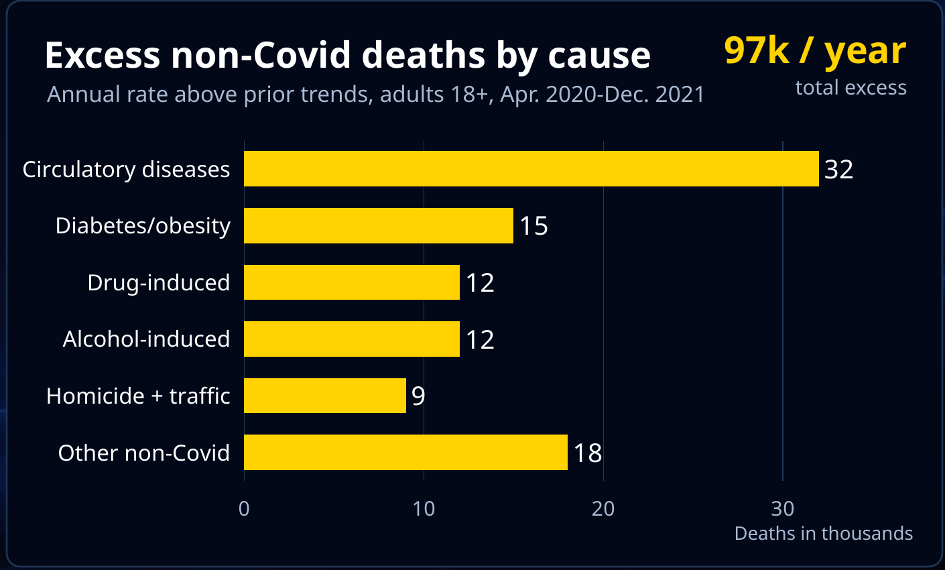
Figure 1. Excess non-COVID deaths by cause, annual rate above prior trends, adults 18+, April 2020 December 2021. Source: Mulligan and Arnott (2022), using CDC WONDER death certificates.
The alcohol pattern is informative because the 2020 increase was especially concentrated in deaths from liver disease. Liver disease does not appear overnight. Instead, many vulnerable people had been managing alcohol-related risk in their own imperfect ways. Disruptions to work, school, social life, treatment, and family routines weakened those self-management systems. The patient-capability test is therefore straightforward: does policy expand patient knowledge, choice, and ability to act, or does it break the tools patients and families use to produce health?
3. Household care infrastructure and patient time
Unpaid care is often described as informal, but that word can understate its economic importance. It includes meal preparation, medication management, fall prevention, transportation, monitoring, appointment scheduling, and the adult child who calls the doctor because a parent is too proud, sick, confused, or overwhelmed to do it.
ASPE estimates the economic value of unpaid long-term services and supports after age 50. Among people born from 1956 to 1960, 68 percent receive unpaid care after age 50. The average lifetime value of unpaid care, including people who receive none, is about $107,000. Among those who receive unpaid care, roughly one in four receive at least $250,000 worth of it.[4] Those magnitudes are too large to be a footnote. They imply that the household and family network are part of the health-care infrastructure.
The family network also shapes the productivity of formal care. A spouse or family caregiver can be the missing input between a diagnosis and an outcome. Marriage and family networks affect who notices deterioration, who manages transportation, who catches medication errors, and who can act when a patient cannot. Health policy that treats patients as isolated consumers at the end of a medical assembly line will miss these inputs.
Measured health spending misses another large input: patient and caregiver time. When Medicare pays a claim, the payment is visible. When a hospital hires a nurse, the wage is visible. When a drug is purchased, the price is visible. But when a patient spends hours traveling, waiting, coordinating, and recovering, that cost is often invisible to the accounting system.
Older adults in traditional Medicare average 20.7 health-care contact days per year, and more than 11 percent have 50 or more contact days. For the average older Medicare beneficiary, roughly three weeks of the year involve getting care outside the home.[5] Another estimate translates outpatient visits into workweeks: travel, waiting, care, and companion time for outpatient visits amount to about 207 million 40-hour workweeks per year for patients and companions.[6] Nearly 40 percent of outpatient visits include a companion, and the companion is usually family.
These figures show that formal care depends on informal labor. Transportation is an input. Scheduling is an input. Waiting time is a cost. Cognitive and emotional support are inputs. If policy makes those inputs less productive, care becomes more expensive even if claims and premiums do not immediately show the cost.
4. AI and wearables as patient capital
Artificial intelligence and wearables are new forms of patient capital. Patients already use AI tools to learn about symptoms, summarize medical information, understand test results, prepare for visits, and ask better questions of providers. The relevant policy question is not whether patients will use such tools; it is how policy can clarify regulations without locking patients out of useful inputs.
A KFF survey found that 32 percent of U.S. adults had used AI chatbots for health information in the prior year. Among those users, 65 percent cited quick or immediate advice as a major reason, and 41 percent had uploaded personal medical information.[7] That behavior is not hypothetical adoption. It is current patient production activity, with real promise and real policy questions.
Wearables and home monitoring extend the same logic from information to continuous observation and feedback. NHLBI summarized evidence showing that almost one in three Americans uses a wearable device to track health or fitness.[8] However, there remains a significant gap among the patients who could benefit most. A JAMA Network Open study found that fewer than one in four adults with or at risk for cardiovascular disease used wearables, even though this group could plausibly benefit from monitoring, feedback, and earlier recognition of changes.[9] The opportunity is to increase patient capability and clinical productivity while clarifying rules without locking patients out of useful tools.
5. Public health as information infrastructure
Public-health knowledge has characteristics of a public good. Government can help acquire, standardize, validate, and disseminate such knowledge. But the goal is not to substitute a national narrative for decentralized judgment. It is to improve the information infrastructure so that patients, physicians, states, firms, schools, and families can act more productively on evidence.
An information-infrastructure approach to public health can be summarized in three words: measure, disclose, and decentralize. Measurement means surveillance, research, standards, and data quality. Disclosure means open data, visible uncertainty, and visible disagreement. Decentralization means allowing patients, physicians, and institutions of civil society to act on information using knowledge of local circumstances that no federal bureaucracy can ever fully possess.
The danger is that public health can become the opposite. When an agency hides uncertainty, suppresses disagreement, or makes one interpretation the national default, it reduces the productivity of patients and physicians. The policy screen is whether a rule increases the supply of information or controls who may use it.
6. Expanding clinical supply
After patients, families, and information, the next input is the professional workforce. Physicians, nurses, technicians, pharmacists, therapists, and support staff are visible suppliers because they are paid and appear in workforce statistics. But the question is still not only how many clinicians exist. It is how much usable, patient-facing clinical capacity the system produces.
That capacity has several margins. One is inflow: medical, nursing, and allied-health training slots, plus the speed and reliability with which trainees move into clinical practice. Another is permission to practice: licensure, scope-of-practice rules, supervision requirements, interstate practice, and credentialing. A trained person is not the same as a person legally and practically allowed to use that training. A third margin is administrative relief. If a physician, nurse, or technician spends more time documenting, coding, or satisfying billing rules, the system has consumed clinical capacity rather than expanded it.
One signal of this capacity problem is primary-care physicians per Medicare enrollee relative to 2000. By 2023 the measure was about 26 percent below the 2000 level, while the Medicare population had grown. Figure 2 displays the trend.
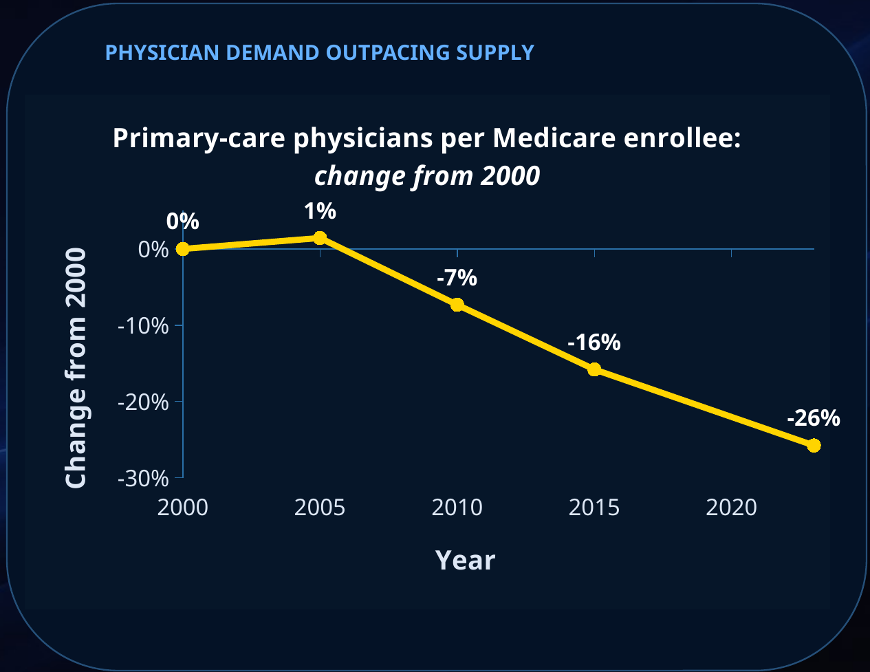
Figure 2. Primary-care physicians per Medicare enrollee, change from 2000. Sources: CDC/NCHS Health, United States (Table 85); AMA Physician Masterfile; HRSA workforce statistics; CMS Medicare enrollment data.
Policy would therefore expand training pipelines where bottlenecks exist, make scope and licensing rules sensible, reduce unnecessary credentialing barriers, and use AI and administrative simplification to move trained professionals back toward patients. The central test is whether a rule adds usable clinical capacity or consumes it.
Clinicians do not appear in the market as disembodied labor hours. They work within practices, groups, hospitals, health systems, clinics, and other organizations. Health-care supply is therefore not only labor supply. It is also ownership, entry, scale, and organization.
The organizational shift is large. In 2002, physician practices with fewer than 500 employees accounted for about 82 percent of physician-office revenue. By 2022 that share had fallen to about 50 percent. The smallest employer practices, those with fewer than 20 employees, fell from about 40 percent of revenue to about 18 percent.[10] Figure 3 shows the transition toward large systems.
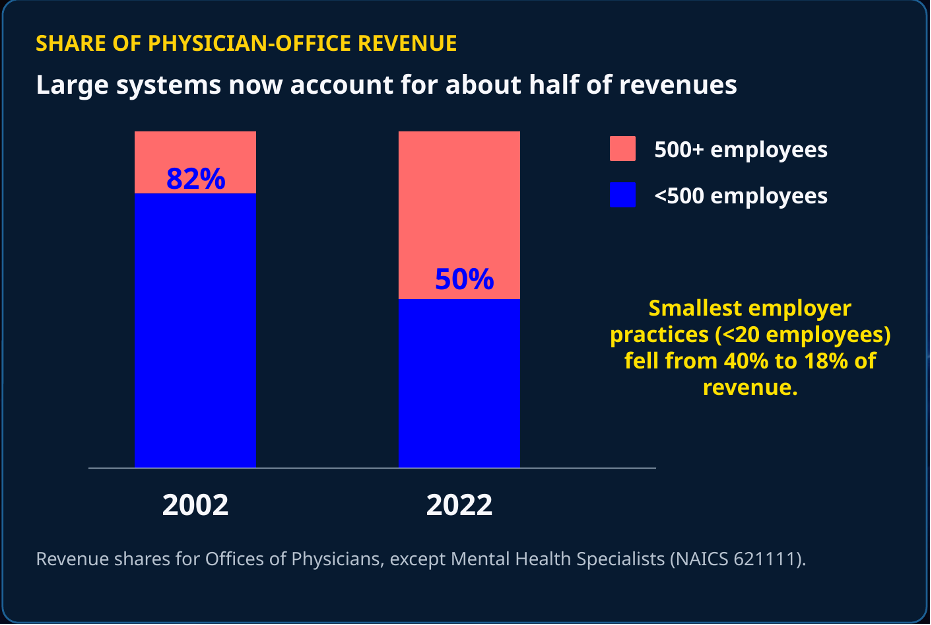
Figure 3. Share of physician-office revenue by employer size, Offices of Physicians, Except Mental Health Specialists (NAICS 621111), 2002 and 2022. Source: SBA Office of Advocacy.[11]
The point is not that every large system is inefficient or that every small practice is efficient. Some scale and integration can improve care. The point is that policy should not force scale by making small practice impossible. A small practice does not have the same billing department, compliance staff, legal team, or IT infrastructure as a large health system. Uniform regulation is not uniform in economic effect.
One-size-fits-all rules can impose unnecessary burdens when they fail to recognize differences in scale and resources. Such burdens can harm competition, discourage innovation, restrict productivity, create entry barriers, and deter entrepreneurs. In physician practice, those effects can alter the structure of supply, reduce entry, and limit local experimentation.
7. Innovation, Prices, and Centralized Forecasts
Health-care productivity gains often come from moving care to a better site, improving scheduling, using telehealth, monitoring at home, changing staffing, or allowing ambulatory and retail models to compete. These are not side issues. They are ways to expand effective supply without necessarily increasing the number of hospital beds or clinicians.
For a clinically appropriate service, the best setting may be a hospital outpatient department, an ambulatory surgical center, a physician office, an urgent-care clinic, a retail clinic, a telehealth visit, or a home-monitoring model. The question is whether rules allow the right model to compete for the right service. Barriers such as certificate-of-need laws, site-specific payment rules, incumbent protection, and one-size compliance burdens can protect existing settings rather than improve health.
Future care must also be produced before it can be covered. A payer cannot cover a treatment, diagnostic, process, or care model that no one has been allowed to create, test, organize, scale, code, train around, and deliver. Innovation therefore includes organizational innovation, process innovation, and product or clinical innovation. Regulation can either leave room for beneficial products and processes to emerge or freeze the status quo before tomorrow s care exists.
Payment policy enters the analysis because prices are not only transfers. They are signals. They tell suppliers whether to enter, expand, invest, open a new site, adopt a new tool, run a trial, or develop a future treatment. Payment rules therefore become production rules.
A lower price produced through competition is a supply-side achievement. It means entry, productivity, innovation, lower-cost sites, or better organization have reduced the real resources required to deliver care. A lower price imposed by command is different. It can reduce the posted price while making supply less attractive, which can lead to exit, shortages, delayed innovation, quality tradeoffs, or budget-window savings that reappear later as less care or less innovation.
This distinction matters because many health-care price controls are largely invisible to patients. DRG rates, CPT-based physician fee schedules, Part B reimbursement, and IRA drug price controls do more than move money among payers and providers. They shape capacity, sites of care, investment decisions, quality, and the future supply of treatments. Affordability requires lower real resource costs, not merely lower displayed prices.
The danger of centralized supply control is that one forecast can become a national rule. Geoffrey Hinton is a useful example precisely because he is not a straw man. He is one of the central figures in modern artificial intelligence and later shared the 2024 Nobel Prize in Physics for foundational discoveries and inventions that enabled machine learning with artificial neural networks.[12]
In 2016, Hinton argued that deep learning would soon do better than radiologists and, in a widely circulated formulation, that people should stop training radiologists.[13] The forecast was plausible and came from a brilliant expert. But radiologist demand did not collapse. Imaging volume increased, radiology residency positions increased, and AI often complemented rather than replaced radiologists. Figure 4 displays the contrast between the forecast and what happened.
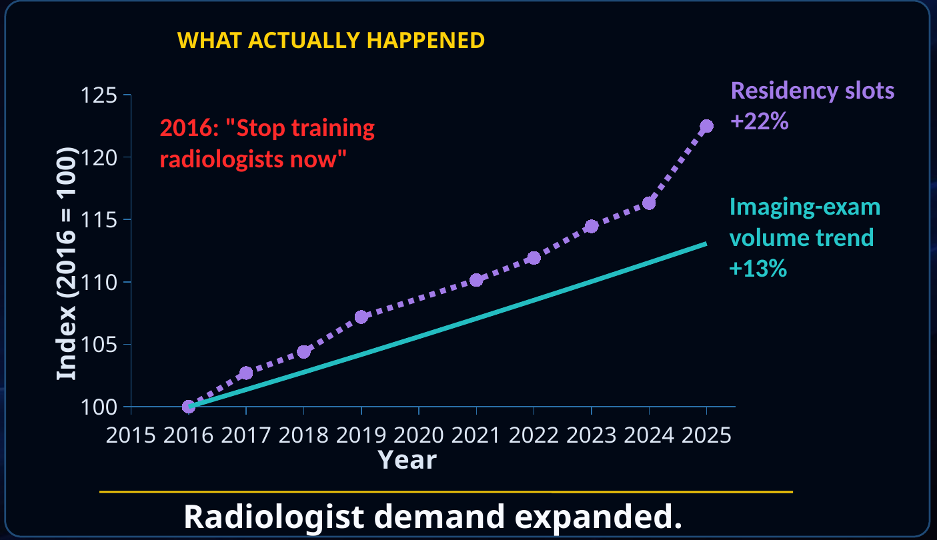
Figure 4. Radiology demand and training after the 2016 stop training radiologists forecast. Sources: NobelPrize.org; Malhotra et al. (2026), Table 1; author s calculations.[14],[15] ,[16]
The lesson is not that experts are bad. The lesson is that even brilliant experts can be wrong about where markets are headed. If one mistaken forecast becomes a national workforce rule, coverage rule, or payment rule, the error scales throughout the supply chain. A monopsony payer does not merely pay bills; it can convert a forecast into a capacity signal for the whole system.
8. Competition is discovery
Competition is not merely a way to lower prices. Competition is discovery. It is how a health system finds out which staffing models, care sites, AI tools, payment designs, and regulatory approaches actually work. That is why institutional flexibility matters: innovation needs room for suppliers of different sizes to enter, care models to compete, and rival forecasts to be tested.
In a competitive system, bad forecasts remain local. One hospital can be wrong. One insurer can be wrong. One medical school can be wrong. One state can be wrong. Others can try something else. Prices and entry reveal bottlenecks. Patients and providers can move. Firms can imitate what works and avoid what fails.
With a centralized payer, bad forecasts scale nationally. A single payment rule can become a workforce rule. A coverage rule can become a technology rule. A price rule can freeze assumptions. That is the knowledge problem in healthcare. Single payer sounds like a financing reform, but single means one: one price schedule, one coverage standard, one political process, and one national default.
This is not an argument that every private actor is wise or every public actor is foolish. It is an argument about error correction. In healthcare, innovation requires entry, experimentation, failure, learning, and scale. The policy screen is therefore simple: expand productive inputs, information, and entry, and avoid making one forecast the national default.
9. Beyond coverage: a policy test
A policy supports health when it expands productive supply. That means patient and family capability: information, data access, self-management, caregiver capacity, and the flexibility to act on local knowledge. It means clinician capacity: training, scope, team-based care, interstate practice, and less administrative drag. It means entry and business innovation: new sites, logistics, telehealth, home care, retail models, and other organizational improvements. It means medical innovation: drugs, devices, diagnostics, procedures, AI, and off-patent knowledge. It means public information and trust: open data, transparent uncertainty, and visible disagreement. And it means competitive discovery: multiple approaches, price signals, entry, and federalism.
A policy undermines health production when it suppresses information, blocks entry, freezes prices without regard to supply response, or substitutes centralized control for local knowledge. Affordability fits the same test. There are two ways to make health care look affordable. One is to ration demand: restrict access, narrow choices, delay care, or hide costs in waiting time and bureaucracy. That is just an appearance of affordability. The other way is to increase supply: more capacity, more competition, better technology, and more productive patients.
The central distinction is simple but important: health is not the same as health care, and health care is not the same as health insurance. Insurance matters, but insurance is not the endpoint. The endpoint is better health, at lower cost, with more control in the hands of patients and families. The way forward is not to centralize the bill; it is to unleash the people who produce health.
*This content is in the process of Section 508 review. If you need immediate assistance accessing this content, please submit a request to Scott Smith, Scott.Smith@hhs.gov. Content will be updated pending the outcome of the Section 508 review.
REFERENCE
[1] Romadlon, D. S.; Wandai, M.; Igarashi, A.; et al. Comparative Effects of Diabetes Self-Management Programs on Type 2 Diabetes Clinical Outcomes: A Systematic Review and Network Meta-Analysis. Diabetes/Metabolism Research and Reviews, 2024. DOI: 10.1002/dmrr.3840. https://onlinelibrary.wiley.com/doi/abs/10.1002/dmrr.3840
[2] World Health Organization. Adherence to Long-Term Therapies: Evidence for Action. Geneva: World Health Organization, 2003. https://iris.who.int/handle/10665/42682
[3] Fischer, M. A.; Stedman, M. R.; Lii, J.; et al. Primary Medication Non-Adherence: Analysis of 195,930 Electronic Prescriptions. Journal of General Internal Medicine 25, no. 4 (2010): 284 290. DOI: 10.1007/s11606-010-1253-9. https://doi.org/10.1007/s11606-010-1253-9
[4] Favreault, Melissa; Johnson, Richard W.; Dey, Judith; Marton, Bill; Lamont, Hilary; and Anderson, Wayne. The Economic Value of Unpaid Care Provided to Older Adults Who Need Long-Term Services and Supports. ASPE Issue Brief, December 2023. https://www.ncbi.nlm.nih.gov/books/NBK606642/
[5] Ganguli, Ishani; Lupo, Chloe; Mainor, Alexander J.; et al. Health Care Contact Days Among Older Adults in Traditional Medicare: A Cross-Sectional Study. Annals of Internal Medicine 177, no. 2 (2024): 125 133. DOI: 10.7326/M23-2331. https://pmc.ncbi.nlm.nih.gov/articles/PMC10923005/
[6] Russell, Louise B.; Ibuka, Yoko; and Carr, Deborah. How Much Time Do Patients Spend on Outpatient Visits? The American Time Use Survey. The Patient 1, no. 3 (2008): 211 222. DOI: 10.2165/1312067-200801030-00008. https://pubmed.ncbi.nlm.nih.gov/22272927/
[7] Montero, Alex; Montalvo III, Julian; Kearney, Audrey; Valdes, Isabelle; Kirzinger, Ashley; and Hamel, Liz. KFF Tracking Poll on Health Information and Trust: Use of AI For Health Information and Advice. KFF, March 25, 2026. https://www.kff.org/public-opinion/kff-tracking-poll-on-health-informat…
[8] National Heart, Lung, and Blood Institute. Study Reveals Wearable Device Trends Among U.S. Adults. News release, June 9, 2023. https://www.nhlbi.nih.gov/news/2023/study-reveals-wearable-device-trend…
[9] Dhingra, Lovedeep S.; Aminorroaya, Arya; Oikonomou, Evangelos K.; et al. Use of Wearable Devices in Individuals With or at Risk for Cardiovascular Disease in the US, 2019 to 2020. JAMA Network Open 6, no. 6 (2023): e2316634. DOI: 10.1001/jamanetworkopen.2023.16634. https://doi.org/10.1001/jamanetworkopen.2023.16634
[10] U.S. Small Business Administration Office of Advocacy. Physician-office revenue shares for Offices of Physicians, Except Mental Health Specialists (NAICS 621111), 2002 and 2022.
[11] U.S. Small Business Administration Office of Advocacy. Physician-office revenue shares for Offices of Physicians, Except Mental Health Specialists (NAICS 621111), 2002 and 2022.
[12] Nobel Prize Outreach. The Nobel Prize in Physics 2024. Summary of the prize awarded to John J. Hopfield and Geoffrey E. Hinton for foundational discoveries and inventions enabling machine learning with artificial neural networks. https://www.nobelprize.org/prizes/physics/2024/summary/
[13] Gans, Joshua. Radiologists Are the Canaries in the Coal Mine. Substack, citing Geoffrey Hinton s 2016 forecast regarding deep learning and radiologists. https://joshuagans.substack.com/p/radiologists-are-the-canaries-in
[14] Gans, Joshua. Radiologists Are the Canaries in the Coal Mine. Substack, citing Geoffrey Hinton s 2016 forecast regarding deep learning and radiologists. https://joshuagans.substack.com/p/radiologists-are-the-canaries-in
[15] Nobel Prize Outreach. The Nobel Prize in Physics 2024. Summary of the prize awarded to John J. Hopfield and Geoffrey E. Hinton for foundational discoveries and inventions enabling machine learning with artificial neural networks. https://www.nobelprize.org/prizes/physics/2024/summary/
[16] The residency-slot series uses radiology positions offered, including diagnostic radiology and interventional radiology, reported in Malhotra et al. (2026), Table 1, citing the National Resident Matching Program, Results and Data: Main Residency Match, as the original source. Imaging-volume trend is an author-estimated trend line using quarterly exams-read data reported in Zamani et al. (2026), Table 2. It is based on ACR General Radiography Improvement Database submissions from 167 radiology practices from December 1, 2017 through February 29, 2024 but omitting pandemic observations. Full citations: Malhotra A, Kandala K, Futela D, Payabvash S, Lakhani DA, Gandhi D, Whitlow C, Duszak R. The Evolving US Radiologist Pipeline: Trends in Residency Positions, Resident Workforce, and Practicing Radiologists per Unit Population. Journal of the American College of Radiology. 2026. doi:10.1016/j.jacr.2026.04.005; Zamani H, Fruscello T, Burleson J, Bhargavan-Chatfield M, Davenport MS. US Radiology Imaging and Workforce Volumes 2017-2024: An Analysis of 46.4 Million Imaging Examinations From 167 Radiology Facilities. Journal of the American College of Radiology. 2026;23(6):1041-1048. doi:10.1016/j.jacr.2025.12.026.