


Authors:
Irma Perez-Johnson and Alan M. Hershey
Prepared under Contract 100-98-009 with the
U.S. Department of Health and Human Services
by
Mathematica Policy Research, Inc.
P.O. Box 2393
Princeton, NJ 08543-2393
(609) 799-3535
www.mathematica-mpr.com
| Project Officer: Alana Landey | Project Director: Alan M. Hershey |
ACKNOWLEDGMENTS
This report responds to a congressional mandate for rapid findings on early WtW program implementation from the National Evaluation of the Welfare-to-Work Grants Program. Meeting this mandate would not have been possible without the diligent work of a large cast of individuals at Mathematica Policy Research, Inc. (MPR) and its partner organizations. The authors wish to acknowledge their invaluable contributions.
At MPR, we are thankful to Todd Ensor for his key role in designing and pretesting the WtW grantee survey instrument. Sedhou Ranganathan assembled the respondent sample and tracking database. Shawn Marsh and Todd Ensor conducted the survey, with oversight from Rita Stapulonis, the survey director for the overall evaluation. Their challenging assignment entailed coordinating the printing and mailing of survey instruments, tracking the sample (especially nonrespondents) to achieve the desired response rate, answering respondent questions, overseeing quality assurance procedures, and creating a research data set all over a period of about three months. A team of dedicated quality control staff reviewed responses and diligently contacted grantees when necessary to clarify ambiguities or contradictions. Dina Kirschenbaum carefully and efficiently completed the programming that supported the analysis, and Alison Stieglitz prepared many of the tables. Patricia Ciaccio provided creative but careful editing. Jennifer Baskwell and others among MPR's secretarial staff did a superb word processing and production job, as usual.
We are also grateful to Walter Corson and Tom Fraker at MPR; Demetra Nightingale, Nancy Pindus, and Terri Thompson at the Urban Institute, and Walter Hillabrant at Support Services International, Inc., for their insightful comments as reviewers of the draft document.
We received valuable support from the U.S. Department of Health and Human Services and the U.S. Department of Labor. Alana Landey, the project officer in the USDHHS Office of the Assistant Secretary for Planning and Evaluation, has given consistently useful advice and guidance. Staff from the USDOL Welfare-to-Work Office in the Employment and Training Administration, in particular Cheryl Turner, have provided important information about the policy framework in which the welfare-to-work programs operate.
We are also indebted to the hundreds of busy managers and administrators who gave generously of their time and provided information on their WtW programs. We appreciate their contributions, as well as those of others we may have omitted unintentionally.
INTRODUCTION
Recent federal policy actions have supported increased efforts to move welfare recipients and other lowВincome Americans into sustained employment.В In 1996, Congress enacted and the President signed into law the Personal Responsibility and Work Opportunity Reconciliation Act (PRWORA), which creates a workВfocused, timeВlimited Temporary Assistance for Needy Families (TANF) program.В In 1997, the Balanced Budget Act (BBA) authorized the U.S. Department of Labor (DOL) to distribute $3 billion in welfareВtoВwork (WtW) grants to states and local communities to promote job opportunities and employment preparation and retention for the hardestВtoВemploy recipients of TANF and for certain noncustodial parents of their children.В The law also instructed the U.S. Department of Health and Human Services (DHHS) to evaluate the implementation and effectiveness of these WtW initiatives.
This report responds to a congressional mandate for rapid findings on WtW program implementation.В Although the evaluation will extend through August 2002, early responses to a survey of grantees conducted at the end of 1998 provide an outline of federally funded WtW programs and their initial startВup experiences.1В The preliminary findings from this survey are displayed in the "Summary of Early Findings" table.
The rest of this report contains six sections.В Section A presents the policy background for the evaluation and its overall design.В Sections B through F then address five basic questions about the early implementation experience of WtW grantees:
- What organizations and resources are involved in the WtW grants program? Who are the grantees? Where are they? How large are the WtW programs? What other resources are being drawn on for WtW programs? (Section B)
- Whom do the federally funded WtW programs serve? How many participants are they likely to serve? To what extent do the programs target certain eligible groups? What are the demographic characteristics of the population they will serve? How are they recruiting participants? (Section C)
- What services do WtW programs provide? What services and employmentВrelated activities are most common? (Section D)
- What early progress is being made in WtW program implementation? To what extent have grantees begun delivering services? How many people have been served? (Section E)
- What issues have emerged in early implementation? What concerns do grantees have about the program as a whole? How might it be improved? How will later stages of the evaluation address important issues? (Section F)
|
Summary of Early Findings from the Evaluation of the WelfareВtoВWork Grants Program
|
|---|
|
|
|
FOOTNOTES
1. We use the word "grantees" to refer to local organizations that are either receiving competitive grants directly from DOL or receiving formula funds through their state.
2. In its proposal to reauthorize the WtW program, the Administration addresses this issue by advocating that eligibility criteria be changed to allow WtW services to reach more people with the kinds of difficult employment problems that the program is designed to overcome.
A. BACKGROUND AND DESIGN OF THE EVALUATION
The National Evaluation of the WelfareВtoВWork Grants Program is beginning just as grantees are starting to put WtW resources to use.В It is thus appropriate to start this first report with a brief summary of the policy changes and the grants program that have led to this evaluation, as well as the evaluation's objectives and design.
Policy and Economic Context for the WtW Evaluation
The policy and economic environment affecting welfare recipients is now dramatically different than it was before Congress enacted the PRWORA and the BBA. The purposes of and organizational responsibility for income support programs have been redefined. TANF programs must not only provide income support, but also help recipients make a transition to lasting employment. The BBA also places a share of responsibility for that objective with workforce development agencies. Meanwhile, the strong economy has combined with the cumulative effects of earlier state welfare reforms and the more recent federal policy changes to reduce welfare rolls dramatically, leaving a much smaller caseload than that of a few years ago.
Shift from LongTerm to Limited Financial Assistance. The Aid to Families with Dependent Children (AFDC) program provided cash assistance indefinitely, and the Job Opportunities and Basic Skills (JOBS) program created for AFDC recipients by the Family Support Act of 1988 allowed (and, in some states, encouraged) recipients to participate in longterm education and training as a way to prepare for employment. In contrast, TANF provides shortterm, workoriented assistance, while giving states considerable flexibility in designing programs and setting policies. TANF recipients are required to work once they are jobready or have received assistance for 24 months, and most families can receive federally funded TANF for a total of only 60 months during their lifetime. To ensure that state TANF programs emphasize work, Congress mandated through PRWORA that states meet steadily increasing requirements for the percentage of their TANF caseload that is in employmentrelated activities.
As a result of time limits and the increased emphasis on work, most TANF programs stress job search assistance and encourage or require recipients to find jobs as quickly as possible, rather than encouraging extended education and training as preparation for employment. Many states, as allowed, reinforce work requirements by having even more stringent penalties for noncompliance and shorter lifetime limits than the levels prescribed in the PRWORA. Most states also reinforce work requirements by shifting to more generous earned income disregards and assistance with child care and transportation expenses than they provided under the AFDC program.
Organizational Separation of TANF and WtW. Congressional action creating TANF and WtW has created two distinct structures for program responsibility and funding. Under the PRWORA, states were given greater discretion and flexibility to run their welfare programs. The legislation provides the 50 states and the District of Columbia with a total of about $16.5 billion annually as a block grant from DHHS through fiscal year 2002. The legislation establishes a broad policy framework for state and local programs. However, it transfers to the states much of the decisionmaking authority that the federal government previously held over the AFDC program. The states may spend these resources on a combination of financial assistance and employment or support services of their own design, although they still must meet several federally defined goals and requirements.
The WtW initiative is different from TANF in several respects. It was created to give states and localities additional resources to help the hardesttoemploy segments of the TANF population, including the noncustodial parents of children on TANF. Funding allocation formulas favor areas with the greatest need by incorporating measures of the concentration of poverty and benefit receipt. Its administrative structure is separate from that of TANF; whereas TANF is operated by human services agencies, primary responsibility for WtW rests with DOL at the federal level and its state counterparts. WtW funds can be used not only to promote job entry, but retention and advancement.
WtW programs are also meant to be designed and operated primarily at the local level. Seventyfive percent of the federal WtW funds are allocated to states based on a formula that considers states' shares of the national poverty population and TANF caseload. States must in turn pass 85 percent of the funding they receive to local private industry councils (PICs) or workforce development boards (WDBs).1 PICs and other groups working with them can also receive separate competitive grants directly from DOL.
Heavy Emphasis on Employment for the Most Disadvantaged. WtW programs as defined in the BBA are intended to complement the "work first" programs established under TANF. The WtW initiative was developed to help states and localities focus on helping the most disadvantaged segment of the TANF population move into the labor market. To ensure that grantees target use of their WtW resources as intended, the legislation established specific spending rules, requiring that 70 percent of grant funds be spent on (1) longterm TANF recipients or recipients within a year of reaching a TANF time limit, who also have two of three specific problems affecting employment prospects; or (2) noncustodial parents of children in a longterm TANF case, who themselves face two of the three specified problems.2
Decline in Welfare Caseloads. From January 1994 to September 1998, the number of families receiving AFDC (and then TANF) declined by 43 percent, from 5.05 million to 2.90 million (U.S. Department of Health and Human Services 1999).3 This sharp decline can have several possible implications for implementation of the WtW programs. First, it leaves many states with TANF funds that, when added to their state spending, allow increased spending on services that promote employment. Second, to the extent that the decline in caseloads results from the strong national economy and job market, it suggests that the environment in which WtW programs are beginning their operations is conducive to success. Meanwhile, states must still meet the federal TANF requirement that 50 percent of the cases must be working or in work activities. As caseloads decline, the remaining TANF recipients may be those most unprepared for or resistant to sustained employment. How these simultaneous effects and implications of caseload decline affect the operation and success of WtW programs will be an important issue for the evaluation as it continues.
Objectives and Design of the Evaluation
Under the BBA, Congress requires DHHS, in collaboration with DOL, to evaluate the effectiveness of WtW initiatives. The evaluation is being conducted by Mathematica Policy Research, Inc., with assistance from two subcontractors, the Urban Institute and Support Services International, Inc. The evaluation will address five key questions:
- What are the types and packages of services WtW grantees provide?
- How do they compare to services already available under TANF or Job Training Partnership Act (JTPA) funding?What are the net impacts of various WtW program approaches on employment and on families' wellbeing?
- What challenges do grantees confront as they implement and operate WtW programs?
- Do the benefits of WtW programs outweigh their costs?
- How well do PICs and other nonTANF organizations the primary vehicles for funding and operating WtW programs meet the challenge of implementing WtW programs for those hardest to employ?
To address these questions, the evaluation plan includes three main components:
- Descriptive Assessment of All WtW Grantees. A mail survey of all formula and competitive grantees, in 1998 and 1999, will provide a comprehensive overview of program designs and activities offered, target populations, characteristics of participants, and, to the extent available, placement outcomes. Site visits will be made to a selected group of grantees to develop a fuller understanding of program variations and to aid in selection of sites for indepth studies. This report is based on responses to the first of the two grantee surveys. Findings from the second survey will be reported in early 2000.
- In-Depth Impact and CostEffectiveness Study. In 8 to 10 sites that agree to participate, rigorous studies using randomassignment designs will be conducted from 1999 to 2001 to determine what difference WtW programs make in employment and family wellbeing outcomes.4 Where the number of people eligible for the program exceeds WtW program capacity, they will be assigned to a program group or a control group. Comparing outcomes for the two groups will yield estimates of program impact and help identify successful program models. Comparisons will also be made between the net benefits of these impacts and the additional costs of delivering program services. Findings on program impacts will be reported in fall 2000 and again in 2002.
- In-Depth Process and Implementation Study. In 1999 and 2000, site visits will be conducted in 12 to 15 grantee sites, including impact evaluation sites and several others where impact analysis may not be possible but that are of interest for other reasons, including their innovative approaches, settings, or target groups. These visits will include discussions with staff of WtW programs and related agencies, focus groups with participants, and program observation. The study will identify implementation issues and challenges, as well as program details that help explain how programs achieve desired impacts. A report on program implementation is scheduled to be issued in late 1999.
In addition to these three core components, a special process and implementation study will focus on documenting tribal welfare and employment systems, the supportive services they provide, and how tribes integrate funds from various sources to move their members from welfare to work. Under the BBA, Congress also authorized grants to American Indian tribes and mandated that their programs be evaluated. This component of the evaluation will focus on implementation experiences in 10 sites, selected to include those with innovative designs and practices, signs of some success, and variation in location, size, and local labor market and economic conditions. Findings from the tribal program evaluation will be reported in fall 2000.
In the rest of this report, we present findings from the first grantee survey. The survey was mailed in early November 1998 to 598 actual and potential WtW grantees. Actual grantees included the 51 organizations that had received competitive grants directly from DOL in its first round of awards in May 1998. Potential grantees were mostly Service Delivery Agencies (SDAs) eligible for receiving an allocation of their state's formulabased WtW grant; 18 of these organizations had received competitive grants.5
The analysis presented is based on 415 responses provided by WtW grantee organizations. Responses were received from 422 of the 598 organizations included in the sample, for an overall response rate of 70.6 percent. However, three organizations were excluded from the analysis because they reported that they had refused their substate allocation of federal WtW formula funds. The responses for the remaining 4 organizations excluded from the analysis were received too late to be processed for inclusion in this report. Response rates by state, by type of grant, and overall are presented in the appendix.
The grantee survey data presented in this report are also complemented with information gathered through less formal discussions with grantees. Such discussions occurred as grantees called with questions about the survey and as evaluation staff pursued with interested grantees the possibility of their participation in the indepth component of the national evaluation.
The 415 respondents were generally similar, in organization type and sources of WtW funding, to the overall sample of 598 organizations to whom the survey was mailed (Table A.1). However, organizations that received competitive grants responded at a somewhat higher rate (78 percent) than the SDAs that account for almost all formula grantees (70 percent). As a result, organizations that received only formula grants comprised 91.5 percent of the overall survey sample, but 88.2 percent of grantee responses. In contrast, competitive grantees (including those that also received formula funds) made up 8.5 percent of the sample and 11.8 percent of grantee responses (Table A.1). Survey respondents were also similar in their levels of funding to nonrespondents although nonrespondents were more likely to be organizations with smaller WtW grants (Table A.2). We estimate that survey respondents account for 74.9 percent of the WtW funds awarded to the sample as a whole (not shown in table).
The design of the survey anticipated that many grantees would have little actual implementation experience to report on, and this expectation proved to be warranted. Many of the survey questions were designed to allow grantees to report on their early experience or their plans and projections, with regard to service strategies and types of services delivered, recruiting approaches and scale of enrollment, and demographic characteristics of the population served. During the survey, many grantees called with reservations about responding because their programs were not under way and, in some cases, even their plans remained uncertain; they were urged to respond with their best projection of where their WtW program was headed. Some grantees knew they would receive WtW funds and were aware of the amount of their substate formula allocation but had not yet actually received their funds. In general, as data presented later indicate, the number of participants enrolled in most WtW programs by the time of the survey was relatively small.
| TABLE A.1
GRANTEE CHARACTERISTICS: OVERALL SURVEY SAMPLE |
||
|---|---|---|
| Overall Survey Samplea (n = 598) |
Survey Respondents (n = 415) |
|
|
Organization Type |
||
| JTPA SDA/PIC | 92.8 | 86.3 |
| Othersb | 7.2 | 13.7 |
| Grant Type(s) Received | ||
| Formula WtW Grant | 91.5 | 88.2c |
| Competitive Grant | 5.2 | 6.5 |
| Formula and Competitive Grants | 3.3 | 5.3d |
| Source: National Evaluation of the WelfaretoWork Grants Program, First Grantee Survey (November 1998February 1999).
a This column presents information that was available on all local substate formula grantees and Round 1 competitive grantees from grantee lists provided by DOL in preparation for the survey. b Other types of grantees include human services agencies, other public agencies, nonprofit communitybased organizations, universities and colleges, and an organization serving people with disabilities. c Includes 75.9 percent of grantees that received formula funding only and 11.6 percent that received formula funding and a share of their state's discretionary funding. Also included are a few grantees (0.7 percent) that reported they had received only a share of the state's discretionary funding; since such grantees were not included in the survey sample, they most likely were expecting to receive substate formula funding but had not yet received the actual funds. d Includes 4.1 percent of grantees that received formula and competitive grants only and an additional 1.2 percent that received these two types and also a share of their state's discretionary funding. |
||
| TABLE A.2
DISTRIBUTION OF SURVEY RESPONDENTS AND NONRESPONDENTS |
||||||||
|---|---|---|---|---|---|---|---|---|
| All Grants | Formula Grants | Competitive Grants | ||||||
| Distribution | Respondents (n=410) |
NonRespondents (n=159) |
Respondents (n=368) |
NonRespondents (n=150) |
Respondents (n=42) |
NonRespondents (n=9) |
||
| Less than $250,000 | 6.8 | 11.3 | 7.6 | 12.0 | 0.0 | 0.0 | ||
| $250,000 to $999,999 | 50.3 | 47.8 | 55.7 | 50.7 | 2.4 | 0.0 | ||
| $1,000,000 to $2,999,999 | 28.5 | 28.3 | 29.1 | 28.6 | 23.8 | 22.2 | ||
| $3,000,000 or more | 14.4 | 12.6 | 7.6 | 8.7 | 73.8 | 77.8 | ||
| Average grant amount | $1,829,890 | $1,581,522 | $1,599,499 | $1,434,891 | $3,848,558 | $4,025,375 | ||
| Source: For formula grants, WelfaretoWork state plans submitted to DOL for FY 1998 (various dates). For competitive grants, grantees' applications to DOL (various dates).
Note: This table classifies grants by funding amount rather than grantees, and the data from state plans on which it drew were incomplete. As a result, the sample size does not match the sample of 598 with which the survey began. Funding information was obtained from state plans and competitive grant applications for a total of 569 grants, but 20 of the grantees received both formula and competitive funding, so 549 grantee organizations are represented in the table. Funding information for the remaining 49 grantees was not available. For four states (Alabama, Georgia, Kentucky, and Washington) substate allocations of formula funding were not available (42 SDAs). For 7 additional SDAs in other states, the formula allocation could not be determined from the state plans. |
||||||||
This first evaluation report must therefore be regarded as a very early look at the nature of the programs that will emerge, the services they will provide, and projections concerning the success they will achieve in moving participants into the workforce. The second survey, in fall 1999, will provide a more complete picture of the WtW grants program. The indepth study component of the evaluation, focusing on the selected 15 sites, will provide deeper insights into the issues confronted in implementing WtW services and their impacts on participants' employment success.
FOOTNOTES
1. Under the Workforce Investment Act of 1998, new workforce investment boards (WIBs) will replace PICs and WDBs, providing in all states a means for coordinating workforce investment, adult education and literacy, and vocational rehabilitation services through OneStop Centers.
2. The three problems specified by the BBA are (1) lack of a high school diploma or general equivalency diploma (GED) and low reading and math skills, (2) substance abuse problems, and (3) a poor work history.
3. U.S. Department of Health and Human Services Home Page. "Change in Welfare Caseloads as of September 1998." January 27, 1999.
4. Outcome measures identified in the legislation include placements in unsubsidized employment (including those lasting six or more months), placements in the private and public sectors, the earnings of individuals who obtain employment, and the average WtW program expenditures per placement. The evaluation will gather evidence on these and other outcomes, including the types of services WtW participants receive and their receipt of TANF benefits.
5. The survey was mailed to JTPA SDAs in all states, except the six that had turned down WtW formula funding (Idaho, Mississippi, Ohio, South Dakota, Utah, and Wyoming). In 12 cases, SDAs were replaced as survey respondents by alternative WtW administrative entities approved under waiver procedures allowed under the law. Only Round 1 competitive grantees were included, but recipients of competitive grants awarded under the second round of funding (in November 1998) and the third round of funding (in September 1999) will be included in the second grantee survey, in fall 1999. The survey was mailed late (in January 1999) to Alaska, because of delays in processing information on the alternative entities substituting for PICs as grantees.
B. ORGANIZATIONS AND RESOURCES SUPPORTING WtW GRANTS PROGRAM
To make a difference in individual lives, the substantial resources Congress has provided for the WtW program must be deployed effectively at the local level.В DOL must distribute the $3 billion in funding to the states and to competitive grantees.В States must distribute at least 85 percent of their formula allocation funds to their substate grantees and decide how to use the 15 percent of their funds over which they have discretion for special projects.В At the local level, both formula and competitive grantees can use funding from other sources to support complementary services to create comprehensive approaches to addressing participants' employment difficulties.В The initial evaluation survey provides a basis for documenting some of the basic features of the grantees and the resources that have so far been deployed.В In this section, information is presented on:
- The types of organizations serving as WtW grantees;
- The timing of funding "rollout" to grantees at the local level and the scale of WtW programs; and
- The extent to which grantees are combining WtW grants with other sources of funding
Private Industry Councils Are, as Planned, the Primary Vehicle for WtW Services
The BBA foresaw that PICs established under the JTPA, or WDBs fulfilling PIC functions, would bear most of the responsibility for delivering WtW services. Given the mandated funding formulas, 64 percent of all funds must go to PICs or designated alternative entities.1 Although six states declined formula funding, we would expect that almost every one of the 577 JTPA SDAs (or a designated alternative agency) in the remaining 48 jurisdictions will be a formula grantee. At the time the survey was initiated, 51 competitive grants had been awarded. PICs also participated in these competitive grants, receiving 18 of the first 51 awarded.
The results in the survey data mirror the pattern foreseeable from the funding process, with PICs accounting for most grantee respondents (Table B.1). Of the 415 responses included in this analysis, 358 were provided by PICs, 18 of which had received Round 1 competitive grants. Almost all formula grantees are PICs; among the 388 respondents that reported receiving formula funds, 33 said they were another type of organization.2 Nonprofit service organizations, including communitybased organizations, account for 19 of the 49 competitive grantees that responded to the survey.
The range of organizations that actually serve WtW program participants, however, will be considerably more diverse than the data on grantee types suggest, because grantees will contract locally with other provider organizations. The BBA and the implementing regulations (20 CFR 645.220) require that postemployment services and services relating to job readiness and job placement be provided through contracts or vouchers. Survey results reflect grantees' plans in accordance with these requirements (and in keeping with PIC practices under JTPA). The 415 survey respondents reported that, in their first year of program operations, they were going to use, on average, 47 percent and 42 percent of their formula and competitive funding, respectively, for contracted services, drawing on a total of 2,376 different providers.
| TABLE B.1
CHARACTERISTICS OF GRANTEE SURVEY RESPONDENTS: |
||||
|---|---|---|---|---|
| Number of Organizations by Grants Received | ||||
| Organization Type | Number of Organizations | Formula Grants Only | Competitive Grants Only | Both Formula and Competitive Grantsa |
| PIC/WDB or Equivalentb | 358 | 337c | 3 | 18 |
| Other Types: | ||||
| Public human services agencies | 8 | 6 | 1 | 1 |
| Other public agencies | 4 | 2 | 2 | 0 |
| Nonprofit service organizations | 24 | 5 | 18 | 1 |
| Other | 21 | 16 | 3 | 2 |
| Total | 415 | 366 | 27 | 22 |
| Source: National Evaluation of the WelfaretoWork Grants Program, First Grantee Survey (November 1998 February 1999).
a Includes 17 organizations that reported having received WtW competitive grants and state formula funds and 5 organizations that also received state 15 percent discretionary funds. b Five PICs reported that they expected to receive formula WtW funds but had not yet been formally notified of their award. Three of these organizations had no other WtW funds, two had 15 percent discretionary funds. c Includes 41 organizations that reported having received both formula WtW funds and state 15 percent discretionary funds. |
||||
Given the Gradual Funding Rollout, Survey Results Provide a Very Early Snapshot
Before funding reached the local organizations actually delivering WtW services, several processes had to be completed at the federal and state levels. States had to submit plans for the use of their formula funds and have them approved by DOL. Some states that received formula funding awards decided to require applications or plans from their PICs before passing on the substate formula funds. DOL had to solicit competitive grant applications, review them, select grantees, and make awards.
As a result, formula and competitive grant funds are reaching states and local grantees gradually, in stages during 1998 and continuing into 1999 (Table B.2). About half of the 48 statelevel grants were awarded in the first six months of 1998, and half in the latter part of the year. Competitive grants are being awarded in three rounds; although two rounds of grants were awarded by November 1998, only the grants awarded in May had been announced in time to be included in the first grantee survey.
| TABLE B.2
TIMING OF WtW GRANTS AWARDED BY THE U.S. DEPARTMENT OF LABOR |
||
|---|---|---|
|
Grant Type/Timing of Awarda |
Number of Grantsb | Total Funding to Date (in Millions) |
| State Formula Grants | 48 | $1,034.2 |
| Awarded JanuaryMarch 1998 | 12 | $222.4 |
| Awarded AprilJune 1998 | 14 | $245.0 |
| Awarded JulySeptember 1998 | 21 | $532.3 |
| Awarded October 1998 | 1 | $34.5 |
| Competitive Grants | 126 | $472.0 |
| Awarded May 1998 (Round 1) | 51 | $199.0 |
| Awarded November 1998 (Round 2) | 75 | $273.0 |
| Target Date September 1999 (Round 3) | -- | -- |
| Total Formula and Competitive Grants as of November 1998 | 174 | $1,506.2 |
| Source: U.S. Department of Labor, Employment and Training Administration.
a Based on date when grant award was announced. b Includes the 44 states that accepted formula funding, the District of Columbia, Puerto Rico, Guam, and the Virgin Islands. |
||
Survey respondents had thus received their WtW grants at various points during 1998, many only shortly before the survey was conducted (Table B.3). States had 30 days to obligate their grant funds to substate grantees, but actual fund transfers could take longer. About 60 percent of substate formula grantees reported receiving their grant notification after midyear, thus reflecting the anticipated lag between states' receipt of their grants and the distribution of allocations to the local level. Moreover, in several states that required local plans, many local grantees reported they had not yet received their actual funds (although they had received notification of the funding allocated to their SDA).
| TABLE B. 3
TIMING OF LOCAL WtW GRANTS REPORTED BY SURVEY RESPONDENTS |
||
|---|---|---|
|
Date of Grant Notification |
Number of Formula Grants | Number of Competitive Grants |
| JanuaryMarch 1998 | 63 | 0 |
| AprilJune 1998 | 86 | 36 |
| JulySeptember 1998 | 190 | 11 |
| OctoberDecember 1998 | 36 | 2 |
| JanuaryFebruary 1999 | 1 | 0 |
| Totala | 376 | 49 |
| Source: National Evaluation of the WelfaretoWork Grants Program, First Grantee Survey (November 1998February 1999).
a The total number of formula grants shown here is slightly less than the 388 (formula and formula/competitive) in Table B.1 because a few grantees did not report the date of their grant notification. |
||
The scale of resources made available to grantees can be expected to vary widely. Competitive grant sizes are diverse because applicants propose services that vary in nature and intensity and propose serving different numbers of participants. Formula grants depend on a formula devised by each state in accordance with guidelines set by the BBA. Each state's formula must take into account the relative number of people living below the poverty line in each SDA, compared to the poverty population in the state as a whole. It may also take into account the SDA's relative share of TANF recipients and unemployed individuals.
| TABLE B. 4
SCALE OF WtW PROGRAMS: GRANT SIZE AND PROJECTED PARTICIPATION |
|||
|---|---|---|---|
| Overall | Formula Grants | Competitive Grants | |
| Average Total Funding per Grantee | $2,235,733 | $1,898,204 | $3,441,700 |
| Distribution of Respondents by Total Funding (Percentages) | |||
| $0 to $99,999 | 1.7 | 1.3 | 2.0 |
| $100,000 to $249,999 | 4.2 | 4.7 | 2.0 |
| $250,000 to $499,999 | 16.5 | 17.6 | 8.2 |
| $500,000 to $999,999 | 27.8 | 32.0 | 2.0 |
| $1,000,000 to $2,999,999 | 33.2 | 33.9 | 24.6 |
| $3,000,000 or more | 16.6 | 10.5 | 61.2 |
| Average Expected Participation | 537 | 464a | 854b |
| Source: National Evaluation of the WelfaretoWork Grants Program, First Grantee Survey (November 1998February 1999).
a Estimate based on expected participation reported by grantees that received formula funds only or formula and discretionary funds. b Estimate based on expected participation reported by grantees that received competitive funds only. |
|||
Grants received to date reflect differences in the funding mechanism for formula and competitive grants (Table B.4). States are adopting different approaches to distributing formula grant funds. Some are passing on to substate grantees their full share of the state's allotment, to be spent over a threeyear period, but some are distributing funds in increments. Formula substate grantees reported an average grant received of $1.90 million, but this figure includes some grants intended to support just a year or less of services and others that will be used over the full three years.3 Competitive grantees, in contrast, have received their entire threeyear grant. Round 1 competitive grants received by survey respondents averaged $3.44 million. Even taking into account the fact that some formula grantees have received only part of their funding, it appears that competitive grantees will operate services for WtW participants on a larger scale.4 Competitive grantees, for example, project serving an average of 854 participants over the full term of their grant, compared to 461 for formula grantees.
Diverse Sources of Other Funds Are Being Tapped to Complement WtW Grants
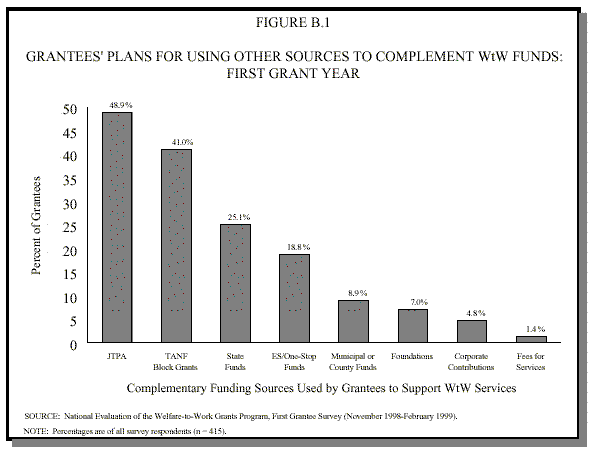
To varying degrees, many of the organizations that have received WtW grants already have experience delivering similar services to lowincome, disadvantaged populations and thus have developed other funding sources to conduct their work. Grantees were asked to identify other funding sources that they expect to draw on, in combination with their WtW grant, to support their overall WtW services. Sixtyfive percent of survey respondents (270 grantees) reported that, during the first grant year, they plan to complement WtW dollars with funds from other sources. JTPA funding and TANF block grants are the most common sources of complementary funding (Figure B.1). PICs can use JTPA funding for WtW participants as long as these participants meet JTPA eligibility criteria, and, in many jurisdictions, PICs have been longstanding providers of services to welfare recipients under contract to human services agencies.5 A smaller proportion of grantees have support for WtW interventions from other state or municipal funds and OneStop Center funds, and a few have support from foundations and private corporations.
FOOTNOTES
1. PICs or designated alternatives would receive 85 percent of the 75 percent of WtW funds that go to states under formula allocations. States can designate alternative entities to administer WtW funds in particular SDAs, under Section 5001(a) of the BBA.
2. Only three of these 33 organizations were among the 11 designated alternative entities included in the survey sample. In other cases, respondents classified themselves as public service agencies, nonprofit groups, or "other" organizations. All of these respondents appear to be the prime contractor for the appropriate JTPA administrative entity.
3. Among survey respondents, 366 of the organizations that received formula grants reported their performance periods. Of these, 66 (or 18.0 percent) reported performance periods of one year or less. Periods of less than one year are most likely defined to extend to the end of the DOL program year in which the grant was awarded.
4. Grantees were also asked to report the amount they would spend from grant funds in the first year of program operations, and those figures also suggest that average funding levels are lower for formula grants ($959,206) than for competitive grants ($1,495,184).
5. All people on TANF are categorically eligible for the JTPA Title II-A Adult Training Program.
C. THE POPULATION TO BE SERVED AND HOW THEY WILL BE RECRUITED
The WtW initiative was created so that states and localities could focus special resources on helping the most disadvantaged recipients of public assistance succeed in the labor market.В The BBA requires that at least 70 percent of all (formula and competitive) grant funds be spent on individuals with a specifically defined combination of employment barriers.В They may be TANF recipients themselves who (1) have been receiving TANF or AFDC for 30 or more months, or are within 12 months of reaching a TANF time limit; and (2) face two of the three specified barriers to employment: lack of a high school diploma or GED certificate and low reading or math skills; substance abuse problems; and a poor work history.В Alternatively, they may be noncustodial parents who face two of the same three barriers and have children who are in a longВterm TANF case.В Up to 30 percent of the funds may be spent on other TANF recipients or noncustodial parents who have characteristics associated with longВterm welfare dependence, such as school dropout, teen pregnancy, or poor work history.В Grantees may, however, exercise some discretion and focus their efforts on particular subgroups within these categories, as long as the overall use of WtW funds meets the 70/30 percent criteria.
Most WtW grantees have experience working with lowВincome disadvantaged Americans, although, in many cases, their experience may not have focused heavily on the hardest to serve who make up the WtW target population.В The JTPA Title IIA services that PICs provide are explicitly designed for a disadvantaged population, and at least some of the people served by most PICs in Title IIA programs have been welfare recipients.1В Moreover, many PICs have been contracted by welfare agencies to run TANF work programs.В However, the welfare recipients many PICs have served in the past have often had to meet minimum criteria for entry to training programs.В It is thus likely that many grantees will face new challenges in their efforts to place the WtW population in employment activities and help them retain their jobs.2
One challenge grantees face, therefore, is to identify, seek out, and enroll participants who meet the eligibility criteria and who present the range of problems the grantees feel they can address successfully, given their experience and the resources they can use.В The early survey data, as well as other currently available information, can help document:
- Whether and how grantees plan to focus their efforts on defined subgroups of the eligible population
- How grantees expect to identify and recruit participants
- The demographic characteristics of projected participants, given grantees' location, traditional clientele, and recruiting approaches
Most Grantees Will Serve the Overall WtW Population Rather than Targeted Subgroups
The BBA gives grantees the latitude to focus their WtW services on subgroups of the eligible WtW population. Grantees might choose to target subgroups for several reasons. The lowincome population in their local area might be facing one particularly severe problem, such as a very high incidence of drug abuse; the grantee might want to focus its outreach and services to deal with that problem (while still accepting individuals who had other problems). Some grantees (particularly some nonPIC competitive grantees) might have more experience dealing with some types of problems than with others. For example, a communitybased organization (CBO) that has run GED programs might only accept individuals who lack a high school credential.
Targeting particular eligible subgroups can be done in several ways. Some grantees (such as the CBO that runs GED programs) might focus their entire WtWfunded program on a defined subgroup. Other grantees might use WtW funds for several programs; one program might seek out certain subgroups (such as noncustodial parents with substance abuse problems), while other programs would serve the overall population that is eligible for WtW services.
Most WtW grantees, however, appear to be preparing to serve the broadly defined population of all those eligible for WtW services. When asked in the survey whether they would use a subset of the criteria set forth in the legislation to prioritize or focus first on eligible individuals with particular characteristics, more than half (56 percent) of grantee respondents answered affirmatively. However, when asked specifically which of 10 possible criteria they would use, about a quarter of even those grantees indicated they would use most or all of the criteria in defining their target populations.3 As a result, about 57 percent of respondents overall indicated they were either not targeting at all or were using at least 8 of the 10 criteria (Table C.1). Among grantees listing any targeting criteria, the most commonly named factors related to the 70 percent eligibility rules (Table C.2). In general, however, we interpret the survey results as suggesting that most WtW programs are seeking to enroll individuals who are eligible under the rules, rather than focusing on individuals with particular characteristics within that overall eligible group.
| TABLE C.1
EXTENT OF TARGETING BY WtW GRANTEES |
||||
|---|---|---|---|---|
| All Survey Respondents (n = 414) |
Grantees with Formula Fundsa (n = 387) |
Grantees with Competitive Funds Only (n = 27) |
||
| Extent of Targeting | Criteria Used | Grantees (Percentages) | ||
| No Targeting or Broad Targeting | 8 or more | 56.8 | 58.4 | 33.3 |
| Modest Targeting | 5 to 7 | 24.6 | 23.5 | 40.8 |
| Narrow Targeting | 1 to 4 | 18.6 | 18.1 | 25.9 |
| Source: National Evaluation of the WelfaretoWork Grants Program, First Grantee Survey (November 1998February 1999).
a Includes all grantees with formula funding. Of the 387 grantees, 17 also had competitive grants, 48 also had 15 percent discretionary funding, and 5 had both other types of funding. The numbers of overall survey respondents and formula grant respondents are lower than in Table B.1 because of item nonresponse. |
||||
Some grantees, however, particularly among competitive grantees, are focusing their programs more narrowly. About 19 percent of survey respondents identified four or fewer targeting criteria for their WtW programs (Table C.1). In its competitive grant announcement, DOL specified that applicants were encouraged to propose service strategies for specific subgroups of the eligible population, as well as innovative service strategies. Competitive grantees, at least those that did not receive formula funding, seem to have adopted more focused targeting approaches.4 Among the grantees that report more tightly defined targeting (using four or fewer criteria), the most common definitions used are noncustodial parents, and recipients of TANF nearing or past their time limit who lack a high school diploma or GED and also have low math or reading skills (Table C.2). Even these targeting strategies reflect a focus on the major groups of eligible individuals defined under the BBA.
| TABLE C.2
PARTICIPANTS TARGETED BY WtW GRANTEES |
||
|---|---|---|
| Percent Using Specific Criterion | ||
| Eligibility Characteristics/Criteria Used | As Percent of Grantees Using Any Targeting Criteriaa | As Percent of Grantees Doing Narrow Targetingb |
| No high school diploma or GED and low math/reading skills | 78.4 | 39.0 |
| Poor work history | 77.6 | 37.7 |
| Substance abuse problems | 64.2 | 23.4 |
| Nearing or past TANF time limit | 65.5 | 39.0 |
| Longterm TANF/AFDC recipients | 75.4 | 33.8 |
| Teenage parents | 31.0 | 7.8 |
| Noncustodial parents | 62.5 | 48.1 |
| Public housing residents | 24.1 | 10.4 |
| People with disabilities | 24.6 | 9.1 |
| School dropouts | 40.1 | 5.2 |
| Source: National Evaluation of the WelfaretoWork Grants Program, First Grantee Survey (November 1998February 1999).
a Percents are of grantees reporting that they will use eligibility criteria set forth in the WtW legislation to prioritize or focus on individuals with particular characteristics. Such organizations represent 56 percent of grantee survey respondents. b Percents are for the subset of grantee organizations that will rely on four or fewer of the WtW eligibility criteria; such organizations represent 19 percent of survey respondents. |
||
Recruitment Will Rely Most Heavily on Referral from TANF Agencies
TANF agencies are expected to be the principal link for referrals and recruitment of WtW participants (Table C.3). Almost all WtW grantees plan to recruit from TANF, and most expect to identify more than half of their clients through TANF referrals. The normal JTPA intake and assessment process will be used as an additional recruiting source for a little more than half of the grantees (this is not surprising, since most WtW grantees are PICs/WDBs).5 However, most grantees expect to recruit relatively small proportions of their WtW participants from JTPA sources.
The emphasis on recruiting from TANF agencies reflects the fact that grantees' WtW programs are one of the ways that TANF recipients can satisfy requirements to participate in an employment activity. Even if they are not explicitly required to participate in a WtW program, many TANF recipients still face substantial pressure to become employed within two years of the time they start receiving TANF. Many states go further, requiring nonexempt recipients to participate in an employment activity immediately, without regard to how much of their two years has passed. In these states, entering a WtW program is one way, but not the only way, for recipients to comply, since they can also find a job independently or, in some sites, participate in an employment activity arranged through some other means than the WtW grantee's program (including the regular TANF work program).
| TABLE C.3
SOURCES OF WtW REFERRAL AND RECRUITMENT |
||||||
|---|---|---|---|---|---|---|
| Grantees Planning to Recruit from These Sourcesa | Estimated Share of Participants to Be Recruited from Each Sourceb | |||||
| 025% | 2650% | 5175% | 76100% | |||
| TANF Agency | 98.0 | 10.9 | 16.4 | 24.3 | 48.4 | |
| JTPA | 58.5 | 94.6 | 3.9 | 0.5 | 1.0 | |
| Courts/Corrections | 37.8 | 97.7 | 2.3 | 0 | 0 | |
| Child Support Enforcement | 54.5 | 95.8 | 3.0 | 0.6 | 0.6 | |
| Grantee's Community Outreach | 48.6 | 88.2 | 8.8 | 2.4 | 0.6 | |
| Other Organizations' Community Outreach | 34.4 | 89.8 | 5.1 | 2.6 | 2.5 | |
| SelfReferral | 45.7 | 99.4 | 0.6 | 0 | 0 | |
| Grantee's Existing Caseload | 37.2 | 83.2 | 7.2 | 6.4 | 3.2 | |
| Source: National Evaluation of the WelfaretoWork Grants Program, First Grantee Survey (November 1998February 1999).
a Based on the 352 grantees that identified their recruiting sources. They represent 85 percent of all responding grantees. b These columns include only grantees that are already or expect to be recruiting from each listed source. |
||||||
Recruiting noncustodial parents presents different challenges from those faced in recruiting TANF recipients and will require different approaches to finding participants. The emphasis on serving noncustodial parents the most common specific targeting criterion among narrowly targeted programs appears to be reflected in the relatively common plan to obtain referrals from the courts and corrections institutions and from the child support enforcement system. More than half of grantee respondents indicated they expect to get referrals from the child support enforcement process, and almost 40 percent of the grantees say they will get referrals from the courts and departments of corrections (Table C.3). However, these sources will account for a small proportion of the participants grantees expect to serve; almost all say they will find fewer than 25 percent of their participants in these ways.6
Expected Characteristics of WtW Participants
The demographic characteristics of the population WtW grantees expect to serve reflect the aims of the program.7 For example, respondents expect most WtW participants to be women between ages 20 and 40, which is consistent with the focus of the program on TANF recipients (Table C.4). Congruent with WtW's eligibility rules and many grantees' efforts to recruit noncustodial parents, men are expected to account for about 20 percent of WtW participants.
Other dimensions of the projected caseload composition may reflect not only the national composition of the potentially eligible TANF population, but also the particular locations of grantee organizations and the traditional roles they have played in their local communities. Overall, the projected caseload across all survey respondents is roughly 52 percent white and 41 percent African American (Table C.4).
As might be expected given the diversity of residential neighborhoods, some grantees will serve populations that are predominantly from one demographic group or another. About 36 percent of responding grantees said they expected more than 70 percent of their WtW clients to be white, and 16 percent expect to serve a predominantly black caseload (not shown in table). Organizations with a predominantly Hispanic or Latino clientele represented less than 10 percent of survey respondents (not shown), although 27 percent of all participants are expected to be Hispanic or Latino.
Although the grantee survey did not ask questions about the urbanicity of WtW target areas or populations, it is clear that most participants will be urban residents. An analysis of the SDAs for WtW grantees that are PICs, WDBs, or equivalent entities shows that only about one percent of PICs/WDBs in the overall grantee survey sample primarily serve counties with rural populations. In contrast, 60 percent serve metropolitan areas with populations greater than 250,000.
| TABLE C.4
CHARACTERISTICS OF PROJECTED PARTICIPANTS |
|
|---|---|
| Characteristic | Percentagea |
| Gender | |
| Male | 18.8 |
| Female | 81.2 |
| Raceb | |
| American Indian/Alaska Native | 3.7 |
| Asian | 3.3 |
| Black/African American | 40.5 |
| Native Hawaiian/Other Pacific Islander | 0.8 |
| White | 51.7 |
| Ethnicity | |
| Hispanic or Latino | 27.4 |
| Not Hispanic or Latino | 72.6 |
| Age | |
| Under 20 | 11.2 |
| 20 to 24 | 22.7 |
| 25 to 40 | 51.3 |
| Over 40 | 14.7 |
| Source: National Evaluation of the WelfaretoWork Grants Program, First Grantee Survey (November 1998February 1999).
a Estimate based on projected percentages reported by responding grantees, weighted by their projected total enrollment. Categories may not sum to 100 percent due to data rounding. b The grantee survey sample does not include tribal WtW programs. Thus, projected enrollment of American Indians and Alaska Natives in the WtW initiative overall is underestimated. |
|
FOOTNOTES
1. In program year 1996, for example, PICs on average reported that 34 percent of their terminees were AFDC recipients and 39 percent received some form of cash welfare assistance.
2. Serving individuals who would fall in the WtW population has been less common for PICs than serving welfare recipients in general. Analysis of JTPA program year 1996 data from the Standardized Program Information Reports suggests that individuals with approximately the characteristics that would qualify them for WtW services made up only about a third of the Title IIA program terminees who were AFDC recipients. For almost half of all PICs, this more disadvantaged population made up less than 10 percent of their terminees.
3. The criteria listed included (1) legislated eligibility factors for the "70 percent group" (no high school diploma or GED and low skills; poor work history; substance abuse; nearing or past TANF time limit; longterm welfare receipt; noncustodial parent), as well as other factors that could be used to identify individuals with high risk of longterm welfare receipt (teenage parents; public housing residents; people with disabilities; school dropouts).
4. It is possible that grantees that have received both formula and competitive grants are also targeting their use of competitive funding to specific subgroups. Their survey responses pertain to their overall use of targeting criteria, however, so their particular strategies for targeting one component of their program strategy may be obscured.
5. Some PICs may describe recruiting from the JTPA intake/assessment process as recruiting from their own existing caseload.
6. The Administration's current proposal to renew the WtW program includes an increased emphasis on serving noncustodial parents and strengthened links to child support enforcement.
7. Since program enrollments are in their very early stages, the survey asked grantees for the demographic characteristics of the projected overall caseload, based on knowledge of their local area and its TANF caseload and their own service plans, rather than just for characteristics of people already enrolled.
D. THE SERVICES AND ACTIVITIES GRANTEES PROVIDE
WtW programs are distinct from the TANF work program and traditional employment and training programs in that they emphasize both rapid movement into employment and subsequent advancement toward stable employment at selfВsufficiency wages.В WtW programs' emphasis on job advancement after early job preparation and placement was absent in at least the early stages of many TANF work programs, especially those with a "work first" focus.В On the other hand, WtW programs differ from traditional employment and training programs because they have such a strong employment first philosophy, rather than emphasizing education or training and then work.
The BBA and the implementing DOL regulations stress "employmentВbased developmental steps for helping individuals secure and retain unsubsidized employment."1В The BBA, in Section 403(a)(5)(C)(i), restricts activities that can be supported by WtW funds to those that help move eligible individuals into jobs through (1) job creation using publicВ or privateВsector wage subsidies; (2) onВtheВjob training; (3) contracts with public or private providers of job readiness, job placement, and postemployment services (including basic education, occupational training, and mentoring); (4) job vouchers for similar services; (5) community service or work experience; or (6) job retention or supportive services, if such services are not otherwise available.В Training or education can be provided with WtW funds only after a participant has begun employment or a comparable workВbased activity.В Congress did not define allowable activities further, instead allowing maximum flexibility for states and localities to design their programs.
The legislative specification of allowable activities suggests that grantees will be pursuing broadly similar strategies, despite the leeway they have to emphasize local concerns and set priorities.В The first grantee survey provides information on two general issues about the services and participant activities that grantee organizations are or will be providing with federal WtW funds:
- The relative emphasis of WtW programs on basic employment, retention, and supportive services
- The degree to which grantees are emphasizing efforts to place WtW participants in supported work activities as opposed to regular unsubsidized jobs
Grantees' reported service priorities and budgetary allocations in large part reflect the thrust of the WtW legislation.В Grantees' plans and resource use emphasize rapid preparation for and entry to employment.В Their responses to the survey also demonstrate their recognition of the special supports participants are likely to need to succeed and advance.
Services and Resource Allocation Emphasize Employment
Consistent with the "work first" thrust of WtW, grantees are emphasizing employment. They are devoting attention and substantial resources to preparing participants to enter employment, as well as to helping them strengthen their skills so they can advance to better jobs and higher wages.
Preparing participants to enter employment and monitoring their progress and problems rank among the most common uses of grant funds. Most survey respondents (93 percent) said they will support assessment and/or case management services with their federal WtW funds (Table D.1). Most also reported plans to provide job readiness and job placement services. Grantee respondents expect the combination of assessment, case management, job readiness preparation, and job placement to consume about 25 percent of their overall WtW funds. These functions are a major cost item, probably because they account for much of the staff time that grantees devote to the WtW programs.
| TABLE D.1
PROJECTED USES OF FEDERAL WtW GRANT FUNDS |
||
|---|---|---|
| Use of Funds | Grantees Providing Services with WtW Funds (Percentage)a |
Projected Share of Overall Federal WtW Funds (Percentage)b |
| Basic Employment Services | ||
| Assessment and/or Case Management | 92.9 | 11.2 |
| Job Readiness | 83.5 | 6.6 |
| Job Placementc | 82.8 | 7.5 |
| Participant Work Activities | ||
| Unsubsidized Employment | 65.6 | 3.1 |
| Supported Work Activitiesd | 91.1 | 21.7 |
| Onthejob training | 75.7 | 4.9 |
| Work experience program | 75.4 | 7.6 |
| Subsidized employment | 60.8 | 7.7 |
| in the private sector | 55.9 | 4.2 |
| in the public sector | 52.2 | 3.5 |
| Community service | 48.6 | 1.6 |
| Postemployment Services | ||
| Postemployment Trainingd | 87.1 | 8.9 |
| Occupational skills | 84.3 | 5.4 |
| Basic skills or ESL education | 74.9 | 3.5 |
| Job Retention Servicesd | 86.1 | 8.8 |
| Counseling | 73.2 | 2.5 |
| Workshops/support groups | 61.3 | 1.5 |
| Onsite coaching | 59.5 | 2.3 |
| Mediation with employers to resolve workplace problems | 59.2 | 1.2 |
| Workplace mentors | 51.1 | 1.3 |
| Other Supportive Services | ||
| Transportation Assistanced | 81.5 | 7.0 |
| Direct transportation assistance to individuals | 69.4 | 5.2 |
| Transportation contracts or subsidies to transportation providers | 48.2 | 1.8 |
| Child Care Assistanced | 62.8 | 9.2 |
| Direct assistance to individuals | 43.5 | 1.2 |
| Contracts or subsidies to providers | 41.9 | 8.0 |
| Substance Abuse Treatment | 50.4 | 1.8 |
| Mental Health Services | 39.2 | 1.0 |
| Assistance with Other EmploymentRelated Expenses | 71.9 | 2.0 |
| Other | ||
| Program Administration | 86.1e | 9.6 |
| Source: National Evaluation of the WelfaretoWork Grants Program, First Grantee Survey (November 1998February 1999).
a Percentages are of grantee organizations who reported on the services they would provide with federal WtW funds; they represent 95.2 percent of survey respondents. b Estimated share is based on grantees' reported percentages, weighted by each grantee's total federal WtW funding received. c Respondents were asked to distinguish between funds budgeted for job placement services that staff provide and the work activities themselves in which participants are placed. Some grantees, however, may not have been able to make this distinction, and may have reported the placement function as part of what they had budgeted for work activities. d The overall percentages shown for supported work, postemployment training, job retention, transportation and child care exceed the percentages shown for each of their component activity or service types because some grantees offer more than one type. e Although grantees are allowed to devote up to 15 percent of funds to administration, some grantees may have found other resources to cover administrative costs, and be devoting all of their WtW grant to services. ESL = English as a Second Language |
||
Once participants enter employment activities, grantees can help them improve their skills as a way to advance in employment and approach some measure of stable selfsufficiency. Most respondents (87 percent) said they will offer postemployment training in basic skills, occupational skills, English as a Second Language (ESL) training, and other such programs. Most WtW participants will lack a high school credential and have low skills in math or reading, so it is not surprising that about threequarters of the grantees will support basic skills or ESL education with WtW funds, devoting an estimated 3.5 percent of total spending to such instruction. However, a larger share of resources (5.4 percent) appears to be going to occupational skills training. This difference may reflect the higher costs of such training, which often uses more equipment and space than basic skills or ESL classes.
Grantees also devote WtW resources to providing a wide array of job retention services that extend well beyond the examples of postemployment supportive services in the legislation.2 More than half of the survey respondents said they will use WtW funds to support workplace mentors (Table D.1). In addition, many reported that they will provide counseling services, workshops or support groups for WtW participants, onsite job coaching, and mediation with employers to resolve workplace problems. An estimated 9 percent of their overall WtW funds are devoted to all such retention services.
Grantee Plans Recognize the Need to Support Participants in Their Employment Efforts
Survey responses make it clear that grantees recognize the serious personal and skill deficits with which many participants will enter employment. This is evident in the emphasis they are putting on placing participants in supported employment. It is also demonstrated by grantees' inclusion in their plans of supportive services to complement services from other available sources.
Supported Work a Major Priority. Most WtW grantees emphasize providing opportunities for their clients to participate in supported work activities, rather than simply placing them in unsubsidized employment. Supported work activities may entail financial incentives that encourage employers to hire people they might otherwise view skeptically, or activities that involve structured worksite training, or both. They include allowable activities such as onthejob training, work experience programs, subsidized employment in either the public or private sector, and community service. While twothirds of survey respondents said they will help WtW clients secure unsubsidized employment, 91 percent will provide such supported employment activities as an interim step towards unsubsidized employment (Table D.1).
Supported work activities account for the largest spending category reported by grantees. Survey respondents project spending an estimated 22 percent of their federal WtW dollars on all supported work activities combined (Table D.1). In contrast, only three percent of their funds were allocated to unsubsidized employment, although almost twothirds of the grantees are providing access to unsubsidized employment. This finding is to be expected, since the major costs of an unsubsidized employment program component are in job preparation and placement services. Supported work activities, in contrast, entail substantial costs for wage subsidies or special supervision and training at the worksite.
Supportive Services Also an Important Element. WtW participants engaged in job readiness or employment activities are allowed to receive appropriate job retention supportive services, if such services are not otherwise available.3 DOL regulations specify that WtWfunded supportive services may include transportation assistance, child care, emergency or shortterm housing assistance, disabilityrelated services, or other supportive services. The first WtW grantee survey asked specifically about plans for most of these types of services: child care, transportation, substance abuse treatment, mental health services, and other needs. Grantees are clearly attentive to the need for supportive services.
Grantees recognize transportation difficulties as a common barrier to employment success for the WtW population. More than 80 percent of respondents indicated that they will provide direct transportation assistance to WtW participants, contract for transportation services, or provide subsidies to transportation providers. The survey respondents will devote an estimated seven percent of their overall WtW funds to providing transportation assistance for WtW participants.
Grantees are likely to spend even more WtW funds on child care services. Almost 63 percent of survey respondents indicated that they will provide direct child care assistance to WtW participants, contract for child care services, or provide subsidies directly to providers. Moreover, they will devote an estimated nine percent of their overall WtW funds (about as much as they are devoting to postemployment training) to such assistance. WtW regulations direct operating entities to ensure that grant funds do not substitute for child care services available through the Child Care Development Fund, TANF funds, or other state or local sources. Respondents' relatively strong emphasis on child care suggests that the child care needs of the WtW target population are perceived as extending beyond the resources generally available at the local level.
Need for substance abuse treatment as a prerequisite for employment is one of the eligibility factors under WtW's hardtoemploy criteria. Thus, it is not surprising that many respondents said they will provide substance abuse treatment with WtW funds (51 percent). A small proportion of overall WtW funds is devoted to these services, however, possibly because WtW funds cannot be used for medical services.4 WtW grantees may be providing nonmedical substance abuse treatment services as part of WtWfunded case management, counseling, support groups, or other components of their programs.
FOOTNOTES
1. References to the DOL regulations allude to the interim final rule on regulations for the WtW grants program and the summary and explanatory text (20 CFR Part 645, RIN 1205AB15, Federal Register, vol. 62, no. 222, pp. 6158861594).
2. Beside education and training services, the only example the WtW legislation provides of allowable postemployment supportive services is mentoring. Nevertheless, DOL's regulations make it clear that these examples are not intended to imply that only educational, training, or mentoring services are allowable as postemployment services under WtW.
3. The BBA's restriction on provision of supportive services was intended to maximize the use of resources available at the local level and focus WtW resources on direct assistance to recipients.
4. Section 408(a)(6) of the BBA, which bars the use of federal TANF funds for medical services, also applies to WtW funds. Therefore, substance abuse treatment services allowed within the WtW legislation only include services performed by those not in the medical profession (such as counselors, technicians, social workers, and psychologists) and services not provided in a hospital or clinic.
E. STARTUP AND EARLY IMPLEMENTATION PROGRESS
After grantees are awarded WtW funding, program implementation unfolds in stages. Staff may have to be hired or transferred from other duties. Grantees must start processes for recruiting or obtaining referrals from other organizations. Expectations for the success of referral and recruitment approaches must be tested against reality and, in some cases, revised to meet targets for participation and service delivery. Services associated with recruiting, intake, and assessment may get under way first, with some delay before the earliest entrants are placed in jobs or other workplace activities. Arranging some types of employment activities and placing participants in them may be accomplished more readily than doing so for other types. The roles of cooperating organizations, negotiated in concept at the grant application stage, must be translated into specific assignments for agency units and individual staff. Considerable variation across grantees can be expected in which of these startВup elements go smoothly and which do not.
The survey conducted at the end of 1998 found WtW grantees in varying stages of this process, which could be expected since grants were received at the local level in stages throughout the year. The survey data from 415 grantee respondents can help document several aspects of start up and early implementation progress:
- When service delivery of any type actually began or is expected to begin;
- The extent to which grantees have already begun enrolling participants and how enrollment to date compares to overall enrollment targets; and
- The extent to which enrolled participants have been enrolled in employment activities and in what types
Program Startup Is Occurring Mostly in Late 1998 and Early 1999
Since the first grantee survey was designed and conducted as WtW funding was still being distributed to the local level in many states, the survey was planned with the assumption that many survey respondents would not yet be delivering their proposed services. The survey responses confirm this assumption (Table E.1). Of the 415 grantees who responded to the survey, half said they had begun delivering WtW services. Grantees that had not yet begun delivering services were asked when they expected to do so. The combination of actual reported service startup dates and projected startup dates creates a timeline of actual and expected service implementation dates. Almost twothirds of the WtW grantees responding to the first survey started or will start their service delivery in the last quarter of 1998 or early 1999.
This result reflects what seems to be about a onequarter lag (3.6 months) on average between grantees' receipt of their grant notifications and the timing of service startup. About 41 percent of grantees reported a lag of three months or less between their grant notification and the start of WtW service delivery, but about the same percentage reported a lag of three to six months, and about 17 percent reported lags of more than six months. Conversations with grantees suggest that this interval is often taken up with the preparations mentioned at the beginning of Section E.
| TABLE E.1
PROGRAM STARTUP AND ENROLLMENT |
|
|---|---|
| Responding Grantees (Percentage) |
|
| Start of Services | |
| WtW Services Begun by Time of Survey? | |
| Yes | 49.9 |
| No | 50.1 |
| Month/Year of Actual/Expected Start of Services | |
| JanuaryMarch 1998 or earlier | 4.7 |
| AprilJune 1998 | 8.6 |
| JulySeptember 1998 | 21.2 |
| OctoberDecember 1998 | 30.0 |
| JanuaryMarch 1999 | 33.3 |
| Later than March 1999 | 2.2 |
| Projected Enrollment and Enrollment to Date | |
| Projected Overall Participants to Be Served with WtW Funds | |
| 100 or less | 25.8 |
| 101 to 250 | 26.9 |
| 251 to 500 | 21.7 |
| 501 to 1,000 | 14.5 |
| 1,001 to 2,000 | 7.0 |
| More than 2,000 | 4.1 |
| Projected Number to Be Served: | Average = 537 Median = 229 |
| Percent of Responding Grantees That Had Enrolled Participants by Survey Completion Date | 43.4 |
| Number Enrolled per Grantee with Enrollees | |
| 1 to 10 | 10.6 |
| 11 to 20 | 7.1 |
| 21 to 50 | 9.4 |
| 51 to 100 | 10.2 |
| More than 100 | 6.1 |
| Number of Enrollees per Grantee: | Average = 64 Median = 34 |
| Source: National Evaluation of the WelfaretoWork Grants Program, First Grantee Survey (November 1998February 1999). | |
Early Enrollments Are Proceeding at a Modest Pace
Even after WtW grantees begin their planned activities, some time may pass before they actually enroll participants. Arranging for referrals, obtaining referral lists or conducting outreach in the community, and holding orientation sessions and assessments may create lags before individuals are considered enrolled as WtW participants. Such lags can explain why 50 percent of grantee respondents to the survey reported they had "begun delivering services," but fewer (43 percent) said they had enrolled participants.
Grantees have made a modest start toward fulfilling their plans for enrollment and services. Grantees set their own targets for the number of participants they will eventually serve with their WtW grants. On average, the respondents to the survey reported that they will eventually serve 537 participants (Table E.1). Considerable variation exists in program size, however; more than half of the grantees expect to serve fewer than 250 participants. Among the 43 percent of grantees that had begun enrollment by the time they responded to the survey, the average grantee had enrolled about 64 participants (Table E.1), with a range from 1 WtW participant (for nine grantees) to 1,084 (for one grantee).
If expected enrollments are to be achieved, the early pace of enrollment in WtW programs must increase. The grantees that had started enrollment by the time of the survey had begun delivering services at different times during 1998, but the average rate at which they had enrolled participants was 21 participants per month. Given their own enrollment targets and their monthly enrollment rates to date, these grantees would, on average, take over five years (66 months) to reach their targets if they continued at the enrollment pace achieved in their early months of operation. Some grantees, however, are enrolling participants more rapidly even in the early stages; for half of the grantees, enrollment targets could be achieved in 24 months or less even at their early enrollment rate. A quarter of grantees, in fact, appear on a pace to reach their overall enrollment target in a year. At the other extreme, however, are grantees that have started enrollment, but very slowly; more than a fifth of the grantees with enrollees would take more than five years to reach their target at their early enrollment rate.
The modest pace of early enrollment undoubtedly reflects the normal kinds of startup issues that all programs encounter, but discussions with grantees suggest that, in many places, other factors also are at work.1 Grantees have commonly used the reported numbers of WtWeligible recipients still on the rolls as a basis for estimating likely numbers of referrals to the WtW program or of individuals who might be recruited. Grantees have frequently noted that, when the referral process or recruitment outreach begins, the number of real participant prospects is more limited. They have cited various reasons for this, such as (1) a strong local economy, which allows TANF recipients to respond to "work first" requirements by finding a job on their own rather than by entering a WtW program; (2) substantial rates of medical exemptions from TANF work participation requirements; (3) stubborn resistance to employment or program participation among a core of even those TANF recipients who could face loss of benefits when they reach an approaching time limit; and (4) the restrictive effects of the WtW eligibility criteria (see Section F).
FOOTNOTES
1. These discussions have occurred as grantees call with questions about the survey and as evaluation staff pursue the possibility with interested grantees of their participation in the indepth component of the evaluation.
F. EMERGING ISSUES FOR CONSIDERATION
The success of WtW programs in carrying out their plans and affecting participants' employment outcomes remains to be determined. Most grantees are still at very early stages of recruiting participants and delivering services, and additional grants remain to be made with currently appropriated funds. In many states, TANF time limits are just now beginning to result in actual termination of benefits; how increasing numbers of recipients affected by time limits will influence referrals and entries to WtW programs is uncertain. Therefore, clear answers to questions about program implementation and impacts will not come until later stages of this evaluation. However, the first grantee survey provides an early glimpse of grantees' own perceptions of how the overall WtW grants program responds to the challenge of moving those hardest to employ into jobs they will keep. We conclude this first report with a summary of those views, followed by a summary of future evaluation activities and the additional evidence they should provide.
Grantee Views on Early Implementation
The first evaluation survey provided a limited opportunity to gauge how program parameters and the economy in which grantees are operating might affect implementation and the overall importance of the program. A mail questionnaire sent to grantees starting a new program must avoid creating an unreasonable burden on them, so only a narrow set of questions could be explored. Moreover, their basis for responding to these questions is, in most cases, just a brief period of program operation and, in some cases, only a sense of what they will encounter when they actually begin their programs.
We therefore focused on exploring grantees' early views on four issues, identified from indepth discussions with some grantees as the survey instrument was being developed:
- How adequate and how critical are WtW funds to the task of helping the target population move toward sustained employment?
- To what extent are employers open to hiring the WtW target population?
- How well do the legislative provisions specifying WtW eligibility criteria correspond to the characteristics of the hardtoemploy population that is the intended target for WtW services?
- To what extent are WtW programs already having some effect?
The survey explored grantee views on these issues by posing six statements and asking respondents to indicate whether their agreement with the statements was high, medium, or low (Table F.1). Four salient findings can be gleaned from their responses.
Funding is sufficient for defined program objectives but may not be enough for the larger challenge. Grantee responses to the first three statements, relating to funding adequacy, at first appear contradictory. Very few grantees (4.4 percent) agreed strongly that there were adequate resources in their area to help the target WtW population before the program was initiated, but more than threequarters (76.6 percent) agreed moderately or strongly that the level of funding they are receiving will suffice to provide WtW services. However, more than half of the respondents moderately or strongly agreed with the statement that there are more people in the target population than they can serve.
This apparent contradiction may arise from the difference between grantees' realistic program plans and their sense of the larger challenge of improving employment outcomes for the segment of the population with severe disadvantages. Discussions with a limited number of grantees, and the modest enrollment achieved to date, suggest that many grantees and their local partners are facing unexpected difficulties in identifying, referring, and actually enrolling the numbers of participants they had planned to serve. Although welfare rolls have shrunk dramatically, there remain in many grantees' service areas large numbers of TANF recipients who appear to fall within the defined target population. In many instances, WtW programs appear to be designed and funded at a level to serve just a portion of this target population, perhaps because of expectations that many will leave TANF on their own or through "work first" interventions that precede intake to WtW programs. Grantees may thus be convinced that overall needs for help in moving from welfare to work exceed the number that will be served in their WtW programs. At the same time, the slow pace of early enrollment may lead many grantees to believe that their grant budgets will be adequate, since they are struggling to find and enroll the numbers of people they projected serving.
| TABLE F.1
GRANTEE VIEWS ON WtW IMPLEMENTATION ISSUES |
|||
|---|---|---|---|
| Level of Agreement | |||
| Statementa | High | Medium | Low |
| Resources were adequate without WtW funds. "Resources for services to groups identified as eligible in the federal WtW statute were adequate in our area even without WTW funds." | 4.4 | 21.7 | 73.9 |
| WtW funding is adequate. "It appears there will be adequate funding available to provide needed WtW services in our local service area." | 39.5 | 37.1 | 23.4 |
| Need exceeds WtW funds. "There are many more people in our defined target groups than we will be able to serve even with federal WtW funds." | 23.7 | 30.8 | 45.5 |
| WtW eligibility criteria are too restrictive. "The WtW eligibility rules sometimes exclude people who are truly among the hardtoemploy but who cannot meet all the required criteria specified in the WtW statute." | 66.4 | 23.6 | 10.0 |
| WtW funding is already having an effect. "Federal WtW funding is already having a substantial effect moving the hardtoemploy into employment." | 4.1 | 14.1 | 81.8 |
| Employer demand is strong. "There is strong demand among local employers for the people our WtW program will be placing in employment." | 14.9 | 49.9 | 35.2 |
| Source: National Evaluation of the WelfaretoWork Grants Program, First Grantee Survey (November 1998February 1999).
a The text of the statement as it appeared in the survey questionnaire is enclosed in quotation marks. The boldfont statement is added here to highlight in simple language the point that respondents confirmed or rejected. |
|||
Restrictive eligibility criteria are contributing to enrollment difficulties. A clear theme from the survey data and from more indepth contacts with WtW grantees is that many believe the specific combination of legislated eligibility criteria defining the population on which 70 percent of WtW funds must be spent is too restrictive. Ninety percent of grantees agreed moderately or strongly that these criteria exclude some people from their programs who truly fall within a group that has serious barriers to employment success. This issue elicited the most consistent views among the set of issues about implementation posed in the survey.
Discussions with grantees suggest that, for at least some, the restrictiveness of the eligibility criteria is contributing to the slow pace of early program enrollment. Grantees have reported, for example, that some prospective participants referred to them from the TANF caseload or other sources meet the broad description of "hard to employ" but fail to meet the specific criteria stated in the legislation. A commonly cited example is individuals who fail to meet the "education and skill deficit" criterion because they have low math or reading skills but had received a high school diploma or GED.1 Such individuals may have a poor work history, but would be eligible for WtW services only if they also have a substance abuse problem that requires treatment. The grantee or another organization might serve such individuals using other funding sources (such as JTPA or the TANF block grant), but those sources may not cover the particular package of services in the WtW program.2
WtW programs are too new to offer evidence of success. Twothirds of the survey respondents began delivering services under their WtW grants in the last quarter of 1998 or in 1999, and 87 percent began after July 1, 1998. At the time of the survey, therefore, grantees had been operating their WtW services for no more than four to six months, and many had just begun. It is thus not surprising that 82 percent of the grantees refrained from asserting that their programs had already had substantial effects on moving participants into employment.3
Employment opportunities are viewed as strong. Grantees' success in moving participants into jobs obviously depends on the readiness of employers in their local areas to hire, and specifically to hire the relatively lowskilled and inexperienced individuals who will be participating in WtW programs. Employer demand for WtW participants does indeed appear strong, as judged by the grantees; almost twothirds of grantees moderately or strongly agreed. This strong demand, however, may also be contributing to the slow pace of enrollment in WtW programs, to the extent that employers are as willing to hire members of the programs' target population directly as through program placement services.
Future Issues for the Evaluation
Implementation experiences will be the focus of several stages of the evaluation. During the first half of 1999, extensive contacts will be made with local WtW grantees to document the local context of their programs, the specific interventions they are attempting, their success in recruiting, and the factors that have shaped both their plans and their success in implementing them. The earliest of these contacts (some already made) are part of the process of recruiting sites for the indepth study component of the evaluation. By summer 1999, intensive site visits will be under way to selected sites. A process analysis report based on this field investigation will be prepared by fall 1999. Implementation experiences, services provided, and job placement outcomes for all WtW grantees will be examined again in a grantee survey in fall 1999 and reported on in early 2000. Comparison of that second survey and the first survey reported on here will provide a systematic measure of implementation progress.
The question of ultimate concern is which program approaches work best. Efforts are now under way to recruit grantees who will participate in the evaluation impact analysis. In an estimated 10 sites, random assignment of program applicants or referrals will be used to create a program group and a control group. This randomassignment process will begin in some sites as early as spring 1999 and in others as late as fall 1999; it will continue in each site for at least 12 months. Comparisons of employment outcomes for the program and control groups in each site (based on TANF and wage records and followup surveys) will be used to determine whether the special WtW program services helped participants achieve a level of employment success beyond that achieved by individuals who had access only to the standard services that would have been vailable in the absence of the local WtW programs that are the focus of the impact analysis. Such impact findings will be made available based on followup of the program group and control group over a minimum of 18 months and should be available in fall 2000.
FOOTNOTES
1. Other factors are also contributing to slow enrollment. Some grantees note that, when they receive a list of longterm TANF recipients who are supposed to be potential WtW participants and attempt to contact them, many have already found jobs and left the TANF rolls. Others turn out to be exempt from TANF work requirements and thus may not face immediate pressure to participate, although they will still be affected by time limits and are eligible to receive WtW services.
2. The President's reauthorization proposal, if passed, would address some of these issues. The proposal retains the program focus on those most in need, while simplifying the eligibility criteria to avoid excluding individuals who are truly among the hardest to employ.
3. The survey question instructed respondents to answer "low" if "services are not yet being delivered or have just begun," to discourage grantees from answering based on their plans rather than on actual experience.
APPENDIX: FIRST WELFARE-TO-WORK GRANTEE SURVEY: RESPONSE RATES BY STATE AND TYPES OF GRANT RECEIVED
APPENDIX TABLE 1
FIRST WELFARE-TO-WORK GRANTEE SURVEY:
RESPONSE RATES BY STATE AND
TYPES OF GRANT RECEIVED
| State or Territory | Formula Grants | Competitive Grants | Total Granteesa | ||||||||
|---|---|---|---|---|---|---|---|---|---|---|---|
| Sample | Respondents | Response Rate (%) | Sample | Respondents | Response Rate (%) | Sample | Respondents | Response Rate (%) | |||
| Alabama | 3 | 3 | 100 | 1 | 1 | 100 | 4 | 4 | 100 | ||
| Alaska | 4 | 0 | 0 | 0 | n.a. | n.a. | 4 | 0 | 0 | ||
| Arizona | 16 | 12 | 75 | 1 | 1 | 100 | 16 | 12 | 75 | ||
| Arkansas | 10 | 7 | 70 | 1 | 1 | 100 | 10 | 7 | 70 | ||
| California | 52 | 43 | 83 | 12b | 6 | 50 | 59 | 47 | 80 | ||
| Colorado | 9 | 4 | 44 | 1 | 1 | 100 | 10 | 5 | 50 | ||
| Connecticut | 8 | 6 | 75 | 1 | 1 | 100 | 8 | 6 | 75 | ||
| Delaware | 1 | 1 | 100 | 0 | n.a. | n.a. | 1 | 1 | 100 | ||
| District of Columbia | 1 | 0 | 0 | 3b | 3 | 100 | 4 | 3 | 75 | ||
| Florida | 26 | 15 | 58 | 2 | 2 | 100 | 27 | 16 | 59 | ||
| Georgia | 16 | 13 | 81 | 2 | 2 | 100 | 17 | 14 | 82 | ||
| Hawaii | 3 | 2 | 67 | 0 | n.a. | n.a. | 3 | 2 | 67 | ||
| Illinois | 26 | 19 | 73 | 3 | 1 | 33 | 28 | 19 | 68 | ||
| Indiana | 16 | 9 | 56 | 2 | 2 | 100 | 16 | 9 | 56 | ||
| Iowa | 16 | 10 | 63 | 0 | n.a. | n.a. | 16 | 10 | 63 | ||
| Kansas | 5 | 5 | 100 | 0 | n.a. | n.a. | 5 | 5 | 100 | ||
| Kentucky | 11 | 5 | 45 | 1 | 1 | 100 | 11 | 5 | 45 | ||
| Louisiana | 18 | 13 | 72 | 0 | n.a. | n.a. | 18 | 13 | 72 | ||
| Maine | 3 | 2 | 67 | 0 | n.a. | n.a. | 3 | 2 | 67 | ||
| Maryland | 12 | 9 | 75 | 2b | 1 | 50 | 14 | 10 | 71 | ||
| Massachusetts | 15 | 9 | 60 | 2b | 1 | 50 | 17 | 10 | 59 | ||
| Michigan | 26 | 19 | 73 | 2 | 2 | 100 | 27 | 20 | 74 | ||
| Minnesota | 17 | 15 | 88 | 0 | n.a. | n.a. | 17 | 15 | 88 | ||
| Missouri | 14 | 9 | 64 | 0 | n.a. | n.a. | 14 | 9 | 64 | ||
| Montana | 1 | 1 | 100 | 0 | n.a. | n.a. | 1 | 1 | 100 | ||
| Nebraska | 3 | 2 | 67 | 0 | n.a. | n.a. | 3 | 2 | 67 | ||
| Nevada | 2 | 2 | 100 | 0 | n.a. | n.a. | 2 | 2 | 100 | ||
| New Hampshire | 1 | 1 | 100 | 0 | n.a. | n.a. | 1 | 1 | 100 | ||
| New Jersey | 15 | 7 | 47 | 2 | 1 | 50 | 15 | 7 | 47 | ||
| New Mexico | 3 | 3 | 100 | 1 | 1 | 100 | 4 | 4 | 100 | ||
| New York | 34 | 27 | 79 | 2 | 2 | 100 | 36 | 29 | 81 | ||
| North Carolina | 25 | 19 | 76 | 1 | 1 | 100 | 26 | 20 | 77 | ||
| North Dakota | 1 | 1 | 100 | 0 | n.a. | n.a. | 1 | 1 | 100 | ||
| Ohio | n.a. | n.a. | n.a. | 1 | 1 | 100 | 1 | 1 | 100 | ||
| Oklahoma | 13 | 10 | 77 | 0 | n.a. | n.a. | 13 | 10 | 77 | ||
| Oregon | 6 | 3 | 50 | 0 | n.a. | n.a. | 6 | 3 | 50 | ||
| Pennsylvania | 28 | 17 | 61 | 2 | 2 | 100 | 29 | 18 | 62 | ||
| Rhode Island | 3 | 3 | 100 | 0 | n.a. | n.a. | 3 | 3 | 100 | ||
| South Carolina | 12 | 10 | 83 | 0 | n.a. | n.a. | 12 | 10 | 83 | ||
| Tennessee | 14 | 11 | 79 | 0 | n.a. | n.a. | 14 | 11 | 79 | ||
| Texas | 29 | 20 | 69 | 2 | 2 | 100 | 30 | 21 | 70 | ||
| Vermont | 1 | 1 | 100 | 1 | 1 | 100 | 2 | 2 | 100 | ||
| Virginia | 14 | 10 | 71 | 2 | 2 | 100 | 16 | 12 | 75 | ||
| Washington | 12 | 9 | 75 | 0 | n.a. | n.a. | 12 | 9 | 75 | ||
| West Virginia | 3 | 2 | 67 | 0 | n.a. | n.a. | 3 | 2 | 67 | ||
| Wisconsin | 11 | 9 | 82 | 1 | 1 | 100 | 11 | 9 | 82 | ||
| Puerto Rico | 6 | 0 | 0 | 0 | n.a. | n.a. | 6 | 0 | 0 | ||
| Virgin Islands | 1 | 0 | 0 | 0 | n.a. | n.a. | 1 | 0 | 0 | ||
| Guam | 1 | 0 | 0 | 0 | n.a. | n.a. | 1 | 0 | 0 | ||
| TOTAL | 567 | 398 | 70.2 | 51 | 40 | 78.4 | 598 | 422 | 70.4 | ||
| Source: National Evaluation of the Welfare to Work Grants Program, First Grantee Survey (November 1998 - February 1999).
Note: n.a. = not applicable a The difference between the total number of WtW grants shown by state and the sum of the numbers of competitive and formula WtW grants by state represents the number of organizations receiving both formula and competitive WtW funds in each state. b The competitive grant numbers for these states include multiВsite WtW programs:В 1 based in California, 2 in the District of Columbia, 2 in Maryland, and 1 in Massachusetts. |
|||||||||||