


Submitted by:
Gregory Acs, Pamela Loprest
with
Tracy Roberts
The Urban Institute
2100 M Street, NW
Washington, DC 20037
Federal Project Officer:
Matthew Lyon
This project was funded by the US Department of Health and Human Services, Office of the Assistant Secretary for Planning and Evaluation under task order number 8 under contract HHS-100-99-0003. The authors would like to thank Romina Woldermarian for research assistance and Sandi Nelson for helpful comments. The views expressed in this report are those of the authors alone and do not necessarily reflect the views of The Urban Institute or its sponsors.
"Executive Summary
The Personal Responsibility and Work Opportunity Reconciliation Act (PRWORA), passed in 1996, replaced the Aid to Families with Dependent Children (AFDC) program with the Temporary Assistance for Needy Families (TANF) block grants to states. Since that time, the federal cash assistance caseloads have dropped by over 50 percent, from 4.4 million in August, 1996 to 2.1 million in March, 2001. There is interest at the federal, state, and local levels in better understanding the circumstances of the unprecedented number of families that have left welfare, including their employment status, participation in public programs, and the overall well-being of both the leavers and their children.
A host of state and policy researchers have examined the well-being of families leaving welfare in the post-reform era. These studies vary widely in the populations they study, how they define a welfare leaver, the outcomes that they examine and how those outcomes are measured, and in their methodological rigor. Consequently, it is difficult to use these studies to draw general conclusions about the status of TANF leavers nationwide.
In an effort to address the above questions about the circumstances of welfare leavers and to facilitate cross-state comparisons, the Office of the Assistant Secretary for Planning and Evaluation (ASPE) of the United States the Department of Health and Human Services (DHHS) awarded competitive grants to select states and large counties in September, 1998, to conduct studies of families that have left the welfare rolls. This report reviews and synthesizes key findings from fifteen of the ASPE-funded leavers studies.
The studies, made possible by an earmarked Congressional appropriation to study the outcomes of welfare reform, include both administrative and survey data on the well-being of families who left welfare. This synthesis includes information on welfare leavers employment and earnings, public assistance program participation, income and poverty status, material hardships, and child well-being. In addition to publishing reports, grantees constructed public-use files containing state or county administrative data and/or survey data. Public use data from several of the sites are analyzed in this report to examine key outcomes for subgroups that may not have been included in the grantees published reports.
Following the devolution of welfare programs to the state level, ASPE chose a research strategy that combined local flexibility in study design with some efforts to develop comparable measures across the studies in order to facilitate cross-study comparisons. There remain important differences in welfare policies, economic conditions, and the characteristics of leavers across the fifteen study areas that may affect leavers post-TANF experiences. However, despite these differences, some clear general patterns emerge.
Major findings for each area are summarized below. The figures in this executive summary show the range of findings reported across the fifteen studies, focusing on the minimum, maximum, and median point of these ranges. Results for individual states appear in the full report.
Employment and Earnings
Encouraging families to move off welfare and into jobs is a goal of welfare reform. All fifteen studies collected some information about employment rates and earnings, wages, and/or employer-related benefits of families that left welfare. The major findings in this area across these studies are:
- About three-quarters of all leavers work at some point in the year after exiting TANF, on average, and about three out of five work at any given point in time. A little more than a third work in all four quarters after exiting TANF.
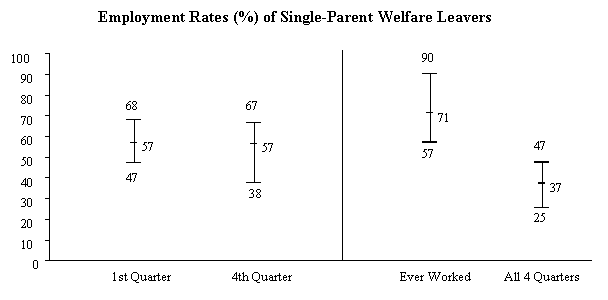
The graph shows the minimum, maximum, and median employment rates as reported across the studies. Not all studies provide data for all post-exit quarters. The data here represent the percentage of leavers employed in the first and fourth quarters after exit, the percentage who ever worked (employed in at least one of the four quarters after exit) and the percentage who worked in all quarters. See Table III.1 of the Final Synthesis Report for more details.
- Mean earnings of employed welfare leavers are about $2,600 per quarter, according to administrative data. Most studies show an increase in quarterly earnings of at least $200 between the first and fourth quarter after exit.
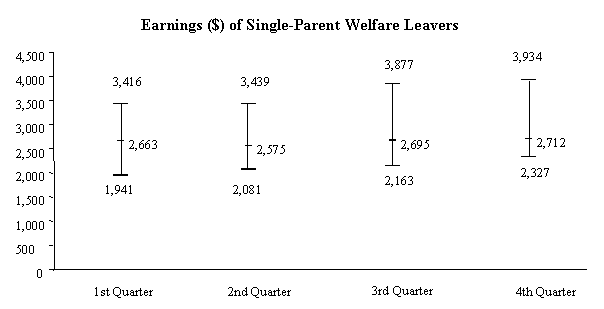
The graph shows the minimum, maximum, and median employment rates as reported across the studies. Not all studies provide data for all post-exit quarters. The data here represent the percentage of leavers employed in the first and fourth quarters after exit, the percentage who ever worked (employed in at least one of the four quarters after exit) and the percentage who worked in all quarters. See Table III.1 of the Final Synthesis Report for more details.
- Working leavers' wages, averaging between $7 and $8 an hour, are generally above the federal minimum wage but are nevertheless low.
- Employed leavers tend to work close to full-time, on average at least 35 hours per week.
- About half of all working leavers are offered employer-sponsored health insurance through their jobs, but only about one-third actually have this coverage.
- Some leavers receive other employer-sponsored benefits. In general, no more than half have paid sick leave or pension coverage. Paid vacations days are a bit more common.
- No single barrier to work consistently affects a majority of leavers; however, a substantial minority of leavers must overcome both child care and health-related problems in order to work.
- Continuous leavers, those who did not return to TANF in the year after exit, are just as likely to have ever worked after exit as those who returned to TANF. However, continuous leavers are somewhat more likely to have worked all four quarters after exit than those who returned. Continuous leavers also have higher earnings than leavers in general.
Program Participation
Non-TANF government assistance can help families in their transition from welfare to work. However, some families return to TANF. The major findings across studies on returns to TANF and participation in other public assistance programs are summarized below.
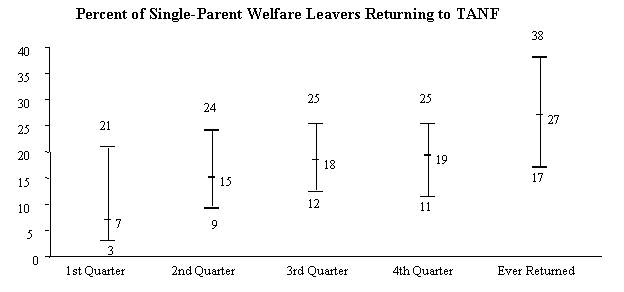
The graph shows the minimum, maximum, and median TANF return rates as reported for the first four post-exit quarters across the studies. Not all studies provide data for all post-exit quarters. See Table IV.1 of the Final Synthesis Report for more details.
- It is not uncommon for leavers to return to TANFa quarter to a third of families who left welfare returned to TANF at some point in the first year after exit.
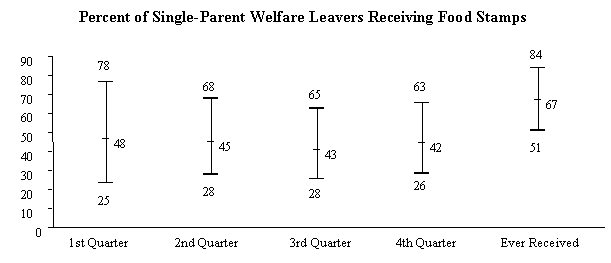
The graph shows the minimum, maximum, and median food stamp receipt rates as reported for the first four post-exit quarters across the studies. Not all studies provide data for all post-exit quarters. See Table IV.3 of the Final Synthesis Report for more details.
- About half of leaver families receive food stamps in the first quarter after exit and about two-thirds receive these benefits at some point in the year after exit.
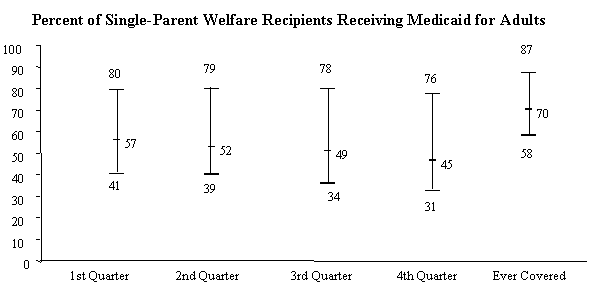
The graph shows the minimum, maximum, and median adult Medicaid coverage rates as reported for the first four post-exit quarters across the studies. Not all studies provide data for all post-exit quarters. See Table IV.7 of the Final Synthesis Report for more details.
- About three out of five leaver families have an adult enrolled in Medicaid in the first quarter after exit. Medicaid coverage of children is generally higher, ranging from 60 to 90 percent after exit.
- The percentage of leavers who receive food stamps and Medicaid at any point over the year after exit is significantly higher than the percentage receiving in any of the individual quarters, suggesting a great deal of cycling on and off these programs.
- Participation in both food stamps and Medicaid is generally lower for continuous leaver families than those who return to TANF at some point in the year after exit.
- Several studies also report on additional sources of government assistance, such as housing assistance, disability benefits, reduced-price lunches, WIC, fuel/energy assistance, unemployment compensation, and the Earned Income Tax Credit. The range of participation in these programs varies across studies.
- Food stamp and Medicaid program participation are generally higher for those who are not currently employed compared to those currently employed.
Household Income
Household income is an important indicator of the well-being of welfare leavers. Although such information is difficult to gather, a subset of studies examine income levels, sources of income, and poverty. Results for the subset of studies that examine these outcomes for the entire household are summarized below.
- Across all leaver families, own earnings are the most important single source of income, and own earnings plus the earnings of other family members together comprise over three-quarters of leaver families incomes on average.
- Average monthly family income for leavers from all sources, including earnings, generally lies near the poverty line.
- In the four studies that explicitly examine poverty rates of leaver families, on average, over half of leavers are poor. Two of the four studies find that the majority of leavers have incomes below 185 percent of the federal poverty line.
- In the few studies that compare monthly income for subgroups, continuous leavers have considerably higher incomes than leavers in general. Employed leavers also have much greater monthly incomes than jobless leavers.
Material Hardship
A number of leaver studies go beyond earnings, employment, income, and program participation and examine the extent to which leavers experience material hardships such as hunger and housing problems and whether these hardships are different for families on and off welfare. Key findings include:
- A quarter or more leaver families experience food hardships at some point after exiting TANFproblems having enough money for food or having food last for the monthand similar percentages experience trouble paying rent or utilities.
- Although some studies show that leavers experience higher levels of food and housing-related hardship after exit relative to when on TANF, other studies show that hardships decrease or remain the same after exit.
- With regard to medical hardship (being unable to access medical care), four studies find leavers are more likely to report being unable to afford health care for their families after exit as compared with before exit.
Several studies report results on material hardship across subgroups of leavers, including workers and non-workers and those who left TANF due to sanction or time limits.
- Most studies that compare material hardship across employment status find that leavers who are working have lower levels of food, housing, and health care-related problems.
- The available evidence on whether sanctioned and time-limited families experience greater material hardships than families who left welfare for other reasons is mixed.
Child Well-Being
Although virtually all families leaving welfare have children, it is difficult to assess child well-being from either administrative data or a single interview. Thus, leaver studies contain limited information about children's outcomes and well-being. For the studies reporting this information, findings on children's health insurance coverage, health status, behavior, interaction with child welfare services, and child care arrangements are summarized below.
- Reports of children in poor or fair health are generally low, ranging from 5 to 10 percent. However, one-tenth to one-quarter of leaver families have children without health insurance.
- Although the measures of child behavior are varied, most studies that compare behaviors pre- and post-exit find that the majority of leavers report child behavior is better after exit.
- Rates of interaction with child welfare services range from 1 to 13 percent, including reports of abuse/neglect and foster care services. There is little evidence on whether the percentage of families involved in child welfare services changed after exiting TANF.
- For child care, a substantial percentage of leaver families rely on parental care. For those using non-parental care, relatives and siblings of the child are by far the most common sources of care for children.
The fifteen ASPE-funded leaver studies reviewed here provide a considerable amount of information on the status of families leaving welfare. This synthesis focuses on key outcomes and measures of well-being that are commonly reported in these studies. In addition to these common elements, the individual studies also contain a rich array of information and subgroup analyses pertinent to understanding the status of former welfare recipients in their respective geographic areas.
Chapter I: Introduction
The Personal Responsibility and Work Opportunity Reconciliation Act (PRWORA), passed in 1996, replaced the Aid to Families with Dependent Children (AFDC) program with the Temporary Assistance for Needy Families (TANF) block grants to states. Since that time, the federal cash assistance caseloads have dropped by over 50 percent, from 4.4 million in August, 1996 to 2.1 million in March, 2001. There is interest at the federal, state, and local levels about the well-being of the unprecedented number of families that have left welfare:
- Are leavers working?
- Are they receiving support through other public assistance programs?
- Do they have the financial wherewithal to provide for themselves and their children?
- Are they and their children suffering hardships from hunger to homelessness?
To help address these questions, the Office of the Assistant Secretary for Planning and Evaluation (ASPE) of the United States the Department of Health and Human Services (DHHS) provided funding to select states and large counties to conduct studies of families that have left the welfare rolls. This report reviews and synthesizes key findings from fifteen ASPE-funded leaver studies. The studies we reviewed here are based in the following locations: Arizona, the District of Columbia, Florida, Georgia, Illinois, Iowa, Massachusetts, Missouri, New York, South Carolina, Washington, Wisconsin, Cuyahoga County (Ohio), Los Angeles county (California), and the Bay Area, a consortium of San Mateo, Santa Clara, and Santa Cruz counties (California).
What are the ASPE Funded Leaver Studies and How are They Different from Earlier Studies?
A host of states and policy researchers have examined the well-being of families leaving welfare in the post-reform era (1). These studies vary widely in the populations they study, how they define a welfare leaver, the outcomes that they examine and how those outcomes are measured, and in their methodological rigor. Consequently, it is difficult to use these studies to draw general inferences about the status of TANF leavers nationwide.
In order to obtain a broader national picture of how welfare leavers are faring in the post-reform era and to facilitate cross-state comparisons, ASPE awarded grants in September, 1998, to ten states, two large counties, and a consortium of counties to conduct leaver studies under a set of common guidelines. Grants for state and county leaver studies were funded out of an earmarked Congressional appropriation to study the outcomes of welfare reform. ASPE also provided funding for additional leaver studies from additional Congressional appropriations.
ASPE worked with its grantees to help make the leaver studies somewhat comparable to one another and encouraged them to report results using comparable definitions, for comparable populations, and comparable post-exit intervals. For example, ASPE developed a set of common measures for reporting findings from administrative data. Further, ASPE encouraged researchers to ask similar questions in their surveys. Finally, ASPE provided substantial amounts of technical assistance to its grantees to assist them in adhering to rigorous methodological standards.
In general, the ASPE-funded leaver studies follow these guidelines:
- They focus on cohorts of leavers, defined as all families that stopped receiving welfare during a particular quarter. In most cases, a family had to remain off welfare for two consecutive months in order to be considered a leaver. Similarly, ASPE encouraged its grantees to present at least some findings for single-parent families.
- For each cohort of leavers, the studies use administrative records to examine leavers subsequent use of cash assistance under TANF and their participation in the Food Stamp and Medicaid programs. Some studies have broader administrative data on leavers participation in additional social support programs, such as child care subsidies and child support, as well as data from state child welfare agencies.
- Almost all studies link their administrative program data with data on employment and earnings from the states Unemployment Insurance system.
- The studies supplement their administrative data using surveys of TANF leavers. Generally the survey samples are drawn from a single cohort of leavers. These surveys provide richer information about families than can be garnered from administrative data.
Note that these leavers studies are not rigorous evaluations of welfare reform. Rather, they are useful tools for monitoring the well-being of families that have received TANF and subsequently left the rolls. They can help policy makers identify the range of problems that families who have left welfare are facing. The ongoing capacity built by states and the research community will hopefully provide a baseline for formulating and evaluating future reforms.
Issues in Comparing and Synthesizing the ASPE-funded Leaver Studies
Even with all of ASPEs efforts to increase comparability, there remain important differences across the ASPE-funded leaver studies that should be kept in mind when comparing them and drawing general conclusions from them. For example, the status of welfare leavers is likely affected by the welfare policies states have adopted, the economic opportunities prevailing in the states, and even the characteristics of welfare recipients themselves.
In addition, the leaver studies do not all focus on the same time period. Indeed, some studies focus on leavers from late 1998 while others examine leavers from late 1996/early 1997. The survey components of the leaver studies also cover different periods of time after leaving. For example, one leaver study interviews leavers over two years after exit from welfare while others conduct interviews six months after exit.
Further, although the survey instruments generally gather similar information, each was developed by a separate team of researchers. Each survey focuses on topics of interest in a particular state or locality, leading to differences in measured outcomes. In addition, the reliability of survey findings are affected by how well survey respondents represent the population of welfare leavers. Response rates to the surveys we include in this synthesis range from 51 to 76 percent (2). While not a guarantee of representative findings, higher response rates generally indicate more reliable results (3).
Finally, there are some small variations in how the studies define leavers and the types of leavers studied. For example, most but not all studies require a family to remain off welfare for two months to be considered a leaver (4). Further, some studies focus exclusively on single parent welfare leavers while others include information on two-parent and, in a few studies, child-only cases. A summary of the types of data used, the time periods analyzed, the study populations, and technical details of surveys appear in Appendix A.
Outline of Synthesis
This synthesis of ASPE-funded leaver studies begins by discussing differences in the policies states have pursued, their economic climate, and the demographic characteristics of their welfare populations. It then discusses the findings from the leaver studies focusing on:
(1)the employment and earnings of leavers;
(2)leavers program participation;
(3)leavers income;
(4)the material hardships leavers face; and
(5)issues relating to child well-being for leavers.
Many studies report administrative data findings from multiple cohorts of welfare leavers. Where this is the case, the focus is on the most recent cohort, especially when there are comparable survey data available for that cohort (5).
The general approach to this synthesis is to focus on the most comparable elements of the leaver studies. Data are summarized in figures which appear within the chapters; more detailed information is presented in tables which appear at the end of the chapter. Whenever possible, findings are presented for single-parent leavers. In addition to using data from published reports, the synthesis also uses public use data files from several sites (6). These public use data can be used to examine key outcomes for special subgroups of leavers that may not have been presented in published reports and to insure that these sub-groups are roughly comparable across sites. Examples of sub-groups analyzed in this synthesis include families that remain off welfare (continuous leavers) as well as leavers who are not working . Finally, several studies report findings for these and other sub-groups in their published reports. This enables us to examine a limited number of outcomes by race and ethnicity as well as for voluntary and "involuntary leavers"families that reached time limits or were sanctioned off welfare.
1.Many of these studies are reviewed in Brauner and Loprest (1999), GAO (1999), Acs and Loprest (2000), Isaacs and Lyon (2000), and DHHS/ASPE (2000).
2.Florida's survey had a response rate of 23 percent. Thus, its survey findings were not included in this final synthesis.
3.To assess the representativeness of their survey findings, most ASPE-funded leaver studies perform "non-response" analyses.
4.Arizona uses a one month requirement throughout its study but presents supplementary findings using a two month definition. In this synthesis report, we focus on the two month findings from Arizona for comparability. DC requires a leaver to remain off welfare one full calendar month.
5.Interestingly, we find few differences in outcomes across early and late cohorts within the same study area.
6. The synthesis uses public use administrative and survey data files from Arizona, DC and Iowa, and survey data from Massachusetts and Washington.
Chapter II: The Context for ASPE-funded Leaver Studies
Before comparing and contrasting the status of welfare leavers across the leaver studies reviewed in this synthesis report, it is important to understand the environment in which families make their decisions to leave welfare. Indeed, the status of welfare leavers is likely affected by the welfare policies states have adopted, the economic opportunities prevailing in the states, and even the characteristics of the recipients themselves. Because there are so many factors contributing to the well-being of leavers, it is difficult to ascribe differences in outcomes across studies to any specific difference in context. In addition, in this descriptive synthesis report, all of these contextual differences cannot be taken into account simultaneously. However, these differences may be noted as they come to bear on comparisons across studies.
State TANF Policies
Under TANF block grants, states have substantial flexibility in determining the length of time families can receive cash assistance (time limits), the penalties for not complying with program rules (sanctions), and the generosity of cash grants, as well as how benefits are reduced as a family moves from welfare to work. Differences in state policy choices may well affect the rate at which families leave TANF, the employment status and material well-being of these families, and their use of government aid after leaving the TANF program.
Table II.1 (appearing at the end of this chapter) shows the time limit and sanction policies that prevailed in 1997 in the states in which the ASPE-funded leaver studies were conducted. We focus on 1997 because this is when states began implementing their TANF programs, and most of the studies provide some data on families that exited welfare just prior to or during that year.
State | Time Limit | Initial Sanction | Maximum Sanction |
|---|---|---|---|
| Arizona | 24 out of 60 months | Adult portion of benefit for one month or until compliance, whichever is longer | Adult portion of benefit for six months or until compliance, whichever is longer |
| District of Columbia | 60 months | Adult portion of benefit for one month or until compliance, whichever is longer | Adult portion of benefit for six months or until compliance, whichever is longer |
| Florida | 48 months and 24 out of 60 months or 36 out of 72 months1 | Entire benefit until in compliance for 10 working days | Entire benefit for three months or until in compliance for 10 working days, whichever is longer |
| Georgia | 48 months | 25% until compliance | Entire Benefit permanently |
| Illinois | 60 months | 50% until compliance | Entire Benefit for three months or until compliance, whichever is longer |
| Iowa | 60 months | Adult portion of benefit for three months | Entire benefit for six months |
| Massachusetts | 24 out of 60 months | Written warning | Entire benefit until in compliance for two weeks |
| Missouri | 60 months | Adult portion of benefit until compliance | Adult portion of benefit for six months or until compliance, whichever is longer |
| New York | 60 months | Adult portion of benefit until compliance | Adult portion of benefit for six months or until compliance, whichever is longer |
| South Carolina | 24 out of 60 months | Case is closed. Unit must reapply and comply for one month | Case is closed. Unit must reapply and comply for one month |
| Washington | 60 months | Adult portion of benefit until compliance | Adult portion of benefit for six months or until compliance, whichever is longer |
| Wisconsin | 60 months | Minimum wage times the number of hours of non-participation until compliance | Entire benefit and must reapply. |
| Cuyahoga Co. | 36 out of 60 months | Adult portion of benefit for one month | Entire benefit for six months. |
| Los Angeles Co. | No limit | Adult portion of benefit until compliance | Adult Portion of benefit for six months or until compliance, whichever is longer |
| San Mateo Co. | No limit | Adult portion of benefit until compliance | Adult Portion of benefit for six months or until compliance, whichever is longer |
| 1The 24 out of 60 month limit applies to non-exempt recipients who have received less than 36 months of assistance during the previous 60 months and are 1). over age 24 or 2). under age 24 with a high school diploma/ GED. The 36 out of 72 month limit applies to non-exempt recipients who 1). have received benefits for 36 of the previous 72 months or 2). are under age 24, have not completed high school/ GED, are not enrolled in a high school equivalency program, and have little or no work experience. Sources: See Appendix B for a complete listing of the leavers studies referenced. Data reported from Urban Institute's Welfare Rules Database. All data are reported as of 7/97. | |||
First, consider time limits. Families subject to shorter time limits may feel pressure to leave welfare sooner than families that are years away from exhausting their benefits. Also, leavers who have nearly exhausted their benefits may be more reluctant to return.
Out of the fifteen studies, seven are based in locations that as of 1997 allowed welfare recipients to receive benefits for the federally-imposed maximum of 60 months (5 years) and placed no intermittent time limits on receipt (see Table II.1). Florida and Georgia have a shorter lifetime limit of 48 months. And Arizona, Florida, Georgia, Massachusetts, South Carolina, and Cuyahoga county all have intermediate time limits, not only restricting the total number of months a family can receive benefits but also prohibiting a family from receiving their lifetime allotment over a single time period.7 For example, in Massachusetts, families can only receive benefits for 24 months in any 60 month period. Because of these intermediate time limits, both the Massachusetts and South Carolina leaver studies can assess the status of leavers that reached their initial time limits. Finally, California, the site of the Bay Area8 and Los Angeles county leaver studies, had no time limit in 1997; however, California imposed the standard 60 month lifetime limit retroactively in 1998 (Welfare Rules DatabaseWRD).
Next, consider states sanction policies. In general, states have imposed tiered sanctions, beginning with less severe sanctions at first and escalating penalties for
repeated instances of non-compliance. Note that leavers who were sanctioned off the rolls may be less "job-ready" then other leavers. Further, they may return to TANF at higher rates than non-sanctioned leavers upon coming back into compliance with program requirements.9
Table II.1also shows the initial and maximum sanction in each of the fourteen states covered by the leaver studies.10 Generally, for the first instance of non-compliance with program rules, a familys TANF benefit is either reduced by a set percentage (usually 25 percent) or the adult portion of the benefit is eliminated (effectively turning a 3 person unit into a two person unit, for example). The District of Columbia, Illinois, Missouri, New York, Washington, and California restore benefits once a family complies with program rules while other states specify a minimum amount of time the family must make do with lower benefits even after it has come into compliance. For example, Iowas initial sanction removes the adult portion of a familys benefit for three months regardless of whether the family quickly complies with program rules. Two states, however, have substantially stronger initial sanctions. In Florida, the familys entire benefit is eliminated until the family is in compliance with program requirements for 10 working days. And in South Carolina, the case is closed, and the family must reapply for benefits and comply with program rules for one month.
Focusing on the maximum sanction, Table II.1 shows that ten of the ASPE leaver studies are based in states that impose full-family sanctions, removing the adult unit head and the children from the TANF rolls. Georgia and Wisconsin not only impose full-family sanctions, but their maximum sanctions are also permanent sanctions; families that reach this point can never return to cash assistance in these two states. In Iowa and Ohio (Cuyahoga County), the full family sanction lasts 6 months, while Arizona, Florida, Illinois, Massachusetts, and South Carolina impose shorter sanctions for families that begin to comply with program rules. DC, Missouri, New York, Washington, and California (site of the LA and Bay Area studies) do not use full family sanctions.
The generosity of a state's welfare program also affects its leavers' outcomes. For example, recipients in states with higher basic benefits and higher earnings disregards can remain on the rolls while working for longer than families in less generous states. As a result, leavers in more generous states may have higher incomes than leavers from less generous states in the months following their TANF exits simply because those with lower incomes do not leave the rolls. On the other hand, leavers may be more likely to return to welfare if the program offers generous assistance.
Table II.2 shows the 1997 maximum TANF benefit a family of three could receive in the 14 states covered by the ASPE leaver studies, as well as earned income disregards in each state. Massachusetts clearly has the most generous policies, with a high maximum benefit and large earnings disregards.11 California, New York, Washington, and Wisconsin all have high benefit levels (in excess of $500 per month for a family of three) with the standard earnings disregard (the first $120 of earnings and one third of the remainder are disregarded). Ohio (Cuyahoga County) and Florida have modest benefits but generous earnings disregards.12
| State | Maximum Benefit for a Family of 3 ($) | Earned Income Disregards | Working at $7 an Hour 20 Hours/Week | |
|---|---|---|---|---|
| TANF Benefit(1) ($) | Total Income(2) ($) | |||
| Arizona | 347 | $120 and 33.3% first 4 consecutive months, $120 next 8 months, $90 thereafter | 26 | 1,096 |
| District of Columbia | 379 | $120 and 33.3% first 4 consecutive months, $120 next 8 months, $90 thereafter | 58 | 1,133 |
| Florida | 303 | $200 and 50% of the remainder | 102 | 1,150 |
| Georgia | 280 | $120 and 33.3% first 4 consecutive months, $120 next 8 months, $90 thereafter | 103 | 1,135 |
| Illinois | 377 | 66.7% | 178 | 1,197 |
| Iowa | 426 | 20% and 50% | 185 | 1,176 |
| Massachusetts | 565 | $120 and 50% of the remainder | 324 | 1,335 |
| Missouri | 292 | $120 and 33.3% first 4 consecutive months, $120 next 8 months, $90 thereafter | 0 | 1,053 |
| New York | 577 | $120 and 33.3% first 4 consecutive months, $120 next 8 months, $90 thereafter | 256 | 1,283 |
| South Carolina | 200 | $120 and 33.3% first 4 consecutive months, $120 next 8 months, $90 thereafter | 200 | 1,189 |
| Washington | 546 | $120 and 33.3% first 4 consecutive months, $120 next 8 months, $90 thereafter | 225 | 1,190 |
| Wisconsin | 518 | $120 and 33.3% first 4 consecutive months, $120 next 8 months, $90 thereafter | 197 | 1,163 |
| Cuyahoga Co. | 341 | $250 and 50% of the remainder for first 12 months, then $90 thereafter | 165 | 1,169 |
| Los Angeles Co. | 565 | $120 and 33.3% | 244 | 1,274 |
| San Mateo Co. | 565 | $120 and 33.3% | 244 | 1,274 |
| 1 For benefit computation, information on payment standards (not shown) is also required. 2 Total Income includes earnings of $602 ($7 an hour working 20 hours per week), TANF benefit, Food Stamp benefit, EITC and subtracts FICA tax. At this wage level there is no federal tax liability and we are assuming no state tax liability. | ||||
The last two columns of Table II.2 show how benefits and disregards interact as a single mother with two children on TANF begins to earn money through a part-time job. In Missouri, a family in which the mother works for 20 hours a week at $7.00 an hour would no longer be eligible for TANF. In Arizona, DC, Florida, and Georgia, monthly cash assistance benefits would be around $100 or less for such a family. The state that pays the highest TANF benefit to this prototypical family is Massachusetts at $324.
Because the family is earning $602 a month from the mothers job, they would be eligible to receive $241 through the federal Earned Income Tax Credit 13(per month) and would owe $46 per month in FICA taxes. In addition, while this familys TANF benefits phase out, it is still eligible for food stamps. This reduces some of the variation in total income between states as food stamp benefit levels are computed using the same federal formula in all states; thus, families in low TANF benefit states may receive greater food stamp benefits than otherwise similar families in high TANF benefit states. In 9 out of the 14 states, the monthly total income of this prototypical family making the transition from welfare to work falls between $1,100 and $1,200 (excluding state taxes and credits). This familys total income would vary from a low of $1,053 in Missouri to a high of $1,335 in Massachusetts. Note that in Missouri, this family would have left TANF entirely, while in Massachusetts, it would still be receiving benefits. Thus, one might expect to see higher levels of hardship among leavers in Missouri than in Massachusetts.
While every aspect of states TANF policies (for example, work requirements and diversion policies have been ignored), are not reviewed here, some general observations about the policy context in which the ASPE leaver studies are based can be made. For example, California (LA and Bay Area studies), New York, and Washington generally pursued policies that would be expected to produce lower exit rates from welfare but higher incomes for those families that do leave. Conversely, states with lower benefits and more severe sanctions such as Arizona and Georgia may move families off the welfare rolls faster but their leavers may have lower total incomes. Finally, other studies are based in states that pursue a mix of policies that are likely to have offsetting effects on the outcomes of leaversfor example, Massachusetts and Cuyahoga County have strict time limits and full family sanctions but very generous earnings disregards.
Economic Context
One would expect that when jobs are plentiful and wages are high, welfare leavers will generally fare better than during lean economic times. Table II.3 shows the 1997 unemployment rates and median incomes in the states in which the leaver studies we review were conducted. Note that these are state averages and some of the leaver studies only cover sub-state geographic areas. For example, the economic conditions in the state of Ohio may not necessarily reflect the conditions in one of its urban centers, Cuyahoga County.
| State | Unemployment Rate (%) | Median Income ($) |
|---|---|---|
| Arizona | 5.1 | 35,503 |
| District of Columbia | 8.9 | 32,382 |
| Florida | 4.3 | 32,455 |
| Georgia | 4.9 | 35,911 |
| Illinois | 5.2 | 40,094 |
| Iowa | 3.5 | 37,407 |
| Massachusetts | 5.4 | 40,624 |
| Missouri | 4.8 | 36,676 |
| New York | 6.3 | 34,783 |
| South Carolina | 5.1 | 30,616 |
| Washington | 6.4 | 37,458 |
| Wisconsin | 3.7 | 43,132 |
| Cuyahoga Co.1 | 4.8 | 36,798 |
| Los Angeles Co.1 | 7.8 | 38,976 |
| San Mateo Co.1 | 7.8 | 38,976 |
| United States | 5.6 | 36,244 |
| 1 Unemployment rate is given for the entire state. Source: "Interpreting TANF Leaver Studies: Comparing ASPE Grantee States to the Nation as a Whole." Mathematica Policy Research, March 27, 2000. | ||
Overall, Wisconsin had both the lowest unemployment rate (3.7 percent) and the highest median income ($43,132) in 1997. In contrast, the District of Columbia had both a relatively high unemployment rate (8.9 percent) and low median income ($32,382). Thus, if the welfare rolls are tied to macroeconomic conditions, one might expect that DCs leavers may struggle more than Wisconsins leavers or be less likely to leave in the first place. For some states, the potential beneficial impacts of low unemployment are offset by low incomes while others have both high incomes and high unemployment. For example, Florida had a low unemployment rate at 4.3 percent, but its median income is also among the lowest at $32,455. And Washington experienced relatively high unemployment (6.4 percent) but its median income was above average ($37,458). Of course, the cost of living also differs from state to state. Thus, it is clear that economic conditions vary considerably across the sites conducting the leaver studies reviewed in this synthesis.
Caseload and Characteristics of Welfare Leavers
While welfare caseloads declined throughout the US during the 1990s, the magnitude of the decline varied from state to state. The average leaver from states with large caseload declines may come from deeper in the caseload and have more barriers to overcome in moving to work than the average leaver from other states. As such, these leavers may have less success in the labor market, face greater hardships, and may be more likely to return to welfare. Note, however, that recent research suggests that leavers are not becoming more disadvantaged over time (Loprest 2001).
Figure II.1 shows caseload declines across the fourteen states hosting leaver studies. The vertical line represents the date of TANF implementation, and the shaded areas denote the cohorts examined in the leaver studies. Caseload declines between
Figure II.1:
AFDC/TANF Caseload Changes in Welfare Leaver Study Sites: 1994-2000
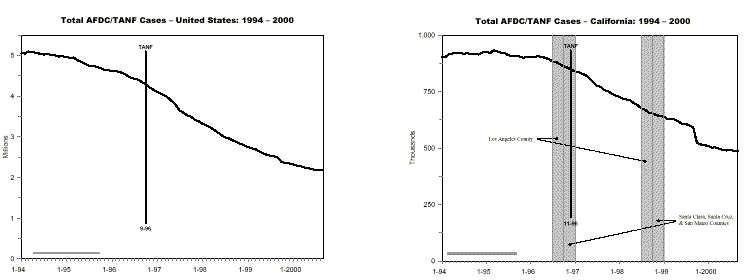
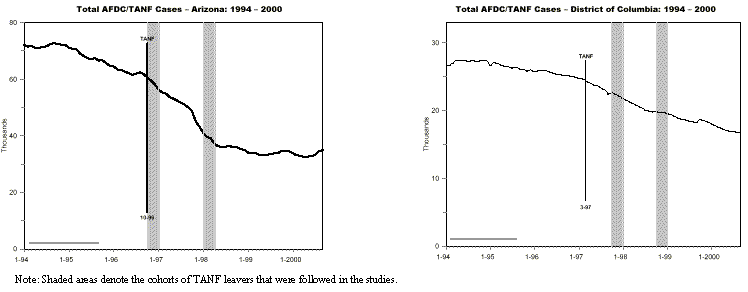
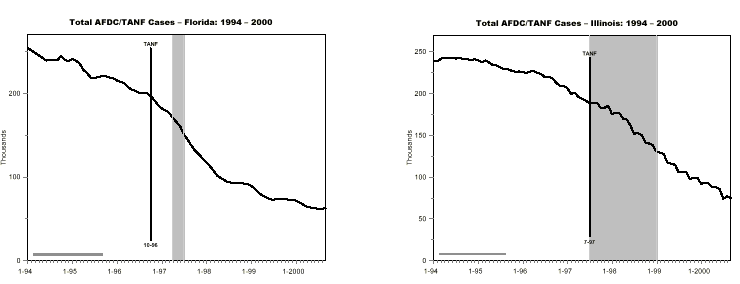
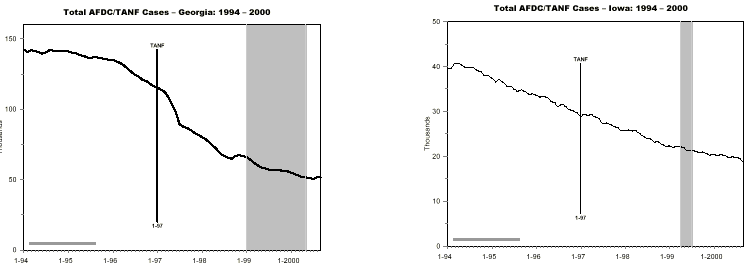
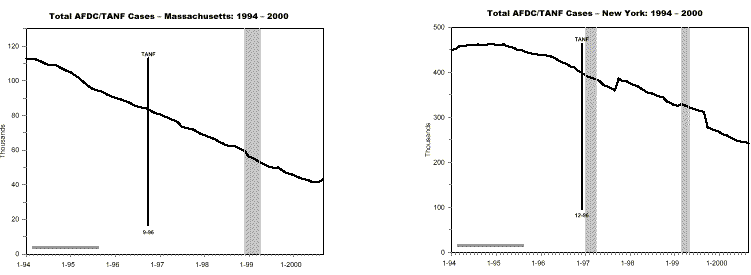
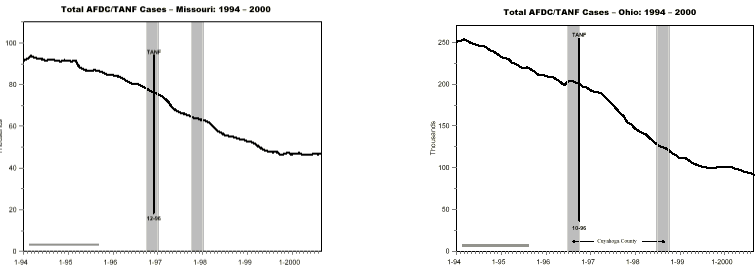
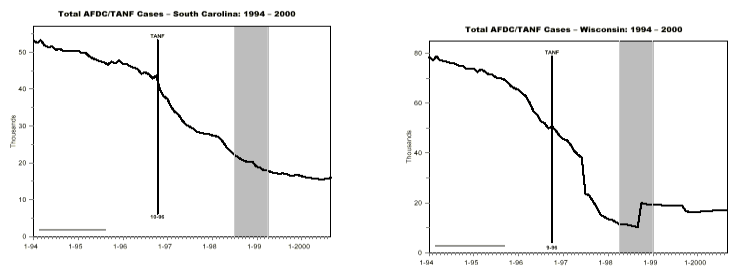
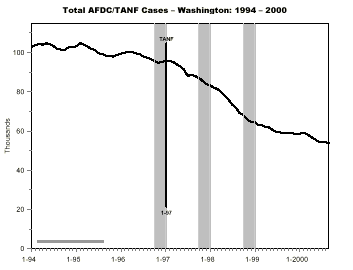
Note: Shaded areas denote the cohorts of TANF leavers that were followed in the studies. August 1996 and December 1999 range from 30 percent in the District of Columbia to 68 percent in Florida. Caseloads fell by more than 50 percent in Georgia, Illinois, Ohio, South Carolina, and Wisconsin. In addition to DC, caseloads declined by less than 40 percent in California, Iowa, and New York.
Differences in the personal characteristics of welfare recipients and welfare leavers also must be considered when comparing findings across leaver studies. Indeed, part of any difference in outcomes across sites may be due to differences among leavers themselves. Further, states likely structure their welfare policies with their welfare populations in mindfor example, a state with a high proportion of high school drop outs may emphasize work readiness programsand this too may affect the status of leavers.
Table II.4 compares the characteristics of leavers across 12 studies which report such information. The table focuses on leavers ages, race/ethnicity, marital statuses, the number of children they have, and their educational attainment. Not all studies provide data on each of these characteristics, and they do not all report them in the same way. For example, Iowa and Massachusetts report the average age of leavers while other studies report a distribution of leavers ages. These differences make direct comparisons more challenging.
State/Study | Age of Unit Head1 | Race/Ethnicity of Unit Head | ||||||
|---|---|---|---|---|---|---|---|---|
| <=20 | 21-30 | 31-40 | 40+ | White | Black | Other2 | Hispanic | |
Arizona | 7 | 51 | 38a | 4 | 42 | 10 | 14 | 35 |
District of Columbia | 4 | 44 | 36 | 16 | 1 | 97 | 1 | 2 |
Florida | 33c | 42 | 40 | 17 | ||||
Georgia # | 34b | 41b | 21b | 4b | 31 | 67 | 2 | |
Illinois # | 7 | 49 | 30 | 14 | 34 | 56 | 1 | 9 |
Iowa * | 30c | 81 | ||||||
Massachusetts # | 33c | 60 | 20 | 20 | 29 8 | |||
Missouri | 11 | 46 | 31 | 12 | 63 | 35 | 2 | 1 |
South Carolina * | 20d | 25d | 38 | 17 | 22 | 78 | ||
Washington * | 3 | 46 | 35 | 16 | 70 | 8 | 23 | 13 8 |
California Bay Area * | 14f | 33f | 35 | 18 | 28 | 12 | 16 | 44 |
Cuyahoga Co. | 6 | 52 | 31 | 12 | 23 | 70 | 2 | 6 |
State/Study | Marital Status | Number of Children | Education | ||||||
|---|---|---|---|---|---|---|---|---|---|
| Never Married | Married | D/W/S3 | 0-1 4 | 2 | 3+ | <HS | HS | HS+ | |
Arizona | 51 | 12 | 37 | 44 | 41 | 11.2 5 | |||
District of Columbia | 87 | 5 | 9 | 50 | 29 | 22 | |||
Florida | 2 6 | ||||||||
Georgia # | 61 | 12 | 23 5 | 33 | 33 | 35 | 22 | 59 | 19 |
Illinois # | 65 | 8 | 27 | 52 | 28 | 20 | 42 7 | 44 7 | 15 7 |
Iowa * | 48 | 15 | 26 | ||||||
Massachusetts # | 59 | 14 | 27 | 35 | 31 | 35 | 27 | 40 | 33 |
Missouri | 51 | 30 | 19 | 39 | 47 | 10 5 | |||
South Carolina * | 40 | 30 | 30 | 44 | 40 | 16 | |||
Washington * | 15 | 2 6 | 29 | 38 9 | 33 | ||||
Bay Area * | 10 | 49 | 30 | 21 | 48 | 26 | 26 | ||
Cuyahoga Co. | 45 | 32 | 24 | ||||||
1Age breakdowns differ from headings as follows: | |||||||||
A priori, it is difficult to anticipate whether younger leavers will, on average, fare better or worse than older leavers. While younger leavers probably have fewer children and likely have shorter spells of receipt prior to exit than older leavers, they also probably have younger children and less work experience. Six of the studies under review report the proportion of leavers age 20 and younger. The share of leavers who are very young ranges from a low of 3 in Washington to a high of 11 percent in Missouri. If we consider data regarding the under 30 group, we can include the South Carolina and San Mateo county studies. In four studies (Arizona, Cuyahoga county, Illinois, and Missouri ) well over half of all leavers are 30 or younger; in DC, the Bay Area, South Carolina, and Washington, less than half of leavers are under age 30.
It is also difficult to anticipate how race/ethnic differences between may affect leavers outcomes because race is only one of many differences among the study areas' TANF caseloads and local population bases. In the District of Columbia, virtually all leavers are black, which is not surprising given the demographic make-up of the city and its caseload. The proportion of leavers who are black ranges from a low of 8 percent in Washington to a high of 97 percent in DC. The share of leavers who are Hispanic ranges from 1 percent in Missouri to 44 percent in the Bay Area. The Bay Area also has a very high proportion (16 percent) of others. Although the majority of "others" in the Bay Area study are Vietnamese, the "other" races and ethnicities may include Asian and Pacific Islanders and Native Americans.
Differences in marital status, number of children, and education all have a stronger theoretical link than race or age to the outcomes of welfare leavers. For example, married or previously married leavers may well have access to more sources of support (for example, child support) than never married leavers. Table II.4 shows that among the 6 leaver studies reporting this information, the share of leavers who are never married ranges from 51 percent in Arizona to 87 percent in DC.
Leavers with more children may have a harder time balancing work and child rearing than other leavers. We see that the share of leavers with one child or less ranges from about one in three in Georgia and Massachusetts to about one half in DC, Illinois and Missouri.14 Conversely, Georgia and Massachusetts are the two study sites with highest proportions of leavers with three or more children, again, about one in three. Missouri has the lowest proportion of leavers with three or more children (19 percent).
Finally, leavers with higher levels of educational attainment should have an easier time finding, keeping, and advancing in jobs than less educated leavers. In four study sites, over 40 percent of leavers had failed to complete high school: Arizona, Illinois, South Carolina, and the California Bay Area. In Massachusetts and Wisconsin, leavers tend to have more education, with about one in three having some schooling beyond high school.
Overall, there are some potentially important differences across leavers in the various ASPE-funded studies; however, these differences may have offsetting effects on outcomes. For example, Massachusetts leavers are more educated on average than other leavers but they also tend to have more children, and Illinois leavers are less educated but tend to have fewer children.
Chapter Summary
Welfare policies, economic conditions, and the characteristics of leavers themselves all likely affect leavers post-TANF experiences. However, after reviewing the range of differences across the 14 sites for these ASPE-funded leaver studies, it is difficult to derive any simple rules of thumb to aid in comparing findings across studies. The varied policies pursued by the states in which these leaver studies are conducted likely have offsetting effects on leavers outcomes. Further, while some states had unambiguously good economies (low unemployment and high incomes) many states had more mixed conditions. And leavers themselves often have a mixed set of characteristics, some of which should lead to higher levels of employment and well-being after exit while others should lead to lower levels. Thus, it is difficult to ascribe differences in average outcomes across leaver studies to observable differences between study locations. However, understanding these contextual differences may be particularly important when comparing specific outcomes for sub-groups of leavers.
7In Arizona, after a family has exhausted its 24 month allotment, the head is removed from the assistance unit, but the children continue on as a child-only unit.
8The Bay Area Study comprises Santa Clara, Santa Cruz, and San Mateo counties.
9For example, Arizona explicitly compares the experience of sanctioned and non-sanctioned leavers and finds that sanctioned leavers are more likely to return to welfare than non-sanctioned leavers (40 v. 33 percent).
10The states conducting leaver studies reviewed here tend to have less severe sanction policies than other states.
11Earnings disregards affect TANF benefit computations. A certain portion of a family's earnings is disregarded for the purposes of computing TANF benefits. States with higher earnings disregards reduce TANF benefits more slowly as earned income rises.
12The standard of living in a state may affect the generosity of its welfare benefits.
13This assumes that the family has no income other than earnings and the mother continues to work at the same rate for all 12 months of the year.
14A family with no children can receive welfare if, for example, the woman is pregnant.
Chapter III: Employment and Earnings
A central goal of welfare reform is moving families from welfare to work and, ultimately, to self-sufficiency. All of the ASPE-funded leaver studies present findings on the post-TANF employment and earnings of welfare leavers. Studies that have reported survey results present additional information on the attributes of the jobs working leavers hold, the hours they work, and the obstacles they must overcome to obtain and keep jobs. In this chapter, we examine the employment status of welfare leavers, reviewing reported findings from administrative data as well as from survey data. Using public use data files, we are also able to make cross-study comparisons of information not necessarily presented in the completed studies.
How Much Are Welfare Leavers Working?
Fourteen of the ASPE-funded leaver studies included here use administrative data from their states Unemployment Insurance (UI) systems to examine the employment and earnings of TANF leavers in the months and years following exit. A fifteenth study, the District of Columbia's, accessed data from the National Directory of New Hires (NDNH) to obtain quarterly employment information for its TANF leavers. This data source cuts across state lines and includes federal workers; thus, given D.C.'s geography and employment patterns, NDNH has more complete and more useful information for D.C. than state UI records.
Post-exit employment rates calculated from administrative data appear in Figure III.1more detailed information appears in Table III.1 Employment rates are remarkably consistent across studies.
Figure III.1:
Employment Rates of Single-Parent Welfare Leavers
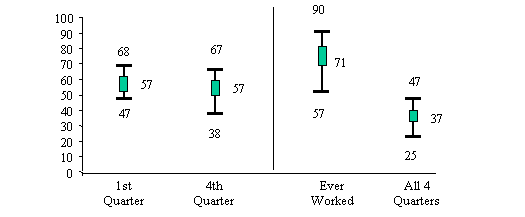
Notes: The graph shows the minimum, maximum, and median employment rates as reported across the studies. The shaded box represents the range in which the middle 50% of reported employment rates fall. Not all studies provide data for all post-exit quarters. See table III.1 for more information.
State/Study | Exit Cohort | Post Exit Quarter (%) | Worked All Four Quarters (%) | Ever Worked After Exit (%) | Working in Pre-Exit Quarter (%) | Working in Exit Quarter (%) | |||
|---|---|---|---|---|---|---|---|---|---|
| Q1 | Q2 | Q3 | Q4 | ||||||
Arizona | 1Q98 | 53 | 51 | 52 | 501 | n.a | 73 1 | 47 | 54 |
District of Columbia2 | 4Q97 | 62 | 66 | 57 | 60 | 39 | 79 | n.a | n.a |
Florida | 2Q97 | 50 | 51 | 53 | 54 | 31 | 71 | n.a | 39 |
Georgia | 1Q99 | 64 | 60 | 59 | 57 | n.a | n.a | n.a | 61 |
Illinois | 3Q97 - 4Q98 | 54 | 53 | 54 | 55 | 39 | 70 | 49 | 55 |
Iowa | 2Q99 | 57 | 42 | 39 | 38 | 25 | 69 | 44 | 57 |
Massachusetts2 | Dec 1998 - Mar 1999 | 60 | 61 | 51 | n.a | n.a | 68 | n.a | 57 |
Missouri2 | 4Q96 | 58 | 58 | 59 | 58 | n.a | n.a | n.a | n.a |
New York | 1Q97 | 50 | 49 | 48 | 48 | 40 | 62 | n.a | 50 |
South Carolina2,3 | Oct 1998 - Mar 1999 | 67 | 68 | 67 | 63 | 34 | 90 | 61 | 69 |
Washington | 4Q97 | 57 | 57 | 58 | 57 | n.a | n.a | 50 | 61 |
Wisconsin2 | 2Q98-4Q98 | 67 | 65 | 67 | 67 | n.a | 82 | 55 | 68 |
Cuyahoga Co.3 | 3Q98 | 68 | 64 | 67 | 64 | 47 | 82 | n.a | n.a |
Los Angeles Co.3 | 3Q96 | 47 | 46 | 46 | 47 | 35 | 57 | 43 | 46 |
Bay Area | 4Q98 | 55 | 55 | 55 | n.a | n.a | n.a | 51 | 58 |
1Data from report differ from revised data in public use data file. Revised fourth quarter employment is 51% and ever worked after exit is 70%. Arizona added 17 new cases to the data file one year after the report was published. | |||||||||
In the first quarter after exit, employment rates range from a low of 47 percent in Los Angeles to a high of 68 percent in Cuyahoga County. The median first post-exit quarter employment rate across the studies is 57 percent, and many studies cluster tightly around the median. By the fourth post-exit quarter, most studies' employment rates remain tightly clustered around 57 percent. Wisconsin's leavers have the highest fourth quarter employment rates (67 percent) while Iowa's leavers have the lowest (38 percent).
In most studies, post-TANF employment rates as reported using administrative data remain fairly stable over the first post-exit year. The two exceptions to this are Georgia, which shows a modest decline in employment rates from 64 to 57 percent between the first and fourth post-exit quarters, and Iowa, which shows a substantial decline from 57 to 38 percent.
It is important to note that while overall employment rates for TANF leavers hover just below 60 percent, this does not imply that the same individuals who worked in the first quarter continue to work throughout the year. Indeed, there is a considerable amount of employment "churning" in the welfare leaver population. In the eleven studies that report information on leavers who ever worked over the first post-exit year, we see that the share of leavers who ever worked after exiting ranges from a low of 57 percent in Los Angeles County to a high of 90 percent in South Carolina; the median "ever worked" employment rate is 71 percent. Further, across the eight studies reporting the share of leavers who worked in all four post-exit quarters, the median study finds that only 37 percent of leavers worked in all four post-exit quarter. The 'all four-quarters' employment rates range from a low of 25 percent in Iowa to a high of 47 percent in Cuyahoga County.
Although there are some methodological differences between studiesfor example, the South Carolina, Los Angeles and Cuyahoga County studies require a leaver to have at least $100 in earnings to be considered working while others require only $1these differences do not account for much of the meager variation across studies. Indeed, Cuyahoga County consistently reports high employment rates despite having a higher threshold for employment. Thus overall, these findings from administrative data suggest that the majority of welfare leavers work or have worked since exiting, but about one out of four have never worked in the year following exit.
All these employment measures are fairly broadeven in the three studies using the $100 earnings threshold, a leaver would be considered employed if she earned minimum wage and worked for just one half of one week out of a 13 week quarter. The public use data files made available by Arizona, the District of Columbia, and Iowa allow an examination of employment rates using a stricter definition: an earnings requirement of at least $500 in a quarter to be considered employed. This higher threshold basically requires a leaver to have worked the equivalent of two full-time weeks and be paid about $6.25 an hour to be counted as having worked in a given quarter. Table III.2 shows that under this tighter rule, employment rates in the first post-exit quarter are 6 to 11 percentage points lower than under the "any earnings" criterion. In the fourth post-exit quarter, the employment rates based on the $500 rule are 6 to 10 percentage points lower than the rates based on the "any earnings" for the three studies. Finally, the share of leavers who ever earned more than $500 dollars in any of the first four post-exit quarters (the "ever worked" employment rate) (see Figure III.2) is also lower than when using the "any earnings" rule: in Arizona, only 62 percent of leavers "ever worked" during the first post-exit year if the "$500 rule" is applied, compared with 70 percent using the "any earnings" rule.
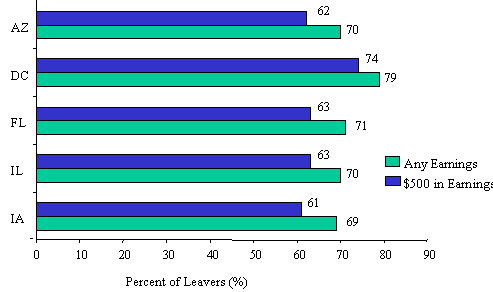
Notes: See table III.2 for more information.
State/Study | Exit Cohort | Quarter Relative to Exit (%) | Worked All Four Quarters (%) | Ever Worked After Exit (%) | ||||
|---|---|---|---|---|---|---|---|---|
| Q-1 | Q1 | Q2 | Q3 | Q4 | ||||
Arizona1 | 1Q98 | |||||||
Any Earnings | 47 | 53 | 51 | 52 | 51 | 32 | 70 | |
$500 in Earnings | 34 | 44 | 43 | 45 | 44 | 25 | 62 | |
District of Columbia1,2 | 4Q97 | |||||||
Any Earnings | 63 | 62 | n.a. | 57 | 60 | 39 | 79 | |
$500 in Earnings | 56 | 56 | n.a. | 53 | 54 | 35 | 74 | |
Florida | 2Q97 | |||||||
Any Earnings | 50 | 51 | 53 | 54 | 31 | 71 | ||
$500 in Earnings | 42 | 43 | 45 | 46 | n.a | 63 | ||
Illinois | ||||||||
Any Earnings | 49 | 54 | 53 | 54 | 55 | 39 | 70 | |
$500 in Earnings | 38 | 47 | 46 | 47 | 48 | n.a. | 63 | |
Iowa1 | 2Q99 | |||||||
Any Earnings | 44 | 57 | 42 | 39 | 38 | 25 | 69 | |
$500 in Earnings | 32 | 49 | 36 | 33 | 32 | 20 | 61 | |
South Carolina2 | ||||||||
Any Earnings | 61 | 67 | 68 | 67 | 63 | 34 | 90 | |
$500 in Earnings | 44 | 56 | 58 | 54 | 53 | n.a. | n.a. | |
1Data calculated from public use data files. | ||||||||
The gaps for DC, Florida, Illinois, and Iowa are similar in size. This suggests that over 10 percent of working leavers really do not work much, at least in jobs covered by unemployment insurance.
One explanation for this discrepancy may be that leavers who only work a little end up returning to the welfare rolls. Therefore, we may expect to see higher employment rates and more employment growth for "continuous leavers"families that remain off welfare for at least an entire year after they exit. Figure III.3 and Table III.3, however, show there is little difference in employment between continuous leavers and leavers in general in three out of four studies that either report this information or have made data available that allow us to compute it.
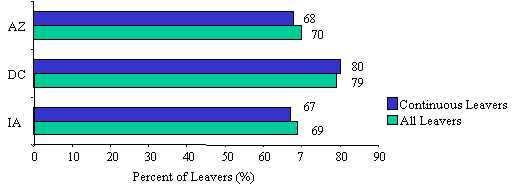
Notes: See table III.3 for more information.
State/ Study | Exit Cohort | Post Exit Quarter (%) | Worked All Four Quarters (%) | Ever Worked After Exit (%) | |||
|---|---|---|---|---|---|---|---|
| Q1 | Q2 | Q3 | Q4 | ||||
Arizona | 1Q98 | ||||||
All Leavers | 53 | 51 | 52 | 51 | 32 | 70 | |
Continuous Leavers | 53 | 53 | 53 | 52 | 36 | 68 | |
District of Columbia1 | 4Q97 | ||||||
All Leavers | 62 | 66 | 57 | 60 | 39 | 79 | |
Continuous Leavers2 | 63 | 68 | 62 | 64 | 44 | 80 | |
Iowa | 2Q99 | ||||||
All Leavers | 57 | 42 | 39 | 38 | 25 | 69 | |
Continuous Leavers | 55 | 42 | 40 | 39 | 28 | 67 | |
Washington | Oct. 1997 | ||||||
All Leavers | 57 | 57 | 58 | 57 | n.a. | n.a. | |
Continuous Leavers | 57 | 57 | 57 | 56 | n.a. | n.a. | |
1Report employment data for all cases, not just for single-parent cases. | |||||||
In Arizona, for example, the fourth post-exit quarter employment rate for continuous leavers is 52 percent, only 2 percentage points higher than the rate for all leavers. Similarly, in Iowa and Washington, the fourth post-exit quarter employment rates are 39 and 56 percent, respectively, for continuous leavers and 38 and 57 percent for all leavers. In DC, however, continuous leavers have slightly higher employment rates than leavers in general: 64 versus 60 percent for the fourth post-exit quarter. Interestingly, although continuous leavers are slightly more likely to have worked in all four post-exit quarters than leavers in general, they are just about as likely to have ever worked.
That the employment rates for continuous leavers are so similar to those for all leavers is somewhat surprising. Indeed, these findings may suggest that continuous leavers are more likely to have some form of support other than work and welfare than leavers in general. This support may come from a spouse/partner or from another public program like SSI. Alternatively, it is possible that continuous leavers have simply disappeared from administrative records, for example, by leaving the state. Since they do not show up back on the state's TANF rolls or in its UI records, they will appear to be unemployed continuous leavers.
Finally, it is important to note that administrative data likely under-represent the amount of work performed by TANF leavers. First, leavers who work across state lines or move to another state entirely will not appear in a states UI system. Second, not all jobs are reported to a states UI systemfor example, leavers who are self-employed or who work in certain jobs in agriculture or in the federal government are not included in UI data systems. And lastly, leavers who are domestic service workers (like nannies or house cleaners) may not appear in the UI system because their employers fail to report them. Thus, some of the leavers who appear to have never worked in administrative data may actually be bringing in earnings in some form.
Because eleven jurisdictions report survey findings on current employment status of TANF leavers, it is possible to assess the extent to which work is under-reported in administrative records. The responses of leavers generally refer to employment about 6 months to a year after exit (see Appendix Table B). Table III.4 compares these self-reported employment rates with fourth quarter post-exit employment rates computed from administrative data. The District of Columbia, which used administrative data from the NDNH, reports fairly similar employment rates from both survey and administrative data sources.15 Interestingly, South Carolina, Washington state, and the Bay Area Study also find similar employment rates using the two data sources. Arizona, Georgia, Illinois, Missouri, and Cuyahoga County find employment rates that are 6 to 10 percentage points higher in survey data than in their state UI records, indicating some coverage gaps in administrative data. In Iowa and Massachusetts, however, the employment gap between survey and administrative data is alarmingly large: surveys find employment rates that are 20 or more percentage points higher than those computed from administrative data. Iowa, because of its large agriculture sector, may have more under-reporting in its UI system than other jurisdictions, but it is unlikely that "true" under-representation would be this much larger than the under-representation in other Midwestern states with heavy agriculture employment, such as Illinois and Missouri.
State/Study | Exit Cohort | Timing of Survey Post Exit | Employment Rate (%) | |
|---|---|---|---|---|
| Survey Data | Administrative Data1 | |||
Arizona | 1Q98 | 12 - 18 months | 57 | 50 3 |
District of Columbia2 | 4Q97 and 4Q98 4 | ~ 12 months | 60 | 60 |
Georgia | Jan 1999-June 20004 | ~ 6 months | 69 | 59 5 |
Illinois | Dec. 1998 | 6 - 8 months | 62 | 54 |
Iowa | 2Q99 | 8 - 12 months | 60 6 | 37 6 |
Massachusetts2 | Dec 1998 - Mar 1999 | ~ 10 months | 71 | 51 7 |
Missouri2 | 4Q98 | 26 - 34 months | 65 | 58 |
South Carolina2 | Oct 1998 - Mar 1999 | 12 months | 59 | 63 |
Washington | Oct. 1998 | 6 - 8 months | 59 | 57 |
Cuyahoga Co. | 3Q98 | 14-21 months | 70 | 64 |
Bay Area | 4Q98 | 6-12 months | 57 | 55 8 |
1Based on employment rate from the 4th post-exit quarter. | ||||
How Much Are Leavers Paid?
Beyond employment, it is also important to examine the quality of the jobs held by TANF leavers. The most basic measure of job quality is how much the job pays. The fifteen studies report mean/median quarterly earnings of employed TANF leavers based on UI wage records or NDNH data studies. These records include earnings information on all reported jobs a leaver has held during the quarter. Note that earnings estimates reported from these administrative sources represent total earnings over a three month period. The data do not provide information on the number of weeks or hours leavers actually worked to achieve their earnings.
Table III.5 and Figure III.4 show that the mean/median earnings of employed leavers during the first post-TANF exit quarter range from about $1,900 to about $3,400.16
Figure III.4:
Mean Earnings of Single-Parent Welfare Leavers
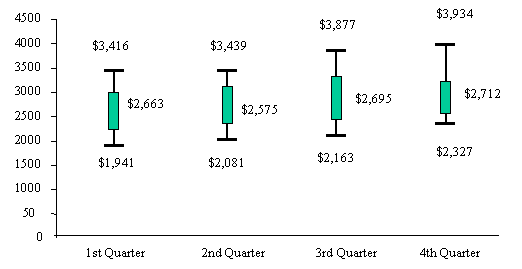
Notes: The graph shows the minimum, maximum, and median earnings as reported across the studies. The shaded box represents the range in which the middle 50% of reported earnings fall. Not all studies provide data for all post-exit quarters. See table III.5 for more information.
State/Study | Exit Cohort | Post- Exit Quarter ($) | Growth Q1-Q4 | |||
|---|---|---|---|---|---|---|
| Q1 | Q2 | Q3 | Q4 | |||
Arizona | 1Q98 | 2,211 | 2,354 | 2,695 | 2511 1 | 300 |
District of Columbia2,3 | 4Q97 | 3,416 | n.a | 3,395 | 3,934 | 518 |
Florida | 2Q97 | 2,163 | 2,352 | 2,343 | 2,496 | 333 |
Georgia | 1Q98 | 2,185 | 2,294 | 2,562 | 2,327 | 142 |
Illinois | 3Q97 - 4Q98 | 2,663 | 2,746 | 2,846 | 2,959 | 296 |
Iowa | 2Q99 | 2,481 | 2,661 | 2,550 | 2,712 | 231 |
Massachusetts2 | Dec 1998 - Mar 1999 | 2,834 | 3,005 | 3,201 | n.a | n.a |
Missouri2 | 4Q96 | 2,192 | 2,360 | 2,384 | 2,698 | 506 |
New York | 1Q97 | 3,393 | 3,402 | 3,877 | 3,602 | 209 |
South Carolina2 | Oct 1998 - Mar 1999 | 1,941 | 2,081 | 2,163 | 2,332 | 391 |
Washington | 4Q97 | 2,678 | 2,906 | 2,975 | 3,275 | 597 |
Wisconsin2 | 4Q97 | 2,272 | 2,362 | 2,278 | 2,561 | 289 |
Cuyahoga Co. | 3Q98 | 2,744 | 2,489 | 2,663 | 2,754 | 10 |
Los Angeles Co. | 3Q96 | 3,414 | 3,387 | 3,521 | 3,576 | 162 |
Bay Area | 4Q98 | 3,144 | 3,439 | 3,612 | n.a | n.a |
1Data from report differ from revised data in public use data file. Revised fourth quarter earnings are $2,525. Arizona added 17 new cases to the data file one year after the report was published. | ||||||
In the first post-TANF quarter, half the studies find mean/median earnings ranging from about $2,200 to $2,800 for leavers with any earnings. During the fourth post-TANF exit quarter, earnings range from about $2,300 to about $3,900. This represents a substantial increase in average earnings over time. For example, in the District of Columbia, Missouri, and Washington, the average earnings of employed leavers increased by over $500 between the first and fourth post-exit quarters.
Table III.6 and Figure III.5 show earnings for leavers earning over $500 a quarter and compares them with leavers with any earnings.
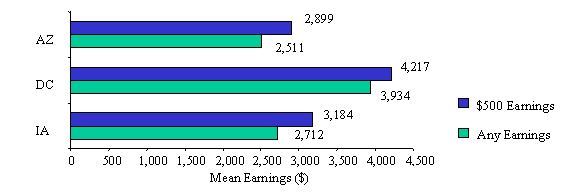
Notes: See table III.6 for more information
State/Study | Exit Cohort | Quarter Relative to Exit ($) | Growth Q1-Q4 | ||||
|---|---|---|---|---|---|---|---|
| Q-1 | Q1 | Q2 | Q3 | Q4 | |||
Arizona | 1Q98 | ||||||
Any Earnings | 1,349 | 2,211 | 2,354 | 2,695 | 2,525 | 300 | |
$500 in Earnings | 1,772 | 2,609 | 2,754 | 3,050 | 2,899 | 290 | |
District of Columbia1 | 4Q97 | ||||||
Any Earnings | 3,347 | 3,416 | n.a | 3,395 | 3,934 | 518 | |
$500 in Earnings | 3,622 | 3,757 | n.a. | 3,563 | 4,217 | 460 | |
Iowa | 2Q99 | ||||||
Any Earnings | 1,402 | 2,481 | 2,661 | 2,550 | 2,712 | 231 | |
$500 in Earnings | 1,859 | 2,844 | 3,046 | 2,995 | 3,184 | 340 | |
1Report earnings data for all cases, not just for single-parent cases. Earnings data are median earnings, not mean earnings. | |||||||
In Iowa and Arizona, the average earnings for leavers who earn at least $500 a quarter is about $400 higher than the average earnings for all leavers. In both states the average fourth post-exit quarter earnings for those earning at least $500 is about $3,000.
Table III.7 and Figure III.6 compare all leavers with earnings with continuous leavers with earnings.
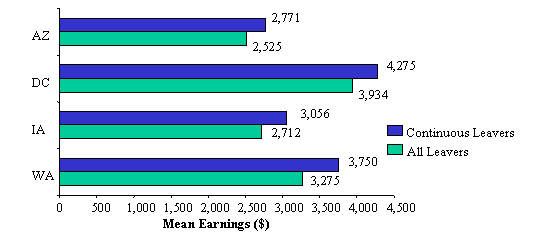
Notes: See table III.6 for more information.
State/Study | Exit Cohort | Quarter Relative to Exit ($) | Growth Q1-Q4 | |||
|---|---|---|---|---|---|---|
| Q1 | Q2 | Q3 | Q4 | |||
Arizona1 | 1Q98 | |||||
All Leavers | 2,211 | 2,354 | 2,695 | 2,525 | 314 | |
Continuous Leavers | 2,470 | 2,645 | 3,039 | 2,771 | 301 | |
District of Columbia1,2 | 4Q97 | |||||
All Leavers | 3,416 | n.a | 3,395 | 3,934 | 518 | |
Continuous Leavers | 3,685 | n.a. | 3,569 | 4,275 | 590 | |
Iowa1 | 2Q99 | |||||
All Leavers | 2,481 | 2,661 | 2,550 | 2,712 | 231 | |
Continuous Leavers | 2,634 | 2,947 | 2,925 | 3,056 | 422 | |
Washington | Oct. 1998 | |||||
All Leavers | 2,678 | 2,906 | 2,975 | 3,275 | 597 | |
Continuous Leavers | 2,945 | 3,273 | 3,422 | 3,750 | 805 | |
1Data calculated from public use data files. | ||||||
In all four studies which examine continuous leavers, leavers who remained off welfare for an entire year tend to have higher earnings than the average leaver and the gap grows slightly over time. For example, in Iowa, continuous leavers earn $153 more than leavers in general, on average, in the first post-exit quarter ($2,634 versus $2,481). By the fourth post-exit quarter, the gap between continuous and all leavers reaches $344 ($3,056 versus $2,712). Only in Arizona does the gap between all and continuous leavers remain stable over time (about $300). These figures suggest that, in general, those leavers who remain off of welfare earn more after exit and experience more rapid earnings growth than the average leaver. It is not clear if higher earnings enable continuous leavers to stay off welfare or whether it is continuous leavers' skill and perseverance that allow them to be more successful in the labor market.
Ten of the studies also use surveys of leavers to examine employment, wage rates, and job characteristics of leavers. While surveys rely on self-reported information, they garner more detailed information than is available through administrative data systems.
Surveys of welfare leavers obtain information on the hours worked and wages of leavers (see Table III.8). All eight of the studies that examine hours worked in their surveys show that employed leavers work close to full-time on average, with mean weekly hours ranging from 33 to 39 and median hours (when reported) reaching 40. Mean hourly wages range from $7.50 to $8.74, and median hourly wages range from $6.50 to $8.13. If a leaver works 40 hours a week and earns $7.50 an hour, she would earn $3,900 in a quarter provided that she worked all thirteen weeks in the quarter. However, as illustrated above, quarterly earnings are usually less than $3,900, indicating that a substantial share of leavers experience periods of joblessness and may even return to welfare.
State/Study | Exit Cohort | Timing of Survey Post Exit | Hours Worked | Wage Rate | ||
|---|---|---|---|---|---|---|
| Mean | Median | Mean | Median | |||
Arizona | 1Q98 | 12 - 18 months | 35 | n.a | 7.52 1 | n.a |
District of Columbia2 | 4Q98 | ~ 12 months | 36 | 40 | $8.74 | $8.13 |
Illinois | 3Q97 - 4Q98 | 6 - 8 months | n.a | 37 | $7.89 | $7.41 |
Iowa | 2Q99 | 8 - 12 months | 35 | n.a | $7.54 | n.a |
Massachusetts2 | Dec 1998 - Mar 1999 | ~ 10 months | 33 | n.a | $8.46 | n.a |
Missouri | 4Q98 | 26 - 34 months | 39 | 40 | n.a | n.a |
South Carolina2 | Oct 1998 - Mar 1999 | 12 months | 36 | n.a | n.a | $6.50 3 |
Washington | Oct. 1998 | 6 - 8 months | 36 | 40 | $7.70 | 7.00 |
Cuyahoga Co. | 3Q98 | 14 - 21 months | 35 | n.a | $7.50 | n.a |
Bay Area | 4Q98 | 6 - 12 months | n.a | n.a | n.a | $9.00 |
1Data published in the report differ slightly because the weights used in the report were not accurate. | ||||||
Table III.9 compares the hours and wage rates of continuous leavers with those of all leavers for the five studies that allow us to make this comparison. Continuous leavers are slightly more likely to be employed at the time of the survey than leavers in general with the difference ranging from 2 to 9 percentage points. With regard to whether leavers were ever employed since leaving TANF, there is little difference between continuous and other leavers; this is consistent with findings from administrative data. In addition, among currently employed leavers, there is little difference in hours worked between continuous and leavers in general, but this could reflect the fact the most working leavers work close to full-time. One might expect that continuous leavers would have higher hourly wage rates either because they have stronger attachments to the labor force, allowing for wage advancement, or because higher wages enable them to continue working. Whatever the reason, mean hourly wages are, in fact, 7 to 23 cents higher for continuous leavers; median hourly wages are up to 25 cents higher. For a full-time worker, a 25 cent an hour difference in pay translates into about $43 a month.
State/ Study | Hours Worked | Wage Rate ($) | Percent Employed (%) | |||||
|---|---|---|---|---|---|---|---|---|
| Mean | Median | Mean | 25th | Median | 75th | Time of Survey | Since Exit | |
Arizona1 | ||||||||
All Leavers | 35 | 40 | 7.52 | 6.00 | 7.00 | 8.50 | 58 | 75 |
Continuous leavers | 35 | 40 | 7.68 | 6.00 | 7.25 | 8.79 | 63 | 74 |
District of Columbia1,2 | ||||||||
All Leavers | 36 | 40 | 8.74 | 7.00 | 8.13 | 10.00 | 60 | 80 |
Continuous leavers | 37 | 40 | 8.94 | 7.00 | 8.38 | 10.24 | 69 | 81 |
Iowa1 | ||||||||
All Leavers | 34 | 38 | 7.19 | 6.00 | 7.00 | 8.00 | 61 | 71 |
Continuous leavers | 35 | 40 | 7.42 | 6.00 | 7.00 | 8.00 | 69 | 68 |
Massachusetts1 | ||||||||
All Leavers | 34 | 35 | 8.46 | 6.50 | 8.29 | 10.00 | 72 | 90 |
Continuous leavers | 34 | 35 | 8.53 | 6.57 | 8.46 | 10.00 | 75 | 93 |
South Carolina2 | ||||||||
All Leavers | 36 | n.a. | n.a. | n.a. | n.a. | n.a. | 59 | n.a. |
Continuous leavers | 36 | n.a. | n.a. | n.a. | n.a. | n.a. | 61 | n.a. |
1 Calculated from public use data files. | ||||||||
In addition to monetary pay, employed leavers may receive non-cash employee benefits through their jobs. Eight of the surveys ask explicitly about job-related benefits, and unlike employment and cash earnings, there is considerable variation across the studies. Table III.10 shows that the share offered such coverage ranges from 41 percent in the Bay area to 58 percent in Cuyahoga County, and the share of leavers with employer sponsored health insurance coverage ranges from 12 percent in Arizona to 36 percent in Washington state. The share of leavers with paid sick days ranges from a low of 28 percent in Washington state to a high of 50 percent in the District of Columbia and Cuyahoga County with Massachusetts close behind at 47 percent; in the other two locales reporting this information, about two out of five leavers have paid sick leave. In three studies, the share with paid vacations reaches 60 percent or more (DC, IA, and CCo.). Finally, 46 percent of working leavers have retirement benefits in DC compared with 21 percent in Washington state.
State/Study | Exit Cohort | Timing of Survey Post Exit | Health Insurance | Percent of Leavers (%) | |||
|---|---|---|---|---|---|---|---|
| Offer | Coverage | Paid Sick Leave | Paid Vacation | Pension | |||
Arizona | 1Q98 | 12 - 18 months | n.a. | 12 | n.a. | n.a. | n.a. |
District of Columbia1 | 4Q98 | ~ 12 months | n.a. | 32 | 50 | 62 | 46 |
Iowa | 2Q99 | 8 - 12 months | 61 | 33 | 40 | 60 | n.a |
Massachusetts1 | Dec 1998 - Mar 1999 | ~ 10 months | 52 | n.a. | 47 | 55 | n.a |
Missouri1 | 4Q98 | 26 - 34 months | 53 | n.a. | 40 | 52 | n.a |
Washington | Oct. 1998 | 6 - 8 months | n.a. | 36 | 28 | 31 | 21 |
Cuyahoga Co. | 3Q98 | 14 - 21 months | 58 | 27 | 50 | 63 | n.a |
Bay Area | 4Q98 | 6-12 months | 41 | n.a. | n.a. | n.a. | n.a. |
1Report data for all cases, not just for single-parent cases. | |||||||
Employment and Earnings by Subgroup
The ASPE-funded leaver studies contain interesting information on the employment outcomes for different groups of leavers. These subgroup comparisons often highlight important issues that are specific to each site. For example, Massachusetts compares outcomes for leavers who reached their initial time limit (24 months) with other leavers. Although there are many interesting and important subgroup comparisons within leaver studies, these subgroups are not all comparable across studies. Among the subgroups that can be compared across studies, this synthesis has already reviewed employment outcomes for continuous leavers with other leavers. This next section considers differences in employed outcomes by race/ethnic affiliation.
Six studies report some information on employment and earnings by racial and ethnic groups. These results show that for the most part, black leavers have higher employment rates than white leavers. The evidence on earnings and for other race/ethnicity groups is more mixed. 17
Of the studies reporting some results on employment rates for different race/ethnic groups, five of the six find that black leavers have higher employment rates than white leavers (Table III.11). The difference in the percentages of black and white leavers employed at any time in the year after exit ranges from 6 percentage points in Arizona (78 percent of blacks compared with 72 percent of whites) to 14 percentage points in Florida (60 percent of blacks compared with 46 percent of whites). Similar differences are reported for employment in the fourth quarter after exit for Arizona, Missouri, and South Carolina. Only in Illinois are the employment rates slightly higher for whites (56 percent) than for blacks (54 percent). The study attributes this difference more to geographic differences in employment between Chicago and downstate Illinois than to race differences per se.
| Race/Ethnicity Group | ||||
|---|---|---|---|---|
| Black | White | Hispanic | Other1 | |
Employment Anytime in Year After Exit (%) | ||||
Arizona2 | 78 | 72 | 77 | 64 |
Florida | 60 | 46 | 48 | 43 |
Georgia | 80 | 67 | n.a. | n.a. |
Missouri3,5 | 78 | 71 | n.a. | n.a. |
Employment in Fourth Quarter After Exit (%) | ||||
Arizona2 | 53 | 49 | 54 | 43 |
Illinois | 54 | 56 | 54 | n.a. |
Missouri3,5 | 64 | 54 | n.a. | n.a. |
South Carolina5 | 61 | 53 | n.a. | n.a. |
Mean Annual Earnings for Workers in Year After Exit ($) | ||||
Florida | 7,037 | 6,361 | 7,732 | 8,236 |
Georgia | 7,784 | 6,894 | n.a. | 8,572 |
Mean Earnings in Fourth Quarter After Exit ($) | ||||
Arizona2 | 2,503 | 2,618 | 2,487 | 2,171 |
Missouri3,5 | 2,900 | 2,550 | n.a. | n.a. |
South Carolina4,5 | 798 | 850 | n.a. | n.a. |
1Other includes Asian/Pacific Islander, Native American, and other unless otherwise specified | ||||
Four studies report employment results for other race/ethnic groups. Employment rates of Hispanic leavers are similar to black leavers in Arizona and Illinois. In Florida, however, the employment rate of Hispanic leavers at any point in the year after exit (48 percent) is similar to that of whites, and lower than rates for blacks. Arizona reports a much lower employment rate for Native Americans than for other racial/ethnic groups in both the year after exit and the fourth quarter after exit. Finally, Georgia also reports significantly lower employment rates for all non-white, non-black leavers, who make up about 2 percent of Georgias leaver sample.
Differences in earnings across racial/ethnic groups for those leavers that are employed are more varied across the studies. Five studies report some measure of earnings after exit by race/ethnicity. Florida and Georgia both report mean annual earnings for workers in the year after exit. They both find that blacks have higher earnings than whites; about $700 higher in Florida and $900 higher in Georgia. Earnings of Hispanic leavers in Florida are significantly higher than for blacks or whites, $7,732 a year. Both Florida and Georgia find the highest earnings among the other category, but this group is quite small in both studies.
Arizona and Missouri report mean earnings in the fourth quarter by race/ethnicity while South Carolina reports mean monthly earnings. Unlike Florida and Georgia, Arizona and South Carolina find that working white leavers have higher earnings than working black leavers. Missouri finds nonwhite leavers have quarterly earnings that are almost $400 higher than white leavers. And Arizona, in contrast to Florida, finds that Hispanic leavers have lower earnings in the fourth quarter after exit ($2,487) than black or white leavers; Native American leavers in Arizona have the lowest earnings levels ($2,171).
What Barriers to Work Do Leavers Face?
Many of the ASPE-funded leaver studies asked leavers to identify barriers or obstacles they face in trying to find and keep jobs. Overcoming such barriers is crucial as welfare leavers seek to become self-sufficient. Unfortunately, the studies do not all ask about a common set of barriers and even when they do ask about the same barrier, studies do not necessarily ask about them in the same way. For example, some studies ask for a list of all barriers while others ask for respondents to identify the most important one. Further, some studies only ask non-working leavers about barriers to work. Consequently, it is difficult to assess just what the key barriers are for welfare leavers focusing solely on these leaver studies.
Table III.12 reports information on five common barriers: lack of skills, problems with child care, problems with transportation, health limitations, and caring for sick family members. In Massachusetts and Cuyahoga County, about two out of five leavers report that a lack of skills is a barrier to work. This is higher than the 15 percent of leavers in Arizona and Illinois citing a lack of skills as a major obstacle to work and far higher than the 3 percent in the District of Columbia. The share of leavers saying that problems with child care is a barrier to work also varies considerably across studies. In Illinois, Missouri, and the Bay Area, one third to one half of all leavers cite child care problems as a barrier to work, while in Arizona, DC, and Cuyahoga County, about one in five cite it. In Iowa and South Carolina, 13 and 15 percent of leavers, respectively, say that child care problems hinder their ability to work. The importance of transportation related problems also varies greatly across studies, ranging from 5 percent in Arizona to 44 percent in the Bay Area.
State/Study | Exit Cohort | Barriers to Work (%) | ||||
|---|---|---|---|---|---|---|
| Education/Skill | Child Care | Transportation | Health-self | Health of Other | ||
Arizona | 1Q98 | 15 | 22 | 5 | 23 1 | n.a. |
District of Columbia2 | 4Q98 | 3 3 | 20 | 9 | 17 | 8 |
Georgia | 1Q98 | n.a. | n.a. | n.a. | 5 4 | 10 4 |
Illinois2 | 3Q97 - 4Q98 | 15 | 40 5 | 27 | 20 6 | n.a. |
Iowa | 2Q99 | n.a. | 13 | 6 | 23 | 9 |
Massachusetts2,7 | Dec 1998 - Mar 1999 | 42 8 | 29 9 | n.a. | n.a.10 | n.a. |
Missouri2 | 4Q98 | n.a. | 33 | 36 | n.a. | n.a. |
South Carolina2,11 | Oct 1998 - Mar 1999 | 3 | 15 | 13 | 25 | 6 |
Cuyahoga Co.12 | 3Q98 | 38 | 22 | n.a. | 15 | 16 13 |
Bay Area14 | 4Q98 | n.a. | 52 | 44 | n.a. | n.a. |
1Includes pregnancy. | ||||||
Finally, many studies ask about health related problems, which may be a barrier to work. Between one-fifth and one-fourth of leavers in Illinois, Arizona, Iowa and South Carolina report having a physical disability or health limitation, variously defined. Fewer than one in five report health limitations in DC, Georgia, and Cuyahoga County. Three of the studies also asked about caring for others who are ill as a potential obstacle. Sixteen percent of Cuyahoga County's leavers report caring for a sick family member inhibits work compared with 6 to 10 percent in DC, Georgia, Iowa, and South Carolina. Finally, the Illinois and Massachusetts studies ask about mental health issues; 10 percent of leavers in Illinois report mental health issues while well over one-third of Massachusetts non-working leavers report being depressed or overwhelmed. Georgia's study also asked specifically about drug and alcohol abuse, finding that just under one in ten leavers report these barriers.
Although no strong consistent findings on barriers emerge from these leaver studies, the results indicate that a substantial minority of leavers confront child care and health-related problems.
Chapter Summary
Encouraging families to move off welfare and into jobs is a stated goal of the federal welfare reform law passed in 1996. These ASPE-funded studies of families leaving welfare show that, on average, about three-quarters of all leavers work at some point after exiting TANF and that about three out of five work at any given point in time. Their wages are above the federal minimum wage but are nevertheless low, averaging between $7 and $8 an hour. Although about half of all working leavers are offered health insurance through their jobs, only about one-third actually have coverage, and no more than half have paid sick leave or pension coverage. Paid vacations days are a bit more common. Finally, there is no single barrier to work that consistently affects a majority of leavers; however, a substantial minority of leavers must overcome child care and health-related problems in order to work.
15Note that the survey findings are based on the 1998 cohort of leavers while the administrative data findings are based on the 1997 cohort.
16Note that we report nominal monetary values. While inflation was very low during the late 1990s, a two-year difference between studies can represent about a five percent difference in purchasing power.
17 Differences in the distribution of leavers by race and ethnic make-up of the leaver cohorts across studies is reported in Chapter II.
Chapter IV: Program Participation
One goal of welfare reform was to reduce families dependence on cash assistance and make receipt of assistance temporary. Participation in other government programs, particularly food stamps and Medicaid, can provide support for families as they make the transition from welfare to work.
For some recipients who exit TANF, the transition is not permanent. A substantial group of former recipients return to the cash assistance roles. While past research has shown that there were families cycling on and off cash assistance before welfare reform, returning to cash assistance takes on increased urgency in light of the lifetime limits on benefit receipt under TANF. The majority of leavers in the areas and cohorts examined here had not reached federal or state time limits during the study time period, but returns to TANF mean further depleting their limited benefit time.
As families leave cash assistance and strive toward self-sufficiency, some government benefits typically remain available to aid in the transition off cash assistance. These include food stamps, Medicaid, and child care assistance. Families who have sufficiently low incomes and meet other program requirements continue to be eligible for these benefits. This section examines returns to TANF and then addresses the extent to which former TANF/AFDC recipients continue to receive other government benefits over time.
Returns to TANF
Despite the relatively high employment rates shown earlier, a sizeable minority of TANF exiters return to cash assistance in the first year after leaving. Figure IV.1 shows the range of these results across studies by quarter after exit using administrative data.
Figure IV.1:
Percent of Single-Parent Welfare Leavers Returning to TANF
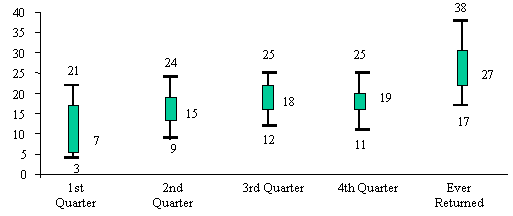
Notes: The graph shows the minimum, maximum, and median TANF return rates as reported across the studies. The shaded box represents the range in which the middle 50% of reported TANF return rates fall. Not all studies provide data for all post-exit quarters. See table IV.1 for more information.
In the second, third, and fourth quarter after exit, the median percentage of families returning to TANF is 15, 18, and 19 percent respectively. However, there is variation across sites (Table IV.1).18 The highest rates of return in the third and fourth quarters after exit are in Iowa and Cuyahoga County, where about a quarter of leavers return to cash assistance. South Carolina and Florida have the lowest percentage of leavers returning in these quarters.
State/Study | Exit Cohort | Quarter Relative to Exit (%) | Receipt Any Time in Year After Exit | |||
|---|---|---|---|---|---|---|
| Q1 | Q2 | Q3 | Q4 | |||
Arizona1 | 1Q98 | 5 | 15 | 21 | 20 | 28 |
| District of Columbia1,2 | 4Q98 | 7 | 13 | 17 | 19 | 21 |
Florida3 | 2Q97 | 7 | 14 | 13 | 11 | 25 |
Georgia | 1Q98 | 3 | 10 | 14 | 14 | 22 4 |
Illinois3 | 3Q97 - 4Q98 | 16 | 19 | 18 | 16 | 29 |
Iowa1 | 2Q99 | 6 | 15 | 22 | 24 | 30 |
Massachusetts2 | Dec 1998 - Mar 1999 | 3 5 | 11 | 16 | 16 | 19 |
Missouri2 | 4Q96 | 13 | 18 | 21 | 21 | 29 |
New York | 1Q97 | n.a | n.a | n.a | 19 | n.a |
South Carolina2 | Oct 1998 - Mar 1999 | 3 | 9 | 12 | 11 | 17 |
Washington | 4Q97 | 8 | 14 | 16 | 16 | 23 |
Wisconsin2 | 4Q97 | 19 | 22 | 22 | 20 | 36 |
Cuyahoga Co. | 3Q98 | 21 | 24 | 25 | 25 | 38 |
Bay Area | 4Q98 | 19 | 21 | 23 | n.a | n.a |
1Quarterly data calculated from public use files. | ||||||
In most of the studies, returns to TANF increase over the first four quarters after exit. However, some report relatively high returns even in the first post-exit quarter. For example, Wisconsin, Cuyahoga County and the Bay Area study all report return rates around 20 percent in the first quarter after exit. Other studies report relatively low return rates in the first quarter. While some of these are reporting monthly and not quarterly rates, the 3 percent returns in Georgia and South Carolina are quarterly. In most studies, the rates of return are more closely bunched in the second through third quarters.19
There are indications that in many areas, fairly steady TANF participation rates in the second through fourth quarters after exit mask a fair degree of cycling families returning to TANF and then leaving again. Eight of the fourteen studies report the percentage of families who ever received TANF in the year after initially exiting. These numbers range from 17 to 38 percent, with the median at 27 percent. In all of these, a higher percent of leavers ever returned to TANF over the course of the year than are on at the end of the year: in most cases a much higher percent. This indicates a large degree of movement off and on TANF. For example, Arizona reports that 28 percent of leavers in the study cohort return to TANF over the year after exit, but only 16 percent were on in the twelfth month after leaving. This means almost half of those who return to TANF at some point in the year after exit have left again before the twelfth month.
Using the limited information available, it is interesting to examine how return rates vary by the time limit policy in each of the study areas. As noted earlier, families may leave earlier in states with shorter time limits compared with states with the 60-month time limit. This could mean families are less likely to return because they have already hit their time limit or want to save up remaining months. It could also mean families are more likely to return if they were less prepared for the labor market when they exited TANF. In the studies examined here, there is some indications that places with shorter time limits (less than the federal 60 month limit) have lower returns in the fourth quarter. For example, Florida, Massachusetts, and South Carolina all have shorter than 5-year time limits and rates of return in the fourth quarter ranging from 11 to 16 percent. Ohio also has a shorter time limit, but Cuyahoga County's rate of return in the fourth quarter is the highest of the studies examined, 25 percent. 20
Administrative data have some advantages over survey data for examining program participation, in that survey data are susceptible to faulty respondent memory and misinterpretation of questions. However, survey data on program participation does have the advantage of capturing benefit receipt for those who have moved out-of-state and no longer appear in the original states administrative data.
Seven studies report results on returns to TANF from their surveys of former recipients (Table IV.2). These results for TANF receipt at the time of the survey (which ranges from 6 to 34 months after exit) are generally comparable to the administrative data results for the same time period. Five of the studies also report the percent returning at any time in the year after exit. These results show that returns since exit are higher than returns at the time of the survey. They reinforce the finding that while a significant percentage of leavers return to welfare, many who return exit again in the time period prior to the survey. Of all the surveys, Missouri allows the longest-term picture of returns to TANF, by administering their survey two and a half years after the initial exit. At this time, 14 percent of leavers report they are back on TANF in Missouri and 31 percent say they received TANF at some point since exit.
State/Study | Exit Cohort | Timing of Survey Post Exit | Since Exit (%) | At Time of Survey (%) |
|---|---|---|---|---|
District of Columbia2 | 4Q98 | ~ 12 months | 25 | 19 1 |
Illinois | Dec. 1998 | 6 - 8 months | 19 | 14 |
Iowa | 2Q99 | 8 - 12 months | 28 | 21 1 |
Massachusetts2 | Dec 1998 - Mar 1999 | ~ 10 months | 18 | 10 |
Missouri2 | 4Q98 | 26 - 24 months | 31 | 14 |
South Carolina2 | Oct 1998-Mar 1999 | 12 months | n.a. | 7 |
Washington | Oct. 1998 | 6 - 8 months | n.a | 19 |
1Month prior to survey. | ||||
Food Stamp Participation
Food stamp benefits can provide a significant amount of resources to a low-income family. Families with incomes below 130 percent of the federal poverty line qualify for food stamp benefits. Since income eligibility requirements are more strict for TANF than for food stamps, the vast majority of TANF recipients are also eligible for food stamps. Six studies report food stamp receipt in the quarter prior to leaving TANF using administrative data, and they all show that over 80 percent of leavers were receiving this benefit (Table IV.3).
State/Study | Exit Cohort | Quarter Relative to Exit (%) | Receipt Any Time in Year After Exit | ||||
|---|---|---|---|---|---|---|---|
| Q-1 | Q1 | Q2 | Q3 | Q4 | |||
Arizona1 | 1Q98 | 83 | 51 | 46 | 45 | 42 | 67 |
District of Columbia1,2 | 4Q98 | 87 | 40 | 42 | 40 | 41 | 53 |
Florida3 | 2Q97 | n.a | 45 | 41 | 38 | 35 | 67 |
Illinois3 | 3Q97 - 4Q98 | 85 | 33 | 35 | 34 | 33 | 56 |
Iowa1 | 2Q99 | 85 | 50 | 44 | 42 | 56 | 67 |
Massachusetts2,3 | Dec 1998 - Mar 1999 | n.a | 42 | 48 | 46 | 44 | 51 |
Missouri2 | 4Q96 | n.a | 57 | 47 | 43 | 40 | 70 |
New York | 1Q97 | n.a | n.a | n.a | n.a | 26 | n.a |
South Carolina2 | Oct 1998 - Mar 1999 | n.a | 78 | 68 | 64 | 61 | 84 |
Washington | 4Q97 | 90 | 46 | 42 | 40 | 36 | n.a |
Wisconsin2 | 2Q98-4Q98 | 84 | 70 | 67 | 65 | 63 | 83 |
Cuyahoga Co. | 3Q98 | n.a | 56 | 48 | 48 | 47 | 68 |
Bay Area4 | 4Q98 | n.a | 26 | 28 | 28 | n.a | n.a |
1Quarterly data calculated from public use files. | |||||||
Twelve studies report post-exit food stamp receipt using administrative data, and they show wide variation in the percent of leavers receiving this benefit overall. Food stamp receipt drops significantly after exiting TANF. The actual percentages range from 26 percent in the Bay Area to 78 percent in South Carolina (Figure IV.2). 21
Figure IV.2:
Percent of Single-Parent Welfare Leavers Receiving Food Stamps
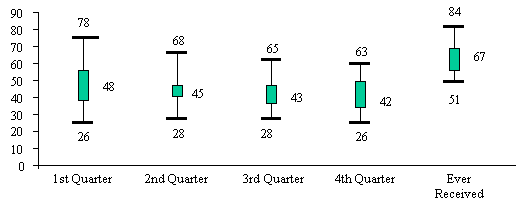
Notes: The graph shows the minimum, maximum, and median food stamp receipt rates. The shaded box represents the range in which the middle 50% of food stamp receipt rates fall. Not all studies provide data for all post-exit quarters. See table IV.3 for more information.
In seven out of the twelve studies reporting food stamp benefit receipt in the quarter after exit, 50 percent or fewer leavers are receiving food stamps. The median level of receipt is 48 percent. These generally low rates of receipt are at least in part due to some recipients no longer being eligible for food stamps. However, the extent to which a change in eligibility status is the reason for the decline in receipt after exit cannot be assessed with these data.
Over the first year after exit, the majority of studies show some decline in food stamp receipt. Figure IV.2 shows that the median percentage of families receiving food stamps falls from 48 percent in the first quarter after exit to 42 percent in the fourth
quarter after exit. The studies reporting the greatest declines, Missouri and South Carolina, have some of the largest receipt rates in the first quarter after exit (Table IV.3). In the fourth quarter after exit, New York reports the lowest rate of receipt among these studies, 26 percent, while Wisconsin has the highest rate, 63 percent. 22
As with returns to TANF, there is evidence in these administrative data of a great deal of cycling on and off food stamps. The percentage of leavers who receive food stamps at any point over the year after exit is significantly higher than the percentage receiving in any of the individual quarters. For example, 67 percent of Arizona leavers receive food stamps at some point in the year after exiting TANF, but only between 42 and 51 percent are receiving benefits in any single quarter. This suggests that while the overall receipt of food stamps declines slowly over time, there is actually a substantial degree of turnover with recipients leaving and entering the food stamp caseload.
These food stamp participation rates include families that have returned to TANF. Thus, these numbers conceal a more extensive decline in food stamp receipt among continuous leavers (those who have not returned to TANF in the year after exit). Those who have returned to TANF are more likely to be receiving food stamps, likely due to the relative ease of accessing food stamps benefits when already receiving TANF. Those who have not returned may have lower receipt over time either because they have more earnings and, therefore, are likely to be less eligible for benefits over time or they moved out of the geographic area being studied and are no longer included in administrative TANF or food stamp data.
Seven studies report food stamp receipt for continuous leavers (Table IV.4). Figure IV.3 shows the five studies reporting receipt of food stamps at any time in the year after exit for continuous and all leavers.
Figure IV.3:
Percent of Single-Parent Welfare Leavers Who Ever Received Food Stamps In Year After Exit--Continuous Leavers v. All Leavers
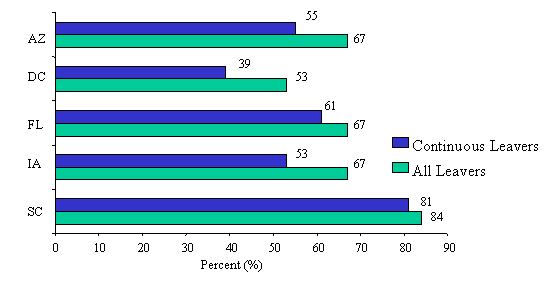
Notes: See table IV.4 for more information.
In all studies in almost all quarters after exit, the percentage of continuous leavers receiving food stamps after leaving TANF is lower than the percentage of all leavers receiving food stamps. For example, in Arizona, 67 percent of all leavers receive food stamps at some point in the year after leaving TANF, compared with 55 percent of continuous leavers.
State | Exit Cohort | Quarter Relative to Exit (%) | Receipt Any Time in Year After Exit | |||
|---|---|---|---|---|---|---|
| Q1 | Q2 | Q3 | Q4 | |||
Arizona1 | 1Q98 | |||||
All Leavers | 51 | 46 | 45 | 42 | 67 | |
Continuous Leavers | 46 | 34 | 31 | 28 | 55 | |
District of Columbia1,2 | 4Q98 | |||||
All Leavers | 40 | 42 | 40 | 41 | 53 | |
Continuous Leavers | 33 | 31 | 26 | 25 | 39 | |
Florida3 | 2Q97 | |||||
All Leavers | 45 | 41 | 38 | 35 | 67 | |
Continuous Leavers | 38 | 30 | 26 | 29 | 61 | |
Illinois3 | 3Q97 - 4Q98 | |||||
All Leavers | 33 | 35 | 34 | 33 | 56 | |
Continuous Leavers | 28 | 33 | 36 | 39 | n.a. | |
Iowa1 | 2Q99 | |||||
All Leavers | 50 | 44 | 42 | 56 | 67 | |
Continuous Leavers | 46 | 31 | 25 | 41 | 53 | |
Missouri2 | 4Q98 | |||||
All Leavers | 57 | 47 | 43 | 40 | 70 | |
Continuous Leavers | 49 | 35 | 30 | 26 | n.a. | |
South Carolina2 | Oct 1998-Mar 1999 | |||||
All Leavers | 78 | 68 | 64 | 61 | 84 | |
Continuous Leavers | 76 | 64 | 59 | 55 | 81 | |
1Quarterly data calculated from public use files. | ||||||
There is information on food stamp receipt from survey data in nine of the studies (Table IV.5). Where the timing of this information overlaps with that of administrative data, the results are similar, with some survey estimates somewhat lower than administrative data (e.g. Arizona). Missouri again affords the opportunity to observe program participation for a fairly long period after exit. In this study, 47 percent of leavers are receiving food stamps 26 to 34 months after exit, the same percentage receiving food stamps in the second quarter after exit according to Missouris administrative data. According to survey data from five studies, continuous leavers also have lower receipt of food stamps than the entire population of leavers (Table IV.6). Receipt of food stamps ranges from 3 to 12 percentage points lower at the time of the survey for continuous leavers as compared with all leavers. The percentage receiving at any time since exit is 10 percentage points lower for continuous leavers in the two studies that provide this information.
State/Study | Exit Cohort | Timing of Survey Post Exit | Since Exit (%) | At Time of Survey (%) |
|---|---|---|---|---|
Arizona1 | 1Q98 | 12-18 months | 55 | 38 |
District of Columbia2 | 4Q98 | ~ 12 months | 55 | 41 |
Georgia | Jan 1999- June 2000 | ~ 6 months | n.a | 74 |
Illinois | Dec. 1998 | 6 - 8 months | 44 | 33 |
Iowa1,3 | 2Q99 | 8 - 12 months | n.a | 43 |
Massachusetts2 | Dec 1998-Mar 1999 | ~10 months | 53 | 38 |
Missouri2 | 4Q98 | 26 - 34 months | n.a | 47 |
South Carolina2 | Oct. 1998-Mar 1999 | 12 months | n.a. | 61 |
Washington1 | Oct. 1998 | 6 - 8 months | 50 | n.a |
1Calculations from public use data files. | ||||
State/Study | Exit Cohort | Timing of Survey Post Exit | Since Exit (%) | At Time of Survey (%) |
|---|---|---|---|---|
Arizona1 | 1Q98 | 12-18 months | ||
All Leavers | 55 | 38 | ||
Continuous Leavers | 45 | 27 | ||
District of Columbia1,2 | 4Q98 | ~ 12 months | ||
All Leavers | 55 | 41 | ||
Continuous Leavers | 45 | 31 | ||
Iowa1,3 | 2Q99 | 8 - 12 months | ||
All Leavers | n.a | 43 | ||
Continuous Leavers | n.a | 31 | ||
Massachusetts1,2 | Dec 1998-Mar 1999 | ~10 months | ||
All Leavers | 53 | 38 | ||
Continuous Leavers | 31 | |||
South Carolina2 | Oct. 1998-Mar.1999 | 12 months | ||
All Leavers | n.a | 61 | ||
Continuous Leavers | n.a | 58 | ||
1Data calculated from public use data files. | ||||
Medicaid and Other Health Insurance
Another important benefit that can support the transition from welfare to work is public health insurance through the Medicaid program. 23 Like food stamps, families receiving TANF are generally eligible for this benefit. This is borne out in the high rates of adult receipt, 90 percent or more, in the six studies reporting Medicaid coverage in the quarter prior to exiting TANF (Table IV.7). Most families exiting welfare through employment are eligible for Transitional Medical Assistance and most children in low-income families are eligible for Medicaid.
State/Study | Exit Cohort | Quarter Relative to Exit | Receipt Any Time in Year After Exit | ||||
|---|---|---|---|---|---|---|---|
| Q-1 | Q1 | Q2 | Q3 | Q4 | |||
Adults | |||||||
Arizona1,2 | 1Q98 | 96 | 60 | 54 | 49 | 45 | 72 |
District of Columbia2,3 | 4Q98 | 98 | 44 | 49 | 49 | 50 | 58 |
Florida4 | 2Q97 | n.a | 55 | 52 | 48 | 45 | 74 |
Illinois4 | 3Q97 - 4Q98 | 93 | 57 | 52 | 47 | 40 | 69 |
Iowa1,2 | 2Q99 | n.a | 54 | 49 | 49 | 46 | 68 |
Missouri3 | 4Q96 | n.a | 41 | 39 | 34 | 31 | n.a |
New York | 1Q97 | n.a | n.a | n.a | n.a | 35 5 | n.a |
South Carolina | Oct 1998 - Mar 1999 | 90 | 69 | 64 | 57 | 45 | 69 |
Washington3,6 | 4Q97 | 93 | 53 | 49 | 46 | 43 | n.a |
Wisconsin3 | 2Q98-4Q98 | 96 | 80 | 79 | 78 | 76 | 87 |
Cuyahoga | 3Q98 | n.a | 60 | 55 | 50 | 46 | 70 |
Bay Area4,7 | 4Q98 | n.a | 74 | 70 | 66 | n.a | n.a |
Children | |||||||
Florida4 | 2Q97 | n.a | 62 | 58 | 54 | 51 | 78 |
Missouri3 | 4Q96 | n.a | 81 | 86 | 97 | 87 | n.a |
New York | 1Q97 | n.a | n.a | n.a | n.a | 34 5 | n.a |
South Carolina3 | Oct 1998 - Mar 1999 | 96 | 88 | 86 | 80 | 68 | 88 |
Wisconsin | 2Q98-4Q98 | 90 | 86 | 83 | 82 | 80 | 90 |
1Only family head enrollment considered. | |||||||
In the studies reporting Medicaid administrative data, there are varying rates of Medicaid coverage for adults after exiting TANF. In the first quarter after exit, results range from 41 percent in Missouri to 80 percent in Wisconsin (Figure IV.4 and Table IV.7).
Figure IV.4:
Percent of Single-Parent Welfare Recipients Receiving Medicaid for Adults
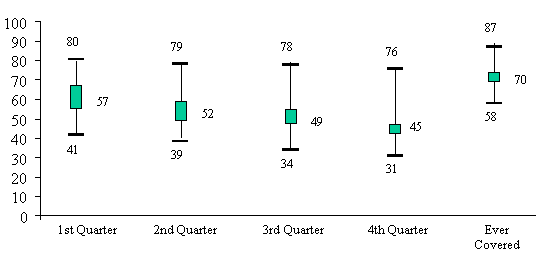
Notes: The graph shows the minimum, maximum, and median Medicaid coverage rates as reported across the studies. The shaded box represents the range in which the middle 50% of Medicaid coverage rates fall. Not all studies provide data for all post-exit quarters. See table IV.7 for more information.
The median percentage covered by Medicaid in the first quarter after exit is 57 percent. While these rates are generally higher than receipt of food stamps, they are far lower than the 90 plus percent receiving Medicaid benefits before exit reported in several studies.
Only five studies report separate administrative data on Medicaid enrollment for children. The coverage rates after exit vary from 62 percent in the third month after exit in Florida to 88 percent in the first quarter after exit for South Carolina. In almost all studies reporting both adult and child enrollment, coverage for children is higher than for adults. New York is the only study reporting about the same Medicaid coverage for adults and children (35 percent versus 34 percent) in the fourth quarter after exit, with 45 percent of cases having any members with Medicaid.
Similar to food stamp receipt, the percentage of leavers who have Medicaid coverage at any time over the year after exit is significantly higher than the percent receiving in any particular month or quarter. For example, in Florida, 74 percent of adults and 78 percent of children are on Medicaid at some point over the year, but only 45 percent and 51 percent of adults and children respectively are covered by Medicaid in the twelfth month after exit. This signals a fair amount of turnover in Medicaid receipt.
Over time, the rate of Medicaid coverage declines for both adults and children in almost all of these studies, except for adults in the District of Columbia and children in Missouri. As with food stamp receipt, the decline is greater for the group of continuous leavers. Six of the eight studies reporting Medicaid use by continuous leavers show this more dramatic decline (Table IV.8).
State | Exit Cohort | Quarter Relative to Exit (%) | Receipt Any Time in Year After Exit | |||
|---|---|---|---|---|---|---|
| Q1 | Q2 | Q3 | Q4 | |||
Arizona1 | 1Q98 | |||||
All Leavers | 60 | 54 | 49 | 45 | 72 | |
Continuous Leavers | 55 | 44 | 34 | 28 | 61 | |
District of Columbia1,2 | 4Q98 | |||||
All Leavers | 44 | 49 | 49 | 50 | 58 | |
Continuous Leavers | 38 | 39 | 37 | 37 | 46 | |
Florida3 | 2Q97 | |||||
All Leavers | 55 | 52 | 48 | 45 | 74 | |
Continuous Leavers | 49 | 41 | 35 | 39 | 69 | |
Illinois3 | 3Q97 - 4Q98 | |||||
All Leavers | 57 | 52 | 47 | 40 | 69 | |
Continuous Leavers | 50 | 53 | 55 | 56 | n.a. | |
Iowa1 | 2Q99 | |||||
All Leavers | 54 | 49 | 49 | 46 | 68 | |
Continuous Leavers | 49 | 37 | 33 | 30 | 55 | |
Missouri2 | 4Q96 | |||||
All Leavers | 41 | 39 | 34 | 31 | n.a. | |
Continuous Leavers | 35 | 26 | 20 | 15 | n.a. | |
South Carolina2 | Oct 1998-Mar 1999 | |||||
All Leavers | 69 | 64 | 57 | 45 | 69 | |
Continuous Leavers | 66 | 62 | 57 | 46 | 66 | |
Washington | 4Q1997 | |||||
All Leavers | 53 | 49 | 46 | 43 | n.a | |
Continuous Leavers | 55 | 45 | 40 | 36 | n.a | |
1data calculated from public use files. | ||||||
Figure IV.5 shows the percent of adult leavers with Medicaid coverage at some point in the year after exit for continuous and all leavers.
Figure IV.5:
Percent of Single-Parent Welfare Leavers Receiving Medicaid for Adults in Year After Exit--Continuous Leavers v. All Leavers
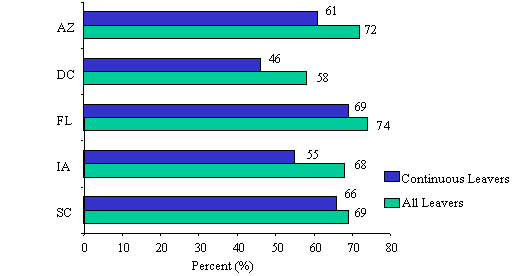
Notes: See table IV.8 for more information.
Coverage rates in the year after exiting TANF are lower for continuous leavers than for all leavers. This is true for most studies in most of the quarters after exit. The main exception is Illinois which actually shows increasing coverage for continuous leavers. Lower coverage of continuous leavers could in part be due to the fact that after six months transitional Medicaid benefits are income-tested in many states and some workers may no longer qualify. It could also be true, as noted earlier, that some leavers move out of the study area and are no longer captured in the studies TANF or Medicaid program data.
Survey data are valuable when collecting information on health insurance coverage other than Medicaid. They can be used to ascertain coverage by private sources as well as public and to discover the percentage of persons with no coverage at all. Ten studies report survey data for insurance coverage of adults at the time of the survey (Table IV.9).24 The percentage covered by Medicaid is reported in the first column under type of coverage at time of interview. This information roughly corresponds to the administrative findings where similar time periods are available, with some survey reports of Medicaid slightly higher than administrative reports and some slightly lower. The exception is South Carolina, where the survey results include Medicaid coverage of any household member, and are thus much higher than administrative reports for adults only.
State/Study | Exit Cohort | Timing of Survey Post Exit | Type of Coverage at Time of Interview (%) | |||
|---|---|---|---|---|---|---|
| Medicaid | Employer1 | Other | Uninsured | |||
Arizona2 | 1Q98 | 12 - 18 months | 38 | 15 | 5 | 41 |
District of Columbia2,3 | 4Q98 | ~ 12 months | 54 | 19 | 4 | 22 |
Georgia | Jan 1999- June 2000 | ~ 6 months | 66 | n.a | 10 4 | 24 |
Illinois2 | 3Q97 - 4Q98 | 6 - 8 months | 47 | 21 5 | n.a | 36 |
Iowa2,6 | 2Q99 | 8 - 12 months | 48 | 14 | 8 | 37 |
Massachusetts2,3 | Dec 1998 - Mar 1999 | ~ 10 months | 81 | 13 | n.a | 10 |
Missouri3 | 4Q98 | 26 - 34 months | 33 | 25 | 9 | 32 |
South Carolina3,7 | Oct 1998 - Mar 1999 | 12 months | 85 | 10 5 | 1 | 10 |
Washington8 | 4Q97 | 6 - 8 months | 53 | 13 | 12 | 26 |
Bay Area | 4Q98 | 6 - 12 months | 53 | n.a | 23 9 | 24 |
1Employer includes own employer coverage for survey respondents. Spouse employer coverage, where reported separately (Missouri, Iowa, and Washington) is included in other. | ||||||
The share of adults without health insurance varies substantially across studies. The rates range from 10 percent in Massachusetts to 41 percent in Arizona. South Carolina reports that in 10 percent of leaver families that have not returned to welfare, all members are uninsured. This range reflects, in part, differences in Medicaid coverage for adults as well as, to a lesser extent, differences in private coverage. The lower rate of adult uninsurance in Massachusetts is a result of the higher rate of adult Medicaid coverage compared with other studies. Arizona has one of the lowest rates of adult Medicaid coverage, and the highest uninsured rate. However, private/employer coverage plays a significant role in Missouri which reports the lowest rate of adult Medicaid coverage among the grantees (33 percent), but has the highest rate of private (employer and other) coverage at 34 percent.
Other Sources of Support
There are a number of other sources of public support that can provide crucial assistance to families that have exited welfare. These include housing assistance through subsidies or public housing, Supplemental Security Income (SSI) program and Social Security program income for persons with disabilities or survivors of beneficiaries. Other programs include reduced price or free school lunches, the Women, Infant, and Children's (WIC) nutritional supplement program, fuel/energy assistance, and unemployment compensation. In addition, many working leavers are eligible for the federal and/or state Earned Income Tax Credits (EITC) that supplement incomes of low-income workers. A few studies ask about receipt of these benefits in their surveys, some asking about receipt at the time of the survey and some about receipt at any point since exit. 25
There is a wide variation in the percent of leavers receiving housing assistance in the eleven studies reporting this information (Table IV.10). Rates of receipt of housing assistance at the time of the survey range from 18 percent in Arizona to 60 percent in Georgia. Receipt of housing assistance at any point since exit ranges from 14 percent of welfare leavers in Illinois to 53 percent in Massachusetts.
State/Study | Exit Cohort | Timing of Survey Post Exit | Housing | SSI | Social Security | School Lunch | WIC | Fuel/ Energy | Unem. Comp. | EITC |
|---|---|---|---|---|---|---|---|---|---|---|
Results for time of survey | ||||||||||
Arizona1 | 1Q98 | 12 - 18 months | 18 | 12 | n.a | 27 | 25 | n.a | n.a | 52 |
District of Columbia1,2,3 | 4Q98 | ~ 12 months | 27 | 6/64 | 7 | n.a | 12/354 | 3 | 3 | n.a |
Georgia | Jan 1999-June 2000 | ~ 6 months | 60 | n.a | n.a | 87 | n.a | n.a | n.a | n.a |
Missouri2 | 4Q98 | 26 - 34 months | 26 | 12 | n.a | n.a | 23 | n.a | 2 | n.a |
South Carolina2 | Oct98-Mar99 | 12 months | 24 | 10 | 8 | 48 | 26 | n.a | n.a | n.a |
Bay Area | 4Q98 | 6 - 12 months | 24 | n.a | n.a | n.a | n.a | n.a | n.a | 32 |
Results for time since exit | ||||||||||
District of Columbia1,2 | 4Q98 | ~ 12 months | 31 | 7/84 | 8 | n.a | 16/464 | 9 | 5 | 50 |
Illinois2 | 3Q97-4Q98 | 6 - 8 months | 14 | 12 | 6 | 40 | 20 | 13 | 4 | 41 |
Iowa1 | 2Q99 | 8 - 12 months | 23 | 7 | 7 | 46 5 | 32 | n.a | n.a | 65 |
Massachusetts1,2 | Dec98-Mar99 | ~ 12 months | 53 6 | 20 7 | n.a | 71 | 27 | 27 | 9 | 42 |
Washington1 | 4Q97 | 6 - 8 months | 17 | 4 3 | 4 | 52 | n.a | 16 | 4 | 65 |
Cuyahoga County | 3Q98 | 14 - 21 months | 28 | 5 | n.a | n.a | n.a | n.a | n.a | n.a |
1Calculated from public use data. | ||||||||||
The variation in SSI receipt is lower, with between 4 and 12 percent of former recipients receiving this form of cash assistance in the nine studies reporting this benefit. Massachusetts reports a higher percentage (20 percent), but this includes Social Security and Social Security Disability Insurance (SSDI) receipt. For those studies reporting Social Security receipt separately, the combined SSI and Social Security percentages range from 8 percent (Washington) to 18 percent (Illinois and South Carolina). Since this income is generally for persons with a disability that prevents them from working, some leavers who are not working may be relying on this income rather than cash assistance from the TANF program.
Receipt of nutritional assistance programs such as reduced price or free school lunch and WIC are much more common, which likely reflects higher income thresholds for eligibility and easier eligibility processes, as well as widespread coverage among low-income children. Receipt of reduced-price or free school lunch varies from 27 percent in Arizona to 87 percent in Georgia. The percent of former recipient families receiving WIC generally ranges from one-quarter to one-third.
Four studies report fuel/energy assistance and five report unemployment compensation receipt. Fuel/energy assistance use ranges from 9 percent in DC to 27 percent in Massachusetts. This higher percentage for Massachusetts likely results from its harsher winters and therefore greater need for fuel assistance. Unemployment compensation use is very low, from 2 percent to 9 percent. These low rates may reflect the fact that many leavers do not have sufficiently high earnings or quarters of employment to be eligible for unemployment insurance.
A final source of public support is the federal EITC. Working families with relatively low earnings are eligible to receive this credit from the federal government.26 Seven studies report how many leavers received this credit. Results range from 32 percent in the Bay Area to 65 percent in Washington and Iowa (these percentages are for all leavers, not just working leavers). Arizona and Illinois also report that a higher percentage of leavers had heard of the EITC, 66 percent and 76 percent, respectively. Illinois probes further and finds that although three-quarters of leavers have heard of the EITC, only 47 percent say they know what it is, a percentage not much higher than those receiving the credit.
Program Participation by Subgroup
Individual reports find differences in results when comparing across subgroups such as employed and not employed or sanctioned and not sanctioned. Two types of subgroup comparisons for program participation were included in enough reports to be discussed here employment status and race/ethnicity.
Examining receipt of government assistance by employment status provides information on the extent to which those who are employed are combining work with some form of public assistance. Generally, one would expect that those who are working are less likely to be receiving government benefits. It is also interesting to examine whether working leavers benefit receipt declines over time, which would be consistent with increasing wages and more stable employment. All the figures described in this section with the exception of South Carolina are calculated from the public use data files for these studies. This allows the report to present program participation by employment status when it is not reported in the published studies.
Program participation by employment status is examined both in administrative data and survey data. Public-use data files including administrative data on food stamps and Medicaid have been provided by two states, Arizona and Iowa. For both of these studies we compare those who have worked at some point since exit and those who have never worked since exit (Table IV.11). Across both these states and programs, 44 to 63 percent of leavers who have worked since exit receive food stamps or Medicaid in any given quarter after exit. A higher percentage, almost three-quarters, receive food stamps or Medicaid at some point during the year after exit. These higher figures indicate that among working leavers there is some cycling on and off non-TANF benefit programs. Because we are examining the group who worked at any point since exit (not necessarily continually), this benefit receipt could be connected to movement on and off TANF.
Program | State/Study | Exit Cohort | Quarter Relative to Exit (%) | Receipt Any Time in Year After Exit | |||
|---|---|---|---|---|---|---|---|
| Q1 | Q2 | Q3 | Q4 | ||||
Food Stamps | |||||||
Arizona1 | 1Q98 | ||||||
Worked Since Exit | 55 | 49 | 48 | 44 | 71 | ||
Never Worked Since Exit | 44 | 39 | 39 | 37 | 57 | ||
Iowa1 | 2Q99 | ||||||
Worked Since Exit | 53 | 47 | 44 | 60 | 70 | ||
Never Worked Since Exit | 45 | 39 | 37 | 48 | 58 | ||
Medicaid | |||||||
Arizona1 | 1Q98 | ||||||
Worked Since Exit | 63 | 58 | 52 | 48 | 76 | ||
Never Worked Since Exit | 51 | 45 | 44 | 39 | 63 | ||
Iowa1 | 2Q99 | ||||||
Worked Since Exit | 57 | 52 | 51 | 49 | 72 | ||
Never Worked Since Exit | 48 | 41 | 43 | 40 | 58 | ||
1Quarterly data calculated from public use files. | |||||||
The administrative data show that those who have never worked since exit are less likely to receive food stamps or Medicaid than those who have worked since exit. This is true in all quarters for Arizona and Iowa for both the food stamp and Medicaid programs. One possible explanation for this difference is that those who have never worked since exit are a heterogeneous group including leavers who have a working spouse or partner and may not qualify for benefits, as well as leavers who have few sources of income. Another possible explanation is that some leavers who do not show up as having earnings or food stamps in administrative databases have moved out of state or may have misspelled last names or missing social security numbers which hamper linkages to both earnings and food stamps databases. In fact, survey data discussed below show different results.
The administrative data can be used to examine the trend in participation over the four quarters for these subgroups. For those who worked at some point since exit and those who never worked since exit, both studies show a gradual decline in benefit receipt over the first three quarters. In Iowa, however, food stamp participation turns up sharply in the fourth post-exit quarter.
Another way of considering program participation by employment status is to examine current benefit receipt among those who are currently working or currently not working. Some of the studies with survey data allow us this comparison to be made. Six of the studies we information by employment status on receipt of food stamps, Medicaid, and SSI (Table IV.12). Program participation for food stamps and Medicaid is almost always higher for those not currently employed compared to those currently employed. The only exception is Massachusetts, where 80 percent of those not currently employed have Medicaid compared with 83 percent of those currently employed. While many of the differences are modest, in the District of Columbia the difference in benefit receipt by current employment status is quite large. Figure IV.6 illustrates the differences in food stamp receipt between leavers who are currently employed and not currently employed.
Program | State/Study | Exit Cohort | Timing of Survey Post Exit | Currently Employed | Not Currently Employed | Never Worked Since Exit |
|---|---|---|---|---|---|---|
Food Stamps | Arizona | 1Q98 | 12-18 months | 30 | 38 | 40 |
District of Columbia2 | 4Q98 | ~ 12 months | 26 | 69 | 59 | |
Iowa3,4 | 2Q99 | 8 - 12 months | 36 | 41 | 49 | |
Massachusetts2 | Dec.1998-Mar.1999 | ~10 months | 33 | 36 | 55 | |
South Carolina2 | Oct.1998-Mar.1999 | 12 months | 49 | 72 | n.a. | |
Washington4 | Oct-98 | 6-8 months | 44 | 50 | 56 | |
Medicaid | Arizona | 1Q98 | 12-18 months | 27 | 29 | 36 |
District of Columbia2 | 4Q98 | ~ 12 months | 41 | 72 | 75 | |
Iowa2,3 | 2Q99 | 8 - 12 months | 37 | 46 | 52 | |
Massachusetts2 | Dec.1998-Mar.1999 | ~10 months | 83 | 80 | 92 | |
South Carolina2 | Oct.1998-Mar.1999 | 12 months | 82 | 83 | n.a. | |
Washington | Oct-98 | 6-8 months | 52 | 56 | 57 | |
SSI | Arizona | 1Q98 | 12-18 months | 11 | 10 | 18 |
District of Columbia2 | 4Q98 | ~ 12 months | 4 | 2 | 16 | |
Iowa2,3 | 2Q99 | 8 - 12 months | 3 | 4 | 17 | |
Massachusetts2,5 | Dec.1998-Mar.1999 | ~10 months | 17 | 19 | 27 | |
South Carolina2,6 | Oct.1998-Mar.1999 | 12 months | 6 | 15 | n.a. | |
Washington | Oct-98 | 6-8 months | 3 | 3 | 8 | |
1All figures except South Carolina calculated from public use data files. | ||||||
Figure IV.6:
Food Stamp Receipt of Welfare Leavers by Employment Status
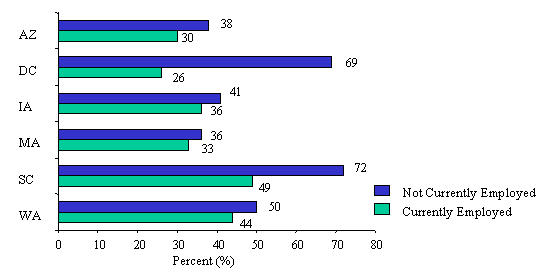
Notes: See table IV.12 for more information.
Table IV.12 also shows results for those who have never worked since exit. Leavers who never worked since exit are more likely to receive food stamps and Medicaid than currently employed leavers. In several studies these differences are quite large. In addition, in almost all of the studies, those who have never worked since exit are more likely to receive benefits than those who are not currently employed. This suggests that those who have never worked since exit are more dependent on government benefits than leavers who have worked at some point since exit. These survey results might differ from the administrative results because they measure receipt in a specific month, versus receipt at any time over a quarter. If there is a great deal of movement on and off benefit programs, as is likely more true for those working at any point since exit than those never working since exit, receipt at some point during a quarter will be higher than receipt in a given month27
Finally, examination of SSI receipt by employment status shows that a relatively high percentage of those who have never worked since exit are receiving this form of cash assistance. The percentages range from 8 percent in Washington to 27 percent in Massachusetts (which includes SSDI and Social Security benefits). That these numbers are relatively high for those who have never worked is not surprising since SSI requires that recipients have a disability that prevents work. However, the majority of former recipients that have not worked since exit are not receiving disability benefits.
Five studies report some information on the participation of leavers in TANF, food stamps, or Medicaid in the year after exit by race and ethnicity (Table IV.13). For the most part, the share of black leavers receiving these forms of government assistance in the year after exit is higher than the share of white and other racial/ethnic group leavers.
| Race/Ethnicity Group | ||||
|---|---|---|---|---|
| Black | White | Hispanic | Other1 | |
Returns to TANF in Year After Exit (%) | ||||
Arizona2 | 33 | 21 | 30 | 40 |
Florida | 32 | 22 | 22 | 16 |
Georgia | 23 | 13 | n.a. | 10 |
Missouri3,4 | 32 | 27 | n.a. | n.a. |
South Carolina5 | 8 | 6 | n.a. | n.a. |
Receipt of Food Stamps in Year After Exit (%) | ||||
Arizona2 | 70 | 62 | 71 | 69 |
Florida | 73 | 63 | 55 | 50 |
Missouri3,4 | 72 | 69 | n.a. | n.a. |
Adult Covered by Medicaid in Year After Exit (%) | ||||
Arizona2 | 75 | 68 | 77 | 70 |
Florida | 78 | 69 | 70 | 63 |
Missouri3,4 | 37 | 44 | n.a. | n.a. |
1Other includes Asain/Pacific Islander, Native American, and other groups unless otherwise specified. | ||||
In all five studies, the percentage of black leavers who return to TANF at some point in the year after exit is higher than the percentage of white leavers who return to TANF. The difference ranges from 2 percentage points in South Carolina (8 percent of black leavers compared with 6 percent of white leavers) to 12 percentage points in
Arizona (33 percent of black leavers compared with 21 percent of white leavers). The two studies reporting results for Hispanic leavers, Arizona and Florida, show mixed results. In Arizona, returns to welfare among Hispanic leavers (30 percent) are closer to those of black leavers than to those of white leavers. Returns for Native American leavers are even higher, at 40 percent. However, the percentage of Hispanic leavers returning to TANF in Florida (22 percent) is the same as for white leavers. The other category in Florida and Georgia show very low returns to TANF, 16 and 10 percent respectively, but these groups are very small percentages of the entire group of leavers in each study.
Leaver subgroups with higher returns to TANF tend to have higher participation in food stamps and Medicaid. The percentage of black leavers receiving food stamps and the percentage covered by Medicaid in the year after exit are for the most part higher than the percentage of white leavers receiving these benefits. The differences in receipt between these two groups ranges from 3 to 10 percentage points. The exception is in Missouri, where fewer nonwhite leavers have Medicaid coverage than white leavers. The pattern for Hispanic leavers follows the pattern of returns to TANF: in Florida, fewer Hispanic leavers receive these benefits than blacks, and in Arizona, more Hispanic leavers receive these benefits than blacks.
It is not surprising that receipt of food stamps and Medicaid is generally higher for racial and ethnic leaver groups that have higher rates of return to TANF. Receipt of these benefits is likely easier for those who are currently receiving TANF than for former recipients. However, it is somewhat surprising that black leavers have a higher rate of return to TANF than white leavers in light of results described in an earlier chapter showing black leavers tend to have higher employment and earnings than white leavers.28 This may reflect differences in the reason for leaving across groups. If black recipients are more likely to leave for employment than white recipients and employment leads to less permanent transitions than other reasons (such as marriage) then employment rates and returns to TANF could be higher for black leavers. We do not have evidence on the differences across race and ethnic groups in the reasons for leaving TANF.
Chapter Summary
Receiving non-TANF government assistance can help families in their transition from welfare to work. Despite the availability of these supports, about a quarter to a third of families who left welfare returned to TANF at some point in the first year after exit. About half of leaver families receive food stamps in the first quarter after exit and two-thirds receive this benefit at some point in the year after exit. About 60 percent of families have an adult enrolled in Medicaid in the first quarter after exit. Medicaid coverage of children is generally higher, ranging from 78 to 90 percent at some point in the year after exit. Participation in both of these programs is generally lower for continuous leaver families. Several studies also report on additional sources of government assistance, such as housing assistance, disability benefits, reduced-price lunches, WIC, fuel/energy assistance, unemployment compensation, and the Earned Income Tax Credit.
Program participation also varies by work status and race/ethnicity. In general, workers are less likely to receive non-TANF government assistance than non-workers, and black leavers are generally more likely to return to TANF and to participate in food stamps and Medicaid than white leavers.
18Some studies report quarterly information (receipt at some point within a three-month period) and some present monthly information (receipt in a particular month). Studies reporting quarterly information will report a higher percentage than if they reported a monthly number. For example, the New York study shows that 17 percent of original exiters were receiving TANF in the twelfth month after leaving, but 19 percent received at some point in the fourth quarter after leaving. To increase comparability, we have included calculations of quarterly data from public use data files where possible. All tables in this chapter indicate whether numbers reported are monthly or quarterly.
19Recall that most of these studies require that a family remain off welfare for at least two months to be considered a leaver. This common leaver definition may contribute to the similar, low return rates across some sites in the first quarter after exit.
20Arizona and Missouri also have less then 5 year benefit time limits but allow the child's portion of the grant to continue. These families would not be included as leavers under the definition used in Arizona and no families had reached the time limit in Missouri at the time of the study.
21Food stamp receipt in the Bay Area study is the combination of non-TANF food stamp receipt and the percentage of families who have returned to TANF. These numbers are likely lower in part because they are monthly reports, not quarterly.
22Iowa shows a large increase in food stamps receipt from the third to fourth quarter, of 42 percent to 56 percent. As was the case with the large declines in fourth quarter employment data, it is unclear why such a large increase is shown here. We see no large increase for returns to TANF or, as we shall see, Medicaid participation in the fourth quarter.
23A number of states also have programs that extend public coverage to children at higher income levels through the State Children's Health Insurance Program (SCHIP). While this coverage sometimes goes by names other than Medicaid, we are including it under Medicaid here.
24The health insurance results for children are discussed later in the child well-being section of this report.
25District of Columbia reports results for both time of the survey and since exit.
26As of 2000, six study areas had state EITCs: District of Columbia, Illinois, Iowa, Massachusetts, New York, and Wisconsin.
27Also, as discussed on the previous page, some of the administrative results for those coded as non-working non-recipients of food stamps may be due to difficulties in tracing certain individuals in administrative databases.
28Similar findings are reported and discussed in Lower-Basch (2000).
Chapter V: Household Income
Household income is an important indicator of the well-being of welfare leavers. Yet only about half of the ASPE-funded leaver studies fully examine the income of leavers. There are several important reasons for this. First, most leaver studies focus on the first year after leavingvery few leavers are likely to achieve economic security in such a short period of time. Indeed, most leavers will have low incomes. Second, income is very hard to measure accurately. Perhaps the most reliable source of income data are tax records; such records are highly confidential and are rarely available for research purposes. Most information on income comes from survey data, but to obtain fairly accurate income information, the survey generally must devote a great deal of time to ask about each possible income source and then obtain the amount. Even among the studies that do ask about income, the amount of time and number of questions devoted to obtaining income data varies. Finally, income is only one measure of well-being, and many surveys ask about explicit hardships leavers face. Hardship information is discussed in a later chapter.
This chapter presents information on the average monthly incomes of welfare leavers and notes how incomes vary across groups of leavers such as those who remain off TANF for a full year (continuous leavers), those who are currently working, and those who never worked since exit. It then examines leavers' sources of income, focusing primarily on non-governmental sources (government transfers are featured in Chapter IV on program participation). Again, it examines how sources of income vary across different groups of leavers. Finally, it examines the poverty status of leaver families.
Average Monthly Income of Welfare Leavers
Eight of the leaver studies reviewed here obtain data on income through surveys (Arizona, the District of Columbia, Illinois, Iowa, Missouri, Washington, Cuyahoga County, and the Bay Area). Figure V.1 and Table V.1 show that mean monthly incomes range from $1,054 in Illinois to $1,440 in Iowa.29
Figure V.1
Mean Monthly Income of Single-Parent Welfare Leavers: Survey Findings
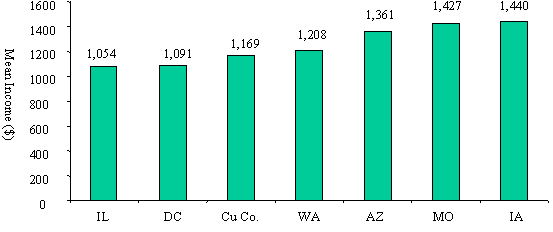
Note: See table V.1 for more information
State/ Study | Exit Cohort | Timing of Survey | Monthly Income1 ($) | |
|---|---|---|---|---|
| Mean | Median | |||
Arizona | 1Q98 | 12-18 months | 1,361 2 | 1,195 |
District of Columbia3 | 4Q98 | ~ 12 months | 1,091 | 800 |
Illinois3 | Dec. 1998 | 6-8 months | 1,054 | 895 |
Iowa | 2Q99 | 8-12 months | 1,440 | n.a. |
Missouri3 | 4Q98 | 26-34 months | 1,427 | 1,166 |
Washington | Oct. 1998 | 6-8 months | 1,208 | 1,000 |
Cuyahoga Co.4 | 3Q98 | 14-21 months | 1,169 | n.a. |
Bay Area | 4Q98 | 6-12 months | n.a. | 1,400 |
1Income data are reported for households in Illinois and Missouri, families in Arizona and Washington, and for welfare cases in all other studies. | ||||
Illinois' mean income is somewhat below DC's mean of $1,091, which is the second lowest, while Iowa's mean is only slightly higher than Missouri's mean of $1,427, which is the second highest. Even if one focuses on DC and Missouri, one sees that mean monthly incomes are more than $300 apart. This translates into a difference of over $3,600 a year. Median incomes also vary across the states. In the six studies that report this information, median incomes range from $895 in Illinois and DC to $1,400 in the Bay Area. However, the Bay Area median is far higher than the second highest median income: $1,195 in Arizona.
There are several important differences across the studies that likely affect reported incomes, but for every potential explanation, there is a counter-example. For example, studies that ask about income a few months after exit are likely to find lower incomes than studies that ask about income one or two years after exit. In fact, Missouri, which asks about income two-and-one-half years after exit, reports a very high average monthly income for leavers. On the other hand, among the studies asking about income a year or less after exit, both Washington and the Bay Area have relatively high incomes while Illinois' average income is, in fact, low. Similarly, surveys that ask detailed questions about income sources, such as Missouri's survey, likely will find higher average incomes than those that simply ask respondents to estimate their monthly incomes in a single question like the DC and Illinois surveys. In addition, income differences may reflect differences in the cost of living. Consequently, it is not surprising to see high average incomes for the Bay Area; however, the average incomes in Iowa and Missouri are also high, yet the cost of living in Iowa is far lower than in California's Bay Area counties. Even if we cannot easily account for the range of reported incomes, it is important to keep in mind that even the highest average incomesaround $1,400 a monthare just about equal to the poverty line for a family of four.
Next, consider how the incomes of welfare leavers vary based on their ability to stay off welfare as well as on their work status. Table V.2 compares the monthly incomes of continuous leavers with those of all leavers. In the four studies with the information needed to make this comparison, both mean and median incomes of continuous leavers are considerably higher than those of leavers in general. Differences in mean income between continuous and all leavers range from $60 in Washington to $182 in DC; differences in median monthly incomes range from $55 in Illinois to $200 in DC.
State/ Study | Mean ($) | Median ($) | ||
|---|---|---|---|---|
| All Leavers | Continuous Leavers | All Leavers | Continuous Leavers | |
Arizona1,2 | 1,361 | 1,476 | 1,195 | 1,265 |
District of Columbia3 | 1,091 | 1273 1 | 800 | 1,000 1 |
Illinois4 | 1,054 | 1,131 | 895 | 950 |
Washington | 1,208 | 1,268 | 1,000 | 1,100 |
1Data calculated from public use data file. | ||||
Table V.3 compares the incomes of leavers by their work status. Only Arizona, DC, and Washington produced public use data files that allow us to make this comparison. The table shows that currently working leavers have monthly incomes far above those of leavers in general. For example, mean monthly income for working leavers in Arizona is $1,727, almost $400 higher than the mean for all leavers. Similarly, in DC and Washington, the mean employed leaver has a monthly income that is over $250 higher than the average leaver. In addition, working leavers in all three sites have higher incomes than leavers who are currently jobless. DC and Washington's data also allow analysts to distinguish between leavers who never worked since exit and those who have worked but are currently jobless; however, the data show only a small difference in the average incomes of these two groups of jobless leavers.30
State/ Study | Employment Status | |||
|---|---|---|---|---|
| All Leavers ($) | Currently Employed ($) | Not Currently Employed ($) | Never Worked Since Exit ($) | |
Arizona1,2 | ||||
Mean | 1,361 | 1,727 | 892 | n.a. |
Median | 1,195 | 1,400 | 720 | n.a. |
District of Columbia3 | ||||
Mean | 1,091 | 1,353 | 675 | 647 |
Median | 800 | 1,102 | 500 | 547 |
Washington4 | ||||
Mean | 1,227 | 1,462 | 870 | 884 |
Median | 1,000 | 1,200 | 576 | 601 |
1Data calculated from public use data file. | ||||
Income Sources
Next, consider the sources of income for welfare leavers. Here, the focus is primarily on private sources; public sources of support are discussed in much more detail in Chapter IV. Table V.4 shows the share of leavers receiving income from up to four different sources: a leaver's own earnings, the earnings of other family members, child support, and financial help from family and friends. Definitions of these sources vary across studies, so comparisons should be made with caution.
State/ Study | Exit Cohort | Timing of Survey Post Exit | Percent of Leavers With Income From: | ||||
|---|---|---|---|---|---|---|---|
| Own Earnings | Other Earnings | Any Earnings | Child Support | Family/ Friends | |||
District of Columbia1 | 4Q98 | ~12 months | 60 | n.a. | 64 | 11 | 11 |
Georgia | 1Q1999-2Q2000 | ~ 6 months | 69 | n.a. | n.a. | n.a. | 59 |
Illinois | Dec. 1998 | 6-8 months | 63 | n.a. | 66 2 | 31 3 | 14 |
Iowa | 2Q99 | 8-12 months | 60 | 37 | n.a. | 28 | 25 4 |
Massachusetts | Dec 1998- Mar 1999 | ~ 12 months | 71 | 16 | 77 | 46 | 18 |
Missouri | 4Q98 | 26-34 months | 65 | n.a. | 80 | 22 | n.a. |
South Carolina5 | Oct 1998-Mar 1999 | 12 months | 61 | n.a. | 67 | 26 6 | 4 6 |
Washington | Oct. 1998 | 6-8 months | 60 | 21 | n.a. | 23 | n.a. |
Cuyahoga County | 3Q98 | 14 - 21 months | 69 | 21 | n.a. | 13 | 12 |
1Income data reported for all cases; not just single-parents. | |||||||
Since about three out of five leavers are working, it is not surprising to find that 60 to 71 percent of leavers in the nine surveys that ask about the sources of income report having income from earnings. In addition, leavers may have access to the earned income of other household members. Four studies explicitly ask about earned income from someone other than the family head. Three of the four report that about one out of five (16 to 21 percent) of leavers have some income from the earnings of someone other than the leaver. Iowa's survey finds the highest proportion of leavers (37 percent) with income from the earnings of someone other than the family head. Five studies report a composite, "any earned income" measure. The results range from a low of 64 percent in DC to a high of 80 percent in Missouri.
In six out of eight studies with information on child support, over 20 percent of leavers report receipt. In Massachusetts, however, nearly half of all leavers (46 percent) say they have some income from an absent parent. A relatively small share of DC and Cuyahoga County leavers say they receive child support: 11 and 13 percent, respectively.
Finally, the share of leavers reporting that they receive financial assistance from friends or family ranges from a low of 4 percent in South Carolina to a high of 59 percent in Georgia. In South Carolina, leavers are not asked to identify all their sources of support; rather they must identify their primary source of support. Thus it is not surprising that South Carolina's reported share is low. Georgia's survey, on the other hand, asks if a family needed help from family and friends and not whether the leaver actually received this help. Consequently, it is not surprising that Georgia's reported share is high. Excluding these two studies, the share of leavers reporting support from family or friends ranges from 11 percent in DC to 25 percent in Iowa.31
Next, consider how important different sources of income are for welfare leavers. Although several studies present this information, there is no standard way to group income sources or assess the average contribution of each source to total families income. Consequently, this synthesis relies on information in Iowa's and Missouri's published report and public use data available from Arizona and Washington to make these comparisons. Even with this limited set of information, the measures of income sources are not strictly comparable across sites. Also, because public use data are used to examine these leaver sub-groups, the set of income sources differs slightly from the set used above. Here, the sources of income considered are own earnings, earnings of other adults, government aid apart from TANF, TANF, and child support.
This synthesis uses three measures to examine the importance of these sources of income. First, the synthesis reports the average amount of income a leaver receives from a specific source for all leavers who have any income from that source. In other words, the average earnings of leavers who actually have earned income are examined; leavers with no earnings are omitted. Second, the report looks at the share of total income that a particular source represents for families that have income from that source. Finally, it examines the share of total income that a particular source represents for all families, not just those with income from that source. In other words, non-earners are included in this measure. In this final measure, the shares sum to 100 percent and the importance of each share reflects both the proportion of families with income from a given source as well as the amount of income from that source.
Table V.5 shows that among leaver families whose heads have earnings, average monthly own (e.g. head's) earnings is $1,079 in Arizona, and $951 in Washington. For these families, head's earnings represent 69 and 73 percent of family income in Arizona and Washington, respectively. For those families that actually have income from the earnings of someone other than the family head, this income is actually quite high; higher than head's earnings, in fact. In Arizona, the average earnings of others is $1,677 which represents 73 percent of the income of families with this source of income; in Washington, average earnings of others is $1,391, representing 65 percent of family income. Missouri's study reports information on total household earnings: leavers with earned income average $1,395 in earnings, representing 85 percent of their households' incomes.
State/Study | Source of Income | ||||
|---|---|---|---|---|---|
| Own Earnings | Other Earnings | Child Support | Government Aid1 | TANF | |
Mean Income By Source for Those With Income From Source2 ($) | |||||
Arizona | 1,079 | 1,677 | 242 | 383 | 286 |
Missouri3 | 1,395 4 | n.a. | 226 | n.a. | 281 |
Washington | 951 | 1,391 | 285 | 924 | n.a. |
Share of Income By Source for Those With Income From Source2 (%) | |||||
Arizona | 69 | 73 | 28 | 36 | 45 |
Missouri3 | 85 4 | n.a. | 27 | n.a. | 53 |
Washington | 73 | 65 | 29 | 62 | n.a. |
Share of Income By Source Across All Families5 (%) | |||||
Arizona | 42 | 38 | 3 | 3 | 12 |
Iowa6 | 45 | 37 | 6 | 10 7 | n.a. |
Washington | 47 | 27 | 6 | 17 | n.a. |
1Government aid includes various public support programs. In Arizona, it includes food stamps, SSI, SSDI, General Assistance, and 'other assistance.' Washington includes SSI, Social Security, General Assistance, Unemployment Compensation, retirement benefits, worker's compensation, and 'other assistance.' | |||||
Child support is an important income supplement to those families that receive it. Among leavers receiving child support, the average monthly amount ranges from $226 in Missouri to $285 in Washington and represents just over one-quarter of these leavers' family incomes.
Many leavers rely on government assistance and some have returned to TANF. Among families receiving non-TANF aid in Arizona, the average value of aid, including the cash value of food stamps, is almost $400, and it represents about one-third of a leaver's income. Families that return to TANF receive an average of about $300 a month, and this represents about half the income among leavers who return to TANF in Arizona and Missouri. Washington reports information on all government assistance including TANF. In total, leavers in Washington that receive any government aid receive an average of $924 a month, representing 62 percent of family income for these leavers.
Finally, the bottom third of Table V.5 examines the share of total income that each particular source represents for all families, not just those with income from that source. 32 These shares cannot be computed from Missouri's published data; however, information from Iowa's leaver study can be included. Overall, head's earnings account for between 42 and 47 percent of leavers' family incomes and are the single most important source of income in Arizona, Iowa, and Washington. Earnings of others is the next most important source of income, accounting for over one-third of income for leavers in Arizona and Iowa; in Washington, other earnings represents 27 percent of family income. Thus, overall, earned income accounts for over three-quarters of leavers' family incomes. Child support plays a very small role in family income overall, ranging from 3 to 6 percent across the three studies. Government aid including TANF accounts for 10 to 17 percent of family income.
Income Sources for Subgroups of Leavers
Continuous Leavers. Table V.6 examines differences in sources of income for both continuous and all leavers.33 In both Arizona and Iowa, families that have remained off TANF for at least a year are more likely to have earnings from the family head than leavers in general. Continuous leavers in Arizona are also slightly more likely to have other earned income and to receive child support. For these two income sources, there is little difference between continuous and all leavers in Iowa. Continuous leavers in both studies are less likely to receive government assistance than leavers in general.
State/ Study | Source of Income | ||||
|---|---|---|---|---|---|
| Own Earnings | Other Earnings | Child Support | Government Aid1 | TANF | |
Percent with Source | |||||
Arizona | |||||
All Leavers | 50 | 30 | 16 | 47 | 16 |
Continuous Leavers | 56 | 34 | 20 | 39 | 6 2 |
Iowa3 | |||||
All Leavers | 60 | 42 4 | 28 | 35 | n.a. |
Continuous Leavers | 69 | 41 4 | 33 | 19 | n.a. |
Amount for Those With Income From Source ($) | |||||
Arizona | |||||
All Leavers | 1,079 | 1,677 | 242 | 383 | 286 |
Continuous Leavers | 1,118 | 1,711 | 242 | 396 | 327 2 |
1Government aid includes various public support programs. In Arizona, it includes food stamps, SSI, SSDI, General Assistance, and 'other assistance.' Iowa includes TANF, SSI, Social Security, General Assistance, Unemployment Compensation, Child care assistance, emergency assistance, and 'other assistance.' Washington includes SSI, Social Security, General Assistance, Unemployment Compensation, retirement benefits, worker's compensation, and 'other assistance.' | |||||
In Arizona, continuous leavers have slightly higher household head's earnings and other earnings than leavers in general. There are no differences in the average amount of child support between the two groups of leavers. Finally, continuous leavers who receive government aid in Arizona tend to receive slightly more government aid than leavers in general. This may indicate that continuous leavers who receive such aid may be getting SSI while other leavers receiving aid are only receiving food stamps or have returned to TANF, which provides lower benefits than SSI. 34
Leavers' Sources of Income Based on Employment Status. Table V.7 shows the sources of income for leavers based on their employment status. Virtually all currently employed leavers and virtually none of the jobless leavers had earnings in the month prior to the survey.35 One might expect that non-working leavers are more likely to have income from others, child support, and government assistance than those who are currently working. With the exception of child support, we find this generally to be the case.
State/ Study | Source of Income | ||||
|---|---|---|---|---|---|
| Own Earnings | Other Earnings | Child Support | Government Aid1 | TANF | |
Percent with Source | |||||
Arizona | |||||
All Leavers | 50 | 30 | 16 | 47 | 16 |
Currently Employed | 29 | 17 | 35 | 6 | |
Not Currently Employed | 31 | 16 | 59 | 26 | |
Iowa2 | |||||
All Leavers | 60 | 42 | 28 | 35 | n.a. |
Currently Employed | 35 | 35 | 22 | n.a. | |
Not Currently Employed | 46 | 17 | 56 | n.a. | |
Washington | |||||
All Leavers | 60 | 21 | 24 | 22 | n.a. |
Currently Employed | 20 | 26 | 17 | n.a. | |
Currently Jobless | 21 | 17 | 31 | n.a. | |
Never Worked Since Exit | 31 | 24 | 28 | n.a. | |
Amount For Those With Income From Source ($) | |||||
Arizona | |||||
All Leavers | 1,079 | 1,677 | 242 | 383 | 286 |
Currently Employed | 1,084 | 1,737 | 251 | 306 | 259 |
Not Currently Employed | 1,600 | 229 | 449 | 294 | |
Washington | |||||
All Leavers | 951 | 1,391 | 285 | 924 | n.a. |
Currently Employed | 1,006 | 1,271 | 247 | 1,181 | n.a. |
Not Currently Employed | 1,508 | 264 | 741 | n.a. | |
Never Worked Since Exit | 1,555 | 487 | 629 | n.a. | |
1Government aid includes various public support programs. In Arizona, it includes food stamps, SSI, SSDI, General Assistance, and 'other assistance.' Iowa includes TANF, SSI, Social Security, General Assistance, Unemployment Compensation, Child care assistance, emergency assistance, and 'other assistance.' Washington includes SSI, Social Security, General Assistance, Unemployment Compensation, retirement benefits, worker's compensation, and 'other assistance.' | |||||
In Iowa, 46 percent of jobless leavers live in families with other earnings, compared with 35 percent of currently employed leavers. In Arizona, however, the share of leavers with other earned income does not vary much by employment status. In Washington, the comparison is more complex. Leavers who have never worked are substantially more likely to live in families with other earnings than currently employed leavers; among Washington leavers who have worked since exit, however, there is little difference between currently working and currently jobless leavers.
In all three studies, working leavers are more likely to receive child support than non-working leavers, although the difference is minor in Arizona. Interestingly, in Washington, which allows us to examine leavers who never worked since exit, we find that leavers who never worked are almost as likely to receive child support as those who are currently working.
Not surprisingly, jobless leavers are far more likely to receive government aid than working leavers. Almost 60 percent of leavers who are not currently working received some form of government aid other than TANF in Arizona and Iowa compared with 35 and 22 percent of working leavers in those two states, respectively. In
Washington, only 17 percent of working leavers received such government assistance, compared with 31 percent of currently jobless leavers and 28 percent of leavers who never worked since exit.
Finally, the bottom half of Table V.7 shows the average amount of monthly income from these sources based on the employment status of leavers, presenting contradictory information from the two studies with data that allow such comparisons. Among leavers who live with working adults, non-working leavers receive more other earnings, on average, than working leavers in Washington; the reverse is true in Arizona. In Arizona, there is only a modest difference in the amount of child support received by working leavers compared with other leavers. However, in Washington among families receiving child support, those who have never worked since exit receive over $200 more in child support than other leavers. And in Arizona, working leavers receiving TANF or other government assistance receive less on average than non-working leavers. In Washington, however, working leavers that receive government assistance generally receive more than non-working leavers.
Poverty and Family Income Relative to Needs
Four of the eight studies collecting information about leaver income explicitly examine the poverty status of leavers. Figure V.2 and Table V.8 shows that in Missouri, Washington, and Cuyahoga County, well over half of all single-parent leavers are poor. In Iowa, nearly half of all leavers are poor (47 percent) when focusing on cash income.36 The Washington study compares poverty rates of TANF leavers with those of families still on TANF: although 58 percent of Washington's leavers are poor, a much higher percentage (86 percent) of families receiving TANF have incomes that fall below the poverty line.
Figure V.2:
Poverty Among Single-Parent Welfare Leavers: Survey Findings
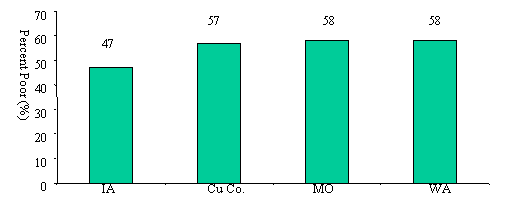
Notes:See table V.8 for more information
| State/ Study | Exit Cohort | Timing of Survey Post Exit | % Poor | % Below 185% of Federal Poverty Level |
|---|---|---|---|---|
Iowa | 2Q99 | 8-12 months | 47 1 | 80 |
Missouri | 4Q98 | 26-34 months | 58 | 89 |
Washington | Oct. 1998 | 6-8 months | 58 | n.a. |
| Cuyahoga Co. | 3Q98 | 14-21 months | 57 2 | n.a. |
1Iowa also provided a poverty rate based on income including food stamps, 41%. | ||||
Iowa and Missouri also report the share of single-parent leavers who have incomes below 185 percent of the federal poverty line. Above this level of income, most families become ineligible for virtually all low-income support programs including the earned income tax credit, and so this cutoff can be considered a rough marker for self-sufficiency. In Iowa, only one out of five leavers have incomes above 185 percent of poverty, and in Missouri, about one out of ten leavers have incomes above this threshold.
Chapter Summary
While the average incomes of leavers vary from study to study, most leavers have low incomes. It is important to note that these low-income leavers may be eligible for various in-kind public supports such as food stamps, WIC, child care assistance, and Medicaid or other public health insurance programs, all of which can enhance their well-being and are not included in these income and poverty measures. In addition, low-income working leavers can receive cash support from the EITC, currently the largest program supporting low-income families in the United States. These sources of support are examined in Chapter IV.
29The income "unit" varies slightly across the studies. For example, Illinois and Missouri report household income; Washington reports family income, and Arizona presents case income.
30This phenomenon is examined in more detail below in the section on the sources of leavers' incomes.
31Iowa includes loans in addition to gifts as help from family/friends.
32These shares are computed by dividing average income for those with the source by average family income. Shares sum to 100 percent subject to rounding and survey item non-response.
33Table V.6 presents only the incidence and average amounts for each source. The share of income represented by each source for each sub-group of leavers with income from that particular source is quite similar to the shares reported for all leavers in Table V.5.
34Note that in Arizona, some families designated as continuous leavers because they remained off TANF for a year, have returned to TANF by the time they are surveyed 12 to 18 months after exit.
35Because surveys ask about current employment but income last month, there are a few leavers who had earnings last month but are currently jobless and a few who had no earnings last month but are currently working. Because the discussion assumes work status and income are reported contemporaneously, the analysis does not present the actual computation; rather, it assumes that all currently employed leavers have earnings and that no currently jobless leavers have earnings.
36When the cash value of food stamps are counted, the poverty rate for Iowa's leavers drops to 41 percent.
Chapter VI: Material hardship and Relative Well-Being
Income, earnings, and program participation are important parts of economic well-being, but they do not capture all aspects of well-being. A number of ASPE-funded leaver studies have collected information in their surveys that reveals the extent to which former recipients experience particular material hardships, such as hunger and housing problems.37 Many studies also compare the hardships leavers experience after exit with their experiences while on welfare to assess whether their well-being has improved or gotten worse.38 The questions across these surveys are not identical, so comparisons need to be made carefully. However, the addition of these measures significantly broadens our understanding of the well-being of welfare leavers.В
Food-Related Problems
One area of concern is the extent to which families who left welfare are having problems with the basic necessity of having enough food. The studies use a variety of measures to assess the extent and severity of food-related problems families are experiencing (Table VI.1). Three studies (Iowa, Massachusetts, and Cuyahoga County)
Problem | AZ | DC1 | GA | IL1 | IA | MA1 | MO1 | SC1,2 | WA | Cuy. Co. | Bay Area |
|---|---|---|---|---|---|---|---|---|---|---|---|
Food Insecure | 32 | 43 | 46 | ||||||||
Food Insecure with hunger | 16 | 22 | 26 | ||||||||
Cut size of meals or skipped meals (one or more months) | 25 | 25 | 20 | 43/273 | |||||||
Almost every month | 6 | 6 | |||||||||
Child cut or skipped meals | 3 | 13/4 | |||||||||
Food didn't last (often or sometimes) | 46 | 44 | 53 | ||||||||
Food didn't last (often) | 13 | 11 | |||||||||
Not enough to eat at times | 24 | 13 | 31 | ||||||||
Went without food all day at least once | 15 | ||||||||||
Could not afford balanced meals (often or sometimes) | 18 | 38 | |||||||||
Is unable to buy enough food | 26 | ||||||||||
Ate less because not enough money | 22 | ||||||||||
Hungry but didn't eat because couldn't afford | 10 | ||||||||||
Worried food wouldn't last | 53 | 38 | |||||||||
Received Emergency Food Services4 | |||||||||||
Food from religious, community or charitable organization | 12 | 7 | 2 | 10 | |||||||
Food pantry/food kitchen/shelters/food banks | 21 | 12 | 285 | 29 | 3 | 35 | |||||
Received food/money for food from friends/relatives | 21 | 7 | 14 | ||||||||
1Results are for all cases, not just single-parents. | |||||||||||
report on the concept of food insecurity a measure based on answers to the Household Food Security Scale developed by the U.S. Department of Agriculture.39These studies also report the more severe situation of food insecurity with hunger (defined as answering yes to at least five out of the six questions on the USDA Food Insecurity scale). In all three of these studies, about a third or more of leaver families (32 to 46 percent) report experiencing food insecurity. Among the three studies, between 16 and 26 percent of leaver families experienced food insecurity with hunger between the time they left TANF and the time the survey was administered.
Another eight studies asked some combination of questions on whether leavers experienced a variety of food-related problems, including not having enough to eat, not being able to afford food, food not lasting until the end of the month, or having to cut or skip meals.40 A fairly large percentage of leaver families report experiencing one of these food-related problems in the time since exiting welfare. Four studies ask whether families had to cut the size of meals or skip meals entirely. The share of leavers reporting this hardship at least some of the time since exit ranges from 20 percent in South Carolina to 43 percent in Washington. Smaller percentages of leavers in these four studies report such hardships on a monthly basis or among children in the households. In DC and South Carolina, 6 percent of families report they cut or skipped meals almost every month. Missouri reports that 3 percent of leavers children had to cut the size of or skip meals and Washington reports 13 percent of leavers cut the size of their children's meals.
Three studies ask whether food didnt last until the end of the month. About half of leaver families report this happened sometimes or often since exit: 44 percent in Illinois, 46 percent in DC, and 53 percent in South Carolina. A number of these families (13 percent in DC and 11 percent in South Carolina) report experiencing this problem more frequently.
In Arizona, Georgia, and the Bay Area studies, 24, 13, and 31 percent of leaver families, respectively, reported not having enough to eat. In Washington, 15 percent of leavers went without food all day at least once since exit.
Several studies ask questions about whether a leaver family could not afford food. The exact question asked varies across studies. Results for similarly worded questions also vary. In South Carolina, 38 percent of leavers said they couldnt afford balanced meals while 18 percent in Georgia said this was true. Results vary even for similarly worded questions within the same study. For example, in South Carolina, when asked if they were hungry but didnt eat because they couldnt afford food, 10 percent agreed; when asked if they ate less because they did not have enough money, 22 percent said yes.
Finally, two studies report the percent of leavers that had worried food wouldnt last. In both DC and Georgia, this percentage is higher than other food hardship measures in those studies. DC and Georgia report that 53 and 38 percent of leaver families, respectively, experience this worry.
What can we learn from this variety of measures and responses? While questions differ across studies, in most of them one-quarter to one-half of leaver families are reporting some type of food-related problems. Using available measures, Georgia seems to be reporting somewhat lower rates of food hardships than the other studies.
Emergency Food Services. One action families may take when faced with problems affording food is to seek help from emergency food service providers, including food banks or pantries, food kitchens or shelters, churches, or other charitable or community organizations. The percentage of leaver families reporting they have sought out these services ranges from lows of 5 percent in South Carolina (combining both sources of services) and 7 percent in Missouri to highs of 29 percent in Massachusetts and 35 percent in Washington. The lower end of the range may represent conservative estimates because these states only asked the subset of leavers reporting a specific food problem these questions about seeking assistance, rather than all leavers.
Friends and relatives can also be a source of assistance when food problems occur; several studies report receipt of this type of aid. In Missouri, 7 percent of families received assistance from family and friends, while 14 percent and 21 percent report help in South Carolina and Arizona, respectively. The percentage for Arizona may be higher because it represents assistance of food or money from friends and relatives for any use.
Changes in Food-Related Problems Since Exit. In addition to comparing food hardship across studies, we also examine whether leavers in a given area are experiencing higher levels of food problems after leaving TANF than before exit. Four studies compare food problems before and after exit based on the respondents' recollection at the time of interview (Table VI.2).41 The Washington state study has a different research design for comparing former and current recipientsit compares the cohort of leavers with a separate sample of families still on TANF.
Problem | AZ | IL1 | MA1 | SC1,2 | WA | |||||
|---|---|---|---|---|---|---|---|---|---|---|
| pre | post | pre | post | pre | post | pre | post | Caseload | Leavers | |
Food Insecure | 30 | 43 | ||||||||
Food Insecure with hunger | 14 | 22 | ||||||||
Cut the size of meals or skipped meals (one or more months) | 24 | 25 | 14 | 20 | 39/22 3 | 43/27 3 | ||||
Almost every month | 3 | 6 | ||||||||
Child cut or skipped meals | 16/5 | 13/4 | ||||||||
Not enough to eat at times | 30 | 24 | ||||||||
Food didn't last (often or sometimes) | 51 | 44 | ||||||||
Went without food all day at least once | 11 | 15 | ||||||||
Is unable to buy enough food | ||||||||||
Ate less because not enough money | 13 | 22 | ||||||||
Hungry but didn't eat because couldn't afford | 8 | 10 | ||||||||
Worried food wouldn't last | ||||||||||
Received Emergency Food Services | ||||||||||
Food from religious, community or charitable organization | 15 | 12 | 2 4 | 2 4 | ||||||
Food pantry/food kitchen/shelters/food banks | 29 | 21 | 15 | 12 | 26 | 29 | 2 4 | 3 4 | 44 | 35 |
Received food/money for food from friends/relatives | 24 | 21 | 9 | 14 | ||||||
1Results are for all cases, not just single-parents. | ||||||||||
Arizona finds that fewer leaver families experience food hardship after exit than while receiving TANF benefits.42 In contrast, Massachusetts and South Carolina generally find higher rates of food problems among those who left TANF. The difference is largest in Massachusetts where 30 percent of leaver families report food insecurity before exiting compared with 43 percent reporting this problem after exit. Two studies, Illinois and Washington, present mixed evidence as to whether food hardship is greater before or after exit from welfare.
The use of emergency food services is lower post-exit compared with pre-exit in Arizona and Illinois; in Massachusetts and South Carolina, however, it is somewhat higher. This is not surprising given the decrease in food problems post-exit in Arizona and, to some extent, in Illinois and the increase in these problems in Massachusetts and South Carolina. Washington reports lower use of emergency food services among leavers than among current recipients; the percentage of leavers seeking emergency food services after TANF exit in Washington, however, is still the highest of these five studies, 35 percent.
Differences across studies in whether food problems increase or decrease after exiting TANF could be related to the many differences in the economy, caseload, welfare policy, and survey design. In general, the evidence is mixed for whether food-related problems are more or less prevalent after exit.
Housing-Related Problems
Another area of material hardship for leavers is difficulty affording housing and utilities. Again, the surveys use a number of different questions to assess the extent to which leavers are experiencing housing-related problems. One measure, asked by seven of the studies, is whether the family has fallen behind on rent or housing costs (Table VI.3). In all but one of the study areas, between one-quarter and one-half of leaver families report having fallen behind on rent or housing costs. Georgia, the exception, reports that 18 percent of leaver families had this problem after exit.
Problem | AZ | DC1 | GA | IL1 | IA | MA1 | MO1 | SC1,2 | WA | Cuy. Co. | Bay Area |
|---|---|---|---|---|---|---|---|---|---|---|---|
Behind on Rent/Housing Costs | 37 | 27 | 18 | 38 | 25 | 26 3 | 33 | ||||
Forced to move because of | 17 | 6 | 13 | 12 | 26 | ||||||
housing costs | |||||||||||
Evicted | 4 | 7 | 7 4 | ||||||||
Without a place to live at least once | 1 5 | 7 | 13 | ||||||||
Used homeless shelter | 3 | 3 | 3 | 2 6 | 2 | 1 | |||||
Did not have own place to live | 8 | ||||||||||
Moved in with family/friends | 22 | 11 | 14 | 10 | |||||||
Crowded house conditions | 32 7 | ||||||||||
Behind on Utility Payments | 29 | 22 | 48 | ||||||||
Utilities turned off/Went without | 12 | 14 | 26 | ||||||||
Heat | 5 | 8 | 9 | ||||||||
Electricity | 6 | 12 8 | 7 | 11 | 12 8 | 19 8 | |||||
Water | 3 | 7 | |||||||||
Phone disconnected | 19 | 35 | 35 | ||||||||
1Results are for all cases, not just single-parents. | |||||||||||
Many studies also gathered information on more severe housing problems. These include having to move because of inability to pay housing costs or eviction; being without a place to live or having stayed in a homeless shelter; or moving in with family or friends, not having ones own place to live, or living in crowded housing conditions (2 or more household members per room). In general, a small but substantial percentage of families report these problems.
The percentage of families that were forced to move because of housing costs ranges from 6 percent in DC to 26 percent in Cuyahoga county. The percentage of families evicted is generally smaller, 4 percent in Georgia, and 7 percent in Washington and Cuyahoga County. However, it is possible that some families move to avoid eviction. Of the six studies reporting use of a homeless shelter since exit, the percentages range from 1 to 3 percent. A larger percentage of families reported they were without a place to live at least once in Iowa and Washington 7 and 13 percent respectively. Finally, some families moved in with relatives or friends because of high housing costs. The reports range from 10 percent in Washington to 22 percent in DC. The Bay Area study reports that 32 percent of leaver families say they lived in crowded housing conditions.
Utilities. In addition to problems with rent and places to stay, a number of families have had problems paying utilities or had utilities cut off because of failure to pay. The percentage of families who were behind on utilities after leaving welfare ranges from 22 percent in Georgia to 48 percent in South Carolina. A smaller percentage generally report they had utilities turned off. Some studies separately report having heat, electricity, water, and phone service turned off. The percentage of families that had heat, electricity or water utilities turned off ranges from a low of 3 to 6 percent in DC to a high of 26 percent in Massachusetts. For the three studies reporting that phone service of leavers was disconnected, the percentages are somewhat higher, from 19 percent in Georgia to 35 percent in Iowa and South Carolina.
> Changes in Housing-Related Problems Since Exit. Six of the studies compare leavers pre- and post-exit experiences of housing and utility-related hardships (Table VI.4). The results are similar to those for food-related problems. Three of the studies, Arizona, DC, and Illinois, find similar or lower absolute percentages of families experiencing housing-related problems after exiting TANF than before. Massachusetts and Washington find that leavers experience somewhat higher rates of housing problems after exit than when on TANF. South Carolina reports somewhat of a mixed picture. Leavers in South Carolina have more trouble paying rent and utilities post-exit than when on TANF. However, fewer families in South Carolina were forced to move because of housing costs or used a homeless shelter post-exit than when on TANF. Overall, these results provide mixed evidence on whether leavers experience an increase or decrease in housing problems after exiting TANF.
Problem | AZ | DC1 | IL1 | MA1 | SC1,2 | WA | ||||||
|---|---|---|---|---|---|---|---|---|---|---|---|---|
| Pre | Post | Pre | Post | Pre | Post | Pre | Post | Pre | Post | Caseload | Leavers | |
Behind on Rent/Housing Costs | 41 | 37 | 27 | 27 | 45 | 38 | 25 | 33 | ||||
Forced to move because of housing costs | 21 | 17 | 8 | 6 | 15 | 13 | 19 | 12 | ||||
Evicted | 3 | 7 | ||||||||||
Without a place to live at least once | 2 3 | 1 3 | 11 | 13 | ||||||||
Used homeless shelter | 4 | 3 | 5 | 3 | 4 | 3 | 2 4 | 2 4 | 3 | 2 | 2 | 1 |
Did not have own place to live | 3 | 8 | ||||||||||
Moved in with family/friends | 14 | 11 | 7 | 10 | ||||||||
Behind on Utility Payments | 29 | 29 | 26 | 48 | ||||||||
Utilities turned off/Went without | 18 | 12 | 27 | 14 | 20 | 26 | ||||||
Heat | 7 | 5 | 6 | 9 | ||||||||
Electricity | 7 | 6 | 9 | 12 | 12 | 12 | ||||||
Water | 2 | 3 | 5 | 7 | ||||||||
Phone disconnected | 23 | 35 | ||||||||||
1Results are for all cases, not just single-parents. | ||||||||||||
Health Care Related Problems
In Chapter IV, we discussed the high percentage of adult leavers that do not have health insurance coverage. Lack of health insurance, out-of-pocket costs, and difficulty accessing medical providers even when insured can leave families unable to obtain needed medical care. Six studies report some measure of leaver families having problems affording or receiving health care (Table VI.5).
Problem | AZ | DC1 | GA | IL1 | SC1,2 | Cuyahoga Co. | ||||
|---|---|---|---|---|---|---|---|---|---|---|
| Pre | Post | Pre | Post | Pre | Post | Pre | Post | |||
Could not afford health care | 14 | 24 | 3 | 8 | ||||||
Didn't get medical attention when needed | 10 | 26 | 31 | 4 | 10 | 40 | ||||
Didn't go to dentist when needed | 16 | 41 | ||||||||
1Results are for all cases, not just single-parents. | ||||||||||
>Two studies report the percentage of leaver families that are unable to afford health care8 percent of families in DC and 24 percent in Arizona. The percentage of leaver families reporting they didnt seek medical attention when needed because of costs also varies, from 10 percent in Georgia and South Carolina to 40 percent in Cuyahoga County. The variation in these reports may be related to the percentage who report themselves as uninsured in each study. South Carolina and DC report the lowest rates of adult uninsurance among these studies.
In all four studies that report pre- and post-exit health care problems the incidence of problems is higher after exiting welfare. For example, in Arizona 14 percent of leaver families could not afford health care before exiting TANF, but 24 percent report this problem after exit. These results are consistent with the significant declines in Medicaid coverage among leavers in Arizona reported in Chapter IV. Interestingly, in three of these studies, Arizona, DC, and Illinois, the incidence of food and housing problems reported by leaver families was generally lower after exit compared with while on TANF.
Overall Well-being
A final measure of well-being of families comes from a more general question posed to families in six studies. The question asks families to compare their overall well-being since exiting TANF to a prior time period when they were on TANF (Table VI.6). The specific question varies somewhat across studies, from asking about change in overall well-being to emotional well-being to general standard of living. Six studies report the percentage of families claiming they are better off, worse off, or the same relative to before leaving TANF, although two studies, Arizona and Washington, report finer gradations as well.
State | Much Better Off | Better Off | Same | Worse Off | Much Worse Off |
|---|---|---|---|---|---|
Arizona | 31 | 37 | 16 | 12 | 3 |
Illinois1,2 | n.a. | 57 | 30 | 13 | n.a. |
Iowa2,3 | n.a. | 49 | 32 | 19 | n.a. |
Massachusetts1,2,4 | n.a. | 47 | 26 | 28 | n.a. |
South Carolina1,5 | n.a. | 80 | n.a. | 20 | n.a. |
Washington | 32 | 28 | 19 | 13 | 8 |
1Results are for all cases, not just single-parents. | |||||
In all six studies, about half or more families report they are better off since leaving welfare. More than two-thirds of families report they are better off in Arizona. South Carolina asks families whether they agree or disagree with the statement Life was better when I was getting welfare and 80 percent disagree. Approximately one-fifth or fewer of families report they are worse off or much worse off after leaving TANF than before in all states except Massachusetts, where 28 percent report they are worse off. Illinois has the lowest percentage of leavers who say they are worse off since leaving TANF (13 percent).
Interestingly, this overall self-assessment of relative well-being does not always accord with the leavers reports of specific measures of hardship discussed earlier. For Arizona and Illinois, the relatively high percentage of leaver families reporting they are better off after exit matches the generally lower levels of specific hardships reported in these studies. However, the results for Massachusetts, South Carolina, and Washington are less consistent. The majority of families are reporting they are not worse off since exiting, although the results on specific hardship measures are mixed, with higher rates of hardship among families after exit on many measures.
Material Hardships Among Subgroups of TANF Leavers
Above, the discussion has focused on material hardship among the entire group of welfare leavers. However, there are important questions about how specific subgroups of leavers are doing. For example, one would like to know if hardship is greater among leavers that are not working than those who are working. Also, it would be helpful to know if there are differences in hardship across families by the reason they left welfare, specifically those who left due to sanctions or time limits relative to those who did not. Several leaver studies reviewed here allow us to explore these questions. For these comparisons, the report shows a subset of the measures of food, housing, and health care hardships discussed earlier.
Five studies allow for comparisons between employed leavers and those who are not employed (Table VI.7). All of these studies include results for the group of leavers that are currently employed at the time of the interview. Missouri also reports results separately for those who have worked at some point and those who never worked since exit.43 It is important to remember that in all of these studies, except South Carolina, families who have returned to TANF are included.
Problem | DC1 | IA | IL1 | MO1 | SC1,2 | ||||||
|---|---|---|---|---|---|---|---|---|---|---|---|
| Employed | Not Employed | Employed | Not employed | Employed | Not employed | Currently employed | Worked since exit | Never worked since exit | Employed | Not Employed | |
Cut the size of meals or skipped meals (every month or some months) | 25 | 26 | 21 | 32 | 2 3 | 4 3 | 8 3 | 17 | 25 | ||
Could not afford food/food didn't last (often or sometimes) | 47 | 44 | 38 | 55 | 25 4 | 26 4 | 27 4 | ||||
Food insecure | 29 | 40 | |||||||||
Behind on Rent/Housing Costs | 28 | 27 | 25 | 25 | 29 | 54 | 21 5 | 37 5 | 25 5 | 31 | 35 |
Behind on Utility Payments | 33 | 24 | 48 | 49 | |||||||
Went Without Utilities | 5 6 | 6 6 | 34 | 46 | 12 | 17 | 10 6 | 14 6 | |||
Used homeless shelter | 1 | 6 | 4 7 | 11 7 | 1 | 7 | 2 | 3 | |||
Did not get medical care when needed | 8 | 9 | 25 | 39 | 8 | 14 | |||||
1Results are for all cases, not just single-parents. | |||||||||||
Iowa, Illinois and South Carolina generally find that leavers who are working have lower levels of food, housing, and health care related problems. Further, in Missouri, those currently employed have fewer experiences of food and housing hardships than those who have never worked. Those who have worked at some point since exit but are not currently employed report more food hardships than those who are working at the time of the interview, but less than those who have never worked since exit. Interestingly, however, this group of families that have worked reports a higher incidence of being unable to pay rent, mortgage, or utilities than either workers or those who never worked. This group of intermittent workers also reports greater hardships on other measures not included here.
DC finds more mixed results than the other studies. Those not working have similar rates of hardship in all areas compared with those who are working with one exception: behind on utilities. Employed leavers in DC are more likely to report that they are behind on their utilities payments than non-working leavers (33 v. 24 percent). These mixed results may reflect that a larger number of leavers who are not employed have returned to TANF, to provide their families with some cushion of income, rather than remain both unemployed and off TANF. However, this does not seem to be the case in any of the other studies.
Another subgroup comparison of interest is those who left TANF due to sanctions or time limits versus those who did not leave for these reasons. Three studies allow us to examine this question. Arizona reports results for both sanctioned and non-sanctioned leavers and Massachusetts reports results for both those who left due to time limits and other leavers. South Carolina reports results separately for families who left due to sanctions, time limits, earned income, and other reasons.44
The available evidence on whether sanctioned and time-limited families experience greater material hardships is mixed (Table VI.8). In Arizona, sanctioned and non-sanctioned families have similar experiences of hardship on all but two measures. A greater percentage of sanctioned families had utilities turned off (16 percent) than non-sanctioned families (11 percent). And a smaller percentage of sanctioned families report they were unable to get medical attention when needed (17 percent) compared with non-sanctioned families (25 percent).
Hardship | AZ | MA2 | SC2,3 | |||||
|---|---|---|---|---|---|---|---|---|
| Sanction | Non- Sanction | Time-Limited | Non Time-Limited | Sanctions | Time Limits | Earned Income | Other | |
Not enough to eat at times | 25 | 24 | ||||||
Ate less because not enough money | 21 | 16 | 22 | 25 | ||||
Hungry but didn't eat because couldn't afford | 10 | 6 | 9 | 14 | ||||
Food Insecure | 42 | 43 | ||||||
Food Inscure with Hunger | 24 | 21 | ||||||
Received Emergency Food Services | ||||||||
Food from religious, community or charitable organization | 12 | 12 | 2 | 1 | 2 | 2 | ||
Food pantry/food kitchen/shelters/food banks | 22 | 21 | 33 | 26 | 2 | 2 | 3 | 3 |
Behind on Rent/Housing Costs | 36 | 37 | 31 | 33 | 35 | 29 | ||
Behind on Utilities | 51 | 48 | 47 | 48 | ||||
Utilities turned off/Went without | 16 | 11 | 26 | 26 | 15 4 | 17 4 | 9 4 | 12 4 |
Phone disconnected | 36 | 39 | 33 | 36 | ||||
Forced to move because of housing costs | 19 | 17 | 13 | 20 | 11 | 15 | ||
Used homeless shelter | 3 | 3 | 1 | 3 | 2 | 2 | 1 | 3 |
Did not get medical attention when needed | 17 | 25 | 13 | 7 | 8 | 14 | ||
1Results are for all cases, not just single-parents. | ||||||||
In Massachusetts, the difference between families who left because they reached the time-limit and those who left for other reasons is somewhat mixed. The biggest difference is that more time-limited families report using emergency food services (33 percent) than non-time-limited families (26 percent). However, for most of the other measures shown in Table VI.8, as well as for other measures not shown here, Massachusetts finds relatively little evidence of difference between the two groups in hardship.
South Carolina also shows mixed results across these measures of material hardship. While those who left due to earned income experience the lowest levels of hardship on four out of five housing measures, they are most likely to be behind on rent/housing costs. In addition, on all of the food-related measures shown here and on reports of inability to obtain medical attention when needed, leavers whose cases were closed due to time-limits have the lowest experience of hardship of all the leaver subgroups. Indeed, none of these studies present consistent evidence that sanctioned or time-limited cases have higher levels of material hardship.
Chapter Summary
There are a number of measures that can be used to assess the well-being of families leaving welfare beyond employment and income. The ASPE grantees report a variety of different measures on leavers experiences with food, housing, and medical hardships. Across these varied measures, most studies report a quarter or more leaver families are experiencing food hardships and similar percentages are experiencing trouble paying rent or utilities. A smaller percentage report trouble accessing and affording health care. While some studies show that leavers experience the same or lower levels of food-related and housing hardship after exit relative to when on TANF, other studies shows that hardships increase after exit. In general, medical hardships tend to increase after exit.
37All statistics reported in this chapter come from survey data.
38Arizona, Illinois, and Washington use a 6-month window for their questions (e.g. "have you experienced this problem in the past 6 months? Before the past 6 months?"). South Carolina uses a 12-month window. These windows roughly correspond to pre- and post-exit time periods. The District of Columbia and Massachusetts ask about the time while on TANF and the time since leaving TANF, about 10 months for Massachusetts and 12 months for DC. All of these studies compare leavers' experiences before and after exit except Washington. Washington compares leavers experiences to a separate group of TANF recipients. The remaining studies that do not present comparisons, generally report experience of the specific hardship since exit. This varies by the timing of the survey interview relative to exit.
39The studies used the six-item short form of this scale.
40A number of these questions are part of the six-question USDA scale described above, but these studies did not ask all six questions. South Carolina asked all 6 questions but did not compute food insecurity.
41Only a subset of all available measures are included in Table VI.2.
42We do not discuss here whether these differences are statistically significant, which is not reported in most studies.
43Illinois also reports separate results for those who are continuously employed, intermittently employed, and never employed since exit. We do not show these results here.
44All of these categories are based on reasons for leaving as reported in administrative data rather than on self-reported information from surveys, although the hardship measures are based on survey responses.
Chapter VII: Child Well-Being and Child Care
Since changes in welfare primarily affect families with children, there is concern over how the children of families leaving welfare are faring. Unfortunately, leaver studies contain limited information about childrens outcomes and well-being. Some studies do include information on childrens health status and insurance coverage, school or non-school behaviors, and involvement with the child welfare system. Since few studies report findings for any specific measure, it is difficult to make cross-study comparisons. However, from these limited results we can begin to assess the range of outcomes for children in families that have left the TANF program.
Child Health and Insurance Coverage
One set of measures of child well-being center on child health and health insurance coverage. Ten of the studies with survey data report the percentage of children without any type of health insurance coverage (Table VII.1). This number ranges from less than 10 percent in Missouri, Massachusetts, and the Bay Area, to over 20 percent in Arizona and Illinois. Not surprisingly, some of the states with low percentages of uninsured children, like Massachusetts, are also the states with the highest rates of Medicaid coverage. However, Missouri and the Bay Area also have low percentages of uninsured children but only moderate rates of Medicaid coverage. Higher than average private insurance coverage among children of leavers in these two studies accounts for this discrepancy.
Measure | AZ | DC1 | GA | IL1 | IA | MO | MA1 | SC1,2 | WA | Bay Area |
|---|---|---|---|---|---|---|---|---|---|---|
Health Insurance3 | ||||||||||
Uninsured | 26 | 16 | 11 | 29 | 20 4 | 8 | 8 | 10 | 13 | 9 |
Medicaid | 51 | 60 | 83 | 53 | 62 | 68 | 83 | 85 | 67 | 64 |
Employer | 12 | 12 | 5 | 23 5 | 11 | 20 | 10 | 7 | 9 | |
Other | 8 | 11 | 4 | 18 | 3 | 4 | 10 | 28 6 | ||
Child health | ||||||||||
Excellent | 64 | 50 | 42 | |||||||
Very good | 14 | 24 | 25 | |||||||
Good | 13 | 18 | 24 | |||||||
Fair | 4 | 6 7 | 6 | 8 | ||||||
Poor | 1 | 1 | 1 | |||||||
Child's health better/worse since exit | 39/3 | |||||||||
Child lacks access to routine health care | 7 | |||||||||
1Results are for all cases, not just single-parents. | ||||||||||
Child health is also a measure of child well-being. In the four states reporting child health, the percentage of leaver families with children in poor or fair health as reported by the parent in response to the grantee survey is relatively low, ranging from 5 to 9 percent. Only South Carolina shows how child health changes between the time families receive TANF and after they exit. This study reports that 39 percent of leaver families say their child is in better health since exit, compared with only 3 percent who feel their child is in worse health. South Carolina also reports results for childrens access to health care. The study reports that 7 percent of leaver families have a child that lacks access to routine health care since TANF exit.
Childrens Behavior
Another way to assess child well-being is to examine indicators of a childs behavior. Some of the ASPE-funded leaver studies directly ask about current behavior relative to pre-exit behavior (e.g. is child behavior better or worse now?). Washington state asks about behavior for the post-exit period and the pre-exit period separately. Overall, these limited results suggest that child behaviors have not, on average, worsened for families since their exit from TANF.
Four studies report some results for childrens school-related behavior (Table VII.2). When asked whether a childs school-related behavior was better or worse since exit, the majority of leavers said better with a only small number reporting worse. For example, in South Carolina, 60 percent of families said their child had a greater concern for doing well in school since exit, while only 8 percent said that concern had decreased. In Iowa, 43 percent of families report school behavior and performance was better relative to exit, and only 8 percent reported it was worse.
Measure | GA | IA | MA1 | SC1,2,3 | WA 2 | Bay Area |
|---|---|---|---|---|---|---|
School-Related Behaviors | ||||||
High level of school engagement | 45 | |||||
Child's homework better/worse since exit | 60/10 | |||||
Child's concern for doing well in school is more/less since exit | 60/8 | |||||
Child's school performance very good/not good at all | 43/4 | |||||
School behavior and performance better relative to exit | 43 | |||||
School performance better than others same age | 45 4 | |||||
Suspension or expulsion from school | 29 | 13 | 19(24) 5 | |||
Dropped out of school | 6(5) 5 | |||||
Non-School Related Behaviors | ||||||
In trouble with law | 5(4) | 15 (15) | ||||
Child ran away from home for overnight | 6 (10) | |||||
Child engages in risk behaviors | 12 | |||||
Child ages 5-13 unsupervised some hours per week | 8 | |||||
Often/sometimes doesn't get along with others | 31 | |||||
Often/sometimes unable to concentrate | 33 | |||||
Often/sometimes unhappy, sad, or depressed | 26 | |||||
Child's behavior better/worse since exit | 44/11 6 | |||||
Behavior compared to others of same age - better | 42 4 | |||||
1Results are for all cases, not just single-parents. | ||||||
Another important school-based outcome for children is whether they have been suspended or expelled from school. The percentage of TANF leavers that had children suspended or expelled from school ranges from 13 percent in Massachusetts to 29 percent in Iowa. Washington reports that the share of leaver children (age 11 or older) expelled or suspended is 19 percentlower than the share of current welfare recipient children expelled or suspended in that state, 24 percent.
Several studies report other non-school-related child behaviors. These range from children being in trouble with the law to broad behavioral/emotional measures, such as how often a child reports being unhappy or depressed. Two studies report the share of families with children who had been in trouble with the law 5 percent in South Carolina and 15 percent in Washington. Both of these studies report similar findings for families receiving TANF. The Bay Area study reports that 12 percent of children engage in risky behaviors and 8 percent of 5 to 13 year olds are unsupervised for some hours during the week. 45
Georgia reports that about a third of leaver children often or sometimes have trouble getting along with others, are unable to concentrate, or are unhappy, sad, or depressed. South Carolina leavers report that their childrens behavior is better since exit in 44 percent of families and is worse in 11 percent. Finally, Massachusetts asks leavers to compare their childrens behavior with that of other similarly aged children and finds that 42 percent consider their children to be more well-behaved than other children.
Interactions with Child Welfare Services and Children Living Elsewhere
Another way to assess the well-being of children is through their interactions with child welfare service agencies. Five studies report varying types of child welfare interactions and services, each of which are reported separately here (Table VII.3). Arizona, Illinois, Missouri, and Washington report interventions by child protective services, either out-of-home placements or substantiated abuse/neglect reports. The share of families involved with the child welfare system is relatively small in Arizona, Illinois, and Washington, from less than 1 percent to 2 percent. Missouri reports a higher rate (6 percent) of substantiated abuse/neglect reports.
Measure | AZ 1 | DC 1,2 | GA | IL 1,2 | IA | MA2 | MO2 | SC 1,2,3 | WA 1 |
|---|---|---|---|---|---|---|---|---|---|
Child protective services | 0.4(0.6) | ||||||||
Out-of-home placements | 0.1(0.2) | 0.2(0.4)4 | 0.6(1) | ||||||
Substantiated abuse/neglect | 0.7(1)4 | 6 | 2(4) | ||||||
Foster care services | 7(7) | ||||||||
Child welfare services | 13 | 2 | |||||||
Family preservation services | 1(2) | 2 | |||||||
Child sent to live with someone else | 8(9) | 5(6) | 8(9) | 5(5) | 19(18) 5 | ||||
Absent parent visits | |||||||||
Deceased | 37 6 | 3 7 | |||||||
Never | 25 | 34 | |||||||
Once/several times a year | 14 | 12 | |||||||
One to three times a month | 10 | 11 | |||||||
Once a week | 5 | 8 | |||||||
Several times a week or more | 10 | 31 | |||||||
1Numbers in parentheses are pre-exit for leavers for AZ, DC, and IL. Numbers in parantheses are for caseload in WA. | |||||||||
Arizona, Illinois, and Washington report lower rates of these child welfare agency interactions after exit than before, but the numbers are so small that the differences may not be statistically significant. Finally, Iowa reports a higher rate of child welfare services use than other studies, 13 percent, but this includes interactions with foster care services (7 percent) as well as family preservation services (1 percent). These percentages are similar for the time period while families are receiving TANF.
Another measure of child well-being focuses on whether children were displaced out of their homes due to financial problems. The percentage of leaver families where children were forced to live elsewhere ranges from 5 percent in DC to 19 percent in Washington. Note, however, that the percentage for Washington includes children entering foster care. The share of leavers experiencing this outcome is not much different after exit than before exit.
Interactions with Absent Parents. An additional concern for children in single-parent families is connection with an absent parent. Two studies report the frequency of visits from other parents Georgia, which asks about absent fathers, and Massachusetts, which asks about the other biological parent. Over a third of those asked this question in Massachusetts report the absent/other parent is either deceased or never visits (Table VII.3). In Georgia, 37 percent of absent fathers were either dead or defined as like dead and another 25 percent never visited, for a total of 62 percent with little or no contact. In Georgia, 15 percent of absent fathers visit once a week or more compared with 39 percent in Massachusetts.46
Child Care
Since the transition from welfare to work is a major goal of many states welfare programs, the need for child care among TANF leavers is an important consideration. Child care subsidies are generally available to employed TANF leavers, depending on their income level. Actual receipt of these subsidies is influenced by the type of care arrangement leavers use, their knowledge about and eligibility for subsidies, and the ease with which subsidies can be accessed. Concerns about the quality of care given to children of working TANF leavers are also important, although unfortunately measures of child care quality are generally beyond the scope of the surveys conducted. 47
Results for eight studies are shown in Table VII.4. Four of these studies report results for employed leavers and four report results for all leavers.48 Most studies report results by age of child, as the child care needs of school aged children differ from those of younger children.
Type of Care | IL1,2 | MO | IA2 | WA1 | ||
|---|---|---|---|---|---|---|
| <6 | 6-12 | <6 | 6-13 | <13 | <13 | |
Employed Leavers | ||||||
Uses non-parental child care | 93 | 90 | 75 | 40 | 78 | 82 |
Type of Arrangement for those using child care | ||||||
Relatives/ Siblings | 58 | 59 | 41 | 42 | 65 | 41 |
Friends/ Neighbors | 9 | 12 | 13 | 11 | 6 | |
Center/ Afterschool care/ Church or club | 12 | 8 | 26 | 36 4 | 14 | 23 |
Preschool/ Head Start | 2 | 3 | 4 | |||
Family Day Care/ Babysitter In-home | 15 | 16 | 18 | 8 | 35 | 13 |
Other | 5 | 5 | 1 | 24 5 | ||
Type of Care | AZ2 | SC6 | GA | Bay Area | ||
| <6 | 6-12 | <6 | 6-12 | <12 | <13 | |
All Leavers | ||||||
Uses non-parental child care | 53 | 35 | 62 | 26 | ||
| Type of Arrangement for those using child care | ||||||
Relatives/ Siblings | 57 3 | 43 3 | 42 | 29 | 25 | 54 |
Friends/ Neighbors | 13 | 3 | ||||
Center/ Afterschool care/ Church or club | 25 | 30 | 44 | 50 4 | 30 | |
Preschool/ Head Start | 11 | 23 7 | 2 | 47 | 3 | |
Family Day Care/ Babysitter In-home | 8 | 4 | 6 | 7 | 47 | |
Other | 2 | 4 8 | ||||
| 1Study reports of type of arrangement are recalculated to reflect percentage of families using non-parental child care. 2State reports results for leavers in work, job search, education, or training. Illinois reports results for all leavers, not just single-parents. 3Includes friends and relatives. 4Includes school sponsored programs. 5Other includes mutliple arrangements, preschool/Head Start, child self-care, employer-sponsored care and unspecified care. 6Results are for families that remain off of welfare at the time of the survey. Results are reported for "pre school" and "school age" children. 7Includes school. 8Represents child stays alone. Source: See Appendix B for a complete listing of the leavers studies referenced. | ||||||
Child Care Arrangements. A substantial percentage of families do not have a child care arrangement, other than parent care or regular schooling. The percentage of leaver families with children under age 6 using non-parental child care ranges from 53 percent in Arizona (among all leavers) to 93 percent in Illinois (among employed leavers). The percentage with school-age children using non-parental child care is generally lower. Arizona, Missouri, and South Carolina report that 35, 40, and 26 percent of older children, respectively, have a non-parental child care arrangement.49 Illinois has by far the largest percentage of leavers with children ages 6 to 12 using a non-parental arrangement, 90 percent.
Differences in the use of non-parental care across studies are, in part, due to the different categorizations of care used in each study. While most states directly ask about use of non-parental care, Illinois asked all families who were working, in training, education, or job search activities how they cared for their children. Families who responded no one or spouse/partner are categorized in this report as non-parental care. Georgia asked all families with children under age 12 about child care arrangements; however, their results do not allow us to separately report use of non-parental care. The Bay Area study asked all families with children under 14 if they used a non-parental care arrangement, but did not report the percentage that was only using parental care.
There are a number of similarities in the types of non-parental care used.50 In all of the studies except Georgia and South Carolina, relatives and siblings are by far the most common source of care for pre-school and school age children. The rate of relative/sibling care reported in these studies ranges from 41 percent for pre-schoolers in Missouri to 65 percent for all children under fourteen in Iowa. Leavers in South Carolina are equally likely to use relative/sibling care and center-based care for pre-school children (about 40 percent each). However, for school age children, the share of families using relative/sibling care in South Carolina drops to 29 percent. This latter figure may be among the lowest across the studies because it is the only study to include all school age children, even those older than 13 or 14. Georgia reports the lowest rate of relative/sibling care at 25 percent, despite including parental care in this category. In fact, all of Georgias child care numbers are very different from the other studies.51
The next two most common types of child care arrangements after relative/sibling care are center based care (including after school care, churches, and clubs mainly relevant for older children) and family day care/babysitter care in the home. Arizona, Missouri, Washington, and the Bay Area find center care to be the second most common type of arrangement, while Illinois and Iowa find greater use of family day care/babysitters.
Paying for Child Care. Paying for child care is a critical issue for families leaving TANF for employment. Costs of child care and child care subsidies can affect, and often determine, the choice of arrangements. Three studies report the percentage of employed leavers with child care arrangements who reported paying for child care. Three additional studies report such percentages for all leavers. The percentage of families paying for child care for at least one child varies from 23 percent of all leavers in the Bay Area study to 61 percent of employed leavers in Massachusetts and South Carolina (see Table VII.5). Illinois and Missouri report that the percentage of families paying for child care varies with the age of the child, although the two patterns are not consistent across these studies.
State/ Study | Percent of Leavers with Childcare Arrangements Paying for Care | Percent of Leavers Using Subsidies | Average Monthly Costs for Families Making Payments |
|---|---|---|---|
Employed Leavers | |||
District of Columbia1 | 5/3 2 | ||
Illinois 1,3 | 44 | 17 | $211 |
Iowa 3 | 55 | 17 | $244 |
Massachusetts1 | 61 | 43 | $165 |
Missouri1 | 40 | 14/36 4 | $277 |
Children <5 | 38 | $221 | |
Children 6-13 | 46 | $171 | |
South Carolina1,5 | 61 | 26 | |
All Leavers | |||
Arizona | 15 6 | ||
Washington | 20 | ||
Bay Area | 23 | 24 7 | |
1Results are for all cases, not just single-parents. | |||
Another issue related to cost of child care for working leavers is their use of government child care subsidies. Six studies report use of subsidies by employed leavers and three studies report use among all leavers. The range in the percentage of families using this type of assistance varies from about 5 percent in DC to 43 percent in Massachusetts. Most studies find 15 to 25 percent of employed leavers are using child care subsidies. The studies examining all leavers find similar results. One potential explanation for this low utilization is that many families do not have a non-parental child care arrangement, and generally less than half of families who have an arrangement pay their providers for care. However, it is also possible that some leavers either do not know they could obtain these subsidies, are ineligible for subsidies, or that the subsidies are difficult to use.
Finally, four studies report the average monthly costs for child care among families paying for care. The average monthly out-of-pocket cost ranges from $165 in Massachusetts to $277 in Missouri. Missouri also reports on cost by age of child, showing that costs for young children (under age 5) are lower than for older children (ages 6 to 13), $221 compared to $171. These cost data do not distinguish between those paying the full cost of care and those making co-payments for subsidized care.
Chapter Summary
The ASPE-funded leaver studies include a number of different measures of child well-being. These include measures of health insurance coverage and health, school and other behavior, interaction with child welfare services, and contact with absent parents. One-tenth to one-quarter of leaver families have uninsured children, although reports of children in poor or fair health are generally low, ranging from 5 to 10 percent. While the measures of child behavior are varied, most studies that compare behaviors pre- and post-exit find that the majority of leavers report child behavior is better after exit. Rates of interaction with child welfare services range from 1 to 13 percent, including reports of abuse/neglect and foster care services. There is little evidence on whether the percentage of families involved in child welfare services changed after exiting TANF.
The studies also report on the use of child care, types of arrangements, and use of government subsidies. The findings show that a substantial percentage of leaver families rely on parental care. For those using non-parental care, relatives and siblings of the child are by far the most common sources of care for children. The studies also report that many families are not paying for care (i.e. using unpaid modes of care), and about 15 to 25 percent use government child care subsidies.
45Risk behaviors include being suspended, expelled, dropping out of school, getting in trouble with the police, having a drug or alcohol problem, doing something illegal to get money, or getting pregnant or getting someone else pregnant.
46Massachusetts includes all children, even those living with both biological parents, in reported figures. Therefore, the 39 percent of children with frequent visits includes some percent of children living with both parents. This percentage is not reported, but in roughly 20 percent of leaver households, there is a spouse/parent present.
47South Carolina, Illinois, and Iowa include some information about child care quality and parental satisfaction with child care arrangements.
48The District of Columbia and Massachusetts also report child care arrangements used by employed leavers, but the categories of care reported make it difficult to compare these studies to the others. Their findings are excluded from this discussion.
49South Carolina's percentage may be lower because it asks about all school-age children, while Arizona and Missouri restrict their findings to children ages 6 to 12.
50To facilitate comparisons across studies, we computed the share of children in each type of care arrangement out of all children in non-parental care.
51The high percentage of families using Head Start centers in Georgia may be a combination of families using Head Start or other center-based care.
Chapter VIII: Conclusion
The synthesis of fifteen leaver studies provided in this report includes information on welfare leavers employment and earnings, public assistance program participation, income and poverty status, material hardships, and child well-being. The individual studies show many differences in specific measures of families post-TANF experiences, reflecting in part the differences in context across these areas, such as welfare policies, economic conditions, and the characteristics of leavers. Despite these differences, a number of clear general patterns emerge. Major findings for each area are summarized below.
Employment and Earnings
-
About three-quarters of all leavers work at some point in the year after exiting TANF, on average, and about three out of five work at any given point in time. A little more than a third worked in all four quarters after exiting TANF.
-
Median earnings of welfare leavers are about $2,600 per quarter, according to administrative data. Most studies show a significant increase in quarterly earnings of at least $200 between the first and fourth quarter after exit. Working leavers' wages are comfortably above the federal minimum wage ($5.15/hour) but are nevertheless low, averaging between $7 and $8 an hour.
-
About half of all working leavers are offered employer-sponsored health insurance through their jobs, but only about one-third actually have coverage. Some leavers receive other employer-sponsored benefits. In general, no more than half have paid sick leave or pension coverage. Paid vacations days are a bit more common.
-
No single barrier to work consistently affects a majority of leavers; however, a substantial minority of leavers must overcome child care and health-related problems in order to work.
-
Continuous leavers, those who did not return to TANF in the year after exit, are just as likely to have ever worked after exit than those who returned to TANF. However, continuous leavers are somewhat more likely to have worked all four quarters after exit than those who returned. Continuous leavers also have higher earnings than leavers in general.
Program Participation
-
It is not uncommon for leavers to return to TANFa quarter to a third of families who left welfare returned to TANF at some point in the first year after exit.
-
About half of leaver families receive food stamps in the first quarter after exit and about two-thirds receive these benefits at some point in the year after exit.
-
About three out of five leaver families have an adult enrolled in Medicaid in the first quarter after exit. Medicaid coverage of children is generally higher, ranging from 60 to 90 percent after exit.
-
Participation in both food stamps and Medicaid is generally lower for continuous leaver families than those who return to TANF at some point in the year after exit..
Household Income
-
Across all leaver families, own earnings are the most important single source of income, and own earnings plus the earnings of other family members together comprise over three-quarters of leaver families incomes on average.
-
Average monthly family income for leavers generally hovers near the poverty line. In the four studies that explicitly examine poverty rates of leaver families, on average, over half of leavers are poor. Two studies find that the majority have incomes below 185 percent of the federal poverty line.
-
In the few studies that compare monthly income for subgroups, continuous leavers have considerably higher incomes than leavers in general. Employed leavers also have much greater monthly incomes than jobless leavers.
Material Hardship
-
A quarter or more leaver families experience food hardships at some point after exiting TANFproblems having enough money for food or having food lastand similar percentages are experiencing trouble paying rent or utilities.
-
Although some studies show that leavers experience the same or lower levels of food and housing-related hardship after exit relative to when on TANF, other studies show that hardships increase after exit.
-
With regard to medical hardship (being unable to access medical care), four studies find leavers are more likely to report being unable to afford health care for their families after exit as compared with before exit.
-
Most studies that compare material hardship across employment status find that leavers who are working have lower levels of food, housing, and health care related problems.
-
The available evidence on whether sanctioned and time-limited families experience greater material hardships than families who left welfare for other reasons is mixed.
Child Well-Being
-
Reports of children in poor or fair health are generally low, ranging from 5 to 10 percent. However, one-tenth to one-quarter of leaver families have children without health insurance.
-
Rates of interaction with child welfare services range from 1 to 13 percent, including reports of abuse/neglect and foster care services. There is little evidence on whether the percentage of families involved in child welfare services changed after exiting TANF.
-
For child care, a substantial percentage of leaver families rely on parental care. For those using non-parental care, relatives and siblings of the child are by far the most common sources of care for children.
-
The fifteen ASPE-funded leaver studies reviewed here provide a considerable amount of information on the status of families leaving welfare. This synthesis focuses on key outcomes and measures of well-being that are commonly reported in these studies. In addition to these common elements, the individual studies also contain a rich array of information and subgroup analyses pertinent to understanding the status of former welfare recipients in their geographic area. The titles of the individual studies are provided in Appendix B; many of the reports can be accessed at http://aspe.hhs.gov/hsp/leavers99/reports.htm.
References
Acs, Gregory and Pamela Loprest. January 2001. Initial Synthesis Report of the Findings from ASPE's Leavers Grants. The Urban Institute: Washington, D.C. http://aspe.hhs.gov/hsp/leavers99/synthesis01/index.htm
Brauner, Sarah and Pamela Loprest. May 1999. Where Are They Now? What States Studies of People Who Left Welfare Tell Us. Assessing the New Federalism, Brief, Series A, no. A-32. The Urban Institute: Washington, D.C. http://newfederalism.urban.org/html/anf_32.html
Issacs, Julia and Matthew Lyon. November 2000. A Cross-State Examination of Families Leaving Welfare: Findings from the ASPE-Funded Leavers Studies. United States Department of Health and Human Services, Office of the Assistant Secretary for Planning and Evaluation: Washington, D.C. http://aspe.hhs.gov/hsp/leavers99/cross-state00/index.htm
Loprest, Pamela. July 1999. Families Who Left Welfare: Who Are They and How Are They Doing? Assessing the New Federalism, Discussion Paper No. 99-02. The Urban Institute: Washington, D.C. ttp://newfederalism.urban.org/html/discussion99-02.html
Lower-Basch, Elizabeth. December 2000. Preliminary Analysis of Racial Differences in Caseload Trends and Leaver Outcomes. United States Department of Health and Human Services, Office of the Assistant Secretary for Planning and Evaluation: Washington, D.C. http://aspe.hhs.gov/hsp/leavers99/race.htm
United States General Accounting Office. April 1999. Welfare Reform: Information on Former Recipients Status. GAO-HEHS-00-44. Washington, D.C. http://www.gao.gov/docdblite/summary.php?&rptno=HEHS-99-48
United States Department of Health and Human Services, Office of Assistant Secretary for Planning and Evaluation. April 2000. Summary of Research on Welfare Outcomes Funded by ASPE. Washington, D.C. http://aspe.hhs.gov/hsp/leavers99/ombsum.htm
Appendices
Appendix A: Summary of Technical Specifications of Leaver Studies
State | Type of Study | Leaver Cohorts | Definition of leaver | Cases excluded | Key Reported Subsets |
|---|---|---|---|---|---|
Arizona | Survey and Administrative | 1Q98 | One month, two months | 2 Parent Units, Child-only cases, cases under tribal jurisdiction | Sanctioned, unsanctioned leavers |
District of Columbia | Survey and Administrative | Two Cohorts: 4Q97, 4Q98 | One month | Child-only cases | Continuous leavers |
Florida | Survey and Administrative | 2Q97 | Two months | 2 Parent Units, Child-only cases | Continuous leavers |
Georgia | Administrative | Three Cohorts:1Q97, 1Q98, 1Q99 | Two months | 2 Parent Units | Continuous leavers |
Georgia | Survey | Jan 1999- June 2000 | Two months | 2 Parent Units | Continuous leavers |
Illinois | Survey and Administrative | Six cohorts: 3Q97, 4Q97, 1Q98, 2Q98, 3Q98, 4Q98; Survey: Dec. 1998 | Two months | Child-only cases | Single Parents, Two Parents; Cook County, Downstate |
Iowa | Survey and Administrative | 2Q99 | Two months | 2 Parent Units, Child-only cases | Continuous leavers |
Massachusetts | Survey and Administrative | Dec 1998- Mar 1999 | Two months | Cases that left the state, Child-only cases | Time-Limit Closing, Non-Time Limit Closing |
Missouri | Administrative | 4Q96 | Two months | Child-only cases | n.a. |
Missouri | Survey | 4Q96 | Two months | Child-only cases | Kansas City, St. Louis |
New York1 | Administrative | 1Q97 | Two months | Child-only cases, Cases without a social security number, cases closed due to moving out of state, Adults without children | Single Parents, Two Parents |
South Carolina | Survey and Administrative | Oct 1998-Mar 1999 | Two months | Child-only cases, permanently or temporarily disabled TANF recipients, those with other exemption from work requirements | Continuous Leavers; Case Closure Due to Earnings, Time Limits, Sanctions; High v. Low Risk Neighborhood |
Washington | Administrative | Three cohorts: 4Q96, 4Q97, 4Q98 | Two months | Child-only cases | Leavers, on- TANF; Continuous leavers; Single Parents, Two Parents |
Washington | Survey | October 1998 | Two months | Child-only cases, 2 Parent Units | Leavers, on- TANF |
Wisconsin1 | Administrative | 2Q98-4Q98 | Two months | Child-only cases | Single Parents, Leavers, on- TANF; continuous leavers |
Cuyahoga Co.1 | Survey and Administrative | Two Cohorts: 3Q96 and 3Q98 | Two months | Child-only cases, 2 Parent units | n.a. |
Los Angeles Co.1 | Administrative | 3Q96 | Two months | Child-only cases, 2 Parent units | n.a. |
Bay Area | Survey and Administrative | Two Cohorts: 4Q96, 4Q98 | Two months | Child-only cases | Single Parents, Two Parents; Informally Diverted, Housing Assistance |
1Jurisdictions with administrative data only will add survey data to their final reports (forthcoming). | |||||
Study | Topics Reported in Study | Period of Follow-up After Exit |
|---|---|---|
Arizona | Employment, TANF, Food Stamps, Medicaid, Childcare Subsidy, Child Support, Child Welfare1 | One year |
District of Columbia | Employment, TANF, Food Stamps, Medicaid | 18 months |
Florida | Employment, TANF, Food Stamps, Medicaid | 21 months |
Georgia | Employment, TANF, Food Stamps, Medicaid, Child Support | One year |
Illinois | Employment, TANF, Food Stamps, Medicaid, WIC, Childcare Subsidy, Family Case Management Services, Drug and Alcohol Treatment Services, EITC, Child Support, Child Welfare3 | One year |
Iowa | Employment, TANF, Food Stamps, Medicaid | One year |
Massachusetts | Employment, TANF, Food Stamps | 11 months |
Missouri | Employment, TANF, Food Stamps, Medicaid | Two years |
New York | Employment, TANF, Food Stamps, Medicaid | One year |
South Carolina | Employment, TANF, Food Stamps, Medicaid | One year |
Washington | Employment, TANF, Food Stamps, Medicaid, Childcare Subsidy, Child Support Programs, Child Welfare3 | Two years |
Wisconsin | Employment, TANF, Food Stamps, Medicaid | 15 months |
Cuyahoga Co. | Employment, TANF, Food Stamps, Medicaid | One year |
Los Angeles Co. | Employment2 | One year |
San Mateo Co. | Employment, TANF, Food Stamps, Medicaid | One year |
1Substantiated child protective service reports, out-of-home placements, and use of emergency services. | ||
Study | Cohort Date | Mode | Sample Size | Response Rate | Timing of Survey After Exit |
|---|---|---|---|---|---|
Arizona | 1Q98 | Phone, in person | 821 | 72% | 12-18 months |
District of Columbia | 4Q98 | Phone, in person | 277 | 61% | 12 months |
Georgia | Jan 1999- June 2000 | Phone, in person | 1 | 1 | 8-12 months |
Illinois | Dec 1998 | Phone, in person | 514 | 51% | 6-8 months |
Iowa | 2Q99 | Phone | 401 | 76% | 8-12 months |
Massachusetts | Dec 1998- Mar 1999 | Phone, in person | 930 | 75% | ~10 months |
Missouri | 4Q96 | Phone, in person | 878 | 75% | 26-34 months |
South Carolina | Oct 1998- Mar 1999 | Phone, in person | 1,072 | 74% | 12 months |
Washington | Oct 1998 | Phone, in person | 987 | 72% | 6-8 months |
Bay Area | 4Q98 | Phone, in person | 438 | 66% | 6-12 months |
1Georgia does not report information on sample size or response rate for the full cohort. | |||||
Appendix B: ASPE-funded Welfare Outcome Reports Included in this Review
- Arizona
- Westra, K. & Routley J. (January 2000). Arizona Cash Assistance Exit Study: First Quarter 1998 Final Report. Arizona Department of Economic Security.
- District of Columbia
- Acs, G. & Loprest, P. (January 2001). The Status of TANF Leavers in the District of Columbia: Final Report. The Urban Institute.
- Florida
- Crew, R., Eyerman. J., Graham, J., & McMillan N. (October 2000). Tracking the Outcomes of Welfare Reform in Florida for Three Groups of People. Florida State University.
- Georgia
- Bross, N. (January 2001) Employment, Earnings, and Recidivism among Georgia's TANF Leavers: Findings from the TANF Follow-up System. Georgia Department of Human Resources.
Foster, E.M. & Rickman, D.K. (January 2001). Life After Welfare: Report of the Georgia Welfare Leavers Study. Georgia State University.
- Illinois
- Julnes, G., Halter, A., Anderson, S., Frost-Kumpf, L., Schuldt, R., Staskon, F., and Ferrara, B. (July 2000). Illinois Study of Former TANF Clients, Final Report. Institute for Public Affairs, University of Illinois at Springfield and School of Social Work, University of Illinois at Urbana- Champaign.
- Iowa
- Kauff, J., Fowler, L. Fraker, T., & Milliner-Waddell, J. (February 2001). Iowa Families That Left TANF: Why Did They Leave And How Are They Faring? Mathematica Policy Research, Inc.
- Massachusetts
- Massachusetts Department of Transitional Assistance. (November 2000). After Time Limits: A Study of Households Leaving Welfare Between December 1998 and April 1999.
- Missouri
- Midwest Research Institute. (July 2001). Economic Outcomes of Former Missouri AFDC Recipients. 1996 Leaver Cohort.
Ryan, Sharon. (August 2001). Final Report on the 1996 Cohort of Welfare Leavers (Administrative Outcomes). University of Missouri.
- New York
- Rockefeller Institute, New York State Office of Temporary and Disability Assistance, and the New York State Department of Labor. (December 1999). After Welfare: A Study of Work and Benefit Use After Case Closing. Revised Interim Report.
- South Carolina
- Richardson, P., Schoenfeld, G., LaFever, S., Jackson, F., & Tecco, M. (March 2001) Welfare Leavers and Diverters Research Study. One Year Follow-Up of Welfare Leavers- Final Report. MAXIMUS, Inc.
- Washington
- Ahn J., Fogarty, D., Kraley, S., Lai, F., and Deppman, L. (February 2000). A Study of Washington State TANF Departures and Welfare Reform. Welfare Reform and Findings from Administrative Data. Final Report. Washington Department of Social and Health Services.
Du, J., with Fogarty, D., Hopps, D., and Hu, J. (February 2000). A Study of Washington State TANF Leavers and TANF Recipients. Findings from the April- June 1999 Telephone Survey. Final Report. Washington Department of Social and Health Services.
- Wisconsin
- W-2 Leavers in 1998: Final Report. Wisconsin Department of Workforce Development: Forthcoming.
- Bay Area Study
- Moses, A., Mancuso, D.C., & Lieberman, C.J. (December 2000). Examining Circumstances of Individuals and Families Who Leave TANF: Assessing the Validity of Administrative Data. SPHERE Institute.
- Cuyahoga County
- Verma, N., Coulton, C., Hendra, R. & Polousky, E. (April 2001). Monitoring Outcomes for Cuyahoga County's Welfare Leavers: How are they Faring? Prepared for Cuyahoga Work and Training.
- Los Angeles County
- Verma, N. & Goldman, B. (January 2000). "Los Angeles County Post-TANF Tracking Project: Quarterly Progress Report." Manpower Demonstration Research Corporation. Data are Preliminary
Many of these reports can be accessed at: http://aspe.hhs.gov/hsp/leavers99/reports.htm