


The Future Supply of Long-Term Care Workers in relation to The Aging Baby Boom Generation
REPORT TO CONGRESS
May 14, 2003
PDF Version: http://aspe.hhs.gov/daltcp/reports/ltcwork.pdf (59 PDF pages)
This report was prepared by staff from the Department of Health and Human Services' Office of the Assistant Secretary for Planning and Evaluation (ASPE), the Centers for Medicare and Medicaid Services (CMS), and Health Resource and Services Administration (HRSA) and from the Department of Labor's Office of the Assistant Secretary for Policy, Bureau of Labor Statistics (BLS) and Employment and Training Administration (ETA).
For additional information, you may visit the DALTCP home page at http://aspe.hhs.gov/daltcp/home.htm or contact the office at HHS/ASPE/DALTCP, Room 424E, H.H. Humphrey Building, 200 Independence Avenue, SW, Washington, DC 20201. The e-mail address is: webmaster.DALTCP@hhs.gov.
TABLE OF CONTENTS
I. THE DEMAND FOR AND SUPPLY OF DIRECT CARE WORKERS
A. Overview
B. Demand for Long-Term Care Services
C. Informal Caregivers
D. Uncertainty in Long-Term Projections of Demand
E. Current Number of Paid Direct Care Workers in Long-Term Care
F. Underestimate of the Number of Current Workers
G. Near Term Growth in Employment of Long-Term Care Workers
H. Long-Term Projections of the Labor Force and the Demand for Direct Care Workers
A. Professional Direct Service Workers
B. Paraprofessional Direct Service Workers
III. DOL AND HHS AGENCY EFFORTS ALREADY UNDERWAY
A. Collaborative Efforts Between HHS and DOL
B. Department of Labor
C. Department of Health and Human Services
IV. FACTORS ASSOCIATED WITH SHORTAGE AND RECOMMENDATIONS
APPENDIX. Compendium of State Long-Term Care Workforce Initiatives (separate file)
LIST OF FIGURES
FIGURE 1. Decline in Potential Supply of Direct Care Workers
FIGURE 2. U.S. Population in Need of Long-Term Care Services
FIGURE 3. Estimates of Future Demand for Long-Term Care
FIGURE 4. Demand for Unpaid Informal Caregivers in Relation to Formal Paid Care
LIST OF TABLES
TABLE 1. Employment of Direct Care Workers in Long-Term Care Settings, 2000 and Projected 2010
TABLE 2. Employment of Professional and Paraprofessional Direct Care Workers in LTC Settings, 2000 and Projected 2010
TABLE 3. Wage and Salary Employment Growth in Selected Occupational Groupings and Industries, 2000 and Projected 2010
TABLE 4. Net Replacement Needs for Direct Care Workers, 2000-2010
TABLE 5. Employment of Professional and Paraprofessional Direct Care Workers by LTC Setting, 2000 and Projected 2010
TABLE 6. Labor Supply
TABLE 7. Direct Care Workers Projections--Scenario 1
TABLE 8. Direct Care Workers Projections--Scenario 2
TABLE 9. Direct Care Workers Projections--Scenario 3
TABLE 10. Wages for Registered Nurses in Long-Term Care Settings, 2000
PREFACE
In the FY 2002 Senate Appropriations Subcommittee for Labor-HHS Education and the Conference Committee Report for the FY 2002 Labor-HHS Appropriation, Congress requested that the Secretaries of Health and Human Services and Labor identify the causes of the "shortage" of frontline workers (registered and licensed practical nurses, certified nurse aides and other direct care workers) in long-term care settings such as nursing homes, assisted living and home health care. The Subcommittee and Committee requested that the Department of Labor (DOL) and Department of Health and Human Services (HHS) make comprehensive recommendations to the respective Committees to address the increasing demand of an aging baby boomer generation.
This report is a product of collaboration between HHS and DOL in response to the requests from the U.S. Congress. Staff at these Departments worked collaboratively to share information and data pertaining to direct care workers in long-term care settings and to develop a joint set of recommendations for the future. The results of those efforts are presented in this unified Report to Congress. In addition, HHS and DOL included information from the following activities:
-
HHS's recent meetings with state and local policy makers, long-term care providers, direct care workers, researchers, and labor economists on recruitment and retention of direct care workers in long-term care. Topics included: (1) extrinsic rewards and incentives (such as wage and fringe benefits), (2) workplace culture (organizational structures, social factors, physical settings, environmental modifications and technology), and (3) expanding labor pools of direct care workers.
-
Survey data from both Departments on the supply of and demand for direct care workers in long-term care settings, including DOL's industry and occupational employment data from its Occupational Outlook Program and HHS data on the direct care workforce from the National Nursing Survey and the National Home and Hospice Care Study. New projections were developed for some occupational groups.
-
Research and practice literature related to the shortage of long-term care workers, including information from surveys of direct care workers, and a review of state-sponsored efforts and provider surveys.
EXECUTIVE SUMMARY
One of the challenges facing the U.S. in the 21st Century will be to ensure that individuals throughout their life will have the supports they need and will be treated with dignity. For the growing population of the elderly and people with disabilities, ensuring the adequacy and availability of direct care workers is key to meeting this ideal. As this report shows, the aging "baby boomer generation" will be the most significant factor increasing the demand for long-term care services over the next half century. The number of individuals using either nursing facilities, alternative residential care, or home care services is expected to increase from 15 million in 2000 to 27 million in 2050. Most of this increase will be driven by the growth in the number of elderly in need of such care, which is expected to double from approximately 8 million in 2000 to 19 million in 2050.1
In 2000, approximately 1.9 million direct care workers (defined in this report as including registered nurses (RNs), licensed practical and vocational nurses, nurse aides (NAs), home health and personal care workers) provided care to 15 million Americans in long-term care settings (defined in this report as including nursing and personal care facilities, residential care facilities, and home health care services).2 The Bureau of Labor Statistics (BLS) estimates that by 2010, direct care worker jobs in long-term care settings should grow by about 800,000 jobs, or roughly 45 percent.3 Paraprofessional long-term care employment will account for 8 percent of the estimated increase in the nation's jobs for workers in occupations generally requiring only short-term on-the-job training.
According to estimates developed by HHS's Office of the Assistant Secretary for Planning and Evaluation (ASPE), after 2010, the demand for direct care workers in long-term care settings becomes even greater as the baby boomers reach age 85, beginning in 2030. ASPE estimates project the demand for direct care workers to grow to approximately 5.7-6.6 million workers4 in 2050, an increase in the current demand for workers of between 3.8 million and 4.6 million (200 percent and 242 percent respectively). This increase in demand will be occurring at a time when the supply of workers who have traditionally filled these jobs is expected to increase only slightly.
These projections indicate that it is critical to retain existing long-term care workers and attract new ones. Since many industries will be competing for the supply of workers, pay and working conditions will play a key role in attracting new workers and consequently influencing the supply of long-term care services. Providing adequate levels of high quality, compassionate care will require sustained effort by many actors. While the Federal Government has an important role to play, much of what needs to be done will require action on the part of current and new employers who will expand and alter the market itself and shape new solutions. Other solutions will inevitably be crafted by state and local governments, health care providers and industry associations, education and training institutions, workforce investment systems, faith-based organizations, and workers themselves.
Recommendations
HHS and DOL identified a comprehensive set of recommendations to address potential imbalances between the future demand for and supply of direct care workers in long-term care settings. The recommendations are geared to address key issues relating to:
- Finding new sources of workers;
- The initial and continuing education of workers;
- Compensation, benefits, and career advancement; and
- Working conditions and job satisfaction.
The recommendations include:
National Dialogue With Employers: Engage employers and employees as well as medical professionals and state and local government, in a dialogue on issues relating to improved pay, benefits, career ladders, and working conditions in long-term care.
Outreach to Faith and Community-Based Organizations: Explore with faith and community-based organizations their potential roles in addressing shortages in labor imbalances through strengthening relationships with the workforce investment system, and in recruiting volunteers for respite care for family members, "back-up" services, and home-based support.
Enhanced Use of Technology: Explore use of new technology in recruitment, education and training, recordkeeping and patient care. Expand and work with industry to market CareCareers.net.
State and Local Initiatives: Encourage and support state and local efforts, involving both the private and public sectors to explore use of business partnerships with individual employers or consortiums of employers, training providers and public agencies.
Enhanced Training and Education: Support multiple initiatives including implementation of the newly passed Nurse Reinvestment Act, expanding efforts to leverage private sector funds similar to DOL's Partnerships for Jobs, encouraging states to expand training slots for nurses and paraprofessionals, promoting registered apprenticeship training programs to paraprofessional occupations, and others.
New Sources for Workers: Seek ways to broaden the supply of frontline long-term care workers by reaching out to older workers, former Temporary Assistance for Needy Families (TANF) recipients, military personnel transitioning to civilian life, individuals with recent experience providing care to family members, dislocated workers from other industries and young people.
Support for Informal Caregivers: Continue efforts to support informal caregivers, such as through tax incentives and grants to state and local organizations (e.g., the Administration on Aging's (AoA) National Family Caregiver Support Program), provide information and referral resources, and explore the effectiveness of respite care demonstrations.
Regulatory Changes: Explore areas for potential federal and state regulatory changes, which could include enhanced information sharing and policy coordination among states, and possible federal requirements on patient recordkeeping.
Worker Safety: Continue to support worker safety education and outreach to employers, such as through DOL's National Emphasis Program, and through enhanced safety training within schools of nursing and within the paraprofessional training curriculum.
Research Efforts: Continue to support research and evaluation activities on such subjects as wages, benefits, worker characteristics, and workplace cultures.
INTRODUCTION
One of the challenges facing the U.S. in the 21st Century will be to ensure that individuals throughout their life will have the supports they need and will be treated with dignity. For the growing population of the elderly and people with disabilities, ensuring the adequacy and availability of direct care workers is key to meeting this ideal. As this report shows, the aging "baby boomer generation" will be the most significant factor increasing the demand for long-term care services over the next half century.
Assuring such care is available will depend in part on there being enough individuals, including paid workers, such as RNs and licensed practical nurses (LPNs), certified nurse aides (CNAs), personal care attendants, and home health aides, as well as unpaid family members, neighbors and volunteers to provide the care needed. Many communities are already facing strains in finding a sufficient number of RNs and LPNs, and potential shortages in the supply of paraprofessional workers also are occurring in some parts of the country.
The need, however, is not simply for a sufficient number of workers in long-term care. Such workers need high level of skills, knowledge, and compassion. This will, in turn, require high quality initial and continuing training as well as work environments that provide respect and dignity for the workers.
Providing adequate levels of high quality, compassionate care will require a sustained effort at many levels. While the Federal Government has an important role to play, much of what needs to be done will require action on the part of current and new employers. Those employers will need to expand and alter the market itself and shape new solutions. Other solutions will inevitably be crafted by state and local governments, industry representatives, education and training institutions, workforce investment systems, faith-based organizations, providers, and workers themselves.
This report is an attempt to provide a comprehensive view of the potential needs across the full range of occupations in long-term care and the supply of available workers. It is organized into the following sections:
SECTION I--Provides an overview of the demand for and supply of direct care workers, and describes why it is difficult to develop estimates of occupational labor shortages using available data. It also estimates demand for long-term care services in the U.S., and provides background on unpaid informal caregivers and paid direct care workers.
SECTION II--Identifies the current and future supply of direct care workers and describes the factors associated with potential imbalances in the supply of the long-term care workforce.
SECTION III--Provides descriptions of HHS and DOL programs and initiatives focused on direct care service workers in long-term care settings.
SECTION IV--Presents a series of comprehensive recommendations to address the potential imbalance in the supply of and demand for direct care workers in long-term care settings.
I. THE DEMAND FOR AND SUPPLY OF DIRECT CARE WORKERS
A. Overview
The demand for long-term care will drive the future demand for professional and paraprofessional workers to provide long-term care services. The total number of Americans in need of long-term care is expected to rise from 13 million in 2000 to 27 million in 2050, an increase of over 100 percent.5 The most significant factor increasing demand for long-term care will be the growth of the elderly population which will rise from 8 million in 2000 to 19 million in 2050.6
Unpaid informal caregivers, primarily family members, neighbors and friends, currently provide the majority of long-term care services. Informal caregiving will likely continue to be the largest source of direct care as the baby boomer generation retires, with estimates of informal caregivers rising from 20 million in 2000 to 37 million in 2050, an increase of 85 percent.7
The number of paid workers also will likely increase dramatically. BLS estimates that if current occupational trends continue, by 2010 direct care worker jobs in long-term care settings (RNs, licensed practical and vocational nurses, NAs, home health and personal care workers) will grow to 2.7 million, an increase of 800,000 jobs or about 45 percent from the 1.9 million jobs these occupations provided in 2000. In addition, about 300,000 jobs for direct care workers in long-term care settings will be created due to attrition, as some direct care workers leave their jobs permanently to work in another occupation, leave the labor force because of retirement or other reasons.
According to estimates developed by ASPE on trends after 2010 (extrapolating on BLS 2000-2010 data) the number of workers will continue to grow, particularly after 2030 when the baby boomers begin to reach 85. By 2050, the estimated number of direct care workers will range from 5.7-6.5 million workers,8 an increase of between 200 percent and 242 percent from 2000.
There are likely to be considerable challenges in finding an adequate supply of workers in many occupations, particularly since the supply of workers who have traditionally worked in both the paid and unpaid long-term care workforce--women between the ages of 25 and 54 years of age--will increase only slightly. As a General Accounting Office (GAO) analysis has pointed out, this population group is expected to increase by only 9 percent from 2000 to 2050.9 Should no sources of new workers be found, the ratio of direct care workers and the population in need of their services may change dramatically, with fewer workers available to care for more individuals.
| FIGURE 1. Decline in Supply of Direct Care Workers(in millions) |
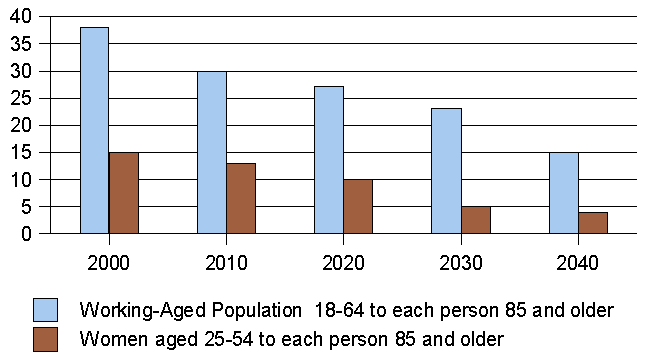 |
| SOURCE: General Accounting Office analysis of U.S. Census Bureau Projections of Total Resident Population, Middle Series, December 1999. |
B. Demand for Long-Term Care Services
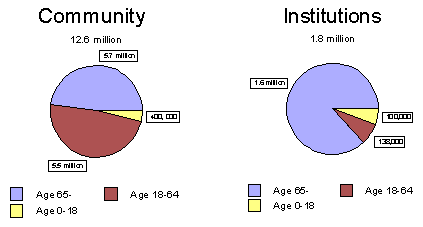
In 2000, as shown in Figure 2, there were approximately 13 million Americans--including children, working age adults with disabilities and the elderly--who needed long-term care. By 2050, the total number of individuals in need of long-term care services will increase to 27 million, with the aging of the baby boomer generation being the most significant factor contributing to the demand.
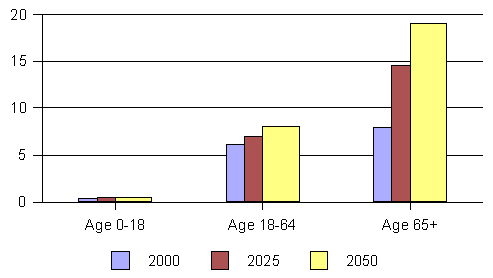
As illustrated in Figure 3, the number of elderly individuals is expected to more than double over the next 50 years, increasing from approximately 8 million to 19 million. The trends in the size of demand for long-term care will follow trends of the aging baby boomer generation. When the baby boomers start to reach age 75 in 2021, the use of institutional and home care will increase significantly. The demand will increase even more sharply around 2030 when the baby boomer generation starts to reach 85.
| FIGURE 2. U.S. Population in Need of Long-Term Care Services |
 |
| SOURCE: National Health Interview Survey, 1994-5 Disability Supplement, analysis of the Office of the Assistant Secretary for Planning and Evaluation. |
Working age adults with disabilities needing long-term care will also increase from around 5 million in 2000 to about 8 million in 2050. Many of these individuals will need specialized assistance to return or remain in their communities, as well as to return to work.
| FIGURE 3. Estimates of Future Demand for Long-Term Care(in millions) |
 |
| SOURCE: 1994 National Health Interview Survey, 2001 Census population projections. For the Institutional Population: 1998 Residential Information Systems Project, 1996 Medical Expenditure Panel Survey. |
Long-term care is provided in both community and institutional settings. Community settings include board and care homes, adult day care, hospice, group homes, and private homes. Institutional care is provided in privately run nursing homes, assisted living facilities, as well as in-state institutions. In 2000, 13 million Americans received long-term care services in community-based settings, and 2 million Americans received long-term care services in institutional settings,10 as illustrated in Figure 3.
The future demand for long-term care services is expected to increase for both the elderly and people with disabilities in both institutional and community-based care settings. The decision by the U.S. Supreme Court in the matter of Olmstead v. L.C. requires that services be provided in the most integrated setting appropriate to the individual--which in many cases are home and community-based care settings. As Figure 3 shows, by the year 2050, an estimated 27 million Americans will need long-term care services.11
The aging of the baby boomer generation will be the most significant factor increasing the demand for long-term care services over the next half century. As illustrated in Figure 3, the number of elderly individuals using either nursing facilities, alternative residential care facilities such as assisted living facilities, or home care services is expected to more than double over the next 50 years, increasing from approximately 8 million to 19 million.12 In large part, this reflects the trend in the number of elderly persons with limitations on activities of daily living (ADLs) that require long-term care services, including declines in disability among the elderly, and trends in cognitive impairment.
The trends in long-term care services will track the aging baby boomer generation. The use of long-term care services, and the need for all types of direct care workers in long-term care settings, will increase as the baby boomer generation ages. When the baby boomer generation starts to reach age 75 in 2021, the use of institutional and home care, and the staff needed to deliver that care, will increase. The number of users will increase even more sharply around 2030 when the baby boomer generation starts to reach 85.
C. Informal Caregivers
Critical to understanding the future supply of direct care workers is examining the central role of unpaid informal caregivers in the provision of long-term care, and recognizing the relationship between formal and informal caregivers.
Informal caregivers provide the majority of long-term care services in the U.S. In 2000, there were 22 million unpaid informal caregivers aiding elderly persons in the U.S.13 Using the National Long-Term Care Survey Caregivers Supplement, and the National Health Interview Survey, Figure 4 shows the number of informal caregivers will rise in 2000 from approximately 22 million individuals caring for approximately 14 million elderly Americans, to approximately 40 million individuals caring for approximately 28 million Americans in 2050.14
| FIGURE 4. Demand for Unpaid Informal Caregivers in Relation to Formal Paid Care(in millions) |
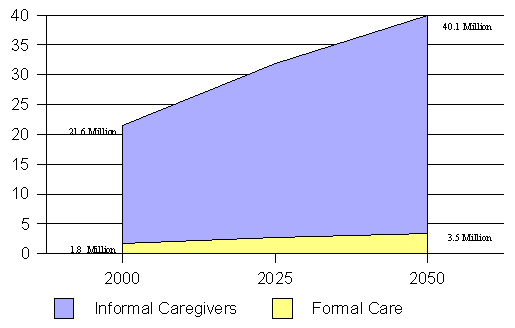 |
| SOURCE: The National Health Interview Survey, 1994; estimates based from the National Long-Term Care Survey Caregiver Supplement, 1989, and the National Health Interview Survey, 1994. |
Demographic factors will undoubtedly bring about some changes in these informal caregiving patterns when the baby boomer generation ages and develops long-term care needs. Baby boomers are likely to rely even more on spouses because husbands and wives are both living longer, and the longevity gap between them is narrowing.15 However, lower rates of marriage and higher rates of divorce are the distinguishing marital characteristics of this generation, resulting in more baby boomers moving into middle and older ages without a spouse to help with potential care needs.
Elderly baby boomers will have fewer adult children available to provide informal care.16 This can be attributed to their fertility rate also being lower than that of their parents, and the fact that baby boomers are somewhat more likely than earlier generations to be childless.16 Where there are children, they may be more likely to seek assistance from paid caregivers because they will have fewer siblings with whom to share caregiving responsibilities.
Whether or not these demographic factors will significantly increase demand for paid residential and home care is uncertain, and depends largely on future socio-cultural values, expectations, and preferences. For example, elderly female baby boomers will, because of their higher labor force participation, have more income and assets than older women of earlier generations. Because of this, many more likely will want to remain in their own homes, alone, at older ages, despite higher levels of disability and this preference can be expected to increase demand for paid home care.17
In addition, many attitude surveys already indicate that when elders become too disabled to live alone safely, many prefer to move into a residential care facility rather than move in with their adult children.18 This is a significant factor behind the growth of a predominantly private pay market for assisted living facilities over the past 15 years. Finally, studies of private long-term care insurance purchase decisions have found that a major reason why older people buy these policies is to avoid becoming dependent on their children for care.19 If more baby boomers are motivated to purchase private long-term care insurance over the next 20 years, this is almost certain to stimulate increased demand for paid long-term care--especially at home and in residential alternatives to nursing facilities.
D. Uncertainty in Long-Term Projections of Demand
Because the availability of informal unpaid caregivers 30-50 years from now depends on the size and composition of future families, it is difficult to generate accurate long-term estimates of potential demand for paid workers in long-term care settings. There are many other factors, which add to the uncertainty in making long-term projections, including the following:
-
Changes in the extent and nature of disabilities.
-
Changes in the amount of public funds available for long-term care.
-
Availability of private resources as a result of broad economic changes in wealth formation and savings.
-
Availability of private long-term care insurance.
-
The role of technology in aiding both paid and unpaid caregivers, through monitoring or assistive devices.
-
Changes in how nursing homes, assisted living centers, or home health agencies use direct care workers (i.e., staff ratios which may decline with improvements in technology), or restructuring of work tasks, with some duties being delegated to new occupational categories of direct care workers, such as single task workers).
-
Changes in the structure of the long-term care industry and the types of provider institutions.
-
Potential changes in the regulation of long-term care settings; for example, quality standards for nursing homes and home health agencies or stronger regulation of assisted living and other residential care providers.
E. Current Number of Paid Direct Care Workers in Long-Term Care
According to BLS, there were an estimated 1.9 million jobs for direct care workers in long-term care settings in 2000. (See Table 1.) These included nurse practitioners (NPs), registered nurses (RNs), licensed practical nurse (LPNs), licensed vocational nurses (LVNs), certified nursing assistants (CNAs), nurse aides (NAs), orderlies, home health workers, home health aides, home care aides, personal care attendants, personal care aides, geriatric aides, and caregivers.
| TABLE 1. Employment of Direct Care Workers in Long-Term Care Settings, 2000 and Projected 2010(Number in thousands) | ||||||
| 2000 Employment | Projected 2010 | Change 2000-2010 | ||||
| Number | % of Industry | Number | % of Industry | Number | % | |
| NURSING AND PERSONAL CARE FACILITIES, TOTAL | 1,038 | 58 | 1,305 | 60 | 267 | 26 |
| Nursing Aides, Orderlies and Attendants | 645 | 36 | 797 | 36 | 153 | 24 |
| Licensed Practical and Vocational Nurses | 203 | 11 | 248 | 11 | 46 | 22 |
| Registered Nurses | 144 | 8 | 196 | 9 | 52 | 36 |
| Home Health Aides | 34 | 2 | 42 | 2 | 8 | 24 |
| Personal and Home Care Aides | 13 | 1 | 22 | 1 | 9 | 67 |
| RESIDENTIAL CARE, TOTAL | 311 | 39 | 518 | 39 | 207 | 67 |
| Home Health Aides | 131 | 16 | 200 | 15 | 69 | 53 |
| Personal and Home Care Aides | 92 | 11 | 173 | 13 | 80 | 87 |
| Nursing Aides, Orderlies and Attendants | 55 | 7 | 93 | 7 | 38 | 70 |
| Licensed Practical and Vocational Nurses | 18 | 2 | 25 | 2 | 8 | 44 |
| Registered Nurses | 16 | 2 | 27 | 2 | 11 | 70 |
| HOME HEALTH CARE SERVICE, TOTAL | 505 | 74 | 859 | 75 | 354 | 70 |
| Home Health Aides | 192 | 30 | 327 | 30 | 135 | 70 |
| Personal and Home Care Aides | 133 | 21 | 226 | 21 | 93 | 70 |
| Registered Nurses | 104 | 16 | 177 | 16 | 73 | 70 |
| Licensed Practical and Vocational Nurses | 43 | 7 | 73 | 7 | 30 | 70 |
| Nursing and Psychiatric Aides1 | 33 | 1 | 56 | 1 | 23 | 70 |
SOURCE: Bureau of Labor Statistics, National Employment Matrix, 2000-2010.NOTE: BLS data used in this analysis cover wage and salary employment in nursing and personal care facilities, residential care, and home health care services. BLS collects data on employment of direct care workers in other industries, such as hospitals, temporary help firms, and public agencies. Data on self-employed independent providers are also collected, but definitional limitations prevent extracting the subset of workers providing long-term care from these estimates.
| ||||||
Of these jobs, about 527,000 were for RNs and LPNs, while approximately 1.3 million were for paraprofessional workers. (See Table 2.) Of the total number of direct care worker jobs in long-term care, 56 percent were in nursing and personal care facilities, 17 percent in assisted living and other residential care settings, and the remaining 27 percent in home health care services.
| TABLE 2. Employment of Professional and Paraprofessional Direct Care Workers in LTC Settings, 2000 and Projected 2010(Number in thousands) | |||
| 2000 | 2010 | Percentage Change | |
| Professional (Registered Nurse, Licensed Practical and Vocational Nurse) | 527 | 747 | 42 |
| Paraprofessional (Home Health Aides, Personal and Home Care Aides, Nursing Aides, Orderlies, and Attendants) | 1,327 | 1,936 | 46 |
| SOURCE: Bureau of Labor Statistics, National Employment Matrix, 2000-2010. | |||
F. Underestimate of the Number of Current Workers
BLS data used in this analysis cover wage and salary employment in nursing and personal care facilities, residential care, and home health care services. BLS collects data on employment of direct care workers in other industries, such as hospitals, temporary help firms, and public agencies. Data on self-employed independent providers are also collected, but definitional limitations prevent extracting the subset of workers providing long-term care from these estimates. For this reason, the number of direct care jobs in long-term care probably is understated.
Direct employment of long-term care workers by consumers has increased in recent years. For example, a number of states, including California, Colorado, Kansas, Maine, Michigan, Oregon, Washington, and Wisconsin, are using consumer-directed home care. In these programs, the individual client is responsible for hiring, training, directing and firing the care worker.20
One indication of the size and growth in this self-employed workforce comes from California's In-Home Supportive Services (IHSS) program. IHSS pays for in-home supportive services for low-income disabled individuals (over 65, disabled, or blind). Under IHSS, the individual with disabilities (or his/her family) hires the provider and is considered to be the provider's employer. In California, most of these workers are not captured in the state's Occupational Employment Statistics Survey. Over 194,000 Californians receive these services monthly, up from 150,000 only seven years earlier.21 California reports employing 202,000 personal care workers in the IHSS program. Assuming that there is a roughly one-to-one relationship between the number of clients and the number of workers, another 116,000 workers may be working in public programs in just six states (Colorado, Kansas, Maine, Michigan, Oregon and Wisconsin). Yet, in 2000, BLS counted only 414,000 jobs for personal and home care aides nationwide.
In addition, direct caregivers who operate as independent contractors and who are not reimbursed by government programs are sometimes paid in cash. Moreover, although required by law, employers often do not pay taxes for these individuals. As a result, there is little information on the size and trends in what is sometimes referred to as the "gray market," direct care workers in a quasi-underground economy whose labor market activities would not be captured in most formal surveys.
G. Near Term Growth in Employment of Long-Term Care Workers
BLS has developed economic models that systematically project employment by industry and occupation over the period 2000-2010.22 Using these models, DOL has estimated that:
-
There were 1.9 million direct care workers employed in long-term care settings in 2000--more than 1.0 million in nursing and personal care facilities, 311,000 in residential care, and 505,000 in home health care services (Table 1).
-
There will be an additional 26 percent direct care worker jobs created in nursing home and personal care facilities, 67 percent more in residential care, and 70 percent more in home health care settings (Table 1).
-
Employment of direct care workers in long-term care settings in the next 10 years will grow nearly twice as fast as health care employment in general (45 percent vs. 25 percent), and three times as fast as all industries (45 percent vs. 16 percent) (Table 3).
-
About 300,000 jobs for direct care workers in long-term care settings will be created due to net replacement needs (Table 4). Added to the increase of 828,000 in jobs stemming from occupational employment growth, a total of 1.1 million new jobs will be created due to growth and net replacement needs.
-
The total number of long-term care jobs for direct care workers will increase by 45 percent or 828,000 between 2000 and 2010 to reach a total of around 2.7 million (Table 3). There will be an increase of 42 percent for professionals (from about 527,000 to 747,000) and 46 percent for paraprofessional long-term care workers (from 1.3 million to 1.9 million) (Table 2).
-
The largest number of job openings due to occupational employment growth for direct care workers will be created among the lowest skilled paraprofessional workers in residential and home health care settings (Table 5).
| TABLE 3. Wage and Salary Employment Growth in Selected Occupational Groupings and Industries, 2000 and Projected 2010(Numbers in thousands) | |||
| 2000 | 2010 | Percent Change | |
| Direct Care Workers in Long-Term Care Settings | 1,854 | 2,683 | 45% |
| Health Services Sector | 11,065 | 13,882 | 25% |
| Total, All Industries | 133,741 | 55,722 | 16% |
| SOURCE: Bureau of Labor Statistics, National Employment Matrix, 2000-2010. | |||
These projections imply continued rapid growth in the employment of direct care workers in long-term care settings; however, the overall supply of these workers will grow much less rapidly. For this reason, an increasing share of the available labor force will have to be allocated to the long-term care industry.
| TABLE 4. Net Replacement Needs for Direct Care Workers, 2000-20101(Number in thousands) | |||
| Total Employment in LTC Settings | Annual Average Attrition Rate | Net Replacement Needs, 2000-2010 | |
| Registered Nurses | 264 | 2.0% | 53 |
| Licensed Practical and Vocational Nurses | 263 | 2.6% | 68 |
| Home Health Aides | 356 | 1.3% | 46 |
| Nursing Aides, Orderlies, and Attendants | 732 | 1.3% | 95 |
| Personal and Home Care Aides | 238 | 1.5% | 36 |
SOURCE: Bureau of Labor Statistics, National Employment Matrix, 2000-2010.
| |||
Increases will be dramatic for low-wage, low-skilled workers. Of the 53 million jobs in the U.S. that BLS classifies as being in occupations generally requiring short-term on-the-job training, about 2.5 percent are in long-term care. Over the period 2000-2010, the total number of jobs due to growth in these relatively low-skilled occupations is expected to increase by 7.7 million. Eight percent, or about 609,000 of these additional jobs will be in long-term care, a significant shift in the employment of low-wage, low-skilled workers.
| TABLE 5. Employment of Professional and Paraprofessional Direct Care Workers by LTC Setting, 2000 and Projected 2010(Number in thousands) | |||
| 2000 | 2010 | Numerical Change | |
| Professional in Nursing and Personal Care Facilities | 347 | 444 | 97 |
| Paraprofessional in Nursing and Personal Care Facilities | 692 | 861 | 169 |
| Professional in Residential and Home Health Care Settings | 181 | 303 | 122 |
| Paraprofessional in Residential and Home Health Care Settings | 635 | 1,074 | 439 |
| SOURCE: Bureau of Labor Statistics, National Employment Matrix, 2000-2010. | |||
H. Long-Term Projections of the Labor Force and the Demand for Direct Care Workers
While BLS has produced overall labor force projections to 2050, DOL does not provide specific industry projections beyond 2010. As Table 6 shows below, labor force growth will slow dramatically in the future, with 1.1 percent annual growth over the period 2000-2010, falling to 0.4 percent growth over 2010-2025, then rising slightly to 0.6 percent growth over 2025-2050. This growth reflects the large impact of retiring baby boomers.
| TABLE 6. Labor Supply | ||||||
| 1980 | 1990 | 2000 | 2010 | 2025 | 2050 | |
| Labor Force (millions) | 107.0 | 125.9 | 140.9 | 157.7 | 165.0 | 191.8 |
| 1980-1990 | 1990-2000 | 2000-2010 | 2010-2025 | 2025-2050 | ||
| Growth Rate (annual) | 1.6% | 1.1% | 1.1% | 0.4% | 0.6% | |
| SOURCE: Labor Supply Projections, developed by the Office of the Assistant Secretary for Planning and Evaluation using Bureau of Labor Statistics data, July 2002. | ||||||
The size and composition of the labor force is the principal determinant of overall economic growth. Demand for goods and services in each industry will change over time as consumer preferences and other factors change. Nonetheless, given a relatively slow growing supply of labor, employers in the various industries will compete with one another for the workers. If employment for a particular industry grows much faster than the overall supply of labor, it can only do so by taking workers away from employers in other industries, or by finding new ones.
BLS employment projections estimate that employment of direct care workers (RNs, LPNs, and aides) is expected to grow by 2.3 percent in nursing homes, 5.5 percent in community-based service, and 5.2 percent in residential care per year over the period of 2000-2010. Each of these employment growth rates is much greater than the anticipated 1.1 percent growth in the labor force. Even if long-term care employers were to meet the 2010 employment projections, these growth rates would be difficult to sustain beyond 2010 because labor force growth will slow further.
Data in Table 7, and the accompanying text, show the implications if the BLS assumptions regarding occupational growth rates were to persist to 2050, as estimated by HHS. In 2000 there were 77 persons in the labor force for each long-term care job. BLS estimates that, by 2010, this figure will decrease to 60 persons per job. HHS estimates that there would be 14 persons per long-term care job in 2050.
| TABLE 7. Direct Care Workers Projections--Scenario 1(2000-2010 Growth Rates) | |||||||
| Industry(millions of workers) | 2000 | 2010 | 2025 | 2050 | Assumed Growth Rates | ||
| 2000-2010 | 2010-2025 | 2025-2050 | |||||
| Nursing Homes and Personal Care | 1.04 | 1.31 | 1.84 | 3.26 | 2.31% | 2.31% | 2.31% |
| Home Health | 0.51 | 0.86 | 1.78 | 6.74 | 5.46% | 5.46% | 5.46% |
| Residential Care | 0.31 | 0.52 | 1.11 | 3.99 | 5.24% | 5.24% | 5.24% |
| Total Long-Term Care | 1.85 | 2.68 | 4.74 | 13.99 | |||
| % Labor Force in Long-Term Care | 1.3% | 1.7% | 2.8% | 7.3% | |||
| SOURCE: Bureau of Labor Statistics Projected Growth Rates by Industry, estimated forward by the Office of the Assistant Secretary for Planning and Evaluation, July 2002. | |||||||
The BLS growth rates for the projections of long-term care employment to 2010 are heavily influenced by historical factors, and use trend data from the 1990s and previous decades. The 1990s were an unusual time in two major respects. Medicare spending for home health and skilled nursing facility care increased dramatically until 1998. In addition, elderly persons and their families began to view assisted living facilities and home health care as desirable and a possible alternative to nursing home care. It is unlikely that the historical growth rate of the 1990s for these industries will be maintained in the future.
A more realistic scenario, as shown in Table 8, is that the growth rate in the home health and residential care industries would taper off after 2010, and perhaps before. Assuming the home health and residential care growth rates are 2.3 percent, as assumed for the nursing and personal care home industry, employment of direct care workers in the long-term care industry will increase from 1.8 million in 2000 to 6.6 million in 2050. However, this reduced scenario still requires substantial shifts of workers to the long-term care industry. In 2000, there were 77 persons in the labor force for each long-term care job. By 2050 HHS estimates that there would be 29 persons per long-term care job.
| TABLE 8. Direct Care Workers Projections--Scenario 2 | |||||||
| Industry(millions of workers) | 2000 | 2010 | 2025 | 2050 | Assumed Growth Rates | ||
| 2000-2010 | 2010-2025 | 2025-2050 | |||||
| Nursing Homes and Personal Care | 1.04 | 1.31 | 1.84 | 3.26 | 2.31% | 2.31% | 2.31% |
| Home Health | 0.51 | 0.86 | 1.13 | 2.01 | 5.46% | 2.31% | 2.31% |
| Residential Care | 0.31 | 0.52 | 0.73 | 1.29 | 5.24% | 2.31% | 2.31% |
| Total Long-Term Care | 1.85 | 2.68 | 3.70 | 6.56 | |||
| % Labor Force in Long-Term Care | 1.3% | 1.7% | 2.2% | 3.4% | |||
| SOURCE: Bureau of Labor Statistics Projected Growth Rates by Industry, estimated forward by the Office of the Assistant Secretary for Planning and Evaluation, July 2002. | |||||||
Another scenario, as seen in Table 9, further assumes that the impact of the Balanced Budget Act of 1997 and related Medicare legislation on the home health home industry results in no employment growth from 2000 to 2010, and then growth of 2.3 percent from 2010 to 2050. This would have a slight effect on the projections in the long run, reducing the number of long-term care jobs in 2050 from 6.6 million to 5.7 million. HHS estimates that there would be 34 persons in the labor force per long-term care job in 2050.
| TABLE 9. Direct Care Workers Projections--Scenario 3(2000-2010 Growth Rates Tapered + Home Health Reduced) | |||||||
| Industry(millions of workers) | 2000 | 2010 | 2025 | 2050 | Assumed Growth Rates | ||
| 2000-2010 | 2010-2025 | 2025-2050 | |||||
| Nursing Home and Personal Care | 1.04 | 1.31 | 1.84 | 3.26 | 2.31% | 2.31% | 2.31% |
| Home Health | 0.51 | 0.51 | 0.67 | 1.18 | 0.00% | 2.31% | 2.31% |
| Residential Care | 0.31 | 0.52 | 0.73 | 1.29 | 5.24% | 2.31% | 2.31% |
| Total Long-Term Care | 1.85 | 2.34 | 3.24 | 5.73 | |||
| % Labor Force in Long-Term Care | 1.3% | 1.5% | 1.9% | 3.0% | |||
| SOURCE: Bureau of Labor Statistics Projected Growth Rates by Industry, estimated forward by the Office of the Assistant Secretary for Planning and Evaluation, July 2002. | |||||||
These projections do not account for unforeseen changes in the future labor market, such as relative strength or weakness of national and local economies, which may be a factor in the future employment in long-term care settings. Similarly, changes in federal training and education programs, scholarship and loan programs, and immigration policy may have a significant impact on the supply of direct care workers.
II. IMBALANCES IN SUPPLY OF, AND DEMAND FOR, SPECIFIC OCCUPATIONAL CATEGORIES OF THE LONG-TERM CARE WORKFORCE
This section discusses growth trends and factors influencing the supply of specific groups of long-term care workers: RNs, LPNs, NAs, orderlies and attendants, home health aides, and personal and home care aides, as traced in BLS's survey of employers. Direct care workers such as therapy aides, rehabilitation aides, employment support aides, medication aides and other paraprofessional workers in long-term care are not included because the data available are not sufficient to describe and analyze potential imbalances for workers in these categories.
A. Professional Direct Service Workers
RNs and LPNs represent approximately 28 percent (527,000) of direct care workers in long-term care settings. Their responsibilities in nursing homes and personal care facilities include direct patient care and supervision of paraprofessional direct care staff. These occupations include a wide range of education and skill level. RNs are typically college educated, having at least an associate degree, and have to pass a licensing exam. LPNs typically complete a one-year post-secondary training program, and also have to pass a licensing exam. NAs and other paraprofessionals typically have, at most, some form of on-the-job training. RNs have the most education, and are subject to state licensing requirements. Licensed practical and vocational nurses also must obtain state licensure, and receive education through formal training programs, typically one year in length.
1. Registered Nurses (RNs)
RNs represent approximately 14 percent (264,000) of direct care workers in long-term care settings such as nursing and personal care facilities, and residential and home health care settings.23 A slight majority, 54 percent (144,000) of long-term care RNs are employed in nursing and personal care facilities settings, compared to residential and home health settings. Their roles in both institutional settings include direct patient care, supervision of LPNs and CNAs, and management of paraprofessional direct care staff. In residential settings, RNs provide nursing care in a patient's home and supervise LPNs and other paraprofessional staff.
BLS estimates that, in 2000, RNs held 264,000 jobs in nursing homes, personal care facilities, residential care, and home health care services settings.24,25 BLS estimates over the period from 2000 to 2010 that 136,000 new jobs for RNs in long-term care settings will be created due to increasing demand for services. In addition to occupational employment growth, 53,000 job openings will result from the need to replace RNs who leave the occupation permanently to enter other jobs, retire, or leave the labor force for other reasons.
The current and future supply of RNs in all health settings is likely to be constrained, in light of the following:
-
The decreasing number of nurses in the training pipeline and shrinking pools of new workers able to replace those nurses who are leaving or retiring from nursing.26,27
-
The lengthy training needed before new nursing students complete their education.
-
The shortage of nursing faculty available to teach new nurses.
-
The decreasing retention of nurses in the profession because of low job satisfaction--40 percent of nurses are dissatisfied with their jobs.28
-
The aging of the nursing workforce; 66 percent of all nurses are 41-60 years older, according to a recent survey of the American Nurses Association (ANA).
Specific factors contributing to the shortage and high turnover of RNs in long-term care settings include:
-
The lower salaries of RNs in long-term settings as compared to in hospital settings; in 2000, the median hourly wage for RNs in hospital settings was 18 percent higher than for RNs in residential care settings ($22.01 versus $18.67).29 (See Table 10.)
-
The lack of authority that nurses have to hire other direct care staff.
-
The complex regulatory environment in nursing homes creating paperwork burden that take nurses away from providing care.
-
The professional isolation of nurses in long-term care positions.
-
The lack of training and continuing education opportunities related to long-term care populations, particularly those with cognitive impairments and psychiatric conditions.
-
The lack of benefits compared to nurses in other practice settings (health care, transportation, fringe benefits).
| TABLE 10. Wages for Registered Nurses in Long-Term Care Settings, 2000 | ||
| Setting | Employment | Median Wage |
| Nursing and Personal Care Facilities | 144 | $19.87 |
| Hospitals, Public and Private | 1,274 | $22.01 |
| Home Health Care Services | 104 | $20.98 |
| Residential Care | 16 | $18.67 |
| SOURCE: Bureau of Labor Statistics, National Employment Matrix, 2000-2010. | ||
2. Licensed Practical and Licensed Vocational Nurses30
LPNs represent approximately 14 percent (263,000) of direct care workers in long-term care settings and provide basic bedside care under the direction of RNs or physicians.31 Their roles in long-term care include direct patient care (assistance with ADLs and instrumental activities of daily living (IADLs)) and administering prescription drugs. In nursing homes, LPNs take on additional roles, such as developing care plans, acting as the charge nurse, and supervising the activities of nurse aides, home health aides, and personal care workers. In residential settings, LPNs take on additional roles, such as teaching family members nursing tasks and supervising home health and home care aides.
BLS estimates that licensed practical and vocational nurses held 263,000 jobs in 2000 in nursing and personal care facilities, and residential and home care settings.32 BLS projects over the period 2000-2010 that 84,000 new jobs will be created for licensed practical and vocational nurses in long-term care settings to increasing demand for services. In addition to occupational employment growth, 68,000 job openings will result from the need to replace registered LPNs who leave the occupation permanently to enter other jobs, retire, or leave the labor force for other reasons.
Factors contributing to constrain our current and future supply of LPNs in long-term care settings are similar to those for RNs. These factors include:
- The decreasing number of LPNs in the training pipeline;
- The shortage of nursing faculty available to teach new LPNs;
- Inadequate training specific to long-term care;
- The lack of benefits compared to LPNs in other acute care settings; and
- The higher turnover rate (51 percent) of nurses and LPNs in nursing home chains than in acute care settings.33
B. Paraprofessional Direct Service Workers
Paraprofessional long-term care workers represent approximately 72 percent (1,327,000) of direct care workers in long-term care settings.34 These paraprofessionals include: CNAs, NAs, orderlies, personal care workers, personal care attendants, personal aides, home health and home care aides, and others. Paraprofessional staff provide assistance with ADLs such as bathing, dressing and eating as well as IADLs such as meal preparation, house cleaning, and medication management. These paraprofessionals work in a variety of long-term care settings including nursing homes, assisted living, residential care settings, adult day care, group homes and private homes. Experts have noted that paraprofessional long-term care workers form the centerpiece of the formal long-term care system.35
1. Nursing Aids (NAs), Orderlies and Attendants36
NAs, orderlies and attendants represent the majority, approximately 62 percent (645,000 of 1,038,000), of the direct care workforce in nursing homes and personal care facilities,34 and 11 percent (87,000 of 816,000), of direct care workers in residential and home health care settings. As the main provider of "hands on care" in these institutional settings, they help people with basic ADLs (such as bathing, dressing, toileting, eating and transferring), IADLs (such as room cleaning and medication management), as well as keep records of services delivered and changes in the client's conditions. NAs who work in Medicare and Medicaid certified nursing homes must, under federal statute, complete a 75 hour training course in order to become a CNA.
BLS estimates that NAs, orderlies, and attendants held approximately 732,000 jobs in 2000 in nursing and personal care facilities and residential and home care settings.37 BLS projects over the period from 2000 to 2010 that 214,000 new jobs for NAs, orderlies, and attendants will be created in long-term settings, a 29 percent increase. In addition to occupational employment growth, 95,000 job openings will result from the need to replace NAs, orderlies, and attendants who leave the occupation permanently to enter other jobs, retire, or leave the labor force for other reasons.
Several supply-site factors may be combining to constrain the supply of--and/or contribute to the high turnover of--NAs, orderlies, and attendants in long-term care settings including:
-
Competitive and adequate wages is one of the most often cited reasons for high turnover among NAs, orderlies and attendants. The median hourly wage for NAs, orderlies and attendants was $8.89 per hour in 2000.38,39
-
One in three NAs in nursing homes earned less than $10,000 per year, and 36 percent reported family incomes below $20,000; 18 percent of NAs working in nursing homes and 19 percent working in home health care have incomes below the poverty level.40
-
These employees face strenuous physical demands and high injury rates from working in nursing homes, as compared to other health and non-health related industries (13.9 employees per 100 employees in nursing and personal care facilities had a workplace injury in 2000 compared to 5.3 employees per 100 in eating and drinking places, or 9.1 per 100 in hospital settings).41
-
Staffing levels of CNAs are inadequate to accommodate workloads in nursing homes.42
-
The competing demands of providing individualized services to residents and meeting institutional requirements for efficiency and volume of work cause NAs to become increasingly frustrated with their jobs.43,44
-
Some staff perceive a lack of respect and of feeling undervalued by supervisors.45
-
The potential inability to receive adequate on-the-job training, such as training for paraprofessionals working with residents who are cognitively impaired.
-
Potentially limited job mobility.46
-
Aides in long-term care settings are less likely than other workers to have employer-sponsored health insurance and much less likely to be covered by a pension.47
As a result of many of these forces, the annualized turnover rates of NAs have been estimated to be as high as 76 percent.48
2. Home Health Aides and Personal and Home Care Aides
While we have a relatively good understanding of the number of RNs, licensed practical and vocational nurses, and NAs, orderlies and attendants in long-term care settings, we have less comprehensive data on home health aides and personal care aides. Occupational definitions used by BLS conform to the 2000 Standard Occupational Classification (SOC) system. Home health aides, by BLS and SOC definition, "provide routine, personal health care, such as bathing, dressing, or grooming, to elderly, convalescent, or disabled persons in the home of patients or in a residential care facility." Personal care and home health aides, by BLS and SOC definition, "assist elderly or disabled adults with daily activities at the person's home or in a daytime non-residential facility." For descriptive purposes, these workers have virtually identical skills and occupational definitions, so we have grouped them together.
Home health, personal care and home care aides represent the majority, approximately 67 percent (548,000 of 816,000), of the long-term care direct care workers in the community (residential care and home health care settings). This estimate undercounts the number of home health care, personal care and home care aides because it excludes hospital-based workers, independent providers, and public agency workers.49 As the main provider of "hands on care" in these residential and home health care settings, these workers help people with basic ADLs (such as bathing, dressing, toileting, eating and transferring), as well as IADLs (such as meal preparation, house cleaning, and medication management). All aides delivering services outside of facilities keep records of services and changes in clients' conditions. Requirements regarding training and certification for home health care and personal and home health aides vary by state.
BLS estimates that in 2000, home health, personal care, and home care aides held approximately 548,000 jobs in community settings, and 47,000 jobs in nursing and personal care facilities.50 BLS projects over the period from 2000-2010 that 395,000 new jobs for home health, personal care, and home care aides will be created in all long-term care settings, a 66 percent increase.50 In addition to occupational employment growth, 82,000 job openings will result from the need to replace home health, personal care and home care aides who leave the occupation permanently to enter other jobs, retire, or leave the labor force for other reasons.
Several supply-side factors may be combining to constrain the current and future supply of home health care workers including:
-
Changes in reimbursement (prospective payment) in Medicare home health have reduced the number of client visits and hours per visit reducing the number of home health aides in home care settings.
-
The level of wages paid may be too low to attract new workers--unlike RNs, LPNs and some CNAs, there are no standards within the home health care industry for workers' wages and benefits; in 2000 the median hourly wages of personal and home care aides was $7.50.51,52
-
Employer sponsored benefits may not exist or be unaffordable for many home health and personal care aides.53
-
Nursing staff may be responsible for more than 100 aides but have not had informal training in supervision.54
-
Home health workers generally have poor opportunities for advancement and limited opportunities for upgrading their skills.55
-
Training provided to aides is limited (usually 75 hours for home health aides)--and does not prepare them for the stresses of the job, such as working with residents who have cognitive impairments and/or behavioral health issues.
-
There is often the stigma associated with working as a home health care worker--where one is treated like a "girl" or "maid."55 There may also be a lack of recognition and support from the client and the agency; home care workers are perceived as an extension of domestic work.56
-
Home care is classified as an unskilled labor (waits of 10-15 years for work permits), making it more difficult for home health care workers to emigrate from other countries, limiting supply. Larger numbers of underrepresented minorities are found in lower paying health occupations such as home health aides.57
-
State Nurse Practice Act regulations may prohibit the provision of any skilled nursing care under the guise of personal care assistance; some states allow nurse delegation of tasks.
III. DOL AND HHS AGENCY EFFORTS ALREADY UNDERWAY
There are a number of provider-based and statewide activities to increase the recruitment and retention of direct care workers in long-term care settings. Much progress is already being made in many jurisdictions to address long-term care workforce issues such as wages and benefits, training, and career development. States have been particularly active in establishing legislative priorities vis-à-vis nurse staffing and nursing education. States also recognized the need to intensify and systematize data collection efforts. These are documented in "Who Will Care For Us," a paper prepared for HHS by the Urban Institute and Institute for the Future of Aging Services, and in "State Long-Term Care Workforce Initiatives," prepared for DOL and HHS by the Urban Institute (Appendix A).
In this section, we focus on federally initiated activities already underway that are aimed at developing a committed and quality direct care worker pool in a variety of long-term care settings. These activities are grouped by agency/office, and include: training and technical assistance for workers, employers, and states; direct assistance to providers, states, students and schools; and collaborative efforts.
A. Collaborative Efforts Between HHS and DOL
Joint Action Strategies: DOL, HHS and the Department of Education have agreed upon on joint action strategies that address regional and local nursing and allied health occupational shortages. The joint effort will better link existing efforts among the agencies. The joint initiative will promote nursing as a career, seek to expand enrollment in nursing programs at all levels, and create a nursing career ladder pilot program linking Job Corps training to NA apprenticeships, community colleges, and vocational and professional nursing education programs.
HHS and DOL "Toolkit" Project: DOL and HHS have come together in a new initiative to address workforce shortages in long-term care settings. The initiative is a two-year research project to develop a "toolkit" to enable state agencies, long-term care providers, and worker groups to assess the impact of policy and practice changes designed to reduce vacancy and turnover rates among direct care workers, and to improve workforce quality. This joint initiative will help states collect data that will allow for comparisons across recruitment and retention efforts.
National Panel on Nursing: DOL and HHS are tasked with convening a national panel to examine education and training requirements for all nursing occupations. The two agencies will work with a number of nursing affiliated groups in this effort. DOL and HHS have begun conversations on how to best assemble the national panel on nursing.
B. Department of Labor[http://www.dol.gov]
1. Employment and Training Administration (ETA)[http://www.doleta.gov]
Targeted High-Growth Job Training Initiative: DOL currently has embarked on several national-level partnerships involving employers and targeting industries and occupations with high job growth. One such public/private partnership is between the DOL and HCA, Inc., the nation's largest manager/owner of hospitals and other health care facilities, some of which will involve long-term care settings. DOL and HCA are each contributing $5 million to offer scholarships and certification to workers who choose to pursue careers as RNs, LPNs, CNAs, and radiological or surgical technicians. DOL is also working to develop a project to recruit dislocated workers in the hospitality industry for positions in health-related fields, utilizing the resources available through ETA's electronic toolkit and the One-Stop Career Center infrastructure.
Apprenticeship Programs: DOL also administers a national system for registered apprenticeship training programs that consist of structured on-the-job training and related academic, theoretical instruction tailored to industry requirements. Primarily individual employers, employer associations, or partnerships between businesses and labor unions, with involvement of education providers, such as community colleges, operate the programs. DOL has certified 36 nursing-related apprenticeship programs in 14 states, in such fields as nursing assistants and LPNs among others.
DOL is currently conducting a pilot project (the Apprenticeship Health Care Outreach Initiative) to expand the number of employers and apprenticeship programs in the health care field, targeting paraprofessional occupations, such as CNAs, LPNs, radiological technicians, opticians, and home health aides, which require a two-year degree or less. ETA field staff are working to establish apprenticeship programs with hospitals, nursing homes, and other health care facilities that employ these workers. An example of an emerging project is one in Washington State, where ETA is working with employers, county government and community colleges to create new apprenticeship programs in high demand health care occupations that the colleges do not have sufficient slots to train. Another example is in Missouri where an apprenticeship program for Direct Support Professionals has been developed.
Electronic Information Systems: DOL has supported the establishment of a specialized on-line job bank, CareCareers.net, dedicated to linking job seekers to new careers in long-term care nursing. The project, announced in April 2002, utilizes existing resources available through ETA's electronic toolkit and is a collaborative venture with the American Health Care Association and the American Association of Homes and Services for the Aging. This new job bank is part of the computerized information systems that are a key part of the One-Stop system. The overall system includes America's Job Bank (http://www.ajb.org), America's Career InfoNet (http://www.acinet.org), and America's Service Locator (http://www.servicelocator.org). In addition, ETA also funds and manages O*NET (http://www.doleta.gov/programs/onet), a database of occupations and their requirements that can be used by job seekers, employers, educators and training professionals. O*NET also includes three career exploration tools, which can be used by individuals to understand the nature of different long-term care occupations and their educational requirements.
One-Stop Career Center System: Created under Title I of the Workforce Investment Act (WIA), the national system of local One-Stop Career Centers integrates and coordinates employment and training services from multiple federal and state programs. The One-Stop System is one of the pivotal areas that could be mobilized to address potential shortages in long-term care at the local and state level. These systems provide a range of services such as career information and job training through 605 local workforce areas managing over 1,900 local One-Stop Career Centers. Local and state One-Stop Systems are overseen by employer-led workforce investment boards (WIBs), charged with identifying and addressing strategic issues in workforce development. One-Stop Career Center Systems also require participation by numerous other federal programs and their local and state agencies, including local Employment Services office.
Youth Programs: DOL administers a number of youth programs, all of which could allow for training young people to fill health-related occupations in the long-term care field. The programs include "formula-funded" services provided through states and local communities, and residential education and training through the Job Corps. Formula-funded youth services are administered by local WIBs to provide a variety of services targeted to at-risk youth. Job Corps, the nation's largest residential education and job training program for at-risk youth, has over $20 million invested in health-related training, and is producing over 4,700 health-trained workers on an annual basis. Nearly all of the 120 Job Corps centers offer at least one health training program in 15 specialty areas, including CNA, medical assistant, LPN, and physical therapy assistant.
Adult and Dislocated Worker Programs: One-Stop Career Centers offer specialized services specific to the needs of dislocated workers and low-income adults. These services may include assessment and training of such workers in health care occupations in long-term care settings. The Employment Service, a mandatory partner in local One-Stop Systems, administers training and other services provided to trade-impacted workers under the recently re-authorized Trade Adjustment Act. These services may also include health care training, including long-term care worker training and job referral as related to workers dislocated as a result of international trade.
National Emergency Grants: The Secretary of Labor provides additional emergency funding for worker re-employment and retraining programs in local areas or states that have experienced large worker dislocations, such as mass layoffs and plant closures. Several of these National Emergency Grants (NEGs) have been used, at least in part, for retraining dislocated workers in health care professions.
Pilot and Demonstration Projects: DOL has conducted a number of pilot and demonstration projects that have supported training in health-related professions, including those in which workers have been in long-term care settings. A current example is a "School at Work" pilot project in five states, with 50 worksites, providing training for low-skill, entry-level workers in health care. Training will be provided at the job site using distance learning. Workers will upgrade their skills so that they can move up a career ladder, and participating employers will provide paid education time and mentoring support. Another recent project involves cross-training and upgrading the skills of home care workers in New York City in order for them to qualify to provide Medicare services and enhance their employability.
DOL has also provided demonstration grants to local WIBs for a number of local "sectoral" efforts that merged economic development with workforce development, and covered a wide range of interventions that go beyond training. Activities have encompassed career ladder development, compensation, working conditions, organizational structures, recruitment channels, and retention strategies. Grants are targeted to specific industries, with 20 of the 39 sectoral grants focused on health care, though not long-term care in particular. Projects involved a range of activities, including development of local or regional consortiums of hospitals and training providers, creation of new programs to upgrade the skills of current health care workers, and changes in employer practices to increase wages and benefits. DOL is developing a Health Care Sector Initiative Primer to provide local workforce areas under WIA with step-by-step, "how-to" guidance on replicating similar sectoral approaches.
Welfare-to-Work: A component and partner in local One-Stop Systems are Welfare-to-Work (WtW) grantees, who received formula funds and competitive grants to provide placement, transitional employment, and other support services targeted to the hardest-to-employ custodial and non-parents under TANF and other low-income families. A number of local competitive and formula-funded projects placed recipients in health care occupations, though not necessarily for long-term care settings. Though the final year of new funding for this program was in Fiscal Year 1999, spending from these resources may continue through Fiscal Year 2004. Various projects offer models for states and localities to use in helping former TANF recipients or other low-income individuals find work in or train for long-term care occupations.
An example of projects include the Pathways to Advancement Project, a partnership between DOL and HHS with non-profit organizations. The project uses funds from TANF, WtW, and WIA to partner with employers and educational institutions to test a model program to help former TANF recipients become entry-level workers, retain their jobs, and eventually move into second tier jobs with better pay, benefits, and training opportunities. One site, Seattle, has exclusively targeted the health care industry, including long-term health care.
Foreign Labor Certification Programs: DOL administers several programs to permit foreigners to legally enter the U.S. to work. One such program is the H-1C Temporary Program for RNs in Shortage Areas. The Nursing Relief for Disadvantaged Areas Act (NRDAA) of 1999 allows qualifying hospitals in designated Health Professional Shortage Areas to temporarily employ foreign RNs for up to three years under a H-1C visa. The NRDAA limits the total number of H-1C visas nationwide to 500 per fiscal year, as well as sets limits for each state. Nurses working under H-1C visas can only work for the employer requesting them. The program was enacted to provide nurses in the inner city and rural areas, which experienced severe shortages in health care professionals and is scheduled to expire on September 21, 2004. Should the need arise, there are other labor certification programs that could be used to increase the number of foreign workers in different occupational areas related to long-term care.58 DOL believes that immigration is a short-term solution and that educating and training American workers offers a greater long-term promise.
Technical Skill Training Grants: Under the American Competitiveness in the Twenty-First Century Act of 2000 and similar prior legislation, DOL provides Technical Skill Training Grants to train domestic workers in specialty occupations being filled by temporary workers admitted under H-1B visas. The grants are awarded to WIBs and to business partnerships using a portion of the fees collected from employers applying for H-1B visas. Out of the $196 million for training grants provided so far, approximately $26 million has been channeled for health-related projects, with some workers for long-term care settings. The project is currently being evaluated.
Senior Community Service Employment Program: DOL administers over $400 million in grants to non-profit organizations and states to provide part-time community service employment, training, and job placement to low-income workers 55 years of age or older. The program annually employs around 100,000 people in a total of 61,000 job slots. Many of these jobs are associated with service to the aging population and assistance that enables individuals to remain in their home. For example, some workers assist in Meals-on-Wheels programs or in filling administrative jobs in organizations that provide services to the elderly.
2. Occupational Safety and Health Administration (OSHA)[http://www.osha.gov]
Safety and Health Initiatives for Frontline Caregivers: Working closely with industry, OSHA has initiated a National Emphasis Program for Nursing and Personal Care Facilities, Skilled Nursing Care Facilities, and Intermediate Care Facilities. This program's focus is on reducing specific hazards that account for the majority of nursing home staff injuries and illnesses such as back injuries from patient handling, blood-borne pathogens, tuberculosis, and slips, trips, and falls. OSHA has issued ergonomics guidelines for the nursing home industry, the first in a series of industry-specific guidelines for preventing musculoskeletal disorders in the workplace. These industry-specific guidelines feature practical recommendations to employers based on methods used successfully by nursing homes.
3. Employment Standards Administration (ESA)[http://www.dol.gov/esa]
Wage and Hour Compliance Assistance in the Long-Term Care Industry: ESA's Wage and Hour Division is focusing resources to improve compliance with labor standards among industries that employ a high concentration of low-wage workers and for which enforcement data and history show high rates of serious violations. Since 1997, the long-term health care industry (including nursing homes, adult family care, assisted living, group homes and residential living facilities) has been the subject of this national initiative. Currently, the effort focuses on compliance education, employer outreach, and strategic partnerships with industry stakeholders.
4. Veterans Employment and Training Service (VETS)[http://www.dol.gov/vets]
Transition Assistance Program: The Transition Assistance Program (TAP) was established to meet the employment needs of separating service members during their period of transition into civilian life by offering job search assistance and related services. TAP was established under a partnership between the Departments of Defense, Veterans Affairs, Transportation and DOL's VETS to give employment and training information to armed forces members within one year of separation or two years of retirement. TAP consists of comprehensive three-day workshops that cover topics such as job searches, career decision-making, current occupational and labor market conditions, evaluations of participant's employability, and information on the most current veteran's benefits. VETS is currently planning two medical employment projects. The projects will provide transition military personnel with opportunities to advance their medical skills learned while in the service or to transition their skills into the medical field. Early identification of credentialing requirements, skill gaps, and availability of training and employment are core ingredients of these projects. One pilot involves partnerships with Johns Hopkins University, the Maryland Department of Labor, the Governor's WIB, and the Department of Defense. The second pilot site is in San Diego, and features Kaiser-Permanente as the primary employer and will serve both veterans and spouses of military members.
5. Women's Bureau (WB)[http://www.dol.gov/wb]
Group E-Mentoring in Healthcare Services: Group E-Mentoring in Healthcare Services (GEM-HS) is a six month pilot project conducted in the Chicago region that links students, ages 16-18, with mentors in the field of nursing via email, a website and special events. Through group mentoring, this project aims to increase the number of young women and men who will pursue post-secondary education in nursing and choose a career in nursing or other health care services. The University of Michigan School of Nursing (UMSN), one of the leading institutions in the health care field is collaborating with WB on the GEM-HS project by hosting and maintaining the website and listserv. UMSN sends participants a DAILY DIGEST in a question and answer format. WB plans to expand GEM-HS to nine other regions during FY 2004 to facilitate the participation of at least 500 young women.
6. Bureau of Labor Statistics (BLS)[http://www.bls.gov]
BLS serves as the primary source for national workforce data. BLS administers two surveys that are used to measure and describe the labor force and project future occupational employment. The Current Population Survey, a monthly survey of approximately 60,000 households conducted by the Bureau of the Census for BLS, collects data on employment, unemployment, demographic characteristics, and wages. Staffing pattern data from the Occupational Employment Statistics survey are a major input into the BLS occupational employment projections that are published every two years, and forecast 10-14 years into the future.
C. Department of Health and Human Services[http://www.hhs.gov]
1. Centers for Medicare and Medicaid Services (CMS)[http://www.cms.hhs.gov]
Real Choice System Change Grants: CMS, under the Real Choice System Change Activities, have made grant funds available to states who are designing systems of care to support people with disabilities in community-based settings. Over 15 states have initiated state-based or provider-based initiatives designed to improve and develop the long-term care workforce capacity in community-settings.
Medicaid Infrastructure Grants: CMS, under the Ticket to Work and Work Incentives Improvement Act of 1999, established a grant program to support state efforts to enhance employment options for people with disabilities. The goal of the Medicaid Infrastructure Grants program is to support people with disabilities in securing and sustaining competitive employment in an integrated setting. Several grants have been awarded to states to build the adequacy and availability of personal assistant services in community-based settings, in order to enable more individuals with disabilities to become employed.
Examining the Adequacy and Availability of Personal Assistant Services: CMS has developed a project entitled, "Understanding the Adequacy and Availability of Community-Based Personal Assistance Services." The purpose of this technical assistance project is to evaluate the size and scope of the shortage of personal assistance services, and to explore policies and practices that influence the recruitment and retention of qualified personal assistance services workers. The work will include: (1) the development of practical, useful, community-based products that can be used to address workforce shortage issues; (2) an electronic database of resources, contacts and tools to be used by federal, state, and local organizations in designing and implementing policies and programs to increase the availability of personal assistance services workers (this database will include querying capabilities); (3) development of a foundation for future research in community-based personal assistance services and supports; (4) an identification of areas needed for additional research or for policy or programmatic changes; and (5) immediate assistance to new projects funded under the System Change Grants related to workforce development in community-based care settings.
2. Health Resources and Services Administration (HRSA)[http://www.hrsa.gov]
Advanced Education Nursing Program: HRSA's Advanced Education Nursing Program supports projects educating nurses for faculty positions in nursing schools, public health nurses, nurse administrators and advanced practice nurses which include nurse practitioners, clinical nurse specialists, nurse anesthetists, and nurse midwives. Funds from this program support advanced education projects enrolling approximately 4,550 students and provide traineeship support for 5,800 graduate level students. There are 61 schools that provide traineeships for graduate students specializing in geriatric nursing. In 2002, four schools of nursing received funding for continuation grants with a geriatric focus. These projects have a total 2002 budget of $941,352. Six new geriatric grants were also funded in 2002. The new grants are projected to benefit 489 students over three project years with total 2002 funding of $1,487,951. These six new and four continuing geriatric grants represented a total of $2,429,303 in funding in 2002. The total Advanced Education Nursing Program budget for 2002 was $60 million, and $60 million is also projected for 2003.
Nursing Workforce Diversity Program: HRSA's Nursing Workforce Diversity Program provides support to projects targeting 1,800 minority and disadvantaged students in elementary and secondary schools, pre-nursing programs, and nursing schools. This program provides enrichment and support services necessary to assure successful completion of those students enrolled in nursing programs ($6.2 million in 2002 and $6.2 million in 2003).
Basic Nurse Education and Practice Program: HRSA's Basic Nurse Education and Practice Program supports academic and continuing education projects designed to recruit and retain a strong nursing workforce. Funds are used to support basic entry-level career ladder programs for LPNs, innovative academic distance learning projects for rural RNs, and projects to expand enrollments in baccalaureate programs. Support is provided for developing cultural competencies among nurses and to support retention strategies through continuing education projects to enhance the skills of the existing nursing workforce for practice in existing and emerging health care systems. In addition, support for faculty-run nurse managed centers provides educational settings for nursing students and clinical practice sites for faculty providing care to underserved populations. The program funds schools of nursing for the training of nurses with a focus on improving curricula and clinical practice to provide care to underserved populations.
The Nursing Faculty Development in Geriatrics funded by the Basic Nurse Education and Practice Program funded three grants in April 2002 for total year one funding of $1,487,951. The grantees project that 191 faculty members will be prepared in geriatric nursing in three project years. The Geriatric Nursing Knowledge and Experiences in Long Term Care for Baccalaureate Nursing Students Initiatives is to assist eligible entities to strengthen the geriatric nursing didactic content and clinical components of their baccalaureate nursing program. The intent is to provide funds to encourage integration of geriatric content and experiences throughout the nursing curriculum, which would continue in place beyond the one-year funding period. The program supported ten awards of approximately $25,000 each, and a reported total of 660 students participated in geriatric courses and clinical experiences during these one-year projects. Total program support was $16.3 million in 2002 and is projected at $16.3 million in 2003.
Nursing Education Loan Repayment Programs: HRSA's Nursing Education Loan Repayment Program provides loan repayment for nurses who agree to serve for not less than two years in designated health facilities. This program was financed at $10.2 million in 2002, and $15 million in 2003.
HRSA's Revolving Nurse Loan Fund Program provides funds to students at academic institutions to support 10,000 nursing students. The program was financed at $22 million in 2001.
HRSA's National Health Service Corps Loan Repayment and Scholarship program provides scholarships to nurse practitioners, nurse midwives and physician assistants. In 2001, there were approximately 300 nurse practitioners and 65 nurse midwives in the field.
HRSA's Faculty Loan Repayment provides loan repayment to faculty from disadvantaged backgrounds. The program received $0.5 million in 2002.
HRSA's National Institute of Nursing Research supports clinical and basic research related to nursing's contribution to patient care, some funds are used for research training. Funding was $117 million in 2002, and $105 million in 2002.
Geriatric Education Centers: HRSA's Geriatric Education Centers (GECs) strengthen multidisciplinary training of health professionals to diagnose, treat and prevent disease and other health problems of the elderly. GECs improve the training of health professionals in geriatrics and provide students with clinical training in geriatrics in nursing homes, chronic and acute care hospitals, ambulatory care centers and senior centers. GECs provide services to and foster collaborative relationships among health professions educators (organizations and institutions that sponsor formal and informal educational programs and activities for faculty, students and practitioners) within defined geographic areas (states, counties, metropolitan areas or portions thereof). GEC grants are made to accredited health professions schools. States match HRSA funding by, on average, $3 (state): $1 (federal). Since 1983, GECs have trained nearly 400,000 health professionals in 25 disciplines. In FY 2000, GECs trained approximately 20,000 health professionals, including 2,400 nurses. HRSA anticipates awarding $12.7 million to GECs in FY 2002.
Regional Centers for Health Workforce Studies: HRSA has funded four Regional Centers for Health Workforce Studies to examine geographic imbalances across five health professional disciplines: medicine, nursing, dentistry, allied health and public health. The Centers work with state agencies and conduct research, including state and regional studies, and develop analytic tools that help states resolve pressing issues in health professions training.
National Sample Survey of Registered Nurses: HRSA's National Sample Survey of Registered Nurses is the nation's most extensive and comprehensive source of statistics about licensed RNs in the U.S. The sample is drawn from the universe of all licensed RNs, whether or not they are part of the labor market. It collects information on the number and characteristics of licensed RNs; their educational background and specialty areas; their employment status including type of employment setting, position level, and salaries; their geographic distribution; and their personal characteristics including gender, racial/ethnic background, age, and family status. Information is collected on RNs employed in long-term care hospitals and nursing homes. In addition, information is collected on RNs employed in home health care (which includes both short and long-term care).
Nursing Supply Forecasting Model: HRSA's Nursing Supply Forecasting Model is a statistically based model that projects the future supply, and full-time employment of RNs for each state and the District of Columbia. The Nursing Supply Model captures age-specific dynamics of the flow of nurses in and out of licensure and the workforce; their progression from one educational level to another; and their state-to-state mobility.
Nursing Demand Model: HRSA's Nursing Demand Model is a statistically based model used to forecast future requirements for RNs, LPNs, and NAs. The nursing demand projections are based on health care utilization, changing demographics, and the health care delivery system. Projections can be made to the year 2020. The model incorporates the capability of forecasting health service requirements for 13 health care sectors, including several long-term care settings: long-term care hospitals, nursing homes, and home health care. Projections are available and can be made for RNs, LPNs, and NAs. The projections are made at the national and state level.
HRSA utilized the Nursing Supply and Demand models to project the supply, demand, and shortages of RNs over the period 2000-2020. This report is scheduled to be released shortly.
Study on Nursing Aides and Home Health Care Workers: HRSA is completing a study, Nursing Aides and Home Health Care Aides--Supply, Demand, Data Sources and Data Issues. This study provides an in-depth investigation of NAs and home health care aides, including their role in long-term care settings, the dynamics of the market, state and national data sources, identifies problems, and makes recommendations about data collection.
3. Office of the Assistant Secretary for Planning and Evaluation (ASPE)[http://aspe.hhs.gov]
Technical Expert Meetings on Paraprofessional Long-Term Care Workforce: ASPE held a series of three technical expert panels on the topic of frontline workers in long-term care settings. The purpose of this project was to heighten the awareness among federal, state, and local policy makers, long-term care providers, consumers, and foundations about the issues related to the frontline long-term care paraprofessional workforce, including people who work for nursing homes, home care agencies and non-medical residential facilities and people who work as independent providers. This project sought to: identify successful training, recruitment and retention models for frontline workers; identify training needs; analyze policy options; identify data gaps; and develop a research and demonstration strategy that the government and foundations can undertake to improve policy making.
National Initiative for Direct Care Workers: ASPE, in collaboration with CMS, has a project entitled "Development of a National Initiative for Direct Care Workers." The purposes of the project are to: (1) increase public recognition of the critical role played by direct care workers, (2) promote innovation at the state, community and provider level to improve recruitment and retention of workers, (3) create a national clearinghouse database on the long-term care workforce with search capacity, (4) increase understanding of the causes of worker shortages and the likelihood they will persist in the future so that new policies, programs and practices can be implemented to resolve them, and (5) collaborate with potential funders to plan and implement a systematic program of applied research, demonstration and evaluation to improve workforce recruitment and retention and the delivery of high quality long-term care services.
4. Agency for Healthcare Research and Quality (AHRQ)[http://www.ahrq.gov]
Workshop for Providers and Policy Makers: AHRQ held a workshop to provide state and local health policy makers with an overview of the major issues underlying the shortage of paraprofessional workers in long-term care settings and potential strategies to address the problem. The workshop included sessions on the supply and demand of paraprofessional workers, working conditions and job design, management of the work environment, and wages and benefits. The workshop also highlighted industry and state initiatives that address these issues including workforce recruitment strategies, new models for organizing long-term care services, and the role of "informal" caregivers.
5. Administration on Aging (AoA)[http://www.aoa.gov]
National Family Caregiver Support Program. AoA administers the National Family Caregiver Support Program. The program is modeled in large part after successful long-term care programs in states such as California, New Jersey, Wisconsin and Pennsylvania, and after listening to the needs expressed by hundreds of family caregivers in discussions held across the country.
Funded at $125 million in FY 2001, approximately $113 million has been allocated to states through a congressionally mandated formula that is based on a proportionate share of the 70+ population. The program calls for all states, working in partnership with area agencies on aging and local community service providers, to have five basic services for family caregivers including:
-
Information about available services.
-
Assistance in gaining access to supportive services.
-
Individual counseling, organization of support groups, and caregiver training to assist the caregivers in making decisions and solving problems relating to their caregiving roles.
-
Respite care to enable caregivers to be temporarily relieved from their caregiving responsibilities.
-
Supplemental services, on a limited basis, to complement the care provided by caregivers.
IV. FACTORS ASSOCIATED WITH SHORTAGE AND RECOMMENDATIONS
Assuring there are an adequate number of competent and compassionate caregivers for the elderly and disabled in the 21st Century will require retaining current workers and attracting new ones. To do so will require addressing key issues, as summarized below.
Finding New Sources of Workers: Avoiding shortages in different occupations will depend not only on retaining current workers but also on increasing the overall supply. Identifying and tapping new workers among older workers, workers laid off by other industries, former TANF recipients, and veterans, will help to assure there will be enough nurses and paraprofessionals in the immediate future and over the longer term. Assuring there are adequate numbers of faculty to train these potential long-term care workers must also be addressed.
Initial and Continuing Education and Training of Workers: Effective post-secondary education and on-the-job training of long-term care workers is essential if they are to have appropriate and high levels of skills. For example, NAs or home health care workers need adequate training to effectively provide care to residents with behavioral health issues and cognitive impairment. To address these issues will require sustained effort on the part of many.
Working Conditions: Hours, Paperwork, Respect, and Safety: Workers in many long-term care settings complain about long hours, high case loads, burdensome paperwork, lack of respect, and potential dangers to their own health and safety. Improving these working conditions has the potential to improve the retention of workers in long-term care settings and to make these occupations more attractive to new workers.
Compensation, Benefits and Advancement: Wages for RNs and CNAs in long-term care settings are appreciably lower than they are in hospital settings, and for CNAs, home health workers and personal care aides wages are at low levels when compared to other low-wage, low-skilled occupations (though rising in some parts of the country). In addition, many workers lack health insurance, access to employee assistance programs, pension coverage, and child care benefits, particularly those in informal care settings and in lower skill positions. Finally, many occupations, such as home health workers and CNAs, do not have career ladders or opportunities for advancement.
Below are comprehensive recommendations guided by a recognition that the key players in crafting and implementing solutions will be employers and industry representatives, education and training institutions, workforce investment systems, faith and community-based organizations, workers themselves, as well as many public agencies, elected officials and legislators at the federal, state, and local level. The recommendations include both those that are crosscutting and those that relate to specific issues of concern.
Recommendations
National Dialogue with Employers: Engage employers and employees, medical professionals, and state and local government officials, in a dialogue on issues relating to pay, benefits, career ladders, skills required and working conditions in long-term care.
Outreach to Faith and Community-Based Organizations: Explore with faith and community-based organizations their potential role in addressing workforce imbalances among long-term care paraprofessionals through strengthening relationships with the workforce investment system, and in recruiting volunteers for respite care for family members, "back-up" services, and home-based support.
Enhanced Use of Technology: Explore options for use of new technology in recruitment, education, recordkeeping and patient care, such as expanding and working with the industry to market the on-line job bank, CareCareers.net, building a web-based information source on education and training for long-term care, establishing an on-line registry for personal assistants for the working disabled, using distance and e-learning, and cutting edge advances in the use of technology for recordkeeping, patient care and patient monitoring.
State and Local Initiatives: Encourage and support state and local efforts, involving both the private and public sectors that explore:
-
Use of a "business partnership" model (similar to DOL's projects at a national level). This could entail working with individual employers or with consortiums of employers, training providers, workforce investment systems, and public agencies on a "sectoral" basis.
-
One-Stop Career Center Systems promote jobseekers' awareness of the full range of long-term care occupations and training requirements (including Medicaid and Medicare requirements) and provide information on benefits available to workers such as Medicaid, Earned Income Tax Credits (EITC), child care and others.
-
Local Medicaid and Social Security agencies can also provide counseling for workers on public benefits they are eligible for--Medicaid, EITC, child care, among others, as well as coordinating with the One-Stop Career Center System on information on employment and training options.
Enhanced Training and Education: Support implementation of the newly passed Nurse Reinvestment Act, and with workforce systems, education and training providers, employers and industry representatives, explore opportunities to:
-
Build partnerships and leverage funds for training and education in long-term care, similar to DOL's national business partnerships.
-
Encourage states to expand the number of slots for training nurses and paraprofessionals in four-year and two-year public educational institutions.
-
Promote registered apprenticeship training programs for paraprofessional occupations, building on DOL's current pilot project.
-
Encourage professional schools of nursing to support undergraduate curriculum development around long-term care and geriatrics, expand the capacity of graduate programs in geriatrics and gerontological nursing, and target support to nursing students preparing to work in long-term care settings.
-
Provide incentives for LPNs and LVNs to prepare to become RNs in order to work in long-term care settings.
-
Train current NAs to work in long-term care settings.
-
Promote "soft skills" elements in training curricula, to cover decision-making, problem solving, communication, and teamwork. These enhancements would better prepare caregivers to work independently with patients or be remotely supervised in home settings.
-
Expand English-as-a-Second Language training to long-term care workers who are limited-English proficient, to increase their effectiveness as well as job satisfaction.
New Source for Workers: Seek ways to broaden the supply of frontline long-term care workers by reaching out to older workers, former TANF recipients, military personnel transitioning to civilian life, individuals with recent experience providing care to family members, displaced workers from other industries, immigrants and young people, including:
-
Disseminating information on long-term health care careers through the TAP for military personnel transitioning to civilian life.
-
Encouraging outreach through One-Stop Career Center Systems and TANF agencies and use of successful training models developed under DOL and HHS pilot programs and demonstrations (such as the School at Work model, technical skill training grants, and WtW grants).
-
Encouraging state and local K-12 educational systems to expand career awareness and training opportunities for the long-term health care field. Explore the feasibility of using high school community service requirements as a way to expose more young people to these fields.
-
Increasing awareness of career opportunities in long-term care among immigrants, workers displaced from jobs in declining industries, persons interested in a second career, persons returning to the labor force, and members of the general public.
Support Informal Caregivers: Continue efforts to support informal caregivers, such as through tax incentives for caregivers, grants to state and local organizations (e.g., the National Family Caregiver Support Program), providing information and referral resources, and exploring the effectiveness of respite care demonstrations.
Worker Safety: Continue to support worker safety education and outreach to employers, such as through DOL's National Emphasis Program, access to employee assistance programs and through enhanced safety training within schools of nursing and within the paraprofessional curriculum and training.
Research Efforts: Continue to support research and evaluation activities in order to inform policy makers at all levels of government, and explore such issues as:
-
Wage and benefits trends among long-term care workers in different work settings, as well as wage differentials among these workers.
-
State-enacted "wage pass-throughs" and their impact on recruitment, retention, and quality in different occupations, and demonstration research such as the "CMS Health Care Voucher Demonstration For Frontline Long-Term Care Workers."
-
Worker characteristics and workplace culture.
-
Data, research and evaluation capabilities at the federal and state levels.
NOTES
-
Elderly Long-Term Care Projections, prepared by the Lewin Group for ASPE, draft July 15, 2002.
-
Estimates developed by the ASPE Office of Disability, Aging and Long-Term Care Policy, using data from the 1994 National Health Interview Survey, and 2001 Census population projection. For the institutionalized population: 1998 Residential Information Systems Project, 1996 Medical Expenditure Panel Survey.
-
Bureau of Labor Statistics, National Employment Matrix, 2000-2010.
-
This estimate varies due to different assumptions of the growth rate of home health care. See discussion associated with Table 7 for a more in depth explanation.
-
Nineteen million aged 65+, 8.2 million aged 18-64, 0.5 million aged 0-17, estimates developed by ASPE using the National Health Interview Survey, 1994-1995 Disability Supplement.
-
Elderly Long-Term Care Projections, prepared by the Lewin Group for ASPE, draft July 15, 2002.
-
Estimates developed using the National Long-Term Care Survey Caregivers Supplement, and the National Health Interview Survey, Office of Disability, Aging and Long-Term Care Policy, July 2002.
-
This estimate varies due to different assumptions of the growth rate of home health care. See discussion associated with Table 7.
-
U.S. General Accounting Office (2001), report on "Recruitment and Retention of Nurses and Nurse Aides Is a Growing Concern." GAO-01-750T.
-
National Health Interview Survey, 1994-1995 Disability Supplement, analysis by ASPE.
-
Nineteen million aged 65+, 8.2 million aged 18-64, 0.5 million aged 0-17, estimates developed by ASPE using the National Health Interview Survey, 1994-1995 Disability Supplement.
-
Elderly Long-Term Care Projections, prepared by the Lewin Group for ASPE, draft July 15, 2002.
-
Estimates based on rates of informal caregiving, National Health Interview Survey, 1994.
-
These estimates do not factor in demand or supply variables that may influence the need for informal unpaid care mentioned previously. Estimates are based on data from: National Long-Term Care Survey, 1989 Caregiver Supplement, National Health Interview Survey, 1994.
-
Easterlin, R.A. (1996), "Economic and Social Implications of Demographic Patterns." In Binstock, R.H. and George, L.K. (eds.), Handbook of Aging and Social Sciences: Fourth Edition, Academic Press Inc., San Diego, CA.
-
Wolf, D.A. (1999), "The Family as Provider of Long-Term Care: Efficiency, Equity, and Externalities." Journal of Aging and Health, Vol.11, No.3, pp.360-382.
-
Easterlin, R.A. (1996), "Economic and Social Implications of Demographic Patterns." In Binstock, R.H. and George, L.K. (eds.), Handbook of Aging and Social Sciences: Fourth Edition, Academic Press Inc., San Diego, CA., and Wolf, D.A. (1999), "The Family as Provider of Long-Term Care: Efficiency, Equity, and Externalities." Journal of Aging and Health, Vol.11, No.3, pp.360-382.
-
Kane, R.A. and Kane, R.L. (1987), Long-Term Care: Principles, Programs, and Policies. Springer Publishing Company, New York, NY.
-
Mellow, J.M. (2001). "Long-Term Care and Nursing Home Coverage: Are Adult Children Substitutes for Insurance Policies?" Journal of Health Economics, Vol.20, No.4, pp.527.
-
Wiener, J., Tilly, J., and Alecxih, LM (2002), "Home and Community-Based Services in Seven States." Health Care Financing Review, 23(3), pp.89-114. Tilly, J. and Wiener, J. (2001), "Consumer-Directed Home and Community Services in Eight States: Policy Issues for Older People and Government." Journal of Aging and Social Policy, 12(4), pp.1-26.
-
California Department of Social Services (2001), "In-Home Supportive Services: Examining Caseload and Costs During State Fiscal Year 1996-99." Sacramento, CA: Department of Social Services, Research and Development Division.
-
These models and the resulting projections are contained in the Monthly Labor Review published by the U.S. Department of Labor.
-
Bureau of Labor Statistics, National Employment Matrix, 2000-2010.
-
This number does not include RNs who worked in hospital-based post-acute long-term care.
-
HRSA (2000), "The Registered Nurse Population: National Sample Survey of Registered Nurses".
-
Data from the National League of Nursing show that there was only a 10 percent increase in graduates from RN education programs between the 1975-1976 and 1997-1998 academic years (Levine, L., Specialist in Labor Economics Domestic Social Policy Division. "A Shortage of Registered Nurses: Is It On the Horizon or Already Here." In CRS Report for Congress, Congressional Research Service, pp. 1-20, May 2001.)
-
American Nurses Association (2001), National Sample Survey of Registered Nurses.
-
Bureau of Labor Statistics, Occupational Employment Statistics Survey, 2000.
-
As defined by BLS, and the 2000 Standard Occupational Classification (SOC) system, LPNs and LVNs care for ill, injured, convalescent, or disabled persons in hospitals, nursing homes, clinics, private homes, group homes, and similar institutions. They may work under the supervision of a RN, licensing is required.
-
Bureau of Labor Statistics, National Employment Matrix, 2000-2010.
-
This number does not include licensed practical and licensed vocational nurses that worked in hospital settings with post-acute and long-term care needs.
-
American Health Care Association (1999), Facts and Trends, 1999, The Nursing Facility Sourcebook. Washington, D.C.: AHCA.
-
Bureau of Labor Statistics, National Employment Matrix, 2000-2010.
-
Stone, R. and Wiener, J. (2001), "Who Will Care For Us? Addressing the Long-Term Care Workforce Crisis." Prepared under contract for the Robert Wood Johnson Foundation and ASPE, October 2001. [Full Report]
-
As defined by BLS and the 2000 Standard Occupational Classification (SOC) system, NAs, orderlies and attendants provide basic patient care under direction of nursing staff. They perform duties such as feed, bathe, dress, groom, move patients, or change linens.
-
Bureau of Labor Statistics, National Employment Matrix, 2000-2010.
-
Bureau of Labor Statistics, Occupational Employment and Wages, 2000.
-
For comparison purposes, the median hourly wage for floral designers was $8.83 in 2000, crossing guards $8.37, fast food cooks $6.53, motel desk clerks $7.87. Ibid, 2000.
-
U.S. General Accounting Office analysis of CPS data including in "Nursing Workforce: Recruitment and Retention of Nurses and Nurse Aides Is A Growing Concern," May 17, 2001.
-
Bureau of Labor Statistics (2000), Survey of Occupational Injuries and Illnesses.
-
U.S. Department of Health and Human Services (2002), "Report to Congress: Appropriateness of Minimum Nurse Staffing Ratios in Nursing Homes Phase II Final Report."
-
Foner, N. (1994), "The Caregiving Dilemma: Work in An American Nursing Home."
-
Salsberg, E. (2002), "Assuring an Adequate Supply of Health Workers To Provide High Quality Care in America's Seniors."
-
Institute of Medicine, Committee on Nursing Home Regulation (1986), "Improving the Quality of Care in Nursing Homes." Washington, D.C.: National Academy Press.
-
Institute of Medicine (2000), "Improving the Quality of Long-Term Care." Washington, D.C.: National Academy Press.
-
U.S. General Accounting Office (2001), "Nursing Workforce: Recruitment and Retention of Nurses and Nurse Aides is a Growing Concern." Testimony before the Committee on Health, Education, Labor and Pensions, U.S. Senate.
-
American Health Care Association (2001), "Preliminary Results of the 2001 AHCA Nursing Position Vacancy and Turnover Survey." Washington, D.C.
-
As many as 1 million additional home health workers work privately for consumers, or work for public authorities (Eckels, 1997). In addition, California has a very large public authority that employs about 300,000 independent home care workers in its In-Home Supportive Services Program.
-
Bureau of Labor Statistics, National Employment Matrix, 2000-2010.
-
Bureau of Labor Statistics, Occupational Employment and Wages, 2000.
-
For comparison purposes, the median hourly wages for fast food cooks was $6.53 in 2000, dishwashers $6.69, maids and housekeeping cleaners $7.41, service station attendants $7.35, and child care workers $7.43.
-
U.S. General Accounting Office (2001), "Health Workforce Ensuring Adequate Supply and Distribution Remains Challenging." One-third of home health aides and one-fourth of nursing home aides do not have any form of health insurance compared to 16 percent of all workers.
-
Surpin, R. and Grumm, F. (1990), "Building the Home Care Triangle: Clients and Families, Paraprofessionals and Agencies in Partnership with Government." New York City Home Care Work Group.
-
Wilner, MA and Wyatt, A. (1998), "Paraprofessional on the Front Lines: Improving Their Jobs--Improving the Quality of Long-Term Care." Conference Background Paper.
-
Surpin, R., Haslanger, K., and Dawson, S. (1994), "Building the Home Care Force."
-
Salsberg, E. (2002), "Assuring an Adequate Supply of Health Workers To Provide High Quality Care to America's Senior."
-
These programs include the Permanent Labor Certification Program and the H-1B Temporary Program for Nonimmigrant Professionals. The Permanent Labor Certification Program allows foreign workers to emigrate to the U.S. to work and become permanent resident aliens. Immigrants must have an offer of permanent employment from an employer, and they and their employer must jointly seek and obtain a certification from DOL. The application and approval process can be time-consuming and there are considerable backlogs (up to several years). Time-reducing exceptions exist within the labor certification process, such as for workers in designated shortage occupations who must apply in conjunction with an employer. This "Schedule A" exception for shortages is currently applicable to such occupations as RNs and physical therapists and could be expanded to long-term care occupations including LPNs, CNAs, and home health aides, should they be designated as having shortages.
APPENDIX. Compendium of State Long-Term Care Workforce Initiatives
Finding ways to recruit and retain frontline long-term care workers has become a priority for many states. State initiatives have focused primarily on certified nurse assistants, home health aides, and personal care assistants, although some states are implementing legislative agendas for Registered Nurses (RNs) and Licensed Practical Nurses (LPNs). For all levels of long-term care workers, such efforts include improving wages and benefits, developing additional training and opportunities for career advancement, and creating additional employee supports.1 The Paraprofessional Health Care Institute and the North Carolina Department of Health and Human Services recently collected information on workforce development activities from all 50 states. In addition, the American Nurses Association and the Health Policy Tracking Service of the National Conference of State Legislatures are documenting state legislative agendas regarding nurse education, data, studies, and staffing.
Nurse Aides and Other Paraprofessionals
Between February and April 2002, the Paraprofessional Healthcare Institute (PHI) and the North Carolina Department of Health and Human Services' Office of Long Term Care (NCDHHS) collaborated to conduct a national survey entitled "2002 National Survey of State Initiatives on the Long-Term Direct Care Workforce." The survey has three primary goals: to obtain updated information from states about public policy actions taken or being considered to respond to shortages of direct care workers, to consolidate information previously collected from states,2 and to solicit comment from states on the effects of the slowing economy on direct care worker shortages.3
The survey was mailed to state Medicaid agencies and State Units on Aging. Some surveys were then redirected to the appropriate state entity to respond. Forty-three states responded to the survey (an 86 percent response rate).
The PHI and NCDHHS report summarizes state initiatives taken to address recruitment and retention of nurse aides and other paraprofessionals, categorized as follows:
- Wages and Benefits
- Training and Other Initiatives
- Task Forces, Work Groups Commissions
- Staffing Ratios
- Systems Change Grants -- Workforce Initiatives
- Other Initiatives
The following sections describe some of the activities included in these categories and highlight selected examples of state legislative efforts (see Table A.1 for a summary of individual state legislative activity).
Wages and Benefits
Initiatives in this category include wage increases, with and without wage pass-throughs; mandating shift differentials in reimbursement rates; establishing living wage initiatives; helping workers obtain health insurance; and providing job enhancements such as bonuses, childcare assistance, and transportation assistance. Wage pass-throughs refer to an earmarking of a reimbursement increase from a public long-term care funding source to be used to increase wages or benefits for frontline workers.4 As of 2002, 34 states had established some form of a wage pass-through, wage supplement, or related program for nurse aides and other direct care staff.5 California has a wage pass-through in nursing facilities, and Massachusetts approved $35 million in wage pass throughs for CNAs in nursing facilities in fiscal year 2000. Massachusetts also has a separate wage pass through for home care only. In Maryland during the fiscal year 2002, $20 million was added to nursing home reimbursement to improve compensation (wages or benefits) and staffing levels for direct care workers. An additional $20 million increase is planned for FY03. Maryland is also taking on a multi-year effort to bring wages of community workers who serve people with developmental disabilities into parity with their counterparts in state residential centers. Michigan had a nursing facility wage pass through for a number of years; now, nursing facilities must pay a minimum wage of $8.50 per hour for competency-evaluated nurse aides. Wisconsin established a nursing home wage pass through Medicaid rate increase which may be used for wages, benefits or to increase staff hours.
Other state efforts addressing wages and benefits focus on health insurance, other employment enhancements, and establishing "living-wage" payment levels (a term that generally means jobs that provide wages and benefits high enough to keep a family out of poverty). In New York state, a home care worker rate demonstration was created, which provides $203 million for 3.5 years to home care agencies to increase health benefits for aides. In 2000, the Health Care Reform Act authorized a demonstration project between the New York City Human Resources Administration and the Local 1199 National Benefit Fund to improve the process of using Medicaid to pay health insurance premiums for persons who are eligible for continuation of health insurance coverage after leaving a job as established by the Consolidated Omnibus Budget Reconciliation Act (COBRA). New York State enacted the Health Care Workforce Recruitment and Retention Act of 2002, which will provide $707 million for hospitals, $505 million for nursing homes, and $636 million for personal care services and community health centers over the next three years to increase salaries, training and benefits.
Pennsylvania's direct care worker initiative provides grants for the sign-on and longevity bonuses, along with shift differential rates. Pennsylvania also provides benefit enhancements, including educating consumers and providers about health plan eligibility for low-income workers, developing a resource guide for direct care workers, and providing bonuses to cover travel expenses, to reward workers willing to provide care in hard-to-serve areas, and for attending training programs. The AAA Direct Care Worker Initiative Plan in Pennsylvania provides childcare, transportation, profit sharing, uniform subsidies, and other benefits. In Wisconsin, a rate increase from $12 to $15 for personal care workers was established with the intent of the increase benefitting workers. Also in Wisconsin, health insurance for low-income families was made available through the Badger Care program.6
Training and Other Initiatives
Training and other initiatives identified in the PHI/NCDHHS survey include establishing new job categories, such as medication aides; expanding the scopes of duty for paraprofessionals; improving professional competency and providing continuing education and training; career ladder initiatives; establishing scholarships, grants and loan forgiveness for people to receive training as long-term care workers; and recruiting welfare recipients or participating in Welfare-to-Work initiatives tied to long-term care. In Massachusetts, the extended care career ladder initiative (ECCLI) is a $5 million program funded by the state's legislature as part of the larger nursing home quality initiative to improve nursing home care. The Commonwealth Corporation, which administers the Workforce Investment Act (WIA), oversees ECCLI. The approach of ECCLI is to establish career ladders and training and support systems for incumbent certified nursing assistants and other entry level nursing home workers. The initiative aims to increase the supply and quality of nurse aides as well as address the nursing shortage by "growing the profession from within."7
Professional competency training and continuing education is the most common activity used by states. Massachusetts allocated $1 million for CNA training scholarship funding. The SFY 2002 budget contains $100,000 for supervisory training for nursing home administrators and managers, $1 million for entry level training scholarships for direct care workers (including English as a second language and adult basic education), and $5 million for career ladder development for nursing homes. Michigan provides additional training and testing for nurse aides and $1.7 million (of the allocated $7.4 million Long-Term Care innovation grants) is for staff development and training initiatives. The staffing workgroup in Michigan is collaborating with community colleges regarding long-term care workers career ladder development. In New York, the Health Care Reform Act of 1996 established the workforce retraining initiative, which supports the retraining of eligible heath workers to transition to new jobs within health care ($15 million was available in 1997-1998 and $30 million was added in 2000). Also in New York, hospitals receiving more than $1 million in funding from the community heath care conversion demonstration program are required to spend at least 25 percent of their funds on workforce retraining projects. Facilities receiving less than $1 million must spent at least 10 percent on retraining. This requirement resulted in $60 million being allocated toward training in the first year. Pennsylvania's Area Agency on Aging Direct Care Worker Initiative allocates funding for: specialized training (includes supervisory skills, one day seminars, best practices, etc.), life skills training (includes communication, conflict resolution, appropriate working attire, etc.), mentoring assistance, basic skills at vocational training, and providing tuition assistance. Wisconsin is aiming to increase the minimum training hours (75 hours presently) and develop personal care worker competency testing. The Wisconsin Alzheimer's Institute developed a worker education, training, and assistance program to improve the quality of care in long-term care facilities.8 Wisconsin also established formal guidelines and parameters for training unlicensed workers to work as medication aides and recognized this worker category in nursing homes, community based residential facilities, and hospices.
Task Forces, Work Groups, Commissions
Thirty-five states have formed at least one task force to address recruitment and retention of direct care workers and half of these states have issued reports on the topic. In 2002, Massachusetts intends to establish both a commission to study the future of long-term care and the long-term care workforce; and an Advisory Council on Quality of Care in nursing homes to address staffing, recruitment, retention, workforce development, budget, policy, and other issues. Maryland established the Statewide Commission on the Crisis in Nursing in 2000, which addresses the state nursing shortage. The state also has a Nursing Home Report Card Steering Committee (1999) and an Oversight Committee on Quality of Care in Nursing Homes (2000). Pennsylvania established its Council on Long-Term Care to highlight workforce problems from the provider/caregiver perspective. The Direct Care Work Group in Pennsylvania is working on apprentice program development and plans to improve recruitment and retention. Pennsylvania's Intra-Governmental Council on Long Term Care issued two reports in 2001 which document the direct care worker shortage.9 In Wisconsin, the Workforce Development Workgroup was formed to identify strategies to meet increasing demands for direct care workers. The group made recommendations and issued a report in 2000.10
Staffing Ratios
In order to improve the quality of care in nursing homes, several states are considering increasing or establishing minimum staffing ratios. These initiatives will increase the demand for certified nursing assistants. Recently adopted state regulations regarding staffing ratios for long-term care facilities are summarized in Table A.1.
| TABLE A.1: Selected State Initiatives on Staffing Ratios in Nursing Homes | |
|---|---|
| State | Staffing Ratios |
| California | (For Nurses) Skilled Nursing Facility (SNF) -- 3 hr/patient day SNF special -- 2.3 hr/patient day Nursing Facility (NF) -- 1.1 hr/patient day NF developmentally disabled -- 2.7 hr/patient day |
| Florida | CNA -- 2.3 hr/patient day began on 1/1/02 Licensed nursing staff -- 1.0 hr/patient day began on 1/1/02 Increase to 2.6 by 1/1/03 and to 2.9 by 1/1/04. No facility below 1 CNA per 20 residents. Licensed Nurses 1 hour direct care per resident per day with never less than 1 per 40 residents |
| Massachusetts | Level I Care -- 2.6hr/patient day (0.6hr by licensed personnel) Level II Care -- 2hr/patient day (0.6hr by licensed personnel) Level III Care -- 1.4hr/patient day (0.4hr by licensed personnel) Level IV Care -- 1-20 beds (1:10 day shift), 20+ beds (1 responsible person 24/7) |
| Maryland | Comprehensive Care Facilities: 1 Full Time (FT) RN (2-99 residents) 2 FT RNs (100-199 residents) 3 FT RNs (200-299 residents) 4 FT RNs (300-399 residents) Ratio no less than 1:25 for nursing personnel |
| New Jersey | 2.5 hr/day (extra staffing required for complex patients) |
| North Carolina | 2.1 hr/patient day All licensed adult care homes/nursing homes must publicly post the number of direct care staff and supervisors on shift |
| Pennsylvania | 2.7 hr/day -- skilled patients 2.3 hr/day -- intermediate care patients1 |
| Wisconsin | Intensive SNF Care -- 3.25 hr/pt day (0.65 hr RN or LPN) SNF Care -- 2.5 hr/pt day (0.5 hr RN or LPN) Intermediate or Limited Nursing Care -- 2hr/pt day (0.4 hr RN or LPN) |
Source: Paraprofessional Healthcare Institute. National Survey on State Initiatives to Improve Paraprofessional Healthcare Employment, http://www.directcareclearinghouse.org/Documents/National_Survey_on_State_Initiatives.htm.
| |
Systems Change Grant -- Workforce Initiatives
Systems Change Grants provide funding for states to design and implement improvements in community long-term support systems in partnership with their disability and aging communities. The 36-month grants, awarded by the Centers for Medicare & Medicaid Services (CMS), will help states enable people with disabilities to reside in their own homes and participate fully in community life.
Grants have been awarded to the following jurisdictions: Alaska, Alabama, Arkansas, Colorado, Connecticut, Delaware, District of Columbia, Florida, Georgia, Guam, Hawaii, Idaho, Illinois, Indiana, Iowa, Kentucky, Maryland, Maine, Massachusetts, Michigan, Minnesota, Missouri, Montana, Nebraska, New Hampshire, New Jersey, Nevada, North Carolina, Oklahoma, Oregon, Rhode Island, South Carolina, Tennessee, Virginia, Vermont, Washington, Wisconsin and West Virginia. Other entities receiving grants include: the Rutgers Center for State Health Policy in New Jersey, the Independent Living Research Utilization program and the Austin Resource Center for Independent Living in Texas, the Mid-Alabama Chapter of the Alabama Coalition of Citizens with Disabilities, the Great Rivers Independent Living Center in Wisconsin, the Making Choices for Independent Living in Maryland, and DisABILITY LINK in Georgia.11
In Maryland, the Systems Change Grant includes $60,000 over three years to fund and promote 'job fairs' to recruit potential home and community-based services (HCBS) waiver personal care providers, to complete paperwork, and to meet training qualifications. These fairs include free CPR/first aid training and reduced cost criminal background checks. In Michigan, a Systems Change grant has a consumer cooperative initiative that proposes to give consumers and families greater control over direct care services. The Texas Planning Council for Developmental Disabilities and the Department of Human Services are using system change grants for recruitment efforts targeting traditionally underemployed workers (i.e., older workers, participants in full-time volunteer programs, people with disabilities, non-English speaking individuals, welfare-to-work participants); the development of college courses offering field work credit for supervised personal assistance experiences; the coordination of efforts to develop and promote a professional association for personal attendants at a local or regional level to increase retention of those currently employed in the field and to recruit and train new attendants; the formation of partnerships with public and/or private workforce agencies or home health organizations to train and place personal assistants; and utilization of marketing strategies for recruitment efforts in a local or regional area. In Wisconsin, a long-term workforce planner is to be hired to provide policy direction and program planning relating to recruitment and retention. The Systems Change grant in Wisconsin also will be used to identify approaches for training and supporting workers and collaborating with the Department of Workforce Development.12
Other Initiatives
Other initiatives reported by states to address recruitment and retention of direct care workers include improving data collection, establishing worker recognition programs, and funding quality of life initiatives (a general term used to describe services such as daycare, transportation, etc.).13 For example, Georgia is collecting data regarding vacancy rates and average turnover time through the Georgia Division of Health Planning Annual Survey. The first statewide professional association for direct care workers was established in Iowa. The Iowa CareGivers Association's goal is to partner with providers, educators, policy makers, advocates, labor and others to develop a network of support, recognition, education and advocacy. Activities include a series of direct care forums, the CAN Recruitment and Retention Program, leadership training, research, information, and referral. Beginning in 2001, North Carolina is collecting annual data and conducting an analysis of basic turnover data on direct care workers in nursing homes, adult care homes and home care agencies, using a standard set of questions. The Virginia Board of Nursing mandated data collection efforts on aide recruitment and retention.
Massachusetts appropriated $5 million in FY2001 to develop an initiative for recruitment and retention strategies (a part of the overall EECLI quality of care enhancement program). Pennsylvania launched a marketing campaign focusing on the value of direct care workers, a Recognition Day with monetary bonuses for designated workers, an emphasis on public awareness of home care and care giving, and some technical assistance with CareerLink14 networks. The Wisconsin Care Giver Association (WCGA) promotes the well-being of care professionals through advocacy, education, and collaboration with other organizations. The Long Term Care Workforce Alliance in Wisconsin works to enhance the role and status of long term care workers and to raise awareness within the community and with policy makers. The Wisconsin Aging Network sponsors Caregiver of the Year and Cornerstone of the Year awards (for a supervisor or an organization). Finally in Wisconsin, the Care Giver Association sponsors a mentoring program for direct care workers.13
With respect to quality of life issues, Pennsylvania conducted follow-up focus groups with direct care workers, and a report will be forthcoming. Also in Pennsylvania, $1.5 million was allocated for demonstration projects targeting quality of life concerns for direct care workers. The AAA Direct Care Worker Initiative plans in Pennsylvania fund numerous projects related to bonuses, training, benefits, and marketing for the direct care industry.
Professional Nurses: RNs and LPNs
State activity regarding shortages of registered nurses and licensed practical nurses tends to cut across service providers and not be targeted specifically to long-term care services. Constituent member associations of the American Nurses Association (ANA) are working together to implement a nationwide state legislative agenda on nurse staffing, and progress is being tracked by the ANA. Another source of information on state legislative activity is the Health Policy Tracking Service of the National Conference of State Legislatures, which monitors state government activities aimed at easing the nursing shortage (see Table A.1 for a summary of individual state legislative activity). State legislative priorities include the following:15
-
Nursing Education Incentives: Approaches include offering student loan forgiveness, grants, and scholarship programs, as well as provisions of funds to schools of nursing to expand nursing programs, staff, and faculty.
-
Collecting Nursing Supply and Demand Data: Data collection is important for states to accurately assess the nursing shortage and develop comprehensive short and long range state workforce planning strategies.
-
Nursing Workforce Studies/Task Forces: With concerns about a shortage of nurses, commissions, task forces or councils are being formed to study the nursing and to make recommendations to state officials.
-
Nurse Staffing Minimums: In order to improve the quality of care, several states are considering increasing or establishing minimum staffing ratios.
Some examples of state legislative activity are described below. The examples are highlights of state activities, and therefore are only select illustrations of efforts aimed at easing the shortage.
Nursing Education Incentives
Some states have proposed pilot programs to offer high school students special placement in associate degree programs or are extending recruitment efforts to primary and secondary schools. Other legislation would provide money to health care facilities to establish education programs in nursing specialty areas that are in short supply. Further, legislation has also been proposed that would allow tax credits on tuition paid for nursing educational programs, provide nursing education money under the state's welfare to work plan, and maintain eligibility for unemployment benefits for people participating in training programs leading to licensure as a registered nurse.
The following legislation has been enacted in 2002: Arizona established a five year plan to increase the number of nurses who graduate from nursing programs in Arizona.16 In California, the chancellor of community colleges is required to provide grants to community college districts to develop curricula and pilot programs that provide training to licensed nurses in specialty areas.17 The Florida legislation created a grant program for school districts to establish an pilot nursing program in middle schools and a career and technical education program in high schools, to promote a smooth transition to post secondary education or employment.
Kentucky legislation creates the Nursing Workforce Foundation to provide funding and award grants to nursing education programs and nursing employers for the recruitment of students. The Foundation will award nursing scholarships and loan repayment programs for nurses including the training of registered nurses who are pursing advanced degrees to become nursing faculty. Louisiana legislation establishes a commission to address, among other things, the education of future health care workers.16 Massachusetts legislation appropriates funds for higher education scholarships and loans, with eligible programs including schools of nursing.17 Two South Dakota bills revise provisions regarding the state's nurses' education assistance loan program by funding up to $5,000 in tuition reimbursement for nurses who practice for two years and makes an appropriation to expand the nursing programs at South Dakota's public universities. Virginia legislation allows part-time nursing students to be eligible for scholarship and loan repayment programs, while West Virginia legislation creates a scholarship program for persons pursing a master's degree in nursing ($10,000) or a fourth year medical student ($20,000) who agrees to practice at least two years in a medically underserved area in West Virginia or a nurse who agrees to teach for two years at a school of nursing.16
Collecting Nursing Supply and Demand Data
Ten states have enacted legislation directing the collection of data on the nursing labor market and an additional five states have introduced similar legislation. For example, in 2002, legislation was enacted in Georgia that requires health care licensure boards to distribute survey questions to gather data related to work force supply and demographics. The questionnaires will include questions about work place and practice settings, current practice by specialty, geographical location and future practice plans. The Office of the Secretary of State will submit the collected data to the University of Georgia or another recognized agency to project trends and needs for the state's health care workforce. Legislation enacted in South Dakota establishes a nursing workforce center under the direction of the Board of Nursing. The center will be funded by nurse licensure renewal fees. The center may address issues regarding the supply, demand, and need for nurses, including issues of recruitment, retention, educational preparation and utilization of nurses.
Legislation enacted in 2001 in Mississippi directs the Office of Nursing Workforce to ensure an adequate supply of nurses. Legislation passed in North Dakota and Tennessee allows the board of nursing to address issues of supply and demand for nurses including issues of recruitment, retention and utilization of nurses. Florida and Texas laws establish independent Centers for Nursing to carry out goals which include the development of a strategic statewide plan for the nursing workforce in the state. This legislation is based on the North Carolina Center for Nursing, which was established in 1991. The North Carolina Center is the first state-supported agency charged with nurse workforce planning, including issues of nursing supply, demand, recruitment and retention.18
Nursing Workforce Studies/Task Forces
Many states do not have the structure in place to collect and analyze nursing workforce data, but they have commissioned studies or task forces to address specific information needs. California legislation requires the Postsecondary Education Commission to conduct a review and analysis of California community college districts' admission procedures and attendance rates for their two-year associate degree nursing program.19 In 2001, legislation passed in Arkansas that requires the Arkansas Legislative Commission on Nursing to submit a strategic plan for meeting the workforce needs of the state to the Legislative Council. New Hampshire enacted legislation that requires a taskforce to make recommendations on recruitment and retention of health care providers. Legislation enacted in Pennsylvania directs the House Professional Licensure Committee to conduct hearings on the shortage of licensed health care professionals and report its findings and recommendations to the House. Two bills passed in Virginia require the Virginia Partnership for Nursing to conduct a study of the availability and adequacy of nursing education programs. The Virginia bills also establish a 24-member advisory council to assist the Secretaries of Education and Health and Human Services to resolve the nursing shortage and recommend resolutions for issues pertaining to nurse education, recruitment and retention. A bill signed into law in West Virginia requires a commission to study the nursing shortage and make recommendations to the legislature on how to reverse the shortage.18
Adequacy of Nurse Staffing
The "Principles for Nurse Staffing," was developed by an expert panel convened by the American Nurses Association (ANA) and adopted by the ANA Board of Directors in 1998.20 The principles provide recommendations for appropriate staffing to provide a safe environment for nurses and patients, and have encouraged state legislative activity related to nurse staffing. As noted in the discussion of legislative initiatives regarding paraprofessionals, a number of states have adopted regulations regarding staffing for long-term care facilities, and some of these regulations address staffing for RNs and LPNs as well as paraprofessionals.
In 1998, Kentucky and Virginia passed the first legislation aimed at nurse staffing. In 1999, California passed legislation to require nurse-to-patient ratios in acute care hospitals. New Hampshire approved data collection on the rates of RNs per hospital bed. New Mexico agreed to study the education and training mix necessary for personnel to meet state health care demands, and Rhode Island began a study on patient care and nurse staffing in acute care hospitals. Legislation enacted in 2001 in Oregon requires hospitals to create and utilize nurse staffing plans and develop internal review processes.21
NOTES
-
U.S. General Accounting Office. Nursing Workforce Recruitment and Retention of Nurses and Nurse Aides is a Growing Concern, May 17, 2001.
-
NCDHHS has published three reports examining state efforts related to nurse aides and other paraprofessional aide workers:
- Comparing State Efforts to Address the Recruitment and Retention of Nurse Aides and Other Paraprofessional aide was published in 1999.
- Results of a Follow-up Survey to States on Wage Supplements for Medicaid and Other Public Funding to Address Aide Recruitment and Retention in Long-Term Care Settings was released in 2000.
- Results of a Follow-up Survey to States on Career Ladder and Other Initiatives to Address Aide Recruitment and Retention in Long-Term Care Settings was published in 2001.
All three publications are available at the NC Division of Facility Services' website http://facility-services.state.nc.us under "For Providers" link.
-
Harmuth, Susan and Susan Dyson. Results of the 2002 National Survey Of State Initiatives On the Long-Term Care Direct Care Workforce. The Paraprofessional Health Institute and the North Carolina Department of Health and Human Services' Office of Long Term Care. May 2002.
-
Stone, Robyn I. and Joshua M. Wiener. Who Will Care for Us? Addressing the Long-Term Care Workforce Crisis. The Urban Institute and the American Association of Homes and Services for the Aging. October 2001. [http://aspe.hhs.gov/daltcp/reports/ltcwf.htm]
-
Harmuth, Susan and Susan Dyson. Results of the 2002 National Survey Of State Initiatives On the Long-Term Care Direct Care Workforce. The Paraprofessional Health Institute and the North Carolina Department of Health and Human Services' Office of Long Term Care. May 2002.
-
Harmuth, Susan and Susan Dyson. Results of the 2002 National Survey Of State Initiatives On the Long-Term Care Direct Care Workforce. The Paraprofessional Health Institute and the North Carolina Department of Health and Human Services' Office of Long Term Care. May 2002.
-
Pindus, Nancy, Jane Tilly and Stephanie Weinstein. Skill Shortages and Mismatches in Nursing Related Health Care Employment. The Urban Institute. April 2002.
-
Harmuth, Susan and Susan Dyson. Results of the 2002 National Survey Of State Initiatives On the Long-Term Care Direct Care Workforce. The Paraprofessional Health Institute and the North Carolina Department of Health and Human Services' Office of Long Term Care. May 2002.
-
Front Line Workers in Long-Term Care: http://www.abramsoncenter.org/PRI/documents/PA_LTC_workforce_report.pdf, and In Their Own Words - Pennsylvania's Frontline Workers in Long-Term Care: http://www.aging.state.pa.us/aging/LIB/aging/20/363/report_care.pdf.
-
Harmuth, Susan and Susan Dyson. Results of the 2002 National Survey Of State Initiatives On the Long-Term Care Direct Care Workforce. The Paraprofessional Health Institute and the North Carolina Department of Health and Human Services' Office of Long Term Care. May 2002.
-
U.S. Department of Health and Human Services, HHS News Press Release. HHS Helps People With Disabilities Live in the Community, Awards Major Grants. September 2001.
-
Harmuth, Susan and Susan Dyson. Results of the 2002 National Survey Of State Initiatives On the Long-Term Care Direct Care Workforce. The Paraprofessional Health Institute and the North Carolina Department of Health and Human Services' Office of Long Term Care. May 2002.
-
Harmuth, Susan and Susan Dyson. Results of the 2002 National Survey Of State Initiatives On the Long-Term Care Direct Care Workforce. The Paraprofessional Health Institute and the North Carolina Department of Health and Human Services' Office of Long Term Care. May 2002.
-
CareerLink is Pennsylvania's term for one-stop career centers authorized under the Workforce Investment Act.
-
Pindus, Nancy, Jane Tilly and Stephanie Weinstein. Skill Shortages and Mismatches in Nursing Related Health Care Employment. The Urban Institute. April 2002.
-
American Nurses Association. State Legislative Trends. 2002. (Accessed from http://www.nursingworld.org, on 6/25/02).
-
Health Policy Tracking Service. Providers: Nursing Shortages. National Conference of State Legislatures. April 5, 2002.
-
American Nurses Association. State Legislative Trends. 2002. (Accessed from http://www.nursingworld.org, on 6/25/02).
-
Health Policy Tracking Service. Providers: Nursing Shortages. National Conference of State Legislatures. April 5, 2002.
-
American Nurses Association. State Legislative Trends. 2002. (Accessed from http://www.nursingworld.org, on 6/25/02).