


U.S. Department of Health and Human Services
Medicaid Buy-In Programs: Case Studies of Early Implementer States
Donna FolkemerNational Conference of State Legislatures
Allen JensenCenter for Health Services Research and Policy, School of Public Health and Health Services, George Washington Medical Center
Robert SilversteinCenter for the Study and Advancement of Disability Policy
Tara StrawNational Conference of State Legislatures
May 2002
This report was prepared under contract #HHS-100-00-0018 between the U.S. Department of Health and Human Services (HHS), Office of Disability, Aging and Long-Term Care Policy (DALTCP) and George Washington University. For additional information about the study, you may visit the DALTCP home page at http://aspe.hhs.gov/daltcp/home.htm or contact the ASPE Project Officer, Andreas Frank, at HHS/ASPE/DALTCP, Room 424E, H.H. Humphrey Building, 200 Independence Avenue, SW, Washington, DC 20201. His e-mail address is: Andreas.Frank@hhs.gov.
This policy paper was funded through a contract with the U.S. Department of Health and Human Services, Office of the Assistant Secretary for Planning and Evaluation supporting a project entitled "Case Studies and Technical Assistance for Medicaid Buy-Ins for People with Disabilities." This paper was also funded by a grant from the National Institute on Disability and Rehabilitation Research of the U.S. Department of Education supporting the Rehabilitation Research and Training Center on Workforce Investment and Employment Policy for Persons with Disabilities. In addition, the paper was supported by a grant from the Robert Wood Johnson Foundation.
The opinions contained in this paper are those of the authors and do not necessarily reflect those of the U.S. Department of Health and Human Services, the U.S. Department of Education, or the Robert Wood Johnson Foundation.
TABLE OF CONTENTS
A. Overview
B. Impetus for the Medicaid Buy-In Program and Related Employment Initiatives
C. Medicaid Eligibility and State SSI Supplementation Program Prior to the Medicaid Buy-In
D. Medicaid Buy-In Program Design Features and Other Work Incentives
E. Effects of the Medicaid Buy-In Program on Medicaid Eligibility
F. Policy Approaches, Administrative Systems, and Stakeholder Involvement
G. Budget Modeling and Cost Estimates
H. Program Experience and Related Policy Issues
A. Overview
B. Impetus for the Medicaid Buy-In Program and Related Employment Initiatives
C. Medicaid Eligibility and State SSI Supplementation Program Prior to the Medicaid Buy-In
D. Medicaid Buy-In Program Design Features and Other Work Incentives
E. Effects of the Medicaid Buy-In Program on Medicaid Eligibility
F. Policy Approaches, Administrative Systems, and Stakeholder Involvement
G. Budget Modeling and Cost Estimates
H. Program Experience and Related Policy Issues
A. Overview
B. Impetus for the Medicaid Buy-In Program and Related Employment Initiatives
C. Medicaid Eligibility and State SSI Supplementation Program Prior to the Medicaid Buy-In
D. Medicaid Buy-In Program Design Features and Other Work Incentives
E. Effects of the Medicaid Buy-In Program on Medicaid Eligibility
F. Policy Approaches, Administrative Systems, and Stakeholder Involvement
G. Budget Modeling and Cost Estimates
H. Program Experience and Related Policy Issues
A. Overview
B. Impetus for the Medicaid Buy-In Program and Related Employment Initiatives
C. Medicaid Eligibility and State SSI Supplementation Program Prior to the Medicaid Buy-In
D. Medicaid Buy-In Program Design Features and Other Work Incentives
E. Effects of the Medicaid Buy-In Program on Medicaid Eligibility
F. Policy Approaches, Administrative Systems, and Stakeholder Involvement
G. Budget Modeling and Cost Estimates
H. Program Experience and Related Policy Issues
A. Overview
B. Impetus for the Medicaid Buy-In Program and Related Employment Initiatives
C. Medicaid Eligibility and State SSI Supplementation Program Prior to the Medicaid Buy-In
D. Medicaid Buy-In Program Design Features and Other Work Incentives
E. Effects of the Medicaid Buy-In Program on Medicaid Eligibility
F. Policy Approaches, Administrative Systems, and Stakeholder Involvement
G. Budget Modeling and Cost Estimates
H. Program Experience and Related Policy Issues
A. Overview
B. Impetus for the Medicaid Buy-In Program and Related Employment Initiatives
C. Medicaid Eligibility and State SSI Supplementation Program Prior to the Medicaid Buy-In
D. Medicaid Buy-In Program Design Features and Other Work Incentives
E. Effects of the Medicaid Buy-In Program on Medicaid Eligibility
F. Policy Approaches, Administrative Systems, and Stakeholder Involvement
G. Budget Modeling and Cost Estimates
H. Program Experience and Related Policy Issues
A. Overview
B. Impetus for the Medicaid Buy-In Program and Related Employment Initiatives
C. Medicaid Eligibility and State SSI Supplementation Program Prior to the Medicaid Buy-In
D. Medicaid Buy-In Program Design Features and Other Work Incentives
E. Effects of the Medicaid Buy-In Program on Medicaid Eligibility
F. Policy Approaches, Administrative Systems, and Stakeholder Involvement
G. Budget Modeling and Cost Estimates
H. Program Experience and Related Policy Issues
A. Overview
B. Impetus for the Medicaid Buy-In Program and Related Employment Initiatives
C. Medicaid Eligibility and State SSI Supplementation Program Prior to the Medicaid Buy-In
D. Medicaid Buy-In Program Design Features and Other Work Incentives
E. Effects of the Medicaid Buy-In Program on Medicaid Eligibility
F. Policy Approaches, Administrative Systems, and Stakeholder Involvement
G. Budget Modeling and Cost Estimates
H. Program Experience and Related Policy Issues
A. Overview
B. Impetus for the Medicaid Buy-In Program and Related Employment Initiatives
C. Medicaid Eligibility and State SSI Supplementation Program Prior to the Medicaid Buy-In
D. Medicaid Buy-In Program Design Features and Other Work Incentives
E. Effects of the Medicaid Buy-In Program on Medicaid Eligibility
F. Policy Approaches, Administrative Systems, and Stakeholder Involvement
G. Budget Modeling and Cost Estimates
H. Program Experience and Related Policy Issues
APPENDIX A: A Summary Description of the Federal Income Maintenance and Health Care Programs for Disabled Persons Who Are Working and Want to Work (separate file)
EXHIBITS
Income Standards for SSI and Medicaid Eligibility in Alaska
Eligibility for Medicaid in Alaska
Income Standards for SSI and Medicaid in Connecticut
Eligibility for Medicaid in Connecticut
Monthly Premiums in Connecticut
Income Standards for SSI and Medicaid Eligibility in Iowa
Eligibility for Medicaid in Iowa
Unearned Income of Buy-In Enrollees
Benefit Standards for SSI and Medicaid Eligibility in Maine
Eligibility for Medicaid in Maine
Benefit Standards for SSI and Medicaid Eligibility in Minnesota
Eligibility for Medicaid in Minnesota
Monthly Unearned Income of Buy-In Enrollees in Minnesota
Sources of Insurance Coverage of Buy-In Enrollees
Monthly Earned Income of Buy-In Enrollees in Minnesota
Benefit Standards for SSI and Medicaid Eligibility in Nebraska
Eligibility for Medicaid in Nebraska
Benefit Standards for SSI and Medicaid Eligibility in Oregon
Eligibility for Medicaid in Oregon
Monthly Earnings of Buy-In Enrollees
Medicaid Buy-In Employment by Industry
Benefit Standards for SSI and Medicaid Eligibility in Vermont
Eligibility for Medicaid in Vermont
Benefit Standards for SSI and Medicaid Eligibility in Wisconsin
Eligibility for Medicaid in Wisconsin
Monthly Premium Payments for Medicaid Buy-In Enrollees in Wisconsin
INTRODUCTION AND OVERVIEW
As we begin the new millennium, individuals with significant disabilities have greater opportunities for employment than ever before in the history of our Nation. These opportunities are aided by advancements in public understanding of disability and innovations in assistive technology, medical treatment, and rehabilitation. These opportunities also are aided by important public policy initiatives such as the work incentive provisions in Section 1619 of the Social Security Act, the Ticket to Work and Work Incentives Improvement Act (TWWIIA), the Workforce Investment Act, the Individuals with Disabilities Education Act, the Rehabilitation Act, and the Americans with Disabilities Act.
In addition, coverage under Medicaid in many states of personal assistance services, prescription drugs, durable medical equipment, as well as basic health care remove many of the barriers between significant disability and work and are powerful and proven tools facilitating the ability of individuals with significant disabilities to obtain and retain employment.
Despite such historic opportunities and the desire of millions of disability recipients to work and support themselves, few of the more than 8.4 million Americans with significant disabilities who receive income from the Social Security Disability Insurance (SSDI) program or the Supplemental Security Income (SSI) program return to work. In fact, according to the Social Security Administration (SSA), less than one-half of 1% of SSDI and SSI recipients leave the disability rolls and return to work.
The reality facing many persons with significant disabilities is that too often they are unable to obtain health insurance in the private sector that provides coverage of the services and supports that enable them to live independently and enter, remain in, or rejoin the workforce. Thus, there is a need to supplement private insurance or rely on Medicaid for necessary services and supports.
For individuals with disabilities currently receiving health care under Medicaid, the fear of losing health care and related services is one of the greatest barriers keeping such individuals from maximizing their employment, earnings potential, and independence. For many individual SSDI and SSI recipients, the risk of losing Medicare and Medicaid coverage that is linked to their cash benefits is a risk that is an equal or greater work disincentive than the loss of cash benefits associated with working.
In addition to the fear of loss of health care coverage, SSDI and SSI recipients and other individuals with significant disabilities cite as barriers to employment the cumulative effect of the following: financial disincentives to work and earn income, lack of adequate employment training and placement services, continuing discrimination, complexity of existing work incentives, and the lack of benefits counseling providing accurate and easy-to-understand information about their options. In addition, individuals cite the lack of a comprehensive integrated system of short and long-term services and supports that addresses the individual's overall needs, including education, training, health care, housing, food, and transportation.
Eliminating barriers to health care and other needed services and supports and creating financial incentives to work can greatly improve their short and long-term financial independence and financial well being. So concluded Congress when it included a Medicaid Buy-In option in Section 4733 of the Balanced Budget Act (BBA) and when it enacted TWWIIA.
In a nutshell, by authorizing states to offer Medicaid Buy-In programs, these landmark pieces of legislation have opened a window of opportunity for states to develop comprehensive work incentive initiatives that encourage people with disabilities to work or increase their level of work.
To date, 19 states1 have chosen to design and implement Medicaid Buy-In programs for working persons with disabilities; several additional states2 have enacted legislation to create such programs, and one state (Massachusetts) created a similar program under Section 1115 Demonstration Project authority. A limited number of additional states are seriously exploring the possibility of implementing Medicaid Buy-In programs. A significant number of states are still taking a wait and see approach before pursuing the authority provided by these laws.
As a general proposition, states do not make major changes to entitlement programs like Medicaid without the existence of accurate, relevant, comprehensive, easy-to-understand information. State policy makers demand such information before they will support new policy initiatives. They need answers and information regarding such issues as:
- Who needs the services and supports?
- How many people are likely to sign-up?
- How much will it cost?
- What options are available for designing a program that provides necessary services and still control costs?
- What kind of infrastructure will maximize effective and efficient implementation?
- What are the best strategies for involving persons with disabilities in the decision-making processes?
- What standards are appropriate for measuring actual experiences and outcomes?
The best source of information is often the experience of other states that are similarly situated (e.g., have similar eligibility criteria (income and resources) and benefits packages under the regular Medicaid program). Policy makers do not like to reinvent the wheel. They want to know what has worked, what has not worked, and why.
To date, vehicles for disseminating information about state-specific experiences include a website developed by the Department of Health and Human Services (HHS) (www.hcfa.gov/Medicaid/twwiia/twwiiahp.htm), a website developed by the Center for Health Services Research and Policy at the George Washington University Medical Center entitled Comprehensive, Person-centered State Work Incentive Initiatives: A Resource Center for Developing and Implementing Medicaid Buy-In Programs and Related Employment Initiatives for Persons with Disabilities (www.uiowa.edu/~lhpdc/work/index.html) and a guide for state legislators developed by the National Conference of State Legislatures entitled "Ticket to Work: Medicaid Buy-in Options for Working People with Disabilities" (July 2000).
In addition, two technical assistance centers focusing on assisting state efforts relating to Medicaid Buy-In programs and infrastructure development have been approved by the Centers for Medicare and Medicaid Services (CMS) (formerly the Health Care Financing Administration (HCFA)):
- The National Consortium for Health Systems Development; and
- APHSA Center for Workers with Disabilities.
These resources provide some, but not all, of the information critical for assisting states design and improve Medicaid Buy-In programs. The Project Team was asked by the Office of the Assistant Secretary for Planning and Evaluation (ASPE), in coordination with CMS to fill a critical gap in knowledge regarding the employment of persons with significant disabilities and the design and implementation of Medicaid Buy-In programs for workers with disabilities.
A. Purposes of the Project
The overall project has several purposes:
-
To examine and describe (using quantitative and qualitative information) the early implementation experiences of states that have opted for the Medicaid Buy-In for working disabled persons.
-
To use the descriptive information to primarily inform and provide technical assistance to state policy makers about the lessons that can be learned (i.e., the range of options and tradeoffs that can be made in developing and improving Medicaid Buy-In programs as part of a comprehensive effort to improve systems that support the employment of persons with disabilities).
-
To inform federal policy makers so that they can better understand the experiences of states implementing Medicaid Buy-In programs.
-
To use the descriptive information to secondarily inform other stakeholders in the state, including persons with disabilities, service providers, and employers about the range of policy options and tradeoffs that can be made in developing and improving Medicaid Buy-In programs as part of an overall effort to improve systems that support the employment of persons with disabilities.
B. Major Products
In order to accomplish the four purposes of the project, the Project Team is preparing the following products:
-
A nine state Case Study.
-
A summary of the lessons learned and policy implications from the nine state Case Study.
-
A policy guide for developing health care and income assistance components of a state's comprehensive work incentive initiative for disabled workers.
-
A summary of conclusions and recommendations for use by federal agencies to enhance employment and earnings for persons with significant disabilities.
C. Purposes of the Case Studies
This paper describes the findings from the nine state Case Study. The Project Team identified three purposes for conducting the case studies:
-
To examine early implementation experience among the states in order to gain an understanding of the programmatic, fiscal, and political context in which design decisions were made.
-
To gather quantitative and qualitative descriptive information for use in providing technical assistance to other states regarding the range and scope of state approaches to enable state policy makers to make informed decisions.
-
To inform federal policy makers and other stakeholders about issues associated with Medicaid Buy-In programs.
D. Methodology Used for Conducting the Case Studies
The Project developed a comprehensive data analysis plan for conducting the case studies.
First, the Project Team developed a discussion guide for categorizing state information based on key issues and themes, including design features.
Second, the Project Team secured feedback from ASPE, HCFA (renamed CMS), and selected stakeholders in the states (particularly states that have not as of yet enacted Medicaid Buy-In programs) and other stakeholders regarding the issues and themes.
Third, the Project Team requested state participation. Generally, the Teams initial contact for the case studies was the person within the state who is assuming lead responsibility for the implementation of the Medicaid Buy-In program.
Fourth, at the initial stages of the case studies, the Project Team field-tested the discussion guide with two states with mature Medicaid Buy-In programs that had agreed to participate in the study. Based on input from the states as well as ASPE and HCFA (renamed CMS), the discussion guide was modified to ensure that information requested from the remaining states in the Case Study produced information that was relevant and useable for other states.
Fifth, the Project Team gathered primary source materials from the states describing policies and procedures relevant to operation of the states' Medicaid programs; SSI state supplementation programs, Medicaid Buy-In programs, and related employment initiatives. The materials reviewed included laws, regulations, policy manuals, and handbooks generally available to the public as well as internal documents not generally available to the public.
Sixth, the Project Team identified key stakeholders in the state for purposes of gathering relevant information about the states program. The purpose of making these contacts was to secure a better understanding and complete picture of the states policies and procedures, not to evaluate the efficacy of program implementation. Key stakeholders contacted included, as appropriate, the person in the state with lead responsibility for the Medicaid Buy-In, the Medicaid director (if different), state officials and service providers with relevant insight about the states program. The Project Team also asked independent groups such as cross-disability coalitions and state independent living centers for recommendations for additional contacts.
Seventh, the Project Team completed the review of written materials prior to phone interviews. Phone interviews with key stakeholders in the state (within and outside state government) were used to verify the accuracy and completeness of information gathered by mail.
Eighth, the Project Team drafted state-by-state descriptions of policies and procedures using issues and organizing themes. The Project Team then shared these descriptions of state programs with key stakeholders in each state to ensure accuracy. Drafts were also reviewed by ASPE and HCFA (renamed CMS). This paper reflects the comments received from the states and HHS.
E. Selection of States for the Case Study
The Project Team selected nine states with Medicaid Buy-In programs in the early stages of implementation for case studies. Early implementation states are those states that have actual operational experience, including experience in enrolling persons with disabilities in the program.
States with Medicaid Buy-In programs included in the case studies are:
The Project Team used the following selection criteria:
-
Geographic diversity
- Differences in:
- Medicaid eligibility profiles
- Implementation date
- Differences in operational experience (e.g., number of participants)
- Processes used for making design choices (surveys, program and fiscal estimates)
- Design choices made (including comprehensiveness of approach)
-
Role of stakeholders (state legislature, executive agencies, consumers, employers, service providers).
-
Does the experience of the particular state provide information that reflects priorities of other states for technical assistance?
F. Approach Used for Reporting Findings
The Case Study for each state begins with an overview of the key findings. This overview will help readers get the "big picture" and understand the unique aspects of the state's initiatives. The Case Study then describes the impetus and foundation for the state's policy activities to help explain how the state initiative evolved, including how and why certain policy tradeoffs were made.
Next, the Case Study includes three interrelated sections that discuss the design features of each state's Medicaid Buy-In program within the context of a state's overall Medicaid program and other state initiatives. The three sections are:
-
Description of the SSI state supplementation policies and the regular Medicaid eligibility categories.
-
Description of the Medicaid Buy-In program and comprehensive work incentive initiatives (if any).
-
Description of the relationship between the SSI state supplementation program, regular Medicaid eligibility categories and the Medicaid Buy-In program.
The findings in these three sections build on the fact that every state with a Medicaid Buy-In program and every state contemplating such a program start from a different baseline against which to measure impact and change. This baseline is a significant factor that may explain different design decisions and enrollment numbers among the states.
To understand a state's baseline and how and why a state structured its Medicaid Buy-In program as it did, it is necessary to describe relationships between the state's Medicaid Buy-In program and the state's regular Medicaid eligibility categories and other related state programs such as the SSI state supplementation program. For example, a person in STATE A who becomes newly eligible for Medicaid under the state's Medicaid Buy-In program already could have been eligible for Medicaid -- without the Medicaid Buy-In -- in STATE B.
The Medicaid Buy-In program is but one strategy to achieve the goal of enhancing employment opportunities for persons with significant disabilities (particularly SSI and SSDI recipients) and concomitantly to reduce or eliminate dependence on income maintenance programs. This section discusses other complementary strategies underway such as initiatives that include benefits counseling and requests for demonstration authority from SSA to test alternatives to the current policies under the SSI and SSDI programs.
Next, the case studies describe the various legislative and executive branch policy approaches, administrative systems used to manage the program and stakeholder involvement. In addition, the case studies describe the processes used to gather data to make cost estimates and assumptions that underpinned the budget modeling and cost projections. This information is critical because policy makers in the various states may have different fiscal constraints and wish to target different categories of disabled persons. Finally, the case studies describe a state's program experience and outcomes, focusing on program performance data now available from states.
Many health care policy experts have limited knowledge of the SSDI and SSI programs and the workforce investment system, including the vocational rehabilitation program. Similarly, many experts in SSDI and SSI or the workforce investment system have limited knowledge of the Medicaid and Medicare programs. To provide additional background for the reader, the report includes as an appendix an "A Summary Description of the Federal Income Maintenance and Health Care Programs for Disabled Persons Who Are Working or Want to Work." The overview highlights (using bold face) the key words and phrases relating to SSDI, SSI, SSI state supplementation, Medicaid, and Medicare used in the case studies.
ALASKA CASE STUDY
A. Overview
Alaska was the first state to pass legislation authorizing a Medicaid Buy-In program (1998) and the second state to implement its program (1999). The Medicaid Buy-In program is part of a comprehensive work incentive initiative called Alaska Works, that also includes benefits counseling and efforts to establish a unified, seamless workforce investment system with public vocational rehabilitation programs as an integral component.
The Medicaid Buy-In program uses two monthly income thresholds to determine eligibility: a family income test and an individual unearned income test. To meet the first test, an applicant must have a family monthly net income that is below 250% of the Federal Poverty Level (FPL). Net income excludes half of the family's earned income and certain impairment-related work expenses (IRWE). If family net income is below the 250% of the FPL family income test, the applicant's individual unearned income is compared to the Adult Public Assistance (APA) standard of need. If unearned income is lower than the APA need standard and the individual meets SSI asset standards, the individual qualifies for the Medicaid Buy-In.
An eligible participant pays no monthly premium if his family net income is less than or equal to 100% of the FPL. If family income is more than 100% of the FPL, the individual is assessed an income-based premium of up to 10% of net income beginning in the third month of eligibility.
Under Alaska's Medicaid State Plan, personal assistance services are available to persons with disabilities statewide seven days a week, 24 hours a day, both within and outside the home. The personal care assistance (PCA) program includes both an agency and an independent contractor option.
The state's budget model assumed that persons who would use the Medicaid Buy-In program would be SSI or APA recipients who chose to work and would otherwise lose Medicaid because of their increased earnings. The budget model assumed that enrollment in the Medicaid Buy-In category would be temporary with people subsequently moving off the Medicaid rolls. The fiscal note assumed savings from APA reductions to offset continued Medicaid costs, with cumulative APA savings resulting in net savings to the state by the third year of the Medicaid Buy-In program.
As of May 2001, 99 persons were enrolled in the Medicaid Buy-In program. Nearly 60% of the participants were paying a premium for their Medicaid coverage, averaging $34 a month across those who were paying premiums or $19 a month if averaged across all beneficiaries. Half of the individuals paying premiums paid $25 or less per month. Two-thirds of the enrollees received Medicare in addition to Medicaid. Twelve percent of enrollees had private insurance coverage.
B. Impetus for the Medicaid Buy-In Program and Related Employment Initiatives
Early in 1997, Alaska's Governor convened a Disability Summit at which the high unemployment rate of persons with severe disabilities was identified as a problem. With input from advocates, consumers, and providers, the Governor's Council on Disabilities and Special Education identified barriers to employment of persons with disabilities. The fear of losing health benefits was among those barriers, as were financial disincentives, lack of knowledge of existing work incentive systems, lack of comprehensive vocational services, and limited work opportunities.
In July 1997, the Alaska Mental Health Trust Authority provided funds to the Work Incentives Project to design a comprehensive, person-centered employment program for Alaskans with severe disabilities. Project funds were used to identify barriers, survey people with severe disabilities and employers, convene planning meetings of key partners, and conduct field research on comprehensive vocational rehabilitation services.
A study of Alaska-specific work incentives identified administrative, policy and legal barriers to the employment of Alaskans with severe disabilities. The findings suggested that greater attention be given to making SSI work incentives known to beneficiaries. It also recommended Medicaid waivers, partnering with the private sector to subsidize private insurance coverage, and rethinking the delivery of long-term support services.
A survey of 1,000 Medicaid beneficiaries with severe disabilities found significant differences in perceptions of employment barriers between persons who had some earnings and the majority of respondents who had not worked. Persons who had not worked were more likely to report significant barriers to work, including lack of transportation, lack of control over the pace and scheduling of work, and inability to work because of their disability. The study described the results as a "powerful and instructive finding about the support and benefits counseling needed to facilitate return-to-work efforts as well as the positive impact that success on the job can have on dispelling fears about loss of benefits."3
As part of the state's field research, Juneau Works, a community rehabilitation provider, received funds to provide comprehensive vocational rehabilitation services, including benefits analysis and counseling and an array of vocational services such as situational assessments, job-seeking skills, job development, placement, training and ongoing support. The program targeted individuals with severe mental illness, developmental disabilities and/or severe physical disabilities who had never worked or had not worked successfully since becoming disabled. The field research reinforced the importance of intensive and sustained benefits counseling and family and employer education as well as a safety net for those who are not successful in sustaining gainful employment.
C. Medicaid Eligibility and State SSI Supplementation Program Prior to the Medicaid Buy-In
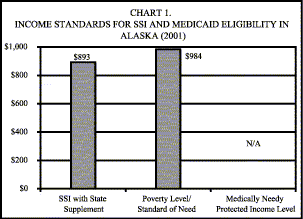
Alaska's SSI state supplementation standards, its Medicaid eligibility standards, and its approach to implementing SSI work incentives provide a base for understanding the state's Medicaid Buy-In program. These eligibility pathways and the maximum monthly incomes associated with them are shown on Chart 1. The state has elected a "standard of need" option (similar to a poverty level option) but does not have a medically needy program.
1. State SSI Supplement Program
The Alaska APA is the state's optional cash supplement to the federal SSI program. In 2001, Alaska paid a maximum monthly SSI supplement of $362 to an individual for a total maximum payment (SSI plus state supplement) of $893 per month. The supplement is administered by the state.
2. Medicaid Eligibility for Adults with Disabilities
Alaska is one of seven states in the country that uses SSI rules as a basis for Medicaid eligibility but requires applicants to file a separate application for Medicaid.4 Individuals who receive APA cash payments (the state's state SSI supplement) without qualifying for SSI also receive Medicaid.
Individuals with disabilities who are ineligible for federal SSI payments or APA cash payments can qualify for Medicaid by meeting the APA standard of need. APA need standards are set at a higher level than APA payment standards. For calendar year 2001, the monthly individual APA need standard was $984. This eligibility category is similar to the "poverty level" option available to states.
Individuals whose medical conditions qualify them for Medicaid-financed long-term institutional care and who receive community-based services under a Home and Community-Based Services (HCBS) waiver can qualify for Medicaid coverage with incomes of up to $1,590 monthly (300% of poverty). The state sets a maximum caseload figure for participation in the waiver.
While Alaska's Medicaid eligibility levels are generous, the rules create a disincentive for earning money beyond the APA standard of need. If an individual's countable income exceeds the need standard by any amount, he loses Medicaid. Because the state does not have a medically needy program, individuals cannot use a "spend down" route to qualify for coverage.
3. Implementation of SSI Work Incentives (Section 1619(a) and (b))
Work incentives in Section 1619 of the federal SSI law provide continued Medicaid eligibility for SSI beneficiaries whose income from earnings could otherwise make them ineligible for coverage. These incentives enable such individual to maintain a connection to both the SSI income assistance program and the Medicaid program when they work. Under Section 1619(a), an individual whose earnings exceed the Substantial Gainful Activity (SGA) earnings test receives SSI cash benefits on a gradually reduced basis and continues to receive Medicaid. In June 2001, 41 persons in Alaska, with average monthly earnings of $949, received SSI and Medicaid on the basis of Section 1619(a).
Under Section 1619(b) and Section 1905(q) of Medicaid law, a person who no longer receives SSI payments because of his earnings level is entitled to Medicaid as long as his disability continues and his earnings are below a federally determined equivalence standard ($2,934 monthly in Alaska). Whether a state provides automatic Medicaid eligibility for SSI beneficiaries and whether it chooses federal or state administration of its SSI state supplement affect the capacity of eligible persons to access Section 1619(b) protections.
In Alaska, a state requiring a separate Medicaid application for SSI beneficiaries, guaranteeing continued Medicaid for persons entitled through Section 1619(b) is administratively complex. When an individual leaves SSI, the state Medicaid agency must review SSA data to track his 1619(b) eligibility status and determine him eligible for continued Medicaid coverage. (By contrast, where Medicaid eligibility is automatic for SSI beneficiaries, the Federal Government sends the state a list of Medicaid-eligible persons, including persons eligible through Section 1619(b).) In June 2001, SSA identified 168 Alaskans, with average monthly earnings of $1,066, as potentially eligible for Medicaid under Section 1619(b). Information on the actual enrollment status of these individuals is not available.
Under its state-administered SSI state supplement program, Alaska does not apply 1619(b) work incentive protections to recipients of SSI state supplementation who do not also receive a federal SSI check. (In states with federally administered SSI state supplements, such persons retain their Medicaid coverage under rules similar to those in effect for SSI recipients.)
4. Personal Assistance Services
Alaska's Medicaid State Plan benefit package includes personal assistance services. Alaska's PCA program meets the definition of a "fully qualified" program as defined by the CMS Infrastructure Grant guidelines. Services are available statewide, seven days a week, 24 hours a day, both within and outside the home and are deemed capable of supporting full-time competitive employment. The PCA program includes both an agency model and an independent contractor model where the consumer hires the worker directly.
Under state regulations, the Medical Assistance Agency or an approved personal care agency may authorize personal care services for up to a 12-month period. Reauthorization for subsequent periods is based on physician orders, a nurse's evaluation, and treatment plan approval by the Medical Assistance Agency or an approved personal care agency.
Alaska has two HCBS waivers that serve working-age adults, one for persons with developmental disabilities and one for persons with physical disabilities. Waiver services include care coordination, adult day services, habilitation services, residential supported living, respite care, meal services, chore services, environmental modifications, private duty nursing, and specialized equipment and supplies.
D. Medicaid Buy-In Program Design Features and Other Work Incentives
1. Medicaid Buy-In Eligibility
General Criteria Alaska's Medicaid Buy-In program provides continued Medicaid eligibility when earnings from work result in a level of income exceeding the APA need standard. Individual unearned income must be less than the APA standard of need.
Income CriteriaAlaska's Medicaid Buy-In program uses two monthly income thresholds to determine eligibility -- a family income test and an individual unearned income test. To meet the first test, an applicant must have a family monthly net income, using SSI standards and methodologies, of less than 250% of the FPL. (For 2001 in Alaska, this amount is $2,235 for a family of one or $3,023 for a family of two). If an applicant meets the family income test, his individual unearned income is compared to the APA standard of need. If his unearned income is lower than the need standard, he qualifies for the Medicaid Buy-In Program.
Resource LimitationsThe state uses SSI standards and methodologies in determining countable resources under the Medicaid Buy-In program. An individual's assets cannot exceed $2,000; a couple's cannot exceed $3,000.
Eligibility PeriodEnrollees are certified for a one-year period.
2. Cost Sharing Policies
An individual's premium liability is based on his family net income. No premiums are due if family net income is less than or equal to 100% of the FPL. If the net family income is more than 100% of the FPL, the individual is assessed an income-based premium beginning in the third month of eligibility. A single individual with a net family income of 250% of the FPL pays the maximum percentage premium of 10% of that income. Persons with lower incomes pay a smaller percentage.5
The Third Party Liability Unit within the Division of Medical Assistance determines the premium amount, sends premium due notices, and collects premiums. If an individual is at least 60 days behind in paying premiums, Medicaid eligibility through the Medicaid Buy-In is terminated.
3. Link Between Medicaid Coverage and Employer Health Plans
There is no formal link between enrollees and employer health plans.
4. Protections and Assurances for Enrollees
There are no special provisions related to continued eligibility for persons who are not able to continue to work.
5. Other Components of a Comprehensive Work Incentive Initiative
Alaska's Medicaid Buy-In program was conceived as part of a broader work incentive initiative. Alaska first received federal funding in the mid-1980s to develop a supported employment system for people who require long-term, ongoing supports to maintain their employment. For the past four years, the Governor's Council on Disabilities and Special Education has spearheaded a cross-agency, comprehensive initiative called Alaska Works to address the major barriers that keep people with disabilities from working. Alaska Works is designing and implementing reforms focusing on the role of one-stop centers, intake and referral procedures, and benefits counseling.
E. Effects of the Medicaid Buy-In Program on Medicaid Eligibility
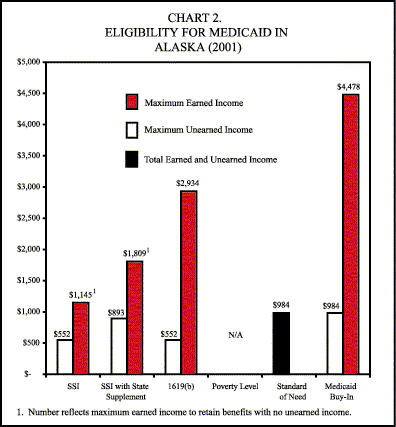
Chart 2 shows the major Medicaid eligibility categories available to working adults with disabilities, including SSI work incentives and the Medicaid Buy-In. It sets forth the maximum monthly income levels for each category, including, as appropriate, earned and unearned income limits.
1. Connection Between the Medicaid Buy-In and State SSI Supplementation Program
As noted earlier, prior to enactment of the Medicaid Buy-In, persons who lost their state SSI supplements due to earnings but had not been on SSI did not retain Medicaid eligibility. Under the Medicaid Buy-In program, such persons have access to Medicaid work incentive protections comparable to those available to SSI recipients.
2. Connection Between the Medicaid Buy-In and Other Medicaid Eligibility Categories
The Medicaid Buy-In program has the effect of raising the maximum monthly unearned income limit for continued eligibility for Medicaid, if working, from the SSI standard ($552) to an amount equal to the state's Medicaid standard of need ($984).
3. Targeting or Cost-Control Mechanisms
Because the program has a limit on unearned income ($984 per month), the number of persons who can qualify for the program is reduced.
F. Policy Approaches, Administrative Systems, and Stakeholder Involvement
1. Role of the State Legislature
Alaska was the first state to enact a Medicaid Buy-In law and the second state to implement its program. H.B.459, the bill authorizing the Medicaid Buy-In program, was enacted in 1998 with strong bipartisan support from the legislature and the Governor. The law added employed persons with disabilities as an optional coverage group, amended the definition of personal care services in a person's home to allow more flexibility in service delivery, and removed a provision requiring physician authorization of personal care services.
2. Role of the Executive Branch
The state has worked extensively with Workforce Investment Boards and One-Stop employment centers to enhance their knowledge of the Medicaid Buy-In program. Vocational rehabilitation services are located at the One-Stop centers. Resource specialists are working with one-stop employment center staff to improve their ability to assist persons with disabilities.
3. Formal Involvement by the Disability Community
Passage of legislation and implementation of the Medicaid Buy-In program were among the outcomes of the Work Incentives Project created in 1997. People with disabilities representing a cross-section of the disability population were part of the planning team. Groups involved include the state Independent Living Council, the Governor's Committee on Employment and Rehabilitation of People with Disabilities, the Alaska Human Resources Investment Council and the Alaska Mental Health Trust Authority.
G. Budget Modeling and Cost Estimates
The state's budget estimate, prepared in 1998, assumed an enrollment of 17 people in FY 1999 (a partial year), 28 people in FY 2000, 23 people in FY 2001, and 22, 23, and 21 persons in FY 2002, FY 2003, and FY 2004 respectively. The fiscal note assumed that persons who would use the new eligibility category were existing SSI or APA recipients who otherwise would lose Medicaid because of their increased earnings. It assumed temporary enrollment with people moving from APA to the Medicaid Buy-In program and then off the Medicaid rolls.
The fiscal note says: "We do not anticipate individuals using this new eligibility category to access Medicaid for the first time. Consequently, this option will not result in an increase in new Medicaid cases, but will only have the effect of extending the Medicaid eligibility of existing recipients for about one year."6 The fiscal note assumed savings from reduced APA cash outlays to offset continued Medicaid costs, with cumulative APA savings resulting in net savings to the state by the third year of the project. In other words, the estimates assumed persons enrolling in the Medicaid Buy-In would leave the APA rolls, thereby saving state funds, and eventually would leave the Medicaid rolls.
H. Program Experience and Related Policy Issues
1. Program Experience
As of May 2001, 99 persons were enrolled in the Medicaid Buy-In program, up from 50 persons enrolled in May 2000. Enrollment levels exceed the original projections.
An analysis of Medicaid Buy-In recipients conducted in October 2000 showed that 58% of the participants were paying a premium for coverage, averaging $34 a month for those who paid premiums or $19 a month if averaged across all beneficiaries. Half of the individuals with premiums paid $25 or less per month. Two-thirds of the enrollees were receiving Medicare in addition to Medicaid. Twelve percent of enrollees had private insurance coverage.
Early data indicate that persons enrolled in the Medicaid Buy-In program cost Medicaid less than they had when enrolled in a different eligibility category. The Medicaid agency compared program costs for those Medicaid Buy-In participants enrolled during the 12-month period beginning July 1, 1999 who had also been on Medicaid in another eligibility category during calendar year 1998. During 1998, Medicaid payments on behalf of these individuals averaged $1,015 per month. During the 1999-2000 period, costs averaged $850 per month. It is too early to determine whether enrollees in the Medicaid Buy-In program will continue to incur lower costs nor is it possible to determine the reasons for the lower costs.
2. State and Federal Policy Issues
As part of an effort to expand the number of personal assistance service providers available to consumers and increase the number of consumers served, Alaska is planning to convert the independent contractor model into a consumer-directed model. In the new model, consumers will arrange for, hire, train, manage, and fire their assistants, while a fiscal intermediary will handle reimbursement and related fiscal functions.
Alaska Works has identified a need for a broader array of personal assistance services and other individualized supportive services within the Medicaid program to support persons with disabilities at the worksite. Through the state's Medicaid Infrastructure Grant, Alaska Works is surveying working people with disabilities and their employers to determine how effective their current services are in helping them maintain employment. The Infrastructure Grant is also supporting development of a transportation plan to improve options for working people with disabilities.
Advocates are seeking program changes related to resource levels and income disregards to encourage additional enrollment in the Medicaid Buy-In program. Advocates are seeking to increase resource levels and income disregards to provide an incentive for savings and to promote job retention. Another proposal would disregard all employment-related disability payments, such as private disability coverage, veteran's disability payments, railroad disability payments, and SSDI, when determining income eligibility.
I. Sources Consulted
Alaska Department of Medical Assistance. Adult Public Assistance Need and Maximum Payment Standards. Fall 2000.
Alaska Works Performance Report: Clarification and Additional Information. July 9, 1999.
CMS web site at www.cms.gov/medicaid/twwiia/twwiiahp.htm.
Explanation of the Working Disabled Medicaid Buy-In. Accessed at www.hss.state.ak.us/dma/news.htm#anchor146212.
"Expanding Health Care Coverage for Alaskans with Disabilities." Press Release from the Governor's Council on Disabilities and Special Education. Summer 2000.
H.B.459 in the Twentieth Legislature. Accessed at old-www.legis.state.ak.us.
"Medicaid for the Disabled. Fiscal Note Summary." Obtained from Kevin Henderson. February 2001.
P Hanes and Associates. Review of Alaska-specific Work Disincentives for Individuals with Significant Disabilities. September 1998.
Welcome to Medicaid. Presentation to the Alaska State Legislature. February 6, 2001. Accessed at www.hss.state.ak.us/dma/table.htm.
CONNECTICUT CASE STUDY
A. Overview
Connecticut's Medicaid Buy-In program legislation was signed into law in June 2000 and began operating on October 1, 2000. The Medicaid Buy-In program is part of a comprehensive work incentive approach that also includes benefits counseling and changes in personal assistance services. Connecticut is the only Case Study state that includes both the Basic Insurance Group and the Medically Improved Group in its Medicaid Buy-In program.
The Medicaid Buy-In program in Connecticut provides categorical Medicaid eligibility for persons who have too much SSDI or other unearned income to become eligible for work incentives available to recipients of SSI or state-administered SSI supplementation. The Medicaid Buy-In program is also an alternative to the medically needy program for working persons with disabilities.
In order to be eligible for the Medicaid Buy-In, an applicant must be paid for his work and must make FICA contributions either through payroll taxes or through payment of self-employment taxes. In addition, an individual must have a monthly gross income of $6,250 or less ($75,000 annually) or net countable monthly income of $3,082 or less. To protect persons with temporary job interruptions, an individual can continue to meet the employment test for up to one year from the date of employment loss.
To meet the program's family asset test, a single applicant must have countable assets of $10,000 or less; a married couple $15,000 or less. Funds in retirement accounts or medical savings accounts set up under federal law and in designated accounts established for purchasing goods or services to increase the individual's employability are not counted. Any assets in such accounts remain excluded during the person's lifetime if he seeks Medicaid eligibility under other eligibility categories.
A participant in the Medicaid Buy-In pays a premium of 10% of his family income in excess of 200% of the Federal Poverty Limit (FPL). Fees paid for private insurance are deducted from the individual's Medicaid Buy-In premium liability. Individuals enrolled in the Medicaid Buy-In are categorically eligible for the state's PCA waiver program.
Connecticut's Medicaid State Plan benefit package does not include personal care services. Instead, the state provides personal assistance services under Medicaid through a HCBS waiver.
To develop its budget estimate for the Medicaid Buy-In program, the state analyzed eligibility records of currently or recently disenrolled disabled Medicaid clients with earnings. They estimated 1,208 persons (a number equal to 1.3% of the total adult disabled population in the state) would enroll in the Medicaid Buy-In, including 301 persons who had qualified under existing categories and 907 persons who were ineligible under existing rules.
As of October 1, 2001, 1,600 persons were enrolled in the Medicaid Buy-In program. Currently, 85% of enrollees are not liable for premiums; 15% do pay premiums. Nearly three-quarters of those paying premiums pay less than $50 monthly. Another 15% pay between $50 and $100 monthly. Slightly over one-fifth of enrollees have monthly earnings exceeding the SGA test of $740; the remainder have earnings below that level. Most enrollees receive unearned income, with more than two-thirds of enrollees receiving unearned monthly income of $600 or more. Almost 5% of enrollees receive no unearned income.
B. Impetus for the Medicaid Buy-In Program and Related Employment Initiatives
Over ten years ago, the Work Incentives Committee of the Northwest Connecticut Mental Health Planning Board, in cooperation with staff from the state Medicaid agency and state Vocational Rehabilitation agency, began working to increase the use of existing work incentives and advocate for improvements in them. One policy change occurred in 1994, when the state Medicaid agency extended SSI work incentives to persons who were receiving a state-administered SSI supplement, but were not receiving federal SSI benefits. As a result of this policy, persons who lose their state SSI supplement because of earnings can remain eligible for Medicaid up to income thresholds specified in SSI law.
In 1999, a cross-disability coalition of consumers and advocates with leadership from legal assistance groups began urging the adoption of the Medicaid Buy-In program. Building on their initiative, the Human Services Committee in the Connecticut House of Representatives established a Work Incentives Working Group in the Fall of 1999. That group, whose members included legislators, legislative and executive branch staff, representatives from disability and legal assistance groups, and persons with disabilities, designed legislation to allow SSDI eligible people to work and retain their health care under Medicaid. The Governor endorsed the effort in January 2000, the legislature passed a bill in April 2000, and the Governor signed the bill in June 2000.
The Northwest Regional Mental Health Board and the Work Incentives Working Group set forth scenarios under which individuals lost Medicaid eligibility when they went to work. They discussed disincentives faced by SSDI beneficiaries in comparison to SSI recipients. In particular, they provided information about the out-of-pocket expenditures required for "spending down" to become eligible for Medicaid coverage. The Work Incentives Working Group launched an education and awareness campaign involving personal contact with legislators, newspaper and radio coverage, and meetings with legislators and the Governor.
The two groups also identified state-funded programs serving a significant number of SSDI beneficiaries, including ConnPace (the state-funded pharmacy assistance program) and the Working Persons Personal Assistance Program. They highlighted the financial benefits to the state of gaining federal matching funds to support these programs for persons who could qualify for the Medicaid Buy-In.
C. Medicaid Eligibility and State SSI Supplementation Program Prior to the Medicaid Buy-In
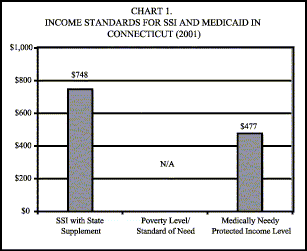
The state's state SSI supplementation program standards, its Medicaid eligibility standards, and its approach to implementing SSI work incentives provide a base for understanding the state's Medicaid Buy-In program. These eligibility pathways and the maximum monthly incomes associated with them are shown on Chart 1. As shown on the chart, Connecticut has a medically needy program but has not elected a poverty level option.
1. State SSI Supplement Program
Connecticut provides an income supplement to the federal SSI program. In 2001, the state's supplement was a maximum of $216 monthly for a total maximum monthly payment of $748 for an individual. The state supplement an individual receives is based on an individual budgeting process that considers shelter costs. Connecticut has chosen to administer its supplement at the state level rather than have it administered by the Federal Government.
2. Medicaid Eligibility for Adults with Disabilities
Connecticut does not provide automatic eligibility for Medicaid for SSI recipients. It is among the states exercising an eligibility option under Section 209(b) of the Social Security Disability Act Amendments of 1973. Under 209(b), states may use Medicaid eligibility criteria that differ from SSI standards as long as the criteria are not more restrictive than the states approved standards when the SSI law was enacted in 1972. In the absence of automatic eligibility for SSI recipients, adults with disabilities living in the community file a separate application for Medicaid.
Individuals with disabilities who are not eligible for SSI or state SSI supplementation can qualify as "medically needy". To do so, they must either have a very low-income level ($477 monthly for an individual) or incur medical expenses through a "spend down that reduce their remaining monthly income to the state's Protected Income Level of $477.
Individuals whose medical conditions qualify them for Medicaid-financed long-term institutional care and who receive community-based services under a HCBS waiver can qualify for Medicaid coverage in the community with incomes of up to $1,590 monthly (300% of poverty). The number of individuals who qualify for coverage through waiver eligibility is limited by a maximum caseload figure set by the state.
3. Implementation of SSI Work Incentives (Section 1619(a) and (b))
Work incentives in Section 1619 of the federal SSI law provide continued Medicaid eligibility for SSI beneficiaries whose income from earnings could otherwise make them ineligible for coverage. These incentives enable such individual to maintain a connection to both the SSI income assistance program and the Medicaid program when they work. Under Section 1619(a), an individual whose earnings exceed the SGA earnings test receives SSI cash benefits on a gradually reduced basis and continues to receive Medicaid. In June 2001, 232 persons in Connecticut, with average monthly earnings of $924, received SSI and Medicaid on the basis of Section 1619(a).
Under Section 1619(b) and Section 1905(q) of Medicaid law, a person who no longer receives SSI payments because of his earnings level is entitled to Medicaid as long as his disability continues and his earnings are below a federally determined equivalence standard ($3,050 monthly in Connecticut). Whether a state provides automatic Medicaid eligibility for SSI beneficiaries and whether it chooses federal or state administration of its state SSI supplementation program affect the capacity of eligible persons to access Section 1619(b) protections.
In Connecticut, a state requiring a separate Medicaid application for SSI beneficiaries, guaranteeing continued Medicaid for persons entitled through Section 1619(b) is administratively complex. When an individual leaves SSI, the state Medicaid agency must review SSA data to track his 1619(b) eligibility status and determine him eligible for continued Medicaid coverage. (By contrast, where Medicaid eligibility is automatic for SSI beneficiaries, the Federal Government sends the state a list of Medicaid-eligible persons, including persons eligible through Section 1619(b).) In June 2001, SSA identified 1,101 persons in Connecticut, with average monthly earnings of $896, as potentially eligible for Medicaid under Section 1619(b). Information on the actual enrollment status of these individuals is not available.
Under its state-administered state SSI supplementation program, Connecticut extends work incentive protections similar to Section 1619(b) to state SSI supplementation program recipients. This policy decision provides continued access to Medicaid for non-SSI, state supplement recipients who enter the workforce. (In states with federally administered state SSI supplements, such persons automatically retain their Medicaid coverage under rules similar to those in effect for SSI recipients.)
4. Personal Assistance Services
Connecticut's Medicaid State Plan benefit package does not include personal care services. Instead, the state provides personal assistance services under Medicaid through an HCBS waiver. Connecticut's personal assistance services meet the requirements for "conditional eligibility" under CMS Infrastructure Grant guidelines.
For persons ineligible for the waiver, the state-funded PCA Working Person's Program provides up to $15,000 per person annually for the purchase of personal care services for adults with severe physical disabilities that are working or likely to work.
D. Medicaid Buy-In Program Design Features and Other Work Incentives
1. Medicaid Buy-In Eligibility
General Criteria Connecticut extends Medicaid coverage to both the Basic Insurance Group and the Medically Improved Group. To be eligible, an individual must meet a disability test and an employment test. Persons in the Basic Insurance Group must meet the disability criteria of the SSDI/SSI program (except those related to inability to work), must be paid for his work, and must make FICA contributions through payroll deductions or payment of self-employment taxes.
To qualify under the Medically Improved Group, an individual must have been previously eligible under the Basic Insurance Group. He must be determined during a regularly scheduled medical review to have a severe medically determinable impairment but to no longer meet the Basic Insurance program's disability criteria due to medical improvement. Participants in this group must work at least 40 hours per month at a wage no less than the federal minimum wage or earn a monthly wage equal to the minimum wage times 40.
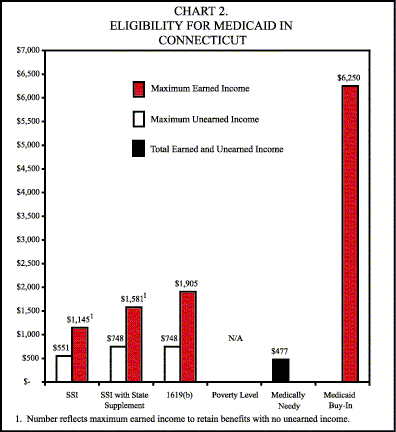
Income CriteriaTo qualify in either the Basic Insurance Group or the Medically Improved Group, an applicant's individual gross monthly income must be $6,250 or less ($75,000 per year) or his individual net countable monthly income (after SSI disregards) must be $3,082 or less.
Resource LimitationsA single applicant's assets cannot exceed $10,000 and a married applicant's joint assets cannot exceed $15,000. Retirement accounts or medical savings accounts set up pursuant to federal law are excluded from consideration as are designated accounts established for purchasing goods or services that will increase the employability of the applicant. Any assets held in retirement, medical savings or designated accounts are exempt from consideration as assets during the person's lifetime, even if he loses Medicaid Buy-In eligibility and seeks enrollment through a different eligibility category.
Eligibility PeriodEnrollees are certified for a one-year period.
2. Cost Sharing Policies
An applicant's cost sharing obligation is based on his net family income, including the income of his spouse but not of dependent children. To derive net income, standard SSI deductions, IRWE and self-employment expenses are subtracted from gross income. Individuals with net family incomes above 200% of the FPL must contribute 10% of their income in excess of 200% of the FPL as a premium. For individuals with net family incomes in excess of 250% of the FPL but not greater than 450% of the FPL, the amount of the monthly premium cannot exceed 7.5% of net family income. Payments are due by the end of the month covered by the premium.
3. Link Between Medicaid Coverage and Employer Health Plans
Like all other Medicaid recipients, Medicaid Buy-In program enrollees must accept employer-sponsored health insurance benefits for which they qualify if such coverage meets cost-effectiveness tests. If an individual buys private health insurance for anyone in his family, his Medicaid Buy-In premium is reduced by the amount of his private insurance payment. If an individual's private insurance costs exceed his Medicaid Buy-In premium liability, the state may contribute to the cost of the private health insurance.
4. Protections and Assurances for Enrollees
To protect persons who have temporary health problems or are involuntarily terminated, an individual can continue to meet the employment test for a period of up to one year from the date of employment loss. To do so, the individual must profess an intention to return to employment. As noted earlier, an individual's assets in retirement, medical savings, and designated accounts are excluded from consideration during his lifetime if he reapplies for Medicaid under a different category.
5. Other Components of a Comprehensive Work Incentive Initiative
Under provisions in Connecticut's Medicaid Buy-In legislation, enrolled individuals are categorically eligible for the state's HCBS waiver (the waiver that offers personal assistance services). Previously, eligibility for the waiver had been limited to persons with incomes at or below 300% of the SSI level, potentially disqualifying some Medicaid Buy-In enrollees. All Medicaid Buy-In enrollees previously participating in the state-funded PCA Working Persons Program will convert to the waiver unless they do not meet other non-financial waiver criteria.
Counselors at the Vocational Rehabilitation agency provide advice about the Medicaid Buy-In as part of their benefits planning process for persons with disabilities who are seeking employment. The counselors help individuals assess how the Medicaid Buy-In will affect their other benefits and determine whether the Medicaid Buy-In is appropriate for them. The Department of Social Services has launched an outreach effort to inform persons about the Medicaid Buy-In program.
The Medicaid Buy-In legislation authorizes the executive agencies to seek demonstration authority from the SSA to afford greater protections and flexibility for SSI and SSDI recipients participating in Medicaid Buy-In programs.
E. Effects of the Medicaid Buy-In Program on Medicaid Eligibility
Chart 2 shows the major Medicaid eligibility categories available to working adults with disabilities, including SSI work incentives and the Medicaid Buy-In. It sets forth the maximum monthly income levels for each category, including, as appropriate, earned and unearned income limits.
1. Connection Between the Medicaid Buy-In and State SSI Supplementation Program
Connecticut's Medicaid Buy-In program builds on state-designed Medicaid work incentive provisions for persons qualifying for SSI or for a state-administered state SSI supplement. The Medicaid Buy-In program extends these incentives to individuals whose SSDI or other unearned income payments exceed SSI or state supplementation program standards.
As discussed earlier, prior to adopting the Medicaid Buy-In, Connecticut's SSI work incentive protections covered individuals who did not qualify for SSI but qualified for a state-administered SSI state supplement. Under the previous rules, individuals with higher levels of unearned income -- that is, individuals who did not qualify for state SSI supplementation -- could not access the state's SSI-related Medicaid work incentives. With the Medicaid Buy-In, these individuals now receive Medicaid protections.
2. Connection Between the Medicaid Buy-In and Other Medicaid Eligibility Categories
Medically NeedyThe Medicaid Buy-In program serves as an alternative to the medically needy program for persons with earnings. By converting to the Medicaid Buy-In category, an enrollee can exchange a monthly spend down for a smaller, more manageable premium and retain more of his income for other purposes.
The Connecticut Department of Social Services has instructed eligibility workers to be proactive in moving individuals into the Medicaid Buy-In category. To facilitate transfers, the Department provided workers with the names of medically needy persons with disabilities with earnings. These persons are being transferred automatically to the Medicaid Buy-In eligibility category.
Home and Community-Based Services WaiversConnecticut extended eligibility for the state's Personal Care (HCBS) waiver to persons qualifying for the Medicaid Buy-In. Because their incomes exceeded the waiver's previous income limit of 300% of SSI, many of these individuals had been enrolled in a state-funded personal care program. With the conversion of their service coverage to Medicaid, the state is newly eligible for federal funds for their personal care and other health services.
3. Targeting or Cost-Control Mechanisms
The state received new federal matching funds to offset the costs of personal assistance and prescription drugs previously paid entirely with state funds.
F. Policy Approaches, Administrative Systems, and Stakeholder Involvement
1. Role of the State Legislature
State legislation enacting the Medicaid Buy-In program provided the framework for comprehensive work incentives efforts. In addition to describing basic eligibility guidelines, the legislation mandated revisions to the PCA waiver and directed the Department of Social Services commissioner to seek waivers from SSA for demonstration projects to enhance work incentives.
2. Role of the Executive Branch
In October 2000, the Department of Social Services published a brochure entitled "Medicaid for the Employed Disabled: A Tool for Self-Sufficiency," describing the program and listing application sites. In November 2000, the Department issued a press release noting the commitment of the Governor and legislature to the right of individuals to retain their health coverage while pursuing a career.
The Medicaid Buy-In program is managed through the Medicaid eligibility, management, and service delivery structure. A manual prepared for eligibility workers provides a detailed explanation of the Medicaid Buy-In and SSI-related work incentives and their application in Connecticut. Eligibility workers use this guide to advise persons with disabilities about their options for continued Medicaid enrollment. The Vocational Rehabilitation Agency, located within the Department of Social Services, provides benefits counseling. Ongoing outreach efforts of the Department are being expanded under the state's Medicaid Infrastructure Grant.
3. Formal Involvement by the Disability Community
Several committees focusing on work incentive issues are advising state officials on the Medicaid Buy-In program and other work incentives. These include the State Rehabilitation Council, the state Committee for Persons with Disabilities within the Department of Social Services, and a group associated with Connecticut's efforts under the Real Choices Systems Change grant.
G. Budget Modeling and Cost Estimates
The Department of Social Services used data gathered about current and former Medicaid clients with disabilities when it developed its budget estimate. It determined the number of potentially eligible clients, estimated average per person costs, calculated potential client premium contributions, and identified possible offsets for some of the costs.
The Department began its analysis by identifying medically needy Medicaid clients with disabilities who had earnings. They considered both current enrollees and persons leaving the rolls during the previous two years. From a caseload of 12,112 medically needy persons, the Department identified a total of 1,208 persons with earnings. After subtracting 301 persons who had already qualified for Medicaid, the Department identified 907 previously ineligible persons who would likely qualify for the Medicaid Buy-In program. They further assumed that all 1,208 qualifying individuals would enroll. This represents 1.3% of the total disabled population in the state, an estimate the state found consistent with rates in other states.
The Department estimated monthly Medicaid expenditures of $453,000 for the 907 new enrollees (assuming a $500 monthly per case cost) or $5.4 million annually. After offsets from client co-pays and prescription drug savings, the Department projected $4.1 million in additional annual state expenditures. The Fiscal Note prepared for the General Assembly made similar projections, estimating 1,000 new persons would be served, with an annualized cost of $5.2 million.
The budget model assumed very few new clients other than the 907 identified from the current or past medically needy rolls. As noted by the analysts: "Medical assistance is a prerequisite for survival for many disabled individuals and people generally tailor their finances to stay within program boundaries. A broadening of the boundaries would therefore allow people to improve their standard of living, but it would not bring significant numbers of new individuals into the Medicaid program."7 In other words, the analysts assumed that Medicaid is so essential that almost every person with disabilities had been willing to forego earnings if that was necessary to meet Medicaid requirements.
A state-funded program, ConnPACE, provides prescription drug coverage for Medicare-eligible persons with incomes of $15,100 or less (approximately 180% of the poverty level) and includes on its rolls working individuals whose incomes exceed Medicaid standards and who have not spent down to the Medicaid level. In determining program offsets, the analysts found that almost half of the potential Medicaid Buy-In participants were eligible for ConnPACE and were costing the state approximately $219 per month per client. With those individuals enrolled in the Medicaid Buy-In program, the costs of prescription drug coverage are split with the Federal Government.
The analysis assumed Medicaid Buy-In fees paid by clients of approximately 4-5% of total costs. It suggested other savings might accrue to the state from increased use of private insurance or reduced expenditures in other programs, but did not quantify them for the budget estimate.
H. Program Experience and Related Policy Issues
As of October 1, 2001, 1,600 persons were enrolled in the Medicaid Buy-In program. Connecticut has exceeded its original estimate of 1,208 persons at full enrollment.
Twenty-one percent of the enrollees in the Medicaid Buy-In program have monthly earnings exceeding the $740 SGA earnings test for disability. The remaining participants have lower monthly earnings. Over two-thirds of enrollees receive unearned income of over $600 a month. Most of the remaining enrollees receive some unearned income, although almost 5% receive no unearned income.
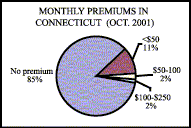
As shown in the pie chart, 85% of enrollees were not liable for premiums in October 2001. Fifteen percent did pay premiums. Nearly three-quarters of those paying premiums paid less than $50 per month. Another 15% paid between $50 and $100. The proportion of persons paying premiums is consistent with estimates when the Medicaid Buy-In was initiated and has increased over time. In March 200l, only 8% of enrollees paid premiums.
Connecticut is gathering data on the enrollees in the Medicaid Buy-In program through its Medicaid management information system. The state expects to publish additional utilization and cost data after automated eligibility is instituted for this eligibility group during the next several months.
I. Sources Consulted
Cohen, Robin. State Medicaid Buy-In Programs for Working People with Disabilities. Prepared for Connecticut Department of Social Services. November 22, 1999.
Connecticut Department of Social Services. Adult Services Division. Eligibility Desk Guide: Medicaid for the Employed Disabled and Adult Work Incentives. Hartford, December 2000.
Connecticut Department of Social Services. Cost Estimate for the Work Incentives Budget Proposal. Office of the Commissioner. Hartford, December 20, 1999.
Connecticut Department of Social Services. Uniform Policy Manual. Updated October 1, 2000.
Connecticut Department of Social Services. State Initiative Ending ?Catch-22 in Job Market: More People with Disabilities Can Work Without Losing Medical Coverage. Public and Government Relations Office. November 27, 2000. Press Release.
Connecticut Department of Social Services. Medicaid for the Employed Disabled: A Tool for Self-Sufficiency. Publication 00-6. October 2000. Brochure.
Connecticut GA 5249, An Act to Provide Work Incentives and Health Care for Persons with Disabilities.
Infrastructure Grant Proposal. Submitted to the Centers for Medicare and Medicaid Services.
Medicaid for the Employed Disabled. Connecticut Department of Social Services. November 8, 2000.
Office of Legislative Research. Bill Analysis, HB 5778 (File 562). Prepared for Connecticut House of Representatives. April 12, 2000.
Office of Legislative Research. Amended Bill Analysis, HB 5778 (File 562, as amended by House A). Prepared for Connecticut House of Representatives.
IOWA CASE STUDY
A. Overview
Iowa's Medicaid Buy-In program was signed into law on April 30, 1999 after passing both houses of the legislature by unanimous votes. Implementation of the Medicaid Buy-In began in March 2000. The program was marketed as an economic development tool and the business community led efforts to pass the legislation. The organized disability community did not play a direct role in securing passage and does not have a formal role in implementation. Iowa's Medicaid Buy-In program is not part of a comprehensive state work incentive initiative, although benefits planning is available from several providers in the state.
For an individual to qualify for Iowa's Medicaid Buy-In program, he or she must be disabled, less than 65 years of age, and have earned income from employment or self-employment. The individual's monthly net family income (earned and unearned) must be less than 250% of the FPL, allowing all standard SSI disregards and exemptions. The asset limit is $12,000 for an individual and $13,000 for a couple. Excluded from the resource limit are retirement and pension funds, medical savings accounts exempt by the IRS, and funds in pre-approved assistive technology accounts.
Premiums are assessed if an individual's gross income is at or above 150% of the FPL. At 150% of the FPL, the monthly premium is $20. The premium increases with income brackets to $201 a month. Enrolled persons have continuous eligibility with annual reviews. Premium adjustments occur every six months. Participants may remain eligible for the Medicaid Buy-In program through a period of work stoppage not greater than six months.
Currently, Iowa's Medicaid State Plan does not include personal assistance services. In 1996, the Iowa Department of Human Services (DHS) implemented a pilot personal assistance services program, through a state appropriation, which currently operates in three counties. Iowa also operates six HCBS waivers, all of which offer personal assistance services. Medicaid Buy-In enrollees are eligible for waiver services.
The state assumed in budget projections that half of Medicaid Buy-In participants would come from existing SSI rolls and would pay average monthly premiums of $40. Persons with disabilities who formerly qualified as medically needy would constitute 20% of enrollees and pay average monthly premiums of $100. Enrollees new to Medicaid would account for 30% of the caseload and pay average monthly premiums of $100. The projections assumed that by FY 2002, the mix of enrollees would shift slightly, with new enrollees then accounting for a 45% share. The state estimated that 400 persons would be enrolled in the Medicaid Buy-In program by June 2001, with a gradual increase to 700 persons by June of 2002.
Enrollment has greatly exceeded the state's estimates. As of April 2001, 2,105 people were enrolled in the Medicaid Buy-In program. The state credits extensive outreach for the increased enrollment. About 30% of participants pay a premium. A majority of beneficiaries (57%) have monthly earnings of less than $250. Approximately 5% have monthly earnings exceeding $750. Over 60% of the Medicaid Buy-In enrollees in Iowa received unearned income exceeding $600 per month with another quarter receiving unearned income of between $500 and $600.
B. Impetus for the Medicaid Buy-In Program and Related Employment Initiatives
The Iowa Business Council, consisting of the 25 largest businesses in the state, recognized that persons with disabilities were an untapped pool of potential employees. Creative Employment Options (CEO), the employment policy arm of Iowas University-Affiliated Program, convened a group of six major employers in 1997 to address concerns raised by the Business Council. The group was aware of the congressional deliberations surrounding the BBA of 1997 provision authorizing states to establish a Medicaid Buy-In program. The group concluded that people with disabilities were not applying for jobs in part because they feared losing Medicaid eligibility due to the resource and asset tests used under the regular eligibility criteria.
When the state was awarded a State Program Initiative grant from SSA, it used part of its grant to educate more employers about the barriers inhibiting disabled workers who were unemployed and underemployed. A member of the Iowa legislature convened a group consisting of representatives from the DHS, including the Medicaid Director, and CEO. The organized disability community did not play an overt role in securing passage. The legislation, passed by both houses on unanimous votes, was marketed by its sponsors as a tool for economic and workforce development.
The Medicaid Buy-In program was developed without the benefit of a formal needs assessment of the population of persons with disabilities. Legislative committees relied on information provided through informal discussions and meetings with DHS staff and others. Specific legislators and the Legislative Service Bureau requested technical information about options available under BBA.
C. Medicaid Eligibility and State SSI Supplementation Program Prior to the Medicaid Buy-In
Iowa's state SSI supplementation program policies, its Medicaid eligibility standards, and its approach to implementing SSI work incentives provide a base for understanding the state's Medicaid Buy-In Program. These eligibility pathways and the maximum monthly incomes associated with them are shown on Chart 1. As shown on the chart, Iowa has a medically needy program, but has not elected a poverty level option.
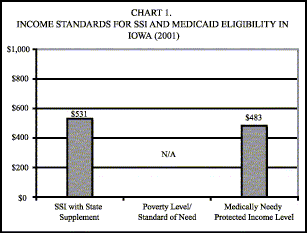
1. State SSI Supplementation Program
Iowa is one of the few states without an state SSI supplementation program for individuals receiving SSI. (Iowa provides an state SSI supplement for blind individuals, persons with dependents, individuals in certain residential settings, or individuals with special needs.)
2. Medicaid Eligibility for Adults with Disabilities
People with disabilities in Iowa are categorically eligible for Medicaid if they receive SSI benefits. A person with a disability who is not eligible for SSI can qualify for Medicaid through the medically needy category if his monthly income is at or below $483. An individual may spend down to the medically needy category by incurring medical bills sufficient to reduce his monthly income to the protected income level of $483.
3. Implementation of SSI Work Incentives (Section 1619(a) and (b))
Work incentives in Section 1619 of the federal SSI law provide continued Medicaid eligibility for SSI beneficiaries whose income from earnings could otherwise make them ineligible for coverage. These incentives enable such individuals to maintain a connection to both the SSI income assistance program and the Medicaid program when they work.
Under Section 1619(a), an individual whose earnings exceed the SGA earnings test receives SSI cash benefits on a gradually reduced basis and continues to receive Medicaid. In June 2001, 283 persons in Iowa, with average monthly earnings of $942, received SSI and Medicaid on the basis of Section 1619(a).
Under Section 1619(b) and Section 1905(q) of Medicaid law, a person who no longer receives SSI payments because of his earnings level is entitled to Medicaid as long as his disability continues and his earnings are below a federally determined equivalence standard ($1,731 monthly in Iowa). Whether a state provides automatic Medicaid eligibility for SSI beneficiaries affects the capacity of eligible persons to access Section 1619(b) protections. Where Medicaid eligibility is automatic for SSI beneficiaries, the Federal Government sends the state a list of Medicaid-eligible persons, including persons eligible through Section 1619(b). When Medicaid eligibility is not automatic, the state must carry out additional administrative tasks to provide access to continued coverage.
In June 2001, SSA identified 1,660 persons in Iowa, with average monthly earnings of $763, as potentially eligible for Medicaid on the basis of Section 1619(b). Because Iowa provides automatic Medicaid eligibility for SSI recipients, persons who lose their entitlement to SSI payments due to earnings automatically remain on the Medicaid rolls. Thus, access to SSI work incentives is relatively easy for SSI recipients in Iowa.
4. Personal Assistance Services
Iowas Medicaid State Plan does not include a specific personal care services option. Iowa qualifies for conditional eligibility under the CMS Medicaid Infrastructure Grant classifications. (This is a change from the first Infrastructure Grant funding cycle, which awarded Iowa transitional eligibility.) In 1996, DHS implemented a pilot personal assistance services program in three counties. In this ongoing program, each person is assessed and eligible individuals receive $200, $400, $700, or $1,000 per month, depending on the amount of assistance required. This money goes directly to the disabled individual to hire and pay an attendant.
Under the state plan, home health agency intermittent services, including skilled nursing care and home health aide services, are available in the consumers home for up to three visits a week for two to three hours at a time. Private duty nursing and personal care is also available to persons with disabilities age 20 and under as part of Early and Periodic Screening Diagnosis and Treatment (EPSDT) benefits.
Iowa operates six Section 1915(c) HCBS waiver programs, serving more than 6,000 individuals. HCBS waivers exist for the following populations: AIDS/HIV, Brain Injury, Elderly, Ill and Handicapped, Physical Disability, and Mental Retardation. All six HCBS waivers offer Consumer-Directed Attendant Care (CDAC). The consumer may select an agency or an individual to provide skilled or non-skilled attendant care services to assist an individual with disabilities to get ready for or return from work, as well as at the job site. Supported employment is available under Mental Retardation and Brain Injury waivers. Supported employment services include instruction and supervision on gaining and maintaining employment, employment-related transportation services, and personal care services at the worksite. Several of the waivers include home health aide and nursing services that can be utilized after maximizing the similar services available under the state plan. Several of the six HCBS waivers include assistance in the purchase of specialized medical equipment, home and vehicle modification, and homemaker services. Iowa amended its waivers for persons with physical disabilities and persons with mental retardation to allow individuals qualifying for Medicaid through the Medicaid Buy-In program to use waiver services.
Iowa offers a State Supplementary Assistance program to provide health care in the home, prevent out-of-home placement, and preserve independent self-care. This program -- funded with 100% state funds -- provides health care to a person, of any age, in the persons own home. The person must require health care because of a mental or physical challenge. The services are approved by a physician and supervised by a registered nurse. The program is available to persons statewide who qualify for the program. The in-home health-related care program includes both skilled and personal care services. The person or the persons family has the primary responsibility for locating a provider. This program can provide personal care services to assist an individual to get ready for their workday.
D. Medicaid Buy-In Program Design Features and Other Work Incentives
1. Medicaid Buy-In Eligibility
General Criteria In order to qualify for the Medicaid Buy-In program, a person must be disabled, under 65 years of age, and have earned income from employment or self-employment.
Income CriteriaIn order to be eligible for Iowas Medicaid Buy-In program, an individuals monthly net family income (earned and unearned) must be less than 250% of the FPL, allowing all standard SSI disregards and exemptions.
Resource LimitationsThe asset limits to qualify for the Medicaid Buy-In program are higher than for other Medicaid coverage groups: $12,000 for the individual and $13,000 for a couple. Excluded from the resource limit are retirement or pension funds, medical savings accounts exempt by IRS, and funds in assistive technology accounts. A physician or other vocational or medical professional must certify a need for assistive technology devices or services and establish that the technology is expected to enhance an individuals employability.
Eligibility PeriodPersons enrolled in the Medicaid Buy-In program have continuous eligibility with annual reviews. Premium adjustments are made every six months. Participants may remain in the Medicaid Buy-In category through a period of work stoppage not greater than six months if their intent is to return to work.
2. Cost Sharing Policies
Premiums are assessed if an individuals gross income is at or above 150% of the FPL. There are eleven different premium brackets depending on income level. At 150% of the FPL ($1,074/month), the monthly premium is $20. Individuals with incomes at or above 390% of the FPL pay the maximum premium of $201 per month.
Premiums are determined for a six-month period based on the individual's income during the approval month. If an individual's income increases during the six-month period, his premium does not increase. The premium may decrease during the six-month period if a recipient reports an income reduction. (If eligibility is established retroactively, premiums are determined for each retroactive month based on actual income received.) An individual's first bill is for the two months following the month of approval (beginning months). Billing is monthly thereafter. Separate bills are sent for the month of approval, any months between application and approval, and up to three retroactive months. These payments are due within 60 days.
Failure to pay the bill for the two beginning months by the due date -- the 14th of the month after the approval month -- results in cancellation of coverage. If premiums are not paid for the prior months (those due within 60 days), Medicaid coverage continues but the beneficiary loses eligibility for the unpaid months. Premiums may be paid in advance on a quarterly or semi-annual basis within the six-month premium period. The Quality Assurance Unit of the Medicaid agency collects premiums.
3. Link Between Medicaid Coverage and Employer Health Plans
Through the Health Insurance Premium Plan, the Medicaid agency will pay a participants premium in an employer health plan if it is less costly than providing all services through Medicaid. The Medicaid program then provides wrap-around coverage for the beneficiary.
4. Protections and Assurances for Enrollees
If employment ends for medical or other reasons, the Medicaid Buy-In program participant may remain eligible under this group for up to six months after the month of job loss if he intends to return to work within those six months. The applicant must write a statement to DHS indicating his intent to return to work within six months and continue to pay monthly premiums. As in other scenarios when income falls, the premium may be reduced during this time.
Under the State Partnership Systems Change Initiative (SPI) grant, Iowa has submitted a request to SSA for demonstration authority under SSDI to make income exclusions for IRWE and blind work expenses identical. Iowas experience was that 90% or more of people with blindness used the blind work expense exclusion while fewer than 10% of people with other disabilities used their exclusion of IRWE.
5. Other Components of a Comprehensive Work Incentive Initiative
The Medicaid Buy-In program is not part of a broader work incentive initiative, although some benefits counseling occurs through Vocational Rehabilitation contracts or through Independent Living Centers.
E. Effects of the Medicaid Buy-In Program on Medicaid Eligibility
Chart 2 identifies the Medicaid eligibility categories for adults with disabilities, including the Medicaid Buy-In category. It sets forth the maximum monthly income levels for each category, including, as appropriate, earned and unearned income limits. As noted earlier, the state does not have a general state SSI supplement for persons with disabilities in the community.
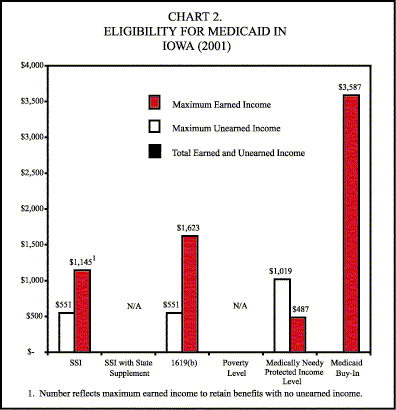
1. Connection Between the Medicaid Buy-In and Other Medicaid Eligibility Categories
Medically NeedyThe Medicaid Buy-In program serves as an alternative to the medically needy program for persons with earnings. By converting to the Medicaid Buy-In category, an enrollee can exchange a monthly spend down for a smaller, more manageable premium and retain more of his income for other purposes.
The Medicaid Buy-In program has a resources limit of $12,000 ($13,000 for a couple) whereas the medically needy program has a resources limit of $10,000. While the difference between the two limits is much less in Iowa than in states using SSI asset levels ($2,000 for an individual) in their regular Medicaid categories, individuals in Iowa can also deduct retirement accounts and medical savings accounts if they enroll in the Medicaid Buy-In category. In addition, the income of an applicant's spouse is not counted in the calculation of premium payments in the Medicaid Buy-In program; spousal income is counted in the medically needy program.
2. Targeting or Cost-Control Mechanisms
There are no explicit targeting or cost-control provisions in the Iowa Medicaid Buy-In program.
F. Policy Approaches, Administrative Systems, and Stakeholder Involvement
1. Role of the State Legislature
Legislation enacting the Medicaid for Employed Persons with Disabilities (MEPD) plan was signed on April 30, 1999 (Senate File 211). Framed as a workforce issue, rather than as a human services initiative, the legislation passed unanimously. Implementation began in March 2000. The legislation provides general authority for the Medicaid Buy-In program and gives DHS broad parameters for its structure.
2. Role of the Executive Branch
The state Medicaid agency within DHS is the lead agency responsible for the implementation of the Medicaid Buy-In program. The agency issued regulations, printed pamphlets and posted the policy manual on the Internet.
DHS established a charter group to help draft administrative rules for the program. This group consisted of consultants from the Disability Determination Service, income maintenance workers and program managers from the state Medicaid agency, staff from the Division of Mental Health and Developmental Disabilities, and CEO.
Iowa budgeted nearly $400,000 for the development of an automated eligibility and billing system and additional improvements are expected as part of the Medicaid Infrastructure Grant. The state has also tried to streamline operations by having all premiums sent to the Central Office, rather than collected at the county level. DHS is conducting a second generation of training for state income maintenance workers to clarify how to interpret program rules.
After enactment of its Medicaid Buy-In program, DHS and CEO offered about ten outreach and public information events throughout the state directed at consumers, businesses, and other agencies (e.g., vocational rehabilitation, case managers, county administrators). As an additional outreach strategy, pamphlets were developed for businesses and potential enrollees. Under the authority of the SPI grant, CEO has convened workforce issues forums for businesses to market the Medicaid Buy-In program.
3. Formal Involvement by the Disability Community
While consumers are not formally involved in policy making in the Medicaid Buy-In program, people with disabilities have played a critical role in enhancing personal care services. The Personal Assistance and Comprehensive Family Support Services Council was established in 1995. It is made up of eleven people (six with disabilities who use personal care and five who are parents of children with disabilities). The Council was important in adding attendant care to all HCBS waivers. Nine members of the Council were included in the Advisory Committee that began in August 2000. The Advisory Committee consists of 24 members and at least half are people with disabilities, family members, and advocates. The Advisory Committee is currently drafting a personal care option for inclusion in the state plan.
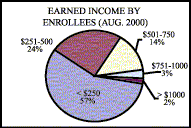
G. Budget Modeling and Cost Estimates
The state assumed in budget projections that the majority of Medicaid Buy-In program participants would already be receiving Medicaid. The fiscal note assumed that SSI recipients would make up about half of Medicaid Buy-In program enrollees in the first year of the program and would pay premiums of $40 per month. Persons with disabilities who formerly qualified for Medicaid under the medically needy category would make up about 20% of enrollees and pay premiums of $100 per month on average. New enrollees on Medicaid would be about 30% of Medicaid Buy-In program enrollees, paying about $100 per month in premiums. By SFY 2002, those numbers would shift slightly, with new enrollees on Medicaid making up 45% of the Medicaid Buy-In population.8
Based on an examination of the adult population with disabilities in Iowa, the state estimated that 700 people would come on to the program by the end of SFY 2002, but expected enrollment to be gradual. In March 2000, officials estimated that 100 people would be enrolled by June 2000, with program costs of approximately $39,000, and data system and administrative costs of $440,000. The state expected to garner offsets totaling $21,000 in premium payments during the first year. By June 2001, enrollment was expected to reach 400 with a total net cost of $327,000 after premium payments totaling $221,000 were used as offsets. For June 2002, anticipated enrollment was 700, premium payments were estimated to be $554,000, and net costs were expected to be $902,000.
H. Program Experience and Related Policy Issues
1. Program Experience
The Medicaid agency collects information on the number of clients enrolled in the Medicaid Buy-In program, the number of hours worked in a month, the amount of earned and unearned income, and the number of participants who pay a premium.
Enrollment has greatly exceeded the state's estimates of 100 people by June 2000 and 400 people by June 2001. As of April 2001, 2,105 people were enrolled in the Medicaid Buy-In program. The state credits its outreach program for the increased enrollment. About 30% of participants pay a premium.
Based on August 2000 data collected on 1,427 Medicaid Buy-In program enrollees, the average amount of money earned by enrollees is relatively low. Approximately 5% of enrollees had monthly earned incomes exceeding $750. As shown in the following table, a majority of beneficiaries (57%) have monthly earnings of less than $250.
Data from August 2000, displayed in the following table, shows that unearned income is an important source of income for many enrollees. Over 60% of Iowa's Medicaid Buy-In program participants received unearned income exceeding $600 a month with another quarter having monthly unearned income of between $501 and $600.
2. State and Federal Policy Issues
DHS is considering provisions affecting eligibility for the Medicaid Buy-In program, such as limiting eligibility to those workers who are paying FICA taxes. Changes to the saving account provision are also under consideration. Currently, a worker with disabilities may save money in a pre-approved assistive technology savings account. In response to requests from the disability community, DHS is considering allowing participants to save without pre-authorization.
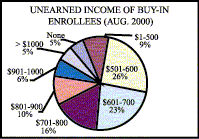
Iowa is in the process of developing options to add personal care to the state plan. A PAS Consumer/Advocate Workgroup assisted with the development of legislation and a 24-member Advisory Committee (with many of the same members) has been convened to develop accurate cost estimates and identify sources of funds. Another significant change under development is the addition of CDAC services at the worksite. All six HCBS waivers offer these services in the home.
There are issues surrounding the potential implementation of a Medically Improved Medicaid Buy-In category, particularly for persons with mental illness. There is also a continued concern that SSDI recipients are maintaining their earnings at levels less than the SGA level of $740 per month due to their fear of losing SSDI benefits. The state has also found it difficult to adequately define work in a way that encourages meaningful workforce participation.
I. Sources Consulted
CMS Medicaid Infrastructure Grant Awardees, accessed October 3, 2001 at http://www.hcfa.gov/medicaid/twwiia/infrastr.htm.
Iowa Infrastructure Grant submission.
Laws of Iowa. 441 IAC 75.1(39) c.
Medicaid for Employed People with Disabilities brochure, Iowa Department of Human Services Communication 180 (Rev November 2000).
Medical Assistance Fiscal Note RFI 9340, HF 586, Iowa Department of Health Services, March 24, 1999.
Medical Assistance Fiscal Note Worksheet RFI 9340, HF 586, Iowa Department of Health Services, March 24, 1999.
Policy Manual 8-F, Medicaid Coverage Groups, Iowa Department of Human Services, Office of Policy Analysis, p.118-126, accessed on October 3, 2001 at http://www.dhs.state.ia.us/policyanalysis/PolicyManualPages/Manual_Documents/Master/8-f.pdf.
Policy Manual 8-G, Medicaid Case Maintenance, Iowa Department of Human Services, Office of Policy Analysis, p. 43, accessed on October 3, 2001 at http://www.dhs.state.ia.us/policyanalysis/PolicyManualPages/Manual_Documents/Master/8-f.pdf.
Selected Statistics, Medicaid for Employed Persons with Disabilities Program, March-August 2000, prepared by James D. Overland, Iowa Division of Mental Health and Developmental Disabilities, October 12, 2000.
MAINE CASE STUDY
A. Overview
Maine's Medicaid Buy-In program was established through a Medicaid State Plan amendment and revisions to Medicaid regulations. Maine's legislature provided funding for the Medicaid Buy-In program in 1999 and the program began operating in August 1999. The Medicaid Buy-In program is not associated with a formal comprehensive work incentive initiative. Nonetheless, state agencies are working closely with several key provider organizations to coordinate work incentive efforts funded under TWWIIA, including benefits counseling.
There is a two-step income test to become eligible for the Medicaid Buy-In program. First, countable unearned income must be equal to or less than 100% of the FPL plus $75. Second, total countable earned and unearned income must be less than 250% of the FPL. Assets must be less than $8,000 for an individual and $12,000 for a couple.
The premium amount is based on countable monthly income projected for a six-month eligibility period. If monthly countable income is between 150% and 200% of the FPL, the monthly premium is $10. Persons with monthly countable income over 200% of the FPL have a $20 monthly premium. There is no premium for individuals with monthly countable income under 150% of the FPL or paying a Medicare Part B premium.
Maine's Medicaid State Plan offers consumer-directed attendant services of up to 35 hours per week and a night attendant seven nights a week for individuals meeting eligibility criteria. Private duty nursing and personal care services are also available for up to 24 hours a day, seven days a week. The state also includes personal assistance services in several waiver programs.
When planning its program, Maine anticipated that many people who received Medicaid through the "SSI-related" Poverty Level category would enroll in the Medicaid Buy-In programs, including SSDI recipients who could pass the unearned income eligibility test. The state estimated its first year cost based on 200 participants at an average statewide per capita non-institutional monthly cost of $600 and an average participant monthly premium payment of $30.
As of December 2001, 633 persons were enrolled in the Medicaid Buy-In program. A total of 1,214 people had been enrolled in the Medicaid Buy-In program for at least one month since its inception. Based on data collected in 2000, 8% of the individuals enrolled were paying premiums. The majority of enrollees had been on Medicaid in the month prior to enrollment; only 15 persons had no prior Medicaid history.
B. Impetus for the Medicaid Buy-In Program and Related Employment Initiatives
Several advocacy groups pushed for a Medicaid Buy-In program in the 1990s. A "Legislative Resolve" passed in 1996 directed the state Medicaid agency to submit a waiver request to HCFA for a Medicaid Buy-In program and created a state oversight group. That group prepared a recommendation to the legislature in 1998, taking advantage of the newly created federal Medicaid Buy-In option under the BBA of 1997. Maine's legislature did not take action; rather the Department of Human Services (DHS) through regulation and an amendment to its Medicaid State Plan created the Medicaid Buy-In program. Maines legislature agreed to appropriate $295,236 out of the $417,600 estimated costs of the program. The Medicaid agency issued rules for the program in May 1999, and the program then began in August 1999.
Two surveys in 1997 revealed the needs and concerns of individuals with disabilities in Maine. The first, conducted by Disability Income Systems, Inc., found that the majority of persons with disabilities were unemployed or underemployed and that onset of disability forced many to leave the workforce permanently. Another survey in late 1997 was aimed specifically at providing information to the Legislature and assisting in the design of the Medicaid Buy-In program. This survey found that only 26% of disabled adults surveyed were working. Of those surveyed, 34% indicated they would go to work or work additional hours if they knew they could retain their medical benefits.
C. Medicaid Eligibility and State SSI Supplementation Program Prior to the Medicaid Buy-In
Maine's state SSI supplementation program standards, its Medicaid eligibility standards, and its approach to implementing SSI work incentives provide a base for understanding the state's Medicaid Buy-In Program. These eligibility pathways and the maximum monthly incomes associated with them are shown on Chart 1. The state has elected a poverty level eligibility option and a medically needy eligibility option in its Medicaid program.
1. State SSI Supplementation Program
The state-administered Maine SSI supplement is $10 per month for a total cash benefit, when added to the SSI benefit, of $541. Maine provides for a $55 income disregard (in addition to the federal disregard of $20) to make additional persons eligible as state SSI supplementation recipients. Thus, individuals with incomes of less than $616 ($531 + $55 state disregard + $20 federal disregard + $10 state supplement amount) are eligible for the state SSI supplementation program.
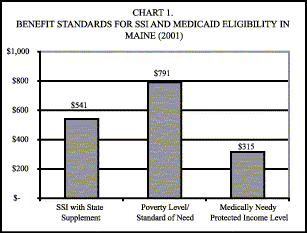
2. Medicaid Eligibility for Adults with Disabilities
SSI and state SSI supplementation program recipients in Maine are automatically eligible for Medicaid in Maine. As noted, Maine's higher state disregard provides state SSI supplementation program eligibility -- and thus Medicaid coverage -- for some persons who would not receive eligibility using federal disregards alone.
Persons with higher incomes may qualify for Medicaid through a poverty level group (called SSI-related in Maine) or a medically needy group. The upper income limit for the poverty level group is $791 in monthly income. (This figure is the poverty level of $716 plus $75 in state and federal disregards.) Individuals with higher levels of countable income must spend down to the medically needy protected income level of $315 per month to qualify for Medicaid.
3. Implementation of SSI Work Incentives (Section 1619(a) and (b))
Work incentives in Section 1619 of the federal SSI law provide continued Medicaid eligibility for SSI beneficiaries whose income from earnings could otherwise make them ineligible for coverage. These incentives enable such individuals to maintain a connection to both the SSI income assistance program and the Medicaid program when they work. Under Section 1619(a), an individual whose earnings exceed the SGA earnings test receives SSI cash benefits on a gradually reduced basis and continues to receive Medicaid. In June 2001, 152 persons in Maine, with average monthly earnings of $948, received SSI and Medicaid on the basis of Section 1619(a).
Under Section 1619(b) and Section 1905(q) of Medicaid law, a person who no longer receives SSI payments because of his earnings level is entitled to Medicaid as long as his disability continues and his earnings are below a federally determined equivalence standard ($1,948 monthly in Maine). Whether a state provides automatic Medicaid eligibility for SSI beneficiaries and whether it chooses federal or state administration of its SSI state supplement affect the capacity of eligible persons to access Section 1619(b) protections.
Because Maine provides automatic Medicaid eligibility for SSI recipients, persons who lose their entitlement to SSI payments due to earnings remain on the Medicaid rolls with no additional administrative work required of the state Medicaid agency. SSA sends the state a list of Medicaid-eligible persons, including persons eligible through Section 1619(b). Thus, persons in Maine who are eligible for SSI have relatively easy access to SSI work incentive protections, including continued Medicaid coverage. In June 2001, SSA identified 686 persons in Maine, with average monthly earnings of $989, as potentially eligible for Medicaid on the basis of Section 1619(b).
Recipients of state SSI supplementation who do not also receive federal SSI payments do not have access to SSI work incentives in Maine. Under its state-administered state SSI supplementation program, Maine does not apply 1619(b) work incentive protections to recipients of state SSI supplementation program who do not also receive a federal SSI check. (In states with federally administered state SSI supplementation program, such persons retain their Medicaid coverage under rules similar to those in effect for SSI recipients).
4. Personal Assistance Services
Maine is a conditional eligibility state under the CMS Medicaid Infrastructure Grant solicitation. The Medicaid State Plan offers consumer-directed attendant services. Medicaid covers up to 35 hours per week and a night attendant seven nights a week for individuals needing assistance with at least two ADLs. Private duty nursing and personal care services are also available for up to 24 hours a day, seven days a week.
The Adults with Disabilities Waiver is available to non-elderly adults who are unable or unwilling to self-direct their care. There is also a Physically Disabled Waiver for consumer-directed attendant services, consumer instruction, and case management. The state estimates that 10% of those who receive this waiver are competitively employed. Another waiver is available for adults with mental retardation or autism who need personal assistance services and supportive employment.
D. Medicaid Buy-In Program Design Features and Other Work Incentives
1. Medicaid Buy-In Eligibility
General Criteria Maine's Medicaid Buy-In program is for the Basic Insurance Group of persons with disabilities with earnings. When policy makers designed the Medicaid Buy-In program in 1996, they targeted individuals with disabilities who received Medicaid through their eligibility for an state SSI supplemental benefit. As noted earlier, these individuals did not have access to continued Medicaid coverage through Section 1619(b) provisions.
Income CriteriaThere is a two-step income test to become eligible for the Medicaid Buy-In program. First, countable unearned family income must be equal to or less than 100% of the FPL. If countable unearned income is equal to or greater than 100% of the FPL, the individual is not eligible for the Medicaid Buy-In program. Due to a $75 unearned income disregard, the effective monthly unearned income limit is the FPL plus $75 or $791.
Second, the applicant must also have countable unearned and earned family income of less than 250% of the FPL ($1,790 individual, $2,419 couple in 2001). The standard federal disregards as well as the state's additional disregard are used in determining the countable income.
Resource LimitationsTo be eligible for the Medicaid Buy-In program, assets must be less than $8,000 for an individual and $12,000 for a couple.
Eligibility PeriodEligibility for persons enrolled in the Medicaid Buy-In program is reviewed every six months. However, if a drop in income makes a person eligible under another eligibility category, and that change is expected to last at least a full calendar month, the individual is converted to another category.
2. Cost Sharing Policies
The premium amount is based on countable monthly family income projected for the six-month eligibility period (called a review period) and does not change during that period. There is no premium for individuals with monthly countable family income under 150% of the FPL or for anyone paying a Medicare Part B premium. If monthly countable income is between 150% and 200% of the FPL, the monthly premium is $10. Individuals with monthly countable family income at or over 200% of the FPL have a $20 premium. Individuals are exempt from paying premiums for retroactive coverage and in times of financial hardship caused by circumstances beyond the individuals control (such as illness of the individual or responsible relative).
Premiums may be paid monthly or for up to six months in advance (through the end of the review period). Premiums are due on the first of the month. If payment is not made at that time, a notice of non-payment is sent. There is a significant grace period for non-payment, lasting through the end of the sixth month of the eligibility period. For example, if the eligibility period is January through June, the individual has until June 30 to pay the premium for the six months. If eligibility ends prior to the end of the review period, the individual must pay any outstanding premiums by the end of the last month of eligibility. If premiums are not paid by the end of the review period and there is no good cause for failure to pay, the individual loses eligibility for the Medicaid Buy-In program. Coverage can be reinstated when all outstanding premiums are paid.
3. Link Between Medicaid Coverage and Employer Health Plans
There is no formal link between enrollees and employer health plans at this time, although it may be addressed under the Medicaid Infrastructure Grant.
4. Protections and Assurances for Enrollees
There are no explicit coverage protections for individuals participating in the Medicaid Buy-In. Individuals with a drop in income that is expected to last more than one full calendar month may be moved to a Medicaid eligibility category without a premium.
5. Other Components of a Comprehensive Work Incentive Initiative
The Maine Medicaid Buy-In program is running parallel to a Medicaid infrastructure enhancement project called CHOICES (Continued Health Options and Incentives via Coordinated Employment Support). CHOICES hopes to improve access to competitive employment and is undertaking multi-year research on how Medicaid-funded services support competitive employment and how these resources can be best targeted. The program is also using the Medicaid Infrastructure Grant to improve coordination of a range of policies and organizations and collaborate with other states with similar employment support.
Maine offers Vocational Rehabilitation Services through its Department of Labor. In FY 1999, the various support programs served about 6,000 disabled individuals, placing approximately 1,000 people into jobs. Alpha One (Maines Independent Living Center) and Maine Medical Center began recruiting benefits counselors in early 2001. Together, they expect to employ 3.5 full-time employees. The Disability Rights Center is also hiring a counselor, and the Bureau of Rehabilitation Services is trying to establish two positions.
E. Effects of the Medicaid Buy-In Program on Medicaid Eligibility
Chart 2 identifies the Medicaid eligibility categories available to working adults with disabilities in Maine, including SSI work incentives and the Medicaid Buy-In program. It sets forth the maximum monthly income levels for each category, including, as appropriate, earned and unearned income limits.
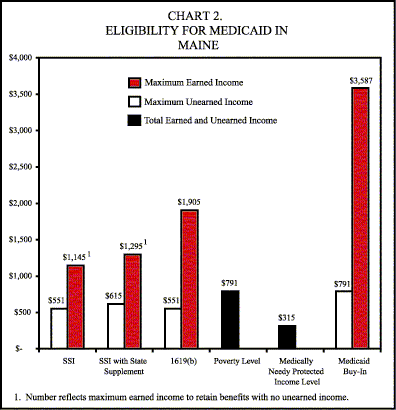
1. Connection Between the Medicaid Buy-In and State SSI Supplementation Program
Though Maine's Medicaid Buy-In program, working individuals with disabilities may qualify for Medicaid with higher levels of unearned income than previously allowed. Under prior rules, the SSI benefit standard (plus a $20 income disregard) was the maximum qualifying unearned income limit. Persons who had not been federal SSI recipients but had received Maines state-administered SSI supplement were not eligible for Medicaid work incentives protections. Under the Medicaid Buy-In, such persons can access Medicaid when working if their monthly unearned income is below the state's poverty level standard of $791.
2. Connection Between the Medicaid Buy-In Program and Other Medicaid Eligibility Categories
Poverty Level CategoryThe unearned income limit under the Medicaid Buy-In ($791 per month) is the same as the state's poverty level Medicaid standard. Persons who were previously eligible for Medicaid through the poverty level category can retain Medicaid eligibility when their incomes exceed $791, but only if their excess income is from earnings.
3. Targeting or Cost-Control Mechanisms
The unearned income limit restricts enrollment to persons with unearned income of less than $791 per month. Persons with higher levels of unearned income cannot qualify for the program.
F. Policy Approaches, Administrative Systems, and Stakeholder Involvement
1. Role of the State Legislature
The state legislature participated in discussions about work incentives for several years prior to creation of a Medicaid Buy-In program. The Medicaid Buy-In program was created through the revision of Medicaid regulations and Medicaid State Plan amendments rather than through legislation.
2. Role of the Executive Branch
The state revised its Medicaid regulations in May 1999 to include the new Working Disabled eligibility group. The state also has a fact sheet available with eligibility information and two case examples, available in print and online. The new eligibility option was promoted through the Internet and by posters and other printed materials. The department provided training on the Medicaid Buy-In to staff in all relevant agencies.
Three bureaus within the Maine DHS coordinate on the Medicaid Buy-In program. The Bureau of Elder and Adult Services coordinates services for adults with disabilities and has taken the lead in the Departments Medicaid Buy-In implementation. The Bureau of Medical Services administers Medicaid and the Bureau of Family Independence determines financial eligibility for Medicaid.
The Bureau of Vocational Rehabilitation within the Department of Labor is a principal state agency partner, offering employment support. The Department of Mental Health, Mental Retardation, and Substance Abuse Services is coordinating employment initiatives for their respective population groups. The Edmund S. Muskie School of Public Service at the University of Southern Maine conducts policy analysis, research and demonstration projects, and program evaluation under a Cooperative Agreement with the state.
3. Formal Involvement by the Disability Community
The original statewide Medicaid Buy-In Advisory Group was created in 1996 and from the beginning has had representatives of consumers, advocacy groups, the Medicaid agency, other related DHS agencies, local service providers and vocational rehabilitation. The Medicaid Buy-In Advisory Group was expanded and renamed CHOICES Advisory Group as part of the expanded systems work of the Medicaid Infrastructure Grant project.
G. Budget Modeling and Cost Estimates
On the basis of a survey of potential participants and a study of participation rates in similar states (Massachusetts was the primary state analyzed), the state developed a first-year participation estimate. The state estimated a first year cost in state dollars of $417,600 using 200 participants the first year; per capital monthly costs of $600, federal reimbursement at 66% and average per capita premium payments of $30 monthly9. Maine anticipated many people who had received Medicaid through the poverty level and SSI state supplemental categories would enroll in the Medicaid Buy-In program.
H. Program Experience and Related Policy Issues
1. Program Experience
Several data collection efforts are underway as part of the Medicaid Infrastructure Grant project, including mail and phone surveys of all participants. Medicaid claims data analysis is also currently underway. Later survey and focus group work will address experience and choices of individuals eligible for the Medicaid Buy-In program, but not enrolled.
In December 2001, 633 persons were actively enrolled in the Medicaid Buy-In program. Since the program's inception in 1999, a total of 1,214 individuals have participated in the category for at least one month. Based on data collected in 2000, 8% of the individuals enrolled were paying premiums. The majority of enrollees had been on Medicaid in the month prior to enrollment; only 15 persons had no prior Medicaid history.
2. State and Federal Policy Issues
No specific changes are planned, pending further data collection under the Medicaid Infrastructure Grant and recommendations of the CHOICES Advisory Group to the legislature. In Spring 2001, a Medicaid expansion bill passed the legislature. A provision to remove the unearned income cap initially was part of the bill, but was not in the final version. Addressing the unearned income cap is a focus of the state's Medicaid Infrastructure Grant activities.
I. Sources Consulted
CHOICES (Continuing Health Options and Incentives via Coordinated Employment Supports) -- Maine's Medicaid Infrastructure Grant submission.
CHOICES web site at http://choices.muskie.usm.maine.edu/.
Eligibility Flow Chart for Maine Medicaid Workers with Disabilities Option, http://choices.muskie.usm.maine.edu/eligflwchrt.htm.
Larry Glantz. "Preliminary Findings from a Survey of Maine's Medicaid Buy-In Program for Workers with Disabilities." Presented to the CHOICES Statewide Advisory Council. January 8, 2001.
Maine Bureau of Rehabilitation web site, http://janus.state.me.us/labor/brs/vr.htm.
Maine Department of Human Services. Bureau of Family Independence. July 2000 data.
Maine Medical Assistance Regulations at http://www.state.me.us/dhs/bfi/medicaid.
Maine P.L. Chap. 795, Section 10.
Program Information Pages. Fact Sheet: New Medicaid Option for Maine Workers with Disabilities at http://www.state.me.us/dhs/beas/buyin.
Report to the Maine Legislature of the Medicaid Buy-In Advisory Group. February 1998.
MINNESOTA CASE STUDY
A. Overview
Minnesota's Medicaid Buy-In program was signed into law in May 1999. Implementation of the program began in July 1999.
The state legislation specifies eligibility requirements, income and asset limits, exemptions, premium structure, and payment information. The legislation was not enacted as part of a more comprehensive work incentive initiative. The program is administered by the Department of Human Services (DHS), which assists county welfare and human services agencies in administering the program. The One-Stop centers established under the Workforce Investment Act are involved in outreach and vocational training and counseling.
The Minnesota Work Incentives Coalition and the Minnesota Consortium for Citizens with Disabilities provided the impetus for the program. These groups, consisting primarily of individuals with disabilities, family members, advocates, and providers, began efforts nearly a decade ago to convince policy makers of the need to allow disabled workers to retain their eligibility for Medicaid. In a cooperative effort, these groups published a survey instrument in a disability newspaper and circulated it to 200 disability-related organizations.
In determining eligibility for the Medicaid Buy-In program, Minnesota has no upper limit for income. Using authority provided to the state under Section 1902(r)(2) of the Social Security Act, all gross income (earned and unearned) is disregarded as well as spousal or family income. Assets must be less than $20,000 excluding retirement plans and medical savings accounts.
Individuals are certified eligible for the Medicaid Buy-In program for six months. Recipients must demonstrate some income for each 30-day period. Special allowances are made for those who switch jobs. Also recipients are allowed up to two months of medical leave -- approved by a physician -- without losing eligibility.
To determine cost sharing liabilities, the individual's gross income is calculated (all earned and unearned income -- excluding spousal and family income) and compared to 200% of the FPL for the appropriate family size. If the total exceeds 200% of the FPL, a premium payment of 10% of the difference is assessed.
Personal assistance services are available as part of the Medicaid State Plan, through Section 1915(c) HCBS waivers and through several state-funded programs. Services can be provided inside or outside the home up to 24 hours a day based on client need. A consumer-directed model using fiscal intermediaries is an option for consumers.
For FY 2000, budget projections assumed a total of 2,756 disabled workers would be eligible for the Medicaid Buy-In. Of these 1,878 would be diverted from traditional Medicaid eligibility categories and 795 would be defined as "additional" eligibles. Cases projected to be diverted from regular Medicaid categories were assumed to produce no additional cost. A key assumption made was that there would be an increase in coverage through employer-sponsored plans.
The state uses monthly enrollment statistics to evaluate the program. These data include demographics, premium breakdowns, and gross monthly earnings. Since enrollment, the number of enrollees significantly outpaced projections. Enrollment is the Medicaid Buy-In program has climbed from 1,410 in July 1999 to 5,657 in January 2001. For the 642 enrollees that paid a premium, the average premium billed was $35. Approximately 25% of Medicaid Buy-In enrollees did not previously participate in the Medicaid Buy-In program, although it is unclear how many are SSDI recipients who were unable to qualify for the medically needy program.
Based on an extrapolation from available data, approximately 13% of Minnesota Medicaid Buy-In program enrollees have monthly earned income exceeding $740, the SGA earnings test for disability. Nearly two-thirds of Medicaid Buy-In Program participants received unearned income in February 2001 of at least $600 a month. Fewer than 10% received no unearned income.
The state will conduct a comprehensive two-phase evaluation of the program. Phase I will consist of a one-year study to determine the effectiveness of the Medicaid Buy-In program in helping people with disabilities to secure employment. Phase II of the evaluation is a long-term impact study designed to demonstrate if participation resulted in improved health status, quality of life, and level of functioning, and factors related to continued employment.
The State of Minnesota has requested demonstration authority from SSA that would provide greater protections for SSDI recipients participating in the Medicaid Buy-In program as well as provide for gradual rather than precipitous reductions in SSDI benefits.
B. Impetus for the Medicaid Buy-In Program and Related Employment Initiatives
Minnesota's Medicaid Buy-In program, Medicaid for Employed Persons with Disabilities (MA-EPD) began in July 1999. Two coalitions are chiefly responsible for the activities that led to Minnesota's Medicaid Buy-In program, the Minnesota Work Incentives Coalition and the Minnesota Consortium for Citizens with Disabilities. The two groups were organized in the early 1990's to teach individuals about the existing work incentives programs and to convince policy makers of the need for additional initiatives and are comprised of disabled individuals, family members, providers, and advocates.
In a cooperative effort, these two coalitions published a survey instrument in the disability newspaper Access Press that is distributed by about 200 disability-related organizations in Minnesota. The purpose of the research was to identify barriers to employment faced by disabled people. Nearly 1,200 physically, mentally, and developmentally disabled individuals responded.
C. Medicaid Eligibility and State SSI Supplementation Program Prior to the Medicaid Buy-In
Minnesotas state SSI supplementation standards, its Medicaid eligibility standards, and its approach to implementing SSI work incentives provide a base for understanding the state's Medicaid Buy-In program. These eligibility pathways and the maximum monthly incomes associated with them prior to recent changes are shown on Chart 1. As shown on the chart, Minnesota had a medically needy program, but had not elected a poverty level option. (Effective in July 2001, Minnesota changed its medically needy program income levels to 70% of the FPL or $501 monthly and created a poverty level option.)
1. State SSI Supplement Program
The state provides supplements to SSI payments based on family size and living arrangements. These payments are administered by the state through county welfare and human services agencies. An individual living independently receives an SSI state supplement of $81 per month for a total federal and state payment of $612.
2. Medicaid Eligibility for Adults with Disabilities
Minnesota does not provide automatic eligibility for Medicaid for SSI recipients. Under Section 209(b) of the Social Security Act, states may use Medicaid eligibility criteria that differ from SSI standards as long as the criteria are not more restrictive than the states approved standards when the SSI law was enacted in 1972. In the absence of automatic eligibility for SSI recipients, adults with disabilities living in the community file a separate application for Medicaid.
Individuals with disabilities who are not eligible for SSI or SSI state supplementation can qualify as medically needy. To do so, they must either have a very low-income level ($472 monthly for an individual in 2001 prior to a recent policy change) or incur medical expenses (spend down) such that their remaining monthly income (their Protected Income Level) does not exceed $472.
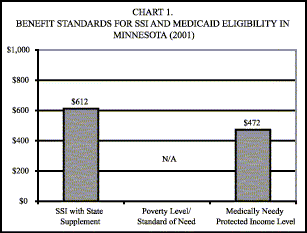
Individuals whose medi cal cond itions quali fy them for Medicaid-financed long-term institutional care and who receive community-based services under a HCBS waiver can qualify for Medicaid coverage in the community with incomes of up to $1,590 monthly (300% of the FPL). The number of individuals who qualify for coverage through waiver eligibility is limited by a maximum caseload figure set by the state.
3. Implementation of SSI Work Incentives (Section 1619(a) and (b))
Work incentives in Section 1619 of the federal SSI law provide continued Medicaid eligibility for SSI beneficiaries whose income from earnings could otherwise make them ineligible for coverage. These incentives enable such individual to maintain a connection to both the SSI income assistance program and the Medicaid program when they work. Under Section 1619(a), an individual whose earnings exceed the SGA earnings test receives SSI cash benefits on a gradually reduced basis and continues to receive Medicaid. In June 2001, 422 persons in Minnesota, with average monthly earnings of $929, received SSI and Medicaid on the basis of Section 1619(a).
Under Section 1619(b) and Section 1905(q) of Medicaid law, a person who no longer receives SSI payments because of his earnings level is entitled to Medicaid as long as his disability continues and his earnings are below a federally determined equivalence standard ($2,537 monthly in Minnesota). Whether a state provides automatic Medicaid eligibility for SSI beneficiaries and whether it chooses federal or state administration of its state SSI supplementation program affect the capacity of eligible persons to access Section 1619(b) protections.
In Minnesota, a state requiring a separate Medicaid application for SSI beneficiaries, guaranteeing continued Medicaid for persons entitled through Section 1619(b) is administratively complex. When an individual leaves SSI, the state Medicaid agency must review SSA data to track his 1619(b) eligibility status and determine him eligible for continued Medicaid coverage. (By contrast, where Medicaid eligibility is automatic for SSI beneficiaries, the Federal Government sends the state a list of Medicaid-eligible persons, including persons eligible through Section 1619(b).) In June 2001, SSA identified 2,452 persons in Minnesota, with average monthly earnings of $895, as potentially eligible for Medicaid under Section 1619(b). Information on the actual enrollment status of these individuals is not available.
Under its state-administered SSI state supplement program, Minnesota does not extend work incentive protections similar to Section 1619(b) to state SSI supplementation recipients. (In states with federally administered state SSI supplementation program, such persons automatically retain their Medicaid coverage under rules similar to those in effect for SSI recipients).
4. Personal Assistance Services
Personal assistance services are available as part of the state plan, through Section 1915(c) HCBS waivers and through several state-funded programs. Minnesota is a fully eligible state under the CMS Medicaid Infrastructure Grant classification. Personal Care Assistant (PCA) services under the Medicaid State Plan can be provided inside or outside the home up to 24 hours a day based on client need. A consumer-directed model using fiscal intermediaries is an option for consumers. A Section 1915(c) waiver provides additional options for individuals with developmental disabilities, including management of a budget for community services without a fiscal intermediary. Minnesota has specified that persons eligible for Medicaid through the Medicaid Buy-In can receive waiver services.
D. Medicaid Buy-In Program Design Features and Other Work Incentives
1. Medicaid Buy-In Eligibility
General Criteria Any employed individual certified disabled by the SSA or the State Medical Review Team, not receiving SSI, and between the ages of 16 and 64 is eligible. Individuals living in long-term care facilities and expected to remain for at least 30 days and those with Section 1619(a) or (b) status are ineligible.
Income CriteriaMinnesota has no upper income limit for the Medicaid Buy-In program. Using section 1902(r)(2) of the Social Security Act, the state disregards all earned and unearned income of the applicant or spouse when determining eligibility.
Resource LimitationsIndividuals with assets of less than $20,000, excluding retirement (401k, 403b, Keogh, Roth and traditional IRAs, employer pensions, and all other retirement funds) and medical savings accounts (including unreimbursed medical and flexible spending accounts) can qualify for the program.
Eligibility PeriodIndividuals are certified for six-month periods but must maintain eligibility throughout. Recipients must demonstrate some income for each 30-day period and are required to report any change in job status or income within ten days. An individual must file a Household Report Form, along with proof of income, every six months.
2. Cost Sharing Policies
When the Medicaid Buy-In program began, the state calculated premium liability by comparing an individual's gross income to 200% of the FPL for the appropriate family size. If the individual's income exceeded 200% of the FPL for his family size, his premium was 10% of the amount above 200% of the FPL. Changes have been made to the premium structure, effective December 1, 2001. Individuals with gross income equal to or greater than 100% of the FPL will pay a sliding scale premium. The scale begins at 1% of income for those with incomes at 100% of the FPL and gradually increases to 7.5% of income for income equal to or greater than 300% of the FPL. There is no maximum income limit or maximum premium.
County agencies can opt to collect the initial premium, if one is due, and forward it to the DHS but subsequent payments are made directly to the DHS. Payments can be made by check, money order or via an automatic withdrawal from a bank account.
3. Link Between Medicaid Coverage and Employer Health Plans
The state determines if buying employer-sponsored coverage would be cost-effective for the state. If so, the beneficiary pays any premium required for the MA-EPD coverage and Medicaid pays the employee premium for employer-sponsored coverage.
4. Protections and Assurances for Enrollees
Special allowances are made for those who switch jobs where the difference in pay schedule makes it appear that no income was received in a 30-day period. Recipients originally could use up to two months of medical leave without losing eligibility. In 2001, the amount of leave increased to four months. If a beneficiary loses eligibility for the Medicaid Buy-In program and seeks to re-enroll in Medicaid in a different category, he is subject to traditional Medicaid income and asset limits.
Minnesota has requested a waiver to stop the clock on the Trial Work Period (TWP) and other related timelines to reduce the number of individuals who lose income when they leave employment for medical reasons and need to return to SSDI. Participation in the Medicaid Buy-In program would not count toward the TWP or other timelines. Additionally, the state requested a waiver to disregard some earned income to prevent precipitous declines in SSDI payments. This waiver would reduce SSDI payments by $1 for every $2 above the SGA level (currently $740). Another waiver, if approved, would suspend the annual Continuing Disability Reviews. The state has also requested approval to apply the $20,000 asset limit for a year to Medicaid Buy-In participants who move to other Medicaid categories. No action has been taken on these waiver requests.
5. Other Components of a Comprehensive Work Incentive Initiative
Vocational rehabilitation programs are available to Medicaid Buy-In program participants through One-Stop centers and the Minnesota Work Incentives Connection.
E. Effects of the Medicaid Buy-In Program on Medicaid Eligibility
Chart 2 identifies the Medicaid eligibility categories for adults with disabilities, including the Medicaid Buy-In category. It sets forth the maximum monthly income levels for each category, including, as appropriate, earned and unearned income limits.
1. Connection Between the Medicaid Buy-In and State SSI Supplementation Program
The Medicaid Buy-In program in Minnesota provides categorical Medicaid eligibility for persons who have too much SSDI or other unearned income to become eligible for federal SSI work incentives. Individuals not qualifying for federal SSI, including persons who received state-administered SSI supplementation, previously could not access work incentives available to SSI recipients.
Unlike the SSI Work Incentives program, the Medicaid Buy-In does not have an unearned income limit. That is, individuals with disabilities who have earnings may have in addition unearned income of any amount. Likewise, the premium schedule under the Medicaid Buy-In program does not distinguish between unearned income and earned income.
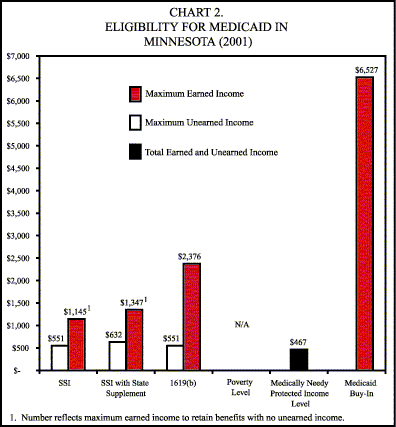
2. Connection Between the Medicaid Buy-In and Other Medicaid Eligibility Categories
Medically NeedyThe state identified persons who spend down to receive Medicaid under the Minnesota medically needy program as specific targets of the Medicaid Buy-In program. The protected income level under the Minnesota medically needy program (prior to a recent policy change) was lower than the federal SSI benefit standard. Because the state did not have a poverty level category, individuals often faced large spend downs to qualify for Medicaid under the medically needy category. The Medicaid Buy-In program provides such individuals with eligibility for no cost or with a small premium so long as some of their income is from earnings. The Medicaid Buy-In also serves as an alternative for working persons who lose coverage due to resources in excess of the $3,000 Medicaid limit.
3. Targeting or Cost-Control Mechanisms
As originally crafted, there were no explicit targeting mechanisms in the Minnesota Medicaid Buy-In program. Effective December 1, 2001, the premium structure has been changed with the likely effect of targeting enrollment and reducing program costs. Premiums will start at 100% of the FPL instead of the current 200%. Premiums will begin at 1% of income for persons at 100% of the FPL (about $7 per month) and increase to a maximum of 7.5% of a person's income when the individual's income reaches 300% of the FPL for the applicant's family size. To provide additional eligibility pathways for persons who are not employed, the state added a poverty level option to its Medicaid program and substantially increased its level of protected income under its medically needy program.
F. Policy Approaches, Administrative Systems, and Stakeholder Involvement
1. Role of the State Legislature
The legislature provided specific details for the design and implementation of Minnesota's Medicaid Buy-In program in response to grassroots efforts by the Minnesota Consortium for Citizens with Disabilities and the Minnesota Work Incentives Coalition. The one-page of text specifies eligibility requirements, income and asset limits and exemptions, premium structure, and payment information. It required no compulsory job training or counseling and did not include a sunset date.
2. Role of the Executive Branch
The Minnesota DHS published regulations, bulletins, and brochures and assisted the county agencies in the implementation of the program. The One-Stop workforce centers and the Minnesota Work Incentives Coalition are involved with outreach and vocational training and counseling. All aspects of the program (excluding the disability determinations) are handled by the county agencies.
3. Formal Involvement by the Disability Community
Advocacy groups surveyed the state's disabled population and presented that information to the legislature. As part of the legislative process, disabled individuals testified regarding work disincentives. Similarly, disabled individuals were included in the implementation procedures.
G. Budget Modeling and Cost Estimates
Minnesota used claims data from its Medicaid payment system to estimate the average monthly cost for services. Original enrollment projections for the Medicaid Buy-In program were based on data from a similar Massachusetts program. Minnesota added a subset of enrollees defined as additional Medicaid recipients. This group included individuals who had not been enrolled in Medicaid or the states other publicly funded health insurance program, MinnesotaCare.
For FY 2000, budget projections assumed a total of 2,756 persons with disabilities would enroll in the Medicaid Buy-In. Of these, 60% were projected to be conversions from other Medicaid categories and 40% additional eligibles. For FY 2001, budget projections assumed an enrollment of 4,300 persons, with about 70% conversions from other categories and 30% new enrollees. FY 2002 and FY 2003 estimates were 4,800 and 5,300 respectively.
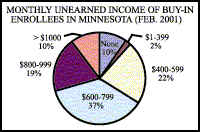
The total annual cost was estimated at $19.1 million for FY 2001, $22.8 million in FY 2002, and $27.2 million in FY 2003. The state share of the program cost was estimated at $9.3 million in FY 2001, $11.1 million in FY 2002, and $13.2 million in FY 2003.
A key assumption was a substantial increase in coverage through employer-sponsored plans. The effect of private insurance coverage on persons converting from other Medicaid categories was projected at $50 per enrolled person per month, based on approximately a sixth of the diverted enrollees gaining employer based coverage valued at an average of $300 per month. The savings for Medicaid Buy-In program recipients from insurance coverage of acute and primary care was estimated to be $1.1 million in the first year and increasing to $2.2 million in FY 2003.
H. Program Experience and Related Policy Issues
The state will conduct a two-phase evaluation of the Medicaid Buy-In program. Phase I will consist of a one-year study to determine the effectiveness of the Medicaid Buy-In program in supporting the efforts of people with disabilities to secure employment. Data from the Department of Health Services data warehouse and other sources will be used to determine if participation results in higher levels of employment and earnings, decreased payments for SSDI, Food Stamps, TANF and Minnesota Supplemental Aid, and low Medicaid payments and higher third party health care coverage.
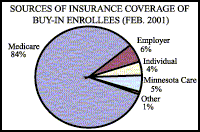
Phase II of the evaluation is a long-term impact study designed to demonstrate if participation resulted in improved health status, quality of life, and level of functioning; participant satisfaction; and factors associated with continuing employment. The data sources are the DHS data warehouse, Minnesota Department of Revenue, and a telephone survey. The survey may include components of the Consumer Assessment of Health Plans Study (CAHPS) for health status, health care, and level of functioning and program satisfaction data.
Since implementation, the number of Medicaid Buy-In program enrollees has significantly outpaced projections. Enrollment in MA-EPD has climbed from 1,410 in July 1999 to 5,657 in January 2001 and to 6,200 as of July 2001. (The state had projected an enrollment of 5,347 by 2003). Approximately a quarter of Medicaid Buy-In program participants had not been enrolled in Medicaid previously. For the 800 enrollees required to pay premiums, the average monthly amount billed was $38.
As noted earlier, the state has changed the premium structure of its Medicaid Buy-In program as of December 2001. It has also created a poverty level category and increased the protected income level within the medically needy program to provide additional eligibility options for persons regardless of their work status.
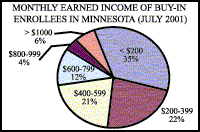
The DHS uses monthly enrollment statistics to gather data about the Medicaid Buy-In program. These data include demographics, premium payments, and earnings. Based on an extrapolation from available data, approximately 13% of Minnesota Medicaid Buy-In program enrollees have monthly earned income exceeding $740, the SGA earnings test for disability. The distribution of earnings of enrollees as of July 1, 2001 is shown below.
As shown, nearly two-thirds of Medicaid Buy-In program participants received unearned income in February 2001 of at least $600 a month. Fewer than 10% received no unearned income.
In February 2001, approximately 12% of Medicaid Buy-In program participants were enrolled in some type of private insurance. Eighty-eight percent of enrollees had Medicare coverage in addition to Medicaid.
I. Sources Consulted
Fiscal Analysis of a Proposal to Adopt the BBA Option for Disabled. Revision for February Forecast.
GWU website info.
Steve Lerch, Medicaid Expansion for Employed Persons with Disabilities: Costs and Benefits of the Ticket to Work Medicaid Buy-In. November 2000.
Minnesota CCD publication.
Minnesota Department of Human Services. MinnesotaCare, MA, and GAMC Income and Asset Guidelines. April 1, 2001.
Minnesota Department of Human Services Bulletin. #99-16-6.
MA-EPD regs.
Minnesota request for Title II Waiver. May 2000.
Minnesota Department of Human Services. Bulletin #99-16-6.
Minnesota Department of Human Services. MA Enrollment July 1999 through January 2001. March 9, 2001.
Minnesota Department of Human Services. Medical Assistance for Employed Persons with Disabilities. September 2001.
S.F No. 2225, 3rd Engrossment: 81st Legislative Session (1999-2000).
NEBRASKA CASE STUDY
A. Overview
Nebraska's Medicaid Buy-In program was enacted in 1999 and was implemented beginning June 1, 1999. In 2001, Nebraska amended its Medicaid Plan to allow delivery of personal care services in the workplace to support employment.
The impetus for the Medicaid Buy-In program was individuals with disabilities expressing frustration when they learned they would lose Medicaid if they increased their work effort. During the development of the Medicaid Buy-In legislation, the state convened a stakeholder meeting to discuss barriers confronting persons with disabilities who want to enter the workforce.
To enroll in Nebraska's Medicaid Buy-In program, an individual must meet the SSA or State Review team definition of disability, be working, meet Medicaid resource limits and have income within program guidelines after application of a two-part income test.
The first income test compares family countable income to the SSI benefit standard for the family size. This income test disregards all the applicant's earned income, counts the spouse's net earned income, and counts all unearned income for the applicant and spouse except for income from a TWP. When an individual is in a TWP, his unearned income based on the TWP is not counted. If a single individual has monthly countable income of less than or equal to $531, the applicant meets the first income test.
The second income test compares family income to 250% of the FPL, the upper income limit for eligibility and is also used to calculate premiums. This income calculation includes net earned family income and gross unearned income (after a $20 disregard and a $10 interest disregard). Regular Medicaid resource limits ($4,000 for an individual or $6,000 for a couple) apply. Persons with family incomes below 200% of the FPL, are not assessed premiums. Persons with family incomes of between 200% and 249% of the FPL are assessed monthly fees ranging from 2% to 10% of income.
Nebraska's Medicaid State Plan benefit package includes personal care services. Personal care services may be provided in the client's home or at the worksite when the individual is engaged in competitive, integrative employment, defined as working at least 40 hours per month.
When the Medicaid Buy-In program was under consideration, the state assumed an average monthly caseload of 100 new Medicaid enrollees (persons not already on Medicaid) with average monthly costs of $732 per person. Department officials derived this estimate from information prepared by a state advocacy group. The state anticipated a total enrollment of 250 persons and 450 persons at the two-year mark of the program.
As of April 2001, 112 people were enrolled in the Medicaid Buy-In program, with no more than two persons paying premiums. State officials suggest that at least one reason for the low enrollment is that Nebraska does not have resources to devote to outreach or publications. The University of Nebraska Public Policy Center is gathering information about the Medicaid Buy-In program, including enrollment data, as part of the state's Medicaid Infrastructure Grant activities.
B. Impetus for the Medicaid Buy-In Program and Related Employment Initiatives
Nebraska's Medicaid Buy-In program was enacted as a response to individuals with disabilities wanting more options for Medicaid eligibility than were offered at the time. The Medicaid Buy-In program was designed to support the efforts of individuals with disabilities who feared losing Medicaid when they entered the workforce.
During the development of the Medicaid Buy-In program, the state convened a stakeholders meeting, consisting of consumer and public and private agencies serving persons with disabilities, to discuss barriers confronting persons with disabilities who wanted to enter the workforce. The Developmental Disabilities Council and the Regional Developmental Disabilities Councils have also identified barriers facing individuals wanting to work.
C. Medicaid Eligibility and State SSI Supplementation Program Prior to the Medicaid Buy-In
Nebraskas state SSI supplementation program standards, its Medicaid eligibility standards, and its approach to implementing SSI work incentives provide a base for understanding the state's Medicaid Buy-In program. These eligibility pathways and the maximum monthly incomes associated with them are shown on Chart 1. As shown on the chart, Nebraska has elected a poverty level option and a medically needy option.
1. State SSI Supplement Program
The state SSI supplementation program level in Nebraska is $8 per month for an individual, bringing the combined federal and state payment in 2001 to $539 for an individual.
2. Medicaid Eligibility for Adults with Disabilities
SSI recipients do not automatically receive Medicaid in Nebraska. Nebraska is one of seven states that use SSI rules as a basis for Medicaid eligibility but require applicants to file a separate Medicaid application.10 Individuals who qualify for state-administered state supplementation payments without qualifying for SSI also qualify for Medicaid after filing a separate Medicaid application.
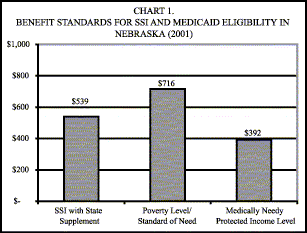
Individuals with disabilities who are ineligible for SSI or state SSI supplementation program can qualify under the poverty level category or the medically needy category if they meet disability and income requirements. The poverty level standard in Nebraska is at 100% of the FPL, or $716 per month for a single individual. To qualify for the medically needy category, individuals must either have a very low-income level ($392 monthly for an individual) or incur medical expenses ("spend down") such that their remaining monthly income (their protected income level) does not exceed $392.
3. Implementation of SSI Work Incentives (Section 1619(a) and (b))
Work incentives in Section 1619 of the federal SSI law provide continued Medicaid eligibility for SSI beneficiaries whose income from earnings could otherwise make them ineligible for coverage. These incentives enable such individual to maintain a connection to both the SSI income assistance program and the Medicaid program when they work. Under Section 1619(a), an individual whose earnings exceed the SGA earnings test receives SSI cash benefits on a gradually reduced basis and continues to receive Medicaid. In June 2001, 162 persons in Nebraska, with average monthly earnings of $933, received SSI and Medicaid on the basis of Section 1619(a).
Under Section 1619(b) and Section 1905(q) of Medicaid law, a person who no longer receives SSI payments because of his earnings level is entitled to Medicaid as long as his disability continues and his earnings are below a federally determined equivalence standard ($1,900 monthly in Nebraska). Whether a state provides automatic Medicaid eligibility for SSI beneficiaries and whether it chooses federal or state administration of its SSI state supplement affect the capacity of eligible persons to access Section 1619(b) protections.
In Nebraska, a state requiring a separate Medicaid application for SSI beneficiaries, guaranteeing continued Medicaid for persons entitled through Section 1619(b) is administratively complex. When an individual leaves SSI, the state Medicaid agency must review SSA data to track his 1619(b) eligibility status and determine him eligible for continued Medicaid coverage. (By contrast, where Medicaid eligibility is automatic for SSI beneficiaries, the Federal Government sends the state a list of Medicaid-eligible persons, including persons eligible through Section 1619(b)). In June 2001, SSA identified 641 Nebraskans, with average monthly earnings of $885, as potentially eligible for Medicaid under Section 1619(b). Information on the actual enrollment status of these individuals is not available.
Under its state-administered state SSI supplementation program, Nebraska does not apply 1619(b) work incentive protections to recipients of SSI state supplementation who do not also receive a federal SSI check. (In states with federally administered state SSI supplements, such persons retain their Medicaid coverage under rules similar to those in effect for SSI recipients).
4. Personal Assistance Services
Nebraska's Medicaid State Plan benefit package includes personal care services. The state meets full eligibility requirements under the CMS Medicaid Infrastructure Grant classification system. (Nebraska was classified as meeting transitional eligibility requirements during the first grant year of the Medicaid Infrastructure Grant). Personal care services may be provided in the client's home or at the worksite when the individual is engaged in competitive, integrative employment, defined as working at least 40 hours per month. Provision of services more frequently than 40 hours a week require prior approval from the state.
Nebraska's regulations describe personal care as follows: "Nebraska Medical Assistance Program covers personal care services when ordered by the client's physician based on medical necessity. Personal care services are medically oriented tasks related to a client's physical requirements (as opposed to housekeeping requirements). These services are offered to individuals who, due to illness or disability, need PCA to remain in their home environments."11 Personal care services may include basic personal care and grooming; assisting with bladder or bowel requirements; assistance with oral medication; assistance with nutrition, including meal preparation; performing household services related to a medical need; and accompanying the client to physician visits.
The Medicaid Infrastructure Grant application describes Nebraska's personal care attendant program as "comprehensive, [but] fragmented"12 with variations between metro and rural areas of the state. It says: "Services are provided by independent personal care contractors, businesses and individuals. Individual providers in the rural areas are more common; however, there is a lack of people to provide such services statewide. In the metro areas, services generally follow a medical model with physicians and/or nurses making recommendations regarding number of hours of services needed. Whereas in the rural areas of the state, Medicaid eligibility workers most often make such determinations."13
Nebraska has three HCBS waivers for adults with disabilities. One is for elderly persons and persons with disabilities who meet nursing home care criteria, the second for persons with mental retardation and related conditions who meet criteria for ICF/MR care, and the third for individuals with traumatic brain injury.
D. Medicaid Buy-In Program Design Features and Other Work Incentives
1. Medicaid Buy-In Eligibility
General Criteria Nebraska's Medicaid Buy-In program legislation, Section 34 of LB 594, established the general boundaries of the program. The bill set 250% of the FPL as the upper income eligibility limit for the program. It identified 200% of the FPL as the income level at which premium payments should begin and it mandated a graduated premium schedule based on family income with payments of no less than 2% and no more than 10% of family net income.
To enroll in Nebraska's Medicaid Buy-In program, an individual must meet the SSA or State Review Team definition of disability, be working, meet Medicaid resource limits, and have income within program guidelines after application of a two-part income test.
Income CriteriaPersons seeking eligibility for the Medicaid Buy-In program must pass two income tests. The first income test compares countable family income to the SSI benefit standard for the family size. This income test disregards all the applicant's earned income, counts the spouse's net earned income (after SSI disregards), and counts all unearned income for the applicant and spouse except for income based on a TWP. The eligibility worker must verify that the applicant is in a TWP as defined by SSA. (For purposes of the Medicaid Buy-In program, the TWP includes SSDI's TWP, the SSDI Cessation Month, the SSDI Grace Months, and the SSDI Extended Period of Eligibility of 36 months.) When an individual is in any of these months, his unearned income is not counted in the first income test. If a single individual has monthly countable income of less than or equal to $531 (the SSI benefit level), he meets the first income test for the program.
The second income test compares family income to the 250% of the FPL, the upper income limit for eligibility and is also used to calculate premiums. This income calculation includes net earned family income (after SSI earned income disregards) and gross unearned income (after a $20 disregard and a $10 interest disregard). An individual who met the first income test and has countable family income of less than 250% of the FPL is eligible for the Medicaid Buy-In program.
Resource LimitationsResource limits for the Medicaid Buy-In program are $4,000 for an individual or $6,000 for a couple.
Eligibility PeriodThe standard eligibility period, as for other Medicaid programs, is one year.
2. Cost Sharing Policies
Persons with family incomes below 200% of the FPL, based on the family income test, are not assessed premiums. The state's premium schedule includes five income bands with fees of 2%, 4%, 6%, 8%, or 10% of income. Monthly fees for single persons range from $29 (2% of income) for a person at 200% of the FPL to $175 (10% of income) for a person at 249% of the FPL.
Individuals owing premiums must pay them to their eligibility worker by the 21st of the month following the month for which they were incurred. For example, a premium payment for the month of June must be paid no later than the 21st of July. The client may prepay the premium, but only up to the next income review date. The local eligibility worker sends the premium payment to the Public Assistance Unit at the state level.
3. Link Between Medicaid Coverage and Employer Health Plans
There is no formal link to employer health plans.
4. Protections and Assurances for Enrollees
The state's poverty level eligibility category provides protection for some individuals when they leave the work force.
5. Other Components of a Comprehensive Work Incentive Initiative
The Medicaid Buy-In program was not created as a formal component of a comprehensive work incentive initiative. However, the state is seeking to integrate more effectively the operations and policy of the Medicaid Buy-In program with other services to support working persons with disabilities. Through its Medicaid Infrastructure Grant, the state is seeking to put into place other system improvements to support persons with disabilities who want to work.
E. Effects of the Medicaid Buy-In Program on Medicaid Eligibility
Chart 2 shows the major Medicaid eligibility categories available to working adults with disabilities, including SSI work incentives and the Medicaid Buy-In. It sets forth the maximum monthly income levels for each category, including, as appropriate, earned and unearned income limits.
1. Connection Between the Medicaid Buy-In and SSI State Supplementation Program
If an individual has monthly earnings sufficient to be considered a TWP month (at least $530 in monthly earnings in 2001) under the federal SSDI program, the state disregards all unearned income. Thus, when an individual has a specified minimum amount of earnings, he can qualify for Medicaid through the Medicaid Buy-In with unearned incomes exceeding SSI levels.
2. Connection Between the Medicaid Buy-In and Other Medicaid Eligibility Categories
Poverty Level CategoryUnder its poverty level program, Nebraska provides categorical Medicaid eligibility for persons whose incomes are less than 100% of the FPL ($716 a month). Through the Medicaid Buy-In, a person whose total income exceeds poverty level guidelines can retain Medicaid eligibility if his monthly income from earnings is at least $530.
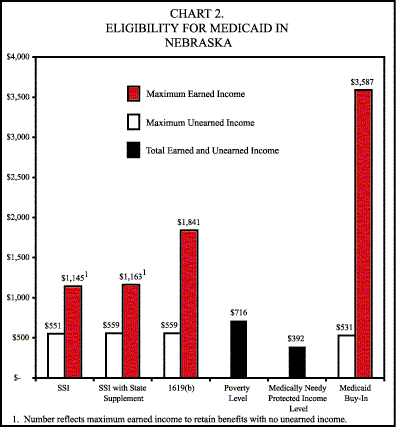
3. Targeting or Cost-Control Mechanisms
The primary targeting mechanism is the requirement that persons have specified amounts of earnings in order to disregard their unearned income from SSDI or other sources when determining countable income. Under these provisions, individuals with low levels of earned income generally would not qualify for the program.
F. Policy Approaches, Administrative Systems, and Stakeholder Involvement
1. Role of the State Legislature
L.B.594, enacted in 1999, set forth general guidelines for the state in developing the Medicaid Buy-In program. It specified maximum income levels for eligibility and minimum income levels for imposition of fees, but left decisions concerning implementation to the executive branch. The law, as enacted, follows in its entirety.
(3) As allowed pursuant to 42 U.S.C. 1396a(a)(10)(A)(ii), medical assistance shall be paid on behalf of disabled persons as defined in section 68-1005 who are in families whose net income is less than two hundred fifty percent of the Office of Management and Budget income poverty line applicable to a family of the size involved and who but for earnings in excess of the limit established under 42 U.S.C. 1396d(q)(2)(B) of the federal Social Security Act, as amended, would be considered to be receiving federal Supplemental Security Income. The Department of Health and Human Services shall apply for a waiver to disregard any unearned income that is contingent upon a trial work period in applying the Supplemental Security Income standard. Such disabled persons shall be subject to payment of premiums as a percentage of the family's net income beginning at not less than two hundred percent of the Office of Management and Budget net income poverty line. Such premiums shall be graduated based on family income and shall not be less than two percent or more than ten percent of family net income.
2. Role of the Executive Branch
The state Medicaid Agency manages the Medicaid Buy-In program as part of its overall management of Medicaid activities.
3. Formal Involvement by the Disability Community
As noted, the state convened a stakeholders group during development of the Medicaid Buy-In to provide input. A formal Advisory Committee with consumers constituting half the membership is a component of the state's Medicaid Infrastructure Grant. As part of the Infrastructure Grant, an Independent Living Center is developing a statewide Consumer Network to give input about the Medicaid Buy-In and TWWIIA activities and to convey information to the disability community. This network will be primarily consumers.
G. Budget Modeling and Cost Estimates
When Medicaid Buy-In legislation was under consideration by the Nebraska Legislature, the Nebraska Health and Human Services System estimated an average monthly caseload of 100 new Medicaid enrollees with average monthly costs of $732 per person. Department officials derived the estimate of 100 new enrollees from information prepared by a state advocacy group. They calculated the estimated monthly cost per person by deleting institutional long-term care expenditures from the state's average monthly expenditures for Medicaid recipients with disabilities. The state anticipated a total enrollment of between 250 persons and 450 persons (including the 100 new enrollees) at the two-year mark of the program.
H. Program Experience and Related Policy Issues
1. Program Experience
As of April 2001, 112 people were enrolled in the program, with no more than two of those persons paying premiums. State officials suggest that at least one reason for the low enrollment is the lack of resources to devote to outreach or publication of brochures.
Nebraska has not gathered detailed program performance information on Medicaid Buy-In program enrollees. Under the Medicaid Infrastructure Grant, the University of Nebraska Public Policy Center will gather information about Nebraska's Medicaid Buy-In program enrollees. The Advisory Committee established under the Medicaid Infrastructure Grant and the Consumer Network established by an Independent Living Center will measure outcomes.
2. State and Federal Policy Issues
The Director of the state's Medicaid Infrastructure Grant notes that there will be difficulties with people becoming and staying employed as long as Social Security rules equate disability with the inability to earn wages beyond a nominal level.
I. Sources Consulted
Medicaid Infrastructure Grant Application. State of Nebraska. July 2000.
Nebraska Health and Human Services Manual. 469 NAC 4-000. Nebraska Medical Assistance Program.
Nebraska Health and Human Services Manual. 471 NAC 15-000 Personal Care Services.
CMS web site at www.cms.gov/medicaid/twwiia/twwiiahp.htm.
Nebraska Quarterly Report. Grant#11-P-92110/7-01. Medicaid Infrastructure Grant.
Nebraska Department of Social Services Manual. Title 480. Home and Community-Based Services.
Nebraska Department of Social Services Manual. Title 469. Working Disabled Medicaid Premium Payment Beneficiaries.
Nebraska Health and Human Services Manual. Manual Letter #16-2001.
Nebraska Health and Human Services Manual. Chapter 8-000 Working Disabled Medicaid Premium Payment Beneficiaries.
Sec. 34 of LB 594.
Nebraska Health and Human Services System. Fiscal Note for LB 518. 2/01/99.
Legislative Fiscal Analyst Estimate. Fiscal Note for LB 518. 2/11/99.
Nebraska Quarterly Report October 2000-March 2001. Medicaid Infrastructure Grant.
OREGON CASE STUDY
A. Overview
Oregon obtained approval in September 1998 for a Medicaid State Plan amendment that added a Medicaid Buy-In. The program began operation in February 1999. The state's Medicaid Buy-In program is referred to as the Employed Persons with Disabilities Program (EPD) and is part of a comprehensive work incentive initiative referred to as Oregon's Employment Initiative (EI).
The impetus for the Medicaid Buy-In program began in 1994. A Work Disincentives Work Group was established to develop elements of an Oregon Demonstration Project to ensure that persons with significant disabilities could continue to have the health benefits and long-term care services they need if they work. The group consisted of state officials, consumers, advocates and researchers. The intention of this group was to seek a Medicaid waiver to establish a Medicaid Buy-In program. In 1996, the Oregon Department of Human Services (DHS) established the EI. In 1999, the Oregon legislature appropriated $2.1 million to the EI.
In designing the Medicaid Buy-In program, consumer involvement was extensive. The state established a steering committee of advocates, consumers, experts and state officials. In deciding what form the Medicaid Buy-In should take, the state put key issues to a vote of the steering committee. In addition to the Medicaid Buy-In, the EI includes services such as information to employers, coordinating the services of peer mentors, interview preparation, and teaching consumers self-advocacy with employers.
To be eligible for the Medicaid Buy-In program, an individual must meet the definition of disability used for purposes of the SSI and SSDI programs and have taxable income. In determining income, all unearned income is disregarded. Adjusted individual earned income must be less than 250% of the FPL. Adjustments include standard deductions under SSI, IRWE, and employment and independence expenses (EIE) paid for out-of-pocket that can reasonably be expected to enhance an individual's independence and employment potential, such as assistive technology devices. The resource limit for the Medicaid Buy-In program is $12,000. Any money in approved accounts set up for expenses to foster independence is also excluded.
The cost sharing provisions in the Oregon Medicaid Buy-In plan distinguish between earned and unearned income. Oregon requires participants to pay as a monthly cost share any unearned income in excess of the state's SSI standard ($533 in 2001). "Special need" SSI state supplements can increase the applicable SSI standard for certain purposes, reducing their payment liability.
There is an additional premium payment if adjusted individual income (unearned income not contributed as part of the cost share and all earned income minus state and federal taxes and EIE) exceeds 200% of the FPL. The premium is a percentage of adjusted income, ranging 2-10%.
Personal assistance services are available statewide 24 hours a day and 7 days a week, both within and outside the home through the Medicaid State Plan and waivers. Consumer-directed services are available through a waiver.
As of September 30, 2001 there were 511 enrollees in the Medicaid Buy-In program in Oregon, an increase from 422 enrolled a year earlier. Slightly over half of program participants had gross monthly earnings above the SGA earnings test of $740 in March 2001, with close to a quarter of the total group having earnings of $1,500 per month or more. The majority of Medicaid Buy-In participants are employed in the private sector and slightly over half of the participants are employed in business services, social services, or human resources administration.
B. Impetus for the Medicaid Buy-In Program and Related Employment Initiatives
Beginning in 1994 with the Oregon Option, the state began to lay the groundwork to reduce work disincentives for persons with disabilities. The Oregon Option was designed to facilitate the development and approval of federal waivers that would reduce work disincentives. For these purposes, a Work Disincentives Work Group was created to develop the elements of an Oregon Demonstration Project to ensure that persons with severe disabilities could continue to have the health benefits they need if they work. The group consisted of state officials, consumers, advocates and researchers. Initially, the group intended to establish a Medicaid Buy-In program through the waiver process.
Two years later the Oregon Option became part of a broader initiative underway in the state. In 1996 the Oregon DHS established the EI. The EI began as a committee designed to look at the issues of employment and persons with disabilities. The committee identified certain policies as barriers to employment for persons with disabilities. Through the EI, the committee hoped to be able to do more on a one-on-one basis to help disabled individuals find and retain employment. After a series of efforts to assist persons with disabilities in becoming employed, the DHS funded ten full-time positions for the EI. As a result of its growing success, in 1999 the Oregon Legislature awarded $2.1 million to the EI to continue its efforts to assist individuals with disabilities obtain employment.
Prior to the implementation of the Medicaid Buy-In program, Oregon was already far ahead of many states. Oregon was previously providing attendant care, a service not covered by many state Medicaid programs, to a large number of people with disabilities. Additionally, in 1981 Oregon received a waiver allowing the use of Medicaid dollars for HCBS.
The idea for a Medicaid Buy-In program was developed in 1996 and was given a boost with the passage of the 1997 BBA. Once the commitment to helping people with disabilities find jobs was officially recognized at the federal level, Oregon began work on its Medicaid Buy-In program. Officials worked with the Federal Government and with local citizens to develop an idea that would receive federal approval.
Oregon received approval for an amendment to its Medicaid State Plan authorizing a Medicaid Buy-In program for people with disabilities in September 1998 and began to implement the program on February 1, 1999. The Medicaid Buy-In program, the EPD program, is part of the overall EI that is administered by the DHS.
Oregon used its wealth of experience with HCBS waivers and the Oregon EI to aggregate information about the needs of persons with disabilities. Although no formal statewide data collection was performed, consumers with disabilities were instrumental in the development of the Medicaid State Plan amendment that created the Medicaid Buy-In.
C. Medicaid Eligibility and State SSI Supplementation Program Prior to the Medicaid Buy-In
The state's state SSI supplementation program policies, its Medicaid eligibility standards, and its approach to implementing SSI work incentives provide a base for understanding the state's Medicaid Buy-In program. These eligibility pathways and the maximum monthly incomes associated with them are shown on Chart 1. As shown on the chart, Oregon has a medically needy program, but has not elected a poverty level option.
1. State SSI Supplement Program
The basic monthly state SSI supplementation program for an individual living in the community is $1.70 for a combined total payment of about $533. The state SSI supplementation program is state-administered. Individuals may be eligible for "special need" payments in addition to the standard supplement for costs of basic needs exceeding the standard payment. Increased costs associated with housing accessibility for a person with a disability or the need for a live-in attendant are among the factors considered when reviewing applicants for "special need" payments.
2. Medicaid Eligibility for Adults with Disabilities
People with disabilities in Oregon are eligible for Medicaid if they receive SSI benefits or the state SSI supplementation program, but must file a separate application for coverage.14 A person with a disability who is not eligible for SSI or the state SSI supplementation program can qualify for Medicaid through the medically needy category if his monthly income is at or below $413. An individual may spend down to the medically needy category by incurring medical bills sufficient to reduce his monthly income to the protected income level of $413.
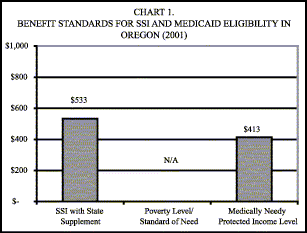
Oregon has extended its insurance coverage options through Medicaid Section 1115 waivers. Any individual in Oregon whose family income is below 100% of the FPL can enroll in the Oregon Health Plan.
3. Implementation of SSI Work Incentives (Section 1619(a) and (b))
Work incentives in Section 1619 of the federal SSI law provide continued Medicaid eligibility for SSI beneficiaries whose income from earnings could otherwise make them ineligible for coverage. These incentives enable such individual to maintain a connection to both the SSI income assistance program and the Medicaid program when they work. Under Section 1619(a), an individual whose earnings exceed the SGA earnings test receives SSI cash benefits on a gradually reduced basis and continues to receive Medicaid. In June 2001, 187 persons in Oregon, with average monthly earnings of $942, received SSI and Medicaid on the basis of Section 1619(a).
Under Section 1619(b) and Section 1905(q) of Medicaid law, a person who no longer receives SSI payments because of his earnings level is entitled to Medicaid as long as his disability continues and his earnings are below a federally determined equivalence standard ($2,023 monthly in Nebraska). Whether a state provides automatic Medicaid eligibility for SSI beneficiaries and whether it chooses federal or state administration of its state SSI supplementation program affect the capacity of eligible persons to access Section 1619(b) protections.
In Oregon, a state requiring a separate Medicaid application for SSI beneficiaries, guaranteeing continued Medicaid for persons entitled through Section 1619(b) is administratively complex. When an individual leaves SSI, the state Medicaid agency must review SSA data to track his 1619(b) eligibility status and determine him eligible for continued Medicaid coverage. (By contrast, where Medicaid eligibility is automatic for SSI beneficiaries, the Federal Government sends the state a list of Medicaid-eligible persons, including persons eligible through Section 1619(b).) In June 2001, SSA identified 1,047 persons in Oregon, with average monthly earnings of $854, as potentially eligible for Medicaid under Section 1619(b). Information on the actual enrollment status of these individuals is not available.
Under its state-administered state SSI supplement program, Oregon does not apply 1619(b) work incentive protections to recipients of state SSI supplementation who do not also receive a federal SSI check. (In states with federally administered state SSI supplements, such persons retain their Medicaid coverage under rules similar to those in effect for SSI recipients.) With Oregon's low SSI state supplementation level, relatively fewer people are likely to be affected by this decision than is the case in other states.
4. Personal Assistance Services
Oregon qualifies as a fully-eligible state under the CMS Medicaid Infrastructure Grant classification. Personal assistance services are available statewide 24 hours a day and seven days a week, both within and outside the home through the Medicaid State Plan and waivers. Consumer-directed services are available through a waiver. The Office of Developmental Disabilities Services also administers a HCBS waiver capable of supporting competitive employment and providing pre-vocational support. On-going employment and pre-vocational support services were provided to 4,134 individuals at the time of the Medicaid Infrastructure Grant proposal, with 2,277 persons on the wait list.
D. Medicaid Buy-In Program Design Features and Other Work Incentives
1. Medicaid Buy-In Eligibility
General Criteria To be eligible for the Medicaid Buy-In, an individual must meet the SSA definition of disability and have taxable income.
Income CriteriaIn determining eligibility for the Medicaid Buy-In program, all unearned income is disregarded. Adjusted individual earned income must be less than 250% of the FPL. In addition to standard SSI deductions, Oregon deducts EIE to arrive at adjusted income. EIE can be any expense paid for out-of-pocket that can reasonably be expected to enhance the individuals independence and employment potential. EIE must be approved by the local DHS office. Possible EIE include: monthly car payments, mileage, noncovered medical expenses, assistive devices, interpreter, reader, or attendant services not covered by Medicaid, and deposits into approved accounts.
Resource LimitationsThe resource limit for the Medicaid Buy-In program is $12,000. Any money in approved accounts is also excluded. These accounts are specifically for saving for future investments that can reasonably be expected to enhance the individuals independence and employability. Possible expenditures from these accounts include a new car or van, a down payment on a more accessible home or modifications to a current residence, assistive technologies, and retirement accounts or medical savings accounts. (Although retirement accounts may be approved accounts, deposits are not considered EIE and cannot be deducted in determining countable income.)
Eligibility PeriodThe eligibility period is 12 months.
2. Cost Sharing Policies
Oregon requires participants to pay to the state as a monthly cost share any unearned income in excess of the states SSI standard ($533 in 2001). If an individual has a "special need" supplement, the SSI standard, for purposes of determining Medicaid Buy-In program premium liability, increases by the amount of the supplement. According to Oregon officials, over half of the Medicaid Buy-In enrollees are not required to pay the unearned income cost share. This occurs because such individuals are receiving a special need payment raising their SSI standard above their monthly SSDI or other unearned income levels.
An individual whose adjusted individual income exceeds 200% of the FPL pays an additional premium. Adjusted individual income refers to the total amount of an individual's earned income and any unearned income not paid as a cost share after deducting mandatory taxes, disability-related expenses (IRWEs and BWEs) and EIE. The premium is a percentage of the amount of adjusted income over 200% of the FPL, based on a sliding scale 2-10%.
The premium does not begin until the second certification period (a certification period is six months so premiums would begin in the seventh month). Premium calculations are performed semi-annually. If the client provides evidence of a change in circumstance, the premium may be recalculated. To remain eligible for the Medicaid Buy-In, the premium must be paid each month. A local office may waive a premium if the client provides proof of significant economic difficulty (e.g., divorce, illness). IRWE and EIE costs are estimated using the previous six-month period.
3. Link Between Medicaid Coverage and Employer Health Plans
Medicaid Buy-In participants are encouraged to purchase employer-sponsored insurance, if offered. As required by federal law, Medicaid provides wrap-around coverage for people who purchase such coverage.
4. Other Components of a Comprehensive Work Incentive Initiative
For more than a decade, Oregon has sought to increase the independence and employment of persons with disabilities. A national leader in the development of HCBS waivers in 1981, Oregon continued its commitment to citizens with disabilities by establishing the EI. As noted earlier, the EI began as an outgrowth of a committee reviewing the issue of employment and persons with disabilities.
The 1999 Legislature funded a budget package giving $2.1 million to the DHS for the EI. Using these funds, the state created EI Specialists providing services such as placement assistance; providing information to employers; coordinating the services of peer mentors; interview preparation; and teaching consumers self-advocacy with employers.
E. Effects of the Medicaid Buy-In Program on Medicaid Eligibility
Chart 2 identifies the Medicaid eligibility categories for adults with disabilities, including the Medicaid Buy-In category. It sets forth the maximum monthly income levels for each category, including, as appropriate, earned and unearned income limits.
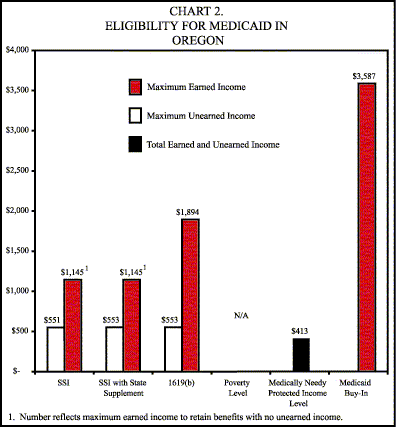
1. Connection Between the Medicaid Buy-In and State SSI Supplementation Program
Oregon's Medicaid Buy-In program has separate cost sharing provisions for earned income and unearned income. The provisions related to unearned income have the effect of equalizing the unearned income of Medicaid Buy-In participants with that of recipients receiving Medicaid on the basis of SSI eligibility.
Every Medicaid Buy-In participant must pay to the state as a cost share any unearned income over the SSI monthly benefit standard of $533. Therefore, whether an individual receives Medicaid on the basis of SSI eligibility or through the Medicaid Buy-In, the amount of unearned income he retains is the same. As a result, under the Medicaid Buy-In, the amount of total net income a participant in Oregon retains depends on his earnings, not on the amount of SSDI he receives. Requiring an individual to pay unearned income over the state SSI standard allows the state to influence the work characteristics of participants. Those who participate in the Medicaid Buy-In program will be individuals who can earn more through work than they will lose through the unearned income cost share.
2. Connection Between the Medicaid Buy-In and Other Medicaid Eligibility Categories
The unearned income of a participant in the Medicaid Buy-In program is treated similarly to the unearned income of a person in the state's HCBS waiver program. The program's cost sharing provisions are similar to the cost of care payments made by individuals in HCBS waiver programs.
For some working persons with disabilities, the Medicaid Buy-In program provides health coverage for persons with too much income to qualify under the Oregon Health Plan, a Medicaid Section 1115 waiver in place for a number of years in the state.
3. Targeting or Cost-Control Mechanisms
The requirement that all unearned income over the state's SSI benefit standard be paid as a cost share is likely to influence the number and characteristics of persons who enroll in the program. Persons with relatively high SSDI benefits and earnings less than the difference between these benefits and the SSI benefit standard may not find the Medicaid Buy-In program advantageous because their unearned income cost sharing liability would be higher than their medically needy spend down amount. In general, persons with significant earnings ability and relatively low SSDI benefits are more likely to use the Medicaid Buy-In program. With more of their income from earnings, the unearned income premium -- the difference between their SSDI benefits and the SSI benefit standard -- constitutes a manageable portion of total income.
F. Policy Approaches, Administrative Systems, and Stakeholder Involvement
1. Role of the State Legislature
The Medicaid Buy-In program was created through a Medicaid State Plan amendment, rather than through legislation. However, the state legislature played a key role in the development of the EI.
2. Role of the Executive Branch
The Medicaid Buy-In program is run by the Medicaid agency within DHS and draws on resources from the Vocational Rehabilitation Division (VRD). It was important to policy makers that the program be a collaborative effort between the two divisions so that the Medicaid Buy-In program could be coupled with a vocational rehabilitation program. VRD counselors help coordinate job shadowing or volunteer work experiences as a method of vocational exploration, conduct life skills classes, and coordinate evaluation of vocational interests, skills, and abilities. In addition, VRD is working on outreach efforts to educate the business community on employing persons with disabilities. Various divisions of DHS sit on the Employment Initiative Steering Committee. In some cases local Medicaid eligibility offices are housed with vocational rehabilitation offices.
3. Formal Involvement by the Disability Community
Oregons consumer involvement is extensive. In designing the Medicaid Buy-In program, the state created a steering committee of advocates, consumers, experts and state officials. In deciding what form the Medicaid Buy-In program should take (who to target, what are the goals, should a sliding fee scale be used, etc.), the state put issues to a vote of the steering committee.
G. Budget Modeling and Cost Estimates
The state did not develop formal cost estimates. During its deliberations on program design, the Steering Committee voted to give priority for program enrollment to SSDI recipients but to include interested SSI populations as well.
H. Program Experience and Related Policy Issues
As of September 30, 2001 there were 511 enrollees in the Medicaid Buy-In program in Oregon, an increase from 422 enrolled a year earlier. The Oregon Department of Employment has wage records for 277 of the Medicaid Buy-In enrollees for the month of March 2001. At that time, as shown in the table below, slightly over half of program participants had gross monthly earnings above the SGA earnings test of $740, with close to a quarter of the total group having earnings of $1,500 per month or more.
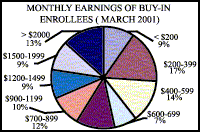
As of March 31, 2001, over half of Medicaid Buy-In program participants were employed in business services, social services, or human resources administration. State data show that four of every five participants are employed in the private sector with the remainder working in the public sector.
| MEDICAID BUY-IN EMPLOYMENT BY INDUSTRY(March 2001) | |||
| Business services | 20 % | Executive, legislative & general | 5% |
| Social services | 19 % | Educational services | 5% |
| Administration of human resources | 12 % | General merchandise stores | 4% |
| Health services | 9% | Food stores | 4% |
| Eating & drinking services | 8% | Real estate | 4% |
| Auto dealers & service stations | 5% | Membership organizations | 4% |
Oregon has preliminary information on the type of disability experienced by individuals in the Medicaid Buy-In program. Among those enrolled, 54% are persons with physical impairments, 28% are persons with mental illness, 14% are persons with cognitive impairments, with the status of the remaining 4% unknown.
I. Sources Consulted
American Public Human Service Association. Article on Oregon Employment Initiative, March 1999.
History of the Employment Initiative, February 2000.
http://www.ssa.gov/statistics/ssi_sap/2000/or.pdf.
Oregon's Employed Persons with Disabilities Program. Accessed at www.hcfa.gov/medicaid/twwiia/buyinor.htm.
Oregon Infrastructure Grant.
Oregon material from Institute for Community Inclusion (ICI) RRTC Conference on "Employment Initiatives for Persons with Disabilities", April 5-6, 2001.
Oregon State Regulations. P. 25, 461-160-0850.
Scott Lay. Oregons Employed Persons with a Disability Program: Why We Made Certain Choices, October 1998.
VERMONT CASE STUDY
A. Overview
On June 2, 1999, Vermont passed legislation authorizing a Medicaid Buy-In program. On January 1, 2000, Vermont implemented its Medicaid Buy-In program.
The impetus for the Medicaid Buy-In program was language included in the FY 1995 appropriations bill requiring the Agency for Human Services to prepare a report identifying potential methods by which to increase the number of employed individuals with disabilities by reducing barriers to employment. Prior to submitting its report in January 1997, the Agency conducted several focus groups and did significant research relating to Medicaid and its interaction with the SSI and SSDI programs.
The Medicaid Buy-In program is part of a comprehensive work incentive initiative called the Vermont Work Incentives Initiative Project that also includes comprehensive services such as benefits counseling and job training. An additional key element is securing demonstration authority from the SSA regarding the operation of the SSI and SSDI programs in the state. The demonstration authority is designed to provide greater protections for Medicaid Buy-In participants and, under the SSDI program, provide for gradual rather than precipitous loss of benefits. Vermont has secured demonstration authority from SSA providing additional protections for SSI recipients but has yet to secure such authority for its SSDI recipients.
Vermont's Medicaid Buy-In program is viewed as a companion program to its Children's Health Insurance Program (CHIP). The premium schedule for the Medicaid Buy-In program parallels the premium schedule for CHIP. The Medicaid Buy-In program also provides coverage for employed persons with disabilities with too much income to qualify under the Vermont Health Access Plan (VHAP), a Section 1115 Medicaid waiver program with somewhat more limited benefits than the traditional Medicaid program.
The applicant is subject to a two-part income test. First, the applicant's family net income using SSI-related rules must be below 250% of the FPL. Second, after disregarding the individual's earnings and $500 of his Social Security disability payments, his total family income must be below the SSI or medically needy Medicaid eligibility level for his family size.
Applicants must meet regular Medicaid assets test. However, a key feature of the Medicaid Buy-In program is that an individual can retain up to 100% of his earnings from January 1, 2000 onward. These retained earnings do not count toward the asset test.
Vermont offers personal assistance under Medicaid HCBS waivers and through a state-funded program. Vermont is drafting rules to create a Medicaid State Plan program to mirror its state-funded personal assistance program.
When the Medicaid Buy-In was under consideration, state agency officials gathered cost data for a sample of SSDI consumers who received Medicaid services, and multiplied those costs by predicted enrollment. In designing the program, Vermont officials assumed that the vast majority of enrollees would be existing Medicaid recipients. By June 2001, about 280 individuals had enrolled in the Medicaid Buy-In program with 90% of them persons who were already on Medicaid and 70% of them clients of the vocational rehabilitation program.
B. Impetus for the Medicaid Buy-In Program and Related Employment Initiatives
The Vermont Department of Vocational Rehabilitation (DVR), working with the Vermont Center for Independent Living and other advocates, drafted the rules for a Medicaid Buy-In program as part of a comprehensive work incentive effort. The Governor approved the program design and added funding to his FY 2000 budget.
As part of the larger national debate and discussion related to welfare reform many states, including Vermont, looked at potential areas to reduce the dependence of individuals on government programs. Policy makers viewed a health insurance Medicaid Buy-In program as an attractive and cost-effective option, much like providing day care services to able-bodied but unemployed mothers.
To that end, the Vermont Legislature included language in its FY 1995 appropriations bill requiring the Agency for Human Services to prepare a report. The report identified potential methods to increase the number of persons with disabilities who were employed by reducing employment barriers. The Medicaid Buy-In program was among the policy actions taken after release of the report.
When preparing the mandated report, the Department of Aging and Disabilities (DAD) in the Agency for Human Services conducted several focus groups including individuals with disabilities and their families, service providers, employers and employment services, and state legislators and agencies. DAD conducted research on Medicaid's interaction with SSI and SSDI, and on related issues of benefits counseling and transportation. The report, released in January 1997, found that only 1% of disabled individuals receiving SSDI return to work. Seventy-eight percent would like to work, but fear losing either cash benefits or Medicaid coverage.15 Major recommendations included tax credits, increased job training and benefits counseling, improved transportation and support services, outreach efforts to employers, and expanded health care coverage.
C. Medicaid Eligibility and State SSI Supplementation Program Prior to the Medicaid Buy-In
The state's state SSI supplementation program standards, its Medicaid eligibility standards, and its approach to implementing SSI work incentives provide a base for understanding the state's Medicaid Buy-In program. These eligibility pathways and the maximum monthly incomes associated with them are shown on Chart 1. As shown on the chart, Vermont has a medically needy program, but has not elected a poverty level option.
1. State SSI Supplement Program
The basic monthly state SSI supplementation program for an individual living in the community is $59 for a combined total payment of $590. The state SSI supplementation program is federally administered.
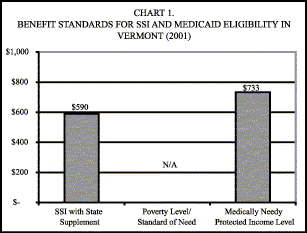
2. Medicaid Eligibility for Adults with Disabilities
People with disabilities in Vermont are categorically eligible for Medicaid if they receive SSI benefits or the state SSI supplementation program. A person with a disability who is not eligible for SSI or the state SSI supplementation program can qualify for Medicaid through the medically needy category if his monthly income is at or below $733. An individual may spend down to the medically needy category by incurring medical bills sufficient to reduce his monthly income to the protected income level of $733.
Vermont has extended its Medicaid eligibility options through Medicaid Section 1115 waivers. Any individual in Vermont with no other health insurance whose family income is below 150% of the FPL can enroll in the VHAP. Persons enrolled in Medicare are not eligible for VHAP, but persons with disabilities who are not enrolled in Medicare would be eligible for coverage. Any elderly person or person with a disability on Medicare with family income below 150% of the FPL can enroll in the VHAP Pharmacy program to supplement his Medicare coverage. VHAP Pharmacy includes full coverage for prescription drugs with very low co-payments ($1 or $2 per prescription). Finally, the state funds a VSCRIPT Pharmacy program that covers half of all prescription costs for elderly persons or persons with disabilities with family income below 225% of the FPL.
3. Implementation of SSI Work Incentives (Section 1619(a) and (b))
Work incentives in Section 1619 of the federal SSI law provide continued Medicaid eligibility for SSI beneficiaries whose income from earnings could otherwise make them ineligible for coverage. These incentives enable such individuals to maintain a connection to both the SSI income assistance program and the Medicaid program when they work. Under Section 1619(a), an individual whose earnings exceed the SGA earnings test receives SSI cash benefits on a gradually reduced basis and continues to receive Medicaid. In June 2001, 143 persons in Vermont, with average monthly earnings of $1,019, received SSI and Medicaid on the basis of Section 1619(a).
Under Section 1619(b) and Section 1905(q) of Medicaid law, a person who no longer receives SSI payments because of his earnings level is entitled to Medicaid as long as his disability continues and his earnings are below a federally determined equivalence standard ($1,985 monthly in Vermont). Whether a state provides automatic Medicaid eligibility for SSI beneficiaries and whether it chooses federal or state administration of its state SSI supplementation program affect the capacity of eligible persons to access Section 1619(b) protections.
Because Vermont provides automatic Medicaid eligibility for SSI recipients, persons who lose their entitlement to SSI payments due to earnings remain on the Medicaid rolls with no additional administrative work required of the state Medicaid agency. SSA sends the state a list of Medicaid-eligible persons, including persons eligible through Section 1619(b). Thus, persons in Vermont who are eligible for SSI have relatively easy access to SSI work incentive protections, including continued Medicaid coverage. In June 2001, SSA identified 348 persons in Vermont, with average monthly earnings of $922, as potentially eligible for Medicaid on the basis of Section 1619(b).
Vermont has elected to have the Federal Government administer its state SSI supplementation program. As a result, persons who are not eligible for SSI, but are only eligible for the state SSI supplementation program, receive work incentive protections, including continued Medicaid coverage under Section 1619 that are available to SSI beneficiaries.
4. Personal Assistance Services
Vermont has a "personally-directed attendant care program" that is 100% state-funded and provides personal assistance services to workers with disabilities regardless of income or assets. This program serves over 400 Vermonters but has a waiting list. Vermont also has personal assistance under HCBS waivers and home nurse programs. In FY 2000, 1,247 persons were served under the Vermont HCBS waiver program for the elderly and persons with disabilities.
The CMS determined Vermont was "conditionally eligible" under the Medicaid Infrastructure Grant because primary attendant services to workers with disabilities are provided under a state-funded program, rather than the Medicaid program. Vermont is drafting rules to create a Medicaid State Plan program to mirror its state-funded personal care program. Funds now expended in the state-funded program will be used to draw match under the Medicaid program.
D. Medicaid Buy-In Program Design Features and Other Work Incentives
1. Medicaid Buy-In Eligibility
General Criteria Individuals are eligible for the Medicaid Buy-In program if they meet the SSA definition of disability, are working, and meet the financial standards.
Income CriteriaAn applicant is subject to a two-part income test. First, the applicant's family net income using SSI-related rules must be below 250% of the FPL. Second, after disregarding the individual's earnings and $500 of his Social Security disability payments, his total family income must be below the SSI or medically needy Medicaid eligibility level for his family size.
Resource LimitationsAn individual who applies for the Medicaid Buy-In program must meet the SSI resources test except that he can save up to 100% of any earnings he accumulated through work after January 1, 2000, the starting date of the Medicaid Buy-In program. Assets accumulated from work can also be in the form of liquid assets held in a bank account, or in retirement accounts or medical savings accounts or they can be in the form of non-liquid assets purchased with income from employment.
Eligibility PeriodEnrollees are certified for six-month periods.
2. Cost Sharing Policies
Individuals share costs on a sliding scale based on family income. There is no charge for those with incomes at or below 185% of the FPL. Persons with family incomes of more than 185% of the FPL but no more than 225% of the FPL pay a $10 monthly fee. Persons with incomes of more than 225% of the FPL, but no more than 250% of the FPL pay a $12 fee if they have private insurance and a $25 fee if they do not. The Medicaid Buy-In fee schedule is built on the premium structure developed for the CHIP.
3. Link Between Medicaid Coverage and Employer Health Plans
Enrollment in employer-sponsored plans is not compulsory but individuals in the 225% to 250% of the FPL income group are eligible for a discounted premium if they secure coverage.
4. Protections and Assurances for Enrollees
DVR has requested several federal waivers to coincide with the Medicaid Buy-In program. State officials expect these waivers to encourage significant numbers of employed persons with disabilities to seek higher paying jobs while many currently unemployed individuals will become employed.
In the case of SSI beneficiaries, state officials have received approval for a demonstration waiver that will give more favorable treatment to certain types of unearned income derived from work, suspend continuing disability reviews, and allow accumulation of additional resources. To limit the effects of the SSDI "cash cliff" problem, Vermont officials have proposed a reduction of one dollar in benefits for every two dollars earned above the SGA. This waiver is pending.
5. Other Components of a Comprehensive Work Incentive Initiative
The Vermont Work Incentives Initiative Project includes comprehensive benefits counseling and job training services for individuals with physical disabilities and mental illness. Benefits specialists staff each local DVR office and also all the community mental health centers in the state. These individuals work with the participants, service providers, family members, and advocates to minimize barriers to employment. They also facilitate interactions with DVR for job training, counseling, and case management. Further, they act as a resource when participants deal with Social Security or Medicaid offices. The mental health component uses the "Individual Placement Services" model to increase the employment of mentally ill Vermonters.
E. Effects of the Medicaid Buy-In Program on Medicaid Eligibility
Chart 2 identifies the Medicaid eligibility categories for adults with disabilities, including SSI work incentives and the Medicaid Buy-In category. It sets forth the maximum monthly income levels for each category, including, as appropriate, earned and unearned income limits.
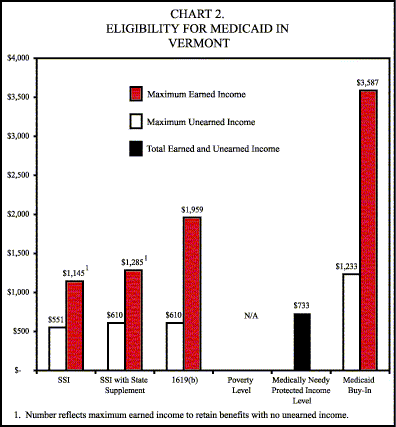
1. Connection Between the Medicaid Buy-In and State SSI Supplementation Program
The Medicaid Buy-In program increases by $500 per month the amount of unearned income an individual with earnings can disregard when determining his eligibility for Medicaid. Thus, it provides Medicaid eligibility for many persons with earnings who have too much SSDI or other unearned income to become eligible for SSI work incentives.
2. Connection Between the Medicaid Buy-In and Other Medicaid Eligibility Categories
Medically NeedyBy enrolling for Medicaid through the Medicaid Buy-In program, persons previously eligible as medically needy can increase their net incomes if they have earnings. Under Vermont's medically needy program, an individual can retain $733 in combined earned and unearned income. For persons whose monthly incomes apart from earnings exceed $733, all work income is subject to a spend down, providing a financial disincentive to work. By contrast, in the Medicaid Buy-In program, such an individual pays no fee or a fee of $10-$25 monthly for his Medicaid coverage. The favorable fee structure provides a significant incentive for persons previously enrolled in the medically needy category to gain additional income from work.
Children's Health Insurance Program (CHIP)The Medicaid Buy-In program in Vermont is a companion program to the CHIP. The Medicaid Buy-In premium schedule parallels the CHIP premium schedule.
Vermont Health Access Plan (VHAP)The Medicaid Buy-In program provides health care coverage for persons with too much income to qualify for the VHAP, a Section 1115 Medicaid waiver program in place for a number of years. The VHAP benefit package is more limited than the Medicaid package and some persons otherwise eligible for VHAP may choose to become employed and enroll in the Medicaid Buy-In to acquire a broader range of benefits.
3. Targeting or Cost-Control Mechanisms
Eligibility is limited to persons with monthly unearned income of $1,233 or less, providing a limit on enrollment by persons with higher amounts of unearned income.
F. Policy Approaches, Administrative Systems, and Stakeholder Involvement
1. Role of the State Legislature
Authorizing legislation specified income eligibility requirements but left the cost sharing structure and other decisions to the executive branch. The Medicaid Buy-In legislation, in its entirety, reads as follows:
Of the above special funds, $46,000.00 shall be used to extend Medicaid eligibility to disabled workers in families whose income is less than 250% of the federal poverty level and who would be considered to be receiving Supplemental Security Income (SSI) except for earnings in excess of SSI income limits or, subsequent to initial Medicaid eligibility, assets in excess of SSI limits that are attributable to savings from earnings. In addition, up to $500 per month of the disabled worker's Social Security Disability Insurance payments shall be disregarded in the Medicaid eligibility determination. The commissioner shall have the authority to establish program premiums and other cost sharing charges by rule for such coverage. These funds shall be matched with available federal funds.16
2. Role of the Executive Branch
DVR and the Medicaid agency collaborated on program rules. Implementation occurs in local social welfare and health access offices. The DVR conducted training on the Medicaid Buy-In program for advocates, consumers, DVR and mental health staff, and Medicaid trained their own staff.
The DVR runs the Vermont Work Incentive Initiative, a comprehensive effort to remove barriers to employment for people on SSI/SSDI, which includes benefits counseling, SSA waivers and peer counseling. The DVR partners closely with Medicaid, mental health agencies, SSA and other relevant partners.
3. Formal Involvement by the Disability Community
In preparing the report mandated by the legislature, the state convened several focus groups. Members of advisory groups included disabled individuals, their families, caretakers, service providers, advocates, and government officials and employees. Members were divided into two groups: a professional group consisting mostly of DVR, SSA, Medicaid and mental health staff, and a consumer advisory group that advises the broader Work Incentive Initiative.
G. Budget Modeling and Cost Estimates
Because employed persons with SSI eligibility already receive Medicaid protections under Section 1619, the Medicaid Buy-In program is aimed at SSDI consumers who are employed. The state assumed approximately 90% of participants would be existing Medicaid or VHAP recipients, and that most of the remainder would have been receiving Medicare and VHAP Pharmacy without Medicaid. Officials based this assumption largely on the data demonstrating the proportion of disabled individuals on Medicaid who were working in relation to the number with a desire to work.
To develop budget estimates, officials gathered Medicaid utilization costs for a sample of SSDI consumers who received Medicaid services, and multiplied those costs by predicted enrollment. They estimated what percentage of those consumers would be "new" to Medicaid and included costs only for those consumers.
H. Program Experience and Related Policy Issues
1. Program Experience
By mid 2001, about 280 individuals had enrolled in the Medicaid Buy-In program. About 90% of the enrollees had previously been enrolled in Medicaid under different eligibility categories and 70% are DVR consumers.
2. State and Federal Policy Issues
As noted, Vermont has requested demonstration authority from SSA to support employment of SSI and SSDI recipients. The SSI request has been granted; the SSDI request is still pending. The waivers will complement the Medicaid Buy-In by providing additional protections for persons with disabilities who enter the workforce.
I. Sources Consulted
CMS web site at http://www.cms.gov/medicaid/twwiia/infgraw.htm.
Heather Johnson-Lamarche. The Barriers to Employment Faced by Persons with Disabilities: Problems and Solutions. Report to the Vermont General Assembly on Work Disincentives. January 1997.
Vermont Act 62, paragraph.. Formerly H.554 sec. 121h. Accessed at www.leg.state.vt.us/docs/2000/acts/ACT062.htm.
Vermont Work Incentive Initiative Project flyer. Undated.
Vermont Work Incentive Initiative, PowerPoint Presentation by Peter Baird. July 2001.
Vermont Work Incentive Initiative, SSI Waiver Request. Peter Baird, Division of Vocational Rehabilitation, August 2000.
Vermont Work Incentive Initiative, Title II Waiver Requests. Division of Vocational Rehabilitation. August 10, 2000.
Vermont Infrastructure Grant application.
State of Vermont. Agency of Human Services Bulletin. No. 99-15P. January 1, 2000.
WISCONSIN CASE STUDY
A. Overview
Wisconsin's Medicaid Purchase Plan (Wisconsin's Medicaid Buy-In program) was enacted in October 1999 and implemented in March 2000.
The impetus for Wisconsin's Medicaid Buy-In program was work incentives research begun in 1993. The research, with significant consumer input, continued until 1997 when the state formally established its Pathways to Independence project (Pathways). Pathways is a five-year demonstration project, offering each participant an individualized support team providing comprehensive services, including vocational assistance and benefits management to individuals with disabilities who are seeking employment.
A key premise of Pathways is that persons in the Medicaid Buy-In program and the Pathways demonstration need additional protections in order to risk working. In addition, SSDI recipients should be subject to gradual rather than precipitous loss of cash benefits. SSA must grant demonstration authority to implement these policies. To date, SSA has granted demonstration authority for the SSI recipients in the Pathways program; demonstration authority is still pending for the SSDI recipients.
Residents of Wisconsin with disabilities are eligible for the Medicaid Buy-In program if net family income is less than 250% of the FPL. IRWE are excluded from countable income. Wisconsin uses a high asset standard, allowing participants to have up to $15,000 in countable assets. Wisconsin also encourages savings by workers with disabilities. Medicaid Buy-In participants may deposit up to 50% of earned income in Independence Accounts. Funds in these accounts are not considered countable assets. The accounts may be used for retirement savings, purchase of a home or car, or purchase of other goods or services that will increase independence.
The Wisconsin Medicaid Buy-In program has a premium structure that draws a distinction between earned and unearned income. The premium rate is equal to 100% of unearned income (minus a living allowance and specified deductions) plus 3% of the individual's earned income. Premiums are assessed when an individual's income is at or above 150% of the FPL for his family size.
Unlike most Medicaid Buy-In programs, participants in Wisconsin's Medicaid Buy-In program are not required to have earnings from work when they enroll. As an alternative, they may enroll in a Health and Employment Counseling (HEC) Program for up to one year. If a participant loses his job, he does not automatically lose eligibility for the Medicaid Buy-In. If an individual has been in the Medicaid Buy-In for at least six months and has a health setback that makes him unable to work, the state may waive the work requirement for up to six months.
Personal care services are covered under the Medicaid State Plan and through HCBS waivers and are available statewide up to 24 hours a day and seven days a week. Services are available outside the home and are capable of supporting full-time competitive employment.
In developing its cost estimates, Wisconsin considered the experiences of Massachusetts and Oregon, which were designing similar programs. In addition, data were gathered from SSA quarterly reports, Urban Institute reports on the use of sliding scale premiums, Census data, and 1995 Survey of Income and Program Participation. Program planners assumed that a significant majority of participants would be individuals already on Medicaid or persons who would move to the Medicaid Buy-In from state-funded community-based care programs. Cost estimates projected net savings for the state from the program. Program planners projected approximately 2,100 enrollees for FY 2001; the Wisconsin Legislative Fiscal Bureau projected 1,190 for the same period.
As of July 2001, 1,590 persons were enrolled in the Purchase Plan. Approximately 10% of participants have earned incomes exceeding the $740 SGA earnings test. In June 2001, 16% of enrollees were paying premiums. Almost a third of persons with premium obligations paid the lowest fee of $25 per month, with another third paying either $50, $75, or $100, and the remainder paying $125 or more.
B. Impetus for the Medicaid Buy-In Program and Related Employment Initiatives
Using state and county funds, the State of Wisconsin contracted with Employment Resources, Inc. (ERI), a community rehabilitation provider, and the University of Wisconsin to begin researching work incentives in 1993. Consumers played an instrumental role in designing the study and were part of a consumer-based Advisory Council for the project. Over an 18-month study period, the researchers used focus groups and individual interviews to gather information about the employment barriers faced by persons with disabilities.
Loss of Medicaid benefits was a major concern of the surveyed individuals as was the lack of comprehensive vocational services, including career planning, education, and job placement. The Advisory Council made recommendations on ways to remove the identified barriers, including a pilot program to coordinate the various service systems (vocational, health, housing) that serve people with disabilities.
Building on this work, the state, along with ERI, piloted the Vocational Futures Planning Process in 1994-1995. Vocational Futures Planning involved coordination of vocational, long-term support, and rehabilitation technology services, consumer mentors and employers to develop solutions to an individuals identified barriers to employment. Based on work with an initial group of 30 participants, the Process evolved a model of individualized vocational services emphasizing benefits counseling. In 1997 and 1998, officials in Wisconsin began discussing the need for the SSA, SSI/SSDI, and Medicaid waivers to extend participation in employment initiatives activities.
In 1997, the Robert Wood Johnson Foundation, the State of Wisconsin, and Dane County jointly funded the Health Systems for Workforce Enhancement Research and Demonstration Project. Fifty-three individuals with significant physical disabilities were randomly recruited from Dane Countys long-term support programs. Those assigned to the experimental group were to receive benefits and employment counseling and an assurance that their health coverage would not be taken away if they worked for wages. But project managers quickly discovered that this demonstration project would not be possible without SSA and HCFA waivers. Instead, they conducted a feasibility project, providing counseling along with guarantees that existing benefits would be held harmless during the project period.
Wisconsin established Pathways to Independence demonstration project as a continuance of the 1997-1998 project to provide coordinated vocational and health care advising to individuals with disabilities. The state passed legislation in 1997, intending to form a program similar to a Medicaid Buy-In by using a Section 1115 waiver, but the passage of the BBA of 1997 allowed Wisconsin to add a Medicaid Buy-In as a Medicaid State Plan amendment instead. In addition to general funds, the demonstration is supported by grants from the SSA and the Robert Wood Johnson Foundation.
C. Medicaid Eligibility and State SSI Supplementation Program Prior to the Medicaid Buy-In
The state's state SSI supplementation standards, its Medicaid eligibility standards, and its approach to implementing SSI work incentives provide a base for understanding the state's Medicaid Buy-In program. These eligibility pathways and the maximum monthly incomes associated with them are shown on Chart 1. As shown on the chart, Wisconsin has a medically needy option, but has not elected a poverty level or standard of need option.
1. State SSI Supplement Program
In 2001 the monthly state SSI supplementation program for an individual with a disability living independently was $84, resulting in a maximum monthly combined federal and state payment of $615 for an individual. Since 1996, the state SSI supplemental is not available to new SSI applicants unless their income is of a level that they also qualify for the federal SSI benefit. Persons who had received the state SSI supplement without federal benefits prior to 1996 will continue to receive the state supplement as long as they qualify. The state administers the state SSI supplementation program. Wisconsin provides a higher state SSI supplement for persons living in other living arrangements such as private non-medical group homes or residential settings. Approximately 25% of Wisconsins SSI recipients receive a higher state supplement.
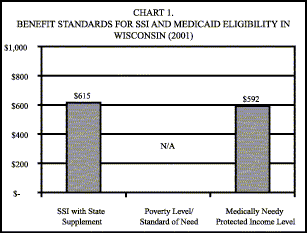
2. Medicaid Eligibility for Adults with Disabilities
People with disabilities in Wisconsin are categorically eligible for Medicaid if they receive SSI benefits or state SSI supplementation. Under Wisconsin's medically needy category, an individual with a disability receives Medicaid when, after deducting incurred medical expenses from his income, his remaining income is at or below the medically needy protected income standard of $592. There is an earned income disregard for the medically needy program.
3. Implementation of SSI Work Incentives (Section 1619(a) and (b))
Work incentives in Section 1619 of the federal SSI law provide continued Medicaid eligibility for SSI beneficiaries whose income from earnings could otherwise make them ineligible for coverage. These incentives enable such individuals to maintain a connection to both the SSI income assistance program and the Medicaid program when they work.
Under Section 1619(a), an individual whose earnings exceed the SGA earnings test receives SSI cash benefits on a gradually reduced basis and continues to receive Medicaid. In June 2001, 557 persons in Wisconsin, with average monthly earnings of $943 received SSI and Medicaid on the basis of Section 1619(a).
Under Section 1619(b) and Section 1905(q) of Medicaid law, a person who no longer receives SSI payments because of his earnings level is entitled to Medicaid as long as his disability continues and his earnings are below a federally determined equivalence standard ($1,854 monthly in Wisconsin). Whether a state provides automatic Medicaid eligibility for SSI beneficiaries and whether it chooses federal or state administration of its state SSI supplementation program can affect the capacity of eligible persons to access Section 1619(b) protections.
Because Wisconsin provides automatic Medicaid eligibility for federal SSI recipients, persons who lose their entitlement to SSI payments due to earnings remain on the Medicaid rolls with no additional administrative work required of the state Medicaid agency. SSA sends the state a list of Medicaid-eligible persons, including persons eligible through Section 1619(b). Thus, persons in Wisconsin who are eligible for SSI have relatively easy access to SSI work incentive protections, including continued Medicaid coverage. In June 2001, SSA identified 2,789 persons in Wisconsin, with average monthly earnings of $894, as potentially eligible for Medicaid on the basis of Section 1619(b).
Wisconsin has elected to administer its state SSI supplementation program and extends work incentive protections similar to 1619(b) to state SSI supplement-only recipients who, because of earnings, no longer meet the requirements for cash payments.
4. Personal Assistance Services
Wisconsin is "fully eligible" under the Medicaid Infrastructure Grant categorization. Personal care services are covered under the Medicaid State Plan and are available statewide up to 24 hours a day and seven days a week. Services are available outside the home and are capable of supporting full-time competitive employment. These services include: assistance with activities of daily living, assistance with housekeeping activities, accompaniment to medical appointments, assistance with medically oriented tasks, travel time for personal care providers, registered nurse supervisory visits, and disposable medical supplies. The level of service is based on the individuals need, but individuals requiring more than 50 hours of services per month must receive prior authorization for these services.
Wisconsin operates four HCBS Section 1915(c) waivers and several state programs and demonstration projects that provide personal assistance sufficient to support competitive employment. The Community Integration Program (CIP I) provides personal assistance and supported employment services for individuals with developmental disabilities. The Community Options Program (COP-W) and the Community Integration Program II (CIP II) provide supportive home care and other services based on the recipients needs in the home or at work. The Community Supported Living Arrangement (CSLA) program provides services to adults with developmental disabilities and the Brain Injury Waiver (BIW) provides services for people with brain injuries. Supportive home care in Wisconsin waivers is offered based on the availability of funds in county budgets. Wisconsin also has a state-funded Community Options Program (COP-R) that provides a broad range of personal assistance services. The Family Care (FC) program is a federally approved demonstration program that uses Medicaid and state funds to provide comprehensive long-term care services in several locations in the state.
D. Medicaid Buy-In Program Design Features and Other Work Incentives
1. Medicaid Buy-In Eligibility
General Criteria Wisconsin's Medicaid Buy-In Program (Medicaid Purchase Plan or MAPP) is designed to provide continued Medical Assistance for persons whose income or asset level exceeds traditional eligibility levels. To be eligible for the Medicaid Buy-In, persons with disabilities must be employed or be enrolled in a DHFS-certified HEC program. Participants in HEC develop an employment plan to meet the MAPP work requirement. After approval of the employment plan, the consumer can participate in MAPP for up to one year under their employment plan. Eligibility is redetermined annually.
Income CriteriaAdult residents of Wisconsin are eligible for the Medicaid Buy-In if net family income is less than 205% of the FPL. Family income includes the income of the applicant and spouse, but excludes the income of all dependents. The standard SSI disregards are applied to determine countable income and IRWE are excluded from countable income.
Resource LimitationsWisconsin's Medicaid Buy-In program has a higher asset limit than for persons meeting categorically or medically needy eligibility. To be eligible for the Medicaid Buy-In, an applicant must have individual countable assets of less than $15,000 (rather than the $2,000 limit under SSI eligibility). Spousal assets are excluded from calculation of countable assets.
A Medicaid Buy-In program participant may deposit up to 50% of his earned income into an Independence Account. Funds in Independence Accounts are not considered countable assets. Accounts must be newly established at a financial institution after enrollment in the program and subsequently registered with the county or tribal human or social services department. There are no limits to the number or type of accounts, but the participant must be the sole account holder. The money can be used to save for retirement or to purchase items that will increase the participant's independence, such as a home or first car. If funds are used to purchase an item that would be considered a countable asset, this asset will count toward the $15,000 asset limit.
Eligibility PeriodEligibility for MAPP is re-determined annually.
2. Cost Sharing Policies
Wisconsin calculates premium liability by comparing the individuals monthly income to the family income limit. If the participant's gross individual monthly income is less than 150% of the FPL for the family size of which the beneficiary is a member, there is no premium obligation. For example, an individual in the Medicaid Buy-In with a family of three will only pay a premium if his individual income (earned and unearned) is at least $1,769 per month (150% of the FPL for a family of three).
The premium has two parts. The first component affects unearned income. An individual pays 100% of his unearned income, minus a standard living allowance ($635/month in 2001), IRWE and medical and remedial expenses. The second part of the premium is 3% of the individual's earned income. If unearned income deductions exceed actual unearned income, the difference is subtracted from earned income before assessing the 3% premium.
A county economic support worker collects the first premium (and any premiums for retroactive months claimed) at the time of application. Subsequent premiums are due the tenth of every month and are mailed to the county. Wage withholding and direct withdrawal will be available when the eligibility system is automated. If the premium is not paid by the end of the month, program regulations requires that a termination notice be sent and coverage terminated on the last day of the following month. If Medicaid Buy-In participation is terminated because of failure to pay the premium, the enrollee must wait at least six months before reapplying and he will owe any unpaid premiums from the prior eligibility period. If the enrollee waits at least 12 months before reapplying, he may do so without repayment of past unpaid premiums. Premiums may be paid up to 12 months in advance or until the time of the next reapplication.
3. Link Between Medicaid Coverage and Employer Health Plans
Under Wisconsins Health Insurance Premium Payment program, Medicaid may pay for insurance coverage for any individual eligible for Medicaid through his (or his spouses) employers health plan if doing so would cost less than Medicaid. Persons in the Medicaid Buy-In program would pay the MAPP premium and Wisconsin Medicaid would pay the insurance premium and cost sharing expenses, such as co-payments.
4. Protections and Assurances for Enrollees
If a Medicaid Buy-In participant loses employment, he does not automatically lose Medicaid Buy-In eligibility. If a participant has been in the Medicaid Buy-In for at least six months and a health setback makes him unable to work, the work requirement may be waived for up to six months. The individual may also participate in the HEC program for up to a year. However, individuals may only participate in HEC twice in a five-year period, with a minimum of six months between each enrollment period.
Wisconsin has sought two waivers from SSA to provide income protections to persons with disabilities. The SSI waiver, granted in January 2001, allows SSI recipients to count $1 of every $4 of wages as income, rather than $1 of every $2 as required by current law. The waiver also allows the state to increase the SSI assets limit from the current $2,000 to 50% of earnings (not to exceed $8,000). The waiver also eliminates disability reviews for people with permanent disabilities. Also, certain types of unearned income -- private disability insurance, workers compensation, and unemployment insurance -- will be counted as earned income for the purposes of calculating the SSI cash benefit.
The SSDI waiver request proposes a $1 for $4 reduction in SSDI benefits from earnings, rather than the current dollar for dollar benefit reduction. The waiver also proposes stop the clock provisions for the TWP, extended periods of eligibility, and continued Medicare coverage. Disability reviews would be suspended unless medical improvement is expected. The SSDI waiver was submitted in June 2000 and is pending.
5. Other Components of a Comprehensive Work Incentive Initiative
Pathways To Independence is administered jointly by the Department of Workforce Development and the Department of Health and Family Services (DHFS), and expects to serve 1,200-1,800 participants over five years. The primary goal of Pathways to Independence is to remove employment barriers to allow participants to increase their employment and/or earnings to the level they desire.
The program has two primary components: a vocational assistance network and benefits counseling. The assistance network is an individualized team of support personnel, including a Department of Vocational Rehabilitation counselor, a Pathways employment specialist and the participant. Together, they develop a written plan of vocational goals and potential barriers to achieving those goals. The team then identifies a network of people who can assist in lifting those burdens (such as professionals, family, community members, and employers) by assisting with specific tasks (transportation, rehabilitation technology, training and employment opportunities, independent living issues, etc.). Participants' networks will change based on their current needs.
The second part of Pathways is benefits counseling. Each participant works with a benefits specialist at each stage of the employment process to develop a written benefits analysis. After the participant receives employment and maintains progress without requiring significant ongoing support, Pathways services may end. Services may be reinstated at a later date if needed.
In 1999, the states awarded five-year Pathways contracts to 16 providers. The state awarded additional contracts in 2000. Because there are a limited number of providers, assistance is available to people living near providers, rather than statewide. The state will evaluate the providers based on participant outcomes and performance of various research functions.
E. Effects of the Medicaid Buy-In Program on Medicaid Eligibility
Chart 2 identifies the Medicaid eligibility categories for adults with disabilities, including SSI categories and the Medicaid Buy-In. It sets forth the maximum monthly income levels for each category, including, as appropriate, earned and unearned income limits.
1. Connection Between the Medicaid Buy-In and State SSI Supplementation Program
In the calculation of unearned income premiums, Wisconsins Medicaid Buy-In program uses the state SSI supplementation program benefit standard for living independently as its base. Persons with gross incomes at or above 150% of the FPL can retain a total of $635 of monthly unearned income (an amount equal to the federal SSI payment plus the state SSI supplementation program plus $20). Any remaining unearned income is then returned to the state as a portion of the Medicaid Buy-In premium.
Wisconsin uses a work incentive provision from the SSI program to increase the income level for Medicaid eligibility under the Medicaid Buy-In. To encourage employment, Wisconsin deducts IRWE from the amount of an individual's countable income. A similar deduction is made when calculating the amount of unearned income to be paid as a premium. This is, in effect, an individualized budgeting approach that increases both the income eligibility standard and the maintenance allowance for an individual with work expenses.
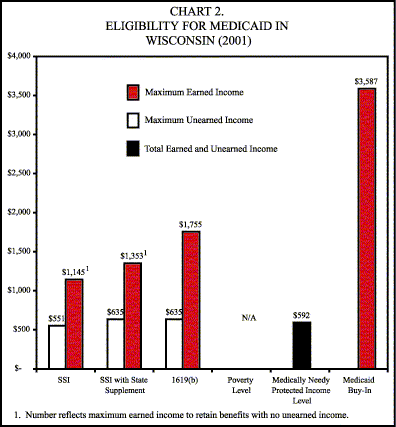
2. Connection Between the Medicaid Buy-In and Other Medicaid Eligibility Categories
Medically NeedyThe state's medically needy eligibility category includes some work incentives, but the treatment of earned income is generally more favorable under the Medicaid Buy-In. The medically needy program in Wisconsin uses SSI earned income disregards when calculating countable income. As a result, applicants with SSDI incomes just above the SSI standard do not have to contribute any of their first $65 of earnings toward a spend down. Above that level, an applicant must expend $1 of every $2 of earnings for health care costs to meet the spend down requirement. In comparison, under the Medicaid Buy-In, an individual required to pay a premium contributes only 3% of his earnings as an earned income premium.
BadgerCareThe Medicaid Buy-In program legislation established the family income standard for triggering premium payments -- 150% of the FPL -- at the same level used in the Wisconsin Badger Care program for low-income families.
3. Targeting or Cost-Control Mechanisms
The unearned income portion of the premium is the primary targeting mechanism in the Wisconsin Medicaid Buy-In program. This design feature reduces the likelihood that persons with relatively high SSDI benefits and minimal work effort will apply for the Medicaid Buy-In program. Such persons would not benefit financially if their earnings are less than the amount of their unearned income premium.
The state mandated that most non-elderly adults receiving 100% state COP funds apply for Medicaid under the Medicaid Buy-In option. Wisconsin receives a federal match for services for individuals found eligible, thus reducing net program costs.
F. Policy Approaches, Administrative Systems, and Stakeholder Involvement
1. Role of the State Legislature
Prior to the enactment of the BBA of 1997, which authorized states to establish Medicaid Buy-In programs, the Wisconsin State Legislature provided general authority for DHFS to seek federal waivers and pilot a Medicaid Buy-In program. With the new authority granted to the states with the passage of BBA, DHFS proceeded with plans for a Medicaid Buy-In program without waivers. The Medicaid Buy-In legislation passed in 1999 was more detailed than the initial legislation.
2. Role of the Executive Branch
The executive branch took a strong leadership role in the development of the Medicaid Buy-In program, based on consumer input and previous efforts to redesign delivery systems for children, the elderly and people with disabilities.
The Medicaid Buy-In initiative received a boost in January 1999 when Governor Tommy Thompson referred to it in his State of the State address. The executive branch developed the administrative rules, policies and procedures documents, and eligibility worker training materials. The state has put together several printed and on-line consumer outreach items, including a comprehensive consumer guide and fact sheets.
The Medicaid Buy-In program was developed and implemented by the various departments and bureaus of the Medicaid agency, including the HCBS division, the Medicaid eligibility division and the aging/long-term care division. The Division of Vocational Rehabilitation (DVR) collaborates and offers feedback in an advisory capacity through the Pathways program. To maximize effective implementation, the premium collection, outreach and eligibility worker training sessions were incorporated into existing processes and administrative structures within the Department.
Pathways is run jointly by the Medicaid agency, DVR, and the Office of the Governor. The Medicaid agency largely serves as the program administrator, the Department of Workforce Development serves as rehabilitative services administrator and the Governors Office provides additional support. ERI is under contract to provide benefits counseling. The Bureau of Community Mental Health (BCMH), Department of Public Health (DPH), and the Bureau of Developmental Disabilities Services (BDDS) also provide technical assistance at local sites.
3. Formal Involvement by the Disability Community
Consumers have played a key role in the evolution of work incentive initiatives and the Medicaid Buy-In. When Wisconsin initiated its effort in 1992, the study process was set up to include full participation from persons with disabilities. As was stated in the explanation in the original report:
"The role of the Advisory Council was to provide expert advice regarding: the best means of gathering information from people on incentives and barriers to employment, as well as strategies to increase incentives and address barriers; interpreting the results following the information-gathering stage; recommending strategies to address barriers and expand the results of the study statewide. The Council includes individuals who have personal experience with the long term support system and have faced barriers to getting and keeping work. Their collective wisdom guarantees that we have a true awareness of the real issues facing real people."17
With its current work incentives programs, the state has relied heavily on both the Pathways to Independence Advisory Council and local PTI provider sites for input on the design and operation of the program. The Pathways Advisory Council is a consumer-driven advisory panel that meets quarterly to provide feedback to the Department regarding various work incentives initiatives.
G. Budget Modeling and Cost Estimates
Wisconsin used data from SSA quarterly reports to determine the number of SSI/SSDI eligibles in the state and to gather earnings information for SSI recipients. They also used an Urban Institute report on the use of sliding scale premiums in subsidized insurance programs, Census data, state-funded program data, and a 1995 Survey of Income and Program Participation. In developing its budget projections, Wisconsin also considered the experiences of Massachusetts and Oregon in designing similar programs.
The state identified several categories of potential enrollees, including individuals who were SSDI beneficiaries, uninsured, eligible for SSI (including 1619), in the medically needy program, in state-funded community care programs, and with private insurance.
The Department assumed that a majority of participants would be individuals who were already being served through Medicaid eligibility categories or through HCBS waivers. The state also assumed that enrollees would be individuals with low amounts of unearned income or those planning to leave the disability rolls if allowed to earn and save more.
Planners assumed that a number of the enrollees would move to the Medicaid Buy-In Program from 100% state-funded programs, such as COP. New federal funds generated, along with premium payments, were projected to offset new state costs. Using BadgerCare premium collection processes and systems minimized the costs associated with administration.
Program planners projected an enrollment of approximately 2,100 people by the end of the 2000/2001 fiscal year. Based on a number of factors, including the experiences of the Massachusetts and Oregon Medicaid Buy-In programs, the Legislative Fiscal Bureau cut the projection almost in half, to 1,200.
H. Program Experience and Related Policy Issues
1. Program Experience
Wisconsin mandated a three-year comprehensive evaluation of the Medicaid Buy-In program to examine program impact, program processes, and fiscal effects. The "impact" evaluation will measure the effect of the Medicaid Buy-In program and HEC on employment and earnings and evaluate health care coverage, utilization of services, and health status during enrollment. It will also look at changes in the savings patterns of participants, the use of Independence Accounts and any changes in countable assets. The "process" evaluation will identify whether the Medicaid Buy-In program was implemented equitably across the state and whether the program is efficient and effective. The "fiscal" evaluation will look at the Medicaid Buy-In programs fiscal effect on general revenues and federal funds and its effect on other programs.
Enrollment in the Medicaid Buy-In was 1,590 as of July 2001. According to state data, approximately 10% of participants have earned income exceeding the $740 SGA earnings test.
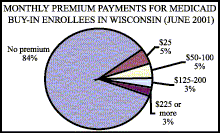
As noted earlier, Medicaid Buy-In enrollees in Wisconsin whose gross individual income equals or exceeds 150% of the FPL for their family size are subject to a premium. Monthly fees are set in $25 increments. In June 2001, 16% of enrollees were paying premiums; 84% were not required to pay premiums. Almost a third of persons with premiums paid $25 per month, with another third paying either $50 or $100.
2. State and Federal Policy Issues
There is some support among consumers and advocates for broadened income and asset rules in the Medicaid Buy-In program. The state is examining the feasibility of exempting Independence Accounts for all Medicaid eligibility categories.
As noted earlier, Wisconsin applied for federal demonstration authority for SSI and SSDI recipients participating in Pathways to Independence projects. The SSI demonstration authority was granted; the SSDI demonstration authority is still pending.
Wisconsin is working with other states to explore solutions to federal barriers such as the inability of a state to define employment; the effect of work in the disability determination process for persons with mental health disabilities; and the challenges of obtaining federal data on SSDI beneficiaries.
I. Sources Consulted
Hamilton, Thomas. Policy Barriers to Employment for Persons with Physical Disabilities: Discussion Paper, Center for Delivery Systems Development, Wisconsin Department of Health and Family Services, February 1997, p. 3-4.
Joint Committee on Finance Paper #484, MA Purchase Plan (DBFS-Medical Assistance), Legislative Fiscal Bureau, Wisconsin Department of Health and Family Services, June 1, 1999.
Medicaid Purchase Plan Consumer Guide, http://www.dhfs.state.wi.us/mapp/pdfs/Consumer%20Guide.pdf, MAPP web site http://www.dhfs.state.wi.us/mapp.
Medical Assistance and Badgercare, Legislative Paper #43, Legislative Fiscal Bureau, January 2001, at http://www.legis.state.wi.us/lfb/informationalpapers/2001/43.pdf.
Pathways to Independence Roster, http://www.dwd.state.wi.us/dvr/rosterpti.htm.
Pathways RFP, http://www.dwd.state.wi.us/dvr/nrfppti.htm.
Personal Care Handbook, http://www.dhfs.state.wi.us/Medicaid2/handbooks/personal_care/text/cs_co....
Premiums Fact Sheet, Wisconsin Department of Health and Family Services, at http://www.dhfs.state.wi.us/mapp/premiums.htm.
Press release, January 25, 2001, Governor Announces Approval of Pathways Waiver.
Ridgely, Mary. Employment Initiatives for Persons with Physical Disabilities: Preliminary Report, Wisconsin Department of Health and Human Services, Dane County Department of Human Services, Employment Resources, Inc., June 1993.
Ridgely, Mary. Employment Initiatives for Persons with Physical Disabilities: An Interim Report, Wisconsin Department of Health and Human Services, Dane County Department of Human Services, Employment Resources, Inc., August 1995.
SSI in Wisconsin, Programs and Services, Wisconsin Department of Health and Human Services, accessed on October 5, 2001 at http://www.dhfs.state.wi.us/ssi/benefits.htm.
What is the Medicaid Purchase Plan? Fact Sheet, Wisconsin Department of Health and Family Services, http://www.dhfs.state.wi.us/mapp/general.htm.
Wisconsin Infrastructure Grant submission.
Wisconsin material from Institute for Community Inclusion RRTC Conference on Employment Initiatives for Persons with Disabilities, Minneapolis, MN April 5-6, 2001.
1997 Wis. Act 237, s. 205, http://www.legis.state.wi.us/1997/data/acts/97Act237.pdf.
1999 Wis. Act 9, s.1440.
NOTES
-
Alaska, Arkansas, California, Connecticut, Iowa, Maine, Mississippi, Minnesota, Nebraska, New Hampshire, New Mexico, New Jersey, Oregon, Pennsylvania, South Carolina, Utah, Vermont, Washington, and Wisconsin.
-
States enacting legislation include Arizona, Colorado, Illinois, Indiana, Kansas, Missouri, Oklahoma, New York, Texas, and West Virginia. The legislation is diverse and in some states is directed toward the creation of demonstration projects.
-
Review of Alaska-Specific Work Disincentives for Individuals with Significant Disabilities. P Hanes and Associates. September 1998.
-
The other states are Idaho, Kansas, Nebraska, Nevada, Oregon, and Utah.
-
The formula for calculating the payment is Y=(X-100)/15-0.75(N-1) where Y is the percentage payment required, X is the percentage of poverty represented by the person's family income, and N is the number of persons in the household.
-
Medicaid for the Disabled. Fiscal Note Summary.
-
Cost Estimate for the Work Incentives Budget Proposal. State of Connecticut. Department of Social Services. December 1999.
-
Department of Health Services. Medical Assistance Fiscal Note RFI 9340, HF 586. March 24, 1999.
-
Report to the Maine Legislature of Buy-In Advisory Group, February 1998, p. 9.
-
The other states are Alaska, Idaho, Kansas, Nevada, Oregon, and Utah.
-
Nebraska Health and Human Services Manual. 471 NAC 15-000 Personal Care Services.
-
State of Nebraska. July 28,2000. Medicaid Infrastructure Grant Application. Page 4.
-
Ibid. Page 5.
-
Oregon is one of seven states that use SSI rules as a basis for Medicaid eligibility but require applicants to file a separate Medicaid application. The other states are Alaska, Idaho, Kansas, Nebraska, Nevada, and Utah.
-
Heather Johnson-Lamarche. The Barriers to Employment Faced by Persons with Disabilities: Problems and Solutions. Report to the Vermont General Assembly on Work Disincentives. January 1997.
-
H.554 sec. 121h. Accessed at www.leg.state.vt.us/docs/2000/acts/ACT062.htm.
-
Mary Ridgely, Employment Initiative for Persons with Physical Disabilities: A Preliminary Report, June 1993, p. I-2.
APPENDIX A: A Summary Description of the Federal Income
Maintenance and Health Care Programs for Disabled Persons Who Are Working or
Want to Work
Allen Jensen
Center for Health Services Research and Policy, School
of Public Health and Health Services, George Washington Medical Center
Robert Silverstein
Center for the Study and Advancement of
Disability Policy
Donna Folkemer
National Conference of State Legislatures
May 2002
The purposes of this Appendix are twofold. First, to provide an overview
of our federal income maintenance programs targeted for persons with
disabilities--the Social Security Disability Insurance (SSDI) program and the
Supplemental Security Income (SSI) program. The overview includes a description
of the work incentive provisions in these income maintenance programs. Second,
to provide an overview of our federal health care programs, including
provisions expanding health care services under Medicare and Medicaid programs
for persons with disabilities who are working or who want to work but fear
losing their health care. The overview reflects amendments to these programs
added by the Balanced Budget Act of 1997 and the Ticket to Work and Work
Incentives Improvement Act of 1999 (TWWIIA).
THE FEDERAL INCOME MAINTENANCE PROGRAMS
The Social Security Disability Insurance Program
Title II of the Social Security Act establishes the Social Security
Disability Insurance Program (SSDI). SSDI is a program of federal
disability insurance benefits for workers who have contributed to the Social
Security trust funds and meet the disability standard or become a blind
individual before retirement age. Spouses with disabilities and dependent
children of fully insured workers (often referred to as the primary
beneficiary) also are eligible for disability benefits upon the retirement,
disability, or death of the primary beneficiary. Section 202(d) of the Social
Security Act also establishes the adult disabled child program which authorizes
disability insurance payments to surviving children of retired, deceased or
workers with disabilities who were eligible to receive Social Security
benefits, if the child has a permanent disability originating before age 22.
For purposes of this paper, the term "SSDI" refers to all benefit
payments made to individuals on the basis of disability under Title II of the
Social Security Act.
SSDI provides monthly cash benefits paid directly to eligible persons
with disabilities and their eligible dependents throughout the period of
eligibility. Generally, an individual must wait five full calendar months after
disability begins before receiving SSDI benefits. If an individual leaves the
disability rolls and subsequently return with the same or a related impairment
within five years, the Social Security Administration (SSA) does not require a
new waiting period.
The Supplemental Security Income Program
Title XVI of the Social Security Act establishes the Supplemental
Security Income Program (SSI). The SSI program is a means-tested program
providing monthly cash income to low-income persons with limited resources on
the basis of age and on the basis of blindness and disability for children and
adults. The SSI program is funded out of the general revenues of the Treasury.
Eligibility for SSI is determined by certain federally established
income and resource standards. Individuals are eligible for SSI if their
"countable" income falls below the federal benefit rate ($531 for
an individual and $769 for couples in 2001). Not all income is counted for SSI
purposes. Excluded from income is the first $20 of any monthly income
(i.e., either unearned, such as social security and other pension benefits, or
earned) and the first $65 of monthly earned income plus one-half of the
remaining earnings. The federal limit on resources is $2,000 for an
individual and $3,000 for couples. Certain resources are not counted,
including, for example, an individual's home and the first $4,500 of the
current market value of an automobile.
States may supplement the federal benefit rate (State Supplemental
Payments, SSP). These state supplements are state-determined and vary
widely by state and may be administered by SSA or by the state. Some
individuals who have too much income to qualify for SSI may qualify for an SSP
benefit only. States may elect to make such persons automatically eligible for
Medicaid, just as they can for SSI beneficiaries.
The Definition of Disability under the SSDI and the SSI
Programs
The definition of disability for purposes of initial eligibility is
identical under the SSDI and SSI programs. Disability is defined as the
inability to engage in any substantial gainful activity
(SGA) by reason of a medically determinable physical or mental impairment
that is expected to last for a continuous period of not less than 12 months, or
to result in death. SGA is defined in federal regulations as earnings of $740
per month (through the period ending on December 31, 2001). SGA will be
adjusted annually effective January 1, 2002 and every year thereafter based on
the Cost of Living Adjustment (COLA).
After the initial determination of disability for applicants for
the SSI program, SSI recipients can continue to be eligible for SSI on the
basis of disability even when they have earnings in excess of the SGA earnings
test applied at the initial determination of disability. In contrast, for SSDI
recipients, earnings above SGA are considered in determining their continued
disability status.
Work Incentive Provisions in the SSDI and Related
Federal Health Care Programs
The SSDI program includes a number of provisions designed to permit or
encourage recipients to work:
- A trial work period (nine months) during which an individual
may continue to receive cash benefits. - A temporary extension of Medicare coverage for persons
returning to work (8½ years free Medicare Part A from the beginning of
work activity). - An extended eligibility period (36 months) to provide
protection against the risks of an unsuccessful work attempt. - The exclusion of impairment-related work expenses in
determining whether an individual is engaging in SGA.
These bullets reflect the policy in the SSDI program that work
incentives are time-limited.
For persons receiving SSDI benefits, earnings above a certain
amount are considered an indication that they may no longer meet the definition
of disability under the program. Work may eventually affect their eligibility
for health services under the Medicare program. Loss of disability status under
SSDI will also eventually affect their eligibility for specific
disability-related health and long-term support services in states that have
chosen the Medicaid state option to provide Medicaid for low-income SSDI
recipients under its "medically needy" program. The Medicaid program often
includes services not available under the Medicare program or private health
insurance (e.g., personal attendant services and medications).
As explained above, eligibility for SSDI requires an applicant to meet
certain criteria, including the presence of a disability that renders the
individual unable to engage in SGA. Continuing disability reviews (CDRs)
are conducted by the SSA to determine whether an individual remains disabled
and thus eligible for continued benefits. Prior to January 1, 2002, CDRs can be
triggered by evidence of recovery from disability, including return to work.
SSA is also required to conduct periodic CDRs every three years for
beneficiaries with a nonpermanent disability and at times determined by the
Commissioner for beneficiaries with a permanent disability.
Effective January 1, 2002, the Social Security Act, as amended by
TWWIIA, establishes the standard that CDRs for a long-term SSDI beneficiary
(i.e., an individual receiving disability benefits for at least 24 months) may
not be scheduled for the individual solely as a result of the individual's work
activity. SSA would continue to evaluate work activity to determine whether
eligibility for cash benefits continued (e.g., the individual has earnings that
exceed the established level), but a return to work would not trigger a review
of the beneficiary's impairment to determine whether it continued to be
disabling. An individual would still be subject to a regularly scheduled
periodic review.
In addition, during any period for which an individual is using a
"Ticket" under the Ticket To Work and Self-Sufficiency Program, the
Commissioner (and any applicable state agency) may not initiate a continuing
disability review or other review of whether the individual is or is not under
a disability for purposes of the SSDI program. This provision is effective when
the Ticket program is effective and is applicable to both the SSI and SSDI
programs.
Prior to passage of TWWIIA, individuals entitled to SSDI benefits
received expedited reinstatement of benefits following termination of
benefits because of work activity (i.e., termination due to performing at the
SGA level) any time during the 36 month extended period of eligibility so long
as they continue to have a disabling impairment. In other words, during this
period, benefits may be reinstated without a new application and disability
determination.
Under the Social Security Act, as amended by TWWIIA, a SSDI beneficiary
whose entitlement to SSDI benefits has been terminated due to the performance
of SGA following the 36 month extended period of eligibility may request
reinstatement of those benefits without filing a new application. The former
SSDI beneficiary must be unable to engage in SGA due to his or her disability
and the finding of disability must be the same as (or related to) the physical
or mental impairment that gave rise to the initial finding of disability. The
request for reinstatement must be filed within 60 consecutive months following
the month the SSDI benefits were terminated.
Work Incentive Provisions in the SSI program and Related
Federal Health Care Programs
Since the SSI program was implemented in 1974, there have been work
incentives for persons with severe disabilities:
- A portion of a SSI recipient's earned income is not counted in
determining the amount of cash benefits they receive (earned income
disregard). - Working individuals with no unearned income in a state without state
supplementation will continue to receive a declining amount of SSI benefits as
his or her earned income rises until he or she reaches the earned income
break-even point, which in 2001 is $1,147 per month. (See description of
Section 1619 (a) below.) - Impairment-related work expenses can be excluded on an
individualized basis. - Certain income and resources are excluded for recipients who are
participating in a time-limited plan for achieving self-support (PASS)
as may be specified in individualized PASS plans.
In addition, under the SSI program an individual whose earnings exceed
the SGA earnings level can continue to receive SSI cash benefits and Medicaid
under the provisions of Section 1619(a) of the Social Security Act as
long as the individual meets the SSI income and resources tests. Further, an
individual may retain his or her Medicaid eligibility as long as it is needed
under specified circumstances under Section 1619(b) and Section 1905(q)
of the Social Security Act even though he or she no longer receives SSI cash
benefits (see below for more detailed description).
SSI recipients who become ineligible for SSI cash benefits or SSI status
under Section 1619(b) because of income or resources go into a suspension
status for up to 12 months. They can be reinstated to SSI payment status or
SSI status under Section 1619(b) without a new application if their income and
resources are reduced to a level that they once again meet the SSI criteria if
they are within 12 months of their loss of SSI payment status or SSI status
under Section 1619(b). However, if an individual is past the 12-month
suspension period time limit and loses his or her SSI status, the individual
must make a new application for SSI on the basis of disability, income and
resources.
Under the expedited reinstatement provision added by TWWIIA, those
individuals who are no longer eligible for SSI cash benefits because of earned
income (or earned and unearned income) may apply for reinstatement for
eligibility for SSI cash benefits, even though they are no longer in the 12
month SSI suspension period time limit.
In order to apply for reinstatement, the former SSI recipient's
disability must render the individual unable to perform SGA and the finding of
disability must be the same as (or related to) the physical or mental
impairment that gave rise to the initial finding of disability. In addition,
the individual must satisfy the nonmedical requirements for SSI benefits. The
request for reinstatement must be filed within 60 consecutive months beginning
with the month following the most recent month for which the individual was
eligible for SSI (including Section 1619(b) status) prior to the period of
ineligibility.
Provisional Benefits Under SSDI and SSI Programs
Under the Social Security Act, as amended by TWWIIA, while the
Commissioner is making a determination pertaining to a reinstatement request
under SSDI and SSI, the individual is eligible for provisional benefits (i.e.,
federal cash benefits and Medicare and Medicaid, as appropriate) for a period
of not more than six months. If the Commissioner makes a favorable
determination, such individual's prior entitlement to benefits will be
reinstated (as would the benefits of his or her dependents). If the
Commissioner makes an unfavorable determination, provisional benefits would
end, but the provisional benefits already paid would not be considered an
overpayment (except under specified circumstances). [Section 112 of the Act
adds Section 223(i) to the Social Security Act and Section 1631(p) to the
Social Security Act.]
THE FEDERAL HEALTH CARE PROGRAMS FROM A DISABILITY PERSPECTIVE
The Medicare Program and SSDI Beneficiaries
Title XVIII of the Social Security Act establishes the Medicare
program, which authorizes health insurance benefits for specified elderly
persons and certain persons with disabilities (e.g., disabled workers receiving
SSDI benefits). More specifically, individuals who have been entitled to SSDI
benefits for 24 consecutive months are eligible to receive health insurance
benefits under the Medicare program. The Medicare program is divided into three
parts. Part A authorizes hospital insurance benefits; Part B provides
supplemental medical insurance benefits; and Part C contains miscellaneous
provisions, including coverage for end stage renal disease. For FY 2000, the
Part A premium is $300 per month and the Part B premium is $50 per month.
As explained above, SSDI beneficiaries are allowed to test their ability
to work for at least nine months without affecting their SSDI (and therefore
their Medicare) status. SSDI payments stop after a three-month grace period
when a beneficiary has monthly earnings at or above substantial gainful
employment after the nine-month period. Prior to the enactment of TWWIIA, if
the beneficiary remained disabled but continued working, Medicare can continue
for an additional 39 months (for a total of 48 months). The Social Security
Act, as amended by TWWIIA, provides for continued Medicare Part A coverage for
4½ additional years (for a total of 8½ years) without the payment
of premiums. Part B of Medicare benefits would continue to flow from continuing
eligibility for Part A, but the Part B premium would apply as usual. A Medicare
Buy-In program is already available under current law, which allows disabled
workers to obtain Medicare. The result would be that after the 8½ years
disabled workers could continue to be covered under Medicare if their
disability continues, and if they pay a required premium under Medicare Part A
and Part B.
The Medicaid Program and SSI and SSDI Beneficiaries
Title XIX of the Social Security Act establishes the Medicaid
program. Medicaid is the nation's major public financing program for providing
health and long-term services and supports to low-income persons. Medicaid is a
means-tested entitlement program financed by the state and Federal Government
out of general revenues. Within federal guidelines, states set their own income
and asset eligibility criteria for Medicaid services.
Federal assistance is provided to states through federal matching
payment rates based on a state's per capita income. Under Medicaid, states are
required to serve some population groups (mandatory coverage groups) and
are permitted to serve others (optional groups).
State policy makers enjoy broad discretion under federal law to
establish eligibility criteria for adults with disabilities under the Medicaid
program and to establish a state supplement to the federal SSI program
(state SSI supplementation programs). State policy makers also enjoy
broad discretion in selecting the methods used for administering the Medicaid
eligibility criteria and a state SSI supplementation program (methods
of administration).
Medicaid Eligibility Options for Federal SSI
Recipients
State policy makers essentially have two policy options related to
Medicaid eligibility for federal SSI recipients. Under Option 1, a state may
provide Medicaid eligibility for all persons determined eligible for SSI (i.e.,
SSI recipients are categorically eligible for Medicaid). SIZE="-1">1 In order to be eligible for the
SSI program, an individual must meet certain criteria related to his or her
disability as well as criteria related to his or her income level. Under Option
2, a state may decide not to use the SSI criteria for eligibility for Medicaid
and instead develop its own income, resources and disability criteria so long
as the criteria are not more restrictive than the states approved
Medicaid plan in January 1972--the year the SSI law was enacted. These states
are commonly referred to as Section 209(b) states. This
provision is also codified in Section 1902(f) of the Medicaid law. SIZE="-1">2
Extending Medicaid Eligibility to SSI Recipients and SSDI
Recipients Through the State SSI Supplementation Program
As explained above under Option 1, a state may provide categorical
Medicaid eligibility for federal SSI recipients. In addition, federal Medicaid
law permits a state to extend Medicaid eligibility to individuals who are
eligible for SSI on the basis of a state SSI supplementation program. SIZE="-1">3 Therefore, when a state decides
to establish a state SSI supplementation program, it may also be making a
decision affecting the income eligibility standard for Medicaid. One effect of
this decision is to increase the percentage of SSDI recipients in the state who
are "SSI recipients" and thus eligible for Medicaid.
A person is considered an "SSI recipient" if he or she is entitled to:
- Federal SSI payment based on the federal SSI benefit standard;
- State SSI supplementation payment based on the state SSI
supplementation benefit standard; or - An SSI payment based on an SSI benefit standard which is the federal
SSI benefit standard plus the amount of the state SSI supplement.
There are four scenarios describing how and from whom an individual
receives SSI cash payments in a state with a state SSI supplementation program.
A state that provides for a state SSI supplement of the federal SSI standard
can choose to enter into an agreement with SSA to administer the state SSI
supplementation program. If the state enters into such an agreement, under SSA
regulations it must use the same income disregards and asset criteria as the
federal SSI program. A state may also choose to administer its own state SSI
supplementation program and provide categorical Medicaid eligibility for those
individuals eligible for the state supplement. This includes individuals who
are only eligible for the state SSI supplement but have too much unearned
income to be eligible for federal SSI benefits. If the state administers its
state SSI supplementation program, it can use its own income disregards and
asset criteria. Understanding these scenarios is important because although the
SSI program is viewed primarily as a federal program, state decisions regarding
the nature and administration of a state SSI supplementation program have a
significant impact on eligibility for and accessibility to a state's Medicaid
program.
First, in a state in which SSA administers the state SSI supplementation
program, an SSI recipient can receive a single check from SSA that includes
both the federal SSI payment and the state SSI supplementation
payment.4
Second, in a state in which SSA administers the state SSI
supplementation program, an SSI recipient can receive a single check from SSA
that includes only the state SSI supplementation payment. Under this scenario,
the individual does not receive federal SSI funds because the individual has
too much income to be eligible for the federal SSI benefit.
Third, in a state in which the state administers its state SSI
supplementation program, an SSI recipient can receive two checks (a check for
the federal SSI payment and a check from the state for the state SSI
supplementation payment).
Fourth, in a state in which the state administers its state SSI
supplementation program and the individual is not eligible for a federal SSI
payment (because the individual has too much income to be eligible for the
federal SSI benefit), an SSI recipient can receive a single check from the
state (rather than from SSA).
Under existing federal policy, an individual is eligible for SSI if his
or her unearned income (e.g., SSDI) is less than the federal SSI benefit
standard ($531 per month in 2001) plus $20 (the initial federal SSI income
disregard). In sum, $551 in 2001 is the "unearned income limit" for eligibility
for federal SSI in a state with no state SSI supplementation program. It can be
said that the federal SSI unearned income limit also creates an unearned income
limit for the Medicaid program in those states that use SSI criteria for
Medicaid eligibility.
As explained above, it is important to understand that under federal SSI
regulations (not SSI law) when SSA administers the state SSI supplementation
program, the income disregards used in the state SSI supplementation program
must be identical to federal income disregards. In contrast, when the state
administers its own state SSI supplementation program, it has the option to
adopt the federal income disregards or it may adopt its own income disregards.
Under existing federal Medicaid policy, a state can use SSI-related Medicaid
eligibility standards based on the amount of state SSI supplementation and
state-developed income disregards.
Medicaid Work Incentives under Section 1619(a) and (b) of SSI Law
and Section 1905(q) of Medicaid Law
The federal SSI program provides for a gradual reduction in SSI benefits
to a recipient as the individual's earnings increase. During this period, the
individual remains eligible for Medicaid. HREF="#note5">5 Even after the federal SSI recipient's
earnings make the individual no longer eligible for SSI cash payments, the
individual still remains eligible for Medicaid as if he or she was receiving
cash payments ((Section 1619(b) and 1905(q)) of the Social Security
Act). This period of eligibility continues until the individual reaches an
earnings level referred to as the "Section 1619(b) threshold." SIZE="-1">6
Under Section 1619(b) and Section 1905(q) of the Social Security Act,
individuals continue to be eligible for Medicaid even if their earned income
makes them no longer eligible for SSI benefits. This special eligibility status
applies as long as the individual continues to have a disabling condition or is
blind and meets the following additional criteria:
- Except for earnings, continues to meet all the other requirements for
SSI eligibility; - Would be seriously inhibited from continuing or obtaining employment
if Medicaid eligibility were to end; and - Has earnings that are not sufficient to provide a reasonable
equivalency of benefits from SSI, SSP (if provided by the state), Medicaid, and
publicly funded attendant care that would have been available in the absence of
those earnings.
In making an initial determination under the criteria concerning
reasonable equivalency of benefits, SSA compares the individual's gross
earnings to a Section 1619(b) threshold amount applicable to
each state. The threshold established each year is based on the average
expenditures for Medicaid benefits for disabled SSI cash recipients in the
individual's state of residence plus the SSI and state supplement rates for an
individual living alone. In 2001, the threshold amount for states ranges from
$14,690 to $36,598. If the individual's earnings exceed the threshold, an
individualized threshold can be calculated which considers the person's actual
Medicaid use, work expenses, and publicly funded attendant care.
Medicaid Eligibility Based on Medically Needy and Spend Down
Options
Under Medicaid law, a state may also include under the Medicaid program
individuals who are medically needy. Individuals are
considered "medically needy" if they are determined to have severe disabilities
(medical impairments and not working) and income too high to be eligible for
SSI but low enough, after paying some of their health care bills, to meet the
state's income criteria. The income criterion is called the "Protected Income
Level" (PIL) in some states and the medically needy income level (MNIL) in
other states. Medically needy persons with incomes above the state's threshold
must spend down with health care expenses to these levels
before becoming eligible for Medicaid benefits. Some states have chosen to
provide for earned income disregards in determining the countable income for
the income criteria for the medically needy program.
Also, if the state does not have a medically needy program and has
elected to use the Section 209(b) option, they must allow a person to "spend
down" to the federal SSI standard to become eligible for Medicaid.
Medicaid Eligibility Based on Poverty Level and Standard of Need
Options
States also have the option to raise the countable income level at which
a person with disabilities in the state can qualify for Medicaid as high as
100 percent of the federal poverty level. States also can use what is
called the standard of need option to provide Medicaid
coverage, which essentially has the same impact as the poverty level option.
Under these options, state can use "income disregards" in determining the
income to be counted toward the poverty level or standard of needs.
300 Percent of SSI Income Rule
States also have the option of allowing eligibility for persons with
gross incomes at or above 300 percent of current SSI levels ($1,593 in
2001). This option is limited to persons residing in a medical institution and
to persons receiving home and community services under a Section 1915(c) waiver
(described below). Under this option, states may impose a post-eligibility
cost-sharing amount.
Home and Community-Based Services Waivers and Demonstration
Authority
Under the Medicaid program, the Secretary of Health and Human Services
is authorized to grant waivers to allow a state to offer home and
community-based services and supports to individuals who, in the absence of
such services, would require institutional care as long as costs (in the
aggregate) under the waiver do not exceed the cost of providing institutional
care to the target population. [Section 1915(c) of the Social Security
Act] The Secretary may also grant waivers under the Medicaid program for
research and demonstration projects in accordance with Section
1115 of the Social Security Act.
Medicaid Buy-In Programs
The Balanced Budget Act of 1997 (Public Law 105-33) added a new
provision in the Medicaid program that allows states to elect to provide
Medicaid coverage to persons with disabilities who are working and who
otherwise meet SSI eligibility criteria but have net income (after applying the
SSI income disregards) up to 250% of the federal poverty guidelines.
Beneficiaries under the more liberal income limit may "buy into"
Medicaid by paying premium costs. Premiums are set on a sliding scale based on
an individual's income, as established by the state. Medicaid law allows states
to utilize more generous eligibility criteria under Section 1902(r)(2) of
Medicaid law than SSI rules related to unearned income and resources to
provide Medicaid eligibility under this new option. If a state uses the
authority for a Medicaid Buy-In program under the Balanced Budget Act of 1997
(Section 1902(a)(10)(A)(ii)(XIII)) there are no restriction related to the size
of the premiums. Also, a state cannot set age limits for a Medicaid Buy-In
program established under the Balanced Budget Act of 1997 authority.
More recently under TWWIIA, states were provided two additional options
for establishing Medicaid Buy-In programs:
Option 1 under TWWIIA--Basic Coverage
Group
(Section 1902(a)(10)(A)(ii)(XV) of the Social Security
Act)
States have the option to cover individuals with disabilities (aged
16-64) who, except for earnings, would be eligible for SSI. States are
allowed to permit working individuals with disabilities to buy-into the
Medicaid program by paying premiums and other cost-sharing charges on a
sliding-fee scale based on income. Under amendments to the Medicaid program
included in the TWWIIA, this option is available to individuals with incomes
above 250% of the federal poverty level (compared to the 250% income
ceiling included in the Balanced Budget amendments). Under this option and the
authority for a Medicaid Buy-In under the Balanced Budget Act of 1997 a state
cannot directly set a minimum work requirement.Option 2 under TWWIIA--Medically Improved
Group
(Section 1902(a)(10)(A)(ii)(XVI) of the Social Security
Act)
If and only if a state provides Medicaid coverage to individuals
described in Option 1 under the Basic Coverage Group, the state would also have
the option of providing coverage to employed persons with disabilities (aged
16-64) whose medical condition has improved (and as a result are no
longer eligible for SSDI or SSI and therefore are no longer eligible for
Medicaid) but who continue to have a severe medically determinable impairment
as defined in regulations issued by the Secretary of the Department for Health
and Human Services (HHS). Under this option, individuals would be considered
employed if they earn at least the federal minimum wage and work at least 40
hours per month or are engaged in work that meets criteria for work, hours, or
other measures established by the state and approved by the Secretary of HHS.
Under both of these options under TWWIIA, states can establish uniform
limits on assets, resources, and earned or unearned income (or both) for this
group that differ from the federal SSI requirements. The state would be
required to make premiums or other cost-sharing charges the same for both these
two new eligibility groups. States may require individuals with incomes above
250% of the federal poverty level to pay the full premium cost. Under TWWIIA,
in contrast to the Medicaid Buy-In authority under the Balanced Budget Act of
1997, in the case of individuals with incomes between 250 percent and 450
percent of the poverty level, premiums may not exceed 7.5 percent of
income. States must require individuals with adjusted gross incomes above
$75,000 per year (subject to annual adjustments after FY 2000) to pay all the
premium costs. States may choose to subsidize premium costs for such
individuals, but they may not use federal matching funds to do so.
TWWIIA requires that in order to receive federal Medicaid funds, states
must maintain the level of expenditures they expended in the most recent fiscal
year prior to enactment of this provision to enable working individuals with
disabilities to work (maintenance of effort requirement).
Under TWWIIA, a state may apply to the Secretary of HHS for approval of
a demonstration project under which a specified maximum number of
individuals who are workers with a potentially severe disability are
provided medical assistance equal to that provided to workers with disabilities
whose income does not exceed 250% of the federal poverty level and who would be
eligible for SSI, except for their earnings (the provision added by the
Balanced Budget Act of 1997). In the case of a state that has not elected to
provide medical assistance to these workers with disabilities, the state's
demonstration project must provide such medical assistance as the Secretary
determines is an appropriate equivalent to the medical assistance provided
under such option.
A "worker with a potentially severe disability" is an individual (aged
16-64) who is employed and has a specific physical or mental impairment that,
as defined by the state, is reasonably expected, but for the receipt of medical
assistance, to become blind or disabled as defined under the Social Security
Act for purposes of the SSI program. In accordance with the conference report,
the states' definitions of workers with potentially severe disabilities can
include individuals with a potentially severe disability that can be traced to
congenital birth defects as well as diseases or injuries developed or incurred
through illness or accident in childhood or adulthood.
Subject to the amount of funds appropriated for this demonstration, the
Secretary must approve applications if the state demonstrates that it is
maintaining fiscal effort and the state provides for an independent evaluation.
The Secretary may allow for sub-state demonstrations (thereby waiving the
statewide provision in the Medicaid legislation).
Congress must appropriate $42 million for each of the fiscal years
2001-2004 and $41 million for each of the fiscal years 2005-2006. In no case
may payments made to the states by the Secretary exceed $250 million in the
aggregate. In addition, in no case may the payments made by the Secretary to
the states for administrative expenses relating to annual reports exceed $2
million.
A state with an approved demonstration project must submit an annual
report to the Secretary. Not later than October 1, 2004, the Secretary must
submit a report to the Congress regarding whether the demonstration project
should be continued after fiscal year 2006.
NEW GRANT PROGRAMS
Medicaid Infrastructure Grants
The Secretary of HHS must award grants to states to support the design,
establishment, and operation of state infrastructures that provide items
and services to support working individuals with disabilities. The Secretary
must also award grants to states to conduct outreach campaigns regarding the
existence of such infrastructures.
In order to be eligible for a state infrastructure grant, a state must
demonstrate that it makes personal assistance services available under
its Medicaid plan to the extent necessary to enable individuals with
disabilities to remain employed, including working individuals with
disabilities with incomes up to 250% of poverty buying into Medicaid under the
provision added by the Balanced Budget Act of 1997. The term "personal
assistance services" means a range of services provided by one or more persons,
designed to assist an individual with a disability to perform daily activities
on and off the job that the individual would typically perform if the
individual did not have a disability. Such services shall be designed to
increase the individual's control in life and ability to perform every day
activities on or off the job.
With respect to the amount of a state's infrastructure grant, the Act
directs the Secretary of HHS to reward states that adopt the state Medicaid
buy-in option for working individuals with disabilities with incomes up to 250%
of poverty (as added by the Balanced Budget Act of 1997). States may request
funding for up to 10% of total expenditures for their Medicaid Buy-In program.
States that choose not to adopt this option would be subject to a maximum grant
award established by a methodology developed by the Secretary, consistent with
the limit applied to states that take up the option.
States are required to submit an annual report to the Secretary on the
use of grant funds. In addition, the report must indicate the percent increase
in the number of SSDI and SSI beneficiaries who return to work.
The Act specifies that Congress must appropriate $20 million for fiscal
year 2001, $25 million for fiscal year 2002, $30 million for fiscal year 2003,
$35 million for fiscal year 2004, $40 million for fiscal year 2005, and for
each of the fiscal years 2006-2011 an amount appropriated for the preceding
fiscal year increased by the Consumer Price Index.
The Secretary, in consultation with the Ticket to Work and Work
Incentives Advisory Panel is required to make a recommendation by October 1,
2010 to the Congress regarding whether the grant program should continue after
fiscal year 2011.
Benefits Planning Assistance and Outreach
Under the Act, SSA is required to establish a community-based work
incentives planning and assistance program for the purpose of disseminating
accurate information to individuals on work incentives. Under the program, the
Commissioner is required to:
- Establish a program of grants, cooperative agreements, or contracts
to provide benefits planning and assistance (including information on the
availability of protection and advocacy services) to individuals with
disabilities and outreach to individuals with disabilities who are potentially
eligible for work incentive programs; and - Establish a corps of work incentive specialists located within SSA.
The Commissioner is required to determine the qualifications of agencies
eligible for grants, cooperative agreements, and contracts. Eligible
organizations may include Centers for Independent Living, protection and
advocacy organizations, client assistance programs, state Developmental
Disabilities Councils, and state welfare agencies. State Medicaid agencies and
Social Security field offices are ineligible.
Under TWWIIA, Congress may appropriate $23 million for each of the
fiscal years 2000-2004. The provision is effective on date of enactment.
Protection and Advocacy Systems Grant Awards
The Commissioner of SSA is authorized to make grants to existing
protection and advocacy systems established under the Developmental
Disabilities Assistance and Bill of Rights Act to provide information and
advice about obtaining vocational rehabilitation, employment services,
advocacy, and other services a SSDI or SSI beneficiary may need to secure or
regain gainful employment, including applying for and receiving work
incentives. [Section 122 of the Act adds a new Section 1150 to the Social
Security Act.]
Under TWWIIA, Congress may appropriate $7 million for each of the fiscal
years 2000-2004. The provision is effective on the date of enactment.
SSDI DEMONSTRATION AUTHORITY AND PROJECTS
SSDI Demonstration Authority
Section 505 of the Social Security Disability Amendments of 1980, as
amended, provided the Commissioner of Social Security authority to conduct
certain demonstration projects. The Commissioner was authorized to
initiate experiments and demonstration projects to test ways to encourage SSDI
beneficiaries to return to work, and was authorized to waive compliance with
certain benefit requirements in connection with these projects. This
demonstration authority expired on June 9, 1996. Effective as of the date of
enactment (i.e. December 17, 1999), TWWIIA extends the demonstration authority
for five years and includes authority for demonstration projects involving
applicants as well as beneficiaries.
Demonstration Projects Providing for Reductions in Disability
Insurance Benefits Based on Earnings
TWWIIA requires the Commissioner of Social Security to conduct a
demonstration project under which payments to SSDI beneficiaries would be
reduced $1 for every $2 of beneficiary earnings above a level to be determined
by the Commissioner. The Commissioner must annually report to the Congress on
the progress of this demonstration project.
ADVISORY PANEL
TWWIIA establishes a Ticket to Work and Work Incentives Advisory Panel
[web site www.ssa.gov/work/panel]. The panel must consist of 12 members with
experience or expert knowledge as a recipient, provider, employer or employee
in the fields of, or related to, employment services, vocational rehabilitation
services, and other support services. At least one-half of the members must be
individuals with disabilities or representatives of individuals with
disabilities, with consideration given to current or former SSDI or SSI
beneficiaries.
The Panel is to advise the Commissioner and report to the Congress on
the implementation of the Ticket to Work and Self-Sufficiency Program,
including such issues as the establishment of pilot sites, refinements to the
program, and the design of program evaluations. In addition, the Panel is to
advise the President, the Congress and the Commissioner on issues related to
work incentives programs, planning, and assistance for individuals with
disabilities, including work incentive provisions under the SSDI, SSI, Medicare
and Medicaid programs. Further the Panel is to advise the Commissioner
regarding the most effective designs for research and demonstration projects
providing for reductions in disability insurance benefits based on earnings.
NOTES
The state Medicaid agency can provide automatic
Medicaid eligibility for all persons eligible for SSI or the state can require
a separate application.A Section 209(b) state is required to provide
continued Medicaid for SSI recipients whose earnings make them ineligible for
SSI cash benefits. Continued Medicaid must be provided if the SSI recipient had
been eligible in the previous month for Medicaid under the state's Medicaid
plan.Forty-three states provide some state SSI
supplement. In 23 states, however, the state SSI supplement is only for
individuals in group living arrangements (not for those living
independently).Under federal SSI regulations, SSA will
administer up to six "categories" of state SSI supplementation benefit
standards. States with multiple categories of state SSI supplementation have
created categories based primarily on special living arrangements needs related
to individuals with disabilities.A working disabled individual with no unearned
income in a state without state SSI supplementation will continue to receive a
declining amount of SSI benefits as his or her earned income rises until the
individual reaches the "break-even" point, which in 2001 was $1,147 per
month.The threshold amount is based on the average
expenditures for Medicaid benefits for disabled SSI cash recipients in the
individual's state of residence plus the earned income break-even point of
individuals living alone. If the individual's earnings exceed the threshold, an
individualized threshold can be calculated that considers the person's actual
Medicaid use, work expenses, and publicly funded personal assistant
services.