


"This report was prepared under contract #HHS-100-03-0010 between the U.S. Department of Health and Human Services (HHS), Office of Disability, Aging and Long-Term Care Policy (DALTCP) and the RAND Corporation. For additional information about this subject, you can visit the DALTCP home page at http://aspe.hhs.gov/_/office_specific/daltcp.cfm or contact the ASPE Project Officer, Emily Rosenoff, at HHS/ASPE/DALTCP, Room 424E, H.H. Humphrey Building, 200 Independence Avenue, S.W., Washington, D.C. 20201. Her e-mail address is: Emily.Rosenoff@hhs.gov.
The opinions and views expressed in this report are those of the authors. They do not necessarily reflect the views of the Department of Health and Human Services, the contractor or any other funding organization.
Preface
Communication is a critical component of helping individuals prepare for, respond to, and recover from emergencies. However, there is limited knowledge about how to best communicate with at-risk populations in emergencies. To inform this gap, RAND researchers, under contract by the U.S. Department of Health and Human Services Office of the Assistant Secretary for Planning and Evaluation (Task Order 07EASPE000074), sought to understand the communication needs and to identify strategies with potential for improving risk communication with at-risk populations.
This one-year study presents the results of an assessment that involved review of the literature on emergency preparedness risk communication and public health messaging strategies; the compilation of educational and outreach materials for emergency preparedness communication with at-risk populations; and site visits in three states and the Washington, DC area to identify gaps in the practice of risk communication with at-risk populations.
The findings should be of interest to state and local emergency managers, community-based organizations, public health researchers, and policy makers.
Comments on this report are welcome and may be addressed to the principal investigator, Lisa Meredith (Lisa_Meredith@rand.org). She may also be reached by mail at the RAND Corporation, 1776 Main Street, P.O. Box 2138, Santa Monica, CA 90407-2138. More information about RAND is avaiable at http://www.rand.org.
Acknowledgments
We wish to thank those individuals whom we interviewed during our site visits for providing valuable information about their planning efforts and experiences working with at-risk populations around risk communication. We would also like to thank the individuals who helped connect us to our interview participants, making those interviews possible. In addition, we wish to thank Mary Vaiana, Nicole Lurie, and Sandra Quinn for their thoughtful reviews. Lastly, we would like to thank Roberta Shanman for her expertise in library science and Florence “Toni” Christopher for her help and organizational know-how in preparation of this report.
Acronyms
| ADA | Americans with Disabilities Act |
| ASL | American Sign Language |
| ASPE | HHS Office of the Assistant Secretary for Planning and Evaluation |
| ASPR | Assistant Secretary for Preparedness and Response |
| ASTHO | Association of State and Territorial Health Officials |
| CARF | Commission on the Accreditation of Rehabilitation Facilities |
| CBO | community-based organization |
| CDC | HHS Centers for Disease Control and Prevention |
| CERC | crisis and emergency risk communication |
| DAF | data abstraction form |
| DC | District of Columbia |
| DHS | U.S. Department of Homeland Security |
| EAO | External Affairs Officer |
| FEMA | Federal Emergency Management Agency |
| GIS | geographic information system |
| HHS | U.S. Department of Health and Human Services |
| JCAHO | Joint Commission on Accreditation of Healthcare Organizations |
| JFO | joint field office |
| NACCHO | National Association of City and County Health Officials |
| NECLC | National Emergency Child Locator Center |
| NRP | National Response Plan |
| OK-WARN | Oklahoma Weather Alert Remote Notification |
| PAHPA | Pandemic and All-Hazards Preparedness Act |
| PHEP | public health emergency preparedness |
| PIO | Public Information Officer |
| PWD | people with disabilities |
| SAMHSA | HHS Substance Abuse and Mental Health Services Administration |
| SNAKE | special needs assessment for Katrina evacuees |
| TTY | telephone typewriter or teletypewriter |
I. Introduction
A. Overview and Study Purpose
Communication about the risks associated with large-scale hazards and emergencies is a critical component of individual preparedness, response, and recovery. While much is known about risk perception and communication generally, these topics have been less well addressed for at-risk populations, particularly as they relate to emergency preparedness. In an effort to better understand what risk communication activities are currently used to reach at-risk populations, to learn from existing emergency preparedness efforts, and to identify which communication strategies, if any, have been successful, the Office of the Assistant Secretary for Planning and Evaluation (ASPE) within the U.S. Department of Health and Human Services (HHS), contracted with the RAND Corporation to examine the state of risk communication efforts for at-risk populations. This one-year project provides the groundwork to inform the Secretary’s obligation under the Pandemic and All-Hazard Preparedness Act (PAHPA) to plan for the needs of at-risk populations.
Results of this study, as summarized in this report, are intended to inform policy makers, federal/state/local public information officers (PIOs), others responsible for developing and disseminating risk communication messages, and other interested parties about the most promising activities focused on risk communication for at-risk populations. In our discussion, we also identify challenges to and gaps in the development of risk communication messages and methods of dissemination. This information will assist policy makers in building materials that focus on specific needs of at-risk populations that have not been previously addressed.
The PAHPA (P.L. 109-417), signed by President George W. Bush in December 2006 created the HHS Office of the Assistant Secretary for Preparedness and Response (ASPR) and tasked it with new authorities for a number of efforts, including:
-
Ensuring the integration of the needs of at-risk individuals (sometimes referred to as “special populations,” “special needs populations,” or “vulnerable populations”) on all levels of emergency planning.
-
Ensuring the effective incorporation of at-risk populations into existing and future policy, planning, and programmatic documents at the federal and state levels.
-
Establishing a Director of At-Risk Individuals within ASPR.
The full HHS working definition of “at-risk populations” (see box below) adopts a functional approach and establishes a flexible framework that encompasses a broad set of common needs irrespective of specific diagnoses, statuses, or labels (e.g., those with HIV, children, senior citizens). The approach is also designed to be congruent with the definition of special needs as stated in the Department of Homeland Security (DHS) National Response Framework.
HHS Working Definition of At-risk Populations
Before, during, and after an incident, members of at-risk populations may have additional needs in one or more of the following functional areas:
|
Examples. We provide several examples of functional needs of at-risk individuals.
| Example 1: An individual with HIV/AIDS who does not speak English and who contracts influenza could easily find herself in a precarious situation. In addition to treatment for influenza, her functional needs would be medical care (for the HIV/AIDS) and communication (her lack of English may keep her from hearing about where and how to access services). Without addressing these functional needs, she cannot receive health care services. |
| Example 2: The health status of an individual receiving home dialysis treatment and who relies on a local Para-transit system to attend medical appointments and shop for food could quickly become critical when drivers are scarce during a hurricane and transportation is suspended. His functional needs would be medical care (for dialysis) and transportation. Without addressing these functional needs, he cannot receive health care services. |
| Example 3: An individual with early stage Alzheimer’s disease living on a limited income and supported by a part-time caregiver may become fearful and agitated during a bombing attack and unable to access additional care. (is not this a perfectly normal reaction under the circumstances?) Her functional needs would include maintaining independence; she might also need supervision if she decompensates. Without addressing these functional needs, she cannot receive health care services. |
| Example 4: A seven year old child with visual impairments contracts avian influenza and requires hospitalization. In addition to treatment for influenza, his functional needs include communication (due to visual impairment) and supervision (since he is seven). Without addressing these functional needs, he cannot receive health care services. |
These kinds of at-risk individuals, along with their needs and concerns, must be addressed in all federal, state, Tribal, Territorial, and local emergency plans.
Importantly, the HHS definition focuses on the ability to access or receive medical care. However, it is also important to consider other types of needs as they affect the ability to prepare, evacuate, and respond adequately to the risk communication messages. Thus, we propose an expanded definition for the purposes of this report:
At-risk individuals are those who have, in addition to their event-related medical needs, social and structural needs that may interfere with their ability to access or receive medical care, prepare for an emergency, and take appropriate measures (e.g., evacuate, shelter-in-place, etc.) and respond adequately to risk communication messages during an emergency.
B. Risk Communication and Public Health Messaging Needs for At-Risk Populations
Many, at-risk populations are face specific communication challenges (Wingate, Perry, Campbell, David, and Weist, 2007). For example, those with low-literacy may not be able to interpret written messages. Thus, these groups may not be able to access and use the standard resources offered in emergency preparedness, planning, response, and recovery. In addition, the literature has shown that social, cultural, economic, and psychological factors, including age, class, race/ethnicity, and poverty, affect the ability of individuals to receive, process, and act upon messages (Tierney, 2000). For example, low-income populations cannot afford to buy and store extra food and other materials, such as extra medication to have in an emergency. Therefore, emergency messages should suggest alternative means of storing food and materials to help these populations overcome these economic barriers. For example, those with limited space could identify an alternative location for storing necessities and suggest purchasing materials in bulk with a group to save money. Cultural diversity and sensitivity are also important considerations, not only for various ethnic/racial groups but also for at-risk populations for which culture is a function of the type of disability or limitation they face in a disaster (e.g., the hearing-impaired, mobility restricted).
In a recent evaluation of the status of catastrophic and evacuation planning required by the 2006 DHS Appropriations Act (P.L. 109-90) and the Safe, Accountable, Flexible, Efficient Transportation Equity Act (P.L. 109-59), DHS found clear deficiencies in communication and information-sharing strategies used by state and local emergency managers (DHS, 2006a, 2006b). The most pertinent finding from this evaluation was that emergency planning for at-risk populations is limited; for example, less than 25 percent of urban area plans were rated as having sufficient ability to provide expedited warning to custodial institutions or to provide pre-scripted, hazard-specific warnings.
To be effective in keeping the public safe, risk communication must allow for individuals to access, process, and act upon information provided about the risk (Mileti and Sorensen, 1990). At-risk populations may have unique needs related to each of these goals. Emergency preparedness plans as well as response and recovery guidelines must include provisions for how to best inform and educate at-risk populations (Centers for Disease Control and Prevention [CDC] and HHS, 2006). As suggested by the PAHPA definition, many individuals will require messages specifically tailored to their functional needs. Messages should include information about the nature of the emergency as well as guidance about what to do given the particular circumstances.
Numerous federal statutes and plans call for including at-risk populations and each state is required to include those at-risk in their emergency preparedness plans. However, there is little evidence that the needs of these groups are being adequately addressed (Association of State and Territorial Health Officials [ASTHO], 2008; Ringel et al., 2007). In fact, we know from recent public health events and other emergencies that there are gaps in the ability of communities to respond to the special needs of at-risk populations. For example, Hurricane Katrina left 5,000 children without their families (National Center for Missing and Exploited Children, 2005). In New Orleans, 75 percent of all deaths were among senior citizens, yet only 15 percent of the city’s total population is senior citizens (National Organization on Disability, 2006). In addition, less than 30 percent of sheltered populations had access to American Sign Language (ASL) interpreters, so individuals with hearing impairment had limited ability to receive information about risks and recovery (Wingate et al., 2007).
A recent study of gaps in the education and training to protect at-risk populations in public health emergencies found that most consumer-oriented aids and resources for at-risk populations, where they existed, were disseminated primarily through the Internet (Wingate et al., 2007). This medium of dissemination is likely to be inaccessible to many at-risk populations including the economically disadvantaged, the mentally ill, the visually impaired, low-literacy and non-English speaking individuals, young children, and older adults. Further, evidence suggests that some at-risk populations may prefer to rely on social networks or trusted community members to receive information and to guide decision making during a public health emergency (Eisenman, Cordasco, Asch, Golden, and Glik, 2007). This approach can strengthen trust in the community (Eisenman et al., 2007; Meredith, Eisenman, Rhodes, Ryan, and Long, 2007). These findings highlight the need for communicating about risk through appropriate channels and media before, during, and after emergencies and public health disasters (McGough, Frank, Tipton, Tinker, and Vaughan, 2005).
C. Policy and Organizing Framework for Risk Communication
Risk communication is typically defined as an interactive process that involves the exchange of information between parties about a sensitive issue (Commission on Risk Perception and Communication, Commission on Behavioral and Social Services and Education, Commission on Physical Sciences, and National Research Council, 1989). The two-way nature of this exchange is essential for giving people the information they need to make informed choices about potential risks they may encounter. Included in the risk communication process is some opportunity to elicit and respond to concerns, opinions, reactions, and legal issues (e.g., mandated responsibilities and liability) related to the message. Even if the recipients of the information do not actively participate in the communication interaction, it is essential that they are comfortable with the quality of the information received (i.e., feel they have heard the truth and they received all of the information).
For this report, we present our findings within the context of guidance provided to the states by the CDC for renewing cooperative agreements, which provide funds to strengthen states’ public health emergency preparedness (PHEP) capacity and build capability. As initially presented, the guidance was organized around Focus Areas, one of which specifically related to risk communication and health information dissemination (CDC & HHS, 2004). The guidance asked states to develop plans to meet the specific needs of at-risk populations, which included people with disabilities (PWD), people with serious mental illness, minority groups, non-English speakers, children, and senior citizens. In addition, the guidance identifies the general risk communication activities states were expected to perform under the funding they receive from the CDC. Specifically, the guidance encouraged states engage in five types of activities:
-
Develop response plans that include the media, public, partners, and community stakeholders.
-
Conduct trainings, drills, and exercises (including those that include risk communication for at-risk populations).
-
Coordinate risk communication planning with state/local agencies and non-government partners.
-
Train key state and local public health spokespersons in risk communication principles and standards.
-
Establish mechanisms to translate emergency messages into priority languages spoken.
More recent guidance has focused on a framework that makes the CDC’s emergency response efforts more congruent with efforts of DHS. This guidance is organized around six CDC preparedness goals: Prevent, Detect and Report, Investigate, Control, Recover, and Improve (CDC and HHS, 2006). This guidance continues to emphasize the importance of including at-risk populations in emergency preparedness activities; documenting efforts to identify, quantify, and communicate with at-risk populations; and ensuring that these populations participate in all preparedness planning activities and exercises. It specifically asks states to coordinate activities within and across state and local jurisdictions, community organizations, health care providers and facilities, tribal organizations, etc. The guidance also continues to emphasize the support of preparedness education and training activities. A strong focus of this guidance is on being more efficient and reducing the time to respond/act by improving coordination among different entities.
We do not evaluate specific federal, state, or local risk communication activities in this report. However, the CDC guidance provides a useful framework for thinking about what might be considered expected or usual risk communication practice and to distinguish this from activities that may be considered more innovative (e.g., a practice that stands out from typical or core activities as determined by informants and the research team).
For this study, we framed our results in accordance with the five types of activities encouraged by the CDC guidance. Specifically, we explain risk communication activities as well as innovative practices identified in this research in terms of the development of response plans with the local community; trainings, drills and exercises; coordinated planning with government entities, training of risk communicators, and translation mechanisms. Our conclusions also consider how they map across phases of an emergency event in accordance with a Haddon Matrix (Haddon, 1972, 1980) which looks at factors and attributes before, during, and after an event. By utilizing this framework, one can then think about evaluating the relative importance of different factors and design interventions. This approach makes the risk communication practices more actionable.
D. Contribution of this Study
As we have learned from recent experiences, existing emergency plans are not often sufficient to meet the communication needs of the varied at-risk populations in the United States. Because little rigorous evidence is currently available in this area, we set out to identify what information does exist and to learn where more research is needed to fully inform policy makers about meeting the communication needs of at-risk populations. In this study, we use multiple strategies to identify existing practices, gaps that may still exist in developing and disseminating risk communication practices for at-risk populations, and promising approaches to reaching and preparing at-risk populations in the event of an emergency. This study focuses on the following policy questions:
-
What public health preparedness outreach and risk communications strategies are used with senior citizens, PWD, and other at-risk populations, including their caregivers and providers of long-term care services? How have those strategies been translated into educational and outreach information?
-
Which strategies, if any, demonstrate promising evidence of success--for example, through increased public awareness and compliance--and thus might inform broader public health preparedness planning for at-risk populations, including PWD and senior citizens?
-
What can we learn from existing emergency preparedness efforts that might specifically support the Secretary’s role in implementing the PAHPA and enhance emergency preparedness for at-risk populations?
To address these policy questions, the RAND team undertook three key activities: We: (1) reviewed the literature on emergency preparedness risk communication and public health messaging strategies, particularly for at-risk populations; (2) assembled a compendium of current emergency preparedness communication, outreach, and education materials/practices directed at at-risk individuals and their caregivers, including providers of long-term care services; and (3) conducted site visits in four states/regions regarding promising or emerging efforts to educate and inform at-risk populations and their providers. In this report, we present the results of our site visits, synthesize the findings from all of these efforts, and identify gaps in the practice of risk communication with at-risk populations. The interim reports from the literature review and compendium are included in Appendix A and Appendix B.1
E. Report Organization
The remainder of this report includes the following sections:
-
Study methodology, including a description of data sources, brief descriptions of the methods used to conduct each of the study components, and a discussion of study limitations.
-
Major findings, synthesizing lessons learned from the literature review and compendium with that of the site visits, including discussions of existing evaluation efforts and the effectiveness of risk communication practices, risk communication challenges and barriers, and descriptions of innovative practices identified during our site visits.
-
Implications and conclusions, including a discussion of future risk communication opportunities and key themes identified from the site visits, synthesized with lessons learned from the literature review and compendium.
II. Study Methodology
The study had three components:
-
Literature review. We reviewed the literature on emergency preparedness risk communication and public health messaging strategies, particularly for at-risk populations.
-
Compendium search. We assembled a compendium of current emergency preparedness communication, outreach, and education materials and practices directed at senior citizens, PWDs, and other at-risk populations and their caregivers, including providers of long-term care services.
-
Site visits. We conducted interviews with representatives in four sites to reflect a wide variety of hazard and emergency situations regarding promising or emerging efforts to educate and inform at-risk populations and their caregivers and providers.
A. Literature Review
We reviewed the literature pertaining to the use of risk communication strategies for at-risk populations in any stages of emergency preparedness, response, or recovery (see Appendix A). Our review included peer-reviewed citations published in English since January 1, 2000. We reviewed the abstracts of 1,268 citations retrieved from four databases (PubMed, Cumulative Index to Nursing and Allied Health Literature, PsycINFO, and the Social Science Citation Index) and deemed 40 citations relevant for inclusion in this review. Additionally, we searched all references dated 2000 or later in the National Cancer Institute’s Risk Communication Bibliography2 and we reviewed publications posted on the Center for Risk Communication website (http://www.centerforriskcommunication.com/home.htm). These websites, known to the authors through their previous work on the topic, were selected as supplemental search venues given their specific focus on risk communication to ensure no relevant content was missed and to validate the search strategy used in the larger databases. A citation was excluded from review if it addressed the consequences of a public health emergency without addressing risk communication; if it only addressed risk perception and not risk communication; if it only described a preparedness training program without describing the results of training; if it addressed interagency communication but not risk communication to the public; or if at-risk populations were not specifically and substantively referenced in the title and/or abstract of the citation.
In addition to reviewing the peer-reviewed literature, we also reviewed selected statutes, regulations, and other related government and organizational reports. We relied on direction from the ASPE Task Order Monitor and a targeted Web search to identify appropriate documents for review. More details about the literature review search methods are provided in Appendix A.
B. Compendium Search
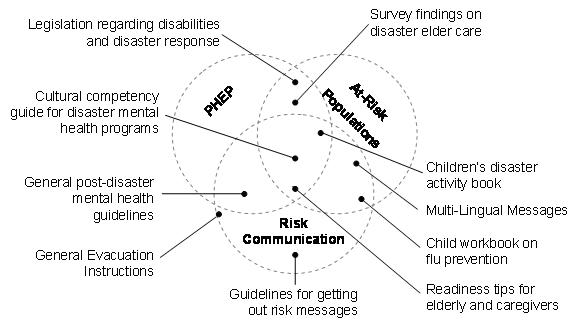
We identified risk communication materials for at-risk populations by searching publicly available websites. We scanned and reviewed websites for communication materials that were at the intersection of three domains: PHEP), at-risk populations, and risk communication. Figure 1 depicts the intersection of these three domains and provides three examples of risk communication materials that fit in this intersection. Many of the materials we identified focused on some but not all of these domains. Figure 1 also provides examples of materials that do not fit in the intersection of the domains and hence are not included in the compendium.
| FIGURE 1. The Intersection of Public Health Emergency Preparedness, At-Risk Populations, and Risk Communication |
 |
The materials in our compendium largely focused on the needs or special circumstances of one or more at-risk populations (those with disabilities, children, and pregnant women, etc.), targeting members of those at-risk populations, their caregivers, and/or the provider communities that serve these populations. We included materials targeted at service providers only if the materials provided actionable recommendations for communicating with the at-risk populations, not merely general advice or considerations. We did not include materials that were simply translations of materials intended for the general population unless the materials devoted specific attention to the broader issues affecting limited English or non-English speakers. However, where materials that met inclusion criteria were translated, we noted these other languages.
Compendium search methods. We focused the compendium search on material that was both widely and readily available (from websites of major national organizations) through a snowball-sampling strategy that began with the identifying organizations whose focus was on public health and emergency preparedness, at-risk populations, or both. Specifically, team members and other RAND experts identified organizations targeting these areas. The project team searched the website of each organization, followed links from these to other websites one or two “clicks” deep, and cataloged eligible items. When links led to other rich sources of information, those sites were added to our existing list of organizations and returned to later for thorough searches.
Compendium sample. The compendium construction involved three progressive phases of review. Phase 1 focused on the identification of candidate materials to populate the compendium and catalogue key dimensions. We identified 309 different risk communication documents or other media from 73 different organizations. After removing 40 of these that we deemed outside the scope of the project and 27 that were unavailable for download and hence not immediately available to our audiences, 242 materials remained in the final compendium.
In Phase 2, each resource was reviewed by a randomly assigned team member, and catalogued data were double-checked. Reviewers were also instructed to identify exceptional materials (“all-stars”). Materials were identified as all-stars if they met two criteria: (1) if they conveyed actionable information; and (2) that the information is appropriate for the intended audience (i.e., were formatted and contained content matched to the target at-risk population). Of these, 41 (17 percent) were identified by Phase 2 reviewers as “all-stars.”
In Phase 3, four team members divided up materials flagged as “all-stars” and reviewed them in more depth to identify key messages and strategies. Each “all-star” resource was then rated on six dimensions, including the extent to which the resource clearly stated and addressed objectives, clearly stated and addressed risks associated with the public health emergency, reasonably covered issues salient to the specified vulnerable population(s), provided specific guidance on how to act on the advice given, was clear and easy to understand, and was engaging. More details about this task, including the compendium, are available in Appendix B.
C. Site Visits in Four Sites
The RAND team conducted interviews with 50 individuals via site visits in four states/regions across the country.
Criteria for choosing sites. We initially screened states using the criterion that they were exemplars with respect to PHEP planning. We based this criterion on other ongoing RAND work in emergency preparedness and prioritized exemplary sites based on the size of the population and their distribution of at-risk populations, using statistics from the United States 2000 Census. We chose sites that represented disparate regions of the United States and had varied concentrations of urban or rural areas. We avoided sites that were over-studied (e.g., Louisiana) to reduce the research burden on potential informants and sites that would not be generalizable to the other sites (e.g., New York, given its extreme mix of urban and rural areas and its exposure to terrorism).
Although the initial site screening was based on exemplary work in PHEP, it was unclear if any state had yet emerged as exemplary in risk communication within emergency preparedness, especially as it related to risk communication with at-risk populations. We made many attempts to garner such information through informal conversations with emergency preparedness experts, emergency preparedness conference attendees, and Internet searches. We learned that although no state has yet been identified as exemplary in risk communication based on empirical evidence or consensus from public health informants, states that are leading innovative efforts in PHEP may have developed promising risk communication strategies for at-risk populations.
| TABLE 1. Sites Selected, Disaster Types, and At-Risk Populations | ||
|---|---|---|
| Site (Region) | Disaster Types | At-Risk Populations and Considerations |
| California (West) | Earthquakes, fires, floods, and landslides; terrorist threats to the Golden Gate Bridge and shipping ports | Diverse cultures (26% foreign-born) and non-English speakers (20% speak English “less than very well”); the vast majority (94%) of the 35 million residents live in urban areas in which commuting during disasters is a concern |
| Florida (South) | Hurricanes and flooding; receives evacuees from other states due to natural disasters | Senior citizens (17%); disabled (22%); and diverse cultures (17% foreign-born); and non-English speakers (10% speak English “less than very well”) |
| Metropolitan Washington Area (Montgomery County, MD, and Washington, DC) (East) | Hurricanes, winter storms and flooding; domestic terrorism; as the nation’s capital, this area remains a high-risk target for terrorism | Disabled (22%) and living below the federal poverty limit (>18%); relatively high percentage using the transportation system, which could make a large proportion of the population at-risk during a disaster, and a high proportion of African Americans (60%) |
| Oklahoma (Midwest) | Tornadoes, floods, and severe winter storms; domestic terrorism | Less populated state (3.5 million persons) with a relatively high number of rural persons living below the poverty limit (14%), disabled persons (22%), and diverse cultures (38 federally recognized Native American tribes) |
| SOURCES: Federal Emergency Management Agency Declared Disasters by Year or State, available at http://www.fema.gov/news/disaster_totals_annual.fema; U.S. Census Bureau, 2000. | ||
Given this context, we chose sites for our study that: use innovative public health emergency practices or are considered “exemplars” in this field, have experienced a range of potential public health emergencies that other states would experience, represent the at-risk populations of interest, and are geographically diverse.
Sites selected for study. The sites selected for our study were California, Florida, the Metropolitan Washington Area, and Oklahoma (see Table 1). In the Metropolitan Washington Area, we focused on two jurisdictions: (1) Washington, DC; and (2) Montgomery County, Maryland. These sites are geographically diverse. Cumulatively, these areas experience a variety of natural disasters (i.e., earthquakes, fires, floods, landslides, ice storms, hurricanes, and tornadoes) as well as other emergencies and include areas at higher risk for terrorism. The sites are also areas with a greater than normal proportion of at-risk populations (e.g., senior citizens in Florida, non-English speaking populations in California).
Interview sample. We interviewed a total of 50 individuals working in emergency preparedness and risk communication with at-risk populations between May and July 2008. We used semi-structured interviews conducted in person or by phone, each lasting approximately 45 minutes to two hours long. Interviewees were a convenience sample based on referrals, cold calls, and contacts we made or had in the four sites.3 The distribution of interviewees by site was as follows: California (n=11), Metropolitan Washington Area (n=9), Florida (n=14), and Oklahoma (n=15). Interviews were conducted primarily with individuals from community-based organizations (CBOs), state and local departments of public health, and other state and local government agencies (e.g., Departments of Rehabilitation, Aging, or Social/Human Services) (see Table 2).
The CBOs that our informants belonged to overwhelmingly addressed issues of PWD (including older adults with disabilities) followed by organizations that served senior citizens. Two organizations addressed issues of pregnant women, children, non-English speaking populations, and those from diverse cultures.
| TABLE 2. Interview Sample by Organizational Type (N = 50) | ||
|---|---|---|
| Organizational Type | n | % |
| Community-based organizations | 15 | 30 |
| Departments of Public Healtha | 13 | 26 |
| Government agency--othera | 12 | 24 |
| Miscellaneous expertsb | 4 | 8 |
| Departments/Offices of Emergency Managementa | 4 | 8 |
| Red Crossa | 2 | 4 |
| Total | 50 | 100 |
|
||
Interview content. We developed an interview guide to elicit information about current risk communication practices (both that they were undertaking and other practices they are aware of in their area) with at-risk populations as they pertained to the broader study goals. Human subject protections and data safeguarding procedures were approved by RAND’s Human Subject Protection Committee. The protocol covered six domains:
-
Emergency plans for risk communication (e.g., What plans are currently in place? Who is responsible for message formulation and delivery?).
-
Risk communication for at-risk populations (e.g., Are at-risk populations specifically addressed in risk communication plans. Which at-risk populations are your focus? Are representatives from at-risk populations involved in the development and execution of plans/strategies?).
-
Current risk communication practices for at-risk populations (e.g., How were strategies developed? What other organizations were involved? What modes of communication are you using?).
-
Evaluation of risk communication strategies (e.g., Have you evaluated the impact of existing risk communication activities for at-risk populations? What have you learned?).
-
Challenges/barriers to risk communication in at-risk populations.
-
Innovative practices.
Data analysis. A team of five RAND staff took notes at each interview and compiled and analyzed the notes at the site. Site visit summaries were merged and compared across sites. We based our analyses on the six domains of the protocol and organized common themes across sites.
III. Findings
Our discussion of study findings has five subsections. We first summarize some of the key risk communication planning and implementation activities planned and underway across the site visits (III A). We then highlight those innovative practices that are at the forefront of risk communication for at-risk populations (III B). We follow with a brief summary of evaluations undertaken to either assess needs of at-risk populations or to assess the impact of risk communication efforts (III C). We also describe the challenges and barriers to risk communication that sites face (III D), present future risk communication opportunities identified by informants (III E), and end this section by presenting some limitations (III F).
Within each of these subsections, we organize our findings in accordance with the CDC guidance framework introduced in the beginning of this report. Thus, we highlight the risk communication activities for at-risk populations in five areas: (1) developing emergency response plans that include the media, public, partners, and stakeholders; (2) conducting trainings, drills, and exercises that include risk communication for at-risk populations; (3) coordinating risk communication planning with state/local agencies and non-government partners; (4) training key state and local public health spokespersons in risk communication principles and standards; and (5) establishing mechanisms to translate emergency messages into priority languages spoken.
A. Risk Communication Activities for At-Risk Populations
General findings. Our interviews with state and local informants revealed common themes regarding how communities are currently developing and implementing their risk communication strategies for at-risk populations. Across states, planning is initiated at the state level, but most message adaptation and strategy development for reaching specific at-risk populations is conducted at the local level. As an example, in California, officials approach risk communication using a top-down guidance approach. Specifically, lead state agencies within the California Department of Public Health, such as the Public Health Emergency Preparedness Office and the Office of Emergency Services, provide broad guidance to the local agencies on how to deal with emergency situations, and they monitor how the agencies follow those guidelines. The California Department of Aging serves in an intermediary role between the Office of Emergency Services and CBOs. Specifically, the Department receives incident information, communicates it to their representatives “on the ground,” and then sends information from the ground it back up the pipeline. This minimizes the burden on the front lines.
Oklahoma also uses a top-down approach to risk communication practices. For example, state legislation guides how the state responds and communicates in the event of an emergency. The Oklahoma Department of Emergency Management generally takes the lead in developing and disseminating most messages before, during, and after an emergency. The content of those messages may involve input from the Oklahoma Departments of Health and Rehabilitative Services or other state agencies, depending on the issues involved. In this state, the local/county governments adopt state messaging unchanged or adapt it/add to it as needed for their local communities.
At the state level, risk communication efforts are generally not specific with respect to different at-risk populations. Most state informants reported that the message content does not need to be tailored, but that there may be situations in which the method of message dissemination should be altered to meet the needs of at-risk populations (e.g., people with hearing impairments or those with limited English proficiency). This tailoring is generally performed at the CBO or agency level rather than by the state and is consistent with findings from the compendium, where we found that non-government organizations often specifically tailored message content to specific at-risk populations (e.g., transportation for those who are mobility impaired or sheltering for those with guide dogs).
Tailoring messages to each at-risk population is resource-intensive, and most state informants are not trained in messaging for each population. For example, in Florida and Oklahoma, the local/county governments use the state templates for messaging and then add messages that may be relevant to their local communities. Some county administrators manage multiple counties with limited staff (sometimes without a PIO) and may pass the messages on to their residents unchanged. Other counties have full or part-time PIOs and can tailor the messages more to the needs of the local community; however, this tailoring may be related to local emergency conditions and not the needs of specific local populations.
On the other hand, all states prioritized the translation of messages into multiple languages, depending on the need in the population. For example, the Oklahoma Department of Health regularly translates preparedness materials into Spanish but uses CDC-prepared materials translated into other languages spoken in the state. It is difficult to find the resources needed to translate into other languages that are spoken by smaller groups, especially when many of these groups are also proficient in English.
CBOs are important assets in serving as intermediaries in the process of communicating with different populations. Our literature review emphasized their importance in presenting messages from trusted members of the community. However, some states were more inclined to actively involve CBOs in the risk communication process than others. Nevertheless, these community partnership approaches are consistent with the priorities for risk communication in the CDC guidance.
States tend to develop some pre-planned, standardized messages around emergency events that are likely to occur every year in their state, such as heat waves, tornadoes, fires, or hurricanes. Many states have lists of sample key messages that are ready to disseminate. Informants also noted the importance of factors emphasized in the compendium report (Appendix B): Messages should be crisp and easily understandable, and include actionable recommendations. Messages should be empathetic, describe the scope of the problem, list how the health department (or other agencies) are responding, explain the risk to residents, and tell the intended audience what actions can/should be taken (e.g., be alert, seek medical treatment, where to go for more information).
In the compendium of risk communications, we found that when risk communications specified the type of emergency, it was most often a natural disaster. In each of the sites visited, this same pattern was found, with sites targeting the natural disasters most common to their specific locations. For example, in California, the key events are earthquakes, heat, and fires, though guidance also covers terrorism and bioterrorism events. In Oklahoma, the emphasis is on tornados and ice storms, with some attention to wildfires and floods. Florida is concerned primarily with hurricanes and flooding, and the Metropolitan Washington Area is focused on bioterrorism, hurricanes, electrical storms, and flooding. The Washington, DC, metro area in particular is poised to respond to threats of terrorism given the events of 9/11 and the subsequent anthrax attacks. In addition, given CDC and other federal funding and the priorities they set, there is also a significant focus on developing preparedness plans and messaging for pandemic influenza.
-
Developing emergency response plans that include the media, public, partners, and stakeholders. We learned about several activities across states that involve partnering with key stakeholders, including community members, agencies, and other organizations, to develop emergency response plans. The desirability of such strategies is supported by the results of our literature review, which identified community-based participatory approaches to message development as especially promising. We highlight some examples:
-
Plans for local community partners to address at-risk populations. The California Department of Health Services developed a risk communication tool kit for use by local health departments in the state; the tool kit includes ideas about how to communicate with various populations but leaves the majority of content decisions to local planners. California is also working with community organizations, such as libraries, that can distribute guidebooks to their constituents. In addition, the state is partnering with Kaiser Permanente to develop three video public service announcements on seasonal and pandemic influenza. The state holds ethnic media roundtables where PIO staff meet with a wide variety of ethnic media organizations to discuss risk communication messages and to establish and maintain professional ties.
In Miami-Dade, Florida, there is a database containing information on 10 percent of the persons at-risk in the county. The county uses this information to work with CBOs to meet the needs of at-risk populations. The information can be organized by evacuation zone, level of care, primary language, whether the person is bed-bound, and a variety of other characteristics. CBOs often inform clients about an emergency and develop disaster guides with the at-risk population they serve. This tool has high utility but because it is difficult to obtain such information for the majority of people at-risk, its reach is limited.
-
Plans for PWD. Together, the Florida health and disability agencies have developed a 12-page preparedness guide for PWD. The Florida Statewide Disability Coordinator: (1) works with the health department and the Centers for Independent Living to learn how best to communicate with consumers of those agencies; (2) establishes procedures to provide effective communication within shelters; and (3) works with each county to establish contact with ASL interpreters who could be available in shelters during an emergency. In addition, the Developmental Disabilities Council is creating a manual to help PWD prepare for disasters, know what to include in emergency packets, and know what to do in the event of a disaster.
-
Outreach for senior citizens. Oklahoma is in the process of developing the Push Partner Program. This is a plan for disseminating mass immunizations or prophylaxis in case of pandemic flu or other public health emergency. The state health department will partner with different organizations that have outreach to populations who might not otherwise be able to get to a central dispensing site. This includes older adults and people with disabilities. The state is developing a statewide memorandum of understanding with the Aging Services Division within the Oklahoma Department of Human Services be the conduit to the Area Agencies on Aging across the state to push information to older adults and others who are at-risk.
Specific messages have not yet been developed; however, the Push Partner Program offers a unique opportunity for getting messages out to at-risk populations through a community partnership approach. Indeed, these extra efforts to reach senior citizens are especially valuable: our review of the literature suggests that this population is less likely to access sources of information, such as the Internet, that are becoming increasingly popular media for disseminating emergency risk communication. (The literature review also identified the Internet as a successful delivery method for those who do have access.)
-
Communication channels for the hearing-impaired. Oklahoma Weather Alert Remote Notification (OK-WARN) is a program developed in partnership with the Oklahoma Departments of Emergency Management and Rehabilitative Services, the National Weather Service, and other organizations to disseminate emergency messages via email and pagers to those who are deaf or hard-of-hearing. Interested individuals register themselves with this program and, in the event of a weather alert or an emergency, they are notified by the OK-WARN system. Message recipients must supply their own pager or other communication device, but the service is free. This strategy is consistent with findings from the literature review suggesting that risk communication needs to be locally relevant in order to achieve effectiveness. States generally create broad messages for the population as a whole, which local staff tailor for their specific populations.
-
Core messaging tools. Montgomery County in the Metropolitan Washington Area is using several strategies for developing plans and communicating with the major at-risk populations. The core approach relies on Plan 9 (Montgomery County, Maryland) or Be Ready DC (Washington, DC), a county-wide educational campaign and tool kit emphasizing preparing a disaster kit with nine essential items needed in the event of an emergency: water, food, clothes, medications, flashlight, can opener, radio, hygiene items, and first-aid. Plan 9 distills these nine essential tips to keep in mind during an emergency, which CBO leaders can use with their constituents to prepare them for an emergency. Another advantage of this approach is that the message is concrete and serves as a centralized messaging strategy that can be standardized on all preparedness plans and materials shared with the community. It also ensures that folks get the same types of information in an easy-to-use format. Community partners have enhanced this tool for use with specific at-risk populations, not by altering the content of Plan 9, but by adjusting the way this information is shared.
Both Department of Health interview informants in Montgomery County and Washington, DC, are partnering with a local CBO to craft and disseminate the messages. For example, in Washington, DC, city agencies have worked together to create Be Ready DC: easy-to-use materials for creating a personal or family emergency plan. Unlike in Montgomery County, where many efforts are housed in the Maryland Department of Health, the DC Departments of Homeland Security and Emergency Management coordinate Be Ready DC efforts. Be Ready DC is a centralized place to obtain emergency updates as well. These practices are particularly action oriented, a clear principle identified from the compendium.
-
-
Conducting trainings, drills, and exercises. We highlight two examples of training activities.
-
Communication exercises. In collaboration with the Sheriffs Department, the California Department of Health and Human Services, through its PIO, conducts periodic exercises to ensure that responders are properly trained for helping at-risk populations during a disaster. For example, one exercise involved training responders to provide rapid outreach to non-English speaking people from different cultures in different languages. As emphasized in the literature review, it is important that risk communication efforts for at-risk populations go beyond straight translation to also teach cultural competence (e.g., address linguistic barriers and incorporate cultural beliefs) to ensure comprehension.
-
Risk communication training. In Oklahoma, the PIO in the Oklahoma Department of Emergency Management provides regular training sessions and monthly opportunities for continuing education to PIOs across the state (including those who work for state and local government agencies as well as those who are responsible for messaging in private organizations). In addition to these efforts, the Oklahoma Department of Human Services provides risk communication training annually to PIOs, focusing on developing and disseminating emergency messages. A community disability organization is training advocates of PWD, and this training includes an emergency planning component. These approaches highlight the importance of cultural competency and participatory involvement of community members, as discussed in the results of the literature review.
-
-
Coordinating risk communication planning with state and local agencies and non-government partners. We identified a number of ongoing activities involving coordination of risk communication at our study sites.
-
Training the public to address the needs of at-risk populations. The Red Cross Bay Area Chapter in California works with businesses and apartment managers to train residents on first-aid and cardiac pulmonary resuscitation, with a focus on the health aspects of disasters, including having extra medication available for people with chronic illness.
-
Training for PWD. The Preparenow.org program is a coalition of local partners that includes risk communication to focus on PWD and non-English speakers, frail senior citizens, and recent immigrants to ensure that the needs and concerns of people at-risk are addressed in emergency preparedness and response. (“Secure your stuff” and “Have a disaster kit” are key messages.) Numerous materials on various types of disasters are available for download.
-
Contracting with disability organizations. One mechanism that facilitates dissemination of risk communication messages in California includes contracting with disability organizations to leverage resources. For example, one state accessed a large volunteer base of trained instructors and presenters who were skilled in different languages and were from different cultures. Their materials were also available in Braille. They also conduct grassroots activities in the community and work in collaboration with other agencies. Key messages they promote are to (1) make a plan with family; (2) have a disaster kit with basic supplies; and (3) be informed--get appropriate and correct information during a disaster. Often these messages need tailoring to at-risk populations, for example, providing large print for senior citizens, identifying lower-cost strategies for low-income residents to assemble a disaster kit, and developing school-based programs to help parents prepare with their children.
-
-
Training key state and local public health spokespersons to communicate with at-risk populations. Several training activities with a focus on emergency preparedness and response for at-risk populations were notable across the sites.
-
Community health care and other providers as spokespersons. In California, guidelines for message development include attention to cultural sensitivity, the needs of multiple community stakeholders, and mental health considerations. Populations that are identified as needing tailored messages include those with limited literacy, the homeless, immigrants, individuals with limited or no proficiency with English, those with visual or hearing impairments; individuals with disabilities, senior citizens, and children. Informants in this state have also developed an inventory of messages for “confirmed” and “unconfirmed” events. In addition to the general public, health care and other community providers are often the target audience for risk communication that occurs prior to an event. Messages tailored to these providers often include strategies for contacting clients and developing plans for their clients to obtain care in an emergency. The state disseminates best practices to local health departments through complementary resources--the Crisis and Emergency Risk Communication (CERC) Tool kit that is based on CDCynergy (Covello, 2008) and the CDC’s CERC course (http://www.cdc.gov/communication/emergency/cerc.htm). How local departments train spokespersons varies by community.
-
Weather reporters as spokespersons. Oklahoma relies heavily on the community and the “Oklahoma Standard” (a high standard of civic behavior and generosity in helping others), encouraging residents to check on their neighbors following an emergency to ensure that they are okay, to help them if evacuation is ordered, or to determine their needs. Weather reporters are also key assets in the state in communicating messages in preparation for, during, and in the immediate aftermath of a disaster. They help to reinforce messages for safety during a tornado (where you should be, what you should have with you, and how to keep yourself safe) and are important communications conduits--widely watched and respected. The results of the literature review suggested that weather reporters are a particularly trusted source of emergency information; they are seen as non-political, objective messengers who appear on the easily accessed communication medium of television.
-
-
Establishing mechanisms to translate emergency messages into priority languages. Informants at all the sites we visited indicated that they translated risk communication materials into multiple languages. In California, in response to the fires and extreme heat of summer 2008, several key risk communication messages were translated into priority languages. For example, a one-pager in multiple languages explained the N95 respirator and how to use it appropriately, and another provided summer heat tips, with information on preventing and treating heat related illness (translated in 12 languages). Cultural and social factors that may affect communication such as mistrust may also require different dissemination channels to increase the impact of messages. For example, we also learned about the importance of CBOs that are closely linked to non-English speaking populations in helping to ameliorate concerns of immigrants they will be reported to the immigration and naturalization service and mistrust of public health officials. As with training, messages and messengers must also be culturally competent in order for communication to be successful.
B. Innovative Practices
We now highlight risk communication activities that are particularly innovative strategies for reaching at-risk populations. We deemed a practice as innovative if it stood out from typical or core activities as determined by informants and the research team. These particular practices have strong promise for increasing public awareness of risks in advance of an emergency, and increasing compliance with public health recommendations during and following an emergency. We were not able to list all of the innovative practices but have attempted to emphasize those deemed innovative by informants and that, based on the literature review and compendium, appear to move the field beyond typical practice.
-
Developing emergency response plans that include the media, public, partners, and stakeholders. Below we describe several promising practices pertaining to involving key groups in emergency planning.
-
Involving at-risk populations in the planning process. Although other sites (Florida and DC) also involve at-risk populations in risk communication activities, the level of involvement in California was particularly noteworthy. California emergency response planners have 45 partners actively participating on committees to reach everyone in the state. These community participants not only guide disaster planning, policies, and approaches; they are trained members working on verifiable outcomes and goals to make risk communication plans usable across groups. The primary goal of the network is to get command center emergency information back to the partner organizations through real-time communication channels (email, wireless devices) and for community partners to return feedback about their local needs. All of the 110 individuals involved in this network are integrally linked into the warning center system around the clock. Individuals are selected from organizations because they have decision making capacities and other resources for at-risk populations (e.g., are sign language interpreters, have a wheelchair accessible vehicle). The committees strive to use “people first” language that attributes positive labels to people, such as “people with disabilities,” and avoids negative labels, such as “the handicapped” or “the disabled.” The committees also emphasize functional approaches to disaster planning and response. As noted previously, this community participation approach is well supported by the literature review. This is also one means of enhancing the comprehensiveness of the risk communications--a theme identified from the compendium of risk communications--since local partners are more likely to be aware of needs of at-risk populations specific to their communities.
-
Establishing partnerships to prepare families. April is Family Preparedness Month in Oklahoma. McReady is a private-public partnership designed to prepare families for emergencies, particularly weather-related emergencies. McDonald’s restaurants across the state displayed a variety of brochures available to the public including a family preparedness guide, a coloring book for kids on weather safety, a brochure about the OK-WARN program (a program for communicating with the deaf and hard-of-hearing), and a preparedness guide for sheltering in place. The Oklahoma Department of Emergency Management also partners with two local television stations and their weather reporter to visit schools and give special presentations. They have developed a DVD that is distributed to all schools in the state and includes Oklahoma’s First Lady, a popular weather reporter in the state, and the Oklahoma Gas and Electric’s mascot talking about preparedness issues. Finally, the Oklahoma Department of Emergency Management and its McReady partners attend community safety fairs to present information about emergency preparedness. In 2009, the state plans to disseminate preparedness materials in Spanish through the McReady program. This substantial collaboration effort is consistent with the theme of community engagement identified in the compendium review.
-
Helping pregnant women prepare. As part of home visits to pregnant women served by maternal and child health funding, the case workers in Montgomery County discuss Plan 9 in the context of pregnancy planning. During these visits, the workers check how women have progressed in their planning using the Plan 9 assessment (e.g., water, flashlight). The program has developed an additional assessment form based on case management forms for other populations, in which they adapted the Plan 9 list for the specific supply needs of pregnant or parenting women, such as formula, Tylenol, and diapers. This inclusion of pregnant women as a population in need of specific risk communication messages addressed a gap in current research: Both the literature review and compendium found limited attention to the preparedness needs of pregnant women.
-
Using technology to map the needs of at-risk populations. Florida purchased and developed software to determine and map community resources, with attention to the needs of at-risk populations. Like the vulnerability mapping tool that RAND is developing, it would be useful to use such a tool to import local Census data for identifying and locating at-risk populations. The tool could provide information for planners on where to target resources before, during, and after an emergency. Our literature review highlighted the central role of vulnerability assessment in program development.
-
-
Conducting trainings, drills, and exercises. The sites also informed us about some innovative training activities being conducted.
-
Including children with disabilities in exercises and drills. This is particularly important for school-based exercises in which those at-risk are often excluded, despite the fact that they constitute the majority of individuals who will need help in that setting. Even simple knowledge about how to exit the classroom must be clearly communicated. This approach being used in California is consistent with the literature. Several of the citations we reviewed highlighted the special needs of children and pointed to school-based communication interventions as particularly effective in reaching this population. This approach also directly addresses two themes that arose from the compendium of risk communications: tailoring the format to the audience and using active approaches to engage that audience.
-
Engaging the community. Florida is working with high school youth as “mitigators” for disasters to raise awareness among youth in their schools and their families. Youth are also sent to senior centers and other senior housing facilities to conduct preparedness awareness sessions with senior citizens. Having youth interact with senior citizens makes emergency preparedness more collaborative and enjoyable for those involved. Some of the methods of interaction were to play “windy bingo” and ”hurricane jeopardy,” activities that were well-received. The games were created by the youth (so they learned in the process) and enjoyed by the residents. The games also stimulated discussion about emergency preparedness. Senior citizens, in turn, shared their experiences in disasters over their lifetime so that some intergenerational learning took place. Bilingual youth are also involved as community educators with at-risk populations, including migrant camp areas and other neighborhoods whose residents may respond better to these interactive forms of communication than to typical didactic messaging.
-
-
Coordinating risk communication planning with state and local agencies and non-government partners. Our informants identified as innovative several coordination activities that involve planning with the community to better reach at-risk populations.
-
Involving the faith community. Two innovative strategies for reaching out to the faith community stood out in Montgomery County. The Gospel Program is an effort to partner with local churches to disseminate Plan 9 materials. During the 2007-2008 year, the program received money to provide survival kits for congregants. The initiative focuses primarily on work within congregations, but there are plans to use bus advertising to reach out to congregants in the community. In addition, Montgomery County has developed the Strengthening the Strengtheners program, which uses parish nurses to conduct outreach. The parish nurses and other community nurses use a core set of materials to train others about emergency preparedness in their respective congregations. These strategies illustrate the power of community participation.
-
Regular meetings among PIOs across the state. In Florida, PIOs use meetings to discuss important messaging issues and recent disasters. This serves two purposes: It provides continuing education, and it ensures that PIOs across the state know each other and are not just, in the words of one informant, “exchanging business cards on the day of the disaster.”
-
Employing Americans with Disabilities Act (ADA; P.L. 101-336) coordinators in all county departments. Florida also works with a centralized ADA office and created a statewide disability position to help enforce ADA compliance. This strategy facilitates local tailoring of messages for PWD by providing a local opportunity for engaging these audiences more directly. Having a statewide disability position to help enforce ADA compliance better ensures that messages are made available in formats that are accessible to the relevant audiences (e.g., large print with sing language interpreter, appropriate color contrast, sound options, etc.).
-
Making emergency information readily available. Oklahoma uses a 211 phone line to make information available statewide. It serves as a step-down version of 911 for non-emergency needs. Staff in the call centers are available to answer questions about a variety of issues and either already have or will be provided with all messages that come from the Oklahoma Department of Emergency Management and other agencies, including the Oklahoma Department of Health, in the event of an emergency. The 211 call center receives the same messages that are sent to the media in the event of an emergency. The call center will also feed back information to emergency management staff about the kinds of questions that callers are asking so that messages can be further tailored and refined. Various agencies are involved in advertising the availability of 211 through TV spots, ads on buses, website announcements, etc. These practices are consistent with an overarching conclusion of the literature review: To achieve effective emergency risk communication, offer frequent messages in multiple modes that are locally and personally relevant.
-
-
Training key state and local public health spokespersons in risk communication. We identified a number of innovative practices involving training in the sites we studied.
-
Building risk communication skills. In terms of training, local public health officials in California receive a risk communication tool kit for use with all populations, including those at-risk. The tool kit earned California the Public Relations Society of America 2005 PRism award for excellence in public relations. The kit trains direct service providers to be better prepared and to have their own plans in place locally. It also builds skills at the local level to teach risk communication. Agencies are trained to teach each at-risk population community that they are personally responsible for their own safety just like everyone else (rather than that they need to be treated as “special”).
-
Providing materials to first responders. In Oklahoma, a consortium of organizations representing PWD disseminates and provides training for a pocket-sized flip chart with guidelines for managing emergency response. The guidelines include a broad range of at-risk populations: senior citizens; those with service animals, those with mobility impairments; those with autism; individuals who are deaf, hard-of-hearing, blind, or visually impaired; those with cognitive disabilities; those with multiple chemical sensitivities; and individuals who are mentally ill. The demand for this information has been great, and the consortium is in the process of developing an on-line version for Fire and Rescue to use in their trucks. Exactly this sort of simple yet flexible tool was highlighted as an “all-star” from the compendium, since it addresses the needs of the audience and provides concrete motivations for recommended actions.
-
Conducting exercises and drills that include at-risk populations. Including at-risk populations in drills can reveal risk communication problems: For example, one drill in Florida showed that police did not know how to communicate with deaf persons and, as a consequence, were perceived as threatening by deaf persons. Because their emergency management department implements the drills through a modular system, they can select different components that are relevant to emphasize communication with particular at-risk populations. This approach to risk communication is consistent with tailoring the format to the audience and using active approaches to engage that audience, key principles arising from the compendium.
-
Developing action plans for homebound populations. Montgomery County, Maryland, developed a curriculum for case managers and home health aides. The curriculum trains aides and case managers to help clients prepare a “File for Life”--a list of medications and provider information that is placed on a refrigerator for family members and emergency medical technicians in the case of an emergency. Aides also work with clients to determine what needs to be replaced in their emergency kits (water, perishable items) and sometimes these aides shop for clients or ask family members to help shop.
-
-
Establishing mechanisms to translate emergency messages into priority languages. Below we highlight two strategies used to translate materials for the needs of at-risk populations. The first example addresses not only language translation but also strategies for making cultural competency an integral component of translation. The second example highlights the use of interpersonal and social networks through community organizations which are important channels for reaching at-risk populations.
-
Tailoring messages for Latinos. Montgomery County, Maryland, also started the development of a telenovela4 integrating emergency preparedness messages for Latinos. Although lack of funding has hampered continuation of the effort, the idea represents a creative strategy for reaching this community. The lack of translation to other languages was noted with regards to the risk communications in the compendium.
-
Networking with the faith community. Montgomery County also readily involves the faith community to help with translation as with the Plan 9 materials (see section 3, “Coordinating”).
-
C. Evaluation of Risk Communication Strategies
Overview. The literature on evaluating emergency risk communications is “fraught with challenges” (Thomas, Vanderford, and Quinn, 2008) and our literature review and site visits revealed that evaluation studies of risk communication for at-risk populations were also limited. However, there were a few examples that stood out, including the Latino program in Montgomery County, Maryland, and other evaluations to map at-risk populations used in California and Oklahoma (described below). Given the dearth of effectiveness evaluations, we also asked site visit informants whether they conduct any kind of vulnerability assessments to guide their approach to risk communication with at-risk populations because these approaches can either facilitate evaluation or, in the case of exercising, can provide feedback for improving future activities. Specifically, we inquired about whether they collect information on the size and location of at-risk populations to gauge the communication needs of a specific population during an emergency. We also asked informants about whether they conduct any formal (or informal) evaluation of the impact of communication activities that have been conducted. For example, do they survey their at-risk constituents to assess whether communication efforts were successful at increasing preparedness behaviors and response following actual emergencies?
Vulnerability assessments. The literature points to vulnerability assessments as a key part of formative research in the pre-event phase. Vulnerability assessments can include geographic information systems (GIS) as a method to map the location of at-risk populations so that communication campaigns can be targeted accordingly. Use of GIS to plan communication strategies is already underway in one state. In addition to GIS mapping, many states are using community-based participatory approaches to foster preparation, response, and recovery. As described previously, most of the states we studied employed community partnerships and networks to build capacity by better understanding local concerns and identifying ways to best address them (Quinn, 2008). Assets mapping can be used to elicit perspectives of at-risk populations through the process and can engage communities in identifying key strengths, assets, and partners that may be useful in risk communication activities. Moving beyond GIS, it would enable health departments to also have a comprehensive picture of at-risk communities including key natural leaders, important community locations that could serve as gathering places, critical partners such as specific churches or CBOs, and non-traditional communication channels. Other methods of assessment (e.g., telephone focus groups with professionals representing at-risk populations) are in use as well. Additionally, though more challenging, formative research is still possible at the time of an event. In fact, rapid assessment that can help to identify any hidden audiences, identify specific environmental factors that may increase risk, uncover critical audience questions and concerns, and identify any potential trusted spokespersons or partners is proposed by the literature (Quinn, Thomas, and McAllister, 2005).
Oklahoma’s health department conducted a study in August 2004 to better identify their at-risk populations and determine their needs. They employed a consulting firm to run focus groups by telephone with professionals representing their key groups: Native Americans, immigrants and refugees, minorities, homeless and low-income populations, PWD, and senior citizens. That assessment concluded that lack of proficiency with English, cultural differences, and limited literacy were the greatest barriers faced by the state’s at-risk populations. Consistent with the literature, these professionals highlighted the importance for at-risk populations to receive reliable information delivered by trusted spokespersons.
Effectiveness evaluation. As noted previously, evaluation studies to assess the impact of risk communication are limited. Nonetheless, we did learn about several notable evaluation activities from both a systemic and programmatic level (Thomas et al., 2008). For example, California’s emergency services recently surveyed county and city emergency managers about the use of registries for tracking at-risk populations. The survey highlighted the need to increase manager awareness about the utility of registries for enhancing emergency preparedness, response, and recovery efforts. Survey findings also revealed concerns about privacy among constituents, which may explain the limited use of registries to track PWD in the community.
In addition, the California Department of Health uses a very rigorous message development methodology that incorporates evaluation. It begins with CDC risk communication messages, which are then adapted to the needs of particular at-risk populations and, subsequently, sent to CDC technical and medical personnel, who check the adapted versions for accuracy. When the risk communication product is both medically and technically correct and understandable for the relevant population and at the appropriate reading level, they translate the product into 12 languages. They then conduct focus groups to make sure that the translation actually conveys the intended message. However, this process takes about 6-12 months, so it cannot be used to develop messages about new events as they emerge (for example, as with the sudden wave of fires in 2008). Some chapters of the state Red Cross conduct periodic telephone surveys with members of the community about preparation to inform future program design.
Oklahoma has exercised most aspects of its response plans, including risk communication. Combining exercises to test different aspects of response plans with after-action evaluation provide Oklahoma with insight into what works, what does not, and what needs to be modified for future response planning and response efforts. As an example of learning from an exercise, Oklahoma conducted an influenza clinic exercise during flu season and learned from the effort that they need to repeat messages many times and in many different formats to get the target populations to come to the clinics. To make risk communication most effective in the future, public health officials will put messages in the newspaper every day for a week up to the start of the flu clinic; they will also broadcast messages on the radio every day at different times to ensure that the messages reach the widest possible audience. They also learned that it helps to distribute flyers at the places where people frequent (e.g., Wal-Mart). These strategies are consistent with recommendations from the literature to offer frequent messages in multiple modes that are locally accessible and personally relevant. This example also demonstrates the value of a multi-modal risk communication strategy, which was identified in the compendium as potentially increasing attention and comprehension. This practice provides an example of how evaluation can be incorporated into regular activities to improve preparedness and response.
The Metropolitan Washington Area has evaluated several of its programs. For example, in Montgomery County, Maryland, the faith-based programs had several committee members perform outreach activities with their own organizations. One organization conducted a follow-up survey six months after the outreach, but the response was poor. Most of the participants had not yet started preparing a kit, although they reported knowing that they should do so. In addition, homebound care training was evaluated with a survey of aides at multiple assessments to determine whether clients had obtained the core items in the Plan 9 list, and case manager training is evaluated through required reporting every six months. Last year, Montgomery County informants evaluated a program for pregnant women by reviewing records to assess whether case managers were engaging pregnant women in preparedness planning. The reviewers saw increases in the number of women who included supplies (such as formula) for their child in their preparedness kits.
Another example of evaluation is for the Latino program in Montgomery County. There, informants conducted a small pilot evaluation focusing on health promotores and developed a curriculum to train health promoters based on their research. They have worked with six promotores who are active in a variety of venues (e.g., through parent-teacher associations and schools, churches, neighbors) in order to encourage their creativity.
The evaluation, which was performed at two sites, revealed that health promotores do affect recipients’ actions with regard to emergency planning. Informants learned that “one-shot” interventions do not work well. Efforts must include repetition as well as precise and simple messages. A structured training that includes follow-up is required to ensure that outreach workers are communicating the right message, and to provide incentives (such as food at trainings or gift certificates) for doing the work since they are volunteers.
Use of health promotores is consistent with recommendations from the literature to enlist community members as partners in message development and dissemination. This approach leverages existing community resources and capitalizes on the willingness (as suggested by the literature) of community members to be actively involved in emergency preparedness, response, and recovery efforts. It also augments the resources available to achieve a core recommendation from the literature review: communicate early, communicate often, and communicate in accessible and personally relevant ways.
D. Challenges and Barriers to Risk Communication in At-Risk Populations
We specifically asked site visit informants about challenges or barriers they experienced in conducting or planning risk communication activities targeting at-risk populations. Below we summarize some of the issues that were mentioned. We first address issues that were raised about specific at-risk populations and then address broader, more general challenges and barriers that were raised, such as politics, funding, and government structure.
Lack of resources for addressing diversity. Site visit informants reported that their constituents are very diverse ethnically, making it nearly impossible to translate risk communication materials into all the languages needed. Also, non-native English and non-English speakers often miss a lot of information contained in written materials, requiring direct one-on-one communication, which is not financially feasible. Translation is a necessary (and relatively low-resource) step to reaching non-English speakers. However, as noted above, emergency risk communication must also be culturally competent. Achieving cultural competency in the development and delivery of emergency risk communication is a more resource-intensive endeavor than translation. Cultural competence requires a significant investment of time and training. Partnering with CBOs that are competent to serve their own communities is one way to enhance the competence of the health department staff, build the capacity of the CBO staff, increase trust and credibility, and ultimately strengthen the relevance of the messages, channels and spokespersons.
Informants also mentioned several risk communication challenges or barriers that were not specific to any particular at-risk population, but instead applied to at-risk populations in general. One such challenge was how to prioritize among the many messages that needed communicating. Informants said that the range of messages that need to be communicated to at-risk populations is broad because different at-risk populations may face different issues during emergencies. Similarly, informants from all four sites noted the difficulty of being able to reach at-risk populations both because they are dispersed geographically and because they are hard to find. A third, somewhat related challenge, is that funding to provide adequate risk communication to at-risk populations is limited. For example, many community-based providers serving at-risk populations cannot afford computers, which are necessary to receive emergency information electronically. Also, with cuts in state and county budgets, some government staff reported that it was becoming more difficult to justify conducting risk communication activities specifically for at-risk populations, as one informant put it, “when they are only 25 percent of the population.” Although definitions vary between states, those with functional needs may constitute much more than 25 percent. Finally, many said it was difficult to access at-risk communities because they were difficult to reach or because they mistrusted the government or agencies. More focus on pre-event education is one means to address these barriers and to lay a stronger foundation for preparedness. By providing ongoing risk education and community engagement, communities are likely to be better able to respond during an emergency which in turn, increases community capacity and lessons can be incorporated into subsequent risk education (Quinn, 2008).
At-risk individuals have limited resources for emergency preparedness. Informants reported that lower-income persons often believe that they do not have money to prepare for emergencies. Many lower-income persons reserve their resources for surviving now rather than spending them on preparing for the future. In fact, some persons living in small, crowded areas have no space to store preparedness provisions and, in some cases, low-income persons who receive pre-packaged meals to use in case of an emergency or shelter-in-place may eat those meals ahead of time because they lack food daily under ordinary circumstances. Due to limited resources, individuals at-risk may also be less likely to respond to emergency messages even if they receive them. For example, individuals may not evacuate because they lack transportation or a might need special attention that they feel they are unlikely to receive if they evacuate.
Special challenges for PWD. Sites also reported barriers to conducting or planning risk communication for PWD. One such challenge is finding them. Anyone receiving disability-related state or federal funding can be easily identified, but there are large numbers of people who do qualify but who will not pursue government funding and, as such, are more difficult to locate. Another challenge is the difficulty of getting TV stations to provide ASL interpreters for the deaf. Oftentimes, emergency message text runs across the picture of the interpreter or logos are placed over the ASL interpreters, making them impossible to see. Some informants reported that they have witnessed emergency response personnel not responding appropriately to the needs of PWD during an emergency, which heightens concerns about whether at-risk populations will be properly assisted. Community engagement in planning or the use of community-based participatory research and/or a community advisory board can sensitize first responders and strengthen communication planning (Quinn, 2008).
Poor trust and privacy concerns. At-risk populations may lack trust in the emergency response community. We learned from informants that PWD have experienced challenges when trying to access shelters; not all shelters follow ADA guidelines regarding accessibility. A common concern across the sites was that the disabled community is not always involved in the planning process, which also can damage the community’s trust in first responders and government agencies responsible for public health and emergency response. Informants from all sites also mentioned that undocumented persons have recently witnessed increased deportation activities. As a result, many undocumented individuals have become more reluctant to add their names to at-risk population registries, to seek preparedness information, to respond to evacuation requests, or to ask for emergency assistance. They also mistrust messages from the government or from service messages assuring them that they will not be deported if they do seek assistance. Community engagement would also be a significant step toward addressing the issues of mistrust. For example, in communities that have specific churches with established ministries for immigrants, CBOs, and even immigration lawyers, involving them as partners is essential for reaching immigrant communities.
Difficulty reaching the socially isolated. Few informants reported challenges or barriers to conducting risk communication that were specific to senior citizens. However, we learned that senior citizens may be difficult to reach if they have weak social networks or do not receive any social services. Others informants suggested that some senior citizens cannot easily remember information and may also become easily confused about how to prepare for and respond to emergencies. Their suggested solution was to repeat preparedness messages for senior citizens and also develop messages that target caregivers and providers so that they may be able to intervene on an elder’s behalf.
Negative attitudes about preparedness and planning. Site visit informants mentioned that effectively communicating with at-risk populations was difficult because of the attitudes of their target audience. Not surprisingly, one prominent attitude was complacency. Informants were quick to report that most people, whether or not they belong to an at-risk population, think about emergency preparation after an emergency, not beforehand. Audiences also maintain a certain amount of disbelief about the potential for an emergency to arise. Other informants said it was difficult for people to understand that victims most likely would not receive prompt assistance during an emergency, making their personal preparation essential. A few informants also suggested that some people are suspicious when they receive preparedness information and demand, “Why are you asking us to do this? Is there something you know that we don’t know?” Another challenge was trying to avoid “information overload;” people tend to feel overwhelmed when faced with too much information and disengage. The use of community-based participatory methods is one way to identify some of these obstacles as well as potential solutions from community partners’ perspectives.
E. Future Risk Communication Opportunities
We asked all site visit informants to tell us, leaving aside any barriers, what would they like to see implemented to further improve risk communication content and strategies for disseminating information to at-risk populations in their state. In this section, we summarize what we learned from the sites as possible actions that could be taken to address the various types of barriers and what they see as opportunities for future risk communication. In some cases, what informants at one site identified as a gap in their current risk communication activities was actually being addressed in practice at another site; we highlight some of these cases in the discussion below. Informants across the sites we visited indicated that they would like more opportunities to learn about activities in other states that could be applied in their state or region. This could be accomplished through the development of networks across states and localities to facilitate sharing of information. Use of existing networks coordinated by the CDC or through state and local government association annual meetings is a potential vehicle for such an effort. Specific partners for whom this report could be useful in developing further training activities are ASTHO and the National Association of City and County Health Officials.
Targeting at-risk populations. A common concern raised by representatives of both Oklahoma and the Metropolitan Washington Area was how best to develop methods for identifying the types and locations of at-risk populations. In Oklahoma, there is no statewide understanding of where at-risk populations are located, making it difficult to target message delivery and develop plans for providing relevant populations with the appropriate response in the event of an emergency. Informants said they would like to see greater use of GIS technology to map, on a statewide basis, where different at-risk populations reside and to relay to appropriate agencies at the state or local level information about targeting response and allocating resources.
The literature review identified GIS as an innovative and promising tool in vulnerability assessments to effectively focus communication campaigns on areas in which at-risk populations are concentrated. Thus, across research and practice, use of GIS may play an increasing role in emergency risk communication for at-risk populations. Informants also stated that they would like to develop a registry for at-risk populations that could be used in the event of an emergency to further target response and allocate resources. Both California and Florida have developed approaches for identifying the location of and developing registries for different at-risk populations. The lessons learned from their efforts may be useful to other states. RAND recently developed a tool that can import local Census data for identifying and locating at-risk populations; this may be useful in assisting states with resource planning.
Informants in Oklahoma would like to see more messages disseminated appropriately for older adults and PWD. For example, it is useful to talk slowly and clearly (e.g., on the radio) for those with hearing impairments to and provide appropriate color contrast and big type for print and Internet messages for those with vision impairments. A California informant also called for developing new technology for the hearing-impaired community to push out information to wireless devices, pagers, TTY (teletypewriter for communication with the deaf), and other social network service systems. The OK-WARN program in Oklahoma may serve as a useful template for developing similar resources in other states.
Oklahoma and Florida informants also thought that the relevant utilities companies (e.g., electricity and gas) may be important partners in identifying where at-risk populations live and in disseminating messages to them. In particular, developing a registry for those who are ventilator-dependent or are otherwise dependent on electrical devices can help identify where at-risk groups reside and help evacuate them to a safer environment if power is lost. In addition, a registry may also serve as a way to prioritize the utility company’s response in the event that power is lost, as it would provide information about who needs power restored most urgently.
Partnering with at-risk populations. Informants from all of the states recognized the value of community partners in message dissemination and suggested that state and local officials recruit them to support risk communication activities. Community partners may be closest to the target at-risk populations and can be a valuable conduit for messaging. They can also help feed information back to state and local officials, who can help respond to the needs of local populations. Informants suggested identifying appropriately trained representatives from various at-risk populations as a way to facilitate access to these populations and to garner trust among the recipients of the message. Another recommendation from informants in Oklahoma was to capitalize on the trusting relationship citizens might have (a trust supported by the literature) in their weather reporters; they are regularly involved in communicating weather-related messages, and their prominence and authority make them well-suited for communicating messages about other types of emergencies.
Among the community partners identified as important collaborators for risk communication, faith communities were singled out as important assets in Oklahoma and DC. In many parts of the country, citizens are often well connected to their religious institutions, and the institutions stay in good communication with their members through the use of bulletins and volunteers. Bulletins can be used to disseminate important messages, and volunteers can also be important for checking in on individuals who may be at-risk in the event of an emergency. Communities could enhance collaboration by training volunteers as a useful resource for helping at-risk groups prepare for an emergency. In addition, there are also opportunities for mutual learning that would allow for formative research, improve health departments’ cultural competence, and enhance the capacity of organizations, including faith-based organizations, to serve their communities.
Formatting messages. Informants from Oklahoma indicated they would like to develop more messages in a graphic form for those with limited ability to learn (e.g., those with intellectual disabilities, children). These could be most easily received by a wide range of at-risk populations, including those who do not speak English. This may also be an efficient use of resources if the same graphic message could be used for multiple at-risk populations. Several of the themes drawn from the compendium echo these assertions, with multi-modal presentations increasing the usefulness to multiple audiences. We learned from informants in California and Florida that they are developing messages in pictorial format in order to reach the broadest audience. Other states and localities could benefit from formatting their risk communication materials for use across multiple at-risk populations.
Tailoring messages. In addition, many of the informants we spoke with would like to see more messages tailored to the needs of the population, recognizing that the same message may not apply to all at-risk groups. Even within the same at-risk population, messages may need to be tailored. For example, there are older adults or people with disabilities who may not speak English. In addition, messages that benefit an at-risk group may need to be targeted to multiple audiences (e.g., the individual, their caregivers, and their providers). In the compendium, 53 percent of the included resources targeted individuals at-risk, 53 percent targeted caregivers, and 38 percent targeted providers (i.e., there was often overlap). As another example, message tailoring for people with vision challenges would necessarily be provided in Braille and be segmented for both the individual and the caregiver. Informants from Oklahoma and Florida wished for greater financial resources to poll their residents to identify needs and learn where different at-risk populations reside. Thus, use of approaches that offer messages in multiple and graphic formats, tailor communication to the needs of specific groups, follow recommendations from the literature to offer frequent messages in multiple modes that are locally and personally relevant, enlist the participation of community members in message development and delivery, may boost communication for at-risk populations.
Training. Informants in Oklahoma and DC also wanted to train direct service providers (e.g., personal attendants, home health care providers, staff in doctor’s offices) on emergency preparedness for at-risk populations, and to encourage them to have their own plans in place and to help prepare their clients (e.g., ensure they have an emergency kit). Informants recommended that direct service providers receive specific training on information management similar to what a PIO would learn so that they could better delegate authority and ensure a positive response. They also suggested empowering clients to make decisions about how they want to respond in the event of an emergency rather than having the provider make all decisions about evacuation, etc. California informants noted the importance of cross-training so that both emergency preparedness and response professionals as well as at-risk populations learn from each other’s perspectives.
Another area of potential is to adapt Functional Assessment Services Teams, which deploy 8-10 people trained to help people with different disabilities during disasters, to focus on risk communication for those groups. Each representative would target an at-risk group and deliver messages to that group in the most appropriate manner. While California and Florida are doing this in some counties at shelters where PWD stay, we know of no adaptations focusing on risk communication.
F. Limitations
There are a few limitations worth noting; first, by only including peer-reviewed literature in our review, we may have eliminated books or other reports that include relevant information. However, by focusing on peer-reviewed literature, we are confident that the conclusions drawn from the literature review and the guidance of these conclusions for subsequent project tasks grounded our study in empirical evidence. The date boundaries of our review may have also affected our results; as the public health emergency risk communication literature published since 2000 focuses heavily on the events focuses heavily on the events surrounding Hurricanes Katrina and Rita, our results may be biased towards risk communication regarding natural disasters and the at-risk populations represented in the Gulf States. Finally, though we reviewed a relatively small sample of statutes, regulations, and related reports deemed relevant for inclusion added a useful dimension of evidence to the review, because of the limited applicability of the data abstraction form in characterizing these references, our ability to synthesize these citations into the larger review of peer-reviewed literature was somewhat limited.
The compendium targeted materials that are widely available (e.g., through national organizations) and easily accessible on the Internet. Given the wide-ranging set of possible sources, we chose to use a snowball-sampling strategy. This strategy may have limited the search, unintentionally excluding some materials, such as those not available on the Internet. However, the compendium is not intended to be a census of risk communication: such a database would not be cost-effective to create and would be quickly outdated. Hence, caution should be used when making generalizations from the compendium. The identification of “all-star” materials was a subjective process, and one designed to identify exemplary materials rather than to provide a detailed evaluation of each resource (although inter-rater agreement was high). This part of the task was more qualitative, although structure was provided through the use of a standardized score sheet. Still, the subjective nature of these reviews should be acknowledged, and conclusions taken as suggestive.
Another limitation of our site visit approach is that we are not able to generalize the findings beyond the particular perspectives of the informants we interviewed. Although we strived to speak with informants in all of the organizations listed in Table 2, differences in state structures and access to individuals across the types did not allow for uniform coverage of informant type across states. In addition, our description of risk communication activities does not represent the totality of any state’s efforts in the area. Nevertheless, the site visits provide a snapshot of emergency preparedness activities at the state and local levels where we were able to collect information. As such, these findings provide a sense of how some local and state planners approach risk communication to address the needs of at-risk populations in emergencies.
IV. Study Conclusions And Policy Considerations
We draw a number of conclusions from our assessment of risk communication strategies and practices. First, the field, defined by the intersection of public health emergency risk communication and at-risk populations, is relatively new. Only a small proportion of the literature in this domain addresses at-risk populations within the context of public health risk communication (see Appendix A). Of the literature identified, most is descriptive in nature, suggesting a need for more rigorous evaluations of risk communication strategies that target at-risk populations. In her review of risk communication activities during public health emergencies, Glik (2007) also noted the need for systematic evaluations of the effectiveness of risk communication, particularly during actual events. We found that across states and risk communication activities, evaluation efforts range widely in terms of their methodology and rigor. More systematic evaluation to determine the impact of risk communication for at-risk populations would provide valuable information to guide the field in enhancing preparedness, response, and recovery.
A relatively wide range of risk communication resources was identified in the compendium search (see Appendix B). Among the subset of materials we judged to be “all-stars” and reviewed in greater depth, we confirmed many of the findings from the literature review.
For example, in the literature review, weather reporters were identified as a preferred risk communication messenger during emergencies. Accordingly, interviews in Oklahoma confirmed the importance of weather reporters as key communicators to the public because they are trusted community members and they provide essential weather-related information as well as reinforce messages about how viewers can protect themselves.
Our interviews also confirmed the literature review findings that children have special needs during disasters and therefore that school-based settings are an important venue for exercises and drills.
Finally, our literature review, compendium search, and interviews provided triangulating information about how risk communication for at-risk populations is used and highlighted those activities that are particularly innovative and that hold promise for broader use across states. As suggested by the results of the literature review, using community-based participatory approaches to designing and disseminating risk communication for at-risk populations, and offering messages in multiple modes that are locally and personally relevant, are promising practices that would have many benefits but are currently underutilized.
Table 3 summarizes the key factors of risk communication as they apply to at-risk populations organized within the five CDC guidance areas (rows) across each phase of an emergency event (columns). This table follows the form of a Haddon Matrix (Haddon, 1972, 1980). The matrix illustrates how particular features of effective risk communication map to the phase in terms of when certain activities should take place. Accordingly, our key conclusions and policy considerations are delineated by emergency phase (pre-event, event, and post-event), highlighting the risk communication strategies that are commonly used and suggesting which of these hold particular promise for future success. We also discuss implications for future PHEP.
| TABLE 3. Matrix for Organizing Risk Communication Practices for At-Risk Populations by Phase of Emergency and Risk Communication Practice Area | |||
|---|---|---|---|
| Risk Communication Practice Area | Event Phase | ||
| Pre-Event | During Event | Post-Event/Recovery | |
| Plan Development | Establishing planning committees that include representatives of at-risk populations | N/A | N/A |
| Drills/Exercises | Strengthening training by directly addressing the needs of at-risk populations | N/A | Evaluate the impact of risk communication efforts |
| Coordination | Community involvement | Use new technology to enhance communication reach | Share lessons learned across organizations and geographic regions |
| Spokesperson Training | Present clear facts with actionable plans | Present clear facts with actionable plans | N/A |
| Translation Mechanisms | Tailor the risk communication to the unique needs of at-risk populations | Offer risk communication in multiple modes and multiple languages | Develop messaging for post-event risk communication |
| NOTE: N/A = not applicable for this phase. | |||
1. Risk Communication Pre-Event
State officials in public health and other agencies have made a number of advancements in risk communication, such as developing tool kits to guide local agencies and developing core messages for use with common types of disasters, particularly for natural disasters, as described in Section III (e.g., involving at-risk populations in the planning process and tailoring messages for Latinos). There has also been promising growth in activities designed specifically for at-risk populations, including the availability of messages in different languages and formats for those who do not speak English or who have disabilities, respectively.
However, as evidenced by our evaluation (including the literature review, the compendium, and our site visits), many barriers to effective risk communication remain, in part because of limited resources to enable specific tailoring to meet the needs of such a diversity of at-risk groups. Some possible solutions that may not be particularly resource-intensive may enhance public awareness and increase compliance with public health recommendations. These include the following activities before an event takes place:
-
Establish planning committees that include representatives of at-risk populations. Including representatives who are themselves at-risk in planning committees can inform the types of risk communication strategies as well as approaches for message dissemination. Even if some groups are not represented on committees, involving them in other preparation activities (e.g., including children in school-based drills or senior citizens in influenza vaccination clinic exercises) will provide valuable lessons for future disasters. In addition, involving these representatives in the development and review of communication materials can ensure that messages are appropriately crafted.
-
Strengthen training activities by directly addressing the needs of at-risk populations. One potential way to address public concerns is to strengthen educational activities by including CBOs, agencies, and other partners in the training itself. Enhanced training for those delivering messages regarding the special needs of at-risk populations may aid mutual learning, increase cultural competence, increase trust among members of the potentially at-risk population and strengthen health departments, agency, and CBO capacity. In addition, techniques such as message framing may be particularly useful. Specifically, framing messages to anticipate concerns expressed by at-risk populations (e.g., privacy and distrust) as well as by first responders (e.g., discomfort with PWD) that include points of resistance (Chapman and Lupton, 1994) may be particularly useful strategies for communicating risk to at-risk populations. Thus, trainings, drills, and exercises should incorporate the unique aspects of at-risk populations.
-
Tailor risk communication to the functional needs of at-risk populations. Risk communication should closely match the perspectives, technical abilities, and concerns of the intended audience (National Research Council, 1989). Having at-risk population representatives involved in planning will facilitate message development to meet the specific needs of different groups. In particular, including checklists and self-assessments as part of risk communication development can help the recipient customize the material to their personal needs. Social marketing strategies, such as creating specific messages for audiences from diverse backgrounds and with diverse needs, are a useful approach to enhancing communication and associated compliance (Andreason, 1995; Kotler, 1989; Manoff, 1985). Identifying in advance who is most in need of help can more precisely direct preparation and response efforts (Kasperson, 1986), including communication channels. In particular, it is important to consider the likelihood that certain factors need to be addressed for successful emergency risk communication. As an example, it is highly likely that PWD will be dependent on assistance from others given their limited independence and will also require different communication channels. Non-English speakers will require language translation and bilingual spokespersons with the appropriate social and cultural competencies and those from diverse cultures will also have a high likelihood of mistrusting authorities. Also, risk communication should be tailored to the developmental abilities of children and adapted for adults with intellectual disabilities. The use of data to identify characteristics of target audiences--such as through surveys, exploratory group sessions (focus groups), checklists, demographic profiles, and interviews--provides valuable information for guiding the design of risk communication messages and approaches to dissemination (Covello, McCallum, and Pavlova, 1989). In addition, embedding risk communication activities into other ongoing activities such as adding written materials to standard program or agency mailings using strategies that work in other community settings, may help engage individuals from at-risk populations to participate in preparedness.
2. Risk Communication During an Event
Dissemination of effective risk communication messages to at-risk populations during an emergency depends on the extent to which messages can be crafted so that they are “locally relevant and culturally competent” (Glik, 2007). Reynolds (2007) suggests considering three critical questions in determining how to communicate with at-risk populations during a crisis or emergency:
-
For which population during a crisis is a specialized message or communication product required, if any?
-
Are cultural differences among non-dominant group members of the United States significant when attempting to communicate health and safety information during a public health emergency?
-
Are communication messages from government authorities involved in the disaster response received differently by non-dominant groups?
Accordingly, local relevance and cultural competence can be more nuanced and therefore more challenging to address. Based on what we learned from this evaluation, the following strategies for use during an emergency hold the most promise and are supported by the literature:
-
Offer risk communications in multiple modes and multiple languages. “A picture is worth a thousand words” and pictorial media can effectively communicate across the majority of at-risk populations, excepting those with visual impairments, for whom alternative modes of communication are necessary. Most information designed for informing at-risk populations about risk in emergencies is made available only on the Internet, yet this mode of communication may not be accessible to many at-risk populations (Wingate et al., 2007). Other forms of communication, such as reliance on social networks in local communities, may be more effective for such groups (Eisenman et al., 2007). Further, translation of materials into other languages should ensure that proper dialectical differences and colloquialisms are used to increase reach and uptake by that population. In addition, crafting messages so that they can be most easily understood in whichever medium they are presented is critical. For example, speaking slowly and in an audible voice is necessary for television/radio messaging, presenting messages in large font and with appropriate color contrast is necessary for print messages, etc. Finally, the Internet was identified as a viable mode of risk communication but it is important to ensure that all individuals, including PWD, have access to that information on the websites. In fact, state and local government websites are legally obligated to provide equal access to information for PWD under the ADA (http://www.ada.gov/websites2.htm; http://www.section508.gov).
-
Present clear facts with actionable plans. Consistent with the risk communication literature (Lundgren, 1994; Mileti, Fitzpatrick, and Farhar, 1992; Renn and Levine, 1991; Sandman, 2003), a strong theme from the site visits was the importance for messages to deliver balanced facts that incorporate the most timely and accurate information. The facts about the risks should be accompanied by information about what individuals can do to protect themselves. Specifically, risk messages should allow recipients to access, confirm, and take direct action (Mileti and Sorensen, 1990). Further, these actions need to be presented in terms that populations at-risk can embrace. As an example, it is insufficient to recommend evacuation without qualifying how someone in a wheelchair might comply; they might need to be advised to ask for help. Therefore, training for spokespersons delivering risk communication messages should emphasize these principles. However, to enhance reach to at-risk populations, it will be important to broaden the number and types of professionals available and trained in risk communication beyond the health department PIO. Additionally, use of message mapping (Covello, 2008) is a useful tool to help address mental noise and focus practitioners on creation of clear, jargon-free messages.
-
Employ new technology to enhance communication reach. Recognizing that, for some states and localities, resources may limit the types of technologies that are available for enhancing risk communication, it is still important to use whatever methods are available. Thus, videophones, help lines, and mass phone alerts can significantly broaden the outreach of communications beyond what the print, Internet, radio, and television media can provide, particularly if some power sources are down. However, some older technologies such as phone trees, neighborhood watches, and bull horns may be the best option for reaching audiences that are unable to access the newer technologies.
-
Use strategies to identify and track at-risk populations. Our site visits also suggested that registries are a promising planning tool for identifying and communicating with at-risk populations and that the information in those registries can significantly improve the targeting of risk communication materials during an emergency. However, use of registries comes with a number of challenges. One concern is that such systems rely on PWD to register themselves, and the simple act of signing up for a registry may create a false sense of security; individuals will still need to be prepared, regardless of whether they are on a registry. Additionally, a registry is only as effective as the response capability. Thus, liability of emergency managers who maintain those registries is of concern. To address these barriers, site visit informants suggested that instead of implementing plans focused on knowing where to locate at-risk populations, emergency managers should integrate service providers from CBOs and local government agencies into a broader registry to address all phases of emergency management (planning, exercising, coordinating, training, and translation/cultural adaptation). In addition, a rapid assessment at the time of the event may uncover subtle cultural issues that need to be addressed either through changing the message, altering the channels, using a different spokesperson or engaging a community partner to help enhance credibility and trust (Quinn, 2008). Finally, as mentioned previously, GIS systems can be an effective tool for mapping the location of at-risk populations.
3. Risk Communication Post-Event
Following an emergency, the emphasis for communicating risk to at-risk populations is on learning how to address gaps that were identified in previous events and on how to minimize future problems. These are some of the themes revealed across our efforts pertaining to the recovery phase:
-
Develop messaging for post-event risk communication. In our review of existing risk communication practices, we identified relatively few risk communication materials intended for the post-event response. However, informants shared that this continues to be a gap area, as the recovery from a major event may require a set of long-term strategies that must be shared clearly with community members. As we summarized earlier, at-risk populations are not only at increased risk of poor consequences during an event; they often are more susceptible to challenges in establishing daily life after disaster. Risk communication efforts that include messages for these populations (e.g., how to access specialized resources; eligibility for specific social services) are critical.
-
Evaluate the impact of risk communication efforts. From our literature review and interviews, we learned that there is little formal evaluation of past efforts to inform communities about risk. Such evaluations, including after-action reports, may become more common as more experience is gained and as state governments face increasing disasters due to pandemic flu, bioterrorism, and other public health threats (Glik, 2007). Building a capacity for systematic evaluations to track messages, monitor media coverage, and survey recipients following emergencies accompanying responses will be key to identifying what works and what does not work to increase public awareness and compliance. Of course, evaluation is also important before an event and we learned that few of the practices we identified through site visits and interviews are being evaluated to determine their reach and/or effectiveness.
-
Share lessons learned across organizations and geographic regions. Once the acute stage of a disaster has subsided, communications can focus on after-action reports and other evaluation activities, including sharing experiences and lessons with other counties and states. Use of community forums and engagement of community partners in the evaluation will ultimately help to improve the capacity of agencies and their cultural competence with at-risk populations.
4. Implications for Future Public Health Emergency Activities
A key theme in our discussions with informants across sites was the importance of using “people first” language that does not inappropriately attribute a disability to those individuals. This feedback reaffirms a function-based approach, which focuses on individual capabilities rather than on labels or broad generalizations about populations, and is consistent with what we learned in the interviews. This suggests that most risk communication messages and dissemination strategies should be designed to match the abilities and resources of individuals, rather than their disabilities.
In addition, many aspects of communicating risks in the face of emergencies apply to all individuals, regardless of whether they are from an at-risk population. Further, most individuals at-risk are able to communicate in some common ways. For example, all groups except those with visual impairments have the ability to interpret pictorial material, particularly if it is simple and does not require translation to multiple languages. Supplementing imagery with audio messages is likely to address the needs of many at-risk populations.
However, we also learned that some content of emergency risk communication is specific to a particular at-risk group. Thus, consistent with implementing PAHPA with a functional-capabilities approach, message tailoring for particular groups should be based on functional areas, including independence, transportation, need for supervision, communication, and medical care needs. For example, individuals who need assistance with aspects of daily living may need information about how to involve their caregiver in preparing for and responding to disasters. Another example is that people who use wheelchairs need to know how to evacuate “on wheels.”
The results presented in this report could inform federal, state, tribal, territorial, and local emergency preparedness planning on how to address the unique needs of at-risk populations in existing emergency preparedness, response, and recovery plans. We have highlighted several risk communication practices that could be modified and adopted by others. We have also described some of challenges or barriers that others might encounter when attempting to plan and execute their own risk communication activities.
V. Considerations For Additional Research
Through the course of this study, we identified a number of areas that warrant additional research. These considerations are organized in two groups: (1) questions that were within the scope of the project, but that we were not able to address given the lack of evidence; and (2) questions that were beyond the scope of the project.
Because states are not currently collecting this information, we were unable to gather and present data to:
-
Evaluate the effectiveness of new technology for reaching at-risk populations.
-
Study the impact of education and outreach campaigns on the awareness, attitudes, and preparedness of at-risk populations.
-
Discover what methods of dissemination work best for each at-risk population.
-
Identify risk communication activities for at-risk populations that were not covered in our literature review, compendium, or site visits (e.g., people without transportation, people with pharmacological dependence, mental illness).
Some questions were not addressable within the scope of this project. More evidence is needed to:
-
Understand exposure following disasters and individual responses about message receipt, comprehension, and actions taken.
-
Design, implement, and study the effect of a cross-state mechanism for sharing tools and lessons learned regarding disaster management for at-risk populations.
-
Develop risk communication materials that address at-risk populations for the post-event/recovery stage of disasters.
-
Identify additional ways to involve the community and at-risk populations themselves in communication for planning, response and recovery.
-
Consider other aspects of being at-risk beyond function that may affect how messages are received--geographic isolation, socioeconomic issues such as affordability of emergency kits, etc.
VI. Literature Cited
Atman, C.J., Bostrom, A., Fischhoff, B., & Morgan, M.G. (1994). Designing risk communications: completing and correcting mental models of hazardous processes, Part I. Risk Analysis, 14, 779-88.
Andreason, A.R. (1995). Marketing Social Change: Changing Behavior to Promote Health, Social Development, and the Environment (1st ed.). San Francisco, CA: Jossey-Bass.
Association of State and Territorial Health Officials. (2008). At-Risk Populations Project: Federal and National-Level Document Review. Retrieved September 2, 2008, from http://www.astho.org/pubs/ASTHO_ARPP_Federal_Review_August2008.pdf.
Centers for Disease Control and Prevention & U.S. Department of Health and Human Services. (2004). Continuation Guidance, Budget Year Five, Attachment F, Focus Area F: Risk Communication and Health Information Dissemination (Public Information and Communication). Retrieved August 18, 2008, from http://emergency.cdc.gov/planning/continuationguidance/pdf/communication_attachf.pdf.
Centers for Disease Control and Prevention & U.S. Department of Health and Human Services. (2006). Public Health Emergency Preparedness Cooperative Agreement Continuation.
Chapman, S., & Lupton, D. (1994). The Fight for Public Health. London: BMJ.
Commission on Risk Perception and Communication, Commission on Behavioral and Social Sciences and Education, Commission on Physical Sciences, and Resources, & National Research Council. (1989). Improving Risk Communication. Washington, DC: National Academy Press.
Covello, V.T. & Allen, F.W. (1988). Seven Cardinal Rules of Risk Communication. Washington, DC: Environmental Protection Agency, Office of Policy Analysis.
Covello, V.T., McCallum, D.B., & Pavlova, M.T. (1989). Principles and guidelines for improving risk communication. In V.T. Covello, D.B. McCallum & M.T. Pavlova (Eds.), Effective Risk Communication: The Role and Responsibility of Government and Nongovernment Organizations (pp. 3-16). New York, NY: Plenum Press.
Covello, V.T. Message Mapping. Retrieved December 17, 2008, from http://www.orau.gov/cdcynergy/.
Dausey, D.J., Buehler, J.W., & Lurie, N. (2007). Designing and conducting tabletop exercises to assess public health preparedness for manmade and naturally occurring biological threats. BMC Public Health, 7:92. Available from: http://www.biomedcentral.com/1471-2458/7/92.
Eisenman, D.P., Cordasco, K.M., Asch, S., Golden, J.F., & Glik, D. (2007). Disaster planning and risk communication with vulnerable communities: Lessons from Hurricane Katrina. American Journal of Public Health, 97 Suppl 1, S109-115.
Glik, D.C. (2007). Risk communication for public health emergencies. Annual Reviews of Public Health, 28, 33-54.
Haddon, W. Jr. (1972). A logical framework for categorizing highway safety phenomena and activity. Journal of Trauma, 12(3), 193-207.
Haddon, W. Jr. (1980). Advances in the epidemiology of injuries as a basis for public policy. Public Health Reports, 95(5), 411-421.
Kasperson, R.E. (1986). Six propositions on public participation and their relevance for risk communication. Risk Analysis, 6(3), 275-281.
Kotler, P. (1989). Social marketing: Strategies for changing public behavior. New York, NY: Free Press.
Lundgren, R. (1994). Risk communication: A handbook for communicating environmental, safety and health risks. Columbus, OH: Batelle Memorial Institute.
Manoff, R.K. (1985). Social marketing: New imperative for public health. New York, NY: Praeger.
McGough, M., Frank, L.L., Tipton, S., Tinker, T.L., & Vaughan, E. (2005). Communicating the risks of bioterrorism and other emergencies in a diverse society: A case study of special populations in North Dakota. Biosecurity and Bioterrororism, 3(3), 235-245.
Meredith, L.S., Eisenman, D.P., Rhodes, H., Ryan, G., & Long, A. (2007). Trust influences response to public health messages during a bioterrorist event. Journal of Health Communication, 12(3), 217-232.
Mileti, D.S., Fitzpatrick, C., & Farhar, B.C. (1992). Fostering public preparations for natural hazards. Environment, 34(3), 16-39.
Mileti, D.S., & Sorensen, J.H. (1990). Communications of Emergency Public Warnings: A Social Science Perspective and State-of-the-Art Assessment (No. Rep. ORNL-6609 Federal Emergency Management Agency). Oak Ridge, TN: Oak Ridge National Laboratory.
National Center for Missing and Exploited Children. (2005). Last of Unaccompanied Children in Katrina Shelters Reunited with Families. Retrieved October 10, 2005, from http://www.ncmec.org/missingkids/servlet/NewsEventServlet?LanguageCountry=en_US&PageId=2150.
National Organization on Disability. (2006). Report on Special Needs Assessment for Katrina Evacuees (SNAKE) Project. Washington, DC: National Organization on Disability.
National Research Council. (1989). Improving Risk Communication. Washington, DC: National Academy Press.
Public Law 109-417. (2006). Pandemic and All-Hazards Preparedness Act.
Public Law 109-90. (2006). The Department of Homeland Security Appropriations Act of 2006.
Public Law 109-59. (2006). The Safe, Accountable, Flexible, Efficient Transportation Equity Act.
Public Law 101-336. (1990). The Americans with Disabilities Act.
Quinn, S.C. (2008). Crisis and emergency risk communication in a pandemic: A model for building capacity and resilience of minority communities. Health Promotion Practice, 9, 18S-25S.
Quinn, S.C., Thomas, T., & McAllister, C. (2005). Postal workers' perspectives on communication during the anthrax attack. Biosecurity and Bioterrorism: Biodefense, Strategy, Practice, and Science, 3, 207-215.
Renn, O., & Levine, D. (1991). Credibility and trust in risk communication. In R.E. Kasperson & P.J.M. Stallen (Eds.), Communicating Risks to the Public. Dordrecht, The Netherlands: Kluwer Academic Publishers.
Reynolds, B. (Ed). (2002). Crisis and Emergency Risk Communication. Atlanta, GA: Centers for Disease Control and Prevention.
Reynolds, B. (Ed). (2007). Crisis and Emergency Risk Communication: Pandemic Influenza. Atlanta, GA: Centers for Disease Control and Prevention.
Ringel, J.S., Chandra, A., Leuschner, K.J., Lim, Y.W., Lurie, N., Ricci, K.A., et al. (2007). Lessons Learned from the State and Local Public Health Response to Hurricane Katrina (No. WR473). Santa Monica, CA: RAND.
Sandman, P.M. (2003). Four Kinds of Risk Communication. Retrieved September 16, 2008, from http://psandman.com/col/4kind-1.htm.
Tierney, K.J. (2000). Implementing a Seismic Computerized Alert System (SCAN) for Southern California: Lessons and Guidance from the Literature on Warning Response and Warning Systems. Newark, DE: University of Delaware Disaster Research Center.
Thomas, G.W., Vanderford, M.L., & Quinn, S.C. (2008). Evaluating emergency risk communications: A dialogue with the experts. Health Promotion Practice, 9, 5S-12S.
Wingate, M.S., Perry, E.C., Campbell, P.H., David, P., & Weist, E.M. (2007). Identifying and protecting vulnerable populations in public health emergencies: Addressing gaps in education and training. Public Health Reports, 122, 422-426.
U.S. Department of Homeland Security. (2006a). Nationwide Plan Review: Phase 1 Report. Retrieved September 16, 2008, from http://training.fema.gov/EMIWeb/edu/docs/Nationwide%20Plan%20Review%20-%20Phase%201%20Report.pdf.
U.S. Department of Homeland Security. (2006b). Nationwide Plan Review: Phase 2 Report. Retrieved September 16, 2008, from https://www.dhs.gov/xlibrary/assets/Prep_NationwidePlanReview.pdf.
Notes
-
At the time that the interim reports were prepared, the process of establishing the HHS definition of “at-risk populations” was still in flux. The interim reports use the term vulnerable populations instead of at-risk populations.
-
Initially, we identified and contacted 79 potential interview participants. However, some individuals did not respond to our request, others were unavailable, (e.g., deployed to the Iowa floods and other emergencies), yet others were not able to respond to the issues we wanted to address.
-
A limited run television serial melodrama modeled after those made famous in Latin America.
Appendices
Appendix A. Literature Review
Background
Risk communication plays a critical role in preparing for, responding to, and recovering from public health emergencies.[1] For example, in a chemical spill or radiological incident, exposed individuals need to be informed of decontamination requirements. In natural disasters, individuals need to have information about potential dangers and how and where they can seek safe shelter, while in emergencies with a contagious agent, communication-related to isolation and quarantine procedures is required. In general, risk communication in the context of public health emergencies is a complex process. Messages must be communicated in the appropriate languages, at the right reading level, and disseminated in multiple ways amid significant stress and uncertainty. With the goal of keeping the public safe, to be effective, risk communication must achieve the following goals: individuals must be able to access information, process information, and be able to act upon information provided about the risk.
Vulnerable populations may have special needs related to each of these goals. For the purposes of this review, vulnerable populations include individuals who have disabilities, are institutionalized, are senior citizens, are from diverse cultures, have limited English proficiency or are non-English speaking, are children, are transportation disadvantaged, pregnant, have chronic medical disorders, or have pharmacological dependency (i.e., chemical dependency/addiction). The definition of vulnerable populations used here has been adopted by the Department of Health and Human Services and was determined by recommendations of the Interagency Coordinating Council on Emergency Preparedness and Individuals with Disabilities, the draft implementation plan for the Pandemic and All-Hazards Preparedness Act (PAHPA), and the draft revisions to the National Response Plan (NRP).
It is critical that public health emergency risk communication is non-discriminatory[2] and that all individuals have equal and ample access to information about the nature of the emergency and particularly about how to respond given the event circumstances. Thus, comprehensive emergency preparedness plans, as well as response and recovery guidelines will include provisions for how to best inform and educate vulnerable populations. Vulnerable populations are often “not able to access and use the standard resources offered in disaster preparedness, response, and recovery.”[3] For example, people with physical disabilities may have mobility limitations and special needs related to access to emergency preparedness communications. Children have less developed communication skills and require differently worded messages to be effectively informed. Children may also be separated from parents or other family members who would typically serve as translators for them. Pregnant women may face physical limitations and communications would need to be sensitive to the needs of their children. Senior citizens may have difficulties with mobility, and with regard to communication, could have hearing limitations and visual impairments suggesting that communication medium and format must be taken into account. Individuals with hearing limitations and visual impairment will require alternate communication strategies suggesting that medium and format also should be taken into account. Those with serious mental illness may have cognitive deficits that limit their ability to comprehend messages. Low-literacy is another limitation that may be a communication obstacle for children, the mentally impaired, individuals with poor literacy, and non-English speaking populations.
While much is known generally about risk perception and communication,[4] these topics have been less well addressed for vulnerable populations, particularly as they relate to emergency preparedness.[1] Yet the outcomes of recent public health events and other emergencies suggest that the unique characteristics of vulnerable populations and the special needs of these groups are not being adequately addressed by traditional emergency preparedness plans. For example, Hurricane Katrina left 5,000 children without their families.[5] In addition, less than 30 percent of a sheltered population had access to American Sign Language interpreters so that individuals with hearing impairment had no ability to receive information about risks and recovery.[6] These circumstances highlight the need for special attention to vulnerable populations before, during, and after public health emergencies.[7]
To support the efforts of public health emergency planners and responders working to successfully address the communication-related needs of vulnerable populations, we conducted a literature review in response to Task Order 07EASPE000074 to identify promising risk communication approaches and messaging strategies that address the communication limitations or barriers facing vulnerable populations before, during, and after a public health emergency. Our review (Task 3) had three aims:
-
Describe promising communication strategies for public health emergency risk communication with vulnerable populations.
-
Summarize the quality and content of the peer-reviewed literature and relevant statutes and regulations addressing public health emergency risk communication with vulnerable populations for all stages of emergency preparedness.
-
Identify gaps in the literature.
For the purposes of this project, we focus on risk communication that includes actionable information related to public health emergency preparedness (PHEP), response, and recovery for vulnerable populations. That is, in keeping with previous definitions of risk communication (See [8]) this review addressed public health emergency communication for vulnerable populations that does not simply describe the nature or consequences of a risk, but rather that provides information on how to prepare for, protect against, or respond to the risk. Such risk communication may include press releases, emergency-related print materials, interactive preparedness websites, and other communications that convey actionable risk-related information.
This literature review informed the development of a compendium of communication materials (Task 4) and case studies of sites with promising approaches to risk communication for vulnerable populations (Task 5). In addition, this review lays a foundation for the final report for this project.
Methods
Peer-Reviewed Literature
We conducted a review of the literature pertaining to the use of risk communication strategies for vulnerable populations in any stages of emergency preparedness, response, or recovery. Our review included peer-reviewed citations published in English since January 1, 2000. Forty citations were deemed relevant for inclusion in this review; for a detailed description of our inclusion criteria, please see Appendix A1.
Statutes and Regulations
In addition to peer-reviewed literature, we also reviewed selected statutes, regulations, and other related government or organizational reports.[2, 6, 9, 10, 11, 12, 13, 14, 15, 16] Because statutes and regulations are primarily intended as guidance documents for states and localities, they are traditionally not found in the on-line databases for published, peer-reviewed literature, and it is therefore difficult to conduct a systematic search of these documents. To identify relevant guidance documents and other reports, we relied upon direction from the Task Order Monitor and a targeted web search (Federal Government sites and sites of organizations focused on vulnerable populations) to identify appropriate statutes, regulations, and other reports for review. In addition to the documents requested for review in the Task Order (The Joint Commission’s “Standing Together: An Emergency Planning Guide for America’s Communities” and the Commission on the Accreditation of Rehabilitation Facilities’ (CARF's) “CARF Guide to Accessibility”), the following documents were included in the review:
-
The NRP (retrieved from the Department of Homeland Security [DHS] website).
-
Chapter 68 (Disaster Relief) of Title 42 (Public Health and Welfare) (retrieved from the U.S. House of Representatives Downloadable U.S. Code website).
-
“The Federal Response to Hurricane Katrina: Lessons Learned” (retrieved from the White House website).
-
Post-Katrina Emergency Management Reform Act of 2006 (retrieved from the Library of Congress).
-
The Report on Special Needs Assessment for Katrina Evacuees (SNAKE) Project (retrieved from the National Organization on Disability website).
-
“Ready or Not? Protecting the Public’s Health from Diseases, Disasters, and Bioterrorism” (retrieved from the Trust for America’s Health website).
-
Executive Order 13347: “Individuals with Disabilities in Emergency Preparedness” (retrieved from the White House website).
-
“Just in Case: Emergency Readiness for Older Adults and Caregivers” (retrieved from the Administration on Aging website).
Literature Search Methods
We used a Data Abstraction Form (DAF) to facilitate a systematic evaluation of each document reviewed. Specifically, the DAF was used to record information from the citations included in the review (peer-reviewed literature and statutes/regulations). The DAF was developed by the research team to capture standard elements regarding quality and content (e.g., type of vulnerable population addressed). For a detailed description of the development of the DAF, a complete copy of the form, and our analytic strategy, please see Appendix A2.
For most DAF items, more than one category within each item could be selected to characterize the literature (e.g., one citation could address more than one vulnerable population); therefore, count data are presented in the Results, rather than percentages. This strategy makes it possible to have more counts across categories than citations reviewed; that is, because one citation could address more than one vulnerable population, the count of vulnerable populations addressed within all 40 citations reviewed could be greater than 40. Once the review research team conducted a pilot test of the DAF to ensure inter-rater reliability regarding consistency of data abstraction and to determine whether the categories adequately captured data from the literature, the remaining citations were divided among the team for full review. The DAF enabled quantitative analyses (frequencies and crosstabs) to characterize the literature, as well as qualitative analyses of the content of each citation included in the review.
Results
From the literature on public health emergency risk communication, we reviewed the relatively small portion (20 percent) that specifically addresses vulnerable populations. Most of these citations were primarily descriptive and qualitative in nature, with an emphasis on emergency response to natural disasters (as opposed to emergency preparedness or recovery related to other types of public health emergencies). Thus, the state of the literature to date offers limited empirical support for specific public health messaging interventions. However, several common themes emerged in the citations we reviewed such that we were able to identify promising strategies for public health emergency risk communication with vulnerable populations.
Our results are presented in three sections. First, regarding the primary goal of this task, we provide a detailed report of the promising strategies for public health emergency risk communication with vulnerable populations that were identified in the review. Next, we outline a more general summary of the quality and content of the existing literature on public health emergency risk communication with vulnerable populations, including the main issues addressed by relevant statutes, regulations, and other related government or organizational reports. Finally, we describe gaps in the literature related to the methodological approaches of and the vulnerable populations addressed in the literature.
Promising Strategies for Public Health Emergency Risk Communication with Vulnerable Populations
The larger literature on risk communication--beyond that which addresses public health emergencies and vulnerable populations--offers several recommendations for how to develop and deliver successful messages. Good risk communication has been described as decision-relevant, two-way, and interactive.[17, 18, 19] Effective risk communication can promote trust, awareness, understanding, and motivation to act.[20]
The literature reviewed here, specific to public health emergency risk communication with vulnerable populations, echoed these general recommendations. Additionally, each of the reviewed references addressed the broad points that early and consistent risk communication is key in public health emergencies (See [21]) and that risk communication must take into account the special needs of vulnerable populations (See [10, 22]). Several themes emerged from the literature that highlight promising communication strategies for public health emergency risk communication with vulnerable populations. These themes are summarized below.
Offer Frequent Communication in Multiple Modes that are Locally and Personally Relevant
A major challenge in public health emergency risk communication is providing timely, accessible information that is locally and personally relevant about an event, which is often broad in scope and characterized by some degree of uncertainty. For vulnerable populations, there are additional considerations related to their special needs that must be taken into account when developing a messaging strategy.[22, 23] Several of the references in this review suggested that risk communication with vulnerable populations is most likely to succeed when messages are provided early, often, in multiple formats (e.g., television, print (verbal and pictorial), audio, Internet, interpersonal), and when the content of messages and their presentation are tailored to be locally and personally (including linguistically) relevant.[6, 7, 9, 13, 21, 24, 25, 26, 27, 28, 29, 30, 31, 32, 33, 34, 35, 36, 37, 38, 39, 40, 41] Thus, ideally, the information contained within public health emergency risk communication is presented to the public early and often, via multiple sources that individuals find trustworthy, accessible, and credible. This is true for the public generally (See [42]), and for vulnerable populations in particular, who may need additional time or specific accommodations to adequately follow emergency instructions.
This first theme represents an overarching conclusion of all the references we reviewed. Achieving timely, frequent, tailored risk communication presented in multiple formats and delivered by trusted sources requires considerable resources and organizational infrastructure. More specific themes regarding how to do this follow.
A Community-Based Participatory Approach is Promising
Several studies[7, 10, 12, 14, 29, 31, 35, 37, 41, 43, 44, 45, 46, 47] highlighted the potential of community-based participatory approaches to improving risk communication for vulnerable populations. Community-based participatory approaches[48] are increasingly common in public health, with good evidence of success in intervention development and delivery.[49] Further, in areas of public health outside of emergency preparedness, community-based strategies such as use of community or lay health advisors are increasingly used to motivate health behavior (See [50, 51]). The evidence suggests that community members want to be involved in PHEP, response, and recovery[7, 29, 47] and would therefore be amenable to participating in risk communication efforts for vulnerable populations. In many communities, local Citizen Corps programs may provide the infrastructure around which to organize community-based efforts.[14]
Community involvement may help emergency risk communications overcome common barriers to success related to trust and available resources for communication dissemination.[31, 35, 37, 43] Further, with appropriate training, community-based risk communicators would be well positioned to provide information tailored to local cultural norms. This type of tailoring has been shown to be important to the success of risk communication with vulnerable populations,[41] and may be especially useful for senior citizens,[37] individuals from diverse cultures,[43] and those living in geographically isolated or rural settings.[35, 45] Specific community-based risk communication approaches mentioned in the literature include use of churches,[31] knowledge centers (hubs where one or two trained community members facilitate access to communication technology is available[35]), and lay advisors to deliver neighborhood and peer-delivered communication.[37]
Implications for Tasks 4 and 5: Continued work should determine whether available outreach and education materials have been developed in a community-based participatory way (Task 4), and to what degree community members are involved with the development and execution of public health emergency risk communication efforts, as recommended by the Joint Commission on Accreditation of Healthcare Organizations (JCAHO)[10] (Task 5).
The Internet Is a Successful Delivery Method--for Those Who Have Access
The Internet is increasingly utilized in health care delivery and practice[52] and has been demonstrated to be a successful communication tool in the aftermath of a public health emergency. For example, the faculty, students, and staff of Tulane Medical School benefited greatly from a “recovery website” that was created to facilitate communications in the days and weeks following Hurricane Katrina.[53]
Would an Internet-based risk communication strategy for PHEP, response, and recovery be valuable to vulnerable populations? In fact, use of advanced communication technologies is a recommendation of the “Hurricane Katrina: Lessons Learned” report,[11] and there is evidence to suggest that Internet-based communication strategies may be particularly useful, as features of Internet-based messaging are especially effective at overcoming communication barriers commonly encountered by vulnerable populations. For example, tailored health communications have been shown to be more effective than non-tailored messages at influencing behavior,[54] and communications delivered via the Internet can be very easily and specifically tailored,[55] increasing the chances for success with vulnerable populations.[9, 25, 34, 56] There are several ways that Internet-based risk communications can be tailored to accommodate the needs of vulnerable populations, including the language in which the information is presented (for non-English speaking populations), the accompanying images displayed (for cultural tailoring for diverse populations), the reading level and detail provided (for low-literate populations or children), and the format in which the information is presented (visual and/or audio). Further, Internet access to Electronic Health Records, where available, can facilitate communication critical to the medical needs of individuals with chronic illnesses. Finally, Internet-based messaging can also be frequently updated to reflect the often fast-changing circumstances surrounding a public health emergency.
In our review, very few studies addressed risk communication via the Internet for vulnerable populations.[24, 26, 34, 36, 56, 57, 58] The potential for Internet-based messaging to improve emergency communication with vulnerable populations is limited by Internet access,[3, 26, 57] and some vulnerable populations may be especially limited in their use of the Internet. For example, the PEW Internet and American Life Project[59] found that only 26 percent of Americans age 65 and older are “on-line” using the Internet for email and other purposes, compared to 67 percent of Americans age 50-64. However, increased use of cell phones to access the Internet has widened the population of Internet users beyond those with computers and has made text messaging a viable option for widely disseminated risk communication. Additionally, there is evidence to suggest that some vulnerable populations may prefer to rely on social networks to receive information and to guide decision making during a public health emergency.[32] Thus, if one member of the social network was able to access the Internet, the benefits would reach a larger audience.
Use of the Internet to disseminate communication regarding emergency preparedness may be problematic, given that several vulnerable populations are less likely to have easy access to the Internet or to be savvy Internet users. However, during response and recovery, Internet access could be offered to affected individuals as part of re-establishing the communication infrastructure. For example, resources such as the Federal Emergency Management Agency’s (FEMA) Mobile Emergency Response Support detachments could provide Internet access to evacuees with websites developed and managed remotely. In this way, vulnerable populations could receive Internet assistance from individuals aiding in response and recovery, thereby benefiting from the strengths of the Internet as a communication tool. As technologically based approaches to communication may not address the needs of all groups (e.g., senior citizens, mentally ill, cognitively disabled), the Internet cannot replace “old media” means of communication (e.g., radio, television, print media). However, the percentage of the population engaged with the Internet is steadily increasing,[60] and given that employing multiple modes of communication increases the chances of reaching the hard-to-reach,[36] adding the Internet to the public health emergency risk communication arsenal could increase the chances of adequately addressing the needs of some vulnerable populations. However, even for those with Internet access, these electronic systems often become unavailable for all populations during disasters that affect electrical supply during the immediate aftermath of emergencies. Thus, the Internet may be most effective for preparedness and recovery stages of public health emergencies.
Implications for Tasks 4 and 5: Continued work should examine whether Internet-based resources for vulnerable populations are available and offer good potential for success (Task 4), and site visits should include an assessment of wireless communication capability and how these modes are integrated in state and local plans (Task 5).
Translation Does Not Ensure Comprehension
While translation is an obvious first step towards effective risk communication with non-English speakers, several studies we reviewed indicated that translation is not enough. To successfully communicate public health emergency risks to non-English speaking and diverse populations in general, communication must be culturally competent.[9, 10, 24, 29, 38, 61] Clarification of key terms must be addressed (e.g., definition of “emergency”[29]), linguistic barriers must be identified and remedied (e.g., the Spanish word for “chicken pox” is the same word for “smallpox”[38]), and cultural beliefs about the causes of disasters must be addressed.[61] Training plays a key role in preparing communicators to be culturally competent,[24] and research is necessary to develop culturally competent educational materials.[2] Volunteers from vulnerable populations may be especially valuable in these endeavors[29] as part of a community-based participatory approach.
Implications for Tasks 4 and 5: Continued work should characterize the availability of outreach and educational materials that are offered in languages other than English and to what degree these materials also appear to be culturally competent (e.g., were they developed by members of the cultural group to whom they are targeted, do they contain culturally relevant images; Task 4). Efforts to address linguistic and cultural considerations should be examined in stakeholder interviews as part of the case studies (Task 5).
Vulnerability Assessments are a Critical Step in Program Development
Knowing the size and locations of vulnerable populations in a given jurisdiction facilitates effective outreach, including communication, during a public health emergency. Vulnerability assessments as a routine part of public health preparedness are critical to informing risk communication strategies.[10, 56, 62] Chapter 68 of U.S. Code Title 42[2] describes the use of multihazard maps to identify where natural disasters are likely to occur. Similarly, population vulnerabilities can be mapped using Geographic Information Systems (GIS). GIS maps are increasingly used in public health research to examine distributions of disease incidence[63] and health-related knowledge[64] and could also be purposed to develop effective communication campaigns for vulnerable populations. For example, GIS maps could be used to determine where vulnerable populations may cluster (e.g., locations of hospitals, nursing homes, low-income housing) and could use this information to target risk communication campaigns. With funding from the Office of the Assistant Secretary for Preparedness and Response, RAND is currently completing an interactive web-based GIS tool to be used by health departments for this purpose. The tool will allow health departments to geographically identify where the most vulnerable members of their communities live (e.g., individuals with disabilities, non-English speaking individuals).
Implications for Task 5: Continued work should determine the degree to which vulnerability assessments are a routine part of preparedness activities and whether GIS mapping is routinely conducted as a part of vulnerability assessments for emergency preparedness. In addition, the task should examine whether stakeholders perceive that these maps could result in added value for risk communication planning.
The Special Needs of Children
When children are affected by a public health emergency, their developmental levels and their psychological reactions must be taken into account regarding communication.[10, 65] Often, emergency risk communication and messaging strategies will reach children through their caregivers. For parents, emergency risk communication should be frequent and instructive, as parents of young children are likely to experience additional anxiety related to protecting their children.[28, 30, 46] School-based communication strategies offer an opportunity to reach both children and their caregivers; school curricula may be an effective venue in which to promote risk communication for children that is tailored to their developmental abilities,[66] and school nurses are an important ally in emergency risk communication for children.[10]
Implications for Tasks 4 and 5: Continued work should examine what materials are available for children and parents/caregivers regarding PHEP and whether there is an adequate range of developmentally tailored resources for older versus younger children (Task 4). Discussions with key informants should investigate whether school-based efforts or activities in other institutions in charge of children (e.g., child care centers) are a part of current emergency preparedness efforts in their jurisdiction (Task 5).
In Self-Contained Organizations, Leadership is Key to Communication Success
In addition to addressing vulnerable populations, three studies offered perspectives on successful communication strategies within self-contained organizations, such as hospitals,[67] large office buildings,[44] and schools.[68] In these cases, clear leadership was identified as key to communication success. Leadership regarding who is in charge of formulating and disseminating risk communication is critical to timely execution of message delivery and to avoiding unclear or ambiguous messaging.
Implications for Tasks 5: Continued work should investigate the chain of command and leadership structure around the steps involved with risk communication (e.g., message formulation, message delivery), and whether communication with vulnerable populations is specified in an organization’s plan, and if leadership on this communication is designated to someone.
Meteorologists as a Trusted Source
In what appears to be two unrelated references, meteorologists were specifically mentioned as excellent points of communication delivery in public health emergencies, as they are seen as trusted and objective sources of information[69, 70] and appear most often on television, which may be a preferred risk communication medium.[40] Though meteorologists were only mentioned twice, in a relatively small literature it is worth noting that two studies arrived at this same conclusion. Given the relevance of weather to several types of public health emergencies (e.g., natural disasters and any emergency with an airborne component), meteorologists would have frequent opportunities to be involved with public health emergency risk communication for vulnerable populations.
Implications for Tasks 4 and 5: Continued work should determine whether meteorologists are included within outreach materials (Task 4) and to what degree meteorologists or local weather departments are included within risk communication strategies (Task 5).
Quality and Content of the Literature on Public Health Emergency Risk Communication with Vulnerable Populations
In addition to a qualitative synthesis of the existing peer-reviewed literature, we also examined data collected by the DAF to provide a general summary of the quality and content of the existing literature on public health emergency risk communication with vulnerable populations, including the main issues addressed by relevant statutes, regulations, and other related government or organizational reports. This summary includes descriptions of the types of vulnerable populations; the stages of emergency preparedness, response, and recovery; the types of public health emergencies; the functional areas; and the barriers to risk communication addressed in the literature to date.
Vulnerable Populations
A wide range of vulnerable populations were addressed in the review. Individuals from diverse cultures (including racial/ethnic minorities) were most commonly represented in the literature,[7, 23, 24, 26, 27, 28, 29, 32, 34, 37, 38, 41, 43, 47, 69, 70, 71, 72] followed by low-income populations[7, 25, 26, 28, 32, 34, 38, 39, 40, 43, 47, 56] and those with chronic medical disorders.[7, 22, 26, 28, 36, 39, 44, 47, 67, 68, 71] Additionally, several studies addressed children,[7, 30, 33, 41, 46, 56, 62, 65, 68, 71] individuals with little or no English proficiency,[7, 29, 33, 34, 37, 38, 62, 70] those who are transportation disadvantaged,[7, 26, 28, 32, 34, 39, 43, 71] the elderly,[7, 36, 37, 39, 47, 56, 62] and disabled individuals.[7, 23, 40, 44, 56] Only a few citations (less than five) were identified that addressed those who live in institutional settings[36, 39, 58, 71] or individuals with pharmacological dependency.[7, 71] There were no citations that addressed public health emergency risk communication for pregnant women.
Stages of Emergency Preparedness, Response, and Recovery
Studies addressed risk communication in the context of response to public health emergencies most often[21, 22, 23, 25, 26, 28, 32, 33, 35, 36, 38, 39, 40, 41, 43, 44, 47, 58, 61, 62, 66, 67, 69, 70, 72] (Figure 1), followed by preparedness,[7, 24, 26, 29, 31, 32, 34, 35, 36, 38, 39, 40, 41, 45, 47, 56, 57, 61, 62, 66, 67, 68] and recovery.[26, 27, 30, 35, 40, 41, 46, 47, 56, 61, 62, 65, 66, 67, 71] In one study, stage was not specified[37] and in another, the focus was broadly on threat, warning, impact, reconstruction, and resilience.[62]
We examined what stages of emergency were addressed by the type of vulnerable population. For individuals from diverse cultures, low-income backgrounds, and with chronic medical conditions (the top three vulnerable populations represented in the literature), we found that emergency response (e.g., evacuation) was most frequently addressed (Figure 1). However, for children, emergency recovery (e.g., mental health issues) was most often the focus of study, whereas for those with limited English proficiency, emergency preparedness (e.g., education to raise awareness) was most commonly addressed.
| FIGURE 1. Stages of Emergency Addressed within Different Vulnerable Populations |
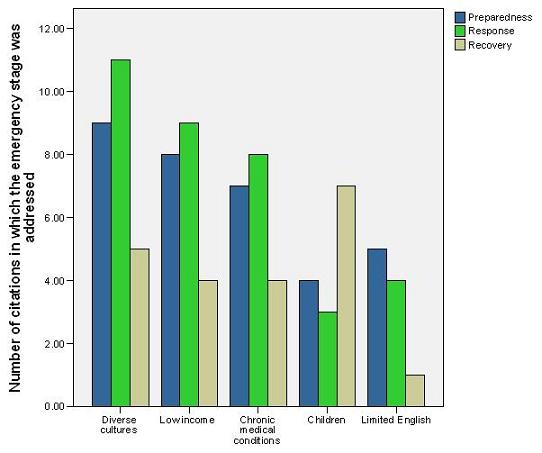 |
Regarding types of emergencies (Figure 2), natural disasters (e.g., hurricane, tsunami) were the topic most often in the literature on risk communication with vulnerable populations[22, 25, 26, 27, 28, 29, 31, 32, 35, 37, 38, 39, 40, 41, 43, 56, 58, 61, 65, 66, 67, 68, 71] followed by terrorist threats or incidents.[7, 23, 29, 31, 38, 44, 45, 46, 57, 62, 67, 68, 69, 70, 72] Infectious disease outbreaks were addressed in several citations[29, 30, 31, 33, 57, 67, 68] while infectious disease pandemics[21, 67, 68] and man-made disasters[38, 67, 68] were each addressed less frequently. The remaining studies addressed another type of emergency, including agricultural,[45] any trauma,[46] flood or dam failures,[ 39] heat waves,[29, 36] power outage,[67] school violence,[68] or the type of emergency was not specified.[24, 34, 47, 65]
| FIGURE 2. Types of Emergencies Addressed in the Review |
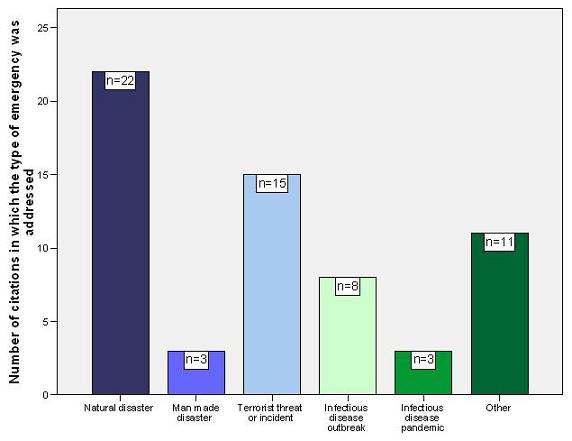 |
Functional Areas
As our working definition of risk communication highlights the importance of “actionable information,” we examined citations for whether specific functional areas were addressed in the context of risk communication (i.e., did the communication provide actionable information or instruction related to specific functional areas). Five functional areas relevant to the needs of vulnerable populations were considered: maintaining independence (e.g., communication regarding the securing of back-up medical supplies for the chronically ill), communication (e.g., communication regarding how to get needed information for individuals with hearing or sight-related disabilities), transportation (e.g., where evacuation transportation can be located for the transportation disadvantaged), supervision (e.g., how those who require supervision, such as children or institutionalized individuals, can obtain it during an emergency), and medical care (e.g., how those who require medical care can obtain it during an emergency). Communication was the functional area was most commonly addressed in the literature,[7, 21, 22, 24, 25, 26, 27, 29, 30, 32, 33, 34, 35, 36, 37, 38, 40, 41, 44, 45, 46, 47, 57, 58, 61, 65, 66, 67, 68, 69, 70, 71, 72] followed by medical care,[21, 22, 23, 28, 30, 33, 35, 37, 39, 47, 58, 66, 67, 68, 71] transportation,[31, 32, 34, 35, 37, 39, 47] maintaining independence,[27, 31, 71] and supervision.[71] Several citations addressed an additional functional area, such as mental health[38, 46, 62, 65] or evacuation.[40, 43, 44]
Table 1 shows the functional areas addressed by type of vulnerable populations represented, where an X indicates that at least one reference addressed both the vulnerable population and the functional area. For the most part, functional areas were well distributed across types of vulnerable populations. However, there are some notable exceptions; for example, none of the literature we reviewed described emergency communication regarding maintaining independence, transportation, or supervision for individuals with disabilities. Similarly, emergency communication regarding supervision was missing from the literature on the elderly, and as no citations addressed pregnant women, functional areas relevant to this group in the context of public health emergencies (e.g., communication, medical care) were not addressed.
| TABLE 1. Functional Areas Addressed within Different Vulnerable Populations | |||||
|---|---|---|---|---|---|
| Vulnerable Population | Functional Area Addressed | ||||
| Maintaining Independence | Communication | Transportation | Supervision | Medical Care | |
| Diverse cultures | X | X | X | X | X |
| Low-income | X | X | X | ||
| Chronic medical condition | X | X | X | X | X |
| Children | X | X | X | X | |
| Elderly | X | X | X | X | |
| Limited/no English proficiency | X | X | X | X | |
| Transportation disadvantaged | X | X | X | X | X |
| Disabled | X | X | |||
| Institutionalized | X | X | X | X | X |
| Pregnant women | |||||
| Rural areas | X | X | X | X | |
| Pharmacological dependency | X | X | X | X | |
| Low-literacy | X | X | X | X | |
Communication Barriers
Finally, we examined the literature for barriers identified to communication success including emotional interference (e.g., fear, anxiety), trust, resources to disseminate communication, inconsistent or ambiguous messaging, and preconceived assumptions based on prior experiences with the type of emergency addressed. All but one study[36] addressed the issue of barriers; of the categories included on the DAF (Appendix A1), barriers related to trust were addressed most often,[7, 23, 24, 28, 29, 30, 31, 32, 37, 38, 39, 43, 56, 69, 70, 72] followed by inadequate resources to disseminate communication.[24, 26, 28, 31, 32, 34, 35, 44, 56, 61, 66, 68, 70, 71] For example, Meredith et al.[72] found that African American focus group participants had significant trust concerns related to government officials communicating truthful information in the event of a terrorist attack. Inconsistent or ambiguous messaging,[7, 21, 22, 23, 26, 28, 29, 33, 44, 57, 69, 72] emotional interference,[30, 32, 33, 37, 38, 46, 62, 65, 67, 69] and incorrect assumptions[7, 23, 28, 29, 31, 32, 72] were addressed in several citations as well. For example, Eisenman and colleagues[32] found that one barrier to successful risk communication aimed at preparing vulnerable populations living in New Orleans for Hurricane Katrina was the incorrect assumption among some residents that the severity of Katrina would be similar to previous hurricanes that were far less devastating. In over half of citations there were barriers mentioned that did not fall within the categories we used on the DAF. These included (but were not limited to) barriers related to the specific characteristics of vulnerable populations, such as cultural beliefs, interpretations, or language barriers,[24, 28, 61, 70] literacy,[34, 35] and specific issues related to disabilities, such as provision of written information for the hearing-impaired.[23] Figure 3 represents the distribution of barriers addressed.
| FIGURE 3. Barriers to Communication Success |
 |
Statutes and Regulations
The DAF was used to extract data, where applicable, from the statutes and regulations included in the review. However, given the relatively small sample of statutes, regulations, and related reports deemed relevant for inclusion and the limited applicability of the DAF in characterizing these references (e.g., items such as Type of Study, Sample Size do not apply), rather than present aggregate data on DAF items we will briefly summarize the content relevant to emergency risk communication for vulnerable populations from each citation below. A table summarizing the vulnerable populations and stages of emergency addressed as well as key messages are displayed at the end of the section in Table 2.
The NRP: The NRP[14] from the DHS describes a comprehensive framework for response to all hazards. As such, the NRP addresses emergency preparedness, response, and recovery, but also prevention. The NRP was the only citation included in this review that addressed public health emergency prevention as a specific emergency stage.
Communication plays a significant role in the NRP. One of the plan’s “key concepts” is the provision of coordinated communication between federal, state, and local government, as well as between members of the public and private sectors, in response to a public health emergency (generally referred to as Incidents of National Significance). Communication with vulnerable populations is not specifically addressed in the NRP.
Updated in 2006, the NRP details the development of a Joint Field Office (JFO) in response to an Incident of National Significance, the particular structure of which is determined by the type of emergency involved. In the JFO, primary responsibility for risk communication with vulnerable populations would fall to the External Affairs Officer (EAO). The EAO would work through the federal Joint Information Center and within the Logistics Section of the JFO. In its section on Incident Action Special Considerations, the NRP details three message considerations that would likely be impacted by an Incident of National Significance: message development, message delivery, and message receipt. Thus, the NRP acknowledges that there are significant challenges to successful risk communication in public health emergencies. These challenges are often exaggerated for members of vulnerable populations.
Finally, the NRP highlights the importance of citizens in all stages of emergencies, and describes the U.S. Citizen Corps, a community-based network that works to improve emergency preparedness, response, and recovery, by providing services that include “targeted outreach for special needs groups.”
Title 42, The Public Health and Welfare, Chapter 68, Disaster Relief: Overall, Chapter 68 emphasizes that disaster relief must be non-discriminatory.[2] Specifically, in Section 5151, the code states “provisions for insuring that the distribution of supplies, the processing of applications, and other relief and assistance activities shall be accomplished in an equitable and impartial manner, without discrimination on the grounds of race, color, religion, nationality, sex, age, or economic status.”
All vulnerable populations included in the PAHPA definition are not included in Chapter 68 of Title 42. Vulnerable populations specifically mentioned in the code are individuals from diverse cultures, low-income backgrounds, seasonal farm workers, and “small impoverished communities,” defined as low-income areas of less than 3000 persons. Emergency preparedness, response, and recovery are addressed in Chapter 68, and details are provided regarding associated communication between federal, state, and local government.
Chapter 68 primarily serves to legislate the duties of the Federal Government in responding to national emergencies and disasters. As such, the code does not provide specific recommendations regarding outreach to vulnerable populations beyond specifying that disaster relief be non-discriminatory. However, in Section 5197h, the Minority Emergency Preparedness Demonstration Program is described. This program is intended to support research that: (1) examines the preparedness and response capacities of diverse populations; and (2) that promotes effective communication regarding public health emergencies to racial/ethnic minority groups. Relevant to the peer-reviewed literature that addresses diverse populations and populations with limited English proficiency, the Minority Emergency Preparedness Demonstration program places an emphasis on the development of public health emergency education that is culturally competent. However, details on what defines culturally competent communication or education are not specified.
The Federal Response to Hurricane Katrina: Lessons Learned: The publicly available Hurricane Katrina: Lessons Learned report[11] follows a timeline beginning before Katrina’s landfall and ending with the continuing recovery efforts in the Gulf States. Emergency preparedness, response, and recovery are addressed for the vulnerable populations affected by the storm.
One hundred and twenty-five recommendations are made at the end of the report, organized within 17 “Critical Challenges.” One of the Challenges is Public Communications, which includes five recommendations specific to risk communication. The recommendations (summarized below) address several barriers to risk communication success identified in the peer-reviewed literature, including trust in risk communication sources, resources to disseminate messaging, and clarity and consistency of risk communication. However, none of the barriers identified in the peer-reviewed literature that specifically relate to vulnerable populations are referenced (e.g., cultural beliefs, interpretations, or language barriers,[24, 38, 61, 70] literacy,[34, 35] and specific issues related to disabilities, such as provision of written information for the hearing-impaired[23]).
-
Recommendation #73: The NRP should detail the ways in which clear and consistent communication will occur between officials from federal, state, and local governments.
-
Recommendation #74: DHS should train and provide rapidly deployable Public Affairs teams.
-
Recommendation #75: Communication-related training should be provided to personnel in federal, state, and local governments.
-
Recommendation #76: Credible spokespersons for risk communication should be identified and coordinated as part of White House crisis communications efforts.
-
Recommendation #78: DHS should develop an integrated emergency alert system that leverages advanced technologies.
Post-Katrina Emergency Management Reform Act of 2006: The Post-Katrina Emergency Management Reform Act of 2006[15] outlines several actions to be taken by FEMA to address the needs of vulnerable populations before, during, and after public health emergencies.
Relevant to this review, the Reform Act recommends an Office of Emergency Communication within FEMA and designates an Administrator to create and oversee guidelines that address communication-related and other needs of individuals with disabilities, other vulnerable populations, and their caregivers. These guidelines will include provisions related to communication and accessibility both in shelters and more broadly during public health emergency response and recovery. Additionally, the Reform Act appoints a Disability Coordinator and establishes the National Emergency Child Locator Center (NECLC) within the National Center for Missing and Exploited Children. The NECLC is intended to facilitate communication aimed at reuniting families separated during a public health emergency via phone and Internet-based media; for example, the NECLC is required to establish a toll-free hotline to receive reports of displaced persons and to manage a website that tracks information about displaced children.
The National Organization on Disability’s Report on SNAKE Project: The National Organization on Disability's SNAKE project report[6] describes the impact of Hurricane Katrina on vulnerable populations; specifically, individuals with “special needs” defined to include the elderly and those with physical, emotional, or cognitive disabilities. The SNAKE team evaluated shelter response in the aftermath of Hurricane Katrina using a survey that assessed shelter conditions, management, resources, and involvement of community-based organizations.
Among several recommendations made for how to better support vulnerable populations throughout emergency preparedness, response, and recovery, the SNAKE report offers specific guidance on how to present risk communication in accessible formats. Individuals who are deaf or hard-of-hearing were identified as the “most underserved” group with respect to communication needs. Accordingly, the SNAKE report suggests that the Federal Communications Commission remind purveyors of emergency information that emergency communications must be accessible to individuals with visual and hearing disabilities. The report goes on to emphasize that while accessible communication is critical during response to public health emergencies, communication must continue to be accessible during the recovery period as well; thus, any actions taken to increase the accessibility of emergency communications must extend beyond the area immediately affected by a public health emergency to include surrounding areas and states that will receive evacuees.
Trust for America’s Health: “Ready or Not? Protecting the Public’s Health from Diseases, Disasters, and Bioterrorism”: The Trust for Americas Health Ready or Not? 2007 report[12] aims to describe the nation’s progress toward achieving successful emergency preparedness (all hazards). Several preparedness indicators are examined state-by-state; however, none of the indicators included in “Ready or Not?” are specific to communication.
The report does address vulnerable populations in a section on “Additional Issues and Concerns.” Here, the report references another citation included in this review[24] and echoes the main points it contains, including the need to tailor risk communication to the needs of vulnerable populations and to deliver information through a trusted source, to increase communication-related training opportunities for emergency responders, and to involve members of vulnerable populations in community-based efforts to prepare for, respond to, and recover from public health emergencies.
The Joint Commission’s “Standing Together: An Emergency Planning Guide for America’s Communities”: The Emergency Planning Guide[10] from JCAHO outlines 13 components of emergency planning for communities (rural and suburban) that are to be executed in a participatory fashion. “Ensure thorough communication planning” and “ensure thorough planning related to vulnerable populations” are specified as two of the 13 essential components.
The JCAHO Guide offers recommendations for emergency preparedness, response, and recovery for several vulnerable populations, including those who have disabilities, who live in institutional settings, who are elderly, who are from diverse cultures, who have limited English proficiency, who are children, who have chronic medical disorders, who have pharmacological dependency, and who are geographically isolated. Regarding communication planning, the Guide recommends 15 strategies, three of which are particularly relevant to this review: planners are encouraged to identify credible, trusted sources to disseminate risk communication to the public; to determine how messages can be disseminated in multiple forms so that all community members can receive the communication (e.g., offer information in multiple languages, in print and audio formats); and to craft culturally competent messages such that cultural and linguistic factors are taken into account.
Regarding vulnerable populations, the Guide suggests that emergency planners conduct needs assessments to identify vulnerable populations and to enlist members of vulnerable populations in planning and response activities, including drills and exercises. The developmental and cognitive limitations of children regarding emergency risk communication are discussed; in particular, the Guide highlights children’s increased psychological vulnerability related to traumatic incidents associated with disasters and their limited cognitive resources with which to interpret relevant information. Educational settings are stressed as an important venue in public health preparedness: school nurses are identified as important partners for addressing the communication needs of children, and high school and college students are identified as potential participants in emergency planning and response.
Individuals with Disabilities in Emergency Preparedness (Executive Order 13347): Executive Order 13347, Individuals with Disabilities in Emergency Preparedness[16] created the Interagency Coordinating Council on Emergency Preparedness and Individuals with Disabilities. The Council is chaired by the Secretary of Homeland Security and functions to ensure that the needs of disabled individuals are considered during the conception and implementation of emergency preparedness plans for all hazards.
CARF's “CARF Guide to Accessibility”: The CARF Guide to Accessibility[9] details the requirements that organizations must meet to successfully provide an environment that is accessible to individuals with disabilities. Though specific emergency stages are not addressed in this publication, issues regarding accessibility in the context of public health emergencies generally are addressed.
| TABLE 2. Summary of Reviewed Statutes, Regulations, and Related Reports | |||
|---|---|---|---|
| Statute/Regulation | Vulnerable Populations Addressed | Stages of Emergency Addressed | Key Message |
| The National Response Plan | Not specified | Prevention, preparedness, response, and recovery | Highlights the importance of citizens in all stages of emergencies and describes where communication procedures are housed in a JFO. |
| Title 42, Chapter 68 | Diverse cultures, low-income, seasonal farm workers | Preparedness, response, and recovery | Details the disaster responsibilities of federal departments; disaster relief must be non-discriminatory. |
| The Federal Response to Hurricane Katrina | Institutionalized individuals, elderly, diverse cultures, children, transportation disadvantaged, chronically ill, pharmacologically dependent, low-income | Preparedness, response, and recovery | Follows the timeline of events leading up to Hurricane Katrina’s landfall through the recovery phase and offers 125 recommendations based on “lessons learned.” |
| The Post-Katrina Emergency Management Reform Act of 2006 | Individuals with disabilities, elderly, children, low-income, homeless, individuals with special needs and their caregivers | Mitigation, preparedness, response, and recovery | Recommends an Office of Emergency Communication within FEMA, a Disability Coordinator, and guidelines to ensure successful communication and accessibility for vulnerable populations. |
| National Organization on Disability’s SNAKE Project | Individuals with disabilities, elderly | Preparedness, response, and recovery | Describes the impact of Hurricane Katrina shelter conditions on individuals with special needs; the deaf and hard-of-hearing are identified as the most underserved. |
| Trust for America’s Health “Ready or Not?” | Individuals with disabilities, elderly, limited English proficiency, children, transportation disadvantaged, pharmacologically dependent, low-income, geographically isolated, homeless | Preparedness, response, and recovery | Reports progress on indicators of preparedness state-by-state. Cites[35] regarding communication strategies with vulnerable populations. |
| JCAHO’s “Standing Together” | Individuals with disabilities, institutionalized individuals, elderly, diverse cultures, limited English proficiency, children, chronically ill, pharmacologically dependent, geographically isolated | Preparedness, response, and recovery | Outlines 13 components of emergency planning for rural and suburban communities. Recommends needs assessments to identify vulnerable populations and to enlist them planning and response activities. |
| Individuals with Disabilities in Emergency Preparedness (Executive Order 13347) | Individuals with disabilities | Preparedness | Established the Interagency Coordinating Council on Emergency Preparedness and Individuals with Disabilities. |
| CARF Guide to Accessibility | Individuals with disabilities | Not specified | Offers guidance to assure that risk communication can be accessible to and acted upon by disabled persons. |
| Administration on Aging’s “Just in Case” | Elderly, caregivers for the elderly | Preparedness, response, recovery | Brief set of guidelines and resources addressing functional areas of maintaining independence, communication, transportation, and medical care during public health emergencies. |
In Chapter 3 (and Checklist 4 of Appendix C), the Guide outlines numerous barriers to successful communication with disabled persons and specifies services that can be provided to overcome these barriers. Given the associated high-stress, it seems likely that the communication barriers identified by the CARF guide would only be exacerbated in the event of a public health emergency, thus underscoring the importance of following the guidelines to ensure communication accessibility for individuals with disabilities.
Visual, acoustic, and physical barriers to communication are included in the guide, such as inadequate lighting that interferes with lip reading or sign viewing, lack of signage and accessibility symbols, and high noise levels. Suggestions to overcome these barriers and to achieve successful risk communication with people with disabilities (PWD) include installing sound buffers, flashing alarms, appropriate signage posted at heights accessible to individuals in wheelchairs, offering a large print option for printed materials, provision of assisted listening devices, and allowance of service animals.
The Administration on Aging’s “Just in Case: Emergency Readiness for Older Adults and Caregivers”: Just in Case[13] is a brief set of guidelines for the elderly and their caregivers addressing the functional areas of maintaining independence, communication, transportation, and medical care for emergency preparedness, response, and recovery. The guidelines are organized around three steps: Know the Basics, Have Your Emergency Supplies Ready, and Make a Personal Plan.
Communication is highlighted within the Personal Plan section; specifically, elderly individuals are encouraged to communicate with family, neighbors, and home health workers regarding a plan for staying safe during a public health emergency. Finally, Just in Case directs readers to several related websites, a readiness checklist, and a template to record emergency contact numbers and health conditions.
Gaps in the Literature on Public Health Emergency Risk Communication with Vulnerable Populations
Along with the themes regarding successful risk communication strategies with vulnerable populations, gaps in the literature were revealed through our review as well.
Vulnerable Populations are Underrepresented in the Public Health Emergency Risk Communication Literature
Only 40 citations--20 percent of the peer-reviewed literature on public health emergency risk communication--contained a substantive focus on vulnerable populations (i.e., vulnerable populations were referenced in the title or abstract). Some vulnerable populations were less well represented than others: only a few citations (less than five) were identified that addressed those who live in institutional settings,[36, 39, 58, 71] who are geographically isolated,[21, 31, 45] those with pharmacological dependency,[7, 71] or individuals with low-literacy.[37, 41] Additional vulnerable populations addressed in only one citation each included developing countries,[66] indigenous persons,[61] those in “poor health,”[57] refugees/immigrants,[62] the rural poor in India,[35] critically ill hospital patients,[58] and socially isolated individuals.[36] None addressed pregnant women.
Thus, there is little evidence upon which to build effective risk communication strategies for many groups within vulnerable populations, including but not limited to individuals living in long-term care facilities, recent immigrants who have limited English proficiency, PWD that affect mobility or cognitive capacity, or pregnant women.
Implications for Tasks 4 and 5: Continued work should determine how much of the available educational and/or outreach materials that are currently available are targeted towards the vulnerable populations largely left out of the peer-reviewed literature (Task 4) and to what degree these groups are represented within risk communication strategies for vulnerable populations (Task 5).
The Literature is Primarily Descriptive and Qualitative in Nature
Qualitative studies were most often represented in the literature on public health emergency risk communication with vulnerable populations,[21, 23, 29, 30, 31, 32, 33, 43, 44, 45, 61, 69, 70, 72] followed by literature reviews[24, 25, 35, 36, 37, 38, 46, 56, 65] and observational studies (survey-based).[22, 27, 28, 39, 40, 57, 68] The remaining studies reviewed were of another type (e.g., content analysis of web-based emergency preparedness materials;[34] multi-method studies incorporating qualitative and observational methods.[7, 26] Most studies relied on a qualitative analytical approach,[7, 21, 23, 24, 25, 29, 30, 31, 32, 33, 34, 35, 36, 37, 38, 41, 43, 44, 45, 46, 47, 56, 61, 62, 65, 67, 69, 70, 71] while a few employed descriptive or bivariate analyses[22, 28, 40, 57, 58, 68, 72] and two used multivariate analyses.[27, 39] Additionally, one citation used a country case study analytical approach[66] and another used both qualitative and multivariate analysis.[26] For over half of citations reviewed[22, 23, 25, 28, 29, 30, 31, 32, 33, 34, 35, 37, 38, 40, 41, 43, 44, 46, 47, 56, 57, 58, 65, 67, 68, 69, 70, 72] the primary research objective was descriptive. Program/policy development or evaluation was an objective of several references[7, 21, 24, 25, 31, 36, 40, 46, 47, 58, 61, 62, 65, 67, 71, 72] with the remainder of studies being needs assessments,[24, 29, 30, 31, 32, 45, 70] hypothesis driven,[26, 27] or documentation of ways information is exchanged between countries.[66]
Overall, within the small literature on public health risk communication that does address vulnerable populations, most references are descriptive in nature and use only qualitative methods in their study design. Indeed, there are several challenges to the empirical study of public health preparedness given that full scale public health emergencies are (fortunately) rare events.[73] Better representation of different types of studies (e.g., observational studies, experimental studies) and different types of methods or analytical approaches (e.g., representative survey samples, quantitative analysis) would facilitate the growth of a strong evidence base that can offer specific guidance on communication interventions for vulnerable populations.
Gaps Related to Functional Areas Addressed
One of the critical functions of public health emergency risk communication is to provide actionable information about functional areas of importance to vulnerable populations. Though functional areas were well distributed across types of vulnerable populations, some gaps exist; for example, none of the literature we reviewed described emergency communication regarding maintaining independence, transportation, or supervision for individuals with disabilities. Similarly, emergency communication regarding supervision was missing from the literature on the elderly.
Implications for Tasks 4 and 5: Continued work should determine whether a range of functional areas are addressed in existing outreach and educational materials (Task 4) and to what degree functional areas are included within risk communication strategies for vulnerable populations (Task 5).
Discussion
Though a large body of research exists on public health emergency risk communication, only a small portion of that literature addresses vulnerable populations, and most citations are primarily descriptive in nature, leaving very few that offer empirical support for specific public health messaging strategies for use with vulnerable populations. However, in the aftermath of Hurricanes Katrina and Rita in particular, studies of public health emergency risk communication focused on vulnerable populations have become more common. As the evidence base regarding risk communication strategies for vulnerable populations grows, policy makers and decision makers can draw upon the general literature on public health emergency risk communication to design strategies for success.[1] In addition, our review identified several promising approaches to successful public health emergency risk communication with vulnerable populations:
-
Offer frequent risk communication in multiple modes that are locally and personally relevant.
-
Employ community-based participatory approaches when designing and disseminating risk communication for vulnerable populations.
-
Keeping in mind that access may be limited, consider Internet-based communication strategies, particularly during emergency response and recovery.
-
Risk communication must be culturally competent in addition to being offered in languages appropriate for vulnerable populations.
-
Vulnerability assessments are key to developing successful risk communication strategies with vulnerable populations.
-
Children are a vulnerable population with special needs and schools are a promising setting for delivering risk communication to children and other vulnerable populations.
-
Leadership is critical to successful risk communication with vulnerable populations, particularly in self-contained organizations (e.g., hospitals, companies, schools).
-
Meteorologists may be a preferred risk communication messenger during public health emergencies to which they are relevant (e.g., natural disasters and any emergency with an airborne component).
Limitations
Though we aimed to be comprehensive in our review, our search strategy may have excluded potentially relevant references from the citations that were examined for inclusion. Our search aimed to capture the broad literature on public health emergency risk communication; those that addressed vulnerable populations were included in the review. Had our strategy first captured the broad literature on vulnerable populations and then included references that addressed public health emergency risk communication, we may have found different results. Further, by only including peer-reviewed literature published since 2000 in our database search, we may have eliminated books or other reports that include information relevant to the review. Additionally, as the public health emergency risk communication literature published since 2000 focuses heavily on the events surrounding Hurricanes Katrina and Rita,[22, 26, 27, 28, 32, 40, 41, 43, 58] our results may be biased towards risk communication regarding natural disasters and the vulnerable populations represented in the Gulf States. Finally, in reviewing a relatively small sample of statutes, regulations, and related reports deemed relevant for inclusion and the limited applicability of the DAF in characterizing these references, our incorporation of these citations into the larger review was somewhat limited.
Conclusion
Risk communication plays a key role in keeping vulnerable populations safe before, during, and after public health emergencies. This review offers insights into ways of improving public health emergency risk communication with vulnerable populations and suggestions as to how subsequent project tasks can further inform efforts to address vulnerable populations in emergency preparedness, response, and recovery.
Appendix A1: Detailed Peer-Reviewed Literature Search Methods
We conducted a review of the literature pertaining to the use of risk communication strategies for vulnerable populations in any stages of emergency preparedness, response, or recovery. Our review included peer-reviewed citations published in English since January 1, 2000. Using these limits, the search strategy in Table A1 was used to identify citations for possible review in four databases (PubMed, Cumulative Index to Nursing and Allied Health Literature, PsycINFO, Social Science Citation Index). Additionally, all references dated 2000 or later in the National Cancer Institutes Risk Communication Bibliography were searched, and publications posted on the Center for Risk Communication website (http://www.centerforriskcommunication.com/home.htm) were also reviewed for inclusion. The review research team (EB and SS) examined titles and abstracts to filter out duplicate retrievals and to determine whether citations met additional inclusion criteria (Criterion A, Table A1).
| TABLE A1. Literature Review Search Strategy and Inclusion Criteria | ||
|---|---|---|
| Search Strategy | [risk communication OR health communication OR public health messaging] AND [emergency preparedness OR emergency OR preparedness OR emergency response OR emergency recovery OR public health emergency OR disaster OR disaster preparedness OR disaster response OR disaster recovery] |
1268 citations identified by search strategy A |
| Criterion A |
|
|
| Criterion B |
|
|
From over 1200 citations identified by our search strategy, 203 met Criterion A. These citations represented the broad literature on risk communication and public health emergencies. To identify which of these specifically addressed vulnerable populations (Criterion B), the review team conducted a second, more thorough abstract review of these 203 citations. Forty (20 percent) were determined to substantively address public health emergency risk communication for vulnerable populations and represented the final literature sample for full review.
Appendix A2: Data Abstraction Form
The DAF was used to systematically record information from the citations included in the review (peer-reviewed literature and statutes/regulations). The DAF was developed by the research team to capture standard elements regarding quality and content (e.g., type of study, sample size, analytic approach). In addition, several items were created by the team to capture data for the specific purposes of this review, including what vulnerable populations were included in the reference, the source of risk communication and the communication delivery method, the type of pubic health emergency described, and the functional areas addressed (e.g., communication, medical care). Barriers to communication success were defined based on previous research conducted by members of the research team[72, 74], as well as a review of the literature on public health emergency risk communication.[1] Further, items to capture the primary research objective of each reference and the stages of emergency preparedness, response, and recovery addressed were included based on results of a recent literature review on disaster medicine and public health preparedness.[75] Additionally, as our working definition of risk communication highlights the importance of “actionable information,” we examined articles for whether specific functional areas were addressed in the context of risk communication (i.e., did the communication provide actionable information or instruction related to specific functional areas relevant to the needs of vulnerable populations). Finally, a field was included in the DAF to enable a qualitative analysis wherein the review team summarized the main points of each study in a free text entry of 3-4 sentences. Once a DAF was complete for all identified documents, the data were entered into SPSS, Version 16.0 for analysis. Free text entries were entered into the SPSS database, cut, and sorted into thematic categories.
| 1. Citation: | ||||
|---|---|---|---|---|
| 2. Does the reference address vulnerable populations? | Yes | No | ||
| If yes: Which ones? (check all that apply) |
who have disabilities | |||
| who live in institutional settings | ||||
| who are elderly | ||||
| who are from diverse cultures | ||||
| who have limited English proficiency or who are non-English speaking | ||||
| who are children | ||||
| who are transportation disadvantaged | ||||
| who are pregnant women | ||||
| who have chronic medical disorders | ||||
| who have pharmacological dependency | ||||
| Other (specify; include low-income): | ||||
| Evaluation of Quality | ||||
| 1. Type of study | ||||
| Randomized controlled trial | ||||
| Literature Review | ||||
| Meta Analysis / Systematic Review | ||||
| Qualitative data | ||||
| Observational / Survey | ||||
| Longitudinal data | ||||
| Other (specify): | ||||
| 2. Sample description (include gender, age, race/ethnicity | ||||
| 3. Sample size | ||||
| 4. Data collection method | ||||
| Focus group | ||||
| In-person interview | ||||
| Phone/Mail/Web survey | ||||
| Other (specify): | ||||
| 5. Measures | ||||
| 6. Analytic approach | ||||
| Qualitative synthesis (includes literature reviews) | ||||
| Descriptive or bivariate analysis only | ||||
| Multivariate analysis | ||||
| Other: | ||||
| 7. Estimated impact of results (check not applicable if citation is a literature review) | ||||
| How novel is the study? (0-10 where 10 is most novel) | ||||
| How usable are the studys results? (0-10 where 10 is most usable) | ||||
| How rigorous are the studys methods? (0-10 where 10 is most rigorous) | ||||
| Average | ||||
| Evaluation of Content | ||||
| 1. Type of publication | ||||
| Original research | ||||
| Statute or regulation | ||||
| 2. Stages of preparedness addressed (check all that apply) | ||||
| Preparedness (e.g., vaccination, education, resource gathering) | ||||
| Response (e.g., evacuation) | ||||
| Recovery & Mitigation (e.g., shelter management, safety maintenance, MH) | ||||
| Other (specify): | ||||
| 3. Source of risk communication (check all that apply) | ||||
| Local government | ||||
| State government | ||||
| Federal Government | ||||
| Health care provider/health care system | ||||
| Other (specify): | ||||
| 4. Communication delivery method (check all that apply) | ||||
| Written | ||||
| Internet | ||||
| Radio/Television | ||||
| Interpersonal | ||||
| Other (specify): | ||||
| 5. Intended communication audience | ||||
| 6. Primary research objective (check all that apply) | ||||
| Descriptive | ||||
| Program/policy development or evaluation | ||||
| Hypothesis driven | ||||
| Needs assessment | ||||
| Other (specify): | ||||
| 7. Type of Emergency (check all that apply) | ||||
| Natural disaster | ||||
| Man-made disaster | ||||
| Terrorist threat/incident | ||||
| Infectious disease outbreak | ||||
| Infectious disease pandemic | ||||
| Other public health emergency | ||||
| Other emergency (specify): | ||||
| 8. Outcomes assessed (check all that apply; say not applicable if citation is a literature review) | ||||
| Change in awareness | ||||
| Change in understanding/comprehension | ||||
| Change in behavior | ||||
| Other (specify): | ||||
| 9. Barriers identified to communication success | ||||
| Emotional interference | ||||
| Trust in source of communication | ||||
| Resources to disseminate communication | ||||
| Inconsistent or ambiguous messaging | ||||
| Pre-conceived assumptions based on prior experience with type of emergency | ||||
| Other (specify): | ||||
| 10. Functional areas addressed (check all that apply) | ||||
| Maintaining independence | ||||
| Communication | ||||
| Transportation | ||||
| Supervision | ||||
| Medical care | ||||
| Other (specify): | ||||
| 11. Impact of communication (check not applicable if citation is a literature review) | ||||
| Significant | ||||
| Neutral | ||||
| Low | ||||
| Unknown | ||||
| Not applicable (e.g., a specific communication intervention was not evaluated) | ||||
| 12. Overall implications | ||||
References
-
Glik, D.C. (2007) Risk communication for public health emergencies. Annual Reviews of Public Health, 28, 33-54.
-
U.S. House of Representatives. (2006). U.S. Code Title 42: The Public Health and Welfare, Chapter 68 (Disaster Relief).
-
Wingate, M.S., Perry, E.C., Campbell, P.H., David, P., & Weist, E.M. (2007). Identifying and protecting vulnerable populations in public health emergencies: Addressing gaps in education and training. Public Health Reports, 122, 422-426.
-
Aakko, E. (2004). Risk communication, risk perception, and public health. Wisconsin Medical Journal, 103(1), 25-27.
-
National Center for Missing and Exploited Children. (2005). Last of Unaccompanied Children in Katrina Shelters Reunited with Families. Available from: http://www.ncmec.org/missingkids/servlet/NewsEventServlet?LanguageCountry=en_US&PageId=2150.
-
National Organization on Disability. (2005). Report on special needs assessment for Katrina evacuees (SNAKE) project. Retrieved on-line December 7, 2007 at http://www.nod.org/Resources/PDFs/katrina_snake_report.pdf.
-
McGough, M., et al. (2005). Communicating the risks of bioterrorism and other emergencies in a diverse society: A case study of the special populations in North Dakota. Biosecurity and Bioterrorism-Biodefense Strategy Practice and Science, 3(3), 235-245.
-
Covello, V.T.A., & Seven, F.W. (1988). Seven Cardinal Rules of Risk Communication. Washington, DC: Environmental Protection Agency, Office of Policy Analysis.
-
Commission on Accreditation of Rehabilitation Facilities. (2004). CARF Guide to Accessibility. Tucson, AZ: Commission on Accreditation of Rehabilitation Facilities.
-
Joint Commission on Accreditation of Healthcare Organizations. (2005). Standing Together: An Emergency Planning Guide for America's Communities. Retrieved on-line December 7, 2007 at http://www.jointcommission.org/NR/rdonlyres/FE29E7D3-22AA-4DEB-94B2-5E8….
-
The White House. (2006). The Federal Response to Hurricane Katrina: Lessons Learned. Retrieved on-line December 7, 2007 at http://www.whitehouse.gov/reports/katrina-lessons-learned.pdf.
-
Trust for America's Health. (2007). Ready or Not? Protecting the Public's Health from Diseases, Disasters, and Bioterrorism. Retrieved on-line December 7, 2007 at http://healthyamericans.org/reports/bioterror07/BioTerrorReport2007.pdf.
-
U.S. Department of Health and Human Services, Administration on Aging. Just in Case: Emergency Readiness for Older Adults and Caregivers. Retrieved on-line December 7, 2007 at http://www.aoa.gov/PROF/aoaprog/caregiver/overview/Just_in_Case030706_l….
-
U.S. Department of Homeland Security. (2004). National Response Plan. Retrieved on-line December 7, 2007 at http://www.dhs.gov/xlibrary/assets/NRPbaseplan.pdf.
-
GovTrack.us S. 3721--109th Congress (2006): Post-Katrina Emergency Management Reform Act of 2006. GovTrack.us (database of federal legislation) accessed March 4, 2008 at http://www.govtrack.us/congress/bill.xpd?bill=s109-3721.
-
Executive Order 13347: Individuals with Disabilities in Emergency Preparedness. Retrieved on-line February 2008 at http://www.whitehouse.gov/news/releases/2004/07/20040722-10.html.
-
Atman, C.J., Bostrom, A., Fischhoff, B., & Morgan, M.G. (1994). Designing risk communications: completing and correcting mental models of hazardous processes, Part I. Risk Analysis, 14, 779-788.
-
Ng, K.L., & Hamby, D.M. (1997). Fundamentals for establishing a risk communication program. Health Physics, 73, 473-482.
-
Council, N.R. (1989). Improving Risk Communication. Washington DC: National Academy Press.
-
Kasperson, R.E. (1992). The Social Amplification of Risk: Progress in Developing an Integrative Framework. In Krimsky, S., & Golding D. (ed.), Social Theories of Risk. Westport, CT: Praeger.
-
Doxtator, L.A., Gardner, C.E., & Medves, J.M. (2004). Responding to pandemic influenza--A local perspective. Canadian Journal of Public Health-Revue Canadienne De Sante Publique, 95(1), 27-31.
-
Rogers, B., & Lawhorn, E. (2007). Disaster preparedness: Occupational and environmental health professionals' response to Hurricanes Katrina and Rita. AAOHN Journal, 55(5), 197-207.
-
Blanchard, J.C., et al. (2005). In their own words: Lessons learned from those exposed to anthrax. American Journal of Public Health, 95(3), 489-495.
-
Andrulis, D.P., Siddiqui, N.J., & Gantner, J.L. (2007). Preparing racially and ethnically diverse communities for public health. Health Affairs, 26(5), 1269-1279.
-
Basher, R. (2006). Global early warning systems for natural hazards: Systematic and people-centered. Phil Trans R Soc A, 364, 2167-2182.
-
Beaudoin, C.E. (2007). News, social capital and health in the context of Katrina. Journal of Health Care for the Poor and Underserved, 18(2), 418-430.
-
Beaudoin, C.E. (2007). Mass media use, neighborliness, and social support: Assessing causal links with panel data. Communication Research, 34(6), 637-664.
-
Brodie, M., et al. (2006). Experiences of Hurricane Katrina evacuees in Houston shelters: Implications for future planning. American Journal of Public Health, 96(8), 1402-1408.
-
Carter-Pokras, O., et al. (2007). Emergency preparedness: Knowledge and perceptions of Latin American immigrants. Journal of Health Care for the Poor and Underserved, 18(2), 465-481.
-
Chan, S.S., et al. (2007). Parental response to child's isolation during the SARS outbreak. Ambulatory Pediatrics, 7(5), 401-404.
-
Chesser, A., et al. (2006). Preparedness needs assessment in a rural state: Themes derived from public focus groups. Biosecurity and Bioterrorism-Biodefense Strategy Practice and Science, 4(4), 376-383.
-
Eisenman, D.P., et al. (2007). Disaster planning and risk communication with vulnerable communities: Lessons from Hurricane Katrina. American Journal of Public Health, 97 Supplement 1, S109-S115.
-
Gearing, R.E., Saini, M., & McNeill, T. (2007). Experiences and implications of social workers practicing in a pediatric hospital environment affected by SARS. Health and Social Work, 32(1), 17-27.
-
James, X., Hawkins, A., & Rowel, R. (2007). An assessment of the cultural appropriateness of emergency preparedness communication for low income minorities. Journal of Homeland Security and Emergency Management, 4(3).
-
Kesavan, P.C., & Swaminathan, M.S. (2006). Managing extreme natural disasters in coastal areas. Philos Transact A Math Phys Eng Sci, 364(1845), 2191-2216.
-
Kovats, R.S., & Kristie, L.E. (2006). Heatwaves and public health in Europe. Europe Journal of Public Health, 16(6), 592-599.
-
Langer, Langer, N. (2004). Natural Disasters that Reveal Cracks in our Social Foundation. Educational Gerontology, 30(4), 275-285.
-
Ng, A.T. (2005). Cultural diversity in the integration of disaster mental health and public health: A case study in response to bioterrorism. International Journal of Emergency Mental Health, 7(1), 23-31.
-
Rosenkoetter, M. (2007). Perceptions of older adults regarding evacuation in the event of a natural disaster. Public Health Nursing, 24(2), 160-168.
-
Spence, P.R., et al. (2007). Media use and information needs of the disabled during a natural disaster. Journal of Health Care for the Poor and Underserved, 18(2), 394-404.
-
Vanderford, M.L., et al. (2007). Emergency communication challenges in response to Hurricane Katrina: Lessons from the Centers for Disease Control and Prevention. Journal of Applied Communication Research, 35(1), 9-25.
-
Stein, B.D., Tanielian, T.L., Ryan, G.W., Rhodes, H.J., Young, S.D., & Blanchard, J.C. (2004). A bitter pill to swallow: Nonadherence wtih prophylactic antibiotics during the anthrax attacks and the role of private physicians. Biosecurity and Bioterrorism: Biodefense Strategy, Practice, and Science, 2(3), 175-185.
-
Cordosco, K.M., Eisenman, D.P., Glik, D.C., Golden, J.F., & Asch, S.M. (2007). They blew the levee: Distrust of authorities among Hurricane Katrina evacuees. Journal of Health Care for the Poor and Underserved, 18, 277-282.
-
Gershon, R.R.M., et al. (2007). Factors associated with high-rise evacuation: Qualitative results from the World Trade Center evacuation study. Prehospital and Disaster Medicine, 22(3), 165-173.
-
Heideman, M., & Hawley, S.R. (2007). Preparedness for allied health professionals: Risk communication training in a rural state. Journal of Allied Health, 36(2), 72-76.
-
Joshi, P.T., & Lewin, S.M. (2004). Disaster, terrorism: Addressing the effects of traumatic events on children and their families is critical to long-term recovery and resilience. Psychiatric Annals, 34(9), 710-716.
-
Kirkpatrick, D.V., & Bryan, M. (2007). Hurricane emergency planning by home health providers serving the poor. Journal of Health Care for the Poor and Underserved, 18(2), 299-314.
-
Israel, B.A., et al. (1998). Review of community-based research: Assessing partnership approaches to improve public health. Annu Rev Public Health, 19, 173-202.
-
Viswanathan, M., et al. (2004). Community-Based Participatory Research: Assessing the Evidence. Agency for Healthcare Research and Quality.
-
Plescia, M., Groblewski, M., & Chavis, L., A lay health advisor program to promote community capacity and change among change agents. Health Promotion Practice, Epub ahead of print, p.1-6.
-
Rhodes, S.D., Foley, K.L., Zometa, C.S., & Bloom, F.R. (2007). Lay health advisor interventions among Hispanics/Latinos: A qualitative systematic review. American Journal of Preventive Medicine, 33(5), 418-427.
-
Hesse, B., & Schneiderman, B. (2007). eHealth research from the user's perspective. American Journal of Preventive Medicine, 32(5S), S97-S103.
-
Fordis, M., Alexander, J.D., & McKellar, J. (2007). Role of a database-driven web site in the immediate disaster response and recovery of an academic health center: The Katrina experience. Academic Medicine, 82(9), 769-772.
-
Noar, S.M., Benac, C.N., & Harris, M.S. (2007). Does tailoring matter? A meta-analytic review of tailored print health behavior change interventions. Psychological Bulletin, 133(4), 673-693.
-
Collins, L.M., Murphy, S.A., & Strecher, V. (2007). The Multiphase Optimization Strategy (MOST) and the Sequential Multiple Assignment Randomized Trial (SMART): New methods for more potent eHealth interventions. American Journal of Preventive Medicine, 32(5S), S112-S118.
-
Stephenson, R.S. (2002). Disasters and development: Part 2: Understanding and exploiting disaster-development linkages. Prehospital and Disaster Medicine, 17(3), 170-173.
-
Kittler, A.F., et al. (2004). The Internet as a vehicle to communicate health information during a public health emergency: A survey analysis involving the anthrax scare of 2001. Journal of Medical Internet Research, 6(1).
-
Sexton, K.H., Alperin, L.M. & Stobo, J.D. (2007). Lessons from Hurricane Rita: The University of Texas Medical Branch hospital's evacuation. Academic Medicine, 82(8), 792-796.
-
Fox, S. (2005). Digital Divisions. October 2005 Report for the PEW Internet and American Life Project. Available from: http://www.pewinternet.org/pdfs/PIP_Digital_Divisions_Oct_5_2005.pdf.
-
Pew. (2005). Latest Trends. Pew Internet & American Life Project. Available from: http://www.pewinternet.org/trends.asp.
-
Alcantara-Ayala, I., et al. (2004). Natural hazards and risk communication strategies among indigenous communities--Shedding light on accessbility in Mexico's mountains. Mountain Research and Development, 24(4), 298-302.
-
Lemyre, L., et al. (2005). A psychosocial risk assessment and management framework to enhance response to CBRN terrorism threats and attacks. Biosecurity and Bioterrorism-Biodefense Strategy Practice and Science, 3(4), 316-330.
-
Klassen, A., & Platz, E. (2006). What can geography tell us about prostate cancer? American Journal of Preventive Medicine, 30(2S), S7-S15.
-
Rutten, L.J.F., Auguston, E.M., Moser, R.P., Beckjord, E.B., & Hesse, B.W. Smoking Knowledge and Behavior in the U.S.: Sociodemographic, Smoking Status, and Geographic Patterns. Nicotine & Tobacco Research, Manuscript accepted for publication.
-
Wooding, S., & Raphael, B. (2004). Psychological impact of disasters and terrorism on children and adolescents: Experiences from Australia. Prehospital and Disaster Medicine, 19(1), 10-20.
-
Health aspects of disaster preparedness and response. Report from a regional meeting of countries of South East Asia; Bangkok, Thailand, 21-23, November 2005. Prehospital and Disaster Medicine, 2006, 21(5), s62-s78.
-
Wingard, J.R., Leahigh, A.K., et al. (2006). Preparing for the unthinkable: Emergency preparedness for the hematopoietic cell transplant program. Bio Blood Marrow Transplant, 12(11), 1229-1238.
-
Olympia, R.P., Wan, E. & Avner, J.R. (2005). The preparedness of schools to respond to emergencies in children: A national survey of school nurses. Pediatrics, 116(6), e738-745.
-
Becker, S.M. (2004). Emergency communication and information issues in terrorist events involving radioactive materials. Biosecurity and Bioterrorism-Biodefense Strategy Practice and Science, 2(3), 195-207.
-
Henderson, J.N., et al. (2004). Chemical (VX) terrorist threat: Public knowledge, attitudes, and responses. Biosecurity and Bioterrorism-Biodefense Strategy Practice and Science, 2(3), 224-228.
-
Ibrahim, A., & Hameed, A. (2006). Mental health and psychosocial support aspects of disaster preparedness in the Maldives. International Review of Psychiatry, 18(6), 573-578.
-
Meredith, L.S., et al. (2007). Trust influences response to public health messages during a bioterrorist event. Journal of Health Communication, 12(3), 217-32.
-
Nelson, C., Lurie, N., & Wasserman, J. (2007). Assessing public health emergency preparedness: Concepts, tools, and challenges. Annual Reviews of Public Health, 28, 1-18.
-
Beckjord, E.B., Finney Rutten, L.J., Arora, N.K., Moser, R.P., & Hesse, B.W. Negative affect and cognitive processing: Evidence from the 2003 Health Information National Trends Survey. Health Psychology, In press.
-
Abramson, D.M., Morese, S.S., Garrett, A.L., Redlener. (2007). Public health disaster research: Surveying the field, defining its future. Concepts in Disaster Medicine, 1(1), 57-62.
Appendix B. Compendium of Risk Communications
Background
Risk communication is a critical component of public health emergency preparedness (PHEP), response, and recovery efforts,[1] as it provides an all-important link for the public to make informed decisions about what actions to take. According to the U.S. House of Representatives,[2] public health emergency communication should be non-discriminatory, with equal access and utility to all individuals. As described in the literature review in Task 3 of this project,[3] vulnerable populations face specific challenges in their ability to access, process, and act on risk communication and may have particular needs before, during, and after emergencies.
To assist planning and response efforts for these more vulnerable populations, we created a compendium to obtain and inventory relevant communication, outreach, and education materials, related to emergency preparedness, response, and recovery, that are intended for vulnerable populations. Specifically, the purposes of this compendium are:
-
To provide a list of resources to public health emergency planners and those working to deliver risk communications to vulnerable populations.
-
To identify promising risk communication strategies.
-
To identify gaps and commonalities in available resources.
Risk communication has been defined as an interactive process of exchange of information and opinion among individuals, groups, and institutions. It involves multiple messages about the nature of risk and other messages, not strictly about risk, that express concerns, opinions, or reactions to risk messages or to legal and institutional arrangements for risk management.[4] For purposes of this task, and in keeping with other discussions of risk communication,[5, 6] we focus on communications regarding risks that specifically include actionable information. That is, the information does not simply describe the nature or consequences of a risk, but rather provides information on how to prepare for, protect against, respond to, or recover from the risk. A great number of risk communication resources exist for general audiences. Yet, the literature review (Task 3) and recent events such as Hurricanes Katrina and Rita highlight the specific challenges and shortcomings of risk communications for vulnerable populations. In addition to being actionable, the public health emergency risk communications considered here must address the specific needs that vulnerable populations will likely have before, during, or after a public health emergency.
Vulnerable populations include individuals who have disabilities, are institutionalized, are elderly, are from diverse cultures, have limited English proficiency or are non-English speaking, are children, are transportation disadvantaged, are pregnant, have chronic medical disorders, or have pharmacological dependency (i.e., chemical dependency/addiction). The definition used here has been adopted by the Department of Health and Human Services and was derived from recommendations of the Interagency Coordinating Council on Emergency Preparedness and Individuals with Disabilities, the draft implementation plan for the Pandemic and All-Hazards Preparedness Act, and the draft revisions to the National Response Plan.
The compendium is built on the foundation provided by the literature review of promising risk communication approaches and communication strategies (Task 3). In conjunction with the literature review, this compendium informs the case studies of state or local region risk communication practices as they relate to vulnerable populations (Task 5).
Methods
Compendium of Risk Communication Materials for Vulnerable Populations
As described in more detail below, risk communication materials for vulnerable populations were identified by searching publicly available websites. Websites were scanned and reviewed for communication materials that were at the intersection of three domains. To be included in the compendium, items needed to focus on each of three criteria:
-
PHEP, including preparedness for natural disasters, man-made disasters, terrorist events, and contagious public health exposures.
-
Vulnerable populations, as those at-risk.
-
Risk communication that both characterized the risk and provided information that was actionable.
Figure 1 depicts the intersection of these three criteria, including examples of resources that fit in this intersection. Many available resources address some but not all of these domains. Figure 1 also provides examples of resources that would not be in this intersection and hence are not included in the compendium.
Compiled materials have a significant focus on the needs or special circumstances of one or more vulnerable populations (e.g., those with disabilities, children, and pregnant women, etc.), targeting members of those vulnerable populations, their caregivers, and/or the provider communities that serve these populations. Some resources were targeted at service providers and not the vulnerable population specifically. In this case, we only include resources that provided actionable recommendations for communicating with the vulnerable populations and not merely general advice or considerations. Items could also address any stage of the preparedness cycle, including preparedness, response, and/or mitigation and recovery. Finally, many resources have been translated into a variety of languages (including American Sign Language). Resources that were mere translations of general population resources, without specific attention to the broader issues affecting limited English or non-English speakers, were not included in the compendium. However, where resources that met inclusion criteria are translated, these other languages are noted (in Appendix B1, final column).
| FIGURE 1. The Intersection of Public Health Emergency Preparedness, Vulnerable Populations, and Risk Communication |
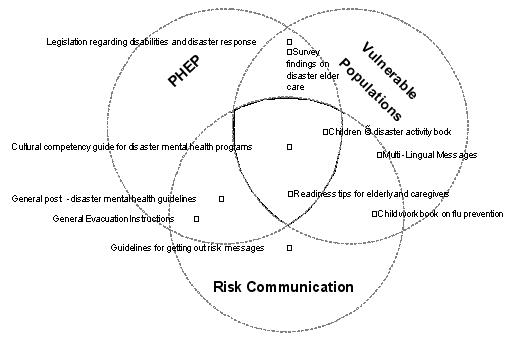 |
Compendium Search Methods
We focused the compendium search on material that was both widely and readily available (from websites of major national organizations) through a snowball-sampling strategy that began with the identification of government and national organizations whose focus was on public health and emergency preparedness (e.g., American Red Cross), vulnerable populations (e.g., National Organization on Disability), or both (e.g., Disability Preparedness Center). Specifically, team members and other area experts at RAND identified organizations targeting each of these areas. The project team searched each of these organizations’ websites. Additionally, team members followed links from these to other websites one or two “clicks” deep and eligible items were cataloged. If any links led to sites that were themselves rich sources of information, we added those organizations to our existing list of organizations and returned to them later for thorough searches. The list of all organizations included in this compendium, as well as their website addresses, is provided in Appendix B2. Resources that were referenced on websites, but not immediately available electronically (either because no electronic versions were posted or the materials needed to be special ordered) were catalogued but not included in the final compendium. This small number of unavailable resources is discussed below and provided in Appendix B3.
Compendium Data Extraction
The construction of the compendium involved three progressive phases of review. Phase 1 review focused on the identification of candidate resources with the goal of growing the compendium, as well as initial cataloging of key dimensions, which flow from the conceptual framework included in the proposal. This framework draws on theories of persuasive communication and includes five aspects of communication:[7, 8]
-
The source of the message, including whether the organization is a government or non-government organization.
-
The medium by which the message is conveyed, including whether the risk communication was text-based, audio/visual, or interactive (electronically, as in an on-line quiz, or personally, as in a discussion group). Because there is great diversity even within these categories, a specific type variable was also entered, which described the resource qualitatively (e.g., booklet, brochure, etc.).
-
The targeted recipient, which includes whether the risk communication targets members of the vulnerable population, caregivers, or providers. This also includes which vulnerable population is targeted.
-
The content of the message itself includes emergency type, which was cataloged as natural disaster, man-made disaster, terrorist threat or incident, infectious disease outbreak, infectious disease pandemic, other public health emergency, other emergency, or unspecified. It also includes stage of preparedness, which was catalogued as preparedness, response, or recovery.
-
The target behavior, which includes five functional areas--maintaining independence, communication, transportation, supervision, medical care, and other.
Generally, the categories within each variable were allowed to overlap, with a single resource potentially getting multiple assignments (e.g., targeting both vulnerable individuals and caregivers).
The compendium is a database in an Excel spreadsheet. Each resource is catalogued in a single row, with columns for document number, hyperlink to an electronic version of the resource, citation, source, source type, medium type, specific medium type, vulnerable population, target audience, emergency type, stage of preparedness, functional area, and whether the resource is also available in other languages. A legend of these variables is presented in Appendix B1.
During Phase 2 review, each resource was reviewed by a randomly assigned team member, and catalogued data were double-checked. Reviewers were also instructed to identify exceptional resources (all-stars), which would be reviewed carefully in Phase 3 to identify key messages and strategies. Specifically, Phase 2 reviewers were instructed to flag resources they viewed as exemplary, in terms of anticipated benefit to their intended audience. Anticipated benefit was defined as the conveyance of actionable information that is appropriate for the intended audience. Furthermore, reviewers were informed that the aim was to capture approximately the best 10 percent. The goal was not to systematically review each resource, but instead to identify key exemplars that could be the focus of a more intensive review.
For Phase 3 review, four team members divided up resources flagged as all-stars. Each all-star resource was then reviewed carefully, rated on six dimensions, including the extent to which the resource:
- Clearly stated and addressed objectives;
- Clearly stated and addressed risks associated with the public health emergency;
- Reasonably covered issues salient to the specified vulnerable population(s);
- Provided specific guidance on how to act on the advice given;
- Was clear and easy to understand; and
- Was engaging.
Reviewers made notes on the motivation behind their ratings and also noted key messages delivered by the resource. The all-star score sheet is provided in Appendix B4.
Compendium Sample
Figure 2 illustrates the compendium sampling flow. Phase 1 review identified 309 resources from 73 different organizations (as well as websites linked from those organizations’ websites). As shown in Appendix B2, 28 of these 73 organizations were within the Federal Government, 20 were associations (e.g., National Association of City and County Health Officials [NACCHO]), 15 were service organizations (e.g., the American Red Cross), four were research organizations (e.g., RAND), and four did not fit any of these classifications but were referenced sufficiently to warrant adding to our list of organizations. Upon the closer inspection of the Phase 2 review, it was determined that 32 resources failed to satisfy our definitions of PHEP, vulnerable populations, or risk communication. Eight resources were risk communications directed at the safety of responders themselves, rather than vulnerable populations. As these were outside the scope of the compendium, they were removed. 27 of the remaining 269 resources were unavailable for download, and hence were not immediately available to audiences. Because of this, they were separated from the main compendium and are not included in the following analyses. The result is 242 resources in the final compendium.1 Forty-one (16.9 percent) of these were identified by Phase 2 reviewers as all-stars.2
| FIGURE 2. Compendium Sampling Flow |
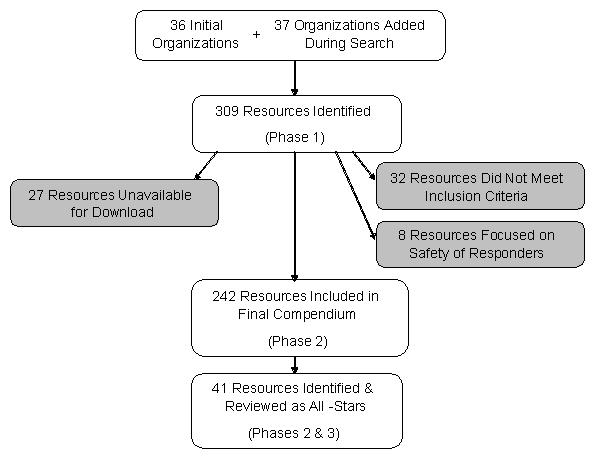 |
Results
Our results are presented in two sections. The first provides a detailed, qualitative analysis of promising emergency risk communication strategies for vulnerable populations among the risk communications included in the compendium. The second section takes a more quantitative approach, identifying gaps and commonalities in the coverage of materials across vulnerable populations, emergency types, and other key characteristics.
Identify Promising Risk Communication Strategies
The final Phase of review (Phase 3) consisted of carefully reviewing each resource labeled an all-star in Phase 2, with the goals of identifying promising risk communication strategies and providing examples of these strategies drawn from this set of resources. At this stage, the goal was not to quantitatively evaluate each and every resource. Each all-star resource was rated on six dimensions using a scale ranging from poor to truly extraordinary, with relatively finer distinctions made at the high end of the scale, reflecting that these resources had already been identified as exemplary. Subsequent analysis focused on the dimensions upon which specific all-star resources were seen to excel. Table 1 displays the proportion of the 41 all-stars rated as truly extraordinary (the highest rating) on the six score sheet dimensions. The all-star score sheet is included in Appendix B4.
| TABLE 1. Proportion of All-Stars Rated Highest on Each Dimension (N = 41) |
|
|---|---|
| Dimension | Proportion Rated “Truly Extraordinary” |
| EFFECTIVENESS/COMPREHENSIVENESS | |
| Objectives for the resource are clearly stated and addressed | 24% |
| The risks associated with the public health emergency are clearly stated and addressed | 22% |
| Resource reasonably covers issues salient to the specified vulnerable population(s) | 41% |
| FEASIBILITY/USEFULNESS | |
| Resource provides specific guidance on how to act on the advice given (i.e., is easily actionable) | 41% |
| Resource is clear and easy to understand | 44% |
| Resource is engaging | 29% |
Clarity and Understandability. The most often-cited point of excellence among the all-stars was clarity and understandability. Within this, three themes arose. First of all, providing concrete examples can dramatically increase clarity. Videos by Ready America (Documents #8 and #9 in the compendium) showed members of the vulnerable population and their caregiver acting out recommended actions, providing concrete models for recipients. A webcast (#77) by the Substance Abuse and Mental Health Services Administration (SAMHSA) ends with a mock counseling session, helping recipients to ground their expectations. An American Red Cross coloring book (#62) includes pictures of what children should be doing during an emergency. And a resource from the American Red Cross (#63) includes a letter written to seniors by seniors, conveying compelling, relevant experiences.
A second theme was that understanding may be facilitated by simply defining terminology and spelling out assumptions. Emergency preparedness communities often use language that may not be well-known to vulnerable populations, and hence need to be defined. For example, the Ready, Set, Prepare! children's activity book (#59), also from the American Red Cross, has a Words to Know section defining important words. Similarly, SAMHSAs Developing Cultural Competence in Disaster Mental Health Programs (#113) begins with a set of guiding assumptions which help set the stage for the rest of the resource.
Third, tailoring the format to the audience and situation can greatly impact clarity and understanding. Audio/visual and pictorial displays can have great impact. A simple but dramatic example is provided by the City of Los Angeles guide, Emergency Preparedness for People with Disabilities (#183), which contains a drawing of a dog holding a sign that says dont forget me. But whereas flashy can be good, simple can be better for specific audiences or situations. A set of tip cards for first responders from the Center for Development and Disability at the University of New Mexico (#4) consists of simple, bulleted information broken down by disability type. The effectiveness comes from the ability to quickly digest the key points in dynamic response environments. A very different example of formatting that facilitates use by different audiences is the Centers for Disease Control and Prevention Website, Index of Printable Hurricane and Flood Materials (#289), which provides risk communications in multiple languages in an easy-to-navigate matrix design. Another example of tailoring is the Masters of Disasters suite of material for earthquakes (#39). This set of materials offers lessons and examples tailored to multiple developmental stages, for use with children in different age groups. Other important aspects of tailoring the format include using appropriate reading levels and ensuring that availability matches the audience (e.g., because of modality or technology limitations).
Comprehensiveness. Coverage of issues relevant to vulnerable populations was also frequently noted in the review of these documents. Resources that were careful to acknowledge diversity within vulnerable populations stood out. For example, a factsheet from the U.S. Department of Veterans Affairs (#267) noted that children of different age ranges will likely have different reactions to terrorist attacks, and hence will require different caregiving strategies. The previously mentioned SAMHSA guide on cultural competency (#113) explicitly emphasizes this point.
Comprehensive coverage, however, does not mean uniform coverage. In particular, risk communicators may have the instinct to tell people what they should know, not recognizing that some of that information is obvious or widely known. Dwelling on such information could potentially damage credibility of the source. Instead, including and emphasizing crucial information that is less likely to be known can have a greater impact.[9] In particular, such a strategy can lead to ah-ha moments with recipients, enhancing the perceived value of the resource. A straightforward example of this was noted in a brochure by the National Organization on Disability for animal owners (#180), noting that different resources (e.g., access to shelters) may be available to service animals than for pets in general. A brochure from the Community Emergency Preparedness Information Network on hurricane preparedness for the hearing- impaired (#143) suggested placing important papers in waterproof containers and putting refrigerators/freezers on their coldest settings to prepare for a potential power outage. These specific examples may not be news to some individuals, but were to the reviewers, and may also be to other individuals.
Action Orientation. Also frequently cited by reviewers was the action orientation of many all-star resources. An American Red Cross activity book (#59) encourages children to take an active role in preparing for emergencies, and a ready.gov scavenger hunt (#242) sends children in search of emergency kit items. The second section of the guide to cultural competency (#113) provides a framework for action. Additionally, checklists and self-assessments can help recipients tailor resources to their own needs. The booklet, Listen, Protect, and Connect: Psychological First Aid for Children and Parents, (#250) from the U.S. Department of Homeland Security (DHS), includes places to write in details, which helps to ground the risk communication in an individuals experiences. Finally, the credibility of calls to action may be enhanced by recognizing barriers to success. The NACCHO Advanced Practice Center Toolbox (#18) does this quite effectively, citing cost of preparedness (e.g., first-aid kit and battery-powered radio) and denial of risk as examples of barriers.
Ability to Engage the Audience. Another prominent theme was the ability of resources to engage their intended audience. Multi-modal approaches were noted by the reviewers as breaking monotony, grabbing attention, and providing different angles on a common message. For example, SAMHSAs substance use and trauma-related webcast (#77) combines an interview video with parallel PowerPoint slides (with the option of enabling closed captioning). Such approaches acknowledge both different learning styles and different communications needs. Embedding checklists, self-assessments, and other active segments can help to achieve some of the benefits of shorter resources, but within longer, more comprehensive resource packages. The Family Readiness Kit from the American Academy of Pediatrics (#125) was a particularly striking example of this, including checklists, childrens activities, and fact sheets within a larger kit. Similarly, in longer resources, and particularly those targeting providers, appendices can add crucial details without breaking up the overall flow of the main resource.
Clearly Stating and Addressing Objectives and Risks. Finally, reviewers also noted that stating the purpose of a resource early and clearly was helpful in grounding resources. For example, a preparedness manual from the American Red Cross (#1) for people with disabilities (PWD) was at the same time very tangible and very detailed--a combination facilitated by clearly spelling out objectives. A single-page SAMHSA handout entitled Alcohol, Medication, and Drug Use After Disaster (#92) very clearly and concisely spells out substance abuse risks after a disaster and provides strategies for managing these risks. Similarly, motivating recommended actions helps make them more compelling and relevant to the decisions that need to be made by the recipient. The tip cards for early responders (#4), in one specific instance, point out that every person and disability is unique, as a means of motivating responders to ask a person before attempting to assist them. Such motivations can serve to demystify recommendations by suggesting contextual considerations.
Identification of Gaps and Commonalities
In addition to the qualitative review of those resources labeled all-stars, we also analyzed the compendium itself to provide a general analysis of gaps and commonalities among those resources identified as emergency risk communications for vulnerable populations. Table 2 presents breakdowns of the 242 resources by key variables in the compendium. For ease of comprehension, categories have been ordered in descending frequency, except for stage of preparedness, which has a natural ordering.
The resources came almost equally from government and non-government sources. Text was the medium of choice, with relatively few audio/visual or interactive resources. Equal number of resources targeted members of vulnerable populations and their caregivers, with somewhat fewer resources targeting providers. Some of this latter effect may have been due to limiting the provider resources to just those specifically giving guidance on risk communication.
Among the resources that we found, there was great variation in the number of resources targeting different vulnerable populations. Many resources were directed at the disabled and children, with smaller but still sizeable numbers targeting the elderly and those with chronic medical conditions. Relatively few resources were found for the other vulnerable populations. It should be noted, however, that there was often considerable overlap among these categories, particularly between disabled and chronic medical conditions and between elderly and chronic medical conditions. Those resources labeled “other” for vulnerable population include those with mental or cognitive impairments, service animals, those with environmental illnesses or chemical sensitivities, and those dependent on medical devices.
Most of the resources were not specific to one type of emergency or took an all hazards approach. When they did specify an emergency type, it was most likely a natural disaster (an emergency type particularly common in resources targeting children). The remaining few focused on terrorist threats or incidents, infectious disease outbreaks, other emergencies (primarily fires), and man-made disasters. Virtually no resources specifically targeted pandemic diseases, which may differ from other public health emergencies in time horizon (two or three waves of 6-8 weeks duration versus days), greater immunologic risks for certain vulnerable populations, and greater need for personal resilience.
| TABLE 2. Compendium Resources by Source, Medium, Audience, Message, and Key Behavior | |
|---|---|
| Resource Characteristica | Percent (N = 242) |
| SOURCE | |
| Government | 55% |
| Non-government | 46% |
| MEDIUM | |
| Text | 89% |
| Interactive, electronic | 7% |
| Audio/visual | 4% |
| Interactive, personal | <1% |
| RECIPIENT: TARGET AUDIENCE | |
| Vulnerable individual | 53% |
| Caregiver | 53% |
| Provider | 38% |
| RECIPIENT: VULNERABLE POPULATION | |
| Disabled | 42% |
| Children | 39% |
| Elderly | 22% |
| Chronic medical disorders | 20% |
| Institutionalized | 8% |
| Pharmacologically dependent | 4% |
| Diverse cultures | 3% |
| Transportation disadvantaged | 2% |
| Pregnant women | 2% |
| Limited English or non-English speakers | <1% |
| Other | 7% |
| MESSAGE: EMERGENCY TYPE | |
| Natural disaster | 27% |
| Terrorist threat or incident | 7% |
| Infectious disease outbreak | 5% |
| Other emergency | 5% |
| Man-made disaster | 4% |
| Infectious disease pandemic | <1% |
| Unspecified | 65% |
| MESSAGE: STAGE OF PREPAREDNESS | |
| Preparation | 76% |
| Response | 29% |
| Mitigation and Recovery | 32% |
| TARGET BEHAVIOR: FUNCTIONAL AREAS | |
| Communication | 89% |
| Medical care | 33% |
| Maintaining independence | 15% |
| Transportation | 13% |
| Supervision | 3% |
| Other | 34% |
|
|
As might be expected, given that we are normally looking toward future emergencies, most resources addressed a preparation stage of preparedness. However, a moderate amount also addressed response, mitigation, and recovery.
As might also be expected, given the focus on risk communication, most resources targeted communication issues. Many also dealt with medical care, with somewhat less of a focus on maintaining independence and transportation issues. Relatively few dealt with supervision. The bulk of those falling in the “other” functional area focused on stress, coping, and mental health.
Finally, of those resources compiled, only 24 (10 percent) were also found to be translated into other languages, with Spanish being the most common. It should be noted, however, that this compendium was not designed to capture all translated materials, but rather we flagged when materials that met other inclusion criteria were also translated. Nevertheless, surprisingly few resources targeting vulnerable populations are also available in other languages (or easily identified as such).
Table 3 presents a cross-tabulation of vulnerable population by emergency type. Within both natural disasters and unspecified emergencies, the two most common emergency types, the frequency of different vulnerable population resources parallels the total (presented in the final column), with disabled being the most common vulnerable population targeted. However, for terrorist threats, infectious disease outbreaks, and man-made disasters, children (or those caring for them) are much more likely to be the intended recipient, rather than the disabled. The sparseness of coverage for many vulnerable populations (noted above and in Table 2) is demonstrated here across different emergency types.
| TABLE 3. Number of Resources Targeting Each Vulnerable Population by Emergency Type | |||||||
|---|---|---|---|---|---|---|---|
| Vulnerable Population | Emergency Typea,b | ||||||
| ND | TT | IDO | OE | MMD | UNS | Total | |
| Disabled | 37 | 1 | 0 | 9 | 1 | 69 | 102 |
| Children | 24 | 13 | 6 | 2 | 8 | 54 | 94 |
| Elderly | 7 | 3 | 3 | 5 | 2 | 42 | 54 |
| Chronic medical disorders | 7 | 2 | 6 | 0 | 1 | 36 | 48 |
| Institutionalized | 1 | 1 | 5 | 0 | 0 | 13 | 19 |
| Pharmacologically dependent | 1 | 0 | 0 | 0 | 0 | 8 | 9 |
| Diverse cultures | 0 | 1 | 0 | 0 | 1 | 5 | 6 |
| Transportation disadvantaged | 0 | 0 | 0 | 0 | 0 | 5 | 5 |
| Pregnant women | 0 | 0 | 1 | 0 | 0 | 4 | 5 |
| Other | 7 | 1 | 0 | 1 | 1 | 10 | 16 |
| Total | 65 | 16 | 12 | 12 | 9 | 158 | 242 |
|
|||||||
Conclusions
This task centered on the compilation of emergency-related risk communications designed to address the needs of vulnerable populations. An extensive search of web-based resources from 73 Federal Government agencies and national organizations uncovered 242 available risk communications. The identified resources most commonly addressed issues relevant to PWD, children, the elderly, and those with chronic medical disorders. Relatively few resources were found for those who are institutionalized, pharmacologically dependent, from diverse cultures, transportation disadvantaged, pregnant, or who have limited English skills or are non-English speakers.3 Most of the resources identified did not specify emergency type. Where specified, emergencies were most commonly natural disasters.
Upon detailed review (Phase 2), 41 of these resources were flagged as exceptional (so-called “all-stars”) and subjected to more in-depth review (Phase 3). This review, in turn, uncovered a number of promising risk communication strategies that were effectively implemented by these resources. Most common were themes related to the clarity and understandability of the resources, closely followed by comprehensiveness and having an action orientation. Less often cited, but still highlighted, were strategies to make resources more engaging, as well as providing clear statements of objectives and risks.
The compendium reaffirmed several findings of the literature review (Task 3 of this project). The literature review revealed that some vulnerable populations are especially underrepresented in the peer-reviewed literature, such as institutionalized individuals, individuals with pharmacological dependency, and pregnant women. These three groups are also underrepresented with respect to publicly available resources (Table 2). The compendium resources also parallel the results of the literature review with respect to functional areas addressed. Resources addressing communication and medical care were found most frequently, whereas resources addressing supervision were least common. The literature also suggested that emergency preparedness risk communication should be offered in multiple languages; though the compendium was not designed to capture all translated materials, surprisingly few resources were available in languages other than English.4 Finally, the literature review emphasized the need for risk communication tailored to the developmental abilities of children. Here, the compendium found that resources specifically designed for children were prevalent, and addressed a wide variety of types of public health emergencies.
Limitations
The compendium targets resources that are widely available (e.g., through national organizations’) and easily accessible (i.e., on the web). Given the wide-ranging set of possible sources, a snowball-sampling strategy was necessary. This strategy may have limited the search, in turn unintentionally excluding some resources, such as those from state or local sources or those not available on the web. Notably, this compendium is not intended to be a census of risk communications, as such a database would not be cost-effective to create and would be quickly outdated. Hence, caution should be used when making generalizations from the compendium or this summary.
The compendium itself is based on relatively easy-to-identify categories within multiple variables. Each of these pieces of data, in turn, was checked by at least two people. Identification of all-stars, however, was a more subjective process--and one designed to identify exemplars, rather than to provide a detailed evaluation of each resource (although inter-rater agreement was high). Phase 3 review was more qualitative, although structure was provided through the use of a standardized score sheet. Still, the subjective nature of these reviews should be acknowledged, and conclusions taken as suggestive. Furthermore, the materials included in the compendium were not reviewed by members of the target audience, and evaluations are not available assessing their application and usefulness to these specific populations.
Summary
In closing, an impressive variety of risk communications were identified through a targeted search and compiled into the accompanying compendium. Promising risk communication strategies, reflected in our all-star exemplars, cut across many superficial features such as length, medium, and production value. Despite the range of formats, they each highlight the importance of clarity of presentation, careful vetting of information, and the ability to act on the information provided.
References
-
Glik, D.C. (2007). Risk communication for public health emergencies. Annual Review of Public Health, 28, 33-54.
-
U.S. House of Representatives. (2006). Chapter 68 (Disaster Relief). U.S. Code Title 42: The Public Health and Welfare.
-
Beckjord, E.B., Stern, S., Meredith, L.M., Shugarman, L., Chandra, A., Tanielian, T., Taylor, S., & Parker, A.M. (2008). Enhancing Emergency Preparedness, Response, and Recovery Management for Vulnerable Populations. Task 3: Literature review. Available at http://aspe.hhs.gov/daltcp/reports/2008/emergfrA.htm.
-
Commission on Risk Perception and Communication, Commission on Behavioral and Social Sciences and Education, Commission on Physical Sciences Mathematics and Resources & National Research Council. (1989). Improving Risk Communication. Washington, DC: National Academy Press.
-
Atman, C.J., Bostrom, A., Fischhoff, B., & Morgan, M.G. (1994). Designing risk communications: Completing and correcting mental models of hazardous processes, Part I. Risk Analysis, 14, 779-88.
-
Covello, V.T., & Allen, F.W. (1988). Seven Cardinal Rules of Risk Communication. Washington, DC: Environmental Protection Agency, Office of Policy Analysis.
-
McGuire, W.J. (1985). Attitudes and attitude change. In G. Lindzey & E. Aronson (Eds.), The Handbook of Social Psychology (Vol. 2, pp. 238-241). New York, NY: Random House.
-
Roberts, D.F., & Maccoby, N. (1985). Effects of mass communication. In G. Lindzey & E. Aronson (Eds.), Handbook of Social Psychology (Vol. 2, pp. 539-598). New York, NY: Random House.
-
Bruine de Bruin, W., Downs, J.S., & Fischhoff, B. (2007). Adolescents thinking about the risks of sexual behaviors. In M.C. Lovett & P. Shah (Eds.), Thinking with Data. New York, NY: Erlbaum.
Appendix B1: Compendium of Emergency Risk Communications for Vulnerable Populations
The spreadsheet legend is presented below, followed by the Compendium itself.
| LEGEND | |
|---|---|
| Variable | Coding |
| SOURCE | |
| Hyperlink | Web link to materials |
| Citation | Title of materials |
| Source | Sponsor of materials |
| Source type | G=Government N=Non-government |
| MEDIUM | |
| Type | P=print, AV=audio/visual, IE=interactive, electronic IP=interactive, personal OTH=other (specify) |
| Specific type | Description of medium (e.g., brochure, newsletter, etc.) |
| RECIPIENT | |
| Vulnerable population | DIS=disabled INS=institutionalized ELD=elderly DC=diverse cultures ENG=limited English or non-English speakers CHI=children TD=transportation disadvantaged PW=pregnant women CMD=chronic medical disorders PD=pharmacologically dependent OTH=other (specify) |
| Audience | VI=vulnerable individual, CAR=caregiver, PRO=provider |
| MESSAGE | |
| Emergency type | ND = natural disaster MMD = man-made disaster TT = terrorist threat or incident IDO = infectious disease outbreak IDP = infectious disease pandemic OPH = other public health emergency (specify) OE = other emergency (specify) UNS=Unspecified |
| Stage of preparedness | PRE=preparation RES=response REC=recovery & mitigation |
| TARGET BEHAVIOR | |
| Functional area | MI=maintaining independence COM=communication TRAN=transportation SUP=supervision MC=medical care OTH=other |
| Doc # | Hyperlink | Citation | Source | Source Type | Medium Type | Specific Type | Vulnerable Population | Audience | Emergency Type | Stage of Preparedness | Functional Area | Other Languages |
|---|---|---|---|---|---|---|---|---|---|---|---|---|
| 1 | http://www.redcross.org/services/disaster/beprepared/disability.pdf | Disaster Preparedness for People with Disabilities | American Red Cross | N | P | Preparedness Manual | DIS | VI | ND | PRE | MI COM TRAN MC |
|
| 2 | http://www.apahelpcenter.org/articles/pdf.php?id=109 | Tornadoes, Hurricanes, and Children | American Psychological Association | N | P | Tipsheet | CHI | CAR | ND | REC | OTH | |
| 3 | http://www.ct.gov/opapd/lib/opapd/documents/adobe/guide_final.pdf | A Guide for Including People with Disabilities in Disaster Preparedness Planning | Connecticut Developmental Disabilities Network | G | P | Guide | DIS | VI CAR PRO |
UNS | PRE | MI COM TRAN MC OTH |
|
| 4 | http://cdd.unm.edu/products/TipsForFirstResponders.htm | Tips For First Responders In Assisting Persons With Disability | Center for Development and Disability, University of New Mexico | N | P | Tipsheet | DIS (people with service animals) ELD CMD TD |
PRO | UNS | RES | COM MC TRANS |
|
| 5 | http://www.fema.gov/plan/prepare/specialplans.shtm | FEMA Individuals with Special Needs, Preparing and Planning | Federal Emergency Management Agency (FEMA) | G | P | Tipsheet | DIS ENG TD CMD |
VI CAR |
UNS | PRE | COM TRAN MC |
|
| 6 | http://www.fema.gov/library/viewRecord.do?id=1442 | Preparing for Disaster for People with Disabilities and other Special Needs | Federal Emergency Management Agency (FEMA) America Red Cross |
G, N | P | Guide | DIS | VI CAR |
UNS | PRE | MI COM TRAN MC |
|
| 7 | http://www.jan.wvu.edu/media/emergency.html | Employers' Guide to Including Employees with Disabilities in Emergency Evacuation Plans | Job Accommodation Network | N | P | Guide | DIS | PRO | UNS | PRE | COM TRAN |
|
| 8 | http://www.ready.gov/america/about/_flash/movie12.html | Ready Older Americans Video | Ready America | G | AV | Preparedness Video | ELD | VI | UNS | PRE | MI COM TRAN MC |
|
| 9 | http://www.ready.gov/america/about/_flash/movie14.html | Americans with Disabilities and Special Needs Video | Ready America | G | AV | Preparedness Video | DIS | VI | UNS | PRE | MI COM TRAN MC |
|
| 10 | http://www.ready.gov/america/_downloads/older_americans.pdf | Older Americans Ready Brochure | Ready America | G | P | Brochure | ELD | VI | UNS | PRE | MI SUP COM TRAN MC OTH |
|
| 11 | http://www.ready.gov/america/getakit/seniors.html | Older Americans | Ready America | G | P | Tipsheet | ELD | VI | UNS | PRE | MI COM TRAN MC |
|
| 12 | http://www.ready.gov/america/_downloads/disabilities.pdf | Disabilities and Special Needs Ready Brochure | Ready America | G | P | Written Brochure | DIS | VI | UNS | PRE | MI COM TRAN MC |
|
| 13 | http://www.ready.gov/america/_downloads/inschool_book.pdf | Ready Kids Activity Book | Ready America | G | P | Activity Book | CHI | VI | UNS | PRE | COM | |
| 15 | http://www.ready.gov/america/_downloads/inschool_plan.pdf | Ready Kids Teaching Guide | Ready America | G | P | Teaching Guide | CHI | CAR | ND | PRE | OTH | |
| 17 | http://www.naccho.org/pubs/documents/na132_emergency.pdf | Emergency Response Planning for Child Care Providers Montgomery County, MD Department of Health and Human Services Preparedness and Response Program | NACCHO Advanced Practice Center Toolbox | N | P | Tool kit | CHI | CAR PRO |
ND MMD TT OE (transit breakdown, utility disruption) |
PRE | COM SUP OTH |
|
| 18 | http://www.naccho.org/pubs/documents/na149_checklistcasemanagement.pdf | Emergency Preparedness Checklist for Case Management and Home Care Services Montgomery County, MD Department of Health and Human Services Preparedness and Response Program | NACCHO Advanced Practice Center Toolbox | N | P | Checklist/ Brochure | DIS ELD CMD |
CAR | UNS | PRE | COM | |
| 19 | http://www.alz.org/national/documents/topicsheet_disasterprep.pdf | Alzheimer's Association Disaster Preparedness Topic Sheet | Alzheimer's Association | N | P | Tipsheet | ELD CMD (Alzheimer's disease) |
CAR | UNS | PRE RES |
MC | |
| 20 | http://www.aahsa.org/advocacy/documents/pandemic_guide.pdf | Planning for a Pandemic/ Epidemic or Disaster: Caring for persons with cognitive impairment | American Association of Homes and Services for the Aged | N | P | Tipsheet | ELD CMD OTH (cognitive impairment) |
CAR PRO |
UNS | PRE RES REC |
COM MC |
|
| 21 | http://www.aahsa.org/qualityfirst/resources/governance_accountability/s… | Updating Your Disaster Plan (published 2003) | American Association of Homes and Services for the Aged | N | P | Written Brochure | ELD CMD OTH (cognitive impairment) |
PRO | UNS | PRE RES REC |
COM MC SUP |
|
| 24 | http://www.aahsa.org/money_saving/gp_articles_info/emergency.asp | Emergency Preparedness-- Ensuring your Residents' Safety | American Association of Homes and Services for the Aged | N | P | Tipsheet | INS ELD |
PRO | UNS | PRE RES REC |
COM MC |
|
| 25 | http://www.ahcancal.org/facility_operations/disaster_planning/Documents/Hurricane_Summit_May2007.pdf | Caring for Vulnerable Elders During a Disaster: National Findings of the 2007 Nursing Home Hurricane Summit, May 21-22, 2007, St. Petersburg Beach, Florida. Convened by The Florida Health Care Association | American Health Care Association | N | P | Report | INS ELD CMD |
PRO | ND | PRE RES |
COM MC TRAN MI |
|
| 28 | http://www.disabilitypreparedness.org/Emergency%20Preparedness%20On%20T… | Emergency Preparedness on the Job for People with Disabilities | The Center for Disabilities and Special Needs Preparedness (DPC) | N | P | Written Brochure | DIS | VI | UNS | PRE | OTH (dealing with disasters while at work) | |
| 29 | http://www.disabilitypreparedness.org/Emer%20Prep%20at%20home%20rev%206… | Emergency Preparedness at Home for People with Disabilities | The Center for Disabilities and Special Needs Preparedness (DPC) | N | P | Written Brochure | DIS | VI | UNS | PRE | MI COM TRAN |
Also avail in other lang |
| 31 | http://www.aginginstride.org/emergencyprep/docs/Just_in_Case.pdf | Just In Case Emergency Readiness for Older Adults and Caregivers & Emergency Readiness Checklist for Older Adults | U.S. Department of Health and Human Services Administration on Aging; Aging in Stride | G | P | Tipsheet | ELD | VI CAR |
UNS IDP |
PRE | MI OTH |
YES--Spanish |
| 34 | http://www.cert-la.com/ESP/ESP-Disabilities-Guide-2006.pdf | Emergency Preparedness: Taking Responsibility for Your Safety Tips for People with Disabilities and Activity Limitations | Los Angeles County Emergency Survival Program, posted 05/2/06 | G | P | Brochure/ Checklist/ Tipsheet | DIS ELD CMD TD |
VI | UNS | PRE | MI COM |
|
| 35 | http://www.ada.gov/emergencyprepguide.htm | An ADA Guide for Local Governments Making Community Emergency Preparedness and Response Programs Accessible to People with Disabilities | U.S. Department of Justice, Americans with Disabilities Act | G | P | Guide | DIS | PRO | UNS | PRE | MI TRAN COM |
|
| 38 | http://www.redcross.org/services/disaster/eduinfo/beready.pdf | Be Ready 1-2-3 Workbook | American Red Cross | N | P | Workbook | CHI | VI | ND OE (home fire) |
PRE | COM | YES--Spanish, Vietnamese |
| 39 | http://www.redcross.org/disaster/masters/familymodule/fam-cd-main-menu-2.html | Masters of Disasters-- Family Kit | American Red Cross | N | P IE (families click on approp material) |
Family Kit | CHI | PRO | ND | PRE RES |
COM | |
| 40 | http://www.redcross.org/disaster/masters/educatorsmodule/ed-cd-main-menu-2.html | Masters of Disasters-- Educator's Kit | American Red Cross | N | P | Educator's Kit | CHI | PRO | ND | PRE RES REC |
COM OTH (training) |
|
| 41 | http://www.redcross.org/static/file_cont6927_lang0_2816.pdf | Masters of Disaster Quick Start Guide-- Family Kit | American Red Cross | N | P, AV | Brochure/ CD-ROM/ DVD | CHI | CAR | ND | PRE RES |
COM | |
| 42 | http://www.redcross.org/static/file_cont6928_lang0_2817.pdf | Masters of Disaster Quick Start Guide-- Educator's Kit | American Red Cross | N | P | Overview guide | CHI | PRO | ND | PRE RES |
COM | |
| 43 | http://www.redcross.org/disaster/masters/facingfear/start.html | Facing Fear: Helping Young People Deal With Terrorism and Other Tragic Events | American Red Cross | N | P IE (teachers click on approp material) |
Curriculum | CHI | PRO | ND | PRE RES |
COM | |
| 58 | http://www.redcross.org/pubs/dspubs/Activity4_7_ENGLISH.pdf | Ready Set Prepare! A Disaster Preparedness Activity Book, Ages 4-7 | American Red Cross | N | P | Activity Book | CHI | VI CAR |
ND | PRE | COM | Yes--Spanish |
| 59 | http://www.redcross.org/pubs/dspubs/Activity8_11_ENGLISH.pdf | Ready Set Prepare! A Disaster Preparedness Activity Book, Ages 8-11 | American Red Cross | N | P | Activity Book | CHI | VI CAR |
ND | PRE | COM | Yes--Spanish |
| 61 | http://www.redcross.org/services/disaster/foreignmat/1303en.pdf | Helping Young Children Cope with Trauma | American Red Cross | N | P | Written Brochure | CHI | CAR | ND | REC | COM | Yes--Arabic, Cambodian, Chinese, Farsi, French, Hmong, Korean, Location, Russian, Spanish, Tagalog, Vietnamese |
| 62 | http://www.redcross.org/services/disaster/eduinfo/colorbk.pdf | Disaster Preparedness Coloring Book | American Red Cross | N | P | Coloring Book | CHI | VI CAR |
ND | PRE | COM | YES--Spanish, Tagalog, Vietnamese |
| 63 | http://www.redcross.org/services/disaster/beprepared/seniors.html | Disaster Preparedness for Seniors by Seniors | American Red Cross | N | P | Tipsheet | ELD | VI | UNS | PRE | COM MI |
Yes--Chinese, Japanese, Korean, Spanish, Tagalog, Vietnamese |
| 64 | http://www.redcross.org/services/disaster/beprepared/mobileprogs.html | Tips for Seniors and People with Disabilities-- Establish a Personal Support Network | American Red Cross Independent Living Resource Center San Francisco |
N | P | Tipsheet | ELD DIS |
VI CAR |
ND (earthquake) | PRE | COM MI SUP MC |
Yes--Spanish |
| 65 | http://www.redcross.org/services/disaster/beprepared/animalsafety.html | Pets and Disaster-- Be Prepared | American Red Cross | N | P | Tipsheet | DIS | VI CAR |
UNS | PRE | OTH (service animal preparedness) | |
| 66 | http://www.redcross.org/services/disaster/beprepared/deaf.html | Tips for People Who Are Hearing Impaired or Have Communication and Speech Related Disabilities | American Red Cross | N | P | Tipsheet | DIS | VI CAR |
UNS | PRE | MI COM |
Yes--Spanish |
| 67 | http://www.redcross.org/services/disaster/beprepared/eyes.html | Tips for People With Visual Disabilities | American Red Cross | N | P | Tipsheet | DIS ELD |
VI CAR |
UNS | PRE | MI COM |
|
| 68 | http://www.redcross.org/services/disaster/beprepared/mobility.html | Earthquake Tips for People With Mobility Disabilities | American Red Cross | N | P | Tipsheet | DIS ELD |
VI CAR |
UNS | PRE | MI COM TRAN |
Yes--Spanish |
| 69 | http://www.redcross.org/services/disaster/beprepared/chemical.html | Tips for People With Environmental Illness or Chemical Sensitivities | American Red Cross | N | P | Tipsheet | DIS CMD OTH (environmental illness or chemical sensitivities) |
VI CAR |
ND (earthquake) | PRE | MI COM MC |
Yes--Spanish |
| 70 | http://www.redcross.org/services/disaster/beprepared/cogdis.html | Tips for People With Cognitive or Psychiatric Disabilities | American Red Cross | N | P | Tipsheet | DIS CMD |
VI CAR |
UNS | PRE | MI COM MC |
Yes--Spanish |
| 71 | http://www.redcross.org/services/disaster/beprepared/support.html | Tips for People Who Use Life Support Systems | American Red Cross | N | P | Tipsheet | DIS CMD ELD |
VI CAR |
UNS | PRE | MI COM MC |
Yes--Spanish |
| 72 | http://www.redcross.org/services/disaster/beprepared/checklist.html | Personal Emergency Preparedness Checklist for Seniors and People with Disabilities | American Red Cross | N | P | Tipsheet | DIS CMD ELD |
VI CAR |
UNS | PRE | MI COM MC |
|
| 73 | http://www.redcross.org/services/disaster/beprepared/healthcard.html | Tips for Creating an Emergency Health Information Card | American Red Cross | N | P | Tipsheet | DIS CMD ELD |
VI CAR |
UNS | PRE | MI COM MC |
|
| 74 | http://www.redcross.org/services/disaster/beprepared/otherdocs.html | Tips for Collecting Emergency Documents | American Red Cross | N | P | Tipsheet | DIS CMD ELD |
VI CAR |
UNS | PRE | MI COM MC |
|
| 75 | http://www.redcross.org/services/disaster/0,1082,0_602_,00.html | Helping Children Cope with Disaster | American Red Cross Federal Emergency Management Agency (FEMA) |
G, N | P | Tipsheet | CHI | CAR | UNS | PRE REC |
COM | Yes--Chinese, Japanese, Korean, Tagalog, Vietnamese |
| 77 | http://mentalhealth.samhsa.gov/samhsadr/contents.htm | Substance Use Disorders, Trauma, and Post-Traumatic Stress | Substance Abuse and Mental Health Services Administration (SAMHSA) | G | AV | Webcast | PD OTH (mental health) |
PRO | UNS | REC | COM OTH (mental health/ trauma) |
|
| 80 | http://mentalhealth.samhsa.gov/publications/allpubs/CA-BKMARKR02/defaul… | Helping Children Cope With Fear & Anxiety | Substance Abuse and Mental Health Services Administration (SAMHSA) | G | P | Tipsheet | CHI | CAR | UNS | RES REC |
COM OTH (mental health/ trauma) |
|
| 81 | http://download.ncadi.samhsa.gov/ken/pdf/KEN01-0092/KEN01-0092.pdf | In the Wake of Trauma: Tips for College Students | Substance Abuse and Mental Health Services Administration (SAMHSA) | G | P | Tipsheet | CHI | VI CAR |
UNS | REC | COM OTH (mental health/ trauma) |
|
| 83 | http://mentalhealth.samhsa.gov/publications/allpubs/KEN-01-0094/default… | A Guide for Older Adults | Substance Abuse and Mental Health Services Administration (SAMHSA) | G | P | Website/ Tipsheet | ELD | VI CAR |
UNS | REC | COM OTH (mental health/ trauma) |
|
| 84 | http://mentalhealth.samhsa.gov/publications/allpubs/KEN-01-0095/default… | Mental Health Aspects of Terrorism | Substance Abuse and Mental Health Services Administration (SAMHSA) | G | P | Tipsheet | CHI | CAR PRO |
UNS | REC | COM OTH (mental health/ trauma) |
|
| 85 | http://mentalhealth.samhsa.gov/publications/allpubs/tips/financial.pdf | Tips for Survivors of a Traumatic Event: What to Expect in Your Personal, Family, Work, and Financial Life | Substance Abuse and Mental Health Services Administration (SAMHSA) | G | P | Tipsheet | CHI | CAR PRO |
UNS | REC | COM OTH (mental health/ trauma) |
|
| 86 | http://mentalhealth.samhsa.gov/disasterrelief/psa.aspx | What's Going on in the Mind of a Child Who's Lived Through a Hurricane? (PSA-- TV ad) | Substance Abuse and Mental Health Services Administration (SAMHSA) | G | AV | Public Service Announcement-- TV | CHI | CAR | ND | REC | COM OTH (mental health/ trauma) |
Yes--Spanish |
| 87 | http://mentalhealth.samhsa.gov/disasterrelief/publications/allpubs/KEN0… | Reaction of Children to a Disaster | Substance Abuse and Mental Health Services Administration (SAMHSA) | G | IE | Tipsheet | CHI | CAR PRO |
UNS | REC | COM OTH (mental health/ trauma) |
|
| 88 | http://mentalhealth.samhsa.gov/disasterrelief/publications/allpubs/tips… | Tips for Talking to Children in Trauma1/28/2008 Interventions at Home for Preschoolers to Adolescents | Substance Abuse and Mental Health Services Administration (SAMHSA) | G | P | Tipsheet | CHI | CAR | UNS | REC | COM OTH (mental health/ trauma) |
|
| 89 | http://mentalhealth.samhsa.gov/disasterrelief/psa.aspx | What's Going on in the Mind of a Child Who's Lived Through a Hurricane? (PSA-- radio ad)-- 30 sec | Substance Abuse and Mental Health Services Administration (SAMHSA) | G | AV | Public Service Announcement-- radio | CHI | CAR | ND | REC | COM OTH (mental health/ trauma) |
YES--Spanish |
| 90 | http://mentalhealth.samhsa.gov/disasterrelief/psa.aspx | What's Going on in the Mind of a Child Who's Lived Through a Hurricane? (PSA-- radio ad)-- 55 sec | Substance Abuse and Mental Health Services Administration (SAMHSA) | G | AV | Public Service Announcement-- radio | CHI | CAR | ND | REC | COM OTH (mental health/ trauma) |
|
| 91 | http://mentalhealth.samhsa.gov/disasterrelief/psa.aspx | What's Going on in the Mind of a Child Who's Lived Through a Hurricane? (PSA-- radio ad)-- 60 sec | Substance Abuse and Mental Health Services Administration (SAMHSA) | G | AV | Public Service Announcement-- radio | CHI | CAR | ND | REC | COM OTH (mental health/ trauma) |
YES--Spanish |
| 92 | http://www.samhsa.gov/csatdisasterrecovery/outreach/05-SA_Disasters_Handout.pdf | Handout: Alcohol, Medication, and Drug Use After Disaster | Substance Abuse and Mental Health Services Administration (SAMHSA) Center for Substance Abuse Treatment | G | P | Tipsheet | PD OTH (mental health) |
VI | UNS | REC | COM MC OTH (mental health/ trauma) |
|
| 93 | http://www.samhsa.gov/csatdisasterrecovery/outreach/howToHelpChildrenAfterDisaster.pdf | How to Help Children After a Disaster | Substance Abuse and Mental Health Services Administration (SAMHSA) | G | P | Tipsheet | CHI | CAR PRO |
TT | REC | COM OTH (mental health/ trauma) |
|
| 94 | http://www.samhsa.gov/csatdisasterrecovery/outreach/ageSpecificInterventions.pdf | Age-specific Interventions at Home for Children in Trauma: From Preschool to Adolescence | Substance Abuse and Mental Health Services Administration (SAMHSA) | G | P | Tipsheet | CHI | CAR PRO |
UNS | REC | COM OTH (mental health/ trauma) |
|
| 95 | http://www.samhsa.gov/csatdisasterrecovery/outreach/afterDisasterWhatTeensCanDo.pdf | After Disaster: What Teens Can Do | Substance Abuse and Mental Health Services Administration (SAMHSA) | G | P | Tipsheet | CHI | VI | UNS | REC | COM OTH (mental health/ trauma) |
|
| 96 | http://www.samhsa.gov/csatdisasterrecovery/outreach/mentalHealthAspectsOfTerrorism.pdf | Mental Health Aspects of Terrorism | Substance Abuse and Mental Health Services Administration (SAMHSA) | G | P | Tipsheet | CHI | CAR | UNS | REC | COM OTH (mental health/ trauma) |
|
| 97 | http://www.samhsa.gov/csatdisasterrecovery/outreach/04-COCEDisasterEventsText-SAMHSAapproved.pdf | Disaster Events and Services for Persons with Co-Occurring Substance Abuse and Mental Health Disorders | Substance Abuse and Mental Health Services Administration (SAMHSA) | G | P | Tipsheet | PD | CAR PRO |
UNS | REC | COM OTH (mental health/ trauma) |
|
| 102 | http://www.samhsa.gov/csatdisasterrecovery/featuredReports/hurricanePhysicianRecommendations.pdf | Recommendations to Physicians Caring for Katrina/Rita Disaster Victims on Chronic Opioids | Substance Abuse and Mental Health Services Administration (SAMHSA) Center for Substance Abuse Treatment-- from a work group of the American Academy of Pain Medicine, National Pain Foundation, American Pain Foundation, and National Hospice and Palliative Care Organization | G | P | Guide | CMD PD |
PRO | ND | RES REC |
MC | |
| 103 | http://www.samhsa.gov/csatdisasterrecovery/featuredReports/traumaticEventsAndSaDemandsOnSaTreatment.pdf | Traumatic Events and Substance Abuse: Demands on the Substance Abuse Treatment Delivery System | Substance Abuse and Mental Health Services Administration (SAMHSA) Center for Substance Abuse Treatment | G | P | PowerPoint presentation | PD | PRO | UNS | RES REC |
MC | |
| 105 | http://www.samhsa.gov/csatdisasterrecovery/preparedness/allHazardsResponsePlanningForState.pdf | All-Hazards Response Planning for State Substance Abuse Service Systems | Substance Abuse and Mental Health Services Administration (SAMHSA) Center for Substance Abuse Treatment | G | P | Tipsheet | PD DIS CMD INS |
PRO | UNS | PRE | MC OTH (mental health) |
|
| 106 | http://www.samhsa.gov/csatdisasterrecovery/preparedness/disasterReliefGrantProgramEPP.pdf | Emergency Preparedness Plan | Substance Abuse and Mental Health Services Administration (SAMHSA) Center for Substance Abuse Treatment | G | P | Preparedness Plan | PD DIS CMD INS |
PRO | UNS | PRE RES REC |
MC TRAN OTH (mental health) |
|
| 107 | http://www.cdihp.org/evacuation/emergency_evacuation.pdf | Emergency Evacuation Preparedness: Taking Responsibility for Your Safety A Guide for People with Disabilities and Other Activity Limitations | Center for Disability Issues and the Health Professions (CDIHP) (link from SAMHSA's Disaster Technical Assistance Center) | N | P | Guide | DIS CMD ELD (any mobility-related limitations) |
VI PRO |
UNS | PRE | MC MI COM |
|
| 108 | http://www.cdihp.org/pdf/emergencyv1.pdf | Emergency Health Information: Savvy Health Care Consumer Series | Center for Disability Issues and the Health Professions (CDIHP) (link from SAMHSA's Disaster Technical Assistance Center) | N | P | Guide | DIS CMD |
VI | UNS | PRE | MC MI COM |
|
| 109 | http://www.usdoj.gov/crt/ada/emerprepguideprt.pdf | An ADA Guide for Local Governments: Making Community Emergency Preparedness and Response Programs Accessible to People with Disabilities | US Department of Justice (link from SAMHSA's Disaster Technical Assistance Center) | G | P | Guide | DIS CMD |
PRO | UNS | PRE | TRAN COM |
|
| 111 | http://www.aap.org/advocacy/blankform.pdf | Emergency Information Form for Children With Special Needs | American Academy of Pediatrics (link from SAMHSA's Disaster Technical Assistance Center) | N | P | Emergency Information Form | DIS CHI CMD |
CAR | UNS | PRE | MC COM |
Yes--Spanish |
| 113 | http://download.ncadi.samhsa.gov/ken/pdf/SMA03-3828/CulturalCompetence_… | Developing Cultural Competence in Disaster Mental Health Programs: Guiding Principles and Recommendations | Substance Abuse and Mental Health Services Administration (SAMHSA) Center for Mental Health Services | G | P | Guiding Principles Document | DC | PRO | UNS | PRE | COM OTH (mental health/ trauma) |
|
| 116 | http://www.ncptsd.va.gov/ncmain/ncdocs/handouts/PFA_Appx_E_handouts.pdf | The Psychological First Aid (PFA) Field Operations Guide, 2nd Edition Appendix E: Handouts | Terrorism Disaster Branch of the National Child Traumatic Stress Network and the National Center for PTSD (link from SAMHSA) (posted on VA website) | N | P | Guide | CHI PD | VI CAR PRO |
UNS | REC | COM MC OTH (mental health/ trauma) |
|
| 117 | http://download.ncadi.samhsa.gov/ken/pdf/dtac/ChildrensReactions.pdf | Children’s Reactions to Disaster | Substance Abuse and Mental Health Services Agency (SAMHSA) Disaster Technical Assistance Center (from a grantee) | G | P | Tipsheet | CHI | CAR | UNS | RES REC |
COM OTH (mental health/ trauma) |
|
| 118 | http://download.ncadi.samhsa.gov/ken/pdf/dtac/MovingBackHome.pdf | Moving Back Home-- Some Things to Keep in Mind for Children | Substance Abuse and Mental Health Services Agency (SAMHSA) Disaster Technical Assistance Center (from a grantee) | G | P | Tipsheet | CHI | CAR | UNS | REC | COM OTH (mental health/ trauma) |
|
| 119 | http://download.ncadi.samhsa.gov/ken/pdf/dtac/SpecialConcernsofOlderAdu… | Special Concerns of Older Adults Following a Disaster | Substance Abuse and Mental Health Services Agency (SAMHSA) Disaster Technical Assistance Center (from a grantee) | G | P | Brochure | ELD | VI CAR |
UNS | REC | COM OTH (mental health/ trauma) |
|
| 120 | http://mentalhealth.samhsa.gov/publications/allpubs/ADM90-538/tmsection… | Training Manual for Mental Health and Human Service Workers in Major Disasters Section 3-- Disaster Reactions of Potential Risk Groups | Substance Abuse and Mental Health Services Agency (SAMHSA) Center for Mental Health Services | G | P | Tipsheet | CHI ELD DC CMD OTH (socio-economic) |
CAR PRO |
UNS | PRE RES REC |
COM OTH (mental health/ trauma) |
|
| 121 | http://www.nctsnet.org/nctsn_assets/pdfs/Talking_to_%20US_ChildrenSolomon_Tsunami.pdf | Talking with Children in the United States about the Tsunami | The National Child Traumatic Stress Network (link from SAMHSA) | N | P | Tipsheet | CHI | CAR | ND | REC | COM OTH (mental health/ trauma) |
|
| 122 | http://www.nctsnet.org/nctsn_assets/pdfs/edu_materials/9-11%20Card%20Material%20-%20NRC-sw.pdf | Family Preparedness Thinking Ahead | The National Child Traumatic Stress Network (link from SAMHSA) | N | P | Tipsheet/ Checklist | CHI | CAR | ND | PRE | COM OTH (mental health/ trauma) |
|
| 123 | http://www.nctsnet.org/nctsn_assets/pdfs/edu_materials/revised-folded4.pdf | Preparedness Wallet Card | The National Child Traumatic Stress Network (link from SAMHSA) | N | P | Wallet Card | CHI | CAR | UNS | PRE | COM | |
| 124 | http://www.aap.org/terrorism/topics/PhysiciansSheet.pdf | Children, Terrorism & Disasters Toolkit The Youngest Victims: Disaster Preparedness to Meet Childrens Needs | American Academy of Pediatrics (link from SAMHSA's Disaster Technical Assistance Center) | N | P | Tipsheet | CHI | CAR | TT | PRE RES REC |
MC COM OTH (mental health/ trauma) |
|
| 125 | http://www.aap.org/family/frk/aapfrkfull.pdf | Family Readiness Kit: Preparing to Handle Disasters | American Academy of Pediatrics (link from SAMHSA's Disaster Technical Assistance Center) | N | P | Readiness Kit | CHI ELD |
CAR | ND MMD TT |
PRE RES REC |
MI COM MC |
Yes--Spanish |
| 126 | http://www.nccnhr.org/uploads/EmergencyPreparedness.pdf | Emergency Preparedness Questions Consumers Should Ask | National Citizens’ Coalition for Nursing Home Reform | N | P | Consumer Fact Sheet | ELD INS CMD |
VI CAR |
UNS | PRE | COM MC |
|
| 127 | http://www.ltcombudsman.org/uploads/Emergency_Checklist_for_LTC_Facilit… | Emergency Preparedness for Every Emergency-- Emergency Planning Checklist Recommended Tool for Persons in Long-Term Care Facilities & Their Family Members, Friends, Personal Caregivers, Guardians & Long-Term Care Ombudsmen | US Department of Health and Human Services, Centers for Medicare & Medicaid Services (retrieved off of the National Long-Term Care Ombudsman Resource Center website) | G | P | Checklist/ Tipsheet | ELD INS CMD |
VI CAR PRO |
UNS | PRE | COM MC |
|
| 128 | http://www.ltcombudsman.org/uploads/Emergency_Checklist_for_Providers_0… | Emergency Preparedness for Every Emergency-- Emergency Preparedness Checklist Recommended Tool for Effective Health Care Facility Planning | US Department of Health and Human Services, Centers for Medicare & Medicaid Services (retrieved off of the National Long-Term Care Ombudsman Resource Center website) | G | P | Checklist | ELD INS CMD |
PRO | UNS | PRE | COM SUP MC |
|
| 130 | http://www.ltcombudsman.org/uploads/Emergency_Checklist_for_Persons_Med… | Emergency Preparedness for Every Emergency-- Emergency Planning Checklist Recommended Tool for Persons with Medical Needs Living at Home, Their Family Members, Guardians & Caregivers | US Department of Health and Human Services, Centers for Medicare & Medicaid Services (retrieved off of the National Long-Term Care Ombudsman Resource Center website) | G | P | Checklist | ELD INS DIS CMD |
VI CAR |
UNS (all hazards) | PRE | COM TRAN MC |
|
| 134 | http://www.ltcombudsman.org/uploads/FLAssessmentForm.pdf | Long-Term Care Facility Resident Assessment 2004 Hurricane Relief Effort | National Long Term Care Ombudsman Resource Center (orig from the Florida Ombudsman website) | N | P | Assessment Tool | ELD INS CMD |
PRO | UNS | RES REC |
COM MC |
|
| 135 | http://transit-safety.volpe.dot.gov/publications/safety/DisasterResponse/PDF/DisasterResponse.pdf | Disaster Response and Recovery Resource for Transit Agencies | US Department of Transportation, Federal Transit Administration | G | P | Resource Guide | DIS TD |
PRO | UNS | RES REC |
TRAN | |
| 136 | http://www.bt.cdc.gov/disasters/psa/drowning.asp | Public Service Announcement-- Keeping Children Safe From Drowning in Flooded Areas | Centers for Disease Control and Prevention (CDC) (linked from DisabilityInfo.gov) | G | AV | Public Service Announcement Video (audio only also exists) | CHI | CAR | ND (flood) | RES | OTH (safety) | Yes--American Sign Language http://www.bt.cdc.gov/disasters/psa/drowning_asl.asp |
| 137 | http://mentalhealth.samhsa.gov/publications/allpubs/KEN-01-0093/default… or http://mentalhealth.samhsa.gov/disasterrelief/publications/allpubs/tips… | Tips for Talking to Children After a Disaster: A Guide for Parents and Teachers | Substance Abuse Mental Health Service Agency (SAMHSA) National Mental Health Information Center, Center for Mental Health Services | G | P | Tipsheet | CHI | CAR PRO |
ND | REC | COM | |
| 138 | http://www.fema.gov/plan/prepare/specialplans.shtm | Individuals with Special Needs Preparing and Planning | Federal Emergency Management Agency (FEMA) | G | P | Tipsheet | DIS ELD CMD TD ENG |
VI CAR PRO |
UNS | PRE | COM MC MI |
|
| 139 | http://www.fema.gov/plan/prepare/dementia.shtm | Caring for Someone with Dementia in a Disaster | Federal Emergency Management Agency (FEMA) | G | P | Tipsheet | ELD CMD OTH (dementia) |
CAR | UNS | PRE REC |
COM MC MI |
|
| 140 | http://www.alz.org/we_can_help_medicalert_safereturn.asp | MedicAlert + Safe Return, Enroll individuals with Alzheimer's or dementia into MedicAlert + Safe Return | Alzheimer's Association (link from FEMA) | N | P | Tipsheet, enrollment materials | ELD CMD |
CAR | UNS | PRE | COM MI MC |
|
| 141 | http://www.cepintdi.org/pdf/Floods.pdf | Floods-- Are You Ready? A Fact Sheet for People who are Deaf or Hard of Hearing | Community Emergency Preparedness Information Network (linked from DisabilityNow.org site) | N | P | Tipsheet | DIS (hard-of-hearing/ deaf) | VI | ND (flood) | PRE RES REC |
MI COM |
|
| 142 | http://www.cepintdi.org/pdf/ExtremeHeat.pdf | Extreme Heat-- Are You Ready? A Fact Sheet for People who are Deaf or Hard of Hearing | Community Emergency Preparedness Information Network (linked from DisabilityNow.org site) | N | P | Tipsheet | DIS (hard-of-hearing/ deaf) | VI | ND (extreme heat) | PRE RES REC |
MC | |
| 143 | http://www.cepintdi.org/pdf/Hurricanes.pdf | Hurricanes-- Are You Ready? A Fact Sheet for People who are Deaf or Hard of Hearing | Community Emergency Preparedness Information Network (linked from DisabilityNow.org site) | N | P | Tipsheet | DIS (hard-of-hearing/ deaf) | VI | ND (hurricanes) | PRE RES REC |
MC COM |
|
| 144 | http://www.cepintdi.org/pdf/Televisions.pdf | Receiving Information in an Emergency: Televisions-- Are You Ready? A Fact Sheet for People who are Deaf or Hard of Hearing | Community Emergency Preparedness Information Network (linked from DisabilityNow.org site) | N | P | Tipsheet | DIS (hard-of-hearing/ deaf) | VI | UNS | PRE | COM | |
| 145 | http://www.cepintdi.org/pdf/TextAlerts.pdf | Text Alerts & 9-1-1-- Are You Ready? A Fact Sheet for People who are Deaf or Hard of Hearing | Community Emergency Preparedness Information Network (linked from DisabilityNow.org site) | N | P | Tipsheet | DIS (hard-of-hearing/ deaf) | VI | UNS | PRE | COM | |
| 148 | http://www.cms.hhs.gov/ESRDNetworkOrganizations/Downloads/EmergencyPrep… | Emergency Preparedness for Dialysis Facilities-- A Guide for Chronic Dialysis Facilities | Centers for Medicare and Medicaid Services (CMS) | G | P | Guide | CMD INS |
PRO | ND | PRE RES REC |
MC COM |
|
| 151 | http://www.aoa.gov/PRESS/preparedness/pdf/Attachment_1357.pdf | Administration on Aging: Emergency Assistance Guide | Administration on Aging | G | P | Guide | ELD | PRO | UNS | PRE | COM OTH (emergency management system response) |
|
| 152 | http://www.ahrq.gov/research/altstand/altstand.pdf | Bioterrorism and Other Public Health Emergencies Altered Standards of Care in Mass Casualty Events Prepared by: Health Systems Research, Inc. AHRQ Publication No. 05-0043 April 2005 | Agency for Healthcare Research and Quality, U.S. Department of Health and Human Services (link from AHRQ, HHS, CMS) | G | P | Guide | CMD INS |
PRO | UNS | RES | MC TRAN COM |
|
| 153 | http://www.hhs.gov/od/tips.html | Dealing with Disabilities: Tips for First Responders | US Department of Health and Human Services, Office of Disability | G | P | Tipsheet | DIS ELD |
PRO | UNS | RES | MC TRAN COM |
|
| 154 | http://www.nichd.nih.gov/publications/pubs/cope_with_crisis_book/index.cfm | An Activity Book For African American Families: Helping Children Cope with Crisis | National Institutes of Health, National Institute of Child Health & Human Development | G | P | Activity Book | CHI DC |
CAR | UNS | REC | COM OTH (mental health/ trauma) |
|
| 155 | http://mentalhealth.samhsa.gov/cmhs/TraumaticEvents/children.asp | Coping With Traumatic Events Parent Guidelines for Talking with Young Children about War and Terrorism | Substance Abuse and Mental Health Services Administration (SAMHSA), National Mental Health Information Center | G | IE | Guidelines | CHI | CAR | TT MMD (war) |
REC | COM OTH (mental health/ trauma) |
|
| 156 | http://mentalhealth.samhsa.gov/cmhs/TraumaticEvents/tips.asp | Coping With Traumatic Events Parent Guidelines for Talking with School-Age Children about War and Terrorism | Substance Abuse and Mental Health Services Administration (SAMHSA), National Mental Health Information Center | G | IE | Guidelines | CHI | CAR VI |
TT MMD (war) |
REC | COM OTH (mental health/ trauma) |
|
| 157 | http://mentalhealth.samhsa.gov/cmhs/TraumaticEvents/teenagers.asp | Coping With Traumatic Events Parent Guidelines for Talking with Teenagers about War and Terrorism | Substance Abuse and Mental Health Services Administration (SAMHSA), National Mental Health Information Center | G | IE | Guidelines | CHI | CAR | TT MMD (war) |
REC | COM OTH (mental health/ trauma) |
|
| 158 | http://mentalhealth.samhsa.gov/cmhs/TraumaticEvents/teachers.asp | Coping With Traumatic Events Tips for Supporting children during Times of War: A Guide for Teachers | Substance Abuse and Mental Health Services Administration (SAMHSA), National Mental Health Information Center | G | P | Guidelines | CHI | CAR PRO |
TT MMD (war) |
REC | COM OTH (mental health/ trauma) |
|
| 159 | http://mentalhealth.samhsa.gov/cmhs/EmergencyServices/oneyear.asp | Emergency Mental Health and Traumatic Stress Tips for Teachers Marking Disaster Anniversaries in the Classroom | Substance Abuse and Mental Health Services Administration (SAMHSA), National Mental Health Information Center | G | P | Guidelines | CHI | CAR PRO |
TT MMD (war) |
REC | COM OTH (mental health/ trauma) |
|
| 160 | http://mentalhealth.samhsa.gov/cmhs/EmergencyServices/questions.asp | Emergency Mental Health and Traumatic Stress Tips for Teachers Questions to Help Children Talk About a Disaster | Substance Abuse and Mental Health Services Administration (SAMHSA), National Mental Health Information Center | G | P | Guidelines | CHI | CAR PRO |
UNS | REC | COM OTH (mental health/ trauma) |
|
| 161 | http://mentalhealth.samhsa.gov/cmhs/EmergencyServices/otherways.asp | Emergency Mental Health and Traumatic Stress Tips for Teachers When Talking Doesn't Help: Other Ways to Help Children Express Their Feelings Following a Disaster | Substance Abuse and Mental Health Services Administration (SAMHSA), National Mental Health Information Center | G | P | Guidelines | CHI | CAR PRO |
UNS | REC | COM OTH (mental health/ trauma) |
|
| 162 | http://mentalhealth.samhsa.gov/cmhs/EmergencyServices/culture.asp | Emergency Mental Health and Traumatic Stress Tips for Teachers The Role of Culture in Helping Children Recover from a Disaster | Substance Abuse and Mental Health Services Administration (SAMHSA), National Mental Health Information Center | G | P | Guidelines | CHI DC |
PRO | UNS | REC | COM OTH (mental health/ trauma) |
|
| 163 | http://mentalhealth.samhsa.gov/publications/allpubs/SMA05-4025/SMA05-40… | Mental Health Response to Mass Violence and Terrorism a Field Guide | US Department of Health and Human Services Substance Abuse and Mental Health Services Administration Center for Mental Health Services 2005 | G | P | Field guide | CHI ELD DC CMD OTH (mental health) |
PRO | TT MMD (mass violence) |
RES REC |
COM OTH (mental health/ trauma) |
|
| 166 | http://www.dol.gov/PrinterFriendly/PrinterVersion.aspx?url=http://www.d… | Effective Emergency Preparedness Planning: Addressing the Needs of Employees with Disabilities | US Department of Labor, Office of Disability Employment Policy | G | P | Tip sheet | DIS | PRO | UNS | PRE | TRAN COM OTH (work/legal issues) |
|
| 167 | http://www.usfa.dhs.gov/downloads/pdf/publications/fa-154.pdf | Emergency Procedures for Employees with Disabilities in Office Occupancies | U.S. Department of Labor, Office of Disability Employment Policy | G | P | Guide | DIS | PRO | UNS | PRE RES |
TRAN (evacuation) COM |
|
| 168 | http://www.fcc.gov/cgb/consumerfacts/emergencyvideo.html | Accessibility of Emergency Video Programming To Persons With Hearing And Visual Disabilities | Federal Communications Commission | G | P | Factsheet | DIS | PRO | UNS | RES | COM | |
| 169 | http://www.fema.gov/oer/reference/ | Accommodat-ing Individuals With Disabilities In The Provision Of Disaster Mass Care, Housing, And Human Services Reference Guide | Federal Emergency Management Agency (FEMA) | G | P | Guide | DIS | PRO | ND | RES REC |
OTH (ADA) | |
| 170 | http://www.ada.gov/pcatoolkit/chap7emergencymgmt.htm | ADA Best Practices Tool Kit for State and Local Governments Chapter 7 Emergency Management Under Title II of the ADA | US Department of Justice, ADA | G | P | Guide | DIS | PRO | ND | PRE | OTH (ADA) | |
| 171 | http://www.ada.gov/pcatoolkit/chap7emergencymgmtadd1.htm | ADA Best Practices Tool Kit for State and Local Governments, Chapter 7 Addendum 1: Title II Checklist (Emergency Management) | US Department of Justice, ADA | G | P | Checklist | DIS | PRO | ND | PRE | OTH (ADA) | |
| 173 | http://www.nod.org/EPIResources/interactive_map.html | Interactive Map of Disability & Emergency Preparedness Resources | National Organization on Disability (NOD) | N | IE | Resource Map | DIS | VI | UNS | PRE RES REC |
COM | |
| 174 | http://www.jik.com/techartV4.doc | Emergency Power Planning for People Who Use Electricity and Battery Dependent Assistive Technology and Medical Devices | June Isaacson Kailes, Disability Policy Consultant (linked from access-board.gov, from HHS) | N | P | Checklist | DIS | VI CAR |
UNS | PRE | COM TRAN MI MC |
|
| 175 | http://www.disastersrus.org/MyDisasters/disability/epips2sensory.pdf | Prepare Yourself Disaster Readiness Tips for People with Sensory Disabilities | National Organization on Disability (NOD) | N | P | Brochure | DIS (sensory disabilities) | VI CAR |
UNS | PRE RES |
COM | |
| 176 | http://www.disastersrus.org/MyDisasters/disability/epips1disability.pdf | Prepare Yourself Disaster Readiness Tips for People with Disabilities | National Organization on Disability (NOD) | N | P | Brochure | DIS | VI CAR |
UNS | PRE RES |
COM TRAN MC |
|
| 178 | http://www.nod.org/resources/PDFs/epips4mobility.pdf | Prepare Yourself Disaster Readiness Tips for People with Mobility Disabilities | National Organization on Disability (NOD) | N | P | Brochure | DIS | VI CAR |
UNS | PRE RES |
COM | |
| 179 | http://www.nod.org/resources/PDFs/epips3cognitive.pdf | Prepare Yourself Disaster Readiness Tips for People with Developmental or Cognitive Disabilities | National Organization on Disability (NOD) | N | P | Brochure | DIS | VI CAR |
UNS | PRE RES |
COM SUP MC |
|
| 180 | http://www.nod.org/resources/PDFs/epips5animals.pdf | Prepare Yourself Disaster Readiness Tips for Owners of Pets or Service Animals | National Organization on Disability (NOD) | N | P | Brochure | DIS OTH (service animal) |
VI CAR |
UNS | PRE RES |
COM OTH (service animal) |
|
| 181 | http://www.nod.org/Resources/PDFs/preparing2a.pdf AND http://www.nod.org/Resources/PDFs/preparing2b.pdf | Preparing Makes Sense for People with Disabilities and Special Needs | National Organization on Disability (NOD) | N | P | Brochure | DIS | VI CAR |
UNS | PRE RES |
COM MC OTH (service animal) |
|
| 182 | http://www.nod.org/Resources/PDFs/preparing1a.pdf AND http://www.nod.org/Resources/PDFs/preparing1b.pdf | Preparing Makes Sense for Older Americans | National Organization on Disability (NOD) | N | P | Brochure | ELD | VI CAR |
UNS | PRE RES |
COM MC OTH (service animal) |
|
| 183 | http://www.lacity.org/dod/handbook.pdf | City of Los Angeles Department on Disability Emergency Preparedness for People with Disabilities | City of Los Angeles Department on Disability (linked from National Organization on Disability NOD) | G | P | Guide | DIS | VI CAR |
UNS | PRE | COM | |
| 185 | http://www.unitedspinal.org/pdf/WheelchairFireSafety.pdf | Fire Safety for Wheelchair Users at Work and at Home | United Spinal Association (linked to by National Organization on Disability NOD) | N | P | Guide | DIS (wheelchair specific) | VI CAR PRO |
UNS | PRE | COM TRAN |
|
| 186 | http://www.usfa.dhs.gov/downloads/pdf/publications/hearing.pdf | Fire Risks for the Deaf or Hard of Hearing | US Fire Administration (linked by NOD) | G | P | Guide | DIS (deaf or hard-of-hearing) | VI CAR PRO |
OE (fire) | PRE RES |
COM | |
| 188 | http://www.usfa.dhs.gov/downloads/pdf/publications/mobility.pdf | Fire Risks for the Mobility Impaired | US Fire Administration (linked by NOD) | G | P | Guide | DIS (mobility impaired) | VI CAR PRO |
OE (fire) | PRE RES |
COM TRAN |
|
| 189 | http://www.usfa.dhs.gov/downloads/pdf/publications/older.pdf | Fire Risks for Older Adults | US Fire Administration (linked by NOD) | G | P | Guide | ELD | VI CAR PRO |
OE (fire) | PRE RES |
COM | |
| 190 | http://www.preparenow.org/ba-eprep.html | Bay Area Emergency Preparedness Coalition For Seniors and people with Disabilities | Bay Area Emergency Preparedness Coalition (linked to by NOD) in conjunction with the Red Cross | N | P | Checklist | DIS ELD |
VI | UNS | PRE | COM | |
| 191 | http://www.preparenow.org/eqtips.html | Earthquake Tips for People With Disabilities | Bay Area Emergency Preparedness Coalition (linked to by NOD) in conjunction with the Red Cross | N | P | Checklist | DIS | VI | ND (earthquake) | PRE | COM | |
| 192 | http://www.preparenow.org/eqtmdis.html | Earthquake Tips for People Mobility Disabilities | Bay Area Emergency Preparedness Coalition (linked to by NOD) in conjunction with the Red Cross | N | P | Checklist | DIS (mobility impaired) | VI | ND (earthquake) | PRE | COM | |
| 193 | http://www.preparenow.org/eqtcoms.html | Earthquake Tips for People With Communication and Speech Related Disabilities | Bay Area Emergency Preparedness Coalition (linked to by NOD) in conjunction with the Red Cross | N | P | Checklist | DIS (communication and speech related disabilities) | VI | UNS ND (earthquake) | PRE | COM | |
| 194 | http://www.preparenow.org/eqtpsyd.html | Earthquake Tips for People With Psychiatric Disabilities | Bay Area Emergency Preparedness Coalition (linked to by NOD) in conjunction with the Red Cross | N | P | Checklist | DIS OTH (psychiatric disabilities) |
VI | ND (earthquake) | PRE RES REC |
COM MC |
|
| 195 | http://www.preparenow.org/cogdis.html | Earthquake Tips for People with Cognitive Disabilities (mental retardation, brain injury, stroke and other conditions that may reduce the ability to process information.) | Bay Area Emergency Preparedness Coalition (linked to by NOD) in conjunction with the Red Cross | N | P | Checklist | DIS OTH (cognitive disabilities) |
VI | ND (earthquake) | PRE | COM | |
| 196 | http://www.preparenow.org/deaf.html | Earthquake Tips for the Hearing Impaired | Bay Area Emergency Preparedness Coalition (linked to by NOD) in conjunction with the Red Cross | N | P | Checklist | DIS (hearing impairment) | VI | ND (earthquake) | PRE | COM | |
| 197 | http://www.preparenow.org/eyes.html | Earthquake Tips for People With Visual Disabilities | Bay Area Emergency Preparedness Coalition (linked to by NOD) in conjunction with the Red Cross | N | P | Checklist | DIS (visual disabilities) | VI | UNS ND (earthquake) |
PRE | MI | |
| 198 | http://www.preparenow.org/eqtenvil.html | Earthquake Tips for People with Environmental Illness or Chemical Sensitivities | Bay Area Emergency Preparedness Coalition (linked to by NOD) in conjunction with the Red Cross | N | P | Checklist | DIS CMD OTH (environmental illness or chemical sensitivities) |
VI | UNS ND (earthquake) |
PRE | COM MC |
|
| 199 | http://www.preparenow.org/eqtlsups.html | Earthquake Tips for People Who Use Life Support Systems (dialysis, respirator, oxygen, suction, Intravenous pump or infusion therapy) | Bay Area Emergency Preparedness Coalition (linked to by NOD) in conjunction with the Red Cross | N | P | Checklist | DIS CMD OTH (people who use support systems-- dialysis, respirator, oxygen, suction, IV pump, infusion therapy) |
VI | ND (earthquake) | PRE | COM MC |
|
| 200 | http://www.preparenow.org/eqtanpet.html | Earthquake Tips for Service Animals and Pet Owners | Bay Area Emergency Preparedness Coalition (linked to by NOD) in conjunction with the Red Cross | N | P | Checklist | DIS OTH (service animals) |
VI | UNS ND (earthquake) |
PRE | COM OTH (service animal) |
|
| 201 | http://www.preparenow.org/tipcrd.html | Tips for Creating an Emergency Health Information Card | Bay Area Emergency Preparedness Coalition (linked to by NOD) in conjunction with the Red Cross | N | P | Checklist | DIS CMD |
VI | UNS ND (earthquake) |
PRE | COM MC |
|
| 202 | http://www.preparenow.org/doctip.html | Tips for Collecting Emergency Documents | Bay Area Emergency Preparedness Coalition (linked to by NOD) in conjunction with the Red Cross | N | P | Checklist | DIS | VI | UNS ND (earthquake) |
PRE | COM | |
| 204 | http://www.cms.hhs.gov/ESRDNetworkOrganizations/Downloads/EmergencyPrep… | Emergency Preparedness for Dialysis Facilities-- A Guide for Chronic Dialysis Facilities | Centers for Medicare and Medicaid Services (CMS) | G | P | Guide | INS CMD |
PRO | UNS | PRE | MC | |
| 205 | http://www.naccho.org/_toolbox/apc-NHAssessment_fnl.pdf | Emergency Preparedness Checklist for Nursing Homes, Assisted Living Facilities, and Group Homes | The Montgomery County Advanced Practice Center for Public Health Emergency Preparedness and Response (Advanced Practice Center on the NACCHO website) | G | P | Checklist | ELD INS CMD |
PRO | UNS | PRE | MC | |
| 206 | http://www.cdc.gov/ncidod/dhqp/pdf/bt/13apr99APIC-CDCBioterrorism.PDF | Bioterrorism Readiness Plan: A Template for Healthcare Facilities | Centers for Disease Control and Prevention (CDC) (APIC Bioterrorism Task Force and CDC Hospital Infections Program Bioterrorism Working Group) | G | P | Template | INS CMD |
PRO | TT IDO |
PRE RES |
MC TRAN |
|
| 207 | http://www.pandemicflu.gov/plan/workplaceplanning/correctionchecklist.p… | Correctional Facilities Pandemic influenza Planning Checklist | Centers for Disease Control and Prevention (CDC) pandemicflu.gov | G | P | Checklist | INS | PRO | IDO | PRE | COM OTH (incident command system) |
|
| 208 | http://www.pandemicflu.gov/plan/pdf/longtermcare.pdf | Long-Term Care and Other Residential Facilities Pandemic Influenza Planning Checklist | Centers for Disease Control and Prevention (CDC) pandemicflu.gov | G | P | Checklist | INS CMD ELD |
PRO | IDO | PRE RES |
COM OTH (incident command system) |
|
| 209 | http://www.pandemicflu.gov/plan/pdf/child_care.pdf | Child Care and Preschool Pandemic Influenza Planning Checklist | Centers for Disease Control and Prevention (CDC) pandemicflu.gov | G | P | Checklist | CHI | CAR PRO |
IDO | PRE RES |
COM OTH (program operations) |
|
| 210 | http://www.pandemicflu.gov/plan/pdf/schoolchecklist.pdf | School District (K-12) Pandemic Influenza Planning Checklist | Centers for Disease Control and Prevention (CDC) pandemicflu.gov | G | P | Checklist | CHI | PRO | IDO | PRE | COM OTH (program operations) |
|
| 211 | http://www.pandemicflu.gov/plan/pdf/colleges_universities.pdf | Colleges and Universities Pandemic Influenza Planning Checklist | Centers for Disease Control and Prevention (CDC) pandemicflu.gov | G | P | Checklist | CHI INS |
PRO | IDO | PRE | COM OTH (program operations) |
|
| 212 | http://www.pandemicflu.gov/plan/pdf/individuals.pdf | Pandemic Flu Planning Checklist for Individuals & Families | Centers for Disease Control and Prevention (CDC) pandemicflu.gov | G | P | Checklist | CHI | CAR | IDO | PRE RES |
COM MC |
Yes--Amharic, Arabic, Chinese, Spanish, Farsi, Russian, Vietnamese |
| 213 | http://www.pandemicflu.gov/plan/pdf/informationsheet.pdf | Family Emergency Health Information Sheet | Centers for Disease Control and Prevention (CDC) pandemicflu.gov | G | P | Checklist | CHI | CAR | IDO | PRE | COM MC |
|
| 214 | http://www.pandemicflu.gov/plan/pdf/healthcarechecklist.pdf | Home Health Care Services Pandemic Influenza Planning Checklist | Centers for Disease Control and Prevention (CDC) pandemicflu.gov | G | P | Checklist | CMD ELD INS |
PRO | IDO | PRE | COM MC |
Yes--Spanish |
| 215 | http://www.pandemicflu.gov/plan/pdf/medofficesclinics.pdf | Medical Offices and Clinics Pandemic Influenza Planning Checklist | Centers for Disease Control and Prevention (CDC) pandemicflu.gov | G | P | Checklist | CMD | PRO | IDO | PRE | COM MC |
|
| 216 | http://www.pandemicflu.gov/plan/pdf/ems.pdf | Emergency Medical Service and Non-Emergent (Medical) Transport Organizations Pandemic Influenza Planning Checklist | Centers for Disease Control and Prevention (CDC) pandemicflu.gov | G | P | Checklist | CMD | PRO | IDO | PRE | COM MC |
|
| 217 | http://www.pandemicflu.gov/plan/healthcare/hospitalchecklist.pdf | Hospital Pandemic Influenza Planning Checklist | Centers for Disease Control and Prevention (CDC) pandemicflu.gov | G | P | Checklist | CMD CHI ELD PW |
PRO | IDO | PRE | COM MC TRAN |
|
| 219 | http://www.atsdr.cdc.gov/publications/100233-RelocationStress.pdf | Helping Families Deal With the Stress of Relocation After a Disaster | Centers for Disease Control and Prevention (CDC) Agency for Toxic Substances and Diseases Registry (ATSDR) | G | P | Guide | CHI ELD |
CAR | UNS (evacuation) | REC | COM OTH (relocation) |
|
| 223 | http://www.bt.cdc.gov/preparedness/mind/parents/ | Maintain a Healthy State of Mind Parents and Caregivers | Centers for Disease Control and Prevention (CDC) Emergency Preparedness and Response | G | P | Tipsheet | CHI OTH (caregivers) |
CAR | UNS | PRE RES REC |
COM OTH (mental health/ trauma) |
|
| 224 | http://www.bt.cdc.gov/preparedness/mind/middleschool/ | Maintain a Healthy State of Mind Middle School Students | Centers for Disease Control and Prevention (CDC) Emergency Preparedness and Response | G | P | Tipsheet/ Checklist | CHI | VI CAR |
TT | RES REC |
COM OTH (mental health/ trauma) |
|
| 225 | http://www.bt.cdc.gov/preparedness/mind/highschool/ | Maintain a Healthy State of Mind High School Students | Centers for Disease Control and Prevention (CDC) Emergency Preparedness and Response | G | P | Tipsheet | CHI | VI | UNS TT |
RES REC |
COM OTH (mental health/ trauma) |
|
| 226 | http://www.bt.cdc.gov/preparedness/mind/seniors/ | Maintain a Healthy State of Mind Seniors | Centers for Disease Control and Prevention (CDC) Emergency Preparedness and Response | G | P | Tipsheet | ELD | VI | TT ND |
PRE RES REC |
COM OTH (mental health/ trauma) |
|
| 227 | http://www.redcross.org/static/file_cont1249_lang0_566.pdf | Sign Language for Emergency Situations | American Red Cross | N | P | Guide | DIS | PRO | UNS | RES REC |
COM | |
| 228 | http://www.ready.gov/kids/_downloads/matchinggame.pdf | Pack It Up Matching Game | Department of Homeland Security (DHS) (ready.gov) | G | P | Activity Sheet | CHI | VI CAR |
UNS | PRE | COM | |
| 229 | http://www.ready.gov/kids/_downloads/crossword.pdf | Crossword Puzzle | Department of Homeland Security (DHS) (ready.gov) | G | P | Activity Sheet | CHI | VI CAR |
UNS | PRE | COM | |
| 230 | http://www.ready.gov/kids/_downloads/hiddentreasures.pdf | Hidden Treasures Worksheet | Department of Homeland Security (DHS) (ready.gov) | G | P | Activity Sheet | CHI | VI | UNS | PRE | COM | |
| 231 | http://www.ready.gov/kids/_images/illustrations/comic_1_large.gif | Comic Strip: Supply Kit | Department of Homeland Security (DHS) (ready.gov) | G | P | Comic Strip | CHI | VI CAR |
UNS | PRE | COM | |
| 232 | http://www.ready.gov/kids/_images/illustrations/comic_2_large.gif | Comic Strip: Family Plan | Department of Homeland Security (DHS) (ready.gov) | G | P | Comic Strip | CHI | VI | UNS | PRE | COM | |
| 233 | http://www.ready.gov/kids/_images/illustrations/comic_3_large.gif | Comic Strip: Weather Preparedness | Department of Homeland Security (DHS) (ready.gov) | G | P | Comic Strip | CHI | VI | ND (extreme weather) | PRE | COM | |
| 234 | http://www.ready.gov/kids/_downloads/wordsearch.pdf | Word Search Game | Department of Homeland Security (DHS) (ready.gov) | G | P | Word Search Activity | CHI | VI CAR |
UNS | PRE | COM | |
| 237 | http://www.ready.gov/kids/_downloads/communicate.pdf | Communicate! | Department of Homeland Security (DHS) (ready.gov) | G | P | Worksheet | CHI | VI CAR |
UNS | PRE | COM | |
| 238 | http://www.ready.gov/kids/_downloads/familyplan.pdf | Just in Case Family Plan | Department of Homeland Security (DHS) (ready.gov) | G | P | Family Plan | CHI | VI CAR |
UNS | PRE | COM | |
| 239 | http://www.ready.gov/kids/_downloads/familylist.pdf | Family Supply List | Department of Homeland Security (DHS) (ready.gov) | G | P | Checklist | CHI | VI CAR |
UNS | PRE | COM | |
| 240 | http://www.ready.gov/kids/step1/finalcheck.html | Final Check | Department of Homeland Security (DHS) (ready.gov) | G | IE | Quiz | CHI | VI CAR |
UNS | PRE | COM | |
| 241 | http://www.ready.gov/kids/step1/packitup.html | Pack it Up-- Interactive Version | Department of Homeland Security (DHS) (ready.gov) | G | IE | Matching game | CHI | VI CAR PRO |
UNS | PRE | COM | |
| 242 | http://www.ready.gov/kids/step1/scavengerhunt.html | Scavenger Hunt Family Game | Department of Homeland Security (DHS) (ready.gov) | G | IP | Scavenger Hunt | CHI | VI CAR |
UNS | PRE | COM | |
| 243 | http://www.ready.gov/kids/step2/wordsearch.html | Word Search Game-- interactive version | Department of Homeland Security (DHS) (ready.gov) | G | IE | Word Search Interactive | CHI | VI CAR |
UNS | PRE | COM | |
| 244 | http://www.ready.gov/kids/step2/hidden.html | Hidden Treasures Activity-- Interactive Version | Department of Homeland Security (DHS) (ready.gov) | G | IE | Hidden Treasures Activity | CHI | VI CAR |
UNS | PRE | COM | |
| 245 | http://www.ready.gov/kids/step2/talkitout.html | Talk it Out | Department of Homeland Security (DHS) (ready.gov) | G | IE | Tipsheet | CHI | VI CAR |
UNS | PRE | COM | |
| 246 | http://www.ready.gov/kids/step3/index.html | Know the Facts | Department of Homeland Security (DHS) (ready.gov) | G | IE | Factsheet | CHI | VI CAR |
UNS (all hazards) | PRE | COM | |
| 247 | http://www.ready.gov/kids/step3/quiz.html | Crossword Puzzle-- Interactive Version | Department of Homeland Security (DHS) (ready.gov) | G | IE | Crossword Puzzle-- Interactive | CHI | VI CAR |
UNS | PRE | COM | |
| 248 | http://www.ready.gov/kids/step4/index.html | Graduate from Readiness U! | Department of Homeland Security (DHS) (ready.gov) | G | IE | Quiz-- Interactive | CHI | VI CAR |
UNS | PRE | COM | |
| 249 | http://www.ready.gov/kids/_downloads/kids_song.pdf | Get Prepared! | Department of Homeland Security (DHS) (ready.gov) | G | IP | Song | CHI | VI CAR PRO |
ND | PRE | COM | |
| 250 | http://www.ready.gov/kids/_downloads/PFA_Parents.pdf | Listen, Protect, and Connect: Psychological First Aid for Children and Parents | Department of Homeland Security (DHS) (ready.gov) | G | P | Booklet | CHI | CAR | UNS | PRE | COM OTH (mental health/ trauma) |
|
| 251 | http://www.cepintdi.org/pdf/Thunderstorms.pdf | Thunderstorms-- Are You Ready? A Fact Sheet for People who are Deaf or Hard of Hearing | Community Emergency Preparedness Information Network (linked from Disabilityinfo.gov site) | N | P | Factsheet | DIS (deaf or hard-of-hearing) | VI | ND | PRE | COM | |
| 252 | http://www.cepintdi.org/pdf/Volcanoes.pdf | Volcanoes-- Are You Ready? A Fact Sheet for People who are Deaf or Hard of Hearing | Community Emergency Preparedness Information Network (linked from Disabilityinfo.gov site) | N | P | Factsheet | DIS (deaf or hard-of-hearing) | VI | ND | PRE RES |
COM | |
| 253 | http://www.cepintdi.org/pdf/Tornadoes.pdf | Tornadoes-- Are You Ready? A Fact Sheet for People who are Deaf or Hard of Hearing | Community Emergency Preparedness Information Network (linked from Disabilityinfo.gov site) | N | P | Factsheet | DIS (deaf or hard-of-hearing) | VI | ND | PRE | COM | |
| 254 | http://www.cepintdi.org/pdf/Wildfires.pdf | Wildfires-- Are You Ready? A Fact Sheet for People who are Deaf or Hard of Hearing | Community Emergency Preparedness Information Network (linked from Disabilityinfo.gov site) | N | P | Factsheet | DIS (deaf or hard-of-hearing) | VI | ND | PRE | COM | |
| 255 | http://www.cepintdi.org/pdf/Winterstorms.pdf | Winter Storms-- Are You Ready? A Fact Sheet for People who are Deaf or Hard of Hearing | Community Emergency Preparedness Information Network (linked from Disabilityinfo.gov site) | N | P | Factsheet | DIS (deaf or hard-of-hearing) | VI | ND | PRE | COM | |
| 256 | http://www.cepintdi.org/pdf/Landslides.pdf | Landslides-- Are You Ready? A Fact Sheet for People who are Deaf or Hard of Hearing | Community Emergency Preparedness Information Network (linked from Disabilityinfo.gov site) | N | P | Factsheet | DIS (deaf or hard-of-hearing) | VI | ND | PRE RES |
COM | |
| 257 | http://www.cepintdi.org/pdf/Tsunamis.pdf | Tsunamis-- Are You Ready? A Fact Sheet for People who are Deaf or Hard of Hearing | Community Emergency Preparedness Information Network (linked from Disabilityinfo.gov site) | N | P | Factsheet | DIS (deaf or hard-of-hearing) | VI | ND | PRE RES REC |
COM | |
| 258 | http://www.cepintdi.org/pdf/NOAARadios.pdf | Are You Ready? A Fact Sheet for People who are Deaf or Hard of Hearing Receiving Information in an Emergency: NOAA Weather Radios | Community Emergency Preparedness Information Network (linked from Disabilityinfo.gov site) | N | P | Factsheet | DIS (deaf or hard-of-hearing) | VI | ND TT MMD |
PRE | COM | |
| 259 | http://www.usfa.dhs.gov/downloads/pdf/fswy22.pdf | Removing the Barriers A Fire Safety Factsheet for People with Disabilities and their Caregivers | US Fire Administration (under DHS-FEMA) | G | P | Tipsheet | DIS | VI CAR |
ND OE (fire) |
PRE | COM | |
| 260 | http://www.usfa.dhs.gov/downloads/pdf/fswy23.pdf | Special Populations Fire-Safe Checklist A Fire Safety Factsheet for People with Special Needs | US Fire Administration (under DHS-FEMA) | G | P | Checklist | DIS (deaf or hard-of-hearing) ELD |
VI CAR |
ND OE (fire) |
PRE | COM | |
| 261 | http://www.usfa.dhs.gov/downloads/pdf/fswy20.pdf | A Clear Fire Safety Message A Fire Safety Factsheet for the Visually Impaired | US Fire Administration (under DHS-FEMA) | G | P | Factsheet | DIS (visually impaired) | VI CAR |
ND OE (fire) |
PRE | COM | |
| 262 | http://www.usfa.dhs.gov/downloads/pdf/fswy19.pdf | Fire Safe and Sound-- A Fire Safety Factsheet for the Deaf or Hard of Hearing | US Fire Administration (under DHS-FEMA) | G | P | Factsheet | DIS (hearing-impaired) | VI CAR |
ND OE (fire) |
PRE | COM | |
| 263 | http://www.usfa.dhs.gov/downloads/pdf/publications/fa-205.pdf | Fire Risks for the Blind or Visually Impaired | US Fire Administration (under DHS-FEMA) | G | P | Guide | DIS ELD OTH (visually impaired) |
VI CAR PRO |
ND OE (fire) |
PRE | COM | |
| 264 | http://www.usfa.dhs.gov/downloads/pdf/publications/fa-202-508.pdf | Fire Risks for the Deaf or Hard of Hearing | US Fire Administration (under DHS-FEMA) | G | P | Guide | DIS (deaf or hard-of-hearing) ELD |
VI CAR PRO |
ND OE (fire) |
PRE | COM | |
| 265 | http://www.usfa.dhs.gov/downloads/pdf/publications/fa-204-508.pdf | Administration Fire Risks for the Mobility Impaired | US Fire Administration (under DHS-FEMA) | G | P | Guide | DIS ELD OTH (mobility impaired) |
VI CAR PRO |
ND OE (fire) |
PRE | COM | |
| 267 | http://www.ncptsd.va.gov/ncmain/ncdocs/fact_shts/fs_children_disaster.h… | Terrorist Attacks and Children | US Department of Veterans Affairs, National Center for PTSD (link from disabilityinfo.gov website) | G | P | Factsheet | CHI | CAR | TT | REC | COM OTH (mental health/ trauma) |
|
| 268 | http://www.ed.gov/admins/lead/safety/emergencyplan/index.html | Emergency Management for Schools-- Four Webcasts | US Department of Education | G | AV | Webcast Training | CHI | PRO | UNS | PRE RES REC |
COM TRAN OTH (emergency management planning) OTH (mental health/ trauma) |
|
| 269 | http://www.ed.gov/admins/lead/safety/emergencyplan/crisisplanning.pdf | Practical Information on Crisis Planning: A Guide for Schools and Communities | US Department of Education | G | P | Guide | CHI | PRO | UNS | PRE | COM | |
| 272 | http://www.midwife.org/siteFiles/about/givingbirthinplacerevised.pdf | Giving Birth "In Place": A Guide for Emergency Preparedness for Childbirth | American College of Nurse-Midwives | N | P | Guide | PW | VI CAR |
UNS | PRE RES REC |
MC | |
| 273 | http://www.marchofdimes.com/pnhec/159_21889.asp | Prepare for Disaster: Special Information for Pregnant Women | March of Dimes | N | P | Checklist | PW | VI | UNS | PRE RES REC |
MC | |
| 274 | http://www.aap.org/breastfeeding/PDF/InfantNutritionDisaster.pdf | Infant Nutrition During a Disaster Breastfeeding and Other Options | American Academy of Pediatrics (link from La Leche League) | N | P | Factsheet | CHI | CAR PRO |
UNS | RES REC |
MC OTH (nutrition) |
|
| 275 | http://www.llli.org/images/EmergencyFeeding.pdf | Infant Feeding in Emergencies | Texas Department of State Health Services | G | P | Brochure | CHI | CAR | UNS | RES REC |
MC OTH (nutrition) |
|
| 276 | http://www.euro.who.int/document/e56303.pdf | Infant Feeding in Emergencies: A Guide for Mothers | World Health Organization, Europe | G | P | Guide | CHI | CAR | UNS | RES REC |
MC OTH (nutrition) |
|
| 277 | http://www.nasponline.org/resources/crisis_safety/specpop_general.aspx | Coping with Crisis-- Helping Children With Special Needs | National Association of School Psychologists | N | P | Tipsheet | CHI DIS |
CAR PRO |
UNS | RES REC |
COM OTH (mental health/ trauma) |
|
| 278 | http://www.diabetes.org/type-2-diabetes/travel/emergency-tips.jsp | Tips for Emergency Preparedness | American Diabetes Association | N | P | Tipsheet | CMD CHI |
CAR | UNS | PRE | MC COM |
|
| 279 | http://www.nj.gov/health/fhs/documents/diabetes_disaster_guidelines.pdf | Diabetes Disaster Preparedness Patient Information | State of New Jersey | G | P | Tipsheet | CMD | VI CAR |
UNS | PRE RES |
MC | |
| 280 | http://www.cdc.gov/Diabetes/news/docs/hurricanes.htm | Help for People with Diabetes Affected by Natural Disasters | Centers for Disease Control (CDC) | G | P | Tipsheet/ website | CMD | VI CAR |
ND | PRE | MC COM |
|
| 281 | http://www.aoa.gov/prof/disaster_assist/disaster_assist_manual_IX.asp | Disaster Preparedness Manual for the Aging Network IX. Native Americans | Administration on Aging | G | P | Factsheet | DC ELD |
PRO | UNS | PRE RES REC |
COM TRAN |
|
| 282 | http://www.nfpa.org/assets/files//PDF/Forms/EvacuationGuide.pdf | Emergency Evacuation Planning Guide For People with Disabilities | National Fire Protection Association | N | P | Guide | DIS | PRO | UNS | PRE | COM | |
| 283 | http://www.ilcusa.org/media/pdfs/epopib.pdf | Emergency Preparedness for Older People | International Longevity Center | N | P | Guide | ELD | PRO | UNS | PRE | COM MC |
|
| 284 | http://www.healthinaging.org/public_education/disaster_tips.pdf | Emergency Preparedness Tips for Older Adults | American Geriatrics Society | N | P | Tipsheet | ELD | PRO | UNS | PRE | COM MC |
|
| 285 | http://www.aadb.org/information/emergency_preparation/emerg_plan.html | What to Do in an Emergency? | American Association of the Deaf-Blind | N | P | Tipsheet | DIS (deaf, hard-of-hearing, blind) | PRO | UNS | PRE | COM MC |
|
| 286 | http://www.acb.org/washington/Emergency-Preparedness-Brochure.pdf | Emergency Preparedness for your Service Animal or Pet | American Council of the Blind | N | P | Tipsheet | DIS (blind) | VI CAR |
UNS | PRE | COM OTH (service animal) |
|
| 287 | http://www.acb.org/washington/emergency-preparedness-final.doc | Emergency Preparedness and People who are Blind and Visually Impaired: A Handbook for the Consumer | American Council of the Blind | N | P | Tipsheet | DIS (blind) | VI CAR |
UNS | PRE | COM | |
| 289 | http://www.bt.cdc.gov/disasters/hurricanes/printindex.asp | Index of Printable Hurricane and Flood Materials | Centers for Disease Control (CDC) | G | IE | Website/ Translated materials | ENG | VI | UNS | PRE RES REC |
COM | Yes--French, German, Haitian-Creole, Chinese, Portuguese, Spanish, Vietnamese |
| 291 | http://mentalhealth.samhsa.gov/cmhs/katrina/first.asp | Tips for First Responders Possible Alcohol and Substance Abuse Indicators | Substance Abuse and Mental Health Services Association (SAMHSA), Center for Mental Health Services | G | P | Tipsheet | PD | PRO | UNS | RES REC |
COM | |
| 292 | http://download.ncadi.samhsa.gov/ken/pdf/SMA99-3323/99-821.pdf | Psychosocial Issues for Older Adults in Disasters | Substance Abuse and Mental Health Services Association (SAMHSA), Center for Mental Health Services | G | P | OTH (report) | ELD CMD INS |
VI CAR PRO |
UNS | PRE RES REC |
COM MC MI |
|
| 293 | http://www.nobodyleftbehind2.org/~rrtcpbs/findings/posters_orderform.shtml | Do’s & Dont Checklists | Nobody Left Behind | N | P | Poster/ Checklists | DIS | VI | UNS | PRE | COM OTH (evacuation) |
|
| 294 | http://www.citycent.com/dp2/prepare.htm | Prepare for What Will Happen | DP2 Disabled People and Disaster Planning | N | P | Tipsheet | DIS | VI | UNS | PRE | COM OTH (evacuation) |
|
| 295 | http://www.citycent.com/dp2/shelmngr.htm | Shelter Managers Should Know … | DP2 Disabled People and Disaster Planning | N | P | Tipsheet | DIS | PRO | UNS | PRE | COM OTH (shelter) |
|
| 296 | http://www.citycent.com/dp2/rescue.htm | Training Rescue Workers | DP2 Disabled People and Disaster Planning | N | P | Tipsheet | DIS | PRO | UNS | PRE | COM | |
| 297 | http://www.citycent.com/dp2/wheelchair.htm | Evacuating Wheelchair Users | DP2 Disabled People and Disaster Planning | N | P | Tipsheet | DIS | VI PRO |
UNS | PRE | COM OTH (evacuation) |
|
| 298 | http://www.citycent.com/dp2/communications.htm | Communica-tions After a Disaster | DP2 Disabled People and Disaster Planning | N | P | Tipsheet | DIS | PRO | UNS | PRE | COM | |
| 299 | http://www.citycent.com/dp2/shelters.htm | Managing Shelters | DP2 Disabled People and Disaster Planning | N | P | Tipsheet | DIS | PRO | UNS | PRE | COM OTH (shelter) |
|
| 300 | http://www.citycent.com/dp2/service.htm | Points of Service (Food, Water, Financial Aid, etc.) | DP2 Disabled People and Disaster Planning | N | P | Tipsheet | DIS | PRO | UNS | PRE | COM OTH (shelter) |
|
| 301 | http://www.aadb.org/information/emergency_preparation/emerg_kit.html | Building an Emergency Kit: Checklist | American Association of the Deaf-Blind | N | P | Website | DIS (deaf, hard-of-hearing, blind) | VI | UNS | PRE | COM | |
| 302 | http://www.fema.gov/kids/ | FEMA for Kids | Federal Emergency Management Agency (FEMA) | G | IE | Website | CHI | VI CAR |
UNS | PRE | COM | |
| 303 | http://www.helpusafety.org/3PREPSDI.pdf | Disaster Preparedness-- Reasoning Why | HELPU Fire and Life Safety | N | P | Newsletter | DIS | VI CAR |
UNS | PRE | COM MC |
|
| 304 | http://www.helpusafety.org/safetybrochuresenglish.html | Winter Safety | HELPU Fire and Life Safety | N | P | Tipsheet | DIS | VI | ND | PRE | COM MI |
|
| 305 | http://www.whiteribbonalliance.org/Resources/Documents/WISP.Final.07.27.07.pdf | Women and Infants Services Package (WISP) National Working Group for Women and Infant Needs in Emergencies in the United States | White Ribbon Alliance for Safe Motherhood (linked to NACCHO, March of Dimes, Assoc Acad Pediatrics) | N | P | Guide | PW CHI |
VI CAR PRO |
UNS | PRE | COM MC |
|
| 308 | http://www.aap.org/new/returnofchildren.pdf | Clinician Recommendations Regarding Return of Children to Areas Impacted by Flooding and/or Hurricanes: A Joint Statement from the Pediatric Environmental Health Specialty Units and the American Academy of Pediatrics | American Academy of Pediatrics (AAP) | N | P | Factsheet | CHI PW |
PRO | UNS | REC | COM MC |
|
| 309 | http://www.aap.org/terrorism//topics/parents.pdf | Responding to Children’s Emotional Needs During Times of Crisis: An Important Role for Pediatricians | American Academy of Pediatrics (AAP) | N | P | Factsheet | CHI | PRO | UNS | RES REC |
COM OTH (mental health/ trauma) |


Appendix B2: Organizations Included in Compendium Sample
| Organization | Website |
|---|---|
| FEDERAL GOVERNMENT | |
| Avianflu.gov | http://www.avianflu.gov |
| DisabilityInfo.gov | http://www.disabilityinfo.gov/digov-public/public/DisplayPage.do?parent… |
| Federal Communications Commission (FCC) | http://www.fcc.gov |
| National Council on Disability | http://www.ncd.gov |
| Pandemicflu.gov | http://www.pandemicflu.gov |
| U.S. Access Board | http://www.access-board.gov |
| U.S. Department of Education, Emergency Planning | http://www.ed.gov/admins/lead/safety/emergencyplan/index.html |
| U.S. Department of Education, National Institute for Disability and Rehabilitation Research | http://www.ed.gov/about/offices/list/osers/nidrr/index.html |
| U.S. Department of Health and Human Services, Administration for Developmental Disabilities | http://www.acf.hhs.gov/programs/add/resources/dispub.html |
| U.S. Department of Health and Human Services, Administration on Aging | http://www.aoa.gov |
| U.S. Department of Health and Human Services, Assistance for Persons with Disabilities or Special Needs | http://www.hhs.gov/katrina/survivors.html |
| U.S. Department of Health and Human Services, Centers for Disease Control and Prevention (CDC), Bioterrorism Preparedness and Response, and Emergency Preparedness and Response Branch | http://www.cdc.gov http://www.bt.cdc.gov http://www.cdc.gov/nceh/emergency/default.htm |
| U.S. Department of Health and Human Services, Centers for Medicare and Medicaid Services (CMS) | http://www.cms.hhs.gov/home/medicare.asp |
| U.S. Department of Health and Human Services, Office of Civil Rights, Emergency Preparedness Planning and Response | http://www.hhs.gov/ocr/hipaa/emergencyPPR.html |
| U.S. Department of Health and Human Services, Office of Disability | http://www.hhs.gov/od/emergencypreparedness.html |
| U.S. Department of Health and Human Services, Office of Public Health Preparedness | http://www.hhs.gov/disasters/index.html |
| U.S. Department of Health and Human Services, Substance Abuse and Mental Health Services Administration (SAMSHA) | http://www.samhsa.gov |
| U.S. Department of Homeland Security (DHS) | http://www.dhs.gov/dhspublic http://www.hhs.gov/katrina/survivors.html |
| U.S. Department of Homeland Security, Disabilitypreparedness.gov | http://www.disabilitypreparedness.gov |
| U.S. Department of Homeland Security, Disasterhelp.gov | http://www.disasterhelp.gov |
| U.S. Department of Homeland Security, Federal Emergency Management Agency (FEMA) | http://www.fema.gov/plan/prepare/specialplans.shtm |
| U.S. Department of Homeland Security, Ready America and Ready Kids | http://www.ready.gov http://www.ready.gov/kids/parents/downloads.html |
| U.S. Department of Homeland Security, U.S. Fire Administration (USFA) | http://www.usfa.fema.gov |
| U.S. Department of Labor, Occupational Safety and Health Administration (OSHA) | http://www.osha.gov |
| U.S. Department of Labor, Office of Disability Employment Policy, The Job Accommodation Network | http://www.jan.wvu.edu |
| U.S. Department of Transportation, Federal Transit Administration | http://www.fta.dot.gov/index.html http://www.transit-safety.volpe.dot.gov/Default.asp |
| U.S. National Library of Medicine, National Institutes of Health, Outreach Activities and Resources, Specialized Information Services | http://www.sis.nlm.nih.gov/outreach/specialpopulationsanddisasters.html |
| U.S. Department of Homeland Security, HELPU Fire Life Safety | http://www.helpusafety.org |
| ASSOCIATIONS | |
| Advanced Practice Centers (APC), NACCHO | http://www.naccho.org/topics/emergency/APC.cfm |
| American Academy of Pediatrics | http://www.aap.org/new/disasterresources.htm |
| American Association of Homes and Services for the Aged | http://www2.aahsa.org/ |
| American Association of People with Disabilities | http://www.aapd-dc.org/index.php |
| American Association of the Deaf-Blind | http://www.aadb.org |
| American Council of the Blind | http://www.acb.org |
| American Health Care Association | http://www.apha.org |
| American Public Health Association (APHA) | http://www.apha.org |
| Association of State and Territorial Health Officials (ASTHO) | http://www.astho.org/?template=preparedness.html |
| Disaster Preparedness and Emergency Response Association | http://www.disasters.org/dera/dera.htm |
| National Association of City and County Health Officials (NACCHO) | http://www.naccho.org |
| National Association of State EMS | http://www.nasemsd.org |
| National Association of the Deaf | http://www.nad.org |
| National Citizens' Coalition for Nursing Home Reform (NCCNHR) | http://www.nccnhr.org/default.cfm |
| National Conference of State Legislatures | http://www.ncsl.org/index.htm# |
| National Congress of American Indians | http://www.ncai.org/Home.9.0.html |
| National Federation of the Blind | http://www.nfb.org/nfb/default.asp |
| National Governors Association | http://www.nga.org/portal/site/nga |
| National Long-Term Care Ombudsman Resource Center | http://www.ltcombudsman.org |
| United Spinal Association/The Eastern Paralyzed Veterans Association | http://www.unitedspinal.org |
| SERVICE ORGANIZATIONS | |
| Alzheimers Association | http://www.alz.org/index.asp |
| American Red Cross | http://www.redcross.org |
| Center for Disability and Special Needs Preparedness | http://www.disabilitypreparedness.org |
| Community Emergency Preparedness Information Network (CEPIN) | http://www.cepintdi.org |
| iCan! | http://www.icanonline.net |
| Living Independent Research Utilization | http://www.ilru.org/html/training/webcasts/handouts/2003/08-27-PB/resources.htm |
| March of Dimes | http://www.marchofdimes.com |
| National Alliance for Hispanic Health | http://www.hispanichealth.org |
| National Council for Independent Living | http://www.ncil.org |
| National Council of La Raza | http://www.nclr.org/content/programs/detail/1452/ |
| National Organization on Disability | http://www.nod.org |
| PrepareNow.org | http://www.preparenow.org |
| The Joint Commission | http://www.jointcommission.org/PublicPolicy/ep_home.htm |
| Through the Looking Glass | http://www.lookingglass.org |
| White Ribbon Alliance for Safe Motherhood | http://www.whiteribbonalliance.org |
| RESEARCH ORGANIZATIONS | |
| Centers for Public Health Preparedness, Association of Schools of Public Health | http://www.asph.org/cphp/home.cfm |
| National Child Traumatic Stress Network | http://www.nctsnet.org/nccts/nav.do?pid=hom_main |
| Nobody Left Behind | http://www.nobodyleftbehind2.org |
| RAND Corporation | http://www.rand.org |
| OTHERS | |
| Center for an Accessible Society | http://www.accessiblesociety.org |
| Disabled People and Disaster Planning PD2 | http://www.citycent.com/dp2/ |
| Exceptional Parent Magazine | http://www.eparent.com/index.asp |
| June Isaacson Kailes, Disability Policy Consultant | http://www.jik.com/disaster.html |
Appendix B3: Compendium of Unavailable Resources
The spreadsheet legend is the same as in Appendix B1.
| Doc # | Hyperlink | Citation | Source | Source Type | Type | Specific Type | Vulnerable Population | Audience | Emergency Type | Stage of Preparedness | Functional Area | Other Languages |
|---|---|---|---|---|---|---|---|---|---|---|---|---|
| 23 | http://www.aahsa.communityzero.com/disasterhelp | Disaster Help Community | American Association of Homes and Services for the Aged | N | IE | On-line Community | INS ELD |
VI CAR |
UNS | PRE RES REC |
COM | |
| 30 | http://www.disabilitypreparedness.org/NEW%20DPC%20WEB%20PAGE/Special%20… | Earthquake Preparedness Video | The Center for Disabilities and Special Needs Preparedness (DPC) | N | AV | Video | DIS | VI | ND | PRE | OTH | Yes--Cantonese, Mandarin, Russian, Spanish, Korean, Cambodian, Vietnamese, Tagalog, and English open captioned |
| 32 | http://www.aginginstride.org/emergencyprep/default.htm#Section1 | Just in Case Emergency Readiness Kit-- Video and Presenter's Guide | US Department of Health and Human Services Administration on Aging; Aging in Stride | G | P/AV | Video Presenter's Guide | ELD | VI CAR PRO |
UNS | PRE | MI COM |
|
| 33 | http://www.aginginstride.org/emergencyprep/default.htm#Section1 | Just in Case-- Emergency Readiness for Older Adults and Caregivers Video | U.S. Department of Health and Human Services Administration on Aging; Aging in Stride | G | AV | Video | ELD | VI CAR PRO |
UNS | PRE | MI COM MC |
Yes--Spanish |
| 36 | http://www.state.tn.us/commerce/sfm/fireSafetyEducationResources.html | Programs for Reaching Hearing Impaired. The Tennessee Fire Marshal’s Office Offers a Course for Safety Educators in Reaching People with Hearing Disabilities in the Event of Fire | State of Tennessee, Department of Commerce and Insurance | G | OTH (Course) | Course | DIS | PRO | ND | PRE RES |
COM | |
| 37 | http://www.disabilitypreparedness.org/NEW%20DPC%20WEB%20PAGE/Readiness%… | Readiness Training and Materials for Individuals with Disabilities and Other Special Needs | Center for Disabilities and Special Needs Preparedness (DPC) | N | P | Training Guide | DIS | PRO VI |
UNS | PRE | COM MI |
|
| 44 | http://www.redcross.org/pubs/dspubs/childmatls.html#equake | After The Earthquake Coloring Book | American Red Cross | N | P | Coloring Book | CHI | VI CAR |
ND | REC | COM | Yes--Spanish |
| 45 | http://www.redcross.org/pubs/dspubs/childmatls.html#equake | Children's Activity Poster | American Red Cross | N | P | Activity Poster | CHI | VI CAR |
ND | PRE | COM | |
| 46 | http://www.redcross.org/pubs/dspubs/childmatls.html#equake | Fire Safety Pictorial Brochure | American Red Cross | N | P | Written Brochure | CHI | VI CAR |
ND | PRE | COM | |
| 47 | http://www.redcross.org/pubs/dspubs/childmatls.html#equake | Fire Safety Doorknob Hang-Tag | American Red Cross | N | P | Doorknob Hang-Tag | CHI | VI CAR |
ND | PRE | COM | |
| 48 | http://www.redcross.org/pubs/dspubs/childmatls.html#equake | After the Fire Coloring Book | American Red Cross | N | P | Coloring Book | CHI | VI CAR |
ND | REC | COM | Yes--Spanish |
| 49 | http://www.redcross.org/pubs/dspubs/childmatls.html#equake | Look Hot! Stay Cool! Childrens Activity Book | American Red Cross | N | P | Activity Book | CHI | VI CAR |
ND | PRE | COM | |
| 50 | http://www.redcross.org/pubs/dspubs/childmatls.html#equake | Video: Look Hot! Stay Cool! Kid's Video | American Red Cross | N | AV | Video | CHI | VI CAR |
ND | PRE | COM | |
| 51 | http://www.redcross.org/pubs/dspubs/childmatls.html#equake | After the Flood Coloring Book | American Red Cross | N | P | Coloring Book | CHI | VI CAR |
ND | REC | COM | Yes--Spanish |
| 52 | http://www.redcross.org/pubs/dspubs/childmatls.html#equake | Jason and Robin's Awesome Hurricane Adventure | American Red Cross | N | P | Workbook | CHI | VI CAR |
ND | PRE | COM | |
| 53 | http://www.redcross.org/pubs/dspubs/childmatls.html#equake | Video: Jason and Robin's Awesome Hurricane Adventure | American Red Cross | N | AV | Video | CHI | VI CAR |
ND | PRE | COM | |
| 55 | http://www.redcross.org/pubs/dspubs/childmatls.html#equake | After the Storm Coloring Book | American Red Cross | N | P | Coloring Book | CHI | VI CAR |
ND | REC | COM | Yes--Spanish |
| 56 | http://www.redcross.org/pubs/dspubs/childmatls.html#equake | After the Tornado Coloring Book | American Red Cross | N | P | Coloring Book | CHI | VI CAR |
ND | REC | COM | Yes--Spanish |
| 57 | http://www.redcross.org/pubs/dspubs/childmatls.html#equake | Wildfire Coloring Book | American Red Cross | N | P | Coloring Book | CHI | VI CAR |
ND | REC | COM | |
| 60 | http://www.redcross.org/pubs/dspubs/childmatls.html#equake | Video: Adventures of the Disaster Dudes | American Red Cross | N | AV | Video | CHI | VI CAR PRO |
ND | PRE | COM | |
| 78 | http://mentalhealth.samhsa.gov/samhsadr/contents.htm | Child Trauma and Schools: Disaster Response | Substance Abuse and Mental Health Services Administration (SAMHSA) | G | AV | Webcast | CHI | PRO | UNS | REC | COM OTH (mental health/ trauma) |
|
| 146 | http://www.cepintdi.org/default.aspx?pageid=174 | Emergency Preparedness Video | Community Emergency Preparedness Information Network (linked from DisabilityNow.org site) | N | AV | Video | DIS OTH (hard-of-hearing/ deaf) |
VI CAR |
UNS | PRE RES |
COM MI |
Yes--American Sign Language |
| 147 | http://www.cepintdi.org/default.aspx?pageid=175 | How to Respond to Emergencies with Deaf, Hard of Hearing, and Deaf Blind People | Community Emergency Preparedness Information Network (linked from DisabilityNow.org site) | N | AV | Video | DIS OTH (hard-of-hearing/ deaf) |
PRO | UNS | PRE RES |
COM MI |
|
| 270 | http://www.threatplan.org/ | "Bomb Threat Response: A Free Interactive Planning Tool | US Department of Education | G | AV | CD-ROM | CHI | PRO | TT OTH (bomb) |
PRE | COM | |
| 306 | http://www.aap.org/terrorism/topics/TIPP_VIPP.pdf | Four Steps to Prepare Your Family for Disasters | American Academy of Pediatrics (AAP) | N | P | Tipsheet | CHI ELD |
CAR | UNS | PRE | COM MC |
|
| 307 | http://www.aap.org/terrorism/topics/disasterprepplanforpeds.pdf | A Disaster Preparedness Plan for Pediatricians | American Academy of Pediatrics (AAP) | N | P | Guide | CHI | PRO | UNS | PRE | COM MC |
|
| 310 | http://www.aap.org/profed/childrencheckup.htm | Feelings Need Check Ups Too | American Academy of Pediatrics (AAP) | N | AV | CD-ROM | CHI | PRO | UNS | RES REC |
COM OTH (mental health/ trauma) |
Appendix B4: All-Star Score Sheet
| HHS Working Definition of At-Risk Population |
Resource #____________ | Resource Name:________________________________ |
|---|
| Dimensions | Not Enough Info | Poor | Fair | Good | Excellent | Truly Extraordinary | Motivation for Score/Other Comments |
|---|---|---|---|---|---|---|---|
| EFFECTIVENESS/COMPREHENSIVENESS | |||||||
| Objectives for the resource are clearly stated and addressed. | 0 | 1 | 2 | 3 | 4 | 5 | |
| The risks associated with the public health emergency are clearly stated and addressed. | 0 | 1 | 2 | 3 | 4 | 5 | |
| Resource reasonably covers issues salient to the specified vulnerable population(s). | 0 | 1 | 2 | 3 | 4 | 5 | |
| FEASIBILITY/USEFULNESS | |||||||
| Resource provides specific guidance on how to act on the advice given (i.e., is easily actionable). | 0 | 1 | 2 | 3 | 4 | 5 | |
| Resource is clear and easy to understand. | 0 | 1 | 2 | 3 | 4 | 5 | |
| Resource is engaging. | 0 | 1 | 2 | 3 | 4 | 5 | |
| OTHER HIGHLIGHTS | |||||||
| Key Messages Delivered (e.g., bullets of key strategies or themes; substance that should be noted for the summary) | |||||||
Notes
-
Resources retain their original document numbers in order to avoid confusion or misattribution across multiple phases of review.
-
Additionally, 20 of the 242 resources were given Phase 2 review by two reviewers. These reviewer pairs agreed on 18 of 20 determinations of all-star status (90 percent). The two resources for which there was disagreement were excluded from Phase 3 review (and are not part of the 41 all-stars).
-
The current search, however, did not look for simple translations of emergency risk communications targeting general populations.
-
Whereas the number of translated materials reported here seems low, we did not compare them to resources targeting general audiences, which may suffer from the same lack of translation. The current search also focused on English language websites. Searches of websites in other languages may have revealed more materials.