


By:
Julia Isaacs
ASPE Staff
These state reports are companion documents to the national report and use the same methods. They summarize recent child care subsidy, affordability, and supply information for: California, Connecticut, Delaware, Florida, Louisiana, Michigan, Pennsylvania, Texas, and Utah. The state reports were drawn from state administrative data reported to the Child Care Bureau of the U.S. Department of Health and Human Services (HHS) and state and local data collected by the Urban Institute during the summer of 1999 under contract with HHS.
"Child Care in California: A Short Report on Subsidies, Affordability, and Supply
This report summarizes recent child care information for the state of California. The first section provides new information on child care subsidies, based on eligibility estimates generated by the Urban Institute and state administrative data reported to the U.S. Department of Health and Human Services (HHS). The second two parts, on affordability and supply, draw on state and local data collected by the Urban Institute during the summer of 1999 under contract with HHS. A companion document to the national report entitled "Access to Child Care for Low-Income Working Families," the California report is one in a series of nine state reports. [The other reports are: Connecticut, Delaware, Florida, Louisiana, Michigan, Pennsylvania, Texas, and Utah]
I. Child Care Subsidies
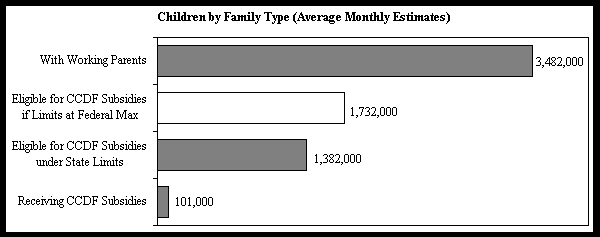
Figure 1. Child Care and Development Fund (CCDF) Eligibility and Receipt in California
Sources: Urban Institute simulations and state administrative data reported to the Child Care Bureau.
- 3,482,000 children under age 13 (or under age 18 if disabled) live in families where the family head (and spouse if present) is working or is in an education or training program, as shown in Figure 1. Children across all family income levels are included in this estimate. Most of these children (3,280,000) are under age 13 and living with working parents.1
- 1,382,000 of these children, and 930,000 families, are estimated to meet California’s income guidelines for child care assistance under the Child Care and Development Fund (CCDF) October 1997 state plan. The eligibility estimate would be even higher — 1,732,000 children — if California raised income eligibility limits to 85 percent of State Median Income, the maximum level allowed under Federal law. 2
- To be eligible under California’s October 1997 state plan, a family of 3 had to have income below $30,306, or 75 percent of State Median Income.
- Most eligible children (85 percent) live in families with annual income below 200 percent of the Federal poverty threshold and more than one-third (35 percent) are living in poverty. About 15 percent live in families that report receiving cash welfare.
- Most (1,223,000) eligible children are under age 13 with working parents; the remaining children have parents in education/training programs or are disabled youth under 18.
- 101,000 children in California received child care subsidies through CCDF-funded programs in an average month in 1998. This estimate suggests that 7 percent of the eligible population under state limits (and 6 percent of children who would be eligible under the Federal maximum limits) were served with CCDF funds.3
- The Child Care and Development Fund (CCDF) is the major source of Federal funding allocated to states to subsidize the child care expenses of low- and moderate-income families so they can work, or attend education or training programs. Using CCDF dollars along with state funds, California has designed its own child care program within broad parameters specified under federal law. CCDF-funded subsidies, and the number of children that the state reported were served with these subsidies, are highlighted in this report because CCDF is a primary source of funding in most states. Also, CCDF administrative data is the most comparable source of child care data across states. It should be noted, however, that California, like many other states, also uses other funding sources to provide child care subsidies.
- In 1998, there were an estimated 200,000 children on the waiting list for government subsidies in California. Many counties in the state have waiting lists in excess of 1,000 children. Low-income families in California may have to wait for more than a year before they receive child care subsidies.4
- The state of California has a priority system for determining who receives child care subsidies. Children receiving cash welfare assistance through CalWORKS and children at-risk in the protective services system are guaranteed child care subsidies. Low-income working families receive subsidies as funds become available.
- In addition to the waiting list, state staff believe that there are eligible families that do not apply for child care subsidies. This belief is corroborated by staff from child care resource and referral agencies within the state of California.
II. Affordability [5]
- Prices for child care vary considerably, by such factors as geographic area, type of provider and age of child. Figure 2 shows the average monthly prices for child care in California. Given that these are average prices, it is clear that many families pay more or less than this amount.
- Centers in California charge an average of $420 per month for preschool care and $577 per month for infant care, as shown in Figure 2. This means that a family with $15,000 in income and one preschool child in an average-priced center would spend more than one-third (34 percent) of its total monthly income on child care expenses. Average-priced infant care would represent an even higher share (46 percent) of monthly income for a family earning $15,000.
- Family child care homes in California charge an average of $422 per month for preschool children and $432 per month for infants. This means that a family with $15,000 in income and one child in an average-priced family child care home would spend 34 percent of its monthly income on care for a preschool child or 35 percent for an infant.
- Families who receive child care subsidies usually pay much smaller monthly co-payments, rather than the full market rate. Such co-payments are established under a sliding fee schedule, and are based on family size, income and the number of children in care. For example, a family with $15,000 in income and one preschooler or infant in an average-priced center in California would be charged a monthly co-payment of $43, or about three percent of monthly income, as shown in Figure 2.
| WITHOUT SUBSIDY | WITH SUBSIDY | |||
|---|---|---|---|---|
| Average Monthly Prices (Full Time Care) |
% of Income (Family Income of $15,000 Annually) |
Monthly Co-Payments* (If receive subsidy) |
% of Income* (Family Income of $15,000 Annually) |
|
| INFANT (1 year) | ||||
| Center-based | $577 | 46.1% | $43 | 3.4% |
| Family child care home | $432 | 34.6% | $43 | 3.4% |
| PRESCHOOLER (4 years) | ||||
| Center-based | $420 | 33.5% | $43 | 3.4% |
| Family child care home | $422 | 33.8% | $43 | 3.4% |
|
* State policy does not prevent providers from charging parents additional amounts, above the co-payment, if the providers’ rates exceed the state reimbursement level. Maximum reimbursement rates in California, however, exceed the statewide average prices. Figures in this table represent the minimum co-payment. Source: Price data collected by the Urban Institute from the California Child Care Resource and Referral Network, a statewide child care resource and referral agency, summer 1999. Co-payment data collected by the Urban Institute from the California Department of Education, summer 1999. |
||||
III. Gaps in Child Care Supply [6]
- The adequacy of the supply of child care varies across California. To determine the level of unmet need, the California Child Care Resource and Referral Network uses a combination of census data and child care supply data from local resource and referral networks. Licensed child care supply meets only 21 percent of the estimated need for licensed care for children of all ages. Supply gaps vary throughout the state. For example, in Alpine County, licensed child care meets 78 percent of the need for all children; in Los Angeles County, supply meets only 17 percent of the need.
- Throughout the state of California, infant care is in short supply. For example, in Los Angeles County, San Diego County, San Francisco County, and Siskiyou County less than 5 percent of slots in licensed care centers are infant slots.
- Only 4 percent of all of the licensed and license-exempt centers, and only 33 percent of the licensed family child care homes listed with the California Child Care Resource and Referral Network provide care during odd hours, such as weekends, evenings or over night.
Footnotes
1 Estimate based on microsimulations using the Urban Institute's TRIM3 model, guidelines in the state's 1997-99 CCDF state plan, and three years of Current Population Survey data (calendar years 1995-97).
2 Ibid.
3 Estimates based on state administrative data reported to the Child Care Bureau and adjusted to reflect children funded through CCDF only. 1998 figures based on April-September 1998.
4 Waiting list data were obtained and compiled by the Urban Institute from the California Child Care Resource and Referral Network (a statewide child care resource and referral agency).
5 Information in this section was obtained and compiled by the Urban Institute from the California Child Care Resource and Referral Network (a statewide child care resource and referral agency).
6 Information in this section was obtained and compiled by the Urban Institute from the 1999 California Child Care Portfolio, California Child Care Resource and Referral Network.
Child Care in Connecticut: A Short Report on Subsidies, Affordability, and Supply
This report summarizes recent child care information for the state of Connecticut. The first section provides new information on child care subsidies, based on eligibility estimates generated by the Urban Institute and state administrative data reported to the U.S. Department of Health and Human Services (HHS). The second two parts, on affordability and supply, draw on state and local data collected by the Urban Institute during the summer of 1999 under contract with HHS. A companion document to the national report entitled "Access to Child Care for Low-Income Working Families," the California report is one in a series of nine state reports. [The other reports are: California, Delaware, Florida, Louisiana, Michigan, Pennsylvania, Texas, and Utah]
I. Child Care Subsidies
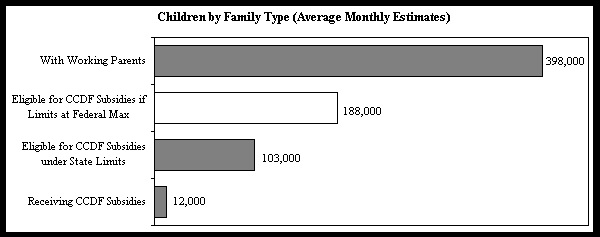
Figure 1. Child Care and Development Fund (CCDF) Eligibility and Receipt in Connecticut
Sources: Urban Institute simulations and state administrative data reported to the Child Care Bureau.
- 398,000 children under age 13, (or under age 19 if disabled), live in families where the family head (and spouse if present) is working or is in an education or training program, as shown in Figure 1. Children across all family income levels are included in this estimate. Most of these children (380,000) are under age 13 and living with working parents.1
- 103,000 of these children, and 63,000 families, are estimated to meet Connecticut’s income guidelines for child care assistance under the Child Care and Development Fund (CCDF) October 1997 state plan. The eligibility estimate would be even higher — 188,000 children — if Connecticut raised income eligibility limits to 85 percent of State Median Income, the maximum level allowed under Federal law.2
- To be initially eligible under Connecticut’s October 1997 state plan, a family of 3 had to have income below $26,112, or 50 percent of State Median Income. A family could continue to receive subsidies until its income reached $39,168 or 75 percent of State Median Income.
- Most eligible children (84 percent) live in families with annual income below 200 percent of the Federal poverty threshold and more than two-fifths (41 percent) are living in poverty. About 23 percent live in families that report receiving cash welfare.
- Most (89,000) eligible children are under age 13 with working parents; the remaining children have parents in education/training programs or are disabled youth under 19.
- 12,000 children in Connecticut received child care subsidies funded by CCDF in an average month in 1998. This estimate suggests that 12 percent of the eligible population under state limits (and 6 percent of children who would be eligible under the Federal maximum limits) were served with CCDF funds. In addition, Connecticut's state administrative data system indicates that 14,600 children were served with other Federal and state funds.3
- The Child Care and Development Fund (CCDF) is the major source of Federal funding allocated to states to subsidize the child care expenses of low- and moderate-income families so they can work, or attend education or training programs. Using CCDF dollars along with state funds, Connecticut has designed its own child care program within broad parameters specified under federal law. CCDF-funded subsidies, and the number of children that the state reported were served with these subsidies, are highlighted in this report because CCDF is a primary source of funding in most states. Also, CCDF administrative data is the most comparable source of child care data across states. It should be noted, however, that Connecticut may, like many other states, also use other funding sources to provide child care subsidies.
- There is no waiting list for government subsidies in Connecticut. The United Way of Connecticut/Child Care Infoline, a statewide child care resource and referral agency, reports that the state only takes new applications for subsidies when the funds are available. Connecticut has not had to stop taking applications for at least 12 months. However, staff from the United Way of Connecticut/Child Care Infoline believe that there are eligible families that do not apply for subsidies.4
II. Affordability [5]
- Prices for child care vary considerably, by such factors as geographic area, type of provider and age of child. Figure 2 shows the average monthly prices for child care in Hartford and New Britain, Connecticut. Given that these are average prices, it is clear that many families pay more or less than these amounts.
- Centers in Hartford, Connecticut charge an average of $481 per month for preschool care and $618 per month for infant care, as shown in Figure 2. This means that a family with $15,000 in income and one preschool child in an average-priced center would spend more than one-third (38 percent) of its total monthly income on child care expenses. Average-priced infant care would represent an even higher share (50 percent) of monthly income for a family earning $15,000.
- In New Britain, Connecticut, center-based care costs an average of $480 per month for preschool care, or 38 percent of monthly income for a family earning $15,000, as shown in Figure 2. The average price for infant center-based care in New Britain, Connecticut is $657 per month, or 53 percent of monthly income for a family with $15,000 in income.
- Family child care homes in Hartford, Connecticut charge an average of $414 per month for preschool children and $456 per month for infants. This means that a family with $15,000 in income and one child in an average-priced family child care home would spend 33 percent of its monthly income on care for a preschool child or 37 percent for an infant. A family in New Britain, Connecticut with the same annual income using average-priced care would spend 41 percent of its monthly income ($508 per month) for preschool care or 43 percent ($531 per month) for an infant in a family child care home.
- Families who receive child care subsidies usually pay much smaller monthly co-payments, rather than the full market rate. Such co-payments are established under a sliding fee schedule, and are based on family income and family size. By law, families in Connecticut are required to make only one co-payment regardless of the number of children they have in care.
- For example, a family of three with $15,000 in income and one preschooler or infant in average-priced care in Connecticut would be charged a monthly co-payment of $50, or 4 percent of monthly income, as shown in Figure 2. If this family of three had two preschoolers in average-priced care, its monthly co-payment would also be $50.
- In Connecticut, families receiving cash welfare assistance are not required to make co-payments.
| WITHOUT SUBSIDY | WITH SUBSIDY | |||
|---|---|---|---|---|
| Average Monthly Prices (Full Time Care) |
% of Income (Family Income of $15,000 Annually) |
Monthly Co-Payments* (If receive subsidy) |
% of Income* (Family Income of $15,000 Annually) |
|
| FAMILY LIVING IN HARTFORD, CONNECTICUT | ||||
| INFANT (1 year) | ||||
| Center-based | $618 | 49.5% | $50 | 4.0% |
| Family child care home | $456 | 36.5% | $50 | 4.0% |
| PRESCHOOLER (4 years) | ||||
| Center-based | $481 | 38.4% | $50 | 4.0% |
| Family child care home | $414 | 33.1% | $50 | 4.0% |
| FAMILY LIVING IN NEW BRITAIN, CONNECTICUT | ||||
| INFANT (1 year) | ||||
| Center-based | $657 | 52.6% | $50 | 4.0% |
| Family child care home | $531 | 42.5% | $50 | 4.0% |
| PRESCHOOLER (4 years) | ||||
| Center-based | $480 | 38.4% | $50 | 4.0% |
| Family child care home | $508 | 40.6% | $50 | 4.0% |
|
* State policy does not prevent providers from charging parents additional amounts, above the co-payment, if the providers' rates exceed the state reimbursement level. Figures in this table represent the minimum co-payment. Source: Data collected by the Urban Institute from United Way Connecticut/Child Care Infoline, a child care resource and referral agency serving Connecticut, summer 1999. |
||||
- State policy does not prevent providers from charging parents additional amounts, above the co-payment, if the providers’ rates exceed the state reimbursement level. For example, the maximum CCDF rate for a preschooler in a family child care home in New Britain, Connecticut is $433 per month, which is $75 less than the $508 average price shown in Figure 2. If the $75 differential is paid by the family, the total cost to the family is $125 per month, more than twice the official co-payment of $50 shown in Figure 2. If the fee is not charged to the family, the provider loses $75 per month for providing service to a subsidized child. The differential could be much larger than $75 for some child care setting, including accredited centers and other settings with higher than average rates, and for families with more than one child in care.
III. Gaps in Child Care Supply [6]
- Maximum reimbursement rates in Connecticut are determined on a regional basis. Providers in Connecticut may be unwilling to accept subsidized children, or may limit their enrollment, when the reimbursement rates are lower then their prices (see example in section II). As a result, families receiving subsidies may have limited choices of caregivers.
- Staff from United Way Connecticut/Child Care Infoline, the resource and referral agency serving Connecticut, report shortages in the supply of infant/toddler care, school-age care, care during non-traditional hours, and care for children who have special needs or are ill. Specifically:
- There is a shortage of infant/toddler care in Connecticut. Many center-based programs do not offer care, or offer limited services, to children under the age of three.
- School-age care in many areas of Connecticut can be difficult to find. Generally, children must attend programs within their school district, and vacancy rates vary by area. For example there is one school District in Hartford that has no available school-age slots.
- Care during non-traditional hours is in short supply in Connecticut. For example, only 16 percent of family day care homes in Hartford offer any non-traditional hour care. A smaller fraction, 5 percent, provide care during weekend hours.
- Connecticut’s licensing regulations do not permit programs to offer care for sick children.
Footnotes
1 Estimate based on microsimulations using the Urban Institute's TRIM3 model, guidelines in the state's 1997-99 CCDF state plan, and three years of Current Population Survey data (calendar years 1995-97).
2 Ibid.
3 Estimates based on state administrative data reported to the Child Care Bureau and adjusted to reflect children funded through CCDF only. 1998 figures based on April-September 1998.
4 Waiting list data was obtained and compiled by the Urban Institute from the United Way of Connecticut/Child Care Infoline (the statewide child care resource and referral agency).
5 Information in this section was obtained and compiled by the Urban Institute from the United Way of Connecticut/Child Care Infoline (the statewide child care resource and referral agency).
6 Ibid.
Child Care in Delaware: A Short Report on Subsidies, Affordability, and Supply
This report summarizes recent child care information for the state of Delaware. The first section provides new information on child care subsidies, based on eligibility estimates generated by the Urban Institute and state administrative data reported to the U.S. Department of Health and Human Services (HHS). The second two parts, on affordability and supply, draw on state and local data collected by the Urban Institute during the summer of 1999 under contract with HHS. A companion document to the national report entitled "Access to Child Care for Low-Income Working Families," the Delaware report is one in a series of nine state reports. [The other reports are: California, Connecticut, Florida, Louisiana, Michigan, Pennsylvania, Texas, and Utah]
I. Child Care Subsidies
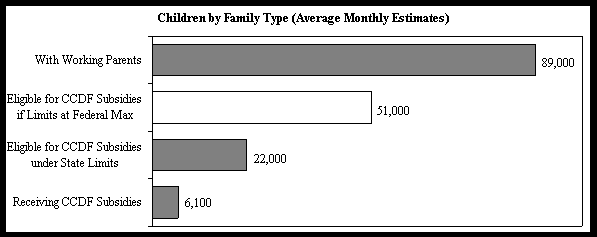
Figure 1. Child Care and Development Fund (CCDF) Eligibility and Receipt in Delaware
Sources: Urban Institute simulations and state administrative data reported to the Child Care Bureau.
- 89,000 children under age 13 (or under age 18 if disabled) live in families where the family head (and spouse if present) is working or is in an education or training program, as shown in Figure 1. Children across all family income levels are included in this estimate. Most of these children (84,000) are under age 13 and living with working parents.1
- 22,000 of these children, and 12,000 families, are estimated to meet Delaware’s income guidelines for child care assistance under the Child Care and Development Fund (CCDF) October 1997 state plan. The eligibility estimate would be even higher — 51,000 children — if Delaware raised income eligibility limits to 85 percent of State Median Income, the maximum level allowed under Federal law.2
- To be eligible under Delaware’s October 1997 state plan, a family of 3 had to have income below $20,124, or 56 percent of State Median Income.
- Nearly all eligible children (98 percent) live in families with annual income below 200 percent of the Federal poverty threshold and over half (56 percent) are living in poverty. About 16 percent live in families that report receiving cash welfare.
- Most (19,000) eligible children are under age 13 with working parents; the remaining children have parents in education/training programs or are disabled youth under 18.
- 6,100 children in Delaware received child care subsidies funded by CCDF in an average month in 1998. This estimate suggests that 28 percent of the eligible population under state limits (and 12 percent of children who would be eligible under the Federal maximum limits) were served with CCDF funds. In addition, Delaware’s state administrative data system indicates that about 3,800 children were served with other Federal and state funds.3
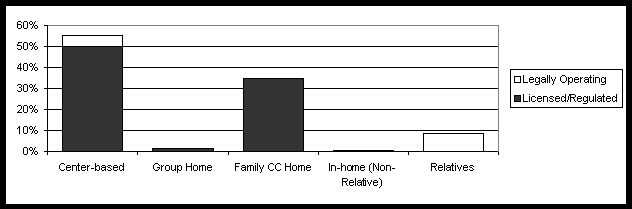
- In Delaware, over half (55 percent) of child care settings receiving funds from CCDF in 1998 were center-based settings, as shown in Figure 2. The next most common settings were family child care homes (35 percent). The remaining settings include care by relatives (8 percent), care in group homes (1 percent) and in-home care by non-relatives (less than 1 percent).4
Figure 2. Child Care Settings Subsidized by CCDF in Delaware
Source: State administrative data for April-September 1998 reported to the Child Care Bureau.
- The Child Care and Development Fund (CCDF) is the major source of Federal funding allocated to states to subsidize the child care expenses of low- and moderate-income families so they can work, or attend education or training programs. Using CCDF dollars along with state funds, Delaware has designed its own child care program within broad parameters specified under federal law. CCDF-funded subsidies, and the number of children that the state reported were served with these subsidies, are highlighted in this report because CCDF is a primary source of funding in most states. Also, CCDF administrative data is the most comparable source of child care data across states. It should be noted, however, that Delaware, like many other states, also uses other funding sources to provide child care subsidies.
- No waiting list for government subsidies has been maintained since 1993-94. All families who currently apply receive subsidies. However, state staff believe that there are eligible families that do not apply for subsidies.5
II. Affordability [6]
- Prices for child care vary considerably, by such factors as geographic area, type of provider and age of child. Figure 3 shows the average monthly prices for child care in Delaware. Given that these are average prices, it is clear that many families pay more or less than this amount.
- Centers in Delaware charge an average of $390 per month for preschool care and $473 per month for infant care, as shown in Figure 3. This means that a family with $15,000 in income and one preschool child in an average-priced center would spend close to one-third (31 percent) of its total monthly income on child care expenses. Average-priced infant care would represent an even higher share (38 percent) of monthly income for a family earning $15,000.
- Accredited care costs even more, $444 per month for a preschooler in center-based care, or about 36 percent of family income for families with $15,000 in income.* Families with an infant in an accredited center would pay $553, or about 44 percent of family income for families earning $15,000.
- Family child care homes in Delaware charge an average of $353 for preschool children and $385 per month for infants. This means that a family with $15,000 in income and one child in an average-priced family child care home would spend 28 percent of its monthly income on care for a preschool child or 31 percent of income for an infant.
| WITHOUT SUBSIDY | WITH SUBSIDY | |||
|---|---|---|---|---|
| Average Monthly Prices (Full Time Care) |
% of Income (Family Income of $15,000 Annually) |
Monthly Co-Payments* (If receive subsidy) |
% of Income* (Family Income of $15,000 Annually) |
|
| INFANT (1 year) | ||||
| Center-based | $473 | 37.8% | $98 | 7.8% |
| Accredited center-based | $553 | 44.2% | $98 | 7.8% |
| Family child care home | $385 | 30.8% | $75 | 6.0% |
| PRESCHOOLER (4 years) | ||||
| Center-based | $390 | 31.2% | $81 | 6.5% |
| Accredited center-based | $444 | 35.5% | $81 | 6.5% |
| Family child care home | $353 | 28.2% | $74 | 6.0% |
|
* State policy does not prevent providers from charging parents additional amounts, above the co-payment, if the providers’ rates exceed the state reimbursement level. Source: Data collected by the Urban Institute from The Family and Workforce Connection, a statewide child care resource and referral agency in Delaware, summer 1999. |
||||
- Families who receive child care subsidies usually pay much smaller monthly co-payments rather than the full market rate. Such co-payments are established under a sliding fee schedule, and are based on family size, income and the cost of care. The official fee in Delaware ranges from 1 percent to 46 percent of the cost of care up to certain state-set maximum rates.
- For example, a family with $15,000 in income and one preschooler in an average-priced center in Delaware would be charged a monthly co-payment of $81, or 6.5 percent of monthly income, as shown in Figure 3.
- In Delaware, a co-payment is not charged to families with income below 40 percent of the poverty level, families receiving cash welfare assistance, and families receiving protective services.
- State policy does not prevent providers from charging parents additional amounts, above the co-payment, if the providers’ rates exceed the state reimbursement level. For example, the maximum CCDF rate for infant center care in the New Castle region of Delaware is $426 per month7, which is $47 less than the $473 average price shown in Figure 3. If the $47 differential is paid by the family, the total cost to the family is $145 per month, more than the official co-payment of $98 shown in Figure 3. If the fee is not charged to the family, the provider loses $47 per month for providing service to a subsidized child. The differential could be much larger than $47 for some child care centers, including accredited centers and other centers with higher than average rates.
III. Gaps in Child Care Supply [8]
- Not all providers in Delaware accept children who receive subsidies. Of the providers registered with The Family and Workforce Connection, a statewide child care resource and referral agency, 68 percent of centers, 54 percent of family child care homes, and 41 percent of group child care homes accept subsidies. It is harder to find accredited providers who serve subsidized children; 45 percent of accredited centers and 40 percent of accredited family homes accept subsidized children.
- According to the state plan for 1997-1999, maximum reimbursement rates in Delaware are capped at the 75th percentile of market rate, based on a 1996 market rate survey. Providers may be unwilling to accept subsidized children, or may limit their enrollment, when the state reimbursement rates are lower than their prices (see the example in section II). As a result, families receiving subsidies may have limited choices of caregivers.
- Staff from the resource and referral agency report shortages in the supply of many types of care in Delaware. Staff believe that the most severe areas of need are for infant care, school-age care, care during odd hours and care for children who have special needs or are ill. Specifically:
- Infant care is hard to find in Delaware because many child care centers begin caring for children at the age of two years. Some centers accept infants, but not those who receive a subsidy. In particular, there are critical shortages of infant care in the City of Wilmington and in areas with many corporate employers.
- In 1998, there were no centers providing care for sick children registered with the statewide child care resource and referral agency in Delaware, down from four in 1996.
- School-age care is available through school-based programs in only 59 percent of public schools in Delaware. Some school districts do not have any programs. School-based programs tend to target elementary grades, while middle school children are more likely to be left home alone. In areas where care is available, school districts will not transport children from schools without after-school programs to off-site programs.
- Care during odd hours is particularly needed in Wilmington, Dover, and Sussex County, Delaware, where employees have rotating or split shifts in poultry plants or banks.
Footnotes
1 Estimate based on microsimulations using the Urban Institute's TRIM3 model, guidelines in the state's 1997-99 CCDF state plan, and three years of Current Population Survey data (calendar years 1995-97).2 Ibid.
3 Estimates based on state administrative data reported to the Child Care Bureau and adjusted to reflect children funded through CCDF only. 1998 figures based on April-September 1998.
4 Ibid.
5 Waiting list data were obtained and compiled by the Urban Institute from the Delaware Division of Social Services, the state child care agency.
6 Information in this section was obtained and compiled by the Urban Institute from the Delaware Division of Social Services and The Family and Workforce Connection (a statewide child care resource and referral agency).
7 State maximum rates were obtained and compiled by the Urban Institute from the Delaware Division of Social Services, summer 1999.
8 Information in this section was obtained and compiled by the Urban Institute from The Family and Workforce Connection (a statewide child care resource and referral agency).
* Providers are accredited by national organizations based on criteria designed to measure quality. Accreditation is one indication that a provider has a demonstrated commitment to providing quality care.
Child Care in Florida: A Short Report on Subsidies, Affordability, and Supply
This report summarizes recent child care information for the state of Florida. The first section provides new information on child care subsidies, based on eligibility estimates generated by the Urban Institute and state administrative data reported to the U.S. Department of Health and Human Services (HHS). The second two parts, on affordability and supply, draw on state and local data collected by the Urban Institute during the summer of 1999 under contract with HHS. A companion document to the national report entitled "Access to Child Care for Low-Income Working Families," the Florida report is one in a series of nine state reports. [The other reports are: California, Connecticut, Delaware, Louisiana, Michigan, Pennsylvania, Texas, and Utah]
I. Child Care Subsidies
Figure 1. Child Care and Development Fund (CCDF) Eligibility and Receipt in Florida
Sources: Urban Institute simulations and state administrative data reported to the Child Care Bureau.
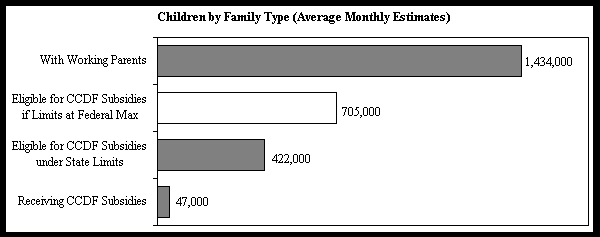
- 1,434,000 children under age 13 live in families where the family head (and spouse if present) is working or is in an education or training program, as shown in Figure 1. Children across all family income levels are included in this estimate. Most of these children (1,375,000) live with working parents.1
- 422,000 of these children, and 263,000 families, are estimated to meet Florida’s income guidelines for child care assistance under the Child Care and Development Fund (CCDF) October 1997 state plan. The eligibility estimate would be even higher — 705,000 children — if Florida raised income eligibility limits to 85 percent of State Median Income, the maximum level allowed under Federal law.2
- To be initially eligible for subsidies under Florida’s October 1997 state plan, a family of 3 had to have income below $19,476, or 150 percent of the Federal Poverty Level. A family of three can continue to receive subsidies until its income reaches $24,084, or 185% of the Federal Poverty Level.
- Nearly all eligible children (95 percent) live in families with annual income below 200 percent of the Federal Poverty Level and just under one-half (49 percent) are living in poverty. (The few eligible families with annual income above 200 percent of poverty had lower income for some months of the year and were thus eligible for child care assistance during those months.) About 16 percent live in families that report receiving cash welfare.
- Most (381,000) eligible children are under age 13 with working parents; the remaining children have parents in education/training programs.
- 47,000 children in Florida received child care subsidies through CCDF-funded programs in an average month in 1998. This estimate suggests that 11 percent of the eligible population under state limits (and 7 percent of children who would be eligible under the Federal maximum limits) were served with CCDF funds. In addition, Florida’s state administrative data system indicates that 57,000 children were served with other Federal and state funds.3
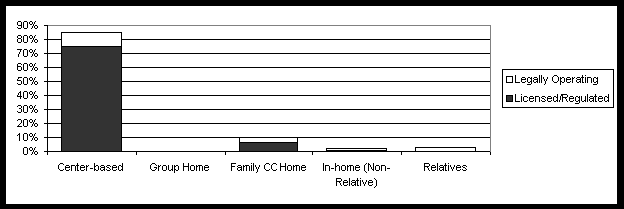
- In Florida, most (85 percent) of child care settings receiving funds from CCDF in 1998 were center-based settings, as shown in Figure 2. The remaining settings include family child care homes (10 percent), care by relatives (3 percent) and in-home care by non-relatives (2 percent).4
Figure 2. Child Care Settings Subsidized by CCDF in Florida
Source: State administrative data for April-September 1998 reported to the Child Care Bureau.
- The Child Care and Development Fund (CCDF) is the major source of Federal funding allocated to states to subsidize the child care expenses of low- and moderate-income families so they can work, or attend education or training programs. Using CCDF dollars along with state funds, Florida has designed its own child care program within broad parameters specified under federal law. CCDF-funded subsidies, and the number of children that the state reported were served with these subsidies, are highlighted in this report because CCDF is a primary source of funding in most states. Also, CCDF administrative data is the most comparable source of child care data across states. It should be noted, however, that Florida, like many other states, also uses other funding sources to provide child care subsidies.
- In April 1999, there were 18,790 children on the waiting list for government subsidies in Florida.5 Of the children on the waiting list, 40 percent were less than three years old, 28 percent were between 3 and 5 years old, and 32 percent were between 6 and 12 years old. Time on the waiting list can vary by district. Some children remain on the list only a few days and some children have been on lists for more than 2 years. The waiting time is contingent upon district funding and the family’s priority for services.
- The state of Florida has a priority system for determining who receives child care subsidies. Children determined to be at-risk of abuse, neglect or exploitation have the highest priority, followed by children whose families are participating in the welfare-to-work program (WAGES) and families whose income is less than 100 percent of the Federal Poverty Level. Children in families whose income is between 100 and 150 percent of the Federal Poverty Level receive the lowest priority. The majority of the waiting list (91 percent) comprises children in this last category.
- In addition to the waiting list, state staff believe that there are eligible families that do not apply for child care subsidies. This belief is corroborated by staff from state child care resource and referral agencies.
II. Affordability [6]
- Prices for child care vary considerably, by such factors as geographic area, type of provider and age of child. Figure 3 shows the average monthly prices for child care in Florida. Given that these are average prices, it is clear that many families pay more or less than this amount.
- Centers in Florida charge an average of $325 per month for preschool care and $416 per month for infant care, as shown in Figure 3. This means that a family with $15,000 in income and one preschool child in an average-priced center would spend about one-fourth (26 percent) of its total monthly income on child care expenses. Average-priced infant care would represent an even higher share (33 percent) of monthly income for a family earning $15,000.
| WITHOUT SUBSIDY | WITH SUBSIDY | |||
|---|---|---|---|---|
| Average Monthly Prices (Full Time Care) |
% of Income ( Family Income of $15,000 Annually) |
Monthly Co-Payments* (If receive subsidy) |
% of Income* (Family Income of $15,000 Annually) |
|
| INFANT (1 year) | ||||
| Center-based | $416 | 33.3% | $70 | 5.6% |
| Family child care home | ||||
| Licensed | $386 | 30.9% | $70 | 5.6% |
| Registered | $329 | 26.3% | $70 | 5.6% |
| PRESCHOOLER (4 years) | ||||
| Center-based | $325 | 26.0% | $70 | 5.6% |
| Family child care home | ||||
| Licensed | $355 | 28.4% | $70 | 5.6% |
| Registered | $303 | 24.3% | $70 | 5.6% |
* State policy does not prevent providers from charging parents additional amounts, above the co-payment, if the providers’ rates exceed the state reimbursement level. Figures in this table represent the minimum co-payment.
Source: Price data collected by the Urban Institute from the Florida Children’s Forum, a statewide child care resource and referral agency, summer 1999. Co-payment data collected by the Urban Institute from the Florida Department of Children and Families, the state child care agency, summer 1999.
- Licensed family child care homes in Florida charge an average of $355 per month for preschool children and $386 per month for infants. This means that a family with $15,000 in income and one child in an average-priced family child care home would spend 28 percent of its monthly income on care for a preschool child or 31 percent for an infant. Family child care homes that are registered with the county, but not licensed, generally charge lower rates, as shown in Figure 3.
- Families who receive child care subsidies usually pay much smaller monthly co-payments rather than the full market rate. Such co-payments are established under a sliding fee schedule, and are based on family size, income and the number of children in care. For example, a family with $15,000 in income and one preschooler in an average-priced center in Florida would be charged a monthly co-payment of $70, or 5.6 percent of monthly income, as shown in Figure 3.
III. Gaps in Child Care Supply [7]
- Not all providers in Florida accept children who receive subsidies. According to information from the two child care resource and referral agencies that serve the city of Miami (Greater Dade County), only 50 percent of centers, 32 percent of family homes and 35 percent of accredited care centers in the northern part of Dade County accept subsidies.** In the remainder of Dade County, it is harder to find providers who serve subsidized children; 32 percent of centers, 21 percent of family homes and 25 percent of accredited care centers accept subsidized children.
- In a June 1998 report entitled "Charting the Progress of Child Care in Florida," the Florida Children’s Forum described a shortage in the supply of child care for infants and toddlers, school-age children, during non-traditional hours, and for sick or special needs children.8 Specifically:
- The Florida Children’s Forum report estimates that the supply of child care in Florida meets only 34 percent of the need for care for children zero to 3 years old and only 32 percent of the need for school-aged children.
- The need for odd-hour care is steadily increasing in Florida, due in part to growth in employment among former welfare recipients.
- Only 3 percent of Florida’s child care providers report serving children with special needs.
- Until recently, only hospitals could provide sick child care. During the 1999 legislative session, Florida passed legislation allowing child care centers to care for mildly ill children.
Footnotes
1 Estimate based on microsimulations using the Urban Institute's TRIM3 model, guidelines in the state's 1997-99 CCDF state plan, and three years of Current Population Survey data (calendar years 1995-97).
2 Ibid.
3 Estimates based on state administrative data reported to the Child Care Bureau and adjusted to reflect children funded through CCDF only. 1998 figures based on April-September 1998.
4 Ibid.
5 Waiting list data were obtained and compiled by the Urban Institute from the Florida Department of Children and Families, the state child care agency.
6 Information in this section was obtained and compiled by the Urban Institute from the Florida Children's Forum, a statewide child care resource and referral agency.
7 Ibid.
8 Florida Children's Forum, "Charting the Progress of Child Care in Florida," June 1998, p. 5.
** Providers are accredited by national organizations based on criteria designed to measure quality. Accreditation is one indication that a provider has demonstrated commitment to providing quality care.
Child Care in Louisiana: A Short Report on Subsidies, Affordability, and Supply
This report summarizes recent child care information for the state of Louisiana. The first section provides new information on child care subsidies, based on eligibility estimates generated by the Urban Institute and state administrative data reported to the U.S. Department of Health and Human Services (HHS). The second two parts, on affordability and supply, draw on state and local data collected by the Urban Institute during the summer of 1999 under contract with HHS. A companion document to the national report entitled "Access to Child Care for Low-Income Working Families," the Louisiana report is one in a series of nine state reports. [The other reports are: California, Connecticut, Delaware, Florida, Michigan, Pennsylvania, Texas, and Utah]
I. Child Care Subsidies
Figure 1. Child Care and Development Fund (CCDF) Eligibility and Receipt in Louisiana
Sources: Urban Institute simulations and state administrative data reported to the Child Care Bureau.
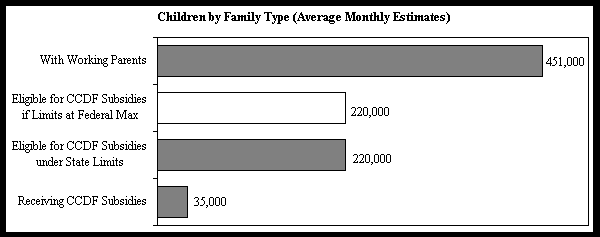
- 451,000 children under age 13 (or under age 18 if disabled) live in families where the family head (and spouse if present) is working or is in an education or training program, as shown in Figure 1. Children across all family income levels are included in this estimate. Most of these children (428,000) are under age 13 and living with working parents.1
- 220,000 of these children, and 143,000 families, are estimated to meet the Louisiana’s income guidelines for child care assistance under the Child Care and Development Fund (CCDF) October 1997 state plan. Louisiana’s income eligibility limit is equal to the maximum level allowed under Federal law, 85 percent of State Median Income.2
- To be eligible under Louisiana’s October 1997 state plan, a family of 3 had to have income at or below $29,580.
- A large majority of eligible children (87 percent) live in families with annual income below 200 percent of the Federal poverty threshold and 45 percent are living in poverty. About 11 percent live in families that report receiving cash welfare.
- Most (198,000) eligible children are under age 13 with working parents; the remaining children have parents in education/training programs or are disabled youth under 18.
- 35,000 children in Louisiana received child care subsidies funded by CCDF in an average month in 1998. This estimate suggests that 16 percent of the eligible population under both state limits and the Federal maximum limits were served with CCDF funds.3
- The Child Care and Development Fund (CCDF) is the major source of Federal funding allocated to states to subsidize the child care expenses of low- and moderate-income families so they can work, or attend education or training programs. Using CCDF dollars along with state funds, Louisiana has designed its own child care program within broad parameters specified under federal law. CCDF-funded subsidies, and the number of children that the state reported were served with these subsidies, are highlighted in this report because CCDF is a primary source of funding in most states. Also, CCDF administrative data is the most comparable source of child care data across states. It should be noted, however, that Louisiana, like many other states, also uses other funding sources to provide child care subsidies.
- No waiting list for government subsidies has been maintained since 1996-97. All families who currently apply receive subsidies. However, state staff believe that there are eligible families that do not apply for subsidies.4
II. Affordability [5]
- Prices for child care vary considerably, by such factors as geographic area, type of provider and age of child. Figure 2 shows the average monthly prices for child care in New Orleans, Louisiana. Given that these are average prices, it is clear that many families pay more or less than this amount.
- Centers in New Orleans, Louisiana charge an average of $303 per month for preschool care and $325 per month for infant care, as shown in Figure 2. This means that a family with $15,000 in income and one preschool child in an average-priced center would spend close to one-quarter (24 percent) of its total monthly income on child care expenses. Average-priced infant care would represent a slightly higher share (26 percent) of monthly income for a family earning $15,000.
- Accredited care costs even more, $390 per month for a preschooler in center-based care, or about 31 percent of family income for families with $15,000 in income.* Families with an infant in an accredited center would pay $412, or about 33 percent of family income for families earning $15,000.
- Family child care homes in New Orleans, Louisiana charge an average of $217 for both preschool-age children and infants. This means that a family with $15,000 in income and one child in an average-priced family child care home would spend 17 percent of its monthly income on care for either a preschool-age child or for an infant.
- Families who receive child care subsidies usually pay much smaller monthly co-payments rather than the full market rate. Such co-payments are established under a sliding fee schedule, and are based on family size, income and the cost of care. The official fee in Louisiana ranges from 10 to 70 percent of the cost of care up to certain state-set maximum rates.
- For example, a family with $15,000 in income and one preschooler or infant in an average-priced center in Louisiana would be charged a monthly co-payment of $29, or 2.3 percent of monthly income, as shown in Figure 2.
- Louisiana does not require families with monthly incomes at or below $1,100 to make co-payments.
- State policy does not prevent providers from charging parents additional amounts, above the co-payment, if the providers’ rates exceed the state reimbursement level. For example, the maximum CCDF rate for preschool center care in New Orleans Louisiana is $286 per month,6 which is $17 less than the $303 average price shown in Figure 2. If the $17 differential is paid by the family, the total cost to the family is $46 per month, more than the official co-payment of $29 shown in Figure 2. If the fee is not charged to the family, the provider loses $17 per month for providing service to a subsidized child. The differential could be much larger than $17 for some child care centers, including accredited centers and other centers with higher than average rates.
| WITHOUT SUBSIDY | WITH SUBSIDY | |||
|---|---|---|---|---|
| Average Monthly Rates (Full Time Care) |
% of Income (Family Income of $15,000 Annually) |
Monthly Co-Payments* (If receive subsidy) |
% of Income** (Family Income of $15,000 Annually) |
|
| INFANT (1 year) | ||||
| Center-based | $325 | 26.0% | $29 | 2.3% |
| Accredited center-based | $412 | 32.9% | $29 | 2.3% |
| Family child care home | $217 | 17.3% | $22 | 1.7% |
| PRESCHOOLER (4 years) | ||||
| Center-based | $303 | 24.3% | $29 | 2.3% |
| Accredited center-based | $390 | 31.2% | $29 | 2.3% |
| Family child care home | $217 | 17.3% | $22 | 1.7% |
|
* State policy does not prevent providers from charging parents additional amounts, above the co-payment, if the providers’ rates exceed the state reimbursement level. Figures in this table represent the minimum co-payment. ** Co-payments in Louisiana are based on a percentage of the cost of care, which was assumed equal to average monthly prices (shown in column 1) or maximum CCDF reimbursement rates, whichever was lower. Source: Data collected by the Urban Institute from the Agenda for Children-Child Care Resources, a child care resource and referral agency serving the area in and around New Orleans, summer 1999. |
||||
III. Gaps in Child Care Supply [7]
- Not all providers in Louisiana accept children who receive subsidies. Of the providers registered with the Agenda for Children-Child Care Resources, which serves 11 of the 64 parishes in the state, 57 percent of centers and 45 percent of family child care homes accept subsidies. Only 50 percent of accredited centers serve subsidized children.
- Providers may be unwilling to accept subsidized children, or may limit their enrollment, when the state reimbursement rates are lower than their prices (see the example in section II). As a result, families receiving subsidies may have limited choices of caregivers.
- Staff from the resource and referral agency report shortages in the supply of various types of care in the 11 parishes they serve in Louisiana. Staff believe that the most severe areas of need are for infant care, school-age care, care during odd hours and care for children who have special needs or are ill. Specifically:
- School-age care is limited to some child care centers and some schools in many of the parishes in Louisiana served by the Agenda for Children-Child Care Resources. To participate in school-based care, children must attend a school that provides a school-age child care program.
- Care during odd hours is very scarce in Louisiana. For example, only 4 of 447 centers in Orleans and Jefferson parishes provide care during non-traditional hours.
- Care for sick children is not available from any of the centers in the Agency for Children-Child Care Resources’ database, which covers 11 Louisiana parishes.
Footnotes
1 Estimate based on microsimulations using the Urban Institute's TRIM3 model, guidelines in the state's 1997-99 CCDF state plan, and three years of Current Population Survey data (calendar years 1995-97).
2 Ibid.
3 Estimates based on state administrative data reported to the Child Care Bureau and adjusted to reflect children funded through CCDF only. 1998 figures based on April-September 1998.
4 Waiting list data were obtained and compiled by the Urban Institute from the Louisiana Department of Social Services, the state child care agency.
5 Information in this section was obtained and compiled by the Urban Institute from Agenda for Children-Child Care Resources (AC-CCR) (a child care resource and referral agency in Louisiana). AC-CCR covers 11 of the 64 parishes in the state: Assumption, Jefferson, Orleans, Lafourche, Plaquemines, St. Bernard, St. Charles, St. James, St. John, St. Tammany, and Terrebone. These 11 parishes are concentrated primarily in and around New Orleans.
6 State maximum rates were obtained and compiled by the Urban Institute from the Louisiana Department of Social Services, summer 1999.
7 Information in this section was obtained and compiled by the Urban Institute from Agenda for Children-Child Care Resources.
* Providers are accredited by national organizations based on criteria designed to measure quality. Accreditation is one indication that a provider has a demonstrated commitment to providing quality care.
Child Care in Michigan: A Short Report on Subsidies, Affordability, and Supply
This report summarizes recent child care information for the state of Michigan. The first section provides new information on child care subsidies, based on eligibility estimates generated by the Urban Institute and state administrative data reported to the U.S. Department of Health and Human Services (HHS). The second two parts, on affordability and supply, draw on state and local data collected by the Urban Institute during the summer of 1999 under contract with HHS. A companion document to the national report entitled "Access to Child Care for Low-Income Working Families," the Michigan report is one in a series of nine state reports. [The other reports are: California, Connecticut, Delaware, Florida, Louisiana, Pennsylvania, Texas, and Utah]
I. Child Care Subsidies
Figure 1. Child Care and Development Fund (CCDF) Eligibility and Receipt in Michigan
Sources: Urban Institute simulations and state administrative data reported to the Child Care Bureau.
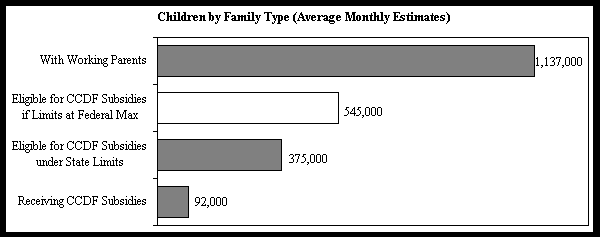
- 1,137,000 children under age 13 (or under age 19 if disabled) live in families where the family head (and spouse if present) is working or is in an education or training program, as shown in Figure 1. Children across all family income levels are included in this estimate. Most of these children (1,092,000) are under age 13 and living with working parents.1
- 375,000 of these children, and 226,000 families, are estimated to meet Michigan’s income guidelines for child care assistance under the Child Care and Development Fund (CCDF) October 1997 state plan. The eligibility estimate would be even higher — 545,000 children — if Michigan raised income eligibility limits to 85 percent of State Median Income, the maximum level allowed under Federal law.2
- To be eligible under Michigan’s October 1997 state plan, a family of 3 had to have income below $26,064, or 59 percent of State Median Income.
- Nearly all eligible children (91 percent) live in families with annual income below 200 percent of the Federal poverty threshold and more than one-third (37 percent) are living in poverty. One-fifth (20 percent) live in families that report receiving cash welfare.
- Most (342,000) eligible children are under age 13 with working parents; the remaining children have parents in education/training programs or are disabled youth under 19.
- 92,000 children in Michigan received child care subsidies funded by CCDF in an average month in 1998. This estimate suggests that 25 percent of the eligible population under state limits (and 17 percent of children who would be eligible under the Federal maximum limits) were served with CCDF funds. In addition, Michigan’s state administrative data system indicates that 29,100 children were served with other Federal and state funds.3
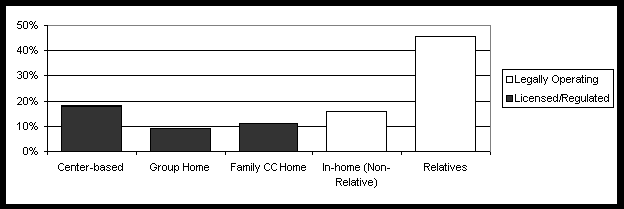
- In Michigan, relative care accounted for nearly half (46 percent) of child care settings receiving funds from CCDF in 1998, as shown in Figure 2. The next most common settings were center-based (18 percent) and in-home care by non-relatives (16 percent). The remaining settings include family child care homes (11 percent) and care in group homes (9 percent).4
Figure 2. Child Care Settings Subsidized by CCDF in Michigan
Source: State administrative data for April-September 1998 reported to the Child Care Bureau.
- The Child Care and Development Fund (CCDF) is the major source of Federal funding allocated to states to subsidize the child care expenses of low- and moderate-income families so they can work, or attend education or training programs. Using CCDF dollars along with state funds, Michigan has designed its own child care program within broad parameters specified under federal law. CCDF-funded subsidies, and the number of children that the state reported were served with these subsidies, are highlighted in this report because CCDF is a primary source of funding in most states. Also, CCDF administrative data is the most comparable source of child care data across states. It should be noted, however, that Michigan, like many other states, also uses other funding sources to provide child care subsidies.
- Currently there is no waiting list for government subsidies. The state of Michigan serves all eligible families who apply for care.5 However, both state staff and staff from Michigan child care resource and referral agencies believe that there are eligible families that do not apply for subsidies.
II. Affordability [6]
- Prices for child care vary considerably, by such factors as geographic area, type of provider and age of child. Figure 3 shows the average monthly prices for child care in Detroit and Lansing, Michigan. Given that these are average prices, it is clear that many families pay more or less than this amount.
- Centers in Detroit, Michigan charge an average of $384 per month for preschool care and $513 per month for infant care, as shown in Figure 3. This means that a family with $15,000 in income and one preschool child in an average-priced center would spend close to one-third (31 percent) of its total monthly income on child care expenses. Average-priced infant care would represent an even higher share (41 percent) of monthly income for a family earning $15,000.
- Centers in Lansing, Michigan charge even more per month for care. Average-priced preschool care costs $482 a month, or 39 percent of monthly income for a family earning $15,000. If this low-income family had an infant, rather than a preschooler, in average-priced care, the $619 per month price would consume 50 percent of the family’s total monthly income.
| WITHOUT SUBSIDY | WITH SUBSIDY | |||
|---|---|---|---|---|
| Average Monthly Prices (Full Time Care) |
% of Income (Family Income of $15,000 Annually) |
Monthly Co-Payments* (If receive subsidy) |
% of Income* (Family Income of $15,000 Annually) |
|
| FAMILY LIVING IN DETROIT, MICHIGAN | ||||
| INFANT (1 year) | ||||
| Center-based | $513 | 41.1% | $28 | 2.2% |
| Family child care home | $395 | 31.6% | $20 | 1.6% |
| PRESCHOOLER (4 years) | ||||
| Center-based | $384 | 30.7% | $22 | 1.8% |
| Family child care home | $345 | 27.6% | $20 | 1.6% |
| FAMILY LIVING IN LANSING, MICHIGAN | ||||
| INFANT (1 year) | ||||
| Center-based | $619 | 49.5% | $29 | 1.7% |
| Family child care home | $454 | 36.3% | $24 | 1.5% |
| PRESCHOOLER (4 years) | ||||
| Center-based | $482 | 38.6% | $24 | 1.5% |
| Family child care home | $428 | 34.2% | $24 | 1.5% |
|
* State policy does not prevent providers from charging parents additional amounts, above the co-payment, if the providers’ rates exceed the state reimbursement level. Figures in this table represent the minimum co-payment. Source: Price data collected by the Urban Institute from the Office of Young Children and the Detroit-Wayne 4C, child care resource and referral agencies serving Lansing and Detroit, respectively, summer 1999. Co-payment data collected by the Urban Institute from the Michigan Family Independence Agency, the state child care agency, summer 1999. |
||||
- Family child care homes in Detroit, Michigan charge an average of $345 per month for preschool children and $395 per month for infants. This means that a family with $15,000 in income and one child in an average-priced family child care home would spend 28 percent of its monthly income on care for a preschool child or 32 percent for an infant. A family in Lansing with the same annual income using average-priced care would spend 34 percent of its monthly income ($428 per month) for preschool care or 36 percent ($454 per month) for an infant in a family child care home.
- Families who receive child care subsidies usually pay much smaller monthly co-payments rather than the full market rate. Such co-payments are established under a sliding fee schedule, and are based on family size, income and the state maximum reimbursement rate for the type of care used. In Michigan, co-payments range from 5 to 70 percent of the maximum reimbursement rates for the type of care used. Maximum reimbursement rates vary by region.
- For example, a family with $15,000 in income and one preschooler in an average-priced center in Lansing, Michigan would be charged a monthly co-payment of $24, or less than 2 percent of monthly income, as shown in Figure 3.
- In Michigan, families participating in the welfare-to-work program (Family Independence Program), Food Stamp-only families, families in protective services, foster care families and child-only welfare cases are not required to make co-payments.
- State policy does not prevent providers from charging parents additional amounts, above the co-payment, if the providers’ rates exceed the state reimbursement level. For example, the maximum CCDF rate for infant center care in Lansing, Michigan is $575* per month7, which is $44 less than the $619 average price shown in Figure 3. If the $44 differential is paid by the family, the total cost to the family is $73 per month, or more than twice the official co-payment of $29 shown in Figure 3. If the fee is not charged to the family, the provider loses $44 per month for providing service to a subsidized child. The differential could be much larger than $44 for some child care centers, including accredited centers and other centers with higher than average rates.
III. Gaps in Child Care Supply [8]
- Not all providers in Michigan accept children who receive subsidies. Of the providers listed in a statewide child care resource and referral agency database, only 47 percent of centers, 54 percent of family child care homes, and 53 percent of group child care homes accept subsidies.
- According to the state plan for 1997-1999, the state of Michigan calculates different maximum CCDF reimbursement rates, set at the 75th percentile of the local market rate, for six regions in the state. Providers may be unwilling to accept subsidized children, or may limit their enrollment, when the state reimbursement rates are lower than their prices (see the example in section II). As a result, families receiving subsidies may have limited choices of caregivers.
- A report written by the Michigan 4C Association, a statewide child care resource and referral agency, finds a critical shortage in the supply of licensed, non-relative care. The report concludes that statewide there are only enough child care slots to serve 80 percent of the children needing licensed, non-relative care. Staff from the statewide agency, and from resource and referral agencies serving Lansing and Detroit, report shortages in the supply of infant/toddler care, care during odd hours, and care for children who have special needs or are ill. Specifically:
- Parents of infants and toddlers often call the state administrator, as well as resource and referral agencies serving Lansing and Detroit, for additional child care referrals. Vacancy checks by the agencies reveal few available slots for infants and toddlers.
- Care for sick children is not permitted in licensed/regulated facilities in Michigan. In a study conducted by Public Sector Consultants (February 1999), 42 percent of parents surveyed in Michigan reported having trouble finding care when their child was ill.
- Among parents of children with special needs in Michigan, the Public Sector Consultants report found 35 percent have trouble finding care for their special needs children.
Footnotes
1 Estimate based on microsimulations using the Urban Institute's TRIM3 model, guidelines in the state's 1997-99 CCDF state plan, and three years of Current Population Survey data (calendar years 1995-97)
2 Ibid.
3 Estimates based on state administrative data reported to the Child Care Bureau and adjusted to reflect children funded through CCDF only. 1998 figures based on April-September 1998.
4 Ibid.
5 Waiting list data were obtained and compiled by the Urban Institute from the Michigan Family Independence Agency, the state child care agency.
6 Information in this section was obtained and compiled by the Urban Institute from the Michigan 4C Association, a statewide child care resource and referral agency, the Office of Young Children (a child care resource and referral agency serving Lansing), and the Detroit-Wayne 4C (the resource and referral agency serving Detroit).
7 State maximum rates were obtained and compiled by the Urban Institute from the Michigan Family Independence Agency, summer 1999.
8 Information in this section was obtained and compiled by the Urban Institute from the resource and referral agencies serving the state of Michigan and the cities of Lansing and Detroit, see note 6.
* This calculation assumes that a child is in care for 45 hours per week. If the child is in care for 50 hours per week, the maximum reimbursement rate would be $639.
Child Care in Pennsylvania: A Short Report on Subsidies, Affordability, and Supply
This report summarizes recent child care information for the state of Pennsylvania. The first section provides new information on child care subsidies, based on eligibility estimates generated by the Urban Institute and state administrative data reported to the U.S. Department of Health and Human Services (HHS). The second two parts, on affordability and supply, draw on state and local data collected by the Urban Institute during the summer of 1999 under contract with HHS. A companion document to the national report entitled "Access to Child Care for Low-Income Working Families," the Pennsylvania report is one in a series of nine state reports. [The other reports are: California, Connecticut, Delaware, Florida, Louisiana, Michigan, Texas, and Utah]
I. Child Care Subsidies
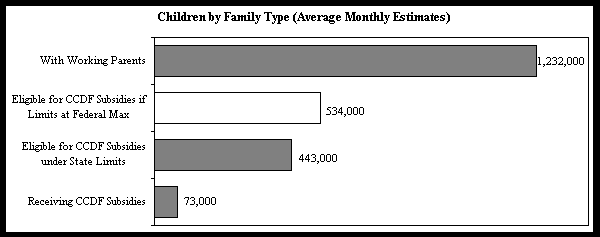
Figure 1. Child Care and Development Fund (CCDF) Eligibility and Receipt in Pennsylvania
Sources: Urban Institute simulations and state administrative data reported to the Child Care Bureau.
- 1,232,000 children under age 13 (or under age 18 if disabled) live in families where the family head (and spouse if present) is working or is in an education or training program, as shown in Figure 1. Children across all family income levels are included in this estimate. Most of these children (1,167,000) are under age 13 and living with working parents.1
- 443,000 of these children, and 266,000 families, are estimated to meet Pennsylvania’s income guidelines for child care assistance under the Child Care and Development Fund (CCDF) October 1997 state plan. The eligibility estimate would be even higher – 534,000 children – if Pennsylvania raised income eligibility limits to 85 percent of State Median Income, the maximum level allowed under Federal law.2
- To be eligible under Pennsylvania’s October 1997 state plan, a family of 3 had to have income below $31,320, or 74 percent of State Median Income.
- More than three-fourths of eligible children (77 percent) live in families with annual income below 200 percent of the Federal poverty threshold and over one-quarter (27 percent) are living in poverty. About 10 percent live in families that report receiving cash welfare.
- Most (389,000) eligible children are under age 13 with working parents; the remaining children have parents in education/training programs or are disabled youth under 18.
- 73,000 children in Pennsylvania received child care subsidies funded by CCDF in an average month in 1998. This estimate suggests that 16 percent of the eligible population under state limits (and 14 percent of children who would be eligible under the Federal maximum limits) were served with CCDF funds. In addition, Pennsylvania’s state administrative data system indicates that about 9,000 children were served with other Federal and state funds.3
- The Child Care and Development Fund (CCDF) is the major source of Federal funding allocated to states to subsidize the child care expenses of low- and moderate-income families so they can work, or attend education or training programs. Using CCDF dollars along with state funds, Pennsylvania has designed its own child care program within broad parameters specified under federal law. CCDF-funded subsidies, and the number of children that the state reported were served with these subsidies, are highlighted in this report because CCDF is a primary source of funding in most states. Also, CCDF administrative data is the most comparable source of child care data across states. It should be noted, however, that Pennsylvania, like many other states, also uses other funding sources to provide child care subsidies.
- The state of Pennsylvania has multiple waiting lists for child care subsidies. Families that do not enter the child care system through the welfare system or do not have a child with special needs are most likely to be put on waiting lists. Children may be on a waiting list for one day or for several months. As of June 30, 1999, there were 4,764 children on the waiting list for subsidies in Pennsylvania. This number includes 1,530 children on the waiting list in Philadelphia and 940 children in Pittsburgh. By September 1999, Pennsylvania reduced the statewide waiting list by nearly 1,000 children to 3,776.4
- In addition, state staff believe there are eligible families that do not apply for subsidies. This belief is corroborated by staff from Child Care Partnerships, a child care resource and referral agency that serves the Pittsburgh area.
- The number of families applying for subsidies has more than doubled since Pennsylvania increased its funding for child care subsidies in February, 1999.
II. Affordability [5]
- Prices for child care vary considerably, by such factors as geographic area, type of provider and age of child. Figure 2 shows the average monthly prices for child care in Pittsburgh and Philadelphia, Pennsylvania. Given that these are average prices, it is clear that many families pay more or less than this amount.
- Centers in Pittsburgh charge an average of $490 per month for preschool care and $589 per month for infant care, as shown in Figure 2. This means that a family with $15,000 in income and one preschool child in an average-priced center would spend close to two-fifths (39 percent) of its total monthly income on child care expenses. Average-priced infant care would represent an even higher share (47 percent) of monthly income for a family earning $15,000.
- Accredited care costs even more, $550 per month for a preschooler in center-based care, or about 44 percent of family income for families with $15,000 in income.* Families with an infant in an accredited center would pay $680, or more than half (54 percent) of family income for families earning $15,000.
- Centers in Philadelphia charge even more per month for care, particularly for infants. Average-priced preschool center care costs $494 a month, or about 40 percent of monthly income for a family earning $15,000. If this low-income family had an infant, rather than a preschooler, in average-priced center care, the $620 per month price would consume 50 percent of the family’s total income.
| WITHOUT SUBSIDY | WITH SUBSIDY | |||
|---|---|---|---|---|
| Average Monthly Prices (Full Time Care) |
% of Income (Family Income of $15,000 Annually) |
Monthly Co-Payments* (If receive subsidy) |
% of Income* (Family Income of $15,000 Annually) |
|
| FAMILY LIVING IN PITTSBURGH, PENNSYLVANIA | ||||
| INFANT (1 year) | ||||
| Center-based | $589 | 47.1% | $108 | 8.7% |
| Accredited center-based | $680 | 54.4% | $108 | 8.7% |
| Family child care home | $481 | 38.5% | $108 | 8.7% |
| PRESCHOOLER (4 years) | ||||
| Center-based | $490 | 39.2% | $108 | 8.7% |
| Accredited center-based | $550 | 44.0% | $108 | 8.7% |
| Family child care home | $455 | 36.4% | $108 | 8.7% |
| FAMILY LIVING IN PHILADELPHIA, PENNSYLVANIA | ||||
| INFANT (1 year) | ||||
| Center-based | $620 | 49.6% | $108 | 8.7% |
| Accredited center-based** | NA | NA | $108 | 8.7% |
| Family child care home | $446 | 35.7% | $108 | 8.7% |
| PRESCHOOLER (4 years) | ||||
| Center-based | $494 | 39.5% | $108 | 8.7% |
| Accredited center-based** | NA | NA | $108 | 8.7% |
| Family child care home | $407 | 32.6% | $108 | 8.7% |
|
* State policy does not prevent allows providers from to charging parents additional amounts, above the co-payment, if the providers’ rates exceed the state reimbursement level. ** Accredited prices were not available for Philadelphia due to small sample sizes. Source: Data collected by the Urban Institute from Child Care Partnerships and Philadelphia Child Care Resources South/Center City, child care resource and referral agencies serving Pittsburgh and Philadelphia, respectively, summer 1999. |
||||
- Family child care homes in Pittsburgh, Pennsylvania charge an average of $455 for preschool children and $481 per month for infants. This means that a family with $15,000 in income and one child in an average-priced family child care home would spend 36 percent of its monthly income on care for a preschool child or 39 percent of income for an infant. A family in Philadelphia with the same annual income using average-priced family child care would spend 33 percent of its monthly income ($407 per month) for preschool care or 36 percent ($446 per month) for an infant.
- Families who receive child care subsidies usually pay much smaller monthly co-payments rather than the full market rate. Such co-payments are established under a sliding fee schedule, and are based on family size and income.
- For example, a family with $15,000 in income and one preschooler or infant in an average-priced center in Pennsylvania would be charged a monthly co-payment of $108, or 8.7 percent of monthly income, as shown in Figure 2.
- In Pennsylvania, welfare recipients in an unpaid work activity, or employed but yet to receive a paycheck, are exempt from paying a co-payment.
- State policy does not prevent providers from charging parents additional amounts, above the co-payment, if the providers’ rates exceed the state reimbursement level. For example, the maximum CCDF rate for preschool center care in Pittsburgh is $453 per month6, which is $37 less than the $490 average price shown in Figure 2**. If the $37 differential is paid by the family, the total cost to the family is $145 per month, more than the official co-payment of $108 shown in Figure 2. If the fee is not charged to the family, the provider loses $37 per month for providing service to a subsidized child. The differential could be much larger than $37 for some child care centers, including accredited centers and other centers with higher than average rates.
III. Gaps in Child Care Supply [7]
- Not all providers in Pennsylvania accept children who receive subsidies. For example, among the providers in the Philadelphia Child Care Resources South/Center City database, 80 percent of centers, 70 percent of family child care homes, and 61 percent of group child care homes accept subsidies.
- According to the state plan for 1997-1999, maximum reimbursement rates in Pennsylvania are capped at the 75th percentile of market rate. Providers may be unwilling to accept subsidized children, or may limit their enrollment, when the state reimbursement rates are lower than their prices (see the example in section II). As a result, families receiving subsidies may have limited choices of caregivers.
- Staff from a resource and referral agency serving Pittsburgh report shortages in the supply of infant and toddler care in certain areas. There are also shortages of, school-age care, especially in suburban areas, and shortages throughout the county of care for children who have special needs or are ill.
- The state of Pennsylvania initiated a program for assessing and building child care capacity, and enhancing quality in May of 1998. A provider survey and assessment of needs was conducted in June 1998 with an additional survey planned for January 2000. Results from the survey in 1998 showed inadequate capacity for school-aged care in all counties.
Footnotes
1 Estimate based on microsimulations using the Urban Institute's TRIM3 model, guidelines in the state's 1997-99 CCDF state plan, and three years of Current Population Survey data (calendar years 1995-97).
2 Ibid.
3 Estimates based on state administrative data reported to the Child Care Bureau and adjusted to reflect children funded through CCDF only. 1998 figures based on April-September 1998.
4 Waiting list data were obtained and compiled by the Urban Institute from the Pennsylvania Department of Public Welfare, the state child care agency.
5 Information in this section was obtained and compiled by the Urban Institute from the Pennsylvania Department of Public Welfare, Child Care Partnerships (a child care resource and referral agency serving Allegheny County (Pittsburgh)) and Philadelphia Child Care Resources South/Center City (a child care resource and referral agency serving the Philadelphia area).
6 State maximum rates were obtained and compiled by the Urban Institute from the Pennsylvania Department of Public Welfare, summer 1999.
7 Information in this section was obtained and compiled by the Urban Institute from Child Care Partnerships.
* Providers are accredited by national organizations based on criteria designed to measure quality. Accreditation is one indication that a provider has a demonstrated commitment to providing quality care.
** Effective January 1, 2000, Pennsylvania will increase its reimbursement rates by an average of 14 percent.
Child Care in Texas: A Short Report on Subsidies, Affordability, and Supply
This report summarizes recent child care information for the state of Texas. The first section provides new information on child care subsidies, based on eligibility estimates generated by the Urban Institute and state administrative data reported to the U.S. Department of Health and Human Services (HHS). The second two parts, on affordability and supply, draw on state and local data collected by the Urban Institute during the summer of 1999 under contract with HHS. A companion document to the national report entitled "Access to Child Care for Low-Income Working Families," the Texas report is one in a series of nine state reports. [The other reports are: California, Connecticut, Delaware, Florida, Louisiana, Michigan, Pennsylvania, and Utah]
I. Child Care Subsidies
Figure 1. Child Care and Development Fund (CCDF) Eligibility and Receipt in Texas
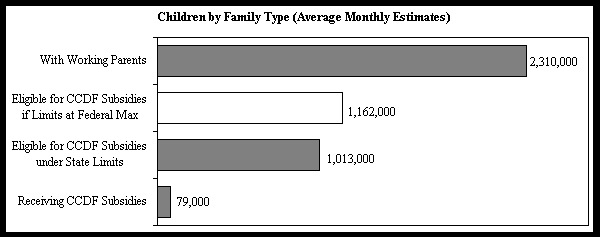
Sources: Urban Institute simulations and state administrative data reported to the Child Care Bureau.
- 2,310,000 children under age 13 (or under age 19 if disabled) live in families where the family head (and spouse if present) is working or is in an education or training program, as shown in Figure 1. Children across all family income levels are included in this estimate. Most of these children (2,187,000) are under age 13 and living with working parents.1
- 1,013,000 of these children, and 613,000 families, are estimated to meet the Texas income guidelines for child care assistance under the Child Care and Development Fund (CCDF) October 1997 state plan. The eligibility estimate would be even higher — 1,162,000 children — if Texas raised income eligibility limits to 85 percent of State Median Income, the maximum level allowed under Federal law.2
- To be eligible under Texas’ October 1997 state plan, a family of 3 had to have income below $27,480, or 75 percent of State Median Income.
- Nearly all eligible children (89 percent) live in families with annual income below 200 percent of the Federal poverty threshold and more than one-third (37 percent) are living in poverty. About 8 percent live in families that report receiving cash welfare.
- Most (920,000) eligible children are under age 13 with working parents; the remaining children have parents in education/training programs or are disabled youth under 19.
- 79,000 children in Texas received child care subsidies funded by CCDF in an average month in 1998. This estimate suggests that 8 percent of the eligible population under state limits (and 7 percent of children who would be eligible under the Federal maximum limits) were served with CCDF funds.3
- In Texas, most (79 percent) of the child care settings receiving funds from CCDF in 1998 were center-based settings, as shown in Figure 2. The remaining settings include relative care (14 percent), care in group homes (3 percent), and family child care homes (3 percent).4
Figure 2. Child Care Settings Subsidized by CCDF in Texas
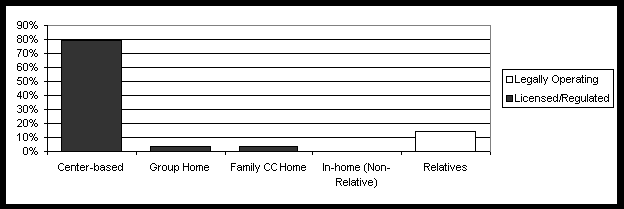
Source: State administrative data for April-September 1998 reported to the Child Care Bureau.
- The Child Care and Development Fund (CCDF) is the major source of Federal funding allocated to states to subsidize the child care expenses of low- and moderate-income families so they can work, or attend education or training programs. Using CCDF dollars along with state funds, Texas has designed its own child care program within broad parameters specified under federal law. CCDF-funded subsidies, and the number of children that the state reported were served with these subsidies, are highlighted in this report because CCDF is a primary source of funding in most states. Also, CCDF administrative data is the most comparable source of child care data across states. It should be noted, however, that Texas may, like many other states, also use other funding sources to provide child care subsidies.
- Currently the state of Texas has waiting lists for government subsidies. The waiting lists are regional and maintained by contractors who administer the child care program. Generally, children in low-income families not receiving welfare are the children most likely to be on the waiting list.5 In addition, staff from both the Texas Workforce Commission, the state child care agency, and the Texas Association of Child Care Resource and Referral Agencies believe that there are eligible families that do not apply for subsidies.
- As of September 1999, for example, the number of children on the waiting lists was 2,411 in Bexar County (San Antonio); 7,409 in Harris County (Houston); and 2,793 children in Dallas County (Dallas).
II. Affordability [6]
- Prices for child care vary considerably, by such factors as geographic area, type of provider and age of child. Figure 3 shows the average monthly prices for child care in Texas. Given that these are average prices, it is clear that many families pay more or less than this amount.
- Centers in Texas charge an average of $316 per month for preschool care and $360 per month for infant care, as shown in Figure 3. This means that a family with $15,000 in income and one preschool child in an average-priced center would spend about one-quarter (25 percent) of its total monthly income on child care expenses. Average-priced infant care would represent an even higher share (29 percent) of monthly income for a family earning $15,000.
- Family child care homes in Texas charge an average of $303 per month for preschool children and $325 per month for infants. This means that a family with $15,000 in income and one child in an average-priced family child care home would spend 24 percent of its monthly income on care for a preschool child or 26 percent of income for an infant.
- Families who receive child care subsidies usually pay much smaller monthly co-payments rather than the full market rate. Such co-payments are established under a sliding fee schedule, and are based on family size, income and the number of children in care.
- For example, a family with $15,000 in income and one preschooler or infant in an average-priced center in Texas would be charged a monthly co-payment of $117, or 9.4 percent of monthly income, as shown in Figure 3.
- In Texas, parents receiving cash assistance through TANF or SSI are exempt from paying a co-payment.7
- State policy in Texas prohibits child care providers from charging subsidized families more than the co-payment amount.
| WITHOUT SUBSIDY | WITH SUBSIDY | |||
|---|---|---|---|---|
| Average Monthly Prices (Full Time Care) |
% of Income (Family Income of $15,000 Annually) |
Monthly Co-Payments* (If receive subsidy) |
% of Income* (Family Income of $15,000 Annually) |
|
| INFANT (1 year) | ||||
| Center-based | $360 | 28.8% | $117 | 9.4% |
| Family child care home | $325 | 26.0% | $117 | 9.4% |
| PRESCHOOLER (4 years) | ||||
| Center-based | $316 | 25.3% | $117 | 9.4% |
| Family child care home | $303 | 24.3% | $117 | 9.4% |
|
* The average prices and co-payment rates shown in the table were effective in July 1999. The co-payment scale changed on September 1, 1999 when Local Workforce Development Boards were given authority to set the co-payment policies for their respective geographic areas. Source: Price data collected by the Urban Institute from the Texas Association of Child Care Resource and Referral Agencies, summer 1999. Co-payment data collected by the Urban Institute from the Texas Workforce Commission, summer 1999. |
||||
III. Gaps in Child Care Supply [8]
- Not all providers in Texas accept children who receive subsidies. Among child care providers in the Texas Association of Child Care Resource and Referral Agencies' database only 52 percent of centers and 7 percent of group homes accept subsidies.
- According to the state plan for 1997-1999, maximum reimbursement rates in Texas are set at the 75th percentile of the local market rate. Providers may be unwilling to accept subsidized children, or may limit their enrollment, when the state reimbursement rates are lower than their prices. If there were a differential between a provider's price and the state maximum reimbursement rate, Texas would not allow the provider to charge subsidized parents for that differential.
- Staff from the Texas Association of Child Care Resource and Referral Agencies report shortages in the supply of infant/toddler care, care during odd hours, and care for children who are ill or have special needs. Specifically:
- There is a shortage of care for infants and toddlers in most of the major metropolitan areas in Texas. Waiting lists for infant care exceed 2 years in some areas.
- Throughout Texas there are shortages in odd hour care, even as more employers shift to using non-traditional work hours. In Bexar County (San Antonio), for example, only 4 centers (less than 1 percent) provide extended-hour care.
- Most areas in Texas have little or no available care for sick children. For example, none of the centers in Bexar County (San Antonio) provide care to sick children and only a few family child care homes provide care for children with minor illnesses.
- Parents of children with special needs in Texas have difficulty locating child care. In Bexar County (San Antonio), for example, only 1 percent of centers accept children with special needs.
Footnotes
1 Estimate based on microsimulations using the Urban Institute's TRIM3 model, guidelines in the state's 1997-99 CCDF state plan, and three years of Current Population Survey data (calendar years 1995-97).
2 Ibid.
3 Estimates based on state administrative data reported to the Child Care Bureau and adjusted to reflect children funded through CCDF only. 1998 figures based on April-September 1998.
4 Ibid.
5 Waiting list data were obtained and compiled by the Urban Institute from the Texas Association of Child Care Resource and Referral Agencies, summer 1999.
6 Unless noted otherwise, information in this section was obtained and compiled by the Urban Institute from the Texas Association of Child Care Resource and Referral Agencies, summer 1999.
7 Information about co-payment exclusions is from the Texas October 1997 state plan filed with the U.S. Department of Health and Human Services.
8 Information in this section was obtained and compiled by the Urban Institute from the Texas Association of Child Care Resource and Referral Agencies, summer 1999.
Child Care in Utah: A Short Report on Subsidies, Affordability, and Supply
This report summarizes recent child care information for the state of Utah. The first section provides new information on child care subsidies, based on eligibility estimates generated by the Urban Institute and state administrative data reported to the U.S. Department of Health and Human Services (HHS). The second two parts, on affordability and supply, draw on state and local data collected by the Urban Institute during the summer of 1999 under contract with HHS. A companion document to the national report entitled "Access to Child Care for Low-Income Working Families," the Utah report is one in a series of nine state reports. [The other reports are: Connecticut, Delaware, Florida, Louisiana, Michigan, Pennsylvania, Texas, and Utah]
I. Child Care Subsidies
Figure 1. Child Care and Development Fund (CCDF) Eligibility and Receipt in Utah
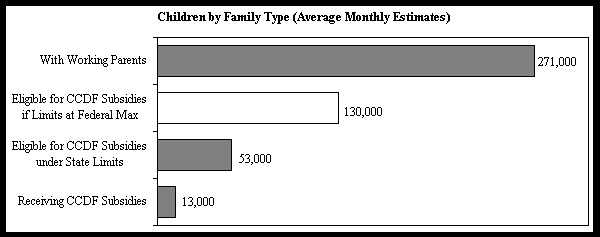
Sources: Urban Institute simulations and state administrative data reported to the Child Care Bureau.
- 271,000 children under age 13 (or under age 19 if disabled) live in families where the family head (and spouse if present) is working or is in an education or training program, as shown in Figure 1. Children across all family income levels are included in this estimate. Most of these children (259,000) are under age 13 and living with working parents.1
- 53,000 of these children, and 33,000 families, are estimated to meet Utah’s income guidelines for child care assistance under the Child Care and Development Fund (CCDF) October 1997 state plan. The eligibility estimate would more than double — 130,000 children — if Utah raised income eligibility limits to 85 percent of State Median Income, the maximum level allowed under Federal law.2
- To be eligible under Utah’s October 1997 state plan, a family of 3 had to have income below $21,108, or 56 percent of State Median Income.
- Nearly all eligible children (95 percent) live in families with annual income below 200 percent of the Federal poverty threshold and more than two-fifths (42 percent) are living in poverty. About 4 percent live in families that report receiving cash welfare.
- Most (46,000) eligible children are under age 13 with working parents; the remaining children have parents in education/training programs or are disabled youth under 19.
- 13,000 children in Utah received child care subsidies funded by CCDF in an average month in 1998. This estimate suggests that 25 percent of the eligible population under state limits (and 10 percent of children who would be eligible under the Federal maximum limits) were served with CCDF funds. In addition, Utah’s state administrative data system indicates that 100 children were served with other Federal and state funds.3
- In Utah, nearly half (48 percent) of child care settings receiving funds from CCDF in 1998 were center-based settings, as shown in Figure 2. The next most common settings were family child care homes (28 percent). The remaining settings include care by relatives (15 percent), care in group homes (6 percent) and in-home care by non-relatives (6 percent).4
Figure 2. Child Care Settings Subsidized by CCDF in Utah
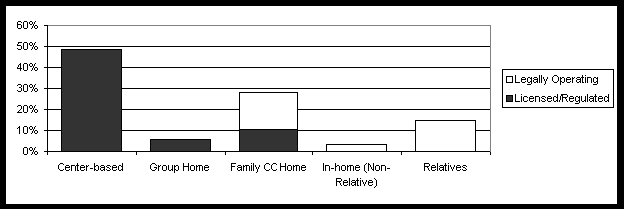
Source: State administrative data for April-September 1998 reported to the Child Care Bureau.
- The Child Care and Development Fund (CCDF) is the major source of Federal funding allocated to states to subsidize the child care expenses of low- and moderate-income families so they can work, or attend education or training programs. Using CCDF dollars along with state funds, Utah has designed its own child care program within broad parameters specified under federal law. CCDF-funded subsidies, and the number of children that the state reported were served with these subsidies, are highlighted in this report because CCDF is a primary source of funding in most states. Also, CCDF administrative data is the most comparable source of child care data across states. It should be noted, however, that Utah, like many other states, also uses other funding sources to provide child care subsidies.
- No waiting list for government subsidies has been maintained since 1996 in Utah. All families who currently apply receive subsidies. In 1996, Utah changed its eligibility criteria so that low-income, non-welfare families participating in education or training are no longer eligible for subsidies. State staff believe that there are eligible families that do not apply for subsidies.5 This belief is corroborated by staff from Child Care Resource and Referral~Metro, the child care resource and referral agency serving Salt Lake and Tooele Counties.
II. Affordability [6]
- Prices for child care vary considerably, by such factors as geographic area, type of provider and age of child. Figure 3 shows the average monthly prices for child care in Salt Lake County, Utah. Given that these are average prices, it is clear that many families pay more or less than this amount.
- Centers in Salt Lake County, Utah charge an average of $392 per month for preschool care and $508 per month for infant care, as shown in Figure 3. This means that a family with $15,000 in income and one preschool child in an average-priced center would spend close to one-third (31 percent) of its total monthly income on child care expenses. Average-priced infant care would represent an even higher share (41 percent) of monthly income for a family earning $15,000.
- Family child care homes in Utah charge an average of $345 per month for preschool children and $392 per month for infants. This means that a family with $15,000 in income and one child in an average-priced family child care home would spend 28 percent of its monthly income on care for a preschool child or 31 percent for an infant.
- Families who receive child care subsidies usually pay much smaller monthly co-payments rather than the full market rate. In Utah, the state pays parents directly for their child care costs. State payments to families are determined by actual provider charges, up to a maximum state rate, and then reduced by an adjustment (i.e., co-payment) amount. The adjustment amount is determined by family size, adjusted gross income and the number of children in care.
- For example, Utah would reduce its payment to a family of three with $15,000 in income and one child in care by $10, as shown in Figure 3.
- In Utah, cash welfare (TANF) assistance is not counted as income in determining the family’s adjustment. Payments to families receiving cash assistance and families with annual income below the poverty line are not reduced by a family adjustment.
| WITHOUT SUBSIDY | WITH SUBSIDY | |||
|---|---|---|---|---|
| Average Monthly Prices (Full Time Care) |
% of Income (Family Income of $15,000 Annually) |
Monthly Adjustment* (If receive subsidy) |
% of Income* (Family Income of $15,000 Annually) |
|
| INFANT (1 year) | ||||
| Center-based | $508 | 40.7% | $10 | 0.8% |
| Family child care home** | $392 | 31.3% | $10 | 0.8% |
| PRESCHOOLER (4 years) | ||||
| Center-based | $392 | 31.3% | $10 | 0.8% |
| Family child care home** | $345 | 27.6% | $10 | 0.8% |
|
* State policy does not prevent providers from charging parents additional amounts, above the co-payment, if the providers’ rates exceed the state reimbursement level. Figures in this table represent the minimum co-payment. ** Average prices for family homes contain prices for group homes. Source: Data collected by the Urban Institute from Child Care Resource and Referral~Metro, the child care resource and referral agency serving Salt Lake County, Utah, summer 1999. |
||||
- State policy does not prevent providers from charging parents additional amounts if the providers’ rates exceed the state reimbursement level. For example, the maximum CCDF rate for preschool center care in Salt Lake County, Utah is $378 per month7, which is $14 less than the $392 average price shown in Figure 3. If the $14 differential is paid by the family, the total cost to the family is $24 per month, or more than twice official family adjustment of $10 shown in Figure 3. If the fee is not charged to the family, the provider loses $14 per month for providing service to a subsidized child. The differential could be much larger than $14 for some child care centers, including accredited centers and other centers with higher than average rates.
III. Gaps in Child Care Supply [8]
- According to the state plan for 1997-1999, maximum reimbursement rates in Utah are capped at the 75th percentile of market rate, based on biennial market rate surveys. Providers in Utah may be unwilling to accept subsidized children, or may limit their enrollment, when the state reimbursement rates are lower than their prices (see the example in section II). As a result, families receiving subsidies may have limited choices of caregivers. However, as of the summer of 1999, in Salt Lake and Tooele Counties in Utah, all regular child care providers did accept subsidies, according to staff at Child Care Resource and Referral~Metro, a child care resource and referral agency serving those areas. The resource and referral agency did not have any information about acceptance of subsidies among accredited and odd-hour providers.
- Staff from the resource and referral agency report shortages in Salt Lake and Tooele Counties in the supply of infant/toddler care, school-age care, and care for children who have special needs or are ill. Specifically:
- Infant/toddler care is hard to find in Salt Lake County. The resource and referral agency did a study of infant/toddler care slots and vacancies in 1991. Overall only 14 percent of all slots for children less than three years old were vacant throughout the county. The densely populated Northeast Quadrant of the county had a vacancy rate of less than 5 percent.
- School-age care is available only in certain locations in Salt Lake and Tooele Counties. In the areas surrounding some schools, the resource and referral agency does not list a single licensed family home or center provider that provides school-age care.
- According to staff at Child Care Resource and Referral~Metro, no provider in Utah registered with a resource and referral agency reports offering care for sick children.
- Parents of children who have special needs report that it is nearly impossible to find qualified care for their children, and little training is available in Utah to help providers prepare for special needs children. When asked by the resource and referral agency, less than one-fifth (17 percent) of providers in Salt Lake and Tooele Counties said they were comfortable taking special needs children. Most of these providers felt they were not suited to care for profoundly disabled children.
Footnotes
1 Estimate based on microsimulations using the Urban Institute's TRIM3 model, guidelines in the state's 1997-99 CCDF state plan, and three years of Current Population Survey data (calendar years 1995-97).
2 Ibid.
3 Estimates based on state administrative data reported to the Child Care Bureau on and adjusted to reflect children funded through CCDF only. 1998 figures based on April-September 1998.
4 Ibid.
5 Waiting list data were obtained and compiled by the Urban Institute from the Utah Department of Workforce Services, the state child care agency.
6 Information in this section was obtained and compiled by the Urban Institute from the Child Care Resource and Referral~Metro (a child care resource and referral agency serving Salt Lake and Tooele Counties).
7 State maximum rates were obtained and compiled by the Urban Institute from the Utah Department of Workforce Services, summer 1999.
8 Information in this section was obtained and compiled by the Urban Institute from Child Care Resource and Referral~Metro.