


By:
Irma Perez-Johnson, Jacqueline Kauff, and Alan Hershey
Submitted to:
Department of Health and Human Services
Office of the Assistant Secretary for Planning and Evaluation
Project Officer:
Alana Landey
Submitted by:
Mathematica Policy Research, Inc.
Project Director:
Alan Hershey
Introduction
In recent years, policymakers and program administrators have increasingly focused on the role of noncustodial parents (NCPs) in the lives of low-income families. Increasing the payment of child support for children in these families is now commonly acknowledged as an important element of efforts to reduce poverty and welfare dependency, as well as to promote personal responsibility. Although the failure of some NCPs to pay support may stem from a lack of commitment to their children, research shows that about one-quarter of all NCPs fail to pay support because they are poor and cannot afford to make payments, rather than because they do not want to (Sorensen and Zibman 2001). This finding has led states and localities to implement strategies to help economically disadvantaged NCPs increase their employment and earnings, and thus their ability to meet their child support obligations. Although the national Welfare-to-Work (WtW) grants program primarily targets recipients of Temporary Assistance for Needy Families (TANF), it has been an important vehicle for states and localities to provide employment, training, and support services to NCPs.
This report examines a special initiative, called Support Has A Rewarding Effects (SHARE), that operated with WtW grant support and targeted NCPs in three counties in the state of Washington.SHARE offered three options to NCPs whose children were receiving TANF and who were in arrears on their support obligations: (1) start paying support, (2) enroll in a WtW program, or (3) face possible incarceration. The main objective of this study was to examine the employment, earnings, and child support outcomes from this innovative collaboration involving the welfare system, child support enforcement agencies, the workforce investment system, and employment and training providers. Table I.1 summarizes our main findings.
|
The Welfare-To-Work Grants Program
The WtW grants program is one of several major, federally funded initiatives aimed at helping welfare recipients and other low-income parents to move into employment. In 1997, the Balanced Budget Act (BBA) authorized the U.S. Department of Labor (DOL) to award $3 billion in grants to states and local organizations. The grants were intended to help the hardest-to-employ recipients of TANF and noncustodial parents of children on TANF to prepare for employment, find jobs, stay employed, and advance in the job market. The WtW grants program built on the earlier enactment, in 1996, of the Personal Responsibility and Work Opportunity Reconciliation Act, which created the work-focused, time-limited TANF program. TANF was designed to move people off the welfare rolls and into employment quickly, whereas WtW grants provided resources targeted to state and local efforts to help particularly disadvantaged individuals who were likely to have great difficulty making that transition.
DOL distributed the $3 billion in funding that Congress provided for the WtW grants program in stages during 1998 and 1999. Three-quarters of the funds were allocated to states based on a formula that considered the states' shares of the national poverty population and TANF caseload. One-quarter was distributed competitively on the basis of applications that states, local agencies, and nonprofit organizations submitted to DOL. Competitive grants were awarded in three rounds, which were announced in May 1998, November 1998, and October 1999. Formula and competitive funds may be used for a range of activities designed to move WtW participants into employment, and grantees have substantial flexibility in designing WtW services.
WtW Eligibility Requirements for NCPs. The BBA required WtW grantees to spend at least 70 percent of their funds on specific target groups, one of which was NCPs. In order to qualify for WtW under the 70 percent criteria, however, NCPs had to meet two requirements. First, they had to have two of the following three legislatively specified barriers to employment: (1) no high school diploma or GED and low reading or math skills, (2) substance abuse problems, and (3) poor work history.(2) Second, they had to have a child with a custodial parent who was a long-term TANF recipient or within one year of reaching the TANF time limit (or have a child in a child-only TANF case who met the same criterion). WtW grantees also could spend up to 30 percent of their funds on TANF recipients or other NCPs with "characteristics associated with long-term welfare dependency," such as being a teenage parent, having a poor work history, or being a high-school dropout.
As the WtW programs were implemented, it became clear that the congressionally defined eligibility criteria were slowing enrollment and limiting participation (Perez-Johnson et al. 2000). The WtW eligibility rules were therefore amended in November 1999. The amendments left intact the requirement that 70 percent of WtW funds be spent on a specific category of participants, but they broadened this category to make it easier for both TANF recipients and NCPs to qualify for WtW services. To qualify for WtW after the amendments, NCPs had to (1) be unemployed, underemployed, or having difficulty making child support payments; (2) have minor children who were receiving or were eligible for TANF, had received TANF during the past year, or were receiving or were eligible for assistance under the Food Stamp, Supplemental Security Income, Medicaid, or State Children's Health Insurance Program; and (3) enter into a personal responsibility contract under which they committed to cooperating in establishing paternity, paying child support, and participating in services to improve their prospects for employment and paying child support.
End of the WtW Program. Congress did not intend to provide ongoing support for WtW interventions. WtW grantees originally were given three years from the date they received their awards (both formula and competitive) to spend their grants. Grantees, in turn, often passed these requirements on to the providers with whom they subcontracted for WtW services. Ultimately, Congress extended the period over which WtW funds may be used to a total of five years that is, through 2004.(3) However, no additional appropriations for WtW have been made or are planned.
How Did Share Operate?
The Tri-County Workforce Development Council (WDC),(4) in the state of Washington, was one of the WtW grantees that targeted services to NCPs. As the administrative entity for Workforce Investment Act (WIA) services in Yakima, Kittitas, and Klickitat counties, Tri-County WDC was responsible for the administration of WtW formula funds ($3.4 million received in 1998 and $2.4 million received in 1999) and for delivery of WtW services in the three counties.
SHARE involved strong collaboration among Tri-County WDC, the Division of Child Support (DCS) of the state's Department of Social and Health Services, and the office of the Yakima County Prosecuting Attorney (YCPA). The program targeted NCPs who had current orders of child support and were delinquent in their payments. (NCPs who owed only arrears were not considered eligible for SHARE.) DCS identified parents who had not paid child support during the past 60 days or longer, and who seemed eligible for WtW services (that is, had a child receiving TANF) and then referred them to YCPA for initiation of contempt proceedings. After receiving a referral, YCPA set a hearing date and had a process server attempt to contact the NCP to notify him that he must appear in court.(5) If he failed to appear, the NCP was considered in contempt of court and a bench warrant was issued for his arrest. If the NCP could not be located and served, the hearing date was cancelled.
When an NCP appeared in court, YCPA staff asked for a finding of contempt. YCPA staff then asked the NCP whether he understood why he had been called to court and whether he was working; they then explained the SHARE program to the NCP. The NCP had to meet the terms of his support order (or orders) by paying child support in order to avoid sanctions from the court, including possibly jail. NCPs who were unemployed or who believed that they might have difficulty meeting their child support obligations were given the opportunity to purge the contempt finding and avoid jail by participating in WtW services. The NCPs who agreed to participate in WtW services were referred to one of Tri-County WDC's WtW service providers, with a requirement to contact the provider within 10 days.(6)
SHARE operated as a special initiative under Tri-County WDC's Welfare-to-Work program. Hence, once at a WtW provider, the referred NCPs had access to the same services and followed the same client-flow process as other WtW-eligible clients. Participants first met with a case manager for an assessment that was conducted as a one-on-one meeting and covered a wide range of issues, including education and work history, employment goals, family history, and potential employment barriers. At the assessment meeting, NCPs were asked to sign a personal responsibility contract detailing their responsibilities in the program.
The services WtW providers offered consistently focused on helping the NCPs secure unsubsidized employment, but they also were structured to meet individual needs. Thus, although activities such as job search workshops and referrals for job openings were the principal service offered, NCPs could be placed in on-the-job training, work experience, or subsidized jobs as an intermediate step before unsubsidized employment. After the NCP had secured an unsubsidized job, WtW case management continued for at least 90 days, with a focus on ensuring that the NCP kept his job and advanced to better opportunities, if appropriate. WtW funds were available to help with transportation, uniforms, work supplies, and other short-term emergency needs. NCPs also could be referred to outside organizations for a range of services, as necessary, including anger management, conflict mediation, and substance abuse counseling.
After the NCP was referred to WtW, YCPA staff continued to obtain progress reports from the providers and to monitor child support payments. YCPA review hearings initially were scheduled to check the NCP's progress every 30 to 45 days. Prior to each review hearing, YCPA staff solicited progress reports from the WtW providers, to be used to update the court. If the NCP was making progress toward obtaining and maintaining employment, and if he was making child support payments (even if minimal until the start of employment), review hearings could be set for every other month or, in some cases, less frequently.
Although SHAREs main goal was to work with NCPs to help them meet their child support obligations, it also strove to limit the burden of the obligations on the NCPs so these did not become a disincentive to work. When an NCP began to work, YCPA staff worked with the parent to modify the existing child support order (or orders) to ensure that payment requirements were reasonable.(7) In particular, DCS allowed for (1) establishment of payment agreements for less than the current amount for a temporary period;(8) (2) reestablishment of payment agreements for default orders that originally were incorrect (for example, for orders completed when the NCP was not present in court); and (3) the possibility of waiving arrears. Support orders could be modified further based on WtW provider reports and review hearings.
The SHARE program began in July 1998 and continued operating in the manner described above through September 2001. Tri-County WDC suspended enrollments into WtW at that time to ensure that sufficient funds would be available to complete services to individuals already enrolled in the program. The collaboration among Tri-County WDC, DCS, and the YCPA for SHARE has been maintained, however. At this time, instead of referring to WtW providers, NCPs who are not meeting their child support obligations because of employment difficulties are referred to Tri-County WDC's one-stop career center, Worksource-Yakima. There, they may access a broad range of WIA-funded employment and training services.
The National WtW Evaluation and the SHARE Outcomes Study
The SHARE outcomes study is part of a comprehensive, congressionally mandated evaluation of the WtW grants program, which Mathematica Policy Research, Inc. (MPR), the Urban Institute, and Support Services International, Inc. are conducting under a contract from the U.S. Department of Health and Human Services (DHHS). The national evaluation has three major components:
- Descriptive Assessment of WtW Programs Nationwide. Mail surveys of all WtW grantees, conducted in 1998 and 1999, provided an overview of program designs and activities, target populations, characteristics of participants, and, when available, information on early placement outcomes. Visits to several dozen grantees before the first survey was conducted helped to develop a fuller understanding of program variations and provided a basis for selection of in-depth study sites. Previously released reports document the findings from both national surveys and the early visits to selected grantees.(9)
- Process Study. Two rounds of site visits, in 1999-2000 and 2000-2001, were conducted to 11 purposefully selected WtW grantee evaluation sites. Some sites were selected because of their innovative approaches, settings, or target groups, others because they were typical of the most common WtW interventions. The process visits included discussions with staff of WtW programs and related agencies, focus groups with participants, and program observations. The aim of the process and implementation study was to identify implementation issues and challenges, as well as lessons from program implementation.(10)
- Outcomes Analysis. In 10 of the 11 process study sites, a sample of WtW participants was formally enrolled in the evaluation. Follow-up data on these participants are being collected through surveys and administrative data, and are being used to analyze participants' activities in the programs and their employment and social outcomes. We refer to the 10 grantee sites in which these analyses are being conducted as the "in-depth" study sites.
In addition, a special process and implementation study focuses on documenting welfare and employment systems operated by American Indian and Alaska Native grantees, the supportive services they provide, and the way these tribal grantees integrate funds from various sources to help their members to move from welfare to work.(11)
Tri-County WDC is one of the in-depth study sites for the national evaluation. As such, it has been included in both the process study and the analysis of WtW outcomes. However, the outcomes analysis for the national evaluation includes, among WtW participants, only those NCPs whose eligibility for WtW services was confirmed and who were referred to a WtW contractor for services. Among NCPs targeted for participation in SHARE, the national evaluation will not capture outcomes for NCPs who (1) were delinquent in their child support payments but found ineligible for WtW services, (2) failed to appear for their contempt hearings, or (3) chose to pay support rather than participate in WtW services. Although SHARE may have affected the employment and child support payments of these NCPs, the national evaluation cannot capture their outcomes. To better understand the paths that SHARE participants followed, and to further document emerging strategies for serving NCPs in general, DHHS contracted with MPR to conduct a small study documenting the outcomes forall NCPs targeted for participation in the SHARE program.
Research Questions
The broad purpose of this study was to document more fully the operation and outcomes of a program for NCPs that uses "carrots" and "sticks" both positive incentives and compliance enforcement to encourage participation. Specifically, the SHARE outcomes study was designed to address questions in two key areas:
- Program Participation. To what extent did SHARE reach the population targeted for its services? Given the defined consequences for failing to pay child support and failing to participate in SHARE, to what extent did NCPs appear or not appear at their contempt hearings? What choices did NCPs make at the hearings?
- Program Outcomes. To what extent did SHARE participants increase their employment, earnings, and child support payments after being referred to the program? How are outcomes in these areas different for NCPs who appeared at their contempt hearing and for those who did not? How are they different for NCPs who, after appearing at their hearing, were referred to WtW services and for those who were not?
Data Sources and Methodology
The sample members for this study are NCPs with outstanding current child support orders who were referred by DCS to YCPA for initiation of contempt proceedings between July 1, 1998, and September 30, 2001. NCPs were considered to have outstanding orders if they currently owed child support and had not paid child support for the previous 60 days or longer. There were 574 such referred noncustodial parents in our sample.
MPR collected data on the SHARE participation and outcomes of each sample member. YCPA provided participation data on the 574 referred NCPs from a database it maintained on SHARE participants and on the participants' activities. These data are the basis for our analysis of program participation. We also collected administrative data from the state for all 574 NCPs on employer-reported earnings, child support payments, and receipt of TANF and food stamp benefits.
We used the administrative data to construct variables describing the employment, earnings, and child support payments for NCPs over the four calendar quarters preceding the quarter of referral to SHARE through as many as 15 quarters after the quarter of referral. Because sample members were referred toSHARE over time, the number of quarters of data available varies by individual; data for later quarters are available for fewer sample members. In this report, we present analyses only for the quarters in which data were available for the majority of sample members. We present data on employment and earnings through the sixth quarter after referral to SHARE, and on child support payments through the ninth quarter after referral.
To address questions about program participation, we analyzed information on the flow of NCPs from DCS to YCPA, and from YCPA to WtW, and information on the resolution of referred child support cases. Chapter II presents the results of this analysis. However, no data on actual participation in WtW activities was examined for this report, so we cannot comment on either the extent of participation or the intensity of service receipt among NCPs referred for WtW services.
To address questions on program outcomes, we compared data on employment, earnings, and child support payment for the quarters preceding referral to SHARE with data on the same outcomes for the quarter of referral to SHARE and for the quarters after referral. We examined these pre-post trends for sample members as a whole, but also for subgroups. In particular, we analyzed data from before and after referral for sample members who appeared at their contempt hearing and for those who did not appear for the hearing. Among those who appeared at their hearing, we further examined pre-post data separately for those who were referred to WtW services and for those who were not referred. In addition to making pre-post hearing comparisons, we compared these subgroups with each other to explore differences in the patterns of outcomes for NCPs who followed different paths through the initiative. These comparisons provide useful profiles of the extent to which NCPs' "trajectory" of outcomes follows the course intended by the SHARE program.
2. The WtW regulations defined "poor work history" as having worked no more than 13 consecutive weeks full-time in unsubsidized employment during the prior 12 months.
3. This extension was granted largely in response to the difficulties that most grantees encountered enrolling participants under the BBA's original eligibility criteria, which lasted for most of the grants' original implementation period. These implementation issues are discussed in more detail in Fender et al. (2000) and in other reports from the national WtW evaluation.
4. Formerly, the Tri-Valley Private Industry Council.
5. We refer to a noncustodial parent as "he" or "him" because 88 percent of the referred cases were men.
6. Tri-County WDC contracted with three organizations to provide the majority of WtW services: (1) People for People, (2) the Yakima Valley Opportunities Industrialization Center, and (3) the Yakima Valley Farm Workers Clinic.
7. YCPA staff also could modify existing child support orders for NCPs who, at their hearing, preferred to find employment and/or resume paying child support on their own.
8. According to YCPA staff, the child support orders of SHARE participants (that is, those NCPs who appeared at their court hearings and agreed to cooperate with SHARE) were routinely modified to limit initially the state's collection against the NCP's wages to no more than 50 percent of the net amount the state could collect under current statutes. YCPA staff reviewed these modified orders on a regular basis and increased the amount of child support collected as the NCPs' employment and income increased.
9. For results of the two surveys, see Perez-Johnson and Hershey (1999) and Perez-Johnson et al. (2000). Findings from the exploratory site visits are discussed in Nightingale et al. (2000).
10. Findings from the process visits are discussed in Nightingale (2001) and Nightingale et al. (2002). Topical briefs on recruitment challenges and strategies (Fender et al. 2000) and on the approaches used by programs serving NCPs (Martinson et al. 2000) also are available.
11. Reports by Hillabrant and Rhoades (2000), Hillabrant et al. (2001), and Hillabrant and Pindus (2003) document findings to date from the tribal study.
Participation in SHARE
Finding and engaging their intended participants is one challenge that programs aiming to serve NCPs and other unattached males commonly encounter. Therefore, before exploring the outcomes of SHARE, it is important to examine the extent to which this initiative was able to reach out to and engage its target population.
One feature that sets SHARE apart from other programs targeting NCPs is the strong role that child support enforcement and prosecuting attorneys play in this collaboration. In their review of 11 WtW programs targeting NCPs, Martinson et al. (2000) note that SHARE was the only program that relied entirely on child support enforcement agencies for identification and recruitment of WtW-eligible NCPs. SHARE also was the only program featuring mandatory participation in employment servicesВ NCPs who indicated that they were unable to find work and pay support on their own were referred to WtW services under threat of incarceration if they did not participate. SHARE also had features that administrators viewed as important "carrots" to promote participation, including temporary modification of child support orders and the possibility of waiving arrearages.
In this chapter, we examine how effective SHARE was in reaching out to and engaging NCPs who were not meeting their child support obligations. First, we examine the flow of NCPs through the programВ that is, the number of NCPs referred by DCS, the number appearing in court, the number referred for WtW services, and the number with bench warrants issued for their arrest. Second, we explore how long the process took to identify, establish contact with, and reach resolution of the referred NCP cases. We also examine how cases were resolved from YCPA's perspective and discuss common reasons for nonparticipation.
Did SHARE Reach its Intended Targets?
DCS worked closely with YCPA to identify and engage NCPs with outstanding orders of support in the SHARE program. DCS was responsible for identifying NCPs potentially eligible for SHARE and for referring these cases to YCPA. To be eligible for SHARE, each case had to meet two basic criteria. First, the NCP had to have an outstanding order of child support. (A case was considered outstanding if no payments had been made in the past 60 days or longer. However, NCPs who owed only arrears were not eligible for SHARE.) Second, the dependent child had to be a TANF recipient.
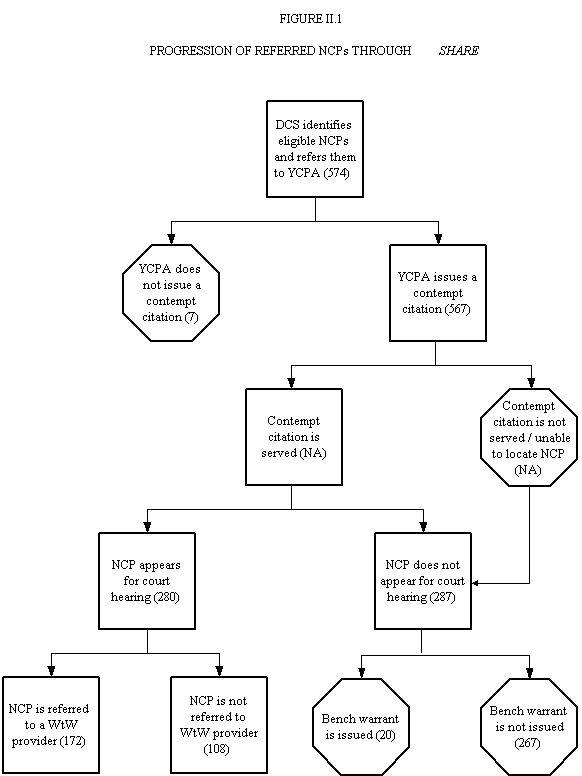
The path that NCPs took through SHARE branched at several points, depending on their eligibility, YCPA's success in serving citations, the NCPs' attendance at or failure to attend the hearings, and the NCPs' appropriateness for WtW services (Figure II.1). After DCS referred a case, YCPA staff first confirmed the NCP's basic eligibility for the program, mainly by checking that the case still had outstanding child support payments. If SHARE eligibility was not confirmed, YCPA staff referred the case back to DCS without issuing a contempt citation. If SHARE eligibility was confirmed, YCPA issued a contempt citation notifying the parent that he must appear in court for a hearing and then attempted to serve the parent with the citation. If YCPA staff could not locate an NCP who had been issued a contempt citation, they cancelled the hearing and referred the case back to DCS, closing the case from the standpoint of the SHARE program. The staff presented three options to NCPs who were located, served their citations, and attended their hearing: (1) start making child support payments, (2) participate in WtW services, or (3) possibly go to jail. YCPA staff were expected to issue bench warrants for the arrest of any NCP who was served a contempt citation but failed to appear at a hearing.(12) As we discuss later, this did not always happen, as many of the NCPs who failed to appear at their hearings could not be located.
DCS = Division of Child Support; NA = not available;
NCP = noncustodial parent; WtW = Welfare-to-Work; YCPA = Yakima County Prosecuting Attorney.
YCPA staff approached most referred cases. Between July 1998 and September 2001, DCS identified 574 NCPs as potential SHARE participants and referred their cases to YCPA (Table II.1). Most of these cases progressed to the issuance of a contempt citation. YCPA staff issued 567 contempt citations, which notified individuals that they were required to attend a court hearing to address their delinquent orders of child support. According to YCPA's records, seven cases were not issued contempt citations because YCPA staff quickly determined that the NCPs no longer had outstanding orders of child support, were ineligible for WtW services, or would otherwise be unable to participate in the program (for example, because the NCP was incarcerated).
| Number | |
|---|---|
| All NCPs Referred by DCS | 574 |
| NCPs Never Issued a Citation to Appear at YCPA Hearing | 7 |
| NCPs Issued a Citation to Appear at YCPA Hearing | 567 |
| NCPs Issued a Citation | |
| 287 |
| 280 |
| NCPs Who Appeared at YCPA Hearing | |
| 172 |
| 108 |
| Source: Office of the Yakima County Prosecuting Attorney (YCPA), SHARE database (as of February 28, 2002). DCS = Division of Child Support; NCP = noncustodial parent. | |
About half of the NCPs issued citations appeared for their hearings, and almost two-thirds of those who appeared were referred to WtW. Of the 567 NCPs issued contempt citations, 280 eventually appeared for hearings with YCPA staff. According to YCPA records, the majority of these NCPs (172 parents or 61 percent of those appearing) were referred to a WtW provider for employment services. This finding suggests that the majority of the NCPs who appeared at hearings were people facing significant employment difficulties that made it hard for them to meet their child support obligations without help. As we discuss in more detail later, some of the NCPs who appeared at hearings and were not referred to WtW services we estimate 24 NCPs were determined ineligible for WtW services at such hearings. Hence, the majority of the NCPs who appeared but were not referred to WtW 84 of 108 NCPs seem to have opted to find employment and/or resume paying child support on their own.
Few arrest warrants were issued. Contempt citations stated clearly that a bench warrant would be issued if the NCP failed to appear for his scheduled hearing. Furthermore, NCPs who reported for their hearings were threatened with incarceration if they did not resume paying child support on their own or did not agree to participate in WtW services. However, few bench warrants were issued. Only 20 NCPs, or fewer than 10 percent of the 287 who failed to appear at a hearing, were issued a bench warrant (Table II.2), in large part, it appears, because YCPA could not locate many of these NCPs. Bench warrants also were issued for 29 NCPs who appeared for their hearings; 14 of the 29 had been referred to WtW services, and 15 had not. These NCPs seemed to be ones who initially appeared to cooperate with the SHARE process, but who later stopped cooperating. None of the NCPs appearing at their hearings seemed to opt explicitly for jail. Although few arrest warrants were issued, program administrators believed that the credible threat of incarceration was important in securing NCPs' cooperation.
| Number of Warrants Issued | Percent | |
|---|---|---|
| All NCPs Referred by DCS (n = 574) | 49 | 8.5 |
| NCPs Who Never Appeared at YCPA Hearing (n = 287) | 20 | 7.0 |
| NCPs Who Appeared at Hearing | ||
| 14 | 8.1 |
| 15 | 13.9 |
| Source: Office of the Yakima County Prosecuting Attorney (YCPA), SHARE database (as of February 28, 2002). DCS = Division of Child Support; NCP = noncustodial parent. | ||
How Successful Was SHARE in Reestablishing Support?
Reestablishing child support payments, the main objective of SHARE, often required substantial effort. In this section, we use information from program records to examine how long YCPA staff were involved with referred cases, how often they were able to reestablish child support payments, and why they sometimes were unable to reestablish payments.
In many cases, referral to SHARE did not lead to reestablishment of child support payments. According to YCPA records, 449 (or 78 percent) of the 574 cases referred to them were closed and referred back to DCS when no further action by YCPA staff was deemed possible or warranted (Table II.3). In 111 of these 449 cases, the NCPs had resumed payments and were released from court supervision. In the remaining 338 cases closed, YCPA staff had been unable to reestablish child support. These overall statistics nevertheless mask important differences in the resolution of cases referred to SHARE and the paths that NCPs followed through the initiative.
| All Cases Closed by YCPA and Referred Back to DCS | Cases Closed by YCPA, Paying Child Support | Cases Closed by YCPA, Not Paying Child Support | |
|---|---|---|---|
| All NCPs Referred by DCS (n = 574) | 449 | 111 | 338 |
| NCPs Who Were Never Issued a Citation to Appear at YCPA Hearing (n = 7) | 7 | 1 | 6 |
| NCPs Who Were Issued a Citation to Appear at YCPA Hearing (n = 567) | 442 | 110 | 332 |
| Never Appeared at YCPA Hearing (n = 287) | 255 | 18 | 237 |
| Appeared at YCPA Hearing (n= 280) | 187 | 92 | 95 |
| 102 | 52 | 50 |
| 85 | 40 | 45 |
| Source: Office of the Yakima County Prosecuting Attorney (YCPA), SHARE database (as of February 28, 2002). DCS = Division of Child Support; NCP = noncustodial parent. | |||
The further the SHARE process went, the greater the likelihood of reestablishing child support payments. NCPs who never appeared at a hearing almost always had their cases closed without having resumed child support payments (Table II.3). However, when NCPs appeared for their hearings, YCPA staff achieved better results. NCPs who appeared for their hearings were about equally likely to have their cases closed with child support being paid as with child support not being paid. At first, the cases of NCPs who appeared at hearings seemed somewhat more likely to be closed with child support being paid if the NCP was referred for WtW services than otherwise (52 of 102 cases, compared to 40 of 85 cases Table II.3). As we discuss later, however, some of the 85 closed NCP cases not referred to WtW were deemed ineligible for the program; among the remaining WtW-eligibles not referred, YCPA staff also seemed to achieve a positive child support outcome in most cases.
YCPA staff remained involved for about two years in the cases of NCPs who appeared for hearings. On average, almost five months elapsed from the date of referral by DCS to the NCP's appearance at a court hearing (Table II.4). YCPA staff usually remained involved with these cases for nearly two years, whether or not the NCP was referred to WtW services. This degree of involvement is not surprising after the initial hearings, YCPA staff continued to conduct review hearings and monitor child support payments to ensure that the NCP was meeting his obligations. The prolonged involvement of YCPA staff may have been an important factor in the successful outcome of many of these cases.
The cases of NCPs who did not come to hearings were resolved quickly. YCPA staff continued to try to establish contact with NCPs who failed to appear at their hearings, in order to engage them in the program. However, these cases generally were closed (as far as the SHARE program was concerned) and referred back to DCS within an average of six months (Table II.4).
| Time Since DCS Referral and | ||||
|---|---|---|---|---|
| Child Support Hearing | Case Closed, Referred Back to DCS | Case Closed, Paying Child Support | Case Closed, Not Paying Child Support | |
| All NCPs Referred by DCS | n.a. | 12.4 | 15.2 | 11.5 |
| NCPs Never Issued a Citation to Appear at YCPA Hearing | n.a. | 4.0 | 3.2 | 4.2 |
| NCPs Who Never Appeared at YCPA Hearing | n.a. | 6.2 | 9.4 | 6.0 |
| NCPs Who Appeared at YCPA Hearing | 4.6 | 21.2 | 16.4 | 25.8 |
| Were referred to WtW program | 4.4 | 18.7 | 20.3 | 17.0 |
| Were not referred to WtW program | 4.8 | 24.2 | 11.4 | 35.6 |
| Source: Office of the Yakima County Prosecuting Attorney (YCPA), SHAREdatabase (as of February 28, 2002). DCS = Division of Child Support; n.a. = not applicable; NCP = noncustodial parent. | ||||
Many of the cases of NCPs who did not appear were closed without reestablishment of child support because YCPA staff could not locate the NCPs or could not engage them in SHARE. YCPA staff were unable to locate 128 (54 percent) of the 237 NCPs who failed to appear at hearings (Table II.5). Twenty-four other NCPs (10 percent) could not participate in SHARE because they were incarcerated. Another common reason for case closure among NCPs who had failed to appear at hearings was that the NCPs had moved out of YCPA's jurisdiction (22 NCPs, or 9 percent); people in this group included NCPs who had moved out of Yakima County, moved out of the state, or had been deported.
| NCPs Who Appeared at Hearing | ||||
|---|---|---|---|---|
| Reason | NCPs Who Never Appeared at Hearing | Referred to WtW | Not Referred to WtW | All NCPs Referred by DCSa |
| NCP Could Not Be Located | 128 | 0 | 1 | 130 |
| NCP Was Incarcerated | 24 | 16 | 9 | 50 |
| NCP Was Living Outside of YCPA Jurisdiction | 22 | 3 | 1 | 26 |
| NCP Did Not Qualify for WtW Services | 17 | 10 | 17 | 45 |
| Child/children living with NCP | 1 | 6 | 5 | 12 |
| NCP and custodial parent reconciled | 1 | 2 | 9 | 12 |
| Child/children not receiving TANF | 6 | 0 | 1 | 8 |
| Child/children emancipated, older than 18 | 2 | 2 | 0 | 4 |
| NCP owed arrears only | 3 | 0 | 1 | 4 |
| NCP cannot work legally in the United States | 0 | 0 | 1 | 1 |
| NCP did not qualify (reason unspecified) | 4 | 0 | 0 | 4 |
| NCP Was Receiving TANF | 13 | 9 | 6 | 29 |
| Other Reason | 17 | 6 | 3 | 27 |
| No Reason Noted | 16 | 6 | 8 | 31 |
| Total | 237 | 50 | 45 | 338 |
| Source: Office of the Yakima County Prosecuting Attorney (YCPA), SHARE database (as of February 28, 2002). DCS = Division of Child Support; NCP = noncustodial parent; TANF = Temporary Assistance for Needy Families; WtW=Welfare-to-Work program. a Includes six of the seven referred NCP cases that did not have contempt citations issued. | ||||
Even when NCPs appeared at their hearings, a variety of circumstances sometimes led to case closure without reestablishment of child support. Subsequent incarceration was the most common or second most common reason for a poor outcome among NCPs who appeared at their hearings, whether they were referred for WtW services (16 cases) or not referred for WtW services (9 cases). As mentioned earlier, some of the NCPs who appeared were determined ineligible for SHARE at their hearings (24 NCPs not referred to WtW, including 1 living outside of YCPA's jurisdiction and 6 receiving TANF) or after having been referred for WtW services (22 NCPs). In some of these cases, however, although child support payments were not reestablished, the reasons for case closure suggest somewhat equivalent outcomes. In 22 cases, either the dependent children were living with the NCP (11 cases), or the NCP and custodial parent had reconciled (another 11 cases).
The majority of SHARE-eligible NCPs who appeared had their cases closed with child support being paid, whether or not the NCP was referred for WtW services. Of the 280 NCPs who appeared for hearings, 172 were referred for WtW services (Table II.3). Of these 172 cases, 102 had been closed by YCPA staff by the time of our data extract, and just over half of these 52 of the 102 cases were closed with child support having been reestablished. Of the 108 cases of NCPs who appeared for hearings but were not referred for WtW services, 85 had been closed by the time of our data extract 40 with child support being paid and 45 without (Table II.3). However, 24 of the 45 cases closed without child support being paid were for NCPs who were deemed ineligible for SHARE at their hearings (Table II.5). This suggests that the majority of closed cases among NCPs who appeared and opted to find employment or pay child support on their own 40 of 61 closed cases also had child support reestablished.
WtW eligibility criteria or difficulties with their application may have prevented some NCPs from participating in SHARE. In 45 cases, when the NCP first appeared at a hearing or during other contacts, YCPA staff found that the NCP was ineligible or no longer eligible to participate in SHARE (last column in Table II.5). In 24 of these cases, either the children for whom the support orders were issued were living with the NCP, or the parents had reconciled. In eight cases, because the dependent children were older than age 18, the NCP owed only arrears. These NCPs were ineligible for SHARE, as WtW regulations stipulated that the children who are owed child support must be minors. YCPA records indicated that the dependent children in another eight cases were not current TANF recipients. Under the revised WtW regulations, NCPs could qualify for services if their children had received TANF during the past year, or if the children simply were eligible for a variety of public assistance programs. However, many SHARE referrals occurred before the revised regulations took effect and, hence, YCPA staff generally determined NCPs as eligible for WtW only if they could confirm that the NCPs' dependent children were current TANF recipients. Difficulties in substantiating eligibility under the liberalized options may have also been a factor in eligibility decisions.
Summary
The process of identifying eligible NCPs and engaging them in SHARE was lengthy and often unsuccessful. Overall, about half of the individuals referred to SHARE ever appeared at a court hearing at which the program was explained to them. However, two-thirds of those who did appear were referred for WtW services, suggesting that many of the targeted NCPs faced significant employment difficulties that made it hard for them to pay child support. Once referred to SHARE, it usually took several months for an individual to appear in court, and often more than two years elapsed before a case was resolved and referred back to DCS. Even so, the longer the SHARE process continued, the greater the likelihood of success in reestablishing child support payments. Referred cases were most likely to be resolved with the NCP paying child support if the NCP had appeared for a hearing with YCPA staff, and if he had been referred to WtW for employment services. However, YCPA staff also seemed to achieve success with NCPs who appeared for their hearings and opted to find employment and/or resume paying child support on their own.
12. The information from YCPA's SHARE database does not enable us to distinguish between SHARE-eligible NCPs whom YCPA was unable to serve a contempt citation and NCPs who were located and thus served but still failed to appear at their contempt hearing. Hence, for our analysis, we classify both groups of NCPs as individuals who never appeared at a contempt hearing.
Program Outcomes
The main objective of SHARE was to help NCPs increase their employment, earnings, and ability to pay child support. This study examines whether NCPs did work more, earn more, and pay more support after they were exposed to the initiative. Because the study is not experimentalВ it does not entail randomly assigning sample members to a treatment or control groupВ we cannot establish definitively whether, or to what extent, SHARE itself is responsible for any of the observed changes in these outcomes over time. However, the study's design does allow us to establish the extent to which the initiative's intended outcomes were being achieved, and whether observed changes could plausibly be related to program effects.
Although the NCPs in this study shared some common characteristics and experiences, they followed a variety of paths after they were referred to SHARE. Some never appeared at a contempt hearing, and those who appeared may or may not have been referred for WtW services. It is reasonable to expect that whether NCPs appeared at contempt hearings, and whether they were referred to WtW services, may be associated with employment, earnings, and child support payment outcomes.
Many factors may have influenced the paths that NCPs took. Preexisting differences in backgrounds, motivation, and capabilitiesВ unobserved in the available dataВ could have affected how NCPs responded to SHARE, as well as their employment and child support outcomes. Because individuals targeted by programs such as SHARE usually are at a low point in their employment and other aspects of their lives when they are first engaged in services, post-referral outcomes are likely to reflect a certain amount of "natural recovery" from these lows.(13) Finally, the various components of SHARE may have affected individual NCPs differently.
This chapter first describes the characteristics and experiences of NCPs in the study before their exposure to SHARE. It then explores changes in the participants' labor market and child support experiences after referral to SHARE, as well as differences in outcomes for NCPs who took different paths through the initiative. It concludes with a discussion of factors that may have contributed to the observed differences and implications for future research.
Characteristics of the NCP Sample Before Referral to SHARE
As context for examination of employment, earnings, and child support outcomes, it is useful to understand the backgrounds of the NCPs referred to SHARE. A basic description of the pre-referral characteristics and experiences of NCPs can provide a backdrop for interpreting the responses of these individuals to the initiative.
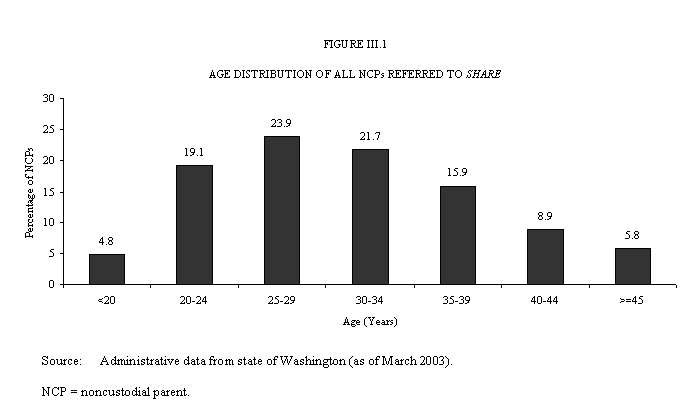
Most NCPs were male, and they were older than age 25 when referred to SHARE. Based on the limited demographic data available, we can construct a rudimentary profile of the NCPs referred to SHARE. Most NCPs included in the study (88 percent) were male (see Appendix Table A.1).(14) Their average, as well as median, age at the time of referral toSHARE was 31 years. Fewer than one-quarter were younger than age 25 at referral, and there were few teenagers or people age 45 or older (five and six percent, respectively) (Figure III.1).
Rates of participation in TANF were low. No more than seven percent of the NCPs in the study were receiving TANF in any of the four quarters before referral to SHARE (Table III.1).
This finding is not surprising, given that only needy children and their residential caretakers may receive TANF. Still, some NCPs in our sample may have been receiving TANF, for one of two reasons. First, our analysis of patterns of participation in SHARE revealed a number of NCPs who were never referred to a WtW provider because YCPA staff discovered at the contempt hearing that the noncustodial children were at that time living with them (see Chapter II). Some of these NCPs may by then have been receiving TANF for themselves and for these children, although earlier they had been under order to pay support to the other parent. Second, some NCPs may have been living with other children for whom they were receiving TANF. The majority of NCPs receiving TANF were male (21 of 25 receiving TANF four quarters before referral to SHARE, and 27 of 40 receiving TANF in the quarter immediately before referral).
|
Quarters Before Referral |
TANF | Food Stamps |
|---|---|---|
| Quarter 4 | 7.0 | 22.3 |
| Quarter 3 | 5.6 | 22.5 |
| Quarter 2 | 5.2 | 22.8 |
| Quarter 1 | 4.4 | 22.1 |
| TANF = Temporary Assistance for Needy Families. | ||
Rates of participation in the Food Stamp Program (FSP) are higher than in TANF. Between one-fifth and one-quarter of the sample was receiving food stamps during each quarter before referral. The higher rates of participation in the FSP likely reflect the less stringent eligibility criteria of the FSP, both in terms of family structure and financial resources, as well as need among this relatively disadvantaged population.
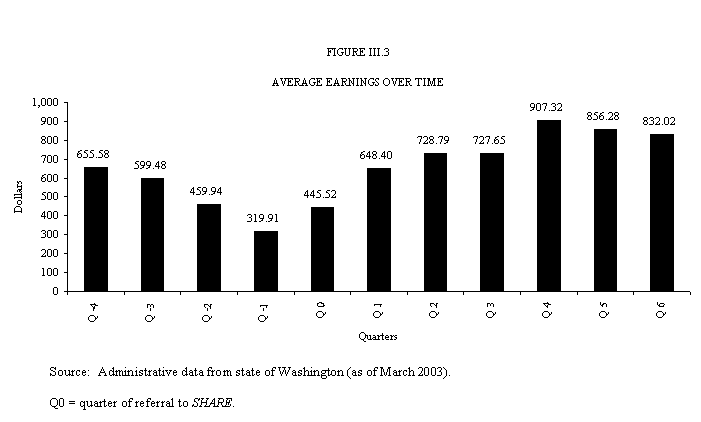
Before referral to SHARE,the majority of NCPs were not employed, and average earnings were low. During the first three of the four quarters before referral to SHARE, only about one-third of all NCPs had any reported employment (Table III.2). During the quarter immediately before referral, the share with any employment was lower still, with only about one-quarter reporting employment. Moreover, it appears that nearly all those who were employed before referral worked in jobs that offered low wages or worked too few hours to earn a substantial living. Even four quarters before referral, when average earnings were highest, three-quarters of those working earned less than $2,500 in the quarter (Table A.4). Average earnings among all NCPs were lowest a mere $320 during the quarter immediately preceding referral to SHARE (Table III.2). The low average earnings reflected primarily the low rates of employment among referred NCPs, which declined to only 25 percent in the quarter before referral to SHARE. Average quarterly earnings for those employed also declined, to $1,302. It is unclear, however, if the decline in average earnings reflects an actual decline among those who remained employed or if those who remained employed were lower earners throughout the period.
| Quarters Before Referral | Percentage Employed | Average Quarterly Earnings Among All NCPs (Dollars) | Average Quarterly Earnings Among Those Employed (Dollars) |
|---|---|---|---|
| Quarter 4 | 36.6 | $655.58 | $1,791.92 |
| Quarter 3 | 35.5 | $599.48 | $1,686.78 |
| Quarter 2 | 30.3 | $459.94 | $1,517.28 |
| Quarter 1 | 24.6 | $319.91 | $1,302.34 |
Few NCPs paid child support before referral to SHARE. During each of the four quarters leading up to their referral to SHARE, no more than 18 percent of all NCPs paid any child support (Table III.3). The proportion of NCPs paying child support was lowest 13 percent during the quarter immediately preceding referral to SHARE. Several circumstances help explain why some NCPs were referred to SHARE despite these reported payments. First, parents may have paid support during the balance of the calendar quarter in which they were referred. Second, there may have been a time lag between identification of a delinquent parent and referral to SHARE, during which that parent may have made a payment. Third, some payments may reflect intercepted Internal Revenue Service (IRS) refunds that would not qualify the NCPs as meeting their obligations.(15)
| Quarters Before Referral | Percentage Paying | Average Amount Paid in Quarter Among All NCPs (Dollars) | Average Amount Paid in Quarter Among Those Paying (Dollars) |
|---|---|---|---|
| Quarter 4 | 15.7 | 74.87 | 477.50 |
| Quarter 3 | 17.8 | 71.69 | 403.41 |
| Quarter 2 | 15.7 | 51.46 | 328.19 |
| Quarter 1 | 13.2 | 37.77 | 285.25 |
Average child support collections were extremely low before referral to SHARE and only about half of the NCPs with employment paid any child support. During the fourth quarter before referral, DCS collected an average of only $75 from the NCPs referred to SHARE. This low average payment reflects the 84 percent of NCPs who made no payments (Table III.3). The average amount collected declined progressively throughout the year leading up to referral, reaching a low of $38 during the quarter immediately before referral. The reduction in average payments was greater than the reduction in the percent paying, perhaps indicating that those who continued to pay had smaller obligation amounts or paid less than was due.(16) Our data also suggest that the NCPs may have informally adjusted the amount of support they paid according to the relative burden that these payments represented. NCPs who paid any child support four quarters before referral paid an average of $478 (Table III.3). This amount represents about 27 percent of the average quarterly earnings for employed NCPs (Table III.2). The amount declined to a low of $285 during the quarter immediately preceding referral about 22 percent of the average quarterly earnings of NCPs who were working.
How Did Targeted NCPS Fare after Referral to SHARE?
The ultimate goal of SHARE was to help NCPs meet their obligations to financially support their children. However, an intermediate goal of SHARE was to help NCPs increase their employment and earnings, as parents need income in order to meet their obligations, and the most likely source of steady income is a job. This section examines trends over time in the employment, earnings, and child support payments of NCPs referred to SHARE.
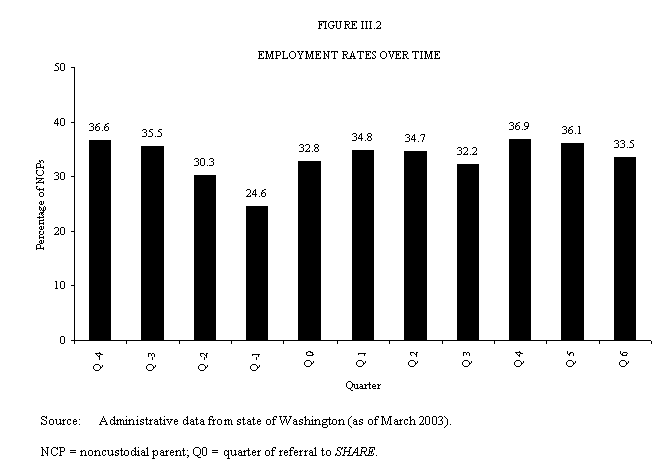
Employment rates and earnings increased after referral to SHARE. Employment rates among all NCPs referred toSHARE increased from their low of one-quarter during the quarter immediately preceding referral to one-third during the quarter of referral (Figure III.2).(17) In subsequent quarters, employment rates remained just above one-third. Similarly, average earnings increased 40 percent between the quarter immediately preceding referral and the quarter of referral (Table A.5).(18) However, average earnings continued to climb more substantially than the employment rate did (Figure III.3). In the fourth quarter after referral, average earnings were almost three times the average during the quarter immediately prior to referral, and almost one-and-a-half times the pre-referral high. The larger increases in average earnings across all NCPs referred to SHARE (relative to increases in employment) reflect higher average earnings for those NCPs who were employed (Table A.5). These gains could reflect increases in hourly wages, hours worked each week, or weeks worked in each quarter.
After referral to SHARE, NCPs generally experienced more sustained spells of employment. About 16 percent of referred NCPs were employed during all four quarters after referral, compared with only 9 percent employed during all four quarters preceding referral (Table A.9). This clearly contributed to the increase in average earnings after referral to SHARE. Sustained employment is particularly important for low-income NCPs, as it likely increases their opportunities for wage progression and, thus, their ability to meet their financial obligations to their children. Sustained employment also increases the probability that a wage withholding order can be put into effect.
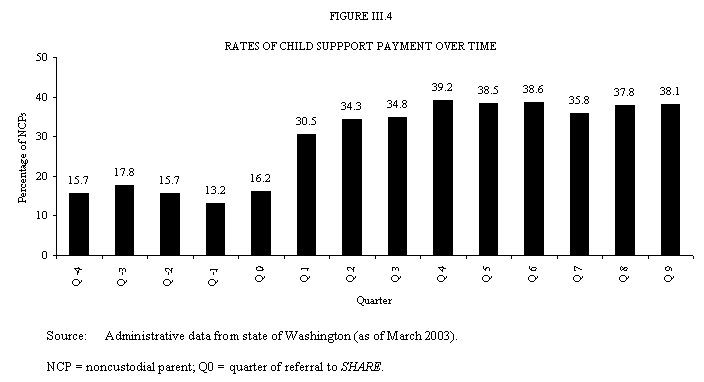
Child support payment rates increased markedly between the quarter of referral to SHARE and the quarter after referral. Among all NCPs referred to SHARE, child support payment rates nearly doubled between the quarter of referral to SHARE and the subsequent quarter (Figure III.4). Payment rates during all subsequent quarters ranged between 30 and 40 percent, substantially higher than they were before referral to SHARE. Even so, in each quarter after referral, the majority of referred NCPs failed to pay any child support.
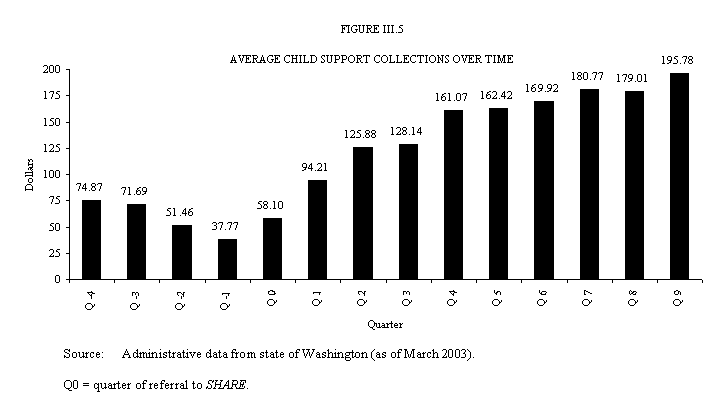
Overall, average child support collections were substantially higher after referral to SHARE than before. During every quarter after referral to SHARE except the first one, average child support collections among all NCPs were more than $125 (Figure III.5). In contrast, average quarterly collections before referral to SHARE never rose above $75. Average collections increased in almost every quarter after referral; by the ninth post-referral quarter, they were at a high of $196. This trend reflects mainly increases in the number of NCPs paying support, which are noticeably larger than the increases in average payments across those NCPs paying support (Table A.7). Nine quarters after referral, 38 percent of all referred NCPs were paying child support an increase of 143 percent relative to the prereferral high of 17.8 percent (in the third quarter before referral). In contrast, average payments across those NCPs paying support increased by only 28 percent over the same period. The increases in child support collections also reflect more sustained payments by NCPs who were paying support. Of the referred NCPs, 14 percent made child support payments in all four quarters after referral to SHARE, compared with only 3 percent paying in all four quarters prior to referral (Table A.9).
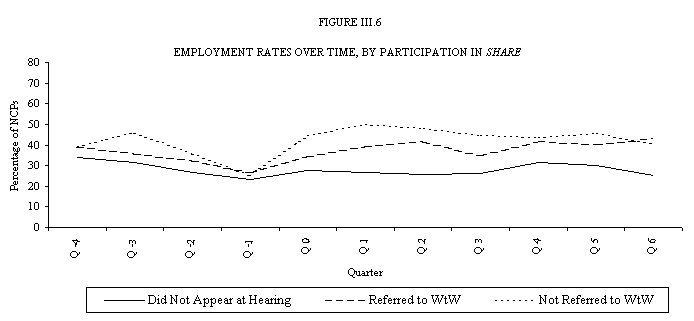
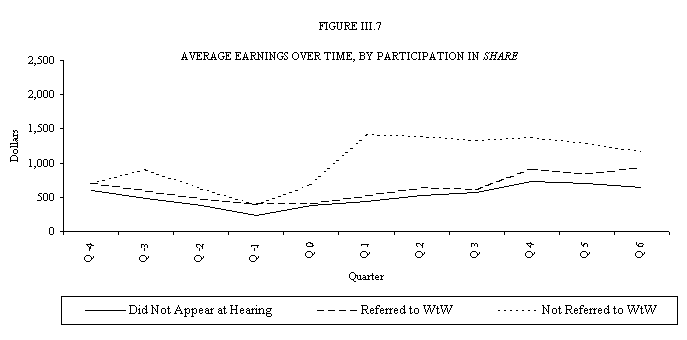
Outcomes in employment and earnings varied across groups that took different paths through the initiative. In all quarters after referral to SHARE, employment rates were lowest among NCPs who never appeared at contempt hearings, and highest among those who appeared but were not referred for WtW services (Figure III.6). Average earnings followed a similar pattern (Figure III.7). All of the differences in post-referral employment and average earnings between those who appeared at their hearings and those who did not appear are statistically significant (Table A.5). In general, the differences in employment between the NCPs referred for WtW services and those not referred for services are not significant, while the differences in their average earnings are significant (Table A.6).
Source: Administrative data from state of Washington (as of March 2003).
NCP = noncustodial parent; Q0 = quarter of referral to SHARE; WtW = Welfare-to-Work.
Source: Administrative data from state of Washington (as of March 2003).
NCP = noncustodial parent; Q0 = quarter of referral to SHARE; WtW = Welfare-to-Work.
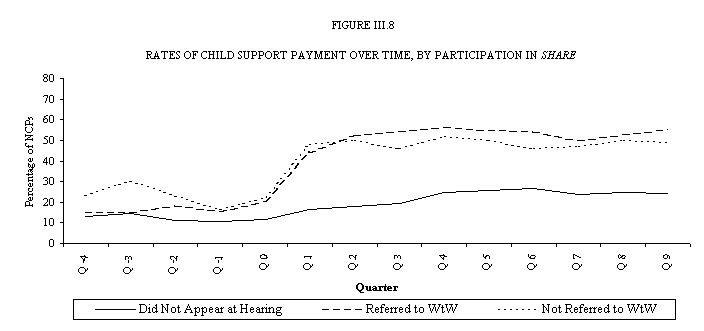
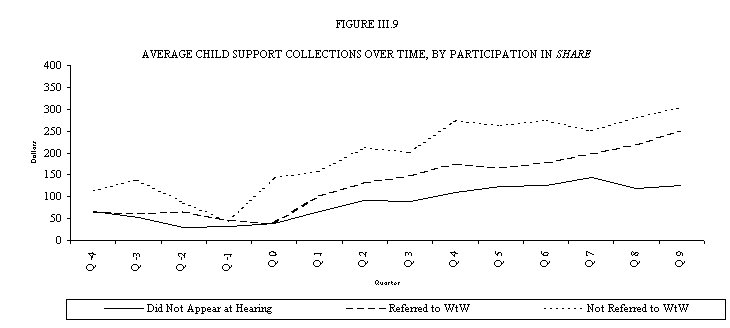
Child support payment rates and average collections were lowest among those who never appeared at their contempt hearings. In almost every quarter after referral to SHARE, the payment rates and average collections among NCPs who never appeared at their contempt hearings were half or less than half of those among NCPs who did appear (Figure III.8), and the differences are significant (Table A.7). Payment rates among those who were referred for WtW services were higher than payment rates among those who appeared at their hearings but were not referred for services; however, these differences are not statistically significant (Table A.8). Although NCPs referred for WtW services paid slightly more often, average collections for this group were lower than for NCPs who appeared but were not referred for WtW services (Figure III.9). This may reflect the fact that, on average, NCPs who appeared for their hearings and were referred for WtW services earned significantly less in the quarters after referral than the NCPs who appeared but were not referred for WtW services. Hence, on average, they may have only been able to afford smaller amounts.
What Can We Conclude from These Findings?
Trends in employment, earnings, and child support payments change around the time of referral to SHARE. The pre-post referral patterns for all NCPs in this study suggest that something is happening during the quarter of referral toSHARE or during the quarter after referral to reverse the pre-referral trends in declining employment, earnings, and child support payments. Because the quarter of referral is a different calendar quarter for each sample member, occurring within a span of more than three years, it is unlikely that a specific point-in-time event or phenomenon, such as the institution of new child support enforcement policies or an improvement in the economy, contributed to the immediate and substantial increases in outcomes after referral.
Source: Administrative data from state of Washington (as of March 2003).
NCP = noncustodial parent; Q0 = quarter of referral to SHARE; WtW = Welfare-to-Work.
Source: Administrative data from state of Washington (as of March 2003).
Q0 = quarter of referral to SHARE; WtW = Welfare-to-Work.
A variety of factors, including normal fluctuations, likely contributed to the increases in employment, earnings, and child support payments after referral to SHARE. The post-referral increases in employment, earnings, and child support are observed, although much more modestly, even for NCPs who never appeared at a contempt hearing. It is unlikely that SHARE had much influence on these NCPs, as they had little exposure to the initiative.(19) Rather, factors other than the SHARE program probably contributed to the pre-post patterns observed for this group. These same external factors may have affected the pre-post patterns of other groups of NCPs as well. For instance, it is possible that the observed patterns reflect normal fluctuations in the labor market experiences and child support payment patterns of NCPs. In the quarter before their referral, the NCPs referred toSHARE appear as individuals to be going through a particularly bad period with regard to employment and their ability to pay child support. The observed increases during the quarter of referral and after that quarter are likely to reflect some degree of natural recovery from this low.
Differences in pre-referral unobserved characteristics may have influenced the paths NCPs took and the outcomes they achieved. The distribution of NCPs into various groups after referral to SHARE probably was not random. Rather, NCPs in certain circumstances or of particular dispositions may have had a higher propensity to appear at their hearings than did other NCPs, and some NCPs likely had a relatively greater need for WtW services. Traces of these differences among NCPs in the study are observed before referral to SHARE, although in most cases the differences are not large enough to be statistically significant. For instance, it seems that NCPs who did not appear at hearings may have been the most disadvantaged NCPs in the sample. Before referral toSHARE, their employment rates, average earnings, child support payment rates, and average collections were lower than those of any other group. Perhaps parents who failed to heed the summons to appear in court (or who did not receive the summons because they could not be located) were least likely to have characteristics associated with socioeconomic success and, in turn, were least likely to have positive outcomes when referral to SHARE did not result in any intervention.
Nonetheless,the carrots and sticks built into the SHARE initiative appear to have influenced some NCPs. Preexisting differences in the employment, earnings, and support outcomes of NCPs who appeared at their hearings and of NCPs who did not appear at their hearings clearly become magnified after referral to SHARE. This widening of the gap in outcomes suggests that SHARE may have played a role in the improvements for NCPs engaged in the initiative. The consequences for failing to meet their obligations, which were presented at the contempt hearings, may have motivated some of the NCPs who appeared at the hearings to improve their economic situations and meet their obligations more than they would have otherwise. This would especially be true if the NCPs had good employment prospects and much to lose by becoming incarcerated and establishing a criminal record. Similarly, the alternatives offered at the contempt hearings such as renegotiation of support orders or even forgiveness of arrears may have reduced the incentives for some NCPs to work few hours or hide their earnings. They may have also motivated some NCPs who were working in the underground economy before referral to SHARE to move into formal jobs after referral.(20)
It is also possible that WtW services contributed to higher post-referral rates of child support payment and to lower earnings among NCPs referred for services. YCPA staff regularly monitored and reviewed payments made by WtW participants, and this close scrutiny could have prompted additional payments. Lower earnings among the NCPs referred for WtW services could reflect the time that these SHARE participants spent in WtW activities, which would have reduced their availability to work. It is also possible that the NCPs referred for WtW services were systematically more disadvantaged than those who appeared for hearings but were not referred for WtW services. Their lower average earnings may reflect important differences in their educational and employment background and, hence, in their income earning potential. In the end, however, it is not possible in this study to explore such potential systematic differences among NCPs targeted for participation in SHARE, nor to determine how any of these NCPs would have behaved or fared without SHARE.
Summary and Study Conclusions
Employment rates, earnings, and child support collections were higher after referral to SHARE than before, and there were clear differences in outcomes among NCPs who took different paths after referral. Several factors probably contributed to these results. It appears that the NCPs in this study had reached a low point in their ability to work and/or pay child support during the quarter before referral, and that the increases observed in subsequent quarters reflect some natural recovery from this low point. It also seems likely that different types of NCPs responded differently to the initiative based on unobserved characteristics that were present before referral. In addition to these factors, however, it appears that some or all of the components of SHARE service of a summons, threat of incarceration, offer to renegotiate obligations and arrears, availability of WtW services, and ongoing monitoring of compliance may have played a role in the improvements in outcomes observed for NCPs who became actively engaged in the initiative. In general, these NCPs worked more, earned more, and paid more support six to nine quarters after referral to SHARE than at any point during the year preceding referral. Moreover, differences between the employment, earnings, and child support outcomes for NCPs who appeared at hearings and learned about SHARE and the outcomes for NCPs who never appeared insignificant prior to referral to SHARE become more marked and significant during the quarters after referral to the program.
Without a random assignment evaluation, we cannot establish definitively that SHARE is responsible for the observed increases, the extent to which it influenced these outcomes, or how it influenced them. However, the available evidence suggests that the intervention is promising. A more rigorous evaluation of SHARE or of similar initiatives could shed light on the effects of the program relative to other factors. An ideal future evaluation would use a controlled experiment that would determine outcomes for participants and also provide information on how targeted NCPs would have fared in the absence of the intervention that is, the program's "value-added." In such an evaluation, it would be important to examine how various components of the intervention contribute to observed changes in the outcomes of interest, and their relative importance in achieving the desired results overall and for various types of NCPs (for example, NCPs who had criminal records before referral, or those with poor employment histories).
Before embarking on such an evaluation, it might be useful to understand better why so many NCPs fail to appear at their court hearings and, once located, what strategies could more effectively help this relatively disadvantaged group of individuals. Implementing those strategies before conducting a more rigorous evaluation could help programs reach out more effectively to all individuals who may benefit from their services not just those who are easier to reach and thereby result in a more thorough test of the intervention.
13. This pattern of recovery from a pre-program low is typically referred to as "Ashenfelter's dip," for his observation that adult participants in job training programs often experience a dip in earnings prior to their decision to participate (Ashenfelter and Card 1985).
14. The tables in Appendix A contain data supporting all the findings and statistics discussed in this chapter. Many, but not all, of the findings and statistics also are presented in the tables and figures in this chapter. Some of the tables in Appendix A present more statistics than are discussed in the chapter.
15. There is no way to distinguish interceptions of IRS refunds from voluntary payments or wage garnishment in the child support payment data in this study.
16. Unfortunately, no data on child support obligations were available for this study.
17. Sample sizes increased substantially during the quarter of referral to SHARE and during the quarter after referral because data were available for more NCPs during those quarters. Pre-post referral results are not biased by this change in sample size; an analysis of all outcomes limiting the post-referral sample to NCPs for whom pre-referral data are available reveals patterns consistent with those reported here.
18. This jump in average earnings during the quarter of referral relative to the quarter just before referral is likely to be, in part, an artifact of our quarterly data analysis. That is, for NCPs whose date of referral to SHARE falls relatively early in the quarter, the quarter of referral is likely to include some post-referral earnings.
19. The only exposure these NCPs may have had to the initiative was receipt of the summons to appear in court, and 46 percent, at most, of the NCPs who did not appear at a hearing seem likely to have experienced that event. As discussed in Chapter II, the majority of NCPs who did not appear at a hearing could not be located (128 closed cases) or were incarcerated (24 closed cases). Service of the summons alone is likely to have had only a small influence on the NCPs who did receive the summons but failed to appear at a hearing.
20. Research suggests that the accumulation of arrears to unrealistic levels and the state's retention of child support to offset the custodial parents' welfare payments may motivate NCPs to evade the child support system by moving out of formal jobs and into the underground economy (see Miller and Knox 2001).
References
Ashenfelter, Orley, and David Card. "Using the Longitudinal Structure of Earnings to Estimate the Effect of Training Programs." Review of Economics and Statistics, vol. 67, 1985.
Fender, Lynne, Alan Hershey, and Demetra Smith Nightingale. "Welfare-to-Work Grant Programs Tackle Recruitment Challenges. The National Evaluation of the Welfare-to-Work Grants Programs." Occasional Brief, series no. 00-01. Washington, DC: The Urban Institute, November 2000.
Hillabrant, Walter, and Nancy Pindus. "Operating TANF: Opportunities and Challenges for Tribes and Tribal Consortia." Princeton, NJ: Mathematica Policy Research, Inc., February 2003.
Hillabrant, Walter, and Mack Rhoades. "Learning from Tribal Experience: The Evaluation of the Tribal Welfare-to-Work Grants Program." Silver Spring, MD: Support Services International, Inc., December 2000.
Hillabrant, Walter, Mack Rhoades, Nancy Pindus, and John Trutko. "The Evaluation of the Tribal Welfare-to-Work Grants Program: Initial Implementation Findings." Silver Spring, MD: Support Services International, Inc., November 2001.
Martinson, Karin, John Trutko, and Debra Strong. "Serving Noncustodial Parents: A Descriptive Study of Welfare-to-Work Programs." Washington, DC: The Urban Institute, December 2000.
Miller, Cynthia, and Virginia Knox. "The Challenge of Helping Low-Income Fathers Support Their Children: Final Lessons from Parents' Fair Share." New York: Manpower Development Research Corporation, November 2001.
Nightingale, Demetra Smith. "Program Structure and Service Delivery in Eleven Welfare-to-Work Grant Programs." Washington, DC: The Urban Institute, January 2001.
Nightingale, Demetra Smith, Nancy Pindus, and John Trutko (with contributions by Michael Egner). "Slow but Steady: The Implementation of Welfare-to-Work Grant Programs." Draft report. Princeton, NJ: Mathematica Policy Research, Inc., February 2002.
Nightingale, Demetra Smith, Terri Thompson, Nancy Pindus, Pamela Holcomb, Edgar Lee, and Jesse Valente. "Early Implementation of the Welfare-to-Work Grants Program: Report to Congress, Part II." Princeton, NJ: Mathematica Policy Research, Inc., 2000.
Perez-Johnson, Irma, and Alan M. Hershey. "Early Implementation of the Welfare-to-Work Grants Program: Report to Congress." Princeton, NJ: Mathematica Policy Research, Inc., March 1999.
Perez-Johnson, Irma, Alan M. Hershey, and Jeanne Bellotti. "Further Progress, Persistent Constraints: Findings from a Second Survey of the Welfare-to-Work Grants Program." Princeton, NJ: Mathematica Policy Research, Inc., May 2000.
Sorensen, Elaine, and Chava Zibman. "Poor Dads Who Don't Pay Child Support: Deadbeats or Disadvantaged?" New Federalism Policy Brief, series B, no. B-30. Washington, DC: The Urban Institute, April 2001.
Appendix A
| All NCPs Referred to SHARE | Appeared at Hearing | Did Not Appear at Hearing | Difference Between Subgroups (p-Value) |
|
|---|---|---|---|---|
| Percentage Malea | 87.9 | 89.3 | 86.2 | 0.30 |
| Average Age (Years) | 31.3 | 31.0 | 31.6 | 0.37 |
| Median Age (Years) | 30.5 | 29.8 | 31.1 | |
| Sample Size | 503 | 270 | 233 | -- |
| All NCPs Who Appeared at Hearing | Referred to WtW | Not Referred to WtW | Difference Between Subgroups (p-Value) |
|
| Percentage Malea | 89.3 | 86.9 | 93.1 | 0.11 |
| Average Age (Years) | 31.0 | 31.0 | 31.1 | 0.91 |
| Median Age (Years) | 29.8 | 30.1 | 29.5 | |
| Sample Size | 270 | 168 | 102 | -- |
| Source: Administrative data from state of Washington. a Sample size equals 502 (270 who appeared, 232 who did not appear, 168 who were referred, and 102 who were not referred) due to missing data. NCP = noncustodial parent; WtW = Welfare-to-Work. |
||||
| All NCPs Referred to SHARE |
Appeared at Hearing |
Did Not Appear at Hearing |
Difference Between Subgroups (p-Value) |
|
|---|---|---|---|---|
| Percent Receiving TANF | ||||
| 4 quarters prior to referral | 7.0 | 8.2 | 5.8 | 0.25 |
| 3 quarters prior to referral | 5.6 | 5.7 | 5.4 | 0.89 |
| 2 quarters prior to referral | 5.2 | 6.1 | 4.4 | 0.38 |
| 1 quarter prior to referral | 4.4 | 4.3 | 4.4 | 0.94 |
| Quarter of referral | 4.9 | 2.9 | 6.8 | 0.03 |
| 1 quarter after referral | 7.5 | 6.1 | 8.8 | 0.21 |
| 2 quarters after referral | 7.8 | 7.9 | 7.8 | 0.99 |
| 3 quarters after referral | 7.0 | 8.6 | 5.4 | 0.14 |
| 4 quarters after referral | 8.0 | 10.4 | 5.8 | 0.04 |
| 5 quarters after referral | 8.2 | 10.7 | 5.8 | 0.03 |
| 6 quarters after referrala | 7.0 | 8.3 | 5.8 | 0.24 |
| 7 quarters after referralb | 7.4 | 9.1 | 5.8 | 0.13 |
| 8 quarters after referralc | 6.2 | 7.3 | 5.1 | 0.28 |
| 9 quarters after referrald | 5.7 | 7.0 | 4.4 | 0.19 |
| Percent Receiving Food Stamps | ||||
| 4 quarters prior to referral | 22.3 | 26.4 | 18.4 | 0.02 |
| 3 quarters prior to referral | 22.5 | 27.1 | 18.3 | 0.01 |
| 2 quarters prior to referral | 22.8 | 26.8 | 19.1 | 0.03 |
| 1 quarter prior to referral | 22.1 | 23.9 | 20.4 | 0.31 |
| Quarter of referral | 24.7 | 26.1 | 23.5 | 0.47 |
| 1 quarter after referral | 24.2 | 26.1 | 22.5 | 0.31 |
| 2 quarters after referral | 23.2 | 25.7 | 20.8 | 0.16 |
| 3 quarters after referral | 23.0 | 26.8 | 19.4 | 0.04 |
| 4 quarters after referral | 21.8 | 24.6 | 19.1 | 0.10 |
| 5 quarters after referral | 22.3 | 25.0 | 19.7 | 0.13 |
| 6 quarters after referrala | 21.8 | 24.2 | 19.5 | 0.17 |
| 7 quarters after referralb | 20.8 | 25.6 | 16.4 | 0.01 |
| 8 quarters after referralc | 20.3 | 25.3 | 15.7 | 0.00 |
| 9 quarters after referrald | 20.1 | 25.0 | 17.1 | 0.02 |
| Sample Size | 574 | 280 | 294 | -- |
| Source: Administrative data from state of Washington. a Sample size equals 570 (277 who appeared and 293 who did not appear) due to missing data. b Sample size equals 567 (274 who appeared and 293 who did not appear) due to missing data. c Sample size equals 566 (273 who appeared and 293 who did not appear) due to missing data. d Sample size equals 565 (272 who appeared and 293 who did not appear) due to missing data. NCP = noncustodial parent; TANF = Temporary Assistance for Needy Families. |
||||
| All NCPs Who Appeared at Hearing |
Referred to WtW | Not Referred to WtW | Difference Between Subgroups (p-Value) |
|
|---|---|---|---|---|
| Percent Receiving TANF | ||||
| 4 quarters prior to referral | 8.2 | 8.7 | 7.4 | 0.70 |
| 3 quarters prior to referral | 5.7 | 5.2 | 6.5 | 0.66 |
| 2 quarters prior to referral | 6.1 | 5.2 | 7.4 | 0.46 |
| 1 quarter prior to referral | 4.3 | 2.3 | 7.4 | 0.04 |
| Quarter of referral | 2.9 | 1.7 | 4.6 | 0.16 |
| 1 quarter after referral | 6.1 | 4.7 | 8.3 | 0.21 |
| 2 quarters after referral | 7.9 | 6.4 | 10.2 | 0.25 |
| 3 quarters after referral | 8.6 | 7.0 | 11.1 | 0.23 |
| 4 quarters after referral | 10.4 | 9.3 | 12.0 | 0.47 |
| 5 quarters after referral | 10.7 | 10.5 | 11.1 | 0.87 |
| 6 quarters after referrala | 8.3 | 8.9 | 7.4 | 0.67 |
| 7 quarters after referralb | 9.1 | 8.3 | 10.4 | 0.57 |
| 8 quarters after referralc | 7.3 | 7.8 | 6.6 | 0.72 |
| 9 quarters after referrald | 7.0 | 7.8 | 5.7 | 0.50 |
| Percent Receiving Food Stamps | ||||
| 4 quarters prior to referral | 26.4 | 27.9 | 24.1 | 0.48 |
| 3 quarters prior to referral | 27.1 | 30.2 | 22.2 | 0.14 |
| 2 quarters prior to referral | 26.8 | 29.6 | 22.2 | 0.17 |
| 1 quarter prior to referral | 23.9 | 24.4 | 23.2 | 0.81 |
| Quarter of referral | 26.1 | 28.5 | 22.2 | 0.25 |
| 1 quarter after referral | 26.1 | 28.5 | 22.2 | 0.25 |
| 2 quarters after referral | 25.7 | 29.7 | 19.4 | 0.06 |
| 3 quarters after referral | 26.8 | 29.7 | 22.2 | 0.17 |
| 4 quarters after referral | 24.6 | 27.3 | 20.4 | 0.19 |
| 5 quarters after referral | 25.0 | 26.7 | 22.2 | 0.40 |
| 6 quarters after referrala | 24.2 | 28.4 | 17.6 | 0.04 |
| 7 quarters after referralb | 25.6 | 29.8 | 18.9 | 0.04 |
| 8 quarters after referralc | 25.3 | 26.4 | 23.6 | 0.61 |
| 9 quarters after referrald | 25.0 | 24.7 | 25.5 | 0.89 |
| Sample Size | 280 | 172 | 108 | -- |
| Source:Administrative data from state of Washington. aSample size equals 277 (169 who were referred and 108 who were not referred) due to missing data. bSample size equals 274 (168 who were referred and 106 who were not referred) due to missing data. cSample size equals 273 (167 who were referred and 106 who were not referred) due to missing data. dSample size equals 272 (166 who were referred and 106 who were not referred) due to missing data. NCP = noncustodial parent; WtW = Welfare-to-Work. |
||||
| Earnings | Percentage of NCPs |
|---|---|
| Less than $500 | 25.7 |
| $501 - $999 | 14.8 |
| $1,000 - $1,499 | 11.4 |
| $1,500 - $1,999 | 15.7 |
| $2,000 - $2,499 | 8.1 |
| $2,500 - $2,999 | 5.7 |
| $3,000 - $3,499 | 5.2 |
| $3,500 - $3,999 | 3.8 |
| $4,000 - $4,499 | 2.9 |
| $4,500 - $4,999 | 1.0 |
| $5,000 or More | 5.7 |
| Sample Size | 210 |
| Source: Administrative data from state of Washington. NCP = noncustodial parent. |
|
| All NCPs Referred to SHARE |
Appeared at Hearing | Did Not Appear at Hearing | Difference Between Subgroups (pValue) |
|
|---|---|---|---|---|
| Percent Employed | ||||
| 4 quarters prior to referral | 36.6 | 39.6 | 33.7 | 0.14 |
| 3 quarters prior to referral | 35.5 | 40.0 | 31.3 | 0.03 |
| 2 quarters prior to referral | 30.3 | 33.9 | 26.9 | 0.07 |
| 1 quarter prior to referral | 24.6 | 26.1 | 23.1 | 0.23 |
| Quarter of referral | 32.8 | 38.2 | 27.6 | 0.01 |
| 1 quarter after referral | 34.8 | 43.6 | 26.5 | 0.00 |
| 2 quarters after referral | 34.7 | 44.3 | 25.5 | 0.00 |
| 3 quarters after referral | 32.2 | 38.6 | 26.2 | 0.00 |
| 4 quarters after referral | 36.9 | 42.5 | 31.6 | 0.01 |
| 5 quarters after referral | 36.1 | 42.1 | 30.3 | 0.00 |
| 6 quarters after referrala | 33.5 | 42.2 | 25.3 | 0.00 |
| Average Earnings Across Employed NCPs | ||||
| 4 quarters prior to referral | $1,791.92 | $1,787.62 | $1,796.75 | 0.97 |
| 3 quarters prior to referral | $1,686.78 | $1,788.77 | $1,562.63 | 0.34 |
| 2 quarters prior to referral | $1,517.28 | $1,589.97 | $1,429.87 | 0.53 |
| 1 quarter prior to referral | $1,302.34 | $1,547.69 | $1,038.95 | 0.03 |
| Quarter of referral | $1,360.27 | $1,351.10 | $1,372.37 | 0.92 |
| 1 quarter after referral | $1,860.90 | $2,000.65 | $1,642.31 | 0.17 |
| 2 quarters after referral | $2,102.13 | $2,113.23 | $2,083.78 | 0.92 |
| 3 quarters after referral | $2,257.69 | $2,303.91 | $2,192.86 | 0.72 |
| 4 quarters after referral | $2,456.60 | $2,573.91 | $2,306.50 | 0.39 |
| 5 quarters after referral | $2,374.42 | $2,413.73 | $2,322.30 | 0.78 |
| 6 quarters after referrala | $2,482.98 | $2,424.41 | $2,575.58 | 0.66 |
| Average Earnings Across All NCPs | ||||
| 4 quarters prior to referral | $655.58 | $708.66 | $605.03 | 0.36 |
| 3 quarters prior to referral | $599.48 | $715.51 | $488.99 | 0.04 |
| 2 quarters prior to referral | $459.94 | $539.45 | $384.22 | 0.10 |
| 1 quarter prior to referral | $319.91 | $403.50 | $240.30 | 0.03 |
| Quarter of referral | $445.52 | $516.31 | $378.10 | 0.11 |
| 1 quarter after referral | $648.40 | $871.71 | $435.71 | 0.00 |
| 2 quarters after referral | $728.79 | $935.86 | $531.58 | 0.00 |
| 3 quarters after referral | $727.65 | $888.65 | $574.32 | 0.02 |
| 4 quarters after referral | $907.32 | $1,093.91 | $729.61 | 0.02 |
| 5 quarters after referral | $856.28 | $1,017.21 | $703.01 | 0.04 |
| 6 quarters after referrala | $832.02 | $1,024.03 | $650.49 | 0.01 |
| Sample Size | 574 | 280 | 294 | -- |
| Source:Administrative data from state of Washington. aSample size equals 570 (277 who appeared and 293 who did not appear) due to missing data. NCP = noncustodial parent. |
||||
| All NCPs Who Appeared at Hearing |
Referred to WtW | Not Referred to WtW | Difference Between Subgroups (p-Value) |
|
|---|---|---|---|---|
| Percent Employed | ||||
| 4 quarters prior to referral | 39.6 | 39.5 | 39.1 | 0.96 |
| 3 quarters prior to referral | 40.0 | 36.1 | 46.3 | 0.09 |
| 2 quarters prior to referral | 33.9 | 32.6 | 36.1 | 0.54 |
| 1 quarter prior to referral | 26.1 | 26.7 | 25.0 | 0.75 |
| Quarter of referral | 38.2 | 34.3 | 44.4 | 0.09 |
| 1 quarter after referral | 43.6 | 39.5 | 50.0 | 0.09 |
| 2 quarters after referral | 44.3 | 41.9 | 48.2 | 0.30 |
| 3 quarters after referral | 38.6 | 34.9 | 44.4 | 0.11 |
| 4 quarters after referral | 42.5 | 41.9 | 43.5 | 0.79 |
| 5 quarters after referral | 42.1 | 40.1 | 45.4 | 0.39 |
| 6 quarters after referrala | 42.2 | 43.2 | 40.7 | 0.69 |
| Average Earnings Across Employed NCPs | ||||
| 4 quarters prior to referral | $1,787.62 | $1,808.47 | $1,754.64 | 0.88 |
| 3 quarters prior to referral | $1,788.77 | $1,658.16 | $1,950.72 | 0.40 |
| 2 quarters prior to referral | $1,589.97 | $1,479.81 | $1,748.14 | 0.49 |
| 1 quarter prior to referral | $1,547.69 | $1,543.95 | $1,554.06 | 0.98 |
| Quarter of referral | $1,351.10 | $1,200.84 | $1,535.79 | 0.26 |
| 1 quarter after referral | $2,000.65 | $1,325.97 | $2,850.25 | 0.00 |
| 2 quarters after referral | $2,113.23 | $1,554.13 | $2,887.37 | 0.00 |
| 3 quarters after referral | $2,303.91 | $1,756.71 | $2,987.91 | 0.00 |
| 4 quarters after referral | $2,573.91 | $2,189.91 | $3,162.16 | 0.03 |
| 5 quarters after referral | $2,413.73 | $2,120.61 | $2,826.48 | 0.09 |
| 6 quarters after referrala | $2,424.41 | $2,164.62 | $2,855.44 | 0.10 |
| Average Earnings Across All NCPs | ||||
| 4 quarters prior to referral | $708.66 | $714.98 | $698.61 | 0.92 |
| 3 quarters prior to referral | $715.51 | $597.71 | $903.11 | 0.09 |
| 2 quarters prior to referral | $539.45 | $481.80 | $631.27 | 0.35 |
| 1 quarter prior to referral | $403.50 | $412.92 | $388.51 | 0.85 |
| Quarter of referral | $516.31 | $411.92 | $682.57 | 0.05 |
| 1 quarter after referral | $871.71 | $524.22 | $1,425.12 | 0.00 |
| 2 quarters after referral | $935.86 | $650.57 | $1,390.22 | 0.00 |
| 3 quarters after referral | $888.65 | $612.81 | $1,327.96 | 0.00 |
| 4 quarters after referral | $1,093.91 | $916.71 | $1,376.13 | 0.06 |
| 5 quarters after referral | $1,017.21 | $850.71 | $1,282.38 | 0.06 |
| 6 quarters after referrala | $1,024.03 | $935.01 | $1,163.33 | 0.33 |
| Sample Size | 280 | 172 | 108 | -- |
| Source:Administrative data from state of Washington. aSample size equals 277 (169 who were referred and 108 who were not referred) due to missing data. NCP = noncustodial parent; WtW = Welfare-to-Work. |
||||
| All NCPs Referred to SHARE |
Appeared at Hearing |
Did Not Appear at Hearing |
Difference Between Subgroups (pValue) |
|
|---|---|---|---|---|
| Percent Paying Support | ||||
| 4 quarters prior to referral | 15.7 | 18.2 | 13.3 | 0.10 |
| 3 quarters prior to referral | 17.8 | 21.1 | 14.6 | 0.04 |
| 2 quarters prior to referral | 15.7 | 20.4 | 11.2 | 0.00 |
| 1 quarter prior to referral | 13.2 | 16.1 | 10.5 | 0.05 |
| Quarter of referral | 16.2 | 21.1 | 11.6 | 0.00 |
| 1 quarter after referral | 30.5 | 45.0 | 16.7 | 0.00 |
| 2 quarters after referral | 34.3 | 51.4 | 18.0 | 0.00 |
| 3 quarters after referral | 34.8 | 51.1 | 19.4 | 0.00 |
| 4 quarters after referral | 39.2 | 54.6 | 24.5 | 0.00 |
| 5 quarters after referral | 38.5 | 52.9 | 25.5 | 0.00 |
| 6 quarters after referrala | 38.6 | 51.3 | 26.6 | 0.00 |
| 7 quarters after referralb | 35.8 | 48.9 | 23.6 | 0.00 |
| 8 quarters after referralc | 37.8 | 51.7 | 24.9 | 0.00 |
| 9 quarters after referrald | 38.1 | 52.9 | 24.2 | 0.00 |
| Average Amount Across NCPs Paying Support | ||||
| 4 quarters prior to referral | $477.50 | $462.07 | $497.68 | 0.74 |
| 3 quarters prior to referral | $403.41 | $434.70 | $360.49 | 0.37 |
| 2 quarters prior to referral | $328.19 | $367.78 | $259.82 | 0.24 |
| 1 quarter prior to referral | $285.25 | $275.97 | $298.71 | 0.76 |
| Quarter of referral | $358.57 | $374.18 | $331.47 | 0.72 |
| 1 quarter after referral | $309.01 | $274.46 | $397.85 | 0.02 |
| 2 quarters after referral | $366.77 | $317.23 | $501.38 | 0.00 |
| 3 quarters after referral | $367.77 | $332.04 | $457.43 | 0.04 |
| 4 quarters after referral | $410.90 | $392.24 | $450.55 | 0.28 |
| 5 quarters after referral | $418.06 | $386.70 | $497.94 | 0.10 |
| 6 quarters after referrala | $440.25 | $421.44 | $474.50 | 0.49 |
| 7 quarters after referralb | $504.91 | $449.70 | $612.13 | 0.04 |
| 8 quarters after referralc | $473.46 | $471.87 | $476.53 | 0.95 |
| 9 quarters after referrald | $514.49 | $514.58 | $514.31 | 1.00 |
| Average Amount Across All NCPs | ||||
| 4 quarters prior to referral | $74.87 | $84.16 | $66.02 | 0.41 |
| 3 quarters prior to referral | $71.69 | $91.60 | $52.72 | 0.04 |
| 2 quarters prior to referral | $51.46 | $74.87 | $29.16 | 0.01 |
| 1 quarter prior to referral | $37.77 | $44.35 | $31.50 | 0.31 |
| Quarter of referral | $58.10 | $78.85 | $38.33 | 0.06 |
| 1 quarter after referral | $94.21 | $123.51 | $66.31 | 0.00 |
| 2 quarters after referral | $125.88 | $163.14 | $90.38 | 0.00 |
| 3 quarters after referral | $128.14 | $169.58 | $88.69 | 0.00 |
| 4 quarters after referral | $161.07 | $214.33 | $110.34 | 0.00 |
| 5 quarters after referral | $162.42 | $204.40 | $122.43 | 0.00 |
| 6 quarters after referrala | $169.92 | $216.04 | $126.32 | 0.01 |
| 7 quarters after referralb | $180.77 | $219.93 | $144.15 | 0.03 |
| 8 quarters after referralc | $179.01 | $243.72 | $118.73 | 0.00 |
| 9 quarters after referrald | $195.78 | $272.42 | $124.63 | 0.00 |
| Sample Size | 574 | 280 | 294 | -- |
| Source: Administrative data from state of Washington. a Sample size equals 570 (277 who appeared and 293 who did not appear) due to missing data. b Sample size equals 567 (274 who appeared and 293 who did not appear) due to missing data. c Sample size equals 566 (273 who appeared and 293 who did not appear) due to missing data. d Sample size equals 565 (272 who appeared and 293 who did not appear) due to missing data. NCP = noncustodial parent. |
||||
| All NCPs Who Appeared at Hearing |
Referred to WtW | Not Referred to WtW | Difference Between Subgroups (p-Value) |
|
|---|---|---|---|---|
| Percent Paying Support | ||||
| 4 quarters prior to referral | 18.2 | 15.1 | 23.2 | 0.09 |
| 3 quarters prior to referral | 21.1 | 15.1 | 30.6 | 0.00 |
| 2 quarters prior to referral | 20.4 | 18.6 | 23.2 | 0.36 |
| 1 quarter prior to referral | 16.1 | 15.7 | 16.7 | 0.83 |
| Quarter of referral | 21.1 | 20.4 | 22.2 | 0.71 |
| 1 quarter after referral | 45.0 | 43.9 | 48.2 | 0.40 |
| 2 quarters after referral | 51.4 | 52.3 | 50.0 | 0.71 |
| 3 quarters after referral | 51.1 | 54.1 | 46.3 | 0.21 |
| 4 quarters after referral | 54.6 | 56.4 | 51.9 | 0.46 |
| 5 quarters after referral | 52.9 | 54.7 | 50.0 | 0.45 |
| 6 quarters after referral a | 51.3 | 54.4 | 46.3 | 0.19 |
| 7 quarters after referral b | 48.9 | 50.0 | 47.2 | 0.65 |
| 8 quarters after referral c | 51.7 | 52.7 | 50.0 | 0.67 |
| 9 quarters after referral d | 52.9 | 55.4 | 49.1 | 0.31 |
| Average Amount Paid Across NCPs Paying Support | ||||
| 4 quarters prior to referral | $462.07 | $428.09 | $497.41 | 0.61 |
| 3 quarters prior to referral | $434.70 | $409.60 | $454.47 | 0.71 |
| 2 quarters prior to referral | $367.78 | $358.30 | $397.91 | 0.86 |
| 1 quarter prior to referral | $275.97 | $286.81 | $259.71 | 0.79 |
| Quarter of referral | $347.18 | $185.41 | $649.48 | 0.01 |
| 1 quarter after referral | $274.46 | $238.80 | $325.20 | 0.12 |
| 2 quarters after referral | $317.23 | $252.21 | $425.58 | 0.00 |
| 3 quarters after referral | $332.04 | $275.78 | $436.68 | 0.01 |
| 4 quarters after referral | $392.24 | $312.73 | $529.98 | 0.00 |
| 5 quarters after referral | $386.70 | $307.25 | $525.01 | 0.00 |
| 6 quarters after referral a | $421.44 | $327.84 | $593.66 | 0.00 |
| 7 quarters after referral b | $449.70 | $399.90 | $533.37 | 0.16 |
| 8 quarters after referral c | $471.87 | $417.30 | $562.49 | 0.12 |
| 9 quarters after referral d | $514.58 | $454.42 | $621.01 | 0.13 |
| Average Amount Paid Across All NCPs | ||||
| 4 quarters prior to referral | $84.16 | $64.71 | $115.14 | 0.13 |
| 3 quarters prior to referral | $91.60 | $61.92 | $138.87 | 0.02 |
| 2 quarters prior to referral | $74.87 | $66.66 | $87.94 | 0.50 |
| 1 quarter prior to referral | $44.35 | $45.02 | $43.29 | 0.93 |
| Quarter of referral | $78.85 | $37.73 | $144.33 | 0.01 |
| 1 quarter after referral | $123.51 | $102.74 | $156.58 | 0.07 |
| 2 quarters after referral | $163.14 | $131.97 | $212.79 | 0.01 |
| 3 quarters after referral | $169.58 | $149.11 | $202.17 | 0.16 |
| 4 quarters after referral | $214.33 | $176.36 | $274.80 | 0.02 |
| 5 quarters after referral | $204.40 | $167.92 | $262.50 | 0.02 |
| 6 quarters after referral a | $216.04 | $178.47 | $274.84 | 0.07 |
| 7 quarters after referral b | $219.93 | $199.95 | $251.59 | 0.34 |
| 8 quarters after referral c | $243.72 | $219.89 | $281.25 | 0.28 |
| 9 quarters after referral d | $272.42 | $251.85 | $304.65 | 0.42 |
| Sample Size | 280 | 172 | 108 | -- |
| Source: Administrative data from state of Washington. a Sample size equals 277 (169 who were referred and 108 who were not referred) due to missing data. b Sample size equals 274 (168 who were referred and 106 who were not referred) due to missing data. c Sample size equals 273 (167 who were referred and 106 who were not referred) due to missing data. d Sample size equals 272 (166 who were referred and 106 who were not referred) due to missing data. NCP = noncustodial parent; WtW = Welfare-to-Work. |
||||
| All NCPs Referred toSHARE | Appeared at Hearing | Did Not Appear at Hearing | Difference Between Subgroups (p-Value) |
|
|---|---|---|---|---|
| Percent Employed in: | ||||
| 0 of 4 quarters prior to referral | 43.6 | 38.9 | 48.0 | 0.03 |
| 1 of 4 quarters prior to referral | 16.7 | 16.8 | 16.7 | 0.97 |
| 2 of 4 quarters prior to referral | 17.8 | 20.0 | 15.6 | 0.17 |
| 3 of 4 quarters prior to referral | 13.1 | 14.3 | 11.9 | 0.40 |
| 4 of 4 quarters prior to referral | 8.9 | 10.0 | 7.8 | 0.36 |
| 0 of 4 quarters after referral | 44.3 | 33.9 | 54.1 | 0.00 |
| 1 of 4 quarters after referral | 16.7 | 18.6 | 15.9 | 0.25 |
| 2 of 4 quarters after referral | 11.3 | 13.2 | 9.5 | 0.16 |
| 3 of 4 quarters after referral | 11.5 | 13.2 | 9.9 | 0.21 |
| 4 of 4 quarters after referral | 16.2 | 21.1 | 11.6 | 0.00 |
| Percent Paying Child Support in: | ||||
| 0 of 4 quarters prior to referral | 69.2 | 63.2 | 74.8 | 0.00 |
| 1 of 4 quarters prior to referral | 12.0 | 13.6 | 10.5 | 0.27 |
| 2 of 4 quarters prior to referral | 9.2 | 11.4 | 7.1 | 0.08 |
| 3 of 4 quarters prior to referral | 6.5 | 7.9 | 5.1 | 0.18 |
| 4 of 4 quarters prior to referral | 3.1 | 3.9 | 2.4 | 0.29 |
| 0 of 4 quarters after referral | 43.7 | 23.9 | 62.6 | 0.00 |
| 1 of 4 quarters after referral | 15.0 | 16.8 | 13.3 | 0.24 |
| 2 of 4 quarters after referral | 14.3 | 17.1 | 11.6 | 0.06 |
| 3 of 4 quarters after referral | 12.7 | 17.5 | 8.2 | 0.00 |
| 4 of 4 quarters after referral | 14.3 | 24.6 | 4.4 | 0.00 |
| Sample Size | 574 | 280 | 294 | -- |
| Source: Administrative data from state of Washington. NCP = noncustodial parent. |
||||
| All NCPs Who Appeared at Hearing |
Referred to WtW | Not Referred to WtW | Difference Between Subgroups (p-Value) |
|
|---|---|---|---|---|
| Percent Employed in: | ||||
| 0 of 4 quarters prior to referral | 38.9 | 40.1 | 36.1 | 0.44 |
| 1 of 4 quarters prior to referral | 16.8 | 16.9 | 16.7 | 0.97 |
| 2 of 4 quarters prior to referral | 20.0 | 20.4 | 19.4 | 0.85 |
| 3 of 4 quarters prior to referral | 14.3 | 11.1 | 19.4 | 0.06 |
| 4 of 4 quarters prior to referral | 10.0 | 11.1 | 8.3 | 0.46 |
| 0 of 4 quarters after referral | 33.9 | 34.4 | 33.3 | 0.87 |
| 1 of 4 quarters after referral | 18.6 | 19.8 | 16.7 | 0.52 |
| 2 of 4 quarters after referral | 13.2 | 16.3 | 8.3 | 0.06 |
| 3 of 4 quarters after referral | 13.2 | 12.8 | 13.9 | 0.79 |
| 4 of 4 quarters after referral | 21.1 | 16.9 | 27.8 | 0.03 |
| Percent Paying Child Support in: | ||||
| 0 of 4 quarters prior to referral | 63.2 | 66.9 | 57.4 | 0.11 |
| 1 of 4 quarters prior to referral | 13.6 | 13.4 | 13.9 | 0.90 |
| 2 of 4 quarters prior to referral | 11.4 | 10.5 | 13.0 | 0.52 |
| 3 of 4 quarters prior to referral | 7.9 | 7.0 | 9.3 | 0.49 |
| 4 of 4 quarters prior to referral | 3.9 | 2.3 | 6.5 | 0.08 |
| 0 of 4 quarters after referral | 23.9 | 22.1 | 26.9 | 0.37 |
| 1 of 4 quarters after referral | 16.8 | 16.3 | 17.6 | 0.78 |
| 2 of 4 quarters after referral | 17.1 | 18.0 | 15.7 | 0.62 |
| 3 of 4 quarters after referral | 17.5 | 20.9 | 12.0 | 0.06 |
| 4 of 4 quarters after referral | 24.6 | 22.7 | 27.8 | 0.34 |
| Sample Sizeb | 280 | 172 | 108 | -- |
| Source: Administrative data from state of Washington. NCP = noncustodial parent; WtW = Welfare-to-Work. |
||||