


By:
Sheena McConnell, Andrew Burwick, Irma Perez-Johnson, and Pamela Winston
March 2003
Submitted to:
U.S. Department of Health and Human Services
Office of the Assistant Secretary for Planning and Evaluation
Project Officer:
Ann McCormick
Submitted by:
Mathematica Policy Research, Inc.
Project Director:
Sheena McConnell
Acknowledgments
We would like to thank the many administrators and staff of the public and private agencies who met and talked with us during our site visits to Delaware, Hennepin County, Lower Rio Grande Valley, Palm Beach County, San Diego County, and Wisconsin. They were exceedingly generous with their time and in sharing their perspectives on the successes and challenges of privatization. Several sites had been involved with other studies of privatization and welfare reform but were nonetheless willing to take the time and make the effort to assist us with this study.
We are particularly grateful to the study liaisons in each site who organized our visits, graciously hosted us, and reviewed and commented on the draft of this report. They include: Tom Smith in Delaware, Philip AuClaire in Hennepin County, Cassandra Moreno in the Lower Rio Grande Valley, Ken Montgomery in Palm Beach County, Jolie Ramage in San Diego County, and Mary Rowin in Wisconsin. In addition, we spoke with representatives of advocacy groups and public employee unions in each site who were also very helpful in offering their thoughts and concerns about the privatization of TANF case management.
Ann McCormick and Matt Lyon, our project officers from the Office of the Assistant Secretary for Planning and Evaluation, U.S. Department of Health and Human Services, provided insightful and collegial guidance, review, and support throughout the project. They were a pleasure to work with.
Richard Roper of The Roper Group offered essential assistance. He coordinated and led the site visits to Hennepin and Palm Beach Counties. He also provided valuable advice and suggestions on the study design and interpretation of the findings and made helpful comments on an earlier draft of this report.
At Mathematica Policy Research, Donna Pavetti, Alan Hershey, and Heather Hill reviewed drafts of project reports and presentations and contributed thoughtful feedback. Jackie Wong provided valuable assistance with many tasks associated with this project. The report was edited by Caitlin Johnson and expertly produced by Alfreda Holmes and Jill Miller.
Introduction
Privatization of welfare services has a long history in the United States. Recently, however, the privatization of welfare services has increased significantly and expanded into new services a trend that is likely to continue. The 1996 Personal Responsibility and Work Opportunity Reconciliation Act (PRWORA) provided much of the impetus for this increase. It did so by shifting the emphasis of the welfare system from providing cash assistance to placing welfare recipients in jobs and by giving states more autonomy to formulate their own programs and policies under the new Temporary Assistance for Needy Families (TANF) program. Many states and localities responded to welfare reform by changing not only the services they offer, but also the types of organizations that deliver them. Services once primarily provided by government agencies, including case management, are now increasingly contracted out. The U.S. General Accounting Office (GAO) estimates that in 2001 state and local governments spent more than $1.5 billion or about 13 percent of all federal and state maintenance-of-effort expenditures for TANF administration and services on contracts with nongovernmental agencies (GAO 2002).
State and local government agencies that choose to privatize welfare services face significant challenges, however. The agency must ensure that contractors are selected in a fair, effective, and competitive way; design contracts that motivate providers to perform and ensure appropriate services are provided; coordinate the public and private provision of services; and monitor the work of the contractors. Many states and localities that are privatizing welfare services have little experience with large-scale contracting, and information on the associated challenges and effective ways to meet them is scant.
Recognizing the need for more information about privatization of TANF services, the Office of the Assistant Secretary for Planning and Evaluation (ASPE) of the U.S. Department of Health and Human Services (DHHS) funded Mathematica Policy Research to conduct a study of privatization with a special emphasis on TANF case management. This study is designed to inform policymakers, researchers, and states and localities that are either currently contracting out or considering doing so. Built around in-depth case studies of six states or localities that have privatized TANF case management, the study has two main goals:
- To describe the privatization of TANF case management in the study sites. The study focuses on the key decisions and activities undertaken in privatizing TANF case management. It describes the rationale for privatization and the selection of services to privatize, the contractors involved, the procurement process, and the types of contracts issued. The challenges of service provision under privatization and the methods used to monitor contractors are also examined.
- To document the lessons learned in the study sites from their experiences privatizing TANF case management. States and localities have gained expertise on privatization both by meeting its challenges and by learning from the mistakes inevitable in all new ventures. This study aims to highlight innovative practices and identify common pitfalls in privatization.
The study focuses on TANF case management and related case processing for three reasons. First, these services which include eligibility determination, assessments, development of self-sufficiency or employment plans, referrals, and sanctioning had traditionally been provided mainly by government agencies but are now increasingly being provided by private agencies. Indeed, prior to PRWORA, only government employees were allowed to determine eligibility for cash assistance. Now, however, privatizing some aspects of TANF case management is quite common 40 states have done so and some states and localities have privatized all TANF case management functions (GAO 2002). Second, case management is at the heart of the TANF program; the programs success in placing welfare recipients in jobs is largely dependent on case managers ability to identify barriers to employment and ensure that clients receive appropriate services. Third, by the nature of their jobs, case managers have considerable discretion in the provision of services. Some observers have raised concerns about assigning this power to private agencies, particularly for-profit organizations.
The findings from the case studies will be valuable to any state or locality that has already decided to privatize welfare services. However, the study does not address the broader question of whether the state or locality should privatize. While information on stakeholders perceptions about the effects of privatization was collected as part of the case studies, it was beyond the scope of the study to conduct a rigorous evaluation of the impact of privatization.
This report presents findings from the case studies. The remainder of Chapter I defines privatization, provides study background, and describes the study design. Chapter II describes the TANF case management services privatized in each site, how they were privatized, to whom the contracts were awarded, and the rationale for those decisions. The methods used to select contractors and ensure that the process was fair, effective, and competitive are outlined in Chapter III. The issues involved in designing the contracts between public and private agencies are presented in Chapter IV. The role of the public agency in monitoring the work of the private agencies is discussed in Chapter V. Chapter VI examines some challenges to service delivery under privatization, including coordinating public and private service provision, facilitating the transition to privatization, and managing contract turnover. Chapter VII offers a summary of the major lessons learned from the study.
Defining Privatization
The term "privatization" can mean several different things, from contracting out services to the sale of government assets. In this study, "privatization" refers to contracting out services to private organizations, including both for-profit and nonprofit organizations. Although some states and localities, including several in this study, contract with government agencies (such as local government agencies) and quasi-governmental agencies (such as community colleges), the study focuses mainly on contracting out to private agencies.
Background to the Study
Private provision of publicly funded social services is not new in the United States. Private religious and secular organizations have delivered welfare services for over a century (Smith and Lipsky 1993). During the 1960s and 1970s, however, spending on social services provided by private agencies increased (Brodkin et al. 2002). This increase was fueled in the 1960s by new federal spending (Young et al. 1981) and in the 1970s by the search for ways to reduce costs in light of fiscal strains (Kramer 1994).
Since the passage of PRWORA, both the scale and scope of privatization of welfare services has changed. The GAO found that contracting for TANF-funded services occurs in the District of Columbia and every state except South Dakota (GAO 2002). Prior to welfare reform, welfare agencies mainly contracted out direct services, such as job training, job search instruction, and child care provision. Some Aid to Families with Dependent Children (AFDC) agencies, for example, contracted with employment and training providers for the operation of all or part of their Jobs Opportunities for Basic Skills (JOBS) programs. While these types of services are still often contracted out, private agencies are now more likely to provide case management and job placement or retention services. Another recent change is the increasing role of large, national for-profit organizations in the provision of welfare services.
Welfare reform provided an impetus to privatization in several ways. First, it signaled a growing frustration with the old AFDC system, seen as geared more toward ensuring eligibility and compliance with rules than helping clients become self-sufficient (Bane and Ellwood 1994). As private agencies were seen as less entrenched in the old ways than the public welfare agencies, privatization appeared to be a way of making fundamental changes to the welfare program (Diller 2000).
Second, the change to a work-oriented assistance program meant that TANF programs needed to provide new services to move welfare recipients into jobs as quickly as possible and provide the supports necessary to maintain employment. Some states and localities believed they lacked the capacity to provide the services, and contracting out allowed them to "buy" this capacity quickly (Sanger 2001).
Third, unlike AFDC, TANF no longer prohibited private organizations from performing eligibility determination for cash assistance. This opened up the possibility of privatizing the entire TANF program. Public employees are still required, however, to determine food stamp and Medicaid eligibility in 1997, DHHS denied Texas a waiver to privatize these functions. As TANF recipients are frequently also eligible for food stamps and Medicaid, being unable to privatize eligibility determination for these benefits may reduce the advantages of privatizing TANF eligibility determination. A recent waiver granted to Florida may spur new interest in privatizing TANF eligibility determination. In July 2002, six counties in Florida received permission for private contractors to determine food stamp eligibility. The Senate Appropriations Committee, however, directed that no additional waivers be granted until the effects of privatizing food stamp eligibility determination in Florida are evaluated.
Fourth, changes in the federal financing of cash assistance gave states broad new discretion and new incentives to pursue potentially cost-saving methods of service delivery (Winston et al. 2002). By switching from unlimited matching funds under AFDC to a fixed block grant under TANF, the federal government encouraged states to investigate new options for increasing efficiency, including privatization.
PRWORA also expanded states ability to contract with faith-based organizations through its "charitable choice" provisions. These organizations are now allowed to provide TANF-funded services without removing religious symbols from their facilities or religious content from their services. These provisions, however, have not been viewed as a significant factor in the increase in privatization of welfare services.
Privatization of welfare services is controversial. Proponents view privatization as a means to improve services, reduce costs, increase the flexibility of the public sector, and provide opportunities to meet more needs of welfare recipients. Opponents are skeptical that privatization results in an improvement in services, citing lack of competition (Sclar 2000) and the pursuit of profits leading for-profit organizations to reduce service quality (Service Employees International Union 1997; Rodrigue 1997; Hartung and Washburn 1998). Some remain unconvinced that privatization reduces the costs of service provision once the costs of administering and monitoring the contracts are taken into account. Others are concerned that community-based organizations may be unable to compete for contracts with large, for-profit organizations, and may no longer be viable (Sanger 2001). Further concerns include the loss of public employee jobs (SEIU 1997), the loss of talented staff from the public sector (Sanger 2001), and the potential for conflict of interest in the procurement process (Berkowitz 2001; Hartung and Washburn 1998).
Study Design
In-depth case studies were conducted in six sites. Each site was defined by the jurisdiction of the public agency that contracted out TANF case management. The sites, shown in Figure I.1, are:
Figure I.1. Case Study Sites
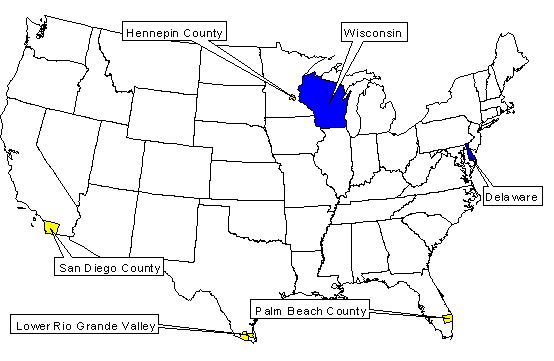
- State of Delaware (Delaware)
- Hennepin County, Minnesota (Hennepin County)
- Lower Rio Grande Valley Workforce Development Board, Texas (Lower Rio Grande Valley)
- Palm Beach County Workforce Development Board, Florida (Palm Beach County)
- San Diego County, California (San Diego County)
- State of Wisconsin (Wisconsin)
Appendix A provides a detailed description of each study site.
Selecting Sites
The six sites were selected purposively for their potential to provide information about the challenges of privatizing TANF case management and the lessons learned from addressing those challenges. Sites were included in the study only if they contract out at least the following core case management services: assessments, development of an employment plan, referrals, and monitoring of client participation. Some states or localities with considerable experience in TANF privatization, such as New York City, were not included because they have not privatized all these specific case management services.
The sites were not selected to be representative of states and localities that have privatized TANF case management. In fact, the study sites over-represent sites that privatized early, privatized a substantial proportion of TANF case management, and have performance-based contracts.
Three main criteria were used in selecting the sites: (1) experience in contracting out TANF case management, (2) diversity in sites, and (3) other specific features of the sites that make them particularly informative to study.
To ensure that the case studies would be informative, all the study sites have a relatively long history of contracting out TANF case management, have experienced several procurement cycles, and/or have privatized all, or a substantial proportion of, TANF case management services. As shown in Table I.1, four study sites privatized just after welfare reform, and have now nearly five years of experience. Lower Rio Grande Valley privatized relatively late but has experienced three procurement rounds.
Very few states or localities privatize all TANF case management and processing functions, including eligibility determination. However, those sites that do are particularly informative because of the scope of their experience. Of the three sites known to contract out TANF eligibility determination Maricopa County, Arizona; Palm Beach County, Florida; and Wisconsin two were selected for study sites. Maricopa County was not selected because it is the focus of another in-depth study (Kornfeld 2002; Peck and Porcari 2002). TANF case management in the other four sites selected for this study is divided between the public and private agencies, with the private agencies conducting employment-related case management, including assessments, developing an employment plan, referrals, placement and retention support, and monitoring compliance with the employment plan. In San Diego County and Wisconsin, TANF case management was privatized in only certain geographic areas; a public agency conducted all TANF case management and processing functions in the other areas. In Hennepin County, TANF clients could choose between private, state, or county agencies for employment-related case management.
| Site | Year Privatization Occurred | Number of Procurements | Types of Case Management and Processing Privatized(a) |
|---|---|---|---|
| Delaware | 1997 | 3 | Employment-related case management |
| Hennepin County | 1997 | 2 | Employment-related case management |
| Lower Rio Grande Valley | 1999 | 3 | Employment-related case management |
| Palm Beach County | 1997 | 2 | All, including TANF eligibility determination(b) |
| San Diego County(c) | 1998 | 1 | Employment-related case management |
| Wisconsin(c) | 1997 | 3 | All, including TANF eligibility determination |
| a More information on the types of case management privatized in each site is provided in Table II.1 b TANF eligibility determination was privatized in July 2001 c Privatization occurred in only some regions of San Diego County and Wisconsin | |||
The sites were chosen so that they vary across four dimensions:
- Type of Public Agencies Responsible for TANF. Prior to welfare reform, welfare services were administered by the state or by counties, with state oversight. The shift to a work-oriented program prompted some states to move the administration of cash assistance to the workforce development system. The study sites include examples of state, county, and workforce development system administration of TANF. TANF is administered by the state in two study sites, by the county in two sites, and by local workforce development boards in the remaining two sites (Table I.2).
- Types of Contractors. Three types of contractors for-profit organizations, local affiliates of national nonprofit organizations, and local nonprofit organizations operate in the study sites (Table I.2). For-profit contractors are used in five of the six sites. Two nationally operated for-profit organizations MAXIMUS and Affiliated Computer Services (ACS) each provide TANF case management in three or four study sites. Faith-based organizations provide some TANF case management as prime contractors in Delaware and Hennepin County and as subcontractors in Wisconsin. They may be either local affiliates of national nonprofit organizations, such as Catholic Charities, or small community-based organizations.
- Types of Contracts. Contracts fall into four major types: cost-reimbursement, pure pay-for-performance, fixed price, and hybrid a cost-reimbursement or fixed price contract with some payment based on performance. The study sites include examples of all four types (Table I.2).
- Region of Country and Urban/Rural Composition. The sites vary by region of the country: Delaware in the Northeast, Palm Beach County in the Southeast, Hennepin County and Wisconsin in the Midwest, Lower Rio Grande Valley in the Southwest, and San Diego County in the West. All the sites include urban areas. Three sites Delaware, Lower Rio Grande Valley, and Wisconsin include rural areas.
Special characteristics of the sites also contributed to their selection. For example, in San Diego County and Wisconsin, TANF case management is provided by private agencies in some areas and public agencies in others. In Hennepin County, clients are given a choice of case management providers.
| Site | Entity Responsible for TANF Administration | Type of Contractors | Type of Contracts |
|---|---|---|---|
| Delaware | State | For-profit (MAXIMUS) Local affiliate of national nonprofit (Salvation Army) Local nonprofits Community colleges | Pure pay-for-performance |
| Hennepin County | County and City of Minneapolis | Local affiliate of national nonprofit (Lutheran Social Services) Local nonprofits State agency | Cost-reimbursement |
| Lower Rio Grande Valley | State, Local Workforce Development Boards | Joint venture between a for-profit (ACS) and a regional nonprofit | Hybrid of cost-reimbursement and pay-for-performance |
| Palm Beach County | State, Local Workforce Development Boards | For-profit (ACS) | Two contracts, one pure pay-for-performance, the other fixed price |
| San Diego County | County | For-profits (ACS, MAXIMUS) Local affiliate of national nonprofit (Catholic Charities) | Hybrid of fixed price and pay-for-performance |
| Wisconsin | State | For-profits (MAXIMUS, ACS) Local and regional nonprofits County agencies Tribal agency | Hybrid of cost-reimbursement and pay-for-performance |
| ACS: Affiliated Computer Services a More information on the contractor type by site is provided in Table II.4. More information on contract type by site is provided in Table IV.2. | |||
Conducting the Case Studies
Information for this study was gathered through site visits and telephone interviews conducted between March and July 2002 by researchers from Mathematica and its subcontractor, The Roper Group. To develop a more complete picture of privatization, researchers interviewed staff with a variety of perspectives, including staff at public and private agencies, management and line staff, and advocates for TANF recipients and public agency employees. Information was also obtained from reviewing requests for proposals, proposals, contracts, auditors reports, and program manuals.
The first interviews were conducted with staff at the public agency administering the contract (Table I.3), including senior program managers and managers responsible for procurement and contract monitoring. Interviews were also conducted with any public agencies that are not responsible for the TANF case management contracts but are involved in TANF administration or in related functions, such as food stamp and Medicaid eligibility determination (Table I.3).
| Site | Public Agency Administering the Contract | Other Public Agencies Involved in Administering TANF, Food Stamps, or Medicaid |
|---|---|---|
| Delaware | Delaware Department of Labor | Delaware Department of Health and Human Services, Division of Social Services |
| Hennepin County | Hennepin County Training and Employment Assistance and Minneapolis Employment and Training Program | Hennepin County Economic Assistance Department |
| Lower Rio Grande Valley | Lower Rio Grande Valley Workforce Development Board | Texas Department of Human Services |
| Palm Beach County | Palm Beach County Workforce Development Board | Florida Department of Children and Families |
| San Diego County | San Diego County Health and Human Services Agency | None |
| Wisconsin | Wisconsin Department of Workforce Development | County Human Service Departments |
The number of contractors visited during the site visits varied from one to five, depending on the number and types of contractors in the site, as well as logistical issues. (A list of the contractors and other service providers visited during the site visits is provided in Appendix B). Where more than one contractor provided services, several different types of contractors were included in the study. In San Diego County and Hennepin County, county agencies also provide employment-related TANF case management but were not contractors. Interviews were conducted with one county agency case management provider in each of these two sites.
At each contractor and public agency that performed TANF case management or case processing functions, interviews were conducted with groups of case managers. Researchers also questioned representatives of groups advocating for welfare recipients, including legal aid associations, and staff at local chapters of labor unions representing public employees, for example, the Service Employees International Union and the American Federation of State, County, and Municipal Employees.
Privatizing TANF Case Management: Why, What, and to Whom?
Although some TANF services are privatized in all but one state, there is considerable variation in the services selected for privatization and the types of contractors. In most states, only some TANF case management functions are contracted out; only a handful of states and localities use outside organizations for all TANF case management and processing functions, including eligibility determination. Some sites administer only one or two contracts for all of their TANF services, while others issue many, smaller contracts. And while state-level TANF contracts in some states such as Florida are awarded mainly to for-profit organizations, New Jersey and other states rely nearly exclusively on nonprofit organizations (GAO 2002).
This chapter offers some explanations for this wide variation by examining the study sites decisions about which services to privatize, the scope and size of the contracts, and to whom contracts are awarded. Section A discusses the factors that played a role in the study sites decisions to privatize. Section B describes the types of TANF case management and related case processing functions that are privatized and some of the issues considered in making these decisions. The size and scope of contracts issued by each site, and the factors behind those decisions, are discussed in Section C. Section D offers a description and comparison of the types of contractors providing services in the study sites.
The Rationale for Privatization
At the time the study sites were considering whether and how to privatize case management, their cash assistance programs were undergoing major changes in structure and goals as a result of welfare reform. In many cases, welfare reform itself acted as a catalyst for modifications in service delivery. In three study sites Palm Beach County, Florida; Lower Rio Grande Valley, Texas; and Wisconsin state welfare reform legislation explicitly allowed or even encouraged some privatization.
The level of government at which the decision to privatize was made varied by site. In Florida and Texas, the state legislatures required local workforce development boards to contract out operation of the one-stop career centers and the TANF services they provided. Similarly, Wisconsins state welfare reform legislation required that TANF services be contracted out to either private agencies or counties. In San Diego and Hennepin Counties, the decision to privatize was made by the county government. In Delaware, the decision was made by the four state agencies designated to administer welfare reform. Officials from these agencies reported that they received little or no pressure from the governor or state legislature to privatize. Although several factors played a role in each sites decision to privatize, they generally fell into two broad categories: a belief that private agencies can provide better services at lower cost, and pragmatic and political considerations.
Belief that Privatization Improves Service Delivery
The most frequently given rationale for privatization is the belief that it will lead to better services and/or services being delivered more efficiently. This was referenced in all the study sites, and was one of the bases for the political support for privatization in Florida, Texas, and Wisconsin.
Privatization may lead to better and/or cheaper service provision via three mechanisms. The first is competition. Competition for contracts may motivate organizations to improve the quality and efficiency of service provision. Staff at Delawares Department of Labor, for example, argued that under privatization, when an agency fails to perform, it risks losing its contract and being replaced. In contrast, when a public agency shows poor performance, the only recourse is change within the agency, which may be more difficult.
Some argue that it is competition rather than privatization that leads to better or cheaper services, and that introducing such competition between public and private agencies or even among different public agencies could be effective (Nightingale and Pindus 1997). In Wisconsin this was recognized explicitly; public and private agencies were encouraged to compete for contracts. In fact, of the 64 entities that hold TANF contracts in Wisconsin, 54 are counties or consortia of counties. In San Diego County, TANF case management functions are provided exclusively by public agencies in two regions and are divided between public and private agencies in the other four. These public agencies did not compete with private agencies for contracts, but their performance is compared with that of the latter group. Depending on the quality of performance, currently privatized regions could revert to public service provision or vice versa.
The second mechanism by which privatization may improve services is by taking advantage of specific characteristics of private agencies. Some advocates of privatization argue that for-profit private agencies can be motivated to perform by linking payment to their performance, but that it is more difficult to motivate government agencies with performance standards. Others cite the greater flexibility of private agencies. They may have smaller bureaucracies. The lack of civil-service regulations and the absence of labor unions also increase private agencies relative flexibility in hiring, firing, and compensating workers. In San Diego, for example, county administrators pointed to the cumbersome and lengthy process involved in hiring county employees. In contrast, contractors can hire and fire staff and adjust operations relatively quickly if they perceive shortcomings in their services.
The third mechanism by which privatization may lead to better service delivery is through the exercise of client choice. In a privatized system with multiple providers, welfare recipients can be allowed to choose the service provider, encouraging competition between providers and increasing the likelihood of a good match between the services and the client. In Hennepin County, contracting with many different agencies was seen as an effective way to avoid a "one size fits all" approach and to match services with clients needs. Wisconsin is considering creating an "open district" in Milwaukee, in which clients could choose their service provider.
Pragmatic and Political Factors
In some sites, pragmatic and political factors also played a role in the decision to privatize. In Delaware and San Diego County, for example, the need to add capacity for new services in response to welfare reform was one of several factors. In Delaware, the state wanted to provide more services but was constrained by the governors desire not to expand the state governments workforce. San Diego County wanted to provide services quickly to recipients transitioning into a new, time-limited welfare program but believed it could not increase its staff rapidly enough because of limits on the size of the county workforce.
The desire for a fundamental change in the provision of services was also a factor. Welfare reform changed the job of many welfare staff from primarily determining eligibility and benefit levels to much more intensive, work-focused assistance. One advantage of changing from public to private agencies is that the latter could hire staff with the necessary skills and mindset to provide more work-oriented case management. In Delaware, there was a view that existing staff lacked the skills necessary to provide the services. In both Delaware and Wisconsin, privatization with performance-based contracts was viewed as a way of promoting service provider "responsibility" that mirrored welfare reforms central philosophy of personal responsibility among recipients.
In many of the sites, another factor in the decision to privatize was their history of contracting out for human services. It seemed natural to expand this method when more employment services were needed after welfare reform. For example:
- In Delaware, two of the four agencies responsible for welfare reform had considerable prior experience contracting out. The Department of Social Services had contracted out for vocational training and job search assistance under AFDC and the Department of Labor had contracted for training under JTPA.
- The City of Minneapolis (in Hennepin County) had contracted out employment and training services to nonprofit agencies for over ten years prior to welfare reform, deliberately cultivating a community-based service network.
- In Wisconsin, even prior to welfare reform, the state had contracted with the counties to provide AFDC, and private agencies had run the JOBS program.
Deciding Which Functions to Privatize
The decision to privatize involves not only the decision to contract out some services, but also the decision about what types of services should be privatized.
Types of Case Management and Processing Functions Privatized
The range of TANF case management functions that could be privatized include:
- Initial Contact with Client. This first contact with the client may include a basic assessment of the appropriate program for the client. Diversion options may also be discussed with her at this point.
- Assessments. These include evaluating the clients ability to obtain and retain employment and her need for further education or training, or such supportive services as transportation, child care, and mental health or substance abuse treatment.
- Developing a Personal Responsibility Plan and/or Employment Plan. The personal responsibility plan (in some sites known as the Individual Responsibility Plan or the Contract for Mutual Responsibility) documents the clients goals and her obligations. These may include conducting a job search, obtaining a GED or training, attending parenting classes, ensuring children are enrolled in school and have received immunizations, and addressing any substance abuse problems. Some TANF programs also require clients to develop an employment plan that specifies the activities clients will undertake to move toward stable employment.
- Referrals. This includes identifying services needed by the client, such as counseling or treatment for substance abuse, and referring her to the appropriate agency.
- Job Search, Placement, and Retention Support. Job search assistance may include supervising the clients search. It may also involve teaching skills, including resume writing, interviewing techniques, and "soft" skills, such as how to handle conflict on the job. Job placement activities can include developing and identifying employment opportunities and leads, making contact with employers, or helping clients apply for criminal charges to be expunged. Job retention support involves regular contact after the client finds work, including job coaching, and addressing issues such as child care, transportation, housing and other issues that may interfere with a clients ability to retain employment.
- Monitoring Compliance with Employment or Personal Responsibility Plan. This involves monitoring that the client fulfills each of her responsibilities as described in the personal responsibility plan or employment plan.
- Recommending Sanctions. Failure to comply with the personal responsibility plan or employment plan may lead to the recommendation of a sanction.
Closely related to these case management functions are the following case processing functions:
- TANF Eligibility Determination. This involves collecting detailed information about the clients household and determining eligibility and benefits for TANF. It may also involve determining eligibility for other assistance, such as food stamps, Medicaid, and child care subsidies.
- Monitoring Ongoing Eligibility. These functions include processing reports of changes in circumstances and conducting redetermination interviews.
- Imposing Sanctions. If the client does not comply with the personal responsibility plan a sanction may be imposed.
The sites in our study divided these TANF case management and processing functions between the private and public agencies in one of two ways. In some sites, the responsibility for all TANF case management and processing functions was given to a contractor. In others, only employment-related case management functions were privatized. Table II.1 indicates which functions are privatized in each site.
Two sites Palm Beach County and Wisconsin privatized all TANF case management and processing functions. The clients initial contact with the TANF program, eligibility determination, and all subsequent case management and processing, including the development of a personal responsibility plan, and the implementation of sanctions, is administered by a private agency. In Wisconsin, contractors administer the entire TANF program in some counties, including the payment of TANF benefits. In Palm Beach County, the contractor is responsible for all case management and processing functions, including TANF eligibility determination, but the Florida Department of Children and Families makes benefit payments.
The other four sites Delaware, Hennepin County, Lower Rio Grande Valley, and San Diego County privatized only employment-related case management functions. In those sites, clients who are subject to work requirements have two case workers: a public agency case worker (sometimes referred to as a financial worker or eligibility technician ) and a contractor case worker. A public agency retains responsibility for determining eligibility, monitoring ongoing eligibility and compliance with the non-employment aspects of the personal responsibility plan, and imposing sanctions. In addition, clients initial contact with the TANF program is with a public agency employee.
| Function | Delaware | Hennepin County | Lower Rio Grande Valley | Palm Beach County | San Diego County(a) | Wisconsin(a) |
|---|---|---|---|---|---|---|
| Case Management Functions | ||||||
| Initial contact with client | ü | ü | ||||
| Assessments | ü(b) | ü | ü | ü | ü | ü |
| Developing a personal responsibility plan | ü | ü | ||||
| Developing an employment plan | ü | ü | ü | ü | ü | ü |
| Referrals for supportive services | ü(b) | ü | ü | ü | ü | ü |
| Job search, placement, and retention support | ü | ü | ü | ü | ü | ü |
| Monitoring compliance with the employment plan | ü(b) | ü | ü(b) | ü | ü(b) | ü |
| Recommendation for sanctions | ü(b) | ü | ü | ü | ü | ü |
| Case Processing Functions | ||||||
| TANF eligibility determination | ü | ü | ||||
| Monitoring ongoing eligibility | ü | ü | ||||
| Monitoring compliance with nonemployment aspects of the personal responsibility plan | ü | ü(b) | ü | |||
| Imposition of sanctions | ü | ü | ||||
| a In some regions, a public agency performs all TANF case management functions. b Public agency also performs some of this function | ||||||
Typically, this staff member develops the personal responsibility plan and monitors the non-employment aspects of the plan, while the contractor designs and oversees the plan for obtaining employment. The contractor case workers are more like traditional case managers. They conduct detailed assessments; make referrals for supportive services; assist with job search, placement, and retention; monitor compliance with the employment plan; and make referrals for sanctions.
In all sites where clients have both a public and private case worker, the contractor case workers conduct much more intensive case management than the case worker at the public agency, reflecting the differences in their functions. Contractor case workers are required to identify and address barriers to employment a process that is often intensive and time-consuming. The public agency case workers are primarily responsible for determining eligibility and ensuring that decisions are documented appropriately. The contractor case workers typically meet with the client much more frequently. In Lower Rio Grande Valley, for example, public agency case workers meet with clients every three to six months after initial eligibility is determined, while contractor case workers meet weekly with clients during the job search process. Contractor case workers are also more likely to meet with clients outside the agency office and make home visits. As a result, the contractor case workers in each site have significantly lower caseloads than those at the public agencies (Table II.2).
Federal law requires that an employee of a public agency determine food stamp and Medicaid eligibility. In Palm Beach County, a private agency eligibility worker collects information for the food stamp and Medicaid application as well as the TANF application. This worker then takes the client to a public assistance specialist employed by the state and colocated with the private agency workers. This specialist conducts a "mini interview" with the client and reviews their benefits application. After being determined eligible for benefits, the client is assigned a private agency case manager. In Wisconsin, the client first sees a resource specialist employed by the contractor, who assesses the clients needs. This specialist will refer the client to a private agency case manager if she needs TANF, and/or a public sector worker if she needs food stamps or Medicaid.
Factors Affecting Which Case Management and Processing Functions are Privatized
In deciding which TANF case management and processing functions to privatize, at least two factors came into play in the study sites. The first was consideration of the relative strengths and abilities of the public and private agencies. Some study sites that chose to privatize only employment case management viewed the public agencies as having all the skills and expertise necessary to determine eligibility. However, the existing public agency staff was seen as not having the expertise or, equally important, the mindset to conduct the more intensive employment case management required by welfare reform.
| Site | Caseloads for Case Workers at Public Agency | Caseloads for Case Workers at Private Agencies |
|---|---|---|
| Delaware | 180-225 | 50-150 |
| Hennepin County | 200-350 | 70-90(b)/25(c) |
| Lower Rio Grande Valley | 200-300 | 40-90 |
| San Diego County | 140-160 | 80-125 |
| a TANF case management is not shared between the public and private agencies in Palm Beach County or in Wisconsin. b Tier I services for traditional TANF recipients c Tier II services for long-term TANF recipients | ||
The importance placed on service integration was the second factor in the decision about privatizing. Many TANF programs embraced the idea of one-stop shopping. However, because the law requires public employees to determine eligibility for food stamps and Medicaid, a fully integrated assistance system cannot be wholly privatized. Sites have reacted to this in different ways some moved away from privatizing TANF eligibility in order to keep the eligibility functions integrated; others chose to privatize all TANF services, separating TANF eligibility determination from that for food stamps and Medicaid.
In Texas, efforts were made to privatize case management and processing across all programs and functions, including eligibility determination for TANF, food stamps, Medicaid, and child-care subsidies. However, after its application to the federal DHHS for the necessary waiver in 1997 was rejected, Texas has instead kept all eligibility determination functions housed within the state Department of Human Services, forgoing full privatization of the TANF program. State law requires that the workforce investment boards, including the one in Lower Rio Grande Valley, contract out operation of the one-stop centers where employment-focused case management is provided. Wisconsin also sought to privatize a fully integrated assistance system. After the Texas waiver application was denied, the state decided to forgo integration across assistance programs but pursue privatization of the full TANF program.
Establishing the Scope and Size of TANF Contracts
Public agencies contracting out TANF services also need to determine the scope of their contracts, in terms of services and geographic reach, and whether to award a few large contracts or more numerous, smaller contracts. Table II.3 shows the number and average size of the contracts in each study site. Some study sites chose to issue one or two large contracts to cover all services, while others parceled out services to many contractors. Lower Rio Grande Valley, for example, issued one $31 million contract to cover the operation of the one-stop centers, including the provision of TANF case management. Palm Beach County issued two contracts, one of which was worth over $6 million. At the other end of the spectrum, Hennepin County has 26 contracts, none of which is much larger than $2 million.
The sites also varied in how they defined the scope of each contract (Table II.3). San Diego County and Wisconsin issued contracts for service provision by geographic region. Delaware did the same, but within each region, issued separate contracts for employment placement and retention support. Each contract in Hennepin County specified a number of client slots, allowing clients to choose among providers. Separate contracts were also awarded for traditional (Tier I) TANF recipients and long-term (Tier II) recipients. Palm Beach County issued two contracts for TANF case management both held by the same organization. One contract covered the operation of the one-stop centers and direct services, including TANF case management; the other dealt with TANF eligibility determination. The latter was issued by the Department of Children and Families to the Workforce Investment Board, which in turn subcontracted to the private agency. Lower Rio Grande Valley issued only one contract for the entire region.
| Site | Number of Contracts | Value of Individual Contracts | Scope of Contracts Defined by: |
|---|---|---|---|
| Delaware | 8 | $0.2m to $1.6m(a) | Region and service (placement or retention support) |
| Hennepin County | 26 | $0.2m to $1.9m(a) | Number of client slots and service (general or long-term recipients) |
| Lower Rio Grande Valley | 1 | $30.7m (b) | Covers entire region |
| Palm Beach County | 2 | $0.7m to $6.4m(c) | Service (one-stop operation or eligibility determination) |
| San Diego County | 3 | $2.1m to $7.6m(a) | Region |
| Wisconsin | 67 | $0.25m to $61.5m(d) | Region |
| a Contracts cover only employment-related TANF case management. b Contract covers the management and operation of one-stop centers, including TANF case management. c One contract covers eligibility determination; the other covers the operation of one-stop centers, including TANF case management. d Contracts cover all TANF services, administration, and benefits. | |||
Issuing a few, large contracts has several advantages. First, it limits the cost of contract administration and monitoring. Second, there may be economies of scale in providing services the costs of the infrastructure and management can be spread across a larger number of clients. Third, it allows for greater coordination and service integration if there are many contracts divided by function, rather than region, clients may "fall between the cracks." In Delaware, for example, considerable effort was made to ensure that once clients left the placement contractor, they met with a retention support case manager in a different agency. However, one Delaware contractor argued that it would be more efficient for the same contractor to provide both placement and retention support to the clients.
Issuing more numerous, smaller contracts has advantages of its own. First, it allows contractors to specialize by service or by population. In Hennepin County, the providers specialized in different racial/ethnic populations or in different neighborhoods of the city. One agency, for example, specialized in serving the Hmong community. Wisconsin divided Milwaukee into six different regions, each with its own contract, so that contractors could specialize in serving different neighborhoods of the city. In Delaware, the contracts were divided by function because both the public agency and contractors felt placement case managers required different skills than retention support case managers, and several contractors mentioned that they would not want to undertake providing both services.
The second advantage of having more numerous, smaller contracts is the reduced risk of contractor nonperformance. If a contractor goes out of business or performs below standard, the administering agency can more quickly replace the nonperforming contractor with another that is operating nearby.
The third advantage of having more numerous, smaller contracts is increased competition, that may in turn lead to higher quality or cheaper services. The greater the number of contracts, the more incumbent contractors there will be. This increases competition because the fiercest competition at contract renewal usually comes from other incumbent contractors. In addition, a wider range and, as a result, a greater number of organizations can compete for smaller contracts.
The Contractors
A diverse array of private organizations provides TANF services on behalf of state and local agencies. Contractors in the study sites reflect this variety, differing in for-profit or nonprofit status, size and expertise, and geographic reach (Table II.4). In two of the study sites, the group of contractors also includes public organizations community colleges in Delaware and county agencies in Wisconsin. (Public agencies also provide case management services in San Diego County and Hennepin County but are not contractors.)
| Site | Contractor Types(a,b) | Number of Contractors | Examples | Faith-Based Contractors | Sub-Contractors |
|---|---|---|---|---|---|
| Delaware | Local nonprofit Local affiliate of national nonprofit For-profit Community college | 5 | Children and Families First Salvation Army
MAXIMUS | Yes | Yes(c) |
| Hennepin County | Local affiliate of national nonprofit Local nonprofits State agency | 20 | Lutheran Social Services Rise, Inc. | Yes | No |
| Lower Rio Grande Valley | For-profit/nonprofit partnership | 1 | The Valley Partnership: ACS and Texas Migrant Council | No | No |
| Palm Beach County | For-profit | 1 | ACS | No | Yes |
| San Diego County | Local affiliate of national nonprofit For-profits | 3 | Catholic Charities ACS, MAXIMUS | Yes | Yes |
| Wisconsin | Local affiliate of national nonprofit For-profit Counties | 64 | YW Works MAXIMUS | No Some subcontractors are faith-based | Yes |
| ACS: Affiliated Computer Services a Public agencies also provide some TANF employment case management services in Hennepin County and San Diego County but are not contractors. b Some organizations partner with others. For example, RISE Inc. partners with the Opportunity Partners, Accessibility, Inc., and Tasks Unlimited. c Although subcontractors do not provide case management. | |||||
Private contractors can be divided into three broad groups: national for-profit firms, affiliates of national nonprofits, and local and regional nonprofits. Nationwide, it is much more common for states to contract with nonprofits than for-profits; nearly three quarters of all state-level TANF contracts are with nonprofits (GAO 2002). For-profit organizations do have a sizeable presence in some places, however, holding half or more of the total value of state contracts in eight states (GAO 2002). In certain localities, including Palm Beach County, for-profits are the single provider of employment services for TANF clients.
National For-Profits
The two main for-profit contractors operating in the study sites, MAXIMUS and ACS, are large organizations with ongoing projects in numerous states and localities. Both companies engage in a wide range of business activities, extending well beyond the welfare or workforce development arenas, and both bring substantial resources to the competition for contracts and service delivery.
MAXIMUS. MAXIMUS specializes as a contractor to government agencies, as evident in the companys motto, "Helping government help the people." Its projects cover the gamut of social programs, including welfare-to-work, health care, child care, child support enforcement, and child welfare. MAXIMUS also supplies logistical support to government agencies for example, managing vehicle fleets or putting electronic payment technology into place. Projects involving TANF case management come under the companys government operations division, which carries out programs on behalf of state and local agencies. MAXIMUS has roughly 4,800 employees in more than 170 offices across the country and earned nearly $500 million in revenue last year.
Affiliated Computer Services, Inc. In contrast with MAXIMUS, much of ACSs work is with private sector firms, as an outside provider of business and information technology services ranging from processing forms to installing and maintaining computer systems. ACS is also larger than MAXIMUS, with over $3 billion in revenues in fiscal year 2002 and more than 36,000 employees. According to press reports, about one-third of ACSs revenue comes from contracts with state and local government agencies (Welsh 2002). In recent years, ACS has purchased several other companies including Lockheed Martin Information Management Systems. As part of this acquisition, ACS gained several contracts to provide TANF case management, along with agreements covering such tasks as collecting child support, enrolling people in state-run health insurance programs, and operating one-stop centers funded through the Workforce Investment Act. ACS has also acquired Concera Corporation, a for-profit provider of business process outsourcing and workforce development services. Prior to being purchased by ACS, Concera Corporation purchased Curtis and Associates, a for-profit company that has provided TANF case management services in many states.
Because of the scope and resources of MAXIMUS and ACS, the companies employees can draw on extensive expertise in securing new contracts and delivering services. In developing proposals, for example, employees familiar with local circumstances and TANF program details take primary responsibility but have the assistance of corporate staff members who specialize in drafting project budgets and preparing effective proposals. Local project staff also benefit from program materials, such as proprietary curricula for job readiness and life skills courses, prepared for use in all project sites. The companies may also have a fairly standardized program model to implement, adapting it to local policies and conditions as needed.
Affiliates of National Nonprofits
Some nonprofit organizations operate throughout the country via networks of locally governed affiliates. These organizations offer an array of social services to individuals and families, from homeless shelters to nutrition programs for the elderly. Within each network, a national office may develop broad general policies, provide technical assistance to members, and engage in policy advocacy. The local affiliates that provide direct services operate with substantial independence, however, and primarily receive funding from the communities in which they are based rather than their national organizations. They also typically receive much less assistance in proposal preparation and program development from their national headquarters than the national for-profits do. Their size, in terms of budget and number of employees, varies.
Affiliates of several national organizations provide TANF services in the study sites. They include:
- Catholic Charities Diocese of San Diego. Catholic Charities runs 35 programs in the San Diego area. The organizations services address homelessness; assistance for refugees and immigrants; pregnancy, parenting, and adoption; and other issues.
- Lutheran Social Services of Minnesota. Lutheran Social Services is one of the largest nonprofit agencies in Minnesota. It offers assistance in varied areas, including housing, mental health, employment, and refugee resettlement.
- American Indian Opportunities Industrialization Center of Minnesota and the Opportunities Industrialization Center of Greater Milwaukee. Opportunities Industrialization Centers (OIC) in Hennepin County and Wisconsin offer education and job skills training, employment assistance, housing, and other services for low-income people.
- Salvation Army Delaware Region. The Salvation Army in Delaware maintains separate arms for its ministry and social services activities. Its social services division operates child care, employment, emergency assistance, and other programs.
Affiliates that opt to compete for TANF case management contracts typically view the undertaking as an extension of their current employment and training programs, consistent with their mission to serve the poor and disadvantaged. Their service model may include links with other programs that the local and parent organizations offer to low-income families. While many affiliates have a history of providing services as government contractors, TANF case management may be a new, and substantially different, role for them. In particular, staff members may be forced to implement policies that seem severe such as sanctioning clients who fail to meet work requirements and that are in tension with the organizations traditional role as providers of assistance to the needy.
Local and Regional Nonprofits
Some nonprofits develop as an exclusively local response to the needs of disadvantaged people. Many of these nonprofits, like the affiliates of national organizations, have experience as government contractors, but they tend to operate with fewer funds and administrative resources than nonprofits working within a national network. However, this is not always the case. In Hennepin County, for example, several local nonprofits rival the national affiliates in terms of budget and program scope. These organizations operate an array of social and economic development programs, often focusing their activities on a particular neighborhood, ethnic group, or population in need of assistance. The local nonprofits providing TANF case management services in the study sites are a diverse group, as these examples illustrate:
- Children and Families First. Children and Families First operates throughout Delaware, offering employment, foster care, family development, and HIV/AIDS services to a broad range of people.
- Hmong American Partnership. Based in Minnesotas Twin Cities, the Hmong American Partnership serves the areas Hmong community with English language, self-sufficiency, and youth programs.
- Ministry of Caring. A faith-based organization located in Wilmington, Delaware, the Ministry of Caring focuses its services on homeless and low-income families. Its staff and numerous volunteers operate shelters along with health care, child care, and employment programs.
- RISE, Inc. As a community rehabilitation organization, RISE specializes in employment assistance, housing, and other services for people with disabilities. RISE provides case management for TANF clients in collaboration with several similar organizations.
- Texas Migrant Council. From its beginnings with a mobile Head Start program for migrant workers, the Texas Migrant Council has expanded into a variety of services for migrants and other low-income families, including child care and employment assistance. The organization also operates in Ohio and Indiana.
From the perspective of TANF agencies, local nonprofits may bring important qualifications to the task of case management, including familiarity with a local area and the needs of specific groups of clients. In reconciling the responsibilities of TANF case managers with their philanthropic missions, however, these organizations face dilemmas similar to those of their counterparts affiliated with national groups. Smaller local groups also confront the challenge of managing and reporting on a complex program with sometimes limited internal resources.
Several faith-based organizations both national affiliates and local nonprofits provide services in the study sites (Table II.4). These organizations missions are rooted in religious principles, but the TANF case management services they offer do not include an explicitly religious component. Agency administrators in the study sites did not express a strong preference for or against working with faith-based organizations. In Wisconsin, however, the agency administering TANF contracts has attempted to boost the involvement of faith-based organizations by offering a performance bonus to prime contractors who have subcontracts with faith-based organizations.
Collaboration Among Contractors
Contractors frequently collaborate through partnership and subcontracting arrangements. As a result, more than one type of organization provides TANF services in each of the study sites, including places where agencies hire a single, prime contractor (Table II.4). Both for-profits and nonprofits have a presence in all sites except Hennepin County, where the strength of the local nonprofit sector and the small size of contracts probably deter the entrance of for-profits. In those sites using both for-profit and nonprofit organizations, it is not uncommon for organizations to work together. Agencies may even provide explicit incentives for this by, for example, including community collaborations among the evaluation criteria for proposals.
Cooperative arrangements in the Lower Rio Grande Valley and Wisconsin illustrate some of the ways contractors join forces. In its bid to operate one-stop centers in the Lower Rio Grande Valley, ACS partnered with the Texas Migrant Council, already a contractor for child care programs in the region. The two organizations created a joint venture known as the Valley Partnership, dividing responsibilities between them. Either ACS or Texas Migrant Council employees staff individual one-stop centers, but overall project management is shared. The organizations also split administrative responsibilities, with ACS acting as fiscal agent for the partnership and the Texas Migrant Council handling internal monitoring.
Among contractors providing TANF case management in Wisconsin, subcontracting is a common means of collaboration. All four W-2 providers in the county subcontract out significant components of their services home visits and assessments, for example sometimes to other W-2 contractors or even the county government. Throughout the state of Wisconsin, about 13 percent of W-2 contract expenditures went to subcontractors (Wisconsin Legislative Audit Bureau 2001).
Several factors motivate cooperative efforts among contractors. National for-profits view collaboration as a way to access the expertise of community organizations, especially their familiarity with local populations or programs. Such knowledge can help for-profits make their proposals more competitive and target services more effectively. Partnerships with nonprofits can also soften local opposition to service provision by for-profit organizations. Nonprofits that join with other organizations as partners or subcontractors may benefit from increased capacity, income, and risk protection. Smaller organizations, in particular, may not be willing to bid for contracts independently because they lack the resources to initiate programs and, if the contract is performance-based, to cushion themselves from possibly dramatic fluctuations in income. Organizations also pursue alliances in order to reduce competition for contracts, removing potential rivals from the field by offering them a role in (and revenues from) service delivery.
While the benefits of collaboration are apparent, such arrangements are not always successful. In several sites, contractors have abandoned subcontracting or partnership agreements. ACS in San Diego County, for instance, designed its service model to include 15 or more community-based organizations that would provide specialized assistance to a diverse welfare population. That model proved to be impractical, however, in part because the countys monitoring procedures required extensive collection and verification of information from every subcontractor. Similarly, in Wisconsin, the YWCA and two health care providers created a limited for-profit partnership in order to combine their services on behalf of welfare recipients. The for-profit partnership dissolved after a year of operation.
Collaboration between for-profit and nonprofit organizations creates special challenges for the parties involved. Differences in management approach can be significant and extend to practical matters, such as employee compensation. Within the Valley Partnership in Lower Rio Grande Valley, discrepancies in benefits for employees of ACS and Texas Migrant Council created dissatisfaction among staff. Establishing a single benefits package was difficult, since both organizations also have employees working outside the partnership, but managers have attempted to equalize perks for employees as much as possible.
Strengths of Different Types of Contractors
The experiences of study sites offer no conclusive evidence that one type of contractor consistently provides better services than another. Contractors that rank highly on performance standards established in the six sites come from each group for-profits, affiliates of national nonprofits, and local nonprofits. The same is true of organizations with lackluster records. Contractors performance may reflect local context as much as organizational effectiveness, however, as differences in economic conditions or the characteristics of clients can influence program results.
Still, researchers are making efforts to weigh the effectiveness of different types of service providers by comparing outcomes for TANF recipients in locations with a mix of providers:
- Florida. Crew and Lamothe (2002) used data on employment outcomes and satisfaction among clients to compare government, for-profit, and nonprofit providers of welfare services in Florida. Taking into account some observable variation in regional economies and client characteristics, they conclude that differences among outcomes for different types of providers "are generally small and often non-existent." They also find that "in no case are private organizations substantively superior" to public entities in providing services to welfare clients. Providers do, however, differ on some measures. Among other things, the study indicates that nonprofits and public agencies do a better job than for-profits in finding unsubsidized employment for welfare clients, but for-profits are more successful in helping clients leave welfare due to earnings.
- Maricopa County, Arizona. Kornfield (2002) compared the performance of a private for-profit agency and a public agency after the TANF program in eastern Maricopa County was reformed and privatized as the Arizona Works program. A public agency continued to run the TANF program, known as EMPOWER, in the rest of the county. With the caveat that the Arizona Works program differs from EMPOWER in some of its rules and the existence of performance measures, the study concluded that the private and public agencies were about equally successful at increasing clients earnings and employment.
- San Diego County. San Diego Countys allocation of different regions to nonprofit, for-profit, and public providers is another attempt to draw conclusions about relative effectiveness. The RAND Corporation is conducting an evaluation for this purpose.
Certainly, for-profits, national affiliates, and local nonprofits vary in the resources they have available. Larger organizations, particularly for-profits, tend to have more financial resources that enable them to take on projects of substantial size. Their financial advantage also enables them to take greater risks, such as entering into a purely pay-for-performance contract. In some places, well-financed organizations have employed their resources to lobby for policy changes that increase their chances of securing a contract. In the Lower Rio Grande Valley, a for-profit went so far as to finance a lawsuit against the workforce board after losing a contract award.
In addition to this disparity in resources, agency administrators and advocates in the study sites emphasized that nonprofits mission orientation affects how they provide services and respond to contract incentives. For-profits appear to hold closely to the conditions of the contract and are driven by performance outcomes. At least one for-profit, MAXIMUS, rewards case managers financially for achieving performance targets. On the other hand, some observers noted that nonprofit agencies are more likely to meet the needs of their clients regardless of their contract obligations.
Stakeholders also often perceive a difference in management style and program approach between for-profits and nonprofits. Case management provided by nonprofits is generally thought to be more holistic than that of for-profits addressing the needs of an entire family, for example, rather than the adult head of household alone.
Procurement: Ensuring a Fair, Effective, And Competitive Process
Selecting contractors is one of the most important tasks for the public agencies charged with administering the TANF contracts. Public agencies administering contracts have three main objectives for the procurement: (1) to attract qualified, competitive bidders, (2) to award contracts to the most capable providers, and (3) to protect the integrity of the selection process. While all three goals are affected by the way the procurement process is conducted, an agencys ability to attract qualified, competitive bidders also depends on the size, scope, and structure of contracts.
This chapter describes the variation across study sites in the competitiveness of the procurements and the steps involved in the procurement process. Section A discusses promoting competition a key element in both selecting the best contractor and ensuring that contractors are motivated to perform at their best. Section B describes the "nuts and bolts" of the procurement process and the actions public agencies can take to ensure that the procurement process is fair and effective.
Promoting Competition
Many of privatizations perceived benefits derive from competition among contractors. Proponents of privatization believe that competition drives contractors to be more flexible and innovative, leading to better services and more efficient service provision. Some analysts even argue that it is the degree of competition that is most important, rather than whether the provider is a public or private sector organization (Kettl 1993; Donahue 1989; Osborne and Gaebler 1992; Nightingale and Pindus 1997).
Variation in the Degree of Competition
The degree of competition depends on whether bidders perceive that there are other organizations that can offer services of similar or higher quality at a similar or lower cost. Procurements are more competitive when bidders perceive a high probability that they may lose the bid and less competitive when they perceive that other organizations are unlikely to be interested in securing a contract or that other bidders will be unlikely to offer services of higher quality or lower cost.
As it depends on bidders perceptions, there is no single, quantifiable measure of competition. The number of bids for each contract, the frequency that service providers are changed, and assessments of competition from contractors and the procuring agency all indicate the degree of competition.
All indicators suggest that there is a wide variation in the degree of competition for TANF case management contracts. Competition seems considerable in Delaware, San Diego County, and Lower Rio Grande Valley. It is more limited, however, in Hennepin County (at least for Tier I contracts), Palm Beach County, and Wisconsin.
The number of bids for each contract varied by site. At the most recent procurement, there were five bids per contract in Lower Rio Grande Valley, but only a single bidder for the contract in Palm Beach County (Table III.1). In Hennepin County, the process may be more competitive than suggested by the low ratio of bids to awarded contracts, because contractors compete for the number of slots as well as the contract. The number of slots for general TANF recipients ("Tier I slots") awarded to contractors varies from 100 to over 900. The number of bids per contract in Wisconsin overstates the degree of competition for contracts because contractors who meet certain performance standards earn the "right of first selection" and do not need to compete with other contractors for the new contract. The right of first selection is discussed in more detail below.
| Site | Number of Bids Per Contract(a) |
|---|---|
| Delaware | 8 to 10 bids per 3 or 4 contracts |
| Hennepin County | 23 bids for 20 Tier I contracts(b) 18 bids for 6 Tier II contracts(b) |
| Lower Rio Grande Valley | 5 bids for 1 contract |
| Palm Beach County | 1 bid for 1 contract |
| San Diego County | 2 to 5 bids per contract |
| Wisconsin | 12 bids for 5 contracts(c) |
| a Refers to the most recent procurement. b Contractors also compete for the number of slots. c This is for contracts that are competitively bid. In Wisconsin, contractors who meet certain performance standards win the right of first selection and do not compete against other contractors. | |
Some opponents of privatization have suggested that contracting will become less competitive over time. However, there was no discernable trend in the number of bids per contract in the study sites. In Hennepin County, the number of bids for each Tier I contract fell from 1.8 to 1.2. Similarly, in Palm Beach County, the number of bids fell from three in 1997 to one in 2002. In Lower Rio Grande Valley, however, the number of bids per contract increased from three in 1999, to four in January 2001, to five in December 2001. The number of bids per contract remained similar in Wisconsin for the contracts that were competed. (San Diego County has conducted only one procurement.)
Another indication of the extent of competition is the frequency with which contractors lose a contract to another contractor. Delaware and the Lower Rio Grande Valley, both with a high ratio of bids to awards, were the sites in which there was the highest turnover of contracts:
- Delaware. Of the three incumbent contractors who held placement contracts between 1997 and 1999, two lost their contracts in the 1999 procurement. One lost its contract to another incumbent contractor and the other lost to a new contractor. (In the 2001 procurement, no change occurred in the placement contractors.) Even more turnover occurred in the contractors who held retention contracts. Of the six contractors who held retention contracts between 1997 and 1999, three lost their contracts to other incumbent contractors in the 1999 procurement. In the 2001 procurement, one of the three remaining incumbent contractors was replaced.
- Lower Rio Grande Valley. All three procurements in Lower Rio Grande Valley have resulted in a change in contractor. Lockheed Martin IMS won the first contract in 1999. Due to issues with contractor performance and a need to expand the scope of the contract to cover additional functions, the workforce board decided to put the contract up for competition again in January 2001. At that procurement, Lockheed Martin lost the contract to Workforce Network and subsequently sued the board. As part of the settlement, the contract was competitively re-issued in December 2001 and awarded to a joint venture of ACS (which by then had acquired Lockheed Martin IMS) and the Texas Migrant Council.
In contrast, there were fewer contract turnovers in Hennepin County, Palm Beach County, and Wisconsin:
- Hennepin County. Of the 19 contractors who provided services between 1997 and 2000, only one lost its contract during the 2000 procurement. However, the number of slots the contractor can fill may be decreased in a new procurement or at renewal. Of the 21 organizations currently providing services, three were notified that their allocation of slots would be reduced if their performance did not improve.
- Palm Beach County. The one contractor awarded the first procurement also won the second, most recent procurement.
- Wisconsin. There has been very little turnover in contractors in Milwaukee. The contractors selected to deliver services at the first procurement were all awarded "right of first selection" and did not need to compete for the 2000-2001 contracts. Before the third procurement, a contractor that had been caught with disallowable costs in a state audit agreed not to bid; all other organizations maintained their contracts. The turnover has been greater in other parts of the state, mainly because several counties voluntarily terminated their contracts.
Although assessments of competition varied across sites, the public agency and the contractors within a site generally agreed about the degree of competition. In Delaware, Lower Rio Grande Valley, and San Diego County, both the contractors and the public agency administering the contracts viewed the contracts as competitive. On the other hand, in Hennepin County, most contractors interviewed did not perceive a significant risk of losing their contracts. Similarly, going into the most recent procurement, contractor staff in Palm Beach County had not expected strong competition, but they were surprised to be the lone bidder.
Decisions that Affect the Degree of Competition
To some extent, competition in the sites reflected the importance placed on it by the public agency administering the contracts. In Delaware, for example, competition was viewed as key to the success of privatization. In contrast, public agencies in Hennepin County felt the need for diversity in providers was at least as, if not more, important than promoting competition. Other public agencies view the advantages of privatization accruing from performance standards and performance-based contracts and downplay the need for competition. The cost of contract turnovers may also limit public agencies desire to promote competition.
The experiences of agencies in the study sites suggest that four factors may increase competition: (1) using a competitive rather than sole-source procurement; (2) reducing the advantage of the incumbent contractor; (3) increasing the pool of qualified potential bidders; and (4) giving clients a choice of provider.
Using Competitive Rather than Sole-Source Procurements. The biggest obstacle to competition is sole-source procurement. Among the study sites, only Wisconsin had any sole-source procurements for contracts that covered TANF case management. In all other sites, the procurements were competitive.
Wisconsin awards the "right of first selection" to contractors who, at the end of their contract, meet certain performance standards. These contractors are awarded the new contract without competition if they submit an adequate plan. If, based on performance, a contractor does not win the right of first selection, the state conducts a competitive procurement for the new contract in which the incumbent contractor can compete. For the first procurement, counties could receive the right of first selection if they achieved a certain reduction in AFDC caseloads and met specific job placement, work activity, and AFDC expenditure targets. Most of the states counties won the right of first selection, and most of these went on to bid for contracts. Milwaukee County, which administered about 60 percent of the AFDC caseload, did not win the right of first selection and did not bid for any contracts in the county.
The right of first selection was created as a compromise between the states desire to privatize and the counties concern about job loss and surrendering control of cash assistance. It was also seen as a way to ensure that the better performing counties continued to play a role in providing cash assistance and remained motivated to perform in the period running up to privatization. Other proponents of this right argued that it provided stability of service provision why change contractors if they are performing?
On the other hand, client advocates argue that the right of first selection is too easy to meet and removes competition. Contractors agreed it was not difficult to achieve the right of first selection; during the last procurement, all but 7 of the over 60 agencies met it. The state is currently considering whether the right of first selection should be included in future contracts.
Reducing the Advantage of the Incumbent. A contractor that performs at least satisfactorily has several advantages at the next competition. First, a public agency averse to risk may take a "better the devil you know" approach and avoid changing a satisfactory contractor for another that may provide better and/or lower-cost services. Second, the public agency may want to avoid the costs to both itself and the clients of a change in contractor. When such changes occur, the public agency must develop new relationships and address any issues specific to the new contractor. And clients may have to receive services from a different case worker in a different location. Finally, the incumbent may also gain political influence and be willing to use it to increase its chance of winning a contract.
This incumbent advantage makes it difficult for other providers to compete effectively. It diminishes, however, if there are two or more incumbent contractors holding similar contracts. Although these contractors retain an advantage over new bidders, they face competition from other incumbents. In Delaware, for example, a contractor for one county could easily expand to provide services in another. In Wisconsin, there was intense competition among several incumbents for a new contract to provide services to two regions of Milwaukee. In Palm Beach County, in contrast, no bidder competed against the one incumbent at the last procurement.
The incumbents advantage is also decreased, and competition enhanced, if the cost of changing contractors is not perceived as large or if the public agency is willing to bear the cost. Turnover costs are typically lower with smaller contracts, and when no accompanying changes in the case workers or office are required. In Lower Rio Grande Valley, despite having only one TANF case management contract, the public agency signaled its willingness to change providers by awarding the second contract to a nonprofit organization rather than the incumbent, Lockheed Martin. Although the turnover was not without cost, new contractors have tended to hire most of their employees from the previous contractor, and the workforce board owns the facilities where services are provided.
Increasing the Pool of Qualified Potential Bidders. One factor that may contribute to a lack of competition is a limited number of qualified providers. If contracts are large, risky, or require considerable financial reserves, many smaller organizations will be unable to compete. Small community-based organizations, for example, could not compete for the large contracts in Palm Beach County, which may be one reason that ACS was the sole bidder during the most recent procurement. A representative of the countys workforce development board noted that even at the first procurement, only one of the three bidders had the financial resources to perform the required services. Similarly, the large size of the single contract in Lower Rio Grande Valley and the necessity that the contractor fund its own start-up costs effectively precludes all but large organizations from competing. In contrast, in Delaware, the contracts are small enough that even small community-based organizations can compete.
One way to encourage providers to enter the market for the provision of TANF services is for the public agency to provide funds to smaller organizations to hire staff or purchase facilities (Cohen and Eimicke 2001). One representative of the Texas Department of Human Services expressed her concern with the degree of competition and recommended that the state invest in developing a provider community. However, none of the public agencies in the Lower Rio Grande Valley or other study sites had done any significant capacity building of this type.
Although a contracts size and degree of risk affect the level of competition, large contracts do not preclude competition, nor do small contracts guarantee it. In San Diego County, for example, there is considerable competition for contracts worth many millions of dollars. In contrast, the largest contract in Hennepin County is only about $2 million, and yet there is much less competition.
Giving Clients a Choice of Provider. Public agencies may also foster competition by allowing clients to choose from different providers and paying providers for only the clients they serve. Only one study site Hennepin County gives clients a choice of provider. Clients in Hennepin County are given a 12-page brochure that describes the 21 different providers at 36 locations, and asks them to rank their three preferred providers among those that have slots available. The brochure provides information about the services, office location, hours, and parking availability, and some information on the extent to which the contractor has met the performance standards (such as the percentage of TANF cases closed due to earnings). Case workers then assign clients to one of their top three choices. In practice, client choice, and hence competition, is limited because many providers do not have any available slots. In August 2002, for example, only 12 of the 36 provider locations were open to new clients.
To increase competition and specialization of contractors, Wisconsin is considering creating an "open district" within Milwaukee County in which clients can choose their TANF contractor. While MAXIMUS, one of the contractors in the county, supports the idea of an open district, two others interviewed for this study felt that the logistics of such a plan would be difficult, and that some clients would make "rash" decisions based on their frustration with TANF rules common to all contractors rather than contractor performance.
Ensuring a Fair and Effective Procurement Process
A well-designed procurement process provides sufficient information to encourage qualified providers to bid, gives public agencies a clear picture of potential contractors capabilities, and includes safeguards to ensure that the agency is and is seen as unbiased in its selection. Most procurements include three basic steps: developing a request for proposals (RFP), soliciting potential bidders, and evaluating proposals to make awards. Agencies often are subject to outside regulations governing the way they conduct procurements. In addition to adhering to these rules, administrators in several study sites have tailored the process to address specific concerns such as improving the quality of proposals and increase the likelihood that the selection will proceed fairly and yield effective providers.
Balancing Flexibility and Prescription in Requests for Proposals
As agencies draft RFPs, they establish the latitude they will offer TANF case management contractors in program design and operation. An RFP may present a detailed program model and specific implementation methods. Alternatively, it may articulate only the general framework of a program and require contractors to describe the means they will use to accomplish particular goals. The belief that privatizing services can spur innovation often leads public agencies to give contractors more freedom. This aim must be balanced, however, against the necessities of meeting state and federal requirements which mandate certain program features and of ensuring that clients receive appropriate services.
Agencies in study sites strike different balances between flexibility and prescription in RFPs, basing their choices in part on the scope of services to be privatized and their previous experience with contracting. In Delaware, for example, potential contractors had considerable leeway in deciding how to design and deliver case management services. The division of employment-related case management into two programs, one for job placement and one for retention, helped make this flexibility possible. Accordingly, Delawares RFP presented a set of performance goals and basic program requirements, but obliged applicants to offer additional, quantifiable performance targets along with service strategies for achieving them. This design was intended to focus contractors attention on outcomes while encouraging them to develop creative approaches to service delivery.
A negative experience with a contractor that operated one-stop centers led the Lower Rio Grande Valley Workforce Development Board to increase the specificity of its RFP. After discovering that its provider lacked effective service provision and fiscal monitoring processes, the board required subsequent applicants to furnish extensive detail on how they planned to run programs and manage one-stop operations. Although the boards most recent RFP did not prescribe service delivery strategies, it included questions regarding the components of individual programs for example, outreach, intake, and assessment for TANF clients and required bidders to present explicit procedures for each activity. Board staff felt this approach would encourage potential contractors to plan comprehensively, and that clients of the one-stop centers would receive better service as a result.
Getting expert assistance or outside feedback on balancing flexibility and prescription in RFPs has helped some agencies develop requests that both convey clear expectations and support contractor innovation. Delaware administrators hired an external consultant specializing in outcome funding to aid their development of a results-oriented RFP. Procurement specialists and welfare agency staff in San Diego County engaged a wider group of experts by preparing a request for information and a concept paper before issuing their RFP. The request for information solicited ideas on structuring employment case management services from a number of academics, government officials, and organizations familiar with welfare programs. It also gauged levels of interest and capacity among potential contractors. A later concept paper requested additional suggestions for program and RFP design, particularly regarding outcomes-focused payment models and strategies for encouraging contractors to interface with county staff and employers. Agency staff in both Delaware and San Diego County felt they were able to draft more effective RFPs as a result of the input they received.
Providing Information and Assistance to Potential Bidders
After issuing an RFP for TANF case management, some states and localities made special efforts to help potential bidders become familiar with program requirements and submit strong proposals. In all the study sites, agency staff members conduct bidders conferences, in which organizations have the opportunity to clarify elements of the RFP and selection process in a public forum. San Diego County also created a technical resource center to provide materials that would familiarize potential bidders with Californias TANF program, CalWORKs, and the countys plan for implementing it. The resource center contained such information as statistics on the local welfare caseload, a handbook describing the information system that providers would be expected to use, and state program guidelines.
Providing tailored feedback can also improve the quality of proposals that organizations submit. Such advice may be especially useful to smaller providers with less experience in and resources for developing proposals. Hennepin County, which contracts with numerous national and local nonprofits, offered group technical assistance sessions for agencies applying for TANF employment services contracts. When requested, staff members also gave suggestions for improvement to individual organizations that submitted unsuccessful proposals, helping increase their chances of winning a contract in a subsequent procurement.
Delaware employed a more formal method of offering feedback, the "best and final" process. This approach gave organizations the opportunity to improve proposals after initial submission and before review by the selection committee. State staff met with each group that tendered a proposal to provide feedback and engage in initial budget negotiations. Potential contractors could then revise their proposals in response. The selection committee saw only the organizations best and final offers. Although this approach prevented the committee from intuiting a potential contractors capabilities based on the quality of its original proposal, state administrators felt it made the procurement process more accessible to new and smaller organizations, increasing competition. Contractors in Delaware noted that this process enhanced communication with state agencies.
Evaluating Proposals and Selecting Contractors Fairly
The process of choosing TANF case management providers often generates substantial scrutiny from advocates, losing bidders, and auditors, owing to both the sensitivities associated with welfare privatization and the value of contracts at stake. Agencies in some study sites have been targets of criticism even lawsuits due to perceived unfairness in the procurement process:
- Lower Rio Grande Valley. Lockheed Martin IMS sued the workforce investment board over the loss of its contract in January 2001. Lockheeds proposal received a slightly higher score than a competitors, but with a budget of $2 million more. Although the board felt its award decision was justified, it eventually settled the case by conducting another procurement.
- San Diego County. Because county staff did not have sufficient information or time to compare complex budgets from multiple contractors, the selection committee elected to remove cost entirely from the scoring process. Although this decision conformed with the countys procurement guidelines, a civil grand jury speculated that award decisions may have been affected as a result (San Diego County Grand Jury 1999).
- Delaware. After a 1999 procurement, a state auditor found errors in six of the 80 scores verified (State of Delaware, Office of Auditor of Accounts 2001). The committee used multiple methods to calculate scores, and one committee member arrived late and was unable to score all the contractors. Although these errors affected the contractors total scores, correcting the errors would not have led to different selection decisions. The state agency made improvements to its process in response to this critique.
This external attention makes it especially important that agencies conduct procurement in an evenhanded fashion and document the rationale for selection. Identifying the evaluators and the criteria they will use are two key considerations.
Proposal Evaluators. In every study site, a committee has responsibility for assessing proposals and making awards. The membership of these committees varies, however, and may include public agency staff, independent citizens, and/or consultants. Some agencies recruit members of the local community to serve as evaluators, while others deliberately tap outsiders for this role. Table III.2 summarizes the membership of selection committees in the six sites.
| Site | Evaluation/Selection Committee Membership |
|---|---|
| Delaware | Five representatives of private sector organizations and employees of four state agencies |
| Hennepin County | Employees of county agencies and a representative of the local workforce board |
| Lower Rio Grande Valley | Independent consultants evaluate proposals and make recommendations. Entire workforce board votes on final award. |
| Palm Beach County | Subcommittee of the workforce development board |
| San Diego County | County employees and citizens, employees of state and outside local agencies, and representatives of nonprofit research/advocacy organizations |
| Wisconsin | State TANF agency employees |
Each type of evaluator has associated advantages and drawbacks. Agency staff contribute detailed knowledge of a programs policies and operation, which can help in assessing whether a potential contractor has the necessary capacity to carry out case management well. However, their relationship with current or previous providers may be too close, and their expertise too focused, to permit impartial and wide-ranging consideration of proposals. Involving people from outside the agency brings a fresh perspective, and relevant business or cultural expertise to the selection process. Outside evaluators can also protect the integrity of the process by reducing the potential that contractors or others will exert improper influence over award decisions. However, these evaluators require training by agency staff and, if they are volunteers, may be reluctant to commit the time and effort required for a thorough reading and appraisal of each proposal.
Agencies in some study sites have attempted to capture the strengths of various evaluators by including a mix in their selection processes. San Diego County and Delaware placed public agency employees and private citizens on their selection committees, drawing representatives from the community and employers from the local workforce investment board. Selection committees consisted exclusively of workforce board members in Palm Beach County and the Lower Rio Grande Valley. In its most recent procurement round, however, Lower Rio Grande Valley hired a team of three outside evaluators to score proposals and offer recommendations to board members, who made the final award. (The lead evaluator also served as an intermediary during contract negotiations.) This approach helped insulate board members and agency staff from possible lobbying by contractors, which had been an issue during past procurements.
Evaluation Criteria. Selection committees in the study sites employed a number of similar criteria to assess proposals. Four key factors appeared in nearly all of the sites: (1) program design, (2) organizational capacity and management capability, (3) past performance, and (4) budget (meaning either the cost of services or the allocation of resources to different activities, or both). Some agencies used additional factors in response to local priorities. San Diego County included partnerships and collaboration among the main factors used to judge applicants, mainly to ensure the cultural competence and local integration of providers. Agencies also varied in the priority they placed on each of these factors.
Schemes for scoring proposals in the study sites suggest that a proposals budget generally received less weight than other formal evaluation criteria. In none of the sites did budget account for the largest share of possible points, and in several it was the least important factor. The greatest number of points generally went to program design, organizational capacity, or past performance. Nevertheless, contractors were often subject to other pressures to keep costs down. Hennepin County offered contractors a fixed price per client slot, for instance, capping the amount it would reimburse providers for services. In San Diego County, although the procurement did not prioritize contractors proposed budgets, the county charter requires that private providers demonstrate at the initial procurement and contract renewal that their services cost less than the employment case management provided by county staff.
Designing Contracts That Work
Designing effective contracts is one of the most challenging and consequential aspects of privatizing TANF case management. Whether contractors provide services as intended depends largely on the specific provisions of the agreements they sign. Public agencies contracting out make a host of choices about contract design. The three most important are: the performance measures to include, the structure of payments to the contractor, and the duration of the contract.
This chapter examines each of these three contract design decisions, drawing on the experiences of the study sites. Section A begins by discussing the issues related to performance measures. The different types of payment structures used in contracts and the implications of these structures are discussed in Section B. The chapter concludes in Section C with a discussion of considerations in setting the duration of the contracts.
Performance Measures
The 1990s saw a growing interest in using performance measurement for government programs and passage of the Government Performance and Results Act of 1993 and the Government Management and Results Act of 1994. Government agencies are now more frequently subject to performance standards and pass those performance standards onto their contracted services providers. Reflecting this trend, contracts in all the study sites contain performance measures. Table IV.1 summarizes the performance measures used in each contract.
Performance measures can be outcome or "process" measures. Outcome measures focus on the results of services that contractors provide and include client employment, job retention, and wages and earnings. They could also include measures of more intermediate outcomes, such as participation in vocational training. Four contracts include measures of participation in work activities, aligning the definition of participation with federal and state performance measures. Process measures focus on whether and how services are delivered. They include the number of program enrollments, completion of assessments, accuracy of referrals, and even the amount of staff training. Client satisfaction can also be thought of as a process measure. A measure of the participation of a faith-based organization was included as an optional measure in the contracts in Wisconsin.
| Number of Measures | Outcome Measures | Process Measures |
|---|---|---|
| DELAWARE | ||
| Placement Contract | ||
| 5 | Employment(a) 90 days job retention(a) Full-time employment at 90 days | Program enrollment(a) Referral to retention contractor |
| Retention Contract | ||
| 7 | 30 days employment (after enrollment)(a) 90 days job retention(a) 180 days job retention(a) 270 days job retention(a) 360 days job retention(a) Full-time employment for second 180-day period | Program enrollment |
| HENNEPIN COUNTY | ||
| 7 | Participation rate as defined by federal measure Employment Average wage Average wage in unsubsidized jobs 90 days job retention 180 days job retention | Program enrollment or sanction referral |
| LOWER RIO GRANDE VALLEY | ||
| 5 | Employment(a) Participation rate for one-parent families(a) Participation rate for two-parent families(a) Number of cases in which the head of household meets work requirements | Program enrollment(a) |
| PALM BEACH COUNTY | ||
| Employment Services Contract | ||
| 6 | Employment(a) 90 days job retention(a) 180 days job retention(a) 365 days job retention(a) Completion of vocational education or training(a) | Completion of employment plan and assessments(a) |
| TANF Eligibility Determination Contract | ||
| 7 | Client satisfaction Applications processed within 30 days Benefits determined accurately Accurate referral to employment program Sanctions executed within 10 days Clients complaints addressed within 30 days Information used to determine eligibility provided to public agency for checking within 3 days of receipt | |
| SAN DIEGO COUNTY | ||
| 12 | Participation rate for one-parent families Participation rate for two-parent families Employment(a) 30 days job retention 90 days job retention 180 days job retention(a) Increase in average hourly wage Exiting TANF due to employment(a) | Completion of appraisals Completion of assessments Engagement in job search activities Signing a Welfare-to-Work plan |
| WISCONSIN | ||
| 20 plus 3 optional | Employment(a) Job retention (30 and 180 days)(a) Optional | Caseload per case manager Staff training(a) Completion of assessments(a) Processing extension request(a) Timely submission of audits(a) Compliance with contract and no corrective action plans(a) Client satisfaction(a) Percentage of participants who receive services to address barriers Number of nonTANF clients served Level of in-work supports Optional |
| a Triggers payment | ||
The types of performance measures included in the contracts depend on whether the contract is for employment-related TANF case management, case processing functions such as eligibility determination, or both. Not surprisingly, the contracts for employment services focus on work-related outcomes. Contracts that include case processing those in Palm Beach County and Wisconsin focus much more on process, using measures such as client satisfaction, accuracy of referrals, and timeliness of actions.
The number of performance measures varies by contract (Table IV.1). The contracts in Delaware and Lower Rio Grande Valley include only five, while Wisconsin uses 23 (including three optional measures) in its contracts. Most contracts contain seven or fewer measures.
Selecting performance measures is not straightforward. Public agencies in the study sites devoted considerable effort to choosing and refining the performance measures in their contracts. The challenge for the public agencies is to choose measures that create incentives to meet program goals, avoid unintended consequences, and can be assessed without costly data collection.
Creating Incentives to Meet Program Goals
A public agencys choice of performance measures depends on the goals of its program. For most welfare agencies, achieving self-sufficiency for clients is the most important goal. Self-sufficiency can be indicated in numerous ways, however leaving the welfare rolls, participation in work activities, completion of education or vocational training, employment, job retention, adequate wages and benefits, and earnings gains, among others. Agencies may also establish high quality service delivery as a goal in its own right and so focus on process measures. This is especially true for contracts that cover such case processing functions as eligibility determination.
Performance measures are sometimes used to compare the services provided by different private agencies or, as in San Diego, to compare private and public agencies. One problem with these comparisons is that some providers may have harder-to-serve clients than others. If this is the case, comparisons of performance across contractors will not reflect differences in the "value added" by the provider. This issue is of particular concern in Hennepin County, where providers specialize in serving specific populations.
Avoiding Unintended Incentives
By focusing attention on a limited set of measurable objectives, a contract may inadvertently encourage providers to act in ways that contradict other program goals. Examples of potential unintended incentives in TANF case management contracts include:
- Contractors may work to find a job for the client quickly but not help clients find jobs that offer high wages, benefits, and the possibility of upward mobility. This may occur if performance standards focus on placement only.
- Contractors may choose to place fewer resources into contacting clients and enrolling them into the program if they believe that those who are harder to enroll are less likely to have positive outcomes. No contractor in the study could deny services to a referred client, but they could control the intensity of their outreach.
- Contractors may put less effort into conducting thorough assessments and making appropriate referrals for clients if performance measures focus only on employment outcomes.
- Contractors may attempt to fine tune service data in order to influence performance measures for example, by estimating hours for work participation generously.
While public agency administrators and contractors in the study sites admitted that some of these perverse incentives do exist in the contracts and potentially could create difficulties, there was no evidence that they were a serious problem at the time of the site visits. Contractors argued that it was difficult to favor clients who were more likely to become employed, because they could not identify those people easily, and most of their clients faced barriers to employment. Moreover, the contracts in the study were designed to avoid these problems they all included a range of performance measures, including process measures.
Some public agencies and contractors in the study sites acknowledged that providers placed special emphasis on reporting favorable client outcomes. Several contractors noted that they spent time manipulating the data to present their performance in the most positive light.
Adding certain performance measures can reduce the likelihood of unintended incentives. Including measures related to job retention, wages and benefits, and earnings gains diminishes the incentive for contractors to place clients quickly in poor quality jobs. Measures of program enrollment increase the contractors incentive to engage all referred clients. Incorporating measures indicating completion of program activities such as assessments limits the ability of contractors to serve clients differentially.
Increasing the number of performance measures, however, has its drawbacks. A larger number of measures may reduce the focus of the contractor on the key program goals. If the measures focus on the delivery of particular services, they also may limit the flexibility of the contractor to innovate.
Feasibility of Measurement
The choice of performance measures is limited by the availability of data and the cost of collecting it. Data on wages and employment retention may require clients and their employers to provide employment information to the welfare agency frequently. Performance measures usually focus on short-term employment, because once clients leave the program it is difficult to collect data on them. Due to data limitations, job retention is often defined in terms of the client being employed a certain number of days after placement, rather than continuous employment at the same job. The quality of service provision is also particularly costly to measure, often requiring case reviews or client or employer surveys.
Payment Structure
Contracts differ in the events that trigger payments. Some contracts require the public agency to make regular fixed payments or payments to cover the costs incurred. In others, some or all of the payments are contingent on contractors meeting performance goals. Some contracts also include advance payments to help providers cover upfront costs.
Contract Types
Agencies in the study sites use four different types of contract (Table IV.2): (1) pure pay-for-performance, (2) cost-reimbursement, (3) fixed price, or (4) hybrid contracts.
| Contract Type | Payment Structure |
|---|---|
| DELAWARE | |
| Placement Contract | |
| Pure pay-for-performance | Per-client payments for: Enrollment 30 and 90 days employment retention Bonuses for: |
| Retention Contract | |
| Pure pay-for-performance | Per-client payments for: 30, 90, 180, 270, and 360 days employment retention Bonuses for: |
| HENNEPIN COUNTY | |
| Cost-reimbursement | Reimbursement of costs up to a cap |
| LOWER RIO GRANDE VALLEY | |
| Hybrid of cost-reimbursement and pay for performance | Reimbursement of costs up to a cap Fee paid for meeting performance targets Bonuses of 1 and 2 percent for exceeding performance targets |
| PALM BEACH COUNTY | |
| Employment Services Contract | |
| Pure pay-for-performance | Per-client payments for: Completion of employment plan and assessment Job placement 90, 180, and 365 days employment retention Completion of vocational education or training Completion of job search curriculum Placement wage above $7.15 per hour Placements with earnings above 200 percent of poverty Fixed payments per quarter for: |
| TANF Eligibility Determination Contract | |
| Fixed price | Fixed payment |
| SAN DIEGO COUNTY | |
| Hybrid of fixed price and pay-for-performance | Fixed payment of 15-25 percent of contractors budget Monthly payments based on percentage of target achieved on three performance measures: Employed clients 180 days employment retention Exits from assistance due to employment Bonuses based on percentage that actual performance exceeds performance targets |
| WISCONSIN | |
| Hybrid of cost-reimbursement and pay-for-performance | Reimbursement of costs up to a cap Restricted bonus (must be used for community reinvestment) for meeting second-level performance targets Unrestricted bonus for meeting third-level performance targets |
Pure Pay-for-Performance Contracts. Under these contracts, contractors are compensated only as they achieve certain performance goals. Delaware and Palm Beach County use pure pay-for-performance contracts.
Payments can be based on the number of clients who achieve certain outcomes or "pay points," the percentage of clients who meet performance goals, or both. In the placement contract used in Delaware, payments are based on the number of clients who enroll as well as the number of clients who attain job retention goals. Contract payments in Palm Beach County include a broader range of pay points, some related to employment outcomes and others to clients receipt of services, such as employment plans and assessments, vocational education or training, and job search classes. In both sites, further payments are made if the contractor achieves supplemental performance goals. For example:
- In the placement contract in Delaware, bonus payments of up to 7 percent of the contract value are available for each percentage point the proportion of enrollees with 180 days job retention exceeds the target and the proportion of employed enrollees working part-time falls below the target.
- In Palm Beach County, the contractor receives payments based on reported satisfaction of employers and job seekers. For example, $12,000 is paid for each quarter in which the job seeker satisfactory rate is 90 percent or above, and $7,500 for each quarter in which the rate is 80 percent or above.
- Payments also occur in Palm Beach County based on the statewide ranking of the workforce development board in meeting three performance standards: entered employment, wage rate at entered employment, and welfare recidivism. The contractor earns $7,000 per measure if the Palm Beach County Workforce Development Board is ranked as the top board in the state, $5,000 if it is ranked in the top 25 percent, and $2,500 if it is ranked in the top 50 percent.
- The contracts may also include performance goals that do not trigger payments.
Cost-Reimbursement Contracts. Under cost-reimbursement contracts, providers receive payments for the expenses they incur. Generally, costs must fall within a budget approved during the procurement process. Some cost-reimbursement contracts specify performance goals, but compensation is not dependent on attaining them. Hennepin Countys contracts are pure cost-reimbursement providers are allocated a specific number of client "slots" and receive payment for the expenses they incur up to a maximum per client amount.
Fixed-Price Contracts. Fixed-price agreements establish a set fee for contractors, regardless of performance or the actual cost of providing services. As with cost-reimbursement contracts, the contracts may include performance measures, but a contractors performance does not directly affect payments. Palm Beach Countys contract for TANF eligibility determination is fixed price.
Hybrid Contracts. Three study sites Lower Rio Grande Valley, San Diego County, and Wisconsin use hybrid contracts. These contracts combine elements of pay-for-performance contracts with either cost-reimbursement or fixed-price contracts. The three contracts differ in the share of contractor income that is based on performance:
- San Diego County ties most of contractors income to performance. Contractors receive a fixed monthly payment of 15 to 25 percent of their budgets, irrespective of their performance. Additional monthly payments are based on contractors achievements on three performance measures. Semi-annual bonuses are also paid based on the extent to which actual performance exceeds performance targets.
- Lower Rio Grande Valley uses a cost-reimbursement contract with performance-based profit and incentive payments. The contractor earns a 5 percent profit payment upon meeting performance standards set by the state. Bonus payments of 1 and 2 percent are available for meeting performance targets that exceed the state standards.
- Wisconsin also uses a cost-reimbursement contract with performance-based bonuses. Contractors receive restricted bonuses, which must be reinvested in purposes consistent with TANF, for reaching intermediate performance goals, and unrestricted bonuses for the highest performance goals. The contract includes three "optional" performance standards (Table IV.1). Attainment of these optional standards only triggers bonus payments if one or more of the other standards are not met. The contractor can substitute an optional performance standard for an unmet basic standard in order to qualify for the bonus payment. The amount of the bonuses is not specified in the contract but will be determined by a subsequent Biennial Budget. For the 2000-2001 contracts, the bonuses were worth about 7 percent of the contract amount (Wisconsin Legislative Audit Bureau 2001).
The contracts in the study sites are not representative of those used nationally. Pure pay-for performance contracts are relatively rare fewer than 20 percent of states use them as are contracts combining performance-based payments with cost reimbursement, used in only 2 percent of states (GAO 2002). In contrast, over 60 percent of states use cost reimbursement for at least half their contracts, and most TANF contracts are fixed price in nearly a quarter of all states.
Implications of the Contracts Payment Structure
The design of a contracts payment structure can affect the public agency and the contractor in at least four broad ways:
- Providing incentives to perform and the potential for unintended consequences
- Changing the distribution of the risk between public and private agencies
- Affecting the contractors cash flow
- Presenting operational challenges of administering the contract
The implications of each contract type are summarized in Table IV.3.
| Contract Type | Strength of Incentives | Risk | Cash Flow Problems | Operational Challenges |
|---|---|---|---|---|
| Pure pay-for-performance | High | Contractor bears most | Can be significant | Requires performance data Setting targets and payment amounts |
| Cost reimbursement | Low | Welfare agency bears most | Less significant | None |
| Fixed price | Low | Divided between welfare agency and contractor | Less significant | Setting fixed price |
| Hybrid | Moderate | Divided between welfare agency and contractor | Less significant | Requires performance data Setting targets and payment amounts |
Incentives. Pure pay-for-performance contracts offer the most financial incentives for contractors to meet performance goals. These contracts also allow the public agency to place emphasis on specific goals by varying the dollar amounts attached to attaining each goal.
Evidence from the study sites suggests that these incentives do motivate contractors. In the organizations with pay-for-performance contracts visited as part of the study, all staff members, from the top management to the front line, were aware of the performance goals and their importance. Progress on goals was communicated frequently through meetings and process reports. In some organizations, case managers received individual performance targets and progress reports. At least one for-profit contractor pays its case managers bonuses based on their individual contribution to meeting contract goals. Some contractors even provide clients financial incentives that are linked to performance goals. For example, in Delaware, one contractor provided a $20 incentive for clients to enroll in its program.
Even when payments do not depend on performance, as in cost-reimbursement and fixed-price contracts, contractors care about their performance, especially if the contracts include performance measures. Measured performance can affect whether contracts are extended and which providers are selected at competitive procurements. It may also affect contractors reputations as providers and hence their likelihood of being retained by other agencies.
The incentives to perform in cost-reimbursement and fixed-price contracts are, however, less intense than those in pure pay-for-performance contracts. In Hennepin County, which uses a cost-reimbursement contract, contractors were not as intent on attaining all the performance goals as contractors in sites with pay-for-performance contracts. One provider, for instance, places special emphasis on enrolling clients into education and training, in order to achieve better wages for its clients, but does not meet its employment target.
The unintended incentives associated with performance measures are magnified when payments are based on attainment of the goals. However, the potential for unintended incentives exists in all contracts, even those without performance standards. In cost-reimbursement contracts, contractors have the incentive to provide clients with services even if it is not cost-effective to do so. In fixed-price contracts, an incentive exists for contractors to cut costs by not serving clients or by serving them with a "light touch."
The first contract used in Wisconsin for the provision of TANF services provides an example of the potential for serious unintended incentives. The contracts were cost-reimbursement but included a bonus that depended on the difference between actual costs and a specified maximum. If costs exceeded the maximum, the difference was the responsibility of the provider. If the provider spent less than the cap, however, it received a portion of the savings. Critics of the contract argued that it gave contractors the incentive to not serve clients or serve them less intensely. The contract generated substantial controversy when large caseload reductions in Wisconsin resulted in significant profits for the providers in one case, more than $9 million. The criticisms of the contract led the state to completely overhaul its bonus provisions.
Public agencies can take several steps to reduce the potential for unintended incentives. Adding performance standards to the contract without tying them to contract payments is one common way to do so. For example, in Palm Beach Countys fixed-price contract for eligibility determination, the performance measures include high targets for the quality of case processing, including client satisfaction, timely actions, and accurate processing. These standards guard against contractors attempting to reduce costs and compromising quality in the process. Capping payments on cost-reimbursement contracts discourages frivolous spending.
Distribution of Risk. The cost and effectiveness of providing TANF services is uncertain. The number of clients and the ease with which they can be moved toward self-sufficiency is unknown and difficult to forecast accurately. The payment structure in contracts affects how the risk associated with this uncertainty is distributed between the public agency and contractors.
Pure pay-for-performance contracts are the least risky contracts for public agencies and the most risky for service providers. Payments only occur if contractors are successful at meeting the performance goals. The amount to be paid is usually capped, limiting the financial risk to the public agency. In contrast, there is no minimum payment to the contractor payments depend only on success at meeting performance goals. This success depends at least partly on factors outside of contractors control, however, such as caseloads, the economy, the availability of support services, and the barriers to employment faced by their clients.
Pay-for-performance contracts are most risky if payments are based on the number, rather than the percentage, of clients who meet performance targets. This is because under these contracts payments are dependent on referral flows. A shortfall in referral flows can significantly lower payments. In Delaware, the number of clients referred to contractors providing retention services had been lower than expected around the time of the site visit. Because payments were based on individual clients achieving milestones, the drop in referrals had significant effects on some providers income. At least one nonprofit contractor was contemplating layoffs.
Under cost-reimbursement contracts, most of the risk is borne by the public agency. These contracts require payments to be made even if services are of poor quality or ineffective. The public agency also bears the risk of changes in referral flows, paying more if caseloads rise, and sometimes paying for the increase in the cost per client as caseloads fall. Cost-reimbursement contracts usually include a cap on total payments to the contractor to limit the financial obligations of the public agency.
Under fixed-price contracts, the public agency and contractor share the risk. These contracts are risky for the public agency because they require payments to be made irrespective of the quality and effectiveness of the services. But because the amount paid is fixed, the contractor bears the risks of higher than anticipated costs because of referral increases, higher service costs, or increased client needs.
It may not be in the best interests of the public agency to design contracts that are risky for contractors, for two reasons. First, if contractors are suffering financially, they may end up either cutting costs or terminating the contract, both of which may have detrimental effects on service provision. Second, smaller organizations with limited financial resources may be less likely to bid for risky contracts, reducing the diversity of service providers and the extent of competition. This is one of the main reasons for the cost-reimbursement contracts in Hennepin County, where the public agency prioritizes cultivating community-based providers that have experience serving distinct client populations.
By dividing a contractors total payments between performance-based compensation and cost-reimbursement or fixed payments, hybrid contracts allow agencies to retain incentives for providers while sharing the risk. San Diego County first used a cost-reimbursement contract but switched about a year later to a pure pay-for-performance contract. When the county revised its performance targets some months later, it also incorporated a fixed payment into its contracts in order to moderate the risk borne by contractors. An interesting feature of this arrangement is that contractors can choose (within bounds) the amount of their compensation received as a fixed payment, tailoring the individual contracts to their willingness to bear risk.
Some contracts include clauses that allow reconsideration of the payment structure if there are significant changes in the economy or referral flows. In San Diego, for example, the contracts include a guarantee that the county will meet with the contractors to re-evaluate performance goals if the unemployment rate deviates by more than 2 percent for two consecutive months from a specified rate or if caseloads are more than 5 percent above monthly projections for two consecutive months. In Delaware, some contracts have included a sliding fee scale in which the payment per client increased if there was a decline in referrals. In Palm Beach County, if the quarterly client flow varies from the forecasted number by more than 15 percent, either the contractor or the public agency can request a reconsideration of funding.
Cash Flow. Contract design affects when payments are made to contractors, as well as how much they are paid. The timing of payments is important because it affects the financial resources needed for contractors to cover expenses before they are paid. Small organizations may not be able to bid on contracts that require them to have the financial resources to weather a period when expenses exceed income, even if it is relatively short. Public agency staff in Palm Beach County noted that availability of financial resources to cover upfront costs was an important factor in awarding its contracts. Lower Rio Grande Valley also was concerned about this issue after a contractor responded to cash flow problems by delaying supportive service payments to clients.
Pure pay-for-performance contracts do not pay providers until they meet a performance goal, which may occur many months after they have incurred the expenses of providing services for the client. Even with cost-reimbursement contracts, costs may not be reimbursed for several months after they are incurred. These problems are most significant for large contracts and at the beginning of the contract, especially if contractors are expected to run large programs or ramp up quickly to serve clients.
Public agencies in the study sites have addressed this cash-flow problem in several ways. Some have shied away from using pure pay-for-performance contracts. San Diego County switched to a hybrid contract after first using cost-reimbursement contracts and then pure pay-for-performance contracts. The public agency in at least one site, Wisconsin, makes advance payments to help contractors cover their initial costs, disbursing a fixed amount during the first three months of the contract. Other sites, such as Lower Rio Grande Valley, have been reluctant to make advance payments, citing the financial risk to the public agency. If a service provider became insolvent, the agency would be unlikely to recover possible substantial outlays.
Operational Challenges. Pay-for-performance contracts also present some operational challenges to the public agency. First, accurately assessing performance requires a sophisticated data collection system. Although this is a requirement for all contracts with performance measures, its importance is magnified when payment is based on performance. In San Diego County, the need to develop an adequate data management system delayed the change over from a cost-reimbursement to a performance-based contract by five months.
A second operational challenge is setting reasonable performance targets and payments for reaching the targets. If the targets are set too low or the payments too high, the incentives to perform weaken. Setting the targets too high or the payments too low also may have serious financial implications for the contractors. A similar challenge is how to set the payment amount in a fixed-price contract.
Several agencies reported encountering difficulty in setting reasonable targets, especially during the initial implementation of their TANF programs. Lacking historical data for their performance goals, sites were forced to rely on "educated guesses" about referral flows and the number of clients who are expected to meet the goals. These sites revised their performance targets or payments once they found the original targets were too high or too low.
Contract Duration
Advantages and disadvantages exist for choosing short or longer contracts. Contracts covering longer periods reduce the potential frequency of contractor turnover and the disruption in service provision that may accompany it. Fewer and less frequent procurements can help conserve both agency and contractor staff time and other resources. Longer contracts also may give contractors more opportunity to establish a program model and improve service provision over time.
Contracts of shorter duration, on the other hand, increase incentives for contractors to launch and establish programs quickly. Shorter contracts may contribute to increased competition as well, by reducing the advantages of long-term incumbency. They also reduce risk by providing agencies more frequent opportunity to change performance targets or payments. Unsatisfactory providers can also be released more readily. Many contracts include provisions allowing the agency to terminate them before they expire, but doing so can be difficult.
In practice, the basic contracts in the study sites cover one or two years (Table IV.4). In most cases, however, the contracts include options for renewal without a new procurement if the public agency is satisfied with the providers performance. None of the study sites offer contracts whose total length, with renewals, exceeds four years. Some exceptions to these patterns occur under special circumstances. At least one site Lower Rio Grande Valley issued a contract for only eight months to cover the period shortened by the termination of a previous contract. In Hennepin Countys 2002 round of contract renewals, agency administrators renewed three contracts for only six months, rather than a full year, as part of a corrective action plan for providers that were not performing.
| Site | Basic Contract Length | Options for Renewal |
|---|---|---|
| Delaware | 1 year | 1 one-year renewal (both contracts) |
| Hennepin County | 1 year | 2 one-year renewals |
| Lower Rio Grande Valley | 8 months | 3 one-year renewals |
| Palm Beach County | 1 year | 2 one-year renewals (employment services contract) None for eligibility determination contract |
| San Diego County | 1 year | 3 one-year renewals(a) |
| Wisconsin | 2 years | None |
| a San Diegos contracts have been extended for an additional year with a renewal option for up to 18 months. | ||
Upholding Accountability Through Monitoring
Privatizing TANF services does not relieve welfare agencies of their responsibilities to taxpayers in addition to developing and implementing local policy, they continue to be accountable for offering high-quality and effective services, complying with program rules, and using public funds efficiently. Private contractors that provide services on behalf of a public agency must, therefore, be held to similar standards. Contracts that specify clearly providers expected performance are one important way to ensure this accountability. Monitoring contractors activities to make certain that they meet their obligations is equally important.
Independent auditors have highlighted deficiencies in the monitoring conducted by many public agencies. In a review of single audit reports, the GAO found significant problems with tracking of TANF fiscal and program activities in 15 states during 1999 and 2000 and noted potential problems in over a quarter of states (2002). State auditors in at least two study sites also exposed inadequacies in agencies monitoring of contractors. In Delaware, examiners found insufficient documentation to confirm some outcomes under a pay-for-performance contract (State of Delaware Office of Auditor of Accounts 2001). Wisconsin auditors discovered that contractors were billing for inappropriate costs (Wisconsin Legislative Audit Bureau 2001).
This chapter discusses strategies for and considerations involved in monitoring TANF contractors. Section A describes typical monitoring methods and outlines those used in the study sites. Section B addresses the division of responsibilities among the public and private agencies and other organizations involved in monitoring. The actions agencies take to correct identified problems are described in Section C. Section D examines the burdens monitoring places on both agencies and contractors.
Types and Methods of Monitoring
Public welfare agencies need to verify that contractors meet standards in three basic areas: (1) the quality and effectiveness of services, (2) compliance with program policy, and (3) proper invoicing and financial controls. Monitoring each of these areas requires different methods including collecting performance data, reviewing case documents and sanction decisions, conducting customer satisfaction surveys, visiting contractor offices, examining supporting documentation for invoices, and performing financial audits. Table V.1 presents a summary of the methods commonly used to monitor contractors.
| Type | Purpose | Methods |
|---|---|---|
| Service quality and effectiveness | To determine whether contractors fulfill program goals | Automatic and manual collection of performance data Review of case documents Customer satisfaction surveys Visits to contractor sites |
| Compliance with program policies | To determine whether contractors deliver services in accordance with policy | Automatic collection of case processing data Review of case documents Review of sanctions Visits to contractor sites |
| Financial integrity | To determine whether contractors bill for services accurately and manage funds adequately | Review of supporting documentation for invoices Financial audits |
To some extent, the monitoring methods a public agency uses depend on the types of contracts it has with service providers. Public agencies using pure pay-for-performance contracts must give more attention to the documentation of performance outcomes (as they directly affect payment), while those relying on cost-reimbursement contracts must put more emphasis on verifying that contractors are spending funds properly. Agencies in the study sites make use of all three types of monitoring described here.
Service Quality and Effectiveness
Public agencies must ensure that the services contractors provide meet standards for quality and effectiveness. Much of this monitoring involves determining contractors performance on measures contained in their contracts. Agencies in most study sites gather performance data automatically. Management information systems and databases, usually developed by the welfare agency, record client activities and employment status as case workers perform their duties. Reports produced through these systems indicate overall program results, as well as the performance of individual contractors or service sites. Because the accuracy of this information sometimes comes into question, some contractors have created in-house performance tracking systems, which may include manual data gathering. In one site, Delaware, contractors collect their own data and submit it via an Internet-based form.
Limitations of management information systems have hampered some agencies ability to collect performance data. San Diego Countys implementation of pay-for-performance TANF contracts was delayed by the shortcomings of a system originally designed for the countys previous welfare program. The agency eventually decided to move ahead with performance-based payments, requiring contractors to track their accomplishments manually until an improved system was operational.
Several sites Lower Rio Grande Valley, Palm Beach County, San Diego County, and Wisconsin use client satisfaction surveys to measure service quality. Although client experiences and opinions are considered important, assessing them reliably has proved problematic. Often, surveys take the form of short questionnaires distributed at service delivery locations. These surveys, if designed by the contractor, may vary in content. They also usually result in extremely small sample sizes. Contractors criticized the surveys for highlighting complaints about issues outside service providers control, such as time limits on cash assistance. In addition, survey respondents sometimes do not make a clear distinction between the employees of public agencies and private contractors, complicating the interpretation of their answers. Agencies might correct these flaws by conducting more rigorous surveys on a regular basis, but the cost of doing so would be high.
Another common method of assessing service quality is reviewing case notes and other documents to determine whether clients are given adequate information about program services and conditions, have their skills and needs assessed, and receive appropriate services. These reviews can also be used to confirm the accuracy of contractors performance claims by comparing paper records such as enrollment forms and pay stubs with the data public agencies and contractors have collected. With TANF caseloads in the thousands, however, monitoring staff clearly cannot review every case represented in performance figures. Instead, the general practice is to draw periodically a random sample of cases from each contractor and examine documents from these files.
Visiting contractor locations to observe the service delivery process can help provide a general sense of client satisfaction and case worker responsiveness. A few agencies conduct interviews with contractor staff to gain further insight regarding service provision. This method of monitoring can be difficult, however, because its qualitative assessments require monitors who are well versed in program details and the nature of case management. Public agencies in the study sites typically conduct site visits one to three times a year.
Policy Compliance
In monitoring policy compliance, agencies evaluate whether contractors abide by established TANF rules which may include collecting documentation from clients, meeting standards for timeliness in service delivery, and adequately justifying decisions (such as sanction recommendations). In sites that have privatized eligibility determination, contractors must comply with regulations for the correct determination of benefits and appropriate application of sanctions.
Agencies verify program compliance through a combination of automated and manual methods. Computer systems in some sites collect information on the timeliness of service delivery, such as the length of time it takes to process an application for benefits or the lapse between a clients referral to and engagement by a contractor. Monitoring compliance with other program rules generally requires periodic reviews of random samples of case files. These inspections tend to focus on whether files include all required documents, case notes provide sufficient justification for decisions, and the correct supportive service benefits have been offered.
The experiences of study sites highlight the particular importance of monitoring both public and private agencies roles in sanctioning clients. In several sites where public agencies must approve sanctions recommended by contractors, agency employees noted that they often lack the necessary time and information for a thorough review of the recommendations. Public agency administrators and advocates in Delaware found, early on, that some contractors recommended a sanction after only one failed attempt to engage a client, while others made additional attempts. As a result, the public agency changed its contracts to establish minimum standards for outreach. A state auditor in Wisconsin found cases in which sanctions were inappropriately applied (Wisconsin Legislative Audit Bureau 2001).
The methods public agencies use to monitor client sanctions depend on the degree of responsibility transferred to contractors. In sites where contractors recommend sanctions that public agencies impose, the agencies control is intended as a form of monitoring. Once contractor case workers send a recommendation for a sanction, public employees are responsible for determining whether it is appropriate and taking the required action. San Diego County relies on a central sanction reviewer, in addition to employees managing individual cases, to ensure that requests from all contractors are handled similarly. In Palm Beach County and Wisconsin, where eligibility determination is privatized, contractor employees both recommend and impose sanctions. Public agencies in these sites rely exclusively on the monitoring methods used for other aspects of policy compliance: data from computer systems and case file reviews.
Financial Integrity
Public agencies monitor contractors finances to determine whether they bill for appropriate services and properly administer funding for subcontractors or client supportive service payments. Scrutiny is necessary not only to confirm that contractors are spending public funds on allowable expenses, but also to alert public agencies about possible weaknesses in the management of provider operations.
At least two sites Wisconsin and Lower Rio Grande Valley have had to address problems related to contractor finances. The Wisconsin Legislative Audit Bureau exposed charges for disallowable costs made by two contractors. These included staff time spent on developing proposals for work in other states, entertainment expenses, and donations to nonprofit organizations (Wisconsin Legislative Audit Bureau 2001). In Lower Rio Grande Valley, workforce board employees discovered fiscal negligence on the part of a former contractor when they learned it was delaying supportive service payments to clients due to cash shortfalls.
Financial audits are the main way public agencies verify contractors fiscal integrity. Some welfare agencies provide specific guidelines for financial management procedures and standards and use monitoring visits to confirm that required procedures are in place. Ongoing financial control also occurs as public agencies review invoices submitted by contractors. Information from study sites points to the importance of providing clear and comprehensive guidelines on financial management, and using multiple approaches for monitoring, as doing so increases the likelihood of identifying problems early.
Who Performs Monitoring?
Public agencies do not have sole responsibility for monitoring contractors. Other organizations take part through formal relationships with the agency or on their own initiative. These include the contractors themselves, professional auditors, and advocates for public assistance recipients.
Division of Responsibilities Between Agency and Contractor
While public agencies retain ultimate responsibility for supervising the activities of their contractors, service providers in all the sites also keep tabs on their own operations. Contracts in some study sites Lower Rio Grande Valley, Palm Beach County, and Wisconsin require service providers to undertake internal monitoring, effectively bundling these functions with service delivery. In other locations, contractors perform internal reviews on their own or in response to increased scrutiny by the public agency. The sophistication and intensity of contractors internal monitoring varies widely across service providers, particularly in sites where these activities are voluntary. Some contractors review their operations continuously, addressing multiple aspects of service delivery and hiring quality assurance staff for this purpose. Many providers, however, do so on an ad hoc and irregular basis.
When contractors take on monitoring responsibilities, the public agencys role sometimes shifts to include technical assistance. Members of the Lower Rio Grande Valley Workforce Development Boards quality assurance staff, for example, consider their primary duty to be guiding contractor staff in performing their own monitoring. Board staff may conduct frequent reviews during the early phases of a new contract, but their aim is to turn this task over to contractors.
Professional Auditors Role
Public agencies in most study sites hire private firms or require contractors to do so for some of their monitoring. In some sites the purview of these outside reviewers is restricted to financial audits. Palm Beach County gives professional auditors a larger role, retaining a large accounting firm to undertake case reviews and an administrative audit of ACS, the contractor. San Diego County employs an independent audit firm to verify employment case management performance data from all regions, including those where the county provides services.
Using professional auditors enables public agencies to access expertise and independence; however, there are some drawbacks to this approach. Private firms may be unfamiliar with the policies and procedures of a TANF program, which limits their ability to monitor service quality and policy compliance. Contractor staff in Palm Beach County expressed doubts about how well the auditors could perform case reviews, given their lack of experience in the field of welfare and workforce development. Monitors from the accounting firm followed pre-determined review protocols very closely, leaving little room for discussion of case workers rationale for actions in a specific case. For these reasons, professional auditors appear most qualified to conduct financial reviews.
Client Advocates Role
Advocates for low-income families, such as legal aid societies, help uphold the accountability of public agencies and contractors by focusing on clients rights to fair treatment. Advocates can aid public agencies monitoring, particularly in the areas of service quality and policy compliance, by keeping watch over the way contractors deliver services, and drawing attention to instances where clients do not receive appropriate services or benefits.
Privatization has made it more difficult for advocates to monitor welfare services in some places. To fulfill their role, they must have access to information about clients cases and the operations of private service providers. Private contractors legal obligation to share such information with advocates is not always clear, however (Bass and Hammitt 2002). The division of services between public agencies and private contractors further complicates the situation, as advocacy groups may have to target multiple organizations to get results.
Using Monitoring to Improve Services
Monitoring has the greatest value when public agencies and other organizations not only gather and verify information on contractor services but use it to facilitate improvements. This is a two-part process, incorporating (1) reporting the information collected through monitoring and (2) working with contractors to address deficiencies.
Reporting Results
All of the public agencies in the study sites distribute periodic reports to contractors summarizing their performance status. In sites with multiple contractors, these reports sometimes include information on other service providers, offering comparison points and creating an additional incentive to meet targets. In Hennepin County, reports show each service providers performance on all measures and convert these results into an overall grade of A to F. Some performance measures receive more weight than others in determining the grade. While such ratings may be inexact, administrators feel that they facilitate interpretation of performance results (especially for people who are not experts on the TANF program) and increase informal competition among contractors.
Monitors usually share the conclusions of case reviews and financial audits only with the contractor they affect. The results may take the form of a written report, an exit interview with contractor staff after a monitoring session, or both. Public agencies may also provide reports of error rates, based on data collected through management information systems and case reviews.
Addressing Deficiencies
When monitors in the study sites identify problems, the public agency generally convenes meetings with service providers to address them. Delaware has formalized this process by conducting quarterly "results and learning" sessions with each contractor. At these meetings, representatives from the contractor and the four state agencies that run Delawares TANF program review the contractors performance during the previous three months and discuss difficulties or potential problems. Public agency administrators felt that this approach encouraged an open exchange of ideas and helped keep contractors accountable for their performance. While contractors agreed that the sessions could be useful, they also noted that because they felt some pressure to portray their performance in a positive way, frank discussions rarely occurred.
Public agencies might also take the opportunity to provide informal technical assistance after case reviews. In Hennepin County, contractors reported that some public agency monitors would not only point out errors in documentation or procedures but also spend time discussing how contractor staff could prevent future mistakes.
When very serious problems arise, or when previously noted deficiencies persist, public agencies may require contractors to submit a formal plan for resolving them, impose a provisional contract extension or, in extreme cases, terminate a contract entirely.
- In Delaware, contractors whose actual performance misses targets by more than 20 percent must prepare a written narrative explaining why this is the case, proposing actions to address the situation, and, if appropriate, requesting a modification of the target.
- During Hennepin Countys most recent round of contract renewals, public agency administrators created special provisions for four providers that had not met half or more of their performance targets. The county required these contractors to prepare corrective action plans, indicating how they intended to change their services and management. It also issued three- to six-month (rather than full-year) contracts to these providers, with the possibility of renewal if performance improved.
- In Wisconsin, the state notifies contractors of the results of each monitoring session and lists changes that require corrective action. If the contractor does not implement the changes listed in the corrective action plan, its right of first selection may be revoked, it may be assessed a penalty, and/or its contract may be terminated.
- Persistent and serious problems with a former contractor in Lower Rio Grande Valley, including financial mismanagement, contributed to workforce board administrators decision to terminate the contract early.
Balancing the Benefit and Burden of Monitoring
Public agencies must weigh the benefits of monitoring against its costs. Consistent and thorough monitoring is vital in privatized welfare programs, but it requires considerable resources. In study sites with particularly exhaustive monitoring, public and private staff devote much time to gathering and reporting information. Employees of contractors in San Diego county, for example, stated that they spend considerable time on paperwork and data entry related to the countys monitoring requirements. Monitoring also involves specialized expertise. This expertise can be obtained by training internal staff or hiring outside experts, but both alternatives are likely to be time-consuming or expensive.
Facing the Challenges of Service Provision Under Privatization
Service delivery is fundamentally changed by privatization. Public provision of services typically involves one agency providing most services, with little likelihood of a change in provider. Under privatization, services are provided by multiple agencies, some private and some public, and service providers may change over time. These circumstances pose new challenges to the agencies providing TANF services.
This chapter discusses these challenges and the strategies the study sites use to address them. Section A discusses the factors that complicate ongoing coordination of work between public and private agencies, and strategies to promote and facilitate it. Section B focuses on the issues that arise during the transition from public to private provision of services. The chapter concludes in Section C with a discussion of some issues that arise during the turnover of service providers.
Coordinating Public-private Provision of Services
Public agency staff always need to coordinate with private agency staff in the provision of TANF services, at least to some extent. Even when the entire TANF program is privatized, as it is in Wisconsin, private agency TANF workers need to coordinate with public agency staff conducting food stamp and Medicaid eligibility determination. And in those sites where only employment-related case management functions are privatized, public agency workers who conduct TANF eligibility determination and other case processing functions need to coordinate with the private agency employment case managers.
Coordination Challenges Created by Privatization
The study sites vary in how successfully the public and private agencies manage this coordination. In some sites, such as Delaware, both public and private agency staff viewed the collaboration between the two types of agencies to work well. In other sites most notably Palm Beach County and Lower Rio Grande Valley some public and private agency staff reported coordination difficulties.
Coordinating Eligibility Determination for TANF and Other Assistance Programs. In Palm Beach County and Wisconsin, private agency staff determine TANF eligibility while, as required by law, public agency staff determine food stamp and Medicaid eligibility. This division of eligibility determination responsibilities has caused problems in Palm Beach County, but less so in Wisconsin. This difference is mainly because the responsibilities of the public and private agencies are much more interdependent in Palm Beach County. Opinions about the desirability of the integration of eligibility determination functions across programs also differed between the two sites.
In Palm Beach County, the split in eligibility determination between TANF and other assistance programs was viewed as a constant source of confusion and conflict for both the private and public agency line staff. Private agency staff are responsible for collecting information and documentation needed to establish eligibility for TANF, food stamps, and Medicaid, but they are responsible for determining eligibility for TANF only. Food stamp and Medicaid eligibility is determined by a state worker from the Department of Children and Families, using the information collected by the private agency staff. The state workers complained that information or documentation necessary to determine food stamp and Medicaid eligibility was frequently missing. This lengthened the time the state worker needs to spend with the client. And, as information collected by the state worker must be shared with the contractor before any action is taken, missing information may also delay the clients eligibility determination. Both state and private agency staff in Palm Beach County expressed the view that it would be more efficient in their system for one agency to determine eligibility for all three programs.
In contrast, in Wisconsin the division of eligibility determination functions between contractor and county staff seems to pose less of a problem. The private agencies are not responsible for collecting information and documentation for food stamp and Medicaid eligibility determination, although information they collect for TANF eligibility is available to the county workers via the management information system (MIS). And it is the clients rather than the contractors responsibility to provide information to the county. In contrast to Palm Beach County, neither public agency nor contractor staff in Wisconsin viewed the integration of eligibility functions across programs as necessarily desirable. Splitting the eligibility determination functions by program was viewed as a way to avoid staff having to learn the complicated eligibility rules for three programs in addition to providing intensive case management.
Aligning the Goals of the Public and Private Agencies. Due to the differences in their roles and responsibilities, public and private agencies involved in the provision of TANF services may have different goals. This is especially true in those sites where a public agency conducts eligibility determination and other case processing functions and private agencies conduct employment-related TANF case management. Public agencies charged with case processing functions are judged on accuracy and close attention to program rules. The private agencies in the study focus more on assessing client goals, needs, and barriers to self-sufficiency, and are judged more on client outcomes, such as placement and retention rates. Although these two goals are not inconsistent, staff may pay more attention to tasks that affect the attainment of their agencys specific goals.
Lack of prompt and accurate information sharing about clients is the most frequently cited example of how line staff focusing on the goals of their own agency can affect the performance of line staff in another agency.
- In San Diego County, contractor case managers said that county staff do not always promptly inform them when clients quit or lose their jobs. This affects how quickly they can provide re-employment assistance in order to meet the programs retention goals.
- Public agency staff in Delaware noted that contractor staff sometimes entered data on clients hours of participation in work activities into a shared data system incorrectly. This affected the public welfare agencys ability to determine clients monthly TANF benefits.
- In Wisconsin, county staff complained that contractor case managers do not always inform them promptly of changes in their clients work hours or earnings, which can affect their food stamp and Medicaid benefits and inflate quality control error rates.
Recommendations for sanctions can be another source of conflict. In Lower Rio Grande Valley, public agency staff considered contractor staff sometimes too quick to initiate sanctions without checking carefully enough that the client was not exempt from the work requirements. Correcting these mistakes placed a significant burden on the public agency staff.
Ensuring a Seamless Delivery of Clients Between Agencies. When TANF services are provided by more than one agency there is the potential for clients to "fall through the cracks" when referred to another agency. To guard against this, Palm Beach County requires that the contractor accompany the client to the public agency worker. In other sites, such as Delaware, the referral to a contractor is done automatically via the MIS. In addition, when clients have a choice of providers, as in Hennepin County, it is important that the public agency staff have sufficient information about differences among contractors so they can assist clients in choosing the most appropriate providers.
Promoting Good Working Relationships Between Staff at Different Agencies. In several sites, there were clear tensions between public and private agency staff. Some of these tensions resulted from differences in agency goals, as discussed above. Other tensions arose from differences in pay between public and private agency staff private agency staff sometimes were paid more and often received more of their compensation in cash bonuses. Differences in work rules such as the hours worked and the dress code and differences in the general culture and mission of the agency also contributed to tensions. In Palm Beach County and Wisconsin, these differences exacerbated resentments public agency staff already felt about private agency staff "taking over" functions they had previously performed.
Strategies to Facilitate Coordination
Administrators and line staff across the sites identified a range of practices that promote coordination between public agency and private contractor staff. These include cross-training, regular meetings and staff interactions, shared access to data systems, and colocation.
Cross-Training. Line staff at both the contracted providers and public agencies reported finding it useful to learn formally or informally about their counterparts functions. In Delaware and San Diego County, welfare agency staff who visited contractor offices reported that it was useful to learn in detail about the staff roles and services offered. Learning about the responsibilities of welfare agency staff and the mechanics of their work seemed to be equally valuable for contractor staff. Cross-training should occur on an ongoing basis to respond to staff turnover and keep staff abreast of policy or procedure changes.
Staff movement from the public agencies to the private contractors enables this cross-training and facilitates coordination. The public agency staff who join contractor organizations typically become resources for information about the services and operations of the welfare agency. However, public agencies should guard against private contractors "poaching" trained workers. In Palm Beach County, the contractor pays for its own workers to be trained by the public agency in TANF eligibility determination but has also hired public agency staff who have just completed their training.
Regular Meetings and Other Staff Interactions. In each of the study sites, senior managers and administrators from the private contractors meet regularly with public agency staff. In several sites, such interactions are formal requirements of the providers contracts. Typically, manager meetings happen monthly or more frequently.
Respondents across all the study sites agreed that regular and ongoing interactions among the upper-level managers of the private and public agencies are important in setting the tone and example for collaboration. Reported perceptions of the overall usefulness of upper-management meetings varied, nevertheless, depending on their structure and focus. Respondents felt that regular meetings were most valuable when their objective was not only to share program updates and developments, but also to resolve problems. In Wisconsin, each of the states TANF regions has a community steering committee that meets quarterly. The committees are intended to help the contracting agencies identify resources to aid clients. They typically include community businesspeople, advocates, and other interested parties. Contractor staff in Milwaukee felt that advocates more interested in changing policies than dealing with day-to-day management challenges sometimes dominated the committee meetings.
Regular meetings or other interactions among lower-level management and line staff from public and private agencies do occur, but are not required in any of the study sites. In San Diego County, for example, coordination between provider and welfare agency case workers varies by contractor and region. Liaisons for Catholic Charities and county case workers visit each others offices weekly, and collaborative meetings occur every other month. Neither ACS nor MAXIMUS case workers have regular meetings with their public agency counterparts. MAXIMUS respondents indicated that coordination happens easily and informally, as they are housed in the same building as the public agency.
When interactions among line staff or lower-level managers happen regularly, welfare agency and contractor staff members find them to be useful. In San Diego County, employment case workers noted that joint "case staffings" on clients who were not engaged in work activities or were about to be sanctioned helped staff share information on child care, domestic abuse, child protection, and other issues to determine the best course of action. Similarly, public agency caseworkers reported that periodic visits by contractor liaisons facilitate the resolution of issues and enabled critical information sharing.
Organizations in some study sites designate liaisons to facilitate coordination. Doing so seems to be important, especially in sites where the relationship between public agency and contractor staff is more adversarial. In Palm Beach County, a mid-level manager in the state agency has been assigned to serve as a liaison to ACS, to help its staff get up to speed on TANF eligibility rules and other agency procedures. The liaison spends a substantial amount of time troubleshooting issues and providing technical assistance on the shared data system. ACS management and staff considered this assistance extremely useful. Hennepin County created a special coordination office, staffed by public agency employees, to run the "client choice" system and help contractor and agency staff work together.
Shared Access to Data Systems. Contractor staff in all study sites have at least limited viewing privileges to the data systems used by their public agency counterparts. In most sites, contractors access to data systems is notably more extensive. In Delaware, Palm Beach County, and Wisconsin, for example, contractor and public agency staff use the same data system for eligibility determinations and ongoing case management. In Lower Rio Grande Valley, the data systems used by contractor and public agency staff share information on a daily basis.
Shared access to information systems facilitates coordination among private and public agency staff in a number of ways. In San Diego County, Lower Rio Grande Valley, and Delaware, welfare agency staff can electronically refer clients to employment service providers. Shared access to data systems also facilitates the resolution of problems, making it possible for contractor and public agency staff to collect information from or identify discrepancies in their counterparts systems. In Delaware, private and public case workers can even share case notes via the computer system.
Shared access to data systems is not without challenges, however. The type and extent of access granted to contractor staff does not always meet their needs.
- Contractor staff in Hennepin County have view-only access to a limited set of data in the MIS. Contractor staff noted that the information on clients hours of employment is often outdated, and they do not have the access to be able to update it. Yet this information is needed by contractors to accurately report their progress in meeting their performance standards.
- In Wisconsin, public agency and contractor staff use the same data system. Both staff complained that the system was designed for one worker with full responsibility for all services, and thus is cumbersome for two workers to use.
- In San Diego County, clients sometimes show up as work-mandatory in the contractors but not the public agencys data system (or vice versa). Such discrepancies are reconciled manually. Public agency and contractor staff noted that this time-consuming process hinders their availability to work directly with clients.
- State staff in Palm Beach County complained that every time contractor staff updates information on one part of an electronic case file, they have to manually update client information in other parts of the file.
Information also needs to be shared about policy or procedural changes that occur at either the public or private agency. This does not always happen, however. Both public and private agency staff in Lower Rio Grande Valley, for example, complained that they frequently heard about policy or procedural changes only through informal communication with their counterparts at the other agency.
Colocation. In the two sites where all TANF case management and processing is privatized Wisconsin and Palm Beach County public and private agency staff are typically colocated. In the other four sites, colocation of staff occurred only in some offices or not at all (Table VI.1).
| Study Site | Extent of Colocation |
|---|---|
| Delaware | No colocation |
| Hennepin County | Usually not colocated |
| Lower Rio Grande Valley | No colocation |
| San Diego County | Usually not colocated |
| Palm Beach County | All colocated |
| Wisconsin | Usually colocated |
While the usual goal of colocation is to increase clients access to services and to promote "one-stop shopping," it also facilitates cross-organizational communication and coordination. In several sites, both public and private agency staff noted that face-to-face interactions among staff from different organizations enabled prompt resolution of issues and decreased the likelihood of miscommunication. Formal and informal interaction can make it easier for public agency and contractor staff to familiarize themselves with each others roles and responsibilities, and personal familiarity can help staff overcome resentments or misconceptions. Some contractors argued that coordination suffered even if public and private agency staff were on different floors of the same building.
Colocation generates its own challenges, however. Resentments about differences in work rules, compensation, or agency culture across staff from different organizations are most pronounced when staff are colocated. Moreover, relationships between staff can be tense if one agency dominates the facility. In Wisconsin, the one-stop centers were run by a partnership of agencies, but the private agency was clearly the dominant partner. County workers reported feeling like "guests" at the center.
Colocation seems to work best when management is aware of the potential for these problems and is proactive in reducing conflict. One contractor in Wisconsin, for example, went as far as placing flowers on the desks of county agency staff to make them feel welcome and made an effort to invite county staff to any social events organized by the contractor.
Managing the Transition to Privatized Services
In all the study sites, the transition to privatized services was accompanied by changes in the overall philosophy of the welfare programs, as it coincided with or closely followed the passage of welfare reform. Major changes occurred not only in service delivery, but also in the types of services provided.
In most sites, the transition to privatization led to some confusion among staff and clients and the typical hiccups that occur with any major change in program or service delivery. For example, advocacy groups in some sites claimed that clients were unsure of where to go for services. It is difficult, however, to ascertain how much of this was due to the policy changes resulting from welfare reform and how much was due to privatization.
The privatization of new services designed to augment the public agencys capacity typically went more smoothly than the privatization of functions that were previously performed by public agency staff. In Palm Beach County, for example, privatization of employment case management was less problematic than the later privatization of TANF eligibility determination. Typical difficulties included the need to get contractor staff up to speed quickly on program rules. Sites recommended a longer transition period to give public agency staff enough time to fully train contractor staff.
Despite public employees fears, large layoffs of public agency staff did not occur in any site. In Delaware and Hennepin County, this was largely because the functions performed by the public agency remained generally unchanged after privatization; only new functions were privatized. In San Diego, there were no layoffs because the county moved case workers affected by the privatization to positions in other parts of the county and some public case workers left voluntarily. In the other sites, public agency positions were eliminated the Texas Department of Human Services eliminated about 25 staff positions in Lower Rio Grande Valley after restructuring its welfare program, and 100 county staff positions were eliminated in Milwaukee after March 1996. The elimination of these staff positions did not lead to large layoffs, however. This was partly because private agencies hired some public agency employees. In Palm Beach County, for example, ACS offered employment to all the countys eligibility workers at risk of losing their jobs. In addition, the public agencies provided other positions for staff in other parts of their agencies. They also refrained from hiring new workers, allowing their workforce to naturally fall as a result of staff quitting or retiring.
Managing Contractor Turnover
No matter how well it is handled, contractor turnover is disruptive and requires that local administrators take steps to minimize the negative consequences. Administrators noted, however, that contractor turnover sends an important signal to providers. It communicates unambiguously to prospective vendors that the agencies are serious about performance expectations.
When there is contractor turnover, the manner in which clients transition to a new provider can vary. In Delaware, a change in contractor means individual clients receive a new caseworker in a new location. In other instances including the recent turnover in Milwaukee some case workers change, but the location of services remains the same. A new contractor in Lower Rio Grande Valley, for example, hired most of the staff of the previous contractor and delivers services in the same location. In fact, the workforce boards contract with the new provider required that it give first consideration to current employees of the outgoing contractor. In such cases, clients may be unaware of the contract turnover.
Turnover can be unsettling for staff, even if they retain their jobs with the new contractor. In Lower Rio Grande Valley, for example, managers and line staff alike noted that contractor transitions were stressful. A new contractor typically results in changes in work rules, policies, procedures, and health plans and other fringe benefits for staff.
Key Lessons Learned
Privatization of TANF case management has presented new responsibilities and challenges to all the public welfare agencies in this study. Privatization expands the main duties of public welfare agencies to include procuring contractors, designing contracts, monitoring contractor performance, and coordinating the work of multiple service providers. As is common in new ventures, the agencies made mistakes as they took on these responsibilities. They also learned important lessons in the process. This chapter presents seven key lessons that emerged from the case studies.
Agencies Must Prepare to Address the Challenges of Privatization
Privatization is not easy. All the study sites found privatization challenging some more so than they anticipated. The most demanding aspects of privatization include promoting competition, developing a fair and effective procurement process, designing contracts that provide incentives for contractors to meet program goals and are acceptable to diverse organizations, monitoring effectively, and coordinating the work of private and public agencies. Although nearly all the study sites had experience contracting out for TANF services prior to welfare reform, it was typically on a much smaller scale and for job training services rather than case management.
States and localities considering privatization must allocate sufficient government resources particularly staff time and outside expertise to ensure it is done well. Public agencies in several study sites found it helpful to access outside expertise for RFP and contract design. San Diego County, for example, placed considerable emphasis on soliciting advice from community stakeholders, other states, and researchers; this advice helped produce a contract the agency found to be effective. Delaware hired an independent management consultant to help develop its RFP and contracts and explain the rationale for performance-based contracting to the providers and the public agency. Both public agency and contractor staff benefited from this assistance.
The Procurement Process Must be Fair and Transparent
Selecting contractors poses challenges for TANF agencies because they must pursue several goals: encouraging qualified organizations to bid, choosing the most effective providers, and, perhaps most importantly, conducting procurement in a clearly fair manner. Public agencies can avoid disputes over the selection process by taking steps to ensure that it occurs in an equitable and open way. Agencies often place a higher priority on subjective selection criteria such as organizational capacity and program design than on concrete factors like cost and budget allocation. Rules and procedures are necessary, therefore, to protect the integrity of the procurement and to establish the rationale behind selection decisions in a way that is acceptable to participants and observers.
Public agencies can employ several strategies to enhance the fairness and transparency of procurements. These include engaging evaluators who do not have close links with potential bidders, making certain that evaluators share a similar understanding of the selection criteria and undertake a complete review of proposals, and documenting the selection process thoroughly.
Contract Design Affects the Level of Competition
Competition among contractors is one of the most commonly cited ways by which privatization leads to an improvement in service quality, a reduction in costs, or both. Yet competition is not automatic. In some study sites, competition for contracts was quite fierce; in others, it was limited.
The extent of competition can be significantly affected by contract size, scope, and payment structure. Large contracts limit the pool of potential prime bidders to agencies with the necessary capacity. Splitting the work among multiple contractors can significantly increase competition. Likewise, if only one contract is issued covering TANF case management in an entire state or locality, the incumbent contractor has a considerable advantage. This advantage may discourage others from bidding. As described in Lesson 5, contract payment structures that impose considerable financial risk on contractors may also deter some organizations from bidding.
Performance Measures Should Be Targeted, Yet Comprehensive Enough to Avoid Unintended Consequences
In selecting performance measures to include in contracts, public agencies must balance several conflicting objectives. To be effective, the performance measures should be targeted to only a small number of key program goals. This focuses providers efforts and limits the data collection burden on clients, public agencies, and contractors. Performance measures in TANF case management contracts frequently focus on aspects of self-sufficiency, such as job placement and retention. Those contracts that include case-processing functions, such as eligibility determination, feature measures of accuracy and timeliness.
By focusing attention on a limited set of measurable goals, however, a contract may inadvertently encourage providers to act in ways that contradict other program objectives. If, for example, the performance measures focus only on placement, the contractor may have the incentive to get the client a job quickly, but not necessarily to find the client a good job. Contractors may also lack incentives to spend time assessing the needs of clients who are unlikely to become employed. Including performance measures that address the quality of services helps guard against these potential unintended consequences.
It Is Possible to Design Contracts that Include Performance Incentives but Limit Risk to Contractors
Pure pay-for-performance contracts offer the strongest financial incentives for contractors to meet performance goals. In study sites where the contractors payment depends on performance, all contractor employees from top management to line staff are aware of the performance goals and their importance. Incentives to perform still exist in cost-reimbursement and fixed-price contracts if they contain performance standards, but these incentives are usually much weaker.
Pure pay-for-performance contracts, however, can be financially risky for the provider because payments are made only when there are successful outcomes. These outcomes may depend on the strength of the local economy and other factors beyond contractors control. Contracts in which payments are based on the number rather than the percentage of clients who meet specific goals are particularly risky because they depend on the referral flow. As payments under pay-for-performance contracts do not occur until performance goals are met, providers must have the resources to cover initial expenses.
Although contractors bear the financial risk in pay-for-performance contracts, the public agency can be affected as well. First, if contractors with limited financial resources are not performing, they may end up either cutting costs or terminating the contract, both of which may have detrimental effects on service provision. Second, smaller organizations with limited financial resources may be much less likely to bid for pure pay-for-performance contracts, reducing the diversity of service providers and the extent of competition.
To provide incentives but reduce the financial risks on providers, some agencies combine elements of both pay-for-performance and cost-reimbursement or fixed-price contracts. Some contracts provide a fixed payment up front, but make the majority of payments conditional on performance. Others reimburse costs and provide incentives through performance-based financial bonuses further reducing the contractors risk. In addition, some contracts allow adjustments in performance targets if there are significant changes in the economy or caseloads.
Public Agencies Must Dedicate Resources to Monitor the Work of Contractors Effectively
Even though private agencies are delivering services, public agencies are still accountable to taxpayers, and must therefore monitor the work of service providers. Public welfare agencies need to ensure that contractors: (1) deliver services that meet standards for quality and effectiveness, (2) abide by program rules, and (3) bill only for appropriate services and properly administer subcontractor payments. The most effective monitoring systems are those that identify weaknesses in contractors operations early and facilitate cooperation between contractors and the public agency in order to remedy them.
Monitoring requires significant resources. Public agency employees often need to learn new skills in order to monitor contractors successfully. For example, staff who may have focused previously on service delivery must often learn to analyze information gathered about contractors work and provide technical assistance to providers. Employees also must decide how contractors can participate in monitoring without unreasonably diverting attention and resources from their primary duty of working with clients.
Public and Private Agencies Must Find Effective Ways to Coordinate Services
Even when TANF case management is privatized, public agencies always play a role in providing services to welfare recipients including conducting case management not related to employment and overseeing TANF case processing functions, such as eligibility determination. In sites where the entire TANF program is privatized, government agencies still determine food stamp and Medicaid eligibility.
Coordinating the services provided by the public and private agencies can be challenging. Typical problems that arise include: inefficiencies in service provision when the performance of the one agency depends on the work of another, lack of prompt sharing of information about clients or changes in policy, losing clients as they move from one agency to another, and poor working relations between public and private agency staff. Colocation of staff alleviates some of these potential problems, but may exacerbate tensions that arise because of differences in pay, rules, or professional cultures. Coordination between agencies can be improved by cross-training staff, holding regular staff meetings, and ensuring shared access to data systems.
These lessons offer important guidance to public agencies facing the challenges of privatization. For those agencies that have already privatized TANF services, and for those considering doing so, the experiences described and lessons gathered in this report highlight potential pitfalls of privatization and suggest strategies for contracting out services successfully. However, many significant questions remain for future research to address. These include:
- Do TANF recipients receive more effective services from private organizations than from public agencies?
- Do some types of private organizations provide better services than others?
- Does privatization save taxpayers money, given the new responsibilities it places on public agencies?
Answers to these questions will allow public agencies to make informed decisions about the future direction of welfare privatization.
References
Bane, Mary Jo, and David T. Ellwood. Welfare Realities: From Rhetoric to Reform. Cambridge, MA: Harvard University Press, 1994.
Bass, Greg, and Harry Hammit. "Freedom of Information Act Access to Documents of Private Contractors Doing the Publics Business." Clearinghouse Review, vol. 35, nos. 9-10, January-February 2002.
Berkowitz, Bill. "Prospecting among the Poor: Welfare Privatization." Oakland, CA: Applied Research Center, May 2001.
Brodkin, Evelyn Z., Carolyn Fuqua, and Katarina Thoren. "Contracting Welfare Reform: Uncertainties of Capacity-Building Within Disjointed Federalism." Working Paper on the Project on the Public Economy of Work. Chicago, IL: University of Chicago, March 2002.
Cohen, Steven, and William Eimicke. "Overcoming Operational Obstacles to Privatization: The Art and Craft of Contracting." Paper presented at the Annual Research Conference of the Association of Policy Analysis and Management, Washington, DC: November 2001.
County of San Diego Grand Jury. A Review of San Diego Countys Implementation of Welfare-to-Work Case Management Services. San Diego, CA: County of San Diego, 1999.
Crew, Jr., Robert E., and Scott Lamothe. "The Impact of Privatization on Success in Finding Employment for TANF Beneficiaries." Paper presented at the 42nd Annual Workshop of the National Association for Welfare Research and Statistics, Albuquerque, New Mexico, August 2002.
Diller, Matthew. "The Revolution in Welfare Administration: Rules, Discretion and Entrepreneurial Government." Research paper no. 08. New York University Law Review, vol. 75, no. 5, November 2000.
Donahue, John D. The Privatization Decision: Public Ends, Private Means. New York, NY: Basic Books, 1989.
Hartung, William D., and Jennifer Washburn. "Lockheed Martin: From Warfare to Welfare." The Nation, March 2, 1998.
Kettl, Donald. Sharing Power: Public Governance and Private Markets. Washington, DC: Brookings Institution, 1993.
Kornfeld, Robert. "Evaluation of the Arizona Works Pilot Program: Second Impact Study Report." Prepared for Arizona Works Agency Procurement Board. Bethesda, MD: Abt Associates, Inc., February 2002.
Kramer, Ralph M. "Voluntary Agencies and the Contract Culture: Dream or Nightmare?" Social Service Review, vol. 68, no. 1, 1994.
Nightingale, Demetra Smith, and Nancy Pindus. "Privatization of Public Social Services: A Background Paper." Prepared for the U.S. Department of Labor, Office of the Assistant Secretary for Policy. Washington, DC: The Urban Institute, October 15, 1997.
Osborne, David, and Ted Gaebler. Reinventing Government: How the Entrepreneurial Spirit Is Transforming the Public Sector. Reading, MA: Addison-Wesley Publishing Company, Inc. 1992.
Peck, Laura, and Diane Porcari. "Evaluation of the Arizona Works Pilot Program: Second Process Study Report." Prepared for Arizona Works Agency Procurement Board. Bethesda, MD: Abt Associates, Inc., February 2002.
Rodrigue, George. "Problems Reported in Privatizing Welfare." Dallas Morning News. May 17, 1997.
Sanger, Mary Bryna. "When the Private Sector Competes." Reform Watch brief no. 3, Center for Public Service. Washington, DC: Brookings Institution, October 2001.
Sclar, Elliott D. You Dont Always Get What You Pay For: The Economics of Privatization. A Century Foundation Book. Ithaca, NY: Cornell University Press, 2000.
Service Employees International Union. "Contracting Human Services: Recurring Scandals and Bad Performance." Washington, DC: SEIU, May 1997.
Smith, Steven Rathgeb, and Michael Lipsky. Nonprofits for Hire: The Welfare State in the Age of Contracting. Cambridge, MA: Harvard University Press, 1993.
State of Delaware. "Delawares A Better Chance Program, July 1998-August 2000, Economy and Efficiency Audit." Dover, DE: Office of Auditor of Accounts, February 2001.
Welsh, William. "Whos Who in the State and Local Market," in Washington Technology, February 18, 2002.
Winston, Pamela, Andrew Burwick, Sheena McConnell, and Richard Roper. "Privatization of Welfare Services: A Review of the Literature." Report submitted to the U.S. Department of Health and Human Services, Office of the Assistant Secretary for Planning and Evaluation. Washington, DC: Mathematica Policy Research, Inc., 2002.
Wisconsin Legislative Audit Bureau. "An Evaluation of the Wisconsin Works (W-2) Program." Madison, WI: Legislative Audit Bureau, April 2001.
U.S. General Accounting Office. "Welfare Reform: Federal Oversight of State and Local Contracting Can Be Strengthened." Publication no. GAO-02-661. Washington, DC: GAO, June 2002.
Young, Dennis, Stephen Finch, and Daniel F. Gonsiewski. Foster Care and Non-Profit Agencies. Lanham, MD: Lexington Books, 1981.
Appendices
Appendix A: Site Descriptions
State of Delaware
Date of Site Visit: March 12-15, 2002
Local Context
Delaware is home to 796,000 people, according to Census estimates from 2001. Most of the population--over 60 percent--lives in New Castle County, which includes the city of Wilmington. The state's other two counties, Kent and Sussex, are more rural. Relatively low rates of unemployment (4 percent in March 2002) and poverty (9 percent in 1999) reflect Delaware's strong economy, which is bolstered by the presence of commercial banks, pharmaceutical manufacturers, and business services providers. Average wages are higher in New Castle than in Kent and Sussex counties.
Welfare Administration and Key Policies
Delaware began reforming its welfare system in 1995, with substantial changes to policies and services made under a federal waiver of AFDC rules. The current TANF program, known as Delaware's A Better Chance (DABC), is administered directly by the state. Four state agencies collaborate in policy and program development: the Division of Social Services (DSS) in the Department of Health and Human Services, the Department of Labor (DOL), the Department of Economic Development, and the Department of Transportation. DOL manages the state's contracts with DABC employment service providers.
The current lifetime limit for DABC cash benefits is 36 months. Under Delaware's "work for your welfare" policy, DABC participants must meet a weekly requirement for work activity hours, based on the size of the cash grant and food stamp allotment. For every required work hour not completed, a participant's grant decreases by $6.15 (the state's minimum hourly wage).
TANF clients who are not exempt from work requirements are automatically referred to the Employment Connections program. This program uses a rapid-attachment model to move clients into unsubsidized employment or work activity assignments, and provides job retention support for 90 days. Once clients achieve 90 days of employment, they enroll in the Keep a Job program, which offers support for job retention and advancement for up to 12 months, even after leaving TANF.
TANF Caseload
Delaware's statewide caseload numbered 5,884 in March 2002. Work-mandatory cases, which are referred to contractors who provide employment services, make up about one third of the total caseload.
Case Management Service Delivery
DSS and contractors share case management duties for work-mandatory DABC clients. DSS workers conduct intake, determine eligibility and benefits for TANF, food stamps, and child care, and develop a contract for mutual responsibility with clients. Clients who are required to work are automatically referred to a contractor for the Employment Connections program. DSS workers monitor clients' compliance with DABC requirements related to family functioning--child immunizations, for example--and meet with clients periodically to re-certify eligibility. At any time, clients may contact DSS workers to address sanctions and eligibility for child care or other supportive services.
Contractors operate the Employment Connections and Keep a Job programs. Case workers in these programs offer more intensive case management than those under DSS. Their duties include performing assessments, developing employment plans, offering job search assistance, making service referrals to other agencies, and authorizing vouchers or other payments to help remove barriers to work. Their caseloads are smaller than those of DSS workers, and they tend to meet with clients more frequently, including at home and other places outside the office.
DSS and contractor staff members are not colocated. DSS staff work at agency offices throughout the state. The Employment Connections and Keep a Job programs operate from offices maintained by contractors.
Contracting History
DOL has contracted out employment programs since the 1980s but did not begin contracting for DABC employment services until 1997. The department has conducted three procurement rounds for DABC services: in 1997, 1999, and 2001.
Current Contractors
The state awards contracts for the Employment Connections and Keep a Job programs by county. MAXIMUS (a for-profit company) operates Employment Connections in New Castle County, and Delaware Technical and Community College (a public educational institution) operates the program in Kent and Sussex Counties. Three contractors run Keep a Job programs in New Castle County: MAXIMUS, the Salvation Army (a faith-based nonprofit social services agency), and the Ministry of Caring (a faith-based community organization). Children and Families First (a nonprofit social services agency) operates Keep a Job in Kent and Sussex counties. None of the contractors uses subcontractors for TANF case management.
The total value of Employment Connections and Keep A Job contracts is approximately $4.2 million for one year, including supportive service payments to participants.
Key Contract Characteristics
Employment Connections. Contracts are pure pay-for-performance. Employment Connections contractors earn per-client payments for each of three milestones. (Dollar amounts indicate range of payments across contractors. Payment amounts differ due to variation in contractor budgets.) The milestones include:
- Enrollment ($394 to $454)
- 30 days employment ($582 to $684)
- 90 days employment ($887 to $1,146)
Bonus payments of up to seven percent of the contract value are available for each percentage point a contractor's performance is above the minimum standard for 90-day retention and below the maximum standard for part-time placements.
Keep a Job. Contractors earn per-client payments for up to five milestones:
- 30 days employment ($265 to $489)
- 90 days employment ($244 to $451)
- 180 days employment ($509 to $940)
- 270 days employment ($509 to $940)
- 360 days employment ($522 to $762)
Bonus payments of up to 7 percent of the contract value are available for each percentage point a contractor's performance is above a minimum standard for 180 days of employment and below a maximum standard for part-time employment.
Contracts for both programs cover one year, with the option to renew for an additional year.
Key Performance Measures
Employment Connections contracts specify five performance targets (some differ by county in order to accommodate disparities in local caseload characteristics and economic conditions):
- Referred clients who enroll (72-79 percent)
- Enrolled clients who are placed in jobs (65 percent)
- Enrolled clients who are employed after 90 days (42-60 percent)
- Employed clients who have full time jobs after 90 days (70 percent)
- Clients who transition successfully to Keep a Job providers (50 percent)
Keep a Job contracts also include five performance targets:
- Referred clients who enroll (80 percent)
- Enrolled clients who maintain continuous employment for 90 days (92 percent)
- Enrolled clients who maintain continuous employment for 180 days (77 percent)
- Enrolled clients who maintain continuous employment for 12 months (55-59 percent)
- Enrolled clients who maintain full-time continuous employment for the next 180 days (80 percent)
Hennepin County, Minnesota
Date of Site Visit: July 10-13, 2002
Local Context
Hennepin County, the home of Minneapolis and its suburbs, had a population of about 1,116,000 in 2000. The local economy is fairly strong, with a demand for professional and service sector employees. The unemployment rate was 4 percent in August 2002, according to the Bureau of Labor Statistics. The poverty rate was 8 percent in 1999. The county's population is 80 percent white, but a substantial proportion--about 10 percent--is foreign-born. Southeast Asians and Somalis are two of the major immigrant groups.
Welfare Administration and Key Policies
Minnesota's new welfare system, the Minnesota Family Investment Program (MFIP), began as a pilot program in three counties, including Hennepin, in 1994, and expanded statewide in 1998. It is state-supervised and county-administered, with counties deciding whether to privatize employment services.
Hennepin County and the city of Minneapolis administer MFIP in partnership, with two county agencies--the Department of Training and Employment Assistance (TEA) and the Economic Assistance Department (EAD)--and the Minneapolis Employment and Training Program (METP) sharing responsibility. EAD determines clients' eligibility, while TEA and METP oversee employment-related assistance. At the time of the site visit, 21 Employment Service Providers (ESPs) provided employment and training services and employment case management. Twenty of the ESPs held contracts with TEA; 19 were non-profit organizations and one was a state agency. In addition, one county agency served as an ESP. MFIP clients are classified as either Tier I (in need of traditional job readiness assistance) or Tier II (on assistance for more than 18 months, not in school and unemployed, and in need of more intensive services). ESPs may serve only Tier I or both Tier I and II clients. They may also differ in the types of services they provide, such as bilingual case management or special training programs.
MFIP combines cash assistance, food stamps, and the state's Family General Assistance program into a single program with one monthly payment split between cash assistance and food assistance. Although not strictly a work-first program, MFIP emphasizes quick entry into the workforce through such activities as career workshops and job search classes. The program is generous relative to programs in other states, providing up to $532 per month in cash assistance for a family of three. Clients do not become ineligible for cash benefits until their total income reaches 120 percent of the poverty level. Applicants may also receive emergency diversion payments instead of enrolling in MFIP.
The current lifetime limit for cash benefits is 60 months, but clients can "stop the clock" by discontinuing the cash assistance portion of their grants while still receiving food assistance. Single parents with children age six or older must complete 30 to 35 hours per week of work activities; those with children under six must complete 20 to 25 hours per week. The County is required to offer participants a choice of at least two employment assistance providers.
TANF Caseload
There were about 8,200 TANF recipients subject to time limits in Hennepin County in February 2002, 75 percent of whom lived in Minneapolis.
Case Management Service Delivery
County EAD workers share case management responsibility with ESP job counselors, although the latter are considered the primary case workers. EAD intake workers collect information to determine eligibility and help clients apply for medical assistance. They provide clients with information about the types of ESPs and their services, after which clients select their top three choices among those with available slots. (More than half of the ESPs lacked available slots at the time of the site visit). If eligible for assistance, clients are assigned to an EAD financial worker who provides more detailed information about MFIP and the role of ESPs, and information on program requirements and available services.
After clients are assigned to one of their ESP choices, a job counselor contacts them to conduct orientation and assessment and develop a job search support plan. If clients cannot find work, they undergo a follow-up assessment and develop an employment plan. ESPs provide a range of training, employment, and support services, including subsidized employment and referrals to child care and transportation assistance. Job counselors may see clients daily until they find work.
Most EAD staff are located in downtown Minneapolis, while the 21 ESP agencies are located in 34 sites around Hennepin County. At five sites, however, EAD financial workers are colocated with ESP staff.
Contracting History
Hennepin County and Minneapolis conducted two rounds of procurement for employment services, one in 1997 and one in 2000. The county TEA holds the contracts, but it has released the RFP jointly with METP, and both entities administer and oversee the contracts.
Current Contractors
The 21 current service providers include 19 nonprofits--both local organizations and affiliates of national organizations--one state agency, and one county agency. The nonprofits include faith-based organizations such as Lutheran Social Services. The ESPs also include coalitions of smaller organizations. All 21 providers serve Tier I clients, six service providers serve both Tier I and Tier II clients. Most ESPs do not use subcontractors.
The total value of ESP contracts in Hennepin County is $14,422,050 for the 2002-2003 program year.
Key Contract Characteristics
The agency uses cost-reimbursement contracts, with caps. ESPs are assigned a certain number of slots and receive a maximum of $1,825 for each enrolled Tier I client or $4,000 for each Tier II client. Contracts are the same among the ESPs, except for the number of allocated slots and the budget. They are issued for a one-year term with up to two year-long extensions.
Key Performance Measures
Current performance measures and targets include:
- Referred clients enrolled or sanctioned within 90 days of referral (100 percent)
- Clients meeting the federal participation requirement of 30 hours work activities per week (58 percent)
- Clients employed plus clients who leave MFIP due to unsubsidized employment (rises from 48 percent for the first quarter to 66 percent for the fourth quarter)
- Average wage of employed clients ($8.50 per hour)
- Average wage of clients who leave MFIP due to unsubsidized employment ($9.75 per hour)
- Clients employed 90 days (80 percent)
- Clients employed 180 days (70 percent)
Performance is reported and monitored quarterly.
Lower Rio Grande Valley Workforce Development Board, Texas
Date of Site Visit: April 8-11, 2002
Local Context
At the time of the site visit, the Lower Rio Grande Valley Workforce Development region covered two Texas counties, Hidalgo and Willacy, located near the United States-Mexico border (in September 2002, Starr County was added). Nearly 90 percent of the area's 590,000 inhabitants are Hispanic. Hidalgo County includes several medium-sized cities--McAllen, Edinburg, and Mission--while Willacy is entirely rural. Poverty and unemployment rates are very high in the two counties. More than one-third of the population is poor, according to 1999 estimates, and the unemployment rate was about 14В percent in April 2002. Cross-border trade helps fuel the local economy, which centers on the health and social services, retail, and agriculture sectors. State and local government agencies are major employers; the stability and relatively high pay of these jobs makes them especially attractive to local residents.
Welfare Administration and Key Policies
The Texas Department of Human Services (TDHS) and the Texas Workforce Commission (TWC) jointly administer the state's TANF program, Texas Works. TDHS has responsibility for determining program eligibility and disbursing cash, food stamps, and Medicaid benefits. TWC and 28 regional workforce development boards, such as Lower Rio Grande Valley, run the employment and training component of Texas Works, called Choices, and child care programs for TANF recipients. The local workforce development boards maintain substantial control over Choices but contract out management of the one-stop service delivery centers. The Lower Rio Grande Valley Workforce Development Board (also known as Workforce Solutions) manages the contracts for one-stops in Hidalgo and Willacy counties.
Texas has a tiered system of time limits for Choices. Limits range from 12 to 24 to 36 months, depending on clients' education and work experience. Once they reach the deadlines, adults may not reapply for benefits for five years (although their children may continue to receive benefits). The lifetime limit for receipt of cash assistance is five years. Texas is considered a "low-benefit" state; the maximum monthly TANF benefit for a family of three ($201) was less than half the national median in 2000.
Texas Works/Choices follows a work-first philosophy. As a condition of assistance, single parents must participate in 30 hours of work activities per week, and two-parent families must participate in 35 hours (55 hours if they receive child care subsidies). Before their eligibility is certified, applicants must attend an orientation at a local one-stop center to learn of available job-search resources.
TANF Caseload
The TANF caseload in the Lower Rio Grande Valley Workforce Development Area was approximately 13,600 in April 2002. Choices cases, wherein work was mandatory, represented about one quarter of this total.
Case Management Service Delivery
Clients begin the TANF application process at a TDHS office, where they provide information necessary to determine program eligibility and prepare a personal responsibility agreement with an advisor. Clients required to work are referred to a contractor-run one-stop center for an orientation. Each client then meets with a Choices case manager--a contractor employee--to develop an individual employment plan.
During assessments, Choices case managers identify clients' skills and help establish short- and long-term goals. They then assign clients to job search and readiness activities, generally limited to six weeks per year. Clients who do not find employment or have low skills may be referred to work experience positions, subsidized employment, or other temporary activities.
Choices case managers are required to meet weekly with clients during the job search process. Once clients enter employment or training, case managers maintain regular contact to provide follow-up assistance such as support services and referrals. TDHS staff generally see clients much less frequently (every three to six months) to re-certify benefits or assist clients who have received sanction notices.
TDHS staff and contractor employees are not colocated. TDHS staff work at agency offices; contractor employees work in one of the area's seven one-stop centers. In one location, the TDHS office and one-stop center are next door to each other.
Contracting History
The Lower Rio Grande Valley Workforce Development Board conducted its first procurement for one-stop management in November 1999. A second procurement occurred in August 2000 after the board determined it needed to expand the scope of services covered by the contract. Partly because of contention over the previous selection process, the board carried out a third procurement in December 2001.
Current Contractors
The Valley Partnership, a joint venture between Affiliated Computer Services, Inc. (a national for-profit) and the Texas Migrant Council (a regional nonprofit), holds a contract that extends through August 2002. The contract covers the management and services of seven one stop-centers, including responsibility for Choices, Food Stamp Employment and Training, Welfare-to-Work, and Workforce Investment Act programs for adults and youth.
The contract value is $30,676,277 for eight months, including funds for client training and supportive services (which account for about three-quarters of the total amount). The total operational budget is about $7 million; operational costs for Choices alone are about $1.8 million.
Key Contract Characteristics
The workforce board awarded Valley Partnership a cost-reimbursement contract with performance-based profit and incentive payments. The contractor earns a profit payment upon meeting performance standards set by the state. Bonus payments of one and two percent are available for meeting performance targets that exceed the state standards.
Performance Measures
The contract includes five Choices performance measures established by the Texas Workforce Commission:
- Eligible clients served (39 percent)
- Clients who enter employment (52 percent)
- Two-parent families who meet participation requirements (24.25 percent)
- Single-parent families who meet participation requirements (24.25 percent)
- Number of cases that meet participation requirements (1,314)
The Lower Rio Grande Valley workforce board apportioned profit and bonus payments according to the emphasis it believed the Valley Partnership should place on each measure. The contractor can earn 10 percent of each payment for meeting the target for eligible clients served, 40 percent for the client employment target, 25 percent for the two-parent participation target, and 25 percent for the single-parent participation target. The contract does not allocate any payment for achieving the target number of cases that meet participation requirements.
Palm Beach County Workforce Development Board, Florida
Date of Site Visit: May 14-16, 2002
Local Context
Palm Beach County covers 2,000 square miles from the eastern coast to the interior of Florida. About 1.2 million people live in the county, most in the coastal areas. Although the majority of residents are white, 14 percent are African-American and 12 percent Latino. The county includes some of the wealthiest cities in Florida, and its median family income is higher than that of the state as a whole. The cost of living is also well above average. Major industries include business services, health care, and tourism. About one in ten Palm Beach County residents lives in poverty; unemployment was just over 5 percent in May 2002.
Welfare Administration and Key Policies
Florida's Department of Children and Families (DCF) administers the TANF program, but responsibility for its employment component, the Welfare Transition Program (WTP), lies with the workforce development system. Workforce Florida, Inc. (a nonprofit corporation supervised by the state's Agency for Workforce Innovation) establishes statewide policy for the WTP. Twenty-four regional workforce development boards implement the program locally.
Florida has a lifetime limit of 48 months on cash assistance, with a maximum for most recipients of 24 months in any 60-month period. Clients in the WTP must participate in work activities between 30 and 40 hours per week.
In most areas of the state, DCF holds responsibility for determining TANF eligibility. It began contracting out this task in Palm Beach County under a pilot project in 2001. At the time of the site visit, DCF continued to determine eligibility for Medicaid and food stamps.
TANF Caseload
A total of 2,605 TANF recipients lived in Palm Beach County in May 2002, of whom 917 were WTP participants.
Case Management Service Delivery
Clients apply for assistance in person at one of the county's five one-stop centers, which are staffed by contractor employees. Contractor career counselors at the centers determine eligibility for cash assistance and collect information necessary for DCF staff to establish Medicaid and food stamp eligibility. Counselors also explain the WTP to clients, who must find employment and develop an Individual Responsibility Plan specifying the steps they will take to become self-sufficient. After this meeting, clients attend a face-to-face "mini interview" with DCF staff members, who complete and verify information needed for food stamps and Medicaid applications.
After their applications are approved, clients attend an orientation and meet with WTP Account Executives, who review work histories and initial assessments, explore job interests, discuss budgets, and make referrals to employment and training activities. WTP Account Executives provide ongoing case management, supervising job search activities and facilitating access to support services. When necessary, they will recommend sanctions, which are imposed by career counselors.
DCF staff members continue to administer food stamp and Medicaid benefits, re-determining eligibility periodically and changing amounts when necessary. When clients have questions about the programs, the contractor refers them to DCF.
Contracting History
The Palm Beach County Workforce Development Board became operational in 1996 and awarded its first contract for direct services provision in 1997 to Lockheed Martin IMS, now Affiliated Computer Services (ACS). In a subsequent procurement, the board expanded the scope of its RFP to include management of one-stop centers. Lockheed Martin IMS won this contract in 2000. In 2001, the Workforce Development Board, under a contract with the Department of Children and Families, assumed responsibility for TANF eligibility determination. The board then subcontracted this function out to Lockheed Martin IMS.
Current Contractor
ACS (a national for-profit) holds a contract for one-stop center operation and another for TANF eligibility determination. ACS subcontracts to Gulfstream Goodwill Industries (the local affiliate of a national nonprofit) to conduct client assessments and the Center for Information and Crisis Services (a community-based organization) to provide emergency assistance to clients.
Key Contract Characteristics
Payment structures in the two contracts differ: the one-stop operation contract is pure pay-for-performance, while the TANF eligibility determination contract is fixed price.
The total value of the one-stop operation contract, which includes the WTP and other programs, is $6.4 million over one year. Maximum payment for the WTP is $3.4 million. The one-year TANF eligibility determination contract is worth an additional $727,124.
The contract for one-stop operation indicates per-client pay points for each program offered at the centers. Six targets and payment amounts are specified for the WTP:
- Completion of an individual service strategy, assessment, and countable work activity (825 clients at $1,100 each)
- Employment (775 clients at $1,400 each)
- 90-day job retention (430 clients at $1,500 each)
- 180-day job retention (360 clients at $1,050 each)
- 365-day job retention (255 clients at $350 each)
- Completion of vocational education or training (300 clients at $200 each)
In addition, the contract includes per-client bonuses for:
- $350 for each placement that meets or exceeds $7.15 per hour, based on 35 hours per week
- $400 for each placement above 200 percent of the poverty level
- $300 per client who completes a specified job search curriculum and creates a work readiness plan
Quarterly bonuses are also paid:
- $7,500 for an employer satisfaction rate of 80 percent or above, or $12,000 for 90 percent or above
- $7,500 for a jobseeker satisfaction rate of 80 percent or above, or $12,000 for 90 percent or above
- High performance on state WTP standards for employment, wage rate, and welfare return rate: $2,500 per standard if ranking is in the top half of all workforce boards, $5,000 per standard if ranking is in the top quarter, or $7,000 per standard if ranking is first
Performance Measures
The workforce board evaluates performance related to one-stop center operation using the pay points and incentive provisions described above.
Performance measures for TANF eligibility determination focus on timeliness, accuracy, and customer satisfaction. They include:
- Applications processed within 30 days (98 percent)
- Cash assistance benefits determined accurately (93.9 percent)
- Accurate referrals to WTP within one day (98 percent)
- WTP sanctions executed within 10 calendar days (98 percent)
- Client complaints addressed and replied to within 30 calendar days (100 percent)
- Clients satisfied with services (90 percent)
- Information gathered during prescreening delivered to DCF within three working days and on the same day as TANF cash benefits authorization (100 percent)
San Diego County, California
Date of Site Visit: May 28-31, 2002
Local Context
Covering an area about the size of Connecticut, San Diego County is the fourth largest county in the country. Its borders encompass a major city and rural areas, including desert and agricultural regions. The county is also home to several universities, a naval base, and well-known tourist attractions. Of its nearly 3 million inhabitants, more than 25 percent are Latino, due in part to immigration across the county's border with Mexico. Asians and African-Americans make up about 9 percent and 6 percent of the population, respectively.
While San Diego's economy at one time relied heavily on the military, it has diversified in recent years to include technology, biomedicine, tourism, and international trade. For this reason, the area has weathered economic fluctuations well, and demand for workers remains high. (The local unemployment rate was 4 percent in May 2002, well below the statewide average of 6 percent.) The county's poverty rate, 12 percent in 1999, is below the statewide figure but higher than the national average, and low-income families face challenges such as insufficient affordable housing and a high cost of living.
Welfare Administration and Key Policies
California established its TANF program in August 1997, later than many other states. The program, known as California Work Opportunity and Responsibility to Kids (CalWORKs), is state-supervised and county-administered. The state established a basic service model and sets eligibility and benefit policies, but counties retain control over employment service delivery, including the decision to contract this out.
California's lifetime limit for cash assistance is 60 months. However, unless they meet exemption criteria, clients must work in order to receive benefits after reaching an interim time limit of 18 or 24 months, depending on when they began receiving assistance. Single parents are required to participate in program activities for 32 hours per week, and adults in two-parent families must meet a combined 35-hour work requirement per week. (Counties have some flexibility in establishing participation requirements.)
In San Diego County, the Health and Human Services Agency (HHSA) has responsibility for establishing CalWORKs policy and implementing the program. The agency runs a number of other initiatives, working with a budget of about $1.6 billion and a staff of 6,000. As part of its administrative strategy, HHSA divides the county into six geographic regions, each of which operates with some independence.
The county awarded contracts for CalWORKs case management by region--privatizing employment services in four regions and reserving two for HHSA. Its original contracting plan divided the four privatized regions equally between for-profit and nonprofit organizations, but during the selection process, three regions were awarded to for-profit organizations and one to a nonprofit organization. Using its mix of public, for-profit, and nonprofit service providers, the county intends to compare the effectiveness of each type over time. The RAND Corporation is conducting an evaluation for this purpose.
TANF Caseload
San Diego County's CalWORKs caseload was just over 27,000 in May 2002, according to state reports. Child-only cases accounted for over one third of this total. About 6,800 cases were work-mandatory.
Case Management Service Delivery
When applying for assistance, clients make initial contact with county employees. An intake and assessment worker at one of 11 family resource centers (or other community locations such as public health clinics) screens applicants for eligibility and possible diversion, if appropriate. Clients who continue the application process then complete a standardized personal responsibility agreement. The intake worker determines initial eligibility for CalWORKs and other programs. Eligible clients' cases are then transferred to county eligibility technicians for ongoing maintenance.
New or returning CalWORKs participants are automatically referred to the employment case management provider in their region--which may be a contractor or the county. Providers use letters and other outreach methods to notify clients about orientation sessions. Once they have completed orientation, clients meet with employment case managers (ECMs) who continue the assessment process and help clients access child care assistance and complete welfare-to-work plans specifying the activities they will undertake. The case manager also determines whether a client must work immediately or is eligible to participate in full-time education.
Most clients participate in a four-week job club. Those who do not find employment within this period undertake an in-depth assessment and may be referred to alternate activities, such as training, mental health services, substance abuse treatment, or domestic violence counseling. Once clients achieve employment, they continue to meet regularly with ECMs for supportive services. They meet directly with eligibility technicians less frequently, mainly to confirm qualifications for continued program participation.
When employment case managers feel a sanction for nonparticipation is necessary, they must forward their recommendation to a central county worker for approval. This ensures that requests from different providers are evaluated according to consistent standards. Eligibility technicians implement those sanctions deemed appropriate.
Eligibility technicians and employment case managers are not always colocated. In regions where the county provides employment services, employment and eligibility staff members generally work in the same facilities. County and contractor staff members share a building in one privatized region, but in the other three, colocation occurs only intermittently--when a county or contractor employee is out-stationed--or not at all.
Contracting History
The county conducted one procurement for employment case management providers in the spring of 1998. Contracts awarded in that competition have been renewed several times; those in effect at the time of the site visit are set to expire in June 2003.
Current Contractors
Three contractors provide employment case management in San Diego County: Affiliated Computer Services (ACS) in the East and North Inland regions, Catholic Charities in the North Central region, and MAXIMUS in the South region.
Key Contract Characteristics
The contract has changed in structure twice since it was signed. During the first 11 months of the contract period, the county paid contractors on a cost-reimbursement basis. Contracts transitioned to a pure pay-for-performance structure in August 1999. Contracts were revised again in January 2001 to include a fixed "core payment," with the remaining payment tied to performance.
The "core payment" equals 15 to 25 percent of contractors' proposed budgets. Each contractor chose the percentage it would receive as a core payment, within the range established by the county.
Under the revised payment structure, contractors' earnings are linked to their performance on three measures: the share of participants who (1) find employment, (2) retain jobs for 180 days, and (3) exit assistance due to employment. Targets are set for each performance measure. The payment a contractor receives is determined by the proportion of each target that the contractor actually achieves. This proportion is multiplied by the maximum monthly payment set for each performance measure. A contractor that achieves half of the employment target, for example, receives half of the maximum payment for that measure. At the time of the site visit, contractors' maximum monthly payments for each performance measure were between $26,074 and $73,119.
Contracts also provide for incentive payments, awarded twice a year. Contractors earn the incentives by exceeding the three performance targets. The size of the incentive payment depends on the amount that a contractor's overall performance during the previous six months exceeds the targets.
Performance Measures
The county monitors contractor performance on 12 measures. The current measures and their targets (in parentheses) are:
- Clients who complete appraisals (85 percent)
- Clients who complete an assessment (90 percent of those who complete appraisals)
- Clients who sign a welfare to work plan (71 percent of those who complete assessments)
- Clients who engage in job search activities (85 percent of those referred to job search)
- One-parent assistance units who meet participation requirement of 32 hours per week (60 percent)
- Two-parent assistance units who meet participation requirement of 35 hours per week (75 percent)
- Engagement in employment (goal changes quarterly, rising from 44 to 50 percent)
- Clients entering employment who attain 30 days job retention (70 percent)
- Clients entering employment who attain 90 days job retention (65 percent)
- Clients who attain 180 days employment (1.5 percent of all clients)
- Annual increase in average hourly wage of employed clients (2 percent)
- Monthly exits from cash assistance due to employment (3.5 percent of active participants)
State of Wisconsin
Date of Site Visit: May 28-31, 2002
Local Context
The state of Wisconsin has a population of about 5.4 million, 932,000 of whom live in Milwaukee County, according to 2001 Census estimates. The state is a mix of urban, suburban, and rural areas. The county is more ethnically diverse than the state as a whole: the former is about 66 percent white and 26 percent black, while the latter is about 89 percent white and 6 percent black. The service and manufacturing sectors are the predominant employers in the county. In August 2002, the unemployment rate in the Milwaukee area was about 6 percent, according to the Bureau of Labor Statistics. The 1999 poverty rate was 9 percent in the state and 15 percent in Milwaukee County.
Welfare Administration and Key Policies
Wisconsin has been a leader in welfare reform efforts. The state began welfare reform planning in 1993 and in 1997 replaced AFDC with Wisconsin Works (W-2), a work-oriented program. The Division of Workforce Solutions (DWS) within the state Department of Workforce Development (DWD) administers W-2 through contracts with counties and private agencies. These agencies conduct TANF eligibility determination and other case management functions. The state Department of Health and Family Services (DHFS) determines eligibility for food stamps and Medicaid. W-2 is administered in 79 regions, including six regions within the county of Milwaukee.
The W-2 program consists of four work placement tiers leading to permanent unsubsidized employment: Transitional Jobs (W-2T), Community Service Jobs (CSJ), Trial Jobs, and Unsubsidized Employment. Clients in all tiers receive case management services but only those in transitional and community service jobs may receive cash grants. The state has placed a two-year time limit on transitional and community service job placements, and a five-year lifetime limit on cash assistance. Clients may request an unlimited number of 3 to 6 month extensions. They may be sanctioned $5.15 per hour of participation they miss without "good cause"; their W-2 case managers determine when sanctions are warranted.
TANF Caseload
State caseloads decreased by 84 percent between 1993 and 2000, one of the greatest declines in the nation. Since March 2001, however, caseloads have increased. Between March 2001 and March 2002, caseloads increased by 13 percent from about 11,000 to 12,500. About 76 percent of the cases in March 2002 were in Milwaukee County.
Case Management Service Delivery
W-2 services are provided at job centers operated in collaboration with other agencies administering employment and training programs and related services.
There is some variation in case flow by contractor but it generally follows the same steps. Applicants first see a receptionist at the W-2 agency who refers them to a Resource Specialist. These staff provide information about W-2 and other available programs and resources to which appropriate applicants may be "diverted." If applicants remain interested in W-2 and appear to be eligible, they are referred to a Financial and Employment Planner (FEP).
FEPs meet with clients within five days of application, and conduct intake interviews that include assessments of their education, work experience, personal circumstances, housing, and other possible barriers to employment, as well as verification of their eligibility. FEPs determine the appropriate tier for the client and develop her employment plans. At intake, clients are also referred to a county Economic Support Specialist (ESS), who assists with applications for food stamps, Medicaid, and child care subsidies.
FEPs meet with clients once a month, or more frequently if they face significant barriers to employment or are approaching their time limit. FEPs are responsible for monitoring clients' progress, referring them to services, and helping them resolve work barriers. They also monitor clients' program participation and determine sanctions. W-2 agencies subcontract many functions, including, in some cases, the sanction process.
In the six Milwaukee regions, FEPs are contractor staff, and ESSs are county employees. FEP and ESS staff are usually colocated at the job centers.
Contracting History
The state began contracting for administration of W-2 in September 1997 and has had three contracts, extending from 1997 through 1999, 2000 through 2001, and 2002 through 2003. From the start, the "right of first selection"--essentially a sole source procurement process--was granted to counties that achieved certain performance levels, although not all have chosen to bid. W-2 program operations in 11 counties were competitively bid. The county of Milwaukee did not win the right of first selection in the original round of contracting and did not compete for the contract. In other regions of the state, county agencies have competed successfully against private organizations to run W-2.
Current Contractors
Across the state's 79 W-2 regions, programs are run by 64 entities, including 53 counties, one consortium of five counties, one tribal organization, six nonprofit organizations, and three for-profit companies. The for-profits are MAXIMUS, ACS, and the Kaiser Group. In Milwaukee County, MAXIMUS and the nonprofits UMOS, YW Works, and Opportunities Industrialization Center of Greater Milwaukee, Inc., (OIC) currently hold contracts.
Many of the state's W-2 contractors use subcontractors. According to one estimate, about 13 percent of contract expenditures were for subcontractors. In Milwaukee, all contract agencies use subcontractors for services such as assessments and home visits.
The value of W-2 contracts in Milwaukee is $188,624,098 for 2002-2003. This total includes cash assistance benefits paid to clients.
Key Contract Characteristics
W-2 operates under cost-reimbursement contracts with performance-based bonuses paid at the end of the two-year term. The agency provides contractors with advance payments to cover start-up costs.
Key Performance Measures
Contract performance measures determine bonuses and the right of first selection. The current contracts contain 13 required and three optional measures. Contractors must reach a base level in all 13 measures to achieve right of first selection. They receive restricted bonuses (which must be reinvested in purposes consistent with TANF) for reaching intermediate performance levels, and unrestricted bonuses for the highest performance levels. The optional measures may be substituted for unmet required standards. In the most recent contract, all but seven contractors reached the base level and most reached the highest level.
The required measures and base compliance levels are:
- Clients served by the agency who enter employment (35 percent)
- Employed clients who attain 30-day job retention (75 percent) and 180-day job retention (50 percent)
- Clients engaged in appropriate activities for required number of hours (80 percent)
- Clients without high school diplomas who are engaged in basic education activities (80 percent)
- Clients who enter and complete an educational activity (35 percent)
- Clients with earnings gains (50 percent with any monthly gain)
- Average caseload size of no more than 55 cash cases and 125 total cases (meets requirement all eight quarters)
- W-2 staff meeting training requirements (90 percent)
- Clients who receive appropriate assessment (80 percent)
- Extension requests processed in a timely manner (85 percent) and entered into data system (95 percent)
- Customer satisfaction (average score of 6.5 on 10-point scale for 10 different items)
- Financial management (must submit timely audit reports)
- Contract compliance (must comply with contract and have no corrective action plans)
Optional measures include:
- Subcontracts with faith-based organizations
- Availability of a Supplemental Security Income advocate
- Availability of health insurance benefits for employed clients
Seven measures that do not affect payments include:
- Average wage at placement
- Percentage of participants in W-2 components to address barriers to employment (e.g., mental health counseling)
- Levels of work program participants in Children First, Welfare to Work, and Workforce Attachment and Advancement
- Receipt of in-work supports, such as the Earned Income Tax Credit (EITC), child care subsidies, food stamps, medical assistance, and child support
- Earnings measured using Unemployment Insurance data
- Percentage of new W-2 participants receiving cash payments who previously received W-2 cash
- Activities and employment of 18 and 19 year olds
Appendix B: Service Providers Visited for Case Studies
| Site | TANF Case Management Provider Visited |
|---|---|
| Delaware | Children and Families First Salvation Army MAXIMUS Delaware Technical and Community College |
| Hennepin County | Lutheran Social Services Catholic Charities Resource, Inc. Rise, Inc. American Indian Opportunities Industrialization Center Work Employment Resource Center(a) |
| Lower Rio Grande Valley | Affiliated Computer Services (ACS) Texas Migrant Council |
| Palm Beach County | ACS |
| San Diego County | Catholic Charities ACS MAXIMUS Health and Human Services Agency(a) |
| Wisconsin | YW Works United Migrant Opportunity Service (UMOS) MAXIMUS |
| a Organization provides TANF case management but is not a contractor. | |