


Executive Summary
In the 1990s, officials at the state and federal levels were concerned that despite state efforts and enactment of the 1980 Adoption Assistance and Child Welfare Act (AACWA), the number of children entering the child welfare system continued to rise, and children lingered in foster care for an extended period of time. The Congress responded to these concerns with the Adoption and Safe Families Act 1997 (ASFA). ASFA amended the 1980 Adoption Assistance and Child Welfare Act by refocusing efforts to promote safety and permanence for children in the foster care system. Of primary importance was addressing cases where children still lingered in the foster care system for an extended period of time or had returned to foster care after a previous placement because of an unsafe family situation. ASFA's intent is to promote permanent placements for children. To reach this end, the law included criteria to further define when efforts to preserve and reunify a family are required, outlined the court's discretion to make decisions on a child's permanency based on safety considerations, and provided financial incentives to states to increase the number of adoptions.
States' efforts to address the needs of children in foster care and to prevent further maltreatment are dominated by the concept of permanency. Children should be afforded living arrangements that are nurturing and long lasting. Foster care itself is not considered an appropriate permanency plan, so the intention in most cases is to move the child into other circumstances. There are many options: reunification with parents, placement with relatives, legal guardianship by relatives or others, independent living, adoption. Not all options are available for every child, but there is usually more than one, so decisions need to be made. Child welfare professionals prefer to return the child home safely whenever that is possible, so in most cases that is the alternative that is explored first. Usually at least some work is attempted with the birth parents (or other original caretakers) directed at making return home possible. If work with the parents proves unsuccessful, other alternatives are sought.
The research presented in this report is a compendium of six papers that, as a group, provide a description of current reunification efforts in the foster care system and assess the status of reunification in permanency policy and practice. The papers address six main components:
- Identification and examination of reunification practice and services in 25 states,
- An analysis of the patterns of reunification and reentry to track experiences of children in foster care,
- An exploration of the role of race in reunification,
- An examination of the reunification case decision making process,
- A framework for thinking about permanency with a focus on the status of reunification within the permanency continuum, and
- Consideration of the issues involved in evaluating programs for permanency and reunification.
This executive summary provides a brief abstract of each.
1. Permanency and Reunification Trends in 25 States
Permanency and Reunification Trends in 25 States provides an overview of the types of services and programs provided at the state and local levels to achieve safe reunification outcomes for children. Information on reunification efforts throughout the country that was previously collected for A Review of Family Preservation and Family Reunification Programs,was verified and updated.1 The paper also profiles four reunification programs. These programs demonstrate innovative reunification efforts taking place in communities around the country, and offer examples of collaborative efforts among agencies and intensive reunification services that are helping families.
It is evident when looking at state structure and the delivery of services in the 25 states that the majority of child welfare services are administered at the state-level. However, many states reported an increasing amount of autonomy being passed to the county and local levels. In addition, this review illustrates a trend toward the use of privately contracted service providers. Although most state administrators reported that both the public agency and private contractors share service delivery to clients, in many cases, the public agency is focused on investigative and case planning and management, while private contractors are providing direct treatment services to children and families.
State policies enacted in the late 1990s and the enactment of ASFA have produced significant changes in child welfare policy with a strong emphasis on promoting safety, shortening timelines, expediting permanency, and looking to alternatives for reunification.
Discussions with state administrators demonstrate that ASFA is being taken seriously. Legislative changes to bring state policy and statutes into compliance have been instituted, and administrators are working at the state, county, and local levels to implement new policy and practice. All states have adopted ASFA requirements through legislation.
Instituting and adapting to shortened timelines was a dominant topic of our discussions with administrators. States seem to be focused on ways to abide by the timelines for permanency. As a result, states and their foster care staff recognize the need to make permanency decisions sooner and are looking for any and all tools at their disposal to help deal with the rush for permanency. Those mentioned most often by state administrators included concurrent planning, guardianship, and kinship support.
States reported that reunification is the first permanency option they consider for every child entering care. However, the implementation of the new timelines has given adoption considerable attention. Adoption is commanding a great deal of time and money in states, as illustrated by the number of states that mentioned new adoption initiatives. States are putting much effort into locating new adoptive homes for children, particularly for children who have been in the foster care system for a significant period of time.
Relatives also are receiving an enormous amount of attention. States recognize that relatives are an important resource for permanency for children. States are making an effort to locate relatives as soon as a child comes into care and make them part of the permanency process — providing foster care, participating in case decisionmaking, and even providing adoptive homes for children.
Child permanency is dependent on collaboration between agencies. Some states appear to be renewing their efforts to collaborate with other agencies, the courts, and policy makers to expedite permanency within the new timelines. This can be a very difficult task for overburdened child welfare agencies, particularly when dealing with strained court systems and a lack of appropriate community resources.
States seem to be trying to balance the need to expedite permanency with the desire to reunify families. State administrators report that reunification is still the primary goal for families in the child welfare system. However, as much as states want to preserve families through reunification, they also recognize that letting a child linger in the foster care system is not an adequate response to the needs of the child. State administrators report that they believe the expedited timelines instituted by federal and state law were necessary. Some administrators reported relief by staff, as timelines provided a rationale for terminating a parent's rights and seeking a permanency option other than reunification for children whose parents are not able to resolve issues that brought the child into care. But at the same time, administrators spoke about the concern that permanency would become equivalent to adoption, and reunification would become the exception rather than the norm for families.
State policy makers continue to look for programmatic tools to assist in achieving permanency for children in foster care. Looking at initiatives across states, relative and non-relative homes are being sought to provide permanency for children. Children who have spent years in the foster care system are now part of the "backlog" for whom permanent placements must be found. Some of these children are in their teens and do not want to be adopted. They will remain in state custody with a goal of emancipation or independent living. However, many other children will require a legally permanent relative placement or an adoptive home. As a result, states are spending a great deal of time and money to implement initiatives to find adoptive homes and encourage and support relatives who can provide homes for children.
Despite the apparent push toward adoption, foster care administrators are still optimistic about reunification as a priority and, overall, do not see an about-face on the issue of reunification. They declared a need for proper resources for education of staff and training tools to achieve progress in reunifying families under shortened timelines. Most believed that reunification will remain the first priority among permanency options for families and will maintain priority status through the development of methods to speed the progress of reunification with families.
1. This review was done as part of the Evaluation of Family Preservation and Reunification Services, under contract from the U.S. Department of Health and Human Services, ASPE.
2. Reunification From Foster Care in Nine States 1990-1997: Description and Interpretation
Reunification From Foster Care in Nine States: 1990-1997 presents analyses using the Multistate Foster Care Data Archive to describe the basic structure of the exit process from foster care. Children first entering foster care from 1990-1994 were tracked through administrative data for three years after entry. The proportion of children exiting to various living situations (e.g., reunified, in relative placement, adopted, in guardianship, etc.) were assessed by child characteristics, foster care experiences, and the combined influence of age at entry and duration in care on exit patterns. Trends over time and variability across states with respect to different types of exits are presented.
Reunification Analysis. There are similarities in reunification patterns across all states. This is seen most clearly in the timing of discharges from care — exits by family reunification tend to occur earlier in foster care episodes than do other types of exits. The likelihood of reunification also tends to be similarly related to the same child and case attributes across most states.
There is also extensive variability in reunification patterns across states. This is seen most clearly in the overall prevalence of reunification — as the proportion of foster care exits that are achieved via family reunification varies widely across the nine states.
These apparently contradictory statements are drawn from empirical observation of reunification patterns during the mid-1990s. It is important to note that foster care reunification is not an isolated process, but rather one that is embedded in many other dynamics of state child welfare systems. Reunification levels are influenced greatly by the composition of the foster care population, and depend in part on the decisions that determine placement in foster care.
The prevailing feature of the reunification process is that the likelihood of exit by reunification is highest at the beginning of a child's stay in foster care, and gradually decreases as time in care elapses. For all foster care episodes observed in these data, approximately 8 percent ended in reunification during the first month of care, about 30 percent during the first year in care, and about 40 percent during the first three years in care.
As a result, reunification tends to occur earlier (or for episodes of shorter duration) than other types of foster care exit. This pattern is consistent with two widely held tenets of child welfare practice: that foster care is intended to serve as a temporary intervention in a time of family crisis, and that family reunification is the preferred outcome of placement in alternative care arrangements. For a certain segment of the foster care population, relatively rapid reunification is achieved.
The likelihood of reunification is related to a number of variables describing both child and case characteristics:
Child characteristics. Children more likely to become reunified are those who entered care between the ages of 1 and 11 years, white and Hispanic children, and children from outside of the largest urban counties. Children less likely to be reunified include those who entered foster care as infants or teens, African-American children, and those from the largest urban counties. A child's gender had no relation to reunification.
Case characteristics. Children are more likely to be reunified when they are in their first foster care placement, when their episode involves only one residence (no moves), and for those states where it is measurable, when they are placed with non-relatives. Children are less likely to be reunified if they have reentered foster care, if their episode involves movement between residences, and if they are in kinship placements.
Trends. Under multivariate controls, the likelihood of reunification was decreasing steadily over time. The children who entered foster care in 1994 were 17 percent less likely to exit by reunification than those who entered during 1990.
States. For the most part, the direction of most of these relationships was consistent across states, although there was some variability in magnitudes. This suggests that the reunification process is similar in the different systems.
Reentry Analysis. Overall, 17 percent of the observed family reunifications resulted in the child re-entering foster care within one year of exit. Reentry to foster care is a significant signal that the reunification was not fully successful. A multivariate analysis was performed on the likelihood of reentry after an exit by reunification.
Higher reentry levels were observed for children who entered care during their teenage years, children who had been placed in congregate care arrangements during their stay in foster care, children whose initial spell in care was shorter in duration, children who had previously experienced a reentry to foster care, children from the non-urban counties, and for African-American children.
Lower reentry levels were observed for children who had entered as pre-teens, children who had been placed in family foster homes, children whose previous spell had been longer in duration, children who had experienced only one stay in foster care, children from large urban counties, and for Hispanic children.
The likelihood of reentry after reunification exits was increasing moderately over time.
Adoption Analysis. The age of the child at entry to foster care is the dominant factor in these models. Children who were placed in foster care as newborns (0-2 months of age) had a much greater likelihood of adoption than other children. (Approximately 3 times higher than children who entered at 3-12 months of age, 5 times higher than 1-2 years, etc.) This is a combination of the "attractiveness" of young children to potential adoptive parents and of the increased chance that the birth parents of newborns placed in foster care are at higher risk of losing their parental rights than parents of older children.
Other factors related to increased likelihood of adoption include: children from non-urban counties, white children, children in first foster placements, children in family foster arrangements, and children with longer duration in alternative care.
Factors related to a lower likelihood of adoption include: children from large urban counties, African-American children, children who have reentered foster care at least once, children in congregate care placements, and children with briefer duration of time in foster care.
A substantial increase in adoptions was noted over time, with children who entered foster care in 1993 being over 20 percent more likely to exit via adoption than the children who entered foster care in 1990.
3. The Role of Race in Parental Reunification
The Role of Race in Parental Reunification explores whether race is a strong predictor of reunification when combined with other child, family, or case history characteristics, and whether the main effect of race is reduced when controlling for other important predictors of reunification.
This paper provides information from a secondary analysis of data collected for the National Study of Preventive, Protective, and Reunification Services Delivered to Children and Their Families.2 The paper addresses three questions. First, is race a strong predictor of reunification when combined with other important child, family, or case history characteristics? The analyses revealed that race is a strong predictor of reunification when combined with other important child, family, and case history characteristics. White children were more likely to be reunified than black children. Second, what other child, family, or case history characteristics are also strong predictors of reunification? The analysis reveals four important predictors of reunification in addition to race: age of entry, caretaker job skills, caretaker substance abuse problems, and caretaker services. In particular, age of entry was found to be significantly related to reunification. Rates of reunification rose directly with increases in the age that the children entered foster care. Third, are the main effects of race reduced when controlling for other important predictors? The analyses found that controlling for the other key predictors does not reduce the independent effects of race. In sum, it was concluded that race continues to play a major role in the reunification of children in addition to other child, family, and case history characteristics.
The analyses also found kinship placement to be inversely related to reunification: children who were placed with kin were less likely to be reunified than children placed with non-relatives. Moreover, this study found that kinship placement did not continue to be significantly related to reunification, when combined with race and the other predictors in the regression models. Thus, it was concluded that the higher kinship placements of black children do not explain their lower reunification rates relative to white children.
2. U. S. Children's Bureau. 1997. National Study of Protective, Preventive, and Reunification Services Delivered to Children and Their Families. Washington, D. C: U. S. Government Printing Office.
4. Casework Decision Making
Caseworker Decision Making examines the reunification decision making process and those factors that are considered by caseworkers and staff in determining whether to work towards reunification. Discussions were held with staff at three different child welfare agencies, to obtain an overview of their decision making processes. Emphasis was placed on understanding the impact of shortened timeframes on reunification decisions, who was involved in decision making, how concurrent planning was implemented, and how caseworkers handle the ongoing changes in emphasis on safety and permanency.
The workers reported having adequate staff and sufficient services available to address clients' needs. In addition, the agencies have well-defined decision-making procedures in place that involve input from colleagues, supervisors, service providers, attorneys, and other county staff. This well-defined process — whether or not followed through completely for every case — allows these workers to feel they have sufficient guidance and support to make fair decisions for children and their families. Consequently, the workers we talked with appeared confident about their decision-making capabilities, given the agencies' systems of checks and balances.
However, under ASFA, caseworkers must make decisions faster, while they continue to deal with children and families with difficult problems. The implementation of new time limits, coupled with the troubled families coming into the child welfare system, has created a paradox for caseworkers and administrators. On the one hand, caseworkers and administrators believe that the shortened time limits provided by ASFA are fair and proper in order to expedite permanency for children and avoid foster care drift. On the other hand, workers find it difficult to tackle the intransigent problems and situations of families coming into the foster care system within these shortened time limits. Workers continue to face the overwhelming troubles of children and families entering the foster care system without any new or improved ways to deal with the problems of these families, despite the need to either reunify families or find other permanent living arrangements for children more quickly.
Broadening permanency. The timeframes of ASFA require workers to consider all permanency options from the time the child enters care. Workers and administrators believe strongly in reunifying families and continue to make family reunification the initial goal of all families served by their agencies. However, the focus on keeping children and their parents together if at all possible has diminished under the new time limits. If a family cannot be reunited within 15 months so that the child can live safely at home, then it may be determined that the child must live permanently in an alternative safe and stable household.
To meet the permanency needs of children who cannot return home from foster care, agencies have turned to relative placement as the permanency option of choice when reunification is not possible. Permanency with relatives encompasses a variety of arrangements, including licensed foster care placements, unlicensed or informal placements, custody arrangements in lieu of foster care placement, legal guardianship (subsidized and unsubsidized), and adoption. In fact, one agency referred to relative placements as reunification and counted them as reunifications in their data.
Another agency used relatives as legal guardians (unsubsidized) to divert children from entering foster care. Relatives were located by CPS prior to placement and given legal custody of the child so that the case never entered the foster care unit. This is an obvious way to keep children from foster care placement and avoid the costs of having the child in care. However, diverting the child from foster care also diverted the child's parents from receiving most services through the child welfare system, thereby failing to make any attempt to solve the problems that required placement of the child out of the home.
Relatives' roles with respect to children in the child welfare system are diverse and debated. The increased use of relatives as permanent alternatives for children creates further reason to step back and clearly define the roles they play. Although placement in the family structure can be an ideal permanency placement for a child that can offer family continuity, from a child's point of view living with a relative can be very different from returning home to his or her birth parents. Alternatively, placement with a relative — formally or informally — may be the most permanent arrangement a child will experience. Policy for relative placements has been pieced together over time in response to changing needs. Issues surrounding the emotional and financial implications to birth parents, children, and relatives need to be considered comprehensively. Relatives are a valuable resource and a thoughtful and systematic approach to defining their expanding role is critical.
Watching the clock. The time limits instituted by ASFA require workers to make decisions on permanency when a child has been in care 15 of the past 22 months. It is clear that workers are mindful of the time they have to work with birth parents. Workers found that the time limits relieved them of some of the responsibility for deciding how many months — or years — services should be provided to parents while their children remain in foster care. Most workers said they believe the time limits are fair to birth parents and in the best interest of children. There were a few workers who mentioned conflicting feelings over struggling to reunify families within 15 months. The conflict of these workers is understandable as agencies move from allowing families an extended period of time to achieve reunification to an emphasis on watching the clock and expediting permanency.
Critical to making these difficult decisions in shorter time periods is having sufficient information to assess a family's strengths and weaknesses. However, workers reported that the assessment procedures they use have not changed since ASFA.
Concurrent planning, although implemented by the agencies prior to ASFA, is the primary tool used to comply with the new time requirements. Concurrent planning has changed the focus and approach of case planning and decision making. Agencies and workers use concurrent planning as a tool to convey clearly to parents early in the planning process that they have a limited amount of time to resolve the problems necessary for reunification or they may lose parental rights to their children. However, we found that, in practice, workers did not actively work toward an alternative permanency plan until they determined that reunification was unlikely. Moreover, some workers reported that they continued to try to reunify families even after the child's goal had been changed. Concurrent planning requires delicate balancing of coercion and encouragement. With the balancing act come tensions due to the inherent difficulties of working toward reunification while planning for the possibility of alternative permanency for the child and tension between the client and caseworker that sometimes occurs during the planning process. For these reasons, concurrent planning is dependent upon systematic training and supervision of casework practice. While some tensions were reported by workers, most embraced the concept because it allows them to establish consequences for parent noncompliance early in the relationship.
In search of new tools to assist in working with families, agencies reported using foster parent mentoring and family group planning as part of their foster care practices. Two of the agencies had recently begun implementing foster parent training on mentoring, and the third agency had an established foster parent mentoring program. However, agency staff revealed that these efforts, designed to enhance and support the reunification process, were not achieving that specific purpose in most cases.
All three agencies reported using some form of family conferencing or group planning as an enhancement to concurrent planning. This type of planning involves bringing together birth parents, relatives, close friends of the family, and sometimes even foster parents to participate in the case planning process and to ensure a safety network for the parents and children in support of reunification. However, this type of planning is usually successful only if the birth parents and children have relatives and close friends willing to participate in the reunification process. For families who lack this social support, the planning process includes little more than a meeting between the birth parents and caseworker. Also, relatives can act to aggravate birth parents if they are not supportive of reunification efforts. Workers discussed meeting with family groups for case planning but also said that they had cases without relative support. Discussions with some workers indicated that relatives were often included in the case planning to prepare them to care for the child. Some workers referred to these meetings as a time to put relatives on alert — telling them that if the birth parents did not comply with the reunification plan, the children would need another permanent home. Workers reported using the planning session more as a resource to find and prepare relatives as caretakers rather than to provide support for reunification.
Aside from foster parent mentoring and family group planning, it appears that these agencies are doing very little differently post-ASFA to enhance assessment or services to improve the likelihood of reunification within the shorter timeframe. With the need to achieve reunification more quickly, there is a need for tools to enhance efforts to reunify families within the timeframes.
5. Permanency: A Balancing Act
Permanency: A Balancing Act, presents a framework for thinking about permanency and explores the status of reunification within the permanency continuum. The paper provides an analysis of information gathered across the research components.
The overall goal of the child welfare system has always been to maintain safety and permanency for children. Historically, the path to this goal has been riddled with ambivalence. At any one time, society emphasizes either family or child. A true balance of these interests seems elusive and the result is a child welfare system constantly in tension. Any choice of emphasis results in new tension which must be managed. A comprehensive approach to addressing the needs of both children and their families remains to be found.
The current tension is the result of a shortened timeline for permanency decisions. Although the new schedule conforms to the child's "sense of time," (i.e., his or her developmental needs) it conflicts with the fact that parental change often takes longer than is permitted under the new deadlines. In turn, this has created a tension among permanency options. Reunification remains the initial goal for the majority of children entering foster care. Yet, the concept of permanency has broadened, with an emphasis on other options such as adoption, guardianship, and placement with relatives. The challenge becomes viewing the goal of permanency as a continuum rather than competing forces.
Balancing permanency and child safety in shortened time frames has resulted in a variety of responses throughout the service delivery system. Greater pressure is being placed on the courts to make permanency determinations in shorter timeframes. Since the implementation of PL 96-272 in 1980, which instituted 18-month court case reviews, there have been complaints of overburdened family courts and extensive delays in case reviews. The ASFA requirements of the 12-month court case review, permanency decisions by 15 months, and the increase in TPR cases, have put additional burdens on the court system.
New emphasis on relatives as a permanency option has created tensions between those who believe that relatives are the best way to keep children within the family unit and those who believe that "the apple does not fall far from the tree." Relatives are sought to keep children out of the system, as placements once a child has been put into the system, and as alternative options to reunification. Debate about the role relatives play is complicated by who is defining permanency and whether it is considered an emotional state of being, a legal status, or a fiscal issue. No matter the perspective, relatives are an increasingly used resource and the concerns over their role, the services needed to maintain a child in their custody, and the value placed upon them as resources need to be addressed.
The shortened timeframe of ASFA has shifted the focus from a presumption of reunification to a presumption of permanency, with reunification being a major option. As a result, there is greater emphasis on a parent's responsibility to change despite ASFA's implied expectations for reciprocal responsibilities of agencies and parents. A parent's personal responsibility is important for successful reunification, however, for family reunification to have a chance, the agency must uphold its responsibility to facilitate adequate services. Successful reunification requires addressing the problems of the parent, and that entails more than drawing up plans, setting appointments for treatment and visitation, and monitoring parents' progress. Greater success in reunifying families comes when agencies and their staff work to share the responsibility with parents. Staff need to assist and support parent treatment and visitation and provide adequate concrete and emotional support to bridge the gap between the parent problem and successful treatment.
This agency responsibility puts pressure on the service delivery system to develop targeted services to meet the needs of parents in a timely manner. Programs are varying the intensity of services, the length of time that services are provided, the point in a case when reunification services begin, and the extent to which post-reunification services are available to families. To target services effectively, information is needed on which services work best for which families and under which circumstances, focusing on accomplishing reunification in a time-limited period.
6. The Evaluation of Programs for Permanency and Reunification
The Evaluation of Programs for Permanency and Reunification expands upon the conceptual paper and reviews what must be learned to develop more effective programs for achieving permanency. It broadens the focus beyond the evaluation of particular programs to consider other empirical work that might inform policy making and program design. Based on information from state and local administrators and from site visits, the paper identifies possibilities for evaluation at various levels of rigor.
The core of all efforts to understand permanency and reunification in the current context is careful monitoring of system performance. Analysis of administrative data is central here, but should be augmented by special studies. Of particular importance are studies tracking children in various permanency arrangements, and collecting longitudinal information that goes beyond the data contained in administrative systems. In addition, studies are needed on topics that include:
- How decisions are made by child welfare workers, administrators, and judges. This includes the use of risk assessment procedures and their effectiveness and a determination of how concurrent planning is working.
- Evaluations of components of permanency and reunification practice, such as foster parent mentoring and family group conferencing.
- Evaluations of family drug courts.
- Evaluations of other approaches directed at substance abuse in families served by the child welfare system.
- Evaluations of specific programs for permanency and reunification, in particular, wraparound programs and community oriented programs such as Family to Family.
These studies, if conducted in the most rigorous manner possible, will provide the solid evidence necessary to make policy and program decisions that will serve the best interests of children and families.
Summary
The priority of child welfare agencies is to provide safe and permanent environments for children. The best way to accomplish this goal is to balance the needs of children and their families. These needs often conflict, creating inherent tensions at all levels of the service delivery system. While the tensions can be frustrating and even confusing, it must be recognized that the tensions are intrinsic to the problems being addressed. The challenge is to learn to successfully manage the tensions and use them as a vehicle for positive change. New policies are creating environments that emphasize child safety. Yet, programmatic efforts are being developed to try to balance the needs of children and their families. It will be very important to track the effects of policy changes on child, family, and system outcomes. Some of the questions to be answered include: Will reunification rates drop significantly? If they do, will children be in other permanent arrangements or in legal limbo? Can concurrent planning be implemented effectively and if so, is it an effective approach for permanency? How will it impact reunification of families? And how are children faring under the many permanency options?
Chapter 1. Introduction
Improving the permanency of living arrangements for children in the child welfare system has been a central focus of federal and state policy for the past two decades. The Adoption and Safe Families Act of 1997 (ASFA) creates faster timeframes for decision making and incentives for adoption to move children more quickly out of the foster care system and find them permanent living arrangements.
With the implementation of ASFA and its strong emphasis on expediting permanency, it is important to review reunification efforts and how reunification fits into the larger context of permanency. Specifically, information is needed about:
- How reunification and permanency are being defined in child welfare;
- How state and local child welfare staff think about reunification and its role in achieving permanency
- The core characteristics of reunification efforts; and
- The implications of service delivery and the future course of reunification in the permanency continuum.
Westat was asked by the Department of Health and Human Services to assess the context of permanency and reunification in the foster care system following ASFA. In response, Westat and Chapin Hall Center for Children provide an examination of reunification and permanency in the child welfare system.
The research conducted consisted of five main components: 1) developing a conceptual framework for thinking about permanency with a focus on reunification, 2) specifying issues to consider in evaluating programs for permanency and reunification, 3) documenting patterns of reunification and reentry to track experiences of children in foster care, 4) examining the reunification decision making process, and 5) identifying and examining reunification efforts.
To address these issues, this report presents a compendium of six papers that together provide a description of current reunification efforts in the foster care system and assess the status of reunification in permanency policy and practice.
The first paper, Permanency: A Balancing Act, presents a framework for thinking about permanency and explores the status of reunification within the permanency continuum. Reunification remains the initial goal for the majority of children entering foster care. Yet the concept of permanency has broadened, with an emphasis on other options such as adoption, guardianship, and placement with relatives. The challenge becomes viewing the goals as a continuum rather than competing forces. The paper draws on the literature and the work done on the other components of this study to describe the shifting tensions in defining permanency as a goal for children in the child welfare system. It also explores the status of reunification, the core characteristics of reunification efforts, and implications for service delivery.
Following the framework, Permanency and Reunification Trends in 25 States provides an overview of the types of efforts (services and programs) provided at the state and local levels to improve reunification of children. Information on reunification efforts throughout the country, that was previously collected for A Review of Family Preservation and Family Reunification Programs,was verified and updated.1 A description of four reunification programs is also presented. These programs were visited to discuss the core characteristics of the reunification effort with staff.
The Evaluation of Programs for Permanency and Reunification expands upon the first paper and reviews what must be learned to develop more effective programs for achieving permanency. It considers programs designed to enhance the likelihood of reunification as well as programs focused on permanency more broadly. It also broadens the focus beyond the evaluation of particular programs to consider other empirical work that might inform policy making and program design. Based on information obtained through verifying information with states and local administrators and on site visits, the paper identifies possibilities for evaluation at various levels of rigor. Taking into consideration that reunification efforts often occur outside the context of specific programs and in the everyday work of both public and private providers, as well as the small size of reunification programs that do exist, various research alternatives are suggested.
The fourth paper, Reunification From Foster Care in Nine States, 1990-1997, presents analyses using the Multistate Foster Care Data Archive to describe the basic structure of the exit process from foster care. The pooled multi-state data set of new foster care entrants from 1990-1994 were tracked for three years after entry. The exit distributions (e.g., proportion of children reunified, in relative placement, adopted, in guardianship, etc.) are assessed by child characteristics, foster care experiences, and the combined influence of age at entry and duration in care on exit patterns. Trends over time and variability across states with respect to different types of exits are presented.
Secondary analyses based on data from the 1994 National Study of Protective, Preventive, and Reunification Services Delivered to Children and Their Families is the basis of the fourth paper The Role of Race in Parental Reunification. This paper explores whether race is a strong predictor of reunification when combined with other child, family, or case history characteristics, and whether the main effect of race is reduced when controlling for other important predictors of reunification. The analyses revealed that race is a strong predictor of reunification, and controlling for other key predictors (e.g., age of entry, caretaker job skills, caretaker substance abuse problem, and caretaker receipt of services) does not eliminate the independent effect of race on reunification.
The last paper, Caseworker Decision Making, examines the reunification decision making process and those factors that are considered by caseworkers and staff in determining whether to work towards reunification. Discussions were held with up to three staff at three different child welfare agencies, to obtain an overview of their decision making processes. Emphasis was placed on understanding the impact of shortened timeframes on reunification decisions, who was involved in decision making, how concurrent planning was implemented, and how caseworkers handle the ongoing changes in emphasis on safety and permanency.
These papers are presented to further the dialogue about policy and program initiatives that are being implemented to affect permanency decisions for children and families serviced by the child welfare system.
1. This review was done as part of the Evaluation of Family Preservation and Reunification Services, under contract from the U.S. Department of Health and Human Services, ASPE.
Chapter 2. Permanency: A Balancing Act
1. An Historical Review
In the last few decades, foster care of children has come to be viewed as an evil. A necessary evil in some cases, but an evil nonetheless. When possible it should be avoided, since a child's birth family is viewed as the best place for the child except in extraordinary circumstances. When foster care cannot be avoided it is viewed as an arrangement that should be short term, even though it sometimes turns out to be otherwise.
So what is to be done when a child is removed from his or her family and placed in foster care? At present, answers to that question are dominated by the concept of permanency. Children should be afforded living arrangements that are nurturing and long lasting. Foster care itself is not thought of as an appropriate permanency plan, so the intention (not always accompanied by action) in most cases is to move the child into other circumstances. There are many options: reunification with parents, placement with relatives, legal guardianship by relatives or others, independent living, adoption. Not all options are available for every child, but there is usually more than one, so decisions need to be made. It is thought that the best option is to return the child home whenever that is possible, so in most cases that is the alternative that is explored first. Usually at least some work is attempted with the birth parents (or other original caretakers) directed at making return home possible. When work with the parents proves unsuccessful, we turn to other alternatives.
In this paper we develop a framework for thinking about permanency. We place particular emphasis on reunification and on the decision processes that are involved in choosing reunification or other alternatives. We begin with a brief review of the social history of child welfare in the last century and consider the legislative initiatives in various periods of that history (with particular emphasis on federal legislation). We describe the current status of permanency and reunification efforts in the states based on information gathered from several sources, and conclude with a discussion of implications of our investigation and an identification of central policy and practice issues.
1.1 The Social History of Child Welfare
The last century has seen the development of an extensive (and expensive) child welfare system in this country -- a system dominated by government (mostly state and local governments), and a service delivery system dominated by private social service agencies. The system's primary focus is on abuse and neglect of children, having been given responsibility for society's response to child maltreatment. In the last fifty years, in addition to permanency, three other concepts have dominated thinking about child welfare: the best interests of the child, reasonable efforts, and least restrictive alternative. Of these, perhaps the most central is best interests. That we should act in the best interests of children seems unassailable. The question is what constitutes the best interest of an individual child.
The answer to that question has depended on shifting views as to the origins of abuse and neglect and on the importance of the natural family in a child's development. It is generally recognized that many factors enter into child maltreatment, including parental pathology, ignorance, and other failings; disorders of relationships within the family; the social condition of the family, most notably poverty and poor housing; and broader social conditions. The extent to which maltreatment is attributed to something inside the parents, and the extent to which that something is seen as moral failing, has been one of the most significant influences on responses to child maltreatment. Joined to that issue are beliefs about the extent to which people can change and whether some external intervention can bring about that change. On the one hand, some people believe that child maltreatment arises out of personal failings that are quite unlikely to change. Others believe blaming parents is inappropriate and ineffective because in most maltreatment there is a substantial component of cause that is not the "fault" of the parents, and that people, families, and relationships can change.
Views on the importance of the birth family to the child are also central. Early in the last century, those concerned with abused and neglected children recognized the importance of the child's own family. The White House Conference on Children in 1909 said that "home life is the highest and finest product of civilization" and children should not be deprived of home life "except for urgent and compelling reasons" (Proceedings of the Conference on the Care of Dependent Children, 1909). This notion was strengthened by the idea of the parent-child bond, developed in detail by Bowlby (1952, 1969-73, 1988). It is believed that there is a special bond between child and mother that comes out of their biological relationship and is unlike other human relationships. Beyond the special bond, many advocates in child welfare believe that families inherently want to do right by their children.
But the special bond is sometimes violated and sometimes children are harmed by their parents. So are the child's best interests served by removing the child from the parents or by leaving him or her with them? The decision must balance interests in the child's safety with interests in maintaining familial bonds (Goldstein et al., 1996). If a child is removed, it is hoped that the removal will be temporary, that the problems in the family can be relieved enough to return the child home soon (or later). The reunification decision invokes the same balancing: the interest in restoring familial bonds with that of avoiding future harm to the child.1 In deciding on whether or not to return a child home, the crucial issues are how much must the parents change and how long do we wait for that change to take place before considering other alternatives?
The history of the child welfare system has been characterized by cycles in which emphasis on these two values, maintenance of the family and safety of the child has shifted back and forth. Neither of these values are ever totally repudiated, but at any one time one appears to be dominant. And each value has advocates at any one time. Shifts in the balancing of these values are precipitated by events, changes in the political landscape, and sometimes by changes in expert opinion.
Following Bowlby's work in the early 1950s, concern with the effects of the child welfare system on children began to build. In the late 50s, the publication of Maas and Engler's Children in Need of Parents (1959) had a considerable impact on the field. This study of the situation of children in foster care in several communities showed that children often stayed in care for long periods of time, often did not visit with their natural parents, and often developed behavioral problems. The findings suggested that these children had been abandoned by their parents and neglected by the system. The results could be taken as evidence of the need for reform of the foster care system, or as evidence for the desirability of limiting foster care placement, or both.
The 1960s saw a rediscovery of child abuse with the discovery of the "battered child syndrome." Advances in xerography led to identification of injuries that were unlikely to have had accidental origin (Kempe et al., 1962; Nelson, 1984). States established child welfare agencies to investigate reports of maltreatment and take action when needed. States also enacted laws requiring professionals to report to the state agencies suspicions of abuse or neglect. The dominant concern of the child welfare system with maltreatment was established.
Due largely to increased public awareness, the number of reports of maltreatment and the number of children in substitute care grew enormously during the 1970s and 80s. The number of staff and the budgets of child welfare departments also grew, leading to concerns about costs on the part of state legislatures and the federal government. Worries about increased costs of foster care, the effects of foster care on children, and beliefs that at least some foster care placements were unnecessary led to a swinging back of the pendulum of public concern.2 Thus was born, in the late 1970s, the "family preservation" movement, the development of policies and programs intended to prevent the placement of children in foster care. Programs designed to work with parents to avoid placement or facilitate the return home of children in foster care had been around for a long time,3 but a new model for such work, developed by David Haapala and Jill Kinney in the early 1970s, was thought to be particularly promising (Kinney et al., 1991). Called "Homebuilders," the model called for very short term, intensive, crisis-oriented work based on cognitive-behavioral principles. Other models for family preservation were also promulgated. Early evaluations of family preservation programs, particularly Homebuilders, seemed to indicate remarkable success. Few of the families receiving such services experienced the placement of a child. As a result of such evaluations and the skilled work of advocates, led by foundations such as the Edna McConnell Clark Foundation, many states began to develop family preservation programs by the late 1980s. By the early 90s, most states were experimenting with family preservation and both the programs and philosophy of family preservation were well established as cornerstones of reform of the child welfare system.
But the early 1990s also saw the beginnings of a backlash against family preservation. Despite efforts to keep children from entering foster care, between 1987 and 1996 the number of children in the child welfare system placed in out-of-home care increased by 89.5 percent.4 Deaths or serious harm to children living at home, whose families had previously been involved with the child welfare system were prominently displayed in the media of a number of cities. These incidents were attributed to the policy of family preservation and critics suggested that the interests of families were being allowed to supercede the best interests of children. Legislatures began to write laws affirming that safety of children must come first in making child welfare decisions. A new round of evaluations, this time more carefully designed than earlier ones, began to cast doubt on the effectiveness of family preservation in maintaining families. The research was used by critics, often inappropriately, to bolster their attacks.
By the mid-1990s interest also began to be focused on the "back end" of the system. Lengths of time in foster care had been rising and children were often moved from one placement to another, with consequent disruption of relationships critical to their development. Thus, it was thought that more work should be done with families so that more children could be returned home more quickly. The contrary view was that families should not be given unlimited opportunities to prove themselves capable of safe parenting, the child's sense of time should take precedence. Interest in alternatives such as adoption and relative guardianship grew.
At present the pendulum has swung back. Public understanding of the meaning of best interests of the child again places emphasis on the safety of the child, rather than maintenance of the birth parent and child as a family unit, both in decisions about what should be done in newly discovered cases of maltreatment and in decisions about how to proceed once a child has been placed in substitute care. Alternatives such as adoption, guardianship, and placement with relatives and non-relatives are given more weight and lengths of time before deciding on permanent plans have been reduced. More children are being adopted and fewer are returning home.5
1. The motivation for keeping a child in his or her home and returning a removed child is sometimes put in terms of maintenance of family integrity. This view stresses the value our culture places on the privacy of the family and the right of families to determine how they want to raise their children.
2. There was also concern at the time that the financing of the child welfare system contributed to the increase in foster care. The federal government, through provisions of the Social Security act, provides open-ended partial financing of foster care costs of the states. At the time, federal support for prevention of maltreatment or for services to avoid placement was much less available.
3. For example, the St. Paul Family Centered project of the 1950s (Wood and Geismar, 1989).
4. Child Welfare League of America Stat Book (1999) CWLA Press, Washington, D.C. citing American Public Welfare Association's,Characteristics of Children in Substitute and Adoptive Care: (1993). A Statistical Summary of the VCIS National Child Welfare Data Base. (1998) Washington, D.C., Child Welfare League of America.
5. See Reunification From Foster Care in Nine States: 1990-1997, Description and Interpretation, in this reunification series.
1.2 Federal Legislation
It is important to put federal legislation into a proper perspective in the history of the child welfare system in the United States. Legislation largely followed trends that were already underway, rather than creating those trends, so it is a mistake to trace history solely in terms of legislation. Furthermore, child welfare is a state responsibility (often delegated to counties), so in fact there are more than fifty separate child welfare systems in this country. Child welfare laws, customary ways of dealing with family problems, characteristics of caseloads, and salience of various social problems all vary considerably from one jurisdiction to another. All of the innovations in the child welfare system in the past century began in the states, some were later embraced by the federal government. Nonetheless, federal legislation confirmed trends and contributed to them, so a complete picture of the history of child welfare must include it.
The Social Security Act. The Social Security act of 1935 included, in Title IV-B, grants to the states for child welfare services. Most of these funds were initially used for foster care but more recently they have been used for other services. In 1961, as part of the Aid to Dependent Children program, under Title IV-A of the Act, funds were provided to the states for costs of foster care for children eligible for assistance under ADC in an attempt to address barriers to placing children in foster care when their own homes were unsafe. Funding is open ended, provided under a matching grant formula. In 1980 the program was transferred to Title IV-E of the Act.
Funding for foster care under these provisions has constituted, and continues to constitute, the major contribution of the federal government to the child welfare system in this country. The openendedness of the funding has been thought by many to be a significant disincentive to reforms that might de-emphasize foster care, whether through family preservation or alternatives to foster care such as adoption.6
The Child Abuse Prevention and Treatment Act (CAPTA, PL 93-247). CAPTA was enacted in 1974, as a result of the heightened awareness of child abuse in the 1960s. Although states had already begun to pass mandatory reporting laws, CAPTA encouraged such laws, provided for the development of standards for responding to reports, and required maintaining records of reports. CAPTA established the National Center on Child Abuse and Neglect and provided funds to the states that adhere to the Act's provisions. The Act contributed to the development of the state child protective agencies that now constitute the core of the child welfare system.
The Adoption Assistance and Child Welfare Act (PL 96-272). Passed in 1980, this Act was a triumph of the advocates of family preservation. It required that states (as a condition of receiving federal funds for foster care expenses) exercise "reasonable efforts" to prevent the placement of children whenever possible and to encourage the return home of children removed from their parents. The Act represented an unusual melding of interests: both those concerned with the burgeoning costs of foster care to federal and state governments and those interested in affirming the importance of family life supported it. Following its passage, states continued to develop family preservation programs and the family preservation philosophy of not removing children unless absolutely necessary took hold. However, it is generally accepted that the Act was never fully implemented. The Act did not include funding for family preservation or reunification programs (there were no carrots in the Act, only the stick of reduced funding if federal guidelines were not followed) and the vague term "reasonable efforts" was never adequately defined so that it was unclear whether the intent of the Act was being followed in individual cases.
The Family Preservation and Support Provisions of the 1993 Omnibus Budget Reconciliation Act. This Act provided funds to the states for family preservation and family support (child maltreatment prevention) programs.7 This enactment finally put federal funds behind the requirements of PL 96-272. States were required to use at least some of the funds for each of the subcategories of programs, family preservation and family support. However, there is evidence that most of the funds were allocated to family support. The Act came at the time the family preservation movement was beginning to wane.
The Adoption and Safe Families Act (ASFA). ASFA was enacted in 1997, with the waning of family preservation now well under way. It shifted federal guidance away from family preservation to again emphasize the safety of the child, a trend already evident in many jurisdictions. The Act reauthorized funding for family preservation and family support but added reunification and adoption services to the list of activities that could be supported by the funds. Other provisions of the Act limited the length of time most children could be in foster care before an alternative other than return home was pursued, encouraged "concurrent planning" (planning for both return home and other alternatives at the same time), and encouraged states to increase the number of adoptions. The Act confirmed the swing of the pendulum back to emphasis on the safety of the child.
Income Support Programs. Welfare programs have long had substantial effects on child welfare and indirectly on the child welfare system. Aid to Dependent Children (later Aid to Families of Dependent Children), enacted as part of the original Social Security Act, provided financial support for destitute children and is thought to have prevented the involvement of the child welfare system in many families. The welfare reform of 1996 (PL 104-193) eliminated AFDC, replacing it with Temporary Assistance to Needy Families. In the process, the federal entitlement to welfare assistance was replaced by block grants to states. Adults who receive assistance must engage in activities that will lead to work and the length of time on welfare is limited in most cases to a lifetime total of five years.
6. States have used some funds from the Social Services Block Grant (Title XX of the Social Security Act, passed in 1975) for child welfare, including prevention and family preservation programs.
7. Despite the intention of the Act, most family support programs do not explicitly include maltreatment and prevention/reduction among their goals and do not target children at significant risk of maltreatment.
2. Current Status of Permanency and Reunification
The current child welfare system is characterized by an emphasis on the safety of the child. Lengths of time before deciding on permanent plans have been reduced, and more weight is being given to permanency options such as adoption and relative placements. The current emphasis on safety and expedited permanency for children has led to new state legislation and regulation. The provisions include holding permanency hearings sooner, practicing concurrent planning, and establishing a more expedited track to filing termination of parental rights (TPR) when reunification is inappropriate. Discussions with state and local child welfare staff about permanency elicit responses about the legal responsibilities of the state to provide safety for the child, limiting the child's time in foster care by expediting the process of the child returning home or being placed in a permanent home outside the child welfare system. Emphasis is on the safety, health, and well-being of a child; and the importance of finding a solution to meet the physical and emotional needs of the child.
Child welfare staff are left to safely expedite the best permanency solution for a child within time limits, while facing the reality of family problems. With a focus on child safety and away from the family unit, there seems to be less emphasis on services to resolve parental problems necessary to maintain the family. Caseworkers must cope with difficult and chronic family problems, and often lack resources and services to adequately address family needs. Yet they must achieve the goals of safety and permanency for a child, and make decisions on where the child will be placed within the timelines set by law. As a result, time is at the forefront of permanency decisions made by caseworkers. Gone are the days when extended periods were granted to assist parents in resolving their problems in order to reunify the family. Instead, workers are pressed to expedite a family assessment and case plan for the family. However, with large caseload sizes, workers have less time to spend with families. Parents can be difficult to engage after a child is removed from the home, particularly when drug or mental health problems are an issue. If parents are apathetic and unresponsive to initial attempts for treatment, workers have little time to spend providing personal support or handholding. If parents are not able to meet case plan goals to rectify problems that brought their child into care within 15 months, they risk losing parental rights to their child. Unfortunately, substance abuse and mental health problems are not easily resolved in short time periods.
So given the time limitations to resolve permanency where does this leave reunification in the permanency continuum? The Adoption and Safe Families Act upheld requirements that reasonable efforts be made to preserve and reunify families. However, at the same time, ASFA instituted a major change in the reasonable efforts requirement by making the safety and health of the child the paramount consideration in decisions to return a child home. ASFA specifies it is not reasonable to reunify children with their parents when: 1) a court determines that a parent has committed murder or voluntary manslaughter of one child, 2) a parent commits serious bodily injury to a child, 3) a parent has subjected the child to aggravated circumstances as defined by state law, or 4) parental rights to a sibling have been involuntarily terminated. In other cases, reasonable efforts must be made within specified time limits.
Despite the changes in regulation, child welfare administrators and staff reported overwhelmingly that reunification is always the first permanency option considered for families, with very few exceptions. However, the questions remain -- to what extent is reunification seen as feasible within the time limits, and as a result, is reunification receiving true commitment by service providers? Are reunification services adequate given the new time limitations?
Many states and localities are working to institute new programs to better serve children and parents working towards reunification within the time constraints.(8) But in many agencies around the country, the reality is that staff work with constrained resources, and as a result, child well-being and permanency take priority over the focus on successfully treating parents and reunifying families.
There appears to be a broadening of the traditional notion of reunification in some states and localities. Several states and localities count permanent placement with a relative as reunification (sometimes called family reunification). It is not clear whether this trend is something new in response to shortened time requirements for permanency, or a longstanding practice for some states or localities.
Emphasis on other permanency options. With the increasing pressures to expedite permanency, states and localities are considering a number of alternative permanency options. Permanency options reported by states now include adoption, relative placement, guardianship placement, and independent living.
Many states and localities now practice some type of concurrent planning on cases. Concurrent planning is the process of planning two strategies for permanency for a child from the start of a case. This process involves a primary plan, usually a goal of reunification, and at the same time the worker plans an alternative permanency goal for the child (e.g., permanent relative placement, guardianship, or adoption) in case the primary goal is not achieved within the set timelines. Workers seek out commitments by relatives and other possible caregivers early in case the parent does not resolve his or her problems within the time limit and termination of parental rights is necessary. Planning alternative options earlier appears to be popular although in many jurisdictions this process does not take shape until after a determination has been made by the worker and supervisor that the family will not reunify. Workers mention that concurrent planning can create tension between themselves and parents, and they also find their "dual role" of simultaneously supporting family reunification and planning alternative permanency conflicting. For these reasons, and also because workers have little time for dual planning, workers may provide some preliminary planning on alternatives (contact relatives or close friends of the family) but true planning for an alternative placement is often left until it is determined reunification for a family is not feasible.
States are increasingly turning to relatives as a permanency option. In fact, relatives seem to be the main avenue to permanency when reunification is not possible. A majority of state administrators reported an increase in the use of temporary and permanent relative placements over the past few years. Relative placement may be more popular as an option because children placed with relatives are exempt from the ASFA timelines, although some state law time limitations apply to relative placements.
Placing children with relatives when a parent is unable to care for the child has been practiced among families for generations. But in the past many of these arrangements were informal kin placements outside the child welfare system. Once in the foster care system, states and localities use relatives in a variety of ways to create permanency for children including as licensed foster care placements, informal placements, legal guardians (subsidized and unsubsidized), adoption, and some local communities recognize placement with a relative as reunification. In some cases, the process of finding relative caregivers begins at the time it is suspected that a child may enter the foster care system. Identifying and relying on kin for placements early can divert children from foster care, but at the same time may also lessen the use of services necessary to alleviate problems between birth parents and their children, leaving little chance for reunification.
States prefer transferring legal custody of children in kin placements to relatives so that the child is no longer in state custody. This decreases expenditures by reducing both foster care and administrative costs. Moreover, states believe that legal custody by kin provides a more stable permanent placement for a child and reduces the chance that the child will return to foster care. To this end, many states have implemented a more stringent policy, requiring relatives to take legal custody or adopt children, if they are to remain in the relative's care. Such policies are intended to provide a more permanent home for the child and reduce the chance that the child will re-enter the foster care system. However, this policy may not be effective for permanency because relatives may not be willing to legally take a relative's child or become involved in the termination of parental rights due to the delicate nature of family relationships. Kin may also be unwilling to endure the burdensome process of adoption or may be unable to care for a child without financial support. States are working to relieve relative burdens by using mediation and financial support to address relatives' needs. Many states have recently developed guardianship programs and initiatives (subsidized and unsubsidized) to address these concerns. In addition, many states have simplified procedures for guardianship and kinship assistance, and have implemented new programs specifically to support grandparents as guardians. However, despite states' current implementation of programs to alleviate the burden placed on relatives, it is important to recognize that the changing roles of relatives have changed the child welfare system. If the trend continues, service structure, and particularly reunification services, may be affected as states and localities move to address the service needs of children and their relative caretakers.
With implementation of new timelines for permanency, adoption has been given a great deal of attention as a permanency option. Under ASFA, termination of parental rights usually takes place after a child is in foster care 15 of the most recent 22 months. Since ASFA, there has been an increase in the number of children freed for adoption in many states.
Voluntary TPR can be difficult to obtain from birth parents and more states and localities are using mediation counseling to resolve issues between parents and the agency to make the process easier for parents and their children. The voluntary relinquishment of rights is sometimes facilitated by good relationships that have developed between the foster parents and birth parents, and some agencies reported that such relationships are more often cited as leading to open adoptions, allowing the birth parents to maintain some contact with their children. However, the process can be difficult in involuntary TPR cases. With involuntary TPR, workers must document parents' lack of progress in a case and present it at a court hearing, and parents may have legal representation at these hearings and may bring witnesses to support their opposition.
ASFA established a number of incentives to states for placing children in adoptive homes, including financial assistance for states, local communities, and courts that reach targets for increased numbers of adoptions. ASFA also requires states to use cross-jurisdictional resources for adoptive and permanent placements and denies federal assistance to a state that impedes the placement of a child for adoption outside the jurisdiction.
Adoption is commanding a great deal of worker time and public money. There is a good deal of discussion about the expansion of adoption and how that has prompted the need for adoption expertise, increased adoptive services and larger adoption units, and budget changes to addressthese adoption needs. States have found it difficult to find an adequate pool of adoptive parents to meet the needs of children freed for adoption. Changes are ongoing in states focusing on recruiting an increased number of adoptive parents (to meet the increasing numbers of children waiting), using foster families as adoptive homes, broadening the geographic area for adoption home consideration, and promoting adoption through web sites. Despite these efforts, states will likely end up lacking an adequate number of adoptive homes for children in state custody, resulting in an increased number of "legal orphans" -- children whose partents' rights have been terminated but for whom no adoptive family has been identified.
Guardianship has also become a popular permanency option. Guardianship placement can mean many different things -- placement with relatives or non-relatives, subsidized or unsubsidized placement. Guardianship provides states an additional avenue to move children out of state custody. Many states have implemented some type of guardianship option and others have plans to institute guardianship soon. States are quickly realizing the benefits of guardians and are using state funds (or using federal waiver money) to institute financial support to promote guardianship placements.
8. See Section 3 of this paper for more information on reunification efforts.
3. Programmatic Initiatives
While these alternative permanency options are receiving much attention, reunifying foster care children with their families is still the initial goal of almost every case coming into the system. Routinely, caseworkers follow basic elements of standard reunification practice including:
- Meet with birth parents to establish a service plan that outlines the steps they need to take for the child to return home;
- Provide or refer parents to services to meet goals of the service plan;
- Supervise visitation between parents and children;
- Monitor and evaluate parents' progress in remedying the problems that brought the child into care; and
- Based on parents' progress, make recommendations to the court to either return the child home or pursue an alternate permanency option.
In the majority of cases, these steps are still effective in returning the majority of children to their parents in a short time frame. Yet, these techniques fail other children who can languish in the system.
Some agencies have implemented intensive reunification programs within their foster care units. These programs follow these same steps but give the workers smaller caseloads and flexible funding to provide additional services to the birth family to return children home more quickly. In addition to these "regular" reunification procedures, many states and counties have adopted special reunification efforts to facilitate reunification. Balancing reunification and expedited permanency has led to the development of a number of new initiatives. These initiatives can be categorized into three broad categories: 1) tools to expedite reunification, 2) specialized reunification programs, and 3) system reform efforts.
3.1 Tools to Expedite Reunification
Interviews with state administrators suggest that the following tools are gaining popularity to facilitate and speed reunification within traditional child welfare agencies.
Family Conferencing. Family conferencing, which is also known as family group decision making, was the most commonly identified new practice that states were using to enhance reunification efforts. Family conferencing was originally developed in New Zealand in response to concerns of indigenous people that Eurocentric expert-driven models were undermining their families and tribes.(9) The family conferencing model recognizes the strengths of families and their ability to help design solutions to child and caregiver problems. This model focuses on the extended family to make plans to ensure the safety of children at risk of abuse. As used in the United States, family conferencing involves inviting extended family members, friends, and members of the family's support network such as ministers or priests, to attend a meeting at the time of initial placement to discuss the problems that have brought a child into care and what needs to be accomplished for the child to return to a safe home environment. Rather than having the caseworker serve as the expert to determine what the family needs to do, the family is encouraged to come up with plans for what needs to be done. In practice, family conferencing programs vary in the extent to which families are empowered to come up with their own solutions. In some localities, family conferencing is a means to inform families about the permanency planning process, what is expected from the family, and what the repercussions will be if problems are not remedied in a timely fashion (i.e., the termination of parental rights). In other areas, family members are expected to participate fully in the design of the intervention and service plan to provide an environment where the child can one day return home. Ideally, family conferences are used throughout the service process to evaluate progress and make new plans as necessary. Supporters of family conferencing believe that it is effective because it identifies additional supportive resources for the parent and child, helps to break down the sometimes adversarial relationship between child welfare staff and family so that all are working toward a common goal, and serves to give the family notice of the consequences of inaction on the part of the parent.
Intensive Visitation. Intensive visitation programs try to increase safe and healthy contact between parent and child to maintain a strong bond and keep the parent focused on the goal of the child's return home. In response to research identifying visitation as one of the most important factors in reunifying families, Pennsylvania created a statewide manual on visitation. The manual provides practice guidelines to counties on how to make sure parents maintain contact with their child. The process is primarily focused on systematically changing visitation policy at an agency's administrative level, and then instituting administrative oversight (at the county level) of workers. In Tennessee, the state contracted with a private provider to provide therapeutic or intensive visitation between parents and children.
Foster Parent Mentoring. Foster parent mentoring is used to develop a helping relationship between the foster parent and the birth parent so that the foster parent serves as a source of support and learning for the birth parent. Under ideal circumstances, a mentoring foster parent has regular contact with the birth parent, allows visitation in his or her home, models good parenting behavior, and serves as a means of social support for the birth parent while the child is in care and even after the child returns home. Caseworkers we interviewed felt that when foster parents were willing to work with birth parents there were positive results in terms of greater visitation and the birth parents viewing the foster parents and agency as less of a threat.
While these tools are used to help facilitate reunification, they may also facilitate a permanency plan other than reunification. Workers told us that, at times, a consequence of foster parent mentoring was the birth parent's decision to voluntarily relinquish parental rights and consent to adoption of the child by the foster parents as the birth parent felt the child would be better off with the foster parents. Similarly, one state administrator told us family conferencing can help parents realize much earlier in the process that they are not going to be able to parent their child and this expedites permanency for the child.
9. Pennell, J., & Burford, G. (2000 March/April). Family Group Decision Making: Protecting Women and Children. Child Welfare, LXXIX (2), 131-158.
3.2 Special Reunification Programs
Beyond these reunification tools that are implemented in many foster care agencies, many states and counties have developed special reunification programs. These specialized programs are designed to serve families or children with particular needs, or for programs designed as an alternate approach to traditional reunification practices in foster care systems. Some of these are structured as managed care or performance contract efforts. Some emphasize concurrent planning. Others are community oriented efforts while still others make use of other approaches such as "wrap-around services" (intensive efforts to provide extensive community supports for the family) and court-based services. The concepts of permanency, time limits for making decisions, and use of community resources pervade these programs. The importance of ongoing contact between children and their parents is generally recognized, so visitation is a part of all programs directed at return home, although it is handled in various ways in different programs. In other respects, there is great variation in the ways common goals are pursued.
Specialized or innovative reunification programs can be classified into four categories:
- Programs for substance abusing parents;
- Programs for children with severe problems;
- Community-based programs; or
- Family preservation model intensive in-home services.
Programs for Substance Abusing Parents. Programs for substance abusing parents focus on working with a population recognized as one of the most difficult to reunify, particularly under the constraints of the ASFA timelines. Long-term substance abuse is a difficult behavior to eradicate. Even when parents are motivated to change, repeated relapse is common before they are ultimately free of drugs. Two types of programs developed to combat substance abuse among parents are drug courts and residential treatment programs.
Drug courts represent an approach to treatment of drug abusers that includes sanctions enforced by the court. One such program is the Drug Court Recovery Project in San Diego County, California. When a custody petition is entered and the caseworker has identified substance abuse as a contributing factor to the abuse or neglect of the child, the parent is referred for inpatient or outpatient substance abuse treatment and regular drug testing. Parents' failure to comply with treatment may result in the court exercising a number of sanctions including 3-5 days in custody and/or a monetary penalty for contempt of court, and upon the third failure to comply a referral is made to the Dependency Drug Court Program. Participation in the program is voluntary and subject to the approval of the court judge. In this program, parents continue to receive treatment for substance abuse, but must make frequent court appearances to report their progress to the judge during phases of the program. Phase 1 of the Dependency Drug court requires a court appearance once a week for 90 days; phase 2 requires a court appearance once every two weeks for 90 days; and phase 3 requires a court appearance once a month for 90 days. The Dependency Drug Court hopes to encourage compliance through the heightened supervision of the court and through peer support. Parents receive praise for compliance and are given tokens for the number of days of sobriety maintained. Failure to comply results in sanctions of up to 5 days in custody or dismissal from participation and evaluation for TPR.
Another specialized approach to working with substance abusing parents is the development of residential treatment programs for drug dependent women and their children. Mothers Making a Change (MMAC) in Cobb and Douglas Counties in Georgia is a comprehensive program that includes community outreach, early intervention, family preservation and support services, and substance abuse treatment services. MMAC's services are based on a non-threatening treatment model that is family-centered, community-based, and encompasses a holistic approach to treatment. MMAC recognizes that substance abuse is usually one of many family problems, and addresses not only the addiction but education, health, housing, and employment in a holistic fashion. The program recognizes that to keep a parent and child together requires resolving the problems of the parent. Therefore, services are mother and family focused rather than child focused. The hallmark of the MMAC program is a residential substance abuse treatment service. Clients receive intensive services to conquer addiction for 90 days in the Ready to Work program at the Cobb County facility. In the second phase of the program women are transferred to the Douglas County facility, (a complex of apartments rented by the program) where they spend 9 months receiving services focused on anger management, child development, parental skills, nutrition, and education. Most women are reunified with their children during this phase. In the final phase, clients receive 6 months of aftercare focused on support to minimize the risk of relapse and on finding employment.
Programs for Children with Severe Problems. While the drug courts and residential substance abuse prevention programs target parents whose problems make them among the most difficult to reunify, other innovative programs target children whose severe problems make reunification difficult. Children with severe mental health problems who end up in the child welfare system are difficult to reunify as their parents' problems with parenting are exacerbated by the children's serious mental health needs. Finding a way to reunify children who have been institutionalized due to their mental illness is a real challenge. Wraparound services were mentioned by several states as an effective way to reunify emotionally disturbed children with their parents. Wraparound services refers to an approach whereby an extensive array of services are individualized and "wrapped around" the family unit to support their strengths and meet all their needs with respect to personal and community safety, education, emotional and physical health, family life recreation and legal issues.
Wraparound services are used by the Santa Clara County California Department of Family and Children's Services for emotionally disturbed children who have been placed -- or are at risk of being placed -- in their highest level of care residential placement facilities. Through the efforts of two wraparound programs in the county, children and their families are provided with an individualized array of program services to maintain the child in a more normalized setting outside of an institution. The program uses a team approach with a variety of specialists within the agency working with parents to make decisions about what services the family needs to keep the child within the home. A crisis line is available with program specialists on call 24 hours a day to go to the family's home to intervene as necessary. At times, as many as 12 staff members may be assigned to work with one family. Although these intensive wraparound programs are costly in terms of resources, workers report the services are successful in returning children to their homes who would otherwise stay institutionalized until they reached the age of majority.
Community Based Models. Across the country, community based models for providing foster care and reunifying families have become more prevalent. The Annie E. Casey Foundation's Family to Family Initiative is one of the more widely used community-based models. This model seeks to reform foster care systems so that 1) there is better screening of cases to determine if out-of-home placement is necessary, 2) children in institutional settings are returned to their communities, 3) foster families are used as team members to facilitate family reunification, and 4) family-centered neighborhood-based services are developed to strengthen the communities from which foster children come.
Community-based reunification programs try to recruit foster families to serve children in the communities where the children reside so that there are no unnecessary disruptions of school and peer friendships. The Lucas County Ohio Community Development Department adopted the Family to Family model to help facilitate reunification. Six neighborhood community centers have been given subcontracts from the department to provide space for family visitation, parenting classes, and family conferences. The families find the community centers more convenient and less intimidating than the Department's downtown offices. In addition to providing space for Department use, the community centers themselves are multi-service agencies that provide recreation, family counseling, health services, and after-school programs. Community advocates from the Department are linked with families shortly before a child is to return home. Their job is to provide intensive in-home services to parents and children to prepare them for the transition and to stabilize the reunified family. The community advocates introduce families to the community centers so that the community centers can serve as a resource for families once services by the community advocate end. The goal of the program is to use the community centers as a resource that troubled families can draw upon to prevent abuse and neglect and another out-of-home placement.
Family Preservation Intensive In-Home Services. A fourth widespread approach to specialized reunification services are programs that use the family preservation model of short-term intensive in-home services. Caseworkers assigned to these cases have small caseloads of 2 to 5 families, are available to the families 24 hours a day, seven days per week and go to the home to provide services to the families. Typically the families start to receive services a few weeks before the child is to return home and the services last for 8 to 12 weeks until the family is stable and the child has been reintegrated into the family. The amount of service is intensive with families typically receiving between 10 and 20 hours of services per week, depending on the families' needs.
A variation of this family preservation model is the Natural Parent Support Program which operates in central New Jersey. Like family preservation programs, the program provides home-based services to families whose children are soon to be returned home. The services are typically less intensive than family preservation services and workers work with families in their homes an average of 5 to 7 hours per week. However, families receive services for 6 months, a much longer period of time than families are usually served by family preservation programs.
The services are family-focused with an emphasis on trying to support the parents' ability to be successful parents through behavior modeling, mentoring, advocacy for school and other services, and family counseling. The program also provides concrete services such as transportation to appointments, child care, and help finding housing and employment. Workers have caseloads of five to seven families. This program occupies an important niche between family preservation programs which provide more intensive services but can only serve a few families as caseloads are limited to 2 or 3 families per worker and traditional reunification services where caseworkers have much larger caseloads and provide families with much more limited attention.
While the special reunification programs described represent different approaches to reunification and serve different populations, these programs, with the exception of the drug courts, share several elements in common. First, they are predominantly family-focused rather than child-focused or parent-focused. They stress working with the entire family to provide the support and resources necessary for the family to function effectively as a unit. Second, they develop a well delineated case plan with the parents that identifies what is necessary to return and keep children in the home. Also, there is an emphasis on active work with the parents to make sure that the goals of the case plan are met. Reunification services provided within the context of standard social service practice typically put much more of the onus on the parents to comply with the case plan and, given the size of their caseloads, can rarely provide the intensive one-on-one attention that is evidenced in these specialized programs. Third, these programs are comprehensive efforts to address a range of issues that effect the parent's ability to be a good parent. They focus on much more than remedying the problems that brought the child into the system but on making sure families are stable with respect to housing, employment, and networks of support. Fourth, services are individualized and customized to meet the unique needs of the families. Finally, these reunification programs start their intensive reunification efforts once a decision has been made to return the child. These programs help parents and children prepare for and then make the transition to home and then expend considerable time and resources to stabilize the family so that the child can remain home permanently.
3.3 Systems Reform
Today there are a number of ideas for reforming the child welfare system that compete for attention. We appear to have a rich menu of possibilities but little agreement on what to try next. Some of the current ideas include:10
Divided Systems. Some jurisdictions are focusing on the front end of the system and experimenting with differential responses to reports of maltreatment. Two separate processing streams are available for reports, one investigative and law enforcement oriented and the other oriented toward assessment and support of the family. The first system is available in very serious circumstances when it appears the criminal justice system should be invoked. But it is thought that most cases of maltreatment can be handled in the second system which avoids determination of blame and instead focuses on how the family might be helped to attain better functioning. Cases in the second stream avoid the "investigation" that is usually the initial response to a report of maltreatment. A differential response system is being tried in Missouri and in a few other jurisdictions.
Alterations in Financial Structure and Performance Responsibility. This approach is based on the belief that problems in the functioning of the child welfare system are the result of suboptimal relationships among responsible organizations, particularly the relationships between the public child welfare agencies and the private agencies that provide much of the service under contract with the public agencies. Hence, the approach focuses on restructuring those contracts. One motivation for this restructuring is the belief that the financing of foster care (based on open-ended federal appropriations) encourages placement in the first place and discourages termination of placement once the child is in care. Hence, we should alter the incentive structure for agencies responsible for providing foster care to encourage quicker termination of that care. This can be accomplished through managed care contracts, modeled after managed care arrangements in medical care, in which flat-rate payments are made for service to a group of children or families for a period of time, instead of payments for particular services provided. An example of such contracts is the agreement by a private agency to serve a group of children in foster care for a fixed sum. The incentive structure is thus changed through a rearrangement of the financial risks the parties undertake. If a child is in foster care for a shorter period of time than expected, the agency "makes money" while if the child is in care a longer time, the agency loses money. The incentive is to reduce the time a child is in placement. An early example of a child welfare, managed care program is HomeRebuilders in New York City.11
A second motivation for altering organizational relationships is the observation that traditional contracts with agencies specify the services to be delivered, rather than the outcomes to be achieved. This leads to performance contracting, in which payment and contract renewal is based on the achievement of goals defined in terms of outcomes, such as terminating placements for a certain proportion of cases covered by the contract. Illinois, together with some other jurisdictions, employs performance contracting in some of its contracts.
However, as in medical managed care, when financial incentives drive the system of care, quality of service may suffer, so mechanisms for assuring quality are often added to managed care and performance contracting. Unfortunately, in arenas such as child welfare, the measurement of quality of service is often problematic, and so it is unclear whether quality assurance programs will succeed.
10. Other system reform practices not discussed here include strategies to redesign and restructure the foster care system such as those initiatives ongoing in Oregon, North Carolina, and Ohio.
11. See the HomeRebuilders Evaluation on the World Wide Web at http://aspe.hhs.gov/hsp/NYC-HomeRebuilders99/index.htm
4. Implications
The overall goal of the child welfare system has always been to maintain safety and permanency for children. Historically, the path to this goal has been riddled with ambivalence. At any one time, society emphasizes either family or child. A true balance of these interests seems elusive and the result is a child welfare system constantly in tension. Any choice of emphasis results in new tension which must be managed. A comprehensive approach to addressing the needs of both children and their families remains to be found.
The current tension is the result of shortened timelines for permanency decisions. Although it is in line with the child's "sense of time,"(i.e., his or her developmental needs) it conflicts with the fact that parental change often takes longer than is permitted under the new deadlines. In turn, this has created a tension among permanency options. Reunification remains the initial goal for the majority of children entering foster care. Yet, the concept of permanency has broadened, with an emphasis on other options such as adoption, guardianship, and placement with relatives. The challenge becomes viewing the goals as a continuum rather than competing forces.
New time limits give workers permission to remove a child from foster care by finding an alternative permanent home at 15 months, if reunification is unlikely. Concurrent planning is the primary tool used to comply with the new time requirements. Concurrent planning has changed the focus and approach of case planning and decision making. It requires caseworkers to make a primary plan, usually a goal of reunification, and at the same time make plans for an alternative form of permanency. There are inherent tensions in the approach, starting with the conflict it creates around a principle of casework -- that social workers are trained to have full confidence in a client and focus on a client's ability to change. Reunification efforts require total commitment and should not be approached with the expectation of failure. Instead, a worker develops a plan for the purpose of inciting client change, while at the same time the worker develops an alternative permanency plan in case client change does not occur. There is some shaping of the concept in the field. In some locales, emphasis is placed on concurrent planning involving relatives and foster parents, and not on stranger adoptions as an alternative plan. Perhaps this makes the concurrent planning concept more acceptable. Also, many workers initially identify a "back-up" plan but do not actively pursue it until they have determined that reunification is unlikely.
Balancing permanency and child safety in shortened time frames has resulted in a variety of responses throughout the service delivery system. Greater pressure is being placed on the courts to make permanency determinations in shorter timeframes. Since the implementation of PL 96-272 in 1980, which instituted 18-month court case reviews, there have been complaints of overburdened family courts and extensive delays in case reviews. The ASFA requirements of the 12-month court case review, permanency decisions by 15 months, and the increase in TPR cases, have put additional burdens on the court system.
New emphasis on relatives as a permanency option has created tensions between those who believe that relatives are the best way to keep children within the family unit and those who believe that "the apple does not fall far from the tree." Relatives are sought to keep children out of the system, as placements once a child has been put into the system, and as alternative options to reunification. Debate about the role relatives play is complicated by who is defining permanency and whether it is considered an emotional state of being, a legal status, or a fiscal issue. No matter the perspective, relatives are an increasingly used resource and the debate over their role, the services needed to maintain a child in their custody, and the value placed upon them as resources needs to be addressed.
The shortened timeframes of ASFA have shifted from a presumption of reunification to a presumption of permanency, with reunification being a major option. As a result, there is greater emphasis on a parent's responsibility to change despite ASFA's implied expectations for reciprocal responsibilities of agencies and parents. Personal responsibility from the parent is important for successful reunification, however for family reunification to have a chance, the agency must uphold its responsibility to facilitate adequate services. Successful reunification requires addressing the problems of the parent, and that entails more than drawing up plans, setting appointments for treatment and visitation, and checking in with the parent to verify progress. Greater success in reunifying families comes when agencies and their staff work to share the responsibility with parents by assisting and supporting parent treatment and visitation, and providing adequate concrete and emotional support to bridge the gap between the parent problem and successful treatment.
This agency responsibility puts pressure on the service delivery system to develop targeted services to meet the needs of parents in a timely manner. Programs are varying the intensity of services, the length of time that services are provided, the point in a case when reunification services begin, and the extent to which post-reunification services are available to families. To target services effectively, information is needed on which services work best for which families and under which circumstances, focusing on accomplishing reunification in a time-limited period.
The priority of child welfare agencies is to provide safe and permanent environments for children. The best way to accomplish this goal is to balance the needs of children and their families. The needs often conflict, creating inherent tensions at all levels of the service delivery system. While the tensions can be frustrating and even confusing, it must be recognized that the tensions are intrinsic to the problems being addressed. The challenge is to learn to successfully manage the tensions and use them as a vehicle for positive change. New policies are creating environments that emphasize child safety. Yet, programmatic efforts are being developed to try to balance the needs of children and their families. It will be very important to track the effects of policy changes on child, family, and system outcomes. Some of the questions to be answered include: Will reunification rates drop significantly? If they do, will children be in other permanent arrangements or in legal limbo? Can concurrent planning be implemented effectively and if so, is it an effective approach for permanency? How will it impact reunification of families? And how are children faring under the many permanency options?
References
Bowlby, John (1952). Maternal Care and Mental Health. Geneva: World Health Organizations
Bowlby, John (1969-1973). Attachment and Loss. London: Hogarth.
Bowlby, John (1988). A Secure Base: Parent-child Attachment and Healthy Human Development. New York: Basic Books.
Child Welfare League of America. Stat Book (1999). CWLA Press, Washington, D.C.
Excerpts in Robert H. Bremmer, Ed., Children and Youth in America, Vol. 2, Cambridge, MA: Harvard university Press, 1979.
Goldstein, Joseph, Albert Solnit, and Anna Freud. (1996) The Best Interests of the Child: The Least Detrimental Alternative. New York: Free Press.
Kempe, C.H., Frederic N. Silverman, Brandt T. Steele, William Droegemuller, and Henry R. Silver (1962). The Battered Child Syndrome. JAMA 181(1): 17-24.
Kinney, Jill M., David Haapala, and Charlotte Booth. (1991). Keeping Families Together: The Homebuilders Model. Hawthorne, NY: Aldine de Gruyter.
Maas, Henry S. and Richard Engler, Jr. (1959) Children in Need of Parents. New York: Columbia University Press.
Nelson, Barbara J. (1984) Making an Issue of Child Abuse. Chicago: University of Chicago Press.
Pennell, J., & Burford, G. (2000 March/April). Family Group Decision Making: Protecting Women and Children. Child Welfare, LXXIX (2), 131-158.
Wood, Katherine M. and Ludwig L. Geismar. (1989). Families at Risk: Treating the Multiproblem Family. New York: Human Sciences Press.
Chapter 3. Permanency and Reunification Trends in 25 States
1. Introduction
In 1994, as part of the Evaluation of Family Preservation and Reunification Services, Westat interviewed state- and county-level administrators from 25 states about the status of reunification in their states and then profiled reunification programs in those states for possible inclusion in the Evaluation of Family Preservation and Reunification Services.1
In the 1990s, the number of children in the child welfare system placed in out-of-home care continued to increase. Officials at the state and federal levels were concerned that, despite state efforts and enactment of the 1980 Adoption Assistance and Child Welfare Act (AACWA), the numbers of children entering the child welfare system continued to rise, and children still lingered in the foster care system for an extended period of time. Additionally, cases of child deaths highlighted by the media fueled critics who believed that preserving and reunifying families was not necessarily an effective way to establish permanen, safe, and stable homes for many children in foster care.
In response, states began enacting legislation and requirements in the 1990s that emphasized child safety and expedited permanency. The provisions included holding permanency hearings sooner for children in state care, practicing concurrent planning, and implementing a more expedited track to filing termination of parental rights (TPRs) for abandoned children or unresponsive parents.
Beginning in spring of 2000, Westat and Chapin Hall Center for Children met with public and private child welfare staff at the state and county levels to discuss issues surrounding permanency for children and reunification policy and practice. Of particular interest was information about the states' policy and practices, how states are adapting to the Adoption and Safe Families Act (ASFA) requirements, and what changes in policy and practice have taken place in states and localities since ASFA implementation. This report presents an overview of the information on permanency and reunification in child welfare, based on our discussions with state administrators.
Adoption and Safe Families Act
ASFA, Public Law 105-89, was enacted in November 1997. ASFA amended the 1980 Adoption Assistance and Child Welfare Act by refocusing efforts to promote safety and permanence for children in the foster care system. Of primary importance was addressing cases where children still lingered in the foster care system for an extended period of time or had returned to foster care after a previous placement because of an unsafe family situation.
ASFA includes criteria to define when efforts to preserve and reunify a family are not required and outlines the court's discretion to make decisions on a child's permanency based on safety considerations. ASFA also limits the amount of time a child can be in the foster care system prior to being placed in a permanent home. Moreover, ASFA requires permanency hearings be held for children no later than 12 months after they enter foster care (6 months earlier than the prior law). The Act also requires, in most cases, that TPR be initiated for any child who has been in state custody for 15 out of the most recent 22 months. ASFA provides financial incentives to states to increase the number of adoptions.
Once enacted, ASFA requirements were effective immediately. The passing of state legislation to comply with ASFA took place in states across the country in 1998 and 1999. By early 1999, all 50 states and the District of Columbia had passed legislation in response to ASFA.2 The Department of Health and Human Services (DHHS) conducted numerous briefings and training sessions for states and localities on the implementation of ASFA, and DHHS issued final regulations on the Act on January 25, 2000.
ASFA prompted policy and practice changes in state and local child welfare systems across the country. It is important to examine how states perceive permanency post-ASFA and the role reunification plays in the continuum of options to find safety and permanency for children.
1. For information on the 1994 report, see A Review of Family Preservation and Family Reunification Programs, for the National Evaluation of Family Services, Contract No HHS-100-94-0020, May 30, 1995. See http://aspe.hhs.gov/hsp/cyp/fpprogs.htm
2. Children's Defense Fund Action Council Issue Basics, Adoption and Safe Families Act. Retrieved on January 8, 2001 from the World Wide Web: http://www.cdfactioncouncil.org/ASFA.htm.
2. State-level Information and Trends
The first section of this report summarizes information and trends on permanency and reunification in 25 states. Westat and Chapin Hall Center for Children staff spoke to state administrators in 25 states to update information on permanency and reunification policy and practices. Topics discussed included: state system structure, permanency options in the state, state viewpoints on permanency and reunification, service provider structure, changes in the state prompted by ASFA, current child welfare initiatives, and future options for permanency and reunification for families. For a list of all the states included in the report and additional information on individual states, see Appendix A.
State administrators were asked to describe their child welfare system structure to provide context for further state information on permanency and reunification. Data provided by the Adoption and Foster Care Analysis and Reporting System (AFCARS) Annual Foster Care Database and Child Welfare League of America (CWLA) Yearbook provide an illustration of the number of children in out-of-home care in their states. Estimates indicate that those states contacted for information represented a good cross-section of states across the country regarding the number of children out-of-home.
| Number of Children in Out-of-Home Placement(a) | |||||
|---|---|---|---|---|---|
| Less than 5,000 children in care | 5,000-9,999 children in care | 10,000 - 14,999 children in care | 15,000 - 20,000 children in care | Over 20,000 children in care | |
| Number of States Contacted | 4 | 10 | 4 | 3 | 4 |
a. Data from the AFCARS Annual Foster Care Database, FY 1998 and from the 1999 CWLA Child Abuse and Neglect Stat Book.
Individual state data on the number of children in out-of-home placement are presented in Appendix A.
Administrators were also asked about the structure of the child welfare system. The 25 states were divided between state-administered systems and those that are state supervised but county administered. Of the 25 states, 15 had state-administered child welfare systems, while 10 had county- administered systems.
Within the two general types of administrative structures, there were a variety of sub-structures within states, ranging from systems with strong state management over service delivery to systems where states give autonomy in service delivery to the local level. Many states reported an increasing amount of autonomy being passed to the county and local levels. However, even with the trend of devolution, states tend to maintain control of child welfare through policy and funding and assure compliance with state and federal regulations and requirements.
2.1 Service Delivery
Administrators discussed service delivery arrangements in their states. The responses indicate a trend toward the use of private contractors to deliver direct services to clients. In no state are all reunification services provided by the public agency. The majority of state administrators (56%) reported using both public and private providers to deliver reunification services to families in their state.
There are many different types of public and private service delivery arrangements. In public-private shared arrangements, it is common for states to maintain investigation and case management services for children in state custody, while private contractors provide direct treatment services to children and families. While some public agencies may share in providing direct services to clients, others may contract with private agencies to deliver all direct treatment services to clients. In a couple of states, administrators reported that private contracts were primarily used for high-cost foster care services such as therapeutic, residential, or group home services for children but not for other foster care services.
Nine administrators (36%) reported that child welfare services were primarily privatized or planned to be so within a short time. In other words, the state or local division of the public agency provided oversight on cases, but services to clients were contracted to private agencies. Two administrators responded that all services were provided solely by the public agency, although both of those administrators discussed exceptions in individual counties where private providers are also used. Overall, it is clear that most all of the states are using private agencies to provide some portion of services to clients.
2.2 Permanency
When discussing permanency with state administrators, a variety of issues arose surrounding acclimating to new federal and state timelines for child permanency. Overall, administrators seemed very attentive to the legal timelines and the requirements for expedited permanency. They discussed the timing of permanency in their states, including schedules for dispositional hearings, and the complex process of working through issues and finding tools to expedite permanency. Administrators talked about the effects of ASFA on state law, and several administrators made a point of mentioning that they adhered to ASFA definitions for permanency. But we also found that some states had moved to shortened timelines prior to ASFA. One state administrator commented that her state was in the process of working through issues to get beyond the present belief permeating child welfare that permanency for a child equals adoption. Administrators also remarked on issues of least restrictive, permanent environments for children, and about the importance of meeting a child's physical and emotional needs for lifelong attachment and a permanent home.
Administrators mentioned efforts to expedite permanency, including concurrent planning, guardianship, and adoption. Concurrent planning is the process of planning two strategies for permanency for a child from the start of a case - a primary plan which usually involves a goal of reunification and working with and providing services to the family to achieve this goal and, at the same time, planning and working toward an alternative permanency goal for the child (e.g., permanent relative placement, guardianship, or adoption) in case the primary plan is not achieved within the timeline set. Establishing and simplifying guardianship policy was discussed as a way to find permanent homes for children. Guardianship is a legal means for an adult to assume parental responsibility and authority for a child without severing parental rights of the birth parents. One administrator said the guardianship policy in her state was originally designed for adults needing guardians but that the state was planning to simplify the process by eliminating reporting and fee requirements that made the process cumbersome to families. Administrators also mentioned that adoption is getting more attention, and many states are making a substantial effort to bolster adoption efforts, particularly since new timelines have been in effect.
States were asked about the types of permanency options available for children and the priority they established for those options. Every state responded that reunification with the child's birth parents or with the custodian from which the child was taken was the first permanency option.
| Prioritizing Permanency Options | Yes | No |
|---|---|---|
| Ranked reunification first among permanency options(a) | 23 | 0 |
| Ranked adoption second among permanency options(a) | 15 | 8 |
| Reported a relative placement option | 22 | 2(b) |
| Ranked relative placement second, giving preference over adoption(a) | 7 | 16 |
| Reported a guardianship option (subsidized or unsubsidized) | 13 | 10 |
| Reported a long-term or permanent foster care option | 20 | 3 |
a. N=23; Colorado and Georgia did not give order preference.
b. Missouri and Wisconsin do not currently have formal relative placement options; however Missouri has multiple initiatives in the state to encourage relative placement.
The majority of states (65%) ranked "adoption" as the second permanency option, and "relative placement" (including legal custody, guardianship, or some other type of arrangement) usually ranked third (7 of 23 states ranked relative placement above adoption in importance). States' preferences for adoption over relative placement seemed to reflect their concern that relative placements may not be permanent for the child and the need to find legal permanency for a child so that he or she can exit the foster care system. Some states specifically stated a preference for relative adoption or a guardianship (if available in the state) because this secured permanency for the child and discharge from the foster care system. Twenty-two states (92%) had some type of relative placement option for children, and 13 states (56%) had a guardianship option.
2.1.1 Relative Placements
States mentioned a variety of ways they are using relatives to create permanency for children, including kin placements, guardianship, and adoption. In an attempt to address the need to find an increasing number of permanent homes for children, states are turning often to relatives.
Sixty-eight percent of the states (13) reported an increase in the use of temporary and/or permanent relative placements over the past few years.3
Six states reported maintaining steady rates or no change in the rate of relative placements, but some of those States also said it has always been common to have children placed with relatives. No states reported a decrease in the use of relative placements. Many state administrators who reported an increase in relative placements also reported more upfront work in locating relatives for placement, due to the time limits of federal and state legislation.
Administrators showed a preference toward permanent relative placements. Once a child is placed with a relative, according to ASFA regulations, the state may choose whether to exempt the child from ASFA timelines. However, many states have implemented the stringent position to require legal permanency for a child with a relative, in an effort to find permanency for children and move them out of the foster care system. Without legal placement, the child remains in state custody. This burdens the state's system financially and also leaves the status of the child unresolved; without legal custody to a third party or TPR, a parent may choose to take the relative to court at a later time to regain custody of the child. A few administrators stated a preference for relative placements that involved adoption or a guardianship placement because, in their states, these were considered legally permanent where the child exits the foster care system and has a better chance of uninterrupted permanency. However, legal custody or placement with a relative can be difficult to accomplish since some kin may not be willing to go through the burdensome legal process of adoption or legal custody or may be unable to care for the child without financial support.
About one-half of the states (13) responded that they had some type of guardianship option for children (with relatives and non-relatives), although only three specifically mentioned that guardianships were subsidized. However, states seem to understand the concerns of relative caretakers and know that support is important in order to place a child permanently. Eighteen states (72%) reported some type of new initiative underway in their state to assist relative placement.4 Particularly popular were plans for guardianship assistance (n=14) and also various initiatives for kin care assistance (n=5). Moreover, two states also reported support initiatives specifically for grandparent caretakers. With states struggling to find innovative and diverse ways to obtain safe and permanent placements for children, it is clear that states are focused on encouraging and supporting relatives as caregivers when children must be placed outside the home.
3. N = 19; 7 states reported no information on this subject. Some states that reported no change in the use of temporary or permanent relative placements discussed efforts underway to increase the number of relative placements.
4. Two states in the group had Title IV-E child welfare waivers for subsidized/assisted guardianship. The others seemed to be utilizing state funds for their initiatives.
2.1.2 Reunification
ASFA and corresponding state legislation have placed a significant emphasis on expediting permanency for children in foster care placement. This emphasis has prompted discussions about the role of reunification in the permanency continuum across states. Reunification can be difficult to achieve within a limited timeline. With this in mind, we discussed with administrators if there had been changes in the definition or traditional concept of reunification - to return a child to the birth parents or to the original custodian from whom the child was taken. In particular, has there been a change in the role of birth parents (custodial and non-custodial) and kin in reunification. States were asked if their definitions of reunification had been expanded beyond the traditional definition to a broader definition that included extended relatives. In other words, have states broadened their concept of reunification to include kin?
Most states maintained the traditional definition of reunification - to return the child to his or her birthparents or household of origin.5 However, five states reported that placement of a child with either a birth parent or a family relative was considered "reunification," or what some called "family reunification" in the state. A strong common point among these states was a large increase in placing children with relatives, particularly over the past few years, and their success in creating permanent living arrangements with relatives. An administrator from one of the five states pointed out that often the children have closer relationships with relatives than with their birth parents, based on the family situation. This inclusion of relatives as "reunification" seems to indicate the importance placed on maintaining the child within his/her extended family structure and the success of these permanent arrangements.
5. Three state administrators did not provide a definition during discussions.
2.1.3 Changes prompted by ASFA
Most administrators we spoke with described significant changes in their states as a result of ASFA, although a few administrators mentioned that their state had enacted similar legislation prior to ASFA and reported few changes after enactment of the federal law. Administrators described legislative changes to bring their policy, procedures, and reporting structure into compliance with ASFA and working at the county and local levels to implement new provisions. A number of people also told us that their states had passed legislation instituting timelines and had established policy and practices to facilitate faster permanency, such as concurrent planning, prior to the passage of ASFA.
Administrators reported a new impetus for permanency and meeting the new timelines. Many discussed moving backlog cases out of the foster care system by changing the goals to adoption and proceeding with TPR. As a result, there was a good deal of discussion about the expansion of adoption and how that has prompted the need for adoption expertise, increasing adoptive services and the size of adoption units, and budget changes to address adoption needs. Administrators reported changes ongoing in their states to focus on obtaining an increased number of adoptive parents (to meet the needs of TPR cases), efforts to use foster families as adoptive homes, broadening the geographic area for adoptive home consideration, and promoting adoption through state web sites.
Recognizing the need to make permanency decisions sooner, some administrators reported programmatic and administrative changes utilized to expedite permanency. A number of administrators spoke about changes to engage relatives in cases sooner, particularly in the case-planning process, and also reported a significant increase in the use of guardianship and kinship care arrangements as permanent and temporary placements for children.
Administrators mentioned the use of concurrent planning as a tool for permanency planning. Often, a child is placed with relatives in anticipation of custody or adoption at a later date, or the child is placed with foster parents who are prepared to take a child into their home on a permanent basis (often referred to as Fost-Adopt homes). Agency staff prefer these types of arrangements because it limits the number of placements the child must undergo prior to permanency. Some administrators noted that their states had begun concurrent planning on cases prior to ASFA, but that there has been a greater acceptance of the practice since ASFA implementation. Administrators also reported expanding the responsibilities of foster parents to have them work with birth parents for reunification purposes. In this role, foster parents can act as mentors to birth parents. However, this relationship can act also as an impetus for birth parents to give up rights to their child, believing that the foster parents would provide a better life for their child.
Administrators also said that ASFA has compelled their agencies to coordinate and collaborate with other agencies to expedite permanency for children, specifically discussing their work with service providers and the courts. One administrator believed that ASFA, by expediting permanency for children drifting in the system, placed an increased caseload burden on the courts. Another administrator said that the court had gotten quicker at expediting cases through the system.
There were a few brief comments about changes in services as well. Most comments on services seemed to focus on adapting family-driven services to meet expedited permanency requirements. One administrator mentioned that ASFA's push for permanency had compelled more intensive services to families in the state; another referred to training of staff to do a good family assessment early so that they could adequately address needs and services for families and expedite permanency. However, one administrator did say that in her opinion, ASFA had compelled her state to change from services being family-driven to child-driven.
2.1.4 State Initiatives
State administrators were asked if there were any new initiatives being implemented in the state to promote permanency for an update on new policy in the states. Twenty-two administrators reported some type of new initiative in their states, ranging from those dealing with services to prevent child placement to those implemented to assist in mediating termination of parental rights. Initiatives most often reported by administrators were concentrated in the areas of adoption, guardianship, and kinship care. Appendix B provides a glossary of terms to assist in understanding initiatives listed in the table below.
Nine administrators reported initiatives dealing with the recruitment of adoptive parents or post-adoptive services. Also, nine administrators mentioned some type of guardianship project starting or ongoing in their state. Guardianship initiatives ranged from simplifying the guardianship process to offering subsidized guardianship. Included among the nine were two states with Title IV-E Waivers for guardianship.
| State Initiative | Number of States Reporting |
|---|---|
| Adoption | 9 |
| Guardianship | 9 |
| Kinship or relative caregiver support | 7 |
| Concurrent planning | 4 |
| Foster care recruitment | 3 |
| Family group decisionmaking | 2 |
| Family to Family Initiative | 2 |
| Managed care | 2 |
| TPR mediation | 2 |
| Birth parent support for reunification | 1 |
| Performance-based foster care reimbursement | 1 |
| Permanency planning coordinator | 1 |
| Permanent placement program for children | 1 |
| Preventive services | 1 |
| Foster care caseload reduction | 1 |
| Substance abuse provider partnerships | 1 |
| Visitation | 1 |
In addition to the high number of adoption and guardianship initiatives, kinship care initiatives were also highly reported. Seven state administrators reported some type of kinship support measure instituted to support relative caregivers, including specific measures to support grandparent caretakers. Other initiatives mentioned included concurrent planning (N=4), foster care recruitment (N=3), TPR mediation (N=2), family group decisionmaking (N=2), and managed care initiatives (N=2).
State administrators were also asked about special or innovative reunification efforts ongoing in their state. Many administrators discussed ongoing reunification efforts, some instituted as part of their statewide reunification services to families, other efforts were specialized programs offered for reunification clients with particular problems (i.e., substance abuse or children in therapeutic foster care). After review of the efforts described by administrators, further discussions were conducted with program administrators for 12 reunification programs in states across the country. Appendix C provides brief descriptions of the 12 reunification programs we reviewed for further research.
After further review of the 12 programs, four programs that appeared to be innovative and unique in the nature of services provided to clients were chosen for further study. Reports on these reunification programs are provided in Appendix D.
3. Conclusions
Looking at state structure and the delivery of services in the 25 states, we see that the majority of child welfare services are administered at the state-level, although many states reported an increasing amount of autonomy being passed to the county and local levels. In addition, our review of information on delivery of services illustrates a trend toward the use of privately contracted service providers. Although most state administrators told us that both the public agency and private contractors share service delivery to clients, in many cases, the public agency is focused on investigative and case planning and management, while private contractors are providing direct treatment services to children and families.
State policies enacted in the late 1990s and the enactment of ASFA have made for significant changes in child welfare policy with a strong emphasis on promoting safety, shortening timelines and expediting permanency, and looking to alternatives for reunification.
Our discussions with state administrators demonstrate that ASFA is being taken seriously. Implementation of the law is taking place. Legislative changes to bring state policy and statutes into compliance have been instituted, and administrators are working at the state, county, and local levels to implement new policy and practice. All states have adopted ASFA requirements through legislation.
Instituting and adapting to shortened timelines was a dominant topic of our discussions with administrators. States seem to be focused on ways to abide by the timelines for permanency. As a result, states and their foster care staff recognize the need to make permanency decisions sooner and are looking for any and all tools at their disposal to help deal with the rush for permanency. Those mentioned most often by state administrators included concurrent planning, guardianship, and kinship support.
States say that reunification is the first permanency option they consider for every child entering care. However, the implementation of the new timelines has given adoption a great deal of attention. Adoption is commanding a great deal of time and money in states, as illustrated by the number of states that mentioned new adoption initiatives. States are putting much effort into locating new adoptive homes for children, particularly for children who have been in the foster care system for a significant period of time (i.e., backlog cases).
Relatives also are receiving an enormous amount of attention. States recognize that relatives are an important resource for permanency for children. States are making an effort to locate relatives as soon as a child comes into care and make them part of the permanency process - providing foster care, participating in case decisionmaking, and even providing adoptive homes for children.
Child permanency is dependent on collaboration between agencies. Some states appear to be renewing their efforts to collaborate with other agencies, recognizing the benefits of cooperation and collaboration with other agencies, the courts, and policy makers to expedite permanency within the new timelines. However, the burden for cooperation continues to lie with the child welfare agencies, which forces them to take the lead. This can be a very difficult task for overburdened agencies, particularly when dealing with overburdened court systems and lack of appropriate community resources.
States seem to be trying to balance the need to expedite permanency with the need to reunify families. State administrators report that reunification is still the primary goal for families in the child welfare system. However, as much as states want to preserve families through reunification, they also admit that letting a child linger in the foster care system is not an adequate response to the needs of the child. State administrators report that they believe the expedited timelines instituted by federal and state law were necessary. Some administrators reported relief by staff as timelines provided rationale for terminating a parent's right and seeking a permanency option other than reunification for children who have been in the system for an extended period and whose parents were not able to resolve issues that brought the child into care. But at the same time, administrators spoke about the concern that permanency would become equivalent to adoption, and reunification would become the exception rather than the norm for families.
While administrators and child welfare staff grapple with the issues of reunification and expedited permanency, state policy makers continue to look for tools to adequately address finding permanency for children in foster care. By looking at initiatives across states, relative and non-relative homes are being sought to provide permanency for children. Children who have spent years in the foster care system are now part of the "back log" for which permanent placements must be found. Some of these children are in their teens and do not want to be adopted. They will remain in state custody with a goal of emancipation or independent living. However, the rest of the children will require a legally permanent relative placement or an adoptive home. As a result, states are spending a great deal of time and funding to implement initiatives to find adoptive homes and encourage and support relatives who can provide homes for children. State policy seems to emphasize adoption, which indicates that states may find adoption more feasible than locating relative placements. The fact that states receive a monetary incentive for final adoptions is a factor in the equation to further consider.
Despite the apparent push toward adoption, foster care administrators are still optimistic about reunification as a priority and, overall, do not see an about-turn on the issue of reunification. They declared a need for proper resources for education of staff and training tools to achieve progress in reunifying families under shortened timelines. However, despite these needs, most believed that reunification will remain the first priority among permanency options for families and will maintain priority status through the development of methods to speed the progress of reunification with families (i.e., assessment and engaging family). Appendix D provides an in-depth look at four reunification programs. These programs demonstrate innovative reunification efforts taking place in communities around the country, and offer examples of collaborative efforts among agencies and intensive reunification services that are helping families.
References
Chapin Hall Center for Children, University of Chicago. Adoption, Foster Care, and Analysis and Reporting System (AFCARS) Annual Database.
Children's Defense Fund. Issue Basics, Adoption and Safe Families Act. Retrieved on January 8, 2001 from the World Wide Web:http://www.cdfactioncouncil.org/ASFA.htm.
Child Welfare League of America. Child Abuse and Neglect: A Look at the States. CWLA Press, Washington, D.C. 1999.
Westat, James Bell Associates, Inc., and The Chapin Hall Center for Children. A Review of Family Preservation and Family Reunification Programs. The National Evaluation of Family Services. U.S. Department of Health and Human Services, Assistant Secretary for Planning and Evaluation. Washington, D.C., 1995.
Appendices
Appendix A. State Matrix (6)
| State | Organizational Structure | Foster Care Population | Permanency Options (in order of preference) | Reunification Defined | Provider Type | Changes After ASFA and Recent Permanency Initiatives | Reunification Programs Recommended for Review |
|---|---|---|---|---|---|---|---|
| Alabama | State-administered system. There are separate state-level units for foster care, independent living program, therapeutic foster care, family preservation and reunification. | Estimated number of children in foster care: 5,200 | 1) Returning home to parent 2) Relative custody 3) Adoption 4) Long term foster care |
Reunification is defined as return child to a parent, but could also be considered return to a relative. | Reunification services are provided by both private and public providers. | Changes: ASFA has served as an impetus to address foster care issues and focus efforts on getting children home or in a permanent placement sooner. Initiatives: |
Expedited substance abuse services. |
| Arizona | State-administered system. The State is divided into 6 districts that cover all 15 counties in the State. | Estimated number of children in foster care: 5,600 | 1) Return to parent 2) Adoption 3) Adoption by relative 4) Guardianship (subsidized or non-subsidized) 5) Permanent guardianship 6) Long-term foster care 7) Independent living |
Reunification is considered as return to parent or original guardian from whom the child was taken. | Some direct reunification services are provided through the public providers but about 70% of services are provided by private providers. | Changes: Upon removal there is a petition filed and court hearing for all parties; Parents are held more accountable with shortened timeframes.
Initiatives: |
None. |
| California | State-supervised, County-administered child welfare system. | Estimated number of children in foster care: 112,800 | 1) Reunification 2) Adoption 3) Guardianship* *relative guardianship is preferred to non-relative adoption. Non-relative guardianship is least preferred. Preferential consideration is given to relatives for both placement and permanency. |
Reunification is defined as reunifying the child with parents from whose care the child was removed.
California does include relatives in all aspects of case planning. |
Reunification services are provided by both public and private providers. | Changes: Only minor modifications were required to meet ASFA safety requirements and reunification provisions. The State incorporated all ASFA requirements into AB2773; Concurrent planning was in practice prior to ASFA. Initiatives: |
California does not have statewide specific reunification programs; reunification is generally covered by a unit serving child welfare services. Programs: 1) Santa Clara County's use of the Family Group Decision-Making model in reunification maintenance programs. 2) Santa Clara and San Mateo counties' wraparound initiative in reunification services. |
| Colorado | State-supervised, county-administered child welfare system, through 63 counties statewide. | Estimated number of children in foster care: 8,000 | Not in any preference order: Reunification with family; In Kind (kinship care); Adoption; Independent living services. |
Reunification is defined as return from place of removal. | Reunification services are provided by both public and private providers, although services are considered privatized. | Changes: The State is promoting the retention of foster parents and obtaining adoptive homes. ASFA pushed the State to rework the contract with Mental Health due to the capitated rate for Medicaid Working to expand their expertise in adoption with an increase in adoptive services. Initiatives: None provided. |
None. |
| Connecticut | State-administered child welfare system.
The State is made up of 5 regional offices and 9 sub-offices. |
Estimated number of children in foster care: 6,700 | 1) Reunification 2) Adoption 3) Relative placement 4) Permanent foster care 5) Independent living Connecticut also has subsidized guardianship. |
Reunification is defined as return to parent from whom the child was taken. | Reunification services are provided by both public and private service providers. | Changes: The State adopted ASFA legal mandates and reporting structure required by federal government. Initiatives: Subsidized guardianship. |
None. |
| Florida | State-administered system that is slowly switching to a community-based, privatized system. Some counties are privatized, others are just starting to move toward privatization. | Estimated number of children in foster care: 26,300 | 1) Reunification 2) Adoption 3) Custody to relative 4) Custody to foster parent 5) Independent living 6) Long-term foster care |
Reunification is defined as returning the child to any family member (i.e., parent, aunt, grandmother, etc). | Reunification services are provided by both public and private services providers, but some counties are using only private providers. | Changes: ASFA has made an enormous change towards emphasizing safety. Initiatives: |
1) Pensacola, FL, program servicing first-time children in foster care. 2) Jacksonville, FL, program that serves adolescent children. |
| Georgia | State-supervised, county-administered system.
159 counties and 14 field coordinators who directly supervise the county directors. |
Estimated number of children in foster care: 9,900 | Options not ranked.
While reunification is still a priority, stronger emphasis is being put on adoption to prevent children from lingering in care. |
Reunification is defined as return to the family members that the child was living with or person who was the child's prior custodian. | Reunification services are primarily provided by private providers. Public agency workers act as case managers who make the referrals to services. | Changes: Under ASFA, the state has moved a lot of children with goals of reunification to adoption. Using concurrent planning, using foster families for adoptive families, expanding use of foster parents to work with birth parents. Developed staff training on doing a good family assessment early. Training in family conferencing. Initiatives: |
1) Mothers making a Change: a substance abuse treatment program for foster care families. 2) Healthy Grandparents. |
| Iowa | State-administered system.
The State is made up of 5 regions and numerous areas. |
Estimated number of children in foster care: 4,200 | 1) Keeping children in home 2) Reunification 3) Adoption 4) Subsidized guardianship 5) Kinship placement or family custody |
Reunification is defined as being with the child's biological parents or household of origin. | Services are almost always provided through private providers. The public agency oversees and manages but very seldom provides direct services. | Changes: Most requirements per ASFA were made through similar state revisions prior to ASFA. The state updated its case monitoring system so workers receive reminders on the timeframe of cases. State made arrangements to widen the geographical area on adoption and set up an adoption web site. Initiatives: New mediation-work initiative that helps parties work out differences during TPR. Small grant initiative to provide support for grandparents as caregivers. |
Woodbury County's use of Casey Family-to-Family elements in their foster care services. |
| Kentucky | State-supervised, locally administered system.
Day-to-day oversight of contracts are done by local staff. |
Estimated number of children in foster care: 3,500 | 1) Return home 2) Adoption 3) Placement with relative 4) Planned permanent living arrangement (long term foster care) The State places an emphasis on kinship care and placing children with relatives. |
No definition given. | Reunification services are provided by private providers. | Changes: ASFA has affected all aspects of child services. As a result they have gone from a family-driven system to a child-driven system. Regional managers are judged by contract outcomes based on the 7 ASFA outcomes. Initiatives: Working with Edna McConnell Clark Foundation to develop safety nets with community services. Preparing to work with Casey on Family-to-Family. |
1) Bluegrass Comprehensive Care Mental Health Resources. 2) Kentucky Baptist Homes for Children. |
| Massachusetts | State-administered system.
The State has a central office and is divided into 6 regional offices and 29 area offices. |
Estimated number of children in foster care: 13,000 | 1) Return home 2) Adoption 3) Subsidized guardianship 4) Kinship placement |
The state defines as a child returned to the parents or to the persons from whom the child was removed. | Reunification services are provided by both public and private providers. | Changes: ASFA has pushed them to require agencies to decide on permanency sooner and engage relatives sooner. The state passed the Massachusetts Adoption Bill, incorporating the permanency hearing, parent notification, and other aspects of ASFA. Initiatives: |
Family Reunification Network in the Boston Region. |
| Michigan | State-administered system. | Estimated number of children in foster care: 15,700 | 1) Return home 2) Adoption* 3) Guardianship** 4) Long-term foster care*** *the current state climate supports putting more resources into adoption than reunification and other options. **Michigan does a limited number of guardianships. ***LTFC is used as an option for some older teens. |
Reunification is defined as return to parent, and also includes relative placements. | Nearly all reunification services are provided by private providers. | Changes: Michigan statutes addressing ASFA-type changes preceded ASFA. Initiatives: Title IV-E Waiver implemented last October. Implemented family group decision making pilot in 7 counties. |
None |
| Minnesota | County-administered, state-supervised system | Estimated number of children in foster care: 8,600 | 1) Return home 2) Adoption 3) Relative given legal custody 4) Long-term foster care Transfer of legal custody to a relative is the same as legal guardianship, which does not include TPR. |
Return to the home in which the child was removed.
Returning child to non-custodial parent may also be considered reunification, but placing a child with another relative would be placement with relative, not reunification. |
Services are primarily delivered by contracted private agencies.
Public agency provides investigation, case planning, and attend court hearings. |
The state has broken down its budget differently due to adoption promotion and support. Change in budget has provided impetus for permanency project that might otherwise not have been funded. | Olmstead County social services reunification programs. |
| Missouri | State-administered system.
The State has 115 field offices in 114 counties and the City of St. Louis. |
Estimated number of children in foster care: 12,500 | 1) Return home 2) Adoption 3) Independent living 4) Long term foster care |
Reunification is defined as return child home to parent or family of origin. | Reunification services are provided by both public and private providers. | Changes: The biggest change has been the timeliness of TPR and adoption through the courts. There has been an enhancement of the use of guardianship and kinship care and a heavy emphasis in the use of these placement options. The State passed the 1998 Juvenile Court Dispositional Hearing to a Permanency Hearing which adopted ASFA criteria for case review processes. Initiatives: Subsidized guardianship. Grandparents as guardians. |
Family Reunion Services Programs in St. Louis and Kansas City. |
| New Hampshire | State-administered system managing 12 districts.
Districts are staffed with state workers. Reunification services are delivered at the district level. |
Estimated number of children in foster care: 1,600 | 1) Reunification 2) Adoption 3) Guardianship with relative 4) Guardianship with non-relative, long-term foster care. |
Reunification is defined as return to parent(s). | Reunification services are provided by both public and private providers. | Changes: State has identified backlog cases which need TPR and that number has increased. In response, state has enlarged its adoption unit and staff to meet the needs of TPR cases. Initiatives: |
None. |
| New Jersey | State-administered system.
Each of the state's 21 counties has a district office from which direct services are provided. |
Estimated number of children in foster care: 9,200 | 1) Return to birth parent 2) Family placement 3) Adoption 4) Legal guardianship 5) Independent living and long-term foster care The option of long term foster care is currently being reconsidered as an option. |
Reunification is defined as "family reunification" and includes all family, not just birth parents. | Reunification services are primarily provided by private providers, but the system is publicly run. | Changes: ASFA sensitized the state for the need to increase collaboration between child welfare, the courts, and other agencies to be organized and work together toward expediting permanency. Initiatives: Family Group Conferencing is being implemented by the State. Birthparent Support Program providing support to parents in the foster care system. Contracting out services to increase visitation in foster care. |
1) Birth Parent Support Program. 2) Court Mediation Program in Essex County. |
| New York | State-supervised, county-administered child welfare system.
The state has 58 local districts from which services are delivered. |
Estimated number of children in foster care: 53,600 | 1) Reunification 2) Adoption 3) Independent living 4) Adult custodial care |
Reunification is defined as return to the person who has legal rights as a child's parent or guardian. | Reunification services are provided by both public and private providers. | Changes: The State places more emphasis on child safety and faster permanency. The state is also more willing to consider the use of concurrent planning, although it is not presently used for cases. Initiatives: |
1) Anadoga County's Dunbar Center.
2) Family Resolution Program - Genessee County, NY. 3) Monroe County DSS. |
| North Carolina | State-supervised, county- administered system.
There are 100 counties and each has a county department of social service office and county board responsible for administrating child welfare services. |
Estimated number of children in foster care: 11,300 | 1) Reunification 2) Adoption 3) Guardianship with a relative 4) Guardianship with non-relative 5) Custody with a relative 6) Emancipation |
Reunification is defined as the return of the child to the parent from whom the child was removed. | Reunification services are provided by both public and private providers. | Changes: None provided. Initiatives: Families for Kids - Second Generation. |
1) Families for Kids Program in Buncombe County.
2) Families for Kids Program in Cleveland County. |
| Ohio | Ohio is a state-supervised, county-administered system.
The state has 88 counties and each county child welfare system runs independently. |
Estimated number of children in foster care: 18,800 | 1) Reunification 2) Legal guardianship/ placement with a relative 3) Adoption 4) Other planned permanent living arrangement |
Reunification is defined as return home to the parent or person the child was living with before going into custody. | Reunification services are provided by public and private providers, depending on the county. | Changes: State is working with counties to define ASFA provisions such as compelling reasons. State law was changed to meet ASFA mandates. There is more emphasis on permanency decisions. Initiatives: |
1) Lucas County Community Advocacy and Parenting Programs.
2) Trumble County Reunification Services. |
| Oregon | State-administered system.
Each county has an agency branch office to service children and families. Oregon's Services to Children and Families Agency handles CPS, foster care and adoption cases only; a separate state agency deals with family preservation. |
Estimated number of children in foster care: 7,300 | 1) Reunification 2) Adoption 3) Guardianship 4) Permanent foster or long-term foster care |
Reunification is defined as return to the family, including birth parents or grandparents. | Reunification services are provided through both public and private providers. | Changes: Significant policy changes moving toward the practice changes for reunification and permanency plans for children. Most changes took place prior to ASFA. Court burdened due to unfunded nature of ASFA. Initiatives: Services bolstered to support post-adoption population. |
None. |
| Pennsylvania | State-supervised, county-administered system.
Pennsylvania has a very strong county system, made up of 67 counties. There are also 4 regions, each with a regional office that conducts licensing of the agencies. |
Estimated number of children in foster care: 23,000 | 1) Reunification 2) Kinship placement 3) Adoption 4) Independent living/long-term foster care |
Reunification is defined as return to the home the child came from. | Approximately 200 private service providers operate in the state. Services are provided through these private agencies. | Changes: ASFA has compelled the state to provide more intensive services and coordinate with providers of substance abuse services to families. Initiatives: Statewide Adoption Network. |
None. |
| Tennessee | State-administered system with 12 regions, serving 95 counties. Each region has an administrator that reports to the state. | Estimated number of children in foster care: 9,100 | 1) Return to parent or caregiver 2) Placement with relative 3) Adoption 4) Emancipation or permanent foster care |
Reunification is defined as return to the person the child was removed from. | Reunification services are primarily provided by private agencies. | Changes: Focused on ensuring reunification and permanency within ASFA timeframes. Worked with CWLA to develop a 3-year plan to help reduce caseload and workload, develop training curriculum, and enhance concurrent planning policy. Initiatives: Kinship care initiative to enable relatives to care for children without state custody. Managed Care Initiative. |
Child and family services program for therapeutic visitation. |
| Texas | State-administered system.
The state is divided into 11 regions, each having its own county structure that mirrors the state's. |
Estimated number of children in foster care: 17,100 | 1) Family reunification 2) Permanent placement with relative or close family friend 3) Adoption by non-relative 4) Alternative long-term care 5) Adult living |
Reunification is defined as returning the child home to the parents. | Reunification services are provided through both public and private providers. | Changes: None provided. Initiatives: |
None recommended. |
| Utah | State-administered system, with 7 regions throughout the state.
The regions have some autonomy but state supervises and approves. |
Estimated number of children in foster care: 2,500 | 1) Return home 2) Kinship care 3) Adoption 4) Guardianship 5) Long-term foster care and independent living |
No information provided. | Reunification services are primarily provided through public providers, although some private providers are used. | Changes: Court system has gotten quicker in expediting cases. Initiatives: |
None. |
| Washington | State-administered system, divided into 6 regions with an administrator in each region. | Estimated number of children in foster care: 9,000 | 1) Return home 2) Adoption 3) Permanent custody 4) Guardianship |
Reunification is defined as returning the child to persons from whom he or she was taken at the time of placement. | Reunification services are provided by private providers under contract. | Changes: Shortened the timeline for permanency decisions. Initiatives: Reviewing plans for strengthening kinship care. Remove barriers to guardianship |
None. |
| Wisconsin | County-administered system, through the 71 counties in the state.
The only exception is that in 1998 the state assumed responsibility for child welfare in Milwaukee as a result of an ACLU lawsuit. |
Estimated number of children in foster care: 10,000 | 1) Reunification with the family 2) Adoption 3) Sustaining care (long-term foster care) |
No information provided. |
Reunification services are provided through public providers (the county agency). In Milwaukee, both public and private agencies provide reunification services. |
Changes: ASFA has forced services to become more intense due to time limitations. State bill passed in response to ASFA. Initiatives: Concurrent planning. |
None recommended. |
6. Data for the State Matrix come from discussions with state administrators except for information on the foster care population in each state. Foster care data come from the Adoption and Foster Care and Analysis and Reporting System (AFCARS) annual database, FY 1998. Data from the 1999 Child Welfare League of America (CWLA) Yearbook, State Agency Survey (1998) was used when AFCARS data was unavailable. Most CWLA data is for the year 1996. Foster care figures are rounded to the nearest 100.
Appendix B. Glossary of Terms
Concurrent planning
The process of planning two strategies for permanency for a child from the start of a case - a primary plan which usually involves a goal of reunification and working with and providing services to the family to achieve this goal, and at the same time, planning and working toward an alternative permanency goal for the child (e.g., permanent relative placement, guardianship, or adoption) in case the primary plan is not achieved.
Family group decision making
a case planning method that brings together a family in which abuse and neglect took place, with their relatives, friends, and other supports, to develop a plan to stop the maltreatment.
Family to Family
A foster care reform initiative developed by the Casey Family Services that includes a wide variety of strategies and approaches to serve families and children and promote family reunification. The initiative's framework is focused on a family-centered approach that is tailored to meet individual needs, while being community-based, and sensitive to cultural differences. States or localities apply for grants through the Annie E. Casey Foundation to support restructure of foster care according to the guidelines of the initiative.
Guardianship
A legal means for an adult to assume parental responsibility and authority for a child without severing parental rights of the birth parents. Subsidized guardianship provides a subsidy to the guardian.
Kinship care
The practice of a blood relative assuming parental responsibility for a child. Kinship care arrangements are often informal (outside the child welfare system) but have been and continue to be used by states for temporary or permanent living arrangements for children who cannot live with their birth parents. Subsidy for the relatives is generally not provided unless relatives are licensed foster parents. Relatives may also apply for TANF assistance.
Managed care
A strategy utilized by states to control the costs of child welfare services. Traditionally, the state pays service delivery agencies a per capita rate (set amount of funding) for cases rather than a fee-for-service funding structure (where agencies submit bills and are reimbursed on the basis of the number and type of services they provide). Under managed care, the service delivery agencies assume a risk that the costs to provide services for families and children will not exceed their funding. The strategy provides an incentive for agencies to serve the child and family promptly and have the child exit the system, thereby achieving both cost savings and expedited permanency for the child. States maintain the legal custody and responsibility for the safety and well-being of children. There are a number of variations in managed care adapted by states and localities.
Performance-based contracting
Contracting methods intended to ensure that required performance quality levels (i.e., number of children exiting foster care, number of families reunified, etc) are achieved and that payment is related to the degree that services performed meet contract standards.
TPR mediation
A process whereby a third-party professional helps to resolve conflict between birth parents and agency workers during the process of terminating parental rights.
Appendix C. A Review of 12 Reunification Efforts
Program: Wraparound Services -- Santa Clara County, California
Established: 1994
The Wraparound Services program in Santa Clara County provides intensive services to remove severely emotionally disturbed children from the county's most restrictive residential facilities and reunify them with their families. These cases represent some of the most difficult ones to serve and reunify in the child welfare system, where parents' problems with parenting are exacerbated by children's serious mental health needs. Wraparound is a family-centered, strength-based approach where an extensive array of services are "wrapped around" the family unit to support their strengths and meet all their needs with respect to personal and community safety, education, emotional and physical health, family life, recreation and legal issues. The program uses a team approach to involve the family, wraparound staff, relatives, neighbors and other community members to make decisions about the family's service plan.
| Program Contact: | Sue Farr Social Service Program Manager Santa Clara County 1725 Technology Drive San Jose, CA 95110 (408) 441-5610 |
Program: Substance Abuse Recovery Management System (SARMS) and Dependency Court Recovery Project -- San Diego, California
Established: 1998
The Substance Abuse Recovery Management (SARMS) and Dependency Drug Court are coordinated programs to address the overwhelming need to resolve the substance abuse problems of parents in San Diego whose children are in foster care. When a custody petition is entered and the caseworker has identified substance abuse as a contributing factor to the abuse or neglect of the child, the parent(s) is referred to the 6-month SARMS treatment program where treatment is provided by several inpatient and outpatient substance abuse treatment centers. Parents' failure to comply with treatment may result in the court exercising a number of sanctions, including 3-5 days in custody and/or a monetary penalty for contempt of court. About 80-85 percent of parents successfully complete the SARMS program. The balance are referred to the 9-month Dependency Drug Court program. In the Drug Court program, parents continue to receive treatment for substance abuse, but must make frequent court appearances to report their progress to the judge.
| Program Contact: | Pat Peterson Substance Abuse and Recovery Management System (SARMS) Coordinator SARMS 2851 Meadowlark Drive San Diego, CA 92123-2792 (858) 514-8498 |
Program: Homeward Bound -- Pensacola, FL
Established: 1992
The Homeward Bound program provides reunification services to children at the time of their first out-of-home placement. These reunification services begin immediately following a child's removal from the home. Using a team approach with a caseworker and a para-professional, Homeward Bound provides a variety of services, including child counseling; concrete services of food, transportation, and housing referral; parent training; household management; visitation; foster care mentoring (for new foster parents) aftercare services; wraparound services; day care; education and training; and medical care. The children are seen weekly by the caseworkers (rather than monthly for regular reunification services), and workers establish a relationship with the children and parents so that they can contribute to the planning process. Reunification services may be provided for up to 12 months and the program also provides 6 months of after-care services to a parent or relative once the child has returned home.
| Program Contact: | Kim Rayburn Program Director Homeward Bound Children's Home Society 5375 North Ninth Ave. P.O. Box 19136 Pensacola, FL 32523 (850) 494-5985 |
Program: Bridging for Success --Georgia
Established: 1992
Bridging for Success is a statewide reunification program in Georgia that provides strength-based, family-focused, community-based, and solution-focused services to families whose children are primarily in residential treatment. The program serves children ages 12 to 17 who have been severely physically or sexually abused, most of whom have been in multiple foster care placements. The program does a thorough assessment of the family early in the treatment process and tries to involve as many relatives or close friends of the clients as possible in the service planning, treatment and case review process. The program provides individual and family counseling/therapy, concrete services, parent training, household management, visitation, after care services, wraparound services, substance abuse services (to parent or child), education and training (to parent or child), and medical care for 11 to 14 months, while the child is in residential care. After-care is provided for up to 12 months after the child returns home.
| Program Contact: | Thomas Russell Executive Director Bridging for Success 1559 Johnson Rd., N.W. Atlanta, GA 30318 (404) 792-0070 |
Program: Mothers Making A Change -- Cobb and Douglas Counties, Georgia
Established: 1992
Mothers Making a Change (MMAC) provides services to women who are at risk of losing their children due to substance abuse. The program provides a coordinated set of services, including substance abuse treatment, anger management sessions, parenting education, general education, and child care support to keep families together. The program includes a residential component, where women and their children may live together while services are provided. If a client is pregnant upon referral, the program provides services to make sure she delivers a drug-free baby and is not at risk of losing the baby upon delivery. Other clients must have and maintain rights to at least one child, or be eligible to petition for rights, in order to qualify for the program. The program has a multi-level team staff to address client needs, including a residential site coordinator, site supervisor, educational coordinator, clinical counselor, physician, nurse, and child care staff, and a Child Protective Service worker is also located at the MMAC site. Families generally receive services for 12-15 months, although they can extend for up to 2 years.
| Program Contacts: | Teresa Smith Director of Women's Services Mothers Making A Change (MMAC) 331 N. Marietta Parkway Marietta, GA 30060 (770) 499-2422 Doris Walker |
Program: Kentucky Baptist Homes for Children -- Somerset, Kentucky
Established: 1996
The reunification program operated by the Kentucky Baptist Homes for Children is based on a Homebuilders model: Caseworkers are available to families 24 hours a day, 7 days per week and each worker serves three to five families for a service duration of 2 to 4 months. The program serves families where the child has at least 30 days left in placement before returning home. Services available to families include individual and family counseling, budgeting, communication skills, mediation, crisis intervention, parenting skills, alternative forms of discipline, and concrete services, with nearly all services provided to the family in-home. The program is distinct from other reunification services in Kentucky due to its intensity of service, particularly the number of hours per week it serves the family and the flexible hours workers are available to the family (i.e., weekends, after hours, and nights).
| Program Contact: | Michael Phelps Program Director Kentucky Baptist Homes for Children 111 S. Church St. Somerset, KY 42501 (606) 677-0784 |
Program: Family Reunification, Blue Grass Comp Care -- Kentucky
Established: 1995
Family Reunification is a program where staff work with both the family and the foster family to help the child make a smooth transition to return home with the birth parent. The program provides intensive services to families, beginning at the point just prior to when a child returns home, and for up to 12 weeks after the child is home. Services are most intense at the time the child returns home, when tensions and stress can make reunification difficult. Children eligible for the program must have been in foster care for less than 15 months, the family must have had at least three extended overnight visits, and have a case goal of reunification. Workers generally carry a caseload of 4 to 5 reunification cases, and provide 5 to 20 hours of services per week, depending on the family's need. Services received by the families includes individual counseling, concrete services, connecting families with community services and resources, parenting skills, and communication skills.
| Program Contact: | Rosemary Coldiron-Ekes Office Manager and Program Director Family Preservation, Blue Grass Comprehensive Care 2311 Fortune Dr. Suite 201 Lexington, KY 40509 606-299-0794 |
Program: Family Reunification Network -- Massachusetts
Established: 1993
The Family Reunification Network (FRN) is a regional network serving children, generally over 6 years old, in specialized foster care. FRN's goal is to reunify children in high-cost, specialized, residential treatment placements with their parents. A Network clinician provides in-home services to both the child (in specialized foster family care) and to the birth parents. Eighty percent of the children in the program are also receiving mental health treatment through an outpatient clinic, so most children in foster homes are receiving support services in-home as well as outpatient mental health services. Birth parents receive services to prepare them for reunification and other services necessary to meet their needs. The clinician also works to link families to natural community supports, such ongoing therapy through a neighborhood clinic, and helping to find afterschool programs for children in their communities. FRN services are provided for 1 year. When a child enters FRN, concurrent planning is done with the case from the start. If reunification is not possible following services and the child is freed for adoption, FRN staff work aggressively to find an adoptive family for the child.
| Program Contact: | Peggy Mosley Director of Operations Communities for People, Inc. 566 Commonwealth Avenue Boston, MA 02215-09111 617-267-1013 |
Program: Family Reunion -- Missouri
Established: 1993
Family Reunion is a statewide intensive reunification program serving children ages 0-17 who are in foster care or kinship care, and have had safety issues addressed. The program is based on the Homebuilder model encompassing a philosophy of empowering and building new skills for families; small caseload sizes; and short-term, intensive services to families. Family Reunion specialists carry a caseload of three families, and spend 10-13 hours per week with each family, most often providing in-home services. Children and families are provided services for an 8 to 12 week period, although some areas provide up to 6 months of services to a family. The program provides concrete services, parent training, behavior training, household management, housekeeping or cleaning, and safety training. Other services provided to families, if available in the community, including individual and family counseling, assistance to find day care, crisis intervention and crisis funds, and transportation. The program also works to connect the family with community resources and services.
| Program Contact: | Vincent Geremia CS Program Manager Missouri Department of Social Services Division of Family Services P.O. Box 88 Jefferson City, MO 65103 573-751-3221 |
Program: Natural Parent Support Program -- New Jersey
Established: 1999
The Natural Parent Support Program (NPSP) is a statewide intensive reunification program that emphasizes a holistic approach to family issues, and provides each family with 5-7 hours of in-home services per week to reduce the stress of transitioning the child back into the home. A wide array of services are available to help teach parenting, home management, communication, parent behavior and discipline techniques, and to assist the parent in dealing with daily activities of work, home, and child care. Parents may also receive education and training, medical care, and transportation to appointments and school. NPSP also provides a full-range of service to children including individual counseling, play therapy, monitoring of school progress, psychological evaluation, and school support. Families receive services for 4 to 6 months, with an extension possible if needed. In the final family assessment, the public agency worker (DYFS) and NPSP worker coordinate to arrange referrals to appropriate community based after care services for the family.
| Program Contact: | Joseph Gorman Assistant Division Director Catholic Charities 39 North Clinton Avenue Trenton, NJ 08609 609-394-5157 |
Program: Families for Kids -- North Carolina
Established: 1996
Families for Kids is a statewide comprehensive service program that targets all children entering the child welfare system. Families for Kids, designed individually by the local social service agencies in each community, includes comprehensive services for at risk families who are at home or in foster care. The program philosophy is based on the belief that better outcomes for children can be achieved through five basic changes in the child welfare system: 1) providing comprehensive preventive services to any family who asked for them; 2) conducting a single assessment for families entering the child welfare system; 3) providing continuity and coordination of services through one social work team; 4) reducing the number of foster care placements for each child; and 5) achieving permanency for a child within one year. A system of care protocol is implemented that incorporates teams of social service staff to serve families to insure that all the agencies serving a particular family or child worked together. The program also includes a written protocol used by social service staff for assessing families' needs (a single coordinated assessment tool). An integrated case plan is developed and services are provided through a single social service team comprised of multiple agency workers, rather than several individual agencies. Services provided include individual and family counseling, concrete services, parent training, household management, visitation, foster parent mentoring, aftercare services, wraparound services, substance abuse treatment, day care, education, and medical care.
| Program Contact: | Mandy Stone Assistant Director, Buncombe County Department of Social Services P.O. Box 7408 Asheville, North Carolina 28802 (828) 250-5749 |
Program: Lucas County Ohio Community Development Department (CDD)
Established: 1998
The Community Development Department of Lucas County Ohio (CDD) provides intensive, in-home reunification services to families. The CDD, using the Casey Family-to-Family model, works to connect families with their neighborhoods and communities, and assists in identifying and developing neighborhood-based, family-centered, family-based services (through private agencies). Lucas County has eight community resource centers to facilitate services and work to link families to services in their immediate neighborhoods. CDD is made up of four units: Community Resources Liaison, Parent Education, Day Care, and Community Advocate. These units provide a range of services that are intended to maintain or reunify families including parenting classes, home management, and referrals to counseling and other community services. Families receive services as soon as the child has been removed from the home, and services can last up to 10 months. The hope is that once Children's Services closes a reunification case, that the family, when in need of assistance or support, will turn to the community resource center for additional services.
| Program Contact: | Beth Leatherman Community Development Manager Lucas County Children Services 705 Adams Street Toledo, Ohio 43624-9943 419-213-3200 |
Appendix D. Four Reunification Programs
This appendix provides an in-depth look at four reunification programs. These programs demonstrate innovative reunification efforts taking place in communities around the country, and offer examples of collaborative efforts among agencies and intensive reunification services that are helping families. The programs include:
- Mothers Making a Change (Georgia)
- Wraparound Service Program (California)
- Natural Parent Support Program (New Jersey)
- Community Development Department Services (Ohio)
Chapter 4. The Evaluation of Programs for Permanency and Reunification
1. Background
The purpose of this paper is to review what must be learned to develop more effective programs for assuring that children taken into foster care have permanent, nurturing arrangements for their care. It considers programs designed to enhance the likelihood of reunification with original caretakers but goes beyond that to look at programs focused on permanency more broadly. It also broadens the focus beyond the evaluation of particular programs to consider other empirical work that might inform policy making and program design.1
Our discussion is framed by the character of the current child welfare system, the values that drive it, the legislation that guides its operation, and the nature of practice within it. In the last decade there has been a shift away from emphasizing efforts to preserve or restore families whenever possible to emphasizing the importance of assuring the safety of children and achieving permanency for them as soon as possible. The shift in emphasis is reflected in and promoted by the 1997 federal Adoption and Safe Families Act (ASFA) which affirmed the primacy of safety in determining the best interests of the child and placed limits on the time spent on attempts to reunite children with original caretakers before implementing other permanency options. However, when most children are removed from their homes, the initial case goals are still return home.2 Child welfare professionals have hierarchies of permanency options in their minds, and although there is not universal agreement on a single hierarchy, return home is thought to be the best alternative whenever possible. In this sense, a central requirement for the evaluability of programs is at least minimally met: the necessity for agreement among relevant stakeholders as to objectives of programs.
The discussion here is guided by an updated review of the reunification and permanency practices and programs in 25 states originally included in the 1995 Review of Family Preservation and Family Reunification Programs undertaken as part of the Evaluation of Family Preservation and Reunification Programs. The program update was supplemented by site visits to four programs. We also undertook an examination of decision making processes in three agencies in the Washington, DC vicinity. A framework for what we present here is provided in section 2 of this report entitled "Permanency: A Balancing Act."
1. We limit ourselves here to services for families in which children have been removed from caretakers, not considering "front-end" services or services to intact families, although such services can properly be thought of as part of a continuum of permanency activities.
2. ASFA does, for the first time in federal legislation, specify conditions under which "reasonable efforts" to return children home do not have to be made, so that in these cases the initial case plan objective does not have to be reunification.
1.1 The New Legislative Framework and Its Implementation
The legislation of 1997 not only shifted emphasis back toward the safety of the child, it also placed restrictions on the practice of child welfare workers by limiting the time for decisions, requiring concurrent planning, and limiting the exercise of discretion. Legislative requirements of this kind are always blunt instruments for the achievement of policy objectives. No universal prescription can possibly fit all of the familial circumstances of children in foster care. Fully individualized plans for families are no longer possible.
The requirement that proceedings for termination of parental rights begin if the child has been in state custody for 15 of the most recent 22 months has undoubtedly benefited many children who would otherwise have remained in foster care for a long time. But there are cases in which the legislative timetable may not be appropriate (as is acknowledged by the fact that exceptions are permitted with the concurrence of a judge). Time has different meanings at different ages, and the urgency to act quickly may not be as great for older children as for infants and toddlers. Furthermore, termination of parental rights may not be as appropriate for teenagers in placement who may not wish to sever parental ties and who may be content to live out their childhood in foster care, sometimes with a relative. The requirement for termination may also not be appropriate for some younger children in relative foster care where there are comfortable, or at least adequate, relationships among the natural parents, the foster parents, and the child. This is one of the motivations for the development of the status of guardianship.
One can imagine a number of side effects of the new timetables for decisions. We cite two here. As many children are more quickly discharged from care, whether to their parents, relatives, or adoption, that those remaining in care (1) will be those with problems that are more difficult to resolve such as older children,or special needs children; and (2) will have been in care longer. Hence, the lengths of time in care for the group in care at any one time may be expected to increase (this appears to be happening in some places).
In considering the legislation, one must remember that no policy choice can eliminate all risk of harm to children. Decisions entail predictions and prediction is not perfect. As long as any children are returned home, at least a few will be subsequently harmed. And some children in other permanency arrangements, whether adopted, in homes of relatives, or in long term foster care, will also suffer from maltreatment. And, these arrangements may not turn out to be permanent. As more children enter these alternative arrangements, the rate of their disruption can be expected to increase.3
3. It is to be expected that as more alternative arrangements are used, more of them will experience difficulties. But the rate of difficulty is also likely to go up, since thresholds for deciding to use a particular alternative arrangement will go down. That is, use will be made of relative's homes and adoptive homes that might not have been used previously.
1.2 Role of Research
Tracking Studies. The issues identified here make clear the need to continue to track the experience of children and families under the new policy. This should be done first through administrative data systems, which in most states are now improving to the point that long-term follow-up of cases will be possible. But administrative data systems are limited in the information they contain, so they must be supplemented by more detailed studies of the course of cases. How many cases are being declared exceptions to the time limits? In how many other cases do the rules not fit? What is the trend in the rate of maltreatment of children returned home? What is the safety record of alternative placements? We know that decisions on permanency are being made more quickly, will that trend be sustained? Do quicker decisions in fact result in real permanency, or is there an increase in the disruption of placements intended to be permanent? Is the trend toward increased adoptions sustained or will the number of adoptions begin to decline once backlogs of children in care for a long time are reduced?
Decision Making Studies. Discussions of the operation of the child welfare system inevitably lead to questions about decision making. The questions are both descriptive and prescriptive: how are child welfare workers, supervisors, administrators, and judges making decisions in the changed policy environment and how should they be making them? Prediction and risk assessment are central here. Most, if not all, child welfare departments make use of risk assessment tools. While there has been a considerable amount of research conducted in connection with these instruments, we need more. The effectiveness of risk assessment procedures is still not known with certainty and undoubtedly can be improved.4 Any decision as to a course of action implies predictions of the likely outcomes of both the action to be taken as well as alternative actions. We need to understand better how good those predictions are.
Beyond this, we need greater understanding about how workers make decisions about cases. Again, there is a fair body of literature on the subject, but we need to understand how workers are deciding in the changed policy context. For each of the decisions they face, determinations of services to be delivered to families, deciding to return children home, deciding on the acceptability of a relative's home, moving to terminate parental rights, deciding on an adoptive family, we need to know the factors that enter into the decision, how workers combine those factors in their minds, and how the agency, community, and policy context affects decisions.
Implementation Studies. Besides leading to better decisions, decision making studies probe the ways in which policies are working or not working. Laws and regulations governing the actions of officials are rarely implemented in exactly the ways intended. Street-level bureaucrats shape, and sometimes even subvert, the intentions of policy makers in myriad ways. Sometimes this is a matter of resistance to change, the desire to continue to operate in familiar ways, using skills that are well ingrained. Sometimes it is a matter of inadequate training on new requirements and new approaches. Sometimes it is a matter of adapting general rules to local situations. And sometimes subversion is used to gain more flexibility in order to better serve clients. We need studies of how workers are implementing the requirements of new laws and regulations.
Implementation of Concurrent Planning. One of the central features of the new approaches is the concept of concurrent planning. Although the initial case goal may be return home, workers are required to develop alternatives to that goal from the beginning, usually by exploring the possibility of adoption. This requirement is intended to save time later on, in case the original plan does not work out (the threat of an alternative to return home may also put beneficial pressure on parents to change), but it creates conflicts for workers as well. Workers must be working on two, conflicting plans. Sometimes, as in the case of an older adolescent, an alternative plan such as adoption is just not realistic. Our exploration of current reunification practice suggests that the concurrent plan requirement is interpreted by workers as requiring that adoption or guardianship by a relative or foster parent be explored. "Stranger adoption" (i.e., adoption by an unknown adult) is often not included in concurrent planning. Some workers, contrary to policy, do not begin to work seriously on alternatives until close to the time of administrative or judicial review, when it appears the family is not ready for the return of the child. We need greater understanding of how the concurrent planning requirement is being implemented on the ground and the ways in which it may be avoided or subverted.
The Time Dilemma. The time dilemma facing workers is often put in terms of the conflict between the child's sense of time and the parent's sense of time. For children, a year in placement is a long time, a time in which new relationships may be formed and old ones fade. It is also a time of uncertainty as to the future and it may be a time in which stable, loving relationships are not there to further growth. But parental change does not happen over night, it takes time to overcome old habits, to learn new ways of functioning and particularly of ways to relate to children. The dilemma is particularly acute in cases of parental substance abuse, the treatment of which is characterized by ups and downs, sometimes repeatedly. How many relapses should be allowed? How much time should be allowed for parents to overcome their addictions? Although there apparently has been some waning of the drug problem in our central cities, it remains a central problem facing families in the child welfare system. The field would benefit from greater understanding of the course of treatment of addictions and from better capacity to predict the likely outcome of drug and alcohol treatment.
4. Determining the effectiveness of risk assessment instruments in a definitive way is quite difficult. Ideally, one would want a design in which cases with similar levels of risk (or predictions) are randomly assigned to alternative courses of action.
2. The Evaluation of Programs
Requirements for Evaluation. Successful and useful evaluations require that a number of conditions be met:
- The program should have a well articulated set of objectives and a well specified set of activities to achieve them. There should be a "theory of change" that is logical and believable, such that it is credible that the intended objectives will be met. This is a particularly difficult requirement for programs in child welfare, since the problems dealt with are serious and not easily overcome or managed. A corollary of this requirement is that it should be likely that the evaluation will have positive findings, that is, that the program will prove successful.5
- The program should be generalizable. It should be plausible that it could be implemented in other locations with differing contexts, including differing legal and regulatory frameworks. It should be possible to implement the program elsewhere at a scale such that it will make a difference.
- There should be the possibility of implementing a rigorous evaluation, providing the best possible foundation for policy and practice decisions.
- The program should have some promise of cost-effectiveness. Without this requirement it is unlikely that it would be adopted elsewhere.
- The objectives should be measurable, they should be observable within a reasonable period of time after the completion of the intervention and there should be observable indications of their achievement.
- It is necessary that the program be large enough to provide enough subjects for adequate statistical power to detect important effects. This means that it should be reasonable to expect that a sufficient number of cases will enter the program in a reasonable period of time so that an adequate sample size can be accumulated.6 It should be remembered that referrals often drop when an experiment is undertaken.
- If a randomized experiment is to be implemented, it is desirable that the program not have saturation coverage of the eligible cases, requiring some rationing of services, so that the randomized experiment will not result in fewer cases receiving services than before.
- The organizations involved in the evaluation should have adequate administrative data systems that will provide information on important outcomes. Adequate accounting systems should be available to provide information for cost analyses.
- Program managers and relevant agency executives must be supportive of the evaluation and be willing to exert influence to assure cooperation of staff with evaluation requirements that could be somewhat demanding. Staff sabotage of an evaluation is an ever present possibility, so there should be the capacity to implement mechanisms that will minimize it.
- Front-line workers should get regular feedback about the evaluation and data to support their continued participation.
- It should be possible to assess the extent to which a program is implemented as intended, that is, to determine the degree of program fidelity.
Evaluations should provide solid evidence for decisions about the particular program under review and decisions to implement a similar program elsewhere. This requires that evaluations be as rigorous as possible, ideally experiments in which cases are randomly assigned either to a group receiving the service being tested or to a group receiving a different service or no service at all. In the absence of a randomized experiment, it should be possible to implement a convincing quasi-experiment, involving similar groups receiving contrasting services. Besides giving the best possible information on effects of programs, rigorous evaluations maximize the possibility of other learning, such as what can go wrong in program implementation. In any event, the evaluation should be prospective, clients should be followed from the time they enter the program or a contrasting service, through the program and for a reasonable follow-up period, probably not less than one year. Given the length of time required for some actions, such as termination of parental rights, a follow-up period of longer than that would be useful.
While a credible contemporaneous comparison group is essential for a useful evaluation, the set of outcomes examined might depend on available resources for the research. At a minimum, outcomes should include an accounting of the status of children at various points in time, that is, whether in foster care, at home, adopted or freed for adoption, in independent living arrangements, etc. Ideally, assessments should also be periodically performed of the well being of children and the functioning of the families in which they are living. If children are not living in their original homes but reunification is planned, the functioning of the homes to which they are to be returned should also be examined. Sources of data should include administrative data on living arrangements, reports of maltreatment, administrative and judicial actions altering the child's status, and services provided. Again, ideally, periodic interviews should be undertaken with caretakers, workers involved with cases (both in the public agency and in other organizations that are involved), and the child. Data might also be obtained from others in a position to know about the child's well being, such as teachers. Evaluations should also consider cost issues, ideally conducting a cost-effectiveness or cost-benefit analysis.
We note a particular problem in the evaluation of reunification programs: as indicated above, it is the business of virtually the entire body of foster care practice to work toward reunification in the first place and, if that does not work out, alternative permanency arrangements. Thus, many jurisdictions do not have identifiable programs for reunification and permanency, rather seeing all of their "out-of-home" work directed toward those ends.7 Furthermore, there is a lack of well known, well articulated models of reunification practice that have been implemented in large scale and no single program model has captured the attention of the field as a whole.
5. Negative findings are useful, but more is learned and better guidance for decisions is available when results are positive. An exception is the situation in which the program has been widely adopted or is widely touted. In this case, it is desirable to undertake a rigorous evaluation in order to verify or disprove accepted wisdom.
6. We cannot specify more precisely the sample sizes required without further exploration of expected size of effects of particular programs.
7. This is in contrast to the situation in regard to family preservation a decade ago. Although the ideals of family preservation had pervaded the system, many jurisdictions had (and still have) identifiable family preservation programs, some of them operating at quite large scale.
2.1 Program Dimensions
There are some identifiable programs8 around the country, and it would be well to review here some of the dimensions of difference among them:
- Intensiveness. Reunification programs usually involve some degree of intensiveness of service with families, having relatively small worker caseloads. Sometimes they are very intensive, with extensive worker involvement and employing approaches such as wrap-around services.
- Program theories. Programs have differing theories as to the central problems clients face and as to the activities necessary to deal with those problems.
- Use of community resources. Programs can rarely do it all themselves so they make varying uses of community resources. They vary in the extent of dependence on and involvement with other agencies and community organizations.
- Time limits. Programs usually have time limits, although there often are exceptions made to them. Programs based on family preservation models are generally short (e.g., Missouri's Family Reunion, 8-12 weeks; New Jersey's Natural Parent Support Program, 3-6 months). Most other programs last for a year or two (e.g., Florida's Homeward Bound, 18 months; Georgia's Mothers Making a Change, 12-15 months extendable to 2 years).
- Target groups. Programs receive specific referrals for service, but there is great variation in their target groups. One dimension of targeting is the timing of the referral in the course of the case. Programs could take cases at the time of or shortly after placement of a child in foster care, but this appears to be rarely done in specific reunification programs. More often, programs accept cases only after a child has been in care for a time, while others take long-term, difficult to work with cases. Some programs specialize in cases with particular problems, for example, substance abusing parents or mentally ill children.
- Work with foster parents. Some programs make considerable use of foster parents in working with birth parents while others do not. Experience seems to indicate that foster parents must be specially selected for such work. Many foster parents resist involvement with birth parents and are less than enthusiastic about the prospect of the child returning home.
- Emphasis on pre- or post-reunification, or both. Some programs focus on work to prepare families for return of children and do little with families after the reunification. Others do most of their work shortly before and after reunification has occurred (they could be considered post-reunification family preservation programs). Still others work with families both before and after reunification.
- Use of concurrent planning. As described previously, some programs are quite committed to concurrent planning from the beginning of their work with families while others begin it in earnest only when it becomes evident an alternative plan may be necessary.
- Auspices. Some programs are located in public child welfare agencies while others are conducted by private agencies under contract with the public agency.
- Use of various program components. Examples are family group conferencing and visitation. Some programs use family group conferencing while others do not. While visitation is a part of virtually all reunification practice, the emphasis placed on it varies.
8. By an "identifiable program" we mean a set of activities involving an identified group of staff who spend a substantial portion of their time (though not necessarily full time) on the work, referral of specific cases, and specification of goals and of activities designed to achieve them.
2.2 Evaluation of Particular Program Components.
In addition to evaluating whole programs, it would be useful to assess a number of program components that are increasingly being used in reunification and permanency programs. The provision of a particular program feature could be varied within an overall program, some families receiving it and others not, with the outcomes of the differing conditions examined to determine whether the feature made a difference.9 We consider here several program components that we believe could be separately evaluated.
Foster Parent Mentoring. Foster parents have long been viewed as potential resources in working with birth parents and the idea of foster parent mentoring is being tried in a number of jurisdictions and programs. These efforts obviously require special training of foster parents. It is clear that not all good foster parents are suited for such a role and anecdotal reports indicate that foster parents often resist involvement with birth parents. It is possible that there is a role conflict between foster parent responsibility for the care and safety of children and becoming involved with birth parents. Some staff have reported an unintended consequence of foster parent mentoring is a decision by birth parents to relinquish children once they become aware of the contrast between them and the foster parents. To our knowledge, no rigorous evaluations of foster parent mentoring have been undertaken.
Family Group Conferencing. Family group conferencing seeks to bring together the family, relatives, neighbors, community supports (such as clergy), and representatives of organizations working with the family to determine goals and courses of action. Theoretically, a conference should occur at the outset of the case and periodically thereafter to assess progress and adjust plans. Some research on the outcomes of family group conferencing has been conducted in New Zealand and in Europe. The Chapin Hall Center for Children is conducting an evaluation of the Edna McConnell Clark Foundation Community Partnerships Promoting Change program, in which family group conferencing is a prominent feature. However, we know of no rigorous equivalent group designs in the United States.
Termination of Parental Rights Mediation. TPR mediation is being tried in a number of jurisdictions as an attempt to avoid adversarial proceedings and shorten the time before children are available for adoption. In theory, TPR mediation could be examined in a controlled experiment, examining the outcomes of time to termination and families' feelings about the process and its outcome. We have not determined the number of families involved in TPR mediation in particular jurisdictions and one difficulty in evaluation may be that the numbers of cases undergoing mediation in a reasonable period of time are too small to support a controlled experiment.
Concurrent Planning. Concurrent planning presents special problems in constructing rigorous evaluations. For one thing, it is expected by policy to take place in most cases, an expectation that would need to be waived for cases in a control group. Furthermore, there are difficulties in determining just when concurrent planning has taken place: what activities constitute a threshold that could be considered concurrent planning and how can it be determined whether or not these activities have taken place? The determination of outcomes may also be problematic. It is expected that cases with concurrent planning will on average achieve a permanent solution more quickly, but presumably this expectation applies only to those cases in which an alternative to return home is decided upon, so the expectation of shorter times to permanency only applies to a subgroup. Complicating interpretation of times to permanency is the possibility of extensions of timelines and delays in obtaining TPR and finalizing adoptions. While randomized experiments on concurrent planning may not be advisable at present, studies of its implementation and process are quite important to determine whether it is being implemented as intended.
Other Components of Permanency Practice. There are a number of other components of reunification and permanency practice that are potential candidates for evaluation. These include assessment procedures, approaches to visitation, the provision of aftercare services (for both reunification and adoption), and recruitment programs for foster and adoptive parents. However, while these are important elements of practice, we do not know of promising new approaches in these areas that might warrant the mounting of rigorous evaluation.
Therapeutic Technical Packages. A number of models and approaches have been developed for working with troubled families and children. They include multi-systemic therapy, attachment trauma therapy, family resolution therapy, parent-child interaction therapy, parents anonymous, and many others. Some of these approaches focus on work with disturbed children and adolescents. Treating behavioral and psychological disturbances of children obviously may have impact on the likelihood of successful reunification, but we have not focused on these issues in this paper, since the field of child welfare more often focuses on parent and family interventions. Technical packages have varying degrees of research support. Multi-systemic therapy is one approach that has been evaluated fairly rigorously in contexts outside reunification and might well be tried in reunification work.
9. One difficulty with component evaluation is that all elements of a program may be seen as crucial, the program intending to make use of interactions among them, to produce the desired outcomes.
2.3 Evaluation of Programs With Specific Foci
Section 3 of this report, Permanency and Reunification Trends in 25 States, describes programs in 12 locations. Section 2, Permanency: A Balancing Act, puts these programs in four categories:
- Programs for substance abusing parents. Drug courts are a subtype of programs focused on parental substance abuse. An example of a drug court is the Drug Court Recovery Project in San Diego County, California. Drug treatment is provided by several inpatient and outpatient treatment substance abuse centers. Services other than substance abuse treatment are provided through a county case manager. Parents' failure to comply with treatment may result in the court imposing sanctions such as short stays in jail and fines for contempt of court. Continued violations may result in dismissal from the program and evaluation for termination of parental rights. Phase 1 of the program requires a court appearance once a week for 90 days; phase 2 requires a court appearance once every two weeks for 90 days; and phase 3 requires a court appearance once a month for 90 days. An additional feature of the program is the use of "safe houses," transitional housing units for parents and children while parents are undergoing treatment. This is a large program, about 880 cases were being served in July 2000.
There are also specialized programs for substance abuse outside the framework of the courts. An example is Mothers Making a Change(MMAC) in Cobb and Douglas Counties in Georgia, a comprehensive program that includes community outreach, early intervention, family preservation and support services, and substance abuse treatment services. The program involves an inpatient phase of 90 days, followed by 9 months of services in the community during which children should be reunified. After that, clients receive 6 months of aftercare services. At the time we talked with this program there were 21 parents in the residential phase and 30 in the nonresidential phases.
- Programs for children with severe problems. These programs are focused on children with severe mental health problems and are sometimes characterized by "wraparound" services, an effort to bring to bear a comprehensive set of community services to meet child and family needs. Examples are the Santa Clara County, California wraparound services and Boston's Family Reunification Network. Santa Clara County's program accepts children who are in high-end residential care. It is conducted by two private agencies and has the capacity to serve 195 children. Boston's program is conducted by a network of private agencies and tries to reunify children who are in specialized foster care or residential treatment with their parents. The Heller School at Brandeis University conducts research on the program.
- Community-based programs. Community based approaches to child welfare are being tried in a number of communities. The Family to Family initiative of the Annie E. Casey Foundation is a model that is being used in a number of locations. The Lucas County, Ohio Community Development Department uses the Family to Family model to help facilitate reunification. Six neighborhood community centers provide space for visitation, parenting classes, and family conferences. These multi-service agencies also provide recreation, family counseling, health services, and after-school programs. A Community Advocate program provides intensive in-home services when the child is ready to return home. The county has about 500 children in foster care and 500 in relative care. There are between 80 and 100 families in the Community Advocates program.
- Family preservation model intensive services. These programs use family preservation like services, often adapting the Homebuilders model. Caseloads are small (2-5 families), services are intensive and short term. An example is the New Jersey Natural Parent Support Program in which families receive services for 6 months. The program is fairly small, each of six counties serve 9 families at a time.
All of the above initiatives deserve evaluation. Of particular urgency is the evaluation of drug courts, both because of the centrality of substance abuse as a problem in child welfare and because drug courts represent an increase in responsibilities and influence of the courts in the child welfare system. An assessment of the effects of strong court sanctions is also needed. We understand that an evaluation of the San Diego program is contemplated and that effort should be closely watched.
Other programs focused on substance abuse should also be evaluated. The Georgia Mothers Making a Change effort could be explored further for possible evaluation. A major issue here is program size. The numbers of cases involved at present may not be sufficient to allow for rigorous evaluation. It is also not known whether there are cases referred that cannot be served because of program capacity limits, thus allowing for random assignment or the construction of a comparison group by other means.
Also much needed are evaluations of community based programs. Some are underway. As mentioned above, Chapin Hall is engaged in an evaluation of the Edna McConnell Clark Foundation's CPPC program. The Casey Foundation's Family to Family programs have research components (for example, the Child Welfare Research Center at the University of California, Berkeley is working with the Los Angeles program). To our knowledge, the Lucas County program is not yet being subjected to rigorous evaluation and could be explored further as an evaluation site.
A major difficulty in evaluating community programs is that they are intended to have community-wide impacts or to involve all cases in a community. (The Lucas County program includes all children in care in the county.) Therefore, forming comparison groups is quite problematic, since one cannot identify contemporaneous cases in the same community that are not affected by the initiative. In this situation, comparisons over time are often suggested (comparing outcomes before the program was implemented) but such comparisons are always subject to alternative explanations of the source of the change (economic conditions are always changing and communities do not otherwise stand still). Comparisons may also be made with other communities in which the initiative is absent but such comparisons are also usually flawed, since one cannot be sure the communities were similar before implementation of the initiative or that their trajectories of change would have been the same without the program (communities are usually chosen for a program because of the likelihood of success). It would be possible to randomly assign communities to interventions but so far foundations do not appear to have taken that option seriously (most community intervention efforts have been supported by foundations).
Programs for children with severe mental health needs and wraparound programs should be evaluated. As we note above, the Boston Family Reunification Network has associated research activities. The possibility of an evaluation of the Santa Clara County program should be explored further. It appears that program may be marginally large enough to support rigorous evaluation, but it is not known whether saturation has been reached.
While it would be desirable to conduct rigorous evaluations of family preservation-like reunification programs, it appears to us that research implementation issues may often be quite daunting. In particular, the programs we are aware of are generally quite small, too small to allow for the accumulation of enough cases within a reasonable period of time.
Given the increased interest in subsidized guardianship as a component of permanency efforts, it is important that evaluative information be developed. Fortunately, a large scale randomized experiment on the Illinois subsidized guardianship program is being conducted by Westat for the State of Illinois. Interim findings from that study showed that the introduction of guardianship as a permanency option increased the number of children placed in permanent arrangements without detracting from the number of children adopted. Questions still to be answered include the continued impact of guardianship on permanency rates and the effects of guardianship on child well being.
3. An Agenda for Research on Permanency and Reunification
The core of all efforts to understand permanency and reunification in the current context is careful monitoring of system performance. Analysis of administrative data is central here, but should be augmented by special studies, as indicated earlier. Of particular importance is follow-ups for reasonable periods of time of children in various permanency arrangements, follow-ups that go beyond data contained in administrative systems.
Beyond the tracking of system performance, we need studies in a number of other areas:
- How decisions are made by child welfare workers, administrators, and judges. This includes the use of risk assessment procedures and their effectiveness. It also includes an assessment of how concurrent planning is working.
- Evaluations of components of permanency and reunification practice, such as foster parent mentoring and family group conferencing.
- Evaluations of drug courts.
- Evaluations of other approaches directed at substance abuse in families in the child welfare system.
- Evaluations of specific programs for permanency and reunification, in particular, wraparound programs and community oriented programs such as Family to Family.
These studies, if conducted in the most rigorous manner possible, will provide the solid evidence necessary to make policy and program decisions that will serve the best interests of children and families.
Chapter 5. Reunification from Foster Care in Nine States, 1990-1997: Description and Interpretation
This work describes discharges from foster care, with a focus on those exits that are accomplished by reunifying the foster child with his or her family of origin. The data presented cover a time period from 1990 through 1997. Child welfare practice has undergone substantial change since the mid-1990s. Some changes are due to new federal legislation, such as the Adoption and Safe Families Act of 1997. Others result from policy and practice reform at the state and local levels. As a result, the size and dynamics of current-day foster care caseloads in some states already differ substantially from their experience during the early and mid-1990's. The information that follows provides a description of exits from foster care, based on actual records of child histories in care. It is intended to be used as a baseline against which current and future patterns of exit from foster care can be measured and evaluated.
The tables presented include foster care exit dynamics for nine states: Alabama, California, Illinois, Maryland, Michigan, Missouri, New Mexico, New York, and Wisconsin. The data for these analyses is drawn from the Multistate Foster Care Data Archive at the Chapin Hall Center for Children. The Archive was created with individual level records extracted from the automated administrative tracking systems of each state's public child welfare agency and supplied by the states to Chapin Hall for analytic purposes.
The universe for this analysis includes all episodes of child placement in substitute care arrangements that began during the years 1990 through 1997.1 Each episode (or spell in placement) is tracked either until the child exits from foster care or until the end of 1997. If the child entered care more than once between 1990 and 1997, each spell is retained as a separate event.
Many findings are pooled across all nine states to reveal general trends and patterns. Because these nine states combined contain well over half of the nation's foster care population, observations based on these data should be useful for describing relationships at the national level. However, these data should not be considered as fully representative of the national foster care population, and these nine states are not a representative sample of all state child welfare systems.
This document describes the table contents and figures (located at the end of the document), and highlights some of the patterns and findings observed within them. The discussion of the first table also introduces and describes most of the variables that are used throughout the analysis.
1. The dates of coverage for Maryland and New Mexico are for fiscal years 1990 through 1997 (July 1, 1989 through June 30, 1996). In the analysis, these fiscal year data will be compared directly to calendar year date from the other seven states.
1. Exits from Foster Care
In order to understand patterns of reunification from foster care, it is useful to consider reunification in the context of all exits from care, and in the context of the individual characteristics and the case histories of the children involved.2 Table IIA.1 presents an overview of exits from foster care. The left side of the table contains counts of spells by type of exit, classified first by state, then by four child characteristics, and finally by each of four case characteristics. This series of two-way tables is based on a universe of 404,416 distinct spells in foster care. These are all spells that began with a foster placement between 1990-94 in any of the nine states, and are enumerated in the first column, labeled "All Entries. These spells are each tracked until the child is discharged from foster care or through the end of 1997. So the potential period of observation is at least three years (for children who entered care at the end of 1994), and at most eight years (for children who entered care at the start of 1990.
The second column, labeled "No Exit, Still in Care," indicates how many of these spells were still open at the end of 1997. Just under one-fifth (75,199 or 18.6%) of the children who entered care between 1990 and 1994 remained in care through the end of observation. It is important, to note that exits from some long-term stays in care are not observed and are not reported in this table, so that the completed duration and the eventual discharge destination at exit for these spells are censored from this analysis. However, we do know that all of these censored spells, by definition, have a duration of three years or more, and as will be seen, reunification is a fairly rare outcome after three years. Therefore, we assume that these censored spells would probably add little new information to most of this reunification analysis. However, it should be noted that exits from stays of over three years are incompletely described in these tables. The proportion still in care is computed against a base of all entries.
The exit distribution is presented with six categories for destination at exit:
- Reunification is defined as a return to the parent or family of origin.
- Relative care is full custodial placement with a relative outside of the foster care system. It is not formal kinship foster care, which involves state custody and control.
- Adoption is finalized legal adoption of the child, either by relatives or by unrelated persons. Pre-adoptive placements are considered as foster care.
- Reach majority occurs when a child ages out of foster care.
- Runaway occurs when the child leaves placement for a significant period of time without agency authorization.
- "Other exit" is a catch all for a variety of categories, including "unknown," "service completed," death, and transfer to other agency.
Looking at the first row of Table IIA. I , we see that of the 404,416 spells observed, 187,406 ended with a family reunification. There were also 23,398 exits to other relatives, 38,291 completed adoptions, 9,583 children "aging out" of care, 23,635 runaways, and 46,904 spells that exited to "other" destinations. On the right side of the table, each exit type is presented as a proportion of all observed exits. Therefore, the statistic reporting that the proportion of reunification spells for all nine states combined is .569 should be interpreted as meaning that 56.9 percent of all spells where an exit was observed were exits by reunification.
During the period of observation, the majority of exits (57%) were achieved through family reunification. Of the remainder, 7 percent were to relatives, 12 percent via adoption, 3 percent reached majority, 7 percent involved runaways from care, and 14 percent were in the "other" category. This exit distribution for the spells from the pooled nine-state data provides a yardstick against which the distributions for each state or subgroup will be compared.
It is important to note that the distributions presented in Table IIA. I describe each type of exit as a proportion of all observed exits, not as a proportion of all entries. If the 9-state reunification statistic (.569) were recomputed as a proportion of all spells, we would see that 46.3 percent of all entry spells were observed to end in reunification by the end of 1997. This latter statistic is usually what would be considered as a reunification rate, in that it describes the likelihood of reunification for an entire population at risk. The difference between the two measures is caused by spells where an exit is not observed. The relationship of these statistics is presented in Figure A. Here, we can see that the reunification rate (reunifications/entries) can be described as the product of a) the likelihood of exit (exits/entries), and b) the likelihood that an exit is by reunification (reunifications/exits). Alabama has one of the highest exit rates, so the low reunification rate must be interpreted in the context of knowing that many children exit foster care in other ways. In contrast, the low reunification rate in Illinois must be understood in the context of low overall exit rates -- as relatively few children leave foster care to other destinations.3
| Counts | Proportion of Entries | Proportion of Exits | |||||||||||||
|---|---|---|---|---|---|---|---|---|---|---|---|---|---|---|---|
| All Entries | No Exit | Exit Type | No Exit | Exit Type | |||||||||||
| Still in Care | Reunify | Relative Care | Adopt | Reach Majority | Run Away | Other Exit | Still in Care | Reunify | Relative Care | Adopt | Reach Majority | Run Away | Other Exit | ||
| State | |||||||||||||||
| Alabama | 9,224 | 774 | 2,423 | 2,668 | 454 | 50 | 269 | 2,586 | 0.084 | 0.287 | 0.316 | 0.054 | 0.006 | 0.032 | 0.306 |
| California | 143,973 | 30,944 | 75,910 | 2,838 | 10,571 | 4,181 | 6,351 | 13,178 | 0.215 | 0.672 | 0.025 | 0.094 | 0.037 | 0.056 | 0.117 |
| Illinois | 56,354 | 20,767 | 17,661 | 915 | 5,506 | 684 | 4,475 | 6,346 | 0.369 | 0.496 | 0.026 | 0.155 | 0.019 | 0.126 | 0.178 |
| Maryland | 14,003 | 2,512 | 5,155 | 2,346 | 1,629 | 676 | 401 | 1,284 | 0.179 | 0.449 | 0.204 | 0.142 | 0.059 | 0.035 | 0.112 |
| Michigan | 31,537 | 1,750 | 14,442 | 3,074 | 5,734 | 619 | 1,264 | 4,654 | 0.055 | 0.485 | 0.103 | 0.193 | 0.021 | 0.042 | 0.156 |
| Missouri | 22,629 | 2,315 | 10,732 | 983 | 2,457 | 390 | 1,204 | 4,548 | 0.102 | 0.528 | 0.048 | 0.121 | 0.019 | 0.059 | 0.224 |
| New Mexico | 5,889 | 275 | 3,342 | 448 | 553 | 172 | 344 | 755 | 0.047 | 0.595 | 0.080 | 0.099 | 0.031 | 0.061 | 0.134 |
| New York | 94,758 | 13,474 | 41,949 | 8,528 | 9,854 | 1,806 | 8,064 | 11,083 | 0.142 | 0.516 | 0.105 | 0.121 | 0.022 | 0.099 | 0.136 |
| Wisconsin | 26,049 | 2,388 | 15,792 | 1,598 | 1,533 | 1,005 | 1,263 | 2,470 | 0.092 | 0.667 | 0.068 | 0.065 | 0.042 | 0.053 | 0.104 |
| Nine State Total | 404,416 | 75,199 | 187,406 | 23,398 | 38,291 | 9,583 | 23,635 | 46,904 | 0.186 | 0.569 | 0.071 | 0.116 | 0.029 | 0.072 | 0.142 |
|
Child Characteristics |
|||||||||||||||
|
Age at Entry |
|||||||||||||||
| < 3 mos. | 51,521 | 13,215 | 15,095 | 2,772 | 15,492 | 0 | 0 | 4,947 | 0.256 | 0.394 | 0.072 | 0.404 | 0.000 | 0.000 | 0.129 |
| 3-11 mos. | 31,028 | 6,835 | 13,733 | 2,060 | 5,161 | 0 | 0 | 3,239 | 0.220 | 0.568 | 0.085 | 0.213 | 0.000 | 0.000 | 0.134 |
| 1 to 2 yrs. | 57,188 | 13,032 | 28,155 | 3,773 | 6,835 | 0 | 0 | 5,393 | 0.228 | 0.638 | 0.085 | 0.155 | 0.000 | 0.000 | 0.122 |
| 3 to 5 | 61,649 | 15,148 | 31,406 | 3,897 | 5,525 | 0 | 9 | 5,664 | 0.246 | 0.675 | 0.084 | 0.119 | 0.000 | 0.000 | 0.122 |
| 6 to 8 | 46,372 | 11,556 | 24,199 | 2,924 | 3,036 | 0 | 209 | 4,448 | 0.249 | 0.695 | 0.084 | 0.087 | 0.000 | 0.006 | 0.128 |
| 9 to 11 | 40,943 | 8,822 | 21,637 | 2,545 | 1,514 | 165 | 1,817 | 4,443 | 0.215 | 0.674 | 0.079 | 0.047 | 0.005 | 0.057 | 0.138 |
| 12 to 14 | 62,742 | 5,498 | 31,067 | 3,315 | 601 | 2,294 | 10,611 | 9,356 | 0.088 | 0.543 | 0.058 | 0.010 | 0.040 | 0.185 | 0.163 |
| 15 to 17 | 52,973 | 1,093 | 22,114 | 2,112 | 127 | 7,124 | 10,989 | 9,414 | 0.021 | 0.426 | 0.041 | 0.002 | 0.137 | 0.212 | 0.181 |
|
Age at Exit |
|||||||||||||||
| 0 years | 20,487 | 0 | 13,813 | 2,558 | 1,217 | 0 | 0 | 2,899 | 0.000 | 0.674 | 0.125 | 0.059 | 0.000 | 0.000 | 0.142 |
| 1 to 2 | 47,325 | 0 | 29,317 | 4,090 | 8,375 | 0 | 0 | 5,543 | 0.000 | 0.619 | 0.086 | 0.177 | 0.000 | 0.000 | 0.117 |
| 3 to 5 | 80,501 | 17,848 | 35,440 | 4,578 | 15,529 | 0 | 0 | 7,106 | 0.222 | 0.566 | 0.073 | 0.248 | 0.000 | 0.000 | 0.113 |
| 6 to 8 | 62,543 | 20,868 | 26,189 | 3,160 | 7,041 | 0 | 0 | 5,285 | 0.334 | 0.628 | 0.076 | 0.169 | 0.000 | 0.000 | 0.127 |
| 9 to 11 | 46,650 | 13,449 | 22,288 | 2,592 | 3,484 | 0 | 359 | 4,478 | 0.288 | 0.671 | 0.078 | 0.105 | 0.000 | 0.011 | 0.135 |
| 12 to 14 | 58,176 | 10,620 | 27,935 | 3,101 | 1,883 | 59 | 7,220 | 7,358 | 0.183 | 0.587 | 0.065 | 0.040 | 0.001 | 0.152 | 0.155 |
| 15 to 17 | 69,444 | 8,747 | 30,330 | 3,016 | 682 | 1,960 | 14,573 | 10,136 | 0.126 | 0.500 | 0.050 | 0.011 | 0.032 | 0.240 | 0.167 |
| Over 17 yrs | 19,290 | 3,667 | 2,094 | 303 | 80 | 7,564 | 1,483 | 4,099 | 0.190 | 0.134 | 0.019 | 0.005 | 0.484 | 0.095 | 0.262 |
|
Gender |
|||||||||||||||
| Female | 207,204 | 37,079 | 95,132 | 12,124 | 18,895 | 6,095 | 14,803 | 23,076 | 0.179 | 0.559 | 0.071 | 0.111 | 0.036 | 0.087 | 0.136 |
| Male | 197,212 | 38,120 | 92,274 | 11,274 | 19,396 | 3,488 | 8,832 | 23,828 | 0.193 | 0.580 | 0.071 | 0.122 | 0.022 | 0.056 | 0.150 |
|
Race/Ethnicity |
|||||||||||||||
| African American | 161,625 | 44,281 | 59,368 | 11,302 | 16,070 | 2,794 | 9,057 | 18,753 | 0.274 | 0.506 | 0.096 | 0.137 | 0.024 | 0.077 | 0.160 |
| Hispanic | 61,343 | 11,049 | 32,146 | 2,544 | 4,301 | 1,381 | 4,046 | 5,876 | 0.180 | 0.639 | 0.051 | 0.086 | 0.027 | 0.080 | 0.117 |
| Other | 31,480 | 4,167 | 14,730 | 2,367 | 2,866 | 795 | 2,683 | 3,872 | 0.132 | 0.539 | 0.087 | 0.105 | 0.029 | 0.098 | 0.142 |
| White | 149,968 | 15,702 | 81,162 | 7,185 | 15,054 | 4,613 | 7,849 | 18,403 | 0.105 | 0.604 | 0.054 | 0.112 | 0.034 | 0.058 | 0.137 |
|
Case Characteristics |
|||||||||||||||
|
Spell Sequence |
|||||||||||||||
| First Spell | 352,029 | 67,390 | 166,035 | 20,842 | 34,935 | 7,833 | 15,624 | 39,370 | 0.191 | 0.583 | 0.073 | 0.123 | 0.028 | 0.055 | 0.138 |
| Reentry Spell | 52,387 | 7,809 | 21,371 | 2,556 | 3,356 | 1,750 | 8,011 | 7,534 | 0.149 | 0.479 | 0.057 | 0.075 | 0.039 | 0.180 | 0.169 |
|
Duration |
|||||||||||||||
| < 1 mo | 49,767 | 0 | 34,820 | 5,027 | 271 | 90 | 4,048 | 5,511 | 0.000 | 0.700 | 0.101 | 0.005 | 0.002 | 0.081 | 0.111 |
| 1 to 3 months | 46,432 | 0 | 30,905 | 4,336 | 510 | 216 | 4,297 | 6,168 | 0.000 | 0.666 | 0.093 | 0.011 | 0.005 | 0.093 | 0.133 |
| 4 to 6 months | 35,492 | 0 | 23,517 | 2,862 | 459 | 334 | 3,309 | 5,011 | 0.000 | 0.663 | 0.081 | 0.013 | 0.009 | 0.093 | 0.141 |
| 6 mos to 1 year | 48,657 | 0 | 33,358 | 3,197 | 1,706 | 872 | 3,661 | 5,863 | 0.000 | 0.686 | 0.066 | 0.035 | 0.018 | 0.075 | 0.120 |
| 1 year to 18 mos | 36,557 | 0 | 24,329 | 2,210 | 2,170 | 1,041 | 2,165 | 4,642 | 0.000 | 0.666 | 0.060 | 0.059 | 0.028 | 0.059 | 0.127 |
| 18 mos to 2 year | 26,752 | 0 | 15,077 | 1,655 | 3,141 | 1,097 | 1,529 | 4,253 | 0.000 | 0.564 | 0.062 | 0.117 | 0.041 | 0.057 | 0.159 |
| 2 to 3 year | 36,103 | 0 | 14,327 | 2,040 | 9,777 | 1,948 | 2,098 | 5,913 | 0.000 | 0.397 | 0.057 | 0.271 | 0.054 | 0.058 | 0.164 |
| 3 years + | 124,656 | 75,199 | 11,073 | 2,071 | 20,257 | 3,985 | 2,528 | 9,543 | 0.603 | 0.224 | 0.042 | 0.410 | 0.081 | 0.051 | 0.193 |
|
Placement Type |
|||||||||||||||
| Congregate Care | 64,836 | 4,602 | 30,990 | 3,529 | 739 | 2,195 | 11,932 | 10,849 | 0.071 | 0.514 | 0.059 | 0.012 | 0.036 | 0.198 | 0.180 |
| Foster Care | 214,991 | 31,805 | 103,302 | 14,303 | 30,038 | 4,955 | 8,029 | 22,559 | 0.148 | 0.564 | 0.078 | 0.164 | 0.027 | 0.044 | 0.123 |
| Kinship Care | 108,750 | 35,027 | 46,611 | 5,084 | 6,738 | 1,478 | 2,356 | 11,456 | 0.322 | 0.632 | 0.069 | 0.091 | 0.020 | 0.032 | 0.155 |
| Mixed Type | 15,839 | 3,765 | 6,503 | 482 | 776 | 955 | 1,318 | 2,040 | 0.238 | 0.539 | 0.040 | 0.064 | 0.079 | 0.109 | 0.169 |
|
Placement Stability |
|||||||||||||||
| 1 placement | 207,134 | 22,650 | 117,125 | 14,699 | 12,216 | 3,958 | 11,212 | 25,274 | 0.109 | 0.635 | 0.080 | 0.066 | 0.021 | 0.061 | 0.137 |
| 2 placements | 97,561 | 18,850 | 42,557 | 5,317 | 12,391 | 2,260 | 5,284 | 10,902 | 0.193 | 0.541 | 0.068 | 0.157 | 0.029 | 0.067 | 0.139 |
| 3-4 placements | 66,504 | 19,090 | 21,272 | 2,688 | 9,981 | 2,025 | 4,161 | 7,287 | 0.287 | 0.449 | 0.057 | 0.211 | 0.043 | 0.088 | 0.154 |
| 5+ placements | 33,217 | 14,609 | 6,452 | 694 | 3,703 | 1,340 | 2,978 | 3,441 | 0.440 | 0.347 | 0.037 | 0.199 | 0.072 | 0.160 | 0.185 |
Figure A
Likelihood of Reunification from Foster Care Components of Reunification Rates
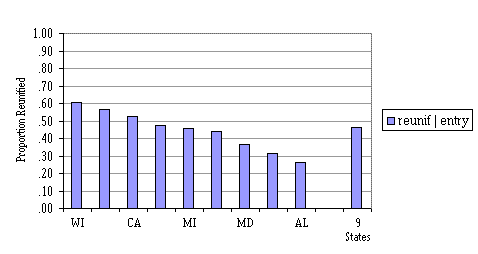
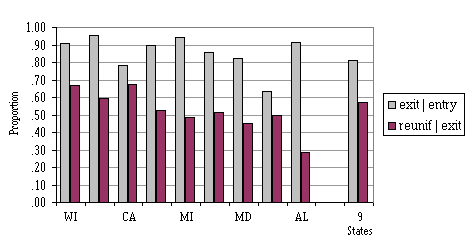
The proportions in Figure A.1 report the likelihood that a child or youth entering foster care between 1990 and 1994 exited before 1998 via reunification with their family.
One decomposition of the proportions in Figure A.1 is represented in Figure A.2, which presents the likelihood of any exit from care and the proportion of exits that are achieved via reunification. Mathematically, the likelihood of reunification is the product of these two separate proportions.
2. Ideally, we would also consider attributes of the family of origin, the parents (or other home caregivers), and the home environment; but this type of information is not generally available through child welfare tracking systems.
3. The analysis in later sections will focus almost exclusively on reunification rates (the likelihood of reunification among entrants). The focus on exit distribution in this section is to highlight the differences between children who are reunified and children who exit in other ways.
1.1 State Patterns of Exit From Foster Care
Individually, the nine states present very different patterns of exit distribution from foster care. Illinois and California had the largest proportion of children remaining in care, which meant that they had the greatest share of long duration foster spells. Over one-third of the spells in Illinois and one-fifth of the spells in California had not been completed by the end of 1997. By contrast, in five states (Alabama, Michigan, Missouri, New Mexico, and Wisconsin) only one tenth or fewer of all spells remained open in 1997. To the extent that reunification is related to the length-of-stay in foster care, this is a very significant dynamic to remember during this analysis.
Reunification levels differ by state -- from 28.7 percent of exits in Alabama to 67.2 percent in California and 66.7 percent in Wisconsin. In the other six states, 45-60 percent of all foster care exits were family reunification. This state-to-state variation in the use of reunification to end episodes of foster care placement is substantial. Alabama is a clear outlier, with far lower proportions of reunification exits than any of the other states, but the reunification levels among the remaining eight states still vary widely, from 45 percent to 67 percent of observed exits.
Exits to relatives also differ widely among states. Alabama and Maryland reported the most family discharges (31.6% and 20.4%), while California and Illinois each reported less than 3 percent family exits.4 This is a difficult category to interpret, because it represents differences in foster care practice and in state data definitions. The child welfare agencies in Alabama and Maryland tended to use strategies that supported kinship placements outside of the formal foster care system, while California, Illinois and New York placed a substantial number of foster children in kinship arrangements within the foster care system. When exit to relatives and reunification are combined into a single category of "family exits," the variation between states is somewhat smaller than it is for either exit type considered alone. In part, the higher level of exit to relatives helps to explain why the reunification levels in Alabama and Maryland are very low. It should also be noted that children in care in California, New York, and Illinois (but in kin placements) may be similar to the exits to relative placements elsewhere.
Michigan has the highest rate of completed adoption with almost one-fifth (.193) of foster care spells ending with adoptive placement. Exits by adoption were least common in Alabama and Wisconsin (.054 and.065).
Few children exit foster care because they reach majority (or "age out"), with Maryland showing the highest proportion at .059.
Illinois (.126) and New York (.099) have the highest rates of runaway exits.
Overall, "other" exits represent almost 15 percent of all foster care spell endings. These are particularly common in Alabama (.306) and Missouri (.224). In both cases, most of the "other" exits are to unknown destinations. It is possible that many of these undefined exits are by reunification, but that the exit reason coded in the data system was represented in some unidentifiable way (such as by a change in legal status).
4. Other evidence suggests that a large share of the exits coded as "other" in Illinois (17.8% of exits) may actually be relative exits.
1.2 Exit Destination by Child Characteristics
Age at entry is the age of the child at the time of their initial placement into this spell in care. Reunification levels are highest for children who enter the foster care spell between the ages of 3 and 11 years. Over two-thirds of the exits for these children are by reunification. Reunification is least likely for children who enter as infants (39% of exits for children entering under 3 months of age) or as adolescents (43% of children 15-17 years).
The youngest children are much more likely than others to leave foster care via adoption (40% of exits for children <3 months, 21% for children 3-11 months). For the 0-3 month entry group, more spells end through adoption than through reunification. Adoption becomes a far less likely outcome as the age at entry to foster care increases. Older entrants are far more likely to leave foster care via runaway, by reaching majority, or for "other" reasons.
Age at exit. This variable is the age of the child at the end of the spell in care. While the previous finding shows that the youngest children are least likely to exit by reunification, those young entrants who do exit quickly (and thus are still very young at exit) have very high rates of reunification and high rates of relative placement. This is partly because the large number of infants that move to the adoptive track tend to remain in care for several years, and are older by the time they exit. Adoption is most likely for children who leave care at age 3-5, almost one quarter (.248) of whom exit by adoption. Aging out of care and exiting by runaway occur only for foster children in their teens. That these exit types are age-limited, and are not available exit options for young children.
Gender. The relationship between gender and the type of exit from foster care is very weak. Boys are somewhat more likely to remain in care longer, and slightly more likely to be reunified. Girls are slightly more likely to reach majority in care, and somewhat more likely than boys to run away from substitute care arrangements.
Race/Ethnicity. Hispanic foster children who leave foster care are more likely to be reunified (.639) than children from the other groups, and are the least likely to exit to relative care or by adoption. African American children who exit are the least likely to be reunified (.506), while they are the most likely to exit to relative care or adoption. The exit patterns of white children in foster care fall between these extremes, with a reunification proportion (.604) somewhat closer to the Hispanics than to the African Americans. White children, however, are more likely to leave foster care without experiencing long-term stays before exit. Just over 10 percent of the white children who entered care in 1990-94 remained in care at the end of 1997, compared to 18 percent of Hispanic children and 27 percent of African American children.
1.3 Exit Destination by Case Characteristics
Spell sequence is defined by whether this is the first foster care experience for the child or a reentry spell in care. Children exiting from their first spell in foster care are more likely to be reunified than children who have already left care and then reentered (.583 vs. .479). Children exiting first spells are also more likely to exit to relative care (.073 vs. .057) and to be adopted from care (.123 vs. .075). Runaway and "other" exits are far more common for reentrants (.180 and .169) than for children experiencing a first spell in care (.055 and .138).
Duration of spell is the length of stay in a completed spell in care. By the design of this study population, all spells with duration of less than three years are completed, while approximately three-fifths of the spells with duration of three years or more are censored. The proportion of reunifications decreases as the length of stay in foster care increases. For all spells that exit in less than 18 months, over two-thirds end with family reunification. In contrast, of the completed spells that lasted over 3 years, less than one-quarter (.224) ended through reunification. Exits to relatives follow a similar pattern to reunification. Adoptive exits and exits by aging out are most likely from long spells in foster care. One implication of shorter spells showing high levels of reunification is that reunification tends to occur more quickly than other exits.
Placement type is defined by the of primary type of care experienced during a spell. A spell is classified as kinship care,5 congregate care (institution and group home), or nonrelative foster care if the child spent more than one-half of their days in care in that type of placement. If no care type was primary, then the spell is classified as being of "mixed" type. Among observed exits, children in kinship placements are the most likely to be reunified with their families (.632). This suggests that kinship care can in some cases work to maintain family ties during the period of removal from the home. This statistic must be interpreted cautiously, though, because children in kinship placement also tend to remain in care the longest, and were the least likely to exit at all within the study period.6 Only two-thirds of the kinship placement spells were completed, while 85 percent of children in nonrelative foster placements and 93 percent of children in congregate care facilities have observed exits. Children exiting congregate care spells were the least likely to reunify (.514), and the most likely to exit by runaway (.198) or "other" exit (.180). Children in nonrelative foster care were much more likely to be adopted (.164) than children in other placements.
Placement stability is defined by the number of different physical placements (and caregivers) a child experiences within a spell in care. Reunification is far more likely from a foster care spell that involves placement in only one home or facility. Two-thirds (.635) of the children who exited from a one-placement spell returned home upon exit. As the number of placements within a spell increases, the reunification rate decreases. A similar pattern applies to relative exits.
Adoptions are more common among children exiting spells with multiple placements. One explanation is that adoptive placements usually require some movement, as children on the adoptive track are often shifted into a pre-adoptive foster care arrangements.
5. Please note that kinship care is not tracked in Alabama, Michigan, and Wisconsin because it is not fully identifiable in their data systems. Kinship placements in these states are combined with nonrelative foster care. Fortunately, for these analyses, none of these states uses kinship placement with the frequency that Illinois, New York, and California do.
6. Looking at reunification as a proportion for all entries (rather than exits) illustrates the issue discussed here. During the period of observation, about 43 percent of children in kinship care were reunified, as compared to 48 percent of children in nonrelative foster care and congregate care. Therefore, while a higher proportion of exits from kin care were by reunification, a lower proportion of kinship care cases were observed to result in reunification.
1.4 Summary
Table IIA.1presented nine sets of two-way tables. Taken together, they demonstrate that there is systematic and substantial variability in the patterns of exit from foster care spells. Of all nine variables, only gender did not produce an important qualification about the use of reunification to end spells in foster care. Variables with particularly strong relationships were state, age at entry, and spell duration. Some of the more important relationships are portrayed graphically in Figure B.
Figure B
Proportion of Observations Exit from Foster Care, By Destination and Selected Characteristics 1990-1994. Entries Observed Through December 31, 1997. Nine States.
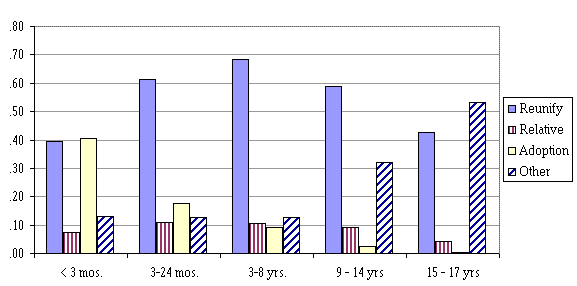
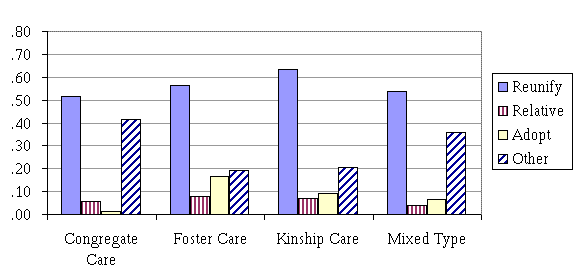
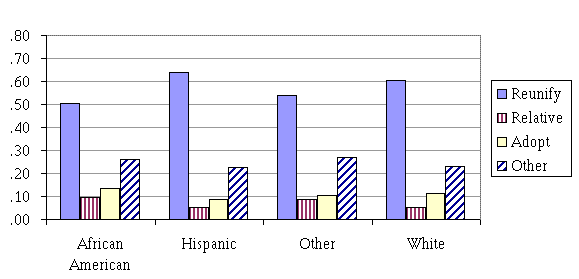
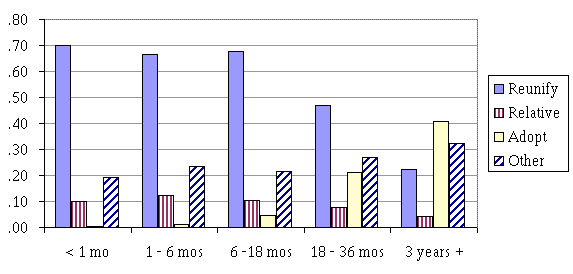
As observed by their relationships with the other variables, it appears that reunification exits and family exits are related -- in that they tend to occur commonly to the same type of children and in similar case situations. These observations suggest that we might consider them together as permanency solutions. This will be examined in a following section where they are combined into a single category termed "family exits."
However, these bivariate findings also pose questions. One issue is the high interrelation among the independent variables (multicollinearity). For example, placement stability is highly correlated with duration and with placement type. The relationships seen in the two-way tables between exit type and any of these variables might easily be caused by one of the other related predictors, by a combination of the predictors, or by another related factor that is not described. To address this issue of multicollinearity, multivariate analyses will be presented later in the report that use the predictor variables simultaneously.
Another issue is interpreting what a variable actually represents. For example, age at entry can capture many dimensions of a foster care case. The high level for adoption of infants is partially due to child characteristics (e.g., their attractiveness on the adoption market). But it is also true that the family situations that lead to the removal of infants also involve a large share of cases where terminating parental rights and initiating the adoptive process is thought to be necessary. These tables demonstrate that reunification is complex and multidimensional, and we see that interpretations should be made with care.
2. Timing of Foster Care Exits and Trends over Time
Exits from foster care are presented in this section in a format designed to encourage comparisons of the rates and the timing of foster care exit activity, both between states and across time. A series of 10 pages of tables, plus one summary, is employed.
Table IIB.1 Reunification Tracking Tables for Annual Entries to Foster Care
(Pooled information for all nine states combined)
| Year | A. Number of Exits in Interval(months) | Total Exits | Total Entries | |||||||
|---|---|---|---|---|---|---|---|---|---|---|
| 0 < 1 | 1 < 3 | 3 < 6 | 6 <12 | 12<18 | 18<24 | 25<36 | 36+ | |||
| 1990 | 9,506 | 8,979 | 6,671 | 8,831 | 6,748 | 5,086 | 6,598 | 14,019 | 66,438 | 74,162 |
|
1991 |
9,811 | 9,374 | 6,898 | 9,130 | 7,058 | 4,983 | 6,825 | 12,991 | 67,070 | 77,324 |
|
1992 |
9,801 | 8,861 | 6,685 | 9,673 | 7,229 | 5,143 | 6,951 | 10,896 | 65,239 | 78,580 |
|
1993 |
10,185 | 9,395 | 7,485 | 10,006 | 7,448 | 5,479 | 7,583 | 8,012 | 65,593 | 83,293 |
|
1994 |
10,464 | 9,823 | 7,753 | 11,017 | 8,074 | 6,061 | 8,146 | 3,539 | 64,877 | 91,057 |
|
1995 |
10,038 | 9,455 | 7,527 | 10,353 | 7,536 | 5,463 | 4,507 | 54,879 | 86,301 | |
|
1996 |
10,885 | 9,118 | 7,598 | 10,532 | 6,326 | 1,675 | 46,134 | 94,013 | ||
|
1997 |
9,874 | 7,461 | 4,629 | 2,948 | 24,912 | 90,013 | ||||
Notes: Observations in italic are partially censored by time limit of period of observation.
Observations in blank are fully censored (unobservable).
By calendar year in 7 states. By fiscal year in Maryland and New Mexico.
|
Year |
B. Number of Reunifications in Interval (months) | Total Reunifs | |||||||
|---|---|---|---|---|---|---|---|---|---|
| 0 < 1 | 1 < 3 | 3 < 6 | 6 <12 | 12<18 | 18<24 | 25<36 | 36+ | ||
|
1990 |
6,914 | 6,164 | 4,621 | 6,202 | 4,588 | 2,949 | 2,786 | 3,454 | 37,678 |
|
1991 |
6,932 | 6,237 | 4,603 | 6,234 | 4,687 | 2,803 | 2,839 | 2,924 | 37,259 |
|
1992 |
6,691 | 5,857 | 4,349 | 6,558 | 4,764 | 2,922 | 2,859 | 2,304 | 36,304 |
|
1993 |
7,109 | 6,152 | 4,941 | 6,837 | 4,896 | 3,047 | 2,945 | 1,673 | 37,600 |
|
1994 |
7,174 | 6,495 | 5,003 | 7,527 | 5,394 | 3,356 | 2,898 | 718 | 38,565 |
|
1995 |
6,707 | 6,062 | 4,885 | 6,807 | 4,845 | 2,735 | 1,517 | 33,558 | |
|
1996 |
7,003 | 5,300 | 4,568 | 6,337 | 3,633 | 759 | 27,600 | ||
|
1997 |
5,794 | 4,018 | 2,531 | 1,499 | 13,842 | ||||
Notes: Observations in italic are partially censored by time limit of period of observation.
Observations in blank are fully censored (unobservable).
By calendar year in 7 states. By fiscal year in Maryland and New Mexico.
|
Year |
C. Cumulative Proportion of Entrants Exiting By Month | |||||||
|---|---|---|---|---|---|---|---|---|
| <1 | <3 | <6 | <12 | <18 | <24 | <36 | 36+ | |
|
1990 |
0.128 | 0.249 | 0.339 | 0.458 | 0.549 | 0.618 | 0.707 | 0.896 |
|
1991 |
0.127 | 0.248 | 0.337 | 0.455 | 0.547 | 0.611 | 0.699 | 0.867 |
|
1992 |
0.125 | 0.237 | 0.323 | 0.446 | 0.538 | 0.603 | 0.692 | 0.830 |
|
1993 |
0.122 | 0.235 | 0.325 | 0.445 | 0.534 | 0.600 | 0.691 | 0.787 |
|
1994 |
0.115 | 0.223 | 0.308 | 0.429 | 0.518 | 0.584 | 0.674 | 0.712 |
|
1995 |
0.116 | 0.226 | 0.313 | 0.433 | 0.520 | 0.584 | 0.636 | |
|
1996 |
0.116 | 0.213 | 0.294 | 0.406 | 0.473 | 0.491 | ||
|
1997 |
0.110 | 0.193 | 0.244 | 0.277 | ||||
Notes: Observations in italic are partially censored by time limit of period of observation.
Observations in blank are fully censored (unobservable).
By calendar year in 7 states. By fiscal year in Maryland and New Mexico.
|
Year |
D. Cumulative Proportion of Entrants Reunifying By Month | |||||||
|---|---|---|---|---|---|---|---|---|
| <1 | <3 | <6 | <12 | <18 | <24 | <36 | 36+ | |
|
1990 |
0.093 | 0.176 | 0.239 | 0.322 | 0.384 | 0.424 | 0.461 | 0.508 |
|
1991 |
0.090 | 0.170 | 0.230 | 0.310 | 0.371 | 0.407 | 0.444 | 0.482 |
|
1992 |
0.085 | 0.160 | 0.215 | 0.298 | 0.359 | 0.396 | 0.433 | 0.462 |
|
1993 |
0.085 | 0.159 | 0.219 | 0.301 | 0.359 | 0.396 | 0.431 | 0.451 |
|
1994 |
0.079 | 0.150 | 0.205 | 0.288 | 0.347 | 0.384 | 0.416 | 0.424 |
|
1995 |
0.078 | 0.148 | 0.205 | 0.283 | 0.340 | 0.371 | 0.389 | |
|
1996 |
0.074 | 0.131 | 0.179 | 0.247 | 0.286 | 0.294 | ||
|
1997 |
0.064 | 0.109 | 0.137 | 0.154 | ||||
Notes: Observations in italic are partially censored by time limit of period of observation.
Observations in blank are fully censored (unobservable).
By calendar year in 7 states. By fiscal year in Maryland and New Mexico.
|
Year |
E. Average Monthly Exit Rate during interval | ||||||
|---|---|---|---|---|---|---|---|
| 0 < 1 | 1 < 3 | 3 < 6 | 6 <12 | 12<18 | 18<24 | 25<36 | |
|
1990 |
0.128 | 0.069 | 0.040 | 0.030 | 0.028 | 0.025 | 0.019 |
|
1991 |
0.127 | 0.069 | 0.040 | 0.030 | 0.028 | 0.024 | 0.019 |
|
1992 |
0.125 | 0.064 | 0.037 | 0.030 | 0.028 | 0.024 | 0.019 |
|
1993 |
0.122 | 0.064 | 0.039 | 0.030 | 0.027 | 0.024 | 0.019 |
|
1994 |
0.115 | 0.061 | 0.037 | 0.029 | 0.026 | 0.023 | 0.018 |
|
1995 |
0.116 | 0.062 | 0.038 | 0.029 | 0.026 | 0.022 | 0.010 |
|
1996 |
0.116 | 0.055 | 0.034 | 0.026 | 0.019 | 0.006 | |
|
1997 |
0.110 | 0.047 | 0.021 | 0.007 | |||
Notes: Observations in italic are partially censored by time limit of period of observation.
Observations in blank are fully censored (unobservable).
By calendar year in 7 states. By fiscal year in Maryland and New Mexico.
|
Year |
F. Average Monthly Reunification Rate During Interval | ||||||
|---|---|---|---|---|---|---|---|
| 0 < 1 | 1 < 3 | 3 < 6 | 6 <12 | 12<18 | 18<24 | 25<36 | |
|
1990 |
0.093 | 0.048 | 0.028 | 0.021 | 0.019 | 0.015 | 0.008 |
|
1991 |
0.090 | 0.046 | 0.026 | 0.020 | 0.019 | 0.013 | 0.008 |
|
1992 |
0.085 | 0.043 | 0.024 | 0.021 | 0.018 | 0.013 | 0.008 |
|
1993 |
0.085 | 0.042 | 0.026 | 0.020 | 0.018 | 0.013 | 0.007 |
|
1994 |
0.079 | 0.040 | 0.024 | 0.020 | 0.017 | 0.013 | 0.006 |
|
1995 |
0.078 | 0.040 | 0.024 | 0.019 | 0.017 | 0.011 | 0.004 |
|
1996 |
0.074 | 0.032 | 0.021 | 0.016 | 0.011 | 0.003 | |
|
1997 |
0.064 | 0.025 | 0.012 | 0.004 | |||
Notes: Observations in italic are partially censored by time limit of period of observation.
Observations in blank are fully censored (unobservable).
By calendar year in 7 states. By fiscal year in Maryland and New Mexico.
|
Year |
G. Reunifications as Proportion of Exits (Cumulative) | |||||||
|---|---|---|---|---|---|---|---|---|
| <1 | <3 | <6 | <12 | <18 | <24 | <36 | 36+ | |
|
1990 |
0.727 | 0.707 | 0.704 | 0.703 | 0.699 | 0.686 | 0.653 | 0.567 |
|
1991 |
0.707 | 0.686 | 0.681 | 0.682 | 0.679 | 0.667 | 0.635 | 0.556 |
|
1992 |
0.683 | 0.672 | 0.667 | 0.670 | 0.668 | 0.657 | 0.626 | 0.556 |
|
1993 |
0.698 | 0.677 | 0.673 | 0.675 | 0.672 | 0.660 | 0.624 | 0.573 |
|
1994 |
0.686 | 0.674 | 0.666 | 0.671 | 0.670 | 0.657 | 0.617 | 0.594 |
|
1995 |
0.668 | 0.655 | 0.653 | 0.655 | 0.653 | 0.636 | 0.611 | |
|
1996 |
0.643 | 0.615 | 0.611 | 0.609 | 0.604 | 0.598 | ||
|
1997 |
0.587 | 0.566 | 0.562 | 0.556 | ||||
Notes: Observations in italic are partially censored by time limit of period of observation.
Observations in blank are fully censored (unobservable).
By calendar year in 7 states. By fiscal year in Maryland and New Mexico.
Tables IIB.2 Reunification Tracking Tables, by State
(Tables with the same information for each state separately, plus a summary page).
|
Year |
Number of Exits in Interval | Total Exits | Total Entries | |||||||
|---|---|---|---|---|---|---|---|---|---|---|
| 0 < 1 | 1 < 3 | 3 < 6 | 6 <12 | 12<18 | 18<24 | 25<36 | 36+ | |||
|
1990 |
391 | 414 | 269 | 271 | 171 | 120 | 118 | 175 | 1,929 | 2,004 |
|
1991 |
433 | 392 | 269 | 268 | 147 | 90 | 107 | 155 | 1,861 | 1,960 |
|
1992 |
421 | 316 | 289 | 248 | 149 | 67 | 85 | 148 | 1,723 | 1,855 |
|
1993 |
295 | 377 | 195 | 248 | 126 | 65 | 102 | 79 | 1,487 | 1,692 |
|
1994 |
326 | 319 | 236 | 241 | 144 | 75 | 76 | 33 | 1,450 | 1,713 |
|
1995 |
286 | 301 | 164 | 213 | 98 | 84 | 58 | 1,204 | 1,582 | |
|
1996 |
337 | 322 | 264 | 305 | 95 | 17 | 1,340 | 2,107 | ||
|
1997 |
332 | 292 | 160 | 90 | 874 | 2,101 | ||||
Note: Observations in italic are partially censored by time limit of period of observation.
Observations in blank are fully censored (unobservable).
|
Year |
Number of Reunifications in Interval | Total Reunifs | |||||||
|---|---|---|---|---|---|---|---|---|---|
| 0 < 1 | 1 < 3 | 3 < 6 | 6 <12 | 12<18 | 18<24 | 25<36 | 36+ | ||
|
1990 |
180 | 135 | 100 | 73 | 31 | 23 | 17 | 19 | 578 |
|
1991 |
172 | 132 | 91 | 65 | 30 | 22 | 13 | 16 | 541 |
|
1992 |
171 | 84 | 72 | 73 | 31 | 9 | 13 | 12 | 465 |
|
1993 |
128 | 116 | 49 | 78 | 23 | 18 | 13 | 4 | 429 |
|
1994 |
94 | 109 | 73 | 61 | 38 | 21 | 11 | 3 | 410 |
|
1995 |
136 | 113 | 58 | 62 | 24 | 18 | 6 | 417 | |
|
1996 |
112 | 99 | 79 | 86 | 26 | 3 | 405 | ||
|
1997 |
111 | 97 | 46 | 14 | 268 | ||||
Note: Observations in italic are partially censored by time limit of period of observation.
Observations in blank are fully censored (unobservable).
|
Year |
Cumulative Proportion of Entrants Exiting By Month | |||||||
|---|---|---|---|---|---|---|---|---|
| <1 | <3 | <6 | <12 | <18 | <24 | <36 | 36+ | |
|
1990 |
0.195 | 0.402 | 0.536 | 0.671 | 0.756 | 0.816 | 0.875 | 0.963 |
|
1991 |
0.221 | 0.421 | 0.558 | 0.695 | 0.770 | 0.816 | 0.870 | 0.949 |
|
1992 |
0.227 | 0.397 | 0.553 | 0.687 | 0.767 | 0.803 | 0.849 | 0.929 |
|
1993 |
0.174 | 0.397 | 0.512 | 0.659 | 0.733 | 0.772 | 0.832 | 0.879 |
|
1994 |
0.190 | 0.377 | 0.514 | 0.655 | 0.739 | 0.783 | 0.827 | 0.846 |
|
1995 |
0.181 | 0.371 | 0.475 | 0.609 | 0.671 | 0.724 | 0.761 | |
|
1996 |
0.160 | 0.313 | 0.438 | 0.583 | 0.628 | 0.636 | ||
|
1997 |
0.158 | 0.297 | 0.373 | 0.416 | ||||
Note: Observations in italic are partially censored by time limit of period of observation.
Observations in blank are fully censored (unobservable).
|
Year |
Cumulative Proportion of Entrants Reunifying By Month | |||||||
|---|---|---|---|---|---|---|---|---|
| <1 | <3 | <6 | <12 | <18 | <24 | <36 | 36+ | |
|
1990 |
0.090 | 0.157 | 0.207 | 0.244 | 0.259 | 0.270 | 0.279 | 0.288 |
|
1991 |
0.088 | 0.155 | 0.202 | 0.235 | 0.250 | 0.261 | 0.268 | 0.276 |
|
1992 |
0.092 | 0.137 | 0.176 | 0.216 | 0.232 | 0.237 | 0.244 | 0.251 |
|
1993 |
0.076 | 0.144 | 0.173 | 0.219 | 0.233 | 0.243 | 0.251 | 0.254 |
|
1994 |
0.055 | 0.119 | 0.161 | 0.197 | 0.219 | 0.231 | 0.238 | 0.239 |
|
1995 |
0.086 | 0.157 | 0.194 | 0.233 | 0.248 | 0.260 | 0.264 | |
|
1996 |
0.053 | 0.100 | 0.138 | 0.178 | 0.191 | 0.192 | ||
|
1997 |
0.053 | 0.099 | 0.121 | 0.128 | ||||
Note: Observations in italic are partially censored by time limit of period of observation.
Observations in blank are fully censored (unobservable).
| Year | Average Monthly Exit Rate during interval | ||||||
|---|---|---|---|---|---|---|---|
| 0 < 1 | 1 < 3 | 3 < 6 | 6 <12 | 12<18 | 18<24 | 25<36 | |
| 1990 | 0.195 | 0.128 | 0.075 | 0.049 | 0.043 | 0.041 | 0.027 |
| 1991 | 0.221 | 0.128 | 0.079 | 0.052 | 0.041 | 0.033 | 0.025 |
| 1992 | 0.227 | 0.110 | 0.086 | 0.050 | 0.043 | 0.026 | 0.019 |
| 1993 | 0.174 | 0.135 | 0.064 | 0.050 | 0.036 | 0.024 | 0.022 |
| 1994 | 0.190 | 0.115 | 0.074 | 0.048 | 0.041 | 0.028 | 0.017 |
| 1995 | 0.181 | 0.116 | 0.055 | 0.043 | 0.026 | 0.027 | 0.011 |
| 1996 | 0.160 | 0.091 | 0.061 | 0.043 | 0.018 | 0.004 | |
| 1997 | 0.158 | 0.083 | 0.036 | 0.011 | |||
Note: Observations in italic are partially censored by time limit of period of observation.
Observations in blank are fully censored (unobservable).
| Year | Average Monthly Reunification Rate during interval | ||||||
|---|---|---|---|---|---|---|---|
| 0 < 1 | 1 < 3 | 3 < 6 | 6 <12 | 12<18 | 18<24 | 25<36 | |
| 1990 | 0.090 | 0.042 | 0.028 | 0.013 | 0.008 | 0.008 | 0.004 |
| 1991 | 0.088 | 0.043 | 0.027 | 0.013 | 0.008 | 0.008 | 0.003 |
| 1992 | 0.092 | 0.029 | 0.021 | 0.015 | 0.009 | 0.003 | 0.003 |
| 1993 | 0.076 | 0.042 | 0.016 | 0.016 | 0.007 | 0.007 | 0.003 |
| 1994 | 0.055 | 0.039 | 0.023 | 0.012 | 0.011 | 0.008 | 0.002 |
| 1995 | 0.086 | 0.044 | 0.019 | 0.012 | 0.006 | 0.006 | 0.001 |
| 1996 | 0.053 | 0.028 | 0.018 | 0.012 | 0.005 | 0.001 | |
| 1997 | 0.053 | 0.027 | 0.010 | 0.002 | |||
Note: Observations in italic are partially censored by time limit of period of observation.
Observations in blank are fully censored (unobservable).
| Year | Reunifications as Proportion of Exits (Cumulative) | |||||||
|---|---|---|---|---|---|---|---|---|
| <1 | <3 | <6 | <12 | <18 | <24 | <36 | 36+ | |
| 1990 | 0.460 | 0.391 | 0.386 | 0.363 | 0.342 | 0.331 | 0.319 | 0.300 |
| 1991 | 0.397 | 0.368 | 0.361 | 0.338 | 0.325 | 0.320 | 0.308 | 0.291 |
| 1992 | 0.406 | 0.346 | 0.319 | 0.314 | 0.303 | 0.295 | 0.288 | 0.270 |
| 1993 | 0.434 | 0.363 | 0.338 | 0.333 | 0.317 | 0.315 | 0.302 | 0.289 |
| 1994 | 0.288 | 0.315 | 0.313 | 0.300 | 0.296 | 0.295 | 0.287 | 0.283 |
| 1995 | 0.476 | 0.424 | 0.409 | 0.383 | 0.370 | 0.359 | 0.346 | |
| 1996 | 0.332 | 0.320 | 0.314 | 0.306 | 0.304 | 0.302 | ||
| 1997 | 0.334 | 0.333 | 0.324 | 0.307 | ||||
Note: Observations in italic are partially censored by time limit of period of observation.
Observations in blank are fully censored (unobservable).
| Year | Number of Exits in Interval | Total Exits | Total Entries | |||||||
|---|---|---|---|---|---|---|---|---|---|---|
| 0 < 1 | 1 < 3 | 3 < 6 | 6 <12 | 12<18 | 18<24 | 25<36 | 36+ | |||
| 1990 | 3,401 | 2,878 | 1,916 | 3,351 | 2,773 | 2,133 | 2,214 | 3,978 | 22,644 | 26,550 |
| 1991 | 3,364 | 3,062 | 2,063 | 3,298 | 2,647 | 1,962 | 2,181 | 3,449 | 22,026 | 26,373 |
| 1992 | 3,330 | 3,021 | 1,934 | 3,331 | 2,846 | 2,069 | 2,366 | 3,035 | 21,932 | 27,653 |
| 1993 | 3,643 | 3,309 | 2,443 | 3,596 | 3,019 | 2,190 | 2,572 | 2,303 | 23,075 | 30,313 |
| 1994 | 3,586 | 3,620 | 2,665 | 3,966 | 3,276 | 2,489 | 2,624 | 1,126 | 23,352 | 33,084 |
| 1995 | 3,476 | 3,304 | 2,540 | 3,581 | 2,898 | 2,002 | 1,614 | 19,415 | 32,572 | |
| 1996 | 3,397 | 2,634 | 2,271 | 3,172 | 2,390 | 752 | 14,616 | 35,474 | ||
| 1997 | 2,577 | 1,786 | 1,039 | 1,084 | 6,486 | 33,372 | ||||
Note: Observations in italic are partially censored by time limit of period of observation.
Observations in blank are fully censored (unobservable).
| Year | Number of Reunifications in Interval | ||||||||
|---|---|---|---|---|---|---|---|---|---|
| 0 < 1 | 1 < 3 | 3 < 6 | 6 <12 | 12<18 | 18<24 | 25<36 | 36+ | Total Reunifs | |
| 1990 | 2,997 | 2,483 | 1,568 | 2,686 | 2,067 | 1,242 | 778 | 1,070 | 14,891 |
| 1991 | 3,005 | 2,593 | 1,643 | 2,584 | 1,912 | 1,101 | 782 | 833 | 14,453 |
| 1992 | 2,917 | 2,570 | 1,534 | 2,580 | 2,116 | 1,259 | 916 | 659 | 14,551 |
| 1993 | 3,203 | 2,756 | 1,900 | 2,866 | 2,224 | 1,299 | 929 | 395 | 15,572 |
| 1994 | 3,153 | 3,049 | 2,108 | 3,179 | 2,475 | 1,537 | 817 | 125 | 16,443 |
| 1995 | 2,985 | 2,755 | 2,022 | 2,792 | 2,127 | 1,021 | 329 | 14,031 | |
| 1996 | 2,954 | 2,106 | 1,669 | 2,100 | 1,377 | 305 | 10,511 | ||
| 1997 | 2,128 | 1,384 | 699 | 581 | 4,792 | ||||
Note: Observations in italic are partially censored by time limit of period of observation.
Observations in blank are fully censored (unobservable).
| Year | Cumulative Proportion of Entrants Exiting By Month | |||||||
|---|---|---|---|---|---|---|---|---|
| <1 | <3 | <6 | <12 | <18 | <24 | <36 | 36+ | |
| 1990 | 0.128 | 0.236 | 0.309 | 0.435 | 0.539 | 0.620 | 0.703 | 0.853 |
| 1991 | 0.128 | 0.244 | 0.322 | 0.447 | 0.547 | 0.622 | 0.704 | 0.835 |
| 1992 | 0.120 | 0.230 | 0.300 | 0.420 | 0.523 | 0.598 | 0.683 | 0.793 |
| 1993 | 0.120 | 0.229 | 0.310 | 0.429 | 0.528 | 0.600 | 0.685 | 0.761 |
| 1994 | 0.108 | 0.218 | 0.298 | 0.418 | 0.517 | 0.592 | 0.672 | 0.706 |
| 1995 | 0.107 | 0.208 | 0.286 | 0.396 | 0.485 | 0.547 | 0.596 | |
| 1996 | 0.096 | 0.170 | 0.234 | 0.323 | 0.391 | 0.412 | ||
| 1997 | 0.077 | 0.131 | 0.162 | 0.194 | ||||
Note: Observations in italic are partially censored by time limit of period of observation.
Observations in blank are fully censored (unobservable).
| Year | Cumulative Proportion of Entrants Reunifying By Month | |||||||
|---|---|---|---|---|---|---|---|---|
| <1 | <3 | <6 | <12 | <18 | <24 | <36 | 36+ | |
| 1990 | 0.113 | 0.206 | 0.265 | 0.367 | 0.444 | 0.491 | 0.521 | 0.561 |
| 1991 | 0.114 | 0.212 | 0.275 | 0.373 | 0.445 | 0.487 | 0.516 | 0.548 |
| 1992 | 0.105 | 0.198 | 0.254 | 0.347 | 0.424 | 0.469 | 0.502 | 0.526 |
| 1993 | 0.106 | 0.197 | 0.259 | 0.354 | 0.427 | 0.470 | 0.501 | 0.514 |
| 1994 | 0.095 | 0.187 | 0.251 | 0.347 | 0.422 | 0.469 | 0.493 | 0.497 |
| 1995 | 0.092 | 0.176 | 0.238 | 0.324 | 0.389 | 0.421 | 0.431 | |
| 1996 | 0.083 | 0.143 | 0.190 | 0.249 | 0.288 | 0.296 | ||
| 1997 | 0.064 | 0.105 | 0.126 | 0.144 | ||||
Note: Observations in italic are partially censored by time limit of period of observation.
Observations in blank are fully censored (unobservable).
| Year | Average Monthly Exit Rate during interval | ||||||
|---|---|---|---|---|---|---|---|
| 0 < 1 | 1 < 3 | 3 < 6 | 6 <12 | 12<18 | 18<24 | 25<36 | |
| 1990 | 0.128 | 0.062 | 0.032 | 0.030 | 0.031 | 0.029 | 0.018 |
| 1991 | 0.128 | 0.067 | 0.034 | 0.031 | 0.030 | 0.027 | 0.018 |
| 1992 | 0.120 | 0.062 | 0.030 | 0.029 | 0.030 | 0.026 | 0.018 |
| 1993 | 0.120 | 0.062 | 0.035 | 0.029 | 0.029 | 0.026 | 0.018 |
| 1994 | 0.108 | 0.061 | 0.034 | 0.028 | 0.028 | 0.026 | 0.016 |
| 1995 | 0.107 | 0.057 | 0.033 | 0.026 | 0.025 | 0.020 | 0.009 |
| 1996 | 0.096 | 0.041 | 0.026 | 0.019 | 0.017 | 0.006 | |
| 1997 | 0.077 | 0.029 | 0.012 | 0.006 | |||
Note: Observations in italic are partially censored by time limit of period of observation.
Observations in blank are fully censored (unobservable).
|
Year |
Average Monthly Reunification Rate during interval | ||||||
|---|---|---|---|---|---|---|---|
| 0 < 1 | 1 < 3 | 3 < 6 | 6 <12 | 12<18 | 18<24 | 25<36 | |
|
c |
0.113 | 0.054 | 0.026 | 0.024 | 0.023 | 0.017 | 0.006 |
|
1991 |
0.114 | 0.056 | 0.027 | 0.024 | 0.022 | 0.015 | 0.007 |
|
1992 |
0.105 | 0.053 | 0.024 | 0.022 | 0.022 | 0.016 | 0.007 |
|
1993 |
0.106 | 0.052 | 0.027 | 0.023 | 0.021 | 0.015 | 0.006 |
|
1994 |
0.095 | 0.052 | 0.027 | 0.023 | 0.021 | 0.016 | 0.005 |
|
1995 |
0.092 | 0.047 | 0.026 | 0.020 | 0.018 | 0.010 | 0.002 |
|
1996 |
0.083 | 0.033 | 0.019 | 0.013 | 0.010 | 0.002 | |
|
1997 |
0.064 | 0.022 | 0.008 | 0.003 | |||
Note: Observations in italic are partially censored by time limit of period of observation.
Observations in blank are fully censored (unobservable).
| Year | Reunifications as Proportion of Exits (Cumulative) | |||||||
|---|---|---|---|---|---|---|---|---|
| <1 | <3 | <6 | <12 | <18 | <24 | <36 | 36+ | |
| 1990 | 0.881 | 0.873 | 0.860 | 0.843 | 0.824 | 0.793 | 0.740 | 0.658 |
| 1991 | 0.893 | 0.871 | 0.853 | 0.834 | 0.813 | 0.783 | 0.733 | 0.656 |
| 1992 | 0.876 | 0.864 | 0.847 | 0.827 | 0.810 | 0.785 | 0.735 | 0.663 |
| 1993 | 0.879 | 0.857 | 0.837 | 0.826 | 0.809 | 0.783 | 0.731 | 0.675 |
| 1994 | 0.879 | 0.861 | 0.842 | 0.830 | 0.816 | 0.791 | 0.734 | 0.704 |
| 1995 | 0.859 | 0.847 | 0.833 | 0.818 | 0.803 | 0.770 | 0.723 | |
| 1996 | 0.870 | 0.839 | 0.811 | 0.769 | 0.736 | 0.719 | ||
| 1997 | 0.826 | 0.805 | 0.780 | 0.739 | ||||
Note: Observations in italic are partially censored by time limit of period of observation.
Observations in blank are fully censored (unobservable).
| Year | Number of Exits in Interval | Total Exits | Total Entries | |||||||
|---|---|---|---|---|---|---|---|---|---|---|
| 0 < 1 | 1 < 3 | 3 < 6 | 6 <12 | 12<18 | 18<24 | 25<36 | 36+ | |||
| 1990 | 742 | 738 | 631 | 735 | 521 | 426 | 577 | 1,939 | 6,309 | 7,662 |
| 1991 | 736 | 809 | 638 | 946 | 671 | 447 | 638 | 2,465 | 7,350 | 10,146 |
| 1992 | 798 | 720 | 688 | 917 | 618 | 484 | 892 | 2,399 | 7,516 | 11,238 |
| 1993 | 744 | 695 | 617 | 867 | 722 | 592 | 1,090 | 1,791 | 7,118 | 11,935 |
| 1994 | 865 | 750 | 717 | 1,120 | 781 | 821 | 1,337 | 903 | 7,294 | 15,373 |
| 1995 | 822 | 788 | 747 | 1,074 | 760 | 715 | 802 | 5,708 | 13,129 | |
| 1996 | 741 | 767 | 622 | 967 | 582 | 161 | 3,840 | 12,077 | ||
| 1997 | 627 | 621 | 380 | 240 | 1,868 | 9,372 | ||||
Note: Observations in italic are partially censored by time limit of period of observation.
Observations in blank are fully censored (unobservable).
| Year | Number of Reunifications in Interval | Total Reunifs | |||||||
|---|---|---|---|---|---|---|---|---|---|
| 0 < 1 | 1 < 3 | 3 < 6 | 6 <12 | 12<18 | 18<24 | 25<36 | 36+ | ||
| 1990 | 534 | 552 | 492 | 515 | 361 | 255 | 239 | 292 | 3,240 |
| 1991 | 488 | 548 | 460 | 654 | 432 | 255 | 263 | 387 | 3,487 |
| 1992 | 445 | 454 | 518 | 615 | 361 | 266 | 381 | 473 | 3,513 |
| 1993 | 431 | 456 | 407 | 523 | 456 | 320 | 447 | 435 | 3,475 |
| 1994 | 510 | 477 | 488 | 724 | 466 | 454 | 577 | 250 | 3,946 |
| 1995 | 470 | 459 | 480 | 646 | 468 | 421 | 393 | 3,337 | |
| 1996 | 406 | 458 | 366 | 619 | 384 | 88 | 2,321 | ||
| 1997 | 334 | 359 | 222 | 159 | 1,074 | ||||
Note: Observations in italic are partially censored by time limit of period of observation.
Observations in blank are fully censored (unobservable).
| Year | Cumulative Proportion of Entrants Exiting By Month | |||||||
|---|---|---|---|---|---|---|---|---|
| <1 | <3 | <6 | <12 | <18 | <24 | <36 | 36+ | |
| 1990 | 0.097 | 0.193 | 0.276 | 0.371 | 0.439 | 0.495 | 0.570 | 0.823 |
| 1991 | 0.073 | 0.152 | 0.215 | 0.308 | 0.375 | 0.419 | 0.481 | 0.724 |
| 1992 | 0.071 | 0.135 | 0.196 | 0.278 | 0.333 | 0.376 | 0.455 | 0.669 |
| 1993 | 0.062 | 0.121 | 0.172 | 0.245 | 0.305 | 0.355 | 0.446 | 0.596 |
| 1994 | 0.056 | 0.105 | 0.152 | 0.225 | 0.275 | 0.329 | 0.416 | 0.474 |
| 1995 | 0.063 | 0.123 | 0.180 | 0.261 | 0.319 | 0.374 | 0.435 | |
| 1996 | 0.061 | 0.125 | 0.176 | 0.256 | 0.305 | 0.318 | ||
| 1997 | 0.067 | 0.133 | 0.174 | 0.199 | ||||
Note: Observations in italic are partially censored by time limit of period of observation.
Observations in blank are fully censored (unobservable).
|
Year |
Cumulative Proportion of Entrants Reunifying By Month | |||||||
|---|---|---|---|---|---|---|---|---|
| <1 | <3 | <6 | <12 | <18 | <24 | <36 | 36+ | |
|
1990 |
0.070 | 0.142 | 0.206 | 0.273 | 0.320 | 0.354 | 0.385 | 0.423 |
|
1991 |
0.048 | 0.102 | 0.147 | 0.212 | 0.254 | 0.280 | 0.306 | 0.344 |
|
1992 |
0.040 | 0.080 | 0.126 | 0.181 | 0.213 | 0.237 | 0.271 | 0.313 |
|
1993 |
0.036 | 0.074 | 0.108 | 0.152 | 0.190 | 0.217 | 0.255 | 0.291 |
|
1994 |
0.033 | 0.064 | 0.096 | 0.143 | 0.173 | 0.203 | 0.240 | 0.257 |
|
1995 |
0.036 | 0.071 | 0.107 | 0.157 | 0.192 | 0.224 | 0.254 | |
|
1996 |
0.034 | 0.072 | 0.102 | 0.153 | 0.185 | 0.192 | ||
|
1997 |
0.036 | 0.074 | 0.098 | 0.115 | ||||
Note: Observations in italic are partially censored by time limit of period of observation.
Observations in blank are fully censored (unobservable).
| Year | Average Monthly Exit Rate during interval | ||||||
|---|---|---|---|---|---|---|---|
| 0 < 1 | 1 < 3 | 3 < 6 | 6 <12 | 12<18 | 18<24 | 25<36 | |
| 1990 | 0.097 | 0.053 | 0.034 | 0.022 | 0.018 | 0.017 | 0.012 |
| 1991 | 0.073 | 0.043 | 0.025 | 0.020 | 0.016 | 0.012 | 0.009 |
| 1992 | 0.071 | 0.034 | 0.024 | 0.017 | 0.013 | 0.011 | 0.011 |
| 1993 | 0.062 | 0.031 | 0.020 | 0.015 | 0.013 | 0.012 | 0.012 |
| 1994 | 0.056 | 0.026 | 0.017 | 0.014 | 0.011 | 0.012 | 0.011 |
| 1995 | 0.063 | 0.032 | 0.022 | 0.017 | 0.013 | 0.013 | 0.008 |
| 1996 | 0.061 | 0.034 | 0.020 | 0.016 | 0.011 | 0.003 | |
| 1997 | 0.067 | 0.036 | 0.016 | 0.005 | |||
Note: Observations in italic are partially censored by time limit of period of observation.
Observations in blank are fully censored (unobservable).
| Year | Average Monthly Reunification Rate during interval | ||||||
|---|---|---|---|---|---|---|---|
| 0 < 1 | 1 < 3 | 3 < 6 | 6 <12 | 12<18 | 18<24 | 25<36 | |
| 1990 | 0.070 | 0.040 | 0.027 | 0.015 | 0.012 | 0.010 | 0.005 |
| 1991 | 0.048 | 0.029 | 0.018 | 0.014 | 0.010 | 0.007 | 0.004 |
| 1992 | 0.040 | 0.022 | 0.018 | 0.011 | 0.007 | 0.006 | 0.005 |
| 1993 | 0.036 | 0.020 | 0.013 | 0.009 | 0.008 | 0.006 | 0.005 |
| 1994 | 0.033 | 0.016 | 0.012 | 0.009 | 0.007 | 0.007 | 0.005 |
| 1995 | 0.036 | 0.019 | 0.014 | 0.010 | 0.008 | 0.008 | 0.004 |
| 1996 | 0.034 | 0.020 | 0.012 | 0.010 | 0.007 | 0.002 | |
| 1997 | 0.036 | 0.021 | 0.009 | 0.003 | |||
Note: Observations in italic are partially censored by time limit of period of observation.
Observations in blank are fully censored (unobservable).
| Year | Reunifications as Proportion of Exits (Cumulative) | |||||||
|---|---|---|---|---|---|---|---|---|
| <1 | <3 | <6 | <12 | <18 | <24 | <36 | 36+ | |
| 1990 | 0.720 | 0.734 | 0.748 | 0.735 | 0.729 | 0.714 | 0.675 | 0.514 |
| 1991 | 0.663 | 0.671 | 0.685 | 0.687 | 0.679 | 0.668 | 0.635 | 0.474 |
| 1992 | 0.558 | 0.592 | 0.642 | 0.651 | 0.640 | 0.629 | 0.594 | 0.467 |
| 1993 | 0.579 | 0.616 | 0.629 | 0.622 | 0.624 | 0.612 | 0.571 | 0.488 |
| 1994 | 0.590 | 0.611 | 0.633 | 0.637 | 0.630 | 0.617 | 0.578 | 0.541 |
| 1995 | 0.572 | 0.577 | 0.598 | 0.599 | 0.602 | 0.600 | 0.585 | |
| 1996 | 0.548 | 0.573 | 0.577 | 0.597 | 0.607 | 0.604 | ||
| 1997 | 0.533 | 0.555 | 0.562 | 0.575 | ||||
Note: Observations in italic are partially censored by time limit of period of observation.
Observations in blank are fully censored (unobservable).
| Year | Number of Exits in Interval | Total Exits | Total Entries | |||||||
|---|---|---|---|---|---|---|---|---|---|---|
| 0 < 1 | 1 < 3 | 3 < 6 | 6 <12 | 12<18 | 18<24 | 25<36 | 36+ | |||
| 1990 | 388 | 389 | 223 | 220 | 183 | 139 | 239 | 465 | 2,246 | 2,454 |
| 1991 | 408 | 493 | 261 | 235 | 221 | 152 | 255 | 390 | 2,415 | 2,707 |
| 1992 | 340 | 396 | 205 | 285 | 229 | 176 | 255 | 406 | 2,292 | 2,742 |
| 1993 | 321 | 414 | 202 | 278 | 199 | 159 | 255 | 320 | 2,148 | 2,736 |
| 1994 | 440 | 474 | 249 | 343 | 232 | 190 | 324 | 138 | 2,390 | 3,364 |
| 1995 | 336 | 398 | 224 | 300 | 249 | 225 | 156 | 1,888 | 3,123 | |
| 1996 | 437 | 433 | 236 | 299 | 196 | 59 | 1,660 | 3,103 | ||
| 1997 | 445 | 379 | 163 | 90 | 1,077 | 3,182 | ||||
Note: Observations in italic are partially censored by time limit of period of observation.
Observations in blank are fully censored (unobservable).
| Year | Number of Reunifications in Interval | ||||||||
|---|---|---|---|---|---|---|---|---|---|
| 0 < 1 | 1 < 3 | 3 < 6 | 6 <12 | 12<18 | 18<24 | 25<36 | 36+ | Total Reunifs | |
| 1990 | 220 | 227 | 119 | 104 | 87 | 57 | 74 | 89 | 977 |
| 1991 | 242 | 303 | 149 | 118 | 89 | 65 | 83 | 70 | 1,119 |
| 1992 | 192 | 226 | 98 | 138 | 98 | 57 | 72 | 68 | 949 |
| 1993 | 172 | 248 | 133 | 145 | 101 | 54 | 74 | 44 | 971 |
| 1994 | 265 | 262 | 124 | 166 | 103 | 82 | 102 | 35 | 1,139 |
| 1995 | 166 | 205 | 113 | 138 | 123 | 108 | 50 | 903 | |
| 1996 | 227 | 209 | 116 | 150 | 91 | 26 | 819 | ||
| 1997 | 192 | 190 | 80 | 38 | 500 | ||||
Note: Observations in italic are partially censored by time limit of period of observation.
Observations in blank are fully censored (unobservable).
| Year | Cumulative Proportion of Entrants Exiting By Month | |||||||
|---|---|---|---|---|---|---|---|---|
| <1 | <3 | <6 | <12 | <18 | <24 | <36 | 36+ | |
| 1990 | 0.158 | 0.317 | 0.407 | 0.497 | 0.572 | 0.628 | 0.726 | 0.915 |
| 1991 | 0.151 | 0.333 | 0.429 | 0.516 | 0.598 | 0.654 | 0.748 | 0.892 |
| 1992 | 0.124 | 0.268 | 0.343 | 0.447 | 0.531 | 0.595 | 0.688 | 0.836 |
| 1993 | 0.117 | 0.269 | 0.342 | 0.444 | 0.517 | 0.575 | 0.668 | 0.785 |
| 1994 | 0.131 | 0.272 | 0.346 | 0.448 | 0.517 | 0.573 | 0.669 | 0.710 |
| 1995 | 0.108 | 0.235 | 0.307 | 0.403 | 0.483 | 0.555 | 0.605 | |
| 1996 | 0.141 | 0.280 | 0.356 | 0.453 | 0.516 | 0.535 | ||
| 1997 | 0.140 | 0.259 | 0.310 | 0.338 | ||||
Note: Observations in italic are partially censored by time limit of period of observation.
Observations in blank are fully censored (unobservable).
| Year | Cumulative Proportion of Entrants Reunifying By Month | |||||||
|---|---|---|---|---|---|---|---|---|
| <1 | <3 | <6 | <12 | <18 | <24 | <36 | 36+ | |
| 1990 | 0.090 | 0.182 | 0.231 | 0.273 | 0.308 | 0.332 | 0.362 | 0.398 |
| 1991 | 0.089 | 0.201 | 0.256 | 0.300 | 0.333 | 0.357 | 0.388 | 0.413 |
| 1992 | 0.070 | 0.152 | 0.188 | 0.239 | 0.274 | 0.295 | 0.321 | 0.346 |
| 1993 | 0.063 | 0.154 | 0.202 | 0.255 | 0.292 | 0.312 | 0.339 | 0.355 |
| 1994 | 0.079 | 0.157 | 0.194 | 0.243 | 0.273 | 0.298 | 0.328 | 0.339 |
| 1995 | 0.053 | 0.119 | 0.155 | 0.199 | 0.239 | 0.273 | 0.289 | |
| 1996 | 0.073 | 0.141 | 0.178 | 0.226 | 0.256 | 0.264 | ||
| 1997 | 0.060 | 0.120 | 0.145 | 0.157 | ||||
Note: Observations in italic are partially censored by time limit of period of observation.
Observations in blank are fully censored (unobservable).
| Year | Average Monthly Exit Rate during interval | ||||||
|---|---|---|---|---|---|---|---|
| 0 < 1 | 1 < 3 | 3 < 6 | 6 <12 | 12<18 | 18<24 | 25<36 | |
| 1990 | 0.158 | 0.094 | 0.044 | 0.025 | 0.025 | 0.022 | 0.022 |
| 1991 | 0.151 | 0.107 | 0.048 | 0.025 | 0.028 | 0.023 | 0.023 |
| 1992 | 0.124 | 0.082 | 0.034 | 0.026 | 0.025 | 0.023 | 0.019 |
| 1993 | 0.117 | 0.086 | 0.034 | 0.026 | 0.022 | 0.020 | 0.018 |
| 1994 | 0.131 | 0.081 | 0.034 | 0.026 | 0.021 | 0.019 | 0.019 |
| 1995 | 0.108 | 0.071 | 0.031 | 0.023 | 0.022 | 0.023 | 0.009 |
| 1996 | 0.141 | 0.081 | 0.035 | 0.025 | 0.019 | 0.007 | |
| 1997 | 0.140 | 0.069 | 0.023 | 0.007 | |||
Note: Observations in italic are partially censored by time limit of period of observation.
Observations in blank are fully censored (unobservable).
|
Year |
Average Monthly Reunification Rate during interval | ||||||
|---|---|---|---|---|---|---|---|
| 0 < 1 | 1 < 3 | 3 < 6 | 6 <12 | 12<18 | 18<24 | 25<36 | |
|
1990 |
0.090 | 0.055 | 0.024 | 0.012 | 0.012 | 0.009 | 0.007 |
|
1991 |
0.089 | 0.066 | 0.028 | 0.013 | 0.011 | 0.010 | 0.007 |
|
1992 |
0.070 | 0.047 | 0.016 | 0.013 | 0.011 | 0.007 | 0.005 |
|
1993 |
0.063 | 0.051 | 0.022 | 0.013 | 0.011 | 0.007 | 0.005 |
|
1994 |
0.079 | 0.045 | 0.017 | 0.013 | 0.009 | 0.008 | 0.006 |
|
1995 |
0.053 | 0.037 | 0.016 | 0.011 | 0.011 | 0.011 | 0.003 |
|
1996 |
0.073 | 0.039 | 0.017 | 0.013 | 0.009 | 0.003 | |
|
1997 |
0.060 | 0.035 | 0.011 | 0.003 | |||
Note: Observations in italic are partially censored by time limit of period of observation.
Observations in blank are fully censored (unobservable).
|
Year |
Reunifications as Proportion of Exits (Cumulative) | |||||||
|---|---|---|---|---|---|---|---|---|
| <1 | <3 | <6 | <12 | <18 | <24 | <36 | 36+ | |
|
1990 |
0.567 | 0.575 | 0.566 | 0.549 | 0.540 | 0.528 | 0.499 | 0.435 |
|
1991 |
0.593 | 0.605 | 0.597 | 0.581 | 0.557 | 0.546 | 0.518 | 0.463 |
|
1992 |
0.565 | 0.568 | 0.548 | 0.533 | 0.517 | 0.496 | 0.467 | 0.414 |
|
1993 |
0.536 | 0.571 | 0.590 | 0.574 | 0.565 | 0.542 | 0.507 | 0.452 |
|
1994 |
0.602 | 0.577 | 0.560 | 0.542 | 0.529 | 0.520 | 0.490 | 0.477 |
|
1995 |
0.494 | 0.505 | 0.505 | 0.494 | 0.494 | 0.492 | 0.478 | |
|
1996 |
0.519 | 0.501 | 0.499 | 0.500 | 0.495 | 0.493 | ||
|
1997 |
0.431 | 0.464 | 0.468 | 0.464 | ||||
Note: Observations in italic are partially censored by time limit of period of observation.
Observations in blank are fully censored (unobservable).
| Year | Number of Exits in Interval | Total Exits | Total Entries | |||||||
|---|---|---|---|---|---|---|---|---|---|---|
| 0 < 1 | 1 < 3 | 3 < 6 | 6 <12 | 12<18 | 18<24 | 25<36 | 36+ | |||
| 1990 | 566 | 799 | 645 | 840 | 660 | 467 | 734 | 941 | 5,652 | 5,776 |
| 1991 | 686 | 867 | 688 | 878 | 752 | 548 | 793 | 952 | 6,164 | 6,333 |
| 1992 | 664 | 755 | 659 | 924 | 688 | 483 | 732 | 815 | 5,720 | 5,956 |
| 1993 | 738 | 782 | 698 | 930 | 628 | 527 | 944 | 748 | 5,995 | 6,405 |
| 1994 | 802 | 867 | 679 | 1,036 | 813 | 681 | 1,087 | 291 | 6,256 | 7,067 |
| 1995 | 744 | 932 | 790 | 1,055 | 833 | 739 | 515 | 5,608 | 7,074 | |
| 1996 | 854 | 985 | 800 | 1,199 | 697 | 206 | 4,741 | 7,733 | ||
| 1997 | 924 | 1,024 | 699 | 365 | 3,012 | 8,820 | ||||
Note: Observations in italic are partially censored by time limit of period of observation.
Observations in blank are fully censored (unobservable).
| Year | Number of Reunifications in Interval | Total Reunifs | |||||||
|---|---|---|---|---|---|---|---|---|---|
| 0 < 1 | 1 < 3 | 3 < 6 | 6 <12 | 12<18 | 18<24 | 25<36 | 36+ | ||
| 1990 | 326 | 445 | 415 | 606 | 404 | 235 | 258 | 171 | 2,860 |
| 1991 | 393 | 492 | 440 | 596 | 460 | 269 | 211 | 155 | 3,016 |
| 1992 | 342 | 420 | 414 | 626 | 398 | 223 | 208 | 125 | 2,756 |
| 1993 | 404 | 419 | 432 | 599 | 326 | 209 | 268 | 122 | 2,779 |
| 1994 | 434 | 472 | 369 | 635 | 488 | 303 | 284 | 46 | 3,031 |
| 1995 | 415 | 484 | 467 | 635 | 427 | 276 | 144 | 2,848 | |
| 1996 | 395 | 457 | 407 | 627 | 373 | 85 | 2,344 | ||
| 1997 | 315 | 392 | 294 | 144 | 1,145 | ||||
Note: Observations in italic are partially censored by time limit of period of observation.
Observations in blank are fully censored (unobservable).
| Year | Cumulative Proportion of Entrants Exiting By Month | |||||||
|---|---|---|---|---|---|---|---|---|
| <1 | <3 | <6 | <12 | <18 | <24 | <36 | 36+ | |
| 1990 | 0.098 | 0.236 | 0.348 | 0.493 | 0.608 | 0.689 | 0.816 | 0.979 |
| 1991 | 0.108 | 0.245 | 0.354 | 0.492 | 0.611 | 0.698 | 0.823 | 0.973 |
| 1992 | 0.111 | 0.238 | 0.349 | 0.504 | 0.620 | 0.701 | 0.824 | 0.960 |
| 1993 | 0.115 | 0.237 | 0.346 | 0.491 | 0.590 | 0.672 | 0.819 | 0.936 |
| 1994 | 0.113 | 0.236 | 0.332 | 0.479 | 0.594 | 0.690 | 0.844 | 0.885 |
| 1995 | 0.105 | 0.237 | 0.349 | 0.498 | 0.615 | 0.720 | 0.793 | |
| 1996 | 0.110 | 0.238 | 0.341 | 0.496 | 0.586 | 0.613 | ||
| 1997 | 0.105 | 0.221 | 0.300 | 0.341 | ||||
Note: Observations in italic are partially censored by time limit of period of observation.
Observations in blank are fully censored (unobservable).
| Year | Cumulative Proportion of Entrants Reunifying By Month | |||||||
|---|---|---|---|---|---|---|---|---|
| <1 | <3 | <6 | <12 | <18 | <24 | <36 | 36+ | |
| 1990 | 0.056 | 0.133 | 0.205 | 0.310 | 0.380 | 0.421 | 0.466 | 0.495 |
| 1991 | 0.062 | 0.140 | 0.209 | 0.303 | 0.376 | 0.418 | 0.452 | 0.476 |
| 1992 | 0.057 | 0.128 | 0.197 | 0.303 | 0.369 | 0.407 | 0.442 | 0.463 |
| 1993 | 0.063 | 0.128 | 0.196 | 0.289 | 0.340 | 0.373 | 0.415 | 0.434 |
| 1994 | 0.061 | 0.128 | 0.180 | 0.270 | 0.339 | 0.382 | 0.422 | 0.429 |
| 1995 | 0.059 | 0.127 | 0.193 | 0.283 | 0.343 | 0.382 | 0.403 | |
| 1996 | 0.051 | 0.110 | 0.163 | 0.244 | 0.292 | 0.303 | ||
| 1997 | 0.036 | 0.080 | 0.113 | 0.130 | ||||
Note: Observations in italic are partially censored by time limit of period of observation.
Observations in blank are fully censored (unobservable).
| Year | Average Monthly Exit Rate during interval | ||||||
|---|---|---|---|---|---|---|---|
| 0 < 1 | 1 < 3 | 3 < 6 | 6 <12 | 12<18 | 18<24 | 25<36 | |
| 1990 | 0.098 | 0.077 | 0.049 | 0.037 | 0.038 | 0.034 | 0.034 |
| 1991 | 0.108 | 0.077 | 0.048 | 0.036 | 0.039 | 0.037 | 0.035 |
| 1992 | 0.111 | 0.071 | 0.048 | 0.040 | 0.039 | 0.036 | 0.034 |
| 1993 | 0.115 | 0.069 | 0.048 | 0.037 | 0.032 | 0.033 | 0.037 |
| 1994 | 0.113 | 0.069 | 0.042 | 0.037 | 0.037 | 0.040 | 0.041 |
| 1995 | 0.105 | 0.074 | 0.049 | 0.038 | 0.039 | 0.045 | 0.022 |
| 1996 | 0.110 | 0.072 | 0.045 | 0.039 | 0.030 | 0.011 | |
| 1997 | 0.105 | 0.065 | 0.034 | 0.010 | |||
Note: Observations in italic are partially censored by time limit of period of observation.
Observations in blank are fully censored (unobservable).
|
Year |
Average Monthly Reunification Rate during interval | ||||||
|---|---|---|---|---|---|---|---|
| 0 < 1 | 1 < 3 | 3 < 6 | 6 <12 | 12<18 | 18<24 | 25<36 | |
| 1990 | 0.056 | 0.043 | 0.031 | 0.027 | 0.023 | 0.017 | 0.012 |
| 1991 | 0.062 | 0.044 | 0.031 | 0.024 | 0.024 | 0.018 | 0.009 |
| 1992 | 0.057 | 0.040 | 0.030 | 0.027 | 0.022 | 0.016 | 0.010 |
| 1993 | 0.063 | 0.037 | 0.029 | 0.024 | 0.017 | 0.013 | 0.011 |
| 1994 | 0.061 | 0.038 | 0.023 | 0.022 | 0.022 | 0.018 | 0.011 |
| 1995 | 0.059 | 0.038 | 0.029 | 0.023 | 0.020 | 0.017 | 0.006 |
| 1996 | 0.051 | 0.033 | 0.023 | 0.021 | 0.016 | 0.004 | |
| 1997 | 0.036 | 0.025 | 0.014 | 0.004 | |||
Note: Observations in italic are partially censored by time limit of period of observation.
Observations in blank are fully censored (unobservable).
| Year | Reunifications as Proportion of Exits (Cumulative) | |||||||
|---|---|---|---|---|---|---|---|---|
| <1 | <3 | <6 | <12 | <18 | <24 | <36 | 36+ | |
| 1990 | 0.576 | 0.565 | 0.590 | 0.629 | 0.626 | 0.611 | 0.571 | 0.506 |
| 1991 | 0.573 | 0.570 | 0.591 | 0.616 | 0.615 | 0.600 | 0.549 | 0.489 |
| 1992 | 0.515 | 0.537 | 0.566 | 0.600 | 0.596 | 0.581 | 0.536 | 0.482 |
| 1993 | 0.547 | 0.541 | 0.566 | 0.589 | 0.577 | 0.555 | 0.506 | 0.464 |
| 1994 | 0.541 | 0.543 | 0.543 | 0.564 | 0.571 | 0.554 | 0.500 | 0.484 |
| 1995 | 0.558 | 0.536 | 0.554 | 0.568 | 0.558 | 0.531 | 0.508 | |
| 1996 | 0.463 | 0.463 | 0.477 | 0.491 | 0.498 | 0.494 | ||
| 1997 | 0.341 | 0.363 | 0.378 | 0.380 | ||||
Note: Observations in italic are partially censored by time limit of period of observation.
Observations in blank are fully censored (unobservable).
| Year | Number of Exits in Interval | Total Exits | Total Entries | |||||||
|---|---|---|---|---|---|---|---|---|---|---|
| 0 < 1 | 1 < 3 | 3 < 6 | 6 <12 | 12<18 | 18<24 | 25<36 | 36+ | |||
| 1990 | 651 | 738 | 393 | 467 | 339 | 197 | 297 | 542 | 3,624 | 3,780 |
| 1991 | 685 | 764 | 507 | 492 | 357 | 247 | 379 | 640 | 4,071 | 4,332 |
| 1992 | 862 | 796 | 455 | 608 | 405 | 290 | 403 | 489 | 4,308 | 4,647 |
| 1993 | 800 | 737 | 536 | 670 | 429 | 300 | 396 | 391 | 4,259 | 4,850 |
| 1994 | 774 | 702 | 517 | 619 | 445 | 319 | 527 | 149 | 4,052 | 5,020 |
| 1995 | 827 | 725 | 524 | 653 | 494 | 330 | 240 | 3,793 | 5,096 | |
| 1996 | 939 | 709 | 536 | 684 | 407 | 81 | 3,356 | 5,708 | ||
| 1997 | 832 | 535 | 343 | 179 | 1,889 | 5,661 | ||||
Note: Observations in italic are partially censored by time limit of period of observation.
Observations in blank are fully censored (unobservable).
| Year | Number of Reunifications in Interval | Total Reunifs | |||||||
|---|---|---|---|---|---|---|---|---|---|
| 0 < 1 | 1 < 3 | 3 < 6 | 6 <12 | 12<18 | 18<24 | 25<36 | 36+ | ||
| 1990 | 414 | 447 | 228 | 244 | 187 | 102 | 115 | 108 | 1,845 |
| 1991 | 446 | 427 | 319 | 273 | 179 | 122 | 158 | 156 | 2,080 |
| 1992 | 558 | 472 | 260 | 334 | 230 | 138 | 177 | 100 | 2,269 |
| 1993 | 546 | 422 | 310 | 406 | 258 | 149 | 159 | 90 | 2,340 |
| 1994 | 482 | 407 | 305 | 373 | 261 | 170 | 170 | 30 | 2,198 |
| 1995 | 538 | 406 | 308 | 382 | 293 | 134 | 66 | 2,127 | |
| 1996 | 577 | 404 | 327 | 331 | 171 | 37 | 1,847 | ||
| 1997 | 373 | 179 | 147 | 67 | 766 | ||||
Note: Observations in italic are partially censored by time limit of period of observation.
Observations in blank are fully censored (unobservable).
| Year | Cumulative Proportion of Entrants Exiting By Month | |||||||
|---|---|---|---|---|---|---|---|---|
| <1 | <3 | <6 | <12 | <18 | <24 | <36 | 36+ | |
| 1990 | 0.172 | 0.367 | 0.471 | 0.595 | 0.685 | 0.737 | 0.815 | 0.959 |
| 1991 | 0.158 | 0.334 | 0.452 | 0.565 | 0.648 | 0.705 | 0.792 | 0.940 |
| 1992 | 0.185 | 0.357 | 0.455 | 0.586 | 0.673 | 0.735 | 0.822 | 0.927 |
| 1993 | 0.165 | 0.317 | 0.427 | 0.566 | 0.654 | 0.716 | 0.798 | 0.878 |
| 1994 | 0.154 | 0.294 | 0.397 | 0.520 | 0.609 | 0.673 | 0.777 | 0.807 |
| 1995 | 0.162 | 0.305 | 0.407 | 0.536 | 0.632 | 0.697 | 0.744 | |
| 1996 | 0.165 | 0.289 | 0.383 | 0.502 | 0.574 | 0.588 | ||
| 1997 | 0.147 | 0.241 | 0.302 | 0.334 | ||||
Note: Observations in italic are partially censored by time limit of period of observation.
Observations in blank are fully censored (unobservable).
|
Year |
Cumulative Proportion of Entrants Reunifying By Month | |||||||
|---|---|---|---|---|---|---|---|---|
| <1 | <3 | <6 | <12 | <18 | <24 | <36 | 36+ | |
|
1990 |
0.110 | 0.228 | 0.288 | 0.353 | 0.402 | 0.429 | 0.460 | 0.488 |
|
1991 |
0.103 | 0.202 | 0.275 | 0.338 | 0.380 | 0.408 | 0.444 | 0.480 |
|
1992 |
0.120 | 0.222 | 0.278 | 0.349 | 0.399 | 0.429 | 0.467 | 0.488 |
|
1993 |
0.113 | 0.200 | 0.264 | 0.347 | 0.400 | 0.431 | 0.464 | 0.482 |
|
1994 |
0.096 | 0.177 | 0.238 | 0.312 | 0.364 | 0.398 | 0.432 | 0.438 |
|
1995 |
0.106 | 0.185 | 0.246 | 0.321 | 0.378 | 0.404 | 0.417 | |
|
1996 |
0.101 | 0.172 | 0.229 | 0.287 | 0.317 | 0.324 | ||
|
1997 |
0.066 | 0.098 | 0.123 | 0.135 | ||||
Note: Observations in italic are partially censored by time limit of period of observation.
Observations in blank are fully censored (unobservable).
| Year | Average Monthly Exit Rate during interval | ||||||
|---|---|---|---|---|---|---|---|
| 0 < 1 | 1 < 3 | 3 < 6 | 6 <12 | 12<18 | 18<24 | 25<36 | |
| 1990 | 0.172 | 0.118 | 0.055 | 0.039 | 0.037 | 0.028 | 0.025 |
| 1991 | 0.158 | 0.105 | 0.059 | 0.035 | 0.032 | 0.027 | 0.025 |
| 1992 | 0.185 | 0.105 | 0.051 | 0.040 | 0.035 | 0.032 | 0.027 |
| 1993 | 0.165 | 0.091 | 0.054 | 0.040 | 0.034 | 0.030 | 0.024 |
| 1994 | 0.154 | 0.083 | 0.049 | 0.034 | 0.031 | 0.027 | 0.027 |
| 1995 | 0.162 | 0.085 | 0.049 | 0.036 | 0.035 | 0.029 | 0.013 |
| 1996 | 0.165 | 0.074 | 0.044 | 0.032 | 0.024 | 0.006 | |
| 1997 | 0.147 | 0.055 | 0.027 | 0.008 | |||
Note: Observations in italic are partially censored by time limit of period of observation.
Observations in blank are fully censored (unobservable).
| Year | Average Monthly Reunification Rate during interval | ||||||
|---|---|---|---|---|---|---|---|
| 0 < 1 | 1 < 3 | 3 < 6 | 6 <12 | 12<18 | 18<24 | 25<36 | |
| 1990 | 0.110 | 0.071 | 0.032 | 0.020 | 0.020 | 0.014 | 0.010 |
| 1991 | 0.103 | 0.059 | 0.037 | 0.019 | 0.016 | 0.013 | 0.010 |
| 1992 | 0.120 | 0.062 | 0.029 | 0.022 | 0.020 | 0.015 | 0.012 |
| 1993 | 0.113 | 0.052 | 0.031 | 0.024 | 0.020 | 0.015 | 0.010 |
| 1994 | 0.096 | 0.048 | 0.029 | 0.021 | 0.018 | 0.014 | 0.009 |
| 1995 | 0.106 | 0.048 | 0.029 | 0.021 | 0.021 | 0.012 | 0.004 |
| 1996 | 0.101 | 0.042 | 0.027 | 0.016 | 0.010 | 0.003 | |
| 1997 | 0.066 | 0.019 | 0.011 | 0.003 | |||
Note: Observations in italic are partially censored by time limit of period of observation.
Observations in blank are fully censored (unobservable).
| Year | Reunifications as Proportion of Exits (Cumulative) | |||||||
|---|---|---|---|---|---|---|---|---|
| <1 | <3 | <6 | <12 | <18 | <24 | <36 | 36+ | |
| 1990 | 0.636 | 0.620 | 0.611 | 0.593 | 0.587 | 0.582 | 0.564 | 0.509 |
| 1991 | 0.651 | 0.602 | 0.609 | 0.598 | 0.586 | 0.579 | 0.561 | 0.511 |
| 1992 | 0.647 | 0.621 | 0.611 | 0.597 | 0.593 | 0.583 | 0.568 | 0.527 |
| 1993 | 0.683 | 0.630 | 0.616 | 0.614 | 0.612 | 0.602 | 0.582 | 0.549 |
| 1994 | 0.623 | 0.602 | 0.599 | 0.600 | 0.598 | 0.592 | 0.555 | 0.542 |
| 1995 | 0.651 | 0.608 | 0.603 | 0.599 | 0.598 | 0.580 | 0.561 | |
| 1996 | 0.614 | 0.595 | 0.599 | 0.571 | 0.553 | 0.550 | ||
| 1997 | 0.448 | 0.404 | 0.409 | 0.406 | ||||
Note: Observations in italic are partially censored by time limit of period of observation.
Observations in blank are fully censored (unobservable).
| Year | Number of Exits in Interval | Total Exits | Total Entries | |||||||
|---|---|---|---|---|---|---|---|---|---|---|
| 0 < 1 | 1 < 3 | 3 < 6 | 6 <12 | 12<18 | 18<24 | 25<36 | 36+ | |||
| 1990 | 293 | 190 | 159 | 123 | 71 | 43 | 80 | 98 | 1,057 | 1,068 |
| 1991 | 299 | 190 | 124 | 141 | 94 | 72 | 84 | 130 | 1,134 | 1,171 |
| 1992 | 293 | 181 | 143 | 176 | 99 | 71 | 108 | 131 | 1,202 | 1,247 |
| 1993 | 301 | 183 | 183 | 156 | 116 | 68 | 104 | 65 | 1,176 | 1,249 |
| 1994 | 274 | 199 | 132 | 165 | 88 | 61 | 87 | 39 | 1,045 | 1,154 |
| 1995 | 281 | 206 | 145 | 183 | 119 | 79 | 38 | 1,051 | 1,288 | |
| 1996 | 283 | 171 | 119 | 168 | 80 | 17 | 838 | 1,256 | ||
| 1997 | 290 | 126 | 71 | 54 | 541 | 1,230 | ||||
Note: Observations in italic are partially censored by time limit of period of observation.
Observations in blank are fully censored (unobservable).
| Year | Number of Reunifications in Interval | Total Reunifs | |||||||
|---|---|---|---|---|---|---|---|---|---|
| 0 < 1 | 1 < 3 | 3 < 6 | 6 <12 | 12<18 | 18<24 | 25<36 | 36+ | ||
| 1990 | 209 | 115 | 109 | 85 | 52 | 25 | 22 | 7 | 624 |
| 1991 | 226 | 123 | 77 | 96 | 59 | 31 | 23 | 13 | 648 |
| 1992 | 217 | 136 | 91 | 111 | 67 | 37 | 35 | 15 | 709 |
| 1993 | 220 | 130 | 137 | 108 | 73 | 33 | 18 | 4 | 723 |
| 1994 | 216 | 146 | 89 | 103 | 49 | 15 | 16 | 4 | 638 |
| 1995 | 219 | 135 | 97 | 114 | 68 | 45 | 17 | 695 | |
| 1996 | 219 | 106 | 62 | 102 | 28 | 6 | 523 | ||
| 1997 | 223 | 89 | 48 | 28 | 388 | ||||
Note: Observations in italic are partially censored by time limit of period of observation.
Observations in blank are fully censored (unobservable).
| Year | Cumulative Proportion of Entrants Exiting By Month | |||||||
|---|---|---|---|---|---|---|---|---|
| <1 | <3 | <6 | <12 | <18 | <24 | <36 | 36+ | |
| 1990 | 0.274 | 0.452 | 0.601 | 0.716 | 0.783 | 0.823 | 0.898 | 0.990 |
| 1991 | 0.255 | 0.418 | 0.523 | 0.644 | 0.724 | 0.786 | 0.857 | 0.968 |
| 1992 | 0.235 | 0.380 | 0.495 | 0.636 | 0.715 | 0.772 | 0.859 | 0.964 |
| 1993 | 0.241 | 0.388 | 0.534 | 0.659 | 0.752 | 0.806 | 0.890 | 0.942 |
| 1994 | 0.237 | 0.410 | 0.524 | 0.667 | 0.744 | 0.796 | 0.872 | 0.906 |
| 1995 | 0.218 | 0.378 | 0.491 | 0.633 | 0.725 | 0.786 | 0.816 | |
| 1996 | 0.225 | 0.361 | 0.456 | 0.590 | 0.654 | 0.667 | ||
| 1997 | 0.236 | 0.338 | 0.396 | 0.440 | ||||
Note: Observations in italic are partially censored by time limit of period of observation.
Observations in blank are fully censored (unobservable).
| Year | Cumulative Proportion of Entrants Reunifying By Month | |||||||
|---|---|---|---|---|---|---|---|---|
| <1 | <3 | <6 | <12 | <18 | <24 | <36 | 36+ | |
| 1990 | 0.196 | 0.303 | 0.405 | 0.485 | 0.534 | 0.557 | 0.578 | 0.584 |
| 1991 | 0.193 | 0.298 | 0.364 | 0.446 | 0.496 | 0.523 | 0.542 | 0.553 |
| 1992 | 0.174 | 0.283 | 0.356 | 0.445 | 0.499 | 0.528 | 0.557 | 0.569 |
| 1993 | 0.176 | 0.280 | 0.390 | 0.476 | 0.535 | 0.561 | 0.576 | 0.579 |
| 1994 | 0.187 | 0.314 | 0.391 | 0.480 | 0.523 | 0.536 | 0.549 | 0.553 |
| 1995 | 0.170 | 0.275 | 0.350 | 0.439 | 0.491 | 0.526 | 0.540 | |
| 1996 | 0.174 | 0.259 | 0.308 | 0.389 | 0.412 | 0.416 | ||
| 1997 | 0.181 | 0.254 | 0.293 | 0.315 | ||||
Note: Observations in italic are partially censored by time limit of period of observation.
Observations in blank are fully censored (unobservable).
| Year | Average Monthly Exit Rate during interval | ||||||
|---|---|---|---|---|---|---|---|
| 0 < 1 | 1 < 3 | 3 < 6 | 6 <12 | 12<18 | 18<24 | 25<36 | |
| 1990 | 0.274 | 0.123 | 0.091 | 0.048 | 0.039 | 0.031 | 0.035 |
| 1991 | 0.255 | 0.109 | 0.061 | 0.042 | 0.038 | 0.037 | 0.028 |
| 1992 | 0.235 | 0.095 | 0.062 | 0.047 | 0.036 | 0.033 | 0.032 |
| 1993 | 0.241 | 0.097 | 0.080 | 0.045 | 0.045 | 0.037 | 0.036 |
| 1994 | 0.237 | 0.113 | 0.065 | 0.050 | 0.038 | 0.034 | 0.031 |
| 1995 | 0.218 | 0.102 | 0.060 | 0.046 | 0.042 | 0.037 | 0.012 |
| 1996 | 0.225 | 0.088 | 0.049 | 0.041 | 0.026 | 0.007 | |
| 1997 | 0.236 | 0.067 | 0.029 | 0.012 | |||
Note: Observations in italic are partially censored by time limit of period of observation.
Observations in blank are fully censored (unobservable).
| Year | Average Monthly Reunification Rate during interval | ||||||
|---|---|---|---|---|---|---|---|
| 0 < 1 | 1 < 3 | 3 < 6 | 6 <12 | 12<18 | 18<24 | 25<36 | |
| 1990 | 0.196 | 0.074 | 0.062 | 0.033 | 0.029 | 0.018 | 0.010 |
| 1991 | 0.193 | 0.071 | 0.038 | 0.029 | 0.024 | 0.016 | 0.008 |
| 1992 | 0.174 | 0.071 | 0.039 | 0.029 | 0.025 | 0.017 | 0.010 |
| 1993 | 0.176 | 0.069 | 0.060 | 0.031 | 0.029 | 0.018 | 0.006 |
| 1994 | 0.187 | 0.083 | 0.044 | 0.031 | 0.021 | 0.008 | 0.006 |
| 1995 | 0.170 | 0.067 | 0.040 | 0.029 | 0.024 | 0.021 | 0.005 |
| 1996 | 0.174 | 0.054 | 0.026 | 0.025 | 0.009 | 0.002 | |
| 1997 | 0.181 | 0.047 | 0.020 | 0.006 | |||
|
Year |
Reunifications as Proportion of Exits (Cumulative) | |||||||
|---|---|---|---|---|---|---|---|---|
| <1 | <3 | <6 | <12 | <18 | <24 | <36 | 36+ | |
|
1990 |
0.713 | 0.671 | 0.674 | 0.677 | 0.682 | 0.677 | 0.643 | 0.590 |
|
1991 |
0.756 | 0.714 | 0.695 | 0.692 | 0.685 | 0.665 | 0.632 | 0.571 |
|
1992 |
0.741 | 0.745 | 0.720 | 0.700 | 0.697 | 0.684 | 0.648 | 0.590 |
|
1993 |
0.731 | 0.723 | 0.730 | 0.723 | 0.711 | 0.696 | 0.647 | 0.615 |
|
1994 |
0.788 | 0.765 | 0.745 | 0.719 | 0.703 | 0.672 | 0.630 | 0.611 |
|
1995 |
0.779 | 0.727 | 0.714 | 0.693 | 0.678 | 0.669 | 0.661 | |
|
1996 |
0.774 | 0.716 | 0.675 | 0.660 | 0.630 | 0.624 | ||
|
1997 |
0.769 | 0.750 | 0.739 | 0.717 | ||||
Note: Observations in italic are partially censored by time limit of period of observation.
Observations in blank are fully censored (unobservable).
| Year | Number of Exits in Interval | Total Exits | Total Entries | |||||||
|---|---|---|---|---|---|---|---|---|---|---|
| 0 < 1 | 1 < 3 | 3 < 6 | 6 <12 | 12<18 | 18<24 | 25<36 | 36+ | |||
| 1990 | 2,438 | 2,210 | 1,802 | 2,132 | 1,677 | 1,311 | 2,004 | 5,279 | 18,853 | 20,586 |
| 1991 | 2,491 | 2,122 | 1,672 | 2,089 | 1,687 | 1,224 | 1,927 | 4,322 | 17,534 | 19,549 |
| 1992 | 2,339 | 1,968 | 1,581 | 2,298 | 1,672 | 1,186 | 1,789 | 3,118 | 15,951 | 18,304 |
| 1993 | 2,398 | 2,005 | 1,724 | 2,284 | 1,723 | 1,269 | 1,788 | 2,045 | 15,236 | 18,410 |
| 1994 | 2,468 | 1,934 | 1,618 | 2,380 | 1,726 | 1,124 | 1,742 | 718 | 13,710 | 17,909 |
| 1995 | 2,332 | 1,904 | 1,504 | 2,241 | 1,598 | 1,006 | 892 | 11,477 | 16,448 | |
| 1996 | 3,016 | 2,176 | 1,876 | 2,726 | 1,447 | 298 | 11,539 | 20,179 | ||
| 1997 | 3,026 | 1,954 | 1,261 | 612 | 6,853 | 20,741 | ||||
Note: Observations in italic are partially censored by time limit of period of observation.
Observations in blank are fully censored (unobservable).
| Year | Number of Reunifications in Interval | Total Reunifs | |||||||
|---|---|---|---|---|---|---|---|---|---|
| 0 < 1 | 1 < 3 | 3 < 6 | 6 <12 | 12<18 | 18<24 | 25<36 | 36+ | ||
| 1990 | 1,573 | 1,327 | 1,140 | 1,388 | 1,152 | 853 | 1,105 | 1,437 | 9,975 |
| 1991 | 1,454 | 1,175 | 946 | 1,288 | 1,166 | 792 | 988 | 1,130 | 8,939 |
| 1992 | 1,332 | 1,060 | 808 | 1,461 | 1,093 | 732 | 864 | 755 | 8,105 |
| 1993 | 1,366 | 1,001 | 906 | 1,354 | 1,072 | 766 | 879 | 514 | 7,858 |
| 1994 | 1,342 | 911 | 753 | 1,382 | 1,109 | 599 | 777 | 199 | 7,072 |
| 1995 | 1,162 | 899 | 712 | 1,307 | 983 | 553 | 431 | 6,047 | |
| 1996 | 1,561 | 911 | 965 | 1,651 | 923 | 168 | 6,179 | ||
| 1997 | 1,581 | 896 | 647 | 323 | 3,447 | ||||
Note: Observations in italic are partially censored by time limit of period of observation.
Observations in blank are fully censored (unobservable).
| Year | Cumulative Proportion of Entrants Exiting By Month | |||||||
|---|---|---|---|---|---|---|---|---|
| <1 | <3 | <6 | <12 | <18 | <24 | <36 | 36+ | |
| 1990 | 0.118 | 0.226 | 0.313 | 0.417 | 0.498 | 0.562 | 0.659 | 0.916 |
| 1991 | 0.127 | 0.236 | 0.321 | 0.428 | 0.515 | 0.577 | 0.676 | 0.897 |
| 1992 | 0.128 | 0.235 | 0.322 | 0.447 | 0.539 | 0.603 | 0.701 | 0.871 |
| 1993 | 0.130 | 0.239 | 0.333 | 0.457 | 0.550 | 0.619 | 0.717 | 0.828 |
| 1994 | 0.138 | 0.246 | 0.336 | 0.469 | 0.565 | 0.628 | 0.725 | 0.766 |
| 1995 | 0.142 | 0.258 | 0.349 | 0.485 | 0.582 | 0.644 | 0.698 | |
| 1996 | 0.149 | 0.257 | 0.350 | 0.485 | 0.557 | 0.572 | ||
| 1997 | 0.146 | 0.240 | 0.301 | 0.330 | ||||
Note: Observations in italic are partially censored by time limit of period of observation.
Observations in blank are fully censored (unobservable).
| Year | Cumulative Proportion of Entrants Reunifying By Month | |||||||
|---|---|---|---|---|---|---|---|---|
| <1 | <3 | <6 | <12 | <18 | <24 | <36 | 36+ | |
| 1990 | 0.076 | 0.141 | 0.196 | 0.264 | 0.320 | 0.361 | 0.415 | 0.485 |
| 1991 | 0.074 | 0.134 | 0.183 | 0.249 | 0.308 | 0.349 | 0.399 | 0.457 |
| 1992 | 0.073 | 0.131 | 0.175 | 0.255 | 0.314 | 0.354 | 0.402 | 0.443 |
| 1993 | 0.074 | 0.129 | 0.178 | 0.251 | 0.310 | 0.351 | 0.399 | 0.427 |
| 1994 | 0.075 | 0.126 | 0.168 | 0.245 | 0.307 | 0.340 | 0.384 | 0.395 |
| 1995 | 0.071 | 0.125 | 0.169 | 0.248 | 0.308 | 0.341 | 0.368 | |
| 1996 | 0.077 | 0.123 | 0.170 | 0.252 | 0.298 | 0.306 | ||
| 1997 | 0.076 | 0.119 | 0.151 | 0.166 | ||||
Note: Observations in italic are partially censored by time limit of period of observation.
Observations in blank are fully censored (unobservable).
| Year | Average Monthly Exit Rate during interval | ||||||
|---|---|---|---|---|---|---|---|
| 0 < 1 | 1 < 3 | 3 < 6 | 6 <12 | 12<18 | 18<24 | 25<36 | |
| 1990 | 0.118 | 0.061 | 0.038 | 0.025 | 0.023 | 0.021 | 0.019 |
| 1991 | 0.127 | 0.062 | 0.037 | 0.026 | 0.025 | 0.022 | 0.019 |
| 1992 | 0.128 | 0.062 | 0.038 | 0.031 | 0.028 | 0.023 | 0.021 |
| 1993 | 0.130 | 0.063 | 0.041 | 0.031 | 0.029 | 0.026 | 0.021 |
| 1994 | 0.138 | 0.063 | 0.040 | 0.033 | 0.030 | 0.024 | 0.022 |
| 1995 | 0.142 | 0.067 | 0.041 | 0.035 | 0.031 | 0.024 | 0.013 |
| 1996 | 0.149 | 0.063 | 0.042 | 0.035 | 0.023 | 0.006 | |
| 1997 | 0.146 | 0.055 | 0.027 | 0.007 | |||
| Year | Average Monthly Reunification Rate during interval | ||||||
|---|---|---|---|---|---|---|---|
| 0 < 1 | 1 < 3 | 3 < 6 | 6 <12 | 12<18 | 18<24 | 25<36 | |
| 1990 | 0.076 | 0.037 | 0.024 | 0.016 | 0.016 | 0.014 | 0.010 |
| 1991 | 0.074 | 0.034 | 0.021 | 0.016 | 0.017 | 0.014 | 0.010 |
| 1992 | 0.073 | 0.033 | 0.019 | 0.020 | 0.018 | 0.014 | 0.010 |
| 1993 | 0.074 | 0.031 | 0.022 | 0.018 | 0.018 | 0.015 | 0.010 |
| 1994 | 0.075 | 0.029 | 0.019 | 0.019 | 0.019 | 0.013 | 0.010 |
| 1995 | 0.071 | 0.032 | 0.019 | 0.020 | 0.019 | 0.013 | 0.006 |
| 1996 | 0.077 | 0.027 | 0.021 | 0.021 | 0.015 | 0.003 | |
| 1997 | 0.076 | 0.025 | 0.014 | 0.004 | |||
Note: Observations in italic are partially censored by time limit of period of observation.
Observations in blank are fully censored (unobservable).
|
Year |
Reunifications as Proportion of Exits (Cumulative) | |||||||
|---|---|---|---|---|---|---|---|---|
| <1 | <3 | <6 | <12 | <18 | <24 | <36 | 36+ | |
|
1990 |
0.645 | 0.624 | 0.626 | 0.632 | 0.641 | 0.642 | 0.629 | 0.529 |
|
1991 |
0.584 | 0.570 | 0.569 | 0.581 | 0.599 | 0.604 | 0.591 | 0.510 |
|
1992 |
0.569 | 0.555 | 0.543 | 0.569 | 0.584 | 0.587 | 0.573 | 0.508 |
|
1993 |
0.570 | 0.538 | 0.534 | 0.550 | 0.562 | 0.567 | 0.557 | 0.516 |
|
1994 |
0.544 | 0.512 | 0.499 | 0.522 | 0.543 | 0.542 | 0.529 | 0.516 |
|
1995 |
0.498 | 0.487 | 0.483 | 0.511 | 0.529 | 0.531 | 0.527 | |
|
1996 |
0.518 | 0.476 | 0.486 | 0.520 | 0.535 | 0.535 | ||
|
1997 |
0.522 | 0.497 | 0.501 | 0.503 | ||||
Note: Observations in italic are partially censored by time limit of period of observation.
Observations in blank are fully censored (unobservable).
| Year | Number of Exits in Interval | Total Exits | Total Entries | |||||||
|---|---|---|---|---|---|---|---|---|---|---|
| 0 < 1 | 1 < 3 | 3 < 6 | 6 <12 | 12<18 | 18<24 | 25<36 | 36+ | |||
| 1990 | 636 | 623 | 633 | 692 | 353 | 250 | 335 | 602 | 4,124 | 4,282 |
| 1991 | 709 | 675 | 676 | 783 | 482 | 241 | 461 | 488 | 4,515 | 4,753 |
| 1992 | 754 | 708 | 731 | 886 | 523 | 317 | 321 | 355 | 4,595 | 4,938 |
| 1993 | 945 | 893 | 887 | 977 | 486 | 309 | 332 | 270 | 5,099 | 5,703 |
| 1994 | 929 | 958 | 940 | 1147 | 569 | 301 | 342 | 142 | 5,328 | 6,373 |
| 1995 | 934 | 897 | 889 | 1053 | 487 | 283 | 192 | 4,735 | 5,989 | |
| 1996 | 881 | 921 | 874 | 1012 | 432 | 84 | 4,204 | 6,376 | ||
| 1997 | 821 | 744 | 513 | 234 | 2,312 | 5,534 | ||||
Note: Observations in italic are partially censored by time limit of period of observation.
Observations in blank are fully censored (unobservable).
| Year | Number of Reunifications in Interval | ||||||||
|---|---|---|---|---|---|---|---|---|---|
| 0 < 1 | 1 < 3 | 3 < 6 | 6 <12 | 12<18 | 18<24 | 25<36 | 36+ | Total Reunifs | |
| 1990 | 461 | 433 | 450 | 501 | 247 | 157 | 178 | 261 | 2,688 |
| 1991 | 506 | 444 | 478 | 560 | 360 | 146 | 318 | 164 | 2,976 |
| 1992 | 517 | 435 | 554 | 620 | 370 | 201 | 193 | 97 | 2,987 |
| 1993 | 639 | 604 | 667 | 758 | 363 | 199 | 158 | 65 | 3,453 |
| 1994 | 678 | 662 | 694 | 904 | 405 | 175 | 144 | 26 | 3,688 |
| 1995 | 616 | 606 | 628 | 731 | 332 | 159 | 81 | 3,153 | |
| 1996 | 552 | 550 | 577 | 671 | 260 | 41 | 2,651 | ||
| 1997 | 537 | 432 | 348 | 145 | 1,462 | ||||
Note: Observations in italic are partially censored by time limit of period of observation.
Observations in blank are fully censored (unobservable).
| Year | Cumulative Proportion of Entrants Exiting By Month | |||||||
|---|---|---|---|---|---|---|---|---|
| <1 | <3 | <6 | <12 | <18 | <24 | <36 | 36+ | |
| 1990 | 0.149 | 0.294 | 0.442 | 0.603 | 0.686 | 0.744 | 0.823 | 0.963 |
| 1991 | 0.149 | 0.291 | 0.433 | 0.598 | 0.700 | 0.750 | 0.847 | 0.950 |
| 1992 | 0.153 | 0.296 | 0.444 | 0.624 | 0.729 | 0.794 | 0.859 | 0.931 |
| 1993 | 0.166 | 0.322 | 0.478 | 0.649 | 0.734 | 0.789 | 0.847 | 0.894 |
| 1994 | 0.146 | 0.296 | 0.444 | 0.624 | 0.713 | 0.760 | 0.814 | 0.836 |
| 1995 | 0.156 | 0.306 | 0.454 | 0.630 | 0.711 | 0.759 | 0.791 | |
| 1996 | 0.138 | 0.283 | 0.420 | 0.578 | 0.646 | 0.659 | ||
| 1997 | 0.148 | 0.283 | 0.375 | 0.418 | ||||
Note: Observations in italic are partially censored by time limit of period of observation.
Observations in blank are fully censored (unobservable).
| Year | Cumulative Proportion of Entrants Reunifying By Month | |||||||
|---|---|---|---|---|---|---|---|---|
| <1 | <3 | <6 | <12 | <18 | <24 | <36 | 36+ | |
| 1990 | 0.108 | 0.209 | 0.314 | 0.431 | 0.489 | 0.525 | 0.567 | 0.628 |
| 1991 | 0.106 | 0.200 | 0.300 | 0.418 | 0.494 | 0.525 | 0.592 | 0.626 |
| 1992 | 0.105 | 0.193 | 0.305 | 0.431 | 0.505 | 0.546 | 0.585 | 0.605 |
| 1993 | 0.112 | 0.218 | 0.335 | 0.468 | 0.531 | 0.566 | 0.594 | 0.605 |
| 1994 | 0.106 | 0.210 | 0.319 | 0.461 | 0.525 | 0.552 | 0.575 | 0.579 |
| 1995 | 0.103 | 0.204 | 0.309 | 0.431 | 0.486 | 0.513 | 0.526 | |
| 1996 | 0.087 | 0.173 | 0.263 | 0.369 | 0.409 | 0.416 | ||
| 1997 | 0.097 | 0.175 | 0.238 | 0.264 | ||||
Note: Observations in italic are partially censored by time limit of period of observation.
Observations in blank are fully censored (unobservable).
| Year | Average Monthly Exit Rate during interval | ||||||
|---|---|---|---|---|---|---|---|
| 0 < 1 | 1 < 3 | 3 < 6 | 6 <12 | 12<18 | 18<24 | 25<36 | |
| 1990 | 0.149 | 0.085 | 0.070 | 0.048 | 0.035 | 0.031 | 0.025 |
| 1991 | 0.149 | 0.083 | 0.067 | 0.048 | 0.042 | 0.028 | 0.032 |
| 1992 | 0.153 | 0.085 | 0.070 | 0.054 | 0.047 | 0.040 | 0.026 |
| 1993 | 0.166 | 0.094 | 0.076 | 0.055 | 0.040 | 0.034 | 0.023 |
| 1994 | 0.146 | 0.088 | 0.070 | 0.054 | 0.040 | 0.027 | 0.019 |
| 1995 | 0.156 | 0.089 | 0.071 | 0.054 | 0.037 | 0.027 | 0.011 |
| 1996 | 0.138 | 0.084 | 0.064 | 0.046 | 0.027 | 0.006 | |
| 1997 | 0.148 | 0.079 | 0.043 | 0.011 | |||
Note: Observations in italic are partially censored by time limit of period of observation.
Observations in blank are fully censored (unobservable).
| Year | Average Monthly Reunification Rate during interval | ||||||
|---|---|---|---|---|---|---|---|
| 0 < 1 | 1 < 3 | 3 < 6 | 6 <12 | 12<18 | 18<24 | 25<36 | |
| 1990 | 0.108 | 0.059 | 0.050 | 0.035 | 0.024 | 0.019 | 0.014 |
| 1991 | 0.106 | 0.055 | 0.047 | 0.035 | 0.031 | 0.017 | 0.022 |
| 1992 | 0.105 | 0.052 | 0.053 | 0.038 | 0.033 | 0.025 | 0.016 |
| 1993 | 0.112 | 0.063 | 0.058 | 0.042 | 0.030 | 0.022 | 0.011 |
| 1994 | 0.106 | 0.061 | 0.052 | 0.042 | 0.028 | 0.016 | 0.008 |
| 1995 | 0.103 | 0.060 | 0.050 | 0.037 | 0.025 | 0.015 | 0.005 |
| 1996 | 0.087 | 0.050 | 0.042 | 0.030 | 0.016 | 0.003 | |
| 1997 | 0.097 | 0.046 | 0.029 | 0.007 | |||
Note: Observations in italic are partially censored by time limit of period of observation.
Observations in blank are fully censored (unobservable).
| Year | Reunifications as Proportion of Exits (Cumulative) | |||||||
|---|---|---|---|---|---|---|---|---|
| <1 | <3 | <6 | <12 | <18 | <24 | <36 | 36+ | |
| 1990 | 0.725 | 0.710 | 0.710 | 0.714 | 0.712 | 0.706 | 0.689 | 0.652 |
| 1991 | 0.714 | 0.686 | 0.693 | 0.699 | 0.706 | 0.699 | 0.698 | 0.659 |
| 1992 | 0.686 | 0.651 | 0.687 | 0.690 | 0.693 | 0.688 | 0.682 | 0.650 |
| 1993 | 0.676 | 0.676 | 0.701 | 0.721 | 0.724 | 0.718 | 0.702 | 0.677 |
| 1994 | 0.730 | 0.710 | 0.719 | 0.739 | 0.736 | 0.726 | 0.706 | 0.692 |
| 1995 | 0.660 | 0.667 | 0.680 | 0.684 | 0.684 | 0.676 | 0.666 | |
| 1996 | 0.627 | 0.612 | 0.627 | 0.637 | 0.633 | 0.631 | ||
| 1997 | 0.654 | 0.619 | 0.634 | 0.632 | ||||
Note: Observations in italic are partially censored by time limit of period of observation.
Observations in blank are fully censored (unobservable).
| All 9 States | Average Monthly Reunification Rate During Interval | ||||||
|---|---|---|---|---|---|---|---|
| Year | 0 < 1 | 1 < 3 | 3 < 6 | 6 <12 | 12<18 | 18<24 | 25<36 |
| 1990 | 0.093 | 0.047 | 0.028 | 0.021 | 0.019 | 0.015 | 0.008 |
| 1991 | 0.090 | 0.046 | 0.026 | 0.020 | 0.019 | 0.013 | 0.008 |
| 1992 | 0.085 | 0.043 | 0.024 | 0.021 | 0.018 | 0.013 | 0.008 |
| 1993 | 0.085 | 0.042 | 0.026 | 0.020 | 0.018 | 0.013 | 0.007 |
| 1994 | 0.079 | 0.040 | 0.024 | 0.020 | 0.017 | 0.013 | 0.006 |
| 1995 | 0.078 | 0.040 | 0.024 | 0.019 | 0.016 | 0.011 | 0.003 |
| 1996 | 0.075 | 0.032 | 0.021 | 0.016 | 0.011 | 0.003 | |
| 1997 | 0.063 | 0.025 | 0.011 | 0.004 | |||
| AL | Average Monthly Reunification Rate during interval | ||||||
|---|---|---|---|---|---|---|---|
| Year | 0 < 1 | 1 < 3 | 3 < 6 | 6 <12 | 12<18 | 18<24 | 25<36 |
| 1990 | 0.090 | 0.042 | 0.028 | 0.013 | 0.008 | 0.008 | 0.004 |
| 1991 | 0.088 | 0.043 | 0.027 | 0.013 | 0.008 | 0.008 | 0.003 |
| 1992 | 0.092 | 0.029 | 0.021 | 0.015 | 0.009 | 0.003 | 0.003 |
| 1993 | 0.076 | 0.042 | 0.016 | 0.016 | 0.007 | 0.007 | 0.003 |
| 1994 | 0.055 | 0.039 | 0.023 | 0.012 | 0.011 | 0.008 | 0.002 |
| 1995 | 0.086 | 0.044 | 0.019 | 0.012 | 0.006 | 0.006 | 0.001 |
| 1996 | 0.053 | 0.028 | 0.018 | 0.012 | 0.005 | 0.001 | |
| 1997 | 0.053 | 0.027 | 0.010 | 0.002 | |||
| CA | Average Monthly Reunification Rate during interval | ||||||
|---|---|---|---|---|---|---|---|
| Year | 0 < 1 | 1 < 3 | 3 < 6 | 6 <12 | 12<18 | 18<24 | 25<36 |
| 1990 | 0.113 | 0.054 | 0.026 | 0.024 | 0.023 | 0.017 | 0.006 |
| 1991 | 0.114 | 0.056 | 0.027 | 0.024 | 0.022 | 0.015 | 0.007 |
| 1992 | 0.105 | 0.053 | 0.024 | 0.022 | 0.022 | 0.016 | 0.007 |
| 1993 | 0.106 | 0.052 | 0.027 | 0.023 | 0.021 | 0.015 | 0.006 |
| 1994 | 0.095 | 0.052 | 0.027 | 0.023 | 0.021 | 0.016 | 0.005 |
| 1995 | 0.092 | 0.047 | 0.026 | 0.020 | 0.018 | 0.010 | 0.002 |
| 1996 | 0.083 | 0.033 | 0.019 | 0.013 | 0.010 | 0.002 | |
| 1997 | 0.064 | 0.022 | 0.008 | 0.003 | |||
| IL | Average Monthly Reunification Rate during interval | ||||||
|---|---|---|---|---|---|---|---|
| Year | 0 < 1 | 1 < 3 | 3 < 6 | 6 <12 | 12<18 | 18<24 | 25<36 |
| 1990 | 0.070 | 0.040 | 0.027 | 0.015 | 0.012 | 0.010 | 0.005 |
| 1991 | 0.048 | 0.029 | 0.018 | 0.014 | 0.010 | 0.007 | 0.004 |
| 1992 | 0.040 | 0.022 | 0.018 | 0.011 | 0.007 | 0.006 | 0.005 |
| 1993 | 0.036 | 0.020 | 0.013 | 0.009 | 0.008 | 0.006 | 0.005 |
| 1994 | 0.033 | 0.016 | 0.012 | 0.009 | 0.007 | 0.007 | 0.005 |
| 1995 | 0.036 | 0.019 | 0.014 | 0.010 | 0.008 | 0.008 | 0.004 |
| 1996 | 0.034 | 0.020 | 0.012 | 0.010 | 0.007 | 0.002 | |
| 1997 | 0.036 | 0.021 | 0.009 | 0.003 | |||
| MD | Average Monthly Reunification Rate during interval | ||||||
|---|---|---|---|---|---|---|---|
| Year | 0 < 1 | 1 < 3 | 3 < 6 | 6 <12 | 12<18 | 18<24 | 25<36 |
| 1990 | 0.090 | 0.055 | 0.024 | 0.012 | 0.012 | 0.009 | 0.007 |
| 1991 | 0.089 | 0.066 | 0.028 | 0.013 | 0.011 | 0.010 | 0.007 |
| 1992 | 0.070 | 0.047 | 0.016 | 0.013 | 0.011 | 0.007 | 0.005 |
| 1993 | 0.063 | 0.051 | 0.022 | 0.013 | 0.011 | 0.007 | 0.005 |
| 1994 | 0.079 | 0.045 | 0.017 | 0.013 | 0.009 | 0.008 | 0.006 |
| 1995 | 0.053 | 0.037 | 0.016 | 0.011 | 0.011 | 0.011 | 0.003 |
| 1996 | 0.073 | 0.039 | 0.017 | 0.013 | 0.009 | 0.003 | |
| 1997 | 0.060 | 0.035 | 0.011 | 0.003 | |||
| MI | Average Monthly Reunification Rate during interval | ||||||
|---|---|---|---|---|---|---|---|
| Year | 0 < 1 | 1 < 3 | 3 < 6 | 6 <12 | 12<18 | 18<24 | 25<36 |
| 1990 | 0.056 | 0.043 | 0.031 | 0.027 | 0.023 | 0.017 | 0.012 |
| 1991 | 0.062 | 0.044 | 0.031 | 0.024 | 0.024 | 0.018 | 0.009 |
| 1992 | 0.057 | 0.040 | 0.030 | 0.027 | 0.022 | 0.016 | 0.010 |
| 1993 | 0.063 | 0.037 | 0.029 | 0.024 | 0.017 | 0.013 | 0.011 |
| 1994 | 0.061 | 0.038 | 0.023 | 0.022 | 0.022 | 0.018 | 0.011 |
| 1995 | 0.059 | 0.038 | 0.029 | 0.023 | 0.020 | 0.017 | 0.006 |
| 1996 | 0.051 | 0.033 | 0.023 | 0.021 | 0.016 | 0.004 | |
| 1997 | 0.036 | 0.025 | 0.014 | 0.004 | |||
| MO | Average Monthly Reunification Rate during interval | ||||||
|---|---|---|---|---|---|---|---|
| Year | 0 < 1 | 1 < 3 | 3 < 6 | 6 <12 | 12<18 | 18<24 | 25<36 |
| 1990 | 0.110 | 0.071 | 0.032 | 0.020 | 0.020 | 0.014 | 0.010 |
| 1991 | 0.103 | 0.059 | 0.037 | 0.019 | 0.016 | 0.013 | 0.010 |
| 1992 | 0.120 | 0.062 | 0.029 | 0.022 | 0.020 | 0.015 | 0.012 |
| 1993 | 0.113 | 0.052 | 0.031 | 0.024 | 0.020 | 0.015 | 0.010 |
| 1994 | 0.096 | 0.048 | 0.029 | 0.021 | 0.018 | 0.014 | 0.009 |
| 1995 | 0.106 | 0.048 | 0.029 | 0.021 | 0.021 | 0.012 | 0.004 |
| 1996 | 0.101 | 0.042 | 0.027 | 0.016 | 0.010 | 0.003 | |
| 1997 | 0.066 | 0.019 | 0.011 | 0.003 | |||
| NM | Average Monthly Reunification Rate during interval | ||||||
|---|---|---|---|---|---|---|---|
| Year | 0 < 1 | 1 < 3 | 3 < 6 | 6 <12 | 12<18 | 18<24 | 25<36 |
| 1990 | 0.196 | 0.074 | 0.062 | 0.033 | 0.029 | 0.018 | 0.010 |
| 1991 | 0.193 | 0.071 | 0.038 | 0.029 | 0.024 | 0.016 | 0.008 |
| 1992 | 0.174 | 0.071 | 0.039 | 0.029 | 0.025 | 0.017 | 0.010 |
| 1993 | 0.176 | 0.069 | 0.060 | 0.031 | 0.029 | 0.018 | 0.006 |
| 1994 | 0.187 | 0.083 | 0.044 | 0.031 | 0.021 | 0.008 | 0.006 |
| 1995 | 0.170 | 0.067 | 0.040 | 0.029 | 0.024 | 0.021 | 0.005 |
| 1996 | 0.174 | 0.054 | 0.026 | 0.025 | 0.009 | 0.002 | |
| 1997 | 0.181 | 0.047 | 0.020 | 0.006 | |||
| NY | Average Monthly Reunification Rate during interval | ||||||
|---|---|---|---|---|---|---|---|
| Year | 0 < 1 | 1 < 3 | 3 < 6 | 6 <12 | 12<18 | 18<24 | 25<36 |
| 1990 | 0.076 | 0.037 | 0.024 | 0.016 | 0.016 | 0.014 | 0.010 |
| 1991 | 0.074 | 0.034 | 0.021 | 0.016 | 0.017 | 0.014 | 0.010 |
| 1992 | 0.073 | 0.033 | 0.019 | 0.020 | 0.018 | 0.014 | 0.010 |
| 1993 | 0.074 | 0.031 | 0.022 | 0.018 | 0.018 | 0.015 | 0.010 |
| 1994 | 0.075 | 0.029 | 0.019 | 0.019 | 0.019 | 0.013 | 0.010 |
| 1995 | 0.071 | 0.032 | 0.019 | 0.020 | 0.019 | 0.013 | 0.006 |
| 1996 | 0.077 | 0.027 | 0.021 | 0.021 | 0.015 | 0.003 | |
| 1997 | 0.076 | 0.025 | 0.014 | 0.004 | |||
| WI | Average Monthly Reunification Rate during interval | ||||||
|---|---|---|---|---|---|---|---|
| Year | 0 < 1 | 1 < 3 | 3 < 6 | 6 <12 | 12<18 | 18<24 | 25<36 |
| 1990 | 0.108 | 0.059 | 0.050 | 0.035 | 0.024 | 0.019 | 0.014 |
| 1991 | 0.106 | 0.055 | 0.047 | 0.035 | 0.031 | 0.017 | 0.022 |
| 1992 | 0.105 | 0.052 | 0.053 | 0.038 | 0.033 | 0.025 | 0.016 |
| 1993 | 0.112 | 0.063 | 0.058 | 0.042 | 0.030 | 0.022 | 0.011 |
| 1994 | 0.106 | 0.061 | 0.052 | 0.042 | 0.028 | 0.016 | 0.008 |
| 1995 | 0.103 | 0.060 | 0.050 | 0.037 | 0.025 | 0.015 | 0.005 |
| 1996 | 0.087 | 0.050 | 0.042 | 0.030 | 0.016 | 0.003 | |
| 1997 | 0.097 | 0.046 | 0.029 | 0.007 | |||
2.1 The Structure of Tracking Tables
These tracking tables each contain seven panels, all organized in the same manner. The rows are defined by the year of entry to the foster care spell, and thus represent entry cohorts. The columns are defined by the elapsed duration of spells experienced by children in these annual entry groups, and thus represent intervals of time spent in care. The cell contents contain exit (or reunification) statistics, such as the count of events that occurred within the given duration interval, the cumulative proportion of entrants that had experienced exits by the end of this duration interval, or the average rate of exits for children during this duration interval. This format encourages comparison of the exit experiences of annual entry cohorts, and thus supports examination of trends in the timing and distribution of exits from foster care.
The lightly shaded cells are partially censored, meaning that while the contents reported in them were observed, some possible events that might eventually be included in the cell were unobservable within the timeframe of the current data. This means that when fully observed data are available, these numbers may become larger (they will never become smaller). The darkly shaded cells are fully censored, meaning that none of these events could be observed with this source data.
Using Table IIB.1 as an example, we will describe the contents of each panel, which are labeled as A through G. This table contains pooled information from all nine states combined.
Panels A and B present the counts of exits and of reunifications that were observed for an annual entry cohort within the given interval of duration. For example, in Panel A we can see that 78,580 foster care spells began during 1992. Of these, 6,685 resulted in some exit from care during months 3, 4 or 5 of the spell. In the same cell position in Panel B, we can see that 4,349 of these exits were achieved by family reunification. These two panels contain the raw data that are used to compute each of the remaining panels-- they are difficult to use or interpret in this form.
Panels C and D rearrange these counts in the form of cumulative proportions, expressing for each entry cohort the proportion of spells that have ended (Panel C), or been reunified (Panel D) by the end of the duration interval. For example, in Panel D, we can see that 46 percent (.461) of the 1990 entry cohort was reunified from foster care within 36 months of entry to care. Four rows below, we can see that 42 percent (.416) of the 1995 entry cohort was reunified by 18 months.
Panels E and F present the average monthly exit and reunification rates during each interval. Thus, for 1994 entrants, 11.5 percent (.115) exited from care before the end of the first month, while for those who remained in care at three months, an average of only 2.9 percent (.029) of the children exited per month for the next three months.
Panel G presents the proportion of all exits that have occurred by the end of each duration interval that were achieved by family reunification. Thus for the 1990 entry cohort, 70.3 percent (.703) of the children who exited during their first year in care did so by reunification. For the 1996 entrants, the percentage of first -- year exits that were by reunification had decreased to 60.9 percent (.609).
Any cell in Panels C through G should be directly comparable to other cells in the same column (same measure from another entry cohort), unless one is censored. This is how we look at trends over time. Similarly, any cell in Panels C through G should be directly comparable to the corresponding cell in the same panel for another state. This is how we compare different foster care populations.
2.2 Substantive Highlights From Nine-State Table
Several predominant trends can be observed across the eight annual cohorts:
- Exits from foster care in general, and exits by reunification in particular, occur with higher incidence during the earlier months of spells in foster care. This is most readily observed in Panels E and F, which show that monthly exit (reunification) rates during the first month in care tend to be almost double the rates for months 2 and 3, which in turn are larger than the rates for months 3-6, etc. For example, of the 1990 entrants to care, 9.3 percent were reunified during the first month. Of those that remained in care after one month, an average of 4.8 percent per month were reunified during the next two months. Of those that remained in care at the end of 3 months, an average of 2.8 percent per month were reunified during the next three months. The likelihood of exit of any type, and reunification in particular, decreases as the elapsed time in a foster care spell increases. Another way of saying this is that reunifications are most likely to occur early in spells. The longer a child remains in care, the less likely it is that he/she will be reunified. This fundamental pattern is repeated for each entry cohort.
- Foster care exit rates dropped between 1990 and 1996. With a few small exceptions from the 1995 cohort, every column in Panels C and E decreases as we move downward from the 1990 entrants to the 1996 entrants. Because exits are occurring progressively later in spells for each entry cohort, the average duration of spells in care was increasing across this time period. Panels D and E show that reunification rates also dropped steadily between 1990 and 1996, with a minor exception in the 1993 cohort. Thus, from 1990 to1996, a period in which the number of entrants to care was increasing, the prevailing trend in exit rates and reunification rates was downward.
- On the whole, the decreases in reunification were sharper than the decreases in exits. Panel G presents reunification as a proportion of all exits. Except for a small reversal between the 1992 and 1993 entry cohorts, the share of exits by reunification decreased steadily from 1990 to 1996.
- These decreases in exits and reunifications over time were most pronounced among shorter spells, those less than six months in duration. Looking at Panels E and F, we see that the differences between the rates for the 1990 and 1994 cohorts are much larger for the 0-1, 2-3 and 3-6 month duration intervals than for the later duration intervals.
2.2.1 Substantive Highlights From Individual State Tables
For all states combined, the time trend observed between 1990 and 1996 was a decrease in exit rates and a sharper decrease in reunification rates. While this general pattern is reflected across the individual state tables, there is substantial variation among the individual states in the timing and magnitude of these changes.
- Only California and Illinois exhibit persistent downward trends in both exit rates and reunification rates across all annual cohorts.
- New York shows an increase in exit rates across the time period, while reunification rates decreased slightly. This is the one case where a decrease in the proportion of reunifications appears to be primarily the result of an increase in other types of exit.
- Michigan shows no apparent time trend for exits, but a decrease in reunification.
- In Wisconsin, Alabama, New Mexico, Maryland, and Missouri, the general trends observed over the full 1990-1997 period were of decreases in both rates. However, these changes were not smooth and continuous. In each case, we observe one or more small annual reversals to the pattern of decrease.
A final sheet is presented after the state tables that summarizes the nine-state and single state results. It is a display of the "average monthly reunification rate" (Panel G), from each of the preceding sheets on a single page.
Figure C is a graphic representing duration-specific reunification rates for each state. These rates were obtained by averaging the separate 1990-1996 entry rates from each Panel E. The pattern of reunification rates decreasing over the duration of spells in foster care is apparent in all nine states. However the magnitudes and the timing of changes in these duration specific rates varies widely. Although all states have their highest reunification rate during the first month of care, the actual Month I rate varies from .181 in New Mexico to .042 in Illinois. In Maryland, New Mexico, and Alabama the rates drop very quickly during the first year, while in Wisconsin and Michigan they drop much less rapidly.
- Highest completed reunification is observed in Wisconsin and New Mexico. New Mexico reunifies a very high proportion of foster children during the first month of care. Wisconsin has relatively high initial rates, but is notable for maintaining higher reunification levels through 18 months.
- Medium overall level of reunification is observed in California, Missouri, Michigan, and New York. Michigan has the lowest early rates among this group, but maintains slightly higher rates of reunification from 6 months through 3 years,
- The lower overall levels of reunification are observed in Alabama, Maryland, and Illinois. Alabama and Maryland have medium levels compared to other states during the first month of care, but these drop quickly for months 2 onward. Illinois has comparatively low reunification rates across the duration interval.
Figure C.
Likelihood of Reunification from Foster Care Average Monthly Rates by Time Spent in Care, Nine States
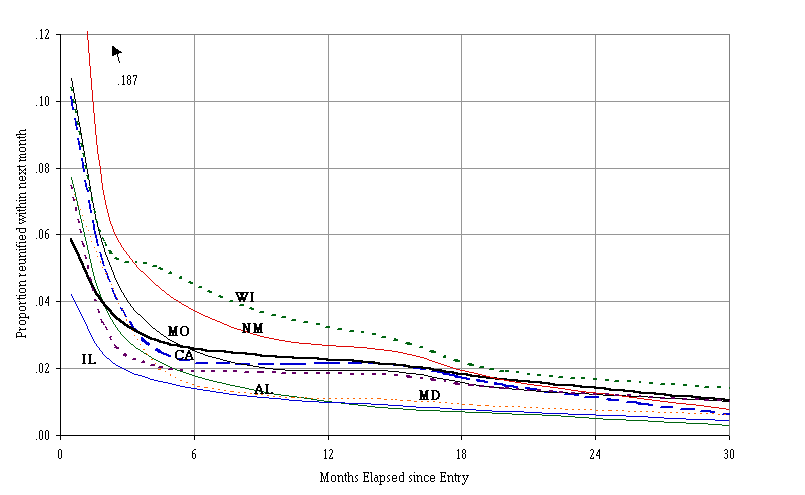
2.3 Cross-Sectional Picture of Exit Change: 1990 and 1994
Table IIB.3 provides a different vantage of this pattern of change by comparing the exit experiences of two entry cohorts (1990 and 1994) in each state.
The first and second panels present descriptive statistics for each of the two entry cohorts. Note that the exit proportions here are computed as a share of all entrants in the cohort (in contrast to Table IIA.I where they were presented as a proportion of all exits). The third panel looks at the proportional shift that occurred in each of these measures between 1990 and 1994. The intent is to identify changes that occurred during the four years that separate these two cohorts, and interpret them as potential indicators of trends. The final panel lists arithmetic changes between 1990 and 1994.7
On the third panel (proportional changes, 1990-1994), we see first that the number of entries to foster care spells grew by a total of 23 percent during this four year period. Rapid growth in entries was observed in Illinois (101%), Maryland, Missouri, and Wisconsin. In contrast, Alabama and New York showed a decrease in entries during these four years. A quick comparison between the change in entries, the incidence rate of entry (from panels 1 and 2), and the reunification levels (as observed in the previous section) suggests that there is no evidence of a direct link between these three characteristics of state child welfare systems.
The third panel also contains rows presenting changes in the proportion of entrants that exited within three years ¾ first for all exits and then detailed separately as reunification, adoption, or relative exits. For all states combined, the proportion of entrants that exited care within three years decreased by 5 percent between 1990 and 1994. During the same time, reunification exits decreased by 10 percent, adoption exits by 4 percent and exits to relatives by 13 percent. In eight of the nine states described, we observe decreases in both the proportion of entrants who were reunified and the proportion of exits that were achieved through reunification. The sole exception, Wisconsin, showed a 1 percent increase in the proportion of entrants reunified, and a 2 percent increase in the proportion of exits that were made by reunification.
| State | Pooled Total | |||||||||
|---|---|---|---|---|---|---|---|---|---|---|
| AL | CA | IL | MD | MI | MO | NM | NY | WI | ||
|
1990 Entrants |
||||||||||
| N entrants to Foster Care | 2,004 | 26,550 | 7,662 | 2,454 | 5,776 | 3,780 | 1,068 | 20,586 | 4,282 | 74,162 |
| Incidence Rate of Entry | 1.86 | 2.99 | 2.43 | 1.91 | 2.28 | 2.71 | 2.13 | 4.53 | 3.19 | 3.00 |
| Prop. Entrants who Exit in 3 years | 0.88 | 0.70 | 0.57 | 0.73 | 0.82 | 0.82 | 0.90 | 0.66 | 0.82 | 0.71 |
| Prop. by Reunification | 0.28 | 0.52 | 0.38 | 0.36 | 0.47 | 0.46 | 0.58 | 0.41 | 0.57 | 0.46 |
| Prop. by Adoption | 0.03 | 0.05 | 0.05 | 0.08 | 0.11 | 0.08 | 0.03 | 0.02 | 0.03 | 0.05 |
| Prop. to Relatives | 0.25 | 0.02 | 0.00 | 0.16 | 0.09 | 0.03 | 0.10 | 0.08 | 0.06 | 0.06 |
| Prop Reunification | Exit (proportion of exits that are by reunification) | 0.32 | 0.74 | 0.67 | 0.50 | 0.57 | 0.56 | 0.64 | 0.63 | 0.69 | 0.65 |
|
1994 Entrants |
||||||||||
| N entrants to Foster Care | 1,713 | 33,084 | 15,373 | 3,364 | 7,067 | 5,020 | 1,154 | 17,909 | 6,373 | 91,057 |
| Incidence Rate of Entry | 1.59 | 3.73 | 4.87 | 2.62 | 2.79 | 3.60 | 2.30 | 3.94 | 4.75 | 3.69 |
| Prop. Entrants who Exit in 3 years | 0.83 | 0.67 | 0.42 | 0.67 | 0.84 | 0.78 | 0.87 | 0.73 | 0.81 | 0.67 |
| Prop. by Reunification | 0.24 | 0.49 | 0.24 | 0.33 | 0.42 | 0.43 | 0.55 | 0.38 | 0.57 | 0.42 |
| Prop. by Adoption | 0.02 | 0.04 | 0.03 | 0.05 | 0.13 | 0.06 | 0.06 | 0.03 | 0.03 | 0.04 |
| Prop. to Relatives | 0.29 | 0.01 | 0.01 | 0.17 | 0.09 | 0.04 | 0.08 | 0.08 | 0.05 | 0.05 |
| Prop Reunification | Exit | 0.29 | 0.73 | 0.58 | 0.49 | 0.50 | 0.56 | 0.63 | 0.53 | 0.71 | 0.62 |
|
Proportional Change 1990 to 1994 Entrants |
||||||||||
| N entrants to Foster Care | -0.15 | 0.25 | 1.01 | 0.37 | 0.22 | 0.33 | 0.08 | -0.13 | 0.49 | 0.23 |
| Incidence Rate of Entry | -0.15 | 0.25 | 1.01 | 0.37 | 0.22 | 0.33 | 0.08 | -0.13 | 0.49 | 0.23 |
| Prop. Entrants who Exit in 3 years | -0.05 | -0.04 | -0.27 | -0.07 | 0.03 | -0.05 | -0.03 | 0.10 | -0.01 | -0.05 |
| Prop. by Reunification | -0.15 | -0.05 | -0.38 | -0.09 | -0.09 | -0.06 | -0.05 | -0.07 | 0.01 | -0.10 |
| Prop. by Adoption | -0.51 | -0.17 | -0.39 | -0.35 | 0.14 | -0.19 | 0.90 | 0.58 | -0.09 | -0.04 |
| Prop. to Relatives | 0.17 | -0.33 | NA | 0.10 | -0.02 | 0.31 | -0.26 | -0.00 | -0.12 | -0.13 |
| Prop Reunification | Exit | -0.10 | -0.01 | -0.14 | -0.02 | -0.12 | -0.01 | -0.02 | -0.16 | 0.02 | -0.06 |
|
Arithmetic Change 1990 to 1994 Entrants |
||||||||||
| N entrants to Foster Care | -291 | 6,534 | 7,711 | 910 | 1,291 | 1,240 | 86 | -2,677 | 2,091 | 16,895 |
| Incidence Rate of Entry | -0.27 | 0.74 | 2.44 | 0.71 | 0.51 | 0.89 | 0.17 | -0.59 | 1.56 | 0.68 |
| Prop. Entrants who Exit in 3 years | -0.05 | -0.03 | -0.15 | -0.05 | 0.03 | -0.04 | -0.03 | 0.07 | -0.01 | -0.03 |
| Prop. by Reunification | -0.04 | -0.03 | -0.14 | -0.03 | -0.04 | -0.03 | -0.03 | -0.03 | 0.01 | -0.05 |
| Prop. by Adoption | -0.02 | -0.01 | -0.02 | -0.03 | 0.02 | -0.01 | 0.03 | 0.01 | -0.00 | -0.00 |
| Prop. to Relatives | 0.04 | -0.01 | 0.01 | 0.02 | -0.00 | 0.01 | -0.03 | -0.00 | -0.01 | -0.01 |
| Prop Reunification | Exit | -0.03 | -0.01 | -0.10 | -0.01 | -0.07 | -0.01 | -0.01 | -0.10 | 0.02 |
0.04 |
7. Each cell in the third panel is produced by dividing the 1994 number by the 1990 number, and subtracting 1 from the result. Each cell in the fourth panel is obtained by subtracting the 1990 number from the 1994 number. The third panel is the focus of analysis. The fourth panel is to remind us that certain large proportional changes can result from small numbers.
3. Multivariate Analysis of Foster Care Exits
Logistic Regression Methods and Tables
Eight of the remaining tables, including the next four, present the results of analyses that apply logistic regression procedures in multivariate models, using data at the level of the individual spell. The dependent variables in these logistic models are binary events -- foster care reunification, reentry to foster care, and completed adoption. The independent variables are a set of child and case attributes that have been considered previously as related to foster care history and exit dynamics.
When interpreting these models, the primary statistics of interest are odds ratios, which indicate the relative effects that are attributed to the different values of each predictive variable, controlling for the influence of other variables in the model. For each variable in the model, one of the possible response attributes (or categories) is arbitrarily selected as the "excluded" category, and is assigned an odds ratio of 1.00. The odds ratios computed for each of the other categories of that variable express the likelihood that a spell with that attribute has the predicted outcome-relative to the likelihood that a spell with the "excluded" attribute has the predicted outcome.
As an example, Table IIC.1 presents the results from two models ¾ one predicting reunification within three years of entry and the other predicting any "family" exit (reunifications plus relative exits) within three years of entry. Each model is computed with nine independent variables.
| Predictor Variable | Category | Reunification within 36 months | Family exit within 36 months | ||
|---|---|---|---|---|---|
| Standardized parameter | Odds Ratio | Standardized parameter | Odds Ratio | ||
| Age at Entry | < 3 months | -0.17 | 0.39 | -0.17 | 0.39 |
| 3 -11 months | -0.04 | 0.78 | -0.03 | 0.79 | |
| 1 - 2 years | -0.01 | 0.94 | 0.00 | 0.96 | |
| 3 - 5 years | 0.00 | 0.98 | 0.00 | 0.99 | |
| 6 - 8 years | 0.00 | 0.98 | 0.00 | 0.99 | |
| 9 -11 years * | - - | 1.00 | - - | 1.00 | |
| 12-14 years | -0.04 | 0.83 | -0.05 | 0.80 | |
| 15-17 years | -0.11 | 0.57 | -0.12 | 0.51 | |
|
Gender |
Male | 0.00 | 1.01 | 0.00 | 0.99 |
| Female * | - - | 1.00 | - - | 1.00 | |
|
Race/ethnic |
African American | -0.12 | 0.65 | -0.10 | 0.69 |
| Hispanic | 0.00 | 1.00 | 0.00 | 1.03 | |
| White, Other * | - - | 1.00 | - - | 1.00 | |
|
Region |
Primary urban county | -0.12 | 0.65 | -0.12 | 0.64 |
| Remainder of State * | - - | 1.00 | - - | 1.00 | |
|
Sequence |
First Spell in care * | - - | 1.00 | - - | 1.00 |
| Reentry Spell | -0.06 | 0.72 | -0.07 | 0.69 | |
|
Placement Type |
Congregate Care | 0.03 | 1.18 | 0.02 | 1.12 |
| Other (FC or KC) * | - - | 1.00 | - - | 1.00 | |
|
Stability |
On placement in spell * | - - | 1.00 | - - | 1.00 |
| 2+ placements | -0.26 | 0.40 | -0.29 | 0.35 | |
|
State: |
Alabama | -0.08 | 0.36 | -0.01 | 0.88 |
| California | 0.05 | 1.19 | -0.05 | 0.83 | |
| Illinois | -0.07 | 0.68 | -0.15 | 0.45 | |
| Maryland | -0.03 | 0.72 | 0.00 | 0.97 | |
| Michigan * | - - | 1.00 | - - | 1.00 | |
| Missouri | 0.02 | 1.17 | 0.00 | 0.94 | |
| New Mexico | 0.03 | 1.37 | 0.01 | 1.28 | |
| New York | -0.01 | 0.96 | -0.02 | 0.91 | |
| Wisconsin | 0.05 | 1.45 | 0.03 | 1.27 | |
|
Year of Entry |
1990 | 0.02 | 1.12 | 0.02 | 1.12 |
| 1991 | 0.01 | 1.05 | 0.01 | 1.06 | |
| 1992 * | - - | 1.00 | - - | 1.00 | |
| 1993 | 0.00 | 0.98 | 0.00 | 0.98 | |
| 1994 | -0.02 | 0.92 | -0.02 | 0.93 | |
| Intercept | 0.78 | 1.28 | |||
| exp(intercept) | 2.18 | 3.60 | |||
| Predictive Concordance | 0.70 | 0.71 | |||
| N spells | 404,416 | 404,416 | |||
| N exits (in type) | 176,353 | 197,682 | |||
| Proportion exit (in type) | 0.44 | 0.49 | |||
Note: Predictors noted with "*" are not contained in model, but are the "excluded" category for their variable. Predetermined odds ratios of 1.00 are assigned to these categories. Odds ratios for other categories of the same variable express effects in relation to that of the excluded category.
Looking at the reunification model, the first independent variable is the age of the child at the time of entry to this spell in foster care. The age category "9-11 years" was selected as the excluded category, and its odds ratio is automatically set at 1.00. The odds ratios for each of the other age categories express the likelihood of reunification of a child entering care at that age, relative to the likelihood of reunification for a child entering care at the age of 9 to 11 years, while controlling for the influence of the other eight variables in the model.
The odds ratio estimated for foster care spells that begin when the child is an infant (<3 months of age) is .39. This should be interpreted as meaning that the relative odds of reunification for a newborn entrant, as compared to a 9-11 year old entrant, are .39 to 1. Conversely, we could take the reciprocal and state that a 9-11 year old entrant is 2.56 times more likely to be reunified within three years than is a newborn. The choice of the excluded category should be unimportant because while numerical values of the odds ratio do depend on which particular category is excluded, the values of the odds ratios relative to each other will be preserved.
The parameters listed in this table are the actual coefficients of the logistic regression model. These are the formal statistics estimated by the model. Because logistic models are not readily interpretable in an intuitively approachable manner, we rely on the odds ratios to express the results of the model. The predictive concordance statistic is a measure of goodness-of-fit for the model. It reports the proportion of outcomes that are correctly predicted by the logistic regression.
3.1 Reunification From Foster Care
Table IIC.I presents a logistic regression model for the likelihood of reunification within three years of entry and also a parallel model for the likelihood of a family exit within three years of entry. The units of analysis are all spells that started during the years 1990-94 in the nine study states. Because the spells were observed through 1997, there are no censored observations in these data.
Summary of Logistic Reunification Analysis.
| Age | Reunification is least likely for children under one year of age at entry, and also for children over twelve years of age at entry. The largest difference is between the ratio for infants and that for 9-11 year olds, as 9-11 year olds are 2.56 times more likely to reunify than infants.8 |
| Gender | Gender has little apparent effect on the likelihood of reunification, with males estimated as being 1 percent more likely than females to exit via reunification. |
| Race | The odds of reunification for white and Hispanic children are even. The odds of reunification are 54 percent [(1.00/0.65) -1] more likely for children from either of these groups than for African American children in foster care. |
| Region | Reunification is 54 percent [(1.00/0.65) -1] more likely for children living in those portions of these states that are not in the primary urban counties. 9
The main urban counties have lower reunification rates. |
| Sequence | Reunification is 39 percent [(1.00/0.72) -1] more likely for children in their first spell in care than it is for children in reentry foster care spells. |
| Placement | Reunification is less likely for children in family foster care arrangements (relative or nonrelative) than for children in institutions or group homes.10 This result is weakened by the fact that both kinship and nonrelative foster care are included in the foster care category. |
| Stability | Reunification is 150 percent more likely [(1.00/0.40) - 1] from spells where the child stays in one single placement than in spells where the child moves at least one time between placement settings. |
| Year: | Reunification became less likely for each successive annual cohort between 1990 and 1994. The odds for the reunification of 1990 entrants were 22 percent greater [(1.12/0.92)-1) for 1990 entrants than they were for 1994 entrants. |
| State: | Reunification is most likely in Wisconsin and New Mexico and least likely in Alabama. The largest difference in odds is between Wisconsin and Alabama: entrants in Wisconsin are over 4.0 times as likely [1.45 0.36] as entrants in Alabama to exit foster care via reunification. |
It is worth restating that these statistics were computed simultaneously in a single multivariate model. Thus, unlike the bivariate results shown earlier, each of these relationships is observed with the influence of all of the other variables in the model being controlled. It is important to note that, for the most part, the basic direction of most of the bivariate results observed in Table IIA. I are largely preserved in the results produced under multivariate controls. Thus, the independent variables we have discussed each appear to contribute independently to the prediction of reunification levels.
8. The following are equivalent expressions: 9-11 year olds are 2.56 times more likely to reunify than infants. Infants are 156 percent less likely to reunify than 9-11 year olds. The odds ratio of reunification between infants and 9-11 year olds is .39 to 1.
9. Primary urban counties have been as follows: AL (Jefferson), CA (Los Angeles), IL (Cook), MD (Baltimore City), MI (Wayne), MO (Jackson and St. Louis City), NM (Bernalillo), NY (New York City), and WI (Milwaukee).
10. Because kinship care cannot be identified in all states, relative and nonrelative foster care are combined into one category for the nine-state analysis tables that follow, a category for kinship care will be reported separately. For states where kinship cannot be identified, relative and nonrelative care will continue to be combined, and the value for kinship care is reported as "missing."
3.1.1 Family Exit Analysis
The second model in Table IIC.I shows a parallel analysis with the dependent variable changed from reunification exits to all family exits. Family exits are reunification exits plus exits to relatives. It is significant that each odds ratio is virtually identical to the comparable statistic in the reunification-only analysis, except for major difference in the odds ratios describing differences by state.
The state odds ratios for family exits are much less dispersed than they were for reunifications, and the ordering among states is shifted. Notably, family exits are least likely in Illinois. Alabama, which had the lowest odds of reunification, shows an odds ratio for family exits that is still low, but far more central in the distribution. California had the third highest odds of reunification among the nine states, but has the second lowest odds of any family exit. The largest discrepancy in state odds ratios is between New Mexico and Illinois, with entrants in New Mexico being 2.8 times more likely than entrants in Illinois to experience a family exit. While narrower than the odds of 4:1 observed in the reunification analysis, this represents major difference in the exit activities between these two states.
3.1.2 Reunification During Different Periods in the Duration of a Spell
Table IIC.2, is a modification of the reunification analysis from Table IIC.1, designed to investigate the influence of duration in care and the timing of exits on the relationship between the independent variables and reunification. This design is motivated by the observations made earlier (from the IIB tables) that reunification levels are much higher during the early months of spells in foster care. This model examines whether the factors related to reunification also change as the child remains in care over time.
- The first three models consider the likelihood of reunification for all spells that started in 1990-94. Column I is a model of the likelihood of reunification within the first six months of the spell. Column 2 models the likelihood of reunification within the first 18 months of the spell, and Column 3 the likelihood of reunification within 3 years. (This column repeats the reunification results from the first model inTable IIC.1).
- The next two models consider the likelihood of reunification only for those spells that remain open for at least six months, i.e., the child has not exited from care by reunification or any other type of spell discharge. Column 4 is a model of the likelihood of reunification between 6 and 18 months. Column 5 a model of the likelihood of reunification between 6 months and 3 years.
- The final model considers the likelihood of reunification by 3 years only for those spells that remain open for 18 months or more.
Overall, the basic structure of the odds ratios is rather similar in all six of these models, suggesting that the influence of these predictor variables on reunification is somewhat stable for all portions of a spell in foster care. However, some differences can be observed.
| Predictor variable | Category | From Time of Spell Entry: | If 6 months elapsed without exit: | If 18 months without exit: | |||
|---|---|---|---|---|---|---|---|
| Reunification before 6 months | Reunification before 18 months | Reunification before 36 months | Reunification before 18 months | Reunification before 36 months | Reunification before 36 months | ||
| Odds Ratios | Odds Ratios | Odds Ratios | Odds Ratios | Odds Ratios | Odds Ratios | ||
| Age at Entry | <3 months | 0.48 | 0.43 | 0.39 | 0.46 | 0.41 | 0.41 |
| 3-11 months | 0.80 | 0.82 | 0.78 | 0.88 | 0.80 | 0.76 | |
| 1-2 years | 0.92 | 0.96 | 0.94 | 1.02 | 0.97 | 0.92 | |
| 3-5 years | 0.95 | 0.99 | 0.98 | 1.03 | 1.00 | 0.97 | |
| 6 - 8 years | 0.95 | 0.99 | 0.98 | 1.03 | 1.00 | 0.97 | |
| 9-11 years * | 1.00 | 1.00 | 1.00 | 1.00 | 1.00 | 1.00 | |
| 12-14 years | 0.88 | 0.90 | 0.83 | 1.06 | 0.96 | 1.02 | |
| 15-17 years | 0.70 | 0.69 | 0.57 | 0.95 | 0.70 | 0.70 | |
|
Gender |
Male | 0.92 | 0.99 | 1.01 | 1.03 | 1.04 | 1.05 |
| Female * | 1.00 | 1.00 | 1.00 | 1.00 | 1.00 | 1.00 | |
|
Race/Ethnic |
African American | 0.69 | 0.63 | 0.65 | 0.62 | 0.66 | 0.77 |
| Hispanic | 1.12 | 1.02 | 1.00 | 0.93 | 0.93 | 0.97 | |
| White and Other * | 1.00 | 1.00 | 1.00 | 1.00 | 1.00 | 1.00 | |
|
Urban |
Primary urban county | 0.70 | 0.62 | 0.65 | 0.58 | 0.64 | 0.74 |
| Remainder of State * | 1.00 | 1.00 | 1.00 | 1.00 | 1.00 | 1.00 | |
|
Sequence |
First Spell * | 1.00 | 1.00 | 1.00 | 1.00 | 1.00 | 1.00 |
| Reentry Spell | 0.67 | 0.72 | 0.72 | 0.90 | 0.87 | 0.93 | |
|
Care Type |
Congregate Care | 1.07 | 1.18 | 1.18 | 1.47 | 1.50 | 1.65 |
| All others (FC, KC)* | 1.00 | 1.00 | 1.00 | 1.00 | 1.00 | 1.00 | |
|
Stability |
One placement in spell * | 1.00 | 1.00 | 1.00 | 1.00 | 1.00 | 1.00 |
| 2+ placements | 0.24 | 0.33 | 0.40 | 0.43 | 0.48 | 0.56 | |
|
State: |
Alabama | 0.82 | 0.45 | 0.36 | 0.33 | 0.26 | 0.26 |
| California | 1.24 | 1.22 | 1.19 | 0.88 | 0.84 | 0.66 | |
| Illinois | 0.88 | 0.71 | 0.68 | 0.51 | 0.50 | 0.45 | |
| Maryland | 1.21 | 0.80 | 0.72 | 0.46 | 0.46 | 0.47 | |
| Michigan * | 1.00 | 1.00 | 1.00 | 1.00 | 1.00 | 1.00 | |
| Missouri | 1.93 | 1.29 | 1.17 | 0.82 | 0.83 | 0.85 | |
| New Mexico | 2.32 | 1.63 | 1.37 | 1.12 | 0.96 | 0.73 | |
| New York | 0.95 | 0.88 | 0.96 | 0.74 | 0.87 | 0.97 | |
| Wisconsin | 1.44 | 1.14 | 1.45 | 1.20 | 1.26 | 1.15 | |
| Year of Entry | 1990 | 1.14 | 1.12 | 1.12 | 1.06 | 1.08 | 1.07 |
| 1991 | 1.10 | 1.06 | 1.05 | 1.01 | 1.02 | 1.00 | |
| 1992 * | 1.00 | 1.00 | 1.00 | 1.00 | 1.00 | 1.00 | |
| 1993 | 1.02 | 0.99 | 0.98 | 0.96 | 0.96 | 0.95 | |
| 1994 | 0.94 | 0.94 | 0.92 | 0.94 | 0.91 | 0.87 | |
| Intercept | -0.34 | 0.49 | 0.78 | -0.14 | 0.42 | -0.57 | |
| exp(intercept) | 0.71 | 1.63 | 2.18 | 0.87 | 1.52 | 0.57 | |
| Predictive Concordance | 0.73 | 0.72 | 0.70 | 0.70 | 0.69 | 0.66 | |
| N spells | 404,416 | 404,416 | 404,416 | 272,725 | 272,725 | 187,286 | |
| N successes | 89,242 | 147,085 | 176,353 | 57,843 | 87,111 | 29,268 | |
| Proportion successes | 0.22 | 0.36 | 0.44 | 0.21 | 0.32 | 0.16 | |
Note: Predictors noted with "*" are not contained in model, but are the "excluded" category for their variable. Predetermined odds ratios of 1.00 are assigned to these categories. Odds ratios for other categories of the same variable express effects in relation to that of the excluded category.
For example, the racial gap in the odds of reunification narrows markedly as spell duration increases. Between 0 and 6 months, Hispanic children are 62 percent more likely than African American children to be reunified, and 12 percent more likely than white children. Between 6 and 18 months, Hispanics are 50 percent more likely than African Americans, and 7 percent less likely than whites to be reunified. Between 18 months and 3 years, Hispanics are 26 percent more likely than African Americans and 3 percent less likely than whites to be reunified.
Similarly, children in reentry spells and children in spells with multiple placements are characterized by very low relative likelihoods of reunification during the first six months in care. In each case, as the spell duration increases, the odds of reunification for these categories grow closer to (but not equal to) those of children in first spells and children in single-placement spells.
The largest changes appear in the odds ratios for states. New Mexico and Missouri both have highest relative odds of reunification within the first six months of a spell, yet moderate to low relative odds of reunification between 18 months and 3 years. Thus, early reunification appears to be unusually likely in Missouri. Michigan, in contrast has moderately low relative odds of reunification between months 0 and 6, but the second highest odds of reunification between months 6-18 and 18-36.
Overall, the influence of the substantive covariates of reunification appear to be relatively stable for different temporal portions of foster care spells, and when they do change, they tend to become less influential as the time in care increases. Thus early reunifications appear to be more readily predicted by child characteristics and case factors than do late reunifications. Also, we see that the states vary widely in the likelihood of reunification for spells of different lengths. This is similar to the wide variation in the timing of reunification that was observed in Figure C.
3.1.3 Individual State Models of Reunification and Family Exits
Tables IIC.3 and IIC.4 report results obtained by applying the multivariate logistic regression techniques to each state separately. In Tables IIC.3 (reunification models) and IIC.4(family exit models), each column presents the odds ratios estimated by fitting an independent logistic regression model for a separate state. The model from the nine-state analysis is modified in two ways for use with state data. First, the variable for state is removed from the model. Second, a separate category for kinship care is added to the placement type variable because kinship foster care can be distinguished from foster care with unrelated caregivers in six of these states. For the three states where kinship care is not identifiable, the odds ratios for this category are not estimated.
|
Predictor Variable |
Category | AL | CA | IL | MD | MI | MO | NM | NY | WI | 9-State |
|---|---|---|---|---|---|---|---|---|---|---|---|
|
Age at Entry |
< 3 months | 1.06 | 0.42 | 0.43 | 0.42 | 0.42 | 0.30 | 0.35 | 0.30 | 0.40 | 0.40 |
| 3-11 months | 0.92 | 0.81 | 0.77 | 0.81 | 0.75 | 0.61 | 0.75 | 0.72 | 0.72 | 0.77 | |
| 1 - 2 years | 1.08 | 0.96 | 0.89 | 0.85 | 0.85 | 0.84 | 0.97 | 0.99 | 0.89 | 0.93 | |
| 3 - 5 years | 0.99 | 1.02 | 0.95 | 0.92 | 0.85 | 0.87 | 0.93 | 1.06 | 0.88 | 0.97 | |
| 6 - 8 years | 0.97 | 1.01 | 0.95 | 1.00 | 0.93 | 1.03 | 1.00 | 0.99 | 0.90 | 0.98 | |
| 9-11 years * | 1.00 | 1.00 | 1.00 | 1.00 | 1.00 | 1.00 | 1.00 | 1.00 | 1.00 | 1.00 | |
| 12-14 years | 1.52 | 0.73 | 0.78 | 1.00 | 0.93 | 0.88 | 0.55 | 0.85 | 0.87 | 0.83 | |
| 15-17 years | 1.59 | 0.36 | 0.49 | 0.57 | 0.66 | 0.72 | 0.26 | 0.67 | 0.64 | 0.57 | |
|
Gender |
Male | 1.03 | 0.99 | 0.99 | 1.00 | 0.97 | 1.03 | 0.94 | 1.04 | 1.05 | 1.02 |
| Female * | 1.00 | 1.00 | 1.00 | 1.00 | 1.00 | 1.00 | 1.00 | 1.00 | 1.00 | 1.00 | |
|
Race/Ethnic |
African American | 0.68 | 0.64 | 0.55 | 0.72 | 0.84 | 0.78 | 0.53 | 0.74 | 0.85 | 0.61 |
| Hispanic | - - | 1.00 | 1.21 | 1.13 | 1.00 | 0.86 | 0.97 | 0.98 | 1.05 | 1.11 | |
| White, Other * | 1.00 | 1.00 | 1.00 | 1.00 | 1.00 | 1.00 | 1.00 | 1.00 | 1.00 | 1.00 | |
|
Region |
Primary urban county | 1.64 | 0.88 | 0.25 | 0.58 | 0.82 | 0.83 | 0.75 | 0.62 | 0.58 | 0.65 |
| Remainder of State * | 1.00 | 1.00 | 1.00 | 1.00 | 1.00 | 1.00 | 1.00 | 1.00 | 1.00 | 1.00 | |
|
Sequence |
First spell in care * | 1.00 | 1.00 | 1.00 | 1.00 | 1.00 | 1.00 | 1.00 | 1.00 | 1.00 | 1.00 |
| Reentry Spell | 0.60 | 0.67 | 0.84 | 0.81 | 0.84 | 0.66 | 0.65 | 0.65 | 0.69 | 0.71 | |
|
Care Type |
Kinship Care | - - | 0.71 | 0.85 | 0.38 | - - | 0.52 | 0.75 | 0.77 | - - | 0.76 |
| Congregate Care | 1.38 | 0.87 | 1.28 | 1.52 | 0.90 | 0.93 | 0.94 | 1.07 | 1.19 | 1.05 | |
| Foster Care * | 1.00 | 1.00 | 1.00 | 1.00 | 1.00 | 1.00 | 1.00 | 1.00 | 1.00 | 1.00 | |
|
Stability |
One placement * | 1.00 | 1.00 | 1.00 | 1.00 | 1.00 | 1.00 | 1.00 | 1.00 | 1.00 | 1.00 |
| 2+ placements | 0.45 | 0.30 | 0.49 | 0.39 | 0.36 | 0.50 | 0.34 | 0.48 | 0.36 | 0.37 | |
|
Year of Entry |
1990 | 1.15 | 1.04 | 1.60 | 1.14 | 1.03 | 0.90 | 1.00 | 1.18 | 0.89 | 1.12 |
| 1991 | 1.14 | 1.04 | 1.23 | 1.32 | 1.02 | 0.89 | 0.94 | 1.05 | 1.00 | 1.05 | |
| 1992 * | 1.00 | 1.00 | 1.00 | 1.00 | 1.00 | 1.00 | 1.00 | 1.00 | 1.00 | 1.00 | |
| 1993 | 1.07 | 0.98 | 0.91 | 1.08 | 0.89 | 1.00 | 1.10 | 0.98 | 1.05 | 0.99 | |
| 1994 | 0.95 | 0.93 | 0.89 | 1.09 | 0.96 | 0.90 | 0.98 | 0.88 | 1.03 | 0.93 | |
| Intercept | -0.89 | 1.18 | 0.87 | 0.35 | 0.71 | 0.83 | 1.52 | 0.71 | 1.11 | 0.91 | |
| exp(intercept) | 0.41 | 3.25 | 2.39 | 1.42 | 2.03 | 2.29 | 4.57 | 2.03 | 3.03 | 2.48 | |
| Predictive Concordance | 0.66 | 0.70 | 0.76 | 0.69 | 0.66 | 0.64 | 0.70 | 0.68 | 0.66 | 0.69 | |
| N Entrants | 9,224 | 143,973 | 56,354 | 14,003 | 31,537 | 22,629 | 5,889 | 94,758 | 26,049 | 404,416 | |
| N Reunifications | 2,369 | 72,838 | 15,825 | 4,849 | 13,823 | 10,248 | 3,300 | 37,921 | 15,180 | 176,353 | |
| Prop.Reunifications | 0.26 | 0.51 | 0.28 | 0.35 | 0.44 | 0.45 | 0.56 | 0.40 | 0.58 | 0.44 |
Note: Predictors noted with "*" are not contained in model, but are the "excluded" category for their variable. Predetermined odds ratios of 1.00 are assigned to these categories. Odds ratios for other categories of the same variable express effects in relation to that of the excluded category.
| Predictor variable | Category | AL | CA | IL | MD | MI | MO | NM | NY | WI | 9-State |
|---|---|---|---|---|---|---|---|---|---|---|---|
|
Age at Entry |
< 3 months | 0.76 | 0.41 | 0.43 | 0.44 | 0.42 | 0.34 | 0.34 | 0.30 | 0.36 | 0.39 |
| 3 -11 months | 1.10 | 0.80 | 0.76 | 0.96 | 0.79 | 0.64 | 0.68 | 0.75 | 0.72 | 0.78 | |
| 1 - 2 years | 1.19 | 0.95 | 0.87 | 1.02 | 0.89 | 0.86 | 0.95 | 1.05 | 0.92 | 0.95 | |
| 3 - 5 years | 1.14 | 1.01 | 0.93 | 1.01 | 0.90 | 0.91 | 0.83 | 1.11 | 0.93 | 0.99 | |
| 6 - 8 years | 1.03 | 1.00 | 0.94 | 1.01 | 0.95 | 1.08 | 0.90 | 1.03 | 0.92 | 0.99 | |
| 9 -11 years * | 1.00 | 1.00 | 1.00 | 1.00 | 1.00 | 1.00 | 1.00 | 1.00 | 1.00 | 1.00 | |
| 12-14 years | 1.11 | 0.72 | 0.77 | 0.97 | 0.91 | 0.86 | 0.49 | 0.76 | 0.81 | 0.79 | |
| 15-17 years | 0.99 | 0.36 | 0.49 | 0.46 | 0.54 | 0.72 | 0.23 | 0.58 | 0.52 | 0.51 | |
|
Gender |
Male | 0.94 | 0.98 | 0.99 | 0.97 | 0.92 | 1.04 | 0.93 | 1.01 | 1.02 | 1.00 |
| Female * | 1.00 | 1.00 | 1.00 | 1.00 | 1.00 | 1.00 | 1.00 | 1.00 | 1.00 | 1.00 | |
|
Race/Ethnic |
African American | 1.10 | 0.61 | 0.56 | 0.81 | 1.03 | 0.80 | 0.50 | 0.83 | 0.84 | 0.66 |
| Hispanic | 0.98 | 0.99 | 1.20 | 1.07 | 1.24 | 0.79 | 0.82 | 1.07 | 1.01 | 1.06 | |
| White, Other * | 1.00 | 1.00 | 1.00 | 1.00 | 1.00 | 1.00 | 1.00 | 1.00 | 1.00 | 1.00 | |
|
Region |
Primary urban county | 1.92 | 0.91 | 0.26 | 0.81 | 0.75 | 1.04 | 0.71 | 0.55 | 0.40 | 0.65 |
| Remainder of State * | 1.00 | 1.00 | 1.00 | 1.00 | 1.00 | 1.00 | 1.00 | 1.00 | 1.00 | 1.00 | |
|
Sequence |
First spell in care * | 1.00 | 1.00 | 1.00 | 1.00 | 1.00 | 1.00 | 1.00 | 1.00 | 1.00 | 1.00 |
| Reentry Spell | 0.54 | 0.65 | 0.83 | 0.72 | 0.77 | 0.65 | 0.60 | 0.60 | 0.64 | 0.69 | |
|
Care Type |
Kinship Care | - - | 0.73 | 0.90 | 0.41 | - - | 0.85 | 1.04 | 0.74 | - - | 0.66 |
| Congregate Care | 1.31 | 0.84 | 1.25 | 1.78 | 1.07 | 0.89 | 0.98 | 0.95 | 1.05 | 1.04 | |
| Foster Care * | 1.00 | 1.00 | 1.00 | 1.00 | 1.00 | 1.00 | 1.00 | 1.00 | 1.00 | 1.00 | |
|
Stability |
One placement * | 1.00 | 1.00 | 1.00 | 1.00 | 1.00 | 1.00 | 1.00 | 1.00 | 1.00 | 1.00 |
| 2+ placements | 0.35 | 0.29 | 0.48 | 0.33 | 0.25 | 0.49 | 0.26 | 0.39 | 0.30 | 0.32 | |
|
Year of Entry |
1990 | 0.99 | 1.06 | 1.58 | 1.09 | 0.97 | 0.88 | 1.28 | 1.20 | 0.87 | 1.14 |
| 1991 | 1.17 | 1.05 | 1.20 | 1.30 | 1.00 | 0.88 | 1.04 | 1.07 | 0.98 | 1.06 | |
| 1992 * | 1.00 | 1.00 | 1.00 | 1.00 | 1.00 | 1.00 | 1.00 | 1.00 | 1.00 | 1.00 | |
| 1993 | 1.12 | 0.98 | 0.95 | 1.00 | 0.83 | 1.02 | 1.16 | 0.99 | 1.02 | 0.98 | |
| 1994 | 0.99 | 0.92 | 0.94 | 1.09 | 0.92 | 0.89 | 1.11 | 0.90 | 1.01 | 0.92 | |
| Intercept | 0.49 | 1.30 | 0.87 | 0.92 | 1.31 | 0.89 | 2.06 | 1.25 | 1.71 | 1.26 | |
| exp(intercept) | 1.63 | 3.67 | 2.39 | 2.51 | 3.71 | 2.44 | 7.85 | 3.49 | 5.53 | 3.53 | |
| Predictive Concordance | 0.67 | 0.70 | 0.75 | 0.69 | 0.70 | 0.63 | 0.73 | 0.70 | 0.69 | 0.70 | |
| N Entrants | 9,224 | 143,973 | 56,354 | 14,003 | 31,537 | 22,629 | 5,889 | 94,758 | 26,049 | 404,416 | |
| N Family Exits | 4,942 | 75,482 | 16,151 | 7,108 | 16,839 | 11,118 | 3,724 | 45,608 | 16,710 | 197,682 | |
| Prop. Family Exits | 0.54 | 0.52 | 0.29 | 0.51 | 0.53 | 0.49 | 0.63 | 0.48 | 0.64 | 0.49 |
Note: Predictors noted with "*" are not contained in model, but are the "excluded" category for their variable. Predetermined odds ratios of 1.00 are assigned to these categories. Odds ratios for other categories of the same variable express effects in relation to that of the excluded category.
The findings reported from each of the separate state models resemble one another and the pooled nine-state result. This suggests that there is substantial similarity in the nature of the reunification process across states. Certain results are remarkably stable. These include the findings that gender has little influence on reunification and that reentry spells are much less likely to result in reunification than are first spells.
For other findings, the direction of the results is fairly consistent, but the magnitude of the effects varies widely among states. For example, white children are more likely to be reunified from substitute care than are African American children in all states. In Illinois and New Mexico, the likelihood of reunification is almost twice as high for whites as for African Americans (ratio of 100:55), while race has less predictive importance in Michigan and Wisconsin as shown by odds ratios that are near 100:85. The pattern for Hispanics varies, but they usually are equally likely or somewhat more likely to be reunified than whites.
The placement type variable is more useful with state-level data because kinship care can be separately identified for six of the nine states. In each of these states, reunification within three years is much less likely from kinship foster care than from nonrelative foster care. In most states, the odds of reunification from congregate care placements and nonrelative foster care placements are rather similar, although in Alabama and Maryland the odds of reunification from congregate placements are much higher.
Alabama appears to be the state that is most systematically different in the relationships between these predictive variables and reunification. The patterns of influence by age and by regional influence on reunification observed for Alabama are directly reversed from what is seen in the other eight states.
There is also variability by state in the apparent trends in the likelihood of reunification over time, as seen through the experiences of cohorts defined by year of entry to care. These trends differ from those presented in earlier sections because the multivariate models introduce factors that are related to the changing composition of each state's caseload. For example, if a state foster care caseload has an increasing share of infant cases, we would expect reunification rates to decrease, even if all other practice factors remained stable. In this case, the likelihood of reunification for any given individual would not be changing, but the statewide reunification rates would drop solely because the caseload contains a greater proportion of children that have a lower likelihood of reunification. So, these measures of cohort effects can be interpreted as changes in the likelihood of reunification across years, with some control for shifts in composition based on age, race, gender, region, etc.
The nine-state total shows the odds of reunification decreasing steadily between the 1990 and 1994 cohorts, a total 17 percent reduction [I - (0.93/1.12)] across the five years. For individual states, a clear and direct downward trend for reunification is apparent only for California, Illinois, and New York. For Wisconsin, the odds of reunification increase across the five annual cohorts, and the trends over times in the other states are inconsistent or absent.
The fact that trends observed primarily in California, Illinois and New York have strong influence on the nine-state results bears some thought. Together, these three states contain 73 percent of the foster care spells in the universe being examined, yet they represent only three of the nine separate child welfare systems. To the extent that we are trying to understand national trends and patterns, consideration of pooled data (which gives weight to the larger caseloads) seems useful. If we are trying to understand the behavior of child welfare systems, then examination of individual state models might be more appropriate.
4. Reentry from Foster Care
Reentry levels are important markers of the "success" of exits from foster care, and as such, provide a useful outcome measure to consider in evaluating reunification. While we tend to assume that family reunification is a positive outcome, reentry statistics help assess the degree to which reunification practice is successful. That is, whether the children who were returned home were able to remain at home following their discharge from care. When high reunification levels are accompanied by high reentry levels, we are led to assume that many of the reunifications were arranged unwisely or prematurely. 11
Most of the following reentry analysis looks at the universe of foster care spells that started between 1990-93, that ended within 36 months, and where the child was aged 14 or younger at the time of exit. These restrictions are used to define a risk group for which reentry is equally possible for all cases. In most models, we evaluate reentries that occur within the first year after exit.
11. This argument is presented in its simplest form. Indeed, some reentry is probably better than none, although defining an optimal level involves both technical and normative questions. If no children reenter foster care, it could be understood to imply that the decisions to reunify have been made too conservatively. In this case we should be concerned that a large number of potentially successful reunifications are avoided for fear of possible failure. However, we believe the reentry levels we report here are generally above the levels one would consider optimal.
4.1 Reentry Counts and Rates by Type of Exit From Care
Table IID.1 presents counts of children who reentered foster care within one year of an earlier exit, with each cell classified by the type of exit from the prior spell and by a series of child and case characteristics. The cells to the right side of the table present these reentries as a proportion of all relevant exits. For the nine states pooled, 17.3 percent of children reunified from foster care by the age of 14 years reentered care within one year of exit. Reentry rates for relative exits and other exits were slightly higher (18.3%), and reentry from runaway exits was much higher. Adoption and age-out exits are excluded from the reentry analysis because they are expected to produce no identifiable reentries.
| Counts | Proportion who Reenter Care | |||||||||
|---|---|---|---|---|---|---|---|---|---|---|
| Exit Type | Exit Type | |||||||||
| Reunified with Family | Exit to other Relative | Run away from care | Other exit | Total Tracked exits | Reunif | Relative | Run | Other | Total | |
|
All Exits |
138,458 | 16,820 | 15,858 | 28,722 | 199,858 | |||||
|
Ages 15-17 at Exit |
22,288 | 2,116 | 9,761 | 6,873 | 41,038 | |||||
| Reenter in 12 mos. | 3,182 | 423 | 4,889 | 1,905 | 10,399 | 0.143 | 0.200 | 0.501 | 0.277 | 0.253 |
|
Ages 0-14 at Exit |
115,000 | 14,539 | 5,377 | 20,594 | 155,510 | |||||
| Reenter in 12 mos. | 19,945 | 2,654 | 3,485 | 4,953 | 31,037 | 0.173 | 0.183 | 0.648 | 0.240 | 0.200 |
| Reenter in 36 mos | 30,241 | 3,930 | 3,751 | 6,265 | 44,187 | 0.263 | 0.270 | 0.698 | 0.304 | 0.284 |
| Reenter before 1998 | 34,740 | 4,386 | 3,773 | 6,722 | 49,621 | 0.302 | 0.302 | 0.702 | 0.326 | 0.319 |
|
Ages 0-14, Reentries in 12 months |
||||||||||
|
State |
||||||||||
| AL | 244 | 340 | 35 | 299 | 918 | 0.163 | 0.192 | 0.547 | 0.186 | 0.186 |
| CA | 8,068 | 221 | 918 | 651 | 9,858 | 0.158 | 0.117 | 0.592 | 0.120 | 0.164 |
| IL | 2,250 | 50 | 703 | 292 | 3,295 | 0.217 | 0.365 | 0.864 | 0.127 | 0.242 |
| MD | 580 | 339 | 37 | 118 | 1,074 | 0.185 | 0.225 | 0.487 | 0.176 | 0.199 |
| MI | 1,426 | 599 | 143 | 140 | 2,308 | 0.154 | 0.285 | 0.581 | 0.075 | 0.171 |
| MO | 1,259 | 75 | 184 | 466 | 1,984 | 0.193 | 0.126 | 0.748 | 0.184 | 0.201 |
| NM | 484 | 22 | 55 | 154 | 715 | 0.204 | 0.079 | 0.618 | 0.348 | 0.224 |
| NY | 3,964 | 840 | 1,261 | 2,433 | 8,498 | 0.166 | 0.155 | 0.616 | 0.482 | 0.233 |
| WI | 1,670 | 168 | 149 | 400 | 2,387 | 0.246 | 0.200 | 0.608 | 0.583 | 0.279 |
|
Year of Spell Entry |
||||||||||
| 1990 | 4,608 | 652 | 632 | 1,193 | 7,085 | 0.159 | 0.179 | 0.610 | 0.239 | 0.184 |
| 1991 | 4,818 | 690 | 854 | 1,247 | 7,609 | 0.168 | 0.185 | 0.653 | 0.239 | 0.196 |
| 1992 | 5,094 | 637 | 892 | 1,272 | 7,895 | 0.182 | 0.179 | 0.641 | 0.243 | 0.207 |
| 1993 | 5,425 | 675 | 1,107 | 1,241 | 8,448 | 0.184 | 0.187 | 0.674 | 0.240 | 0.211 |
|
Duration of previous spell in care |
||||||||||
| < 1 month | 4,737 | 824 | 805 | 1,066 | 7,432 | 0.194 | 0.225 | 0.588 | 0.317 | 0.227 |
| 1 - 2 months | 4,140 | 649 | 770 | 1,113 | 6,672 | 0.198 | 0.208 | 0.620 | 0.308 | 0.231 |
| 3 - 5 months | 2,664 | 350 | 550 | 742 | 4,306 | 0.175 | 0.182 | 0.660 | 0.274 | 0.208 |
| 6 -11 months | 3,308 | 347 | 562 | 801 | 5,018 | 0.162 | 0.170 | 0.676 | 0.258 | 0.190 |
| 12-17 months | 2,441 | 219 | 346 | 461 | 3,467 | 0.159 | 0.160 | 0.724 | 0.176 | 0.175 |
| 18-24 months | 1,460 | 123 | 187 | 336 | 2,106 | 0.152 | 0.115 | 0.690 | 0.139 | 0.158 |
| 25-36 months | 1,195 | 142 | 265 | 434 | 2,036 | 0.130 | 0.106 | 0.753 | 0.156 | 0.149 |
|
Type of Care |
||||||||||
| Congregate Care | 2,867 | 411 | 1,820 | 1,161 | 6,259 | 0.242 | 0.267 | 0.629 | 0.333 | 0.317 |
| Nonrel. Foster Care | 12,628 | 1,971 | 1,198 | 2,967 | 18,764 | 0.183 | 0.198 | 0.675 | 0.261 | 0.204 |
| Kinship Care | 3,940 | 232 | 283 | 654 | 5,109 | 0.127 | 0.083 | 0.699 | 0.129 | 0.130 |
| Mixed care types | 510 | 40 | 184 | 171 | 905 | 0.153 | 0.159 | 0.605 | 0.259 | 0.199 |
|
Age at Spell Entry |
||||||||||
| Under 3 months | 1,946 | 266 | 0 | 529 | 2,741 | 0.175 | 0.130 | - - | 0.169 | 0.169 |
| 3 mos. - 1 year | 1,856 | 219 | 0 | 416 | 2,491 | 0.181 | 0.145 | - - | 0.209 | 0.181 |
| 1 - 2 years | 3,542 | 447 | 0 | 612 | 4,601 | 0.170 | 0.167 | - - | 0.193 | 0.173 |
| 3 - 5 years | 3,496 | 474 | 0 | 604 | 4,574 | 0.155 | 0.174 | - - | 0.192 | 0.161 |
| 6 - 8 years | 2,461 | 348 | 7 | 575 | 3,391 | 0.140 | 0.172 | 0.583 | 0.221 | 0.153 |
| 9 -11 years | 2,773 | 367 | 508 | 744 | 4,392 | 0.174 | 0.205 | 0.721 | 0.291 | 0.209 |
| 12-14 years | 3,871 | 533 | 2,970 | 1,473 | 8,847 | 0.230 | 0.301 | 0.637 | 0.368 | 0.325 |
|
Age at Exit |
||||||||||
| 0 years | 2,254 | 338 | 0 | 555 | 3,147 | 0.202 | 0.162 | - - | 0.234 | 0.202 |
| 1 - 2 years | 4,018 | 486 | 0 | 810 | 5,314 | 0.172 | 0.149 | - - | 0.185 | 0.171 |
| 3 - 5 years | 3,875 | 517 | 0 | 639 | 5,031 | 0.155 | 0.169 | - - | 0.170 | 0.158 |
| 6 - 8 years | 2,590 | 353 | 0 | 566 | 3,509 | 0.140 | 0.167 | - - | 0.209 | 0.150 |
| 9 -11 years | 2,604 | 349 | 177 | 670 | 3,800 | 0.161 | 0.189 | 0.681 | 0.267 | 0.183 |
| 12-14 years | 4,604 | 611 | 3,308 | 1,713 | 10,236 | 0.221 | 0.281 | 0.646 | 0.350 | 0.310 |
|
Spell Sequence |
||||||||||
| First spell in care | 17,359 | 2,369 | 2,352 | 4,055 | 26,135 | 0.165 | 0.178 | 0.627 | 0.223 | 0.186 |
| Reentry spell | 2,586 | 285 | 1,133 | 898 | 4,902 | 0.256 | 0.237 | 0.698 | 0.375 | 0.320 |
Note: Exits for Completed Adoption and Reaching Age of Majority (aging out of foster care) are excluded from this table. Reentries from adoptions cannot be tracked due to privacy restrictions. Reentries should never occur for children who age out of care.
By examining the column containing reentry proportions from reunification exits, we observe systematic differences in the relationship between reentry and the independent variables. For all states combined, there is an observed tendency for more reentry by children whose prior spell was in the following categories:
- shorter spells in care,
- spells where the child was over 12 years of age at entry,
- spells where the child is either very young or over 12 years of age at exit,
- spells where the child was primarily placed in congregate care facilities,
- spells that were themselves reentries from a prior foster care episode.
Table IID.2 presents reentry levels from reunification spells for each state separately. Reentry rates vary from a low range of 15-16 percent in Alabama, California, Michigan and New York, to levels over 20 percent in New Mexico, Illinois and Wisconsin.
| AL | CA | IL | MD | MI | MO | NM | NY | WI | Total | |
|---|---|---|---|---|---|---|---|---|---|---|
|
Number Reunified within Three Years of Entry |
1,493 | 51,172 | 10,367 | 3,136 | 9,255 | 6,514 | 2,377 | 23,900 | 6,786 | 115,000 |
| Reentry within One Year | 244 | 8,068 | 2,250 | 580 | 1,426 | 1,259 | 484 | 3,964 | 1,670 | 19,945 |
| Reentry in Years 2-3 | 89 | 4,309 | 1,170 | 229 | 795 | 668 | 145 | 2,161 | 730 | 10,296 |
|
Proportion Reentering Care: |
||||||||||
| within one year | 0.163 | 0.158 | 0.217 | 0.185 | 0.154 | 0.193 | 0.204 | 0.166 | 0.246 | 0.173 |
| during Years 2-3 * | 0.060 | 0.084 | 0.113 | 0.073 | 0.086 | 0.103 | 0.061 | 0.090 | 0.108 | 0.090 |
|
Proportion Reentering Care Within One Year of Reunification |
||||||||||
|
Year Spell Start |
||||||||||
| 1990 | 0.141 | 0.141 | 0.211 | 0.167 | 0.147 | 0.188 | 0.174 | 0.157 | 0.232 | 0.159 |
| 1991 | 0.156 | 0.149 | 0.221 | 0.188 | 0.151 | 0.191 | 0.192 | 0.168 | 0.219 | 0.168 |
| 1992 | 0.170 | 0.171 | 0.228 | 0.183 | 0.143 | 0.192 | 0.218 | 0.169 | 0.271 | 0.182 |
| 1993 | 0.196 | 0.169 | 0.208 | 0.200 | 0.176 | 0.201 | 0.225 | 0.173 | 0.256 | 0.184 |
|
Duration of Prior Spell |
||||||||||
| < 1 month | 0.223 | 0.152 | 0.270 | 0.207 | 0.168 | 0.191 | 0.226 | 0.216 | 0.334 | 0.194 |
| 1-2 months | 0.146 | 0.174 | 0.239 | 0.203 | 0.161 | 0.195 | 0.164 | 0.247 | 0.252 | 0.198 |
| 3-5 months | 0.114 | 0.166 | 0.209 | 0.186 | 0.154 | 0.207 | 0.165 | 0.160 | 0.232 | 0.175 |
| 6-11 months | 0.182 | 0.151 | 0.207 | 0.149 | 0.148 | 0.191 | 0.221 | 0.141 | 0.231 | 0.162 |
| 12-17 months | 0.066 | 0.153 | 0.211 | 0.170 | 0.172 | 0.218 | 0.227 | 0.126 | 0.176 | 0.159 |
| 18-23 months | 0.039 | 0.160 | 0.192 | 0.163 | 0.134 | 0.150 | 0.252 | 0.115 | 0.219 | 0.152 |
| 24-36 months | 0.067 | 0.137 | 0.161 | 0.139 | 0.123 | 0.170 | 0.169 | 0.102 | 0.158 | 0.130 |
|
Primary Type of Care |
||||||||||
| Congregate | 0.205 | 0.222 | 0.334 | 0.238 | 0.178 | 0.249 | 0.222 | 0.243 | 0.292 | 0.242 |
| Unrelated Foster Care | 0.143 | 0.177 | 0.221 | 0.181 | 0.152 | 0.185 | 0.218 | 0.175 | 0.244 | 0.183 |
| Kinship Care | - - | 0.126 | 0.188 | 0.122 | - - | 0.120 | 0.140 | 0.079 | - - | 0.127 |
| Mixed Care Types | 0.200 | 0.149 | 0.202 | 0.104 | - - | 0.273 | 0.273 | 0.114 | 0.158 | 0.153 |
|
Age at Exit |
||||||||||
| 0 years | 0.149 | 0.199 | 0.249 | 0.193 | 0.187 | 0.204 | 0.183 | 0.194 | 0.260 | 0.202 |
| 1-2 years | 0.182 | 0.163 | 0.211 | 0.182 | 0.173 | 0.199 | 0.230 | 0.147 | 0.236 | 0.172 |
| 3-5 years | 0.153 | 0.150 | 0.200 | 0.160 | 0.138 | 0.171 | 0.215 | 0.131 | 0.191 | 0.155 |
| 6-8 years | 0.130 | 0.133 | 0.180 | 0.135 | 0.121 | 0.135 | 0.215 | 0.124 | 0.186 | 0.140 |
| 9-11 years | 0.142 | 0.143 | 0.192 | 0.187 | 0.144 | 0.187 | 0.175 | 0.161 | 0.229 | 0.161 |
| 12-14 years | 0.191 | 0.174 | 0.295 | 0.248 | 0.176 | 0.254 | 0.181 | 0.234 | 0.317 | 0.221 |
|
Race/Ethnicity |
||||||||||
| African American | 0.187 | 0.188 | 0.230 | 0.178 | 0.162 | 0.216 | 0.211 | 0.154 | 0.185 | 0.184 |
| Hispanic | 0.000 | 0.133 | 0.159 | 0.125 | 0.143 | 0.167 | 0.189 | 0.142 | 0.216 | 0.139 |
| Other | 0.182 | 0.120 | 0.326 | 0.194 | 0.136 | 0.221 | 0.244 | 0.168 | 0.277 | 0.172 |
| White | 0.148 | 0.161 | 0.205 | 0.198 | 0.149 | 0.180 | 0.207 | 0.200 | 0.267 | 0.181 |
|
Spell Sequence |
||||||||||
| First Spell | 0.158 | 0.151 | 0.209 | 0.178 | 0.148 | 0.185 | 0.190 | 0.161 | 0.221 | 0.165 |
| Reentry Spell | 0.212 | 0.240 | 0.308 | 0.269 | 0.220 | 0.274 | 0.295 | 0.209 | 0.416 | 0.256 |
|
Placement Stability |
||||||||||
| One Placement | 0.193 | 0.153 | 0.220 | 0.177 | 0.144 | 0.181 | 0.186 | 0.177 | 0.242 | 0.171 |
| Two placements | 0.106 | 0.160 | 0.217 | 0.198 | 0.176 | 0.184 | 0.212 | 0.147 | 0.256 | 0.172 |
| 3-4 Placements | 0.116 | 0.185 | 0.199 | 0.201 | 0.167 | 0.210 | 0.239 | 0.154 | 0.274 | 0.186 |
| 5 or more placements | 0.069 | 0.214 | 0.253 | 0.256 | 0.169 | 0.259 | 0.291 | 0.120 | 0.275 | 0.211 |
*Note: Reentry proportions for years 2 and 3 may be partially censored for spells that started in 1992 or 1993.
Again, the individual state patterns tend to resemble the pattern for all states combined with a number of deviations. One interesting pattern is that the proportion of reentries appears to be increasing over the time of observation in all states (except for a final-year drop-off in Illinois and Wisconsin). There is also a strong tendency for reentries to occur more frequently after prior spells in care that were of shorter duration. The relation to duration is least apparent in Michigan, Missouri and California. In addition, Michigan, Missouri and New Mexico each show a pattern of higher reentries from one of the middle-length spell groups (12-24 months).
However, there does not appear to be a direct relationship, at the aggregate level, between those states with high reunification rates and those states with high reentry rates. Broad conclusions of this type would be attractive, but are not supported by the data. On the one hand, Wisconsin and New Mexico have high levels of each type, and Alabama has low levels of both types. These observations would support the idea that reentry and reunification levels are systemically related. But in contrast, California has higher reunification and lower reentry, while Illinois has lower reunification and higher reentry.
4.2 Multivariate Models for Reentry After Reunification
Tables IIE.1 and IIE.2 present the results of logistic regression models predicting the likelihood of reentry within 12 months of a reunification from foster care. As with the logistic regression models used in the analysis of reunification, these results are computed with multivariate controls. Even so, they tend to reproduce the findings observed from the bivariate proportions described in the previous section.
|
Predictor Variable |
Category | Standardized parameter | Odds Ratio |
|---|---|---|---|
|
Age at Entry |
< 3 months | 0.021 | 1.15 |
| 3 -11 months | 0.015 | 1.11 | |
| 1 - 2 years | 0.000 | 1.00 | |
| 3 - 5 years | -0.024 | 0.89 | |
| 6 - 8 years | -0.043 | 0.79 | |
| 9 -11 years * | - - | 1.00 | |
| 12-14 years | 0.035 | 1.18 | |
| 15-17 years | -0.114 | 0.53 | |
|
Gender |
Male | 0.003 | 1.01 |
| Female * | - - | 1.00 | |
|
Race/Ethnic |
African American | 0.039 | 1.17 |
| Hispanic | -0.032 | 0.86 | |
| White, Other * | - - | 1.00 | |
|
Region |
Primary Urban County | -0.053 | 0.82 |
| Remainder of State * | - - | 1.00 | |
|
Sequence |
First Spell in Care * | - - | 1.00 |
| Reentry Spell | 0.087 | 1.68 | |
|
Care Type |
Congregate Care | 0.045 | 1.24 |
| Foster Care, Kin Care * | - - | 1.00 | |
|
Stability |
One Placement in Spell * | - - | 1.00 |
| 2+ placements | 0.050 | 1.21 | |
|
Duration |
Log(months in spell) | -0.111 | 0.84 |
|
State |
Alabama | -0.014 | 0.81 |
| California | 0.031 | 1.12 | |
| Illinois | 0.074 | 1.61 | |
| Maryland | 0.014 | 1.17 | |
| Michigan * | - - | 1.00 | |
| Missouri | 0.020 | 1.17 | |
| New Mexico | 0.022 | 1.34 | |
| New York | 0.011 | 1.05 | |
| Wisconsin | 0.080 | 1.69 | |
|
Year of Entry |
1990 | -0.022 | 0.91 |
| 1991 | -0.017 | 0.93 | |
| 1992 * | - - | 1.00 | |
| 1993 | 0.002 | 1.01 | |
| Intercept | -1.516 | ||
| exp(intercept) | 0.220 | ||
| Concordance | 0.61 | ||
| N | 138,503 | ||
| N reentries | 23,131 | ||
| Proportion Reentry | 0.17 |
Note: Predictors noted with "*" are not contained in model, but are the "excluded" category for their variable. Predetermined odds ratios of 1.00 are assigned to these categories. Odds ratios for other categories of the same variable express effects in relation to that of the excluded category.
The pooled nine-state results in the model in Tables IIE.1 suggests the following:
- Reentry is most likely for children who entered care at ages under one year or between the ages of 12 and 14 years.
- African American children are more likely to reenter after reunification, Hispanics are less likely to reenter, with the likelihood for whites falling in between.
- Children from primary urban places have lower reentry rates than children from the other regions of their states.
- Reentry spells are substantially more likely than first spells to result in subsequent reentry. Some children seem to cycle in and out of care.
- Children in congregate care are more likely to reenter than are children in foster care.
- Children who experienced more than one placement during the previous spell are more likely to reenter than children who had a single placement.
- Reentry is negatively related to the duration of the prior spell. Reunification after a short stay in care is more likely to lead to reentry than reunification after a longer spell in care.
- The rates of reentry increased moderately between the 1990 and 1993 cohorts.
- Controlling for the other variables in the model, the likelihood of reentry is highest in Wisconsin and Illinois, and relatively high in New Mexico. The likelihood of reentry is lowest in Alabama and Michigan.
The individual state models in Table IIE.2 again tend to resemble the pooled model. Some of the differences observed are:
| AL | CA | IL | MD | MI | MO | NM | NY | WI | 9-State | |
|---|---|---|---|---|---|---|---|---|---|---|
|
Age at Entry |
||||||||||
| < 3 months | 0.79 | 1.30 | 1.08 | 0.91 | 1.19 | 1.08 | 0.61 | 0.98 | 0.76 | 1.12 |
| 3 -11 months | 0.74 | 1.25 | 1.02 | 1.07 | 1.13 | 1.09 | 1.34 | 0.93 | 1.02 | 1.10 |
| 1 - 2 years | 1.07 | 1.10 | 1.00 | 0.84 | 1.04 | 1.03 | 1.27 | 0.84 | 0.83 | 1.00 |
| 3 - 5 years | 1.00 | 1.00 | 0.94 | 0.77 | 0.86 | 0.78 | 1.36 | 0.76 | 0.72 | 0.89 |
| 6 - 8 years | 0.62 | 0.87 | 0.85 | 0.70 | 0.80 | 0.72 | 0.98 | 0.70 | 0.69 | 0.80 |
| 9 -11 years * | 1.00 | 1.00 | 1.00 | 1.00 | 1.00 | 1.00 | 1.00 | 1.00 | 1.00 | 1.00 |
| 12-14 years | 0.94 | 1.10 | 1.52 | 1.21 | 0.97 | 1.28 | 0.98 | 1.10 | 1.34 | 1.18 |
| 15-17 years | 0.36 | 0.56 | 0.90 | 0.65 | 0.47 | 0.60 | 0.54 | 0.34 | 0.60 | 0.56 |
|
Gender |
||||||||||
| Male | 0.96 | 1.00 | 1.07 | 1.05 | 1.05 | 1.00 | 1.06 | 0.99 | 1.02 | 1.02 |
| Female * | 1.00 | 1.00 | 1.00 | 1.00 | 1.00 | 1.00 | 1.00 | 1.00 | 1.00 | 1.00 |
|
Race/Ethnic |
||||||||||
| African American | 1.37 | 1.30 | 1.23 | 0.97 | 1.29 | 1.30 | 0.85 | 1.04 | 1.03 | 1.17 |
| Hispanic | - - | 0.88 | 0.71 | 0.62 | 0.99 | 0.97 | 0.95 | 0.95 | 0.96 | 0.85 |
| White, Other * | 1.00 | 1.00 | 1.00 | 1.00 | 1.00 | 1.00 | 1.00 | 1.00 | 1.00 | 1.00 |
|
Region |
||||||||||
| Primary Urban County | 0.86 | 0.88 | 0.95 | 0.97 | 0.74 | 0.98 | 1.45 | 0.76 | 0.59 | 0.82 |
| Remainder of State | 1.00 | 1.00 | 1.00 | 1.00 | 1.00 | 1.00 | 1.00 | 1.00 | 1.00 | 1.00 |
|
Sequence * |
||||||||||
| First Spell in Care | 1.00 | 1.00 | 1.00 | 1.00 | 1.00 | 1.00 | 1.00 | 1.00 | 1.00 | 1.00 |
| Reentry Spell | 1.19 | 1.73 | 1.58 | 1.56 | 1.63 | 1.59 | 1.69 | 1.40 | 1.76 | 1.67 |
|
Care Type |
||||||||||
| Kinship Care | - - | 0.71 | 0.86 | 0.64 | - - | 0.56 | 0.66 | 0.59 | - - | 0.77 |
| Congregate Care | 1.29 | 1.39 | 1.44 | 1.23 | 1.22 | 1.22 | 1.05 | 1.07 | 0.85 | 1.16 |
| Foster Care * | 1.00 | 1.00 | 1.00 | 1.00 | 1.00 | 1.00 | 1.00 | 1.00 | 1.00 | 1.00 |
|
Stability |
||||||||||
| One Placement in Spell * | 1.00 | 1.00 | 1.00 | 1.00 | 1.00 | 1.00 | 1.00 | 1.00 | 1.00 | 1.00 |
| 2+ placements | 0.76 | 1.07 | 1.13 | 1.27 | 1.38 | 1.24 | 1.38 | 1.23 | 1.29 | 1.20 |
|
Duration |
||||||||||
| Log(months in spell) | 0.74 | 0.99 | 0.85 | 0.82 | 0.90 | 0.94 | 0.92 | 0.71 | 0.72 | 0.85 |
|
Year of Entry |
||||||||||
| 1990 | 0.86 | 0.83 | 0.96 | 0.87 | 1.08 | 1.12 | 0.69 | 1.00 | 0.93 | 0.91 |
| 1991 | 0.88 | 0.87 | 1.00 | 0.97 | 1.11 | 1.07 | 0.78 | 1.02 | 0.81 | 0.93 |
| 1992 * | 1.00 | 1.00 | 1.00 | 1.00 | 1.00 | 1.00 | 1.00 | 1.00 | 1.00 | 1.00 |
| 1993 | 1.14 | 0.99 | 0.95 | 1.02 | 1.29 | 1.09 | 0.93 | 1.01 | 0.95 | 1.01 |
|
Intercept |
-1.32 | -1.60 | -1.20 | -1.24 | -1.84 | -1.68 | -1.48 | -0.90 | -0.58 | -1.31 |
| 0.27 | 0.20 | 0.30 | 0.29 | 0.16 | 0.19 | 0.23 | 0.41 | 0.56 | 0.27 | |
|
Concordance |
0.66 | 0.60 | 0.60 | 0.60 | 0.59 | 0.60 | 0.63 | 0.65 | 0.66 | 0.60 |
|
N |
1,962 | 56,518 | 12,129 | 3,745 | 10,838 | 8,080 | 2,666 | 31,047 | 11,518 | 138,503 |
|
N reentries |
281 | 8,733 | 2,706 | 675 | 1,590 | 1,495 | 520 | 4,628 | 2,503 | 23,131 |
|
Prop. reenter in 12 mos. |
0.14 | 0.15 | 0.22 | 0.18 | 0.15 | 0.19 | 0.20 | 0.15 | 0.22 | 0.17 |
Note: Predictors noted with "*" are not contained in model, but are the "excluded" category for their variable. Predetermined odds ratios of 1.00 are assigned to these categories. Odds ratios for other categories of the same variable express effects in relation to that of the excluded category.
Age: In Alabama, New York, and Wisconsin, the youngest children (those who entered their prior spell under one year of age) do not have higher reentry rates. In New Mexico, the highest reentry rates are for children who entered their first spell between 3-5 years of age-while in most states this was one of the lower reentry age groups. Also, Alabama, Michigan, and New Mexico do not show an increase in reentry for children ages 12-14.
Race and Ethnicity: Reentry levels are lower for Hispanics in all states. Reentry levels are much higher for African Americans than whites in Alabama, California, Illinois, Michigan, and Missouri. In Maryland, New York, and Wisconsin, the reentry levels for African Americans and whites are very similar. In New Mexico, African American reentry rates are lower than those for Hispanics or whites.
Region: Reentry levels are lower in the primary urban county for all states except New Mexico, where they are substantially higher in Bernalillo County. Reentry rates are especially low in the primary urban places in Michigan (Wayne County.), New York (New York City) and Wisconsin (Milwaukee County.).
Duration: The inverse relation between spell duration and the likelihood of reentry is strongest in Alabama, New York, and Wisconsin. Note that these include one low-reunification state (Alabama), one medium-reunification state (New York), and one high-reunification state (Wisconsin).
Time Trends: As was observed in the reunification models, while the pooled nine-state data shows a clear trend across entry cohorts (for reentry it is increasing), the individual state trends are less clear or mixed. Alabama, California, and Maryland are the only states where the odds ratios present a clear picture of increasing likelihood of reentry.
5. Adoption from Foster Care
Logistic regression models of the likelihood of adoption from foster care are presented in Tables IIF.I (pooled data) and IIF.2 (individual states). The universe is composed of all spells that began in 1990-93 in the nine study states. Adoptive exits are observed for up to four years following entry.
|
Predictor Variable |
Category | Standardized parameter | Odds Ratio |
|---|---|---|---|
|
Age at Entry |
0 - 2 months | 0.51 | 15.54 |
| 3 - 11 months | 0.26 | 5.69 | |
| 1 - 2 years | 0.23 | 3.36 | |
| 3 - 5 years | 0.16 | 2.28 | |
| 6 - 8 years | 0.08 | 1.61 | |
| 9 - 11 years * | - - | 1.00 | |
| 12 - 14 years | -0.23 | 0.32 | |
| 15 - 17 years | -0.41 | 0.11 | |
|
Gender |
Male | -0.01 | 0.97 |
| Female * | - - | 1.00 | |
|
Race/Ethnic |
African American | -0.18 | 0.51 |
| Hispanic | -0.07 | 0.72 | |
| White, Other * | - - | 1.00 | |
|
Region |
Primary Urban County | -0.26 | 0.38 |
| Remainder of State | - - | 1.00 | |
|
Sequence |
First Spell in Care * | - - | 1.00 |
| Reentry Spell | 0.07 | 1.51 | |
|
Care Type |
Congregate Care | -0.15 | 0.47 |
| Foster Care, Kin Care * | - - | 1.00 | |
|
Spell Duration |
Log(months in spell) | 0.44 | 1.74 |
|
State |
Alabama | -0.16 | 0.15 |
| California | -0.46 | 0.18 | |
| Illinois | -0.26 | 0.24 | |
| Maryland | -0.05 | 0.60 | |
| Michigan * | - - | 1.00 | |
| Missouri | -0.09 | 0.49 | |
| New Mexico | -0.06 | 0.40 | |
| New York | -0.38 | 0.20 | |
| Wisconsin | -0.17 | 0.28 | |
|
Year of Entry |
1990 | -0.02 | 0.91 |
| 1991 | -0.02 | 0.93 | |
| 1992 * | - - | 1.00 | |
| 1993 | 0.02 | 1.10 | |
| Intercept | -3.30 | ||
| exp(intercept) | 0.04 | ||
| Concordance | 0.86 | ||
| N spells observed | 313,359 | ||
| N adoptions in 4 years | 22,141 | ||
| Percent adopted in 4 years | 7.1% |
Note: Predictors noted with "*" are not contained in model, but are the excluded category for their variable. The odds ratios of 1.00 associated with these predictors are predetermined. The odds ratios for other categories of the variable express the effect in relation to that of the excluded category
| State | 9 states (no kin term) | 9 states (with kin term) | |||||||||
|---|---|---|---|---|---|---|---|---|---|---|---|
| AL | CA | IL | MD | MI | MO | NM | NY | WI | |||
| ratios of relative odds of adoption | |||||||||||
|
Age at Entry |
|||||||||||
| 0 - 2 months | 117.71 | 49.32 | 16.27 | 49.77 | 2.98 | 21.50 | 7.01 | 11.57 | 13.03 | 12.31 | 12.28 |
| 3 - 11 months | 21.91 | 18.17 | 4.95 | 14.79 | 1.79 | 7.72 | 3.23 | 4.74 | 4.88 | 5.20 | 5.31 |
| 1 - 2 years | 16.04 | 10.83 | 2.56 | 8.35 | 1.52 | 3.36 | 2.72 | 2.61 | 3.60 | 3.17 | 3.32 |
| 3 - 5 years | 7.43 | 5.38 | 1.94 | 5.87 | 1.47 | 2.48 | 1.59 | 1.82 | 2.35 | 2.18 | 2.29 |
| 6 - 8 years | 3.47 | 2.49 | 1.57 | 2.74 | 1.40 | 1.43 | 1.19 | 1.43 | 1.90 | 1.59 | 1.65 |
| 9 - 11 years * | 1.00 | 1.00 | 1.00 | 1.00 | 1.00 | 1.00 | 1.00 | 1.00 | 1.00 | 1.00 | 1.00 |
| 12 - 14 years | - - | 0.46 | 0.23 | 0.32 | 0.35 | 0.45 | 0.25 | 0.20 | 0.25 | 0.33 | 0.32 |
| 15 - 17 years | - - | 0.26 | 0.06 | 0.11 | 0.07 | 0.15 | 0.16 | 0.08 | 0.20 | 0.11 | 0.11 |
|
Gender |
|||||||||||
| Male | 1.15 | 0.93 | 0.95 | 0.89 | 0.97 | 1.03 | 0.84 | 0.99 | 1.05 | 0.98 | 0.97 |
| Female * | 1.00 | 1.00 | 1.00 | 1.00 | 1.00 | 1.00 | 1.00 | 1.00 | 1.00 | 1.00 | 1.00 |
|
Race/Ethnic |
|||||||||||
| African American | 0.34 | 0.33 | 0.51 | 0.54 | 0.76 | 0.86 | 0.56 | 0.58 | 0.43 | 0.54 | 0.58 |
| Hispanic | - - | 0.73 | 0.72 | 0.48 | 0.66 | 2.00 | 0.79 | 0.56 | 0.74 | 0.53 | 0.62 |
| White, Other * | 1.00 | 1.00 | 1.00 | 1.00 | 1.00 | 1.00 | 1.00 | 1.00 | 1.00 | 1.00 | 1.00 |
| Region | |||||||||||
| Primary Urban County | 0.83 | 0.25 | 0.61 | 0.30 | 0.49 | 0.65 | 0.93 | 0.60 | 0.35 | 0.38 | 0.44 |
| Remainder of State * | 1.00 | 1.00 | 1.00 | 1.00 | 1.00 | 1.00 | 1.00 | 1.00 | 1.00 | 1.00 | 1.00 |
|
Spell Sequence |
|||||||||||
| First Spell in Care * | 1.00 | 1.00 | 1.00 | 1.00 | 1.00 | 1.00 | 1.00 | 1.00 | 1.00 | 1.00 | 1.00 |
| Reentry Spell | 1.52 | 1.49 | 1.14 | 1.57 | 1.16 | 1.19 | 1.70 | 1.81 | 1.41 | 1.47 | 1.35 |
|
Care Type |
|||||||||||
| Kinship Care | - - | 0.31 | 0.37 | 0.38 | - - | 0.51 | 0.93 | 0.27 | - - | - - | 0.26 |
| Congregate Care | 0.22 | 0.99 | 0.06 | 0.35 | 0.07 | 0.23 | 0.71 | 0.55 | 0.11 | 0.47 | 0.36 |
| Foster Care * | 1.00 | 1.00 | 1.00 | 1.00 | 1.00 | 1.00 | 1.00 | 1.00 | 1.00 | 1.00 | 1.00 |
|
Spell Duration |
|||||||||||
| Log(months) | 2.56 | 1.79 | 1.24 | 2.03 | 1.94 | 1.95 | 3.32 | 1.82 | 2.08 | 1.60 | 1.69 |
|
Year Admitted |
|||||||||||
| 1990 | 1.47 | 1.02 | 1.04 | 0.81 | 0.86 | 1.23 | 1.10 | 0.67 | 0.87 | 0.90 | 0.89 |
| 1991 | 0.96 | 1.01 | 0.87 | 0.83 | 0.93 | 1.09 | 0.88 | 0.85 | 0.86 | 0.95 | 0.94 |
| 1992 * | 1.00 | 1.00 | 1.00 | 1.00 | 1.00 | 1.00 | 1.00 | 1.00 | 1.00 | 1.00 | 1.00 |
| 1993 | 1.13 | 1.08 | 0.95 | 1.02 | 1.23 | 1.02 | 1.26 | 1.15 | 1.24 | 1.09 | 1.10 |
|
Intercept |
-8.09 | -5.64 | -3.25 | -4.90 | -3.09 | -4.80 | -6.04 | -4.80 | -5.05 | -4.24 | -4.26 |
|
exp(intercept) |
0.00 | 0.00 | 0.04 | 0.01 | 0.05 | 0.01 | 0.00 | 0.01 | 0.01 | 0.01 | 0.01 |
|
Concordance |
0.95 | 0.89 | 0.84 | 0.89 | 0.80 | 0.88 | 0.90 | 0.87 | 0.89 | 0.84 | 0.86 |
|
N spells observed |
7,511 | 110,889 | 40,981 | 10,639 | 24,470 | 17,609 | 4,735 | 76,849 | 19,676 | 313,359 | 313,359 |
|
N adoptions in 4 years |
289 | 7,080 | 2,586 | 1,090 | 4,170 | 1,613 | 333 | 4,186 | 794 | 22,141 | 22,141 |
|
Percent adopted in 4 years |
3.8% | 6.4% | 6.3% | 10.2% | 17.0% | 9.2% | 7.0% | 5.4% | 4.0% | 7.1% | 7.1% |
Note: Predictors noted with "*" are not contained in model, but are the "excluded" category for their variable. Predetermined odds ratios of 1.00 are assigned to these categories. Odds ratios for other categories of the same variable express effects in relation to that of the excluded category.
The pooled analysis highlights the dramatic relationship between age at spell entry and the likelihood of exit by adoption. Children who entered foster care as newborns (0-2 months) were 49 times more likely [15.54/0.32] to have an adoptive exit from care than were children who entered care at the ages of 12-14 years, and over 15 times more likely [ 15.54/1.00] to have an adoptive exit than children who entered care between the ages of 9-11. Newborns were even 2.73 times more likely [ 15.54/5.69] to be adopted from care than were children who entered care between the ages of 3 months and 1 year.
Regarding the other variables:
- African American (.51) and Hispanic (.72) children were less likely to be adopted than were white children.
- Children in congregate care placements (.47) were less likely to be adopted than were children in family foster placements.
- Children in primary urban counties (.38) were less likely to be adopted than were children from the other regions of their state.
- Children in reentry spells (1.51) were more likely to be adopted than were children in their first spell in care.
- The likelihood of adoption increased steadily between the 1990 and 1993 entry cohorts.
- Michigan was by far the most successful state at achieving adoptive exits from foster care, with Maryland, Missouri, and New Mexico showing adoptive likelihoods higher than those of the remaining states.
Adoption models for each state are shown separately in Table IIF.2. Here, we can see that Michigan differed from the other eight states in several ways. Most importantly, the adoption activity in Michigan was less limited to the population of children who entered foster care as newborns. The reason that the odds ratio for newborns in Michigan (2.98) is so much smaller than those for the other states (which range from 7 to 118) is not because Michigan has fewer infant adoptions. It is because Michigan has many more adoptions of children who entered at 9-11 years (the "excluded" category which forms the basis of the odds ratios). The odds ratio is the relative likelihood of adoption for children from the two categories. Michigan is also one of three states (Illinois and Missouri are the others) that move almost as high a share of children in their first spells to adoption as reentry spells. It is also one of two states (Missouri is the other) where adoption of African American children from foster care occurs with at least a 75 percent likelihood as the adoption of white children. Thus, the markedly higher adoption rates in Michigan seem to result from an expansion of the domain of potentially adoptable foster children in comparison to the other states observed.12
The likelihood of adoptive outcomes from kinship spells in care is very low in the six states where kinship care can be tracked.
Several individual states show unusual patterns in the likelihood of adoption from foster care. California had extremely low adoption levels in Los Angeles, relative to other parts of the state; and unusually high levels of adoption from congregate care. In New York, an unusually high proportion of foster care adoptions is from reentry spells, and the likelihood of adoption almost doubled between 1990 and 1993.
The time trend for all states pooled is an increase in the likelihood of adoption for successive cohorts. At least five of the individual states reflect this general trend, and only Missouri showed a substantial decrease in adoptions during this period.
Like reunification, adoptions are generally regarded as positive exits from foster care, in that they define new life situations that are intended to be permanent, nonrestrictive, and nurturing. Adoptions are a preferred resolution when family-centered options seem unfeasible. Because adoption and reunification are mutually exclusive events, in that they cannot both be discharge destinations for the same spell in care, we might expect that they would be negatively related to one another at the aggregate level. But again the statewide findings do not support such a conclusion.
However, there is a clear relation between reunification and adoption in child welfare practice. This was made explicit in the Adoption and Safe Families Act, which included language that directed states to initiate pre-adoptive activity for most foster care cases where reunification had not been accomplished within 15 months of entry. This law does not rule out future reunification activity, in fact concurrent planning activity is encouraged. It does, however, explicitly target an increase in adoptions from foster care and a reduction in the time that elapses before adoption.
12. It is also worth noting that some states pay providers more according to the degree of difficulty to adopt.
6. Summary of Administrative Data Analysis
The comparison of the foster care reunification patterns from nine states extends our perspective about the processes involved in child discharges from the custody of state child welfare agencies.
This work is based on analysis of the population of children who have been admitted to foster care, and examines information from the administrative records of their foster care history. As such, it does not examine the underlying social contexts of the communities and families from which the children have been removed, nor does it consider the substance of reunification work -- such as the nature and quantity of services provided to the child and/or the family of origin. Instead, it provides comparable information about the outcomes of these forces, that is, the child's history in the foster care system.
There are similarities in reunification patterns across all states. This is seen most clearly in the timing of discharges from care -- exits by family reunification tend to occur earlier in foster care episodes than do other types of exits. The likelihood of reunification also tends to be similarly related to the same child and case attributes across most states.
But there is also extensive variability in reunification patterns across states. This is seen most clearly in the overall prevalence of reunification -- as the proportion of foster care exits that are achieved via family reunification varies widely across the nine states.
These apparently contradictory statements are drawn from empirical observation of reunification patterns during the mid-1990s. It is important to note that foster care reunification is not an isolated process, but rather one that is embedded in many other dynamics of state child welfare systems. Reunification levels are influenced greatly by the composition of the foster care population, and depend in part on the decisions that determine placement in foster care. For example, an emphasis on placement prevention strategies might be expected to reduce reunification levels, because a segment of "likely" cases for reunification would be diverted from placement in foster care.
The prevailing feature of the reunification process is that the likelihood of exit by reunification is highest at the beginning of a child's stay in foster care, and gradually decreases as time in care elapses. For all foster care episodes observed in these data, approximately 8 percent ended in reunification during the first month of care, about 30 percent during the first year in care, and about 40 percent during the first three years in care. This basic pattern exists for each state, as shown in the graphic of the likelihood of reunification over time in Figure C.
As a result, reunification tends to occur earlier (or for episodes of shorter duration) than other types of foster care exit. This pattern is consistent with two widely held tenets of child welfare practice: that foster care is intended to serve as a temporary intervention in a time of family crisis, and that family reunification is the preferred outcome of placement in alternative care arrangements. For a certain segment of the foster care population, relatively rapid reunification is achieved. During the time period observed, the following categories describe basic foster care (based on Table II.B.1, Panels C and D, numbers rounded):
- 20% reunification within 6 months of placement
- 20% reunification during months 6-36
- 30% other exit by month 36
- 30% still in care at month 36
Although the temporal pattern of reunification exits is similar across states, there is extensive variability in the actual levels. The percent of exits by reunification varied between 29 percent in Alabama and 67 percent in California and Wisconsin. Certain states (NM, MO, WI, CA) had high proportions of reunification levels during the first month. This may reflect entry decisions as well as exit practice. Some states (WI, NM, MI) demonstrated higher levels of continuing reunification after 6 months.
Analysis of Reunification
The likelihood of reunification is related to a number of variables describing both child and case characteristics. These were analyzed using multivariate techniques to control for the fact that the characteristic variables are themselves highly interrelated.
Child Characteristics:
- Children more likely to become reunified are those who entered care between the ages of 1 and 11 years, white and Hispanic children, and children from outside of the largest urban counties.
- Children less likely to be reunified include those who entered foster care as infants or teens, African-American children, and those from the largest urban counties.
- A child's gender had no relation to reunification.
Case Characteristics:
- Children are more likely to be reunified when they are in their first foster care placement, when their episode involves only one residence (no moves), and for those states where it is measurable, when they are placed with non-relatives.
- Children are less likely to be reunified if they have reentered foster care, if their episode involves movement between residences, and if they are in kinship placements.
Trends:
- Under multivariate controls, the likelihood of reunification was decreasing steadily over time. The children who entered foster care in 1994 were 17 percent less likely to exit by reunification than those who entered during 1990.
States:
- For the most part, the direction of most of these relationships was consistent across states, although there was some variability in magnitudes. This suggests that the reunification process is similar in the different systems (Alabama is the outlier, with opposite relationships for age and region). Overall, controlling for the child and case characteristics, reunification was most likely in Wisconsin and New Mexico.
Analysis of Reentry After Reunification
Overall, 17 percent of the observed family reunifications resulted in the child re-entering foster care within one year of exit. Reentry to foster care is a significant signal that the reunification was not fully successful. A multivariate analysis was performed on the likelihood of reentry after an exit by reunification.
Higher reentry levels were observed for children who entered care during their teenage years, children who had been placed in congregate care arrangements during their stay in foster care, children whose initial spell in care was shorter in duration, children who had previously experienced a reentry to foster care, children from the non-urban counties, and for African-American children.
Lower reentry levels were observed for children who had entered as pre-teens, children who had been placed in family foster homes, children whose previous spell had been longer in duration, children who had experienced only one stay in foster care, children from large urban counties, and for Hispanic children.
The states with the highest reentry rates were Wisconsin and Illinois. While Wisconsin was also one of the states with higher levels of reunification, Illinois was one of the lower reunification states, so there is no evidence of a clear relationship between reunification rates and reentry rates at the aggregate level. Alabama and Michigan had the lowest reentry levels.
The likelihood of reentry after reunification exits was increasing moderately over time.
Adoption Analysis
Exits from foster care by completed adoption were analyzed using the same multivariate tools that were applied in the analysis of exits by reunification.
The age of the child at entry to foster care is the dominant factor in these models. Children who were placed in foster care as newborns (0-2 months of age) had a much greater likelihood of adoption than other children. (Approximately 3 times higher than children who entered at 3-12 months of age, 5 times higher than 1-2 years, etc.) This is a combination of the "attractiveness" of young children to potential adoptive parents and of the increased chance that the birth parents of newborns placed in foster care might be at higher risk of losing their parental rights than parents of older children.
Other factors related to increased likelihood of adoption include: children from non-urban counties, white children, children in first foster placements, children in family foster arrangements, and children with longer duration in alternative care.
Factors related to a lower likelihood of adoption include: children from large urban counties, African-American children, children who have reentered foster care at least once, children in congregate care placements, and children with briefer duration of time in foster care.
A substantial increase in adoptions was noted over time, with children who entered foster care in 1993 being over 20 percent more likely to exit via adoption than the children who entered foster care in 1990.
Michigan has a much higher likelihood of foster care adoption than any of the other eight states. Alabama, California, New York and Illinois have the lowest likelihoods of adoption.
Chapter 6. The Role of Race in Parental Reunification
1. Introduction
Reuniting children in foster care with their families has been a primary goal of public and private child welfare services for many years. In fact, a major objective of the landmark Adoption Assistance and Child Welfare Act of 1980 was to institute timelines to expedite children's discharge from foster care and, to the extent possible, to facilitate a timely return to their families. Moreover, the Adoption and Safe Families Act of 1997 allows states to use federal funds to provide family reunification services for the first 15 months after a child enters foster care.
However, this legislation also reduces the number of months that a child may remain in foster care without a permanency hearing from 18 to 12 months, and requires states to file for termination of the rights of parents of children who have spent 15 of the most recent 22 months in foster care. These shortened time frames present special challenges for efforts to reunite children with parents who may have serious problems, such as drug addiction and alcoholism (Hohman and Butt 2201).
Such reduced timelines may have special implications for children of color, since many child welfare studies have identified racial differentials among children in out-of-home care. They have documented the fact that black children are more likely than white children: to be placed in foster care, to be placed in kinship care, and to remain in care for longer time periods (McMurty and Lie 1992; U.S. Children's Bureau 1997; Courtney et. al. 1996).
Several studies have also found racial patterns in parental reunification (McMurty and Lie 1992; Courtney 1994; Wells and Guo 1999). For example, white children are reunified more quickly and at higher rates than black children. What are the reasons for the lower reunification rates of African American children? To what extent is it due to the greater economic deprivation and associated social problems among black families relative to white families? Or, is it a result of racial insensitivity, i.e., are black families with the same characteristics and problems as white families treated differently by the foster care system? This study addresses the role of race in reunification patterns.
2.Prior Research
This review focuses on five reunification studies (Goerge 1990; McMurty and Lie 1992; Courtney 1994; Barth at. al. 1987; Wells and Guo 1999). These studies were selected because: (a) reunification was a major dependent variable; (b) race was an important independent variable; (c) they had adequate size samples of African Americans; and (d) they employed rigorous multivariate statistical techniques. Four studies used event history or hazard rates analyses that focused on reunification patterns for first-time cohorts of children based on administrative records (Goerge 1990; Courtney 1994; Wells and Guo 1999; McMurty and Lie 1992). The study by Goerge (1990) tracked a statewide sample of children in Illinois who entered foster care for the first time from 1977 to 1984. He employed proportional hazards analysis to describe the declining probability of reunification the longer children remained in foster care. Interestingly, his analysis did not find lower reunification rates for blacks than whites, nor that race alone had any independent or main effects on reunification rates. But he did find interactions between race and region. For example, black children in Cook County had a lower probability of reunification than non-black children in Cook County. He also found that children with non-relatives had higher reunification rates than children in kinship care.
Another reunification study was conducted by Courtney (1994) in California. He also used the proportional-hazard regression model to track the experiences of a cohort of children who entered foster care for the first time between January 1988 and May 1991. His analysis revealed that less than half of the children entering foster care for the first time would be reunified with their families within three years. Among the half reunified, about half went home within six months and about 70 percent returned within one year. Thus, he concluded the probability of reunification is greatest immediately following placement. His analysis also revealed important differences in reunification patterns between children placed with relatives and those placed with non-relatives: about half of the children placed with non-relatives during the first six months of the study were reunified, compared to only 36 percent of those placed with relatives. But the differences declined between the two groups for children who had been in care for more than six months. As a result of these deviations from the proportional-hazards framework, he decided to stratify his analysis between kin and non-kin.
Courtney found racial differentials in reunification. Whether the children were placed with kin or non-kin, African American children were reunified at about half the rate as white children--even after controlling for child disabilities, family structure and economic deprivation. Further analyses revealed that these differences may have been due in part to the lower reunification rates of black children who were infants or older youth than white children who were infants or older youth. In fact, race and age interactions revealed that--among children placed with non-kin--black children between the ages of 1-12 years old have similar reunification rates as comparable-age white children. Yet, no similar race and age interactions between blacks and whites were found among children placed with relatives.
Wells and Guo (1999) conducted a longitudinal study of children who entered the foster care system in Cuyahoga County, Ohio for the first time between January 1, 1992 and December 31, 1993. Their experiences were tracked--based on administrative records--over four years and three months from January 1, 1992 through March 31, 1996. Rates of reunification were examined 24 months after each child's first entry into foster care. They employed proportional hazards regression models to conduct event history analysis of rates of reunification and reentry. However, this study will focus on their findings related to reunification. These researchers also identified racial differentials in reunification: black children had lower rates of reunification than white children. They also found an interaction between race and age of entry. African American infants were reunified more slowly than non-African American infants. However, these differentials declined as the children got older, such that, by age 13, there were no differences in reunification rates between the racial groups. Interestingly, the researchers did not find different reunification rates between children placed with kin and non-kin.
McMurty and Lie (1992) conducted an events history analysis of the exit patterns of white and minority children who had been placed in foster care in Maricopa County, Arizona from 1979 through 1984, and whose cases were closed from 1979 through 1986. The authors found: (1) African American children were half as likely to be reunified as white children; and (2) children with disabilities were less likely to be reunified than children without disabilities. Barth and colleagues (1987) conducted a stepwise discriminant analysis of the discharge status of children who had been placed in foster care for physical abuse in San Mateo County, California. Among the study sample of 101 children who had been discharged between 1980 and 1984, 80 were reunified and 21 had other permanent out-of-home placements (including adoption, placement with kin, guardianship, and emancipation). The study sought to determine which background characteristics or type of services more strongly predicted reunification or other permanency placements. The authors concluded that black children were less likely to be reunified than white children. They also found the intensity of direct services (i.e, the total hours of phone or face-to-face contact between social workers and clients in the home, the worker's office, or in the courtroom) to be a stronger predictor of reunification than the intensity of in-home services (i.e., the total hours of all services received in the home and rendered by all providers.)
What conclusions can be drawn from these five studies? Four studies found lower rates of reunification for black than white children (Barth et. al. 1987; McMurty and Lie 1992; Courtney 1994; Wells and Guo 1999). Two studies found interactions between race and age of entry: wide racial differentials in reunification rates at younger ages, which declined as the children grew older (Courtney 1994; Wells and Guo 1999). Two studies found lower reunification rates among children who were placed with kin than among those placed with non-relatives (Courtney 1994; Goerge 1990).
3. Research Methods
This study seeks to answer the question, "Is race a strong predictor of reunification when combined with other important child, family or case history characteristics?" Related questions are: (a) "What other child, family or case history characteristics are also strong predictors of reunification?" and (b) "Are the main effects of race reduced when controlling for other important predictors?"
The data for this study are from the 1994 National Study of Protective, Preventive and Reunification Services Delivered to Children and Their Families (NSPPRS), which will be referred to as the "National Study." An objective of the National Study, which was conducted by Westat, was to document the number and characteristics of children and families who received various in-home or out-of-home child welfare services between March 1, 1993 and March 1, 1994 based on a national sample of 2109 children. This analysis will focus on the subsample of 1034 children who had foster care experiences (i.e., were placed in foster care) during the study period, had left foster care or who were still in foster care by February 28, 1994.
The National Study has a longitudinal component, since it obtains outcome data on the segment of children who were discharged during the six-month period after February 28, 1994. This analysis, however, will rely on the cross-sectional aspects of the study. Thus, the NSPPRS is essentially a point-in-time study that suffers from the limitations of many cross-sectional studies: it over-represents cases that remain in care for longer periods of time. On the other hand, a unique advantage of the National Study is that, since it is based on interviews with caseworkers who provided information for specific foster children based on their case records, the survey was able to include variables that are not often found in most administrative records. Because of the small sample size of Hispanics in the survey, this analysis is restricted to comparisons between blacks and whites.
Logistic regression models are the primary method of analysis in this study. Most of the study variables were also used in other reunification studies. The independent variables fall into three groups: children's characteristics, family characteristics and case history characteristics. Children's characteristics include: race, gender, age at entry, and disability status. Family characteristics include: social class index (combining parent's education and employment status), whether the parent lacks job skills, has substance abuse problems, or is a single mother. Case history characteristics include: reasons for placement (abuse allegations or neglect allegations), whether the child was placed with kin or nonkin, and whether the parental caretaker was provided various kinds of services. Caseworkers were asked whether the caretakers received any of the following 23 services: parent training (at home or in classes), household management, homemaker services, day care, respite care, emergency financial aid, family planning, legal services, schooling, employment training, health care, psychological assessments, out-patient or inpatient mental health treatment, case management or counseling, out-patient or inpatient substance abuse treatment, self-help groups, housing, housing payment, temporary shelter and transportation.
The dependent variable in this analysis is parental reunification (i.e., the proportion of children who were reunified vs. those who were discharged for other reasons or are still in care.) The specific codes for the independent and dependent variables are described in detail in the appendix.
3.1 Study Sample
Selected characteristics of the sample of children in the reunification study are presented in Table 1. These characteristics were reported by caseworkers to the Westat interviewers based on a careful examination of the children's case records. Of the 1,034 foster children in the study, 21 percent were reunified, seven percent had other discharges and 72 percent were still in care. Half of them (52%) were white, 38 percent were black and one-tenth were Hispanic. Six out of ten had a disability. Thirty-seven percent entered foster care under the age of five, 17 percent entered between the ages of 5-8 years old, and 46 percent entered at nine years or older. How long were they in foster care? Twenty-eight percent were in care less than one year, 38 percent were in foster care between 1 and 2 years, while 34 percent were in foster care three or more years. One-fifth of the children were placed with relatives.
What are the characteristics of the children's caretakers? Only three out of ten were single mothers. Over half (54%) had less than a high school education, 64 percent were not employed and half received AFDC. Thirty-one percent of the caretakers lacked job skills, 41 percent had substance abuse problems, and 44 percent did not receive any of the 23 services listed. Three out of ten (30%) caretakers had allegations of abuse, while one-fourth (26%) had allegations of neglect. Most data on foster children reveal that the number placed for neglect usually far exceeds those placed for abuse. Yet, the data in Table 1 provide comparable numbers of abuse and neglect allegations. There are two reasons for these results. First, these study variables refer to the subset of ONLY abuse and ONLY neglect allegations--excluding cases in which both abuse and neglect allegations may have been present. Second, neglect allegations were restricted to the three types that almost all states include in their definitions: physical, emotional and medical. Allegations of abandonment, lack of supervision, or failure to thrive were excluded, since many states do not include them in their classifications of neglect.
| Discharge Status | Caretaker Education | ||
|---|---|---|---|
|
Reunified |
21% |
Less than HS education |
54% |
|
Other discharge |
7% |
HS or higher education |
46% |
|
Still in care |
72% |
Percent |
100% |
|
Percent |
100% |
Total N |
555 |
|
Total N |
1,034 | ||
|
Employment |
|||
|
Race of Child |
Employed |
36% | |
|
White |
52% |
Not employed |
64% |
|
Black |
38% |
Percent |
100% |
|
Hispanic |
10% |
Total N |
743 |
|
Percent |
100% | ||
|
Total N |
989 |
AFDC |
|
|
Receives AFDC |
49% | ||
|
Child Disability |
No AFDC |
51% | |
|
Disabled |
60% |
Percent |
100% |
|
Not disabled |
40% |
Total N |
717 |
|
Percent |
100% | ||
|
Total N |
1,017 |
Job Skills |
|
|
Has skills |
69% | ||
|
Age Entered Foster Care |
No skills |
31% | |
|
Under 1 year |
17% |
Percent |
100% |
|
1-4 years |
20% |
Total N |
793 |
|
5-8 years |
17% | ||
|
9-12 years |
19% |
Drug Problem |
|
|
13 or more years |
27% |
Has problems |
41% |
|
Percent |
100% |
No problem |
59% |
|
Total N |
946 |
Percent |
100% |
|
Total N |
792 | ||
|
Time in Foster Care |
|||
|
Under 1 year |
28% |
Caretaker Services |
|
|
1-2 years |
38% |
1 or more services |
56% |
|
3-4 years |
18% |
No services |
44% |
|
5-9 years |
13% |
Percent |
100% |
|
10 or more years |
3% |
Total N |
1,034 |
|
Percent |
100% | ||
|
Total N |
1,033 |
Abuse Allegations |
|
|
Only abuse |
30% | ||
|
Kin Care |
No abuse |
70% | |
|
With Kin |
21% |
Percent |
100% |
|
Not with Kin |
79% |
Total N |
763 |
|
Percent |
100% | ||
|
Total N |
976 |
Neglect Allegations |
|
|
Only neglect |
26% | ||
|
Single Mom |
No neglect |
74% | |
|
Single |
30% |
Percent |
100% |
|
Not single |
70% |
Total N |
792 |
|
Percent |
100% | ||
|
Total N |
1,034 | ||
(Total N = unweighted sample sizes)
4. Findings
What is the relationship between race and reunification? The data in Table 2 reveal that 34 percent of whites are reunified, compared to only nine percent of blacks. Thus, white children are four times more likely than black children to be reunified.
|
White |
Black |
Total |
|
|---|---|---|---|
|
Reunified |
34% |
9% |
21% |
|
Not Reunified 1 |
66% |
91% |
79% |
|
Total Percent |
100% |
100% |
100% |
|
(Unweighted N) |
(519) | (371) | (890) |
|
(Weighted N) |
(277,858) |
(303,840) |
(581,698) |
p=.00*
1 Not reunified includes children discharged for reasons other than reunification and those children who are still in care.
In order to identify the independent variables that were strong predictors of reunification, logistic regressions were run separately with single factors. The rankings of 15 variables by size of R2 are presented in Table 3. Eleven variables have significant bivariate relationships with reunification: race, services provided to caretakers, age of entry, parental job skills, socioeconomic status (SES), parental employment status, parental substance abuse problem, child placed because of neglect, child placed because of abuse and parental education. These findings reveal that reunification rates were higher among caretakers: who received services, who had job skills, who had no substance abuse problem, who had completed high school, and who were currently working. However, white and older children had higher reunification rates than black and younger children. Yet, it should be noted that abuse and neglect had opposite relationships with reunification. Children placed for abuse were more likely to be reunified, while children placed for neglect were less likely to be reunified. On the other hand, four variables were not significantly related to reunification: child's disability, child's gender, if the parent was a single mother, and whether the child's parental household received AFDC. Thus, it was decided to drop these four variables from any further analysis.
|
Predictors |
Estimates | P-level | (100)R 2 | F-values |
|---|---|---|---|---|
|
Race (black=1) |
-1.61 |
.00* |
9.2% |
22.98 |
|
No Caretaker Services |
-1.36 | .00* | 6.4% | 19.97 |
|
Age at Entry |
.11 | .00* | 5.5% | 24.81 |
|
Lack of Job Skills |
-1.35 | .00* | 5.2% | 23.22 |
|
Low SES |
-1.27 |
.00* |
4.9% | 16.74 |
|
Not Employed |
-.99 |
.00* |
3.5% | 11.60 |
|
Substance Abusers |
-.91 |
.00* |
3.2% | 11.32 |
|
Neglect Allegations |
-.98 |
.01* |
2.7% |
9.95 |
|
Abuse Allegations |
.90 |
.00* |
2.7% |
9.95 |
|
Low Education |
-.63 |
.03* |
1.6% |
5.01 |
|
Kin Caretaker |
-.68 | .03* | 1.2% | 5.14 |
|
Child Disability |
-.15 | .64 | 0.1% | .23 |
|
Child Gender |
-.09 | .65 | 0.0% | .21 |
|
Single Mom |
.14 |
.48 |
0.0% | .52 |
|
AFDC Recipient |
.09 | .73 | 0.0% | .13 |
*Statistically significant relationships at p=< .05
To examine the possible presence of multicollinearity, a correlation matrix was run among nine variables that were significantly related to reunification. (Parental education and employment status were not included in the matrix, since they comprised the SES index.) The strongest correlations were found between substance abuse problems and SES (-.61), between abuse and neglect allegations(.53) and race and placement with kin (-.53). To minimize collinearity, abuse was excluded from the initial analyses of the best-fitting models for predicting reunification and neglect was retained. Despite the high correlations between kin placement and race, and SES and substance abuse problem, it was decided to retain them to assess their effects on the best-fitting models, since they were found to be important predictors of reunification in prior studies (see Table 4).
| No Services | Entry Age | Lack Skills | Sub Abuser | Allegations | With Kin | Low SES | ||
|---|---|---|---|---|---|---|---|---|
| Neglect | Abuse | |||||||
|
Race |
-.12 | .38 | .18 | -.36 | .19 | .39 | -.53 | .01 |
|
No Services |
-.15 | .21 | .05 | -.16 | -.16 | .05 | .21 | |
|
Age of Entry |
.11 | .15 | -.11 | -.04 | -.25 | .08 | ||
|
Lack Job Skills |
.30 | -.06 | .23 | -.14 | -.28 | |||
|
Substance Abusers |
.04 | .15 | -.08 | -.61 | ||||
|
Neglect Allegations |
.53 | .01 | -.37 | |||||
|
Abuse Allegations |
-.34 | -.27 | ||||||
|
Kin Caretaker |
-.06 | |||||||
4.1 Best-Fitting Regression Model
To examine interaction effects among the stronger predictors, many regression models (such as race by entry age, race by services, race by job skills, race by substance abuse problem, race by kinship placement, substance abuse by services, etc.) were run that included various combinations of those variables. However, none of the interaction terms maintained significance in combination with the remaining variables. In some cases, the addition of interaction terms reduced the size of the R2 . Thus, it was decided to focus on regression models that excluded interactions.
In order to determine the best-fitting logistic regression model, the top-ranking eight variables were entered in a stepwise sequence from stronger to weaker predictors. The resulting eight models are presented in Table 5. The top-ranking five variables (race, age at entry, job skills, caretaker services, substance abuse problem) are entered sequentially in Models 1-5. As each variable is entered, the others continue to be significant predictors of reunification. In Model 5, their combined effects accounted for a 20.5 percent variance (R2 ) in reunification with an F-value of 15.45.
However, when neglect was added in Model 6, it was not significantly related to reunification, while four of the five other predictors continued to be significant predictors. Similarly, when kin caretaker is added in Model 7, it no longer was significantly related to reunification, while all five of the other variables remained significant predictors. It is interesting that the strong correlation between race and parental reunification was not reduced when kinship placement was added to the model. Finally, when SES was added in Model 8, it also was no longer significantly related to reunification, while four of the five other variables continue to be significant predictors. Nor does the addition of SES reduce the influence of race. on reunification. Since time in foster care, abuse, and caretaker's education were found to be important predictors in past studies, additional regression models were run separately for each of these three variables. Moreover, a broader definition of neglect (including physical, emotional, medical, abandonment, lack of supervision and failure to thrive) was also included in a separate regression model. However, none of these additional variables continued to be significantly related to reunification when combined with the other five predictors. Consequently, Model 5 was considered to be the best-fitting model for predicting parental reunification, since it was the only model in which all of the predictors were able to maintain a significant relationship with reunification in combination with one another.
|
Predictors |
Model 1 |
Model 2 |
Model 3 |
Model 4 |
|---|---|---|---|---|
|
Intercept |
-69 (.00)* |
-.32 (.07) |
-1.05 (.00) |
-.55 (.06) |
|
Race (black=1) |
-1.61 (.00)* |
-1.54 (.00)* |
-1.50 (.00)* |
-1.57 (.00)* |
|
No Services |
----- |
-1.06 (.00)* |
-1.07 (.00)* |
-.97 (.01)* |
|
Age at Entry |
----- |
----- |
.09 (.00)* |
.08 (.00)* |
|
No Job Skills |
----- |
----- |
----- |
-1.40 (.00)* |
|
(100)R 2 = |
9.2% |
12.7% |
16.8% |
20.1% |
|
F-Value = |
22.8 (.00)* |
28.12 (.00)* |
21.28 (.00)* |
15.78 (.00)* |
*Statistically significant relationships at p=< .05
|
Predictors |
Model 5 |
Model 6 |
Model 7 |
Model 8 |
|---|---|---|---|---|
|
Intercept |
-.33 (.33) | -.18 (.69) | -.22 (.64) | -.33 (.53) |
|
Race (black = 1) |
-1.46 (.00)* | -1.47 (.00)* | -1.49 (.00)* | -.93 (.05)* |
|
No Services |
-1.04 (.00)* | -1.04 (.00) | -1.08 (.01) | -.99 (.01) |
|
Age at Entry |
.08 (.01)* | .08 (.02)* | .09 (.02)* | .11 (.01)* |
|
No Job Skills |
-1.36 (.00)* | -1.36 (.00)* | -1.36 (.00)* | -1.07 (.01) |
|
Substance Abuse Problem |
-.48 (.04)* | -.46 (.10) | -.46 (.00) | -.04 (.92) |
|
Neglect Allegations |
----- | -.33 (.39) | -.27 (.47) | .04 (.93) |
|
Kin Caretaker |
----- | ----- | .10 (.79) | .18 (.66) |
|
Low SES |
----- | ----- | ----- | -.78 (.09) |
|
(100)R2 = |
20.5% | 22.4% | 22.1% | 19.8% |
|
F-Value = |
15.45 (.00)* | 18.77 (.00)* | 14.77 (.00)* | 7.08 (.00)* |
*Statistically significant relationships at p=< .05
4.2 Probabilities of Reunification
Based on the parameters of the best-fitting model, the probabilities of reunification are derived for various subgroups of children who entered foster care at seven years old, which was the average age. Using the methodology employed in the reanalysis of NIS-2 data (Sedlak 1993), probabilities of reunification are derived for eight scenarios that involve various combinations of caretaker services, job skills and substance abuse problems (see Table 6). The highest probabilities of reunification are represented in scenario eight: children whose parental caretakers have job skills, received services and do not have any substance abuse problems. For this scenario, the probability of reunification is 56 percent among white children, compared to only 23 percent among black children.
|
Job Skills |
Caretaker Services | Substance Abuse Problem | Probability of Reunification (100* Probability) |
||
|---|---|---|---|---|---|
| Scenario | Black | White | |||
| 1 | No | No | Yes | 2% | 7% |
| 2 | No | No | No | 3% | 10% |
| 3 | No | Yes | Yes | 4% | 17% |
| 4 | Yes | No | Yes | 6% | 22% |
| 5 | No | Yes | No | 7% | 24% |
| 6 | Yes | No | No | 9% | 31% |
| 7 | Yes | Yes | Yes | 15% | 44% |
| 8 | Yes | Yes | No | 23% | 56% |
Scenario six represents intermediate probabilities: children whose parental caretakers have job skills, have no substance abuse problem, but received no services. For this scenario, whites have a probability of reunification that is three times higher than blacks (31% vs. 9%). Other intermediate probabilities appear in scenario four: children whose parental caretakers have job skills, but have substance abuse problems, and received no services. In this scenario, whites have a probability of reunification that is about four times higher than blacks (22% vs. 6%). Yet, scenario one represents the lowest probabilities of reunification: children whose parental caretakers have no job skills, received no services, and have substance abuse problems. In this scenario, the probability of reunification among white children is 7 percent, compared to only 2 percent among black children.
To depict visually the various probabilities of reunification by race, a bar graph (Fig. 1) was created that compares four scenarios: one, four, six and eight. It reveals that the probability of reunification increases as the parental caretakers' characteristics are more advantaged. Yet, it also reveals that even when parental caretakers of black children have the same desirable (or undesirable) characteristics as white caretakers, white children are still three or more times likely to be reunified than black children. Moreover, the probability of reunification for blacks with the more desirable characteristics in scenario eight (23%) is about the same as it is for whites in scenario four (22%) in which caretakers have substance abuse problems, received no services, but have job skills. Clearly, race continues to be a strong predictor of reunification in each of the scenarios.
Figure 1
Probability of Parental Reunification for Children Who Entered Foster Care At Age 7 by Race
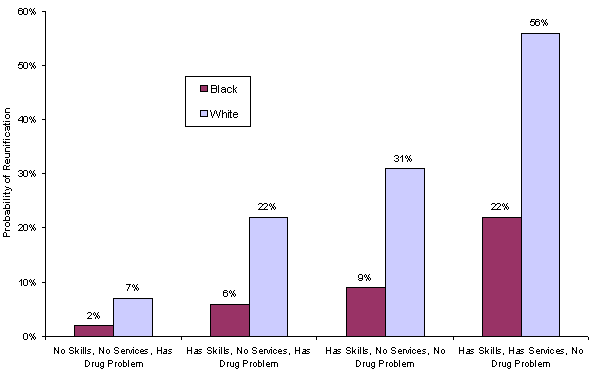
5. Discussion
Although this study is based on cross-sectional data, it is interesting to note that many of its findings are consistent with those from several longitudinal studies. This is especially evident when some of the bivariate relationships of important variables with reunification are compared with those of prior research. First, this analysis found race to be significantly related to reunification: white children were more likely to be reunified than black children. This finding agrees with those in four reunification studies: Barth (1987), Courtney (1994), Wells and Guo (1999) and McMurty and Lie (1992). While Goerge (1990) found no direct racial differences, he obtained interactions between race and region. For example, blacks in Cook County had lower reunification probabilities that whites in Cook County.
Second, this study found kinship placement to be inversely related to reunification: children who were placed with kin were less likely to be reunified than children placed with non-relatives. These findings agree with those of two studies: Goerge (1990), and Courtney (1994). However, Wells and Guo (1999) did not find kinship placement to be related to reunification. Moreover, this study found that kinship placement did not continue to be significantly related to reunification, when combined with race and the other predictors in the regression models. Thus, it was concluded that the higher kinship placements of black children do not explain their lower reunification rates relative to white children.
Third, this study found age of entry to be significantly related to reunification: rates of reunification rose directly with increases in the age that the children entered foster care. Several studies also found lower reunification rates among infants and young children than older children (Goerge 1990; Courtney 1994). Moreover, Courtney (1994) found large racial differences in reunification between blacks and whites at young ages, but declining racial differentials as the age of the children increased. While Wells and Guo (1999) found no significant relationship between age of entry and reunification, they found a positive relationship between the interaction term "African American and age of entry" and reunification.
Fourth, although this study found the reasons for placement to be significantly related to reunification, there were wide differences regarding the specific reasons in prior research. For example, Goerge (1990) found neglected children to have higher reunification rates than abused children. But Wells and Guo (1999) found that children placed for abuse had higher rates of reunification than those placed for neglect or dependency. While Courtney (1994) found--among children placed with non-kin--that children placed for sexual abuse had higher reunification rates than those placed for neglect, he found no significant relationships between any of the reasons for placement and reunification among children placed with kin. And, while this study found that abuse and neglect were both significantly correlated with reunification, they were related in the opposite directions. Children placed for abuse were more likely to be reunified, while children placed for neglect were less likely. However, neither reason for placement continued to be significantly related to reunification -- when combined with other key predictors in the regression models.
On the other hand, unlike the studies by McMurty and Lie (1992), Courtney (1994) and Wells and Guo (1999), this analysis did not find child disability or health problems to be significantly related to reunification. Those studies found children with health problems to be reunified more slowly than children without any health problems. Nor did this study find, as did Courtney (1994), that AFDC status was significantly related to reunification. Yet, this analysis found two other measures of socioeconomic status -- parental education and employment status -- to be positively related to reunification. Children whose parental caretakers had completed high school and were currently employed were more likely to be reunified than children whose parental caretakers were high school dropouts or were not employed.
The questions raised at the beginning of this study will now be addressed. First, "Is race a strong predictor of reunification when combined with other important child, family or case history characteristics?" This analysis revealed that race is a strong predictor of reunification when combined with other important child, family or case history characteristics. A second question was: "What other child, family or case history characteristics are also strong predictors of reunification?" This study reveals four important predictors of reunification in addition to race: age of entry, caretaker job skills, caretaker substance abuse problems and caretaker services.
A third question was: "Are the main effects of race reduced when controlling for other important predictors?" This study found that controlling for the other key predictors does not reduce the independent effects of race. In sum, it was concluded that race continues to play a major role in the reunification of children in addition to other child, family and case history characteristics.
6. Research Implications
This analysis suggests a number of future directions in research on race and reunification. First, as Courtney and colleagues (1996) conclude in their comprehensive review of the literature, it is important to acknowledge the role of race and ethnicity in future child welfare research:
We encountered many studies in which these factors were not mentioned as variables, although the sample size and location of the study would have lent themselves to such analysis. The failure or unwillingness to at least acknowledge the relationships among race, child welfare services, and child welfare outcomes may only serve to invite uninformed speculation about the reasons for these relationships. Whenever methodologically possible, child welfare researchers should include race as an explanatory factor in research designs and consider their theoretical justification for doing so (i.e., why does the researcher think that race might play a role?) (Courtney 1996).
Second, there is a need for reunification studies that not only include adequate sample sizes of African Americans, but of Hispanics, Native Americans, and Asian and Pacific Islanders as well. While many studies have often obtained similar results for Caucasians and Hispanics, little is known about reunification rates for Native Americans or Asians because they are most often excluded due to their small sample sizes. Third, there is a need for more longitudinal studies that are based on both administrative records and surveys that track cohorts of children over time to better understand the dynamics of reunification patterns among racial and ethnic groups.
Fourth, additional research is needed on the type of services that are most appropriate for enhancing reunification among parental caretakers of different racial and ethnic groups (Maluccio, Fein, and Davis 1994). This analysis found lower reunification rates among families that did not receive any services. Reviews of child welfare research revealed that families of color are less likely to receive services than Caucasian families (Courtney 1996). Further research is needed to determine, "Which mix of specific services are most effective for reunification with which types of parental caretakers among various racial and ethnic groups?" Fifth, more research is needed that continues to include common measures from prior studies in order to more carefully examine their separate and combined effects on reunification. Such an approach might resolve contradictory findings related to the importance of race, ethnicity, kinship placement, SES, child disability, age of entry, and reasons for placement as predictors of reunification.
Appendix: Coding of Study Variables
Independent Variables
Child Characteristics
Race: black=1; white=0.
Gender: male=1; female=0
Age of Entry: Continuous variable (average age was seven years old)
Child Disability Status: with disability=1; no disability=0
Family Characteristics
Parent Job Skills: lack job skills=1; has job skills=0
Parent Substance Abuse Problem: has problem=1; has no problem=0
Parent Single Mother: is a single mom=1; not a single mom=0
Parent Social Class: finished HS and employed=0; all other combinations=1
The social class index comprises only parental education and employment status.
The variable "AFDC recipient" was excluded from the index, because it was not correlated with the other two measures of socioeconomic status.
Case History Characteristics
Reasons for Placement: only abuse allegation=1; no abuse allegation=0.
only neglect allegation =1; no neglect allegation=0.
The variable "only abuse allegations" applies only to allegations that include: sexual abuse, physical abuse and emotional abuse; it excludes any neglect allegations. The variable "only neglect allegations " applies only to allegations that include: physical neglect, emotional neglect; and medical neglect, it excludes any abuse allegations.
Type of Placement: with kin=1; not with kin=0
Parental Caretaker Services: no services received=1; some services received=0.
The 23 services included: parent training at home, parent training in classes, household management, homemaker services, day care, respite care, emergency financial aid, family planning, legal services, schooling, employment training, health care, psychological assessments, outpatient mental treatment: inpatient mental health treatment, case management or counseling, outpatient substance abuse treatment, in-patient substance abuse treatment, self-help groups, housing, housing payment, temporary shelter and transportation. The number of services provided to caretakers could range from 0-23.
Dependent Variables
Parental Reunification: reunified=1; other discharges and still in care=0
References
Barth, Richard, et al. (1987) Contributors to Reunification or Permanent Out-of-Home Care for Physically Abused Children. Journal of Social Service Research, 9(2/3): 31-45
Courtney, Mark E. (1994) Factors Associated with the Reunification of Foster Children with Their Families. Social Service Review, 68 (1): 81-108.
Courtney, Mark E. (1995) Reentry to Foster Care of Children Returned to Their Families. Social Service Review, 69 (2): 226-241.
Courtney, Mark E., et al. (1996) Race and Child Welfare Services: Past Research and Future Directions. Child Welfare, 75 (2): 99-137.
Frame, Laura, Jill Duerr Berrick and Melissa Lim Brodowski (2000) Understanding Reentry of Out-of Home for Reunified Infants. Child Welfare, 79 (4): 339-369.
Goerge, Robert M. (1990) The Reunification Process in Substitute Care. Social Service Review, 64 (3): 422-457
Hohman, Melinda M. and Rick L. Butt (2001) How Soon is Too Soon? Addiction Recovery and Family Reunification. Child Welfare, 80 (1): 53-67.
Maluccio, Anthony N., Edith Fein, and Inger Davis (1994) Family Reunification: Research Findings, Issues, and Directions. Child Welfare, 73 (5): 489-504.
Maas, Henry and Richard Engler, Jr. (1959) Children in Need of Parents. New York: Columbia University Press.
McMurty, S. and G. Lie (1992) Differential Exit Rate of Minority Children in Foster Care. Social Work Research and Abstracts, 28 (1): 42-48.
Sedlak, Andrea (1993) Study of High Risk Child Abuse and Neglect Groups, NIS-2 Reanalysis: Report to Congress. Appendix C.
U. S. Children's Bureau (1997) National Study of Protective, Preventive and Reunification Services Delivered to Children and Their Families. Washington, D. C: U. S. Government Printing Office.
Wells, Kathleen and Shenyang Guo (1999) Reunification and Reentry of Foster Children. Children and Youth Services Review, 21 (4): 273-294
Chapter 7. Caseworker Decision Making
1. Introduction
The Adoption and Safe Families Act of 1997 (ASFA) amended the foster care provisions of the Social Security Act for the purpose of promoting safe and permanent living arrangements for children. Prior to ASFA, some foster children continued to linger in out-of-home care while prolonged attempts were made to reunite them with their birth parents. Consideration of the child's need for a permanent home seemed to be forgotten; an alternate permanent home for a child was rarely considered until the child had been in out-of-home care for 18 months. ASFA introduced two key provisions to address the problem of drift and expedite permanency for children. First, the law determines that states need not pursue efforts to prevent removal from home or return a child home if a parent has already lost parental rights to that child's sibling; has committed specific types of felonies, including murder or voluntary manslaughter of the child's sibling; or has subjected the child to aggravated circumstances such as abandonment, torture, chronic abuse, and sexual abuse.1 In these situations, the courts may find that services to preserve or reunite the family, or "reasonable efforts" required under Public Law 96-272 of 1980, are not required. Second, ASFA directs states to begin the process of terminating parental rights by filing a petition with the courts if an infant has been abandoned, the parent committed any of the felonies included in the first provision, or the child has been in foster care 15 of the last 22 months. States may exempt a child from this requirement if the child is placed with a relative, the state has not provided services needed to make the home safe for the child's return, or there exists a compelling reason why filing a petition to terminate parental rights is not in the child's best interest. In response to ASFA, states enacted their own parallel legislation, and by July 1999, all states had laws that mirrored ASFA or were more stringent than federal law. In some states, such legislation was already in place before passage of ASFA.2
This paper focuses on caseworker decision making in reunification cases, and the influence of ASFA and related state laws on the process. This analysis of caseworker decision making provides information and insight into the primary considerations weighed in the decision process, the tools used to facilitate reunification and permanency, agency policy, and caseworker's thoughts and impressions of the rules, tools, and decisions they make that affect children and families. This paper provides a description of how workers said they make decisions, but it is not an evaluation of whether decisions always follow the general principles workers outlined.
Site visits were made to three public child welfare agencies in the greater Washington, D.C. Metropolitan Area. Individual one-hour discussions were conducted with a foster care program director and three caseworkers selected by each agency. Additional discussions were held with a county attorney at one agency and a foster parent program coordinator at another, at the request of those agencies. The discussions included questions on agency policy, timelines for permanency, permanency planning practices, services provided, and factors considered when making decisions to return children home or consider other permanency options.
This paper provides
- A brief description of the agencies studied,
- An overview of the case process,
- An examination of caseworkers' decision making, and
- Conclusions regarding the implications of the decision-making process for children and families.
1. States may expand upon the definition of aggravated circumstances.
2. United States General Accounting Office. (1999). Report on States' Early Experiences Implementing the Adoption and Safe Families Act.Washington, D.C.: Government Printing Office.
1.1 Agency Background
Discussions with caseworkers and other agency staff were conducted at three public child welfare agencies located in the Washington, D.C. Metropolitan Area. The agencies were chosen to reflect a cross-section of geographic and demographic variations in client population. All three agencies were organized under county-administered, state-supervised child welfare systems. One agency had more control at the local level than the others.
Overall, agency workers we talked to were well educated and trained.3 The average length of time workers had been employed by their current agency was 7.8 years, ranging from 13 months to more than 20 years. Most of the workers had prior work experience at other public and private agencies as caseworkers, protective service workers, or mental health workers. All of the workers had a bachelor's degree and four of the nine had master's degrees.4 Most of the workers also had many hours of additional training on subjects such as mental health issues, sexual abuse, drug and alcohol abuse, and handling difficult clients.
Agency A is located in a large, densely populated, resource-rich, suburban county that serves approximately 600 children in foster care per year. The agency has 35 caseworkers and 7 supervisors working with out-of-home cases in the county. The foster care population in the county is 54 percent African-American, 28 percent White, 11 percent Hispanic, 2 percent Asian, and 5 percent unknown or some other race/ethnicity. About 25 percent of the children in out-of-home-care are placed with relatives. In 1999, 174 children exited the foster care system, about 29 percent of all those in foster care during the year.5
Agency A has an intensive reunification unit as well as ongoing foster care units serving children in out-of-home placement. Cases in the intensive reunification unit receive intensive services from the time of placement, provided by a caseworker and a case aide to expedite the family's reunification. Workers in the intensive unit carry smaller caseloads than ongoing foster care workers, typically around 14 children compared to an average of 25 for ongoing workers. All cases entering the foster care system are initially referred to the intensive reunification unit unless the child had been in out-of-home care many times or there are other extenuating circumstances surrounding the case (such as the parent's involvement in the death of another child) that make reunification unlikely.
Cases are served in the intensive reunification unit for up to 9 months, with the goal of reunifying the child and family within that time. The case can be transferred to another unit at any point if it is determined that rapid reunification within 9 months is unlikely. The ongoing units serve children in all types of out-of-home placements and often receive the most difficult cases to reunify -- those transferred from the intensive unit after efforts at rapid reunification have proven unsuccessful.
The agency reported making reunification its first choice for permanency. The agency is committed to giving parents a good chance to have their children returned by providing intensive reunification efforts for several months. Services provided to work toward the goal of reunification are determined on an individual basis and can include substance abuse treatment, mental health services, individual and family therapy, support groups, parenting classes, housing assistance, transportation, job search assistance, and literacy training. If after receiving services for 9 to 12 months the birth parents do not demonstratively make a good effort toward reunification, the agency considers an alternative permanency plan. If the plan for the child is adoption, the agency conducts a legal sufficiency staffing on the case to determine whether there is sufficient evidence to warrant a petition to terminate parental rights (TPR). This is a change in policy for the agency. Prior to ASFA, the agency typically waited at least 15 months before taking any action for TPR and making another permanency plan. Once a decision is made to pursue adoption, the case is transferred to the adoption unit.
When a child is successfully reunified with his or her parents and returned home, aftercare services are provided for 6 months. At this time, the child is still committed to the agency and still under the court's jurisdiction. Policy requires the worker to visit the home once a month to monitor and check on the family and arrange any necessary services, including a parent aide to help the family with budgeting, scheduling, and finding day care.
Agency B is located in a densely populated, less affluent, suburban county. This agency served 976 children in foster care in 1999 with a staff of 57 caseworkers and 10 supervisors. Approximately 85 percent of the foster care population in the county is African-American. About 25 percent of the children in care are placed with relatives in paid or unpaid kinship care arrangements. In 1999, 279 (29%) of the 976 children in foster care during the year exited the foster care system. Of those children who exited foster care, 146 (52%) were reunified with a parent or relative (both return to parent and permanent placement with relatives outside the home of origin were considered as "reunification" in this county), 59 (21%) were adopted, and 78 (28%) were emancipated.
This agency has an intensive reunification unit, four ongoing foster care units in which reunification is the primary plan, two adoption units, two independent living units, and one unit that serves youth in residential placement. The intensive reunification unit has been in operation for about 8 years. Cases in the intensive unit are served by a team of a caseworker and case aide using an approach that emphasizes families' strengths. The workers in this unit generally have more access to flexible funds to provide special services than do workers in other units. Caseworkers in the intensive unit carry a caseload of 10 to 14 children and can provide up to 15 hours of services per week to a single family. The average time for reunification for cases in this unit is 4.5 months.
One of the four ongoing foster care units is a student field placement unit with five to seven students who have very small caseloads. Workers in the other three ongoing foster care units are trained in The Annie E. Casey Foundation's Family to Family model of community-based foster care.6 Caseworkers in these ongoing foster care units carry caseloads of about 18-20 children and their caseloads include children in long-term foster care, kinship placements, and cases with a goal of reunification. The average length of stay for children in these ongoing units is 18 months.
Cases are typically assigned to the intensive reunification unit if there is a parent or relative who is willing to work toward reunification and if there are sufficient openings in the intensive unit. Services provided by both intensive and ongoing foster care units are based on the particular needs of the family but may include psychological evaluations, parenting classes, anger management classes, counseling, substance abuse treatment, day care, transportation, medical assistance, vouchers for Section 8 housing, furniture, help applying for public assistance, food, and clothing.
Reunification either with the birth parents or a relative is the first outcome the agency works to achieve in all cases. However, the foster care director noted that the agency had also always been very mindful of the need to move children along in the system and not let them drift in foster care. Reunification services are typically provided to families for up to 15 months and can be extended if it is believed a longer service period will lead to a successful reunification.
When the caseworker determines there has been no progress toward reunification and the parents are not able to achieve the service plan goals, a permanency planning staffing is scheduled to determine if the case goal should be changed to adoption or another permanency plan. Depending on the circumstances of the case, this decision can take place anytime between 6 and 15 months after the child entered care. Reunification services continue to be provided to the parents even after the case plan is changed to adoption, and cases are sometimes reunified from the adoption unit.
When a child is returned home, custody is transferred to the parents, and the department maintains protective supervision of the child for 6 to 12 months while aftercare services are provided to the family. The worker is to contact the family at least monthly, and the worker and/or a case aide assists the family as necessary by providing assistance with parenting skills, helping with budgeting and planning meals, and providing transportation. Aftercare services can be provided to the family for up to 4 to 6 hours per week, as required.
Agency C is located in an area that had traditionally been rural, but in the past few years has increased in population and is rapidly becoming more suburban. The agency served 48 children in foster care between July 1998 and June 1999. There are three foster care caseworkers and one supervisor. Most foster care cases come from the suburban areas of the county, with only a few cases coming from truly rural sections. The foster care population in the county on June 30, 1999 was 42 percent White, 27 percent African-American, 25 percent multi-racial (White/African-American), 3 percent Hispanic, and 3 percent reported as "other." No children in care at this agency are placed with relatives in temporary kinship care arrangements. Twelve children (25% of the foster care population served in Fiscal Year (FY) 1999) exited foster care during FY99. Of those children who exited foster care, 1 child (8%) was reunified, 9 (75%) were adopted, and 2 (17%) were emancipated.
Agency C does not have an intensive reunification unit. All cases that come into foster care are served by workers in the one foster care unit. The agency emphasizes using intensive upfront services such as family preservation for those families at risk of having children placed in foster care. Most of the families whose children eventually come into foster care have received these upfront, in-home services. The agency generally does not serve children in relative placements. Child Protective Service (CPS) workers make a strenuous effort to locate any available relatives prior to placement. When relatives are found, they are nearly always given legal custody of the child upfront, diverting the case from the foster care system. The foster care unit generally serves the most difficult cases--those with very complex, extensive child or family problems that were not addressed successfully through preventive or in-home services -- and cases in which extended family were not available for a child's care. As a result, most children in the foster care unit are not likely to return home. Caseworkers carry an average caseload of 15-20 children.
The agency director reported that the agency expends a great deal of effort trying to keep children out of foster care, as is also the case in the other two agencies. All cases entering foster care have an initial goal of reunification. The only exceptions are cases that had previously been in foster care, which can go directly to the adoption unit under certain circumstances. Once a child is placed in care, services provided to reunify the family include individual and family therapy for the parents and child, substance abuse treatment, mental health treatment, parenting classes, employment and training services, day care, and medical services. If birth parents refuse to participate in services or make no progress toward remedying their problems within 6 months of placement, the worker considers changing the goal to adoption.
Agency C maintains legal custody of the child and gives physical custody to parents when a child returns home. This custody arrangement generally lasts for a minimum of 6 months and allows the agency to immediately remove the child without going to court if there is any question of the child's safety at home. Aftercare services are provided by a contractual agency for up to 20 hours per week and include services to improve parenting skills and assistance in helping the child make the transition back into the family.
3. It is important to remember that the individual workers we spoke with were chosen by their agencies and likely represented the agencies' more exemplary workers. However, the agencies provided access to workers with varied backgrounds and experiences, from different reunification programs (intensive reunification vs. ongoing foster care units), and who served various types of families.
4. Three of the four had masters in social work degrees.
5. No information was available on the number of children who were reunified, adopted, or had other exit outcomes.
6. This site was a pilot site for Family to Family. This model emphasizes a community-based approach to foster care which includes placing children in their neighborhoods, involving foster families as team members in reunification efforts, and investing in the neighborhood as a resource for children and families.
1.2 An Overview of the Case Process
Decisions that affect the lives of children identified as being at risk of abuse or neglect are made at a variety of junctures and influenced by many different parties in the child welfare system. Caseworkers have a critical role to play in the decision to reunify or establish an alternative permanency plan for a child in foster care, but their decisions are affected by state law and agency policy. It is important to understand the broader context of how cases move through the child welfare system for a full understanding of the ways caseworkers' decisions are influenced and constrained by external forces. In this section, we further describe how cases generally move through the three agencies and the issues that arise and decisions that are made at different points that ultimately affect the decision-making process of the caseworkers themselves. This description presents an overview of the case process as it is designed to occur though exceptions and deviations may occur in individual cases. A section describing how caseworkers actually make decisions follows.
When an allegation of abuse or neglect has been made, the case is investigated by CPS workers. The decision of the CPS worker to remove the child from the home or to provide in-home services to keep the family intact is the first that affects the types of cases that caseworkers ultimately work with in foster care. All three agencies espoused a strong belief in providing preventive services to families so that children need not be removed from the home, except under the most extreme circumstances when their safety is in peril. In-home services and referrals to treatment and other services are commonly provided through CPS or family preservation units to serve children and families in their homes, and workers reported these services are often effective in preventing removal of the children. The cases in which children are removed from the home represent the most serious cases where in-home services have proven ineffective to address the family's problems. Severe mental illness and long-term drug dependency are problems that face many of the parents served by all three agencies and were frequently the underlying cause of the child's removal from the home.
Once the CPS worker determines that the child cannot remain safely in the home, the case may follow a variety of different paths, according to each agency's policy and practice. At Agency C, children are commonly placed in shelter care for up to 60 days as an alternative to the state assuming custody and are typically returned home within this period. This county also has a privately run foster parent program in which children can be placed voluntarily for up to 3 weeks with volunteer foster parents not under the jurisdiction of the agency and without a change in custody from the parent. Therefore, families for whom successful reunification is most likely can be served short-term without the child being brought into the foster care system.
All three agencies stress that keeping children out of foster care whenever possible is of paramount consideration. When it is unsafe for a child to remain in the home with a parent, relative placements can be used in lieu of the state opening a foster care case. In these cases, a change in custody is authorized by the court with the parent's consent. These cases represent ones where permanency with family (though not necessarily with the parents) can be achieved most easily and is accomplished without the child entering the foster care system.
All three agencies expressed a preference for relative care over non-relative foster care, although in Agency C relative care is primarily used as a diversion from the child welfare system. At Agencies A and B, children are often placed with relatives once they are removed from their homes and enter the child welfare system. The relatives can be either licensed foster care providers or unlicensed kinship care homes. Whether relatives are licensed or unlicensed does not make a difference in the types of services provided to reunify the child with the parents but does make a difference in whether the relatives receive payment from the state for their care of the child. Licensed relative foster care providers receive the foster care board rate. Relatives who are not licensed are not eligible for state foster care payments, although they can receive cash assistance through child-only Temporary Assistance for Needy Families (TANF).
Workers and administrators at all three agencies ranked permanency goals similarly: 1) reunification, 2) relative placement, 3) adoption, 4) independent living, and 5) permanent foster care.7 Independent living is typically used as an option for older teens who are not likely to be adopted (and often do not want to be). These youths are to receive special services to prepare them for emancipation from the foster care system. Permanent foster care is used as a goal when a foster parent is willing to keep the child in the home until emancipation but is not willing to adopt. Agencies A and B also have a goal of long-term foster care as a permanency option. Long-term foster care is typically in a residential or group home setting or foster home where the placement appears stable and long-term but where there is no formal commitment to keep the child in the placement until emancipation. Long-term foster care is also used when there is some chance that the goal could be changed to reunification, relative placement, or adoption at some future date.
Agency policy regarding the use of relatives to provide temporary placements for children has important implications for the ultimate permanency plans made for a child. When a child cannot be returned home, the child's current living arrangement is the likely first choice to become the permanent placement. When a child is placed with a relative, the transition from a temporary to a permanent placement can be made following the hierarchy of preferred placement options without disrupting the child's placement. When a child is living in a non-relative foster home, permanent placement with a relative would mean moving the child from his or her current placement and disrupting the bond the child may have developed with the foster parent. The upfront decision about where the child is placed while in foster care may well be the decisive factor in determining where the child ends up on a permanent basis. Because many children are adopted by their foster parents, agency policy is to try to appropriately match children with foster parents who would provide good permanent placements for the children if return home is not possible.
Relatives' decisions to become licensed foster care providers can also have an impact on the eventual permanency outcomes for a child. Relatives become licensed to receive the foster care payment to help defray some of the costs of caring for the child, to be eligible for certain services, and in some instances to help protect a child. Workers said that licensed relatives may be less likely to establish a permanent legal relationship which would remove the child from the foster care system and terminate the foster care payment. Although these relatives would generally qualify for an adoption subsidy, relatives are often reluctant to adopt their kin because they do not want to disrupt family ties and see parental rights terminated, or they feel that adoption is unnecessary because of existing blood ties. The net result is that children stay in permanent foster care with their licensed relative caregivers until they are emancipated. Only Agency A has a kinship care subsidized guardianship program (as part of a state pilot project) where relatives can receive a subsidy that is somewhat less than the foster care board rate, if they agree to become the child's legal guardian, and the foster care case is closed by the agency.
Once a child is placed into foster care--either with relatives or nonrelatives--the case is sent to a reunification unit to receive services to try to reunify the family. All three agencies stated that reunification is the initial goal of nearly all cases that come into foster care. Exceptions, as allowed by ASFA, are cases where the parent has been involved in the death of a child's sibling or has caused severe bodily harm to the child placed in care. In these cases, TPR and another permanent placement are considered immediately. As described in the previous section, Agencies A and B both have intensive reunification units in which workers have smaller caseloads and work with a case aide to provide services to families. In Agency A, nearly all cases are referred to the intensive unit immediately, unless a child has been in and out of foster care repeatedly. In Agency B, cases are referred to the intensive reunification unit as space permits, with the criterion only that there is someone in the family--either parent or relative--with whom the worker can actively work to reunify the child. This agency includes permanent relative custody in its definition of reunification. The decision about whether a particular case goes to the intensive reunification unit in Agency B is made by the foster care intake worker, who relies largely upon case information provided by the CPS worker and supervisor. If a case seems appropriate for the intensive unit but there are no available slots, the case is referred to one of the ongoing foster care units. All of the workers in the ongoing foster care units are trained in the Family to Family model and can provide the same services as the intensive unit but cannot spend as much time with the family due to higher caseloads.
Decisions made by the foster care intake worker in Agency B determine which unit a case is sent to and the likelihood that reunification will occur. If the child is 16 years old and the information provided by CPS staff indicates that return home is not a likely option for the child, the case is sent to the independent living unit where the child is prepared for emancipation as the eventual exit from foster care. If the child is very young and return home is not likely, the case might be assigned to the adoption unit on a fast track to adoption. The cases that are sent to the intensive reunification unit are the ones determined to have the greatest chance of being reunified.
At all three agencies, once the case is assigned to a reunification unit, a case staffing occurs to assess the case and assign it to a caseworker within the unit. This staffing includes the supervisor, other unit caseworkers, and the CPS worker or supervisor who discuss the case and any services received prior to the child coming into care. In consultation with the birth parents, supervisor, and sometimes other relatives and foster parents, a service plan is prepared that outlines the steps the birth parents need to take for the child to return home and the timeframe for reunifying the family or establishing an alternate permanency plan. As part of the concurrent planning process, in which workers plan for alternative permanency options if children cannot return home, parents are told about time limits they have to meet or risk loss of the child permanently. Parents are to be told they have between 6 and 12 months to address the problems that brought the child into care.
Cases in the intensive reunification units in Agencies A and B are viewed as being on a fast track to reunification, with reunification expected to occur in 6 to 9 months. The average length of time for cases to reunify in the intensive unit in Agency B is 4.5 months. At Agency A, if the caseworker and supervisor of the intensive unit decide that reunification is not likely to occur within 9 to 12 months, the case is generally transferred to an ongoing unit where reunification services continue, but without the intensive effort. However, if the family is approaching the 12-month mark but is making progress toward reunification and has a good relationship with the intensive worker, the case will typically stay with the original worker until the child returns home. At Agency B, cases are transferred from the intensive unit only when it appears that reunification is unlikely. Depending on the circumstances of the case, the case is transferred to one of the ongoing foster care units, particularly if kinship care or long-term foster care seem likely, to the adoption unit if the plan is to terminate parental rights, or to the independent living unit if the child is 16 or older.
The role played by the courts is an important one because the courts make the final decisions to terminate parental rights, to return children home, and to approve changes in goals to permanent or long-term foster care. Under ASFA, courts are required to hold hearings on a case once a child has been in foster care for 6 months. All three agencies replaced 6-month administrative case review hearings with a formal court hearing. At these hearings, the worker discusses efforts made on behalf of the agency to achieve reunification and discusses the parents' progress toward this end. The birth parents (with legal representation) discuss their compliance with their agency contract, a signed agreement made as during joint case planning with their caseworker, and compliance with court-ordered services. Changes in case plans from reunification to other permanency options are based on a review of the progress a birth parent has made, although it is rare that a goal is changed from reunification at the 6-month hearing.
Workers and an attorney interviewed at Agency A noted that these case hearings are very formal, similar to an evidentiary hearing, and include witnesses testifying for the county and birth parents. These hearings can last for several days. ASFA's addition of the 6-month court hearings, along with an increase in the number of TPR cases, places a heavy burden on the court system and delays in 6- and 12-month hearings are common. One worker at Agency A described situations in which it could take 6 to 9 months to get a court date set to hear a TPR petition.
Workers said that judges recognize the requirement to have a permanency plan within 12 months and recognize that decisions must be made on cases. Workers in two agencies told us that prior to ASFA some judges were very lenient and tended to err on the side of the birth parents, causing workers to sometimes feel the safety of the child was in jeopardy. Since the states updated their laws to meet the federal requirements of ASFA regarding timelines and permanency decisions, workers reported that judges have been stricter in their interpretation of the laws and are generally willing to move cases toward permanency faster. Workers reported that judges usually accept their recommendations on cases, though some judges are still reluctant to move as quickly to TPR in some cases as the workers feel appropriate. One agency administrator said that public defenders for parents have been successful in persuading judges to give parents another chance even when the children have been in care for 4 to 5 years. He noted that "Even with ASFA, judges do what they want to do." For these cases, the agency gives the parents an additional 6 months of services before refiling for TPR. Overall, workers indicated that they thought ASFA is helping to expedite the decision for TPR from the court, and they felt the court acts fairly in reviewing evidence and testimony from both the agency and the birth parents before rendering a decision on TPR.
The role played by foster parents in decisions about permanency is also an important one to consider. Traditionally, the role of foster parents has been limited to providing care to children in their homes, and they had little to no contact or interaction with birth parents. More recently, many States and localities have adopted an approach that utilizes foster parents as a resource in the reunification process. Agency C has a staff member dedicated half-time to run a program designed to encourage mentoring of birth parents by foster parents. This program trains foster parents to work with and understand the complex situations of birth parents. Agencies A and B integrated elements of the Family to Family foster parent mentoring model into their foster parent programs and are beginning to train new foster parents on the importance of helping with the reunification process.
Under ideal circumstances, the foster parent has regular contact with the birth parents, allows visitation in his or her home, models good parenting behavior, and serves as a means of social support for the birth parents while the child is in care and even after the child returns home. However at all three agencies, good relationships between foster parents and birth parents were uncommon, and workers reported that foster parents were often resistant to meeting with birth parents, sometimes due to previous negative experiences with birth parents. Caseworkers felt that when foster parents were willing to work with birth parents, there were positive results in terms of greater visitation and the birth parents viewing the foster parents and agency as less of a threat. However, staff at all three agencies also noted that when good relationships were established between foster parents and birth parents, a common, though unintended consequence was the birth parent's decision to voluntarily relinquish parental rights and consent to adoption of the child by the foster parents. In some cases, voluntary relinquishment resulted in open adoptions, with the birth parents continuing to visit and maintain a relationship with the child after adoption by the foster parents.
7. Although relative placement was given as a permanent option by Agency C, relatives were usually found through CPS prior to foster care placement so relative placements were rarely used once a child was placed in foster care except in cases of relative adoption.
2. Caseworker Decision Making
Understanding the caseworker decision-making process is key to understanding when and why children are reunified, adopted, or have some other permanency outcome. The decisions made by caseworkers to set and change permanency goals dramatically affect the lives of children and families. With the implementation of ASFA and its strong emphasis on expediting permanency, it is important to consider the influence ASFA has had on how caseworkers make permanency decisions. This section examines caseworkers' decision making in setting and changing permanency goals, the mechanisms used by workers to facilitate reunification and permanency, the primary considerations that weigh in their decisions to return children to their parents or to terminate parental rights, and caseworker's thoughts and impressions on expediting reunification and permanency for children and families. Statements made by caseworkers, in their own words, are presented throughout the section in italics. We caution that the information presented on the decision-making process is a collection of views expressed by the nine caseworkers we spoke to and should not be viewed as representative of the various viewpoints of caseworkers in agencies across the country.
Under ASFA, an agency has 15 months to find a permanent living arrangement for the child who is in foster care. If a child in foster care for 15 out of the most recent 22 months cannot be reunified with his or her parents, TPR proceedings must be initiated and an alternative permanent placement should be found for the child to expedite his or her exit from foster care.8 With the high number of cases on workers' caseloads, the difficulty in working with families who are often angry about their children's removal, and the high caseworker turnover in the child welfare system, we anticipated that agency officials and caseworkers would be disgruntled over the ASFA time requirements. However, agency officials and caseworkers in the agencies we visited told us that they embraced the new time limits. The primary response of caseworkers was that they believe the time restrictions provide support to expedite their cases. They feel that the time requirements give them "permission" to expedite TPR when parents cannot achieve reunification, thus limiting parents' repeated failed efforts to remedy their problems as children languish in foster care for long periods of time.
. . . people would keep trying to reunify and that's what kept kids in care a long time. We wouldn't say that [reunification ] is not working, but would give the parents chance after chance after chance because we think the child needs to go home. But that's not good for the child, keeping them in care for 2 to 3 years while their parents try to get it together.
Moreover, most workers said they believe the time requirements are in the best interest of children for a permanent home.
Children should have permanency, whether it's permanency back home or permanency with a relative or adoptive family. Children should not be in a system, children should be with a family.Although some people say we don't have enough time, I think that decisions need to be made about kids before the case lingers too long.
Some caseworkers do have conflicting feelings about the time requirements, especially for families with problems that are difficult to address within the 15-month time limit. However, most still believe that the time limits are fair and appropriate.
In fairness to the children the timelines are long enough. These children need permanency. They change and grow daily. Their emotional needs need to be met. It's really sad because I know that sometimes a parent could turn their lives around if they had more time, but we have to be fair to the children. It's too bad parents' needs and children's needs don't mesh, but we have to go with the children's needs.
Our discussions with caseworkers and agency staff indicated that the new time requirements are taken seriously. Caseworkers reported that although they had always been focused on permanency for children, the new law prompts them to work harder at expediting children's permanency. However, there are also indications that there is flexibility in implementing the time requirements. The agencies, workers, and courts are willing to examine children and families on a case-by-case basis to approve time beyond 15 months to work toward reunification when a family's circumstances indicate that reunification could occur with a few additional months of services.
Concurrent planning is the primary tool used by these agencies to comply with the new time requirements. Concurrent planning involves planning and working with the family towards reunification but also arranging for an alternate permanent placement in case reunification is not achieved. Although some caseworkers noted that their agencies had been doing concurrent planning for some time, most workers said that the ASFA time requirements increase the importance of devising an alternative permanency plan for a child at the time the initial permanency plan is made.
I may look at reunification with the parent as a goal but at the same time I look at reunification with a relative also. I work dually on those goals, so if one doesn't work out, I have the other. That's the law now.
Generally, the concurrent planning process is used throughout the case process to meet the goal of establishing permanency within the 15 of 22 month timeframe. Concurrent planning begins when a child is removed from the home. It starts with the decisions made by agency workers to find a temporary placement for the child, as many temporary placements become children's permanent ones. All three agencies attempt to place children with relatives or with compatible foster parents for the initial placement, with the hope that the relatives or foster parents will be willing to adopt the child if the child cannot be returned home.
When the child is first brought into care, workers meet with birth parents and are frank with them about the concurrent planning process, time limits they must meet, and the consequences they face if they do not remedy their behavior and problems within the time limits. Workers then search for an absent parent, or look to relatives or foster parents as an alternative permanent placement for the child. Birth parents are included in the discussion of possible alternate permanency plans and are asked to provide input into where they want the child to live if the child cannot be returned home. The alternate plan is generally treated as a "secondary" goal or backup plan. Workers most commonly see the child's temporary placement, whether with relatives or non-relative foster parents, as the most probable alternate permanent placement. Caseworkers continue to focus on reunification as the primary goal but begin to make more concrete arrangements for implementing the alternate plan, as reunification appears less likely over time. Once a goal is changed from reunification, the alternate plan is put in place. In two of the agencies visited, concurrent planning continues even after the initial goal of reunification is changed to adoption. Parents continue to receive services for reunification after the case is transferred to the adoption unit and reunification sometimes takes place from the adoption unit.
Workers believe that concurrent planning is a fair and necessary part of the permanency process and helps expedite permanency. They believe it is fair because birth parents are informed from the time of case planning what is expected of them and what the consequences of noncompliance will be.
We work concurrently . . . from the beginning. I think this is fair to parents. I tell parents this may sound like we are threatening them, but we really aren't. We are just explaining what the realities are and what has to be done or the goal will be changed. I feel this is only fair to parents so that they don't lose track of time and what needs to be done to get their kids back.
Although workers have always been responsible for making alternate permanent arrangements for children when they could not return home, in the past workers typically did not begin planning for another option when the child was first brought into care but waited until reunification appeared very unlikely. Parents were informed at that point that alternate arrangements were being made for their children. The net effect was a slower process for establishing permanency both because the worker did not start making concrete arrangements for an alternate plan early on and because the parents often did not believe that their children would truly be removed from them on a permanent basis until there was clear evidence of a viable alternate plan. The real threat of losing their children can create a crisis for the parents which may spur them to try to address the problems that brought the child into care. However, when parents do not start addressing their problems until children have been in care for several months, this prolongs the amount of time a child is in foster care.
Although workers feel that concurrent planning is fair to parents, some indicated that it can create a tension between the worker and the parents when the worker is trying to help the family reunify and at the same time work toward an alternate arrangement.
It [concurrent planning] is very, very difficult for several reasons. It's hard to work with a parent with a goal of reunification while at the same time looking into relative resources and possible adoption resources. . . . I currently have a case with a 7 year old child where I am working with the mother on reunification which is the primary goal, but the case has a secondary goal of relative placement with a godmother. While I am working with the birth mother, I am also doing clearances on the other party to get her ready for a possible placement. I also let the parent know that this is a mandate and there is a timeline that we work towards and why. But it creates a conflict in the helping relationship when we are saying that we want them to get services, to get their job back, and for things to work out. But at the same time we are asking the parent if they don't comply who else would they like to take care of their child.
For parents who experienced the placement of other children in out-of-home care prior to ASFA and were accustomed to open-ended services with little threat of permanent removal of the child, the new concurrent planning process can be particularly contentious.
For these parents it can be frustrating and I often hear from them that they don't feel I am working for them (the parent) but only working to take their kids away and place them with another family.
A worker spoke of the cognitive complexity involved in working on plans for two opposing goals at the same time.
It's hard to make the switch in your brain to work on both [reunification and concurrent planning]. But I tell myself that I have to document what's going on in the case. I may be working on a goal of return home, but need to document everything happening, knowing that the case may have to go to termination.
Concurrent planning weaves through the entire decision-making process as workers evaluate what parents need to do to have a child returned home, what services are necessary and available to help parents meet their goals, the progress of parents, and the best placement for the child if reunification is not possible.
Establishing an initial permanency plan. Regardless of whether a case is served by an intensive or ongoing reunification unit, nearly all cases have an initial goal of reunification. A worker conducts an initial assessment of a family's needs, which often includes clinical evaluations to determine the extent of child and family problems. The factors considered in this initial assessment include the severity of the problems that brought the child into care, the parent's commitment to seeing the child returned, prior services received to prevent placement, and previous history with the child welfare system. The worker also takes these factors into consideration when designing a service plan for the parent and when evaluating the likelihood that reunification can occur within the ASFA time limits.
Agencies' policies call for a planning meeting to be scheduled within 48 hours of the placement if possible. The planning meeting involves the birth parents and may also include family relatives, close friends of the family, foster parents, and the children if they are old enough to participate and feel comfortable in doing so. At the planning meeting, the caseworker outlines the reasons why the child was brought into care, the steps parents need to take to address the conditions that brought the child into care, and the services available to families to help them with their problems. Service goals and timeframes for achieving these goals are set. As described above, caseworkers also discuss the concurrent planning process and the timelines that must be met for reunification to occur or for alternative permanency to be established. Relatives or close family friends who attend the meeting are asked to provide input into the plan, including the discussion of alternate placement options. The purpose of the meeting is to involve as many people as possible who can provide support for the parents and to keep the parents mindful of the timelines that must be met for reunification to occur.
When the initial service plan and goals are being developed, we begin talking to the parent and other parties [telling them] that if we cannot return the child home safely, what to expect with regards to a change of goal-we put the parents and other parties on alert. We discuss the hierarchy of goals and the differences between the goals and what the implications are for the parents, relatives, and child. We discuss the responsibility of the parents financially and regarding visitation; about the legal timelines so that they understand what type of compulsion everybody is under in the process. . . . There is also input from the other parties on what they believe needs to be done to achieve reunification.
The service plan outlines services the worker and parents deem necessary to address the family's problems so that the child can return home. Caseworkers and agency administrators reported a wide range of services available to families, including individual and family therapy, substance abuse inpatient and outpatient treatment, mental health treatment, support groups, parenting classes, anger management classes, job-training, transportation, medical services, access to Section 8 housing, and day care. In addition, workers reported the availability of concrete help with furniture, clothing, and rental deposits. Some agency programs also provide families with in-home services in parenting and household management.
Unlike many other areas in the country, the three agencies are situated in relatively resource-rich environments, and workers reported that they had little difficulty accessing services for children and families, including substance abuse treatment and mental health treatment. Although one worker noted that there was sometimes a waiting list for mental health treatment at one agency, most other workers said that it was rare that necessary services were unavailable to families who wanted them. Workers reported that a much more common problem was parents' failure to utilize available services.
Most caseworkers said that they can tell within the first few months whether birth parents intend to make progress toward reunification. Families who indicate a strong desire to have the children returned and who immediately start services and visit their children on a regular basis are good candidates for reunification. Workers conduct ongoing assessments of parents' progress between the initial planning meeting and the 6-month court review. Workers receive input from a variety of sources as they evaluate the likelihood of reunification and make decisions about the case. Workers most often mentioned peer advice and consultation as important elements in assessing a case, particularly for the benefit of drawing on the various experiences of other agency staff. Workers discuss the progress of their cases with their supervisors on a weekly or bi-weekly basis; they discuss cases with colleagues within their unit on an informal basis, and they have formal staffings to discuss cases when a change in goal from reunification to another option is being considered. Workers also receive provider input from service progress reports (e.g., reports from therapists, substance abuse counselors, mental health counselors) on the compliance and progress of the parents in addressing their problems.
Evaluating parent progress. Decisions to return a child to the home of the parents can be made at any time when the worker determines that sufficient progress has been made to remedy the problems that brought the child into care, and the court concurs with the assessment. Workers reported that the issues essential to their decisions to return a child home are: 1) parent compliance with services, 2) safety of the child, 3) visitation, and 4) the child's wishes and well-being. By far, the issue mentioned most frequently by caseworkers when deciding whether to return a child home was the birth parents' compliance with the court's order and the agency's service agreement. Specifically, caseworkers look at whether the birth parents have complied with service referrals, whether the parents have actively participated in treatment, whether parents' behavior has changed, whether the parents have been drug free if they had substance abuse problems, and whether the parents are actively participating in plans for the child's daily activities and schooling.
This (returning home) is not an easy decision and I have had some uneasy feelings about some cases. We have to look at operating within the letter of the law. Parents may do everything to comply with the court order, but we may still have a gut feeling that something is not right. The court doesn't care about my gut feeling . . . . We look at what parents have done. Have parents followed the court order? Have parents gone to counseling? We talk to the counselor about whether there has been any intrinsic change in the parent. Does the therapist feel the children will be safe? Have parents completed their drug counseling and have been clean for at least 6 to 9 months? Are the parents working? Are parents visiting their kids and what are the visits like? We collect data from all sources and make a decision. This does not mean everything is going to be 100 percent. There may be some soft areas that continue to need to be shored up, which is why we generally return the children under the agency's protective supervision, giving us 6 more months to observe and provide assistance.
The caseworker's evaluation of the safety of the home is also critical in the decision to reunify. Safety issues include an assessment of the risk of further maltreatment, evidence regarding what has actually changed in the home and in the birth parent's behavior to make the home safe for the child, whether the parents can discipline the child appropriately, and whether the parents are capable of caring for the child and meeting the child's daily needs by providing adequate housing, financial stability, and day care.
Visitation is also a key indicator that caseworkers said they use to determine whether a child is ready to go home. Lack of visitation by the birth parents is an early indicator that reunification will not take place. Workers said they monitor visitation closely and that visits generally progress from being supervised visits that occur in the agency office to unsupervised visits in the community. Workers look at whether the birth parent visits regularly and whether there are good child-parent interactions during visits or whether the child acts out around the parents.
Finally, the child's wishes and an assessment of the child's overall well-being are important determinants of whether a child may be returned home. Although the desire to return home is strong for most children, others do not wish to be returned home. In some cases, return home is determined to be contrary to the best interests of the child, even when the parents have complied with services.
In some cases the parents are pretty compliant but it's still not in the kid's best interest to go home, so you have to weigh both of those things. One case is where child is emotionally disturbed and was sexually abused while in the parents' care, though not by them. Mom was a substance abuser and there's sex abuse rampant in this family and in the community where they live. Mom's gotten off drugs and they've gotten one of their children back but this child doesn't feel safe and doesn't feel protected, despite all his therapy. . . . It doesn't work for him. The parents have done everything--there isn't anything else for us to ask the parents to do but it's not working for him and as we have more unsupervised visits to work toward reunification, he regresses and gets suicidal. He's 9. The parents are somewhat limited intellectually and though they've done everything, they really don't understand the impact of the sex abuse on him and why he doesn't feel safe. They think he should be returned home and they don't understand why he doesn't trust them. . . . The plan has recently been changed to adoption. We've been working on this case for about 3 years.
Changing permanency plans. Changing the permanency goal from reunification to another permanency option can occur at any time during the case process but most commonly occurs after the family has received reunification services for 9 to 12 months. Our discussions with workers revealed three general types of birth parents--those who made no effort to achieve reunification during the first 12 months the child was in care, those who made some effort to achieve reunification, and those who actively worked toward reunification from the time of placement. Workers were united in expressing their willingness to give birth parents every opportunity possible to make efforts toward reunification. Workers explained that if parents made some progress toward meeting their goals for reunification, even a small effort, they would continue to work with the parent. However, if the birth parents made little or no effort to comply with referrals to evaluations, attend services, and/or did not visit or have contact with their children, workers began the process of changing the permanency plan and working toward another option.
I look at what progress the parent is making . . . . If a parent refuses to participate in services or to make progress towards remediating the problems that brought the child into care . . . then I may change the goal to adoption at that time.
For caseworkers, case decisions are easier if they have parents who are cooperative and compliant from the beginning or if parents are completely noncompliant. Caseworkers recalled the cases they had where the goal was always reunification and they had no doubt that the parents would eventually get their children back from the first weeks of the case.
I currently have a case where it is clear that there should be success. The parent has received services and continues to be sober, the child is doing very well in a group home and is succeeding in school, and the parent is participating in his planning at the group home. It is clear when things are going to work out because everything is going as it should--parents' work hard to do what they know needs to get done.
However, caseworkers more often discussed cases where the birth parents made no effort to remedy the situation that brought their child into care. Caseworkers reported that they began moving these cases toward other permanency options within the first few months after they received the case, particularly if they were ongoing foster care workers who received a case that had already received intensive services from an intensive reunification unit. Noncompliance was often due to a parent's chronic substance abuse or mental illness.
I have a lot of parents who are absolutely noncompliant--heavily substance-abusing who basically disappear and parents who are on their sixth or seventh child the department has been involved with. I have one case right now where I have never met the mother. She never came to a court hearing and she never responded to a letter. In those cases, I send a letter saying we've changed the plan and in those cases they usually don't end up objecting to the guardianship petitions.If there's no response over a long period of time or [the parent] made minimal progress and no time likely in the near future would make enough progress to adequately care for the children . . . . I've had a few cases where the person had such significant mental health issues that we've moved to adoption quickly because we already had documentation from a clinician that this person would never be able to parent safely.
Cases where parents are very compliant or very non-compliant with service plans are the easy ones for workers to decide what the permanency goals should be. Caseworkers told us that the real difficulty comes when they have to decide whether parents who are making some effort toward reunification will ever truly meet their service goals and be able to have the children returned home. These decisions are particularly difficult when the parents' problems involve substance abuse or mental illness, problems that are not easily addressed within ASFA's 15 month timeframe for achieving permanency.
My biggest concern, timewise, is with substance abuse issues because they tend to take a lot longer time to assess and treat. And if a parent relapses, they have to go back into treatment. Plus the monitoring that takes place for a parent that has a substance abuse problem.We are now getting more families with a history of mental illness and a lot of drug stuff, which is very difficult to change in 9 months. Someone can be using [drugs] for 10 years and we are expected to change this in 9 months?
Some caseworkers felt that families with severe problems could ultimately be reunified, if they were able to receive services for more than 15 months.
When we offer services for more than 15 or 24 months, more kids go home. People take and need a long time to deal with very serious problems that they have. That's a dilemma. The law says kids need permanent places but we know mental health and substance abuse issues take a long period of time, even with a parent who is ready, willing, and able. I know more parents would get their kids returned if services were longer, but is that fair to the kids? It's a difficult question.
Often workers found it was difficult to engage parents in actively working to have their children return home, and it was not until the point of TPR that parents began actively seeking services to keep from losing their children permanently. A few workers were critical of parents who waited until this point. However, some birth parents were successful at turning things around at this late point in the process and could be successfully reunified.
For these most difficult cases, workers and the court often have to weigh the various aspects of cases and decide what is truly in the best interest of the child. Based on the individual characteristics of the children and families, sometimes the case moves to TPR, and other times the worker continues to work toward reunification. One worker discussed a case where she believed that reunification would not be successful, and she should terminate parental rights, despite progress made by the parents.
I had one case with two parents who had not been taking care of themselves. They were in poor health and said they didn't know if they would keep using drugs. They didn't have adequate housing or employment. One and a half years had gone by and the parents were pretty consistent with visits but didn't have a good understanding of one child's special educational needs . . . . Even though there was something of a bond and they had nice visits with the kids, the parents could barely take care of themselves, how were they going to take care of two kids and one with special needs? I could have worked with these parents forever but they couldn't do it.
Workers and administrators also noted that there were cases that reached the 15- month time limit and where the parents continued to have significant problems that barred the return of the child but where decisions were made by workers and the court to continue to work toward reunification.
The most difficult cases for courts is when the children are between ages 7 and 11. These kids have bonded relationships with their parents, even though the parents are dysfunctional and not improving. When you weigh in the best interest for the children and you are talking about doing TPR with kids that are least likely to be adopted, you see everyone including the courts wanting to give these situations more time and chances. It doesn't matter what the legislation says, if the reality is there are not going to be permanent homes and the kids are going to be traumatized by the separation, there is a tendency to give the case more time.
At the point at which a worker decides that reunification is not going to take place, the worker needs to move on the backup permanency plan. The alternate permanency plan may or may not include a decision to seek TPR. A TPR petition must be filed before a child can be adopted. However, many children are given alternate permanency plans that do not include adoption. These cases may occur when the child is considered to be a poor candidate for adoption, either because the child is living with relatives who feel adoption is not necessary, because the child is older, or because the child does not want to be adopted. As children age, they become less and less likely to be adopted. Although some workers stated that they were getting more adoptions completed with older children who were once considered to be unadoptable due to their age, adoption of teens is still rare. When workers consider whether to file a petition for TPR, the child's age, the availability of adoptive homes, the child's attachment to the birth parents, and his or her bonding with the foster parents are all important factors that weigh into the worker's decision.
We have to justify a lot now. We give parents a reasonable amount of chances and all kinds of services and if they can't achieve the goals of the service plan then we have to move along. Of course, each case is different. If a child is 10 years old and has been with the parent for his whole life and desperately wants to go back, we're not going to ride roughshod over that child's attachment. But if the child has bonded with relatives or foster parents and is ready to move on, the child's needs are primary.
Under ASFA, workers must justify why TPR and adoption are not being pursued after the child has been in the system for 15 months. If a child is not going to be adopted or placed in the permanent custody of a relative, ASFA requires that the child still have some type of permanency established. Permanency options other than reunification, adoption, and relative placement include independent living and permanent foster care. Independent living is the permanency goal for children who are close to emancipation, generally 16 or 17 years of age. While workers at all three agencies stated that permanent foster care is an option of last resort, the courts are willing to sanction permanent foster care as a permanency goal for children who do not want to be adopted, who are living with relatives licensed as foster parents who do not wish to adopt, and those children for whom adoptive placements are not likely to be found.
Children may be 14 or 15 and not want to be adopted or relatives may not want to adopt and it's considered in the child's best interest not to disrupt a placement that's working for them by looking for some other placement that may or may not lead to permanency.I have five teens on my caseload who came into care as teens and could not return home so we set up permanent foster care placements. The kids didn't wish to have their identity changed at this stage of their lives.
The dilemma of how to establish permanency for older children is one with which agencies and workers struggle.
I do not think 15 months is long enough in these cases with older kids. I would like to be able to have some type of open arrangement with pre-teens and adolescent kids where it is acceptable for the kids to be in long-term foster care and also have a relationship with their birth parent. So it is clear the kids won't be going home, but they can still maintain some type of relationship. In essence, I think the kids should be allowed to grow up. When these kids get to be 18, it doesn't matter what their legal status is, they will go and find their birth parents. So it is very artificial to go and do all the court work on a case, when you know the kid will end up returning to the parents. The problem is that the agency doesn't have a "middle area" that says it is ok to have these kids in long-term foster care.
Caseworkers told us that cases most likely to have a change of plan to adoption and go through TPR are those where the children are younger and where parents are noncompliant, nonresponsive or have simply given up on working toward reunification. Caseworkers explained that as part of their concurrent planning process, they document cases from the very beginning so that if TPR is necessary down the road, they have the information needed to make a strong case for why it is justified. There is a significant burden placed on the department to prove to the court that a case should have a goal changed to adoption with the resulting TPR. As part of the process for TPR, caseworkers hold a staffing meeting with other agency staff and county attorneys to determine if a case warrants TPR, and if not, what additional proof is needed to file the petition.
The process (to determine TPR) is an ongoing one from the beginning. We spend time consulting with each other and practicing peer supervision to bring in the various experiences with workers. We will "staff" a case and discuss what has been done for the family, what has been available to the parents and child. We look at what the parents' participation has been, if they have had treatment then we get a prognosis from the treatment provider. We come to a clinical decision that TPR is what is best for the child and that the prognosis for the family is that they are not going to be able to provide safety for the child in a timely manner. We also run these situations by our attorney and provide all information to him and then we can get from a legal standpoint what our case would be as well. The staffing of a case provides the ability to see proof of a decision -- whether the decision is based on just feelings the worker has or if there is actually concrete proof.[If] there's been no progress . . . it's going to be staffed for legal sufficiency about whether we should change the case plan . . . . If we don't have legal sufficiency, we discuss what's missing or whether enough time has been given. We may give the parent another 90 days. . . . I would meet with the parent and say, "ok, we have another 90 days and these things have to be accomplished or we'll change the plan to something else."
Caseworkers and administrators said that TPR is a very lengthy and difficult process. It is typically traumatic for all parties involved and can take many months to schedule due to the court's overburdened docket. When possible, workers try to get parents to voluntarily relinquish their rights. Mediation is one method used to expedite court matters in cases and particularly to ease the struggle between birth parents and agency workers and help achieve voluntary relinquishing of parental rights. Mediation programs are either currently used or in the planning stages at the agencies we visited. If mediation is successful, the amount of time for the TPR process is lessened, meaning lower costs for the agency and courts and less time in care for the child. Moreover, voluntary TPR was more often cited as leading to open adoptions, allowing the birth parents to maintain some contact with their children. The voluntary relinquishment of rights is sometimes facilitated by good relationships that have developed between the foster and birth parents.
Caseworkers play a powerful role in shaping children's futures. The decisions they make in developing initial permanency plans, evaluating parent progress, and making alternate arrangements for permanency ultimately determine who is allowed to raise a child. Our discussion of caseworker decision making captures the overarching decision-making process: the procedures that caseworkers follow, the timeframes they work within, the factors they weigh, and the role of other parties in informing and shaping permanency plans. All of the agencies had formal policies and procedures in place to help caseworker decision making occur in a timely fashion with input and oversight from other parties. Workers were very consistent in describing these procedures, but whether they are followed in most cases cannot be determined by this research. Instead, from discussions with agency personnel, we have the opportunity to highlight the critical issues caseworkers consider in determining permanency for children and comment upon the implications for children and family outcomes.
8. Certain exceptions to TPR may apply in individual cases. For instance if the child is in the care of a relative, the state documents a compelling reason why filing TPR is not in the best interest of the child, or the state has not provided the family with services deemed necessary for the child to return home safely.
3. Implications
This report is based on discussions with caseworkers and administrative staff at three public child welfare agencies. These three agencies may be unusual compared to many child welfare agencies in the level of resources available to serve families. The workers reported having adequate staff and sufficient services to address clients' needs. In addition, the agencies have well-defined decision-making procedures in place that involve input from colleagues, supervisors, service providers, attorneys and other county staff. This well-defined process -- whether or not followed through completely for every case -- allows these workers to feel they have sufficient guidance and support to make fair decisions for children and their families. Consequently, the workers we talked with appeared confident about their decision-making capabilities, given the agencies' systems of checks and balances.
However, under ASFA, caseworkers must make decisions faster, while they continue to deal with children and families with difficult problems. The implementation of new time limits, coupled with the troubled families coming into the child welfare system, has created a paradox for caseworkers and administrators. On the one hand, caseworkers and administrators believe that the shortened time limits provided by ASFA are fair and proper in order to expedite permanency for children and avoid foster care drift. On the other hand, workers find it difficult to tackle the intransigent problems and situations of families coming into the foster care system within these shortened time limits. Workers continue to face the overwhelming troubles of children and families entering the foster care system without any new or improved ways to deal with the problems of these families, despite the need to reunify or find permanency more quickly.
Broadening permanency. The timeframes of ASFA require workers to consider all permanency options from the time the child enters care. Workers and administrators we spoke with believe strongly in reunifying families and continue to make family reunification the initial goal of all families served by their agencies. However, the focus on keeping children and their parents together if at all possible has diminished under the new time limits. If a family cannot be reunited within 15 months so that the child can live safely at home, then it may be determined that the child must live permanently in an alternative safe and stable household. Because decisions like this are happening more frequently, there is a serious need to find permanent placements for children within a reasonable time.
To meet the permanency needs of children who cannot return home from foster care, agencies have turned to relative placement as the permanency option of choice when reunification is not possible. Permanency with relatives encompasses a variety of arrangements, including licensed foster care placements, unlicensed or informal placements, custody arrangements in lieu of foster care placement, legal guardianship (subsidized and unsubsidized), and adoption. In fact, one agency we visited referred to relative placements as reunification and counted them as reunifications in their data.
Another agency we visited commonly used relatives as legal guardians (unsubsidized) to divert children from entering foster care. Relatives were located by CPS prior to placement and given legal custody of the child so that the case never entered the foster care unit. This is an obvious way to keep children from foster care placement and avoid the costs of having the child in care. However, diverting the child from foster care also diverted the child's parents from receiving any services through the foster care unit, thereby failing to make any attempt to solve the problems that required placement of the child out of the home.
Relatives have served as a variety of placement options for children. Their roles are diverse and debated. The increased use of relatives as permanent alternatives for children creates further reason to step back and clearly define the roles they play. Although placement in the family structure can be an ideal permanency placement for a child that can offer family continuity, from a child's point of view living with a relative can be very different from returning home to his or her birth parents. Alternatively, placement with a relative -- formally or informally -- may be the most permanent arrangement a child will experience. Policy for relative placements has been pieced together over time in response to changing needs. Issues surrounding the emotional and financial implications to birth parents, children, and relatives need to be considered comprehensively. Relatives are a valuable resource and a thoughtful and systematic approach to defining their expanding role is critical to their being an effective resource.
With the implementation of ASFA, we expected to see a reduction in the use of long-term foster care for children at agencies we visited. However, all of the agencies used long-term or permanent foster care placements under certain circumstances. These cases usually involved pre-teen or teen children who had strong bonds with their parents, did not want to be adopted, and where placement with a relative was not feasible. Workers were still required to place these children in long-term or permanent foster care placements. These were the most difficult and frustrating cases for workers to make decisions on because they had few choices for permanency other than keeping the children in some type of foster care placement until emancipation. It was clear that these cases complied with ASFA's exceptions for compelling reasons. It is evident that a number of children in the child welfare system will continue to stay in long-term foster care until emancipation because there are no other permanency alternatives. Agency administrators expressed a concern about children being made legal orphans, as required by ASFA, and parental ties are severed but no adoptive home identified.
Watching the clock. The time limits instituted by ASFA require workers to make decisions on permanency when a child has been in care 15 of the past 22 months. It is clear that workers are mindful of the time they have to work with birth parents. Workers found that the time limits relieved them of some of the responsibility for deciding how many months -- or years -- services should be provided to parents while their children remain in foster care. Most workers said they believe the time limits are fair to birth parents and in the best interest of children. There were a few workers who mentioned conflicting feelings over struggling to reunify families within 15 of 22 months. The conflict of these workers is understandable as agencies move from allowing families an extended period of time to achieve reunification to an emphasis on watching the clock and expediting permanency.
When a case is assigned to a worker's caseload, workers reported that they typically go through the process of meeting with the family, making permanency plans with members of the family, choosing the services they feel are appropriate for a family, documenting the family's progress, consulting with peers and colleagues to determine whether the family should be reunified or if the alternate permanency plan should move forward, and reporting to the court about the family's progress at the 6- and 12-month court reviews. However, as regimented as the process appeared, the workers found some room for flexibility. There were times when workers adhered to the time limits, but they also understood how to bend the time requirements when they felt that a family deserved more time for reunification. Workers reported that if birth parents made a diligent effort to comply with the goals set forth in the case plan and court orders but had not completed the necessary requirements to remedy the situation that brought their children into care within 15 of the past 22 months, judges were willing to allow the family an extra 6 or 9 months to receive services and work towards reunification. Critical to making these difficult decisions in shorter time periods is having sufficient information to assess a family's strengths and weaknesses, but workers reported that the assessment procedures they use have not changed since ASFA but have remained fairly constant.
Concurrent planning, although implemented by the agencies prior to ASFA, is the primary tool used to comply with the new time requirements. Concurrent planning has changed the focus and approach of case planning and decision making. Agencies and workers use concurrent planning as a tool to convey clearly to parents early in the planning process that they have a limited amount of time to resolve the problems necessary for reunification or they may lose parental rights to their child. However, we found that workers did not actively work toward an alternative permanency plan until they determined that reunification was unlikely. Moreover, some workers reported that they continued to try and reunify families even after the child's goal had been changed. Concurrent planning requires delicate balancing of coercion and encouragement. With the balancing act come tensions due to the inherent difficulties of working toward reunification while planning for the possibility of alternative permanency for the child and tension between the client and caseworker that sometimes occurs during the planning process. For these reasons, concurrent planning is dependent upon systematic training and supervision of casework practice. While some tensions were reported by workers, overall workers embrace the concept because it allows them to establish consequences for parent noncompliance early in the relationship.
In search of new tools to assist in working with families, agencies reported using foster parent mentoring and family or group planning as part of their foster care practices. Two of the agencies had recently begun implementing foster parent training on mentoring, and the third agency had an established foster parent mentoring program. However, our discussions with agency staffs revealed that these efforts, designed to enhance and support the reunification process, were not achieving that specific purpose in most cases. The supervisor in charge of the established foster parent mentoring program reported that the program conducted training for foster parents on mentoring birth parents and that the agency had an existing pool of foster parents willing to take on the mentoring role. Workers reported that when foster parents formed a relationship and worked with birth parents, it often made a significant difference in helping the birth parents achieve reunification. However, we heard that more often the program resulted in the birth parents voluntarily relinquishing parental rights to allow the foster parents to adopt their child. In cases where birth parents' problems are so severe and persistent that they can never care for their children, the voluntary relinquishment of parental rights was seen as a positive step, making permanency occur faster and more easily. Nonetheless, given evidence of this unanticipated effect, it is important to determine if the program may be covertly coercing birth parents to give up their children due to feelings of inadequacy brought on by personal comparisons to the mentoring foster parents' more substantial parenting skills and financial resources.
All three agencies reported using some form of family conferencing or group planning as an enhancement to concurrent planning. This type of planning is predicated on bringing together birth parents, relatives, close friends of the family, and even foster parents, to participate in the case planning process and to ensure a safety network for the parents and children in support of reunification. However, this type of planning is usually successful only if the birth parents and children have relatives and close friends willing to participate in the reunification process. For families who lack this community support, the planning process includes little more than a meeting between the birth parents and caseworker. Also, relatives can act to aggravate birth parents if they are not supportive of reunification efforts. Workers discussed meeting with family groups for case planning but also said that they had cases without relative support. Discussions with some workers indicated that relatives were often included in the case planning to prepare them to care for the child. Some workers referred to these meetings as a time to put relatives on alert -- telling them that if the birth parents did not comply with the reunification plan, the children would need another permanent home. Workers reported using the planning session more as a resource to find and prepare relatives as caretakers rather than to provide support for reunification.
Aside from foster parent mentoring and family group planning, we did not learn of any other changes in services or service delivery being used to enhance reunification with families. It appears that these agencies are doing very little differently post-ASFA to enhance assessment or services to improve the likelihood of reunification within the shorter timeframe. With the need to achieve reunification more quickly, there is a need for tools to enhance efforts to reunify families within the timeframes. Moreover, the example of the foster mentoring program illustrates the need to carefully evaluate all the effects of these tools.
Barriers to reunification. To workers, one of the most frustrating barriers to achieving reunification is engaging the high number of parents who have chronic substance abuse problems or mental illness. By the time a family enters the foster care system, parents' problems are often long-established and difficult to treat. Despite the generally adequate evaluation and treatment services, workers are discouraged by their inability to convince these parents to obtain treatment. Shortened timeframes necessitate the development of new strategies for workers to engage families more quickly and intensively in needed services. However, even when parents are willing to undertake substance abuse treatment, such treatment can take several months to complete, and there are frequently periods of relapse before an individual is drug-free. The substance abuse treatment field cannot provide quick fixes for long-term drug and alcohol addiction, making addiction frequently impossible to address within the new timeframes.
Prior to ASFA, workers were inclined to give birth parents with chronic substance abuse and mental illness substantial periods of time to continue treatment and work toward reunification. Unfortunately, this often meant that the child was left to drift in care for a number of years. ASFA has given workers "permission" to proceed with TPR at 12 or 15 months, and find an alternative home for children if parents have not complied with treatment. Moreover, under ASFA, if parental rights to a sibling have been terminated involuntarily, reasonable efforts may not be required for other children in the family who enter care. Consequently, parents who have chronic substance abuse and mental illness may lose parental rights to all their children. This is an important dilemma that needs to be considered as it has far-reaching consequences on the economic and emotional well-being and viability of families and communities.
Role of the courts. The courts play an important role as they make decisions on the requirements a family needs to meet for reunification, to return a child home, to terminate parental rights, and to approve a change in goal to permanent or long-term foster care. What happens to a family, in large part, depends on a judge's decision. Although in some jurisdictions, judges' views on reunification and TPR can be very diverse and contrary to workers' views, agency staff we spoke with told us that family court judges they deal with are educated about ASFA, recognize the requirements to have a permanency plan within 12 months, usually concur with worker recommendations for families, and act fairly in reviewing evidence and testimony from both the agency and birth parents before rendering a decision on TPR.
ASFA has put additional burdens on the court system. Since the implementation of Public Law 96-272 in 1980, which instituted 18-month court reviews, there have been complaints of overburdened family courts and extensive delays in case reviews. ASFA's additions of the 6-month court review, along with an increase in the number of TPR cases, have placed a heavy weight on the court system, causing delays in scheduling 6- and 12-month hearings and delays of up to several months for TPR petition hearings. Workers at one agency reported that the court reviews were being conducted as formal evidentiary hearings lasting up to 4 days. Workers commented that policy to guide and regulate the implementation of these reviews would be helpful to agencies and the courts. The burden on the courts is a key problem that was not adequately addressed at the time of ASFA's initial implementation. However, the federal government has recently instituted grants to assist courts with their responsibilities under ASFA.
ASFA has prompted changes in the decision-making process to establish permanency for children, based on the premise that shorter timeframes will move children more quickly out of foster care and into permanent living arrangements. According to our research, provisions of ASFA have been adopted into states' laws, and administrators and caseworkers have incorporated some changes in their case planning process and service delivery to meet the new time limit for reunification; however, it is not known whether these procedures are being consistently implemented. It appears that ASFA is stimulating action to address the problem of children languishing in foster care. Nevertheless, as stated above, there are still some important issues to be thought through by policymakers, states, agency administrators and caseworkers. Hopefully the implementation of ASFA and the repercussions will serve as a wake-up call to comprehensively rethink issues that have beleaguered the child welfare system for decades and stimulate the creation of an environment that promotes strategic planning of programs and resources to guide caseworkers' decisions.
References
United States General Accounting Office.. Report on States' Early Experiences Implementing the Adoption and Safe Families Act.(1999)Washington, D.C.: GPO.