


Vulnerable Youth and the Transition to Adulthood
Youth from Distressed Neighborhoods
July 2009
This Research Brief is part of a larger project:Vulnerable Youth and the Transistion to Adulthood
This Research Brief is available on the Internet at:http://aspe.hhs.gov/hsp/09/VulnerableYouth/4/index.shtml
Printer friendly version in PDF format (4 pages)Free PDF reader  How to Obtain a Printed Version
The author acknowledges the comments of Robin Smith, Jennifer Macomber, and Michael Pergamit of the Urban Institute. Also from the Urban Institute, Tracy Vericker helped conceptualize the project and Daniel Kuehn performed the data work and provided technical assistance. Additional information regarding this study can be obtained from the Federal Project Officers: Flavio Menasce (202-260-0384, Flavio.Menasce@hhs.gov), Susan Hauan (202-690-8698, Susan.Hauan@hhs.gov), and Annette Rogers (202-690-7882, Annette.Rogers@hhs.gov).
This research was conducted with restricted access to Bureau of Labor Statistics (BLS) data. The views expressed here do not necessarily reflect the views of the BLS.
The transition to adulthood can be particularly challenging for youth growing up in distressed neighborhoods. Using the National Longitudinal Survey of Youth 1997, this fact sheet compares the adolescent risk behaviors and young adult outcomes of youth from distressed neighborhoods with those of youth from non-distressed neighborhoods.[1] All differences discussed below are significant at the 95 percent confidence level or above.
- Youth from distressed neighborhoods do not engage in more risk behaviors during adolescence than youth from non-distressed neighborhoods (3.0 and 3.3 mean cumulative risks for youth from distressed and non-distressed neighborhoods, respectively).[2] Specifically, youth from distressed neighborhoods have lower rates of participation in criminal activities such as selling illegal drugs and destroying property than youth from non-distressed neighborhoods; however, youth from distressed neighborhoods are more likely to have sex by age 16 (67 percent versus 50 percent) and to have been a member of a gang (15 percent versus 8 percent).
- Ten percent of youth from distressed neighborhoods have sex before age 13, compared with 3 percent of youth from non-distressed neighborhoods. One in ten (11 percent) young women from distressed neighborhoods have given birth by age 18, compared with 3 percent of young women from non-distressed neighborhoods.
- Twice as many youth from distressed neighborhoods (32 percent) do not earn a high school diploma as youth from non-distressed neighborhoods (15 percent).[3] Only 12 percent of youth from distressed neighborhoods obtain a degree from a four-year college, compared with 27 percent of youth from non-distressed neighborhoods.
- About one in three (35 percent) youth from distressed neighborhoods are consistently-connected to work or school between the ages of 18 and 24, compared with nearly two in three (62 percent) youth from non-distressed neighborhoods.[4]
- Sixty-five percent of youth from distressed neighborhoods are employed on their 24th birthday, compared with 78 percent of youth from non-distressed neighborhoods.
- The earnings of youth from distressed neighborhoods are 22 percent lower at age 23 than the earnings of their peers in non-distressed neighborhoods ($17,891 and $22,805, respectively).[5]
- Seventy-eight percent of youth in distressed neighborhoods are from low-income families.[6] Even among youth from low-income families, those in distressed neighborhoods are less likely to be consistently-connected to school or work than those in non-distressed neighborhoods (see Figure 1).
FIGURE 1. Youth Consistently-Connected to School or Work between Ages 18 and 24
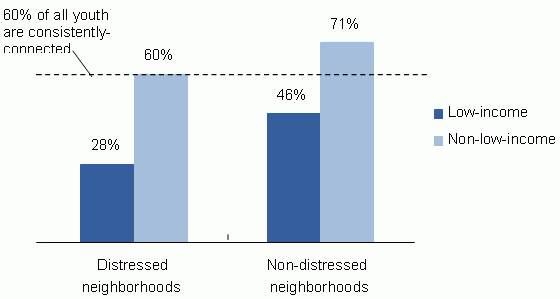
Source: Urban Institute estimates of the National Longitudinal Survey of Youth 1997.Notes: Sample sizes: low-income youth in distressed neighborhoods, n = 201; non-low-income youth in distressed neighborhoods, n = 49; low-income youth in non-distressed neighborhoods, n = 695; and non-low-income youth in non-distressed neighborhoods, n = 910. Consistently-connected youth are in school or working most of the time between ages 18 and 24. Differences in connectedness between youth from low-income families in each type of neighborhood are significant at the 99% confidence level.
| Youth from distressed neighborhoods | Youth from non-distressed neighborhoods | All youth | |
| (n = 286) | (n = 1,755) | (n = 2,041) | |
| Adolescent Risk Behaviors | |||
| Cumulative risky behaviors (mean) | 3.0 | 3.3 | 3.3 |
| Alcohol by age 13 | 11% | 15% | 15% |
| Marijuana by age 16 | 26%* | 36% | 35% |
| Used other drugs | 19%* | 28% | 27% |
| Sex by age 16 | 67%* | 50% | 51% |
| Attack someone/get into a fight | 31% | 28% | 28% |
| Member of a gang | 15%* | 8% | 9% |
| Sell drugs | 12%* | 20% | 19% |
| Destroy property | 27%* | 37% | 36% |
| Steal something worth less than $50 | 30%* | 47% | 46% |
| Steal something worth more than $50 | 11% | 15% | 15% |
| Other property crime | 14% | 14% | 14% |
| Carry a gun | 18% | 16% | 16% |
| Ever run away | 22% | 17% | 18% |
| Other Sexual activity | |||
| Sex by age 13 | 10%* | 3% | 4% |
| Birth by age 18 (among female youth) | 11%* | 3% | 4% |
| Highest Degree Completed by Age 23-24 | |||
| None | 32%* | 15% | 17% |
| High school diploma | 51% | 51% | 51% |
| Associate's degree | 5% | 6% | 6% |
| Four-year college degree or higher | 12%* | 27% | 26% |
| Median Annual Earnings (among Earners) | |||
| Age 18 | $9,066 | $10,281 | $10,139 |
| Age 19 | $11,224 | $12,743 | $12,637 |
| Age 20 | $12,214* | $14,034 | $13,876 |
| Age 21 | $13,348* | $17,743 | $17,384 |
| Age 22 | $16,675* | $21,766 | $21,430 |
| Age 23 | $17,891* | $22,805 | $22,411 |
| Employment | |||
| Employed on 24th birthday | 65%* | 78% | 77% |
| Connectedness to School or Work between Ages 18 and 24 | |||
| Consistently-connected | 35%* | 62% | 60% |
| Initially-connected | 22%* | 14% | 15% |
| Later-connected | 21%* | 15% | 15% |
| Never-connected | 22%* | 9% | 10% |
| Charged with a Crime | |||
| Charged with any adult crime by age 24 | 17% | 17% | 17% |
| Source: Urban Institute estimates of the National Longitudinal Survey of Youth 1997.Notes: Some youth who did not complete high school may have earned a General Equivalency Diploma. Median earnings exclude youth who did not work and therefore had zero earnings. The cumulative risk behavior score is based on the 13 risk behaviors listed beneath it. Adolescent risk behaviors are measured up to age 18, except where otherwise noted. Never-connected youth may make extremely short connections to school or the labor market. * Estimates are statistically different at the 95% confidence level or above. | |||
Endnotes
[1] Distressed neighborhoods are defined as census tracts in which 30 percent or more of the households are at or below the federal poverty level.
[2] Cumulative risky behaviors include consuming alcohol before age 13, using marijuana before age 16, using other drugs before age 18, selling illegal drugs before age 18, engaging in sex before age 16, stealing something worth less than $50 before age 18, stealing something worth more than $50 before age 18, destroying property before age 18, committing other property crime before age 18, being a member of a gang before age 18, getting into a fight before age 18, carrying a gun before age 18, and running away from home before age 18.
[3] Youth who did not obtain a high school degree may have obtained a General Equivalency Diploma.
[4] Results of a trajectory analyses conducted using the National Longitudinal Survey of Youth 1997 identify four pathways for youth connectedness to employment or school between ages 18 and 24: consistently-connected, initially-connected, later-connected, and never-connected. For more information, see Kuehn, D., Pergamit, M., Macomber, J., and Vericker, T. (2009). Multiple Pathways Connecting to School and Work. Washington, D.C.: U.S. Department of Health and Human Services, Office of the Assistant Secretary for Planning and Evaluation.
[5] Median earnings exclude youth who did not work and therefore had zero earnings.
[6] Low-income youth are from families earning less than 200 percent of the federal poverty level.