


Prepared for:
Susan Bogasky
Assistant Secretary for Planning and Evaluation (ASPE)
U.S. Department of Health and Human Services
Hubert H. Humphrey Building, Room 443F5
200 Independence Avenue, SW
Washington, DC 20201
Prepared by:
Barbara Gage, PhD, Melissa Morley, PhD, Melvin Ingber, PhD, and Laura Smith, PhD
RTI International
1440 Main Street, Suite 310
Waltham, MA 02451
RTI Project Number 0208824.002.007

U.S. Department of Health and Human Services
In Collaboration with the
U.S. Department of Labor
| This study provides an opportunity to explore additional research questions as the Assistant Secretary for Planning and Evaluation (ASPE) and the Centers for Medicare and Medicaid Services (CMS) continue to consider alternatives to the prospective payment silos in post-acute care (PAC). This project expands ASPE's Medicare post-acute care (PAC) episode analytic file in terms of sample size and the number of years used (2006-2008) to provide more detailed characteristics of PAC episodes under different definitions. This analysis provides information on changes in PAC use, allows for more detailed understanding of the patterns of PAC use by geography, and provides a cross-sectional and longitudinal analysis. In addition, this work uses acute Medicare hospital and community entrant initiated episode definitions. |
1. Background
This study provides an opportunity to explore additional research questions as the Assistant Secretary for Planning and Evaluation (ASPE) and the Centers for Medicare & Medicaid Services (CMS) continue to consider alternatives to the prospective payment silos in Post-Acute care (PAC). Reports by MedPAC (June, 2008) and The Commonwealth Fund (Schoen et al., 2007) discuss the potential for moving to episode-based payments to better align incentives across providers, and the Patient Protection and Affordable Care Act includes a pilot program for a bundled payment. Episode-based payments may give providers a financial incentive to be more efficient and to coordinate patient services across settings, potentially helping to improve health outcomes and reduce Medicare payments. The work presented here provides more information on episodes of care and on the PAC services that are included and excluded based on different episode definitions. The results of this work can be used to inform discussions around bundled payments and for understanding the service use trajectories of beneficiaries using PAC across the country.
In work with ASPE over the last several years, RTI International has constructed episodes of PAC using 2005 and 2006 five percent Medicare claims data. These episodes were defined as starting with an index hospitalization and included all PAC services as well as Part B physician claims. While episode payments may be a way to improve care coordination across settings and reduce Medicare spending, there is no consensus on the definition of an episode. The 60-day gap variable-length episode that RTI has examined in past work with ASPE (Gage et al., 2009) has been used to explore trends in PAC use. Under this episode definition, all acute and PAC services prior to a 60-day gap in services are included in an episode. However, there are many alternative episode definitions, including fixed-length episode definitions, some of which were examined by RTI and ASPE in 2009 work (Morley et al., 2009). Fixed-length episodes—for example 30 days following discharge from an acute hospitalization—may provide administrative ease, but there is debate on how long episodes should be given that a beneficiary may have several unrelated services during a potential episode. Fixed-length episodes may also exclude services that are related clinically but initiate beyond a fixed period. This issue is of particular relevance for beneficiaries with longer PAC use trajectories. It is important to examine the impact of different definitions as policy makers consider alternatives.
In the current work, RTI has expanded the data file used in the episode analysis in terms of both sample size and the number of years of data used in order to provide more detailed information on the characteristics of PAC episodes under different definitions. The data used in this work include 30 percent of episodes initiating with an acute hospitalization, 30 percent of episodes initiating with home health (HHA), and 100 percent of episodes initiating in a long-term-care hospital (LTCH) or inpatient rehabilitation facility (IRF) in 2006, 2007, and 2008 Medicare claims. Expanding the analytic file provides information on changes in PAC use over the period 2006-2008, allows for a more detailed understanding of the patterns of PAC use by geography, and provides the opportunity to follow patients over time. This work also differs from past work looking at episodes of care in that it includes analysis of PAC use for beneficiaries without an acute hospitalization at the start of an episode. Although much of the discussion surrounding episodes of care focuses on PAC use after a hospitalization, many beneficiaries are referred to HHA from physician offices, and a smaller number of beneficiaries enter IRF or LTCH without prior acute hospitalizations. Understanding use patterns for these types of beneficiaries is important in establishing context for discussions on how episodes of care are defined.
The next sections of this report describe the data sources, methods, and key findings from this set of analyses. Section 2 describes the analytic samples, the episode definitions explored, and the methods for standardizing payments. Section 3 presents the results of analyses of acute hospital-initiated episodes, including a discussion of the types of cases, episode patterns, and service use under alternative episode definitions. Section 4 presents the results of analyses of community-initiated episodes for beneficiaries entering IRF, LTCH, or HHA without a prior acute hospitalization. For each type of community-initiated episode, we examine the types of cases treated, patterns of care, and use of the range of PAC services under different episode definitions, and we compare these beneficiaries to those with acute hospital-initiated episodes discharged to IRF, LTCH, or HHA as their first PAC setting. Section 5 stratifies episode descriptives based on whether beneficiaries die during their episode in order to compare use patterns for those who die during the episode to against patterns for those who survive to the end of an episode. Section 6 provides detail on how PAC use and PAC episode payments differ by geographic area to demonstrate the implications of setting episode payment policy in different areas of the country. Section 7 presents the results of a cohort analysis where use of acute and PAC services was examined over a 2-year period for beneficiaries with initiating events in 2006. This includes analysis of the percentage of beneficiaries using PAC services in 30-day windows following discharge from their initiating event as well as mean payments per PAC user overall, by type of service, and by Medicare Severity Diagnosis Related Group (MS-DRG). Section 8 includes a discussion of the implications of these results for payment policy.
2. Post-Acute Care Episode Definitions
This section describes the construction of the analytic file used to examine PAC episodes. The file allows for the analysis of a cohort of beneficiaries with an initiating event in 2006 and includes acute, PAC, and physician claims for these beneficiaries for 2006, 2007, and 2008. The analytic file also allows for examination of patterns of use over time by including a cross-sectional sample of the first PAC episode per beneficiary per year in each of the three years of data, 2006, 2007, and 2008. This section describes the analytic samples in greater detail, the definition of an initiating event, and the episode definitions included in the analyses.
2.1 Definition of an Initiating Event
| Episode Initiating Event | Initiating Claim Type |
|---|---|
| 1. Acute hospital-initiated episode |
|
| 2. Community entrant episode |
|
RTI's past work constructing PAC episodes (Gage et al., 2009; Morley et al., 2009) required a 60-day clean period for an acute hospitalization to initiate an episode of care. This clean period was defined as the absence of acute hospital and PAC services (HHA, LTCH, IRF, and skilled nursing facility [SNF]). In the current work, RTI has replaced the 60-day clean period with a 30-day clean period. The decision to reduce the clean period to 30 days was based on earlier work with ASPE looking at time-based episode definitions. This decrease in the required gap in services prior to initiating an episode is likely to result in inclusion of a broader range of beneficiaries who may be in and out of acute and Post-Acute care.
2.2 Analytic Samples
One of the main goals of this project was to increase the sample size of the analytic file from the 5 percent Medicare beneficiary sample used in earlier work. The file constructed for this project includes 30 percent of beneficiaries with acute hospital-initiated episodes, 30 percent of beneficiaries with HHA-initiated episodes, plus 100 percent of beneficiaries initiating episodes in LTCH and IRF settings in 2006, 2007, and 2008. Two analytic samples were incorporated into the data files as described below (Figure 1).
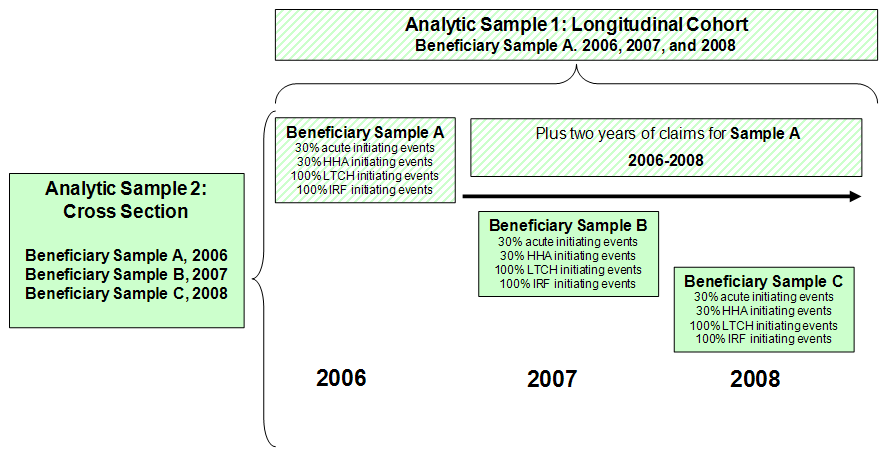
Figure 1 is a schematic of the two analytic samples. Analytic Sample 1 is the longitudinal cohort which includes beneficiaries with initiating events in 2006 and two years of their claims. Analytic Sample 2 is the cross section. This includes the first episode per year for beneficiaries with initiating events in 2006, 2007, and 2008.
- Analytic Sample 1: Longitudinal Cohort—The longitudinal cohort sample consists of a 30 percent sample of beneficiaries with an initiating event in an acute hospital or in home health in 2006 plus 100 percent of beneficiaries with an initiating event in LTCH or IRF in 2006. To construct the cohort sample, RTI selected the first initiating event in 2006 per beneficiary and then constructed a file of all claims following the initiating event for 2006, 2007, and 2008 for these beneficiaries. This file contains two calendar years of data for each beneficiary in the cohort.
- Analytic Sample 2: Cross Section—The cross-sectional samples consist of a 30 percent sample of beneficiaries with an initiating event in an acute hospital or in home health plus 100 percent of beneficiaries with an initiating event in LTCH or IRF in 2006, 2007, and 2008. RTI constructed the first episode per year for these beneficiaries to compare changes in utilization patterns over the 3-year study period.
2.3 Episode Definitions
RTI constructed 15 PAC episode definitions in the analytic file and constructed episodes for both acute hospital-initiated and community entrant episodes using the following definitions:
- 30-day fixed-length episode, and
- 30-day variable-length episode.
The endpoint of a fixed-length episode was defined using two different methods. The first method allowed any claim initiating within a fixed period to be part of the episode definition. For example, using this method, the entirety of a 60-day home health claim initiating 25 days after acute hospital discharge was included in the 30-day fixed-length episode definition. In the second method, we prorated claims so that only PAC days within the fixed period (and the associated dollars) were included in the episode. Using the example of the 60-day home health claim initiating 25 days after acute hospital discharge, under the prorated methodology, only visits occurring during the first 5 days of the home health claim (up to day 30 after acute hospital discharge) were included in the 30-day fixed episode definition. As in earlier work, prorated payments were estimated by dividing the total claim Medicare payment amount by the total number of visits on the claim (or the number of days on institutional claims).
Figure 2 provides a schematic of the fixed- and variable-length episodes examined in this work. Additionally, Figure 3 depicts the difference between allowing a claim initiating in a fixed window to finish an episode versus prorating the episode endpoint. Note that an alternative end point to each of the episode definitions is acute hospitalization (a readmission for acute hospital-initiated episodes or the first acute hospitalization for community entrant episodes). Note also that all episode definitions include the initiating event and that episode end points for each of the definitions are calculated based on the discharge date on the claim for the initiating event. For example, in the case of home health community entrants, where a home health claim is the initiating event and may be followed by a series of home health claims for beneficiaries receiving ongoing care, the episode endpoint is calculated using the discharge date from the first home health claim that initiated the episode.
Figure 2. Fixed-Length versus Variable-Length Episodes
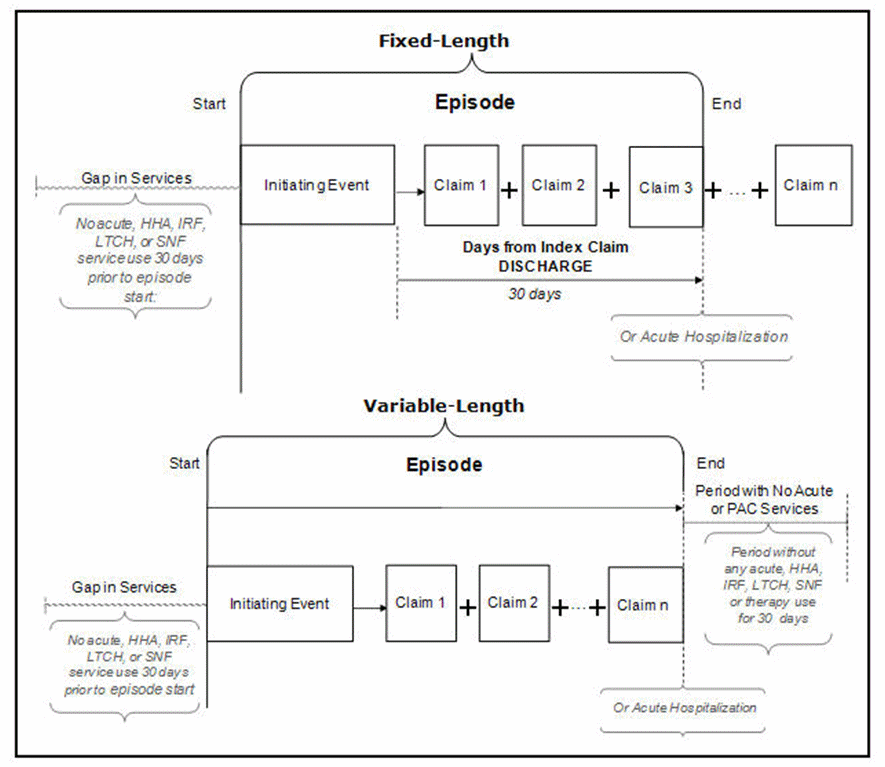
Figure 2 is a schematic of the difference between fixed-length and variable-length episodes. Fixed-length episodes include claims within 30 days of discharge from an initiating event. Variable-length length episodes include claims following discharge from an initiating event prior to a 30 day gap in acute or PAC service use.
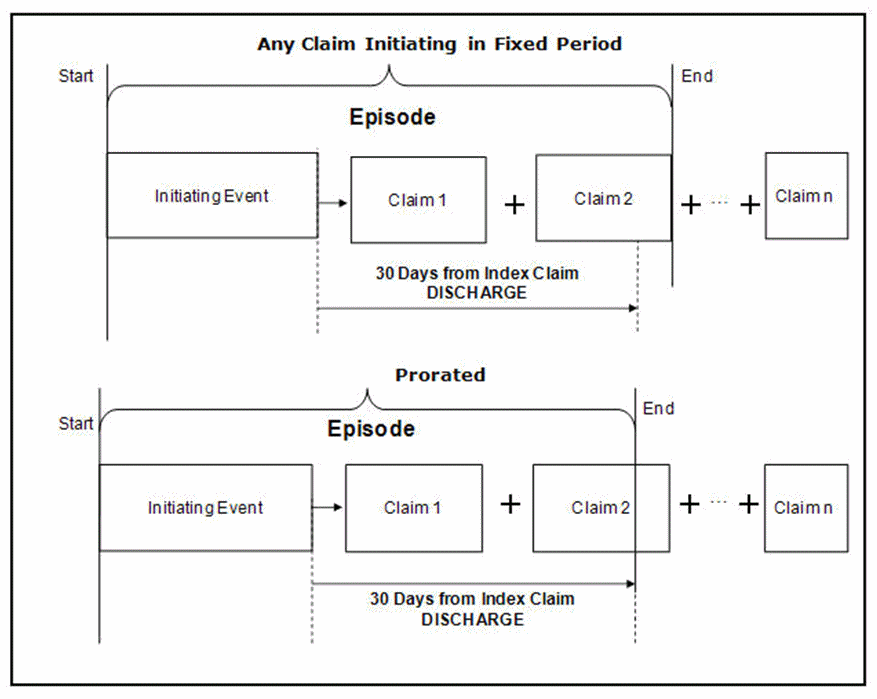
Figure 3 is a schematic of the difference between fixed-length episodes including any claim initiating within a fixed period versus fix-length episodes that are prorated. Under a prorated approach, only claim dollars and days associated with service use in the fixed-length period are included in the episode. Under the any claim initiating approach, the entirety of a claim initiating prior to the fixed-length end point is included in the episode.
Physician claims were also examined as part of this analysis though only acute and PAC claims were used to define initiating events and episode endpoints. Physician claims with dates of service falling between the admission date on an initiating event and the last date of episode were identified from the Medicare Carrier claims using physician specialty codes and the dollars associated with these services were included in episode payment analyses.
In summary, episodes were constructed on the following dimensions:
- Episode definition
- 30-day fixed length
- 30-day variable length
- Initiating event
- Acute hospital
- HHA
- IRF
- LTCH
- Alternative methods of handling the end of fixed episodes
- Any claim initiating
- Prorated
- Alternative episode end point of an acute hospitalization.
Based on these dimensions, the total number of episodes examined in this work includes the 15 episode definitions shown in Table 2. Using these definitions, RTI examined episode patterns, use of PAC services, and payments for both the acute hospital-initiated and the community entrant episodes.
| Initiating Event |
Fixed or Variable Length |
Episode End Point |
|---|---|---|
| Acute hospitalization | Fixed | Any Claim Starting Within 30 Days After Hospital Discharge |
| Acute hospitalization | Fixed | Any Claim Starting Within 30 Days After Hospital Discharge, Excluding Acute Hospital Readmissions |
| Acute hospitalization | Fixed | 30-Day Fixed Period Following Hospital Discharge (prorated) |
| Acute hospitalization | Fixed | 30-Day Fixed Period Following Hospital Discharge (prorated), Excluding Acute Hospital Readmissions |
| Acute hospitalization | Variable | 30-Day Variable-Length Episode |
| Acute hospitalization | Variable | 30-Day Variable-Length Episode Excluding Acute Hospital Readmissions |
| HHA | Fixed | Any Claim Starting Within 30 days After Discharge from Initiating Event |
| HHA | Variable | 30-Day Variable-Length Episode |
| HHA | Variable | 30-Day Variable-Length Episode Excluding Acute Hospitalizations |
| IRF | Fixed | Any Claim Starting Within 30 days After Discharge from Initiating Event |
| IRF | Variable | 30-Day Variable-Length Episode |
| IRF | Variable | 30-Day Variable-Length Episode Excluding Acute Hospitalizations |
| LTCH | Fixed | Any Claim Starting Within 30 days After Discharge from Initiating Event |
| LTCH | Variable | 30-Day Variable-Length Episode |
| LTCH | Variable | 30-Day Variable-Length Episode Excluding Acute Hospitalizations |
2.4 Diagnosis and Severity Adjustment
RTI ran each of the claims initiating episodes through the most recently available 3M Medical Severity Grouper (MS-DRG) software version 27.0. For episodes initiating with an acute hospitalization or an LTCH claim, this allows for consistent comparison of MS-DRGs over time.
Given the analysis of "community entrant" episodes, a different approach was required for HHA- and IRF-initiated episodes by condition. The primary diagnoses on IRF claims are vague and generally not descriptive of the underlying condition for which a patient is receiving care, and HHA claims most often use V-codes to describe the types of services being received.
For IRF-initiated episodes, RTI stratified analyses by the rehabilitation impairment group (RIC) recorded on the IRF claims in the standard analytic file (SAF). RICs represent 21 groups of conditions for which a beneficiary is treated and are the basis for payment for IRFs. Examples of RICs include stroke, neurologic conditions, cardiac, pulmonary, spinal cord dysfunction, brain dysfunction, and amputation.
For HHA-initiated episodes, RTI used a condition grouping algorithm based on Major Diagnostic Category (MDC) and MS-DRGs after running the MS-DRG grouper on all claims including HHA claims. These groupings are highly aggregated but provide an understanding of the broad types of cases entering HHA without a prior acute hospitalization. These groupings are presented in Section 4. In addition, RTI also examined International Classification of Diseases Ninth Revision (ICD-9) coding in the first position of HHA claims and the home health resource group (HHRG) codes recorded on HHA claims for payment purposes. These groups do not reflect specific diagnosis groups but include measures of therapy utilization, clinical severity, functional severity, and service severity.
2.5 Standardizing Payments for Geographic Benchmarking Analysis
One of the goals of this work was to perform geographic benchmarking analysis to look at the differences in PAC payments across different levels of geography and learn more about differences in patterns of PAC utilization as they relate to differences in the local availability of providers and practice patterns across the country. Analyses were conducted at the state and the core-based statistical area (CBSA) levels. Mean PAC episode length and mean PAC payments were calculated per discharge for acute hospital-initiated episodes and per PAC user for both acute hospital-initiated and community entrant episodes.
In conducting the geographic benchmarking analysis, we standardized payments to remove the effects of payment adjustments caused by geography or other policy considerations. By standardizing the payments, we remove payments related to wage adjustments, indirect medical education (IME), and disproportionate share hospital (DSH) payments. Our approach to standardizing payments included using base rate payments and case-mix weights as published in the Federal Register and applying those to our claims using the case-mix weight variables in the standard analytic files. We applied rates and weights according to the payment policies in place for each payment system corresponding to the type of PAC service and the claim date.
The methods used to standardize payments were as follows:
- Acute hospital standardized payment = base rate * MS-DRG weight
- IRF standardized payment = base rate * case-mix group (CMG) weight
- LTCH standardized payment = base rate * LTCH DRG weight
- HHA standardized payment = base rate * home health resource group (HHRG) weight
- SNF standardized payment = per diem * resource utilization group (RUG) weight * days
- Therapy standardized payment = physician fee schedule amount1 * units
2.6 Cohort Analysis
To learn more about the use patterns of beneficiaries over longer periods of time, ASPE and RTI examined patterns of acute and PAC use for beneficiaries with an initiating event (acute, LTCH, IRF, or HHA) in 2006 and followed these beneficiaries using 2 years of claims data. RTI constructed twenty-four 30-day windows over which to look at service use. Similar to the prorated episode definition described above, claims were prorated so that only days and dollars associated with the portion of the claim in each of the 30-day windows were attributed to the window. As in creating the prorated episode definition, only dollars associated with visits and days in each of the windows were assigned to the windows, and prorated payments per window were estimated by dividing the total claim Medicare payment amount by the total number of visits (or days in the case of institutional claims) on the claim and assigning payments based on those that occurred in each window. Analyses of this sample included examination of the percentage of beneficiaries with a claim, mean total acute and PAC payments, and mean payments per service type. Analyses were conducted by type of initiating event and also included some MS-DRG specific analyses to learn more about how patterns change for beneficiaries with different types of diagnoses.
3. Acute Hospital-Initiated Episodes
Analyses of acute hospital-initiated episodes were based on the cross-sectional analytic sample described in Section 2. The analyses focused on understanding the types of cases with acute hospital-initiated episodes, the first site of PAC, and any differences that occur in the 3 years of data examined here. In addition, the analyses looked specifically at episode patterns, episode length, and episode payment under six different episode definitions. Overall, episode summary statistics are shown here for each of the 3 years of data, although only 2008 data are shown for the episode pattern and service-specific utilization under different episode definitions. The key findings from the analyses of acute hospital-initiated episodes are summarized below.
Table 3 summarizes the top 10 MS-DRGs for beneficiaries initiating a PAC episode with an acute hospitalization as well as the percentage of all PAC users with the MS-DRG. This table also provides data on the ranking of these same MS-DRGs in the earlier years of data included in our analysis. The most common MS-DRG among beneficiaries discharged to PAC is MS-DRG 470, "Major joint replacement or reattachment of lower extremity w/o MCC" (13.7 percent of PAC users in 2008). Other MS-DRGs in the top five include MS-DRG 194, "Simple pneumonia & pleurisy w CC"; MS-DRG 690, "Kidney & urinary tract infections w/o CC"; MS-DRG 065, "Intracranial hemorrhage or cerebral infarction w CC"; and MS-DRG 481, "Hip & femur procedures except major joint w CC." The top 10 MS-DRGs account for close to 30 percent of all PAC users in 2008. This analysis reveals that the top five MS-DRGs among PAC users have been consistent over the 3 years of data examined, 2006-2008.
| Rank 2008 |
Rank 2007 |
Rank 2006 |
MS-DRG | N 2008 |
Percent 2008 |
Cumulative Percent 2008 |
|---|---|---|---|---|---|---|
| Source: RTI analysis of 2006, 2007, and 2008 Medicare claims (M3MM143). | ||||||
| 1 | 1 | 1 | 470: Major joint replacement or reattachment of lower extremity w/o MCC | 90,434 | 13.7 | 13.7 |
| 2 | 2 | 2 | 065: Intracranial hemorrhage or cerebral infarction w CC | 13,992 | 2.1 | 15.8 |
| 3 | 4 | 4 | 481: Hip & femur procedures except major joint w CC | 13,704 | 2.1 | 17.9 |
| 4 | 3 | 3 | 194: Simple pneumonia & pleurisy w CC | 13,064 | 2.0 | 19.9 |
| 5 | 5 | 5 | 690: Kidney & urinary tract infections w/o MCC | 12,954 | 2.0 | 21.9 |
| 6 | 7 | 11 | 641: Nutritional & misc metabolic disorders w/o MCC | 9,755 | 1.5 | 23.3 |
| 7 | 6 | 6 | 299: Peripheral vascular disorders w MCC | 9,752 | 1.5 | 24.8 |
| 8 | 9 | 7 | 292: Heart failure & shock w CC | 8,602 | 1.3 | 26.1 |
| 9 | 15 | 17 | 291: Heart failure & shock w MCC | 8,561 | 1.3 | 27.4 |
| 10 | 12 | 14 | 552: Medical back problems w/o MCC | 8,113 | 1.2 | 28.6 |
The proportion of beneficiaries with acute hospital-initiated episodes discharged to each site of PAC is shown in Table 4. The percentage of beneficiaries discharged to each PAC setting is similar across the 3 years of data, with the largest proportion of beneficiaries discharged to SNF (42.2 percent in 2008) and HHA (37.4 percent in 2008) and a smaller proportion discharged to LTCH (1.7 percent in 2008), IRF (8.6 percent in 2008), and therapy services (10.1 percent in 2008). These results indicate that there has been a slight decrease in the percentage of beneficiaries discharged to IRF and a slight increase in the percentage discharged to SNF over the period 2006-2008. This change is of particular note when looking at specific MS-DRGs. For example, 17.9 percent of beneficiaries in MS-DRG 470, "major joint replacement" were discharged to IRF in 2006, and this decreased to 12.2 percent of beneficiaries in this MS-DRG in 2008. The decrease is likely a result of the phase-in of the 60 percent rule in the IRF payment system—a rule that requires 60 percent of a provider's admissions meet certain classification criteria in order for the provider to be eligible for IRF payment.
| MS-DRG | N | % Discharged to PAC |
% Discharged to LTCH |
% Discharged to IRF |
% Discharged to SNF |
% Discharged to HHA |
% Discharged to Therapy |
|---|---|---|---|---|---|---|---|
| Source: RTI analysis of 2006, 2007, and 2008 Medicare claims (M3MM143, M3MM156). | |||||||
| All MS-DRGs 2008 | 659,549 | 38.7 | 1.7 | 8.6 | 42.2 | 37.4 | 10.1 |
| 470: Major joint replacement or reattachment of lower extremity w/o MCC | 90,434 | 94.2 | 0.1 | 12.2 | 37.4 | 37.4 | 12.9 |
| 065: Intracranial hemorrhage or cerebral infarction w CC | 13,992 | 75.0 | 1.2 | 37.0 | 36.8 | 17.3 | 7.7 |
| 481: Hip & femur procedures except major joint w CC | 13,704 | 95.4 | 0.4 | 22.1 | 68.0 | 7.7 | 1.8 |
| 194: Simple pneumonia & pleurisy w CC | 13,604 | 36.3 | 0.9 | 1.7 | 51.1 | 37.8 | 8.5 |
| 690: Kidney & urinary tract infections w/o MCC | 12,954 | 43.9 | 0.4 | 1.7 | 58.3 | 28.9 | 10.7 |
| All MS-DRGs 2007 | 661,958 | 37.9 | 1.7 | 8.9 | 42.2 | 37.1 | 10.0 |
| 470: Major joint replacement or reattachment of lower extremity w/o MCC | 91,259 | 93.9 | 0.1 | 14.2 | 37.1 | 36.2 | 12.4 |
| 065: Intracranial hemorrhage or cerebral infarction w CC | 14,433 | 75.1 | 1.3 | 36.7 | 38.1 | 16.4 | 7.4 |
| 481: Hip & femur procedures except major joint w CC | 13,558 | 95.0 | 0.7 | 23.1 | 66.8 | 7.7 | 1.8 |
| 194: Simple pneumonia & pleurisy w CC | 15,044 | 36.1 | 1.2 | 1.5 | 50.7 | 38.8 | 7.8 |
| 690: Kidney & urinary tract infections w/o MCC | 13,704 | 43.9 | 0.4 | 1.8 | 59.8 | 28.0 | 10.1 |
| All MS-DRGs 2006 | 667,784 | 37.1 | 1.8 | 9.7 | 42.1 | 36.4 | 9.9 |
| 470: Major joint replacement or reattachment of lower extremity w/o MCC | 91,621 | 94.0 | 0.2 | 17.9 | 36.2 | 33.7 | 12.0 |
| 065: Intracranial hemorrhage or cerebral infarction w CC | 15,459 | 74.7 | 1.6 | 35.5 | 39.0 | 16.3 | 7.5 |
| 481: Hip & femur procedures except major joint w CC | 13,846 | 94.8 | 0.8 | 23.1 | 66.8 | 7.3 | 1.9 |
| 194: Simple pneumonia & pleurisy w CC | 16,638 | 35.7 | 1.2 | 1.7 | 51.6 | 38.3 | 7.3 |
| 690: Kidney & urinary tract infections w/o MCC | 13,724 | 43.3 | 0.5 | 1.8 | 60.8 | 27.3 | 9.7 |
Table 5 displays the top 30 episode patterns for beneficiaries with acute hospital-initiated episodes. Each letter in the sequence represents a type of service: A = acute hospital, S = SNF, H = HHA, I = IRF, L = LTCH, O = hospital outpatient therapy, and T = independent therapist. Note that a single letter may represent one claim or multiple claims of the same type. This episode pattern analysis was conducted on the 30-day variable-length episode definition to provide an understanding of the complete clinical trajectory of service use related to an index event. Analysis of episode patterns for beneficiaries with acute hospital-initiated episodes indicate that as expected, acute to HHA (AH) and acute to SNF (AS) are the most common episode patterns (36.8 percent of all PAC episodes in 2008), and that the top 30 episode patterns account for over 82 percent of all episode patterns for beneficiaries discharged to PAC. Given that a small proportion of beneficiaries use LTCH nationally, there is only one episode pattern in that top 30 that includes LTCH. The episode pattern acute to LTCH (AL) is the 26th most common episode pattern, and it is common to 0.5 percent of beneficiaries with acute hospital-initiated episodes.
| Rank | Episode Pattern | N | Percent | Cumulative Percent |
|---|---|---|---|---|
| Note: Episode pattern is based on a 30-day variable episode definition. Each letter indicates a type of service use, but a single letter may represent one claim or multiple claims of the same type of service. A = acute hospital, S = SNF, H = HHA, I= IRF, L= LTCH, O = outpatient department therapy, T = independent therapist. Source: RTI analysis of 2008 Medicare claims (M3MM157). |
||||
| 1 | AH | 150,850 | 22.9 | 22.9 |
| 2 | AS | 91,928 | 13.9 | 36.8 |
| 3 | ASH | 56,661 | 8.6 | 45.4 |
| 4 | AO | 34,141 | 5.2 | 50.6 |
| 5 | AHA | 24,512 | 3.7 | 54.3 |
| 6 | AT | 18,485 | 2.8 | 57.1 |
| 7 | ASO | 17,931 | 2.7 | 59.8 |
| 8 | AIH | 14,900 | 2.3 | 62.1 |
| 9 | ASAS | 14,687 | 2.2 | 64.3 |
| 10 | AHO | 14,655 | 2.2 | 66.5 |
| 11 | AHT | 14,467 | 2.2 | 68.7 |
| 12 | ASA | 13,841 | 2.1 | 70.8 |
| 13 | AHAH | 8,839 | 1.3 | 72.2 |
| 14 | ASHO | 6,632 | 1.0 | 73.2 |
| 15 | ASHT | 6,115 | 0.9 | 74.1 |
| 16 | AIO | 5,961 | 0.9 | 75.0 |
| 17 | ASHA | 5,221 | 0.8 | 75.8 |
| 18 | AI | 4,902 | 0.7 | 76.5 |
| 19 | ASASH | 4,446 | 0.7 | 77.2 |
| 20 | AST | 4,282 | 0.6 | 77.8 |
| 21 | ASASA | 3,453 | 0.5 | 78.4 |
| 22 | ASASAS | 3,353 | 0.5 | 78.9 |
| 23 | AIHO | 3,158 | 0.5 | 79.4 |
| 24 | ASASO | 3,135 | 0.5 | 79.8 |
| 25 | AHAS | 3,071 | 0.5 | 80.3 |
| 26 | AL | 3,004 | 0.5 | 80.8 |
| 27 | AHAHA | 2,488 | 0.4 | 81.1 |
| 28 | AOA | 2,482 | 0.4 | 81.5 |
| 29 | AISH | 2,337 | 0.4 | 81.9 |
| 30 | AHASH | 2,290 | 0.3 | 82.2 |
Summary statistics looking at index, PAC, and total episode payments, by episode definition are presented in Tables 6 to 9. Mean payments were calculated using three different methods—payments per service use, payments per PAC user, and payments per hospital discharge—to demonstrate the differences in mean payments across different beneficiary samples. These different calculations are described below.
- Payments per service user indicate the mean Medicare payments for those beneficiaries who use the specific PAC service (average payments per SNF admission for those who had an SNF admission).
- Payments per PAC user indicate the mean Medicare payments across all beneficiaries who use any PAC, regardless of whether or not they use a specific PAC service.
- Payments per hospital discharge indicate the mean Medicare payments across all beneficiaries with an index acute hospital stay, regardless of whether they use a PAC service. Note that the per-hospital discharge calculations include rehospitalizations and a small amount of subsequent service use for beneficiaries not discharged to PAC from their acute hospital initiating event.
As also demonstrated in earlier work, episode length and payments differ significantly by episode definition. For example, in 2008, the mean PAC payment per PAC user under the longest episode definition, the 30-day variable-length episode definition, was $17,236 in 2008 compared with $10,651 under the episode definition that includes any claim initiating within 30 days after hospital discharge (Table 6). Payments per discharge, as opposed to payments per PAC user, depend on the proportion of beneficiaries discharged to PAC. Among beneficiaries with acute hospital-initiated episodes in 2008, 38.7 percent were discharged to PAC and the mean PAC payment per hospital discharge was $8,384 under the 30-day variable-length episode definition. Table 7 displays episode summary statistics for the top five MS-DRGs by volume of PAC users to demonstrate the differences in PAC utilization by MS-DRG and to demonstrate the differences in the per-PAC-user and per-discharge calculations by MS-DRG given differences in the proportion of beneficiaries discharged to PAC by MS-DRG. For example, for MS-DRG 470, the mean PAC payment per discharge and the mean payment per PAC user were very similar across episode definitions ($9,593 versus $10,067 for the 30-day variable episode) because 94.2 percent of beneficiaries in this MS-DRG are discharged to PAC. In contrast, only 36.3 percent of beneficiaries in MS-DRG 194 are discharged to PAC, and therefore there are significant differences in the per-PAC-user and per-hospital-discharge calculations for PAC payments ($7,072 versus $14,892 for the 30-day variable episode). In addition to summary statistics for PAC users, Table 8 also shows the mean length of stay associated with each of the episode definitions in each of the 3 years of data. In general, the patterns in episode length are consistent with the patterns we observe for payment, with significant variation in the PAC and total episode length depending on whether we look at a shorter fixed-length definition or a longer variable-length definition. These patterns were consistent across the 3 years of data examined.
| Episode Definition | Mean Index Acute Hospital Payment Per Discharge1 |
Mean Index Acute Hospital Physician Payment Per Discharge1,2 |
Mean PAC Payment Per Discharge1,3 |
Mean Episode Payment Per Discharge1,4 |
Mean Index Acute Hospital Payment Per PAC User1,5 |
Mean Index Acute Hospital Physician Payment Per PAC User2,5 |
Mean PAC Payment Per PAC User3,5 |
Mean Episode Payment Per PAC User5,5 |
|---|---|---|---|---|---|---|---|---|
|
||||||||
| 2008 (N=659,549) | ||||||||
| A. 30-Day Variable Episode | $8,531 | $1,172 | $8,384 | $18,847 | $10,572 | $1,524 | $17,236 | $30,827 |
| B. 30-Day Variable Episode Excluding Acute Hospital Readmissions | $8,531 | $1,172 | $3,511 | $13,472 | $10,572 | $1,524 | $9,075 | $21,926 |
| C. 30-Day Fixed: Any Claim Starting Within 30 Days After Hospital Discharge | $8,531 | $1,172 | $5,252 | $15,355 | $10,572 | $1,524 | $10,651 | $23,499 |
| D. 30-Day Fixed: Any Claim Starting Within 30 Days After Hospital Discharge Excluding Acute Hospital Readmissions | $8,531 | $1,172 | $3,157 | $13,048 | $10,572 | $1,524 | $8,165 | $20,838 |
| E. 30-Day Fixed Following Hospital Discharge (prorated) | $8,531 | $1,172 | $3,845 | $13,948 | $10,572 | $1,524 | $7,564 | $20,412 |
| F. 30-Day Fixed Following Hospital Discharge Excluding Acute Hospital Readmissions (prorated) | $8,531 | $1,172 | $2,221 | $12,113 | $10,572 | $1,524 | $5,745 | $18,418 |
| 2007 (N=661,958) | ||||||||
| A. 30-Day Variable Episode | $8,205 | $1,161 | $7,725 | $17,807 | $10,062 | $1,524 | $16,145 | $29,156 |
| B. 30-Day Variable Episode Excluding Acute Hospital Readmissions | $8,205 | $1,161 | $3,259 | $12,865 | $10,062 | $1,524 | $8,596 | $20,904 |
| C. 30-Day Fixed: Any Claim Starting Within 30 Days After Hospital Discharge | $8,205 | $1,161 | $4,905 | $14,656 | $10,062 | $1,524 | $10,100 | $22,416 |
| D. 30-Day Fixed: Any Claim Starting Within 30 Days After Hospital Discharge Excluding Acute Hospital Readmissions | $8,205 | $1,161 | $2,945 | $12,489 | $10,062 | $1,524 | $7,772 | $19,918 |
| E. 30-Day Fixed Following Hospital Discharge (prorated) | $8,205 | $1,161 | $3,612 | $13,363 | $10,062 | $1,524 | $7,217 | $19,533 |
| F. 30-Day Fixed Following Hospital Discharge Excluding Acute Hospital Readmissions (prorated) | $8,205 | $1,161 | $2,088 | $11,632 | $10,062 | $1,524 | $5,510 | $17,656 |
| 2006 (N=667,784) | ||||||||
| A. 30-Day Variable Episode | $7,941 | $1,127 | $7,208 | $16,953 | $9,644 | $1,482 | $15,236 | $27,720 |
| B. 30-Day Variable Episode Excluding Acute Hospital Readmissions | $7,941 | $1,127 | $3,045 | $12,339 | $9,644 | $1,482 | $8,200 | $20,015 |
| C. 30-Day Fixed: Any Claim Starting Within 30 Days After Hospital Discharge | $7,941 | $1,127 | $4,617 | $14,052 | $9,644 | $1,482 | $9,604 | $21,426 |
| D. 30-Day Fixed: Any Claim Starting Within 30 Days After Hospital Discharge Excluding Acute Hospital Readmissions | $7,941 | $1,127 | $2,754 | $11,991 | $9,644 | $1,482 | $7,422 | $19,086 |
| E. 30-Day Fixed Following Hospital Discharge (prorated) | $7,941 | $1,127 | $3,425 | $12,860 | $9,644 | $1,482 | $6,909 | $18,731 |
| F. 30-Day Fixed Following Hospital Discharge Excluding Acute Hospital Readmissions (prorated) | $7,941 | $1,127 | $1,967 | $11,203 | $9,644 | $1,482 | $5,300 | $16,964 |
| Episode Definition | Mean Index Acute Hospital Payment Per Discharge1 |
Mean Index Acute Hospital Physician Payment Per Discharge1,2 |
Mean PAC Payment Per Discharge1,3 |
Mean Episode Payment Per Discharge1,4 |
Mean Index Acute Hospital Payment Per PAC User1,5 |
Mean Index Acute Hospital Physician Payment Per PAC User2,5 |
Mean PAC Payment Per PAC User3,5 |
Mean Episode Payment Per PAC User4,5 |
|---|---|---|---|---|---|---|---|---|
|
||||||||
| A. 30-day Variable Episode | ||||||||
| 470: Major joint replacement or reattachment of lower extremity w/o MCC | $11,079 | $1,484 | $9,593 | $22,802 | $11,120 | $1,505 | $10,067 | $23,365 |
| 065: Intracranial hemorrhage or cerebral infarction w CC | $6,392 | $979 | $21,822 | $30,587 | $6,401 | $1,038 | $28,034 | $37,217 |
| 481: Hip & femur procedures except major joint w CC | $10,295 | $1,734 | $24,434 | $37,817 | $10,296 | $1,750 | $25,465 | $38,918 |
| 194: Simple pneumonia & pleurisy w CC | $5,347 | $631 | $7,072 | $13,681 | $5,471 | $749 | $14,892 | $22,291 |
| 690: Kidney & urinary tract infections w/o MCC | $3,989 | $513 | $8,727 | $13,859 | $4,090 | $586 | $16,943 | $22,712 |
| B. 30-Day Variable Episode Excluding Acute Hospital Readmissions | ||||||||
| 470: Major joint replacement or reattachment of lower extremity w/o MCC | $11,079 | $1,484 | $7,093 | $20,079 | $11,120 | $1,505 | $7,527 | $20,601 |
| 065: Intracranial hemorrhage or cerebral infarction w CC | $6,392 | $979 | $13,849 | $21,974 | $6,401 | $1,038 | $18,460 | $26,904 |
| 481: Hip & femur procedures except major joint w CC | $10,295 | $1,734 | $16,900 | $29,687 | $10,296 | $1,750 | $17,719 | $30,559 |
| 194: Simple pneumonia & pleurisy w CC | $5,347 | $631 | $2,710 | $8,895 | $5,471 | $749 | $7,458 | $14,246 |
| 690: Kidney & urinary tract infections w/o MCC | $3,989 | $513 | $4,092 | $8,814 | $4,090 | $586 | $9,316 | $14,494 |
| C. 30-Day Fixed: Any Claim Starting Within 30 Days After Hospital Discharge | ||||||||
| 470: Major joint replacement or reattachment of lower extremity w/o MCC | $11,079 | $1,484 | $7,335 | $20,238 | $11,120 | $1,505 | $7,701 | $20,679 |
| 065: Intracranial hemorrhage or cerebral infarction w CC | $6,392 | $979 | $14,812 | $22,960 | $6,401 | $1,038 | $19,086 | $27,484 |
| 481: Hip & femur procedures except major joint w CC | $10,295 | $1,734 | $17,664 | $30,413 | $10,296 | $1,750 | $18,402 | $31,193 |
| 194: Simple pneumonia & pleurisy w CC | $5,347 | $631 | $4,385 | $10,711 | $5,471 | $749 | $9,163 | $15,977 |
| 690: Kidney & urinary tract infections w/o MCC | $3,989 | $513 | $5,418 | $10,247 | $4,090 | $586 | $10,453 | $15,642 |
| D. 30-Day Fixed: Any Claim Starting Within 30 Days After Hospital Discharge Excluding Acute Hospital Readmissions | ||||||||
| 470: Major joint replacement or reattachment of lower extremity w/o MCC | $11,079 | $1,484 | $6,437 | $19,279 | $11,120 | $1,505 | $6,831 | $19,753 |
| 065: Intracranial hemorrhage or cerebral infarction w CC | $6,392 | $979 | $12,239 | $20,191 | $6,401 | $1,038 | $16,314 | $24,528 |
| 481: Hip & femur procedures except major joint w CC | $10,295 | $1,734 | $15,168 | $27,749 | $10,296 | $1,750 | $15,903 | $28,528 |
| 194: Simple pneumonia & pleurisy w CC | $5,347 | $631 | $2,490 | $8,631 | $5,471 | $749 | $6,858 | $13,527 |
| 690: Kidney & urinary tract infections w/o MCC | $3,989 | $513 | $3,684 | $8,352 | $4,090 | $586 | $8,400 | $13,456 |
| E. 30-Day Fixed Following Hospital Discharge (prorated) | ||||||||
| 470: Major joint replacement or reattachment of lower extremity w/o MCC | $11,079 | $1,484 | $5,893 | $18,796 | $11,120 | $1,505 | $6,182 | $19,160 |
| 065: Intracranial hemorrhage or cerebral infarction w CC | $6,392 | $979 | $10,520 | $18,667 | $6,401 | $1,038 | $13,496 | $21,894 |
| 481: Hip & femur procedures except major joint w CC | $10,295 | $1,734 | $11,567 | $24,316 | $10,296 | $1,750 | $12,047 | $24,838 |
| 194: Simple pneumonia & pleurisy w CC | $5,347 | $631 | $3,112 | $9,438 | $5,471 | $749 | $6,235 | $13,049 |
| 690: Kidney & urinary tract infections w/o MCC | $3,989 | $513 | $3,615 | $8,444 | $4,090 | $586 | $6,749 | $11,938 |
| F. 30-Day Fixed Following Hospital Discharge Excluding Acute Hospital Readmissions (prorated) | ||||||||
| 470: Major joint replacement or reattachment of lower extremity w/o MCC | $11,079 | $1,484 | $5,173 | $18,016 | $11,120 | $1,505 | $5,490 | $18,412 |
| 065: Intracranial hemorrhage or cerebral infarction w CC | $6,392 | $979 | $8,672 | $16,624 | $6,401 | $1,038 | $11,559 | $19,773 |
| 481: Hip & femur procedures except major joint w CC | $10,295 | $1,734 | $9,955 | $22,536 | $10,296 | $1,750 | $10,437 | $23,062 |
| 194: Simple pneumonia & pleurisy w CC | $5,347 | $631 | $1,664 | $7,805 | $5,471 | $749 | $4,583 | $11,252 |
| 690: Kidney & urinary tract infections w/o MCC | $3,989 | $513 | $2,353 | $7,021 | $4,090 | $586 | $5,364 | $10,420 |
| Episode Definition | N | Percent of Beneficiaries Discharged to PAC1 |
Mean Index Acute Hospital LOS2 (days) |
Mean Index Acute Hospital Payment2 |
Mean PAC LOS3 (days) |
Mean PAC Payment4 |
Mean Episode LOS5 (days) |
Mean Episode Payment5 |
|---|---|---|---|---|---|---|---|---|
|
||||||||
| 2008 | ||||||||
| A. 30-Day Variable Episode | 659,549 | 38.7 | 6.2 | $10,572 | 79.1 | $17,236 | 87.3 | $30,827 |
| B. 30-Day Variable Episode Excluding Acute Hospital Readmissions | 659,549 | 38.7 | 6.2 | $10,572 | 56.4 | $9,075 | 64.6 | $21,926 |
| C. 30-Day Fixed: Any Claim Starting Within 30 Days After Hospital Discharge | 659,549 | 38.7 | 6.2 | $10,572 | 40.6 | $10,651 | 48.8 | $23,499 |
| D. 30-Day Fixed: Any Claim Starting Within 30 Days After Hospital Discharge Excluding Acute Hospital Readmissions | 659,549 | 38.7 | 6.2 | $10,572 | 37.4 | $8,165 | 45.6 | $20,838 |
| E. 30-Day Fixed Following Hospital Discharge (prorated) | 659,549 | 38.7 | 6.2 | $10,572 | 25.0 | $7,564 | 33.2 | $20,412 |
| F. 30-Day Fixed Following Hospital Discharge Excluding Acute Hospital Readmissions (prorated) | 659,549 | 38.7 | 6.2 | $10,572 | 22.7 | $5,745 | 30.9 | $18,418 |
| 2007 | ||||||||
| A. 30-Day Variable Episode | 661,958 | 37.9 | 6.3 | $10,062 | 77.9 | $16,145 | 86.2 | $29,156 |
| B. 30-Day Variable Episode Excluding Acute Hospital Readmissions | 661,958 | 37.9 | 6.3 | $10,062 | 55.8 | $8,596 | 64.0 | $20,904 |
| C. 30-Day Fixed: Any Claim Starting Within 30 Days After Hospital Discharge | 661,958 | 37.9 | 6.3 | $10,062 | 41.2 | $10,100 | 49.5 | $22,416 |
| D. 30-Day Fixed: Any Claim Starting Within 30 Days After Hospital Discharge Excluding Acute Hospital Readmissions | 661,958 | 37.9 | 6.3 | $10,062 | 38.0 | $7,772 | 46.2 | $19,918 |
| E. 30-Day Fixed Following Hospital Discharge (prorated) | 661,958 | 37.9 | 6.3 | $10,062 | 24.9 | $7,217 | 33.2 | $19,533 |
| F. 30-Day Fixed Following Hospital Discharge Excluding Acute Hospital Readmissions (prorated) | 661,958 | 37.9 | 6.3 | $10,062 | 22.6 | $5,510 | 30.9 | $17,656 |
| 2006 | ||||||||
| A. 30-Day Variable Episode | 667,784 | 37.1 | 6.4 | $9,644 | 75.4 | $15,236 | 83.8 | $27,720 |
| B. 30-Day Variable Episode Excluding Acute Hospital Readmissions | 667,784 | 37.1 | 6.4 | $9,644 | 53.2 | $8,200 | 61.5 | $20,015 |
| C. 30-Day Fixed: Any Claim Starting Within 30 Days After Hospital Discharge | 667,784 | 37.1 | 6.4 | $9,644 | 39.2 | $9,604 | 47.6 | $21,426 |
| D. 30-Day Fixed: Any Claim Starting Within 30 Days After Hospital Discharge Excluding Acute Hospital Readmissions | 667,784 | 37.1 | 6.4 | $9,644 | 36.1 | $7,422 | 44.5 | $19,086 |
| E. 30-Day Fixed Following Hospital Discharge (prorated) | 667,784 | 37.1 | 6.4 | $9,644 | 24.7 | $6,909 | 33.1 | $18,731 |
| F. 30-Day Fixed Following Hospital Discharge Excluding Acute Hospital Readmissions (prorated) | 667,784 | 37.1 | 6.4 | $9,644 | 22.4 | $5,300 | 30.8 | $16,964 |
The percentage of beneficiaries using specific PAC services also varies by episode definition as shown in Table 9 In this table, we report the percentage of beneficiaries using each type of service, the mean claim length of stay, mean payment per service user, mean payment per PAC user, and mean payment per hospital discharge for each of the six episode definitions examined. The results indicate that the percentage of beneficiaries using HHA and SNF services increases under longer episode definitions because these services may be used directly after discharge from an acute hospitalization or later in an episode of care such as following an LTCH or IRF admission. Use of LTCH and IRF services is less sensitive to episode definitions because these services most often occur directly following an acute hospitalization. Table 8 also demonstrates the differences in acute hospital readmission during an episode-by-episode definition. Under the episode definition including any claim starting within 30 days after hospital discharge, 14.8 percent of beneficiaries had a readmission during an episode, but this increases to 28.6 percent under a 30-day variable-length episode definition again indicating differences in service use and policy implications for different episode definitions.
| Service Use (N = 659,549) | A. 30-Day Variable Episode |
B. 30-Day Variable Episode Excluding Acute Hospital Readmissions |
C. 30-Day Fixed: Any Claim Starting Within 30 Days After Hospital Discharge |
D. 30-Day Fixed: Any Claim Starting Within 30 Days After Hospital Discharge Excluding Acute Hospital Readmissions |
E. 30-Day Fixed: Any Claim Starting Within 30 Days After Hospital Discharge (prorated) |
F. 30-Day Fixed: Any Claim Starting Within 30 Days After Hospital Discharge Excluding Acute Hospital Readmissions (prorated) |
|---|---|---|---|---|---|---|
|
||||||
| HHA | ||||||
| Percent with Claim | 60.7 | 57.1 | 52.2 | 51.3 | 52.2 | 51.3 |
| Mean Visits | 25.6 | 20.1 | 15.8 | 15.7 | 6.8 | 6.6 |
| Mean Claim Length (days) | 60.4 | 47.5 | 35.3 | 35.1 | 19.9 | 18.6 |
| Mean Payment Per Service User1 | $4,230 | $3,429 | $2,786 | $2,768 | $1,339 | $1,304 |
| Mean Payment Per PAC User2 | $2,566 | $1,958 | $1,455 | $1,420 | $699 | $669 |
| Mean Payment Per Hospital Discharge3 | $1,079 | $759 | $590 | $549 | $278 | $259 |
| SNF | ||||||
| Percent with Claim | 48.2 | 44.5 | 45.3 | 44.2 | 45.3 | 44.2 |
| Mean LOS (days) | 39.3 | 30.3 | 32.3 | 29.4 | 19.8 | 18.9 |
| Mean Payment Per Service User1 | $13,646 | $10,743 | $11,476 | $10,518 | $7,495 | $7,169 |
| Mean Payment Per PAC User2 | $6,575 | $4,781 | $5,204 | $4,644 | $3,399 | $3,165 |
| Mean Payment Per Hospital Discharge3 | $2,703 | $1,849 | $2,085 | $1,796 | $1,348 | $1,224 |
| IRF | ||||||
| Percent with Claim | 9.7 | 8.9 | 9.0 | 8.8 | 9.0 | 8.8 |
| Mean LOS (days) | 14.3 | 13.0 | 13.5 | 12.9 | 12.9 | 12.5 |
| Mean Payment Per Service User1 | $17,518 | $15,922 | $16,504 | $15,825 | $15,919 | $15,378 |
| Mean Payment Per PAC User2 | $1,707 | $1,410 | $1,489 | $1,387 | $1,436 | $1,348 |
| Mean Payment Per Hospital Discharge3 | $706 | $545 | $601 | $536 | $573 | $521 |
| LTCH | ||||||
| Percent with Claim | 2.6 | 1.8 | 2.0 | 1.8 | 2.0 | 1.8 |
| Mean LOS (days) | 31.5 | 27.3 | 27.4 | 27.0 | 20.8 | 21.3 |
| Mean Payment Per Service User1 | $38,932 | $35,069 | $35,203 | $34,861 | $27,406 | $28,144 |
| Mean Payment Per PAC User2 | $1,011 | $634 | $691 | $621 | $538 | $501 |
| Mean Payment Per Hospital Discharge3 | $444 | $245 | $283 | $240 | $215 | $194 |
| Outpatient Department Therapy | ||||||
| Percent with Claim | 20.3 | 17.0 | 11.5 | 11.4 | 11.5 | 11.4 |
| Mean Payment Per Service User1 | $1,410 | $1,137 | $628 | $620 | $363 | $359 |
| Mean Payment Per PAC User2 | $286 | $193 | $72 | $70 | $42 | $41 |
| Mean Payment Per Hospital Discharge3 | $117 | $75 | $29 | $27 | $16 | $16 |
| Independent Therapist | ||||||
| Percent with Claim | 9.6 | 8.9 | 6.3 | 6.2 | 6.3 | 6.2 |
| Mean Payment Per Service User1 | $1,209 | $1,125 | $358 | $358 | $331 | $330 |
| Mean Payment Per PAC User2 | $116 | $100 | $22 | $22 | $21 | $20 |
| Mean Payment Per Hospital Discharge3 | $46 | $39 | $9 | $9 | $8 | $8 |
| Acute Hospital Readmission | ||||||
| Percent with Claim | 28.3 | — | 14.8 | — | 14.8 | — |
| Mean LOS (days) | 11.3 | — | 7.4 | — | 6.0 | — |
| Mean Payment Per Service User1 | $17,561 | — | $11,594 | — | $9,652 | — |
| Mean Payment Per PAC User2 | $4,976 | — | $1,718 | — | $1,430 | — |
| Mean Payment Per Hospital Discharge3 | $3,288 | — | $1,655 | — | $1,407 | — |
The per-service-user, per-PAC-user, and per-hospital-discharge calculations highlight the sensitivity of these calculations to the episode definition selected and the population over which payments are averaged. This is demonstrated most clearly by examining the LTCH utilization. Under the episode definition including any claim starting within 30 days after hospital discharge, mean payment per beneficiary using LTCH is $35,203. When calculated per PAC user, the mean payment is $691, and when calculated per hospital discharge, the payment is $283. These sharp differences indicate the importance of understanding service use patterns in thinking about episode-based payment. This includes consideration of issues related to geography and provider supply in areas of the country with access to LTCHs compared with those without LTCHs in their area.
Physician service use is another topic of interest to episode bundling discussions. Use of physician services in the week prior to the episode initiating event, during the initiating event, and during the episode is presented in Table 10. To reveal more about differences in use prior to the start of an episode for different types of cases (for example, medical versus surgical), these data are presented both overall and for the top five MS-DRGs by volume of PAC users. Overall, 49.9 percent of beneficiaries with acute hospital-initiated episodes had at least one physician claim in the week prior to the start of an episode, although this finding varied from 34.5 percent for beneficiaries in MS-DRG 481, "hip & femur procedures," to 54.2 percent for beneficiaries in MS-DRG 470, "major joint replacement or reattachment of lower extremity." Total episode payments for physician services were higher for beneficiaries receiving surgical procedures and for beneficiaries with stroke compared with beneficiaries being treated for pneumonia or kidney and urinary tract infections.
| MS-DRG | 7 Days Prior to Index Acute Hospitalization1 |
Index Acute Hospitalization1 |
A. 30-Day Variable Episode |
B. 30-Day Variable Episode Excluding Acute Hospital Readmissions |
C. 30-Day Fixed: Any Claim Starting Within 30 Days After Hospital Discharge |
D. 30-Day Fixed: Any Claim Starting Within 30 Days After Hospital Discharge Excluding Acute Hospital Readmissions |
E. 30-Day Fixed: Any Claim Starting Within 30 Days After Hospital Discharge (prorated) |
F. 30-Day Fixed: Any Claim Starting Within 30 Days After Hospital Discharge Excluding Acute Hospital Readmissions (prorated) |
|---|---|---|---|---|---|---|---|---|
|
||||||||
| All MS-DRGs | ||||||||
| Percent with Claim | 49.9 | 98.6 | 98.9 | 98.9 | 98.9 | 98.8 | 98.9 | 98.8 |
| Mean Payment Per Service User2 | $207 | $1,546 | $3,052 | $2,305 | $2,302 | $2,125 | $2,302 | $2,125 |
| Mean Payment Per PAC User3 | $103 | $1,524 | $3,019 | $2,279 | $2,275 | $2,101 | $2,275 | $2,101 |
| Mean Payment Per Hospital Discharge4 | $107 | $1,137 | $1,931 | $1,430 | $1,572 | $1,360 | $1,572 | $1,360 |
| 470: Major joint replacement or reattachment of lower extremity w/o MCC | ||||||||
| Percent with Claim | 54.2 | 98.9 | 99.0 | 99.7 | 99.0 | 99.0 | 99.0 | 99.0 |
| Mean Payment Per Service User2 | $156 | $1,522 | $2,200 | $1,974 | $1,877 | $1,820 | $3,104 | $1,820 |
| Mean Payment Per PAC User3 | $85 | $1,505 | $2,178 | $1,954 | $1,858 | $1,801 | $1,858 | $1,801 |
| Mean Payment Per Hospital Discharge4 | $83 | $1,484 | $2,130 | $1,906 | $1,824 | $1,763 | $1,824 | $1,763 |
| 065: Intracranial hemorrhage or cerebral infarction w CC | ||||||||
| Percent with Claim | 37.0 | 98.2 | 98.4 | 98.4 | 98.4 | 98.3 | 98.4 | 98.3 |
| Mean Payment Per Service User2 | $217 | $1,057 | $2,827 | $2,077 | $2,030 | $1,843 | $2,030 | $1,843 |
| Mean Payment Per PAC User3 | $80 | $1,038 | $2,782 | $2,043 | $1,997 | $1,812 | $1,997 | $1,812 |
| Mean Payment Per Hospital Discharge4 | $81 | $979 | $2,373 | $1,733 | $1,756 | $1,560 | $1,756 | $1,560 |
| 481: Hip & femur procedures except major joint w CC | ||||||||
| Percent with Claim | 34.5 | 98.8 | 99.0 | 99.0 | 98.9 | 98.9 | 98.9 | 98.9 |
| Mean Payment Per Service User2 | $181 | $1,770 | $3,189 | $2,571 | $2,522 | $2,354 | $2,522 | $2,354 |
| Mean Payment Per PAC User3 | $62 | $1,750 | $3,157 | $2,545 | $2,496 | $2,329 | $2,496 | $2,329 |
| Mean Payment Per Hospital Discharge4 | $62 | $1,734 | $3,089 | $2,492 | $2,455 | $2,287 | $2,455 | $2,287 |
| 194: Simple pneumonia & pleurisy w CC | ||||||||
| Percent with Claim | 45.0 | 99.1 | 99.3 | 99.2 | 99.2 | 99.2 | 99.2 | 99.2 |
| Mean Payment Per Service User2 | $178 | $756 | $1,942 | $1,328 | $1,353 | $1,207 | $1,353 | $1,207 |
| Mean Payment Per PAC User3 | $80 | $749 | $1,928 | $1,318 | $1,343 | $1,198 | $1,343 | $1,198 |
| Mean Payment Per Hospital Discharge4 | $85 | $631 | $1,262 | $838 | $979 | $794 | $654 | $794 |
| 690: Kidney & urinary tract infections w/o MCC | ||||||||
| Percent with Claim | 43.0 | 98.9 | 99.1 | 99.1 | 99.1 | 99.1 | 99.1 | 99.1 |
| Mean Payment Per Service User2 | $167 | $593 | $1,694 | $1,098 | $1,109 | $975 | $1,109 | $975 |
| Mean Payment Per PAC User3 | $72 | $586 | $1,679 | $1,864 | $1,099 | $966 | $1,099 | $966 |
| Mean Payment Per Hospital Discharge4 | $82 | $513 | $1,143 | $734 | $840 | $679 | $840 | $679 |
4. Community-Initiated Episodes
Similar to the analyses of acute hospital-initiated episodes, the community-initiated episode analyses were based on the cross-sectional analytic sample described in Section 2. The analyses focused on understanding the types of cases with community-initiated episodes and any differences that occur in the 3 years of data examined here. In addition, the analyses looked more specifically at episode patterns, episode length, and episode payment under three different episode definitions. Overall episode summary statistics are shown here for each of the 3 years of data, though only 2008 data are shown for the episode pattern and service-specific utilization under different episode definitions. The key findings from the analyses of acute hospital-initiated analyses are summarized below. First we present the results of HHA-initiated episode analyses, followed by the results of the LTCH-initiated episode analyses and the IRF-initiated episode analyses.
4.1 HHA-Initiated Episodes
Table 11 shows the distribution of cases for beneficiaries entering HHA without a prior acute hospitalization by diagnosis grouping as discussed in Section 2. There is no single, obvious way to classify home health community entrant episodes by diagnosis. While MS-DRGs have been developed for acute hospital and LTCH payment, HHA payment is based more on the services provided (nursing and therapy) rather than on the primary diagnosis for which the beneficiary is receiving care. RTI developed a grouping algorithm based on MDC and MS-DRG after running the MS-DRG grouper on all claims including HHA claims. These groupings are more highly aggregated than the MS-DRG but may provide an understanding of the broad types of cases entering HHA without a prior acute hospitalization. With this grouping approach, close to one quarter of HHA-initiated episodes are in an "other" condition grouping, but other large groupings include orthopedic minor medical, neurologic medical, and cardiovascular general, which account for a total of 40 percent of HHA-initiated episodes in 2008.
| Rank 2008 |
Rank 2007 |
Rank 2006 |
Condition Grouping | N 2008 |
Percent 2008 |
Cumulative Percent 2008 |
|---|---|---|---|---|---|---|
| Source: RTI analysis of 2006, 2007, and 2008 Medicare claims (M3MM204). | ||||||
| 1 | 1 | 1 | Other, Medical | 57,849 | 24.48 | 24.5 |
| 2 | 2 | 2 | Orthopedic, Minor Medical | 40,669 | 17.21 | 41.7 |
| 3 | 3 | 3 | Neurologic, Medical | 33,344 | 14.11 | 55.8 |
| 4 | 6 | 6 | Cardiovascular, General | 21,438 | 9.07 | 64.9 |
| 5 | 4 | 4 | Integumentary, Medical | 20,783 | 8.79 | 73.7 |
| 6 | 5 | 5 | Endocrine, Medical | 19,050 | 8.06 | 81.7 |
| 7 | 7 | 7 | Cardiovascular, Cardiac Medical | 9,429 | 3.99 | 85.7 |
| 8 | 8 | 8 | Kidney & Urinary, Medical | 6,909 | 2.92 | 88.6 |
| 9 | 10 | 11 | Respiratory, COPD | 6,075 | 2.57 | 91.2 |
| 10 | 9 | 9 | Cardiovascular, Vascular Medical | 5,522 | 2.34 | 93.5 |
In addition to looking at HHA episodes by condition grouping, RTI also examined the top 10 ICD-9 codes in the first position on HHA claims for beneficiaries with acute hospital-initiated episodes discharged to HHA and for beneficiaries with HHA-initiated episodes (Table 12) as well as the HHRG coded on HHA claims for these two groups of beneficiaries (Table 13). The results of these analyses indicate that the most common ICD-9 code for beneficiaries initiating care in an acute hospital was V54.81 "Aftercare following joint replacement" (11.5 percent) while the most common ICD-9 code for the HHA-initiated beneficiaries was V57.1 "Other physical therapy" (10.3 percent). In general, the top ICD-9 codes for the acute initiated episodes were for aftercare related to surgery whereas the top ICD-9 codes for the HHA-initiated episodes were for more chronic conditions such as hypertension, congestive heart failure, diabetes, and Alzheimer's. The top ten ICD-9 codes accounted for 43.6 percent of all episodes for beneficiaries initiating care in an acute hospital and discharged to HHA and 35.1 percent of all HHA-initiated episodes. The HHRG analysis also indicated some differences in these two populations. Based on the top 10 HHRGs in each group of beneficiaries, a higher proportion of beneficiaries initiating an episode in an acute hospital and discharged to HHA were in higher case-mix weight HHRGs indicating higher clinical severity, functional severity, and service severity compared to beneficiaries with HHA-initiated episodes. One of the top ten HHRGs for HHA-initiated episodes included 14-19 therapies while all others included 0-13 therapies. These results suggest a lower intensity, but chronic patient in the HHA-initiated episodes.
| Rank | ICD-9 Code | N | Percent | Cumulative Percent |
|---|---|---|---|---|
| Source: RTI analysis of 2008 Medicare claims (M3MM256). | ||||
| Acute Hospital-Initiated Episodes, Beneficiaries Discharged to HHA | ||||
| 1 | V54.81: Aftercare following joint replacement | 28,244 | 11.5 | 11.5 |
| 2 | V57.1: Other physical therapy | 14,552 | 5.9 | 17.4 |
| 3 | 428.0: Congestive heart failure, unspecified | 13,116 | 5.3 | 22.7 |
| 4 | V58.73: Aftercare following surgery of the circulatory system, NEC | 12,439 | 5.0 | 27.7 |
| 5 | 486: Pneumonia, organism unspecified | 7,841 | 3.2 | 30.9 |
| 6 | 491.21: Obstructive chronic bronchitis with (acute) exacerbation | 7,252 | 2.9 | 33.8 |
| 7 | V58.42: Aftercare following surgery for neoplasm | 7,108 | 2.9 | 36.7 |
| 8 | V58.78: Aftercare following surgery of the musculoskeletal system, NEC | 6,388 | 2.6 | 39.3 |
| 9 | V58.75: Aftercare following surgery of the teeth, oral cavity and digestive system | 5,449 | 2.2 | 41.5 |
| 10 | 401.9: Essential hypertension, unspecified | 5,224 | 2.1 | 43.6 |
| HHA-Initiated Episodes | ||||
| 1 | V57.1: Other physical therapy | 24,218 | 10.3 | 10.3 |
| 2 | 401.9: Essential hypertension, unspecified | 14,399 | 6.1 | 16.3 |
| 3 | 781.2: Abnormality of gait | 9,312 | 3.9 | 20.3 |
| 4 | 250.00: Diabetes mellitus without mention of complication, type II or unspecified type, not stated as uncontrolled | 8,534 | 3.6 | 23.9 |
| 5 | 428.0: Congestive heart failure, unspecified | 5,652 | 2.4 | 26.3 |
| 6 | 250.02: Diabetes mellitus without mention of complication, type II or unspecified type, uncontrolled | 5,388 | 2.3 | 28.6 |
| 7 | 728.87: Muscle weakness (generalized) | 5,388 | 2.3 | 30.8 |
| 8 | 331.0: Alzheimer's disease | 3,715 | 1.6 | 32.4 |
| 9 | V57.89: Other specified rehabilitation procedure, Other (multiple training or therapy) | 3,244 | 1.4 | 33.8 |
| 10 | 332.0: Paralysis agitans (Parkinson's disease) | 3,119 | 1.3 | 35.1 |
| Rank | HHRG | Case Mix Weight | N | Percent | Cumulative Percent |
|---|---|---|---|---|---|
| Source: RTI analysis of 2008 Medicare claims (M3MM257, M3MM258). | |||||
| Acute Hospital-Initiated Episodes, Beneficiaries Discharged to HHA | |||||
| 1 | 1CGK: Early Episode, 0-13 therapies, Clinical Severity Level 3, Functional Severity Level 2,Service Severity Level 1 | 0.9896 | 24,521 | 9.9 | 9.9 |
| 2 | 1BFK: Early Episode, 0-13 therapies, Clinical Severity Level 2, Functional Severity Level 1,Service Severity Level 1 | 0.7335 | 19,884 | 8.1 | 18.0 |
| 3 | 1CFK: Early Episode, 0-13 therapies, Clinical Severity Level 3, Functional Severity Level 1,Service Severity Level 1 | 0.901 | 19,849 | 8.0 | 26.1 |
| 4 | 1BGK: Early Episode, 0-13 therapies, Clinical Severity Level 2, Functional Severity Level 2,Service Severity Level 1 | 0.8221 | 19,551 | 7.9 | 34.0 |
| 5 | 1AFK: Early Episode, 0-13 therapies, Clinical Severity Level 1, Functional Severity Level 1,Service Severity Level 1 | 0.5827 | 12,585 | 5.1 | 39.1 |
| 6 | 1AGK: Early Episode, 0-13 therapies, Clinical Severity Level 1, Functional Severity Level 2,Service Severity Level 1 | 0.6713 | 8,982 | 3.6 | 42.7 |
| 7 | 1BGM: Early Episode, 0-13 therapies, Clinical Severity Level 2, Functional Severity Level 2,Service Severity Level 3 | 1.2993 | 7,938 | 3.2 | 45.9 |
| 8 | 1BGP: Early Episode, 0-13 therapies, Clinical Severity Level 2, Functional Severity Level 2,Service Severity Level 5 | 1.69 | 7,005 | 2.8 | 48.8 |
| 9 | 1CHK: Early Episode, 0-13 therapies, Clinical Severity Level 3, Functional Severity Level 3,Service Severity Level 1 | 1.0733 | 6,742 | 2.7 | 51.5 |
| 10 | 1AGM: Early Episode, 0-13 therapies, Clinical Severity Level 1, Functional Severity Level 2,Service Severity Level 3 | 1.1485 | 6,466 | 2.6 | 54.1 |
| HHA-Initiated Episodes | |||||
| 1 | 1CGK: Early Episode, 0-13 therapies, Clinical Severity Level 3, Functional Severity Level 2,Service Severity Level 1 | 0.9896 | 25,829 | 10.9 | 10.9 |
| 2 | 1CFK: Early Episode, 0-13 therapies, Clinical Severity Level 3, Functional Severity Level 1,Service Severity Level 1 | 0.901 | 21,635 | 9.2 | 20.1 |
| 3 | 1BFK: Early Episode, 0-13 therapies, Clinical Severity Level 2, Functional Severity Level 1,Service Severity Level 1 | 0.7335 | 15,057 | 6.4 | 26.5 |
| 4 | 1BGK: Early Episode, 0-13 therapies, Clinical Severity Level 2, Functional Severity Level 2,Service Severity Level 1 | 0.8221 | 14,876 | 6.3 | 32.8 |
| 5 | 1CHK: Early Episode, 0-13 therapies, Clinical Severity Level 3, Functional Severity Level 3,Service Severity Level 1 | 1.0733 | 11,522 | 4.9 | 37.6 |
| 6 | 1AFK: Early Episode, 0-13 therapies, Clinical Severity Level 1, Functional Severity Level 1,Service Severity Level 1 | 0.5827 | 10,317 | 4.4 | 42.0 |
| 7 | 1AGK: Early Episode, 0-13 therapies, Clinical Severity Level 1, Functional Severity Level 2,Service Severity Level 1 | 0.6713 | 6,361 | 2.7 | 44.7 |
| 8 | 1BGP: Early Episode, 0-13 therapies, Clinical Severity Level 2, Functional Severity Level 2,Service Severity Level 5 | 1.69 | 5,119 | 2.2 | 46.9 |
| 9 | 2BGK:Early Episode, 14-19 therapies, Clinical Severity Level 2, Functional Severity Level 3,Service Severity Level 1 | 0.8221 | 4,894 | 2.1 | 48.9 |
| 10 | 1BHK: Early Episode, 0-13 therapies, Clinical Severity Level 2, Functional Severity Level 3,Service Severity Level 1 | 0.9058 | 4,522 | 1.9 | 50.8 |
In Table 14, episode patterns for beneficiaries initiating care in HHA are shown. Over 70 percent of HHA community entrant beneficiaries have "HHA only" episodes and do not go on to use other PAC services. The second most frequent episode pattern is HHA to acute hospital (HA), which is common to 5.9 percent of the HHA community entrants. To learn more about the difference between HHA community entrants and beneficiaries with acute hospital-initiated episodes discharged to HHA as their first site of PAC, we ran an episode pattern analysis on the second set of beneficiaries as well (Table 15). A smaller proportion of beneficiaries in the acute hospital-initiated group use HHA only (61.2 percent), and a higher proportion of beneficiaries go on to use subsequent services—a pattern more clearly illustrated in the next set of tables.
| Rank | Episode Pattern | N | Percent | Cumulative Percent |
|---|---|---|---|---|
| Note: Episode pattern is based on a 30-day variable episode definition. Each letter indicates a type of service use, but a single letter may represent one claim or multiple claims of the same type of service. A = acute hospital, S = SNF, H = HHA, I = IRF, L = LTCH, O = outpatient department therapy, T = independent therapist. Source: RTI analysis of 2008 Medicare claims (M3MM157). |
||||
| 1 | H | 165,702 | 70.1 | 70.1 |
| 2 | HA | 14,033 | 5.9 | 76.1 |
| 3 | HAH | 8,681 | 3.7 | 79.7 |
| 4 | HO | 7,130 | 3.0 | 82.8 |
| 5 | HAS | 4,336 | 1.8 | 84.6 |
| 6 | HT | 4,293 | 1.8 | 86.4 |
| 7 | HASH | 3,099 | 1.3 | 87.7 |
| 8 | HAHA | 1,682 | 0.7 | 88.4 |
| 9 | HOH | 1,544 | 0.7 | 89.1 |
| 10 | HAHAH | 1,357 | 0.6 | 89.7 |
| Rank | Episode Pattern | N | Percent | Cumulative Percent |
|---|---|---|---|---|
| Note: Episode pattern is based on a 30-day variable episode definition. Each letter indicates a type of service use, but a single letter may represent one claim or multiple claims of the same type of service. A = acute hospital, S = SNF, H = HHA, I = IRF, L = LTCH, O = outpatient department therapy, T = independent therapist. Source: RTI analysis of 2008 Medicare claims (M3MM187). |
||||
| 1 | AH | 150,850 | 61.2 | 61.2 |
| 2 | AHA | 24,512 | 9.9 | 71.1 |
| 3 | AHO | 14,655 | 5.9 | 77.1 |
| 4 | AHT | 14,467 | 5.9 | 82.9 |
| 5 | AHAH | 8,839 | 3.6 | 86.5 |
| 6 | AHAS | 3,071 | 1.2 | 87.8 |
| 7 | AHAHA | 2,488 | 1.0 | 88.8 |
| 8 | AHASH | 2,290 | 0.9 | 89.7 |
| 9 | AHAHAH | 1,430 | 0.6 | 90.3 |
| 10 | AHASA | 1,060 | 0.4 | 90.7 |
Summary statistics for the HHA-initiated episodes are shown in Table 16 by year and episode definition. The mean number of visits in the initial index HHA claim is 16.8 visits, and this is consistent across the 3 years of data examined. As with the acute hospital-initiated episodes, episode length and payments are sensitive to the episode definition we look at. For example, under Episode Definition C (any claim initiating within 30 days following discharge from the initiating event), the mean episode length of stay is 64.0 days, but this increases to 113.1 days under the longer 30-day variable-length episode definition. Table 17 presents the difference in total HHA utilization for beneficiaries with acute-initiated episodes discharged to HHA and for beneficiaries with HHA-initiated episodes for 2006-2008. Beneficiaries with HHA initiated episodes have a higher number of HHA visits, more claim days in HHA, and higher HHA payments compared to beneficiaries with acute initiated episodes discharged to HHA.
| Episode Definition | N | Mean Visits During Initiating Event1 |
Mean Index Claim Length (days) |
Mean Initiating Event Payment1 |
Mean Episode LOS (days)2 |
Mean Episode Payment2 |
|---|---|---|---|---|---|---|
|
||||||
| 2008 | ||||||
| A. 30-Day Variable Episode | 236,307 | 16.8 | 101.0 | $2,779 | 113.1 | $11,736 |
| B. 30-Day Variable Episode Excluding Acute Hospitalization | 236,307 | 16.8 | 83.7 | $2,779 | 87.9 | $4,966 |
| C. 30-Day Fixed: Any Claim Starting Within 30 Days After Discharge from Initiating Event | 236,307 | 16.8 | 59.4 | $2,779 | 64.0 | $6,446 |
| 2007 | ||||||
| A. 30-Day Variable Episode | 223,915 | 17.2 | 96.7 | $2,690 | 108.9 | $10,957 |
| B. 30-Day Variable Episode Excluding Acute Hospitalization | 223,915 | 17.2 | 80.2 | $2,690 | 84.3 | $4,773 |
| C. 30-Day Fixed: Any Claim Starting Within 30 Days After Discharge from Initiating Event | 223,915 | 17.2 | 57.6 | $2,690 | 62.6 | $6,155 |
| 2006 | ||||||
| A. 30-Day Variable Episode | 212,780 | 16.8 | 103.5 | $2,555 | 116.0 | $11,313 |
| B. 30-Day Variable Episode Excluding Acute Hospitalization | 212,780 | 16.8 | 82.2 | $2,555 | 86.3 | $4,678 |
| C. 30-Day Fixed: Any Claim Starting Within 30 Days After Discharge from Initiating Event | 212,780 | 16.8 | 56.4 | $2,555 | 61.3 | $5,924 |
| Episode Definition | Mean HHA Visits per HHA Initiated Episode |
Mean HHA Claim Length (days) per HHA Initiated Episode |
Mean HHA Payment per Episode per HHA Initiated Episode |
Mean HHA Visits per Acute Initiated Episode Discharged to HHA |
Mean HHA Claim Length (days) per Acute Initiated Episode Discharged to HHA |
Mean HHA Payment per Episode per Acute Initiated Episode Discharged to HHA |
|---|---|---|---|---|---|---|
|
||||||
| 2008 | ||||||
| A. 30 Day Variable Episode | 64.7 | 101.0 | $5,776 | 22.6 | 57.8 | $3,697 |
| B. 30 Day Variable Episode Excluding Acute Hospitalization | 57.2 | 83.7 | $4,777 | 17.9 | 45.7 | $3,030 |
| C. 30 Day Fixed: Any Claim Starting Within 30 Days After Discharge from Initiating Event | 48.2 | 59.4 | $3,675 | 14.8 | 34.9 | $2,571 |
| 2007 | ||||||
| A. 30 Day Variable Episode | 65.2 | 96.7 | $5,521 | 22.5 | 55.9 | $3,462 |
| B. 30 Day Variable Episode Excluding Acute Hospitalization | 57.6 | 80.2 | $4,597 | 18.0 | 44.4 | $2,852 |
| C. 30 Day Fixed: Any Claim Starting Within 30 Days After Discharge from Initiating Event | 47.7 | 57.6 | $3,530 | 14.9 | 34.5 | $2,440 |
| 2006 | ||||||
| A. 30 Day Variable Episode | 68.0 | 103.5 | $5,657 | 23.4 | 57.1 | $3,416 |
| B. 30 Day Variable Episode Excluding Acute Hospitalization | 57.8 | 82.2 | $4,504 | 18.1 | 44.0 | $2,755 |
| C. 30 Day Fixed: Any Claim Starting Within 30 Days After Discharge from Initiating Event | 46.7 | 56.4 | $3,321 | 14.8 | 34.2 | $2,343 |
Table 18 and Table 19 show more clearly the service-specific utilization under different episode definitions for HHA community entrants (Table 18) and for beneficiaries initiating a PAC episode in an acute hospital but discharged to HHA for their first site of PAC (Table 19). In Table 18, we can see that 35.4 percent of beneficiaries with an HHA-initiated episode have more than one HHA claim in their care trajectory under the 30-day variable-length episode. Over 9 percent go on to use SNF, and 23.1 percent have an acute hospitalization under this same episode definition. Among those beneficiaries initiating care in an acute hospital but discharged to HHA as the first setting of PAC, a similar proportion of beneficiaries goes on to use SNF and have an acute hospitalization. Under the same episode definition, 7.3 percent of beneficiaries have an SNF claim and only a slightly higher proportion of beneficiaries have a rehospitalization (25.9 percent). In Table 20, we see the proportion of beneficiaries using physician services in the week prior to the start of an episode and during the episode. A higher proportion of beneficiaries with HHA-initiated episodes have at least one physician claim in the week prior to the start of the episodes, compared with beneficiaries with acute hospital-initiated episodes (57.2 percent and 49.9 percent, respectively).
| Service Use (N = 236,307) | A. 30-Day Variable Episode |
B. 30-Day Variable Episode Excluding Acute Hospitalization |
C. 30-Day Fixed: Any Claim Starting Within 30 Days After Discharge from Initiating Event |
|---|---|---|---|
|
|||
| HHA (not including initiating event)1 | |||
| Percent with Claim | 35.4 | 28.2 | 33.0 |
| Mean Visits | 64.0 | 53.9 | 18.5 |
| Mean Claim Length (days) | 166.4 | 148.1 | 51.6 |
| Mean Payment Per Service User | $8,465 | $7,096 | $2,711 |
| SNF | |||
| Percent with Claim | 9.3 | 0.4 | 5.6 |
| Mean LOS (days) | 47.8 | 40.0 | 36.3 |
| Mean Payment Per Service User | $16,517 | $12,886 | $12,863 |
| IRF | |||
| Percent with Claim | 1.5 | 0.2 | 0.8 |
| Mean LOS (days) | 16.2 | 14.2 | 14.9 |
| Mean Payment Per Service User | $19,238 | $15,781 | $17,772 |
| LTCH | |||
| Percent with Claim | 0.8 | 0.1 | 0.3 |
| Mean LOS (days) | 33.0 | 33.3 | 29.0 |
| Mean Payment Per Service User | $38,520 | $31,122 | $33,213 |
| Outpatient Department Therapy | |||
| Percent with Claim | 7.4 | 5.1 | 4.6 |
| Mean Payment Per Service User | $1,378 | $1,141 | $657 |
| Independent Therapist | |||
| Percent with Claim | 3.4 | 3.0 | 2.6 |
| Mean Payment Per Service User | $1,234 | $1,181 | $458 |
| Acute Hospitalization2 | |||
| Percent with Claim | 23.1 | — | 16.7 |
| Mean LOS (days) | 10.7 | — | 7.3 |
| Mean Payment Per Service User | $15,850 | — | $10,563 |
| Service Use (N = 246,595) | A. 30-Day Variable Episode |
B. 30-Day Variable Episode Excluding Acute Hospitalizations |
C. 30-Day Fixed: Any Claim Starting Within 30 Days After Hospital Discharge |
|---|---|---|---|
|
|||
| HHA | |||
| Percent with Claim1 | 100.0 | 100.0 | 100.0 |
| Mean Visits | 22.6 | 17.9 | 14.8 |
| Mean Claim Length (days) | 57.8 | 45.7 | 34.9 |
| Mean Payment Per Service User | $3,697 | $3,030 | $2,571 |
| SNF | |||
| Percent with Claim | 7.3 | 0.7 | 2.8 |
| Mean LOS (days) | 39.7 | 30.5 | 26.4 |
| Mean Payment Per Service User | $14,135 | $10,323 | $9,679 |
| IRF | |||
| Percent with Claim | 1.3 | 0.1 | 0.4 |
| Mean LOS (days) | 15.3 | 12.9 | 12.9 |
| Mean Payment Per Service User | $19,184 | $15,294 | $16,065 |
| LTCH | |||
| Percent with Claim | 0.8 | 0.0 | 0.2 |
| Mean LOS (days) | 30.0 | 25.2 | 23.8 |
| Mean Payment Per Service User | $35,925 | $26,896 | $28,227 |
| Outpatient Department Therapy | |||
| Percent with Claim | 9.3 | 7.5 | 4.2 |
| Mean Payment Per Service User | $1,016 | $881 | $424 |
| Independent Therapist | |||
| Percent with Claim | 7.5 | 6.9 | 4.2 |
| Mean Payment Per Service User | $1,168 | $1,124 | $299 |
| Acute Hospitalization2 | |||
| Percent with Claim | 25.9 | — | 14.0 |
| Mean LOS (days) | 11.4 | — | 7.1 |
| Mean Payment Per Service User | $18,205 | — | $11,322 |
| Condition Grouping | 7 Days Prior to Initiating Event1 |
A. 30-Day Variable Episode |
B. 30-Day Variable Episode Excluding Acute Hospitalizations |
C. 30-Day Fixed: Any Claim Starting Within 30 Days After Hospital Discharge |
|---|---|---|---|---|
|
||||
| All Condition Groupings | ||||
| Percent with Claim | 57.2 | 83.0 | 81.8 | 82.3 |
| Mean Payment Per Service User | $259 | $1,679 | $1,018 | $960 |
| Other, Medical | ||||
| Percent with Claim | 60.2 | 78.8 | 77.5 | 78.3 |
| Mean Payment Per Service User | $349 | $1,367 | $842 | $875 |
| Orthopedic, Minor Medical | ||||
| Percent with Claim | 58.2 | 84.0 | 82.9 | 83.3 |
| Mean Payment Per Service User | $507 | $1,431 | $913 | $825 |
| Neurologic, Medical | ||||
| Percent with Claim | 51.7 | 82.6 | 81.4 | 81.7 |
| Mean Payment Per Service User | $488 | $1,507 | $903 | $821 |
| Cardiovascular, General | ||||
| Percent with Claim | 54.0 | 86.7 | 85.9 | 85.7 |
| Mean Payment Per Service User | $494 | $1,532 | $994 | $816 |
| Integumentary, Medical | ||||
| Percent with Claim | 57.9 | 83.0 | 81.5 | 82.2 |
| Mean Payment Per Service User | $629 | $1,876 | $1,024 | $1,092 |
4.2 LTCH-Initiated Episodes
Table 21 presents the frequency of the LTCH MS-DRG variable for beneficiaries with LTCH-initiated episodes, and Table 22 presents the frequency of the LTCH MS-DRG variable for beneficiaries initiating an episode of care in an acute hospital, but discharged to LTCH as their first site of PAC. These two tables indicate significant differences in the types of cases entering the LTCH from the community versus those who enter following discharge from an acute hospital. Most notably, the most common MS-DRG among beneficiaries with LTCH-initiated episodes is MS-DRG 885, "Psychoses," which was common to 13.5 percent of the LTCH community entrant sample in 2008. Other common MS-DRGs among community entrants included respiratory system diagnosis with ventilator support at 6.7 percent (MS-DRG 207), skin ulcers at 7.8 percent (MS-DRGs 592 and 593), and skin grafts at 6.1 percent (MS-DRGs 573 and 574). The relative frequency of these MS-DRGs was similar across the 3 years of data examined. In contrast, beneficiaries initiating an episode in an acute hospital and discharged to LTCH as their first site of PAC were more likely to have respiratory and medical diagnoses including MS-DRG 207 (14.2 percent of beneficiaries); MS-DRG 189, "pulmonary edema & respiratory failure" (7.8 percent of beneficiaries); and MS-DRG 871, "Septicemia w/o MV 96+ hours w MCC" (4.5 percent).
| Rank 2008 |
Rank 2007 |
Rank 2006 |
MS-DRG | N 2008 |
Percent 2008 |
Cumulative Percent 2008 |
|---|---|---|---|---|---|---|
| Source: RTI analysis of 2006, 2007, and 2008 Medicare claims (M3MM143). | ||||||
| 1 | 1 | 1 | 885: Psychoses | 672 | 13.5 | 13.5 |
| 2 | 2 | 2 | 207: Respiratory system diagnosis w ventilator support 96+ hours | 333 | 6.7 | 20.2 |
| 3 | 5 | 6 | 189: Pulmonary edema & respiratory failure | 204 | 4.1 | 24.3 |
| 4 | 3 | 3 | 593: Skin ulcers w CC | 196 | 3.9 | 28.3 |
| 5 | 7 | 7 | 592: Skin ulcers w MCC | 195 | 3.9 | 32.2 |
| 6 | 6 | 8 | 573: Skin graft &/or debrid for skin ulcer or cellulitis w MCC | 158 | 3.2 | 35.4 |
| 7 | 4 | 4 | 574: Skin graft &/or debrid for skin ulcer or cellulitis w CC | 142 | 2.9 | 38.3 |
| 8 | 8 | 5 | 057: Degenerative nervous system disorders w/o MCC | 136 | 2.7 | 41.0 |
| 9 | 10 | 9 | 299: Peripheral vascular disorders w MCC | 103 | 2.1 | 43.1 |
| 10 | 13 | 12 | 603: Cellulitis w/o MCC | 84 | 1.7 | 44.8 |
| Rank | MS-DRG | N | Percent | Cumulative Percent |
|---|---|---|---|---|
| Source: RTI analysis of 2008 Medicare claims (M3MM143). | ||||
| 1 | 207: Respiratory system diagnosis w ventilator support 96+ hours | 1,628 | 14.2 | 14.2 |
| 2 | 189: Pulmonary edema & respiratory failure | 899 | 7.8 | 22.1 |
| 3 | 871: Septicemia w/o MV 96+ hours w MCC | 519 | 4.5 | 26.6 |
| 4 | 949: Aftercare w CC/MCC | 401 | 3.5 | 30.1 |
| 5 | 177: Respiratory infections & inflammations w MCC | 388 | 3.4 | 33.5 |
| 6 | 208: Respiratory system diagnosis w ventilator support <96 hours | 291 | 2.5 | 36.0 |
| 7 | 193: Simple pneumonia & pleurisy w MCC | 246 | 2.1 | 38.2 |
| 8 | 945: Rehabilitation w CC/MCC | 236 | 2.1 | 40.2 |
| 9 | 190: Chronic obstructive pulmonary disease w MCC | 223 | 1.9 | 42.2 |
| 10 | 057: Degenerative nervous system disorders w/o MCC | 208 | 1.8 | 44.0 |
Table 23 and Table 24 describe the episode patterns for beneficiaries with LTCH-initiated episodes (Table 23) and beneficiaries with acute hospital-initiated episodes discharged to LTCH as their first site of PAC (Table 24). A higher proportion of beneficiaries used LTCH only in their episode among the community entrant sample (40.3 percent) compared with the acute hospital-initiated sample of beneficiaries discharged to LTCH (26.2 percent). More detail on the episode- and service-specific utilization between these two groups is presented in the next set of tables.
| Rank | Episode Pattern | N | Percent | Cumulative Percent |
|---|---|---|---|---|
| Note: Episode pattern is based on a 30-day variable episode definition. A = Acute hospital, S = SNF, H = HHA, I = IRF, L = LTCH, O = outpatient department therapy, T = independent therapist Source: RTI analysis of 2008 Medicare claims (M3MM157). |
||||
| 1 | L | 2,002 | 40.3 | 40.3 |
| 2 | LS | 531 | 10.7 | 51.0 |
| 3 | LH | 425 | 8.6 | 59.6 |
| 4 | LA | 206 | 4.1 | 63.7 |
| 5 | LO | 132 | 2.7 | 66.4 |
| 6 | LSO | 92 | 1.9 | 68.2 |
| 7 | LSA | 90 | 1.8 | 70.0 |
| 8 | LSH | 79 | 1.6 | 71.6 |
| 9 | LSAS | 78 | 1.6 | 73.2 |
| 10 | LHA | 55 | 1.1 | 74.3 |
| Rank | Episode Pattern | N | Percent | Cumulative Percent |
|---|---|---|---|---|
| Note: Episode pattern is based on a 30-day variable episode definition. A = Acute hospital, S = SNF, H = HHA, I = IRF, L = LTCH, O = outpatient department therapy, T = independent therapist Source: RTI analysis of 2008 Medicare claims (M3MM187). |
||||
| 1 | AL | 3,004 | 26.2 | 26.2 |
| 2 | ALH | 1,352 | 11.8 | 38.0 |
| 3 | ALS | 872 | 7.6 | 45.6 |
| 4 | ALA | 643 | 5.6 | 51.3 |
| 5 | ALSH | 344 | 3.0 | 54.3 |
| 6 | ALHA | 281 | 2.5 | 56.7 |
| 7 | ALSA | 264 | 2.3 | 59.0 |
| 8 | ALSAS | 205 | 1.8 | 60.8 |
| 9 | ALSO | 183 | 1.6 | 62.4 |
| 10 | ALO | 158 | 1.4 | 63.8 |
Similar to the acute and HHA-initiated episodes, episode length and payments vary by each of the episode definitions (Table 25). Under episode definition C, any claim initiating within 30 days of discharge, the mean episode length of stay for beneficiaries with LTCH-initiated episodes is 57.8 days. In comparison, under the longer definition A, 30-day variable length, the mean episode length is 101.6 days. In Table 26, the total LTCH utilization per episode is shown for beneficiaries with acute hospital-initiated episodes discharged to LTCH and for beneficiaries with LTCH-initiated episodes. Though there was not much difference in the mean LTCH days per episode, the mean payments were higher for beneficiaries initiated their episodes in an acute hospital indicating that these beneficiaries are in higher weight MS-DRGs.
| Episode Definition | N | Mean Initiating Event LOS (days)1 |
Mean Initiating Event Payment1 |
Mean Episode LOS (days) 2 |
Mean Episode Payment2 |
|---|---|---|---|---|---|
|
|||||
| 2008 | |||||
| A. 30-Day Variable Episode | 4,967 | 26.7 | $26,414 | 101.6 | $46,633 |
| B. 30-Day Variable Episode Excluding Acute Hospitalization | 4,967 | 26.7 | $26,414 | 70.9 | $33,467 |
| C. 30-Day Fixed: Any Claim Starting Within 30 Days After Discharge from Initiating Event | 4,967 | 26.7 | $26,414 | 57.8 | $36,399 |
| 2007 | |||||
| A. 30-Day Variable Episode | 4,587 | 28.0 | $26,803 | 98.0 | $45,447 |
| B. 30-Day Variable Episode Excluding Acute Hospitalization | 4,587 | 28.0 | $26,803 | 81.3 | $12,751 |
| C. 30-Day Fixed: Any Claim Starting Within 30 Days After Discharge from Initiating Event | 4,587 | 28.0 | $26,803 | 58.5 | $36,209 |
| 2006 | |||||
| A. 30-Day Variable Episode | 4,821 | 27.9 | $26,679 | 93.3 | $42,851 |
| B. 30-Day Variable Episode Excluding Acute Hospitalization | 4,821 | 27.9 | $26,679 | 65.5 | $32,028 |
| C. 30-Day Fixed: Any Claim Starting Within 30 Days After Discharge from Initiating Event | 4,821 | 27.9 | $26,679 | 55.7 | $34,972 |
| Episode Definition | Mean LTCH Length of Stay (days) per LTCH Initiated Episode |
Mean LTCH Payment per Episode per LTCH Initiated Episode |
Mean LTCH Length of Stay (days) per Acute Initiated Episode Discharged to LTCH |
Mean LTCH Payment per Episode per Acute Initiated Episode Discharged to LTCH |
|---|---|---|---|---|
|
||||
| 2008 | ||||
| A. 30 Day Variable Episode | 32.2 | $31,549 | 31.2 | $39,621 |
| B. 30 Day Variable Episode Excluding Acute Hospitalization | 28.6 | $27,983 | 27.3 | $35,291 |
| C. 30 Day Fixed: Any Claim Starting Within 30 Days After Discharge from Initiating Event | 29.1 | $28,484 | 27.6 | $35,784 |
| 2007 | ||||
| A. 30 Day Variable Episode | 32.8 | $31,429 | 31.5 | $38,413 |
| B. 30 Day Variable Episode Excluding Acute Hospitalization | 29.4 | $28,029 | 27.8 | $34,536 |
| C. 30 Day Fixed: Any Claim Starting Within 30 Days After Discharge from Initiating Event | 29.9 | $28,658 | 28.0 | $34,920 |
| 2006 | ||||
| A. 30 Day Variable Episode | 32.6 | $30,998 | 31.8 | $38,286 |
| B. 30 Day Variable Episode Excluding Acute Hospitalization | 29.4 | $27,896 | 28.0 | $34,526 |
| C. 30 Day Fixed: Any Claim Starting Within 30 Days After Discharge from Initiating Event | 29.9 | $28,558 | 28.3 | $34,957 |
In Table 27 and Table 28, we compare the service-specific utilization in the episode for beneficiaries initiating care in the LTCH (Table 27) to the utilization for beneficiaries who initiate care in an acute hospital-initiated episode and are discharged to LTCH (Table 28). Patterns of service-specific utilization do vary for these two samples, particularly when examining episode definition A, the 30-day variable-length episode. Beneficiaries with acute hospital-initiated episodes discharged to LTCH as their first setting of PAC have a higher proportion of service use of all types compared with the community-initiated entrants. For example, 38.6 percent of beneficiaries with acute hospital-initiated episodes discharged to LTCH used HHA during the episode compared with 24.1 percent among the LTCH community entrants; SNF utilization was 38.5 percent compared with 32.9 percent and acute hospitalizations was 42.7 percent compared with 29.5 percent. The differences in use during episodes between the community entrant and the acute hospital-initiated LTCH user likely reflect the types of cases in each group—the more complex medical conditions versus psychoses and skin cases, as demonstrated in Table 21 and Table 22. Use of physician services during episodes is presented in Table 29. Over 54 percent of beneficiaries with LTCH-initiated episodes have at least one physician claim in the week prior to the initiating event. Payments associated with physician services during LTCH-initiated episodes varied significantly by MS-DRG, with highest payments associated with beneficiaries in MS-DRG 207, "respirator system diagnosis w ventilator support 96+ hours," and MS-DRG 199, "pulmonary edema & respiratory failure," compared with far lower physician service payments for beneficiaries in MS-DRG 885, "psychoses."
| Service Use (N = 4,967) | A. 30-Day Variable Episode |
B. 30-Day Variable Episode Excluding Acute Hospitalization |
C. 30-Day Fixed: Any Claim Starting Within 30 Days After LTCH Discharge |
|---|---|---|---|
|
|||
| HHA | |||
| Percent with Claim | 24.1 | 20.1 | 18.8 |
| Mean Visits | 59.1 | 44.7 | 22.7 |
| Mean Claim Length (days) | 137.4 | 105.6 | 48.2 |
| Mean Payment Per Service User | $7,958 | $6,014 | $3,188 |
| SNF | |||
| Percent with Claim | 32.9 | 28.1 | 29.3 |
| Mean LOS (days) | 56.2 | 43.3 | 43.0 |
| Mean Payment Per Service User | $16,599 | $12,778 | $12,861 |
| IRF | |||
| Percent with Claim | 3.5 | 2.3 | 2.6 |
| Mean LOS (days) | 18.8 | 17.8 | 17.8 |
| Mean Payment Per Service User | $21,804 | $20,906 | $21,303 |
| LTCH (not including initiating event)1 | |||
| Percent with Claim | 13.3 | 4.9 | 6.7 |
| Mean LOS (days) | 40.6 | 37.7 | 35.2 |
| Mean Payment Per Service User | $38,469 | $31,799 | $30,881 |
| Outpatient Department Therapy | |||
| Percent with Claim | 13.5 | 8.9 | 6.0 |
| Mean Payment Per Service User | $2,602 | $2,120 | $1,140 |
| Independent Therapist | |||
| Percent with Claim | 1.3 | 1.0 | 0.7 |
| Mean Payment Per Service User | $1,362 | $1,480 | $415 |
| Acute Hospitalization2 | |||
| Percent with Claim | 29.5 | — | 18.6 |
| Mean LOS (days) | 14.7 | — | 9.8 |
| Mean Payment Per Service User | $22,291 | — | $15,69 |
| Service Use (N = 11,454) | A. 30-Day Variable Episode |
B. 30-Day Variable Episode Excluding Acute Hospitalization |
C. 30-Day Fixed: Any Claim Starting Within 30 Days After Acute Hospital Discharge |
|---|---|---|---|
|
|||
| HHA | |||
| Percent with Claim | 38.6 | 31.1 | 17.2 |
| Mean Visits | 51.3 | 36.6 | 21.6 |
| Mean Claim Length (days) | 113.7 | 81.0 | 44.9 |
| Mean Payment Per Service User | $7,499 | $5,429 | $3,325 |
| SNF | |||
| Percent with Claim | 38.5 | 30.5 | 18.0 |
| Mean LOS (days) | 57.0 | 41.7 | 40.1 |
| Mean Payment Per Service User | $19,550 | $14,546 | $14,002 |
| IRF | |||
| Percent with Claim | 8.0 | 5.9 | 4.0 |
| Mean LOS (days) | 20.0 | 18.2 | 17.5 |
| Mean Payment Per Service User | $21,776 | $19,890 | $19,862 |
| LTCH | |||
| Percent with Claim1 | 100.0 | 100.0 | 100.0 |
| Mean LOS (days) | 31.2 | 27.3 | 27.6 |
| Mean Payment Per Service User | $39,621 | $35,291 | $35,784 |
| Outpatient Department Therapy | |||
| Percent with Claim | 14.5 | 8.2 | 1.4 |
| Mean Payment Per Service User | $2,467 | $1,857 | $582 |
| Independent Therapist | |||
| Percent with Claim | 1.7 | 1.0 | 0.1 |
| Mean Payment Per Service User | $1,218 | $1,091 | $171 |
| Acute Hospitalization2 | |||
| Percent with Claim | 42.7 | — | 13.7 |
| Mean LOS (days) | 16.1 | — | 10.8 |
| Mean Payment Per Service User | $25,010 | — | $19,878 |
| MS-DRG | 7 Days Prior to Initiating Event1 |
A. 30-Day Variable Episode |
B. 30-Day Variable Episode Excluding Acute Hospital Readmissions |
C. 30-Day Fixed: Any Claim Starting Within 30 Days After Hospital Discharge |
|---|---|---|---|---|
|
||||
| All MS-DRGs | ||||
| Percent with Claim | 54.2 | 92.8 | 92.3 | 92.6 |
| Mean Payment Per Service User | $401 | $4,306 | $2,908 | $3,084 |
| 885: Psychoses | ||||
| Percent with Claim | 56.5 | 96.4 | 96.4 | 96.4 |
| Mean Payment Per Service User | $174 | $1,718 | $1,523 | $1,454 |
| 207: Respirator system diagnosis w ventilator support 96+ hours | ||||
| Percent with Claim | 42.6 | 85.3 | 84.4 | 85.3 |
| Mean Payment Per Service User | $820 | $6,691 | $4,638 | $5,556 |
| 189: Pulmonary edema & respiratory failure | ||||
| Percent with Claim | 48.5 | 87.3 | 86.3 | 86.3 |
| Mean Payment Per Service User | $580 | $6,596 | $3,624 | $4,084 |
| 593: Skin ulcers w CC | ||||
| Percent with Claim | 53.6 | 96.4 | 95.9 | 95.9 |
| Mean Payment Per Service User | $217 | $3,665 | $2,551 | $2,559 |
| 592: Skin ulcers w MCC | ||||
| Percent with Claim | 50.8 | 97.9 | 97.9 | 97.9 |
| Mean Payment Per Service User | $269 | $5,552 | $3,432 | $3,698 |
4.3 IRF-Initiated Episodes
The final set of community-initiated analyses presented is for beneficiaries entering IRF without a prior acute hospitalization. In Table 30 we show the proportion of cases of IRF-initiated episodes falling into the top 10 RICs. As discussed in Section 2, RICs are recorded on the IRF claims and represent 21 different types of conditions for which a beneficiary may be admitted to an IRF, for example, stroke, neurologic conditions, cardiac, pulmonary, spinal cord dysfunction, brain dysfunction, and amputation. Table 31 shows the proportion of beneficiaries with acute hospital-initiated episodes discharged to IRF as their first site of care by the RIC on the IRF claim as a comparison to the IRF community entrant. The most common RIC in both samples is stroke, although a higher proportion of the acute hospital-initiated sample is in this RIC compared with the community-initiated beneficiaries (21.3 percent versus 16.0 percent). A significantly higher proportion of beneficiaries are admitted for RIC 7 and RIC 8 (the lower extremity fracture and joint replacement RICs) in the acute hospital-initiated sample (37.5) compared with the community entrant sample (14.2 percent). The higher proportion of beneficiaries admitted to IRF directly from the community for neurologic conditions, pain, and amputation suggests that these patients may be more likely to be receiving care for an ongoing condition compared with beneficiaries with acute hospital-initiated episodes.
| Rank 2008 |
Rank 2007 |
Rank 2006 |
RIC | N 2008 |
Percent 2008 |
Cumulative Percent 2008 |
|---|---|---|---|---|---|---|
| Source: RTI analysis of 2006, 2007, and 2008 Medicare claims (M3MM155). | ||||||
| 1 | 1 | 1 | RIC 01: Stroke | 1,917 | 16.0 | 16.0 |
| 2 | 2 | 2 | RIC 06: Neurological Conditions | 1,875 | 15.7 | 31.7 |
| 3 | 3 | 4 | RIC 09: Other Orthopedic | 1,648 | 13.8 | 45.5 |
| 4 | 4 | 3 | RIC 20: Miscellaneous | 1,427 | 11.9 | 57.4 |
| 5 | 5 | 5 | RIC 07: Lower Extremity Fracture | 994 | 8.3 | 65.7 |
| 6 | 6 | 6 | RIC 08: Lower Extremity Joint Replacement | 710 | 5.9 | 71.7 |
| 7 | 8 | 7 | RIC 16: Pain Syndrome | 445 | 3.7 | 75.4 |
| 8 | 9 | 8 | RIC 05: Spinal Cord Dysfunction, Non-Traumatic | 441 | 3.7 | 79.1 |
| 9 | 7 | 9 | RIC 10: Amputation, Lower Extremity | 376 | 3.1 | 82.2 |
| 10 | 11 | 11 | RIC 02: Brain Dysfunction, Traumatic | 373 | 3.1 | 85.4 |
| Rank | RIC | N | Percent | Cumulative Percent |
|---|---|---|---|---|
| Source: RTI analysis of 2008 Medicare claims (M3MM155). | ||||
| 1 | RIC 01: Stroke | 12,010 | 21.3 | 21.3 |
| 2 | RIC 07: Lower Extremity Fracture | 10,644 | 18.9 | 40.1 |
| 3 | RIC 08: Lower Extremity Joint Replacement | 10,516 | 18.6 | 58.8 |
| 4 | RIC 20: Miscellaneous | 4,921 | 8.7 | 67.5 |
| 5 | RIC 09: Other Orthopedic | 3,463 | 6.1 | 73.6 |
| 6 | RIC 06: Neurological Conditions | 3,248 | 5.8 | 79.4 |
| 7 | RIC 14: Cardiac | 2,173 | 3.9 | 83.2 |
| 8 | RIC 03: Brain Dysfunction, Non-Traumatic | 2,039 | 3.6 | 86.8 |
| 9 | RIC 05: Spinal Cord Dysfunction, Non-Traumatic | 2,000 | 3.5 | 90.4 |
| 10 | RIC 02: Brain Dysfunction, Traumatic | 1,598 | 2.8 | 93.2 |
As observed in the other types of community entrants, a higher proportion of beneficiaries initiating care in an IRF use only IRF services in their episode (Table 32) compared with beneficiaries initiating their episode in acute hospitals and discharged to IRF as their first setting of PAC (Table 33) (24.3 percent versus 8.7 percent, respectively). A similar proportion of beneficiaries in each sample are discharged to HHA only following their episode, 22.6 percent among community-initiated episodes and 26.4 percent among beneficiaries initiating their episode in an acute hospital.
| Rank | Episode Pattern | N | Percent | Cumulative Percent |
|---|---|---|---|---|
| Note: Episode pattern is based on a 30-day variable episode definition. A = Acute hospital, S = SNF, H = HHA, I = IRF, L = LTCH, O = outpatient department therapy, T = independent therapist. Source: RTI analysis of 2008 Medicare claims (M3MM157). |
||||
| 1 | I | 2,910 | 24.3 | 24.3 |
| 2 | IH | 2,708 | 22.6 | 47.0 |
| 3 | IO | 1,220 | 10.2 | 57.2 |
| 4 | IS | 594 | 5.0 | 62.2 |
| 5 | ISH | 442 | 3.7 | 65.9 |
| 6 | IHO | 328 | 2.7 | 68.6 |
| 7 | IT | 214 | 1.8 | 70.4 |
| 8 | IA | 194 | 1.6 | 72.0 |
| 9 | IHA | 164 | 1.4 | 73.4 |
| 10 | ISO | 155 | 1.3 | 74.7 |
| Rank | Episode Pattern | N | Percent | Cumulative Percent |
|---|---|---|---|---|
| Note: Episode pattern is based on a 30-day variable episode definition. A = Acute hospital, S = SNF, H = HHA, I = IRF, L = LTCH, O = outpatient department therapy, T = independent therapist Source: RTI analysis of 2008 Medicare claims (M3MM187). |
||||
| 1 | AIH | 14,900 | 26.4 | 26.4 |
| 2 | AIO | 5,961 | 10.6 | 37.0 |
| 3 | AI | 4,902 | 8.7 | 45.6 |
| 4 | AIHO | 3,158 | 5.6 | 51.2 |
| 5 | AISH | 2,337 | 4.1 | 55.4 |
| 6 | AIHT | 2,268 | 4.0 | 59.4 |
| 7 | AIS | 1,826 | 3.2 | 62.6 |
| 8 | AIT | 1,775 | 3.1 | 65.8 |
| 9 | AIHA | 1,410 | 2.5 | 68.3 |
| 10 | AIA | 1,114 | 2.0 | 70.3 |
Table 34 presents the IRF-initiated episode summary statistics per year of analysis and by episode definition. The mean episode length under episode definition C, any claim initiating within 30 days was 47.8 days, but this increased to 92.2 days under the longer 30-day variable-length episode definition. Patterns of use and payment per episode definition were similar across the years of data. In Table 35, the total IRF utilization per episode is shown for beneficiaries with acute hospital-initiated episodes discharged to IRF and for beneficiaries with IRF-initiated episodes. Across the episode definitions and years of data shown here, beneficiaries with IRF-initiated episodes had slightly longer mean episode length of stay, but slightly lower mean episode payments compared to beneficiaries with acute hospital-initiated episodes discharged to IRF.
| Episode Definition | N | Mean Initiating Event LOS (days)1 |
Mean Initiating Event Payment1 |
Mean Episode LOS (days) 2 |
Mean Episode Payment2 |
|---|---|---|---|---|---|
|
|||||
| 2008 | |||||
| A. 30-Day Variable Episode | 11,956 | 13.0 | $13,833 | 92.2 | $27,563 |
| B. 30-Day Variable Episode Excluding Acute Hospitalization | 11,956 | 13.0 | $13,833 | 67.1 | $19,349 |
| C. 30-Day Fixed: Any Claim Starting Within 30 Days After Discharge from Initiating Event | 11,956 | 13.0 | $13,833 | 47.8 | $20,932 |
| 2007 | |||||
| A. 30-Day Variable Episode | 11,564 | 13.2 | $13,836 | 91.1 | $26,734 |
| B. 30-Day Variable Episode Excluding Acute Hospitalization | 11,564 | 13.2 | $13,836 | 66.9 | $19,001 |
| C. 30-Day Fixed: Any Claim Starting Within 30 Days After Discharge from Initiating Event | 11,564 | 13.2 | $13,836 | 48.3 | $20,622 |
| 2006 | |||||
| A. 30-Day Variable Episode | 11,936 | 13.2 | $13,391 | 89.7 | $25,486 |
| B. 30-Day Variable Episode Excluding Acute Hospitalization | 11,936 | 13.2 | $13,391 | 63.5 | $18,055 |
| C. 30-Day Fixed: Any Claim Starting Within 30 Days After Discharge from Initiating Event | 11,936 | 13.2 | $13,391 | 46.4 | $19,537 |
| Episode Definition | Mean IRF Length of Stay (days) per IRF Initiated Episode |
Mean IRF Payment per Episode per IRF Initiated Episode |
Mean IRF Length of Stay (days) per Acute Initiated Episode Discharged to IRF |
Mean IRF Payment per Episode per Acute Initiated Episode Discharged to IRF |
|---|---|---|---|---|
|
||||
| 2008 | ||||
| A. 30 day Variable Episode | 14.4 | $15,436 | 14.1 | $17,224 |
| B. 30 Day Variable Episode Excluding Acute Hospitalization | 13.3 | $14,164 | 12.9 | $15,836 |
| C. 30 Day Fixed: Any Claim Starting Within 30 Days After Discharge from Initiating Event | 13.7 | $14,605 | 13.4 | $16,453 |
| 2007 | ||||
| A. 30 day Variable Episode | 14.5 | $15,310 | 13.9 | $16,850 |
| B. 30 Day Variable Episode Excluding Acute Hospitalization | 13.5 | $14,113 | 12.8 | $15,551 |
| C. 30 Day Fixed: Any Claim Starting Within 30 Days After Discharge from Initiating Event | 13.8 | $14,539 | 13.2 | $16,138 |
| 2006 | ||||
| A. 30 day Variable Episode | 14.4 | $14,795 | 13.5 | $15,946 |
| B. 30 Day Variable Episode Excluding Acute Hospitalization | 13.4 | $13,666 | 12.5 | $14,763 |
| C. 30 Day Fixed: Any Claim Starting Within 30 Days After Discharge from Initiating Event | 13.8 | $14,093 | 13.0 | $15,291 |
In examining the service-specific utilization for IRF community entrants (Table 36) and for beneficiaries initiating their episodes in an acute hospital and discharged to IRF (Table 37), a higher proportion of beneficiaries with acute hospital-initiated episodes used HHA under the 30-day variable-length episode definition (62.7 percent compared with 48.1 percent) and had an acute hospitalization (29.3 percent compared with 22.9 percent), again demonstrating the likely differences in medical complexity between these two groups of beneficiaries. Physician service use for beneficiaries with IRF-initiated episodes is presented in Table 38. Of beneficiaries with IRF-initiated episodes, 65 percent had at least one physician claim in the week prior to the initiating event, and over 80 percent of beneficiaries with IRF-initiated episodes in RIC 09 (Other Orthopedic) had at least one physician claim prior to the start of the episode.
| Service Use (N = 11,956) | A. 30-Day Variable Episode |
B. 30-Day Variable Episode Excluding Acute Hospitalization |
C. 30-Day Fixed: Any Claim Starting Within 30 Days After Discharge from Initiating Event |
|---|---|---|---|
|
|||
| HHA | |||
| Percent with Claim | 48.1 | 42.6 | 40.0 |
| Mean Visits | 38.2 | 30.7 | 21.9 |
| Mean Claim Length (days) | 81.5 | 65.9 | 41.9 |
| Mean Payment Per Service User | $6,082 | $5,007 | $3,710 |
| SNF | |||
| Percent with Claim | 24.1 | 17.4 | 20.3 |
| Mean LOS (days) | 52.9 | 44.3 | 43.5 |
| Mean Payment Per Service User | $17,725 | $14,755 | $14,683 |
| IRF (not including initiating event)1 | |||
| Percent with Claim | 7.8 | 2.0 | 4.4 |
| Mean LOS (days) | 17.8 | 15.9 | 15.6 |
| Mean Payment Per Service User | $20,537 | $16,581 | $17,490 |
| LTCH | |||
| Percent with Claim | 1.5 | 0.3 | 0.7 |
| Mean LOS (days) | 33.1 | 32.4 | 27.5 |
| Mean Payment Per Service User | $34,871 | $28,617 | $27,173 |
| Outpatient Department Therapy | |||
| Percent with Claim | 24.3 | 20.4 | 15.7 |
| Mean Payment Per Service User | $1,888 | $1,544 | $770 |
| Independent Therapist | |||
| Percent with Claim | 5.7 | 5.0 | 3.1 |
| Mean Payment Per Service User | $1,370 | $1,240 | $396 |
| Acute Hospitalization2 | |||
| Percent with Claim | 22.9 | — | 13.7 |
| Mean LOS (days) | 11.5 | — | 7.8 |
| Mean Payment Per Service User | $16,910 | — | $11,314 |
| Service Use (N = 56,439) | A. 30-Day Variable Episode |
B. 30-Day Variable Episode Excluding Acute Hospitalization |
C. 30-Day Fixed: Any Claim Starting Within 30 Days After Hospital Discharge |
|---|---|---|---|
|
|||
| HHA | |||
| Percent with Claim | 62.7 | 55.2 | 49.6 |
| Mean Visits | 34.1 | 27.3 | 21.0 |
| Mean Claim Length (days) | 68.1 | 53.5 | 38.0 |
| Mean Payment Per Service User | $5,712 | $4,714 | $3,777 |
| SNF | |||
| Percent with Claim | 24.4 | 16.8 | 18.8 |
| Mean LOS (days) | 51.7 | 42.1 | 39.7 |
| Mean Payment Per Service User | $18,287 | $15,016 | $14,326 |
| IRF | |||
| Percent with Claim1 | 100.0 | 100.0 | 100.0 |
| Mean LOS (days) | 14.1 | 12.9 | 13.4 |
| Mean Payment Per Service User | $17,224 | $15,836 | $16,453 |
| LTCH | |||
| Percent with Claim | 1.4 | 0.2 | 0.5 |
| Mean LOS (days) | 32.6 | 27.3 | 28.4 |
| Mean Payment Per Service User | $33,777 | $27,479 | $30,960 |
| Outpatient Department Therapy | |||
| Percent with Claim | 28.5 | 23.7 | 14.0 |
| Mean Payment Per Service User | $1,769 | $1,484 | $640 |
| Independent Therapist | |||
| Percent with Claim | 11.1 | 9.8 | 4.9 |
| Mean Payment Per Service User | $1,577 | $1,496 | $405 |
| Acute Hospitalization2 | |||
| Percent with Claim | 29.3 | — | 14.7 |
| Mean LOS (days) | 11.5 | — | 7.9 |
| Mean Payment Per Service User | $17,801 | — | $12,376 |
| RIC | 7 Days Prior to Initiating Event1 |
A. 30-Day Variable Episode |
B. 30-Day Variable Episode Excluding Acute Hospital Readmissions |
C. 30-Day Fixed: Any Claim Starting Within 30 Days After Hospital Discharge |
|---|---|---|---|---|
|
||||
| All RICs | ||||
| Percent with Claim | 65.0 | 89.5 | 89.3 | 89.3 |
| Mean Payment Per Service User | $532 | $2,172 | $1,385 | $1,433 |
| RIC 1: Stroke | ||||
| Percent with Claim | 58.0 | 86.9 | 86.6 | 86.8 |
| Mean Payment Per Service User | $438 | $2,400 | $1,445 | $1,448 |
| RIC 06: Neurological Conditions | ||||
| Percent with Claim | 61.8 | 94.2 | 94.0 | 94.1 |
| Mean Payment Per Service User | $359 | $2,237 | $1,442 | $1,459 |
| RIC 09: Other Orthopedic | ||||
| Percent with Claim | 80.8 | 95.6 | 95.3 | 95.5 |
| Mean Payment Per Service User | $578 | $1,990 | $1,389 | $1,431 |
| RIC 20: Miscellaneous | ||||
| Percent with Claim | 70.5 | 93.6 | 93.4 | 93.5 |
| Mean Payment Per Service User | $411 | $2,288 | $1,327 | $1,481 |
| RIC 07: Lower Extremity Fracture | ||||
| Percent with Claim | 72.7 | 89.9 | 89.8 | 89.7 |
| Mean Payment Per Service User | $719 | $2,228 | $1,253 | $1,292 |
4.4 Conclusion
The community entrant episode analyses presented here provide an important complement to the work looking at acute hospital-initiated episodes. As policy makers consider different ways to define a PAC episode, it is necessary to understand beneficiaries who enter PAC service use without an acute event. Although the number of IRF and LTCH community entrants is relatively small, a significant number of beneficiaries enter HHA from the community. These analyses reveal that the types of cases and the trajectories of PAC use differ for community entrants compared with acute hospital-initiated episodes and that the community entrant episodes appear to involve patients with less severe conditions and lower service utilization in an episode; however, the cohort analyses (Section 7) looking at 2 years of claims utilization for beneficiaries with different types of initiating events provide additional context to understanding the longer term utilization and characteristics of these beneficiaries.
5. Mortality Analyses
In addition to the episode descriptives presented in Sections 3 and 4, RTI stratified analyses by type of initiated event (acute, HHA, LTCH, and IRF) and by whether beneficiaries died during the episode. This mortality analysis was conducted for two episode definitions: the 30-day variable-length episode definition and the 30-day fixed-length with any claim initiating within 30 days after discharge from the index event. These episode definitions were chosen because they allow us to look at timing of death and differences in service utilization under a shorter versus longer episode definition. Note that these mortality analyses were conducted to learn more about trajectories of care and service use, and were not intended for quality measurement.
In looking at acute hospital-initiated episodes, 7.7 percent of beneficiaries die in their episode under the 30-day variable-length episode definition (Table 39). This percentage decreases to 4.4 percent when looking at the shorter 30-day fixed episode definition with any claim initiating within 30 days of discharge from the index acute hospitalization (Table 40). These tables also indicate that beneficiaries who die in their episodes have higher index acute hospitalization length and payment suggesting that these beneficiaries are likely more complex when they initiate care. However, mean episode length does not differ substantially between beneficiaries dying during the episode under the 30-day variable-length episode definition (87.5 days for those who are alive at the end of the episode and 84.6 days for those who die before the end of the episode). Compared with beneficiaries who survive until the end of the episode, a higher proportion of beneficiaries who die before the end of the episode use SNF (76.0 percent versus 45.8 percent), LTCH (10.6 percent versus 1.9 percent), and have an acute hospitalization (68.6 percent versus 25.0 percent). In contrast, a higher proportion of beneficiaries surviving to the end of the episode used IRF, HHA, and therapy services. Similar results were revealed in looking at service use under the shorter 30-day fixed episode definition with any claim initiating within 30 days of discharge from the index acute hospitalization.
| 30-Day Variable-Length Episode Definition | Beneficiaries Alive at End of Episode |
Beneficiaries Dying During Episode |
|---|---|---|
|
||
| Number of Beneficiaries | 608,499 | 51,050 |
| Percent of Beneficiaries | 92.3 | 7.7 |
| Mean Index Acute Hospital Length of Stay1 | 5.9 | 9.0 |
| Mean Index Acute Hospital Payment1 | $10,392 | $12,712 |
| Mean Episode Length of Stay (days)2 | 87.5 | 84.6 |
| Mean Episode Payments2 | $26,281 | $46,018 |
| Mean PAC Length of Stay (days)3 | 79.4 | 74.5 |
| Mean PAC Payments3 | $15,888 | $33,306 |
| HHA | ||
| Percent with Claim | 62.8 | 34.6 |
| Mean Visits Per Service User4 | 25.3 | 31.2 |
| Mean Payment Per Service User4 | $4,213 | $4,599 |
| IRF | ||
| Percent with Claim | 9.9 | 7.3 |
| Mean Length of Stay Per Service User (days)4 | 14.3 | 15.6 |
| Mean Payment Per Service User4 | $17,444 | $18,718 |
| LTCH | ||
| Percent with Claim | 1.9 | 10.6 |
| Mean Length of Stay Per Service User (days) 4 | 32.1 | 30.3 |
| Mean Payment Per Service User4 | $38,092 | $40,756 |
| SNF | ||
| Percent with Claim | 45.8 | 76.0 |
| Mean Length of Stay Per Service User (days) 4 | 40.2 | 33.4 |
| Mean Payment Per Service User4 | $13,920 | $11,676 |
| Outpatient Therapy | ||
| Percent with Claim | 21.2 | 9.6 |
| Mean Payment Per Service User4 | $1,410 | $1,409 |
| Independent Therapist | ||
| Percent with Claim | 10.3 | 1.0 |
| Mean Payment Per Service User4 | $1,210 | $1,083 |
| Acute Hospital Readmission | ||
| Percent with Claim | 25.0 | 68.6 |
| Mean Length of Stay Per Service User (days) 4 | 10.5 | 14.9 |
| Mean Payment Per Service User4 | $15,891 | $24,807 |
| 30-Day Fixed-Length Episode Definition | Beneficiaries Alive at End of Episode |
Beneficiaries Dying During Episode |
|---|---|---|
|
||
| Number of Beneficiaries | 630,573 | 28,976 |
| Percent of Beneficiaries | 95.6 | 4.4 |
| Mean Index Acute Hospital Length of Stay (days)1 | 6.0 | 9.3 |
| Mean Index Acute Hospital Payment1 | $10,466 | $12,889 |
| Mean Episode Length of Stay (days)2 | 49.2 | 39.0 |
| Mean Episode Payments2 | $20,885 | $28,581 |
| Mean PAC Length of Stay (days)3 | 41.1 | 29.0 |
| Mean PAC Payments3 | $10,420 | $15,693 |
| HHA | ||
| Percent with Claim | 53.7 | 21.0 |
| Mean Visits Per Service User4 | 15.9 | 8.8 |
| Mean Payment Per Service User4 | $2,806 | $1,720 |
| IRF | ||
| Percent with Claim | 9.2 | 4.5 |
| Mean Length of Stay Per Service User (days)4 | 13.5 | 10.5 |
| Mean Payment Per Service User4 | $16,585 | $12,867 |
| LTCH | ||
| Percent with Claim | 1.7 | 8.2 |
| Mean Length of Stay Per Service User (days) 4 | 28.7 | 21.6 |
| Mean Payment Per Service User4 | $36,040 | $31,503 |
| SNF | ||
| Percent with Claim | 44.0 | 73.8 |
| Mean Length of Stay Per Service User (days) 4 | 33.3 | 18.9 |
| Mean Payment Per Service User4 | $11,830 | $6,879 |
| Outpatient Therapy | ||
| Percent with Claim | 12.0 | 2.5 |
| Mean Payment Per Service User4 | $630 | $376 |
| Independent Therapist | ||
| Percent with Claim | 6.6 | 0.2 |
| Mean Payment Per Service User4 | $358 | $289 |
| Acute Hospital Readmission | ||
| Percent with Claim | 13.4 | 45.1 |
| Mean Length of Stay Per Service User (days) 4 | 7.3 | 8.1 |
| Mean Payment Per Service User4 | $10,963 | $15,680 |
In the mortality analysis of beneficiaries initiating episodes in HHA, 4.5 percent died under the longer 30-day variable-length episode definition (Table 41) and 2.5 percent died under the shorter 30-day fixed episode definition (Table 42). Under the 30-day variable-length episode definition, beneficiaries dying during the episode have a higher number of HHA visits in the index event than those who survive, but under the shorter 30-day fixed definition, beneficiaries who die have fewer visits during their index HHA claim. A higher proportion of beneficiaries dying during an HHA-initiated episode used IRF, LTCH, SNF, and had an acute hospitalization. Under the 30-day variable definition, 82.5 percent of beneficiaries dying during the episode have an acute hospitalization during their episode compared with 20.3 percent of beneficiaries who survive until the end of the episode. Results were similar across the two episode definitions examined.
| 30-Day Variable-Length Episode Definition | Beneficiaries Alive at End of Episode |
Beneficiaries Dying During Episode |
|---|---|---|
|
||
| Number of Beneficiaries | 225,632 | 10,675 |
| Percent of Beneficiaries | 95.5 | 4.5 |
| Mean Index HHA Visits1 | 16.8 | 17.3 |
| Mean Index HHA Payment1 | $2,791 | $2,529 |
| Mean Episode Length of Stay (days)2 | 112.0 | 135.6 |
| Mean Episode Payments2 | $10,685 | $33,951 |
| HHA (not including initiating event)3 | ||
| Percent with Claim | 34.9 | 45.9 |
| Mean Visits Per Service User4 | 64.4 | 58.1 |
| Mean Payment Per Service User4 | $8,530 | $7,423 |
| IRF | ||
| Percent with Claim | 1.4 | 3.7 |
| Mean Length of Stay Per Service User (days) 4 | 16.3 | 15.2 |
| Mean Payment Per Service User4 | $19,359 | $18,261 |
| LTCH | ||
| Percent with Claim | 0.6 | 6.3 |
| Mean Length of Stay Per Service User (days) 4 | 34.5 | 30.0 |
| Mean Payment Per Service User4 | $38,546 | $38,467 |
| SNF | ||
| Percent with Claim | 8.0 | 37.1 |
| Mean Length of Stay Per Service User (days) 4 | 50.6 | 35.3 |
| Mean Payment Per Service User4 | $17,373 | $12,614 |
| Outpatient Therapy | ||
| Percent with Claim | 7.3 | 8.6 |
| Mean Payment Per Service User4 | $1,388 | $1,192 |
| Independent Therapist | ||
| Percent with Claim | 3.5 | 1.5 |
| Mean Payment Per Service User4 | $1,240 | $959 |
| Acute Hospitalization | ||
| Percent with Claim | 20.3 | 82.5 |
| Mean Length of Stay Per Service User (days) 4 | 9.8 | 15.3 |
| Mean Payment Per Service User4 | $14,204 | $24,397 |
| 30-Day Fixed-Length Episode Definition1 | Beneficiaries Alive at End of Episode | Beneficiaries Dying During Episode |
|---|---|---|
|
||
| Number of Beneficiaries | 230,357 | 5,950 |
| Percent of Beneficiaries | 97.5 | 2.5 |
| Mean Index HHA Visits1 | 16.9 | 12.8 |
| Mean Index HHA Payment1 | $2,796 | $2,144 |
| Mean Episode Length of Stay (days)2 | 64.4 | 50.3 |
| Mean Episode Payments2 | $6,173 | $17,008 |
| HHA (not including initiating event)3 | ||
| Percent with Claim | 33.5 | 16.2 |
| Mean Visits Per Service User4 | 18.6 | 9.5 |
| Mean Payment Per Service User4 | $2,723 | $1,709 |
| IRF | ||
| Percent with Claim | 0.8 | 1.4 |
| Mean Length of Stay Per Service User (days)4 | 15.0 | 12.0 |
| Mean Payment Per Service User4 | $17,875 | $15,496 |
| LTCH | ||
| Percent with Claim | 0.2 | 2.5 |
| Mean Length of Stay Per Service User (days)4 | 29.7 | 26.4 |
| Mean Payment Per Service User4 | $33,346 | $32,695 |
| SNF | ||
| Percent with Claim | 5.1 | 24.2 |
| Mean Length of Stay Per Service User (days)4 | 38.3 | 20.3 |
| Mean Payment Per Service User4 | $13,530 | $7,368 |
| Outpatient Therapy | ||
| Percent with Claim | 4.6 | 3.8 |
| Mean Payment Per Service User4 | $661 | $454 |
| Independent Therapist | ||
| Percent with Claim | 2.7 | 0.4 |
| Mean Payment Per Service User4 | $459 | $390 |
| Acute Hospitalization | ||
| Percent with Claim | 15.2 | 73.8 |
| Mean Length of Stay Per Service User (days)4 | 7.0 | 9.8 |
| Mean Payment Per Service User4 | $9,888 | $15,951 |
Analysis of the LTCH-initiated episode revealed that 17.8 percent of LTCH community entrants die before the end of the episode under the 30-day variable-length definition (Table 43). This percentage decreases to 13.5 under the shorter 30-day fixed definition (Table 44). Mean index LTCH length of stay is similar across those who die and those who survive, but under the 30-day variable-length episode the total episode length of stay is much shorter for beneficiaries who die during the episode (68.2 days compared with 108.8 days). A higher proportion of beneficiaries who survive through the end of the episode use subsequent PAC and have acute hospitalization during the episode. Of those that survive until the end of the episode under the 30-day variable length definition, 26.8 percent of beneficiaries who survive have an acute hospitalization compared with 42.0 percent of those who die. Similar results were found in looking at the shorter episode definition; however, the proportion of beneficiaries using each service was lower.
| 30-Day Variable-Length Episode Definition | Beneficiaries Alive at End of Episode |
Beneficiaries Dying During Episode |
|---|---|---|
|
||
| Number of Beneficiaries | 4,083 | 884 |
| Percent of Beneficiaries | 82.2 | 17.8 |
| Mean Index LTCH Length of Stay (days)1 | 26.5 | 27.9 |
| Mean Index LTCH Hospital Payment1 | $24,850 | $33,638 |
| Mean Episode Length of Stay (days)2 | 108.8 | 68.2 |
| Mean Episode Payments2 | $44,387 | $57,006 |
| HHA | ||
| Percent with Claim | 26.8 | 11.4 |
| Mean Visits Per Service User3 | 59.9 | 50.2 |
| Mean Payment Per Service User3 | $8,088 | $6,556 |
| IRF | ||
| Percent with Claim | 3.8 | 2.3 |
| Mean Length of Stay Per Service User (days)3 | 18.5 | 21.2 |
| Mean Payment Per Service User3 | $21,436 | $24,642 |
| LTCH (not including initiating event)4 | ||
| Percent with Claim | 12.5 | 17.1 |
| Mean Length of Stay Per Service User (days)3 | 41.4 | 38.1 |
| Mean Payment Per Service User3 | $37,122 | $43,034 |
| SNF | ||
| Percent with Claim | 33.4 | 30.7 |
| Mean Length of Stay Per Service User (days)3 | 60.1 | 36.5 |
| Mean Payment Per Service User3 | $17,544 | $11,850 |
| Outpatient Therapy | ||
| Percent with Claim | 15.3 | 5.4 |
| Mean Payment Per Service User3 | $2,633 | $2,200 |
| Independent Therapist | ||
| Percent with Claim | 1.6 | 0.2 |
| Mean Payment Per Service User3 | $1,400 | $110 |
| Acute Hospitalization | ||
| Percent with Claim | 26.8 | 42.0 |
| Mean Length of Stay Per Service User (days) 3 | 14.6 | 14.9 |
| Mean Payment Per Service User3 | $20,996 | $26,110 |
| 30-Day Fixed-Length Episode Definition | Beneficiaries Alive at End of Episode |
Beneficiaries Dying During Episode |
|---|---|---|
|
||
| Number of Beneficiaries | 4,295 | 672 |
| Percent of Beneficiaries | 86.5 | 13.5 |
| Mean Index LTCH Length of Stay (days)1 | 26.6 | 27.5 |
| Mean Index LTCH Hospital Payment1 | $25,363 | $33,130 |
| Mean Episode Length of Stay (days)2 | 60.9 | 38.1 |
| Mean Episode Payments2 | $35,565 | $41,728 |
| HHA | ||
| Percent with Claim | 21.0 | 4.2 |
| Mean Visits Per Service User3 | 23.1 | 9.7 |
| Mean Payment Per Service User3 | $3,226 | $1,974 |
| IRF | ||
| Percent with Claim | 2.9 | 0.7 |
| Mean Length of Stay Per Service User (days)3 | 17.8 | 17.6 |
| Mean Payment Per Service User3 | $21,422 | $18,300 |
| LTCH (not including initiating event)4 | ||
| Percent with Claim | 6.9 | 5.7 |
| Mean Length of Stay Per Service User (days)3 | 35.1 | 36.3 |
| Mean Payment Per Service User3 | $30,095 | $36,978 |
| SNF | ||
| Percent with Claim | 31.1 | 17.7 |
| Mean Length of Stay Per Service User (days)3 | 45.3 | 17.7 |
| Mean Payment Per Service User3 | $13,446 | $6,289 |
| Outpatient Therapy | ||
| Percent with Claim | 6.8 | 0.7 |
| Mean Payment Per Service User3 | $1,150 | $568 |
| Independent Therapist | ||
| Percent with Claim | 0.8 | 0.1 |
| Mean Payment Per Service User3 | $425 | $114 |
| Acute Hospitalization | ||
| Percent with Claim | 17.5 | 25.6 |
| Mean Length of Stay Per Service User (days)3 | 10.0 | 8.6 |
| Mean Payment Per Service User3 | $14,662 | $20,203 |
A much smaller proportion of beneficiaries with IRF-initiated episodes die during their episode, likely because beneficiaries in IRFs must be willing to participate in 3 hours of therapy per day. In looking at the 30-day variable-length episode definition, 3.9 percent of beneficiaries die (Table 45) and this decreases to 2.0 percent when looking at the shorter episode definition (Table 46). A higher proportion of beneficiaries with IRF-initiated episodes who die during their episode have more than one IRF claim in their episode, use SNF or LTCH, or have an acute hospitalization compared with those who survive. A higher proportion of beneficiaries surviving until the end of their episode use HHA and therapy services, and these patterns are consistent across the longer and shorter episode definitions.
| 30-Day Variable-Length Episode Definition | Beneficiaries Alive at End of Episode |
Beneficiaries Dying During Episode |
|---|---|---|
|
||
| Number of Beneficiaries | 11,485 | 471 |
| Percent of Beneficiaries | 96.1 | 3.9 |
| Mean Index IRF Length of Stay (days)1 | 13.0 | 12.5 |
| Mean Index IRF Payment1 | $13,833 | $13,837 |
| Mean Episode Length of Stay (days)2 | 92.0 | 98.2 |
| Mean Episode Payments2 | $26,538 | $52,539 |
| HHA | ||
| Percent with Claim | 48.5 | 38.6 |
| Mean Visits Per Service User3 | 38.0 | 45.9 |
| Mean Payment Per Service User3 | $6,072 | $6,396 |
| IRF (not including initiating event)4 | ||
| Percent with Claim | 7.4 | 18.3 |
| Mean Length of Stay Per Service User (days)3 | 18.0 | 15.7 |
| Mean Payment Per Service User3 | $20,674 | $19,188 |
| LTCH | ||
| Percent with Claim | 1.2 | 7.9 |
| Mean Length of Stay Per Service User (days)3 | 34.6 | 27.0 |
| Mean Payment Per Service User3 | $36,222 | $29,687 |
| SNF | ||
| Percent with Claim | 22.7 | 57.7 |
| Mean Length of Stay Per Service User (days)3 | 54.3 | 39.5 |
| Mean Payment Per Service User3 | $18,161 | $13,544 |
| Outpatient Therapy | ||
| Percent with Claim | 24.8 | 12.1 |
| Mean Payment Per Service User3 | $1,898 | $1,411 |
| Independent Therapist | ||
| Percent with Claim | 23.3 | 2.1 |
| Mean Payment Per Service User3 | $1,369 | $1,441 |
| Acute Hospitalization | ||
| Percent with Claim | 20.7 | 76.6 |
| Mean Length of Stay Per Service User (days)3 | 10.6 | 17.6 |
| Mean Payment Per Service User3 | $15,043 | $29,189 |
| 30-Day Fixed-Length Episode Definition1 | Beneficiaries Alive at End of Episode |
Beneficiaries Dying During Episode |
|---|---|---|
|
||
| Number of Beneficiaries | 11,716 | 240 |
| Percent of Beneficiaries | 98.0 | 2.0 |
| Mean Index IRF Length of Stay (days)1 | 13.0 | 11.9 |
| Mean Index IRF Payment1 | $13,843 | $13,324 |
| Mean Episode Length of Stay (days)2 | 48.1 | 36.0 |
| Mean Episode Payments2 | $20,747 | $29,965 |
| HHA | ||
| Percent with Claim | 40.5 | 18.3 |
| Mean Visits Per Service User3 | 21.9 | 17.8 |
| Mean Payment Per Service User3 | $3,718 | $2,918 |
| IRF (not including initiating event)4 | ||
| Percent with Claim | 4.3 | 8.8 |
| Mean Length of Stay Per Service User (days) 3 | 15.9 | 10.1 |
| Mean Payment Per Service User3 | $17,741 | $11,416 |
| LTCH | ||
| Percent with Claim | 0.6 | 2.9 |
| Mean Length of Stay Per Service User (days) 3 | 28.9 | 13.6 |
| Mean Payment Per Service User3 | $28,630 | $11,976 |
| SNF | ||
| Percent with Claim | 19.8 | 42.9 |
| Mean Length of Stay Per Service User (days) 3 | 44.5 | 21.5 |
| Mean Payment Per Service User3 | $14,991 | $7,749 |
| Outpatient Therapy | ||
| Percent with Claim | 15.9 | 2.5 |
| Mean Payment Per Service User3 | $772 | $173 |
| Independent Therapist | ||
| Percent with Claim | 3.2 | 0.0 |
| Mean Payment Per Service User3 | $396 | |
| Acute Hospitalization | ||
| Percent with Claim | 12.8 | 59.2 |
| Mean Length of Stay Per Service User (days) 3 | 7.7 | 8.6 |
| Mean Payment Per Service User3 | $10,555 | $19,314 |
The mortality analyses conducted here provide important information on the proportion of beneficiaries who die under each type of initiated episode and the episode payment associated with these beneficiaries. Given the finding that episode payments are substantially higher for beneficiaries who die in an episode, these results demonstrate the important implications of mortality status on total episode utilization and payments.
6. Geographic Benchmarking
After exploring episode utilization and payments by type of initiating event and by episode definition, and looking at the relationship between episode utilization and mortality, ASPE and RTI also stratified the episode descriptives by geographic area to illustrate the differences across the country due to PAC provider supply and differences in practice patterns. In these analyses, we stratified episode descriptives by state and by core-based statistical area (CBSA) based on the location of the index provider. In many cases the location of the index provider and beneficiary residence are the same, but some beneficiaries cross state lines and metropolitan areas to receive care. Analyses conducted in 2009 generated the geographic descriptive based both on the location of the index provider and on the location of the beneficiary and found little difference in the mean PAC payment per PAC user or per discharge (Morley et al. 2009; Gage et al., 2009). For this reason, we provide the episode descriptives in this report based only on the location of the index provider. Provider state and county were identified using the Provider of Service (POS) file, and CBSA was assigned using a county-to-CBSA crosswalk available from CMS. Standardized payment amounts were used here to remove the effects of wages and other adjustments that vary by geography. These analyses were performed on the 30-day fixed-episode definition, including any claim initiating within 30 days after discharge from the initiating event.
Table 47 contains the results of the first geographic analysis. This table reports the number and percentage of beneficiaries with acute hospital-initiated episodes discharged to PAC in different states, along with the mean payment per hospital discharge, the mean payment per PAC user, and the mean PAC length of stay for 2008. In terms of mean PAC payment per PAC user, the states included in this table are the top 5, the middle 10, and the bottom 5. These states were selected to demonstrate the range in payments per PAC user across the country. At over $14,000, Louisiana and Texas have the highest mean payments per PAC user. In Louisiana, 35.2 percent of beneficiaries are discharged to PAC, and 38.8 percent are similarly discharged in Texas.2 Although these percentages are not higher than the national average of 38.7 percent, the mean PAC payments per PAC user are the highest nationally. In contrast, the lowest mean PAC payments per PAC user were in Oregon, South Dakota, Montana, Iowa, and Alaska. Each of these states also had lower-than-average percentages of discharge to PAC. Patterns of PAC episode length of stay were consistent with payments per PAC user with longer episodes in Texas and Louisiana and shorter episodes in Iowa and Alaska.
| State | Number of PAC Users1 |
Percent of Beneficiaries Discharged to PAC 2(%) |
Mean PAC Payment Per Discharge3 ($) |
CV4 | Mean PAC Payment Per PAC User5 ($) |
CV4 | Mean PAC LOS Per PAC User6 (days) |
CV4 |
|---|---|---|---|---|---|---|---|---|
|
||||||||
| Top 5 States for Mean PAC Payment Per PAC User | ||||||||
| LA | 9,160 | 35.2 | $6,291 | 2.2 | $14,864 | 1.3 | 48.7 | 0.6 |
| TX | 41,438 | 38.3 | $6,453 | 2.0 | $14,387 | 1.2 | 47.2 | 0.6 |
| NV | 3,853 | 37.3 | $6,355 | 2.1 | $14,359 | 1.2 | 39.6 | 0.6 |
| IN | 17,038 | 37.9 | $6,362 | 2.0 | $14,282 | 1.2 | 42.2 | 0.7 |
| OH | 29,900 | 40.2 | $6,161 | 2.0 | $12,982 | 1.2 | 40.5 | 0.7 |
| Middle 10 States for Mean PAC Payment Per PAC User | ||||||||
| CO | 7,266 | 39.7 | $5,418 | 2.1 | $11,571 | 1.3 | 37.4 | 0.7 |
| FL | 49,482 | 43.0 | $5,772 | 1.9 | $11,536 | 1.2 | 39.9 | 0.6 |
| NM | 2,683 | 32.1 | $4,528 | 2.2 | $11,463 | 1.2 | 42.2 | 0.6 |
| AL | 11,617 | 31.2 | $4,442 | 2.3 | $11,457 | 1.2 | 45.0 | 0.6 |
| GA | 15,553 | 32.3 | $4,645 | 2.3 | $11,430 | 1.3 | 42.2 | 0.7 |
| MO | 16,991 | 37.2 | $5,220 | 2.1 | $11,429 | 1.3 | 39.6 | 0.8 |
| MI | 25,376 | 39.3 | $5,306 | 2.1 | $11,293 | 1.3 | 41.0 | 0.7 |
| DE | 2,757 | 42.7 | $5,614 | 1.9 | $11,189 | 1.2 | 36.7 | 0.6 |
| NH | 3,796 | 47.3 | $4,528 | 2.2 | $11,161 | 1.3 | 42.3 | 0.7 |
| AZ | 8,563 | 30.6 | $4,376 | 2.3 | $11,097 | 1.2 | 33.8 | 0.6 |
| Bottom 5 States for Mean PAC Payment Per PAC User | ||||||||
| OR | 4,578 | 33.2 | $3,838 | 2.1 | $8,925 | 1.2 | 35.7 | 0.6 |
| SD | 2,294 | 35.3 | $3,853 | 2.4 | $8,747 | 1.5 | 34.0 | 0.9 |
| MT | 2,215 | 31.9 | $3,525 | 2.4 | $8,429 | 1.4 | 35.5 | 0.8 |
| IA | 8,498 | 36.2 | $3,787 | 2.2 | $8,092 | 1.3 | 32.8 | 0.8 |
| AK | 491 | 21.7 | $2,626 | 3.1 | $7,395 | 1.8 | 33.8 | 0.7 |
By displaying the mean PAC payment per PAC user and the mean PAC payment per discharge, we can see the effect of using different denominators over which to calculate mean payments at the state level. Comparing both calculations highlights the impact of the percentage of beneficiaries discharged to PAC as well as the use per PAC user. In Figure 4 these differences are shown graphically for 10 states. The states shown here represent two from the top 5 in terms of mean PAC payment per PAC user (Texas and Ohio), three from the middle 10 (Florida, Michigan, and New Hampshire), and 2 from the bottom five (Oregon and Montana). In addition to these 7, we also chose to include Massachusetts, California, and New York in this figure because of their population size and the differences in supply and practice patterns that they represent. The figure displays both the mean payment per PAC user and the mean payment per discharge in these 10 states. By presenting both of these numbers in the same graph, we can see that though Texas has the highest mean PAC payment per PAC user of the states shown here, and Massachusetts has a higher mean payment per discharge due to the higher proportion of beneficiaries in Massachusetts discharged to PAC (50.5%). The dotted lines across the figure represent the mean payment per PAC user based on the mean and median nationally. The national mean and median are shown here to provide benchmarks for comparing state payments to national payments. Six of the 10 states shown here have mean payments per PAC user lower than the national average, and four states have higher mean payments per PAC user than the national average. Differences in provider supply and practice patterns are clearly an important consideration in developing an episode-based payment.
Figure 4. Benchmarking Analysis: Mean PAC Episode Payment Per PAC User, and Per Discharge for Acute Initiated Episodes, By State, Episode Definition 30-day Fixed Any Claim Starting Within 30 Days, 2008
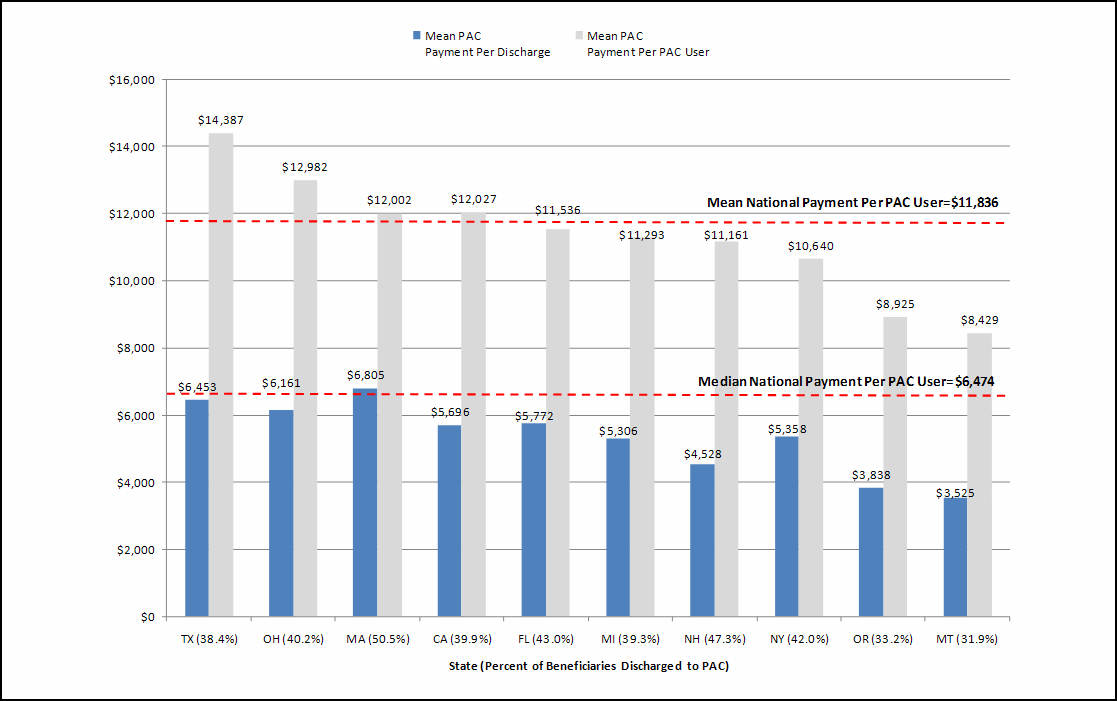
Figure 4 is a bar chart reporting the mean PAC payment per discharge and the mean PAC payment per PAC User by state for beneficiaries under the episode definition 30-Day Fixed: Any Claim Starting within 30 Days in 2008. Data for Texas, Ohio, Massachusetts, California, Florida, Michigan, New Hampshire, New York, Oregon, and Montana are shown here. The mean and median national payment per PAC user are also reported to allow for an understanding of how the states compare to each other and how they compare to the nation overall.
Source: RTI analysis of 2006, 2007, and 2008 Medicare claims (M3MM200).
Although the state-level PAC episode analysis reveals important differences across geographic areas, the CBSA-level analysis highlights additional variation within states and across metropolitan areas. Table 48 contains PAC episode descriptives for acute hospital-initiated episodes for the top 20 CBSAs in terms of the number of PAC users. Although New York, Illinois, California, Philadelphia, and Massachusetts were not among the top states in mean PAC payment per PAC user, metropolitan areas within these states are at the top in terms of the numbers of beneficiaries using PAC services. Three CBSAs in Texas are among the top 20 nationally, including Houston, Dallas, and rural Texas. In looking at these three CBSA areas alone, we see differences in use patterns within Texas. Although 38.3 percent of beneficiaries are discharged to PAC in Texas overall, 37.0 percent were discharged to PAC in Houston, 38.1 percent in rural Texas, and 41.0 percent in Dallas. There is significant variation in mean PAC payment per PAC user among the CBSAs shown here, with Houston having the highest (and fifth highest across all CBSAs) at $16,188 and Baltimore having the lowest at $10,124.
| Top 20 CBSAs by Volume of PAC Users |
Number of PAC Users1 |
Percent of Beneficiaries Discharged to PAC2 (%) |
Mean PAC Payment Per Discharge3 ($) |
CV4 | Mean PAC Payment Per PAC User5 ($) |
CV4 | Mean PAC LOS Per PAC User6 (days) |
CV4 |
|---|---|---|---|---|---|---|---|---|
|
||||||||
| New York-White Plains-Wayne, NY-NJ | 23,031 | 43.1 | $5,998 | 1.7 | $11,687 | 1.1 | 39.7 | 0.6 |
| Chicago-Naperville-Joliet, IL | 19,111 | 41.3 | $6,105 | 1.9 | $12,354 | 1.1 | 41.9 | 0.6 |
| Los Angeles-Long Beach-Santa Ana, CA | 13,403 | 42.8 | $6,682 | 1.9 | $13,320 | 1.2 | 43.5 | 0.6 |
| Philadelphia, PA | 9,986 | 45.6 | $5,709 | 1.9 | $10,755 | 1.2 | 38.2 | 0.7 |
| Nassau-Suffolk, NY | 9,023 | 43.2 | $5,459 | 1.7 | $10,757 | 1.0 | 37.8 | 0.6 |
| Boston-Quincy, MA | 8,151 | 49.7 | $6,735 | 1.8 | $11,881 | 1.2 | 43.5 | 0.6 |
| St. Louis, MO-IL | 7,953 | 39.3 | $5,373 | 2.1 | $11,174 | 1.3 | 39.5 | 0.7 |
| Tampa-St. Petersburg-Clearwater, FL | 7,546 | 44.4 | $6,119 | 1.9 | $11,995 | 1.2 | 39.7 | 0.6 |
| Houston-Sugar Land-Baytown, TX | 7,544 | 37.0 | $7,072 | 2.1 | $16,188 | 1.2 | 45.6 | 0.6 |
| Edison, NJ | 7,213 | 47.4 | $6,676 | 1.7 | $12,396 | 1.0 | 38.1 | 0.6 |
| Cleveland-Elyria-Mentor, OH | 6,817 | 41.7 | $6,417 | 1.8 | $13,096 | 1.1 | 40.5 | 0.6 |
| Warren-Troy-Farmington-Hills, MI | 6,777 | 40.8 | $5,591 | 2.0 | $11,543 | 1.2 | 41.7 | 0.6 |
| Baltimore-Towson, MD | 6,652 | 33.0 | $4,377 | 2.0 | $10,124 | 1.1 | 34.2 | 0.6 |
| Atlanta-Sandy Springs-Marietta, GA | 6,343 | 33.6 | $4,943 | 2.3 | $11,818 | 1.3 | 43.9 | 0.6 |
| Washington-Arlington-Alexandria DC-VA | 6,279 | 37.6 | $4,979 | 2.0 | $10,794 | 1.2 | 36.7 | 0.7 |
| Rural NC | 6,003 | 33.5 | $4,641 | 2.1 | $11,083 | 1.2 | 41.6 | 0.7 |
| Newark-Union, NJ-PA | 5,836 | 44.0 | $6,518 | 1.8 | $12,904 | 1.0 | 39.8 | 0.6 |
| Dallas-Plano-Irving, TX | 5,779 | 41.0 | $6,927 | 1.9 | $14,685 | 1.1 | 46.6 | 0.6 |
| Pittsburgh, PA | 5,360 | 47.0 | $6,696 | 1.9 | $12,362 | 1.2 | 39.2 | 0.6 |
| Rural TX | 5,128 | 38.1 | $5,743 | 2.1 | $12,789 | 1.2 | 48.3 | 0.6 |
In addition to the geographic analysis for acute hospital-initiated episodes, we also performed geographic analysis for HHA-initiated episodes. Because of the small numbers of beneficiaries with LTCH- and IRF-initiated episodes at the state and CBSA levels, geographic analyses for these types of episodes are not presented here. Table 49 shows the mean PAC payment per user for the top 5 states, the middle 10 states, and the bottom 5 states. The states with the highest payments per HHA-initiated episode are Indiana and Tennessee, and the states with the lowest payments are Vermont and Oregon. Although there is variation in the PAC episode payment across states, there is also significant variation in the number of beneficiaries with HHA-initiated episodes in each of the states shown in Table 49 with Texas, California, and Michigan among the top. To reveal more about the geographic areas with the highest volume of these types of cases, Table 50 presents the top 20 CBSAs in terms of the number of HHA-initiated episodes. Although Chicago and Los Angeles have the highest volume of HHA community-initiated episodes, these types of episodes are also common to several different metropolitan areas in Texas and Florida as well as rural areas of Texas, Mississippi, Oklahoma, and North Carolina.
| State | N | Mean Episode Payment1 ($) |
CV2 | Mean Episode LOS1 (days) |
CV2 |
|---|---|---|---|---|---|
|
|||||
| Top 5 States for Mean Episode Payment Per User | |||||
| IN | 3,904 | $7,732 | 1.6 | 66.3 | 0.6 |
| TN | 6,354 | $7,656 | 1.4 | 76.1 | 0.5 |
| WV | 962 | $7,376 | 1.5 | 65.2 | 0.6 |
| CT | 3,441 | $7,333 | 1.4 | 56.9 | 0.7 |
| WY | 186 | $7,320 | 1.5 | 60.7 | 0.6 |
| Middle 10 States for Mean Episode Payment Per User | |||||
| GA | 6,706 | $6,565 | 1.5 | 66.4 | 0.6 |
| NV | 1,779 | $6,519 | 1.6 | 62.0 | 0.6 |
| NC | 6,650 | $6,479 | 1.5 | 57.4 | 0.7 |
| NE | 840 | $6,461 | 1.4 | 53.8 | 0.7 |
| TX | 23,528 | $6,451 | 1.3 | 86.6 | 0.4 |
| DE | 449 | $6,441 | 1.3 | 52.0 | 0.7 |
| MO | 4,311 | $6,413 | 1.5 | 55.5 | 0.7 |
| VA | 5,366 | $6,412 | 1.4 | 57.8 | 0.7 |
| WI | 1,840 | $6,403 | 1.3 | 52.6 | 0.7 |
| MI | 14,321 | $6,385 | 1.4 | 64.7 | 0.6 |
| Bottom 5 States for Mean Episode Payment Per User | |||||
| CA | 19,251 | $5,690 | 1.4 | 55.1 | 0.7 |
| SD | 236 | $5,621 | 1.4 | 42.5 | 0.8 |
| MT | 400 | $5,603 | 1.2 | 48.8 | 0.7 |
| VT | 739 | $5,580 | 1.3 | 59.2 | 0.7 |
| OR | 1,733 | $5,239 | 1.3 | 49.7 | 0.7 |
| CBSA | Number of PAC Users |
Mean PAC Payment Per PAC User ($) |
CV | Mean PAC LOS Per PAC User (days) |
CV |
|---|---|---|---|---|---|
| Source: RTI Analysis of 2008 Medicare Claims (M3MM200). | |||||
| Chicago-Naperville-Joliet, IL | 11,599 | $6,000 | 1.8 | 83.7 | 0.4 |
| Los Angeles-Long Beach-Santa Ana, CA | 9,124 | $5,562 | 1.7 | 62.9 | 0.5 |
| Warren-Troy-Farmington-Hills, MI | 7,303 | $6,158 | 1.5 | 67.6 | 0.5 |
| New York-White Plains-Wayne, NY-NJ | 6,447 | $6,042 | 1.6 | 51.3 | 0.6 |
| Miami-Miami Beach-Kendall, FL | 5,261 | $4,836 | 1.6 | 57.7 | 0.5 |
| Tampa-St. Petersburg-Clearwater, FL | 5,005 | $6,081 | 1.6 | 53.3 | 0.6 |
| West Palm Beach-Boca Raton-Boynton FL | 4,311 | $5,752 | 1.6 | 53.2 | 0.6 |
| Houston-Sugar Land-Baytown, TX | 4,297 | $6,410 | 1.6 | 87.9 | 0.4 |
| Dallas-Plano-Irving, TX | 3,885 | $6,376 | 1.8 | 88.3 | 0.3 |
| Ft Lauderdale-Pompano Beach-Deerfield | 3,136 | $5,548 | 1.7 | 56.5 | 0.6 |
| Rural TX | 3,098 | $6,316 | 1.5 | 88.8 | 0.4 |
| Atlanta-Sandy Springs-Marietta, GA | 2,956 | $6,518 | 1.7 | 68.0 | 0.5 |
| Philadelphia, PA | 2,632 | $6,261 | 1.6 | 57.8 | 0.6 |
| McAllen-Edinburg-Mission, TX | 2,549 | $5,475 | 1.5 | 92.1 | 0.3 |
| Rural MS | 2,415 | $7,398 | 1.8 | 86.9 | 0.4 |
| Detroit-Livonia-Dearborn, MI | 2,408 | $6,587 | 1.7 | 67.6 | 0.6 |
| St. Louis, MO-IL | 2,274 | $6,421 | 1.5 | 57.2 | 0.6 |
| Jacksonville, FL | 2,019 | $6,182 | 1.6 | 62.7 | 0.5 |
| Rural OK | 1,926 | $7,134 | 1.7 | 89.2 | 0.4 |
| Rural NC | 1,893 | $6,858 | 1.6 | 61.9 | 0.6 |
7. Longitudinal Cohort Analyses
The final set of analyses was conducted on the longitudinal cohort analytic sample described in Section 2. This analytic sample was developed to allow us to follow beneficiary utilization patterns over a 2-year period to learn more about patterns of service use for different types of beneficiaries beyond what we observe in the first episode. The analyses presented here provide information on utilization and payments for twenty-four 30-day windows following discharge from an initiating event. Data are presented by initiating event (acute, HHA, LTCH, and IRF). For beneficiaries with acute hospital-initiated episodes, additional information on service-specific utilization and utilization by index acute MS-DRG is also presented.
Figure 5 shows the proportion of beneficiaries with an acute or PAC claim (HHA, SNF, IRF, LTCH, or therapy) in each of the twenty-four 30-day windows following discharge from an initiating event. Data are shown here for beneficiaries with acute, HHA, LTCH, and IRF-initiated episodes. Within the first 90 days following discharge from an initiating event, beneficiaries with acute hospital-initiated episodes have the highest proportion of beneficiaries using acute or PAC service, followed by beneficiaries with an IRF-initiated episode. Of beneficiaries with an acute hospital-initiated event, 100 percent had a claim in the first window (days 1 to 30 following discharge from the acute initiating event) because our sample focused on PAC users. After 90 days, the proportion of beneficiaries with acute hospital-initiated episodes with an acute or PAC claim decreases significantly and is lower than among any of the beneficiaries with community-initiated episodes. After day 90 and for the remainder of the 2-year period examined here, beneficiaries with HHA-initiated episodes have the highest proportion of beneficiaries with an acute or PAC claim, indicating that these beneficiaries may be more likely to be chronically ill and in need of ongoing care.
Figure 5. Percentage of Beneficiaries with an Acute or PAC Claim Following Discharge From Initiating Event, by Type of Initiating Event
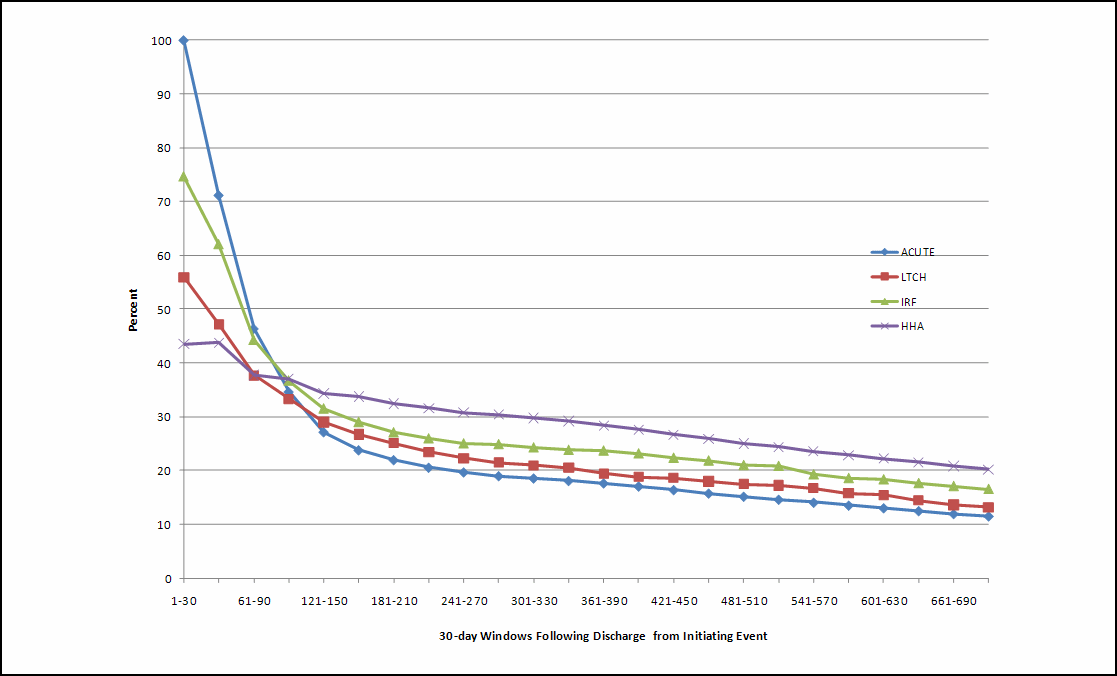
Figure 5 reports the percentage of beneficiaries with at least one acute or PAC claim following discharge from an initiating event, by initiating event, for each of the twenty-four 30-day windows included in the longitudinal cohort analysis.
Note: All initiating events occurred in 2006. Twenty-four 30-day windows were constructed following discharge from the initiating event to follow service use for 2 years.
Source: RTI analysis of 2006, 2007, and 2008 Medicare claims (M3MM197).
While Figure 5 provides information on the percentage of beneficiaries using different services following discharge from an initiating event, Figure 6 provides information on the payment associated with that service use by type of initiating event. Payments are presented per PAC user, so the denominator is constant across each window and includes all beneficiaries with an initiating event. Mean payments per PAC user are highest for beneficiaries with acute hospital-initiated episodes in the first 30 days following discharge from the initiating event, but for the remainder of the analysis period, beneficiaries with LTCH-initiated episodes have the highest payments per PAC user. Although beneficiaries with HHA-initiated episodes had the highest proportion of beneficiaries with at least one acute or PAC claim after 90 days (as seen in Figure 5), the payments associated with this use are low and likely indicative of ongoing HHA and therapy services.
Figure 6. Mean Acute and PAC Payments Per PAC User Following Discharge From Initiating Event, by Type of Initiating Event
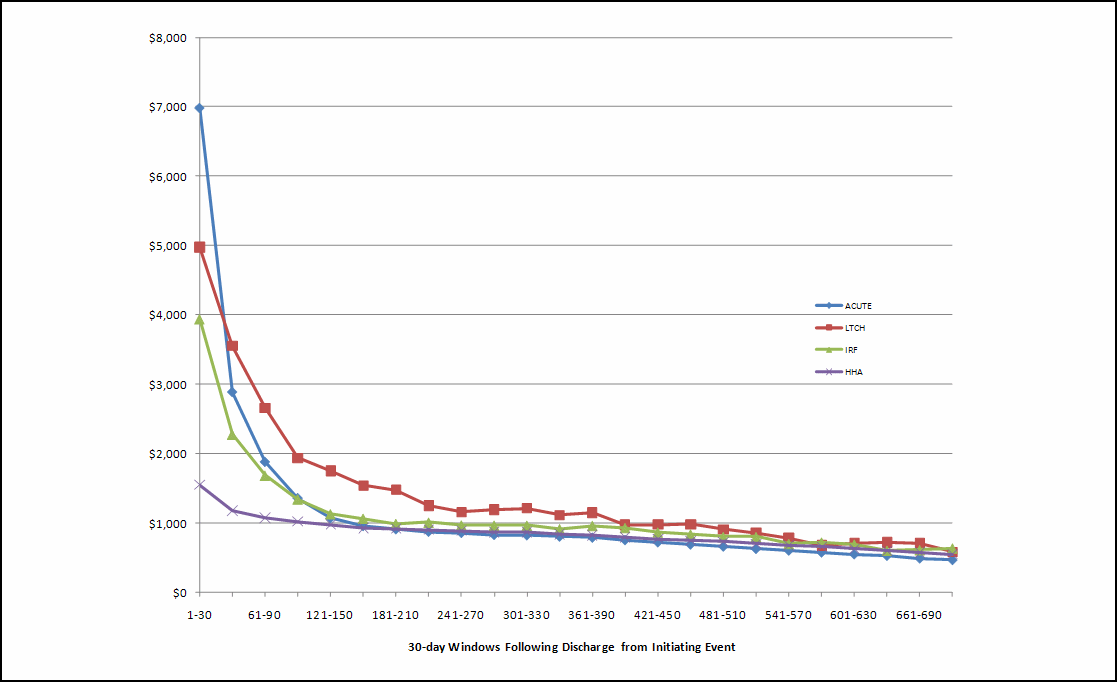
Figure 6 reports the mean acute and PAC payments per PAC User following discharge from an initiating event, by initiating event, for each of the twenty-four 30-day windows included in the longitudinal cohort analysis.
Note: All initiating events occurred in 2006. Twenty-four 30-day windows were constructed following discharge from the initiating event to follow service use for 2 years.
Source: RTI analysis of 2006, 2007, and 2008 Medicare claims (M3MM197).
For beneficiaries with acute hospital-initiated episodes, Figure 7 and Figure 8 provide more detail on the percentage of beneficiaries with a claim by service type and the mean payments per PAC user by service type. Although physician service use is not included in Figure 5 or Figure 6, these services were included in Figure 7 and Figure 8 to demonstrate the high proportion of physician service use following discharge from an acute hospital-initiated episode and the continued use of these services over the 2-year period. In looking specifically at PAC services, HHA and SNF service use is relatively high compared with other PAC services in the first 90 days following discharge from an acute hospitalization. While 10 percent of beneficiaries use IRF in the first 30 days after discharge, this percentage decreases to less than 1 percent for the remainder of the analysis period. The proportion of beneficiaries with an acute hospitalization is highest in the first 90 days following discharge from the index hospitalization and then decreases for the remainder of the analysis period. After day 90, use of HHA and acute hospitalization are most common among beneficiaries with acute hospital-initiated episodes. The payments per PAC user shown in Figure 8 reveal that the payments per PAC user for SNF are highest up until day 60, but the payments per PAC user for acute hospitalizations are highest for the remainder of the analysis period. Although a high proportion of beneficiaries use physician services in each window, the payments associated with these services are very low.
Figure 7. Percentage of Beneficiaries with an Acute, PAC, or Physician Claim Following Discharge From an Acute Initiating Event, by Type of Claim
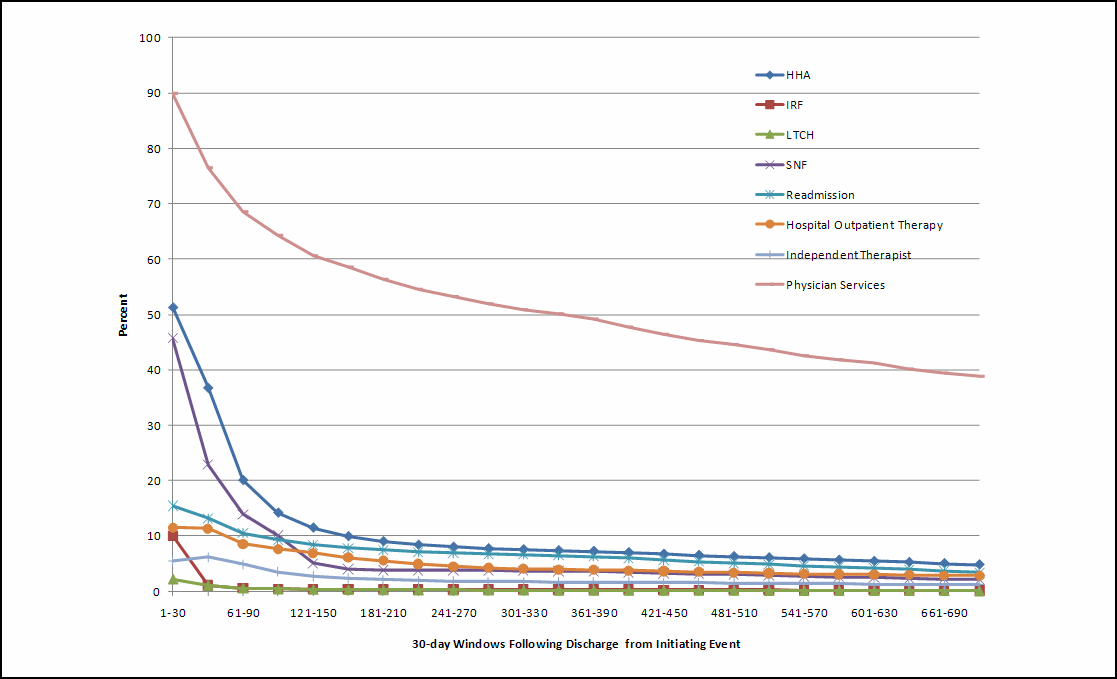
Figure 7 reports the percentage of beneficiaries with at least one acute, PAC, or physician claim following discharge from a acute hospital-initiating event, by type of claim (HHA, IRF, LTCH, SNF, readmission, hospital outpatient therapy, independent therapy and physician services) for each of the twenty-four 30-day windows included in the longitudinal cohort analysis.
Note: All initiating events occurred in 2006. Twenty-four 30-day windows were constructed following discharge from the initiating event to follow service use for 2 years.
Source: RTI analysis of 2006, 2007, and 2008 Medicare claims (M3MM181).
Figure 8. Mean Acute, PAC, and Physician Payments Per User PAC User Following Discharge From an Acute Hospital-Initiated Event, by Type of Claim
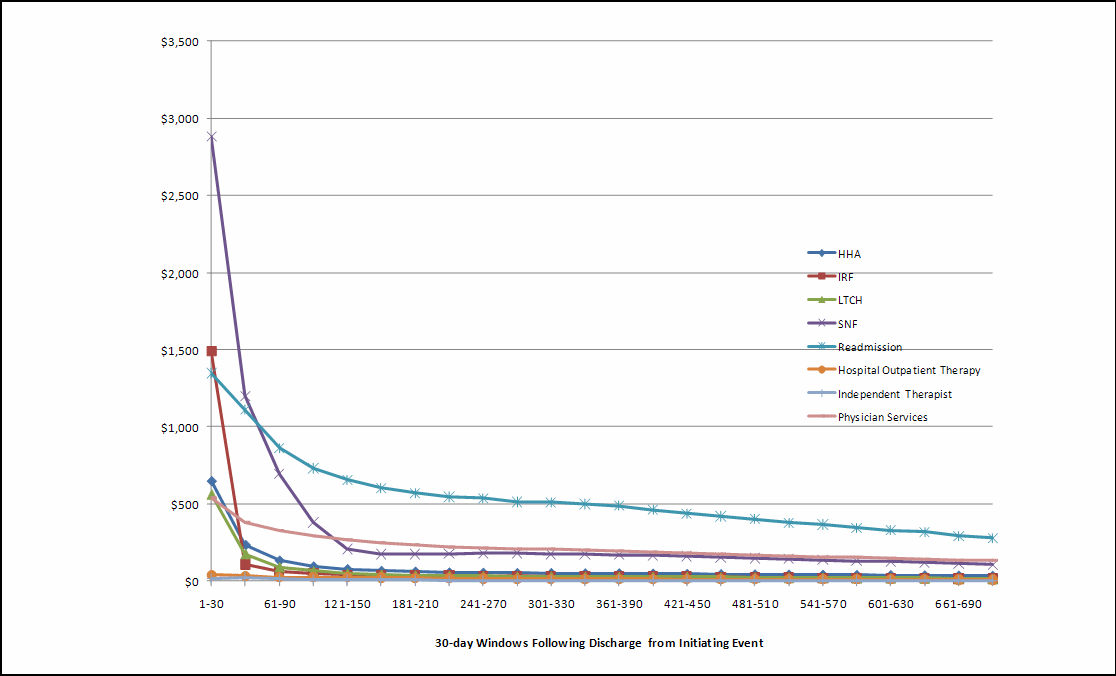
Figure 8 reports the mean acute, PAC, and physician payments per PAC Users following discharge from an acute hospital-initiating event, by type of claim (HHA, IRF, LTCH, SNF, readmission, hospital outpatient therapy, independent therapy and physician services) for each of the twenty-four 30-day windows included in the longitudinal cohort analysis.
Note: All initiating events occurred in 2006. Twenty-four 30-day windows were constructed following discharge from the initiating event to follow service use for 2 years.
Source: RTI analysis of 2006, 2007, and 2008 Medicare claims (M3MM181).
To learn more about the differences in use patterns over a 2-year period for beneficiaries with different diagnoses in their acute initiating event, we looked at the mean acute and PAC payments for beneficiaries in the top five MS-DRGs in terms of volume of discharges to PAC (Figure 9). Beneficiaries in MS-DRG 065, "Intracranial hemorrhage or cerebral infarction w CC," and beneficiaries in MS-DRG 481, "Hip & femur procedures except major joint w CC," had the highest payments per PAC user for the first 90 days following discharge from the index acute hospitalization. Payments per PAC user for beneficiaries in MS-DRG 470 decreased at the fastest rate and were lowest among the top five MS-DRGs starting at 30 days following discharge from the index hospitalization.
Figure 9. Mean Acute and PAC Payments Per PAC User Following Discharge From an Acute Initiating Event, by MS-DRG
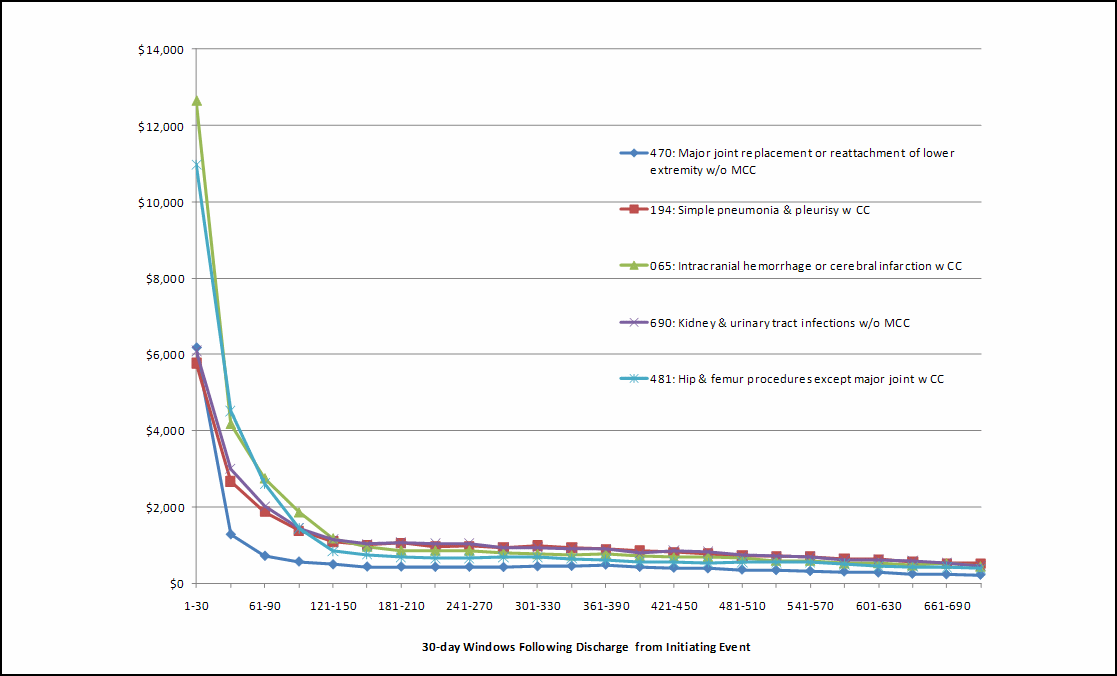
Figure 9 reports the mean acute and PAC payments per PAC User following discharge from an acute hospital- initiating event, by MS-DRG, for each of the twenty-four 30-day windows included in the longitudinal cohort analysis. Five MS-DRGs are shown here including MS-DRG 470 "Major joint replacement or reattachment of lower extremity w/o MCC"; MS-DRG 194 "Simple pneumonia & pleurisy w CC; MS-DRG 065 "Intracranial hemorrhage or cerebral infarction w CC; MS-DRG 690 "Kidney & urinary tract infections w/o MCC'; and MS-DRG 481 "Hip & femur procedures except major join w CC."
Note: All initiating events occurred in 2006. Twenty-four 30-day windows were constructed following discharge from the initiating event to follow service use for 2 years.
Source: RTI analysis of 2006, 2007, and 2008 Medicare claims (M3MM181).
Figure 10 and Figure 11 show the mean payment per PAC user by service type for the top two MS-DRGs for beneficiaries with acute hospital-initiated episodes (MS-DRG 470, "Major joint replacement or reattachment of lower extremity w/o MCC" and MS-DRG 194, "Simple pneumonia & pleurisy w CC") to reveal more about differences in service-specific utilization for a rehabilitative diagnosis versus a medical diagnosis. Figures 10 and 11 use the same scale on the vertical axis to enable comparison of the mean payments across these two MS-DRGs. Most notably, the mean payments per PAC user for SNF and for acute hospitalizations were higher for beneficiaries in MS-DRG 194 across the analysis period compared with beneficiaries in MS-DRG 470. Mean payments per PAC user for HHA were higher for beneficiaries in MS-DRG 470 in the first 30 days following discharge from the index hospitalization, but were similar to that seen for beneficiaries in MS-DRG 194 after day 30. These two figures highlight differences in longer term utilization patterns for beneficiaries with different types of index diagnoses.
Figure 10. Mean Acute, PAC, and Physician Payments Per User PAC User Following Discharge From an Acute Initiating Event, by Type of Claim, MS-DRG 470, "Major Joint Replacement or Reattachment of Lower Extremity w/o MCC"
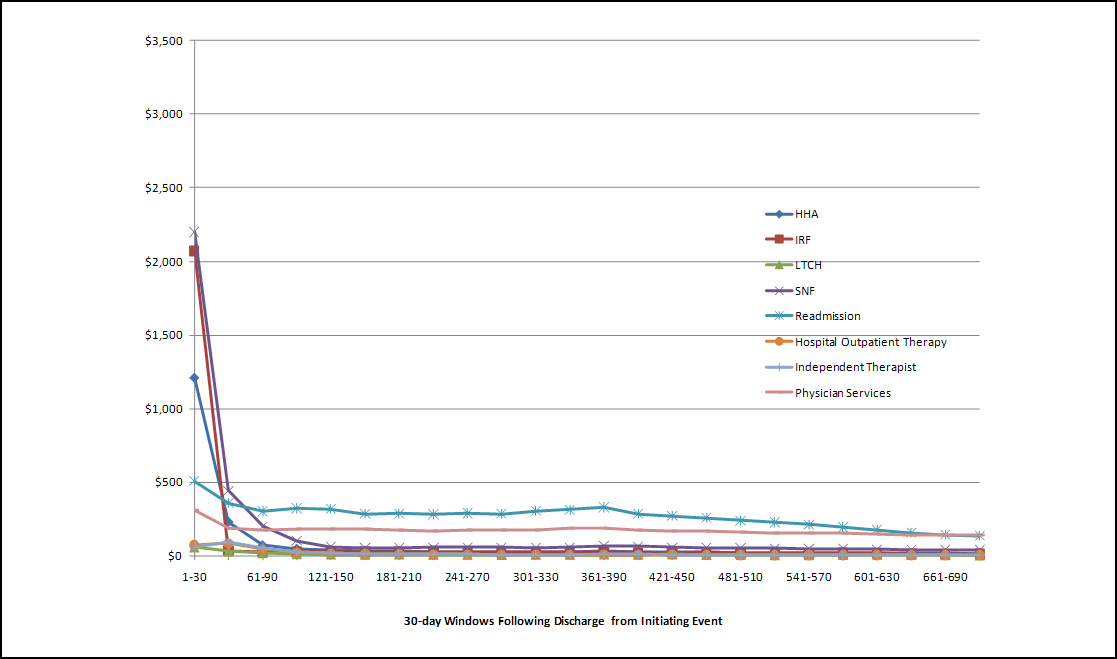
Figure 10 reports the mean acute, PAC, and physician payments per PAC Users following discharge from an acute hospital-initiating event for MS-DRG 470 "Major joint replacement or reattachment of lower extremity w/o MCC", by type of claim (HHA, IRF, LTCH, SNF, readmission, hospital outpatient therapy, independent therapy and physician services) for each of the twenty-four 30-day windows included in the longitudinal cohort analysis.
Note: All initiating events occurred in 2006. Twenty-four 30-day windows were constructed following discharge from the initiating event to follow service use for 2 years.
Source: RTI analysis of 2006, 2007, and 2008 Medicare claims (M3MM181).
Figure 11. Mean Acute, PAC, and Physician Payments Per User PAC User Following Discharge From an Acute Initiating Event, by Type of Claim, MS-DRG 194, "Simple Pneumonia & Pleurisy w CC"
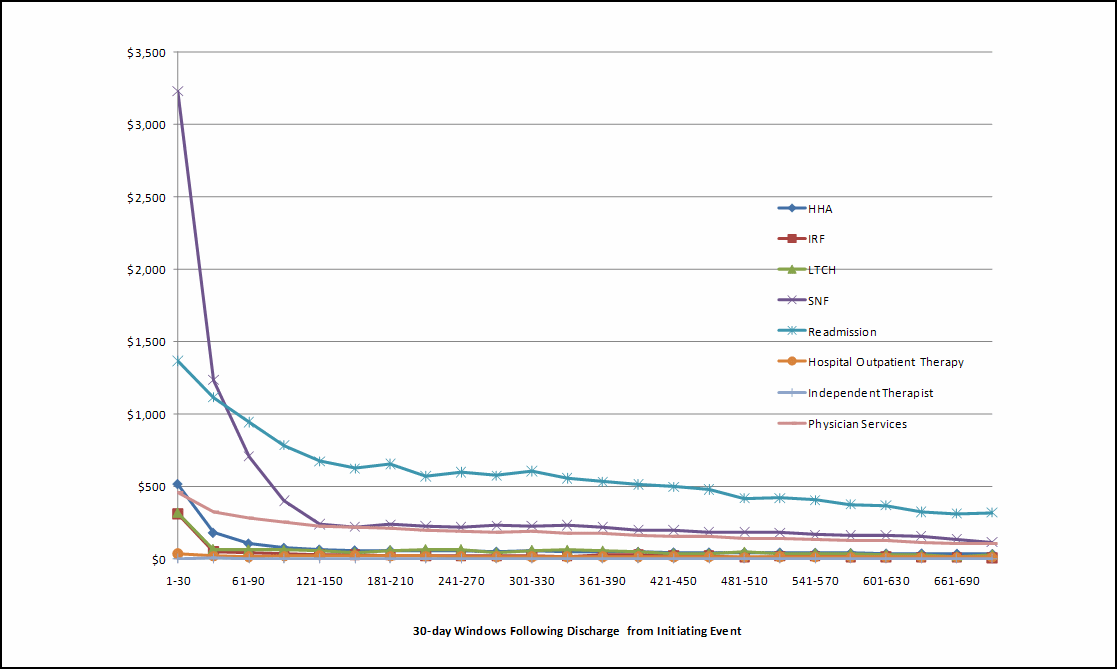
Figure 11 reports the mean acute, PAC, and physician payments per PAC Users following discharge from an acute hospital-initiating event for MS-DRG 194 "Simple pneumonia & pleurisy w CC", by type of claim (HHA, IRF, LTCH, SNF, readmission, hospital outpatient therapy, independent therapy and physician services) for each of the twenty-four 30-day windows included in the longitudinal cohort analysis.
Note: All initiating events occurred in 2006. Twenty-four 30-day windows were constructed following discharge from the initiating event to follow service use for 2 years.
Source: RTI analysis of 2006, 2007, and 2008 Medicare claims (M3MM181).
8. Discussion and Policy Implications
The analyses presented in this report demonstrate the differences in episode composition and payments associated with beneficiaries initiating their PAC episode with an acute hospitalization versus the community entrants who initiate PAC use without a prior hospitalization. This work is an important complement to earlier work by ASPE and RTI looking at PAC utilization following an acute hospitalization. The current work highlights differences in the types of diagnoses and patterns of service use within episodes for those initiating services with an acute hospitalization compared with community entrants. The diagnoses of community entrants are in general more characteristic of chronic conditions and the need for ongoing care while the diagnoses for beneficiaries with acute hospital-initiated episodes are more acute in nature. The longitudinal cohort analysis also provides additional detail on the longer term use patterns for beneficiaries initiating PAC service use in different settings beyond what we observe in the first episode of care. Together, these analyses demonstrate the shorter term, higher cost nature of service use for beneficiaries initiating a PAC episode with an acute hospitalization compared with the longer term, relatively lower cost service use of those entering PAC directly from the community. Although these community entrants are a small proportion of total PAC users, their service use patterns are unique and indicative of longer term service use.
As in earlier work, the results looking at the impact of different episode definitions reveal substantial differences in the services included and the associated episode payments across the definitions examined. Because LTCH and IRF are most often the first sites of PAC for beneficiaries using these services, use and payments for LTCH and IRF are less sensitive to the shorter fixed-length episode definitions than HHA and SNF services, which are also often first sites of PAC but are often used following discharge from LTCH and IRF. Although a higher proportion of beneficiaries may use SNF and HHA under the longer, variable-length episode definitions, this proportion decreases when looking at the fixed-length definitions or definitions that exclude readmissions and subsequent PAC user. The inclusion or exclusion of readmissions and subsequent PAC use has a significant impact on total episode length of stay and episode payments when comparing across definitions. The illustration of these differences and their impact can help inform policy discussions on whether a readmission is part of an episode or the start of a new episode.
Another important contribution of this work is in the ability to track PAC use patterns over time using the cross-sectional analytic samples. In examining beneficiary episode utilization in 2006, 2007, and 2008, it is possible to see the slight changes in use. For example, there has been a slight increase in the percentage of beneficiaries discharged to PAC nationally (from 37.1 percent in 2006 to 38.7 percent in 2008). But of particular note is the slight change in the proportion of beneficiaries discharged to the different PAC settings over the 3-year period—specifically, the percentage of beneficiaries discharged to IRF. In 2006, 9.7 percent of beneficiaries were discharged to IRF, but this decreased to 8.6 percent in 2008, and MS-DRG-specific analysis highlighted the significant decrease in the proportion of beneficiaries with joint replacement (MS-DRG 470) discharged to IRF. These small changes are likely a result of CMS's phasing in changes in compliance criteria associated with IRF payment, but the ability to detect these changes is an important benefit of the analytic file.
The increased sample size of this work has also provided a valuable opportunity to look at differences in PAC use and payments at smaller geographic levels. The data provided here allow for more detailed analysis of MS-DRG level utilization at the state and CBSA level than were possible using the 5 percent files in earlier work. The results of this geographic analysis again highlight that provider supply and geography are significant drivers of PAC utilization and spending and that policy discussions related to PAC episode payment must recognize these issues and include discussions of the implications of benchmarking given different practice patterns and provider supply. This concept is also highlighted in the use per user, use per PAC user, and use per hospital discharge calculations of mean payments per service type. In areas of the country with LTCHs, a beneficiary using an LTCH may have mean payments of over $33,000 although the mean LTCH use per hospital discharge can be closer to $250 (depending on the episode definition examined). This raises important policy considerations if an episode payment were to be set based on national per-discharge use patterns.
The results of this work are meant to inform the larger discussion of PAC episodes and bundled payment policy. The information presented provides additional context to what episodes of care look like by different types of initiating events (acute versus community entrant) and what the implications are for setting an episode one way versus another. Although there has be much discussion of episodes definitions that include service use for 30 days following hospital discharge, it is important to point out that "30 days following hospital discharge" can mean different things, and more precise language may be necessary. Does this include any service initiating within 30 days of acute hospital discharge? Or is it prorated to exclude service use after day 30? Are readmissions included or excluded? What about episodes that do not start with an acute hospitalization? The work presented here shows the impact of these different dimensions and the importance of these considerations as policy makers continue to consider bundled payment.
This work also demonstrates that the services in a beneficiary's trajectory included or excluded from an episode do vary by MS-DRG. For example, over three quarters of PAC payments for the 30-day variable episode (episode definition A) are also captured by the 30-day fixed-length episode definition where any claim initiating in the 30-days following acute discharge is included in the episode (episode definition C) for MS-DRG 470, "major joint replacement or reattachment," but this decreases to less than two thirds of PAC payments for beneficiaries in MS-DRG 194, "simple pneumonia & pleurisy w CC," and MS-DRG 690, "kidney & urinary tract infections." However, under the 30-day fixed-length episode definition where services are prorated to reflect 30 calendar days of use, less than half of the PAC payments associated with the 30-day variable episode definition are captured for four out of the five top MS-DRGs by volume of PAC use. This indicates that in considering an episode definition, it is important to consider the proportion of services (and dollars associated with this use) in a clinical trajectory that the episode definition is actually capturing. It is also necessary to consider how service use will be paid for after an episode is complete, particularly if an episode includes 30 calendar days and payment for a service may be only partially covered under a bundle. The MS-DRG-specific analysis for acute hospital-initiated episodes also indicates that the decision to pay a bundle per hospital discharge versus per PAC user will have different implications for different MS-DRGs. A per-discharge bundle means something different for an MS-DRG with a high proportion of beneficiaries discharged to PAC services compared with an MS-DRG with a lower proportion of beneficiaries going on to use PAC services.
Next steps in ASPE and RTI's exploration of PAC episodes include work related to episode risk adjustment. This work is in collaboration with CMS and uses data from the Post Acute Care Payment Reform Demonstration, including the uniform patient assessment instrument and the Continuity Assessment Record and Evaluation (CARE) data. The goal of this work is to learn more about how patient assessment data can be used to predict episode utilization and payments. Additional work with ASPE will also examine the potential to use data from current assessment instruments and claims data. This work is part of ongoing research at ASPE on PAC episodes.
9. References
Gage, B., Morley, M., Spain, P., and Ingber, M. "Examining Post Acute Care Relationships in an Integrated Hospital System." Final Report. ASPE. RTI International. February 2009. Available at: http://aspe.hhs.gov/health/reports/09/pacihs/report.pdf
Morley, M., Gage, B., Smith, L., Spain, P., and Ingber, M. "Post Acute Care Episodes." Final Report. ASPE. RTI International. November 2009. Available at: http://aspe.hhs.gov/health/reports/09/pacepifinal/report.pdf
Schoen, C., Guterman, S., Shih, A., Lau, J., Kasimow, S., Gauthier, A., and Davis, K. "Bending the Curve: Options for Achieving Savings and Improving Value in U.S. Health Spending." The Commonwealth Fund. December 2007. Available at: http://www.commonwealthfund.org/~/media/Files/Publications/Fund Report/2007/Dec/Bending the Curve Options for Achieving Savings and Improving Value in U S Health Spending/Schoen_bendingthecurve_1080 pdf.pdf
Endnotes
1 Because there is no national physician fee schedule, state-level physician fee schedule amounts were used in this calculation. RTI selected one state, Kansas (although any state could have been selected), for the purposes of this analysis and applied Kansas rates to all therapy claims. By applying the rates from one state to all of the data, we were able to achieve the goal of understanding levels of utilization in the absence of wage adjustments and other geographic differences in payments.
2 Note that in the November 2009 report by Morley, Gage, Smith et al., the proportion of beneficiaries discharged to PAC in Texas was reported to be 29.2 percent. The authors acknowledged the unexpected results and reported that future analysis would examine this issue further. In the file construction effort for the current report, RTI identified a data issue where some providers in Texas were inadvertently excluded from the earlier analytic data file. These analyses reflect the corrected totals.