


With the passage of the Personal Responsibility and Work Opportunity Reconciliation Act of 1996 (PRWORA), policymakers and researchers have recognized the importance of understanding the dynamics of the low-wage labor market and the economic opportunities in it. As large numbers of current and former recipients enter the low-wage labor market, it is important to understand issues related to job retention and mobility among low-wage workers, as well as their prospects for wage progression.
While a number of researchers have examined issues related to the labor market experiences of workers in general, fewer studies have directly examined the labor-market experiences of low-wage workers. Moreover, these studies use data from the late 1980s and early 1990s but have not examined the situations of low-wage workers in more recent times. To learn how low-wage workers have fared in recent times, the Office of the Assistant Secretary for Planning and Evaluation (ASPE) contracted with Mathematica Policy Research, Inc. (MPR) to provide a comprehensive profile of the characteristics and labor market experiences of low-wage workers since the passage of PRWORA.
"Definition of Low-Wage Worker
The research was based on data from the 1996 panel of the Survey of Income and Program Participation (SIPP), which provides longitudinal data from 1996 to early 2000. The primary approach for defining low-wage workers was to use the hourly wage at which a full-time worker would have annual earnings below poverty for a family of four. Assuming a full-time worker works 2,080 hours per year, the low-wage cutoff was set at $7.50 in 1996, $7.72 in 1997, $7.91 in 1998, $8.03 in 1999, and $8.20 in 2000.
Findings
- Twenty-eight percent of all workers in March 1996 were low-wage workers, which is consistent with other studies. While this share remained relatively stable throughout the panel, the share of low-wage workers decreased slightly (from 28 percent to 25 percent) through the mid- to late-1990s.
- Females, African Americans and Hispanics, single parents with children, individuals with health limitations, recent public assistance recipients, and workers in poor households were disproportionately likely to be low-wage workers.
- Low-wage job and employment spells were typically short. During the study period, the median length of low-wage job spells was about four months. About 80 percent ended within a year, and more than 90 percent ended within two years.
- There was substantial job mobility among low-wage workers. Many low-wage workers experienced upward mobility (mainly into “medium-wage” jobs) and wage growth during the study period. Still, many workers simply moved in and out of the low-wage labor market during the course of the panel.
- Upward mobility was more common for those low-wage workers who began the period with better quality jobs (somewhat higher wages, health benefits available, full-time hours) and for those who switched jobs (relative to those still in their starting job).
- Low-wage workers experienced considerable wage growth during the study period. Average wage increases for low-wage workers were about 25 percent over a three-year period after they started their jobs, or a real wage increase of nearly 8 percent per year. Female workers had lower wages than male workers throughout the follow-up period, but wage growth was similar by gender, as shown in the figure below.
Trends in Real Wages Over Time Among Those Who Started a Low-Wage Job, by Gender
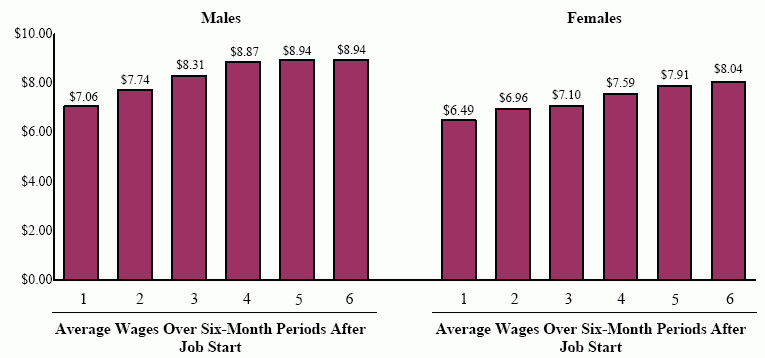
Source: 1996 SIPP longitudinal file using workers who started low-wage jobs
within six months after the start of the panel period.
Note: Each bar represents a six-month period.
All wages are reported in 1999 dollars