


Content
With the passage of the Personal Responsibility and Work Opportunity Reconciliation Act of 1996 (PRWORA), policymakers and researchers have recognized the importance of understanding the dynamics of the low-wage labor market and the economic opportunities in it. As large numbers of current and former recipients enter the low-wage labor market, it is important to understand issues related to job retention and mobility among low-wage workers, as well as their prospects for wage progression.
While a number of researchers have examined issues related to the labor market experiences of workers in general, fewer studies have directly examined the labor-market experiences of low-wage workers. Moreover, these studies use data from the late 1980s and early 1990s but have not examined the situations of low-wage workers in more recent times. To learn how low-wage workers have fared in recent times, the Assistant Secretary for Planning and Evaluation (ASPE) at the U.S. Department of Health and Human Services (DHHS) contracted with Mathematica Policy Research, Inc. (MPR) to provide a comprehensive profile of the characteristics and labor market experiences of low-wage workers since the passage of PRWORA. This study uses data from the 1996 longitudinal panel of the Survey of Income and Program Participation (SIPP), which covers the period between late 1995 and early 2000.
[ Go to Contents ]
Key Research Questions
The study examines a broad range of research questions pertaining to the low-wage labor market during the mid- to late 1990s. These questions include:
- How many workers hold low-wage jobs?
- Who are the people in the low-wage labor market and what are the characteristics of the jobs they hold?
- employment experiences of low-wage workers over a three-and-one-half-year follow-up period and what are their typical job and employment spell lengths?
- What wage growth do low-wage workers experience?
- Do labor market experiences differ across key subgroups of workers?
[ Go to Contents ]
Data And Methods
This study was conducted using data from the 1996 longitudinal panel of the SIPP. The 1996 SIPP is a large, multipanel, longitudinal survey that collected demographic and socioeconomic information on a nationally representative sample of U.S. households. The data cover the period from late 1995 to early 2000, and 48 months of follow-up data are available for each individual in the longitudinal file.
Our primary approach for defining low-wage workers was to use the hourly wage at which a full-time worker would have annual earnings below poverty for a family of four. Using federal poverty guidelines, and assuming a full-time worker works 2,080 hours per year, we set the low-wage cutoff at $7.50 in 1996, $7.72 in 1997, $7.91 in 1998, $8.03 in 1999, and $8.20 in 2000. We defined medium-wage workers as those with wage rates between one and two times the low-wage cutoff value and high-wage workers as those with wages more than twice the low-wage cutoff value.
We conducted our analysis using employed SIPP sample members who were between ages 16 and 64 and who were not enrolled in school. We excluded students and older workers, because their labor market experiences are likely to be very different from those of the population that is the focus of this study. We used both descriptive and multivariate regression analytic methods to address the research questions for the study. We used cross-sectional samples of workers to answer some analysis questions, entry cohort samples of workers starting low-wage jobs to answer other questions, and samples of low-wage job spells for others. We conducted the analyses using the full sample, as well as for key subgroups defined by worker and job characteristics.
[ Go to Contents ]
Key Findings
Our analysis provides a complex picture of the characteristics of low-wage workers and their jobs, as well as their labor market dynamics. We summarize the key analysis findings here:
How Many Workers Hold Low-Wage Jobs?
- In March 1996, less than one-third of all workers were low-wage workers. In March 1996, about 28 percent of all workers were low-wage workers, with hourly wages below $7.50 in 1996 dollars. Most workers (43 percent) were medium-wage workers, with wages between $7.50 and $15 per hour. About 29 percent were high-wage workers, with wages over $15 per hour. The share of low-wage workers decreased somewhat during the mid- to late 1990s as the unemployment rate declined. These estimated shares are similar to those found in previous studies covering earlier periods that used a similar hourly wage cutoff value to define low-wage workers.
Who Are the People in the Low-Wage Labor Market?
- Low-wage workers are disproportionately young, female, nonwhite, with a high school credential or less, and with health limitations. During the mid- to late 1990s, more than one-third of all employed females were in the low-wage labor market, compared to 22 percent of all employed males. Similarly, about 84 percent of employed teenagers between the ages of 16 and 19 held low-wage jobs, compared to less than one-quarter for those between the ages of 30 and 60. Differences by education level are especially large; about 56 percent of workers who did not complete high school were low-wage workers, compared to 36 percent of workers with a high school diploma or GED, and only about 14 percent of workers who completed college.
- Single parents with children, those who had recently received public assistance, and workers in households with incomes below the federal poverty level are disproportionately likely to be low-wage workers. More than 40 percent of employed single parents with children in our sample were in the low-wage labor market, compared to 25 percent of married couples with or without children. Similarly, workers who received public assistance in the past year were twice as likely as their counterparts to be in the low-wage labor market (58 versus 27 percent).
- Despite these patterns, low-wage workers are a relatively diverse group. They exist in a wide range of subgroups defined by individual and household characteristics. For example, although workers in households below the federal poverty level were much more likely to be low-wage workers than those with incomes greater than 200 percent of poverty (79 percent, compared to only 20 percent), nearly 60 percent of all low-wage workers were in higher-income households. Similarly, in March 1996, nearly 20 percent of all low-wage workers graduated college.
What Are the Characteristics of Jobs That Low-Wage Workers Hold?
- Many low-wage workers earn considerably less than the low-wage cutoff value used in our study. In March 1996, only 21 percent of low-wage workers earned between $7.00 and $7.50 (the hourly wage cutoff value used in our study). More than one-quarter earned less than $5.00 per hour (close to the $4.75 minimum wage). On average, low-wage workers earned $5.58 per hour, compared to $13.62 for all workers.(1) Interestingly, the wage distributions for low-wage workers are similar for males and females.
- However, most work full-time, and many are covered by health insurance through their employers. Most low-wage workers in our sample reported working full-time (defined as those working at least 35 hours per week). Among male workers in March 1996, about 85 percent of those with low wages reported working full-time; the figure for higher-wage male workers is about 96 percent.(2) Similarly, about 66 percent of low-wage female workers reported working full-time, compared to 83 percent of other employed females. Many had health insurance coverage through their employers; interestingly, health insurance coverage rates for low-wage workers were higher for females than for males (57 percent, compared to 41 percent), perhaps due in part to the fact that fewer females were self-employed.
- Low-wage workers are substantially overrepresented in service professions and underrepresented in professional and technical occupations. In 1996, nearly one-third of all low-wage workers were in service occupations, compared to only 10 percent of higher-wage workers. Conversely, only 14 percent of low-wage workers were in professional and technical occupations, compared to 40 percent for other workers. Only about 6 percent of low-wage workers were unionized, compared to 16 percent of medium-wage and 25 percent of high-wage workers. Finally, a larger share of low-wage workers than other workers are self-employed (13 percent, compared to 9 percent).
What Are the Overall Employment Experiences of Low-Wage Workers?
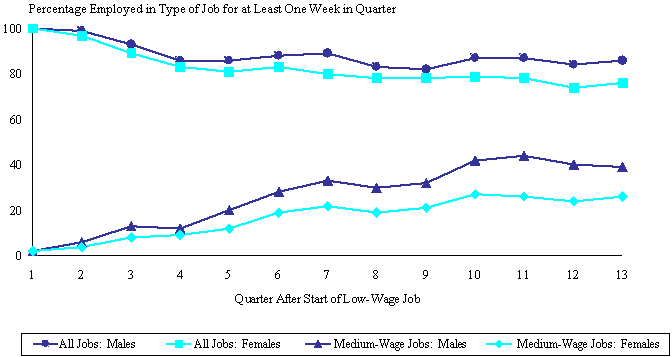
- Many low-wage workers were employed for most of the study's three-and-a-half-year follow-up period. On average, those who started low-wage jobs were employed about 79 percent of the time over the study period (83 percent for males and 76 percent for females). Nearly 40 percent of the low-wage workers were employed every month, and only 30 percent were employed for less than half the period. Furthermore, employment rates remained fairly constant during the follow-up period for both males and females (top two lines in Figure 1). These high rates of employment may reflect the strong economic conditions during the mid- to late 1990s.
- Most low-wage workers held medium-wage jobs at some point. About 69 percent of males held medium-wage jobs (that is, earned wages between one and two times the low-wage cutoff value of $7.50 in 1996 dollars) and 13 percent held high-wage jobs during the three-and-a-half-year follow-up period; only 30 percent held low-wage jobs only. Employment rates in medium-wage jobs were somewhat lower for females than for males, suggesting that females experienced less upward mobility than males. However, female employment rates in these jobs were still high about one-half of women workers ever held them.
- Many low-wage workers moved in and out of the low-wage labor market. For example, nearly two-thirds of those who held a medium- or high-wage job subsequently returned to the low-wage labor market, and many of those who became nonemployed reentered low-wage jobs. Similarly, low-wage workers held an average of three jobs during the follow-up period, and 80 percent of these were low-wage jobs. Thus, there is considerable job mobility among low-wage workers.
- Low-wage job and employment spells were typically short. During the study period, the median length of low-wage jobs spells was about four months for both males and females.(3) About 80 percent ended within a year, and more than 90 percent ended within two years. Low-wage workers often went directly from their low-wage jobs into medium- or high-wage employment, but many also left these jobs. At the same time, however, many low-wage workers, especially females, exited their low-wage jobs into another low-wage job or into nonemployment. Thus, we find additional evidence of substantial job mobility among low-wage workers.
- Low-wage workers in our sample experienced some upward mobility over the medium term. Over the entire follow-up period, sample members typically spent considerable more time in low-wage than higher-wage jobs (an average of 57 percent of months in low-wage jobs, compared to 23 percent of months in higher-wage jobs). However, employment rates in low-wage jobs decreased over time, whereas employment rates in medium-wage jobs increased over time (bottom two lines in Figure 1). This is especially true for males; the average male worker actually spent about the same amount of time in low-wage and higher-wage jobs during the second half of the follow-up period. These patterns, however, are weaker for female workers, suggesting further that females experienced less upward mobility than males.
What Wage Growth Do Low-Wage Workers Experience?
- Low-wage workers experienced considerable wage growth during the study period. Average wage increases for low-wage workers were about 25 percent over a three-year period after they started their jobs, or a real wage increase of nearly 8 percent per year (Figure 2). Female workers had lower wages than male workers throughout the follow-up period, but wage growth was similar by gender.
- The majority of workers experienced some increases in wages,and some workers experienced fairly large gains. About 80 percent of both male and female workers experienced an increase in real wages. Some low-wage workers also experienced significant amounts of wage growth for example, nearly half of males and 40 percent of females experienced a wage growth of more than 25 percent between their initial job and their most recent job three years later.
Figure Exec.2.
Trends in Real Wages Over Time Among Those Who Start a Low Wage Job, by Gender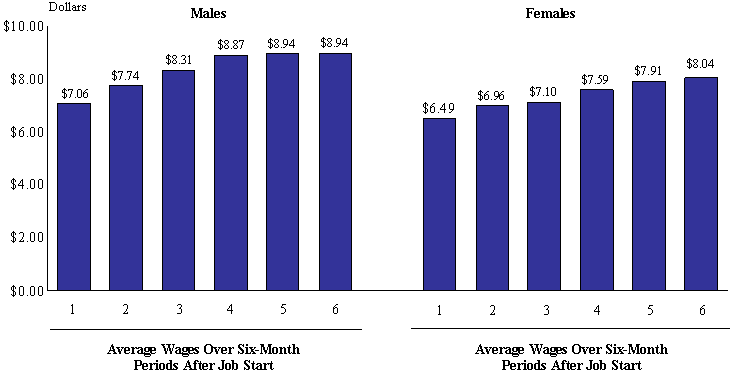
Source: 1996 SIPP longitudinal file using workers who started low-wage jobs within six months after the start of the panel period
Note: All wags are reported in 199 dollars. - Low-wage workers also moved to "better" jobs over time. Low-wage workers worked more hours over time, and a higher fraction had health insurance coverage through their jobs. The fraction of workers working full-time increased for both male and female workers. Similarly, the fraction of low-wage workers in jobs that offered fringe benefits, such as health insurance, increased by more than 50 percent.
- Despite the high amounts of wage growth, many workers still had low wages and earnings. Because they started at fairly low wage levels, despite wage increases, many workers, especially females, had low wages and annualized earnings that would put them below the federal poverty level for a family of four (50 percent of male workers and more than 60 percent of female workers).
Do Labor Market Experiences Differ Across Key Subgroups of Low-Wage Workers?
- We find some differences in labor market outcomes across key demographic subgroups of the low-wage population, although the differences are not large. Males, prime-age workers (those between ages 20 and 60), educated workers, whites, those without health limitations, and those in higher-income households typically spend more time in higher-wage jobs than their respective counterparts and experience greater wage growth.
- We also find that job quality matters. Those who start with better jobs (measured by higher initial wages, health insurance coverage, and full-time work status) are more likely than those in lower-quality jobs to spend time in higher-wage jobs and to have higher wage growth. In addition, we find some differences across occupations males in professional and sales occupations and females in professional and clerical occupations have more positive labor market outcomes than other workers.
- Among male workers, business owners were more likely than jobholders to experience greater wage growth. Self-employed male workers spent substantially more time in medium- and high-wage jobs than did male jobholders, and had higher wages in the last follow-up period. These differences are statistically significant in the multivariate regression models.
- Time spent employed was associated with wage growth. Low-wage workers who were employed for most of the period (at least 75 percent of months) experienced greater wage growth than those who were employed for fewer months, and especially for males. For instance, about 33 percent of continuously-employed males earned more than $10 per hour at the end of the follow-up period, compared to only 17 percent of males who were intermittently employed.
- Among those continuously employed, job switchers experienced somewhat greater wage growth than job stayers, especially for females. Among continuously-employed workers, those who switched jobs spent more time in the medium- or high-wage labor market than those who stayed in their initial jobs. The job switchers also experienced more wage growth during the follow-up period, and these differences are statistically significant.
- In general, differences in labor market success across subgroups are smaller than expected. Although, in both our descriptive and multivariate analyses, we identified groups that are at particular risk of poor labor market outcomes, we could not fully account for the variation in outcomes across low-wage workers. Thus, substantial diversity exists in labor market success within groups. Clearly, important residual factors affect the wage progression of those starting low-wage jobs.
[ Go to Contents ]
Conclusions
The labor market dynamics of low-wage workers about 28 percent of all workers are complex. Low-wage workers in our sample were employed for most of the three-and-one-half year follow-up period (about 79 percent of weeks). However, there was considerable movement in and out of the low-wage labor market for these workers. While about 70 percent of male workers and 50 percent of female workers held medium-wage jobs at some point during the follow-up period, on average, males spent only about 30 percent of the time in these jobs, and the corresponding figure for females was about 20 percent. However, we see an upward trend in employment rates in these higher-paying jobs over time for both males and females.
We find significant wage growth for low-wage workers in our sample. Overall, the average real wage increase was about 25 percent during the follow-up period (for those employed at the start and end of the period). In addition, about 80 percent of workers experienced an increase in real wages, with some experiencing significant amounts of wage growth. Furthermore, low-wage workers tended to move into better jobs (as measured by hours worked and available fringe benefits). Despite this wage growth, however, many workers still had low earnings. Because they started at fairly low wage levels, by the end of the follow-up period, more than one-half of workers had earnings that would put them below the federal poverty level for a family of four.
We conducted subgroup analyses to try to explain the diversity in labor market outcomes across low-wage workers. Our analysis consistently found that, among the low-wage population, males, prime-age workers (those between ages 20 and 60), educated workers, whites, those without health limitations, and those in wealthier households typically spent more time in higher-wage jobs and experienced more wage growth than their respective counterparts. Furthermore, job quality matters those who start with better jobs (measured by higher initial wages, health insurance coverage, and full-time work status) are more likely to experience wage growth than those in lower-quality jobs. In addition, we find some differences across occupations males in professional and sales occupations and females in professional and clerical occupations have more positive labor market outcomes than other workers. Business owners were also more likely than jobholders to experience greater wage growth.
We find also some association between the overall employment experiences of low-wage workers during the follow-up period and their wage growth. First, wage progression was greater for those who were employed for most of the period than those employed less, suggesting that policies promoting employment retention could improve the wage growth of low-wage workers. Second, among workers continuously employed during the follow-up period, those who switched jobs tended to have better outcomes than those who stayed with their same employer, suggesting that job turnover was an avenue for wage growth for some low-wage workers.
We find also, however, that substantial diversity exists in labor market success within worker subgroups. Thus, although we identified groups that are of particular risk of poor labor market outcomes, we could not fully account for the variation in labor market outcomes across low-wage workers. Clearly, important residual factors affect the wage progression of those starting low-wage jobs.
Overall, our results clearly indicate that low-wage workers have some upward mobility over the medium term. At the same time, however, a segment of the low-wage population remains entrenched in low-wage jobs. Thus, there is considerable diversity in labor market success for low-wage workers. Of course, it has to be kept in mind that the economic conditions were very strong during the mid- to late 1990s, and our results may be different under a weaker economy.
[ Go to Contents ]
Endnotes
(1) Medium-wage workers earned an average of about $11 per hour, and high-wage workers earned an average of about $25 per hour.
(2) Higher-wage workers include those who were in medium-wage or high-wage jobs.
(3) A job spell was classified as "low-wage" on the basis of the worker's wage rate at the start of the job spell. A low-wage job spell ended when the worker moved to another low-wage job, moved to a higher-wage job (either with the same or different employer), became unemployed, or left the labor force.