


By:
Peter Schochet and Anu Rangarajan
Submitted to:
U.S. Department of Health and Human Services
Office of the Assistant Secretary for Planning and Evaluation
Project Officer:
Susan Hauan
Submitted by:
Mathematica Policy Research, Inc.
Project Director:
Anu Rangarajan
Project Investigator:
Peter Schochet
Contract No.: 282-98-002; Task Order 34
MPR Reference No.: 8915-600
Acknowledgements
We would like to thank those whose efforts have made this report possible. Susan Hauan, from the Office of the Assistance Secretary for Planning and Evaluation (ASPE) at the U.S. Department of Health and Human Services, the project officer for the study, provided invaluable guidance throughout the course of the study, and provided very helpful comments on both the substance and presentation of material in this report. We also received valuable comments throughout the course of the study from other people at ASPE: Julia Issacs, Kelleen Kaye, and Don Oellerich. At Mathematica Policy Research, Jim Ohls and Rob Wood provided useful comments on the analysis and findings at various stages of the project. Jigar Bhatt provided outstanding programming assistance in constructing the large and complex data files and in writing the computer programs to conduct the myriad analyses that were performed for this study. Carol Razafindrakoto and Tim Novak also provided helpful programming assistance. Finally, Jennifer Chiaramonti and Bryan Gustus expertly produced the report, and Patricia Ciaccio provided valuable editorial assistance. We gratefully acknowledge these contributions.
Introduction
With passage of the Personal Responsibility and Work Opportunity Reconciliation Act of 1996 (PRWORA), policymakers and researchers have recognized the importance of understanding the dynamics of the low-wage labor market and the economic opportunities in it. The "work first" focus and time limits established through the creation of the Temporary Assistance for Needy Families (TANF) program are designed to end the dependence of needy families by moving welfare recipients off the welfare rolls and into work. Given the low education and skill levels of typical welfare recipients, this work first emphasis has led many recipients into low-wage jobs. As large numbers of current and former recipients enter the low-wage labor market, we need to understand, in detail, job retention and mobility among low-wage workers, as well as their prospects for wage progression. A thorough understanding of these issues can provide insights into other possible policy initiatives for low-wage workers, such as strengthening work supports for former welfare recipients and improving job retention and career advancement strategies.
This report discusses the research that Mathematica Policy Research, Inc. (MPR) has conducted, under contract with the Assistant Secretary for Planning and Evaluation (ASPE) at the U.S. Department of Health and Human Services (HHS), to provide a comprehensive profile of the characteristics and labor market experiences of low-wage workers since the passage of PRWORA. The study was conducted using data from the 1996 longitudinal panel of the Survey of Income and Program Participation (SIPP), which covers the period between late 1995 and early 2000. The economy was strong during this time period; thus, the study's findings may be different under weaker economic conditions.
The study examines a broad range of research questions pertaining to the low-wage labor market. We categorize these questions into the following topical areas:
- Who are the people in the low-wage labor market? What proportion of people in the workforce had low-wage employment in the mid- to late 1990s? How do their demographic characteristics compare to those of higher-wage workers? Do the answers to these questions differ across key subgroups of the low-wage population?
- What are the characteristics of the jobs that low-wage workers hold? How much do they earn per hour and per week? What are their usual hours worked per week? In which occupations and industries are they concentrated? To what extent are health insurance benefits available on their jobs? How do their job characteristics differ from those of higher-wage workers? Do the answers to these questions differ across key subgroups of the low-wage population?
- What are the employment-related characteristics of low-wage workers? How long have they been at their jobs? What are their employment histories? How many hold more than one job? How many hours do they work per week in all jobs, and what are their total weekly earnings?
- What are the overall employment experiences of low-wage workers over a three-and-one-half-year follow-up period? How many job and employment spells do they typically have? How many eventually find a higher-wage job? How many move in and out of the low-wage labor market? What fraction of time are they in low-wage jobs, higher-wage jobs, and no jobs? Do employment rates increase over time? How do the employment patterns of low-wage workers compare to those of higher-wage workers?
- What wage growth do low-wage workers experience, and what factors are important for wage progression in the low-wage labor market? To what extent do low-wage workers experience wage growth over a three-year follow-up period? What circumstances are associated with wage growth in the low-wage labor market? Are those employed in certain occupations or industries more likely than others to experience wage growth? Are initial wage and earnings levels associated with wage growth? Do those who continue in the same job experience greater or lower wage growth than those who switch jobs? Do low-wage workers experience more or less wage growth than higher-wage workers?
- What are typical job and employment spell lengths for low-wage workers? Are spell lengths related to characteristics of the worker or of the job? At what rate do workers move from low-wage job spells directly into higher-wage job spells? At what rate do they become nonemployed? How soon do those who leave a low-wage job become reemployed in another low-wage job or a higher-wage job? How do job spell lengths of low-wage workers compare to those of higher-wage workers?
Subsequent chapters discuss our findings in detail. In the remainder of this chapter, we provide an overview of the data sources for the study, wage definitions, analysis samples, and our methodological approach. This chapter ends with a roadmap for the rest of the report.
Overview of Data, Wage Definitions, Analysis Samples, and Methodological Approach
The 1996 longitudinal panel of the Survey of Income and Program Participation (SIPP), collected by the U.S. Bureau of the Census, is the primary data source that we used for examining the low-wage labor market in our study. Because of the wide range of study questions, we used different samples and methodological approaches for different types of analyses. We discuss these issues in this section (see the Methodological Appendix A for a more detailed discussion of these topics).
Data
This study was conducted using data from the 1996 longitudinal panel of SIPP. The 1996 SIPP is a large, multipanel, longitudinal survey that collected demographic and socioeconomic information on a nationally representative sample of U.S. households. The data cover the period from late 1995 to early 2000, and 48 months of follow-up data are available for each individual in the longitudinal file. SIPP provides detailed monthly measures on labor force participation (for those age 15 and older), income, participation in public programs, and household composition. We supplemented the SIPP data with state-level data on economic conditions and poverty levels.
Defining Low-Wage Workers
Our primary approach for defining low-wage workers was to use the hourly wage at which a full-time worker would have annual earnings below poverty for a family of four. We calculated separate low-wage cutoff values for each calendar year the SIPP panel covered. We then classified a worker as "low-wage" if the worker's wage rate was less than the cutoff level in the calendar year when the wage rate was reported. Using federal poverty guidelines, and assuming a full-time worker works 2,080 hours per year, we set the low-wage cutoff at $7.50 in 1996, $7.72 in 1997, $7.91 in 1998, $8.03 in 1999, and $8.20 in 2000. We defined medium-wage workers as those with wage rates between one and two times the low-wage cutoff value and high-wage workers as those with wages more than twice the low-wage cutoff value.
Wage Construction, Samples, and Methodological Approach
We conducted our analysis using employed SIPP sample members who were between ages 16 and 64 and who were not enrolled in school. We excluded students and older workers, because their labor market experiences are likely to be very different from those of the population that is the focus of this study.
The main analysis sample that we used in Chapter III to examine the prevalence of low-wage jobs and the characteristics of low-wage workers and their jobs is a cross-sectional sample of workers in March 1996. We selected March 1996 as the reference point for several reasons, including the fact that it is the earliest month in the SIPP data that is covered for all sample members (see Appendix A). We also constructed cross-sectional samples of workers in March 1997, March 1998, and March 1999 to examine changes in the prevalence and profiles of low-wage workers over time, due to changing economic conditions and TANF program parameters.
The analysis of the overall employment experiences of low-wage workers (see Chapter IV ) and the wage-growth analysis (see Chapter V ) were conducted using only those who started low-wage jobs or businesses during the first six months of the panel period. We selected this timing to ensure a sufficient follow-up period for examining medium-term labor market experiences and adequate analysis sample sizes. We identified the first new job that the worker held during the six-month period. If the sample member had more than one job or business at the same time, we selected the job or business at which the sample member worked the most hours. We classified a sample member as a low-, medium-, or high-wage worker on the basis of the worker's average hourly wage during the month of job start and the subsequent six months (for those months in which the worker was employed). We used this six-month period to help distinguish "true" low-wage workers from those who held low-wage jobs for only a very short time due to temporary changes in earnings or labor supply effort or to data errors. For similar reasons, we "smoothed" temporary wage fluctuations for the follow-up period using adjacent wages.
Our analysis to examine the distribution of the length of continuous job and employment spells for low-wage workers and the extent to which these spells end in higher-wage jobs or in nonemployment focused on the low-wage spell rather than on the low-wage worker (see Chapter VI). The sample for this duration analysis included an entry cohort of low-wage job and employment spells that began at any time during the follow-up period. Spells were classified as low-wage (or higher-wage) on the basis of the hourly wage rate at the start of the spell.
We used both descriptive and multivariate regression analytic methods to address the research questions for the study. We conducted the analysis for the full sample. In addition, because of differences in labor market participation decisions and experiences by gender, we conducted separate analyses for males and females. Within each gender group, we calculated statistics for the full sample, as well as for key subgroups defined by worker and job characteristics. We used sample weights from the SIPP files in all analyses (either the longitudinal or calendar year weights, depending on the analysis) to make our findings representative of all workers nationally.
Roadmap of Report
The rest of this report provides our findings. Chapter II reviews the literature that examines the low-wage labor market and discusses how our study fills in gaps in the previous research. Chapters III through VI present our empirical findings. In Chapter III, we discuss the characteristics of low-wage workers and their jobs. In Chapter IV, we discuss the overall employment experiences of low-wage workers during a three-year follow-up period, and Chapter V presents wage growth findings. Chapter VI presents results from analyses examining the duration of low-wage job and employment spells, the extent to which these spells end in higher-wage jobs, and reentry rates into the low-wage labor market. Finally, Chapter VII presents our summary and conclusions.
Literature Review
Our literature review focuses on the small number of empirical studies that have examined the characteristics and labor market experiences of low-wage workers. A much larger body of literature exists on the labor market experiences of all adult workers, but we present results from these studies only when they are pertinent to low-wage workers. Similarly, there is a growing literature on the employment experiences of people who left welfare for work after the passage of PRWORA. The employed welfare population, however, is a narrow segment of the population of all low-wage workers. Therefore, we present findings for the employed welfare population to supplement our main presentation, but we do not provide a complete literature review for this group. Finally, a large body of literature exists on topics tangential to those that our study covers, such as income inequality and the demand for low-skilled workers. These topics are clearly related to those of our study. We do not directly address them in our empirical analysis, however. Thus, to keep our literature review focused, we do not discuss these topics.
The literature review contains three sections. First, we discuss how researchers have defined low-wage workers. Second, we summarize the literature on the characteristics of low-wage workers and their jobs. Finally, we discuss what is known about job turnover and wage progression for those in the low-wage labor market.
Defining Low-Wage Workers
Researchers have used several definitions of the low-wage labor market. One approach has been to define low-wage workers as those whose hourly wages are below a cutoff value. Some researchers have defined the cutoff value as the hourly wage at which a full-time worker would have annual earnings below the poverty level for a family of three or four (Bernstein and Hartmann 1999; Mitnik et al. 2002; and Ryscavage 1996).(4) The wage cutoff value has also been defined as the minimum wage (Smith and Vavrichek 1992).
Some researchers have defined low-wage workers as those whose annual earnings are below a cutoff value to account both for hourly wages that workers receive and for the amount that they work (that is, to adjust for the possibility that workers may not work enough hours to meet their families' needs). Mishel et al. (2001) define low-wage workers as those who worked full- or part-time involuntarily, but whose annual earnings were not high enough to reach the poverty level for a family of three, which was $15,208 in 1998. Similarly, Carnevale and Rose (2001) use an annual earnings cutoff value of $15,000 a year, and Holzer et al. (2001) use a cutoff value of $12,000 a year for three consecutive years.
Another approach used in the literature is to define low-wage workers as those whose hourly wages are in the bottom percentiles of the wage distribution (that is, a "relative wage" rather than an "absolute wage" approach). For example, Gladden and Taber (2000a) define low-wage workers as those whose hourly wages are below the 20th percentile of the wage distribution. Similarly, Long and Martini (1990) focus on those with earnings below the median value for full-year, full-time workers. This relative wage approach has also been used in studies that have examined changes over time in income inequality (see, for example, Gottschalk 1997).
Still another approach has been to define low-wage workers as those with low education levels or test scores (Gladden and Taber 2000b; and Holzer and LaLonde 2000). This approach does not use wage or earnings information directly; instead, it relies on the fact that low-wage workers usually have only a high school degree or less. One problem with this approach is that a substantial number of higher-wage workers also have low education levels (see below).
Finally, some studies have focused on the working poor. They define a person as a low-income worker if the total annual income of the person's family is below a given level and if the person worked a minimum number of hours during the year. For example, three papers by U.S. Bureau of Labor Statistics (BLS) researchers define a worker as a low-wage worker if his or her family's total income was below the federal poverty level (the official U.S. Census Bureau definition) and if he or she worked or looked for work in at least 27 weeks over the past calendar year (Gardner and Herz 1992; Hale 1997; and Klein and Roens 1989). Similarly, Acs et al. (2001) consider a family to be poor if its total annual income was below twice the federal poverty level and as working if all adult family members worked an average of half-time or more during the year.
Characteristics of Low-Wage Workers and Their Jobs
The literature characterizing low-wage workers and their jobs has focused on three main questions:
- What is the size of the low-wage labor market?
- Who are low-wage workers? and
- What are the job and overall employment characteristics of low-wage workers?
The fact that researchers have used several methods to define low-wage workers often makes it difficult to directly compare the findings across studies. In addition, researchers have used a number of data sets, both cross-sectional and longitudinal, to study these issues. The data sets often include different samples and cover different time periods, which further complicates direct comparisons. Despite these differences in definitions and samples, however, the key findings across studies are broadly consistent. This is likely due to the considerable overlap in samples generated using the different definitions of low-wage workers. In this literature review, we draw from research using each of the definitions of low-wage workers described above.
What is the Size of The Low-Wage Working Population?
Several recent studies using a variety of data sources and definitions of low-wage workers (that are not based on family income levels) show that about one-quarter to one-third of all workers in the late 1990s and early 2000s were in low-wage jobs. Bernstein and Hartmann (2000) find that 29 percent of all workers in 1997 were low-wage workers, and Mitnik et al. (2002) find a corresponding figure of 25 percent in 2001. Both studies use cross-sectional Current Population Survey (CPS) data and a poverty-level wage cutoff value to define low-wage workers. Using a similar definition of low-wage workers, but Survey of Income and Program Participation (SIPP) data, Ryscavage (1996) estimates that about 25 percent of jobholders in 1993 were in low-wage jobs. Finally, using data from the Panel Study of Income Dynamics (PSID), Carnevale and Rose (2001) find that, of all people who worked in 1998, 32 percent were low earners, whom they define as those with annual earnings below $15,000, which was just above the amount needed to keep a household of three out of poverty.
Although less relevant to our study, estimates of the size of the low-income working population are much lower in studies that have examined workers in low-income working poor families. Several studies show that the poverty rate among working adults was only about six percent in the late 1980s, where a worker is defined as poor if his or her family's total income fell below the federal poverty level and if the person worked or looked for work in at least 27 weeks over the past calendar year (Gardner and Herz 1992; Hale 1997; and Klein and Roens 1989). Schiller (1994) uses a stricter standard to define a worker only those who worked full-time and full-year and finds that the poverty rate among them was only 2.5 percent. Kim (1998) uses a much less stringent standard to define workers: any adult who worked at all in the previous calendar year. She finds that 10 percent of workers were poor. The poverty rates for workers more than double if the family income threshold used to define the working poor is increased from 100 to 150 percent of poverty (Kim 1998; and Schwarz and Volgy 1992).
Why are estimates of the size of the low-income working population much lower in studies that use total family income to define low-wage workers than in those that do not? The explanation is that a significant number of low-wage workers are in families with total incomes above the poverty level. Carnevale and Rose (2001) confirm this they show that 57 percent of workers who earned less than $15,000 a year in 1998 lived in families with incomes above $25,000. Using SIPP data, Long and Martini (1990) find a similar result the lower tail of the earnings distribution coincides only partly with the population in poverty. These results suggest that some low-wage workers are secondary earners and work part-time or take lower-paying jobs. Consequently, they fall in the low-wage group based on their own earnings (but not on their family income).
Has the size of the low-wage working population changed over time? The evidence suggests that it has changed only slightly, although the direction of the change depends on the definition used to identify low-wage workers. Using cross-sectional CPS data from 1973 to 1997, Bernstein and Hartmann (2000) find that the share of workers earning poverty-level wages increased slightly over time, from 24 percent in 1973, to 27 percent in 1987, to 29 percent in 1997. Interestingly, the five percentage point increase between 1973 and 1997 was due entirely to an upward trend for males but not for females. Carnevale and Rose (2001), however, using PSID data, find that the share of the workforce with earnings below $15,000 (in 1998 dollars) decreased slightly over time, from 38 percent in 1979 to 36 percent in 1995 and 32 percent in 1998.
Who are Low-Wage Workers?
Broad consensus exists among studies that low-wage workers are disproportionately female, minority, young, and without a college education (Bernstein and Hartmann 1999; Carnevale and Rose 2001; Mishel et al. 2001; and Mitnik et al. 2002). Consistent with these findings, low-wage workers are also much more likely to live in households with children, that are headed by single females, that contain fewer adults, and that have fewer secondary workers.
At the same time, the research indicates that low-wage workers are a relatively diverse group. For example, Carnevale and Rose (2001) point out that low earners are a diverse group in terms of their family income among workers whose annual earnings were less than $15,000, more than half lived in families with total incomes above $25,000. Thus, many low-income workers live in families with other earners and with total family incomes above the poverty level.
The research indicates that most changes in the composition of low-wage workers for key characteristics, except for gender, have mirrored those of the total workforce. For example, the share of workers in the low-wage labor market with a high school degree or less decreased substantially during the 25-year period, but the same pattern holds for all workers in the labor force (due to widespread educational upgrading and the long-term wage decline among non-college graduates). Similarly, like the rest of the workforce, the low-wage sector became older and included more minorities. However, studies show that the low-wage workforce became increasingly male between 1973 and 1997, even though the female share of the entire workforce increased.
What are the Job and Overall Employment Characteristics of Low-Wage Workers?
Several studies examine, in varying detail, the characteristics of jobs held by the population of low-wage workers and their overall employment characteristics (Acs et al. 2001; Bernstein and Hartmann 1999; Carnevale and Rose 2001; Mishel et al. 2001; and Mitnik et al. 2002). These studies focus on such characteristics as annual hours and weeks worked (in the low-wage job and in all jobs), job tenure, number of jobs held, benefits available on the job, and job occupations and industries. However, except for Acs et al. (2001), none of these studies examine the full range of job characteristics.(5)
The studies indicate that most low earners receive low hourly wages and are not full-time, full-year workers. In addition, the jobs that low-wage workers hold provide fewer benefits than the jobs that higher-wage workers hold, and low-wage workers have substantially less job tenure than higher-wage workers. Low-wage workers are represented in all occupations and all industries, but they are found disproportionately in retail trade industries, low-end service and sales occupations, and nonunion jobs (Acs [1999]; Bernstein and Hartmann [2000]; Carnevale and Rose [2001]; Mitnik et al. [2002]; Mishel et al. [2001]; and Osterman [2001]).
A large literature exists demonstrating that real wages of low-skilled workers (especially males) declined between the early 1970s and the mid-1990s, which suggests that the economic circumstances of workers in the low-wage sector worsened during this period (Blank 1994; Card and Blank 2000; Gottschalk 1997; and Mishel et al. 2001). For example, the real wages of males with wages at the 20th percentile of the wage distribution declined by about 20 percent between 1973 and 1994 (Gottschalk 1997). At the same time, real wages rose for workers in the upper tails of the wage distribution; thus, earnings inequality increased during the period.
Since 1994, however, the real wages of low-skilled male and female workers increased as a result of the strong economy (Card and Blank 2000; and Mishel et al. 2001). For example, the real wage of the 10th-percentile worker rose about nine percent between 1995 and 1999.
Finally, some evidence exists of occupational shifts over time within the low-wage sector (Bernstein and Hartmann 2000). For example, low-wage workers became less likely to work in clerical occupations and more likely to work in low-wage sales occupations than higher-wage workers. Similarly, by industry, low-wage workers became less likely to work in manufacturing and more likely to work in low-wage services such as the retail trade.
Wage Progression for Low-Wage Workers
Are low-wage jobs a stepping-stone to higher-paying jobs, or are people in low-wage jobs stuck in them? Despite the policy importance of this issue, little research has been conducted on it. Furthermore, the studies that have examined this issue have focused largely on the period through the early 1990s.
The literature on this topic uses longitudinal data on the same people over time, primarily from the PSID, SIPP, or the National Longitudinal Survey of Youth (NLSY). The Longitudinal Employer Household Dynamics (LEHD) data, which combines administrative data on quarterly employment and earnings for individuals with data on employers, is another good source for examining labor market dynamics over time (see Holzer 2001). Most studies identify low-wage workers or low earners in a base period and examine their labor market outcomes over subsequent periods, ranging anywhere from 1 year to more than 15 years. For example, Carnevale and Rose (2001) used the PSID to identify prime-age workers with earnings less than $15,000 in 1988 and followed them until 1992. Similarly, Gottschalk (1997) used the PSID to categorize workers in 1974 into quintiles of the earnings distribution and examined their earnings quintiles in 1975 and 1991. As another example, Smith and Vavrichek (1992) used the SIPP data to examine the labor market outcomes of minimum-wage workers in 1985 one year later. Another approach taken in the literature to measure the extent of wage growth for low-skilled workers is to use regression methods to estimate the relationship between work experience and hourly wages (Gladden and Taber 2000a, and 2000b).
The evidence in the literature about the extent of wage progression for low-wage workers consistently suggests that some low-wage workers experience wage growth, while others do not. Studies also find that movement out of the low-wage labor market into the higher-wage one increases with time spent in the labor market. Two patterns, however, are noteworthy. First, although there is some increase out of the low-wage labor market with time, the movements are not large. Second, a considerable number of low-wage workers drop out of the labor force over time, so that the group that remains is a somewhat select sample.
Several studies examining the employment experiences of the welfare population also send a mixed message about the extent of wage progression for those in lower-end jobs. Using the NLSY, Rangarajan et al. (1998) show that job retention is a problem for most welfare recipients who find jobs (75 percent of the sample left their jobs within a year). However, on average, welfare recipients who worked steadily experienced considerable increases in earnings over time, primarily as a result of increases in hours and weeks worked; however, wages improved only modestly.(6) Studies by Bartik (1997), Burtless (1995), and Corcoran and Loeb (1999), which focus on the economic returns to work experience, also find modest returns to work for welfare recipients.
An important policy question is the extent to which success in the labor market differs across key subgroups of the low-wage population. The literature on this topic is sparse. The few studies that address this question find that wage progression is lower for females, minorities, and people with low education (Carnevale and Rose 2001; Smith and Vavrichek 1992; and Holtzer et al. 2001). Only limited information exists on the extent of wage progression for low-wage workers by age. The study by Smith and Vavrichek (1992), the only one we found that addresses this matter, finds that wage progression among minimum-wage workers was greater for people ages 25 to 54 than those in other age ranges. Those age 55 or older had the lowest wage gains, followed by teenagers.
In addition, limited information exists on wage growth for subgroups of the low-wage population defined by their initial job characteristics. Rangarajan et al. (1998) examine this matter using NLSY data, but only for the population of welfare recipients who find jobs. They find that initial job characteristics are closely related to employment spell lengths and wage growth, even after controlling for numerous individual characteristics. In particular, wage growth was substantially greater for people in jobs with higher initial wages and with fringe benefits than for people in other jobs. Holzer and Lalonde (2000) use low-skilled youths in the NLSY to study job turnover rates the extent to which workers change jobs by initial job characteristics, although they do not examine wage growth directly. Their results, however, corroborate those of Rangarajan et al. (1998). Specifically, they find that the characteristics of the jobs to which less-educated workers have access, including their starting wages, occupations, and industries, affect their job turnover rates. For example, jobs in construction and service occupations have higher turnover rates than other jobs, whereas jobs in manufacturing (and to a lesser extent, in transportation and utility sectors) have lower turnover rates. Similarly, the starting wage of the job has strong negative effects on job transition rates.
Has it become increasingly difficult for low-wage workers to move out of poverty? Duncan et al. (1995) suggest that the answer to this question is yes, at least during the 1970s and 1980s. Using the 1968-1992 waves of the PSID data, they found that, for all subgroups of 21-year-old men, classified by race, ethnicity, and education level, the time it took them to earn twice the poverty level increased throughout the 1970s and 1980s. Importantly, the worsening of mobility prospects has been particularly severe for workers with low levels of education.
Another salient issue is the role of job retention in achieving wage growth for low-wage workers. Job turnover is common among low-skilled workers (Holzer and Lalonde 2000; Light and Ureta 1992; Royalty 1998; and Topel and Ward 1992). Furthermore, evidence exists that recent declines in employment rates among less-educated people largely reflect increasingly lengthy durations of nonemployment for those who leave their jobs. Consequently, an important policy issue is the labor market consequences of these high job turnover rates. Changing jobs, even with intermittent unemployment spells, might help low-wage workers progress in the labor market. However, it is also possible that workers progress more by staying in the same job.
The evidence on the effect of job turnover on wage progression for low-wage workers is limited. However, the detailed study by Gladden and Taber (2000a) suggests that there is a positive return to some voluntary mobility for those with low levels of education, although the story is complex. Using the NLSY, they show that a voluntary job change was associated with a three percent increase in wage growth for low-skilled workers, although frequent job changes led to earnings losses. In contrast, an involuntary job change led to a five percent decrease in wages. They also find the intuitive result that, when workers moved directly between jobs or were unemployed for a short time, their wages tended to rise with turnover, but when the unemployment spell was longer, their wages fell. They conclude that a substantial amount of wage growth for low-skilled workers comes with job changes.
Summary
Our review of the literature indicates that a lot is known about the characteristics of recent low-wage workers. About one-quarter to one-third of all workers are in the low-wage labor market, and their share in the full labor force has not changed much over time. Low-wage workers are disproportionately female, minority, young, and with low levels of education. At the same time, however, they are also a relatively diverse group. For example, many low-wage workers are poor, but many also live in families with other earners and with total family incomes above the poverty level.
Consensus also exists on the characteristics of jobs that low-wage workers hold. Most receive low hourly wages, work part-time, and hold jobs that are markedly less stable and provide fewer benefits than those that higher-wage workers hold. Low-wage workers are represented in all occupations and industries, but they are found disproportionately in retail trade industries, low-end service and sales occupations, and nonunion jobs.
Less is known about the employment dynamics and wage growth of low-wage workers, and the available evidence pertains to the pre-PRWORA period only. The literature has identified important patterns, however. First, several studies find that, although there is some movement out of the low-wage labor market over time, the movements are not large. Second, movement out of the low-wage sector increases somewhat with work experience. Third, although some workers escape the low-wage labor market, their wage and earnings growth is modest. Finally, female workers, minority workers, and those with low education levels are less likely than their respective counterparts to move into the higher-wage labor market.
Our study builds on the existing literature in two ways. First, and most important, we use a recent cohort of low-wage workers, a unified data source, and a consistent definition of low-wage workers to address a wide range of topics covered in the literature. We provide a comprehensive profile of recent low-wage workers and their labor market experiences, instead of focusing on narrow issues typically addressed in the literature. Second, we provide a more complete analysis of the employment dynamics and wage progression of low-wage workers than is found in the literature.
(4) For example, dividing the 2002 poverty level for a family of four ($18,100) by the number of full-time work hours in a year (2,080) yields a wage cutoff of $8.70 an hour for the low-wage sector.
(5) A larger literature exists on studies that have focused on the characteristics of jobs held by the welfare population only (see, for example, Rangarajan et al. 1998; and Pavetti and Acs 1997).
(6) Rangarajan et al. (1998) showed that a considerable number (nearly 30 percent) also experienced a decrease in wages over time. Recent studies that have examined wage growth among former welfare recipients suggest that those starting at low wages are most likely to experience wage growth, while those starting at relatively high wages are the ones most likely to experience wage reductions over time.
Characteristics of Low-wage Workers and Their Jobs
In this chapter, we use nationally representative March cross-sectional samples of workers from the mid- to late 1990s to address these questions: What has the size of the low-wage working population been since the passage of PRWORA in 1996? Who are low-wage workers, and how do they compare to medium- and high-wage workers? What are the characteristics of jobs that low-wage workers hold? Did the characteristics of low-wage workers and their jobs change between 1996 and 1999?
For most of the analysis, we use a March 1996 cross-sectional sample for several reasons, including the fact that it is the earliest month in the SIPP data that is covered for all sample members (see Appendix A). However, we also conducted some analyses using the March 1997 to March 1999 cross-sectional samples to examine changes in the prevalence and characteristics of low-wage workers over time. To place our findings in perspective, we also present descriptive statistics for all workers and for medium- and high-wage workers.(7) Unless otherwise noted, all figures were calculated using our primary definition of low-wage workers: those with a wage below which a full-time worker would have annual earnings below poverty for a family of four ($7.50 in 1996, $7.72 in 1997, $7.91 in 1998, and $8.03 in 1999). All figures were calculated using the respective calendar year weights. Appendix B contains tables supplemental to those in the text of this chapter.
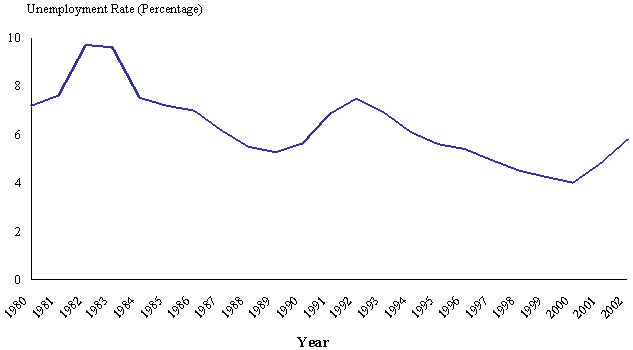
Because the mid- to late 1990s was a period of strong economic growth with low inflation, our findings must be interpreted carefully. The national unemployment rate decreased from 7.5 percent in 1992 (a period of recession) to 5.4 percent in 1996, and it decreased further to 4.0 percent in 2000, which is low by recent historical standards (see Figure III.1).(8) Thus, the characteristics of low-wage workers during our period of investigation may be somewhat atypical as it may include some workers who were previously unemployed or out of the labor force. Examining trends in the characteristics of low-wage workers and their jobs using earlier SIPP cohorts is beyond the scope of this study. However, we did examine changes in the composition of the low-wage labor market between 1996 and 1999 as the economy improved.
| В |
 |
| Source: U.S. Bureau of Labor Statistics. |
As discussed later, we found that the characteristics of the low-wage population did not change during this period, suggesting that our findings may be representative of low-wage workers in general.
Size of the Low-Wage Population
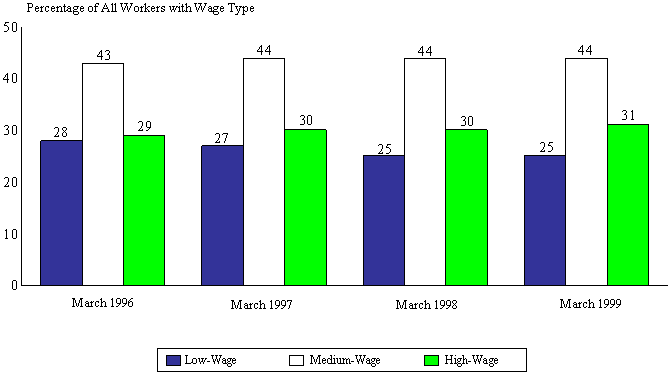
The share of all workers who were low-wage workers was 28 percent in March 1996 (or nearly 29 million workers, Figure III.2). It decreased slightly to 27 percent in March 1997 and to 25 percent in March 1998 and March 1999. These estimated shares are similar to those found in previous studies (discussed in Chapter II) that used a similar cutoff value to define low-wage workers. For example, using March CPS data, Bernstein and Hartmann (2000) found that 29 percent of all workers in 1997 were low-wage workers, and Mitnik et al. (2002) found a corresponding figure of 25 percent in 2001.
 |
| Source: SIPP March cross-sectional samples. Note: All figures were calculated using the relevant calendar year weight and the absolute poverty low-wage cutoff definition. |
The slight decrease in the size of the low-wage population after 1996 may be due to declines in the unemployment rate during that period, suggesting that some low-wage workers may have been able to find higher-paying jobs because of the tight labor market. This interpretation is consistent with findings in the literature that the real wages of low-skilled male and female workers increased starting in the mid-1990s as a result of the strong economy (Card and Blank 2000; and Mishel et al. 2001).
Most workers in the mid- to late 1990s were medium-wage workers (Figure III.2). These workers are defined as those whose hourly wages were between one and two times the low-wage cutoff (for example, those who earned between $7.50 and $15 per hour in 1996). Roughly equal numbers were low-wage and high-wage workers (Figure III.2). For example, in March 1996, 43 percent of all workers were medium-wage workers (about 44 million workers), 28 percent were low-wage workers (about 29 million workers), and 29 percent were high-wage workers (the 31 million workers who earned at least $15 per hour). Interestingly, the slight decrease in the share of low-wage workers between 1996 and 1999 was offset by small increases in both the medium- and high-wage sectors.
The size of the low-wage labor market differs substantially according to the definition used to identify low-wage workers (Table III.1). These definitions, described in greater detail in Chapter II, include identifying low-wage workers using the minimum wage, the 20th percentile of the wage distribution, annual earnings relative to the poverty level, and those with low education levels. The estimated fraction in the low-wage labor market according to these definitions range from 7 percent to 44 percent of workers. We briefly describe these findings below:
| Wage Type | Hourly Wage Cutoff Usedfor the Study($7.50) | Hourly Wage Below MinimumWage($4.75) | Hourly Wage Below 20th Percentile ($6.57) | Annual Earnings Below PovertyCutoff ($15,150)(a) | Low Education Level(b) |
|---|---|---|---|---|---|
| Percent of All Workers Who Are: | |||||
| Low-Wage Workers | 28 | 7 | 20 | 32 | 44 |
| Medium-Wage Workers(c) | 43 | 35 | 20 | 34 | 30 |
| Higher-Wage Workers(c) | 30 | 58 | 60 | 34 | 26 |
| Sample Size | 30,730 | 30,730 | 30,730 | 32,014 | 32,014 |
| Source: 1996 SIPP files using a March 1996 cross-sectional sample. Note: All figures are weighted using the 1996 calendar year weight. a. Annualized earnings are calculated as total monthly earnings from all jobs and businesses in March 1996 multiplied by 12. b. Low-wage workers are defined as those with a high school degree or less, medium-wage workers as those who had some college education, and higher-wage workers as those with a B.A. degree or more. c. Medium-wage workers are defined as those with wages/earnings that are between one and two times the level of the low-wage definition, and higher-wage workers are defined as those with wages/earnings that are greater than twice the level of the low-wage definition. |
|||||
- Only 7 percent of all workers were in the low-wage labor market if these workers are identified as those earning less than the minimum wage $4.75 per hour. Using the minimum wage threshold, about 58 percent of those employed were high-wage workers (defined as those who earned more than twice the minimum wage). Thus, using the minimum wage sets the bar very low for defining low-wage workers.
- As expected, 20 percent of workers are in the low-wage labor market using the 20th percentile cutoff value of the wage distribution ($6.57 per hour). Thus, using our benchmark $7.50 cutoff value generates a larger estimate of the size of low-wage population than using the 20th percentile of the wage distribution as the cutoff value (28 percent of all workers, compared to 20 percent; Table III.1, columns 2 and 4).(9)
- About 32 percent were low-wage workers using an annual earnings below poverty cutoff. This measure defines a low-wage worker as one whose total monthly earned income from all jobs and businesses multiplied by 12 was below the annual poverty level for a family of four, and takes into account both hours worked and hourly wages.(10) Interestingly, while the 32 percent figure using the annual earnings measure is similar to our 28 percent benchmark measure, a significant number of workers are classified as low-wage workers using one definition but not the other. For example, of all those classified as low-wage workers using either definition, about 42 percent were classified as low-wage using one definition but not the other: 18 percent were classified as low-wage using only our benchmark definition, and 24 percent were classified as low-wage using only the annual earnings measure. These discrepancies suggest that there are (1) many workers with high wages who work only a limited number of hours, and (2) many workers with low wages who work a substantial number of hours. As discussed, we adopt the wage-based measure, because our study focuses on low-wage workers rather than low-income ones.
- About 44 percent of workers were in the low-wage labor market if low-wage workers are defined as those with a high school diploma/GED or less. We believe, however, that the use of this education-based definition does not adequately characterize the low-wage population, because, according to our benchmark wage-based definition, nearly 60 percent of those with a high school credential or less were higher-wage workers. Similarly, under our benchmark definition, about 18 percent of those who attended college are classified as low-wage workers.
Demographic Characteristics of Low-Wage Workers
We examined the characteristics of low-wage workers in two interrelated ways. First, we examined the question: Among all workers within a particular subgroup, what percentage are low-wage workers? For example, we calculated the share of all male workers who are low-wage workers and the share of all workers between ages 30 and 39 who are in the low-wage labor market. Second, we examined the reverse question: Among all low-wage workers, what percentage are in a particular subgroup? For example, we calculated the percentage of all low-wage workers who are male and compared it to the corresponding shares for all workers and for medium- and high-wage workers.
An example can be used to explain the difference between the two analyses and how to reconcile them. As discussed later, in 1996, about 84 percent of workers younger than age 20 were low-wage workers. However, only about four percent of all low-wage workers were younger than age 20, because teenage workers made up only about one percent of the entire labor force. The two sets of findings can be reconciled by using the result that teenage workers were four times more likely to be low-wage than higher-wage workers. Thus, each analysis provides, from a different angle, important descriptive information on the characteristics of those in the low-wage labor market.
We produced summary statistics for each variable one at a time. In addition, we conducted a cluster analysis to identify distinct groups of low-wage workers based on their full set of characteristics. This analysis accounts for the correlation between variables, and hence, provides a concise typology of groups of low-wage workers.
Our results on the characteristics of low-wage workers corroborate findings in the literature that low-wage workers are disproportionately (1) young, (2) female, (3) nonwhite, (4) with a high school credential or less, (5) in single-adult households with children, and (6) in households with incomes below the poverty level. At the same time, however, they are a relatively diverse group they exist in a wide range of subgroups defined by individual and household characteristics.
Individual Characteristics
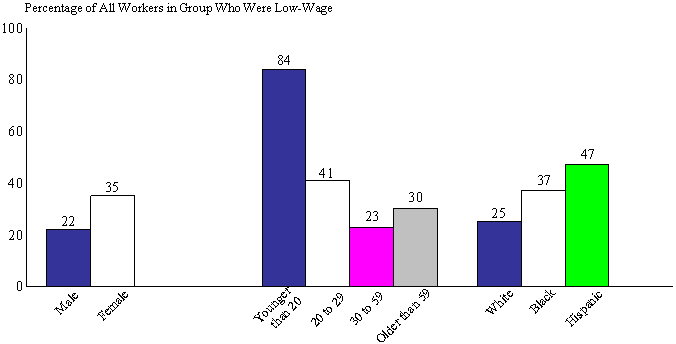
- Female workers are more likely than male workers to hold low-wage jobs. In 1996, more than one-third of all employed females were in the low-wage labor market, compared to 22 percent of employed males (Figure III.3 and Table III.2). Importantly, females made up about 57 percent of all low-wage workers even though they comprised only 46 percent of all workers (Table III.3). Thus, there were more female than male low-wage workers, even though there were fewer females than males in the workforce. These findings are similar to those found in Bernstein and Hartmann (2000) using March 1997 CPS data. The finding that females make up a larger share of the low-wage population than males is critical for understanding the characteristics of low-wage workers, because many of the results discussed in the rest of this section stem from these gender differences. For example, low-wage workers are more likely than higher-wage ones to be in single-adult households with children and to be on public assistance.
 |
| Source: SIPP 1996 March cross-sectional samples. Note: All figures were calculated using the 1996 calendar year weight. |
| Individual Subgroup | Males(a) | Females(a) | Full Sample(a) |
|---|---|---|---|
| Percent of All Workers Who Were Low-Wage Workers | 22 | 35 | 28 |
| Age | |||
| Younger than 20 | 74 | 96 | 84 |
| 20 to 29 | 37 | 46 | 41 |
| 30 to 39 | 19 | 32 | 25 |
| 40 to 49 | 15 | 27 | 21 |
| 50 to 59 | 17 | 30 | 23 |
| 60 or older | 22 | 40 | 30 |
| Race/Ethnicity | |||
| White and other non-Hispanic | 18 | 32 | 25 |
| Black, non-Hispanic | 34 | 39 | 37 |
| Hispanic | 43 | 52 | 47 |
| Educational Attainment | |||
| Less than high school/GED | 46 | 71 | 56 |
| High school/GED | 27 | 46 | 36 |
| Some college | 22 | 33 | 27 |
| College graduate or more | 11 | 18 | 14 |
| Has a Health Limitation | |||
| No | 21 | 33 | 27 |
| Yes | 36 | 52 | 44 |
| Marital Status | |||
| Married | 16 | 32 | 23 |
| Separated, divorced, widowed | 25 | 34 | 30 |
| Single, never married | 41 | 43 | 42 |
| Region of Residence | |||
| Northeast | 17 | 28 | 22 |
| South | 20 | 37 | 27 |
| Midwest | 27 | 38 | 32 |
| Northwest | 22 | 32 | 26 |
| Lives in a Metropolitan Area | |||
| No | 27 | 47 | 36 |
| Yes | 21 | 31 | 25 |
| Sample Size of All Workers | 16,186 | 14,544 | 30,730 |
| Source: SIPP 1996 March cross-sectional samples. Note: All figures were weighted using the 1996 calendar year weight. a. The interpretation of the statistics can be illustrated using the Hispanic figures, which show that, in 1996, 43 percent of all male Hispanic workers and 52 percent of all female Hispanic workers were low-wage workers. | |||
| Individual Subgroup | Males Workers(a) | Females Workers(a) | All Workers(a) | |||
|---|---|---|---|---|---|---|
| Low-Wage | All Wage Levels | Low-Wage | All Wage Levels | Low-Wage | All Wage Levels | |
| Gender | ||||||
| Females | 0 | 0 | 100 | 100 | 57 | 46 |
| Males | 100 | 100 | 0 | 0 | 43 | 54 |
| Age | ||||||
| Younger than 20 | 5 | 1 | 4 | 1 | 4 | 1 |
| 20 to 29 | 34 | 21 | 27 | 20 | 30 | 20 |
| 30 to 39 | 27 | 31 | 29 | 31 | 28 | 31 |
| 40 to 49 | 19 | 27 | 23 | 29 | 21 | 28 |
| 50 to 59 | 12 | 16 | 14 | 16 | 13 | 16 |
| 60 or older | 3 | 3 | 4 | 3 | 3 | 3 |
| Race/Ethnicity | ||||||
| White and other non-Hispanic | 68 | 82 | 76 | 81 | 73 | 81 |
| Black, non-Hispanic | 14 | 9 | 14 | 12 | 14 | 11 |
| Hispanic | 18 | 9 | 10 | 7 | 14 | 8 |
| Educational Attainment | ||||||
| Less than high school/GED | 22 | 11 | 17 | 8 | 19 | 9 |
| High school/GED | 43 | 35 | 45 | 34 | 44 | 34 |
| Some college | 17 | 17 | 18 | 19 | 17 | 18 |
| College graduate or more | 18 | 37 | 21 | 40 | 20 | 38 |
| Has a Health Limitation | ||||||
| No | 91 | 95 | 91 | 94 | 91 | 94 |
| Yes | 9 | 5 | 9 | 6 | 9 | 6 |
| Marital Status | ||||||
| Married | 46 | 66 | 56 | 61 | 52 | 63 |
| Separated, divorced, widowed | 15 | 13 | 21 | 21 | 18 | 17 |
| Single, never married | 39 | 21 | 23 | 18 | 30 | 20 |
| Region of Residence | ||||||
| Northeast | 15 | 19 | 16 | 20 | 16 | 20 |
| South | 22 | 25 | 27 | 25 | 25 | 25 |
| Midwest | 42 | 35 | 38 | 35 | 40 | 35 |
| Northwest | 21 | 22 | 19 | 20 | 20 | 21 |
| Lives in a Metropolitan Area | ||||||
| No | 27 | 22 | 29 | 22 | 28 | 22 |
| Yes | 73 | 78 | 71 | 78 | 72 | 78 |
| Sample Size | 4,389 | 16,186 | 6,088 | 14,544 | 10,477 | 30,730 |
| Source: SIPP 1996 March cross-sectional samples. Note: All figures are weighted using the 1996 calendar year weight. a. The interpretation of the statistics can be illustrated using the Hispanic figures, which show that 18 percent of all male Low-Wage workers and 10 percent of all female Low-Wage workers were Hispanic. | ||||||
- Not surprisingly, a much higher share of younger workers than older ones earn low wages. In March 1996, about 84 percent of employed teenagers between ages 16 and 19 held low-wage jobs (74 percent for male teenage workers and 96 percent for female teenage workers; Figure III.3 and Table III.2). The share of low-wage workers decreased with age from 41 percent for 20- to 29-year-old workers to 23 percent for 50- to 59-year-old workers, but then increased slightly to 30 percent for those older than 60. We find a similar pattern for men and women, although low-wage shares are somewhat higher for women across all age groups. These age profiles are consistent with economic theory that specifies that worker productivity, and hence, wages, increase over time as workers accumulate work experience and job-specific human capital.
- Because young workers make up only a small percentage of the full labor force, they constitute only a small fraction of all low-wage workers. In March 1996, only about 4 percent of all low-wage workers were teenagers, and 30 percent were ages 20 to 29 (Table III.3).(11) Thus, about two-thirds of the low-wage population were prime-age working adults (that is, those at least 30 years old). This occurs because only 1 percent of the entire 1996 labor force consisted of workers who were teenagers and 20 percent of workers who were between ages 20 and 29. Thus, although younger workers have a higher rate of low-wage employment than older workers, the data do not support the argument that low-wage workers are mainly teenagers and young workers without family responsibilities.
- A higher fraction of minority workers than white workers are in the low-wage labor market. In March 1996, about 25 percent of white workers held low-wage jobs, compared to 37 percent of African American and 47 percent of Hispanic workers (Figure III.3 and Table III.2). Stated another way, about 28 percent of all low-
wage workers were minorities, although minorities made up only 19 percent of
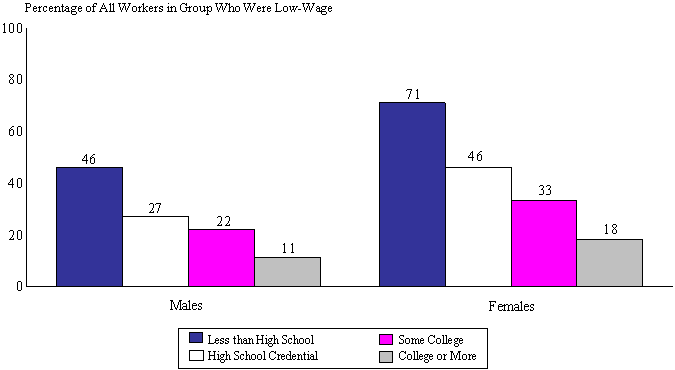
the workforce (Table III.3).(12) It should be pointed out, however, that, despite the disproportionate share of minorities in the low-wage population, nearly three-quarters of all low-wage workers in March 1996 were white (Table III.3). This finding is due to the fact that 81 percent of workers in the entire labor force were white. - Differences in the shares of low-wage workers by education level are especially large. For example, in 1996, about 56 percent of workers who did not complete high school were low-wage workers, compared to 36 percent of workers with a high school diploma or GED, and only about 14 percent of workers who completed college (Table III.2).(13) The differences are especially large for females: nearly three-quarters of employed females without a high school credential held low-wage jobs, compared to only 18 percent of those who completed college (Table III.2 and Figure III.4).
 |
| Source: SIPP March cross-sectional samples. Note: All figures were calculated using the 1996 calendar year weight. |
- At the same time, however, low-wage workers are diverse in educational levels. For example, in March 1996, nearly 20 percent of all low-wage workers graduated college, which is the same figure as the percentage of all low-wage workers without a high school diploma or GED (Table III.3). Similarly, about one-quarter of all male high-wage workers were those with a high school credential or less (Table B.1). Thus, there is not an exact overlap between low-wage workers and workers with low levels of education.
- Health status is associated with being a low-wage worker. Workers in 1996 who reported that they had a physical, mental, or other health condition that limited the kind or amount of work that could be done were much more likely to hold low-wage jobs than those without a health limitation (44 percent, compared to 27 percent; Table III.2).(14) In addition, more than half of female workers with a health limitation were in low-paying jobs. However, only about six percent of the workforce was made up of those with health problems for both males and females (Table III.3). Consequently, only about nine percent of all low-wage workers had health limitations.
- Married workers tend to earn more than those not married. In 1996, only 23 percent of those married held low-wage jobs, compared to 30 percent of those separated, divorced, or widowed, and 42 percent of those single and never married (Table III.2). Interestingly, the differences are much larger for males than females; only 16 percent of married males held low-wage jobs, compared to 32 percent of married females. These findings by gender suggest that many married women hold secondary (part-time) jobs to supplement their spouses' incomes.(15)
- Despite the overrepresentation of nonmarried workers in the low-wage population, more than one-half of all low-wage workers are married. For instance, in March 1996, 52 percent of all low-wage workers were married (Table III.3). The high share of married workers among all workers reflects the fact that married workers are the predominant group of workers in the full labor force (63 percent). These findings further demonstrate the diversity of the low-wage population.
- Low-wage workers are roughly proportionately dispersed across all regions of the country. There is some evidence that low-wage workers in 1996 were most common in the Midwest and least common in the Northeast, but the differences are not large (Tables III.2 and III.3). Interestingly, the distribution of low-wage workers across regions does not correlate with the magnitude of state unemployment rates across regions (6.5 percent for those in Northwest states, 5.6 percent for those in Northeast states, 5.2 percent for those in Midwest states, and 4.5 percent for those in Southern states; not shown). The low-wage worker findings across regions, however, are consistent with state poverty rates and median incomes across regions. Specifically, state poverty rates and median incomes were highest in the Midwest and Northwest regions, the regions in which workers were most likely to earn low wages (not shown).
- Low-wage workers are disproportionately concentrated in nonmetropolitan areas. This result, however, is much more pronounced for female workers than for male workers. For example, in 1996, about 47 percent of female workers in nonmetropolitan areas were low-wage workers, compared to 31 percent of female workers in metropolitan areas (Table III.2). The corresponding figures for males are 27 nonmetropolitan and 21 percent metropolitan, respectively. Despite these differences, however, because nearly 80 percent of workers lived in metropolitan areas, nearly three-quarters of low-wage workers were from them.
Household Characteristics
- Workers in households with single adults with children are more likely to hold low-wage jobs than workers in other types of households. In March 1996, about 44 percent of female workers in single-parent households held low-wage jobs (Figure III.5 and Table III.4). These single parents, who account for a significant share of the TANF population, make up about 18 percent of all female low-wage workers
(Table III.5). - Married male workers have substantially lower rates of low-wage employment than unmarried male workers. For instance, under 20 percent of married male workers were in low-wage jobs compared with over 30 percent of unmarried male workers (Figure III.5). Interestingly, the marriage effects for males hold for both those with and without children. The wage differences between married and unmarried workers are much smaller for female than male workers.
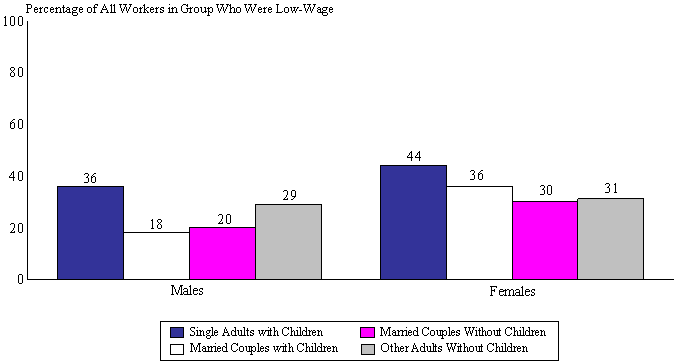 |
| Source: SIPP March cross-sectional samples. Note: All figures were calculated using the 1996 calendar year weight. |
| Individual Subgroup | Males(a) | Females(a) | Full Sample(a) |
|---|---|---|---|
| Percent of All Workers Who Were Low-Wage Workers | 22 | 35 | 28 |
| Household Type | |||
| Single adults with children | 36 | 44 | 42 |
| Married couples with children | 18 | 36 | 26 |
| Married couples without children | 20 | 30 | 25 |
| Other adults without children | 29 | 31 | 30 |
| Household Size | |||
| 1 | 22 | 26 | 24 |
| 2 | 20 | 30 | 25 |
| 3 | 25 | 37 | 30 |
| 4 or more | 23 | 39 | 30 |
| Age of the Youngest Child in the Household (in Years for Those with Children) | |||
| Younger than 3 | 22 | 41 | 30 |
| 3 to 6 | 20 | 41 | 29 |
| 6 to 12 | 18 | 37 | 27 |
| 13 to 18 | 24 | 36 | 30 |
| Other Employed Adult Lives in the Household | |||
| No | 23 | 35 | 28 |
| Yes | 22 | 34 | 28 |
| Has a Spouse Who Earns (for Those Married) | |||
| No | 28 | 45 | 33 |
| Yes | 14 | 31 | 22 |
| Received Public Assistance in the Past Year | |||
| No | 22 | 34 | 27 |
| Yes | 51 | 66 | 58 |
| In Public or Subsidized Housing | |||
| No | 22 | 34 | 27 |
| Yes | 58 | 73 | 67 |
| Household Income as a Percentage of the Poverty Level | |||
| 100 percent or less | 73 | 84 | 79 |
| 101 to 200 percent | 50 | 65 | 57 |
| More than 200 percent | 15 | 26 | 20 |
| Sample Size of All Workers | 16,186 | 14,544 | 30,730 |
| Source: SIPP 1996 March cross-sectional samples. Note: All figures are weighted using the 1996 calendar year weight. a. The interpretation of the statistics can be illustrated using the household income figures, which show that, in 1996, 73 percent of male workers and 79 percent of female workers in households with incomes below the poverty level were low-wage workers. | |||
| Individual Subgroup | Males Workers(a) | Females Workers(a) | All Workers(a) | |||
|---|---|---|---|---|---|---|
| Low-Wage | All Wage Levels | Low-Wage | All Wage Levels | Low-Wage | All Wage Levels | |
| Household Type | ||||||
| Single adults with children | 10 | 6 | 18 | 14 | 15 | 10 |
| Married couples with children | 36 | 43 | 39 | 37 | 37 | 40 |
| Married couples without children | 26 | 29 | 25 | 28 | 25 | 29 |
| Other adults without children | 28 | 22 | 18 | 21 | 23 | 21 |
| Household Size | ||||||
| 1 | 10 | 10 | 7 | 10 | 8 | 10 |
| 2 | 24 | 28 | 27 | 32 | 26 | 29 |
| 3 | 24 | 22 | 24 | 23 | 24 | 22 |
| 4 or more | 41 | 41 | 41 | 36 | 41 | 39 |
| Age of the Youngest Child in the Household (in Years for Those with Children) | ||||||
| Younger than 3 | 30 | 27 | 25 | 23 | 27 | 25 |
| 3 to 6 | 20 | 21 | 22 | 20 | 21 | 21 |
| 6 to 12 | 28 | 33 | 34 | 35 | 31 | 34 |
| 13 to 18 | 22 | 20 | 20 | 21 | 21 | 20 |
| Other Employed Adult Lives in the Household | ||||||
| No | 32 | 31 | 27 | 27 | 30 | 29 |
| Yes | 68 | 69 | 73 | 73 | 70 | 71 |
| Has a Spouse Who Earns (for Those Married) | ||||||
| No | 52 | 35 | 23 | 17 | 35 | 27 |
| Yes | 48 | 65 | 77 | 83 | 65 | 73 |
| Received Public Assistance in the Past Year | ||||||
| No | 96 | 98 | 96 | 98 | 96 | 98 |
| Yes | 4 | 2 | 4 | 2 | 4 | 2 |
| In Public or Subsidized Housing | ||||||
| No | 98 | 99 | 97 | 99 | 98 | 99 |
| Yes | 2 | 1 | 3 | 1 | 2 | 1 |
| Household Income as a Percentage of the Poverty Level | ||||||
| 100 percent or less | 14 | 4 | 12 | 5 | 13 | 5 |
| 101 to 200 percent | 31 | 14 | 27 | 14 | 29 | 14 |
| More than 200 percent | 55 | 82 | 61 | 81 | 59 | 81 |
| Sample Size of All Workers | 4,389 | 16,186 | 6,088 | 14,544 | 10,477 | 30,730 |
| Source: SIPP 1996 March cross-sectional samples. Note: All figures are weighted using the 1996 calendar year weight. a. The interpretation of the statistics can be illustrated using the household type figures, which show that 10 percent of all male low-wage workers and 18 percent of all female low-wage workers lived in single-adult households with children. | ||||||
- Workers in larger households are more likely to be in low-wage jobs, a result driven by females but not males. For instance, nearly 40 percent of female workers in larger households were in low-wage jobs compared with about 26 to 30 percent in smaller households (Table III.4). Interestingly, larger households have higher rates of low-wage employment than smaller households within each household type (not shown). For example, in 1996, single-parent female workers with at least three children were much more likely to hold low-wage jobs than those with fewer children (57 percent, compared to 40 percent). This result may be due to child care problems that make it more difficult for women with many children to find higher-paying jobs or to increase their educational levels. Similarly, low-wage workers are more prevalent in larger than smaller households without children, because adults living in multifamily adult households tend to have low incomes and low educational levels.
- While the age of the youngest child in the household is not associated with being a low-wage worker for the full sample, some important differences exist by household type. The age of the youngest child is not associated with hourly wages for married workers with children (Table III.4). However, there is a strong association between child's age and wage levels for females in single-parent households. Specifically, in 1996, about 61 percent of single-parent female workers whose youngest child was less than three months old were low-wage workers, compared to only 37 percent for those whose youngest child was a teenager (not shown). Clearly, these findings are confounded with age effects, because as discussed, young workers tend to be in the low-wage labor market and are more likely than older workers to have small children. However, we find similar, although weaker, associations between the age of the youngest child and being a low-wage worker using only those single-parent females who were older than age 30.
- Overall, the presence of employed adults in the household is not correlated with being a low-wage worker.(16) However, married workers tend to earn more if their spouse is employed than if their spouse is nonemployed. For example, only 14 percent of married males with a working spouse were in the low-wage labor market in 1996, compared to 28 percent of those without a working spouse (Table III.4). These unexpected results are likely due to the higher education levels of workers with employed spouses than workers with nonemployed spouses. For example, in 1996, about 56 percent of workers with an employed spouse completed more than high school, compared to 40 percent of those with a nonworking spouse.
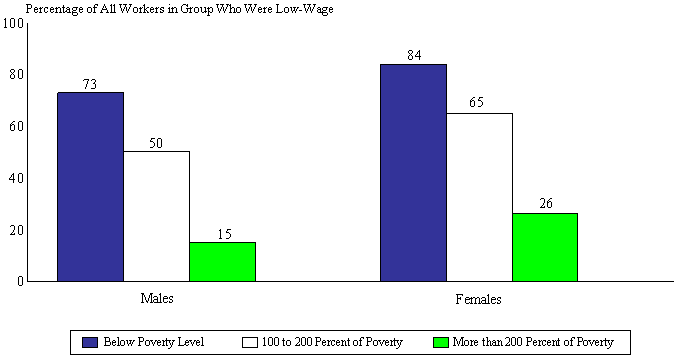
- Not surprisingly, workers in households that receive public assistance or who live in public or subsidized housing are more than twice as likely as their counterparts to be low-wage workers. These findings hold equally by gender (Table III.4). Similarly, being a low-wage worker is highly correlated with household income for both male and female workers (Figure III.6 and Table III.4). For example, in 1996, about 79 percent of those in households with incomes below the poverty level were low-wage workers, compared to 57 percent for those in households with incomes between 101 to 200 percent of poverty, and only 20 percent for those in households with incomes more than 200 percent of poverty.
- At the same time, however, because more than 80 percent of all workers had household incomes above 200 percent of poverty, nearly 60 percent of all low-wage workers were in these higher-income households (Table III.5). Thus, low earners are a diverse group in terms of their household incomes. Carnevale and Rose (2001) found a similar result using PSID data: among workers whose annual earnings were less than $15,000, more than half lived in families with total incomes above $25,000.
 |
| Source: SIPP March cross-sectional samples. Note: All figures were calculated using the 1996 calendar year weight. |
Changes Over Time
Did the characteristics of low-wage workers change between 1996 and 1999 as the unemployment rate decreased and more states implemented PRWORA provisions? The answer to this question appears to be no. The distribution of low-wage workers across key subgroups remained reasonably constant over time (Table III.6). In particular, the fraction of low-wage workers who were female, young, poor, and in households with single adults with children did not change appreciably during the mid- to late 1990s. Thus, changes in the unemployment rate and the implementation of new welfare rules that led many welfare recipients to leave welfare for work did not appear to affect the composition of the low-wage population. These results suggest that our empirical results about the characteristics of the low-wage population may be representative of the low-wage population under a weaker economy, although fully examining this issue is beyond the scope of this study.
Typologies of Low-Wage Workers
Thus far, we have examined worker characteristics one at a time. However, many of these characteristics are highly correlated with each other. Thus, we conducted a cluster analysis to identify typologies of low-wage workers using a combination of worker characteristics. In this analysis, each worker was "optimally" assigned to a cluster on the basis of the similarity of that worker's characteristics to those of other workers within the cluster. A distance measure between two workers was constructed by calculating the sum of squared differences between each of the workers' characteristics. Workers were then allocated to clusters to minimize the within-cluster variance and maximize the between-cluster variance. Separate analyses were conducted for males and females.
| Subgroup | March 1996(a) | March 1997(a) | March 1998(a) | March 1999(a) |
|---|---|---|---|---|
| Gender | ||||
| Male | 43 | 42 | 42 | 42 |
| Female | 57 | 58 | 58 | 58 |
| Age | ||||
| Younger than 20 | 4 | 4 | 4 | 4 |
| 20 to 29 | 30 | 29 | 28 | 27 |
| 30 to 39 | 28 | 27 | 26 | 26 |
| 40 to 49 | 21 | 22 | 23 | 24 |
| 50 to 59 | 13 | 15 | 15 | 16 |
| 60 or older | 3 | 4 | 4 | 4 |
| Race/Ethnicity | ||||
| White and other non-Hispanic | 73 | 72 | 71 | 72 |
| Black, non-Hispanic | 14 | 14 | 15 | 15 |
| Hispanic | 14 | 14 | 13 | 13 |
| Educational Attainment | ||||
| Less than high school/GED | 19 | 19 | 19 | 18 |
| High school/GED | 44 | 45 | 44 | 43 |
| Some college | 17 | 17 | 17 | 18 |
| College graduate or more | 20 | 20 | 20 | 21 |
| Has a Health Limitation | ||||
| Yes | 9 | 7 | 6 | 6 |
| No | 91 | 93 | 94 | 94 |
| Marital Status | ||||
| Married | 52 | 52 | 52 | 52 |
| Separated, divorced, widowed | 18 | 18 | 18 | 18 |
| Single, never married | 30 | 29 | 30 | 30 |
| Household Type | ||||
| Single adults with children | 15 | 15 | 15 | 15 |
| Married couples with children | 37 | 38 | 39 | 38 |
| Married couples without children | 25 | 27 | 26 | 27 |
| Other adults without children | 23 | 21 | 20 | 21 |
| Household Income as a Percentage of the Poverty Level | ||||
| 100 percent or less | 13 | 14 | 13 | 12 |
| 101 to 200 percent | 29 | 31 | 31 | 29 |
| More than 200 percent | 59 | 56 | 56 | 59 |
| Sample Size of All Workers | 30,730 | 26,581 | 24,990 | 25,148 |
| Source: SIPP 1996 March cross-sectional samples. Note: All figures are weighted using the 1996 calendar year weight. a. The interpretation of the statistics can be illustrated using the Hispanic figures, which show that 14 percent of all Low-Wage workers were Hispanic in 1996 and 1997. and 13 percent of all Low-Wage workers were Hispanic in 1998 and 1999. | ||||
Our cluster analysis revealed that both male and female workers could effectively be grouped into three clusters that captured the diversity of the low-wage population (Figure III.7 and Table B.2). The distinguishing features of the three clusters for males can be described as follows:
- Young, Single, Educated. These workers are characterized by their high education levels; about 55 percent attended college (compared to only 35 percent of all male low-wage workers). A disproportionate number of these workers are under age 40, white, and unmarried, and nearly all are from well-to-do households. This cluster contains 39 percent of all male low-wage workers.
- Older, Middle-Income, Low-Education, White. In March 1996, about 84 percent
of these workers were age 30 or older, and 93 percent were white. In addition, only 23 percent attended college. These workers are concentrated in middle-income households (those with incomes between one and two times the poverty level). They account for about 36 percent of all male low-wage workers.Figure III.7.
Share Of Low-Wage Workers, By Typology And Gender
(Percentages)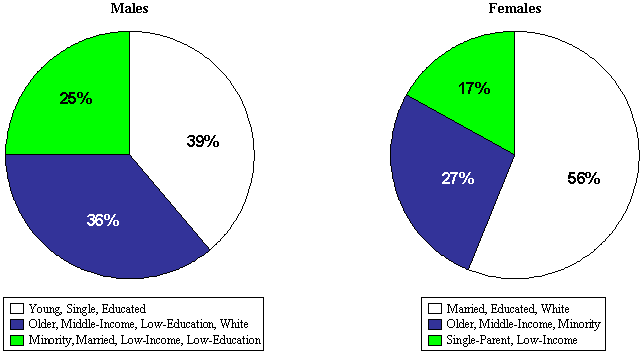
Source: SIPP March cross-sectional samples.
Note: All figures were calculated using the 1996 calendar year weight. - Minority, Married, Low-Income, Low-Education. Nearly all of these workers are minorities (about 95 percent in 1996), and have low education levels (38 percent were high school dropouts in 1996). These workers tend to be married (nearly 80 percent in 1996). In addition, they tend to live in poor households. These workers make up about 25 percent of the male low-wage worker population.
The three clusters for females can be categorized as follows:
- Married, Educated, White. These workers are characterized by their high marriage rates and education levels. In 1996, more than 80 percent of these workers were married, although many did not have children. Nearly half had attended college. In addition, the majority had spouses who worked. Nearly all were white. Not surprisingly, nearly all of these workers were in households with incomes above twice the poverty level. Thus, many of these workers are secondary workers who have low-wage and part-time jobs to supplement their husbands' incomes. These workers account for the largest share of female low-wage workers 56 percent in 1996.
- Older, Middle-Income, Minority. These workers tend to be older than average, and nearly two-thirds are minorities. Most live in households with incomes between one and two times the poverty level. In addition, they tend to be married with children. Their education levels are typical of other low-wage female workers. This cluster contains about 27 percent of all low-wage workers.
- Single-Parent, Low-Income. These workers tend to be single parents and live in poor households. In 1996, more than three-quarters lived in single-parent households, and about 16 percent received public assistance in the previous year (compared to only 4 percent of all female low-wage workers). More than one-half of these workers lived in households with incomes below the poverty level. Not surprisingly, these workers tend to have low education levels. However, they are not characterized by their age or race/ethnicity. In 1996, about 17 percent of all female low-wage workers were in this cluster.
Job and Overall Employment Characteristics of Low-Wage Workers
SIPP contains some information on job and business characteristics, including usual hours per week worked, hourly wages, monthly earnings, occupation, industry, job tenure, whether health insurance is available on the job, and union membership status. We followed a similar approach for tabulating these characteristics as for tabulating workers' demographic characteristics. Our tables present distributions of job and business characteristics for low-wage workers, and all workers.(17) Unlike the previous section, however, we do not present the reverse figures (that is, the share of low-wage workers among those with a particular job characteristic), because these figures have less policy relevance. We present figures separately for males and females and present selected statistics by age. In addition, we present selected figures for the six (three male and three female) low-wage worker typologies discussed above.
We find that many low-wage workers receive hourly wages substantially below the low-wage cutoff value used in our study. In addition, low-wage workers hold jobs that are markedly less stable and provide fewer benefits than the jobs higher-wage workers hold. Interestingly, however, most report that they usually work at least 35 hours per week (that is, full-time). Low-wage workers are represented in all occupations and industries, but they are disproportionately found in retail trade industries, service occupations, and nonunion jobs. In combination, our results are similar to those found in Acs et al. (2001), Bernstein and Hartmann (1999), Carnevale and Rose (2001), Mishel et al. (2001), and Mitnik et al. (2002).
Hourly Wages
- Many low-wage workers earn considerably less than the low-wage cutoff value used in this study. As shown in Table III.7, in March 1996, only 21 percent of low-wage workers earned between $7.00 and $7.50 (the low-wage threshold value used in this study). More than one-quarter earned less than $5.00 per hour (which is close to the $4.75 minimum wage). On average, low-wage workers earned $5.58 per hour, compared to $13.62 for all workers.(18) Interestingly, the wage distributions for low-wage workers are similar for males and females. However, males typically earned more than females among medium- and high-wage workers (Table B.3).
| Job Characteristics | Males Workers(a) | Females Workers(a) | All Workers(a) | |||
|---|---|---|---|---|---|---|
| Low-Wage | All Wage Levels | Low-Wage | All Wage Levels | Low-Wage | All Wage Levels | |
| Hourly Wages | ||||||
| Less than $5.00 | 26 | 6 | 27 | 9 | 27 | 7 |
| $5.00 to $5.99 | 24 | 5 | 26 | 9 | 25 | 7 |
| $6.00 to $6.99 | 28 | 6 | 27 | 9 | 28 | 8 |
| $7.00 to $7.50 | 22 | 5 | 20 | 7 | 21 | 6 |
| $7.51 or more | 0 | 78 | 0 | 65 | 0 | 72 |
| (Average hourly wage in dollars) | (5.62) | (15.38) | (5.54) | (11.52) | (5.58) | (13.62) |
| Usual Hours Worked per Week | ||||||
| 1 to 19 | 3 | 1 | 9 | 6 | 6 | 4 |
| 20 to 34 | 13 | 5 | 25 | 17 | 20 | 11 |
| 35 to 40 | 51 | 50 | 52 | 58 | 52 | 53 |
| More than 40 | 34 | 43 | 14 | 20 | 22 | 33 |
| (Average hours worked) | (42.9) | (44.7) | (35.2) | (37.7) | (38.5) | (41.5) |
| Weekly Earnings | ||||||
| Less than $150 | 15 | 4 | 29 | 12 | 23 | 7 |
| $150 to $299 | 64 | 16 | 63 | 27 | 63 | 21 |
| $300 to $600 | 21 | 40 | 8 | 42 | 13 | 41 |
| $600 or more | 0 | 41 | 0 | 19 | 0 | 31 |
| (Average weekly earnings in dollars) | (240) | (702) | (196) | (443) | (215) | (584) |
| Owns Business (Self-Employed) | 18 | 12 | 10 | 7 | 13 | 10 |
| Covered by Health Insurance(b) | 41 | 74 | 57 | 79 | 50 | 76 |
| Sample Size | 4,389 | 16,186 | 6,088 | 14,544 | 10,477 | 30,730 |
| Source: SIPP 1996 March cross-sectional samples. Note: All figures are weighted using the 1996 calendar year weight. a. The interpretation of the statistics can be illustrated using the health insurance figures, which show that 41 percent of all male low-wage workers and 57 percent of all female low-wage workers had health insurance coverage through their jobs. b. SIPP contains information on employer-based health insurance coverage only for jobs that were in progress at the time of the interview. Thus, the health insurance figures pertain to jobs held by the March 1996 cross-sectional sample at the time of their wave 1 interviews. These jobs sometimes differed from the jobs they held in March 1996. | ||||||
- Low-wage workers between ages 20 and 50 typically earn more than those younger and older (Figure III.8). However, the wage differences by age are smaller than expected. For example, in 1996, low-wage teenagers earned an average of $5.42 per hour, compared to $5.60 for low-wage workers in their 30s.(19)
- We find some wage differences across the low-wage worker typologies. Among low-wage working men, hourly wages tend to be highest for the young, single, educated group (Table B.4). Similarly, among low-wage working women, hourly wages tend to be highest for the married, white, educated group, and to be lowest for the single-parent, low-income group.
Hours Worked Per Week
- Most low-wage workers report working full-time (defined as those who report usually working at least 35 hours per week; Table III.7 and Figure III.9). However, they work fewer hours than other workers. For example, among male workers in March 1996, about 85 percent of those with low wages worked full-time, compared to 93 percent of all workers (Table III.7 and Figure III.9).(20) Similarly, about 66 percent of low-wage female workers usually worked full-time, compared to 78 percent of all employed females. Average hours worked per week, however, did not vary across the low-wage worker typology groups (Table B.4). It is interesting to note that, in total, 86 percent of all workers worked full-time in the strong economy of 1996. This figure is somewhat higher than the 83 percent figure per year between 1985 and 1992 (Statistical Abstract of the United States).
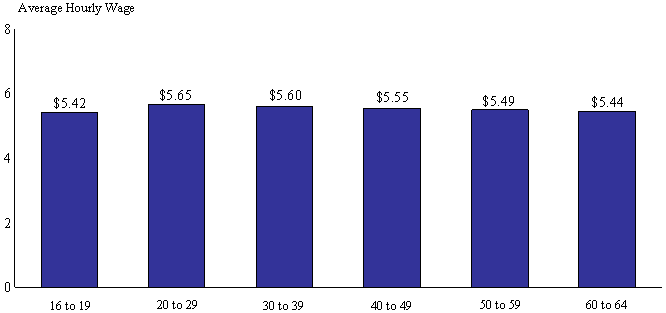 |
| Source: SIPP March cross-sectional samples. Note: All figures were calculated using the 1996 calendar year weight. |
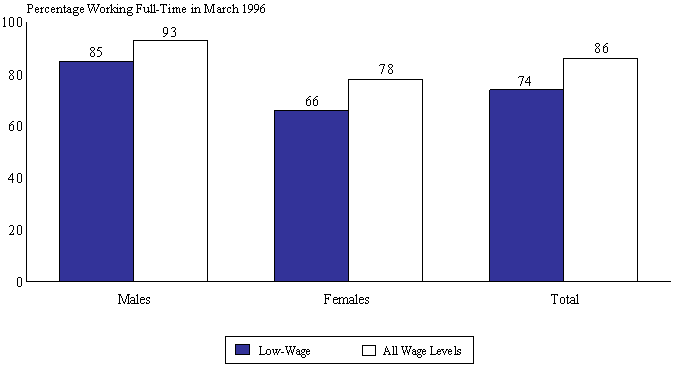 |
| Source: SIPP March cross-sectional samples. Note: All figures were calculated using the 1996 calendar year weight. |
- Not surprisingly, the oldest and youngest low-wage workers work fewer hours than other low-wage workers (not shown). In 1996, less than two-thirds of teenage and elderly male low-wage workers worked full-time, compared to 85 percent of other low-wage workers. Similarly, only about one-half of teenage and elderly female low-wage workers were employed full-time.
Weekly Earnings
- The weekly earnings of low-wage workers are typically much lower than for higher-wage workers (Table III.7). These differences are primarily due to differences in hourly wage rates but are also due in part to lower work effort for low-wage employees. In 1996, male low-wage workers earned an average of only $240 per week, whereas the average U.S. male employee earned nearly three times more. (21) Low-wage females typically earn less than low-wage males (an average of $196 per week for females in 1996, compared to $240 for males). This is because low-wage females typically work fewer hours per week, although hourly wages are similar by gender. The weekly earnings levels of low-wage workers translate into annual earnings well below the poverty level for both sexes and for each of the low-wage worker typology groups.
Availability of Health Insurance Coverage
- Many of those in the low-wage population are covered by health insurance through their employers, although coverage rates are substantially lower than for higher-wage workers. For instance, 50 percent of all low-wage workers had employer-based health insurance coverage compared with 76 percent of all workers (Table III.7 and Figure III.10). The comparable figures were about 90 percent for medium-wage workers and 96 percent for high-wage workers (Table B.3). Interestingly, health insurance coverage rates for low-wage workers are higher for females than males (57 percent, compared to 41 percent), although there are no gender differences in the rates for medium- and high-wage workers.(23)
- We also find large differences in employer-based health insurance coverage rates across the low-wage typology groups. In particular, among males, coverage rates are much higher for the young, single, educated group than for the minority, married, low-income, low-education group (46 percent, compared to 35 percent, Table B.4). Differences among females are more pronounced: the coverage rate for the married, white, educated workers is 67 percent, compared to only 31 percent for the single-parent, low-income workers. These major differences reflect differences in the quality of jobs held by workers across the groups.
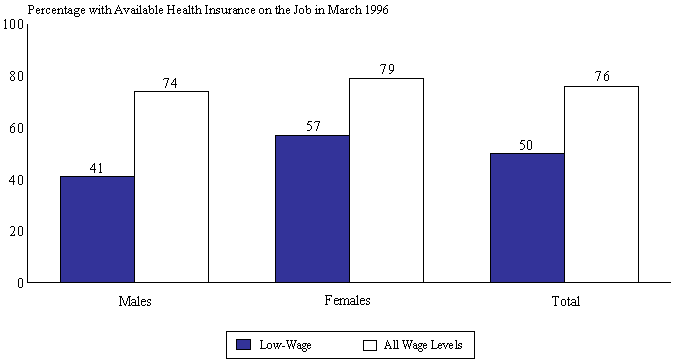 |
| Source: SIPP 1996 March cross-sectional samples. Note: All figures were calculated using the 1996 calendar year weight. |
Self-Employment Status
- About 13 percent of low-wage workers in 1996 were self-employed (that is, owned businesses). Self-employment rates were higher for males than females (18 percent, compared to 10 percent, Table III.7). Furthermore, self-employment rates among low-wage workers were somewhat higher than for all workers, for both males and females. For instance, about 18 percent of low-wage male workers were self-employed, compared to about 10 percent for other male workers. Interestingly, the group of older, middle-income, and low-education male workers had the highest self-employment rates among all the low-wage worker typologies (Table B.4).
- There are some important differences between the employment characteristics of jobholders and business owners. Average hourly wages are significantly higher for those with jobs than businesses ($5.75, compared to $4.48 in 1996, Table B.5). Business owners also tend to work more hours than job holders (44 hours compared to 38 hours for all low-wage workers in 1996). Health insurance coverage rates are also substantially higher for those with jobs. Finally, there are some differences across occupations, as discussed in the next section.
Occupations, Industries, and Union Membership
- Low-wage workers are spread across all occupations and industries. However, they are substantially overrepresented in service professions and underrepresented in professional and technical occupations. In 1996, for example, nearly one-third of all low-wage workers were in service occupations, compared to only 16 percent of all workers (Table III.8). Conversely, only 14 percent of low-wage workers were in professional and technical occupations, compared to 33 percent for all workers. (24) The share of low-wage workers in administrative support and clerical, and machine and construction occupations mirrored the corresponding shares for all workers. Low-wage workers are also spread across all industries (Table III.8). However, they are most prevalent in wholesale and retail trades.
- There are some gender differences across occupations for low-wage workers. In particular, men are much more likely to be in machine and construction occupations, whereas women are much more likely to be in administrative support and clerical ones (Table III.8). We observe some similar differences by gender across occupation for medium- and high-wage workers (Table B.3). For instance, among medium- and high-wage workers, men were more likely than women to be in machine and construction operators (similar to the pattern for low-wage male workers). In contrast, however, female medium- and high-wage workers were more likely to be in professional and technical occupations (Table B.3). There are smaller gender differences, however, across industries among low-wage workers.
- We also find differences in occupations across the low-wage worker typology groups that are consistent with previous findings on hourly wage rates and the availability of health insurance across these groups. Specifically, among low-wage workers, the young, single, educated male workers and the married, white, educated female workers are much more likely than their counterparts to be in professional and clerical occupations and less likely to be in service occupations (Table B.4). Thus, it is not surprising that these workers receive higher wages and are more likely to have available health insurance than their counterparts.
- There are substantial differences in the occupations of jobholders and business owners, although the patterns differ by gender. For males, business owners are much more likely to be in professional and technical trades than jobholders, and earn low hourly wages because they work many hours (Table B.5). Female business owners, on the other hand, are overrepresented in service occupations (in 1996, one-half of all female business owners were in service trades, compared to only one-third of female jobholders).
| Job Characteristics | Males Workers(a) | Females Workers(a) | All Workers(a) | |||
|---|---|---|---|---|---|---|
| Low-Wage | All Wage Levels | Low-Wage | All Wage Levels | Low-Wage | All Wage Levels | |
| Occupation | ||||||
| Professional/technical | 14 | 31 | 14 | 36 | 14 | 33 |
| Sales/Retail | 11 | 11 | 16 | 11 | 14 | 11 |
| Administrative support/clerical | 5 | 6 | 20 | 25 | 14 | 15 |
| Service professions/ handlers/ cleaners | 30 | 14 | 36 | 18 | 33 | 16 |
| Machine/construction/production/ transportation | 32 | 35 | 13 | 10 | 21 | 23 |
| Farm/agricultural/other workers | 8 | 4 | 1 | 1 | 4 | 2 |
| Industry | ||||||
| Agriculture/forestry/fishing/ hunting | 11 | 7 | 8 | 6 | 9 | 6 |
| Mining/manufacturing/ construction | 20 | 30 | 12 | 14 | 16 | 23 |
| Transportation/utilities | 5 | 9 | 2 | 4 | 3 | 7 |
| Wholesale/retail trade | 27 | 17 | 31 | 18 | 29 | 17 |
| Personal services | 12 | 7 | 12 | 8 | 12 | 7 |
| Health services | 2 | 3 | 10 | 15 | 7 | 8 |
| Other services | 11 | 19 | 22 | 33 | 17 | 26 |
| Other | 12 | 8 | 3 | 2 | 7 | 6 |
| Union Member | 7 | 19 | 6 | 13 | 6 | 16 |
| Sample Size | 4,389 | 16,186 | 6,088 | 14,544 | 10,477 | 30,730 |
| Source: SIPP 1996 March cross-sectional samples. Note: All figures are weighted using the 1996 calendar year weight. a. The interpretation of the statistics can be illustrated using the union figures, which show that seven percent of all male low-wage workers and six percent of all female low-wage workers were union members. | ||||||
- Low-wage workers are much less likely than higher-wage ones to be union members. For example, in 1996, about 6 percent of low-wage workers were union members, compared to 16 percent of all workers (Table III.8). Among low-wage workers, there were no differences in union membership by gender. In comparison, medium- and high-wage males were more likely to be union members than their female counterparts. For instance, 18 percent of medium-wage and 27 percent of high-wage male workers were union members (Table B.3). The comparable figures for females were 15 and 22 percent, respectively.
Other Employment-Related Characteristics
- Many low-wage workers at a point in time have relatively long job tenure, but job tenure is typically shorter for low-wage workers than for all workers. In March 1996, for example, 41 percent of low-wage wage workers had at least three years of job tenure, compared to 61 percent for all workers (Table III.9). Similarly, average job tenure was 47 months for low-wage workers, compared to 86 months for all workers.(25) At the same time, a substantial fraction of low-wage workers have short job tenure. About 35 percent of low-wage workers had started their jobs within a year prior to March 1996, compared to 20 percent for all workers. Interestingly, the distribution of months on the job is similar for low-wage males and females. We emphasize that these job tenure figures pertain to a cross-sectional sample, and not to an "entry cohort" sample of low-wage workers who started jobs. The cross-sectional sample contains workers with longer-than-average job spells.(26) Consequently, the job tenure figures are larger than they would be for an entry cohort sample.
- Only a small percentage of low-wage workers hold more than one job or business. In 1996, only 8 percent of male and female low-wage workers held more than one job. This figure is similar to the fraction of all workers with more than one job (Table III.9). Because relatively few low-wage workers hold more than one job, statistics on their total hours worked per week and weekly earnings in all jobs are similar to those presented above for the primary job (Table III.9).
| Job Characteristics | Males Workers(a) | Females Workers(a) | All Workers(a) | |||
|---|---|---|---|---|---|---|
| Low-Wage | All Wage Levels | Low-Wage | All Wage Levels | Low-Wage | All Wage Levels | |
| Tenure at Job or Business (Months) | ||||||
| Less than 6 | 23 | 11 | 21 | 12 | 22 | 12 |
| 6 to 12 | 12 | 7 | 14 | 9 | 13 | 8 |
| 12 to 24 | 13 | 10 | 15 | 11 | 14 | 11 |
| 24 to 36 | 9 | 8 | 11 | 9 | 10 | 9 |
| Longer than 36 | 43 | 63 | 39 | 58 | 41 | 61 |
| (Average tenure) | (49) | (93) | (47) | (79) | (47) | (86) |
| Working in More than One Job or Business | 8 | 7 | 8 | 7 | 8 | 7 |
| Total Hours Worked per Week in All Jobs and Businesses | ||||||
| Less than 20 | 3 | 1 | 9 | 6 | 6 | 3 |
| 20 to 34 | 12 | 5 | 24 | 16 | 19 | 10 |
| 35 to 40 | 47 | 47 | 49 | 55 | 49 | 50 |
| More than 40 | 38 | 47 | 18 | 24 | 27 | 36 |
| (Average total hours worked) | (44.8) | (46.3) | (36.5) | (38.8) | (40.1) | (42.9) |
| Weekly Earnings from All Jobs and Businesses | ||||||
| Less than $150 | 15 | 4 | 28 | 11 | 22 | 7 |
| $150 to $299 | 61 | 15 | 61 | 26 | 61 | 20 |
| $300 to $600 | 24 | 39 | 10 | 43 | 16 | 41 |
| $600 or more | 1 | 42 | 0 | 20 | 0 | 32 |
| (Average weekly earnings) | (256) | (717) | (204) | (453) | (227) | (596) |
| Sample Size | 4,389 | 16,186 | 6,088 | 14,544 | 10,477 | 30,730 |
| Source: SIPP 1996 March cross-sectional samples. Note: All figures are weighted using the 1996 calendar year weight. a. The interpretation of the statistics can be illustrated using the tenure figures, which show that 23 percent of all male low-wage workers and 21 percent of all female low-wage workers started their jobs within six months of March 1996. | ||||||
Changes Over Time
- The quality of low-wage jobs improved slightly between 1996 and 1999 as the economy improved (Table III.10). Hourly wages increased from $5.58 per hour to $5.86 per hour, which is consistent with findings in the literature that the real wages of low-skilled male and female workers increased starting in the mid-1990s as a result of the strong economy (Card and Blank 2000; and Mishel et al. 2001). Similarly, the fraction with health insurance coverage from the employer increased from 51 to 54 percent. The distributions of occupations of low-wage jobs remained fairly constant, although there was a slight increase in the percentage of low-wage workers in higher-paying professional and technical occupations.
| Characteristic | March 1996 | March 1997 | March 1998 | March 1999 |
|---|---|---|---|---|
| Average Hourly Wage in 1996 Dollars | 5.58 | 5.61 | 5.71 | 5.86 |
| Owns Business (Self-Employed) | 13 | 13 | 13 | 13 |
| Health Insurance Available on the Job | 51 | 53 | 54 | 54 |
| Occupation | ||||
| Professional/technical | 14 | 14 | 14 | 15 |
| Sales/retail | 14 | 14 | 14 | 14 |
| Administrative support/clerical | 14 | 13 | 13 | 13 |
| Service professions/handlers/cleaners | 33 | 33 | 34 | 34 |
| Machine/construction/production/ transportation | 21 | 21 | 21 | 20 |
| Farm/agricultural/other workers | 4 | 4 | 5 | 4 |
| Union Member | 6 | 4 | 4 | 4 |
| Sample Size | 8,530 | 7,091 | 6,258 | 6,150 |
| Source: SIPP March 1996 to March 1999 cross-sectional samples. Note: All figures are weighted using the relevant calendar year weight. | ||||
(7) We refer to the combined group of medium-wage and high-wage workers as higher-wage workers.
(8) The unemployment rate increased to about 5.8 percent in 2002, but this is beyond the period our data cover.
(9) Using the "relative" wage approach presented in column 4 of Table III.1, we defined medium-wage workers as those with wages between the 20th and 40th percentiles of the wage distribution (that is, between $6.57 and $9.25) and high-wage workers as those with wages above $9.25. Under our primary wage-based approach, we defined medium-wage workers as those who earned between $7.50 and $15 per hour, which generates a much larger estimate of the size of the medium-wage population than using the relative wage approach (43 percent of all workers, compared to 20 percent) but a much smaller estimate of the size of high-wage population (30 percent of all workers, compared to 60 percent).
(10) This estimate is identical to the 1998 estimate provided by Carnevale and Rose (2001) using the PSID data and a similar definition of low-wage workers.
(11) In comparison, less than one percent of medium- or high-wage workers were teenagers; and about 23 percent and 8 percent of medium-wage workers and high-wage workers, respectively, were ages 20 to 29 (Table B.1).
(12) Bernstein and Hartmann (2000) found similar results using March 1997 CPS data.
(13) Again, Bernstein and Hartmann (2000) found similar results.
(14) Using 1996 data from the National Survey of American Families, Acs et al. (2001) also found a similar result that the percentage of family heads with a work-limiting health condition was higher in low-income working families than in higher-income working families (12 percent, compared to 7 percent).
(15) To help disentangle the age findings from the marriage findings, we also computed low-wage population shares for those age 30 and older by marital status. These results are similar to those presented in the tables (not shown).
(16) This finding contrasts with Acs et al. (2000), who found that low-income working families are much less likely than higher-income working families to have secondary workers.
(17) A breakdown of characteristics by medium- and high-wage workers is included in Appendix B.
(18) Medium-wage workers earned an average of about $11.00 per hour, and high-wage workers earned an average of about $25 per hour (Table B.3).
(19) We find similar age patterns for males and females.
(20) For instance, 95 percent of medium-wage workers and 97 percent of high-wage workers worked at least 35 hours per week (Table B.3).
(21) The comparable numbers were $495 per week for male medium-wage workers and $1,217 per week for high-wage workers (Table B.3).
(22) SIPP contains information on employer-based health insurance coverage only for jobs that were in progress at the time of the interview. Thus, the health insurance figures pertain to jobs held by the March 1996 cross-sectional sample at the time of their wave 1 interviews. These jobs sometimes differed from the jobs they held in March 1996.
(23) These findings may partly reflect lower rates of self-employment for low-wage female workers than for low-wage male workers, as discussed in the next section.
(24) For instance, 22 percent of medium-wage male workers and 51 percent of high-wage male workers were in professional and technical occupations (Table B.3). The comparable figures were 35 and 71 percent, respectively, for female workers.
(25) It was 85 months for medium-wage workers and 125 months for high-wage workers (not shown).
(26) For example, among low-wage workers who started their jobs in March 1992, only those whose jobs lasted for at least four years would be in the March 1996 cross-sectional sample; workers with shorter spells would not be included in the cross-sectional sample.
Overall Employment Experiences of Low-wage Workers
What are the overall employment experiences of low-wage workers over a three-and-one-half year follow-up period after job start? How many eventually find a higher-wage job? How many move in and out of the low-wage labor market? What fraction of time are they in low-wage jobs, higher-wage jobs, and no jobs? Do employment rates increase over time? How do the employment patterns of low-wage workers compare to those of higher-wage workers? Which groups of workers have the best outcomes?
This chapter addresses these questions using a nationally representative sample of workers in the SIPP longitudinal panel file who started jobs during the first six months of the panel period (roughly in the first half of 1996). As discussed in Chapter II, to minimize misclassification errors, we defined a worker as a low-, medium-, or high-wage worker on the basis of the worker's average wage during the month of job start and the subsequent six months. We then examined the labor market experiences of these workers over a 42-month (three-and-one-half year) follow-up period from the month of job start. We conducted a descriptive (univariate) analysis by gender, as well as a multivariate analysis to efficiently summarize key labor market outcomes for subgroups of low-wage workers. To place our findings in context, we also present selected descriptive statistics for medium- and high-wage workers (a group whom we often refer to collectively as higher-wage workers).(27) All statistics were calculated using the longitudinal panel weight. Supplemental tables to those presented in the main text are found in Appendix B.
The entry cohort sample used in the overall employment analysis is conceptually different than the March 1996 cross-sectional sample used to describe the characteristics of low-wage workers and their jobs in the last chapter. The entry cohort sample consists of workers who started a job spell during a six-month window, whereas the cross-sectional sample consists of workers in the middle of their job spells, and hence, contains a disproportionate share of workers with longer-than-average spells. The demographic and job characteristics of the two sets of workers reflect these differences (Table C.1). Workers in the entry cohort sample tend to be younger and to live in poorer households than those in the cross-sectional sample. Similarly, workers in the entry cohort sample typically worked fewer hours, had lower weekly earnings, and were much less likely to have employer-based health insurance coverage. There are few differences, however, between the education levels, racial and ethnic composition, hourly wages, and occupations of workers in the two samples.
In the remainder of this chapter, we present descriptive findings by gender for the full set of outcome measures, and then present findings from the subgroup and multivariate analyses for selected outcomes. We caution readers again that the 1996 to 1999 follow-up period covered by our data was a period of strong economic growth with a high demand for labor. These strong economic conditions may have produced more positive labor market outcomes for our sample than would have been the case under a weaker economy.
Descriptive Analysis Findings, By Gender
Our descriptive analysis reveals that there was some movement into and out of the low-wage labor market for low-wage workers. During a three-and-one-half-year period after job start, most workers held medium-wage jobs at some point. However, many also returned to the low-wage labor market. Low-wage workers were employed about 80 percent of the time. Altogether, low-wage workers spent about twice as much time in low-wage than higher-wage (that is, medium- or high-wage) jobs. However, employment rates in higher-wage jobs increased over time, especially for males.
These results indicate that low-wage workers have some upward mobility over the medium-term. At the same time, however, a segment of the low-wage population remains entrenched in low-wage jobs. Next, we discuss the evidence for these findings.
Overall Employment Rates in Low-, Medium-, and High-Wage Jobs
Most low-wage workers in our sample left the low-wage labor market for higher-paying employment--either in the same job or a different job--within three to four years after starting their low-wage job (Figure IV.1). About 69 percent of males held medium-wage jobs and 13 percent held high-wage jobs during the follow-up period; only 30 percent held low-wage jobs only. Employment rates in higher-paying jobs were somewhat lower for females than males, suggesting that females experienced less upward mobility than males. However, female employment rates in higher-paying jobs were still high; about one half of women workers ever held medium-wage jobs.
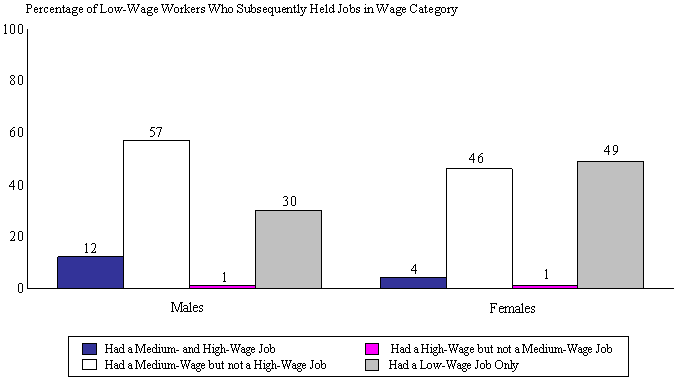 |
| Source: 1996 SIPP longitudinal files using workers who started low-wage jobs within six months after the start of the panel period Note: All figures were calculated using the longitudinal panel weight and pertain to a 42-month follow-up period. |
Although many low-wage workers held higher-paying jobs at some point, many returned to the low-wage labor market (Figure IV.2). Altogether, about 67 percent of low-wage males and 69 percent of low-wage females who obtained higher-paying employment during the 42-month follow-up period subsequently returned to the low-wage labor market.
These high mobility rates may be due in part to workers who had initial wages near the low-wage cutoff value used for this study and who periodically crossed the low-wage boundary because of changes in their labor supply effort or for other reasons. However, as discussed in the previous chapter, most low-wage workers in our sample earned considerably less than the low-wage cutoff value. Hence, we believe that our findings reflect real movements of low-wage workers into and out of the low-wage labor market.
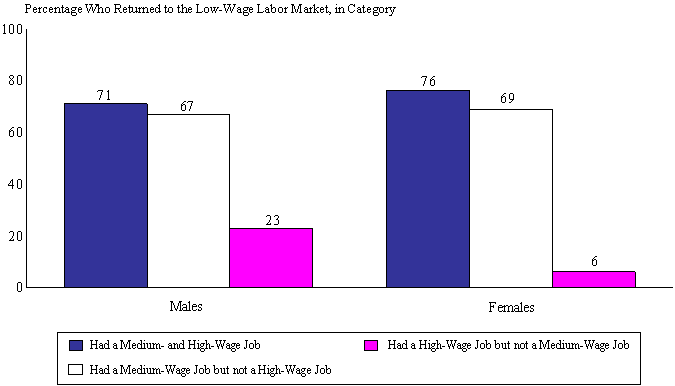 |
| Source: 1996 SIPP longitudinal files using workers who started low-wage jobs within six months after the start of the panel period Note: All figures were calculated using the longitudinal panel weight and pertain to a 42-month follow-up period. |
There is also some movement across wage categories for medium- and high-wage workers (Table C.2). For example, among medium-wage workers, about 45 percent of males and females held low-wage jobs, and 45 percent of males and 33 percent of females held high-wage jobs. Similarly, nearly one-half of high-wage workers spent some time in the medium-wage labor market sector. Thus, wage mobility is common both for low earners and higher earners.
In sum, the low-wage population is not static. Rather, a substantial number of workers move between low- and medium-wage jobs.
Number of Job and Employment Spells
Consistent with the employment rate findings, low-wage workers during the mid- to late 1990s typically held many jobs (Table IV.1 and Figure IV.3). Male low-wage workers held an average of 3.0 jobs during the 42-month follow-up period, and the corresponding figure is 2.9 jobs for females. More than three-quarters of workers held more than one job, and nearly one-third experienced at least four jobs. Workers typically experienced fewer employment spells (2.0 spells on average), because some workers moved directly from one job to another (and thus, started a new job spell but continued their employment spell). These findings are consistent with findings from our duration analysis that low-wage job spells tend to be short and that nonemployment spells for those who leave low-wage jobs also tend to be short (see Chapter VI).
| Males | Females | All Workers | |
|---|---|---|---|
| Average Number of New Job and Employment Spells | |||
| All Jobs | 3.0 | 2.9 | 2.9 |
| Low-wage jobs(a) | 2.3 | 2.4 | 2.3 |
| Medium-wage jobs(a) | 0.6 | 0.4 | 0.5 |
| High-wage jobs(a) | 0.1 | 0.0 | 0.1 |
| Employment Spells of Any Wage Type(a) | 1.9 | 1.8 | 1.8 |
| Distribution of the Number of New Job and Employment Spells (Percentages) | |||
| Jobs | |||
| 1 | 24 | 23 | 24 |
| 2 | 22 | 26 | 25 |
| 3 | 21 | 21 | 21 |
| 4 or more | 33 | 29 | 31 |
| Employment Spells | |||
| 1 | 48 | 49 | 49 |
| 2 | 29 | 31 | 30 |
| 3 or more | 23 | 20 | 21 |
| Sample Size | 522 | 817 | 1,339 |
| Source: 1996 SIPP longitudinal files using the entry cohort sample of workers who started jobs within six months after the start of the panel period. All workers were followed for 42 months after job start. Note: All figures are weighted using the longitudinal panel weight. a. These figures pertain to the number of times a new low-, medium-, or high-wage job started during the follow-up period. A spell was classified as "low-wage" on the basis of the wage at the start of the job. A low-wage job spell ended when the worker moved to another low-wage job, moved to a higher-wage job (either with the same or different employer), became unemployed, or left the labor force. A low-wage employment spell ended when the worker moved to a higher-wage job or became unemployed. Medium- and high-wage spells were defined analogously. | |||
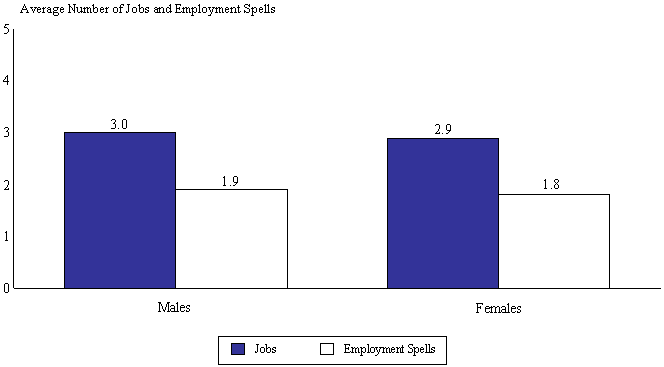 |
| Source: 1996 SIPP longitudinal files using workers who started low-wage jobs within six months after the start of the panel period Note: All figures were calculated using the longitudinal panel weight and pertain to a 42-month follow-up period. |
Sample members were much more likely to start low-wage jobs than higher-wage jobs (Table IV.1). On average, sample members started 2.3 low-wage jobs during the 42-month period, but only .5 medium-wage jobs and .1 high-wage jobs. Thus, nearly 80 percent of all new jobs were low-wage jobs.
Interestingly, medium- and high-wage workers in the mid- to late 1990s typically experienced a number of job spells similar to those of low-wage workers (Table C.2). For example, the average medium-wage worker held 2.6 jobs and the average high-wage worker held 2.3 jobs, compared to 3.0 jobs for the average low-wage worker. Thus, job turnover is common among all workers, not isolated to low-wage workers.
Employment Rates Over Time
Overall quarterly employment rates after the start of the workers' initial low-wage jobs remained high throughout the follow-up period (Figures IV.4 and IV.5). The rates remained fairly constant at about 85 percent per quarter for males and 80 percent per quarter for females. The strong economy during the mid- to late 1990s probably had an influence on these high labor force participation rates. Nonetheless, the notion that low-wage workers tend to have long spells of unemployment is not supported by the data for either males or females.
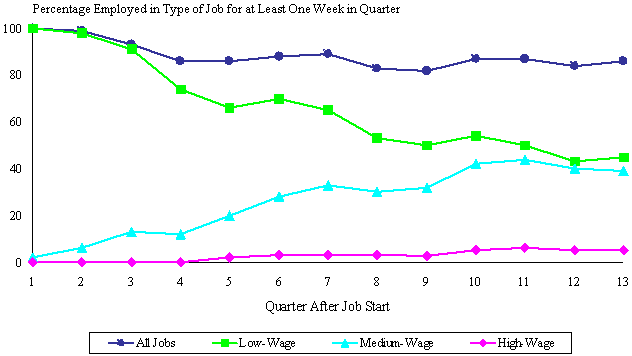 |
| Source: 1996 SIPP longitudinal files using workers who started low-wage jobs within six months after the start of the panel period Note: All figures were calculated using the longitudinal panel weight and pertain to a 42-month follow-up period. |
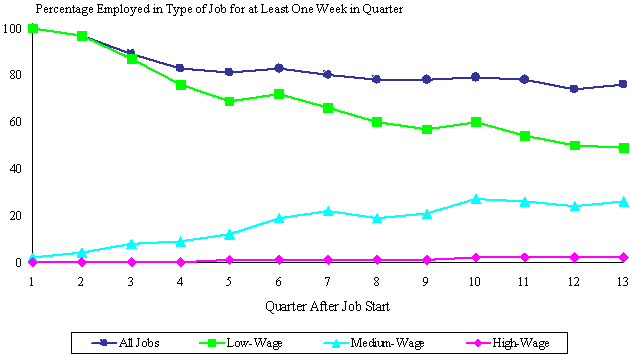 |
| Source: 1996 SIPP longitudinal files using workers who started low-wage jobs within six months after the start of the panel period Note: All figures were calculated using the longitudinal panel weight and pertain to a 42-month follow-up period. |
The percentage of workers employed in low-wage jobs decreased over time, whereas employment rates in medium-wage jobs increased, which led to quarterly employment rates in all jobs that remained fairly constant (Figures IV.4 and IV.5). For males, the quarterly employment rate in low-wage jobs decreased from 74 percent in quarter 4 after job start, to 53 percent in quarter 8, to 45 percent in quarter 13. Conversely, the participation rate in medium-wage jobs increased from 12 percent in quarter 4, to 30 percent in quarter 8, then leveled off to about 40 percent for the rest of the follow-up period. By the end of the panel period, a similar percentage of males were employed in low-wage and medium-wage jobs.
The same general pattern holds for females, although females experienced less successful outcomes than males: females experienced slower decreases in the low-wage employment rate over time and smaller increases in the medium-wage employment rate. By the end of the follow-up period, there were still about twice as many females in low- than medium-wage jobs.
Employment rates in high-wage jobs were very low throughout the follow-up period for both sexes. Starting in quarter 10, they were about 5 percent per quarter for males and 2 percent per quarter for females.
In sum, our results strongly suggest that low-wage workers have some upward mobility over the medium term. These workers tend to bounce in and out of the low-wage labor market, but on average, are more likely to hold higher-paying jobs over time; this is especially true for males. Not surprisingly, wage increases are not large; low-wage workers increasingly enter the medium-wage sector, but few enter the high-wage sector (as found also in Carnevale and Rose 2001; and Gottschalk 1997).
Time Spent in Labor Market Activities
Our findings on the percentage of time low-wage workers spend in various labor market activities corroborate our employment rate findings. Low-wage workers in the mid- to late 1990s were typically employed for most months during the three and one-half years after job start (Figure IV.6 and Tables IV.2 and IV.3).(28) The average male worker was employed for 83 percent of the months, and the average female worker was employed for 76 percent of the months (where females spent most of the rest of their time out of the labor force). About three-quarters of male workers and two-thirds of female workers were employed for at least 32 months (that is, three-quarters of the time), and about 37 percent were employed every month. Only 30 percent of workers were employed for less than half the period. (29) These results provide further evidence that low-wage workers are active participants in the labor force.
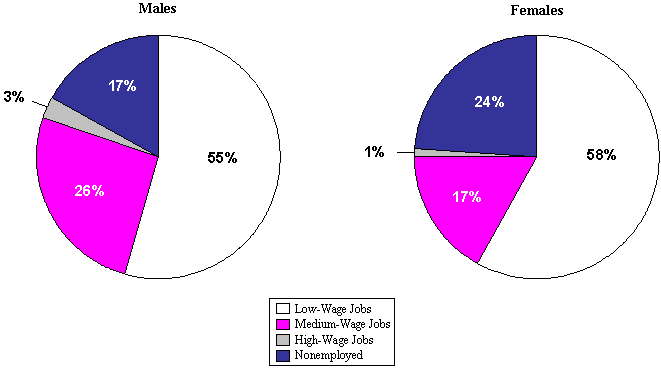 |
| Source: 1996 SIPP longitudinal files using workers who started low-wage jobs within six months after the start of the panel period Note: All figures were calculated using the longitudinal panel weight and pertain to a 42-month follow-up period. |
Over the entire follow-up period, sample members typically spent considerable more time in low-wage than higher-wage jobs (an average of 57 percent of months in low-wage jobs, compared to 23 percent of months in higher-wage jobs). However, consistent with the employment rate results, over time, workers increasingly spent more time in medium-wage jobs. For example, the average male actually spent about the same amount of time in low-wage and higher-wage jobs during the second half of the follow-up period (42 percent of months, compared to 40 percent of months; Table IV.2).
| Labor Market Activity | Males | Females | All Workers |
|---|---|---|---|
| In All Months(a) | |||
| All Jobs | 83 | 76 | 79 |
| Low-wage jobs | 55 | 58 | 57 |
| Medium-wage jobs | 26 | 17 | 21 |
| Higher-wage jobs | 3 | 1 | 2 |
| Unemployment | 7 | 5 | 6 |
| Not in the Labor Force | 10 | 19 | 15 |
| In Months 1 to 21(a) | |||
| All Jobs | 84 | 79 | 81 |
| Low-wage jobs | 67 | 68 | 68 |
| Medium-wage jobs | 16 | 11 | 13 |
| Higher-wage jobs | 1 | 0 | 1 |
| In Months 22 to 42(a) | |||
| All Jobs | 82 | 73 | 77 |
| Low-wage jobs | 42 | 48 | 46 |
| Medium-wage jobs | 36 | 24 | 29 |
| Higher-wage jobs | 4 | 2 | 3 |
| In All Weeks | |||
| All Jobs | 81 | 73 | 76 |
| Low-wage jobs | 52 | 55 | 54 |
| Medium-wage jobs | 25 | 17 | 20 |
| Higher-wage jobs | 3 | 1 | 2 |
| Sample Size | 522 | 817 | 1,339 |
| Source: 1996 SIPP longitudinal files using the entry cohort sample of workers who started jobs within six months after the start of the panel period. All workers were followed for 42 months after job start. Note: All figures are weighted using the longitudinal panel weight. a. An individual was defined to have been employed in a month if he or she was employed for at least one week during the month. | |||
| Labor Market Activity(a) | Males | Females | All Workers |
|---|---|---|---|
| All Jobs (Percent) | |||
| 0 to 25 | 5 | 10 | 8 |
| 25 to 50 | 6 | 11 | 9 |
| 50 to 75 | 13 | 14 | 13 |
| 75 to 99 | 36 | 30 | 32 |
| 100 | 40 | 35 | 37 |
| Low-Wage Jobs (Percent) | |||
| 0 to 25 | 20 | 20 | 20 |
| 25 to 50 | 25 | 22 | 23 |
| 50 to 75 | 24 | 21 | 22 |
| 75 to 99 | 21 | 22 | 22 |
| 100 | 10 | 15 | 13 |
| Medium-Wage Jobs (Percent) | |||
| 0 to 25 | 59 | 74 | 67 |
| 25 to 50 | 19 | 11 | 15 |
| 50 to 75 | 14 | 12 | 12 |
| 75 to 99 | 9 | 3 | 6 |
| High-Wage Jobs (Percent) | |||
| 0 to 25 | 96 | 98 | 97 |
| 25 to 50 | 3 | 1 | 2 |
| 50 to 75 | 2 | 1 | 1 |
| 75 to 99 | 0 | 0 | 0 |
| Unemployment (Percent) | |||
| 0 to 25 | 93 | 96 | 95 |
| 25 to 50 | 6 | 4 | 4 |
| 50 to 75 | 1 | 1 | 1 |
| 75 to 99 | 1 | 0 | 0 |
| Not in the Labor Force (Percent) | |||
| 0 to 25 | 87 | 72 | 78 |
| 25 to 50 | 8 | 13 | 11 |
| 50 to 75 | 2 | 8 | 6 |
| 75 to 99 | 3 | 8 | 6 |
| Sample Size | 522 | 817 | 1,339 |
| Source: 1996 SIPP longitudinal files using the entry cohort sample of workers who started jobs within six months after the start of the panel period. All workers were followed for 42 months after job start. Note: All figures are weighted using the longitudinal panel weight. a. An individual was defined to have been employed in a month if he or she was employed for at least one week during the month. | |||
We find results on the number of hours per week worked during the follow-up period similar to those on the number of months employed (Figure IV.7). Males worked an average of 33 hours per week during the 42-month period. This high figure reflects the high percentage of time the males were employed, as well as the fact that most worked full-time while employed (as discussed in the previous chapter). The corresponding figure for female workers was slightly lower (27 hours per week). Over the whole period, workers typically worked about twice as many hours in low-wage jobs than in medium-wage jobs. For example, males worked an average of 21 hours per week in low-wage jobs during the entire follow-up period (or 3,822 hours in total), compared to an average of 11 hours per week in medium-wage jobs (or 2,002 hours in total).(30) However, hours worked in medium-wage jobs increased over time (not shown).
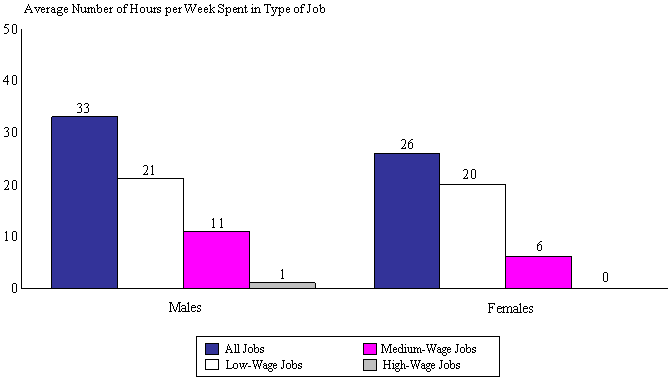 |
| Source: 1996 SIPP longitudinal files using workers who started low-wage jobs within six months after the start of the panel period Note: All figures were calculated using the longitudinal panel weight and pertain to a 42-month follow-up period. Additionally, the average number of hours per week employed by wage type of job refers to the average hours worked in that type of job over the entire follow-up period and includes zero hours worked in any job type. |
Despite the evidence of some wage progression for the typical low-wage worker, it is important to realize that many low-wage workers do not experience wage gains across wage categories (Table IV.3). About 57 percent of workers were employed in low-wage jobs for more than one-half the period (55 percent of males and 58 percent of females). Similarly, about two-thirds of workers spent little time (less than one-quarter of months) in medium-wage jobs. Thus, although there is some upward mobility for many low-wage workers, a significant portion remain entrenched in low-wage jobs. In the next section, we attempt to identify workers in each group.
An important policy issue to consider is whether employment outcomes are better for low-wage workers who stay in their jobs or for those who change jobs. It is not clear from economic theory which group of workers is likely to do better. On the one hand, outcomes might be better for those who remain in their jobs, because these workers might experience increased productivity as they gain job-specific human capital. On the other hand, job search theory suggests that those who switch jobs might eventually find job matches that better fit their skills. Thus, it is an empirical question as to which effect is stronger.
To address this issue, we used the sample of those who were employed during the entire follow-up period (that is, those who were continuously employed), and divided these workers into two groups: (1) those who held one job, and (2) those who held multiple jobs. Then, for each group, we tabulated the average percentage of time that these workers spent in medium- or high-wage jobs during the 42-month follow-up period.
We find that those who switched jobs had somewhat better labor market outcomes than those who remained in their starting jobs, although the differences are larger for females than males (Figure IV.8). Among continuously-employed female workers, those who switched jobs spent an average of 28 percent of months in medium- or high-wage jobs, compared to 19 percent of months for those who stayed in their initial jobs. The corresponding figures for male job switchers and job stayers are 36 and 34 percent, respectively. Thus, there is some evidence that job turnover can be beneficial for low-wage workers, especially for female workers. We address this topic further in the wage growth analysis in the next chapter.
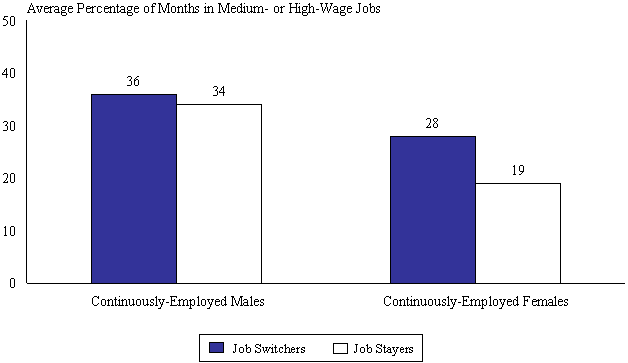 |
| Source: 1996 SIPP longitudinal files using workers who started low-wage jobs within six months after the start of the panel period Note: All figures were calculated using the longitudinal panel weight and pertain to a 42-month follow-up period. |
Finally, as expected, we find that higher-wage workers spent more time employed than low-wage workers for both males and females (Table C.3). For example, medium- and high-wage males were employed for about 93 percent of months on average (compared to 83 percent for low-wage workers). Interestingly, medium-wage workers spent most of their time in medium-wage jobs, and high-wage workers spent most of their time in high-wage jobs. Thus, there was more movement between wage categories for workers initially in low-wage jobs than for workers initially in higher-wage jobs, even though both groups had a similar number of jobs.
Subgroup Findings
We have found that the average earnings of low-wage workers improve somewhat over time. At the same time, however, many low-wage workers do not experience positive labor market outcomes. This section addresses the important question: Which groups of low-wage workers experience improvements in their labor market outcomes and which groups do not? Examining differences in overall employment outcomes across subgroups of the low-wage population has important policy implications for targeting appropriate services to those who are at most risk of poor outcomes.
We conducted our subgroup analysis in two interrelated ways. First, we examined key labor market outcomes for selected subgroups one at a time. These subgroups were defined by worker, area, and job characteristics at the time the workers started their low-wage jobs. (31) Second, we conducted a multivariate analysis to examine the association between particular explanatory (subgroup) variables and key labor market outcomes, holding constant the effects of other explanatory variables. The multivariate analysis accounts for correlations among the subgroup variables and also allows us to efficiently examine labor market outcomes for a large number of subgroups.
We examined four key labor market outcomes for the subgroup analysis:
- The percentage of months low-wage workers spent in low-wage jobs during the 42-month follow-up period
- The percentage of months workers spent in higher-wage jobs (that is, in medium- and high-wage jobs)
- The percentage of months workers spent in all jobs
- Whether the worker spent less than 25 percent of months in higher-wage jobs
We used the total time employed measure to assess the overall labor force attachment of subgroups of low-wage workers. We examined the average percentage of time that workers held higher-wage jobs to assess the extent to which subgroups of workers were able to escape the low-wage labor market over time. Finally, because focusing on averages can mask important subgroup differences in the distributions of the amount of time workers spent in various labor market activities, we also examined the share of workers who spent little time (less than one-quarter time) in the medium- and high-wage labor market sectors. Together, these summary outcome measures were used to identify subgroups who had the most and least successful labor market experiences.
The subgroup analysis was conducted separately by gender. Furthermore, all figures were calculated using the longitudinal panel weight. We estimated the multivariate models using ordinary least squares methods for the continuous outcome measures (the first three listed above) and logit maximum likelihood methods for the binary outcome measure (the fourth measure listed above). In the multivariate analysis, we conducted statistical tests to gauge the statistical significance of differences in labor market outcomes across subgroups. For some subgroups with small sample sizes (see Table III.1), the standard errors of the estimates are large. Consequently, some relatively large parameter estimates are not statistically significant. (32)
We included the following categories of explanatory variables in the regression models:
- Individual and household characteristics measured at job start (from the longitudinal panel file)
- Prepanel employment information (from the wave 1 topical module)
- Job characteristics measured at the start of the low-wage employment spell (from the longitudinal panel file)
- Area characteristics and state economic indicators measured at the start of the job, as well as changes in unemployment rate indicators between the start and end of the follow-up period (from published data sources; see the Methodological Appendix A)(33)
Findings From The Univariate Analysis
We find some broad differences in labor market outcomes across key subgroups of the low-wage population, although the differences are smaller than expected (Tables IV.4 and IV.5). Males, prime-age workers, educated workers, whites, those without health limitations, and those in wealthier households typically spend more time in higher-wage jobs than their respective counterparts. Furthermore, job quality matters--those who start with better jobs (measured by higher initial wages, the availability of health benefits, and full-time work status) are more likely to spend time in medium- and high-wage jobs than those in lower-quality jobs. In addition, we find some differences across occupations--males in professional and sales occupations and females in professional and clerical occupations have more positive labor market outcomes than other workers. These findings are consistent with those from the few previous studies that have addressed wage progression across subgroups of low-wage workers (Carnevale and Rose 2001; Smith and Vavrichek 1992; and Holtzer et al. 2001).
| Subgroup | Male Low-Wage Workers | Female Low-Wage Workers | ||||||
|---|---|---|---|---|---|---|---|---|
| Average Percentage of Months | Percentage in Higher-Wage Jobs for Less than 25 Percent of Months | Average Percentage of Months | Percentage in Higher-Wage Jobs for Less than 25 Percent of Months | |||||
| In Low-Wage Jobs | In Higher- Wage Jobs | In All Jobs | In Low- Wage Jobs | In Higher- Wage Jobs | In All Jobs | |||
| Overall | 55 | 28 | 84 | 55 | 58 | 18 | 77 | 73 |
| Age (in Years) | ||||||||
| Younger than 20 | 59 | 22 | 82 | 67 | 56 | 10 | 67 | 84 |
| 20 to 29 | 56 | 29 | 86 | 51 | 54 | 20 | 76 | 71 |
| 30 to 39 | 53 | 32 | 86 | 51 | 59 | 17 | 77 | 73 |
| 40 to 49 | 51 | 32 | 84 | 57 | 64 | 20 | 84 | 69 |
| 50 to 59 | 56 | 22 | 79 | 64 | 66 | 17 | 83 | 75 |
| 60 or older | 54 | 18 | 73 | 74 | 56 | 16 | 74 | 70 |
| Race/Ethnicity | ||||||||
| White and other non-Hispanic | 54 | 31 | 87 | 50 | 58 | 20 | 79 | 69 |
| Black, non-Hispanic | 50 | 21 | 72 | 71 | 57 | 14 | 72 | 75 |
| Hispanic | 64 | 20 | 85 | 68 | 63 | 9 | 73 | 89 |
| Educational Attainment | ||||||||
| Less than high school/GED | 58 | 21 | 80 | 67 | 58 | 9 | 68 | 88 |
| High school/GED | 56 | 28 | 85 | 54 | 64 | 15 | 79 | 78 |
| Some college | 47 | 36 | 84 | 46 | 52 | 22 | 76 | 64 |
| College graduate or more | 55 | 33 | 90 | 48 | 52 | 28 | 81 | 56 |
| Has a Health Limitation | ||||||||
| Yes | 52 | 17 | 71 | 73 | 51 | 11 | 63 | 83 |
| No | 55 | 30 | 86 | 53 | 59 | 19 | 79 | 71 |
| Household Type | ||||||||
| Single parent with children | 51 | 28 | 81 | 56 | 61 | 16 | 77 | 76 |
| Married couple with children | 56 | 31 | 88 | 49 | 57 | 16 | 74 | 77 |
| Married couple without children | 54 | 27 | 81 | 59 | 60 | 19 | 79 | 69 |
| Other adults without children | 55 | 27 | 83 | 60 | 56 | 24 | 81 | 62 |
| Household Income as a Percentage of the Poverty Level | ||||||||
| 100 percent or less | 60 | 26 | 87 | 55 | 61 | 14 | 76 | 79 |
| 101 to 200 percent | 56 | 27 | 84 | 57 | 56 | 15 | 72 | 77 |
| More than 200 percent | 52 | 31 | 83 | 54 | 58 | 22 | 81 | 67 |
| Full Sample Size | 522 | 522 | 522 | 522 | 817 | 817 | 817 | 817 |
| Source: 1996 SIPP longitudinal files using the entry cohort sample of workers who started low-wage jobs within six months after the start of the panel period. All workers were followed for 42 months after job start. Note: All figures are weighted using the longitudinal panel weight. | ||||||||
| Subgroup | Male Low-Wage Workers | Female Low-Wage Workers | ||||||
|---|---|---|---|---|---|---|---|---|
| Average Percentage of Months | Percentage in Higher-Wage Jobs for Less than 25 Percent of Months | Average Percentage of Months | Percentage in Higher-Wage Jobs for Less than 25 Percent of Months | |||||
| In Low-Wage Jobs | In Higher- Wage Jobs | In All Jobs | In Low- Wage Jobs | In Higher- Wage Jobs | In All Jobs | |||
| Overall | 55 | 28 | 84 | 55 | 58 | 18 | 77 | 73 |
| Hourly Wages | ||||||||
| Less than $5.00 | 63 | 19 | 83 | 68 | 59 | 8 | 68 | 88 |
| $5.00 to $5.99 | 63 | 17 | 81 | 71 | 66 | 13 | 79 | 81 |
| $6.00 to $6.99 | 50 | 37 | 88 | 42 | 55 | 26 | 81 | 59 |
| $7.00 to $7.50 | 42 | 42 | 84 | 39 | 46 | 39 | 85 | 41 |
| Hours Worked per Week | ||||||||
| 1 to 19 | 54 | 20 | 76 | 74 | 57 | 13 | 71 | 80 |
| 20 to 34 | 57 | 22 | 81 | 65 | 57 | 18 | 75 | 75 |
| 35 to 40 | 56 | 29 | 86 | 54 | 59 | 20 | 80 | 69 |
| More than 40 | 49 | 37 | 88 | 41 | 58 | 19 | 79 | 71 |
| Weekly Earnings | ||||||||
| Less than $150 | 56 | 22 | 80 | 67 | 58 | 13 | 72 | 81 |
| $150 to $299 | 57 | 27 | 85 | 56 | 59 | 21 | 80 | 68 |
| $300 to $600 | 42 | 45 | 89 | 30 | 51 | 28 | 80 | 47 |
| Owns Business (Self-Employed) | ||||||||
| Yes | 40 | 43 | 87 | 35 | 60 | 18 | 82 | 73 |
| No | 56 | 27 | 84 | 57 | 58 | 18 | 77 | 73 |
| Health Insurance Coverage(a) | ||||||||
| Yes | 50 | 34 | 86 | 47 | 56 | 22 | 79 | 67 |
| No | 57 | 25 | 84 | 60 | 60 | 15 | 76 | 77 |
| Occupation | ||||||||
| Professional/technical | 52 | 38 | 92 | 43 | 56 | 28 | 86 | 55 |
| Sales/retail | 53 | 35 | 90 | 41 | 56 | 20 | 77 | 71 |
| Administrative support/clerical | 59 | 24 | 84 | 62 | 51 | 28 | 80 | 55 |
| Service professions/handlers/cleaners | 57 | 24 | 82 | 63 | 62 | 13 | 76 | 80 |
| Machine/construction/production/ transportation | 51 | 32 | 84 | 49 | 62 | 10 | 73 | 88 |
| Farm/agricultural/other workers | 58 | 23 | 82 | 65 | 58 | 18 | 76 | 80 |
| Industry | ||||||||
| Agriculture/forestry/fishing/hunting | 56 | 24 | 83 | 62 | 62 | 14 | 79 | 80 |
| Mining/manufacturing/construction/ transportation/utilities | 53 | 31 | 85 | 52 | 60 | 12 | 72 | 84 |
| Wholesale/retail trade | 59 | 28 | 88 | 54 | 56 | 17 | 73 | 74 |
| Personal/health/other services | 53 | 26 | 80 | 61 | 59 | 22 | 81 | 67 |
| Other | 37 | 44 | 85 | 33 | 68 | 30 | 102 | 58 |
| Full Sample Size | 522 | 522 | 522 | 522 | 817 | 817 | 817 | 817 |
| Source: 1996 SIPP longitudinal files using the entry cohort sample of workers who started low-wage jobs within six months after the start of the panel period. All workers were followed for 42 months after job start. Note: All figures are weighted using the 1996 calendar year weight. a. These figures pertain to health insurance coverage from all sources, including coverage through the employer as well as from other sources. We used this variable instead of the employer-based health insurance coverage variable, because data on overall health insurance coverage is available monthly, whereas the employer-based coverage variable pertains only to jobs in progress at the time of the interview. Thus, the employer-based health insurance variable could not always be linked to the job under investigation, which led to a significant number of missing values. However, the subsets of health insurance variables overlap considerably: the source of health insurance coverage was the employer for 80 percent of those with any coverage. | ||||||||
At the same time, the story is complex--substantial diversity exists in labor market success within groups. Thus, although we identified groups that are at particular risk of poor labor market outcomes, we could not fully account for the variation in outcomes across low-wage workers. Next, we present the evidence for these findings.
a. Findings for Subgroups Defined by Individual and Household Characteristics
Table IV.4 presents our findings for subgroups defined by individual and household characteristics at the start of the low-wage job. We summarize these findings here:
- Male low-wage workers exhibit more movement out of the low-wage labor market than female low-wage workers. During the mid- to late 1990s, males spent more time in the labor market (an average of 84 percent of the time, compared to 77 percent of the time for females) and spent considerably more time in higher-wage jobs (an average of 28 percent of months, compared to 18 percent of months for females). Similarly, females typically spent more time in low-wage jobs. These gender results hold across all subgroups.
- Low-wage workers between ages 20 and 60 have better labor market outcomes than those older and younger. In our sample, teenage workers and those older than 60 had the poorest outcomes; they spent less time in the labor market and fewer months in higher-wage jobs than other workers. Those between ages 50 and 60 (and males, in particular) typically had the next poorest outcomes. Prime-age workers between ages 20 and 50 had the best outcomes. However, even within the 20- to-50-year-old age group, there was substantial diversity in labor market success; more than one-half of males and more than two-thirds of females in this age group spent less than one-quarter of months in high- or medium-wage jobs.
- Whites typically spend more time in higher-wage jobs than blacks and Hispanics. White female workers in our sample spent an average of 20 percent of months in higher-wage jobs, compared to about 12 percent of months for minority female workers. The corresponding figures for males are 31 percent for whites and 20 percent for minorities, respectively. Similarly, whites spent less time in low-wage employment than Hispanics, and spent more time employed in all jobs than minority workers (and, in particular, than black workers). We stress again, however, that there is considerable variation in labor market success within each racial and ethnic group.
- Education is strongly associated with labor market success. As expected, labor market outcomes for sample members were typically poorest for the high school dropouts and improved with education level. Among female workers, those who were high school dropouts at the start of their jobs spent an average of only 9 percent of months in higher-wage jobs, compared to 15 percent of those with a high school credential and about 25 percent of those who attended college. Similarly, those with low education levels typically spent more time in low-wage jobs than their counterparts and spent less time in all jobs.
- Low-wage workers with health limitations are at particular risk of poor labor market outcomes. During the mid- to late 1990s, male workers with health problems typically spent only about 17 percent of months in higher-wage jobs, compared to 30 percent for those healthier, and the corresponding figures for female workers are 11 percent and 19 percent, respectively. Overall employment rates were also much lower for those with health problems for both males and females. Thus, those with health limitations tend to spend most of their time in either low-wage jobs or in nonemployment.
- Married males have slightly more successful labor market experiences than other males. Among males in our sample, those who were married and had children were employed, on average, for 88 percent of all months, compared to 84 percent of months for all male workers. Similarly, they were employed in medium- or high-wage jobs for an average of 31 percent of the follow-up period, compared to 28 percent for all workers. These differences, however, are smaller than expected.
- There are few differences in the labor market experiences of single-parent females and females living in other types of households. Figures for female low-wage workers on the time spent in higher-wage jobs and in all jobs are similar across household groups.
- Poverty status is associated with labor market success. Not surprisingly, during the mid- to late 1990s, low-wage workers in wealthier households spent more time, on average, in higher-wage jobs than those in poorer households. For example, females living in households with incomes below poverty spent nearly half as much time in the higher-wage labor market than households with incomes more than twice the poverty level (14 percent, compared to 22 percent). Similarly, those in the poorest households spent more time in the low-wage sector than their wealthier counterparts. These differences are similar for females than males. Despite this, however, we again find considerable differences in labor market success even for those within the wealthiest households. For example, 67 percent of females in the wealthiest households spent less than one-quarter of their time in higher-wage jobs, which is not substantially below the 79 percent figure for males in households below poverty.
b. Findings for Subgroups Defined by Job Characteristics
Our findings for subgroups defined by job characteristics at the start of the low-wage job indicate that job quality matters--those with better jobs tend to have more positive labor market outcomes than those in lower-quality jobs (Table IV.5). We summarize these results here:
- Those with higher initial wages are more likely than those earning lower wages to leave the low-wage labor market. Sample members who earned less than $5.00 per hour (about 27 percent of all low-wage workers) had the poorest labor market outcomes, and outcomes improved as wage levels increased. For example, male workers earning less than $5.00 per hour spent an average of 19 percent of months in higher-wage jobs, compared to 37 percent for those earning between $6.00 and $7.00 and 42 percent for those earning between $7.00 and $7.50. Similarly, the lowest earners spent much more time in low-wage employment than higher earners. Not all high-earners had successful outcomes, however; about 40 percent of those earning more than $7.00 spent little time in higher-paying jobs.
- Full-time workers typically have more successful outcomes than part-time workers. During the mid- to late 1990s, low-wage workers who reported working more than 35 hours per week (about 26 percent of all workers) spent, on average, much more time in higher-wage jobs and less time in low-wage jobs than those working fewer hours. These results hold for both males and females. For example, males who worked less than 20 hours per week typically spent only about 20 percent of their time in higher-wage jobs, whereas the corresponding figure is 37 percent for those working more than 40 hours per week. These results strongly suggest that part-time workers are at particular risk of poor labor market outcomes.
- The availability of fringe benefits on the job is a strong predictor of labor market success. Those covered by health benefits (about 60 percent of all low-wage workers) spent considerably more time in higher-wage jobs than those without these benefits (34 percent compared to 25 percent of months for males, and 22 percent compared to 15 percent for females).(34) These results further confirm our findings that job quality matters.
- Male business owners typically have better labor market outcomes than male jobholders. As discussed, business owners (about 13 percent of all low-wage workers), tend to work many hours in order to get their businesses off the ground and tend to have lower hourly wages than jobholders near the start of their employment spells. However, earnings growth appears to be somewhat greater for the self-employed. Male business-owners spent an average of 43 percent of months in higher-wage jobs, compared to 27 percent for male jobholders. Differences between the outcomes of female business owners and jobholders, however, are smaller.
- Among male low-wage workers, those in professional and sales occupations experience more wage progression than other workers. The differences across occupations are substantial. During the mid- to late 1990s, professional and sales workers (14 percent of workers each) were typically employed for about 90 percent of the time during the 42-month follow-up period, compared to about 83 percent for other workers. Similarly, professional and sales workers spent about 37 percent of months, on average, in higher-paying jobs, compared to 24 percent for clerical workers, 24 percent for service workers, 32 percent for machinists and construction workers, and 23 percent of those in other occupations. Similarly, a relatively small fraction of professional and sales workers spent little time in medium- and high-wage jobs.
- Female workers in professional and clerical jobs have the most labor market success. Female sample members in professional and clerical occupations spent more time employed in all jobs, and higher-wage jobs in particular, than those in other occupations. These workers spent about 28 percent of the follow-up period in the higher-wage labor market, compared to less than 20 percent for those in each of the other occupations. Service workers had particularly poor outcomes.
- We find smaller differences in labor market success across industries. This result holds for both males and females.
Findings From The Multivariate Analysis
Thus far, we have examined subgroup results one at a time. However, many of these subgroups are correlated with each other. For example, we have seen that less disadvantaged workers and those in higher-quality jobs tend to have more successful outcomes than other workers. However, better-off workers are more likely than those worse off to be in high-quality jobs. Thus, an important question is whether labor market success is due more to worker characteristics or initial job characteristics.
We isolated subgroup effects from others using multivariate regression methods. We estimated regression models for the four outcome measures used in the univariate subgroup analysis. In the main text, we present findings for the most important outcome measure: the percentage of months workers spent in medium- and high-wage jobs (Table IV.6). The results for the other three outcomes are presented in Table C.4 and are qualitatively similar to those presented in the text (although as discussed, in general, there was less variation in the total time workers spent employed than in the time workers spent in higher-wage jobs). We present "regression-adjusted" means for each subgroup level and indicate whether the difference between the regression-adjusted means for each subgroup and the "left-out" subgroup is statistically significant at the five percent significance level.(35)
We present estimates from three models for both males and females. The first model includes demographic variables only (that is, explanatory variables defined by individual, household, and area characteristics; model (1) in Table IV.6). The second model includes demographic variables as well as prepanel work experience variables from the wave 1 topical module [model (2)]. The third model includes demographic variables and initial job-related variables [model (3)]. In Table C.4, we present the model (3) results for the additional employment-related outcome measures only.
a. Models Including Demographic Variables Only
The regression-adjusted differences in labor market outcomes across subgroups defined by individual and household characteristics are similar to the univariate findings described above (Table IV.6). In particular, among our sample of low-wage workers, teenagers and older workers, African Americans and Hispanics, those with low levels of education, and those with health problems spent less time in medium- and high-wage jobs than their counterparts, and many of these differences are statistically significant at the ten percent level. There is also some evidence that those in higher-income households and males with children had better labor market outcomes than other workers, but these differences are not statistically significant. Thus, adjusting for the correlation among the demographic variables does not materially influence the subgroup findings.
| Explanatory Variables | Regression-Adjusted Means for Models with Demographic and Other Denoted Explanatory Variables | |||||
|---|---|---|---|---|---|---|
| Males | Females | |||||
| No Other Variables (1) | Pre-Panel Work History Variables (2) | Initial Job Variables (3) | No Other Variables (1) | Pre-Panel Work History Variables (2) | Initial Job Variables (3) | |
| Individual Characteristics | ||||||
| Age | ||||||
| Younger than 20(a) | 20 | 27 | 23 | 12 | 15 | 12 |
| 20 to 29 | 29** | 30 | 30* | 20** | 20 | 20** |
| 30 to 39 | 33*** | 32 | 33** | 18* | 17 | 18* |
| 40 to 49 | 33** | 29 | 30 | 19* | 18 | 19* |
| 50 to 59 | 22 | 17 | 16 | 18 | 17 | 18 |
| 60 or older | 18 | 12* | 12 | 17 | 16 | 14 |
| Race/Ethnicity | ||||||
| White and other non-Hispanic(a) | 31 | 31 | 31 | 20 | 19 | 19 |
| Black, non-Hispanic | 21** | 22** | 22** | 15 | 16 | 15* |
| Hispanic | 22** | 20** | 24 | 13** | 13** | 14* |
| Educational Attainment | ||||||
| Less than high school/GED(a) | 23 | 24 | 26 | 12 | 12 | 14 |
| High school/GED | 28 | 28 | 29 | 16* | 16 | 16 |
| Some college | 34** | 34** | 30 | 21*** | 21*** | 21** |
| College graduate or more | 32* | 33* | 30 | 26*** | 25*** | 23*** |
| Has a Health Limitation | ||||||
| No(a) | 30 | 30 | 30 | 19 | 19 | 19 |
| Yes | 17*** | 17*** | 19*** | 10*** | 10*** | 13** |
| Work Experience Prior to the Panel Period | ||||||
| Ever Worked for Six Straight Months | ||||||
| No(a) | 27 | 19 | ||||
| Yes | 29 | 18 | ||||
| Number of Years Ever Worked Six Straight Months | ||||||
| Less than 5(a) | 27 | 14 | ||||
| 5 to 10 | 31 | 19* | ||||
| 10 to 20 | 26 | 22*** | ||||
| More than 20 | 32 | 20* | ||||
| Usually Worked at Least 35 Hours Per Week When Working | ||||||
| No(a) | 20 | 18 | ||||
| Yes | 31*** | 18 | ||||
| Household Characteristics | ||||||
| Household Type | ||||||
| Single adults with children(a) | 30 | 31 | 30 | 18 | 18 | 19 |
| Married couples with children | 32 | 32 | 30 | 17 | 17 | 17 |
| Married couples without children | 26 | 25 | 27 | 16 | 16 | 16 |
| Other adults without children | 25 | 26 | 26 | 23* | 24* | 23 |
| Household Income as a Percentage of the Poverty Level | ||||||
| 100 percent or less(a) | 26 | 24 | 29 | 17 | 17 | 20 |
| 101 to 200 percent | 27 | 28 | 28 | 17 | 17 | 18 |
| More than 200 percent | 30 | 31 | 28 | 19 | 19 | 18 |
| Received Public Assistance in the Past Year | ||||||
| No(a) | 29 | 29 | 29 | 18 | 18 | 18 |
| Yes | 22 | 21 | 23 | 17 | 17 | 17 |
| Area Characteristics | ||||||
| Region of Residence | ||||||
| Northeast(a) | 27 | 26 | 29 | 29 | 28 | 28 |
| South | 25 | 26 | 24 | 18*** | 18*** | 18*** |
| Midwest | 30 | 30 | 30 | 14*** | 14*** | 14*** |
| Northwest | 30 | 30 | 31 | 18*** | 18** | 17*** |
| Lives in a Metropolitan Area | ||||||
| No | 26 | 25 | 25 | 16 | 16 | 17 |
| Yes | 30 | 30 | 30* | 19 | 19 | 19 |
| 20th Percentile of the Hourly Wage Distribution in State | ||||||
| $250 or less(a) | 27 | 27 | 27 | 16 | 16 | 17 |
| $251 to $269 | 35* | 34* | 33 | 19 | 19 | 19 |
| $270 or more | 27 | 27 | 28 | 20 | 20 | 19 |
| Percentage of State Population Residing in Metropolitan Areas | ||||||
| 72 or less(a) | 28 | 27 | 28 | 21 | 21 | 21 |
| 73 to 84 | 31 | 31 | 31 | 17* | 17 | 17** |
| 85 or more | 27 | 27 | 27 | 16 | 15* | 16* |
| Poverty Rate in State | ||||||
| Less than 10 percent(a) | 29 | 29 | 27 | 15 | 15 | 14 |
| 10 to 12 percent | 31 | 30 | 30 | 19 | 19 | 20** |
| More than 12 percent | 26 | 27 | 28 | 19 | 19 | 20* |
| Unemployment Rate in State | ||||||
| 6 percent or less(a) | 27 | 28 | 29 | 13 | 14 | 14 |
| More than 6 percent | 29 | 29 | 28 | 20* | 20* | 20* |
| Change in Unemployment Rate in State of Residence Between 1996 and 1999 (Percentage Points) | ||||||
| -2 percentage points or less(a) | 28 | 28 | 27 | 18 | 18 | 19 |
| -1 to -2 | 28 | 28 | 28 | 19 | 19 | 19 |
| More than -1 | 30 | 30 | 30 | 16 | 16 | 16 |
| Initial Job Characteristics | ||||||
| Hourly Wages | ||||||
| Less than $5.00(a) | 19 | 11 | ||||
| $5.00 to $5.99 | 19 | 14 | ||||
| $6.00 to $6.99 | 37*** | 24*** | ||||
| $7.00 to $7.50 | 40*** | 34*** | ||||
| Usual Hours Worked per Week | ||||||
| 1 to 19(a) | 24 | 13 | ||||
| 20 to 34 | 25 | 20*** | ||||
| 35 to 40 | 29 | 19** | ||||
| More than 40 | 32 | 18 | ||||
| Has More than One Job or Business | ||||||
| No(a) | 28 | 18 | ||||
| Yes | 31 | 18 | ||||
| Owns Business (Self-Employed) | ||||||
| No(a) | 27 | 18 | ||||
| Yes | 44*** | 24 | ||||
| Health Insurance Coverage(b) | ||||||
| No(a) | 26 | 17 | ||||
| Yes | 34*** | 20* | ||||
| Union Member | ||||||
| No(a) | 29 | 18 | ||||
| Yes | 27 | 19 | ||||
| Occupation | ||||||
| Professional/technical(a) | 29 | 22 | ||||
| Sales/retail | 31 | 21 | ||||
| Administrative support/clerical | 28 | 22 | ||||
| Service professions/handlers/cleaners | 26 | 16 | ||||
| Machine/construction/production/ transportation | 32 | 12** | ||||
| Farm/agricultural/other workers | 24 | 22 | ||||
| Regression R(2) Value | .12 | .15 | .27 | .14 | .15 | .27 |
| Sample Size | 522 | 522 | 522 | 817 | 817 | 817 |
| Source: 1996 SIPP longitudinal and wave 1 topical module files using the entry cohort sample of workers who started low-wage jobs within six months after the start of the panel period. All workers were followed for 42 months after job start. Note: All figures are weighted using the 1996 calendar year weight, and standard errors account for design effects due to weighting and clustering. a. Denotes the omitted explanatory variable in the regression model. b. These figures pertain to health insurance coverage from all sources, including coverage through the employer as well as from other sources. We used this variable instead of the employer-based health insurance coverage variable, because data on overall health insurance coverage is available monthly, whereas the employer-based coverage variable pertains only to jobs in progress at the time of the interview. Thus, the employer-based health insurance variable could not always be linked to the job under investigation, which led to a significant number of missing values. However, the subsets of health insurance variables overlap considerably: the source of health insurance coverage was the employer for 80 percent of those with any coverage. * Difference between the variable mean and the mean of the omitted explanatory variable is significantly different from zero at the .10 level, two-tailed test. ** Difference between the variable mean and the mean of the omitted explanatory variable is significantly different from zero at the .05 level, two-tailed test. *** Difference between the variable mean and the mean of the omitted explanatory variable is significantly different from zero at the .01 level, two-tailed test | ||||||
The explanatory variables measuring area characteristics have little predictive power in the regression models (Table IV.6). Those in metropolitan areas tended to have slightly better outcomes than those in other areas, and there is some evidence that females in the northeast region had more positive labor market experiences than females in other regions (although this result does not hold for males). However, in general, the state hourly wage and state unemployment measures are not statistically significant, and the parameter estimates are not in the expected direction. These weak results are somewhat surprising, because the area characteristics are intended to capture the economic conditions faced by sample members. Hence, we expected more positive labor market outcomes for those residing in areas with a higher demand for labor than those in other areas. A possible explanation for the weak findings is that the area characteristics are measured at the aggregated state level, so they might not accurately reflect demand conditions faced by the workers in their local areas.
The regression R(2) value from model (1) is about .13 for both males and females. Thus, although the demographic variables explain about 13 percent of the variance in the amount of time workers spent in the higher-wage labor market, substantial residual factors remain that account for differences across workers. Stated differently, there is substantial diversity in labor market outcomes among members within the subgroups under investigation.
b. Models Including Demographic and Prepanel Work Experience Measures
Work experience matters to some extent. All else equal, sample members with more than five years of labor market experience typically spent slightly more time in higher-wage jobs than those with less work experience, and this result holds for both men and women (Table IV.6). Furthermore, males who typically worked full-time while employed had more wage progression, on average, than part-time male workers, and these differences are statistically significant.
Interestingly, differences in mean outcomes across age groups diminish somewhat when the prepanel work experience variables are included in the models. Thus, our initial findings across age groups can be explained by the higher levels of work experience among older workers, which gave them more job-related skills and made it easier for them to find higher-paying jobs.
c. Models Including Demographic and Initial Job-Related Variables
In general, the inclusion of the job-related variables leads to slightly smaller differences across the demographic subgroups than those presented above (model (3) in Table IV.6). (36) For example, when the initial job characteristics are included in the model, the Hispanic and education effects for males become statistically insignificant. The effects become slightly smaller due to the fact that less disadvantaged workers tend to get better jobs, even in the low-wage worker population.
The multivariate findings support our conclusions from the univariate analysis that job quality matters (Table IV.6 and Table C.4). Low-wage workers who had higher starting wages, worked more hours, and had available health benefits spent more time, on average, in higher-wage jobs than those in lower-quality jobs. Most of these differences are statistically significant at the 5 percent significance level. However, the regression-adjusted means across the job-related subgroups are slightly smaller than the univariate means because of the correlation between the demographic and job-related variables and the correlation among the job-related variables. For example, the regression results no longer suggest that males in professional and sales occupations and females in professional and clerical occupations experienced more wage progression than other workers. The occupational effects, however, more closely resemble those from the univariate analysis if the demographic variables are excluded from the models, or if the demographic variables are included but other job-related variables are excluded (not shown).
Interestingly, those who had more than one job at the start of the low-wage job spell had slightly better outcomes than those who did not, perhaps capturing differences in the motivation to work and succeed across the two groups of workers (Table IV.6 and Table C.4). In addition, self-employed workers typically spent substantially more time than jobholders in the medium- and high-wage labor market sectors, and these differences are statistically significant for males.
Finally, the inclusion of both the job and demographic characteristics yields a model R(2) value of .27 for both males and females (Table IV.6). Thus, we find again that there remain substantial residual factors that account for differences in labor market success across low-wage workers, even after controlling for a large number of demographic and job-related factors. In sum, although we have identified some important differences in medium-term labor market outcomes across key subgroups of the low-wage worker population, there are clearly other important factors that we could not identify using the SIPP data.
(27) In the previous chapter, we focused our discussion on the comparison of the characteristics of low-wage workers to those of all workers. However, in this chapter, we focus our discussion on the comparison of low-wage workers to medium- and high-wage workers in order to assess the extent to which the labor market experiences (such as total time employed) of low-wage workers differ from those of higher-wage workers.
(28) An individual was defined to have been employed in a month if he or she was employed for at least one week during the month.
(29) We find similar results for the percentage weeks worked (Table IV.3), because most individuals were employed for all weeks during the month. Thus, for simplicity, in this chapter, we focus on the months measure.
(30) The hours figures for medium-wage jobs include the zero hours worked by those who never held medium-wage jobs.
(31) We did not examine subgroup differences across the three male and three female low-worker typologies presented in the previous chapter, because the much smaller sample size used in the overall employment analysis yielded unstable clusters that were difficult to interpret.
(32) The standard errors of the estimates account also for design effects in the SIPP data due to clustering.
(33) We measured these indicators using information on the state in which the worker lived at the beginning and end of the follow-up period.
(34) These figures pertain to health insurance coverage from all sources, including coverage through the employer as well as from other sources. We used this variable instead of the employer-based health insurance coverage variable, because data on overall health insurance coverage is available monthly, whereas the employer-based coverage variable pertains only to jobs in progress at the time of the interview. Thus, the employer-based health insurance variable could not always be linked to the job under investigation, which led to a significant number of missing values. However, the subsets of health insurance variables overlap considerably: the source of health insurance coverage was the employer for 80 percent of those with any coverage.
(35) The regression-adjusted mean for Hispanics, for example, was the average predicted value from the regression model, where the value of 1 was inserted for the Hispanic dummy variable for all individuals but where the other explanatory variables were calculated at their actual values. The regression-adjusted means for other explanatory variables were constructed in an analogous way.
(36) We are aware that the job variables are likely to be correlated with the error term in the regression models (that is, that the job variables are likely to be endogenous), which could lead to biased coefficient estimates on all the explanatory variables. Thus, we do not view our parameter estimates as "structural" relationships between the explanatory and dependent variables. Rather, our goal is to identify broad associations between subgroup variables and labor market outcomes.
Wage Growth and Progression Among Low-wage Workers
What are the patterns of wage growth among low-wage workers who start a job? What is the amount of increase in wages for those employed three years later? Are low-wage workers moving into better jobs over time? What factors are associated with wage growth in the low-wage labor market? Are those employed in certain occupations or industries more likely than others to experience wage growth? Do initial wages matter? Do those who keep the same job experience greater or lower wage growth than those who switch jobs?
This chapter addresses these and related questions using data on workers in the 1996 SIPP longitudinal panel file who started low-wage jobs during the first six months of the panel period (roughly, in the first half of 1996). We used the average wages over the initial six-month period after initial job start to classify individuals as low-wage workers. Low-wage workers are those whose average wages during this initial period were below $7.50 per hour (in 1996 dollars), which is the cutoff that would put them below the federal poverty level for a family of four if they worked full-time.(37) We then tracked their progress by examining the changes in their average wages over six-month intervals during the subsequent three-year period. Unless otherwise noted, all wages reported are real wages in 1999 dollars.
We conducted a descriptive analysis to answer the key analysis questions and a multivariate analysis to better understand factors related to wage growth. To place our findings in context, Appendix C presents selected descriptive statistics for workers who started medium- and high-wage jobs. All statistics were calculated using the longitudinal panel weight.
Before turning to the study findings, we discuss three important sample- and methodological-related issues that pertain to the analysis in this chapter. First, similar to the aggregate analysis described in chapter IV, the sample for this analysis includes those who started low-wage jobs during the first six months of the panel period.(38) Among those who started a job in the first six months of the panel period, just under half were low-wage workers, about 38 percent were medium-wage workers, and about 15 percent were high-wage workers.
The second issue relates to that of the classification of job starters as low-, medium-, or high-wage workers. As discussed in the Methodological Appendix A, we based our initial classification of workers into these three groups based on their average wages during the first six-month period after they started their jobs. Categorizing people into low-, medium-, or high-wage workers at any given point in time has two potential issues especially important for the wage growth analysis. First, if a worker misreports his or her wages at the time of job start, we may incorrectly classify an individual into a wage type that may not be their real wage type. Second, people sometimes obtain jobs that may not be related to their true ability levels and may soon move into a job that more closely matches their true human capital level. For example, if a worker with low productivity gets a high-wage job, he or she may not be able to sustain that job for long and may soon move into a low-wage one. Conversely, a high-productivity worker may have found a low-wage job and might soon move to a higher-wage job (defined as a medium- or high-wage job). Both these factors work in the direction of potentially large wage growth for low-wage workers (or lower wage growth for high-wage workers), especially in the early periods after job start. We were particularly concerned about minimizing the effects of any data errors, as these errors do not reflect true changes in wages. Thus, as described earlier, we smoothed wages and took the six-month average of wages after job start to classify workers into wage categories.(39) (We call this initial period to classify workers into wage categories "period 0.") While this smoothing is likely to reduce the noise due to data errors to a large extent, residual errors could still remain, and we may be overstating wages for low-wage workers. Consequently, in our analysis examining wage growth over time, we start with the average wage in the first six-month period after the period we used to define their initial worker type and examine their wage growth over the following three-year period (period 1 through period 6). For trends in wages over time, we present average wages of those employed in period 1, average wages of those employed in period 2, average wages of those employed in period 3, and so on. For the analysis of individual workers' wage growth over time, we compare wages and job characteristics of those workers who were employed in both the first and last periods (i.e., period 1 and period 6) regardless of their employment in other periods. We also examined the sensitivity of the wage growth findings to alternative definitions of low-wage workers, such as excluding those with very low wages and looking at longer time periods to classify low-wage workers, but we found that our main results were not sensitive to these alternative definitions.
The third issue relates to sample selection. Since we observe wages only for those who are employed, the wage growth analysis is limited to the sample of people who were working at different points in time. Those who remained employed at a later time may be different from those who did not remain employed. As demonstrated in the previous chapter, because of the strong economic conditions in the mid- to late-1990s, relatively large fractions of low-wage workers remained employed three and a half years after job start. The high fraction of low-wage workers who remained employedВ 88 percent of male workers and 80 percent of female workersВ suggests to us that our sample for the wage growth analysis is similar to the sample of those who started low-wage jobs. However, we do observe some differences between those working and those not working three and a half years later, which mimic the subgroup results from the previous chapter. For example, those with health limitations were considerably less likely than those with no health limitations to be employed three and a half years later. In addition, older men, African American males, and males working part-time in their initial jobs were less likely to hold a job at the end of the three-year follow-up period. Females with less than a high school diploma and those whose initial wages were less than $5 (in 1996 dollars) were also less likely to be employed at the end of the follow-up period.
This chapter is in two sections. First, we present descriptive findings by gender for the full set of outcome measures; second, we present findings from the subgroup and multivariate analyses for selected outcomes.
Descriptive Analysis Findings, By Gender
Our descriptive analysis shows that low-wage workers experienced considerable wage growth during the boom period of the mid- to late 1990s. Nearly 80 percent of low-wage workers experienced some wage increase over the three-year period following job start, and nearly one in five had jobs that paid more than $10 per hour at the end of the period. Male workers started at higher hourly wage levels than female workers, but both groups experienced similar wage growth over time (about a 25 percent increase over the three-year period). Low-wage workers also moved to better jobs over time they were more likely to work full-time, and a higher fraction were in jobs that offered fringe benefits.
Although many low-wage workers experienced wage growth in their jobs and moved into better jobs, over half of low-wage workers remained in the low-wage labor-market three years later, even in this period of strong economic conditions.
Trends in Wages Over Time
Workers, as a group, who started a low-wage job experienced a steady increase in wages during the three-year follow-up period (Figure V.1). Real wages for male workers were just over $7, on average, during period 1 (which reflects the 7- to 12-month period after job start).(40) They increased steadily over time and were just under $9 three years later, representing about a 25 percent increase in real wages. Increases in wages for male workers were the largest during the early periods after job start. Wages continued to increase at relatively high rates during the first couple of years after job start, then tapered off. Although the extent of wage increases is large, the average wage for male low-wage workers was only at about 125 percent above the federal poverty level for a family of four at the end of the follow-up period. Nearly half still had wages below the federal poverty level, and another quarter had wages between 100 and 125 percent of the federal poverty level (Figure V.2).
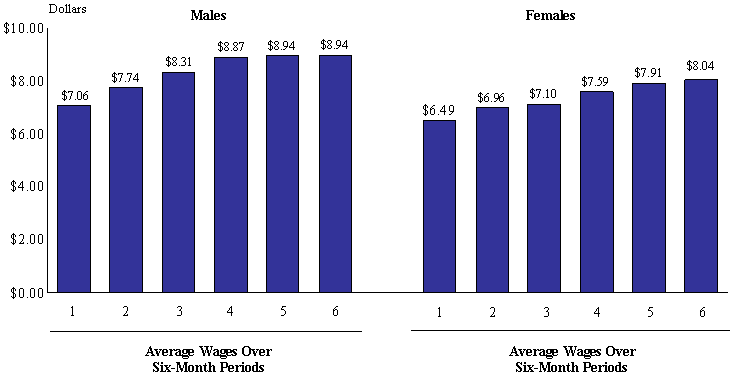 |
| Source: 1996 SIPP longitudinal files using workers who started low-wage jobs within six months after the start of the panel period Note: All figures were calculated using the longitudinal panel weight and pertain to a 42-month follow-up period. |
Female workers had lower wages than male workers (about $6.50 on average for females, compared to $7.06 on average for males, during period 1). However, wages of female workers steadily increased, and their average wages were about $8 at the end of the three-year follow-up period (Figure V.1). Female low-wage workers also experienced about a 25 percent increase in real wages over the three-year period, and their wages at the end of the three-year period put their average earnings right around the federal poverty level for a family of four. (41) Sixty percent of female workers continued to have earnings that put them below the federal poverty level, and about 25 percent had incomes between 100 to 125 percent of the federal poverty level (Figure V.2).
The percentage increases in real wage we observed for low-wage workers were considerably larger than the wage increases we observed for medium- and high-wage workers. Medium-wage workers, as a group, experienced a real wage increase of about 10 to 12 percent over the three-year period, and high-wage workers experienced a real wage increase of less than 5 percent over the same period (Table D.2). The average increase in wages across all workers who started jobs, where we do not classify them into worker type and hence are not worried about any contamination, is 12 to the same period (Table D.2). The average increase in wages across all workers who started jobs, where we do not classify them into worker type and hence are not worried about any contamination, is 12 to 15 percent for the three-year period.(42)
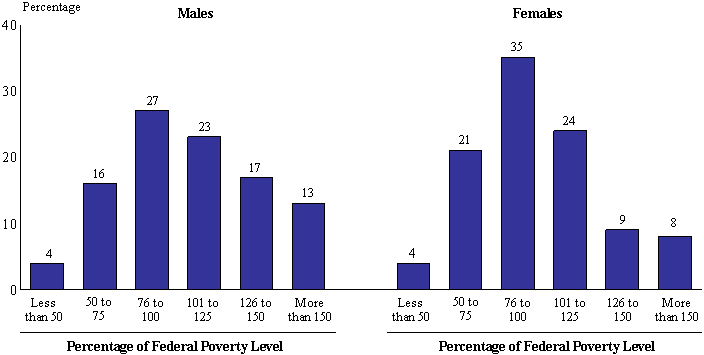 |
| Source: 1996 SIPP longitudinal files using workers who started low-wage jobs within six months after the start of the panel period Note: All figures were calculated using the longitudinal panel weight and pertain to a 42-month follow-up period. |
Extent of Wage Growth Over Time
While workers as a group who started low-wage jobs experienced wage increases over time, it is important to examine the extent to which individual workers experienced an increase in wages. To better understand the distribution of wage growth, we examined the fraction of low-wage workers who experienced wage growth, as well as the extent of wage growth during the three-year follow-up period.
Most low-wage workers (nearly 80 percent) experienced an increase in real wages between their wages in period 1 and their wages three years later (Table V.1). The proportion experiencing any increase in wages was essentially the same for males and females (78 percent, compared to 80 percent). The amount of wage growth was also considerable for many, although male workers were somewhat more likely than females to experience greater amounts of growth. For example, nearly half of males, and just over 40 percent of females, experienced an increase in real wages of over 25 percent over the three-year period. In addition, more than one in five workers experienced an increase of over 50 percent in their wages. In contrast, few experienced large reductions in wages. Given the low levels of their starting wages, this is not surprising.
Another dimension of wage growth, somewhat related to the analysis in the preceding chapter, is the fraction of low-wage workers who had moved into medium- or high-wage jobs three years later. Even though they experienced relatively large increases in wages over time, a significant fraction still remained in the low-wage labor market three years later (47 percent of males and 60 percent of females Table V.1). Those who moved to higher-wage jobs were most likely to be in medium-wage jobs, and only a small fraction were in high-wage jobs. For example, three and a half years after they started their low-wage job, only about 2 percent of females and 5 percent of males had moved into high-wage jobs (with hourly wages over $16), and about 48 percent of males and 38 percent of females were in medium-wage jobs.
| Male Workers | Female Workers | |
|---|---|---|
| Percentage Employed in Both Periods | 82 | 74 |
| Percentage Whose Wages:(a) | ||
| Increased | 78 | 80 |
| Decreased | 22 | 20 |
| Percentage Change in Wages(a) | ||
| More than 50 percent | 26 | 20 |
| 26 to 50 percent | 21 | 22 |
| 11 to 25 percent | 17 | 21 |
| 1 to 10 percent | 14 | 17 |
| -1 to -10 percent | 9 | 9 |
| Less than -10 percent | 13 | 11 |
| Change in Real Wages Over Time (in Dollars)(a) | ||
| More than $5.00 | 14 | 9 |
| $2.51 to $5.00 | 21 | 15 |
| $1.01 to $2.50 | 21 | 27 |
| $0 to $1.00 | 21 | 27 |
| $0 to -$1.00 | 11 | 11 |
| Less than -$1.00 | 11 | 9 |
| Percentage Whose Job Three Years Later Was:(a) | ||
| Low wage | 47 | 60 |
| Medium wage | 48 | 38 |
| High wage | 5 | 2 |
| Sample Size | 460 | 636 |
| Source: 1996 SIPP longitudinal file using workers who started low-wage jobs within six months after the start of the panel period. Note: All figures were calculated using the longitudinal panel weight. Wage changes are calculated as the difference between average wages in period 1 (the first six months, after initial job categorization) and average wages over a six-month period three years later. | ||
Workers who started low-wage jobs were more likely to experience wage increases than those starting medium- or high-wage jobs. For example, around 70 percent of medium-wage workers and under 60 percent of high-wage workers experienced an increase in real wages, compared with 80 percent of low-wage workers (Table D.4). Because they start at higher wage levels, the fraction of higher-wage workers who experienced large relative increases in wages (over a 50 percent increase in wages) is considerably lower than the corresponding fraction of low-wage workers who experienced such large increases. However, higher-wage workers were considerably more likely than low-wage workers to have experienced an increase of $5 per hour over the three-year follow-up period.
Changes in Job Characteristics
Not only did low-wage workers experience wage growth, but they also worked more hours and moved into better jobs over time. The fraction of low-wage workers working full-time (defined as 35 or more hours) went up from 76 percent to 86 percent over the three-year period for males, and from 54 percent to 69 percent for females. Similarly, average hours worked for those starting low-wage jobs increased slightly over time, by about three to four hours per week (Table V.2).
Low-wage workers also moved into jobs that offered fringe benefits such as health insurance. As Table V.2 shows, 52 percent of male workers had health coverage through their jobs at the end of the follow-up period, compared with only 24 percent of those in their initial job. Female workers were more likely than male workers to have employer-based health coverage at the start of their jobs (34 percent), and they continued to move into jobs with health insurance coverage. By the end of the follow-up period, 65 percent of females had employer-based health insurance coverage.
| Job Characteristics | Male Workers(a) | Female Workers(a) | ||
|---|---|---|---|---|
| Initial Job | Most Recent Job | Initial Job | Most Recent Job | |
| Hourly Wages | ||||
| Less than $5.00 | 18 | 7 | 24 | 7 |
| $5.00 to $5.99 | 27 | 12 | 30 | 16 |
| $6.00 to $6.99 | 25 | 12 | 26 | 17 |
| $7.00 to $7.99 | 31 | 13 | 20 | 19 |
| $8.00 to $8.99 | -- | 14 | -- | 13 |
| $9.00 to $9.99 | -- | 11 | -- | 11 |
| $10.00 to $10.99 | -- | 9 | -- | 7 |
| $11.00 to $11.99 | -- | 8 | -- | 3 |
| $12.00 or more | -- | 14 | -- | 9 |
| (Average hourly wage, in dollars) | ($6.07) | ($8.96) | ($5.78) | ($8.04) |
| Usual Hours Worked Per Week | ||||
| 1 to 19 | 8 | 5 | 16 | 10 |
| 20 to 34 | 17 | 10 | 30 | 20 |
| 35 to 40 | 54 | 60 | 46 | 62 |
| More than 40 | 22 | 26 | 8 | 8 |
| (Average hours worked) | (38) | (41) | (31) | (35) |
| Covered by Health Insurance(b) | 24 | 52 | 34 | 65 |
| Occupation | ||||
| Professional/technical | 8 | 11 | 10 | 15 |
| Sales/retail | 11 | 10 | 17 | 14 |
| Administrative support/clerical | 6 | 6 | 19 | 22 |
| Service professions/handlers/cleaners | 34 | 31 | 39 | 34 |
| Machine/construction/production/ transportation | 29 | 36 | 12 | 13 |
| Farm/agricultural/other workers | 11 | 6 | 3 | 2 |
| Industry | ||||
| Agriculture/forestry/fishing/hunting | 11 | 8 | 8 | 6 |
| Mining/manufacturing/construction | 21 | 26 | 11 | 14 |
| Transportation/utilities | 6 | 7 | 2 | 4 |
| Wholesale/retail trade | 30 | 25 | 31 | 26 |
| Personal services | 14 | 12 | 20 | 12 |
| Health services | 2 | 2 | 8 | 11 |
| Other services | 11 | 15 | 20 | 27 |
| Other | 6 | 5 | 1 | 1 |
| Union Member | 3 | 8 | 2 | 4 |
| Owns Business/Self-Employed | 9 | 8 | 6 | 5 |
| Sample Size | 491 | 491 | 693 | 693 |
| Source: 1996 SIPP longitudinal file using workers who started low-wage jobs within six months after the start of the panel period. Note: All figures are weighted using the longitudinal panel weight. a. The interpretation of the statistics can be illustrated using the union figures, which show that three percent of all male workers were union members in their initial jobs, and eight percent of all workers were union members in their most recent jobs. b. SIPP contains information on employer-based health insurance coverage only for jobs that were in progress at the time of the interview. Thus, the health insurance figures in this table pertain to jobs held by sample members at the time of the wave 1 and the wave 12 interviews. | ||||
We observe some small movements over time in the occupations and industries of low-wage workers. Compared to their initial jobs, male workers were somewhat more likely to be in construction and production jobs and in professional and technical jobs and were less likely to be in agricultural or service jobs three years later. Similarly, female workers were more likely to move into professional and technical and administrative support occupations and were less likely to be in service and sales jobs. Low-wage workers, especially male workers, were also more likely to move into unionized jobs.
In contrast to low-wage workers, we did not see much change in hours worked over time for medium- and high-wage workers, especially among males (Table D.5). The only notable change we observed was for high-wage female workers, who actually experienced a slight reduction in hours worked. Similar to low-wage workers, medium-wage workers were considerably more likely to move to jobs that offer fringe benefits, such as health insurance. The majority of high-wage workers already were in jobs that offered health insurance at the time of initial job start. We did not observe changes in industry and occupation for these higher-wage workers.
Subgroup Findings
We found that many low-wage workers experienced some increase in wages during the mid- and late 1990s. At the same time, however, some low-wage workers experienced little to no wage growth, even in this time of strong economic conditions. This section addresses the important question: Which groups of low-wage workers experience significant wage increases over time and which groups do not? This question is important, because examining differences in the extent of wage growth across subgroups of the low-wage population has implications for targeting appropriate services to those who are at most risk of experiencing poor wage outcomes.
We conducted our subgroup analysis in a manner similar to that done in Chapter IV. First, we examined key wage growth outcomes for selected subgroups one at a time. These subgroups were defined by worker and job characteristics at the time the workers started their low-wage jobs. Second, we conducted a multivariate analysis to examine the association between a particular explanatory (subgroup) variable and key labor market outcomes, holding constant the effects of other explanatory variables. The multivariate analysis accounts for correlations among the subgroup variables and also allows us to efficiently examine wage growth outcomes for a large number of subgroups.
We examined three key outcomes for the wage growth subgroup analysis for low-wage workers:
- Whether the worker was in a medium- or high-wage job at the end of the follow-up period (that is, earned more than $8 per hour)
- Whether the worker earned $10 or more at the end of the follow-up period
- Whether the worker experienced more than a 50 percent increase in wages between period 1 and period 6 (three years later)
While these measures are related, they capture somewhat different elements of wage growth. For example, the percentage of workers who were in medium- or high-wage jobs at the end of the follow-up period indicates the fraction that escaped the low-wage labor market. The fraction with hourly wages over $10 provides some indication of the fraction of individuals whose earnings are 20 percent higher than the $8 per hour cutoff point for low-wage workers. The fraction that experienced a wage increase of over 50 percent allows us to examine the extent of progress workers have made over the three-year period relative to their starting wage in period 1.
We conducted the subgroup analysis separately by gender. Furthermore, all figures were calculated using the longitudinal panel weight. We estimated the multivariate models using logit maximum likelihood methods, as all outcomes measures are binary outcomes. In the multivariate analysis, we conducted statistical tests to gauge the statistical significance of differences in labor market outcomes across subgroups. For some subgroups with small sample sizes (see Table III.1), the standard errors of the estimates are large. Consequently, some relatively large parameter estimates are not statistically significant.
Similar to the analysis in Chapter IV, we included the following categories of explanatory variables in the regression models:
- Individual and household characteristics measured at the month of initial job start (from the longitudinal panel file)
- Prepanel employment information (from the wave 1 topical module)
- Job characteristics measured at the month of initial job start (from the longitudinal panel file)
- Area characteristics and state economic indicators measured at the start of the job, as well as changes in unemployment rate indicators between the start and end of the follow-up period (from published data sources Methodological Appendix A)(43)
Findings From The Univariate Analysis
To a large extent, and not surprisingly, the patterns of subgroup findings for the wage growth analyses are fairly similar to the patterns of subgroup findings for the aggregate analysis. We find some broad differences in labor market outcomes across key subgroups of the low-wage population, although the differences are smaller than expected (Tables VI.3 and VI.4). Males, older workers, educated workers, whites, and those without health limitations were somewhat more likely to experience wage growth than their respective counterparts. Job characteristics also matter those who start with better jobs (measured by higher initial wages, availability of health benefits, and full-time work status) were more likely to experience wage growth than those in lower-quality jobs. We find few differences across occupations and industry. The exception is males in professional occupations and females in clerical and administrative support occupations both groups were more likely to experience greater amounts of wage growth than workers in other occupations.
a. Findings for Subgroups Defined by Individual and Household Characteristics
Table V.3 presents our findings for subgroups defined by individual and household characteristics at the start of the low-wage job. We summarize these findings here:
- Male low-wage workers were more likely than female low-wage workers to experience wage growth. Male low-wage workers were more likely than females to have earned at least $10 per hour at the end of the three-year follow-up period (30 percent, compared to 18 percent for females). They were also more likely to be in medium- or high-wage jobs (53 percent of males, compared to 40 percent of females). Finally, males were somewhat more likely to have experienced a relatively large increase in wages over time; 26 percent of males experienced a wage growth of more than 50 percent during a three-year follow-up period, compared with 20 percent of females. These gender results hold across all subgroups.
- Males older than age 20 experienced greater wage growth than younger males. In our sample, teenage male workers experienced the lowest amounts of wage growth; only about 19 percent had wages over $10 per hour three and a half years after job start, compared with between 30 and 40 percent for older males. We observe similar patterns for other measures of wage growth for young males. We do not observe much difference in patterns of wage growth by age for females, however.
- White females were likely to have the best wage growth outcomes, and Hispanic female workers were likely to have the poorest wage growth outcomes. Across all the measures of wage growth we examined, white females were most likely to experience the greatest growth, followed by black females. For example, 20 percent of white females earned more than $10 per hour about 42 months after job start, compared with 15 percent of blacks and only 10 percent of Hispanics. Similarly, white females were also somewhat more likely than females from other race/ethnic groups to have experienced wage growth of over 50 percent during a three-year follow-up period. We do not observe differences in patterns of outcomes for males by race/ethnicity.
| Subgroup | Male Low-Wage Workers | Female Low-Wage Workers | ||||
|---|---|---|---|---|---|---|
| Earned More than $10 in Last Period | In Medium- or High-Wage Jobs in Last Period | More than 50 Percent Increase in Wages | Earned More than $10 in Last Period | In Medium- or High-Wage Jobs in Last Period | More than 50 Percent Increase in Wages | |
| Overall | 30 | 53 | 26 | 18 | 40 | 20 |
| Age (in Years) | ||||||
| Younger than 20 | 19 | 37 | 18 | 19 | 35 | 26 |
| 20 to 29 | 29 | 57 | 27 | 18 | 45 | 21 |
| 30 to 39 | 35 | 57 | 27 | 18 | 42 | 20 |
| 40 to 49 | 32 | 54 | 26 | 17 | 33 | 18 |
| 50 or older | 38 | 45 | 30 | 20 | 35 | 21 |
| Race/Ethnicity | ||||||
| White and other non-Hispanic | 32 | 57 | 25 | 20 | 43 | 21 |
| Black, non-Hispanic | 26 | 46 | 30 | 15 | 36 | 19 |
| Hispanic | 35 | 42 | 28 | 10 | 30 | 17 |
| Educational Attainment | ||||||
| Less than high school/GED | 18 | 40 | 19 | 9 | 23 | 14 |
| High school/GED | 26 | 52 | 22 | 15 | 35 | 18 |
| Some college | 44 | 66 | 33 | 22 | 53 | 24 |
| College graduate or more | 49 | 61 | 42 | 33 | 56 | 33 |
| Has a Health Limitation | ||||||
| Yes | 23 | 45 | 21 | 11 | 41 | 26 |
| No | 31 | 54 | 26 | 18 | 35 | 20 |
| Household Type | ||||||
| Single parent with children | 30 | 56 | 30 | 15 | 35 | 19 |
| Married couple with children | 31 | 53 | 24 | 20 | 41 | 23 |
| Married couple without children | 32 | 49 | 23 | 16 | 38 | 18 |
| Other adults without children | 29 | 56 | 28 | 20 | 51 | 21 |
| Household Income as a Percentage of the Federal Poverty Level | ||||||
| 100 percent or less | 26 | 49 | 29 | 10 | 32 | 17 |
| 101 to 200 percent | 30 | 49 | 22 | 14 | 32 | 17 |
| More than 200 percent | 33 | 57 | 26 | 23 | 48 | 23 |
| Full Sample Size | 491 | 491 | 491 | 693 | 693 | 636 |
| Source: 1996 SIPP longitudinal files using the entry cohort sample of workers who started low-wage jobs within six months after the start of the panel period. All workers were followed for three years after job start. Note: All figures are weighted using the longitudinal panel weight. |
||||||
- Education is strongly associated with wage growth. As expected, wage growth outcomes were typically poorest for high school dropouts and improved with education level. Among male low-wage workers, only 18 percent of those who were high school dropouts at the start of their jobs had hourly wages over $10 three and a half years later, compared with 26 percent of those with a high school credential and around 45 to 50 percent among those who attended college. Similarly, males with lower education levels were less likely to experience substantial wage growth. We find similar patterns for female workers.
- Male low-wage workers with health limitations were somewhat less likely than those without health problems to experience higher levels of wage growth. Around 23 percent of low-wage male workers with health problems had wages of over $10 per hour at the end of the follow-up period, compared with just over 30 percent of those without health problems. While we observe modest differences in this direction for all measures for males, we do not observe similar patterns for females across all measures of wage growth. These findings are in contrast to the findings from Chapter IV, where we observed better labor market outcomes for those with no health limitations. These findings may be explained partly by the fact that those with health limitation are less likely to be employed at a later time and thus are less likely to be part of the wage growth sample.
- We do not observe strong patterns of wage growth by household type for either male or female low-wage workers. Among females in our sample, single parents with children and married couples without children were somewhat less likely to experience greater wage growth than other household types. However, the differences were not large. Furthermore, we did not observe any such patterns of wage growth by household types for male workers.
Poverty status is inversely associated with positive wage outcomes at followup. In general, low-wage workers in wealthier households were more likely than those in poorer households to experience greater wage growth. These findings may reflect the fact that those in wealthier households are also likely to be more educated, which may be related to the higher amounts of wage growth they experience. Interestingly, we find the reverse pattern for males who experienced wage growth of more than 50 percent. Males in households with income below the federal poverty level were more likely than males in other households to experience large increases in their wages.
b. Findings for Subgroups Defined by Job Characteristics
Our findings for subgroups defined by job characteristics at the start of the low-wage job indicate that job quality matters those who started with better jobs tended to have jobs with somewhat higher hourly wages at the time of the follow-up period. However, fewer initial job characteristics are associated with who is most likely to experience a more than 50 percent wage growth. The exception is initial wages, and those with very low initial wages were most likely to experience the maximum increase in their wages over time (Table V.4). We summarize these results here:
- In general, those with higher initial wages were more likely than those earning lower wages to earn more than $10 per hour at the end of the follow-up period. Sample members who started at less than $6 per hour were less likely to be earning more than $10 per hour at the end of the follow-up period or to have moved into a medium- or high-wage job. While they were less likely to exit the low-wage labor market, the lowest-wage workers (those earning less than $5 per hour) were more likely to experience the largest gains in their own wages over time. For example, 34 percent of male low-wage workers who had initial hourly wages of less than $5 were likely to have experienced a wage increase of over 50 percent three years later, compared with only around 20 percent among those whose starting wage was $6 per hour or more. We found similar patterns for female low-wage workers.
- Male low-wage workers working more than 40 hours per week had higher hourly wages at followup than those working fewer hours. During the mid- to late 1990s, male low-wage workers who reported working more than 40 hours per week (about 20 percent of all workers) were more likely to be earning more than $10 per hour or have moved into a medium- or high-wage job three years later. For example, 42 percent of males who worked more than 40 hours per week had earned more than $10 per hour three and a half years after initial job start, compared with between 25 and 30 percent for workers who had worked fewer hours. The patterns are not as strong for female workers or for the percentage experiencing more than 50 percent wage growth for either gender.
- Those in jobs that offered fringe benefits were somewhat more likely to have greater hourly wages three and a half years after initial job start. Those covered by health benefits (about one-third to half of all low-wage workers) were more likely than those not covered to have earned more than $10 in the last period (38 percent, compared to 26 percent for males, and 23 percent, compared to 13 percent for females). Health insurance coverage, however, did not seem to affect the percentage of male and female workers experiencing 50 percent wage growth.
- Business owners were more likely than job holders to experience greater wage growth. Although business owners (about 13 percent of all low-wage workers) tended to have lower hourly wages than job holders near the start of their employment spells, they were more likely than job holders to experience greater amounts of wage growth. For example, 46 percent of low-wage male business owners earned more than $10 at the last period, compared to 29 percent for male job holders. We observe similar patterns of outcomes for female business owners and job holders, but the differences are smaller.
- Among male low-wage workers, those in professional occupations experienced more wage growth than other workers. During the mid- to late 1990s, male low-wage workers who worked in professional occupations (eight percent of workers) were most likely to be in a medium- or high-wage job at the time of the followup, and those in service professions, handlers, and cleaners were the least likely to have escaped the low-wage labor market. We do not see patterns quite as strong for females, nor do we see strong patterns by industry type.
| Subgroup | Male Low-Wage Workers | Female Low-Wage Workers | ||||
|---|---|---|---|---|---|---|
| Earned More than $10 in Last Period | In Medium- or High-Wage Jobs in Last Period | More than 50 Percent Increase in Wages | Earned More than $10 in Last Period | In Medium- or High-Wage Jobs in Last Period | More than 50 Percent Increase in Wages | |
| Overall | 30 | 53 | 26 | 18 | 40 | 20 |
| Hourly Wages | ||||||
| Less than $5.00 | 24 | 39 | 34 | 13 | 25 | 27 |
| $5.00 to $5.99 | 20 | 39 | 28 | 12 | 33 | 17 |
| $6.00 to $6.99 | 35 | 63 | 20 | 25 | 54 | 20 |
| $7.00 or more | 46 | 76 | 22 | 30 | 66 | 15 |
| Hours Worked per Week | ||||||
| 1 to 19 | 25 | 35 | 20 | 15 | 31 | 18 |
| 20 to 34 | 31 | 47 | 30 | 22 | 42 | 24 |
| 35 to 40 | 27 | 54 | 22 | 16 | 42 | 18 |
| More than 40 | 42 | 61 | 33 | 15 | 44 | 27 |
| Weekly Earnings | ||||||
| Less than $150 | 31 | 42 | 33 | 18 | 34 | 24 |
| $150 to $299 | 24 | 52 | 23 | 17 | 44 | 19 |
| $300 to $600 | 59 | 74 | 29 | 25 | 47 | 15 |
| Owns Business (Self-Employed) | ||||||
| Yes | 46 | 69 | 47 | 24 | 40 | 27 |
| No | 29 | 52 | 24 | 17 | 41 | 20 |
| Health Insurance Coverage(a) | ||||||
| Yes | 38 | 61 | 28 | 23 | 47 | 21 |
| No | 26 | 49 | 25 | 13 | 35 | 20 |
| Occupation | ||||||
| Professional/technical | 48 | 64 | 34 | 26 | 46 | 25 |
| Sales/retail | 38 | 59 | 25 | 23 | 49 | 28 |
| Administrative support/clerical | 35 | 59 | 36 | 23 | 58 | 17 |
| Service professions/handlers/cleaners | 23 | 43 | 22 | 13 | 30 | 18 |
| Machine/construction/production/ transportation |
32 | 61 | 25 | 15 | 29 | 20 |
| Farm/agricultural/other workers | 27 | 45 | 29 | 3 | 30 | 16 |
| Industry | ||||||
| Agriculture/forestry/fishing/hunting/other | 35 | 54 | 36 | 16 | 28 | 19 |
| Mining/manufacturing/construction/ transportation/utilities | 29 | 57 | 24 | 12 | 30 | 16 |
| Wholesale/retail trade | 30 | 49 | 21 | 16 | 41 | 25 |
| Personal/health/other services | 30 | 53 | 28 | 21 | 45 | 19 |
| Employment Status | ||||||
| Continuously employed with one job | 26 | 52 | 20 | 10 | 37 | 11 |
| Continuously employed with multiple jobs | 35 | 62 | 29 | 20 | 48 | 21 |
| Intermittent, employed less than 75% of time | 17 | 27 | 21 | 14 | 29 | 21 |
| Intermittent, employed 75% or more of time | 34 | 57 | 27 | 22 | 44 | 25 |
| Full Sample Size | 491 | 491 | 460 | 693 | 693 | 636 |
| Source: 1996 SIPP longitudinal files using the entry cohort sample of workers who started low-wage jobs within six months after the start of the panel period. All workers were followed for 42 months after job start. Note: All figures are weighted using the longitudinal panel weight. a. These figures pertain to health insurance coverage from all sources, including coverage through the employer as well as from other sources. We used this variable instead of the employer-based health insurance coverage variable, because data on overall health insurance coverage is available monthly, whereas the employer-based coverage variable pertains only to jobs in progress at the time of the interview. Thus, the employer-based health insurance variable could not always be linked to the job under investigation, which led to a significant number of missing values. However, the subsets of health insurance variables overlap considerably: the source of health insurance coverage was the employer for 80 percent of those with any coverage. |
||||||
- Time spent employed was associated with wage growth. For instance, about 33 percent of male workers who were employed for most of the period (at least 75 percent of months) earned at least $10 per hour at the end of the follow-up, compared to only 17 percent of males who were employed for fewer months (Table V.4). The corresponding figures for females are 19 percent and 14 percent, respectively. Thus, policies that promote employment retention could improve the wage growth of low-wage workers.
- Among those continuously employed, those who switched jobs experienced greater wage growth than those who remained in the same job over the entire follow-up period. Workers who were continuously employed, but in different jobs, were somewhat more likely than those who remained employed in the same job to experience greater wage growth. For example, 35 percent of male workers who switched directly from one job to another were likely to earn more than $10 per hour at the end of the three-year follow-up period, compared with 26 percent of those who remained with the same employer over time (Table V.4). We find similar patterns even among intermittent workers who were employed at least 75 percent of the time over the three-year period. We find similar patterns of findings for female workers as well. These findings are consistent with the findings of Gladden and Taber (2000b) who find positive wage growth with job turnover, when workers moved directly between jobs or were unemployed for a short time.
2. Findings from the Multivariate Analysis
Thus far, we have examined subgroup results one at a time. However, many of these subgroups are correlated with each other. For example, we have seen that less disadvantaged workers and those in higher-quality jobs tend to have more positive wage growth outcomes than other workers. However, better-off workers are more likely than those who are more disadvantaged to be in higher-quality jobs. Thus, an important question is whether labor market success is due more to worker characteristics or initial job characteristics.
We isolated subgroup effects from others using multivariate regression methods. We estimated regression models for the three outcome measures used in the univariate subgroup analysis. In the main text, we present findings for the percentage who earned at least $10 at the last period we observed them, about 42 months after job start (Table V.5). The results for the other two outcomes are presented in Table D.6 and are qualitatively similar to those presented in the text (although a few differences exist). We present regression-adjusted means for each subgroup level and indicate whether the difference between the regression-adjusted means for each subgroup and the "left-out" subgroup is statistically significant at the five percent significance level.
| Explanatory Variable | Regression-Adjusted Means for Models with Demographic and Other Denoted Explanatory Variables |
|||||
|---|---|---|---|---|---|---|
| Male Workers | Female Workers | |||||
| No Other Variables (1) | Prepanel Work History Variables (2) | Initial Job Variables (3) | No Other Variables (1) | Prepanel Work History Variables (2) | Initial Job Variables (3) | |
| Individual Characteristics | ||||||
| Age | ||||||
| Younger than 20(a) | 19 | 27 | 20 | 20 | 28 | 20 |
| 20 to 29 | 30 | 32 | 30 | 17 | 17 | 17 |
| 30 to 39 | 35** | 34 | 36* | 18 | 17 | 18 |
| 40 to 49 | 32 | 26 | 32 | 14 | 14** | 14 |
| 50 or older | 34 | 24 | 30 | 26 | 25 | 30 |
| Race/Ethnicity | ||||||
| White and other non-Hispanic(a) | 32 | 32 | 32 | 19 | 19 | 19 |
| Black, non-Hispanic | 23 | 25 | 25 | 17 | 18 | 17 |
| Hispanic | 26 | 25 | 28 | 11* | 11* | 12 |
| Educational Attainment | ||||||
| Less than high school/GED(a) | 19 | 20 | 22 | 11 | 12 | 13 |
| High school/GED | 27 | 26 | 27 | 15 | 16 | 16 |
| Some college | 39** | 39** | 34 | 21 | 20 | 19 |
| College graduate or more | 47** | 49** | 44** | 24** | 23* | 23 |
| Has a Health Limitation | ||||||
| No(a) | 31 | 31 | 31 | 18 | 18 | 18 |
| Yes | 24 | 25 | 27 | 11 | 11 | 13 |
| Work Experience Prior to the Panel Period | ||||||
| Ever Worked for Six Straight Months | ||||||
| No(a) | 34 | 22 | ||||
| Yes | 30 | 17 | ||||
| Number of Years Ever Worked Six Straight Months | ||||||
| Less than 5(a) | 27 | 12 | ||||
| 5 to 10 | 31 | 20 | ||||
| 10 to 20 | 28 | 23* | ||||
| More than 20 | 38 | 18 | ||||
| Usually Worked at Least 35 Hours Per Week When Working | ||||||
| No(a) | 20 | 14 | ||||
| Yes | 34** | 20* | ||||
| Household Characteristics | ||||||
| Household Type | ||||||
| Single adults with children(a) | 33 | 34 | 32 | 19 | 19 | 20 |
| Married couples with children | 36 | 36 | 34 | 20 | 20 | 20 |
| Married couples without children | 28 | 27 | 31 | 13 | 13 | 12** |
| Other adults without children | 24 | 24 | 24 | 18 | 18 | 18 |
| Household Income as a Percentage of the Federal Poverty Level | ||||||
| 100 percent or less(a) | 29 | 27 | 30 | 11 | 12 | 13 |
| 101 to 200 percent | 31 | 32 | 32 | 14 | 15 | 15 |
| More than 200 percent | 30 | 31 | 30 | 22** | 22** | 21 |
| Received Public Assistance in the Past Year | ||||||
| No(a) | 31 | 32 | 31 | 18 | 18 | 17 |
| Yes | 23 | 22* | 28 | 19 | 19 | 20 |
| Area Characteristics | ||||||
| Region of Residence | ||||||
| Northeast(a) | 27 | 27 | 29 | 22 | 21 | 22 |
| South | 31 | 31 | 29 | 15 | 14 | 15 |
| Midwest | 28 | 29 | 28 | 17 | 17 | 18 |
| West | 33 | 33 | 36 | 22 | 22 | 19 |
| Lives in a Metropolitan Area | ||||||
| No | 22 | 22 | 21 | 13 | 12 | 13 |
| Yes | 34** | 34** | 34** | 20** | 20** | 20* |
| 20th Percentile of the Weekly Wage Distribution in State | ||||||
| $250 or less(a) | 30 | 30 | 30 | 18 | 18 | 18 |
| $251 to $269 | 37 | 35 | 34 | 17 | 17 | 17 |
| $270 or more | 28 | 29 | 29 | 18 | 18 | 18 |
| Percentage of State Population Residing in Metropolitan Areas | ||||||
| 72 or less(a) | 24 | 24 | 25 | 22 | 22 | 23 |
| 73 to 84 | 35** | 35** | 35* | 15* | 15 | 15** |
| 85 or more | 33 | 33 | 32 | 16 | 16 | 16 |
| Poverty Rate in State | ||||||
| Less than 10 percent(a) | 28 | 28 | 26 | 20 | 21 | 17 |
| 10 to 12 percent | 31 | 31 | 32 | 18 | 18 | 21 |
| More than 12 percent | 31 | 32 | 32 | 15 | 15 | 15 |
| Unemployment Rate in State | ||||||
| 6 percent or less(a) | 31 | 31 | 30 | 17 | 17 | 17 |
| More than 6 percent | 28 | 29 | 30 | 22 | 23 | 22 |
| Change in Unemployment Rate in State of Residence Between 1996 and 1999 (Percentage Points) | ||||||
| -2 percentage points or less(a) | 21 | 19 | 19 | 14 | 14 | 14 |
| -1 to -2 percentage points | 30 | 30 | 31 | 21 | 21 | 21 |
| More than -1 percentage point | 35 | 36 | 36 | 13 | 13 | 13 |
| Initial Job Characteristics | ||||||
| Hourly Wages | ||||||
| Less than $5.00(a) | 25 | 14 | ||||
| $5.00 to $5.99 | 22 | 13 | ||||
| $6.00 to $6.99 | 35 | 25** | ||||
| $7.00 to $7.50 | 42** | 22 | ||||
| Usual Hours Worked per Week | ||||||
| 1 to 19(a) | 29 | 14 | ||||
| 20 to 34 | 33 | 24** | ||||
| 35 to 40 | 28 | 16 | ||||
| More than 40 | 35 | 14 | ||||
| Has More than One Job or Business | ||||||
| No(a) | 31 | 17 | ||||
| Yes | 27 | 22 | ||||
| Owns Business (Self-Employed) | ||||||
| No(a) | 29 | 17 | ||||
| Yes | 41 | 29 | ||||
| Health Insurance Coverageb | ||||||
| No(a) | 27 | 16 | ||||
| Yes | 35* | 19 | ||||
| Union Member | ||||||
| No(a) | 30 | 18 | ||||
| Yes | 32 | 20 | ||||
| Occupation | ||||||
| Professional/technical(a) | 34 | 19 | ||||
| Sales/retail | 30 | 23 | ||||
| Administrative support/clerical | 42 | 19 | ||||
| Service professions/handlers/cleaners | 25 | 13 | ||||
| Machine/construction/production/ transportation | 32 | 24 | ||||
| Farm/agricultural/other workers | 33 | 7* | ||||
| Industry | ||||||
| Agriculture/forestry/fishing and hunting(a) | 20 | 12 | ||||
| Mining/manufacturing/construction/ transportation and warehousing/ utilities | 33 | 13 | ||||
| Wholesale/retail trade | 33 | 16 | ||||
| Services/other | 29 | 21 | ||||
| Type of Worker | ||||||
| Continuous worker with only one employer/business | 25 | 9 | ||||
| Continuous worker with more than one employer/business | 30 | 17* | ||||
| Intermittent worker, employed less than 75% of time | 22 | 18* | ||||
| Intermittent worker, employed 75% or more of time | 36* | 23** | ||||
| Sample Size | 491 | 491 | 491 | 693 | 693 | 693 |
| Source: 1996 SIPP longitudinal and wave 1 topical module files using the entry cohort sample of workers who started low-wage jobs within six months after the start of the panel period. All workers were followed for 42 months after job start. Note: All figures are weighted using the 1996 calendar year weight. a. Denotes the "omitted" explanatory variable in the regression model. b. These figures pertain to health insurance coverage from all sources, including coverage through the employer as well as from other sources. We used this variable instead of the employer-based health insurance coverage variable, because data on overall health insurance coverage is available monthly, whereas the employer-based coverage variable pertains only to jobs in progress at the time of the interview. Thus, the employer-based health insurance variable could not always be linked to the job under investigation, which led to a significant number of missing values. However, the subsets of health insurance variables overlap considerably: the source of health insurance coverage was the employer for 80 percent of those with any coverage. * Difference between the variable mean and the mean of the "omitted" explanatory variable is significantly different from zero at the .10 level, two-tailed test. ** Difference between the variable mean and the mean of the "omitted" explanatory variable is significantly different from zero at the .05 level, two-tailed test. |
||||||
We present estimates from three models for both males and females. The first model includes demographic variables only that is, explanatory variables defined by individual, household, and area characteristics; model (1) on Table V.5. The second model includes demographic variables as well as prepanel work experience variables from the wave 1 topical module model (2). The third model model (3) includes demographic variables and initial job-related variables. Table D.6 presents the model (3) results for the additional employment-related outcome measures only.
a. Models Including Demographic Variables Only
The regression-adjusted differences in labor market outcomes across subgroups defined by individual and household characteristics are largely similar to the univariate findings described above, although few findings are statistically significant (Table V.5). Again, the patterns of findings across demographic subgroups are similar to those observed for the aggregate analyses in Chapter IV, although fewer differences are statistically significant in the wage growth analysis.
Education is the strongest predictor of wage growth, especially for males, with college graduates more likely to experience wage growth than those with less education. Similar to the univariate subgroup findings, female Hispanic workers were significantly less likely than black non-Hispanics or white non-Hispanics to earn more than $10 per hour at the end of the follow-up period.
Living in a metropolitan area is a strong predictor of wage growth for both males and females. Holding all else constant, 34 percent of male low-wage workers in metropolitan areas were likely to earn more than $10 per hour at the last period, compared with only 22 percent among nonmetropolitan workers. However, most other explanatory variables measuring area characteristics had little predictive power in the regression models.
The regression R(2) value from model (1) is about .11 for males and .08 for females. Thus, demographic variables explain only about 10 percent of the variance in wage growth, and substantial residual factors remain that account for differences across workers.
b. Models Including Demographic and Prepanel Work Experience Measures
Most prepanel variables capturing prior work experience had only small effects on wage growth of low-wage workers. We observe some differences for female workers, with those who worked less than five years least likely to earn more than $10 per hour at the end of the study period. We also found that workers who typically worked full-time while employed prior to the panel period experienced better wage outcomes than part-time workers, and these differences were statistically significant for both males and females. The R-squared value in model (2) is about .14 for males and .10 for females, indicating that adding prepanel variables has only a small effect in explaining differences in wage growth across workers.
c. Models Including Demographic and Initial Job-Related Variables
The multivariate findings provide some evidence that job quality matters. Among low-wage male workers, those who had higher hourly wages in their initial job were more likely to be earning more than $10 per hour three years after job start. In addition, males in jobs with fringe benefits were also more likely to have higher hourly wages three years later. Among female
workers, those with lower starting wages and those who worked part-time (between 20 and 34 hours) in their initial job were more likely than those working fewer or more hours to earn $10 per hour or more at the time of the follow-up period model (3) on Table IV.5.(44)
While those self-employed seem to do better, the differences are not statistically significant. Nor do we observe significant differences by industry and occupation. We also find that low-wage workers who stayed continuously in the same job over time were less likely to experience wage growth than those who switched jobs (either continuously moved from one job to another, or switched jobs with a break in between jobs but were employed over most of the follow-up period, Table V.5). Interestingly, these findings are strongest for intermittent workers who were employed at least 75 percent of the time.
In general, the inclusion of the job-related variables does not much affect the differences across the demographic subgroups as compared to those presented above. This is partly because few demographic variables were significant to begin with. However, race among females, and higher education for both groups, continue to remain important, although the effects of education are not statistically significant for females.
The inclusion of both the job and demographic characteristics yields a model R2 value of .18 for males and .14 for females (not shown). Thus, while including job characteristics helps explain some more of the differences in wage growth across groups of workers, substantial residual factors remain that account for differences in wage growth outcomes across low-wage workers, even after controlling for a large number of demographic and job-related factors. Clearly, there are other important factors that we could not identify using the SIPP data that may explain differences in wage growth outcomes across groups of workers.
(37) Medium-wage workers include those whose wages are between 100 and 200 percent of the federal poverty level, and high-wage workers are those whose wages are greater than 200 percent of the federal poverty level. The hourly wage cutoff for medium-wage workers is between $8.03 and $16.06 per hour. High-wage workers are those whose hourly wages are greater than $16.06 per hour.
(38) We chose to examine patterns of wage growth among those who started a job, as we wanted to know what wage growth welfare recipients and other low-wage workers who start a job might expect.
(39) As noted in Chapter II, the usual extent of data cleaning performed in earlier SIPP waves was not done for the 1996 longitudinal files.
(40) As described earlier, this six-month period refers to average wages during the first six-month period after the six-month period that was used to classify workers into low-, medium- or high-wage groups, which we called period 0. We do this because we are concerned about overstating wages which may be particularly low in period 0 for the reasons discussed earlier.
(41) Patterns of wage growth remain similar when we looked at alternative definitions of low-wage workers. For example, they remain similar when we use average wages across the first year to define low-wage workers, as well as when we exclude those with wages below $3.
(42) If we examine the change including the base period (period 0) used to classify workers into wage type, wage growth was somewhat higher (closer to 20 percent).
(43) We measured these indicators using information on the state in which the worker lived at the beginning and end of the follow-up period.
(44) Because the job variables are likely to be endogenous, they could lead to biased coefficient estimates on all the explanatory variables. Thus, we do not view our parameter estimates as "structural" relationships between the explanatory and dependent variables. Rather, our goal is to identify broad associations between subgroup variables and labor market outcomes.
Spell Duration Analysis
Thus far, we have examined the overall employment experiences and wage growth of low-wage earners over a three-and-one-half-year period after job start. For these analyses, the worker was the unit of analysis, and we examined aggregate measures of potentially discontinuous employment and nonemployment spells that workers experienced over the fixed follow-up period. Another interrelated way to examine the labor market experiences of low-wage workers is to directly examine the duration of their employment and nonemployment spells. For these analyses, the spell, rather than the worker, is the unit of analysis.
These spell analyses allow us to address the following important study questions:
- What are typical job and employment spell lengths for those who start low-wage jobs? How do they vary across subgroups of low-wage workers?
- At what rate do low-wage workers exit their low-wage jobs directly into higher-wage jobs? At what rate do they exit into other low-wage jobs and into nonemployment?
- How soon do those who exit the low-wage sector into nonemployment become reemployed in low- or higher-wage jobs? At what rate do those who exit low-wage jobs into higher-wage jobs return to the low-wage labor market?
- How do job spell lengths of low-wage workers compare to those of medium- and high-wage workers (a group whom we refer to collectively as higher-wage workers)?
We addressed these questions using information on the duration of job, employment, and nonemployment spells that started during the panel period. We used life table statistical methods to examine spell durations for the full sample, by gender, and for key subgroups of low-wage workers.
Our spell analysis paints a complex picture of the labor market dynamics of low-wage workers. Most importantly, we find that the job, employment, and nonemployment spells of low-wage workers during the mid- to late 1990s were short, and that there was substantial diversity in the ways in which these spells ended. For instance, the median duration of low-wage job spells was about four months for both males and females; about 80 percent ended within a year, and more than 90 percent ended within two years. About 39 percent of male low-wage workers and 28 percent of female low-wage workers exited their low-wage jobs directly into higher-wage employment within three-and-one-half years after job start; at the same time, however, 31 percent of spells for males and 41 percent of spells for females ended in nonemployment (with the remainder of spells ending in another low-wage job). Similarly, more than one-half of those who exited their low-wage jobs into higher-wage jobs returned to the low-wage labor market within two years, and about 87 percent of males who exited their low-wage jobs into nonemployment became reemployed within two years (with one-quarter entering high-wage jobs and the remainder entering low-wage jobs).
These results suggest that job mobility was very common; many workers bounced in and out of the low-wage and higher-wage labor markets.(45) Furthermore, our results indicate that the pathways that led to general improvements in economic prospects over time (discussed in the overall employment and wage progression analyses) differed significantly across workers and were not smooth for most workers. Finally, and not surprisingly, we find that the same subgroups of workers who typically had the best overall employment experiences and wage growth also had the best spell-related outcomes.
Methodological Approach
We conducted multiple spell analyses to examine exit rates out of low-wage jobs and reentry rates into the low-wage labor market. For each spell analysis, the sample contains an entry cohort of job, employment, or nonemployment spells that started during the panel period. Thus, an individual could contribute more than one spell to an analysis file.
Each analysis file contains one observation per month of the spell. We constructed a dependent variable that was set to zero in months when the spell was in progress, and to 1 when the spell ended (or in some analyses, to positive codes signifying the type of exit or reentry). The last observation for a spell corresponds to the month when the spell ended, or to the end of the panel period for spells that were still in progress at that time (that is, for right-censored spells). The analysis files also contain individual and job characteristics pertaining to the month in which the spell started that were used for the subgroup analysis.
Next, we discuss the various types of spells that we examined and the life table procedures that we used to estimate spell durations.
Defining Spells
A central, and complicated, analytic issue is how to define job, employment, and nonemployment spells (that is, the rules used to assign zeros and positive codes to the dependent variables discussed above). To facilitate this discussion, we first list the five possible states into which a low-wage worker could exit:
- Another low-wage job (or business)
- A higher-wage job with the same employer
- A higher-wage job with a different employer
- Unemployment
- Not in the labor force
Using these possible exit states, we conducted duration analyses for four types of job and employment spells, each of which addresses a slightly different analytic question:
- Low-Wage Job Spells. The duration of these spells was measured from the start of the low-wage job until the worker exited into any of the five states listed above (or, for right-censored spells, until the end of the panel period). These spells were used to address the extent to which low-wage workers remain in their initial jobs and continue to receive low pay.
- Job Spells. These spells pertain to the period the worker was employed with the initial employer regardless of the wage level that the worker received (that is, until the worker exited into state 1, 3, 4, or 5). Thus, these spells provide information on the amount of time low-wage workers remain with their initial employer. These spells will produce different results than the low-wage job spells if low-wage workers experience wage growth within their jobs.
- Low-Wage Employment Spells. The duration of these spells was measured from the start of the low-wage job spell until the worker left all low-wage employment (that is, until they exited into state 2, 3, 4, or 5). This duration includes continuous changes from one low-wage job spell to another. Results using these spells will differ from those using the low-wage job spells if low-wage workers move directly from one low-wage job to another.
- Employment Spells. These spells provide information on the time between job start and when the worker became nonemployed (that is, until the worker exited into state 4 or 5). Thus, these spells pertain to the number of months that the worker was employed in any job, regardless of the wage level. Duration results based on these spells will differ from those based on the other spells if low-wage workers move seamlessly between employers and across wage levels.
Similar procedures were used to construct spells for those who began medium- and high-wage jobs during the panel period.
We examined two types of spells for our analyses of reentry into the low-wage labor market. First, we examined the rate at which those who exited their low-wage jobs into nonemployment (that is, into exit states 4 and 5) returned to the low-wage and higher-wage labor markets. Second, we examined the extent to which those who exited their low-wage jobs into higher-wage jobs returned to the low-wage sector.
Life Table Methods
To examine the duration of job, employment, and nonemployment spells, we used "life table analyses." Spells can be broken down into months; for each month, the life table displays the estimated hazard rate and cumulative exit rate. The hazard rate is the probability that a spell ended in a particular month, given that the spell lasted at least until the beginning of that month. The cumulative exit rate, obtained from the estimated hazard rates, is the unconditional probability that a spell ended within a given number of months. The cumulative exit rate enables policymakers to answer such questions as: Of the next 100 people who begin a low-wage job spell, how many will exit their low-wage jobs within one year?
A major advantage of using life table methods is that they can effectively treat right-censored spells (that is, spells still in progress at the end of the observation period). Right-censored spells contribute information to the life table up to the month in which they are right-censored (that is, up to the time we no longer have information on them). For example, if a spell is right-censored 12 months after the spell started, then that spell is included in the hazard rate calculations (that is, enters the denominator of the calculations) for months 1 to 12, but not afterward.
The treatment of left-censored spells (that is, spells in progress at the start of the panel) is more problematic, because the duration distributions of left-censored and non-left-censored spells are likely to differ. For example, suppose a low-wage job spell started one year prior to the start of the panel period. Then, that spell would be observed in the data only if it lasted longer than one year (it would not be observed if it ended prior to the panel period). Furthermore, counting from month 1 of the panel period, the spell is likely to last longer than a typical non-left-censored low-wage spell because of duration dependence (that is, spell exit rates often decrease the longer the spell has been in progress). Thus, left-censored spells are likely to be longer on average and to have a different duration distribution than are typical spells.
Left-censored spells, however, can be included in the life table analysis, because the wave 1 core files contain information on the start dates of left-censored spells. The left-censored spells contribute information to the life table starting in the month in which they are left-censored. For example, a spell that had been in progress for 12 months would enter the life table starting in month 12. This procedure, however, produces unbiased estimates only if we assume a stationary environment (that is, if spell duration distributions did not change over time). This assumption, however, may be unrealistic for spells that had been in progress for a long time due to changes in labor market structure and conditions. Furthermore, because SIPP does not contain prepanel information on hourly wages, left-censored spells can be included in the analysis only if we assume that left-censored low-wage jobs were low-wage jobs for the entire period between job start and month 1 of the panel period.
For these reasons, we excluded left-censored spells in our main spell duration analyses (the approach that most researchers conducting event history studies use). However, left-censored spells were included in some analyses to examine issues pertaining to the duration of longer spells than could be observed in the panel period and to check the robustness of study findings.
The life table methods described above can be extended to examine the rate at which workers leave the low-wage labor market, by type of exit. In this "competing risks" framework, the dependent variable for the analysis was set to zero in months the spell was in progress and to a positive code--signifying the specific exit type--in the month the spell ended. Thus, spells contributed information to the life table up to the month that they ended (that is, until a positive code appeared) or until the end of the panel period for right-censored spells. In this framework, the estimated monthly hazard and cumulative exit rates across the exit types sum to the corresponding values for the overall spell analysis where we did not distinguish between exit types.
The life tables themselves contain a great deal of information and can be complicated. Because the cumulative exit rates efficiently and intuitively summarize the life table results, our presentation focuses on them. Furthermore, when presenting results for the subgroup analyses, we present summary information such as the median spell duration, as well as the percentage of spells that ended within a given number of months. We also conducted statistical tests to gauge whether the spell duration distributions differed across levels of a subgroup using the log-rank statistic.(46) All statistics were constructed using the longitudinal panel weight.
Finally, for several reasons, we present life table results by wave only (that is, in four-month intervals from 4 to 44 months after job start). First, as discussed in the Methodological Appendix, the constructed hourly wage for a particular job or business was constant within a wave. Second, sample members tended to report being employed (or unemployed) for the entire wave rather than for only specific months covered by the wave. Consequently, we find more changes in low-wage job status across waves than within waves, so that the estimated hazard rates spike at the "seam" points. Thus, we present the life table results in four-month intervals only.
Spell Information
The sample contains a large number of low-wage job spells (Table VI.1). The larger number of spells for females than males (10,259 spells for 5,985 female workers, compared to 6,373 spells for 3,934 male workers) is consistent with our earlier findings that low-wage workers are disproportionately female. About 20 percent of spells are right-censored, and nearly 30 percent are left-censored. Few are both right- and left-censored. Because of duration dependence, mean observed spell durations are considerably longer for left-censored spells than for non-left-censored ones.(47)
| Spell Type for Males | Spell Type for Females | |||
|---|---|---|---|---|
| Job | Employment | Job | Employment | |
| Low-Wage Spells | ||||
| Total Number of Spells | 6,373 | 4,882 | 10,259 | 7,755 |
| Number of Spells per Worker (Percentages) | ||||
| 1 | 62 | 75 | 58 | 73 |
| 2 | 22 | 18 | 23 | 20 |
| 3 or more | 16 | 7 | 19 | 7 |
| (Average number) | (1.7) | (1.3) | (1.8) | (1.4) |
| Percentage of Spells That Are: | ||||
| Right-censored | 18 | 22 | 20 | 25 |
| Left-censored | 29 | 38 | 28 | 36 |
| Right- and left-censored | 4 | 6 | 3 | 6 |
| Mean Observed Spell Duration (Months)(a) | ||||
| Non-left-censored spells | 7 | 8 | 8 | 10 |
| All spells | 25 | 31 | 25 | 32 |
| Percentage of Low-Wage Spells with Exit Type(b) | ||||
| Another low-wage job | 18 | NA | 21 | NA |
| Medium- or high-wage job | 32 | 22 | ||
| In the same job | 21 | 15 | ||
| In a different job | 11 | 7 | ||
| Unemployment | 14 | 10 | ||
| Not in the labor force | 13 | 21 | ||
| Spells of Any Wage Type | ||||
| Total Number of Spells | 6,170 | 3,943 | 10,057 | 6,832 |
| Number of Spells per Worker (Percentages) | ||||
| 1 | 61 | 77 | 58 | 74 |
| 2 | 22 | 16 | 23 | 19 |
| 3 or more | 17 | 7 | 19 | 7 |
| (Average number) | (1.7) | (1.3) | (1.8) | (1.3) |
| Percentage of Spells That Are: | ||||
| Right-censored | 32 | 53 | 32 | 48 |
| Left-censored | 28 | 42 | 27 | 39 |
| Right- and left-censored | 10 | 27 | 9 | 21 |
| Mean Observed Spell Duration (Months)(a) | ||||
| Non-left-censored spells | 10 | 13 | 10 | 13 |
| All spells | 29 | 60 | 28 | 41 |
| Source: 1996 SIPP longitudinal files for those in low-wage jobs. Note: All figures are unweighted. A job spell of any wage type pertains to the period that the worker was employed with the initial employer, while the employment spell of any wage type includes continuous changes from one job to another. Low-wage job spell pertains to the duration with the initial employer, in which the worker continues to receive low pay, and the low-wage employment spell includes continuous changes from one low-wage job spell to another. The definitions for each spell type are given in Section A.1. a. Figures pertain to the mean spell length observed during the panel period, including spells that are still in progress at the end of the period (that is, right censored spells). Thus, the figures are shorter than the ultimate mean lengths of the spells. b. Figures pertain to exit types for non-left-censored spells only. NA: = Not applicable | ||||
The analysis file contains multiple low-wage job spells for a substantial number of workers (Table VI.1). On average, male and female workers each contributed about 1.8 spells to the file, and about 40 percent contributed at least 2 spells. These results are consistent with our findings from the overall employment analysis that many low-wage workers exit low-wage jobs, but many return to the low-wage labor market.
Exit types vary across low-wage workers (Table VI.1). The most common exit type for both male and female low-wage workers in our sample was into higher-paying jobs. Among non-right-censored spells, about 32 percent of spells for males and 22 percent of spells for females ended in this way. Furthermore, most of these spells ended in a higher-wage job with the same employer rather than with a different employer. At the same time, however, many workers exited their low-wage jobs into another low wage job (20 percent of spells for males and females) or into nonemployment.
Interestingly, spell information for low-wage job and low-wage employment spells are similar (Table VI.1). This occurs because only a relatively small percentage of workers moved directly from one low-wage job to another.
The sample contains fewer job and employment spells than low-wage job and employment spells (Table VI.1). This occurs because many low-wage job spells resulted in continued employment in higher-wage jobs. Stated differently, only a relatively small fraction of low-wage spells ended in nonemployment. Thus, mean observed spell durations are somewhat longer for the overall job and employment spells than for the low-wage spells. Similarly, a much higher percentage of overall job and employment spells are right-censored.
Finally, the analysis files contain more medium-wage than low-wage job and employment spells for both males and females (Tables E.1 and E.2). We expected these findings because our cross-sectional analysis found that the medium-wage sector is the largest labor market sector, and because our overall employment analysis found that many low-wage workers obtain medium-wage jobs. Not surprisingly, observed mean spell durations are shorter for low-wage than higher-wage job and employment spells.
Findings From The Life Table Analysis
This section presents key findings from our life table analysis for various types of job, employment, and nonemployment spells. We present findings, by gender, for the full sample of spells, as well as for key subgroups of low-wage workers defined by their individual, household, and initial low-wage job characteristics.
Duration of Low-Wage Job and Employment Spells and Types of Exits
a. Low-Wage Job Spells
Low-wage job spells that started during the mid- to late 1990s were typically short for both men and women (Table VI.2). About one-half of spells ended within four months after job start, about three-quarters ended within one year, and nearly 90 percent ended within two years. By 44 months after job start (the longest period for which life table results could be obtained), about 95 percent of low-wage job spells had ended. Thus, there is substantial wage and job mobility among low-wage workers.
| Month | Total | Type of Exit | ||||
|---|---|---|---|---|---|---|
| Another Low-Wage Job | Higher-Wage with the Same Employer | Higher-Wage with a Different Employer | Unemployment | Out of the Labor Force | ||
| Males | ||||||
| Number of Months After Start of Low-Wage Job | ||||||
| 4 | 51 | 12 | 13 | 8 | 9 | 9 |
| 8 | 73 | 17 | 18 | 11 | 14 | 12 |
| 12 | 81 | 20 | 21 | 12 | 15 | 14 |
| 16 | 87 | 21 | 23 | 12 | 16 | 15 |
| 20 | 90 | 22 | 23 | 13 | 16 | 16 |
| 24 | 92 | 22 | 24 | 13 | 17 | 16 |
| 28 | 94 | 23 | 25 | 13 | 17 | 16 |
| 32 | 95 | 23 | 25 | 13 | 17 | 17 |
| 36 | 96 | 23 | 26 | 13 | 17 | 17 |
| 40 | 97 | 23 | 26 | 13 | 17 | 17 |
| 44 | 97 | 23 | 26 | 13 | 18 | 17 |
| Females | ||||||
| Number of Months After Start of Low-Wage Job | ||||||
| 4 | 46 | 13 | 8 | 5 | 7 | 13 |
| 8 | 65 | 19 | 12 | 7 | 10 | 18 |
| 12 | 76 | 22 | 14 | 8 | 11 | 22 |
| 16 | 83 | 24 | 16 | 8 | 12 | 23 |
| 20 | 87 | 25 | 17 | 8 | 12 | 24 |
| 24 | 90 | 26 | 18 | 9 | 13 | 25 |
| 28 | 92 | 26 | 18 | 9 | 13 | 26 |
| 32 | 93 | 27 | 19 | 9 | 13 | 26 |
| 36 | 94 | 27 | 19 | 9 | 13 | 27 |
| 40 | 95 | 27 | 19 | 9 | 13 | 27 |
| 44 | 96 | 27 | 19 | 9 | 14 | 27 |
| Source: 1996 SIPP longitudinal files using the entry cohort sample of 4,489 low-wage job spells for males and 7,401 low-wage job spells for females. Left-censored spells are excluded from the sample. Note: All figures are weighted using the longitudinal panel weight. | ||||||
Into which labor market state did low-wage workers most often exit? The answer is that there is considerable diversity in exit states, although low-wage workers most often exited into higher-wage jobs (Table VI.2). Interestingly, most of those who entered higher-paying jobs stayed with the same employer. Looking at all exits that occurred within 12 months after job start, low-wage jobs evolved into higher-paying jobs with the same employer for 21 percent of males and 14 percent of females. Over the same one-year period, an additional 12 percent of males and 8 percent of females obtained a different higher-paying job. Thus, altogether, 33 percent of male low-wage workers and 22 percent of female low-wage workers found higher-paying employment within one year. Thereafter, the cumulative exit rates into higher-wage employment leveled off to about 39 percent for males and 28 percent for females. These findings provide further evidence of some wage mobility for the low-wage population during the strong economy of the mid- to late 1990s.
At the same time, however, many workers during the mid- to late 1990s exited their low-wage jobs directly into another low-wage job or into nonemployment (Table VI.2). For instance, 27 percent of spells for females and 23 percent of spells for males eventually ended in another low-wage job. Similarly, more than one-quarter of female workers and 17 percent of male workers exited their jobs by leaving the labor force. Finally, spells ultimately ended in unemployment for about 18 percent of males and 14 percent of females. Thus, altogether, about 41 percent of spells for females and 31 percent of spells for males ended in nonemployment.
b. Low-Wage Employment Spells
Thus far, we have examined the length of low-wage job spells from the start of these spells until the worker exited into another low-wage job, a higher-paying job, or nonemployment. As discussed, we also examined the duration of low-wage employment spells, which were allowed to continue if a worker moved continuously from one low-wage job to another. Thus, these spells could end only if the worker found a higher-paying job or became nonemployed.
Low-wage employment spells tend to be slightly longer than low-wage job spells (Tables VI.2 and VI.3, the top two lines in Figure VI.1, and Tables E.3 and E.4). For example, among male low-wage workers, about 74 percent of low-wage job spells ended within one year after job start, compared to 81 percent of low-wage employment spells. The differences between the duration distributions of low-wage job and low-wage employment spells reflect the fact that about one-quarter of low-wage workers in our sample moved from a low-wage job directly into another low-wage job.
Examining the types of exits from low-wage employment spells and low-wage job spells tells a somewhat similar story (Table VI.3). As expected, transition rates into higher-wage jobs and into nonemployment are somewhat larger for low-wage employment spells (because transitioning into another low-wage job is no longer a possible exit state). For instance, about 43 percent of males eventually exited their low-wage employment spells into medium-wage jobs and an additional 6 percent exited into high-wage jobs. Thus, nearly one-half of males exited their low-wage employment spells directly into higher-paying jobs, which is somewhat larger than the corresponding figure of 39 percent for male low-wage job spells. Similarly, about 38 percent of females eventually exited their low-wage employment spells because they left the labor force, whereas the corresponding figure is 27 percent for female low-wage job spells.
These findings support our results from the overall employment and wage progression analyses that there is substantial diversity in labor market success across low-wage workers. They also support our previous findings that female low-wage workers typically have poorer labor market outcomes than male low-wage workers.
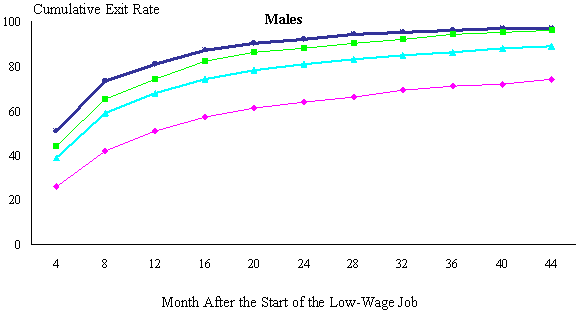 |
| Source: 1996 SIPP longitudinal files using the entry cohort sample. Note: All figures were calculated using the longitudinal panel weight. |
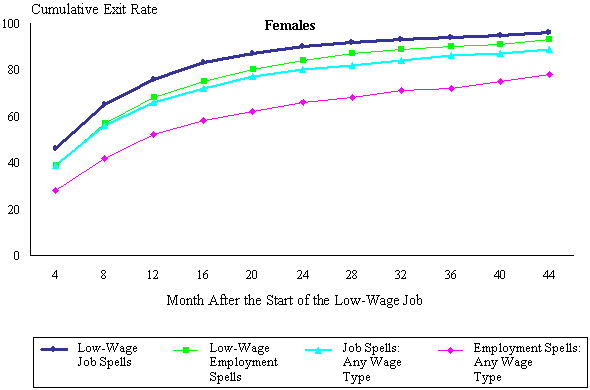
| Total | Type of Exit | ||||
|---|---|---|---|---|---|
| Medium-Wage Job | High-Wage Job | Unemployment | Out of the Labor Force | ||
| Males | |||||
| Number of Months After Start of Low-Wage Job | |||||
| 4 | 44 | 20 | 3 | 11 | 10 |
| 8 | 65 | 28 | 4 | 17 | 15 |
| 12 | 74 | 32 | 5 | 19 | 18 |
| 16 | 82 | 36 | 5 | 21 | 20 |
| 20 | 86 | 38 | 5 | 22 | 21 |
| 24 | 88 | 39 | 6 | 23 | 21 |
| 28 | 90 | 40 | 6 | 23 | 21 |
| 32 | 92 | 41 | 6 | 24 | 22 |
| 36 | 94 | 42 | 6 | 24 | 22 |
| 40 | 95 | 43 | 6 | 24 | 22 |
| 44 | 96 | 43 | 6 | 24 | 23 |
| Females | |||||
| Number of Months After Start of Low-Wage Job | |||||
| 4 | 39 | 13 | 2 | 8 | 16 |
| 8 | 57 | 19 | 3 | 12 | 23 |
| 12 | 68 | 22 | 3 | 14 | 28 |
| 16 | 75 | 25 | 3 | 16 | 32 |
| 20 | 80 | 27 | 3 | 16 | 33 |
| 24 | 84 | 29 | 3 | 18 | 35 |
| 28 | 87 | 30 | 4 | 18 | 36 |
| 32 | 89 | 31 | 4 | 18 | 36 |
| 36 | 90 | 31 | 4 | 18 | 37 |
| 40 | 91 | 31 | 4 | 19 | 37 |
| 44 | 93 | 32 | 4 | 19 | 38 |
| Source: 1996 SIPP longitudinal files using the entry cohort sample of 3,021 low-wage employment spells for males and 4,926 low-wage employment spells for females. Left-censored spells are excluded from the sample. Note: All figures are weighted using the longitudinal panel weight. | |||||
Duration of Alternative Job and Employment Spells
We examined also the duration of low-wage jobs using two alternative definitions of spell end dates. First, we examined job spells, where a spell continued as long as the worker remained with their initial employer regardless of the wage received. Second, we examined employment spells, where a spell continued as long as the worker was employed in any job (regardless of the wage level received).
Not surprisingly, job spells tend to be longer than low-wage job spells (Figure VI.1 and Tables E.3 and E.4). For example, nearly 80 percent of low-wage job spells in our sample ended within one year after job start, compared to only 67 percent of job spells. Similarly, more than 90 percent of low-wage spells ended within 24 months, compared to only about 80 percent of job spells. These findings are due to the significant numbers of low-wage workers who obtained higher-wage jobs with the same employer.
Despite these findings, however, job spells are not long. About two-thirds ended within a year after job start, and more than three-quarters ended within two years. Thus, low-wage workers sometimes obtain higher-wage jobs with the same employer, but many do not remain in these higher-wage jobs for a substantial period of time.
The finding that job spells are not long, however, is not necessarily a negative result, because as discussed in the previous two chapters, among workers who were continuously employed during the follow-up period, those who switched jobs tended to have more positive labor market outcomes than those who remained with their initial employers. Thus, job turnover is an avenue for wage growth for some low-wage workers.
We also find that spell durations tend to be longer for overall employment spells than for overall job spells (Figure VI.1 and Tables E.3 and E.4). For example, one-year cumulative exit rates were about 67 percent for job spells, compared to about 51 percent for employment spells. The two duration distributions differ because a sizeable fraction of low-wage workers moved continuously from a low-wage job to another one or to a higher-paying job with a different employer.
Including Left-Censored Spells
The life table results that include left-censored spells (about 37 percent of all employment spells and 30 percent of all job spells) are similar to those that exclude these spells (Tables VI.4, E.3 and E.4). Cumulative exit rates from employment and job spells in months 4 to 44 are very similar whether or not the left-censored spells are included in the analysis (although the left-censored spells are slightly longer than their comparable non-left-censored spells).(48) These results suggest that the assumptions, discussed above, that are needed to justify the use of the left-censored spells appear to be appropriate (at least for spells that started soon before the panel period).
Comparing The Duration of Low-, Medium-, and High-Wage Spells
How long are the spells of workers who start low-wage jobs compared to those of workers who start medium- and high-wage jobs? The answer to this question can help place in perspective the life table findings for low-wage workers presented above.
To address this question, we compared two types of employment spells for those starting low-, medium-, and high-wage jobs. First, we examined the length of time workers were employed in jobs of the same wage type as their initial job. For example, we examined how long medium-wage workers remained in medium-wage jobs (either with the same employer or with a different one). Second, we examined how long workers were employed at all. For example, we examined how long those starting high-wage jobs were continuously employed in any job and at any wage level.
| Month | Males | Females | ||
|---|---|---|---|---|
| Without Left- Censored Spells | With Left- Censored Spells | Without Left- Censored Spells | With Left- Censored Spells | |
| Number of Months After Start of Low-Wage Job | ||||
| 4 | 26 | 24 | 28 | 25 |
| 8 | 42 | 39 | 42 | 39 |
| 12 | 51 | 46 | 52 | 48 |
| 16 | 57 | 52 | 58 | 54 |
| 20 | 61 | 56 | 62 | 58 |
| 24 | 64 | 59 | 66 | 62 |
| 28 | 66 | 61 | 68 | 65 |
| 32 | 69 | 63 | 71 | 67 |
| 36 | 71 | 65 | 72 | 69 |
| 40 | 72 | 67 | 75 | 72 |
| 44 | 74 | 68 | 78 | 73 |
| 48 | 70 | 74 | ||
| 52 to 104 (1 to 2 Years) | 81 | 85 | ||
| 105 to 156 (2 to 3 Years) | 85 | 91 | ||
| 157 to 208 (3 to 4 Years) | 89 | 94 | ||
| 208 to 260 (4 to 5 Years) | 94 | 97 | ||
| Source: 1996 SIPP longitudinal files using the sample of 3,943 spells for males and 6,832 spells for females. Note: All figures are weighted using the longitudinal panel weight. | ||||
We find that, during the mid- to late 1990s, low-wage employment spells were typically shorter than medium- and high-wage employment spells, especially for males (Figure VI.2, and Tables E.3 and E.4). Furthermore, the differences increased somewhat over time. For example, among male workers, about 74 percent of low-wage employment spells ended within one year after job start, compared to 60 percent of high-wage spells. By 24 months, differences in the cumulative exit rates were larger (88 percent for low-wage employment spells, compared to 70 percent for high-wage employment spells). This suggests that, after an initial adjustment period, higher-wage workers became more and more likely than low-wage workers to remain on their jobs. Differences in spell lengths by wage type, however, are smaller for women. The 24-month cumulative exit rate was 84 percent for females with low-wage employment spells and 76 percent for females with high-wage employment spells.
Although medium- and high-wage employment spells were somewhat longer than low-wage employment spells, they were shorter than expected. The reason is that a nontrivial percentage of medium-wage workers exited into low-wage or high-wage jobs, and a nontrivial percentage of high-wage workers exited into medium-wage jobs. Among medium-wage workers, about 30 percent of males and females ultimately exited into higher-wage jobs, and 28 percent of males and 19 percent of females ultimately exited into low-wage jobs (not shown). Among those starting high-wage job spells, about 37 percent of males and females exited into medium-wage jobs within 44 months.
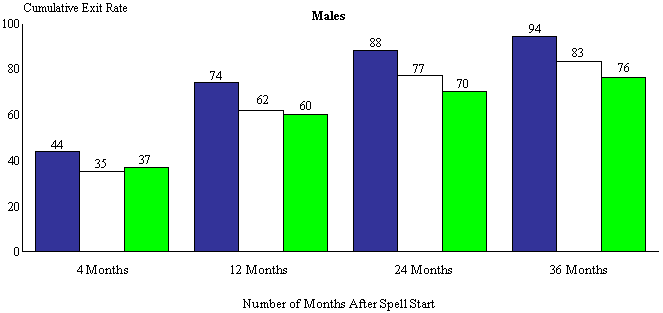 |
| Source: 1996 SIPP longitudinal files using the entry cohort sample. |
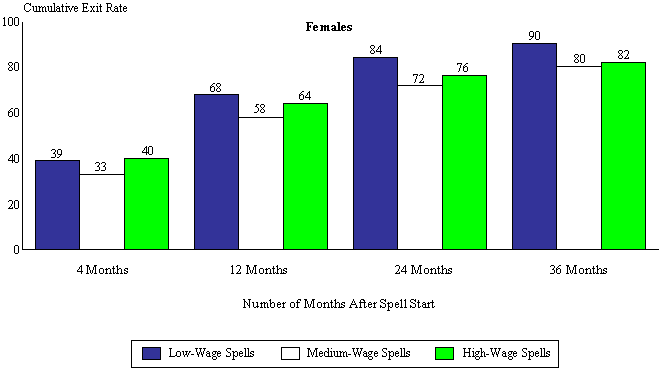
Thus, there is considerable wage movement over time for those starting medium- and high-wage spells, as well as for those starting low-wage spells. These wage fluctuations could be due partly to reporting errors in hourly wages or in monthly earnings and hours worked per week (for those who could not directly report hourly wages) or to temporary changes in labor supply effort or earnings levels (although we "smoothed" the constructed wage measures within waves to help alleviate this problem). We believe, however, that our findings reflect real movements of medium- and high-wage workers across wage categories. This interpretation is supported by findings from the overall employment analysis that many workers in our sample who started higher-wage jobs at the start of the panel period experienced multiple job and employment spells over the three-and-one-half-year follow-up period. Thus, wage and job mobility is common both for higher earners and for low earners.
During the mid- to late 1990s, overall employment spells lasted substantially longer for those starting higher-wage than lower-wage jobs (Figure VI.3, and Tables E.3 and E.4). About 65 percent of low-wage male and female workers became nonemployed within two years after starting their jobs. In contrast, only about 45 percent of medium-wage and 39 percent of high-wage workers became nonemployed over the same period. Thus, although wage fluctuations were common for all groups of workers, unemployment was less of a problem for higher-wage workers than for low-wage ones. Again, our overall employment analysis supports these findings, because over a fixed three-and-one-half-year follow-up period, low-wage workers spent, on average, more than twice as many weeks unemployed than higher-wage workers.
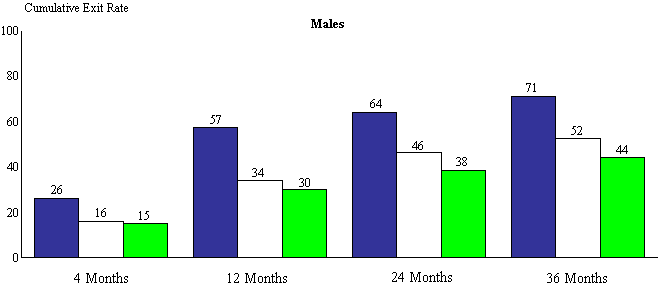 |
| Source: 1996 SIPP longitudinal files using the entry cohort sample of spells. |
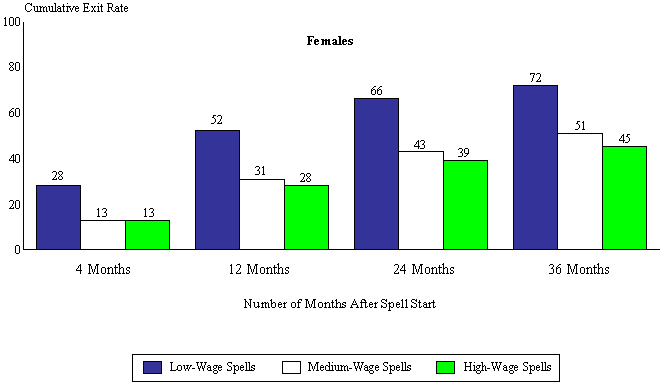
Reentry Into The Low-Wage Labor Market
What happens to low-wage workers after they leave their low-wage jobs? We have seen that during the mid- to late 1990s, about one-half of low-wage job spells ended in higher-wage employment, and about one-quarter ended in nonemployment. In this section, we examine reentry into the low-wage labor market for these workers.
a. Duration of Nonemployment Spells
During the period under investigation, about 47 percent of male low-wage workers and 57 percent of female low-wage workers exited their low-wage employment spells into nonemployment (including unemployment and leaving the labor force; Table VI.3). How long did they stay nonemployed, and what types of jobs did they find when they became reemployed?
Nonemployment spells for low-wage workers were typically short (Table VI.5). Among males in our sample, about two-thirds returned to the labor market within six months after becoming nonemployed, and 80 percent returned within a year. Reemployment rates were somewhat lower for females (51 percent found jobs within six months, and 67 percent found jobs within a year), in part reflecting the higher percentage of females who became nonemployed because they left the labor force. These relatively high reemployment rates may have been due to the strong economy faced by sample members. Nonetheless, they suggest that low-wage workers do not typically remain unemployed for a long time.
Most nonemployed low-wage workers in our sample who became reemployed returned to the low-wage labor market, and fewer entered higher-paying jobs (Table VI.5). Within 24 months after becoming nonemployed, 64 percent of males returned to low-wage jobs, compared to only 23 percent of males who found higher-paying jobs. Stated differently, more than 7 in 10 males who found jobs returned to the low-wage labor market. Similarly, more than 8 in 10 females who became reemployed returned to low-wage jobs.
| Month | Males Workers | Females Workers | ||||
|---|---|---|---|---|---|---|
| Total | Type of Reemployment | Total | Type of Reemployment | |||
| Low-Wage Job | Higher-Wage Job | Low-Wage Job | Higher-Wage Job | |||
| Cumulative Percentage of Spells Ending in Reemployment Within the Specified Number of Months | ||||||
| 1 | 18 | 14 | 4 | 13 | 11 | 2 |
| 2 | 32 | 24 | 8 | 22 | 19 | 3 |
| 3 | 42 | 31 | 10 | 29 | 25 | 4 |
| 4 | 56 | 41 | 15 | 43 | 35 | 7 |
| 5 | 61 | 45 | 16 | 47 | 39 | 8 |
| 6 | 66 | 49 | 17 | 51 | 43 | 9 |
| 7 | 69 | 51 | 17 | 55 | 46 | 9 |
| 8 | 73 | 54 | 19 | 59 | 49 | 10 |
| 9 | 74 | 55 | 19 | 61 | 51 | 10 |
| 10 | 76 | 57 | 20 | 63 | 52 | 11 |
| 11 | 78 | 58 | 20 | 65 | 54 | 11 |
| 12 | 80 | 59 | 21 | 67 | 56 | 12 |
| 13 | 81 | 60 | 21 | 69 | 57 | 12 |
| 14 | 82 | 61 | 21 | 71 | 59 | 12 |
| 15 | 83 | 61 | 21 | 72 | 60 | 12 |
| 16 | 83 | 62 | 22 | 73 | 61 | 13 |
| 17 | 84 | 62 | 22 | 74 | 62 | 13 |
| 18 | 85 | 63 | 22 | 75 | 62 | 13 |
| 19 | 85 | 63 | 22 | 76 | 63 | 13 |
| 20 | 86 | 63 | 22 | 76 | 63 | 13 |
| 21 | 86 | 64 | 22 | 77 | 64 | 13 |
| 22 | 86 | 64 | 22 | 78 | 64 | 13 |
| 23 | 86 | 64 | 23 | 78 | 65 | 14 |
| 24 | 87 | 64 | 23 | 79 | 65 | 14 |
| Source: 1996 SIPP longitudinal files using the sample of 1,277 spells for males and 2,761 spells for females for low-wage workers who exited their low-wage job spells into nonemployment. Note: All figures are weighted using the longitudinal panel weight. | ||||||
b. Duration of Higher-Wage Spells
During the mid- to late 1990s, about 49 percent of low-wage employment spells for males and 36 percent of low-wage employment spells for females ended in medium-wage or high-wage employment within a four-year period (see bottom panel for each gender group in Table VI.3). In this section, we examine the rate at which workers who obtained these higher-paying jobs (1) left these jobs, (2) returned to the low-wage labor market, and (3) became nonemployed.
Our results on the duration of higher-wage employment spells show that the majority of those who obtained higher-wage jobs left these jobs within the panel period, but a significant number also remained in them (Table VI.6). Nearly 60 percent of males and females left the higher-wage labor market within one year after job start, and about 70 percent left within two years. Yet, nearly one-third stayed employed in these high-wage jobs for at least two years. Thus, we again find diversity in the labor market success of low-wage workers.
Interestingly, nearly all those who left higher-wage jobs returned to the low-wage labor market, and only a small percentage exited into nonemployment (Table VI.6). For example, more than one-half of all workers reentered the low-wage labor market within two years, whereas only about 16 percent became nonemployed over the same period. Stated another way, nearly 80 percent of those who left higher-paying jobs reentered the low-wage labor market. These results are consistent with previous findings from the overall employment analysis that many low-wage workers experienced multiple low-wage job spells during the panel period. Consequently, both exits out of and reentry into the low-wage market were common for low-wage workers during the mid- to late 1990s.
| Month | Males Workers | Females Workers | ||||||
|---|---|---|---|---|---|---|---|---|
| Total | Type of Exit | Total | Type of Exit | |||||
| Low-Wage Job | Unemployment | Left the Labor Force | Low-Wage Job | Unemployment | Left the Labor Force | |||
| Cumulative Percentage of Higher-Wage Employment Spells Ending Within the Specified Number of Months | ||||||||
| 1 | 2 | 2 | 0 | 0 | 3 | 2 | 0 | 1 |
| 2 | 6 | 4 | 1 | 1 | 7 | 4 | 1 | 2 |
| 3 | 9 | 6 | 1 | 2 | 10 | 6 | 1 | 2 |
| 4 | 36 | 30 | 3 | 4 | 37 | 31 | 2 | 4 |
| 5 | 38 | 31 | 3 | 4 | 39 | 32 | 2 | 5 |
| 6 | 39 | 32 | 3 | 4 | 41 | 33 | 3 | 5 |
| 7 | 41 | 33 | 3 | 5 | 43 | 34 | 3 | 5 |
| 8 | 50 | 40 | 4 | 5 | 52 | 43 | 3 | 6 |
| 9 | 52 | 41 | 4 | 6 | 54 | 44 | 3 | 7 |
| 10 | 52 | 42 | 5 | 6 | 55 | 44 | 3 | 7 |
| 11 | 53 | 43 | 5 | 6 | 56 | 45 | 4 | 8 |
| 12 | 58 | 46 | 5 | 6 | 60 | 48 | 4 | 8 |
| 13 | 58 | 46 | 5 | 7 | 61 | 48 | 4 | 8 |
| 14 | 59 | 47 | 6 | 7 | 61 | 48 | 4 | 8 |
| 15 | 60 | 47 | 6 | 7 | 61 | 49 | 4 | 8 |
| 16 | 64 | 50 | 7 | 7 | 65 | 51 | 4 | 9 |
| 17 | 64 | 50 | 7 | 8 | 65 | 51 | 4 | 9 |
| 18 | 64 | 50 | 7 | 8 | 66 | 52 | 5 | 10 |
| 19 | 65 | 50 | 7 | 8 | 67 | 52 | 5 | 10 |
| 20 | 66 | 51 | 7 | 8 | 69 | 54 | 5 | 10 |
| 21 | 67 | 52 | 7 | 8 | 69 | 54 | 5 | 11 |
| 22 | 67 | 52 | 7 | 8 | 69 | 54 | 5 | 11 |
| 23 | 67 | 52 | 7 | 8 | 70 | 54 | 5 | 11 |
| 24 | 70 | 54 | 8 | 8 | 71 | 55 | 5 | 11 |
| Source: 1996 SIPP longitudinal files using the sample of 2,061 spells for males and 2,469 spells for females for low-wage workers who exited their low-wage job spells into medium- or higher-wage jobs. Note: All figures are weighted using the longitudinal panel weight. | ||||||||
In sum, the labor market dynamics of low-wage workers are complex. Most low-wage workers find higher-paying jobs at some point. Many, however, return to the low-wage labor market. At the same time, however, a nontrivial share of low-wage workers exit into higher-paying employment and keep these jobs for a substantial period of time. Thus, there is considerable diversity in wage progression among the low-wage worker population, although, on average, their earnings prospects improve over time.
Subgroup Results
There is substantial diversity in job and employment spell durations among low-wage workers. Is it possible to identify subgroups of workers across whom spell durations differ? Identifying these subgroups can provide policy-relevant information as to which subgroups of low-wage workers fare best in the labor market. Furthermore, the analysis can be used to check the robustness of our previous subgroup findings from the overall employment and wage progression analyses.
To keep our presentation manageable, we present subgroup findings on (1) exit rates from low-wage job spells within 12 months after job start by type of exit; and (2) cumulative exit rates from employment spells within 4, 12, and 24 months after job start. We estimated life tables, one at a time, for key subgroups of males and females defined by individual, household, and initial job characteristics.
Because our findings strongly support those presented in previous chapters, we provide less detail on the results than before. In particular, we find that the same subgroups of workers who typically had the best overall employment experiences and wage growth also had the best spell-related outcomes. The concurrence of the subgroup results is not surprising, because we
expected that subgroups of low-wage workers who experienced the most wage progression over the medium term would also be the ones most likely to exit low-wage job spells into higher-wage employment and to have the longest overall employment spells.
a. Overall Duration of Low-Wage Job Spells
Low-wage job spells are typically short across all subgroups defined by worker and initial job characteristics (last column in Tables VI.7 and VI.8). For example, during the mid- to late 1990s, 12-month cumulative exit rates for males in most subgroups ranged from 78 to 85 percent. Similarly, the cumulative exit rates for females typically ranged from 73 to 80 percent.
Nonetheless, some patterns are evident. Low-wage spells were typically longer for older than for younger workers, but as discussed in the next section, this finding masks important age differences in the states into which workers exited. More intuitively, spell durations were likely to be longer for Hispanics, those who did not attend college and those with low wages than for their counterparts. However, exit rate differences across these subgroups are not large.
b. Types of Exits from Low-Wage Job Spells
We find larger subgroup differences in exit types from low-wage job spells:
- The low-wage job spells of workers between the ages of 30 and 60 are much more likely to result in higher-wage employment than for those younger or older. Only about 20 percent of male teenagers in our sample and 8 percent of female teenagers obtained higher-wage jobs within 12 months after job start (either with the same employer or a different one; Tables VI.7 and VI.8). In contrast, the corresponding figures for males and females between ages 30 and 60 were about 40 percent and 25 percent, respectively. Similarly, the younger workers were much more likely than those older to exit into another low-wage job and nonemployment. Thus, it is not surprising that in previous analyses we found that younger low-wage workers typically experience less wage growth than those older.
| Subgroup | 12-Month Cumulative Exit Rate for Males, by Exit Type | Total | |||
|---|---|---|---|---|---|
| Another Low-Wage Job | Higher-WagehJob with the Same Employer | Higher-Wage Job with a Different Employer | Nonemploy-ment | ||
| Overall | 20 | 21 | 12 | 29 | 81 |
| Individual and Household Characteristics | |||||
| Age (in Years) | |||||
| Younger than 20 | 25 | 13 | 7 | 43 | 88 |
| 20 to 29 | 24 | 18 | 13 | 29 | 83 |
| 30 to 39 | 15 | 25 | 14 | 25 | 79 |
| 40 to 49 | 14 | 28 | 11 | 25 | 78 |
| 50 to 59 | 13 | 27 | 12 | 22 | 75 |
| 60 or older | 10 | 19 | 8 | 25 | 62 |
| Race/Ethnicity | |||||
| White and other non-Hispanic | 21 | 22 | 13 | 26 | 83 |
| Black, non-Hispanic | 14 | 18 | 9 | 39 | 80 |
| Hispanic | 21 | 17 | 7 | 32 | 77 |
| Educational Attainment | |||||
| Less than high school/GED | 20 | 16 | 7 | 37 | 79 |
| High school/GED | 20 | 18 | 11 | 30 | 80 |
| Some college | 19 | 27 | 12 | 26 | 84 |
| College graduate or more | 19 | 27 | 20 | 19 | 84 |
| Has a Health Limitation | |||||
| Yes | 17 | 17 | 7 | 45 | 85 |
| No | 20 | 21 | 12 | 28 | 81 |
| Household Type | |||||
| Single parent with children | 19 | 15 | 8 | 39 | 81 |
| Married couple with children | 20 | 23 | 13 | 27 | 82 |
| Married couple without children | 20 | 22 | 10 | 26 | 78 |
| Other adults without children | 19 | 18 | 14 | 32 | 83 |
| Household Income as a Percentage of the Poverty Level | |||||
| 100 percent or less | 22 | 14 | 11 | 34 | 82 |
| 101 to 200 percent | 20 | 19 | 10 | 31 | 80 |
| More than 200 percent | 19 | 23 | 13 | 27 | 82 |
| Job Characteristics | |||||
| Hourly Wages | |||||
| Less than $5.00 | 20 | 18 | 13 | 30 | 81 |
| $5.00 to $5.99 | 23 | 11 | 9 | 33 | 75 |
| $6.00 to $6.99 | 22 | 18 | 11 | 30 | 81 |
| $7.00 to $7.50 | 14 | 33 | 15 | 25 | 87 |
| Hours Worked per Week | |||||
| 1 to 19 | 26 | 9 | 15 | 35 | 86 |
| 20 to 34 | 24 | 13 | 10 | 33 | 81 |
| 35 to 40 | 18 | 20 | 11 | 30 | 79 |
| More than 40 | 17 | 33 | 15 | 20 | 86 |
| Weekly Earnings | |||||
| Less than $150 | 27 | 11 | 13 | 32 | 83 |
| $150 to $299 | 20 | 18 | 11 | 30 | 79 |
| $300 to $600 | 13 | 38 | 14 | 24 | 88 |
| Owns Business | |||||
| Yes | 14 | 40 | 25 | 12 | 90 |
| No | 20 | 20 | 11 | 30 | 81 |
| Health Insurance Coverage(a) | |||||
| Yes | 18 | 26 | 14 | 24 | 82 |
| No | 21 | 17 | 10 | 33 | 81 |
| Occupation | |||||
| Professional/technical | 15 | 35 | 18 | 17 | 86 |
| Sales/retail | 23 | 27 | 10 | 20 | 81 |
| Administrative support/clerical | 17 | 20 | 11 | 30 | 79 |
| Service professions/ handlers/cleaners | 22 | 14 | 10 | 35 | 80 |
| Machine/construction/production/transportation | 17 | 25 | 13 | 27 | 83 |
| Farm/agricultural/other workers | 22 | 15 | 10 | 35 | 82 |
| Industry | |||||
| Agriculture/forestry/ fishing/hunting | 20 | 20 | 12 | 31 | 83 |
| Mining/manufacturing/construction/transportation/utilities | 18 | 25 | 13 | 28 | 83 |
| Wholesale/retail trade | 22 | 17 | 10 | 29 | 79 |
| Personal/health/other services | 19 | 18 | 11 | 32 | 81 |
| Other | 14 | 40 | 22 | 12 | 89 |
| Source: 1996 SIPP longitudinal files using the entry cohort sample of 4,489 low-wage job spells for males. Left-censored spells were excluded from the sample. Note: All figures are weighted using the longitudinal panel weight. a. These figures pertain to health insurance coverage from all sources, including coverage through the employer as well as from other sources. We used this variable instead of the employer-based health insurance coverage variable, because data on overall health insurance coverage is available monthly, whereas the employer-based coverage variable pertains only to jobs in progress at the time of the interview. Thus, the employer-based health insurance variable could not always be linked to the job under investigation, which led to a significant number of missing values. However, the subsets of health insurance variables overlap considerably: the source of health insurance coverage was the employer for 80 percent of those with any coverage. | |||||
| Subgroup | 12-Month Cumulative Exit Rate for Females, by Exit Type | Total | |||
|---|---|---|---|---|---|
| Another Low-Wage Job | Higher-WagehJob with the Same Employer | Higher-Wage Job with a Different Employer | Nonemploy-ment | ||
| Overall | 22 | 14 | 8 | 33 | 76 |
| Individual and Household Characteristics | |||||
| Age (in Years) | |||||
| Younger than 20 | 29 | 4 | 4 | 44 | 82 |
| 20 to 29 | 25 | 13 | 8 | 35 | 81 |
| 30 to 39 | 21 | 15 | 7 | 31 | 75 |
| 40 to 49 | 19 | 18 | 8 | 24 | 70 |
| 50 to 59 | 15 | 17 | 9 | 26 | 67 |
| 60 or older | 14 | 14 | 1 | 33 | 62 |
| Race/Ethnicity | |||||
| White and other non-Hispanic | 23 | 15 | 8 | 30 | 76 |
| Black, non-Hispanic | 20 | 12 | 5 | 39 | 76 |
| Hispanic | 20 | 12 | 6 | 37 | 74 |
| Educational Attainment | |||||
| Less than high school/GED | 23 | 6 | 3 | 43 | 76 |
| High school/GED | 22 | 13 | 6 | 33 | 73 |
| Some college | 25 | 17 | 9 | 30 | 80 |
| College graduate or more | 19 | 22 | 14 | 24 | 80 |
| Has a Health Limitation | |||||
| Yes | 23 | 8 | 5 | 46 | 81 |
| No | 22 | 15 | 8 | 31 | 76 |
| Household Type | |||||
| Single parent with children | 24 | 11 | 6 | 37 | 78 |
| Married couple with children | 19 | 15 | 6 | 34 | 76 |
| Married couple without children | 23 | 15 | 8 | 27 | 73 |
| Other adults without children | 26 | 15 | 11 | 27 | 79 |
| Household Income as a Percentage of the Poverty Level | |||||
| 100 percent or less | 25 | 7 | 5 | 40 | 77 |
| 101 to 200 percent | 22 | 11 | 6 | 36 | 76 |
| More than 200 percent | 21 | 18 | 9 | 28 | 76 |
| Job Characteristics | |||||
| Hourly Wages | |||||
| Less than $5.00 | 24 | 10 | 7 | 37 | 78 |
| $5.00 to $5.99 | 26 | 6 | 5 | 37 | 74 |
| $6.00 to $6.99 | 22 | 13 | 7 | 31 | 73 |
| $7.00 to $7.50 | 15 | 31 | 11 | 24 | 82 |
| Hours Worked per Week | |||||
| 1 to 19 | 24 | 10 | 7 | 38 | 80 |
| 20 to 34 | 26 | 9 | 7 | 35 | 77 |
| 35 to 40 | 19 | 17 | 7 | 30 | 74 |
| More than 40 | 21 | 21 | 11 | 27 | 80 |
| Weekly Earnings | |||||
| Less than $150 | 26 | 9 | 7 | 38 | 79 |
| $150 to $299 | 22 | 14 | 7 | 31 | 73 |
| $300 to $600 | 12 | 40 | 13 | 22 | 87 |
| Owns Business | |||||
| Yes | 15 | 27 | 20 | 19 | 81 |
| No | 22 | 14 | 7 | 33 | 76 |
| Health Insurance Coverage(a) | |||||
| Yes | 18 | 19 | 10 | 28 | 74 |
| No | 26 | 10 | 5 | 37 | 78 |
| Occupation | |||||
| Professional/technical | 17 | 29 | 11 | 24 | 80 |
| Sales/retail | 25 | 10 | 7 | 35 | 78 |
| Administrative support/clerical | 19 | 23 | 10 | 26 | 77 |
| Service professions/ handlers/cleaners | 25 | 9 | 6 | 34 | 74 |
| Machine/construction/ production/transportation | 17 | 12 | 5 | 38 | 73 |
| Farm/agricultural/other workers | 21 | 7 | 5 | 49 | 82 |
| Industry | |||||
| Agriculture/forestry/ fishing/hunting | 15 | 17 | 13 | 35 | 81 |
| Mining/manufacturing/ construction/ transportation/utilities | 17 | 16 | 5 | 36 | 75 |
| Wholesale/retail trade | 26 | 9 | 6 | 35 | 77 |
| Personal/health/other services | 21 | 17 | 8 | 29 | 75 |
| Other | 18 | 31 | 17 | 10 | 77 |
| Source: 1996 SIPP longitudinal files using the entry cohort sample of 7,401 low-wage job spells for females. Left-censored spells were excluded from the sample. Note: All figures are weighted using the longitudinal panel weight. a. These figures pertain to health insurance coverage from all sources, including coverage through the employer as well as from other sources. We used this variable instead of the employer-based health insurance coverage variable, because data on overall health insurance coverage is available monthly, whereas the employer-based coverage variable pertains only to jobs in progress at the time of the interview. Thus, the employer-based health insurance variable could not always be linked to the job under investigation, which led to a significant number of missing values. However, the subsets of health insurance variables overlap considerably: the source of health insurance coverage was the employer for 80 percent of those with any coverage. | |||||
- White workers are more likely to obtain higher-paying jobs than minority workers. During the mid- to late 1990s, the 12-month cumulative exit rate into higher-wage jobs was 39 percent for white males, compared to 27 percent for African American males, and 24 percent for Hispanic males. A similar pattern holds for females. In addition, more minorities exited into nonemployment, which we have seen is a state from which many return to the low-wage labor market.
- Education level is strongly associated with entry into the higher-wage labor market for both men and women. Nearly one-half of low-wage job spells for males who completed some college ended in a higher-paying job, compared to 29 percent for those with a high school credential only, and 23 percent for those who did not complete high school. Differences in cumulative exit rates by education level are even larger for females (ranging downward from 36 percent for college graduates to 9 percent for high school dropouts). Correspondingly, rates of exit into nonemployment substantially decreased with education level.
- Those with health limitations tend to have poor spell-related outcomes. Workers with health problems are likely to exit their low-wage jobs into nonemployment, and only a small percentage exit directly into higher-wage jobs. Thus, it is not surprising that our previous subgroup analyses found that those with health limitations are at particular risk of poor labor market outcomes.
- Entry into higher-paying jobs is less prevalent for lower-income households than for wealthier ones. Within a year after job start, about 27 percent of female sample members in households with incomes more than twice the poverty level experienced exits into high-wage employment, compared to only 12 percent for females in households with incomes below the poverty level. Consistent with these results, we find poorer spell outcomes for females in single-parent households than for females in other types of households. However, as has been the case throughout our study, there is considerable diversity in spell outcomes within household income groups; for example, nearly 30 percent of females in the wealthiest households exited their low-wage job spells into nonemployment, and 21 percent exited their jobs into another low-wage job.
- Job quality matters: those with better jobs tend to have more positive spell outcomes than those in lower-quality jobs. Those whose initial jobs offer higher hourly wages, more work hours, and health benefits are more likely to move into higher-paying jobs than those in lower-quality jobs. For example, during the mid- to late 1990s, 29 percent of female workers with available health insurance coverage entered high-wage employment, compared to only 15 percent of female workers without this fringe benefit. The corresponding figures for males are 40 percent and 27 percent, respectively.
- Entry rates into higher-paying jobs are much higher for the self-employed than for jobholders. For example, nearly two-thirds of male business owners in our sample became higher-wage workers within one year, compared to only 31 percent of jobholders. These findings are consistent with earlier results that the wages of self-employed workers grow substantially faster than those of other workers, even though they start their jobs with lower wages.
- Those in professional or technical occupations experience the most movement into higher-wage employment. Among males, those in sales occupations experience the next best spell-related outcomes, and those in service occupations experience the worst ones. Among females, those in clerical positions perform nearly as well as those in professional positions, although there are few differences in performance across those in other occupations. These results are identical to those found in our previous subgroup analyses.
c. Duration of Employment Spells
The ordering of subgroups for those with the longest to shortest employment spells (of any wage type) are similar to the ordering of subgroups discussed above. This occurs because subgroups most likely to exit into higher-wage employment were also those least likely to exit into nonemployment. Consequently, subgroups that tended to obtain higher-paying jobs also tended to have the longest employment spells. The life table results for employment spells are presented in Tables E.5 and E.6, which also show log-rank statistics to test differences in hazard rate distributions across subgroup levels. Many of the subgroup differences are statistically significant.
(45) This job mobility, however, is not necessarily a negative result, because as discussed in the previous two chapters, among workers who were continuously employed during the follow-up period, those who switched jobs tended to have more positive labor market outcomes than those who remained with their initial employers. Thus, it appears that job mobility is an avenue for wage growth for some low-wage workers.
(46) The log-rank statistic compares the actual to expected monthly hazards, where the expected hazards are calculated under the null hypothesis that the monthly hazard rates are the same for each level of the subgroup. The log-rank statistic has a chi-squared distribution with the degrees of freedom equal to one less than the number of life tables being compared.
(47) The mean spell lengths pertain to those observed during the panel period, including the right-censored spells. Thus, the figures are shorter than the ultimate mean lengths of the spells. The spell durations for left-censored spells include the time spent in the spell during the prepanel period.
(48) We did not include left-censored spells when examining the durations of low-wage job and employment spells, because most of these spells ended during the panel period. Thus, the inclusion of the left-censored spells would not provide any new information.
Summary and Conclusions
Our analysis provides a complex picture of the characteristics of low-wage workers and their jobs, as well as their labor market dynamics. During the mid- to late 1990s, the share of all workers at a point in time who were low-wage workers defined as those earning less than the hourly wage at which a full-time worker would have annual earnings below the poverty level for a family of four was about 28 percent. Low-wage workers were disproportionately young, female, nonwhite, with a high school credential or less, in single-adult households with children, and in households with incomes below the poverty level. At the same time, however, they are a relatively diverse group they exist in a wide range of subgroups defined by individual and household characteristics.
We find that many low-wage workers receive hourly wages substantially below the low-wage cutoff value used in this study, and hold jobs that are markedly less stable and that provide fewer benefits than jobs held by higher-wage workers. Interestingly, however, most report that they usually work full-time. Low-wage workers are represented in all occupations and industries, but they are disproportionately found in retail trade industries, service occupations, and nonunion jobs.
Low-wage workers in our sample were employed for most of the three-and-one-half year follow-up period, and the majority held higher-paying jobs at some point. Low-wage workers were employed about 79 percent of weeks, which may reflect the strong economic conditions during the mid- to late 1990s. About 70 percent of male and 50 percent of female workers held higher-wage jobs at some point during the follow-up period. Overall, males spent an average of about 30 percent of the time in higher paying jobs, and the corresponding figure for females was about 20 percent. While these figures are less than the total time spent in low-wage jobs (55 percent of months for males and 58 percent of months for females), employment rates in higher-wage jobs increased over time for both males and females. For instance, during the second half of the follow-up period, males spent roughly equal amounts of time in low-wage and higher-wage jobs.
We find also, that during the mid- to late 1990s, low-wage workers moved frequently into and out of the low-wage labor market. Most held multiple jobs (an average of 3 jobs during the three-and-one-half-year follow-up period), and low-wage job spells were typically short about three-quarters ended within a year. Low-wage workers often exited their low-wage jobs directly into higher-wage jobs, although many also exited into other low-wage jobs or into nonemployment. Many exiters, however, also returned to the low-wage labor market.
We find significant wage growth for low-wage workers in our sample. Overall, the average real wage increase was about 25 percent during the follow-up period (for those employed at the start and end of the period). In addition, about three-quarters of workers experienced an increase in real wages, with some experiencing significant amounts of wage growth. Furthermore, low-wage workers tended to move into better jobs (as measured by hours worked and available fringe benefits). Despite this wage growth, however, many workers still had low earnings. Because they started at fairly low wage levels, by the end of the follow-up period, more than one-half of workers had earnings that would put them below the federal poverty level for a family of four.
We conducted subgroup analyses to try to explain the diversity in labor market outcomes across low-wage workers. Our analysis consistently found that, among the low-wage population, males, prime-age workers (those between ages 20 and 60), educated workers, whites, those without health limitations, and those in wealthier households typically spent more time in higher-wage jobs and experienced more wage growth than their respective counterparts. Furthermore, job quality matters those who start with better jobs (measured by higher initial wages, health insurance coverage, and full-time work status) are more likely to experience wage growth than those in lower-quality jobs. In addition, we find some differences across occupations males in professional and sales occupations and females in professional and clerical occupations have more positive labor market outcomes than other workers. Business owners were also more likely than jobholders to experience greater wage growth.
We find several interesting results about the association between overall employment experiences during the follow-up period and wage growth. First, wage progression was greater for those who were employed for most of the period than those employed less, suggesting that policies promoting employment retention could improve the wage growth of low-wage workers. Second, among workers continuously employed during the follow-up period, those who switched jobs tended to have better outcomes than those who stayed with their same employer, suggesting that job turnover was an avenue for wage growth for some low-wage workers.
At the same time, however, substantial diversity exists in labor market success within worker subgroups. Thus, although we identified groups that are of particular risk of poor labor market outcomes, we could not fully account for the variation in labor market outcomes across low-wage workers. Clearly, important residual factors affect the wage progression of those starting low-wage jobs.
In sum, our results clearly indicate that low-wage workers have some upward mobility over the medium term. At the same time, however, a segment of the low-wage population remains entrenched in low-wage jobs. Thus, there is considerable diversity in labor market success for low-wage workers. These findings are inevitable in a study such as this, and the extent to which the findings are interpreted as positive or negative depends on whether one views the glass as half empty or half full. Of course, it has to be kept in mind that the economic conditions were very strong during the mid- to late 1990s, and our results for the employment prospects of low-wage workers may be different under a weaker economy.
References
Acs, Gregory. A Profile of Low-Wage Workers. Washington DC: The Urban Institute, 1999.
Acs, Gregory, Katherin Ross, and Daniel McKenzie. "Chapter 2--Playing by the Rules, but Losing the Game: Americans in Low-Income Working Families." in Low-Wage Workers in the New Economy. Edited by Richard Kazis and Marc S. Miller, Washington, DC: The Urban Institute Press, 2001, pp. 21-44.
Bartik, Timothy. "Short-Term Employment Persistence for Welfare Recipients: The Effects of Wages, Industry, Occupation, and Firm Size." W.E. Upjohn Institute for Employment Research Mimeo, June 1997.
Bernstein, Jared, and Heidi Hartmann. "Chapter 1--Defining and Characterizing the Low-Wage Labor Market." in The Low-Wage Labor Market. Edited by Kelleen Kaye and Demetra Smith Nightingale, Washington, DC: The Urban Institute Press, 2000, pp. 15-40.
Blank, Rebecca. "Outlook for the U.S. Labor Market and Prospects for Low-Wage Entry Jobs." in The Work Alternative: Welfare Reform and the Realities in the Job Market. Edited by Demetra Nightingale and Robert Haveman. Washington, DC: The Urban Institute Press, 1995.
Burtless, Gary. "Employment Prospects of Welfare Recipients." in The Work Alternative: Welfare Reform and the Realties of the Job Market. Edited by Demetra Nightingale and Robert Haveman. Washington, DC: The Urban Institute Press, 1995.
Card, David, and Rebecca Blank. "Introduction--Job Change and Job Stability Among Less Skilled Young Workers." in Finding Jobs: Work and Welfare Reform. Edited by David Card and Rebecca M. Blank, New York: The Russell Sage Foundation, 2000, pp. 1-19.
Carnevale, Anthony P., and Stephen J. Rose. "Chapter 3--Low Earners: Who Are They? Do They Have a Way Out?" in Low-Wage Workers in the New Economy. Edited by Richard Kazis and Marc S. Miller, Washington, DC: The Urban Institute Press, 2001, pp.45-66.
Corcoran, Mary and Susanna Loeb. "Welfare, Work Experience, and Economic Self-Sufficiency." U. of Michigan Mimeo, 1999.
Duncan, Greg J., Johanne Boisjoly, and Timothy M. Smeeding. "Slow Motion: Economic Mobility of Young Workers in the 1970s and 1980s." Income Security Policy Series, Paper No. 11, Syracuse, NY: Center for Policy Research, Maxwell School of Citizenship and Public Affairs, Syracuse University, September 1995.
Gardner, Jennifer and Diane Herz. "Working and Poor in 1990." in Monthly Labor Review. December 1992, pp 20-28.
Gladden, Tricia, and Christopher Taber. "The Relationship Between Wage Growth and Wage Levels." Paper prepared for the Joint Center for Poverty Research, October 26, 2000a.
Gladden, Tricia, and Christopher Taber. "Chapter 4--Wage Progression Among Less Skilled Workers." in Finding Jobs: Work and Welfare Reform. Edited by David Card and Rebecca M. Blank, New York: The Russell Sage Foundation, 2000b, pp. 160-192.
Gottschalk, Peter. "Inequality, Income Growth, and Mobility: The Basic Facts." in The Journal of Economic Perspectives. Vol. 11, No. 2, Spring 1997, pp. 21-40.
Gottschalk, Peter. "Chapter 8--Work as a Stepping-Stone for Welfare Recipients: What Is the Evidence?" in The Low-Wage Labor Market. Edited by Kelleen Kaye and Demetra Smith Nightingale, Washington, DC: The Urban Institute Press, 2000, pp. 171-184.
Hale, Thomas. "The Working Poor." in Monthly Labor Review. September 1997, pp 47-48.
Holzer, Harry J., and Robert J. Lalonde. "Chapter 3--Job Change and Job Stability Among Less Skilled Young Workers." in Finding Jobs: Work and Welfare Reform. Edited by David Card and Rebecca M. Blank, New York: The Russell Sage Foundation, 2000, pp. 125-159.
Holzer, Harry, Julia I. Lane, Lars Vilhuber, Henry Jackson, and George Putnam. Escaping Poverty for Low-Wage Workers: The Role of Employer Characteristics and Changes. Report prepared for the U.S. Census Bureau's Longitudinal Employer-Household Dynamics Program, June 2001.
Kim, Marlene. "Are the Working Poor Lazy?" in Challenges. Vol. 41, no. 3, 1998, pp 85-99.
Klein, Bruce and Philip Roens. "A Profile of the Working Poor." in Monthly Labor Review. October 1989, pp 3-13.
Light, Audrey and Manuelita Ureta. "Panel Estimates of Male and Female Job Turnover Behavior: Can Female Nonquitters Be Identified?" in Journal of Labor Economics. Vol. 10, no. 2, 1992, pp. 156-181.
Long, Sharon K., and Alberto Martini. "Wages and Employment Among the Working Poor: New Evidence from SIPP." Paper No. 9014, Paper prepared for the Bureau of the Census, U.S. Department of Commerce, November 1990.
Mishel, Lawrence, Jared Bernstein, and John Schmitt. The State of Working America 2000-2001. Ithaca, NY: ILR Press, Cornell University Press, 2001.
Mitnik, Pablo A., Matthew Zeidenberg, and Laura Dresser. "Can Career Ladders Really Be a Way Out of Dead-End Jobs? A Look at Job Structure and Upward Mobility in the Service Industries." Madison, WI: Center on Wisconsin Strategy, 2002.
Osterman, Paul. "Chapter 4--Employers in the Low-Wage/Low-Skill Labor Market" in Low-Wage Workers in the New Economy. Edited by Richard Kazis and Marc S. Miller, Washington, DC: The Urban Institute Press, 2001, pp.45-66.
Pavetti, LaDonna, and Gregory Acs. "Moving Up, Moving Out or Going Nowhere? A Study of the Employment Patterns of Young Women." Washington, DC: The Urban Institute, 1997.
Rangarajan, Anu, Peter Schochet, and Dexter Chu. "Employment Experiences of Welfare Recipients Who Find Jobs: Is Targeting Possible?" Princeton, NJ: Mathematica Policy Research, Inc., August 1998.
Royalty, Anne Beeson. "Job-to-Job and Job-to-Nonemployment Turnover by Gender and Education Level." in Journal of Labor Economics, Vol. 16, No. 2, April 1998, pp. 392-443.
Ryscavage, Paul. "A Perspective on Low-Wage Workers." in Current Population Reports, No. P70-57, Newsletter from the U.S. Census Bureau, August 1996.
Schiller, Bradley. "Who Are the Working Poor?" in The Public Interest. Spring 1994,
pp 61-71.
Schwarz, John and Thomas Volgy. The Forgotten Americans. New York: W.W. Norton and Company, 1992
Smith, Ralph E., and Bruce Vavrichek. "The Wage Mobility of Minimum Wage Workers." in Industrial & Labor Relations Review, Vol. 46, No. 1, October 1992, pp. 82-88.
Topel, Robert H., and Michael P. Ward. "Job Mobility and the Careers of Young Men." in The Quarterly Journal of Economics, Vol. CVII, Issue 2, May 1992, pp. 439-479.
U.S. Census Bureau. Statistical Abstract of the United States. Washington, DC: 1985 to 2001.
Appendix A: Data, Wage Definitions, Analysis Samples, and Methodological Approach
The 1996 longitudinal panel of the Survey of Income and Program Participation (SIPP), collected by the U.S. Bureau of the Census, is the primary data source that we used for examining the low-wage labor market in our study. Because of the wide range of study questions, we used different samples and methodological approaches for different types of analyses. We discuss these issues in this methodological appendix.
Data
The 1996 SIPP is a large, multipanel, longitudinal survey that collected demographic and socioeconomic information on a nationally representative sample of U.S. households. The data cover the period from late 1995 to early 2000. SIPP provides detailed monthly measures on labor force participation (for those age 15 and older), income, participation in public programs, and household composition. Our study also used data from several SIPP topical modules that contain information on supplemental topics and on sample members' experiences before the beginning of the panel period. Finally, the SIPP data were supplemented with state-level data on the economic conditions and poverty levels in the states.
Advantages of the SIPP Data for the Study
The 1996 SIPP panel is particularly well suited for the study, for several reasons. First, because it covers a period between late 1995 and early 2000, we can examine the dynamics of the low-wage labor market during the post-PRWORA period. Second, because it contains detailed monthly information on jobs each sample member held during the panel period, we can conduct individual-level longitudinal analyses of employment spells and wage progression.
The SIPP data also have several advantages over other national data sets. Cross-sectional data sets, such as the March Current Population Survey (CPS), can provide point-in-time information on low-wage workers, but they do not allow analyses of individual-level employment and earnings experiences over time. The Panel Study of Income Dynamics (PSID), begun in 1968, is a longitudinal study of a representative sample of people in the United States that contains information through 1999. Thus, the PSID covers the post-PRWORA period and, because it is a long panel, has more information than SIPP on employment histories. However, because PSID data have been collected annually (and recently every other year), compared to every four months for SIPP, recall error is likely to be larger in the PSID. This is a particularly important problem for this study, because the job spells of many low-wage workers are likely to be short. Furthermore, sample sizes are much larger in SIPP (more than 40,000 households were sampled for the 1996 SIPP, whereas the 1999 PSID contains information on only about 7,000 families). The National Longitudinal Survey of Youth (NLSY) is limited to people who were ages 14 to 21 in 1978, so data from the NLSY are not well suited for examining the experiences of low-wage workers of all ages.
Description of the 1996 SIPP Panels
Adults followed in the SIPP panel come from a nationally representative sample of households in the civilian, noninstitutionalized population of the United States. Sample members were interviewed once every four months during the 48-month panel period. If original (primary) sample members older than age 14 moved from their original residences, they were interviewed at their new addresses. Secondary sample members--those who were not part of the original sample but who lived with primary sample members after the first interview--were interviewed if they were in the same household as primary sample members.
The Census Bureau used multistage sampling techniques to select a representative set of households for the 1996 SIPP panels. The first interviews for the panel began in April 1996 with a sample of 40,188 households and 95,402 primary sample members, where households in the low-income stratum were sampled at 1.66 times the rate of the higher-income stratum. (1) Sample households were divided into four "rotation groups" of roughly equal size, and one rotation group was interviewed each month. Thus, each household was interviewed in four-month intervals, called "waves." The 1996 SIPP contains 12 waves, which provide 48 months of data for each person in the sample.(2)
At each interview, sample members provided information about their experiences during the preceding four-month period, called the "reference period." For example, people in rotation group 1 whose wave 1 interviews were conducted in April 1996 (the earliest interviews) were asked about their experiences between December 1995 and March 1996. Similarly, people in rotation group 4 whose wave 12 interviews were conducted in March 2000 (the latest interviews) were asked about their experiences between November 1999 and February 2000. Thus, the 12 reference periods for the 1996 SIPP panel cover December 1995 through February 2000.
The 1996 SIPP interviews were administered using computer-assisted interviewing (CAI) to increase data quality. CAI, used for the first time in the 1996 SIPP, permitted automatic consistency checks of reported data during the interview and allowed for the use of prior-wave data for editing missing data.
The SIPP questionnaire is made up of the core questions and the topical modules. The core questions provide information on (1) demographic characteristics; and (2) work behavior, income, and program participation for each of the four months preceding the interview date. The core questions were asked in every wave interview. Sample members were asked the topical module questions after the core questions. The content of the topical module changed from wave to wave. For our purposes, the topical modules administered in wave 1 are of special interest, because they contain information on respondents' prepanel experiences (see Section 4 below).
The 1996 SIPP Longitudinal Research File
The Census Bureau constructed a full-panel, longitudinal research file by linking the data collected for each sample person over the life of the panel. Unlike the individual core wave files that contain one record per person-month, the longitudinal file contains one record per person. The longitudinal sample that this research file represents consists of all primary sample members who have complete data (either reported or imputed) for every month of the panel (excluding months of ineligibility). This longitudinal sample contains 55,484 people and is the main sample that was used for the analysis.
The 1996 longitudinal file contains a smaller percentage of all primary sample members than in previous SIPP panels, for several reasons. First, sample attrition was higher in the 1996 panel than in earlier panels because the 1996 panel was longer (12 waves, compared to 8 waves in previous panels). For example, the sample loss rate was 35.5 percent by the end of wave 12 in the 1996 panel, but it was 26.9 percent by the end of wave 8 in the 1993 panel.(3) Second, in creating the final data files, the Census Bureau typically performs imputations for missing responses to individual questions or to entire wave interviews (see U.S. Census Bureau 2003, SIPP Data Editing and Imputation), thereby increasing the sample size in the analysis files. In creating the 1996 SIPP data files currently available, however, the Census Bureau has performed fewer imputations than in previous panels.(4)
The longitudinal research file is available online using the FERRET system. As the Census Bureau specifies, however, this system is efficient (practical) only for downloading a small number of variables, because variable requests must be performed separately for each variable using a series of menus and because downloading even a few variables takes considerable time. Our study employs a large number of variables, so we did not use the FERRET system to obtain the longitudinal data needed for the analysis.
Instead, we downloaded (from the SIPP Web page) the entire ASCII database for each of the 12 individual core wave files and constructed our own longitudinal file following the same procedures the Census Bureau used to construct its longitudinal file. Specifically, we "flattened" each core file to obtain one record per person (rather than per person-month) and merged these 12 flattened files using the unique person identification code (LGTKEY). We compared key selected variables (such as earnings and hourly wage rates) in our constructed longitudinal file to those in the longitudinal file on the FERRET system and found the variables to be identical in both data files.
Finally, to take into account nonresponse, sample attrition, and the complex sample design of the 1996 SIPP (including the oversampling of poor households), the longitudinal research file contains panel weights (which we downloaded using the FERRET system). These weights make the SIPP longitudinal sample representative of the noninstitutionalized, resident population of the United States as of March 1996 (the only month common to all four rotation groups in wave 1).(5) We used weights throughout the statistical analyses and adjusted the standard errors of our estimates to account for design effects due to weighting and clustering.
Topical Modules
The topical modules contain more detailed information on particular topics than are contained in the core files. We used data from the topical modules to construct explanatory variables for the multivariate analysis.
The wave 1 topical module contains retrospective information on sample members' prepanel activities and experiences. The most important such information for this study concerns prepanel employment experiences (including the number of years the respondent worked at least six months, breaks from the labor force, the date last worked, and whether the respondent generally worked 35 or more hours per week since he or she first started working at least six months per year). Unlike previous SIPP panels, information on the starting dates for those in the middle of job spells at the start of the SIPP panel period (that is, who have left-censored job spells) are in the wave 1 core file and not in the topical module.
Several topical modules contain information on work schedules and health status. Data on work schedules are contained in the wave 4 and wave 10 topical modules. However, as discussed later, most of our analysis was conducted using samples of workers who began low-wage jobs at the start of the panel period (that is, in waves 1 and 2), and our analysis described the characteristics of low-wage workers and their jobs at the start of these jobs. Thus, the data on work schedules was collected too late to be useful for our study, so we did not use them in the analysis. For a similar reason, we did not use the detailed information on functional limitations and disabilities contained in topical modules 5 and 11.(6) However, we did use in the analysis the health status variable contained in each core data file concerning whether the respondent had a physical, mental, or other health condition that limited the kind or amount of work that could be done.
State-Level Data
The state-level data for our analysis included information on states' economic conditions. We merged this state-level information by month or year (depending on data availability) to the SIPP data file using monthly (annual) information on the state in which each sample member lived.(7) We used this information to explore the relationship between state characteristics and the dynamics of the low-wage labor market in the multivariate analysis.
We used variables from the following categories of state economic indicator variables that are intended to proxy for the labor market situation faced by SIPP sample members:
- Unemployment rate and the change in the unemployment rate during the follow-up period (Source: U.S. Department of Labor's Bureau of Labor Statistics [BLS])
- Employment growth per capita (Source: BLS)
- Poverty rate (source: Statistical Abstract of the United States)
- Household median income (source: Statistical Abstract of the United States)
- 20th percentile of monthly wages of employed people age 18 and older
- Per-capita income (source: Bureau of Economic Analysis)
- Real minimum wage (source: Statistical Abstract of the United States)
- Mean wage in the manufacturing industry
Rural population share
Although we initially included all these measures as explanatory variables in our multivariate models, we ultimately narrowed the list because of the high correlation among many of the state-level measures. This high degree of multicollinearity increased the standard errors of all parameter estimates and made it difficult to isolate the separate effects of each of the state-level measures. The final list of explanatory variables included (1) the unemployment rate measures, (2) the poverty rate measure, (3) the 20th percentile of monthly wages, and (4) the rural population share.
Defining Low-Wage Workers
A central analysis issue for the study is how to define low-wage workers. As discussed in detail in Chapter II, researchers have used a variety of definitions of the low-wage labor market, and each definition has advantages and disadvantages. Because of project budget constraints, it was not feasible to conduct analyses using each of these measures. Therefore, we needed to select among the alternative measures.
Our primary approach for defining low-wage workers was to use the hourly wage at which a full-time worker would have annual earnings below poverty for a family of four. We calculated separate low-wage cutoff values for each calendar year the SIPP panel covered. We then classified a worker as "low-wage" if the worker's wage rate was less than the cutoff level in the calendar year when the wage rate was reported. Using U.S. Department of Health and Human Services poverty guidelines and assuming a full-time worker works 2,080 hours per year, we set the low-wage cutoff at $7.50 in 1996, $7.72 in 1997, $7.91 in 1998, $8.03 in 1999, and $8.20 in 2000. We also defined medium-wage workers as those with wage rates between one and two times the low-wage cutoff value and higher-wage workers as those with wages more than twice the low-wage cutoff value.
We adopted the absolute low-wage cutoff approach so that the analysis could focus on low-wage workers and their jobs based on a well-defined cutoff value. We did not use the minimum wage as the absolute wage cutoff value, because it sets the bar too low for defining the low-wage labor market. We rejected using definitions based on family income levels, because that approach would be appropriate for examining working poor households rather than low-wage workers.
We used the absolute wage cutoff rather than a relative wage cutoff, because the relative wage cutoff allows for no change over time in the fraction of the labor force that is defined as low wage, even if living standards of low-income workers change. For example, under the relative wage approach, a worker earning a wage rate at the 20th percentile of the wage distribution at two time points would be classified as a low-wage worker at each point, even if the wage distribution for low-wage workers shifted over time (that is, even if the worker's wage rate changed). Thus, the relative wage approach would provide less information than the absolute wage cutoff approach on the extent to which low-wage workers enter and exit the low-wage labor market over time. Furthermore, we rejected using a definition based on the skill levels of workers, because not all workers in the low-wage labor market have low skills.
We did, however, construct samples of low-wage workers using alternative definitions when we estimated the size of the low-wage labor market as part of the descriptive analysis presented in Chapter III. The rest of the analysis, however, was conducted using only the absolute low-wage cutoff measure.
Finally, one implication with the absolute low-wage cutoff measure is that the low-wage threshold was constructed for a household of average size and, thus, may be too low for larger-than-average households and too high for smaller-than-average ones (although it is correct on average). One approach for addressing this issue would be to define wage cutoff levels by household size so that the cutoff values would be higher in larger households than in smaller ones. We rejected this option, however, for two main reasons. First, the unit of analysis is the low-wage worker, rather than the low-income working household; thus, it is preferable to use a uniform definition for all workers. Second, household size often changes over time, so people's cutoff values would often change over time, which would lead to analytic complications. For example, suppose a worker held the same job and received the same wage rate in two successive months. If the worker's household size decreased in the second month, then the worker could be classified as a low-wage worker in the first month but not in the subsequent one.
Wage Construction, Samples, and Methodological Approach
Our study seeks to address a broad range of research questions related to the low-wage labor market, including questions that require the analysis of employment-related data at a point in time and over specific intervals. Furthermore, to address some questions, the individual is the unit of analysis; to address others, the low-wage job or employment spell is the unit of analysis. Thus, we employed various analysis samples and statistical methods for the study.
In this section, we first discuss general issues about which workers were included in the empirical analysis and the construction of hourly wage rates. Then, we provide an overview of specific analytic issues separately by type of analysis. We provide a more complete discussion of these issues in each of the relevant topical chapters presented in this report.
Sample Inclusion Criteria
Our analysis was conducted using employed SIPP sample members who were between ages 16 and 64 and who were not enrolled in school at the start of their jobs. We excluded students and older workers, because their labor market experiences are likely to be very different from those of the population that is the focus of this study.
Our analysis included information on those who worked for employers (that is, those who held jobs) and on those who owned businesses. At each wave, SIPP contains information on up to two jobs held by sample members and two businesses owned by sample members during the reference (four-month) period. Although the studies of low-wage workers reviewed in Chapter II typically examined those in jobs only, we included both jobs and businesses in our analysis, because a significant percentage of those with businesses were low-wage workers. For example, in March 1996, about 12 percent of all low-wage workers in our sample owned businesses, and an equal share of those with jobs and businesses were low-wage workers. Thus, we did not want to exclude from the analysis self-employed workers who constitute an important segment of the low-wage labor market.
Construction of Hourly Wages
For each month of the panel period, we constructed hourly wages for each job and business using detailed employment information in SIPP. SIPP contains direct information on hourly wage rates for the 60 percent of jobholders who could provide wage data in this way. Hourly wage rate information, however, is not available for the remaining 40 percent of jobholders and for all those with businesses. For these workers, we constructed hourly wages by combining information on monthly earnings (which are reported for each month of the panel period) and usual hours worked per week at each job or business during the reference period (topcoded at 84 hours), and assuming that the worker was employed for the entire month.(8) The "earnings-based" hourly wage measure was then constructed for each month by dividing monthly earnings by the number of hours worked in the month.(9)
Our preliminary analysis of the SIPP data showed that hourly wage rates fluctuated considerably over time, and especially for the constructed earnings-based measures. These fluctuations are often due to sudden large changes in wage rates that appear to be due more to reporting errors or SIPP data errors than to real wage changes. Furthermore, they yield more worker transitions into and out of the low-wage labor market than we deem plausible. Consequently, we used several methods to "smooth" the hourly wage rates to identify those who were truly in low-wage jobs:
- We set outliers to missing. Wages below $1 and above $150 were treated as missing, which affected 2.7 percent of workers. Furthermore, the SIPP user notes report a data imputation problem for some jobholders whose earnings information was missing. Earnings are reported as zero for these workers rather than as a positive imputed value. SIPP reports that this problem may have affected around 1.5 percent of the observations in the monthly earnings distributions. However, it is not possible to identify these individuals from those who truly reported zero wages. Thus, we set zero wage values to missing. Finally, SIPP topcoded monthly employment income at $12,500. Due to our focus on low-wage workers, however, this constraint does not materially affect the analysis.
- We smoothed the earnings-based hourly wage rates by averaging positive wage values across the four months within a wave. We smoothed in this way because the earnings-based measure varies by month (because sample members were asked to report their earnings for each month of the reference period), whereas the direct hourly wage measure pertains to the entire wave and not to specific months within the wave. Thus, there is considerably more fluctuation in the earnings-based hourly wage measure than in the direct hourly wage measure, which generates more frequent and shorter spells of low-wage employment using the earnings-based measure.
- We smoothed unusual changes in hourly wage rates in the same job across waves. If wages within a job suddenly increased by 25 percent and then rapidly decreased by 25 percent or vice versa, then we smoothed (imputed) wages at the "spike" points as the average of the surrounding wages on that job. We set a conservative 25 percent threshold value to avoid over-smoothing the data.
Finally, for those with multiple jobs and businesses in a particular month, we selected the hourly wage from the job or business in which the sample member worked the most hours. In March 1996, about 11 percent of workers held multiple jobs and businesses. Thus, we defined whether a worker was a low- medium-, or high-wage worker using the wage on the selected "main" job or business in that month.
Overview of Samples and Methodological Approach by Topical Area
Our analysis addresses questions in four topical areas: (1) the characteristics of low-wage workers and their jobs, (2) the employment experiences of low-wage workers over a three-year follow-up period, (3) the wage growth of low-wage workers over a three-year period, and (4) the duration of low-wage job and employment spells and types of exits from the low-wage labor market. Next, we briefly provide an overview, by topical area, of the analysis samples and methodological approaches used in the study, as well as the subgroups for which separate estimates were obtained. We provide additional details in the report chapters that present the study findings. We begin here, however, with a brief discussion of general analytic issues that pertain to all analyses.
a. General Analytic Issues
Our descriptive and multivariate analyses were conducted separately for males and females, because of differences in labor market participation decisions and experiences by gender. Within each gender group, we calculated statistics for the full sample, as well as for key subgroups defined by worker and job characteristics. We used sample weights in all analyses (either the longitudinal or calendar year weights, depending on the analysis) to make our findings representative of all workers nationally.
An important component of our analysis was to compare the characteristics and labor market experiences of low-wage workers to those of medium- and high-wage workers (labeled hereafter as "higher-wage workers"). We conducted these analyses to provide a context from which to understand the findings for those in the low-wage labor market. Thus, in selected analyses, we computed statistics for workers in each of the three wage categories. For example, to help interpret findings on the percentage of time that low-wage workers were employed during the follow-up period, we also computed these employment measures for medium- and high-wage workers.
b. Describing Low-Wage Workers and Their Jobs
The main analysis sample that we used in our descriptive analysis to examine the prevalence of low-wage jobs and the characteristics of low-wage workers and their jobs is a cross-sectional sample of workers in March 1996. We selected March 1996 as the reference point because
(1) it is the earliest month in the SIPP data that is covered for all sample members; (2) the 1996 calendar year weight is constructed to make the sample representative of the U.S. population in March 1, 1996; (3) previous cross-sectional studies examining the low-wage sector have used the March CPS data, so we can compare our results to those from previous studies; and (4) the sample used to examine the overall employment experiences and wage growth of low-wage workers was based on those who started low-wage jobs early in the panel period. We also constructed cross-section samples of workers in March 1997, March 1998, and March 1999 to examine changes in the prevalence and profiles of low-wage workers over time, due to changing economic conditions and TANF program parameters.
We described three main aspects of low-wage workers and the types of jobs they hold separately for men and women. First, we examined the fraction of all workers who are in the low-wage labor market. Second, we examined their demographic characteristics and compared them with those of medium- and high-wage workers. Finally, we described the job and other employment-related characteristics of low-wage workers.
A worker was defined as a low-, medium, or high-wage worker on the basis of the worker's hourly wage measure (on the main job or business) at the time the worker entered the sample (for example, March 1996). Similarly, worker and job characteristics were defined at the sampling point.
c. Examining Overall Employment Experiences
The analysis of the overall employment experiences of low-wage workers was conducted using only those who started jobs or businesses during the first six months of the panel period, to ensure a sufficient follow-up period for examining overall employment patterns and adequate sample sizes. We identified the first job that the worker held during the six-month period, and if the sample member held multiple jobs or businesses at the same time, we selected the job or business at which the sample member worked the most hours. We classified a sample member as a low-, medium-, or high-wage worker on the basis of the worker's average hourly wage during the month of job start and the subsequent six months (for those months in which the worker was employed). We used this six-month period to help identify "true" low-wage workers from those who held low-wage jobs for only a very short time due to temporary changes in earnings or labor supply effort, or to data errors. The follow-up period was measured at the start of the initial job, and was 42 months for all sample members (the longest period that could be examined for those who started jobs in panel month 6). Thus, the follow-up period was not measured in calendar time, but in the number of months since job start.
We constructed the following categories of outcome measures for the analysis:
- Movements into and out of the low-wage and higher-wage labor markets, including the percentage of low-wage workers who (1) found higher-wage jobs, (2) found other low-wage jobs, and (3) cycled between low-wage and higher-wage jobs.
- Time spent in various labor market activities, including the percentage of all
months the worker was (1) employed in all jobs, (2) employed in low-wage jobs,
(3) employed in medium-wage jobs, (4) employed in higher-wage jobs, and
(5) unemployed or out of the labor force.(10) - The number of job and employment spells, including the number of low-wage jobs, higher-wage jobs, and nonemployment spells. For this analysis, we defined a low-wage job spell as ending when a worker moved to another low-wage job, moved to a higher-wage job (either with the same or different employer), became unemployed, or left the labor force. Medium- and high-wage job spells were defined in a similar way.
- Changes in employment patterns over time, including employment rates in low-wage and higher-wage jobs by quarter after job start.
We calculated summary statistics for each outcome measure for the whole sample and for selected subgroups. In addition, we conducted selected analyses using medium- and high-wage workers to place the findings for low-wage workers in perspective. All estimates were constructed using the longitudinal panel weights. We also estimated multivariate regression models to examine factors associated with positive overall employment outcomes during the follow-up period. This analysis allowed us to more efficiently examine a larger set of factors than could be examined in the descriptive analysis. The analysis also allowed us to isolate the contribution of each factor from others. In Chapter IV, we discuss the specific dependent and explanatory variables included in the models and the statistical techniques used to estimate the models.
d. Examining Wage Progression
For the analysis of wage progression, we examined the extent to which the wages of low-wage workers grow over time and what factors are associated with wage growth over a three-year follow-up period. Similar to the overall employment analysis, the wage progression analysis was conducted using only those who started jobs or businesses during the first six months of the panel period. The key difference between the wage progression analysis and the overall employment analysis is that the wage progression analysis focused on continuous measures of wage growth, whereas the overall employment analysis focused on employment patterns over the follow-up period.
As described earlier, to classify job starters as low-, medium-, or high-wage workers, we based our initial classification of workers into these three groups based on their average wages during the first six-month period after they started their jobs. Categorizing people into low-, medium-, or high-wage workers at any given point in time has two potential issues especially important for the wage growth analysis. First, if a worker misreports his or her wages at the time of job start, we may incorrectly classify an individual into a wage type that may not be their real wage type. Second, people sometimes obtain jobs that may not be related to their true ability levels and may soon move into a job that more closely matches their true human capital level. For example, if a worker with low productivity gets a high-wage job, he or she may not be able to sustain that job for long and may soon move into a low-wage one. Conversely, a high-productivity worker may have found a low-wage job and might soon move to a higher-wage job (defined as a medium- or high-wage job). Both these factors work in the direction of potentially large wage growth for low-wage workers (or lower wage growth for high-wage workers), especially in the early periods after job start. We were particularly concerned about minimizing the effects of any data errors, as these errors do not reflect true changes in wages. Thus, as described earlier, we smoothed wages and took the six-month average of wages after job start to classify workers into wage categories.(11) (We call this initial period to classify workers into wage categories "period 0.") While this smoothing is likely to reduce the noise due to data errors to a large extent, residual errors could still remain, and we may be overstating wages for low-wage workers. Consequently, in our analysis examining wage growth over time, we start with the average wage in the first six-month period after the period we used to define their initial worker type and examine their wage growth over the following three-year period (period 1 through period 6). For trends in wages over time, we present average wages of those employed in period 1, average wages of those employed in period 2, average wages of those employed in period 3, and so on. For the analysis of individual workers' wage growth over time, we compare wages and job characteristics of those workers who were employed in both the first and last periods (i.e., period 1 and period 6) regardless of their employment in other periods.
Additionally, the wage progression analysis was conducted using only those who were employed at various follow-up points. This is because hourly wages are observed only for those who were employed--they are not observed for nonworkers (they are missing, not zero).(12) Thus, the sample to examine wage progression was restricted to those who reported being employed in various follow-up intervals (six-month intervals), so that initial hourly wages could be compared to hourly wages reported later. This is the usual approach used in the literature to address wage growth issues.(13)
We measured wage progression as the difference in (real) hourly wage rates at various fixed time points after the start of the low-wage job. We also measured wage growth as the percentage increase in real wages (relative to the starting wage) at the same follow-up points. In addition, we constructed indicator variables signifying whether the worker's wage increased, decreased, or stayed the same (and by how much).
We conducted descriptive and multivariate analyses to examine wage progression. To help interpret the wage growth results, we also compared the distribution of key job characteristics for the initial low-wage job and the most recent job held in the last year of the panel period. This analysis provides information on whether potential increases in wage growth between years 1 and 4 are associated with improvements in other job characteristics, such as the availability of fringe benefits, hours worked, and occupations. As discussed in more detail in Chapter V, we also conducted multivariate analyses to examine factors associated with wage progression.
e. Examining Spell Durations and Types of Exits
An important component of our analysis was to examine the distribution of the length of continuous job and employment spells for low-wage workers and the extent to which these spells end in higher-wage jobs or in nonemployment. This duration analysis differed from (but complements) the overall employment analysis in several respects. First, the duration analysis focused on the low-wage spell rather than the low-wage worker. Thus, the analysis file for the duration analysis contains one record per spell month rather than one record per person. Second, the duration analysis focused on the length of continuous low-wage job and employment spells, whereas the overall analysis described patterns of potentially discontinuous employment and nonemployment spells that workers experienced over a fixed follow-up period.
A central, and complicated, analytic issue is how to define job, employment, and nonemployment spells. To facilitate this discussion, we first list the five possible states into which a low-wage worker could exit:
- Another low-wage job (or business)
- A higher wage job with the same employer
- A higher-wage job with a different employer
- Unemployment
- Not in the labor force
Using these possible exit states, we conducted duration analyses for four types of job and employment spells, each of which addresses a slightly different analytic question:
- Low-Wage Job Spells. The duration of these spells was measured from the start of the low-wage job until the worker exited into any of the five states listed above (or, for right-censored spells, until the end of the panel period). These spells were used to address the extent to which low-wage workers remain in their initial jobs and continue to receive low pay.
- Job Spells. These spells pertain to the period the worker was employed with the initial employer regardless of the wage level that the worker received (that is, until the worker exited into state 1, 3, 4, or 5). Thus, these spells provide information on the amount of time low-wage workers remain with their initial employer. These spells will produce different results than the low-wage job spells if low-wage workers experience wage growth within their jobs.
- Low-Wage Employment Spells. The duration of these spells was measured from the start of the low-wage job spell until the worker left all low-wage employment (that is, until they exited into state 2, 3, 4, or 5). This duration includes continuous changes from one low-wage job spell to another. Results using these spells will differ from those using the low-wage job spells if low-wage workers move directly from one low-wage job to another.
- Employment Spells. These spells provide information on the time between job start and when the worker became nonemployed (that is, until the worker exited into state 4 or 5). Thus, these spells pertain to the number of months that the worker was employed in any job, regardless of the wage level. Duration results based on these spells will differ from those based on the other spells if low-wage workers move seamlessly between employers and across wage levels.
Similar procedures were used to construct spells for those who began medium- and high-wage jobs during the panel period.
We examined also two types of spells for our analyses of reentry into the low-wage labor market. First, we examined the rate at which those who exited their low-wage jobs into nonemployment (that is, into exit states 4 and 5) returned to the low-wage and higher-wage labor markets. Second, we examined the extent to which those who exited their low-wage jobs into higher-wage jobs returned to the low-wage sector.
In sum, the samples for the duration analysis included entry cohorts of job, employment, and nonemployment spells that began during the panel period. Job and employment spells were classified as low-wage (or higher-wage) on the basis of the hourly wage rate at the start of the spell, and a spell ended if the worker exited into one of the various exit states described above. These samples allow us to answer such hypothetical questions as (1) Of those who begin a low-wage job, what percentage will still be working at that job one year later? and (2) Of those who begin a low-wage job, how many will leave that job and go directly into a higher-paying job? Similarly, the sample for the analysis of nonemployment spells allows us to answer such questions as: Of those who exit a low-wage job into nonemployment, how many will become reemployed in low-wage or higher-wage jobs within eight months?
We used standard life table statistical methods to estimate the proportion of spells that ended within a given number of months after the start of the spell (that is, cumulative exit rates). As discussed in Chapter VI, these methods adjust for right-censored spells (that is, spells still in progress at the end of the panel period) and left-censored spells (spells in progress at the start of the panel period). We conducted analyses for the full sample of males and females, as well as for key population subgroups defined by worker characteristics at the start of the spell. We also compared findings for low-wage workers to those of medium- and higher-wage ones.
f. Subgroup Analysis and Sample Sizes
As discussed, we conducted all analyses separately for male and female workers because of differences in labor market participation decisions by gender. In addition, within each gender group, we conducted selected analyses for key subgroups of low-wage workers defined by their demographic and job characteristics at the start of their low-wage jobs (for the overall employment, wage progression, and duration analyses). The subgroup analysis provides information on whether labor market experiences differ for different groups of low-wage workers. We selected the following policy-relevant categories of subgroups across whom we hypothesized study findings might differ:
- Individual and Household Characteristics at Job Start: (1) age; (2) race/ethnicity; (3) educational attainment; (4) whether has a physical, mental, or other health condition that limited the kind or amount of work that could be done; (5) household income as a percentage of the poverty level; and (6) household type
- Job Characteristics at Job Start: (1) hourly wage rate; (2) hours worked per week; (3) weekly earnings; (4) occupation; and (5) whether has health insurance available on the job(14)
Table A.1 displays subgroup definitions and sample sizes by type of analysis. In addition to these subgroups, we examined the relationship between a broader set of characteristics and key labor market outcomes in our multivariate analysis (as discussed further in the main report).
| Subgroup | Describing Demographic and Job Characteristics(a) | Overall Employment Analysis(b) | Wage Progression Analysis(c) | Employment Spell Duration Analysis(d) | ||||
|---|---|---|---|---|---|---|---|---|
| Males | Females | Males | Females | Males | Females | Male Spells | Female Spells | |
| Total | 3,466 | 5,044 | 522 | 817 | 491 | 693 | 8,274 | 11,133 |
| Individual and Household Characteristics | ||||||||
| Age (in Years) | ||||||||
| Younger than 20 | 172 | 177 | 67 | 56 | 61 | 47 | 613 | 538 |
| 20 to 29 | 1,106 | 1,256 | 198 | 262 | 189 | 225 | 2,246 | 2,721 |
| 30 to 39 | 941 | 1,476 | 122 | 240 | 127 | 197 | 2,174 | 3,118 |
| 40 to 49 | 687 | 1,227 | 71 | 157 | 69 | 145 | 1,791 | 2,811 |
| 50 to 59 | 462 | 709 | 39 | 81 | 45 | 79 | 1,147 | 1,726 |
| 60 or older | 118 | 199 | 25 | 21 | 303 | 419 | ||
| Race/Ethnicity | ||||||||
| White and other non-Hispanic | 2,401 | 3,777 | 379 | 614 | 357 | 523 | 6,047 | 8,418 |
| Black, non-Hispanic | 441 | 726 | 62 | 103 | 51 | 86 | 993 | 1,639 |
| Hispanic | 644 | 541 | 81 | 100 | 83 | 84 | 1,234 | 1,276 |
| Educational Attainment | ||||||||
| Less than high school/GED | 811 | 890 | 147 | 155 | 131 | 118 | 1,754 | 1,844 |
| High school/GED | 1,460 | 2,254 | 212 | 344 | 198 | 300 | 3,281 | 4,667 |
| Some college | 586 | 871 | 84 | 138 | 112 | 204 | 1,454 | 2,109 |
| College graduate or more | 629 | 1,029 | 79 | 180 | 50 | 71 | 1,785 | 2,713 |
| Has a Physical, Mental, or Other Health Condition That Limited the Kind or Amount of Work That Could Be Done | ||||||||
| Yes | 300 | 454 | 61 | 83 | 50 | 60 | 624 | 848 |
| No | 3,186 | 4,590 | 461 | 734 | 441 | 633 | 7,650 | 10,485 |
| Household Income as a Percentage of the Poverty Level | ||||||||
| 100 percent or less | 514 | 665 | 120 | 179 | 121 | 153 | 1,161 | 1,564 |
| 101 to 200 percent | 1,137 | 1,380 | 150 | 247 | 137 | 199 | 2,340 | 2,905 |
| More than 200 percent | 1,835 | 2,999 | 252 | 391 | 233 | 341 | 4,773 | 6,864 |
| Household Type | ||||||||
| Single parent with children | 331 | 958 | 60 | 203 | 58 | 173 | 706 | 2,160 |
| Married couple with children | 1,333 | 1,931 | 204 | 313 | 203 | 268 | 3,412 | 4,541 |
| Married couple without children | 864 | 1,220 | 129 | 165 | 112 | 139 | 2,288 | 2,695 |
| Other adults without children | 958 | 935 | 129 | 136 | 118 | 113 | 1,868 | 1,937 |
| Job Characteristics | ||||||||
| Hourly Wages | ||||||||
| Less than $5.00 | 886 | 1,383 | 130 | 257 | 114 | 187 | 1,410 | 1,967 |
| $5.00 to $6.00 | 816 | 1,299 | 130 | 250 | 136 | 223 | 1,790 | 2,917 |
| $6.00 to $7.00 | 984 | 1,378 | 158 | 208 | 122 | 153 | 2,222 | 2,971 |
| $7.00 to $7.50 | 800 | 984 | 104 | 102 | 119 | 130 | 2,852 | 3,478 |
| Hours Worked per Week | ||||||||
| 1 to 19 | 99 | 459 | 40 | 128 | 40 | 113 | 339 | 1,314 |
| 20 to 34 | 435 | 1,252 | 100 | 252 | 82 | 209 | 1,005 | 2,913 |
| 35 to 40 | 1,750 | 2,633 | 280 | 371 | 263 | 318 | 4,149 | 5,767 |
| More than 40 | 1,202 | 700 | 102 | 66 | 106 | 53 | 2,781 | 1,339 |
| Weekly Earnings | ||||||||
| Less than $150 | 532 | 1,470 | 110 | 332 | 108 | 280 | 1,154 | 3,199 |
| $150 to $299 | 2,216 | 3,183 | 342 | 454 | 291 | 356 | 4,626 | 6,566 |
| $300 to $600 | 738 | 391 | 70 | 31 | 92 | 57 | 2,494 | 1,568 |
| Occupation | ||||||||
| Professional/technical | 487 | 719 | 36 | 70 | 39 | 72 | 1,258 | 1,897 |
| Sales/retail | 396 | 784 | 57 | 136 | 55 | 119 | 1,001 | 1,901 |
| Administrative support/clerical | 174 | 999 | 33 | 159 | 31 | 132 | 450 | 2,391 |
| Service professions/handlers/cleaners | 1,008 | 1,805 | 187 | 324 | 167 | 267 | 2,227 | 3,619 |
| Machinists/construction/production/ transportation |
1,131 | 681 | 151 | 104 | 143 | 83 | 2,681 | 1,329 |
| Farm/agriculture/other workers | 290 | 56 | 58 | 24 | 56 | 20 | 657 | 196 |
| Health Insurance Coverage(e) | ||||||||
| Yes | 1,823 | 3,350 | 196 | 403 | 179 | 343 | 4,851 | 7,410 |
| No | 1,663 | 1,694 | 326 | 414 | 312 | 350 | 3,433 | 3,923 |
| Source: 1996 SIPP files. Note: All samples exclude those in school and workers younger than age 16 and older than age 64 at the start of their jobs. a. This sample includes low-wage workers in March 1996 with a positive 1996 calendar year weight. b. This sample includes workers who (1) started low-wage jobs during the first six months of the panel period, (2) who have a positive longitudinal panel weight, and (3) had at least 38 months of follow-up data. c. This sample includes workers who (1) started low-wage jobs during the first six months of the panel period, (2) were employed at some point between 2.5 and 3 years later, and (3) had a positive longitudinal panel weight. d. This sample includes low-wage employment spells that started during the panel period or were in progress at the start of the panel period (about 20 percent of spells are left-censored). The sample includes the spells of only those with positive longitudinal panel weights. A worker can contribute more than one spell to the sample. e. These figures pertain to health insurance coverage from all sources, including coverage through the employer as well as from other sources. We used this variable instead of the employer-based health insurance coverage variable, because data on overall health insurance coverage is available monthly, whereas the employer-based coverage variable pertains only to jobs in progress at the time of the interview. Thus, the employer-based health insurance variable could not always be linked to the job under investigation, which led to a significant number of missing values. However, the subsets of health insurance variables overlap considerably: the source of health insurance coverage was the employer for 80 percent of those with any coverage. |
||||||||
(1) The sample size for the 1996 SIPP was larger than for previous panels. For example, the 1990 panel contains 21,900 sampled households and 43,799 sampled people.
(2) The 1996 SIPP redesign called for 12 panels, rather than the 8 used in previous SIPP panels.
(3) The sample loss rate at the end of wave 8 in the 1996 panel was 32.8 percent.
(4) The Census Bureau has performed imputations for "Type Z" noninterviews, which occurred when an interview was conducted with at least one household member but not with one or more sample people in the household. The Census Bureau, however, has indicated that it will not perform additional imputations for the 1996 SIPP panel.
(5) The longitudinal data file also contains calendar year weights. The 1997, 1998, and 1999 calendar year weights pertain to the January population in those years. The 1996 weight, however, pertains to the March population.
(6) Topical modules 3, 6, 9, and 12 contain detailed information on medical expenses and the utilization of health care, but these data cover topics that are beyond the scope of the analysis.
(7) For nine states with relatively few SIPP respondents, the data do not identify the state individually, but rather in three groups: (1) Maine and Vermont; (2) Iowa, North Dakota, and South Dakota; and (3) Alaska, Idaho, Montana, and Wyoming. For these groups, we inserted mean characteristics across all states in the group.
(8) Initially, we used job and business start and end dates to calculate the exact number of weeks that the worker was employed in the month. However, we found in the data that workers who started jobs in the middle of the month tended to report monthly earnings for the full month. For example, we found many instances where workers reported the same monthly earnings in months in which they worked only part of the month (that is, in months when they started their jobs) and in subsequent months. Thus, in order to avoid inflating the constructed wage rates, we assumed that workers were employed for the full month.
(9) We did not use the earnings-based measure for those who directly reported an hourly wage, because we believe that the direct measure is more accurate. This approach has typically been used in the literature discussed in Chapter II.
(10) These categories are not mutually exclusive.
(11) As noted in Chapter II, the usual extent of data cleaning performed in earlier SIPP waves was not done for the 1996 longitudinal files.
(12) According to economic theory, an individual chooses not to work if the person's market (offered) wage is lower than the person's reservation wage (the minimum wage for which the person would be willing to work). Otherwise, the individual chooses to work, and hours worked are adjusted to equate the reservation and market wages. Thus, for nonworkers, the reservation wage is missing, and one cannot assign a zero wage rate to these individuals.
(13) As discussed in Chapter VI, we examined the extent of potential sample selection biases in our estimates by comparing the characteristics of workers who were included and excluded from the analysis sample. The results from this wage growth analysis may represent a best-case scenario, because the sample is likely to overrepresent those who had positive employment outcomes at the various points.
(14) For the overall employment and wage progression analyses, the hourly wage rate and weekly earnings subgroups were formed using the average wage during the month of job start and the subsequent six months.
Appendix B: Supplementary Tables To Chapter III
Table B.1. Distribution of Individual and Household Characteristics of Low-, Medium-, and High-Wage Workers In March 1996, By Gender
| Characteristics | Male Workers(a) | Female Workers(a) | ||||
|---|---|---|---|---|---|---|
| Low-Wage | Medium-Wage | High-Wage | Low-Wage | Medium-Wage | High-Wage | |
| Individual Characteristics | ||||||
| Age | ||||||
| В В В Younger than 20 | 5 | 1 | 0 | 4 | 0 | 0 |
| В В В 20 to 29 | 34 | 25 | 8 | 27 | 20 | 9 |
| В В В 30 to 39 | 27 | 33 | 31 | 29 | 31 | 34 |
| В В В 40 to 49 | 19 | 24 | 37 | 23 | 29 | 37 |
| В В В 50 to 59 | 12 | 14 | 21 | 14 | 17 | 18 |
| В В В 60 or older | 3 | 3 | 3 | 4 | 3 | 2 |
| Race/Ethnicity | ||||||
| В В В White and other non-Hispanic | 68 | 82 | 90 | 76 | 82 | 86 |
| В В В Black, non-Hispanic | 14 | 10 | 6 | 14 | 12 | 10 |
| В В В Hispanic | 18 | 9 | 4 | 10 | 6 | 4 |
| Educational Attainment | ||||||
| В В В Less than high school/GED | 22 | 11 | 3 | 17 | 5 | 1 |
| В В В High school/GED | 43 | 41 | 22 | 45 | 34 | 14 |
| В В В Some college | 17 | 19 | 16 | 18 | 22 | 13 |
| В В В College graduate or more | 18 | 29 | 59 | 21 | 39 | 73 |
| Has a Health Limitation | ||||||
| В В В No | 91 | 95 | 96 | 91 | 95 | 97 |
| В В В Yes | 9 | 5 | 4 | 9 | 5 | 3 |
| Marital Status | ||||||
| В В В Married | 46 | 64 | 79 | 56 | 62 | 65 |
| В В В Separated, divorced, widowed | 15 | 14 | 11 | 21 | 21 | 21 |
| В В В Single, never married | 39 | 22 | 10 | 23 | 16 | 14 |
| Region of Residence | ||||||
| В В В Northeast | 15 | 19 | 22 | 16 | 21 | 26 |
| В В В South | 22 | 26 | 25 | 27 | 25 | 23 |
| В В В Midwest | 42 | 36 | 28 | 38 | 34 | 29 |
| В В В Northwest | 21 | 19 | 24 | 19 | 20 | 23 |
| Lives in a Metropolitan Area | ||||||
| В В В No | 27 | 26 | 15 | 29 | 20 | 13 |
| В В В Yes | 73 | 74 | 85 | 71 | 80 | 87 |
| Household Characteristics | ||||||
| Household Type | ||||||
| В В В Single adults with children | 10 | 6 | 3 | 18 | 13 | 9 |
| В В В Married couples with children | 36 | 42 | 49 | 39 | 36 | 37 |
| В В В Married couples without children | 26 | 28 | 32 | 25 | 30 | 29 |
| В В В Other adults without children | 28 | 23 | 16 | 18 | 21 | 24 |
| Household Size | ||||||
| В В В 1 | 10 | 11 | 9 | 7 | 10 | 13 |
| В В В 2 | 24 | 28 | 29 | 27 | 33 | 35 |
| В В В 3 | 24 | 22 | 20 | 24 | 23 | 21 |
| В В В 4 or more | 41 | 39 | 42 | 41 | 34 | 31 |
| Age of the Youngest Child in the Household (in Years for Those with Children) | ||||||
| В В В Younger than 3 | 30 | 29 | 24 | 25 | 22 | 23 |
| В В В 3 to 6 | 20 | 22 | 20 | 22 | 20 | 19 |
| В В В 6 to 12 | 28 | 32 | 36 | 34 | 36 | 36 |
| В В В 13 to 18 | 22 | 17 | 20 | 20 | 22 | 22 |
| Other Employed Adult Lives in the Household | ||||||
| В В В No | 32 | 30 | 32 | 27 | 26 | 27 |
| В В В Yes | 68 | 70 | 68 | 73 | 74 | 73 |
| Has a Spouse Who Earns (for Those Married) | ||||||
| В В В No | 52 | 32 | 30 | 23 | 15 | 10 |
| В В В Yes | 48 | 68 | 70 | 77 | 85 | 90 |
| Received Public Assistance in the Past Year | ||||||
| В В В No | 96 | 98 | 99 | 96 | 99 | 100 |
| В В В Yes | 4 | 2 | 1 | 4 | 1 | 0 |
| In Public or Subsidized Housing | ||||||
| В В В No | 98 | 99 | 100 | 97 | 99 | 100 |
| В В В Yes | 2 | 1 | 0 | 3 | 1 | 0 |
| Household Income as a Percentage of the Poverty Level | ||||||
| В В В 100 percent or less | 14 | 2 | 0 | 12 | 2 | 1 |
| В В В 101 to 200 percent | 31 | 15 | 2 | 27 | 10 | 2 |
| В В В More than 200 percent | 55 | 83 | 97 | 61 | 88 | 98 |
| Sample Size | 4,389 | 7,890 | 6,841 | 6,088 | 7,434 | 3,495 |
| Source: SIPP March 1996 cross-sectional sample. Note: All figures are weighted using the 1996 calendar year weight. |
||||||
Table B.2. Distribution of The Characteristics of Low-Wage Workers By Cluster/Typology and Gender
| Characteristics | Male Low-Wage Workers(a) | Female Low-Wage Workers(a) | ||||||
|---|---|---|---|---|---|---|---|---|
| Young, Single, Educated | Older, Middle-Income, Low-Education | Minority, Married, Low-Income, Low-Education | Total | Young, Single, Educated | Older, Middle-Income, Low-Education | Minority, Married, Low-Income, Low-Education | Total | |
| Age | ||||||||
| В В В Younger than 20 | 6 | 3 | 5 | 5 | 3 | 3 | 7 | 4 |
| В В В 20 to 29 | 48 | 14 | 42 | 34 | 33 | 11 | 35 | 27 |
| В В В 30 to 39 | 18 | 36 | 27 | 27 | 23 | 38 | 34 | 29 |
| В В В 40 to 49 | 15 | 25 | 16 | 19 | 23 | 27 | 17 | 23 |
| В В В 50 to 59 | 10 | 17 | 8 | 12 | 15 | 15 | 6 | 14 |
| В В В 60 or older | 3 | 5 | 1 | 3 | 3 | 6 | 2 | 4 |
| Race/Ethnicity | ||||||||
| В В В White and other non-Hispanic | 86 | 93 | 5 | 68 | 96 | 37 | 74 | 76 |
| В В В Black, non-Hispanic | 8 | 4 | 38 | 14 | 2 | 35 | 18 | 14 |
| В В В Hispanic | 6 | 3 | 56 | 18 | 2 | 28 | 8 | 10 |
| Educational Attainment | ||||||||
| В В В Less than high school/GED | 11 | 22 | 38 | 22 | 9 | 26 | 25 | 17 |
| В В В High school/GED | 33 | 55 | 41 | 43 | 43 | 43 | 55 | 45 |
| В В В Some college | 25 | 11 | 13 | 17 | 20 | 16 | 12 | 18 |
| В В В College graduate or more | 30 | 12 | 7 | 18 | 28 | 15 | 8 | 21 |
| В В В Has a Health Limitation | 9 | 10 | 7 | 9 | 8 | 9 | 10 | 9 |
| В В В Lives in a Metropolitan Area | 77 | 65 | 79 | 73 | 71 | 73 | 68 | 71 |
| Household Type | ||||||||
| В В В Single adults with children | 4 | 13 | 15 | 10 | 2 | 15 | 76 | 18 |
| В В В Married couples with children | 20 | 40 | 55 | 36 | 45 | 44 | 9 | 39 |
| В В В Married couples without children | 27 | 26 | 24 | 26 | 36 | 16 | 3 | 25 |
| В В В Other adults without children | 49 | 22 | 6 | 28 | 17 | 25 | 13 | 18 |
| В В В Has a Spouse Who Earns | 24 | 36 | 29 | 29 | 65 | 43 | 5 | 49 |
| В В В Received Public Assistance in the Past Year | 1 | 6 | 8 | 4 | 1 | 3 | 16 | 4 |
| Household Income as a Percentage of the Poverty Level | ||||||||
| В В В 100 percent or less | 4 | 15 | 28 | 14 | 2 | 7 | 55 | 12 |
| В В В 101 to 200 percent | 3 | 61 | 33 | 31 | 6 | 69 | 29 | 27 |
| В В В More than 200 percent | 93 | 25 | 39 | 55 | 92 | 24 | 16 | 61 |
| Sample Size | 1,305 | 1,299 | 882 | 3,486 | 2,723 | 1,437 | 884 | 5,044 |
| Source: SIPP March 1996 cross-sectional sample. Note: All figures are weighted using the 1996 calendar year weight. |
||||||||
Table B.3. Distribution of Job Characteristics of Low-, Medium, and High-Wage Workers In March 1996, By Gender
| Job Characteristics | Male Workers | Female Workers | ||||
|---|---|---|---|---|---|---|
| Low-Wage | Medium-Wage | High-Wage | Low-Wage | Medium-Wage | High-Wage | |
| Average Hourly Wage in Dollars | 5.62 | 11.05 | 26.22 | 5.54 | 10.71 | 22.95 |
| Usual Hours Worked per Week | ||||||
| В В В 1 to 19 | 3 | 1 | 1 | 9 | 4 | 5 |
| В В В 20 to 34 | 13 | 4 | 2 | 25 | 12 | 12 |
| В В В 35 to 40 | 51 | 52 | 47 | 52 | 63 | 56 |
| В В В More than 40 | 34 | 43 | 50 | 14 | 21 | 27 |
| В В В (Average hours worked) | 42.9 | 44.8 | 45.6 | 35.2 | 38.9 | 39.3 |
| Average Weekly Earnings in Dollars | 240 | 495 | 1,217 | 196 | 417 | 898 |
| Owns Business (Self-Employed) | 18 | 9 | 12 | 10 | 5 | 7 |
| Covered by Health Insurance(a) | 41 | 77 | 89 | 57 | 87 | 92 |
| Occupation | ||||||
| В В В Professional/technical | 14 | 22 | 51 | 14 | 35 | 71 |
| В В В Sales/retail | 11 | 10 | 10 | 16 | 9 | 7 |
| В В В Administrative support/clerical | 5 | 7 | 4 | 20 | 35 | 14 |
| В В В Service professions/handlers/cleaners | 30 | 14 | 5 | 36 | 11 | 4 |
| В В В Machinists/construction/production/ transportation |
32 | 44 | 26 | 13 | 10 | 3 |
| В В В Farm/agricultural/other workers | 8 | 3 | 2 | 1 | 0 | 0 |
| Industry | ||||||
| В В В Agriculture, forestry, fishing, and hunting | 11 | 5 | 7 | 8 | 3 | 6 |
| В В В Mining/manufacturing/ construction | 20 | 35 | 31 | 12 | 16 | 12 |
| В В В Transportation/utilities | 5 | 9 | 11 | 2 | 5 | 7 |
| В В В Wholesale/retail trade | 27 | 18 | 10 | 31 | 13 | 6 |
| В В В Personal services | 12 | 7 | 5 | 12 | 6 | 4 |
| В В В Health services | 2 | 3 | 3 | 10 | 16 | 22 |
| В В В Other services | 11 | 18 | 26 | 22 | 38 | 42 |
| В В В Other | 12 | 7 | 7 | 3 | 2 | 2 |
| В В В Union Member | 7 | 18 | 27 | 6 | 15 | 22 |
| Sample Size | 4,389 | 7,890 | 6,841 | 6,088 | 7,434 | 3,495 |
| Source: SIPP March 1996 cross-sectional sample. Note: All figures are weighted using the 1996 calendar year weight. a. SIPP contains information on employer-based health insurance coverage only for jobs that were in progress at the time of the interview. Thus, the health insurance figures pertain to jobs held by the March 1996 cross-sectional sample at the time of their wave 1 interviews. These jobs sometimes differed from the jobs they held in March 1996. |
||||||
Table B.4. Distribution of Job Characteristics of Low-Wage Workers In March 1996, By Typology and Gender
| Characteristics | Male Low-Wage Workers(a) | Female Low-Wage Workers(a) | ||||
|---|---|---|---|---|---|---|
| Young, Single, Educated | Older, Middle-Income, Low-Education | Minority, Married, Low-Income, Low-Education | Young, Single, Educated | Older, Middle-Income, Low-Education | Minority, Married, Low-Income, Low-Education | |
| Average Hourly Wage in Dollars | 5.76 | 5.49 | 5.58 | 5.64 | 5.48 | 5.30 |
| Usual Hours Worked per Week | ||||||
| В В В 1 to 19 | 3 | 3 | 3 | 10 | 8 | 8 |
| В В В 20 to 34 | 14 | 12 | 11 | 25 | 22 | 29 |
| В В В 35 to 40 | 47 | 47 | 62 | 49 | 60 | 52 |
| В В В More than 40 | 36 | 38 | 24 | 16 | 11 | 10 |
| В В В (Average hours worked) | 43.0 | 43.8 | 41.3 | 35.2 | 35.7 | 34.2 |
| Average Weekly Earnings in Dollars | 249 | 237 | 230 | 200 | 196 | 183 |
| Owns Business (Self-Employed) | 14 | 26 | 11 | 12 | 8 | 7 |
| Covered by Health Insurance(a) | 46 | 39 | 35 | 67 | 53 | 31 |
| Occupation | ||||||
| В В В Professional/technical | 19 | 14 | 6 | 19 | 10 | 7 |
| В В В Sales/retail | 15 | 12 | 6 | 17 | 13 | 19 |
| В В В Administrative support/clerical | 6 | 4 | 5 | 23 | 17 | 14 |
| В В В Service professions/handlers/ cleaners | 29 | 26 | 36 | 30 | 41 | 44 |
| В В В Machinists/construction/ production/transportation | 27 | 37 | 34 | 10 | 17 | 16 |
| В В В Farm/agricultural/other workers | 5 | 8 | 13 | 1 | 2 | 1 |
| Industry | ||||||
| В В В Agriculture/ forestry/fishing/ hunting | 10 | 10 | 14 | 10 | 7 | 6 |
| В В В Mining/manufacturing/ construction | 18 | 21 | 22 | 10 | 16 | 12 |
| В В В Transportation/utilities | 5 | 5 | 5 | 2 | 1 | 1 |
| В В В Wholesale/retail trade | 32 | 23 | 24 | 31 | 26 | 38 |
| В В В Personal services | 12 | 10 | 14 | 11 | 13 | 16 |
| В В В Health services | 3 | 2 | 2 | 9 | 13 | 10 |
| В В В Other services | 12 | 10 | 11 | 24 | 21 | 14 |
| В В В Other | 8 | 20 | 8 | 4 | 2 | 2 |
| Union Member | 7 | 6 | 7 | 5 | 7 | 5 |
| Sample Size | 1,305 | 1,299 | 882 | 2,723 | 1,437 | 884 |
| Source: SIPP March 1996 cross-sectional sample. Note: All figures are weighted using the 1996 calendar year weight. a. SIPP contains information on employer-based health insurance coverage only for jobs that were in progress at the time of the interview. Thus, the health insurance figures pertain to jobs held by the March 1996 cross-sectional sample at the time of their wave 1 interviews. These jobs sometimes differed from the jobs they held in March 1996. |
||||||
Table B.5. Distribution of Job Characteristics of Low-Wage Workers In March 1996 For Those In Jobs and Businesses, By Gender
| Characteristics | Males Workers(a) | Females Workers(a) | All Workers(a) | |||
|---|---|---|---|---|---|---|
| Has Job | Owns Business | Has Job | Owns Business | Has Job | Owns Business | |
| Average Hourly Wage in Dollars | 5.82 | 4.73 | 5.70 | 4.14 | 5.75 | 4.48 |
| Usual Hours Worked per Week | ||||||
| В В В 1 to 19 | 3 | 3 | 9 | 15 | 6 | 8 |
| В В В 20 to 34 | 13 | 13 | 25 | 25 | 20 | 18 |
| В В В 35 to 40 | 57 | 23 | 55 | 26 | 56 | 24 |
| В В В More than 40 | 28 | 61 | 11 | 35 | 18 | 50 |
| В В В (Average hours worked) | 41.3 | 50.0 | 35.0 | 37.0 | 37.6 | 44.4 |
| Average Weekly Earnings in Dollars | 241 | 235 | 201 | 153 | 217 | 200 |
| Owns Business (Self-Employed) | -- | 100 | -- | 100 | -- | 100 |
| Covered by Health Insurance(a) | 44 | 20 | 59 | 27 | 53 | 23 |
| Occupation | ||||||
| В В В Professional/technical | 10 | 34 | 14 | 22 | 12 | 28 |
| В В В Sales/retail | 10 | 17 | 16 | 15 | 14 | 16 |
| В В В Administrative support/clerical | 6 | 1 | 22 | 5 | 15 | 3 |
| В В В Service professions/ handlers/cleaners | 35 | 7 | 34 | 50 | 34 | 25 |
| В В В Machinists/construction/production/ transportation |
32 | 33 | 14 | 6 | 21 | 22 |
| В В В Farm/agricultural/other workers | 8 | 9 | 1 | 2 | 4 | 6 |
| Sample Size | 2,858 | 628 | 4,540 | 504 | 7,398 | 1,132 |
| Source: SIPP March 1996 cross-sectional sample. Note: All figures are weighted using the 1996 calendar year weight. a. SIPP contains information on employer-based health insurance coverage only for jobs that were in progress at the time of the interview. Thus, the health insurance figures pertain to jobs held by the March 1996 cross-sectional sample at the time of their wave 1 interviews. These jobs sometimes differed from the jobs they held in March 1996. |
||||||
Appendix C: Supplementary Tables To Chapter IV
Table C.1. Distribution of Characteristics of Low-Wage Workers In The Entry Cohort and March 1996 Cross-Sectional Samples, By Gender
| Characteristics | Male Low-Wage Workers | Female Low-Wage Workers | All Low-Wage Workers | |||
|---|---|---|---|---|---|---|
| Cross-Section | Entry Cohort | Cross-Section | Entry Cohort | Cross-Section | Entry Cohort | |
| Individual and Household Characteristics | ||||||
| Gender | ||||||
| В В В Females | 0 | 0 | 100 | 100 | 57 | 59 |
| В В В Males | 100 | 100 | 0 | 0 | 43 | 41 |
| Age | ||||||
| В В В Younger than 20 | 5 | 13 | 4 | 8 | 4 | 10 |
| В В В 20 to 29 | 34 | 43 | 27 | 38 | 30 | 40 |
| В В В 30 to 39 | 27 | 22 | 29 | 26 | 28 | 25 |
| В В В 40 to 49 | 19 | 13 | 23 | 17 | 21 | 15 |
| В В В 50 to 59 | 12 | 6 | 14 | 9 | 13 | 8 |
| В В В 60 or older | 3 | 4 | 4 | 2 | 3 | 3 |
| Race/Ethnicity | ||||||
| В В В White and other non-Hispanic | 68 | 72 | 76 | 74 | 73 | 73 |
| В В В Black, non-Hispanic | 14 | 14 | 14 | 14 | 14 | 14 |
| В В В Hispanic | 18 | 14 | 10 | 12 | 14 | 12 |
| Educational Attainment | ||||||
| В В В Less than high school/GED | 22 | 27 | 17 | 18 | 19 | 22 |
| В В В High school/GED | 43 | 43 | 45 | 43 | 44 | 43 |
| В В В Some college | 17 | 16 | 18 | 17 | 17 | 17 |
| В В В College graduate or more | 18 | 14 | 21 | 21 | 20 | 19 |
| Has a Health Limitation | 9 | 12 | 9 | 10 | 9 | 11 |
| Household Type | ||||||
| В В В Single adults with children | 10 | 12 | 18 | 25 | 15 | 20 |
| В В В Married couples with children | 36 | 37 | 39 | 37 | 37 | 37 |
| В В В Married couples without children | 26 | 24 | 25 | 20 | 25 | 22 |
| В В В Other adults without children | 28 | 26 | 18 | 18 | 23 | 21 |
| Household Income as a Percentage of the Poverty Level | ||||||
| В В В 100 percent or less | 14 | 22 | 12 | 21 | 13 | 21 |
| В В В 101 to 200 percent | 31 | 29 | 27 | 30 | 29 | 30 |
| В В В More than 200 percent | 55 | 49 | 61 | 49 | 59 | 49 |
| Job Characteristics | ||||||
| Hourly Wages | ||||||
| В В В Less than $5.00 | 26 | 25 | 27 | 30 | 27 | 28 |
| В В В $5.00 to $5.99 | 24 | 25 | 26 | 31 | 25 | 28 |
| В В В $6.00 to $6.99 | 28 | 30 | 27 | 26 | 28 | 28 |
| В В В $7.00 to $7.50 | 22 | 20 | 20 | 12 | 21 | 15 |
| В В В (Average hourly wage in dollars) | 5.62 | 5.73 | 5.54 | 5.40 | 5.58 | 5.53 |
| Usual Hours Worked per Week | ||||||
| В В В 1 to 19 | 3 | 8 | 9 | 15 | 6 | 12 |
| В В В 20 to 34 | 13 | 20 | 25 | 30 | 20 | 26 |
| В В В 35 to 40 | 51 | 54 | 52 | 47 | 52 | 50 |
| В В В More than 40 | 34 | 19 | 14 | 8 | 22 | 12 |
| В В В (Average hours worked) | 42.9 | 37.5 | 35.6 | 31.4 | 38.5 | 33.9 |
| Weekly Earnings | ||||||
| В В В Less than $150 | 15 | 22 | 29 | 39 | 23 | 32 |
| В В В $150 to $299 | 64 | 66 | 63 | 57 | 63 | 60 |
| В В В $300 to $600 | 21 | 12 | 8 | 4 | 13 | 8 |
| В В В (Average weekly earnings in dollars) | 240 | 217 | 196 | 172 | 215 | 191 |
| Covered by Health Insurance | 41 | 24 | 57 | 34 | 50 | 29 |
| Occupation | ||||||
| В В В Professional/technical | 14 | 7 | 14 | 8 | 14 | 7 |
| В В В Sales/retail | 11 | 11 | 16 | 17 | 14 | 15 |
| В В В Administrative support/clerical | 5 | 8 | 20 | 20 | 14 | 15 |
| В В В Service professions/ handlers/cleaners | 30 | 36 | 36 | 39 | 33 | 38 |
| В В В Machinists/construction/production/ transportation |
32 | 29 | 13 | 13 | 21 | 20 |
| В В В Farm/agricultural/other workers | 8 | 11 | 1 | 3 | 4 | 6 |
| Sample Size | 3,486 | 522 | 5,044 | 817 | 8,530 | 1,339 |
| Source: SIPP March 1996 cross-sectional sample, and an entry cohort sample of those in the longitudinal panel file who started low-wage jobs during the first six months of the panel period. Note: Cross-sectional figures are weighted using the 1996 calendar year weight, and entry cohort figures are weighted using the longitudinal panel weight. |
||||||
Table C.2. Employment Rates and The Number of Job and Employment Spells During The Three and One-Half Years After Job Start For Low-, Medium-, and High-Wage Workers, By Wage Type and Gender
| В | Starting Wage Type of the First Job Held in Panel Months 1 to 6 | |||||
|---|---|---|---|---|---|---|
| Male Workers | Female Workers | |||||
| Low-Wage | Medium-Wage | High-Wage | Low-Wage | Medium-Wage | High-Wage | |
| Employment Rates (Percentages) | ||||||
| Type of Job Ever Held | ||||||
| В В В High-wage job | 14 | 45 | 100 | 5 | 33 | 100 |
| В В В Medium-wage job | 72 | 100 | 49 | 54 | 99 | 45 |
| В В В Low-wage job | 100 | 46 | 14 | 100 | 45 | 21 |
| Combinations of Jobs Ever Held | ||||||
| В В В Low-, medium-, and high-wage | 12 | 19 | 14 | 4 | 11 | 17 |
| В В В Low- and medium-wage | 57 | 27 | 0 | 46 | 32 | 0 |
| В В В Low- and high-wage | 1 | 0 | 2 | 1 | 1 | 8 |
| В В В Medium- and high-wage | 0 | 23 | 36 | 0 | 18 | 28 |
| В В В Low-wage only | 30 | 0 | 0 | 49 | 0 | 0 |
| В В В Medium-wage only | 0 | 31 | 0 | 0 | 39 | 0 |
| В В В High-wage only | 0 | 0 | 49 | 0 | 0 | 47 |
| Average Number of Job and Employment Spells | ||||||
| В В В Job Spells | 3.0 | 2.6 | 2.3 | 2.9 | 2.3 | 2.2 |
| В В В Employment Spells | 1.9 | 1.5 | 1.4 | 1.8 | 1.4 | 1.4 |
| Distribution of the Number of Job and Employment Spells (Percentages) | ||||||
| Jobs | ||||||
| В В В 1 | 24 | 31 | 45 | 23 | 38 | 30 |
| В В В 2 | 22 | 24 | 24 | 26 | 25 | 41 |
| В В В 3 | 21 | 21 | 14 | 21 | 20 | 16 |
| В В В 4 or more | 33 | 25 | 17 | 29 | 18 | 13 |
| Employment Spells | ||||||
| В В В 1 | 48 | 65 | 79 | 49 | 68 | 68 |
| В В В 2 | 29 | 23 | 10 | 31 | 22 | 26 |
| В В В 3 or more | 23 | 13 | 11 | 20 | 9 | 6 |
| Sample Size | 521 | 545 | 258 | 814 | 464 | 125 |
| Source: 1996 SIPP longitudinal files using the entry cohort sample of workers who started jobs within six months after the start of the panel period. All workers were followed for 42 months after job start. Note: All figures are weighted using the longitudinal panel weight. |
||||||
Table C.3. Time Spent In Labor Activities During The Three and One-Half Years After Job Start For Low-, Medium-, and High-Wage Workers, By Wage Type and Gender
| В | Starting Wage Type of the First Job Held in Panel Months 1 to 6 | |||||
|---|---|---|---|---|---|---|
| Male Workers | Female Workers | |||||
| Low-Wage | Medium-Wage | High-Wage | Low-Wage | Medium-Wage | High-Wage | |
| Average Percentage of Months Spent in Labor Market Activities | ||||||
| All Jobs | 83 | 92 | 93 | 76 | 88 | 89 |
| В В В Low-wage jobs | 55 | 11 | 4 | 58 | 11 | 5 |
| В В В Medium-wage jobs | 26 | 69 | 15 | 17 | 68 | 15 |
| В В В Higher-wage jobs | 3 | 12 | 74 | 1 | 10 | 70 |
| Unemployment | 7 | 4 | 2 | 5 | 2 | 3 |
| Not in the Labor Force | 10 | 5 | 5 | 19 | 10 | 8 |
| Distribution of the Percentage of Time Spent in Labor Market Activities | ||||||
| All Jobs | ||||||
| В В В 0 to 25 | 5 | 2 | 3 | 10 | 4 | 5 |
| В В В 25 to 50 | 6 | 2 | 2 | 11 | 5 | 2 |
| В В В 50 to 75 | 13 | 6 | 3 | 14 | 6 | 6 |
| В В В 75 to 99 | 36 | 31 | 18 | 30 | 30 | 28 |
| В В В 100 | 40 | 59 | 75 | 35 | 56 | 58 |
| Low-Wage Jobs | ||||||
| В В В 0 to 25 | 20 | 84 | 94 | 20 | 85 | 94 |
| В В В 25 to 50 | 25 | 10 | 4 | 22 | 9 | 1 |
| В В В 50 to 75 | 24 | 5 | 2 | 21 | 5 | 5 |
| В В В 75 to 99 | 21 | 2 | 0 | 22 | 2 | 0 |
| В В В 100 | 10 | 0 | 0 | 15 | 0 | 0 |
| Medium-Wage Jobs | ||||||
| В В В 0 to 25 | 59 | 10 | 80 | 74 | 14 | 79 |
| В В В 25 to 50 | 19 | 18 | 9 | 11 | 16 | 9 |
| В В В 50 to 75 | 14 | 20 | 6 | 12 | 18 | 6 |
| В В В 75 to 99 | 9 | 32 | 5 | 3 | 28 | 7 |
| В В В 100 | 0 | 20 | 0 | 0 | 24 | 0 |
| High-Wage Jobs | ||||||
| В В В 0 to 25 | 96 | 83 | 13 | 98 | 83 | 17 |
| В В В 25 to 50 | 3 | 10 | 12 | 1 | 8 | 11 |
| В В В 50 to 75 | 2 | 6 | 8 | 1 | 7 | 15 |
| В В В 75 to 99 | 0 | 2 | 29 | 0 | 1 | 24 |
| В В В 100 | 0 | 0 | 37 | 0 | 0 | 33 |
| Unemployment | ||||||
| В В В 0 to 25 | 93 | 97 | 98 | 96 | 98 | 99 |
| В В В 25 to 50 | 6 | 2 | 2 | 4 | 2 | 1 |
| В В В 50 to 75 | 1 | 0 | 0 | 1 | 0 | 0 |
| В В В 75 to 99 | 1 | 0 | 0 | 0 | 0 | 0 |
| Not in the Labor Force | ||||||
| В В В 0 to 25 | 87 | 94 | 95 | 72 | 87 | 90 |
| В В В 25 to 50 | 8 | 4 | 2 | 13 | 5 | 3 |
| В В В 50 to 75 | 2 | 2 | 1 | 8 | 4 | 3 |
| В В В 75 to 99 | 3 | 1 | 2 | 8 | 4 | 4 |
| Average Number of Hours Per Week Worked | ||||||
| All Jobs | 33 | 39 | 41 | 26 | 33 | 33 |
| Low-Wage Jobs | 21 | 5 | 2 | 20 | 4 | 1 |
| Medium-Wage Jobs | 11 | 29 | 7 | 6 | 25 | 6 |
| High-Wage Jobs | 1 | 5 | 33 | 0 | 4 | 26 |
| Sample Size | 521 | 545 | 258 | 814 | 464 | 125 |
| Source: 1996 SIPP longitudinal files using the entry cohort sample of workers who started jobs within six months after the start of the panel period. All workers were followed for 42 months after job start. Note: All figures are weighted using the longitudinal panel weight. |
||||||
Table C.4. Multivariate Analysis Findings For Additional Overall Employment Measures During The 42-Month Period, By Gender
| Explanatory Variable | Regression-Adjusted Means for the Denoted Dependent Variable | |||||
|---|---|---|---|---|---|---|
| Male Workers | Female Workers | |||||
| Percentage of Months in All Jobs | Percentage of Months in Low-Wage Jobs | Percentage in Higher-Wage Jobs for Less than 25 Percent of Months | Percentage of Months in All Jobs | Percentage of Months in Low-Wage Jobs | Percentage in Higher-Wage Jobs for Less than 25 Percent of Months | |
| Individual Characteristics | ||||||
| Age | ||||||
| В В В Younger than 20(+) | 81 | 57 | 65 | 65 | 52 | 80 |
| В В В 20 to 29 | 86 | 54 | 49* | 75** | 54 | 72 |
| В В В 30 to 39 | 87 | 53 | 51 | 77*** | 58 | 70 |
| В В В 40 to 49 | 83 | 52 | 60 | 85*** | 66*** | 71 |
| В В В 50 to 59 | 79 | 62 | 71 | 85*** | 66*** | 74 |
| В В В 60 or older | 71 | 58 | 78 | 74 | 58 | 74 |
| Race/Ethnicity | ||||||
| В В В White and other non-Hispanic(+) | 87 | 55 | 51 | 78 | 58 | 71 |
| В В В Black, non-Hispanic | 72*** | 49 | 70** | 73* | 57 | 73 |
| В В В Hispanic | 84 | 60 | 63 | 75 | 60 | 81 |
| Educational Attainment | ||||||
| В В В Less than high school/GED(+) | 81 | 54 | 61 | 71 | 56 | 80 |
| В В В High school/GED | 86* | 56 | 53 | 80*** | 63** | 76 |
| В В В Some college | 83 | 52 | 54 | 76 | 54 | 68* |
| В В В College graduate or more | 88* | 57 | 53 | 78* | 54 | 66* |
| Has a Health Limitation | ||||||
| В В В No(+) | 86 | 55 | 53 | 79 | 59 | 72 |
| В В В Yes | 72*** | 52 | 71** | 62*** | 48*** | 81 |
| Household Characteristics | ||||||
| Household Type | ||||||
| В В В Single adults with children(+) | 82 | 51 | 52 | 80 | 61 | 72 |
| В В В Married couples with children | 87 | 55 | 49 | 75* | 58 | 76 |
| В В В Married couples without children | 82 | 54 | 59 | 75 | 58 | 73 |
| В В В Other adults without children | 84 | 57 | 62 | 79 | 55 | 63 |
| Household Income as a Percentage of the Poverty Level | ||||||
| В В В 100 percent or less(+) | 88 | 57 | 51 | 79 | 58 | 71 |
| В В В 101 to 200 percent | 85 | 55 | 55 | 72* | 53 | 72 |
| В В В More than 200 percent | 83* | 53 | 58 | 79 | 61 | 73 |
| Received Public Assistance in the Past Year | ||||||
| В В В No(+) | 85 | 55 | 55 | 78 | 59 | 72 |
| В В В Yes | 80 | 56 | 64 | 71** | 53 | 73 |
| Area Characteristics | ||||||
| Region of Residence | ||||||
| В В В Northeast(+) | 87 | 57 | 55 | 83 | 54 | 62 |
| В В В South | 79* | 54 | 61 | 79 | 60 | 72 |
| В В В Midwest | 86 | 56 | 56 | 77 | 62 | 77* |
| В В В Northwest | 83 | 51 | 49 | 71*** | 53 | 73 |
| Lives in a Metropolitan Area | ||||||
| В В В No | 80 | 54 | 64 | 80 | 63 | 76 |
| В В В Yes | 86** | 55 | 52* | 76* | 56** | 71 |
| 20th Percentile of the Hourly Wage Distribution in State | ||||||
| В В В $250 or less(+) | 83 | 54 | 58 | 77 | 59 | 74 |
| В В В $251 to $269 | 83 | 49 | 51 | 79 | 59 | 68 |
| В В В $270 or more | 87 | 57 | 54 | 77 | 57 | 73 |
| Percentage of State Population Residing in Metropolitan Areas | ||||||
| В В В 72 or less(+) | 86 | 58 | 55 | 79 | 57 | 67 |
| В В В 73 to 84 | 86 | 54 | 51 | 76 | 58 | 76* |
| В В В 85 or more | 80 | 52 | 60 | 76 | 59 | 76 |
| Poverty Rate in State | ||||||
| В В В Less than 10 percent(+) | 85 | 56 | 56 | 74 | 59 | 76 |
| В В В 10 to 12 percent | 83 | 52 | 53 | 78 | 57 | 71 |
| В В В More than 12 percent | 85 | 56 | 57 | 79 | 59 | 71 |
| Unemployment Rate in State | ||||||
| В В В 6 percent or less(+) | 86 | 56 | 52 | 74 | 59 | 79 |
| В В В More than 6 percent | 84 | 54 | 56 | 78 | 58 | 70 |
| Change in Unemployment Rate in State of Residence Between 1996 and 1999 (Percentage Points) | ||||||
| В В В -2 percentage points or less(+) | 86 | 59 | 68 | 89 | 69 | 73 |
| В В В -1 to -2 | 83 | 54 | 54 | 76** | 56** | 71 |
| В В В More than -1 | 85 | 54 | 51 | 75** | 58 | 76 |
| Initial Job Characteristics | ||||||
| Hourly Wages | ||||||
| В В В Less than $5.00(+) | 83 | 62 | 66 | 69 | 57 | 84 |
| В В В $5.00 to $5.99 | 82 | 62 | 69 | 80*** | 65*** | 80 |
| В В В $6.00 to $6.99 | 88 | 50*** | 44*** | 81*** | 56 | 64*** |
| В В В $7.00 to $7.50 | 83 | 42*** | 42*** | 83*** | 48* | 51*** |
| Usual Hours Worked per Week | ||||||
| В В В 1 to 19(+) | 79 | 54 | 71 | 70 | 56 | 79 |
| В В В 20 to 34 | 82 | 55 | 60 | 78** | 57 | 71 |
| В В В 35 to 40 | 86* | 56 | 54 | 80*** | 60 | 71 |
| В В В More than 40 | 84 | 50 | 49* | 73 | 54 | 73 |
| Has More than One Job or Business | ||||||
| В В В No(+) | 83 | 54 | 56 | 76 | 57 | 72 |
| В В В Yes | 92*** | 60 | 52* | 84*** | 65** | 73 |
| Owns Business (Self-Employed) | ||||||
| В В В No(+) | 84 | 56 | 57 | 77 | 58 | 73 |
| В В В Yes | 88 | 41*** | 30** | 89** | 61 | 62 |
| Covered by Health Insurance(a) | ||||||
| В В В No(+) | 83 | 56 | 60 | 79 | 61 | 74 |
| В В В Yes | 87* | 52 | 46** | 76 | 55** | 71 |
| Union Member | ||||||
| В В В No(+) | 85 | 55 | 55 | 77 | 58 | 72 |
| В В В Yes | 72** | 45 | 63 | 73 | 54 | 72 |
| Occupation | ||||||
| В В В Professional/technical(+) | 91 | 61 | 56 | 81 | 58 | 66 |
| В В В Sales/retail | 86 | 54 | 48 | 77 | 55 | 69 |
| В В В Administrative support/ clerical | 85 | 56 | 55 | 75 | 53 | 67 |
| В В В Service professions/ handlers/cleaners | 83 | 56 | 60 | 79 | 62 | 75 |
| В В В Machinists/construction/ production/transportation | 85 | 51 | 48 | 72* | 59 | 85*** |
| В В В Farm/agricultural/other workers | 80* | 55 | 66 | 81 | 59 | 74 |
| Regression R(2) Value | .21 | .17 | NA | .18 | .15 | NA |
| Sample Size | 522 | 522 | 522 | 817 | 817 | 817 |
| Source: 1996 SIPP longitudinal files using the entry cohort sample of workers who started low-wage jobs within six months after the start of the panel period. All workers were followed for 42 months after job start. Note:В All figures are weighted using the 1996 calendar year weight, and standard errors account for design effects due to weighting and clustering. a.В These figures pertain to health insurance coverage from all sources, including coverage through the employer as well as from other sources. We used this variable instead of the employer-based health insurance coverage variable, because data on overall health insurance coverage is available monthly, whereas the employer-based coverage variable pertains only to jobs in progress at the time of the interview. Thus, the employer-based health insurance variable could not always be linked to the job under investigation, which led to a significant number of missing values. However, the subsets of health insurance variables overlap considerably: the source of health insurance coverage was the employer for 80 percent of those with any coverage. +В Denotes the "left-out" explanatory variable in the regression model. *В Difference between the variable mean and the mean of the "left-out" explanatory variable is significantly different from zero at the .10 level, two-tailed test. **В Difference between the variable mean and the mean of the "left-out" explanatory variable is significantly different from zero at the .05 level, two-tailed test. ***В Difference between the variable mean and the mean of the "left-out" explanatory variable is significantly different from zero at the .01 level, two-tailed test. |
||||||
Appendix D: Supplementary Tables To Chapter V
Table D.1. Distribution of Initial Demographic and Job Characteristics of Low-Wage Workers Employed Three Years Later Compared With Those Not Employed Three Years Later
| Characteristics | Male Low-Wage Workers | Female Low-Wage Workers | ||
|---|---|---|---|---|
| Employed at Both Periods | Not Employed Three Years Later | Employed at Both Periods | Not Employed Three Years Later | |
| Individual and Household Characteristics | ||||
| Gender | ||||
| В В В Females | 0 | 0 | 80 | 20 |
| В В В Males | 88 | 12 | 0 | 0 |
| Age | ||||
| В В В Younger than 20 | 13 | 8 | 8 | 7 |
| В В В 20 to 29 | 43 | 33 | 39 | 37 |
| В В В 30 to 39 | 24 | 15 | 25 | 29 |
| В В В 40 to 49 | 13 | 15 | 18 | 13 |
| В В В 50 or older | 8 | 28 | 9 | 15 |
| В В В (Average age) | (31.0) | (37.7) | (33.3) | (34.1) |
| Race/Ethnicity | ||||
| В В В White and other non-Hispanic | 72 | 68 | 75 | 74 |
| В В В Black, non-Hispanic | 13 | 25 | 14 | 13 |
| В В В Hispanic | 15 | 7 | 11 | 13 |
| Educational Attainment | ||||
| В В В Less than high school/GED | 26 | 27 | 16 | 25 |
| В В В High school/GED | 43 | 42 | 45 | 35 |
| В В В Some college | 16 | 22 | 17 | 21 |
| В В В College graduate or more | 16 | 9 | 22 | 20 |
| Has a Health Limitation | 10 | 31 | 8 | 19 |
| Household Type | ||||
| В В В Single adults with children | 13 | 11 | 25 | 24 |
| В В В Married couples with children | 39 | 20 | 38 | 38 |
| В В В Married couples without children | 23 | 39 | 20 | 22 |
| В В В Other adults without children | 26 | 30 | 17 | 16 |
| Household Income as a Percentage of the Federal Poverty Level | ||||
| В В В 100 percent or less | 23 | 14 | 22 | 18 |
| В В В 101 to 200 percent | 28 | 38 | 28 | 38 |
| В В В More than 200 percent | 49 | 48 | 51 | 45 |
| Job Characteristics | ||||
| Hourly Wages | ||||
| В В В Less than $5.00 | 26 | 29 | 30 | 44 |
| В В В $5.00 to $5.99 | 25 | 26 | 31 | 25 |
| В В В $6.00 to $6.99 | 31 | 21 | 26 | 23 |
| В В В $7.00 to $7.50 | 18 | 25 | 13 | 9 |
| В В В (Average hourly wage in dollars) | ($5.72) | ($5.47) | ($5.48) | ($4.95) |
| Usual Hours Worked per Week | ||||
| В В В 1 to 19 | 8 | 12 | 16 | 19 |
| В В В 20 to 34 | 17 | 33 | 29 | 32 |
| В В В 35 to 40 | 54 | 38 | 47 | 40 |
| В В В More than 40 | 21 | 18 | 8 | 10 |
| В В В (Average hours worked) | (38.2) | (35.0) | (31.5) | (38.5) |
| Weekly Earnings | ||||
| В В В Less than $150 | 21 | 33 | 39 | 50 |
| В В В $150 to $299 | 65 | 54 | 56 | 48 |
| В В В $300 or more | 13 | 12 | 4 | 2 |
| В В В (Average weekly earnings in dollars) | ($220) | ($194) | ($176) | ($154) |
| Occupation | ||||
| В В В Professional/technical | 8 | 6 | 10 | 6 |
| В В В Sales/retail | 11 | 9 | 18 | 14 |
| В В В Administrative support/clerical | 8 | 5 | 19 | 17 |
| В В В Service professions/ handlers/cleaners | 34 | 38 | 38 | 45 |
| В В В Machinists/construction/production/ transportation |
28 | 34 | 12 | 16 |
| В В В Farm/agricultural/other workers | 11 | 9 | 3 | 3 |
| Sample Size | 491 | 67 | 693 | 170 |
| Source: SIPP March 1996 cross-sectional sample, and an entry cohort sample of those in the longitudinal panel file who started low-wage jobs during the first six months of the panel period. Note: Figures are weighted using the longitudinal panel weight. |
||||
Table D.2. Average Real Wages Over Time Among All Job Starters, By Wage Type
| В | Low Wage | Medium Wage | High Wage | All | ||||
|---|---|---|---|---|---|---|---|---|
| Males | Females | Males | Females | Males | Females | Males | Females | |
| Six-Month Period from Time of Job Start | ||||||||
| 1 | 7.06 | 6.49 | 11.58 | 11.13 | 22.79 | 22.69 | 11.97 | 9.47 |
| 2 | 7.74 | 6.96 | 11.94 | 11.68 | 22.43 | 21.57 | 12.30 | 9.88 |
| 3 | 8.31 | 7.10 | 12.19 | 11.97 | 22.91 | 21.48 | 12.73 | 10.08 |
| 4 | 8.87 | 7.59 | 12.45 | 12.22 | 23.20 | 22.06 | 13.11 | 10.49 |
| 5 | 8.94 | 7.91 | 12.86 | 12.40 | 22.58 | 23.14 | 13.17 | 10.80 |
| 6 | 8.94 | 8.04 | 13.30 | 12.56 | 23.11 | 22.23 | 13.46 | 10.84 |
| Sample Sizes | В 491 to 558В | В 687 to 863В | В 541 to 571В | В 420 to 481В | В 270 to 286В | В 122 to 138В | В 1308 to 1415В | В 1249 to 1482В |
| Source: 1996 SIPP longitudinal files. a. Sample sizes are usually highest in period 0 and usually decrease as time from job start increases. |
||||||||
Table D.3.Real Wages Relative To Poverty, at The Time of The Follow-Up Period, By Wage Type and Gender
| В | Low Wage | Medium Wage | High Wage | |||
|---|---|---|---|---|---|---|
| Males | Females | Males | Females | Males | Females | |
| Full-Time Earnings as a Percentage of Federal Poverty Level(a) | ||||||
| В В В Less than 50 percent | 4 | 4 | 2 | 2 | 1 | 0 |
| В В В 50 to 100 percent | 43 | 55 | 13 | 12 | 44 | 9 |
| В В В 101 to 150 percent | 40 | 33 | 33 | 41 | 8 | 10 |
| В В В 151 to 200 percent | 8 | 5 | 29 | 28 | 12 | 15 |
| В В В 201 to 250 percent | 3 | 1 | 14 | 10 | 21 | 17 |
| В В В More than 250 percent | 2 | 1 | 9 | 7 | 54 | 50 |
| Sample Sizes | 491 | 693 | 541 | 420 | 270 | 126 |
| Source: 1996 SIPP longitudinal
file using workers who started low-wage jobs within six months after the
start of the panel period. Note: All figures were calculated using the longitudinal panel weight. a. Refers to federal poverty level for a family of three. |
||||||
Table D.4. Growth In Real Hourly Wages Over Three Years, By Worker Type
| В | Low Wage Workers | Medium Wage Workers | High Wage Workers | |||
|---|---|---|---|---|---|---|
| Males | Females | Males | Females | Males | Females | |
| Percentage Employed in Both Periods(a) | 82 | 74 | 92 | 85 | 93 | 87 |
| Percentage Whose Wages: | ||||||
| В В В Increased | 78 | 81 | 68 | 73 | 59 | 54 |
| В В В Decreased | 22 | 20 | 32 | 28 | 41 | 46 |
| Percentage Change in Wages | ||||||
| В В В More than 50 percent | 26 | 20 | 17 | 13 | 9 | 13 |
| В В В 26 to 50 percent | 21 | 22 | 18 | 15 | 9 | 14 |
| В В В 11 to 25 percent | 17 | 21 | 18 | 23 | 18 | 12 |
| В В В 1 to 10 percent | 14 | 17 | 15 | 22 | 23 | 19 |
| В В В -1 to -10 percent | 9 | 9 | 12 | 11 | 16 | 15 |
| В В В -11 to -25 percent | 6 | 6 | 9 | 8 | 11 | 11 |
| В В В -26 to -50 percent | 3 | 2 | 8 | 6 | 6 | 12 |
| В В В Less than -50 percent | 4 | 2 | 3 | 3 | 8 | 8 |
| Change in Real Wages Over Time (in Dollars) | ||||||
| В В В More than $5.00 | 14 | 9 | 16 | 12 | 17 | 22 |
| В В В $2.51 to $5.00 | 21 | 15 | 22 | 19 | 14 | 12 |
| В В В $1.01 to $2.50 | 21 | 29 | 16 | 21 | 13 | 8 |
| В В В $0 to $1.00 | 21 | 27 | 15 | 21 | 14 | 12 |
| В В В $0 to -$1.00 | 11 | 11 | 11 | 10 | 7 | 7 |
| В В В -$1.01 to -$2.50 | 6 | 6 | 7 | 8 | 8 | 8 |
| В В В -$2.51 to -$5.00 | 3 | 2 | 9 | 6 | 11 | 12 |
| В В В Less than -$5.00 | 3 | 2 | 5 | 4 | 16 | 20 |
| Percentage Whose Job Was: | ||||||
| В В В Low wage | 47 | 60 | 14 | 13 | 5 | 9 |
| В В В Medium wage | 48 | 38 | 62 | 69 | 20 | 24 |
| В В В High wage | 5 | 2 | 23 | 18 | 75 | 67 |
| Sample Size | 460 to 481 | 636 to 693 | 529 to 641 | 409 to 420 | 256 to 270 | 121 to 126 |
| Source: 1996 SIPP longitudinal file using workers who started low-wage jobs within six months after the start of the panel period. Note: All figures were calculated using the longitudinal panel weight. a. Refers to the average wages during period 1, the first six-month wage average after the base period used to categorize workers into wage type, and the average six-month wage three years later. |
||||||
Table D.5. Distribution of Job Characteristics Across Initial Job and Most Recent Job Three and Half Years Later of Low-, Medium, and High-Wage Workers, By Gender
| Job Characteristics | Males Workers | Females Workers | ||||||||||
|---|---|---|---|---|---|---|---|---|---|---|---|---|
| Low Wage Workers | Medium Wage Workers | High Wage Workers | Low Wage Workers | Medium Wage Workers | High Wage Workers | |||||||
| Initial Job | Most Recent Job | Initial Job | Most Recent Job | Initial Job | Most Recent Job | |||||||
| Usual Hours Worked per Week | ||||||||||||
| В В В 1 to 19 | 8 | 5 | 4 | 2 | 4 | 2 | 16 | 10 | 9 | 6 | 13 | 11 |
| В В В 20 to 34 | 17 | 10 | 10 | 5 | 3 | 4 | 30 | 20 | 20 | 18 | 14 | 21 |
| В В В 35 to 40 | 54 | 60 | 49 | 58 | 50 | 49 | 46 | 62 | 55 | 60 | 48 | 52 |
| В В В More than 40 | 22 | 26 | 37 | 36 | 43 | 46 | 8 | 8 | 16 | 17 | 25 | 16 |
| В В В (Average hours worked) | (38) | (41) | (42) | (43) | (44) | (44) | (31) | (35) | (36) | (37) | (37) | (35) |
| Owns Business (Self-Employed) | 9 | 8 | 7 | 7 | 12 | 12 | 6 | 5 | 5 | 5 | 12 | 7 |
| Covered by Health Insurance(a) | 24 | 52 | 46 | 74 | 77 | 89 | 34 | 65 | 64 | 84 | 76 | 84 |
| Occupation | ||||||||||||
| В В В Professional/technical | 8 | 11 | 18 | 20 | 48 | 52 | 10 | 15 | 34 | 36 | 73 | 68 |
| В В В Sales/retail | 11 | 10 | 11 | 12 | 11 | 12 | 17 | 14 | 8 | 9 | 7 | 7 |
| В В В Administrative support/clerical | 6 | 6 | 9 | 7 | 5 | 4 | 19 | 22 | 35 | 34 | 12 | 15 |
| В В В Service professions/handlers/cleaners | 34 | 31 | 17 | 16 | 8 | 6 | 39 | 34 | 15 | 14 | 3 | 6 |
| В В В Machinists/construction/production/transportation | 29 | 36 | 41 | 42 | 26 | 26 | 12 | 13 | 8 | 7 | 4 | 3 |
| В В В Farm/agricultural/other workers | 11 | 6 | 4 | 4 | 2 | 0 | 3 | 2 | 1 | 0 | 1 | 1 |
| Industry | ||||||||||||
| В В В Agriculture, forestry, fishing, and hunting | 11 | 8 | 6 | 5 | 6 | 6 | 8 | 6 | 4 | 4 | 7 | 6 |
| В В В Mining/manufacturing/ construction | 21 | 26 | 37 | 35 | 34 | 32 | 11 | 14 | 13 | 15 | 15 | 13 |
| В В В Transportation/utilities | 6 | 7 | 7 | 7 | 9 | 8 | 2 | 4 | 5 | 7 | 3 | 2 |
| В В В Wholesale/retail trade | 30 | 25 | 16 | 19 | 10 | 11 | 31 | 26 | 13 | 11 | 6 | 6 |
| В В В Personal services | 14 | 12 | 12 | 9 | 10 | 9 | 20 | 12 | 15 | 10 | 7 | 11 |
| В В В Health services | 2 | 2 | 2 | 2 | 3 | 3 | 8 | 11 | 16 | 16 | 26 | 24 |
| В В В Other services | 11 | 15 | 16 | 17 | 21 | 25 | 20 | 27 | 32 | 38 | 30 | 36 |
| В В В Other | 6 | 5 | 5 | 6 | 6 | 6 | 1 | 1 | 1 | 1 | 6 | 2 |
| Union Member | 3 | 8 | 8 | 12 | 24 | 26 | 2 | 4 | 6 | 8 | 7 | 8 |
| Sample Size | 491 | 491 | 541 | 541 | 270 | 270 | 693 | 693 | 420 | 420 | 126 | 126 |
| Source: 1996 SIPP longitudinal files using workers who started jobs within six months after the start of the panel period. Note: All figures are weighted using longitudinal panel weight. Sample includes individuals who started jobs at the start of the panel period and who held jobs three years later. a. SIPP contains information on employer-based health insurance coverage only for jobs that were in progress at the time of the interview. Thus, the health insurance figures in this table pertain to jobs held by sample members at the time of the wave 1 and the wave 12 interviews. |
||||||||||||
Table D.6. Multivariate Analysis Findings On The Percentage of Low-Wage Workers Switching To A Medium- Or High-Wage Job
| Explanatory Variable | Regression-Adjusted Means for Models with Demographic and Other Denoted Explanatory Variables |
|||
|---|---|---|---|---|
| Switched to Medium or High-Wage Job | Experienced 50 Percent Increase in Wages | |||
| Males | Females | Males | Females | |
| Individual Characteristics | ||||
| Age | ||||
| В В В Younger than 20(a) | 39 | 39 | 19 | 23 |
| В В В 20 to 29 | 58** | 43 | 27 | 19 |
| В В В 30 to 39 | 58** | 43 | 25 | 20 |
| В В В 40 to 49 | 52 | 32 | 25 | 18 |
| В В В 50 or older | 34 | 38 | 32 | 32 |
| Race/Ethnicity | ||||
| В В В White and other non-Hispanic(a) | 55 | 41 | 25 | 20 |
| В В В Black, non-Hispanic | 43* | 38 | 29 | 25 |
| В В В Hispanic | 49 | 39 | 27 | 17 |
| Educational Attainment | ||||
| В В В Less than high school/GED(a) | 47 | 34 | 18 | 15 |
| В В В High school/GED | 51 | 36 | 23 | 17 |
| В В В Some college | 61* | 48** | 32* | 27* |
| В В В College graduate or more | 58 | 47* | 38** | 26 |
| Has a Health Limitation | ||||
| В В В No(a) | 53 | 40 | 26 | 20 |
| В В В Yes | 51 | 41 | 21 | 28 |
| Household Characteristics | ||||
| Household Type | ||||
| В В В Single adults with children(a) | 61 | 41 | 27 | 23 |
| В В В Married couples with children | 55 | 41 | 28 | 24 |
| В В В Married couples without children | 49 | 30* | 21 | 14* |
| В В В Other adults without children | 50 | 50 | 26 | 19 |
| Household Income as a Percentage of the Federal Poverty Level | ||||
| В В В 100 percent or less(a) | 55 | 43 | 34 | 17 |
| В В В 101 to 200 percent | 49 | 36 | 24* | 18 |
| В В В More than 200 percent | 54 | 42 | 24 | 23 |
| Received Public Assistance in the Past Year | ||||
| В В В No(a) | 54 | 41 | 27 | 20 |
| В В В Yes | 45 | 39 | 18* | 21 |
| Area Characteristics | ||||
| Region of Residence | ||||
| В В В Northeast(a) | 56 | 37 | 29 | 21 |
| В В В South | 53 | 43 | 26 | 27 |
| В В В Midwest | 50 | 39 | 16** | 20 |
| В В В West | 53 | 42 | 33 | 13 |
| Lives in a Metropolitan Area | ||||
| В В В No | 46 | 35 | 16 | 17 |
| В В В Yes | 56* | 43* | 30** | 22 |
| 20th Percentile of the Weekly Wage Distribution in State | ||||
| В В В $250 or less(a) | 51 | 41 | 22 | 21 |
| В В В $251 to $269 | 54 | 44 | 31 | 23 |
| В В В $270 or more | 55 | 38 | 27 | 19 |
| Percentage of State Population Residing in Metropolitan Areas | ||||
| В В В 72 percent or less(a) | 52 | 41 | 29 | 20 |
| В В В 73 to 84 percent | 60 | 32** | 29 | 16 |
| В В В 85 percent or more | 47 | 49 | 20 | 25 |
| Poverty Rate in State | ||||
| В В В Less than 10 percent(a) | 52 | 47 | 20 | 23 |
| В В В 10 to 12 percent | 59 | 45 | 31 | 20 |
| В В В More than 12 percent | 49 | 30** | 26 | 19 |
| Unemployment Rate in State | ||||
| В В В 6 percent or less(a) | 50 | 42 | 25 | 22 |
| В В В More than 6 percent | 61 | 37 | 27 | 15 |
| Change in Unemployment Rate in State of Residence Between 1996 and 1999 (Percentage Points) | ||||
| В В В -2 percentage points or less(a) | 46 | 41 | 14 | 31 |
| В В В -1 to -2 percentage points | 51 | 39 | 28 | 20 |
| В В В More than -1 percentage point | 59 | 44 | 28 | 19 |
| Initial Job Characteristics | ||||
| Hourly Wages | ||||
| В В В Less than $5.00(a) | 40 | 30 | 34 | 28 |
| В В В $5.00 to $5.99 | 39 | 35 | 29 | 18** |
| В В В $6.00 to $6.99 | 62** | 51** | 20** | 21 |
| В В В $7.00 to $7.50 | 72** | 52** | 21** | 12** |
| Usual Hours Worked per Week | ||||
| В В В 1 to 19(a) | 39 | 33 | 19 | 14 |
| В В В 20 to 34 | 53 | 45** | 32 | 24* |
| В В В 35 to 40 | 55* | 40 | 24 | 20 |
| В В В More than 40 | 54* | 40 | 27 | 28 |
| Has More than One Job or Business | ||||
| В В В No(a) | 52 | 39 | 24 | 19 |
| В В В Yes | 59 | 47 | 34 | 30* |
| Owns Business (Self-Employed) | ||||
| В В В No(a) | 51 | 39 | 25 | 20 |
| В В В Yes | 71** | 72** | 39 | 33 |
| Covered by Health Insurance(b) | ||||
| В В В No(a) | 50 | 38 | 26 | 21 |
| В В В Yes | 59* | 43 | 26 | 20 |
| Union Member | ||||
| В В В No(a) | 53 | 40 | 26 | 20 |
| В В В Yes | 62 | 57 | 17 | 33 |
| Occupation | ||||
| В В В Professional/technical(a) | 49 | 38 | 21 | 21 |
| В В В Sales/retail | 54 | 47 | 29 | 24 |
| В В В Administrative support/clerical | 64 | 49 | 36 | 19 |
| В В В Service professions/handlers/cleaners | 46 | 34 | 23 | 17 |
| В В В Machine/construction/production/transportation | 60 | 36 | 27 | 27 |
| В В В Farm/agricultural/other workers | 49 | 56 | 27 | 29 |
| Industry | ||||
| В В В Agriculture/forestry/ fishing and hunting(a) | 48 | 15 | 21 | 8 |
| В В В Mining/manufacturing/construction/transportation and warehousing/utilities | 54 | 40** | 29 | 16 |
| В В В Wholesale/retail trade | 54 | 43** | 22 | 25* |
| В В В Services/other | 52 | 44** | 28 | 21 |
| Type of Worker | ||||
| В В В Continuous worker with only one employer/business | 51 | 35 | 20 | 11 |
| В В В Continuous worker with more than one employer/business | 55 | 43 | 24 | 18 |
| В В В Intermittent worker, employed less than 75% of time | 36/** | 37 | 27 | 23* |
| В В В Intermittent worker, employed 75% or more of time | 59 | 43* | 29 | 26** |
| Regression R(2) Value | ||||
| Sample Size | 491 | 693 | 491 | 693 |
| Source: 1996 SIPP longitudinal files using the entry cohort sample of workers who started low-wage jobs within six months after the start of the panel period. All workers were followed for 42 months after job start. Note: All figures are weighted using the 1996 calendar year weight, and standard errors account for design effects due to weighting and clustering. a. Denotes the "left-out" explanatory variable in the regression model. b. These figures pertain to health insurance coverage from all sources, including coverage through the employer as well as from other sources. We used this variable instead of the employer-based health insurance coverage variable, because data on overall health insurance coverage is available monthly, whereas the employer-based coverage variable pertains only to jobs in progress at the time of the interview. Thus, the employer-based health insurance variable could not always be linked to the job under investigation, which led to a significant number of missing values. However, the subsets of health insurance variables overlap considerably: the source of health insurance coverage was the employer for 80 percent of those with any coverage. * Difference between the variable mean and the mean of the "left-out" explanatory variable is significantly different from zero at the .10 level, two-tailed test. ** Difference between the variable mean and the mean of the "left-out" explanatory variable is significantly different from zero at the .05 level, two-tailed test. |
||||
Appendix E: Supplementary Tables To Chapter VI
Table E.1. Job Spell Information
| Male Workers | Female Workers | |||||
|---|---|---|---|---|---|---|
| Wage Type at Start of Spell | Wage Type at Start of Spell | |||||
| Low-Wage | Medium-Wage | High-Wage | Low-Wage | Medium-Wage | High-Wage | |
| Job Spells of the Same Wage Type | ||||||
| Total Number of Spells | 6,373 | 9,211 | 6,182 | 10,259 | 8,697 | 3,234 |
| Number of Spells per Worker (Percentages) | ||||||
| 1 | 62 | 69 | 77 | 58 | 73 | 79 |
| 2 | 22 | 20 | 16 | 23 | 19 | 15 |
| 3 | 9 | 7 | 4 | 10 | 6 | 4 |
| 4 or more | 7 | 4 | 3 | 8 | 3 | 2 |
| (Average number) | (1.7) | (1.5) | (1.4) | (1.8) | (1.4) | (1.3) |
| Percentage of Spells That Are: | ||||||
| Right-censored | 18 | 26 | 37 | 20 | 30 | 35 |
| Left-censored | 29 | 46 | 58 | 28 | 48 | 57 |
| Right- and left-censored | 4 | 10 | 20 | 3 | 11 | 18 |
| Mean Observed Spell Duration (Months)(a) | ||||||
| Non-left-censored spells | 7 | 10 | 11 | 8 | 10 | 10 |
| All spells | 25 | 55 | 98 | 25 | 59 | 89 |
| Job Spells of Any Wage Type | ||||||
| Total Number of Spells | 6,170 | 8,871 | 5,895 | 10,057 | 8,369 | 3,073 |
| Number of Spells per Worker (Percentages) | ||||||
| 1 | 61 | 69 | 77 | 58 | 72 | 79 |
| 2 | 22 | 20 | 16 | 23 | 19 | 15 |
| 3 | 10 | 7 | 4 | 10 | 6 | 4 |
| 4 or more | 7 | 4 | 3 | 9 | 3 | 2 |
| (Average number) | (1.7) | (1.5) | (1.4) | (1.8) | (1.4) | (1.3) |
| Percentage of Spells That Are: | ||||||
| Right-censored | 32 | 49 | 60 | 32 | 51 | 58 |
| Left-censored | 28 | 45 | 58 | 27 | 47 | 56 |
| Right- and left-censored | 10 | 24 | 36 | 9 | 24 | 34 |
| Mean Observed Spell Duration (Months)(a) | ||||||
| Non-left-censored spells | 10 | 13 | 14 | 10 | 13 | 14 |
| All spells | 29 | 62 | 106 | 28 | 65 | 96 |
| Source: 1996 SIPP longitudinal files using the entry cohort sample. Note: All figures are unweighted. a. Figures pertain to the mean spell length observed during the panel period, including spells that are still in progress at the end of the period (that is, right censored spells). Thus, the figures are shorter than the ultimate mean lengths of the spells. |
||||||
Table E.2. Employment Spell Information
| Male Workers | Female Workers | |||||
|---|---|---|---|---|---|---|
| Wage Type at Start of Spell | Wage Type at Start of Spell | |||||
| Low-Wage | Medium-Wage | High-Wage | Low-Wage | Medium-Wage | High-Wage | |
| Continuous Employment Spells of the Same Wage Type | ||||||
| Total Number of Spells | 4,882 | 7,285 | 4,545 | 7,755 | 7,130 | 2,714 |
| Number of Spells per Worker (Percentages) | ||||||
| 1 | 75 | 83 | 89 | 73 | 84 | 89 |
| 2 | 18 | 14 | 9 | 20 | 13 | 9 |
| 3 | 5 | 3 | 1 | 5 | 2 | 1 |
| 4 or more | 2 | 1 | 1 | 2 | 1 | 0 |
| (Average number) | (1.3) | (1.2) | (1.1) | (1.4) | (1.2) | (1.1) |
| Percentage of Spells That Are: | ||||||
| Right-censored | 22 | 30 | 42 | 25 | 33 | 37 |
| Left-censored | 38 | 58 | 70 | 36 | 58 | 68 |
| Right-and left-censored | 6 | 15 | 29 | 6 | 16 | 24 |
| Mean Observed Spell Duration (Months)(a) | ||||||
| Non-left-censored spells | 8 | 11 | 12 | 10 | 11 | 10 |
| All spells | 31 | 69 | 118 | 32 | 71 | 105 |
| Continuous Employment Spells of Any Wage Type | ||||||
| Total Number of Spells | 3,943 | 5,635 | 4,048 | 6,832 | 5,679 | 2,119 |
| Number of Spells per Worker (Percentages) | ||||||
| 1 | 77 | 88 | 93 | 74 | 88 | 92 |
| 2 | 16 | 10 | 5.9 | 19 | 10 | 7 |
| 3 | 5 | 2 | 1 | 5 | 1 | 1 |
| 4 or more | 2 | 0 | 0 | 2 | 0 | 0 |
| (Average number) | (1.3) | (1.1) | (1.1) | (1.3) | (1.1) | (1.1) |
| Percentage of Spells That Are: | ||||||
| Right-censored | 53 | 71 | 79 | 48 | 68 | 75 |
| Left-censored | 42 | 69 | 81 | 39 | 67 | 80 |
| Right-and left-censored | 27 | 52 | 65 | 21 | 47 | 61 |
| Mean Observed Spell Duration (Months)(a) | ||||||
| Non-left-censored spells | 13 | 17 | 17 | 13 | 16 | 17 |
| All spells | 60 | 95 | 150 | 41 | 94 | 137 |
| Source: 1996 SIPP longitudinal files using the entry cohort sample. Note: All figures are unweighted. a. Figures pertain to the mean spell length observed during the panel period, including spells that are still in progress at the end of the period (that is, right censored spells). Thus, the figures are shorter than the ultimate mean lengths of the spells. |
||||||
Table E.3. Cumulative Exit Rates From Job Spells, By Wage Level and Gender
| Male Workers | Female Workers | |||||
|---|---|---|---|---|---|---|
| Wage Type at Start of Spell | Wage Type at Start of Spell | |||||
| Low-Wage | Medium-Wage | High-Wage | Low-Wage | Medium-Wage | High-Wage | |
| Job Spells of the Same Wage Type | ||||||
| Number of Months After Job Start | ||||||
| 4 | 51 | 39 | 37 | 46 | 36 | 37 |
| 8 | 73 | 57 | 52 | 65 | 52 | 53 |
| 12 | 81 | 68 | 61 | 76 | 63 | 63 |
| 16 | 87 | 74 | 66 | 83 | 69 | 68 |
| 20 | 90 | 79 | 69 | 87 | 75 | 73 |
| 24 | 92 | 82 | 73 | 90 | 78 | 78 |
| 28 | 94 | 85 | 76 | 92 | 82 | 79 |
| 32 | 95 | 88 | 79 | 93 | 84 | 81 |
| 36 | 96 | 90 | 81 | 94 | 86 | 83 |
| 40 | 97 | 91 | 82 | 95 | 89 | 85 |
| 44 | 97 | 92 | 83 | 96 | 90 | 85 |
| Job Spells of Any Wage Type | ||||||
| Number of Months After Job Start | ||||||
| 4 | 39 | 25 | 21 | 39 | 22 | 21 |
| 8 | 59 | 40 | 33 | 56 | 36 | 34 |
| 12 | 68 | 51 | 41 | 66 | 46 | 43 |
| 16 | 74 | 58 | 47 | 72 | 52 | 48 |
| 20 | 78 | 63 | 50 | 77 | 58 | 55 |
| 24 | 81 | 67 | 55 | 80 | 62 | 59 |
| 28 | 83 | 69 | 59 | 82 | 66 | 62 |
| 32 | 85 | 73 | 62 | 84 | 70 | 66 |
| 36 | 86 | 75 | 64 | 86 | 72 | 69 |
| 40 | 88 | 77 | 64 | 87 | 75 | 71 |
| 44 | 89 | 77 | 68 | 89 | 80 | 73 |
| Including Left-Censored Spells | ||||||
| 4 | 38 | 24 | 20 | 37 | 21 | 21 |
| 8 | 57 | 39 | 32 | 54 | 35 | 33 |
| 12 | 65 | 49 | 40 | 64 | 45 | 42 |
| 16 | 72 | 56 | 45 | 71 | 51 | 47 |
| 20 | 77 | 60 | 49 | 75 | 56 | 54 |
| 24 | 80 | 64 | 54 | 79 | 60 | 59 |
| 28 | 82 | 67 | 57 | 82 | 65 | 63 |
| 32 | 84 | 70 | 60 | 83 | 67 | 66 |
| 36 | 86 | 73 | 62 | 85 | 71 | 69 |
| 40 | 88 | 75 | 64 | 87 | 73 | 71 |
| 44 | 89 | 77 | 67 | 88 | 75 | 73 |
| 48 | 90 | 78 | 68 | 89 | 76 | 74 |
| 52 to 104 | 97 | 90 | 83 | 97 | 89 | 88 |
| 105 to 156 | 98 | 94 | 90 | 98 | 94 | 93 |
| 157 to 208 | 99 | 96 | 93 | 99 | 96 | 95 |
| 208 to 260 | 100 | 97 | 95 | 100 | 98 | 96 |
| Source: 1996 SIPP longitudinal files using the entry cohort sample. All figures are weighted using the longitudinal panel weight. | ||||||
Table E.4. Cumulative Exit Rates From Employment Spells, By Wage Level and Gender
| Male Workers | Female Workers | |||||
|---|---|---|---|---|---|---|
| Wage Type at Start of Spell | Wage Type at Start of Spell | |||||
| Low-Wage | Medium-Wage | High-Wage | Low-Wage | Medium-Wage | High-Wage | |
| Continuous Employment Spells of the Same Type | ||||||
| Number of Months After Start of Spell | ||||||
| 4 | 44 | 35 | 37 | 39 | 33 | 40 |
| 8 | 65 | 52 | 52 | 57 | 49 | 54 |
| 12 | 74 | 62 | 60 | 68 | 58 | 64 |
| 16 | 82 | 68 | 64 | 75 | 63 | 68 |
| 20 | 86 | 73 | 68 | 80 | 69 | 73 |
| 24 | 88 | 77 | 70 | 84 | 72 | 76 |
| 28 | 90 | 79 | 72 | 87 | 76 | 78 |
| 32 | 92 | 82 | 74 | 89 | 78 | 79 |
| 36 | 94 | 83 | 76 | 90 | 80 | 82 |
| 40 | 95 | 85 | 78 | 91 | 83 | 83 |
| 44 | 96 | 86 | 80 | 93 | 85 | 83 |
| Continuous Employment Spells of Any Wage Type | ||||||
| Number of Months After Start of Spell | ||||||
| 4 | 26 | 16 | 15 | 28 | 13 | 13 |
| 8 | 42 | 27 | 25 | 42 | 23 | 22 |
| 12 | 51 | 34 | 30 | 52 | 31 | 28 |
| 16 | 57 | 39 | 34 | 58 | 35 | 33 |
| 20 | 61 | 42 | 36 | 62 | 40 | 36 |
| 24 | 64 | 46 | 38 | 66 | 43 | 39 |
| 28 | 66 | 48 | 40 | 68 | 46 | 40 |
| 32 | 69 | 51 | 41 | 71 | 50 | 43 |
| 36 | 71 | 52 | 44 | 72 | 51 | 45 |
| 40 | 72 | 53 | 45 | 75 | 54 | 48 |
| 44 | 74 | 54 | 46 | 78 | 57 | 48 |
| Including Left-Censored Spells | ||||||
| 4 | 24 | 15 | 14 | 25 | 11 | 12 |
| 8 | 39 | 24 | 23 | 39 | 20 | 20 |
| 12 | 46 | 30 | 27 | 48 | 29 | 27 |
| 16 | 52 | 34 | 30 | 54 | 33 | 30 |
| 20 | 56 | 37 | 33 | 58 | 37 | 33 |
| 24 | 59 | 40 | 35 | 62 | 40 | 36 |
| 28 | 61 | 42 | 37 | 65 | 43 | 40 |
| 32 | 63 | 44 | 37 | 67 | 45 | 42 |
| 36 | 65 | 46 | 39 | 69 | 48 | 45 |
| 40 | 67 | 48 | 40 | 72 | 50 | 47 |
| 44 | 68 | 49 | 41 | 73 | 51 | 48 |
| 48 | 70 | 50 | 43 | 74 | 53 | 50 |
| 52 to 104 | 81 | 65 | 54 | 85 | 69 | 64 |
| 105 to 156 | 85 | 72 | 63 | 91 | 77 | 71 |
| 157 to 208 | 89 | 77 | 69 | 94 | 82 | 76 |
| 208 to 260 | 94 | 82 | 75 | 97 | 87 | 81 |
| Source: 1996 SIPP longitudinal files using the entry cohort sample. All figures are weighted using the longitudinal panel weight. | ||||||
Table E.5. Cumulative Exit Rates From Employment Spells Among Male Low-Wage Workers, By Subgroup
| Subgroup | Cumulative Exit Rates for Males | |||
|---|---|---|---|---|
| 4 Months or Less (Percentages) | 12 Months or Less (Percentages) | 24 Months or Less (Percentages) | Log-Rank Statistic to Test Differences Across Subgroups | |
| Overall | 26 | 51 | 64 | |
| Individual and Household Characteristics | ||||
| Age (in Years) | 21*** | |||
| Younger than 20 | 34 | 64 | 79 | |
| 20 to 29 | 26 | 51 | 66 | |
| 30 to 39 | 22 | 48 | 57 | |
| 40 to 49 | 25 | 44 | 55 | |
| 50 to 59 | 18 | 40 | 56 | |
| 60 or older | 23 | 43 | 63 | |
| Race/Ethnicity | 6** | |||
| White and other non-Hispanic | 25 | 48 | 61 | |
| Black, non-Hispanic | 31 | 59 | 72 | |
| Hispanic | 22 | 51 | 66 | |
| Educational Attainment | 14** | |||
| Less than high school/GED | 29 | 58 | 74 | |
| High school/GED | 28 | 50 | 64 | |
| Some college | 21 | 44 | 57 | |
| College graduate or more | 18 | 43 | 53 | |
| Has a Health Limitation | 13*** | |||
| Yes | 40 | 65 | 77 | |
| No | 24 | 49 | 62 | |
| Household Type | 8** | |||
| Single parent with children | 35 | 59 | 70 | |
| Married couple with children | 24 | 49 | 64 | |
| Married couple without children | 22 | 44 | 59 | |
| Other adults without children | 28 | 55 | 66 | |
| Household Income as a Percentage of the Poverty Level | 3 | |||
| 100 percent or less | 28 | 54 | 68 | |
| 101 to 200 percent | 26 | 54 | 66 | |
| More than 200 percent | 25 | 47 | 61 | |
| Job Characteristics | ||||
| Hourly Wages | 2 | |||
| Less than $5.00 | 24 | 53 | 69 | |
| $5.00 to $5.99 | 27 | 50 | 67 | |
| $6.00 to $6.99 | 25 | 52 | 62 | |
| $7.00 to $7.50 | 27 | 50 | 59 | |
| Hours Worked per Week | 6 | |||
| 1 to 19 | 30 | 60 | 73 | |
| 20 to 34 | 29 | 55 | 69 | |
| 35 to 40 | 25 | 49 | 61 | |
| More than 40 | 24 | 45 | 63 | |
| Weekly Earnings | 5* | |||
| Less than $150 | 28 | 57 | 72 | |
| $150 to $299 | 26 | 49 | 62 | |
| $300 to $600 | 24 | 48 | 62 | |
| Owns Business | 3* | |||
| Yes | 12 | 31 | 45 | |
| No | 26 | 51 | 65 | |
| Covered by Health Insurance(a) | 4* | |||
| Yes | 24 | 45 | 60 | |
| No | 27 | 54 | 66 | |
| Occupation | 11* | |||
| Professional/technical | 18 | 40 | 48 | |
| Sales/retail | 14 | 39 | 55 | |
| Administrative support/clerical | 24 | 48 | 61 | |
| Service professions/ handlers/cleaners | 29 | 54 | 67 | |
| Machine/construction/ production/transportation | 26 | 50 | 66 | |
| Farm/agricultural/other workers | 28 | 59 | 69 | |
| Industry | 3 | |||
| Agriculture/forestry/ fishing/hunting | 27 | 59 | 69 | |
| Mining/manufacturing/ construction/ transportation/utilities | 28 | 50 | 62 | |
| Wholesale/retail trade | 23 | 48 | 65 | |
| Personal/health/other services | 27 | 53 | 65 | |
| Other | 14 | 33 | 48 | |
| Source: 1996 SIPP longitudinal files using the entry cohort sample of 2,239 employment spells for male low-wage workers. Note: All figures are weighted using the longitudinal panel weight. a. These figures pertain to health insurance coverage from all sources, including coverage through the employer as well as from other sources. We used this variable instead of the employer-based health insurance coverage variable, because data on overall health insurance coverage is available monthly, whereas the employer-based coverage variable pertains only to jobs in progress at the time of the interview. Thus, the employer-based health insurance variable could not always be linked to the job under investigation, which led to a significant number of missing values. However, the subsets of health insurance variables overlap considerably: the source of health insurance coverage was the employer for 80 percent of those with any coverage. * Significantly different from zero at the .10 level, two-tailed test ** Significantly different from zero at the .05 level, two-tailed test. *** Significantly different from zero at the .01 level, two-tailed test. |
||||
Table E.6. Cumulative Exit Rates From Employment Spells Among Female Low-Wage Workers, By Subgroup
| Subgroup | Cumulative Exit Rates for Females | |||
|---|---|---|---|---|
| 4 Months or Less (Percentages) | 12 Months or Less (Percentages) | 24 Months or Less (Percentages) | Log-Rank Statistic to Test Differences Across Subgroups | |
| Overall | 28 | 52 | 66 | |
| Individual and Household Characteristics | ||||
| Age (in Years) | 39*** | |||
| Younger than 20 | 37 | 65 | 80 | |
| 20 to 29 | 30 | 56 | 71 | |
| 30 to 39 | 26 | 49 | 62 | |
| 40 to 49 | 22 | 42 | 58 | |
| 50 to 59 | 25 | 42 | 53 | |
| 60 or older | 25 | 45 | 61 | |
| Race/Ethnicity | 5* | |||
| White and other non-Hispanic | 26 | 50 | 64 | |
| Black, non-Hispanic | 32 | 56 | 70 | |
| Hispanic | 27 | 53 | 70 | |
| Educational Attainment | 18*** | |||
| Less than high school/GED | 34 | 61 | 74 | |
| High school/GED | 26 | 49 | 66 | |
| Some college | 30 | 50 | 63 | |
| College graduate or more | 21 | 47 | 59 | |
| Has a Health Limitation | 22*** | |||
| Yes | 49 | 68 | 77 | |
| No | 25 | 50 | 65 | |
| Household Type | 2 | |||
| Single parent with children | 27 | 55 | 69 | |
| Married couple with children | 28 | 51 | 66 | |
| Married couple without children | 26 | 48 | 64 | |
| Other adults without children | 28 | 50 | 63 | |
| Household Income as a Percentage of the Poverty Level | 10*** | |||
| 100 percent or less | 33 | 58 | 69 | |
| 101 to 200 percent | 29 | 53 | 69 | |
| More than 200 percent | 24 | 48 | 62 | |
| Job Characteristics | ||||
| Hourly Wages | 19*** | |||
| Less than $5.00 | 33 | 59 | 72 | |
| $5.00 to $5.99 | 29 | 54 | 70 | |
| $6.00 to $6.99 | 24 | 48 | 63 | |
| $7.00 to $7.50 | 24 | 44 | 57 | |
| Hours Worked per Week | 9* | |||
| 1 to 19 | 35 | 56 | 68 | |
| 20 to 34 | 28 | 54 | 69 | |
| 35 to 40 | 25 | 48 | 63 | |
| More than 40 | 24 | 52 | 65 | |
| Weekly Earnings | 10*** | |||
| Less than $150 | 32 | 57 | 69 | |
| $150 to $299 | 25 | 49 | 65 | |
| $300 to $600 | 24 | 44 | 55 | |
| Owns Business | 2 | |||
| Yes | 19 | 43 | 48 | |
| No | 28 | 52 | 66 | |
| Covered by Health Insurance(a) | 16*** | |||
| Yes | 24 | 46 | 60 | |
| No | 30 | 56 | 71 | |
| Occupation | 27*** | |||
| Professional/technical | 21 | 45 | 61 | |
| Sales/retail | 31 | 57 | 70 | |
| Administrative support/clerical | 24 | 43 | 56 | |
| Service professions/ handlers/cleaners | 26 | 51 | 66 | |
| Machine/construction/ production/transportation | 30 | 56 | 68 | |
| Farm/agricultural/other workers | 53 | 70 | 84 | |
| Industry | 9* | |||
| Agriculture/forestry/ fishing/hunting | 35 | 56 | 68 | |
| Mining/manufacturing/ construction/ transportation/utilities | 30 | 56 | 69 | |
| Wholesale/retail trade | 29 | 54 | 68 | |
| Personal/health/other services | 25 | 47 | 63 | |
| Other | 20 | 29 | 29 | |
| Source: 1996 SIPP longitudinal files using the entry cohort sample of 2,239 employment spells for male low-wage workers. Note: All figures are weighted using the longitudinal panel weight. a. These figures pertain to health insurance coverage from all sources, including coverage through the employer as well as from other sources. We used this variable instead of the employer-based health insurance coverage variable, because data on overall health insurance coverage is available monthly, whereas the employer-based coverage variable pertains only to jobs in progress at the time of the interview. Thus, the employer-based health insurance variable could not always be linked to the job under investigation, which led to a significant number of missing values. However, the subsets of health insurance variables overlap considerably: the source of health insurance coverage was the employer for 80 percent of those with any coverage. * Significantly different from zero at the .10 level, two-tailed test ** Significantly different from zero at the .05 level, two-tailed test. *** Significantly different from zero at the .01 level, two-tailed test. |
||||