


Prepared for:
Assistant Secretary for Planning and Evaluation (ASPE)
U.S. Department of Health and Human Services (HHS)
Prepared by:
Rob Geen, Pamela Holcomb, Amy Jantz,
Robin Koralek, Jake Leos-Urbel, Karin Malm
The Urban Institute
"Acknowledgements
The Alternative Kinship Care project was funded by the Assistant Secretary for Planning and Evaluation (ASPE), Department of Health and Human Services (HHS) under a contract to the Urban Institute. The project benefited greatly from the oversight and input of Laura Feig Radel and Colleen Rathgeb, the ASPE Project Officers.
This study could not have been completed without the commitment and assistance of dedicated and diligent staff at each of the seven sites visited. We are indebted to the persons we interviewed for the study, but also to the many other individuals who helped arrange our visits. We would also like to thank officials from the alternative programs we did not visit, but who provided written materials about their programs. In addition, we would like to recognize the numerous experts and advocates who helped identify alternative kinship care programs to include in this study. Most of all we would like to thank the kinship caregivers who spoke with us openly and honestly about their often painful experiences in the hopes that doing so would help inform policy makers and administrators seeking to better address the needs of this population.
At the Urban Institute, Renu Shukla assisted in the editing, and Helena Mickle with the formatting of the final report.
To obtain of this report, send or fax the title and your mailing information to:
Human Services Policy, Rm 404EU.S. Department of Health and Human Services
200 Independence Av, SW
Washington, DC 20201
Fax: 202-690-6562
Policy Context and Report Overview
Extended family members have long played a role in caring for children when their parents were unavailable or unable to do soВ a practice commonly referred to as "kinship care." In 2000, approximately 3 million children were living with neither of their parents; 2.2 million of these were living with relatives.(1)
But kinship care families appear to be a particularly vulnerable group. Kinship caregivers are older, more likely to be single, more likely to have less education and lower incomes, and more likely to report being in poor health than parent caregivers (U.S. DHHS, 2000a). Compared to children in parent care, kinship care children score lower on measures of cognitive, physical, and psycho-social well-being (Ehrle, Geen, and Clark, 2001).
Public support for kinship care families, if provided at all, has traditionally come from income assistance or child welfare agencies. Amendments to the 1950 Social Security Act offered relatives two ways to receive Aid to Families with Dependent Children (AFDC) for children in their care. First, poor relative caretakers could apply for assistance for themselves and for the children just like any other needy family. Second, caregivers could, regardless of their income, receive payment for only the child or children in their care, a "child-only" grant. The 1950 amendments noted that this second scenario was permitted because relatives were not legally required to care for the child. The Temporary Assistance for Needy Families (TANF) program which replaced AFDC in 1996, does not guarantee relative caregivers access to financial assistance, but all states except Wisconsin have continued this entitlement.
In contrast, child welfare agencies have only recently begun to support kinship care. When the Adoption Assistance and Child Welfare Act of 1980 was passed, forming the basis of federal foster care policy, it was very rare for a child's relative to act as a foster parent. Today, child welfare agencies increasingly consider kin as the first placement choice when foster care is needed and kin are available to provide a safe home. Kin meeting state licensing standards typically receive foster care payments when caring for children in state custody.(2)
Child welfare and TANF policy makers have been paying much greater attention to kinship care recently as it is a growing share of both the foster care and TANF caseloads. In addition, some policy makers have questioned whether government support of kinship care may provide an unintended incentive for parents to abandon their children or for kin to seek out child welfare involvement. In the past few years, many states and localities have begun to develop new strategies for meeting the needs of kin outside of their traditional foster care or TANF programs. This report highlights information collected about states' efforts to design such alternative programs for kin.
Trends in Kinship Care
Between 1983 and 1985 and again between 1992 and 1993(3), the number of children in kinship care grew at a slightly faster rate than the number of children in the United States as a whole 8.4 percent compared to 6.6 percent (Harden, Clark, and Maguire, 1997). Many researchers argue that the growth of kinship care during this period was a result of greater pressures on the nuclear family, due to social ills such as increased rates of homelessness, drug and alcohol abuse, juvenile delinquency, AIDS, and child abuse and neglect (Hornby, Zeller, and Karraker, 1995; Spar, 1993). Since 1994, however, both the number and prevalence of kinship care children has decreased.(4)
The number of children in non-kin foster care has doubled since 1983 and available evidence suggests that kinship foster care increased substantially during the late 1980s and 1990s (Boots and Geen, 1999; Harden et al., 1997; Kusserow, 1992). Data on the number of foster children cared for by relatives is limited, with estimates varying from about 150,000 (U.S. DHHS, 2001) to 200,000 (Ehrle et al., 2001). In addition, states' use of kin as foster parents varies significantly with kinship foster care accounting for more than half of all placements in some states (U.S. DHHS, 2000c) and very few placements in others.
| Child welfare agencies have developed a more positive attitude toward the use of kin as foster parents as research has demonstrated that children may suffer less trauma when placed with someone they already know. |
Several factors have contributed to the growth in kinship foster care. While the number of children requiring placement outside the home has increased, the number of non-kin foster parents has declined. In addition, child welfare agencies have developed a more positive attitude toward the use of kin as foster parents as research has demonstrated that children may suffer less trauma when placed with someone they already know. Finally, several federal and state court rulings have recognized the rights of relatives to act as foster parents and to be compensated financially for that role.
Federal and State Kinship Care Policies
Foster Care
Since the federal government began funding foster care through the child welfare system, it has carefully regulated states' foster care practices, imposing standards and procedural safeguards and defining the types of children for which states may claim federal reimbursement. Federal child welfare policies, however, have remained fairly silent on states' treatment of kin foster parents. As a result, some states treat kin foster parents like non-kin foster parents, while some treat the two groups differently.
In the late 1970s and 1980s, as more children in need of foster care entered the child welfare system, states began to consider kin a viable placement option. Around the same time, Congress passed two laws that promoted states' use of kin as foster parents. First, through the Indian Child Welfare Act of 1978, federal policy stated that in Native American placements, a child should be "within reasonable proximity to his or her home . . ." and that states should aim to place the child with "a member of the Indian child's extended family. . . ." Second, the Adoption Assistance and Child Welfare Act of 1980 mandated that a state's foster care placement should be the "least restrictive, most family-like setting available located in close proximity to the parent's home, consistent with the best interests and special needs of the child." Many states interpreted this act as an implicit preference for the use of kin as foster caregivers, and several states began to enact laws that explicitly preferred kin.
More recently, the 1997 Adoption and Safe Families Act (ASFA) and the 1996 Personal Responsibility and Work Opportunity Reconciliation Act (PRWORA) have articulated federal support of kinship foster care. ASFA indicates that "a fit and willing relative" can provide a "planned permanent living arrangement" and that termination of parental rights does not have to occur within the allotted time frame if, "at the option of the state, the child is being cared for by a relative." Although PRWORA is known as the legislation that reshaped the nation's cash assistance landscape, it also requires states to "consider giving preference to an adult relative over a non-related caregiver when determining a placement for a child, provided that the relative caregiver meets all relevant state child protection standards."
| Given the limited federal guidance, state kinship care policies vary significantly in the ways in which kinship caregivers are assessed and supported. |
Given the limited federal guidance, state kinship care policies vary significantly in the ways in which kinship caregivers are assessed and supported (Leos-Urbel et al., 2000). In 1999, 10 states required kin to meet the same foster care licensing standards as non-kin. In the remaining 41 states, kin could choose to be assessed by a different standard, which often resulted in a smaller payment (TANF child-only or kin-specific payment). Sixteen states applied non-kin foster care licensing standards to kin but waived or modified one or more of the standards that would not be waived for non-kin foster parents. Thirty-two states offered a separate assessment process for kin (which may be called licensing, approval, or certification). Most often this process was less stringent than the non-kin foster care licensing standards.
In addition to assessing kin who care for children in state custody, 39 states reported that in some instances child welfare workers helped place children with kin without seeking state custody. In such cases, a family may be brought to the attention of the child welfare agency and the caseworker may recommend that the birth parent voluntarily place the child with a relative.
For kin caring for children in state custody, the type of payment they receive is directly linked to their assessment process. Generally, if kin go through the same licensing process as traditional foster parents, they receive foster payments.(5) Foster care payment rates vary from $212 to $708 a month for basic care (CWLA, 2001).(6) Kin who are assessed by different standards generally are not eligible to receive foster care payments, but may receive TANF child-only payments.(7) There are no data on the number of kinship caregivers who are licensed foster parents and receive foster care payments. Only 15 states were able to estimate the percentage of kin receiving foster care payments when asked in a 1999 Urban Institute survey. Among these, 12 states noted that less than half of all kin receive foster care payments, with 5 states estimating that fewer than 1 in 10 receive foster care payments (Leos-Urbel et al., 2000).
| States' policies for kinship foster care are still evolving. Between 1997 and 1999, 16 states altered the way they either pay or assess kinship foster caregivers |
States' policies for kinship foster care are still evolving. Between 1997 and 1999, 16 states altered the way they either pay or assess kinship foster caregivers. In addition, recent federal guidance on the licensing of kin foster parents will require at least 18 states to alter their policies if they want to seek federal reimbursement for foster care payments paid to kin (Leos-Urbel et al., 2000).
TANF
All kin not receiving foster care payments may receive TANF child-only grants on behalf of their related child, or if poor themselves, may include the related child as part of their assistance unit. States set their own TANF payment levels; state child-only rates vary from $60 to $514 a month with a median rate of $215 (Committee on Ways and Means, 2000).
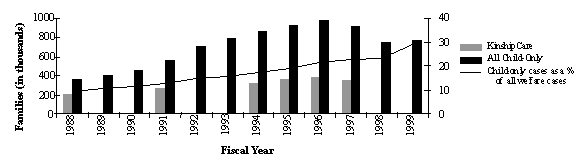
Data from fiscal year 1999 show that 9.4 percent (499,960) of all children receiving TANF benefits were related to but not the children of the head of the household (U.S. DHHS, 2000c).(8) The large majority of these children (421,599) were supported through child-only grants. While historical data on welfare assistance received by kinship care children is limited, the number of kinship care child-only cases grew from 206,000 in 1988 to 388,000 in 1996 before declining in 1997 to 341,000 following the trend of the entire welfare caseload (U.S. DHHS, 2000d) (see Exhibit 1).(9) In addition, data show that even though all kin who do not receive a foster care payment are eligible to receive at least a TANF child-only payment, most do not receive any TANF assistance. In 1997, only 28 percent of kinship care children lived with a relative who received AFDC (Ehrle et al., 2001). In comparison, in 1997 approximately 69 percent of all TANF eligible persons received benefits (DHHS, 2000b).
| Policy makers have been paying much closer attention to the child-only caseload as it represents a growing share of the total welfare caseload |
Policy makers have been paying much closer attention to the child-only caseload as it represents a growing share of the total welfare caseload. The number of child-only welfare families increased steadily in the late 1980s and throughout the middle 1990s, reaching a peak of 978,000 such families in 1996. The number of child-only families decreased in 1997 (918,000) and 1998 (743,000), before increasing again in 1999 (770,000) (U.S. DHHS, 2000c). But the child-only share of the total welfare caseload grew in each year between 1988 and 1999, from 10 percent in 1988 to 29 percent in 1999 (see Exhibit 1). The share of the welfare caseload represented by child-only grants varies considerably among states, with child-only grants representing more than 50 percent of the caseload in some states (U.S. DHHS, 2000c).
In general, states do not impose work requirements or time limits on kinship caregivers who receive child-only TANF grants, because they are under no legal obligation to support the relative child. If kinship caregivers themselves receive TANF payments, federal work requirements and time limits do apply. States may exempt relative caregivers from state requirements and may support them using state-only funds (U.S. DHHS 1999).
Exhibit 1.
Changes in Child_Only Caseload, 1988-1999
Other Federal Programs
| In spite of their eligibility, many kin do not receive this wide range of supports |
In addition to TANF, kinship caregivers and relative children may be eligible for a wide range of federal and state programs. For example, almost all foster children are eligible for Medicaid,(10) and children cared for by kin who are outside the child welfare system and receive a TANF child-only payment are eligible for Medicaid. Kin are also eligible to receive Supplemental Security Income (SSI) for any related child who meets the disability guidelines of the program. Kin who are income-eligible for food stamps are eligible to receive additional food stamp benefits for related children. Depending upon the state, kin may also be eligible to receive housing assistance, subsidized child care, or emergency financial assistance. But in spite of their eligibility, many kin do not receive this wide range of supports. For example, only 60 percent of kin who are income eligible receive food stamps and only 54 percent receive Medicaid for their related child (Ehrle et al., 2001). In comparison, 78 percent of all food stamp eligible children participate in the program (U.S. DHHS, 2000b). Of all children eligible for both TANF and Medicaid, about 65 percent receive Medicaid benefits (Dubay, Kenney, and Haley 2001).
Study Purpose and Overview
While part of the solution to meeting the needs of kin may be better information and outreach on available programs and supports, many policy makers have found that existing public agency services and programs are not appropriate or sufficient for kin. As a result, numerous states and localities have begun to develop kin-specific programs. In June 2000, the Department of Health and Human Services (HHS), Office of the Assistant Secretary for Planning and Evaluation (ASPE) noted the proliferation of such programs and, since little was known about them, contracted with the Urban Institute to conduct a study of alternative kinship care programs established outside of TANF and foster care. This report documents the findings from this study and describes the variety of alternative approaches states and localities are taking to address the needs of kinship caregivers.
There are many programs nationwide that serve kinship caregivers and children, but not all are alternatives to TANF or foster care. For the purposes of this study, "alternative" kinship care programs are those specifically designed to meet the needs of kinship care families and that serve, at least in part, families referred by child welfare and/or TANF agencies.
Identifying existing alternative kinship care programs required several strategies. First, knowledgeable individuals around the country were asked to identify alternative kinship care programs of which they were aware. Second, Cornell University's Child Abuse Prevention Network Listserve asked its members to identify programs. Third, kinship care experts and organizations that work with kin or with state and local TANF and child welfare agencies offered information. Fourth, a review of the agendas of recent conferences sponsored by children's organizations identified presentations by or about alternative kinship care programs. Finally, the Brookdale Foundation, which for the past few years has provided seed money to state and local agencies interested in expanding services for kinship care families, provided a list of programs they support.
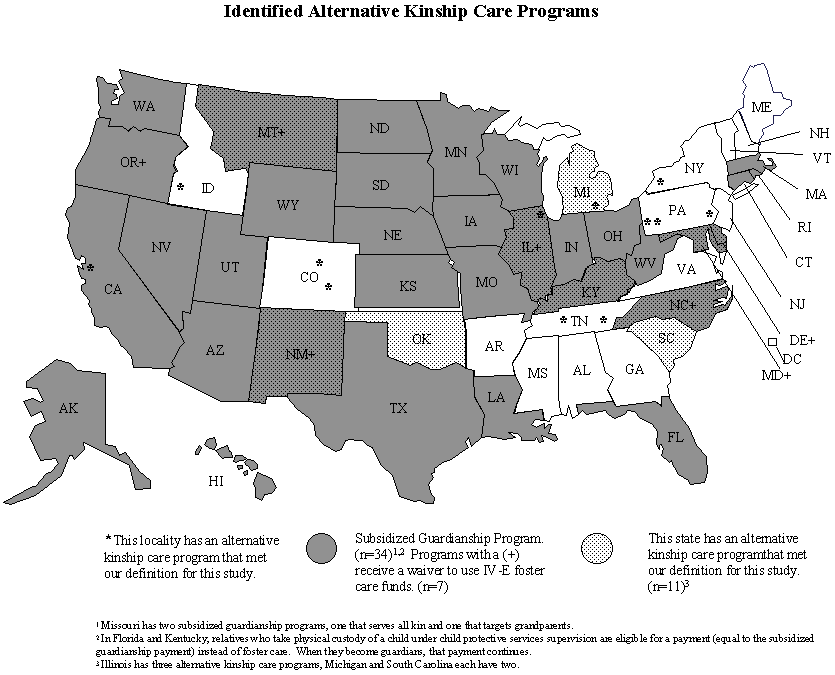
In all, 167 programs serving kinship care families were identified, and researchers contacted 107 programs which were thought to fit the definition of alternative kinship care.(11) Identified programs were asked to provide brochures, authorizing legislation, and other publicly available information about current and planned activities. The information provided showed that 57 of these programs served families referred by either TANF or child welfare and could be considered alternative programs.(12) Of these 57, 34 are subsidized guardianship programs, programs that provide on-going financial support to kin who take permanent legal custody of a related child who has been abused or neglected. Such programs are alternative in that they provide an option only to kin that is different from traditional foster care or adoption assistance. Program administrators offered some basic information about all 57 alternative kinship programs. Researchers selected seven programs for more in depth study(13):
- A Second Chance, Inc. (ASCI) in Pittsburgh, PA is the largest private non-profit kinship foster care agency in the United States with an ongoing caseload of over 700 children. ASCI serves primarily families that have been referred by the Allegheny County Department of Human Services after a child has been adjudicated as abused or neglected and placed with a relative caregiver. Following referral, ASCI is responsible for all child welfare services needed until children achieve permanency including ensuring that kinship caregivers complete all foster parent licensing requirements. A unique attribute of ASCI, and what makes their program "alternative," is that the agency recognizes that kinship care families need to be served differently than traditional foster families. A Second Chance, Inc. works with the entire "triad" the birth parent, child, and kinship caregiver. ASCI looks at permanency planning from the outset through a kinship strength assessment and reunification staff work simultaneously with kinship care and birth families to resolve family issues that serve as impediments to reunification. Sixty percent of kinship care children return home within six months of placement.
- Denver's Grandparents and Kinship Program, operating within the TANF division of the Department of Human Services, provides a supplemental child-only TANF payment and other supports to relatives caring for their grandchildren or other relative kin. Program participants receive the financial supplement in addition to their TANF child-only payment as well as case management and other supportive services. With the additional supplement, the TANF child-only payment becomes similar in amount to the foster care monthly payment. The program provides case management services, depending upon a participant's needs. Relative caregiver support groups are an integral part of the program. Relatives caring for children involved with child welfare (and receiving TANF child-only payments) receive the financial supplement through the program; however, case management services continue to be provided through the child welfare division.
- Florida's statewide Relative Caregiver Program serves children being cared for by relatives who, without the caregivers, would otherwise be in foster care. The relative must have a juvenile court order placing the child in their home under protective supervision (in cases where reunification with birth parents is the goal), or under temporary custody cases (where the parents are unavailable, unable or unwilling to pursue reunification). The program has two primary components: the relative caregiver payment and case management services. Additionally, children are eligible for Medicaid and day care. Families in the program receive monthly financial payments from the TANF program and are monitored (at a minimum for six months) by the child welfare system. Currently, the financial payment is approximately 70 percent of the foster care rate. One of the major goals of the program is permanency for children, and long-term relative placement is a court disposition and a permanency option most of the families in this program choose. Families in the program continue to be eligible for the payment until the child is 18 years old. Relatives who assume legal guardianship of the children in their care also continue to be eligible for the relative caregiver payment.
- The Kentucky Kinship Care Program, administered by the Kentucky Cabinet for Children and Families (an umbrella agency responsible for both child welfare and TANF), provides kin caring for children who have been abused or neglected an alternative to becoming licensed as a foster parent. Rather than the state taking custody of children and licensing kin as foster parents, in the Kinship Care Program, kin caregivers take temporary legal custody of adjudicated children and must agree to accept permanent legal custody of children if they cannot return to their parents. Kinship caregivers receive a payment of $300 per month per adjudicated child in their care (approximately 50 percent of the foster care rate) and this payment continues until the child is 18. Agency supervision under the Kinship Care program is less intensive than when children are in foster care there is typically six months of caseworker supervision following placement. The kinship care program is entirely TANF funded with $8 million allocated for the program in 2000.
- The Kentucky KinCare Project is a statewide network of 29 kinship care support groups that resulted from a unique partnership between the state Office of Family Resource and Youth Service Centers (part of the Kentucky Cabinet for Children and Families), the Office of Aging, and the Cooperative Extension Service. The Resource Centers are located in public schools throughout the state and host the support group meetings and provide ongoing operational support. The public schools assist in identifying and recruiting kinship caregivers for the support groups. A statewide steering committee provides day-to-day guidance as well as a long-term vision and advocacy for expanding supports to grandparent caregivers. Representatives from the Office of Aging and the Cooperative Extensive Service serve on the steering committee and were responsible for the development of the first grandparent support groups in the state.
- The Kinship Support Network (KSN), is a comprehensive program designed to fill in the gaps in public social services to relative caregivers and the children they are raising. KSN is administered by the Edgewood Center for Children and Families, a private non-profit organization in San Francisco, California. KSN serves both families that are, and are not, actively involved with the county child welfare agency, the Department of Human Services (DHS). Approximately half of the referrals to KSN come from DHS with the remainder coming from other community agencies or self-referrals. KSN offers case management which includes monthly visits by community workers, as well as support services that include support groups, respite and recreation, mental health assessment and support, and advocacy. All KSN services are voluntary and there are no eligibility requirements. KSN is funded by DHS as well as through private resources.
- Oklahoma does not have a specific alternative kinship care program, but has many ongoing initiatives that involve services to relative caregivers. The Aging Services Division of Oklahoma's Department of Human Services (DHS) has sponsored an annual conference on grandparents raising grandchildren each year since 1997. At the conference, representatives from various agencies provide information about the child welfare and welfare systems. The Aging Division raised foundation funding to support local support groups and has also published a grandparent handbook which provides information and key phone numbers for local resources. In addition, Aging Services provides money for respite care to families in which a grandparent, age 60 or older, is the primary caregiver of a child. Families who are income eligible receive up to a $400 voucher each quarter to purchase respite care services.
The seven selected programs illustrate different service delivery approaches. They also vary in size, geographic areas and demographic groups they serve, funding mechanisms, and administration. Summary information about all 57 alternative kinship care programs identified is included in Appendix A. Appendix B includes summary profiles of the seven programs selected for in-depth study.
Teams of two Urban Institute researchers conducted multi-day site visits with selected programs and conducted interviews with program administrators and supervisors, TANF and child welfare administrators, local advocacy organizations, and private service providers who work with kin. Semi-structured protocols were employed to collect information about programs' goals, services, structure, administration, financing, and the target client population. In addition, Urban Institute researchers conducted focus groups with alternative kinship care program workers, child welfare and TANF workers, and kinship caregivers. These focus groups yielded information on the needs and service delivery experiences of kin and how the alternative program interacted with TANF, child welfare, and other public and private agencies.
1. Based on Urban Institute tabulations of March 2000 Current Population Survey.
2. Caregivers of children in state custody who do not meet state licensing requirements typically do not receive foster care payments, but are eligible to receive TANF child-only payments. Three states only provide foster payments to kin if the children in their care are title IV-E eligible.
3. Census Bureau Current Population Survey (CPS) data. Data are provided based on two- or three-year averages, because the number of children in kin care in a single year's CPS sample is relatively small and provide unreliable estimates. In addition, because of the introduction of improved data collection and processing procedures, data before 1994 are not comparable to later years.
4. The number of children in kinship care decreased from an average of 2.16 million to 2.14 million between 1995-1997 and 1998-2000 and the average prevalence decreased from 3.05 percent to 2.98 percent.
5. In California, New Jersey, and Oregon, kin must care for a child eligible for federal reimbursement (under title IV-E) to receive a foster care payment.
6. Basic rates vary by the age of the child. In addition, states often supplement these basic rates with allowances for clothes, shelter, school supplies, or other expenses.
7. The Urban Institute's 1999 survey found that 8 states provided foster care payments to kin who were assessed based on different licensing standards. In January, 2000 HHS published a final rule implementing ASFA and noted that states could not claim federal reimbursement of foster care payments made to kin who were licensed based on different standards.
8. However, we cannot determine how many of these kinship child-only recipients are kin foster parents who are not receiving foster care payments because they are not licensed.
9. In addition to kinship care, there are several other reasons why a family may receive a child-only welfare payment. The head of the household may be 1) receiving Supplemental Security Income (SSI) instead of TANF, 2) ineligible for TANF due to their citizenship status, or 3) under sanction by the welfare office.
10. Title IV-E eligible children are categorically eligible for Medicaid. States have the option of whether to provide Medicaid to non-IV-E eligible children.
11. Since a comprehensive survey was not conducted, it is likely that there are alternative kinship care programs that were not identified. In addition, since efforts to identify programs in June/July 2000, some new alternative programs have been implemented.
12. Some of these programs receive relatively few referrals from TANF or child welfare while others receive most if not all referrals from these sources. It is possible that some of the programs not considered alternative also receive some referrals from TANF or child welfare, but were inadvertently left out because programs materials or program officials did not note these referrals.
13. Although subsidized guardianship programs were the most common alternative kinship care program identified, we did not include any of these programs for in depth study since several of these programs are being implemented under title IV-E waivers and are being closely monitored.
Overview of Alternative Kinship Care Programs
| Twenty-eight of the fifty-seven alternative programs we identified have been operating for three years or less. |
Over the past few years, kin-specific programs designed as alternatives to either traditional TANF or foster care programs have proliferated rapidly. In fact, 28 of the 57 alternative programs we identified have been operating for three years or less. But while development of alternative kinship care programs is widespread and growing, the programs that state and localities have developed are very different. They vary in how and why they were established, the target population the programs hope to reach, and the goals they seek to achieve.
The Goals of Alternative Kinship Care Programs
The three basic goals of the child welfare system are to ensure the safety, permanency and well-being of children. The vast majority of identified alternative kinship care programs seek to achieve one or more of these goals.
Of 57 alternative programs, 34 are subsidized guardianship programs with the primary goal of making the kinship care placement permanent. Of the remaining 23, 18 also seek to make kinship care arrangements more permanent. Most of the programs also seek to increase the stability of kinship care arrangements (21 of the 23 programs not providing subsidized guardianship). Programs in Florida and Pittsburgh and Kentucky's child welfare alternative program all seek to increase permanency (the services these programs provide to increase permanency are described below). In contrast, only eight of the programs seek to reunify children in kinship care with their birth parents. Of the programs visited, Pittsburgh's program makes the most concerted effort to reunify kinship care children with their biological parents.
Most programs, whether child welfare-focused or not, also seek to improve the overall well-being of kinship care families. Of the 23 programs identified not providing subsidized guardianship, 21 cite improving the well-being of kinship care children as a program goal and 20 seek to improve the well-being of kinship caregivers. In addition 17 seek to prevent foster care placements.
Several of the programs we visited also have goals to improve more generally service delivery to kinship caregivers. Kentucky officials noted that one of the goals of its child welfare alternative program is to increase the use of relatives as foster parents. Some, such as Oklahoma's program, seek to improve overall community awareness of the needs of kinship care families and integration of available services. Some programs, such as the Kinship Support Network in San Francisco, focus on providing a wide array of community-based services for kin and the children in their care. Pittsburgh's program also has the goal of making kinship foster care services more culturally responsive and family focused.
Impetus for Program Development
| Some programs, such as the Kinship Support Network in San Francisco, focus on providing a wide array of community-based services for kin and the children in their care. |
Researchers documented the events and individuals critical to the development of the programs. While each alternative kinship care program has a unique history, we observed a number of common themes:
- Identification of need. Public agency support of alternative kinship care programs was often preceded by grass-roots efforts to articulate the needs of relative caregivers. In the sites we visited, the needs of kinship caregivers were often first articulated by private and/or faith-based organizations or by the public outcry of the kin themselves. Examples are highlighted below.
In Denver, grandparent support groups were first organized by members of a local church. When the Department of Human Services (DHS) recognized the need for such support groups, they organized the groups through a staff member located at a local food stamp office. Currently, DHS funds Catholic Charities to facilitate a growing number of relative support groups across the city. Local officials in Denver noted that grassroots organizing by grandparent caregivers, including a protest in front of the DHS office, was influential in moving beyond support groups to the supplemental TANF financial assistance provided by the alternative program>.
In Florida, as part of an effort to improve family court procedures, relatives caring for children in state custody voiced their concerns about the required inspections and paperwork for foster care licensing. They also articulated their need for greater financial assistance than offered by TANF.
Officials in Kentucky credit the Homemakers clubs, which have about 30,000 members, for raising the issue of grandparents raising grandchildren which led to the development of Kentucky's support group program.
Both public and private agency officials were surprised by the size of the kinship care population and the extent of their needs. Both public and private agency officials were surprised by the size of the kinship care population and the extent of their needs. For example, in Kentucky, officials noted a seminar on grandparents caring for grandchildren that was sponsored by the Court Attorney's office and held in a Baptist church. Organizers prepared for 25 people but more than 300 attended.
- Public agency involvement. While child welfare agencies, and to a lesser extent TANF agencies, appear to be the driving force behind the development of alternative kinship care programs, a variety of other public agencies took a role in creating the alternative programs we visited. For example, the Aging Office in Oklahoma's Department of Human Services has taken the lead in its Grandparent Initiative, and Kentucky's support group program resulted from efforts by the Cooperative Extension Service, the Aging Office, and the public schools. The administrative structure of alternative kinship care programs is discussed in more detail below.
- Role of elected officials. Elected officials took a significant role in the development of several of the visited programs. In Denver, a city council member was a leading supporter of the alternative program and was influential in getting support from TANF. Florida's alternative kinship care program is codified in statute and the state legislature has been active in the design and oversight of the program. In California, the state legislature set aside $750,000 from the state General Fund to establish family support programs, modeled after the Kinship Support Network in San Francisco, for relatives caring for abused and neglected children.
- Outside influences. Often a unique external factor catalyzed the creation of the alternative programs, such as the availability of funding or a legal action. For example, foundation funds for kinship care were influential in both Oklahoma's and Kentucky support group programs, and the availability of TANF surplus funds helped spur the programs in Denver and Florida, and Kentucky's child welfare alternative program. In Pittsburgh, following a lawsuit alleging that kinship care families were not given the same options as traditional foster care families, the county child welfare agency signed a consent decree requiring the county to improve services to kinship care families. The county relies on A Second Chance to serve kinship care families and fulfill the requirements of the consent decree.
Target Population
| Designers of alternative kinship care programs struggle to decide what segments of the kinship care population they should serve, and how. |
By definition, the alternative programs studied focus on meeting the needs of kinship care families. However, the populations the programs target vary considerably. Designers of alternative kinship care programs struggle with a key question: what segments of the kinship care population should the program serve, and how?
- The Kinship Support Network in San Francisco offers the same services to both those that are involved with the child welfare system (public kin) and those that are not (private kin).
- Denver's program provides the same level of payment to both public and private kin (all relatives receiving TANF child-only payments to care for their kin) but private kin may receive case management and other supports from the alternative program. Public kin receive case management and other services through the child welfare agency.
- Kentucky's child welfare alternative program and Florida's program both exclude all private kin, making child welfare involvement an eligibility criterion for program services.
- Kentucky's and Oklahoma's support group programs were established to serve private kin, but neither exclude public kinship care families.
| The programs serving public kinship care families provide roughly the same amount of attention to the child and the caregiver, while the programs serving private kin appear to be more focused on the caregivers. |
In addition, programs vary as to whom they viewed as their primary client. The programs serving public kinship care families provide roughly the same amount of attention to the child and the caregiver, while the programs serving private kin appear to be more focused on the caregivers. With the exception of A Second Chance in Pittsburgh, none of the alternative kinship care programs target extensive services to birth parents and/or extended families. However, a few administrators noted that the lack of attention to birth parents is a program weakness they hope to address in the future.
In several of the programs visited, there have been efforts to expand the target population. For example, A Second Chance in Pittsburgh focuses on kinship foster care, but has recently expanded to provide some services to private kin. And in Florida, where the alternative kinship program serves only public kin, there have been repeated, yet unsuccessful, legislative attempts to expand the program to include private kin.
Program administrators of several of the programs we visited noted that when the programs were being designed, local officials expressed concern that providing additional resources or services to kin may provide an incentive for parents to hand off their children to kin. However, none of the programs reported such problems following implementation. (14)
Summary
Each of the alternative kinship care programs visited is unique in its beginnings, founders, and goals. Regardless of the impetus or specific focus of the program, many states and localities came to the same conclusion that existing public agency support is not adequate to meet the needs of relative caregivers. Approximately half of all the alternative programs identified were developed within the last three years and several more have been implemented since the initial search. Meanwhile, some existing alternative kinship care programs have acknowledged that the size of the kinship care population and the severity of their needs are much greater than originally anticipated and are attempting to expand.
14. Some officials in Pittsburgh noted that, when the county child welfare agency began offering foster care payments instead of TANF child-only grants to kin foster parents, there was an influx of private kin who sought out child welfare involvement to enable them to get the larger payment. Administrators noted that many of these kin were caring for children who had been abused and neglected and placed by the child welfare agency prior to the consent decree.
The Needs of Kinship Care Families
National studies have documented that kinship care families face numerous challenges and have a variety of service needs. Kinship care children, whether or not they have been abused or neglected, are dealing with the emotional trauma of being separated from their parents. At the same time, many of their relative caretakers are older, have limited formal education, and are raising their relative children in impoverished environments. Many caregivers are caring for more than one related child, often in addition to their own children. Many families are eligible for public services such as TANF payments, food stamps and Medicaid, but are not receiving them.
Characteristics of Kinship Families
Site visits to alternative kinship care programs provided concrete and vivid examples of why kinship care families have a wide variety of needs. Interviews with program administrators, workers, and kinship caregivers revealed that kinship caregivers often lack recent parenting experience, face social if not physical isolation, experience the difficulty of balancing work with caregiving, and can face challenges or conflicts with the birth parents of the child for whom they are caring. Caregivers also observe that kinship care children often face severe emotional and behavioral problems as a result of abuse or neglect, separation from their parents, embarrassment over living with an older caretaker, and the uncertainty over the permanency of their current living arrangement. These problems present significant challenges for both the caregivers and the children.
- Caregiver's relation to the child. National research shows that a large majority (69 percent) of children in kinship care are cared for by a grandparent, and over one-fifth (21 percent) are in the care of an aunt or uncle (Ehrle et al., 2001). Likewise, the majority of caregivers enrolled in the alternative programs visited are grandparents and most often, they are grandmothers caring for their daughter's children. However, the prevalence of other types of kin caregivers is notable. For example, of the 1,400 grandparent program cases in Denver's program, 100 are single grandfathers. In Pittsburgh, A Second Chance's primary caregivers are grandmothers in 37 percent of their cases, but aunts account for 33 percent of the kinship caregivers, and family friends account for 16 percent.
| "I was 65, I wanted to go play. I'd been there done that." |
- Age of caregiver and children. Most studies have shown that kinship caregivers are older than non-kin caregivers, with many more over the age of 60 (U.S. DHHS, 2000a). However, since kin caregivers may be aunts or even siblings of a related child, many are also much younger. While Denver's program serves primarily caregivers who are between 55 and 63 years of age, administrators of the Kinship Support Network in San Francisco and Kentucky's support group program face challenges in designing services for kinship caregivers who may be as young as 20 or over age 90. Contrary to popular images of kinship care children as newborns, more than half of children in kinship care are between 11 and 18 years of age (Ehrle et al., 2001).
- Marital status. More than half of kinship care children live with caregivers who are unmarried (Ehrle et al., 2001). Not surprisingly, we heard in many focus groups that many kinship caregivers rely on other family members for support in helping to raise related children.
| "With me, it wasn't bad financially because I had the child on my insurance, but when I retired my income was cut in half." |
- Income of caregivers. Two in five (41 percent) kinship care children live in families with incomes below the federal poverty level (Ehrle et al., 2001). At the same time, many kinship caregivers work, some full time. Although researchers did not document caregiver income at site visits, program administrators confirmed that most of the families they serve are impoverished.
- Caregiver education level. More than a third of children in kinship care are being raised by caregivers without a high school diploma (Ehrle et al., 2001). Limited formal education appears to be most common among older, female caretakers, whose generation likely had more limited opportunities for higher education.
- Number of children in care. Many kinship caregivers are rearing more than one related child, often in addition to children of their own. National data show that one in five kinship caregivers have four or more children in their household (Ehrle et al., 2001). Programs visited reported similar results and noted the intense pressures and service needs of older caregivers who are responsible for multiple children.
- Reason for kinship arrangement. Parental substance abuse is a major reason why children move out of their parents' homes, according to national research. In focus groups, kinship caregivers overwhelmingly identified substance abuse as the primary reason for rearing a related child. Moreover, a lack of child welfare agency involvement does not mean that the child did not suffer abuse or neglect. In fact, many of the kinship caregivers who had no child welfare contact noted that they had stepped forward to care for a related child when they discovered the child had been physically or sexually abused, either by the child's mother or by the mother's boyfriend.
Needs and Challenges of Kinship Caregivers
| "I had, kind of like a career; my life was interrupted, kids dropped on my doorstep, so to speak. The situation was so deplorable that any grandparent, that's your blood that's suffering like that, you have no other recourse than to do something about it. And at the time I was doing some pretty important things for myself; [it was] really the first time when all my kids were grown up and out of the house." |
Many of the needs and challenges faced by kinship caregivers are directly related to the socio-demographic characteristics of both caregivers and related children. Needs also depend on the reason for the kinship living arrangement, the kinship family's adjustment to the arrangement, the kin caregiver's level of preparation for caregiving, and the types of supports the caregiver receives. At the same time, kinship caregivers are not a homogeneous group; their needs and the combinations of their needs can differ dramatically. The needs of this population present a challenge to those trying to serve them, but a number of common challenges were identified:
- Lack of Preparedness. Most kin caregivers take on the responsibility in the midst of a crisis situation, often finding themselves with a child in their care within a few days of receiving a call out of the blue. Focus group participants spoke of being unprepared to meet immediate needs such as clothing, beds, and other furniture for a child's room. Many of their homes, including subsidized homes with occupancy limits, also had inadequate space for a child, and they were forced to consider other housing options. In particular, the amount of lead time and training that kinship caregivers are given to prepare prior to assuming their new caregiving responsibilities is very different from that of non-kin foster parents. Kinship caregivers often have to resolve these issues if they want to become licensed foster parents.
- Financial assistance. Kinship caregivers often face tremendous financial burdens when they add a new member to their family. For example, many kinship caregivers are grandparents who are often retired with a fixed income. In focus groups, participants spoke of the financial difficulties associated with taking on caregiving responsibilities for a related child.
- Mental health/emotional support. Kinship caregivers also need a great deal of emotional support, and kinship care children often need help with trauma or behavioral problems that result from the new living situation, separation from the birth parents, and prior abuse or neglect. Caregivers cited mental health counseling for their related child as one of their most pressing needs. Caregivers also expressed the need for respite time, recreation, mental health counseling for themselves, and most of all, support from others. Emotional support was noted as the most important long-term need of many caregivers in these programs.
- Child care. Finding affordable child care that met their needs was a major challenge voiced by kinship caregivers. Because a large share of caregivers work outside the home, they often need child care. Many of the older caregivers voiced the need for respite time from the demanding role of caring for a child. Keeping a job is a major concern of many of the younger caregivers, since it is likely that they will be forced to take time off of work or change their work schedule due to their new living situation.
| "She sometimes thinks I don't really know what I'm talking about, and I was from the stone ageI don't know, there are times when she and I-it's hard to communicate. I guess it's the difference in the age." |
- Transportation. Both caregiver and worker focus group participants mentioned transportation challenges. In some cases, caregivers are unable to participate in alternative program activities or get children to medical appointments because they do not have accessible transportation.
- Tutoring for the child. Some older caregivers feel out of practice with parenting, and may have difficulty assisting children with their homework. These caregivers need assistance with tutoring the child, since they fear that the child's academic performance might suffer. A few caregivers expressed an interest in adult literacy classes so that they may personally assist the child with schoolwork.
- Health insurance for the child. Health insurance for relative children is an issue for kin caregivers with and without health insurance. Even if a caregiver has health insurance, not all relative children are eligible under the caregiver's health plan. Many other caregivers do not have health insurance themselves and worry about the cost of health insurance for the child.
| "We basically have no rights. We are not eligible for anything without a lawyer." |
- Legal assistance. Many caregivers need affordable legal assistance in making decisions around the custody of the child. For example, they want to know whether to pursue legal guardianship. Aggressive birth parents have a role in many of these family situations, and caregivers want to be informed of their options for protecting the child. Some caregivers also fear the legal system, and do not want to subject their family to a court battle. In Kentucky's support group program, grandparent caregivers said they would have to prove their child is "the scum of the earth" to gain permanent custody of the grandchild.
Opinions on Permanency Options
| "[Adoption] makes you relinquish your own [child's] parental rights. It doesn't benefit me to alienate my daughter and do that." |
During each site visit, researchers attempted to document caregivers' opinions on different permanency options. While some of the caregivers were not sure of the permanency option they would choose if reunification efforts failed, we observed some common attitudes about permanency:
- Willingness to raise children until adulthood. Although decisions about a long-term commitment to the children often depend on the well-being of the birth parents and their own financial situation, overwhelmingly caregivers say they are willing to raise the children until they are adults if necessary. Despite popular belief to the contrary, many kin say that they are more than willing to adopt. Many of them are afraid of losing custody to the birth parents, and some noted that courts focus too much on parental rights. At A Second Chance in Pittsburgh, one caregiver stated, "Why not adopt? Then I can do what I want with them. They are really mine anyway." This sense of attachment and commitment to the children seems to be common among most caregivers.
On the other hand, relative caregivers often choose not to adopt for many reasons. They may not want to permanently terminate the rights of the birth parents, they may hope that the child will be reunified with the birth parents at some later point, or they simply may not be comfortable with the idea of adoption.
- Hopes for parental reunification. Most of the caregivers in these programs have, at some point, hoped for reunification between the relative child in their care and the child's birth parents. However, many of the caregivers had to make a more long-term commitment to the child. For example, program workers in Denver commented that many of the caregivers agree to take the child while thinking that the situation will only last a few months, but most of them have to become more comfortable with the idea of a longer commitment. It is particularly difficult for grandparent caregivers to give up on the idea of reunification. Many grandparent caregivers are hoping that their child will be able to parent again, despite the birth parent's past history of abuse or neglect of the child.
- Encountering barriers to adoption and guardianship. Many kinship caregivers who were eager to adopt or take guardianship of the children in their care reported significant barriers to completing the process. One of these barriers is financial. Caregivers noted that the legal fees for completing an adoption are at least $5,000, under the best case scenario in which the adoption is not contested. Moreover, these fees represent the cost per child and many caregivers are seeking to adopt multiple children. A second barrier identified is a simple lack of understanding about adoption or guardianship process. Many caregivers reported they experienced great difficulty in obtaining accurate information about the legal process. Finally, caregivers who had begun or completed the process noted numerous delays in finalizing their adoptions or guardianships, delays that entail both an emotional and financial cost.
Summary
Overall, the needs and circumstances of these caregivers vary in significant ways. While one kinship caregiver may be 26 years old, caring for her five younger brothers and sisters and trying to hold onto a job, another may be a 70-year-old grandmother raising her teenage grandson in a tiny apartment on a fixed income. The needs of these two caregivers are very different, and alternative kinship programs struggle with ways to serve them both. While some programs provide services such as financial assistance to meet the needs of this population, others are offering support groups and day care. Programs also struggle with deciding how to be structured and administered in order to meet the unique needs of kinship caregivers in a comprehensive and sensitive way.
Administering Alternative Kinship Care Programs
A defining feature of alternative kinship programs is the diversity of administrative and program structures which are used to operate and deliver services. In part, this diversity reflects differences in these programs' orientation and goals, target population, service focus, and funding sources.
Program Administration, Structure, and Staffing
| Alternative kinship care programs may be administered by public agencies-including administrative entities responsible for TANF, child welfare, and aging services-or by private, community-based agencies. |
Alternative kinship care programs may be administered by public agencies--including administrative entities responsible for TANF, child welfare, and aging services--or by private, community-based agencies. All subsidized guardianship programs identified are publicly administered. However, both private and public agencies operate the remaining alternative kinship care programs. Of those identified, 14 are administered by public agencies and 9 are administered by private agencies.
- Locus of Administrative Responsibility. Of the seven alternative kinship care programs visited, two are administered by private, nonprofit organizations and five are administered by the public agency responsible for human services (see Table 1). The locus of administrative responsibility within the larger human services agency differs across program sites. For example, in Kentucky and Florida, the child welfare division administers these states' alternative kinship care programs. Denver's program is administered by the TANF program division, and Oklahoma's efforts are spearheaded by the Aging Services Division. Finally, Kentucky's support group program, a separate initiative coordinated by the state on behalf of kinship families, provides an interesting collaborative administrative arrangement involving the Office of Family Resources and Youth Service Centers, the Office of Aging, and the Cooperative Extension Service.
- Program Structure and Staffing. Alternative kinship care programs are structured and staffed in a variety of ways. They may be specialized units or programs within the larger agency, jointly staffed by different programs, or freestanding programs devoted entirely to providing services to kinship families.
| Program | Administering Entity | ||||
|---|---|---|---|---|---|
| Child Welfare | TANF | Aging | Private Agency | Other | |
| A Second Chance, Inc. (Pittsburgh, PA) | X | ||||
| Grandparents and Kinship Program (Denver County, CO) | X | ||||
| Relative Caregiver Program (Florida) | X | ||||
| The Kentucky Kinship Care Program (child welfare) | X | ||||
| The Kentucky KinCare Project (support groups) | X | X | |||
| The Kinship Support Network (San Francisco, CA) | X | ||||
| Oklahoma | X | ||||
In Denver, the TANF agency created a specialized staff unit composed of different types of staff--a social worker, a case manager, and TANF eligibility workers--to operate its alternative program. In addition, an intra-agency team representing TANF, Family and Children Services, Child Support Enforcement, and Adult Services was formed in order to ensure that the alternative kinship program is integrated into the agency's overall offerings without duplication of services.
In Florida's Relative Caregiver program and Kentucky's child welfare alternative program, there is some local-level variation in how the program is structured and staffed. In general, however, the financial eligibility and payment component is handled by TANF eligibility workers and the case management component of the program is handled by child welfare workers. This arrangement prompted several administrators in Florida to characterize their alternative kinship care program as representing the nexus of the public welfare and child welfare systems.
| Kentucky's support group program staff believe that their location within public schools is critical to their success. |
Kentucky's support group program is overseen by a statewide steering committee. The steering committee provides guidance and direction to the local program staff, develops grass roots strategies and models for implementation, and identifies and promotes a grandparents agenda (e.g., medical and educational consent laws, TANF funding). At the local level, Kentucky's support group program operates through school-based Family Resource and Youth Service Centers with Family Resource Center Coordinators as staff members. Kentucky's support group program staff believe that their location within public schools is critical to their success. Among other things, it allows them to easily identify children being cared for by grandparents and other relatives and to reach out to these families.
| "One thing I really like about the pro-gram is the fact that it provided us with work. When you are overwhelmed with responsibility, and on the dependen-cies that go with it, it's so dreadful to not have work to do - you know, something that [lets] you say, 'I do this and I'm under orders, I account to someone. You know I'm paying for my ser-vices' It's like a value-for-value thing. It seems to [give] you the pleasure you get from work. That's how the program helped me, it gave me back my self-esteem." |
The two private nonprofit programs visited focus solely on providing services to kinship care families. A Second Chance, Inc. in Pittsburgh was established for the purpose of providing services to kinship families referred by the county child welfare agency. A board of directors and an advisory board provide oversight. The Kinship Support Network in San Francisco operates under the auspices of the Edgewood Center for Children and Families, with oversight by its Board of Directors. The Edgewood Center operates primarily as a residential treatment facility. The Center's Kinship Support Network is located in a different part of the city from the Edgewood Center and has its own organizational identity, although program respondents noted the Kinship Support Network had derived significant benefits from having a supportive, well established, and respected parent organization.
In part because the community-based programs visited provide a more comprehensive set of services in-house than the other programs, they employ a larger number and mix of staff than the publicly administered programs visited. Of particular note, both programs find it valuable to use members from their client target populations to fill some staff positions. For example, a birth parent previously served by A Second Chance in Pittsburgh facilitates ongoing support groups for other birth parents in the program. Similarly, many of Edgewood's Kinship Support Network's full-time case managers and support group facilitators are older caregivers themselves. In fact, the case manager position historically was filled solely by caregivers in the community. As the program and its services became more comprehensive, staff with more specialized training and experience were added. It was emphasized in our discussions with administrators and staff that drawing upon members of the community allows staff positions to be filled by individuals who understand and relate well with program participants because of their common experience. It also lends a certain amount of credibility to the program in the eyes of participants.
| Administrators from both programs feel that the fact that they are private, community-based organizations en-hances their ability to gain the trust of kinship care families and meet their needs. |
Program staff from A Second Chance and Edgewood's Kinship Support Network generally feel that there are several significant advantages to operating programs for kinship caregivers through a community-based organization. Administrators from both programs feel that the fact that they are private, community-based organizations enhances their ability to gain the trust of kinship care families and meet their needs. They believe community based organizations are in a better overall position to tailor their services to the needs of the families they serve because they are less constrained by rules and regulations than their public counterparts and have a more sensitized and comprehensive understanding of the local community, culture and residents.
Finally, Oklahoma's efforts in the area of alternative kinship care represent a collection of services and resources available to relatives caring for children that has evolved under the leadership of the Division of Aging Services within the Department of Human Services. Other agencies and programs are involved in different pieces of this effort and a taskforce has been formed to facilitate and promote ongoing collaboration.
Program Funding Levels and Sources
The amount of funding needed to support the alternative programs visited varies extensively, reflecting significant differences between the programs in their size, scope and services. The programs visited also rely on a variety of different funding sources, including both private and public monies.
Funding Levels
Florida's statewide program, which provides financial payments in addition to case management is the largest program visited, serving over 10,000 children and costing over $25 million annually. Kentucky's child welfare alternative program--also a statewide program with a financial payment component--had an $8 million budget for fiscal year 2000 and serves approximately 2,000 children. The county-wide Denver Grandparents and Kinship Program has a $5.6 million annual budget and serves about 1,400 families. A Second Chance in Pittsburgh has an annual budget of approximately $12 million to provide foster care payments and a wide range of services to an ongoing caseload of more than 700 children and their families. Edgewood's Kinship Support Network--a service-rich program with no financial payment component--has a annual budget of approximately $2.5 million and serves about 400 families annually.
Oklahoma and Kentucky's support group programs are less expensive endeavors and require less funding. Both states started the support groups with $10,000 in foundation funded seed money. At the time of our visit, Oklahoma still had foundation grant support available. Kentucky had exhausted its foundation support, and program costs were being covered by the local Family Resource and Youth Service centers.
Funding Sources
Alternative kinship care programs receive funding from of a variety of sources including the TANF block grant, child welfare funding (federal, state and local), and funding dedicated to aging services (Table 2). Foundations and other private entities also provide financial support for kinship care activities. Ten of the subsidized guardianship programs identified are funded through TANF while 14 rely on state funds and one relies on funds from the federal Social Services Block Grant. Of the 23 other programs identified, 4 receive TANF funds, 1 receives other federal funds, 13 receive state funds, 8 receive local funds, and 10 receive private financial support.
| Program | Funding Source | ||
|---|---|---|---|
| Child Welfare | TANF | Other | |
| A Second Chance, Inc. (Pittsburgh, PA) | X | X | |
| Grandparents and Kinship Program (Denver County, CO) | X | ||
| Relative Caregiver Program (Florida) | X | ||
| The Kentucky Kinship Care Program (child welfare) | X | ||
| The Kentucky KinCare Project (support groups) | X | ||
| The Kinship Support Network (San Francisco, CA) | X | * | X |
| Oklahoma | X | ||
| *Although TANF funds are not used for general operating expenses, etc., the Kinship Support Network does receive TANF funding for a small initiative to work with probation officers to identify kinship families. | |||
| Officials from Kentucky's support group program noted that they have avoided securing TANF funding for several rea-sons. They feel that some kinship caregivers do not want to be involved with the TANF system because of the stigma associated with welfare and receiving a "hand-out." |
TANF. The TANF block grant is a flexible funding source that can be used to fund alternative kinship care programs, even if the participants are not receiving TANF cash assistance. In fact, three of the programs visited are entirely TANF-funded (Florida's Relative Caretaker Program, Denver's Grandparents and Kinship Program and Kentucky's child welfare alternative program). Of these, only Denver's program is designed to serve TANF families. Two programs--A Second Chance in Pittsburgh and Edgewood's Kinship Support Network in San Francisco expressed interest in securing TANF funding but noted that attempts to do so were unsuccessful.
Not all programs, however, view TANF as a desirable funding source. For example, Officials from Kentucky's support group program noted that they have avoided securing TANF funding for several reasons. They feel that some kinship caregivers do not want to be involved with the TANF system because of the stigma associated with welfare and receiving a "hand-out." Other families, according to staff, simply do not want the government involved in their lives. Additionally, the state's support group program is a grassroots effort; many administrators feel that adding TANF funding would take the control away from them.
Child welfare. Among our study sites, only two programs receive child welfare funding. A Second Chance in Pittsburgh and the Kinship Support Network in San Francisco--both community-based programs--receive substantial funding from the local social services agency responsible for child welfare services.
Multiple funding sources. Several kinship care programs visited rely on a mix of public and private funding. For example, A Second Chance in Pittsburgh has relied on support from several local foundations (e.g., the Pittsburgh Foundation) to supplement the funding it receives through its contract with the local child welfare agency. Oklahoma relies on a grant from the Brookdale Foundation to fund its kin caregiver support groups, and the Aging Services Division within the Department of Human Services allocates funding from its budget to support respite care payments for older caregivers and an annual conference for grandparent caregivers. The Brookdale Foundation also provided the original funding for Kentucky's support group program. The Kinship Support Network in San Francisco is supported through child welfare funding from the local department of social services, matching funds provided by its parent organization (i.e., Edgewood Center for Children and Families), and foundation support.
IV-E waivers. Although none of the programs visited received title IV-E waivers to implement their alternative programs, a number of states are supporting kinship caregivers under waivers received by HHS under title IV-E. Seven states (Delaware, Illinois, Maryland, Montana, New Mexico, North Carolina, and Oregon) use waivers to implement subsidized guardianship programs. In addition, under its IV-E waiver, the District of Columbia is testing a community-based service delivery model to improve outcomes for kinship care families. Administrators in both Florida and Kentucky's child welfare alternative program reported they had considered applying for a IV-E waiver when developing their statewide alternative kinship care programs but opted against it. They noted that HHS expressed a desire to approve waiver requests that tested new service delivery models rather than multiple waivers of the same model and several other states had already received waivers for kinship care related programs. They were also weary of the waiver evaluation requirements.
Program Eligibility
| While some programs have very specific eligibility requirements for caregivers and children, others serve virtually any kin caregivers seeking support and services. |
Alternative kinship care programs visited vary considerably in terms of their eligibility requirements (Table 3). While some programs have very specific eligibility requirements for caregivers and children, others serve virtually any kin caregivers seeking support and services. Twelve of the non-subsidized guardianship programs identified have specific eligibility criteria; 11 have no criteria and provide services to any kinship care family in need.
| Program | Eligibility Requirement | |||||||||
|---|---|---|---|---|---|---|---|---|---|---|
| TANF case(15) | Child welfare case | Court order/ adjudicated dependant | Physical custody | Temporary legal custody | Child age 18 or younger(16) | Caregiver relationship to child | Coperation with CSE | Residency | Home study/ background check | |
| A Second Chance, Inc. (Pittsburgh, PA) | X(17) | X | ||||||||
| Grandparents and Kinship Program (Denver County, CO) | X (18) | X | X | X | X | |||||
| Relative Caregiver Program (Florida) | X (19) | X | X | X(20) | X | X | X | |||
| The Kentucky Kinship Care Program (child welfare) | X (21) | X | X(22) | X | X | X | X | |||
| The Kentucky KinCare Project (support groups) | ||||||||||
| The Kinship Support Network (San Francisco, CA) | X | |||||||||
| Oklahoma | X(23) | |||||||||
| "I don't draw in money for my granddaughter and the reason why I don't is because I choose not to. Because my son, he helps me with her, and if I draw money for her that's going to send them after him, and I want him to get himself together because he has two more daughters." |
- Requirements for caregivers. Three of the programs visited have eligibility requirements that focus on the caregiver. For example, in Kentucky's child welfare alternative program, the caregiver must meet specific criteria regarding his/her relationship to the child (e.g., related by blood, marriage, or adoption), participate in an annual TANF eligibility review, and participate in a home study. In Florida, the caregiver must be related to the child, complete a home study and criminal background check, and participate in annual TANF eligibility reviews. The home study and caregiver background check in both states are less stringent than those required of non-kin foster parents in the child welfare system. In addition, programs in Florida and Denver, and Kentucky's child welfare alternative program require participants to cooperate with the child support enforcement agency, due to the fact this is an eligibility requirement for TANF cash assistance. In Oklahoma, respite care vouchers are available to families in which a grandparent has the primary caregiving role and is at least 60 years of age, and the household's income does not exceed $45,000.
- Requirements for children. Among the programs visited, those with a child welfare orientation have eligibility requirements linked to the child's circumstances. For example, A Second Chance in Pittsburgh and the Relative Caregiver Program in Florida require that a child be adjudicated as abused or neglected as a pre-condition for participating in their programs. In addition, A Second Chance only serves kinship care families for whom the child welfare agency maintains an open case of protective supervision. The programs in Denver and Florida, and Kentucky's child welfare alternative program require that the child be no older than 18 years of age.
| "I allow my daughter to continue to receive [TANF] for my grandson, because she said she would take him back otherwise. So I get no financial assistance." |
- No eligibility requirements. Two programs visited have open eligibility for participation and receipt of services. The Kinship Support Network is entirely voluntary and has no eligibility criteria other than a San Francisco residency requirement. In Kentucky and Oklahoma, there are no eligibility requirements for the kinship support group programs.
In some cases, eligibility requirements may serve as deterrents to program participation. For example, staff in Kentucky noted that some families choose not participate in the state's child welfare alternative program because they do not want to commit to permanent custody. Others may not want to be financially supported beyond medical assistance for the child. Some do not want a child welfare worker in their home and some feel there is a stigma attached to being involved with welfare. Many caregivers do not want to seek child support from the birth parents, although workers reassure caregivers that they will need to seek it eventually, anyway. In TANF-funded programs, some kinship caregivers noted that they were reluctant to cooperate with child support enforcement because they did not want to take money from their children or they were fearful that the birth parents would demand their children back.
15. For the child.
16.Or 19 years if enrolled in school, with the exception of Florida's program.
17 Family must be referred by the child welfare agency.
18 Must have an active TANF case for the dependent child(ren) (i.e., child-only).
19. Caregiver must participate in annual TANF eligibility reviews.
20. Child must be within the 5th degree of relationship to the relative caregiver.
21. Caregiver must participate in annual TANF eligibility reviews.
22. Willingness to accept permanent custody after 12 months.
23. For respite voucher, only. All other services are open to all kin caregivers.
Alternative Kinship Care Programs Service Delivery
Some alternative kinship programs primarily provide financial assistance, others focus on providing non-financial, supportive services, and still others provide a combination of financial and non-financial services. This section describes how caregivers learn about and become involved in the alternative programs we visited and then describes the types of services they receive through these programs.
Program Outreach and Referral Sources
The alternative programs visited rely on referrals and outreach to reach relative caregivers and provide their service offerings. Child welfare agencies and, to a lesser degree, TANF agencies are the primary referral sources for the alternative kinship care programs visited. Many programs also receive referrals from other community agencies or from caregivers themselves. Some programs conduct outreach efforts in order to reach a broader group of families.
- Child welfare and TANF referrals. Of the 23 programs identified not providing subsidized guardianship, 22 receive at least some referrals from the child welfare system, and 9 receive referrals from the TANF program. Not surprisingly, programs administered and staffed by either a public or private child welfare agency are most likely to receive referrals from the child welfare system. A Second Chance in Pittsburgh consists entirely of child welfare-referred families. In Kentucky's child welfare alternative program and in Florida's Relative Caregiver program, some families are referred by TANF, though only in cases where the child has been adjudicated as abused or neglected. Additionally, some families with closed child welfare cases self-refer to the programs.
As part of the initial program start-up and implementation in Florida and Kentucky, it was necessary to identify and recruit kinship families who would be eligible for the new programs. This was handled by training child welfare workers on the new programs' eligibility requirements, followed by identifying and contacting those families which appeared eligible.
Denver's program is the only TANF-administered alternative kinship care program visited and receives the bulk of its referrals from TANF workers. Child welfare workers receive training about TANF's grandparent program, but the program is still in its infancy and interaction with the child welfare division has yet to be formalized. In San Francisco, the Kinship Support Network receives about half of its referrals from child welfare. Two child welfare workers are on-site at the Edgewood center enabling easier referrals and coordination.
- Role of courts. The courts play a significant role in referring families to the alternative programs developed largely by child welfare agencies. In Pittsburgh, judges often require A Second Chance to accept kin as foster parents who could not be certified because of past criminal charges or other disqualifying factors. As a result, the county cannot receive state or federal reimbursement on behalf of these placements and has to incur all associated placement costs. In addition, judges are sometimes willing to accept pleas from private kinship caregivers who claim that they are caring for children due to abuse and neglect, even though the child welfare agency was not involved in the placement.
In two states visited, judicial practices affect how kin are served by alternative programs. In Kentucky's child welfare alternative program, relatives are supposed to assume temporary custody of children placed with them, so the children receive less supervision than children who are in state custody. However, some judges have allowed kin to participate in the kinship program, but have ordered the child welfare agency to assume custody. In some parts of Florida, judges are reluctant to adjudicate children placed with kin, instead allowing the kin to care for a child "voluntarily." These caregivers are unable to obtain the relative caregiver payment.
- Community and self referrals. In addition to TANF, child welfare and the courts, alternative programs rely on other means to identify potential participants. Some programs utilize schools for outreach efforts while other programs rely on grandparent support groups and word-of-mouth. Of the 23 programs identified not providing subsidized guardianship, 16 receive referrals from community agencies and 7 receive self-referrals.
Kentucky's support group program uses schools to identify children whose legal guardians are relatives rather than parents. Resource coordinators send out notices of support group meetings and provide information at school open houses to inform relative caregivers of support groups. Some advertise the support group program through radio, television, newspapers and community calendars. A support group in Oklahoma also distributed informational brochures to schools and other organizations as a form of outreach.
In San Francisco, the Kinship Support Network heavily relies on word of mouth for referrals in addition to referrals from the child welfare agency. The Kinship Support Network is well established and known in the community and its outreach activities include interaction with the schools, churches, community meetings, providing flyers to the county Department of Human Services, and advertising meetings in community newspapers.
Initially, Denver's program conducted presentations at churches, District and City Attorneys' Offices, and the schools. The program's manager also made local radio and TV appearances. Denver's popular and politically active grandparent support groups are also a source of referrals. At local family resource centers, advocates who receive training on the grandparent program are a source of community referrals.
Financial Assistance
Thirteen of the 23 alternative programs initially identified as not providing subsidized guardianship do not provide financial assistance. However, financial assistance is a key component in many of the programs we visited (see Table 4). In programs providing a monthly payment, the payment may continue until the child reaches the age of 18 or 21. Some programs, in addition to providing a monthly payment, provide emergency financial assistance or financial assistance targeted for specific items, e.g., furnishings, school clothing.
| "I felt so low when I had to apply for benefits. But I knew it was for my [grandchild]." |
- Monthly financial assistance. As discussed earlier, the impetus for many of the alternative kinship programs was to provide additional financial assistance and stability to kinship care arrangements. Programs administering a monthly payment include Denver, Florida, Kentucky's child welfare alternative program, and A Second Chance in Pittsburgh. And, while the Kinship Support Network does not administer a monthly payment, the majority of its clients do receive some sort of monthly financial assistance either through receipt of a foster care payment or TANF child-only payment.
For programs providing a monthly payment, the rates vary along a continuum with the highest equal to the foster care rate and the lowest set at the TANF child-only rate. In Pittsburgh, A Second Chance licenses relatives as foster parents and they receive monthly payments equal to the county's foster care rate. Florida's program provides a monthly payment close to the foster care rate (relatives do not become licensed foster parents). Denver's program provides a supplemental payment in addition to the TANF child-only payment, creating a monthly payment closer to the foster care rate.
| Program | Financial Assistance | ||
|---|---|---|---|
| Monthly financial payment | Emergency financial assistance | Other (school clothing allowance) | |
| A Second Chance, Inc. (Pittsburgh, PA) | Yes. Payment equal to foster care rate. | Yes. | Yes. Quarterly clothing allowance and program has child clothing bank. |
| Grandparents and Kinship Program (Denver County, CO) | Yes. Payment for one child is close to foster care rate, 3 times as much as TANF child-only. Payment for more than one child is less than foster care rate. | Yes. | Yes. |
| Relative Caregiver Program (Florida) | Yes. Payment approx. 76% of foster care payment, twice TANF child-only payment (65% of foster care rate when clothing allowances and other payments to foster parents taken into account). | No. | No. |
| The Kentucky Kinship Care Program (child welfare) | Yes. Payment is 50% of foster care rate, 160% of TANF child-only rate. | Yes. One-time start-up payment up to $500 per child. Preventive assistance funds up to $500/family once per year. | No. |
| The Kentucky KinCare Project (support groups) | No. | No. | No. |
| The Kinship Support Network (San Francisco, CA) | No. However, majority of clients are receiving foster care payment. | Yes. | No. Program has child clothing bank and food bank. |
| Oklahoma | No. | No. | Subsidized respite care |
- Payments until child is an adult. In the programs visited, monthly financial assistance payments may continue until the child turns 18 or 21. Program planners and administrators view the monthly payments as a way to provide continuing support to families until the child reaches adulthood. Florida's revised child welfare statute creates a new permanency option (i.e., long term relative care) expressly for this purpose. In Kentucky's child welfare alternative program, the child is eligible for the monthly payment until they leave home or turn 19 (as long as they are a full-time student). In Denver, children are eligible for the TANF child-only supplemental payment until they turn 18 (or 19 if full-time student); however, program respondents noted that the TANF-funded supplement is dependent upon the availability of funds.
- Other types of financial and in-kind assistance. Additional financial assistance often takes the form of annual clothing allowances used to purchase school uniforms or school clothes. Other uses of financial assistance include paying for child-related furnishings (e.g., bunkbeds) or children's extracurricular activities. Some programs provide a one-time start-up payment while others provide an annual or quarterly amount.
Kentucky's child welfare alternative program recipients are eligible for a one-time, start-up payment of up to $500 per child and preventive assistance funds of up to $500 per family per year. In addition, kin served by A Second Chance in Pittsburgh are eligible for a quarterly clothing allowance and may receive financial assistance to meet emergency needs. Denver participants are also eligible for a clothing allowance ($1000 per year per family) and emergency financial assistance (no set limit).
In San Francisco, the Kinship Support Network has an on-site food bank, and children's clothing, toys and car seats are offered to kinship families. Kentucky's kinship support group program does not provide any direct financial assistance but the support groups are intended to increase grandparents' awareness of and access to financial support programs.
Services
Financial payments are just one type of service that alternative kinship programs may provide. The programs we visited often include a case management component combined with an array of other types of supportive services. Some programs' service offerings are more comprehensive than others and some focus on providing services primarily designed to meet the needs of the adult caregivers while others focus more on addressing the needs of the children.
- Case management services. The degree to which families receive case management services varies by program and by the needs of the families. While participants in the child welfare administered programs receive traditional child protective supervision, the level of supervision varied. In Pittsburgh, kin served by A Second Chance receive the same if not greater supervision than would otherwise be provided to non-kin foster placements.
In Florida's Relative Caretaker Program and Kentucky's child welfare alternative program, supervision appears to be less intensive and for a shorter period of time. The goal of Florida's program is to close cases within six months; however, child welfare caseworkers are reluctant to do so when family needs remain unmet. Kentucky's kinship care program initially set a two-month period for case management but has extended this period to six months.
Denver's program targets TANF child-only kinship families and provides limited case management services to some at-risk families. All relatives in the program who are caring for children involved with child welfare receive case management services from the child welfare worker. The program in Florida and Kentucky's child welfare alternative program are designed to close the child welfare cases after a six- to twelve-month period (though still retain the monthly financial payment to kin)
"[The support group's] been a god-send, I hear other people's stories and I think, 'That's my story. That's exactly where I am.' And thank God we now have a group, now we have someone to turn to.... If I didn't come to the meet-ings, I wouldn't know about a lot of things. And it's just [knowing] that we are not alone in all of this, that we all have similar stories." In San Francisco, Edgewood's Kinship Support Network provides case management services to families referred by the child welfare agency (as well as other families needing additional supports). Case management includes visiting the relative's home once per month, meeting more frequently with clients if needs or circumstances warrant more intensive interaction, making referrals to other programs and services as needed, and advocating for clients in a variety of settings (e.g. accompanying the caregiver to court or to the child's schools). There is no limit on the amount of time families can receive case management. Case management services are terminated once a family has reached their case plan goals or case management is no longer needed. However, at any time families may request reinstatement of case management services if a crises occurs and they feel they need the additional support. It is also important to note that kinship families involved in the child welfare system receive monitoring and supervision by their child welfare worker in addition to the case management services provided by Edgewood's Kinship Support Network.
- Most programs provide some supportive services to kin families. Supportive services encompass a broad range of services including support groups, respite care, child care, education/ mentoring programs, and transportation. Of the 23 alternative programs identified not providing subsidized guardianship, 17 provide education services, 14 provide child care/respite care, 11 provide mental health services or counseling, and 7 provide health services.(24) In addition, 20 programs refer families for health care services, education services and mental health services; 19 refer families for financial assistance and 18 refer families for child care/respite care needs.
Caregiver Support Services
Alternative programs visited recognize the emotional toll that caregiving takes on many relative caregivers, especially grandparents. Kin are unexpectedly shouldered with the responsibility of taking on a new caregiving role later in life or caring for children in addition to their own. Many of the services provided to relative caregivers (e.g., support groups, transportation, child/respite care) are designed to relieve the isolation experienced by kinship caregivers.
Support Groups
| "And right away I knew this [support group was] what I needed. I came in there full of denials and I had all kinds of things that [I was] keeping from the other ladies-not being able to admit that my son was a drug addict, not being able to admit that my family wasn't this ideal familyand it was very difficult for me to lay myself out to the peoplebut none-theless I did and now I talk more than any-one." |
Most of the alternative programs visited organize or facilitate the development of support groups for relatives (particularly grandparents) caring for kin. Support groups offer caregivers a source of emotional support and practical information. Both kinship caregivers participating in the focus groups and program staff considered support groups a valuable and helpful service.
Kentucky's support group program operates 29 groups and uses the groups for distributing information about available services in addition to providing a supportive sharing forum. For example, officials from Kentucky's State Children's Health Insurance Program have presented at several support group meetings. Denver's program contracts with a private provider, Catholic Charities, to organize its relative caregiver support groups. In Denver, group facilitators noted that the support groups initially focused on meeting primary needs such as food and housing by bringing in community partners who donate monthly food baskets. Over time the support groups have evolved to address parenting skills, dealing with the adult children's substance abuse, loss and grief issues, defining roles and legal issues with experts invited to discuss these issues.
| "If it had not been for this group, I would not have known what to do. I would never have lasted." |
Support groups differ by whether they are led by professional facilitators or whether they are more loosely organized. The Kinship Support Network's kinship support groups in San Francisco--known as Grandparents Who Care--are peer run by a caregiver who has received facilitator training. A coordinator oversees all the support groups. Kentucky's support groups are tailored to meet local needs. Some of the groups have developed internal leadership with the grandparents running the program.
The San Francisco Grandparents Who Care support groups are held throughout the community in churches and schools and are held both during daytime and evening hours. There are groups for Latino caregivers and one for Korean caregivers. Pittsburgh's program provides support groups for caregivers, children and birthparents. Denver currently has support groups running in three communities with plans to expand into two largely Latino neighborhoods. A program staff member was also organizing a support group for grandfathers.
Respite Care, Transportation, Child Care
Three important supports which kinship care programs can offer are respite care, transportation assistance and child care assistance. Child care is often provided as a way to enable caregivers to engage in activities which provide respite or attend support groups. In addition, access to child care subsidies can enable caregivers to combine caregiving responsibilities with employment.
Respite care may be provided through a variety of arrangements. Denver's program organizes some group activities which provide needed respite for caregivers. The Kinship Support Network in San Francisco provides organized activities for children, fulfilling the dual objective of providing developmentally appropriate activities for children and affording caregivers a respite period while children engage in these activities. For example, adult caregiver group activities, such as an outing to the mall, are often scheduled to coincide with children's activities. In Pittsburgh, A Second Chance provides both emergency respite (a range of one hour to ten days is offered) as well as a grandparent respite cooperative. Older kinship caregivers in Oklahoma can receive vouchers to purchase respite care services through the Oklahoma Respite Resource Network. This network represents a collaborative state agency, including the Division of Aging Services, to provide funding for respite services. Caregivers may select the respite provider of their choosing so long as the provider is 18 years or older and does not live in the same household.
Some programs attempt to alleviate transportation problems for caregivers. Pittsburgh's A Second Chance program provides extensive transportation to caregivers and children. The program provides transportation for children's visitation with birth parents, medical and other appointments, and for recreation activities. In Denver, the alternative kinship program provides transportation assistance in the form of city bus tokens.
Relative caregivers often have little information on the availability of child care in their community. Several of the alternative programs attempt to provide or coordinate with other programs for child care. In Florida, one of the major benefits of the relative caregiver program is that caregivers can obtain subsidized child care (on a sliding scale) until the child turns 12 years of age. In comparison, state policy requires Florida's TANF program to limit child care assistance to a six-month period for relatives in child-only assistance units. The Kinship Support Network includes after school tutoring three days each week and provides child care during support group meetings. Kinship Support Network families involved with the public child welfare system are also eligible for child care through that agency for one year if the caregiver is working or in school or the child has special needs.
Services for Children
Alternative programs visited are less likely to provide an array of services for children. However, children in kinship families involved with child welfare agencies--Kentucky's child welfare alternative program, Florida's statewide program, and A Second Chance in Pittsburgh--are eligible for many services to address their needs (e.g., Medicaid, mental health). Programs not administered by a child welfare agency are recognizing the needs of children being raised by relatives. Denver's program provides referrals for children's activities including referrals to Big Brother/Big Sister programs and payments for special talents (i.e., music lessons, registering for sports teams). The program is also trying to address children's mental health needs through referrals to therapists.
The Kinship Support Network provides some services specifically for children including recreation activities and an after school tutoring program.
A Different Service Delivery Approach
Two of the programs visited, A Second Chance in Pittsburgh and Edgewood's Kinship Support Network in San Francisco, offer interesting examples of how community-based organizations can work alongside the traditional child welfare and TANF agencies to provide comprehensive services for kinship care families. Both are private agencies with contracts from public child welfare agencies. In Pittsburgh, A Second Chance employs a strength-based approach, focusing on the positive rather than negative aspects of a child's extended family. Staff also stress the cultural responsiveness of their service delivery model. Staff defer to the kinship triad (the child, birth parent, and kinship caregiver), and build services around the client. For example, staff will modify their workday to accommodate a family's schedule. Staff also stress that kin can make the difference for their own family unit, families are the change agents, staff merely facilitate. A Second Chance program also focuses on reunification with the birth parent; 60 percent of kinship care children in the program return home within six months of placement. The program involves birth parents extensively.
In San Francisco, Edgewood's Kinship Support Network aims to provide services to kinship families that are not intrusive, building upon families' strengths, and involving families in planning for their children. The overriding objective is to keep families together if at all possible. After an assessment of needs, case management is provided if it appears that the caregiver would benefit from the individualized attention and support. The program has no limit on the amount of time caregivers can receive case management and the length of time varies by individual. The Kinship Support Network's model recognizes that caregivers' situations and circumstances are dynamic and there may be periods after case management has ended when it makes sense to reassign a case manager.
Many of the Kinship Support Network's case managers are kin caregivers themselves. In the early years of the program, virtually all of the case managers were kin caregivers who shared the same socioeconomic and demographic characteristics as the participants. This model, in which staff understand what the families are going through because they have been through some of the same experiences, promotes an empathetic and trusting relationship between caregiver and case manager.
24. We have very limited information on the support services provided by subsidized guardianship programs, but do note that many provide some support services beyond finanicial payment.
Lessons Learned: Meeting the Needs of Kinship Care Families
Program administrators, supervisors, and workers noted that they had learned a variety of lessons about how best to meet the needs of kinship care families. Kinship caregivers also commented on the benefits and limitations of the alternative programs. Among the lessons learned about kinship care families:
- Kinship families are diverse. A typical kinship care arrangement is commonly perceived as an elderly grandmother caring for a young, neglected child. Most caregivers are grandparents, but one-third are aunts, uncles, siblings, or other relatives. Moreover, while some grandparents are elderly, many more are under age 60 and many are in their 30s or 40s. In addition, kinship caregivers take care of children of all ages, from newborns to teenagers. And while kin are most likely to care for children who have been neglected, many children in kinship care have suffered physical and/or sexual abuse and may have been born with the human immunodeficiency virus (HIV+) or crack addiction.
- Kinship care families have a wide range of needs. Because they are not a homogeneous group, kinship care families may have a wide variety of service needs. For example, while older caretakers may need respite care and health services for themselves, younger caregivers are typically working and need child care assistance. Likewise, depending upon the ages and special circumstances of children in kinship care, they may need mentoring, counseling, specialized health services, recreation activities or special education.
- Kinship care families need more than money. While kinship caregivers have significant financial needs, money alone will not address the challenges they face. Most caregivers we spoke to noted their financial problems, but were actually more vocal about their frustration in trying to access health and social services for their related children, not to mention themselves.
- Kinship care families benefit tremendously from support groups. In each of the sites visited that had support groups, kinship caregivers found them extremely important. Caregivers often described themselves as embarrassed by the situation they were in and were relieved to meet others with similar experiences. Similarly, participants in caregiver focus groups who were not in a support group found the focus group meetings to be therapeutic and wanted to have ongoing communication with other kinship caregivers. In addition, support groups were an important respite opportunity for many caregivers, especially when they provided recreational activities for children. Support groups also offered important information about available services and how to access them through members' conversations about their experiences and through invited speakers' presentations.
| "She has such bad nightmares, she trembles and cries every night. She needs therapy, but [Medicaid] is limited. The therapy is starting to get her to be human again. She smiles now, which she never used to do, and even sings at home. Before she would be hit if she made noise." |
- Nearly all kinship care families need mental health services. Administrators as well as the kinship caregivers themselves identified mental health services as the forgotten or most insufficient intervention provided by alternative kinship care programs. Although children may suffer less trauma when being placed with a relative than with a stranger, these children still suffer a psychological cost when separated from their birth parents. Moreover, these children likely have unaddressed mental health needs stemming from the abuse or neglect they suffered. Likewise, kinship caregivers often have mental health needs over and above the therapeutic benefits derived from participating in a support group. For example, as kinship caregivers, grandparents must face the reality of their child's failure and may question their own ability as a parent.
- Kinship care families need safe and accessible transportation. Since kinship caregivers are often elderly and many are socially isolated, they often have difficulty getting to and from service locations, including support groups. Transportation is not just an issue in rural areas where public transportation is often absent. In some of the urban areas visited, kinship caregivers expressed fear about using public transportation or noted that it did not always take them where they needed to go. Older caregivers also noted that public transportation can be physically taxing.
- Kinship caregivers do not access available supports. Worker and caregiver focus groups offered two main reasons for the low use of available supports documented in national surveys. First, kinship caregivers often do not know that they are eligible for services and programs. For example, focus groups revealed confusion over TANF and Medicaid eligibility requirements. Second, kinship caregivers tend to avoid contact with public agencies. Many caregivers said that they did not want a handout; they had worked their entire lives and did not want to be treated like a welfare client. Many caregivers also feared that if they involved public agencies, the agencies might place related children in foster care. Some caregivers also noted that birth parents were still receiving cash assistance even though their child was no longer in their home. As a result, birth parents threatened to take back their children if the kin caregivers cooperated with child support enforcement or applied for benefits for the child.
- Kinship caregivers want permanency, too. Kinship caregivers were concerned about their ability to keep the children in their care and almost all said they were willing, if not demanding, to care for the children permanently. And, contrary to some past studies and common perception, many kinship caregivers were willing to adopt. However, many caregivers lacked knowledge about how to obtain permanent custody of their related child. For others, the legal fees (up to $5000 per child according to caregivers) associated with adoption or guardianship were prohibitive, especially those kin caring for several children. Many caregivers who attempted to access services from public legal aid agencies reported little success.
Lessons Learned: Developing and Operating Alternative Kinship Care Programs
In interviews, administrators of alternative kinship care programs reflected on their experiences, identified lessons they had learned in developing and operating their programs, and offered advice to others undertaking similar efforts. While many administrators noted lessons they had learned that were specific to their local sites, they also identified issues or lessons that could apply to any new alternative kinship care program. Lessons for alternative kinship care program developers include:
- Define the target population. One of the first and most challenging steps in developing an alternative kinship care program is defining what segments of the kinship care population to serve. This decision will likely have far reaching implications for how the program will be administered, funded, and staffed. One decision to be made is whether to serve families involved with child welfare, those outside the system, or both. Within child welfare, policy makers must decide whether to target all kin caring for children in state custody, those that cannot or do not want to be licensed, or those in which the state does not take custody. Outside of child welfare, policy makers may consider targeting all kin, those who receive TANF child-only benefits, or those who themselves are low-income. Programs may also seek to target kin outside of child welfare who seek assistance from the system. Policy makers also must decide whether alternative programs are intended to serve only those kin related by blood, marriage, or adoption, or a broader population that includes godparents, family friends, neighbors, or others with a close bond with the child needing care. Finally, alternative programs can focus on serving any or all of the following: the child, the kin caregiver, the extended family, and the birth parents.
- Clearly communicate who the program serves and why. In each of the sites visited that had eligibility requirements for program services, there were kinship caregivers that thought they should be served by the programs but were not eligible. Moreover, often, caregivers felt they met eligibility requirements but were arbitrarily denied services. A common example was in programs that required a child to be adjudicated, kin caregivers noted that they were caring for a child that was abused or neglected and they should also receive assistance even though child welfare had not been involved. Program administrators noted a need for better information dissemination, but also a more clear statement about why the program only served certain kinship care families.
| "The group here tonight, grandparents grandparenting grandchildren, is not unusual. My mom worked, and we did not have access to resources, but it was known that grandparents would take care of grandchildren while mom worked. Now we have access to jobs and mobility, and it has put pressure on the expanded family concept. The extended family concept has broken down, and now you see the stress we experience as grandparents; the concept of swapping in the neighborhood has broken down and is straining our families. So how do we cope in [this] changing environment?" |
- Do not underestimate the need for services. In each of the sites visited, program administrators expressed surprise at the extent and diversity of the needs of kinship care families. As a result, some of the programs expanded very quickly, more quickly than anticipated. Program administrators spoke of the growing pains they experienced not including having sufficient staff and adequate facilities. As programs grew, administrators noted that is was hard to monitor service delivery and in hindsight, would have liked to spend more time up front developing operations procedures and guidelines.
- Remember birth parents. Several administrators acknowledged that their programs need to pay greater attention to birth parents. In some instances birth parents are completely out of the picture, but in many cases, birth parents are coming in and out of their children's lives. These contacts can be confusing and even harmful to children. At the same time, if birth parents express a desire to maintain a bond with their children, agencies may be able to facilitate a more healthy relationship. And of course, child welfare agencies have the responsibility to make reasonable efforts to reunify children with their birth parents.
- Identify those already involved. Program administrators and workers noted that there are already a variety of public agencies and community organizations involved in serving kinship care families. While there certainly are gaps in services, programs noted that many of the needs of kinship care families can be addressed by better coordination of services. In addition, building partnerships was seen as essential for effective outreach to kinship caregivers. Administrators noted the importance of using churches, neighborhood associations, and other community based groups to inform kinship caregivers of available supports.
- Develop a process to convert old cases. In each of the sites visited that provided financial support, the programs decided to provide support not only to new kinship care arrangements, but also to existing arrangements that met eligibility requirements retroactively. Each program ran into difficulty identifying and assessing old cases that could be served by the alternative program.
- Involve mental health agencies. Given the mental health needs of kinship care families, this recommendation is not a surprise. Some program administrators regretted that mental health agencies were often not included in the planning of the programs.
- Get buy-in from the courts. Each of the child welfare administered programs visited had some difficulty getting family court judges to fully understand and support the alternative kinship care program. Some program administrators suggested that they would have been wise to involve the courts earlier in the planning process so that the courts would understand the rationale and goals of the alternative programs.
- Tap into the strengths of private community-based agencies. Administrators noted many advantages to operating alternative kinship care programs through private, community-based organizations. The most cited reason was that public agencies, especially child welfare agencies, are not well regarded by kinship care families. One administrator noted that the person taking the child away should not be the same person helping the family get the child back. In contrast, kinship caregivers noted that private agencies were often part of their community and were there to help them, even when they were under contract from the child welfare system. Administrators also noted that private agencies are not as hampered by administrative regulations and thus have more flexibility in hiring of staff and service delivery. However, if an alternative program is designed primarily to provide financial assistance, administrators believed that the program is best operated by a public agency.
Policy Implications
To date, child welfare agencies appear to have taken the lead in the development of alternative kinship care programs. This study highlights a number of issues that child welfare policy makers must consider in designing approaches to serving kinship care families. In addition, the study identifies strategies for TANF and other public agencies to become more involved in identifying and serving kinship care families.
Implications for Child Welfare Policy Makers
| Foster care payments are so much higher than TANF child-only payments that kin may be able to get greater financial support and access to services by inviting child welfare involvement. |
Regardless of when and how states choose to use kinship caregivers, child welfare policy makers must understand that kinship care is a unique phenomenon that touches all parts of the child welfare system.
- Child abuse and neglect reporting: Reports of abuse and neglect are often made by kin. Sometimes these are unfounded reports motivated by a custody dispute, but often they are reports from relatives who are truly concerned about the well being of a related child. Child welfare agencies have a choice in how they respond to reports of abuse and neglect filed by relatives, especially when kin who are already caring for a related child seek out child welfare assistance. Many kinship caregivers noted that they were caring for children as a result of abuse and neglect but were denied alternative kinship care services because the child welfare agency was not responsible for placing the child. These kin felt they were wrongfully punished for stepping in on behalf of a child before the child welfare agency.
Policy makers have also argued that the existing framework for financing and supporting kinship care may unintentionally give caregivers incentives to enter the already over-burdened child welfare system. Because kin are eligible for TANF child-only payments regardless of their income or work participation, many have questioned whether parents may relinquish the care of their children to kin so that kin receive the TANF child-only payments. At the same time, foster care payments are so much higher than TANF child-only payments that kin may be able to get greater financial support and access to services by inviting child welfare involvement.
Recent changes to federal child welfare policy(25) allow a state to seek federal reimbursement when it takes legal custody of a child who was already in kinship care. The state would then be able to offer the kin caregiver a foster care payment. If kin have a significant financial incentive to enter the child welfare system, some fear that such "paper removals" could significantly increase the kinship foster care population. Moreover, it may be very difficult for child welfare agencies to determine whether or not a private kinship care arrangement was the result of abuse or neglect.
- Using kin to prevent removal from the birth parent's home: Few of the alternative kinship care programs identified seek to reunify children in kinship care with their birth parents. It appears that many of the alternative programs are focused on intervening when it has already been determined that the likelihood of reunification is slim. At the same time, many child welfare agencies are seeking strategies to use kin as a resource to prevent the removal of children from their parents' homes. For example, at least 25 states are implementing Family Group Decision Making models to involve extended family members in developing and carrying out service plans. In some states, child welfare agencies are placing children with kin but allowing birth parents to live with the kin as well. Such arrangements can reduce the trauma children experience and kin can model good parenting practices.
- Using kin as foster parents: While experts and policy makers generally agree that children who cannot live with their parents can benefit from being cared for by relatives, there is still widespread debate as to when kin should be used as foster parents and how they should be financially compensated when they are. Questions have been raised about the safety of kinship care, whether kin should receive the same payments as non-kin foster parents, and the unintended incentives created by providing foster care payments to kin.
Are kinship care arrangements safe for children? Some argue that "the apple does not fall far from the tree" and question whether the grandparents who raised abusive children are abusive themselves. Most kinship care arrangements, however, result from parental neglect. While some evidence suggests that abuse may be intergenerational, there is no evidence to suggest that neglect is intergenerational. At the same time, both neglect and kinship care are often linked to substance abuse which has been shown to have intergenerational aspects. Experts and policy makers also question whether kin may have difficulty controlling children's contact with their parents, which could place children at risk of ongoing abuse.
Some contend that it is inappropriate for relatives to receive money, particularly foster care payments for what is seen as a familial duty ¾caring for a family member in a time of need. Others argue, however, that the basic needs of abused and neglected children are the same, irrespective of the relationship to the caregiver, and that the government has a responsibility to ensure that these needs are met.
If child welfare agencies are going to continue to use kin as foster parents they need to acknowledge their fundamental differences from non-kin and respond accordingly. For example, non-kin foster parents are already licensed when they first receive a child. They are informed of their responsibilities and the role of the child welfare agency. They have voluntarily and with foresight agreed to become foster parents. They may also get support (both emotional and technical) from a local foster parent association. In contrast, kin generally are not licensed as foster parents when they are thrust into their new caregiving role. Unless they have acted as a foster parent in the past, they likely have little or no knowledge about what their role is and how child welfare workers can assist them. Kin may even fear contact with the child welfare system and/or resent their involvement. Kin are also unlikely to participate in foster parent associations.
These differences suggest the need for alternative service delivery approaches for kin. States can provisionally license kin while they are meeting full licensing requirements.(26) States can design specialized training and/or orientation sessions for kin. Child welfare agencies can organize support groups specifically for kinship caregivers. Because kin are less likely to request assistance from child welfare agencies, workers may need to be more persistent in offering supports. Child welfare agencies may need to explore alternative service delivery approaches that are less threatening to kin, approaches that make kin more comfortable requesting and accepting assistance. Training is vital to the new service delivery approach. Many child welfare workers have misconceptions about kinship care and some have personal beliefs about how kin should be supported that may contradict agency policy or guidance.
- Achieving permanency for kinship care children: With the focus on permanency planning amplified by ASFA, it is not surprising that many alternative kinship care programs focus on helping kin who want to make a permanent commitment to care for a related child. Some have argued that once kin begin receiving foster care payments, they may be less likely to take permanent custody of related children because ongoing financial support from child welfare is often contingent on adoption,(27) something many kin are unwilling to do. Likewise, because foster care payments are considerably more than what a poor parent can get through TANF, some have argued that foster care payments may provide a disincentive to reunification with a child's parent. Moreover, some have suggested that birth parents may feel less urgency for reunification when relatives care for their children since the birth parents can visit their children whenever they want.
At the federal level, the policy debate has focused on whether the federal government should treat guardianship arrangements like adoption by allowing states to claim reimbursement under title IV-E for such arrangements. In the Report to Congress on Kinship Care, the Secretary of HHS noted that more information was needed about the long-term outcomes of subsidized guardianship, before the federal government could adequately assess whether they should be supported. However, more than half the states have moved forward with subsidized guardianship programs and many receive federal funds (under title IV-E through waivers, TANF, or the Social Services Block Grant). Expanding title IV-E to provide an open-ended entitlement for subsidized guardianship could result in significant cost shifting. Moreover, as adoption provides eligibility for a host of other programs, changes to federal policy on guardianship in child welfare may have a broader impact.
Implications for TANF
The upcoming reauthorization of TANF in late 2002 sets the stage for policymakers to assess key policies and provisions embodied in the current welfare reform legislation. This assessment will need to consider the changing composition and needs of the TANF population and low-income families. Families receiving child-only grants, many of whom are relatives caring for children, now comprise a significant share (29 percent) of the total TANF caseload. Whereas reducing welfare dependency among single mothers with children has been a prime focus of past welfare reform efforts, TANF reauthorization provides an important opportunity to develop policies which better address and respond to families receiving or eligible for child-only grants.
TANF agencies are just now beginning to consider how the flexibility of the TANF block grant could better serve kinship care families that have traditionally been served through the child welfare system or the TANF system. They can be used to fund additional payments and services for child-only cases or they can be used to fund alternative programs for kinship families involved in the child welfare system. Better coordination between TANF and child welfare programs could help ensure that staff and financial resources from both programs are leveraged and used most appropriately in serving kinship care families.
TANF policymakers may also want to consider service delivery approaches that reduce the stigma of welfare for kinship caregivers. This includes strategies such as creating a separate office for handling kinship care cases or allowing kin to apply by mail or by phone. A simple name change, from "welfare" to something that suggests that government is thanking kin for taking on the responsibility of caring for a related child, could remove the "hand out" connotation that many kinship care families dislike.
At the state level, policymakers may also want to consider two technical changes. The first would be to broaden the definition of "kin." Under AFDC, the federal government defined rather narrowly which relatives could receive child-only AFDC payments. Under TANF, states define "relative caregiver." As a result, many kin are not eligible to receive TANF because they are not closely related, if related at all, to the children they care for. And in many states, the child welfare agency will place a child with such kin but will not necessarily license them, excluding them from foster care payment eligibility. If they do not meet the strict definition of relative under TANF, they could in fact be caring for a child in state custody and not be eligible to receive any ongoing payment.
The second technical change would affect child support enforcement policy. Child support cooperation requirements may place kin caregivers in a difficult position. They may choose not to apply or comply with cooperation requirements out of fear that the birth parents will take their children back if they were forced to pay child support. States may want to examine their good cause exceptions and make sure they can be applied under certain circumstances for TANF child-only cases.
Implications for Other Public Agency Policy Makers
Almost all public agencies could play an important role in serving kinship care families, given the wide range of documented service needs. The implications from this study on schools, aging offices, and the family courts are highlighted below.
- The public schools. As one of the few public agencies that come into contact with all school-aged children, schools can play an essential role in identifying kinship caregivers that may need assistance. As one grandparent said in a focus group meeting, "just stand outside one of our elementary schools at the end of the day and see how many children are being picked up by people with gray hair." Schools may want to target mentoring and tutoring services to kinship care children, since kinship caregivers may have difficulty helping related children with school assignments. In addition, many kin report having difficulty either enrolling children in schools or enrolling them in specialized classes when they did not have written documentation to prove they were a child's custodian. Schools may want to reconsider their enrollment policies or provide more technical assistance to kin in how to meet regulations. Schools may also want to consider allowing kin caregivers to leave related children in the schools they were in when they lived with their birth parents even if the kin does not live in the same school district.
- Aging offices. Kinship caregivers may be more likely to access services from an aging office than a TANF or child welfare agency, because they feel that the aging offices were set up specifically to meet their needs. As such, aging offices can play an important role in bringing kin together and identifying supports to meet caregivers' needs. Moreover, for the first time, recent reauthorization of the federal Older Americans Act provides states with funds to support older caregivers rearing related children.
- The courts. The courts are responsible for monitoring the progress of all children placed in kinship foster care. As such, the courts have the opportunity to assess whether child welfare agencies are adequately addressing the needs of this population. Additional training for family court judges specific to ASFA as well as on kinship foster care generally may be needed. Some program administrators questioned whether family court judges understand ASFA exceptions that relate to termination of parental rights and permanency outcomes for related children. Some also noted that judges threatened to remove children from kinship caregiver homes when kin were reluctant to adopt.
In addition, courts may want to consider strategies to better inform kin of their options and rights and/or to assist them in accessing pro bono legal assistance. Courts are responsible for making custodial decisions, so they have contact with many kinship care families that have had no contact with child welfare agencies. In some states, custody hearings are held in probate court, in others in family court, and in others custody decisions may fall under the jurisdiction of more than one court. One of the major barriers that kin identified to obtaining permanent custody or adoption of related children were the costs associated with the legal and court fees as well as simple confusion over the legal process.
Implications for Future Research
This study was largely exploratory, documenting a relatively new service delivery approach for a very specific population. As such, the study raises more questions than it answers. In order to ensure informed program development, policy makers need considerably more information about the kinship care population and their services.
- Child welfare kinship care practices. Over the past few years, researchers have documented federal and state policies affecting kinship care, but much less is known about local kinship foster care practices. Researchers need to document, compare and assess the approaches that child welfare agencies are using to serve kinship care families. New research should include more detailed information, especially outcome data, about commonly implemented models such as family group decision-making and subsidized guardianship. It should also include information about how states and local courts are interpreting and implementing ASFA guidelines as they relate to kin.
- TANF Child-only grants. TANF program administrators need much more information about child-only cases if they choose to broaden their priorities and service strategies to include a more holistic and family-centered approach. There is a striking lack of research and information on child-only cases, even though such cases represent a significant share of the TANF caseload. There is little known about such families' characteristics, their economic circumstances, their use of TANF, or their involvement and interaction with child welfare and other programs. In addition, there has been little research on the state variation in the share of child-only cases and kinship care families receiving child-only grants.
- Other supports for private kin. While this study focused on child welfare and TANF clients, kinship care families may come into contact with a wide range of public agencies. It is important to document how other systems address the needs of kin including agencies that provide child care, education, housing, health, mental health, and legal services.
25 Final rule implementing the Adoption and Safe Families Act, published in the Federal Register, January 25, 2000.
26.Although states cannot claim federal reimbursement for foster care payments made to provisionally licensed kin.
27. Most, but not all, kin are eligible to receive an ongoing adoption assistance payment that is typically at the level of a foster care payment.
References
Child Welfare League of America. 2001. Data retrieved from National Data Analysis System, http://ndas.cwla.org/.
Committee on Ways and Means, U.S. House of Representatives. 1999. 2000 Green Book, Washington, D.C.: U.S. Government Printing Office.
Ehrle, Geen, and Clark. 2001. Children Cared for by Relatives: Who Are They and How Are They Faring, Assessing the New Federalism Policy Brief B-28, Washington, D.C.: The Urban Institute.
Harden, Clark, & Maguire. 1997 . Informal and Formal Kinship Care. Volume I: Narrative Reports, Washington, DC: U.S. Department of Health and Human Services.
Hornby, Zeller, and Karraker. 1995. Kinship Care in America: A National Policy Study, Edmund S. Muskie Institute of Public Affairs.
Leos-Urbel, Bess, and Geen. 2000. State Policies for Assessing and Supporting Kinship Foster Parents, Assessing the New Federalism Discussion Paper 00-05, Washington, D.C.: The Urban Institute.
Spar. 1993. " Kinship" Foster Care: An Emerging Federal Issue, U.S. Report for Congress. Washington, D.C.: Congressional Research Service, Library of Congress.
U.S. DHHS. See U.S. Department of Health and Human Services.
U.S. Department of Health and Human Services. 1999. Frequently Asked Questions About Child-Only Cases, Office of the Assistant Secretary for Planning and Evaluation, http://aspe.hhs.gov/hsp/FAQ-Child-Only99/childonlyfaq.htm
- 2000a. Report to The Congress on Kinship Foster Care, Administration for Children and Families, Administration on Children, Youth and Families, Children's Bureau, http://aspe.hhs.gov/hsp/kinr2c00/.
- 2000b. Indicators of Welfare Dependence: Annual Report to Congress, http://aspe.hhs.gov/hsp/indicators00/index.htm
- 2000c. Temporary Assistance for Needy Families (TANF) Program: Third Annual Report to Congress, Administration for Children and Families, Office of Planning, Research, and Evaluation, http://www.acf.dhhs.gov/programs/opre/director.htm.
- 2000d. Understanding the AFDC/TANF Child-only Caseload: Policies, Composition and Characteristics in Three States. Assistant Secretary for Planning and Evaluation, http://aspe.hhs.gov/hsp/child-only-caseload00/index.htm.
- 2001. The AFCARS Report, April 2001. Administration for Children and Families, http://www.acf.dhhs.gov/programs/cb.
Appendix A: Summary Information about Alternative Kinship Care Programs Identified
| Categories | Number of Total Programs | Subsidized Guardianship | Non-Subsidized Guardianship |
|---|---|---|---|
| Year Established | |||
| Before 1998 | 26 | 11 | 15 |
| 1998 or later | 24 | 16 | 8 |
| Information not obtained | 7 | 7 | -- |
| Funding Sources a | |||
| TANF Funds | 14 | 10 | 4 |
| Other Fed. Funds | 2 | 1 | 1 |
| State Funds | 27 | 14 | 13 |
| Local Funds | 8 | 0 | 8 |
| Private Funds | 10 | 0 | 10 |
| Information not obtained | 9 | 9 | -- |
| Numbers Served | |||
| 500+ Families | 8 | 2 | 6 |
| <500 Families | 15 | 0 | 15 |
| 500+ Children | 7 | 7 | 0 |
| <500 Children | 15 | 13 | 2 |
| Information not obtained | 12 | 12 | -- |
| Geographic Area Served | |||
| Statewide | 38 | 30 | 8 |
| Multiple Localities | 3 | 0 | 3 |
| Single Locality | 12 | 0 | 12 |
| Information not obtained | 4 | 4 | -- |
| Program Outcomes (a, b) | |||
| Preventing Foster Care Placement | 17 | 17 | |
| Increasing Stability of Kinship Care Placement | 21 | 21 | |
| Increasing Permanency of Kinship Care Placement | 18 | 18 | |
| Reunifying Children with Biological Parents | 8 | 8 | |
| Improving Well-Being of Kinship Care Children | 21 | 21 | |
| Improving Well-Being of Kinship Care | 20 | 20 | |
| Eligibility Requirements | |||
| Specific Eligibility Requirements | 46 | 34 | 12 |
| All Persons Are Eligible | 11 | -- | 11 |
| Groups Served(a ,b) | |||
| TANF Clients | 9 | 9 | |
| Child Welfare Clients | 22 | 22 | |
| Other Agency Clients | 0 | 0 | |
| Community Kin | 16 | 16 | |
| Families Self-Refer | 7 | 7 | |
| Services Provided (a, b) | |||
| Health | 7 | 7 | |
| Education | 17 | 17 | |
| Mental Health/Counseling | 10 | 10 | |
| Child Care/Respite Care | 14 | 14 | |
| Financial Assistance | 10 | 10 | |
| Services Referred (a, b) | |||
| Health | 20 | 20 | |
| Education | 20 | 20 | |
| Mental Health | 20 | 20 | |
| Child Care/Respite Care | 18 | 18 | |
| Financial Assistance | 19 | 19 | |
| Administration | |||
| Private | 9 | 0 | 9 |
| Public | 48 | 34 | 14 |
| a Total includes multiple responses from some programs. b Information not obtained from subsidized guardianship programs. |
|||
Appendix B: Descriptions of Alternative Kinship Care Programs Visited
Contents
- A Second Chance, Inc.
- The Grandparents and Kinship Program
- Relative Caregiver Program
- Kinship Care Program
- KinCare Project
- Kinship Support Network
- Oklahoma Kinship Care Services
A Second Chance, Inc.
Location
Pittsburgh, Pennsylvania
Program Development
A Second Chance, Inc. (ASCI) is a private, non-profit kinship foster care agency in Pittsburgh, Pennsylvania established in 1994. The agency provides services in Allegheny County to kinship care families, the children in their care, and birth parents referred by the Allegheny County Department of Human Services, Office of Children, Youth, and Families (CYF).
Mission and Goals
The agency's primary goal is to promote family wellness and provide culturally responsive services through their holistic approach. Additionally, ASCI will assist all communities in their efforts to preserve healthy families and support all children in their right to have a permanent, consistent, and stable family environment. The agency's mission is to increase the reunification of children with their birth families whenever possible and to promote adoption and long-term kinship foster care when necessary for a more permanent status for children.
Target Population and Eligibility Criteria
All families must be referred by CYF within four days of a child's placement with kin. At intake and assessment, ASCI determines whether the referral is appropriate. The program rarely serves special needs children when they would be more appropriately served through a therapeutic home, as they do not directly provide the type of intensive services needed in such cases. ASCI does not work with sexually abused children until criminal hearings are completed. From the start, program staff work with the entire "triad"--the birth parent, child, and kinship caregiver.
A Second Chance can work with no more than 1200 children at a time, as mandated by CYF. In December 2000, the program had 712 children enrolled in services.
Organizational Structure
A Second Chance, Inc. is a private non-profit kinship foster care agency. A nine-member board of directors and an advisory board provide agency oversight. The founder serves as the president and chief executive officer.
A Second Chance staff stay in close contact with CYF workers who handle all legal aspects of each case. CYF remains the legal entity responsible for all children referred to ASCI. ASCI staff notify CYF of any changes in family status and provide monthly and quarterly reports describing each child's progress.
Services
ASCI employs a strength-based approach to service delivery and provides a wide variety of services and has several key efforts including:
- "Point of Contact"--case management and assistance to the entire kinship triad (kin caregiver, child, birth parent) and assistance for caregivers to meet the foster parent requirements
- "First Steps"--90-day intensive services to birth parents and their children to facilitate reunification
- Permanency planning
- Visitation supervision
- Adoption services through the Statewide Adoption Network (SWAN)
- Aftercare (post-permanency contact/referrals)
- Respite care
- Transportation assistance
- Early Periodic Screening Diagnosis and Treatment (EPSDT)
- Wrap-around services in the home
- Support groups (for kinship caregivers, children, and birthparents)
- Youth support services
- Summer camp
- Information and referral
- Furniture and financial assistance for other concrete needs
- "New-2-You" (clothing bank)
- "Moving with Dignity" (new and gently used luggage for kids)
While the intensive case management services are available only to families referred by CYF, informal kin can take advantage of the information and referral service, the clothing bank, support groups, and other supportive services.
Another key component of ASCI is their program for certifying relatives as foster parents. One of ASCI's main accomplishments has been to design training that accommodates the special needs of kin. ASCI has created many options including one-on-one training in the kinship caregiver's home.
Major Funding Sources
The majority of ASCI's funding comes from CYF (IV-E funding). The program receives a set payment per child based on a level system. Residual funds go back into the program and are used for the adoption and reunification components, as well as other activities. Additional funding has come through grants from several foundations, including the Pittsburgh Foundation, the City of Pittsburgh/Youth Works, and the Junior League of Greater Pittsburgh. ASCI is also the administrative agency for the Federal Adoption Opportunities Grant that CYF received.
Key Contact
Dr. Sharon McDaniel
Executive Director
A Second Chance, Inc.
204 North Highland Ave.
Pittsburgh, PA 15206
412/665-2300
The Grandparents and Kinship Program
Location
Denver, Colorado
Program Development
The Grandparents and Kinship Program in Denver, Colorado grew out of a grassroots, informal support network begun in 1993 and first received TANF funding in 1999 by the Department of Human Services, Family Employment and Resources Division (the TANF agency). The program serves only kinship families residing in the City and County of Denver.
Mission and Goals
The Grandparents and Kinship Program is designed to assist persons who have assumed primary child raising responsibility for their grandchildren and/or relative kin by providing professional and peer support, informational, educational, financial, and advocacy services to support them in successfully raising their grandchildren and kin. The primary goals are to:
- Provide services which help relatives successfully raise their grandchildren and other kin;
- Minimize the need for protective services and/or foster care due to the inability of relatives to adequately meet the physical, financial, medical, emotional, and/or educational needs of their grandchildren and other kin;
- Identify and address early indicators that the child's placement with the relative is in danger of disruption; and
- Provide follow-up services and monitoring when the family has concluded services by the Family and Children's Services Division (the child welfare agency).
Target Population and Eligibility Criteria
Both the child and the relatives are considered the primary clients of the program. Program requirements include the following:
- Families must have a dependent child living in the home of a caretaker relative (cannot be foster parents of that child or receiving TANF for themselves);
- There is an active TANF cash assistance case for the dependent children (i.e., child-only);
- The relative must have physical custody of the child more than 50 percent of the time during the month for which assistance is requested;
- The child must be under the age of 18 or between 18 and 19 if a full-time student in a secondary school or the equivalent level of vocational or technical training, and are expected to graduate before age 19;
- A court order is not needed to establish care and control, however, children under court jurisdiction are also eligible.
Organizational Structure
Denver's Grandparents and Kinship Program operates within a specialized unit of the TANF agency and is staffed mainly by TANF eligibility workers. Program staff collaborate with the Family and Children's Services Division (also within the Department of Human Services) and outside agencies, particularly Catholic Charities. The Program funds Catholic Charities to develop and facilitate grandparent support groups throughout Denver.
Referrals come primarily from TANF workers but continuing attempts to collaborate with the Family and Children's Services Division have increased referrals from this division. Community advocates at local family resource centers also make referrals to the program.
Services
Services include a monthly "child-only case supportive payment," clothing allowances, transportation assistance, support groups, respite care, recreation services, professional and peer support, informational, educational, financial, and advocacy services. Referrals are made for mental health services, medical services, legal services, and child care.
Participants receive a monthly supportive payment for each relative child in the home. As of August 1, 1999, the TANF grant standard for one child in a child-only case was $99; the additional supportive payment was $313. An additional $40 payment is given per child in a one- or two-child size household. In contrast, foster care payments range from $369 to $1,000 per month per child depending upon the child's level of need. Under the Grandparents and Kinship Program, a relative home with one child receives an amount close to the foster care payment; payments for more than one child are lower than the foster care payment. Additional emergency financial assistance is available to relative families and can be used for new tires, car repairs, home repairs, etc. There is no limit per family except for an annual clothing allowance of $1000.
Services most frequently accessed (other than financial and grandparent support groups) are clothing allowances, assistance with educational issues, and referrals for child and family counseling. There is no waiting list for any services and the program has the capacity to serve many more grandparents and families. Timeframes within which families can begin receiving some type of services varies from worker to worker depending on their availability and caseload. Ideally, the program manager would like to see all families receive some sort of assistance within a week of intake. Beds and clothing are often needed quickly as some children arrive at the home with few clothes or other personal items. Mental health services often are requested a few months after the child arrives in the home. Clients are encouraged to access the TANF agency's "Family Counseling Program," an in-house mental health program for TANF recipients.
Major Funding Sources
The Grandparents Program is entirely TANF-funded (from the TANF block grant and surplus funds) and administered (operating expenses are funded through general administrative funds). The total budget for the Grandparents and Kinship Program equals approximately $269,000 per month for the child-only TANF payments and an additional $200,000 per month for the kin supplemental payment. There are approximately 1,300-1,400 families in the total caseload with an average household having two children.
Key Contact
Twilla Stiggers
Family Employment and Resources Division, Department of Human Resources
1200 Federal Boulevard
Denver, CO 80204
720/944-2116
twilla.stiggers@dhs.co.denver.co.us
Relative Caregiver Program
Location
Florida
Program Development
Florida's statewide Relative Caregiver Program was first implemented in 1998 when state child abuse statutes were rewritten to conform with the federal Adoption and Safe Families Act requirements. The Relative Caregiver Program was included in the rewritten statute and provides for the same oversight by the courts for foster children and children in the Relative Caregiver program. Case plans have to be developed and adhered to for both groups of children, eliminating informal relative placements.
Mission and Goals
The Relative Caregiver Program is meant to serve children who, without the caregivers, would otherwise be in foster care. State level administrators noted that the Relative Caregiver Program is the nexus of the public welfare and child welfare system. Families in the Relative Caregiver Program receive financial payments from the public welfare system and are monitored (at a minimum for six months) by the child welfare system. One of the major goals of the program is permanency for children.
Target Population and Eligibility Criteria
The program's primary clients are the children and caregivers are provided with a higher stipend and directed to spend the monthly payment on the child. Initially, the child welfare agency had concerns about the program's eligibility requirements wanting to make sure that the program was a feasible alternative to foster care, and that the requirements would not be too difficult for the relatives to meet. The TANF agency also had concerns about the program, fearing that the program might provide an incentive for parents to not comply with work requirements or hand their children over to relatives in order to receive a payment. These concerns are why the program is limited to children who were adjudicated dependent and placed with relatives.
The following eligibility rules apply to Florida's Relative Caregiver Program:
- The child must be within the 5th degree of relationship to the relative caregiver;
- The child must be under the age of 18;
- The child must be a U.S. citizen (or qualified alien) and a Florida resident and have been adjudicated dependent (in the State of Florida);
- The child must have a social security number or submit an application for one;
- The child's income will be assessed to see if a need exists, the asset limit is $2,000 per child;
- The relative must have a juvenile court order placing the child in their home under protective supervision (in cases where reunification with birth parents is the goal), or under temporary custody cases (where the parents are unavailable, unable or unwilling to pursue reunification);
- A home study has been completed to approve the relative home (including background criminal checks on all residents 12 years of age or older and others who visit the home frequently);
- The relative must reside in the State of Florida; and
- The relative must cooperate with Child Support Enforcement.
Organizational Structure
In Florida, all child welfare policy is developed by the state Department of Children and Families. While there is variation across districts, districts are primarily responsible for operations and are rarely involved in program planning. Each of the 15 districts in Florida is implementing the Relative Caregiver Program slightly differently. The department intentionally designed the program to have de-centralization and devolution because it believed that the local programs should have plenty of input into the operations.
Services
The Relative Caregiver Program has two primary components: the Relative Caregiver Payment and case management. Additionally, children are eligible for Medicaid and day care. Currently, the Relative Caregiver payment rate is approximately 76 percent of the 2000 foster care payment though representing only 65 percent of the total foster care payment plus incidentals.
State administrators noted that they continue to emphasize that participation in the Relative Caregiver Program means more than merely receipt of monthly cash assistance. Children and Family Counselors are responsible for case managing all relative caregiver cases. Relative cases can be carried by any worker and the current caseload is approximately 25 families per worker.
Once long-term relative placement is achieved, the case worker can terminate supervision of the family (after a mandatory six month period). The court retains jurisdiction in these cases until the child reaches 18 years of age. Relatives who assume legal guardianship of the children in their care continue to be eligible for the relative caregiver payment.
Other services provided by the Relative Caregiver Program include the child's eligibility for Medicaid and day care subsidy. Workers noted that perhaps the primary reason relatives apply to the Relative Caregiver Program is to obtain Medicaid for the child. Day care subsidies are available for working relatives (until the child turns 12) and, unlike regular TANF cases, are not based on the relative's income.
Major Funding Sources
Florida's Relative Caregiver Program is funded entirely with TANF funds. There is no administrative budget for staffing and there is no special funding at the District level.
Key Contact
Nelson Simmons
Florida Department of Children and Families
Family Safety Program Office
1317 Winewood Blvd.
Tallahassee FL 32399
850/922-0375
Kinship Care Program
Location
Kentucky
Program Development
Kentucky's formal, child welfare administered Kinship Care Program is a program for kin caring for children that have been removed from their parent's home due to safety concerns. The program was piloted in 1998 in three counties and full state implementation began in August 2000.
Mission and Goals
The Kinship Care Program seeks to increase the use of kinship care, increase the stability of relative placements, and ensure timely permanency of kinship care children. The program seeks to avoid having the state take custody of children that can safely be cared for by relatives.
Target Population and Eligibility Criteria
The Kinship Care Program targets:
- Children in need of protection and unable to remain in parental home;
- Children removed from parental home for a protection issue;
- Children in placement with a caring relative who has been determined by the Cabinet to be a preferable alternative to a non-relative;
- Children at risk of commitment to the Cabinet; and
- Children on the TANF child only caseload with a prior protection case on record.
Program requirements include:
- Caregiver must be related to children by blood, marriage or adoption.
- The children's case must be active with CPS or was formerly active. The children must have been removed from their parent's home due to safety concerns.
- The caregiver must participate in the annual eligibility review with the TANF office. Children remain eligible until they leave home or turn 19 as along as they are a full time student.
- Caregiver must submit to home study which includes police record checks and child abuse and neglect checks (if there has been a conviction or substantiation on a charge other than minor traffic offense, caregiver can provide evidence of rehabilitation by submitting a character reference). The home study is the same for relatives and non-kin.
- Caregiver must cooperate with child support enforcement activities. If the parents are dangerous, child support can be set aside to protect the caregiver. Sometimes it is set aside for one parent and not the other.
- Caregiver must take temporary custody of children and follow all requirements that accompany this legal responsibility.
- Caregiver must agree to work with Cabinet social workers for 12 months to establish a permanent placement for the child.
- Caregiver must participate in case planning.
- Caregiver must accept permanent custody of the child after 12 months if the child cannot return to the parents. Permanency is the main goal of the program, so if the relative cannot make this commitment, they cannot be part of the program.
Organizational Structure
The Kinship Care program is state administered and operated through the local social services offices. While the local offices must follow the state Kinship Care regulations, they are not required by the central office to use their staff in any particular way to meet the needs of the Kinship Care program. Some localities use staff from their home evaluation units, others only use staff from ongoing services units. Family support staff, or K-TAP (TANF) workers, usually determine eligibility. Ongoing supervision is conducted by a child welfare worker who is not specialized in kinship care.
Services
The Kinship Care Program provides a payment of $300/month per child (up to 6 children). The payment continues until the child is 19 if still in high school. A one time start-up payment of up to $500/child is available "for the purpose of supplying each child's immediate need for clothing, school supplies, additional furniture, a deposit on a larger apartment or other items or services needed to assist the child in establishing himself in the new environment." Approximately 75-80% of the families in the program receive this payment. In addition, preventive assistance funds up to $500/family are available once per year. Effective December 1, 2000, if a caregiver receives TANF for one child and takes care of a sibling through the Kinship Care Program, then both children become eligible for the Kinship Care payment.
In the Kinship Care Program, when a child is placed with a relative, there is 6 months of caseworker involvement (this was originally set at 2 months and then extended). They believe this makes it less intrusive than the foster care caseworker involvement. The relative can choose to become a foster parent. The levels of supervision in the Kinship Care program and foster care programs are different. The child is not committed to the state in the Kinship Care program and thus there is less supervision. However, the services provided are fairly similar. The services provided by the program include day care, mental health, respite care, and all other services given to non-kin families. There is no waiting list for services. Families in the program are also eligible for either Medicaid or K-Chip.
Major Funding Sources
The Kinship Care program is entirely TANF funded, $8 million in 2000. The program is adequately funded for this year; however, it is unknown how caseloads will accumulate over time. The Cabinet did consider applying for a IV-E waiver because of the options it would give them but did not apply because HHS limits waivers, and because they did not want to wait for the random sampling that occurs with demonstration projects.
Key Contact
Viola Miller
Secretary
Cabinet for Families & Children
275 East Main Street
Frankfort, KY 40621
502/564-7130
KinCare Project
Location
Kentucky
Program Development
Kentucky's KinCare Project is a statewide program of grandparent support groups operated through a partnership between the Office of Family Resource and Youth Service Centers, the Office of Aging, and the Cooperative Extension Service. The partnership received Brookdale Foundation funding in 1998.
Mission and Goals
The stated mission of the KinCare Project is to "make it easier for grandparents to again be parents." The program's operational mission is to develop a network of grandparent support groups in which the grandparents themselves take ownership of the groups, bringing together whatever resources are needed to meet local needs.
Target Population and Eligibility Criteria
The KinCare Project targets all non-parents needing support in parenting, but is mainly focused on grandparents raising grandchildren. There are no requirements for participation in the KinCare program.
Organizational Structure
The KinCare program operates through the local Family Resource and Youth Service Centers which are located in the public schools. A statewide steering committee provides guidance and direction. The steering committee was mandated under the Brookdale Foundation grant, but state officials realized it was important that the program find a means for ongoing support and that a steering committee was needed to provide long-term vision and direction. The committee has recently been enlarged and two subcommittees have been formed. The Program and Services Subcommittee is charged with developing grass roots strategies and models for communities wanting to implement the support groups to follow. The Legislative/Policy subcommittee is focused on identifying and pushing a grandparents agenda, seeking out TANF funds for grandparent caregivers, and pushing for in-service training of TANF workers. The steering committee meets quarterly with subcommittees meeting more regularly.
Services
While the main KinCare program is the operation of 29 support groups, the support groups are used to distribute a variety of information about available services and supports to grandparents raising grandchildren. For example, several groups have brought in KCHIP officials to describe how grandparents can access this program. Other programs have brought in child welfare, legal services, and other community programs. While all programs follow the same general model, they do vary considerably as the local resource centers have flexibility to design the programs to meet local needs. Some programs have developed internal leadership with the grandparents really running the program. That is really the hope for all programs. Each program is encouraged, but not required, to use a state-created form to assess the needs of the grandparents. Some programs have been more focused on educational activities. Others have brought in service providers for information and referral only, while some offer services at their centers. A number of programs have started offering services to children beyond respite care, however with a maximum limit of $90,000 which pays for two staff members, the focus of the family centers has always been information and referral, not service delivery.
Major Funding Sources
The KinCare Program is funded entirely through the state's family resource centers (maximum grant is $90,000, the minimum $10,000, based on $200 per child receiving free meals) now that the $10,000 Brookdale grant has ended. Most resource centers seek out additional funds and many have been successful in adding to their programs.
Key Contact
Bill Montgomery
Coordinator
State Office of Aging Services
Kentucky KinCare Project
275 East Main Street
Frankfort, KY 40621
502/564-6930
Kinship Support Network
Location
San Francisco, California
Program Development
The Kinship Support Network (KSN) is a comprehensive program designed to fill in the gaps in public social services to relative caregivers and the children in their care. KSN was established in 1994 and is the basic program model for Kinship Support Services Programs currently being implemented in 14 counties around the state.
Mission and Goals
The Kinship Support Network seeks to provide culturally sensitive services that strengthen and support kinship families.
Target Population and Eligibility Criteria
KSN is a voluntary program that serves any kinship care family that resides in San Francisco County. Of those who are referred to KSN by other agencies, about half are referred by either the child welfare or TANF divisions of the Department of Human Services. Referrals are made on a case-by-case basis and there are no pre-established referral criteria.
Organizational Structure
KSN operates under the auspices of the Edgewood Center for Children and Families. KSN has about 40 staff, including 11 "community workers" who provide intensive, individualized case management to kinship caregivers. KSN sponsors several support groups located throughout San Francisco. A separate program component provides services to the caregivers' children. The program has had an on-site medical component (i.e., nurse, psychiatrist) in the past and has plans to do so again in the future. Two child welfare workers are outstationed at the KSN program site. In addition, KSN has established many formal and informal collaborative arrangements with a variety of public and private agencies (e.g., school district, legal services) so that kinship care families participating in KSN have access to many services that are not provided on-site.
Services
The Kinship Support Network provides families a wide array of family support services, including intensive, individualized case management to those needing extra help and attention. For those receiving case management services, community workers conduct a family needs assessment and develop an individualized case plan. Community workers meet with families at least once per month, including routinely conducting visits to the homes of caregivers. Nine "Grandparents Who Care" support groups are held throughout the city, including bilingual groups for Latinos and Koreans. These groups are facilitated by trained professionals or caregivers who have received training. KSN also has a separate service component for the children of kin caregivers which includes age-specific programs for at-risk teens, children between ages 8-12, and younger children between ages 3-5. Services for children and adolescents include tutoring three days a week, life skills instruction, recreational and cultural enrichment activities. Other services offered by KSN include respite for caregivers, advocacy, access to legal services; other resources include an on-site library, computer lab, clothes closet and food bank. In the past, the program has employed a part-time nurse and mental health practitioner who provided services on-site and, pending funding, is planning to have on-site health personnel in the future.
Major Funding Sources
The Kinship Support Network's annual budget is approximately $2.5 million. The Department of Social Services, using Family Preservation, IV-E, and county funds is the largest source of funding. The program also receives internal support from the Edgewood Center as well as state Kinship Support Services Program funds, grants from the County Children's Fund, the United Way, and the U.S. Department of Health and Human Services. In addition, TANF funds a grant from the Office of Criminal Justice that provides funding to work with probation officers to identify kinship families.
Key Contact
Ken Epstein
Director, Edgewood Center for Children and Families
1 Rhode Island Street
San Francisco, CA 94103
415/682-3197
kene@edgewoodcenter.org
Oklahoma Kinship Care Services
Although there is no clearly defined alternative kinship program in Oklahoma, the Aging Services Division within the Oklahoma Department of Human Services has spearheaded several ongoing initiatives that involve services to relative caregivers.
Grandparents Raising Grandchildren Conferences
The Aging Services Division has sponsored an annual Grandparents Raising Grandchildren conference since 1997. The conference is consistently well-received and provides grandparents and other kin caregivers with information on a wide range of legal, educational, and family relationship issues. Representatives from various state agencies and programs provide information about the child welfare system, guardianship and other permanency options, and other sources of support such as the Food Stamp Program, Medicaid, and child support. Information about the conference event is distributed by the Aging Services Division through a variety of organizations such as the Department's child welfare agency, the Oklahoma Conference of Churches, schools, daycare centers, and the Area Agencies on Aging.
Grandparent Handbook
Following the first conference in 1997, the state legislature mandated that the Department of Human Services create a handbook for grandparents raising grandchildren. Aging Services and the Division of Children and Family Services collaborated to publish Starting Points for Grandparents Raising Grandchildren (Summer 1998), which provides information and key phone numbers regarding issues such as Child Development, Health and Safety Needs; Child Care, Schools and Education Needs; Obtaining Documents and General Assistance; Custody and Legal Issues; Coping Strategies; and Resources for Grandparent Caregivers.
Support Groups
In 1999, the Division of Aging Services received a grant from The Brookdale Foundation to establish support groups for kinship caregivers. The grant is part of the Brookdale Foundation's Relatives as Parents Program (RAPP) which provides seed grants of $10,000 over a two-year period to local and state agencies to expand services for kinship caregivers and their families. The Division of Aging Services subsequently awarded grants (ranging from $826 to $1000) to four subgrantees in different parts of the state to establish the kinship support groups on an ongoing basis and was planning to fund four additional organizations for the same purpose. Aging Services has also encouraged local groups to apply for additional funding directly from the Brookdale Foundation.
A RAPP Grant inter-system task force was developed early in the program's first year of funding and includes representatives from the State Department of Health, State Department of Mental Health and Substance Abuse Services, DHS, Oklahoma State University, Area Agency on Aging, Chikasaw Nation, Institute of Child Advocacy, and the Oklahoma House of Representatives. The RAPP task force meets primarily to discuss the progress of the support group grantees. The task force also serves the purpose of opening dialogue between many agencies which in some capacity serve grandparent caregivers.
Respite Care for Grandparents
The Oklahoma Respite Resource Network is housed within the Oklahoma Areawide Services Information System (OASIS), a statewide information and referral network. Various agencies, including Family Support, Aging Services and Developmental Disabilities and Mental Health, have contributed funding from their budgets to support respite care costs. Thus far Aging Services has expended about $20,000 on respite care to families in which a grandparent has the primary caregiving role and is at least 60 years old. The family must have a household income of no more than $45,000, or if the child has a developmental disability the income level may be up to $60,000. Families may receive up to $400 per quarter in vouchers to purchase respite services. The caregiver may choose the respite provider, as long as the person is at least 18 years old and does not live in the household. Eligibility is determined and approved upon completion of a simple one-page application.
Key Contact
Judy Leitner
Program Director, Relatives as Parents
Department of Human Services
Aging Services Division
312 NE 38th Street, Suite 101
Oklahoma City, OK 73105
405/522-4510