


By:
LaDonna Pavetti, Michelle Derr, Jacquelyn Anderson, Carole Trippe, and Sidnee Paschal
Submitted to:
U.S. Department of Health and Human Services
Office of the Assistant Secretary for Planning and Evaluation
Hubert H. Humphrey Building
200 Independence Avenue, SW
Washington, DC 20201
Project Officer:
Kelleen Kaye
Submitted by:
Mathematica Policy Research, Inc.
600 Maryland Avenue, SW, Suite 550
Washington, DC 20024
MPR Reference No.: 8543-400
Project Director:
LaDonna Pavetti
Acknowledgments
This report would not have been possible without the cooperation we received from administrators from the welfare and workforce development systems, staff from the organizations that act as intermediaries and businesses that work with intermediaries to help welfare recipients make the transition from welfare to work. Administrators from the welfare office and workforce development system granted us interviews regarding their use of intermediaries and provided us with detailed information on the intermediaries with whom they work to link welfare recipients with jobs. Staff from the organizations that act as intermediaries welcomed us into their job search classes, helped us to understand the challenges they face in working as intermediaries in the current environment and identified employers with whom we could meet to discuss their use of intermediaries. Employers took time out of their busy schedules to describe their relationships with intermediaries and their experience with hiring welfare recipients.
Kelleen Kaye, our project officer, played an active role in shaping this project and helped us produce a report that would respond to the needs of many different audiences. Her clear sense of purpose and insights into the important policy and research questions in this area were invaluable throughout the completion of this project.
At the National Alliance of Business (NAB), James Van Erden, Eleanor Mower and Amanda McMahon helped us to clarify our definition of an intermediary and provided us with valuable information on the kinds of organizations that were functioning as intermediaries. We owe a special thank you to Amanda McMahon for conducting site visits and coordinating the work for this project at NAB.
At MPR, completion of this project was truly a team effort. LaDonna Pavetti, Carole Trippe, Michelle Derr, Jacquelyn Anderson, and Sidnee Paschal conducted the site visits, analyzed the data and contributed to the completion of this report. Sidnee Paschal also developed a database to capture the information we collected on intermediaries and Daniel O'Connor helped us with computer programming to summarize the information in the database. Anu Rangarajan provided an extremely insightful review of an earlier draft of the report. Donna Dorsey and Micki Morris provided administrative support for the project and Daryl Hall provided editorial support.
The authors gratefully acknowledge these many contributions and accept sole responsibility for any errors that may remain.
Introduction
The Personal Responsibility and Work Opportunity Reconciliation Act (PRWORA), enacted in August 1996, brought sweeping changes to the countrys welfare system. Through the elimination of the 61-year-old Aid to Families with Dependent Children (AFDC) program and the creation of the Temporary Assistance for Needy Families (TANF) block grant, the new law shifted the emphasis of the welfare system from providing ongoing cash assistance to placing welfare recipients in jobs. The infrastructure required to accomplish these two goals is quite different. A system focused on providing income support requires staff who are proficient in three key tasks: applying complex eligibility rules to a broad range of family circumstances, determining payment amounts accurately, and issuing cash payments to eligible families in a timely manner. In contrast, a system focused on helping parents find employment requires staff who understand the labor market and how to build relationships with the business community, who can teach unemployed individuals how to look for work, and who can link them with employers who have job openings. Although the balance between these two goals has shifted, welfare offices need to be proficient in both functions to succeed in the current environment.
Local welfare offices have relied on a number of different strategies to shift to a more work- oriented assistance system. Some have either expanded the role of former income maintenance (eligibility) workers to include more tasks related to helping welfare recipients find employment, or they have hired additional staff to perform these functions. Others have created closer alliances with or transferred primary responsibility for employment-related activities to the local workforce development system. Still others have increased their use of intermediaries private or public organizations that act as brokers between the welfare system and employers. Intermediaries recruit, train, and place recipients with employers, often following up to make sure that job placements are successful. Intermediaries appeal to businesses because they serve as an efficient link between the company and the welfare system. They relieve the company of administrative burdens, ensure that prospective employees are job-ready, and, in some cases, help resolve difficulties with child care, health insurance, and transportation. For welfare offices, intermediaries provide a practical way to tap existing expertise in linking job seekers with employers.
Although it is perceived that many welfare offices are using intermediaries to link welfare recipients with jobs, very little is known about how widely they are used, who these intermediaries are or how they operate. To better understand the characteristics of intermediary organizations and their role in linking welfare recipients to jobs, the U.S. Department of Health and Human Services, Office of the Assistant Secretary for Planning and Evaluation (ASPE) contracted with Mathematica Policy Research, Inc. (MPR) to conduct the exploratory research documented in this report. This research has four purposes:
- To describe the characteristics of intermediaries participating in welfare employment efforts in selected communities across the country
- To describe the key decisions local welfare offices have made regarding the use of intermediaries
- To provide in-depth information on the types of services intermediaries provide and the process they use to link welfare recipients with employers
- To identify lessons that can benefit policymakers and other or newly emerging intermediaries and assess the implications of the findings for future research on welfare employment efforts
The devolution of responsibility for the design and implementation of welfare programs to state and local governments makes understanding the role of intermediaries extremely complex. Thus, we begin our analysis of the role of intermediaries in Chapter II with a discussion of how much responsibility localities transfer to intermediaries, how they organize the work of intermediaries and how they reimburse intermediaries for the services they provide. Chapter III then offers a detailed discussion of how intermediaries link welfare recipients with jobs. This chapter discusses how welfare recipients are linked with intermediaries, describes the services intermediaries provide to welfare recipients and explains how intermediaries build relationships with employers and eventually link welfare recipients with jobs. Chapter IV concludes the report with a summary of the lessons learned from this analysis and a discussion of what the findings imply about future research on welfare employment efforts. Before presenting our findings, in the next section we describe our approach to studying the role of intermediaries and briefly describe their characteristics.
Defining Intermediaries
Intermediaries are not new to the welfare system. Prior to the implementation of TANF, some welfare offices used intermediaries (often referred to as employment and training service providers) to operate all or part of their Job Opportunities and Basic Skills training (JOBS) programs. Intermediaries also provide services to welfare recipients and other low-income job seekers through the Job Training Partnership Act (JTPA) programs. In addition, some community-based organizations act as intermediaries, helping unemployed community residents (some of whom are welfare recipients) find employment, often in conjunction with participation in other programs.
Given the broad range of organizations that might be classified as intermediaries in any one community, we sought to develop a definition of an intermediary that would allow valid comparisons across communities. After considering several definitions, we established two criteria that an organization had to meet to be classified as an intermediary for purposes of this study:
- They must provide services that help link welfare recipients with jobs.
- They must have a formal relationship with the welfare office or other administrative entity that has responsibility for moving welfare recipients into the labor market.
In an effort to maintain a focus on intermediaries who link welfare recipients with jobs we explicitly excluded two potentially large groups of organizations that often are thought of as intermediaries: (1) organizations that provide only supportive services (such as child care, transportation, food, clothing or legal assistance) and (2) organizations that offer only education or training services without a job placement component [such as Adult Basic Education (ABE), English as a Second Language (ESL) and General Equivalency Diploma (GED) programs and some community college education, vocational education or training programs]. While narrow in some respects, this definition made it possible to gather and compare information on the universe of intermediaries within select communities in a relatively short time frame and with modest financial resources.
To distinguish the various roles intermediaries play in helping link welfare recipients with jobs we classify intermediaries into two groups, primary and secondary intermediaries. Primary intermediaries provide job search and placement assistance, and sometimes case management, to most TANF recipients who are mandated to find employment. Secondary intermediaries operate work experience, education, training, supported work, job retention, advancement or other specialized employment programs for a more limited pool of recipients.
| What Is an Intermediary? | |
|---|---|
| Intermediary | An organization that has responsibility for linking TANF recipients with jobs through a formal relationship with the state or local entity responsible for the administration of TANF or Welfare-to-Work employment programs. |
| Primary Intermediary | An intermediary that operates a job search and placement assistance program targeted to most TANF recipients who are required to find employment. |
| Secondary Intermediary | An intermediary that operates a work experience, education, training, supported work, job retention, advancement or other specialized employment program for a limited pool of TANF recipients. |
Selecting Sites For In-depth Study
The devolution of responsibility from the federal government to the states for developing and implementing assistance policies for needy families has spawned a broad range of approaches to transforming the welfare system into a work-based assistance system. To capture the way intermediaries function in these diverse policy environments, we purposefully selected sites that would provide us with broad regional representation; a mix of large, medium, and small TANF caseloads; different approaches to moving welfare recipients into employment; and a diversity of administrative and service delivery structures. Using these criteria as our guide, we initially selected ten states to include in the study. Once we selected the ten states, we then selected two communities, one urban and one rural, in which to conduct our analysis.(1)
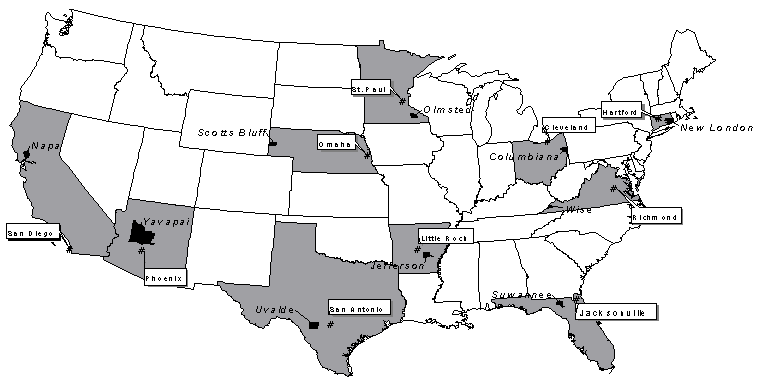
Except for a few of the rural communities, sites were not chosen based on their use of intermediaries. Once we selected the sites, we collected information on intermediaries in the geographic region covered by the administrative entity responsible for TANF employment programs. Especially in the urban areas, this often included the entire county or metropolitan area in which the city of interest was located.
To the extent possible, we include inter mediaries funde d with TANF and Welfare-to-Work (WtW) dollars from each of the sites in this study. TANF employment programs generally are targeted to the entire TANF caseload while WtW programs are targeted more narrowly to hard-to-employ TANF recipients. TANF employment programs usually are administered by the welfare department, although a state or local community can choose to transfer this responsibility to another organization, such as the Department of Labor or a local Workfoce Development Board. The WtW program is administered through the Department of Labor at the federal level and through the workforce development system at the state and local level. In the study sites, both programs were administered by the workforce development system in four sites; in the remaining sites, TANF employment programs were administered by the welfare department and WtW by the workforce development system.
Demographic and Economic Characteristics
As the data presented in Table I.1 show, the sites represent a broad range of demographic characteristics and economic conditions. (More detailed information on each of the sites can be found in Appendix A.) The population in the central cities of the urban sites ranges from 133,000 to more than one million residents. In the rural areas, the population ranges from 25,000 to 253,000 residents, with half of the sites populated by 100,000 or more people.
| Key Character- isticsa |
Phoenix AZ |
Little Rock AR |
San Diego CA |
Hartford CT |
Jackson- ville, FL |
St. Paul MN |
Omaha NE |
Cleveland OH |
San Antonio TX |
Richmond VA |
|---|---|---|---|---|---|---|---|---|---|---|
| Population (central city 1996) | 1,159,000 | 175,752 | 1,171,121 | 133,086 | 721,139 | 259,606 | 364,253 | 498,246 | 1,067,816 | 198,267 |
| Population (county 1997) | 2,696,198 | 350,426 | 2,722,650 | 825,141 | 732,622 | 484,354 | 441,006 | 1,386,803 | 1,332,547 | 242,987 |
| AFDC/TANF Caseloadb | 15,219 | 2,168 | 38,000 | 5,800 | 3,984c | 9,300 | 3,500 | 33,000 | 13,598 | 4,539d |
| Percentage of families that are femaleheaded (1990) | 11.8 | 14.5 | 11.2 | 27.6 | 13.4 | 13.0 | 13.3 | 22.7 | 15.7 | 19.8 |
| Percentage of families below poverty (1989) | 10.5 | 10.8 | 9.7 | 25.7 | 9.8 | 12.4 | 9.6 | 25.2 | 18.7 | 17.4 |
| Racial distribution (1990): | ||||||||||
|
81.7 | 64.7 | 67.1 | 40.0 | 72.7 | 82.3 | 83.9 | 49.5 | 72.2 | 43.4 |
|
5.2 | 34.0 | 9.4 | 38.9 | 24.4 | 7.4 | 13.1 | 46.6 | 7.0 | 55.2 |
|
13.1 | 1.2 | 24.5 | 22.1 | 2.9 | 11.3 | 3.0 | 3.9 | 21.8 | 1.4 |
| High school graduation rate among adults over 25 (1990) | 78.7 | 82.0 | 82.3 | 80.9 | 76.9 | 81.1 | 82.6 | 58.8 | 69.1 | 68.1 |
| City unemployment ratee | 2.9 | 3.6 | 3.7 | 7.5 | 3.3 | 2.5 | 2.4 | 8.4 | 4.1 | 4.8 |
| Notes:
a Data are from the 1999 Annual Metro, City, and County Data Book, unless otherwise noted. b Data gathered from individual site visits, unless otherwise noted. c http://www.state.fl.us/cf_web/wages/tme_line.XLS (September 1998). d Virginia Independence Program Monthly Report, March 1998. Virginia Department of Social Services. e The State of the Cities 1999, U.S. Department of Housing and Urban Development. |
||||||||||
| Key Character- isticsa |
Yavapai County AZ |
Jefferson County AR |
Napa County CA |
New London County CT |
Suwannee County FL |
Olmstead County MN |
Scotts Bluff County NE |
Columbiana County OH |
Uvalde TX |
Wise County VA |
|---|---|---|---|---|---|---|---|---|---|---|
| Population (1997) | 144,298 | 82,259 | 119,269 | 252,958 | 33,077 | 114,619 | 36,281 | 111,644 | 25,619 | 39,288 |
| AFDC/TANF caseloadb | 582 | 956 | 590 | 2,400 | 311c | 807 | 600 | 200 | 200 | 757d |
| Percentage of families that are femaleheaded (1990) | 7.0 | 16.0 | 9.2 | 9.6 | 11.3 | 7.5 | 9.0 | 10.3 | 12.2 | 12.1 |
| Percentage of families below poverty (1989) | 9.8 | 19.3 | 4.6 | 4.7 | 15.1 | 4.5 | 11.9 | 14.0 | 40.8 | 18.8 |
| Racial distribution (1997): | ||||||||||
|
97.2 | 53.1 | 94.0 | 91.9 | 81.4 | 94.2 | 97.0 | 98.1 | 98.6 | 97.2 |
|
.3 | 46.0 | 1.1 | 5.9 | 17.7 | 1.0 | .3 | 1.5 | .5 | 2.2 |
|
2.5 | .9 | 4.9 | 2.7 | .9 | 4.8 | 2.7 | .5 | 1.0 | .5 |
| High school graduation rate among adults over 25 (1990) | 78.9 | 65.9 | 80.7 | 80.9 | 63.8 | 88.0 | 74.3 | 71.8 | 56.1 | 52.1 |
| Unemployment ratee | 4.0 | 7.8 | 6.3 | 5.3 | 5.1 | 2.9 | 4.6 | 5.5 | 12.2 | 17.0 |
| Notes:
a Data are from the 1999 Annual Metro, City, and County Data Book, unless otherwise noted. b Data gathered from individual site visits, unless otherwise noted. c http://www.state.fl.us/cf_web/wages/tme_line.XLS (September 1998). d Virginia Independence Program Monthly Report, March 1998. Virginia Department of Social Services. e 1998 Statistical Abstract of the United States. |
||||||||||
In addition to having a broad range of demographic characteristics, the sites in this study also represent a variety of economic conditions. The percentage of families living in poverty ranges from a low of 4.5 percent to a high of 40.8 percent. The unemployment rate in seven of the urban sites is lower than the national rate of 4.2 percent. In the urban sites, the highest reported unemployment is 8.4 percent. In the rural areas, the unemployment rates tend to be higher than in the urban sites. Only two of the rural sites have an unemployment rate below the national average and two have an unemployment rate above 10 percent.
The number of families who receive cash assistance in the urban areas ranges from a low of 2,168 families to a high of 38,000 families. In the rural sites, the number of families receiving TANF assistance ranges from 200 to 2,400 families.
Key Work-Related TANF Policies in the Study States
Because states now have more control over the design and implementation of their assistance policies and programs for low-income families, requirements for and services provided to families vary from state to state, and in some cases, from one locality to another within a state. Key work-related policies that guide the delivery of employment-related services in the study states are summarized in Table I.2. Undoubtedly, some of these policies will influence the work of intermediaries more than others will, but they all help to shape the environment in which intermediaries operate. How a state or locality defines its work requirements may influence the range of services an intermediary might provide and the pool of recipients to whom they will be provided. Sanctions and time limits may influence the ease with which intermediaries are able to encourage recipients to take advantage of the services they have to offer. The provision of supportive services may help to ease the transition to work and increase job retention.
| State | Work Requirement (Single Parent, FY 1999) | Exemptions | Sanctions | Time Limits | Transitional Benefits |
|---|---|---|---|---|---|
| Arizona | 30 hrs/wk Mostly job-search activities education and training determined on a case-by-case basis | Narrow Youngest child younger than 3 months | Full-family (TANF) Progressive | 24 of 60 mos | Child care, Medicaid - 24 mos Transportation Extended EID (Earned Income Disregard) |
| Arkansas | 25 hrs/wk Broad range of initial activities for 6 weeks then education, training, work experience must be combined with at least 20 hours of work | Narrow Youngest child younger than 3 months | Full-family (TANF) Progressive | 24 mos | Child care - 36 mos Transportation - 2 mos Medicaid - 12 mos Expanded and extended EID |
| California | 32 hrs/wk Up-front job search required education and training allowed if employed | Broad Youngest child younger than 6 months | Parent-only (TANF) | 60 mos (Parent- only) | Child care, Medicaid - 12 mos Expanded and extended EID |
| Connecticut | 25 hrs/wk Mostly job search activities education and training allowed as clients near the end of the time limit | Broad Youngest child younger than 12 months | Full-family (TANF) Progressive | 21 mos | Child care - income eligible Medicaid - 24 mos Expanded and extended EID |
| Florida | 25 hrs/wk Job-search for a maximum of four weeks then education and training determined on a case-by- case basis | Narrow Youngest child younger than 3 months | Full-family (TANF) Immediate | 24 of 60 or 36 of 72 mos total | Child care - 24 mos Medicaid, food stamps - 12 mos Expanded and extended EID |
| Minnesota | 30 hrs/wk 8 week up-front job search for most clients, although alternatives such as education or training can be pursued with approval broad range of activities after up-front job search, including education and training | Broad Youngest child younger than 12 months | Partial grant (TANF) Progressive Vendor payments | 60 mos | Medicaid - 6 mos Expanded and extended EID |
| Nebraska | No specific number of hours Broad range of initial activities including education and training (up to 24 months), work experience, and job search | Narrow Youngest child younger than 3 months | Full-family (TANF) Immediate | 24 of 48 mos; 60 mos total | Child care - income eligible Medicaid - 12 mos Expanded EID |
| Ohio | 30 hrs/wk Varies by county must meet state work requirements; emphasis on initial job search followed by work experience | Narrow Youngest child younger than 12 months | Full-family (TANF) Immediate | 36 of 60 mos; 60 mos total | Extended EID |
| Texas | 25 hrs/wk Mostly job search education and training allowed if employed | Broad Youngest child younger than 48 months | Parent-only (TANF) | 12, 24, or 36 of 60 mos; 60 mos total | Medicaid - 12 mos |
| Virginia | 30 hrs/wk 3 month up-front job search required if no employment, placed in work experience education and training allowed if employed | Broad Youngest child younger than 18 months | Full-family (TANF) Immediate | 24 of 60 mos; 60 mos total | Child care, transportation, Medicaid - 12 mos Expanded and extended EID |
Work Requirements. The study states rely on several different approaches to help TANF recipients enter the paid labor market. Three of the states allow at least some recipients to participate in a broad range of initial work-related activities including education and training, work experience, or job search. The remaining states require all clients to participate in job search initially, reserving participation in other activities including education, training, and community work experience for persons who are employed, for whom barriers to employment have been identified, or who do not find employment after a specified period of time. Practically speaking, the majority of recipients initially participate in a job search program, even when states allow a broad range of work-related activities.
Exemptions. Under TANF, states are free to decide who is required to participate in work activities, although for purposes of meeting federal work participation rates, the only families who may be excluded are those with a child under the age of one. Half the states in this study changed their participation policies so that fewer clients are exempted from participation than were exempted under JOBS. All of the sites exempt some recipients from participation, in some sites, however, these exemptions are defined quite narrowly.
Sanctions and Time Limits. Seven of the 10 study states have implemented full family sanctions to enforce participation in work or work-related activities, while three eliminate only a portion of the TANF grant for noncompliance with work requirements. Eight of the ten study states have adopted a time limit that is shorter than the federal 60-month limit. The shortest time limit adopted by any of the study states is 21 months. One of the states that has adopted the 60-month time limit only eliminates benefits for the parent.
Work Supports. To support families who find work, some of the study states have adopted policies to extend Medicaid coverage and provide child care or transportation assistance to families who find employment. Several of the study states also have enacted generous earned income disregards that allow families to continue to receive cash assistance while they are working. The majority of states expanded the earned income disregard that was in place for the first four months of employment under the AFDC program and also extended it beyond the first four months. Only one state did not extend or expand the earned income disregard for working families when TANF was implemented.
State and Local TANF Administrative Structures
Intermediaries are operating not only within a changing policy environment but also within a changing administrative environment. The shift to a work-oriented assistance system has caused some states and localities to reconsider how to best align TANF employment programs with other employment services for the disadvantaged. As a result, the administrative structures for operating TANF employment programs are more varied and complex than the administrative structures that were in place prior to the implementation of welfare reform. While some systems continue to be administered by the welfare system, others are now administered by the workforce development system or by a newly created administrative entity. Since the implementation of welfare reform, over half of the study states substantially altered the administrative structure in their local areas (see Table I.3.).
| State | State or County Administered | State Administrative Oversight of Employment Services for TANF Recipients | Changes in Administrative Oversight as a Result of Welfare Reform |
|---|---|---|---|
| Arizona | State | Combined welfare and employment services system (with separate administrative divisions) | None |
| Arkansas | State | Transitional Employment Board (TEB) | New structure state TEB and local Transitional Employment Assistance (TEA) coalitions |
| California | County | Welfare system | San Diego divided the county into 6 service delivery regions |
| Connecticut | State | Workforce development system | Responsibility for service delivery shifted from the welfare to workforce system |
| Florida | State | Work and Gain Economic Selfsufficiency (WAGES) board | New structure state WAGES board and local WAGES coalitions |
| Minnesota | County | Welfare system | Olmsted County shifted responsibility for service delivery from workforce to welfare system |
| Nebraska | State | Welfare system | None |
| Ohio | County | Welfare system | None |
| Texas | State | Workforce development system | Responsibility for service delivery shifted from the welfare to workforce system |
| Virginia | State | Welfare system | None |
If we take these changes into account, the intermediaries in the 10 study states operate under one of four administrative structures.
- Welfare Office as Sole TANF Administrative Entity. Under this administrative arrangement, the welfare office has responsibility for determining eligibility for cash assistance and managing all work or work-related activities. The advantage of this arrangement from the perspective of intermediaries is that the welfare office can control the flow of its clients to the intermediary. The disadvantage is that TANF employment services are not fully integrated with other employment and training programs, possibly making it more difficult for TANF intermediaries to access these services for their clients. In the current labor market, this structure may also foster competition for clients between the TANF and workforce development systems. Intermediaries in five of the 10 study states operate under this structure.
- Administrative Responsibility Shared by the Welfare Office and Workforce Development System. Under this administrative structure, the welfare office determines eligibility for cash assistance, and the workforce development system develops and manages all employment and training activities. The advantage of this administrative structure is that it integrates employment and training activities for TANF recipients with all other employment and training activities, making it easier to create a streamlined system. The disadvantage is that coordinating client referrals, welfare policies, funding, and data systems can be a daunting task. Intermediaries in two of the study states operate under this structure.
- Administrative Responsibility Shared by the Welfare Office and a Newly Created Community-based Administrative Entity. The advantage to this administrative structure is that it engages the broader local community in welfare reform planning and decision-making. The disadvantage is that it often takes time to put a new organizational structure into place and to gain consensus among a broad range of community partners about what services should be provided and how they should be provided. An additional disadvantage is that the new administrative entity often must forge working relationships with both the welfare and the workforce development systems. Intermediaries in two of the study states operate under this administrative structure.
- Combined Welfare and Workforce Development System. Under this administrative structure, responsibility for determining eligibility for cash assistance and the management of all employment and training activities (including those outside of the TANF system) are housed within one agency. The advantage of this administrative structure is that is eliminates the historical separation between services for welfare recipients and all other low income populations and the complete separation of eligibility for cash assistance from the provision of employment-related services. Only one of the study states, Arizona, operates using this administrative structure.
Collecting Data on Intermediaries and the Environments in Which They Operate
Information for this study was gathered through site visits conducted between April and August 1999 by researchers from MPR and our subcontractor, the National Alliance of Businesses (NAB). During the site visits, two-person research teams met with staff from the welfare office, an agency from the workforce development system, selected intermediaries, and employers who actively hire welfare recipients through intermediaries. We obtained information on intermediaries with whom we did not meet through meetings with staff from the welfare office and workforce development system, written material collected during our site visits, and through an information request sent to individual intermediaries.
From the site visits, general information about intermediaries was collected and entered into a database containing information on all of the intermediaries in each site. This information falls into four key areas:
- Program responsibility, which identifies how program responsibilities are allocated among agencies within the services delivery system;(2)
- Payment information, which includes information on how and how much intermediaries are paid for their services;
- Services, which lists the types of services intermediaries provide; and
- Characteristics, which provides basic data on each intermediary, such as type of agency, funding sources, and the types of clients who are served.
In all, the database includes information on 120 intermediary organizations in 18 of the 20 sites. (Two sites have no intermediaries that met our criteria for inclusion in the study.) In the sites with intermediaries, the number of intermediaries ranges from 1 to 29. Whenever possible, we have included intermediaries funded through TANF and the Welfare-to-Work program.
Characteristics of Intermediaries in the Study Sites
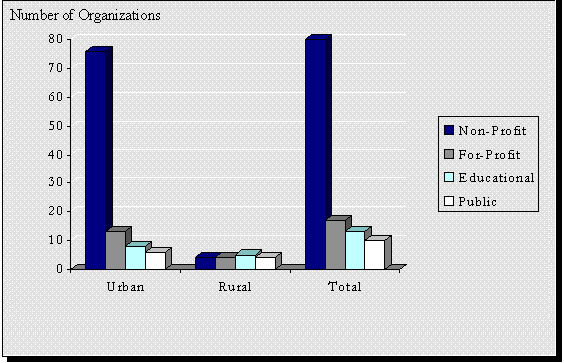
As the information presented in Figure I.2 shows, the intermediaries included in this study represent a broad range of organizations. (Examples of the kinds of organizations that are represented among these various categories can be found in Appendix B.) While a few sites rely only on nonprofit organizations, most use a mix of nonprofit, for-profit, and public organizations, as well as educational institutions to link welfare recipients with jobs. (A site by site listing of the number of intermediaries by type of organization is included in Appendix C). Still, the overwhelming majority of the intermediaries in the study sites are nonprofit organizations, accounting for 67 percent of the intermediaries overall and 74 percent of the intermediaries in the urban sites. The intermediaries in the rural areas are more equally split among the various types of organizations.
Figure I.2
Types of Organizations Acting as Intermediaries
Within these broad categories, the organizations that act as intermediaries bring a broad range of expertise to the task of linking welfare recipients with employment. The majority of the non-profit organizations are of two types: (1) local entities or local affiliates of national organizations (e.g., the Urban league, Salvation Army, Goodwill, etc.) that have a long history of providing employment-related services to disadvantaged populations and (2) organizations with expertise in addressing the supportive service, and sometimes the employment, needs of special populations such as ex-offenders, persons with disabilities, or persons who speak limited English. Only a few nonprofit organizations are new to the communities in which they provide services or have no experience providing employment services to or working with welfare recipients.
Represented among the for-profit intermediaries are organizations that have been providing employment services to welfare recipients for many years and organizations that are new to the employment service arena. Most of the for-profit intermediaries are large organizations with a national presence, although a few are smaller local organizations. The educational institutions that act as intermediaries include community colleges, adult education programs, and local school districts. The public or quasi-public agencies that act as intermediaries include city governments, local JTPA agencies and public housing authorities.
1. By the time we conducted site visits to the local communities, some of the caseloads had dropped below 500 families.
2. By the time we conducted site visits to the local communities, some of the caseloads had dropped below 500 families.
3. This information is site-specific. All other information in the database corresponds to a specific intermediary.
Defining the Roles and Responsibilities of Intermediaries in a Work-Based Assistance System
Regardless of whether a state's welfare program is state or county administered, local welfare offices always have had significant control over how to structure the delivery of employment services for welfare recipients.В While some local welfare offices provided these services in-house prior to the implementation of TANF, others forged close relationships with the JTPA system, collaborated with the local community college, or contracted with community-based organizations.В In order to provide services in a timely manner to the expanded pool of recipients required to work or participate in work-related activities, most communities have had to develop new or expanded service delivery systems.В The shift from a human capital development to a work-first approach to serving welfare recipients also has required them to reorient their service delivery systems toward job search and placement rather than participation in longer-term education and training programs.
Within a work-based assistance system, a broad range of tasks must be performed to provide families with cash assistance and to help them make the transition to self-sufficiency.В The primary employment-related services provided to most TANF recipients are case management and job search and placement assistance.В Secondary employment-related services, provided on a more limited basis, include work experience, education, training, supported work, job retention, and advancement programs.В In deciding how to use intermediaries to provide these services, local welfare offices or their designee face three key decisions:
- How much responsibility to transfer to intermediaries
- Whether to transfer responsibility to a single intermediary or multiple intermediaries
- How and how much to reimburse intermediaries for the services they provide
Using these three key decisions as our framework, in this chapter, we examine the choices the local sites made regarding how to use intermediaries to help welfare recipients make the transition to employment.В A summary of our key findings is presented in Table II.1.
How Much Responsibility to Transfer to Intermediaries
The amount of responsibility the local sites transferred to intermediaries ranged from full responsibility for all employment-related services to no responsibility (see Table II.2). Of the 20 study sites, 18 transfer some responsibility for providing employment-related services to intermediaries. The two sites that do not transfer any responsibility to intermediaries are both rural sites that provide all employment-related services in-house or rely on existing resources in the community. Decisions regarding how much responsibility to transfer to intermediaries not only define the role intermediaries play in linking welfare recipients with jobs but also the extent to which the welfare office plays a role in helping welfare recipients to find and/or maintain employment. Several key patterns emerge regarding how much responsibility the local sites transferred to intermediaries:
1. The employment-related responsibilities transferred to intermediaries most often are job search and placement assistance, although a substantial number of communities also transfer responsibility for case management.
Intermediaries provide job search and placement assistance in all of the sites that transfer some work-related responsibilities to intermediaries. In 12 of these (seven urban and five rural), intermediaries have responsibility for providing case management for the majority of the TANF caseload that is required to look for work; in three of the urban sites welfare office staff also provide case management, but for a relatively small portion of the overall caseload.
Given the emphasis on shifting the focus of the welfare office from determining eligibility to helping TANF recipients make the transition to unsubsidized paid employment, it is noteworthy that so many of the sites, especially in the urban areas, transferred primary responsibility for providing case management services to intermediaries. Cleveland is the only urban site where former eligibility staff have been retrained to function as "self-sufficiency coaches," assuming responsibility for eligibility and case management. The other urban sites that provide case management have separate staff, usually working in a separate unit, who have responsibility for this function. When case management responsibilities are transferred, the intermediary is responsible not only for linking TANF recipients with jobs but also for working with the recipients to develop self-sufficiency plans and linking them with the resources they need to achieve the goals outlined in their plans.
| Responsibility Transferred to Intermediaries | Responsibility Retained by the Welfare Office | # of Primary Intermed. | Method of Assignment | |||||||
|---|---|---|---|---|---|---|---|---|---|---|
| Eligibility | Case Mgmt | Job Search | Secondary Services | Eligibility | Case Mgmt | Job Search | Secondary Services | |||
| Urban Sites (TANF Caseload) | ||||||||||
| San Diego, CA (38,000) | P | P | P | P | S | S | S | 3 | Geographic | |
| Cleveland, OH (33,000) | P | P | P | P | S | 9 | Discretion | |||
| Phoenix, AZ (15,219) | S | S | S | S | P | P | P | P | 1 | Geographic |
| San Antonio, TX (13,598) | P | P | P | P | 1 | |||||
| St. Paul, MN (9,300) | P | P | P | P | S | S | S | 7 | Discretion | |
| Hartford, CT (5,800) | P | P | P | P | 3 | Discretion | ||||
| Richmond, VA (4,539) | S | S | P | P | P | P | 1 | |||
| Omaha, NE (3,500) | P | P | S | P | S | 2 | Discretion | |||
| Little Rock, AK (2,168) | P | P | P | P | P | 7 | Geographic | |||
| Jacksonville, FL (3,984) | P | P | P | P | 1 | |||||
| Rural Sites | ||||||||||
| New London, CT (2,400) | P | P | P | P | 3 | Functional | ||||
| Olmsted, MN (807) | P | P | P | P | S | 2 | Functional | |||
| Wise, VA (757) | P | P | P | P | 0 | |||||
| Scotts Bluff, NE (600) | S | S | P | P | P | 1 | ||||
| Napa, CA (590) | P | P | P | P | P | 1 | Functional | |||
| Yavapai, AZ (582) | P | P | P | P | 0 | |||||
| Jefferson, AK (329) | S | P | P | P | P | 0 | ||||
| Suwannee, FL ( 311) | P | P | P | P | 1 | |||||
| Columbiana, OH (200) | S | S | P | P | P | P | 1 | |||
| Uvalde, TX (200) | P | P | P | P | 1 | |||||
| Notes: P = Primary Responsibility; S = Secondary Responsibility | ||||||||||
2. Some welfare offices that transfer significant responsibility for providing primary employment services to intermediaries continue to provide these services for at least some portion of the TANF caseload. Some welfare offices, however, have no responsibility for providing employment-related services to TANF recipients.
Many welfare offices developed some capacity for providing employment-related services to welfare recipients through their implementation of the JOBS program. Several of the sites have continued to rely on this expertise to provide employment-related services to at least a portion of the TANF caseload (see Table II.2). For example, in Maricopa County (Phoenix), full responsibility for TANF implementation was transferred to an intermediary in only part of the county; in the remainder of the county, former JOBS staff provide case management services and operate a semi-structured job search assistance program for all TANF recipients required to find employment. In St. Paul and San Diego, welfare office staff provide case management and job search and placement services to a portion of the TANF caseload; the remainder of the caseload receives these services from an intermediary. In Richmond, welfare office staff provide case management services for all TANF clients and job search and placement services are provided in-house for some clients and by intermediaries for others. In Omaha, welfare office staff refer all clients to intermediaries for job search and placement services but provide case management in-house for almost half the caseload. In many of the sites, job ready clients are referred to a resource room located at the welfare office to look for employment on their own.
Due to their smaller size, the rural welfare offices have maintained more responsibility for providing primary employment-related services to TANF recipients. For example, in Wise County, welfare staff provide case management, job search assistance and placement and develop and monitor recipients' participation in work experience placements. When appropriate, welfare office staff refer TANF clients to existing employment or training programs in the community. Even in Columbiana and Scottsbluff, where intermediaries are used to provide primary employment services to some TANF recipients, welfare staff provide job search and placement assistance to the majority of the TANF caseload. As its caseload declines, TANF staff in Columbiana are taking on more responsibility for helping clients find employment, reducing the number of clients served by Columbiana's primary intermediary.
Welfare offices in three of the ten states (Connecticut, Florida, and Texas) have no responsibility for providing employment-related services to TANF recipients. In Connecticut and Texas, full responsibility for providing employment-related services has been transferred to the workforce development system. In Florida, local WAGES coalitions decide who will provide employment services to TANF recipients. Some local WAGES coalitions rely on the local community college to provide these service while others have used a competitive bidding process to select one or more intermediaries to provide them.
3. When secondary employment-related services are provided, they are almost always provided by intermediaries, however, in most sites, these programs are still in the early stages of development.
Although some secondary services are provided in all of these sites, they do not reach large numbers of recipients and are in the very early stages of development. When secondary employment services are provided they almost always are provided by intermediaries, usually using funds from the Welfare-to-Work program. Unlike primary employment services that include similar elements across all of the sites, secondary services vary considerably. In some sites the only secondary service provided is work experience; in others, short-term training or programs to promote job retention and advancement are emphasized. Work experience programs and intensive case management and outreach for sanctioned families are the only secondary employment programs that are sometimes provided by welfare office staff.
| Using Intermediaries to Help the Hard-to-Employ Find Employment |
|---|
| Cleveland (Cuyahoga County) stands apart from the other study sites in both its approach and the comprehensive nature of the secondary employment services it provides to TANF recipients. In late 1998, Cleveland issued a request for proposals to identify intermediaries who could provide employment services to TANF recipients who are deemed "hard-to-employ." Through this process, Cleveland now has 19 intermediaries who will provide specialized job search and supportive services for ex-offenders, recipients with chronic barriers to employment such as substance abuse or mental health and "intermittent" workers who can find, but do not retain employment. All of these services are being funded with TANF funds, making it possible for the welfare office to set and, if necessary, redefine the eligibility criteria for receipt of these more specialized services. The expectation is that TANF recipients referred to these more specialized intermediaries will receive more intensive services than recipients who receive regular job search and placement assistance; follow-up services may be provided for some participants for as long as 18 months. The intermediaries that will provide these services are primarily local nonprofit organizations, including several that specialize in providing supportive and/or employment services to hard-to-employ populations outside of the TANF system. |
4. The local sites' decisions regarding how much responsibility to transfer to intermediaries were influenced by their current and potential administrative capacity, their previous experience with intermediaries, the TANF administrative structure, caseload size, and legislative mandates.
Even though the local sites are operating in a range of policy environments, these policies seemed to have little, if any, influence on the decisions the local sites made regarding how much responsibility to transfer to intermediaries. Instead, the factors that most affected their decisions focused primarily on administrative considerations, including whether the local site had or could hire sufficient staff to provide services in-house and their previous experience working with intermediaries or their perceptions of the advantages of doing so.
Limited Administrative Capacity. Lack of administrative capacity significantly influenced several local offices' decisions regarding how much responsibility to transfer to intermediaries. For example, San Diego estimated that they would need 433 additional staff to provide employment services to the portion of their TANF caseload that was mandated to find employment. Operating in an environment where there is considerable support for privatizing government operations, county officials enthusiastically embraced the decision to transfer significant responsibility to intermediaries rather than add this number of additional staff to the county's payroll. In Omaha, where the welfare office is under a statewide hiring freeze, the decision to transfer significant responsibility to intermediaries was viewed as a necessity, rather than the optimum service delivery arrangement.
History. Previous experience with intermediaries played a much greater role in the decision to use intermediaries in some of the local sites. For example, having used intermediaries to provide case management and employment-related services under the JOBS program, Ramsey County (St. Paul) was able to build on established relationships with providers in the community to expand its capacity for providing employment-related services to TANF recipients. Napa, operating one of the oldest one stop centers in the country, already had a comprehensive, well-functioning collaborative service system in place on which they could build. New London chose to design a service delivery system that would take into account the strengths of the organizations already providing employment-related services in the community.
Administrative Structure. In the sites where the welfare office retained administrative responsibility for TANF employment programs, responsibility for providing employment-related services was usually shared between the welfare office and intermediaries. However, when administrative responsibility for TANF employment programs was transferred to the workforce development system, all responsibility for providing employment services was transferred to intermediaries, leaving the welfare system with no employment-related responsibilities.
Caseload Size. The urban sites were more likely to transfer responsibility to intermediaries than the rural sites. However, within the urban sites, caseload size did not seem to be the primary determinant of how much responsibility to transfer to intermediaries. For example, the three sites with the largest TANF caseloads made very different decisions regarding how much responsibility to transfer to intermediaries. One of the largest sites transferred responsibility for case management and job search and placement assistance to intermediaries for two-thirds of its TANF caseload. A second transferred responsibility for job search and placement assistance but not case management for its entire TANF caseload. A third currently provides all primary employment services in-house for the majority of its TANF caseload.
Legislative Mandates. The legislatures in three of the states enacted legislation to encourage greater use of intermediaries. The Arizona legislature mandated that full responsibility for operation of the TANF program (including eligibility determination) in a portion of Maricopa County (including part of Phoenix) be transferred to the private sector. If the intermediary selected to operate the TANF program meets its performance goals, the legislature's long-range plan is to transfer statewide operation of the TANF program to the intermediary. The legislatures in Arkansas and Florida mandated the creation of new administrative structures to increase the role of the private sector in the implementation of TANF. In Arkansas, the state Transitional Employment Board (TEB) and local Transitional Employment Assistance (TEA) coalitions have responsibility for planning and coordinating the delivery of employment-related services for TANF recipients. In Florida, this responsibility rests with the state Work and Gain Economic Self-Sufficiency (WAGES) Board and the local WAGES coalitions.
Use of a Single Intermediary or Multiple Intermediaries
In the study sites, the roles and responsibilities of intermediaries have been further defined by the decisions the localities made regarding whether to transfer responsibility to a single intermediary or multiple intermediaries. In the urban sites, these decisions primarily affected the number of clients intermediaries would serve and how clients are assigned to a particular intermediary. In the few rural sites that chose to use multiple intermediaries these decisions influenced the range and/or type of services each intermediary would provide. Key findings regarding the use of a single intermediary or multiple intermediaries are presented below.
1. Most of the urban sites, but only a few of the rural sites, transferred primary employment-related responsibilities to multiple intermediaries. When secondary services were provided, in most of the urban sites and some of the rural sites, they are almost always provided by multiple intermediaries.
Seven of the 10 urban sites and three of the rural sites transferred responsibility for providing primary employment services to multiple intermediaries (see Table II.2). Given their larger caseload size, it is not surprising that the use of multiple intermediaries is more common in the urban areas than in the rural areas. However, the size of the caseload in the urban sites did not appear to be the main factor that determined how many intermediaries were given responsibility for linking welfare recipients with jobs. One of the largest urban sites transferred responsibility for primary employment services to nine intermediaries, the most of any of the sites. Two additional urban sites, one medium-sized and one small, transferred responsibility to seven intermediaries. The remaining sites transferred responsibility to only two or three intermediaries.
The larger sites that transferred responsibility for primary employment services to multiple intermediaries also transferred responsibility for secondary services to multiple intermediaries, although they tended to transfer responsibility for these more specialized services to a larger number of intermediaries. The two largest sites, San Diego and Cleveland, transferred responsibility for secondary employment services to 19 and 24 intermediaries, respectively. Intermediaries that provide secondary services often have more flexibility to define the services they will provide than intermediaries that provide primary employment services. Consequently, in contrast to primary employment services, the secondary services provided by multiple intermediaries are not necessarily part of a continuum of services nor are they comparable to one another.
| Creating "Managed Competition" Among Multiple Intermediaries |
|---|
| To compare the performance of difference types of intermediaries, San Diego County officials decided to divide the county into six service delivery areas. Their plan was to have the County operate TANF employment programs in two of the six regions and to attract non-profit and for-profit organizations to operate the other four. Intermediaries were permitted to bid to operate all four districts, however, the County planned to award no more than two districts to a single intermediary. This restriction was made to ensure continuing competition and to encourage a diversity of approaches to providing employment services to TANF recipients. Lockheed Martin and Maximus, both for-profit companies and Catholic Charities, a non-profit, were selected to act as intermediaries in the four regions. (Lockheed Martin operates the TANF employment program in two of the regions.) Each of the intermediaries and the County are all subject to the same performance outcome measures. During an eight-month start-up period, the intermediaries were paid on a cost-reimbursement basis; now, they are reimbursed on a pay-for-performance basis. Over time, the County plans to use the information it collects on the intermediaries' performance to determine whether one type of organization (i.e., for-profit, non-profit or public) does a better job of placing TANF recipients in employment. If so, the County may decide to turn over full operation of its TANF programs to that sector. |
2. In the urban areas, when responsibility for providing primary employment services was transferred to multiple intermediaries, each intermediary provided the same services to a portion of the TANF caseload. However, in the rural sites, multiple intermediaries were more specialized, providing employment services to specific subgroups of the TANF caseload or a narrowly defined set of employment services to all TANF clients.
When the local sites transferred responsibility for providing employment services to multiple intermediaries, they had to develop a strategy for allocating TANF clients and/or responsibilities to individual intermediaries. In some sites, TANF clients are referred to intermediaries based on where they live. In others, they are referred through a centralized referral process or based on specific criteria. In some sites, the decision regarding which intermediary a client should be referred to is left up to individual welfare eligibility staff. Given their smaller caseload size and smaller number of intermediaries, the referral process is usually far less complex in the rural sites than in the urban sites. The various strategies used to assign TANF clients to intermediaries are discussed below.
Location. In three of the 10 urban sites, TANF recipients are referred to an intermediary based on where they live. In San Diego, the county is divided into six regions. In four of the six regions, an intermediary acts as the "gatekeeper" for all employment services. (The welfare office performs this function in the remaining regions.) The intermediary can choose to provide all services themselves, can subcontract with other intermediaries to provide services or can refer clients to existing services in the community (including those providing secondary services through the WtW program). Little Rock uses a more targeted neighborhood approach. When the system is fully operational, clients will be referred to a "Family Development Center" in their neighborhood for employment services. TANF staff will be co-located in the centers to provide easy access to all public benefits. St. Paul and Cleveland are also in the process of developing neighborhood-based service delivery models.
Centralized process. In Cleveland and Hartford, clients are referred to intermediaries through a centralized process. In Cleveland, the process is managed by welfare office staff while in Hartford it is managed by the workforce development system. This centralized referral process is designed to ensure that all intermediaries receive equal consideration when client referrals are made.
Staff discretion. In St. Paul, welfare eligibility staff have primary responsibility for deciding to which intermediary a TANF client should be referred. They make their decisions based on client choice and their knowledge about the intermediary and how well they can meet the clients' needs.
Functional specialization. In the rural areas, sites that use multiple intermediaries refer clients to intermediaries in a more specialized manner. New London, for example, uses one intermediary to conduct assessments, a second intermediary to provide case management and job search assistance, and a third intermediary to place TANF recipients in employment. This process makes the intermediaries more interdependent than in most of the other sites, making communication that much more critical. In Olmsted, clients are referred to one of three intermediaries based on their language needs or disability status. Napa uses a one-stop collaborative model of service delivery with various service components delivered by members of the one-stop.
3. Caseload size, the amount of responsibility transferred to intermediaries and the decision whether to use one or multiple intermediaries influence the number of TANF clients any one intermediary will serve and the kinds of organizations that will act as intermediaries.
The decisions the local sites made regarding how much responsibility to transfer to intermediaries and whether to transfer this responsibility to one intermediary or multiple intermediaries defines the scope and scale of services provided by individual intermediaries. These decisions, in turn, influence the kind of organizations that act as intermediaries. For-profit organizations are most likely to act as intermediaries in the sites that require intermediaries to provide a broad range of services and serve large numbers of clients. Sites that define the responsibility of intermediaries more narrowly or use multiple intermediaries to provide a broader range of services make it possible for a broader range of organizations to act as intermediaries. The use of intermediaries in San Diego and Cleveland illustrates how this plays out in practice.
San Diego and Cleveland, with TANF caseloads of 38,000 and 33,000 respectively, both allocate responsibility to multiple intermediaries. To function as an intermediary in San Diego an organization had to have the capacity to provide comprehensive employment services for at least 1,000 TANF recipients. San Diego selected three intermediaries, two for-profit and one non-profit to provide employment services in four of its six regions (one for-profit provides services in two regions). To function as an intermediary in Cleveland an organization had to be able to provide job search and placement assistance to an unspecified number of TANF clients. Among the nine intermediaries selected to provide primary employment services, seven are non-profit and two are for-profit organizations. These intermediaries will provide employment services to as few as 25 and as many as 700 TANF recipients.
On average, the TANF intermediaries included in this study expect to serve 370 TANF clients, but the range of clients served is wide, with the smallest intermediary expecting to serve only 20 recipients and the largest expecting to serve 4,000 (see Table II.3.) On average, for-profit organizations expect to serve the largest numbers of clients. Forty percent of the for-profit intermediaries in the study sites expect to serve more than 500 clients, compared to only 10 percent of the non-profit organizations. Because they are more likely than other types of organizations to serve large number of clients, for profits are projected to serve 40 percent of the total TANF caseload in the study sites, even though they account for only 15 percent of the intermediaries.
| Minimum | Maximum | Average | |
|---|---|---|---|
| Total | 20 | 4,000 | 370 |
| Location | |||
| 20 40 | 4,000 900 | 390 270 |
| Type of Organization | |||
| 20 50 60 50 | 2,000 4,000 900 1490 | 240 985 200 475 |
Reimbursing Intermediaries for the Services They Provide
In addition to making critical decisions about how much responsibility to transfer to intermediaries and how to structure the delivery of services at the local level, local welfare offices or their designee must also decide how and how much to reimburse intermediaries for the services they provide. The most common payment structures are cost reimbursement where organizations are paid for the costs they incur or pay-for-performance where organizations are paid based on their accomplishments. Key findings regarding the use of different payment structures are summarized below.
1. Most intermediaries are reimbursed for their services through a cost reimbursement rather than a pay-for-performance arrangement. In an attempt to combine the benefits of these two payment systems, several of the sites have developed cost reimbursement payment systems that include performance bonuses or incentives.
The shift to a work-based assistance system and greater emphasis on program outcomes has encouraged administrators of TANF employment programs to reconsider how they should reimburse intermediaries for the services they provide. The experiences of the study sites suggests that while a number of localities have shifted to performance-based payment arrangements, many still reimburse intermediaries on a cost-reimbursement basis. Some localities combine the two, reimbursing the intermediary for part of their costs through a cost reimbursement mechanism and the remainder through a performance incentive structure (see Table II.4.) Many of the local sites that rely on cost-reimbursement payment mechanisms include performance criteria in their cost reimbursement contracts and evaluate the success of their intermediaries against these criteria.
| Site | Payment Arrangement |
|---|---|
| Arizona | |
| Phoenix | Cost reimbursement with performance incentives |
| Yavapai County | na |
| Arkansas | |
| Little Rock | Cost reimbursement |
| Jefferson County | Cost reimbursement |
| California | |
| San Diego | Cost reimbursement; shifting to pay-for-performance |
| Napa County | Cost reimbursement |
| Connecticut | |
| Hartford | Pay-for-performance; shifting to cost reimbursement |
| New London County | Cost reimbursement for case management and assessment Pay-for-performance for job placement |
| Florida | |
| Jacksonville | Pay-for-performance |
| Suwannee County | Cost reimbursement |
| Minnesota | |
| St. Paul | Cost reimbursement |
| Olmsted County | Cost reimbursement |
| Nebraska | |
| Omaha | Cost reimbursement with performance incentives |
| Scottsbluff County | Cost reimbursement with performance incentives |
| Ohio | |
| Cleveland | Pay-for-performance (job search and placement) Partial cost reimbursement; partial pay-for-performance (specialized) Cost reimbursement (training) |
| Columbiana County | Pay-for-performance (job search and placement) Cost reimbursement (training) |
| Texas | |
| San Antonio | Cost reimbursement |
| Uvalde County | Cost reimbursement |
| Virginia | |
| Richmond | Cost reimbursement |
| Wise County | na |
Critics of pay-for-performance reimbursement mechanisms argue that this payment structure encourages program operators to "cream," that is, to provide services to job-seekers who are the most likely to succeed rather than to those most in need of assistance. Critics of cost-reimbursement payment systems argue that program operators get paid even if the services they provide do not produce results, wasting taxpayers' money and reducing incentives to meet high performance standards.
It is too soon to know whether the way in which intermediaries are reimbursed for their services or the amount they are paid influence program outcomes. Welfare offices or other relevant administrative entities that reimburse intermediaries on a cost basis believe they can demand high levels of performance from intermediaries as long as clear program goals are established and performance is monitored on an ongoing basis. Those that reimburse intermediaries based on performance believe that pay-for-performance systems play a critical role in emphasizing the importance of placing recipients in jobs, not just engaging them in employment preparation activities. All agree that administering a pay-for-performance reimbursement system is much more complicated than administering a cost-reimbursement system.
2. The sites that reimburse intermediaries through a pay-for-performance system structure their reimbursements very differently, with some placing far greater emphasis on placement or retention than others.
The sites that have implemented pay-for-performance systems have structured their payment mechanisms very differently. The sites differ in the points at which they paid intermediaries (e.g., enrollment, placement and/or retention) and how they allocate the total payment among the various payment points. For example, Cleveland pays its intermediaries that provide job search and job placement services at two points: 30-day job retention (50 percent) and 90-day job retention (50 percent). Hartford pays its intermediaries that provide the same services at three points: enrollment (60 percent), placement (20 percent), and 90-day retention (20 percent). The First Coast Workforce Development Board (Jacksonville FL) also pays its intermediary at three points, but concentrates more of its payment on job placement: enrollment (30 percent), placement (60 percent) and 90-day job retention (10 percent).
Acknowledging that its specialized intermediaries who provide services to hard-to-employ populations face different challenges and have different goals, Cleveland uses a combined cost reimbursement and pay-for-performance system to reimburse these intermediaries. They receive 36 percent of their contract in monthly installments to cover ongoing operating expenses; the remaining 64 percent is paid based on performance. To encourage longer-term involvement with clients, intermediaries providing services to ex-offenders or holding "managed care" contracts to provide services to recipients with mental health, substance abuse or other chronic barriers to employment receive 40 percent of the pay-for-performance portion of their reimbursement 30 days after placement, 30 percent 90 days after placement and 30 percent 180 days after placement. To encourage greater emphasis on helping recipients sustain employment, the payment for intermediaries providing services to intermittent workers is structured to provide less reimbursement for job placement and more for job retention; 10 percent of the pay-for-performance portion of their reimbursement is received 30 days after placement; 40 percent 90 days after placement and 50 percent 180 days after placement.
3. Regardless of the way in which intermediaries are reimbursed for their services, there is wide variation in the amount intermediaries are paid for the services they provide. This variation exists between the sites and between intermediaries within some of the sites.
The local sites have made different decisions about how much responsibility to allocate to intermediaries. They also have made different decisions about how much to reimburse intermediaries for the services they provide, resulting in considerable variation in the amount intermediaries are paid. In the eight study sites where we were able to obtain comparable reimbursement data, intermediaries were paid as little as $355 and as much as $6250 per recipient served. (See Table II.5). Some, but not all, of this variation reflects differences in the services intermediaries provide. On average, intermediaries that provide only job search and placement assistance are reimbursed $1,320 per person while intermediaries that provide specialized employment services are reimbursed an average of $2970 per person.
| Type of Site | Method of Reimbursement | Minimum | Maximum | Average |
|---|---|---|---|---|
| Four Urban sites with multiple intermediaries | ||||
| Site #1 (Comprehensive Servicesa) Site #2 (Job Search and Placement) Site #3 (Comprehensive Services) Site #4 (Job Search and Placement) | Cost Performance Cost Performance | $1,900 1,100 935 580 | $3,055 3,995 1,135 2,520 | $2,360 2,130 1,045 2,090 |
| Type of organizationb | ||||
| Nonprofit For-profit Educational Public | na | 580 635 355 1,000 | 6,250 4,640 4,775 5,000 | 1,785 2,390 2,660 1,680 |
| Type of Services Provided (TANF)b | ||||
| Job search and placement Comprehensive servicesa Training Specialized (Hard-to-Employ) | na | 400 930 355 1,010 | 5,000 3,055 6,250 5,000 | 1,320 1,825 2,605 2,970 |
| Welfare-to-Work | 745 | 4,745 | 3,685 | |
| Notes: a Comprehensive service includes case management and job search and placement assistance. b Based on data from eight sites: San Diego, CA; Napa County, CA; Hartford, CT; St. Paul, MN; Olmsted, MN; Cleveland, OH; Columbiana County, OH and Richmond VA. | ||||
Comparisons across four of the urban sites that used multiple intermediaries to provide primary TANF employment services suggest that there is considerable variation within and between the sites in how much intermediaries are reimbursed, even when they provide similar services.(1) The average per-person reimbursement across the four sites ranges from $1,045 to $2,360. The sites with the highest and lowest average reimbursement provide comprehensive services job search and placement assistance and case management to TANF clients, suggesting that differences in the range of responsibility transferred to the intermediaries do not fully account for the difference in the amount they are reimbursed for the services they provide. In three of the four sites, the minimum and maximum payment amounts vary dramatically even though the intermediaries have responsibility for providing the same services. In one site, the highest-paid intermediary is paid almost four times the lowest paid intermediary. In sites where payments are comparable across intermediaries, program administrators negotiate a similar price with intermediaries regardless of how much they indicate it will cost to provide services. In sites where there is considerable variation, program administrators accept the price set by intermediaries in their response to the agency's request for bids to provide services.
1. The reimbursements in the sites that have pay-for-performance arrangements in place are adjusted to reflect the intermediaries placement and retention goals. Thus, the actual reimbursement paid per client is higher than what is reported here.
Implementation of the "Intermediary" Function: The Process of Linking Welfare Recipients with Jobs
In a work-based assistance system, intermediaries are an important link in a complex process that starts at the welfare office and ends when a recipient is placed in a job.В Since most TANF recipients are required to look for work prior to participating in other employment preparation activities, many intermediaries provide very similar services to help TANF recipients find employment.В Features that distinguish one intermediary from another include how they structure their job search programs, their ability to link clients with ancillary services and the extent to which services are provided after a client finds employment.В Another important feature that distinguishes one intermediary from another is their approach to job development, especially their ability to establish ongoing working relationships with employers.В Key to their success is the development of strong links to and ongoing communication with the welfare office or other administrative entity that controls the flow of TANF clients to them.
In this chapter, we examine the process through which intermediaries link welfare recipients with jobs.В We start by examining how welfare recipients are linked with intermediaries.В We then discuss the services intermediaries provide to prepare recipients for employment and how they identify job openings to place them in employment.В Our key findings are summarized in Table III.1.
|
Linking Welfare Recipients with Intermediaries
|
|---|
|
|
Linking Welfare Recipients with Employers
|
|
Linking Welfare Recipients with Intermediaries
The process of linking welfare recipients with intermediaries is complex and highly dependent on the service delivery structure in which intermediaries operate. As a result, there is considerable variation in the way in which welfare recipients are linked with intermediaries and the ease with which this process occurs. The success sites have in linking welfare recipients with intermediaries is determined in part by how streamlined the referral process is and how well the different agencies communicate. Our key findings regarding how welfare recipients are linked with intermediaries are discussed below.
1. The path that a welfare recipient takes to get to an intermediary ranges from a simple referral from the welfare office to a complex chain of referrals from one intermediary to another.
In the local sites, intermediaries that provide primary employment services generally do not control the flow of clients they receive. As Figure III.1 illustrates, the sites use four different models to link welfare recipients with intermediaries. These four models are distinguished by two key features: (1) who controls the flow of clients to intermediaries and (2) who has primary responsibility for working with clients to develop a self-sufficiency plan.
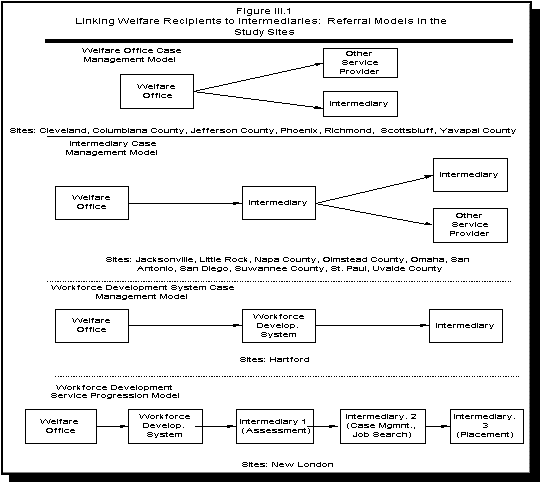
Welfare Office Case Management Model. In the sites that use this model, staff from the welfare office work with TANF clients to develop a self-sufficiency plan and determine which intermediary will provide the services the client needs to make the transition from welfare to work. All changes to a client's self-sufficiency plan are authorized by welfare office staff. Welfare staff coordinate all employment services and are responsible for monitoring a clients' progress toward self-sufficiency on a regular basis.
Intermediary Case Management Model. In the sites that use this model, staff from the welfare office make an initial referral to an intermediary who then coordinates the delivery of all employment-related services. In most cases, job search and placement assistance and case management services are provided by the same organization. The intermediary responsible for providing case management can refer a client to another intermediary for services, although if they are reimbursed on a pay-for-performance basis or evaluated on the number of job placements, there are incentives for them not to do so. When an intermediary is responsible for providing case management, a TANF client is likely to have little contact with staff from the welfare office during the time they are looking for employment. Once a client finds employment, they are then responsible for notifying staff from the welfare office so their benefits can be adjusted to account for their increased earned income.
Workforce Development System Case Management Model. In Hartford, staff from the workforce development office coordinate the delivery of services for TANF recipients. After an initial referral from the welfare office, staff from the workforce development system determine which intermediary will provide the employment services the client needs to make the transition from welfare to work. Changes to a client's plan must be authorized by a case manager in the workforce development office. Hartford is in the process of transferring responsibility for case management to one or more intermediaries. These services will not necessarily be provided by the same intermediaries that provide job search and placement assistance. As in the intermediary case management model, TANF clients have little contact with staff from the welfare office while they are looking for work.
Workforce Development Service Progression Model. New London has taken a unique approach to referring clients to intermediaries. Unlike most other sites, New London's intermediaries are specialized. Clients are first referred to one intermediary for an assessment and development of a self-sufficiency plan. Then, clients are referred to a second intermediary for job search assistance and case management services. Finally, a client is referred to a third intermediary for job placement.
It does not appear that any one of these referral processes necessarily works better than the others. Some of the more complex referral processes worked extremely well while some of the simpler ones did not. The factors that seemed to influence the effectiveness of the referral process include: (1) the level and quality of communication between the welfare office, other administrative entities and intermediaries; (2) the ability of the intermediary to carry out its specified tasks and (3) clearly defined roles and responsibilities of all parties involved in the referral process.
2. To enforce mandatory participation, the referral process is often tightly defined and monitored, making it difficult for intermediaries outside of the primary TANF employment system to receive referrals.
In all of the local sites, participation in employment-related activities is mandatory. Most of the sites have developed their referral and client monitoring systems expecting that clients will participate in programs offered by intermediaries directly under their purview. In developing these systems, the organizations that are responsible for managing TANF employment programs aim to achieve two different goals: (1) ensure that clients who are mandated to find work have access to job search and placement assistance and (2) ensure that the intermediaries to which they have transferred responsibility for providing these services have the opportunity to provide them.
Within this context, intermediaries funded through the WtW program in sites where the TANF employment program is managed by the welfare office have had difficulties (over and above those related to eligibility criteria) receiving referrals for TANF clients. In some sites, WtW providers are dependent upon other intermediaries to refer clients to them; in others, they are dependent upon welfare office staff to consider them along with primary TANF employment intermediaries as potential service providers for their clients. Especially in sites where there is excess service capacity, welfare administrators who encourage referrals to WtW providers run the risk of having even greater excess capacity among their own providers. When the primary TANF employment and the WtW programs are managed by the same administrative entity, it is easier for WtW and TANF providers to receive equal consideration. As WtW intermediaries become more established and their programs more distinguishable from those provided by TANF intermediaries, some of the issues WtW intermediaries currently face may be alleviated.
Linking Welfare Recipients with Employers
In a work first environment, the primary work intermediaries are engaged in is preparing TANF clients to enter the labor market as quickly as possible, leaving little room for them to differentiate their services. More differentiation and specialization is possible for intermediaries that provide secondary employment services. Since primary intermediaries are generally expected to provide the same set of services to clients, their success is dependent mainly on their ability to establish relationships with employers with job openings, a relatively easy task for most intermediaries in the current economic environment. Our key findings regarding the provisions of employment preparation services and the strategies intermediaries use to link welfare recipients with jobs are discussed below.
1. In the current work first environment, intermediaries providing primary employment services are distinguished by their approach to helping clients find employment, their ability to link clients with ancillary services and their approach to job development rather than the specific services they provide.
Most primary intermediaries provide a standard set of services to TANF clients that includes assessment, job search and placement assistance and follow-up services. Thus, the factors that distinguish intermediaries from one another often are subtle differences in the way they provide those services. Many of these factors are significantly influenced by the organizational structure and experience of the intermediary.
Approach to preparing clients to find employment. For most intermediaries, job search/job readiness training is the primary employment service provided to welfare recipients. These services generally include resume development, interview preparation, assisted job search, and life skills training. Depending on the intermediary, job search is more or less directed. Some intermediaries give clients access to a resource room where they can prepare their resumes and look for job opportunities on their own. Other intermediaries assess their clients' interests and skills, conduct structured workshops to teach TANF recipients how to find a job and set up interviews with employers who have job openings. In the urban areas, most intermediaries provide job search assistance to clients in a group setting; in the rural areas, job search is often more individualized. Some job search programs also include formal instruction in life skills. These programs address issues such as employer expectations for workplace behavior, self-esteem and motivation, and overcoming day-to-day barriers to work.
Linking clients with the resources they need to find and sustain employment. Intermediaries vary significantly in the extent to which they provide or link clients with any ancillary services they may need to find or sustain employment. Intermediaries that provide comprehensive services to disadvantaged families often are able to access a broader range of services for their TANF clients than intermediaries that provide only job search assistance. For example, TANF clients who participate in Goodwill's job search program in Cleveland are able to take advantage of Goodwill's extensive vocational assessment services while TANF clients who receive job search services from Cleveland Works are able to receive assistance to resolve their legal problems.
To expand the range of services they can offer to TANF recipients, some organizations have formed collaboratives to act as intermediaries. For example, intermediaries in the St. Paul Workforce Center Collaborative work together to provide job search, placement, and retention services, as well as vocational, high school, GED, and ESL training to TANF recipients. In Richmond, three organizations, the Chamber of Commerce, Mirror Enterprises and Interim Personnel jointly operate the GREAT program. The Chamber provides all fiscal and administrative oversight for the program; Mirror Enterprises provides a three-week, 80-hour job readiness course; Interim Personnel provides high-end assessment and placement services through an Employer Job Center. From the perspective of the intermediaries, a collaborative provides a better chance of winning a contract with the welfare office; from the perspective of the client, the collaborative provides a broader range of services.
Approaches to Job Development. An intermediary's success in linking welfare recipients with employment is crucial to the short-term and long-term success of the organization. Finding jobs for welfare recipients in the current economic environment is an easy task for most intermediaries; employers are looking for qualified employees and are eager to work with intermediaries who can supply them with job-ready applicants. While established intermediaries have already proven their worth to employers, intermediaries that are new to the employment services arena are working hard to show employers that they can provide valuable services such as pre-screening for potential employees and job retention services to clients who are already employed. Intermediaries believe that their success now in establishing relationships with employers will determine how they fare during an economic downturn.
Job development strategies vary widely among intermediaries. For some, job development is as simple as filling job orders from employers. In other instances, intermediaries build relationships with employers by inviting them to participate in job fairs and mock interviewing sessions with job seekers, or by creating internships and work experience programs that allow employers to "test out" clients. Job developers in all but the most established intermediaries also rely on "cold calls" to employers with whom they have not developed a relationship.
Some intermediaries have developed more innovative approaches to job development. Both the Center for Employment Training (CET) and the Texas Engineering Extension (TEEX) have a more formalized relationship with businesses. Employers agree to hire clients who have completed the appropriate vocational training programs offered by CET and TEEX respectively some employers even donate the equipment needed to train the clients. In San Diego, the Workforce Development Board encourages business involvement by using Welfare-to-Work funds to reimburse employers who hire and train hard-to-employ welfare recipients. In Arkansas, Tyson's Chicken plans to offer employment to 200 TANF recipients. After 60 days of employment subsidized by DHS, Tyson's has agreed to extend an offer of permanent employment and provide a mentoring coach for the first year of employment.
In a few of the rural areas where unemployment remains in the double digits, job development is a greater challenge for the welfare office and intermediaries. In Wise County, where the unemployment rate is nearly four times the national average, welfare office staff try to develop work experience positions that can increase TANF recipients' chances of being considered for positions when they do become available. In the face of such a high unemployment rate, welfare staff have been pleasantly surprised at the number of welfare recipients who have been able to find employment when they were mandated to do so. However, most welfare recipients who do find employment only work part-time.
2. Intermediaries that provide secondary employment services provide a diverse set of services to TANF recipients. The focus of these services reflects the priorities of the local community.
Secondary employment services are far less developed than primary employment services. However, unlike intermediaries that provide primary employment services, those that provide secondary employment services can be distinguished by the services they provide. While some secondary intermediaries provide short-term training to help TANF clients obtain better jobs, others provide specialized services to clients with chronic barriers to employment or services to help clients retain employment.
Short-term Training. When welfare recipients are unable to find employment after participating in a job search program or if they find employment and are still eligible for cash assistance, some sites allow welfare recipients to participate in short-term training programs to increase their marketable skills. A few intermediaries that provide job search assistance also provide short-term training programs. Most intermediaries, however, only provide short-term skills training; job placement assistance is provided for graduates of their program. The Center for Employment Training (CET) in Cleveland provides training in shipping and receiving, welding, machine tool operation, and printing. CET's open-entry/open-exit model allows clients to enroll at anytime, and leave whenever they get the skills they need to become employed.
The local community college is often another intermediary that provides special short-term, employment-focused training components for welfare recipients. In Jefferson County, Southeast Arkansas Community College provides workplace training to TANF recipients. The training is based on industry needs and establishes minimum criteria for entry level employees. Participants in the program also receive assistance in developing back-up plans for child care and transportation. Intermediaries that provide skills training often train JTPA-eligible participants along with welfare recipients.
Specialized Services for the Hard-to-Employ. Many TANF clients who participate in job search assistance programs face a broad range of barriers to employment. However, few intermediaries provide specialized services to address the needs of recipients who face the most serious barriers to employment; many feel that they cannot address these issues in the four-to-six weeks allotted for them to help recipients find employment. Some of the sites have started to use WtW funds to provide specialized services to the hardest-to-employ recipients. Using WtW funds, San Diego has created a broad network of intermediaries that will provide short-term training and employment support to the hardest-to-employ TANF recipients. Cleveland, with 19 intermediaries providing employment services to TANF recipients with chronic barriers to employment, has developed the most extensive set of specialized employment services for the hard-to-employ.
In some sites, the welfare office or workforce development system refers welfare recipients with specific employment barriers to those intermediaries with a history of serving clients with that particular barrier. In St. Paul, for example, the Southeast Asian Collaborative specializes in serving non-English speaking, ethnic Asian populations. The staff understand the culture and speak the native language of Hmong, Vietnamese, and Cambodian immigrants. Goodwill, which is located in numerous sites, Marc, Inc., located in Greater Hartford and the St. Paul Rehabilitation Center all have a history of serving people with disabilities. Although these "specialized" intermediaries do not have an agreement to provide specialized services, building on their experience of working with other hard-to-employ populations, they often approach providing job search assistance differently than other intermediaries and often receive referrals for clients who have more significant barriers to employment.
Services to Promote Job Retention and Advancement. Most intermediaries provide at least minimal follow-up services to the clients they serve. Some intermediaries provide more in-depth post-employment services to welfare recipients. For example, Marc, Inc., building on its approach to helping developmentally disabled adults make the transition to work, provides extensive support to clients when they first find employment. Program staff may accompany a client to work to help her complete any initial paperwork and orient her to the job. Or, at the end of the client's shift, the job developer may meet her and take her home to discuss any problems she may have faced during the day. Other services provided include employer mediation and re-employment services if the job turns out to be a poor match for the client.
Another intermediary, Lutheran Social Services in San Antonio, provides only job retention services for welfare recipients. The program organizes volunteer mentors for recently-employed welfare recipients. A telephone or in-person contact between mentor and welfare recipient usually takes place weekly. Mentors are trained to help welfare recipients resolve personal and workplace issues that may become barriers to keeping their job. Every month, mentors are required to fill out a report on how the clients are faring on the job. Mentors and clients may attend monthly seminars that focus on issues such as parenting and self-esteem. In Jacksonville, Goodwill Industries provides on-the-job mentoring for TANF clients who find employment.
While many employers welcome more in-depth post-employment services such as employer mediation, other employers believe it is their responsibility to support their own employees and resolve on-the-job problems. Some of the services provided by employers to encourage job retention include life skills training that occurs during work hours, a $.50 per hour bonus for workers who arrive on time and work all of their scheduled hours during a pay period, and specialized staff to address language and cultural issues for recent immigrants.
3. Employers value the work of intermediaries. Intermediaries help employers to expand their applicant pool and reduce their costs of hiring new employees.
Working with intermediaries is one of many strategies employers use to recruit new employees. Especially in the current economy where employers' demand for employees often exceeds the supply of qualified applicants, employers appreciate having an efficient way to tap into a labor pool to which they may not otherwise have access. Large and small employers use intermediaries to help them fill vacant positions. For example, one large chain of retail clothing stores in the Northeast recruits the majority of its new hires through intermediaries. Other employers that work with intermediaries in the study sites include large hospitals, small nursing homes, hotels, telemarketing firms and small and large factories.
As proof that businesses find the services intermediaries provide valuable, some employers are becoming an "intermediary" themselves most notably the Marriott Corporation. In San Antonio, Marriott combines their own money with Welfare-to-Work funds to provide 180 hours of training to welfare recipients over a six-week period 60 hours in the classroom, and 120 hours on-the-job. All participants that graduate from the program are guaranteed a job at Marriott. Classroom time is devoted primarily to life skills, and on-the-job training prepares them for a future job in the hospitality industry. A similar program operates in Cleveland with TANF funding. In Phoenix, Marriott provides a 60-hour, two week course to TANF recipients living in an enterprise zone.
Lessons Learned and Next Steps
For the last several years, states and localities have been making policy, programmatic and service delivery changes to shift to a more work-oriented assistance system.В Based on the experiences of the 20 sites included in this study, intermediaries clearly are important players in this transition.В Most local welfare offices, at a minimum, have transferred responsibility for teaching TANF clients how to find employment and linking them with employers who have job openings to intermediaries.В In a surprising number of local sites, intermediaries also have broader case management responsibilities including assessing TANF clients' needs and helping them to develop and implement a plan for achieving self-sufficiency.
This research was designed to be exploratory in nature.В Thus, it represents a first step in trying to understand what organizations are acting as intermediaries and the role they play in linking welfare recipients with jobs.В The variation in how the local sites have defined the roles and responsibilities of intermediaries is quite striking.В This suggests that if we had selected more sites or 20 different sites we might have uncovered even more models of using intermediaries.В With this in mind, in this chapter we discuss the challenges the intermediaries in the study sites encountered and present broad lessons that can be gleaned from the study sites' experiences.В We conclude with suggestions for ways in which our understanding of the role intermediaries are playing in linking welfare recipients with jobs might be enhanced.
Implementation Challenges
In the local sites, some intermediaries are new to serving welfare recipients or providing employment services. Thus, they face all of the implementation challenges that any new organization faces hiring and training staff and defining how they will provide the services they have agreed to provide. Established organizations have had to adjust their services to respond to the more work-oriented focus of the welfare system; for many, the primary adjustment they have had to make is decreasing the amount of time they have to prepare TANF recipients for employment. Regardless of whether organizations are new or established, many have faced similar implementation challenges, especially those related to receiving referrals and establishing effective communication systems.
| Implementation Challenges |
|---|
|
| Key Lessons Learned |
|
| Expanding Our Knowledge Base |
|
1. Intermediaries are operating in a new and changing environment where the flow of clients is rarely steady and predictable. Declining TANF caseloads, dual structures for providing employment services for TANF recipients and high no-show rates among TANF recipients all contribute to the uncertainties that intermediaries face in predicting the number of clients they will serve.
When intermediaries enter into a formal agreement with the welfare office or their designee, they do so with the expectation that they will serve a specified number of clients. However, in a rapidly changing environment, it has been difficult to accurately predict how many TANF recipients will need to be served by intermediaries. In some of the urban sites, intermediaries are serving more clients than they anticipated serving. In the sites with the largest caseload declines, intermediaries are serving far fewer TANF clients than they anticipated serving. As a result, many intermediaries' contracts have been modified and discussions are beginning about how the money available for TANF employment services can be used differently. In one of the rural sites, the primary intermediary receives so few referrals for its job search services that the program is no longer self-supporting and is maintained only as a community service.
Intermediaries operating outside of the primary TANF employment program face special difficulties reaching the number of TANF clients they plan to serve. Because most TANF clients are expected to find employment as quickly as possible, it is often difficult for them to participate in programs that are outside of the primary TANF employment structure. Consequently, WtW programs in localities where the TANF employment and WtW programs are managed by separate entities have had an especially difficult time recruiting clients to participate in their programs. Restrictive eligibility criteria contribute to some of the problems faced by WtW intermediaries, however, in communities where the WtW program is not fully integrated into the TANF employment program, enrollment problems are likely to remain even when the pool of eligible participants is broadened.
Even when intermediaries receive sufficient referrals, they have had to account for extremely high levels of non-participation. Intermediaries report that they generally can expect only about half of the clients referred to them to participate in the program. High no-show rates reduce the number of clients an intermediary can serve and create a huge paperwork burden since clients who do not show up for services are usually referred back to the welfare office for sanctioning. In an effort to reduce the number of clients who do not participate in their programs, a few intermediaries have put outreach activities into place. Outreach activities include calling the client the day before they are scheduled to begin participation and sending follow-up reminder cards. Other outreach activities are more intensive and may include conducting home visits to clients.
2. As caseloads decline, there is a growing concern among intermediaries that there is a mismatch between the limited services they are being asked to provide and the needs of the clients they are being asked to serve.
As TANF caseloads decline, many intermediaries feel they are working with more clients with multiple barriers to employment. Most intermediaries believe they could do a better job of serving these families if they had more time to work with clients and could provide a broader range of services. Over time, it is possible there will be less demand for the short-term job search and placement programs currently in place and more demand for longer-term supported work programs. Given the more specialized knowledge needed to address the needs of families with chronic barriers to employment, it is possible that a new set of intermediaries will be called upon to provide these services. Alternatively, existing intermediaries might begin to collaborate more with organizations that are better equipped to provide these services.
3. Intermediaries often are asked to collect and manage large amounts of information on individual clients with limited automated support.
It has been a challenge for most of the sites to establish clear procedures for transferring client information back and forth between multiple agencies. The more agencies involved in the referral and service delivery process, the more difficult it is to establish efficient methods of communication. Most state or local automated data collection systems were not designed to support the complex interactions between the welfare office, the workforce development system and intermediaries. Consequently, many localities have had to rely on manual tracking systems. It is an ongoing challenge to develop and maintain a system of communication that provides all involved parties with the information they need and is not overly burdensome on front line staff.
Key Lessons Learned
1. There are a variety of ways to transfer employment-related responsibilities to intermediaries. Given that localities have different resources, needs and priorities, a service delivery structure that works in one locality may not necessarily work in another.
The local sites examined for this study transferred responsibility to intermediaries in a number of different ways. The decisions they made reflected differences in their in-house resources, administrative structure, prior experience with intermediaries and perceptions of the relative effectiveness of government and the private sector. Based on their early experience, there is no evidence to suggest that one particular strategy for transferring responsibilities to intermediaries will produce better results than another. Instead, what appears to matter is creating an infrastructure that builds on the strengths of the local community.
It is also important to note that the decisions one makes regarding how much responsibility to transfer to intermediaries can impact the kinds of organizations that are qualified to function as an intermediary. In particular, when responsibilities are broadly defined and the number of clients to be served is large, non-profit organizations may be less likely than large for-profit organizations with a national infrastructure to act as an intermediary.
2. Clearly defined roles and responsibilities and ongoing communication are critical to the implementation of the intermediary function.
Intermediaries are operating in a complex policy and administrative environment. Regardless of how TANF is administered and how much responsibility is transferred to intermediaries, the process of linking welfare recipients with jobs is a shared responsibility. Welfare office staff remain responsible for referring clients to intermediaries, imposing sanctions on clients who do not participate in work-related activities and authorizing work supports such as food stamps and Medicaid when clients are no longer eligible for cash assistance. When the welfare office and the workforce development system are both involved in the administration of TANF or providing employment-related services to TANF recipients, clearly defined roles and responsibilities and clear procedures for transferring information between agencies are even more critical.
Expanding our Knowledge Base
This study has provided one of the first examinations of the role intermediaries are playing in helping welfare recipients find employment. Clearly, intermediaries are an important part of a complex array of actors that are attempting to help welfare recipients find and maintain stable employment. Therefore, their ability to link welfare recipients with jobs may substantially influence the overall success of a localities' efforts to reform the welfare system. Especially over the long-term, it would broaden our understanding of welfare reform if we explored the role of intermediaries in further detail.
1. The implementation of welfare reform cannot be fully understood without taking into account the role intermediaries play in linking welfare recipients with jobs.
Understanding the implementation of welfare reform is an extremely complex undertaking. Because many implementation decisions are being made at the local level, the focal point for many implementation studies is the local welfare office. This study suggests that, in some communities, the scope of inquiry may need to expand beyond the welfare office. This is especially true for the analysis of implementation issues that involve significant worker-client interaction such as assessment practices, the implementation of sanction policies and efforts to link clients with ongoing work supports such as food stamps and Medicaid. While we often think of these tasks within the purview of welfare office staff, it is clear that intermediaries have an important role to play in making sure that clients are aware of what is expected of them and the benefits to which they are entitled.
2. Currently, there is no conclusive evidence on whether intermediaries with certain characteristics perform better than others. Investing in research to examine this question could potentially help local welfare offices to develop more effective TANF employment service delivery systems.
In the current environment many intermediaries are being asked to provide the same set of services to welfare recipients. However, intermediaries differ on a number of dimensions that may influence their performance. Key characteristics that may influence performance include: (1) the number of clients served; (2) previous history of providing employment-related services; (3) expertise serving hard-to-employ populations; (4) payment mechanism; (5) payment amount; (6) type of organization; (7) links to the business community; and (8) the administrative structure in which the intermediary is operating.
3. Work first programs, consisting primarily of job search and placement assistance are at the heart of most current efforts to increase employment among welfare recipients. As these programs become more established, it would be useful to know whether one work first approach is more effective than another.
Job search assistance is the core service provided by most primary intermediaries. While these programs are similar in many ways, often there are subtle differences. Some of the dimensions on which these programs vary include: (1) length of the program; (2) amount of structure; (3) level of employer involvement; (4) extent to which life skills issues are addressed; and (5) length and extent of follow-up. Currently, there is no information available to indicate whether different approaches to providing job search have any influence on program outcomes. Additional information on what makes a "good" job search program may help to improve the overall quality of job search programs.
In many communities, intermediaries provide the primary link between welfare recipients and the paid labor market. While a service delivery system that effectively links the welfare office, the workforce development system and intermediaries is in place in some communities, in others, an integrated service delivery system is still being created. Given the changing nature of the TANF caseload and shifting priorities, the system for providing employment-related services to TANF clients is likely to be in transition for some time. Over the next several years, states and localities will be implementing the Workforce Investment Act (WIA) which may encourage some local communities to again rethink how they transfer responsibility to intermediaries. Examining how these transitions take place and how they affect the role intermediaries play in linking welfare recipients with jobs will help to broaden our knowledge of what it takes to create a stable work-based assistance system.
Appendix A: Site Descriptions
Phoenix, Arizona
Phoenix, Arizona, the sixth largest city in the country and second largest of the study sites, recently experienced a dramatic increase in population. With roughly 2.7 million people living in the metropolitan area, Maricopa County is one of the fastest growing regions in the nation. The sunny climate and steady economic growth has contributed to the influx of people moving to the area. Compared to the other urban study sites, Phoenix has one of the lowest proportion of families that are female headed (11.8 percent) and the lowest percentage of families who live in poverty (10.5 percent).
Located within a right to work state, the city of Phoenix is able to attract major businesses to the area such as Motorola, Honeywell, and Allied Signal. In addition, companies such as American Express, Bank of America, and Charles Schwab among others have built their regional and national headquarters within the area. The presence of these major corporations creates ripe employment opportunities for the citizens of Phoenix. The region's low unemployment rate (2.9 percent) and relatively small percentage of families receiving cash assistance is some indication of the strong economic base.
Yavapai County, Arizona
As one of the state's oldest counties, Yavapai County was one of four of the original counties in Arizona prior to statehood. This rural community has a rich Native American history where those from the Apache, Navajo, and other tribes inhabited the land long before the westward expansion. An area which once extended 65,000 square miles now covers about 8,125 square miles, though smaller now than when originally settled, the County of Yavapai is still as large as the state of New Jersey.
With almost 150,000 residents living within the area, Yavapai County has the lowest proportion of female-headed families (7.0 percent) and percentage of households who live below poverty (9.8 percent) among the rural sites. In addition, the area's low unemployment rate, which is 4 percent, is some indication that this rural community has a strong economic base. As one of the top 5 retirement communities in the nation and an area that draws many outdoors enthusiasts, Yavapai County offers a substantial number of employment opportunities for those looking for work, particularly for a rural area. However, transportation is a significant issue. The county covers a large geographic area. Many of the job opportunities are in the small towns in the county while many of the county residents live in the outlying areas.
Little Rock, Arkansas
Located near the center of the state of Arkansas, Little Rock is the largest city within Pulaski County and the state capitol of Arkansas. With 175,752 living within the area, Little Rock has the second fewest number of citizens of the urban sites. The percentage of families who live below poverty (10.8 percent) and the proportion of female-headed families (14.5 percent) are relatively low compared to other sites that have similar concentrations of minority populations. Little Rock has one of the highest rates of high school completion (82 percent) and one of the lowest TANF caseloads (2,168) among the urban sites. In addition to the existence of a major military base, the city of Little Rock is the headquarters for the state's financial industry which includes a large number of banks, investment firms, and insurance companies as well as 28 Fortune 500 companies all of which contributes to the low unemployment rate (3.6 percent) and relatively low TANF population.
Jefferson County, Arkansas
Jefferson County, Arkansas is a southern rural community. Most of the County's population (60,000 of 82,259 residents) live in the town of Pine Bluff. Almost half (46.0 percent) of the residents living in Jefferson County are African American. The poverty rate is high in the area as approximately one-fifth of the households have incomes which are less than the federal poverty level.
There are a large number of businesses in the area; however, most of the jobs are labor and blue-collar positions which pay around minimum wage. The overall County unemployment rate of 7.8 percent is twice that of Little Rock, the urban counterpart for this study.
Even though the unemployment rate is higher than the national average, the TANF caseload has taken a sharp decline since the implementation of welfare reform dropping from 956 time-limited cases in July 1997 to 329 in June 1999, which represents a 66 percent decrease in the number of families on cash assistance. The challenges that are unique to Jefferson County include the highest teen pregnancy rate in the nation and a TANF population where about three-fourths of the clients read at the 8th grade level or below.
San Diego, California
In general, San Diego is a relatively conservative community with a strong bias toward downsizing government and privatizing welfare services. With more than 2.7 million people living in the area and 38,000 families on cash assistance, San Diego County has the largest general population and TANF population of all the sites. According to Census Bureau statistics, about one-third of the population are from minority groups, although, this figure underestimates the number of people who are from minority populations as it does not include the large number of refugees and undocumented workers in the area.
The tourist industry in San Diego County keeps the unemployment rate relatively low at 3.7 percent. Most of the businesses in the area, about 90 percent, have less than 10 employees, which contributes to a large number of uninsured families as small businesses typically cannot afford to pay the cost of health insurance for their workers. Although, high technology and medical technology industries have recently expanded and are seen as major areas of potential economic growth.
Napa, California
Just north of San Francisco, Napa County draws people from all over the country to explore the scenic vineyards and sample the local wines as Napa Valley has become recognized as one of the premier wine-making regions of the world. The economy of Napa depends largely on the wineries and tourists who frequent the area, which makes employment seasonal but wages much higher than minimum wage. In the past, Napa was considered an exporter of labor in that people lived in Napa and worked outside of the area. Recently that trend is shifting as more jobs are available in town due to businesses such as Apple Computer Worldwide Data Center, Dey Labs, and other industrial corporations.
As a result of the high wages and relatively low unemployment, less than 5 percent of the families in Napa live below the poverty level. Even though the poverty rate is relatively low, the lack of housing in the area is a substantial challenge for many low-income families since the vacancy rate is less than one percent.
Hartford, Connecticut
The city of Hartford has the smallest city population of all the sites (133,086), but one of the larger County populations (825,141). Though their population within the city is relatively small, the challenges facing the community are fairly substantial. Of all the urban sites, Hartford has the highest percentage of female-headed households (27.6 percent), proportion of families below poverty (25.7 percent), and concentration of minority populations (60.0 percent).
Part of the instability in the economic base of Hartford is due to a statewide recession from 1989 to 1992, which resulted in a loss of 158,000 jobs. By June 1998, 80 percent of jobs that were lost had been recovered, but the structure of the labor market had shifted from manufacturing to service sector employment, which pay between 30 to 50 percent less than manufacturing positions. The relatively high unemployment rate in Hartford (7.5 percent) is some indication that the area has not fully recovered from the economic downturn.
New London, Connecticut
At the mouth of Thames River and near the eastern end of Connecticut's Long Island shoreline, sits New London County. With a population of 252,958 and a welfare population of 2,400, New London has the largest general population and highest number of families receiving cash assistance among the rural sites. Most of the citizens living in New London are caucasion, however, recently there has been a large influx of immigrants from a variety of Asian and African countries.
New London is one of the few sites where the unemployment rate in the rural area which is 5.3 percent is less than the unemployment rate in the urban site as the percentage of unemployed is around 7.5 percent in Hartford. Most of the jobs are in the tourist industry, particularly during the summer months, and in manufacturing. The recent opening of several large casinos in the area has also increased the number of jobs available for unskilled workers.
Jacksonville, Florida
Jacksonville, Florida, one of the nation's largest cities in terms of square miles, has a little over 700,000 people living within the area. About a quarter of the population is African American, and a small Hispanic community accounts for just three percent of the population. Those living in Jacksonville are more educated than most; almost 77 percent of the population has graduated from high school.
For purposes of providing TANF employment services, Jacksonville is part of a six county area that is served by the First Coast Workforce Development Board. Over 16,000 employers, primarily in the health, service and hospitality, financial, aviation, and construction industries are within this region. Jacksonville, the largest city in the First Coast Region, has a poverty rate in the single digits (9.8 percent) and an unemployment rate of 3.3 percent, lower than the national average.
Suwannee County, Florida
Well known for it's famous tune, "Suwannee River", Suwannee County is one of the largest geographic areas in Florida the region is characterized as very rural with a longstanding agricultural tradition. Suwannee County is one of the smallest rural study sites, with just over 33,000 people living in the area. Suwannee County is average among the study sites with regard to the percentage of female-headed households (11.3 percent) and poverty rate (15.1 percent), although there is a slightly larger minority population (18.6 percent) in Suwannee County and a fewer number of individuals who completed high school (63.8 percent) compared to the other rural sites.
While jobs are available in the area, on average, they pay only slightly above minimum wage, ranging between $6.25 and $6.50 per hour. The main industries in the region include service sector, nursing homes, agriculture, state government, and the state prisons.
Like Jacksonville, the urban site from Florida included in this study, Suwannee County's TANF caseloads have declined, although, not as drastic a drop as in Jacksonville. The number of families receiving cash assistance fell from 615 families in September 1996 to 234 families in July 1999, which represents a 62 percent caseload deduction. Key challenges facing the welfare community include the lack of public transportation, night and weekend child care, the increasing student drop-out rate, low-skilled residents, affordable housing, and a lack of business base.
St. Paul, Minnesota
St. Paul (Ramsey County), known for it's friendly people and family-style community, has been voted the most livable city, best place to do business, best place for working women, and best place to raise a family among other distinctions. As one of the smaller urban sites, the population of St. Paul is about 259,606.
St. Paul has a very large immigrant population from a range of ethnic groups including Hmong, Lao, Vietnamese, and other Asian immigrants, as well as Somalis from East Africa. The language and cultural differences unique to these immigrant populations pose challenges for the service delivery and employability of these groups.
The local economy of St. Paul is strong with an unemployment rate of 2.5 percent and a number of large corporations such as 3M, Ecolab and Minnesota Life among others doing business in the area. Most of the jobs focus on manufacturing, service and high technology. In addition to a range of employment options, Ramsey County is filled with educational opportunities. With a number of technical colleges, two public universities, and five private liberal arts colleges, St. Paul has more institutions of higher learning than any city west of Boston.
Minnesota's basic philosophy guiding its welfare programs, which is to help people leave poverty, not simply to reduce welfare rolls has contributed to only a small decline in the number of families receiving TANF, but higher wages for those who do leave cash assistance (average of $7.77 per hour).
Olmsted County, Minnesota
Olmsted County, a small town surrounded by acres of rich farmland, has approximately 114,619 people living within the area. Most of the citizens living within Olmsted County are caucasian, although, there has been a recent influx of immigrants to the area, particularly from Somali. In Olmsted County, less than 5 percent of the families live below poverty and 88 percent have completed high school. They also have the lowest unemployment rate of any of the rural sites at 2.9 percent. The County's two major employers, IBM and the Mayo Clinic, contribute to the low unemployment and poverty rates in the area which are 2.9 and 4.5 percent, respectively.
Omaha, Nebraska
Omaha, located in Douglas County on the western bank of the Missouri River, is the largest city in Nebraska, with a population of about 358,000, almost double that of Lincoln, the state's next largest city, and about one-quarter of the entire population of Nebraska. Omaha has the most ethnically diverse citizen population in the state, with a relatively large African American community (12 percent).
Unemployment is very low in Omaha, estimated at about 2.7 percent. However, the neighborhoods in which many welfare recipients live, like many central cities, have much higher-than-average unemployment rates. Omaha also has a larger percentage of families living in poverty, as well as a larger percentage of female-headed households than many communities in the state.
Service and retail jobs are most common in Omaha, with nearly three-fifths of area jobs in these sectors. Telemarketing is a major industry in Omaha and a major employer for people leaving welfare assistance for work. The telemarketing firms generally pay higher than minimum wage, but these jobs are temporary and usually do not offer benefits such as health insurance, sick leave, and retirement plans.
Omaha serves the highest number of AFDC/TANF families in the state, with over two-fifths of the state's caseload. In all, in April 1999, there were about 5,100 families on cash assistance in the county, with about 3,500 required to participate in employment activities.
Scotts Bluff County, Nebraska
Scotts Bluff County, in Nebraska's western panhandle, includes nine small, rural communities bordering Colorado and Wyoming. Approximately 36,000 people reside in the county, with most of the residents in the towns of Scottsbluff and Gering.
Sugar beet factories and other agricultural companies employ most of the local residents in Scotts Bluff County. Outside the farming community, the work is mostly in industry, the service sector, and tourism. The reported unemployment rate of 4.6 percent is nearly double that of the rest of the state, but lower than most the rural sites. Underemployment is also common, and starting wages are generally lower than in other parts of the state. Exacerbating these factors, welfare staff in Scottsbluff report a strong bias among local employers against hiring welfare recipients.
Over one-fifth of the children in Scottsbluff live in poverty and about 550 families qualify for financial assistance, about one-quarter of whom are two-parent families. From May through July, during the sugar beet harvest, there is an influx of Hispanic migrant workers to the area, which adds about 100 families to the caseload.
Cleveland, Ohio
Cleveland, Ohio's largest metropolitan area has around 498,246 people living within the city and almost triple that, 1.4 million, in the broader Cuyahoga County. Cleveland is more ethnically diverse compared to most the sites with almost half of the families African American a smaller group that are the Hispanic population (4 percent). In addition, there is a large percentage of families that are female-headed and/or live in poverty as more than one-fifth of the families are female-headed, and about one-quarter have incomes below the federal poverty line. Along with the high rates of poverty in the region, there are fewer parents who have completed their high school education, around 60 percent of Cleveland's residents have a high school degree which is much lower than Ohio as a whole (83.4 percent).
Among the sites, Cleveland has the second highest TANF caseload with approximately 33,000 families receiving cash assistance which represents about one-fourth of Ohio's total welfare caseload. One factor contributing to the high TANF caseload is the lack of employment opportunities within the area. The unemployment rate of Cleveland is the highest of all the urban sites at 8.4 percent, which is double the national average.
Columbiana County, Ohio
Columbiana County, a wooded area with roiling hills and pockets of small rural communities, has 111,853 people living within a broad geographic region. Recognized as one of the oldest regions to be settled in the state, Columbiana has a rich historical tradition as famous events such as George Washington's exploration of Columbiana County as the starting point for the Northwest Territory and Susan B. Anthony chairing the first women's suffrage convention took place within the area.
Most of the residents living within the County are white (98.2 percent), and almost three quarter (71.8 percent) have a high school degree. The local economy is still recovering from the steel mill closings during the 1980's, as the number and types of jobs available in the area are limited to the county and local school systems and the service industry.
San Antonio, Texas
Situated in the Southern part of the state, 80 miles west of Houston and 120 miles northwest of Corpus Christy, lies San Antonio, Texas. As the 10th largest city in the nation, roughly 1 million people live in San Antonio's sprawling community which is primarily known for the famous "Alamo" military post and historic Spanish Colonial missions.
The city is described as a bicultural community as most of the area is inhabited by persons from Mexican descent. The Hispanic community has a strong presence in San Antonio, including a number of undocumented workers in the area; more than half of the population is Hispanic. In addition, because the racial and ethnic communities typically settle in one geographic area, in some locations as many as 90 percent of the population are Hispanic.
The unemployment rate is around 4 percent, which is less than the national average. However, most jobs hover around minimum wage and few offer benefits such as health insurance, sick leave, and retirement. The city has a few major employers like Diamond Shamrock, Southwestern Bell, Tyson Foods, and Kelly Air Force Base, but tourism is the primary source of jobs in the area. The high poverty rate (18 percent) in San Antonio has been declared by the Mayor as the number one concern in the area.
Uvalde, Texas
Uvalde, a small rural town in southern Texas, was organized in 1953 and reorganized in 1956 by Juan de Uvalde, a famous Indian fighter. Located in the center of 10 other counties, there are 147,000 people located within the area's 15,000 square miles, making it one of the largest geographic areas among the sites. According to Census Bureau reports, most of the people living in Uvalde are Caucasian; however, many families living in Uvalde are Hispanic immigrants or undocumented workers which are not included in the census data. As a result, the number of people from the Hispanic community are underestimated by government reports.
The unemployment rate in Uvalde is typically in the low teens, although, some of the surrounding communities report unemployment rates as high as 25 percent. There is a great deal of seasonal fluctuation in the unemployment rate as there are a high number of migrant workers in the area. Like San Antonio, the jobs in Uvalde are typically low-wage positions contributing to a high poverty rate among working families. Agriculture is one of the main industries in Uvalde, however, trade has recently increased as a result of the free trade agreement with Mexico, as there is a considerable demand for truck drivers to transport products into the United States.
Richmond, Virginia
Richmond, the capitol of Virginia, has just under 200,000 people living in the central city and a TANF population of 4,500 families. The majority of families living within Richmond are African American (55.2 percent), with higher than average rates of female-headed households (19.8 percent) and families living below poverty (17.4 percent). Approximately, 56 percent of the working poor earn less than $10,000 per year. Within the city's poorer neighborhoods 33 percent of the residents depend on public assistance.
Richmond has a very small employer-base, particularly in the poorer neighborhoods. Food service, banking and finance, retail, and health care serving as the areas main industry sectors. Most of the area's main employers, including Phillip Morris, Virginia Power, Crestar Bank, Capital One, Burlington, and Motorola, reside outside of the city center.
Wise County, Virginia
Wise County, located in the coal fields region of western Virginia, comprises a mix of small towns and rural areas. Its population of 39,925 lives in the hills and within and outside its many small towns. An isolated area, there is little opportunity for tourism as well as poor access to road transport. Historically, coal alone supported the county until technological advances in mining emerged in the late 1980's and early 1990's. Now that the same amount of coal can be mined with far fewer workers, there are very few mining jobs left, and no new industries have emerged to employ the displaced coal labor force. Just under 18 percent of employees in Wise County still work in coal mining.
While most of Virginia and the rest of the country have been experiencing an economic boom and record low unemployment rates, Wise County has seen its unemployment rate rise to 17 percent. The largest single employer in Wise is a lumber manufacturer, which employs just 281 people. With 18.8 percent of its citizens in poverty, Wise has a poverty rate that is more than twice the statewide rate. The rate of high school completion in Wise is significantly lower than the statewide rate and most of the sites, as only about half of the population has graduated from high school. Most new employment is in low-paying service industry jobs fast food, discount retail, and nursing homes; secretarial and receptionist jobs also account for new employment. Two new prisons opened in recent years bringing some additional jobs to the area.
Appendix B: Examples of Organizations Functioning as Intermediaries
Nonprofit Organizations
In the study sites, a diverse group of nonprofit organizations acts as intermediaries. The majority of these organizations are of two types: (1) local entities or local affiliates of national organizations that have a long history of providing employment-related services to disadvantaged populations and (2) organizations with expertise in addressing the supportive service, and sometimes the employment, needs of special populations such as ex-offenders, persons with disabilities, or persons who speak limited English. Only a few nonprofit organizations are new to the communities in which they provide services or have no experience providing employment services to or working with welfare recipients.
Local experienced providers. Cleveland Works and Community Renewal Team (CRT) of Greater Hartford are two examples of local nonprofit organizations that began operating as intermediaries long before the implementation of TANF. Both expect to serve over 500 TANF recipients. Cleveland Works has been providing services to disadvantaged residents of Cleveland since 1986. In addition to job search and placement assistance, Cleveland Works also provides specialized services to help ex-offenders find employment and to help low-income adults address legal issues (such as poor credit) that affect their ability to find or sustain employment. CRT is one of the oldest community action agencies in the nation, providing job development and social service programs to low-income families in the Hartford area since 1963.
Organizations with expertise in serving hard-to-employ populations. Three organizations Marc, Inc. (Greater Hartford), St. Paul Rehabilitation Center (SPRC), and the Intercultural Mutual Assistance Association (IMAA Olmsted County MN) are examples of TANF and WtW intermediaries that were founded to provide employment assistance to populations with special needs. SPRC was founded in the 1940s to provide and has historically provided physical, occupational, and speech therapy services in the community. It currently provides intensive rehabilitation and employment services to TANF recipients, refugees, the homeless, and persons with developmental disabilities or mental illness. Similarly, Marc, Inc. started providing employment services 50 years ago when it began operating a sheltered workshop for developmentally disabled adults. It now focuses on placing persons with developmental disabilities, and recipients of General Assistance and TANF in unsubsidized employment in the community. IMMA was founded to respond to the needs of refugees; prior to the implementation of TANF, it was funded primarily through grants from the Office of Refugee Resettlement. IMAA's staff of 16 offers services in 12 different languages. In addition to employment services, IMAA provides crime-prevention and youth/family services.
Local affiliates of national organizations. Local affiliates of national nonprofit organizations act as intermediaries for TANF recipients in 8 of the 10 urban areas. However, they do not operate in any of the rural areas. The organizations represented as intermediaries in the study sites include the Salvation Army, Lutheran Social Services, SER/Jobs for Progress, Catholic Charities, Urban League, Goodwill Industries, and Jewish Social Services. The services these organizations provide depend on the community in which they are located, rather than on their national affiliation. For example, Goodwill Industries provides mentoring and job retention services in Jacksonville and San Antonio, job search and placement assistance in Cleveland, and comprehensive services including case management in Omaha. Most of these organizations expect to serve between 100 and 300 TANF recipients. The exception is Catholic Charities of San Diego, which expects to serve 2,000 recipients.
New organizations. A few of the nonprofit organizations were started specifically to help TANF recipients make the transition to employment. Trust House (Hartford) and Consensus Organizing Institute (San Diego) illustrate the diverse roots and goals of these new organizations. Trust House is a small organization started by a group of Catholic nuns who wanted to help TANF recipients and other low-income residents in East Hartford, an area with a high concentration of poverty and public housing developments, find employment. Trust House expects to provide tutoring, and job search and placement assistance to 40 TANF recipients; it also provides enrichment programs for the children of the TANF recipients who participate in their program. Consensus Organizing Institute (San Diego) began operating in 1997 to provide employment opportunities to residents in low-income communities in San Diego. Currently, the institute is working with Pacific Bell to train TANF recipients to become customer service representatives. Pacific Bell has agreed to hire those who complete the training as full-time employees.
For-Profit Organizations
Like the nonprofit organizations that act as intermediaries, the for-profit intermediaries represent a diverse group of businesses; while some have been providing employment services to welfare recipients for many years, others are new to the employment service arena. Most of the for-profit intermediaries are large organizations with a national presence, although a few are smaller local organizations.
Experienced providers with a national presence. Maximus is a large for-profit company that began providing case management and employment services to welfare recipients before welfare reform. Maximus describes itself as the largest private-sector provider of job-readiness training and employment-related services to the disadvantaged. It expects to serve 2,800 TANF recipients in San Diego and 4,000 in Phoenix (Maricopa County). In Phoenix, Maximus will not only provide comprehensive employment services including case management but will also determine eligibility for TANF benefits. If successful in this endeavor, Maximus will gradually take over full responsibility for the management and operation of Arizona's TANF program.
Curtis and Associates is the only for-profit company to operate in one of the smaller rural sites. Like Maximus, Curtis has been providing employment services for welfare recipients for some time. Although Curtis does not act as an intermediary in any of the other study sites, it plays this role in 12 other states. Curtis also produces a job search curriculum for use in its own programs and in job search programs that are operated by other intermediaries.
New providers with a national presence. Like Maximus, Lockheed Martin IMS expects to serve large numbers of TANF recipients in two of the study sites, Jacksonville (750) and San Diego (3,500). However, in contrast to Maximus, Lockheed Martin IMS had no experience providing employment services prior to the implementation of welfare reform. The company saw a niche in the environment it felt qualified to fill and is now acting as an intermediary in five states, including nine sites in Florida.
Local organizations. Creative Connections in New London is one of the few local for-profit organizations that acts as an intermediary. Creative Connections is a small consulting firm that designs and delivers customized training and consulting services. Other smaller, more locally based for-profit companies that are new to the employment and training arena include Ross Learning in Cleveland and Career T.E.A.M. in Connecticut. Ross learning is an operator of proprietary schools that began providing employment services to TANF recipients in Michigan when the state shifted to a work-first model of service delivery. Career T.E.A.M. provides employment services to TANF recipients in many localities in Connecticut. Career T.E.A.M. was started to provide employers with a resource to identify and hire welfare recipients who would meet their hiring standards.
Businesses. In a few of the study sites, businesses act as intermediaries. For example, in San Antonio, Marriott operates the Pathways program, a short-term hospitality training program for TANF recipients offered in many areas across the country. In Little Rock, the Arkansas Hospitality Association works with a local intermediary to provide job coaches for TANF recipients transitioning to employment at one of three hotels Doubletree, La Quinta, and the Excellcer. In Jefferson County, Arkansas, Tyson's Chicken has agreed to place 200 TANF recipients in its chicken processing plant for a 60-day subsidized employment program and provide a mentoring coach to each recipient for the first year of employment. Tyson's provides 8 hours of leave for educational purposes for every 32 hours worked for individuals who stay beyond the 60-day subsidized employment period.
Educational Institutions
A variety of educational institutions play a significant role in linking welfare recipients with jobs, especially in the rural sites. Community colleges, adult education programs, and local school districts all act as intermediaries. The North Florida Community College provides employment services for TANF recipients in Suwanee and five other counties in northern Florida; it also operates the One-Stop Career Center for the six-county region. Southeast Arkansas Community College provides workplace training, and job placement and retention services to TANF recipients in Jefferson County. Case managers at the college also help clients develop contingency plans for times when regular child care and transportation services are not available.
In San Diego, Sweetwater School District works with Maximus to facilitate workshops and provide case management for the welfare recipients who are enrolled in Adult Basic Education classes. The school district also manages a collaborative that operates a career center for low-income families. The Columbiana County Career Center, a vocational school that serves high school students and adults, is the primary intermediary in Columbiana County. The career center has worked with the welfare department to provide adult education and training opportunities for welfare recipients since 1987. It currently provides job search and placement assistance along with two short-term training programs.
Public/Quasi-Public Agencies
A broad range of public agencies act as intermediaries for TANF clients. However, because the relationship between the welfare office or other relevant TANF administrative entity and other public agencies is not always a contractual one, the role public agencies play in helping to link welfare recipients with jobs is easy to overlook. In fact, although we do not classify welfare offices as intermediaries in several of the study sites they perform exactly the same functions as intermediaries. In San Diego, the county human service department operates the TANF employment program in two of the county's six regions. In St. Paul, a specialized unit with the county welfare department acts as an intermediary. In Phoenix, employment services staff conduct a formal two-week job search assistance program and work with employers to identify job openings for welfare recipients.
In addition to these in-house arrangements, some of the sites use other public or quasi-public agencies as intermediaries. For example, several of the sites use local JTPA agencies to provide employment services directly to welfare recipients. This arrangement is especially common in the rural areas. In Hartford, the workforce development board currently provides all case management services to TANF, but these services will be contracted out beginning next year. Cleveland and San Antonio use the local public housing authority as an intermediary. In Uvalde, Texas, the Middle Rio Grand Development Council, a quasi-governmental organization that was started as a commission to work with local elected officials, acts as an intermediary for TANF clients; it also operates the One-Stop Career Center for the county.
Appendix C: Number of Intermediaries by Type of Organization (TANF and WtW)
| Type of Organization | |||||
|---|---|---|---|---|---|
| Site | Total | Non-Profit | For-Profit | Educational | Public |
| Arizona
Phoenix |
2 |
0 |
1 |
0 |
1 |
| Arkansas
Little Rock |
8 |
7 |
0 |
0 |
1 |
| California
San Diego |
22 |
14 |
3 |
4 |
1 |
| Connecticut
Hartford |
11 |
10 |
1 |
0 |
0 |
| Florida
Jacksonville |
2 |
1 |
1 |
0 |
0 |
| Minnesota
St. Paul |
14 |
11 |
0 |
2 |
1 |
| Nebraska
Omaha |
3 |
2 |
0 |
0 |
1 |
| Ohio
Cleveland |
29 |
23 |
4 |
1 |
1 |
| Texas
San Antonio |
10 |
7 |
2 |
1 |
0 |
| Virginia
Richmond |
2 |
1 |
1 |
0 |
0 |
| Grand Total | 120 | 80 | 17 | 13 | 10 |
| Percent of Total | 100% | 67% | 14% | 11% | 8% |
| Urban | 103 | 76 | 13 | 8 | 6 |
| Percent of Total | 100% | 74% | 13% | 8% | 6% |
| Rural | 17 | 4 | 4 | 5 | 4 |
| Percent of Total | 100% | 24% | 24% | 29% | 24% |