


June 2009
This ASPE Research Brief summarizes the findings from the 2008 Indicators of Welfare Dependence Annual Report to Congress reporting the extent to which American families depend on income from welfare programs. The report provides welfare dependence indicators through 2006, reflecting changes that have taken place since passage of the Personal Responsibility and Work Opportunity Reconciliation Act in August 1996.
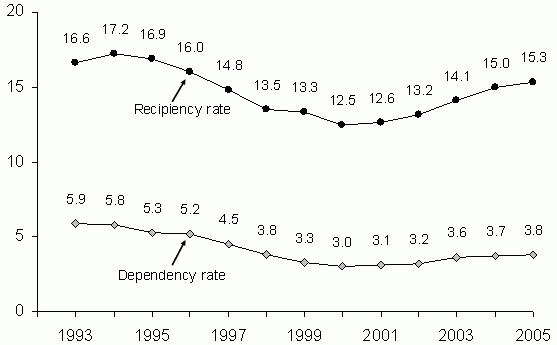
In 2005, 3.8 percent of the population was dependent on social welfare programs — they received more than half of their total family income from the Temporary Assistance for Needy Families, Food Stamp, and/or Supplemental Security Income programs. Since 2000, the dependency rate has increased from a low of 3.0 percent but the 2005 rate is still lower than the 1996 rate (5.2 percent). Two and one half (2.59) million fewer Americans were dependent on social welfare programs in 2005 than they were in 1996, the year of passage of the Personal Responsibility and Work Opportunity Reconciliation Act.
The Welfare Indicators Act of 1994 requires the Secretary of Health and Human Services to prepare an annual report to Congress on indicators welfare dependence. The Indicators of Welfare Dependence report is prepared within the Office of Human Services Policy and delivered to Congress each spring. As mandated under the Congressional act, the report addresses the rate of welfare dependency, the degree and duration of welfare recipiency and dependence, and predictors of welfare dependence. Further, analyses of means-tested assistance in the report include benefits under the Temporary Assistance for Needy Families (TANF) program; the Food Stamp Program, and the Supplemental Security Income (SSI) program. The report also includes risk factors related to economic security, employment, and nonmarital births, as well an appendix with data related to the above programs.
"Introduction
The Welfare Indicators Act of 1994 requires the Department of Health and Human Services to prepare annual reports to Congress on the extent to which American families depend on income from social welfare programs. The Act specified that analyses should include benefits from the Aid to Families with Dependent Children (AFDC)/Temporary Assistance for Needy Families (TANF) program, the Food Stamp program and the Supplemental Security Income (SSI) program. In response, the Secretary of the Department of Health and Human Services (HHS) publishes an annual report, which provides indicators and predictors of welfare dependence. This research brief highlights the key findings from the eleventh annual report in the series, reflecting changes that have taken place since the passage of the Personal Responsibility and Work Opportunity Reconciliation Act (PRWORA)1 in August 1996 and provides updated measures through 2005.
Measuring Welfare Dependence
The Welfare Indicators Act specified that analyses of means-tested assistance should include benefits from the following three programs:
- The Aid to Families with Dependent Children (AFDC) program, the cash assistance program serving the largest number of persons, provided monthly cash benefits to families with children, until its replacement by the Temporary Assistance for Needy Families (TANF) program, which is operated directly by the states.
- The Food Stamp program provides monthly food stamp benefits to individuals living in families or alone if their income and assets are below limits set in Federal Law. It reaches more poor people over the course of a year than any other means-tested assistance program.
- The Supplemental Security Income (SSI) program provides monthly cash payments to elderly, blind, or disabled individuals or couples whose income and assets are below levels set in Federal Law. Though a majority of recipients are adults, disabled children also are eligible.
Welfare dependence is a continuum with variations in degree and in duration. Families may be more or less dependent if larger or smaller shares of their total resources are derived from welfare programs. The amount of time over which families depend on welfare might also be considered in assessing their degree of dependence. For the purposes of this report we adopt the following definition of welfare dependence:
Welfare dependence is the proportion of all individuals in families that receive more than half of their total family income in one year from AFDC/TANF, food stamps and/or SSI.
Highlights of Report
Welfare Dependency
In 2005, 3.8 percent of the total population would be considered “dependent” on social welfare programs given the definition stated above. This is approximately one quarter of the recipiency rate, which is defined as the percentage of individuals living in a family receiving at least some TANF, food stamps or SSI benefits during the year. Although the dependency and recipiency rates have been increasing since 2000, they remain lower than the rates for the period prior to the welfare reform legislation of 1996 as shown in Figure 1. While 13.74 million individuals were dependent in 1996, 11.15 million were dependent in 2005 — representing a decline of 2.59 million people (results not shown).
Figure 1.
Recipiency and Dependency Rates: 1993-2005
Source: Unpublished tabulations from the Current Population Survey, Annual Social and Economic Supplement,
1994-2006, analyzed using the TRIM3 microsimulation model.
Welfare Caseloads
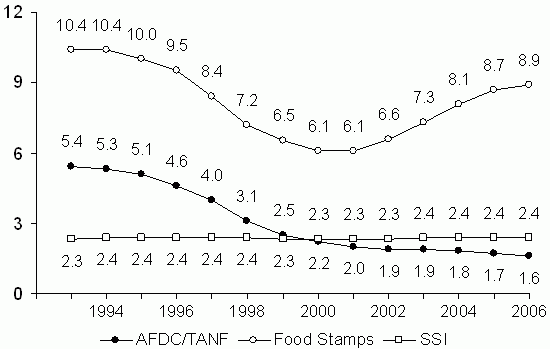
The percentage of individuals receiving AFDC/TANF cash assistance fell from 4.6 percent in 1996 to 1.6 percent in 2006 as shown in Figure 2. Food stamp receipt fell from 9.5 percent in 1996 to 6.1 percent in 2000 and 2001. Since 2001, food stamp receipt has increased to 8.9 percent in 2006. This increase in food stamp recipiency may explain the modest increase in overall dependency since 2000. There have been fewer fluctuations in the rate of receipt of SSI. In 1996 the rate was 2.4 percent and in 2006 the rate was 2.4 percent.
Figure 2.
Percentage of Total Population Receiving Food Stamps, TANF, or SSI: 1980-2006
Source: The Department of Health and Human Services, the Administration for Children and Families,
the Office of Family Assistance, and the U.S. Census Bureau.
Poverty
To assess the social impacts of changes in dependence, changes in the level of poverty are considered (results not shown). There was an increase in the overall poverty rate between 2000 and 2004. The poverty rate remained stable between 2004 and 2005 and decreased between 2005 and 2006. The poverty rate in 2006 (12.3 percent) remains lower than the rate in 1993 (15.1 percent), when poverty reached its highest peak since the early 1980s. Overall, 2.8 million fewer people are in poverty and 2.9 million fewer children are in families with incomes below poverty in 2006 than in 1993.
Conclusion
This brief has highlighted key findings on welfare dependence. A copy of the full report Indicators of Welfare Dependence, 2008, with these and many other indicators and risk factors of dependency, can be found at /node/53026.
Endnote
1 Current legislative authority for the TANF block grant is from the Deficit Reduction Act of 2005 (P.L. 109-171).