by
Deborah J. Chollet, Ph.D.
Mathematica Policy Research
Adele M. Kirk, M.A.
University of California at Los Angeles
Kosali Ilayperuma Simon, Ph.D.
Michigan State University
Submitted to
the Office of the Assistant Secretary for Planning and Evaluation
US Department of Health and Human Services
in partial fulfillment of Contract HHS-10098-0014.
October 20, 2000
This research was conducted with partial funding from the Robert Wood Johnson Foundation to the Academy for Health Services Research and Health Policy.
"Executive Summary
Recent studies of health insurance regulation all have concluded that state regulation of insurance issue, renewal and rating in general either reduces health insurance coverage or, on net, has no impact on coverage. Some of these studies have found that regulation has no significant impact on overall coverage, but that regulation may change the risk distribution of the insured population – raising coverage among high-risk groups and individuals but lowering coverage among low-risk groups and individuals. This literature presumes that, by forcing insurers to accept and pool risk that they would otherwise deny or segment into high-risk rate classes, regulation raises insurer cost. In turn, it presumes that insurance prices rise, discouraging low-risk groups and individuals from buying coverage. As a result, the rate of private insurance coverage declines. Implicitly, all previous studies have assumed that insurance markets are competitive and, therefore, that higher price is an inevitable effect of regulation. Rarely are these studies able to observe price directly.
This paper considers the impact of insurance regulation on the structure of health insurance markets. We do not presume that health insurance markets are competitive. Indeed, both the group and individual health insurance markets in every state are highly concentrated among a few large insurers; most insurers hold very little market share. Thus, the largest insurers (and even some small insurers) probably enjoy a degree of monopoly power and therefore have some discretion about pricing. Moreover, smaller insurers (arguably operating with increasing returns to scale) may respond differently to regulation than larger insurers (with relatively constant returns to scale).
We test a number of regulatory variables against various measures of market structure, separately for the states’ group and the individual health insurance markets. Measures of market structure include the number of insurers selling coverage, the market share of different insurer types, and market concentration (measured as a Herfindahl index and large-firm market share).
We find that much or all of the changes that occurred in market structure were independent of state regulation, and that more “stringent” (i.e., unambiguous) regulation sometimes appeared to have positive market effects. Specifically, controlling for other factors that would influence the number of insurers in the group market, states with all-product guaranteed issue (as HIPAA later required) had more insurers selling coverage and less market concentration among the largest insurers than states that required guaranteed issue of some products or did not require guaranteed issue at all. In group markets with only guaranteed renewal (and no guaranteed issue or only guaranteed issue of some products), insurance markets were more concentrated. The combined effect of both all-product guaranteed issue and guaranteed renewal was a group market with both significantly more insurers and somewhat greater market concentration among the largest insurers. Shortened waiting periods for coverage of preexisting conditions appeared to cause some small insurers to abandon the group market (or to merge) and drove greater market concentration among the largest insurers. However, the magnitude of these latter effects was small.
We conclude that, if HIPAA’s small group provisions had any impact on the small group market, they were mixed: on net, HIPAA probably simplified the group market, encouraging more insurers to participate, despite the difficulty that some insurers may have encountered with shortened waiting periods for coverage of preexisting conditions. Ironically, markets with more modest reforms (only some-product guaranteed issue or only guaranteed renewal, such as many states had adopted prior to HIPAA) may have dampened competition by allowing markets to remain much more complex.
In the individual market, guaranteed issue of all products significantly increased market share among the largest insurers and may also have disfavored commercial insurers, reducing their market share. In contrast, guaranteed issue of only some products appeared to favor greater commercial insurer market share and drove less concentration of the market among the largest insurers. Notably, despite greater concern about adverse selection in the individual market, shortened waiting periods for coverage of preexisting conditions in the individual market had no measurable impact on any measure of market structure.
HIPAA did not address insurers’ rating practices in either the group or individual health insurance markets. States that limit insurer rating – typically prohibiting insurers from using health status or age as a rating factor, and sometimes establishing a composite rate band – have responded to their own policy priorities and political realities.
In the group market, the impacts of rate bands were complex. In states that more narrowly constrained overall (composite) rate variation, many more insurers participated in the group market. However, nearly all states with a composite rate band also limited health rating, and limits on health rating fully offset the impact of the composite band – producing no appreciable net difference in number of insurers in the group market. States that placed narrower limits on health rating in the group market (but no constraints on age rating or on composite rates) had many fewer insurers in the group market. Narrower constraints on age rating generally had no significant impact on any measure of market structure.
In the individual market, narrower limits on health rating appeared to reduce commercial market share (favoring BCBS plans). As in the group market, narrower constraints on age rating had no significant impact on any measure of market structure.
Reviewing the impacts of regulation in markets prior to implementation of HIPAA, it is unclear whether the effects of regulation are in themselves or on balance positive or negative. Whether some forms of regulation produce lower prices and greater coverage depends on the relative strength of their intermediate effects on the number of insurers and on market concentration. In a declining- cost industry such as health insurance, fewer insurers would (all else equal) result in lower-cost production. In a competitive market, lower prices would result. However, in a monopolistic market, the loss of insurers may further dampen price competition and foster higher prices. While available research is not directly helpful in comparing these effects, the emerging literature on insurance coverage suggests that the upward price effect of greater monopoly power – absent regulatory constraints on monopoly pricing – may have outweighed the downward price effect of more efficient levels of production in response to market regulation.
Introduction
All states have enacted health insurance reforms designed to improve access to health insurance among people with health problems. Even before implementation of the Health Insurance Portability and Accountability Act (HIPAA), many states already had required small-group insurers to guarantee issue and renewal. Many states also had portability requirements, limiting the duration of preexisting condition exclusions in the small-group market. Some states had extended these protections into the individual market as well, typically exceeding HIPAA’s very limited protections in the individual market.
An emerging research literature suggests that health insurance market reforms may reduce coverage in private insurance markets. These reforms typically favor small groups and individuals that otherwise would have difficulty obtaining or renewing coverage (due to health problems) or affording coverage that is priced to reflect their higher risk. The now-standard theory of insurance suggests that market regulation favoring high risk would drive some very low risk out of the market when coverage is voluntary, and that new entrants would be higher-risk. Given the change in the risk composition of insured lives, insurance prices would rise. However, this relationship between regulation and insurance prices presumes that sellers of insurance are competitive and that they cannot sustain higher cost without raising prices. These circumstances of the market have not been proven.
This paper considers the impact of regulation on the supply side of health insurance markets, in both the group and individual insurance markets. Our analysis contributes to the existing literature in several ways: (1) we examine the supply side of the market, whereas other studies to date have tested only the demand-side effects regulation; (2) we test for the impact of various market regulations separately, whereas other studies have tested the impact of “bundles” of reforms taken together; and (3) we consider the degree of reforms limiting insurers’ prices and exclusions for preexisting conditions, differentiating both between narrower and broader rate bands and between shorter and longer exclusion periods.
The study is organized into five sections. Section 2 reviews the prevalence of state health insurance regulations in the group and individual health insurance markets. Section 3 summarizes the structure of the states’ group and individual health insurance markets, reviewing changes in those markets between 1995 and 1997, and differences among states in the number of insurers writing coverage in their markets. Section 4 describes our research design and methods, and in Section 5, we present our results. Conclusions are summarized in Section 6.
State Regulation of Health Insurance
At the time HIPAA was enacted, many of its provisions related to guaranteed issue and guaranteed renewal, preexisting condition exclusions and portability were already in place in at least some states. The following sections review state regulation of these features of both small-group and individual insurance plans.
The information presented here is the result of a 50-state survey of state insurance department officials that Alpha Center fielded in Summer 1999 with separate funding from the National Association of Insurance Commissioners. That survey effort is described in the research design and methods section of this report.
A. Guaranteed Issue And Renewal
At the time HIPAA was enacted in 1996, 35 states had enacted and implemented guaranteed issue in the small group market (see Table 1). In general, these states defined small groups as groups of 2 to 50 employees (as does HIPAA). Most (22 states) required guaranteed issue of only some products – typically a standard product devised by the state in part to encourage price competition in the small group market, at least for that product. Only thirteen states required guaranteed issue of all products, as did HIPAA when it became effective in July 1997.
Prior to HIPAA, guaranteed renewal in the small group market was far more common than guaranteed issue – reflecting insurers’ acceptance of guaranteed renewal as less restrictive regulation, allowing them still to deny coverage at first issue. In 1996, 43 states required guaranteed renewal of small-group products. By 1999, all states except California had complied with HIPAA’s small- group guaranteed issue and renewal provisions. In California, the federal government (specifically, the Health Care Financing Administration, HCFA(now known as CMS)) is charged with enforcement of HIPAA’s small- group provisions.
HIPAA’s provisions in the individual market are much less extensive than its small-group market provisions. Specifically, HIPAA requires only that insurers guarantee issue to individuals who have had significant (and continuous) coverage in the small group market immediately prior to applying for individual coverage. At the time HIPAA was enacted, only 10 states had any provision requiring guaranteed issue in the individual market. Seven of those states required guaranteed issue of all products, and three required guaranteed issue of only a basic and standard product as defined by the state. By 1999, 16 states required guaranteed issue of at least some product in the individual market.
HIPAA also requires guaranteed renewal in the individual market (as it does in the group market). In 1996, 10 states had implemented guaranteed issue of individual products. By 1999, all but three states (Missouri, Michigan and California) had implemented guaranteed renewal of individual products; in those three states, HCFA(now known as CMS) is charged with enforcement of HIPAA’s individual-market provisions.
B. Preexisting Condition Exclusions
At the time HIPAA was passed, 43 states limited the extent to which insurers could consider preexisting conditions in small-group plans; 45 states limited the length of time that insurers could exclude coverage for preexisting conditions in small-group plans (see Table 2). HIPAA limited the duration of preexisting conditions in small-group plans to 12 months for conditions that exist within 6 months before coverage, and most states with laws in place met HIPAA’s provisions related to preexisting condition exclusions. By 1999, 3 states had more restrictive laws than HIPAA requires prohibiting lengthy look-back periods in the small-group market (not more than 1 or 3 months), and 8 states had more restrictive laws limiting waiting periods (most often, to 6 months or less).
HIPAA does not restrict either look-backs or waiting periods for coverage of preexisting conditions in the individual market. However, in 1999, 34 states restricted look-backs in the individual market, usually to 6 months or 12 months. Limits on waiting periods for preexisting condition exclusions are also common. In 1999, 35 states limited waiting periods for individual coverage of preexisting conditions, typically to 12 months.1
C. Rate Limits
Most states restrict either the factors that insurers may consider in setting health insurance rates in either the small group or individual health insurance markets, and also the extent to which insurers can vary rates for allowable factors. HIPAA does not speak directly to the issue of rate setting in either statute or regulation, although many consumer advocates have sought guidance on whether various provisions of HIPAA (e.g., requiring “risk spreading” for eligible high-risk individuals) implies that the states need to limit insurers’ rating practices for those persons. The following sections consider three common rating restrictions in state law: rating on health status and age, respectively, and limits on insurers’ composite rates.
Health status. In 1999, 45 states limited the degree to which insurers could rate up small groups for health status (see Table 3). Of these states, 21 states prohibited rate variation on health status of more than 2:1; 13 states required pure or modified community rating – that is, they prohibited insurers from considering health status at all in setting rates.
Fewer states restrict insurers’ use of health status to rate in the individual health insurance market, although a significant number of states enacted and implemented such legislation between 1995 and 1999. In 1999, 16 states limited rating on health status in the individual market; eight required pure or modified community rating in this market.
Age. States are much less likely to restrict age as a rating factor than they are to constrain health rating. In 1999, 16 states limited the degree to which insurers could use age as a rating factor in the small group market (see Table 4), while 11 states did so in the individual market. Only New York prohibits the use of age as a factor entirely in the small group market, while other states impose constraints on age ranging from 1.5:1 to 5:1 (the latter being a “constraint” that probably approximates and may even exceed an unconstrained actuarially justified age slope). In the individual market, New York and New Jersey prohibit the use of age as a rating factor, while other states specify limits ranging from 1.5:1 to 5:1.
Composite rate bands. Rather than (or in addition to) constraining the use of specific factors such as health and age, some states have implemented composite rate bands that impose limits on the total rate variation among groups or individuals taking into account all allowable rating factors. In 1999, 15 states had composite rate bands in the small group market, while 10 had them in the individual market (see Table 5).
Market Structure
The following sections review the structure of health insurance markets in the states and the changes that occurred in those markets between 1995 and 1997. These observations of the states’ group and individual markets underlie our subsequent analysis of regulatory impacts. A more detailed description of these markets is provided elsewhere (Chollet, Kirk and Chow, forthcoming). The data presented below are from the Alpha Center Health Insurer Database compiled with grant funding from the Robert Wood Johnson Foundation; the compilation of these data is described in detail in Appendix 1. The data include 49 states and the District of Columbia; they exclude Hawaii, which does not require HMOs to report their business.
A. Group Health Insurance Markets
Group major medical insurers in the US – including commercial insurance, Blue Cross and Blue Shield plans, and HMOs – wrote approximately $145 billion in earned premiums in 1997. HMOs wrote nearly 45 percent of this business, followed by Blue Cross and Blue Shield plans (36 percent) and commercial insurers (19 percent). Between 1995 and 1997, total earned premiums aggregated across all states rose 19 percent, reflecting high growth in earned premiums in some states (Alaska, Georgia, Indiana, New York, North Carolina, and Wyoming) and modest declines in a few.2
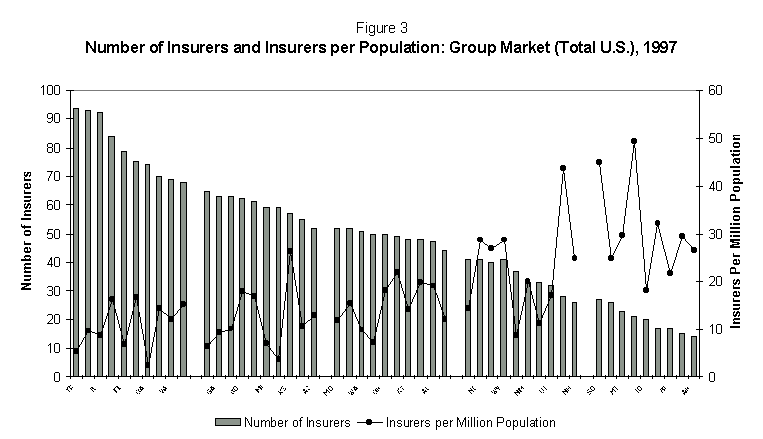
The number of insurers per state varies dramatically among the states: in 1996 Texas had 94 insurers writing group coverage, while Alaska had 14. On a population-adjusted basis, the number of insurers per state is somewhat more equal: smaller population states and states where commercial insurers hold a larger share of the market typically have more insurers writing business. In 1997, Delaware, South Dakota and Wyoming had the largest number of insurers per capita; while California, New York, and Texas had the fewest (see Figure 1).
Between 1995 and 1997, the distribution of the group market among types of insurers changed in important ways. The number of insurers, multiplied by the number of states in which they wrote business, grew nearly 4 percent (see Table 6). Most of this growth was a result of the formation of new HMOs and existing HMOs expanding into new states; during this period, the number of HMOs writing group coverage, multiplied by the number of states in which they wrote business, increased 22 percent. HMOs’ aggregate market share rose nearly 3 percentage points, largely at the expense of Blue Cross and Blue Shield plans, despite significant activity among BCBS plans that resulted in a net increase in the number (including BCBS HMOs) writing coverage. Nevertheless, in the aggregate, Blues plans lost market share. In contrast, the commercial market very nearly maintained market share (contracting less than a point). However, the number of commercial insurers declined: some insurers merged, and in some states they exited.
In most states, the group health insurance market is highly concentrated: in 31 states, the largest three group insurers hold more than one-half of the market; in all but seven states,3 the largest three insurers hold at least 60 percent of the market (see Figure 2). Conversely, in all states the smallest 50 percent of insurers hold less than 10 percent of the market.
B. Individual Health Insurance Markets
The individual health insurance market is much smaller than the group market, both in terms of the dollar volume of premiums earned and the number of insurers writing business. In 1997, insurers wrote $8.2 billion in earned premiums in the individual market – less than 6 percent of the volume of business that insurers wrote in the group market. BCBS plans dominate the individual market, writing fully 50 percent of all earned premiums in the individual market in 1997. Commercial insurers and HMOs nearly evenly divided the rest of the market, holding 24 percent and 26 percent, respectively. Between 1995 and 1997, total earned premiums in the individual market, aggregating across all states, rose just 7 percent. As in the group market, the national change masks significant variation among states: some states (California, Delaware, North Dakota and Utah) showed large growth in the volume of premiums written between 1995 and 1997 – reflecting growth in insured lives, growth in average premiums, or both. In other states (Connecticut, Idaho and Michigan), the volume of business in the individual market declined. These declines may reflect lost coverage; however, it seems likely (given the modest growth in group coverage over these years) that they represent movement between the individual and group markets.
As in the group market, the number of insurers per state varies dramatically among the states: in 1997, New York and Texas had more than 40 insurers writing individual coverage, while six states (Alaska, Delaware, Idaho, Rhode Island, Utah, Vermont) and the District of Columbia had fewer than 5 insurers in this market (see Figure 3). Unlike the group market, in the individual market the number of insurers on a population-adjusted basis varies about as widely as the unadjusted number: Wyoming and South Dakota have many individual insurers per capita (related to their very small populations), while the most populous states (California, Michigan, New Jersey, Ohio, Pennsylvania, and Texas) have fewer than two individual insurers per million population.
Between 1995 and 1997, the changes observed in the group market also occurred in the individual market (see Table 7). The number of HMOs writing group coverage, multiplied by the number of states in which they wrote business, increased 16 percent (compared to 22 percent in the group market), but the share of the market that HMOs held rose more than 10 percentage points. BCBS plans consolidated in the individual market and still lost significant market share (nearly 4 points); commercial insurers exited the market in some states (sometimes through merger or acquisition, as in the group market) and nationwide lost more than 7 points of market share. In summary, at the end of the three year period, significantly more HMOs were writing individual coverage (sometimes, as in New York and Maine, required by the state to do so), and they held substantially more market share.
Like the group market, the individual health insurance market is extremely concentrated – a fact that is only partly explained by the very large average market share that BCBS plans hold. In all states, the largest three group insurers hold more than one-half of the individual market, and in 20 states the largest three insurers hold more than 80 percent of the market (see Figure 4). However, the residual of the market in many states is highly fragmented: the smallest 50 percent of insurers hold more than 20 percent of the market in only five states (New Hampshire, New Mexico, Alabama, West Virginia and South Dakota). The average insurer in the individual market survives on very low premium volume, relative both to the average insurer in the group market and to the largest insurers in the individual market.
Research Design and Methods
Without exception, the empirical research literature investigating the structure of health insurance markets has investigated only the HMO market (Paul and Chollet, 1997). In part because this literature fails to consider the other sectors of the market, and in part because it fails to consider the types of regulation of interest in this paper, it offers no real precedent for this study.
In the next several sections, we propose several models of insurer behavior in regulated markets. In general, these models are consistent with conventional competitive models of supply and also a growing recent literature that links more restrictive state regulation in the small-group market to declines in coverage in that market.4 Finally, we extend the logic of the small-group insurer responses to the individual market, estimating essentially the same models for the individual market. We estimate both sets of models by state and by year, using fixed-effects multiple regression analysis.
A. Insurer Response to Regulation
The types of regulation that states have imposed in the small group market, and to a lesser extent in the individual market, reward greater insurer size, especially if insurers already are operating with increasing economies of scale.5 In general, one would expect that regulation which reduces insurers’ ability to deny risk or to rate risk appropriately would enhance rewards to scale by allowing insurers to defray the implicit subsidy to high-cost groups and individuals over a larger base of insured lives. Moreover, it is unlikely that regulation favoring market entry by high-risk groups and individuals (guaranteed issue or renewal, restrictions on preexisting condition exclusions and limits on rate variation for age, health or other factors) expands the overall size of the market (Nichols, 2000). Instead, it is likely that the number of covered lives might decline, given the price elasticity of demand for coverage in these markets (Marquis and Long, 1995), and indeed that is the sense of the emerging literature linking health insurance coverage (usually among workers in small groups) and insurance market regulation. In markets with increasing economies of scale and no net growth in demand for coverage, insurance regulation is likely to increase price; and competition among insurers may force merger or exit to recapture lower average cost and to increase market share.
Number of insurers. We hypothesize that the number of insurers writing coverage will decline in states with regulation that would require insurers to accept risk that they would otherwise deny or to rate risk in ways that subsidize high-cost insureds. This decline would occur either by insurers exiting the market (ceding market share), or by insurers merging with their competitors to increase the surviving insurer’s market share and gain economies of scale.
To test this hypothesis, we estimate a fixed effects model of the following general forms:
(1) NUMINSst =f (Xst, REGst)
(2) NUMINSst =f (Xst, REGst, BCBSst)
(3) NUMINSst =f (Xst, REGDUMst, BCBSst)
where NUMINS is the number of insurers in state s and year t, Xst is a vector of control variables, REGst is a vector of continuous and categorical regulation variables, and REGDUMst is a vector of regulation variables expressed as categorical variables only (precise variable definitions are provided in Table 8). We tested regulatory variables as both continuous and categorical, the latter to test for a “shock effect” of regulation unrelated to the stringency of the requirement. Also, note that the latter two models control for the Blues’ market share as an exogenous variable; in these specifications we entertain the hypothesis that the Blues’ market share in many states is an artifact of their history and unique position in state regulation, not principally a result of short-term market dynamics.
Market share. We hypothesize that very large insurers, with constant economies of scale, are more likely to thrive in highly regulated markets than small insurers with increasing economies of scale, and that insurer types with characteristically different cost economies systematically gain or lose market share in more highly regulated states. Because different insurer types may have different scale economies,6 we first estimate the relationship between states’ regulatory variables and market share for each of the major types of insurers. To reflect the very nonexclusive rules that BCBS plans in some states have adopted to qualify as HMOs in state law, we include BCBS HMOs as BCBS insurers. Specifically, we estimate the following general forms, again as fixed-effect models and again introducing BCBS market share in some specifications as an independent (exogenous) variable:
(4) BCBSst =f (Xst, REGst)
(5) HMOst =f (Xst, REGst)
(6) HMOst =f (Xst, REGst, BCBSst)
(7) COMMst =f (Xst, REGst)
(8) COMMst =f (Xst, REGst, BCBSst)
Market concentration. A significant net exit of insurers, all else being equal, will increase market concentration, reducing competition among insurers. We estimate the impact of state regulation on two conventional measures of market concentration: (a) a Herfindahl index;7 and (b) recognizing the problems of the Herfindahl index in describing highly skewed markets, the share of the market held by the largest (arbitrarily, the largest five) competitors in the state.
(9) HERF =f (Xit, REGit)
(10) TOPFIVE = f (Xit, REGit)
The price of insurance. Because health insurance products are nonstandard, it is very difficult to measure price in the usual sense. Risk-averse consumers are willing to pay a price in excess of the actuarially fair price (that is, the expected cost of their health care estimated over a class of similar risks), and the price of insurance is measured as the loading that consumers are willing to pay in excess of the actuarially fair price. We express the loading on the insurance policy as its inverse: the insurer’s medical loss ratio (i.e., medical claims paid per premiums earned). In more competitive markets, it is presumed that the price of health insurance is lower – and insurers’ loss ratios are higher.
Insurance regulation complicates several aspects of this conventional model of competitive markets. Most insurance regulation is intended to increase pooling by insurers, forcing them to develop more heterogeneous classes of risk and to cross-subsidize higher-risk members of the class. With more heterogenous risk classes, higher loss ratios may correlate not only with greater competition (measured by the number of insurers and/or market concentration)8 but also with the entry of higher-risk groups or individuals into the health plan.
We hypothesize that average loss ratios are higher in states with insurance regulations that attempt to force insurers to develop more heterogeneous risk classes, both accepting greater risk and limiting rate variation. The model controls for the number of insurers in the market and for market concentration (as measures of competition) as well as the usual vector of control variables defined in Table 10. We estimated the model with alternative measures of market concentration as follow:
(11) LRATIOst =f (Xst, REGst, NUMINSst, HERFst)
(12) LRATIOst =f (Xst, REGst, NUMINSst, TOP5st)
B. Measures of regulation
In preparing a regulation database from published sources, we discovered that recognizes sources of information about insurance regulation (Institute for Health Policy Solutions, 1999; Health Policy Tracking Service, 1996-1998; and Blue Cross and Blue Shield Association, 1996-99) occasionally disagree. With funding from the Robert Wood Johnson Foundation and the National Association of Insurance Commissioners, we launched a 50-state survey to reconcile these differences.
The survey entailed calling each state department of insurance to obtain the name of the correct person to respond to questions about regulation, sending to each state department of insurance a customized 7-page survey instrument restating where available sources had agreed about their regulation in the small-group and individual health insurance markets. We asked each state to confirm, correct and complete the available information, especially clarifying dates of implementation versus enactment. We then followed up with each respondent in an hour-long telephone interview to review their responses.
The response rate to this effort was excellent (48 states and the District of Columbia responded and were interviewed). In a number of cases we discovered that, while all published sources agreed, they were wrong (for example, all published sources reflected the date of enactment of a specific provision, not implementation). In these cases, we obtained and reviewed the state’s insurance statute for confirmation. For two states, where we were unable to obtain either a survey response or, with reasonable effort, the state’s relevant insurance statute, we used published information to complete their regulatory profile.
From this information, we developed measures of regulation, using categorical variables where necessary (for example, for guaranteed issue or renewal), but developing continuous measures of regulation wherever possible (specifically, for age, health and composite rate bands; and for limits on preexisting condition exclusions). We measure rate regulation as the inverse of the ratio of the maximum allowable rate to the minimum allowable rate in regulation. Thus, we rate regulation values for each state in each year that varies between 1 (the rate factor is prohibited, in effect allowing only 1:1 rating on that factor) and, in the limiting case, zero (1/(∞:1). We measured limits on preexisting condition exclusions as the maximum number of months that insurers may exclude coverage for a preexisting condition.9
By developing continuous measures for these variables, we are able to avoid the problems of multicollinearity that have forced other researchers to bundle heterogenous reform measures and search for differences related to the presence or absence of regulation, without regard to differences the variety and restrictiveness of the states’ regulation. Instead, our analysis examines the impacts of specific regulatory measures (e.g., health rate bands separately from age rate bands), and also accounts for stricter limits on pricing and preexisting condition exclusions in some states compared to others. Descriptive statistics for all the market structure, regulation and control variables are provided in Tables 9 and 10.
Results
The results of our analysis suggest that state insurance regulation has some impacts on health insurance markets. However, these effects differ in size and direction in the group and individual markets when the analysis controls for other circumstances, and they often have only weak statistical significance (90 percent). Moreover, our analysis indicates (in the one specification in which we tested dummy regulatory variables) that analyses that fail to account for the strength of state reforms are more likely to detect significant regulatory impacts than analyses that do account for them. In all tests, state effects are highly significant. Typically, year effects (usually over the two-year span of the data) are also significant. These results for the group and individual markets, respectively, are reported in Tables 11 and 12, and summarized below.
A. Group Market Effects of Regulation
The following sections describe our results with respect to three areas of regulation: guaranteed issue and renewal, limits on preexisting condition exclusions, and limits on rating.
Guaranteed issue. We find no evidence that guaranteed issue in the group health insurance – required by HIPAA but implemented earlier in some states – forces insurers from markets. To the contrary, markets with guaranteed issue of all products had more insurers than states that did not, and because they were less concentrated (the largest five insurers held less market share), arguably were more competitive. These significance of even these effects is weak (90-95 percent), suggesting that if guaranteed issue of all products has any impact at all on market structure, it appears to support greater competition — perhaps by “leveling the playing field” for all insurers.
Not surprisingly, more modest reform of this type had no significant impact on most measures of market structure. Guaranteed issue of some but not all products drove a modest increase in the Herfindahl index (with weak significance), suggesting that even modest guaranteed issue reforms may force some concentration of markets via the exit of some small insurers. Similarly, guaranteed renewal forced an increase in both the Herfindahl index (and, with very weak significance, the market share held by the largest insurers in the state). To the extent that small insurers experience strong economies of scale (that is, lower average cost at a higher volume of business), greater market concentration via small insurers leaving the market or merging with others may be a positive outcome of even modest guaranteed issue reforms, if it reduces these insurers’ average cost and if lower insurer cost translates into a lower price for coverage.
Preexisting condition exclusions. Limits on waiting periods for coverage of preexisting conditions in group markets also drove greater concentration in these markets, measured either by the Herfindahl index or by the largest insurers’ market share. The highly significant increase in the Herfindahl index, in particular, suggests that preexisting condition exclusions favor somewhat larger firms over very small firms. In response, some very small firms may exit the market (although this effect was statistically insignificant) or (more likely, over the short period of our study) they may respond to shortened preexisting condition exclusions by raising price and forfeiting market share.
Rate reforms. Statutes that constrain insurers’ composite rates (or, in states without a composite rate band, limit rating both on age and on health) have the clearest impact on the structure of group health insurance markets. On the whole, states that constrain overall rate variation have more insurers than states that do not, and this effect is large: a state with a very narrow composite rate band, all else being equal, would have 30 more insurers than a state with a 2:1 composite rate band. However, also imposing a narrow rate band on health fully neutralizes this impact: the coefficient on health rating is approximately the same size but has the opposite sign (and of the same statistical significance, 95 percent). On net, a state with pure community rating had only slightly fewer insurers than a state with no constraints on rating. States with constraints on both health and age rating also had about the same number of insurers as states that impose limits only on age rating. In practice, only one state – Arizona – has imposed composite rate bands without also imposing separate rate bands on health; however, the composite rate band in Arizona is broad (4:1) and, therefore, any positive impact on the number of insurers probably was small.
Perhaps ironically, states that impose constraints only on age rating or only on health rating, but not both (and also do not limit insurers’ composite rates) may cause greater disruption in their group health insurance markets than states that limit both age and health rating and/or limit composite rates. In all specifications of our model, tighter limits on health rating alone drove a significant reductions in the number of insurers (but had no impact on any other measure of market structure). In one specification, tighter limits on age rating also had this effect, but this result appears to be nonrobust; it disappears entirely in alternative specifications of the model.
It is notable that, when we did not account for the narrowness of allowable rate variation (that is, when health and age rating were entered as a dummy variables), the impacts of age rating and health rating on the number of insurers writing coverage in the state were both more significant and negative. Considering our results, we conclude that analyses which fail to account both for the narrowness of allowable rate bands and the presence of composite or multiple rate bands are likely to bias upwards their estimates of the impact of rate regulation.
Finally, we tested each of the above forms of regulation on insurers’ average loss ratios – potentially a leading indicator of future change in market structure. However, the measurement of loss ratios, in itself, is problematic. Among insurers that wrote group health lines other than major medical, we were unable to discern their loss ratio for major medical coverage from their loss ratio on other health lines. In addition, the likely accounting differences between the medical loss ratios of commercial insurers or BCBS organizations, and those of HMOs is well documented (Robinson, 1997). Recognizing these problems of measurement, we tested the impact of regulation on arguably the most sensitive measure of insurers’ loss ratios available to us: the average (statewide) loss ratio only among commercial insurers whose major medical business comprised at least 85 percent of their total earned premiums in the group market. We found no significant impact of any regulatory variable on insurers’ loss ratios measured this way. We constructed the same type of loss ratio in the individual market, and also finding no significant result, omitted it from the individual-market specifications described below.
B. Individual Market Effects of Regulation
Guaranteed issue. Federal law does not require guaranteed issue in the individual market, as it does in the group market. As a result, only 7 states had all-product guaranteed issue in any year between 1995 and 1997, and only 5 states required guaranteed issue of some products. Neither of these provisions had a significant impact on the number of insurers writing coverage in the state.
However, guaranteed issue provisions may affect the relative market share of different types of insurers. The imposition of some-product guaranteed issue increased commercial insurer market share (with high significance), and (with lower significance) reduced the market share of both BCBS plans and HMOs. The imposition of all-product guaranteed issue raised BCBS market share and reduced commercial insurers’ market share, although these latter results are statistically weak (90 percent).
These results suggest some interaction between the dominance of one type of insurer in the individual market and the state’s adoption of guaranteed issue rules (although their simple correlation is low). Historically, many BCBS organizations have community rated, and in some states where they are dominant, they still do so. In such states, the BCBS plans have complained about adverse selection as a result of commercial insurers underwriting aggressively. In states where BCBS is dominant, they may be more likely to obtain legislative relief through all-product guaranteed issue rules (all else being equal) than in states where they are less dominant. Conversely, in states where commercial insurers have a very strong presence, they are more likely to be engaged in public policy discussions and therefore to drive reforms more acceptable to the commercial insurance industry – such as some products guaranteed issue, but not all-products guaranteed issue.
In contrast to the web of impacts associated with guaranteed issue in the individual market, guaranteed renewal – now required by HIPAA – had no impact on any measure of market structure.
Preexisting condition exclusions. Limits on waiting periods for coverage of preexisting conditions in individual insurance markets had no significant impact on any measure of market structure. This result suggests that, where the states have shortened the maximum waiting period for coverage of preexisting conditions, these reforms did not drive substantial adverse selection by encouraging individuals to drop and seek coverage as their health care needs changed.
Rate reforms. Constraints on either age rating or on health rating in the states had no significant impact on the number of insurers writing coverage in the state. However, as with guaranteed issue provisions, restrictions on health rating may have an effect on the relative market share of commercial insurers. Narrower constraints on health rating in the individual market reduced commercial insurers’ market share in favor of greater BCBS market share, and increased market concentration (measured by the Herfindahl index). This pattern of effects (specifically, the absence of a significant impact on the largest insurers’ market share) suggests that narrower constraints on health rating may have caused the smallest commercial insurers either to abandon the individual market or to merge in order to gain market share.
High risk pools. In general, one would expect that high risk pools might favor the presence of small insurers, supporting a larger number of insurers in the market, greater competition, and potentially lower insurance prices. Indeed, at least one recent study (Sloan and Conover, 1998) found evidence consistent with that expectation: a significant (and positive) effect on coverage from the presence of a high risk pool, despite the very small size of the risk pools in all but two states (California and Minnesota) and their small size relative to population in all states but one (Minnesota). However, we find no measurable impact of the presence of risk pools on any measure of market structure.
Summary and Conclusions
Recent studies of health insurance regulation all have concluded that state regulation of insurance issue, renewal and rating in general either reduces health insurance coverage or, on net, has no impact on coverage. Some of these studies have found that regulation may change the risk distribution of the insured population, raising coverage among high-risk groups and individuals but lowering coverage among low-risk groups and individuals, with no significant impact on overall coverage. All of this literature presumes that, by forcing insurers to accept and pool risk that they would otherwise deny or segment into high-risk rate classes, regulation raises insurer cost and, in turn, insurance prices. Low-risk groups and individuals are thus discouraged from buying coverage, and the rate of private insurance coverage declines. Implicitly, all earlier studies have assumed that insurance markets are competitive and, therefore, that higher price is an inevitable effect of regulation. Rarely are these studies able to observe price directly.10
This paper considers the impact of insurance regulation on the structure of health insurance markets. We do not presume that health insurance markets are competitive. Indeed, both the group and individual health insurance markets in every state are highly concentrated: typically, a few large insurers hold most of the market, and most insurers hold very little. Some segments of the market may be internally competitive, but the skewness of these markets in all states suggests that it is not competitive in the economist’s sense. Instead, the largest insurers (and even some small insurers) probably enjoy a degree of monopoly power, and therefore have some discretion about pricing. Smaller insurers (arguably operating with increasing returns to scale) may respond differently to regulation than larger insurers (with relatively constant returns to scale).
We test a number of regulatory variables against various measures of market structure, separately for the states’ group and the individual health insurance markets. Measures of market structure include the number of insurers selling coverage, the market share of different insurer types, and market concentration (measured as a Herfindahl index and large-firm market share). While we find occasionally strong year and state effects (that is, significant changes occurred in market structure between 1995 and 1997, and especially so in some states), much or all of the changes that occurred in market structure were independent of state regulation.
HIPAA requires guaranteed issue of all products in small-group health insurance markets, and we did find some effect of all-product guaranteed issue on market structure in states that had implemented these laws before HIPAA’s effective date, and the direction of the impact is of interest. Controlling for other factors that would influence the number of insurers in the market, states with all-product guaranteed issue (as HIPAA requires) had more insurers selling coverage — and less market concentration among the largest insurers — than states which required guaranteed issue of some products or did not require guaranteed issue at all. However, guaranteed renewal always accompanied all- product guaranteed issue. The combined effect of both all-product guaranteed issue and guaranteed renewal was a group market with both significantly more insurers and somewhat greater market concentration among the largest insurers.
In markets with no guaranteed issue or only guaranteed issue of some products, guaranteed renewal was associated with significantly greater market concentration. However, these more modest forms of regulation produced no significant change in the number of insurers in the group market.
In summary, it would appear that, if HIPAA’s all-product guaranteed issue provision has had any impact on the small group market, it probably has simplified the market, encouraging more insurers to remain in the market. Ironically, the complexity of markets with more modest reforms (some-product guaranteed issue or simply guaranteed renewal, such as many states had adopted prior to HIPAA) appears to have had dampened competition relative to HIPAA’s fuller reform by allowing insurance markets to remain much more complex.
While HIPAA’s guaranteed issue protections in the individual market extend only to the relatively few “HIPAA eligibles”, we also considered the impact of full guaranteed issue in the individual market, and found some significant effects among the few states that adopted guaranteed issue between 1995 and 1997. Specifically, our results suggest that guaranteed issue of only some products in the individual market appeared to favor greater commercial insurers, increasing their market share and driving less market concentration among the largest insurers. These results were highly significant. Conversely, guaranteed issue of all products significantly increased the largest insurers’ market share (and, with less significance, also drove lower commercial insurer market share). Whether these effects are seen as favorable or worrisome depends on the relative importance of economies of scale in production versus competition in determining the price of insurance. We return to this problem below.
HIPAA also limited the preexisting condition periods that group insurers may impose. We found that shortened waiting periods for coverage of preexisting conditions in the group market drove significantly greater concentration, causing some small group insurers to abandon the market (or to merge) and enabling the largest insurers to gain market share. However, the magnitude of these effects was small. In the individual health insurance market (despite insurers’ greater concern about adverse selection in this market), shortened waiting periods for coverage of preexisting conditions had no measurable impact on any measure of market structure.
HIPAA did not address insurers’ rating practices in either the group or individual health insurance markets. States that limit insurer rating – typically prohibiting insurers from using health status or age as a rating factor, sometimes establishing a composite rate band – have responded to their own policy priorities and political realities.
In the group market, the impacts of rate bands are complex: in states that constrain overall rate variation, the impact on the number of insurers writing coverage in the state was positive and, depending on the model’s specification, moderately to highly significant. However, nearly all states with a composite rate band also limit health rating, and limits on health rating fully offset the impact of the composite band – resulting in a negligible net impact on the number of insurers. States that limit health rating only (without constraints on age rating or on composite rates) had many fewer insurers in the group market, but we found no significant difference in market concentration in those states. Narrower constraints on age rating generally had no significant impact on any measure of market structure.
In the individual market, narrower limits on health rating appeared only to reduce commercial market share (favoring BCBS plans). As in the group market, narrower constraints on age rating had no significant impact on any measure of market structure.
Reviewing the impacts of regulation in markets prior to implementation of HIPAA, it is unclear whether the effects of regulation are in themselves or on balance positive or negative. Whether some forms of regulation produce lower prices and greater coverage depends on the relative strength of their intermediate effects on the number of insurers and on market concentration. In a declining-cost industry such as health insurance, fewer insurers would (all else equal) result in lower-cost production. In a competitive market, lower prices would result. However, in a monopolistic market, the loss of insurers may further dampen price competition and foster higher prices. While available research is not directly helpful in comparing these effects, the emerging literature on insurance coverage suggests that the upward price effect of greater monopoly power – absent regulatory constraints on monopoly pricing – may have outweighed the downward price effect of more efficient levels of production in response to market regulation.
Finally, it is important to understand that the empirical results presented in this paper, as well as in all other studies of state regulation to date, rest on very few observations of regulatory change during the study period. In effect, change in as few as one or two states drive all of the impacts that have been measured by any study to date. Despite the general strength of our analytic approach, the external validity of these results, based on change in only a few states over the study period, is suspect. It is essential that research of this type be extended to examine later years, after many states enacted new regulation or adjusted existing regulation to comply with HIPAA’s provisions, to confirm these results.
Endnotes
1 - In lieu of requiring waiting periods for coverage of preexisting health problems, insurers may exclude coverage for selected conditions altogether. Permanent exclusions of coverage for specific health conditions are called exclusion riders; for other conditions, the insured group or individual coverage has full coverage under the terms of the contract. While most states (in 1999, 37 states) prohibit insurers from using exclusion riders in small-group contracts, only 13 states prohibit exclusion riders in the individual market. However, in at least one state which does not otherwise prohibit exclusion riders, state law banning discrimination effectively prohibits insurers from excluding maternity coverage.
2 - These data exclude self-insured group health plans and also stop-loss coverage to the extent that we could distinguish primary coverage from stop loss. Conversion of self-insured coverage to HMO coverage would represent an addition to health insurers earned premiums. The group data also include association plans, which at least one large domestic insurer formed almost entirely from its individual business between 1995 and 1997. Nationally, the volume of business related to association plans is unknown.
3 - New York, Indiana, Tennessee, Texas, Illinois and Wisconsin.
4 - See, for example: Sloan and Conover, 1998; Jensen and Morissey, 1999; Zuckerman and Rajan, 1999; and Simon, 1999a and 1999b.
5 - At least one study (Grace and Timme, 1992) suggests that most of the accident and health insurance industry (including major medical insurers as well as other accident and health insurers) experiences significant increasing economies of scale, with only the very largest insurers experiencing constant returns to scale. It is reasonable to expect that their result also holds for the subset of the industry that writes major medical coverage. Similarly, other studies (Blair and Vogel, 1978; Clement, 1995; and Feldman, Wholey and Christianson, 1996) suggest increasing economies of scale among small HMOs.
6 - Wholey et al. (1995) estimated that HMOs experience increasing economies of scale until they enroll about 100,000 lives, beyond which additional economies of scale are insignificant.
7 - The Herfindahl index is defined as Σm2, where m is the market share of each insurer. The Herfindahl index takes on a maximum value of 1 (monopoly) and approaches zero as market share is distributed among more competitors.
8 - Satterthwaite (1979) raised an intriguing alternative to the conventional economic sense of competitive markets as price-reducing, which arguably could apply to health insurance markets. Satterthwaite hypothesized that in markets where consumers place subjective value on the service being sold and are able to discern the value of the product accurately only after experiencing it for a period of time, more sellers in a market may equate to greater monopoly power for each seller and higher prices not greater competition and lower prices as the conventional economic theory of monopolistic competition would predict. We use this logic to justify application of two-tailed significance tests in our estimation.
9 - We also tested the sum of limits on look-back periods and waiting periods, with no difference in our empirical results. In states with no limit on the waiting period for coverage of preexisting conditions we coded the waiting period as 72 months — one year longer than the maximum waiting period that we observed in any state.
10 - Simon (1999b) observed an increase (of about 4 percentage points) in group health insurance premiums associated with “full” reform in the small-group market.
References
Blair, R.D., and J.R.Vogel, “A Survivor Analysis of Commercial Health Insurers,” Journal of Business 50, 521-9, 1978.
Blue Cross and Blue Shield Association, “State Legislative Health Care and Insurance Issues: Survey of Plans,” 1995-1999.
Brown, M.J., and E.W. Frees, “Prohibitions on Health Insurance Underwriting: A Means of Making Health Insurance Available Or a Cause of Market Failure?” University of Wisconsin - Madison, working paper 2000.
Buchmueller, T., and J. DiNardo, “Did Community Rating Induce an Adverse Selection Death Spiral? Evidence from New York, Pennsylvania, and Connecticut,” NBER Working Paper 6872, 1999.
Chollet, D.J., A.M. Kirk, and M.E. Chow, “Mapping Insurance Markets: The Small Group and Individual Health Insurance Markets.” The Robert Wood Johnson Foundation’s State Coverage Initiatives Program. Washington, DC: Academy for Health Services Research and Health Policy, 2000.
Chollet, D.J., and R.R. Paul, “Community Rating: Issues and Experiences,” Washington, DC: Alpha Center, 1994.
Chollet, D.J., and R.R. Paul, “Health Insurance Markets: Causes and Effects of Market Structure.” The Robert Wood Johnson Foundation’s State Initiatives in Health Care Reform Program. Washington, DC: Alpha Center, 1996.
Clement, D.G., “HMO Survival: Determination of Optimal Size,” Health Services Management Research 8, 10-22, 1995.
Feldman, R., D. Wholey, and J. Christianson, “Economic and Organizational Determinants of HMO Mergers and Failures,” Inquiry 33, 118-132, 1996.
Grace, M.F., and Timme, S.G., “An Examination of Cost Economies in the United States Life Insurance Industry,” Research Paper No. 22, Georgia State University, Policy Research Center, Atlanta, Georgia, 1992.
Health Policy Tracking Services, “Major Health Care Policies: 50 State Profiles,” 1996-1999.
Institute for Health Policy Solutions, “Database of Small Group and Individual Market Reforms,” 1999.
Jensen, G.A., and M.A. Morrisey, “Small Group Reform and Insurance Provision by Small Firms, 1989-1995,” Inquiry 36, 176-187, 1999.
Marquis, M.S., and S.H. Long, “Worker Demand for Health Insurance in the Non-Group Market,” Journal of Health Economics 14, 47-63, 1995.
Robinson, J.C. “Marketwatch: Use And Abuse Of The Medical Loss Ratio To Measure Health Plan Performance,” Health Affairs 16, 4: 176-187 (1997).
Satterthwaite, M.A., “Consumer Information, Equilibrium Industry Price, and the Number of Sellers,” The Bell Journal of Economics (presently, The Rand Journal of Economics,) 2, 483- 502 1979.
Simon, K.I., “Did Small-Group Health Insurance Reforms Work? Evidence from the March Current Population Survey 1992-1997” (1999a, unpublished).
Simon, K.I., “The Impact of Small-Group Health Insurance Reform on the Price and Availability of Health Benefits” (1999b, unpublished).
Sloan, F.A., and C.J. Conover, “Effects of State Reforms on Health Insurance Coverage of Adults,” Inquiry 35, 280-293, 1998.
Zuckerman, S. and S. Rajan, “An Alternative Approach to Measuring the Effects of Insurance Market Reforms,” Inquiry 36, 44-56, 1999.
Appendix A: the Health Insurer Database
The Health Insurer Database was compiled by Alpha Center with grant funding from the Robert Wood Johnson Foundation. The Health Insurer Database contains information about every health insurer in the U.S. that wrote at least $500,000 of major medical insurance coverage in any state in 1995, 1996 or 1997. Much of the database was compiled from publicly available data reported to state departments of insurance, departments of health, or (in California) the Department of Corporations. However, because much of the database’s information about commercial insurers was obtained from confidential responses to a survey conducted by Alpha Center, the final database is proprietary.
The Health Insurer Database was compiled in three segments, reflecting differences in the states’ reporting requirements and regimes for each of the major types of insurers -- commercial insurers, Blue Cross and Blue Shield organizations, and health maintenance organizations.
Commercial insurers
The NAIC data. Our basic source of information about commercial insurers is the annual financial reports that each admitted insurer files in each state, compiled by the National Association of Insurance Commissioners (NAIC). In all states, each commercial insurer files an extensive set of forms with the state, submitting information on premiums (written and earned), medical losses, administrative costs, surplus and reserves. These data are public use.
Alpha Center Survey of Commercial Insurers. In August and September 1998, Alpha Center fielded a mail survey of all commercial insurers that reported writing at least $500,000 in any line of health insurance in any state. Lines of health insurance that insurers report as an aggregate include major medical, hospital or hospital surgical, accident, disability, dread disease, dental, vision, or any other specialty health insurance product. The survey consisted of individualized forms mailed to each insurer (679 companies). Separate surveys were sent for group and individual lines of business; an insurer writing both lines received two survey forms. In all, 885 line-of-business surveys were mailed. Respondents were asked to identify how much of their business in each state and year (1995, 1996, and 1997) was major medical, how many lives were covered, and whether they were actively marketing in the state in that year. We requested and obtained from HIAA a personally signed letter endorsing the survey and asking that the insurer respond.
Survey response. In October, Alpha Center staff began follow-up phone calls to each insurer that had not responded to the survey, and repeated phone calls to the largest insurers in the survey. The largest insurers were called not fewer than five times, and other avenues (e.g., having HIAA also place a call to the insurer) also were pursued to obtain a response. At the conclusion of this effort, 334 companies had responded, providing information on 446 lines of business. The overall company response rate was 49.2 percent; the line-of-business response rate was 50.4 percent. Survey response rates by line of business are reported in Table A1.
| Total | Group Surveys | Individual Surveys | |
|---|---|---|---|
| Surveys mailed | 885 | 526 | 359 |
| Surveys received | 446 | 247 | 199 |
| Response rate (percent) | 50.4 | 47.6 | 55.4 |
Supplemental sources of information. To gain information about insurers that did not respond to the survey, we went to other public sources of information. None of these sources provides complete information about a reporting commercial insurers group and individual business, but each was valuable in providing some key information about at least part of the insurers business.
- The NAIC Accident and Health Policy Exhibit. The Accident and Health Policy Exhibit provides valuable detail about companies individual health insurance business. However, not all companies file this Exhibit, and the NAIC sells it only in photocopy form. Of the insurers that did not respond to our survey, 60 companies did file this exhibit. We obtained this exhibit these companies, as well as a number of reporting companies in order to ascertain the comparability and integrity of this source.
- Schedule H Accident and Health Exhibit. In 1997, the NAIC added a new section to this Exhibit, requiring companies to report their claims by type of claim (i.e., medical, dental and other). We assumed that companies which reported no medical claims for the year wrote no medical coverage that year. Using this information, we ascertained that 55 non-respondents in the individual market and 54 non-respondents in the group market wrote no major medical coverage.
Using these three sources of information – the Alpha Center survey, the NAIC Accident and Health Policy Exhibit, and the NAIC Schedule H Accident and Health Exhibit – we obtained observations for 314 of 359 commercial insurers in the individual market (87.5 percent) and 301 of 526 companies in the group market (57.2 percent). To improve our information about the group market, we systematically explored additional avenues of information about nonreporting companies (specifically, their SEC filings, the states’ Department of Insurance web pages, and conversations with various Department of Insurance officials). Our estimates of the proportion of the group and individual markets “known” in each state include information obtained by these other means for 13 group insurers and 2 individual insurers.
Blue Cross and Blue Shield Plans
Alpha Center obtained copies of the annual statement of all companies filing as a Hospital, Medical, Dental or Indemnity (HMDI) carrier in 1995, 1996 or 1997. For some states, these were obtainable from NAIC; we contacted other states directly to obtain statements. These statements provide information about every Blue Cross and Blue Shield (BCBS) organization admitted in any state.
Health Maintenance Organizations
Alpha Center obtained photocopies of every HMO filing in 1995, and coded and entered selected fields from these filings into an electronic database. To obtain 1996 and 1997 information, we purchased from InterStudy its standard HMO financial database for 1996 and 1997, enhanced with selected additional premium and medical loss figures by line of business. Due to the enhancement of the standard database, these data are proprietary to Alpha Center. From these data, we identified 638 HMOs operating in 1996 and 671 HMOs operating in 1997.
Market Knowledge by State
The proportion of the group and individual markets in each state that is “known” after compiling data from each of the sources of information described above is listed in Table A2. The proportion of the market that is known is measured as the major medical premiums earned in the state by all of the health insurers about which we have information, divided by the total premium volume of all health insurers in the state with at least $500,000 in earned premiums. Because Hawaii does not require HMOs to file financial reports, we have omitted Hawaii from the database; the database does include, however, the District of Columbia, bringing our total count of state-level markets to 50. Because the denominator for this measure includes all health premiums earned by insurers for which we do not have information (and, therefore, may include health lines other than major medical), these estimates are conservative.
Using earned premiums as a measure, we know at least 89 percent of the group market in all states and at least 95 percent of the group markets in 25 states. In the individual market, we know at least 90 percent of the market in all states but Texas (at 87 percent); in 29 states, we know at least 95 percent of the market.
| Group Markets | Individual Markets | ||
|---|---|---|---|
| AK | 96.59% | AK | 100.00% |
| AL | 98.69% | AL | 96.84% |
| AR | 93.12% | AR | 95.05% |
| AZ | 94.67% | AZ | 97.87% |
| CA | 97.23% | CA | 98.20% |
| CO | 92.01% | CO | 90.61% |
| CT | 96.74% | CT | 95.80% |
| DC | 91.02% | DC | 98.31% |
| DE | 95.14% | DE | 97.21% |
| FL | 89.13% | FL | 91.96% |
| GA | 94.95% | GA | 93.09% |
| IA | 97.20% | IA | 94.59% |
| ID | 97.92% | ID | 100.00% |
| IL | 89.79% | IL | 94.01% |
| IN | 94.25% | IN | 95.57% |
| KS | 95.32% | KS | 95.37% |
| KY | 98.07% | KY | 96.72% |
| LA | 91.23% | LA | 96.61% |
| MA | 96.48% | MA | 93.48% |
| MD | 98.48% | MD | 97.98% |
| ME | 97.34% | ME | 94.97% |
| MI | 96.59% | MI | 95.46% |
| MN | 94.35% | MN | 91.03% |
| MO* | 93.40% | MO* | 96.21% |
| MS | 90.41% | MS | 95.69% |
| MT | 94.21% | MT | 95.65% |
| NC | 96.44% | NC | 91.29% |
| ND | 98.47% | ND | 94.20% |
| NE | 94.58% | NE | 93.41% |
| NH | 96.72% | NH | 95.10% |
| NJ | 93.12% | NJ | 96.93% |
| NM | 96.92% | NM | 93.30% |
| NV | 94.76% | NV | 95.39% |
| NY | 93.88% | NY | 98.48% |
| OH | 89.62% | OH | 97.23% |
| OK | 91.58% | OK | 92.53% |
| OR | 98.74% | OR | 95.58% |
| PA | 88.57% | PA | 92.87% |
| RI | 97.63% | RI | 100.00% |
| SC | 94.47% | SC | 94.14% |
| SD | 92.77% | SD | 92.37% |
| TN | 92.36% | TN | 91.62% |
| TX | 93.11% | TX | 86.71% |
| UT | 93.40% | UT | 99.23% |
| VA | 97.41% | VA | 96.88% |
| VT* | 97.05% | VT* | 78.23% |
| WA | 97.75% | WA | 98.62% |
| WI | 93.25% | WI | 89.93% |
| WV | 92.09% | WV | 94.30% |
| WY | 93.22% | WY | 97.77% |
List of Tables
Table 1: Number of States Requiring Guaranteed Issue or Renewal
Small Group Market |
|||||
|---|---|---|---|---|---|
| Law Implemented | 1995 | 1996 | 1997 | 1998 | 1999 |
| Guaranteed Issued All Products | 11 | 13 | 14 | 50 | 50 |
| Guaranteed Issue Some Products | 18 | 22 | 23 | 0 | 0 |
| Guaranteed Renewal | 43 | 44 | 44 | 50 | 50 |
| Total (n) | 50 | 50 | 50 | 50 | 50 |
Individual Market |
|||||
|---|---|---|---|---|---|
| Law Implemented | 1995 | 1996 | 1997 | 1998 | 1999 |
| Guaranteed Issued All Products | 6 | 7 | 7 | 8 | 7 |
| Guaranteed Issue Some Products | 3 | 3 | 5 | 9 | 9 |
| Guaranteed Renewal | 12 | 16 | 19 | 50 | 50 |
| Total (n) | 50 | 50 | 50 | 50 | 50 |
Table 2: Limits on Preexisting Condition Exclusions, 1995-1999
Small Group Market |
Individual Market |
|||||||||
|---|---|---|---|---|---|---|---|---|---|---|
| 1995 | 1996 | 1997 | 1998 | 1999 | 1995 | 1996 | 1997 | 1998 | 1999 | |
|
Maximum look back period
(Number of months) |
||||||||||
| 0 | 1 | 1 | 1 | 1 | 1 | 0 | 0 | 0 | 1 | 1 |
| 3 | 3 | 3 | 3 | 2 | 2 | 2 | 2 | 2 | 2 | 2 |
| 6 | 26 | 30 | 31 | 43 | 43 | 7 | 12 | 12 | 13 | 13 |
| 12 | 9 | 9 | 9 | 3 | 3 | 7 | 7 | 11 | 12 | 12 |
| 24 | 0 | 0 | 0 | 0 | 0 | 2 | 4 | 3 | 3 | 3 |
| 36 | 1 | 1 | 1 | 0 | 0 | 0 | 0 | 1 | 1 | 1 |
| 60 | 0 | 0 | 0 | 0 | 0 | 2 | 2 | 2 | 2 | 2 |
| No Law | 10 | 6 | 5 | 1 | 1 | 30 | 23 | 19 | 16 | 16 |
| Total (n) | 50 | 50 | 50 | 50 | 50 | 50 | 50 | 50 | 50 | 50 |
|
Maximum waiting period
(Number of months) |
||||||||||
| 0 | 1 | 1 | 1 | 1 | 1 | 0 | 0 | 0 | 1 | 1 |
| 3 | 2 | 2 | 2 | 2 | 2 | 1 | 1 | 1 | 1 | 1 |
| 6 | 5 | 7 | 6 | 5 | 5 | 1 | 1 | 1 | 1 | 1 |
| 9 | 1 | 2 | 2 | 2 | 2 | 1 | 1 | 1 | 1 | 1 |
| 12 | 33 | 34 | 35 | 40 | 40 | 12 | 18 | 24 | 25 | 25 |
| 18 | 0 | 0 | 0 | 0 | 0 | 1 | 1 | 0 | 0 | 0 |
| 24 | 0 | 0 | 0 | 0 | 0 | 7 | 6 | 6 | 6 | 6 |
| No Law | 8 | 4 | 4 | 0 | 0 | 27 | 22 | 17 | 15 | 15 |
| Total (n) | 50 | 50 | 50 | 50 | 50 | 50 | 50 | 50 | 50 | 50 |
Table 3: Number of States with Health Rate Bands in Effect, 1995-1999
| 1995 | 1996 | 1997 | 1998 | 1999 | |
|---|---|---|---|---|---|
|
Small Group Market
|
|||||
| Prohibited | 9 | 10 | 11 | 13 | 13 |
| 1.1-1.9:1 | 28 | 28 | 28 | 25 | 27 |
| 2.0-2.9:1 | 5 | 6 | 5 | 6 | 5 |
| 3.0-3.9:1 | 0 | 0 | 0 | 0 | 0 |
| 4.0-4.9:1 | 0 | 0 | 0 | 0 | 0 |
| 5.0-5.9:1 | 1 | 1 | 1 | 1 | 1 |
| No Law | 7 | 5 | 5 | 5 | 4 |
| Total (n) | 50 | 50 | 50 | 50 | 50 |
|
Individual Market
|
|||||
| Prohibited | 6 | 8 | 9 | 10 | 9 |
| 1.1-1.9:1 | 4 | 6 | 5 | 5 | 5 |
| 2-2.9:1 | 0 | 0 | 1 | 1 | 2 |
| 3.0-3.9:1 | 0 | 0 | 0 | 0 | 0 |
| 4.0-4.9:1 | 0 | 0 | 0 | 0 | 0 |
| 5.0-5.9:1 | 0 | 0 | 0 | 0 | 0 |
| No Law | 40 | 36 | 35 | 34 | 34 |
| Total (n) | 50 | 50 | 50 | 50 | 50 |
Table 4: Number of States with Age Rate Bands in Effect, 1995-1999
| 1995 | 1996 | 1997 | 1998 | 1999 | |
|---|---|---|---|---|---|
|
Small Group Market
|
|||||
| Prohibited | 1 | 1 | 1 | 1 | 1 |
| 1.1-1.9:1 | 3 | 3 | 4 | 4 | 4 |
| 2.0-2.9:1 | 3 | 5 | 5 | 5 | 5 |
| 3.0-3.9:1 | 3 | 3 | 1 | 1 | 1 |
| 4.0-4.9:1 | 1 | 2 | 2 | 3 | 3 |
| 5.0-5.9:1 | 1 | 1 | 2 | 2 | 2 |
| 6.0-6.9:1 | 0 | 0 | 0 | 0 | 0 |
| No Law | 38 | 35 | 35 | 34 | 34 |
| Total N | 50 | 50 | 50 | 50 | 50 |
|
Individual Market
|
|||||
| Prohibited | 2 | 2 | 2 | 2 | 2 |
| 1.1-1.9:1 | 3 | 3 | 3 | 3 | 3 |
| 2-2.9:1 | 0 | 0 | 0 | 1 | 1 |
| 3.0-3.9:1 | 1 | 2 | 2 | 2 | 2 |
| 4.0-4.9:1 | 0 | 1 | 1 | 1 | 1 |
| 5.0-5.9:1 | 0 | 0 | 2 | 2 | 2 |
| 6.0-6.9:1 | 0 | 1 | 0 | 0 | 0 |
| No Law | 44 | 41 | 40 | 39 | 39 |
| Total (n) | 50 | 50 | 50 | 50 | 50 |
Table 5: Number of States with Composite Rate Bands in Effect, 1995-1999
| 1995 | 1996 | 1997 | 1998 | 1999 | |
|---|---|---|---|---|---|
|
Small Group Market
|
|||||
| Prohibited | 9 | 11 | 12 | 14 | 13 |
| 1.1-1.9:1 | 23 | 22 | 22 | 19 | 21 |
| 2.0-2.9:1 | 8 | 9 | 9 | 9 | 8 |
| 3.0-3.9:1 | 0 | 0 | 0 | 0 | 0 |
| 4.0-4.9:1 | 0 | 0 | 0 | 0 | 0 |
| 5:1 | 3 | 3 | 3 | 3 | 3 |
| No Law | 7 | 5 | 5 | 5 | 5 |
| Total (n) | 50 | 50 | 50 | 50 | 50 |
|
Individual Market
|
|||||
| Prohibited | 6 | 8 | 9 | 10 | 9 |
| 1.1-1.9:1 | 4 | 6 | 5 | 5 | 5 |
| 2-2.9:1 | 0 | 0 | 1 | 1 | 2 |
| 3.0-3.9:1 | 0 | 0 | 0 | 0 | 0 |
| 4.0-4.9:1 | 0 | 0 | 0 | 0 | 0 |
| 5:1 | 0 | 0 | 0 | 0 | 0 |
| No Law | 40 | 36 | 35 | 34 | 34 |
| Total (n) | 50 | 50 | 50 | 50 | 50 |
Table 6: Number of Insurers Writing Group Major Medical Insurance and Percent of Market Held by Type of Insurer: 1995-1997[a]
| Type of Insurer | 1995 | 1996 | 1997 | Percent Change, 1995-1997 |
|---|---|---|---|---|
|
Number of Insurers
|
||||
| BCBSb | 136 | 130 | 143 | 5.1 |
| Commercial Insurers | 1744 | 1764 | 1721 | -1.3 |
| HMOs | 482 | 577 | 588 | 22.0 |
| Total | 2362 | 2471 | 2452 | 3.4 |
|
Market Share
|
||||
| BCBSa | 38.7 | 36.5 | 36.3 | -2.4c |
| Commercial Insurers | 19.3 | 18.1 | 18.9 | -0.4c |
| HMOs | 41.9 | 45.3 | 44.8 | 2.9c |
| Total | 100.0 | 100.0 | 100.0 | -- |
| a - Data include the District of Columbia and all states except Hawaii. bIncludes BCBS HMOs. CPercentage points. | ||||
Table 7: Number of Insurers Writing Individual Major Medical Insurance and Percent of Market Held by Type of Insurer: 1995-1997[a]
| Type of insurer | 1995 | 1996 | 1997 | Percent change, 1995-1997 |
|---|---|---|---|---|
|
Number of Insurers
|
||||
| BCBSb | 97 | 102 | 94 | -3.1 |
| Commercial insurers | 483 | 474 | 448 | -7.2 |
| HMOs | 128 | 146 | 149 | 16.4 |
| Total | 708 | 722 | 691 | -2.4 |
|
Market Share
|
||||
| BCBSa | 53.4 | 49.8 | 49.8 | -3.6c |
| Commercial insurers | 30.6 | 26.4 | 24.1 | -6.5c |
| HMOs | 15.9 | 23.7 | 26.0 | 10.1c |
| Total | 100.0 | 100.0 | 100.0 | -- |
|
a - Data include the District of Columbia and all states except Hawaii. b - Includes BCBS HMOs. c - Percentage points. |
||||
Table 8: Variable Definitions, Group and Individual Markets
| Variable Definitions, Group and Individual Markets | |
|---|---|
|
Market Structure and Concentration
|
|
| NUMINSst | Number of major medical insurers in state s in year t |
| BCBSst | Blue Cross and Blue Shield organization market share in state s in year t |
| HMOst | HMO market share in state s in year t |
| COMMst | Commercial insurer market share in state s in year t |
| HERFst | Herfindahl index in state s in year t |
| TOP5st | Market share of the largest five insurers in state s in year t |
|
Regulation Variables
|
|
| PREEXst | Maximum number of months that insurers can impose for preexisting condition exclusions in state s in year t (states without any provision are topcoded at six years). |
| SOMALLst | Guaranteed issue, some or all major medical products in state s in year t (yes=1) |
| ALLst | Guaranteed issue, all products in state s in year t (yes=1) |
| GRENEWst | Guaranteed renewal in state s in year t |
| AGEst | Rate band on age rating, calculated as the 1/(maximum rate/minimum rate) in state s in year t. (Maximum = prohibited factor = 1; minimum = no restriction = 0) |
| HEALTHst | Rate band on health rating, calculated as the 1/(maximum rate/minimum rate) in state s in year t. (Maximum = community rating = 1; minimum = no restriction = 0) |
| COMPOSst | Rate band on age rating, calculated as the 1/(maximum rate/minimum rate) in state s |
| RISKDUMst | High risk pool for individuals in state s in year t (individual market only; yes=1) |
|
Price of Insurance
|
|
| LOSSRst | Average loss ratio in state s in year t, calculated among insurers with at least 85 percent of their business as major medical |
|
Control Variables
|
|
| POPst | Nonelderly population (in millions) in state s in year t |
| STATEs | State dummy |
| YEARt | Year dummy |
Table 9: Descriptive Statistics: Group Market, 1995-1997 (N=150)
| Mean | Maximum | Minimum | Standard deviation | |
|---|---|---|---|---|
| Population (in millions) | 4.63 | 29.40 | 0.42 | 5.16 |
| Number of insurers | 48.57 | 94 | 13 | 20.56 |
| Top five market share | 0.7080 | 0.9700 | 0.3780 | 0.1463 |
| Herfindahl index | 0.2089 | 0.8645 | 0.0480 | 0.1529 |
| Average loss ratio | 0.79 | 0.94 | 0.51 | 0.63 |
| Guaranteed issue - all products | 0.2533 | 1 | 0 | 0.4364 |
| Guaranteed issue - some products | 0.4200 | 1 | 0 | 0.4952 |
| Guaranteed issue - some or all products | 0.67 | 1 | 0 | 0.47 |
| Guaranteed renewal | 0.9133 | 1 | 0 | 0.2823 |
| Health rate band | 0.5975 | 1 | 0 | 0.2894 |
| Age rate band | 0.1165 | 1 | 0 | 0.2269 |
| Composite rate band | 0.1449 | 1 | 0 | 0.2502 |
| Waiting period (in months) | 16.98 | 72 | 0 | 19.30 |
| Any limit on preexisting condition exclusions | 0.8933 | 1 | 0 | 0.3097 |
| BCBS market share | 0.4195 | 0.9295 | 0.0677 | 0.1927 |
| Commercial market share | 0.2188 | 0.6553 | 0.0352 | 0.1124 |
| HMO market share | 0.3617 | 0.7317 | 0.0000 | 0.1830 |
Table 10: Descriptive Statistics: Individual Market, 1995-1997 (N=150)
| Variable | Mean | Maximum | Minimum | Standard deviation |
|---|---|---|---|---|
| Population (in millions) | 4.63 | 29.40 | 0.42 | 5.16 |
| Number of insurers | 14.14 | 42 | 2 | 8.38 |
| Top five market share | 87.08 | 100.0 | 67.00 | 8.84 |
| Herfindahl index | 0.3394 | 0.9572 | 0.1307 | 0.1774 |
| Average loss ratio | 0.78 | 1.39 | 0.39 | .014 |
| Guaranteed issue - all products | 0.1333 | 1 | 0 | 0.3411 |
| Guaranteed issue - some products | 0.073 | 1 | 0 | 0.2616 |
| Guaranteed renewal | 0.3133 | 1 | 0 | 0.4654 |
| Health rate band | 0.2156 | 1 | 0 | 0.3801 |
| Age rate band | 0.1084 | 1 | 0 | 0.2504 |
| Composite rate band | 0.097 | 1 | 0 | 0.2482 |
| Waiting period (in months) | 0.3952 | 72 | 3 | 0.2616 |
| Any limit on preexisting condition exclusions | 0.5600 | 1 | 0 | 0.4980 |
| BCBS market share | 0.5376 | 0.9920 | 0.1320 | 0.2056 |
| Commercial market share | 0.3385 | 0.8249 | 0.0000 | 0.2173 |
| HMO market share | 0.1239 | 0.6482 | 0.0000 | 0.1403 |
Table 11: Estimated Coefficients and Standard Errors: Group Market
| NUMINS (1) | NUMINS (2) | NUMINSa (3) | BCBS (4) | HMO (5) | HMO (6) | COMM (7) | COMM (8) | HERF (9) | TOP5 (10) | LOSSRb (11) | LOSSRb (12) | |
|---|---|---|---|---|---|---|---|---|---|---|---|---|
| Constant | 26.677* (6.854) |
27.276* (6.936) |
30.167 (5.023) |
0.244 (0.192) |
0.341** (0.172) |
0.515* (0.106) |
0.414* (0.119) |
0.485* (0.106) |
0.026 (.093) |
0.572* (0.077) |
0.550** (0.258) |
0.586*** (0.338) |
| POP | 4.179* (1.569) |
4.242* (1.577) |
2.973** (1.291) |
0.026 (0.044) |
0.074*** (0.039) |
0.093* (0.024) |
-0.100* (0.027) |
-0.093* (0.024) |
-0.0091 (0.021) |
0.018 (0.018) |
-0.034 (0.068) |
-0.034 (0.069) |
| PREEX | -0.078** (0.032) |
-0.076** (0.033) |
3.137 (2.033) |
0.00077 (0.001) |
-0.00041 (0.001) |
0.00014 (0.000) |
-0.00036 (0.001) |
-0.00014 (0.000) |
0.0012* (0.000) |
0.00075** (0.000) |
0.000 (0.001) |
0.000 (0.001) |
| SOMALL | -0.736 (1.346) |
-0.655 (1.356) |
-0.213 (1.305) |
0.033 (0.038) |
-0.039 (0.034) |
-0.015 (0.021) |
0.0056 (0.023) |
0.015 (0.021) |
0.031*** (0.018) |
0.019 (0.015) |
0.015 (0.046) |
0.010 (1.046) |
| ALL | 5.504*** (2.981) |
5.392*** (2.995) |
2.514*** (2.446) |
-0.046 (0.083) |
0.011 (0.075) |
-0.022 (0.046) |
0.035 (0.052) |
0.022 (0.046) |
-0.018 (0.041) |
-0.062** (0.034) |
-0.048 (0.101) |
-0.048 (0.103) |
| GRENEW | 1.450 (7.542) |
2.013 (7.615) |
0.230 (0.211) |
-0.256 (0.189) |
-0.093 (0.117) |
0.026 (0.131) |
0.093 (0.117) |
0.239** (0.103) |
0.145*** (0.085) |
0.353 (0.291) |
0.315 (0.293) |
|
| AGE | -12.455 (8.886) |
-12.749 (8.926) |
-9.445** (4.129) |
-0.120 (0.249) |
0.074 (0.223) |
-0.011 (0.137) |
0.046 (0.154) |
0.011 (0.137) |
-0.171 (0.121) |
-0.059 (0.100) |
-0.154 (0.353) |
-0.129 (0.355) |
| HEALTH | -15.381** (6.214) |
-15.607** (6.243) |
-12.685* (4.8) |
-0.092 (0.174) |
0.089 (0.156) |
0.023 (0.096) |
0.0032 (0.108) |
-0.023 (0.096) |
-0.117 (0.084) |
-0.0036 (0.070) |
-0.269 (0.240) |
-0.247 (0.241) |
| COMPOSIT | 15.506** (6.668) |
15.431** (6.691) |
12.566* (3.379) |
-0.03 (0.187) |
0.095 (0.167) |
0.073 (0.103) |
-0.064 (0.115) |
-0.073 (0.103) |
0.056 (0.091) |
-0.027 (0.075) |
0.092 (0.233) |
0.078 (0.234) |
| BCBS | -2.452 (3.756) |
-0.710* (0.058) |
-0.290* (0.058) |
|||||||||
| NUMINS | 0.000 (0.004) |
0.000 (0.004) |
||||||||||
| HERF | -0.260 (0.257) |
|||||||||||
| TOP5 | -0.089 (0.328) |
|||||||||||
| 1995DUM | -1.128** (0.507) |
-1.098** (0.511) |
-1.045*** (0.489) |
0.012 (0.014) |
-0.033* (0.013) |
-0.024* (0.008) |
0.021** (0.009) |
0.024** (0.008) |
0.014** (0.007) |
0.001 (0.006) |
-0.002 (0.019) |
-0.006 (0.019) |
| 1996DUM | 0.469 (0.464) |
0.465 (0.466) |
0.554 (0.448) |
-001.9 (0.013) |
-0.0059 (0.012) |
-0.0073 (0.007) |
0.0078 (0.008) |
0.0073 (0.007) |
0.0076 (0.006) |
-0.0039 (0.005) |
0.011 (0.016) |
0.008 (0.016) |
| adjusted r2 | 0.988 | 0.988 | 0.988 | 0.890 | 0.902 | 0.963 | 0.876 | 0.902 | 0.959 | 0.969 | 0.201 | 0.193 |
| F | 206.365* | 201.595* | 223.856* | 21.740* | 24.646* | 66.997* | 19.176* | 24.353* | 60.675* | 80.994* | 1.615** | 1.582** |
|
*Significant at 0.99. **Significant at 0.95. ***Significant at 0.90. a - All independent regulatory variables are entered as dummies. b - Dependent variable is an unweighted average calculated only among companies in which at least 85 percent of the business is known major medical. |
||||||||||||
Table 12: Estimated Coefficients and Standard Errors: Individual Market
| NUMINS (1) | NUMINS (2) | NUMINSa (3) | BCBS | HMO (1) | HMO (2) | COMM (1) | COMM (2) | TOP5 | HERF | |
|---|---|---|---|---|---|---|---|---|---|---|
| Constant | 6.931* (2.104) |
9.856* (2.621) |
7.437* (2.098) |
0.732* (0.100) |
-0.013 (0.071) |
0.253* (0.078) |
0.281* (0.088) |
0.747* | 97.933* (3.674) |
0.548* |
| POP | -2.584 (1.221) |
-2.264*** (1.218) |
-2.548** (1.226) |
0.08 (0.058) |
0.039 (0.041) |
0.068** (0.036) |
-0.119** (0.051) |
-0.068*** (0.036) |
10.283* (2.134) |
0.070 (0.048) |
| PREEX | 0.0073 (0.014) |
0.0063 (0.013) |
-0.493 (0.763) |
-0.00024 (0.001) |
0.000084 (0.000) |
-0.0000046 (0.0000) |
0.00016 (0.001) |
0.0000046 (0.000) |
-0.020 (0.024) |
0.00045 (0.001) |
| SOMALL | 0.738 (1.405) |
0.292 (1.408) |
0.536 (1.459) |
-0.112*** (0.067) |
-0.037 (0.048) |
-0.078*** (0.042) |
0.149* (0.059) |
0.078*** (0.042) |
-5.714* (2.454) |
-0.057 (0.055) |
| ALL | -3.625 (2.651) |
-2.709 (2.665) |
-3.197 (2.523) |
0.229*** (0.126) |
-0.024 (0.090) |
0.060 (0.079) |
-0.206*** (0.111) |
-0.060 (0.079) |
12.082* (4.630) |
0.199*** (0.104) |
| GRENEW | 0.198 (1.052) |
-0.406 (1.045) |
-0.090 (1.057) |
-0.052 (0.050) |
0.028 (0.036) |
0.0093 (0.031) |
0.024 (0.044) |
-0.0093 (0.031) |
-2.634 (1.838) |
-0.13 (0.041) |
| AGE | 1.454 (4.666) |
1.998 (4.616) |
-0.025 (1.3) |
0.136 (0.222) |
-0.042 (0.158) |
0.0079 (0.137) |
-0.094 (0.196) |
-0.0079 (0.137) |
-6.102 (8.150) |
-0.037 (0.182) |
| HEALTH | 0.086 (1.365) |
0.530 (1.369) |
0.288 (1.172) |
0.111*** (0.065) |
0.020 (0.046) |
0.060 (0.041) |
-0.131** (0.057) |
-0.060 (0.041) |
2.304 (2.384) |
0.106** (0.053) |
| RISKDUM | 0.071 (1.329) |
0.209 (1.314) |
0.06 (1.329) |
0.034 (0.063) |
-0.018 (0.045) |
-0.0054 (0.039) |
-0.016 (0.056) |
0.0054 (0.039) |
.766 (2.322) |
0.014 (0.052) |
| BCBS | -3.998*** (2.185) |
-0.364* (0.065) |
-0.636* (0.065) |
|||||||
| 1995DUM | 0.0095 (0.364) |
0.087 (0.362) |
-0.00082 (0.359) |
0.019 (0.017) |
-0.036* (0.012) |
-0.029* (0.011) |
0.017 (0.015) |
0.029* (0.011) |
0.298 (0.636) |
-0.0069 (0.014) |
| 1996DUM | 0.493 (0.323) |
0.445 (0.320) |
0.481 (0.322) |
-0.012 (0.015) |
-0.0098 (0.011) |
-0.014 (0.010) |
0.022 (0.014) |
0.014 (0.010) |
-0.508 (0.565) |
-0.023* (0.013) |
| adjusted r2 | 0.968 | 0.969 | .968 | .880 | .869 | 0.902 | 0.916 | .959 | .913 | .891 |
| F | 77.801 | 78.555 | 77.789 | 19.512 | 17.763 | 23.897 | 28.614 | 59.362 | 27.374 | 21.697 |
|
*Significant at 0.99. **Significant at 0.95. ***Significant at 0.90. a - All independent regulatory variables are entered as dummies. |
||||||||||
List of Figures
Figure 1: Number of Insurers and Insurers per Population: Group Market, 1997
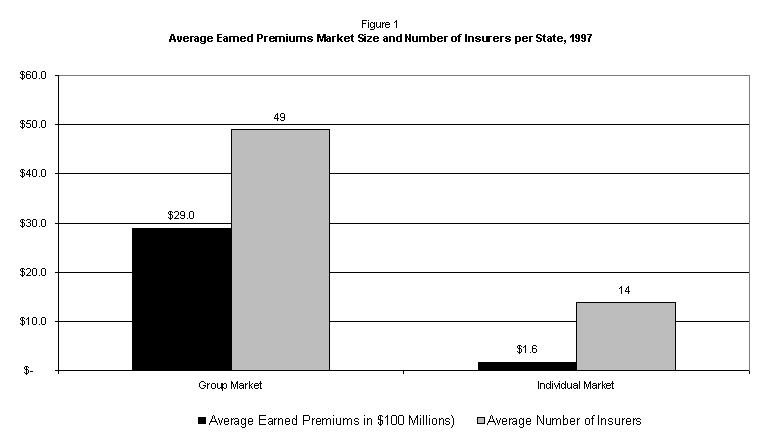
Figure 2: Market Share by Insurer Type: Group Market, 1997
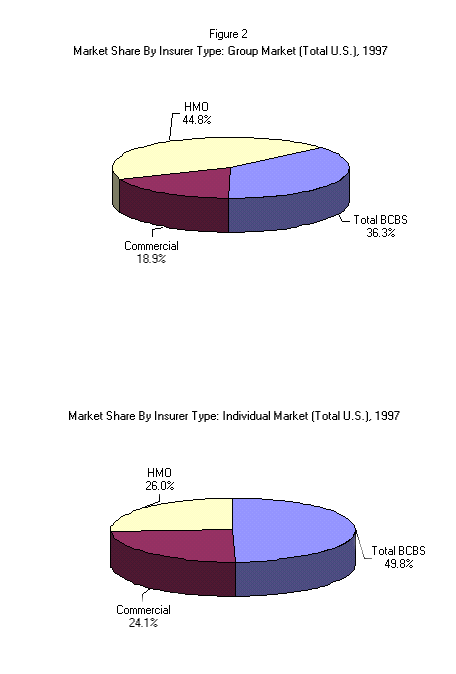
Figure 3: Number of Insurers and Insurers per Population: Group Market, 1997