


Executive Summary
Background
President Bush has often pointed to the Federal Employees Health Benefits (FEHB) Program as a model for health insurance. The FEHB Program is the largest employer-sponsored health insurance program in the Nation, serving more than 8 million Federal employees, their dependents, and retirees. The U. S. Office of Personnel Management (OPM) administers the FEHB Program, which currently offers about 250 health plan choices, providing over $29 billion in health care benefits annually.
At the White House Conference on Mental Health in June 1999, former President Bill Clinton directed OPM to institute a policy of parity, expanding mental health and substance abuse (MH/SA) coverage within the FEHB Program.
The term parity refers to a policy in which specified MH/SA insurance benefits are equal to the benefits for general medical services. Typically this means expanding the coverage for MH/SA services by removing special limits on care (such as annual and lifetime ceilings on expenditures for MH/SA care or limits on the number of outpatient visits or inpatient days) or reducing copayments or deductibles for MH/SA care.
Parity in the FEHB Program
Historically, the FEHB Program has worked toward improved MH/SA benefits. For example, President Kennedy asked the Civil Service Commission (OPM’s predecessor agency) to modify the FEHB Program to treat mental illnesses in the same manner as general medical illnesses (Hustead et al., 1985). In response, from 1967 to 1975, the FEHB Program’s two nationwide health insurance plans offered parity benefits. Beginning in 1975, however, when more flexibility in benefit design was permitted, MH/SA coverage began to erode, with diminution of benefits continuing into the early 1980s. From 1980 to 1997, the share of total claims accounted for by MH/SA claims declined from 7.8% to 1.9% (Foote and Jones, 1999). This trend reflects MH/SA coverage in the larger health care market. It should be noted, however, that other health care costs (e.g., prescription medications) escalated during this time period.
In its annual “call letter” to carriers each spring, OPM issues benefits policy guidance on negotiations for the next contract year. The “call letter” issued by the OPM in 2000 stated that beginning in January 2001, an MH/SA parity policy would go into effect. The aim of the parity policy would be to provide insurance coverage for MH/SA services the same as that for general medical care with respect to benefit design features, such as deductibles, copayments, and limits on visits and inpatient days.
Services to be covered under the parity arrangements are identified as “clinically proven treatment for mental illness and substance abuse… conditions listed in the Diagnostic and Statistical Manual of Mental Disorders, Fourth Edition” (American Psychiatric Association, 1994). The descriptions of covered services and benefits imply and encourage “management” of the care process. Specifically, this takes the form of developing treatment plans, applying medical necessity criteria, employing utilization management methods, and creating networks of providers, among other techniques. Parity benefits may be limited to in-network providers only.
It should be noted that prescription medications were already covered with parity between prescription medications used to treat MH/SA disorders and prescription medications used to treat general medical conditions.
Before the FEHB parity policy went into effect, FEHB plans offered mental health benefits with coverage limits that resembled other plans in the private health insurance market.1 The plans included in the analysis and described in chapter II, Design of the Evaluation, cover about 95% of the beneficiaries from the baseline year. Ninety-eight percent of plans continuously participating in the FEHB Program over the four-year study period contained at least one benefit feature in 1999 that was more restrictive for MH/SA care than for general medical care. For example, in 1999, some health plans limited annual outpatient mental health care to 28 visits and inpatient mental health care to 38 days on average. Substance abuse benefits were similarly limited.
Parity for MH/SA Benefits
MH/SA care and its financing have been influenced by a number of secular trends over the last decade including the passage of State parity laws, a shift to managed care and MH/SA carve-outs, and increased use of pharmaceuticals in health care generally and MH/SA care in particular (U.S. Department of Health and Human Services, 1999; Olfson, Marcus, Druss, et al, 2002).
A series of efforts at parity legislation has occurred at the State level. Some States target their parity legislation narrowly to include only people with severe mental disorders, while others cover a broader range of mental illnesses that may also include substance abuse disorders (Hennessy and Goldman, 2001). To date, 37 States have enacted statutes that might broadly be characterized as parity laws. However, these statutes vary substantially in terms of the type of benefits covered, diagnoses included, populations eligible, and level of explicit regulatory direction with regard to the use of managed care. While some of these statutes are quite limited in scope, 26 States have passed more comprehensive parity statutes that prohibit imposing special inpatient day limits, outpatient dollar limits, and differential cost sharing for mental health conditions (Hennessy and Barry, 2004).
Evaluation Design and Key Research Questions
The design of the evaluation was quasi-experimental. It analyzed plan benefits data for all FEHB plans and claims data on access, utilization, and cost for a subset of nine FEHB plans, both before (1999 and 2000) and after (2001 and 2002) the introduction of FEHB parity. Changes in access, utilization and cost were compared to changes in a matched set of non-FEHB comparison plans. For the subset of plans selected for in-depth study, case studies on the implementation of the parity policy were prepared based on a site visit to each selected plan.
The key research questions on how the FEHB parity policy was implemented and the impact of the policy are shown below.
Implementation Key Research Questions
- Did all FEHB plans comply with the parity policy?
- How did the FEHB parity policy affect MH/SA benefit design and management?
- How did the FEHB parity policy affect the benefit design and management for general medical care?
- Did FEHB plans incur additional expenses in implementing the parity policy?
- How did providers experience the FEHB parity policy?
Impact Key Research Questions
- How did the parity policy affect access to and utilization of MH/SA care?
- How did the parity policy affect cost of MH/SA care to the beneficiary and OPM?
- How did any changes in these areas compare to secular trends?
- How did the parity policy affect utilization and spending on medications for MH/SA disorders?
- Was quality of care affected by the parity policy?
Plan Selection
FEHB plans were selected for in-depth study on the basis of various characteristics on which they were likely to differ, i.e., geographic location; the breadth of parity in State law; differences in plan type and structure (e.g., health maintenance organization [HMO], point of service [POS], or fee-for-service (FFS) with a preferred provider option [PPO]); size of the enrollee population; and the plan’s interest in collaborating on the evaluation. The nine selected plans represent over 3.2 million FEHB beneficiaries.
Limitations of the Study
The evaluation is limited in several ways. First, the study design was not experimental, so it is more difficult to attribute all of the effects to parity rather than the secular trend in MH/SA care generally. However, the matched non-FEHB comparison group diminished this threat considerably. Second, while the effect of State parity laws may have mitigated the impact of the FEHB parity policy, the FEHB parity policy is actually substantially broader than nearly all State parity regulations. Finally, generalizations from these selected plans to all FEHB plans must be made cautiously.
Findings
How was the FEHB Parity Policy Implemented?
All of the FEHB plans complied with the parity policy, most incurred no added administrative costs, and none reported major problems with implementation. The policy change enhanced MH/SA benefits for FEHB Program enrollees. Table 1 shows the key research questions regarding how the parity policy was implemented and the corresponding findings.
Table 1. Parity Implementation Key Research Questions and Findings
| Research Question | Findings |
|---|---|
| Did all FEHB plans comply with the parity policy? | All FEHB plans complied with the parity policy. |
| How did the FEHB parity policy affect MH/SA benefit design and management? | Most plans enhanced their MH/SA benefits consistent with the FEHB parity policy; plans were more likely to enter into managed care carve-out arrangements. |
| How did the FEHB parity policy affect the benefit design and management for general medical care? | There was no evidence of general medical care benefit or management changes resulting from the parity policy. |
| Did FEHB plans incur additional expenses in implementing the parity policy? | Two-thirds of the plans incurred no added administrative costs in implementing the parity policy; the majority of plans experienced some increased benefit costs. |
| How did providers experience the FEHB parity policy? | FEHB plan providers had little awareness of the parity policy and very limited understanding of the parity benefit. |
FEHB Plans Complied with the Parity Policy
All FEHB plans complied with the parity policy. No plan left the FEHB Program to avoid implementing the policy, and plans enhanced their MH/SA nominal benefits as required by the policy change.
Most Plans Enhanced their MH/SA Benefits and were More Likely to Carve-out
The majority of plans enhanced their MH/SA benefits in the post-parity period consistent with the FEHB parity policy. Eighty-four percent of the plans made changes in the amount, scope, or duration of mental health benefits and 73% made such changes for substance abuse benefits. Deductible, copayment or coinsurance limits on mental health benefits were changed by 75% of the plans, and by 64% of the plans for substance abuse benefits.
With the introduction of the parity policy, FEHB plans were more likely to enter into managed care carve-out arrangements with specialty behavioral health care organizations than were comparable non-FEHB plans. However, most other hypothesized changes (e.g., increased gate-keeping at the primary care provider level, reduced provider networks, concurrent or retrospective review, use of disease management programs for MH/SA care, and increased financial risk sharing) occurred less frequently than had been anticipated. While many plans required the submission of treatment plans prior to the parity policy, many more plans required it after the parity policy was implemented.
Finally, while all plans complied with the parity policy for services offered by in-network providers, no plan extended parity to care delivered by out-of-network providers.
General Medical Care was Unaffected by the Parity Policy
While half of the plans changed deductible, copayment and coinsurance limits on general medical benefits, there is no indication that these changes resulted from the FEHB parity policy.
Most Plans Incurred No Added Administrative Costs in Implementing Parity While Benefit Costs Increased for Some Plans
Two-thirds of the FEHB plans reported incurring no added administrative costs in implementing the FEHB parity policy and no plan expressed concerns about any cost increases they did incur. Forty-two percent of the plans reported increased benefit costs only in the immediate post-parity period (2001), and an additional 20% of plans reported these costs increased in both 2001 and 2003.
Providers Had Little Awareness of FEHB Parity
Based on focus groups in three regions of the country, the evaluation found that FEHB plan providers had little awareness of the FEHB parity policy. They also had very limited understanding of the parity benefit itself, often confusing the FEHB parity policy with their State parity laws.
What was the Impact of the Parity Policy on Access, Utilization and Cost?
Overall, the impact of the parity policy on MH/SA service access and utilization, spending, and quality was modest. Utilization and spending results for mental health services alone were not substantially different from those results for MH/SA services combined, nor were utilization and spending results for adults and children significantly different from one another. Table 2 shows the key research questions on the impact of the parity policy on MH/SA access, utilization, spending, and quality and the corresponding findings.
Parity Impact Key Research Questions and Findings
| Research Question | Findings |
|---|---|
| How did the parity policy affect access to and utilization of MH/SA care? How did these changes compare to secular trends? | Access to and utilization of MH/SA services for both adults and children increased consistent with secular trends. For substance abuse services alone, after accounting for secular trends, there was a small but consistent increase in access and utilization across plans. |
| How did the parity policy affect cost of MH/SA care to the beneficiary and OPM? How did these changes compare to secular trends? | Total costs for MH/SA care increased in line with secular trends for both adults and children. In most (but not all) plans, beneficiary out-of-pocket costs declined and no plan’s child beneficiaries experienced cost increases when secular trends were taken into account. |
| Was quality of care affected by the parity policy? | The parity policy had little or no effect on the quality of care for adults with major depressive disorder or substance abuse disorder. |
Utilization of MH/SA Care Increased on Par with Secular Trends
Both adult and child FEHB beneficiaries in all nine plans were more likely to use MH/SA services after parity was implemented, but at a rate consistent with secular trends. (The same was true for mental health services alone.) Thus, the increased utilization of MH/SA care was unlikely a direct result of the parity policy. The parity policy was not associated with changes in inpatient utilization, however, in eight of nine plans.
Access to substance abuse services increased slightly but significantly in all nine plans, but the increase was significant in only four of these plans after accounting for secular trends. Substance abuse services utilization was extremely low, however, both prior to and after the implementation of the parity policy, less than 1% in nearly all plans.
Total Spending on MH/SA Care Increased on Par with Secular Trends and Out-of-Pocket Spending Generally Declined
Overall, FEHB plan total spending increases experienced by the majority of plans generally reflected secular trends in spending on MH/SA care for both adults and children. The FEHB parity policy afforded beneficiaries some improvement in insurance protection in that beneficiaries in five of the nine plans experienced significant decreases in out-of-pocket spending, while no plan’s child beneficiaries experienced an increase in out-of-pocket spending greater than the secular trend.
When secular trends were taken into account, total spending on MH/SA care actually declined in seven of the nine plans, though this decline was significant in only four of the plans. For the two other plans, the spending increases were not significant.
For six of the nine plans, out-of-pocket costs to beneficiaries using MH/SA services declined--even though most plans experienced little or no significant change in use of these services. While three plans experienced significant out-of-pocket spending increases, these increases were in line with secular trends. Patterns of total spending on mental health services alone were nearly identical to those for MH/SA services combined.
Per user total spending on substance abuse care trended upward after the introduction of parity in seven of nine plans, but was significant in only one plan. (Of the two plans experiencing spending decreases, only one was significant). When secular trends were taken into account, total spending on substance abuse care was a mixed picture of spending increases and decreases, but only one plan experienced a significant spending change, i.e., reduced spending of $288 per user of substance abuse care.
Across all plans, the parity policy was associated with a substantial increase in total spending on medications for MH/SA disorders. While per user medication spending ranged from $266 to $519 prior to the FEHB parity policy, in 2002 it increased to a range of $377 to $632.
Quality of Care Improved Slightly or was Unaffected by the Parity Policy
Quality of MH/SA care for two tracer conditions--major depressive disorder and substance use disorders--was slightly improved or unaffected by the parity policy.
Measures of quality for substance abuse treatment in adults included rates of utilization, identification of individuals with substance use disorders, and engagement in treatment. Except for a small increase in rates of identification, there was no evidence of significant quality change associated with the FEHB parity policy.
Measures of quality for treating major depressive disorder in adults either did not change or improved only slightly with introduction of FEHB parity in all but one of the FEHB plans studied. Quality improvement was more notable in the use of medication than for psychotherapy in the treatment of MDD.
Evaluation Findings in Brief
As of January 1, 2001, all of the FEHB plans had complied with the parity policy, two-thirds incurred no added administrative costs, and none reported major problems with implementation. Furthermore, no plans left the FEHB Program to avoid the parity policy. The policy change enhanced MH/SA benefits for FEHB Program enrollees. At the time of policy implementation, two-thirds of the plans had entered into managed care arrangements with a specialty MH/SA vendor (called a “carve out”).
The impact of the parity policy was assessed in detail in nine FEHB plans that reflect both fee-for-service and health maintenance organizations from regions across the country where Federal employees, their dependents, and retirees reside. Overall, the evaluation showed that parity could be implemented with some increase in access to MH/SA care but little or no increase in total MH/SA spending. Users of services in most but not all plans experienced a decrease in out-of-pocket spending, indicating that parity provided the intended additional financial protection for MH/SA expenditures for many enrollees. There was also little or no impact on quality of treatment of major depressive disorder or substance abuse disorder.
For adults, access to MH/SA services (as measured by the probability of MH/SA service use) in these plans increased from before to after parity. Only one plan showed a significant increase in utilization, however, when secular trends were taken into account; two plans showed a significant decrease in utilization. For substance abuse services alone, all of the plans showed a small absolute increase in access that was significant in all cases when compared to secular trends. Total spending on MH/SA services, however, declined in seven of nine plans; four of these decreases were significant. In all but one instance, substance abuse spending either declined or was unchanged. Out-of-pocket expenditures for MH/SA services decreased in six plans and increased in three plans. The impact of the parity policy on children’s utilization and spending for MH/SA services was similar to that observed for adults.
Overall, the parity policy was implemented as intended with little or no significant adverse impact on access, spending, or quality, while providing users of MH/SA care improved financial protection in most instances.
I. Background to the Policy of Parity
In a speech in Albuquerque, New Mexico, on April 29, 2002, announcing the creation of the President’s New Freedom Commission on Mental Health, President George W. Bush reiterated the importance of mental health parity. President Bush said, “Americans with mental illness…deserve a health care system that treats their illness with the same urgency as a physical illness.” While noting the importance of “full mental health parity,” he emphasized that it must be accomplished without significantly raising health care costs. In July 2003, the Commission issued its final report, Achieving the Promise: Transforming Mental Health Care in America (2003), in which it observed that mental health benefits have traditionally been more restricted than general medical benefits. The Commission stated its support for parity and cautioned,
“Insurance plans that place greater restrictions on treating mental illnesses than on other illnesses prevent some individuals from getting the care that would dramatically improve their lives.”
President Bush has often pointed to the Federal Employees Health Benefits (FEHB) Program as a model for health insurance. The FEHB Program is the largest employer-sponsored health insurance program in the Nation, serving more than 8 million Federal employees, annuitants, and their dependents. The U. S. Office of Personnel Management (OPM) administers the FEHB Program, which currently offers about 250 health plan choices, providing over $29 billion in health care benefits annually.
At the White House Conference on Mental Health in June 1999, former President Bill Clinton directed OPM to institute a policy of parity, expanding mental health and substance abuse (MH/SA) coverage within the FEHB Program. OPM and the Office of the Assistant Secretary for Planning and Evaluation (ASPE) of the Department of Health and Human Services (HHS) contracted with ROW Sciences (now Northrop Grumman Information Technology, Inc., Federal Enterprise Solutions/Health Solutions [HS]) to lead an evaluation of the implementation and impact of the new parity policy in the FEHB Program. With investigators from the Harvard Medical School, University of Maryland Medical School, Westat, and the RAND Corporation, HS established the Parity Evaluation Research Team (PERT) as the vehicle for conducting this evaluation.
The term parity refers to a policy in which specified MH/SA insurance benefits are equal to the benefits for general medical services. Typically, this means expanding the coverage for MH/SA services by removing special limits on care (such as annual and lifetime ceilings on expenditures for MH/SA care or limits on the number of outpatient visits or inpatient days) or reducing copayments or deductibles for MH/SA care.
Historically these types of limits and higher cost-sharing provisions have led to MH/SA insurance benefits that differed from those for general medical care and have been considered a barrier to accessing adequate MH/SA care and treatment. Several national and State efforts have initiated MH/SA parity policies. The following sections of the report describe these efforts.
History of Mental Health Benefits and Parity Experiences in the Federal Government
Federal Legislative Trends Affecting Parity in Mental Health Insurance Coverage
Although Federal legislative initiatives on parity in mental health insurance coverage dates from the 1960s, the 1996 Mental Health Parity Act represents the first Federal parity legislation. Implemented in 1998, this legislation focused on only one aspect of the difference in mental health insurance coverage -- catastrophic benefits. It prohibited using lifetime and annual limits on coverage for mental health care that were different from general medical care.5
The Parity Act was limited in a number of important ways. For example, companies with fewer than 50 employees were exempt. Parity provisions did not apply to other forms of benefit limits, such as per-episode limits on length of stay or visits, copayments, or deductibles, which could remain different for mental health treatment. Substance abuse was not covered by the provisions of the legislation. And if an insurer experienced more than a 1% rise in premium as a result of implementing parity, it could apply for an exemption.
The Federal Employees Health Benefits Program
The FEHB Program is the largest employer-sponsored health insurance program in the Nation. As of 2002, the Program was serving more than 8 million Federal employees, annuitants, and their dependents. To understand the process of implementing parity in the FEHB Program, it is critical to understand how the program operates.
The OPM as Purchaser
OPM administers the FEHB Program, which offers a substantial degree of choice to its enrollees and provides them with relatively detailed information on the characteristics, cost, and performance of participating health plans. Health plans compete for enrollees based on benefits, cost, and quality. OPM manages the enrollment process for FEHB Program enrollees and negotiates specific benefit packages and associated premiums with individual carriers.
To qualify as an FEHB participating plan, a carrier must be licensed to sell group insurance within every area it proposes to operate as an FEHB plan. OPM requires participating health plans to establish an internal quality assurance program that meets the OPM’s contract standards, administer a uniform patient satisfaction survey, and implement patient safety improvement programs. OPM also requires health maintenance organizations (HMOs) to provide data from the Health Plan Employer Data and Information Set (HEDIS) and credential/re-credential providers (DHHS, 2000).
OPM pays health plans in one of two ways: Fee-for-service and some HMO plans are paid an experience-rated premium. The basic premium or subscription fee consists of three components: claims costs, administrative costs, and profit. Most HMO plans are paid on a community-rated capitation basis. Community rates are set on the basis of the two largest non-FEHB Program groups within the “community.” Adjustments are made through annual benefit and rate negotiations for differences between specific FEHB plan requirements and prevailing community benefit packages. Large HMOs must provide documentation of premiums from large non-Federal employers in the community. HMOs can also adjust rates based on factors such as the age and sex of enrolled populations.
Parity in the FEHB Program
Historically, the FEHB Program has worked toward improved MH/SA benefits. For example, President Kennedy asked the Civil Service Commission (OPM’s predecessor agency) to modify the FEHB Program to treat mental illnesses in the same manner as general medical illnesses (Hustead et al., 1985). In response, from 1967 to 1975, the FEHB Program’s two nationwide health insurance plans offered parity benefits. Beginning in 1975, however, when more flexibility in benefit design was permitted, MH/SA coverage began to erode, with diminution of benefits continuing into the early 1980s. From 1980 to 1997, the share of total claims accounted for by MH/SA claims declined from 7.8% to 1.9% (Foote and Jones, 1999). This trend reflects MH/SA coverage in the larger health care market. It should be noted, however, that other health care costs (e.g., prescription medications) escalated during this time period.
In its annual “call letter” to carriers each spring, OPM issues benefits policy guidance on negotiations for the next contract year. The “call letter” issued by the OPM in 2000 stated that beginning in January 2001, the aim of parity would be to provide insurance coverage for MH/SA services the same as that for general medical care with respect to benefit design features, such as deductibles, copayments, and limits on visits and inpatient days.
Services to be covered under the parity arrangements are identified as “clinically proven treatment for mental illness and substance abuse… conditions listed in the Diagnostic and Statistical Manual of Mental Disorders, Fourth Edition” (American Psychiatric Association, 1994). The descriptions of covered services and benefits imply and encourage “management” of the care process. Specifically, this takes the form of developing treatment plans, applying medical necessity criteria, employing utilization management methods, and creating networks of providers, among other techniques.
Other key features of the FEHB Program’s parity benefit include the following:
- Parity benefits may be limited to in-network providers only,
- Plans may limit the parity benefit if the beneficiary does not comply with the treatment plan, and
- MH/SA benefit levels are based on the benefit category for comparable medical treatment.
It should be noted that the prescription medication benefit was not subject to the FEHB parity policy in that in most FEHB plans, there was already parity between prescription medications used to treat MH/SA disorders and prescription medications used to treat general medical conditions.
Before the parity policy, FEHB plans offered mental health benefits with coverage limits that resembled other plans in the private health insurance market.6 As reported in Mental Health, United States, 2002, the following 1999 data obtained from the FEHB plan brochures provide average benefit information for the subset of health plans (152) continuously participating in the FEHB Program over the four-year study period (1999 to 2002) and having benefit design information available (Hennessy and Barry, 2004).7
The 152 plans included in the analysis and described in chapter II, Design of the Evaluation, cover about 95% of the beneficiaries from the baseline year. Ninety-eight percent of plans continuously participating in the FEHB Program over the four-year study period contained at least one benefit feature in 1999 that was more restrictive for MH/SA care than for general medical care. For example, in 1999, some health plans limited annual outpatient mental health care to 28 visits and inpatient mental health care to 38 days on average.
Substance abuse benefits were similarly limited. For example, 9% of FEHB plans placed annual dollar limits ranging from $3,000 to $50,000 on substance abuse coverage, and 15% of plans used lifetime limits most often in the form of two 28-day inpatient stays. Dollar limits on substance abuse were more common among fee-for-service plans compared with health maintenance organizations (HMOs). Sixty-eight percent of plans also required higher cost-sharing for outpatient MH/SA services and 23% of plans required higher cost-sharing for inpatient services in 1999.8
Adverse Selection in the FEHB Program
A number of analysts have pointed to adverse selection problems in the FEHB Program over the years (Price and Mays, 1985). Adverse selection refers to the tendency for individuals who expect to use particular health care services to select insurance coverage that meets their anticipated service needs. Mental health care is an area in which adverse selection appears to exert a strong impact. Mental disorders tend to be persistent, and individuals with these disorders expect to spend more on mental health care than other individuals. As a result, they are attracted to health plans with generous mental health care coverage. Health insurers have a financial incentive to avoid enrolling these individuals. For example, in the early 1980s, the use of mental health services was two to three times higher in the FEHB Program’s Blue Cross High Option plan than in the standard option, even though only minor differences existed in the actuarial value of benefits in the two options.
Figure I-1 illustrates the selection incentives in the FEHB Program. The left panel compares inpatient utilization in the two plans, while the right panel compares ambulatory utilization. The grey segments of the bars represent base-level use in the standard or low option plan. The black segments reflect the demand response to the reduced cost-sharing provisions (i.e., reduced deductibles or co-payments) of the high option plan. These were calculated by applying the demand response parameters estimated in the RAND Health Insurance Experiment (Newhouse, 1993).
Figure I-1. Decomposing the differences in use in a health plan with a high and low option for Federal employees, 1983
The white segments of the high option bars represent the estimated utilization differences that are due to selection. The implication is that offering slightly more generous cost-sharing provisions attracted a significantly higher utilizing group of enrollees. Therefore, plans could gain financially by avoiding such enrollees via limited benefits.
Selection incentives may cause health plans to alter plan features other than the nominal benefits described in plan brochures. These so-called effective benefits involve a host of utilization management techniques (Frank, Glazer, and McGuire, 2002). For example, the Plan brochure may state that 30 outpatient visits are offered as nominal benefits. Plans may also use other mechanisms, such as managed care, to bring about the intended change in the effective benefits. These changes may then lead consumers to change plans or use their benefits differently, such as by going to a primary care doctor for services.
State Experiences with Parity
A series of efforts at parity legislation has also occurred at the State level (Hennessy and Stephens, 1997). Some States target their parity legislation narrowly to include only people with severe mental disorders, while others cover a broader range of mental illnesses that may also include substance abuse disorders. Experiences with parity policy at the State level are derived primarily from two sources:
- parity laws enacted by State governments , and
- State employee plans that design a parity MH/SA benefit for their health plans.
Valuable lessons can be gleaned from each set of experiences.
State Parity Laws
To date, 37 States have enacted statutes that might broadly be characterized as parity laws. However, these statutes vary substantially in terms of the:
- type of benefits covered,
- diagnoses included,
- populations eligible, and
- level of explicit regulatory direction with regard to the use of managed care.
Some of these statutes are quite limited in scope. For example, South Carolina currently has a parity policy that applies only to the health insurance of State and local public-sector employees. North Carolina and Arizona have mandates that mirror the Federal parity law by requiring that insurers eliminate special annual or lifetime dollar limits for mental health coverage. Finally, some State parity laws essentially copy the 1996 Mental Health Parity Act and thus do not expand a State’s parity policy beyond the Federal parity law.
Twenty-six States have passed more comprehensive parity statutes that prohibit imposing special inpatient day limits, outpatient visit, and/or dollar limits, and differential cost sharing for mental health conditions. These policies differ in terms of the mental health conditions they cover. For example, 17 of these States have limited parity for diagnoses designated as severe mental illnesses or biologically based disorders. Illnesses frequently characterized as severe tend to include schizophrenia, schizoaffective disorder, bipolar disorder, and major depression.
Nine of these more comprehensive policies require parity in coverage for all medically necessary services to treat MH/SA conditions listed in the Diagnostic and Statistical Manual of Mental Disorders, 4th Edition (DSM-IV; American Psychiatric Association, 1994). Nine States include coverage for substance abuse treatment under the terms of their parity statutes.9
State statutes also differ regarding:
- whether the law applies to both individual and group plans,
- if the law mandates coverage or simply requires parity if mental health benefits are offered,
- whether the law includes a small business exemption, or
- if the law exempts employers experiencing cost growth attributable to parity.
Below we describe three of the more comprehensive state parity laws, as well as parity regulations for State employees in two States, each of which has been evaluated in terms of outcomes.
Vermont State Parity Law
In 1998, Vermont implemented the nation’s most comprehensive parity law. Vermont parity legislation includes both mental health and substance abuse treatment, defines mental illnesses broadly, and requires that mental illnesses and general medical conditions be accorded the same service limits and cost-sharing.
California State Parity Law
In 2001, California implemented a parity statute covering a limited set of diagnoses that focus on serious mental illnesses for adults and serious emotional disturbances for children and youth. The California State parity law prohibited more restrictive benefit limits and higher deductibles and copayments than those for general medical care. Substance abuse disorders were excluded in this legislation.
Maryland State Parity Law
Maryland enacted a parity law in 1994 that prohibits using separate annual and lifetime dollar limits, special deductibles, and special inpatient day and outpatient visit limits for MH/SA disorders. However, it retains a tiered outpatient coinsurance structure of coverage, with higher copayment rates after five visits, which increase again after 30 visits.
State Employee Parity Regulations
Experiences with parity for MH/SA have been studied systematically among two privately insured populations--Massachusetts and Ohio State employees. Experiences reported in those evaluations might predict the likely impacts of the FEHB Program parity initiative.
Massachusetts
State of Massachusetts employees enrolled in PPO and indemnity plans had a parity benefit implemented at the same time as a behavioral health carve-out, i.e., MH/SA care was managed separately from general medical care.
Ohio
Again, parity was introduced after or at the same time as the implementation of a behavioral health carve-out. All health plans serving State of Ohio employees implemented parity (in 1990 for employees in the Ohio indemnity medical plan and in 1995 for all other employees) by expanding the scope of a carve-out program to cover all MH/SA services in all health plans (Sturm, Goldman, and McCulloch, 1998).
Findings from State Parity Laws and Regulations
Vermont State Parity Law
The implementation and effects of the Vermont State parity law are also the most systematically studied (Rosenbach, Lake, Young, et al., 2003). Very few Vermont employers (0.3%) dropped health coverage due to the parity law, and out-of-pocket expenses for MH/SA services declined after the parity implementation. For example, among people with serious mental disorders, the proportion of individuals spending more than $1,000 out of pocket annually was reduced by more than 50%. The implementation of parity was characterized by an increase in managed care for MH/SA services, which was a major factor in controlling costs and may have reduced access and utilization for some services and beneficiaries.
California State Parity Law
One year after California’s State parity implementation, researchers found no evidence of adverse consequences in the State’s health insurance market, such as large premium increases (Lake, Sasser, Young, and Quinn, 2002). Examining the effects of California’s parity law on two large employers in the first year of implementation, Branstrom and Sturm (2002) reported that the parity law was generally producing the intended effects in that “…plans with high costs and high service use show stable or declining spending, and lower-cost plans show increases at tolerable levels (less than 1%).”
Maryland State Parity Law
The National Advisory Mental Health Council (1998) reported on the implementation of parity in the State of Maryland using data from carve-out programs. The Council’s main finding was that parity could be implemented without excessive cost increases.
Ohio State Employees
First, the results for seven years after implementing parity for State of Ohio employees (1990 through 1997 for those in the indemnity plan and 1995 through 1997 for those in other plans) showed no increase in spending within the preferred provider organization (PPO) and indemnity health plans that were part of a carve-out program. The implication is that managed care responds to benefit design to control “moral hazard” effects, i.e., the increase in use and cost of benefits resulting from the price-lowering effect of insurance coverage.
Second, MH/SA spending increased slightly in the health maintenance organization (HMO) plans in response to the benefit expansion, but those plans had very constrained MH/SA benefits before implementing parity.
The Ohio evaluation indicates that the impact of parity is likely to differ across health plans depending on the pre-parity benefits and the organization of the health plan. Moreover, even with a large increase in coverage, the cost increases were modest compared to what one might have expected on the basis of demand response under indemnity insurance (Newhouse and the Insurance Experiment Group, 1993). The Ohio study, however, did not examine changes in enrollment patterns across health plans that may have resulted from the parity benefit.
Massachusetts State Employees
Ma and McGuire (1998) showed that for Massachusetts State employees, the overall impact of managed care exceeded the impact of parity with respect to per person spending on MH/SA. Huskamp (1999) focused her analysis on the outpatient benefits for which the benefit expansion was greatest. She showed that the managed care effect exceeded the moral hazard effect of a benefit expansion. Spending per person fell significantly for MH/SA care, and the statistical analysis also showed a sizable reduction in the probability of use. Her work used a continuously enrolled population and thereby minimized any effects of biased selection due to coverage changes.
Implications of State Parity Experiences for the Evaluation of Parity in the FEHB Program
Because of the variation in the scope of State parity laws and regulations, caution is necessary in drawing inferences from State experiences to the FEHB Program parity initiative. Evidence on the effects of State parity laws comes from both multi-State analyses and single-State case studies. The Health Care for Communities (HCC) and Community Tracking Study (CTS) national household surveys have been used to study effects of parity across States (Sturm, 2000; Capula and Sturm, 2000; Gitterman, 2001; and Bao and Sturm, unpublished manuscript). These studies generally found little overall impact on either access or use due to State parity laws, although some improved access was found for more seriously ill subpopulations. But again, these results must be interpreted with great care.
In addition, Maxfield, Achman, and Cook (2004) found that less than half of Americans in 1999 were affected by either State of Federal parity laws. The Employee Retirement Income Security Act (ERISA) provides the biggest exemption of health plans from State parity laws. ERISA exempts self-insured employer-sponsored health plans, meaning that these health plans are subject only to Federal parity regulations, but exempt from any State parity policy that goes further than the 1996 Mental Health Policy Act. The impact of this exemption is substantial in that Maxfield and colleagues found that 39% of those in employer-sponsored health insurance plans are in self-insured plans. In addition, many states and the Federal parity law also exempt small employers (most States define a “small employer” as one with 50 or fewer employees) for compliance with State parity laws.
This set of studies suggests that the State context may be quite important for assessing the impact of parity in the health plans included in the FEHB Program evaluation. If a State parity law is broad and affects many insured populations, including FEHB enrollees, the subsequent FEHB parity policy may have little effect. If a State parity law is narrow and does not affect many plans, however, the impact of the FEHB parity policy may be larger. Case-studies on the implementation of more comprehensive State parity laws have been conducted in a number of States, including Vermont, California, and Maryland, and are discussed further below.
II. Design o the Evaluation
Goals and Objectives of the Evaluation
The Federal Employees Health Benefits (FEHB) Program evaluation addressed changes in cost, access, utilization, and quality as a result of the parity policy. Additionally, the evaluation focused on adverse selection arising from the managed competition that exists in the FEHB Program. Adverse selection refers to the tendency for individuals to choose insurance plans whose benefits will cover services that they expect to use. For example, people with mental health and substance abuse (MH/SA) conditions tend to select health plans with more generous MH/SA coverage.
The overall goals of the evaluation were to examine both the implementation of the parity requirement for FEHB plans and the intermediate and long-term impacts of the FEHB parity policy on the FEHB plans.
The objectives of this evaluation were to:
- Assess the degree to which the parity requirement affects
- benefit design and management;
- access to MH/SA services;
- utilization of MH/SA services;
- costs to beneficiaries, plans, and Office of Personnel Management (OPM);
- quality of MH/SA services; and
- providers’ awareness and perceptions of the policy change.
- Examine the patterns in these effects across subgroups of plans and providers.
- Assess the interrelationships among changes in
- benefit design and management,
- costs,
- access,
- utilization, and
- quality.
Framework for Evaluating the Implementation of Parity in the FEHB Program
The logic model for understanding the relationship between implementing benefit changes and new methods for managing care and their impact on access, utilization, cost, and quality appears in Figure II-1. The logic model provides a framework for the evaluation. It depicts a sequence of moves from implementing the policy of the President to have all FEHB Program plans offer MH/SA parity, through the required plan changes, to expected changes in access, utilization, and cost and their impact on quality. The logic model also provides a template that maps the research questions and data collection approaches. The result is a matrix of research domains, questions, and methods that is presented in Table II-1.
Figure II-1. Logic Model: Evaluating parity in the FEHB program
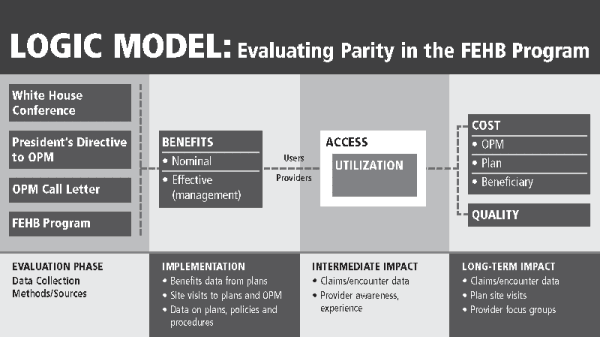
The logic model describes a rational approach to policy and programmatic changes with the following sequence of steps. It was anticipated that carriers and plans would alter their nominal benefits according to the instructions in the call letter from the OPM. In other words, they would eliminate special deductibles and copayments and other “demand side” limits on, for example, inpatient days or outpatient visits that previously applied to MH/SA benefits. Plans could be expected to respond to this change in nominal benefits by altering their management and payment practices in an effort to control costs on the “supply side,” such as through changes in utilization management practices and risk-sharing arrangements with providers. Such changes in effective benefits could be expected to have the following consequences:
- changes in access and patterns of use,
- selection of specific plans by individuals, and
- changes in plan and beneficiary spending.
Changing patterns of access and utilization might also affect the quality of care provided.
Research Questions
The study’s key research questions are described in Table II-1 and reflect the logic model in Figure II-1. Table II-1 identifies the data sources and collection methods most relevant to each research question. chapter III, Implementation of Parity, and chapter IV, Impact of Parity, provide further details on more specific research questions, data sources, data collection methods, and analytic strategies.
Table II-1. Data sources, collection methods, and analysis methods for key research questions
| Research questions | Data source | Data collection method | Data analysis method | |
|---|---|---|---|---|
| Benefits | How has the design of MH/SA benefits offered by FEHB plans changed as a result of the parity policy? | OPM website/plan documents for all FEHB plans OPM/Plan personnel | Document review Key informant interviews (site visits to 8 selected plans) and FEHB Parity Reporting Requirement (for all plans) |
|
| How have the policies and procedures related to the management of the MH/SA benefits offered by the FEHB plan changed as a result of the parity policy? | OPM/Plan personnel | Key informant interviews (site visits) and FEHB Parity Reporting Requirement |
| |
| How have the structure and management of general medical health benefits offered by FEHB plans changed as a result of the parity policy? | OPM/Plan personnel | Key informant interviews (site visits) and FEHB Parity Reporting Requirement (for all plans) |
| |
| Cost | Have aggregate and per-enrollee costs for MH/SA services within select FEHB plans changed after implementation of parity? How do these changes compare to secular trends? | Plan and comparison group claims data | Claims data files transferred to contractor from plans |
|
| Have out-of-pocket costs to beneficiaries utilizing MH/SA services (e.g., deductibles, copayments, and out-of-pocket limits) within select FEHB plans changed after implementation of parity? How do these changes compare to secular trends? | Plan and comparison group claims data | Claims data files transferred to contractor from plans |
| |
| Have FEHB plans incurred additional administrative costs attributable to the parity policy? | Plan personnel | Key informant interviews (site visits) to 8 selected plans |
| |
| Has the Federal Government incurred additional expenses (e.g., premium costs) attributable to the parity policy? | OPM documents OPM personnel | Document review Key informant interviews (site visits) and FEHB Parity Reporting Requirement (for all plans) |
| |
| Within select FEHB plans, is there evidence of either adverse or favorable risk selection among new enrollees or those disenrolling after the implementation of parity? | OPM Health Benefits (Enrollment) Data File | Claims data files transferred to contractor from plans |
| |
| Access | What are the patterns of access to MH/SA services within select FEHB plans both before and after the implementation of parity? How do any changes compare to secular trends? | Plan and comparison group claims data | Claims data files transferred to contractor from plans |
|
| Do these patterns of access differ by type of user, type of service, level of service, or type of condition? How do these patterns compare to secular trends? | Plan and comparison group claims data | Claims data files transferred to contractor from plans |
| |
| Utilization | What are the patterns of service utilization for MH/SA services within select FEHB plans both before and after the implementation of parity? How do these changes compare to secular trends? | Plan and comparison group claims data | Claims data files transferred to contractor from plans |
|
| Do these patterns of service utilization differ by type of user, type of service, level of service, or type of condition? How do these patterns compare to secular trends? | Plan and comparison group claims data | Claims data files transferred to contractor from plans |
| |
| Quality | What type of quality assurance strategies have FEHB plans implemented as a result of the parity policy (e.g., utilization review, case management, disease management protocols, patient care teams, or outcomes monitoring)? | Plan personnel | Key informant interviews (site visits to 8 selected plans) and FEHB Parity Reporting Requirement (for all plans) |
|
| Do FEHB plans utilize any evidence-based practice guidelines for the treatment of mental health, substance abuse, or any other conditions? | Plan personnel | Key informant interviews (site visits to 8 selected plans) |
| |
| If yes, how well do the patterns of care for MH/SA or other conditions (as evidenced in administrative claims/encounter data) reflect adherence to proposed guidelines? | Plan and comparison group claims data | Claims data files transferred to contractor from plans |
| |
| Are there any changes in either the use of guidelines or adherence to guidelines that are related to the implementation of parity? | Plan personnel Plan and comparison group claims data | Key informant interviews (site visits to 8 selected plans) Claims data files transferred to contractor from plans |
|
Overview of the Evaluation Methodology
The design of the evaluation was quasi-experimental. Plan data on nominal benefits (for all FEHB plans) and archival (claims) data on access, utilization, and cost (for nine selected plans) were studied before and after the implementation of parity.Changes in these measures were compared to changes in matched non-FEHB comparison group plans from the Medstat Group MarketScan® Benefit Plan Design database (Medstat).
For selected plans, the Parity Evaluation Research Team (PERT) prepared case studies based on a site visit to each selected plan. These studies were also quasi-experimental in design. They inquired retrospectively about conditions and experiences before and after the parity policy went into effect.
Including the non-FEHB comparison group plans (i.e., Medstat) allowed for assessing secular trends occurring over the same pre- and post-parity implementation period. In this way, it was possible to determine to what extent pre- to post-parity implementation changes could be attributed to the policy change versus changes in the health care system that might have occurred regardless of the parity policy.
The analysis of changes from pre-parity to post-parity relied primarily on the archival claims data and information on nominal MH/SA benefits, as these were the only data that were not reported retrospectively. The pre-parity to post-parity changes from the archival claims data were compared to changes in the matched comparison group set of claims data covering the same period. In addition, the study investigated FEHB plan benefits, policies, and procedures, including changes implemented within the first two years of parity.
Detailed data were obtained through site visits to eight health plans and more limited data were obtained for all FEHB plans (with over 500 enrollees) through a Parity Reporting Requirement (PRR) instituted by the OPM. Information on changes in FEHB health plan structures, policies, and procedures were obtained by site visits with the key plan personnel, resulting in selected plan case studies. The case studies yielded a rich context for understanding results from the archival claims data analysis.
Each of the five domains described in the logic model was examined by the indicated analytic methods. The PERT began its examination of each domain with descriptive analyses covering all data elements relevant to that domain. These analyses entailed both quantitative and qualitative methods, depending on the data element. The more complex research questions were addressed by sophisticated methods, such as statistical modeling, using the claims data and case study methodologies to examine differences in plans’ benefits.
The evaluation design incorporated multiple data collection approaches, including:
- nominal plan benefits data from the OPM website,
- parity implementation reports from all FEHB plans with 500 or more enrollees,
- site visits to acquire detailed plan data from selected plans and OPM,
- archival enrollment and claims/encounter data from selected FEHB plans and a matched set of comparison group plans, and
- focus groups of providers.
Table II-2 summarizes the project’s data collection approaches and the evaluation domains addressed by each approach. It should be noted that several of the evaluation domains were addressed by the combination of multiple data collection approaches, which is indicated when a domain appears in more than one row of the table. In this chapter, each of these approaches is discussed in depth.
Table II-2. Overview of data collection approaches
| Data collection approach | Evaluation domains addressed | Lead Organization |
|---|---|---|
Obtain nominal plan benefits data from OPM website
| Benefits -- Changes in the design of MH/SA benefits | Harvard |
Obtain limited data at two points in time on plan policies and procedures
| Benefits -- Changes in:
| RAND |
| Conduct site visits to 8 selected plans and the OPM to obtain in-depth plan data. | Benefits -- Changes in:
| RAND |
Obtain enrollment and claims/encounter archival data
| Cost
| Harvard RAND |
| Focus groups of providers in the networks of selected plans in the West, Mid-Atlantic, and Northeast regions | Provider awareness -- Providers’ awareness of the parity benefit implementation and its implications for clients’ care | HS/Westat |
| *As explained in the text, eight plans were selected initially and were site visited. The PERT was unable to obtain comparable archival data on utilization and costs from one of the visited plans, but the PERT was able to obtain archival claims data from two additional plans. | ||
Data Collection Issues
Plan Selection
The study design included selecting a small number of plans for in-depth study, i.e., obtaining archival claims data, conducting plan site visits, and conducting focus groups with providers (from a subset of the selected plans). Plans were selected on the basis of various characteristics on which they were likely to differ:
- geographic location;
- the breadth of parity in State law;
- differences in plan type and structure (e.g., health maintenance organization [HMO], point of service [POS], or fee-for-service [FFS] with a preferred provider option [PPO]);
- size of the enrollee population; and
- the plan’s interest in collaborating on the evaluation.
Based on these considerations, the following eight plans were selected for site visits:
- Fee-for-service national plan (FFS-NAT),
- HMO West #1 plan (HMO-W1),
- Fee-for-service West plan (FFS-W),
- Fee-for-service Mid-Atlantic #1 plan (FFS-MA1),
- Fee-for-service Mid-Atlantic #2 plan (FFS-MA2),
- Fee-for-service South plan (FFS-S),
- HMO Northeast plan (HMO-NE), and
- HMO West #2 plan (HMO-W2).10
The first nine plans (excluding HMO-W2) that contributed to the impact analysis that comprises chapter IV represent a total of 3,209,617 FEHB beneficiaries. The FFS-NAT is a very large national fee-for-service (FFS) plan covering over a million lives. HMO-W1 is an HMO, and HMO-NE is an HMO with a POS option within the FEHB Program. The remaining six plans are licensees of a large national association (the “Association”). All six are FFS plans with a PPO, managed in somewhat different ways in each location by a variety of managed behavioral health care organization (MBHO) vendors11. Individual Association plans were selected to represent a range of geographic locations with large numbers of beneficiaries.
For two additional plans, FFS-NE1 and the FFS-NE2, the PERT collected utilization and cost data but was unable to obtain detailed implementation data due to resource constraints.
Because of the small number of selected plans, this represents a purposive sampling process, rather than random sampling. It was intended to produce a sample roughly representative of all the FEHB plans with 500 or more enrollees, along the qualitative dimensions just described.
Procedures to Ensure Confidentiality
The PERT maintained confidentiality for all data collected in the study. Site visit interviews were summarized anonymously in all study materials. For the archival data analysis, each participating health plan created scrambled participant identification numbers; deleted names, addresses, and other unique identifiers; and sent the claims data file to the PERT. When requested, the PERT signed a data user agreement.
Limitations of the Evaluation Design and Analyses
The evaluation design and subsequent analyses are not without limitations. Key limitations in the evaluation design and within each data collection approach and analysis strategy are addressed in their respective sections of this report.
Broader limitations that may make it difficult to draw inferences about the impact of the parity implementation are summarized below:
- The study design was quasi-experimental and did not include a randomized control group observed at the same points in time, making it difficult to interpret changes over time.
- A significant portion of the FEHB plans had State parity laws in varying stages of implementation. These regulations differed greatly in their requirements and location of beneficiary residence. The effect of variations in State parity laws represents a potential confound to the study. Even though State parity laws do not directly affect FEHB plan benefits (the FEHB parity policy supersedes State parity laws), insurers’ prior experiences with State parity laws may have influenced their approach to implementing the FEHB parity policy. The matched national non-FEHB comparison group diminished this threat considerably for the archival data, however. The effect of State parity laws may have also mitigated the impact of the FEHB parity implementation. Compared to nearly all State parity regulations, though, the FEHB parity policy is substantially broader.
- The selected plans were chosen purposively on the basis of various characteristics on which the plans were likely to differ. Thus, generalizations from these selected plans to all FEHB plans must be made cautiously.
- Only the archival claims and enrollment truly represent pre-parity data. Other data collection did not occur until after parity implementation (January 1, 2001).
- There is the possibility of adverse selection resulting from parity-related changes in benefits coverage across plans, complicating the estimation of the effect of parity on spending and use. This was partially addressed by comparing continually enrolled cohorts to all enrollees and by examining enrollment changes across the years.
- The evaluation included no data on beneficiaries’ experiences or unmet need for MH/SA treatment.
- The evaluation time frame captures only two years post-parity, and therefore does not address any longer term effects of MH/SA parity in the FEHB program.
III. Implementation of Parity
Overview
This chapter examines the implementation of the parity policy in the FEHB Program in terms of its effect on nominal and effective plan benefits, as illustrated in the evaluation logic model shown in FigureII-1. The research questions, data sources and collection methods, and analysis methods--summarized in the “Benefits” panel of Table II-1--are detailed in this chapter, as are the relevant findings.
The PERT employed the following approaches to examine the implementation of the FEHB parity policy:
- the Parity Reporting Requirement (PRR), completed by all FEHB plans, to collect descriptive data on all FEHB plans’ parity implementation;
- FEHB plan benefit design data abstracted from plan brochures on the OPM website for two time periods, pre- and post-parity;
- comparison group data, to account for time trends during the pre- to post-parity time period; and
- implementation case studies of the eight plans that are the focus of the analysis in order to provide more extensive data on a subset of FEHB plans.
Federal Employees Health Benefits Parity Reporting Requirement for All Plans
As part of the Office of Personnel Management’s (OPM’s) contract with the FEHB plans, each health plan was required to submit to the OPM a report on implementing mental health and substance abuse (MH/SA) parity in the first quarter of 2002 and in the first quarter of 2003.12 The report, The Parity Reporting Requirement (PRR), designed by PERT investigators, focused on delivering MH/SA benefits in the year before parity implementation (2000), in the year of parity implementation (2001), and two years afterwards (2003).
Key Research Questions
In response to the OPM’s parity policy, the PERT developed the following research questions about FEHB health plans’ behavior:
Nominal Benefit Design
- Will health plans expand the amount, scope, and duration of MH/SA benefits to be equivalent to those for general medical care?
- Will health plans change deductible, copay, and coinsurance on MH/SA benefits to be equivalent to those for general medical care?
- Will health plans add new MH/SA benefits?
Effective Benefit Design
- Will health plans that contracted with managed behavioral health care organizations (MBHOs) pre-parity continue to carve out post-parity?
- Will health plans that did not carve out pre-parity carve out post-parity?
- Will health plans carve out substance abuse as well as mental health benefits post-parity?
- Will health plans move to risk-based contracting with vendors post-parity?
- Will health plans change financial incentives for their providers post-parity?
- Will health plans expand the number and disciplinary mix of MH/SA providers post-parity?
- Will health plans increase the number or mix of utilization controls they employ post-parity?
Implementation Experience
- Will health plans incur modest administrative costs in implementing parity?
- Will health plans report increased MH/SA benefits costs for their FEHB product?
Data Collection
The PERT collaborated with OPM to choose a limited number of implementation domains to make up a PRR that OPM would include in its annual reporting requirements for FEHB health plans. OPM has legislative authority to require FEHB health plans to “furnish such reasonable reports as the Office determines to be necessary to enable it to carry out its functions…” Contracts between OPM and the FEHB health plans stipulate that health plans will furnish reports requested by OPM.
PRR Instrument
PERT researchers developed closed-ended, fixed-choice survey items for the PRR that were FEHB-specific. Because the PERT was unable to use previously field-tested items, it conducted cognitive testing of the instrument with the nine FEHB plans.
A mix of plans were selected that varied on the basis of:
- size of plan,
- type of plan (health maintenance organization [HMO] and fee-for-service [FFS] plans), and
- geographic area.
OPM distributed the draft PRR to representatives of the nine plans and obtained feedback. PERT researchers also sought and received feedback from U.S. Department of Health and Human Services (HHS) project officers and other HHS-funded investigators working in the field of managed behavioral health care (i.e., Brandeis investigators Drs. Constance Horgan and Deborah Garnick). Suggested revisions were incorporated into the final version of the PRR. The relevant PERT organizations’ institutional review board reviewed and approved the PRR data collection plan.
Administering the PRR to the Association Plans
The “Association” is a national, fee-for-service plan administered jointly by the Association and 64 participating Association licensees across the country. All Federal employees and annuitants who are eligible for the FEHB Program may enroll in the Association. Enrollment in the Association represents over 50% of the total FEHB Program enrollment.
A national contract is negotiated between the Association and OPM but local Association plans underwrite the risk. Therefore, decisions about health care delivery, such as whether to contract with an MBHO, are local Association plan decisions. While the Association is subject to OPM’s regular reporting requirements, individual local Association plans do not individually report to OPM, but are accounted for in the Association reports.
For the PRR data collection, in collaboration with the Association, the PERT constructed a short form of the PRR to be administered at a single point in time (2003) to the Association plans. The short-form PRR included only questions on the use of MBHOs and utilization management. Respondents provided retrospective (pre- and post-parity) and current (2003) information in 2003.
The short-form PRR was sent by e-mail attachment to Association plans with instructions to return the completed PRR to OPM. All copies were forwarded to the PERT for data entry, cleaning, and analysis. The response rate for the Association plans was 100%, largely due to the active follow-up efforts of Association staff. (Note that the responses from two of the Association plans were dropped from the analysis because those plans shared responsibility for coverage of FEHB enrollees with other Association licensees in their jurisdiction. To avoid duplication, we report the responses only for the other Association licensee.)
Administering the PRR to the Other FEHB Plans
For the 156 other FEHB plans that were not part of the Association, OPM staff again fielded the PRR for plans that were active in 2002.13 The PRR was distributed to the other FEHB plans in electronic form by e-mail attachment. These plans were instructed to:
- download the electronic copy of the PRR,
- click on the relevant boxes to provide their answers,
- save the document, and
- return it to OPM by e-mail attachment.
A few plans had problems with the electronic version of the PRR and were instructed to print a copy of their responses and fax it back to OPM. OPM staff also conducted aggressive follow-up of non-respondents.
Data were collected at two points in time:
- At Time 1 (January 2002), the other FEHB health plans were asked to provide pre- (2000) and post-parity (2001) implementation data.
- At Time 2 (January 2003), they were asked to describe their current implementation.
In the 2003 version of the PRR, the response categories for one of the questions were modified slightly and another question dropped because it yielded little useful information at Time 1. Otherwise, the items on the two PRRs were identical.
Electronic copies of the completed PRRs were sent from the OPM to the PERT. The PRRs were logged in at a PERT organization and PERT investigators entered, cleaned, and analyzed the data. The response rate at Time 1 was 98% (n = 175) and at Time 2 it was 99% (n = 159), for a total of 156 out of a possible 158 other FEHB plans responding to the PRR at two points in time.
Analytic Methods
RAND researchers analyzed the PRR responses to assess changes in nominal and effective plan benefits after the implementation of the FEHB parity policy. The PRR focused on the year immediately before the implementation of the parity policy (2000) and at two points in time (2001 and 2003) after the implementation.
The PRR provided information on plans’ behavior and explanations for changes made in nominal and effective benefits. For example, the PRR asked if the plans carved out, and if so, whether this decision was in response to the parity policy. Although these reports addressed only a small subset of the issues covered in the site-visit discussion guide administered to eight selected plans (discussed later in this chapter and included as Appendix B, Site Visit Discussion Guide), having a minimum dataset on all FEHB plans allowed PERT investigators to assess whether the parity implementation experiences of the eight plans (studied in depth) were generalizable to the larger FEHB program.
Findings
This section of the report describes the experience of the FEHB parity implementation in the 62 Association member plans and 156 other FEHB plans that participated in the FEHB Program in the years 2002 (reporting on the pre- and post-parity years) and 2003 (two years after FEHB parity implementation). The PRR data collected by OPM describe plan structure, policies, and procedures and whether these changed in response to the implementation of parity.
The Association reported on two issues of interest: whether the plan contracted with an MBHO and the utilization of management techniques employed to limit service utilization. The other FEHB plans reported on a broader range of policies and procedures related to MH/SA. We first report on changes that the FEHB plans made in nominal benefit design, then on the use of contracts with MBHOs and other managed care techniques (such as increasing the use of utilization management or changing financial incentives for providers). We then present administrative and premium costs in the post-parity periods. Findings are shown separately for Association plans, where applicable.
Nominal Benefit Design Changes
Change in Amount, Scope, and Duration Limits on MH/SA Benefits
FEHB plans (n = 156) were asked to report to OPM whether the plan had changed amount, scope, or duration limits for in-network MH, SA, or general medical care benefits as a response to the implementation of FEHB parity (see Table III-1).
Of the 141 plans reporting, 83.7 % reported changing these limits for MH benefits; 73.0% of plans reported making such changes for SA benefits; and only 17.7% of plans reported changing the amount, scope, or duration limits for general medical care benefits post-parity. Although in 2003, an additional 13 health plans reported that they changed limits for general medical care benefits, these additional changes were probably unrelated to MH/SA parity as health plans are continually modifying their benefit packages.
Table III-1. Changes in nominal benefits (2001, 2003)
| Health plans (N = 141) | Yes | No | |||
|---|---|---|---|---|---|
| 2001 only | 2003 only | 2001 & 2003 | |||
| Changed amount, scope, or duration limits – Mental Health | No. of plans % of plans | 114 80.9 | 0 0.0 | 4 2.8 | 23 16.3 |
| Changed amount, scope, or duration limits – Substance Abuse | No. of plans % of plans | 99 70.2 | 0 0.0 | 4 2.8 | 38 27.0 |
| Changed amount, scope, or duration limits – General Medical | No. of plans % of plans | 11 7.8 | 13 9.2 | 1 0.7 | 116 82.3 |
| Changed deductibles, copays, or coinsurance – Mental Health | No. of plans % of plans | 56 39.7 | 15 10.6 | 35 24.8 | 35 24.8 |
| Changed deductibles, copays, or coinsurance – Substance Abuse | No. of plans % of plans | 49 34.8 | 17 12.1 | 24 17.0 | 51 36.2 |
| Changed deductibles, copays, or coinsurance – General Medical | No. of plans % of plans | 6 4.3 | 57 40.4 | 8 5.7 | 70 49.7 |
| Added new benefits – Mental Health | No. of plans % of plans | 16 11.4 | 1 0.7 | 0 0.0 | 124 87.9 |
| Added new benefits – Substance Abuse | No. of plans % of plans | 17 12.1 | 0 0.0 | 0 0.0 | 124 87.9 |
Removing Deductible, Copay, and Coinsurance Limits
Table III-1 also reports changes in deductible, copay, and coinsurance limits on MH, SA, and general medical care benefits in 2001 and 2003. Of the 141 plans, 75.2% reported making such changes for the MH benefit and 63.8% for the SA benefit. While only six plans (4.3%) reported changing these limits for the general medical care benefit in 2001, an additional 57 plans (40.4%) reported making these changes in 2003. Again, these additional 2003 changes were probably part of the plans’ ongoing modifications to their benefits packages and unrelated to the parity policy.
New MH/SA Benefits
Health plans also reported to OPM on whether they had added new MH or SA benefits to comply with the FEHB parity policy. As reported in Table III-1, only 11.4% of plans reported adding new MH benefits in 2001, with one additional plan reporting adding such benefits in 2003. For SA benefits, 12.1% of plans reported adding new SA benefits in 2001 with no plans adding new SA benefits in 2003.
Summary
The majority of plans moved in the expected direction post-parity--that is, most plans removed traditional demand side limits from their nominal benefit design. Those plans that did not report making such changes had already been offering a parity benefit, as there is no evidence of failure to comply with the OPM directive. (See section below, Effective Benefit Design Changes, for more details.) Small numbers of plans reported making additional changes two years after implementing parity. Plans reported that they expanded their MH/SA benefit by removing limits rather than adding new benefits.
Effective Benefit Design Changes
Contracting with MBHOs
Health plans reported to OPM on their use of vendors to manage MH/SA benefits. The PRR asked plans to report “whether [the] health plan contracts with a vendor--such as a managed behavioral health organization--for management of behavioral health benefits.”
If the plan responded in the affirmative, the PRR queried whether this arrangement was a pre-existing (pre-parity) or new (post-parity) arrangement, and whether the arrangement was a response to the implementation of FEHB parity. Table III-2 presents the health plans’ PRR responses for pre- and post-parity periods.
Table III-2. Contracts with behavioral health vendors (2001, 2003)
| Pre-existing behavioral health vendor | Pre-existing, in anticipation of parity | New vendor in response to parity | New vendor other than parity | Other | No behavioral health vendor | ||||||||
|---|---|---|---|---|---|---|---|---|---|---|---|---|---|
| 2001 | 2003 | 2001 | 2003 | 2001 | 2003 | 2001 | 2003 | 2001 | 2003 | 2001 | 2003 | ||
| Association Plans (N = 62) | No. of plans % of plans | 21 33.9 | 3.8 66.1 | 1 1.6 | 0 0 | 15 24.2 | 0 0 | 3 4.8 | 0 0 | 1 1.6 | 0 0 | 21 33.9 | 24 38.7 |
| Other FEHB Health Plans (N = 156) | No. of plans % of plans | 81 51.9 | 103 65.1 | 2 1.3 | 0 0 | 10 6.4 | 0 0 | 10 6.4 | 0 0 | 0 0 | 0 0 | 53 34.0 | 53 34.0 |
Association Plans: In 2001, 41 of the 62 responding Association plans reported contracting with an MBHO for management of behavioral health benefits (see Table III-2). Of this number, 21 (34%) were pre-existing carve-outs that were implemented for reasons other than FEHB parity. Twenty-one Association plans (34%) reported no carve-outs in either the pre- or post-parity period. Sixteen Association plans (26%) evidenced an effect of FEHB parity, reporting that the plans carved out either in anticipation of, or in response to, FEHB parity.
Other FEHB Plans: As indicated in Table III-2, 103 of the 156 other FEHB health plans (66%) reported having a contract with an MBHO for managing behavioral health benefits in 2001. Of this number, 81 were pre-existing carve-outs that were implemented for reasons other than FEHB parity. The majority of these FEHB health plans had already carved out before implementing FEHB parity and continued those relationships in the post-parity period. Fifty-three plans (34%) reported no carve-outs in either the pre- or post-parity period.
Carving Out Post-parity
Table III-2 also indicates that a number of health plans carved out in the post-parity period (2001). Twenty of the 156 other FEHB health plans reported new carve-outs in 2001, but only half of those plans reported making that decision in direct response to FEHB parity. Two of the 81 with pre-existing carve-outs reported having carved out in anticipation of parity. Taken together, 12 of 156 health plans (7.7%) reported to OPM that the FEHB parity policy was the impetus for their decision to carve out their behavioral health benefits.
Benefits Managed by MBHO Vendor
The PRR asked plans that reported carve-outs in 2001 to indicate what benefits (MH, SA, pharmacy, or other) were being managed by the MBHO vendor. One hundred percent of the plans included the MH benefit in the carve-out in 2001 and 2003. By 2003, 100% of health plans reported that the SA benefit in 2001 was also being managed by the MBHO. Table III-3 presents the findings for the pharmacy benefit.
Table III-3. Pharmacy benefits managed by behavioral health vendors
| Health plans (N = 96)1 | Yes | No | ||
|---|---|---|---|---|
| 2001 only | 2003 only | 2001 and 2003 | ||
| ||||
| No. of plans % of plans | 6 6.3 | 2 2.1 | 2 2.1 | 86 89.6 |
Across all reporting plans (n = 96), 89.6% indicated that the pharmacy benefit was not included in the carve-out at either point in time post-parity (2001 or 2003). Only 2.1% of the plans reported carving out pharmacy benefits at both points in time but two health plans added the pharmacy benefit to their carve-out in 2003.
Using Risk-based Contracting with Vendors
FEHB health plans that reported using MBHOs were asked to indicate what type of contract the health plan had with MBHO vendors in 2000 (pre-parity), 2001 (post-parity), and 2003. Table III-4 shows the type of vendor contracts used in the pre- and post-parity periods and changes over time from pre-parity (2000) to 2003.
Table III-4. Type of behavioral health vendor contract
| Full-risk 2000, 2001, 2003 | Partial-risk 2000, 2001, 2003 | ASO** 2000, 2001, 2003 | Increase in risk in 2001 | Increase in risk in 2003 | Decrease in risk in 2001 | Decrease in risk in 2003 | ||
|---|---|---|---|---|---|---|---|---|
| *Plans reporting behavioral health vendors at three points in time **ASO=Administrative services only | ||||||||
| Association Plans (N = 22) | No. of plans % of plans | 2 9.1 | 1 4.6 | 18 81.8 | 0 0.0 | 0 0.0 | 1 4.6 | 0 0.0 |
| Other FEHB Health Plans (N = 79*) | No. of plans % of plans | 57 72.2 | 1 1.3 | 6 7.6 | 0 0.0 | 9 11.4 | 1 1.3 | 5 6.3 |
No clear pattern of effects existed on the use of risk-based contracting with vendors. Association plans and other FEHB plans used risk-based and administrative services only (ASO) contracts in both the pre- and post-parity periods. Of the Association plans reporting carve-outs in both the pre- (2000) and post- (2001) periods, 18 of 22 contracts were ASO contracts (81.8%), while 6 of 79 (7.6%) of the other FEHB plans used ASO contracts. Only two of the Association plans (9.1%) reported using full-risk contracts with MBHOs, while fifty-seven of the 79 other FEHB health plans that reported a vendor (72.2%) used full-risk contracts at all three points in time (pre, post, and in 2003). Only one plan reported using partial capitation contracts at all three points in time. Table III-4 also indicates changes made by plans to increase or decrease the amount of risk assigned to vendors in 2001 and 2003.
Provider Networks and Financial Incentives for Providers
OPM asked representatives of health plans to report whether the health plan or their vendor had changed financial incentives (e.g., level of payment, withholds, or bonuses) for specialty behavioral health providers from 2000 to 2001. Table III-5 reports the findings for individual and institutional MH and SA providers in 2001. As can be seen in Table III-5, the majority of plans report no change in provider networks or financial incentives in any single category.
Table III-5. Changes in provider networks and financial incentives for providers
| Health plans (N = 149)1 | Changes in 2001 | Changes in 2003 | |
|---|---|---|---|
| |||
| Financial incentives for individual mental health providers | No. of plans % of plans | 8 6.3 | 23 17.3 |
| Financial incentives for individual substance abuse providers | No. of plans % of plans | 8 5.6 | 17 12.6 |
| Financial incentives for institutional mental health providers | No. of plans % of plans | 8 6.3 | 22 16.3 |
| Financial incentives for institutional substance abuse providers | No. of plans % of plans | 8 6.3 | 17 12.6 |
| Mental health specialty providers in network increased > 5% | No. of plans % of plans | 38 27.0 | 46 32.6 |
| Substance abuse specialty providers in network increased > 5% | No. of plans % of plans | 24 17.0 | 36 23.4 |
| Geographic area of network expanded | No. of plans % of plans | 24 17.0 | 21 15.9 |
By 2003, two years after implementing FEHB parity, twice as many health plans (12.6%) reported a change in financial incentives for SA specialty providers (individual and institutional) and institutional MH providers (16.3%), and three times as many health plans reported a change in financial incentives for individual MH providers (17.3%) than in 2001. Two years after implementing parity, it appears that health plans were changing the financial incentives for the providers in their networks. It is difficult to say whether this is an effect of parity, some other specific policy in the FEHB Program of which we are unaware, or a secular trend.
OPM asked health plans to report whether they had expanded or narrowed the scope of their specialty provider networks from 2000 to 2001. In particular, OPM asked whether health plans had increased the number and/or disciplinary mix of providers and/or expanded or narrowed the geographic area of their provider networks. Table III-5 reports the findings from 2001 and 2003.
Across all reporting FEHB health plans (n = 149), 27.09% reported that they increased the number of MH specialty providers by more than 5% in 2001. Fewer plans (17%) reported an increase in the number of SA specialty providers. Only 2-3% of plans reported that they decreased the number of specialty providers in their networks in the post-parity period (data not shown). By 2003, 32.69% of health plans reported increasing the number of MH specialty providers and 23.4% of health plans reported increasing the number of specialty SA providers in their networks.
While health plans were increasing the size of their provider networks, they were not changing the disciplinary mix of providers (data not shown). The majority of health plans (92%) reported no changes in disciplinary mix for either MH or SA providers at either 2001 or 2003.
Some health plans also reported changes in the geographic area of their provider networks for 2001 and 2003. Sixteen percent of health plans reporting expanding their networks in 2001 and 16% in 2003. Only 1% of health plans in 2001 and 2003 reported narrowing their geographic networks (data not shown).
Utilization Controls
The PRR asked health plans to report on their use of seven specific approaches to control MH/SA service utilization, i.e., utilization management techniques, in the pre (2000), post (2001), and 2003 periods. Table III-6 reports on the use of utilization management techniques by the 62 Association plans. Table III-7 reports on the other FEHB health plans.
According to the findings from the PRR, gatekeeping by primary care providers, prior authorization, concurrent review, retrospective review, and disease management programs did not figure prominently in parity implementation. The findings on these five utilization control mechanisms are reported only in the tables. The text focuses on treatment plan requirements and provider panels, as these two mechanisms emerged from the data as two important issues in parity implementation.
Table III-6. Use of behavioral health utilization controls by Association plans
| Utilization controls by Association Plans (N=62) | No in 2000, 2001, 2003 | Yes in 2000, 2001, 2003 | No in 2000; Yes in 2001 and/or 2003 | Yes in 2000; No in 2001 and/or 2003 | |
|---|---|---|---|---|---|
| Primary care provider gatekeeping | No. of plans % of plans | 53 85.5 | 5 8.1 | 4 6.5 | 0 0.0 |
| Provider treatment plan | No. of plans % of plans | 4 6.5 | 22 35.5 | 32 51.6 | 4 6.5 |
| Prior authorization | No. of plans % of plans | 4 6.5 | 34 54.8 | 19 30.7 | 5 8.1 |
| Concurrent review | No. of plans % of plans | 3 4.8 | 46 74.2 | 8 12.9 | 5 8.1 |
| Retrospective review | No. of plans % of plans | 15 24.2 | 36 58.1 | 6 9.7 | 5 8.1 |
| Closed or preferred provider panels | No. of plans % of plans | 12 19.4 | 33 53.2 | 17 27.4 | 0 0.0 |
| Disease management programs | No. of plans % of plans | 49 79.0 | 8 12.9 | 5 8.1 | 0 0.0 |
Table III-7. Use of behavioral health utilization control by other FEHB health plans
| Utilization control by other FEHB health plans (N = 152)1 | No in 2000, 2001, 2003 | Yes in 2000, 2001, 2003 | No in 2000; Yes in 2001 and/or 2003 | Yes in 2000; No in 2001 and/or 2003 | |
|---|---|---|---|---|---|
| |||||
| Primary care physician gatekeeping | No. of plans % of plans | 93 61.2 | 16 10.5 | 17 11.2 | 26 17.1 |
| Provider treatment plan | No. of plans % of plans | 23 15.1 | 89 58.6 | 15 9.9 | 25 16.5 |
| Prior authorization | No. of plans % of plans | 6 4.0 | 122 80.3 | 14 9.2 | 10 6.6 |
| Concurrent review | No. of plans % of plans | 2 1.3 | 123 80.9 | 18 11.9 | 9 5.9 |
| Retrospective review | No. of plans % of plans | 26 17.1 | 64 42.1 | 32 21.1 | 30 19.7 |
| Closed or preferred provider panels | No. of plans % of plans | 28 18.4 | 79 52.0 | 26 17.1 | 19 12.5 |
| Disease management programs | No. of plans % of plans | 52 34.2 | 53 34.9 | 24 15.8 | 23 15.1 |
Treatment Plan Requirements
Twenty-two Association plans (35.5%) reported that treatment plans were required at all three points in time. An additional 32 plans (51.6%) reported that as a direct result of parity, treatment plans were required for the first time in the post-parity period (either in 2001 or 2003). Fifty-nine percent of other FEHB health plans required treatment plans from their providers at all three points in time. In addition, 15 plans (9.9%) reported a parity effect by 2001 or 2003, but a greater number of plans (25 plans or 16.5% of the total) stopped requiring provider treatment plans in the post-parity period (in 2001).
Closed or Preferred Provider Panels
Closed or preferred provider panels can be used to control utilization and/or costs by preferentially referring patients to providers that have practice patterns that conform with plan expectations or have agreed to discounted fee schedules. Over 50% of Association plans reported using closed or preferred provider panels at all three points in time. An additional 27.4% of Association plans reported that they used closed or preferred provider panels for the first time post-parity.
Fifty-two percent of the other FEHB plans used closed panels at all three points in time. An additional 17.1% reported using closed or preferred panels for the first time post-parity. As with retrospective review, however, plans also moved away from using closed or preferred panels in the post-parity periods (26 and 19 plans, respectively).
Plans’ Administrative and Benefit Costs
Administrative Costs
The majority of health plans (68%) reported that they did not incur administrative costs in implementing FEHB parity in 2001.
MH/SA Benefits Costs
Health plans were also asked to report whether they estimated increased MH/SA benefit costs for their FEHB product from 2000 to 2001 and from 2002 to 2003. Forty-two percent of health plans reported increased benefit costs in the immediate post-parity period (2001), but not in the 2002-2003 post-parity period. An additional 20% of plans reported increased benefit costs in both time periods post-parity. However, at least a quarter of the plans reported no increased benefit costs during either time period.
Structural Changes to Plan Benefits
PERT researchers acquired nominal plan benefits information on the 304 FEHB plans with available benefit design information and participating in the FEHB in 1999, the baseline year of the evaluation. This information was obtained from the OPM website for all four years of the evaluation (1999-2002).
To compile information on benefits in each of these plans, a data coding structure, variable definitions, and coding procedures were developed for all benefits elements that could be coded, including:
- type of plan;
- enrollment size;
- geographic region;
- premiums;
- beneficiary cost-sharing;
- deductibles; and
- day, visit, and dollar limits for general medical, mental health, substance abuse, and pharmacy benefits.
Note that this data set differs from that used for the FEHB Plan PRR in terms of the number of plans and the plan years.
Key Research Questions
To gauge plans’ responses to parity in the FEHB Program, three research questions were posed:
- Did FEHB plans comply with the parity policy?
- Did plans exit the FEHB Program in response to the parity policy?
- To what extent did plans enter into contracts with MBHO carve-out firms in response to the parity policy?
Data Collection
FEHB Plan Benefit Data
Data on the benefit design of health plans participating in the FEHB Program were abstracted from plan brochures publicly available on the OPM website.14 The resulting dataset included health plans’ beneficiary cost-sharing; deductibles; and day, visit, and dollar limits for general medical, pharmacy, mental health, and substance abuse services. It also included information on health plan type, geographic region, and enrollment size over the four-year study period from 1999 to 2002 (two years before and two years after implementing the parity policy). These data were linked to the data from the 2002 FEHB PRR on changes in contracting with carve-out companies. Some variation existed in the years studied in each analysis, as explained below.
Comparison Group Data
Comparison group data were used to account for general trends in benefit design and management. Using a pre-post analysis only, it would be difficult to attribute the increased likelihood of carving out to the parity policy. Rather, FEHB plan contracting might simply reflect industry-wide trends or decision making for all of an insurer’s plans as a general rule.
The comparison group, the Medstat Group MarketScan® Benefit Plan Design Database (i.e., Medstat), provided abstracted benefit information for health plans located around the U.S. Although the total number of health plans included in Medstat in any given year is higher, this analysis used the 35 plans with data available during both the 2000 and 2001 study years. These plans cover employees who work primarily for self-funded, Fortune 200 companies. Medstat benefit data included information on plan type, presence of a carve-out, enrollment, and geographic region.
Because high levels of missing data were reported on MH/SA cost-sharing (54% missing), outpatient visit limits (77% missing), and inpatient day limits (88% missing), comparison group analyses did not include these variables.15
Analytic Methods
Both qualitative and quantitative analytic methods were employed to examine changes in benefit structure and contracting with behavioral health carve-outs after implementing parity. The data from all FEHB plans were also used to assess the comparability of the experience of the eight selected plans with the universe of FEHB plans.
Analyses were divided into three sections:
- First, researchers described whether FEHB Program health plans complied with the parity policy. Health plans were defined as compliant if MH/SA inpatient day and outpatient visit limits were removed, special annual and lifetime substance abuse dollar limits were removed, and beneficiary cost-sharing was made equivalent for MH/SA and general medical care for the in-network benefit.
- A second analysis tested for an association between the parity policy and health plan exit from the FEHB Program.
- Third, descriptive and multivariate analyses were conducted to examine changes in contracting with MBHO carve-out firms in response to the parity policy. Before-and-after analyses with and without a comparison group examined the association between the parity policy and carving out among health plans.
For the analysis with a comparison group, the econometric approach used difference-in-differences estimation to compare the probability of carving out before and after parity among FEHB plans compared with plans that were unaffected by the policy. A before-and-after-only analysis included additional benefit data and provided leverage for interpreting the difference-in-differences results.
Compliance Analysis
Descriptive statistics were compiled to analyze whether and how FEHB health plans complied with the parity policy. We examined data from the 152 health plans that participated continuously in the FEHB Program during two years before (1999, 2000) and two years after parity (2001, 2002).
Plans that exited or entered the FEHB Program in the baseline year were excluded. However, remaining plans included in this analysis covered 95% of beneficiaries from the baseline year. Of these, 14 were FFS plans and 138 were HMO plans.16 However, enrollment was heavily skewed with 72% of beneficiaries in the study population enrolled in FFS plans. For all descriptive results on compliance, the Association’s Standard Option was counted as a single plan since the benefit design was the same across all local Association plans.17 Change in the designation of in-network and out-of-network benefits were also examined descriptively.
Plan Exit Analysis
A second analysis tested for an association between the parity policy and health plan exit from the FEHB Program. Approximately 200 to 300 health plans contract with OPM annually to provide health insurance through the FEHB Program. However, only a relatively small proportion of plans stop and start contracting in any given year.
To qualify as a participating plan, a carrier needs to:
- be licensed to sell group insurance within the areas of operation,
- collect performance data,
- survey beneficiary satisfaction,
- provide Health Plan Employer Data and Information Set (HEDIS) data,
- credential providers, and
- comply with certain regulations (DHHS, 2000).
The 304 health plans that participated in the FEHB Program in the baseline year comprised the study population for this analysis. The model estimated the likelihood of plans exiting in either of the post-parity study years (2001 or 2002) in comparison with the year before parity implementation (2000), controlling for plan-level characteristics.
MH/SA and general medical care benefit design characteristics at baseline were included as covariates to assess how the level of pre-parity benefits might have influenced the exit decision. The unit of analysis was the plan-year (n = 912), i.e., 304 plans x 3 years = 912.
Since data were compiled on characteristics of health plans measured repeatedly over time, it was necessary to adjust for correlation between observations of the same health plan. The Generalized Estimating Equations (GEE) estimator of Liang and Zeger (1986) was used to account for the repeated measurements for each plan and the calculation of appropriate standard errors in the context of a non-Gaussian i.e., dichotomous, outcome variable (plan exit).
The GEE model related the probability of plan exit to year indicator variables and indicators of pre- to post-parity changes in plan limits using logistic modeling, i.e., relating the logit of the plan exit probability to a linear combination of covariates. The detailed model specification is shown in Appendix A: Detailed Model Specification for Plan Exit and Carve-out Analyses.
The model also included covariates describing plan characteristics at baseline, as well as interactions of year and benefit variables. Both limits and cost-sharing variables captured benefit information in the baseline year to determine whether pre-parity benefits affected the probability of plan exit.
Carve-out Analyses
A pre-post analysis with comparison group design was used to study the association between the parity policy and carving out management of MH/SA benefits among FEHB plans. Using Medstat plans as a comparison group, a difference-in-differences estimation allowed comparison of the difference in outcomes before and after parity for affected plans with the difference for unaffected plans.
Medstat plans were matched to the selected FEHB plans to meet the assumption of the difference-in-differences estimation model that the plans were comparable at baseline on observed characteristics that may have affected the likelihood of carving out. This analytic approach provided a way to minimize the possibility that events other than the parity policy explained the results.
Since survey data on carving out were available at only two points in time (before parity in 2000 and after parity in 2001), this analysis used data from only two years of the total four-year study period. Because Association plans participating in the FEHB Program make independent decisions about carving out, this analysis included 62 local Association plans (excluding 3 Association plans due to missing data)18 along with 151 non-Association plans. Thus, a total of 213 FEHB plans and 35 Medstat plans were included in this two-year analysis (n = 496 plan-years).
As in the exit analysis described previously, this carve-out model used a GEE logistic model to relate the logit of the probability of a plan carving out to covariates indicating the post-parity period relative to pre-parity and FEHB plans relative to Medstat plans, plus several plan characteristics (although plan benefit design characteristics were not included in the model due to missing benefit data in Medstat). The detailed model specifications are shown in Appendix A: Detailed Model Specification for Plan Exit and Carve-out Analyses. The GEE method was again used to account for plan-level repeated measurements and to calculate appropriate standard errors.
Next, a pre-post analysis without a comparison group was conducted to enhance understanding of the results obtained through the difference-in-differences model. Without MH/SA benefit information from Medstat comparison plans, the difference-in-differences model provides no information on how plan characteristics or the level of pre-parity MH/SA benefits might have affected the relationship between parity and the carve-out decision. A GEE logistic model was again used to relate the probability of carving out among FEHB plans to an indicator of pre- versus post-parity, as well as more comprehensive plan characteristics. (See Appendix A: Detailed Model Specification for Plan Exit and Carve-out Analyses, for detailed model specifications.)
Findings
Plans’ Compliance with the Parity Policy
Results show that health plans within the study population complied fully with the FEHB parity policy.19 FEHB plans removed all inpatient day limits and outpatient visit limits on MH/SA coverage.20 Special annual and lifetime substance abuse dollar limits were also removed. Table III-8 illustrates how plans adjusted beneficiary cost-sharing for MH/SA to comply with parity.
After parity, the median copayment required by plans in the FEHB Program fell from $20 to $10 per visit for outpatient mental health services. Similarly, the median coinsurance rates charged to beneficiaries for these services dropped from 50% to 15%. For inpatient care, median mental health copayments dropped from $40 in 1999 to $0 under the parity policy, and median inpatient mental health coinsurance rates dropped from 30% to 10%. These post-parity cost-sharing levels were found to be on par with the general medical care benefit.
Table III-8. FEHB plan behavioral health cost sharing*
| Pre-parity | Post-parity | ||||
|---|---|---|---|---|---|
| 1999 | 2000 | 2001 | 2002 | ||
| Median Copayment | Outpatient mental health | $20 | $20 | $10 | $10 |
| Inpatient mental health | $40 | $40 | -- | -- | |
| Outpatient substance abuse | $10 | $15 | $10 | $10 | |
| Inpatient substance abuse | $40 | $40 | -- | -- | |
| Median Coinsurance | Outpatient mental health | 50% | 50% | 15% | 15% |
| Inpatient mental health | 30% | 30% | 10% | 10% | |
| Outpatient substance abuse | 50% | 50% | 15% | 15% | |
| Inpatient substance abuse | 20% | 20% | 10% | 10% | |
| * This table reports median values for plans with cost-sharing greater than zero. | |||||
Cost-sharing for general medical care remained relatively stable over the study period (results not shown); thus, plans did not respond to the policy change by simply decreasing general medical benefits. This finding was not surprising in light of spending trends for MH/SA and medical services in the FEHB Program.
Between 1990 and 1997, mental health spending averaged only 2.9% of total paid claims (Kichak, 2001). However, the PERT found that some plans redefined the nature of their medical benefit. For example, in 2001, 23 plans (15%) began distinguishing between general medical cost-sharing for a medical primary care visit and for a medical specialist visit, setting higher cost-sharing for medical specialty care.
These plans required beneficiaries to pay for MH/SA care at a rate equivalent to the higher medical specialty rate rather than the lower medical primary care rate. Table III-9 provides information on how parity affected out-of-network benefits in the FEHB Program.
Table III-9. A national FFS plan
| Pre-parity | Post-parity | ||
|---|---|---|---|
| 2000 | 2001 In-network | Out-of-network | |
| MH/SA inpatient day limits | 45 | 0 | 45 |
| MH/SA outpatient visit limits | 20 | 0 | 20 |
| MH/SA outpatient cost sharing | 30% | $15 | 30% |
OPM allowed plans to establish higher cost-sharing and special day/visit limits for out-of-network MH/SA services, implicitly recognizing the moral hazard problem facing plans (OPM, 2000). Like all national FFS plans available to FEHB Program beneficiaries, the health plan profiled in this table provided beneficiaries with both in-network and out-of-network options.21
Before parity, national FFS health plans did not distinguish between in-network and out-of-network behavioral health benefits, although most distinguished between in-network and out-of-network general medical benefits. After parity, these FFS plans began differentiating between in-network and out-of-network MH/SA health benefits.
The new out-of-network benefit design typically matched the more limited behavioral health benefit in place prior to the introduction of parity. This pattern is illustrated in Table III-9 where in-network MH/SA benefits on par with general medical benefits were established in 2001, whereas the out-of-network option exactly matched the 2000 behavioral health benefit.
Like the 2000 benefit, MH/SA services were covered with a 30% outpatient cost-sharing requirement and a 20-visit annual limit out-of-network in 2001, while the in-network outpatient medical benefit required only a $15 copayment post-parity. Thus, enrollees could choose either the in-network or out-of-network benefit. If they chose the in-network benefit, then MH/SA parity applied.
While general medical service users enjoy the same option of choosing in-network or out-of-network providers, the benefit differential is even greater for MH/SA services. This is because parity renders MH/SA and general medical care obtained in-network the same with respect to cost-sharing and limits. However, MH/SA benefits for care obtained out-of-network are generally less generous than out-of-network general medical benefits.
Plans’ Exit from the FEHB Program in Response to the Parity Policy
Results from the plan exit analysis suggest that plans did not exit the FEHB Program for reasons related to the parity policy. Of the health plans participating at baseline, descriptive data showed that 15% exited in 2000. After parity, another 14% exited in 2001 and 19% exited in 2002. As shown in regression results in Table III-10, the coefficients on the year dummies were not significant, indicating that health plans were no more likely to exit in either 2001 or 2002 in comparison with 2000, the pre-parity year.
Table III-10. Probability of plan exit*
| Health Plan Characteristics | Coefficient | SE | Z-score | P-Value | OR |
|---|---|---|---|---|---|
| Intercept | -3.9642 | 1.1068 | -3.58 | 0.0003 | 0.02 |
| Year 01 | -0.3183 | 0.7307 | -0.44 | 0.6631 | 0.73 |
| Year 02 | -0.0913 | 0.6838 | -0.13 | 0.8937 | 0.91 |
| Visits – less restrictive (31-60 annually) | -0.8494 | 0.7629 | -1.11 | 0.2656 | 0.43 |
| Visits – more restrictive (20-30 annually) | 0.0175 | 0.6494 | 0.03 | 0.9785 | 1.02 |
| Days – less restrictive (31-60 annually) | -0.1241 | 0.8028 | -0.15 | 0.8771 | 0.88 |
| Days – more restrictive (20-30 annually) | 0.3187 | 0.6971 | 0.46 | 0.6475 | 1.38 |
| Outpatient mental health cost-sharing | 0.1131 | 0.1592 | 0.71 | 0.4775 | 1.12 |
| Outpatient general medical cost-sharing | -0.115 | 0.1654 | -0.69 | 0.4871 | 0.89 |
| Plan type | 1.9654 | 1.1114 | 1.77 | 0.077 | 7.14 |
| Plan enrollment size/1000 | -0.0319 | 0.0224 | -1.43 | 0.1539 | 0.97 |
| Region 1 (Northeast) | 0.1356 | 0.301 | 0.45 | 0.6524 | 1.15 |
| Region 2 (Midwest) | -0.0778 | 0.2976 | -0.26 | 0.7938 | 0.93 |
| Region 3 (South) | 0.888 | 0.2438 | 3.64 | 0.0003 | 2.43 |
| Region 0 (Nationally-available) | 0.6933 | 0.4984 | 1.39 | 0.1642 | 2.00 |
| Year 01*Visits – less restrictive (31-60) | 1.571 | 0.9773 | 1.61 | 0.1079 | 4.81 |
| Year 01*Visits – more restrictive (20-30) | 0.8502 | 0.8495 | 1.00 | 0.3169 | 2.34 |
| Year 02*Visits – less restrictive (31-60) | 2.3231 | 1.5262 | 1.52 | 0.128 | 10.21 |
| Year 02*Visits – more restrictive (20-30) | 0.2979 | 1.4319 | 0.21 | 0.8352 | 1.35 |
| Year 01*Days – less restrictive (31-60) | -0.7704 | 1.0794 | -0.71 | 0.4754 | 0.46 |
| Year 01*Days – more restrictive (20-30) | -0.6239 | 0.8864 | -0.7 | 0.4815 | 0.54 |
| Yea r 02*Days – less restrictive (31-60) | 0.2759 | 1.5742 | 0.18 | 0.8609 | 1.32 |
| Year 02*Days – more restrictive (20-30) | -0.9409 | 1.4384 | -0.65 | 0.513 | 0.39 |
| * Overall significance of model: Chi-sq = 64.22 (21 DF), p-value = <.0001 | |||||
Likewise, none of the interactions of time dummies with the MH/SA pre-parity benefit variables significantly affected the plan exit decision. Outpatient medical cost-sharing also did not affect the likelihood of plan exit, although this result might have been expected because of limited variability in outpatient medical copayments and coinsurance across plans.
Indeed, the only factors that appear to have been significantly associated with the plan exit decision were region and plan type. Plans in the South were significantly more likely to exit over the study period compared with national plans or plans in the Northeast, Midwest, or West. The higher rate of exit among FEHB health plans located in the South may be due to regional market characteristics. On its web page providing information to plans interested in joining the FEHB Program, OPM “especially invites applicants” from 14 States determined to be medically underserved; almost half of these designated States are located in the South.
That regional HMOs were significantly (at the 0.1 level) more likely to exit the market compared to national FFS plans is consistent with the tendency of many of the national plans to cater to specific Federal employment groups (e.g., Rural Letter Carriers Plan).
Plan Carve-out in Response to the Parity Policy
Tables III-11 through III-13 present findings on carving out MH/SA care after implementation of the parity policy. Table III-11 presents descriptive information comparing FEHB and Medstat comparison group plans in 2000. While the number of Medstat plans was quite small, a similar proportion of Medstat and FEHB plans carved out in 2000. Likewise, the geographic distribution of plans appeared similar. While a larger proportion of FEHB than Medstat plans were HMO/POS, plan distribution by enrollment was weighted toward FFS/PPO plans in both groups. Medstat plans had a much larger average enrollment compared to FEHB plans. The missing MH/SA benefit data in Medstat precluded benefit design comparison. No additional matching was deemed necessary since Medstat and FEHB health plan characteristics were reasonably similar.
Table III-11. Descriptive data on FEHB and Medstat comparison group plans
| Health plan characteristics, 2000 | FEHB | Medstat |
|---|---|---|
| # Plans | 213 | 35 |
| Mean enrollment | 18,157 | 72,964 |
| Plan type | ||
| FFS/PPO | 29% | 57% |
| HMO/POS | 71% | 42% |
| Plan type weighted by enrollment | ||
| FFS/PPO | 74% | 52% |
| HMO/POS | 26% | 48% |
| Region | ||
| Northwest | 21% | 26% |
| Midwest | 29% | 28% |
| South | 19% | 17% |
| West | 23% | 3% |
| National | 8% | 26% |
| Benefit Limits | ||
| % of plans with low annual visit limits (1-31 visits) | 68% | -- |
| % of plans with high annual visit limits (31+ visits) | 18% | -- |
| % of plans with no annual visit limits | 14% | -- |
| Carving out | ||
| % of plans carving out MH/SA services | 47% | 49% |
Descriptive data in Figures III-1a and III-1b show that more FEHB plans carved out after parity in comparison to the set of health plans not in the FEHB Program and not offering parity MH/SA benefits. As Figure III-1a indicates, across all the FEHB plans, 69% carved out after parity implementation in 2001 compared to 49% at baseline. Likewise, Figure III-1b shows that only 37% of Association FEHB plans opted to carve out in the year before parity, whereas 68% of these plans carved out after implementation. These descriptive results indicate that the one-year increase in the proportion of FEHB plans carving out after parity was substantial, especially for Association plans.
The PRR data (reported in the prior section of this report) showed that a majority of health plans (25 out of 38 plans) that carved out for the first time in 2001 attributed this administrative change directly to the parity policy. In comparison, descriptive data indicate that the Medstat comparison plans did not carve out in greater numbers in 2001. In fact, two plans ended their contracts with MH/SA carve-outs during this two-year period (Figure III-1c).
Figure III-1a-c. Proportion of plans carving out before and after parity
Figure III-1a
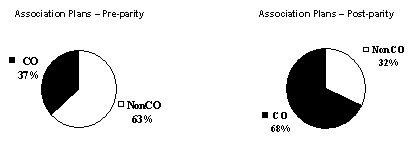
Figure III-1b
Figure III-1c
Tables III-12a and III-12b present multivariate results on the probability of carving out before and after parity using Medstat plans as a comparison group. Using a difference-in-differences estimation approach, a 29% net increase occurred in the probability of carving out (from pre- to post-parity) among FEHB plans relative to Medstat comparison plans. This result provides evidence of a positive relationship between the parity policy and a health plan’s decision to carve out. Unlike the descriptive results above, this result provides some assurance that the likelihood of carving out was not solely a function of industry-wide changes or insurer-wide changes.
Table III-12a. Carving out behavioral health benefits with comparison group
| Health plan characteristics | Coefficient | SE | Z-score | P-value | OR |
|---|---|---|---|---|---|
| Intercept | -0.370 | 0.495 | -0.750 | 0.455 | 0.69 |
| Post | -0.350 | 0.201 | -1.750 | 0.081 | 0.70 |
| Treatment (FEHB plans) | -0.065 | 0.382 | -0.170 | 0.864 | 0.94 |
| Plan type (either FFS/PPO or HMO/POS) | 0.337 | 0.251 | 1.350 | 0.178 | 1.40 |
| Plan enrollment size/1000 | 0.000 | 0.002 | -0.060 | 0.950 | 1.00 |
| Region 1 | -0.049 | 0.396 | -0.120 | 0.902 | 0.95 |
| Region 2 | -0.130 | 0.363 | -0.360 | 0.720 | 0.88 |
| Region 3 | 0.549 | 0.413 | 1.330 | 0.183 | 1.73 |
| Region 4 | 0.554 | 0.459 | 1.210 | 0.227 | 1.74 |
| Post*Treatment | 1.240 | 0.235 | 5.280 | 0.000 |
Table III-12b. Interaction effect from prior model
| Variable | Obs | Mean | SD | Min | Max |
|---|---|---|---|---|---|
| Y(Parity = 1; Post = 1; Parity*Post =1) = Y1,1,1 | 490 | 0.683 | 0.033 | 0.625 | 0.799 |
| Y(Parity = 1; Post = 0; Parity*Post =0) = Y1,0,0 | 490 | 0.474 | 0.038 | 0.409 | 0.623 |
| Y(Parity = 0; Post = 1; Parity*Post =0) = Y0,1,0 | 490 | 0.398 | 0.036 | 0.336 | 0.547 |
| Y(Parity = 0; Post = 0; Parity*Post =0) = Y0,0,0 | 490 | 0.483 | 0.038 | 0.417 | 0.631 |
| Dif-in-Dif = (Y1,1,1 – Y1,0,0) – (Y0,1,0 – Y0,0,0) | |||||
| interaction effect | 490 | 0.294 | 0.011 | 0.266 | 0.301 |
| standard error (of interaction) | 490 | 0.058 | 0.003 | 0.054 | 0.078 |
| z statistic (of interaction) | 490 | 5.123 | 0.403 | 3.443 | 5.506 |
Tables III-13a and III-13b present multivariate results on FEHB plan characteristics associated with carving out before and after parity.22 Table III-13a shows that before parity, Association plans had a 23% lower predicted probability of carving out compared to other health plans after adjusting for plan characteristics. However, in the post-parity period, Association plans had a 30% greater predicted probability of carving out compared with the pre-period. The predicted probability of Association plans’ carving out after parity was still 9% lower in comparison to other health plans in the FEHB Program.
Table III-13a. Predicted probabilities from pre- post carve-out model*
| Variable | Before | After | Predicted Probability |
|---|---|---|---|
| Association Plans | 0.3142 | 0.6163 | 0.3021 |
| Other Plans | 0.5428 | 0.7039 | 0.1611 |
| 0.2287 | 0.0877 | ||
| * To review full model, see Appendix A: Detailed Model Specification for Plan Exit and Carve-out Analyses. | |||
Table III-13b. Predicted probabilities from pre-period*
| Variable | Without limits | With limits | Predicted Probability |
|---|---|---|---|
| Less restrictive visits (31-60) | 0.2742 | 0.8900 | 0.6158 |
| More restrictive visits (20-30) | 0.2742 | 0.6433 | 0.3691 |
| * To review full model, see Appendix A: Detailed Model Specification for Plan Exit and Carve-out Analyses. | |||
Table III-14 shows the pre-post carve-out model used for these analyses. The ability to study this change among Association plans was useful given their reliance on demand-side cost controls in comparison to HMOs in the pre-parity period.
Table III-14. Pre-post carve-out model
| Health plan characteristics | Coefficient | SE | Z-score | P-value | OR |
|---|---|---|---|---|---|
| Post (after parity) | 1.1212 | 0.3782 | 2.96 | 0.003 | 3.07 |
| Visits – less restrictive (31-60 annually) | 2.5171 | 0.8453 | 2.98 | 0.0029 | 12.39 |
| Visits – more restrictive (20-30 annually) | 1.7163 | 0.695 | 2.47 | 0.0135 | 5.56 |
| Days – less restrictive (31-60 annually) | -0.5332 | 0.7385 | -0.72 | 0.4703 | 0.59 |
| Days – more restrictive (20-30 annually) | -1.3165 | 0.6931 | -1.9 | 0.0575 | 0.27 |
| Outpatient mental health cost sharing | 0.0398 | 0.3577 | 0.11 | 0.9114 | 1.04 |
| Association plan | -1.0408 | 0.4797 | -2.17 | 0.03 | 0.35 |
| Plan enrollment size/1000 | -0.0029 | 0.0027 | -1.08 | 0.2809 | 1.00 |
| Post*Association Plan | 0.6211 | 0.3148 | 1.97 | 0.0485 | |
| Post*Less restrictive visits | -0.2334 | 0.5311 | -0.44 | 0.6603 | |
| Post*More restrictive visits | -0.4497 | 0.4176 | -1.08 | 0.2816 | |
| * These regression results correspond to the predicted probabilities displayed in Tables III-13a and 13b. | |||||
Summary of Findings from Nominal Plan Benefits and Comparison Group Data
Here we summarize the findings related to the three key research questions posed at the start of this analysis, based on the nominal plan benefits data from 304 plans and matched comparison group data.
- Compliance with the parity policy: All FEHB plans complied with the requirement to implement MH/SA parity.
- Plan exit from the FEHB Program: No plan left the FEHB Program in response to the parity policy.
- Plan carve-outs: Comparing the pre-parity 1999 and 2000 period with the post-parity 2001 and 2002 period, FEHB plans were more likely to enter into managed care arrangements through a contract with a carve-out vendor than were a matched set of comparison plans that did not face a parity policy for MH/SA benefits.
Implementation Case Studies
Using case study methods, PERT investigators characterized the structure and process employed by OPM and each of the eight selected plans to implement the FEHB Program parity requirement. The case studies focused on effective as well as nominal benefits, and described:
- how FEHB enrollees accessed specialty care;
- how coverage decisions were made by the plan;
- the utilization management process;
- the composition of provider panels; and
- the financial and risk relationships among health plans, their subcontractors, and providers.
Key Research Questions
Because case studies are inductive in nature, research questions rather than research hypotheses guided data collection and analysis. Examples of the research questions that were explored in the case studies include the following:
- How did the health plans respond to the specific parameters of FEHB MH/SA Parity?
- What were the costs associated with implementing FEHB Parity in 2001?
- How did prior experience with State parity laws affect implementation (if at all)?
- What changes did health plans make to the normal MH/SA benefit design?
- Did FEHB health plans carve out in response to MH/SA parity?
- Did FEHB plans increase the use of utilization management in response to parity?
- Were provider panels closed or limited in response to parity?
- Were individual or institutional providers put at risk post-parity?
- Did FEHB plans use gatekeeping to limit access to specialty care in response to parity?
Data Collection
Measures
PERT investigators developed a systematic, semi-structured discussion guide for site-visit data collection. The PERT developed most of the questions in the discussion guide specifically for this evaluation. However, some of the questions were adapted from instruments that PERT team members developed for prior studies, e.g., evaluation of the Managed Behavioral Health Care in the Public Sector Project for the Substance Abuse and Mental Health Services Administration (Ridgely et al., 2002; Ridgely, Giard, and Shern, 1999), Annual Industry Survey for American Association of Health Plans, and Health Care for Communities for the Robert Wood Johnson Foundation). In addition, the guide was informed by the literature and the prior work of other HHS investigators, e.g.:
- the Brandeis Market Area Study on Managed Care for Alcohol, Drug Abuse and Mental Health Services (Merrick et al., 2001);
- the George Washington University Study of Contracts between Medicaid and Managed Care Organization; and
- University of Michigan’s Drug Abuse Treatment System Survey (Lemak, Alexander, and D’Aunno, 2001).
The discussion guide was organized so that questions could be answered by interview or from health plan documentation. A copy of the Discussion Guide is included in this report as Appendix B: Site Visit Discussion Guide.
Recruitment and Procedures
Plans were selected for site visits based on the plan selection procedures outlined in chapter II, Design of the Evaluation. Site visits to the eight health Plans were conducted between July 2001 and June 2002, according to the human subjects requirements of the PERT’s institutional review boards. OPM designated a lead contact person at each of the selected health plans and each of the plans to coordinate FEHB Program evaluation activities for the plan. PERT investigators worked closely with that contact person to identify the appropriate health plan administrators to interview, to schedule the site visit, and to collect needed documentation.
Site visits generally involved health plan administrative staff, such as the medical director, chief financial officer, director of utilization management, director of quality assurance, and director of pharmacy management, as well as the appropriate administrative staff of vendors, such as MBHOs and pharmacy benefit management firms (PBMs).
Each site visit was conducted by a two-person site-visit team consisting of a PERT senior health policy analyst and an economist. The interviews were audiotaped and the tapes transcribed. After the site visit (and any additional telephone contact necessary for clarification), PERT investigators created a matrix summarizing the information gathered on the site visit along the domains of interest indicated in the discussion guide. A copy of the health plan’s summary matrix was returned to that plan for review and comment.
Analytic Methods
Researchers used a number of strategies to decrease the possibility of bias in developing the case studies (Silverman, Ricci, and Gunter, 1990):
- Use of a detailed methodology to serve as a guide;
- Use of a multidisciplinary team (rather than a single observer) for data collection, providing for a balanced set of observations and perspectives and confrontation of biases at an early stage of data collection;
- Some limited re-interviewing of informants for clarification and verification of interview information to resolve factual inconsistencies;
- Targeting in-depth interviews on the most knowledgeable respondents; and
- External review by the organizations under study.
PERT investigators used an issue-oriented analytic approach to synthesize the qualitative information obtained from the site-visit interviews. The analysis of the case study data had five main purposes:
- To understand the context for the implementation of parity in the FEHB Program;
- To carefully and systematically document and describe the specific structures, policies, and procedures used by each of the eight selected FEHB health plans, as well as the similarities and differences across plans (e.g., utilization management techniques and risk-sharing arrangements);
- To identify the extent to which patterns exist in the key domains across various types of plans;
- To understand the organization and delivery of MH/SA services to enrollees in each of the eight plans studied; and
- To document the extent to which changes occur in these plans from pre- to post-parity (e.g., in effective benefits versus nominal benefits).
To help synthesize the large amount of qualitative data this effort yielded, interview data were initially coded by the dimensions of FEHB health plans as reflected in the structured protocol (e.g., benefit design, payment and risk arrangements, and management of MH/SA care).
This coding scheme formed the basis of an analytic matrix that organized the qualitative data into manageable units. PERT investigators also synthesized the data into narrative descriptions of how the selected plans organized and delivered MH/SA care under parity. This step was a valuable product in itself, as there is a dearth of documentation on how health plans actually implement parity and how such implementation has affected the care of people with MH/SA disorders.
Findings
This section of the report describes the experience of the parity implementation in eight large health plans across the U.S. from the year 2000 (pre-parity) to the year 2001 (the first year post-parity), with a focus on the post-parity effective benefit design in these eight FEHB health plans. Site visits to the eight health plans were conducted between July of 2001 and June of 2002. Research questions methods were described previously in this chapter.
The PERT will first characterize the eight health plans as they were at baseline, and then consider how the health plans responded to the specific parameters of OPM’s parity policy in 2001. Table III-15 provides a summary of the health plans selected for intensive review. This group of plans represents two geographic markets (one in the West and one in the Mid-Atlantic States), a single plan in each of two additional States, and a national plan (FFS-NAT).
The sample also represents a mix of for-profit and not-for-profit health plans and FEHB products. The FEHB enrollment as a percent of total health plan enrollment varies from a low of 3% (HMO-W1) to a high of 100% (FFS-NAT).
Table III-15. The eight selected health plans and their FEHB enrollment pre-parity (2000)
| Plan | Plan type1 | Tax status | FEHB% of total enrollment | FEHB% of insurer’s other plans | Health status of FEHB enrollees | FEHB compared to insurer’s other plans |
|---|---|---|---|---|---|---|
| FFS-NAT | FFS | Labor organization | 100% | 100% | N/A | N/A |
| FFS-MA1 | FFS | Not-for-profit | 33% | 39% | Older, higher utilization | Comparable benefit |
| FFS-MA2 | FFS | For-profit, publicly held | 10% | 13% | Higher utilization | Comparable benefit |
| FFS-Wa* | FFS | For-profit, publicly held | ** | ** | ** | Much richer benefit |
| FFS-Wb* | FFS | Not-for-profit | 9% | ** | Sicker, higher utilization | Much richer benefit |
| FFS-S | FFS | Not-for-profit | 15% | ** | Older, very well or very sick | Comparable benefit |
| HMO-W1 | HMO | For-profit, publicly held | 3% | 10% | Varies by location within the State | Much richer benefit |
| HMO-W2 | HMO | Not-for-profit | 4% | 4% | Older, higher utilization | Much richer benefit |
| HMO-NE | FFS | Not-for-profit | 8% | 11% | Older, sicker | Comparable benefit |
| * FFS-Wa and FFS-Wb are separate licensees of the Association Service Benefit Plan but collaborate in providing health services to FEHB enrollees in a single State. ** Missing or proprietary information.
| ||||||
Five of the health plans participate in the Association Service Benefit Plan, the single largest FEHB health plan. Although some of these plans also offer HMO products to FEHB enrollees, in this analysis, the PERT characterize their FFS product provided under the Association’s Service Benefit Plan.
As described in Table III-15, most of the health plans characterized their FEHB enrollees as older and/or sicker (i.e., utilizing more services on average) than the enrollees in their other plans. Three of the FEHB health plans within a single State (FFS-W, HMO-W1, and HMO-W2) also reported that, on average, the FEHB MH/SA benefit was much richer than the MH/SA benefit in their other products, even in the pre-parity period.
How Did the Health Plans Respond to the Specific Parameters of FEHB MH/SA Parity?
Beyond the stipulation that plans were required to extend parity to in-network benefits only, OPM permitted a number of specific flexibilities to aid health plans in implementing MH/SA parity for FEHB enrollees. These flexibilities included:
- Providing that the basis for parity comparison was “analogous services” or “comparable medical treatments” rather than all services,
- Requiring that parity extend only to “clinically proven treatments,”
- Allowing exclusion of MH/SA services currently paid for by public entities, and
- Allowing health plans to limit parity for individuals who do not comply with their treatment plans.
It was largely left to the FEHB health plans, in consultation with OPM, to define these terms, operationalize the concepts, and apply them. Health plans might conceivably have used the first two of these flexibilities to limit changes to the nominal MH/SA benefit--just as the health plans could have altered their general medical benefit to meet the definition of parity. The second two flexibilities might have been used to limit payments to very ill or difficult-to-treat patients.
However, none of the eight health plans reported seriously considering parsing out treatments as “analogous” or “comparable” in their preparation for implementing FEHB parity. Neither did any of the health plans create criteria to differentiate between “clinically proven” and other types of MH/SA treatments in order to apply the parity requirements to a more limited set of MH/SA services. Health plans did report that their utilization management staff considered the evidence base for treatments when approving a particular treatment for a particular patient.
Only one health plan reported that it specifically excluded coverage for some services (i.e., custodial services) paid for by public entities (e.g., Veterans’ Administration clinics or State psychiatric hospitals). The other seven plans either reported that they paid for approved services regardless of whether the approved service was provided by a public- or private-sector provider. In some instances, the health plan worked with public-sector entities to coordinate care. For example, a plan may not pay for inpatient care at a State hospital facility, but the plan would work with staff at the State hospital to ensure that the patient was able to access appropriate inpatient care and follow-up after the hospitalization. Representatives of one plan suggested that this was a “case management” rather than a “benefit design” issue.
Perhaps the most controversial of these flexibilities had to do with treatment noncompliance. This issue was specifically addressed by the Washington Business Group on Health in their review of the experience of large employers (Apgar, 2000). The FEHB health plans reported that this issue tended to arise more around substance abuse than mental health treatment. Plans differed in the extent to which their approaches to noncompliance had been formalized into a policy. Representatives reported that denial of care due to noncompliance was a clinical issue that was more appropriately addressed by alternatives such as better evaluation, modifying the treatment plan so as to better match the patient, and/or assigning a health plan case manager to help the patient comply. They believed that denials due to non-compliance would be “frowned upon” by OPM, and representatives from only one health plan reported that they had ever excluded any patients from services based on non-compliance.
What Were the Costs Associated with the Implementation of FEHB Parity in 2001?
In general, representatives of the eight health plans did not express concern over the costs involved in implementing the FEHB parity policy. As can be seen from Table III-16, most of the plans’ representatives reported that they had separate administrative staff for the FEHB products, but for most plans, these separate administrative structures were in place before implementing FEHB parity. Four of the plans reported minimal or no implementation costs; the other four plans reported adding between 1.5 and 12 full-time employee (FTE) staff. These plans reported adding customer service representatives, utilization management staff (plans and MBHOs), and case managers.
Table III-16. Costs associated with the implementation of FEHB parity in 2001 (site visit data)
| Plan | Plan type1 | Separate administrative staffing | Implementation costs for FEHB parity2 | Premium rise in 2001 | Premium rise in anticipation of FEHB parity |
|---|---|---|---|---|---|
| FFS-NAT | FFS | N/A | None | 7% high option 4% standard option | 0.3 to 0.4% |
| FFS-MA1 | FFS | Yes | 12 FTE | 12.5% | 2.5% |
| FFS-MA2 | FFS | No | 7 FTE | 12.5% | 2.5% |
| FFS-W | FFS | Yes | 1.5 FTE | 12.5%* | 2.5% |
| FFS-S | FFS | Yes | 5 FTE | 12.5% | 2.5% |
| HMO-W1 | HMO | Yes | None | 3% for families 8% for individuals | ** |
| HMO-W2 | HMO | Yes | Minimal | 7.5% | None |
| HMO-NE | FFS | Yes | Minimal | 13% | None |
| * Premiums increased by 12.5% based on experience rating ** Premium increases due to new dental benefits and anticipation of FEHB parity -- estimates $1 per member per month increase to implement FEHB parity.
| |||||
All of the plans reported premium rises in the post-parity year, but the percentage points attributed to the anticipated parity policy ranged from zero to 2.5% (see Table III-16). Premium rises were mainly attributed to the rising costs of pharmaceuticals and hospital costs.
How Did Prior Experience with State Parity Laws Affect Implementation (if at all)?
Four of the represented States have State mental health parity laws that affect all of the plans in this analysis except for FFS-NAT and HMO-NE. In each case, these laws pre-date the implementation of FEHB parity. Three of the four State parity laws are restricted to specific mental disorder diagnoses (i.e., nine diagnoses, reflecting severe mental illnesses in adults and serious emotional disturbances in children), and two of the State statutes include parity for substance abuse treatment, affecting FFS-MA1 and FFS-MA2.
Representatives of one of the health plans in the West reported that implementing State parity required a major effort and that FEHB parity was “just a minor adjustment.” Although one might expect there to have been an effect of FEHB parity-- based on the fact that the State law was limited to nine diagnoses whereas the FEHB parity benefit is unlimited--the plan reported that it had already applied parity across the board for mental health treatment. Not to have done so, it reported, would have been “an administrative nightmare.” It did note, however, that substance abuse was not included in the Western State’s parity law, so the health plan did make changes related to substance abuse treatment in 2001.
By contrast, another Western State plan reported that it had been moving in the direction of parity even before the State law and had an unlimited substance abuse benefit before FEHB parity was implemented. These respondents felt that the parity policies were “liberating,” allowing the health plan to “do things they knew were correct clinically” but that might have exposed the plan to moral hazard in the pre-parity market.
The third plan in the Western State responded to the State parity statute by entering into a relationship with an MBHO to manage benefits for both their FFS and HMO products.
FFS-S did not report any dramatic changes in response to either State or FEHB parity but did note that with the implementation of FEHB parity, the FEHB product became very similar to the rest of their plans offered in the State.
FFS-MA2 reported that they implemented parity across all MH/SA diagnoses in their fully insured business in January 2000, even though its State parity law required parity for only nine diagnoses. As with the other plans, representatives of FFS-MA2 reported that to the extent that start-up problems occurred with the implementation of parity, these were handled during the first year of State parity.
What Changes did Health Plans Make to the Nominal MH/SA Benefit Design?
All of the health plans reported that they made changes to the in-network MH/SA benefit in response to OPM’s directive, but each confirmed that it had not extended parity to the out-of-network benefit. The plans reported that the out-of-network benefit retained the pre-parity demand-side limits. Each health plan changed deductibles, copayments, and visit limits so that parity existed between the general medical and MH/SA benefit. None of the plans’ representatives reported making any parity-related changes to the general medical benefit or to their pharmacy benefit in response to the FEHB parity policy.
In addition to inquiring about parity-related changes, the PERT also asked health plan representatives if they had seen or anticipated any spill-over effects on those benefits (see Table III-17). By spill-over effects the PERT means increases or decreases in utilization of the general medical benefit (e.g., physicians’ more or less often diagnosing MH/SA or general medical visits).
Table III-17. Changes in nominal benefit design in response to FEHB parity (from 2000 to 2001)
| Plan | Plan type1 | Changes to in-network MH/SA benefit | Changes to out-of-network MH/SA benefit | Parity-related changes to general medical benefit/ spillover effects | Parity-related changes to prescription benefit/ spillover effects | Shifts between primary and specialty care |
|---|---|---|---|---|---|---|
| FFS-NAT | FFS | 2001 | No | No/No | No**/No | Anticipating shift to specialty care |
| FFS-MA1 | FFS | 2001 | No | No/No | No/No | Not anticipated |
| FFS-MA2 | FFS | 2001 | No | No/No | No/Anticipated but difficult to confirm | No |
| FFS-W | FFS | 2001 | No | No/No | No/Anticipated but difficult to confirm | No |
| FFS-S | FFS | 2001 | No | No/Difficult to estimate spillover | No/Anticipated but difficult to confirm | Too early to tell |
| HMO-W1 | HMO | 2001 | N/A | No/Difficult to confirm spillover | No/Anticipated increase 10¢ per member per month | Promoting shift to specialty care |
| HMO-W2 | HMO | 2001 | N/A | No/Difficult to estimate spillover | No**/No | No |
| HMO-NE | FFS | MH2000 SA2001 | N/A* | No/No | No**/No | No |
| * Does not offer out-of-network MH/SA benefit under most circumstances. ** Copayments were changed due to double-digit inflation in drug costs and/or to align with other health plan products -- no changes were related to FEHB parity.
| ||||||
Again, none of the plans reported any spillover effects onto the medical/surgical benefit, although representatives from three plans stated that it was either difficult to estimate or difficult to confirm spill-over effects. As to possible spill-over effects onto the pharmacy benefit, one plan estimated an increase of 10¢ per member per month (PMPM) for pharmacy (an effect of State parity) and three others anticipated an increase but thought it would be difficult to confirm.
As to any observed or anticipated shifts between primary and specialty care under the post-parity (or what some plans called the enhanced) benefit, five plans reported no shifts between primary and specialty MH/SA care. Representatives of FFS-NAT reported they had anticipated a shift of patients into specialty care, but this did not materialize. HMO-W1 representatives reported that they were using the implementation of FEHB parity to promote a further shift away from primary care treatment of mental disorders.
Did FEHB Health Plans Carve Out in Response to MH/SA Parity?
Two health plans -- FFS-MA2 and HMO-W2 -- were managing MH/SA benefits within the health plan during the pre-parity period. Both plans continued to manage MH/SA benefits within the health plan in the post-parity period. Five of the eight health plans were already contracting with MBHOs in the pre-parity period and continued to contract with their MBHOs in the post-parity period. Only the very large FFS-NAT responded directly to the FEHB parity policy in 2000 by carving out the MH/SA benefit. FFS-NAT representatives suggested that the decision to carve out was based on the perceived need to hire an experienced entity to manage MH/SA care. They felt that the health plan lacked a sufficiently large network of MH/SA providers. Because the FFS-NAT plan is a national health plan, an extensive provider network would be important from a competitive standpoint.
The FFS-NAT is also one of only two of the eight selected health plans to employ a risk contract with an MBHO. As can be seen from Table III-18, the majority of plans were not placing their carve-out vendors at risk, but instead were using ASO contracts with their MBHOs in both the pre- and post-parity periods.
Table III-18. Use of MBHO vendors by health plans -- pre- and post-parity (2000 versus 2001)
| Plan | Plan type1 | FEHB enrollment post-parity* | Use of MBHO pre-parity (2000) | Use of MBHO post-parity (2001) | Type of contract2 | Primary roles of managed behavioral health care organization3 |
|---|---|---|---|---|---|---|
| FFS-NAT | FFS | 996,021 | No | Yes | Full risk | All aspects of MH/SA care |
| FFS-MA1 | FFS | 174,984 | Yes | Yes | ASO | Inpatient provider network, UM |
| FFS-MA2 | FFS | 110,750 | No | No | N/A | N/A |
| FFS-W | FFS | 99,785 | Yes | Yes | ASO | Referral, UM |
| FFS-S | FFS | 121,440 | Yes | Yes | ASO | UM |
| HMO-W1 | HMO | 51,257 | Yes** | Yes | Soft capitation | All aspects of MH/SA care*** |
| HMO-W2 | HMO | 144,892 | No | No | N/A | N/A |
| HMO-NE | FFS | 79,307 | Yes | Yes | ASO | Member hotline, intake, provider network, UM |
| * Enrollment for Association plans is 2002; for all other plans enrollment is 2001. ** MBHO is wholly owned subsidiary of health plan *** Except for enrollees who choose to receive care from PCPs.
| ||||||
The health plans also differed in the extent to which their MBHOs assumed the management of MH/SA care. Only two plans reported that their MBHOs were administering all aspects of MH/SA care and both of these were risk-based contracts (one at full risk and the other employing “soft capitation.”) The other health plans reported using ASO contracts to purchase a variety of services (e.g., hotline, referral, intake, utilization management, and provider network access) from MBHOs.
The small number of plans in our sample and the lack of comparison plans in this part of the analysis make it very difficult to draw inferences about whether health plans are likely to respond to a parity policy by carving out their MH/SA benefit for management by a specialty organization. (This issue was addressed in the previous section.)
Did FEHB Plans Increase Using Utilization Management in Response to Parity?
Representatives of the eight selected FEHB plans reported that they used medical necessity criteria to restrict using unnecessary or inappropriate MH/SA treatment services in the pre-parity period. Most plans reported that the medical necessity standards they used were developed internally but based on their review of national standards of care developed by well-respected MH/SA organizations. None of the eight plans the PERT interviewed changed those medical necessity criteria in response to implementing FEHB parity.
As Table III-19 illustrates, the FEHB health plans were using a variety of techniques to manage care even under the pre-parity MH/SA benefit. None of the eight plans the PERT studied was using primary care providers as gatekeepers for access to specialty care, either pre- or post-parity. One of the health plans, FFS-W, reported not using the traditional utilization management techniques (i.e., prior authorization, concurrent review, and retrospective review).
A second plan, HMO-W2, reported not using prior authorization for MH/SA services, although this plan did conduct concurrent and retrospective review. However, all of the health plans except HMO-W2 required that their MH/SA providers (both primary care and specialty providers) submit a treatment plan to the health plan for approval. The two HMOs also reported using closed provider panels, while none of the FFS plans did.
Most plans used some form of utilization management in the pre-parity period. Only one change in utilization management occurred in response to implementing FEHB parity. The only parity-related change reported by the health plans (three Association Service Benefit Plan members) was an Association-negotiated requirement among Association plans nationally that their plans would add a standard treatment planning requirement in response to FEHB parity. Under this requirement, treatment providers needed to obtain Association plan approval of a treatment plan before the 9th outpatient visit. This approach was designed to manage expensive episodes of care.
Given that representatives of the Association reported that the majority of episodes of care covered by Association plans never reach a 9th session, it is unlikely that the treatment plan requirement significantly affected the care of high numbers of FEHB enrollees directly. The outpatient care of this small number of FEHB enrollees, however, accounts for a considerable number of outpatient visits. The treatment plan requirement could also indirectly result in moving patients into care from non-network providers who did not require treatment plans. Representatives of FEHB health plans, however, did not believe that this occurred.
Table III-19. Utilization management by health plans -- pre- and post-parity (2000 versus 2001)
| Plan | Plan type1 | Primary care provider gatekeeping | Treatment plan | Prior authorization | Concurrent review | Retrospective review | Closed panel | Disease management | Changes in 2001 |
|---|---|---|---|---|---|---|---|---|---|
| FFS-NAT | FFS | No | Yes | Yes | Yes | Yes | No | Yes | No |
| FFS-MA1 | FFS | No | Yes | Yes | Yes | Yes | No | Yes | Treatment plan at 9th visit |
| FFS-MA2 | FFS | No | Yes | Yes | Yes | Yes | No | No | No |
| FFS-W* | FFS | No | Yes | No | No | No | No | No | Treatment plan at 9th visit |
| FFS-S | FFS | No | Yes | Yes | Yes | Yes | No | Yes | Treatment plan at 9th visit |
| HMO-W1 | HMO | No | Yes | Yes | Yes | Yes | Yes | Yes | No*** |
| HMO-W2 | HMO | No | No | No | Yes | Yes | Yes** | No | No |
| HMO-NE | FFS | No | Yes | Yes | Yes | Yes | No | No | No |
| * FFS-W1 is responsible for all utilization management for FEHB enrollees. ** The HMO-W2 is made up of physician and non-physician providers who contract solely with the plan. *** In 2001, the managed behavioral health care organization began to flag all cases with serious mental or serious emotional disturbance diagnoses -- related to the implementation of the State parity law.
| |||||||||
Were Provider Panels Closed or Limited in Response to Parity?
Only two health plans (both HMOs) reported that they used a closed or limited provider panel (see Table III-19), and both of these arrangements predate the FEHB parity policy. Although closing or limiting provider panels might be an effective strategy to limit inappropriate service utilization, none of the health plans reported that they closed panels in response to parity. One health plan reported using preferred providers, i.e., providers who had agreed to discounted rates in order to be included in the network (see Table III-20).
Were Individual or Institutional Providers Put at Risk Post-Parity? Payment and risk-sharing relationships between health plans, their MBHO vendors, and individual and institutional providers are displayed in Table III-20. With the exception of HMO-W2, all of the plans paid individual providers on a fee-for-service basis. Only HMO-W2 paid providers on a capitation basis, although the risk-sharing arrangement was an exclusive arrangement with the Plan and not with individual providers. None of the health plans or their MBHOs put individual providers at risk either in the pre- or post-parity periods.
Table III-20. Payment and risk-sharing with in-network providers -- pre- and post-parity (2000 versus 2001)
| Plan | Use of preferred provider panels | Primary method of payment (individual providers)1 | Risk-sharing arrangements (individual providers) | Primary method of payment (institutional providers) | Risk-sharing arrangements (institutional providers) | Changes in 2001 |
|---|---|---|---|---|---|---|
| FFS-NAT | No | FFS | No | Per diem | No | No |
| FFS-MA1 | No* | FFS | No | Diagnosis-related groupings (MH) Per diem (SA) | No | No |
| FFS-MA2 | No* | FFS | No | Per diem | No | No |
| FFS-W | No* | FFS | No | Per diem | No | No |
| FFS-S | Yes | FFS | No | Per diem | No | No |
| HMO-W1 | Yes | FFS | No | Per diem | No | No |
| HMO-W2 | Yes | Capitation | ** | *** | No | No |
| HMO-NE | No* | FFS | No | Rate schedule | No | No |
| * In the FFS product, some of these health plans also offer an HMO product to FEHB enrollees. ** HMO-W2 has a risk-sharing arrangement with the Plan’s Medical Group. However, individual MH/SA providers are salaried. *** Payment for HMO-W2 facilities is based on a unique cost-reimbursement methodology. For non-HMO-W2 hospitals, payment varies (discount charges, per diem, case rates).
| ||||||
For institutional providers, per diem was the primary method of payment reported by most of the eight selected health plans; only a single plan reported paying for inpatient mental health treatment using diagnosis-related groupings (DRGs). None of the health plans reported risk-sharing arrangements with institutional providers in either the pre- or post-parity periods. Thus, these health plans did not respond to the parity policy by having providers share the risk for the costs of MH/SA treatment.
Did FEHB Plans Use Gatekeeping to Limit Access to Specialty Care in Response to Parity?
As noted earlier, none of the eight health plans, including the two HMOs, used primary care physicians as gatekeepers for specialty MH/SA care (see Table III-21). In addition, according to health plan representatives, health plans were not using their member hotlines to preferentially refer members to particular providers.
Table III-21 shows how patients accessed specialty MH/SA care in the eight selected plans and any changes in that process that occurred in 2001.
Table III-21. Access to specialty care -- pre- and post-parity
| Plan | Plan type1 | How patients access care | Changes in 2001 | Basis for referrals | Changes in 2001 |
|---|---|---|---|---|---|
| FFS-NAT | FFS | Toll-free number | No | Outpatient referral decisions made by masters-level intake counselors at managed behavioral health care organization | No |
| FFS-MA1 | FFS | Toll-free number | MH/SA-specific toll-free number; Calls go to nurse triage | Members have total discretion but usually suggested that patient see a non-physician provider first | No |
| FFS-MA2 | FFS | On-line preferred provider organization directory or toll-free number | No | Members have total discretion -- no gatekeepers | No |
| FFS-W | FFS | Toll-free number | Vendor now manages toll-free hotline | Members have total discretion to choose provider | No |
| FFS-S | FFS | Toll-free number | No | Members have total discretion to choose provider | No |
| HMO-W1 | HMO | Toll-free number | No | Triage by care manager; physician does face-to-face evaluation | No |
| HMO-W2 | HMO | Make an appointment | No | N/A | N/A |
| HMO-NE | FFS | Toll-free number | No | Members have total discretion – may self-refer or receive assistance | No |
| |||||
Health plan members typically accessed specialty MH/SA providers by using toll-free hotlines that were either staffed by the health plan or by its MBHO. For the majority of plans, the referral decision-maker was the health plan member. However, a number of the plans had staff trained to assist with referrals (e.g., intake counselors, and care or case managers). These individuals typically had a bachelor’s degree and specific training from the health plan or MBHO. They were available to assist members with questions (e.g., provider type, location, and contact information) and make referrals to specific providers if the member had not already chosen a provider.
In the plans that were using risk-sharing arrangements with their MBHO vendors (FFS-NAT and HMO-W1), however, the MBHO staff were clinically trained and played a much more directive role in referral decisions. The FEHB parity benefit appears to have had little impact on the procedures for FEHB plan members to access MH/SA specialty care, beyond some plans’ instituting a separate, specific hotline for MH/SA referrals, staffed either by the MBHO or the health plan.
Implementation Case Studies Summary
The eight site-visited plans implemented the FEHB parity policy in a similar fashion to that of the rest of the plans in the FEHB Program. The eight site-visited plans altered nominal plan benefits to comply with the parity policy and made a small number of changes in management of benefits (i.e., effective benefits). The implementation difference-in-differences analysis showed an increased likelihood that FEHB plans would carve out their MH/SA benefits in the post-parity period. However, among the eight site-visited plans, six of them had carved out their benefits prior to the implementation of the parity policy and one large FFS plan carved out in direct response to parity.
FEHB Network Providers’ Experience Implementing Parity
Provider focus groups were conducted to assess providers’ awareness and perceptions of the parity benefit implementation. Each focus group was audiotaped and verbatim transcripts prepared from these tapes. The transcripts were then systematically analyzed for key themes.
Key Research Questions
PERT researchers developed a discussion guide for the focus groups, which was approved by the GPOs. The discussion guide included questions on these topics:
- Awareness of the implementation of parity for FEHB beneficiary MH/SA service users;
- Providers’ practice patterns;
- Reimbursement arrangements;
- Knowledge, perceptions, and attitudes about managed care in general;
- Knowledge, perceptions, and attitudes about quality of care, particularly pre- versus post-parity comparisons; and
- Effect of FEHB parity on providers’ practice and service user care.
Data Collection and Analytic Methods
To ascertain providers’ awareness and perceptions of the parity implementation and their managed care arrangements more broadly, we conducted six focus groups with a total of 43 in-network providers in three geographic regions (served by five of the nine plans) at 10 months, 15 months, and 32 months after the parity implementation.
The providers represented psychiatrists, psychologists, and licensed social workers working in a variety of inpatient and outpatient capacities across a range of public and private service settings. They provided assessment, therapeutic interventions, medication evaluation, and forensic services in settings such as community mental health centers, psychiatric and general hospitals, nursing homes, and partial hospitalization programs. This component of the evaluation contributed qualitative data on provider experiences of the parity implementation and provided additional context for interpreting other evaluation findings.
Focus group participants were drawn from a pool of clinicians providing a high volume of specialty MH/SA services to FEHB plan beneficiaries in the selected plans serving these three regions. The participants were selected from among psychologists, psychiatrists, social workers, certified counselors, and substance abuse counselors. The high-volume providers (i.e., providing services to the greatest number of FEHB plan beneficiaries in the prior year) comprised the sampling frame for drawing the focus group participants.23
Two PERT researchers, a psychiatrist and a clinical psychologist, both with mental health policy backgrounds, moderated the focus groups.
- The Western State focus groups were conducted in November 2001, with 12 participants.
- The Mid-Atlantic State focus groups occurred in March 2003, with 27 participants.
- The Northeast State focus groups were conducted in September 2003, with four participants.24
Findings
Providers’ Awareness of the Parity Benefit Implementation
The FEHB plan MH/SA providers who participated in the focus groups had a limited awareness and very limited understanding of the FEHB parity benefit for Federal employees. None of the providers clearly understood how the parity benefit might affect their provision of MH/SA services to FEHB beneficiaries. Nearly all the providers in the Western and Mid-Atlantic States’ groups confused the FEHB parity policy with their respective State’s parity law.
Most providers vaguely remembered getting a letter from one or more health plans telling them about implementing parity in the FEHB Program. A few thought they might have first heard about parity in the FEHB by reading about it in a professional journal or newsletter.
Only three providers were clearly aware that a parity policy had been implemented for FEHB MH/SA service users. None of the three, however, clearly understood what this information meant. As a result, some of the evaluation questions could not be answered by any of the providers.
Providers’ Understanding of the Parity Benefit Implementation
The providers’ common confusion about what exactly was meant by “parity in the FEHB Program” was exemplified by one participant’s request to the focus group leaders, about 20 minutes into the session, “Can you tell us a little bit more about parity? What does it mean?” The other providers in the group quickly echoed their desire to know the same.
All the providers demonstrated a general understanding of the conceptual meaning of “parity for MH/SA benefits,” i.e., health insurance providing the same level of benefits for mental disorders as for general medical disorders. In the Western and Mid-Atlantic States’ groups, however, nearly all providers expressed confusion in attempting to distinguish between their State’s MH/SA parity law and parity in the FEHB plans.
Among the three providers who were clearly aware of the FEHB parity policy implementation, one perceived no practical difference in benefits for Federal employees versus non-Federal employees since the January 2001 parity implementation. This comment suggests that, while the provider was aware that a parity policy had been implemented for FEHB beneficiaries, he was largely unaware of the substance of this benefits change. Another provider commented that the FEHB parity policy meant that Federal MH/SA service users had an expanded choice of providers. In fact, this was not a feature of the parity benefit, as it applies only to in-network providers.
Providers’ Awareness of their FEHB Patients
While six of the 12 providers in the Western State focus group could clearly distinguish their service users who were Federal employees from their other service users, i.e., they could think of individual MH/SA service users whom they knew were Federal employees, few of the providers in the Mid-Atlantic or Northeast States’ focus groups could do so.
Providers whose practice included claims or billing staff indicated that they were the people who would know whether a service user was in the FEHB Program. Although the PERT attempted to include providers’ claims and billing staff in the focus groups, none of the providers followed up on the request to invite these staff.
Providers generally knew the occupations of their service users but did not necessarily know if those occupations qualified them as Federal employees or if they were covered by the FEHB Program.
Service Users’ Awareness of the Parity Implementation
None of the providers could recollect a service user who had expressed an awareness of the FEHB parity benefit.
Providers’ Experience of the Parity Implementation
Among the three providers who were aware of the implementation of parity in the FEHB Program, none could readily disentangle the effect of the FEHB parity benefit from that of managed care in general. These three providers thought that introducing parity for Federal service users meant introducing managed care, which nearly all focus group participants perceived negatively.
For these three providers, equating parity in the FEHB plans with managed care meant that the net effect of the parity policy was that FEHB MH/SA service users were neither better nor worse off than those outside the FEHB plans.
The consensus across all providers was that FEHB beneficiaries had fairly good benefits before implementing parity and they continued to have good benefits after implementing parity, even though none of the providers liked managed care.
Summary of Findings on the Implementation of Parity in the FEHB Program
All FEHB plans complied with the parity policy. No plan left the FEHB Program to avoid implementing the parity policy, and plans enhanced their MH/SA nominal benefits as required by the policy change. According to most (two-thirds) of the FEHB plans, they incurred no added administrative cost in implementing the parity policy. Effective benefits changed most dramatically in regards to the increased likelihood that, post-parity, FEHB plans would enter into managed care carve-out arrangements with specialty behavioral health care organizations (in comparison to non-FEHB plans without a parity policy). Most other hypothesized post-parity changes occurred less frequently than had been anticipated (e.g., increased gate-keeping, expanded provider networks, and increased financial risk sharing). Finally, FEHB network providers had little awareness of the parity policy implementation and very limited understanding of the parity benefit. This page intentionally left blank.
IV. Impact of Parity
Overview
This chapter addresses the intermediate and long-term impacts of the parity policy on access to care, service use, cost, and quality of care, as illustrated in the evaluation logic model in Figure II-I. The research questions, data sources and collection methods, and analysis methods relating to cost, access, utilization, and quality that we summarized in chapter II, Design of the Evaluation, are presented in detail in this chapter. Chapter IV is divided into three sections:
- Impact on Access to Care, Service Use, and Cost
- Impact on Quality
- Impact on Provider Awareness and Perceptions of Parity Implementation
Each of these sections separately presents the relevant research questions, data collection methods, analytic strategies, and findings.
Archival claims and enrollment data from selected Federal Employees Health Benefits (FEHB) plans were employed in the analyses of access, service use, cost, and quality, which include before-after-parity and difference-in-differences models, as well as case study analyses. We then compared changes within the selected FEHB plans over the pre- to post-parity period with secular trends by using data from a matched set of comparison plans over the same time period. Finally, we examined providers’ awareness of the parity policy based on a series of focus groups in three geographical regions.
Impact on Access to Care, Service Use, and Cost
Implementing parity required changing the nominal benefits for coverage of treating mental health and substance abuse (MH/SA) disorders. The dimensions of the nominal benefit that are most often affected when parity policies are implemented are:
- copayments,
- deductibles, and
- limits on covered services (inpatient days and outpatient visits) or expenditures.
In traditional fee-for-service, indemnity-type arrangements, changes in the dimensions of nominal benefits typically result in increases in spending on and utilization of MH/SA care as the MH/SA benefits are expanded (Newhouse et al., 1993; Frank et al., 1986; Manning et al., 1992).
It was expected that in many cases, health plans that contracted with the Office of Personnel Management (OPM) would be implementing changes in the manner in which MH/SA care was managed alongside the changes in nominal benefits associated with the parity policy. Consequently, the ability of the Parity Evaluation Research Team (PERT) to disentangle the separate effects of changes in management from changes in nominal benefits was uneven across health plans and limited in all cases. This is because not all management responses were observable by the PERT. Thus, in most cases, it was possible to estimate only the aggregate “net effect” of implementing parity.
To assess the impact of the parity policy on access, utilization, costs, and quality, the PERT obtained the following from nine selected plans:25
- two years of claims/encounter data, pre-parity (1999, 2000), and
- two years of claims/encounter data, post-parity (2001, 2002).
Claims/encounter data for the same four years were also obtained from the Medstat MarketScan® database to form comparison group plans.
Key Research Questions
The analyses in this chapter addressed the following research questions:
- What are the patterns of access to MH/SA services (where access is operationalized as probability of service use) within select FEHB plans both before and after implementing parity?
- Do these patterns of access differ by type of user, type of service, level of service, or type of condition? How do these patterns of access compare to secular trends?
- What are the patterns of service utilization for MH/SA services both before and after the parity policy implementation? How do these patterns compare to secular trends (i.e. general patterns of care outside of the FEHB Program)?
- Have aggregate, per-enrollee, and per-user spending for MH/SA services changed after the implementation of the parity policy? How do these spending changes compare to secular trends?
- Have out-of-pocket costs to beneficiaries utilizing MH/SA services (e.g., deductibles, copayments, and out-of-pocket limits) changed after implementation of the parity policy? How do these changes compare to secular trends?
- How well do patterns of care for MH/SA reflect adherence to quality of care guidelines both before and after the parity policy implementation?
Data Collection
Acquiring Claims Data
For each of the nine selected plans, PERT investigators identified, with the assistance of OPM staff, and established a contact with a designated member of the plan’s data information/claims department.
A PERT member interviewed each plan representative to obtain information on:
- how the data were structured,
- what data elements were available, and
- how the relevant data files could be linked.
PERT investigators worked closely with each representative to identify unique issues with that plan’s data systems before any data were transferred to the PERT.
A preliminary list of variable definitions and names was developed and distributed to each plan to ensure consistency of definitions and completeness. After incorporating any modifications into the list, plans were asked to send electronic claims data in the requested format to the PERT.
Once PERT investigators received the electronic claims data, they conducted a number of quality checks on the data. For example, the proportion of missing values for key variables, such as Current Procedural Terminology (CPT) and diagnosis codes, was tracked. PERT investigators reported to the Government Project Officers (GPOs) and to the rest of the PERT any variables for which the proportion of missing values was higher than standard for the industry and developed a plan for addressing the problem. Trends in claims over time were tracked to identify any unreasonable disruptions in those trends that might signal a problem with data quality.
HMO-W1 provided a mix of claims and encounter data for the general medical services records and only claims data for the MH/SA services. To create estimates of MH/SA spending from the encounter data, investigators applied the average copayment and plan expenditure rates from the MH/SA plan data set to the encounter records. For example, they applied the MH/SA vendor’s average copayment and plan expenditure rates for MH/SA inpatient admissions to each MH/SA inpatient admission occurring in a general medical facility. Similarly, they used the MH/SA vendor’s average copayment and plan expenditure rates per each day of MH/SA outpatient care as an estimate for each day of MH/SA outpatient care occurring in a general medical setting.
PERT cleaned and merged the data (e.g., pharmacy and utilization data). All data were stored on a single machine dedicated to the project, and modifications were documented in a formal log. Data discrepancies were resolved through discussion with the designated plan representative and with PERT members.
The PERT used claims data on MH/SA service use from FEHB enrollees of the selected plans according to the sampling plan shown in Appendix C.
Constructing Analysis Files
Using enrollment and claims/encounter data from each plan contributing such data, PERT staff created a person-level file for these FEHB plan enrollees. This file included:
- demographics and dates of enrollment from the plan’s enrollment file,
- MH/SA claims,
- general medical claims, and
- pharmacy claims for the individual over the period 1999 to 2002.
Two key issues raised by the construction of data files were:
- identifying claims for MH/SA services within claims databases, and
- assigning costs to encounter data (shadow claims) to create spending data.
Identifying MH/SA Services
To examine the effects of the parity policy on MH/SA utilization and spending, PERT researchers specified an algorithm for identifying MH/SA services within claims data, shown in Figure IV-1. Although some types of MH/SA services delivered in certain settings were well coded with appropriate diagnostic information (for example, inpatient MH/SA care for a patient with schizophrenia), claims for many other MH/SA services lacked accurate diagnostic information, particularly when delivered in the primary-care sector. For example, a sizable number of individuals with a claim for an MH/SA medication had no coinciding claim with an MH/SA diagnosis.
For the evaluation, MH/SA utilization and spending includes inpatient and outpatient services associated with specified MH/SA disorders and with use of MH/SA medications.
Figure IV-1. Algorithm to identify use of MH/SA services
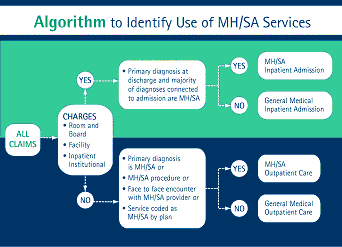
To identify claims for MH/SA services, PERT investigators used algorithms developed from previous analyses of private-sector claims databases and tailored them as needed to fit each plan’s unique data systems. According to these algorithms, a list of specific International Classification of Diseases, 9th Revision Clinical Modification (ICD-9-CM)26 codes associated with MH/SA conditions was first identified. The list of specific ICD9-CM codes contained all codes in the 290 to 319 range except 290, 293, 294, 310, 315, 316, 317, 318, and 319 (including all decimal sub codes), as well as 305.1 (tobacco use disorder) and 305.8 (antidepressant abuse).
Claims were identified as MH/SA inpatient stays if the last hospital primary diagnosis and the majority of the primary diagnoses on the record for an inpatient stay (for room and board, facility, and inpatient institutional charges) were MH/SA conditions.27
For outpatient care, claims were identified as MH/SA if any of these conditions were met:
- presence of a primary diagnosis of MH/SA,
- indication that an MH/SA-specific procedure was performed,
- an indication of a face-to-face encounter or visit with an MH/SA provider,
- a plan’s coding a service as MH/SA, or
- indication of an MH/SA-specific place of service.
To identify MH/SA medication use, the PERT developed two lists of medications, both shown in Appendix C, List of Medications for Identifying MH/SA Use and Spending.
- The restricted list contains medications that are used only for MH/SA conditions.
- The expanded list contains medications that are used for MH/SA conditions as well as for general medical disorders.
PERT researchers counted all medications on the restricted list as MH/SA medication use/spending, even if no other indication of MH/SA use (inpatient or outpatient) existed. In addition, if the patient had any MH/SA use/spending in the year (i.e., MH/SA inpatient care, MH/SA outpatient, or use of any MH/SA medication on the restricted list), then all medications used by that patient from the expanded list were also counted as MH/SA use/spending.
Limitations of Claims Data
Several limitations are associated with using claims data. Claims data provide an artificial precision about health problems by listing single or only a few diagnoses, when, in reality, multiple problems may exist. Many MH/SA diagnoses are also underreported in claims data, yielding an undercount of MH/SA utilization and cost.
Other than assessing individuals independently from the treating provider, there is no solution to those problems of diagnostic inaccuracy. Finally, claims data provide no information on unmet need for MH/SA treatment, just as they cannot tell us whether the services used were truly needed.
Analytic Methods
The analytical perspective used to assess the impact of parity was to view the change in spending for a given health plan as the result of three main factors:
- changes in enrollment patterns (numbers of enrollees joining various plans),
- changes in spending per enrollee, and
- changes in case mix of enrollees.
Changes in spending per user consist of changes in:
- the probability of using services (access);
- the types of services used by users, e.g., the mix of outpatient, inpatient, and prescription medications services (utilization); and
- the level of spending within each class of services (cost).
Thus, the analytic strategy was designed to study the impact of the parity policy on expenditures by examining changes in aggregate spending and the components of spending separately.
Each of these analyses provided different types of information on the impact of parity. Some analyses examined how parity affected access to treatment in general as well as to specific treatments (e.g., inpatient care, outpatient care, or MH/SA medications). Other analyses focused on the intensity and duration of treatment, as well as on cost, i.e., cost to the plan and cost to the beneficiary (e.g., out-of-pocket spending) of treatment received.
The outcomes of principal interest included the following:
- Total health care spending per enrollee;
- Total out-of-pocket spending on all health care per enrollee;
- MH/SA spending per enrollee;
- Out-of-pocket MH/SA spending per MH/SA service user;
- Mental health care spending per mental health (MH) service user;
- Out-of-pocket MH spending per MH service user;
- Substance abuse (SA) spending per SA treatment user;
- Out-of-pocket SA spending per SA treatment user;
- Probability of any MH/SA service utilization;
- Probability of any MH service utilization alone;
- Probability of any SA service utilization alone;
- Probability of using particular types of MH/SA services (i.e., inpatient or outpatient);
- Probability of prescription medication treatment for MH/SA (for MH/SA combined and individually);
- Per-user spending for MH/SA inpatient care, MH/SA outpatient care, and MH/SA prescription medications conditional on use of any of those services (for MH/SA combined and individually); and
- Intensity of use of particular types of MH/SA services, conditional on using that service (e.g., number of outpatient visits, inpatient days, or psychotropic medication days); intensity of service use will be examined for MH/SA combined and individually.
The evaluation design relied on two basic approaches: a before-after-parity (interrupted time-series) assessment of the impact of the parity policy and a difference-in-differences design.
Before-after-parity Analysis
PERT investigators applied the before-after-parity comparisons to the nine selected FEHB plans. Initial analyses provided basic descriptions of how spending per enrollee in total, for MH/SA combined, and for MH/SA separately changed for all enrollees and for a cohort of continuously enrolled beneficiaries for the period 1999 to 2002. The analysis of continuously enrolled beneficiaries provided some basic descriptions of spending patterns before and after implementing parity, holding constant the enrolled population.
Similar analyses were conducted on continuously enrolled beneficiaries for utilization rates of any MH/SA care, utilization rates of specific MH/SA services (e.g., inpatient and prescription medications), and MH/SA spending per user. The spending analyses were conducted separately for plan spending, for enrollee out-of-pocket payments, and for plan spending plus enrollee out-of-pocket payments. Impacts on out-of-plan use and utilization beyond limits were not estimated directly because of lack of data.
PERT researchers also assessed the impact of parity on spending and utilization patterns using multivariate models to control for changes in the demographic and diagnostic profiles of enrollees (for analyses including all enrollees) and MH/SA users (for analyses limited to the continuously enrolled). These included estimating multipart models (Newhouse et al., 1993).
An additional set of analyses focused on changes in enrollment patterns. These analyses examined the impact of benefit design and management changes on enrollment across plans.
Difference-in-differences Analysis
The difference-in-differences models compared outcomes for selected FEHB plans pre- and post-parity with outcomes over the same time period for matched comparison plans that are not part of the FEHB Program.
The source of data on appropriate comparison plans came from the Medstat MarketScan® database. The Medstat data set included:
- preferred provider organizations (PPO),
- point of service plans (POS),
- health maintenance organizations (HMO), and
- managed indemnity plans of large employers (often self-insured).
These plans are spread across the nation, although not according to the distribution of the overall population.
Medstat plans were matched to FEHB plans on the following criteria:
- plan type (HMO versus not HMO),
- location of enrollees (region), and
- enrollee demographics.
Figure IV-2 shows the basic structure of the difference-in-differences design. PERT researchers applied this design to the set of outcomes and cohorts described above in the before-after-parity analysis. The estimated impact of the parity policy on a particular outcome was estimated as: (C-A) - (D–B).
Figure IV-2. Difference-in-differences approach
| FEHB Plan | Comparison Plan | |
|---|---|---|
| Pre-parity | A | B |
| Post-parity | C | D |
This approach takes into account secular trends that cannot be accounted for by simple before-after-parity comparisons. This methodology was applied in the context of both descriptive and multivariate analyses. The approach permits relatively strong inferences to be made about the policy impact of parity.
A variety of econometric issues arose in the context of these analyses. The first was the use of multipart models. There were issues related to the following:
- Using the difference-in-differences method in the context of nonlinear models, such as a logit or a nonlinear least-squares model (Mullahy, 1998);
- Correlation among observed spending or observed use data due to the repeated observations from each enrollee;
- Transforming conditional utilization and spending outcomes; and
- Reconstructing net impacts on spending.
Because the difference-in-differences approach requires estimating a coefficient for an interaction term, the net impact of the parity policy on an outcome, e.g., the probability of using MH/SA care, could not be calculated in a straightforward fashion. Instead, PERT investigators calculated the average impact of the probability of MH/SA service use, i.e., (C-A) – (D-B), using simulation methods based on the estimated equations for the case when the appropriate dummy variables are set to one and zero.
PERT investigators adopted a generalized linear model for characterizing the relationship between spending and the impact of parity. Several “link” functions and distributional assumptions were examined to model expected spending. These included poisson models with log links, gamma models with log links, and normal models with identity links. After checking models, the PERT researchers used a normal model to characterize spending. The investigators accounted for correlation among repeated observations for an enrollee using standard statistical procedures. Simulation methods were used to construct difference-in-differences estimates of the overall spending impacts of parity from multipart econometric models and included estimated standard errors of the estimates.
Indicators of case mix were used as a dependent variable to study possible selection effects stemming from parity and also as covariates in multivariate models of utilization and spending for MH/SA care. In models using the continuously enrolled, the diagnostic indicators were used as statistical covariates in the conditional (on any MH/SA use) spending and utilization models. Because the focus is on the continuously enrolled, these analyses were not driven by plan selection effects. Thus, diagnoses were treated as independent covariates not influenced by the introduction of parity. (For analyses using all enrollees to study utilization and spending, the diagnoses of enrollees within a plan may be affected by the introduction of parity through plan selection effects.)
Findings on Access to Care, Service Use, and Cost -- All Enrolled Beneficiaries (FEHB Plans)
Overview
In this section, we present an overview of the findings on all enrolled beneficiaries from the nine selected FEHB plans. We provide a synopsis of each plan’s demographic composition and findings on the basic structure of MH/SA care utilization and spending.
The findings presented in this section are meant to provide background on the data rather than form the basis for inferences about the impact of the FEHB parity policy. For the latter, we focus solely on the continuously enrolled population.
Given the dynamic nature of enrollment in these FEHB plans, in which members join and exit yearly, using all enrollees -- rather than only the continuously enrolled -- to analyze the impact of the parity policy would greatly complicate attempts to control for the composition of the beneficiaries in the FEHB plan population over the four evaluation years (1999 through 2002).
This is particularly the case when using claims data that offer only a limited set of descriptors on demographic characteristics of enrollees (i.e., age, gender, and relationship to the health plan policy holder).
Therefore, we use a sample of continuously enrolled beneficiaries to rigorously estimate impacts of the parity policy. By adopting such a strategy, we study the effects of the policy change on a stable population, thereby eliminating population change (i.e., selection effects) as an influence on observed patterns of utilization and spending on MH/SA services. Thus, while a focus on the continuously enrolled population limits the generalizability of the results, it strengthens the inferences we can make about the estimated policy impacts.
Findings from the continuously enrolled beneficiary population are presented in the next section, titled Findings on Access to Care, Service Use, and Cost -- Continuously Enrolled Beneficiaries (FEHB and Comparison Plans). The remainder of this section presents findings on all enrollees.
Plan Population Characteristics
Tables IV.A.1 through IV.A.9 report population size and characteristics of enrollees for each of the nine selected FEHB plans, i.e., gender, age, and relation to the health plan policy holder. These tables show that each of the nine plans, except FFS-NAT and HMO-NE, experienced population growth during the 1999 to 2002 period.
In contrast, the populations of FFS-NAT and HMO-NE steadily declined over the four years.
Table IV.A.1. FFS-NAT--All Enrolled Beneficiaries by Age and Beneficiary Status
| 1999 | 2000 | 2001 | 2002 | |
|---|---|---|---|---|
| N | 714,449 | 643,708 | 601,059 | 557,272 |
| Female | 52.5% | 52.7% | 52.7% | 52.8% |
| 17 years of age and younger | 2.9% | 2.8% | 2.7% | 2.6% |
| 18-25 | 14.1% | 13.7% | 13.5% | 13.2% |
| 26-35 | 7.3% | 6.2% | 5.7% | 5.1% |
| 36-45 | 22.6% | 20.9% | 19.4% | 18.0% |
| 46-55 | 33.5% | 34.8% | 35.8% | 36.9% |
| 56-65 | 19.6% | 21.5% | 22.9% | 24.2% |
| Employee | 49.6% | 49.8% | 50.1% | 50.3% |
| Spouse | 32.7% | 32.8% | 33.0% | 33.3% |
| Child/other dependent | 17.6% | 17.4% | 16.9% | 16.5% |
Table IV.A.2. FFS-MA1--All Enrolled Beneficiaries by Age and Beneficiary Status
| 1999 | 2000 | 2001 | 2002 | |
|---|---|---|---|---|
| N | 186,438 | 189,830 | 191,019 | 196,503 |
| Female | 54.7% | 54.8% | 55.0% | 55.0% |
| 17 years of age and younger | 1.8% | 1.8% | 1.7% | 1.7% |
| 18-25 | 9.1% | 9.1% | 9.2% | 9.5% |
| 26-35 | 11.7% | 11.4% | 11.1% | 11.4% |
| 36-45 | 21.3% | 20.9% | 20.2% | 19.9% |
| 46-55 | 32.4% | 32.3% | 32.6% | 31.5% |
| 56-65 | 23.7% | 24.6% | 25.2% | 26.0% |
| Employee | 61.5% | 61.4% | 61.7% | 62.2% |
| Spouse | 29.2% | 29.3% | 29.1% | 28.6% |
| Child/other dependent | 9.4% | 9.4% | 9.3% | 9.2% |
Table IV.A.3. FFS-MA2--All Enrolled Beneficiaries by Age and Beneficiary Status
| 1999 | 2000 | 2001 | 2002 | |
|---|---|---|---|---|
| N | 124,942 | 129,796 | 132,220 | 138,289 |
| Female | 52.6% | 52.7% | 52.8% | 52.7% |
| 17 years of age and younger | 2.4% | 2.3% | 2.3% | 2.3% |
| 18-25 | 10.6% | 10.6% | 10.7% | 10.7% |
| 26-35 | 10.3% | 9.6% | 9.0% | 9.2% |
| 36-45 | 23.1% | 22.9% | 22.3% | 22.0% |
| 46-55 | 31.4% | 31.7% | 32.0% | 31.2% |
| 56-65 | 22.2% | 23.0% | 23.8% | 24.5% |
| Employee | 51.7% | 51.8% | 52.2% | 52.6% |
| Spouse | 36.0% | 36.1% | 35.7% | 35.5% |
| Child/other dependent | 12.3% | 12.2% | 12.1% | 11.9% |
Table IV.A.4. FFS-NE1--All Enrolled Beneficiaries by Age and Beneficiary Status
| 1999 | 2000 | 2001 | 2002 | |
|---|---|---|---|---|
| N | 64,343 | 66,245 | 67,603 | 72,242 |
| Female | 50.8% | 50.9% | 51.0% | 50.8% |
| 17 years of age and younger | 2.4% | 2.5% | 2.6% | 2.5% |
| 18-25 | 10.7% | 10.7% | 11.1% | 11.3% |
| 26-35 | 13.9% | 13.0% | 12.0% | 11.8% |
| 36-45 | 28.6% | 28.1% | 27.4% | 26.5% |
| 46-55 | 28.4% | 29.3% | 30.4% | 30.6% |
| 56-65 | 16.0% | 16.4% | 16.6% | 17.3% |
| Employee | 54.4% | 54.2% | 53.9% | 54.2% |
| Spouse | 33.8% | 33.9% | 33.7% | 33.4% |
| Child/other dependent | 11.9% | 12.0% | 12.4% | 12.4% |
Table IV.A.5. FFS-NE2--All Enrolled Beneficiaries by Age and Beneficiary Status
| 1999 | 2000 | 2001 | 2002 | |
|---|---|---|---|---|
| N | 37,613 | 39,157 | 40,725 | 42,828 |
| Female | 50.3% | 50.4% | 50.5% | 50.5% |
| 17 years of age and younger | 2.2% | 2.1% | 2.2% | 2.2% |
| 18-25 | 9.7% | 9.8% | 9.9% | 10.3% |
| 26-35 | 16.5% | 15.8% | 15.1% | 15.1% |
| 36-45 | 26.9% | 26.0% | 25.2% | 24.3% |
| 46-55 | 29.2% | 30.4% | 31.4% | 31.2% |
| 56-65 | 15.5% | 15.9% | 16.2% | 17.0% |
| Employee | 58.3% | 58.0% | 57.9% | 57.7% |
| Spouse | 31.5% | 31.6% | 31.4% | 31.5% |
| Child/other dependent | 10.2% | 10.5% | 10.7% | 10.8% |
Table IV.A.6. FFS-W--All Enrolled Beneficiaries by Age and Beneficiary Status
| 1999 | 2000 | 2001 | 2002 | |
|---|---|---|---|---|
| N | 92,697 | 95,568 | 96,383 | 101,097 |
| Female | 51.6% | 51.6% | 51.6% | 51.3% |
| 17 years of age and younger | 2.2% | 2.2% | 2.1% | 2.2% |
| 18-25 | 9.8% | 9.7% | 10.0% | 10.2% |
| 26-35 | 12.2% | 11.6% | 11.2% | 11.6% |
| 36-45 | 24.6% | 24.0% | 23.5% | 22.9% |
| 46-55 | 29.7% | 30.2% | 30.7% | 30.3% |
| 56-65 | 21.6% | 22.2% | 22.4% | 22.9% |
| Employee | 55.5% | 55.5% | 55.7% | 56.2% |
| Spouse | 33.3% | 33.3% | 33.0% | 32.7% |
| Child/other dependent | 11.2% | 11.2% | 11.3% | 11.1% |
Table IV.A.7. FFS-S--All Enrolled Beneficiaries by Age and Beneficiary Status
| 1999 | 2000 | 2001 | 2002 | |
|---|---|---|---|---|
| N | 122,601 | 132,692 | 139,126 | 148,726 |
| Female | 52.7% | 52.6% | 52.5% | 52.3% |
| 17 years of age and younger | 2.7% | 2.6% | 2.7% | 2.6% |
| 18-25 | 12.0% | 11.9% | 12.0% | 12.2% |
| 26-35 | 13.7% | 13.9% | 13.9% | 14.8% |
| 36-45 | 23.0% | 22.8% | 22.4% | 22.2% |
| 46-55 | 27.7% | 28.0% | 28.5% | 27.7% |
| 56-65 | 20.9% | 20.8% | 20.6% | 20.6% |
| Employee | 51.0% | 51.3% | 51.5% | 52.2% |
| Spouse | 35.7% | 35.5% | 35.2% | 34.7% |
| Child/other dependent | 13.3% | 13.2% | 13.3% | 13.1% |
Table IV.A.8. HMO-W1--All Enrolled Beneficiaries by Age and Beneficiary Status
| 1999 | 2000 | 2001 | 2002 | |
|---|---|---|---|---|
| N | 37,035 | 35,224 | 38,579 | 44,127 |
| Female | 50.6% | 50.9% | 51.2% | 51.2% |
| 17 years of age and younger | 2.8% | 2.8% | 2.7% | 2.7% |
| 18-25 | 12.0% | 12.0% | 12.4% | 12.6% |
| 26-35 | 19.5% | 17.4% | 16.3% | 16.0% |
| 36-45 | 30.7% | 30.7% | 30.9% | 30.8% |
| 46-55 | 25.1% | 26.3% | 27.2% | 27.6% |
| 56-65 | 10.0% | 10.9% | 10.6% | 10.4% |
| Employee | 58.3% | 57.6% | 57.0% | 56.9% |
| Spouse | 28.9% | 29.7% | 30.1% | 30.3% |
| Child/other dependent | 12.8% | 12.7% | 13.0% | 12.8% |
Table IV.A.9. HMO-NE--All Enrolled Beneficiaries by Age and Beneficiary Status
| 1999 | 2000 | 2001 | 2002 | |
|---|---|---|---|---|
| N | 59,405 | 51,826 | 48,794 | 44,290 |
| Female | 52.4 | 52.3 | 52.3 | 52.1 |
| 17 years of age and younger | 2.7 | 2.8 | 2.6 | 2.6 |
| 18-25 | 13.0 | 12.8 | 12.5 | 11.9 |
| 26-35 | 15.6 | 13.7 | 11.6 | 9.9 |
| 36-45 | 28.6 | 28.5 | 27.8 | 27.0 |
| 46-55 | 28.3 | 30.5 | 32.3 | 34.0 |
| 56-65 | 11.8 | 11.6 | 13.3 | 14.5 |
| Employee | 59.8 | 59.4 | 59.4 | 59.9 |
| Spouse | 26.6 | 26.6 | 26.3 | 26.0 |
| Child/other dependent | 13.5 | 14.2 | 14.3 | 14.1 |
Probability of Any MH/SA, MH, and SA Use
Table IV.A.10 presents the probability of any MH/SA use for each of the nine selected plans. Comparing 1999 to 2002 reveals considerable heterogeneity in trends with respect to the probability of MH/SA service use (this may also be termed the treated prevalence rate). In all nine plans, though, the probability of MH/SA use increased from pre- to post-parity.
FFS-NAT experienced a 21.4% increase in probability of MH/SA use from the pre-parity 1999 period to the post-parity 2002 period, which was the largest increase of the nine plans. However, FFS-NAT also had the lowest initial (1999) probability of MH/SA use of the nine plans, 11.7%.
Finally, HMO-NE had the smallest change from pre- to post-parity in probability of MH/SA use, an increase of 4.7% from 1999 to 2002. Pre- to post-parity percent change information is provided for both 1999 to 2002 and 2000 to 2002 to illustrate early as well as later changes in the pre-parity period.
Table IV.A.10. Plan Probability of MH/SA Use
| Plan | 1999 | 2000 | 2001 | 2002 | Change from pre- to post-parity | |
|---|---|---|---|---|---|---|
| 1999 to 2002 | 2000 to 2002 | |||||
| FFS-NAT | 11.7% | 12.5% | 13.9% | 14.2% | 21.4% | 13.6% |
| FFS-MA1 | 16.8% | 17.6% | 18.3% | 18.5% | 10.1% | 5.1% |
| FFS-MA2 | 16.7% | 17.6% | 18.9% | 19.7% | 18.0% | 11.9% |
| FFS-NE1 | 13.0% | 14.4% | 15.1% | 15.5% | 19.2% | 7.6% |
| FFS-NE2 | 12.3% | 13.3% | 14.1% | 14.0% | 13.8% | 5.3% |
| FFS-W | 13.8% | 15.2% | 15.8% | 16.6% | 20.3% | 9.2% |
| FFS-S | 15.0% | 16.0% | 16.9% | 17.4% | 16.0% | 8.7% |
| HMO-W1 | 13.6% | 14.5% | 14.8% | 14.7% | 8.1% | 1.4% |
| HMO-NE | 15.0% | 14.9% | 15.0% | 15.7% | 4.7% | 5.4% |
Table IV.A.11 presents the probability of any MH service use for the nine plans, which closely tracked the overall MH/SA use rates.
Table IV.A.11. Plan Probability of MH Use
| Plan | 1999 | 2000 | 2001 | 2002 | Change from pre- to post-parity | |
|---|---|---|---|---|---|---|
| 1999 to 2002 | 2000 to 2002 | |||||
| FFS-NAT | 11.5% | 12.3% | 13.8% | 14.2% | 23.5% | 15.4% |
| FFS-MA1 | 16.6% | 17.5% | 18.1% | 18.4% | 10.8% | 5.1% |
| FFS-MA2 | 16.6% | 17.5% | 18.7% | 19.5% | 17.5% | 11.4% |
| FFS-NE1 | 12.8% | 14.2% | 14.9% | 15.4% | 20.3% | 8.5% |
| FFS-NE2 | 12.2% | 13.1% | 13.9% | 13.8% | 13.1% | 5.3% |
| FFS-W | 13.7% | 15.1% | 15.7% | 16.5% | 20.4% | 9.3% |
| FFS-S | 14.9% | 15.9% | 16.8% | 17.3% | 16.1% | 8.8% |
| HMO-W1 | 13.5% | 14.3% | 14.6% | 14.5% | 7.4% | 1.4% |
| HMO-NE | 13.7% | 13.5% | 13.6% | 14.2% | 3.6% | 5.2% |
Table IV.A.12 presents the probability of any SA service use for the nine plans. Pre-parity SA service use ranged from 0.4% to 0.6% for all plans except HMO-NE, which had pre-parity SA service rates of 2.0% in 1999 and 2.1% in 2000. Post-parity SA service use ranged from 0.5% to 0.8% for all plans except (again) HMO-NE, which had post-parity SA service rates of 2.0% in 2001 and 2.3% in 2002.
For eight of the nine plans, the probability of SA service use increased from pre- to post-parity. FFS-NAT, however, maintained a 0.5% SA service use rate across all four years both pre- and post-parity. FFS-NE 2 experienced a 25% increase in SA service use from pre-parity 1999 to post-parity 2002, but no change from 2000 to 2002.
Across the nine plans, the change from pre- to post-parity in rates of SA service use ranged from 0.0% to 40%, with most plans in the 20% to 40% use range.
Table IV.A.12. Plan Probability of SA Use
| Plan | 1999 | 2000 | 2001 | 2002 | Change from pre- to post-parity | |
|---|---|---|---|---|---|---|
| 1999 to 2002 | 2000 to 2002 | |||||
| FFS-NAT | 0.5% | 0.5% | 0.5% | 0.5% | 0.0% | 0.0% |
| FFS-MA1 | 0.6% | 0.6% | 0.6% | 0.7% | 16.7% | 16.7% |
| FFS-MA2 | 0.6% | 0.6% | 0.7% | 0.8% | 33.3% | 33.3% |
| FFS-NE1 | 0.5% | 0.6% | 0.6% | 0.7% | 40.0% | 16.7% |
| FFS-NE2 | 0.4% | 0.5% | 0.6% | 0.5% | 25.0% | 0.0% |
| FFS-W | 0.5% | 0.5% | 0.6% | 0.6% | 20.0% | 20.0% |
| FFS-S | 0.5% | 0.5% | 0.6% | 0.7% | 40.0% | 40.0% |
| HMO-W1 | 0.5% | 0.5% | 0.7% | 0.7% | 40.0% | 40.0% |
| HMO-NE | 20.% | 2.1% | 2.0% | 2.3% | 15.0% | 9.5% |
Inpatient MH/SA, MH, and SA Use
Table IV.A.13 shows the rates of inpatient MH/SA utilization for all nine plans. These rates were generally low, from 1.2% to 2.5%. For most of the nine plans, inpatient utilization rates remained fairly constant or declined over the 1999 to 2002 period. This was the case whether the pre-parity basis for comparison was 1999 or 2000. One exception was HMO-W1, which experienced a 58.3% increase in the MH/SA inpatient utilization rate from 2000 to 2002. (NB: Percent change does not reflect the magnitude of use.)
Table IV.A.13. Plan Probability of MH/SA Inpatient Use
| Plan | 1999 | 2000 | 2001 | 2002 | Change from pre- to post-parity | |
|---|---|---|---|---|---|---|
| 1999 to 2002 | 2000 to 2002 | |||||
| FFS-NAT | 2.5% | 2.4% | 2.1% | 2.0% | -20.0% | -16.7% |
| FFS-MA1 | 1.6% | 1.6% | 1.5% | 1.4% | -12.5% | -12.5% |
| FFS-MA2 | 1.6% | 1.6% | 1.5% | 1.4% | -12.5% | -12.5% |
| FFS-NE1 | 2.0% | 1.6% | 1.9% | 1.8% | -10.0% | 12.5% |
| FFS-NE2 | 2.1% | 2.0% | 2.1% | 1.9% | -9.5% | -5.0% |
| FFS-W | 1.6% | 1.4% | 1.6% | 1.4% | -12.5% | 0.0% |
| FFS-S | 1.4% | 1.7% | 1.7% | 1.7% | 21.4% | 0.0% |
| HMO-W1 | 1.6% | 1.2% | 2.0% | 1.9% | 18.8% | 58.3% |
| HMO-NE | 3.4% | 3.6% | 2.8% | 3.1% | -8.8% | -13.9% |
As shown in Table IV.A.14, the inpatient MH service use rate closely tracked the overall MH/SA inpatient results.
Table IV.A.14. Plan Probability of MH Inpatient Use
| Plan | 1999 | 2000 | 2001 | 2002 | Change from pre- to post-parity | |
|---|---|---|---|---|---|---|
| 1999 to 2002 | 2000 to 2002 | |||||
| FFS-NAT | 2.1% | 2.1% | 2.1% | 2.0% | -4.8% | -4.8% |
| FFS-MA1 | 1.3% | 1.4% | 1.3% | 1.2% | -7.7% | -14.3% |
| FFS-MA2 | 1.4% | 1.4% | 1.2% | 1.2% | -14.3% | -14.3% |
| FFS-NE1 | 1.4% | 1.2% | 1.3% | 1.2% | -14.3% | 0.0% |
| FFS-NE2 | 1.7% | 1.6% | 1.4% | 1.4% | -17.6% | -12.5% |
| FFS-W | 1.3% | 1.2% | 1.2% | 1.0% | -23.1% | -16.7% |
| FFS-S | 1.2% | 1.4% | 1.3% | 1.3% | 8.3% | -7.1% |
| HMO-W1 | 1.3% | 0.9% | 1.4% | 1.4% | 7.7% | 55.6% |
| HMO-NE | 2.0% | 2.2% | 1.7% | 2.0% | 0.0% | -9.1% |
Inpatient SA service use rates and trends, presented in Table IV.A.15, varied considerably across plans. Six of the nine plans experienced an increase in inpatient SA service use, with 1999 to 2002 pre- to post-parity increases ranging from about 17% (FFS-NE1) to 150% (FFS-S), and 2000 to 2002 increases ranging from 20% (FFS-NE2) to 250% (HMO-W1).
FFS-MA1 experienced no change in inpatient SA service use across any of the years from 1999 to 2002. Two plans, FFS-NAT and HMO-NE, had decreases in inpatient SA use, about 25% and 13% from 2000 to 2002, respectively. These plans also had the highest initial inpatient SA service use rates, 0.9% for FFS-NAT and 1.6% for HMO-NE.
Table IV.A.15. Plan Probability of SA Inpatient Use
| Plan | 1999 | 2000 | 2001 | 2002 | Change from pre- to post-parity | |
|---|---|---|---|---|---|---|
| 1999 to 2002 | 2000 to 2002 | |||||
| FFS-NAT | 0.9% | 0.8% | 0.7% | 0.6% | -33.3% | -25.0% |
| FFS-MA1 | 0.3% | 0.3% | 0.3% | 0.3% | 0.0% | 0.0% |
| FFS-MA2 | 0.3% | 0.2% | 0.3% | 0.3% | 0.0% | 50.0% |
| FFS-NE1 | 0.6% | 0.5% | 0.7% | 0.7% | 16.7% | 40.0% |
| FFS-NE2 | 0.4% | 0.5% | 0.8% | 0.6% | 50.0% | 20.0% |
| FFS-W | 0.4% | 0.2% | 0.5% | 0.4% | 0.0% | 100.0% |
| FFS-S | 0.2% | 0.3% | 0.5% | 0.5% | 150.0% | 66.7% |
| HMO-W1 | 0.3% | 0.2% | 0.7% | 0.7% | 133.3% | 250.% |
| HMO-NE | 1.6% | 1.5% | 1.2% | 1.3% | -18.8% | -13.3% |
MH/SA and SA Spending Per Enrollee
Table IV.A.16 reports total MH/SA spending (plan plus out-of-pocket spending) per enrollee per year for the nine FEHB plans. FFS-NAT experienced a 37.6% increase from pre- to post-parity in per enrollee MH/SA spending for the 1999 to 2002 period.
FFS-NAT’s growth in per enrollee MH/SA spending for the 2000 to 2002 period was 21.9%. FFS-NAT had the highest spending growth rate among the PPO or POS plans (all plans excluding HMO-W1 and HMO-NE). The Association plans (all plans excluding HMO-W1, HMO-NE, and FFS-NAT) experienced spending growth rates of 8.3% to 30.2% for the 1999 to 2002 period.
Table IV.A.16. Total MH/SA Spending Per Enrolleea
| Plan | 1999 | 2000 | 2001 | 2002 | Change from pre- to post-parity | |
|---|---|---|---|---|---|---|
| 1999 to 2002 | 2000 to 2002 | |||||
| FFS-NAT | $85 | $96 | $105 | $117 | 37.6% | 21.9% |
| FFS-MA1 | $213 | $235 | $258 | $241 | 13.1% | 2.6% |
| FFS-MA2 | $139 | $154 | $176 | $181 | 30.2% | 17.5% |
| FFS-NE1 | $123 | $133 | $157 | $160 | 30.1% | 20.3% |
| FFS-NE2 | $180 | $190 | $195 | $195 | 8.3% | 2.6% |
| FFS-W | $13 | $145 | $167 | $171 | 28.6% | 17.9% |
| FFS-S | $138 | $151 | $138 | $143 | 3.6% | -5.3% |
| HMO-W1 | $98 | $104 | $124 | $136 | 38.8% | 30.8% |
| HMO-NE | $126 | $137 | $140 | $157 | 24.6% | 14.6% |
| ||||||
The two HMO plans, HMO-W1 and HMO-NE, showed somewhat different patterns. Using 1999 as the base year, total MH/SA spending per enrollee increased 39% for HMO-W1. This is the highest rate of growth in per enrollee MH/SA spending of all the nine plans.
For HMO-NE, the growth from pre- to post-parity in per enrollee MH/SA spending using 1999 as the base year was 24.6%. When 2000 is used as the base year, HMO-NE spending per enrollee increased 14.6% from pre- to post-parity.
Table IV.A.17 reports total SA service spending per enrollee for all nine plans. For seven of the nine plans, total SA service spending increased over the pre- to post-parity periods. FFS-NAT SA service spending did not change from pre- to post-parity. This plan, however, also had the second highest initial SA spending rates, $9 per enrollee in both 1999 and 2000. HMO-NE, which experienced only a 14.3% spending increase from 1999 to 2002 and no change from 2000 to 2002, had the highest initial SA spending rates, $14 in 1999 and $16 in 2000 per enrollee.
HMO-W1 had the lowest initial SA spending rate, $2 per enrollee in both 1999 and 2000, as well as the largest spending increase per enrollee from pre- to post-parity, 450%.
In no plan did SA spending per enrollee decline.
Table IV.A.17. Total SA Spending Per Enrolleea
| Plan | 1999 | 2000 | 2001 | 2002 | Change from pre- to post-parity | |
|---|---|---|---|---|---|---|
| 1999 to 2002 | 2000 to 2002 | |||||
| FFS-NAT | $9 | $9 | $8 | $9 | 0.0% | 0.0% |
| FFS-MA1 | $6 | $6 | $7 | $9 | 50.0% | 50.0% |
| FFS-MA2 | $5 | $4 | $5 | $6 | 20.0% | 50.0% |
| FFS-NE1 | $8 | $9 | $11 | $12 | 50.0% | 33.3% |
| FFS-NE2 | $9 | $8 | $13 | $13 | 44.4% | 62.5% |
| FFS-W | $6 | $4 | $7 | $9 | 50.0% | 125.0% |
| FFS-S | $6 | $8 | $7 | $8 | 33.3% | 0.0% |
| HMO-W1 | $2 | $2 | $9 | $11 | 450.0% | 450.0% |
| HMO-NE | $14 | $16 | $14 | $16 | 14.3% | 0.0% |
| ||||||
MH/SA and SA Spending Per User
Table IV.A.18 shows total MH/SA spending per user for all nine plans. Spending patterns varied widely across plans. Six plans showed increased MH/SA spending per user from pre- to post-parity, ranging from about 2% to 29%. HMO-W1 showed the largest increase from pre- to post-parity, 29.2% over the 1999 to 2002 period and 26.1% over the 2000 to 2002 period. This plan also had the smallest initial per user spending rate, $647 in 1999 and $663 in 2000.
Table IV.A.18. Total MH/SA Spending Per Usera
| Plan | 1999 | 2000 | 2001 | 2002 | Change from pre- to post-parity | |
|---|---|---|---|---|---|---|
| 1999 to 2002 | 2000 to 2002 | |||||
| FFS-NAT | $671 | $707 | $713 | $755 | 12.5% | 6.8% |
| FFS-MA1 | $1,225 | $1,289 | $1,349 | $1,252 | 2.2% | -2.9% |
| FFS-MA2 | $801 | $844 | $897 | $884 | 10.4% | 4.7% |
| FFS-NE1 | $907 | $896 | $988 | $973 | 7.3% | 8.6% |
| FFS-NE2 | $1,390 | $1,380 | $1,308 | $1,306 | -6.0% | -5.4% |
| FFS-W | $923 | $920 | $1,010 | $970 | 5.1% | 5.4% |
| FFS-S | $875 | $901 | $776 | $766 | -12.5% | -15.0% |
| HMO-W1 | $647 | $663 | $777 | $836 | 29.2% | 26.1% |
| HMO-NE | $836 | $916 | $936 | $1,005 | 20.2% | 9.7% |
| ||||||
Two plans had decreases in MH/SA spending per user from pre- to post-parity, FFS-NE2 and FFS-S. FFS-NE2 showed a decline in spending of 6.0% from 1999 to 2002 and 5.4% from 2000 to 2002; it also had the highest initial spending rates, $1,390 in 1999 and $1,380 in 2000.
MH/SA spending per user for FFS-S decreased the most of all the nine plans, 12.5% from 1999 to 2000 and 15.0% from 2000 to 2002. FFS-S’s initial spending rates were about average for the nine plans.
FFS-MA1, which had the second highest initial MH/SA spending rates per user, $1,225 in 1999 and $1,289 in 2000, showed a small spending increase of 2.2% from 1999 to 2002, and a small spending decrease of 2.9% from 2000 to 2002.
Table IV.A.19 shows total per user SA service spending for all nine plans. Again, findings revealed wide variations in spending rates and patterns across plans. Six plans saw clear increases in per user SA service spending, one plan (FFS-NAT) experienced a spending decrease, and two plans (FFS-S and HMO-NE) had mixed results.
Table IV.A.19. Total SA Spending Per Usera
| Plan | 1999 | 2000 | 2001 | 2002 | Change from pre- to post-parity | |
|---|---|---|---|---|---|---|
| 1999 to 2002 | 2000 to 2002 | |||||
| FFS-NAT | $74 | $68 | $53 | $58 | -21.6% | -14.7% |
| FFS-MA1 | $37 | $33 | $37 | $46 | 24.3% | 39.4% |
| FFS-MA2 | $28 | $23 | $26 | $30 | 7.1% | 30.4% |
| FFS-NE1 | $58 | $58 | $69 | $75 | 29.3% | 29.3% |
| FFS-NE2 | $73 | $58 | $86 | $90 | 23.3% | 55.2% |
| FFS-W | $39 | $24 | $44 | $52 | 33.3% | 116.7% |
| FFS-S | $39 | $46 | $41 | $44 | 12.8% | -4.3% |
| HMO-W1 | $16 | $13 | $56 | $70 | 337.5% | 438.5% |
| HMO-NE | $90 | $107 | $95 | $102 | 13.3% | -4.7% |
| ||||||
Among plans showing increases in per user SA spending, HMO-W1 had the largest spending increases from pre- to post-parity by far, about 338% from 1999 to 2002 and 439% from 2000 to 2002. However, HMO-W1 also had the lowest initial per user SA spending rates by far, $16 in 1999 and $13 in 2000. In contrast, pre-parity spending rates for the other eight plans ranged from $28 to $90 in 1999 and from $23 to $107 in 2000. Most spending increases were in the range of 23% to 55%.
FFS-NAT, which had the second highest initial per user SA spending rate, $74 in 1999 and $68 in 2000, was the only plan to post clear decreases in SA service spending from pre- to post-parity, 21.6% from 1999 to 2000 and 14.7% from 2000 to 2002.
HMO-NE, which had the highest initial per user SA spending rates, $90 in 1999 and $107 in 2000, showed an increase of 13.3% from 1999 but a decrease of 4.7% from 2000 to 2002.
MH/SA Medication Spending
Per enrollee total spending on MH/SA medications results are shown in Table IV.A.20. These results generally track those for per user total MH/SA spending, shown in Table IV.A.21 and discussed below.
Table IV.A.20. Total MH/SA Medication Spending Per Enrolleea
| Plan | 1999 | 2000 | 2001 | 2002 | Change from pre- to post-parity | |
|---|---|---|---|---|---|---|
| 1999 to 2002 | 2000 to 2002 | |||||
| FFS-NAT | $34 | $41 | $51 | $58 | 70.6% | 41.5% |
| FFS-MA1 | $90 | $105 | $119 | $122 | 35.6% | 16.2% |
| FFS-MA2 | $78 | $91 | $105 | $109 | 39.7% | 19.8% |
| FFS-NE1 | $51 | $61 | $73 | $78 | 52.9% | 27.9% |
| FFS-NE2 | $54 | $63 | $73 | $76 | 40.7% | 20.6% |
| FFS-W | $65 | $78 | $86 | $91 | 40.0% | 16.7% |
| FFS-S | $64 | $75 | $86 | $90 | 40.6% | 20.0% |
| HMO-W1 | $54 | $60 | $62 | $64 | 18.5% | 6.7% |
| HMO-NE | $50 | $56 | $61 | $68 | 36.0% | 21.4% |
| ||||||
Table IV.A.21. Total MH/SA Medication Spending per Usera
| Plan | 1999 | 2000 | 2001 | 2002 | Change from pre- to post-parity | |
|---|---|---|---|---|---|---|
| 1999 to 2002 | 2000 to 2002 | |||||
| FFS-NAT | $266 | $306 | $345 | $377 | 41.7% | 23.2% |
| FFS-MA1 | $519 | $575 | $624 | $632 | 21.8% | 9.9% |
| FFS-MA2 | $448 | $500 | $537 | $533 | 19.0% | 6.6% |
| FFS-NE1 | $372 | $409 | $462 | $475 | 27.7% | 16.1% |
| FFS-NE2 | $417 | $460 | $488 | $508 | 21.8% | 10.4% |
| FFS-W | $450 | $496 | $521 | $516 | 14.7% | 4.0% |
| FFS-S | $403 | $444 | $484 | $480 | 19.1% | 8.1% |
| HMO-W1 | $357 | $381 | $385 | $395 | 10.6% | 3.7% |
| HMO-NE | $336 | $374 | $410 | $433 | 28.9% | 15.8% |
| ||||||
All nine plans experienced increases from pre- to post-parity in per user MH/SA medication spending, as illustrated in Table IV.A.21. FFS-NAT, which had the lowest level of per-user pre-parity MH/SA medication for both 1999 ($266) and 2000 ($306), also had the largest medication spending increases, 41.7% from 1999 to 2002 and 23.2% from 2000 to 2002. HMO-W1 posted the smallest pre- to post-parity increase in medication spending, 10.6% from 1999 to 2000 and 3.7% from 2000 to 2002. HMO-W1 had the third lowest level of pre-parity mediation spending, $357 in 1999 and $381 in 2000. In each of the plans, medication spending increases were greater for the 1999 to 2002 period than for the 2000 to 2002 period.
Out-of-pocket MH/SA and SA Spending Per Enrollee
As shown in Table IV.A.22, per enrollee MH/SA out-of-pocket spending rates and trends varied widely across plans and plan years. These data on out-of-pocket spending are important as an indicator of the degree of insurance provided in the plan. Out-of-pocket spending amounts may increase if overall spending increases even when larger proportion of charges for services are covered by insurance. In general, plans with the lowest initial MH/SA out-of-pocket spending rates experienced the highest out-of-pocket spending increases, while plans with the highest initial out-of-pocket spending rates experienced decreases or no change in this spending.
Table IV.A.22. MH/SA Out-of-pocket Spending Per Enrolleea
| Plan | 1999 | 2000 | 2001 | 2002 | Change from pre- to post-parity | |
|---|---|---|---|---|---|---|
| 1999 to 2002 | 2000 to 2002 | |||||
| FFS-NAT | $31 | $35 | $37 | $41 | 32.3% | 17.1% |
| FFS-MA1 | $60 | $66 | $61 | $60 | 0.0% | -9.1% |
| FFS-MA2 | $36 | $40 | $35 | $38 | 5.6% | -5.0% |
| FFS-NE1 | $33 | $36 | $34 | $36 | 9.1% | 0.0% |
| FFS-NE2 | $52 | $55 | $48 | $48 | -7.7% | -12.7% |
| FFS-W | $36 | $38 | $33 | $36 | 0.0% | -5.3% |
| FFS-S | $39 | $42 | $26 | $31 | -20.5% | -26.2% |
| HMO-W1 | $9 | $10 | $15 | $15 | 66.7% | 50.0% |
| HMO-NE | $14 | $17 | $18 | $26 | 85.7% | 52.9% |
| ||||||
HMO-NE and HMO-W1 showed the largest pre- to post-parity increases in MH/SA out-of-pocket spending. HMO-NE MH/SA out-of-pocket spending increased 85.7% from 1999 to 2002 and 52.9% from 2000 to 2002. HMO-W1 MH/SA per enrollee out-of-pocket spending increased 66.7% from 1999 to 2002 and 50.0% from 2000 to 2002. These two plans also had the lowest initial per enrollee out-of-pocket spending rates, $9 in 1999 and $10 in 2000 for HMO-W1, and $14 in 1999 and $17 in 2000 for HMO-NE. By contrast, the other seven plans had pre-parity per enrollee out-of-pocket spending rates of $31 to $66.
Table IV.A.23 shows per enrollee out-of-pocket spending for SA services. Overall, the per enrollee SA service out-of-pocket spending rates had a fairly limited range. Thus, their interpretation is of limited value.
Table IV.A.23. SA Out-of-pocket Spending Per Enrolleea
| Plan | 1999 | 2000 | 2001 | 2002 | Change from pre- to post-parity | |
|---|---|---|---|---|---|---|
| 1999 to 2002 | 2000 to 2002 | |||||
| FFS-NAT | $2 | $2 | $1 | $2 | 0.0% | 0.0% |
| FFS-MA1 | $2 | $2 | $1 | $1 | -50.0% | -50.0% |
| FFS-MA2 | $2 | $1 | $1 | $1 | -50.0% | 0.0% |
| FFS-NE1 | $2 | $3 | $2 | $2 | 0.0% | -33.3% |
| FFS-NE2 | $3 | $2 | $2 | $2 | -33.3% | 0.0% |
| FFS-W | $1 | $1 | $1 | $1 | 0.0% | 0.0% |
| FFS-S | $2 | $2 | $1 | $1 | -50.0% | -50.0% |
| HMO-W1 | $0 | $0 | $0 | $0 | 0.0% | 0.0% |
| HMO-NE | $0 | $0 | $0 | $0 | 0.0% | 0.0% |
| ||||||
Out-of-pocket MH/SA and SA Spending Per User
Table IV.A.24 shows MH/SA out-of-pocket spending per user, an indicator of insurance protection for users of MH/SA care. It is important to note that this indicator has a complex interpretation since out-of-pocket burden per service can decrease while total out-of-pocket spending can increase if the amount of service use increases sufficiently.
Table IV.A.24. MH/SA Out-of-pocket Spending Per Usera
| Plan | 1999 | 2000 | 2001 | 2002 | Change from pre- to post-parity | |
|---|---|---|---|---|---|---|
| 1999 to 2002 | 2000 to 2002 | |||||
| FFS-NAT | $246 | $257 | $252 | $264 | 7.3% | 2.7% |
| FFS-MA1 | $346 | $361 | $318 | $309 | -10.7% | -14.4% |
| FFS-MA2 | $208 | $218 | $177 | $188 | -9.6% | -13.8% |
| FFS-NE1 | $246 | $246 | $216 | $217 | -11.8% | -11.8% |
| FFS-NE2 | $403 | $402 | $321 | $319 | -20.8% | -20.6% |
| FFS-W | $249 | $243 | $197 | $202 | -18.9% | -16.9% |
| FFS-S | $245 | $252 | $148 | $164 | -33.1% | -34.9% |
| HMO-W1 | $60 | $64 | $95 | $95 | 58.3% | 48.4% |
| HMO-NE | $91 | $112 | $117 | $169 | 85.7% | 50.9% |
| ||||||
Once again, plans with the lowest initial spending levels generally showed the largest increases in spending from pre- to post-parity, while plans with the highest spending levels generally showed decreases or only small increases in these spending rates.
Three of the nine plans (FFS-NAT, HMO-W1, and HMO-NE) experienced increases in MH/SA out-of-pocket-spending per user over the 1999 to 2002 period. The percentage increases ranged from about 3% (FFS-NAT) to 51% (HMO-NE) from 2000 to 2002. All the Association plans experienced declines in out-of-pocket spending per user.
Table IV.A.25 shows per user SA service out-of-pocket spending. Seven of the nine plans experienced substantial decreases in per user SA service out-of-pocket spending, ranging from about 25% to 50%. Only HMO-W1 had a clear increase in this spending, which was 200%. This plan also had the lowest initial SA out-of-pocket spending, $1 in 1999 and 0 in 2000.
In contrast, the other plans had initial per user SA out-of-pocket spending of $9 to $20 in 1999 and $6 to $17 in 2000. However, HMO-NE, which had the second lowest initial SA out-of-pocket spending, $2 in 1999 and $6 in 2000, showed a 50% increase in out-of-pocket spending from 1999 to 2002, but a 50% decrease from 2000 to 2002.
Table IV.A.25. SA Out-of-pocket Spending Per Usera
| Plan | 1999 | 2000 | 2001 | 2002 | Change from pre- to post-parity | |
|---|---|---|---|---|---|---|
| 1999 to 2002 | 2000 to 2002 | |||||
| FFS-NAT | $18 | $17 | $8 | $12 | -33.3% | -29.4% |
| FFS-MA1 | $10 | $9 | $6 | $6 | -40.0% | -33.3% |
| FFS-MA2 | $9 | $6 | $4 | $4 | -55.6% | -33.3% |
| FFS-NE1 | $16 | $17 | $12 | $12 | -25.0% | -29.4% |
| FFS-NE2 | $20 | $15 | $11 | $11 | -45.0% | -26.7% |
| FFS-W | $9 | $7 | $4 | $4 | -55.6% | -42.9% |
| FFS-S | $10 | $14 | $6 | $6 | -40.0% | -57.1% |
| HMO-W1 | $1 | $0 | $1 | $3 | 200.0% | N/A |
| HMO-NE | $2 | $6 | $2 | $3 | 50.0% | -50.0% |
| ||||||
Findings on Access to Care, Service Use, and Cost -- Continuously Enrolled Beneficiaries (FEHB and Comparison Plans)
This section reports on both before-after-parity and difference-in-differences analyses of the impact of the parity policy on access (i.e., probability of use), utilization, and costs (i.e., expenditures) in terms of the following:
- Adult MH/SA care use and spending
- Adult substance abuse (SA) care use and spending
- Adult mental health (MH) care use and spending (difference-in-differences analysis only)
- Adult out-of-pocket spending on MH/SA care
- Child MH/SA care use and spending
- Adult high utilizers of MH/SA care (before-after-parity analysis only)
The results of these analyses are presented in the sections that follow.
Adult MH/SA Use and Spending: Before-after-parity Analysis
Overview and Model
The before-after-parity analysis of utilization and spending was conducted using two-part models that estimated:
- probability of MH/SA service use, and
- spending for those who used these services.
We analyzed each of the nine FEHB plans separately, focusing on a cohort of continuously enrolled health plan members for the period from 1999 to 2002. The years 1999 and 2000 represented the pre-parity period, while 2001 and 2002 represented the post-parity period.
In the first part of the two-part model, the impact of the parity policy on the probability that an individual used MH/SA services was estimated using a logit regression model. In those regressions, we adjusted for demographic characteristics of the individual (age and gender) and the individual’s relationship to the policyholder (i.e., dependent child or spouse). The age variable also served to adjust for any time trend.
The key variable of interest was an indicator (or dummy) variable that took a value of one for the post-parity period and zero for the pre-parity period. Based on these regressions, we obtained an estimate of the change in the likelihood of using any MH/SA services that was attributable to movement from pre- to post-parity.
However, it is impossible to separate the parity effect from the secular time trend using this analysis approach. Our analysis took into account the repeated measures feature of the data set in calculating the standard error by using a bootstrap estimator to construct 95% confidence intervals for our final estimates (Efron & Tibshriani, 1998).
The second part of the two-part model consisted of an analysis of individual spending on MH/SA services, conditional on using any MH/SA services, employing a least squares regression approach. In this model, we adjusted for individual demographic characteristics and the diagnosis for which an individual received treatment.
As in the logit regression, a before-after-parity indicator variable was the covariate of interest in this model. The coefficient for this variable allowed us to calculate the change in spending that included the presumed effects of the parity policy as well as the secular time trend. Using a bootstrapping technique, we estimated the standard errors for the conditional spending change that account for the repeated measurement design.
Applying the Model
Table IV.B.0 summarizes the change from the pre-parity to the post-parity period in the probability of using any MH/SA services and conditional spending on MH/SA care for the nine FEHB plans identified in Column 1.
Table IV.B.0. Summary Across Plans for Adult MH/SA Use and Spending -- Before-after-parity Analysis
| Column 1 | Column 2 | Column 3 | Column 4 | Column 5 | |||
|---|---|---|---|---|---|---|---|
| Absolute percentage point change from pre- to post-parity in the probability of MH/SA use | Percentage change from pre- to post-parity in probability of MH/SA use | Change from pre- to post-parity in MH/SA spending conditional on any MH/SA usea | Percentage change from pre- to post-parity in MH/SA spending conditional on any MH/SA use | ||||
| Plan | Estimate | Significance | Estimate | Significance | |||
| 1. | FFS-NAT | 2.39% | p<0.05 | 17.02% | $40.10 | p<0.05 | 6.80% |
| 2. | FFS-MA1 | 1.63% | p<0.05 | 8.71% | $87.43 | p<0.05 | 8.70% |
| 3. | FFS-MA2 | 3.00% | p<0.05 | 16.19% | $120.57 | p<0.05 | 19.15% |
| 4. | FFS-NE1 | 2.49% | p<0.05 | 16.54% | $125.49 | p<0.05 | 18.10% |
| 5. | FFS-NE2 | 1.86% | p<0.05 | 12.91% | $11.99 | NS | 1.06% |
| 6. | FFS-W | 2.23% | p<0.05 | 13.83% | $135.37 | p<0.05 | 18.59% |
| 7. | FFS-S | 2.75% | p<0.05 | 15.63% | -$45.32 | p<0.05 | -6.44% |
| 8. | HMO-W1 | 2.64% | p<0.05 | 16.53% | $238.85 | p<0.05 | 46.87% |
| 9. | HMO-NE | 0.51% | p<0.05 | 3.23% | $118.01 | p<0.05 | 17.83% |
| |||||||
Column 2 of Table IV.B.0 reports the absolute percentage point change from pre- to post-parity in the average expected probability of MH/SA service use attributable to parity for each of the nine health plans. Column 3 shows the percent change represented by the estimate of absolute change in probability of use in Column 2 as a percent of the pre-parity probability of use. Column 4 reports the change in conditional MH/SA spending (i.e., conditional on using any MH/SA care). Column 5 shows the percentage change in conditional MH/SA spending based on the results reported in Column 4.
The first stage models generally did not fit the data very well. This occurred, in large part, because the only explanatory variables in the model predicting MH/SA care use were age, gender, and relationship to the health insurance contract holder. These variables have been shown in other research to be weak predictors of MH/SA utilization (Ettner et al, 1997). Thus, the model generally differentiated poorly between users and non-users of MH/SA services. The estimated impact of parity was obtained in this context.
Tables IV.B.1 through IV.B.9 provide details on the absolute utilization and spending patterns for each plan, impact estimates, and standard errors of the impact estimates. Generally, the impacts on the probability of use attributable to parity were estimated with a high level of precision, as indicated by the relatively narrow confidence intervals reported for the impact estimates and shown in Tables IV.B.1 through IV.B.9. Table IV.B.1 provides detailed results for the FFS-NAT analysis, which is summarized in Row 1 of Table IV.B.0. Table IV.B.2 provides detailed results from the FFS-MA1 plan analysis, summarized in Row 2 of Table IV.B.0, and so forth for each of the nine plans. In order to illustrate how the summary findings in Table IV.B.0 were obtained, we examine the results for the FFS-NAT plan in detail.
Panel 1 of Table IV.B.1 reports the descriptive statistics for the actual probability of using MH/SA services (Row 1), actual MH/SA spending per enrollee (Row 2), and actual spending per user of MH/SA services (Row 3) for those continuously enrolled in the FFS-NAT plan. As Row 2 of Table IV.B.1 shows, over the 1999 to 2002 time period, nominal per enrollee spending on MH/SA grew from $83 to $120 in this plan, a 44.6% increase.
In Panel 2 of Table IV.B.1, Row 4 reports the expected probability of using any MH/SA services by year as predicted by the model; Row 5 of Panel 2 reports the average pre- and post-parity expected probability of using any MH/SA services.
Comparing Row 4 with Row 1 of Table IV.B.1 shows the actual versus predicted probabilities of MH/SA use. Thus, for the year 1999, the predicted probability of MH/SA use for FFS-NAT was 14.00%, and the actual rate of use was 13.6%. The 95% confidence intervals around the yearly estimates of the probability of any MH/SA use are quite narrow.
Table IV.B.1. FFS-NAT Adult MH/SA Use and Spending -- Before-after-parity Analysis
| Pre-parity | Post-parity | Change from pre- to post-parity | |||||
|---|---|---|---|---|---|---|---|
| 1999 | 2000 | 2001 | 2002 | ||||
| P A N E L 1 | 1 | Actual probability of MH/SA use | 13.6% | 14.5% | 16.0% | 16.8% | 23.5% |
| 2 | Actual MH/SA spending per enrollee | $83 | $93 | $107 | $120 | 44.6% | |
| 3 | Actual MH/SA spending per user | $611 | $663 | $670 | $715 | 17.0% | |
| P A N E L 2 | 4 | Expected probability of MH/SA use | 14.00% (13.74%, 14.26%) | 14.07% (13.81%, 14.33%) | 16.40% (16.12%, 16.69%) | 16.45% (16.17%, 16.75%) | |
| 5 | Average expected probability of MH/SA use pre- and post-parity | 14.04% (13.77%, 14.29%) | 16.42% (16.14%, 16.72%) | ||||
| P A N E L 3 | 6 | Absolute change from pre- to post-parity in the expected probability of MH/SA use | 2.39% (2.16%, 2.61%) | 17.02% | |||
| 7 | Expected MH/SA spending per user | $596.36 ($554.94, $638.18) | $583.76 ($540.82, $626.24) | $635.37 ($599.57, $671.08) | $624.94 ($592.44, $659.57) | ||
| 8 | Average expected pre- and post-parity MH/SA spending per user | $590.06 ($549.95, $631.42) | $630.16 ($598.13, $663.57) | ||||
| 9 | Expected change from pre- to post-parity in MH/SA spending per user | $40.10 ($4.56, $77.67) | 6.80% | ||||
Panel 3 reports the estimation results for conditional MH/SA spending in the FFS-NAT plan. The expected spending per user based on the regression model is reported in Row 7. The 95% confidence interval for per user MH/SA spending is reported in the parentheses below the point estimate. Thus, in the year 1999, predicted spending in the FFS-NAT plan was $596.36 with a 95% confidence interval of $554.94 to $638.18 (Row 7).
Row 6 of Panel 3 of Table IV.B.1 reports the estimated change from pre- to post-parity in the probability of MH/SA use for the FFS-NAT as 2.39 percentage points with a 95% confidence interval of 2.16% to 2.61%, indicating the change was significantly different from zero. This 2.39 percentage point increase in the probability of MH/SA use is also shown in Column 2 of Row 1 in Table IV.B.0. Row 6 also shows that this 2.39 percentage point change equates to a 17.02% increase from pre- to post-parity in the probability of any MH/SA use for FFS-NAT, which was obtained by dividing the 2.39 percentage point estimate by the 14.04% pre-parity average probability of MH/SA use. The 17.02% increase is also reported in Column 3 of Row 1 of Table IV.B.0.
Comparing this estimate to the Row 3 figure of $611 for actual MH/SA spending per user in 1999 shows the difference between the model’s prediction and the actual level of conditional MH/SA spending. In this case, the actual level of spending was within the 95% confidence interval for the predicted level of 1999 spending. This is not always the case, such as in the prediction of year 2000 conditional MH/SA spending. The implication is that our model generally under predicts actual spending by about 2% to 13% for the FFS-NAT plan.
Panel 3, Row 8 reports the pre- and-post-parity average predicted MH/SA spending per user and their 95% confidence intervals. Thus, in the FFS-NAT, pre-parity spending was $590.06 and post-parity it was $630.16.
Panel 3, Row 9 shows the estimated change in spending from pre- to post-parity as $40.10 for this plan. The relatively large 95% confidence interval ranges from $4.56 to $77.67. This indicates that the estimated parity effect of $40.10 is significantly different from zero at the 5% probability level, where zero means “no change.” We infer the significant difference because the 95% confidence interval does not include zero. The $40.10 estimated parity effect on conditional MH/SA spending also appears in Column 4 of Row 1 of Table IV.B.0. Dividing $40.10 by the pre-parity conditional MH/SA spending estimate of $590.06 yields the percentage change in spending from pre- to post-parity, 6.80%, as reported in Row 9 of Table IV.B.1 and in Column 5 of Row 1 of Table IV.B.0.
Findings Across Plans
Table IV.B.0 summarizes the overall pre- to post-parity estimation results for adult MH/SA service utilization and conditional MH/SA spending for the nine selected FEHB plans. All the estimates of change from pre- to post-parity in the probability of any MH/SA use and conditional spending were significantly different from zero at least at the 5% probability level, except for FFS-NE2’s conditional MH/SA spending increase of $11.99. Examination of the detailed plan results for FFS-NE2 (Table IV.B.5) shows that zero is contained in the 95% confidence interval around the $11.99 pre- to post-parity change estimate.
As shown in Column 2 of Table IV.B.0, the probability of any MH/SA use increased from pre- to post-parity for all nine FEHB plans. HMO-NE had the smallest absolute change in the probability of use, 0.51 percentage points, which represented a 3.23% increase in the rate of any MH/SA use. FFS-MA2 had the largest absolute increase in the probability of any MH/SA use, 3.00 percentage points, which represented a 16.19% increase in the rate of any MH/SA use. However, the FFS-NAT had the largest change in the rate of MH/SA use, an increase of 17.02%. Thus, with the exception of HMO-NE, the rates of change from pre- to post-parity in MH/SA use were in the range of 8.5% to 17.1%.
The absolute changes in conditional MH/SA spending by plan are reported in Column 4 of Table IV.B.0. The estimated changes in absolute spending ranged from a decrease of $45.32 for FFS-S to an increase of $238.85 for HMO-W1. The percentage changes in conditional MH/SA spending are reported in Column 5 of Table IV.B.0 and they also reflect heterogeneity in conditional spending across plans. The FFS-S plan saw a 6.44% decline in conditional MH/SA spending, while the HMO-W1 plan experienced a 46.87% increase.
Discussion
The large increase in adult conditional MH/SA spending reported for HMO-W1 makes this plan very different from the other eight plans. For six of the nine plans, conditional MH/SA spending increases were in the range 6.8% to 18.6%; for four of the nine plans, conditional MH/SA spending increases were in the 17% to 20% range. Thus, the HMO-W1’s increase in conditional spending of 47% is more than twice that found in most of the other eight FEHB plans.
Our impression from the site visit to HMO-W1 is that it implemented substantial fee increases to providers in 2001. We investigated this further in the archival data by examining the price per visit for psychotherapy and found a modest increase that was initiated in 2001. The increase amounted to about $9 per visit or a 5% increase. Thus, it was not sufficient to explain the dramatic rise in HMO-W1’s per-user conditional MH/SA spending.
The number of visits for MH/SA service users of psychotherapy in HMO-W1 increased from an average of 5.7 visits in 1999 to 7 visits in 2002, a change of 22.8%. Finally, spending on psychotropic medications per users grew by 28.5% over the four-year period in this plan. Thus, several factors appear to have contributed to HMO-W1’s large conditional MH/SA spending increases.
Table IV.B.2. FFS-MA1 Adult MH/SA Use and Spending -- Before-after-parity Analysis
| Pre-parity | Post-parity | Change from pre- to post-parity | |||||
|---|---|---|---|---|---|---|---|
| 1999 | 2000 | 2001 | 2002 | ||||
| P A N E L 1 | 1 | Actual probability of MH/SA use | 18.3% | 19.1% | 20.1% | 20.6% | 12.6% |
| 2 | Actual MH/SA spending per enrollee | $214 | $235 | $262 | $249 | 16.4% | |
| 3 | Actual MH/SA spending per user | $1,168 | $1,231 | $1,302 | $1,211 | 3.7% | |
| P A N E L 2 | 4 | Expected probability of MH/SA use | 18.67% (18.32%, 19.03%) | 18.75% (18.40%, 19.13%) | 20.32% (19.98%, 20.68%) | 20.36% (20.01%, 20.72%) | |
| 5 | Average expected probability of MH/SA use pre- and post-parity | 18.71% (18.36%, 19.07%) | 20.34% (20.00%, 20.69%) | ||||
| P A N E L 3 | 6 | Absolute change from pre- to post-parity in the expected probability of MH/SA use | 1.63% (1.37%, 1.87%) | 8.70% | |||
| 7 | Expected MH/SA spending per user | $,1014.35 ($966.05, $1059.66) | $994.51 ($947.42, $1036.21) | $1,109.24 ($1060.26, $1154.55) | $1,074.48 ($1030, $1120.25) | ||
| 8 | Average expected pre- and post-parity MH/SA spending per user | $1,004.43 ($959.01, $1050.15) | $1,091.86 ($1046.25, $1137.52) | ||||
| 9 | Expected change from pre- to post-parity in MH/SA spending per user | $87.43 ($51.18, $124.43) | 8.71% | ||||
Table IV.B.3. FFS-MA2 Adult MH/SA Use and Spending -- Before-after-parity Analysis
| Pre-parity | Post-parity | Change from pre- to post-parity | |||||
|---|---|---|---|---|---|---|---|
| 1999 | 2000 | 2001 | 2002 | ||||
| P A N E L 1 | 1 | Actual probability of MH/SA use | 18.1% | 19.0% | 20.9% | 22.1% | 22.1% |
| 2 | Actual MH/SA spending per enrollee | $132 | $147 | $176 | $186 | 40.9% | |
| 3 | Actual MH/SA spending per user | $730 | $773 | $842 | $840 | 15.1% | |
| P A N E L 2 | 4 | Expected probability of MH/SA use | 18.46% (18.14%, 18.82%) | 18.60% (18.28%, 19.97%) | 21.47% (21.11%, 21.86%) | 21.59% (21.23%, 21.98%) | |
| 5 | Average expected probability of MH/SA use pre- and post-parity | 18.53% (18.21%, 18.90%) | 21.50% (21.17%, 21.92%) | ||||
| P A N E L 3 | 6 | Absolute change from pre- to post-parity in the expected probability of MH/SA use | 3.00% (2.72%, 3.30%) | 16.19% | |||
| 7 | Expected MH/SA spending per user | $629.24 ($589.10, $674.22) | $629.79 ($590.74, $677.01) | $753.91 ($717.43, $791.77) | $746.25 ($709.43, $781.78) | ||
| 8 | Average expected pre- and post-parity MH/SA spending per user | $629.51 ($589.82, $677.42) | $750.08 ($713.91, $786.09) | ||||
| 9 | Expected change from pre- to post-parity in MH/SA spending per user | $120.57 ($79.99, $153.19) | 19.15% | ||||
Table IV.B.4. FFS-NE1 Adult MH/SA Use and Spending -- Before-after-parity Analysis
| Pre-parity | Post-parity | Change from pre- to post-parity | |||||
|---|---|---|---|---|---|---|---|
| 1999 | 2000 | 2001 | 2002 | ||||
| P A N E L 1 | 1 | Actual probability of MH/SA use | 14.3% | 15.8% | 17.0% | 18.1% | 26.6% |
| 2 | Actual MH/SA spending per enrollee | $116 | $131 | $156 | $163 | 40.5% | |
| 3 | Actual MH/SA spending per user | $814 | $830 | $919 | $903 | 10.9% | |
| P A N E L 2 | 4 | Expected probability of MH/SA use | 14.98% (14.65%, 15.28%) | 15.12% (14.78%, 15.42%) | 17.48% (17.14%, 17.82%) | 17.60% (17.25%, 17.96%) | |
| 5 | Average expected probability of MH/SA use pre- and post-parity | 15.05% (14.71%, 15.35%) | 17.54% (17.20%, 17.89%) | ||||
| P A N E L 3 | 6 | Absolute change from pre- to post-parity in the expected probability of MH/SA use | 2.49% (2.23%, 2.77%) | 16.54% | |||
| 7 | Expected MH/SA spending per user | $695.34 ($659.10, $732.46) | $691.23 ($653.06, $726.38) | $822.64 ($779.48, $870.18) | $814.90 ($774.11, $861.02) | ||
| 8 | Average expected pre- and post-parity MH/SA spending per user | $693.28 ($657.29, $728.31) | $818.77 ($776.66, $865.08) | ||||
| 9 | Expected change from pre- to post-parity in MH/SA spending per user | $125.49 ($87.57, $165.08) | 18.10% | ||||
Table IV.B.5. FFS-NE2 Adult MH/SA Use and Spending -- Before-after-parity Analysis
| Pre-parity | Post-parity | Change from pre- to post-parity | |||||
|---|---|---|---|---|---|---|---|
| 1999 | 2000 | 2001 | 2002 | ||||
| P A N E L 1 | 1 | Actual probability of MH/SA use | 14.0% | 14.9% | 16.1% | 16.5% | 17.9% |
| 2 | Actual MH/SA spending per enrollee | $180 | $195 | $204 | $214 | 18.9% | |
| 3 | Actual MH/SA spending per user | $1,290 | $1,314 | $1,269 | $1,300 | 0.8% | |
| P A N E L 2 | 4 | Expected probability of MH/SA use | 14.34% (13.90%, 14.84%) | 14.48% (14.06%, 14.98%) | 16.22% (15.74%, 16.70%) | 16.33% (15.85%, 16.83%) | |
| 5 | Average expected probability of MH/SA use pre- and post-parity | 14.41% (13.98%, 14.91%) | 16.27% (15.80%, 16.77%) | ||||
| P A N E L 3 | 6 | Absolute change from pre- to post-parity in the expected probability of MH/SA use | 1.86% (1.48%, 2.20%) | 12.91% | |||
| 7 | Expected MH/SA spending per user | $1,153.70 ($1,074.94, $1,240.75) | $1,114.04 ($1,037.31, $1,196.92) | $1,165.95 ($1,082.48, $1,254.15) | $1,125.77 ($1,046.49, $1,208.53) | ||
| 8 | Average expected pre- and post-parity MH/SA spending per user | $1,133.87 ($1,056.58, $1,218.59) | $1,145.86 ($1,066.17, $1,230.03) | ||||
| 9 | Expected change from pre- to post-parity in MH/SA spending per user | $11.99a ($-76.14, $98.20) | 1.06% | ||||
| |||||||
Table IV.B.6. FFS-W Adult MH/SA Use and Spending -- Before-after-parity Analysis
| Pre-parity | Post-parity | Change from pre- to post-parity | |||||
|---|---|---|---|---|---|---|---|
| 1999 | 2000 | 2001 | 2002 | ||||
| P A N E L 1 | 1 | Actual probability of MH/SA use | 15.5% | 16.8% | 17.9% | 18.8% | 21.3% |
| 2 | Actual MH/SA spending per enrollee | $136 | $145 | $176 | $183 | 34.6% | |
| 3 | Actual MH/SA spending per user | $881 | $867 | $981 | $971 | 10.2% | |
| P A N E L 2 | 4 | Expected probability of MH/SA use | 16.00% (15.73%, 16.25%) | 16.24% (15.97%, 16.51%) | 18.22% (17.92%, 18.55%) | 18.46% (18.17%, 18.78%) | |
| 5 | Average expected probability of MH/SA use pre- and post-parity | 16.12% (15.85%, 16.38%) | 18.34% (18.04%, 18.66%) | ||||
| P A N E L 3 | 6 | Absolute change from pre- to post-parity in the expected probability of MH/SA use | 2.23% (1.98%, 2.47%) | 13.83% | |||
| 7 | Expected MH/SA spending per user | $741.16 ($695.98, $785.72) | $714.97 ($672.70, $763.63) | $867.56 ($829.00, $908.31) | $859.30 ($821.48, $897.29) | ||
| 8 | Average expected pre- and post-parity MH/SA spending per user | $728.06 ($685.85, $772.31) | $863.43 ($825.46, $898.75) | ||||
| 9 | Expected change from pre- to post-parity in MH/SA spending per user | $135.37 ($94.62, $176.61) | 18.59% | ||||
Table IV.B.7. FFS-S Adult MH/SA Use and Spending -- Before-after-parity Analysis
| Pre-parity | Post-parity | Change from pre- to post-parity | |||||
|---|---|---|---|---|---|---|---|
| 1999 | 2000 | 2001 | 2002 | ||||
| P A N E L 1 | 1 | Actual probability of MH/SA use | 17.0% | 18.2% | 19.7% | 21.0% | 23.5% |
| 2 | Actual MH/SA spending per enrollee | $131 | $147 | $143 | $156 | 19.1% | |
| 3 | Actual MH/SA spending per user | $768 | $814 | $726 | $742 | -3.4% | |
| P A N E L 2 | 4 | Expected probability of MH/SA use | 17.46% (17.17%, 17.76%) | 17.73% (17.44%, 18.02%) | 20.22% (19.89%, 20.56%) | 20.46% (20.13%, 20.81%) | |
| 5 | Average expected probability of MH/SA use pre- and post-parity | 17.59% (17.30%, 17.89%) | 20.34% (20.01%, 20.68%) | ||||
| P A N E L 3 | 6 | Absolute change from pre- to post-parity in the expected probability of MH/SA use | 2.75% (2.50%, 2.98%) | 15.63% | |||
| 7 | Expected MH/SA spending per user | $711.49 ($670.28, $756.52) | $695.41 (654.77, $741.02) | $659.62 ($629.32, $692.77) | $656.63 ($626.73, $687.91) | ||
| 8 | Average expected pre- and post-parity MH/SA spending per user | $703.45 ($661.10, $747.70) | $658.12 ($628.30, $689.20) | ||||
| 9 | Expected change from pre- to post-parity in MH/SA spending per user | -$45.32 (-$85.00, -$6.52) | -6.44% | ||||
Table IV.B.8. HMO-W1 Adult MH/SA Use and Spending -- Before-after-parity Analysis
| Pre-parity | Post-parity | Change from pre- to post-parity | |||||
|---|---|---|---|---|---|---|---|
| 1999 | 2000 | 2001 | 2002 | ||||
| P A N E L 1 | 1 | Actual probability of MH/SA use | 15.6% | 16.5% | 18.1% | 19.2% | 23.1% |
| 2 | Actual MH/SA spending per enrollee | $101 | $113 | $147 | $168 | 66.3% | |
| 3 | Actual MH/SA spending per user | $647 | $688 | $814 | $875 | 35.2% | |
| P A N E L 2 | 4 | Expected probability of MH/SA use | 15.83% (15.37%, 16.29%) | 16.11% (15.64%, 16.66%) | 18.46% (18.01%, 18.96%) | 18.76% (18.29%, 19.26%) | |
| 5 | Average expected probability of MH/SA use pre- and post-parity | 15.97% (15.50%, 16.44%) | 18.61% (18.14%, 19.10%) | ||||
| P A N E L 3 | 6 | Absolute change from pre- to post-parity in the expected probability of MH/SA use | 2.64% (2.21%, 3.04%) | 16.53% | |||
| 7 | Expected MH/SA spending per user | $489.41 ($431.23, $542.11) | $529.76 ($470.39, $585.52) | $739.26 ($671.90, $808.32) | $757.60 ($680.86, $825.85) | ||
| 8 | Average expected pre- and post-parity MH/SA spending per user | $509.59 ($451.33, $561.74) | $748.43 ($671.94, $815.44) | ||||
| 9 | Expected change from pre- to post-parity in MH/SA spending per user | $238.85 ($172.42, $313.49) | 46.87% | ||||
Table IV.B.9. HMO-NE Adult MH/SA Using and Spending -- Before-after-parity Analysis
| Pre-parity | Post-parity | Change from pre- to post-parity | |||||
|---|---|---|---|---|---|---|---|
| 1999 | 2000 | 2001 | 2002 | ||||
| P A N E L 1 | 1 | Actual probability of MH/SA use | 15.6% | 15.9% | 16.0% | 16.6% | 6.4% |
| 2 | Actual MH/SA spending per enrollee | $131 | $139 | $151 | $169 | 29.0% | |
| 3 | Actual MH/SA spending per user | $839 | $876 | $947 | $1,019 | 21.5% | |
| P A N E L 2 | 4 | Expected probability of MH/SA use | 15.67% (15.40%, 15.96%) | 15.90% (15.63%, 16.48%) | 16.20% (15.93%, 16.48%) | 16.39% (16.10%, 16.67%) | |
| 5 | Average expected probability of MH/SA use pre- and post-parity | 15.78% (15.51%, 16.07%) | 16.30% (16.01%, 16.58%) | ||||
| P A N E L 3 | 6 | Absolute change from pre- to post-parity in the expected probability of MH/SA use | 0.51% (0.21%, 0.82%) | 3.23% | |||
| 7 | Expected MH/SA spending per user | $650.10 ($600.86, $701.29) | $673.89 ($625.67, $724.89) | $760.17 ($708.00, $812.32) | $799.84 ($745.22, $857.55) | ||
| 8 | Average expected pre- and post-parity MH/SA spending per user | $661.99 ($616.47, $709.54) | $780.00 ($728.48, $833.42) | ||||
| 9 | Expected change from pre- to post-parity in MH/SA spending per user | $118.01 ($57.98, $177.74) | 17.83% | ||||
Adult MH/SA Use and Spending: Difference-in-differences Analysis
Overview and Model
We compared the before-after-parity-analysis data on MH/SA use and conditional spending reported in the previous section with data from a matched comparison group plan. For each of the nine selected FEHB plans, we constructed a comparison group using administrative data from the Medstat MarketScan® database. Enrollees were matched on the basis of:
- health plan type (PPO and POS versus HMO),
- region of the country, and
- enrollee demographics.
For FFS-NAT, a national health plan, we matched enrollees in each of the plan’s regions with PPO and POS enrollees of Medstat plans from those same regions, thereby creating a national matched comparison data set.
The difference-in-differences estimates were constructed somewhat differently for the probability of using MH/SA care and for the MH/SA spending for users of that care. In both cases, regression models were estimated. For the probability of MH/SA use model, a logistic regression was estimated that included the following explanatory variables:
- age (in years),
- gender,
- relation to the health insurance plan contract holder,
- a dummy variable that took a value of one if a beneficiary was in an FEHB plan and zero otherwise,
- a dummy variable that took a value of one if an observation occurred in the post-parity period (2001, 2002), and
- the interaction of the two dummy variables.
Because the logistic regression was a non-linear model, we used the coefficients in the model to predict the expected MH/SA utilization rates for the study population in each year according to pre- and post-parity and FEHB versus comparison plan status. We then calculated the difference-in-differences estimate for the population and constructed 95% confidence intervals using a bootstrapping procedure.
For the conditional spending regressions, we constructed generalized estimated equations that included the following explanatory variables:
- age,
- gender,
- relation to the health insurance plan contract holder,
- diagnosis,
- a pre- and post-parity dummy variable,
- an FEHB plan control dummy variable, and
- the interaction of the two dummy variables.
The coefficient for the interaction terms in this model was the difference-in-differences estimate for MH/SA spending conditional on MH/SA use. The 95% confidence interval was constructed from the estimated standard errors from the regression models. In both parts of the model, we adjusted for “repeated” measures by allowing correlation between observations for a beneficiary in estimating the regression coefficients.
Applying the Model
Table IV.C.0 summarizes the difference-in-differences analysis results for all nine FEHB plans. Column 2 of Table IV.C.0 reports the difference-in-differences estimates for the effect of parity on the probability of MH/SA service use. Column 3 reports the difference-in-differences estimates for the effect of parity on MH/SA spending conditional on MH/SA use. The statistical significance of each estimate is also shown in these columns.
Table IV.C.0. Summary Across Plans for Adult MH/SA Use and Spending -- Difference-in-differences Analysis
| Column 1 | Column 2 | Column 3 | ||
|---|---|---|---|---|
| Difference-in-differences in probability of MH/SA use from pre- to post-paritya | Difference-in-differences estimate of MH/SA spending per user from pre- to post-parity | |||
| Plan | Estimate | Significance | Estimate | Significance |
| FFS-NAT | -0.12% | NS | -$68.97 | p<0.05 |
| FFS-MA1 | -0.94% | p<0.05 | -$42.13 | NS |
| FFS-MA2 | 0.78% | p<0.05 | $27.11 | NS |
| FFS-NE1 | 0.23% | NS | -$5.50 | NS |
| FFS-NE2 | -0.38% | NS | -$119.26 | p<0.05 |
| FFS-W | -0.24% | NS | -$22.60 | NS |
| FFS-S | 0.35% | NS | -$201.99 | p<0.05 |
| HMO-W1 | 0.31% | NS | $32.96 | NS |
| HMO-NE | -2.73% | p<0.05 | -$77.82 | p<0.05 |
| ||||
Table IV.C.0 was constructed from the plan-specific Tables IV.C.1 through IV.C.9, each of which shows the expected pre- and post-parity probability of MH/SA service use28 and the difference-in-differences estimates of MH/SA use and conditional spending when the FEHB plans are matched with their respective Medstat comparison plans. To illustrate the links between Tables IV.C.1 through IV.C.9 and the difference-in-differences analysis summary results in Table IV.C.0, we again turn to the findings for FFS-NAT, which are shown in Table IV.C.1 and summarized in Row 1 of Table IV.C.0.
Panel 1 of Table IV.C.1 contains six rows representing three pairs of descriptive results for the FFS-NAT plan and its Medstat comparison group. Rows 1 and 2 of Panel 1 show the actual probability of any MH/SA use for FFS-NAT adults and its matched comparison plan, respectively. Likewise, Rows 3 and 4 show actual MH/SA spending per enrollee and Rows 5 and 6 show actual MH/SA spending per user of these services for FFS-NAT and its comparison plan, respectively.
For example, examination of Row 5 of Panel 1 of Table IV.C.1 indicates that actual MH/SA spending per user in FFS-NAT increased from $611 in 1999 (pre-parity) to $715 in 2002 (post-parity), a 17.0% spending increase. Row 6 shows that for FFS-NAT’s matched comparison plan, spending also increased, from $905 in 1999 to $1,065 in 2002, a similar 17.7% spending increase.
Table IV.C.1. FFS-NAT Adult MH/SA Use and Spending -- Difference -in-differences Analysis
| Pre-parity | Post-parity | Change from pre- to post-parity | |||||
|---|---|---|---|---|---|---|---|
| 1999 | 2000 | 2001 | 2002 | ||||
| P A N E L 1 | 1 | Actual probability of MH/SA use | 13.6% | 14.5% | 16.0% | 16.8% | 23.5% |
| 2 | Comparison plan actual probability of MH/SA use | 20.2% | 21.0% | 22.3% | 23.8% | 17.8% | |
| 3 | Actual MH/SA spending per enrollee | $83 | $93 | $107 | $120 | 44.6% | |
| 4 | Comparison plan actual MH/SA spending per enrollee | $182 | $204 | $234 | $252 | 38.5% | |
| 5 | Actual MH/SA spending per user | $611 | $663 | $670 | $715 | 17.0% | |
| 6 | Comparison plan acutal MH/SA spending per user | $905 | $972 | $1,051 | $1,065 | 17.7% | |
| P A N E L 2 | 7 | Average expected probability of MH/SA use pre- and post-parity | 13.97% (13.47%, 14.40%) | 16.32% (15.89%, 16.76%) | |||
| 8 | Comparison plan average expected probability of MH/SA use pre- and post-parity | 20.26% (19.74%, 20.79%) | 22.72% (22.22%, 23.19%) | ||||
| P A N E L 3 | 9 | Difference-in-differences in probability of MH/SA use from pre- to post-parity | -0.21%a (-0.66%, 0.44%) | ||||
| P A N E L 4 | 10 | Difference-in-differences estimate of MH/SA spending per user from pre- to post-parity | -$68.97 (-$89.02, -$48.92) | ||||
| |||||||
Panel 2 of Table IV.C.1 contains the average expected rates of MH/SA use, expressed as estimated percentages of the continuously enrolled adult population that uses MH/SA services. Row 7 shows that for the FFS-NAT plan in the pre-parity period, 14.0% of adults were estimated to use MH/SA services, whereas 16.3% were estimated to use MH/SA services in the post-parity period. Row 8 shows that for the FFS-NAT matched comparison population, the corresponding percentages were 20.3% in the pre-parity period and 22.7% in the post-parity period.
Panel 3 shows the difference-in-differences estimate in the probability of MH/SA use from pre- to post-parity for FFS-NAT as -0.21 percentage points. This estimate, which also appears in Column 2 of Row 1 of summary Table IV.C.0, was calculated by the formula (C-A) – (D-B) shown previously in Figure IV-2.
The estimated 95% confidence interval for the -0.21 percentage-point estimate was –0.66 to 0.44. Because this confidence interval contains zero, the –0.21 estimated impact of parity on adult MH/SA service use was not significantly different from zero at the 5% probability level. That is, the probability of adult use of MH/SA services did not differ between the pre- and post-parity periods when trends in non-FEHB plans (i.e., the Medstat matched comparison plan) were taken into account.
Panel 4 reports the difference-in-differences estimate of adult MH/SA spending conditional on MH/SA use from pre- to post-parity. For FFS-NAT and its comparison plan, the estimated impact of parity on spending was a decrease of $68.97, with a 95% confidence interval ranging from –$89.02 to –$48.92. Thus, the parity spending impact estimate was significantly different from zero at the 5% probability level, i.e., adult MH/SA spending for users of MH/SA services differed between the pre- and post-parity periods when trends in matched non-FEHB plans were taken into account.
From the previously reported implementation analysis (see chapter III for details), recall that for the FFS-NAT plan the implementation of parity coincided with the introduction of a managed behavioral health care carve-out program. Thus, the FFS-NAT difference-in-differences estimate of MH/SA conditional spending captures the impact of both the new managed care arrangement and the parity policy.
Findings Across Plans
Table IV.C.0 summarizes the difference-in-differences use and spending estimates for adults in the nine selected FEHB plans and their comparators. As shown in Column 2 of Table IV.C.0, a positive and significant effect of parity on the probability of any MH/SA use was observed only for the FFS-MA2 plan, for which a 0.78% increase in use relative to its matched comparison plan was estimated.
For the remaining eight plans, the estimated impact of parity on the probability of any MH/SA use was either positive but not significantly different from zero, or was significant but negative (e.g., the significant and large 2.73% relative decrease in MH/SA use for HMO-NE).
Thus, while the before-after use and spending analysis found an increase in the rate of MH/SA services use when comparing the 1999 to 2000 time period with the 2001 to 2002 period, the difference-in-differences analysis indicated that the observed post-parity increase in MH/SA use was primarily due to a general trend in increased MH/SA service utilization over the same time period.
Column 3 of Table IV.C.0 reports the difference-in-differences estimates for MH/SA spending conditional on MH/SA service use. For four plans, significant decreases in spending attributable to parity were estimated. The FFS-NAT, FFS-NE2, FFS-S, and HMO-NE plans all had spending impact estimates that were negative and significantly different from zero at a 5% probability level. The magnitude of these estimates ranged from -$68.97 for FFS-NAT to -$201.99 for FFS-S. As noted above, the FFS-NAT plan introduced a behavioral health carve-out program at the same time the parity policy was implemented, whereas FFS-NE2, HMO-NE, and FFS-S already had managed behavioral health care initiatives in place before the implementation.
As Column 3 of Table IV.C.0 shows, the other spending impact estimates were rather modest, ranging from -$42.13 to $32.96, and did not differ significantly from zero. Therefore, the estimates for the impact of parity on MH/SA spending conditional on MH/SA use offered no evidence of significant increases in spending attributable to the parity policy. To the contrary, the impact estimates offer evidence that for four FEHB plans, FEHB spending increases from pre- to post-parity were significantly smaller than the spending increases experienced by the comparison plans.
Discussion
The plan-specific Tables IV.C.1 through IV.C.9 generally show growth in the FEHB plans’ MH/SA spending per user over the four years observed, with only FFS-S experiencing an actual decline in MH/SA spending. However, spending also grew in the comparison plans over the same time period. The difference-in-differences results confirm that MH/SA spending growth in the selected FEHB plans was on par with or below that in other large, privately insured populations.
These results are “negative” in terms of the impact of the parity policy in that few significant differences were found in the probability of adult MH/SA service use or expenditures and almost none of the increases that some critics of parity had predicted were evident.
These findings raise an interpretation issue, i.e., Was there really limited impact of the parity policy on MH/SA utilization and spending, or did the evaluation design lack the necessary power to detect an impact? Several factors lead us to believe the former:
- First, the descriptive data reported earlier in Panel 1 of Tables IV.C.1 through IV.C.9 aligned well with the analysis results in that any observed differences between FEHB plan enrollees and comparison plan enrollees were relatively small in magnitude.
- Second, the sample sizes used in the analysis were large and have been sufficient to show significant impacts for similar policy measures (e.g., the impact of carve-out programs).
- Finally, the qualitative research (in the site visit component of the evaluation) was generally consistent with the view that the parity policy had only a modest impact on MH/SA service use and spending.
Thus, for all these reasons, we conclude that the estimates reported here reflect the underlying phenomena associated with the implementation of parity, rather than a statistical artifact.
Table IV.C.2. FFS-MA1 Adult MH/SA Use and Spending -- Difference-in-differences Analysis
| Pre-parity | Post-parity | Change from pre- to post-parity | |||||
|---|---|---|---|---|---|---|---|
| 1999 | 2000 | 2001 | 2002 | ||||
| P A N E L 1 | 1 | Actual probability of MH/SA use | 18.3% | 19.1% | 20.1% | 20.6% | 12.6% |
| 2 | Comparison plan actual probability of MH/SA use | 16.6% | 17.9% | 18.8% | 20.0% | 20.5% | |
| 3 | Actual MH/SA spending per enrollee | $214 | $235 | $262 | $249 | 16.4% | |
| 4 | Comparison plan actual MH/SA spending per enrollee | $149 | $177 | $197 | $219 | 47.0% | |
| 5 | Actual MH/SA spending per user | $1,168 | $1,231 | $1,302 | $1,211 | 3.7% | |
| 6 | Comparison plan acutal MH/SA spending per user | $897 | $990 | $1,049 | $1,093 | 21.9% | |
| P A N E L 2 | 7 | Average expected probability of MH/SA use pre- and post-parity | 18.83% (18.36%, 19.36%) | 20.07% (19.59%, 20.60%) | |||
| 8 | Comparison plan average expected probability of MH/SA use pre- and post-parity | 17.29% (16.79%, 17.72%) | 19.47% (19.02%, 19.99%) | ||||
| P A N E L 3 | 9 | Difference-in-differences in probability of MH/SA use from pre- to post-parity | -0.96% (-1.46%, -0.38%) | ||||
| P A N E L 4 | 10 | Difference-in-differences estimate of MH/SA spending per user from pre- to post-parity | -$42.13a (-$126.30, $42.00) | ||||
| |||||||
Table IV.C.3. FFS-MA2 Adult MH/SA Use and Spending-Difference-in-differences Analysis
| Pre-parity | Post-parity | Change from pre- to post-parity | |||||
|---|---|---|---|---|---|---|---|
| 1999 | 2000 | 2001 | 2002 | ||||
| P A N E L 1 | 1 | Actual probability of MH/SA use | 18.1% | 19.0% | 20.9% | 22.1% | 22.1% |
| 2 | Comparison plan actual probability of MH/SA use | 16.6% | 17.9% | 18.8% | 20.0% | 20.5% | |
| 3 | Actual MH/SA spending per enrollee | $132 | $147 | $176 | $186 | 40.9% | |
| 4 | Comparison plan actual MH/SA spending per enrollee | $149 | $177 | $197 | $219 | 47.0% | |
| 5 | Actual MH/SA spending per user | $730 | $773 | $842 | $840 | 15.1% | |
| 6 | Comparison plan acutal MH/SA spending per user | $897 | $990 | $1,049 | $1,093 | 21.9% | |
| P A N E L 2 | 7 | Average expected probability of MH/SA use pre- and post-parity | 18.59% (18.00%, 19.21%) | 21.58% (21.00%, 22.14%) | |||
| 8 | Comparison plan average expected probability of MH/SA use pre- and post-parity | 17.25% (16.73%, 17.77%) | 19.46% (18.93%, 19.98%) | ||||
| P A N E L 3 | 9 | Difference-in-differences in probability of MH/SA use from pre- to post-parity | 0.78% (0.20%, 1.39%) | ||||
| P A N E L 4 | 10 | Difference-in-differences estimate of MH/SA spending per user from pre- to post-parity | $27.11a ($-111.00, $56.70) | ||||
| |||||||
Table IV.C.4. FFS-NE1 Adult MH/SA Use and Spending-Difference-in-differences Analysis
| Pre-parity | Post-parity | Change from pre- to post-parity | |||||
|---|---|---|---|---|---|---|---|
| 1999 | 2000 | 2001 | 2002 | ||||
| P A N E L 1 | 1 | Actual probability of MH/SA use | 14.3% | 15.8% | 17.0% | 18.1% | 26.6% |
| 2 | Comparison plan actual probability of MH/SA use | 16.6% | 17.9% | 18.8% | 20.0% | 20.5% | |
| 3 | Actual MH/SA spending per enrollee | $116 | $131 | $156 | $163 | 40.5% | |
| 4 | Comparison plan actual MH/SA spending per enrollee | $149 | $177 | $197 | $219 | 47.0% | |
| 5 | Actual MH/SA spending per user | $814 | $830 | $919 | $903 | 10.9% | |
| 6 | Comparison plan acutal MH/SA spending per user | $897 | $990 | $1,049 | $1,093 | 21.9% | |
| P A N E L 2 | 7 | Average expected probability of MH/SA use pre- and post-parity | 15.06% (14.65%, 15.49%) | 17.50% (17.05%, 17.99%) | |||
| 8 | Comparison plan average expected probability of MH/SA use pre- and post-parity | 17.27% (16.79%, 17.72%) | 19.47% (19.02%, 19.99%) | ||||
| P A N E L 3 | 9 | Difference-in-differences in probability of MH/SA use from pre- to post-parity | -0.54%a (-0.31%, 0.74%) | ||||
| P A N E L 4 | 10 | Difference-in-differences estimate of MH/SA spending per user from pre- to post-parity | -$5.50a (-$96.20, $85.20) | ||||
| |||||||
Table IV.C.5. FFS-NE2 Adult MH/SA Use and Spending -- Difference-in-differences Analysis
| Pre-parity | Post-parity | Change from pre- to post-parity | |||||
|---|---|---|---|---|---|---|---|
| 1999 | 2000 | 2001 | 2002 | ||||
| P A N E L 1 | 1 | Actual probability of MH/SA use | 14.0% | 14.9% | 16.1% | 16.5% | 17.9% |
| 2 | Comparison plan actual probability of MH/SA use | 16.6% | 17.9% | 18.8% | 20.0% | 20.5% | |
| 3 | Actual MH/SA spending per enrollee | $180 | $195 | $204 | $214 | 18.9% | |
| 4 | Comparison plan actual MH/SA spending per enrollee | $149 | $177 | $197 | $219 | 47.0% | |
| 5 | Actual MH/SA spending per user | $1,290 | $1,314 | $1,269 | $1,300 | 0.8% | |
| 6 | Comparison plan acutal MH/SA spending per user | $897 | $990 | $1,049 | $1,093 | 21.9% | |
| P A N E L 2 | 7 | Average expected probability of MH/SA use pre- and post-parity | 14.43% (14.01%, 14.89% | 16.25% (15.81%, 16.75%) | |||
| 8 | Comparison plan average expected probability of MH/SA use pre- and post-parity | 17.26% (16.84%, 17.72%) | 19.46% (18.99%, 20.00%) | ||||
| P A N E L 3 | 9 | Difference-in-differences in probability of MH/SA use from pre- to post-parity | -0.38%a (-0.89%, 0.23%) | ||||
| P A N E L 4 | 10 | Difference-in-differences estimate of MH/SA spending per user from pre- to post-parity | -$119.26 (-$234.50, -$4.10) | ||||
| |||||||
Table IV.C.6. FFS-W Adult MH/SA Use and Spending -- Difference-in-differences Analysis
| Pre-parity | Post-parity | Change from pre- to post-parity | |||||
|---|---|---|---|---|---|---|---|
| 1999 | 2000 | 2001 | 2002 | ||||
| P A N E L 1 | 1 | Actual probability of MH/SA use | 15.5% | 16.8% | 17.9% | 18.8% | 21.3% |
| 2 | Comparison plan actual probability of MH/SA use | 17.5% | 18.6% | 19.8% | 21.0% | 20.0% | |
| 3 | Actual MH/SA spending per enrollee | $136 | $145 | $176 | $183 | 34.6% | |
| 4 | Comparison plan actual MH/SA spending per enrollee | $129 | $149 | $173 | $190 | 47.3% | |
| 5 | Actual MH/SA spending per user | $881 | $867 | $981 | $971 | 10.2% | |
| 6 | Comparison plan acutal MH/SA spending per user | $736 | $800 | $871 | $906 | 23.1% | |
| P A N E L 2 | 7 | Average expected probability of MH/SA use pre- and post-parity | 16.13% (15.68%, 16.64%) | 18.19% (17.64%, 18.79%) | |||
| 8 | Comparison plan average expected probability of MH/SA use pre- and post-parity | 18.08% (17.58%, 18.58%) | 20.38% (19.88%, 20.92%) | ||||
| P A N E L 3 | 9 | Difference-in-differences in probability of MH/SA use from pre- to post-parity | -0.24%a (-0.77%, 0.27%) | ||||
| P A N E L 4 | 10 | Difference-in-differences estimate of MH/SA spending per user from pre- to post-parity | -$22.60a ($84.40, $39.30) | ||||
| |||||||
Table IV.C.7. FFS-S Adult MH/SA Use and Spending -- Difference-in-differences Analysis
| Pre-parity | Post-parity | Change from pre- to post-parity | |||||
|---|---|---|---|---|---|---|---|
| 1999 | 2000 | 2001 | 2002 | ||||
| P A N E L 1 | 1 | Actual probability of MH/SA use | 17.0% | 18.2% | 19.7% | 21.0% | 23.5% |
| 2 | Comparison plan actual probability of MH/SA use | 17.5% | 18.6% | 19.8% | 21.0% | 20.0% | |
| 3 | Actual MH/SA spending per enrollee | $131 | $147 | $143 | $156 | 19.1% | |
| 4 | Comparison plan actual MH/SA spending per enrollee | $129 | $149 | $173 | $190 | 47.3% | |
| 5 | Actual MH/SA spending per user | $768 | $814 | $726 | $742 | -3.4% | |
| 6 | Comparison plan acutal MH/SA spending per user | $736 | $800 | $871 | $906 | 23.1% | |
| P A N E L 2 | 7 | Average expected probability of MH/SA use pre- and post-parity | 17.65% (17.16%, 18.17%) | 20.30% (19.78%, 20.87%) | |||
| 8 | Comparison plan average expected probability of MH/SA use pre- and post-parity | 18.08% (17.58%, 18.58%) | 20.38% (19.87%, 20.91%) | ||||
| P A N E L 3 | 9 | Difference-in-differences in probability of MH/SA use from pre- to post-parity | 0.35%a (-0.17%, 0.91%) | ||||
| P A N E L 4 | 10 | Difference-in-differences estimate of MH/SA spending per user from pre- to post-parity | -$201.99 (-$255.90, -$148.10) | ||||
| |||||||
Table IV.C.8. HMO-W1 Adult MH/SA Use and Spending-Difference-in-differences Analysis
| Pre-parity | Post-parity | Change from pre- to post-parity | |||||
|---|---|---|---|---|---|---|---|
| 1999 | 2000 | 2001 | 2002 | ||||
| P A N E L 1 | 1 | Actual probability of MH/SA use | 15.6% | 16.5% | 18.1% | 19.2% | 23.1% |
| 2 | Comparison plan actual probability of MH/SA use | 15.1% | 16.5% | 17.7% | 19.0% | 25.8% | |
| 3 | Actual MH/SA spending per enrollee | $101 | $113 | $147 | $168 | 66.3% | |
| 4 | Comparison plan actual MH/SA spending per enrollee | $107 | $122 | $138 | $153 | 43.0% | |
| 5 | Actual MH/SA spending per user | $647 | $688 | $814 | $875 | 35.2% | |
| 6 | Comparison plan acutal MH/SA spending per user | $711 | $739 | $784 | $806 | 13.4% | |
| P A N E L 2 | 7 | Average expected probability of MH/SA use pre- and post-parity | 15.97% (15.51%, 16.41%) | 18.61% (18.10%, 19.14%) | |||
| 8 | Comparison plan average expected probability of MH/SA use pre- and post-parity | 15.87% (15.41%, 16.31%) | 18.20% (17.63%, 18.66%) | ||||
| P A N E L 3 | 9 | Difference-in-differences in probability of MH/SA use from pre- to post-parity | 0.32%a (-0.22%, 0.85%) | ||||
| P A N E L 4 | 10 | Difference-in-differences estimate of MH/SA spending per user from pre- to post-parity | $32.96a (-$40.90, $106.81) | ||||
| |||||||
Table IV.C.9. HMO-NE Adult MH/SA Use and Spending -- Difference-in-differences Analysis
| Pre-parity | Post-parity | Change from pre- to post-parity | |||||
|---|---|---|---|---|---|---|---|
| 1999 | 2000 | 2001 | 2002 | ||||
| P A N E L 1 | 1 | Actual probability of MH/SA use | 15.6% | 15.9% | 16.0% | 16.6% | 6.4% |
| 2 | Comparison plan actual probability of MH/SA use | 14.1% | 16.0% | 17.5% | 18.9% | 34.0% | |
| 3 | Actual MH/SA spending per enrollee | $131 | $139 | $151 | $169 | 20.9% | |
| 4 | Comparison plan actual MH/SA spending per enrollee | $113 | $141 | $163 | $184 | 62.8% | |
| 5 | Actual MH/SA spending per user | $839 | $876 | $947 | $1,019 | 21.5% | |
| 6 | Comparison plan acutal MH/SA spending per user | $749 | $884 | $932 | $972 | 29.8% | |
| P A N E L 2 | 7 | Average expected probability of MH/SA use pre- and post-parity | 15.80% (15.44%, 16.16%) | 16.18% (15.87%, 16.52%) | |||
| 8 | Comparison plan average expected probability of MH/SA use pre- and post-parity | 14.96% (14.63%, 15.31%) | 18.07% (17.70%, 18.43%) | ||||
| P A N E L 3 | 9 | Difference-in-differences in probability of MH/SA use from pre- to post-parity | -2.73% (-3.30%, -2.20%) | ||||
| P A N E L 4 | 10 | Difference-in-differences estimate of MH/SA spending per user from pre- to post-parity | -$77.82 (-$140.11, -$15.53) | ||||
Adult SA Service Use and Spending: Before-after-parity Analysis
Overview and Model
The before-after-parity analysis of adult substance abuse (SA) service utilization and spending was conducted using two-part models that estimated the probability of SA service use and spending for those who used these services.
The estimates for the probability of SA service use were based on a logit regression model that contained age, gender, and relationship to the FEHB plan contract holder. The conditional SA service spending regression model included age, gender, relationship of the FEHB plan contract holder, diagnosis, and a dummy variable indicating whether the year under study was before or after implementation of the parity policy.
Applying the Model
Table IV.D.0 summarizes the results of the before-after-parity analysis of the impact of parity on SA service use and conditional spending on SA services for adults in the nine selected FEHB plans. Column 2 reports the absolute expected change from pre- to post-parity in the probability of using any SA services and the significance of this estimate at the 5% probability level.
Table IV.D.0. Summary Across Plans for Adult SA Service Use and Spending -- Before-after-parity Analysis
| Column 1 | Column 2 | Column 3 | Column 4 | Column 5 | ||
|---|---|---|---|---|---|---|
| Absolute expected change from pre- to post-parity in probability of SA service use | Percent change from pre- to post-parity in probability of SA service use | Change from pre- to post-parity in SA service spending conditional on any SA service use | Percent change from pre- to post-parity in SA service spending conditional on any SA service use | |||
| Plan | Percentage Points | Significance | Spending | Significancea | ||
| FFS-NAT | 0.11% | p<0.05 | 26.93% | -$674.07 | p<0.05 | -33.99% |
| FFS-MA1 | 0.13% | p<0.05 | 23.07% | $202.57 | NS | 25.39% |
| FFS-MA2 | 0.19% | p<0.05 | 37.40% | $2.94 | NS | 0.43% |
| FFS-NE1 | 0.13% | p<0.05 | 29.72% | $76.64 | NS | 5.53% |
| FFS-NE2 | 0.15% | p<0.05 | 38.54% | $567.36 | NS | 37.92% |
| FFS-W | 0.13% | p<0.05 | 28.58% | $167.16 | NS | 16.25% |
| FFS-S | 0.18% | p<0.05 | 34.71% | -$48.44 | NS | -4.74% |
| HMO-W1 | 0.31% | p<0.05 | 61.06% | $1,130.62 | p<0.05 | 1,245.18% |
| HMO-NE | 0.15% | p<0.05 | 7.22% | $101.27 | NS | 20.37% |
| ||||||
Column 3 shows the percent change from pre- to post-parity in the probability of SA service use. Column 4 shows the pre- to post-parity change in spending on SA services for those adults who used SA services and the significance of this estimate at the 5% probability level; the percentage change that this estimate represents is shown in Column 5.
Table IV.D.0 was derived from the plan-specific analysis results shown in Tables IV.D.1 through IV.D.9. To illustrate the links between Tables IV.D.1 through IV.D.9 and the summarized results in Table IV.D.0, we again use the FFS-NAT plan as an illustrative example.
Row 1 of Table IV.D.0 summarizes the before-after-parity results on SA service use and spending analyses for adults in the FFS-NAT plan; the detailed FFS-NAT plan results for these analyses are reported in Table IV.D.1.
Panel 1 of Table IV.D.1 reports descriptive statistics for adults in the FFS-NAT plan on the actual probability that an enrollee will use any SA services (Row 1), actual SA services spending per enrollee (Row 2), and actual SA services spending per SA services user (Row 3).
Row 1 of Panel 1 of Table IV.D.1 shows the actual probability of SA service use per enrollee in the FFS-NAT plan in the pre-parity period as 0.43% in both 1999 and 2000 (Column 1), and in the post-parity period as 0.53% in 2001 and 0.49% in 2002 (Column 2). This represents a 25% increase in the probability of SA service use from pre- to post-parity for adults in the FFS-NAT plan.
Table IV.D.1. FFS-NAT Adult SA Service Use and Spending -- Before-after-parity Analysis
| Column 1 | Column 2 | Column 3 | |||||
|---|---|---|---|---|---|---|---|
| Pre-parity | Post-parity | Change from Pre- to Post-parity | |||||
| 1999 | 2000 | 2001 | 2002 | ||||
| P A N E L 1 | 1 | Actual probability of SA use | 0.43% | 0.43% | 0.53% | 0.49% | 25.00% |
| 2 | Actual SA spending per enrollee | $6.50 | $6.71 | $7.03 | $7.97 | 14.3% | |
| 3 | Actual SA spending per SA user | $1,834.35 | $1,773.29 | $1,318.79 | $1,634.12 | -10.9% | |
| P A N E L 2 | 4 | Expected probability of SA use | 0.43% (0.37%, 0.48%) | 0.42% (0.36%, 0.47%) | 0.55% (0.49%, 0.61%) | 0.53% (0.47%, 0.59%) | |
| 5 | Average expected probability of SA use pre- and post-parity | 0.42% (0.37%, 0.48%) | 0.54% (0.48%, 0.60%) | ||||
| 6 | Absolute expected change from pre- to post-parity in probability of SA use | 0.11% (0.04%, 0.18%) | 26.93% | ||||
| P A N E L 3 | 7 | Expected SA spending per SA user | $1,998.20 ($1,401.98, $2,820.35) | $1,968.35 ($1,424.18, $2,748.72) | $1,177.45 ($886.16, $1,472.07) | $1,440.96 ($1,108.28, $1,831.81) | |
| 8 | Average expected pre- and post-parity SA spending per user | $1,983.27 ($1,418.98, $2,783.00) | $1,309.20 ($1,025.33, $1,626.76) | ||||
| 9 | Expected change from pre- to post-parity in SA service spending conditional on any SA service use | -$674.07 (-$1,436.36, -$41.73) | -33.99% | ||||
Row 2 of Panel 1 of Table IV.D.1 shows the actual SA service spending per enrollee in the FFS-NAT plan in the pre-parity period as $6.50 in 1999 and $6.71 in 2000 (Column 1), and in the post-parity period as $7.03 in 2001 and $7.97 in 2002 (Column 2). The change in SA service use spending per enrollee from pre- to post-parity increased by 14.3% (Column 3).
Finally, Row 3 of Panel 1 of Table IV.D.1 shows the actual SA service spending per user of SA services in the FFS-NAT plan in the pre-parity period as $1,834.35 in 1999 and $1,773.29 in 2000 (Column 1), and in the post-parity period as $1,318.79 in 2001 and $1,634.12 in 2002 (Column 2), resulting in a 10.9% decrease in SA service spending per SA service user from pre- to post-parity (Column 3).
Panel 2 of Table IV.D.1 reports estimates from the regression model on the probability that an enrollee of the FFS-NAT plan will use SA services, along with confidence intervals (shown in parentheses) for these estimates. Row 4 of Panel 2 reports the estimated probability of SA service use in the FFS-NAT plan in the pre-parity period as 0.43% in 1999 and 0.42% in 2000 (Column 1), and in the post-parity period as 0.55% in 2001 and 0.53% in 2002 (Column 2). Row 5 of Panel 2 shows the resulting annual average probability of SA service use as 0.42% in the pre-parity period (Column 1) and 0.54% in the post-parity period (Column 2). Row 6 of Panel 2 shows that for the FFS-NAT plan, the probability of using SA services increased by 0.11 percentage points, which amounts to a 26.93% increase in SA services use from pre- to post-parity, an increase significantly different from zero at the 95% confidence level (Row 6). These impact estimates are also reported on Row 1 of Columns 1, 2, and 3 in Table IV.D.0.
Panel 3 of Table IV.D.1 reports estimates from the regression model on expected annual SA spending for users of SA services and the 95% confidence intervals for these estimates. Row 7 of Panel 3 shows the expected spending on SA services for SA service users in the FFS-NAT plan in the pre-parity period as $1,998.20 in 1999 and $1,968.35 in 2000 (Column 1), and in the post-parity period as $1,177.45 in 2001 and $1,440.96 in 2002 (Column 2). Row 8 shows the resulting expected annual SA services spending in the pre-parity period as $1,983.27 (Column 1) and $1,309.20 in the post-parity period (Column 2). Row 9 of Panel 3 shows that for the FFS-NAT plan, SA services spending for those who used these services decreased $674.07 from pre- to post-parity, which amounts to a decrease of 33.99% (Column 3). As its confidence interval of -$1,436.36 to -$41.73 does not include zero, the -$674.07 estimate is significantly different from zero. The -$674.07 spending estimate and 33.99% decrease in spending from pre- to post-parity are also reported on Row 1 of Table IV.D.1 in Columns 4 and 5, respectively.
Table IV.D.2. FFS-MA1 Adult SA Service Use and Spending -- Before-after-parity Analysis
| Column 1 | Column 2 | Column 3 | |||||
|---|---|---|---|---|---|---|---|
| Pre-parity | Post-parity | Change from Pre- to Post-parity | |||||
| 1999 | 2000 | 2001 | 2002 | ||||
| P A N E L 1 | 1 | Actual probability of SA use | 0.54% | 0.59% | 0.65% | 0.72% | 40.00% |
| 2 | Actual SA spending per enrollee | $5.52 | $4.95 | $6.37 | $7.79 | 33.3% | |
| 3 | Actual SA spending per SA user | $1,023.10 | $840.97 | $985.00 | $1,077.41 | 5.3% | |
| P A N E L 2 | 4 | Expected probability of SA use | 0.58% (0.51%, 0.65%) | 0.59% (0.52%, 0.66%) | 0.71% (0.63%, 0.79%) | 0.72% (0.65%, 0.80%) | |
| 5 | Average expected probability of SA use pre- and post-parity | 0.58% (0.52%, 0.65%) | 0.72% (0.64%, 0.79%) | ||||
| 6 | Absolute expected change from pre- to post-parity in probability of SA use | 0.13% (0.06%, 0.20%) | 23.07% | ||||
| P A N E L 3 | 7 | Expected SA spending per SA user | $821.87 (567.83, $1,100.37) | $773.95 ($528.46, $1,033.09) | $1,012.21 ($783.82, $1,245.79) | $988.75 ($756.85, $1,225.35) | |
| 8 | Average expected pre- and post-parity SA spending per user | $797.91 ($567.73, $1,045.89) | $1,000.48 ($784.04, $1,228.24) | ||||
| 9 | Expected change from pre- to post-parity in SA service spending conditional on any SA service use | $202.57a (-$81.08, $472.08) | 25.39% | ||||
| |||||||
Table IV.D.3. FFS-MA2 Adult SA Service Use and Spending -- Before-after-parity Analysis
| Column 1 | Column 2 | Column 3 | |||||
|---|---|---|---|---|---|---|---|
| Pre-parity | Post-parity | Change from Pre- to Post-parity | |||||
| 1999 | 2000 | 2001 | 2002 | ||||
| P A N E L 1 | 1 | Actual probability of SA use | 0.50% | 0.52% | 0.65% | 0.75% | 60.00% |
| 2 | Actual SA spending per enrollee | $4.04 | $2.98 | $4.09 | $5.56 | 50.0% | |
| 3 | Actual SA spending per SA user | $803.80 | $575.21 | $628.55 | $741.22 | -7.8% | |
| P A N E L 2 | 4 | Expected probability of SA use | 0.51% (0.46%, 0.55%) | 0.51% (0.47%, 0.56%) | 0.70% (0.65%, 0.74%) | 0.71% (0.66%, 0.76%) | |
| 5 | Average expected probability of SA use pre- and post-parity | 0.51% (0.47%, 0.56%) | 0.70% (0.65%, 0.75%) | ||||
| 6 | Absolute expected change from pre- to post-parity in probability of SA use | 0.19% (0.15%, 0.24%) | 37.40% | ||||
| P A N E L 3 | 7 | Expected SA spending per SA user | $705.38 ($570.53, $858.26) | $651.26 ($525.57, $793.23) | $708.15 ($566.88, $886.05) | $654.38 ($521.06, $825.73) | |
| 8 | Average expected pre- and post-parity SA spending per user | $678.32 ($555.74, $819.66) | $681.27 ($536.72, $853.59) | ||||
| 9 | Expected change from pre- to post-parity in SA service spending conditional on any SA service use | $2.94a (-$187.33, $209.23) | 0.4% | ||||
| |||||||
Table IV.D.4. FFS-NE1 Adult SA Service Use and Spending -- Before-after-parity Analysis
| Column 1 | Column 2 | Column 3 | |||||
|---|---|---|---|---|---|---|---|
| Pre-parity | Post-parity | Change from Pre- to Post-parity | |||||
| 1999 | 2000 | 2001 | 2002 | ||||
| P A N E L 1 | 1 | Actual probability of SA use | 0.44% | 0.44% | 0.55% | 0.59% | 50.00% |
| 2 | Actual SA spending per enrollee | $5.66 | $6.88 | $9.45 | $7.35 | 16.7% | |
| 3 | Actual SA spending per SA user | $1,295.83 | $1,558.47 | $1,708.88 | $1,248.51 | -3.6% | |
| P A N E L 2 | 4 | Expected probability of SA use | 0.44% (0.39%, 0.50%) | 0.44% (0.39%, 0.49%) | 0.57% (0.51%, 0.64%) | 0.57% (0.51%, 0.64%) | |
| 5 | Average expected probability of SA use pre- and post-parity | 0.44% (0.39%, 0.50%) | 0.57% (0.51%, 0.64%) | ||||
| 6 | Absolute expected change from pre- to post-parity in probability of SA use | 0.13% (0.07%, 0.20%) | 29.72% | ||||
| P A N E L 3 | 7 | Expected SA spending per SA user | $1,421.01 ($1,041.37, $1,790.95) | $1,348.95 ($993.03, $1,750.21) | $1,551.54 ($1,188.17, $1,932.31) | $1,371.69 ($1,052.15, $1,743.86) | |
| 8 | Average expected pre- and post-parity SA spending per user | $1,384.98 ($1,038.20, $1,755.93) | $1,461.62 ($1,139.60, $1,804.51) | ||||
| 9 | Expected change from pre- to post-parity in SA service spending conditional on any SA service use | $76.64a (-$473.48, $573.84) | 5.53% | ||||
| |||||||
Table IV.D.5. FFS-NE2 Adult SA Service Use and Spending -- Before-after-parity Analysis
| Column 1 | Column 2 | Column 3 | |||||
|---|---|---|---|---|---|---|---|
| Pre-parity | Post-parity | Change from Pre- to Post-parity | |||||
| 1999 | 2000 | 2001 | 2002 | ||||
| P A N E L 1 | 1 | Actual probability of SA use | 0.40% | 0.38% | 0.53% | 0.55% | 50.00% |
| 2 | Actual SA spending per enrollee | $8.66 | $5.57 | $10.99 | $12.13 | 33.3% | |
| 3 | Actual SA spending per SA user | $2,186.06 | $1,457.34 | $2,086.36 | $2,206.19 | 0.9% | |
| P A N E L 2 | 4 | Expected probability of SA use | 0.39% (0.33%, 0.47%) | 0.39% (0.32%, 0.46%) | 0.54% (0.46%, 0.62%) | 0.54% (0.45%, 0.62%) | |
| 5 | Average expected probability of SA use pre- and post-parity | 0.39% (0.32%, 0.47%) | 0.54% (0.46%, 0.62%) | ||||
| 6 | Absolute expected change from pre- to post-parity in probability of SA use | 0.15% (0.07%, 0.23%) | 38.54% | ||||
| P A N E L 3 | 7 | Expected SA spending per SA user | $1,511.55 ($778.61, $2,309.66) | $1,481.23 ($786.00, $2,179.94) | $2,068.46 ($1,461.19, $2,931.88) | $2,059.02 ($1,427.85, $2,885.16) | |
| 8 | Average expected pre- and post-parity SA spending per user | $1,496.39 ($803.69, $2,185.87) | $2,063.74 ($1,436.52, $2,890.72) | ||||
| 9 | Expected change from pre- to post-parity in SA service spending conditional on any SA service use | $567.36a (-$435.02, $1,815.18) | 37.92% | ||||
| |||||||
Table IV.D.6. FFS-W Adult SA Service Use and Spending -- Before-after-parity Analysis
| Column 1 | Column 2 | Column 3 | |||||
|---|---|---|---|---|---|---|---|
| Pre-parity | Post-parity | Change from Pre- to Post-parity | |||||
| 1999 | 2000 | 2001 | 2002 | ||||
| P A N E L 1 | 1 | Actual probability of SA use | 0.45% | 0.47% | 0.56% | 0.62% | 20.00% |
| 2 | Actual SA spending per enrollee | $5.99 | $3.39 | $5.47 | $8.78 | 50.0% | |
| 3 | Actual SA spending per SA user | $1,323.56 | $720.69 | $968.22 | $1,410.99 | 6.6% | |
| P A N E L 2 | 4 | Expected probability of SA use | 0.46% (0.41%, 0.50%) | 0.47% (0.42%, 0.52%) | 0.59% (0.54%, 0.64%) | 0.60% (0.55%, 0.66%) | |
| 5 | Average expected probability of SA use pre- and post-parity | 0.46% (0.42%, 0.51%) | 0.59% (0.55%, 0.65%) | ||||
| 6 | Absolute expected change from pre- to post-parity in probability of SA use | 0.13% (0.08%, 0.18%) | 28.58% | ||||
| P A N E L 3 | 7 | Expected SA spending per SA user | $1,106.14 ($826.15, $1,405.57) | $950.96 ($687.78, $1,191.85) | $1,157.56 ($915.74, $1,429.35) | $1,233.87 ($958.73, $1,512.73) | |
| 8 | Average expected pre- and post-parity SA spending per user | $1,028.55 ($774.72, $1,289.28) | $1,195.71 ($932.32, $1,455.01) | ||||
| 9 | Expected change from pre- to post-parity in SA service spending conditional on any SA service use | $167.16a (-$192.84, $500.09) | 16.25% | ||||
| |||||||
Table IV.D.7. FFS-S Adult SA Service Use and Spending -- Before-after-parity Analysis
| Column 1 | Column 2 | Column 3 | |||||
|---|---|---|---|---|---|---|---|
| Pre-parity | Post-parity | Change from Pre- to Post-parity | |||||
| 1999 | 2000 | 2001 | 2002 | ||||
| P A N E L 1 | 1 | Actual probability of SA use | 0.49% | 0.54% | 0.66% | 0.73% | 40.00% |
| 2 | Actual SA spending per enrollee | $4.32 | $6.60 | $6.45 | $7.54 | 100.0% | |
| 3 | Actual SA spending per SA user | $878.79 | $1,216.35 | $978.70 | $1,027.82 | 17.0% | |
| P A N E L 2 | 4 | Expected probability of SA use | 0.51% (0.47%, 0.55%) | 0.52% (0.48%, 0.57%) | 0.69% (0.64%, 0.75%) | 0.70% (0.65%, 0.77%) | |
| 5 | Average expected probability of SA use pre- and post-parity | 0.52% (0.47%, 0.56%) | 0.70% (0.65%, | ||||
| 6 | Absolute expected change from pre- to post-parity in probability of SA use | 0.18% (0.12%, 0.23%) | 34.71% | ||||
| P A N E L 3 | 7 | Expected SA spending per SA user | $1,046.58 ($808.85, $1,336.71) | $996.15 ($753.84, $1,278.73) | $1,012.71 ($800.96, $1,233.60) | $933.15 ($725.91, $1,172.65) | |
| 8 | Average expected pre- and post-parity SA spending per user | $1,021.37 (787.35, $1,280.39) | $972.93 ($774.02, $1,190.32) | ||||
| 9 | Expected change from pre- to post-parity in SA service spending conditional on any SA service use | -$48.44a (-$373.00, $255.28) | -4.74% | ||||
| |||||||
Table IV.D.8. HMO-W1 Adult SA Service Use and Spending -- Before-after-parity Analysis
| Column 1 | Column 2 | Column 3 | |||||
|---|---|---|---|---|---|---|---|
| Pre-parity | Post-parity | Change from Pre- to Post-parity | |||||
| 1999 | 2000 | 2001 | 2002 | ||||
| P A N E L 1 | 1 | Actual probability of SA use | 0.49% | 0.53% | 0.74% | 0.89% | 80.00% |
| 2 | Actual SA spending per enrollee | $2.29 | $1.72 | $10.68 | $8.75 | $350.0% | |
| 3 | Actual SA spending per SA user | $471.17 | $328.78 | $1,437.50 | $990.02 | 110.2% | |
| P A N E L 2 | 4 | Expected probability of SA use | 0.50% (0.42%, 0.59%) | 0.51% (0.43%, 0.60%) | 0.81% (0.70%, 0.91%) | 0.83% (0.72%, 0.93%) | |
| 5 | Average expected probability of SA use pre- and post-parity | 0.51% (0.42%, 0.59%) | 0.82% (0.71%, 0.92%) | ||||
| 6 | Absolute expected change from pre- to post-parity in probability of SA use | 0.31% (0.20%, 0.42%) | 61.06% | ||||
| P A N E L 3 | 7 | Expected SA spending per SA user | $22.60 (-$686.37, $390.01) | $159.00 (-$537.43, $529.57) | $1,224.91 ($823.02, $1,729.10) | $1,217.94 ($825.96, $1,727.58) | |
| 8 | Average expected pre- and post-parity SA spending per user | $22.60 (-$686.37, $390.01) | $159.00 (-$537.43, $529.57) | ||||
| 9 | Expected change from pre- to post-parity in SA service spending conditional on any SA service use | $1,130.62 ($558.51, $2,144.97) | 1,245.18% | ||||
Table IV.D.9. HMO-NE Adult SA Service Use and Spending -- Before-after-parity Analysis
| Column 1 | Column 2 | Column 3 | |||||
|---|---|---|---|---|---|---|---|
| Pre-parity | Post-parity | Change from Pre- to Post-parity | |||||
| 1999 | 2000 | 2001 | 2002 | ||||
| P A N E L 1 | 1 | Actual probability of SA use | 1.98% | 2.22% | 2.18% | 2.32% | 15.00% |
| 2 | Actual SA spending per enrollee | $12.58 | $10.61 | $15.03 | $16.42 | 23.1% | |
| 3 | Actual SA spending per SA user | $636.81 | $478.73 | $690.87 | $708.49 | 11.1% | |
| P A N E L 2 | 4 | Expected probability of SA use | 2.09% (2.00%, 2.19%) | 2.11% (2.01%, 2.21%) | 2.24% (2.13%, 2.35%) | 2.26% (2.16%, 2.37%) | |
| 5 | Average expected probability of SA use pre- and post-parity | 2.10% (2.00%, 2.20%) | 2.25% (2.14%, 2.36%) | ||||
| 6 | Absolute expected change from pre- to post-parity in probability of SA use | 0.15% (0.02%, 0.28%) | 7.22% | ||||
| P A N E L 3 | 7 | Expected SA spending per SA user | $522.85 ($328.19, $656.77) | $476.24 ($316.15, $605.42) | $600.04 ($474.50, $763.08) | $600.09 ($466.15, $789.06) | |
| 8 | Average expected pre- and post-parity SA spending per user | $497.23 ($343.68, $616.11) | $601.31 ($472.18, $745.48) | ||||
| 9 | Expected change from pre- to post-parity in SA service spending conditional on any SA service use | $101.27a (-$119.88, $366.95) | 20.37% | ||||
| |||||||
Findings Across Plans
Table IV.D.0 summarizes the results of the before-after-parity analysis of the impact of the parity policy on SA services use and spending for adults in the nine selected plans. Column 2 of Table IV.D.0 reports the estimate of the change in the probability of using any SA services. For all nine FEHB plans, estimates for the change from pre- to post-parity in the probability of SA service use were positive and significantly different from zero at the 5% probability level (as none of the confidence intervals for these estimates contained zero). While the magnitudes of these estimates ranged from a 7.34% increase in SA service use in HMO-NE to a 61.06% increase in HMO-W1, for seven of the nine plans, the estimates were in the 23% to 38% increase range for SA service use (Column 3 of Table IV.D.0).
The estimates of the impact of parity on conditional SA services spending showed more variation across the nine plans than did SA service use, as shown in Column 4 of Table IV.D.0. While the impact estimates on spending for two plans (FFS-NAT and FFS-S) were negative, the estimate was significantly different from zero only for the FFS-NAT plan, in which a $674.07 decrease in SA services spending represented a 33.99% spending decrease from pre- to post-parity.
Among the other seven plans, the positive impact estimates on SA services spending for users of SA services were significantly different from zero for only one of these plans -- HMO-W1. That plan experienced a substantial increase in SA services spending of $1,130.62 or 1,245%.
Discussion
The remarkably large SA services spending increase for HMO-W1 may be explained in part by the small number of SA service users in the HMO-W1 plan. Thus, with the exception of the HMO-W1 plan, the results of this before-after-parity analysis do not indicate significant growth in spending on SA services for SA service users, despite significant increases from pre- to post-parity in access to these services.
Adult SA Service Use and Spending: Difference-in-differences Analysis
Overview and Model
For the adult SA service use and spending difference-in-differences analysis, we compared the before-after-parity analysis data on SA service use and conditional spending reported in the previous section with data from a matched comparison group plan.
For each of the nine selected FEHB plans, we constructed a comparison group using administrative data from the Medstat MarketScan® database, employing the same matching procedures as described previously for the adult MH/SA use and spending difference-in-differences analysis. We likewise used the identical covariates and modeling procedures as described in the difference-in-differences analysis for adult MH/SA use and spending.
Applying the Model and Findings Across Plans
Table IV.E.0 summarizes the results across the nine FEHB plans from the difference-in-differences estimates for utilization and spending on SA services. This summary table was constructed from Tables IV.E.1 through IV.E.9, which show the detailed plan-specific findings.
Table IV.E.0. Summary Across Plans for Adult SA Service Use and Spending -- Difference-in-differences Analysis
| Column 1 | Column 2 | Column 3 | ||
|---|---|---|---|---|
| Difference-in-differences in probability of SA service use from pre- to post-parity | Difference-in-differences estimate of conditional SA service spending from pre- to post-parity | |||
| Plan | Estimate | Significancea | Estimate | Significancea |
| FFS-NAT | 0.01% | NS | -$288.41 | p<0.05 |
| FFS-MA1 | 0.08% | NS | $48.59 | NS |
| FFS-MA2 | 0.15% | p<0.05 | -$23.02 | NS |
| FFS-NE1 | 0.09% | p<0.05 | $179.92 | NS |
| FFS-NE2 | 0.11% | NS | $600.47 | NS |
| FFS-W | 0.05% | NS | -$448.02 | NS |
| FFS-S | 0.16% | p<0.05 | -$664.80 | NS |
| HMO-W1 | 0.25% | p<0.05 | $494.90 | NS |
| HMO-NE | 0.07% | NS | $171.17 | NS |
| ||||
Column 2 of Table IV.E.0 reports the parity policy impact estimates on rates of utilization of SA services. Positive impact estimates that were significantly different from zero at the 5% probability level were obtained for four of the nine FEHB plans, FFS-MA1, FFS-NE1, FFS-S, and HMO-W1.
Of all the plans, HMO-W1 had the largest increase from pre- to post-parity in the probability of SA service use, an estimate of 0.25 percentage points, which represents nearly a 50% increase in SA service utilization. FFS-S had the next largest estimate, 0.16 percentage points, which represents about a 32% increase from pre- to post-parity in the SA service utilization rate. For the remaining five plans, estimates were either not significantly different from zero or were considerably smaller in magnitude.
Column 3 reports the difference-in-differences estimates of SA service spending per user from pre- to post-parity. Eight plans had an impact on conditional spending on SA services that was not significantly different from zero; only FFS-NAT, which showed a pre- to post-parity decline of $288.41 in SA service spending, exhibited a significant SA service spending change. FFS-NAT also had one of the highest pre-parity SA spending rates of the nine plans, as shown in Column 2 of Table IV.E.1.
Table IV.E.1. FFS-NAT Adult SA Service Use and Spending -- Difference-in-differences Analysis
| Pre-parity | Post-parity | Change from pre- to post-parity | |||||
|---|---|---|---|---|---|---|---|
| 1999 | 2000 | 2001 | 2002 | ||||
| P A N E L 1 | 1 | Actual probability of SA use | 0.4% | 0.4% | 0.5% | 0.5% | 25.0% |
| 2 | Comparison plan actual probability of SA use | 0.4% | 0.5% | 0.5% | 0.5% | 25.0% | |
| 3 | Actual SA spending per enrollee | $1,834.35 | $1,773.29 | $1,318.79 | $1,634.12 | -10.9% | |
| 4 | Comparison plan actual SA spending per enrollee | $1,348.01 | $1,306.52 | $1,477.01 | $1,472.29 | 9.2% | |
| 5 | Actual SA spending per SA user | $6.50 | $6.71 | $7.30 | $7.97 | 14.3% | |
| 6 | Comparison plan acutal SA spending per SA user | $5.77 | $5.91 | $7.13 | $7.59 | 33.3% | |
| P A N E L 2 | 7 | Average expected probability of SA use pre- and post-parity | 0.44% (0.39%, 0.49%) | 0.55% (0.50%, 0.61%) | |||
| 8 | Comparison plan average expected probability of SA use pre- and post-parity | 0.41% (0.36%, 0.46%) | 0.51% (0.45%, 0.57%) | ||||
| P A N E L 3 | 9 | Difference-in-differences in probability of SA use | 0.01%a (-0.09%, 0.10%) | ||||
| P A N E L 4 | 10 | Difference-in-differences estimate of SA spending per user | -$288.41 (-$504.51, -$72.30) | ||||
| |||||||
Discussion
The impact of the parity policy on SA service use, taking into account secular trends, shows a mixed picture. While four of the FEHB plans experienced increases in SA service use, some substantial, the five other FEHB plans had no significant increases.
Results for the spending analysis, however, were less equivocal. The parity policy had little impact on conditional SA service spending; only one FEHB plan out of nine experienced any significant spending change. While SA spending in one plan, FFS-NAT, declined significantly after introduction of the parity policy, its initial pre-parity SA spending had been much higher than the spending in the other selected FEHB plans.
Table IV.E.2. FFS-MA1 Adult SA Service Use and Spending--Difference-in-differences Analysis
| Pre-parity | Post-parity | Change from pre- to post-parity | |||||
|---|---|---|---|---|---|---|---|
| 1999 | 2000 | 2001 | 2002 | ||||
| P A N E L 1 | 1 | Actual probability of SA use | 0.5% | 0.6% | 0.7% | 0.7% | 40.0% |
| 2 | Comparison plan actual probability of SA use | 0.3% | 0.3% | 0.3% | 0.4% | 33.3% | |
| 3 | Actual SA spending per enrollee | $1,023.10 | $840.97 | $985.00 | $1,077.41 | 5.3% | |
| 4 | Comparison plan actual SA spending per enrollee | $1,218.03 | $1,884.41 | $1,631.28 | $1,967.83 | 61.6% | |
| 5 | Actual SA spending per SA user | $5.52 | $4.95 | $6.37 | $7.79 | 33.3% | |
| 6 | Comparison plan acutal SA spending per SA user | $3.76 | $6.28 | $5.44 | $7.62 | 100.0% | |
| P A N E L 2 | 7 | Average expected probability of SA use pre- and post-parity | 0.58% (0.52%, 0.65%) | 0.70% (0.63%, 0.77%) | |||
| 8 | Comparison plan average expected probability of SA use pre- and post-parity | 0.33% (0.26%, 0.39%) | 0.36% (0.30%, 0.43%) | ||||
| P A N E L 3 | 9 | Difference-in-differences in probability of SA use | 0.08a (-0.02%, 0.19%) | ||||
| P A N E L 4 | 10 | Difference-in-differences estimate of SA spending per user | $48.59a (-$805.98%, $903.16) | ||||
| |||||||
Table IV.E.3. FFS-MA2 Adult SA Service Use and Spending--Difference-in-differences Analysis
| Pre-parity | Post-parity | Change from pre- to post-parity | |||||
|---|---|---|---|---|---|---|---|
| 1999 | 2000 | 2001 | 2002 | ||||
| P A N E L 1 | 1 | Actual probability of SA use | 0.5% | 0.5% | 0.7% | 0.8% | 60.0% |
| 2 | Comparison plan actual probability of SA use | 0.3% | 0.3% | 0.3% | 0.4% | 33.3% | |
| 3 | Actual SA spending per enrollee | $803.80 | $575.21 | $628.55 | $741.22 | -7.8% | |
| 4 | Comparison plan actual SA spending per enrollee | $1,218.03 | $1,884.41 | $1,631.28 | $1,967.83 | 61.6% | |
| 5 | Actual SA spending per SA user | $4.04 | $2.98 | $4.09 | $5.56 | 50.0% | |
| 6 | Comparison plan acutal SA spending per SA user | $3.76 | $6.28 | $5.44 | $7.62 | 100.0% | |
| P A N E L 2 | 7 | Average expected probability of SA use pre- and post-parity | 0.52% (0.46%, 0.58%) | 0.71% (0.63%, 0.77%0 | |||
| 8 | Comparison plan average expected probability of SA use pre- and post-parity | 0.33% (0.26%, 0.39%) | 0.36% (0.30%, 0.43%) | ||||
| P A N E L 3 | 9 | Difference-in-differences in probability of SA use | 0.15% (0.03%, 0.25%) | ||||
| P A N E L 4 | 10 | Difference-in-differences estimate of SA spending per user | -$23.02a (-$878.44, $832.39) | ||||
| |||||||
Table IV.E.4. FFS-NE1 Adult SA Service Use and Spending--Difference-in-differences Analysis
| Pre-parity | Post-parity | Change from pre- to post-parity | |||||
|---|---|---|---|---|---|---|---|
| 1999 | 2000 | 2001 | 2002 | ||||
| P A N E L 1 | 1 | Actual probability of SA use | 0.4% | 0.4% | 0.6% | 0.6% | 50.0% |
| 2 | Comparison plan actual probability of SA use | 0.3% | 0.3% | 0.3% | 0.4% | 33.3% | |
| 3 | Actual SA spending per enrollee | $1,295.83 | $1,558.47 | $1,708.88 | $1,248.51 | -3.6% | |
| 4 | Comparison plan actual SA spending per enrollee | $1,218.03 | $1,884.41 | $1,631.28 | $1,967.83 | 61.6% | |
| 5 | Actual SA spending per SA user | $5.66 | $6.88 | $9.45 | $7.35 | 16.7% | |
| 6 | Comparison plan acutal SA spending per SA user | $3.76 | $6.28 | $5.44 | $7.62 | 100.0% | |
| P A N E L 2 | 7 | Average expected probability of SA use pre- and post-parity | 0.44% (0.39%, 0.49%) | 0.57% (0.51%, 0.63%) | |||
| 8 | Comparison plan average expected probability of SA use pre- and post-parity | 0.32% (0.26%, 0.38%) | 0.36% (0.30%, 0.42%) | ||||
| P A N E L 3 | 9 | Difference-in-differences in probability of SA use | 0.09%a (0.0048%, 0.21%) | ||||
| P A N E L 4 | 10 | Difference-in-differences estimate of SA spending per user | $179.92a (-$795.00, $1,154.83) | ||||
| |||||||
Table IV.E.5. FFS-NE2 Adult SA Service Use and Spending--Difference-in-differences Analysis
| Pre-parity | Post-parity | Change from pre- to post-parity | |||||
|---|---|---|---|---|---|---|---|
| 1999 | 2000 | 2001 | 2002 | ||||
| P A N E L 1 | 1 | Actual probability of SA use | $8.66 | $5.57 | $10.99 | $12.13 | 33.3% |
| 2 | Comparison plan actual probability of SA use | $3.76 | $6.28 | $5.44 | $7.62 | 100.0% | |
| 3 | Actual SA spending per enrollee | $2,186.06 | $1,457.34 | $2,086.36 | $2,206.19 | 0.9% | |
| 4 | Comparison plan actual SA spending per enrollee | $1,218.03 | $1,884.41 | $1,631.28 | $1,967.83 | 61.6% | |
| 5 | Actual SA spending per SA user | 0.4% | 0.4% | 0.5% | 0.6% | 50.0% | |
| 6 | Comparison plan acutal SA spending per SA user | 0.3% | 0.3% | 0.3% | 0.4% | 33.3% | |
| P A N E L 2 | 7 | Average expected probability of SA use pre- and post-parity | 0.39% (0.32%, 0.46%) | 0.54% (0.45%, 0.63%) | |||
| 8 | Comparison plan average expected probability of SA use pre- and post-parity | 0.32% (0.26%, 0.39%) | 0.36% (0.30%, 0.44%) | ||||
| P A N E L 3 | 9 | Difference-in-differences in probability of SA use | 0.11%a (-0.02%, 0.23%) | ||||
| P A N E L 4 | 10 | Difference-in-differences estimate of SA spending per user | $600.47a (-$588.86, $1,789.80) | ||||
| |||||||
Table IV.E.6. FFS-W Adult SA Service Use and Spending--Difference-in-differences Analysis
| Pre-parity | Post-parity | Change from pre- to post-parity | |||||
|---|---|---|---|---|---|---|---|
| 1999 | 2000 | 2001 | 2002 | ||||
| P A N E L 1 | 1 | Actual probability of SA use | 0.5% | 0.5% | 0.6% | 0.6% | 20.0% |
| 2 | Comparison plan actual probability of SA use | 0.4% | 0.4% | 0.4% | 0.4% | 0.0% | |
| 3 | Actual SA spending per enrollee | $1,323.56 | $720.69 | $968.22 | $1,410.99 | 6.6% | |
| 4 | Comparison plan actual SA spending per enrollee | $1,807.78 | $1,164.10 | $2,212.18 | $2,149.06 | 18.9% | |
| 5 | Actual SA spending per SA user | $5.99 | $3.39 | $5.47 | $8.78 | 50.0% | |
| 6 | Comparison plan acutal SA spending per SA user | $6.34 | $4.29 | $9.37 | $8.32 | 33.3% | |
| P A N E L 2 | 7 | Average expected probability of SA use pre- and post-parity | 0.48% (0.42%, 0.54%) | 0.58% (0.52%, 0.64%) | |||
| 8 | Comparison plan average expected probability of SA use pre- and post-parity | 0.36% (0.30%, 0.42%) | 0.40% (0.34%, 0.47%) | ||||
| P A N E L 3 | 9 | Difference-in-differences in probability of SA use | 0.05%a (-0.04%, 0.15%) | ||||
| P A N E L 4 | 10 | Difference-in-differences estimate of SA spending per user | -$448.02a (-$1,292.28, $396.24) | ||||
| |||||||
Table IV.E.7. FFS-S Adult SA Service Use and Spending--Difference-in-differences Analysis
| Pre-parity | Post-parity | Change from pre- to post-parity | |||||
|---|---|---|---|---|---|---|---|
| 1999 | 2000 | 2001 | 2002 | ||||
| P A N E L 1 | 1 | Actual probability of SA use | 0.5% | 0.5% | 0.7% | 0.7% | 40.0% |
| 2 | Comparison plan actual probability of SA use | 0.4% | 0.4% | 0.4% | 0.4% | 0.0% | |
| 3 | Actual SA spending per enrollee | $878.79 | $1,216.35 | $978.70 | $1,027.82 | 17.0% | |
| 4 | Comparison plan actual SA spending per enrollee | $1,807.78 | $1,164.10 | $4,414.18 | $2,149.06 | 18.9% | |
| 5 | Actual SA spending per SA user | $4.32 | $6.60 | $6.45 | $7.54 | 100.0% | |
| 6 | Comparison plan acutal SA spending per SA user | $6.34 | $4.29 | $9.37 | $8.32 | 33.3% | |
| P A N E L 2 | 7 | Average expected probability of SA use pre- and post-parity | 0.50% (0.45%, 0.56%) | 0.70% (0.63%, 0.77%) | |||
| 8 | Comparison plan average expected probability of SA use pre- and post-parity | 0.36% (0.30%, 0.42%) | 0.40% (0.34%, 0.47%) | ||||
| P A N E L 3 | 9 | Difference-in-differences in probability of SA use | 0.16% (0.06%, 0.25%) | ||||
| P A N E L 4 | 10 | Difference-in-differences estimate of SA spending per user | -$664.80a (-$1,498.26, $168.65) | ||||
| |||||||
Table IV.E.8. HMO-W1 Adult SA Service Use and Spending--Difference-in-differences Analysis
| Pre-parity | Post-parity | Change from pre- to post-parity | |||||
|---|---|---|---|---|---|---|---|
| 1999 | 2000 | 2001 | 2002 | ||||
| P A N E L 1 | 1 | Actual probability of SA use | 0.5% | 0.5% | 0.7% | 0.9% | 80.0% |
| 2 | Comparison plan actual probability of SA use | 0.4% | 0.4% | 0.4% | 0.3% | -25.0% | |
| 3 | Actual SA spending per enrollee | $471.17 | $328.78 | $1,437.50 | $990.02 | 110.2% | |
| 4 | Comparison plan actual SA spending per enrollee | $1,463.00 | $1,905.05 | $1,518.31 | $2,037.27 | 39.2% | |
| 5 | Actual SA spending per SA user | $2.29 | $1.72 | $10.68 | $8.75 | 350.0% | |
| 6 | Comparison plan acutal SA spending per SA user | $5.29 | $6.35 | $5.53 | $8.59 | 80.0% | |
| P A N E L 2 | 7 | Average expected probability of SA use pre- and post-parity | 0.51% (0.42%, 0.59%) | 0.81% (0.72%, 0.91%) | |||
| 8 | Comparison plan average expected probability of SA use pre- and post-parity | 0.34% (0.30%, 0.38%) | 0.39% (0.34%, 0.45%) | ||||
| P A N E L 3 | 9 | Difference-in-differences in probability of SA use | 0.25% (0.14%, 0.39%) | ||||
| P A N E L 4 | 10 | Difference-in-differences estimate of SA spending per user | $494.90a (-$150.30, $1,140.11) | ||||
| |||||||
Table IV.E.9. HMO-NE Adult SA Service Use and Spending--Difference-in-differences Analysis
| Pre-parity | Post-parity | Change from pre- to post-parity | |||||
|---|---|---|---|---|---|---|---|
| 1999 | 2000 | 2001 | 2002 | ||||
| P A N E L 1 | 1 | Actual probability of SA use | 2.0% | 2.2% | 2.2% | 2.3% | 15.0% |
| 2 | Comparison plan actual probability of SA use | 0.4% | 0.3% | 0.4% | 0.5% | 25.0% | |
| 3 | Actual SA spending per enrollee | $636.81 | $478.73 | $690.87 | $708.49 | 11.1% | |
| 4 | Comparison plan actual SA spending per enrollee | $1,505.11 | $1,803.30 | $1,935.54 | $2,156.12 | 43.3% | |
| 5 | Actual SA spending per SA user | $12.58 | $10.61 | $15.03 | $16.42 | 23.1% | |
| 6 | Comparison plan acutal SA spending per SA user | $5.44 | $6.14 | $7.55 | $9.60 | 100.0% | |
| P A N E L 2 | 7 | Average expected probability of SA use pre- and post-parity | 2.10% (20..%, 2.21%) | 2.25% (2.14%, 2.34%) | |||
| 8 | Comparison plan average expected probability of SA use pre- and post-parity | 0.36% (0.32%, 0.39%) | 0.44% (0.39%, 0.49%) | ||||
| P A N E L 3 | 9 | Difference-in-differences in probability of SA use | 0.06%a (-0.10%, 0.23%) | ||||
| P A N E L 4 | 10 | Difference-in-differences estimate of SA spending per user | $171.17a (-$415.27, $757.61) | ||||
| |||||||
Adult MH Use and Spending: Difference-in-differences Analysis
Overview and Model
For this analysis, we compared changes from pre- to post-parity on MH service use and conditional spending with data from a matched comparison group plan over the same time period. For each of the nine selected FEHB plans, we constructed a comparison group using administrative data from the Medstat MarketScan® database, employing the same matching procedures as described previously for the adult MH/SA and SA service use and spending difference-in-differences analyses. Likewise, we used the identical covariates and modeling procedures as described in those analyses.
Applying the Model and Findings Across Plans
Table IV.F.0 summarizes the results across the nine plans for service use and conditional spending on MH services. Table IV.F.0 was constructed from Tables IV.F.1 through IV.F.9, which show the detailed plan-specific findings. Table IV.F.0 mirrors the summary in Table IV.E.0 for the difference-in-differences analysis on adult SA service use and spending, reported in the previous section.
Table IV.F.0. Summary Across Plans for Adult MH Service Use and Spending--Difference-in differences Analysis
| Column 1 | Column 2 | Column 3 | ||
|---|---|---|---|---|
| Difference-in-differences in probability of MH service use from pre- to post-paritya | Difference-in-differences estimate of MH conditional spending per user from pre- to post-paritya | |||
| Plan | Estimate | Significance | Estimate | Significance |
| FFS-NAT | 0.07% | NS | -$63.25 | p<0.05 |
| FFS-MA1 | -0.62% | p<0.05 | -$43.03 | NS |
| FFS-MA2 | 0.91% | p<0.05 | -$21.62 | NS |
| FFS-NE1 | 0.29% | NS | -$5.42 | NS |
| FFS-NE2 | -0.35% | NS | -$132.41 | p<0.05 |
| FFS-W | 0.13% | NS | -$12.56 | NS |
| FFS-S | 0.53% | NS | $187.15 | p<0.05 |
| HMO-W1 | -0.13% | NS | $19.85 | NS |
| HMO-NE | -2.62% | p<0.05 | -$77.32 | p<0.05 |
| ||||
Column 2 of Table IV.F.0 reports the impact estimates on the probability of using any MH care. For only one plan, FFS-MA2, did we estimate an MH service use impact that was positive and significantly different from zero at the 5% probability level. That point estimate of 0.91 percentage points was small, representing about a 5% increase in the MH service utilization rate (not shown). In two plans, FFS-MA1 and HMO-NE, we obtained impact estimates that were negative and significantly different from zero. The remaining six plans had point estimates that were not significantly different from zero.
Column 3 of Table IV.F.0 reports impact estimates for MH spending by users of MH services. In none of the plans did we estimate impacts that were positive and significantly different from zero at the 5% probability level. In four plans (FFS-NAT, FFS-NE2, FFS-S, and HMO-NE), we obtained spending impact estimates that were negative and significantly different from zero.
Discussion
The results of these analyses suggest that growth in service use and spending on MH services in the selected FEHB plans were generally comparable to or somewhat below the growth in MH spending experienced by other large employers’ health plans.
Table IV.F.1. FFS-NAT Adult MH Service Use and Spending--Difference-in-differences Analysis
| Pre-parity | Post-parity | Change from pre- to post-parity | |||||
|---|---|---|---|---|---|---|---|
| 1999 | 2000 | 2001 | 2002 | ||||
| P A N E L 1 | 1 | Actual probability of MH use | 13.4% | 14.3% | 16.0% | 16.8% | 25.4% |
| 2 | Comparison plan actual probability of MH use | 20.0% | 20.8% | 22.2% | 23.6% | 18.0% | |
| 3 | Actual MH spending per enrollee | $603.90 | $636.71 | $635.82 | $675.30 | 11.8% | |
| 4 | Comparison plan actual MH spending per enrollee | $884.40 | $951.35 | $1,026.19 | $1,039.17 | 17.5% | |
| 5 | Actual MH spending per MH user | $81.06 | $91.13 | $100.59 | $112.58 | $39.5% | |
| 6 | Comparison plan acutal MH spending per MH user | $176.65 | $198.13 | $227.36 | $245.21 | 38.4% | |
| P A N E L 2 | 7 | Average expected probability of MH use pre- and post-parity | 13.97% (13.59%, 14.40%) | 16.46% (15.99%, 16.92%) | |||
| 8 | Comparison plan average expected probability of MH use pre- and post-parity | 20.52% (20.02%, 21.02%) | 22.93% (22.38%, 23.44%) | ||||
| P A N E L 3 | 9 | Difference-in-differences in probability of MH use | 0.07%a (-0.46%, 0.58%) | ||||
| P A N E L 4 | 10 | Difference-in-differences estimate of MH spending per user | -$63.25a (-$82.55, -$43.94) | ||||
| |||||||
Table IV.F.2. FFS-MA1 Adult MH Service Use and Spending--Difference-in-differences Analysis
| Pre-parity | Post-parity | Change from pre- to post-parity | |||||
|---|---|---|---|---|---|---|---|
| 1999 | 2000 | 2001 | 2002 | ||||
| P A N E L 1 | 1 | Actual probability of MH use | 18.2% | 19.0% | 20.0% | 20.4% | 12.1% |
| 2 | Comparison plan actual probability of MH use | 16.4% | 17.8% | 18.7% | 19.9% | 21.3% | |
| 3 | Actual MH spending per enrollee | $1,146.40 | $1,213.48 | $1,277.30 | $1,180.79 | 3.1% | |
| 4 | Comparison plan actual MH spending per enrollee | $882.77 | $964.00 | $1,025.55 | $1,063.24 | 20.4% | |
| 5 | Actual MH spending per MH user | $208.66 | $230.44 | $255.54 | $241.36 | 15.3% | |
| 6 | Comparison plan acutal MH spending per MH user | $144.81 | $171.08 | $191.31 | $211.69 | 46.2% | |
| P A N E L 2 | 7 | Average expected probability of MH use pre- and post-parity | 18.63% (18.13%, 19.16%) | 20.16% (19.70%, 20.66%) | |||
| 8 | Comparison plan average expected probability of MH use pre- and post-parity | 17.08% (16.64%, 17.53%) | 19.23% (18.77%, 19.73%) | ||||
| P A N E L 3 | 9 | Difference-in-differences in probability of MH use | -0.62% (-1.22%, -0.08%) | ||||
| P A N E L 4 | 10 | Difference-in-differences estimate of MH spending per user | -$43.03a (-$127.16, $41.11) | ||||
| |||||||
Table IV.F.3. FFS-MA2 Adult MH Service Use and Spending--Difference-in-differences Analysis
| Pre-parity | Post-parity | Change from pre- to post-parity | |||||
|---|---|---|---|---|---|---|---|
| 1999 | 2000 | 2001 | 2002 | ||||
| P A N E L 1 | 1 | Actual probability of MH use | 17.9% | 18.9% | 20.8% | 22.0% | 22.9% |
| 2 | Comparison plan actual probability of MH use | 16.4% | 17.8% | 18.7% | 19.9% | 21.3% | |
| 3 | Actual MH spending per enrollee | $712.97 | $761.94 | $827.54 | $819.67 | 15.0% | |
| 4 | Comparison plan actual MH spending per enrollee | $882.77 | $964.00 | $1,025.55 | $1,063.24 | 20.4% | |
| 5 | Actual MH spending per MH user | $127.89 | $143.85 | $172.07 | $180.37 | 40.6% | |
| 6 | Comparison plan acutal MH spending per MH user | $144.81 | $171.08 | $191.31 | $211.69 | 46.2% | |
| P A N E L 2 | 7 | Average expected probability of MH use pre- and post-parity | 18.38% (17.89%, 18.85%) | 21.47% (20.95%, 21.96%) | |||
| 8 | Comparison plan average expected probability of MH use pre- and post-parity | 17.10% (16.65%, 17.54%) | 19.29% (18.79%, 19.80%) | ||||
| P A N E L 3 | 9 | Difference-in-differences in probability of MH use | 0.91% (0.34%, 1.45%) | ||||
| P A N E L 4 | 10 | Difference-in-differences estimate of MH spending per user | -$21.62a (-$105.47, $62.24) | ||||
| |||||||
Table IV.F.4. FFS-NE1 Adult MH Service Use and Spending--Difference-in-differences Analysis
| Pre-parity | Post-parity | Change from pre- to post-parity | |||||
|---|---|---|---|---|---|---|---|
| 1999 | 2000 | 2001 | 2002 | ||||
| P A N E L 1 | 1 | Actual probability of MH use | 14.2% | 15.7% | 16.8% | 18.0% | 26.8% |
| 2 | Comparison plan actual probability of MH use | 16.4% | 17.8% | 18.7% | 19.9% | 21.3% | |
| 3 | Actual MH spending per enrollee | $782.88 | $791.20 | $870.55 | $868.29 | 10.9% | |
| 4 | Comparison plan actual MH spending per enrollee | $882.77 | $964.00 | $1,025.55 | $1,063.24 | 20.4% | |
| 5 | Actual MH spending per MH user | $110.83 | $124.17 | $146.63 | $155.98 | 40.5% | |
| 6 | Comparison plan acutal MH spending per MH user | $144.81 | $171.08 | $191.31 | $211.69 | 46.2% | |
| P A N E L 2 | 7 | Average expected probability of MH use pre- and post-parity | 15.15% (14.69%, 15.61%) | 17.63% (17.12%, 18.10%) | |||
| 8 | Comparison plan average expected probability of MH use pre- and post-parity | 17.11% (16.65%, 17.59%) | 19.29% (18.81%, 19.80%) | ||||
| P A N E L 3 | 9 | Difference-in-differences in probability of MH use | 0.29%a (-0.26%, 0.85%) | ||||
| P A N E L 4 | 10 | Difference-in-differences estimate of MH spending per user | -$5.42a (-$95.36, $84.52) | ||||
| |||||||
Table IV.F.5. FFS-NE2 Adult MH Service Use and Spending--Difference-in-differences Analysis
| Pre-parity | Post-parity | Change from pre- to post-parity | |||||
|---|---|---|---|---|---|---|---|
| 1999 | 2000 | 2001 | 2002 | ||||
| P A N E L 1 | 1 | Actual probability of MH use | 13.8% | 14.7% | 15.9% | 16.3% | 18.1% |
| 2 | Comparison plan actual probability of MH use | 16.4% | 17.8% | 18.7% | 19.9% | 21.3% | |
| 3 | Actual MH spending per enrollee | $1,239.08 | $1,287.21 | $1,211.38 | $1,240.43 | 0.1% | |
| 4 | Comparison plan actual MH spending per enrollee | $882.77 | $964.00 | $1,025.55 | $1,063.24 | 20.4% | |
| 5 | Actual MH spending per MH user | $171.43 | $189.79 | $193.12 | $202.20 | 18.1% | |
| 6 | Comparison plan acutal MH spending per MH user | $144.81 | $171.08 | $191.31 | $211.69 | 46.2% | |
| P A N E L 2 | 7 | Average expected probability of MH use pre- and post-parity | 14.26% (13.80%, 14.73%) | 16.12% (15.63%, 16.62%) | |||
| 8 | Comparison plan average expected probability of MH use pre- and post-parity | 17.08% (16.65%, 17.56%) | 19.29% (18.79%, 19.80%) | ||||
| P A N E L 3 | 9 | Difference-in-differences in probability of MH use | -0.35a (-0.89%, 0.15%) | ||||
| P A N E L 4 | 10 | Difference-in-differences estimate of MH spending per user | -$132.41 (-$246.48, -$18.35) | ||||
| |||||||
Table IV.F.6. FFS-W Adult MH Service Use and Spending--Difference-in-differences Analysis
| Pre-parity | Post-parity | Change from pre- to post-parity | |||||
|---|---|---|---|---|---|---|---|
| 1999 | 2000 | 2001 | 2002 | ||||
| P A N E L 1 | 1 | Actual probability of MH use | 15.4% | 16.7% | 17.8% | 18.7% | 21.4% |
| 2 | Comparison plan actual probability of MH use | 17.4% | 18.5% | 19.7% | 20.9% | 20.1% | |
| 3 | Actual MH spending per enrollee | $847.81 | $851.76 | $955.02 | $927.76 | 9.4% | |
| 4 | Comparison plan actual MH spending per enrollee | $705.27 | $782.37 | $828.45 | $869.52 | 23.4% | |
| 5 | Actual MH spending per MH user | $130.21 | $141.99 | $170.06 | $173.76 | 33.8% | |
| 6 | Comparison plan acutal MH spending per MH user | $122.68 | $144.41 | $163.29 | $181.62 | 48.0% | |
| P A N E L 2 | 7 | Average expected probability of MH use pre- and post-parity | 16.21% (15.77%, 16.66%) | 18.83% (18.38%, 19.30%) | |||
| 8 | Comparison plan average expected probability of MH use pre- and post-parity | 18.05% (17.57%, 18.52%) | 20.54% (20.03%, 21.07%) | ||||
| P A N E L 3 | 9 | Difference-in-differences in probability of MH use | 0.13%a (-0.43%, 0.71%) | ||||
| P A N E L 4 | 10 | Difference-in-differences estimate of MH spending per user | -$12.56a (-$71.65, $46.54) | ||||
| |||||||
Table IV.F.7. FFS-S Adult MH Service Use and Spending--Difference-in-differences Analysis
| Pre-parity | Post-parity | Change from pre- to post-parity | |||||
|---|---|---|---|---|---|---|---|
| 1999 | 2000 | 2001 | 2002 | ||||
| P A N E L 1 | 1 | Actual probability of MH use | 16.9% | 18.1% | 19.6% | 20.9% | 23.7% |
| 2 | Comparison plan actual probability of MH use | 17.4% | 18.5% | 19.7% | 20.9% | 20.1% | |
| 3 | Actual MH spending per enrollee | $747.22 | $781.40 | $696.60 | $709.76 | -5.0% | |
| 4 | Comparison plan actual MH spending per enrollee | $705.27 | $782.37 | $828.45 | $869.52 | 23.4% | |
| 5 | Actual MH spending per MH user | $126.28 | $141.28 | $136.46 | $148.13 | 17.5% | |
| 6 | Comparison plan acutal MH spending per MH user | $122.68 | $144.41 | $163.29 | $181.62 | 48.0% | |
| P A N E L 2 | 7 | Average expected probability of MH use pre- and post-parity | 16.95% (16.49%, 17.42%) | 19.96% (19.44%, 20.50%) | |||
| 8 | Comparison plan average expected probability of MH use pre- and post-parity | 18.05% (17.58%, 18.52%) | 20.53% (20.02%, 21.07%) | ||||
| P A N E L 3 | 9 | Difference-in-differences in probability of MH use | 0.53a (-0.06%, 1.16%) | ||||
| P A N E L 4 | 10 | Difference-in-differences estimate of MH spending per user | -$187.15 (-$238.02, -$136.28) | ||||
| |||||||
Table IV.F.8. HMO-W1 Adult MH Service Use and Spending--Difference-in-differences Analysis
| Pre-parity | Post-parity | Change from pre- to post-parity | |||||
|---|---|---|---|---|---|---|---|
| 1999 | 2000 | 2001 | 2002 | ||||
| P A N E L 1 | 1 | Actual probability of MH use | 15.5% | 16.3% | 17.9% | 19.0% | 22.6% |
| 2 | Comparison plan actual probability of MH use | 14.9% | 16.3% | 17.5% | 18.9% | 26.8% | |
| 3 | Actual MH spending per enrollee | $637.97 | $686.30 | $763.80 | $842.87 | 32.1% | |
| 4 | Comparison plan actual MH spending per enrollee | $695.23 | $718.08 | $769.32 | $773.31 | 11.2% | |
| 5 | Actual MH spending per MH user | $98.61 | $111.67 | $136.74 | $159.33 | 60.6% | |
| 6 | Comparison plan acutal MH spending per MH user | $102.08 | $115.45 | $132.92 | $144.75 | 42.2% | |
| P A N E L 2 | 7 | Average expected probability of MH use pre- and post-parity | 15.87% (15.38%, 16.35%) | 18.39% (17.89%, 18.92%) | |||
| 8 | Comparison plan average expected probability of MH use pre- and post-parity | 15.47% (15.03%, 15.93%) | 18.12% (17.62%, 18.63%) | ||||
| P A N E L 3 | 9 | Difference-in-differences in probability of MH use | -0.13a (-0.67%, 0.48%) | ||||
| P A N E L 4 | 10 | Difference-in-differences estimate of MH spending per user | $19.85a (-$52.25, $91.94) | ||||
| |||||||
Table IV.F.9. HMO-NE Adult MH Service Use and Spending--Difference-in-differences Analysis
| Pre-parity | Post-parity | Change from pre- to post-parity | |||||
|---|---|---|---|---|---|---|---|
| 1999 | 2000 | 2001 | 2002 | ||||
| P A N E L 1 | 1 | Actual probability of MH use | 14.3% | 14.4% | 14.5% | 15.1% | 5.6% |
| 2 | Comparison plan actual probability of MH use | 13.9% | 15.9% | 17.3% | 18.8% | 35.3% | |
| 3 | Actual MH spending per enrollee | $829.17 | $897.75 | $937.56 | $1,014.56 | 22.4% | |
| 4 | Comparison plan actual MH spending per enrollee | $769.69 | $852.00 | $897.78 | $929.69 | 20.8% | |
| 5 | Actual MH spending per MH user | $118.72 | $128.84 | $136.41 | $152.69 | 28.6% | |
| 6 | Comparison plan acutal MH spending per MH user | $107.23 | $135.28 | $155.57 | $174.34 | 62.6% | |
| P A N E L 2 | 7 | Average expected probability of MH use pre- and post-parity | 14.34% (14.08%, 14.61%) | 14.80% (14.53%, 15.08%) | |||
| 8 | Comparison plan average expected probability of MH use pre- and post-parity | 15.02% (14.77%, 15.27%) | 18.11% (17.83%, 18.38%) | ||||
| P A N E L 3 | 9 | Difference-in-differences in probability of MH use | -2.62% (-3.02%, -2.23%) | ||||
| P A N E L 4 | 10 | Difference-in-differences estimate of MH spending per user | -$77.32 (-$139.45, -$15.19) | ||||
Adult High Utilizers of MH/SA Care: Before-after-parity Analysis
Overview and Model
High levels of utilization and spending are directly tied to MH/SA inpatient utilization levels in the nine selected FEHB plans. Thus, in this section, we focus on the impact of the parity policy on the likelihood that MH/SA service users would have an inpatient episode.
In this analysis, we estimated logit regressions on whether adult users of MH/SA services were hospitalized in the pre- and post-parity periods. The explanatory variables in the regression model were age, gender, relationship to the contract holder, and diagnoses. The 95% confidence intervals for the estimates of inpatient MH/SA use were obtained via a bootstrap procedure.
Applying the Model
Table IV.G.0 summarizes the inpatient utilization results for the nine selected FEHB plans shown in Column 1. Column 2 reports the absolute expected change from pre- to post-parity in the probability of adult MH/SA inpatient use, and Column 3 shows the significance of this estimate at the 5% probability level. Finally, Column 4 reports the percentage change from pre- to post-parity in adult MH/SA inpatient use.
Table IV.G.0 was constructed from the plan-specific results in Tables IV.G.1 though IV.G.9. To illustrate the construction of Table IV.G.0, we once again turn to the FFS-NAT plan. Summary results for FFS-NAT are shown in Row 1 of Table IV.G.0 and detailed FFS-NAT results appear in Table IV.G.1.
Table IV.G.0. Summary Across Plans for Adult MH/SA Inpatient Use -- Before-after-parity Analysis
| Column 1 | Column 2 | Column 3 | Column 4 |
|---|---|---|---|
| Plan | Absolute expected change from pre- to post-parity in probability of MH/SA inpatient use | Statistical Significancea | Percentage change from pre- to post-parity in MH/SA inpatient use |
| FFS-NAT | -0.10 | NS | -5.90% |
| FFS-MA1 | -0.07 | NS | -5.20% |
| FFS-MA2 | 0.09 | NS | 7.84% |
| FFS-NE1 | 0.14 | NS | 11.73% |
| FFS-NE2 | 0.04 | NS | 2.90% |
| FFS-W | 0.07 | NS | 6.27% |
| FFS-S | 0.05 | NS | 3.71% |
| HMO-W1 | 0.57 | p<0.05 | 44.22% |
| HMO-NE | -0.06 | NS | -2.36% |
| |||
Table IV.G.1. FFS-NAT Adult MH/SA Inpatient Use -- Before-after-parity Analysis
| Column 1 | Column 2 | Column 3 | Column 4 | |||
|---|---|---|---|---|---|---|
| Pre-parity | Post-parity | Change from pre- to post-parity | ||||
| 1999 | 2000 | 2001 | 2002 | |||
| 1. | Actual probability of MH/SA inpatient use | 1.85% | 1.92% | 1.65% | 1.64% | -15.79% |
| 2. | Expected probability of MH/SA inpatient use | 1.74% (1.50%, 2.00%) | 1.67% (1.44%, 1.92%) | 1.62% (1.42%, 1.85%) | 1.59% (1.41%, 1.83%) | |
| 3. | Average expected probability of MH/SA inpatient use pre- and post-parity | 1.71% (1.47%, 1.93%) | 1.61% (1.43%, 1.82%) | |||
| 4. | Absolute expected change from pre- to post-parity in probability of MH/SA inpatient use | -0.10%a (-0.37%, 0.16%) | -5.90% | |||
| ||||||
Row 1 of Table IV.G.1 presents FFS-NAT’s actual MH/SA inpatient utilization rates in the pre-parity period as 1.85% in 1999 and 1.92% in 2000 (Column 2) and in the post-parity period as 1.65% in 2001 and 1.64% in 2002 (Column 3). Row 1, Column 4 shows the change from pre- to post-parity in MH/SA inpatient utilization as a 15.79% decline over the four years.
Row 2 of Table IV.G.1 reports the estimated MH/SA inpatient use for FFS-NAT in the pre-parity-period as 1.74% in 1999 and 1.67% in 2000 and in the post-parity period as 1.62% in 2001 and 1.59% in 2002. The 95% confidence interval for each estimate appears in parentheses below the estimate.
Row 3 shows the pre-parity average expected rates of MH/SA inpatient use as 1.71% (Column 2), and post-parity as 1.61% (Column 3). The 95% confidence intervals are shown in parentheses below.
Row 4 reports the FFS-NAT impact estimate for MH/SA inpatient utilization as a 0.10 percentage point decrease. The 95% confidence interval for this estimate is shown below and contains zero. Thus, the -0.10 MH/SA inpatient utilization estimate is not significantly different from 0 at the 5% probability level. Column 4 reports the percentage change from pre- to post-parity represented by the impact estimate as -5.90%. The impact estimate of -0.10% and percentage decrease of 5.90% also appear in Row 1 of Table IV.G.0.
Table IV.G.2. FFS-MA1 Adult MH/SA Inpatient Use -- Before-after-parity Analysis
| Column 1 | Column 2 | Column 3 | Column 4 | |||
|---|---|---|---|---|---|---|
| Pre-parity | Post-parity | Change from pre- to post-parity | ||||
| 1999 | 2000 | 2001 | 2002 | |||
| 1. | Actual probability of MH/SA inpatient use | 1.29% | 1.31% | 1.38% | 1.21% | -7.69% |
| 2. | Expected probability of MH/SA inpatient use | 1.30% (1.10%, 1.51%) | 1.36% (1.16%, 1.58%) | 1.24% (1.06%, 1.44%) | 1.28% (1.09%, 1.46%) | |
| 3. | Average expected probability of MH/SA inpatient use pre- and post-parity | 1.33% (1.14%, 1.54%) | 1.26% (1.08%, 1.44%) | |||
| 4. | Absolute expected change from pre- to post-parity in probability of MH/SA inpatient use | -0.07%a (-0.32%, 0.18%) | -5.2% | |||
| ||||||
Table IV.G.3. FFS-MA2 Adult MH/SA Inpatient Use -- Before-after-parity Analysis
| Column 1 | Column 2 | Column 3 | Column 4 | |||
|---|---|---|---|---|---|---|
| Pre-parity | Post-parity | Change from pre- to post-parity | ||||
| 1999 | 2000 | 2001 | 2002 | |||
| 1. | Actual probability of MH/SA inpatient use | 1.16% | 1.17% | 1.17% | 1.18% | 0.00% |
| 2. | Expected probability of MH/SA inpatient use | 1.10% (0.91%, 1.28%) | 1.13% (0.95%, 1.29%) | 1.21% (1.03%, 1.42%) | 1.19% (1.02%, 1.38%) | |
| 3. | Average expected probability of MH/SA inpatient use pre- and post-parity | 1.11% (0.94%, 1.28%) | 1.20% (1.04%, 1.38%) | |||
| 4. | Absolute expected change from pre- to post-parity in probability of MH/SA inpatient use | 0.09%a (-0.11%, 0.30%) | 7.84% | |||
| ||||||
Table IV.G.4. FFS-NE1 Adult MH/SA Inpatient Use -- Before-after-parity Analysis
| Column 1 | Column 2 | Column 3 | Column 4 | |||
|---|---|---|---|---|---|---|
| Pre-parity | Post-parity | Change from pre- to post-parity | ||||
| 1999 | 2000 | 2001 | 2002 | |||
| 1. | Actual probability of MH/SA inpatient use | 1.34% | 1.10% | 1.48% | 1.23% | -7.69% |
| 2. | Expected probability of MH/SA inpatient use | 1.18% (0.96%, 1.40%) | 1.23% (1.00%, 1.46%) | 1.37% (1.16%, 1.60%) | 1.33% (1.12%, 1.55%) | |
| 3. | Average expected probability of MH/SA inpatient use pre- and post-parity | 1.21% (1.00%, 1.42%) | 1.35% (1.15%, 1.55%) | |||
| 4. | Absolute expected change from pre- to post-parity in probability of MH/SA inpatient use | 0.14%a (-0.11%, 0.40%) | 11.73% | |||
| ||||||
Table IV.G.5. FFS-NE2 Adult MH/SA Inpatient Use -- Before-after-parity Analysis
| Column 1 | Column 2 | Column 3 | Column 4 | |||
|---|---|---|---|---|---|---|
| Pre-parity | Post-parity | Change from pre- to post-parity | ||||
| 1999 | 2000 | 2001 | 2002 | |||
| 1. | Actual probability of MH/SA inpatient use | 1.74% | 1.35% | 1.80% | 1.41% | -17.65% |
| 2. | Expected probability of MH/SA inpatient use | 1.56% (1.19%, 1.94%) | 1.50% (1.16%, 1.83%) | 1.64% (1.30%, 1.99%) | 1.51% (1.21%, 1.88%) | |
| 3. | Average expected probability of MH/SA inpatient use pre- and post-parity | 1.53% (1.19%, 1.87%) | 1.58% (1.27%, 1.92%) | |||
| 4. | Absolute expected change from pre- to post-parity in probability of MH/SA inpatient use | 0.04%a (-0.36%, 0.45%) | 2.9% | |||
| ||||||
Table IV.G.6. FFS-W Adult MH/SA Inpatient Use -- Before-after-parity Analysis
| Column 1 | Column 2 | Column 3 | Column 4 | |||
|---|---|---|---|---|---|---|
| Pre-parity | Post-parity | Change from pre- to post-parity | ||||
| 1999 | 2000 | 2001 | 2002 | |||
| 1. | Actual probability of MH/SA inpatient use | 1.28% | 1.09% | 1.33% | 1.25% | 0.00% |
| 2. | Expected probability of MH/SA inpatient use | 1.21% (1.03%, 1.42%) | 1.14% (0.98%, 1.34%) | 1.23% (1.07%, 1.40%) | 1.27% (1.10%, 1.46%) | |
| 3. | Average expected probability of MH/SA inpatient use pre- and post-parity | 1.18% (1.02%, 1.37%) | 1.25% (1.10%, 1.41%) | |||
| 4. | Absolute expected change from pre- to post-parity in probability of MH/SA inpatient use | 0.07%a (-0.12%, 0.27%) | 6.27% | |||
| ||||||
Table IV.G.7. FFS-S Adult MH/SA Inpatient Use -- Before-after-parity Analysis
| Column 1 | Column 2 | Column 3 | Column 4 | |||
|---|---|---|---|---|---|---|
| Pre-parity | Post-parity | Change from pre- to post-parity | ||||
| 1999 | 2000 | 2001 | 2002 | |||
| 1. | Actual probability of MH/SA inpatient use | 1.02% | 1.27% | 1.34% | 1.31% | 30.00% |
| 2. | Expected probability of MH/SA inpatient use | 1.30% (1.08%, 1.57%) | 1.16% (0.95%, 1.39%) | 1.33% (1.13%, 1.63%) | 1.22% (1.01%, 1.48%) | |
| 3. | Average expected probability of MH/SA inpatient use pre- and post-parity | 1.23% (1.02%, 1.45%) | 1.27% (1.09%, 1.53%) | |||
| 4. | Absolute expected change from pre- to post-parity in probability of MH/SA inpatient use | 0.05%a (-0.17%, 0.31%) | 3.71% | |||
| ||||||
Table IV.G.8. HMO-W1 Adult MH/SA Inpatient Use -- Before-after-parity Analysis
| Column 1 | Column 2 | Column 3 | Column 4 | |||
|---|---|---|---|---|---|---|
| Pre-parity | Post-parity | Change from pre- to post-parity | ||||
| 1999 | 2000 | 2001 | 2002 | |||
| 1. | Actual probability of MH/SA inpatient use | 1.47% | 1.15% | 1.97% | 1.74% | 13.33% |
| 2. | Expected probability of MH/SA inpatient use | 1.18% (0.86%, 1.52%) | 1.39% (1.04%, 1.73%) | 1.81% (1.46%, 2.20%) | 1.90% (1.56%, 2.25%) | |
| 3. | Average expected probability of MH/SA inpatient use pre- and post-parity | 1.29% (0.98%, 1.61%) | 1.86% (1.52%, 2.21%) | |||
| 4. | Absolute expected change from pre- to post-parity in probability of MH/SA inpatient use | 0.57% (0.15%, 0.98%) | 44.22% | |||
| ||||||
Table IV.G.9. HMO-NE Adult MH/SA Inpatient Use -- Before-after-parity Analysis
| Column 1 | Column 2 | Column 3 | Column 4 | |||
|---|---|---|---|---|---|---|
| Pre-parity | Post-parity | Change from pre- to post-parity | ||||
| 1999 | 2000 | 2001 | 2002 | |||
| 1. | Actual probability of MH/SA inpatient use | 2.89% | 2.70% | 2.27% | 2.93% | 0.00% |
| 2. | Expected probability of MH/SA inpatient use | 2.66% (2.26%, 3.19%) | 2.70% (2.30%, 3.33%) | 2.45% (2.04%, 2.97%) | 2.78% (2.38%, 3.27%) | |
| 3. | Average expected probability of MH/SA inpatient use pre- and post-parity | 2.68% (2.29%, 3.29%) | 2.62% (2.24%, 3.08%) | |||
| 4. | Absolute expected change from pre- to post-parity in probability of MH/SA inpatient use | -0.06%a (-0.48%, 0.38%) | -2.36% | |||
| ||||||
Findings Across Plans
Table IV.G.0 summarizes the results for all nine selected FEHB plans. It reports MH/SA inpatient use impact estimates and the associated percentage change for each plan. For eight of the nine plans, no significant change (at the 5% probability level) occurred from pre- to post parity in the rate of inpatient utilization. HMO-W1 had the lone significant impact estimate; inpatient utilization increased about 44% from pre- to post-parity in this plan.
Discussion
The lack of significant findings on the impact of parity on inpatient utilization rates was not due to imprecise estimates (i.e., the confidence intervals for the estimates were fairly narrow) but rather to the small magnitude of the impact estimates. For seven of the eight plans in which no significant change in MH/SA inpatient utilization from pre- to post-parity was observed, the impact estimate represented less than an 8% change from pre- to post-parity.
In HMO-W1, which showed the only significant impact estimate, inpatient utilization increased substantially from pre- to post-parity. This change appears to be part of a general expansion in MH/SA utilization in HMO-W1, which behaves consistently different from the other eight plans.
Adult Out-of-pocket spending on MH/SA: Before-after-parity Analysis
Overview and Model
In this section, we analyzed the impact of parity on out-of-pocket costs for adult users of MH/SA services. The regression model we employed was estimated on adult beneficiaries who used MH/SA services. This model controlled for age, gender, relation to contract holder, and diagnosis.
Applying the Model
Table IV.H.0 summarizes the plan-specific results for the impact of parity on out-of-pocket costs (i.e. costs incurred by the beneficiary such as deductibles, co-payments, and costs not otherwise covered by insurance) for adult users of all MH/SA services, including inpatient, outpatient, laboratory, and pharmaceutical services. Table IV.H.0 was constructed from the detailed plan-specific results, shown in Tables IV.H.1 through IV.H.9. To illustrate how the estimates on Table IV.H.0 were constructed, we again use Table IV.H.1, which summarizes the per user out-of-pocket spending results for FFS-NAT, as an example.
Table IV.H.0. Summary Across Plans for Adult Out-of-pocket Spending on MH/SA -- Before-after-parity Analysis
| Column 1 | Column 2 | Column 3 | Column 4 | ||
|---|---|---|---|---|---|
| Plan | Expected change from pre- to post-parity in out-of-pocket MH/SA spending per user | Percent expected change from pre- to post-parity in out-of-pocket MH/SA spending per user | Percent change from pre-to post-parity in proportion of MH/SA spending due to out-of-pocket spending | ||
| Estimate | Significance | ||||
| 1. | FFS-NAT | $14.80 | p<0.05 | 7.14% | 0.32% |
| 2. | FFS-MA1 | -$25.15 | p<0.05 | -8.51% | -15.84% |
| 3. | FFS-MA2 | -$16.18 | p<0.05 | -9.55% | -24.09% |
| 4. | FFS-NE1 | -$15.56 | p<0.05 | -7.83% | -21.95% |
| 5. | FFS-NE2 | -$52.57 | p<0.05 | -15.90% | -16.78% |
| 6. | FFS-W | -$30.05 | p<0.05 | -14.84% | -28.19% |
| 7. | FFS-S | -$68.31 | p<0.05 | -32.86% | -28.24% |
| 8. | HMO-W1 | $51.26 | p<0.05 | 141.41% | 64.37% |
| 9. | HMO-NE | $48.30 | p<0.05 | 67.50% | 42.17% |
| |||||
Table IV.H.1. FFS-NAT Adult Out-of-pocket Spending on MH/SA -- Before-after-parity Analysis
| Pre-parity | Post-parity | Change from Pre- to Post-parity | |||||
|---|---|---|---|---|---|---|---|
| 1999 | 2000 | 2001 | 2002 | ||||
| P A N E L 1 | 1 | Actual MH/SA out-of-pocket spending per enrollee | $31 | $35 | $38 | $42 | 35.5% |
| 2 | Actual MH/SA out-of-pocket spending per user | $231 | $243 | $239 | $252 | 9.1% | |
| P A N E L 2 | 3 | Expected MH/SA out-of-pocket spending per user | $209.39 ($197.63, $225.45) | $205.45 ($193.52, $222.14) | $224.25 ($213.32, $236.73) | $220.19 ($209.29, $232.35) | |
| 4 | Average expected pre- and post-parity MH/SA out-of-pocket spending per user | $207.42 ($195.73, $223.62) | $222.22 ($211.59, $234.45) | ||||
| 5 | Average expected probability of SA use pre- and post-parity | $14.80 ($5.17, $23.86) | 7.14% | ||||
| P A N E L 3 | 6 | Average expected pre- and post-parity MH/SA spending per user | $590.06 | $630.16 | |||
| 7 | Expected out-of-pocket spending share per user | 0.3515 | 0.3526 | ||||
| 8 | Expected change from pre- to post-parity in out-of-pocket spending share per user | 0.0011 | 0.32% | ||||
Panel 1 of Table IV.H.1 presents descriptive statistics for FFS-NAT on MH/SA out-of-pocket spending per enrollee (Row 1) and per user (Row 2). The change in the per-enrollee figures reflects the growing number of users as well as the change in insurance protection resulting from implementing the parity policy.
Panel 2 shows estimates of the impact of parity on out-of-pocket spending for MH/SA based on a regression model on out-of-pocket spending per user. Rows 3, 4, and 5 of Panel 2 report the estimated annual out-of-pocket spending per user, the average out-of-pocket spending per user during the pre- and post parity periods, and the estimated change in out-of-pocket MH/SA spending from pre- to post-parity, respectively. The 95% confidence interval for each estimate is presented in parentheses.
Row 3 shows that within the FFS-NAT plan, estimated out-of-pocket spending on MH/SA care per user increased from $209.39 in 1999 to $220.19 in 2002. Row 4 of Panel 2 shows that average out-of-pocket spending was estimated to be $207.42 pre-parity and $222.22 post-parity. Row 5 shows the before-after-parity change in out-of-pocket spending was $14.80 ($222.22 minus $207.42) with a 95% confidence interval of $5.17 to $23.86. The $14.80 estimated increase from pre- to post-parity in adult MH/SA out-of-pocket spending is significantly different from zero at a 5% probability level and represents a 7.14% out-of-pocket spending increase. The $14.80 and 7.14% figures also appear in Row 2 of summary Table IV.H.0.
Panel 3 combines these results on out-of-pocket spending per MH/SA user with earlier results on total MH/SA spending per user for FFS-NAT. Row 6 reports the average expected MH/SA spending per user for the pre-and post-parity periods, reported earlier in previous analyses. Thus, average spending per MH/SA user grew from $590.06 pre-parity to $630.16 post-parity. Row 7 shows the ratio of the average out-of-pocket MH/SA spending per user to the average total MH/SA spending per user as 0.35 (rounded to two decimal places) in both the pre- and post-parity periods. In other words, out-of-pocket MH/SA spending was 35% of total MH/SA spending in both periods.
Comparing the two ratios provides an indicator of the degree of financial protection afforded by the parity policy, taking into account growth in total MH/SA spending. The lower the ratios in Row 7, the lower the users’ expected out-of-pocket spending on MH/SA, and hence the greater the users’ financial protection.
Row 8 reports the change from pre- to post-parity in the ratios of out-of-pocket to total MH/SA spending as 0.0011, which represents a 0.32% percentage change, as reported in the last column of Row 8. This number is also reported as a summary statistic for FFS-NAT in the first row, last column of Table IV.H.1.
Table IV.H.2. FFS-MA1 Adult Out-of-pocket Spending on MH/SA -- Before-after-parity Analysis
| Pre-parity | Post-parity | Change from Pre- to Post-parity | |||||
|---|---|---|---|---|---|---|---|
| 1999 | 2000 | 2001 | 2002 | ||||
| P A N E L 1 | 1 | Actual MH/SA out-of-pocket spending per enrollee | $60 | $66 | $62 | $62 | 3.3% |
| 2 | Actual MH/SA out-of-pocket spending per user | $326 | $343 | $307 | $299 | -8.3% | |
| P A N E L 2 | 3 | Expected MH/SA out-of-pocket spending per user | $298.73 ($286.48, $310.83) | $292.00 ($279.47, $304.03) | $275.84 ($265.98, $285.96) | $264.60 ($255.18, $274.40) | |
| 4 | Average expected pre- and post-parity MH/SA out-of-pocket spending per user | $295.37 ($282.98, $307.43) | $270.22 ($260.50, $280.15) | ||||
| 5 | Average expected probability of SA use pre- and post-parity | -$25.15 (-$34.19, -$16.04) | -8.51% | ||||
| P A N E L 3 | 6 | Average expected pre- and post-parity MH/SA spending per user | $1,004.43 | $1,091.86 | |||
| 7 | Expected out-of-pocket spending share per user | 0.2941 | 0.2475 | ||||
| 8 | Expected change from pre- to post-parity in out-of-pocket spending share per user | -0.0466 | -15.84% | ||||
Table IV.H.3. FFS-MA2 Adult Out-of-pocket Spending on MH/SA -- Before-after-parity Analysis
| Pre-parity | Post-parity | Change from Pre- to Post-parity | |||||
|---|---|---|---|---|---|---|---|
| 1999 | 2000 | 2001 | 2002 | ||||
| P A N E L 1 | 1 | Actual MH/SA out-of-pocket spending per enrollee | $34 | $38 | $35 | $39 | 14.7% |
| 2 | Actual MH/SA out-of-pocket spending per user | $186 | $198 | $165 | $177 | -4.8% | |
| P A N E L 2 | 3 | Expected MH/SA out-of-pocket spending per user | $169.97 ($160.80, $179.69) | $168.93 ($159.11, $178.73) | $154.47 ($148.91, $160.07 | $152.06 ($146.59, $157.51) | |
| 4 | Average expected pre- and post-parity MH/SA out-of-pocket spending per user | $169.45 ($160.04, $178.78) | $153.27 ($147.77, $158.49) | ||||
| 5 | Average expected probability of SA use pre- and post-parity | -$16.18 (-$23.60, -$9.23) | -9.55% | ||||
| P A N E L 3 | 6 | Average expected pre- and post-parity MH/SA spending per user | $629.51 | $750.08 | |||
| 7 | Expected out-of-pocket spending share per user | 0.2692 | 0.2043 | ||||
| 8 | Expected change from pre- to post-parity in out-of-pocket spending share per user | -0.0648 | -24.09% | ||||
Table IV.H.4. FFS-NE1 Adult Out-of-pocket Spending on MH/SA -- Before-after-parity Analysis
| Pre-parity | Post-parity | Change from Pre- to Post-parity | |||||
|---|---|---|---|---|---|---|---|
| 1999 | 2000 | 2001 | 2002 | ||||
| P A N E L 1 | 1 | Actual MH/SA out-of-pocket spending per enrollee | $32 | $36 | $34 | $37 | 15.6% |
| 2 | Actual MH/SA out-of-pocket spending per user | $222 | $229 | $203 | $204 | -8.1% | |
| P A N E L 2 | 3 | Expected MH/SA out-of-pocket spending per user | $199.60 ($190.13, $209.44) | $197.80 ($188.73, $206.76) | $184.72 ($177.70, $193.20) | $181.57 ($174.30, $189.90) | |
| 4 | Average expected pre- and post-parity MH/SA out-of-pocket spending per user | $198.70 ($189.58, $207.72) | $183.15 ($176.04, $190.73) | ||||
| 5 | Average expected probability of SA use pre- and post-parity | -$15.56 (-$24.34, -$6.53) | -7.83% | ||||
| P A N E L 3 | 6 | Average expected pre- and post-parity MH/SA spending per user | $693.28 | $818.77 | |||
| 7 | Expected out-of-pocket spending share per user | 0.2866 | 0.2237 | ||||
| 8 | Expected change from pre- to post-parity in out-of-pocket spending share per user | -0.0629 | -21.95% | ||||
Table IV.H.5. FFS-NE2 Adult Out-of-pocket Spending on MH/SA -- Before-after-parity Analysis
| Pre-parity | Post-parity | Change from Pre- to Post-parity | |||||
|---|---|---|---|---|---|---|---|
| 1999 | 2000 | 2001 | 2002 | ||||
| P A N E L 1 | 1 | Actual MH/SA out-of-pocket spending per enrollee | $51 | $57 | $51 | $53 | 3.9% |
| 2 | Actual MH/SA out-of-pocket spending per user | $368 | $383 | $315 | $319 | -13.3% | |
| P A N E L 2 | 3 | Expected MH/SA out-of-pocket spending per user | $336.45 ($312.31, $360.51) | $324.88 ($300.02, $349.71) | $283.67 ($269.48, $298.38) | $272.53 ($260.16, $286.39) | |
| 4 | Average expected pre- and post-parity MH/SA out-of-pocket spending per user | $330.67 ($306.25, $355.52) | $278.10 ($265.39, $292.21) | ||||
| 5 | Average expected probability of SA use pre- and post-parity | -$52.57 (-$71.16, -$34.72) | -15.90% | ||||
| P A N E L 3 | 6 | Average expected pre- and post-parity MH/SA spending per user | $1,133.87 | $1,145.86 | |||
| 7 | Expected out-of-pocket spending share per user | 0.2916 | 0.2427 | ||||
| 8 | Expected change from pre- to post-parity in out-of-pocket spending share per user | -0.0489 | -16.78% | ||||
Table IV.H.6. FFS-W Adult Out-of-pocket Spending on MH/SA -- Before-after-parity Analysis
| Pre-parity | Post-parity | Change from Pre- to Post-parity | |||||
|---|---|---|---|---|---|---|---|
| 1999 | 2000 | 2001 | 2002 | ||||
| P A N E L 1 | 1 | Actual MH/SA out-of-pocket spending per enrollee | $37 | $39 | $35 | $38 | 2.7% |
| 2 | Actual MH/SA out-of-pocket spending per user | $237 | $231 | $193 | $204 | -13.9% | |
| P A N E L 2 | 3 | Expected MH/SA out-of-pocket spending per user | $205.42 ($194.87, $216.41) | $199.49 ($189.41, $210.24) | $173.97 ($166.28, $181.42) | $170.85 ($163.37, $178.29) | |
| 4 | Average expected pre- and post-parity MH/SA out-of-pocket spending per user | $202.46 ($192.25, $213.22) | $172.41 ($165.11, $179.71) | ||||
| 5 | Average expected probability of SA use pre- and post-parity | -$30.05 (-$38.70, -$22.01) | -14.84% | ||||
| P A N E L 3 | 6 | Average expected pre- and post-parity MH/SA spending per user | $728.06 | $863.43 | |||
| 7 | Expected out-of-pocket spending share per user | 0.2781 | 0.1997 | ||||
| 8 | Expected change from pre- to post-parity in out-of-pocket spending share per user | -0.0784 | -28.19% | ||||
Table IV.H.7. FFS-S Adult Out-of-pocket Spending on MH/SA -- Before-after-parity Analysis
| Pre-parity | Post-parity | Change from Pre- to Post-parity | |||||
|---|---|---|---|---|---|---|---|
| 1999 | 2000 | 2001 | 2002 | ||||
| P A N E L 1 | 1 | Actual MH/SA out-of-pocket spending per enrollee | $36 | $41 | $28 | $33 | -8.3% |
| 2 | Actual MH/SA out-of-pocket spending per user | $211 | $227 | $141 | $159 | -24.6% | |
| P A N E L 2 | 3 | Expected MH/SA out-of-pocket spending per user | $209.98 ($196.21, $225.07) | $205.76 ($193.07, $220.47) | $140.13 ($133.11, $147.79) | $138.99 ($132.24, $145.83) | |
| 4 | Average expected pre- and post-parity MH/SA out-of-pocket spending per user | $207.87 ($195.01, $222.69) | $139.56 ($133.30, $146.63) | ||||
| 5 | Average expected probability of SA use pre- and post-parity | -$68.31 (-$80.93, -$57.26) | -32.86% | ||||
| P A N E L 3 | 6 | Average expected pre- and post-parity MH/SA spending per user | $703.45 | $658.12 | |||
| 7 | Expected out-of-pocket spending share per user | 0.2995 | 0.2121 | ||||
| 8 | Expected change from pre- to post-parity in out-of-pocket spending share per user | -0.0834 | -28.24% | ||||
Table IV.H.8. HMO-W1 Adult Out-of-pocket Spending on MH/SA -- Before-after-parity Analysis
| Pre-parity | Post-parity | Change from Pre- to Post-parity | |||||
|---|---|---|---|---|---|---|---|
| 1999 | 2000 | 2001 | 2002 | ||||
| P A N E L 1 | 1 | Actual MH/SA out-of-pocket spending per enrollee | $9 | $11 | $18 | $20 | 122.2% |
| 2 | Actual MH/SA out-of-pocket spending per user | $58 | $65 | $100 | $103 | 77.6% | |
| P A N E L 2 | 3 | Expected MH/SA out-of-pocket spending per user | $34.85 ($31.86, $37.85) | $37.65 ($34.81, $40.58) | $86.71 ($82.83, $90.75) | $88.31 ($84.24, $92.22) | |
| 4 | Average expected pre- and post-parity MH/SA out-of-pocket spending per user | $36.25 ($33.36, $39.22) | $87.51 ($83.45, $91.38) | ||||
| 5 | Average expected probability of SA use pre- and post-parity | $51.26 ($46.97, $55.82) | 141.41% | ||||
| P A N E L 3 | 6 | Average expected pre- and post-parity MH/SA spending per user | $509.59 | $748.43 | |||
| 7 | Expected out-of-pocket spending share per user | 0.0711 | 0.1169 | ||||
| 8 | Expected change from pre- to post-parity in out-of-pocket spending share per user | 0.0458 | 64.37% | ||||
Table IV.H.9. HMO-NE Adult Out-of-pocket Spending on MH/SA -- Before-after-parity Analysis
| Pre-parity | Post-parity | Change from Pre- to Post-parity | |||||
|---|---|---|---|---|---|---|---|
| 1999 | 2000 | 2001 | 2002 | ||||
| P A N E L 1 | 1 | Actual MH/SA out-of-pocket spending per enrollee | $13 | $11 | $15 | $16 | 23.1% |
| 2 | Actual MH/SA out-of-pocket spending per user | $94 | $114 | $123 | $174 | 85.1% | |
| P A N E L 2 | 3 | Expected MH/SA out-of-pocket spending per user | $71.29 ($65.91, $77.07) | $71.83 ($67.11, $77.00) | $119.36 ($114.51, $124.01) | $120.36 ($115.86, $124.92) | |
| 4 | Average expected pre- and post-parity MH/SA out-of-pocket spending per user | $71.56 ($66.59, $77.00) | $119.86 ($115.25, $124.48) | ||||
| 5 | Average expected probability of SA use pre- and post-parity | $48.30 ($42.25, $54.48) | 67.50% | ||||
| P A N E L 3 | 6 | Average expected pre- and post-parity MH/SA spending per user | $661.99 | $780.00 | |||
| 7 | Expected out-of-pocket spending share per user | 0.1081 | 0.1537 | ||||
| 8 | Expected change from pre- to post-parity in out-of-pocket spending share per user | 0.0456 | 42.17% | ||||
Findings Across Plans
Column 3 of Table IV.H.0 shows that in six of the nine selected plans, the parity policy was associated with a reduction in out-of-pocket spending per user, with out-of-pocket spending reductions ranging from 7.83% for adult service users in the FFS-NE1 plan to 32.86% for those in the FFS-S plan.
Nevertheless, across all nine plans, users of MH/SA care accrued substantial out-of-pocket spending reductions for those services. For example, for MH/SA users in the FFS-MA2 plan, average annual out-of-pocket spending after implementing parity was reduced by 9.55% (see Row 4 of Table IV.H.3). As shown in Column 2 of summary Table IV.H.0, the absolute dollar reductions in out-of-pocket spending for adult MH/SA care users ranged from $15.56 to $68.31. Thus, the overall impact of parity appears to involve modest reductions in out-of-pocket spending for some users of MH/SA care.
In contrast, users of MH/SA services in HMO-W1 experienced a large and significant increase (141%) in out-of-pocket spending, as did HMO-NE (68% increase), while FFS-NAT saw an out-of-pocket spending increase of 7% (Row 1, Column 3 of Table IV.H.0).
Focusing on the impact of the parity policy on financial protection, Column 4 of Table IV.H.0 presents the percent change from pre-to post-parity in the proportion of MH/SA spending that is due to out-of-pocket expenditures. As previously noted, adult MH/SA users in six of the nine plans experienced reductions in out-of-pocket burden. The magnitude of those declines in out-of-pocket spending, taking into account growth in spending attributable to secular trends, ranged from about 16% to 28%.
By contrast, HMO-W1 and HMO-NE both had notable increases in users’ out-of-pocket MH/SA burden, 64% and 42%, respectively, while FFS-NAT experienced a modest 0.32% increase in MH/SA users’ share of out-of-pocket spending.
Discussion
The large HMO-W1 out-of-pocket spending increase was driven by two phenomena. First, in the pre-parity period, HMO-W1 had lower cost sharing for some MH/SA services than it did for general medical care, a highly unusual situation in U.S. medical markets, including the FEHB Program (Hennessy and Barry, 2004). Second, the average number of visits per adult MH/SA user grew in the post-parity period. Taken together, these circumstances resulted in substantial increases in out-of-pocket spending for HMO-W1 MH/SA users.
In the case of FFS-NAT, a small but significant increase in out-of-pocket spending was estimated, amounting to a 7.14% increase. This was probably due to the relatively high cost-sharing requirements of FFS-NAT’s prescription drug plan, coupled with the national trend emphasizing pharmaceutical treatments among new users of care (DHHS, 1999).
For HMO-NE, no obvious explanation exists for the large increase in MH/SA out-of-pocket spending. HMO-NE imposed new cost-sharing increases in its prescription drug plan in the post-parity period. However, the magnitude of these cost-sharing increases was insufficient to explain HMO-NE’s large increase in out-of-pocket spending in the post-parity period
Taken together, these findings indicate that the parity policy increased MH/SA financial protection for most but not all of the beneficiaries in the selected FEHB plans.
Adult Out-of-pocket Spending on MH/SA: Difference-in-differences Analysis
Overview and Model
We compared the before-after-parity analysis data on MH/SA out-of-pocket spending reported in the previous section with data from a matched comparison group plan. For each of the nine selected FEHB plans, we constructed a comparison group using administrative data from the Medstat MarketScan® database, using the same matching procedures as described previously for the adult MH/SA use and spending difference-in-differences analysis.
In these regression models, out-of-pocket MH/SA spending for users of MH/SA services served as the dependent variable. The covariates in the models were the same as those used in the difference-in-differences analyses for adult MH/SA use and spending, e.g., age, gender, relationship to the health insurance plan contract holder, diagnosis, a dummy variable indicating whether the adult was enrolled in the FEHB plan under study or in the comparison plan, a dummy variable indicating whether the observed year was before or after the implementation of parity, and the interaction of the two dummy variables for FEHB plan and the post-parity time period.
The difference-in-differences out-of-pocket spending impact estimate was the coefficient estimate for the interaction term.
We constructed a 95% confidence interval based on the estimated standard errors, which were derived from the application of the generalized estimating equations (GEE) approach.
The simple hypothesis was that the parity policy would expand coverage and result in lower out-of-pocket spending for people that used MH/SA services, both to a greater degree than the secular trend.
Applying the Model
Table IV.I.0 summarizes the results of the estimation of the regression models on out-of-pocket spending for adult users of MH/SA services in all nine plans and is derived from the detailed plan-specific results in Tables IV.I.1 through IV.I.9. Each of Tables IV.I.1 through IV.I.9 provides descriptive results on yearly out-of-pocket MH/SA spending per enrollee and out-of-pocket MH/SA spending per user of MH/SA services for the FEHB plan and for its matched comparison plan.
Table IV.I.0. Summary Across Plans for Adult Out-of-pocket Spending on MH/SA -- Difference-in-differences Analysis
| Plan | MH/SA Out-of-pocket spending per user | |
|---|---|---|
| Estimate | Significancea | |
| FFS-NAT | $4.48 | p<0.05 |
| FFS-MA1 | -$15.43 | p<0.05 |
| FFS-MA2 | -$13.82 | p<0.05 |
| FFS-NE1 | -$8.78 | NS |
| FFS-NE2 | -$48.12 | p<0.05 |
| FFS-W | -$49.80 | p<0.05 |
| FFS-S | -$87.06 | p<0.05 |
| HMO-W1 | $25.16 | p<0.05 |
| HMO-NE | $23.40 | p<0.05 |
| ||
Those tables also show the difference-in-differences estimates for MH/SA out-of-pocket spending and their 95% confidence intervals. By way of illustration, we again use FFS-NAT, Table IV.I.1 in this analysis, to illustrate how the summary of results in Table IV.I.0 was derived from the plan-specific tables.
In Panel 1 of Table IV.I.1, Row 1 shows the actual adult MH/SA out-of-pocket spending per enrollee in FFS-NAT for years 1999 and 2000 (pre-parity) and 2001 and 2002 (post-parity). (These results were previously reported in the before-after-parity out-of-pocket MH/SA spending analysis in Table IV.H.1.) Row 2 of Panel 1 shows these results for FFS-NAT’s comparison plan. Thus, in FFS-NAT, MH/SA out-of-pocket spending per enrollee increased from $31 in 1999 to $42 in 2002, a 35.5% spending increase (Row 1), while in the comparison plan, it increased from $23 to $33, a 43.5% increase over the same time period (Row 2).
Table IV.I.1. FFS-NAT Adult Out-of-pocket Spending on MH/SA -- Difference-in-Differences Analysis
| Column 1 | Column 2 | Column 3 | Column 4 | ||||
|---|---|---|---|---|---|---|---|
| Pre-parity | Post-parity | Change from Pre- to Post-parity | |||||
| 1999 | 2000 | 2001 | 2002 | ||||
| P A N E L 1 | 1 | Actual MH/SA out-to-pocket spending per enrollee | $31 | $35 | $38 | $42 | 35.5% |
| 2 | Comparison plan actual MH/SA out-of-pocket spending per enrollee | $23 | $26 | $30 | $33 | 43.5% | |
| P A N E L 2 | 3 | Actual MH/SA out-of-pocket spending per user | $231 | $243 | $239 | $252 | 9.1% |
| 4 | Comparison plan actual MH/SA out-of-pocket spending per user | $116 | $123 | $135 | $139 | 19.8% | |
| P A N E L 3 | 5 | Difference-in-differences estimate of MH/SA out-of-pocket spending per user | $4.48 ($0.91, $8.06) | ||||
In Panel 2, Row 3, of Table IV.I.1, these results are shown per user of MH/SA services for both the FFS-NAT and its comparison plan. For example, Row 3 shows actual out-of-pocket spending per user was $231 in 1999 and $252 in 2002 for FFS-NAT, a 9.1% spending increase, while in the comparison plan, it increased from $116 to $139, a 19.8% increase over the same time period.
Panel 3 shows the difference-in-differences estimate of MH/SA out-of-pocket spending per user for the FFS-NAT plan as $4.48, which is significantly different from zero at a 5% probability level (i.e., its confidence interval did not include zero).
In other words, the FFS-NAT plan experienced a $4.48 increase from pre- to post-parity in MH/SA out-of-pocket spending after the influence of secular trends were taken into account. The $4.48 out-of-pocket spending increase for FFS-NAT is also reported in the first row of summary Table IV.I.0.
Findings Across Plans
For five of the nine FEHB plans, the difference-in-differences out-of-pocket MH/SA spending impact estimate was negative (a spending reduction from pre- to post-parity) and significantly different from zero at the 95% confidence level. For example, in the FFS-MA1 plan, the difference-in-differences estimate was -$15.43 and was significant at a 5% probability level. For one plan, FFS-NE1, the impact estimate was negative but not significantly different from zero (i.e., the confidence interval included zero). However, in three plans--FFS-NAT, HMO-NE, and HMO-W1--the out-of-pocket spending impact estimate was positive (a spending increase from pre- to post-parity) and significant.
Discussion
The MH/SA out-of-pocket spending results offer some evidence to support the hypothesis that the parity policy would expand coverage and result in lower out-of-pocket spending for beneficiaries that used MH/SA services.
As discussed earlier in the implementation analysis in chapter III and in the before-after-parity out-of-pocket spending analysis earlier in this chapter, the out-of-pocket spending increases for the FFS-NAT, HMO-NE, and HMO-W1 plans should be interpreted within the context of their plan benefit designs, which had some unusual features. For example, the prescription medication benefit in the FFS-NAT plan carried a high level of cost sharing, which would tend to increase out-of-pocket spending for FFS-NAT users of prescription medications.
Additionally, a secular trend emphasizing greater use of prescription medications in the post-parity period was evident.29 This secular trend would lead to even higher out-of-pocket spending. In the case of HMO-W1, in the pre-parity period, out-of-pocket copayment costs for initial MH/SA visits were actually lower than the out-of-pocket copayment costs for general medical out-patient visits. This is the one instance we studied in which parity for MH/SA care was associated with a higher level of copayments in the post-parity period for MH/SA services. Consequently, implementing parity in HMO-WI meant increased out-of-pocket costs for users of MH/SA care in this plan. We have no explanation, however, for HMO-NE’s significantly increased out-of-pocket spending in the post-parity period.
Table IV.I.2. FFS-MA1 Adult Out-of-pocket Spending on MH/SA -- Difference-in-Differences Analysis
| Column 1 | Column 2 | Column 3 | Column 4 | ||||
|---|---|---|---|---|---|---|---|
| Pre-parity | Post-parity | Change from Pre- to Post-parity | |||||
| 1999 | 2000 | 2001 | 2002 | ||||
| P A N E L 1 | 1 | Actual MH/SA out-to-pocket spending per enrollee | $60 | $66 | $62 | $62 | 3.3% |
| 2 | Comparison plan actual MH/SA out-of-pocket spending per enrollee | $28 | $31 | $31 | $34 | 21.4% | |
| P A N E L 2 | 3 | Actual MH/SA out-of-pocket spending per user | $326 | $343 | $307 | $299 | -8.3% |
| 4 | Comparison plan actual MH/SA out-of-pocket spending per user | $169 | $171 | $165 | $167 | -1.2% | |
| P A N E L 3 | 5 | Difference-in-differences estimate of MH/SA out-of-pocket spending per user | -$15.43 (-$26.14, -$4.73) | ||||
Table IV.I.3. FFS-MA2 Adult Out-of-pocket Spending on MH/SA -- Difference-in-Differences Analysis
| Column 1 | Column 2 | Column 3 | Column 4 | ||||
|---|---|---|---|---|---|---|---|
| Pre-parity | Post-parity | Change from Pre- to Post-parity | |||||
| 1999 | 2000 | 2001 | 2002 | ||||
| P A N E L 1 | 1 | Actual MH/SA out-to-pocket spending per enrollee | $34 | $38 | $35 | $39 | 14.7% |
| 2 | Comparison plan actual MH/SA out-of-pocket spending per enrollee | $28 | $31 | $31 | $34 | 21.4% | |
| P A N E L 2 | 3 | Actual MH/SA out-of-pocket spending per user | $186 | $198 | $165 | $177 | -4.8% |
| 4 | Comparison plan actual MH/SA out-of-pocket spending per user | $169 | $171 | $165 | $167 | -1.2% | |
| P A N E L 3 | 5 | Difference-in-differences estimate of MH/SA out-of-pocket spending per user | -$13.82 (-$23.96, -$3.67) | ||||
Table IV.I.4. FFS-NE1 Adult Out-of-pocket Spending on MH/SA -- Difference-in-Differences Analysis
| Column 1 | Column 2 | Column 3 | Column 4 | ||||
|---|---|---|---|---|---|---|---|
| Pre-parity | Post-parity | Change from Pre- to Post-parity | |||||
| 1999 | 2000 | 2001 | 2002 | ||||
| P A N E L 1 | 1 | Actual MH/SA out-to-pocket spending per enrollee | $32 | $36 | $34 | $37 | 15.6% |
| 2 | Comparison plan actual MH/SA out-of-pocket spending per enrollee | $28 | $31 | $31 | $34 | 21.4% | |
| P A N E L 2 | 3 | Actual MH/SA out-of-pocket spending per user | $222 | $229 | $203 | $204 | -8.1% |
| 4 | Comparison plan actual MH/SA out-of-pocket spending per user | $169 | $171 | $165 | $167 | -1.2% | |
| P A N E L 3 | 5 | Difference-in-differences estimate of MH/SA out-of-pocket spending per user | -$8.78 (-$21.14, $3.57) | ||||
Table IV.I.5. FFS-NE2 Adult Out-of-pocket Spending on MH/SA -- Difference-in-Differences Analysis
| Column 1 | Column 2 | Column 3 | Column 4 | ||||
|---|---|---|---|---|---|---|---|
| Pre-parity | Post-parity | Change from Pre- to Post-parity | |||||
| 1999 | 2000 | 2001 | 2002 | ||||
| P A N E L 1 | 1 | Actual MH/SA out-to-pocket spending per enrollee | $51 | $57 | $51 | $53 | 3.9% |
| 2 | Comparison plan actual MH/SA out-of-pocket spending per enrollee | $28 | $31 | $31 | $34 | 21.4% | |
| P A N E L 2 | 3 | Actual MH/SA out-of-pocket spending per user | $368 | $383 | $315 | $319 | -13.3% |
| 4 | Comparison plan actual MH/SA out-of-pocket spending per user | $169 | $171 | $165 | $167 | -1.2% | |
| P A N E L 3 | 5 | Difference-in-differences estimate of MH/SA out-of-pocket spending per user | -$48.12 (-$66.85, -$29.39) | ||||
Table IV.I.6. FFS-W Adult Out-of-pocket Spending on MH/SA -- Difference-in-Differences Analysis
| Column 1 | Column 2 | Column 3 | Column 4 | ||||
|---|---|---|---|---|---|---|---|
| Pre-parity | Post-parity | Change from Pre- to Post-parity | |||||
| 1999 | 2000 | 2001 | 2002 | ||||
| P A N E L 1 | 1 | Actual MH/SA out-to-pocket spending per enrollee | $37 | $39 | $35 | $38 | 2.7% |
| 2 | Comparison plan actual MH/SA out-of-pocket spending per enrollee | $22 | $24 | $28 | $32 | 45.5% | |
| P A N E L 2 | 3 | Actual MH/SA out-of-pocket spending per user | $237 | $231 | $193 | $204 | -13.9% |
| 4 | Comparison plan actual MH/SA out-of-pocket spending per user | $128 | $131 | $141 | $154 | 22.2% | |
| P A N E L 3 | 5 | Difference-in-differences estimate of MH/SA out-of-pocket spending per user | -$49.80 (-$61.17, -$38.43) | ||||
Table IV.I.7. FFS-S Adult Out-of-pocket Spending on MH/SA -- Difference-in-Differences Analysis
| Column 1 | Column 2 | Column 3 | Column 4 | ||||
|---|---|---|---|---|---|---|---|
| Pre-parity | Post-parity | Change from Pre- to Post-parity | |||||
| 1999 | 2000 | 2001 | 2002 | ||||
| P A N E L 1 | 1 | Actual MH/SA out-to-pocket spending per enrollee | $36 | $41 | $28 | $33 | -8.3% |
| 2 | Comparison plan actual MH/SA out-of-pocket spending per enrollee | $22 | $24 | $28 | $32 | 45.5% | |
| P A N E L 2 | 3 | Actual MH/SA out-of-pocket spending per user | $211 | $227 | $141 | $159 | -24.6% |
| 4 | Comparison plan actual MH/SA out-of-pocket spending per user | $126 | $131 | $141 | $154 | 22.2% | |
| P A N E L 3 | 5 | Difference-in-differences estimate of MH/SA out-of-pocket spending per user | -$87.06 (-$99.73, -$74.38) | ||||
Table IV.I.8. HMO-W1 Adult Out-of-pocket Spending on MH/SA -- Difference-in-Differences Analysis
| Column 1 | Column 2 | Column 3 | Column 4 | ||||
|---|---|---|---|---|---|---|---|
| Pre-parity | Post-parity | Change from Pre- to Post-parity | |||||
| 1999 | 2000 | 2001 | 2002 | ||||
| P A N E L 1 | 1 | Actual MH/SA out-to-pocket spending per enrollee | $9 | $11 | $18 | $20 | 122.2% |
| 2 | Comparison plan actual MH/SA out-of-pocket spending per enrollee | $16 | $18 | $21 | $22 | 37.5% | |
| P A N E L 2 | 3 | Actual MH/SA out-of-pocket spending per user | $58 | $65 | $100 | $103 | 77.6% |
| 4 | Comparison plan actual MH/SA out-of-pocket spending per user | $109 | $107 | $121 | $118 | 8.3% | |
| P A N E L 3 | 5 | Difference-in-differences estimate of MH/SA out-of-pocket spending per user | $25.16 ($17.98, $32.34) | ||||
Table IV.I.9. HMO-NE Adult Out-of-pocket Spending on MH/SA -- Difference-in-Differences Analysis
| Column 1 | Column 2 | Column 3 | Column 4 | ||||
|---|---|---|---|---|---|---|---|
| Pre-parity | Post-parity | Change from Pre- to Post-parity | |||||
| 1999 | 2000 | 2001 | 2002 | ||||
| P A N E L 1 | 1 | Actual MH/SA out-to-pocket spending per enrollee | $13 | $11 | $15 | $16 | 23.1% |
| 2 | Comparison plan actual MH/SA out-of-pocket spending per enrollee | $19 | $22 | $26 | $29 | 52.6% | |
| P A N E L 2 | 3 | Actual MH/SA out-of-pocket spending per user | $94 | $114 | $123 | $174 | 85.1% |
| 4 | Comparison plan actual MH/SA out-of-pocket spending per user | $132 | $135 | $150 | $151 | 14.4% | |
| P A N E L 3 | 5 | Difference-in-differences estimate of MH/SA out-of-pocket spending per user | $23.40 ($15.75, $31.04) | ||||
Child MH/SA Use and Spending: Before-after-parity Analysis
Overview and Model
In this section we address use and spending on MH/SA care for children. For this analysis, children were defined as under age 18 years. The before-after-parity analysis presented here for child MH/SA use and spending parallels that presented earlier for adults. That is, we employed the same two-part model and covariates and again used bootstrapping techniques to construct the 95% confidence intervals for our final estimates.
Applying the Model
Table IV.J.0 summarizes the MH/SA service use and conditional spending impact estimates for children in each of the nine selected FEHB plans. Column 2 of Table IV.J.0 reports the absolute percentage point change from pre-parity to post-parity in the probability of using any MH/SA services for continuously enrolled children. Column 3 of Table IV.J.0 reports the percentage change in children’s probability of MH/SA using the average pre-parity probability of use as a base. Column 4 of Table IV.J.0 reports the absolute change from pre- to post-parity in per user MH/SA spending for children using these services, while Column 5 indicates the percentage change from pre- to post-parity that the dollar values in Column 4 represent.
Table IV.J.0. Summary Across Plans for Child MH/SA Use and Spending -- Before-after-parity Analysis
| Column 1 | Column 2 | Column 3 | Column 4 | Column 5 | |
|---|---|---|---|---|---|
| Plan | Absolute percentage point change from pre- to post-parity in the probability of MH/SA use | Percentage change from pre- to post-parity in probability of MH/SA use | Change from pre- to post-parity in MH/SA spending conditional on any MH/SA use | Percentage change from pre- to post-parity in MH/SA spending conditional on any MH/SA use | |
| 1. | FFS-NAT | 1.68% | 24.71% | $194.70 | 28.04% |
| 2. | FFS-MA1 | 2.75% | 27.17% | $273.26 | 27.42% |
| 3. | FFS-MA2 | 3.01% | 30.01% | $246.20 | 37.74% |
| 4. | FFS-NE1 | 2.28% | 41.61% | $390.20 | 57.28% |
| 5. | FFS-NE2 | 2.24% | 33.94% | $249.31 | 25.71% |
| 6. | FFS-W | 1.57% | 25.74% | $335.52 | 46.34% |
| 7. | FFS-S | 1.95% | 27.31% | $92.01 | 11.82% |
| 8. | HMO-W1 | 2.11% | 40.58% | $171.35 | 31.65% |
| 9. | HMO-NE | 0.81% | 15.73% | $354.94 | 77.04% |
Tables IV.J.1 through IV.J.9 show the detailed plan-specific results from which the summary results in Table IV.J.0 were derived. To illustrate the construction of Table IV.J.0, we again turn to FFS-NAT, shown in Table IV.J.1, as an example.
Table IV.J.1. FFS-NAT Child MH/SA Use and Spending -- Before-after-parity Analysis
| Column 1 | Column 2 | Column 3 | |||||
|---|---|---|---|---|---|---|---|
| Pre-parity | Post-parity | Change from Pre- to Post-parity | |||||
| 1999 | 2000 | 2001 | 2002 | ||||
| P A N E L 1 | 1 | Actual probability of MH/SA use | 6.6% | 7.0% | 8.1% | 8.9% | 34.8% |
| 2 | Actual MH/SA spending per enrollee | $44 | $55 | $71 | $87 | 97.7% | |
| 3 | Actual MH/SA spending per user | $674 | $773 | $883 | $988 | 46.6% | |
| P A N E L 2 | 4 | Expected probability of MH/SA use | 6.55% (6.40%, 6.71%) | 7.05% (6.89, 7.23%) | 8.27% (8.08%, 8.44%) | 8.69% (8.30%, 8.87%) | |
| 5 | Average expected probability of MH/SA use pre- and post-parity | 6.80% (6.64%, 6.97%) | 8.48% (8.30%, 8.66%) | ||||
| 6 | Absolute percentage point change from pre- to post-parity in the probability of MH/SA use | 1.68% (1.52%, 1.84%) | 24.71% | ||||
| P A N E L 3 | 7 | Expected MH/SA spending per user | $663.93 ($626.99, $711.05) | $725.04 ($682.44, $776.16) | $857.24 ($810.55, $907.47) | $921.12 ($863.68, $975.62) | |
| 8 | Average expected pre- and post-parity MH/SA spending per user | $694.48 ($657.83, $739.86) | $889.18 ($840.27, $941.14) | ||||
| 9 | Expected change from pre- to post-parity in MH/SA spending per user | $194.70 ($142.71, $244.93) | 28.04% | ||||
Panel 1 of Table IV.J.1 contains Rows 1, 2, and 3 and indicates the actual probability of child MH/SA use and spending pre- and post-parity. Row 1 shows the actual probability of child MH/SA use pre-parity as 6.6% in 1999 and 7.0% in 2000, and post-parity as 8.1% in 2001 and 8.9% in 2002. Column 3 of Row 1 indicates this represents a 34.8% increase from pre- (1999) to post-parity (2002) in the probability of child MH/SA use.
Row 2 of Table IV.J.1 shows the actual child MH/SA spending per enrollee pre-parity as $44 in 1999 and $55 in 2000 and post-parity as $71 in 2001 and $87 in 2002. Column 3 of Row 2 indicates this represents a 97.7% increase from pre- to post-parity in child MH/SA spending per enrollee.
Row 3 of Table IV.J.1 shows the actual child MH/SA spending per user pre-parity as $674 in 1999 and $773 in 2000 and post-parity as $883 in 2001 and $988 in 2002. Column 3 of Row 3 indicates this represents a 46.6% increase from pre- to post-parity (1999 to 2002) in spending per child MH/SA user.
Panel 2 of Table IV.J.1 contains Rows 4, 5, and 6 and reports the regression results for the probability of child MH/SA use in the FFS-NAT. Row 4 shows the pre-parity expected probability of child MH/SA use pre-parity as 6.55% in 1999 and 7.05% in 2000 and post-parity as 8.27% in 2001 and 8.69% in 2002. Row 5 indicates the average expected probability of child MH/SA use as 6.80% pre-parity and as 8.48% post-parity, with 95% confidence intervals in parentheses below the estimates.
Row 6 shows the expected change from pre- to post-parity in the probability of child MH/SA use as 1.68%, which is also shown in Row 1, Column 2 of summary Table IV.J.0. The 95% confidence intervals around the estimates are reported in parentheses. Column 3 of Row 6 represents this expected change in probability of child MH/SA use as a proportion of the pre-parity period average expected probability; this result, 24.71%, is also shown in Row 1, Column 3 of summary Table IV.J.0.
Panel 3 (Rows 7, 8, and 9) of Table IV.J.1 reports estimates from the regressions for the expected MH/SA spending per child user. Row 7 shows the expected MH/SA spending per user as $663.93 in 1999 and $725.04 in 2002 and post-parity as $857.24 in 2001 and $921.12 in 2002. Row 8 indicates the average expected spending per user pre-parity as $694.48 and post-parity as $889.18.
Row 9 shows the expected change from pre- to post-parity in MH/SA spending per user as an increase of $194.70, which is also shown in Row 1, Column 4 of summary Table IV.J.0. The 95% confidence interval around the estimate is reported in parentheses. Column 3 of Row 9 represents this spending estimate for child MH/SA care as a proportion of the pre-parity period average spending estimate. This result, 28.04%, is also shown in Row 1, Column 5 of summary Table IV.J.0.
Findings Across Plans
The estimated absolute change in the probability of children’s MH/SA use ranged from an increase of 0.81 percentage points for HMO-NE to 3.01 percentage points for FFS-MA2 (Column 2 of Table IV.J.0). None of the nine FEHB plans exhibited a decrease from pre- to post-parity in the probability of child MH/SA use. In terms of percentage change from pre- to post-parity as a proportion of the pre-parity probability of use, the estimates ranged from a 15.73% increase for HMO-NE to a 41.61% increase for FFS-NE2 (Column 3 of Table IV.J.0). HMO-W1 experienced nearly as high an increase as HMO-NE in the probability of MH/SA use for children, 40.58%.
For the remaining six plans, the pre- to post-parity increases in the probability of child MH/SA use ranged from about 25% to 34%. All of the estimated changes in the probability of child MH/SA use reported on Table IV.J.0 were significantly different from zero at the 5% probability level.
For all of the nine plans, the pre- to post-parity change in average per user MH/SA spending for children was significantly greater than zero at the 5% probability level and ranged from $92.01 for FFS-S to $390.20 for FFS-NE1 (Column 4 of Table IV.J.0). None of the plans experienced a decrease from pre- to post-parity in probability of spending on child MH/SA. The percentage changes represented by these absolute dollar changes ranged from 11.82% for FFS-S to 77.04% for HMO-NE, and in the 25% to 57% change range for the remaining seven plans (Column 5 of Table IV.J.0).
Discussion
The growth rates in the probability of children’s MH/SA use were generally higher than those observed for adults, although the base rates for children were much lower. For example, the majority of plans experienced probability of MH/SA use growth rates in the range of 3% to 17% for adults, compared to 25% to 34% for children. Likewise, growth in MH/SA spending for children was higher than that reported for adults.
The results for MH/SA use and spending for children in the nine selected FEHB plans mirror general trends in private health insurance overall (Zito, Safer, dosReis, et al., 2003; Glied and Cuellar, 2003). Later in this chapter, we consider such comparisons in greater detail in the analysis of the selected FEHB plans relative to privately insured populations in the same geographic regions. The relatively large post-parity increase in MH/SA use and spending for children makes this an important issue to examine carefully in the context of a control group.
Table IV.J.2. FFS-MA1 Child MH/SA Use and Spending -- Before-after-parity Analysis
| Column 1 | Column 2 | Column 3 | |||||
|---|---|---|---|---|---|---|---|
| Pre-parity | Post-parity | Change from Pre- to Post-parity | |||||
| 1999 | 2000 | 2001 | 2002 | ||||
| P A N E L 1 | 1 | Actual probability of MH/SA use | 9.7% | 10.6% | 12.3% | 13.4% | 38.1% |
| 2 | Actual MH/SA spending per enrollee | $102 | $128 | $167 | $183 | 79.4% | |
| 3 | Actual MH/SA spending per user | $1,057 | $1,205 | $1,360 | $1,360 | 28.7% | |
| P A N E L 2 | 4 | Expected probability of MH/SA use | 9.56% (9.23%, 9.88%) | 10.68% (10.31%, 11.05%) | 12.34% (11.96%, 12.70%) | 13.41% (12.99%, 13.85%) | |
| 5 | Average expected probability of MH/SA use pre- and post-parity | 10.12% (9.77%, 10.47%) | 12.87% (12.49%, 13.26%) | ||||
| 6 | Absolute percentage point change from pre- to post-parity in the probability of MH/SA use | 2.75% (2.45%, 3.06%) | 27.17% | ||||
| P A N E L 3 | 7 | Expected MH/SA spending per user | $969.76 ($853.38, $1,122.98) | $1,023.26 ($906.53, $1,178.68) | $1,255.62 ($1,158.17, $1,339.58) | $1,283.93 ($1,204.58, $1,365.25) | |
| 8 | Average expected pre- and post-parity MH/SA spending per user | $996.51 ($879.58, $1,150.40) | $1269.77 ($1,198.41, $1,347.55) | ||||
| 9 | Expected change from pre- to post-parity in MH/SA spending per user | $273.26 ($137.49, $389.60) | 27.42% | ||||
Table IV.J.3. FFS-MA2 Child MH/SA Use and Spending -- Before-after-parity Analysis
| Column 1 | Column 2 | Column 3 | |||||
|---|---|---|---|---|---|---|---|
| Pre-parity | Post-parity | Change from Pre- to Post-parity | |||||
| 1999 | 2000 | 2001 | 2002 | ||||
| P A N E L 1 | 1 | Actual probability of MH/SA use | 9.5% | 10.5% | 12.3% | 13.8% | 45.3% |
| 2 | Actual MH/SA spending per enrollee | $67 | $83 | $112 | $138 | 106.0% | |
| 3 | Actual MH/SA spending per user | $699 | $793 | $914 | $1,003 | 43.5% | |
| P A N E L 2 | 4 | Expected probability of MH/SA use | 9.51% (9.16%, 9.85%) | 10.55% (10.16%, 10.91%) | 12.57% (12.17%, 12.96%) | 13.51% (13.10%, 13.90%) | |
| 5 | Average expected probability of MH/SA use pre- and post-parity | 10.03% (9.67%, 10.38%) | 13.04% (12.62%, 13.42%) | ||||
| 6 | Absolute percentage point change from pre- to post-parity in the probability of MH/SA use | 3.01% (2.71%, 3.32%) | 30.01% | ||||
| P A N E L 3 | 7 | Expected MH/SA spending per user | $627.43 ($570.86, $679.13) | $677.29 ($616.33, $732.22) | $869.56 ($811.44, $928.41) | $927.55 ($866.88, $991.54) | |
| 8 | Average expected pre- and post-parity MH/SA spending per user | $652.36 ($594.80, $703.51) | $898.55 ($838.24, $955.01) | ||||
| 9 | Expected change from pre- to post-parity in MH/SA spending per user | $246.20 ($179.05, $305.94) | 37.74% | ||||
Table IV.J.4. FFS-NE1 Child MH/SA Use and Spending -- Before-after-parity Analysis
| Column 1 | Column 2 | Column 3 | |||||
|---|---|---|---|---|---|---|---|
| Pre-parity | Post-parity | Change from Pre- to Post-parity | |||||
| 1999 | 2000 | 2001 | 2002 | ||||
| P A N E L 1 | 1 | Actual probability of MH/SA use | 5.2% | 5.7% | 7.0% | 8.5% | 63.5% |
| 2 | Actual MH/SA spending per enrollee | $40 | $50 | $72 | $107 | 167.5% | |
| 3 | Actual MH/SA spending per user | $782 | $872 | $1,031 | $1,263 | 61.5% | |
| P A N E L 2 | 4 | Expected probability of MH/SA use | 5.20% (4.91%, 5.50%) | 5.76% (5.43%, 6.09%) | 7.46% (7.10%, 7.85%) | 8.07% (7.69%, 8.52%) | |
| 5 | Average expected probability of MH/SA use pre- and post-parity | 5.48% (5.16%, 5.81%) | 7.76% (7.40%, 8.17%) | ||||
| 6 | Absolute percentage point change from pre- to post-parity in the probability of MH/SA use | 2.28% (1.95%, 2.70%) | 41.61% | ||||
| P A N E L 3 | 7 | Expected MH/SA spending per user | $636.40 ($535.15, $735.73) | $725.97 ($617.34, $831.23) | $1,004.48 ($891.58, $1,136.68) | $1,138.29 ($1,006.93, $1,281.37) | |
| 8 | Average expected pre- and post-parity MH/SA spending per user | $681.18 ($573.47, $780.61) | $1,071.39 ($951.37, $1,200.99) | ||||
| 9 | Expected change from pre- to post-parity in MH/SA spending per user | $390.20 ($261.40, $541.75) | 57.28% | ||||
Table IV.J.5. FFS-NE2 Child MH/SA Use and Spending -- Before-after-parity Analysis
| Column 1 | Column 2 | Column 3 | |||||
|---|---|---|---|---|---|---|---|
| Pre-parity | Post-parity | Change from Pre- to Post-parity | |||||
| 1999 | 2000 | 2001 | 2002 | ||||
| P A N E L 1 | 1 | Actual probability of MH/SA use | 5.8% | 7.3% | 8.3% | 9.3% | 60.3% |
| 2 | Actual MH/SA spending per enrollee | $57 | $88 | $102 | $131 | 129.8% | |
| 3 | Actual MH/SA spending per user | $983 | $1,203 | $1,232 | $1,404 | 42.8% | |
| P A N E L 2 | 4 | Expected probability of MH/SA use | 6.27% (5.79%, 6.79%) | 6.94% (6.41%, 7.52%) | 8.55% (7.96%, 9.21%) | 9.13% (8.51%, 9.86%) | |
| 5 | Average expected probability of MH/SA use pre- and post-parity | 6.60% (6.09%, 7.16%) | 8.84% (8.23%, 9.49%) | ||||
| 6 | Absolute percentage point change from pre- to post-parity in the probability of MH/SA use | 2.24% (1.72%, 2.75%) | 33.94% | ||||
| P A N E L 3 | 7 | Expected MH/SA spending per user | $920.46 ($749.41, $1,116.68) | $1,018.94 ($834.35, $1,210.48) | $1,226.24 ($1,049.87, $1,405.98) | $1,211.76 ($1,033.60, $1,409.28) | |
| 8 | Average expected pre- and post-parity MH/SA spending per user | $969.70 ($794.18, $1,163.04) | $1,219.00 ($1,041.81, $1,391.25) | ||||
| 9 | Expected change from pre- to post-parity in MH/SA spending per user | $249.31 ($34.67, $445.22) | 25.71% | ||||
Table IV.J.6. FFS-W Child MH/SA Use and Spending -- Before-after-parity Analysis
| Column 1 | Column 2 | Column 3 | |||||
|---|---|---|---|---|---|---|---|
| Pre-parity | Post-parity | Change from Pre- to Post-parity | |||||
| 1999 | 2000 | 2001 | 2002 | ||||
| P A N E L 1 | 1 | Actual probability of MH/SA use | 5.7% | 6.5% | 7.1% | 8.2% | 43.9% |
| 2 | Actual MH/SA spending per enrollee | $43 | $58 | $76 | $97 | 125.6% | |
| 3 | Actual MH/SA spending per user | $754 | $885 | $1,071 | $1,177 | 56.1% | |
| P A N E L 2 | 4 | Expected probability of MH/SA use | 5.76% (5.42%, 6.10%) | 6.44% (6.08%, 6.83%) | 7.32% (6.96%, 7.70%) | 8.03% (7.62%, 8.44%) | |
| 5 | Average expected probability of MH/SA use pre- and post-parity | 6.10% (5.76%, 6.47%) | 7.67% (7.29%, 8.06%) | ||||
| 6 | Absolute percentage point change from pre- to post-parity in the probability of MH/SA use | 1.57% (1.26%, 1.90%) | 25.74% | ||||
| P A N E L 3 | 7 | Expected MH/SA spending per user | $698.42 ($591.03, $811.90) | $749.54 ($633.43, $881.91) | $1,024.84 ($895.81, $1,176.80) | $1,094.17 ($959.57, $1,261.33) | |
| 8 | Average expected pre- and post-parity MH/SA spending per user | $723.98 ($615.39, $850.67) | $1,059.51 ($929.87, $1,214.76) | ||||
| 9 | Expected change from pre- to post-parity in MH/SA spending per user | $335.52 ($207.87, $469.67) | 46.34% | ||||
Table IV.J.7. FFS-S Child MH/SA Use and Spending -- Before-after-parity Analysis
| Column 1 | Column 2 | Column 3 | |||||
|---|---|---|---|---|---|---|---|
| Pre-parity | Post-parity | Change from Pre- to Post-parity | |||||
| 1999 | 2000 | 2001 | 2002 | ||||
| P A N E L 1 | 1 | Actual probability of MH/SA use | 6.8% | 7.5% | 8.5% | 9.7% | 42.6% |
| 2 | Actual MH/SA spending per enrollee | $58 | $71 | $77 | $97 | 67.2% | |
| 3 | Actual MH/SA spending per user | $859 | $942 | $898 | $1,009 | 17.5% | |
| P A N E L 2 | 4 | Expected probability of MH/SA use | 6.81% (6.51%, 7.09%) | 7.47% (7.14%, 7.78%) | 8.86% (8.54%, 9.20%) | 9.32% (8.97%, 966.%) | |
| 5 | Average expected probability of MH/SA use pre- and post-parity | 7.14% (6.83%, 7.44%) | 9.09% (8.76%, 9.41%) | ||||
| 6 | Absolute percentage point change from pre- to post-parity in the probability of MH/SA use | 1.95% (1.68%, 2.22%) | 27.31% | ||||
| P A N E L 3 | 7 | Expected MH/SA spending per user | $753.57 ($661.61, $842.33) | $803.19 ($712.16, $896.97) | $824.06 ($759.56, $905.41) | $916.71 ($832.79, $1,03.99) | |
| 8 | Average expected pre- and post-parity MH/SA spending per user | $778.38 ($691.48, $865.08) | $870.39 ($801.87, $949.49) | ||||
| 9 | Expected change from pre- to post-parity in MH/SA spending per user | $92.01 ($2.51, $195.38) | 11.82% | ||||
Table IV.J.8. HMO-W1 Child MH/SA Use and Spending -- Before-after-parity Analysis
| Column 1 | Column 2 | Column 3 | |||||
|---|---|---|---|---|---|---|---|
| Pre-parity | Post-parity | Change from Pre- to Post-parity | |||||
| 1999 | 2000 | 2001 | 2002 | ||||
| P A N E L 1 | 1 | Actual probability of MH/SA use | 4.8% | 5.7% | 7.0% | 7.6% | 58.3% |
| 2 | Actual MH/SA spending per enrollee | $28 | $40 | $50 | $63 | 125.0% | |
| 3 | Actual MH/SA spending per user | $598 | $711 | $713 | $834 | 39.5% | |
| P A N E L 2 | 4 | Expected probability of MH/SA use | 4.90% (4.46%, 5.41%) | 5.48% (4.97%, 5.99%) | 7.02% (6.49%, 7.56%) | 7.61% (7.02%, 8.17%) | |
| 5 | Average expected probability of MH/SA use pre- and post-parity | 5.20% (4.72%, 5.71%) | 7.32% (6.76%, 7.85%) | ||||
| 6 | Absolute percentage point change from pre- to post-parity in the probability of MH/SA use | 2.11% (1.65%, 2.59%) | 40.58% | ||||
| P A N E L 3 | 7 | Expected MH/SA spending per user | $499.59 ($383.71, $623.02) | $583.36 $477.66, $719.25) | $670.42 ($556.64, $796.57) | $755.21 ($625.78, $893.18) | |
| 8 | Average expected pre- and post-parity MH/SA spending per user | $541.47 ($439.69, $664.13) | $712.82 ($596.01, $833.85) | ||||
| 9 | Expected change from pre- to post-parity in MH/SA spending per user | $171.35 ($0.76, 332.55) | 30.61% | ||||
Table IV.J.9. HMO-NE Child MH/SA Use and Spending -- Before-after-parity Analysis
| Column 1 | Column 2 | Column 3 | |||||
|---|---|---|---|---|---|---|---|
| Pre-parity | Post-parity | Change from Pre- to Post-parity | |||||
| 1999 | 2000 | 2001 | 2002 | ||||
| P A N E L 1 | 1 | Actual probability of MH/SA use | 5.1% | 5.2% | 5.7% | 6.2% | 21.6% |
| 2 | Actual MH/SA spending per enrollee | $28 | $38 | $55 | $65 | 132.1% | |
| 3 | Actual MH/SA spending per user | $563 | $722 | $960 | $1,054 | 87.2% | |
| P A N E L 2 | 4 | Expected probability of MH/SA use | 4.96% (4.68%, 5.26%) | 5.35% (5.03%, 5.66%) | 5.78% (5.44%, 6.08%) | 6.15% (5.79%, 6.48%) | |
| 5 | Average expected probability of MH/SA use pre- and post-parity | 5.15% (4.86%, 5.46%) | 5.96% (5.61%, 6.27%) | ||||
| 6 | Absolute percentage point change from pre- to post-parity in the probability of MH/SA use | 0.81% (0.46%, 1.16%) | 15.73% | ||||
| P A N E L 3 | 7 | Expected MH/SA spending per user | $419.11 ($263.63, $560.01) | $502.31 ($344.64, $636.59) | $805.55 ($680.28, $944.35) | $825.75 ($686.55, $1,003.82) | |
| 8 | Average expected pre- and post-parity MH/SA spending per user | $460.71 ($318.24, $592.53) | $815.65 ($690.78, $963.54) | ||||
| 9 | Expected change from pre- to post-parity in MH/SA spending per user | $354.94 ($164.12, $576.12) | 77.04% | ||||
Child MH/SA Use and Spending: Difference-in-differences Analysis
Overview and Model
We compared the before-after-parity-analysis data on children’s MH/SA use and conditional spending reported in the previous section with data from matched comparison group plans from the Medstat data set. For each of the nine selected FEHB plans, we constructed a comparison group by matching enrollees on the same basis as we employed previously for the difference-in-differences adult MH/SA use and spending analysis, as reported earlier in this chapter. Likewise, we constructed the difference-in-differences estimates for the probability of children’s MH/SA service use and conditional spending using the same model, covariates, and procedures that we used for the adult MH/SA use and spending difference-in-differences analysis.
Applying the Model
Table IV.K.0 summarizes the results of the difference-in-differences use and spending analyses for children in each of the nine selected FEHB plans, which are shown in Column 1. Column 2 reports the difference-in-differences estimates for the effect of parity on the probability of MH/SA use among children. Column 3 reports the difference-in-differences estimates for the effect of parity on MH/SA spending conditional on MH/SA use. The statistical significance of each estimate is also shown in its respective column.
Table IV.K.0. Summary Across Plans for Child MH/SA Use and Spending -- Difference-in-differences Analysis
| Column 1 | Column 2 | Column 3 | ||
|---|---|---|---|---|
| Difference-in-differences in probability of MH/SA use from pre- to post-paritya | Difference-in-differences estimate of MH/SA spending per user from pre- to post-paritya | |||
| FEHB Plan | Use estimate | Significance of estimate | Spending estimate | Significance of estimate |
| FFS-NAT | -0.39% | NS | -$174.04 | p<0.05 |
| FFS-MA1 | 0.48% | NS | -$48.47 | NS |
| FFS-MA2 | 0.73% | p<0.05 | -$79.22 | NS |
| FFS-NE1 | -0.03% | NS | $20.36 | NS |
| FFS-NE2 | -0.04% | NS | -$128.84 | NS |
| FFS-W | -0.24% | NS | -$103.21 | NS |
| FFS-S | 0.06% | NS | -$320.00 | p<0.05 |
| HMO-W1 | 0.50% | NS | -$293.77 | p<0.05 |
| HMO-NE | -1.51% | p<0.05 | -$307.22 | p<0.05 |
| ||||
Summary Table IV.K.0 was derived from the plan-specific results shown in Tables IV.K.1 through IV.K.9, each of which shows the expected pre- and post-parity probability of child MH/SA service use30 and the difference-in-differences estimates of child MH/SA use and conditional spending when the FEHB plans are matched with their respective comparison group plans. To illustrate the links between the plan-specific Tables IV.K.1 through IV.K.9 and the summarized results in Table IV.K.0, we again use FFS-NAT as an example. Row 1 of Table IV.K.0 summarizes the use and spending difference-in-differences estimates for children in the FFS-NAT plan. The detailed FFS-NAT plan results are reported in Table IV.K.1.
Panel 1 of Table IV.K.1 contains six rows representing three pairs of descriptive results for the FFS-NAT plan and its comparison group plan. Rows 1 and 2 of Panel 1 show the actual probability of any child MH/SA use for FFS-NAT and its matched comparison plan, respectively. Likewise, Rows 3 and 4 show actual child MH/SA spending per enrollee and Rows 5 and 6 show actual child MH/SA spending per user of these services for FFS-NAT and its comparison plan.
Row 1 of Table IV.K.1 shows the probability of any MH/SA use for children in the FFS-NAT plan in the pre-parity period as 6.6% in 1999 and as 7.0% in 2000 (Column 1), and in the post-parity period as 8.1% in 2001 and 8.9% in 2002 (Column 2). The change in probability of child MH/SA use from pre- to post-parity (1999 to 2002) was 34.8% for the FFS-NAT plan (Column 3).
Table IV.K.1. FFS-NAT Child MH/SA Use and Spending -- Difference-in-differences Analysis
| Column 1 | Column 2 | Column 3 | |||||
|---|---|---|---|---|---|---|---|
| Pre-parity | Post-parity | Change from pre- to post-parity | |||||
| 1999 | 2000 | 2001 | 2002 | ||||
| P A N E L 1 | 1 | Actual probability of MH/SA use | 6.6% | 7.0% | 8.1% | 8.9% | 34.8% |
| 2 | Comparison plan actual probability of MH/SA use | 8.9% | 10.0% | 11.0% | 12.3% | 38.2% | |
| 3 | Actual MH/SA spending per enrollee | $44 | $55 | $71 | $87 | 97.7% | |
| 4 | Comparison plan actual MH/SA spending per enrollee | $71 | $88 | $122 | $150 | 111.3% | |
| 5 | Actual MH/SA spending per user | $674 | $773 | $883 | $988 | 46.6% | |
| 6 | Comparison plan actual MH/SA spending per user | $796 | $888 | $1,111 | $1,219 | 53.1% | |
| P A N E L 2 | 7 | Average expected probability of MH/SA use pre- to post-parity | 6.80% (6.51%, 7.15% | 8.56% (8.24%, 8.98%) | |||
| 8 | Comparison plan average expected probability of MH/SA use pre- and post-parity | 9.40% (9.04%, 9.77%) | 11.55% (11.15%, 11.94%) | ||||
| P A N E L 3 | 9 | Difference-in-differences in probability of MH/SA use from pre- to post-parity | -0.39%a (-0.85%, 0.09%) | ||||
| 10 | Difference-in-differences estimate of MH/SA spending per user from pre- to post-parity | -$174.04 (-$258.15, -$89.94) | |||||
| |||||||
Row 2 shows the results for the FFS-NAT’s comparison plan. For the comparison plan, the probability of any MH/SA use in the pre-parity period was 8.9% in 1999 and 10.0% in 2000 (Column 1), and in the post-parity period it was 11.0% in 2001 and 12.3% in 2002 (Column 2). The change in probability of child MH/SA use from pre- to post-parity was 38.2% for the FFS-NAT’s comparison plan (Column 3).
Rows 3 and 4 of Table IV.K.1 show actual MH/SA spending for children per enrollee in FFS-NAT. Row 3 shows spending per enrollee pre-parity in FFS-NAT was $44 in 1999 and $55 in 2000 (Column 1), and post-parity it was $71 in 2001 and $87 in 2002 (Column 2). The change in spending per enrollee from pre-to post-parity (1999 to 2002) was 97.7% for the FFS-NAT plan, as shown in Column 3.
Row 4 shows the same spending results per enrollee for the comparison plan: spending per enrollee pre-parity was $71 in 1999 and $88 in 2000 (Column 1), and post-parity it was $122 in 2000 and $150 in 2001 (Column 2). The change in spending per enrollee from pre- to post-parity (1999 to 2002) was 111.3% for the comparison plan, as shown in Column 3.
Rows 5 and 6 show actual MH/SA spending for children per user. For the FFS-NAT plan, shown in Row 5, spending per user pre-parity was $674 in 1999 and $773 in 2000 (Column 1), and post-parity it was $883 in 2001 and $988 in 2002 (Column 2). The change in spending per user from pre- to post-parity (1999 to 2002) was 46.6% for the FFS-NAT plan, as shown in Column 3.
Row 6 shows the same spending results per user for the comparison plan: spending per user pre-parity was $796 in 1999 and $888 in 2000 (Column 1), and post-parity it was $1,111 in 2001 and $1,219 in 2002 (Column 2). The change in spending per user from pre- to post-parity was (1999 to 2002) 53.1% for the comparison plan, as shown in Column 3.
Panel 2 contains Rows 7 and 8, which show the average expected probability of any child MH/SA use (expressed as estimated percentages of the continuously enrolled child population) and 95% confidence intervals for these estimates for both the FFS-NAT plan and its comparison plan, respectively. For the FFS-NAT plan, 6.8% of continuously enrolled children were estimated to use MH/SA services in the 1999 to 2000 pre-parity period, compared to 8.6% in the 2001 to 2002 post-parity period. For the comparison plan, the corresponding percentages were 9.4% in the pre-parity period and 11.5% in the post-parity period.
Panel 3 shows the difference-in-differences estimates and their 95% confidence intervals for children’s use of any MH/SA services and conditional spending. Row 9 of Panel 3 reports the difference-in-differences estimated impact of the parity policy on MH/SA service use for children as -0.39 percentage points, which was calculated using the same (C-A) – (B-D) difference-in-differences formula as described previously for the adult MH/SA use and spending difference-in-differences analysis. This estimate also appears in Row 1, Column 2 of Table IV.K.0. The estimated 95% confidence interval for the -0.39 percentage point estimate use contained zero (as shown in Row 9 of Table IV.K.1). Thus, the estimated impact of parity on children’s MH/SA was not significantly different from zero at the 5% probability level.
Row 10 reports the difference-in-differences estimated impact of the parity policy on MH/SA spending for children conditional on MH/SA services use. For the FFS-NAT plan, the estimated impact of parity on MH/SA spending was -$174.04, which is also shown in Row 1, Column 3 of summary Table IV.K.0. As the confidence interval did not contain zero, the estimated $174.04 decrease in spending on MH/SA services for children in the FFS-NAT plan was significantly different from zero at the 5% probability level.
As reported previously in the implementation analysis in chapter III, implementing parity coincided with introducing a managed behavioral health care carve-out program in the FFS-NAT plan. Thus, the FFS-NAT difference-in-differences estimate captures the impact of both the new managed care arrangement and the parity policy.
Findings Across Plans
Table IV.K.0 summarizes the results of the difference-in-differences estimates of the impact of parity on child MH/SA use (Column 2) and conditional spending (Column 3) for children in the nine selected FEHB plans. As Column 2 shows, a positive and significant effect of parity (at p<0.05) on the probability of children’s MH/SA use was observed only for the FFS-MA2 plan, in which a 0.73 percentage point increase in MH/SA use was estimated.
For seven of the nine FEHB plans, the estimated impact of parity on the probability of MH/SA use was not significantly different from zero at the 5% probability level, while in one plan, it was significant but negative, i.e., the 1.51 percentage point decrease for HMO-NE. Thus, while the before-after-parity analysis found an increase in the rate of MH/SA services use when comparing the 1999 to 2000 pre-parity period to the 2001 to 2002 post-parity period, the difference-in-differences results for the same time periods found little evidence of a post-parity increase in MH/SA service use relative to the secular trend.
Column 3 of Table IV.K.0 summarizes the difference-in-differences estimates of the impact of parity on child MH/SA spending conditional on MH/SA service use. Four plans -- FFS-NAT, FFS-S, HMO-W1, and HMO-NE -- all had negative impact estimates (i.e., decreases in spending from pre- to post-parity) that were significantly different from zero at the 5% probability level. The magnitude of these estimated spending decreases ranged from $174.04 for FFS-NAT to $320.00 for FFS-W. As noted above, the FFS-NAT plan had introduced a behavioral health carve-out program at the same time the parity policy was implemented. HMO-W1, HMO-NE, and FFS-S already had managed behavioral health care initiatives in place before implementing the parity policy.
The spending impact estimates for four of the other five FEHB plans were also negative but not significantly different from zero. Only one of the nine plans, FFS-NE1, had a positive (although insignificant) impact estimate, i.e., none showed increases in spending greater than the secular trend attributable to the parity policy.
Discussion
The implementation of parity itself resulted in little or no increase in MH/SA service use or spending for children. As was the care for adults, children’s patterns of utilization were governed by the same parity policy and managed care arrangements.
While the before-after-parity analysis found an increase in the rate of child MH/SA services use from pre- to post-parity, the difference-in-differences analysis, which takes into account the influence of secular trends, revealed that the observed increase in use over the same time period was primarily due to a general trend in increased MH/SA service use for children. Only FFS-S experienced an actual decline in MH/SA spending for children in the year after parity was implemented, from $859 in 1999 and $942 in 2000 (pre-parity) to $898 in 2001 and $1,009 in 2002 (post-parity).
The difference-in-differences estimates for the impact of parity on MH/SA spending for children conditional on any MH/SA use offered no evidence of increases in spending attributable to the parity policy. While the plan-specific results (Tables IV.K.1 through IV.K.9) showed growth in MH/SA spending per user for children over the four years observed, spending also grew for children in the comparison plans over the same time period.
These difference-in-differences results confirm that MH/SA spending growth for children in the nine selected FEHB plans was on par with or below that in other large privately insured populations. Thus, these results are “negative” in terms of the impact of parity for children (as was the case in the difference-in-differences results reported earlier for adults), i.e., the parity policy had little impact on child MH/SA service use or spending.
Table IV.K.2. FFS-MA1 Child MH/SA Use and Spending -- Difference-in-differences Analysis
| Column 1 | Column 2 | Column 3 | |||||
|---|---|---|---|---|---|---|---|
| Pre-parity | Post-parity | Change from pre- to post-parity | |||||
| 1999 | 2000 | 2001 | 2002 | ||||
| P A N E L 1 | 1 | Actual probability of MH/SA use | 9.7% | 10.6% | 12.3% | 13.4% | 38.1% |
| 2 | Comparison plan actual probability of MH/SA use | 7.5% | 8.8% | 9.7% | 11.2% | 49.3% | |
| 3 | Actual MH/SA spending per enrollee | $102 | $128 | $167 | $183 | 79.4% | |
| 4 | Comparison plan actual MH/SA spending per enrollee | $61 | $82 | $118 | $133 | 118.0% | |
| 5 | Actual MH/SA spending per user | $1,057 | $1,205 | $1,360 | $1,360 | 28.7% | |
| 6 | Comparison plan actual MH/SA spending per user | $813 | $930 | $1,213 | $1,193 | 46.7% | |
| P A N E L 2 | 7 | Average expected probability of MH/SA use pre- to post-parity | 10.21% (9.83%, 10.60%) | 12.99% (12.57%, 13.42%) | |||
| 8 | Comparison plan average expected probability of MH/SA use pre- and post-parity | 8.20% (7.55%, 8.88%) | 10.50% (9.70%, 11.25%) | ||||
| P A N E L 3 | 9 | Difference-in-differences in probability of MH/SA use from pre- to post-parity | 0.48%a (-0.27%, 1.17%) | ||||
| 10 | Difference-in-differences estimate of MH/SA spending per user from pre- to post-parity | -$48.47a (-$337.61, $240.67) | |||||
| |||||||
Table IV.K.3. FFS-MA2 Child MH/SA Use and Spending -- Difference-in-differences Analysis
| Column 1 | Column 2 | Column 3 | |||||
|---|---|---|---|---|---|---|---|
| Pre-parity | Post-parity | Change from pre- to post-parity | |||||
| 1999 | 2000 | 2001 | 2002 | ||||
| P A N E L 1 | 1 | Actual probability of MH/SA use | 9.5% | 10.5% | 12.3% | 13.8% | 45.3% |
| 2 | Comparison plan actual probability of MH/SA use | 7.5% | 8.8% | 9.7% | 11.2% | 49.3% | |
| 3 | Actual MH/SA spending per enrollee | $67 | $83 | $112 | $138 | 106.0% | |
| 4 | Comparison plan actual MH/SA spending per enrollee | $61 | $82 | $118 | $133 | 118.0% | |
| 5 | Actual MH/SA spending per user | $699 | $793 | $914 | $1,003 | 43.5% | |
| 6 | Comparison plan actual MH/SA spending per user | $813 | $930 | $1,213 | $1,193 | 46.7% | |
| P A N E L 2 | 7 | Average expected probability of MH/SA use pre- to post-parity | 9.98% (9.62%, 10.36%) | 13.02% (12.61%, 13.48%) | |||
| 8 | Comparison plan average expected probability of MH/SA use pre- and post-parity | 8.17% (7.54%, 8.82%) | 10.49% (9.71%, 11.23%) | ||||
| P A N E L 3 | 9 | Difference-in-differences in probability of MH/SA use from pre- to post-parity | 0.73% (0.01%, 1.46%) | ||||
| 10 | Difference-in-differences estimate of MH/SA spending per user from pre- to post-parity | -$79.22a (-$358.11, $199.66) | |||||
| |||||||
Table IV.K.4. FFS-NE1 Child MH/SA Use and Spending -- Difference-in-differences Analysis
| Column 1 | Column 2 | Column 3 | |||||
|---|---|---|---|---|---|---|---|
| Pre-parity | Post-parity | Change from pre- to post-parity | |||||
| 1999 | 2000 | 2001 | 2002 | ||||
| P A N E L 1 | 1 | Actual probability of MH/SA use | 5.2% | 5.7% | 7.0% | 8.5% | 63.5% |
| 2 | Comparison plan actual probability of MH/SA use | 7.5% | 8.8% | 9.7% | 11.2% | 49.3% | |
| 3 | Actual MH/SA spending per enrollee | $40 | $50 | $72 | $107 | 167.5% | |
| 4 | Comparison plan actual MH/SA spending per enrollee | $61 | $82 | $118 | $133 | 118.0% | |
| 5 | Actual MH/SA spending per user | $782 | $872 | $1,031 | $1,263 | 61.5% | |
| 6 | Comparison plan actual MH/SA spending per user | $813 | $930 | $1,213 | $1,193 | 46.7% | |
| P A N E L 2 | 7 | Average expected probability of MH/SA use pre- to post-parity | 5.46% (5.15%, 5.80%) | 7.74% (7.35%, 8.15%) | |||
| 8 | Comparison plan average expected probability of MH/SA use pre- and post-parity | 8.16% (7.48%, 8.90%) | 10.48% (9.73%, 11.28%) | ||||
| P A N E L 3 | 9 | Difference-in-differences in probability of MH/SA use from pre- to post-parity | -0.03%a (-0.77%, 0.70%) | ||||
| 10 | Difference-in-differences estimate of MH/SA spending per user from pre- to post-parity | $20.36a -$284.07, $324.80) | |||||
| |||||||
Table IV.K.5. FFS-NE2 Child MH/SA Use and Spending -- Difference-in-differences Analysis
| Column 1 | Column 2 | Column 3 | |||||
|---|---|---|---|---|---|---|---|
| Pre-parity | Post-parity | Change from pre- to post-parity | |||||
| 1999 | 2000 | 2001 | 2002 | ||||
| P A N E L 1 | 1 | Actual probability of MH/SA use | 5.8% | 7.3% | 8.3% | 9.3% | 60.3% |
| 2 | Comparison plan actual probability of MH/SA use | 7.5% | 8.8% | 9.7% | 11.2% | 49.3% | |
| 3 | Actual MH/SA spending per enrollee | $57 | $88 | $102 | $131 | 129.8% | |
| 4 | Comparison plan actual MH/SA spending per enrollee | $61 | $82 | $118 | $133 | 118.0% | |
| 5 | Actual MH/SA spending per user | $983 | $1,203 | $1,232 | $1,404 | 42.8% | |
| 6 | Comparison plan actual MH/SA spending per user | $813 | $930 | $1,213 | $1,193 | 46.7% | |
| P A N E L 2 | 7 | Average expected probability of MH/SA use pre- to post-parity | 6.59% (6.10%, 7.05%) | 8.86% (8.32%, 9.44%) | |||
| 8 | Comparison plan average expected probability of MH/SA use pre- and post-parity | 8.18% (7.44%, 8.88%) | 10.48% (9.72%, 11.29%) | ||||
| P A N E L 3 | 9 | Difference-in-differences in probability of MH/SA use from pre- to post-parity | -0.04%a (-0.92%, 0.80%) | ||||
| 10 | Difference-in-differences estimate of MH/SA spending per user from pre- to post-parity | -$128.84a (-$458.65, $200.96) | |||||
| |||||||
Table IV.K.6. FFS-W Child MH/SA Use and Spending -- Difference-in-differences Analysis
| Column 1 | Column 2 | Column 3 | |||||
|---|---|---|---|---|---|---|---|
| Pre-parity | Post-parity | Change from pre- to post-parity | |||||
| 1999 | 2000 | 2001 | 2002 | ||||
| P A N E L 1 | 1 | Actual probability of MH/SA use | 5.7% | 6.5% | 7.1% | 8.2% | 43.9% |
| 2 | Comparison plan actual probability of MH/SA use | 9.4% | 10.4% | 11.3% | 12.2% | 29.8% | |
| 3 | Actual MH/SA spending per enrollee | $43 | $58 | $76 | $97 | 125.6% | |
| 4 | Comparison plan actual MH/SA spending per enrollee | $74 | $82 | $105 | $145 | 95.9% | |
| 5 | Actual MH/SA spending per user | $754 | $885 | $1,071 | $1,177 | 56.1% | |
| 6 | Comparison plan actual MH/SA spending per user | $781 | $794 | $922 | $1,195 | 53.0% | |
| P A N E L 2 | 7 | Average expected probability of MH/SA use pre- to post-parity | 6.08% (5.75%, 6.39%) | 7.66% (7.27%, 8.05%) | |||
| 8 | Comparison plan average expected probability of MH/SA use pre- and post-parity | 9.93% (9.32%, 10.55%) | 11.75% (11.03%, 12.44%) | ||||
| P A N E L 3 | 9 | Difference-in-differences in probability of MH/SA use from pre- to post-parity | -0.24a (-0.87%, 0.42%) | ||||
| 10 | Difference-in-differences estimate of MH/SA spending per user from pre- to post-parity | -$103.21a (-$316.82, $110.39) | |||||
| |||||||
Table IV.K.7. FFS-S Child MH/SA Use and Spending -- Difference-in-differences Analysis
| Column 1 | Column 2 | Column 3 | |||||
|---|---|---|---|---|---|---|---|
| Pre-parity | Post-parity | Change from pre- to post-parity | |||||
| 1999 | 2000 | 2001 | 2002 | ||||
| P A N E L 1 | 1 | Actual probability of MH/SA use | 6.8% | 7.5% | 8.5% | 9.7% | 42.6% |
| 2 | Comparison plan actual probability of MH/SA use | 9.4% | 10.4% | 11.3% | 12.2% | 29.8% | |
| 3 | Actual MH/SA spending per enrollee | $58 | $71 | $77 | $97 | 67.2% | |
| 4 | Comparison plan actual MH/SA spending per enrollee | $74 | $82 | $105 | $145 | 95.9% | |
| 5 | Actual MH/SA spending per user | $859 | $942 | $898 | $1,009 | 17.5% | |
| 6 | Comparison plan actual MH/SA spending per user | $781 | $794 | $922 | $1,195 | 53.0% | |
| P A N E L 2 | 7 | Average expected probability of MH/SA use pre- to post-parity | 7.19% (6.87%, 7.53%) | 9.11% (8.74%, 9.52%) | |||
| 8 | Comparison plan average expected probability of MH/SA use pre- and post-parity | 9.85% (9.25%, 10.43%) | 11.70% (10.95%, 12.39%) | ||||
| P A N E L 3 | 9 | Difference-in-differences in probability of MH/SA use from pre- to post-parity | 0.06%a (-0.52%, 0.65%) | ||||
| 10 | Difference-in-differences estimate of MH/SA spending per user from pre- to post-parity | -$320.00 (-$499.54, -$119.35) | |||||
| |||||||
Table IV.K.8. HMO-W1 Child MH/SA Use and Spending -- Difference-in-differences Analysis
| Column 1 | Column 2 | Column 3 | |||||
|---|---|---|---|---|---|---|---|
| Pre-parity | Post-parity | Change from pre- to post-parity | |||||
| 1999 | 2000 | 2001 | 2002 | ||||
| P A N E L 1 | 1 | Actual probability of MH/SA use | 4.8% | 5.7% | 7.0% | 7.6% | 58.3% |
| 2 | Comparison plan actual probability of MH/SA use | 6.1% | 7.3% | 7.8% | 8.8% | 44.3% | |
| 3 | Actual MH/SA spending per enrollee | $28 | $40 | $50 | $63 | 125.0% | |
| 4 | Comparison plan actual MH/SA spending per enrollee | $41 | $51 | $77 | $97 | 136.6% | |
| 5 | Actual MH/SA spending per user | $598 | $711 | $713 | $834 | 39.5% | |
| 6 | Comparison plan actual MH/SA spending per user | $668 | $701 | $981 | $1,104 | 65.3% | |
| P A N E L 2 | 7 | Average expected probability of MH/SA use pre- to post-parity | 5.21% (4.72%, 5.68%) | 7.31% (6.74%, 7.87%) | |||
| 8 | Comparison plan average expected probability of MH/SA use pre- and post-parity | 6.70% (6.31%, 7.07%) | 8.30% (7.91%, 8.77%) | ||||
| P A N E L 3 | 9 | Difference-in-differences in probability of MH/SA use from pre- to post-parity | 0.50%a (-0.14%, 1.11%) | ||||
| 10 | Difference-in-differences estimate of MH/SA spending per user from pre- to post-parity | -$293.77 (-$517.11, -$70.43) | |||||
| |||||||
Table IV.K.9. HMO-NE Child MH/SA Use and Spending -- Difference-in-differences Analysis
| Column 1 | Column 2 | Column 3 | |||||
|---|---|---|---|---|---|---|---|
| Pre-parity | Post-parity | Change from pre- to post-parity | |||||
| 1999 | 2000 | 2001 | 2002 | ||||
| P A N E L 1 | 1 | Actual probability of MH/SA use | 5.1% | 5.2% | 5.7% | 6.2% | 21.6% |
| 2 | Comparison plan actual probability of MH/SA use | 6.6% | 7.5% | 8.7% | 10.0% | 51.5% | |
| 3 | Actual MH/SA spending per enrollee | $28 | $38 | $55 | $65 | 132.1% | |
| 4 | Comparison plan actual MH/SA spending per enrollee | $52 | $63 | $99 | $123 | 136.5% | |
| 5 | Actual MH/SA spending per user | $563 | $722 | $960 | $1,054 | 87.2% | |
| 6 | Comparison plan actual MH/SA spending per user | $789 | $845 | $1,129 | $1,229 | 55.8% | |
| P A N E L 2 | 7 | Average expected probability of MH/SA use pre- to post-parity | 5.15% (4.84%, 5.47%) | 5.95% (5.60%, 6.29%) | |||
| 8 | Comparison plan average expected probability of MH/SA use pre- and post-parity | 7.12% (6.89%, 7.37%) | 9.42% (9.17%, 9.71%) | ||||
| P A N E L 3 | 9 | Difference-in-differences in probability of MH/SA use from pre- to post-parity | -1.51% (-2.00%, -1.00%) | ||||
| 10 | Difference-in-differences estimate of MH/SA spending per user from pre- to post-parity | -$307.22 (-$632.98, -$18.54) | |||||
Impact on Quality of Care
The PERT studied the effect of parity on quality of care for adults by using established standards of care for treating specific disorders, i.e., depression and substance abuse, to create indicators of quality following the methods developed by several investigators (c.f. Berndt et. al 1997; Lehman and Steinwachs, 1998). The methods described in this section use claims and encounter data to study changes in indicators of quality of MH/SA services attributable to implementing parity for MH/SA coverage within the FEHB Program.
Although efficacious treatments exist for many common MH/SA disorders, the quality of care actually provided is sometimes inadequate. Research indicates, for instance, that more than two-thirds of people with a depressive or anxiety disorder receive no appropriate treatment (i.e., no treatment or inappropriate treatment), even when they have medical insurance (Young et al., 2001).
Key Research Question
Chapter III reported on several FEHB plan efforts to implement quality improvement strategies. This chapter presents the evaluation of the impact of the parity policy on quality over the period of the study. The principal question that guided the evaluation of the impact of quality was: How well do the patterns of care for MH/SA conditions (as evidenced in claims/encounter data) reflect adherence to established treatment guidelines?
For a complete discussion of the archival data collection, see Data Collection under Impact on Access to Care, Service Use, and Cost.
General Analytic Methods
The claims-based approach was used to directly compare quality before and after implementing parity, but was limited to individuals who had a claim for MH/SA treatment. This approach estimated the expected outcomes (effectiveness) of care provided to individuals who were in active MH/SA treatment.
Epidemiologic studies indicate that this population represented only some of the people who needed care. For example, while this population included some individuals who received MH/SA treatment only in primary care, others who received MH/SA care in this setting may have gone undocumented.
Impact on Quality of Care for Depression
Overview and Model
PERT researchers focused on depression as a “tracer” condition since it typically accounts for about 50% of spending for MH/SA care in private insurance and effective treatment for this disorder has been well documented (Wells et al., 1996). The PERT limited the analysis to major depressive disorder (MDD), rather than all depressive disorders because prior research experience suggests that the “false positive” rate (i.e., the proportion of persons diagnosed with a disorder compared to those who meet research criteria for the disorder) is lower for MDD compared to other ICD-9-CM31 depressive disorder categories.
The PERT measured potential changes in quality of depression care based on service users receiving guideline recommended treatments in a given claims year as well as within the acute phase of MDD (i.e., the first four months of an episode). Year-level analyses examined the likelihood of individuals diagnosed as having MDD receiving guideline-recommended psychopharmacologic or psychotherapeutic treatments. Acute-phase, episode-level analyses measured the dose and duration of those treatments for MDD-diagnosed enrollees. For both the yearly and phase-level analyses, separate models were examined for each plan.
Characterizing treatments received in episodes of treatment is important when assessing quality of MDD care. This is because MDD is often characterized by exacerbations and remittances. Acute phase treatment is clinically defined as the duration of treatment needed until a service user has complete resolution of depressive symptoms. Often, this phase is categorized by more intensive follow-up and, if medication is prescribed, changes in dose or type of medication. Typically, in clinical efficacy trials, this phase is expected to last at least three months.
In prior claims analyses, PERT researchers had considered acute-phase usual care treatment to last four months in order to account for possible inefficiencies in usual care settings (e.g., missed appointments). In clinical settings, continuation phase treatment begins once a service user has been stabilized and his or her symptoms have resolved.
From a quality assessment perspective, one would then expect a different intensity of treatment based on whether a service user is in the acute phase of an exacerbation instead of the continuation phase. Examining at the episode-level provides important information about quality that can take into account a minimum appropriate intensity and duration of treatment, allowing for a more nuanced assessment of quality than does a year-level analysis alone.
Specific Methods for Quality of Care for Depression Analysis
Service users diagnosed as having MDD were identified by ICD-9-CM code using an algorithm-based approach previously used by the PERT. This algorithm aimed to balance minimizing the false positives with maximizing the true positive rates of identifying people as having MDD.
Once accepted into the MDD analysis cohort, service users were then classified according to clinical and demographic information contained in enrollment files and claims and encounter data. Key variables used in classifying patients were:
- demographic characteristics (i.e., age, gender, and relationship to the contract holder),
- diagnostic information (i.e., presence of co-occurring substance use disorders or other psychiatric), and
- presence of intensive mental health treatment in that year and episode (i.e., inpatient, partial hospital, or residential treatment).
New acute phase MDD episodes were determined by either:
- a new ICD-9-CM code for MDD (i.e., 296.2 or 296.3) after a three-month period of no MH/SA treatment, or
- an inpatient hospitalization for MDD.
Acute phase treatment was determined to “end” when one of the following occurred:
- the service user dropped out of MDD treatment (i.e., no MH/SA treatment for at least 90 days),
- an MH/SA inpatient admission occurred,32 or
- four months of acute phase MDD treatment had been received.
Analytic Strategy
The quality indicators were informed by guidelines published by the American Psychiatric Association and the Agency for Healthcare Research and Quality (Agency for Health Care Policy and Research, 1993; Agency for Health Care Policy and Research, 1999; American Psychiatric Association, 2000). We included person-year and acute phase episode level analyses. In specifying the dose and duration of psychotherapy and antidepressants, the guidelines typically recommend “as clinically indicated” based on a patient’s illness severity and response to treatment. (Appendix C lists the medication for major depressive disorders.) Because this information is not knowable in claims data analyses, we also included measures that have clinical face validity as minimum quality standards for new onset acute phase episodes of MDD.
Specifically, in the person-year analyses, we examined the likelihood of receiving any antidepressants, any psychotherapy, or either treatment in a given year, i.e., pre-parity (years 1999 and 2000) and post-parity (years 2001 and 2002). Receiving either (or both) antidepressants and psychotherapy would be appropriate treatment for MDD, according to the quality guidelines. However, recognizing that the FEHB parity policy may affect these two treatment modalities differently, we also measured changes in receiving psychotherapy separately from changes in receiving antidepressants.
Enrollees were included in the person-year analyses each year that they received at least one MDD diagnosis. In the acute phase episode level analyses, we examined the duration and intensity of MDD treatment follow-up, psychotherapy, and antidepressant medication. Acute phase was defined as the first four months of treatment. In the episode level analyses, we also focused on the acute phase (rather than longer-term follow-up and treatment phases) because that period is associated with the most intensive treatment need. Specifically, we examined:
- Duration of mental health follow-up treatment (visits and/or medications),
- Intensity of follow-up visits within the first two months and in the second two months of acute phase treatment,
- Duration and intensity of psychotherapy, and
- Cumulative antidepressant treatment duration (i.e., total number of days of antidepressant use in acute phase that may or may not be continuous).
Each of the seven plans in this section was analyzed separately.33 Only MDD-diagnosed enrollees who were continuously enrolled for all four study years (1999 through 2002) were included in the analysis.
Each of the regression models controlled for age, gender, relationship to the health plan policy contract holder, and the presence of a mental health co-occurring condition34. The person-year models also controlled for co-occurring substance use disorders excluding tobacco use disorders. We were unable to control for substance use disorders in the acute phase episode analyses because of a low detected prevalence of substance use disorders in the acute phase episodes.
We constructed 95% confidence intervals for the odds ratios based on the estimated standard errors. The standard errors were derived from the application of the Generalized Estimating Equation (GEE) approach. In the episode level analyses, few enrollees were treated for MDD acute phase episodes in both the pre- and post-parity implementation periods. Therefore, this analysis is more similar to a cross-sectional rather than a longitudinal design in which enrollees serve as their own controls.
Findings on Quality of Care for Depression
Person-year Analyses
Table IV.L.1 shows the MDD diagnosis identification rates per plan among all continuously enrolled enrollees for each of the years 1999 to 2002. Increases in MDD diagnosis rates over the four years did not exceed 0.5% except for HMO-W1, which increased from 2.3% to 3.2%.
Table IV.L.1. MDD diagnosis identification rates among all continuously enrolled enrollees (actual percentages)
| Plan | Pre-parity | Post-parity | ||
|---|---|---|---|---|
| 1999 | 2000 | 2001 | 2002 | |
| FFS-MA1 | 2.5 | 2.6 | 2.8 | 2.8 |
| FFS-MA2 | 2.6 | 2.8 | 3.0 | 3.0 |
| FFS-NE1 | 1.5 | 1.7 | 1.8 | 1.9 |
| FFS-NE2 | 1.3 | 1.4 | 1.6 | 1.6 |
| FFS-W | 2.4 | 2.5 | 2.8 | 2.9 |
| FFS-S | 2.0 | 2.1 | 2.2 | 2.3 |
| HMO-W1 | 2.3 | 2.7 | 3.0 | 3.2 |
Table IV.L.2 below describes the person-year sample size per selected FEHB plan. The percent of the sample pre-parity and post-parity are shown. (NB: Percent pre-parity plus percent post-parity add to 100 percent.)
Table IV.L.2. Person-year sample size by plan
| Plan | Pre-parity | Post-parity | ||
|---|---|---|---|---|
| Frequency | Percent | Frequency | Percent | |
| FFS-MA1 | 5,605 | 48.30 | 6,000 | 51.70 |
| FFS-MA2 | 4,043 | 47.19 | 4,525 | 52.81 |
| FFS-NE1 | 1,224 | 46.24 | 1,423 | 53.76 |
| FFS-NE2 | 593 | 46.33 | 687 | 53.67 |
| FFS-W | 2,538 | 46.38 | 2,934 | 53.62 |
| FFS-S | 2,814 | 47.82 | 3,071 | 52.18 |
| HMO-W1 | 903 | 45.08 | 1,100 | 54.92 |
Actual Proportion Receiving Services Consistent with Quality Measures (Antidepressants or Psychotherapy)
Table IV.L.3 describes the actual (i.e., unadjusted) proportion of person-years in which the quality measures were received in each plan. Across plans, there was variability in the proportion receiving services consistent with each of the quality measures. In the post-parity period, the frequencies of receiving these quality measures were similar. The exception was HMO-W1, which experienced a 12.3 percentage point increase in the proportion receiving any psychotherapy. After adjusting for enrollee characteristics, though, this was not a significant change, as we will see in the regression results.
Table IV.L.3. Proportion of MDD diagnosed enrollees who received any psychotherapy or antidepressant
| Plan | Pre-parity | Post-parity | ||
|---|---|---|---|---|
| MDD Diagnosed Enrollees | Received Any Psychotherapy or Antidepressant | MDD Diagnosed Enrollees | Received Any Psychotherapy or Antidepressant | |
| FFS-MA1 | 5,205 | 92.9% | 5,646 | 94.1% |
| FFS-MA2 | 3,656 | 90.4% | 4,180 | 92.4% |
| FFS-NE1 | 1,079 | 88.2% | 1,291 | 90.7% |
| FFS-NE2 | 542 | 91.4% | 638 | 92.9% |
| FFS-W | 2,261 | 89.1% | 2,696 | 91.9% |
| FFS-S | 2,498 | 88.8% | 2,824 | 92.0% |
| HMO-W1 | 791 | 87.6% | 998 | 90.7% |
At least 90% of the MDD diagnosed enrollees received either an antidepressant or psychotherapy.
As shown in Table IV.L.4 and Table IV.L.5, in both the pre- and post-parity periods, receiving antidepressants was more prevalent across plans (about 75% of enrollees diagnosed with MDD) than was receiving any psychotherapy (about 50% of diagnosed enrollees). As Table IV.L.4 shows, for all seven plans, a slightly greater proportion of MDD diagnosed enrollees receive an antidepressant in the post-parity period than in the pre-parity period. In six out of seven plans, the same was true for MDD diagnosed enrollees who received any psychotherapy. In FFS-MA1, MDD diagnosed enrollees were slightly less likely to receive any psychotherapy in the post-parity period.
There was more variability across plans in the prevalence of receiving any psychotherapy compared to the other quality measures.
Table IV.L.4. Proportion of MDD diagnosed enrollees who received any antidepressant
| Plan | Pre-parity | Post-parity | ||
|---|---|---|---|---|
| MDD Diagnosed Enrollees | Received Any Antidepressant | MDD Diagnosed Enrollees | Received Any Antidepressant | |
| FFS-MA1 | 4,461 | 79.6% | 4,913 | 81.9% |
| FFS-MA2 | 3,231 | 79.9% | 3,699 | 81.8% |
| FFS-NE1 | 885 | 72.3% | 1,080 | 75.9% |
| FFS-NE2 | 413 | 69.7% | 520 | 75.7% |
| FFS-W | 1,899 | 74.8% | 2214 | 75.5% |
| FFS-S | 2,253 | 80.1% | 2,533 | 82.5% |
| HMO-W1 | 685 | 75.9% | 840 | 76.4% |
Table IV.L.5. Proportion of MDD diagnosed enrollees who received any psychotherapy
| Plan | Pre-parity | Post-parity | ||
|---|---|---|---|---|
| MDD Diagnosed Enrollees | Received Any Psychotherapy | MDD Diagnosed Enrollees | Received Any Psychotherapy | |
| FFS-MA1 | 3,617 | 64.5% | 3,683 | 61.4% |
| FFS-MA2 | 1,989 | 49.2% | 2,293 | 50.7% |
| FFS-NE1 | 657 | 53.7% | 805 | 56.6% |
| FFS-NE2 | 380 | 64.1% | 453 | 65.9% |
| FFS-W | 1,373 | 54.1% | 1,729 | 58.9% |
| FFS-S | 1,134 | 40.3% | 1,359 | 44.3% |
| HMO-W1 | 309 | 34.2% | 511 | 46.5% |
Estimations of Likelihood of Receiving Quality Measures
Tables IV.L.6, IV.L.7, and IV.L.8 describe the adjusted odds of receiving the quality measures in the post-parity (2001 and 2002) period relative to the pre-parity (1999 and 2000) period. The models controlled for co-occurring SA disorders (excluding tobacco disorders), age, gender, relationship to contract holder, and presence of a co-occurring MH condition. With the exception of HMO-W1, all plans experienced some quality improvement associated with the post-parity implementation period.
FFS-MA1 was the only plan to experience a quality decrement: In FFS-MA1, MDD-diagnosed enrollees were less likely to receive any psychotherapy in the post-parity period. However, post-parity they were more likely to receive antidepressant medication and more likely to receive either antidepressant medication or psychotherapy (i.e., at least one of the guideline recommended treatments). Thus, on balance, FFS-MA1 enrollees experienced a greater likelihood of receiving any MDD treatment that conformed to the quality measures after implementation of the parity policy. This change was due to an increase in antidepressant prescribing, while the likelihood of receiving any psychotherapy decreased. It is notable that in the pre-parity period, FFS-MA1 had the highest proportion of persons receiving any psychotherapy of all the plans (approximately 64%). Post-parity, this proportion declined slightly (to approximately 61%) but was still among the highest of the plans. Other plans in which quality improvements in receiving either treatment modality were observed include FFS-W, FFS-S, and FFS-MA2.
Table IV.L.6. Regression results for adjusted odds ratio of receiving any psychotherapy or any antidepressant in the post-parity period relative to the pre-parity period
| Plan | Odds ratio | Confidence interval |
|---|---|---|
| FFS-MA1 | 1.23*** | 1.09, 1.39 |
| FFS-MA2 | 1.26*** | 1.11, 1.43 |
| FFS-NE1 | 1.20 | 0.95, 1.52 |
| FFS-NE2 | 1.18 | 1.85, 1.65 |
| FFS-W | 1.26** | 1.07, 1.48 |
| FFS-S | 1.36**** | 1.18, 1.57 |
| HMO-W1 | 1.07 | 0.82, 1.38 |
| ** p<0.01 *** p<0.001 **** p<0.0001 | ||
Table IV.L.7. Regression results for adjusted odds ratios of receiving any antidepressant in the post-parity period relative to the pre-parity period
| Plan | Odds ratio | Confidence interval |
|---|---|---|
| FFS-MA1 | 1.14**** | 1.07, 1.22 |
| FFS-MA2 | 1.14** | 1.05, 1.23 |
| FFS-NE1 | 1.21** | 1.05, 1.40 |
| FFS-NE2 | 1.34** | 1.11, 1.61 |
| FFS-W | 1.06 | 0.97, 1.17 |
| FFS-S | 1.14** | 1.03, 1.26 |
| HMO-W1 | 1.00 | 0.85, 1.18 |
| ** p<0.01 **** p<0.0001 | ||
Table IV.L.8. Regression results for adjusted odds ratio of receiving any psychotherapy in the post-parity period relative to the pre-parity period
| Plan | Odds ratio | Confidence interval |
|---|---|---|
| FFS-MA1 | 0.87*** | 0.81, 0.94 |
| FFS-MA2 | 1.02 | 0.94, 1.12 |
| FFS-NE1 | 0.96 | 0.82, 1.13 |
| FFS-NE2 | 0.93 | 0.74, 1.17 |
| FFS-W | 1.02 | 0.91, 1.13 |
| FFS-S | 1.10 | 0.99, 1.22 |
| HMO-W1 | 1.17 | 0.97, 1.41 |
| *** p<0.001 | ||
Acute Phase Episode Analyses
Proportions Receiving Services Consistent with Quality Measures in Acute Phase Episodes
Table IV.L.9 describes the proportion of MDD acute phases that occurred either pre- or post-parity for each plan. (NB: Percent pre-parity plus percent post-parity add to 100 percent.)
Table IV.L.9. Proportion of MDD acute phase episodes in pre- and post-parity periods (actual percentages)
| Plan | Pre-parity | Post-parity | ||
|---|---|---|---|---|
| MDD Actual Phase Episodes | Percent | MDD Actual Phase Episodes | Percent | |
| FFS-MA1 | 499 | 45.4% | 601 | 54.6% |
| FFS-MA2 | 440 | 45.5% | 528 | 54.6% |
| FFS-NE1 | 122 | 37.2% | 206 | 62.8% |
| FFS-NE2 | 85 | 40.5% | 125 | 59.5% |
| FFS-W | 267 | 39.5% | 409 | 60.5% |
| FFS-S | 340 | 46.8% | 386 | 53.2% |
| HMO-W1 | 124 | 41.8% | 173 | 58.3% |
Tables IV.L.10 through IV.L.15 describe the actual proportions of acute phase episodes, pre- and post-parity, that included the acute phase episode quality measures. One notable trend is that on average, only about 50% to 60% of the episodes experienced the full four months of acute phase follow-up (e.g., follow-up defined as duration of mental health visits or medications). During an episode of treatment, individuals received a minimally appropriate intensity of follow-up between 15.3 percent and 36.5 percent of the time.
For the measures that are conditional upon receiving a certain treatment (i.e., duration/intensity of psychotherapy conditional on receiving any psychotherapy and duration of antidepressant prescriptions conditional on receiving any antidepressants), we provide proportions based on two denominators. In the column “% of MDD sample,” the denominator is all MDD acute phase episodes; in the “% of users” column, the denominator is the total number of acute phase episodes receiving at least one of the treatments described by the specific measure. In the description of these tables, we will focus on the column that is conditional on use (i.e., “% of users”).
The range of use varied across the quality measures by plan. Across plans, similar proportions of acute phase episodes met the minimum quality standard for duration of psychotherapy and antidepressants, typically ranging from less than half to approximately two-thirds of the episodes. The proportion of episodes that met the minimum quality standard for therapy intensity tended to be lower, approximately 20% to 40%.
Table IV.L.10. Proportion of MDD acute phase episodes that met quality measures for duration of follow-up (antidepressants and visits) for the 4 month period
| Plan | Pre-parity | Post-parity | ||
|---|---|---|---|---|
| MDD Actual Phase Episodes | Met Quality Measures | MDD Actual Phase Episodes | Met Quality Measures | |
| FFS-MA1 | 285 | 57.1% | 363 | 60.4% |
| FFS-MA2 | 230 | 52.3% | 311 | 58.9% |
| FFS-NE1 | 60 | 49.2% | 112 | 54.4% |
| FFS-NE2 | 43 | 50.6% | 83 | 66.4% |
| FFS-W | 144 | 53.9% | 261 | 63.8% |
| FFS-S | 147 | 43.2% | 205 | 53.1% |
| HMO-W1 | 72 | 58.1% | 100 | 57.8% |
Table IV.L.11. Proportion of MDD acute phase episodes that met quality measures for intensity of follow-up (any MH/SA visit) 1st 2months at least 2 per month
| Plan | Pre-parity | Post-parity | ||
|---|---|---|---|---|
| MDD Actual Phase Episodes | Met Quality Measures | MDD Actual Phase Episodes | Met Quality Measures | |
| FFS-MA1 | 169 | 339.% | 182 | 30.3% |
| FFS-MA2 | 110 | 25.0% | 145 | 27.5% |
| FFS-NE1 | 23 | 18.9% | 50 | 24.3% |
| FFS-NE2 | 31 | 36.5% | 52 | 41.6% |
| FFS-W | 66 | 24.7% | 140 | 34.2% |
| FFS-S | 52 | 15.3% | 66 | 17.1% |
| HMO-W1 | 36 | 29.0% | 55 | 31.8% |
Table IV.L.12. Proportion of MDD acute phase episodes that met quality measures for intensity of follow-up (any MHSA visit) 2nd 2 months at least 1 visit per month
| Plan | Pre-parity | Post-parity | ||
|---|---|---|---|---|
| MDD Actual Phase Episodes | Met Quality Measures | MDD Actual Phase Episodes | Met Quality Measures | |
| FFS-MA1 | 194 | 38.9% | 199 | 33.1% |
| FFS-MA2 | 123 | 28.0% | 152 | 28.8% |
| FFS-NE1 | 39 | 32.0% | 75 | 36.4% |
| FFS-NE2 | 36 | 42.4% | 55 | 44.0% |
| FFS-W | 85 | 31.8% | 156 | 38.1% |
| FFS-S | 56 | 16.5% | 86 | 22.3% |
| HMO-W1 | 42 | 33.9% | 64 | 37.0% |
Proportions Receiving Quality Measures in Acute Phase Episodes, Conditional on Use of Specific Treatments
Table IV.L.13. Proportion of MDD acute phase episodes that met quality measures for duration of psychotherapy (individual, group, and family) for the first 3 months
| Plan | Pre-parity | Post-parity | ||||
|---|---|---|---|---|---|---|
| MDD Actual Phase Episodes | Met Quality Measures | MDD Actual Phase Episodes | Met Quality Measures | |||
| % of MDD Sample | % of users | % of MDD Sample | % of users | |||
| FFS-MA1 | 187 | 37.5% | 62.8% | 209 | 34.8% | 64.1% |
| FFS-MA2 | 111 | 25.2% | 51.6% | 157 | 29.7% | 54.0% |
| FFS-NE1 | 41 | 33.6% | 58.6% | 65 | 31.6% | 53.7% |
| FFS-NE2 | 41 | 48.2% | 70.7% | 50 | 40.0% | 65.8% |
| FFS-W | 77 | 28.8% | 57.5% | 162 | 39.6% | 61.6% |
| FFS-S | 62 | 18.2% | 44.9% | 100 | 25.9% | 55.0% |
| HMO-W1 | 41 | 33.1% | 58.6% | 55 | 31.8% | 54.5% |
Table IV.L.14. Proportion of MDD acute phase episodes that met quality measures for intensity of psychotherapy (individual, group or family) at least 2 per month
| Plan | Pre-parity | Post-parity | ||||
|---|---|---|---|---|---|---|
| MDD Actual Phase Episodes | Met Quality Measures | MDD Actual Phase Episodes | Met Quality Measures | |||
| % of MDD Sample | % of users | % of MDD Sample | % of users | |||
| FFS-MA1 | 110 | 22.0% | 36.9% | 110 | 18.3% | 33.7% |
| FFS-MA2 | 57 | 13.0% | 26.5% | 66 | 12.5% | 22.7% |
| FFS-NE1 | 15 | 12.3% | 21.4% | 25 | 12.1% | 20.7% |
| FFS-NE2 | 25 | 29.4% | 43.1% | 31 | 24.8% | 40.8% |
| FFS-W | 44 | 16.5% | 32.8% | 77 | 18.8% | 29.3% |
| FFS-S | 27 | 7.9% | 19.6% | 35 | 9.1% | 19.2% |
| HMO-W1 | 15 | 12.1% | 21.4% | 28 | 16.2% | 27.7% |
Table IV.L.15. Proportion of MDD acute phase episodes that met quality measures for cumulative antidepressant duration at least 3 months
| Plan | Pre-parity | Post-parity | ||||
|---|---|---|---|---|---|---|
| MDD Actual Phase Episodes | Met Quality Measures | MDD Actual Phase Episodes | Met Quality Measures | |||
| % of MDD Sample | % of users | % of MDD Sample | % of users | |||
| FFS-MA1 | 107 | 21.4% | 56.3% | 148 | 24.6% | 63.3% |
| FFS-MA2 | 93 | 21.1% | 58.1% | 114 | 21.6% | 60.3% |
| FFS-NE1 | 22 | 18.0% | 46.8% | 34 | 16.5% | 54.8% |
| FFS-NE2 | 10 | 11.8% | 41.7% | 24 | 19.2% | 53.3% |
| FFS-W | 65 | 24.3% | 67.0% | 73 | 17.9% | 57.0% |
| FFS-S | 66 | 19.4% | 54.1% | 66 | 17.1% | 52.4% |
| HMO-W1 | 30 | 24.2% | 52.6% | 30 | 17.3% | 46.2% |
Regression Analyses for Quality Measures in Acute Phase Episodes
Table IV.L.16 details the results of the regression analyses for the acute phase episodes. The models controlled for age, gender, relationship to contract holder, and the presence of a co-occurring mental health condition. We were unable to control for co-occurring SA disorder because of a low detected prevalence in the acute phase episode analysis. There were no observed quality decrements associated with the post-parity period. The strongest improvements were seen in the duration of follow-up (FFS-W, FFS-NE2, and FFS-S). There was some improvement in the intensity of follow-up measures for FFS-W and FFS-S. The post-parity period was not associated with any changes in the likelihood of receiving a minimum duration or intensity of psychotherapy; nor was it associated with receiving antidepressants prescription for at least three months duration. It is important to note that in several plans, the sample size of persons receiving any psychotherapy or any antidepressants was too small for adequate power to detect a difference of 10 percentage points based on the minimally acceptable statistical standards of a significance level at 0.05% and power. For the psychotherapy measures, we were underpowered in the FFS-NE2; for the antidepressant duration measure, we were underpowered in HMO-W1 and FFS-NE1, FFS-NE2, and FFS-S.
However, the effectively cross-sectional, rather than longitudinal study samples appear to have had an adverse impact on our ability to detect changes post-parity. Recall that in cross-sectional analyses, persons cannot serve as their own controls which can introduce additional variation, thereby making it more difficult to detect significant change. In order to determine if possibly different results might have been obtained using a longitudinal sample, we performed additional analyses on the small sub-sample of enrollees who received MDD acute phase treatment in both the pre- and post-parity implementation periods (and thus these enrollees were able to serve as their own controls) for some of the plans. In these analyses, we observed positive changes with smaller standard errors that did not achieve significance. These analyses indicate that had there been a larger sample size of enrollees receiving acute phase MDD treatment in both time periods, statistically significant improvements would have been more likely detected.
Table IV.L.16. Regression analysis for odds of receiving acute phase quality measures
| Plan | Odds ratio | Confidence interval |
|---|---|---|
| Duration of follow-up (antidepressants & visits) for at least 4 months | ||
| FFS-MA1 | 1.08 | 0.84, 1.38 |
| FFS-MA2 | 1.25 | 0.94, 1.66 |
| FFS-NE1 | 1.20 | 0.76, 1.91 |
| FFS-NE2 | 2.33** | 1.31, 4.14 |
| FFS-W | 1.72** | 1.22, 2.41 |
| FFS-S | 1.60** | 1.19, 2.16 |
| HMO-W1 | 0.98 | 0.62, 1.55 |
| Intensity of follow-up visits (any MH/SA visit) 1st 2 months, at least 2 per month | ||
| FFS-MA1 | 0.84 | 0.66, 1.07 |
| FFS-MA2 | 1.09 | 0.82, 1.43 |
| FFS-NE1 | 1.49 | 0.87, 2.56 |
| FFS-NE2 | 1.01 | 0.69, 1.49 |
| FFS-W | 1.44* | 1.04, 2.00 |
| FFS-S | 1.13 | 0.77, 1.67 |
| HMO-W1 | 1.15 | 0.68, 1.96 |
| Intensity of follow-up visits (any MH/SA visit) 2nd 2 months, at least 1 per month | ||
| FFS-MA1 | 0.79 | 0.62, 1.00 |
| FFS-MA2 | 0.98 | 0.74, 1.29 |
| FFS-NE1 | 1.24 | 0.76, 2.02 |
| FFS-NE2 | 1.17 | 0.70, 1.96 |
| FFS-W | 1.27 | 0.91, 1.76 |
| FFS-S | 1.49* | 1.03, 2.15 |
| HMO-W1 | 1.22 | 0.74, 2.01 |
| Conditional on any psychotherapy, duration of psychotherapy for at least 3 months | ||
| FFS-MA1 | 1.07 | 0.78, 1.48 |
| FFS-MA2 | 1.06 | 0.74, 1.50 |
| FFS-NE1 | 0.76 | 0.40, 1.41 |
| FFS-NE2 | 0.95 | 0.52, 1.78 |
| FFS-W | 1.22 | 0.79, 1.86 |
| FFS-S | 1.49 | 0.95, 2.35 |
| HMO-W1 | 1.02 | 0.53, 1.98 |
| Conditional on any psychotherapy, intensity of psychotherapy, at least 2 per month | ||
| FFS-MA1 | 0.84 | 0.61, 1.15 |
| FFS-MA2 | 0.83 | 0.57, 1.21 |
| FFS-NE1 | 0.95 | 0.45, 2.00 |
| FFS-NE2 | 1.01 | 0.99, 1.02 |
| FFS-W | 0.82 | 0.53, 1.27 |
| FFS-S | 1.01 | 0.55, 1.87 |
| HMO-W1 | 1.48 | 0.70, 3.12 |
| Conditinal on any antidepressant prescription, cumulative antidepressant duration for at least 3 months | ||
| FFS-MA1 | 1.31 | 0.89, 1.94 |
| FFS-MA2 | 1.01 | 0.59, 1.72 |
| FFS-NE1 | 1.38 | 0.62, 3.09 |
| FFS-NE2 | 1.35 | 0.57, 3.23 |
| FFS-W | 1.90 | 0.11, 32.63 |
| FFS-S | 0.81 | 0.47, 1.37 |
| HMO-W1 | 0.83 | 0.37, 1.85 |
| * p<0.05 ** p<0.01 | ||
Summary and Discussion
The post-parity implementation period (years 2001 and 2002) presents a mixed picture in terms of quality improvement.
There was no change in the identification of MDD across plans. Thus, it does not appear in this stable cohort of persons who were enrolled in the insurance plans for all four of the study years that parity resulted in increased diagnostic detection of MDD. Previous literature demonstrates that MDD is under-detected in usual care practice (Kessler, Berglund, Demler, et al., 2003; Simon and Von Korff, 1995)
Both pre- and post-parity implementation, most persons (approximately 90% or better) received at least one of the quality measures in a given person-year. Additionally, in post-parity implementation years, most plans experienced some improvement in some quality indicators, most notably in the likelihood of receiving any antidepressant or any antidepressant or therapy in a given person-year. HMO-W1 is the only plan that did not experience any quality improvement in any of the measures. Also, several plans experienced improvements in the duration of follow-up during acute phase treatment, but there was limited improvement in the intensity of follow-up. There was no improvement observed in the duration/intensity of therapy or duration of antidepressant prescriptions filled. However, we were underpowered to detect a 10 percentage point change in these measures for several plans, particularly for antidepressant duration.
Despite the improvements noted above, there is evidence of quality concerns as well, particularly when one goes beyond the minimal standards of quality in the person-year analyses (i.e., if an enrollee received at least one antidepressant prescription or at least one therapy visit). Whether pre- or post-parity, only 50% to 60% of the acute phases received a minimal duration of follow-up. Also, the intensity of follow-up only met the quality standard about one-third or less of the time. For persons who received antidepressants or psychotherapy, the durations were also typically in a similar range, although there was variation among the plans. The intensity of psychotherapy only met the minimum standard in typically a third or fewer of the plans. The likelihood of receiving some quality measures (e.g., psychotherapy duration/intensity and antidepressant duration) was unchanged post-parity.
Limitations
There are some important limitations to these data. First, these analyses are largely based on Association plans and therefore, the results may not be generalizable to other plans or geographical regions in which parity is implemented. Also, to facilitate comparison, we limit the analyses to enrollees continuously enrolled all four years. Thus, we cannot comment on the association between parity implementation and quality for enrollees who were not enrolled all four years.
The person-year analyses indicate there was considerable improvement in access to any recommended treatments once MDD was identified, but that was a very minimal quality standard (i.e., at least one prescription filled, at least one psychotherapy visit). The more nuanced measures in the acute phase analyses indicate a more modest improvement in terms of magnitude of change and scope across plans. However, additional analyses suggest that had we a larger sample size of enrollees receiving acute phase MDD treatment in both time periods, we may have been more likely to detect statistically significant improvements in the post-parity implementation period.
Additionally, it is important to note that quality improvements in the post-parity implementation period varied by plan and by specific measures. This is likely a result of local contextual differences such as baseline quality in the plans, geographical practice variation (or geographical enrollee preferences), and plan care management and utilization/review strategies.
Finally, these analyses cannot control for secular trends that would affect quality independent of parity implementation. For example, recent literature indicates even prior to 2000 when parity was implemented, MDD has seen increased treatment rates in general, and in particular increased antidepressant utilization, at times while psychotherapy use significantly decreases (Berndt, Frank, and McGuire, 1997; Berndt, Bir, Busch, Frank, and Normand, 2002; Busch, Berndt, and Frank, 2001; Olfson, Marcus, Pincus, et al., 1998; Olfson, Marcus, Druss, et al., 2002). While in these analyses, the strongest improvements were seen in the likelihood of receiving any guideline recommended treatments (i.e., either psychotherapy or antidepressants), typically these gains resulted from increases in the likelihood of receiving antidepressants. Thus, the strongest improvements observed may be entirely related to secular trends, not parity implementation. Difference in difference analyses can adjust for secular trends; such analyses elsewhere in this report examined the probability of MHSA use and spending and found that increases observed in the FEHB plans were similar to trends observed in the comparison data. Thus, it is quite possible that these MDD quality results also reflect secular trends independent of parity implementation.
Impact on Quality of Care for Substance Abuse
Overview and Model
In this section, we report on the analyses of five indicators of quality of substance abuse (SA) treatment in six of the selected FEHB plans.35 These quality measures focus on adult enrollees age 17 to 65 years.36 The first two indicators capture penetration of SA treatment services in the adult enrollee population by examining annual rates of inpatient, residential and outpatient treatment utilization. Utilization rates are reported as the rate of adults using any SA treatment service in the past year, per 1,000 adults who were continuously enrolled in that year.
Among those who received SA treatment services in the past year, we also report on the average intensity of SA-related care. Intensity measures for those who received inpatient or non-hospital residential treatment for SA are number of stays in the past year and average length of stays. Among those who received SA-related outpatient care, the measure of intensity is the average number of outpatient visits in that year.
The next measures describe rates of use of different levels of care (inpatient, residential, and outpatient), and the intensity of care within each level of care. These measures addressed all care within the measurement year, whether or not it represented a new or single episode of care.
These two indicators of SA treatment penetration and intensity are summarized below.
- Rate of adults with any inpatient/residential SA care in the measurement year.
- Among adults with any inpatient SA care, median/mean length of stay.
- Rate of adults with any outpatient SA care in the measurement year.
- Among adults with any outpatient SA care, median/mean number of visits.
The PERT examined three additional quality indicators known as the Washington Circle Measures. We used the definitions and specifications of these measures as they were recently adopted by National Commission on Quality Assurance (NCQA) for the Health Plan Employer Data and Information Set (HEDIS). These measures focus on new, single SA episodes of care. The index visit that defines a new episode of care follows a wash-out period of 60 days of enrollment in which no claims with SA diagnoses are found. The three Washington Circle measures are:
- the rate of “identification” of an SA diagnosis among adult enrollees;
- among those identified, the rate of “initiation” of SA treatment; and
- among those identified, the rate of “engagement” into SA treatment.
The PERT examined the number of cases identified with SA as defined below, using both a one-year and four-year continuous enrollment requirement, to examine its impact on the number of cases available for analysis. Continuous enrollment in a year was required for both the numerator and denominator of calculated rates.
For the one-year continuous enrollment samples, the PERT calculated measures within each of the study years, 1999 and 2000 (pre-parity) and 2001 and 2002 (post-parity). For the four-year, continuous enrollment sample, the PERT calculated measures for the two-year pre-parity period and the two-year post-parity period.
The PERT defined adult enrollees consistent with the rest of the evaluation (must be 18 years of age by entry and less than 65 years at exit). Adult enrollees were analyzed using the Washington Circle measures as defined below:
- Identification of adult enrollees with a new SA diagnosis. The rate of identification was calculated as number of adult members with a new SA claim over the measurement period divided by the total continuously enrolled adult members over the measurement period. Adults were defined as enrollees if they were 18 years of age or older by December 31st of the measurement year.
- Initiation of SA treatment among adults identified with an SA diagnosis. For this rate, the numerator consisted of adults diagnosed with SA who either had an inpatient/residential SA admission or an outpatient service for SA and an additional SA service within 14 days. The denominator was the number of adults identified with an SA diagnosis (same as the numerator of measure 1).
- Engagement in SA treatment among adults identified with an SA diagnosis. This was calculated as a rate; the numerator consisted of adults diagnosed with SA who either had had at least two additional SA services within 30 days after initiation (if initiation visit was an inpatient/residential admission, then the 30-day period began after discharge); the denominator was the number of adults identified with an SA diagnosis (same as the numerator of measure 1).
Specific Analytic Methods for Quality of Care for Substance Abuse
The PERT began with simple descriptive analyses that reported the above rates by plan and measurement year. Note that although the quality measures were defined as rates, the PERT also used the numerators of each rate mentioned above as dependent variables in logistic regression analyses for which the analytic sample is defined by the denominator.
Other Enrollee/Patient Characteristics
The PERT used age to identify adults. For the logistic regression analyses, the PERT included the following variables in the models:
- Age,
- Gender,
- Relationship to health plan contract holder,
- Any primary or secondary diagnosis of depression during measurement year (definition consistent with rest of the study), and
- Any other primary or secondary MH diagnosis during the measurement year (definition consistent with rest of the study).
Measure 1: Identification
Relevant Primary and Secondary ICD-9-CM Codes
291-292, 303-304, 305.0, 305.2-305.9, 535.3, 571.1
Priority Rule
If multiple types of services occurred on the same day, then detoxification overrode all other types, and inpatient overrode emergency room (ER) and outpatient. The first service in which SA was identified must have been preceded by a “wash out” period of 60 days in which no other SA related claims occurred.
Identifying SA-related Service Claims
- Outpatient visits: Only outpatient visits that were not tests were coded as outpatient visits. Outpatient visits were identified by codes in these groups:
- Miscellaneous visits;
- Preventive medicine, evaluation and management, or counseling;
- Individual therapy;
- Family therapy; and
- Group therapy.
- ER services: ER codes (if they did not lead to hospitalization) were identified as an SA service in the ER according to the same criteria used for outpatient visits (above).
- Detoxification services: All detoxification services were considered specialty SA services.
- Inpatient services: Admissions were defined as SA admissions if either the primary or secondary diagnosis was SA. All continuous inpatient days were counted as one admission if no break in the dates occurred, regardless of movement between hospitals or type of beds. Inpatient included both hospital and non-hospital (SA residential facility) care.
Measure 2: Initiation
A patient was considered to have initiated SA treatment if any one of the following three criteria was met:
- The patient had an inpatient (non-detoxification) stay with a primary diagnosis of SA and no other SA claims within 60 days before the admit date of the inpatient stay. In this case, the Start Date for the Measure 3 analysis was the discharge date for the inpatient stay.
- The patient had an outpatient or ER visit or a missing procedure code with a primary or secondary diagnosis of SA followed within 14 days by a second outpatient (non-ER, non-detoxification) visit or an inpatient (non-detoxification) stay with a primary or secondary diagnosis of SA and no other SA claims within 60 days before the date of the first visit. In this case, the Start Date for the Measure 3 analysis was the date of the second outpatient visit of the discharge date of the inpatient admission.
- The patient had a detoxification claim (can be inpatient or outpatient) with a primary or secondary diagnosis of SA or an inpatient stay with SA as a secondary (not primary) diagnosis followed within 14 days after the discharge date by an outpatient (non-ER, non-detoxification) visit with a primary or secondary diagnosis of SA or another inpatient (non-detoxification) stay with SA as a primary or secondary diagnosis. Other SA claims must not have occurred within 60 days before the admit date of the first stay. In this case, the Start Date for the Measure 3 analysis was the outpatient visit date or the inpatient discharge date of the second visit or discharge dated of the inpatient stay.
Measure 3: Engagement
Among patients who had initiated SA treatment, the PERT determined whether another SA service occurred with a beginning date that was within 30 days of the Start Date determined in Measure 2.
The subsequent SA service could be an outpatient (non-ER, non-detoxification) visit with a primary or secondary diagnosis of SA or another inpatient (non-detoxification) stay with SA as a primary or secondary diagnosis. The Washington Circle measures exclude detoxification services from counting as engagement in SA treatment based on evidence that detoxification alone without further rehabilitation-oriented services are not effective in treating SA disorders.
Findings on Quality of Care for Substance Abuse
In this section, we report findings on the impact of the parity policy on five indicators of quality of SA treatment in six FEHB plans. The first two of these quality indicators, presented in Tables IV.M.1 and IV.M.2, are annual rates of inpatient or residential and outpatient treatment utilization per 1,000 continuously enrolled adult enrollees, respectively.
Table IV.M.1. Unadjusted rates and 95% confidence intervals for adults with any inpatient or residential SA treatment, per 1,000 continuously enrolled adults by plan and measurement year
| Plan | Pre-parity | Post-parity | ||||||
|---|---|---|---|---|---|---|---|---|
| 1999 | 2000 | 2001 | 2002 | |||||
| Unadj. rate | Confidence interval | Unadj. rate | Confidence interval | Unadj. rate | Confidence interval | Unadj. rate | Confidence interval | |
| FFS-MA1 | 2.6 | (2.3, 2.9) | 3.0 | (2.7, 3.2) | 2.6 | (2.4, 2.9) | 2.8 | (2.6, 3.1) |
| FFS-MA2 | 2.5 | (2.2, 2.8) | 2.3 | (2.0, 2.6) | 2.5 | (2.2, 2.8) | 2.8 | (2.5, 3.1) |
| FFS-NE1 | 1.7 | (1.4, 2.1) | 2.4 | (2.0, 2.8) | 2.1 | (1.8, 2.5) | 2.8 | (2.4, 3.3) |
| FFS-NE2 | 2.4 | (1.8, 2.9) | 2.2 | (1.7, 2.7) | 2.6 | (2.0, 3.1) | 2.2 | (1.7, 2.7) |
| FFS-W | 2.5 | (2.2, 2.9) | 2.1 | (1.8, 2.5) | 2.9 | (2.5, 3.3) | 2.8 | (2.5, 3.2) |
| FFS-S | 2.2 | (1.9, 2.5) | 2.5 | (2.2, 2.8) | 2.4 | (2.1, 2.7) | 3.1 | (2.8, 3.4) |
Table IV.M.2. Unadjusted rate and 95% confidence intervals for adults with any outpatient SA treatment, per 1,000 continuously enrolled adults by plan and measurement year
| Plan | Pre-parity | Post-parity | ||||||
|---|---|---|---|---|---|---|---|---|
| 1999 | 2000 | 2001 | 2002 | |||||
| Unadj. rate | Confidence interval | Unadj. rate | Confidence interval | Unadj. rate | Confidence interval | Unadj. rate | Confidence interval | |
| FFS-MA1 | 3.5 | (3.2, 3.8) | 4.6 | (4.2, 4.9) | 4.3 | (4.0, 4.6) | 5.5 | (5.1, 5.9) |
| FFS-MA2 | 4.0 | (3.7, 4.4) | 3.8 | (3.4, 4.1) | 5.0 | (4.6, 5.4) | 5.5 | (5.0, 5.9) |
| FFS-NE1 | 4.0 | (3.4, 4.5) | 4.8 | (4.3, 5.4) | 4.5 | (3.9, 5.0) | 6.5 | (5.9, 7.2) |
| FFS-NE2 | 3.9 | (3.2, 4.6) | 3.8 | (3.2, 4.5) | 5.2 | (4.4, 6.0) | 6.0 | (5.2, 6.8) |
| FFS-W | 3.5 | (3.1, 3.9) | 3.9 | (3.4, 4.3) | 4.7 | (4.2, 5.2) | 5.5 | (4.9, 6.0) |
| FFS-S | 3.2 | (2.8, 3.5) | 3.9 | (3.5, 4.2) | 4.1 | (3.7, 4.5) | 4.9 | (4.5, 5.3) |
Table IV.M.1 presents annual rates (per 1,000 adult enrollees) of SA inpatient or residential treatment utilization. The numerator for these rates represents a count of all continuously enrolled adults receiving inpatient or residential SA treatment in each plan during the measurement year. The denominator represents the total number of continuously enrolled adult enrollees in each plan during the measurement year. Rates were multiplied by 1,000 to obtain rates per 1,000 continuously enrolled adults. For all plans, these rates remained fairly constant over time during the two years pre-parity and two years post-parity with minor fluctuations most likely due to random variation. Three plans (FFS-NE1, FFS-W, and FFS-S) had appreciable increases from pre- to post-parity in rates of inpatient or residential treatment utilization. However, these increases appear to be part of an overall secular trend in these plans.
Table IV.M.2 presents annual rates (per 1,000 adult enrollees) of SA outpatient treatment utilization. The numerator for these rates represents a count of continuously enrolled adult with an outpatient SA visit in each plan during the measurement year. The denominator represents the total number of continuously enrolled adults in each plan during the measurement year. Rates were multiplied by 1,000 to obtain rates per 1,000 adult enrollees.
Table IV.M.2 shows a clear trend of increased outpatient SA treatment in all of the plans during the 4 years of observation. These rate increases began before parity was enacted and continued in the two years after parity. Therefore, there is evidence to suggest that these increases may be due to secular trends rather than parity. It is not possible, however, with the unadjusted rates presented in Table IV.M.2, to tell the level of influence parity had (if any) on the overall magnitude of these rate increases.
Tables IV.M.3 and IV.M.4 break down these indicators into mean numbers of visits and, for the indicator of inpatient or residential service utilization, length of stay.
Table IV.M.3. Mean number of inpatient stays and mean length of stay (LOS) among continuously enrolled adults with any inpatient SA care by plan and measurement year
| Plan | Pre-parity | Post-parity | ||||||
|---|---|---|---|---|---|---|---|---|
| 1999 | 2000 | 2001 | 2002 | |||||
| No. of Stays | LOS | No. of Stays | LOS | No. of Stays | LOS | No. of Stays | LOS | |
| FFS-MA1 | 1.2 | 10.7 | 1.3 | 12.4 | 1.2 | 11.7 | 1.3 | 11.2 |
| FFS-MA2 | 1.2 | 11.7 | 1.1 | 8.7 | 1.2 | 9.9 | 1.2 | 9.4 |
| FFS-NE1 | 1.2 | 1.4 | 1.1 | 10.1 | 1.1 | 8.5 | 1.4 | 12.0 |
| FFS-NE2 | 1.5 | 14.4 | 1.3 | 12.3 | 1.4 | 11.8 | 1.6 | 13.8 |
| FFS-W | 1.2 | 9.4 | 1.2 | 10.3 | 1.3 | 12.5 | 1.3 | 12.7 |
| FFS-S | 1.1 | 9.8 | 1.2 | 9.4 | 1.2 | 10.9 | 1.2 | 9.8 |
Table IV.M.3 displays the inpatient and residential treatment utilization data differently than in Table IV.M.1 by presenting the mean number of inpatient stays and mean length of stay of continuously enrolled adults who received inpatient or residential treatment for each plan annually. Therefore, the only members included in these analyses are those members who had inpatient or residential treatment during the measurement year.
All of the means for number of inpatient stays and length of stay, presented in Table IV.M.3, remained relatively constant with little or no fluctuations when comparing the pre-parity and post-parity time periods. The average number of stays in pre-parity years (1999 and 2000) and post-parity years (2001 and 2002) did not differ significantly nor did the average length of stay (data not shown in table). Therefore the data in Table IV.M.3 provide no evidence that the parity policy had any influence on inpatient service utilization in the plans studied.
Table IV.M.4 displays the outpatient treatment utilization data in a different way than in Table IV.M.2 by presenting the mean number of outpatient visits for each plan annually among continuously enrolled adults who received outpatient treatment. Therefore, the only members included in these analyses are those members that had at least one outpatient visit during the measurement year. Table IV.M.4 reveals that annual increases over time in the rate of outpatient SA treatment, as observed in Table IV.M.2, were not matched by any clear increases in the mean number of outpatient visits among patients receiving any outpatient care. In fact, with the possible exceptions of FFS-MA1 and FFS-NE2, the data in Table IV.M.4 do not appear to have any noticeable trends.
Table IV.M.4. Mean number of outpatient visits among continuously enrolled adults with any outpatient SA care by plan and measurement year
| Plan | Pre-parity | Post-parity | ||
|---|---|---|---|---|
| 1999 | 2000 | 2001 | 2002 | |
| FFS-MA1 | 4.1 | 6.6 | 4.6 | 7.3 |
| FFS-MA2 | 4.1 | 4.5 | 4.3 | 4.8 |
| FFS-NE1 | 3.7 | 6.1 | 3.1 | 3.8 |
| FFS-NE2 | 8.6 | 8.8 | 9.8 | 9.9 |
| FFS-W | 3.6 | 3.5 | 3.8 | 3.7 |
| FFS-S | 2.7 | 3.8 | 3.7 | 3.4 |
Tables IV.M.5, IV.M.6 and IV.M.7 present the unadjusted annual rates (per 100 adult enrollees identified with an SA problem) of the remaining three quality indicators which were developed by the Washington Circle Group: identification of adult enrollees with a new SA disorder, initiation of SA treatment among adults with a primary or secondary SA diagnosis, and engagement of SA treatment among adult enrollees with a primary or secondary SA diagnosis, respectively.
Table IV.M.5 presents unadjusted SA identification rates of adults with a new SA diagnosis per 1,000 continuously enrolled adults. The numerator for these rates represents a count of continuously enrolled adults with a new primary or secondary SA diagnosis during the measurement year as identified by an index visit. An index visit defines a new episode of care and has to follow a washout period of 60-days of enrollment in which no claims with SA diagnoses are found. The denominator represents the total number of continuously enrolled adults in each plan during the measurement year. Rates were multiplied by 1,000 to obtain rates per 1,000 adult enrollees.
Table IV.M.5. Unadjusted SA identification rates and 95% confidence intervals among adults with a new SA diagnosis, per 1,000 adult enrollees by plan and measurement year
| Plan | Pre-parity | Post-parity | ||||||
|---|---|---|---|---|---|---|---|---|
| 1999 | 2000 | 2001 | 2002 | |||||
| Unadj. rate | Confidence interval | Unadj. rate | Confidence interval | Unadj. rate | Confidence interval | Unadj. rate | Confidence interval | |
| FFS-MA1 | 4.5 | (4.1, 4.8) | 5.1 | (4.7, 5.4) | 4.9 | (4.5, 5.2) | 5.7 | (5.3, 6.1) |
| FFS-MA2 | 4.7 | (4.3, 5.1) | 4.5 | (4.1, 4.9) | 5.3 | (4.9, 5.7) | 5.9 | (5.5, 6.4) |
| FFS-NE1 | 4.1 | (3.6, 4.6) | 4.8 | (4.3, 5.4) | 4.7 | (4.2, 5.3) | 7.0 | (6.3, 7.6) |
| FFS-NE2 | 4.2 | (3.5, 4.9) | 4.2 | (3.5, 5.0) | 4.8 | (4.1, 5.6) | 5.6 | (4.8, 6.4) |
| FFS-W | 4.6 | (4.1, 5.1) | 4.8 | (4.3, 5.2) | 5.8 | (5.3, 6.3) | 6.2 | (5.7, 6.8) |
| FFS-S | 4.3 | (3.9, 4.7) | 4.7 | (4.3, 5.1) | 4.9 | (4.5, 5.3) | 5.9 | (5.5, 6.4) |
Table IV.M.5 reveals in the post-parity period, all of the health plans under consideration experienced a small increase in their rates of identifying adults with a new SA diagnosis compared to the pre-parity period. The largest change in rate from the pre-parity period to the post-parity period was 2.9 per 1,000 for FFS-NE1, while the smallest change in rate during the same time period was 1.2 for FFS-MA2 (data not shown in table). The largest changes in rates in identifying adults with a new SA diagnosis occurred in the post-parity time period from 2001 to 2002. It is not possible to tell from these unadjusted rates if these increases represent merely secular changes or instead are an effect of the parity policy.
Table IV.M.6. Unadjusted SA initiation rates and 95% confidence intervals among adults with a new SA diagnosis, per 100 adult enrollees identified with a new SA diagnosis by plan and measurement year
| Plan | Pre-parity | Post-parity | ||||||
|---|---|---|---|---|---|---|---|---|
| 1999 | 2000 | 2001 | 2002 | |||||
| Unadj. rate | Confidence interval | Unadj. rate | Confidence interval | Unadj. rate | Confidence interval | Unadj. rate | Confidence interval | |
| FFS-MA1 | 22.0 | (18.5, 25.4) | 26.7 | (23.1, 30.2) | 20.8 | (17.6, 24.1) | 37.9 | (33.9, 41.8) |
| FFS-MA2 | 26.1 | (21.6, 30.5) | 23.6 | (19.4, 27.9) | 24.9 | (20.9, 28.9) | 24.2 | (20.5, 27.9) |
| FFS-NE1 | 31.1 | (23.9, 38.4) | 33.3 | (26.6, 40.1) | 27.5 | (21.3, 33.7) | 28.4 | (23.3, 33.4) |
| FFS-NE2 | 32.1 | (22.4, 41.8) | 31.9 | (22.6, 41.2) | 35.4 | (26.3, 44.5) | 35.7 | (27.3, 44.1) |
| FFS-W | 20.8 | (16.1, 25.5) | 20.8 | (16.3, 25.4) | 28.4 | (23.6, 33.3) | 20.2 | (16.3, 24.0) |
| FFS-S | 13.4 | (10.0, 16.9) | 21.8 | (17.8, 25.8) | 21.8 | (17.9, 25.7) | 23.7 | (20.2, 27.3) |
Table IV.M.6 presents unadjusted SA initiation rates among continuously enrolled adults with a new SA diagnosis per 100 adults identified with an SA diagnosis. The numerator for this rate represents a count of all continuously enrolled adults in which SA care was initiated during the membership year. The denominator represents the total number of continuously enrolled adults identified with a new SA diagnosis. Rates were multiplied by 100 to obtain rates per 100 adults identified with an SA diagnosis.
Table IV.M.6 reveals that there were no clear increases in initiation rates (per 100 continuously adult enrollees identified) for any of the plans when comparing pre-parity 1999 and post-parity 2002 rates. Plans fluctuated in their rates from year to year, some trending higher and some trending lower by 2002. No clear change from pre- to post-parity was apparent in these data.
Table IV.M.7. Unadjusted SA engagement rates and 95% confidence intervals among continuously enrolled adults with a new SA diagnosis, per 100 adults with a new SA diagnosis by plan and measurement year
| Plan | Pre-parity | Post-parity | ||||||
|---|---|---|---|---|---|---|---|---|
| 1999 | 2000 | 2001 | 2002 | |||||
| Unadj. rate | Confidence interval | Unadj. rate | Confidence interval | Unadj. rate | Confidence interval | Unadj. rate | Confidence interval | |
| FFS-MA1 | 9.1 | (6.9, 11.3) | 4.0 | (11.4, 16.5) | 8.5 | (6.4, 10.5) | 13.7 | (11.3, 16.1) |
| FFS-MA2 | 13.0 | (9.9, 16.2) | 11.7 | (8.7, 14.7) | 11.9 | (9.1, 14.6) | 10.6 | (8.2, 13.0) |
| FFS-NE1 | 10.9 | (6.0, 14.2) | 18.3 | (13.3, 23.3) | 7.7 | (4.4, 11.0) | 13.9 | (10.4, 17.5) |
| FFS-NE2 | 19.8 | (12.2, 27.5) | 20.6 | (13.1, 28.1) | 20.1 | (13.3, 27.0) | 23.0 | (16.3, 29.7) |
| FFS-W | 6.9 | (4.2, 9.7) | 8.3 | (5.4, 11.2) | 11.6 | (8.5, 14.7) | 8.4 | (5.9, 10.9) |
| FFS-S | 4.1 | (2.2, 6.0) | 10.4 | (7.7, 13.2) | 8.6 | (6.1, 11.0) | 8.9 | (6.7, 11.0) |
Table IV.M.7 presents unadjusted SA engagement rates among continuously enrolled adults with a new primary or secondary SA diagnosis per 100 adults identified with an SA diagnosis. The numerator for this rate represents a count of all continuously enrolled adults that engaged in SA treatment during the membership year. The denominator represents the total number of continuously enrolled adults identified with a new SA diagnosis. Rates were multiplied by 100 to obtain rates per 100 continuously enrolled adults identified with an SA diagnosis. Compared to pre-parity 1999, post-parity 2002 engagement rates increased for all but one plan, FFS-MA2, which remained the same. There was, however, considerable fluctuation and random variation in these rates over the four years. For example, three plans’ rates increased from 1999 to 2000, then decreased from 2000 to 2001, then increased again from 2001 to 2002. Thus, no clear pre- to post-parity change in these rates over time was evident, despite the fact that all but one plan experienced increases in their engagement rates.
Table IV.M.8 presents multivariate unconditional logistic regression analyses of these three quality indicators. Standard errors for these models were calculated using a GEE approach. These models allowed us to examine the relationship between the parity policy and SA quality indicators. Three separate models were run for each plan. The primary outcome variables for each of these models were the three quality indicators created by the Washington Circle Group.
The primary predictor variable for these models was a binary variable representing pre-parity (1999 and 2000) and post-parity (2001 and 2002) time periods. All of these models controlled for age, gender, mental health diagnosis, relationship to contract holder, and time trends. The only quality indicator significantly associated with the parity policy was identification. All of the plans except one (FFS-NE2) had significant although modest increases in identification during the post-parity period compared to the pre-parity period. Neither initiation nor engagement was significantly associated with implementation of the parity policy after adjusting for covariates.
Table IV.M.8. Multivariate unconditional logistic regression analyses comparing three SA quality indicators, pre-parity and post-parity†
| Plan | Identification | Initiation | Engagement | |||
|---|---|---|---|---|---|---|
| OR | 95% CI | OR | 95% CI | OR | 95% CI | |
| FFS-MA1 | 1.04 | (1.00, 1.07)* | 1.00 | (0.92, 1.09) | 0.98 | (0.85, 1.14) |
| FFS-MA2 | 1.07 | (1.03, 1.12)*** | 0.99 | (0.90, 1.09) | 0.94 | (0.79, 1.12) |
| FFS-NE1 | 1.13 | (1.07, 1.19)*** | 0.92 | (0.81, 1.05) | 0.89 | (0.71, 1.11) |
| FFS-NE2 | 1.08 | (1.00, 1.17) | 1.10 | (0.93, 1.31) | 0.98 | (0.73, 1.32) |
| FFS-W | 1.08 | (1.03, 1.14)** | 1.10 | (0.97, 1.24) | 1.19 | (0.99, 1.43) |
| FFS-S | 1.05 | (1.01, 1.09)* | 1.11 | (1.00, 1.23) | 0.94 | (0.76, 1.16) |
| † Controlling for age, gender, mental health diagnosis, relationship to contract holder, and time trends. * p<0.05 ** p<0.01 *** p<0.001 | ||||||
Discussion
The analyses presented in this section detailed the relationship between the FEHB parity policy and five SA care quality indicators. With the exception of modest increases in identification rates over time, there was no strong evidence to suggest that the parity policy had any influence on these quality indicators. Having data from a number of large health plans across the country and a sound analytic strategy strengthened the analyses presented in this section. The analyses, however, also have a number of limitations.
First, the results in Table IV.M.8 are based on a series of 18 separate logistic regression analyses (three for each of the six plans considered). A conservative approach would be to adjust the significance level for these tests because of multiple comparisons using an approach by Bonferroni, Scheffe or Tukey. Such an adjustment, though, would nullify the significant association between SA identification and the parity policy.
Second, the sample size for these analyses was limited to the small number of SA service users in each of the six plans who were receiving SA treatment. The small size of the sample decreases the precision of the confidence interval calculations and limits our ability to infer conclusions from the data. Sampling a larger number of plans and having a larger sample size would increase our confidence in the findings.
Third, all six plans in these analyses were fee-for-service plans. The generalizability of these findings beyond fee-for-service plans may be limited. In addition, all of the geographic regions represented by the seven plans are large. It is unclear whether these findings would generalize to smaller regions.
V. Summary of Evaluation Findings
Introduction
This chapter summarizes the evaluation’s major findings on the implementation and impact of the parity policy on mental health and substance abuse (MH/SA) service utilization, cost, and quality. We first present a brief overview of the evaluation’s key research questions and findings. We then highlight the main findings on implementing the FEHB parity policy, followed by a summary of the main findings on the impact of the parity policy.
Research Questions and Findings in Brief
Implementation of the Parity Policy
Key Implementation Research Questions
- Did all FEHB plans comply with the parity policy?
- How did the FEHB parity policy affect MH/SA benefit design and management?
- How did the FEHB parity policy affect the benefit design and management for general medical care?
- Did FEHB plans incur additional expenses in implementing the parity policy?
- How did providers experience the FEHB parity policy?
Implementation Findings
All FEHB plans complied with the parity policy. No plan left the FEHB Program to avoid implementing the parity policy, and plans enhanced their MH/SA nominal benefits as required by the policy change. According to most (two-thirds) of the FEHB plans, they incurred no added administrative cost in implementing the parity policy. Effective benefits changed most dramatically in regards to the increased likelihood that, post-parity, FEHB plans would enter into managed care carve-out arrangements with specialty behavioral health care organizations (in comparison to non-FEHB plans without a parity policy). Most other hypothesized post-parity changes occurred less frequently than had been anticipated (e.g., increased gatekeeping at the primary care physician level, reduced provider networks, and increased financial risk sharing). FEHB plan providers had little awareness of the parity policy implementation and very limited understanding of the parity benefit for Federal employees.
Impact of the Parity Policy
Key Impact Research Questions
- How did the parity policy affect access to and utilization of MH/SA care?
- How did the parity policy affect cost of MH/SA care to the beneficiary and OPM?
- How did any changes in these areas compare to secular trends?
- Was quality of care affected by the parity policy?
Impact Findings
Overall, the impact of the parity policy on MH/SA service access and utilization, spending, and quality was modest. The probability of MH/SA use and expenditures increased for FEHB plans in the post-parity period, but at about the same rate as in a matched set of non-FEHB comparison plans. Thus, the FEHB plan increases generally reflected secular trends in utilization and spending. However, access to SA services did increase slightly but significantly in all of the nine FEHB plans studied, after accounting for secular trends. Utilization and spending results for MH services alone were not substantially different from those results for MH/SA services, nor were utilization and spending results for adults and children significantly different from one another.
The FEHB parity policy appears to have afforded beneficiaries some improvement in insurance protection in that beneficiaries in some of the nine plans experienced significant post-parity decreases in out-of-pocket spending, while no plan’s beneficiaries’ experienced an increase when compared to beneficiaries in matched non-FEHB plans. Quality of MH/SA care for two tracer conditions--major depressive disorder and substance use disorders--was slightly improved or unaffected by the parity policy.
Summary of Findings on Implementing Parity in the FEHB Program
Descriptive findings on FEHB plans’ parity implementation were obtained using data for two time periods (pre- and post-parity) from the Parity Reporting Requirement (PRR), which was completed by all FEHB plans that remained in the FEHB Program continuously from 1999 to 2002.37 Findings on FEHB plans’ benefit design changes in response to the parity policy were obtained by abstracting from FEHB plan brochures on the Office of Personnel Management (OPM) website for two time periods, pre- and post-parity.
FEHB Plan Compliance
All FEHB plans complied with the requirement to implement MH/SA parity and no plan dropped out of the FEHB Program in response to the parity policy, as revealed by examination of the FEHB plan brochures.
FEHB Plan Changes in the Post-parity Period
Nominal Benefits38
The majority of plans changed their MH/SA nominal benefits in the post-parity period to reflect an enhancement of the MH/SA benefit consistent with the FEHB parity policy. Eighty-four percent (118) of the plans made changes in the amount, scope, or duration of MH benefits and 73% (103 plans) made such changes for SA benefits, while 75% (106 plans) changed deductible, copayment or coinsurance limits on MH benefits, and 64% (90 plans) changed the same for SA benefits. While 50% (71) of the plans changed deductible, copayment and coinsurance limits on general medical benefits, there is no indication that these changes were a result of the FEHB parity policy. Finally, 12% (17 plans) added MH/SA benefits to comply with the parity policy
Effective Benefits
FEHB plans in a nationwide fee-for-service association39
Of the 60 plans in a nationwide fee-for-service association (FFSA), 35% (21 plans) had carved out in pre-parity 2000; 31% (19 plans) were newly carved out in post-parity 2001; and 67% (40 plans) had already carved out prior to the parity implementation. Of the plans that decided to carve out in 2001, 84% (16 plans) said that they did so in direct response to the parity policy
Other FEHB Plans40
In pre-parity 2000, 52% (81) of the plans had carved out; 14% (22 plans) were newly carved out in 2001, and 66% (103 plans) were already carved out at the time of the parity implementation. 45% (10 plans) of those that decided to carve out in 2001 and 2% (2 plans) of those that had previously carved out said that their decision was a direct response to parity.
Other Aspects of FEHB Plan Structure and Process
There were no clear effects of the parity policy on the use of risk-based contracts with carve-out vendors, but there were clear differences between the FFSA and the other FEHB plans in the type of contracts used. In both the pre- and post-parity periods, the majority of FFSA plans (81.8%) used administrative-services-only contracts with vendors, while the majority of other FEHB plans (72.2%) used full-risk contracts.
Most plans reported no effect of the parity policy on provider networks or the use of financial incentives with institutional or individual providers in 2001. By 2003, however, more plans reported expanding provider networks and increasing the use of financial incentives.
Most plans reported no effect of the parity policy on the use of primary care provider (PCP) gatekeeping, prior authorization, concurrent review, retrospective review, or the use of disease management programs to control MH/SA utilization. While many plans required the submission of treatment plans in the pre-parity period, many more plans required it in the post-parity period. Some plans also reported an increase from pre- to post-parity in the use of closed or preferred provider panels.
A majority of plans (68%) reported no increase in administrative costs in 2001 related to the implementation of the parity policy. None of the plans expressed concerns about administrative cost increases. Forty-two percent of the plans reported increased benefit costs only in the immediate post-parity period (2001), and an additional 20% of plans reported these costs increased in both 2001 and 2003.
While all plans complied with the parity policy for services offered by in-network providers, no plan extended parity to care delivered by out-of-network providers.
Likelihood of Carving Out in Response to the Parity Policy
Comparing the pre-parity 1999 and 2000 period with the post-parity 2001 and 2002 period FEHB plans were more likely to enter into managed care arrangements through a contract with a carve-out vendor than were a matched set of plans from the Medstat MarketScan® data base that did not face a parity policy for MH/SA benefits.
FEHB Network Providers’ Experience Implementing Parity
Focus groups held with FEHB network providers revealed that the FEHB plan providers--even those identified as “high volume FEHB plan providers”--had little awareness of the parity policy implementation and very limited understanding of the parity benefit for Federal employees. They were not always able to identify the Federal employees in their caseloads and were confused about the policy itself. Those few respondents who seemed to understand the policy could not recall any patient or client who expressed an awareness of the benefit change. Providers often confused the policy with State parity laws and tended to focus more on managed care (i.e., effective benefits) than on parity (i.e., nominal benefits). All FEHB plans sent their FEHB in-network providers routine communications informing them of the new FEHB MH/SA parity benefit.
Summary of Findings on the Impact of Parity in the FEHB Program - Claims and Encounter Data
Utilization and Cost
Descriptive Analysis of All Enrollees
Seven of the nine selected FEHB plans (FFS-NAT and HMO-NE were the two exceptions) increased in membership between 1999 and 2002. There was considerable variability in both probability of use and expenditures for MH/SA services. Probability of use for MH/SA services ranged from 11.7% to 16.8% in 1999 to 14.0% to 19.7% in 2002 with pre- to post-parity increases in all nine FEHB plans. Total expenditures for MH/SA services per user ranged from $647 to $1,390 in pre-parity 1999 to $755 to $1,306 in post-parity 2002, showing total spending increases in seven of the nine examined FEHB plans.
The probability of SA service use alone was extremely low throughout the period, ranging from 0.4% to 2.0% in 1999 to 0.5% to 2.3% in 2002, with little or no rise in any of the nine FEHB plans. Expenditures for SA services per user ranged from $16 to $74 in 1999 to $30 to $75 in 2002 with all but one plan experiencing an increase. Out-of-pocket expenditures for MH/SA services per user ranged from $60 to $403 in 1999 to $95 to $319 in 2002, with six of the nine plans showing a decline in out-of-pocket expenditures--even though most plans experienced little or no significant change in probability of use.
The parity policy was associated with an increase in per user total spending on medications for MH/SA disorders. Each of the nine selected plans exhibited a spending increase that ranged from 10.6% to 41.7% from 1999 to 2002. While per user medication spending ranged from $266 to $519 in 1999, in 2002 it increased to a range of $377 to $632.
Although the analysis of all enrollees is important for obtaining an overview of all use for the period from 1999 to 2002, it is problematic for assessing most of the questions about the impact of the parity policy directive. The changes observed between 1999 and 2002 can be accounted for by multiple factors. It is difficult to attribute them solely to the implementation of the parity policy directive. Observed changes could have been due to effects such as secular trends in MH/SA use experienced in the private insurance market more broadly or to the implementation of managed care or alterations in existing managed care practices. There may have been different patterns of out-of-plan use over this period or changes in the plans’ enrollment due to enrollees’ decisions to change plans during each year’s open enrollment period. The population of “all enrollees” in these analyses includes a mix of enrollees who have moved in and out of plans over the period.
It is better to focus questions of impact on the sub-population of individuals who were continuously enrolled in each of the nine FEHB plans for the entire 1999 to 2002 period. Focusing the analyses on the continuously enrolled population controls for the characteristics of the mix of individuals over the 4-year period, other than changes they undergo as a group during that period. The remaining analyses also make comparisons to continuously enrolled populations in a matched set of plans that did not experience the FEHB parity policy to control for secular trends and isolate the effect of the implementation of the FEHB parity policy directive.
The remaining summary findings report on the continuously enrolled population.
Before-after-parity Descriptive Analyses for MH/SA Utilization and Total Spending
There was considerable variability in both the probability of use and total spending per user for MH/SA services. Increases in the probability of use ranged from 0.5 to 3.0 percentage points, representing percentage increases ranging from 3.2% to 16.6%. Spending varied more dramatically with one plan experiencing an actual decline in spending of $45.32 per user (a decline of 6.4% from 1999 to 2002). The rest of the plans experienced increases in spending, ranging from $11.99 to $238.85 and from 1.0% to 46.9%. HMO-W1 had about twice the absolute increase in spending compared to the next highest plan, and its 46.9% increase was much higher than the rest of the plans that topped out at an increase of 19.2%.
Difference-in-differences Estimates for MH/SA Utilization and Total Spending
Only one of the nine FEHB plans had a significant post-parity increase in the probability of MH/SA service use after taking into account secular trends. FFS-MA2 experienced a 0.78 percentage point increase in the probability of MH/SA use. The estimated probability of use for the remaining eight plans was either not significantly different from zero or was negative and significant, as in the case of 2 plans. The difference-in-differences analysis for total spending showed a decline in expenditures of between $5.50 and $201.99 in seven of the nine plans; four of these differences were statistically significant. The two other plans showed non-significant increases.
Before-after-parity Descriptive Analyses for SA Utilization and Total Spending
Probability of use and total spending for SA services was a very small component of total MH/SA utilization, so the absolute impact of changes between 1999 and 2002 was small. The estimate of the before-after change in the probability of use of SA services, however, was positive and significantly different from zero for all nine plans, ranging from an increase of 7.2% to 61.1%. Most of the estimates, however, fell in the 23% to 38% range. The estimates for SA services spending showed a statistically significant reduction in spending in two plans and non-significant changes in six plans. HMO-W1 showed a dramatically different result; spending increased $1,130.60 (1,245%). (This result may be attributable to very small numbers.)
Difference-in-differences Estimates for SA Utilization and Total Spending
The difference-in-differences analysis showed that the probability of use for SA services increased between 0.01% and 0.25% in all of the nine selected FEHB plans, in relation to the matched comparison plans, and the increase was significant for four of the nine plans. The picture was somewhat more varied for total spending with a mix of positive and negative difference-in-differences results. Only one plan showed a significant change and that was a decrease of $288.41 per user for FFS-NAT when compared to a matched plan that did not experience parity.
Difference-in-differences Estimates for MH Utilization and Total Spending
As expected, the results of the difference-in-differences analysis for MH utilization and total spending were identical to the difference-in-differences analyses for MH/SA services combined. The level of SA use was so small (in all cases except for HMO-NE it was less than 1% of beneficiaries) that its removal from the combined utilization and total spending data had a negligible effect. There was only one significant increase and two significant decreases in probability of MH use, as well as significant decreases in total spending in four of the nine FEHB plans. All other results were non-significant.
Before-after-parity Out-of-pocket Spending for Adults
The parity policy was associated with a significant reduction in MH/SA out-of-pocket spending in six plans, ranging from 7.8% to 32.9%. Out-of-pocket burden, measured as the proportion of spending due to out-of-pocket expenses, was also reduced for these six plans. The three remaining plans, however, experienced significant out-of-pocket spending increases of 7%, 68%, and 141%. These results indicate that the parity policy increased financial protection for beneficiaries in most but not all plans.
Difference-in-differences Estimates for Out-of-pocket Spending for Adults
The difference-in-differences estimate for MH/SA out-of-pocket spending for adults showed a significant decline in out-of-pocket spending for five of the nine plans. For a sixth plan, out-of-pocket spending also declined, but the result was not significant. Out of-pocket spending significantly increased in three plans. As with the before-after analysis, the results indicate that the parity directive expanded financial protection for most but not all plans.
Before-after-parity Descriptive Analyses for Children’s MH/SA Utilization and Total Spending
All the plans experienced an increase in probability of child MH/SA use, ranging from 0.8 to 3.0 percentage point increases and 15.7% to 41.6% increases from pre-to-post parity implementation. Total spending also significantly increased in eight of nine plans--only FFS-S showed a non-significant increase. These spending increases ranged from 10.1% to 53.6%.
Difference-in-differences Estimates for Children’s MH/SA Utilization and Total Spending
The difference-in-differences analysis showed significant changes in probability of use, relative to secular trends, for children in only two plans -- FFS-NAT experienced an increase and HMO-NE a decrease. Results for the rest of the plans were not statistically significant. These findings indicate that, in general, the post-parity increases in MH/SA utilization observed in the before-after-parity analysis were on par with secular trends and thus unlikely a direct result of the parity policy.
Regarding total spending per user on children’s MH/SA, the difference-in-differences analysis comparing FEHB plans with non-parity comparison plans showed significant decreases in spending for four plans, ranging from $174.04 to $353.37, after secular trends were taken into account. The other impact estimates were also negative but were not significantly different from zero. These results parallel the differences-in-differences analysis in adults.
Adult High Service Utilizers of MH/SA Care--Inpatient Users
There was no significant change in inpatient utilization for eight of the nine plans from before to after the parity policy implementation. This result is likely due to small impact estimates. Only HMO-W1 experienced a rather large increase in hospital use during the post parity period, probably due to general expansion of services observed in other areas of study.
Comment on Utilization and Spending Findings
All of the analyses on MH/SA utilization and spending show an upward trend over this period, except for out-of-pocket spending. This upward trend is matched--and at times exceeded--by the pattern of utilization and spending in the comparison plans. As a result, when the secular trend is taken into account there was little overall increase in utilization and spending as an impact of the parity policy. However, out-of-pocket spending on MH/SA care actually declined in most plans.
Quality of MH/SA Care
Quality of Care for SA Treatment
Measures of quality included five process indicators based on the Washington Circle Group’s recommendations, including rates of utilization, identification of individuals with substance use disorders, and engagement in treatment. Except for a small increase in rates of identification, there was no evidence of significant change over the period of parity implementation from 1999 to 2002.
Quality of Care for Major Depressive Disorder Treatment
Measures of quality for treating major depressive disorder (MDD) either did not change or improved only slightly from pre-parity 1999 to post-parity 2002 in all but one selected FEHB plan. In each year from 1999 to 2002, approximately 90% of those diagnosed as having MDD received at least one therapy session and/or antidepressant prescription. Quality improvement was more notable in the use of medication than for psychotherapy in the treatment of MDD. Three of the selected FEHB plans improved from pre- to post-parity in meeting a minimal standard for the duration of MDD follow-up; two plans improved only slightly in meeting a minimal standard for the intensity of MDD follow-up. None of the selected FEHB plans experienced quality improvement in meeting minimal standards of psychotherapy intensity or duration, or in antidepressant duration.
References
Ai, C., & Norton, E. C. (2003). Interaction Terms in Logit and Probit Models. Economic Letters (80): 123-129.
Agency for Health Care Policy and Research. (1993). Depression in primary care: volume 2. Treatment of major depression. Rockville, MD: U.S. Department of Health and Human Services.
Agency for Health Care Policy and Research. (1999). Treatment of depression: Newer pharmacotherapies. Rockville, M.D.: U.S. Department of Health and Human Services.
American Psychiatric Association. (1994). Diagnostic and Statistical Manual of Mental Disorders, Fourth Edition. Washington, DC: American Psychiatric Association.
American Psychiatric Association. (2000). Practice guideline for the treatment of patients with major depressive disorder (Revision). American Journal of Psychiatry, 57(4):s1-s45.
Apgar, K. R. (2000). Large Employer Experiences and Best Practices in Design, Administration, and Evaluation of Mental Health and Substance Abuse Benefits: A Look at Parity in Employer-Sponsored Health Benefit Programs. Washington D.C.: Washington Business Group on Health.
Bao, Y. and R. Sturm (2003). Effects of State Mental Health Parity Legislation on Perceived Insurance Coverage, Access to Care, and Mental Health Specialty Care. Unpublished Manuscript.
Berndt, E.R., Bir, A., Busch, S.H., Frank, R.G., & Normand, S.L.T. (2002). The medical treatment of depression, 1991-1996: Productive inefficiency, expected outcome, and price indexes. Journal of Health Economic, 21(3):373-396.
Berndt, E.B., Busch, S.H., & Frank, R.G. (2001). Price indexes for acute phase treatment of depression. In E.B. Berndt and D.M. Cutler (Eds.), Medical Care Output and Productivity. Chicago: University of Chicago Press.
Berndt, E.R., Frank, R.G., & McGuire, T.G. (1997). Alternative insurance arrangements and the treatment of depression: What are the facts? American Journal of Managed Care, 3(2):243-250.
Branstrom, R.B., & Sturm, R. (2003). An early case study of the effects of California’s mental health parity legislation. Psychiatric Services, 53(10), 1215-1216.
Brisson, A.S., Frank, R.G., Berenbaum, P., & Gazmararian, J. (2000). Changes in a MBHC carve-out: Impact on mental health spending and utilization. Working paper, Harvard University.
Busch, S.H., Berndt, E.R., & Frank, R.G., eds. (2001). Creating price indexes for measuring productivity in mental health care. Cambridge: National Bureau of Economics Research, Gerber AM, ed. Frontiers in Health Policy Research, No. 4.
Duan, N., et al. (1984). Choosing between the sample-selection model and the multi-part model. Journal of Business & Economic Statistics, 2(3), 283–289.
Duan, N., et al. (1983). Smearing estimate: A nonparametric retransformation method. Journal of the American Statistical Association, 78, 605–610.
Ellis, R.P., & McGuire, T.G. (1996). Hospital response to prospective payment: Moral hazard, selection, and practice-style effects. Journal of Health Economics, 15(3), 257–277.
Ettner, S.L., Frank, R.G., McGuire, T.G., Newhouse, J.P., & Notman, E.H. (1998) Risk adjustment of mental health and substance abuse payments. Inquiry, 35(2); 223–239.
Foote, S.M., & Jones, S.B. (1999). Trends: Consumer choice markets: Lessons from FEHB mental health coverage. Health Affairs, 18(5), 125–130.
Frank, R., Glazer, J., & McGuire, T. (2002) Measuring adverse selection in managed health care. Journal of Health Economics, 19, 829-854.
Frank, R.G., McGuire, T.G., Normand, S.L., & Goldman, H.H. (1999). The value of mental health care at the system level: The case of treating depression. Health Affairs, 18(5), 71–88.
Frank, R.G., & McGuire, T.G. (1986). A review of studies of the impact of insurance on the demand and utilization of specialty mental health services. Health Services Research, 21(2); 241–266.
Frank, R.G., & McGuire, T.G. (1998). Parity for mental health and substance abuse care under managed care. The Journal of Mental Health Policy and Economics, 1, 153-159.
Frank, R.G., McGuire, T.G., Bae, J.P., Rupp, A., & Narrow, W.E. (1997). Solutions for adverse selection in behavioral health care. Health Care Financing Review, 18(3), 1090-122.
Geronimus, A., Bound, J., & Neidert, L. (1996). On the validity of using census geocode characteristics to proxy individual socioeconomic characteristics. Journal of the American Statistical Association, 91(434), 529–537.
Goldman, H.H. (1997). Parity redux. Harvard Review of Psychiatry, 5, 91–93.
Goldman, W., McCulloch, J., & Sturm, R. (1998). Costs and use of mental health services before and after managed care. Health Affairs (Millwood), 17, 40–52.
Gresenz, C.R., & Sturm, R. (1999). Who leaves managed behavioral health care? Journal of Behavioral Health Services and Research, 26(4), 390–399.
Hennessy, K.D., & Barry, C.L. (2004). Parity in the Federal Employee Health Benefits Program. Mental Health, United States, 2002. Manderscheid, R.W., & Henderson, M.J., eds. DHHS Pub. No. (SMA) 3938. Rockville, MD: Substance Abuse and Mental Health Services Administration.
Hennessy, K.D., & Stephens, S. (1997). Mental health parity: Clarifying our objectives. Psychiatric Services, 48, 161–164.
Huskamp, H.A. (1999). Episodes of mental health and substance abuse treatment under a managed behavioral health care carve-out. Inquiry, 36(2), 147–161.
Hustead, E., Sharfstein, S., Muszynski, S., Brady, J., & Cahill, J. (1985). Reductions in coverage for mental and nervous illness in the Federal Employees Health Benefits Program, 1980–1984. American Journal of Psychiatry, 142(2), 181–186.
Kessler, R.C., Berglund, P., Demler, O., et al. (2003). The epidemiology of major depressive disorder: results from the National Comorbidity Survey Replication (NCS-R), 289(23): 3095-3105.
Kichak, N. 2001. FEHB Mental Health Parity presentation for a workshop sponsored by the Robert Wood Johnson Foundation on methods and evidence for estimating the costs of parity for mental health, Washington, D.C.
Lake, T., Sasser, A., Young, C., Quinn, B. (2002). A Snapshot of the Implementation of California’s Mental Health Parity Law. Cambridge, MA: Mathematica Policy Research.
Lehman, A.F., Steinwachs, D.M., et al. (1998). Patterns of usual care for schizophrenics. Schizophrenia Bulletin, 24(1), 11–20.
Lemak, C.H., Alexander, J.A., & D’Aunno, T.A. (2001). Selective contracting in managed care: The case of substance abuse treatment. Medical Care Research and Review, 58(4): 455-481.
Liang, K. and Zeger, S.L. 1986. Longitudinal Data Analysis Using Generalized Linear Models. Biometrika (73): 13-22.
Ma, C., & McGuire, T. (1998). Costs and incentives in a mental health carve-out. Health Affairs, 17(2), 53-69.
Maddala, G.S. (1983). Limited Dependent and Qualitative Variables in Econometrics. Cambridge, England: Cambridge University Press. Econometric Society Monograph #3.
Manning, W.G. (1998). The logged dependent variable, heteroscedasticity, and the retransformation problem. Journal of Health Economics, 17(3), 283–295.
Manning, W.G., & Frank, R.G. (1992). Econometric issues in the demand for mental health care and underinsurance, in Frank, R. and Manning, W. (Eds.), Economics and Mental Health. Baltimore: Johns Hopkins Press.
Mathematica (1998). The Costs and Effects of Parity for Mental Health and Substance Abuse Insurance Benefits. Center for Mental Health Services, SAMHSA. DHHS Publication No. 98-3205.
Maxfield, M., Achman, L., & Cook, A. (2004). National Estimates of Mental Health Insurance Benefits. DHHS Pub. No. (SMA) 04-3872. Rockville, MD: Center for Mental Health Services, Substance Abuse and Mental Health Services Administration.
Merrick, E.L., Garnick, D.W., Horgan, C.M. et al. (2001). Benefits in behavioral carve-out plans of Fortune 500 firms. Psychiatric Services, 52(7): 943-948.
Mullahy, J. (1998), Much ado about two: Reconsidering retransformation and the two-part model in health econometrics. Journal of Health Economics, 17, 247–281.
National Advisory Mental Health Council. (1998). Parity in Financing Mental Health Services: Managed Care Effects on Cost, Access and Quality. An Interim Report to Congress by the National Advisory Mental Health Council. NIH Publication No. 98-4322. Rockville, MD: National Institute of Mental Health, National Advisory Mental Health Council, U.S. Department of Health and Human Services.
New Freedom Commission on Mental Health. (2003). Achieving the Promise: Transforming Mental Health Care in America. Final Report. DHHS Publication No. SMA-03-3832. Rockville, MD: 2003.
Newhouse, J.P. (1993). Health care reform: a readers’ guide. New York Times, Sunday Book Review, September 19, 1993, 32–33.
Newhouse, J.P. (1993). Statement of Joseph P. Newhouse in ‘Underlying Causes of Rising Health Care Costs, Hearing before the Committee on Finance, United States Senate,’ Senate Hearing 103-612, October 6, 1993 (ISBN 0-16-044598-1).
Newhouse, J.P., & the Insurance Experiment Group (R.W. Archibald, H.L. Bailit, R.H. Brook, M. Brown, A.R. Davies, N. Duan, G.A. Goldberg, E.B. Keeler, A. Leibowitz, K.N. Lohr, W.G. Manning, K.H. Marquis, M.S. Marquis, C.N. Morris, C.E. Phelps, W.H. Rogers, C.A. Sherbourne, R.B. Valdez, J.E. Ware, K.B. Wells). (1993), Free for All? Lessons From the RAND Health Insurance Experiment. Cambridge, MA: Harvard University Press.
Newhouse, J.P., Sloss, E.M., Manning, W.G., Jr., & Keeler, E.B. (1993). Risk adjustment for a children’s capitation rate. Health Care Financing Review, 15(1), 39–54.
Normand, S.L., Frank, R.G., & McGuire, T.G. (2000) Elicitation in observational studies: Estimating the value of acute phase treatments for major depression. Working paper, Harvard Medical School, under review.
OPM, U.S. Office of Personnel Management. 2000. Call Letter for Contract Year 2001 - Policy Guidance. Published as FEHB Program Carrier Letter No. 2000-17. Washington, D.C.
Olfson, M., Marcus, S.C., Druss, B., Elinson, L., Tanielian, T., & Pincus, H.A. (2002). National trends in the outpatient treatment of depression. Journal of the American Medical Association, 287(2):203-209.
Olfson, M., Marcus, S.C., Pincus, H.A., Zito, J.M., Thompson, J.W., & Zarin, D.A.. (1998). Antidepressant prescribing practices of outpatient psychiatrists. Archives of General Psychiatry, 555(4):310-316.
Pacula, R.L. and R. Sturm (2000). Mental Health Parity: Much Ado About Nothing? Health Services Research 35(12): 1601-1608.
Piehl, A., Cooper, S., Braga, A., & Kennedy, D. (1999) Testing for structural breaks in the evaluation of programs. NBER working paper 7226, July.
Price, J.R., & Mays, J.W. (1985). Biased selection in the Federal Employees Health Benefits Program. Inquiry, 22(1), 67–77.
Ridgely, M.S., Giard, J. & Shern, D. (1999). Florida’s Medicaid mental health carve-out: Lessons from the first years of implementation. Journal of Behavioral Health Services and Research, 6: 400-415.
Ridgely, M. S., Giard, J., Shern, D., Mulkern, V. & Burnam, M. A. (2002). Managed behavioral health care: An instrument to characterize critical elements of public sector programs. Health Services Research, 37(4): 1105-1123.
Rosenbach, M., Lake, T., Young, C., et al. (2003). Effects of the Vermont Mental Health and Substance Abuse Parity Law. DHHS. Pub. No. (SMA) 03-3822. Rockville, MD: Center for Mental Health Services, Substance Abuse and Mental Health Services Administration.
Simon, G.E., & VonKorff, M. (1995). Recognition, management and outcomes of depression in primary care. Archives of Family Medicine, 4(2):99-105
Silverman, M., Ricci, E.M., & Gunter, M.J. (1990). Strategies for increasing the rigor of qualitative methods in evaluation of health care programs. Evaluation Review, 14(1): 57-73.
Stoner, T., Manning, W., Chrstianson, J., Gray, D., & Marriott, S. (1997). Expenditures for mental health services in the Utah Prepaid Mental Health Plan. Health Care Financing Review, 18(3), 73–93.
Sturm, R. (2000). State Parity Legislation and Changes in Health Insurance and Perceived Access to Care Among Individuals with Mental Illness: 1996-1998. Journal of Mental Health Policy and Economics (3): 209-213.
Sturm, R., Gresenz, C., Sherbourne, C., Minnium, K., Klap, R., Bhattacharya, J., Farley, D., Young, A.S., Burnam, M.A., & Wells, K.B. (1999). The design of HealthCare for Communities: A study of health care delivery for alcohol, drug abuse, and mental health conditions. Inquiry, 36, 221–233.
Sturm, R., & Klap, R. (1999). Use of psychiatrists, psychologists, and masters’-level therapists in managed behavioral health care carve-out plans. Psychiatric Services, 504–508.
Sturm, R. et al. (1998). Mental health and Substance Abuse Parity: A Case Study of Ohio’s State Employee Program. Journal of Mental Health Policy and Economics 1(1): 129-134.
Sturm, R., & McCulloch, J. (1998). Mental health and substance abuse benefits in carve-out plans and the Mental Health Parity Act of 1996. Journal of Health Care Finance, 24(3), 82–92.
Sturm, R., Unutzer, J., & Katon, W. (1999). Effectiveness research and implications for study design: Sample size and statistical power. General Hospital Psychiatry, 21(4), 274–283.
Sturm, R., & Wells, K.B. (2000). Health insurance may be improving—but not for individuals with mental illness. Health Services Research, 35(1 pt 2), 253–262.
Sturm, R., Zhang, W., & Schoenbaum, M. (1990). How expensive are unlimited substance abuse benefits under managed care? Journal of Behavioral Health Services and Research, 26(2), 203-210.
Substance Abuse and Mental Health Services Administration. (1998). State Profiles on Public Sector Managed Behavioral Health Care and Other Reforms. Rockville, MD: Author.
U.S. Department of Health and Human Services (1999). Mental Health: A Report of the Surgeon General. Rockville, MD: U.S. Department of Health and Human Services, Substance Abuse and Mental Health Services Administration, Center for Mental Health Services, National Institutes of Health, National Institute of Mental Health.
U.S. Department of Health and Human Services (2000). Request for Proposals: Evaluation of Parity in the Federal Employees Health Benefits (FEHB) Program.
Wells, K.B., Sturm, R., Sherbourne, C.D., & Meredith, L.S. (1996). Caring for Depression. Cambridge, MA: Harvard University Press.
Young, A.S., Klap, R., Sherbourne, C.D., & Wells, K.B. (2001). The quality of care for depressive and anxiety disorders in the United States. Archives of General Psychiatry, 58, 55–61.
Zeger, S.L., & Liang, K.Y (1986). The analysis of discrete and continuous longitudinal data. Biometrics, 42, 121–130.
Zuvekas, S.H., Regier, D.A., Rae, D.S., Rupp, A., & Narrow, W.E. (2002). The impacts of mental health parity and managed care in one large employer group. Health Affairs, 21(3), 148-159.
Notes
Ms. Blasinsky is now at CSR, Inc.
Dr. Patton is now at Westat.
Dr. Barry is now at Yale University School of Medicine.
While at ASPE, Dr. Hennessy initiated the evaluation and served as the initial Government Project Officer. Dr. Hennessy is now at SAMHSA.
The PERT term general medical care is used in this paper to distinguish MH/SA care from other medical and surgical care.
See chapter III, Data Collection for additional information on collection and analysis of FEHB plan benefit information.
The chapter on parity in the FEHB Program that appeared in Mental Health, United States, 2002 reported findings from an earlier, preliminary data analysis on 161 plans continuously participating in the FEHB Program during the first three years (1999 through 2001) of the four-year evaluation period. A subset of these plans exited the FEHB Program in the final year of the evaluation, and were not included in the final analysis prepared for this report.
For a number of additional plans, it was unclear whether the MH/SA cost-sharing burden was higher because these plans required a dollar copayment for general medical services and a percentage coinsurance rate for MH/SA services. These cost-sharing requirements were not directly comparable.
The nine States with parity statutes that apply to substance abuse conditions are Connecticut, Delaware, Kentucky, Maryland, Minnesota, Rhode Island, Utah, Vermont, and Virginia.
HMO-W2 participated in the implementation portion of the evaluation only. It was originally expected that it would also participate in the impact portion of the evaluation. However, the PERT was unable to obtain cost and utilization data for this plan that was comparable to the other selected plans.
The term “managed behavioral health care organization” or MBHO refers to a specialized vendor that manages MH/SA benefits using techniques such as treatment authorization, utilization review, and financial incentives. The terms “MBHO” and “MBHO vendor” are used interchangeably in this report.
This approach was modified for the Association plans that collaborate with the Association to provide Federal Employees Health Benefits (FEHB) coverage to enrollees. They were surveyed with a Parity Reporting Requirement (PRR) at only one point in time (2003). This single PRR administration captured information about changes in plan structure, policy, and procedures in response to the parity policy in 2001 and 2003. In this report, the PERT uses the term Association plans to mean those plans participating in the Association. Note, however, that some Association plans offer multiple products to FEHB enrollees and their parity implementation experience for those other products (e.g., health maintenance organizations) will be reflected in the Other FEHB Plans responses.
Plans that were new to the FEHB program in 2002 were omitted from the data collection because they would be unable to report on pre-parity\ experience.
FEHB health plan benefit design data are publicly available at http://www.opm.gov/insure/health/brochures/index.
Due to the high levels of missing data on these variables, we analyzed only the plans’ decision to carve out, but not changes in any other management activity.
Of the HMOs, OPM designated 126 as community-rated and 12 as experience-rated.
In the years 1999-2001, an Association High Option plan was offered. This plan was eliminated in 2002 and replaced by an Association Basic Option plan. Neither the High Option nor the Basic Option plans were included in most analyses (with the exception of the plan exit analysis) because they were not continuously offered over the study period.
In addition to the 65 fee-for-service local Association plans that comprise the Association Benefit Plan, a number of Association plans offer health insurance to federal employees as HMOs in various parts of the country through the FEHB Program. For the purpose of this analysis, these HMOs are coded as HMO non-Association plans rather than FFS Association plans.
From these results it is inferred--but not known for certain--that those plans that did not change in response to the parity policy (per results of the PRR) likely already had a parity benefit in 2000, so they did not need to change their benefits and thus indicated no change on the PRR.
See chapter I, Background to the Policy of Parity, for descriptive information on MH/SA benefits prior to the FEHB parity policy.
Traditionally, regional community-rated and experience-rated HMO plans have not offered an out-of-network benefit option. In theory, these plans could develop an out-of-network product in response to the parity policy, however, such a trend was not observed in the data.
For results from the full model, see Table III-14. Predicted probabilities in Tables III-12a and 12b correspond to regression results in Table III-14.
Each participant was offered $200 for his or her participation in the two-hour focus group.
In each region, between 20 and 30 providers agreed to participate in the focus groups.
Selection of the nine plans is described in chapter II, Design of the Evaluation. The nine selected plans included seven of the original eight plans that were site visited plus two additional Association plans.
The ICD-9-CM (International Classification of Diseases, 9th Revision, Clinical Modification) is the official system of assigning codes to diagnoses and procedures associated with hospital utilization in the United States. The National Center for Health Statistics and Centers for Medicare and Medicaid Services are the Government agencies responsible for overseeing all changes and modifications to the ICD-9-CM.
Note that all other charges connected to the inpatient MH/SA stay were then counted as MH/SA inpatient spending.
These data were previously reported in Tables IV.B.1 through IV.B.9 as part of the before-after-parity adult MH/SA service use and conditional spending analysis.
E.B. Berndt. Trends and Drivers of Expenditures on Psychotropic Drugs in the U.S. Presentation at the NIMH Workshop on Pharmacoeconomics. Data source is IMS Retail and Provider Prescription Audit.
These data were previously reported in Tables IV.J.1 through IV.J.9 as part of the before-after-parity child MH/SA service use and conditional\ spending analysis.
In this evaluation, the ICD-9-CM codes are the same as the Diagnostic and Statistical Manual Version IV ( DSM-IV) codes.
This indicates the beginning of a new clinical episode and interrupts the current episode of service use and treatment.
Due to variations in some of the plans’ claims data file structures, the analytic strategy was best suited to regional fee-for-service plans. It proved particularly difficult to analyze the HMO-NE and FFS-NAT. Thus, these two plans were excluded from the MDD quality analysis. However, we were able to apply the analysis approach to HMO-W1 so there would be at least one HMO plan in the analysis.
Co-occurring psychiatric diagnoses included all ICD-9-CM diagnoses between 290 and 319 with the exception of delirium, organic brain syndromes, dementia, specific developmental delays, mental retardation, schizophrenia and bipolar disorder.
As in the previous section on quality of care for major depressive disorder, variations in some of the plans’ claims data file structures made the analytic strategy best suited to the regional fee-for-service plans. Again, it proved particularly difficult to analyze the HMO-NE and FFS-NAT, as well as HMO-W1. Thus, these three plans were excluded from the SA quality analysis.
Whereas in other analyses in this evaluation adults were defined as age 18 to 65 years, adults were defined slightly differently in this analysis. Here, the age range was expanded downward one year to include 17-year olds and thus obtain a larger sample.
This approach was modified for the FEHB plans in a nationwide fee-for-service association (FFSA), which were surveyed with a modified PRR instrument and at only one point in time, post-parity.
The nominal benefits data was collected from 141 plans reporting in 2000, 2001, and 2003.
This effective benefits data was collected from 60 plans in a nationwide fee-for-service association reporting in 2000, 2001, and 2003.
This effective benefits data was collected from 156 other FEHB plans.
Appendices
Appendix A: Detailed Model Specification for Plan Exit and Carve-out Analyses
Plan Exit Analysis
The Generalized Estimating Equations (GEE) model used to estimate the probability of plan exit and the change in this probability from 2000 to 2001 and 2002 was:
logit (pr (EXIT))pt = α0 + α1YEAR01t + α2YEAR02t + α3PLANTYPEp + α4VLIMITS(LESS)p + α5VLIMITS(MORE)p + α6DLIMITS(LESS)p + α7DLIMITS(MORE)p + α8CSHAREp + α8MEDCSHAREp + α9ENROLLp + α10REGION1p + α11REGION2p + α12REGION3p + α13REGION4p + α14 YEAR01t*VLIMITS(LESS)p + α15YEAR01t*VLIMITS(MORE)p + α16YEAR02t*VLIMITS(LESS)p + α17YEAR02t*VLIMITS(MORE)p + α18YEAR01t*DLIMITS(LESS)p + α19YEAR01*DLIMITS(MORE)p + α20YEAR02t*DLIMITS(LESS)p + α21YEAR02t*DLIMITS(MORE)p (1.1)
in which
- EXIT indicates whether a health plan exited the FEHB Program,
- p indexes health plans,
- t indexes time,
- YEAR01 and YEAR02 are year dummies indicating whether the time period was either post-parity year (2001 or 2002) compared with 2000, the pre-parity year,
- PLANTYPE indicate whether a plan was an HMO or FFS,
- VLIMITS(LESS) indicates whether a health plan had less restrictive outpatient limits of between 31 and 60 visits a year compared to no limits before parity,
- VLIMITS (MORE) indicates whether a health plan had more restrictive outpatient limits of between 20 and 30 visits a year compared with no limits,
- DLIMITS(LESS) indicates whether a health plan had less restrictive inpatient day limits of between 31 and 60 days a year compared to no limits before parity,
- DLIMITS(MORE) indicates whether a health plan had more restrictive inpatient day limits of between 20 and 30 days a year compared with no limits,
- CSHARE indicates a copayment equal to or greater than $25 and coinsurance equal to or greater than 40 percent for outpatient mental health services in 2000,
- MEDCSHARE indicates a general medical copayment of either greater than or less than $10,1
- ENROLL refers to FEHB Program plan enrollment size measured at a single point in time (2002)2, and
- four REGION dummies indicate whether a health plan was available nationwide or located in one of three regions (Northwest, Midwest, and South) compared with an omitted region, the West.
Carve-out Analyses
The GEE model used to estimate the probability of plan carve-out and the change in this probability from pre- to post-parity, as well as the comparison of this probability for FEHB versus Medstat plans, was:
logit (pr (CO))pt= α0 + α1POSTt + α2PARITYp + α3PLANTYPEp + α4ENROLLp + α5REGION1p + α6REGION2p + α7REGION3p + α8REGION4p + α9POSTt*PARITYp (1.2)
- in which
- CO, the outcome variable, indicates the probability of carving out,
- p indexes plans,
- t indexes time,
- POST indicates whether the time period was before or after parity implementation,
- PARITY indicates whether a plan was an FEHB plan or a Medstat plan,
- PLANTYPE indicates whether the plan was a FFS/PPO (preferred provider organization) or an HMO/POS (point of service) plan, and
- the enrollment and region variables are defined as in Equation 1.1.
Since this estimation model was non-linear, the PERT could not interpret the coefficient of the interaction of POST and PARITY in Equation 1.2 directly, but rather computed the cross difference as indicated in 1.3 and the standard errors using the approach developed by Ai and Norton (2003). Predicted probabilities
of carving out were calculated as:
Diff − in − Diff = (Ŷ1,1 − Ŷ1,0) − (Ŷ0,1 − Ŷ0,0) (1.3)
in which Ŷ1,1 was defined as the predicted probability of carving out among FEHB plans after parity in 2001 (parity equals 1, post equals 1). In comparison, Ŷ1,0 indicated the predicted probability of carving out among FEHB plans before parity in 2000 (parity equals 1, post equals 0). Similarly, Ŷ0,1 was defined as the predicted probability of carving out among Medstat comparison plans in 2001 (parity equals 0, post equals 1), and Ŷ0,0 was defined as the predicted probability of carving out among Medstat plans in 2000 (parity equals 0, post equals 0). This calculation produced a net impact estimate of the change from before to after parity in the predicted probability of carving out among FEHB plans as a percentage of the change among Medstat plans.
The GEE model used to estimate the probability of plan carve-out and the change in this probability from pre- to post-parity was:
logit (pr (CO))pt = α0 + α1POSTt + α2ASSOCIATIONp + α3VLIMITS(LESS)p + α4VLIMITS(MORE)p + α5DLIMITS(LESS)p + α6DLIMITS(MORE)p + α7CSHAREp + α8ENROLLp + α9REGION1p + α10REGION2p + α11REGION3p + α12REGION4p + α13POSTt*ASSOCIATIONp + α14POSTt *VLIMITS(LESS)p + α15POSTt*VLIMITS(MORE)p (1.4)
in which
- CO indicates the probability of carving out,
- p indexes health plans,
- t indexes time,
- POST indicates whether the year was before or after parity implementation,
- ASSOCIATION indicates whether the plan was an Association or non-Association plan, pre-parity visit limit, day limit, and cost sharing dummies in 2000 were constructed as in Equation 1.1, and
- the enrollment and region variables are constructed as in Equation 1.1.
For this model, a variable for plan type was not included because of the high correlation between plan type and the Association dummy. In addition, in Equation 1.4, the pre-parity visit limit, day limit, and cost sharing dummies in 2000 captured benefit information in 2000 to determine whether pre-parity benefits affected carving out.3
1 Results were qualitatively similar testing different cut-points for construction of limit and cost-sharing variables.
2 Relative plan enrollment did not tend to vary substantially across years.
3 Separate analyses (results not presented) using 1999 health plan pre-parity benefit variables rather than 2000 pre-parity benefit variables produced similar results.
Appendix B: Site Visit Discussion Guide
Site Visits to FEHB Health Plans
Conducted through a contract between the Assistant Secretary for Planning and Evaluation of the U.S. Department of Health and Human Services and in conjunction with the U.S. Office of Personnel Management; and subcontracts between ROW Sciences and the University of Maryland School of Medicine, RAND Health, Harvard Medical School, and Westat
Site Visit Discussion Guide
April 2001
The Federal Employees Health Benefits Program is one of the largest employer-sponsored health insurance programs in the nation, serving over 8.6 million federal employees, annuitants, and their dependents through contracts with 294 carriers, health plans, and specialty insuring organizations. In addition to providing health benefits to federal workers, the FEHB Program serves as a model for national health policy in areas ranging from managed care to the design of prescription drug benefits. President Clinton directed the Office of Personnel Management to institute parity for mental health and substance abuse (MH/SA) coverage within the FEHB Program to serve explicitly as a model for both public and private health policy choices. The aim of parity is to provide insurance coverage for MH/SA services that is the same as that for other medical services with respect to benefit design features such as deductibles, copayments, and limits on visits and inpatient days.
The objectives of the evaluation of the implementation of FEHB parity are as follows:
- To assess the degree to which the FEHB Program parity requirement affects benefit design and management; access to MH/SA services; utilization of MH/SA services; beneficiary, plan, and OPM costs; quality of MH/SA services; and beneficiaries’ and providers’ satisfaction and awareness of policy change;
- To examine the patterns in these effects across subgroups of plans, providers, and beneficiaries; and
- To assess the interrelationships among changes in benefit design and management, costs, access, utilization, quality, and satisfaction.
Site Visits to FEHB Health Plans
The purpose of this component of the study is to characterize the structure and process employed by each of the selected health plans to implement the FEHB Program parity requirements. The site visits will enable the evaluation team to describe the plans’ formal, anticipated activities, as well as informal processes, and to identify unanticipated changes, providing context for interpreting outcomes from the implementation of parity. Case-study site visits will be conducted starting in June 2001.
A lead contact person at each of the selected health plans has been designated by OPM and the plans to coordinate FEHB Program evaluation activities for the plan. We will work closely with that contact person to identify the appropriate health plan administrators to interview, to schedule the site visit, and to collect any needed documentation. The Site Visit Discussion Guide will be used to guide the interviews. We anticipate that site visits will take 2-3 days.
The interviews will be conducted by two-person site visit teams. Susan Ridgely, a health attorney at RAND, will lead the site visits at each of the eight plans and a pool of three health economists from Harvard and RAND, as well as ROW Sciences’ senior research staff, will be available to participate as the second site visitor. The interviews will be audio-taped to allow us to supplement our contemporaneous notes. During the site visit documents may be identified and collected as necessary to complement the interviews and complete the information in the Discussion Guide. After the site visit (and any additional telephone contact that may be necessary for clarification), evaluation staff will create a matrix summarizing the information gathered on the site visit along the domains of interest indicated in the Discussion Guide. A copy of the health plan’s summary matrix will be given back to that plan for review and comment.
Site Visit Discussion Guide: Overview
The following site visit discussion guide is organized by topical areas rather than by potential respondents. After the plan’s contact person and RAND staff have discussed the Guide and identified the appropriate respondent to answer questions in each of the topical areas, we will customize the Guide for each plan to facilitate the interview process. The topics covered in the Discussion Guide include:
- Background information about local health plans
- Implementation of FEHB parity and associated costs
- Changes in the MH/SA benefit in 2001
- Changes in other benefits in 2001
- The relationship between primary and specialty MH/SA care
- Use of carve-outs to manage MH/SA benefits
- Contracting with specialty MH/SA providers
- Management of pharmacy benefits for MH/SA disorders
- Provider networks for MH/SA services
- Management of specialty MH/SA care
- Grievance and appeals
A note about context is probably warranted. Many of the following questions ask about whether changes in health plan benefits, policies and procedures are related to the implementation of FEHB parity. We are aware that local health plans have also been responding to changes in state parity laws and have otherwise been making changes in their health plans that are unrelated to parity. As much as possible we would like to identify when a change was made, the rationale for making the change, and whether or not the change was related to the implementation of FEHB parity.
Site Visit Discussion Guide
Background Information About Local Health Plans
- What is your local plan’s tax status?
- Non-profit
- For profit, privately held
- For profit, publicly held
- Other (please specify)
- FEHB enrollees represent approximately what percentage of your local health plan’s total enrollment?
- The FEHB contract represents what percentage of your local plan’s book of business (i.e., revenue share rather than covered lives)?
- Has your local plan made a profit or experienced a loss on the FEHB business in the past two years?
- How would you compare FEHB enrollees with the rest of your enrolled population, with respect to health status?
Implementation of FEHB Parity and Associated Costs
- Is there a separate administrative or management team for the FEHB account?
- Is there a designated individual in charge of FEHB parity implementation?
- How does the FEHB benefit design compare to the rest of your book of business?
- Can you estimate the administrative costs your local plan has incurred to implement FEHB parity?
For example, did your local plan add any FTEs to implement/assure compliance with FEHB parity?
Did your local plan incur additional expense to create or revise marketing materials?
Were there other administrative costs? If so, please specify.
- Did your health plan increase premiums in 2001?
By how much were the premiums increased?
On what basis were the premium changes calculated?
Was this increase specifically related to the implementation of FEHB parity?
- Does your plan anticipate (or have you experienced) any spillover effects of the implementation of FEHB parity onto the medical/surgical benefit?
By “spillover effects” we mean in terms of utilization/spending (for example, medical/surgical costs increasing or decreasing as a result of parity).
If so, have you made any provisions to address potential spillover?
- Does your plan anticipate (or have you experienced) any spillover effects of the implementation of FEHB parity onto the pharmacy benefit?
By “spillover effects” we mean in terms of utilization/spending (for example, MH/SA pharmacy costs increasing or decreasing as a result of parity).
If so, have you made any provisions to address potential spillover?
Changes in MH/SA Benefit Design in 2001
Attached is a chart that summarizes information on mental health and substance abuse benefits. The chart was developed from information available on the FEHB Program website, your health plan’s website, and from preliminary conversations with representatives of your local health plan. We would like to confirm that the information on the chart is correct or make any corrections needed. The next set of questions will be based on a review of the attached chart. (A sample chart can be found on page 11 of this appendix.)
- If your health plan made any changes to the in-network mental health benefits in 2001, what was the rationale for making those changes?
- If your health plan made any changes to the in-network substance abuse benefits in 2001, what was the rationale for making those changes?
- Did your health plan make any changes to the out-of-network mental health or substance abuse benefits in 2001? If so, please describe those changes and the rationale for making them.
- How does your plan determine whether a particular mental health or substance abuse service is covered under the MH/SA benefit, the medical-surgical benefit or not at all?
The next two questions deal with the interpretation of terms contained in the OPM Carrier Letter which provided guidance on implementation of FEHB parity. In that letter OPM stated that the basis for comparison of medical-surgical and MH/SA benefits for purposes of parity implementation is that the services be “comparable” or “analogous.” The Carrier Letter also stated that services “currently covered and paid for by public entities” could be excluded from coverage.
- How did your health plan operationalize the concept of “comparable medical treatment” or “analogous services”?
Can you give us an example that illustrates your thinking about such analogies?
- How did your health plan operationalize the concept of “services currently covered and paid for by public entities”?
What, if any, services did your health plan exclude based on your plan’s determination that they were currently covered and paid for by public entities?
Changes in Other Benefits in 2001
- Referring again to the chart, if your local health plan made any changes in medical/surgical benefits in 2001, what was the rationale for making those changes?
- Referring again to the chart, if your local health plan made any changes to the pharmacy benefit in 2001, what was the rationale for making those changes?
The Relationship Between Primary and Specialty MH/SA Care
- If your health plan carves-out MH/SA benefits, can primary care physicians receive payment for providing MH/SA services?
If yes, are there any restrictions on the number or type of services that can be provided by a primary care physician?
How are primary care physicians paid (e.g., fee-for-service reimbursement, capitation, salary, etc.)?
Are there any bonus or withhold arrangements used for primary care physicians? If so, please describe.
- Has the implementation of FEHB parity resulted in shifts in MH/SA treatment between the primary and specialty sectors in your FEHB product?
- How is the OPM Carrier Letter concept of “full coordination of care” between primary care physicians and behavioral health providers operationalized in your plan?
Use of Carve-outs to Manage MH/SA Benefits
[Skip this section if the health plan does not utilize a MH or SA carve-out]
- Does your local health plan use a “carve-out” to manage mental health and/or substance abuse care for the FEHB product? (Please specify whether the carve-out includes mental health and/or substance abuse.)
If so, why did your local health plan decide to “carve out” management of these benefits?
- When was the carve-out implemented?
- What is the name of the carve-out vendor?
- Has your health plan changed carve-out vendors in 2001?
If so, did the implementation of FEHB parity factor in the decision to change vendors? If so, how?
- What is the duration of the current contract?
- What are the roles or responsibilities of the carve-out vendor (e.g., administrative services, manages the provider network, provides direct care services, etc.)
Have the roles or responsibilities of the carve-out vendor changed since the implementation of FEHB parity in 2001? If yes, please describe any changes.
- What is the financial arrangement with the carve-out vendor (e.g., full-risk contracts, “soft” capitation)?
Has the financing relationship with the carve-out vendor changed since the implementation of FEHB parity in 2001? If yes, please describe any changes.
- When employing capitation contracts with vendors (either full or partial risk contracts), which services are covered under the capitation payments?
- Does the carve-out vendor have reinsurance against aggregate losses or losses on high-cost patients?
If so, please describe the policy (e.g., level of risk assumed by the reinsurer, stop-loss point for high-cost patients, etc.)
Have any changes been made in this policy in 2001?
- Are any performance standards with/without financial penalties or bonuses used in the vendor contract? If so, please specify.
Contracting with MH/SA Specialty Providers
Individual Providers
- Within the network of MH/SA providers, what are the primary methods of payment (e.g., salary, discounted FFS, FFS with withhold/bonus, case rate, capitation, etc.) for specific types of individual providers (e.g., physicians, psychologists, licensed clinical social workers, licensed substance abuse counselors, etc.)?
- Are these methods of payment different for mental health and substance abuse services? If so, how?
- Have there been significant changes in the methods of payment for any of these provider types in 2001? If so, please describe.
- Have there been any significant changes in the level of payment for any of these provider types in 2001? If so, please describe.
Institutional Providers
- Within the network of MH/SA providers in your health plan, what are the primary methods of payment (e.g., cost-based, per diem, DRG or other episode-based, capitation, etc.) for specific types of institutional providers (e.g., psychiatric hospitals, general hospitals, outpatient clinics, partial hospitalization programs, residential treatment centers, etc.)?
- Are these methods of reimbursement different for mental health and substance abuse services? If so, how?
- Have there been significant changes in the methods of payment for any of these facility types in 2001? If so, please describe.
- Have there been any significant changes in the level of payment for any of these facility types in 2001? If so, please describe.
Risk Sharing with Providers
- What kinds of risk-sharing arrangements does your plan or carve-out vendor utilize with providers (e.g., full-risk contracts, “soft” capitation, case rate)?
- For what range of services does your health plan or carve-out vendor put providers at risk?
- Are performance standards included in the risk contracts? If so, please describe the standards and any financial penalties/bonuses that correspond to them.
Management of Pharmacy Benefits for MH/SA Disorders
- Does your local health plan use a “carve-out” to manage the pharmacy benefit for the FEHB product? If so, what is the name of the carve-out vendor?
Are MH/SA-related pharmaceuticals included in this carve-out?
Is a carve-out for pharmaceuticals used for the rest of your book of business?
- If your health plan does not carve out, how does your health plan manage pharmacy benefits (e.g., use of a mail order pharmacy)?
- Are pharmaceuticals prescribed by out-of-network providers handled any differently than those prescribed by in-network providers?
- If your health plan carves-out pharmacy benefits, when was the carve-out implemented and what is the duration of the contract?
- If the carve-out was in existence prior to 2001, has the contract changed in response to the implementation of FEHB parity? If so, how?
- What is the financial arrangement with the carve-out vendor?
- Are any performance standards with/without financial penalties or bonuses used in the contract? If so, specify.
- Please specify formulary type and describe formulary coverage for psychotropic medications in 2001.
- If your health plan had a formulary prior to 2001, has the formulary changed for the year 2001? (If changes have been made, please describe the changes and the rationale for them.)
Provider Networks for MH/SA Services
- Please describe your provider network size and composition as indicated below:
| Number of providers | |
|---|---|
| Psychiatrists | |
| Other M.D.s | |
| Psychologists | |
| Licensed clinical social workers | |
| Certified substance abuse counselors |
- Does your health plan or carve-out vendor use a “core” or “tiered” network?
By “core” or “tier” we mean a limited number of specialty MH/SA providers in the network who received the majority of referrals.
If so, please describe.
- Has your health plan or carve-out vendor expanded or narrowed the scope for the network of MH/SA providers in 2001? If so, why?
Please characterize changes in the network. Were specific types of providers added or excluded from the network?
- How is the OPM Carrier Letter concept of a “comprehensive network of providers” operationalized in your plan?
- Has utilization of out-of-network providers increased since the implementation of FEHB parity?
Management of MH/SA Specialty Care
Access to Care
- How do FEHB enrollees access MH/SA specialty care (e.g., toll free hotline, primary care gatekeeper)?
- Has this process changed since the implementation of FEHB parity?
- If FEHB enrollees have direct access to a carve-out (e.g., toll free hotline), on what basis are referral decisions (e.g., level of care, provider type, location) made?
- Who makes the referral decision (e.g., intake coordinator, case manager)?
- What type of training do these individuals have?
- How much discretion do they have in selecting a provider or providers to refer to?
- Have these policies or procedures changed since the implementation of FEHB parity?
Coverage Decisions
We are interested in how your health plan makes decisions about medical necessity and any standards that your health plan uses to guide these activities.
- Does your health plan use any of the following in making medical necessity determinations:
Models of care (e.g., A.S.A.M. criteria)
Published clinical protocols (e.g., A.P.A. guidelines)
Reviewers with demonstrated clinical expertise (training, experience, credentials)
Other (please specify)
- At what level are medical necessity determinations made (the health plan, a vendor, an intermediary, the provider)? How are the decisions made?
- Are treating physicians directly involved in medical necessity determinations?
Is there a formal clinical appeals process for treating physicians?
- Have any of the policies or procedures related to medical necessity determinations changed in 2001?
- Does your health plan use any of the following for monitoring or assessing quality of care?
Requiring adherence to treatment protocols or guidelines
Peer review
Provider profiling
Tracking HEDIS measures
Tracking other performance monitoring
Quality improvement committee
Systematic analysis of patient complaints and appeals
Other (please specify)
- How are the terms “clinically proven treatment” and “continuum of care” in the OPM Carrier Letter operationalized in your plan?
The OPM Carrier Letter on FEHB parity stated that parity is not required for patients who are non-compliant with a treatment plan.
- How is your plan defining “non-compliance”? Please describe your health plan’s policy for dealing with non-compliance.
- Have any FEHB enrollees been denied services or had their level of coverage for services reduced because of noncompliance?
Utilization Management
- Which, if any, of the following approaches is your plan using to control utilization of MH/SA services? Describe the policy and procedures.
Gatekeeping by primary care physicians
Prior authorization for specialty MH/SA services
Requirement that a treatment plan be submitted by the treating provider
Concurrent review
Retrospective review of claims
Closed or preferred provider panels
Disease management programs
Other (please specify)
- Describe the UR processes for emergency, inpatient and outpatient care.
Do they differ for mental health and substance abuse? If so, how?
- Have any of these policies or procedures changed in 2001? If so, please explain.
Transitional Care
- How does your health plan handle transitional care (either on entering or leaving your plan)?
Grievance and Appeals
- Please describe the grievance and appeals policy and procedures for your plan’s FEHB product.
- Are the same policies and procedures used for the rest of your book of business?
If not, please describe how the policies and procedures differ.
- Has the grievance and appeals process changed in 2001?
- Has your health plan seen any change in the number of complaints and appeals related to claims or coverage decisions since FEHB parity was implemented?
Appendix C. Plan Sampling
Table C-1. Plan Sampling for MH/SA Use and Total and Out-of-pocket Spending
| Plan | N | Before-after-parity Analysis | Plan | N | Difference-in-differences Analysis | |||||
|---|---|---|---|---|---|---|---|---|---|---|
| sampling used | Part I | Part II | Part III | sampling used | Part I | Part II | ||||
| FFS-NAT Comparison plan | 365,137 306,127 | 14.5% N/A | 500 bootstraps | 500 bootstraps | 500 bootstraps | FFS-NAT Comparison plan | 365,137 306,127 | 20,000 20,000 | 500 bootstraps | 1 run |
| FFS-MA1 Comparison plan | 108,460 20,392 | 38.0% N/A | FFS-MA1 Comparison plan | 108,460 20,392 | 20,000 20,000 | |||||
| FFS-MA2 Comparison plan | 75,676 20,392 | 53.0% N/A | FFS-MA2 Comparison plan | 75,676 20,392 | 20,000 20,000 | |||||
| FFS-NE1 Comparison plan | 38,716 20,392 | 100.0% N/A | FFS-NE1 Comparison plan | 38,716 20,392 | 20,000 20,000 | |||||
| FFS-NE2 Comparison plan | 21,459 20,392 | 100.0% N/A | FFS-NE2 Comparison plan | 21,459 20,392 | 20,000 20,000 | |||||
| FFS-W Comparison plan | 51,902 27,376 | 100.0% N/A | FFS-W Comparison plan | 51,902 27,376 | 20,000 20,000 | |||||
| FFS-S Comparison plan | 68,608 27,376 | 68.0% N/A | FFS-S Comparison plan | 68,608 27,376 | 20,000 20,000 | |||||
| HMO-W1 Comparison plan | 17,902 41,723 | 100.0% N/A | HMO-W1 Comparison plan | 17,902 41,723 | 20,000 20,000 | |||||
| HMO-NE Comparison plan | 32,352 70,771 | 100% N/A | HMO-NE Comparison plan | 32,352 70,771 | 100% 20,000 | |||||
Table C-2. Plan Sampling for SA Use and Spending
| Plan | N | Before-after-parity Analysis | Plan | N | Difference-in-dif | ferences A | nalysis | |||
|---|---|---|---|---|---|---|---|---|---|---|
| sampling used | Part I | Part II | Part III | sampling used | Part I | Part II | ||||
| FFS-NAT Comparison plan | 365,137 306,127 | 35,000 N/A | 500 bootstraps | 500 bootstraps | 500 bootstraps | FFS-NAT Comparison plan | 365,137 306,127 | 40,000 40,000 | 500 bootstraps | 1 run |
| FFS-MA1 Comparison plan | 108,460 20,392 | 35,000 N/A | FFS-MA1 Comparison plan | 108,460 20,392 | 40,000 100% | |||||
| FFS-MA2 Comparison plan | 75,676 20,392 | 100% N/A | FFS-MA2 Comparison plan | 75,676 20,392 | 40,000 100% | |||||
| FFS-NE1 Comparison plan | 38,716 20,392 | 100% N/A | FFS-NE1 Comparison plan | 38,716 20,392 | 40,000 100% | |||||
| FFS-NE2 Comparison plan | 21,459 20,392 | 100% N/A | FFS-NE2 Comparison plan | 21,459 20,392 | 40,000 100% | |||||
| FFS-W Comparison plan | 51,902 27,376 | 100% N/A | FFS-W Comparison plan | 51,902 27,376 | 40,000 100% | |||||
| FFS-S Comparison plan | 68,608 27,376 | 100% N/A | FFS-S Comparison plan | 68,608 27,376 | 40,000 100% | |||||
| HMO-W1 Comparison plan | 17,902 41,723 | 100% N/A | HMO-W1 Comparison plan | 17,902 41,723 | 100% 40,000 | |||||
| HMO-NE Comparison plan | 32352 70,771 | 100% N/A | HMO-NE Comparison plan | 32352 70,771 | 100% 40,000 | |||||
Table C-3. Plan Sampling for MH Use and Spending
| Plan | N | Before-after-parity Analysis | Plan | N | Difference-in-di | fference | s Analysis | |||
|---|---|---|---|---|---|---|---|---|---|---|
| sampling used | Part I | Part II | Part III | sampling used | Part I | Part II | ||||
| FFS-NAT Comparison plan | 365,137 306,127 | N/A N/A | 500 bootstraps | 500 bootstraps | 500 bootstraps | FFS-NAT Comparison plan | 365,137 306,127 | 20,000 20,000 | 500 bootstraps | 1 run |
| FFS-MA1 Comparison plan | 108,460 20,392 | N/A N/A | FFS-MA1 Comparison plan | 108,460 20,392 | 20,000 20,000 | |||||
| FFS-MA2 Comparison plan | 75,676 20,392 | N/A N/A | FFS-MA2 Comparison plan | 75,676 20,392 | 20,000 20,000 | |||||
| FFS-NE1 Comparison plan | 38,716 20,392 | N/A N/A | FFS-NE1 Comparison plan | 38,716 20,392 | 20,000 20,000 | |||||
| FFS-NE2 Comparison plan | 21,459 20,392 | N/A N/A | FFS-NE2 Comparison plan | 21,459 20,392 | 20,000 20,000 | |||||
| FFS-W Comparison plan | 51,902 27,376 | N/A N/A | FFS-W Comparison plan | 51,902 27,376 | 20,000 20,000 | |||||
| FFS-S Comparison plan | 68,608 27,376 | N/A N/A | FFS-S Comparison plan | 68,608 27,376 | 20,000 20,000 | |||||
| HMO-W1 Comparison plan | 17,902 41,723 | N/A N/A | HMO-W1 Comparison plan | 17,902 41,723 | 100% 20,000 | |||||
| HMO-NE Comparison plan | 32352 70,771 | N/A N/A | HMO-NE Comparison plan | 32352 70,771 | 20,000 20,000 | |||||
Appendix D. List of Medications for Identifying MH/SA Use and Spending
| Drug generic name | Drug brand name | Restricted and expanded MH/SA medications | Restricted and expanded Major Depressive Disorder medications |
|---|---|---|---|
| 1 = Restricted 0 = Expanded* | 1 = Restricted 0 = Expanded** | ||
| Donepezel | Aricept | 1 | 0 |
| Galantamine | Reminyl | 1 | 0 |
| Tacrine | Cognex | 1 | 0 |
| Rivastigmine | Exelon | 1 | 0 |
| Amitriptyline | Elavil, Endep, Amitid | 1 | 1 |
| Clomipramine | Anafranil | 1 | 1 |
| Desipramine | Norpramin, Pertofrane | 1 | 1 |
| Doxepin | Sinequan, Zonalon | 1 | 1 |
| Imipramine | Tipramine, Tofranil, Tofranil-PM, | 1 | 1 |
| Norfranil | |||
| Nortriptyline | Aventyl, Pamelor | 1 | 1 |
| Protriptyline | Vivactil | 1 | 1 |
| Trimipramine | Surmontil | 1 | 1 |
| Amoxapine | Asendin | 1 | 1 |
| Maprotiline | Ludiomil | 1 | 1 |
| Isocarboxazid | Marplan | 1 | 1 |
| Meclobemide | Aurorix | 1 | 1 |
| Phenelzine | Nardil | 1 | 1 |
| Tranylcypromine | Parnate | 1 | 1 |
| Citalopram | Celexa | 1 | 1 |
| Escitalopram | Lexapro | 1 | 1 |
| Fluoxetine | Prozac, Sarafem, Prozac Weekly | 1 | 1 |
| Fluvoxamine | Luvox | 1 | 1 |
| Paroxetine | Paxil | 1 | 1 |
| Sertraline | Zoloft | 1 | 1 |
| Bupropion | Wellbutrin, Wellbutrin SR | 1 | 1 |
| Mirtazapine | Remeron, Remeron SolTab | 1 | 1 |
| Nefazodone | Serzone | 1 | 1 |
| Reboxetine | Vestra, Edronax | 1 | 1 |
| Venlafaxine | Effexor, Effexor XR | 1 | 1 |
| Trazodone | Desyrel, Trazolan, Trialodine, | 1 | 1 |
| Dotazone | |||
| Chlordiazepoxide/amitriptyline | Limbitrol, Limbitrol-DS | 1 | 1 |
| Perphenazine/amitriptyline | Etrafon, Etrafon-A, Etrafon-Forte, | 1 | 1 |
| Triavil | |||
| Carbamazepine | Atretol, Epitol, Tegretol, Tregetol- | 0 | 0 |
| Drug generic name | Drug brand name | Restricted and expanded MH/SA medications | Restricted and expanded Major Depressive Disorder medications |
|---|---|---|---|
| 1 = Restricted 0 = Expanded* | 1 = Restricted 0 = Expanded** | ||
| XR, Carbatrol | |||
| Divalproex | Depakote, Depakote sprinkles, | 0 | 0 |
| Depakon | |||
| Felbamate | Felbatol | 0 | 0 |
| Gabapentin | Neurontin | 0 | 0 |
| Lamotrigine | Lamictal, Lamictal CD | 0 | 0 |
| Lithium | Eskalith, Lithane, Lithobid, | 1 | 1 |
| Lithonate, Lithotab, Cibalith, | |||
| Cibalith-S, Duralith, Escalith-CR, | |||
| Lithotabs | |||
| Chlormezanone | Trancopal, Trancote | 0 | 0 |
| Topiramate | Topamax | 0 | 0 |
| Valproic Acid, sodium | Depakene, Depacon, | 0 | 0 |
| valproate, valproate sodium | |||
| Acetophenazine | Tindal | ||
| Butaperazine | Repoise, | ||
| Carphenazine | Proketazine | ||
| Verapamil | Calan, Covera, Isoptin, Verelan | 0 | 0 |
| Chlorpromazine | Thorazine, Ormazine, | 1 | 1 |
| Chlorpromazine, Hydrochloride | |||
| Intensol+B110 | |||
| Chlorprothixene | Taractan | 1 | 1 |
| Droperidol | Inapsine | 0 | 0 |
| Fluphenazine | Modecate, Prolixin, Permitil | 1 | 1 |
| Fluphenazine decanoate | Prolixin Decanoate | 1 | 1 |
| Haloperidol | Haldol, Halperon | 1 | 1 |
| Haloperidol decanoate | Haldol Decanoate | 1 | 1 |
| Loxapine | Loxitane, Daxolin | 1 | 1 |
| Mesoridazine | Serentil | 1 | 1 |
| Molindone | Moban | 1 | 1 |
| Perphenazine | Trilafon | 1 | 1 |
| Pimozide | Orap | 1 | 1 |
| Piperacetazine | Quide | 1 | 1 |
| Prochlorperazine | Compazine | 0 | 0 |
| Promazine | Prazine, Sparine | 1 | 1 |
| Thioridazine | Mellaril, Mellaril-S, Mellaril | 1 | 1 |
| Concentrate | |||
| Thiothixene | Navane | 1 | 1 |
| Trifluoperazine | Stelazine | 1 | 1 |
| Triflupromazine | Vesprin | 1 | 1 |
| Aripiprazole | Abilitat, Abilify | 1 | 1 |
| Clozapine | Clozaril | 1 | 1 |
| Iloperidone | Zomaril | 1 | 1 |
| Olanzapine | Zyprexa, Zyprexa Zydis | 1 | 1 |
| Quetiapine | Seroquel | 1 | 1 |
| Risperidone | Risperdal | 1 | 1 |
| Ziprasidone | Geodon | 1 | 1 |
| Alprazolam | Xanax | 1 | 1 |
| Chlordiazepoxide/Clidinium | Clipoxide and Librax | 1 | 1 |
| Drug generic name | Drug brand name | Restricted and expanded MH/SA medications | Restricted and expanded Major Depressive Disorder medications |
|---|---|---|---|
| 1 = Restricted 0 = Expanded* | 1 = Restricted 0 = Expanded** | ||
| Chlordiazepoxide | Librium, Libritabs | 1 | 1 |
| Clonazepam | Klonopin | 0 | 1 |
| Clorazepate | Tranxene, Tranxene-SD, | 1 | 1 |
| Tranxene-SD Half Strength, | |||
| Tranxene T-Tab | |||
| Diazepam | Valium, Diastat, Dizac, | 1 | 1 |
| Diazepam Intensol, Valrelease | |||
| Estazolam | ProSom | 0 | 1 |
| Flurazepam | Dalmane | 0 | 1 |
| Halazepam | Paxipam | 1 | 1 |
| Lorazepam | Ativan, Lorazepam Intensol | 0 | 1 |
| Oxazepam | Serax | 1 | 1 |
| Prazepam | Centrax | 1 | 1 |
| Quazepam | Doral | 0 | 1 |
| Temazepam | Restoril | 0 | 1 |
| Triazolam | Halcion | 0 | 1 |
| Hydroxyzine | Anxanil, Atarax, Vistaril, Durrax, | ||
| Hyzine-50 | |||
| Amobarbital, Amobarbital | Amytal | ||
| Sodium | |||
| Amobarbital+Secobarbital | Tuinal | ||
| Aprobarbital | Alurate | ||
| Butabarbital | Butisol, Busodium, Butalan, | ||
| Buticaps, Sarisol | |||
| Glutethimide | Doriden | ||
| Mephobarbital | Mebaral | ||
| Meprobamate | Equanil, Miltown, MB-Tab, | ||
| Meprospan | |||
| Meprobamate+Aspirin | Equagesic, Micrainin | ||
| Pentobarbital, Sodium | Nembutal | ||
| Pentobarbital | |||
| Phenobarbital | Solfoton, Phenobarbital Elixir, | ||
| Luminal | |||
| Secobarbital | Seconal | ||
| Tybamate | Tybatran, Salacen | ||
| Buspirone | BuSpar | 1 | 1 |
| Chloral hydrate | Noctec, Aquachloral Supprettes | ||
| Doxylamine | Unisom | ||
| Ethchlorvynol | Placidyl | ||
| Ethinamate | Valmid | ||
| Methaqualone | Mequin, Parest, Quaalude | ||
| Methyprylon | Noludar | ||
| Promethazine | Phenergan, Remsed | ||
| Triclofos sodium | Triclos | ||
| Zaleplon | Sonata | ||
| Zolpidem | Ambien | ||
| Amphetamine+Detxroamphet | Adderall, Adderall XR | 1 if under 18 | 1 |
| amine | |||
| Amphetamine | Benzadrine | 1 if under 18 | 1 |
| Atomoxetine | Strattera | 1 if under 18 | 1 |